
Oak Hill City Zoning Code
ARTICLE V
- ZONING: USE, DENSITY AND INTENSITY
Sec. 24-337. - Establishment of zoning districts.
The incorporated area of the city is hereby divided into the zoning districts specified below, in the manner shown on the official zoning map:
ZONING DISTRICTS
(Ord. No. 93-01, § 5.1, 11-16-1992; Ord. No. 95-10, § 1(C), 12-18-1995; Ord. No. 2002-03, § 1(A), 6-10-2002; Ord. No. 2004-02, § 1, 7-12-2004)
Sec. 24-363. - Identification of official zoning map.
(a)
The official zoning map shall be identified by the signature of the mayor attested by the city clerk, and bearing the seal of the city under the following words: "This is to certify that this is the official zoning map referred to in article V of the Land Use and Development Regulations of the City of Oak Hill, Florida."
(b)
If, in accordance with section 24-902, changes are made in district boundaries or other matters portrayed on the official zoning map, such changes shall be entered on the official zoning map promptly after the amendment has been approved by the city commission with an entry on the official zoning map as follows: "On [date], by official action of the city commission the following change was made to the official zoning map: [brief description of change]," which entry shall be signed by the mayor and attested by the city clerk. No amendment of the ordinance from which these land development regulations are derived which involves matters portrayed on the official zoning map shall become effective until after such change and entry has been made to the official zoning map, or matter thereon shown, except in conformity with the procedures set forth in this article.
(c)
Regardless of the existence of purported copies of this official zoning map which may from time to time be made or published, the official zoning map, which shall be secured in the office of the city clerk, shall be the final authority as to the current zoning status of land and water areas, buildings and other structures in the city.
(d)
In the event the official zoning map becomes damaged, destroyed, lost or difficult to interpret because of the nature or number of changes and additions, the city commission may adopt a new official zoning map, which shall supersede the prior official zoning map. The new official zoning map may correct drafting or other errors or omissions in the prior official zoning map, but no such corrections shall have the effect of amending the original official zoning map or any subsequent amendment thereof. The new official zoning map shall be identified by the signature of the mayor attested by the city clerk, and bearing the seal of the city under the following words: "This is to certify that this official zoning map supersedes and replaces the official zoning map adopted [date of adoption of map being replaced] as part of Ordinance No. _____ of the City of Oak Hill, Florida."
(e)
Unless the prior official zoning map has been lost, or has been totally destroyed, the prior map or any significant parts thereof remaining shall be preserved, together with all available records pertaining to its adoption or amendment.
(Ord. No. 93-01, § 5.2.1, 11-16-1992; Ord. No. 2015-02, § 2, 7-27-2015)
Sec. 24-364. - Interpretation of district boundaries.
The following rules of interpretation shall be used to locate the district boundaries shown on the official zoning map:
(1)
Boundaries following streets. Boundaries following, or approximately following the centerlines of streets shall be construed to follow those centerlines. If a street is vacated, the district boundary shall be construed to remain in its same location, except when ownership of the vacated street is divided other than at the center, in which case, the boundary shall be construed to move with the ownership.
(2)
Boundaries following lot lines. Boundaries following, or approximately following, platted lot lines shall be construed to follow those lot lines.
(3)
Boundaries following city limits. Boundaries following, or approximately following city limits shall be construed to follow those city limits.
(4)
Boundaries following water bodies. Boundaries following, or approximately following, the shorelines of water bodies shall be construed to follow and move with those shorelines. Boundaries following, or approximately following, the centerlines of streams, rivers, canals, lakes, or other bodies of water, shall be construed to follow and move with those centerlines.
(5)
Boundaries entering any body of water. Boundaries entering any body of water, but not continuing to intersect with other zoning boundaries, shall be construed to extend in the same direction in which they entered the body of water, until they intersect with other zoning boundaries.
(6)
Increase of incorporated area by municipal annexation. If city limits change through annexation, no different use or change in density may be made of the property annexed until an appropriate zoning classification for it has been assigned in the manner prescribed by law.
(7)
Boundaries parallel to or extensions of above features. Boundaries apparently parallel to, or extensions of the features indicated in subsections (1) through (6) of this section, shall be construed to be parallel to, or extensions of those features, as the case may be.
(8)
Other cases. Boundaries splitting existing lots in subdivisions and any other boundaries not determined by the above rules, shall be determined by reference to the expressed distances on, or the scale of the official zoning map. If the existing lot will not accommodate any of the uses permitted in the multiple classifications indicated thereon, a rezoning to an appropriate classification, as determined by the city, shall be required.
(Ord. No. 93-01, § 5.2.2, 11-16-1992)
Sec. 24-387. - Scope.
These regulations shall apply uniformly to all premises.
(Ord. No. 93-01, § 5.3, 11-16-1992)
Sec. 24-388. - Zoning affects all premises.
No premises shall hereafter be used or occupied, and no principal building or accessory structure shall be hereafter erected, constructed, moved, or altered except in conformity with this article.
(Ord. No. 93-01, § 5.3.1, 11-16-1992)
Sec. 24-389. - Interpretation of uses and structures permitted.
A requested use or structure that is not expressly permitted in a classification, shall be prohibited in that classification.
(Ord. No. 93-01, § 5.3.2, 11-16-1992)
Sec. 24-390. - Yard, lot coverage, floor area, and building height requirements.
Every principal or accessory structure to be erected upon a lot shall meet all yard, lot coverage, floor area and building height requirements of its classification unless otherwise expressly permitted by these regulations.
(Ord. No. 93-01, § 5.3.3, 11-16-1992)
Sec. 24-391. - Multiple use of required space prohibited.
No part of a yard, or other required open space, or of the off-street parking or loading spaces for one structure, shall be included as part of a yard, open space, or off-street parking or loading space requirements for any other structure.
(Ord. No. 93-01, § 5.3.4, 11-16-1992)
Sec. 24-392. - Reduction of lot area and width prohibited.
No lot existing on the effective date of the ordinance from which these regulations are derived shall be reduced in area and width below the minimum requirements of its classification, except lots made up of combinations of nonconforming lots (refer to section 24-415(1)) or cluster subdivision lots.
(Ord. No. 93-01, § 5.3.5, 11-16-1992)
Sec. 24-393. - Uses and structures by right.
Uses and structures not designated in a particular district as permitted principal uses and structures or accessory uses and structures shall be prohibited from that district. Special exceptions are permitted subject to additional regulations. The special exceptions may be approved only in accordance with the provisions of article IX, division 4 of this chapter. Additional uses and structures may be permitted upon amendment of these regulations.
(Ord. No. 93-01, § 5.3.6, 11-16-1992)
Sec. 24-415. - Types of nonconformity.
Within the classifications established by these regulations, there may exist lots, uses of premises, and structures which lawfully existed before these regulations were effective or amended, but which would be prohibited, regulated or restricted under the terms of these regulations. These nonconformities may continue in their present condition, but shall not be enlarged, expanded, extended or used for adding other structures or uses prohibited elsewhere in the same classification. There are five types of nonconformity:
(1)
Nonconforming lots. In any classification, principal and accessory structures otherwise authorized under these regulations may be erected or constructed on any single nonconforming lot which existed, separate and apart from other adjoining lots owned by the same person, on the effective date of adoption or amendment of the ordinance from which these regulations are derived, if all classification requirements other than lot area or width are met. If more than one nonconforming lot with continuous frontage exists in a single ownership, at the time of passage or amendment of these regulations, the land involved must be combined to meet all classification requirements.
(2)
Nonconforming lots created by eminent domain proceedings. Any lot or parcel which shall be made nonconforming as a result of eminent domain proceedings instituted by the city or any other governmental agency, or through voluntary conveyance by such lot or parcel owner in lieu of formal eminent domain proceedings, which lot or parcel except for such eminent domain or voluntary conveyance would be an otherwise conforming lot or parcel, shall be deemed to be a conforming lot or parcel for all purposes under these regulations. However, all yard requirements of the district in which the lot or parcel is located shall control any new construction or building addition.
(3)
Nonconforming use of a premises. In any classification, a lawful principal or accessory use of a premises existing on the effective date of adoption or amendment of these regulations, but not permitted thereafter, may continue, or be resumed if destroyed, provided:
a.
It is not enlarged, increased, or extended to occupy a greater area than was occupied on the effective date of adoption or amendment of these regulations;
b.
It is not moved in whole or part to any portion of the lot other than that occupied by such use on the effective date of adoption or amendment of the ordinance from which these regulations are derived; and
c.
No additional structure is constructed or erected in connection with such nonconforming use.
This section shall not be construed to permit the continued parking of any vehicles or watercraft in violation of the applicable provisions of these regulations after its effective date.
(4)
Nonconforming structure. In any classification, a lawful structure existing on the effective date of adoption or amendment of the ordinance from which these regulations are derived, that could not thereafter be built because of classification dimensional or other requirements, may still be used, provided that:
a.
It is not enlarged or altered in a way which increases its nonconformity (it may be altered to decrease its nonconformity, however);
b.
If it is damaged in excess of 65 percent of its then-assessed value, any reconstruction shall comply with these regulations;
c.
If it is moved for any reasons, or for any distance, it shall thereafter conform to these regulations.
(5)
Involuntary moves. Subsections (2) and (3) of this section are not intended to apply to involuntary movements of uses or structures as a result of condemnation actions or other litigation.
(Ord. No. 93-01, § 5.4.1, 11-16-1992)
Sec. 24-416. - Abandonment of nonconforming use of a premises.
If a nonconforming use of a premises has been abandoned for a period of six consecutive months, it shall not thereafter be reestablished. After abandonment of a nonconforming use, any future use shall conform to these regulations.
(Ord. No. 93-01, § 5.4.2, 11-16-1992)
Sec. 24-447. - C conservation classification.
(a)
Purpose and intent. The purpose and intent of the C conservation district classification is to encourage and promote the conservation of the coastal dunes and the shorelines and associated mangrove and salt marsh communities, and to preserve those conditions and characteristics which promote dune and shoreline stabilization, storm surge abatement, water quality maintenance, wildlife and marine resource habitats, and marine productivity. Additionally, it is intended to discourage and prevent urban development on lands that are unsafe for such use because of a potential for erosion, flooding, wave run-up, inadequate accessibility, or other conditions.
(b)
Permitted principal uses and structures. In the C conservation district classification, only the following uses and structures are permitted notwithstanding applicable regulations of the county, state or federal governments:
(1)
Single-family dwellings constructed on pilings or column footings where necessary to elevate floor level above the applicable regulatory flood elevation.
(2)
Family day care homes.
(3)
Community residential homes with six or fewer residents.
(4)
Essential utility services.
(5)
Access drives for single-family residences.
(6)
Mosquito control ditches.
(7)
Elevated boardwalks.
(8)
Access channels and canals for upland marinas and boat docks.
(9)
Aquatic preserves.
(10)
Fishing, hunting and wildlife management areas.
(11)
Historical and ecological sites.
(12)
Shellfish harvest areas, but not including processing.
(c)
Permitted special exceptions. Public utility uses and structures shall be permitted special exceptions in the C conservation district. (Refer to section 24-501(4).)
(d)
Dimensional requirements. The following dimensional requirements shall apply in the C conservation district:
(1)
Minimum lot size for single-family dwellings:
a.
Area: five acres.
b.
Width: 100 feet.
c.
Depth: 200 feet.
(2)
Minimum yard size:
a.
Front: 40 feet.
b.
Rear: 30 feet.
c.
Side: 25 feet.
d.
Waterfront: 50 feet.
(3)
Maximum building height: 35 feet.
(4)
Maximum lot coverage: While it is intended that lands in this classification be maintained to the greatest degree possible in a natural, undisturbed condition, a maximum 15 percent coverage of the lot by principal and accessory buildings is permitted.
(5)
Minimum floor area: 750 square feet.
(e)
Off-street parking and loading requirements. Off-street parking and loading space meeting the requirements of section 24-576 shall be constructed.
(f)
Development plan review. A development plan shall be submitted and reviewed pursuant to the requirements of article III, division 5 of this chapter.
(g)
Development plan review standards. In addition to the standards listed in article III, division 5 of this chapter, the planning and land development regulation commission shall consider the following standards in determining whether a site plan for development in a C conservation district shall be approved:
(1)
The development does not involve the unnecessary removal or destruction of any natural vegetation. Clearing of vegetation may occur anywhere within 25 feet of the area actually covered by any principal building or accessory building and within the area used for vehicular access to the building site, not exceeding 20 feet in width;
(2)
The flood storage capacity of the site is not reduced by the addition of fill material to the site;
(3)
The natural drainage patterns are maintained to the greatest extent possible;
(4)
Adequate erosion control measures are put into effect;
(5)
Sanitary sewer systems, including septic tanks, are designed so that they can continue to function during flood conditions without discharging inadequately treated effluent;
(6)
Any structures erected, placed or constructed on the site are likely to withstand the flood depth, pressure, velocity, impact and uplift forces associated with the 100-year frequency storm.
(Ord. No. 93-01, § 5.5.1, 11-16-1992)
Sec. 24-448. - A-1 agricultural classification.
(a)
Purpose and intent. The purpose and intent of the A-1 agricultural district classification is to promote and protect agricultural and horticultural production in areas where soils are particularly well suited for such uses, and where such uses are already well established. Low-density residential development consistent with the character of proposed and existing A-1 zoned areas is also appropriate.
(b)
Permitted principal uses and structures. In any A-1 agricultural district, no premises shall be used except for the following uses and their customary accessory uses or structures:
(1)
Commercial agricultural, aquacultural and horticultural production.
(2)
Single-family dwellings, manufactured dwellings, mobile home dwellings and customary accessory buildings incidental thereto.
(3)
Family day care homes.
(4)
Community residential homes with six or fewer residents.
(5)
Gardens and nurseries.
(6)
Parks and recreation areas and facilities accessory to residential development.
(7)
Essential utility services.
(8)
Keeping of livestock for commercial breeding, food production or sale.
(9)
Keeping of horses, mules, goats, sheep, and other grazing animals for personal use and production or sale.
(c)
Permitted accessory uses and structures. Family business offices shall be a permitted accessory use in the A-1 agricultural district.
(d)
Permitted special exceptions. The following shall be permitted special exceptions in the A-1 agricultural district:
(1)
Public uses.
(2)
Public utility uses and structures (refer to section 24-501(4)).
(3)
Recreation areas (e.g., golf courses, country clubs, swim clubs, tennis clubs, etc.; refer to section 24-501(5)).
(4)
Residential cluster subdivisions (refer to section 24-501(9)).
(5)
Recreational shelter and vehicle park (refer to section 24-501(13)).
(6)
Sawmills (refer to section 24-501(14)).
(7)
Mobile home dwellings and manufactured dwellings (nonresidential uses other specified above).
(8)
Accessory apartments (refer to section 24-501(16)).
(9)
Kennels (refer to section 24-501(19)).
(10)
Houses of worship (refer to section 24-501(2)).
(11)
Child care center (refer to section 24-501(1)).
(12)
Community residential homes with greater than six residents.
(13)
Schools, public, parochial or private (refer to section 24-501(6)).
(e)
Dimensional requirements. The following dimensional requirements shall apply in the A-1 agricultural district:
(1)
Minimum lot size:
a.
Area: five acres except as hereafter provided. In accordance with the city's comprehensive plan and F.S. § 163.3179, Family Homestead, an individual may convey a parcel of property to a grandparent, parent, stepparent, adopted parent, sibling, child stepchild, adopted child, or grandchild of the person who conveyed the parcel to said individual, for use solely as a homestead, notwithstanding the minimum lot area prescribed above. However, in no case shall any resulting parcel of property be less than one acre.
b.
Width: 200 feet.
c.
Depth: 200 feet.
(2)
Minimum yard size:
a.
Front: 30 feet.
(3)
Maximum building height: 35 feet.
(4)
Maximum lot coverage: The total lot area covered with principal and accessory buildings shall not exceed 35 percent.
(5)
Minimum floor area: 1,200 square feet, except for mobile homes which shall have a minimum floor area of 720 square feet.
(f)
Off-street parking and loading requirements. Off-street parking and loading space meeting the requirements of section 24-576 shall be constructed.
(g)
Skirting requirements. The area between the ground and floor levels of the manufactured home dwelling or mobile home dwelling shall be enclosed with block or decorative skirting.
(h)
Signs. No sign shall be permitted in any A-1 agricultural district except in conformance with the requirements set forth in article VIII of this chapter.
(Ord. No. 93-01, § 5.5.3, 11-16-1992; Ord. No. 93-04, § 1(A), 2-15-1993; Ord. No. 93-05, § 5.5.3, 8-23-1993; Ord. No. 95-10, §§ 1(E), 1(F), 12-18-1995; Ord. No. 96-10, § 1(I), 12-12-1996; Ord. No. 2016-02, Pt. A, 3-14-2016)
Sec. 24-449. - R-1 low-density single-family residential classification.
(a)
Purpose and intent. The purpose and intent of the R-1 low-density single-family residential classification is to provide low-density residential developments, preserving the character of existing or proposed residential neighborhoods.
(b)
Permitted principal uses and structures. In any R-1 low-density single-family residential district, no premises shall be used except for the following uses and their customary accessory uses or structures:
(1)
Single-family dwellings and customary accessory buildings incidental thereto.
(2)
Family day care homes.
(3)
Community residential homes with six or fewer residents.
(4)
Parks and recreation areas and facilities accessory to residential developments.
(5)
Essential utility services.
(c)
Permitted accessory uses and structures. The following shall be permitted accessory uses and structures in the R-1 low-density single-family residential district:
(1)
Uses customarily associated with, dependent on and incidental to, the permitted principal use.
(2)
Family business offices.
(3)
Community recreation and service facilities including recreation halls, swimming pools, tennis courts, cabanas, maintenance and utility buildings, carports and garages when owned and managed by a homeowners' association solely for the benefit of homeowners of the community and their invited guests.
(d)
Permitted special exceptions. The following shall be permitted special exceptions in the R-1 low-density single-family residential district:
(1)
Public utility uses and structures (refer to section 24-501(4)).
(2)
Recreation areas (e.g., golf courses, country clubs, swim clubs, tennis clubs, etc.; refer to section 24-501(5)).
(3)
Residential cluster subdivisions (refer to section 24-501(9)).
(4)
Houses of worship (refer to section 24-501(2)).
(5)
Home occupations (refer to section 24-501(15)).
(6)
Accessory apartments (refer to section 24-501(16)).
(7)
Keeping of horses, mules, and ponies other for personal use (refer to section 24-501(17)).
(8)
Keeping of fur-bearing animals for personal use only (refer to section 24-501(18)).
(9)
Child care centers (refer to section 24-501(1)).
(10)
Community residential homes with greater than six residents.
(11)
Schools, public, parochial or private (refer to section 24-501(6)).
(e)
Dimensional requirements. The following dimensional requirements shall apply in the R-1 low-density single-family residential district:
(1)
Minimum lot size:
a.
Area: 11,250 square feet.
b.
Width: 100 feet.
c.
Depth: 120 feet.
(2)
Minimum yard size:
a.
Front: 40 feet.
b.
Rear: 30 feet.
c.
Side: ten feet.
d.
Waterfront: 50 feet.
(3)
Maximum building height: 35 feet.
(4)
Maximum lot coverage: The total lot area covered with principal and accessory buildings shall not exceed 35 percent.
(5)
Minimum floor area: 1,200 square feet.
(f)
Off-street parking and loading. Off-street parking and loading facilities shall be provided as required in section 24-576.
(g)
Signs. No sign shall be permitted in any R-1 low-density single-family residential district except in conformance with the requirements set forth in article VIII of this chapter.
(Ord. No. 93-01, § 5.5.4, 11-16-1992; Ord. No. 93-04, § 1(B), 2-15-1993; Ord. No. 95-10, § 1(G), 12-18-1995; Ord. No. 96-10, § 1(II), 12-12-1996)
Sec. 24-450. - R-2 low-medium-density single-family residential classification.
(a)
Purpose and intent. The purpose and intent of the R-2 low-medium-density single-family residential classification is to provide low-medium-density residential developments, preserving the character of existing or proposed residential neighborhoods.
(b)
Permitted principal uses and structures. In any R-2 low-medium-density single-family residential district, no premises shall be used except for the following uses and their customary accessory uses or structures:
(1)
Single-family dwellings and customary accessory buildings incidental thereto.
(2)
Family day care homes.
(3)
Community residential homes with six or fewer residents.
(4)
Parks and recreation areas and facilities accessory to residential developments.
(5)
Essential utility services.
(c)
Permitted accessory uses and structures. The following shall be permitted accessory uses and structures in the R-2 low-medium-density single-family residential district:
(1)
Uses customarily associated with, dependent on and incidental to, the permitted principal use.
(2)
Family business offices.
(3)
Community recreation and service facilities including recreation halls, swimming pools, tennis courts, cabanas, maintenance and utility buildings, carports and garages when owned and managed by a homeowners' association solely for the benefit of homeowners of the community and their invited guests.
(d)
Permitted special exceptions. The following shall be permitted special exceptions in the R-2 low-medium-density single-family residential district:
(1)
Public utility uses and structures (refer to section 24-501(4)).
(2)
Recreation areas (e.g., golf courses, country clubs, swim clubs, tennis clubs, etc.; refer to section 24-501(5)).
(3)
Residential cluster subdivisions (refer to section 24-501(9)).
(4)
Houses of worship (refer to section 24-501(2)).
(5)
Home occupations (refer to section 24-501(15)).
(6)
Accessory apartments (refer to section 24-501(16)).
(7)
Keeping of horses, mules, and ponies for personal use (refer to section 24-501(17)).
(8)
Keeping of fur-bearing animals for personal use only (refer to section 24-501(18)).
(9)
Child care centers (refer to section 24-501(1)).
(10)
Community residential homes with greater than six residents.
(11)
Schools, public, parochial or private (refer to section 24-501(6)).
(e)
Dimensional requirements. The following dimensional requirements shall apply in the R-2 low-medium-density single-family residential district:
(1)
Minimum lot size:
a.
Area: 8,000 square feet.
b.
Width: 70 feet.
c.
Depth: 115 feet.
(2)
Minimum yard size:
a.
Front: 30 feet.
b.
Rear: 20 feet.
c.
Side: ten feet.
d.
Waterfront: 50 feet.
(3)
Maximum building height: 35 feet.
(4)
Maximum lot coverage: The total lot area covered with principal and accessory buildings shall not exceed 35 percent.
(5)
Minimum floor area: 950 square feet.
(f)
Off-street parking and loading requirements. Off-street parking and loading space meeting the requirements of section 24-576 shall be constructed.
(Ord. No. 93-01, § 5.5.5, 11-16-1992; Ord. No. 93-04, § 1(C), 2-15-1993; Ord. No. 95-10, § 1(H), 12-18-1995; Ord. No. 96-10, § 1(III), 12-12-1996)
Sec. 24-451. - R-3 medium-density single-family residential classification.
(a)
Purpose and intent. The purpose and intent of the R-3 medium-density single-family residential classification is to provide medium-density residential developments, preserving the character of existing or proposed residential neighborhoods.
(b)
Permitted principal uses and structures. In any R-3 medium-density single-family residential district, no premises shall be used except for the following uses and their customary accessory uses or structures:
(1)
Single-family dwellings and customary accessory buildings incidental thereto.
(2)
Family day care homes.
(3)
Community residential homes with six or fewer residents.
(4)
Parks and recreation areas and facilities accessory to residential developments.
(5)
Essential utility services.
(c)
Permitted accessory uses and structures. The following shall be permitted accessory uses and structures in the R-3 medium-density single-family residential district:
(1)
Uses customarily associated with, dependent on and incidental to, the permitted principal use.
(2)
Family business offices.
(3)
Community recreation and service facilities including recreation halls, swimming pools, tennis courts, cabanas, maintenance and utility buildings, carports and garages when owned and managed by a homeowners' association solely for the benefit of homeowners of the community and their invited guests.
(d)
Permitted special exceptions. The following shall be permitted special exceptions in the R-3 medium-density single-family residential district:
(1)
Public utility uses and structures (refer to section 24-501(4)).
(2)
Recreation areas (e.g., golf courses, country clubs, swim clubs, tennis clubs, etc.; refer to section 24-501(5)).
(3)
Houses of worship (refer to section 24-501(2)).
(4)
Home occupations (refer to section 24-501(15)).
(5)
Accessory apartments (refer to section 24-501(16)).
(6)
Keeping of fur-bearing animals for personal use only (refer to section 24-501(18)).
(7)
Child care centers (refer to section 24-501(1)).
(8)
Community residential homes with greater than six residents.
(9)
Schools, public, parochial or private (refer to section 24-501(6)).
(e)
Dimensional requirements. The following dimensional requirements shall apply in the R-3 medium-density single-family residential district:
(1)
Minimum lot size:
a.
Area: 7,000 square feet.
b.
Width: 70 feet.
c.
Depth: 100 feet.
(2)
Minimum yard size:
a.
Front: 25 feet.
b.
Rear: 20 feet.
c.
Side: 7½ feet.
d.
Waterfront: 50 feet.
(3)
Maximum building height: 35 feet.
(4)
Maximum lot coverage: The total lot area covered with principal and accessory buildings shall not exceed 35 percent.
(5)
Minimum floor area: 750 square feet.
(f)
Off-street parking and loading requirements. Off-street parking and loading space meeting the requirements of section 24-576 shall be constructed.
(Ord. No. 93-01, § 5.5.6, 11-16-1992; Ord. No. 93-04, § 1(D), 2-15-1993; Ord. No. 95-10, § 1(I), 12-18-1995; Ord. No. 96-10, § 1(IV), 12-12-1996)
Sec. 24-452. - R-4 high-density residential classification.
(a)
Purpose and intent. The purpose and intent of the R-4 high-density residential classification is to provide relatively high-density residential development which makes efficient use of land while preserving functional open space.
(b)
Permitted principal uses and structures. The following shall be permitted principal uses and structures in the R-4 high-density residential district:
(1)
Single-family and two-family dwellings and customary accessory building incidental thereto.
(2)
Family day care homes.
(3)
Community residential homes with six or fewer residents.
(4)
Townhouses.
(5)
Multifamily dwellings and customary accessory buildings incidental thereto.
(6)
Parks and recreation areas and facilities accessory to residential developments.
(7)
Essential utility services.
(c)
Permitted accessory uses and structures. The following shall be permitted accessory uses and structures in the R-4 high-density residential district:
(1)
Uses customarily associated with, dependent on and incidental to, the permitted principal use.
(2)
Family business offices.
(3)
Community recreation and service facilities including recreation halls, swimming pools, tennis courts, cabanas, maintenance and utility buildings, carports and garages when owned and managed by a homeowners' association solely for the benefit of homeowners of the community and their invited guests.
(d)
Permitted special exceptions. The following shall be permitted special exceptions in the R-4 high-density residential district:
(1)
Child care centers (refer to section 24-501(1)).
(2)
Public utility uses and structures (refer to section 24-501(4)).
(3)
Recreation areas (e.g., golf courses, country clubs, swim clubs, tennis clubs, etc.; refer to section 24-501(5)).
(4)
Schools, public, parochial or private (refer to section 24-501(6)).
(5)
Community residential homes with greater than six residents.
(6)
Houses of worship (refer to section 24-501(2)).
(7)
Home occupations (refer to section 24-501(15)).
(8)
Accessory apartments (refer to section 24-501(16)).
(9)
Keeping of fur-bearing animals for personal use (refer to section 24-501(18)).
(e)
Dimensional requirements. The following dimensional requirements shall apply in the R-4 high-density residential district:
(1)
Single-family dwellings:
a.
Minimum lot size:
1.
Area: 7,000 square feet.
2.
Width: 70 feet.
3.
Depth: 100 feet.
b.
Minimum yard size:
1.
Front: 25 feet.
2.
Rear: 20 feet.
3.
Side: 7½ feet.
4.
Waterfront: 50 feet.
c.
Maximum building height: 35 feet.
d.
Maximum lot coverage: The total lot area covered with principal and accessory buildings shall not exceed 35 percent.
e.
Minimum floor area: 750 square feet.
(2)
Two-family dwellings (If each dwelling unit is to be sold separately in fee simple, then the minimum lot size for each dwelling unit shall be 6,000 square feet in area and 50 feet in width.):
a.
Minimum lot size:
1.
Area: 12,000 square feet.
2.
Width: 100 feet.
3.
Depth: 120 feet.
b.
Minimum yard size:
1.
Front: 25 feet.
2.
Rear: 20 feet.
3.
Side: 7½ feet, except that there shall be no side yard requirement along any side lot line that divides a two-family dwelling.
c.
Maximum building height: 35 feet.
d.
Maximum lot coverage: The total lot area covered with principal and accessory buildings shall not exceed 35 percent.
e.
Minimum floor area: 750 square feet.
(3)
Townhouses:
a.
Minimum project dimensions:
1.
Area: 22,500 square feet.
2.
Width: 150 feet.
3.
Depth: 150 feet.
b.
Maximum project density: ten dwelling units per acre.
c.
Minimum floor area: 750 square feet.
d.
Maximum building height: 35 feet.
e.
Maximum building length and width: Buildings shall not exceed 200 feet in length or width.
f.
Minimum building separation requirements: 60 feet between any combination of fronts and rears of principal buildings, and 30 feet between front and side, rear and side, or side and side of principal buildings.
g.
Minimum building setback from interior driveways and off-street parking areas: Buildings shall not be located closer than ten feet from any interior driveway or off-street parking area.
h.
Project perimeter setback: Buildings and structures shall not be located within 25 feet of the perimeter of a project area or the bulkhead line.
(4)
Multifamily dwellings:
a.
Minimum project dimensions:
1.
Area: 22,500 square feet.
2.
Width: 150 feet.
3.
Depth: 150 feet.
b.
Maximum density: ten dwelling units per acre.
c.
Minimum floor area: 750 square feet.
d.
Minimum building separation requirement: 60 feet between any combination of fronts and rears of principal buildings and 30 feet between front and side, rear and side, or side and side of principal buildings.
e.
Minimum building setback from interior driveways and off-street parking areas: Buildings shall not be located closer than ten feet from any interior driveway or off-street parking area.
f.
Maximum building height: 35 feet.
g.
Maximum building length and width: Buildings shall not exceed 200 feet in length or width.
h.
Project perimeter setback: Buildings and structures shall not be located within 25 feet of the project's perimeter or the bulkhead line.
(f)
Off-street parking and loading requirements. Off-street parking and loading space meeting the requirements of section 24-576 shall be constructed.
(g)
Landscape buffer requirements. A landscaped buffer area meeting the requirements of section 24-499 shall be constructed.
(h)
Development plan review. A development plan shall be submitted and reviewed pursuant to the requirements of article III, division 5 of this chapter.
(Ord. No. 93-01, § 5.5.7, 11-16-1992; Ord. No. 93-04, § 1(E), 2-15-1993; Ord. No. 95-10, § 1(J), 12-18-1995; Ord. No. 96-10, § 1(V), 12-12-1996)
Sec. 24-453. - MH-1 urban mobile home subdivision classification.
(a)
Purpose and intent. The purpose and intent of the MH-1 urban mobile home subdivision classification is to provide medium-density areas for mobile home subdivisions.
(b)
Permitted principal uses and structures. The following shall be permitted principal uses and structures in the MH-1 urban mobile home subdivision district:
(1)
Single-family standard, manufactured modular or mobile home dwelling.
(2)
Family day care homes.
(3)
Community residential homes with six or fewer residents.
(4)
Parks and recreation areas and facilities accessory to the developments.
(5)
Essential utility services.
(c)
Permitted accessory uses and structures. The following shall be permitted accessory uses and structures in the MH-1 urban mobile home subdivision district:
(1)
Uses customarily associated with, dependent on and incidental to, the permitted principal use.
(2)
Mobile home community management offices.
(3)
Mobile home community service facilities, including laundries, recreation halls, swimming pools, tennis courts, cabanas, maintenance and utility buildings, carports and garages.
(4)
Family business offices.
(d)
Permitted special exceptions. The following shall be permitted special exceptions in the MH-1 urban mobile home subdivision district:
(1)
Child care centers (refer to section 24-501(1)).
(2)
Public utility uses and structures (refer to section 24-501(4)).
(3)
Recreation areas (e.g., golf courses, country clubs, swim clubs, tennis clubs, etc.; refer to section 24-501(5)).
(4)
Schools, parochial or private (refer to section 24-501(6)).
(5)
Nursing homes, boardinghouses and adult congregate living facilities approved and licensed by the appropriate state agency (refer to section 24-501(7)).
(e)
Dimensional requirements. The following dimensional requirements shall apply in the MH-1 urban mobile home subdivision district:
(1)
Minimum project size: None.
(2)
Minimum lot size:
a.
Area: 5,000 square feet.
b.
Width: 50 feet.
(3)
Minimum yard size:
a.
Front: 20 feet.
b.
Rear: 15 feet.
c.
Side: five feet.
d.
Waterfront: 25 feet.
(4)
Maximum building height: 35 feet.
(5)
Maximum lot coverage: The total lot area covered with principal and accessory buildings shall not exceed 35 percent.
(6)
Minimum floor area: 600 square feet.
(f)
Off-street parking and loading. Off-street parking and loading facilities shall be provided as required in section 24-576.
(g)
Signs. No sign shall be permitted in any MH-1 urban mobile home subdivision district except in conformance with the requirements set forth in article VIII of this chapter.
(Ord. No. 93-01, § 5.5.8, 11-16-1992; Ord. No. 99-06, § 1, 6-7-1999; Ord. No. 2015-12, § 2(Exh. A), 6-22-2015)
Editor's note— Ord. No. 2015-12, § 2(Exh. A), adopted June 22, 2015, changed the title of § 24-453 from "MH-1 mobile home subdivision classification" to read as herein set out.
Sec. 24-454. - MH-2 mobile home/single-family standard residential classification.
(a)
Purpose and intent. The intent of this classification is to provide for the intermingling of standard site-built single-family dwellings and mobile homes in rural setting.
(b)
Permitted principal uses and structures. The following shall be permitted principal uses and structures in the MH-2 mobile home/single-family standard residential district:
(1)
Mobile home dwellings.
(2)
Standard site-built single-family dwellings and manufactured dwellings.
(3)
Family day care homes.
(4)
Community residential homes with six or fewer residents.
(5)
Parks and recreation areas and facilities accessory to residential developments.
(6)
Essential utility services.
(c)
Permitted accessory uses and structures. Uses customarily associated with, dependent on and incidental to, the permitted principal use shall be permitted accessory uses and structures in the MH-2 mobile home/single-family standard residential district.
(d)
Permitted special exceptions. The following shall be permitted special exceptions in the MH-2 mobile home/single-family standard residential district:
(1)
Child care centers (refer to section 24-501(1)).
(2)
Public utility uses and structures (refer to section 24-501(4)).
(3)
Recreation areas (e.g., golf courses, country clubs, swim clubs, tennis clubs, etc.; refer to section 24-501(5)).
(4)
Residential cluster subdivisions (refer to section 24-501(9)).
(e)
Dimensional requirements. The following dimensional requirements shall apply in the MH-2 mobile home/single-family standard residential district:
(1)
Minimum project size: five acres.
(2)
Minimum lot size:
a.
Area: one-half acre.
b.
Width: 150 feet.
c.
Depth: 150 feet.
(3)
Minimum yard size:
a.
Front: 30 feet.
b.
Rear: 30 feet.
c.
Side:
1.
Abutting any lot: ten feet.
2.
Abutting any street: 30 feet.
d.
Waterfront: 25 feet.
(4)
Maximum building height: 35 feet.
(5)
Maximum lot coverage: The total lot area covered with principal and accessory buildings shall not exceed 35 percent.
(6)
Minimum floor area: 960 square feet.
(f)
Off-street parking and loading. Off-street parking and loading facilities shall be provided as required in section 24-576.
(g)
Signs. No sign shall be permitted in any MH-2 mobile home/single-family standard residential district except in conformance with the requirements set forth in article VIII of this chapter.
(Ord. No. 93-01, § 5.5.9, 11-16-1992; Ord. No. 93-05, § 5.5.9, 8-23-1993)
Sec. 24-455. - MH-3 manufactured home residential community classification.
(a)
Purpose and intent. The purpose and intent of the MH-3 manufactured home residential community classification is to provide for the development and preservation of planned manufactured home residential communities. Consistency and/or compatibility of building scale and architectural character are desired.
(b)
Permitted principal uses and structures. The following shall be permitted principal uses and structures in the MH-3 manufactured home residential community district:
(1)
Manufactured homes bearing seals certifying they are constructed in compliance with the federal Manufactured Home Construction and Safety Standard Act.
(2)
Manufactured home parks and subdivisions.
(3)
Manufactured modular dwelling.
(4)
Single-family standard dwelling.
(5)
Family day care homes.
(6)
Community residential homes with six or fewer residents.
(7)
Bingo halls.
(8)
Parks and recreation areas and facilities accessory to residential developments.
(9)
Facilities accessory to residential developments.
(10)
Essential utility services.
(c)
Permitted accessory uses and structures. The following shall be permitted accessory uses and structures in the MH-3 manufactured home residential community district:
(1)
Uses customarily associated with, dependent on and incidental to, the permitted principal use.
(2)
Manufactured home park offices.
(3)
Manufactured home park service facilities, including laundries, recreation halls, swimming pools, tennis courts, cabanas, maintenance and utility buildings, carports and garages.
(4)
Family business offices.
(d)
Permitted special exceptions. The following shall be permitted special exceptions in the MH-3 manufactured home residential community district:
(1)
Public uses.
(2)
Public utility uses and structures (refer to section 24-501(4)).
(3)
Garage apartments (refer to section 24-501(16)).
(4)
Houses of worship and cemeteries (refer to section 24-501(2)).
(5)
Schools, parochial and private (refer to section 24-501(6)).
(6)
Antennas exceeding 70 feet in height above ground level.
(7)
Excavations for stormwater retention ponds for which a permit is required.
(8)
Zero lot line residential cluster subdivisions (refer to section 24-501(9)).
(9)
Off-street parking areas.
(10)
Home occupations (refer to section 24-501(15)).
(e)
Dimensional requirements. The following dimensional requirements shall apply in the MH-3 manufactured home residential community district:
(1)
Minimum lot size:
a.
Area: 6,000 square feet.
b.
Width: 60 feet.
(2)
Minimum yard size:
a.
Front: 20 feet.
b.
Rear: ten feet.
c.
Side:
1.
Abutting any lot: seven feet.
2.
Abutting any street: 20 feet.
d.
Waterfront: 25 feet or the required shoreline buffer, whichever is greater.
(3)
Maximum building height: No more than 35 feet high.
(4)
Maximum lot coverage: The total lot area covered with principal and accessory buildings shall not exceed 35 percent, except that lots which are not riverfront lots and are served by central water and sewer systems shall have a maximum lot coverage of 50 percent.
(5)
Minimum floor area: 1,200 square feet.
(f)
Off-street parking and loading. Off-street parking and loading facilities shall be provided as required for single-family dwellings in section 24-576.
(g)
Skirting requirements. The area between the ground and floor levels of the manufactured home dwelling shall be enclosed with block or decorative skirting.
(h)
Signs. Temporary signs shall be allowed in the MH-3 manufactured home residential community district.
(Ord. No. 93-01, § 5.5.10, 11-16-1992; Ord. No. 93-05, § 5.5.10, 8-23-1993; Ord. No. 2004-01, § 1, 3-22-2004; Ord. No. 2007-07, § 1, 4-23-2007; Ord. No. 2007-11, § 1, 10-8-2007)
Sec. 24-456. - MH-4 rural mobile home/standard single-family residential classification.
(a)
Purpose and intent. The purpose and intent of the MH-4 rural mobile home/standard single-family residential classification is to protect and preserve existing rural areas that are predominantly a mixture of single-family and mobile home dwellings.
(b)
Permitted principal uses and structures. In the MH-4 rural mobile home/standard single-family residential classification, no premises shall be used except for the following uses and their customary accessory uses or structures:
(1)
Essential utility services.
(2)
Parks and recreation areas accessory to residential developments.
(3)
Standard single-family dwellings, manufactured dwellings and mobile home dwellings.
(4)
Family day care homes.
(5)
Community residential homes with six or fewer residents.
(c)
Permitted accessory uses and structures. The following shall be permitted accessory uses and structures in the MH-4 rural mobile home/standard single-family residential district:
(1)
Family business offices.
(2)
Accessory apartments (refer to section 24-501(16); not subject to the requirement that the lot shall be 1½ times greater than the minimum lot size required for a principal dwelling alone in this zoning district).
(d)
Permitted special exceptions. The following shall be permitted special exceptions in the MH-4 rural mobile home/standard single-family residential district:
(1)
Child care centers (refer to section 24-501(1)).
(2)
Home occupations (refer to section 24-501(15)).
(3)
Houses of worship (refer to section 24-501(2)).
(4)
Public uses not listed as a permitted principal use.
(5)
Public utility uses and structures (refer to section 24-501(4)).
(6)
Recreation areas (e.g., golf courses, country clubs, swim clubs, tennis clubs, etc.; refer to section 24-501(5)).
(7)
Residential cluster subdivisions (refer to section 24-501(9)).
(8)
Public schools.
(9)
Keeping of horses, mules and ponies for personal use (refer to section 24-501(17)).
(10)
Keeping of furbearing animals for personal use only (refer to section 24-501(18)).
(e)
Dimensional requirements. The following dimensional requirements shall apply in the MH-4 rural mobile home/standard single-family residential district:
(1)
Minimum lot size:
a.
Area: one acre.
b.
Width: 100 feet.
(2)
Minimum yard requirements:
a.
Front yard: 40 feet.
b.
Rear yard: 40 feet.
c.
Side yard: ten feet.
(3)
Maximum building height: 35 feet.
(4)
Maximum lot coverage: The total lot area covered with principal and accessory buildings shall not exceed 35 percent.
(5)
Minimum floor area: 720 square feet.
(f)
Off-street parking and loading requirements. Off-street parking and loading areas meeting the requirements of section 24-576 shall be constructed.
(g)
Skirting requirement. The area between the ground and floor level of the mobile home dwelling shall be enclosed with block or decorative skirting.
(Ord. No. 2004-02, § 2, 7-12-2004)
Sec. 24-457. - B-1 general commercial classification.
(a)
Purpose and intent. The purpose and intent of the B-1 general commercial classification is to provide areas for a broad range of retail commercial and business establishments which meet the frequent needs of the residents of the city.
(b)
Permitted principal uses and structures. In any B-1 general commercial district, no premises shall be used except for the following uses and their customary accessory uses or structures:
(1)
Automobile service stations (Type A, B, and C).
(2)
Business and personal services.
(3)
Carwashes.
(4)
Essential utility services.
(5)
Financial institutions.
(6)
General offices.
(7)
Laundry and dry cleaning establishments.
(8)
Restaurants (Type A and B).
(9)
Retail sales and services.
(10)
Bingo halls.
(11)
Hotels and motels.
(c)
Permitted special exceptions. The following shall be permitted special exceptions in the B-1 general commercial district:
(1)
Child care centers (refer to section 24-501(1)).
(2)
Clinic, medical or dental.
(3)
Entertainment and recreational uses and structures.
(4)
Houses of worship (refer to section 24-501(2)).
(5)
Mini-warehouses (refer to section 24-501(8)).
(6)
Nursing homes and adult congregate living facilities (refer to section 24-501(7)).
(7)
Only one single-family dwelling, not including a mobile home, for the owner or manager of a permitted principal use.
(8)
Pharmacy (refer to section 24-501(22)).
(9)
Public utility uses and structures (refer to section 24-501(4)).
(10)
Schools, parochial or private (refer to section 24-501(6)).
(11)
Flea markets (refer to section 24-501(11)).
(12)
Sawmills (refer to section 24-501(14)).
(13)
Outside storage, display, sale and servicing of goods and equipment (which includes motor vehicle sales, boat sales, mobile home sales and other uses as defined in section 24-40; refer to section 24-501(20)).
(14)
Resort dwellings (refer to section 24-501(21)).
(d)
Permitted accessory uses and structures. Any use customarily incidental to a permitted principal use. Open, covered outside storage areas, provided stored materials are screened from vision by a six-foot opaque fence on all sides of the structure.
(e)
Prohibited uses. In any B-1 general commercial district, the following uses are specifically prohibited:
(1)
Bars and liquor stores.
(2)
Junkyards.
(f)
Dimensional requirements. The following dimensional requirements shall apply in the B-1 general commercial district:
(1)
Minimum lot size:
a.
Area: 15,000 square feet.
b.
Width: 150 feet.
c.
Depth: 100 feet.
(2)
Minimum yard size:
a.
Front: 35 feet.
b.
Side and rear: ten feet unless abutting any residentially zoned property, then 35 feet.
c.
Waterfront: 25 feet.
(3)
Maximum building height: 35 feet.
(4)
Maximum floor area ratio (FAR): the FAR shall not exceed 0.35 for one-story construction or 0.50 for two-story construction.
(5)
Maximum lot coverage: the total lot area covered with principal and accessory buildings shall not exceed 35 percent.
(g)
Off-street parking and loading requirements. Off-street parking and loading space meeting the requirements of section 24-576 shall be constructed.
(h)
Landscape buffer requirement. A landscaped buffer meeting the requirements of section 24-499 shall be constructed.
(i)
Development plan review. A development plan shall be submitted and reviewed pursuant to the requirements of article III, division 5 of this chapter.
(Ord. No. 93-01, § 5.5.11, 11-16-1992; Ord. No. 95-01, § 1(B), 11-21-1994; Ord. No. 98-02, § 2, 2-16-1998; Ord. No. 2008-11, § 1, 10-27-2008; Ord. No. 2010-02, § 1, 4-12-2010; Ord. No. 2017-09, Pt. A, 2-12-2018)
Sec. 24-458. - B-2 marine-oriented business classification.
(a)
Purpose and intent. The purpose and intent of the B-2 marine-oriented business classification is to encourage the development of light marine uses which are deemed to be compatible with the essentially residential character of the city.
(b)
Permitted principal uses and structures. In any B-2 marine-oriented business district, no premises shall be used except for the following uses and their customary accessory uses or structures:
(1)
Boat launching ramps.
(2)
Boat or vessel sales and display.
(3)
Boat or vessel rental, livery; charter fishing boats; sightseeing boat base.
(4)
Boat storage.
(5)
Docks, piers, wharves, moorage and anchorage areas for any boat except those using "bunker C" type fuel.
(6)
Fishing camps and fishing piers/wharves.
(7)
Hotels and motels.
(8)
Marine engine sales and display.
(9)
Marine safety facilities (i.e., marine patrol base, Coast Guard facility, firehouse-marine, and facilities for safety of navigation.
(10)
Rental trailers and cottages.
(11)
Residence on a boat.
(12)
Restaurants (type A and B).
(13)
Retail sales of boating, fishing, diving and bathing supplies and equipment.
(14)
Retail seafood markets including processing of catches and smoke curing by landowner, operator or his lessee.
(15)
Wholesale transshipments of seafood.
(16)
Yacht brokers and marine insurance brokers.
(17)
Yacht clubs and marine schools.
(c)
Permitted accessory uses and structures. Any of the following accessory uses are permitted provided that the accessory use is clearly secondary and incidental to a permitted principal use and that the principal use claimed is not a subterfuge to circumvent the intent of these regulations and the city's adopted comprehensive plan.
(1)
Boat or vessel and marine engine repair and service in the water or which can be temporarily removed from the water by fork-lift, ramp, marine motor hoist (not exceeding 150-ton capacity) or by marine railway (not exceeding 200-ton capacity).
(2)
Boat or vessel construction (except for riveted metal).
(3)
Only one dwelling unit for the owner or manager of each permitted principal use.
(4)
Woodworking, electrical or electronic or machine shops, sail lofts.
(d)
Permitted special exceptions. Recreational shelter and vehicle parks shall be permitted special exceptions in the B-2 marine-oriented business district (refer to section 24-501(13)).
(e)
Prohibited uses. In any B-2 marine-oriented business district, junkyards are specifically prohibited.
(f)
Dimensional requirements. The following dimensional requirements shall apply in the B-2 marine-oriented business district:
(1)
Minimum lot size:
a.
Area: 7,000 square feet.
b.
Width: 70 feet.
c.
Depth: 100 feet.
(2)
Minimum yard size:
a.
Front yard: 30 feet.
b.
Side yard: ten feet unless abutting any residentially zoned property; then 35 feet.
c.
Rear yard: ten feet unless abutting any residentially zoned property; then 35 feet.
d.
Waterfront yard: compliance with any applicable enactments of county, state or federal governments.
(3)
Maximum building height: 35 feet.
(4)
Maximum floor area ratio (FAR): The FAR shall not exceed 0.35 for one-story construction or 0.50 for two-story construction.
(5)
Maximum lot coverage: The total lot area covered with principal and accessory buildings shall not exceed 35 percent.
(g)
Off-street parking and loading requirements. Off-street parking and loading requirements meeting the requirements of section 24-576 shall be constructed.
(h)
Landscape buffer requirements. A landscaped buffer area meeting the requirements of section 24-499 shall be constructed.
(i)
Development plan review. A development plan shall be submitted and reviewed pursuant to the requirements of article III, division 5 of this chapter.
(Ord. No. 93-01, § 5.5.12, 11-16-1992)
Sec. 24-459. - B-3 waterfront recreation/leisure business classification.
(a)
Purpose and intent. The purpose and intent of the B-3 waterfront recreation/leisure business classification is to encourage development of areas for water-dependent recreation and leisure activity serving the general public.
(b)
Permitted principal uses and structures. In any B-3 waterfront recreation/leisure business district, no premises shall be used except for the following uses and their customary accessory uses or structures:
(1)
Boat launching ramps.
(2)
Boat or vessel sales and display.
(3)
Boat or vessel rental, livery; charter fishing boats; sightseeing boat base.
(4)
Boat storage.
(5)
Docks, piers, wharves, moorage and anchorage areas for any boat except those using "bunker C" type fuel.
(6)
Fishing camps and fishing piers/wharves.
(7)
Marine safety facilities (i.e., marine patrol base, Coast Guard facility, firehouse-marine, and facilities for safety of navigation.
(8)
Lodging facilities (cabins, cottages, etc.)
(9)
Restaurants (type A and type B).
(10)
Retail sales of boating, fishing, diving and bathing supplies and equipment.
(11)
Yacht clubs.
(c)
Permitted accessory uses and structures. Only one dwelling unit for the owner or manager of the project is permitted as an accessory use provided that the accessory use is clearly secondary and incidental to a permitted principal use and that the principal use claimed is not a subterfuge to circumvent the intent of these regulations and the city's adopted comprehensive plan.
(d)
Permitted special exceptions. Recreational shelter and vehicle park, excluding tents (refer to section 24-501(13)) shall be permitted special exceptions in the B-3 waterfront recreation/leisure business district.
(e)
Prohibited uses. In any B-3 waterfront recreation/leisure business district, the following uses are specifically prohibited:
(1)
Junkyards.
(2)
Fuel and oil sales.
(3)
Residence on a boat.
(4)
Overnight stay on a boat.
(5)
Tent camping.
(f)
Dimensional requirements. The following dimensional requirements shall apply in the B-3 waterfront recreation/leisure business district:
(1)
Minimum lot size:
a.
Area: one acre.
b.
Width (water frontage): 200 feet.
(2)
Minimum yard size:
a.
Front yard: 30 feet.
b.
Side yard: ten feet; 35 feet if abutting any residentially zoned property.
c.
Rear yard: ten feet; 35 feet if abutting any residentially zoned property.
d.
Waterfront yard: compliance with any applicable enactments of county, state or federal governments.
(3)
Maximum building height: one story and not to exceed 20 feet.
(4)
Minimum floor area: 300 square feet for cabins and cottages.
(5)
Maximum lot coverage: The total lot area covered with principal and accessory buildings shall not exceed 35 percent.
(g)
Off-street parking and loading requirements. Off-street parking and loading requirements meeting the requirements of section 24-576 shall be constructed.
(h)
Landscape buffer requirements. A landscaped buffer area meeting the requirements of section 24-499 shall be constructed.
(i)
Development plan review. A development plan shall be submitted and reviewed pursuant to the requirements of article III, division 5 of this chapter.
(Ord. No. 2002-03, § 1(B), 6-10-2002)
Sec. 24-460. - I-1 light industrial classification.
(a)
Purpose and intent. The purpose and intent of the I-1 light industrial classification is to provide for the light manufacturing, processing, storage, wholesaling, and distribution uses. The regulations are intended to promote compatibility between uses within the districts and to protect nearby residential areas.
(b)
Permitted principal uses and structures. In any I-1 light industrial district, no premises shall be used except for the following uses and their customary accessory uses or structures:
(1)
Boat building, repair and sales.
(2)
Boat storage.
(3)
Building material sales for buildings and yards.
(4)
Cold storage and freezer locker plants.
(5)
Contractor and construction offices and equipment storage.
(6)
Farm machinery, sales and service.
(7)
Food and beverage processing and distribution, except the slaughter of animals.
(8)
Printing, engraving and publishing establishments.
(9)
Paint and body shops.
(10)
Open storage of noncombustible materials.
(11)
Citrus harvesting and grove services.
(12)
Citrus packing plants.
(13)
Automobile repair shops.
(c)
Permitted accessory uses and structures. Any accessory use customarily incidental to a permitted principal use. Storage yards, provided such areas are enclosed by a fence at least six feet high, which screens the storage yard from vision.
(d)
Permitted special exceptions. The following shall be permitted special exceptions in the I-1 light industrial district:
(1)
Animal hospitals (refer to section 24-501(10)).
(2)
Sawmills (refer to section 24-501(14)).
(e)
Prohibited uses. In any I-1 light industrial district, junkyards are specifically prohibited.
(f)
Dimensional requirements. The following dimensional requirements shall apply in the I-1 light industrial district:
(1)
Minimum lot size:
a.
Area: 30,000 square feet.
b.
Width: 150 feet.
c.
Depth: 150 feet.
(2)
Minimum yard size:
a.
Front yard: 25 feet.
b.
Side yard: ten feet unless abutting any residentially zoned property; then 35 feet.
c.
Rear yard: 20 feet unless abutting any residentially zoned property; then 35 feet.
d.
Waterfront yard: compliance with any applicable enactments of county, state or federal governments.
(3)
Maximum building height: 35 feet.
(4)
Maximum floor area ratio (FAR): The FAR shall not exceed 0.50.
(5)
Maximum lot coverage: The total lot area covered with principal and accessory buildings shall not exceed 35 percent.
(g)
Off-street parking and loading requirements. Off-street parking and loading requirements meeting the requirements of section 24-576 shall be constructed.
(h)
Landscape buffer requirements. A landscaped buffer area meeting the requirements of section 24-499 shall be constructed.
(i)
Development plan review. A development plan shall be submitted and reviewed pursuant to the requirements of article III, division 5 of this article.
(Ord. No. 93-01, § 5.5.13, 11-16-1992)
Sec. 24-461. - P/Q public/quasi-public classification.
(a)
Purpose and intent. The purpose and intent of the P/Q public/quasi-public classification is to permit any lawful governmental activity of federal, state and local governments. It need not be applied to all governmentally owned lands, but only to those lands particularly and peculiarly related to the public welfare. Additionally, where an activity is public or quasi-public in its nature by virtue of educational, recreational, health or welfare orientation, and the public interest will be served by allowing such activity in the city, it may be permitted as a special exception.
(b)
Permitted principal uses and structures. In any P/Q public/quasi-public district, no premises shall be used except for the following uses and their customary accessory uses or structures:
(1)
Essential utility services.
(2)
Parks and recreation areas and facilities.
(3)
Public schools, private schools and parochial schools.
(c)
Permitted special exceptions. Public utility uses and structures shall be permitted special exceptions in the P/Q public/quasi-public district.
(d)
Dimensional requirements. The following dimensional requirements shall apply in the P/Q public/quasi-public district:
(1)
Minimum lot size:
a.
Area: 7,500 square feet.
b.
Width: 75 feet.
c.
Depth: 100 feet.
(2)
Minimum yard size:
a.
Front: 35 feet.
b.
Side and rear: ten feet unless abutting any residentially zoned property, then 35 feet.
c.
Waterfront: 50 feet.
(3)
Maximum building height: 35 feet.
(4)
Maximum floor area ratio (FAR): The FAR shall not exceed 0.50.
(5)
Maximum lot coverage: The total lot area covered with principal and accessory buildings shall not exceed 35 percent.
(e)
Off-street parking and loading requirements. Off-street parking and loading space meeting the requirements of section 24-576 shall be constructed.
(f)
Landscape buffer requirement. Landscaped buffers meeting the requirements of section 24-499 shall be constructed.
(g)
Development plan review. A development plan shall be submitted and reviewed pursuant to the requirements of article III, division 5 of this chapter.
(Ord. No. 93-01, § 5.5.14, 11-16-1992)
Sec. 24-462. - RPUD residential planned unit development classification.
(a)
Purpose and intent. The purpose and intent of the RPUD residential planned unit development classification is to permit large-scale, comprehensively planned residential developments containing a variety of housing types and densities with provision for common open space areas, community facilities and limited commercial facilities serving the needs of the residents of the district. Any approval under this section shall be in compliance with F.S. §§ 163.3220—163.3243, the Florida Local Government Development Agreement Act.
(b)
Permitted principal uses and structures. Permitted principal uses and structures shall be as listed in the development agreement. Permitted principal uses and structures which may be included in the development agreement are as follows:
(1)
Child care centers (refer to section 24-501(1)).
(2)
Dwelling units in detached, semi-detached, attached or multi-storied structures or any combination thereof.
(3)
Family day care homes.
(4)
Community residential homes with six or fewer residents.
(5)
Nonresidential uses of a religious, cultural, recreational or commercial character, to the extent that they are designed and intended principally to serve the residents of the planned unit development; but no commercial structure nor any building devoted to commercial use shall be built or established prior to the residential buildings it is designed and intended to serve.
(6)
Nursing and convalescent homes (refer to section 24-501(7)).
(7)
Adult congregate living facilities (refer to section 24-501(7)).
(8)
Schools, parochial and private (refer to section 24-501(6)).
(9)
Public utility uses and structures (refer to section 24-501(4)).
(c)
Definitions. The following words, terms and phrases, when used in this section, shall have the meanings ascribed to them in this subsection, except where the context clearly indicates a different meaning:
Building separation means the space between the building footprints. A building footprint is that area of land over which a building is located, and shall include but not be limited to all appurtenances such as balconies, overhangs, walkways and bay windows.
Minimum parcel size means the area within the project perimeter boundary.
(d)
Dimensional requirements. The following dimensional requirements shall apply in the RPUD residential planned unit development district:
(1)
Minimum parcel size. Minimum parcel size shall be as follows:
a.
Without commercial uses: 20 acres.
b.
With commercial uses: 100 acres.
(2)
Minimum lot area and yard requirements. Minimum lot area and yard sizes shall be described in the proposed development agreement. Dimensional requirements for minimum lot area and yard requirements for multifamily uses shall meet or exceed the minimum standards for multifamily development in any R-4 zoning district (refer to section 24-452).
(3)
Density. The RPUD zoning classification is intended to reward superior design. Therefore, the maximum number of dwelling units permitted in any RPUD may be increased up to 20 percent higher than the sum of the dwelling units permitted by the zoning that existed immediately prior to rezoning to RPUD. This maximum number of dwelling units permitted shall be set forth in the development agreement.
(4)
Perimeter setbacks. Off-street parking and loading areas and driveways shall be located a minimum of 40 feet from the perimeter boundary of any residential planned unit development project. Buildings shall be located a minimum of 40 feet from the perimeter boundary of a residential planned unit development project except that a setback of 200 feet is required for commercial buildings. The city commission may impose more stringent perimeter setback requirements when such measures are considered to be necessary to protect and preserve the privacy and amenity of adjacent land uses. For the purposes of this section, the project perimeter adjacent to wetlands shall be the boundary of wetland vegetation as defined in F.A.C. ch. 62-340.
(e)
Off-street parking and loading requirements. Off-street parking and loading space meeting the requirements of section 24-576 (except marl shall not be permitted) and section 24-499 shall be constructed.
(f)
Private streets. Private streets, open to the public, may be permitted by the city commission, if right-of-way and pavement are in accordance with city subdivision standards and specifications, within a project area. Private streets are not allowed along the project perimeter. In addition, the city shall have access by easement for public safety and welfare to any portion of a private street which shall contain water or other utility lines under public control.
(g)
Unified ownership.
(1)
All land within the RPUD shall be under the ownership of one person, whether by deed, agreement for deed or contract for purchase, RPUD applicants shall present either an opinion of title by an attorney licensed in the state or a certification by an abstracter or a title company, authorized to do business in the state, that at the time of application, unified ownership of the entire area with the proposed RPUD is in the applicant, or contract seller. Unified ownership shall thereafter be maintained until after the recording of the overall development plan or final plat.
(2)
The provisions of the RPUD shall be binding on successors of ownership.
(h)
Open space requirements. Sixty percent of the project area shall be open space. Open space is that area at ground level which is primarily devoted to planting, patios, unpaved portions of the rights-of-way, guest parking areas, walkways, grass, etc., but excluding areas covered by dwelling units, garages, driveways or common parking areas, or paved portions of streets. Up to 15 percent of the open space may be wetlands. A minimum of 35 percent of the open space shall be designated as common open space to be used for recreational, park, environmental, or amenity, including additional guest parking areas, for collective enjoyment by the residents of the RPUD. Common open space shall meet the following standards:
(1)
It shall be dedicated to and usable by all residents of the RPUD.
(2)
Its location, shape, size and character shall be illustrated on the overall development plan.
(3)
Common open space must be suitably improved for its intended use. Common open space containing natural features deemed worthy of preservation by the planning and land development regulation commission or city commission shall be left unimproved.
(4)
Maintenance guarantees shall be approved by the city commission upon recommendation of the city attorney.
(5)
Appropriate legal provisions concerning the establishment of the homeowner's association and declaration of restrictions shall be included in the resolution and approved by the city attorney. The homeowner's association shall have the following requirements:
a.
The association shall be established before the dwellings are sold.
b.
Membership shall be mandatory for each buyer and successive buyer.
c.
The association shall be responsible for the liability insurance, local taxes and the maintenance of recreational and other facilities and landscaped buffers.
(6)
Common open space shall not include any buildings other than recreational.
(7)
Water retention may not be included as common open space.
(i)
Procedure for rezoning to RPUD.
(1)
Preapplication stage. A preapplication meeting is required before a RPUD rezoning application can be accepted. After the preapplication meeting, a sketch plan may be submitted for review and comment prior to filing the application for rezoning.
(2)
Preapplication meeting. The preapplication meeting is intended to provide an opportunity for an informational exchange between the applicant and the administrative staff. It will be arranged by the development regulations administrator. No fee shall be charged. The applicant need not submit any plans or other information; however, the more information, such as sketch plans, proposed land uses, site information, adjacent land uses, proposed density, that the applicant does submit, the more complete the responsive comment can be. As a minimum, the applicant will be advised of the usual procedures and requirements. Forms, application materials, guidelines, checklists, copies of the comprehensive plan, and of the zoning and subdivision regulations, will be made available at a reasonable cost.
(3)
Sketch plan. After the preapplication meeting, a sketch plan shall be submitted to the development regulations administrator. Written comments on the sketch plan shall be made by the city technical review committee made up of the city department heads and any other interested departments within 30 days. The development regulations administrator shall coordinate this review. The sketch plan shall indicate general land use categories and indicate current zoning classifications of adjacent properties. The sketch plan shall also show the tentative major street layout, approximate street width, sites of schools, open space areas and parks, existing structures, waterways, wooded areas, wetlands, floodplain areas, water retention areas, total acreage and existing zoning. Finally, it shall include a vicinity map, and any other information deemed appropriate by the applicant.
(j)
Application stage.
(1)
Submission to administrator for rezoning; ODP concurrent review. An application for rezoning to RPUD, together with an overall development plan (ODP) and such application fees as are set at the preapplication meeting, shall be submitted to the development regulations administrator. If a rezoning applicant desires concurrent review of an ODP under the subdivision regulations or site plan approval regulations, he shall so state at the time of application, and shall submit any additional information required by those regulations.
(2)
Required documents of ODP. The overall development plan shall consist of a preliminary plan and a written development agreement. Those documents shall include the following information:
a.
Preliminary plan exhibits. The preliminary plan shall consist of the following information:
1.
Name of project and name, address, telephone number of the developer and his professional project engineers, architects and planners.
2.
The date the plan was drawn, its scale, and a north arrow.
3.
Names and location of adjoining streets and names of abutting property owners. Existing zoning classifications of adjacent land.
4.
A boundary survey labeled "boundary survey," signed and sealed by a state-licensed land surveyor and prepared in accordance with the Florida State Board of Land Surveyors' Minimum Technical Standards. The boundary survey shall show the legal description of property, location of all existing streets, building bulkhead lines, coastal control line, easements, and other important features in or adjoining the property.
5.
A topography survey labeled "topography survey," signed and sealed by a state-licensed land surveyor and prepared in accordance with the Florida State Board of Land Surveyors' Minimum Technical Standards. The topography survey shall show wooded areas, wetland areas, 100-year floodplain areas, marshes, watercourses, ponds, vegetation types, natural drainage patterns and topography at a two-foot contour interval based on mean sea level.
6.
Proposed streets, pavement widths, access into and traffic flow with the development, with particular reference to the separation of vehicular traffic from pedestrian or other types of traffic. The number of access points onto an arterial or collector street shall be a minimum.
7.
General feasibility plans for potable water, sewage disposal, stormwater drainage and retention.
8.
Major contour changes, dikes, or other alterations of any artificially created, or natural water bodies or course.
9.
Such additional material, maps, studies, or reports subsequently deemed necessary by any reviewing department or agency.
b.
Written development agreement. In addition to a preliminary plan, a written development agreement shall be prepared, following a general format supplied by the city planner at the preapplication meeting. The development agreement, along with the preliminary plan, shall govern the development of the RPUD and shall regulate the future use of the land. The development agreement shall include any statements or information requested by any reviewing department or agency at the preapplication meeting, such as:
1.
Evidence of unified ownership and control.
2.
Statement agreeing to:
(i)
Proceed with all proposed development according to all regulations;
(ii)
Provide performance and maintenance guarantees in accordance with the city subdivision regulations for public facilities including landscaped buffers; and
(iii)
Follow all other provisions of this chapter and F.S. ch. 163, and bind the applicant's successors in title to his commitments.
3.
The acreage and percentage of the total land area devoted to each of the proposed land uses.
4.
Maximum density for each type of dwelling.
5.
Maximum building heights.
6.
Minimum building spacing and floor areas.
7.
Lot sizes, yard areas, and buffer areas, including perimeter buffers.
8.
Statement regarding the disposition of sewage and stormwater, and arrangements for potable water.
9.
When the RPUD is planned for phase development, a schedule of the phases.
10.
The proposed language of any covenants, easements, or other restrictions.
11.
Any additional information or statements subsequently deemed necessary by any reviewing department or agency.
(k)
Post-approval stage.
(1)
Recording overall development plan. After city commission approval of the rezoning application of RPUD, the preliminary plan, and the written development agreement, both signed by the mayor, and attested by the city clerk, shall be recorded in the public records of the county, at the expense of the applicant.
(2)
Site development plan approval. After the overall development plan (ODP) is recorded, a site development plan shall be prepared and submitted in the manner required by article III, division 5 of this chapter.
(3)
Construction. During construction, the development regulations administrator shall enforce compliance with the approved site development plan or the final plat. Disputes between the developer and the development regulations administrator concerning any aspect of the development of the RPUD shall be resolved by the city commission. Building permits shall not be issued unless supporting infrastructure is in place and terms of the development agreement have been fully complied with as determined by the city commission.
(4)
Amendments. All amendments shall be subject to review and recommendation of the planning and land development regulation commission and approval by the city commission.
(Ord. No. 93-01, § 5.5.15, 11-16-1992)
Sec. 24-463. - BPUD business planned unit development classification.
(a)
Purpose and intent. The purpose and intent of the BPUD business planned unit development classification is to provide for integrated developments, which are consistent with the comprehensive plan, so as to promote a mixture of business types and economical and orderly development consisting of a single or of a mixture of compatible land uses. Further, it is intended that a proposed development be sensitive to existing adjacent and future land uses as depicted by the future land use map of the comprehensive plan, the natural environment and the impact upon supporting public infrastructure through such mechanisms as, but not limited to, the establishment of appropriate buffer areas between land uses, limitations upon the types of permissible uses and structures which are to be permitted in the development. Said buffer may exceed the minimums.
(b)
Permitted principal uses and structures. The permitted uses and structures within a BPUD may be those found in any of the business zoning classifications of this article, provided that said uses are listed in the development agreement and have been approved by the city commission.
Other uses and structures of a similar nature to those listed, after determination by the city commission at the time of master development plan approval that such uses and structures are compatible with the PUD development and the surrounding area.
(c)
Definitions.
(1)
Minimum parcel size shall mean the space within the project perimeter boundary.
(2)
Building separation shall mean the space between the building footprints.
(d)
Dimensional requirements.
(1)
Minimum parcel size. One acre, unless otherwise required by the comprehensive plan.
(2)
Minimum lot area and yard requirements. Minimum lot sizes, width, and yard areas shall be described in the development agreement. In determining yard sizes, the city commission shall consider whether or not the proposed PUD will have adverse effects upon adjoining properties. Factors which may be considered in determining yard sizes include, but are not limited to, existing and future land uses, lot size and buffer requirements.
(e)
Landscape buffer requirements. A landscape buffer area meeting the requirements of section 24-499 of this Code shall be constructed.
(f)
Off-street parking and loading requirements.
(1)
Off-street parking and loading areas meeting the requirements of section 24-576 of this Code shall be constructed.
(2)
The city commission may modify the off-street parking requirements for the number of the individual spaces provided that such action has been substantiated by a study prepared by a professional traffic engineer.
(3)
Any modifications to said requirements which may be granted by the city commission shall be described in the development agreement.
(g)
Transportation impact analysis report.
(1)
Purpose. The transportation impact analysis report is designed to identify the transportation impacts and problems which are likely to be generated by a proposed use because of size, density, traffic generation rates, or location. The report will also identify all improvements required to ensure safe ingress and egress from a proposed development, maintenance of adequate street capacity, and elimination of hazardous conditions and improvements necessary for immediately surrounding roadways and intersections as a result of the property development.
(2)
Thresholds for traffic impact analysis report. A transportation impact analysis report shall be required, unless waived by the city commission, for any use which, according to the Institute of Transportation Engineers Trip Generation Manual, latest edition, rates published by the state department of transportation or rates documented by study and agreed to prior to use by the county traffic engineer, will generate in excess of 1,000 trips per day. The contents of the transportation impact analysis report shall meet the county's requirements of subsection 72-297(h) [Volusia County Code].
(Ord. No. 2010-05, § 1, 7-12-2010)
Editor's note— Ord. No. 2010-05, § 1, adopted July 12, 2010, did not specify manner of inclusion. Hence, to facilitate indexing, said provisions have been included as § 24-463.
Sec. 24-464. - ACPD activity center planned development classification.
(a)
Purpose and intent. The purpose and intent of the activity center planned development (ACPD) zoning classification is to provide for a specified development area in the city to entice development that promotes economic prosperity by increasing and broadening the economic base of the community.
This zoning classification is intended to be flexible in nature to allow a range of potential uses that support the purpose and intent. The zoning classification requires a planned development agreement in order to apply the zoning classification to property with an adopted future land use designation of activity center. The planned development agreement is intended to reflect the activity center PD zoning classification criteria.
More detailed information will be required during development review and any development within the activity center PD shall be processed as a major development per section 24-192. The preliminary development plan submittal requirements for major developments are found in section 24-199 and require review by both the planning and land development regulation commission (PLDRC) and city commission prior to any development approval. The final plan submittal requirements are provided in section 24-200 and require additional PLDRC and city commission review.
(b)
Unified ownership.
(1)
All land within the ACPD shall be under the ownership of one person, whether by deed, agreement for deed or contract for purchase, applicants shall present either an opinion of title by an attorney licensed in the state or a certification by an abstracter or a title company, authorized to do business in the state, that at the time of application, unified ownership of the entire area is the applicant, or contract seller. Unified ownership shall thereafter be maintained until after the recording of the overall development plan or final plat.
(2)
The provisions of the planned development agreement shall be binding on successors of ownership.
(c)
Development scenarios: The following development scenarios are consistent with the Comprehensive Plan Future Land Use Element Policy 1.1.2 H and are allowed in ACPD:
(1)
Scenario # 1. The net developable acreage may consist of 75 percent residential and 25 percent commercial, with the remaining areas designated as open space to provide a buffer to adjacent uses.
Permitted Uses:
Residential:
• Single-family and two-family dwellings and customary accessory buildings incidental thereto.
• Family day care homes.
• Community residential homes with six or fewer residents.
• Townhouses.
• Multifamily dwellings and customary accessory buildings incidental thereto.
• Parks and recreation areas and facilities accessory to residential developments.
• Essential utility services.
• Public schools, private schools and parochial schools.
Commercial:
• Automobile service stations (Type A, B, and C).
• Business and personal services.
• Carwashes.
• Essential utility services.
• Financial institutions.
• General offices.
• Laundry and dry cleaning establishments.
• Restaurants (Type A and B).
• Retail sales and services.
• Bingo halls.
• Hotels and motels.
Open Space:
• Essential utility services.
• Access drives for single-family residences.
• Mosquito control ditches.
• Elevated boardwalks.
• Access channels and canals for upland boat docks.
• Aquatic preserves.
• Fishing, hunting and wildlife management areas.
• Historical and ecological sites.
• Gardens and nurseries.
• Parks and recreation areas and facilities accessory to residential development.
Other uses and structures of a similar nature to those listed, after determination by the city commission that such uses and structures are compatible with the ACPD development and the surrounding area.
(2)
Scenario #2. A mix of 30 percent industrial and 70 percent conservation and agricultural on the gross acreage. The net developable acreage may consist of industrial uses with the remaining areas designated as conservation and agricultural to provide a buffer to adjacent uses.
Permitted Uses:
Industrial:
• Boat, repair and sales.
• Boat storage.
• Building material sales for buildings and yards.
• Cold storage and freezer locker plants.
• Contractor and construction offices and equipment storage.
• Farm machinery, sales and service.
• Food and beverage processing and distribution, except the slaughter of animals.
• Printing, engraving and publishing establishments.
• Paint and body shops.
• Open storage of noncombustible materials.
• Citrus harvesting and grove services.
• Citrus packing plants.
• Automobile repair shops.
• Public and private, vocational or trade schools.
• Research and development facilities.
• Manufacturing, processing, fabricating and packaging and similar uses.
• Wholesaling, warehousing, storage, distribution facilities and similar uses.
• Manufacturing, compounding, assembling.
• Bulk storage.
Agricultural and Conservation
• Commercial agricultural, aquacultural and horticultural production.
• Family day care homes.
• Community residential homes with six or fewer residents.
• Gardens and nurseries.
• Parks and recreation areas and facilities.
• Essential utility services.
• Keeping of livestock for commercial breeding, food production or sale.
• Keeping of horses, mules, goats, sheep, and other grazing animals for personal use and production or sale.
• Access drives for single-family residences.
• Mosquito control ditches.
• Elevated boardwalks.
• Access channels and canals for upland boat docks.
• Aquatic preserves.
• Fishing, hunting and wildlife management areas.
• Historical and ecological sites.
Other uses and structures of a similar nature to those listed, after determination by the city commission that such uses and structures are compatible with the ACPD development and the surrounding area.
(d)
Buffers.
(1)
Scenario #1. Non-developable areas shall be designated as open space on the Preliminary Development Plan to provide a buffer to adjacent uses.
(2)
Scenario #2. Non-developable areas shall be designated as conservation and agricultural on the preliminary development plan.
A boundary buffer shall be required to minimize visual and noise impacts to adjacent existing residential property owners and adjacent to Canaveral National Seashore. The boundary buffer shall be a minimum of 200 feet natural vegetative buffer. No encroachment shall be permitted within this area with the exception of bike paths, boardwalks, equestrian and walking trails, fire lines, retention ponds and intersecting public roadways.
(e)
Orientation of permitted uses and structures. Industrial uses shall be oriented toward the center of the site, with access to the site from an arterial roadway.
(f)
Density/intensity standards.
(1)
Industrial. The maximum floor area ratio shall be .75.
(2)
Commercial. The maximum floor area ratio shall be .50.
(3)
Residential. The maximum density for residential uses shall be eight dwelling units per acre.
(g)
Maximum land coverage by all structures. The total land coverage by all structures shall not exceed 35 percent of the activity center.
(h)
Maximum height of structures. The maximum building height shall be 35 feet with the exception of development of Scenario 2, Industrial uses. The maximum height for structures in Scenario 2 shall be limited to 75 feet. Structures exceeding 35 feet in height shall be setback two horizontal feet for each vertical foot in excess of 35 feet.
(i)
Dimensional requirements for residential development. The following dimensional requirements shall apply in the residential development Scenario #1:
(1)
Minimum parcel size. Minimum parcel size is five acres.
(2)
Minimum lot area and yard requirements. Dimensional requirements for minimum lot area and yard requirements for residential uses shall meet or exceed the minimum standards for multifamily development in any R-4 zoning district (refer to section 24-452).
(j)
Dimensional requirements for commercial development. The following dimensional requirements shall apply in the commercial development Scenario #1:
(1)
Minimum parcel size. One acre, unless otherwise required by the comprehensive plan.
(2)
Minimum lot area and yard requirements. Dimensional requirements for minimum lot area and yard requirements for commercial uses shall meet or exceed the minimum standards for business commercial development in the B-1 zoning district (refer to section 24-457).
(k)
Dimensional requirements for industrial development. The following dimensional requirements shall apply in the industrial development Scenario #2:
(1)
Minimum parcel size. Ten acres, unless otherwise required by the comprehensive plan.
(2)
Minimum lot area and yard requirements. Dimensional requirements for minimum lot area and yard requirements for industrial uses shall meet or exceed the minimum standards for industrial development in the I-1 zoning district (refer to section 24-460).
(l)
Off-street parking and loading requirements. Off-street parking and loading requirements meeting the requirements of section 24-576 shall be constructed.
(1)
The city commission may modify the off-street parking requirements for the number of the individual spaces provided that such action has been substantiated by a study prepared by a professional traffic engineer.
(2)
Any modifications to said requirements which may be granted by the city commission shall be described in the development agreement.
(m)
Development review. Any development within the activity center PD will be processed as a major development per section 24-192. The preliminary development plan submittal requirements for major developments are found in section 24-199 and require review by both the PLDRC and city commission prior to any development approval. The final plan submittal requirements are provided in section 24-200 and require additional PLDRC and city commission review:
(1)
In addition to the submittal requirements provided in section 24-200, where industrial development is proposed, the applicant shall demonstrate how the proposed industrial operations shall minimize or, where possible eliminate, the following impacts on the environment:
a.
Odor, fumes, vapors and gases.
b.
Erosion and stormwater runoff.
c.
Noise.
d.
Fire and explosion hazards.
e.
Radioactive elements.
f.
Electromagnetic interference.
g.
Smoke, dust and dirt.
h.
Vibrations.
i.
Glare.
j.
Hazardous wastes,
k.
Toxic waste.
l.
Petroleum contaminants.
(2)
Central utilities. The preliminary development plan shall demonstrate how connection to the nearest central utilities will be accomplished and that the utilities have sufficient capacity for the proposed development.
(3)
Floodplains. The preliminary development plan shall demonstrate how the development will be located such that all structures/improvements are outside of the 100-year floodplain.
(4)
Access. Access to industrial development shall be shown on the preliminary development plan via an arterial roadway, either by direct access, or via an internal street network and will avoid through traffic in nearby neighborhoods.
(Ord. No. 2015-22, § 1(Exh. A), 11-23-2015)
Sec. 24-493. - Exceptions to minimum yard or lot coverage requirements.
Every part of every yard shall be open and unobstructed from the ground up by any structure, except as follows:
(1)
Accessory structures. On any lot, accessory structures other than fences and walls are not permitted within front or side yards. They may be located within rear yards not less than ten feet from any property line. They may also be located within any portion of the building area except that portion lying streetward of:
a.
A line extending across the face of the principal structure nearest the street; or
b.
A line 50 feet from and parallel to the street right-of-way line;
whichever is nearest the street.
(2)
Fences, walls and hedges. Except as regulated in section 24-505 and elsewhere in these regulations or other ordinances of the city, fences, walls and hedges may be permitted in any required yard or along the edge of any required yard as follows:
a.
Fences and walls of solid-face construction are permitted not exceeding four feet in height along front lot lines and along that portion of side lot lines which extends from the front lot line to the front building line; and not exceeding six feet in height along that portion of side lot lines that extend from the front building line to the rear lot line and along rear lot lines. The finished face of a fence shall be oriented toward the outside of the property being fenced.
b.
Hedges are permitted not exceeding four feet in height along front lot lines and along that portion of side lot lines which extend from the front lot line to the front building line, except corner lots when the height on the two street lines is not to exceed three feet; and not exceeding eight feet in height along that portion of side lot lines that extend from the front building line to the rear lot line and along rear lot lines.
c.
Height regulations.
1.
Along navigable waterways within the territorial jurisdiction of the city, the height of any fence or wall located within 25 feet of the water's edge shall not exceed a height of four feet measured vertically from the existing grade to the uppermost extension of the fence or wall. For purposes of this section, the water's edge is synonymous with the waterside face of an existing bulkhead. If no bulkhead exists, the water's edge shall be the mean high-water line. In the absence of a survey that locates the mean high-water line, the city's development regulations administrator shall determine the water's edge from the best available information.
2.
Any fence or wall exceeding four feet in height within 25 feet of the water's edge that existed on the effective date of the ordinance from which this section is derived shall be deemed nonconforming.
3.
Minor repairs may be made to any such nonconforming fence or wall provided that such minor repairs to do not increase the height, extend the length, change the location, increase the opacity or in any other way increase the nonconformity of the fence or wall. Minor repairs shall include only painting, repairing existing parts, or replacing not more than 25 percent of the existing parts with like parts in any 12 consecutive months. Any repair or replacement that does not qualify as a minor repair may be done only in compliance with this regulation.
4.
Not later than January 1, 2021, every fence or wall that does not comply fully with this regulation shall be removed or modified to comply fully with this regulation. Any property owner that allows a nonconforming fence or wall to exist beyond this date shall be deemed to be in violation of this regulation and, upon a finding of guilt by the city's special master or any court of competent jurisdiction, may be punished as provided in this Code. In such cases, the city may take whatever actions are permitted by law to remove a nonconforming fence or wall or, in the discretion of the city commission, to otherwise eliminate the nonconformity.
(3)
Off-street parking spaces in yards. In all zoning classifications, off-street parking spaces may be located in yards to the extent permitted by section 5.3.10 and in compliance with section 24-499.
(4)
Accessory structures for automobile service stations. Accessory structures for automobile service stations may be located in yards to the extent permitted by section 5.6.15.
(Ord. No. 93-01, § 5.6.1, 11-16-1992; Ord. No. 95-10, § 1(K), 12-18-1995; Ord. No. 2005-03, § 1, 3-14-2005; Ord. No. 2006-01, § 1, 1-23-2006; Ord. No. 2009-05, § 1, 3-23-2009)
Sec. 24-494. - Exceptions to height regulations.
Spires, belfries, cupolas, antennas, water tanks, ventilators, chimneys, or other similar accessory structures, customarily required to extend above the roof level, may extend for an additional 20 feet above the maximum building height prescribed for the classification in which they are located. Antennas exceeding the height limit prescribed herein may be permitted in accordance with the provisions of article X of this chapter.
(Ord. No. 93-01, § 5.6.2, 11-16-1992; Ord. No. 98-09, § 2, 12-21-1998)
Sec. 24-495. - Boathouses, boat slips and piers.
The following regulations shall apply to boathouses, boat slips, piers, docks, and wharves in residential zoning districts along the Indian River/Mosquito Lagoon or any arm, canal or tributary thereof:
(1)
No boathouse, boat slip, pier, or similar structure shall be erected or constructed to exceed a height of 15 feet above mean high tide.
(2)
Boathouses, boat slips, piers and similar structures may be constructed channelward of the bulkhead line if all local, state and federal requirements are met, and if such structure will not materially impair navigation, cause scouring and erosion of the shoreline or river bottom, or otherwise adversely affect the public health, safety and welfare.
(3)
Boathouses shall not be used for dwelling purposes or contain any sleeping or living quarters.
(4)
No boathouse shall exceed 20 feet in width and 40 feet in length.
(5)
No boathouse, boat slip, pier or similar structure shall be constructed or erected within ten feet of a side lot line or a side lot line extended.
(6)
No more than one boathouse may be erected or constructed on an individual waterfront lot.
(7)
A separate permit is required for the erection, construction, or alteration of each boathouse and boat slip.
(8)
No boathouse or covered dock shall have enclosing sides.
(9)
No boathouse or covered dock shall have a roof with a slope less than a ratio of 4:12, or more than a ratio of 6:12.
(Ord. No. 93-01, § 5.6.3, 11-16-1992)
Sec. 24-496. - Obstruction to visibility on corner lots.
(a)
On any corner lot, no structure or shrubbery shall obstruct vision between three and ten feet in height above the centerline grades of adjacent streets within a triangular area formed by the intersecting street right-of-way lines and a straight line joining those right-of-way lines at points located 25 feet from the intersection of those rights-of-way lines.
(b)
The development regulations administrator, upon recommendation of the chief of police, may relax restrictions of this section or impose additional restrictions upon the height or location of structures and shrubbery where such structures or shrubbery are deemed to constitute an impairment to visibility that is conducive to traffic safety hazards.
(Ord. No. 93-01, § 5.6.4, 11-16-1992)
Sec. 24-497. - Compound uses.
Two or more principal uses shall be permitted on any single lot in any B-1, B-2, B-3 and I-1 district, provided the entire area on which the uses are to be established is under single ownership, and provided each such use shall meet the minimum requirements for off-street parking, loading and unloading facilities, and shall meet the minimum lot and building requirements for the district in which the property is located. In all other zoning classifications, only one principal structure may be erected or constructed on a single lot.
(Ord. No. 93-01, § 5.6.5, 11-16-1992; Ord. No. 2002-03, § 1(C), 6-10-2002)
Sec. 24-498. - Residence/staying overnight on any boat, vessel or watercraft.
(a)
No person shall reside or establish residence or stay overnight on any boat, vessel or watercraft, nor shall the owner of any such boat, vessel or watercraft allow, cause or contribute to causing any person to reside or to establish residence or stay overnight on any boat, vessel or watercraft except as hereafter provided:
(1)
In any residential zoning district, no boat shall be used for residential purposes unless it is moored to a permanent dock. Not more than one boat may be used for residential purposes on or adjacent to any individual lot in a residential zoning district.
(2)
In any B-2 zoning district, residence on a boat is permitted.
(3)
In any B-3 zoning district, residence on a boat and sleeping overnight on a boat is prohibited.
(b)
The following shall constitute prima facie proof of residing or establishing residence on a boat, vessel or watercraft:
(1)
Sleeping or staying overnight for any consecutive period of 72 hours or longer.
(2)
Preparing meals aboard any boat, vessel or watercraft for any consecutive period of 72 hours or longer.
(3)
Sleeping or staying overnight for six days or more during any calendar month.
(4)
Establishing hookups for septic tanks or waste treatment.
(5)
Establishing hookups for garbage pickup or cable TV.
(6)
Receiving U.S. mail or using such boat, vessel or watercraft as a mailing address.
This listing shall not be exclusive. Residing on or establishing residence may also be shown according to the customary definition and usage of the word "reside" and the phrase "establishing residence. The term "staying overnight" is intended to be used herein according to common usage and understanding. It is more narrowly defined than "residing or establishing residence," and may be evidenced by a single night occurrence. It is not intended to include staying on a boat overnight when actively engaged in fishing or other activities.
(Ord. No. 93-01, § 5.6.5, 11-16-1992; Ord. No. 2002-03, § 1(D), 6-10-2002)
Sec. 24-499. - Landscaping requirements.
The following regulations shall apply where landscaped buffers or off-street parking areas are required:
(1)
Plant materials. All plant materials shall be Florida No. 1 grade, or better, according to the current state department of agriculture's Grades and Standards for Nursery Plants, except where in the discretion of the development regulations administrator natural vegetation is adequate to provide the necessary visual screening.
a.
Trees. Tree species shall be a minimum of six feet in height at the time of planting. Palms shall be considered trees. Also, trees planted within 12 feet of publicly maintained streets or other public improvements shall be selected from a list of trees available at the city building department.
b.
Shrubs and hedges. Shrubs and hedges shall be a minimum of two feet in height, immediately after planting. Plants shall be spaced no more than three feet apart measured from center to center.
c.
Ground covers. Ground covers may include any plant materials that reach an average height of not more than 12 inches. They may be used in lieu of grass. Ground covers must present a finished appearance and provide reasonably complete coverage at time of planting.
d.
Lawn grass. Grassed areas shall be planted with any species of grass common to the central part of the state. They may be sodded, plugged, sprigged or seeded, except that sod is required in swales and other areas subject to soil erosion. Unless sod or grass seed is used, nursegrass seed shall be sown for immediate effect and protection until coverage is otherwise achieved.
(2)
Landscaped buffer area. Where a landscaped buffer area is required, the following regulations shall apply:
a.
A landscaped buffer area shall be established along the entire length of, and contiguous to, any property line. It shall be not less than five feet in width measured at right angles to the property line and landscaped with any combination of the plant material described in subsection (1) of this section and other materials such as stone, gravel or mulch.
b.
When a landscaped buffer area abuts any single or multifamily residential classification, it shall include a visual screen constructed of plant materials or a decorative screening wall or fence.
c.
If plant materials are used for screening, they shall be selected and located to provide, at the time of planting, a visual barrier that is at least three feet above the average ground level of the buffer area, and capable of reaching a height of six feet. Such planting may be placed on an earthen berm to achieve the required height.
d.
If a decorative wall or fence is used for screening, it shall be six feet high. If a masonry wall is used, the top two feet shall be no more than 50 percent solid, and shrubs or vines shall be planted abutting such wall on the street side, at a planting interval of no more than ten feet
(3)
Landscaping of off-street parking areas.
a.
Required off-street parking areas having off-street parking spaces for more than eight vehicles, shall have interior landscaped areas covering ten percent of the total off-street parking area, excluding any required landscaped buffer areas. A portion of the interior landscaped area shall be located at the ends of each row of interior parking spaces not abutting the perimeter of the parking area. Those landscaped row ends shall have a minimum area of 100 square feet with no width less than six feet and no length less than 17.5 feet if it abuts one parking space, or 35 feet if it abuts two parking spaces. Interior landscaped areas, other than those at row ends, shall have a minimum area of 75 square feet with no dimension less than six feet. Two feet of these landscaped areas may be part of the required depth of each abutting parking space, provided wheels stops or curbs are used to protect them.
b.
Each landscaped area shall include at least one tree. The remaining area shall be landscaped with shrubs less than four feet high, grass, ground cover, or other materials, such as stone, gravel or mulch. All trees shall be clear of branches for the first five feet of height above the ground.
c.
Where the strict application of this subsection (3) will seriously limit the function of the parking area, the required landscaping may be located near the perimeter of the paved area.
(4)
Irrigation system. A workable underground irrigation system shall be installed in any area required to be landscaped.
(5)
Landscape plan. When landscaped areas are required by these regulations, a landscape plan shall be submitted with the application for a site development plan approval. The plan shall indicate the type, size, and location of plant materials and shall include plans and specifications for an irrigation system. No building permit shall be issued by the development regulations administrator for any structure until the plan is approved by the planning commission.
(6)
Maintenance. Where landscaped areas are required by these regulations the owner or his tenant or agent, if any, shall be jointly and severally responsible for maintenance. Required landscaped areas shall be maintained in a healthy, neat, and orderly condition as indicated on the approved site plan, and shall be kept free from refuse or debris.
(7)
Guarantee of installation of improvements. No certificate of occupancy shall be issued by the development regulations administrator until the landscape and irrigation improvements shown on the approved landscape plan are installed.
(Ord. No. 93-01, § 5.6.6, 11-16-1992)
Sec. 24-500. - Parking and storage of vehicles or watercraft.
(a)
Large vehicles. No tractor-trailer, or trucks larger than one ton, commercial buses, or similar vehicles shall be parked except when being loaded or unloaded in any residential zoning district, including the R-1, R-2, R-3, R-4, MH-1, and MH-2 districts. It is further provided that no tractor trailer or truck larger than one ton shall be parked overnight in these districts.
(b)
Recreational vehicles, watercraft and trailers. Mobile recreational shelters and vehicles, watercraft and trailers are permitted to be stored in all residential districts provided the storage of such is not in violation of recorded covenants and restrictions associated with the subject property and the following conditions are met.
(1)
They shall have a current license plate or validation sticker, and shall be stored, if lot configuration and the location of existing structures on the lot will permit, in the rear yard or the side yard located as close to the side of the house as reasonably possible. If it cannot reasonably be located in the side or rear yard, it may be parked in the front yard. The ground area beneath such vehicles shall be kept free from debris, including excessive weed growth.
(2)
They may be temporarily parked in the driveway of the principal structure for trip preparation, loading, unloading and cleanup, for a maximum of 36 hours per week.
(3)
They shall not be parked or stored in a street right-of-way. They shall not be parked or stored within that portion of the lot lying across the full width of the lot between the front lot line and the principal structure, except as provided for by paragraphs (1) and (2) above.
(4)
No sewage shall be permitted to escape from such vehicle onto a lot or street.
(5)
Recreational vehicles may be connected to the residence's electric service, provided the connection is in compliance with electric code requirements, for the purpose of maintaining the integrity of the unit's electrical components and minimizing the potential for mold growth but shall not be connected to water and sewer lines or be used for residential purposes.
(6)
They shall be maintained in operable condition with tires inflated to factory specifications and repairs to such shall not exceed three months in duration.
(7)
Watercraft must be stored on operable trailers.
(8)
They shall be kept clean and shall not become a nuisance that can be detected beyond the property line.
(9)
Storage is limited to only those recreational vehicles, watercraft and trailers that are owned by the resident(s) of the property where they are stored.
(10)
Recreational vehicles shall not be used for residential purposes except following an emergency or natural disaster that damages the principal residence to point where it is no longer habitable. The vehicles may be used for residential purposes only after application for building permits for repair of the primary residence and until the primary residence is restored to a habitable condition. Recreational vehicles may be used as a temporary residence during new construction and/or substantial repair of the primary residence, provided a building permit has been issued and conditions of subsections (b)(1), (4), (6), (8) and (9), above, are met.
(11)
Temporary parking of recreational vehicles and watercrafts owned by guests, shall be parked in compliance with subsections (b)(1) through (8) above.
(Ord. No. 93-01, § 5.6.7, 11-16-1992; Ord. No. 2008-04, § 1, 5-12-2008; Ord. No. 2008-04, § 1, 5-12-2008)
Sec. 24-501. - Special exceptions.
The following uses or structures are permitted as special exceptions only when listed or permitted as special exceptions in division 3 of this article and meet the requirements set forth below and in article IX of this chapter.
(1)
Child care centers. Child care centers are permitted as special exceptions, provided that:
a.
They are designed and constructed according to the standards adopted pursuant to F.S. § 402.301 et seq., and F.A.C. ch. 65C-22.
b.
The child care center would not adversely affect the habitability or value of the surrounding properties nor the essential residential character of the neighborhood.
c.
Approval of the child care center is expressly conditioned upon any other reasonable requirement established by the city commission.
(2)
Houses or worship. Houses of worship are permitted, provided that:
a.
No principal or accessory building shall be located less than 50 feet from any property line.
b.
Unless waived by the city commission, off-street parking areas meeting the requirements of section 24-576 and landscaped buffer areas meeting the requirements of section 24-499 shall be constructed.
c.
Access is provided directly from one of the city's major thoroughfares such that traffic generated by the house of worship or cemetery will not be directed through any single-family residential areas.
(3)
Package sewage treatment plants. Package sewage treatment plants, provided that they meet all applicable state requirements and the following additional requirements:
a.
Package sewage treatment plant structures shall not be located closer than 35 feet to adjoining lot lines.
b.
Evaporation/percolation ponds shall not be located within 100 feet of adjoining lot lines, street rights-of-way, the mean high-water mark of water bodies, or bulkhead lines.
c.
Subsurface drainfields shall not be located within 75 feet of bulkhead lines or mean high-water mark of water bodies.
d.
When spray irrigation fields are used, the minimum distance between said fields and adjoining lot lines, street rights-of-way, the mean high-water mark of water bodies, or bulkhead lines shall be determined on a case-by-case basis after due consideration of prevailing wind direction, average wind velocity, or other conditions that might carry sprayed effluent onto adjoining premises.
e.
The package plant structure shall, in the absence of an appropriate natural vegetative screen, be visually screened from adjoining properties or street rights-of-way with an appropriate fence, decorative masonry wall, or plant materials.
(4)
Public utility uses and structures. Public utility uses and structures are permitted as special exceptions, provided that:
a.
Unless waived by the city commission, a landscaped buffer area meeting the requirements of section 24-499 is required.
b.
Sewage treatment plants shall comply with section 24-501(3).
(5)
Golf courses and other recreational uses. Golf courses, golf driving ranges, country clubs, swim clubs, tennis clubs, and similar recreational uses are permitted as special exceptions, provided that:
a.
The total lot area covered with principal and accessory buildings shall not exceed 15 percent.
b.
No dwelling units shall be provided on the premises, except for living quarters for a resident manager, watchman or caretaker. Those living quarters, if any, shall be constructed as part of the principal building.
c.
No principal or accessory building, swimming pool or tennis court shall be located less than 50 feet from any lot line.
d.
All artificial lights shall be directed away from adjoining properties.
e.
Unless waived by the city commission, off-street parking areas meeting the requirements of section 24-576 and landscaped buffer areas meeting the requirements of section 24-499 shall be constructed.
(6)
Schools. Schools (parochial or private) are permitted as special exceptions, provided that:
a.
No principal or accessory building shall be located less than 50 feet from any property line.
b.
Unless waived by the city commission, off-street parking areas meeting the requirements of section 24-576 and landscaped buffer areas meeting the requirements of section 24-499 shall be constructed.
c.
Access is provided directly from one of the city's major thoroughfares such that traffic generated by the school will not be directed through any single-family residential area.
(7)
Nursing homes, boardinghouses, and adult congregate living facilities. Nursing homes, boardinghouses, and adult congregate living facilities are permitted as special exceptions, provided that:
a.
Maximum residential occupancy shall not exceed 35 residents per acre.
b.
No principal or accessory building shall be located less than 45 feet from any property line.
c.
Unless waived by the city commission, off-street parking and loading areas meeting the requirements of section 24-576 and landscaped buffer areas meeting the requirements of section 24-499 shall be constructed.
(8)
Mini-warehouses. Mini-warehouses are permitted as special exceptions, provided that:
a.
They shall be limited to dead storage use only. No activities such as miscellaneous or garage sales shall be conducted on the premises. The servicing, repair, sale, exchange or distribution of any goods, materials, equipment or vehicles shall not be conducted on the premises. The operation of a mini-warehouse shall in no way be deemed to include a transfer and storage business where the use of a vehicle is part of such business.
b.
Minimum yard requirements shall be the same as for any permitted principal structure in the district in which the mini-warehouse is located.
c.
No advertising signs shall be permitted on the premises except those identifying the nature of the mini-warehouse business itself; and such sign shall be permitted only in accordance with article VIII of this chapter.
(9)
Residential cluster subdivisions. Residential cluster subdivisions are permitted as special exceptions, provided that:
a.
The project area shall be a minimum of three acres.
b.
The minimum lot size shall be 5,000 square feet.
c.
Dimensional requirements for lots and buildings shall be as provided in the R-3 classification.
d.
Common open space shall be provided in an amount equal to the sum of the area by which each lot is reduced below the minimum size otherwise permitted in the applicable zoning classification.
e.
Common open space shall be permanently dedicated to residents of the project area or to the general public for environmental preservation or recreational use, whichever is determined by the city commission at the time of subdivision approval to be most appropriately related to the goals, objectives and policies of the city's comprehensive plan. The method of dedication and provisions for maintenance of the common open space shall be approved by the city commission upon recommendation of the city attorney.
(10)
Animal hospitals. Animal hospitals are permitted as special exceptions, provided that:
a.
No structures pens, kennels or boarding kennels shall be located closer than 50 feet from any property line.
b.
None of the above structures shall be located closer than 500 feet from any residential property line.
c.
Open kennels shall be screened from view.
(11)
Flea markets and farmers markets. Flea markets and farmers markets are permitted as special exceptions, provided that:
a.
Operation will be conducted only on Tuesdays, Fridays, Saturdays, Sundays and legal holidays (other dates may be approved by the city commission) and during daylight hours;
b.
Adequate refuse containers shall be provided;
c.
The area will be completely cleared of litter and other refuse after each day of operation;
d.
Operation will not contain more than 80 rental spaces or structures per acre;
e.
The minimum project size is one acre with 150 feet of road frontage;
f.
The project shall contain at least three off-street parking spaces for each rental space or structure. All parking areas shall have a hard stabilized surface, but not necessarily paved;
g.
Access driveways shall be at least 20 feet wide for one-way traffic and 30 feet wide for two-way traffic;
h.
No automobiles, motorcycles or boats shall be offered for sale; no personal services shall be offered for sale; and no other items or services shall be offered for sale if otherwise prohibited by local, state or federal law;
i.
All merchandise offered or displayed for sale shall be removed from the premises at the end of each day;
j.
Signs shall comply with article VIII of this chapter; and
k.
Flea markets and farmers markets annexed into the city after the effective date of the ordinance from which this section is derived shall have one year to comply.
(12)
Keeping of livestock or fowl for commercial breeding, food production or sale. Keeping of livestock or fowl for commercial breeding, food production or sale is permitted as a special exception, provided that:
a.
The number of grazing animals, including horses, mules, goats, sheep and cows, and the number of pigs shall not exceed one for the first 10,000 square feet of land area exclusive of dwellings and other structures, plus one for each additional 5,000 square feet exclusive of dwellings and other structures.
b.
No stable, tie-up, stall, barn, coop, corral, feed lot, or other confining enclosure where livestock or fowl are kept shall be located within 100 feet of any property boundary.
(13)
Recreational shelters and vehicle parks. Recreational shelters and vehicle parks are permitted as special exceptions, provided that:
a.
The minimum project area shall be five acres. Project area may not include area devoted to occupancy by uses other than recreational shelters (tents, etc.) and recreational vehicles and other uses and structures accessory thereto.
b.
The number of recreational shelter and recreational vehicle spaces shall not exceed 20 per acre. Not more than two tents or one recreational vehicle shall be permitted on any single space.
c.
No recreational shelter space or recreational vehicle space shall be located within 50 feet of the project perimeter.
d.
Every recreational shelter space and recreational vehicle space shall be located not more than 300 feet from sanitation facilities including showers, toilets and lavatories.
e.
If spaces are used for occupancy by mobile recreational vehicles, there shall be provided a means, as may be specified in the rules of the Department of Health and Rehabilitative Services and other applicable governmental enactments, for emptying and cleaning any receptacles or fixtures containing human excreta, human urine, or any other liquid waste from such recreational vehicles.
f.
No recreational shelters or vehicles shall be permanently affixed to a site by means of a utility connection, a porch, a deck, nor attached permanent structure.
(14)
Sawmills. Sawmills are permitted as special exceptions, provided that:
a.
The project area shall be a minimum of five acres.
b.
No principal or accessory building shall be located less than 50 feet from any lot line.
c.
All artificial lights shall be directed away from adjoining properties.
d.
All machinery shall be operated within enclosed buildings, or in a manner so as to minimize negative environmental effects, including noise and dust.
e.
Unless waived by the city commission, off-street parking and loading areas meeting the requirements of section 24-576 and landscape buffer areas meeting the requirements of section 24-499 shall be constructed.
f.
All structures and machinery shall, in the absence of an appropriate natural vegetative screen, be visually screened from adjoining properties and street rights-of-way with an appropriate fence, decorative masonry wall, or plant materials.
g.
Suitable hours of operation shall be established.
h.
No structure shall be located closer than 300 feet from any residential property line.
i.
All materials, merchandise and equipment, other than raw logs and finished limber shall be stored in the principal building. Logs and lumber shall be neatly stacked.
j.
All debris including excess bark, chips and sawdust shall be removed from the site on a periodic basis, as further established during the special exception approval process.
k.
Granting of approval of a sawmill by a special exception is expressly conditioned upon any other reasonable requirements established by the city commission.
(15)
Home occupations. Home occupations are permitted as special exceptions, provided that:
a.
Only persons who reside in the dwelling unit shall be employed or act as an independent contractor in said dwelling unit permitted as a home occupation. Other employees or independent contractors of the home occupation may be permitted provided that said persons do not assemble upon the premises for the purpose of conducting business.
b.
The home occupation shall be clearly incidental and subordinate to the residential use, and shall under no circumstances change the residential character of the dwelling.
c.
The floor area devoted to the home occupation shall not exceed 25 percent of the floor area of the dwelling. However, up to 500 square feet in an attached or detached garage of a dwelling unit or in an accessory building in an agricultural classification, may be used for a home occupation in lieu of floor space within the dwelling.
d.
There shall be no change in the outside appearance of the premises. No on-premises signs identifying the home occupation are permitted in conjunction with a home occupation. Home occupations may permit one nonilluminate, on premises sign, not exceeding two square feet in area. Any sign shall be mounted flat against the wall of the building.
e.
All storage of materials or supplies used in the home occupation shall be done in enclosed buildings and within the space limitations in subsection (15)c of this section. No products shall be displayed on the premises.
f.
No equipment shall be used in the home occupation which creates fire hazards, electrical interference, noise, vibration, glare, fumes, or odors detectable to the normal senses off the lot if the occupation is conducted in a single-family dwelling or mobile home. In the case of electrical interference, no equipment or process shall be used which creates visual or audible interference in any radio or television receivers off the premises, or causes fluctuations in line voltage off premises.
g.
No vehicular traffic shall be generated by the home occupation in greater volumes than would normally be generated by the dwelling unit. Said volume of traffic shall not exceed ten trip ends per dwelling unit. The city commission may allow as a condition of the requisite special exception, a volume of traffic greater than that typically generated by the dwelling unit. Notwithstanding the provisions of section 24-500, no more than two vehicles associated with the home occupation may be kept on the premises. Any need for parking generated by the conduct of the home occupation shall be met off the street.
h.
The home occupation shall not adversely affect the habitability or value of the surrounding properties nor alter the essential residential character of the neighborhood.
i.
Any violation of these conditions shall constitute grounds for revocation of the special exception permit.
(16)
Accessory apartments. Accessory apartments are permitted as special exceptions, provided that:
a.
Either the principal dwelling or the accessory apartment must be owner-occupied. The applicant shall be required to present evidence of eligibility for homestead exemption, or other suitable evidence, as proof of owner-occupancy.
b.
A minimum of three off-street parking spaces shall be provided on the site, including the two spaces required for the principal dwelling unit.
c.
The floor area of the accessory apartment shall not be less than 300 square feet and not more than 750 square feet. Additionally, the accessory apartment shall not contain more than two bedrooms.
d.
The lot on which the principal dwelling and accessory apartment are to be located shall be a minimum of 1½ times greater than the minimum lot size required for the principal dwelling alone in the zoning district in which the site is located.
e.
The accessory apartment shall not be located within any required front, side, rear, or waterfront yard, and shall meet all setback requirements applicable to the principal structure.
f.
Potable water and sewer facilities shall be in compliance with all applicable provisions of local, state and federal law.
g.
No certificate of occupancy shall be issued for the accessory apartment unless a certificate of occupancy has been issued for the principal structure.
h.
Granting of this special exception is expressly conditioned upon any other reasonable requirement established by the city commission.
(17)
Keeping of horses, mules and ponies for personal use. Keeping of horses, mules and ponies for personal use is permitted as a special exception, provided that:
a.
The number of such animals permitted on the property shall not exceed one per 21,780 square feet of open space. Open space shall be measured as the total lot area less the area covered by the principal dwelling. One additional animal may be permitted for each additional 21,780 square feet of open area.
b.
No stable, stall, barn, corral, or other structure where such animals are kept shall be located within 30 feet of any property line.
c.
The animal enclosure shall be located behind the principal dwelling.
d.
No fence shall be located within five feet of any property line.
e.
Notification of the request for special exception shall be sent by certified mail to all persons who, according to the most recent tax roll, own property contiguous to the subject property. The notice shall state the time, date and place of the hearing and the nature of the request. In addition, the notice shall include a self-addressed, stamped postcard providing check boxes to allow the property owner to indicate "approval," "denial" or "no comment," space for the property owner's signature, and a statement that the property owner's written comments will not be considered by the city unless the post card is signed by the property owner. The notice shall be mailed at least 14 days before the date on which the hearing is to be held.
f.
A stall measuring 144 square feet or larger shall be provided.
g.
An enclosing wire fence shall be provided. A top strand of electrical wire may be added, Approval of this special exception shall automatically waive any general prohibition of electric wire fencing in residential districts to the minimum extent necessary to comply with this subsection. The fence shall have a minimum height of four feet and a maximum height of six feet.
h.
Regardless of the total area involved, the total number of horses, mules and ponies allowed shall not exceed four.
i.
The property shall be maintained in a neat and orderly manner. Manure shall be disposed of regularly and shall not be allowed to accumulate. Grains and other feed products shall be stored and handled so as not to attract vermin or to produce odors with decay.
j.
Any other conditions or safeguards prescribed by the city commission as reasonably necessary to carry out the purpose and intent of the city's land use and development regulations.
(18)
Keeping of poultry or furbearing animals for personal use. Keeping of poultry or furbearing animals for personal use only is permitted as a special exception, provided that:
a.
The number of such animals does not exceed ten per one acre for the first ten animals, plus 1,000 square feet for each additional animal.
b.
No pen, coop, or other confining enclosure where such animals are kept shall be located within 50 feet of any property boundary.
(19)
Kennels. Kennels are permitted as special exceptions, provided that:
a.
The number of domesticated animals does not exceed ten per one acre for the first ten animals, plus 1,000 square feet for each additional animal.
b
No pen, run, or other confining enclosure where such animals are kept shall be located within 75 feet of any property boundary.
(20)
Outside storage, display, sale or servicing of goods and equipment. Outside storage, display, sale or servicing of goods and equipment is permitted as a special exception provided that:
a.
Such goods or equipment cannot reasonably be stored, displayed, sold or serviced within a building because of their large size, storage and handling requirements, or hazardous nature. No goods or equipment shall be stored, displayed, sold or serviced outside a building solely for the purpose of attracting the attention of passers-by unless otherwise permitted by these regulations.
b.
No such goods and equipment shall be placed within 20 feet of a street right-of-way line nor within ten feet of any other property line.
c.
No such goods and equipment shall be placed within a required parking space.
d.
Notwithstanding any other requirements of these land development regulations, a six-foot-high screen, wall or hedge shall be provided along the entire length of property lines which abut residentially zoned or residentially developed properties.
e.
No such goods and equipment shall display advertising nor any flashing or moving, devices, including wind-driven devices, intended to attract the attention of passing motorists except as specifically authorized by the city's sign regulations.
f.
The application for approval of the special exception shall include a site plan showing the proposed location, extent, and arrangement of all such goods and equipment to be stored, displayed, sold or serviced outside a fully enclosed building, in addition to all other information required pursuant to section 24-978.
g.
The city commission may impose other reasonable conditions which are necessary to promote the health, safety and welfare of the general public and to ensure the security and neat appearance of the property.
h.
No dismantled, partially dismantled, nonoperable or discarded motor vehicles shall be permitted on the premises except in a fully enclosed building.
(21)
Resort dwellings are permitted as special exceptions, provided:
a.
The minimum density is two dwelling units per acre and the maximum density is four dwelling units per acre.
b.
Recreational vehicles, boats and boat trailers owned by guests may be stored on the site during the owner's stay, provided they are not used for residential purposes and are not connected to water, sewer and electric services.
(22)
Pharmacy is permitted as a special exception, provided:
a.
All dispensing, payment for and receipt of medications shall occur from inside the business.
b.
Alcoholic beverages. Consumption of alcoholic beverages shall not be permitted on the premises, including in the parking areas, sidewalks, or rights-of-way.
c.
Loitering. The pharmacy shall provide adequate seating for its customers. The pharmacy shall not direct or encourage any customer to stand, sit (including in a parked car), or gather or loiter outside of the building where the business operates, including in any parking areas, sidewalks, rights-of-way, or neighboring properties for any period of time longer than that reasonably required to arrive and depart. 'No loitering' signs shall be posted on the building.
d.
Queuing of vehicles. Queuing of vehicles in the rights-of-way shall not be permitted.
e.
Hours of operation shall be established and approved by the city commission.
f.
Parking standards shall conform to standard retail parking requirements. Unless waived by the city commission, off-street parking areas meeting the requirements of section 24-576 and landscaped buffer areas meeting the requirements of section 24-499 shall be constructed.
g.
State requirements. A pharmacy shall comply with all applicable state requirements.
h.
Granting of this special exception is expressly conditioned upon any other reasonable requirement established by the city commission.
(Ord. No. 93-01, § 5.6.8, 11-16-1992; Ord. No. 93-04, §§ 1(G)—1(I), 2-15-1993; Ord. No. 93-05, § 5.6.8, 8-23-1993; Ord. No. 95-01, § 1(C), 11-21-1994; Ord. No. 95-10, §§ 1(L), 1(M), 12-18-1995; Ord. No. 96-10, § 1(VI), 12-12-1996; Ord. No. 2008-11, § 1, 10-27-2008; Ord. No. 2016-03, Pt. A, 5-23-2016; Ord. No. 2017-09, Pt. A, 2-12-2018)
Sec. 24-502. - Automobile service stations.
The following regulations shall apply to automobile service stations, types A, B, and C.
(1)
Location of principal and accessory structures.
a.
Principal or accessory structures shall not be erected within 25 feet of any property zoned for residential use.
b.
No accessory structures shall be erected closer than ten feet to a street right-of-way. If accessory structures are erected within any front yard, they shall be removed before the property is converted to a use other than an automobile service station.
(2)
Points of access. The number of points of access for one automobile service station shall not exceed two for each 100 feet of street frontage. Each point of access shall be no more than 30 feet wide and be located at no less than 25 feet from the intersection of street rights-of-way. Each point of access shall be located no less than 15 feet from any other property line, or 12 feet from any other point of access. On county maintained roads, clearance for additional points of access shall first be obtained from the county.
(3)
Landscape buffer requirements. Where lots to be used for service stations abut any property zoned for residential use, a landscaped buffer area meeting the requirements of section 24-499 shall be constructed.
(4)
Permanent storage of materials, merchandise and equipment. All materials, merchandise and equipment, other than motor vehicle fuels, shall be stored within the principal building.
(5)
Trash facilities. Adequate, enclosed trash facilities shall be provided on the site.
(6)
Parking of vehicles or vehicles offered for sale or rent at type A and B stations only. Wreckers, service or customer vehicles, or vehicles offered for sale or rent, may be parked on the premises but shall be parked in a manner that will not create a traffic hazard or interfere with any vehicular maneuvering area necessary for gasoline pump areas, service bays, or with any required off-street parking spaces. No more than two motor vehicles may be offered for sale on the premises at any one time unless otherwise authorized by the provisions of this chapter, and in conformity with all applicable state regulations. A truck or trailer rental service, established primarily for the transporting of household goods, shall be permitted, subject to the following:
a.
The required minimum lot area shall be increased by 480 square feet for the parking of each rental truck proposed, and 50 square feet for each rental trailer proposed.
b.
On corner lots, no vehicles offered for sale or rent shall be parked within a yard abutting a street.
(Ord. No. 93-01, § 5.6.9, 11-16-1992)
Sec. 24-503. - Environmental standards.
These environmental standards shall apply in all classifications:
(1)
Air pollution. There shall be no emission of fumes, odors, vapors, gases, chemicals, smoke, dust, dirt, fly ash, or any particulate matter in violation of applicable state standards.
(2)
Water pollution. There shall be no discharge of liquid or solid waste into any public or private sewage disposal system, or into or on the ground, or into any waterway, waterbody or drainage canal, nor any accumulation of any liquid or solid wastes in violation of applicable state standards.
(Ord. No. 93-01, § 5.6.10, 11-16-1992)
State Law reference— Environmental control, F.S. ch. 403.
Sec. 24-504. - Tent sales and sidewalk sales.
(a)
Eligibility for permit. Generally, within a B-1 or B-2 zoning district, any business which holds a current occupational license is entitled to received one permit each calendar year allowing the display and sale of goods from a tent or open display area outside an enclosed building during any consecutive 14-day period.
(b)
Permitted uses. The tent sale or sidewalk sale may include only the display and sale of goods related to the permitted principal use or permitted special exception.
(c)
Location restrictions. The display/sales area shall be located where it will not:
(1)
Occupy any required parking spaces;
(2)
Interfere with vehicles entering or exiting the site or maneuvering within a required parking area;
(3)
Obstruct a motorist vision in such a way as to create a traffic hazard; or
(4)
Occupy any part of a public right-of-way.
(d)
Special signage. Issuance of a tent sale/sidewalk sale permit shall authorize the applicant to display a temporary sign in compliance with section 24-780.
(e)
Permit application and approval. An application for approval of a tent sale or sidewalk sale shall be submitted to the development regulations administrator. The application shall indicate the location and extent of the display/sales area, a general description of the goods that are to be displayed or sold, the beginning date and ending date, the hours of operation, and location and plans for any temporary sign. Upon determining that the proposed tent sales/sidewalk sale will comply with all applicable provisions of these regulations, the development regulations administrator shall issue the permit.
(Ord. No. 95-01, § 1(D), 11-21-1994)
Sec. 24-505. - Restricted fences and walls.
No fence or wall shall be erected except as permitted in this section and in section 24-493(2), and elsewhere in these regulations or other ordinances of the city:
(1)
Prohibited fencing materials. Reserved.
(2)
Fences and walls in residential zoning districts. In any R-1 through R-4, MH-1, MH-2 or MH-3 zoning district, fences and walls shall not incorporate barbed wire, electrical wire, broken glass, spikes, nails or similar material intended to inflict pain or injury to persons or animals except that barbed wire may be placed above the top of any fence or wall eight feet or greater in height when necessary to restrict access to a potential danger.
(Ord. No. 95-10, § 1(N), 12-18-1995)
Sec. 24-506. - Farm ponds.
Permit requirements. No special exception is needed when the following requirements are met and a permit is issued:
Parcel size must be greater than ten acres with one signed and sealed boundary survey submitted which is not more than two years old;
Zoning classification must be agricultural;
There must be an existing agricultural exemption through the county property appraiser's office;
One farm pond is allowed per parcel and, thereby, must be wholly located within a single landowner's property;
The size of the pond cannot exceed ¾ of an acre;
The side slope cannot exceed 3:1 ratio;
The pond shape may be circular, rectangular, oval or square and must be constructed to the standards and specifications promulgated by the U. S. Department of Agriculture, Soil Conservation Service as described in exhibit "A";
Excavated material from the pond must stay on the property;
The location of the pond must be in the uplands and at least 50 feet from a St. Johns' River Water Management designated wetlands or areas designated as conservation by the city or the county;
The landowner will have six months to complete the farm pond construction with no extensions granted except by the city commission;
Placement of the farm pond must be 100 feet from a public road;
The farm pond must be located at least 50 feet from any property line or dedicated easement or buffers;
The setbacks must be 75 feet from any surface water, septic tank or potable water supply;
Prior to final inspection, all disturbed areas must be stabilized and vegetated to prevent erosion;
Fees will be established by resolution with a city designated representative handling the site plan review, site inspection and final inspection;
The city will decide whether the site plan must also be reviewed by the U. S. Department of Agriculture, Soil Conservation Service and/or any other regulatory agency.
Exhibit A
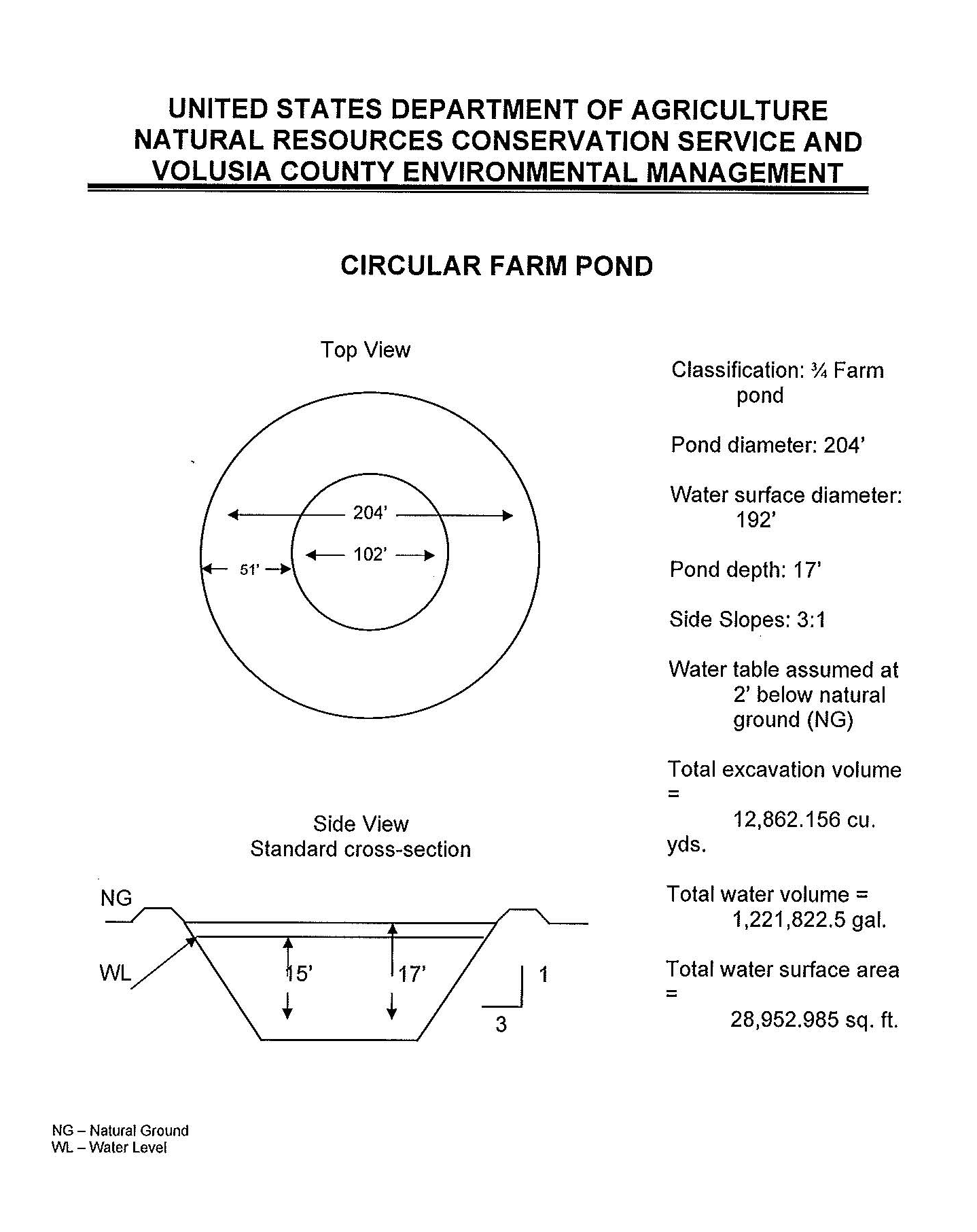
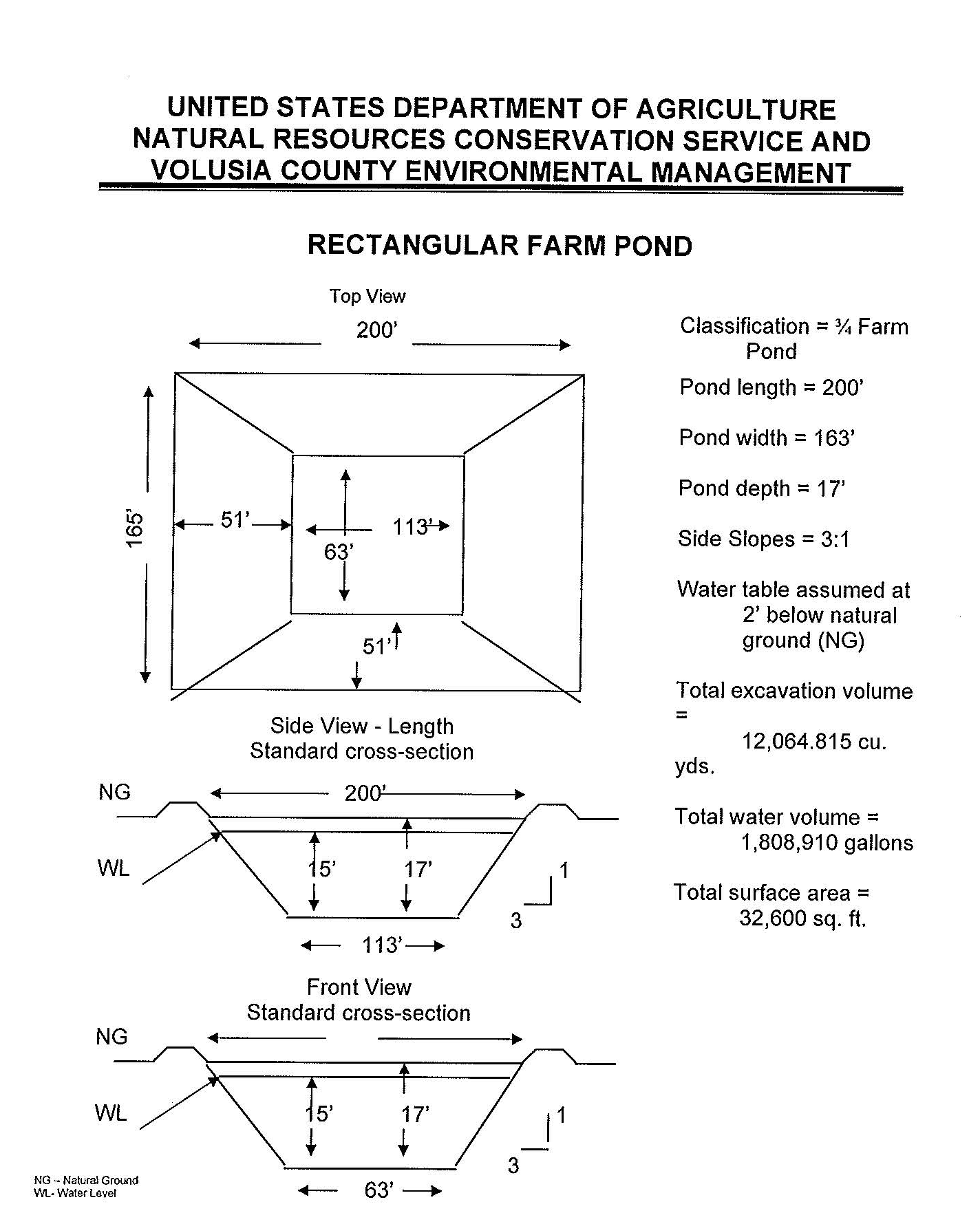
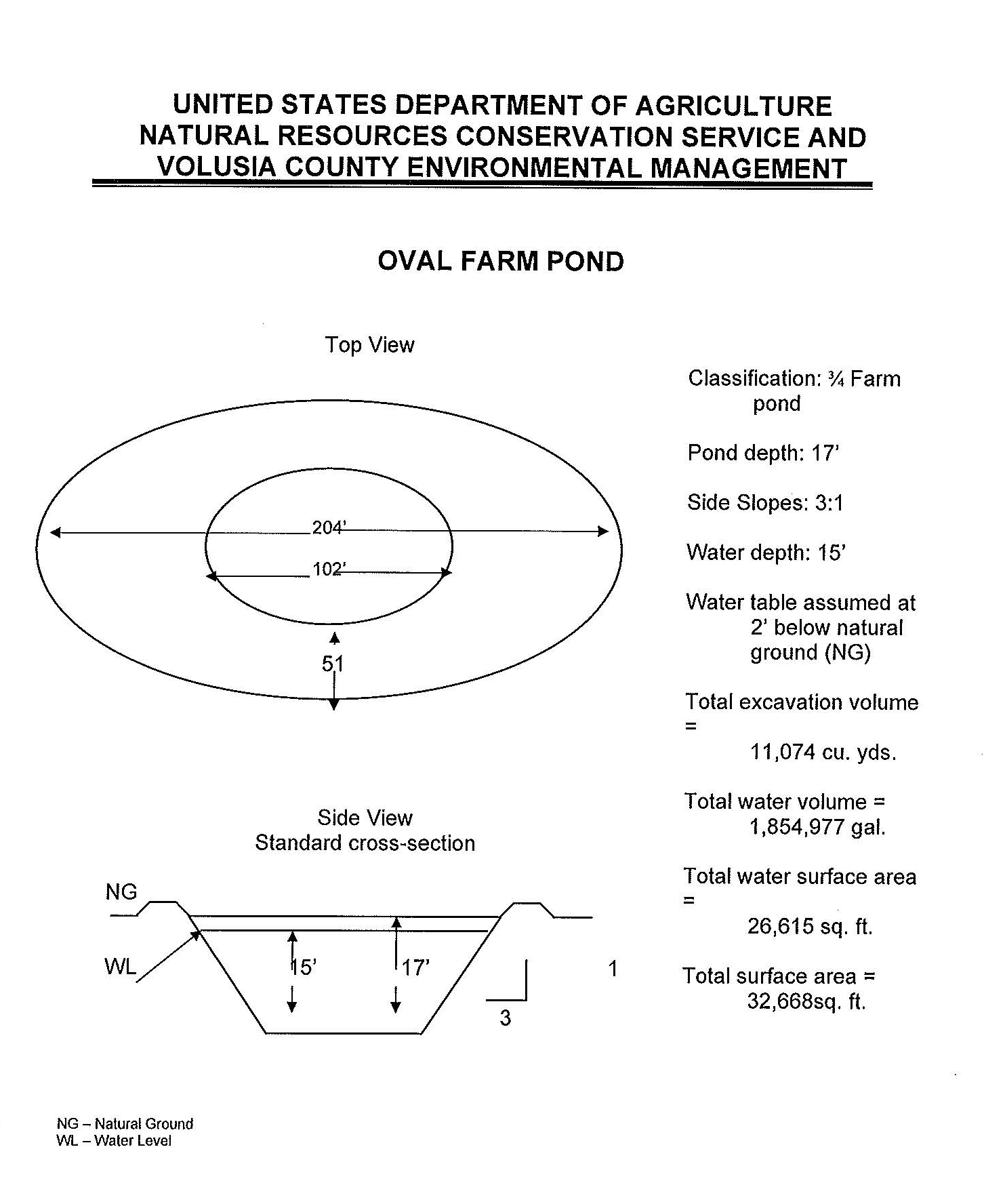
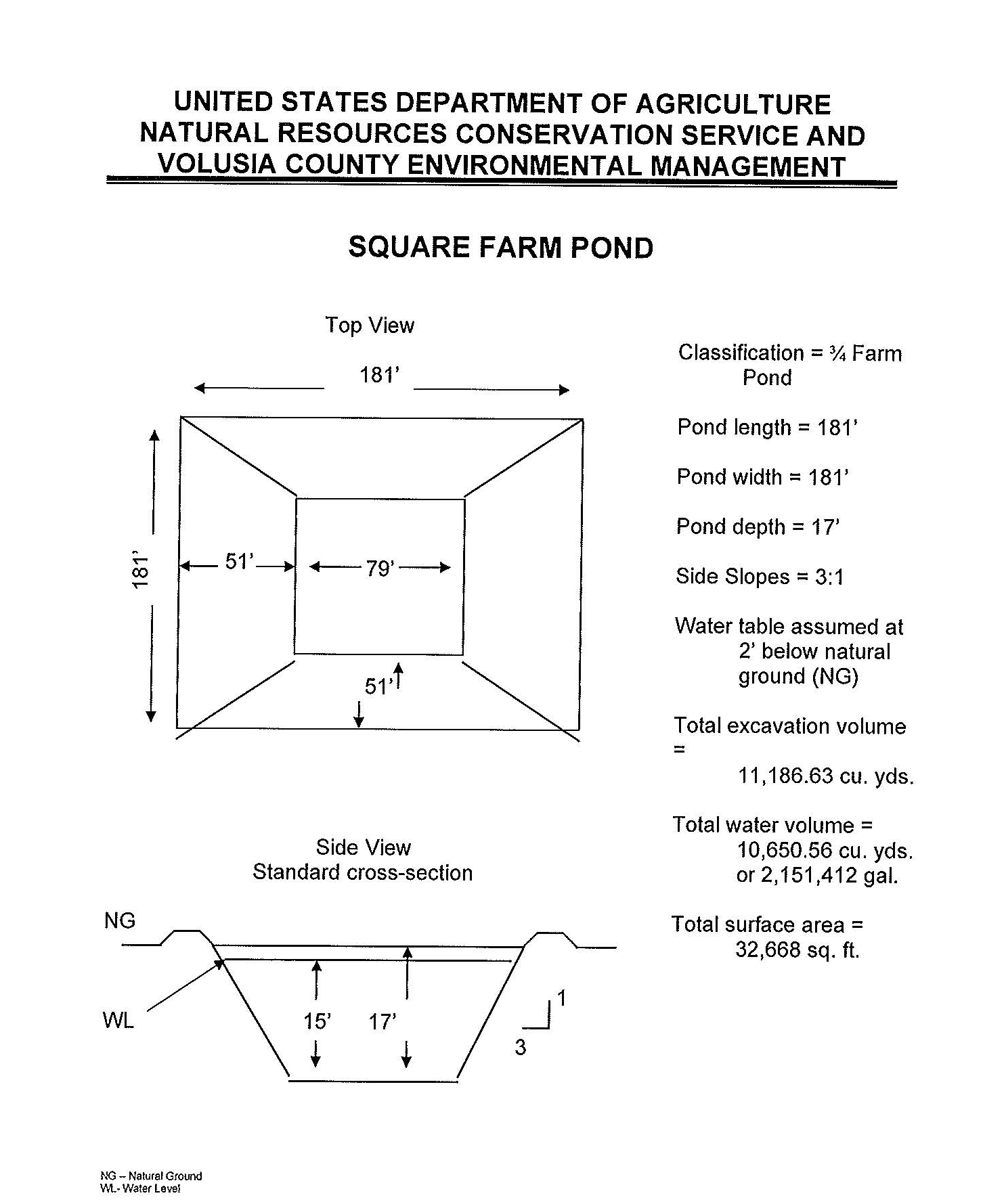
(Ord. No. 2010-13, § 1, 12-13-2010)

