
Oakdale City Zoning Code
ARTICLE 25
10. - DEVELOPMENT STANDARDS
DIVISION 25-10-200. - EXTERIOR BUILDING MATERIALS
(a)
It is the intent of this division to promote high standards for new building design and construction in the city. These exterior building material standards are set forth in order to enhance the visual appearance of the non-residential, large apartment, and mixed use apartment buildings; to prevent the physical deterioration of buildings; to increase the city's tax base; to promote the general welfare of the community; and ensure new development and redevelopment contributes to enhancing the community's character and image.
(b)
Exterior building material standards shall apply to all non-residential, apartment, and mixed use apartment buildings.
(c)
Primary exterior building materials are categorized into three (3) classes—Class I, Class II, Class III—and shall be applied in the following manner:
(1)
To qualify as a primary material, a building material must comprise at least five (5) percent of the exterior building facades.
(2)
Garage doors, window trim, flashing accent items and the like, shall not constitute primary materials.
(3)
The use of Class II or III materials may be vary for each building facade as long as the average across all building facades meets the minimum or maximum standards.
(d)
Primary Classes of Materials. For the purpose of this division, primary materials shall be categorized as Class I; Class II; and Class III as follows:
(1)
Class I shall be considered high-quality building materials that are long-lasting and able to withstand wear and tear. Class I materials are considered architecturally desirable and are designed for the climate conditions the material will commonly be exposed to resulting in a typical material life expectancy of forty (40) years or more.
(2)
Class II shall be considered standard building materials. Class II materials are considered architecturally desirable and are designed for the climate conditions the material will commonly be exposed to resulting in a typical material life expectancy of twenty (20) years or more.
(3)
Class III shall be considered lower-cost and trim grade materials. Class III materials are considered aesthetically incompatible as a primary building material with Class I or Class II materials or are materials which are typically more prone to damage or degradation of material quality from weatherization resulting in a typical material life expectancy of twenty (20) years or less.
Table 10-1. Exterior Building Material Classes
(e)
Buildings shall be composed of materials from Table 10-1 Exterior Building Material Classes in the following manner:
Table 10-2. Exterior Building Material Distribution
1 Buildings may be constructed primarily of one (1) specific Class 1 material provided the design is superior to the general intent of this division and provides variation in detailing, footprint of the structure, or deviations in long wall sections to provide visual interest.
(Ord. No. 948, § 2, 7-8-25; Ord. No. 959, § 8, 1/27/26)
DIVISION 25-10-400. - LIGHTING
(a)
Parking areas in commercial and industrial developments shall be adequately lit for the safety of vehicular and pedestrian movements.
(b)
No light which is flashing, revolving or otherwise resembles a traffic control signal shall be allowed in any area where it could create a hazard for passing vehicular traffic.
(c)
All exterior lighting shall be designed and arranged to direct illumination away from adjacent properties. The source of lights shall be hooded or controlled in some manner so as not to light adjacent property.
(d)
Glare, whether direct or reflected, as differentiated from general illumination, shall not be visible beyond the limits of the site from which it originates.
(e)
Lighting shall be designed such that there is a maximum 0.5 footcandles at any property line.
(f)
Site lighting shall have a maximum height of thirty (30) feet to the illumination source. Site lighting for public recreational uses shall have a maximum height of seventy (70) feet to the illumination source.
(g)
A photometric plan inclusive of all site lighting and specification sheets for each lighting fixture shall be submitted for review.
(Ord. No. 948, § 2, 7-8-25)
DIVISION 25-10-900. - LAND RECLAMATION, EXCAVATION, AND SOIL PROCESSING
(a)
Land reclamation, excavation, and soil processing shall require the issuance of a interim use permit for each project, and the issuance of such a permit shall always require the prior consultation of the City Council with the Public Works Director and City Engineer.
(b)
A performance bond, irrevocable letter of credit, or cash deposit shall be required to guarantee that proposed work is done satisfactorily.
(c)
Any permit issued for land reclamation shall specify plans and programs for the finished grade which will not adversely affect the adjacent land, the type of fill permitted, rodent control, fire control and general maintenance of the site, vehicular ingress and egress, material disbursed by wind or by hauling of material to or from the site, surface water drainage, site restoration. Hours of operation shall be specified. The Council may also apply any other regulations it sees fit to protect the interest of the public. Such permit shall be granted for a specified period.
(d)
Any permit issued for soil processing shall include as a condition thereof a site plan where the processing is to be done, showing the location of the plant, disposal of water, and the route of trucks moving to and from the site in removing processed material from the site. Such permit shall be granted for a specified period.
(Ord. No. 948, § 2, 7-8-25)
Sec. 25-10-101. - Development Review Committee.
(a)
The Development Review Committee (DRC) shall consist of at least three (3) members of the City Staff, to be appointed by the City Administrator. The DRC shall determine technical conformance of proposed developments with the requirements of this article.
(b)
If the DRC determines that the plans comply with the intent and standards of this article, a building permit may be issued. All decisions of the DRC may be appealed to the City Council whose decision shall be final. The City Council shall refer such an appeal to the Planning Commission first for a recommendation.
(Ord. No. 948, § 2, 7-8-25)
Sec. 25-10-102. - Performance Standards.
(a)
Glare, Smoke, Dust, Odors, and Noise.
(1)
The emission of smoke, odor, or particulate matter by any use shall be in compliance with and regulated by the State of Minnesota Pollution Control Standards and Minnesota Pollution Control Agency Regulations.
(2)
Noises emanating from any use shall be in compliance with and regulated by the State of Minnesota Pollution Control Standards, Minnesota Regulations.
(b)
Radiation and Electrical Emissions.
(1)
All activities that emit radioactivity shall comply with the minimum requirements of the Minnesota Pollution Control Agency.
(2)
All activities which create electrical emissions shall comply with the minimum requirements of the Federal Communications Commission.
(c)
Bulk Storage (Liquid).
(1)
All uses associated with the bulk storage of all gasoline, oil, liquid fertilizer, chemical, flammable and similar liquids shall comply with requirements of the Minnesota State Fire Marshal, Minnesota Pollution Control Agency, and Minnesota Department of Agriculture Offices and have documents from those offices stating the use is in compliance.
(Ord. No. 948, § 2, 7-8-25)
Sec. 25-10-103. - Vision Triangle.
(a)
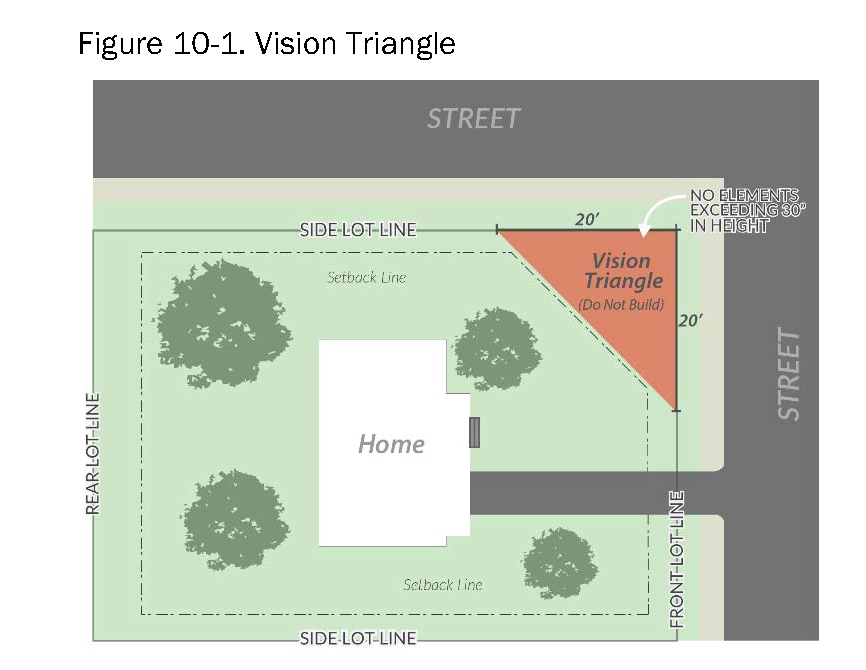
On corner lots in all districts, no structure or planting in excess of thirty (30) inches above the street center line grade shall be permitted within a triangular area defined as follows: beginning at the intersection of the projected property lines of two (2) intersecting streets, thence twenty (20) feet along one (1) property line, thence diagonally to a point twenty (20) feet from the point of beginning on the other property line, thence to the point of beginning.
(Ord. No. 948, § 2, 7-8-25)
Sec. 25-10-104. - Surface Water Ponding.
(a)
If the multiple unit residential, commercial, or industrial site is over one (1) acre in size and the subdivision does not provide a regional basin in conformance with the requirements of Appendix C of the Oakdale Surface Water Management Plan, on-site ponding and infiltration will be required to comply with Appendix C. The applicant shall enter into a Maintenance Agreement for the ponding area and have the agreement recorded against the property.
(Ord. No. 948, § 2, 7-8-25)
Sec. 25-10-301. - General Provisions.
(a)
Change of Use or Occupancy of Buildings. Any change of use or occupancy of any building or buildings, including additions thereto requiring more parking, shall not be permitted until there is furnished such additional parking space as required by these zoning regulations.
(b)
Maintenance.
(1)
It shall be the joint and several responsibility of the lessee and owner of the principal use, uses or building to maintain in a neat and adequate manner, all aspects of the parking area, including but not limited to parking spaces, access ways, striping, landscaping, and required fences.
(2)
Parking lots existing prior to the adoption of this ordinance shall not be exempt from the requirement.
(Ord. No. 948, § 2, 7-8-25)
Sec. 25-10-302. - Parking and Driveways for Single-Unit Detached and Two-Unit Dwellings.
(a)
Parking in residential areas shall be limited to driveways and garages only, except as provided in the City Code. Private passenger vehicles must be parked on a driveway or in a garage, or on an additional off-street parking area. Parking is not permitted on grass vegetation, or other permeable surfaces.
(1)
Additional off-street parking shall be allowed on the side yard, behind the front setback, for the length of the principal structure provided the parking is located five (5) feet from any property line.
(2)
The driveway on the property may have an approach to the additional off-street parking area.
(b)
Off-street parking shall be utilized only for the following items:
(1)
Currently licensed and operable passenger vehicles having a lawful capacity of nine (9) passengers or less;
(2)
For the parking of one (1) commercial usage vehicle per dwelling unit, provided that it is parked in a garage or other lawfully constructed building;
(3)
For the parking of one (1) public utility vehicle registered to a company that provides emergency repair services and is used by the occupant of the residence.
(4)
For the parking of recreational vehicles as specified in Section 25-09-215 Recreational Vehicle Storage.
(c)
No more than four (4) motor vehicles per lawful dwelling unit may be parked or stored anywhere outside on residential zoned property; the Community Development Director can authorize exceptions. This maximum number does not include vehicles of occasional guests.
(d)
Driveway Design.
(1)
All off-street parking spaces shall have access from driveways and not directly from the public street.
(2)
Curb Cuts:
(A)
Number of Curb Cuts:
(i)
All property shall be entitled to at least one (1) curb cut.
(ii)
Single-unit dwellings shall be limited to one (1) curb cut access per property.
(iii)
For all other uses, each property shall be allowed one (1) curb cut access for each one hundred (100) feet of street frontage.
(iv)
These conditions shall apply unless otherwise granted approval by the City Council.
(B)
No curb cut access shall be located less than forty (40) feet from the intersection of two (2) or more street rights-of-way. This distance shall be measured from the intersection of lot lines.
(C)
No driveway access curb opening on a public street shall be located less than forty (40) feet from another.
(D)
No curb cut access shall exceed twenty-four (24) feet in width at the gutter elevation unless approved by the City Engineer.
(3)
Driveways shall be located at least five (5) feet from any side or rear property line.
(4)
Surfacing:
(A)
All driveways to be utilized for parking in front of the front setback shall be surfaced with bituminous, concrete, or brick. Additional off-street parking areas to be surfaced with bituminous, concrete, brick, Class V, or other materials as approved by the City.
(B)
Approaches from the driveway to the additional off-street parking area shall be surfaced with bituminous, concrete, or brick. Plans for surfacing and drainage of driveways and stalls shall be submitted to the City Engineer for review and the final drainage plan shall be subject to written approval by the City Engineer.
(5)
Where a proposed driveway is to be constructed so that it opens onto any street designated as either a Minnesota State, Washington County, or U.S. Trunk Highway, in addition to the requirements of this division, all specifications of the appropriate highway departments will apply, and the required permits shall be obtained from the appropriate department.
(Ord. No. 948, § 2, 7-8-25)
Sec. 25-10-303. - Parking and Driveways for Multi-Unit Residential and Non-Residential Uses.
(a)
Parking Design.
(1)
Parking Dimensions: The following shall be the minimum parking space dimensions:
Table 10-3. Parking Dimensions
(2)
Within Structures: The off-street parking requirements may be furnished by providing spaces that are designated within the principal building or structure attached thereto; however, unless provisions are made, no building permit shall be used to convert said parking structure into a dwelling unit or living area or other use until adequate provisions are made to comply with the required off-street parking regulations of this division.
(3)
Parking areas and circulation drives shall be set back at least five (5) feet from any lot line.
(4)
Circulation between Bays:
(A)
Parking areas shall be designed so that circulation between parking bays or aisles occur within the designated parking lot and does not depend upon a public street or alley.
(B)
Parking area design which requires backing into the public street is prohibited.
(5)
Grade: The grade elevation of any parking area shall not exceed five percent (5%).
(6)
Striping: All parking stalls shall be marked with painted lines not less than four (4) inches wide.
(7)
Curbing: All open off-street parking shall have a concrete curb according to the direction of the City Engineer.
(8)
Lighting: Any lighting used to illuminate an off-street parking area shall be so arranged as to reflect the light away from adjoining property, abutting residential uses and public rights-of-way and be in compliance with this article.
(9)
Signs: No sign shall be so located as to restrict the sight lines and orderly operation and traffic movement within any parking lot. All signs shall conform to the Oakdale Sign Code.
(b)
Driveway Design.
(1)
All off-street parking spaces shall have access from driveways and not directly from the public street.
(2)
Curb Cuts.
(A)
Number of Curb Cuts:
(i)
All property shall be entitled to at least one (1) curb cut.
(ii)
Each property shall be allowed one (1) curb cut access for each one hundred (100) feet of street frontage.
(iii)
These conditions shall apply unless otherwise granted approval by the City Council.
(B)
No curb cut access shall be located less than forty (40) feet from the intersection of two (2) or more street rights-of-way. This distance shall be measured from the intersection of lot lines.
(C)
No driveway access curb opening on a public street shall be located less than forty (40) feet from another.
(D)
No curb cut access shall exceed twenty-four (24) feet in width at the gutter elevation unless approved by the City Engineer.
(3)
Driveways shall be located at least five (5) feet from any side or rear property line.
(4)
Surfacing:
(A)
All driveways to be utilized for parking in front of the front setback shall be surfaced with bituminous, concrete, or brick. Additional off-street parking areas to be surfaced with bituminous, concrete, brick, Class V, or other materials as approved by the city.
(B)
Approaches from the driveway to the additional off-street parking area shall be surfaced with bituminous, concrete, or brick. Plans for surfacing and drainage of driveways and stalls shall be submitted to the Public Works Director/City Engineer for review and the final drainage plan shall be subject to written approval by the Public Works Director/City Engineer.
(5)
Where a proposed driveway is to be constructed so that it opens onto any street designated as either a Minnesota State, Washington County or U.S. Trunk Highway, in addition to the requirements of this division, all specifications of the appropriate highway departments will apply, and the required permits shall be obtained from the appropriate department.
(Ord. No. 948, § 2, 7-8-25)
Sec. 25-10-304. - Parking Spaces Required.
(a)
The minimum number of off-street parking spaces as specified in Table 10-4 below shall be provided and maintained by ownership, easement and/or lease for and during the life of the respective uses hereinafter set forth.
(b)
Computation of Required Spaces.
(c)
The total number of minimum parking spaces required may be reduced by up to forty percent (40%) with Conditional Use Permit approval if at least one (1) of the following criteria are met:
(1)
Floor Area. The term "floor area" for the purpose of calculating the number of off-street parking spaces required shall be determined on the basis of the exterior floor area dimensions of the buildings, structure or use times the number of floors minus ten percent (10%).
(2)
Where fractional spaces result, the parking spaces required shall be construed to be the nearest whole number.
(3)
The parking space requirement for a use not specifically mentioned herein shall be the same as required for a similar use as determined by the Community Development Director.
(4)
When computing total number of parking spaces required for a use, individual activities within the use will be calculated separately and added together to arrive at the total required parking spaces for each specific use proposed.
Table 10-4. Minimum Parking Spaces Required
The total number of minimum parking spaces required may be reduced by up to 40% with Conditional Use Permit approval if at least one (1) of the following criteria are met:
(1)
Proof of parking for all spaces required by this ordinance is provided. If the applicant clearly demonstrates that the required parking is in excess of the actual demand, all of the required parking need not be initially constructed. The remainder of the parking spaces not initially needed, as shown on the site plan, are to be constructed by the applicant if and when the city determines that the additional parking spaces are needed. The area of future parking must be sodded and kept free of buildings, shrubs, and trees.
(2)
A parking study prepared by a licensed engineer is provided that demonstrates no adverse effects resulting from a reduced number of parking spaces.
(3)
The applicant clearly demonstrates that there is no substantial conflict in the hours of peak parking demand for two (2) or more uses which may be located within the same structure(s).
(d)
The total number of minimum of parking spaces may be reduced by up to ten percent (10%) if the site is within a half mile of a Metropolitan Council-operated bus stop served by a bus route that operates at a weekday average frequency of thirty (30) minutes or less.
(Ord. No. 948, § 2, 7-8-25)
Sec. 25-10-305. - Joint Parking Facilities.
(a)
Two (2) or more buildings or uses may collectively provide off-street parking where the total number of spaces provided is less than the sum of the total required for each use should they be provided separately.
(b)
Conditions required for joint use are:
(1)
The building or use for which application is being made to utilize the off-street parking facilities provided by another building or use shall be located within three hundred (300) feet of such parking facilities.
(2)
The applicant shall show that there is no substantial conflict in the operating hours of two (2) or more buildings or uses for which joint use of off-street parking facilities is proposed.
(3)
A properly drawn, legal instrument, executed by the parties concerned for joint use of off-street parking facilities, duly approved as to form and manner of execution by the City Attorney, shall be filed with the City Clerk and recorded with Washington County Property Records.
(Ord. No. 948, § 2, 7-8-25)
Sec. 25-10-306. - Off-Site Parking.
Any off-site parking which is used to meet the requirements of this division shall be subject to the conditions listed below:
(a)
Off-site parking shall be developed and maintained in compliance with all requirements and standards of this division.
(b)
Reasonable access from off-site parking facilities to the use being served shall be provided.
(c)
Off-site parking for multiple family dwellings shall not be located more than one hundred (100) feet from any normally used entrance of the principal use served.
(d)
Off-site parking for non-residential uses shall not be located more than three hundred (300) feet from the main entrance of the principal use being served. No more than one (1) main entrance shall be recognized for each principal building.
(e)
When required accessory off-street parking facilities are provided elsewhere than on the lot in which the same ownership or control, either by deed or long-term lease, as the property occupied by such principal use, the owner of the principal use shall file a recordable document with the city requiring the owner and his or her heirs and assigns to maintain the required number of off-street spaces during the existence of said principal use.
(Ord. No. 948, § 2, 7-8-25)
Sec. 25-10-307. - Parking Lot Landscaping.
(a)
Grass, plantings, or surfaced material shall be provided in all areas bordering an off-street parking area.
(b)
Landscaping shall mean, at a minimum, the use of trees and ground cover defined as grass, shrubs, or other material allowing water to seep through the ground. Berming may also be used. Unless approved by the City Engineer, berm profile shall not exceed a slope of one (1) foot of elevation in three (3) horizontal feet.
(c)
Side yard landscaping requirements for parking areas may be reduced if the developer proposes to locate their parking area next to an existing or proposed parking lot on an adjacent parcel owned by others and the owners have a written agreement to allow joint parking and a common driveway. However, only the common boundary to be used for parking will qualify. In such cases, the sum of the parking area of the two (2) owners will determine the landscaping requirements within the total parking area.
(Ord. No. 948, § 2, 7-8-25)
Sec. 25-10-308. - Electric Vehicle Charging Stations.
(a)
Electric vehicle charging station infrastructure shall be installed in compliance with the state building and electrical codes.
(b)
The installation of electric vehicle supply equipment shall not reduce the overall minimum parking space area dimensions below those required in this division.
(c)
Parking spaces equipped with electric vehicle charging infrastructure shall count toward meeting minimum parking space requirements.
(d)
All electric vehicle charging station wayfinding and station signage shall conform to the standards in Article 25-11 Signage.
(e)
Individuals seeking to install electric vehicle charging infrastructure in residential and non-residential settings should refer to the recommendations in the City of Oakdale Electric Vehicle Charging Infrastructure Guidelines document.
(Ord. No. 948, § 2, 7-8-25)
Sec. 25-10-309. - Installation of Asphalt Driveways and Parking Lots.
(a)
The following procedure and specifications shall be required for all asphalt driveway construction from streets to private garages, and for all parking lot construction. Work conducted within the Right-of-Way shall follow the procedures of Chapter 20 Right-of-Way Management.
(1)
The driveway or parking lot shall be excavated to remove all organic or other unstable soils from the area to be surfaced.
(2)
The area to be surfaced shall be graded and compacted to the elevation that will permit the placement of the full pavement section.
(3)
Minimum pavement sections for driveways and parking lots shall be:
(A)
Driveways for residential buildings with four (4) units or less per building: 2331 bituminous wearing course two (2) inches compacted Class V aggregate base—six (6) inches compacted.
(B)
Parking lots and driveways for residential buildings with more than four (4) units per building, and commercial, industrial, and institutional areas: 2341 bituminous wearing course—two (2) inches compacted 2331 bituminous binder course—two (2) inches compacted Class V aggregate base, six (6) inches compacted unless alternates are approved, in writing, by the city. In all cases, alternate pavement sections shall be considered only if sufficient data to justify another pavement design, based on the current Minnesota Highway Department design procedure for flexible pavement is submitted as part of a formal alternate request. If, based on the plan that is presented, the Building Official determines that the proposed driveway or parking lot construction is not deemed adequate due to traffic volumes or types of traffic, additional construction materials may be required by the city, based on Minnesota Highway Department design criteria.
(4)
The performance of the work and the quality of materials shall be in accordance with the latest revision of the State of Minnesota, Department of Highways Standard specifications for Highway Construction.
(5)
The Building Official shall be granted access to the improvement area during all phases of construction. The contractor or owner shall arrange for inspections of the grading work, the aggregate base placement, and the bituminous course placement, by the Building Official prior to proceeding with the subsequent work phase. Any and all stability, compaction, gradation, or other material or placement tests that the Building Official may request shall be provided by the contractor or owner through a testing company acceptable to the city.
(6)
Driveways and parking lots shall be constructed so as to provide drainage from the garage to the street or storm sewer system, unless an alternative method is approved by the Building Official.
(7)
Installation of metal utility covers on curb boxes and clean-outs in paved areas is required.
(Ord. No. 948, § 2, 7-8-25)
Sec. 25-10-310. - Off-Street Loading.
(a)
All required loading berths shall be off-street and located on the same lot as the building or use to be served.
(b)
Each loading berth shall be located with appropriate means of vehicular access to a street or public alley in a manner which will cause the least interference with traffic.
(c)
Except for loading berths required for apartments, no loading berth shall be located closer than fifty (50) feet from a residential district unless within a structure.
(d)
Loading berths shall not be located within the front yard setback.
(e)
Loading berths located at the front or at the side of buildings on a corner lot shall observe the following requirements:
(1)
Loading berths shall not conflict with pedestrians
(2)
Loading berths shall not obstruct the view of the public right-of-way from off-street parking access; and
(3)
Loading berths shall comply with all other requirements of this article.
(Ord. No. 948, § 2, 7-8-25)
Sec. 25-10-501. - City Approval Required.
(a)
A zoning permit shall be obtained for fences less than seven (7) feet in height prior to the construction of the fence.
(b)
A building permit shall be obtained for any fence seven (7) feet in height or more which is intended to be a permanent structure on the premises, except on a farm and related to farming activities.
(Ord. No. 948, § 2, 7-8-25)
Sec. 25-10-502. - Construction and Maintenance.
(a)
Fences may be located up to any property line, but shall not be located within the right-of-way.
(b)
Fences may be located within drainage and utility easements at the property owner's risk. Any fences located within drainage and utility easements may be subject to future removal for work conducted by the City of Oakdale or utility providers.
(c)
Fences shall be constructed so that their more attractive side faces neighboring property, and the most exposed area of the fence post faces the permitted resident.
(d)
Every fence shall be maintained in a condition of reasonable repair and shall not be allowed to become and remain in a condition of disrepair or danger, or constitute a nuisance, public or private. Any such fence which is, or has become dangerous to the public safety, health or welfare, is a public nuisance and the Oakdale Building Official shall commence proper proceedings for the abatement thereof.
(Ord. No. 948, § 2, 7-8-25)
Sec. 25-10-503. - Fencing Material.
(a)
Every fence shall be constructed in a substantial, workmanlike manner and of substantial material reasonably suited for the purpose for which the fence is proposed to be used.
(b)
Link fences shall be constructed in such a manner that no barbed ends shall be at the top except in the B-4 General Industrial District.
(c)
Electric fences shall only be permitted on farm property when related to farming and on farms in other districts when related to farming, but not as boundary fences.
(d)
Barbed wire fences shall only be permitted on farms or for properties with high-security needs.
(Ord. No. 948, § 2, 7-8-25)
Sec. 25-10-504. - Residential District Fences.
(a)
Fence Height.
(1)
For all properties in residential districts, excluding farms, fences are limited to eight (8) feet in height.
(2)
No fence shall be erected in any required front yard to a height in excess of four (4) feet.
(3)
No fence in excess of four (4) feet shall be erected within the required corner side setback area of a corner lot.
(4)
Fences on corner lots must receive special consideration from the Oakdale Building Official to assure site safety before a zoning permit or building permit is issued. This review may require the applicant to pay an additional fee if extraordinary means need to be taken to ascertain impacts (e.g. consultation by a Traffic Engineer).
(5)
Fences greater than six (6) feet in height shall submit a Certificate of Survey with the permit application, and all pertinent property pins shall be visible upon inspection. Fences shall be constructed within the provisions of the Minnesota State Building Code (MSBC).
(6)
In those instances where a fence exists as an enclosure which restricts access from the front to the rear yard, a gate, identifiable collapsible section, or other such means of recognizable ingress shall be unobstructed and a minimum of three (3) feet in width. The location of such ingress points shall be positioned at any point paralleling the front lot line, between the side lot property line and the principal structure.
(Ord. No. 948, § 2, 7-8-25)
Sec. 25-10-505. - Commercial and Industrial District Fences.
(a)
Fences in all Commercial and Industrial districts shall not exceed ten (10) feet in height.
(Ord. No. 948, § 2, 7-8-25)
Sec. 25-10-506. - Special Purpose Fences.
(a)
Fences for special purposes and fences differing in construction from the provisions listed within this division may be permitted in any district in the City of Oakdale by issuance of a conditional use permit.
(b)
Findings shall be made that the fence is necessary to protect, buffer, or improve the premises for which the fence is intended.
(Ord. No. 948, § 2, 7-8-25)
Sec. 25-10-507. - Retaining Walls.
(a)
Retaining walls over four (4) feet in height require a building permit.
(b)
Exposed areas of retaining walls shall be constructed of a permanent material and finish and shall be of a color compatible with the principal structure.
(Ord. No. 948, § 2, 7-8-25)
Sec. 25-10-601. - General Landscaping Requirements.
(a)
A landscape plan shall be submitted and approved in conjunction with any site plan application.
(b)
All exposed ground areas surrounding or within a principal or accessory use including street boulevards which are not devoted to drives, sidewalks, patios, other such uses shall be landscaped with a combination of trees, shrubs, flowers, and ground cover materials including native plantings.
(c)
For multi-unit residential, commercial, industrial uses, and institutional uses, these areas shall be landscaped, inspected, and certified by a professional landscape architect licensed by the State of Minnesota.
(d)
All areas not otherwise improved in accordance with approved site plans shall be sodded. Exceptions to the above provision are as follows:
(1)
Seeding of future expansion areas as shown on approved plans.
(2)
Undisturbed areas containing existing viable natural vegetation that can be maintained free of foreign and noxious plant material.
(3)
Areas designated as open space or future expansion areas properly planted and maintained with prairie grass.
(4)
Use of mulch material such as rock or wood chips in support of shrubs and foundation plantings.
(e)
All landscaped areas shall be kept neat, clean and uncluttered.
(f)
Landscaped areas shall not be used for the parking of vehicles or the storage or display of materials, supplies or merchandise.
(g)
Public parks shall not be required to meet the landscaping requirements of this chapter.
(Ord. No. 948, § 2, 7-8-25)
Sec. 25-10-602. - Landscaping Design Standards.
Landscaping for all lots shall be designed to meet the following standards:
(a)
Required Plantings.
(1)
Single-unit and two-unit dwellings.
(A)
At least two (2) trees shall be planted per lot. At least one (1) of these trees shall be planted in the front yard.
(B)
The trees planted on a single lot shall include at least two (2) different genera.
(2)
All other uses.
(A)
There shall be a minimum of one (1) tree planted per one thousand (1,000) square feet of the site not occupied by buildings. The area of the following uses may be removed from the non-building area at the City Council's discretion:
(i)
Sports fields or other outdoor recreational use areas.
(ii)
Urban farm plots.
(iii)
Plazas, patios, terraces, and other outdoor open space areas designed for people.
(3)
In addition, the minimum number of overstory trees along the boulevard shall be one (1) overstory tree per fifty (50) linear feet of lot frontage. If the preferred landscaping technique is to cluster the boulevard trees instead of one (1) tree per fifty (50) feet, it may be deemed allowable if it is determined workable by the Development Review Committee.
(A)
The complement of trees fulfilling this requirement shall be not less than twenty-five percent (25%) overstory deciduous and not less than twenty-five percent (25%) coniferous. For difficult soil conditions or unique sites, coniferous trees may be reduced up to one quatrter (¼) of their specified percentage (i.e. coniferous 25% reduced 1/4 to net 17.5%).
(B)
All trees selected for landscaping must specify a minimum of two (2) varieties of each species.
(b)
Minimum Plant Size. All vegetation installed to meet the requirements of this Division shall meet the minimum size at installation as identified in Table 10-5 Minimum Plant Size.
Table 10-5. Minimum Plant Size
(c)
Species.
(1)
All trees used in site developments shall be indigenous to the appropriate hardiness zone and physical characteristics of the site.
(2)
All deciduous trees proposed to satisfy the minimum requirements of this division shall be long-lived hardwood species.
(3)
No trees may be planted which are a noxious or invasive tree species, including those identified on the MN Department of Natural Resources "Invasive Non-Native Plants" list.
(d)
Existing Tree Credit. Credit for the retention of existing trees meeting the species, size, and location requirements of this division may be used to satisfy the minimum number requirements set forth in this division.
(e)
It is the responsibility of the owner to ensure to the longevity and maintenance of all plantings. If any plantings were to die within a year of construction, the owner must replace such plantings to be in compliance with the standards in this division.
(f)
Slopes and Berms. Final slope grades steeper than the ratio of 3:1 shall not be permitted without special landscaping treatments such as terracing, retaining walls, ground cover, or engineered surface treatment.
(g)
Landscape and screening plantings shall be installed within one (1) year from the date of issuance of the building permit. If plantings have not been installed at this time, the city may require the applicant to provide a financial guarantee to ensure the plantings are installed according to the approved site plan.
(Ord. No. 948, § 2, 7-8-25)
Sec. 25-10-603. - Parking Lot Requirements.
(a)
Parking lots are required to landscape five percent (5%) of the parking lot surface area within the parking setback.
(b)
The landscaped area may be in the form of landscape islands or as setback areas that are incorporated into the parking lot.
(c)
Landscape islands shall be a minimum width of sixteen (16) feet and a minimum surface area of four hundred (400) square feet. A minimum of six hundred (600) cubic feet of soil is required for each tree.
(d)
The landscaped area shall adhere to the size and material requirements of this ordinance.
(Ord. No. 948, § 2, 7-8-25)
Sec. 25-10-701. - Required Elements to be Screened.
(a)
The following elements shall be screened from residential uses and adjacent public streets and the public front and office sides of all commercial and industrial uses, except at access points:
(1)
Areas of outdoor storage; external loading and service areas; service and delivery parking in outdoor areas
(A)
The screening requirements will be satisfied through the use of walls, earthen berms, hedges, and other landscape materials as follows:
(i)
The placement of the building on the lot or the placement of a building on an adjacent lot.
(ii)
Berming at least three (3) feet in height with a maximum slope ratio of 3:1.
(iii)
Landscaping.
a.
Landscaping shall produce a screen that is at least eighty percent (80%) opaque at the time of maturity.
b.
Planting screens shall consist of healthy, hardy plant materials at least six (6) feet in height.
c.
Evergreen shrubs used for screening purposes shall be at least three (3) feet in height at planting. Evergreen shrubs will have a minimum spread of twenty-four (24) inches.
(iv)
Screen walls or fences of similar type, material, quality, and appearance as that of the principal structure. Such screens shall be at least six (6) feet in height and provide a minimum opaqueness of eighty percent (80%).
(v)
If the topography, existing vegetation, permanent structure, or other features create a barrier that meets the standards of this division, they may be substituted.
(b)
Parking lots.
(1)
Such screening shall be at least seventy percent (70%) opaque and a maximum height of three (3) feet.
(2)
The screen may consist of:
(i)
Plant materials;
(ii)
Wood, concrete, masonry or ornamental iron;
(iii)
Berming; or
(iv)
A combination of these materials.
(B)
On a corner lot, and at entrances, nothing shall be placed or allowed to grow in such a manner as to impede vision as established in Section 25-10-103 Vision Triangle.
(3)
Trash, recycling, and related handling equipment.
(A)
All trash, recycling, and related handling equipment shall be stored within the principal structure, within an attached structure accessible from within the principal structure, or within an unattached structure. Such attached storage area shall be separated from the principal structure by a firewall.
(i)
Such structure shall be of the same material and architecturally harmonious with principal structure and shall be enclosed by a roof and readily served through a door or gate system properly designed and constructed for abusive use.
(ii)
In Industrial Zones, an attached two-sided structure, or an unattached three-sided structure, without an overhead door or roof, may be allowed for containers that must be truck lifted and not manually positioned.
(B)
Recycling areas shall also be provided.
(C)
Any changes to trash handling once the building is constructed shall comply with the above and meet with approval of the Development Review Committee (i.e. new tenants).
(4)
Mechanical equipment, including those utilities placed on the rooftop or around the building perimeter:
(A)
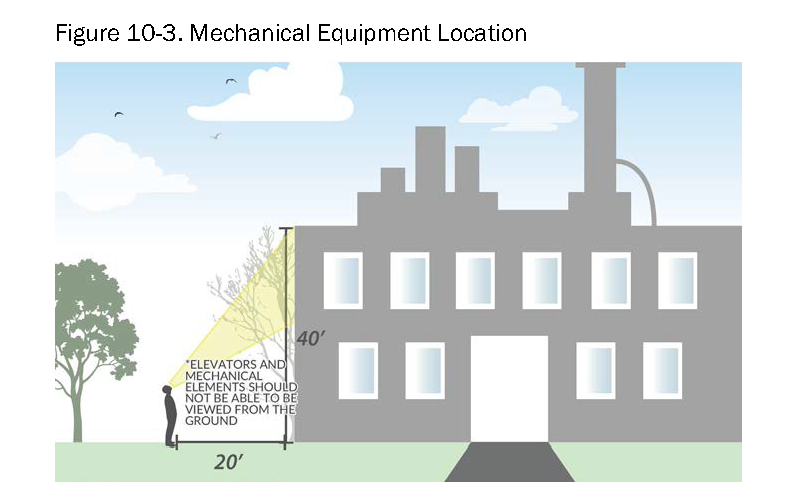
The ground level view of all rooftop equipment including rooftop structures related to elevators and other mechanical utilities, shall be located at a length equal to one-half (½) the height of the face of the building.
(B)
All mechanical equipment shall be screened with materials that are comparable and compatible with that of the exterior building materials. If due to factors unique to the property or the project, it is physically impossible or impractical to screen these utilities, the Development Review Committee, after consultation with the Planning Commission, may approve alternative solutions that renders them aesthetically compatible with the principal structure.
(5)
Commercial and industrial uses which are situated within seventy-five (75) feet of an R-1, R-2, or R-3 district.
(A)
These uses shall be screened using a combination of vegetation and a wall or fence:
(i)
The wall or fence shall be one hundred percent (100%) opaque and up to ten (10) feet in height above the level of the R-1, R-2, or R-3 property at the district boundary.
(ii)
Such wall or fence shall be set back from the property line at least ten (10) feet.
(iii)
A combination of coniferous and deciduous plants shall be planted in the setback area in order to soften the appearance of the fence or wall for the affected residential area.
(B)
Walls or fences of lesser heights or planting screens may be permitted by the City Council if there is a finding that the nature or extent of the use being screened is such that a lesser degree of screening will as adequately promote and protect the use and enjoyment of the properties within the adjacent R-1, R-2, or R-3 district, or if there is a finding that a screening of the type required by this ordinance would interfere with the provision of adequate amounts of light and air to same said properties.
(C)
Chain link fence with privacy slats shall not be used to fulfill the requirements of this section.
(Ord. No. 948, § 2, 7-8-25)
Sec. 25-10-702. - Maintenance.
(a)
Screen walls that are in disrepair shall be repaired.
(b)
Planting screens shall be maintained in a neat and healthy condition. Plantings that have died shall be promptly replaced.
(Ord. No. 948, § 2, 7-8-25)
Sec. 25-10-801. - Findings and purpose.
(a)
Findings.
(1)
The City Council has determined that there are many trees growing on public and private premises within the city, the loss of which would substantially depreciate the value of public and private premises, and impair the safety, good order, general welfare, and convenience of the public.
(2)
The City Council desires to protect the integrity of the natural environment and finds that trees, do so by providing for better air quality, scenic beauty, and noise buffer; by protection against wind and water erosion, storm water runoff, and severe weather conditions; and by providing habitat for birds and other wildlife.
(3)
Additionally, the City Council finds that mature trees take many years to replace, and such trees protect privacy and provide enhancement of property values.
(b)
Purpose.
(1)
The City Council hereby declares its intention to protect and preserve existing trees and to provide regulations relating to the cutting, removal or killing of trees, with the consequent damage and destruction of the wooded and forested areas of the city:
(A)
To promote the orderly development of such areas and thereby minimize public and private losses;
(B)
To encourage protection and preservation of the natural environment and beauty of the city;
(C)
To encourage a resourceful and prudent approach to urban development of wooded areas which provides for minimal tree loss and mitigation of tree removal resulting from development;
(D)
To provide an objective method to evaluate a development's impact on trees and wooded areas and identify whether and how the impact may be reduced; and
(E)
To provide incentive for creative land use and site design which preserves trees while allowing development in wooded areas with mitigation or tree removal and destruction.
(Ord. No. 948, § 2, 7-8-25)
Sec. 25-10-802. - Application.
(a)
These guidelines shall apply to the following site activities:
(1)
Any major subdivision application for a residential development;
(2)
Any site plan or subdivision application for a commercial, industrial, institutional, or multifamily use which will involve site grading and/or principal structure construction;
(3)
Any building permit that involves the new construction of a principal structure, the reconstruction of a principal structure, or construction that increases the building footprint of a principal structure by more than fifty percent (50%);
(4)
Grading permits that are not associated with a development or redevelopment; and
(5)
Removal of more than twenty-five percent (25%) of significant trees on any undeveloped parcel.
(b)
Tree preservation requirements for PUDs shall be determined as part of the development review process.
(Ord. No. 948, § 2, 7-8-25)
Sec. 25-10-803. - Tree preservation plan.
(a)
A Tree Preservation Plan shall include the following items:
(1)
The name(s) and address(es) of property owners, developers, or contractors.
(2)
Delineation of the buildings, structures, or impervious surfaces situated thereon or contemplated to be built thereon.
(3)
Delineation of all areas to be graded and limits of land disturbance.
(4)
Size, species, and location of all significant trees located within the site. For large wooded sites, a representative sample may be used to determine the number of significant trees outside the limits of land disturbance.
(5)
Identification of all significant trees on all individual lots. (The developer shall be required to submit a list of all lot and block numbers identifying those lots, along with the Tree Preservation Plan).
(6)
Measures to protect significant trees.
(7)
Identification of all significant trees proposed to be removed within the construction area.
(8)
Size, species, and location of all replacement trees to be planted on the property in accordance with the Tree Replacement Schedule.
(9)
Signature of the person preparing the plan.
(b)
The tree preservation plan must be prepared by an arborist, forester, or licensed landscape architect. If fewer than six (6) significant trees are proposed to be removed, the applicant may provide the tree preservation plan.
(Ord. No. 948, § 2, 7-8-25)
Sec. 25-10-804. - Process.
Unless otherwise determined by the City Council, the following process for tree preservation shall be required for all eligible site activities:
(a)
The applicant shall submit a complete tree preservation plan in accordance with Section 25-10-803 Tree Preservation Plan.
(b)
Approval:
(1)
For major subdivisions, the City Council shall approve or deny the tree preservation plan.
(2)
For all other eligible site activities described in Section 25-10-802 Application, the tree preservation plan shall be approved or denied by the Community Development Director. The decision may be appealed to the City Council.
(3)
No plat or grading plans shall be approved without an approved tree preservation plan.
(c)
The applicant shall implement the tree preservation plan prior to and during any construction.
(d)
The applicant shall provide the required security outlined in Section 25-10-808 Security following approval of the Tree Preservation Plan and prior to any construction and/or grading. The performance guarantee may be included as part of any "performance guarantee" required in conjunction with design standards, site plans, grading, and landscape plans of the City Code.
(e)
At least three (3) working days prior to construction or grading, the applicant shall be required to request approval of on-site (installed) tree protection measures from the city. No encroachment, grading, trenching, filling, compaction, or change in soil chemistry shall occur within the fenced areas protecting the root zone of the trees to be saved.
(f)
The city will continue to monitor the tree protection measures at the time of routine inspections.
(g)
The tree protection measures shall remain in place until all grading and construction activity is terminated.
(h)
The city will inspect the building site in order to determine compliance with the approved Tree Preservation Plan. The city will determine that:
(1)
Compliance has been met; or
(2)
Alternative mitigation measures have been implemented; or
(3)
Appropriate tree replacement measures have been approved by the city.
(i)
After grading, construction, and restoration for a subdivision or site plan has been completed, a forester, arborist, or landscape architect retained by the developer, shall:
(1)
Certify in writing to the city that the Tree Preservation Plan was followed.
(2)
Certify in writing to the city that the tree protection measures were installed.
(3)
Indicate which significant trees remain and which have been destroyed or damaged.
(4)
Submit a plan for city review identifying where replacement trees, if required, will be integrated into the approved landscape plan, or another plan, as required by the city.
(5)
The name(s) and address(es) of property owners and developers or contractors.
(Ord. No. 948, § 2, 7-8-25)
Sec. 25-10-805. - Tree protection measures.
(a)
Measures to protect significant trees may include, but are not limited to:
(1)
Installation of retaining walls or tree wells to preserve trees.
(2)
Installation of snow fencing, silt fence, or polyethylene laminate safety netting placed at the drip line of significant trees to be preserved.
(3)
Identification of any oak trees requiring pruning between April 15 and July 1; any oak trees so pruned shall be required to have any cut areas sealed with an appropriate tree wound sealant.
(4)
Placement of utilities in common trenches outside of the drip line of significant trees, or use of tunneled installation.
(5)
Prevention of change in soil chemistry due to concrete washout and leakage or spillage of toxic materials, such as fuels or paints.
(6)
Use of tree root aeration, fertilization, and/or irrigation systems.
(7)
Transplanting of significant trees into a protected area for later moving into permanent sites within the construction area.
(8)
Therapeutic pruning.
(b)
If any significant tree indicated to be saved on the Tree Preservation Plan is destroyed or damaged, the Tree Replacement Schedule will be enforced by the city.
(Ord. No. 948, § 2, 7-8-25)
Sec. 25-10-806. - Tree Removal.
(a)
Removal of significant trees shall be in accordance with the city-approved tree preservation plan.
(b)
The development of the site shall require the minimum removal of tree cover. The Community Development Director shall review the tree preservation plan to assess the best overall design for the project taking into account significant trees and ways to enhance the efforts of the developer or property owner to mitigate damage to significant trees.
(c)
Twenty-five percent (25%) of the existing significant trees may be removed during development without obligation of replacement.
(1)
Any removal beyond twenty-five percent (25%) will require replacement as described in Section 25-10-807 Tree Replacement.
(2)
Where practical difficulties or practical hardships result from strict compliance with the provisions of this paragraph, the Community Development Director may permit the removal of up to an additional five percent (5%) of the significant trees without requiring a variance approval by the City Council.
(d)
Trees exempt from replacement. The following types of trees shall not be included as part of the tally of tree removals and shall not be required to be replaced:
(1)
Dead, diseased, or dying trees;
(2)
Invasive species;
(3)
Trees that are transplanted from the site to another appropriate area within the city; or
(4)
Trees that were planted as part of a commercial business such as a tree farm or nursery.
(Ord. No. 948, § 2, 7-8-25)
Sec. 25-10-807. - Tree replacement.
(a)
Developers and property owners will be required to replace all significant trees that were indicated on the Tree Preservation Plan to:
(1)
Be saved, but which were ultimately destroyed or damaged and,
(2)
Be replaced, in accordance with the tree preservation requirements.
(b)
These replacement trees shall be in addition to any other landscape requirements of the city.
(c)
All significant trees shall be replaced at the ratio of one-half (½) caliper inch per one (1) caliper inch removed.
(d)
Replacement trees shall be no smaller than the following sizes:
(1)
Deciduous trees shall be no less than one (1) caliper inch.
(2)
Coniferous trees shall be no less than four (4) feet tall. A four (4) foot tall coniferous tree shall count as two (2) caliper inches for the replacement calculations.
(e)
Replacement Tree Species.
(1)
Replacement trees shall be of a similar species to those that are removed, but also shall be a minimum of twenty-five percent (25%) hardwood deciduous trees and twenty-five percent (25%) coniferous trees.
(2)
Replacement trees shall be indigenous to the appropriate hardiness zone or adaptable to the climate and tolerant of the physical characteristics of the site.
(A)
Tree types listed on the Minnesota Department of Natural Resource's Invasive Non-Native Plants list shall not be used as replacement trees.
(B)
If necessary, the City Forester may make a determination on whether a tree is appropriate.
(3)
Replacement trees shall consist of "certified nursery stock" as defined by Minnesota Statutes, Section 18H.02.
(f)
Location of Replacement Trees.
(1)
Replacement trees shall be planted on the subject property in appropriate soil types and in a space large enough to accommodate the natural growth of the planted species.
(2)
If the site cannot accommodate the required replacement trees, those remaining to be planted shall be located on other property owned by the developer or property owner located within the city, or on property owned by the city. The city shall determine the location of the placement of trees on city property.
(3)
The city recognizes that there may be instances where the total amount of tree replacement required cannot occur on sites as outlined in provisions (f)(1) and (2) above or that there are some land uses (such as refining) that are not compatible with trees. In those instances, the city may, at its option, accept a fee in lieu of tree placement. The fee in lieu of tree replacement will be determined annually by the City Council through the city fee schedule.
(Ord. No. 948, § 2, 7-8-25)
Sec. 25-10-808. - Security
(a)
Unless financial guarantee for tree replacement provisions are provided through the subdivision or site plan process as part of the landscaping plan, the applicant shall adhere to the following tree replacement requirements.
(b)
The applicant shall be responsible to remove and restore any replacement tree which is not alive or healthy, one (1) year after the date that the last replacement tree has been planted.
(c)
Any tree removed shall be replaced with a new healthy tree of the same size and species in place of the removed tree within eight (8) months of removal.
(d)
The builder, developer, owner shall provide security to the city for the performance of its obligations pursuant to this article as follows:
(1)
Form. The security may consist of a bond, letter of credit, cash, or escrow deposit, all in such form and substance as shall be approved by the City Council.
(2)
Amount of Security. The amount of security, unless modified by the City Council, shall be as determined by the City of Oakdale fee schedule:
(3)
Release of Security.
(A)
The tree replacement security shall be retained for at least one (1) year after the date that the last replacement tree has been planted.
(B)
The city may release the security at that time unless the city, upon inspection, finds that any of the replacement trees have died or are unhealthy or if there was any encroachment upon the protective fencing surrounding any tree to be saved.
(C)
The city may retain that portion of the security equal to the cost of:
(i)
Removing dead or unhealthy trees and planting replacement trees; or
(ii)
Replacing a tree which protective fencing had been encroached upon.
(Ord. No. 948, § 2, 7-8-25)

