
Oakdale City Zoning Code
ARTICLE 25
02. - DEFINITIONS
DIVISION 25-02-100. - INTRODUCTORY PROVISIONS
(a)
For the purpose of this ordinance, certain words and terms are defined as follows.
(b)
Words used in the present tense shall include the future; words in the singular shall include the plural, and the plural the singular; the word "building" shall also mean the word "structure"; the word "shall" is mandatory and not directory; and the word "may" is discretionary.
(Ord. No. 948, § 2, 7-8-25)
DIVISION 25-02-200. - GENERAL DEFINITIONS
Applicant: The owner, the owner's agent, or any other person having legal control, ownership, and/or interest in the land proposed to be subdivided or for a land use application.
Basement: A portion of a building located partly underground but having more than half its floor-to-ceiling height below the average grade of the adjoining ground.
Board of adjustment appeals: The City Council shall sit as board of adjustment and appeals as defined in Minnesota Statutes, Section 462.354, subd. 2.
Buffer: The use of land, space, fences, or plantings to screen a property from another property and thus reduce undesirable visual or auditory effects.
Building: Any structure for the shelter, support or enclosure of persons, animals, chattel or property of any kind. When separated by party walls without openings, each portion of such buildings so separated shall be deemed a separate building.
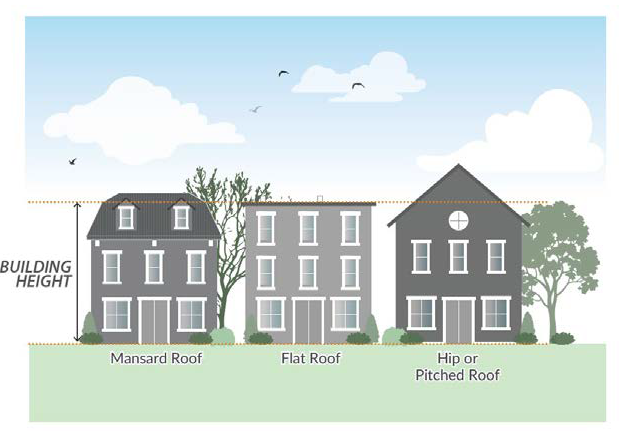
Building height: A distance to be measured from the mean ground level to the top of a flat roof, to the mean distance of the highest gable on a pitched or hip roof, to the deck line of a mansard roof to the uppermost point on other roof types (see Figure 02-1).
Figure 02-1. Building Height
Caliper: The American Nursery Stock Standard for trunk diameter measurement.
Comprehensive plan: The most recent compilation of policy statements, goals, standards, and maps for guiding the physical, social and economic development, both private and public, of the city and its environs, and may include, but is not limited to, the following: statements of policies, goals, standards, a land use plan, including proposed densities for development, a community facilities plan, a transportation plan, and recommendations for plan execution. A comprehensive plan represents the city's recommendations for the future development of the community.
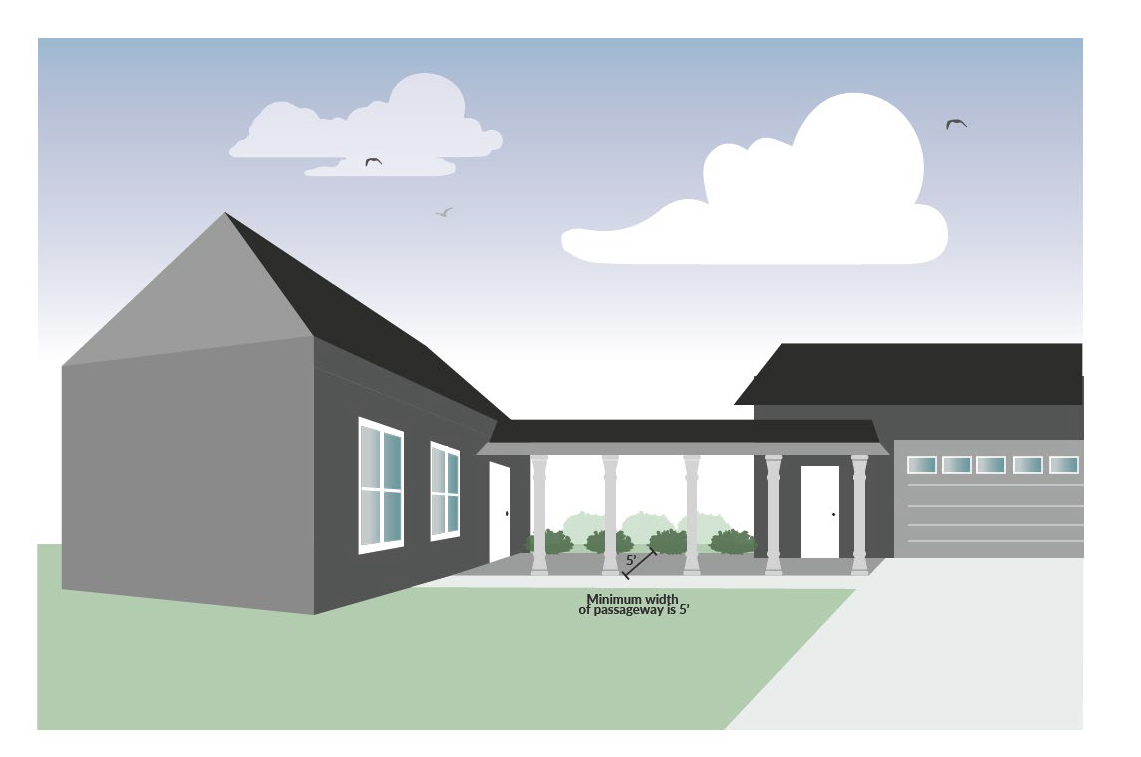
Covered passageway: A roofed structure at least five (5) feet wide which attaches a principal and accessory structure (see Figure 02-2).
Figure 02-2. Covered Passageway
Development: Any man-made change to improved or unimproved real estate including, but not limited to, the placement, construction or modification of buildings, manufactured homes, and other structures, mining, dredging, filling, grading, paving, excavation, drilling operations, or storage of materials or equipment.
Driveway: A hard-surfaced area, usually leading from a garage, used for access to an individual dwelling and not used for general circulation.
Excavation: The extraction of sand, gravel, or other material from the land in the amount of four hundred (400) cubic yards or more and removal thereof from the site without processing.
(Gross) floor area: The sum of the gross horizontal area of the several floors of the building, measured from the exterior faces of the exterior walls.
Foot candle: A measurement of light intensity. The illuminance on a one (1) foot square surface from a uniform source of light. One (1) footcandle is equal to one (1) lumen per square foot.
Impervious surface: A constructed hard surface or natural surface that either prevents or retards the entry of water into the soil and causes water to run off the surface in greater quantities and at an increased rate of flow than prior to development. Examples include, but are not limited to, rooftops, sidewalks, patios, driveways, parking lots, storage areas, and concrete, asphalt, or gravel roads.
Land reclamation: The reclaiming of land by depositing of material so as to elevate the grade and the process of depositing more than one thousand (1,000) cubic yards on any lot or parcel of land shall be land reclamation.
Lot: A parcel of land having fixed boundaries and identified by number or letter designation on a survey or subdivision plat (see Figure 02-3).
Figure 02-3. Lot Types
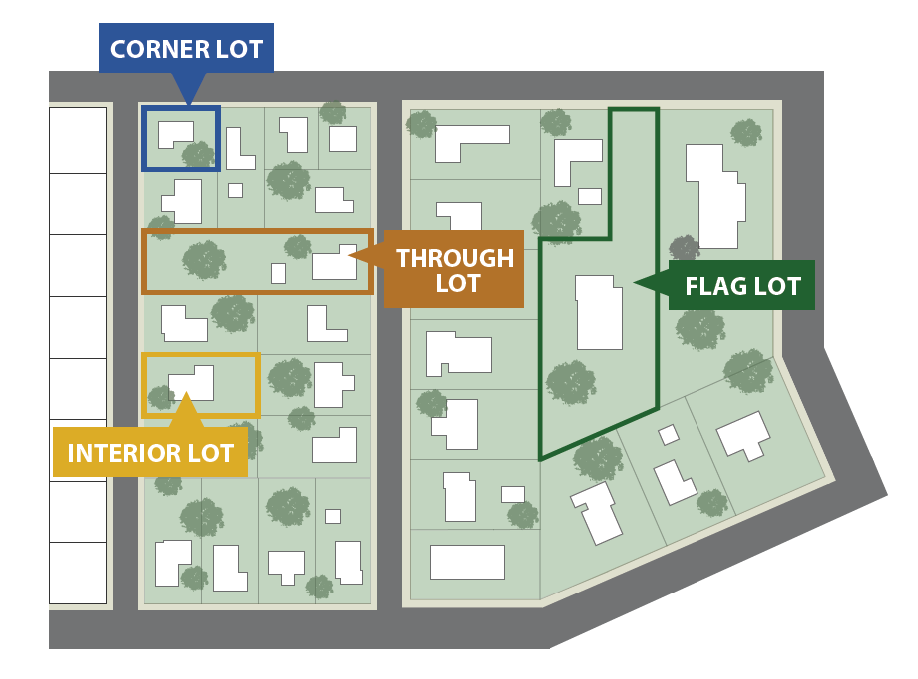
Lot, corner: A lot situated at the junction of and fronting on two (2) or more streets.
Lot, double frontage (through): A lot with opposite lot lines on two (2) non-intersecting streets. Both street frontages shall be considered as front yard areas
Lot, flag: A lot with access provided to the bulk of the lot by means of a narrow corridor which does not meet the minimum lot width requirements at the minimum setback distance from the public street.
Lot, interior: A lot having frontage on one (1) street.
Lot, nonconforming: A lot which lawfully existed prior to the adoption, revision, or amendment of this ordinance, but which fails by reason of such adoption, revision, or amendment to conform to the new district regulation in which it is located.
Lot, substandard: A lot which does not conform to the minimum standards of this ordinance.
Lot of record: Any validly recorded lot which at the time of its recording complied with all applicable laws, ordinances, or regulations.
Lot area: The lot area is the land area within the lot lines.
Lot line: A property boundary line of any lot held in single or separate ownership, except that, where a portion of the lot extends into the abutting street or alley, the lot line shall be deemed to be the street or alley.
Lot line, front: That boundary of a lot which is along an existing or dedicated street. In the case of a corner lot, the front lot line shall be the shortest dimension along a public street or as designated by the Community Development Director based on the practical front yard of the property as determined by such factors as the existing or proposed building configuration of the property and taking into consideration the characteristics of surrounding properties.
Lot line, interior: A lot line which does not abut a public right-of-way. Does not include internal divisions of a unified residential, commercial, or industrial site.
Lot line, rear: That boundary of a lot which is the most distant from and is or is approximately parallel to the front lot line. If the rear lot line is less than ten (10) feet in length or if the lot forms a point at the rear, the rear lot line shall be deemed to be a line ten (10) feet in length within the lot, parallel to and at the maximum distance from the front lot line.
Lot line, side: Any boundary of a lot which is not a front or rear lot line.
Lot width: The horizontal distance between the side lot lines of a lot measured at the minimum required front setback line.
Net acreage: The total area of a site excluding land covered by wetlands, water bodies, public parks and trails, public open space, arterial road rights-of-way, and other undevelopable acres identified in or protected by local ordinances.
Net density: The number of planned housing units divided by the net acreage.
Obstruction: Any dam, wall, wharf, embankment, levee, dike, pile, abutment, projection, excavation, channel modification, culvert, building, wire, fence, stockpile, refuse, fill, structure, or matter in, along, across, or projecting into any channel, watercourse, or regulatory flood plain which may impede, retard, or change the direction of the flow of water, either in itself or by catching or collecting debris carried by such water.
Outlot: A lot remnant or parcel of land left over after platting which is intended as open space or other use and for which no building permit shall be issued without a conditional use permit.
Open space: That portion of a site, outside of a required front or corner side yard, as extended to the rear lot line, that is available for outdoor use.
Parking space: A suitably surfaced and permanently maintained area on privately owned property, either within or outside of a building, of sufficient size to store one (1) standard automobile.
Planned unit development: A type of development characterized by a unified design, site-specific regulations, and flexibility from zoning standards.
Property owner: Person with a legal interest in real property to which the application or decision applies.
Premises: The structures and land that make up a parcel of property.
Recreation equipment: Play apparatus such as swing sets and slides, sandboxes, poles for nets, picnic tables, lawn chairs, barbecue stands, and similar equipment or structures.
Regional flood: A flood which is representative of large floods known to have occurred generally in Minnesota and reasonably characteristic of what can be expected to occur on an average frequency in the magnitude of the one hundred (100) year recurrence interval. Regional flood is synonymous with the term "base flood" used in the Flood Insurance Study.
Right-of-way: Land covered by a public road or land dedicated for public use or for certain private use such as land over which a power line passes.
Roof line: The edge of the roof or the top of the parapet, whichever forms the top line of the building silhouette.
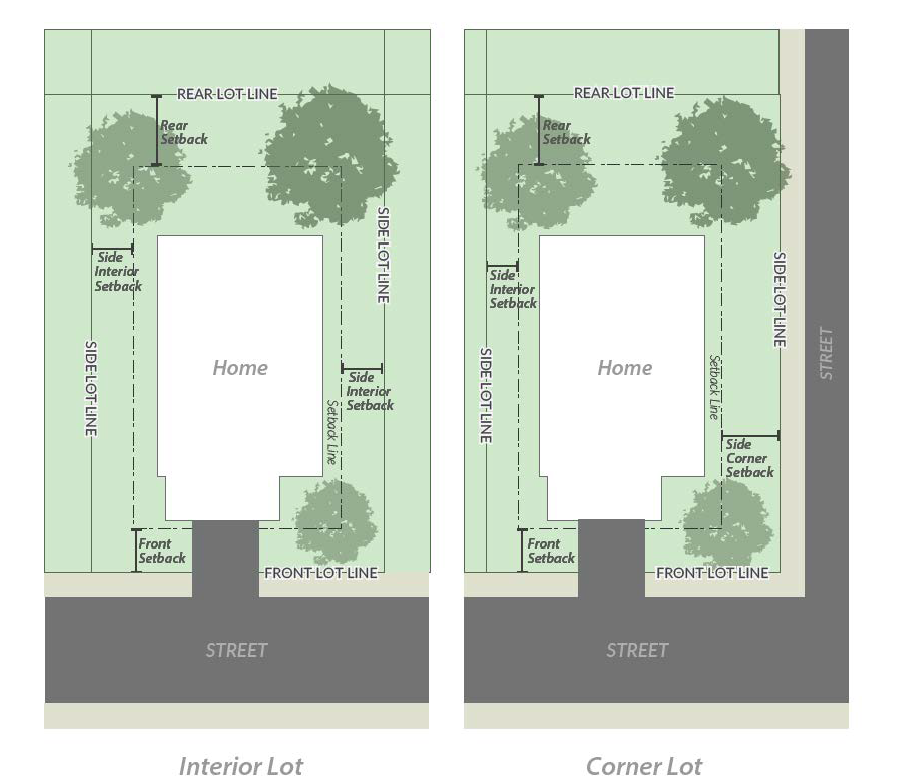
Setback: The required minimum horizontal distance between a structure and a lot line, ordinary high-water mark, paved street, curb, pedestrian way, or right-of-way easement, whichever is less (see Figure 02-4).
Figure 02-4. Setbacks
Soil processing: The processing of sand, gravel, sod, or other material mined from the land shall be considered soil processing for purposes of this ordinance.
Story: That portion of a building included between the upper surface of any floor and the upper surface of the floor next above, except that the topmost story shall be that portion of a building included between the upper surface of the topmost floor and the ceiling or roof above. If the finished floor level directly above a basement, cellar or unused under floor space is more than six (6) feet above grade, as defined herein for more than fifty percent (50%) of the total perimeter or is more than twelve (12) feet above grade as defined herein at any point, such basement, cellar, or unused under floor space shall be considered a story.
Street: A public or private thoroughfare with a right-of-way which is used, or intended to be used, for passage or travel by motor vehicles.
Alley: A public thoroughfare twenty (20) feet or less in width for use of motorized vehicles.
Street, arterial: A street primarily designated to carry large volumes of traffic and provide for vehicular movement between and among large areas. Arterial streets in Oakdale are designated by the City Transportation Plan.
Street, collector: A street which carries traffic from local streets to arterial streets or from arterial to arterial. It includes the principal entrance streets of a residential development and those principal streets used for circulation within such development. Collector streets in Oakdale are designated by the City Transportation Plan.
Street, local: A street of limited continuity used primarily for access to the abutting properties and the local needs of a neighborhood. Local streets in Oakdale are designated by the City Transportation Plan.
Structure: That which is built, constructed, or erected on the ground or attached to the ground, an edifice or building of any kind, or any piece of work artificially built up or composed of parts joined together in some definite manner, including but not limited to, buildings, factories, sheds, detached garages, cabins, manufactured homes, and other similar items.
Structure, nonconforming: Any structure legally existing at the present time or at the time of a subsequent amendment to this Ordinance which does not comply with the regulations as set forth.
Tree, coniferous: A woody plant which, at maturity, is at least twelve (12) feet or more in height, having foliage on the outermost portion of the branches year-round.
Tree, deciduous: A woody plant which, at maturity, is at least fifteen (15) feet or more in height, having a defined crown, and which loses leaves annually.
Tree, overstory: A woody plant, which, at maturity, is at least twelve (12) feet or more in height.
Tree, significant: A healthy deciduous hardwood tree measuring a minimum of eight (8) caliper inches in diameter, a healthy softwood deciduous tree measuring a minimum of twelve (12) caliper inches, or a healthy coniferous tree measuring a minimum of twelve (12) feet in height.
Use: The purpose for which land or premises or a building thereon is designated, arranged, or intended, or for which it is or may be occupied or maintained.
Use, accessory: A use subordinate, incidental, and related to the principal use of a lot or structure located on the same lot.
Use, conditional: A land use, which because of its unique characteristics, cannot be properly classified as a permitted use in a particular district (example: Business in a Residential zone).
Use, interim: A temporary use of property until a particular date, or until the occurrence of a particular event, as determined by the City Council.
Use, nonconforming: Use of land, buildings, or structures legally existing at the present time or at the time of a subsequent amendment to this ordinance which does not comply with the regulations as set forth.
Use, principal: The primary purpose for which land is used.
Variance: A modification or variation of the provisions of this ordinance as applied to a specific piece of property, except that modification in the allowable uses within a district shall not be considered a variance.
Wetland: A location periodically or permanently inundated by surface water and designated on the City of Oakdale Surface Water Management Plan.
Yard: An open space on a lot which is unoccupied and unobstructed by a structure from its lowest level to the sky except as permitted in this ordinance.
Yard, front: A yard extending along the full width of the lot between side lot lines and measured from the front lot line to the front building line of the principal structure.
Yard, rear: A yard extending along the full width of the lot between side lot lines and measured from the rear lot line to the rear building line of the principal structure.
Yard, side: The yard extending from the front yard to the rear yard and measured between the side lot lines and the side building line of the principal structure.
Zoning district: An area or areas within the limits of the City of Oakdale for which the regulations and requirements governing the use are uniform.
Zoning map: The map or maps incorporated into this ordinance that delineate the boundaries of all mapped zoning districts within the physical boundary of the city.
(Ord. No. 948, § 2, 7-8-25)
DIVISION 25-02-300. - USE DEFINITIONS
Accessory adult establishment: A business which meets any of the following criteria, is engaged in any of the following activities or which utilizes any of the following business procedures or practices:
(a)
Any business that devotes less than ten percent (10%) of the sales floor area, up to a maximum of one hundred (100) square feet, of an otherwise permitted business (not including storerooms, stock areas, bathrooms, basements or any portion of the business not open to the public) to materials or persons depicting, exposing, describing, discussing, or relating to specified sexual activities or specified anatomical areas, and is available for barter, rental, or sale for off the premises use only.
(b)
Accessory adult establishment sales do not include the sale of instruments, devices or paraphernalia, which are used or designed for use in connection with specified sexual activities.
(c)
In order to qualify, accessory adult establishment sales of materials depicting, exposing, describing, discussing, or relating to specified sexual activities or specified anatomical areas shall at all times be out of view by any persons under the age of eighteen (18), and hereunder, they shall be restricted from and prohibit access to persons under age eighteen (18) by physical separation, except for sales of print media, which shall be displayed with a completely opaque cover excluding the media's title, and shall be kept a minimum of five (5) feet off the floor.
(d)
Any business with accessory adult establishment sales not meeting the requirements of this definition shall be considered a principal adult establishment, subject to all requirements for such businesses.
Accessory agricultural building: An accessory structure meeting the definition in Minnesota Statutes, Section 326B.103, Subd. 3.
Accessory apartment: A self-contained dwelling unit with a separate entrance, kitchen, sleeping area, and full bathroom facilities, which is located within, attached to, or on the same lot as an existing single-unit residential dwelling.
Accessory building: A building, with or without a roof and/or walls, located on the same lot as the principal building and customarily incidental and subordinate to the principal building.
Accessory office: A portion of a larger structure used for office activities in support of the principal use.
Accessory retail or service: The sale of goods or services located within the same building or on the same lot as the principal use. This use may include daycares, restaurants, recreation, convenience goods, personal services, cafeterias, and similar uses.
Accessory warehousing: A portion of a larger structure used for the storage of goods or materials in support of the principal use.
Agriculture: The use of land for agricultural purposes including farming, dairying, pasturing, agriculture, horticulture, floriculture, and animal and poultry husbandry and the necessary accessory structures and uses. The operation of any accessory uses shall be secondary to that of normal agricultural activities. This use does not include feedlots.
Animal hospital: A building where animals are treated for injury or disease, including premises for boarding of animals being treated.
Animal keeping: The long-term care and maintenance of animal(s) on private property.
Antenna and/or telecommunication support structure: Any satellite dish, radio tower, or ground-mounted satellite vertical antenna that is used in whole or in part for the collection, communication, transmission, or receiving of telecommunications signals.
Art studio: An establishment engaged in the creation of art including music, photography, and other visual media. Limited sales of art created on-site is allowed.
Assisted living facility: A residential facility, as defined in Minnesota Statutes, Section 144G.08, subd. 7, licensed by the state.
Automotive fuel station: A building, land area, or other premises used or intended to be used for the retail dispensing or sale of vehicular fuels. Additional services provided may include, but are not limited to, the sale of automobile accessories, groceries, and household products.
Automotive sales or rental: Any land or buildings, other than a street, used for the display, sale, or rental of new or used motor vehicles or trailers in operable condition. Leasing of vehicles is also included in this use.
Automotive service and repair: A place where light maintenance activities such as engine tune-ups, lubrication, minor repairs, and carburetor cleaning are conducted (does not include fuel sales). Includes the sale of automobile accessories and convenience food goods.
Automotive towing service: An establishment that provides for the removal and temporary storage of vehicles but does not include disposal, permanent disassembly, salvage, or accessory storage of inoperable vehicles.
Body art: Physical body adornment using, but not limited to, the following techniques: body piercing, tattooing, micropigmentation, cosmetic tattooing, branding, scarification, suspension, subdermal implantation, microdermal, tongue bifurcation, and tissue removal. Body art does not include practices and procedures that are performed by a licensed medical or dental professional if the procedure is within the professional's scope of practice.
Brew pub: A brewer who holds one (1) or more retail on-sale licenses and who manufactures fewer than three thousand five hundred (3,500) barrels of malt liquor in a year, at any one licensed premises, the entire production of which is solely for consumption on tap on any licensed premises owned by the brewer, or for off-sale from those licensed premises as permitted by state statute.
Brewery: A facility that produces more than twenty thousand (20,000) barrels of malt liquor in a calendar year as regulated by Minnesota Statutes, and may or may not include a taproom.
Brewery, small: A facility that produces not more than twenty thousand (20,000) barrels of malt liquor in a calendar year as regulated by Minnesota Statutes, and may or may not include a taproom.
Cannabis delivery/transporter business: A business with one (1) of the following issued by the State of Minnesota Office of Cannabis Management: a cannabis delivery service license, or a cannabis transporter license.
Cannabis combination business: The cultivation or manufacturing activities of a business with one (1) of the following issued by the State of Minnesota Office of Cannabis Management: a cannabis mezzobusiness license or a cannabis microbusiness.
Cannabis lounge: A portion of the premises of a licensed cannabis microbusiness with an on-site consumption endorsement by the State of Minnesota Office of Cannabis Management, used for on-site consumption of edible cannabis products and lower-potency hemp edibles.
Cannabis or hemp industrial business: A business with one (1) of the following issued by the State of Minnesota Office of Cannabis Management: a cannabis manufacturer license, a cannabis wholesaler license, a cannabis testing facility license, a cannabis cultivator license, a medical cannabis manufacturer, the non-retail activities of a medical cannabis combination business license, a medical cannabis cultivator license, a lower-potency hemp edible manufacturing license, a lower-potency hemp cultivator license or any license, including a cannabis mezzobusiness license and a cannabis microbusiness license, with a manufacturing or testing endorsement.
Cannabis or hemp retailer: A business with one (1) of the following issued by the State of Minnesota Office of Cannabis Management: a cannabis retailer license, medical cannabis retailer license, lower-potency hemp edible retailer license, the retail activities of a mezzobusiness with a retail endorsement, or the retail activities of a microbusiness with a retail endorsement.
Car wash: A building designed, intended, and used for the washing of automobiles of the public.
Catering establishment: An establishment in which the principal use is the preparation of food and meals on the premises, and where such food and meals are delivered to another location for consumption.
Cemetery: A parcel of land which is intended for the burial of human dead. A marker or memorial is erected at each gravesite for permanent remembrance of the deceased. Cemeteries may include columbariums, crematories, mausoleums, mortuaries, and chapels when operated in conjunction with and within the boundary of such cemetery.
Clinic: A facility used primarily for the provision of outpatient medical, dental, chiropractic, therapeutic, optometric, or mental health care and treatment.
Club or lodge: A non-profit association of persons who are bonafide members paying annual dues which owns, hires, or leases a building, or portion thereof; the use of such premises being restricted to members and their guests.
Commercial center: A group of unified commercial establishments located on a single land parcel and consisting of not less than two (2) distinct business entities which share or jointly use parking facilities.
Commercial event center: A structure or designated area used for celebration, weddings, ceremonies, receptions, corporate functions, or similar activities for the benefit for someone other than the property owner that takes place on an occasional basis. This does not include uses accessory to single-unit residential uses, such as private parties, gatherings, and similar activities.
Commercial recreation facility, indoor: Indoor facilities operated as a business and which are open to the public for a fee that shall include, but are not limited to, bowling alleys, skating rinks, indoor swimming pools, game rooms, movie theaters, arcades, and other similar businesses. Such businesses may also provide a snack bar, restaurant, retail sales of related items, and other support facilities.
Commercial recreation facility, outdoor: Outdoor facilities operated as a business and which are open to the public for a fee that shall include, but are not limited to, golf courses, outdoor swimming pools, amusement parks, and other similar businesses. Such facility may also provide a snack bar, restaurant, retail sales of related items, and other support facilities.
Continuum of care senior facility: A residential facility or complex which provides a variety of senior living choices, from independent living to long-term care, with a goal of helping residents to age in place.
Construction-related temporary use: A temporary use or structure related to construction activities on the same site. This use may consist of construction-related trailers, mobile structures used for construction offices and storage, batch plans, and temporary offices to replace permanent facilities being reconstructed.
Data center: A facility used primarily for the storage, management, processing, and transmission of digital data which houses computer or network equipment, systems, services, appliances, and other associated components related to digital data storage and operations.
Daycare facility: A state-licensed facility other than a private residence that provides for the care of children or adults during only part of a twenty-four (24) hour day. This term includes nursery schools, preschools, day care centers, and other similar uses but excludes public and private schools or any facility offering care of individuals for a full twenty-four (24) hour period.
Daycare, group family: A dwelling unit where a resident of the dwelling is licensed by the state to provide care under Minnesota Rules 9502 for less than twenty-four (24) hours at a time for up to fourteen (14) children, of which no more than ten (10) may be school age.
Distillery: A facility that produces distilled spirits as regulated by Minnesota Statutes.
Drive-through establishment: An accessory use, structure, or portion of a principal structure where patrons may purchase products or receive service without having to leave their motor vehicle and enter a building. Pick-up windows are included in this use.
Dry cleaning service: An establishment which launders or dry cleans articles dropped off on the premises directly by the customer or where articles are dropped off, sorted, and picked up but where laundering or cleaning is done elsewhere.
Dwelling, apartment mixed use: A building designed for one (1) or more dwelling units as well as non-residential uses that are permitted in the zoning district, with all dwelling units sharing a joint entrance from the outside.
Dwelling, attached townhouse or rowhouse: A single residential structure consisting of three (3) or more dwelling units. Each unit shall have a separate entrance and shall be separated from adjoining unit(s) by at least one (1) common side wall.
Dwelling, courtyard cottage: A cluster of single-unit dwellings in the form of smaller houses, arranged around a shared courtyard or open space that is typically perpendicular to the street. The shared courtyard takes the place of individual rear yards and becomes an important community-enhancing element of this housing type.
Dwelling, large apartment: A residential structure consisting of at least nine (9) independent dwelling units sharing hallways and main entrances and exits.
Dwelling, single-unit detached: A site-built or factory-built residential structure designed exclusively for occupancy by one (1) household. This definition includes manufactured homes located outside of a manufactured home park.
Dwelling, small apartment: A residential structure consisting of three (3) to eight (8) independent dwelling units sharing hallways and main entrances and exits.
Dwelling, two-unit: A residential structure designed for or occupied by two (2) households only, including twinhomes and duplexes.
Electric vehicle charging station: A public or private parking space that is served by electric vehicle supply equipment.
External solid fuel-fired heating device: External solid fuel-fired heating device also known as "outdoor furnaces" means any equipment, device or apparatus, or any part thereof, which is installed, affixed or situated outdoors for the primary purpose of combustion of fuel to produce heat or energy used as a component of a heating system providing heat for any interior space. It is the city's intent to regulate exterior freestanding solid fuel-fired devices that are contained within a structure primarily designed or used to house the solid fuel device.
Financial institution: An establishment where the principal business is the receipt, disbursement, investment, or exchange of funds and currencies, such as banks, savings and loans, credit unions, and investment companies.
Funeral home: A building or part thereof used for human funeral services. Such building may contain space and facilities for: a) embalming and the performance of other services used in preparation of the dead for burial; b) the performance of autopsies and other surgical procedures; c) the storage of caskets, urns, and other related funeral supplies; d) the storage of funeral vehicles; e) facilities for cremation; f) a funeral chapel or other area used for the performance of funeral ceremonies, mourning, and viewing of the deceased; and g) associated rituals such as ceremonial processions and activities.
Garage, private: A detached accessory building or portion of the principal building, including a carport, which is situated on the same lot as the principal building used primarily for storing motor vehicles with no facilities for mechanical service or repair of a commercial nature.
Government use: A structure or use in which municipal, school district, county, state, or federal administrative offices are located or services are provided, including but not limited to city hall, public works buildings, or post offices.
Health and athletic club facility: An establishment which provides physical fitness facilities and services to the public for a fee, including but not limited to; game courts, exercise equipment, exercise areas, running tracks, swimming pools, spa areas, physical fitness maintenance and weight control services and instructors, locker rooms, saunas, and associated retail shops intended for members of the club only.
Home occupation: Any occupation, profession, or activity engaged in by the occupants of the residential dwelling, or accessory building, which is clearly incidental and secondary to the residential use of the premises and does not change the character of the premises. A family child care provider or a group family child care provider shall not be considered a home occupation.
Hospital: An establishment providing physical or mental health services, inpatient or overnight accommodations, and medical or surgical care of the sick or injured.
Hotel: A building containing guest rooms in which lodging is provided and offered to the public on a temporary basis for compensation, and which is open to transient guests. Ingress and egress to and from all rooms is made through an inside lobby or office supervised by a person in charge.
Kennel, commercial: A place where boarding and/or training is offered to any number of dogs not owned by the owner or occupant of the premises. Such boarding and/or training may also include but is not limited to related uses such as selling, breeding, showing, treating or grooming. Pet shops, veterinary clinics, and pet grooming facilities are considered commercial uses but shall not be defined as commercial kennels.
Kennel, private: A place where a dog owner keeps four (4) or more dogs over six (6) months of age on property occupied by the dog owner for residential purposes and where the keeping of such dogs is incidental to the occupancy of the premises, and may include breeding and selling of dogs as a hobby.
Laboratory, research, and/or development facility: A facility involved in scientific research, investigation, testing, or experimentation, but not including manufacture or sale of products, except as incidental to the main purpose of the laboratory.
Liquor store, off-sale: An establishment which sells alcoholic beverages, including distilled spirits or hard liquor, for consumption off-site.
Live-work unit: A dwelling unit in combination with a shop, office, studio, or related work space within the same unit, where the resident occupant both lives and works.
Long-term or transitional care facility: A facility that provides meals, lodging, and nursing care to two (2) or more individuals due to illness, age, or infirmity. Long-term care facilities include skilled nursing facilities such as nursing homes, rest homes, boarding care homes, convalescent care, memory care, hospice, and other transitional care facilities.
Manufactured home: A structure, transportable in one (1) or more sections, which in the traveling mode is eight body feet or more in width or forty (40) body feet or more in length or, when erected on site, is three hundred twenty (320) or more square feet, and which is built on a permanent chassis and designed to be used as a dwelling with or without permanent foundation when connected to the required utilities, and includes the plumbing, heating, air conditioning, and electrical systems contained therein, except that the term includes any structure which meets all the requirements and with respect to which the manufacturer voluntarily filed a certification required by the Secretary of the United States Department of Housing and Urban Development and which complies with the standards established under Minnesota Statutes, Chapter 327.
Manufactured home park: An approved manufactured home park which has underground utility service to each site and only permits independent manufactured homes. This use includes all related accessory structures such as shelters, community buildings, laundry facilities, and administrative offices.
Manufacturing, heavy: Any operation which assembles, improves, treats, processes, compounds, and/or packages goods or materials in a manner which creates odor, noise, vibration, illumination, or particulates that may impact surrounding properties. Examples include, but are not limited to, the following: large-scale food and bottling operations; lumber, milling and planing facilities; grain milling; gas manufacture, aggregate, concrete, and asphalt plants; foundries, forge shops, and other intensive metal fabrication; and chemical manufacturing.
Manufacturing, light: Any operation which assembles, improves, treats, processes, compounds, and/or packages goods or materials in a manner which does not create a noticeable amount of noise, dust, odor, smoke, glare, or vibration outside of the building in which the activity takes place, which does not require outside storage of goods or materials. Examples include but are not limited to, the following: food; pharmaceuticals; clothes; furniture (where wood is milled off-site); hardware; toys; light sheet metal products; mechanical components; printing; small vehicle assembly; and computer software.
Meadery: A winery where mead is produced and sold commercially.
Microbrewery: A facility that produces not more than three thousand five hundred (3,500) barrels of malt liquor in a calendar year as regulated by Minnesota statutes, and may or may not include a brewer taproom.
Microdistillery: A distillery operated within the state producing premium, distilled spirits in total quantity not to exceed forty thousand (40,000) proof gallons in a calendar year.
Mobile food unit: A food and beverage service establishment that is a vehicle mounted unit, either:
Motorized or trailered, operating no more than twenty-one (21) days annually at any one place, or operating more than twenty-one (21) days annually at any one place with the approval of the regulatory authority; or
Operated in conjunction with a permanent business licensed under Minnesota Statutes, Ch. 157 or Ch. 28A at the site of the permanent business by the same individual or company, and readily movable, without disassembling, for transport to another location.
Motel: A building containing guest rooms in which lodging is provided and offered to the public on a temporary basis for compensation, and which is open to transient guests. Separate exterior entrances are provided for each guest room.
Nursery, tree farm, or greenhouse: An establishment for the growth, display, and sales of trees, shrubs, flowers, and other plants conducted within or without an enclosed building.
Office: An establishment used primarily for conducting the predominantly administrative or clerical service affairs of a business, profession, service, industry or government, or like activity and where goods are not produced, sold, or repaired.
Off-site service business: Any establishment including but not limited to plumbing, installation, electrical, or IT services where services are rendered off of the premises of the primary business location.
Outdoor dining: A specified outdoor area for dining which is accessory to a principal restaurant or food service establishment use and is not located within a parking area or sidewalk.
Outdoor display: The arrangement of the merchandise sold by a business outside of the building the business occupies.
Outdoor sales: Retail sales in conjunction with a principal commercial use, but located outside of the principal structure.
Outdoor storage: The storage of personal or business property for a period greater than twenty-four (24) hours outside of an enclosed building.
Park or playground: An area of land open to the public which is developed and maintained for active and/or passive recreational pursuits, including tot-lots, playgrounds, neighborhood parks, play fields, and special purpose areas.
Parking and/or loading facility: A land surface or facility with off-street vehicular parking or loading spaces with drives and maneuvering lanes so as to provide access for entrance and exit.
Pawn shop: A commercial business that loans money on the security of pledges of personal property, or deposits and conditional sales of personal property, or the purchase or sale of personal property.
Pet store: A retail sales establishment primarily involved in the sale of domestic animals, such as dogs, cats, fish, birds, and reptiles, excluding exotic animals and farm animals such as horses, goats, sheep, and poultry.
Place of worship: A building whose principal use, together with its accessory buildings and uses, is for persons to regularly assemble for religious worship and which building, together with its accessory buildings and uses, is maintained and controlled by a religious body organized to sustain public worship.
Precious metal dealer: A business that buys, exchanges, collects, receives, stores, or sells precious metal.
Principal adult establishment: A business which meets any of the following criteria, is engaged in any of the following activities or which utilizes any of the following business procedures or practices:
(a)
A business that is conducted exclusively for the patronage of adults that is distinguished or characterized by an emphasis on the depiction of sexual conduct or nudity and to which minors are specifically excluded from patronage, either by operation of law or by the owners of such business;
(b)
Any business that:
a.
Devotes more than ten percent (10%) of the floor area of the business, or at least one hundred (100) square feet, whichever is smaller, to items, merchandise or other materials, distinguished or characterized by an emphasis on material depicting, exposing, describing, discussing or relating to specified sexual activities or specified anatomical areas, such floor area not to include storerooms, stock areas, bathrooms, basements or any portion of the business not open to the public, or
b.
Has at least ten percent (10%) of its inventory, stock and trade, or publicly displayed merchandise comprised of such items, merchandise, or materials, or
c.
Derives at least one-third (⅓) of any month's gross sales from the sale or rental of such items, merchandise or other materials.
Public parking facility: A land surface or facility owned or managed by a public entity with off-street vehicular parking or loading spaces with drives and maneuvering lanes so as to provide access for entrance and exit. Public parking facilities may include public garages, parking ramps, surface parking lots, and other similar uses.
Public recreational facility: An indoor or outdoor public complex or destination designed and equipped for the conduct of sports and leisure-time activities. This facility may include athletic fields, golf courses, or other similar uses associated with a designated recreation area. This use includes related accessory buildings and structures.
Public utility services: Underground or overhead transmission facilities of electric power, gas, steam, water, telecommunications, and railroad companies. These include: Electric power transmission lines and gas pipe lines; substations; telephone facilities; cable TV lines but not studios nor antennae; water pumping, reservoir, and distribution facilities; railroad trackage, but not storage and switching yards; sewers, pipes, poles, conduits, cables, traffic signals, hydrants, and similar equipment but not buildings.
Recreational amenity, private: A private area or facility intended to serve the recreational needs of a specific population. Private recreational amenities include but are not limited to: tennis courts, pickleball courts, walking trails, basketball courts, or playground equipment.
Recreational vehicle: Any vehicle which meets the criteria for "recreation" class registration and license plate, DNR registration, or trailer registration used for conveyance of recreation vehicles as established by the Minnesota Department of Public Safety, Minnesota Department of Natural Resources, or this Ordinance, including, but not limited to: travel trailers, stock car trailers, campers, motor homes, tent trailers, vehicles converted to motor homes, boat trailers, snowmobiles, snowmobile trailers, boats, personal watercraft, all-terrain vehicles, and all-terrain vehicle trailers.
Religious institution: A church, synagogue, mosque, or other religious organization organized under Minnesota Statutes, Chapter 315.
Residential care facility: An in-home residential facility licensed by the state which provides primarily nonmedical care to individuals who are in need of personal assistance to manage the activities of daily life or for the protection of the individual.
Restaurant: An establishment where food and beverages are prepared, served, and consumed on the premises.
Sacred community: A residential settlement established on or contiguous to the grounds of a religious institution's primary worship location primarily for the purpose of providing permanent housing for chronically homeless persons, extremely low-income persons, and designated volunteers that meets the requirements of MN Statutes 327.30.
School, elementary, middle, or secondary: A public or private institution, together with its accessory buildings and uses, for the purpose of elementary, middle, or secondary education, which meets all the requirements of compulsory education laws of the State of Minnesota.
School, post-secondary: A building(s) or area of land used for the purpose of public or private post-secondary education, including but not limited to colleges and universities.
School, vocational: A building or area of land used for the purpose of teaching artistic, business, or industrial skills, including but not limited to trade or business schools.
Self-service laundry: A facility where patrons wash or dry clothing or other fabrics in machines operated by the patron.
Self-service storage facility: Real property designed and used for the purpose of renting or leasing individual storage space to occupants who are to have access for the purpose of storing and removing personal property. The term does not include:
(a)
Property of a financial institution that contains vaults, safe deposit boxes, or other receptacles for the uses, purposes, and benefits of the financial institution's customers;
(b)
Warehousing as defined by this article; or
(c)
A commercial parking garage or parking lot that provides short-term motor vehicle parking.
Showroom: A building, structure, or part thereof used for the display of merchandise or equipment and its sale to a customer where delivery of purchased merchandise is made directly to the ultimate consumer from a warehouse.
Small-scale solar energy generation system: A solar collector or other device mounted on the ground or on a building, pole, or rack whose primary purpose is to harvest energy by transferring solar energy into another form of energy.
Sober home: A dwelling unit occupied by more than six (6) persons, all of whom are in recovery from chemical dependency and considered handicapped under the Federal Fair Housing Act Amendments of 1988, that provides a non-institutional residential environment in which the residents willingly subject themselves to written rules and conditions, including prohibition of alcohol and drug use (except for prescription medications obtained and used under medical supervision), intended to encourage and sustain their recovery. The residents of a sober house are similar to a family unit and share kitchen and bathroom facilities and other common areas of the unit. Sober houses are financially self-supporting.
Social or cultural facility: Any area of land, water, or any building, in which social and cultural events are provided for public and semi-public use, including but not limited to, libraries, museums, theaters, and art galleries.
Specialty food or beverage shop: An establishment whose primary business is the sale of a single specialty type of food or beverage that is not considered a complete meal (e.g. candy, coffee, ice cream, pastries) for consumption on or off premises. The sale of other food, beverages, or merchandise is incidental to the sale of the specialty food or beverage.
Standalone retail or service business: A detached structure where goods or services are sold.
Swimming pool: A constructed or pre-fabricated in-ground or above-ground structure over twenty-four (24) inches deep and containing more than five thousand (5,000) gallons of water designed or used for recreational purposes including swimming, diving, and bathing.
Taproom: An area on the premises of a brewery or on premises adjacent to a brewery owned by the brewer in which the brewer sells or otherwise provides malt liquor produced by the brewer for consumption within the brewery taproom.
Tattoo parlor, tattooing: Establishment engaged in the business of "tattooing". Tattooing means any method of placing indelible ink or other pigment into or under the skin or mucosa with needles or any other instruments used to puncture the skin, resulting in permanent coloration of the skin or mucosa.
Tavern: Establishment serving "on-sale" liquor with or without food service.
Tower or wireless facility: Any tower or wireless facility designed and constructed primarily for the purpose of wireless communication, transmission, and distribution.
Antenna: That portion of any communication equipment located on the exterior or outside of any structure used for continuous or standby transmission or reception of radio or television waves.
Tower: A structure upon which communication equipment is mounted or attached and including support devices such as cables, braces, etc.
Accessory structure: A structure located on the tower or antenna site, necessary to the receiving or transmitting of radio or television programs.
Truck terminal: A building or area devoted principally to the transfer, assembly, and/or storage of goods brought by truck.
Warehousing: The storage of materials, goods, or equipment within an enclosed building and their distribution.
Wholesale trade establishment: An establishment primarily engaged in selling merchandise to retailers; to industrial, commercial, institutional or professional business users; to other wholesalers; or acting as agents or brokers and buying merchandise for, or selling merchandise to, individuals or companies.
Wind energy conversion system (WECS): Any device such as a wind charger, windmill, or wind turbine, which converts wind energy to a form of usable energy.
WESC height: The height of the tower/pole plus the rotor radius.
Winery: A facility involved in the fermenting and processing of fruit juice into wine; or the refermenting of still wine into sparkling wine.
(Ord. No. 948, § 2, 7-8-25)
DIVISION 25-02-400. - FLOODPLAIN DEFINITIONS
Boathouse: A facility as defined by Minnesota Statutes, Section 103G.245.
Buffer: A vegetative feature as defined by Minnesota Statutes, Section 103F.48.
Building line: A line parallel to a lot line or the ordinary high-water level at the required setback beyond which a structure may not extend.
Controlled access lot: A lot used to access public waters or as a recreation area for owners of non-riparian lots within the same subdivision containing the controlled access lot.
Commissioner: The commissioner of the Department of Natural Resources.
Deck: A horizontal, unenclosed platform with or without attached railings, seats, trellises, or other features, attached or functionally related to a principal use or site and at any point extending more than three (3) feet above ground.
Expansion: Any increase in a dimension such as number of units or size, area, volume, or height of an existing structure or accessory structure or facility.
Impervious surface: A constructed hard surface that prevents or retards entry of water into the soil and causes water to run off the surface in greater quantities and at an increased rate of flow than prior to development, including rooftops; decks; sidewalks; patios; swimming pools; parking lots; concrete, asphalt, gravel driveways, or permeable pavers; and other similar surfaces.
Improvement: Making an existing structure or accessory structure or facility of better quality, more efficient, or more aesthetically pleasing, that does not replicate what pre-existed, but does not include an expansion, enlargement, or intensification.
Industrial use: The use of land or buildings for the production, manufacture, warehousing, storage, or transfer of goods, products, commodities, or other wholesale items.
Intensive vegetation clearing: The complete removal of trees or shrubs in a contiguous patch, strip, row, or block.
Ordinary high-water level: The boundary of public waters and wetlands, and shall be an elevation delineating the highest water level which has been maintained for a sufficient period of time to leave evidence upon the landscape, commonly that point where the natural vegetation changes from predominantly aquatic to predominantly terrestrial. For watercourses, the ordinary high-water level is the elevation of the top of the bank of the channel. For reservoirs and flowages, the ordinary high-water level is the operating elevation of the normal summer pool.
Public waters: Any water as defined in Minnesota Statutes, Section 103G.005, Subd. 15, 15a.
Resort: "Resort" has the meaning in Minnesota Statute, Section 103F.227.
Setback: The minimum horizontal distance between a building, structure, fence, parking lot, to an ordinary high-water level or property line.
Sewage treatment system: "Sewage treatment system" has the meaning given under Minnesota Rules, part 7080.1100, Subp. 82.
Sewer system: Pipelines or conduits, pumping stations, and force main, and all other construction, devices, appliances, or appurtenances used for conducting sewage or industrial waste or other wastes to a point of ultimate disposal.
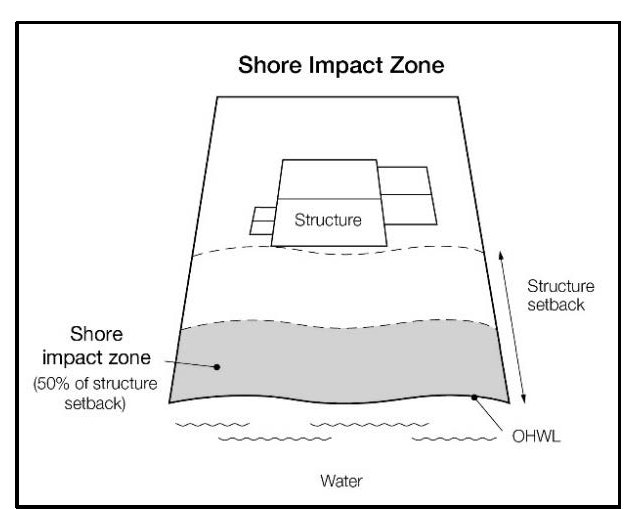
Shore impact zone: Land located between the ordinary high-water level of a public water and a line parallel to it at a setback of fifty percent (50%) of the structure setback (see Figure 02-5).
Figure 02-5. Shore Impact Zone
Shoreland: Land located within one thousand (1,000) feet from the ordinary high-water level of a lake, pond, or flowage.
Shore recreation facilities: Swimming areas, docks, watercraft mooring areas and launching ramps and other water recreation facilities.
Significant historic site: Any archaeological site, standing structure, or other property that meets the criteria for eligibility to the National Register of Historic Places or is listed in the State Register of Historic Sites, or is determined to be an unplatted cemetery that falls under the provisions of Minnesota Statutes, Section 307.08. A historic site meets these criteria if it is presently listed on either register or if it is determined to meet the qualifications for listing after review by the Minnesota state archaeologist or the director of the Minnesota Historical Society. All unplatted cemeteries are automatically considered to be significant historic sites.
Steep slope[:] Lands having average slopes over twelve percent (12%), as measured over horizontal distances of fifty (50) feet or more.
Water-oriented accessory structure or facility: A small, above ground building or other improvement, except stairways, fences, docks, and retaining walls, which, because of the relationship of its use to surface water, reasonably needs to be located closer to public waters than the normal structure setback. Examples of such structures and facilities include, watercraft and watercraft equipment storage structures, gazebos, screen houses, fish houses, pump houses, patios, and detached decks. Boathouses and boat storage structures given the meaning under Minnesota Statutes, Section 103G.245 are not a water-oriented accessory structures.
Water-dependent use: The use of land for commercial, industrial, public or semi-public purposes, where access to and use of a public water is an integral part of the normal conduct of operation. Marinas, resorts, and restaurants with transient docking facilities are examples of uses typically found in shoreland areas.
(Ord. No. 948, § 2, 7-8-25)
DIVISION 25-02-500. - SIGNAGE DEFINITIONS
Accessory sign: A sign relating in its subject matter to the premises on which it is located, or to products, accommodations, services or activities on the premises on which it is located.
Banners and pennants: Attention-getting devices which resemble flags and are of a non-permanent paper, cloth or plastic-like consistency.
Bench signs: A sign which is affixed to a bench or shelter at a bus stop.
Billboard: A large outdoor advertising structure mounted on one (1) or more legs and designed to display posters, composite graphics and electronic (Dynamic Displays) advertisements.
Blade sign: A sign extending from the side of a building at a right angle which may or may not be double-sided.
Electronic message signs: Displays, devices or portions thereof with lighted messages that change at intermittent intervals by electronic process or remove control. Also known as an automatic changeable copy sign, dynamic display message sign, electronic variable message center, electronic dynamic business sign, or video display sign. Electronic message signs are not identified as flashing or motion signs.
Freestanding sign: A sign which is placed in the ground and not affixed to any part of any structure.
Illuminated sign: Any sign which is illuminated by an artificial light source.
Motion sign: Any sign which revolves, rotates, or has any moving parts. Included in this category are searchlights used for advertisement.
NITS: International System of Units, unit of luminance; to quote the brightness of computer displays.
Nonconforming sign: A sign which does not conform to the newly enacted requirements of this ordinance.
Portable sign: A sign which is not permanently attached to the ground or any structure and so designed as to be movable from one location to another.
Projecting sign: Any sign, all or any part of which extends over public property more than twelve (12) inches.
Permanent sign: Any sign which is not a temporary sign.
Pylon sign: A freestanding area identification sign greater than twenty (20) feet in height, intended for freeway advertising.
Roof sign: Any sign erected upon or projecting above the roofline of a structure to which it is affixed.
Sandwich board sign: A self-supporting, typically A-shaped, freestanding temporary signs with two (2) visible sides that are situated adjacent to a business and typically on a sidewalk.
Sign: Any letter, word or symbol, device, poster, picture, statuary, reading matter or representation in the nature of an advertisement, announcement, message or visual communication whether painted, posted, printed, affixed or constructed, which is displayed outdoors for informational or communicative purposes.
Sign area: That area within the marginal lines of the surface which bears the advertisement, or in the case of messages, figures, or symbols attached directly to any part of the building, that area which is included in the smallest rectangle which can be made to circumscribe the message, figure or symbol displayed thereon. The stipulated maximum sign area for a freestanding sign refers to a single facing.
Street frontage: The edge of a street along a parcel. An interior lot has one (1) street frontage and a corner lot two (2) such frontages.
Temporary sign: A sign which is erected or displayed for a limited period of time.
Wall sign: Any sign which is affixed to a wall of any building.
(Ord. No. 948, § 2, 7-8-25)
DIVISION 25-02-600. - ADULT USE DEFINITIONS
Principal adult establishment: A business which meets any of the following criteria, is engaged in any of the following activities or which utilizes any of the following business procedures or practices:
(a)
A business that is conducted exclusively for the patronage of adults and to which minors are specifically excluded from patronage, either by operation of law or by the owners of such business;
(b)
Any business that:
(1)
Devotes more than ten percent (10%) of the floor area of the business, or at least one hundred (100) square feet, whichever is smaller, to items, merchandise or other materials distinguished or characterized by an emphasis on material depicting, exposing, describing, discussing or relating to specified sexual activities or specified anatomical areas, such floor area not to include storerooms, stock areas, bathrooms, basements or any portion of the business not open to the public; or
(2)
Has at least ten percent (10%) of its inventory, stock and trade or publicly displayed merchandise comprised of such items, merchandise, or materials; or
(3)
Derives at least one-third (⅓) of any month's gross sales from the sale or rental of such items, merchandise or other materials.
Accessory adult establishment: A business which meets any of the following criteria, is engaged in any of the following activities or which utilizes any of the following business procedures or practices:
(a)
Any business that devotes less than ten percent (10%) of the sales floor area, up to a maximum of one hundred (100) square feet, of an otherwise permitted business (not including storerooms, stock areas, bathrooms, basements or any portion of the business not open to the public) to materials or persons depicting, exposing, describing, discussing, or relating to specified sexual activities or specified anatomical areas, and is available for barter, rental, or sale for off the premises use only. Accessory adult establishment sales do not include the sale of instruments, devices or paraphernalia, which are used or designed for use in connection with specified sexual activities. In order to qualify, accessory adult establishment sales shall at all times be out of view by any persons under the age of eighteen (18), and hereunder, they shall be restricted from and prohibit access to persons under age eighteen (18) by physical separation, except for sales of print media, which shall be displayed with a completely opaque cover excluding the media's title, and shall be kept a minimum of five (5) feet off the floor. Any business with accessory adult establishment sales not meeting the requirements of this definition shall be considered a principal adult establishment, subject to all requirements for such businesses.
Adult use: An adult use is any of the activities, uses and businesses described below:
(a)
Adult body painting studio: An establishment or business, which provides the service of applying paint or other substance, whether transparent or non-transparent, to the body of a patron when such person is nude.
(b)
Adult bookstore: An establishment or business used for the barter, rental or sale, or other means of distribution of items consisting of printed matter, pictures, slides, records, audio tape, videotape, or motion picture film if such business is not open to the public generally but only to one (1) or more classes of the public, excluding any minor by reason of age, or if such business:
(1)
Devotes at least ten percent (10%) of the floor area of the business, or at least one hundred (100) square feet, whichever is smaller, to items, merchandise or other materials distinguished or characterized by an emphasis on material depicting, exposing, describing, discussing or relating to specified sexual activities or specified anatomical areas, such floor area not to include storerooms, stock areas, bathrooms, basements or any portion of the business not open to the public, or
(2)
Has at least ten percent (10%) of its inventory, stock and trade or publicly displayed merchandise comprised of such items, merchandise, or materials, or
(3)
Derives at least one-third (⅓) of any month's gross sales from the sale or rental of such items, merchandise or other materials.
(c)
Adult cabaret: A business or establishment that provides dancing or other live entertainment to patrons if the dancing and live entertainment is distinguished and characterized by an emphasis on the presentation, display, depiction of matter that seeks to evoke, arouse or excite the patrons' sexual or erotic feelings or desire.
(d)
Adult companionship establishment: A business or establishment that excludes minors by reason of age, and which provides the service of engaging in or listening to conversation, talk or discussion between an employee of the establishment and a customer, if such service is distinguished or characterized by an emphasis on "specified sexual activities" or "specified anatomical areas."
(e)
Adult conversation/rap parlor: A business or establishment that excludes minors by reason of age, and which provides the services of engaging in or listening to conversation, talk, or discussion, if such service is distinguished and characterized by an emphasis on "specified sexual activities" or "specified anatomical areas."
(f)
Adult health/sport club: A health/sport club which excludes minors by reason of age, if such club is distinguished and characterized by an emphasis on "specified sexual activities" or "specified anatomical areas."
(g)
Adult hotel or motel: A hotel or motel from which minors are specifically excluded from patronage and where material is presented which is distinguished and characterized by an emphasis on matter depicting, describing or relating, to "specified sexual activities" or "specified anatomical areas."
(h)
Adult massage parlor, health club: A massage parlor or health club which restricts minors by reason of age, and which provides the services of massage, if such service is distinguished and characterized by an emphasis on "specified sexual activities" or "specified anatomical areas."
(i)
Adult mini-motion picture theater: A business or establishment with a capacity for less than fifty (50) persons used for presenting material if such material is distinguished and characterized by an emphasis on matter depicting, describing or relating to "specified sexual activities" or "specified anatomical areas."
(j)
Adult modeling studio: A business or establishment that provides customers figure models who are so provided with the intent of providing sexual stimulation or sexual gratification to such customers and who engage in "specified sexual activities" or display "specified anatomical areas" while being observed, painted, painted upon, sketched, drawn, sculptured, photographed, or otherwise depicted by such customers.
(k)
Adult motion picture arcade: Any place to which the public is permitted or invited where coin or slug-operated or electronically, electrically or mechanically controlled or operated still or motion picture machines, projectors or other image producing devices are maintained to show images to five (5) or fewer persons per machine at any one time, and where the images so displayed are distinguished and characterized by an emphasis on depicting or describing "specified sexual activities" or "specified anatomical areas."
(l)
Adult motion picture theater: A motion picture theater with a capacity of fifty (50) or more persons used for presenting material if such theater as a prevailing practice excludes minors by reason of age or if such material is distinguished or characterized by an emphasis on "specified sexual activities" or "specified anatomical areas" for observation by patrons.
(m)
Adult novelty business: A business which has as a principal activity the sale of materials or devices which stimulate human genitals, which are designed for sexual stimulation, or which depict or relate to specified anatomical areas or specified sexual activities.
(n)
Adult sauna: A sauna which excludes minors by reason of age, and which provides a steam bath or heat bathing room used for the purpose of bathing, relaxation, or reducing, utilizing steam or hot air as a cleaning, relaxing or reducing agent, if the service provided by the sauna is distinguished or characterized by an emphasis on "specified sexual activities" or "specified anatomical areas."
(o)
Adult steam room/bathhouse facility: A building or portion of a building used for providing a steam bath or heat bathing room used for the purpose of pleasure, bathing, relaxation, or reducing, utilizing steam or hot air as a cleaning, relaxing or reducing agent if such building or portion of a building restricts minors by reason of age and if the service provided by the steam room/bathhouse facility is distinguished and characterized by an emphasis on "specified sexual activities" or "specified anatomical areas."
Nude or specified anatomical areas:
(a)
Less than completely and opaquely covered human genitals, pubic region, buttock, anus, or female breast(s) below a point immediately above the top of the areola; and
(b)
Human male genitals in a discernibly turgid state, even if completely and opaquely covered.
(Ord. No. 948, § 2, 7-8-25)

