
Ocean Ridge City Zoning Code
CHAPTER 63
GENERAL AND ADMINISTRATIVE PROVISIONS2
Cross reference— Administration, ch. 2.
ARTICLE II. - CONCURRENCY MANAGEMENT[3]
Cross reference— Solid waste, ch. 42; streets and sidewalks, ch. 46; traffic and vehicles, ch. 54; utilities, ch. 58; buildings and building regulations, ch. 67.
State Law reference— Concurrency, F.S. § 163.3180.
ARTICLE IV. - SITE PLAN REVIEW PROCEDURES[4]
Cross reference— Buildings and building regulations, ch. 67.
Sec. 63-1. - Short title.
This subpart B shall be known and may be cited by the short title of "The Town of Ocean Ridge, Florida, Land Development Code" and may be referred to as "this land development code" throughout this subpart B.
(Ord. No. 540, 3-13-2003)
Sec. 63-2. - Legislative purpose and intent.
The primary purpose of this land development code is the implementation of the town comprehensive plan, as adopted pursuant to F.S. ch. 163, pt. II, and in accordance with F.A.C. ch. 9J-5. The town commission deems it necessary to adopt this land development code for the following purposes:
(1)
Guiding and accomplishing coordinated, adjusted and harmonious development in accordance with the existing and future needs of the town.
(2)
Protecting, promoting and improving the public health, safety, comfort, order, appearance, convenience, morals and general welfare.
(3)
Conserving the value of land, buildings and resources, and protecting landowners from adverse impacts of adjoining developments.
(4)
Protecting the character and maintaining the stability of residential, open space and public areas.
(5)
Promoting the orderly development of residential areas.
(6)
Ensuring that necessary public facilities are made available concurrent with the impacts of development.
(7)
Balancing the interest of the general public in the town with that of individual property owners.
(Ord. No. 540, 3-13-2003)
Sec. 63-3. - Interpretation and application of land development code.
(a)
The interpretation and application of the regulations and provisions of this land development code shall be reasonable and uniformly applied to all property within the incorporated area of the town.
(b)
Whenever the regulations and requirements of this land development code are at variance with the requirements of any other lawfully enacted and adopted rule, regulation, ordinance or law of the town, the most restrictive shall apply.
(Ord. No. 540, 3-13-2003)
Sec. 63-4. - Enforcement; violations and penalties; other remedies.
(a)
Enforcement responsibility. The town commission, by itself or through the office of the administrative official, shall adopt procedures for enforcing and administering this land development code and shall employ those persons necessary for such administration and enforcement. No district boundary or regulation change, modification of commission approval, major or minor development application site plan, special exception, variance, administrative appeal, building permit, certificate of occupancy and use or other permit shall be granted by the town, the town commission or the board of adjustment except in compliance with the provisions of this land development code or board of adjustment or court order.
(b)
Violations and penalties. For any and every violation of the provisions of this land development code, and for each and every day that such violation continues, such violation shall be punishable as a misdemeanor by a fine not to exceed $500.00, or by imprisonment for not more than 60 days, or by both such fine and imprisonment. Persons charged with such violation may include:
(1)
The owner, agent, lessee, tenant, contractor or any other person using the land, building or premises where such violation has been committed or shall exist.
(2)
Any person who knowingly commits, takes part or assists in such violation.
(3)
Any person who maintains any land, building or premises in which such violation shall exist.
(c)
Other legal remedies. In addition to the criminal penalties and enforcement procedures provided for in this section, the town commission may institute any lawful civil action or proceeding to prevent, restrain or abate the following:
(1)
The unlawful construction, erection, reconstruction, alteration, rehabilitation, expansion, maintenance or use of any building or structure;
(2)
The occupancy of such building, structure, land or water; or
(3)
The illegal act, conduct, business or use of, in or about such premises.
(d)
Other administrative remedies.
(1)
Cease and desist orders. The administrative official shall have the authority to issue cease and desist orders in the form of written official notices given to the owner of the subject building, property or premises, or to his agent, lessee, tenant or contractor, or to any person using the land, building or premises where such violation has been committed or shall exist.
(2)
Revocation or suspension of building permit and certificates of occupancy and use; appeal.
a.
Revocation. The administrative official may revoke a building permit or certificate of occupancy and use in those cases where an administrative determination has been duly made that false statements or misrepresentations existed as to material facts in the application or plans upon which the permit or approval was based.
b.
Suspension. The administrative official may suspend a building permit or certificate of occupancy and use where an administrative determination has been duly made that an error or omission on either the part of the permit applicant or government agency existed in the issuance of the permit or certificate approval.
c.
Notice and appeal. All administrative official decisions concerning the issuance, revocation or suspension of building permits and certificates of occupancy and use shall be stated in an official written notice to the permit applicant. Any decision of an administrative official may be appealed to the board of adjustment or building board of appeals, as applicable.
(Ord. No. 540, 3-13-2003)
Sec. 63-5. - Unity of title agreements.
Where development is proposed on a lot-by-lot basis rather than in a planned residential development, abutting property owners may be allowed to master plan or jointly develop their separately and severally owned properties by execution of a unity of title covenant, which shall be recorded in the office of the clerk of the circuit court of the county, stipulating that a lot, lots or parcels of land shall be held under single or joint ownership and shall not be eligible for further subdivision, and shall not be transferred, conveyed, sold or divided in any unit other than in its entirety. The parties executing the unity of title agreement shall agree to bind themselves and their successors in title, individually and collectively, in the maintenance of the development program approved by the town, and the town shall be a party to the recorded unity of title covenants, which shall run with the land. Such unity of title shall be released only by official action of the town commission upon a finding that the purpose or need of the unity of title no longer exists.
(Ord. No. 540, 3-13-2003)
Sec. 63-16. - Consistency with comprehensive plan.
(a)
Development orders to be consistent with comprehensive plan. No development order shall be issued unless based upon a finding that the development is consistent with the 1989 comprehensive plan and any amendments thereto.
(b)
Determining consistency with comprehensive plan. Prior to the issuance of any development order, the administrative official shall check the proposed development for consistency with the future land use map and related policies of the comprehensive plan. Any finding of inconsistency shall be supported by competent findings of fact documented in writing.
(Code 1993, §26-146)
Sec. 63-17. - Levels of service standards and procedures.
(a)
Applicability of level of service standards. New development shall not be approved unless there is sufficient available design capacity to sustain the following minimum levels of service as established in the town comprehensive plan:
(1)
The level of service standard for streets shall be C.
(2)
The level of service standard for sewage disposal shall be septic tanks, except in the case of package treatment plants, where the level of service shall be at least 115 gallons per person per day.
(3)
The level of service standard for drainage shall be to adequately detain on-site runoff from one inch of rain in one hour.
(4)
The level of service standard for the water system shall be at least 189 gallons per person per day.
(5)
The level of service standard for solid waste shall be 6.5 pounds per capita per day until all commercial uses are amortized, then four pounds per capita per day.
(6)
The level of service standard for recreation shall be town-owned park and open space of one acre per 5,000 population.
(b)
Development subject to adequacy determination.
(1)
New development. All applications for development permits, including special exceptions, site plans, plats and replats, rezoning and building permits, shall be subject to adequacy determination.
(2)
Additional development or redevelopment. All applications for development permits for redevelopment or additional development of previously improved lands shall be subject to an adequacy determination for the additional capacity needed to serve the difference between the capacity to be consumed by the proposed additional development and the capacity generated or consumed by the existing development.
(3)
Exemptions. Property which is exempt from adequacy determination includes:
a.
Development which is authorized by an approved development of regional impact (DRI) development order.
b.
Development which is found by the administrative official to have vested rights with regard to any affected roadway segments or infrastructure capacity reservations.
c.
Minor development.
d.
Development which is a government facility which the town commission finds is essential to the health or safety of the town residents.
(c)
Measurement of level of service capacities.
(1)
Water and wastewater. Measurement of the capacity of water lines will be based on design capacities and projected flows acceptable to the administrative official. Table I of this 5 section shall be used to project additional flows. Table II of this section shall be used to project sewage generation rates when deemed appropriate by the administrative official.
TABLE I. POTABLE WATER DESIGN FLOWS
In a case where the type of connection is not listed, then the most suitable one is to be used.
The town retains the authority to require appropriate information to be submitted in accordance with AWWA standards to settle any dispute.
TABLE II. SANITARY SEWER DESIGN FLOWS
In a case where the type of connection is not listed, then the most suitable one is to be used.
The town retains the authority to require appropriate information to be submitted in accordance with AWWA standards to settle any dispute.
(2)
Roadways. The standard for measuring roadway capacities shall be the state department of transportation Table of Generalized Daily Level-of-Service Maximum Volumes. The measurement of capacity may also be determined by engineering studies or the official county capacity table provided that analysis techniques are technically sound and acceptable to the town engineer. The impact shall be presumed to be limited to the collector or arterial serving the local street giving access to the lot, or to the collector or arterial giving direct access to the lot.
(3)
Solid waste. Table III of this section shall be used to calculate solid waste generation rates, subject to approval by the administrative official.
TABLE III. SOLID WASTE GENERATION RATES
(4)
Drainage. Drainage rates and volumes shall be measured utilizing the methods employed and promulgated by rule by the South Florida Water Management District.
(5)
Recreation. Measurement shall be based on the latest town comprehensive plan and the latest planning board population estimate with any necessary interpretation provided by the administrative official.
(d)
Determination of capacity availability. For purposes of this article, the capacity availability shall be determined by:
(1)
Adding together:
a.
The total design capacity of existing facilities operating at the required level of service; and
b.
The total design capacity of new facilities that will come available concurrent with the impact of the development. The capacity of new facilities may be counted only if one or more of the following is shown:
1.
The necessary facilities are in place at the time a site plan approval is issued or a site plan approval is issued subject to the condition that the necessary facilities will be in place when the impacts of development occur.
2.
Construction of the new facilities is underway at the time of application.
3.
The new facilities are the subject of a binding executed contract for the construction of the facilities to be constructed within a period of time as stipulated in the contract or the provision of services at the time the development permit is issued.
4.
The new facilities have been included in a funded capital improvement program annual budget.
5.
The new facilities are guaranteed at a specific time in an enforceable development agreement. An enforceable development agreement may include but is not limited to development agreements pursuant to F.S. § 163.3220, or an agreement or development order pursuant to F.S. ch. 380. Such facilities must be consistent with the capital improvements element of the town comprehensive plan and approved by the administrative official.
6.
The developer has contributed funds to the town, the county or other governmental entity necessary to provide new facilities consistent with the capital improvements element of the comprehensive plan. Commitment that the facilities will be built must be evidenced by an appropriate budget amendment and appropriation by the town, the county or other governmental entity.
(2)
Subtracting from that number the sum of:
a.
The design demand for the service created by existing development; and
b.
The new design demand for the service, by phase or otherwise, that will be created concurrent with the impacts of the proposed development by the anticipated completion of other presently approved developments.
(e)
Burden of showing compliance to be on applicant. The burden of showing compliance with these levels of service requirements shall be upon the applicant. In order to be approvable, applications for development approval shall provide sufficient and verifiable information showing compliance with these standards.
(Ord. No. 540, 3-13-2003)
Sec. 63-18. - Concurrency monitoring system.
(a)
Responsibility for monitoring development activity. The administrative official shall be responsible for monitoring development activity to ensure the development is consistent with the town comprehensive plan. The administrative official shall record all existing and committed development and its impact on facilities subject to level of service standards. Monitoring shall include:
(1)
A monthly report of all new or amended development code regulations, including changes in zoning districts.
(2)
A monthly summary of all building permits.
(3)
A monthly summary of all permits issued for demolition of buildings.
(4)
A monthly summary of all certificates of occupancy.
(b)
Concurrency rights reservation and effective period.
(1)
Preliminary compliance should be determined at the earliest point in the review process where definitive development data is available, but final compliance will be calculated and capacity reserved at time of final action on an approved site plan, building permit if no site plan is required, or enforceable developer's agreement. Applications for development permits shall be chronologically logged upon approval to determine rights to available capacity.
(2)
Developer agreements as described in F.S. § 163.3220, the Florida Local Government Development Agreement Act, shall have a valid concurrency period not to exceed five years or as may be modified. A building permit application must be submitted within 18 months of site plan approval to preserve the concurrency reservation. An extension of one year may be issued by the town commission.
(Code 1993, § 26-148)
Sec. 63-31. - Planning and zoning commission established; powers and duties.
(a)
Establishment and composition. A planning and zoning commission for the town is hereby created and established, consisting of five members appointed by the town commission. Each member of the planning and zoning commission shall be appointed from the town and must be a resident and registered voter of the town. The planning and zoning commission shall also have two alternate members appointed by the town commission in a like manner. Alternate members may act in the temporary absence or disability of any regular member or when a regular member is otherwise disqualified in a particular case. Alternate members shall be selected for planning and zoning commission service on a rotational basis if both are able, willing and ready to serve in the hearing and disposition of a given case.
(b)
Terms of office; removal from office; vacancies.
(1)
The basic term of office for members, which includes alternates, of the planning and zoning commission shall be three years.
(2)
The regular term of a member of the planning and zoning commission shall commence on May 1 and shall expire on April 30 of the third year following appointment. The expiration terms of the current members of the planning and zoning commission shall be extended, as necessary, to the following April 30. Any member who serves for a full three-year term may be eligible for reappointment. Each member shall hold office until his/her successor is duly appointed and qualified. Any member appointed to serve in lieu of any member on account of death, resignation, removal or disability of such member shall serve only for the unexpired term of such member, but shall be eligible for reappointment thereafter. Members shall serve at the pleasure of the town commission, which may remove any member without cause by majority vote of the entire town commission.
(3)
Should any member of the planning and zoning commission move from the incorporated limits of the town, the member shall become disqualified and a new member shall be appointed from the residents and registered voters of the town.
(4)
Any vacancy occurring shall be filled by the town commission within 60 days after the vacancy occurs.
(5)
Members of the planning and zoning commission shall not hold any elected public office.
(c)
Officers; meetings and rules of procedure; employees and salaries; minutes to be public record.
(1)
The planning and zoning commission shall elect a chairman and a vice-chairman from among its members. The town clerk or his designee shall take all minutes and perform clerical duties necessary to the functioning of the planning and zoning commission.
(2)
The planning and zoning commission shall have regular meetings, to be determined by the chairman or three members of the commission. It shall adopt rules for the transaction of its business and keep a properly indexed record of its resolutions, transactions, findings and determinations, which record shall be a public record. All meetings of the planning and zoning commission shall be open to the public, as prescribed by law.
(3)
The planning and zoning commission may, subject to the approval of the town commission and within the financial limitations set by appropriations made or other funds available, employ such experts, technicians and staff as may be deemed proper and pay their salaries, contractual charges and fees and such other expenses as are necessary to conduct the work of the commission.
(4)
The planning and zoning commission shall keep minutes of its proceedings, showing the vote of each member on each question, or, if absent or abstaining, indicating such fact. No member shall abstain from voting unless he has a conflict of interest pursuant to the provisions of F.S. ch. 112. The records of the planning and zoning commission shall be filed in the office of the town clerk and shall be a public record.
(5)
The town clerk or his/her designated deputy clerk may administer oaths.
(6)
No action shall be taken on any application unless a quorum of three members is present, and action shall be taken only upon a concurring vote of a minimum of three members present and voting. No member shall be permitted to abstain from voting unless he/she has a conflict of interest pursuant to the provisions of F.S. ch. 112.
(d)
Appropriations and expenditures. The town commission may make such appropriations for salaries, fees and expenses as necessary in the conduct of the work of the planning and zoning commission and establish a schedule of fees to be charged by the planning and zoning commission. The planning and zoning commission shall have the authority to expend all sums so appropriated and other sums made available for its use from fees, gifts, state or federal grants, state or federal loans and other sources when acceptance of such loans, etc., is approved by the town commission.
(e)
Authority; functions; powers and duties generally. The planning and zoning commission shall have the authority and duty to:
(1)
Propose or review applications for amendments to the comprehensive plan, including the annual monitoring and evaluation of the plan in accordance with state statutes and rules.
(2)
Hear applications for district boundary changes (rezoning).
(3)
Hear applications for amendment to the text of this land development code.
(4)
Hear applications for major development site plan and special exception applications, including planned residential development applications.
(5)
Hear applications for approval of subdivision plats.
(6)
Conduct such reviews and provide such recommendations or interpretations as are requested of it from time to time by the town commission.
(Code 1993, § 26-230; Ord. No. 635, § 2, 10-1-2018)
Cross reference— Fee schedule for applications and petitions, § 63-131.
Sec. 63-32. - Planning and zoning commission hearing procedure.
(a)
Procedure exclusive. The procedure provided in this section shall be exclusive in the incorporated area of the town.
(b)
Application. All applications and petitions shall follow and comply with the requirements of articles II, IV, V and VII of chapter 63 and articles II and V of chapter 64. After full compliance and official acceptance by the town, the application shall be promptly transmitted to the planning and zoning commission, where it shall be assigned an official file number which shall identify the application and the year of acceptance. The application shall become a part of the official records of the planning and zoning commission and shall not be returnable.
(c)
Notice and hearing.
(1)
Mandatory and courtesy notice. No action shall be taken on any application until a public hearing has been held with due public notice.
a.
Publication of notice of the time, place and purpose of such hearing shall be made once in a newspaper of general circulation in the area, with such publication to be at least ten business days prior to the hearing.
b.
Except where the hearing applies to all of the lands within an area, similar notices setting forth the time, place and purpose of such hearing shall be mailed to the last known address of the owners of the property involved in or directly affected by the hearing.
c.
A courtesy notice shall also be posted in conspicuous places on or around such lots, parcels or tract of lands as may be involved in or are directly affected by the hearing. In addition, a copy of the notice shall be posted in the town hall.
d.
A courtesy notice containing substantially the same information set forth in the published notice provided for in this section may be mailed by the administrative official to the property owners in a radius of 300 feet of the property described; provided, however, that failure to mail or receive such courtesy notice shall not affect any action or proceedings taken under this section.
e.
Affidavit proof of the mandatory publication and mailing of the notice shall be presented at the hearing.
(2)
Hearing. Within 60 days of the time of certification by the administrative official of inclusion of a petition on the official agenda of the planning and zoning commission, a public hearing on such application shall be held by the planning and zoning commission.
(3)
Continuance and postponement. The planning and zoning commission may continue the hearing from time to time, or postpone hearing on the application; however, the public hearings shall be concluded within 60 days after the date of the advertised public hearing. Failure of the planning and zoning commission to act within the time prescribed shall result in the application being submitted without recommendation to the town commission at its next regularly scheduled meeting. The planning and zoning commission shall submit its recommendations, with or without prescribed conditions, to the town commission at the next regularly scheduled commission meeting. The planning and zoning commission's action shall be advisory in nature only and shall be subject to final approval of the town commission.
(d)
Application withdrawal or denial.
(1)
Upon the final denial of an application by the town commission, a period of one year must run prior to the filing of a subsequent application for the same type of requested land use change affecting the same property or any portion thereof.
(2)
An application may be withdrawn without prejudice by the applicant as a matter of right, provided the request for withdrawal is in writing and filed with the town within the two-week period subsequent to the deadline for the filing of an application; otherwise all such requests for withdrawal shall be with prejudice except that the planning and zoning commission may recommend to the town commission that it permit withdrawal without prejudice at the time the application is considered by such body; provided, further, that no application may be withdrawn after final action has been taken. When an application is permitted to be withdrawn without prejudice, the time limitations for reapplication provided in this section shall not apply. The applicant shall not be entitled to the return of any application fees.
(e)
Application of section provisions. The notice and hearing provisions of this section apply only to applications and petitions which require planning and zoning commission review.
(Ord. No. 540, 3-13-2003)
Sec. 63-33. - Town commission action.
(a)
Authority. The town commission shall have authority to consider and take final action on all matters heard by or brought before the planning and zoning commission for recommendation. The town commission may amend or supplement the regulations and districts fixed by this land development code and shall have the power to make application in its own name for any action permitted under this land development code. In making any final decision, the town commission shall be guided by the standards and guidelines applicable to the planning and zoning commission and as contained in this section.
(b)
Rules of procedure. The town commission shall be guided by the rules of procedure as adopted by the town commission and as contained in this section.
(c)
Required records. Minutes will be kept of all meetings and proceedings and shall include and state the vote of each member on each question. A motion shall state the reason upon which it is made, such reason being based upon the prescribed guides and standards of good planning and zoning principles; provided, however, no such reason shall be required for a confirmation of the recommendation of the planning and zoning commission. The town clerk may employ a qualified reporter to report the proceedings before the town commission, who shall transcribe his notes and shall keep accurate records of its public hearings, which shall be filed, together with its minutes and resolutions, with the clerk. The records shall be open for public inspection at reasonable times and hours.
(d)
Notice and hearing.
(1)
Notice. No action shall be taken on any application until a public hearing has been held with due public notice as provided in this article or as otherwise provided by law.
(2)
Hearing. Within 60 days of the date of the rendering of the planning and zoning commission advisory recommendation, the town commission shall consider the application at a duly noticed public hearing.
(e)
Official decision at hearing. The town commission, as the governing body, shall either approve or disapprove the application as submitted, approve the application as amended or conditioned, or defer action on any matter before it in order to inspect the site in question, to refer the matter to the town staff for further consideration and recommendation, to refer the matter to the planning and zoning commission for the purpose of conducting further hearings with the taking of additional testimony, if deemed advisable, at the request of the applicant, or to defer for any other reasonable purpose. In the event of a tie or evenly split vote, action shall be deferred to the next subsequent meeting.
(f)
Copies of records.
(1)
Prior to certifying a copy of any record of final action or portion thereof, the town clerk shall make all necessary corrections in order that the copy shall be a true and correct copy of the record or those portions requested, and shall charge the amount as set forth by resolution of the town commission.
(2)
A transcript of the proceedings before the governing body, when certified by the reporter, may be used in any court review of the matter at issue by any party thereto.
(g)
Limitation on issuance of permits. The administrative official shall not issue any type of permit or certificate based upon any action of the planning and zoning commission until a final decision has been rendered on the application by the town commission as provided by this land development code; provided, however, a temporary conditional permit or certificate may be issued prior to such final decision if the administrative official shall first determine that the withholding of the permit would cause imminent peril to life or property, and then only upon such conditions and limitations, including the furnishing of an appropriate bond, as may be deemed proper by the administrative official.
(Ord. No. 540, 3-13-2003; Ord. No. 633, § 4, 9-6-2018)
Charter reference—Town commission, art. III.
Cross reference— Town commission authority, § 2-26.
Sec. 63-34. - Board of adjustment.
(a)
Establishment and composition. A board of adjustment for the town is hereby created and established, consisting of five members appointed by the town commission. Each member of the board of adjustment shall be appointed from the town and must be a resident and registered voter of the town. The board of adjustment shall also have two alternate members appointed by the town commission in a like manner. Alternate members may act in the temporary absence or disability of any regular member or when a regular member is otherwise disqualified in a particular case. Alternate members shall be selected for board of adjustment service on a rotational basis if both are able, willing and ready to serve in the hearing and disposition of a given case.
(b)
Terms of office; removal from office; vacancies.
(1)
The basic term of office for members, which includes alternates, of the board of adjustment shall be three years.
(2)
The regular term of a member of the board of adjustment shall commence on May 1 and shall expire on April 30 of the third year following appointment. The expiration terms of the current members of the board of adjustment shall be extended, as necessary, to the following April 30. Any member who serves for a full three-year term may be eligible for reappointment for more than one successive term. Each member shall hold office until his successor is duly appointed and qualified. Any member appointed to serve in lieu of any member on account of death, resignation, removal or disability of such member shall serve only for the unexpired term of such member, but shall be eligible for reappointment thereafter. Members shall serve at the pleasure of the town commission, which may remove any member without cause by majority vote of the entire town commission.
(3)
Should any member of the board of adjustment move from the incorporated limits of the town, the member shall become disqualified and a new member shall be appointed from the residents and registered voters of the town.
(4)
Any vacancy occurring shall be filled by the town commission within 60 days after the vacancy occurs.
(5)
Members of the board of adjustment shall not hold any elected public office.
(c)
Officers, meetings and rules of procedure, employees and salaries; minutes to be public record.
(1)
The board of adjustment shall elect a chairman and a vice-chairman from among its members. The town clerk or his designee shall take all minutes and perform clerical duties necessary to the functioning of the board.
(2)
The board of adjustment shall meet at regular intervals to be determined by it, and at such other times as the chairman or town commission may determine. It shall adopt rules for the transaction of its business and keep a properly indexed record of its resolutions, transactions, findings and determinations, which record shall be a public record.
(3)
The board of adjustment may, subject to the approval of the town commission and within the financial limitations set by appropriations made or other funds available, employ such experts, technicians and staff as may be deemed proper and pay their salaries, contractual charges and fees and such other expenses as are necessary to conduct the work of the board.
(4)
The board of adjustment shall keep minutes of its proceedings, showing the vote of each member on each question, or, if absent or abstaining, indicating such fact. No member shall abstain from voting unless he has a conflict of interest pursuant to the provisions of F.S. ch. 112. The records of the board of adjustment shall be filed in the office of the town clerk and shall be a public record.
(d)
Appropriations and expenditures. The town commission may make such appropriations for salaries, fees and expenses as necessary in the conduct of the work of the board of adjustment and establish a schedule of fees to be charged by the board of adjustment. The board of adjustment has the authority to expend all sums so appropriated and other sums made available for its use from fees, gifts, state or federal grants, state or federal loans and other sources when acceptance of such loans, etc., is approved by the town commission.
(e)
Authority, functions, powers and duties. The board of adjustment shall have the following powers and duties:
(1)
Variances. The board of adjustment shall authorize upon appeal such variance from the terms of this land development code pursuant to the standards and procedures delineated in section 63-73. This shall include any alterations to nonconforming or grandfathered uses or structures.
(2)
Appeals from decisions of administrative official. The provisions of section 63-91 shall apply for appealing decisions of an administrative official.
(f)
Application procedures.
(1)
All hearings before the board of adjustment shall be initiated by filing with the town an application, on forms prescribed by the town, executed and sworn to by the owners of at least 75 percent of the property described in the application, or by the tenants, with the owner's written, sworn-to consent, or by duly authorized agents, evidenced by a written power of attorney if not a member of the Florida Bar, or by contract purchasers, or by the administrative official, or by any person aggrieved by an order, requirement, decision or determination of an administrative official when appealing the decision or determination.
(2)
All properties described in one application must be contiguous and immediately adjacent to one another, and the administrative official may require more than one application if the property concerned contains more than ten acres, or if the fee paid for one application would not equal the cost of processing the application.
(g)
Notice and hearing prerequisite to action. The provisions of section 63-32 shall also apply to the board of adjustment.
(h)
Withdrawal, denial, continuance or postponement of application.
(1)
Upon the denial of an application, in whole or in part, a period of one year must run prior to the filing of a subsequent application affecting the same property or any portion thereof that is requesting substantially the same relief.
(2)
Upon the withdrawal of an application, in whole or in part, a period of six months must run prior to the filing of a subsequent application affecting the same property or any portion thereof that is requesting substantially the same relief, unless, however, the decision of the board is without prejudice or permits the withdrawal without prejudice; and provided that such limitations shall not apply to applications filed by the administrative official; and further provided that either period of limitation shall be increased to a two-year waiting period if such an application, in whole or in part, has been twice or more denied or withdrawn.
(3)
An application may be withdrawn without prejudice by the applicant as a matter of right, provided the request for withdrawal is in writing and executed in a manner and on a form prescribed by the town, and filed with the town within the two-week period subsequent to the deadline for filing an application; otherwise all such requests for withdrawal shall be with prejudice. No application may be withdrawn after final action has been taken. When an application is withdrawn without prejudice, the time limitations for reapplication provided in this section shall not apply.
(4)
An application may be continued or postponed at the request of the applicant or the board by majority vote, but the public hearing shall be concluded within 60 days after the date of the first public hearing.
(i)
Meetings and procedures.
(1)
All meetings of the board of adjustment shall be open to the public, as provided by law.
(2)
The administrative official or his designee shall attend all meetings and be permitted to propound questions and give evidence and make recommendations.
(3)
The town clerk or his designated deputy clerk may administer oaths.
(4)
No action shall be taken on any application unless a quorum of three members is present, and action shall be taken only upon a concurring vote of a minimum of three members present and voting. No member shall be permitted to abstain from voting unless he/she has a conflict of interest pursuant to the provisions of F.S. ch. 112.
(5)
Minutes will be kept of all public meetings and proceedings and shall include and state the vote of each member on each question, and the motion shall state the reason upon which it is made, such reason being based upon the prescribed guides and standards of good zoning and planning principles. If a member is absent or abstains from voting, the minutes shall so indicate.
(6)
The board shall keep accurate records of its public hearings, which shall be filed, together with its minutes and resolutions, with the town, and the records shall be open for public inspection at reasonable times and hours.
(7)
The administrative official shall furnish from the town such staff as may be necessary to assist and advise the board in the fulfillment of its duties, and is authorized to retain a qualified reporter or clerk to record and transcribe the public proceedings of the board of adjustment.
(8)
All decisions of the board of adjustment shall be by motion. The decision of the board of adjustment shall be final as to administrative action.
(9)
The board of adjustment or any of its members may inspect the premises, site or area under consideration.
(j)
Staying of work on premises. When an appeal from the decision of the administrative official or any administrative official has been taken and filed with the board of adjustment, all proceedings and work on the premises concerning which the decision was made shall be stayed.
(Ord. No. 540, 3-13-2003; Ord. No. 635, § 3, 10-1-2018)
Cross reference— Fee schedule for applications and petitions, § 63-131; construction board of adjustments and appeals, § 67-55.
Sec. 63-51. - Types of applications.
(a)
Generally. In order to receive a development order, one or more of the following procedures are required depending upon the specifics of the case; all but item (1) are potentially considered development permits:
(1)
Comprehensive plan amendment.
(2)
Rezoning: map or text change.
(3)
Subdivision, plat approval or plat amendment.
(4)
Site plan approval of minor or major development application and special exception application or amendment.
(5)
Planned residential development approval or amendment.
(6)
Variance.
(7)
Modification of commission conditional approval.
(8)
Building or sign permit.
Subsections (a)(1), (6), (7) and (8) of this section, plus single-family dwellings on a lot in ownership separate from adjacent lots, may not be subject to concurrency; see article II of this chapter. The most significant review procedure for purposes of this land development code is site plan review of minor and major development applications. Procedures for subsections (a)(1), (2) and (6) are found in article V of this chapter, procedures for subsection (3) are found in article V of chapter 64, and procedures for building permits are found in chapter 67. The planned residential development procedure, as set out in article II of chapter 64, is a specialized major development plan review process. Development permit applications shall be made upon forms provided by the administrative official with accompanying fees as may from time to time be specified by the town commission.
(b)
Minor and major developments. If a development permit application is in conformance with the comprehensive plan, zoning district regulations and subdivision requirements, the following shall apply:
(1)
A minor development permit application shall require site plan approval by the administrative official. A minor development includes only:
a.
Single- or two-family structure in single and separate ownership;
b.
A modification to a previously-approved site plan which adds less than five percent, cumulatively, to the approved square footage of all structures, or which deviates no more than five percent, cumulatively, from the dimensions of the previously approved site plan;
c.
Signs;
d.
Bulkhead filling; and
e.
Dune vegetation trimming or pruning.
A development permit application related to a single- or two-family structure that is for new development or construction that increases the size of the current structure by more than 50 percent or where such construction costs more than 50 percent of the existing structure shall comply with section 63-56.
(2)
Major development. All development permit applications other than those for minor development are considered for major development and shall require a site plan to be submitted to the administrative official for approval by the town commission after recommendation by the planning and zoning commission. This includes any special exception uses as specified in article I of chapter 64.
(c)
Site plan and special exception distinction.
(1)
Site plan. A major or minor development application is reviewed to make certain that all of the district, supplemental and special regulations have been met by the application, including concurrency as set out in article II of this chapter; these are largely on-site considerations.
(2)
Special exception. In addition to the onsite considerations of the site plan review, a use requiring special exception approval shall also be reviewed for its impact on surrounding uses and facilities. See section 63-54 for review criteria.
(3)
Construction documents. Each set of construction documents furnished to the town for review shall include all mathematical calculations, survey and scaled dimensions in sufficient detail such that the reviewer can determine compliance with the dimensional requirements established by the town or other governmental agency, including but not limited to the minimum lot and floor area, minimum yard setbacks, maximum floor area ratio (FAR), maximum lot coverage and building height, drainage, first floor elevations, and landscape.
(Ord. No. 540, 3-13-2003; Ord. No. 627, § 2, 11-6-2017)
Sec. 63-52. - Minor development application and site plan requirements.
Applications for a minor development shall conform to the requirements of chapter 67, pertaining to buildings, and such administrative requirements as may be specified by the administrative official, but at a minimum the site plan shall include:
(1)
Proof of ownership.
(2)
A boundary survey.
(3)
The approximate location of all existing and proposed structures on the site, as well as those existing on adjacent properties within 100 feet of the outside boundaries of the site.
(4)
The location and area dimensions of all existing environmentally significant vegetation (e.g., mangroves) and exotic vegetation (e.g., Australian pines) plus the proposed landscaping plan as it relates to these plant materials.
(5)
All existing and proposed means of vehicular access to and from the site.
(6)
Proposed fencing, screening and landscaping.
(7)
Proposed location, direction and type of outdoor lighting.
(8)
Existing and proposed contours with intervals of two feet or less extending 50 feet beyond the tract.
(9)
Location of all proposed pervious and impervious surfaces, including onsite runoff detention areas and other drainage facilities.
(10)
Soil suitability for septic tanks.
(11)
Connection to public water line and stub-out for potential connection to public sewer line.
(12)
Site drainage plan which meets the requirement of this land development code.
Subsections (8), (10) and (11) of this section are not applicable to signs, and subsections (8) and (10) of this section are not applicable to bulkhead filling.
(Ord. No. 540, 3-13-2003; Ord. No. 627, § 2, 11-6-2017)
Sec. 63-53. - Major development application and site plan requirements.
The following shall be required for a major development application; the requirements set out in subsection (1) of this section shall also be required for a zoning map change:
(1)
Major development and zoning map change applications. Every application for a major development or zoning map change shall include the following:
a.
Authority. A statement of the petitioner's interest in the property, including a copy of the last recorded deed; and:
1.
If the property is under joint and several ownership, a written consent to the application by all owners of record;
2.
If a contract purchase, a copy of the purchase contract and written consent of the seller/owner;
3.
If the petitioner is an authorized agent, a copy of the agency agreement or written consent of the principal/owner;
4.
If the petitioner is a lessee, a copy of the lease agreement and written consent of the owner;
5.
If the petitioner is a corporation or other business entity, the name of the officer or person responsible for the application and written proof that the representative has the delegated authority to represent the corporation or other business entity, or, in lieu thereof, written proof that he is in fact an officer of the corporation; or
6.
If the petitioner is a group of contiguous property owners, written consent by the owners of at least 75 percent of the property described in the petition.
b.
Survey. A certified boundary survey of the parcel prepared by a surveyor registered in the state, at a scale prescribed by the town, containing the following:
1.
An accurate legal description of the property to be rezoned.
2.
A computation of the total acreage of the tract, to the nearest tenth of an acre.
3.
A raised surveyor's seal on all survey copies accompanying the application.
Notwithstanding the foregoing, if the property to be rezoned is vacant and is to be rezoned to "PC" preservation/conservation district, a certified boundary survey shall not be required. Instead, the petitioner shall provide the town with: (i) a copy of the last recorded deed for the property with a legal description of the property; (ii) an aerial map from the Palm Beach County Property Appraiser; and, (iii) the Palm Beach County Property Appraiser's computation of total acreage of the tract. By submitting such information with the petitioner's application, the petitioner certifies that to the best of the petitioner's knowledge, the legal description in the deed and the information from the Palm Beach County Property Appraiser is accurate and correct.
c.
Area location map. The location for the subject parcel, plotted by an engineer or surveyor registered in the state, on a copy of the official zoning map of the town or reasonable facsimile thereof. Notwithstanding the foregoing, if the property to be rezoned is vacant and is to be rezoned to "PC" preservation/conservation district, this requirement shall be satisfied with the inclusion of the aerial from the Palm Beach County Property Appraiser.
d.
List of area property owners; courtesy notice. A complete list of all property owners, with mailing addresses and legal descriptions, for all property within 300 feet of the subject parcel as recorded in the latest official tax rolls in the county courthouse. Such list shall be accompanied by an affidavit stating that to the best of the petitioner's knowledge the list is complete and accurate. If an application is brought by other than the owners of the subject property or their representatives, actual notice by certified mail shall be given to the owners of record of such property.
e.
Property owners' location drawing. A property owners' location drawing showing all property owner information required in subsection d of this section and the relation to the subject parcel.
f.
Statement of use. A statement of the special reasons or basis for the request, including the intended use of the property.
g.
Confirmation of concurrency. Written confirmation that the provision of all adequate public facilities is in conformance with article II of this chapter.
h.
Filing fee. Payment of the official filing fee as set by the town commission and received by the town clerk.
(2)
Major development site plan requirements. Every application and site plan shall include the following:
a.
The information required for minor development applications in section 63-52 shall be included.
b.
A site plan shall also include the following information, where applicable:
1.
An area map, at a convenient scale prescribed by the town, which shall include existing roads, streams, street rights-of-way and street intersections, and the location of the nearest public streets on all four sides of the subject property.
2.
Existing public streets, easements or other reservations of land within the proposed site.
3.
The items required by subsections (3) through (11) in section 63-52, pertaining to the minor development list.
4.
A traffic impact analysis report or letter of projected trip generation for the development is required.
5.
A statement by the petitioner of the major planning objectives of the development project, including but not limited to:
i.
Project population.
ii.
Proposed timing and stages of development.
iii.
Proposed ownership and form of organization to maintain any common and open space and facilities.
iv.
Proposed density of land use for each development parcel within the project.
6.
Where the applicant wishes to develop the project in incremental stages, a site plan indicating proposed ultimate development, for approval of the entire parcel. Proposed development phases shall be numbered in sequence.
7.
Any other reasonable information which may be reasonably required from time to time by the town commission, which is commensurate with the intent and purpose of this land development code.
(Ord. No. 540, 3-13-2003; Ord. No. 2022-07, § 5, 5-2-2022)
Sec. 63-54. - Special exception requirements.
The planning and zoning commission and town commission shall use the following criteria to make certain that special exception uses do not adversely impact surrounding uses and facilities:
(1)
Intensity of use and purpose of the proposed development in relation to adjacent and nearby properties and the effect thereon; provided, however, that nothing in this subsection shall be construed as granting the town commission the authority to require reduction of residential densities below that permitted by the schedule of use regulations.
(2)
Ingress and egress to the property and the proposed structures thereon, with particular reference to automotive, bicycle and pedestrian safety.
(3)
Proposed screens and buffers to preserve external harmony and compatibility with uses outside the property boundaries.
(4)
Manner of drainage on the property, with particular reference to the effect of provisions for drainage on adjacent and nearby properties and the consequences of such drainage on overall town capacities.
(5)
Utilities, with reference to hook-in locations.
(6)
Recreation facilities and open spaces, with attention to the size, location and development of the areas as to adequacy and effect on privacy of adjacent and nearby properties.
(Ord. No. 540, 3-13-2003)
Sec. 63-55. - Time duration of minor or major development site plan or special exception approval.
Approval of a site plan or special exception shall be valid for 18 months. If a building permit is not obtained during that period, the approval shall lapse. Extensions by the town commission may be approved upon a showing of good cause.
(Code 1993, § 26-138)
Sec. 63-56. - Development plan review.
All development related to a single- or two-family structure that is for new development or construction that increases the size of the current structure by more than 50 percent or where such renovation construction, as classified as substantial improvements per the Florida Building Code, costs more than 50 percent of the existing structure (value of existing structure may be as determined by the Palm Beach County Property Appraiser or as determined by an appraisal submitted by the property owner from a licensed/certified property appraiser) shall be required to submit the development/construction/site plans to the planning and zoning commission for review and approval. Development review applications which do not meet the above 50 percent threshold may be brought before the planning and zoning commission by the building official if the building official determines that one of the following criteria (as set forth in subsection (1) below) has not been sufficiently addressed. A developer/applicant shall be required to submit all documents/plans, as set forth in the development action form, prior to being heard by the planning and zoning commission.
(1)
The planning and zoning commission shall use the review criteria as set forth herein when reviewing site plans.
a.
Relationship of building to site:
1.
The site should be planned to accomplish a desirable transition with the streetscape. The overall balance and proportion of the proposed building will be considered.
2.
The height and scale of each building should be compatible with its site and other buildings onsite.
b.
Relationship of building and site to adjoining area(s):
1.
Buildings and site should be designed to enhance the surrounding neighborhood.
2.
Harmony in architectural style, form, texture, mass and lines, as well as materials, colors, and use of architectural elements should be provided in the design of all buildings.
3.
Buildings and site should be consistent with the established neighborhood character or within acknowledged architectural styles.
4.
The height and scale of the proposed structure(s) should be compatible with the surrounding neighborhood.
5.
The landscaping should enhance and be compatible with the surrounding neighborhood while providing harmony to the architectural style.
c.
Building design:
1.
Evaluation of a project should be based on quality of its design and relationship to surroundings.
2.
Components such as roofs, windows, doors, eaves, and parapets should have balanced proportions in relationship to one another.
3.
Colors should be harmonious and representative of the architectural style of the building and generally within the character of the neighborhood.
4.
Design attention should be given to mechanical equipment or other utility hardware on roofs, buildings and at grade so as to screen them from off-site view.
5.
Buildings should be of a size as to be in harmony with permanent neighboring development or within acknowledged architectural styles.
6.
Use of any/all of the above preferred design elements in conjunction with the renovation or addition to existing homes is encouraged, along with the removal of any existing elements that are not preferred.
7.
The architectural style and elements of proposed additions and renovations shall be consistent with the other portions of the building.
8.
All proposed structures shall be consistent with the town's land development regulations and the goals, objectives and policies of the comprehensive plan.
(2)
Notice of development plan review meeting.
a.
Written notice shall be mailed, no later than 20 calendar days prior to the planning and zoning commission meeting, to the property owners within 300 feet of the perimeter of the property which is the subject of the development plan review,
b.
Notice shall be posted on the town's web site at least 15 calendar days prior to the scheduled meeting.
c.
Notice posted by the town on the property requesting the development plan review by placing one placard visible from each adjoining right-of-way or on each street block face, at least 15 calendar days before the scheduled meeting.
(3)
Following the development plan review hearing, the planning and zoning commission shall approve, deny, approve with conditions, or defer its decision to permit the developer/applicant to provide responses to any questions, concerns, or comments of the planning and zoning commission or to request additional information in order to make a determination that the proposal is compliant with the above criteria. Written notice of appeal of the planning and zoning commission's decision to the town commission shall be made within 30 calendar days of the date such decision is rendered and shall be filed with the town clerk. Those property owners within 300 feet of the perimeter of the subject property shall have the right to appeal the planning and zoning commission's decision to the town commission, in accordance with the time frames set forth herein. Such appeal shall be heard and considered by the town commission at its next available meeting.
(Ord. No. 627, § 3, 11-6-2017; Ord. No. 634, § 2, 10-1-2018; Ord. No. 2019-07, § 2, 6-3-2019; Ord. No. 2022-06, § 2, 5-2-2022)
Editor's note— Ord. No. 2019-07, § 2, adopted June 3, 2019, changed the title of § 63-56 from "Vacancies; forfeitures of office; filling of vacancies in office and candidacy" to read as herein set out.
Sec. 63-71. - Comprehensive plan.
(a)
Adoption. The town commission shall adopt a comprehensive plan in accordance with F.S. ch. 163 and appropriate administrative rules. It shall do so only after a public hearing and recommendation by the planning and zoning commission. Article III of this chapter specifies further procedures for both bodies.
(b)
Amendment. Twice each calendar year the town commission shall accept recommendations for amendments to the adopted comprehensive plan maps or text. Any applicant wishing to initiate such an amendment shall do so within such time limits and formats as specified by the administrative official. Within the specified time limits, the planning and zoning commission shall receive such applications and hold a public hearing thereon before making recommendations to the town commission. Article 3 of this chapter specifies further procedures for both bodies.
(c)
Conformity. As specified in section 63-16, all development permits shall be in conformance with the comprehensive plan.
(d)
Evaluation and appraisal report. The planning and zoning commission shall undertake evaluation and appraisal reports in conformance with state statutes and the 1989 comprehensive plan. The planning and zoning commission shall monitor and evaluate the comprehensive plan annually.
(Ord. No. 540, 3-13-2003)
Sec. 63-72. - Land development code amendments.
(a)
Amendment procedure. The zoning map or land development code text provisions may be amended upon application through the administrative official to the planning and zoning commission. This board shall then make recommendations to the town commission in accordance with article III of this chapter.
(b)
Conformity with comprehensive plan. All land development code amendments shall be in conformance with the comprehensive plan.
(c)
Application. Applications shall be made on the forms specified by the administrative official, and the required information shall be specified on these forms. A zoning map amendment shall require submittal of the data specified in section 63-53.
(Code 1993, § 26-206)
Sec. 63-73. - Variances.
The board of adjustment may grant a variance to the terms of this land development code, hear appeals from the decisions of the administrative official and authorize alterations to nonconforming or grandfathered uses. These decisions shall be reviewed in accordance with the provisions of this land development code.
(1)
Nonconforming or grandfathered uses, structures, characteristics of use and lots. Every application for the extension, alteration, restoration, rehabilitation or other proposed change to a nonconforming or grandfathered use, building, structure, characteristic of use or lot made nonconforming by Ordinance No. 229, as amended, or classified as a grandfathered use, building, structure, characteristic of use or lot by subsequent amendments to Ordinance No. 229, shall include information required by the form provided by the administrative official.
(2)
Appeals from decision of administrative official. The board shall review every appeal from a decision of the administrative official, which is not contrary to the public interest, and where, owing to special conditions, a literal enforcement of the provisions of this land development code will result in unnecessary and undue hardship.
(3)
Variances. When literal or strict enforcement of the provisions of the land development code would cause unusual, exceptional or unnecessary difficulties or undue hardship or injustice because of the size of the tract to be subdivided, its topography, the condition or nature of adjoining areas or the existence of other unusual physical conditions, the board may vary or modify the requirements set forth herein after receiving and reviewing the report of the administrative official. No variance shall be granted if it has the effect of nullifying the intent and purposes of the land development code. In granting variances the board may require such conditions as well secure the objectives of the land development code.
a.
Variances will not be processed unless a written application on forms prescribed by the department and a fee have been submitted to the administrative official demonstrating:
1.
That special conditions and circumstances exist which are peculiar to the land involved and which are not applicable to other lands within the zoning district; and
2.
That a literal interpretation of the provisions of this land development code would deprive the applicant of rights commonly enjoyed by other properties within the zoning district; and
3.
That the special conditions and circumstances do not result from the action of the applicant; and
4.
That the granting of the variances requested will not confer on the applicant any special privilege that is denied to other lands within the zoning district.
b.
Documents will be submitted to the administrative official. To consider the recommendations of the administrative official, the board shall set a public hearing on the proposed variance. To approve a variance the board shall find:
1.
That the requirements of this section have been met; and
2.
That the reasons set forth in the application justify the granting of the variance; and
3.
That special conditions and circumstances exist which are peculiar to the land, structure or building involved, and which are not applicable to other lands, structures or buildings in the same zoning district; and
4.
That special conditions and circumstances do not result from the actions of the applicant; and
5.
That granting the variance requested will not confer on the applicant any special privilege that is denied by this land development code to other lands, buildings or structures in the same zoning district; and
6.
That literal interpretation of the provisions of this land development code would deprive the applicant of rights commonly enjoyed by other properties in the same zoning district under the terms of this land development code; and
7.
That literal interpretation of the provisions of this land development code would work unnecessary and undue hardship on the applicant; and
8.
That the variance granted is the minimum variance that will make possible the reasonable use of the land, building or structure; and
9.
That the grant of the variance will be in harmony with the general intent and purpose of the land development code; and
10.
That such variance will not be injurious to the surrounding area and would not impair desirable general development of the neighborhood or the community as proposed in the comprehensive plan, or otherwise detrimental to the public welfare.
c.
Financial hardship is not to be considered alone as sufficient evidence of a hardship in the grant of a variance.
d.
Under no circumstances, except as permitted in this section, shall the board of adjustment grant a variance to permit a use not generally permitted in the zoning district involved, or on the grounds of nonconforming or grandfathered use of neighboring lands, structures or buildings in the zoning district or of pre-existing conditions or neighboring lands which are contrary to the land development code.
e.
In granting any variance the board may prescribe conditions and safeguards in conformance with the land development code. Violation of such conditions and safeguards, when made a part of the terms under which the variance is granted, shall be deemed a violation of this land development code.
f.
The board of adjustment may prescribe a reasonable time limit within which the action for which the variance is required shall be begun or completed, or both. Unless a specific time limit is prescribed by the board of adjustment, a variance granted under the provisions of this land development code shall automatically lapse if building construction, in accordance with the plans for which such variance was granted, has not been initiated within six months from the date of granting of such variance by the board or, if judicial proceedings to review the board's decision are instituted, from the date of entry of the final order in such proceedings, including all appeals. The town manager is authorized to approve one automatic six-month extension of time to commence construction pursuant to a variance. Any request for additional time shall be presented to the board of adjustment.
g.
Any variance granted by the board shall be noted in its official minutes along with the reasons which justify the granting thereof and required conditions and safeguards.
(Ord. No. 540, 3-13-2003)
Sec. 63-74. - Modification of town commission conditions of approval.
Every application for a change or modification to a condition attached to a site plan approved by the town commission shall be made to the administrative official on the form specified by him. Data necessary to show the reason for the change shall be provided.
(Code 1993, § 26-208)
Sec. 63-75. - Development orders.
The administrative official shall issue a development order only after all of the necessary and appropriate development permits, as outlined in this land development code, have been approved.
(Ord. No. 540, 3-13-2003)
Sec. 63-91. - Appeals from decisions of an administrative official.
(a)
An appeal taken from the requirement, decision or determination made by the administrative official or any administrative official charged with the enforcement of any land development regulation adopted pursuant to this land development code shall be filed with the board of adjustment on forms prescribed by the town. The appeal shall specify the grounds thereof and shall be filed with the town clerk within 30 calendar days after the action complained of by an aggrieved party and in such form as may be prescribed by the board by general rule. An aggrieved party, as used in this article, shall mean any person who is materially and substantially damaged by an error of the administrative official in making requirements, decisions and determinations pursuant to this land development code.
(b)
The administrative official from whom the appeal is taken shall, no later than 30 days after notification of the filing of an appeal, forthwith transmit to the board of adjustment all documents, plans and papers constituting the record of the action from which the appeal is taken.
(c)
Any person seeking to appeal any requirement, decision or determination made by the administrative official prior to the effective date of this ordinance, shall do so within 30 days following its adoption.
(d)
All requests for appeals of administrative decisions and variances shall be made by filing an application therefor with the administrative official on application forms prescribed by the department and in conformance with the provisions contained in this land development code.
(Ord. No. 540, 3-13-2003)
Sec. 63-92. - Appeals from the decisions of the town commission.
Exhaustion of remedies and court review. No person aggrieved by any resolution, order, requirement, decision or determination of an administrative official or by any decision of the town commission may apply to the court for relief unless he has first exhausted the remedies provided in this land development code. It is the intention of the town commission that all steps as provided by this land development code shall be taken before any application is made to the court for relief, and no application shall be made to the court by any party, except the town, for relief except from resolution, ordinance or order adopted by the governing body, pursuant to this land development code. Such decision may be reviewed by the filing of a petition for writ of certiorari in the circuit court of the Fifteenth Judicial Circuit in and for the county, in accordance with the procedure and within the time provided by court rule for the review of the rulings of any commission or board.
(Ord. No. 540, 3-13-2003)
Sec. 63-93. - Appeals from the decisions of the board of adjustment.
(a)
No person aggrieved by any decision of the board of adjustment may apply to the court for relief unless he has first exhausted the remedies provided for in this section and taken all available steps provided by this land development code. The decision of the board may be reviewed by the filing of a petition for writ of certiorari in the circuit court for the Fifteenth Judicial Circuit in and for the county, in accordance with the procedure and within the time provided by court rule for the review of the rulings of any commission or board, and such time shall commence to run from the date of the decision sought to be reviewed.
(b)
No change of venue from the area in which the premises affected is located shall be had in any cause arising under the provisions of this section.
(c)
Costs shall not be allowed against the board of adjustment unless it shall appear to the court that it acted in bad faith or with malice in making the decision appealed from.
(d)
In any court action appealing the decision of the board of adjustment, the town attorney shall provide legal defense for the board. If the town commission shall challenge a decision of the board, the board of adjustment shall be entitled to appoint independent special counsel, paid for by the town commission, to defend the action, which action may be brought by the town attorney.
(Ord. No. 540, 3-13-2003)
Sec. 63-116. - Purpose and intent of article.
(a)
It is the purpose and intent of this article to permit the continuation of those lots, uses, structures or characteristics of use, or combinations thereof, which were lawful before November 25, 1976, but which would be prohibited, regulated or restricted under the terms of this land development code or future amendments thereto.
(b)
For purposes of this article, a grandfathered lot, structure, use or characteristic of use is defined as a lot, structure or use, or combination thereof, that does not comply with the property development regulations of the zoning district in which the lot, structure, use or characteristic of use, or combination thereof, is located, but which was legally established and in existence before November 25, 1976. Grandfathered lots, structures, uses and characteristics of use, or a combination thereof, were previously designated as nonconforming lots, structures and uses under Ordinance No. 229, adopted December 30, 1969.
(c)
This article is designed to provide reasonable and equitable standards and guidelines for the control of grandfathered lots, structures, uses and characteristics of use in the areas of change of use, change in kind or quality of use, change in volume or intensity of use, change in location of use, change of ownership or tenancy of use, accessory or incidental uses to grandfathered lots, structures or uses, changes to more restrictive degrees of use, extension of use, enlargement of use, replacement of use, addition or expansion of facilities, new activities, products or services connected with the grandfathered lot, structure, use or characteristics of use, changes in the volume, intensity or frequency of use, the use of new land connected with the grandfathered lot, structure or use, the alteration of a grandfathered structure, repair of a grandfathered structure, restoration of a grandfathered structure, and abandonment or discontinuance of a grandfathered structure or use, or any combination thereof.
(d)
It is the further purpose and intent of this article to allow grandfathered lots, structures, uses and characteristics of use, and combinations thereof, to continue subject to specific conditions in order not to interfere with the existing circumstances surrounding property development within the town prior to November 25, 1976, more than is necessary for the proper exercise of police powers relating to the general public welfare of the citizens and residents of the town.
(Ord. No. 540, 3-13-2003)
Sec. 63-117. - Grandfathered uses, lots and structures.
(a)
Grandfathered classifications. Within the zoning districts established by this land development code or amendments that may be later adopted to this land development code, there may exist:
(1)
Grandfathered lots;
(2)
Grandfathered structures;
(3)
Grandfathered uses;
(4)
Grandfathered characteristics of use; and
(5)
Combinations of grandfathered lots, grandfathered structures, grandfathered uses and grandfathered characteristics of use;
which were lawful before November 25, 1976, but which would be prohibited, regulated or restricted under the terms of this land development code or future amendments thereto. These grandfathered classifications are declared by this land development code to be incompatible with present permitted classifications and all or part of the property development regulations regulating permitted classifications in the land use district in which the grandfathered classifications are located and, therefore, are the proper subject for special regulation as provided for in this article.
(b)
Scope. In order to avoid undue hardship on the citizens and residents of the town, nothing in this land development code shall be deemed to require any change in the plans, construction or designated use of any structure on which actual construction was lawfully done prior to June 7, 1999, and upon which actual building construction has been carried on diligently. For purposes of this subsection, the term "actual construction" is hereby defined to include the placing of construction materials in a permanent position and fastened in a permanent manner according to approved plans for the specific improvement. Where excavation or demolition or removal of an existing structure has been substantially begun, preparatory to rebuilding, such excavation or demolition or removal shall be deemed to be actual construction; provided, however, that work has been and shall be carried on diligently pursuant to a valid building permit.
(c)
Grandfathered lots of record.
(1)
In any district in which single-family dwellings are permitted, a single-family dwelling and customary accessory buildings may be erected on a single lot, tract or parcel of land which was of record on November 25, 1976, notwithstanding limitations imposed by other provisions of this land development code. Such lot must be in separate ownership and not be of continuous frontage with other lots in the same ownership. This provision shall apply even though such lot fails to meet the requirements for area, width or depth, or all, that are generally applicable in the zoning district in which the lot, parcel or tract is located; provided, however, that yard dimensions and requirements other than those property regulations applying to area, width or depth, or all, of the lot shall conform to the regulations for the zoning district in which such lot is located.
(2)
If two or more lots, or combinations of lots, or portions of lots, with continuous frontage and single ownership are of record on November 25, 1976, and, if all or part of the lots do not meet the requirements established for lot width, area or depth, or all, the lands involved shall be considered to be an undivided parcel for the purposes of this land development code, and no portion of such parcel shall be used or sold in a manner which diminishes the degree of compliance with lot width, area or depth requirements established by this land development code, nor shall any division of any parcel be made which creates a lot with width, area or depth, or all, below the requirements stated in this land development code except as follows: Where such parcel has frontage of three or less times the minimum lot width required for the district, and where a single-family dwelling has been erected in such a manner as to make resubdivision to meet the full requirements of this land development code impractical, the width, area and depth requirements for any existing or resubdivision lots within such parcel may be reduced not to exceed 25 percent upon a finding by the administrative official that:
a.
Such reduction is necessary to provide not more than three lots;
b.
It will not be necessary to reduce yard requirements at the edges of the parcel below those generally called for in the district; and
c.
Yards toward the interior of the parcel can be provided with not more than ten percent reduction from general district requirements.
In the event of extreme hardship, yard setback requirements may be the further subject for a petition for variance by the zoning board of adjustment of the town.
(3)
Two or more grandfathered lots may be combined and redeveloped at a density which exceeds current district requirements pursuant to the planned residential development requirements of this land development code if the redevelopment as a planned residential development reduces the density which would have been allowed if such lots had been developed individually.
(d)
Grandfathered structures.
(1)
Where a lawful structure exists at the effective date of adoption or amendment of this land development code, and it could not be built under the terms of this land development code by reason of restrictions on area, lot coverage, height, yards, location on the lot or other property development regulations or requirements concerning the structure, such structure may be continued so long as it remains otherwise lawful, subject to the following provisions:
a.
Alteration, extension, enlargement or expansion. No alteration, extension, enlargement or expansion of a grandfathered structure shall be permitted in a way which increases its noncompliance with present property development regulations of the land use (zoning) district in which it is located, but any grandfathered structure or portion thereof may be altered to decrease its noncompliance with present property development regulations of the land use (zoning) district in which it is located. For purposes of altering, extending, enlarging or expanding a grandfathered structure which is being or was previously used for commercial purposes, which commercial purposes include or included a residential-type component, in order to develop a multifamily structure, the landowner must comply with all other existing zoning criteria and may not increase the existing nonconformance. Furthermore, subject to the approval of the town commission, the landowner may be permitted to exceed the existing allowable density in the multifamily zoned areas of the town so long as it reduces the number of existing units by at least 50 percent (fractional units to be rounded up). The number of permitted units shall then be deemed the allowable grandfathered density on said property. It is further provided that any development of property pursuant to this section must be approved and developed pursuant to the planned residential development provisions of chapter 64 of the town's Code subject to the following:
i.
The minimum area requirement of subsection 64-22(1) shall not apply;
ii.
The allowable density as provided for in subsection 64-24(a) shall be modified as set forth herein;
iii.
Subsection 64-24(d) shall not apply;
iv.
The minimum yard setback requirements of subsection 64-24(f)(1) shall not apply. Instead, the minimum yard setback requirements of the applicable zoning district shall govern;
v.
The maximum building height of 44 feet set forth in subsection 64-24(f)(4) shall, in RMM zoning districts, be reduced to the permissible height as set forth in subsection 64-2(e)(3).
b.
Replacement, restoration and reconstruction. If any existing grandfathered structure, as provided for in this subsection, is destroyed by any nonvoluntary means, including fire, flood, wind, explosion, act of God, or act of a public enemy, such structure shall be permitted to be replaced, restored or reconstructed as it had previously existed prior to its destruction according to the property development regulations in effect at the time of its original construction and any permitted additions thereto, except that such replacement, restoration and reconstruction can only occur in compliance with those building, plumbing, electrical, gas, fire and other construction and safety related regulations of the town in effect at the time of application for a permit to allow replacement, restoration or reconstruction. In no event shall the destroyed grandfathered structure be so replaced to a degree or level greater than the original structure as to height, lot coverage, total floor area, yard setback requirements or other applicable property development regulations at the time of original construction, without the granting of a variance. Moreover, if any existing grandfathered structure is destroyed by voluntary destruction and the landowner applies to rebuild the structure, the landowner must comply with all other current zoning criteria and may not increase the existing nonconformance. Notwithstanding the foregoing, subject to the approval of the town commission, the landowner of a grandfathered building or structure which includes residential-type units, may be permitted to seek the demolition and redevelopment of the grandfathered structure and, in doing so, exceed the allowable density in the multifamily-zoned areas of the town, but in such circumstances must reduce the number of units which were grandfathered by at least 50 percent (fractional units to be rounded up). The number of permitted units shall then be deemed the allowable grandfathered density on said property. It is further provided that any development of property pursuant to this section must be approved and developed pursuant to the planned residential development provisions of chapter 64 of the town's Code subject to the following:
i.
The minimum area requirement of subsection 64-22(1) shall not apply;
ii.
The allowable density as provided for in subsection 64-24(a) shall be modified as set forth herein;
iii.
Subsection 64-24(d) shall not apply;
iv.
The minimum yard setback requirements of subsection 64-24(f)(1) shall not apply. Instead, the minimum yard setback requirements of the applicable zoning district shall govern;
v.
The maximum building height of 44 feet set forth in subsection 64-24(f)(4) shall, in RMM zoning districts, be reduced to the permissible height as set forth in subsection 64-2(e)(3).
For the purposes of this section, a structure shall be deemed to have been destroyed if the structure will require repair or replacement the cost of which will exceed 50 percent of the appraised value of the structure as established by the Palm Beach County Property Appraiser.
c.
Repairs and maintenance. Routine repairs and maintenance of grandfathered structures on fixtures, wiring or plumbing or on the repair or replacement of walls shall be permitted.
d.
Change in location. Should any grandfathered structure be moved for any reason for any distance whatever from its original permitted location, it shall thereafter conform to the regulations for the zoning district in which it is located after it is moved. The board of adjustment may grant variances to this section to allow for the relocation of historic or landmarked structures, so designated by the town's comprehensive plan or otherwise designated by the town commission.
e.
Accessory or incidental structures. Structures normally accessory to or incidental to a permitted structure or permitted use in the zoning district in which the grandfathered structure is located shall not be permitted as accessory structures to the grandfathered structure.
f.
Abandonment or discontinuance. The abandonment or discontinuance of a grandfathered structure for a period of one year shall render the grandfathered structure status of the specific grandfathered structure null and void. Only structures permitted in the zoning district in which the grandfathered structure is located shall be permitted after the expiration of the one-year period of abandonment or discontinuance. The same notice and appeal procedures and factors for determination of abandonment or discontinuance provided for in subsection (e)(15) of this section shall apply to all cases of abandonment or discontinuance of grandfathered structures.
(2)
Administrative variance; criteria.
a.
Notwithstanding subsection (d)(1)a. above regarding the alteration, extension, enlargement or expansion of a grandfathered structure, the administrative official may grant an administrative variance to the yard setback requirements for the alteration, extension, enlargement, or expansion of a grandfathered structure, such that total area occupied or to be occupied by all existing and proposed structures and all existing accessory structures, shall not encroach into the required yard setbacks by accumulative total area of more than five percent of the property's total setback area. The administrative official may also grant administrative variances from the accumulative totals of each of the other land development dimensional regulations, not to exceed five percent over the current regulations. Notwithstanding the foregoing, no administrative variance shall be granted under this section that permits a structure to encroach within ten feet of any side property line or to exceed the maximum building height as set forth in the current applicable zoning district.
b.
Upon the proper filing of an application for an administrative variance, the administrative official shall cause public notice to be mailed to all properties within 300 feet of the subject property. Such notice shall indicate the nature of the variance requested and shall provide not less than 15 days for comment by the public prior to a written decision by the administrative official. A complete application, with all attachments, requesting a legally permissible variance, along with payment of an administrative review fee, in an amount established by the town commission, shall be submitted to the town clerk. Within seven business days of receipt by the town clerk, the application and all documentation shall be reviewed by the administrative official. Only upon the expiration of the seven business days, without request for additional information from the applicant, or upon a finding of being sufficient by the administrative official, shall the application be deemed properly "filed."
c.
The granting of such administrative variance shall be based on a determination that the application satisfies all of the requirements of this administrative variance section including a finding that the application does not exceed the percentage limitations set forth herein. The decision of the administrative official may be appealed to the board of adjustment, by written request, filed with the town clerk not more than ten days following the rendering of a written decision by the administrative official. Such appeal shall be a de novo hearing before the board of adjustment for the granting of a variance.
d.
If the administrative official determines in his or her sole discretion that a decision regarding the administrative variance application should be made after a full public hearing, the administrative official may direct that the administrative variance application be heard before the board of adjustment. In such case, the administrative official shall notify the applicant to pay the additional fee set by town resolution. Once the additional fee is paid by the applicant, the administrative official shall cause at least ten days' public notice to be given as provided in section 63-32(c)(1) of this Land Development Code for the hearing before the board of adjustment. At the board of adjustment public hearing, the board of adjustment shall consider the application for administrative variance consistent with the requirements of this section and render a written decision. An appeal of the board of adjustment's decision shall be as provided in section 63-93.
e.
Example for illustrative purposes.
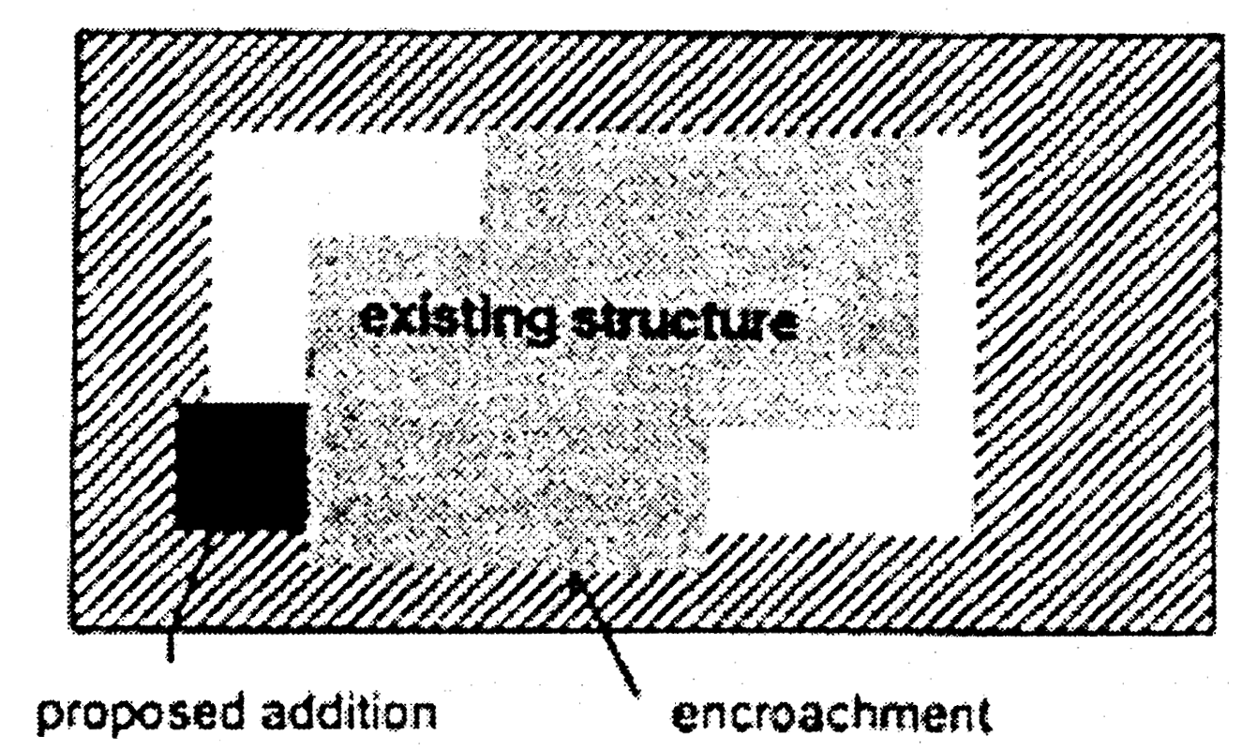
The example above shows a typical 50-foot × 80-foot lot with the current setbacks as dashed lines, the total required setback is cross-hatched, the existing building is in light gray, and a proposed room addition in dark gray. The total area of the setbacks is 4,400 square feet, and the total encroachment of the existing building is 30 feet × five feet or 150 square feet. Using a five percent maximum, the administrative official could grant an administrative variance for a total of 220 square feet, or an additional 70 square feet of encroachment. As depicted, the proposed addition would encroach an additional two feet × 15 feet or 30 square feet. So, the addition could be permitted by the administrative official.
(3)
Amortization of commercial uses. The maximum allowable time for the amortization of commercial uses, including retail stores, offices, and motels is imminent at the adoption of this amendment on June 7, 1999. Therefore, the reconstruction of earlier grandfathered structures for occupancy by a nonconforming or commercial use is hereby prohibited.
(e)
Grandfathered uses of land. The lawful use of land existing as of November 25, 1976, or lawfully existing prior to an amendment to this land development code, although such use does not conform to provisions of this land development code, may be continued subject to the following limitations and restrictions:
(1)
Change of use. A change from a grandfathered use to a use not a continuation of the original grandfathered use which existed on November 25, 1976, and which does not otherwise comply with all of the property development and land use requirements of the town's Code, is prohibited.
(2)
Change in kind or quality of use. A change from a grandfathered use in kind or quality of use not a continuation of the original grandfathered use in kind or quality of use which existed on November 25, 1976, is prohibited.
(3)
Increase in volume or intensity of use. An increase in the volume or intensity of the use not a continuation of the original grandfathered use's volume or intensity of use which existed on November 25, 1976, is prohibited. Notwithstanding the above provision, residential uses shall be permitted to expand the volume of use, i.e., construct additional or expanded rooms, in conformity with the current land development regulations. However, nothing herein shall be construed to permit the establishment of additional dwelling units, unless the same shall conform to the current land development regulations of the town.
(4)
Change in location of use. No such grandfathered use shall be moved in whole or in part to any other portion of the lot or parcel occupied by such use on November 25, 1976.
(5)
Change of ownership or tenancy. All rights and obligations associated with a grandfathered use of land run with the land and are not personal to the present owner or tenant of the grandfathered use of land and are not affected by a change in ownership or tenancy.
(6)
Accessory or incidental uses. Uses accessory to a grandfathered use not in existence on November 25, 1976, are not permitted by this section. Only accessory uses and structures associated to permitted uses within the zoning district within which the permitted use is located are allowed under this land development code.
(7)
Change to a more restrictive degree of use. A grandfathered use may be changed to a more restrictive degree of grandfathered use if the resulting change minimizes the degree to which the grandfathered use is in noncompliance with the property development regulations and use regulations of the zoning district in which it is located.
(8)
Extension of use. No such grandfathered use shall be increased or extended to occupy a greater area of land than was occupied on November 25, 1976, unless such grandfathered use is changed to a use permitted in a zoning district in which such use is located and complies with all property development regulations of the zoning district.
(9)
Enlargement of use. No such grandfathered use shall be enlarged or increased to occupy a greater area of land than was occupied on November 25, 1976, unless such use is changed to a use permitted in the zoning district in which such use is located and complies with all property development regulations of the zoning district.
(10)
Replacement of use. If any existing grandfathered structure, as provided for in this section, is destroyed by any means, including fire, flood, wind, explosion, act of God, or act of a public enemy, such use shall be permitted to be replaced according to the property development regulations in effect at the time of its original construction, except that replacement can only occur in compliance with those building, plumbing, electrical, gas, fire and other construction and safety related regulations of the town in effect at the time of application for a permit to allow replacement. In no event shall the destroyed grandfathered use be replaced to a degree or level greater than the original use as to height, lot coverage, total floor area, bulk or yard setback requirements unless otherwise provided by current town codes and land use regulations. If the destroyed grandfathered use to be replaced was composed of dwelling units for in-transit or nonowner-occupied lodging, and is intended to continue such use, in addition to the other provisions of this subsection, the following requirements shall apply:
a.
No advertising or signs shall use the word "hotel," "motel," or the like, but the word "lodge" may serve as a substitute.
b.
The terms "by day" or "by night" shall not be used, but the terms "vacancy" or no vacancy" are permitted.
c.
Each of the signs erected under the special signage requirements of this subsection shall comply with all provisions of chapter 70 of this land development code.
For the purposes of this section, a structure shall be deemed destroyed if the damage caused to the structure will require repair or replacement the cost of which will exceed 50 percent of the appraised value of the structure as established by the Palm Beach County Property Appraiser.
(11)
Addition or expansion of facilities. No additions to or expansions of grandfathered use facilities shall be permitted under this land development code.
(12)
New activities, products or services. No new activities, products or services shall be permitted in a grandfathered use under this land development code.
(13)
Change in frequency of use. A change in frequency of use in grandfathered use classifications shall be permitted under this land development code. For clarification purposes, an example of a change in frequency of use would be the occupancy of a rental apartment on a yearround basis as opposed to a previous seasonal basis.
(14)
Use of new land. The use of new land previously unoccupied by a grandfathered use is prohibited by this land development code.
(15)
Abandonment or discontinuance of use. The abandonment or discontinuance of a grandfathered use for a period of one year shall render the grandfathered use status of the specific grandfathered use null and void. Only uses permitted in the zoning district in which the grandfathered use is located shall be permitted after the expiration of the one-year period of abandonment or discontinuance. In the factual determination of whether a grandfathered use has been abandoned or discontinued, the following two factors shall be used:
a.
An intent to abandon the grandfathered use existed; and
b.
Some overt act or failure to act which carries with it a sufficient implication that the owner neither claims nor retains any interest in the abandoned property as it stood before the abandonment has occurred.
The town manager shall furnish to the property owner of record, according to the last recorded property ownership rolls of the property appraiser of the county, written notice of the occurrence of the abandonment or discontinuance of the grandfathered use in question and the expiration of the one-year mandatory period of abandonment or discontinuance of use, by certified mail, return receipt requested. The property owner shall have 30 days from the date of receipt of the official notice from the town manager to reply to the notice of abandonment. The property owner may request a public hearing by the zoning board of adjustment of the town on the administrative determination of abandonment or discontinuation within the prescribed 30-day response time. In the event of the property owner's failure to exhaust the prescribed administrative remedies within the prescribed period of time, the grandfathered use automatically loses its grandfathered use status and the property can only be used for a use permitted in the zoning district in which it is located from that date forward.
(f)
Grandfathered lots, structures and uses in combination.
(1)
If on November 25, 1976, a lot of record, structure, use or characteristic of use of land in any combination thereof exists that would not be allowed in the zoning district in which it is located under the terms of this land development code, the lawful existence of the lot of record, structure, use or characteristic of use of land in any combination thereof may be continued so long as it remains otherwise lawful.
(2)
For purposes of this land development code, characteristics of use including but not limited to off-street parking, off-street loading and landscape requirements are interpreted to be synonymous with and a part of the grandfathered classification of uses and structures legally permitted and existing as of November 25, 1976, or legally permitted and existing after an amendment to this land development code, although such characteristics of use do not conform to the provisions of this land development code.
(Ord. No. 540, 3-13-2003; Ord. No. 565, §§ 1—4, 3-6-2005; Ord. No. 567, §§ 1—4, 6-5-2006; Ord. No. 2022-02, § 2, 2-7-2022)
Sec. 63-118. - Nonconforming signs and uses.
(a)
Nonconforming signs not grandfathered. Those signs that were rendered nonconforming by the adoption of Ordinance No. 229 are not grandfathered by any provision of this land development code and shall be removed in accordance with the original amortization schedule provided for in Ordinance No. 229 adopted on December 30, 1969, as follows:
Provided, however, that each grandfathered use may erect or maintain only one sign not to exceed five square feet of surface area for each 25 feet of front yard frontage, or remaining fraction over one-half yard, on a public street.
(b)
Nonconforming nonresidential uses not grandfathered. Those nonresidential uses that were originally rendered nonconforming by the adoption of Ordinance No. 229 are not grandfathered by any provision of this land development code and shall be removed in accordance with the original amortization schedule provided for in Ordinance No. 229, adopted on December 30, 1969, the amortization schedule of which is hereby reaffirmed and readopted for purposes of this section as follows: Any and all nonresidential nonconforming uses shall be discontinued within 40 years of the date of construction of the nonresidential building; provided, however, that no such mandatory discontinuance shall be required in less than 20 years from the date the use became nonconforming by passage of Ordinance No. 229, adopted on December 30, 1969. Any structure involved in such nonresidential nonconforming use shall be removed unless converted to a conforming use which complies with all property development regulations in the district within which it is located. For purposes of this subsection, the date of construction shall be the date of issuance of the building permit for the principal building by the town.
(Ord. No. 540, 3-13-2003)
Sec. 63-131. - Applications and petitions.
(a)
Fee schedule. The fees for all applications and petitions which come before the town commission, the planning and zoning commission, the zoning board of adjustment and the construction board of adjustments and appeals shall be as set forth by resolution of the town commission.
(Ord. No. 540, 3-13-2003; Ord. No. 633, § 5, 9-6-2018)
Cross reference— Application and petitions before the planning and zoning commission, § 63-31; applications and petitions before the board of adjustment, § 63-34.

