
Oconee County Unincorporated
City Zoning Code
City Zoning Code
APPENDIX A
(a)
Building standards. Diversity in design consistent with the local natural and architectural surroundings is encouraged.
(1)
To the extent feasible, primary facades and entrances shall face the street.
(2)
All buildings less than or equal to 20 feet in height shall have a setback of at least 30 feet from the property line along the primary road. Setback from remaining property lines shall be 15 feet.
(3)
Buildings more than 20 feet in height shall have a setback of 30 feet plus an additional distance equal to one foot in horizontal distance for each one foot in additional vertical distance (building height over 20 feet) along the primary road. Setbacks from remaining property lines shall be 25 feet.
(4)
Exterior building materials visible from the traffic lanes shall not consist of unadorned concrete masonry units (concrete blocks), corrugated metal, and/or sheet metal. Pre-cast panels and pre-engineered metal wall units, and 'split-faced' and other rusticated masonry wall are permitted.
(5)
Suitable materials for treating building facades may include, but are not limited to: stone, brick, glass, wood siding, split block, or stucco. Alternative materials may be approved by the planning director.
(6)
Blank, uninterrupted building facades shall not face residential areas or public or private street right-of-ways. Design techniques using architectural elements or repetitive features should be utilized to visually break up the facade. Examples include, but are not limited to: windows, doors, columns, canopies, lighting fixtures, building offsets/projections, decorative tile work, artwork, or other elements approved by the planning director. The following standards apply:
a.
Industrial uses shall not have blank walls greater than 50 feet in length.
b.
All other uses shall not have blank walls greater than 30 feet in length.
(7)
The appearance of strip development resulting from flat, unvaried roof lines is discouraged. Roofline variation may be achieved using one or more of the following methods: vertical or horizontal offsets in ridge lines, variation in roof pitch, gables, or dormers.
(8)
Roof mounted mechanical equipment shall be enclosed or screened to ensure such features are not visible to the extent possible. Enclosures and screens shall be compatible with the architectural style of the building.
(9)
Shipping and receiving areas/docks shall be located in the rear of the structure and should not be visible from primary adjacent parking areas or street rights-of way.
(b)
Signage standards. The sign standards are created to maintain and enhance the aesthetic environment of transportation and economic gateways into Oconee County. The location and design of all signs shall be consistent with the objective of high-quality development and safe and efficient vehicular and pedestrian circulation.
(1)
General standards. All signs, including their supports, braces, guys, anchors, electrical parts and lighting fixtures, and all painted and display areas shall be constructed and maintained in accordance with the building and electrical codes adopted by Oconee County.
a.
It shall be unlawful for any person to erect, construct, enlarge, move, or replace any sign (with the exception of signage requiring no permit) without first obtaining a sign permit from the planning department, except as relates to routine maintenance and repair or the changing of tenant name panels.
b.
A preliminary sign permit application along with applicable fees and sign plan shall be submitted to Oconee County. The detailed sign plan shall include the following information, stamped by a South Carolina licensed surveyor, landscape architect, or engineer:
1.
Parcel number.
2.
Scale of site plan and north arrow.
3.
Drawing of entire property with all existing and proposed structures shown.
4.
Length of street frontage.
5.
Dimensioned setbacks from street and side property line.
6.
Plan drawing with actual dimensions of sign (as seen from above).
7.
Location of all existing signs.
8.
Location of all proposed signs.
9.
Elevation drawing of the proposed sign or sign revision including size, height, copy, colors, illumination, materials.
10.
Verification that the proposed sign(s) meet all requirements set forth in this chapter.
c.
All on-premises nonconforming signs shall come into compliance with these standards when abandoned or the cost of repairs or replacement of such signs is beyond 50 percent of their replacement costs. Nonconforming signs are subject to all requirements of this code regarding safety, maintenance, and repair.
d.
Signage shall be set back a minimum of ten feet from right-of-way, side, or rear property lines.
e.
No sign shall produce a traffic hazard, such as visual obstruction at intersections or glare from lighting. Signs shall not obstruct the view of or resemble traffic directional/safety signs.
f.
Rooftop signs are prohibited.
g.
Flashing or animated signs are prohibited.
h.
No sign shall be attached to a utility pole or street sign, or attached to or painted on tree trunks, rocks, or other natural objects.
i.
No sign shall be placed within the public rights-of-way.
j.
Signs shall not rotate or revolve.
(2)
Signs allowed without a permit. The following signs require no permit. These signs are subject to all requirements of this code regarding safety, maintenance, and repair.
a.
Temporary/portable signs:
1.
Shall be displayed only for the duration of time that they remain relevant to a specific event.
2.
Temporary signs shall be removed within seven days following the conclusion of the specific event being promoted.
3.
No temporary sign exceeding six square feet may be erected on a residential parcel.
4.
The maximum allowable size of any non-residential temporary sign is 32 square feet.
b.
Traffic, directional, warning, official notice or informational signs authorized by any public agency.
c.
Building nameplates with related inscriptions.
d.
Window signs.
e.
Flags and flagpoles.
f.
On-site directional signs, where each sign does not exceed nine square feet in area or four feet in height.
g.
Signs that display name, trademark, logo, brand, or prices, provided the display is an integral part of a vending machine, automatic teller machine, or gas pump. Such signage shall not exceed 32 square feet in area per side.
(3)
Signs allowed that require a permit.
a.
Allowable signs shall be the following:
1.
Monument.
2.
Wall.
3.
Hanging/projecting.
4.
Canopy/awning.
b.
Monument signs:
1.
Shall be architecturally designed to reflect the character of the structure/development for which they are advertising.
2.
No monument sign shall exceed ten feet in height.
3.
One double faced or single faced sign shall be allowed per parcel.
4.
Developments with 400 feet of road frontage serving more than one building shall be permitted one additional sign, which shall not exceed 100 square feet in area. Minimum separation for all monument signs shall be at least 200 linear feet. However, if a building is located on a corner lot with two street facing sides, one sign may be located on each side served by an entryway.
c.
Wall signs:
1.
Wall signage shall not exceed 15 percent of the wall area, per wall face.
2.
Wall signs shall display only one surface and shall not be mounted more than six inches from any wall.
d.
Hanging/projecting signs:
1.
Only one projecting/hanging sign is allowed per building frontage, except for shopping centers, which may have one projecting/hanging sign for each business use.
2.
Signs shall project at a right (90 degree) angle to the building frontage.
3.
Signs shall not extend more than four feet beyond the line of the building or structure to which it is attached.
4.
Signs shall maintain a vertical clearance of eight feet above the sidewalk or ground level accessible to pedestrians.
e.
Canopy/awning signs:
1.
Shall not exceed 15 percent of the surface area of the face or the canopy or awning to which the sign is attached.
2.
Sign shall not extend more than three inches horizontally from the surface of the awning or canopy.
3.
Sign shall not project vertically outside the area of the canopy or awning.
f.
Illumination:
1.
No internal lighting shall include exposed incandescent or fluorescent bulbs.
2.
Externally illuminated signs must have indirect light sources shielded from the view of persons viewing the sign and be further shielded and directed so that the light shines only on the sign and that illumination beyond the copy area is minimized.
3.
Signs shall not have light reflecting backgrounds but may use light reflecting lettering.
4.
No sign shall have lights or illuminations that flash, move, rotate, scintillate, blink, flicker, or vary in intensity or color.
g.
Maintenance: All signs shall be maintained in good condition and working order, and be free of graffiti, peeling paint or paper, faded colors, weeds, vines, and/or broken and damaged materials. No internally or externally illuminated sign shall have only partial illumination for a period of more than 30 days.
(c)
Lighting standards. The purpose of these standards is to assure that adequate exterior lighting is provided to facilitate crime prevention, security, and safe passage, and that exterior lights be shielded to reduce the impact of lighting on neighboring uses, potential safety hazards to the traveling public, and the effect on viewsheds and nightscapes.
(1)
Lighting plans shall be submitted with the zoning permit application on projects that include the installation of outdoor lighting fixtures. Prior to obtaining a zoning permit, an applicant must receive approval of a lighting plan. The lighting plan shall be prepared by an appropriately licensed design professional in the State of South Carolina. The plan shall include the following information:
a.
The location, type, and height of luminaries including both building and ground-mounted fixtures.
b.
A description of the luminaries, including lamps, poles or other supports and shielding devices, which may be provided as catalogue illustrations from the manufacturer.
c.
Photometric data, such as that furnished by the manufacturer, showing the angle of light emission.
d.
Additional information as may be required to determine compliance with this chapter.
(2)
Exterior lighting shall be shielded and directed to avoid illuminating the night sky.
(3)
Lighting shall not illuminate neighboring properties or distract/harm the traveling public on road rights-of-way. Any necessary screening of lighting shall be shown on site plans. Lighting will be inspected before a certificate of occupancy is granted.
(4)
On-site lighting may be used to accent architectural elements and provide safety and security on pedestrian walkways, at building entrances, and public areas between buildings, but shall not be used to illuminate entire portions of buildings.
(5)
In order to promote safety and security in developments, lighting should be used at intersections, entrances, and in parking areas.
(6)
The overall height of lighting fixtures shall not exceed 20 feet.
(7)
Blinking or flashing lights shall be prohibited unless the lights are required as a safety feature (e.g. beacons on towers). Searchlight and laser light operation for advertising/commercial purposes is prohibited.
(d)
Parking standards. Parking areas should be designed in a manner to provide safe and efficient circulation of traffic and safe access for pedestrians. Appropriate parking design and layout should be used to reduce impacts associated with impervious surfaces.
(1)
Parking layout. Avoid parking layouts that dominate a development. The layout of parking areas, pedestrian connections, and open space should reduce the visual impact of parking. Parking is strongly encouraged to be located to the side or rear of the building unless prevented by a physical limitation of the site.
(2)
Perimeter parking buffer. A perimeter parking area buffer of 15 feet shall be required on sides parallel to abutting properties or street rights-of-way. Buffers shall be planted as specified in the landscape standards.
If parking is located in the front of the building, buffer requirements will be increased to 25 feet.
(3)
Parking striping. Parking areas shall have parking spaces marked by surface paint lines or approved alternative traffic marking material.
(4)
Wheel stops. Wheel stops or curbs are required where a parked vehicle encroaches on adjacent property, pedestrian access/circulation areas, right-of-way or landscaped areas.
(5)
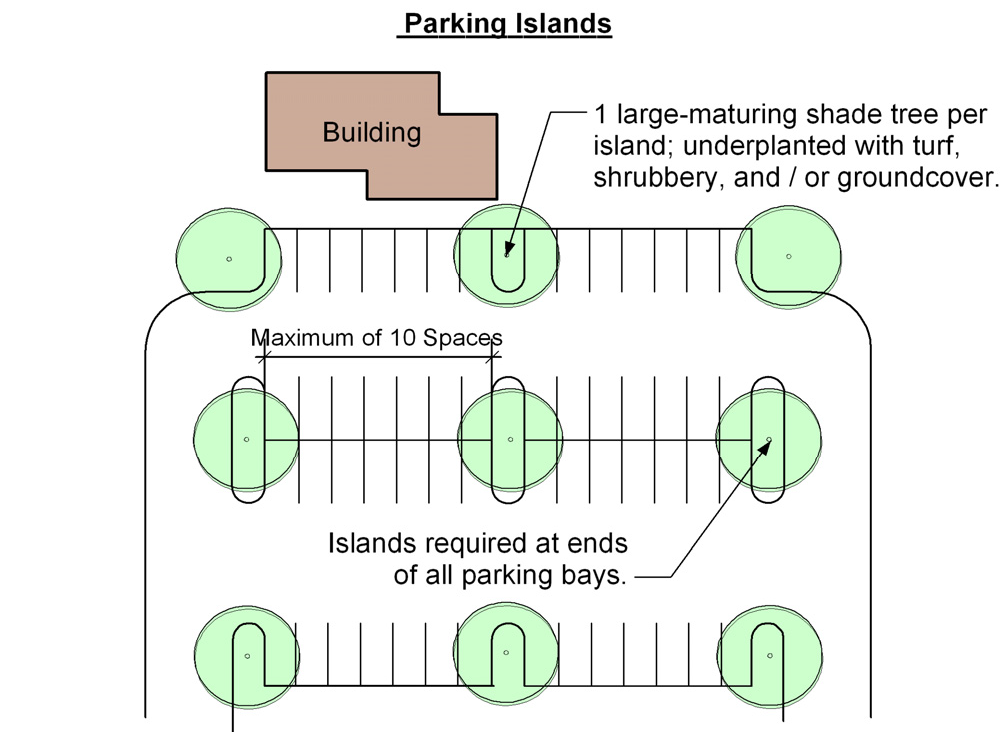
Planting islands. Parking areas shall be designed so that a planting island is provided for every ten parking spaces in a continuous row. Planting islands are also required at the beginning and end of all parking bays. Planting islands shall be surrounded by curbing to prevent vehicular damage to plantings.
Minimum size for required planting islands is nine feet by 15 feet (inside of curb). Islands shall be planted as specified in the Landscape Standards.
(6)
Stormwater. Parking areas shall be designed to convey and/or preferably infiltrate stormwater on-site. Stormwater shall not contribute to the subsidence, erosion, or sedimentation of the development site or off-site areas.
(7)
Paving. Parking areas shall be paved unless otherwise approved by the planning commission. Alternative paving materials that increase permeability such as pervious concrete, pervious asphalt, pavers, grid pavers, or any other approved pervious paving materials are encouraged.
(e)
Landscape standards. Trees and landscaping contribute to the public health, safety, and welfare. Among the benefits of landscaping are: screening of undesirable views; aesthetic enjoyment; climate modification; reduction of glare, noise, odors and dust; reduction of storm water runoff and flooding; buffers between land use; shelter and food for wildlife; and improved air quality. All of these benefits contribute to a higher quality of life and enhance property values within the county.
(1)
Landscape plan. The landscape plan shall be submitted with the zoning permit application. Prior to obtaining a zoning permit, an applicant must receive approval of a landscape plan. The landscape plan shall be prepared by a landscape architect licensed by the State of South Carolina. The landscape plan must contain all information necessary to show that the planned use, structure, or development complies with the standards set forth. This shall include utility information, irrigation plans, existing trees used for credit, and tree protection plans, if applicable.
(2)
Installation. No certificate of occupancy shall be issued until the landscaping is completed as certified by an on-site inspection. If the season or weather conditions prohibit planting of trees, the developer may provide a bond, an irrevocable letter of credit, or other financial surety in an amount equal to 125 percent of the cost of installing the required plantings to guarantee the completion of the required planting within 270 days. The financial surety shall be canceled and/or returned upon completion of the required landscaping. If the required landscaping is not completed within the time allowed, the owner shall forfeit the guarantee and the county shall use such funding to complete the required landscaping.
(3)
Maintenance. The plantings that constitute a landscape area must be properly maintained in order for the landscape area to fulfill the purposes for which it is established. The owner of the property shall be responsible for the maintenance of all plant material within the landscaped areas. This includes keeping landscaped areas free of litter and debris and keeping plantings healthy and orderly in appearance. Tree staking shall be removed within eight months after installation to prevent permanent damage. All dead or diseased vegetation shall be removed. Additionally, any required vegetation that dies or becomes diseased shall be replaced.
(4)
Minimum material size. All required trees shall be a minimum size of 2½-inch caliper measured six inches above ground at the time of installation. All required shrubs shall be a minimum size of three gallons at the time of installation. Reference the American Landscape and Nursery Association (ANLA) publication American Standard for Nursery Stock (ANSI Z60, 1-2004) for plant material quality specifications. All plant material shall be mulched with an organic mulch or other approved material.
(5)
Water source. A permanent water source (hose bib, etc.) shall be provided not more than 100 feet from any required landscaping.
(6)
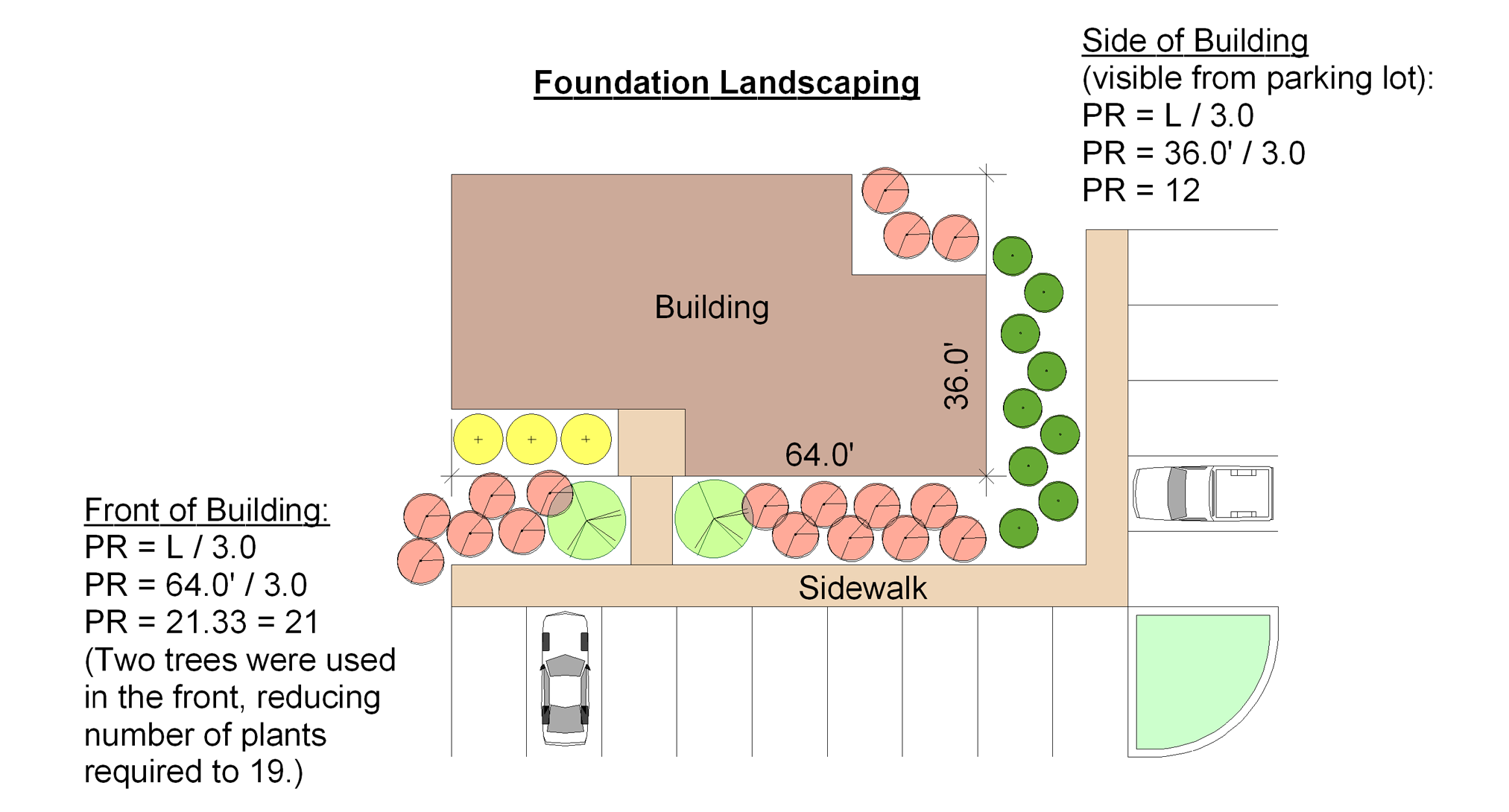
Foundation landscaping. Landscaping shall be provided around the foundation of structures visible from any parking area. Plant material, as defined in this chapter, shall be located in a planting area adjacent to the building in the following quantities:
PR = L/3.0 where:
PR = number of plants required
L = building length, in feet, visible from any parking area
Each tree provided counts as a total of two required plants.
(7)
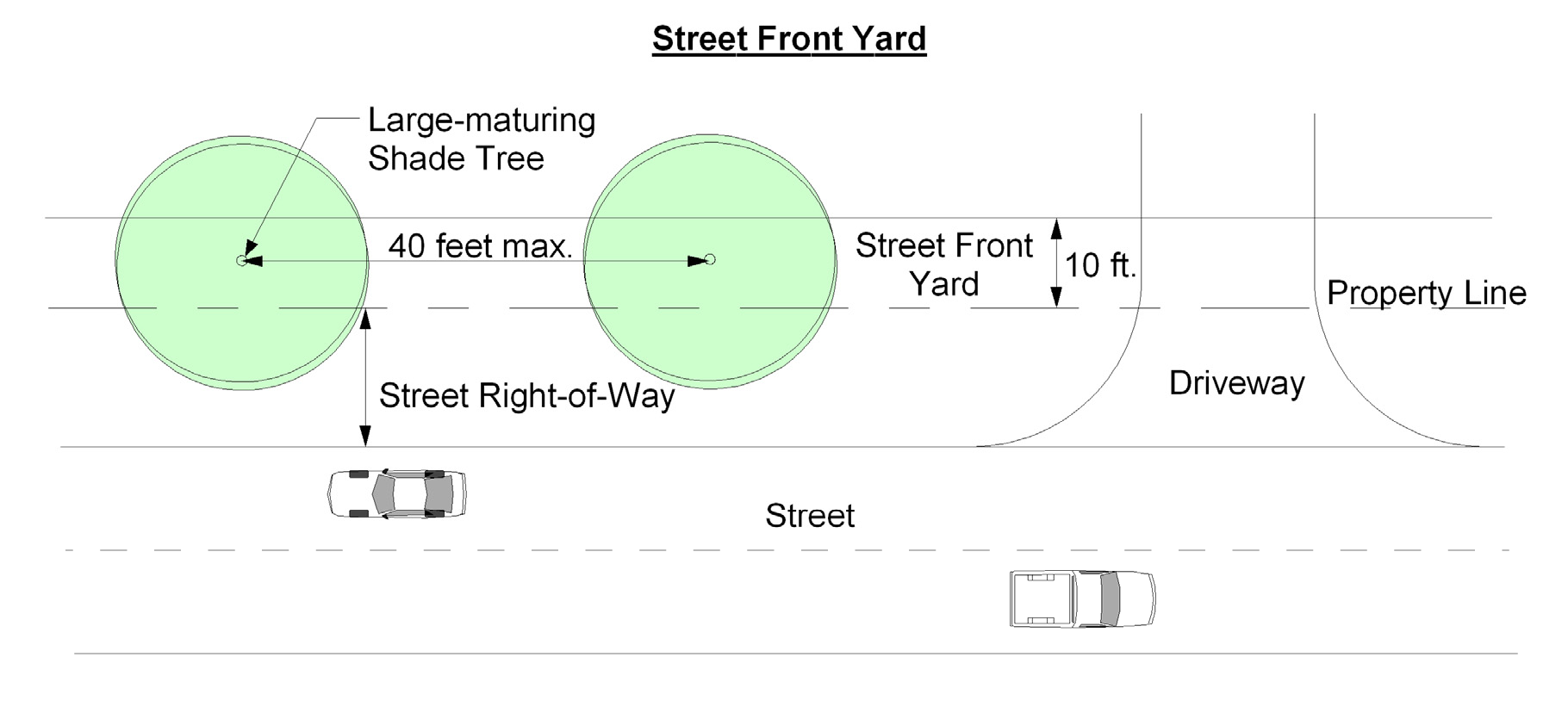
Street front yard. Street front yards shall be located along property adjacent to all street rights-of-way. Street front yards must be located on private property and not within the street right-of-way. Portions of the property needed for driveways are exempted from these requirements. Street front yards shall be a minimum of ten feet in width, measured from the street(s) right-of-way abutting the property. Each street front yard shall contain at least one large maturing shade tree every 40 linear feet or fraction thereof. No street front yard shall contain less than one shade tree. Shrubs, groundcover, understory, and/or turf shall cover the remaining area within the street front yard.
(8)
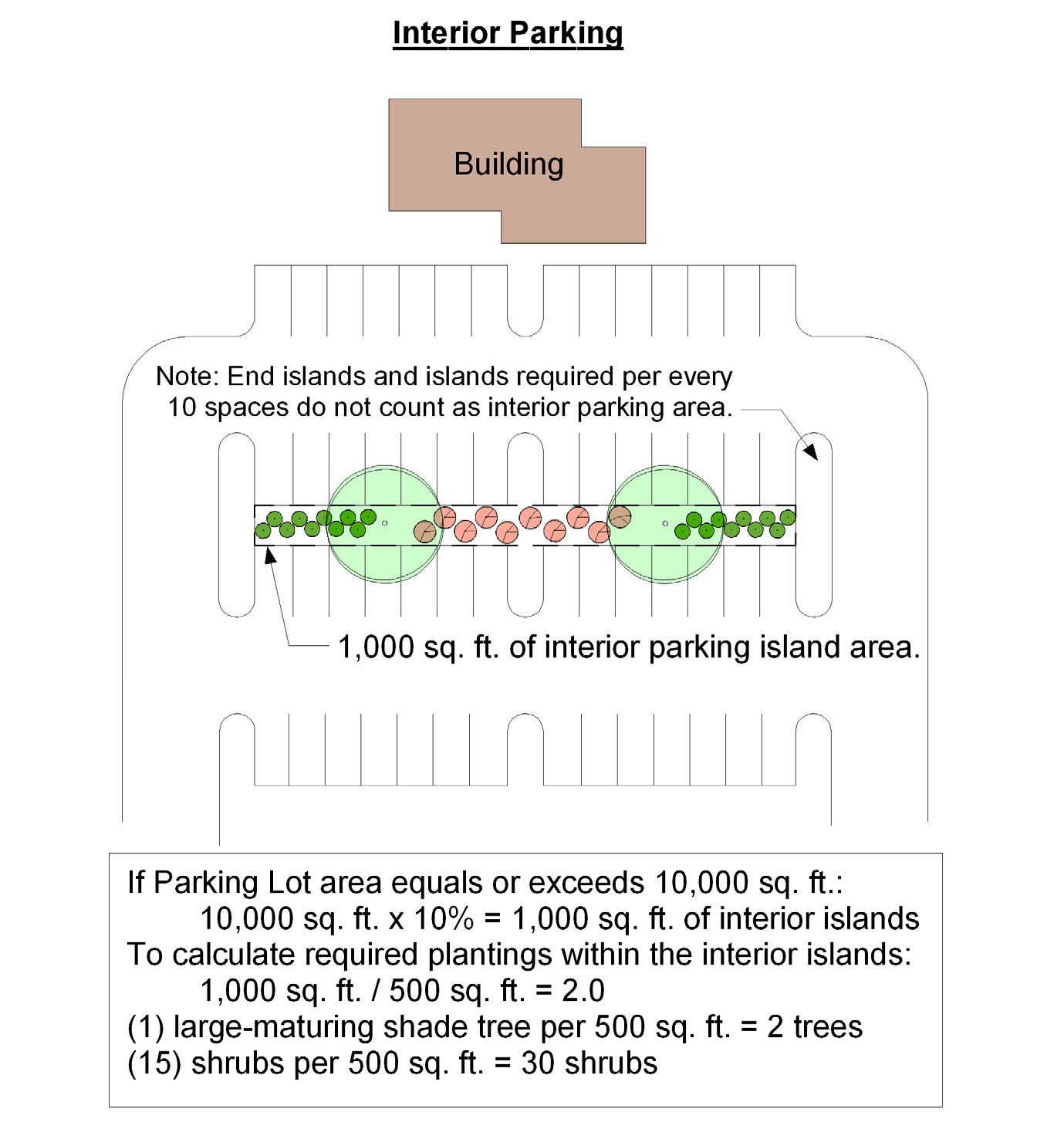
Interior parking. Whenever the impervious parking cover equals or exceeds 10,000 square feet, a planting area equal to ten percent of the total impervious surface must be provided as islands within the interior of the parking area. One large maturing shade tree and 15 shrubs must be planted for each 500 square feet of required interior landscape area. Plantings in landscape islands referenced under the parking islands section may not be used to satisfy this requirement. However, existing trees preserved in appropriately sized islands may be counted as outlined in the existing trees section.
(9)
Existing trees. Existing trees that have a minimum caliper size of four inches may be counted towards satisfying interior landscaping and street front yard requirements if such trees are preserved and adequately protected through all phases of construction. Credited trees shall be uniformly encircled by a fenced protection area of sufficient size (a circle whose center is the trunk and outer edge is the dripline) to insure tree health. Each four caliper inches of an existing tree shall be deemed the equivalent of one required two-inch caliper tree. If any preserved tree used for credit dies or fails to thrive, the owner shall plant new trees equal to the number of credited trees.
(10)
Parking islands. A planted parking island shall be provided for every ten parking spaces in a continuous row. Planting islands are also required at the beginning and end of all parking bays. Refer to the parking standards section for parking island design standards. Planter islands shall contain at least one large maturing shade tree, having a minimum clean trunk of six feet. Shrubbery, groundcover, and/or turf shall be used in the remainder of the island.
(11)
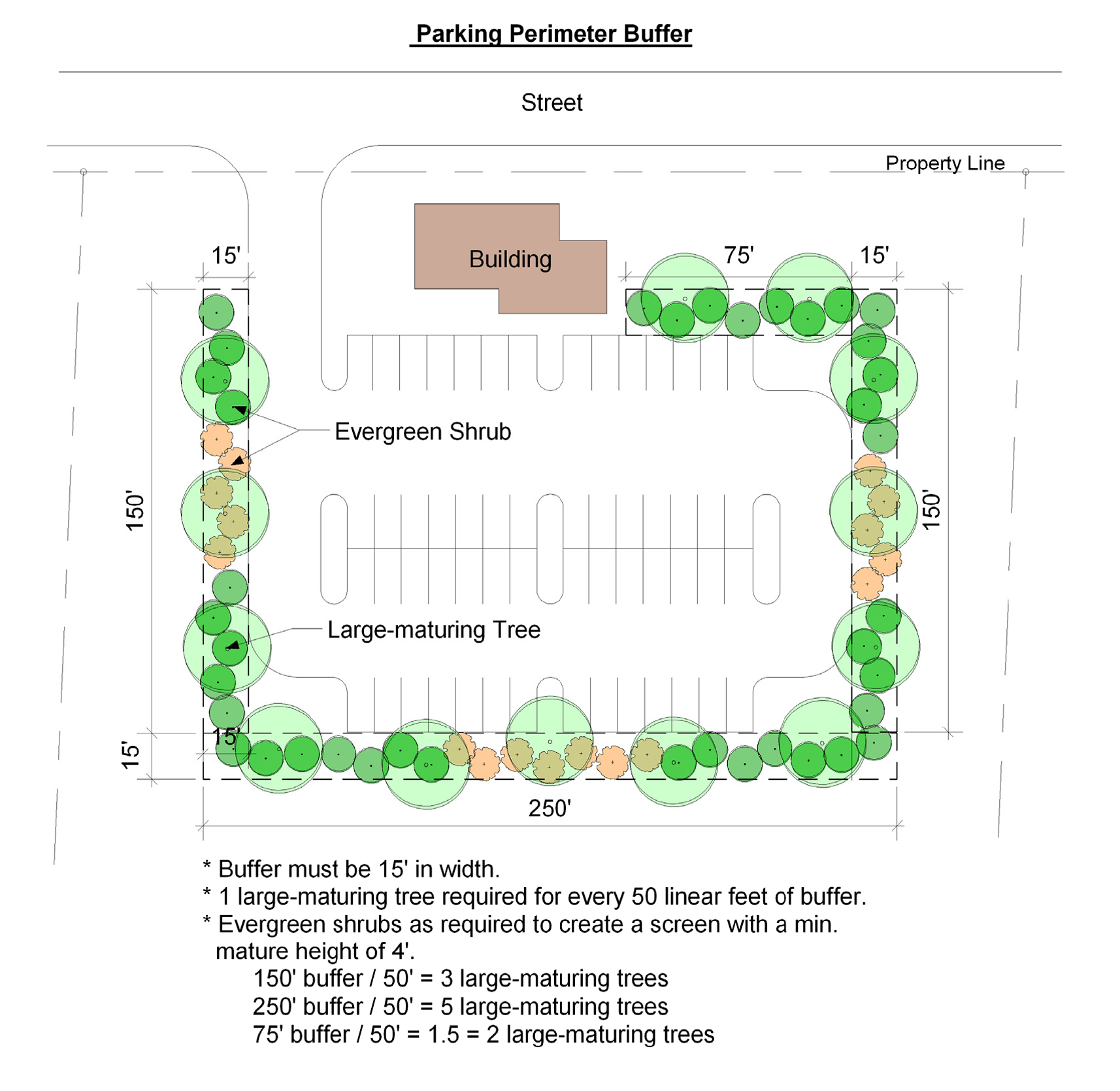
Perimeter parking buffer. All parking lots and vehicular use areas shall be screened from all abutting properties or rights-of-way. The landscaped area shall be directly adjacent to the parking lot edge, and shall be a minimum width of 15 feet. The perimeter shall contain at a minimum, one large maturing tree for every 50 linear feet, and evergreen shrubs in sufficient quantity to provide screening with a minimum mature height of four feet. If parking is located in the front of the building, buffer requirements will be increased by 30 percent in terms of width and planting quantities.
(12)
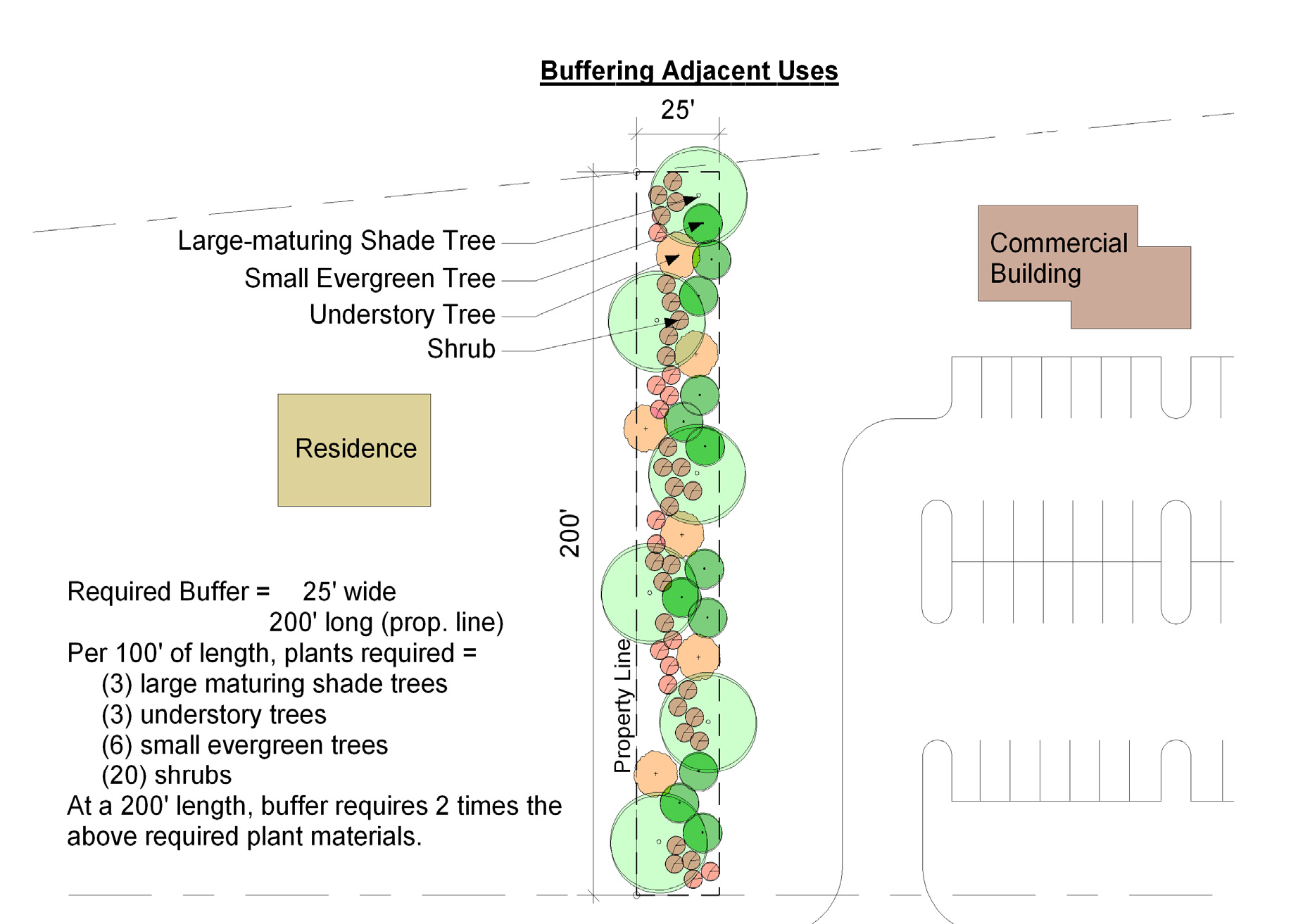
Buffering adjacent uses. In the event that non-residential development borders residential areas or industrial development bordering non-industrial development, a 25 feet wide landscape buffer shall be required along the common property boundary. The following mixture of plants per 100 feet of property boundary shall be required:
Three large maturing shade trees, equally spaced
Three understory trees, equally spaced
Six small evergreen trees
Twenty shrubs
If an abutting parcel contains a required buffer or screen, it shall count towards the buffer requirements.
(13)
Existing natural buffers. When a natural, undisturbed buffer is retained along a property boundary where a buffer is required, a waiver (in whole or part) of the required landscaping may be granted. The existing buffer must achieve the same screening effects as the required buffer materials and adhere to the requirements for protection and size outlined in the buffering adjacent uses section.
(14)
Screening of collection areas. Screening of loading and trash collection areas must be accomplished with an opaque wall of masonry, rot-resistant wood, or evergreen shrubs that are one foot taller than the object to be screened. If evergreen shrubs are used, they must achieve the required screening at the time of planting.
(15)
Sight triangles. The placement of any material shall not obstruct the view between access drives and streets, or the intersecting streets of a corner lot. No fence, building, wall or other structure, (excepting single
trunk trees less than 12 inches in diameter, pruned to a height of eight feet, and poles and support structures less than 12 inches in diameter), shall exist between a height of 2½ feet and eight feet above the upper face of the nearest curb (or street centerline if no curb exists) and the sight triangle. For a corner lot, the sight triangle area is the area bounded on two sides by the street right-of-way lines, each having a length of 25 feet, and a third side connecting the two right-of-way sides. For an intersecting street and driveway, the sight triangle is formed by measuring from the point of intersection of the right-of-way and the edge of drive the distance of 25 feet and connecting the points so established to form a triangle on the area of the lot adjacent to the street. Note that road design criteria concerning sight distances is governed by the standards in Chapter 32, Unified Performance Standards of the Oconee County Code of Ordinances.
(Ord. No. 2012-14, § 1, 5-15-2012)

(Ord. No. 2012-14, 5-15-2012; Ord. No. 2012-34, § 3(Exh. B), 1-22-2013)

