
Oelwein City Zoning Code
ARTICLE I
- ESTABLISHMENT OF DISTRICTS
Sec. 101. - Use districts.
The city is hereby divided into districts:
Sec. 102. - District boundaries.
The provisions of this ordinance shall apply within the corporate limits of the City of Oelwein, Iowa, as now or hereafter fixed.
District boundaries are shown on the "official zoning map of the City of Oelwein, Iowa" said map being as much a part of this ordinance as if fully described herein. Where uncertainty exists as to boundaries, the following rules shall apply:
102.1.
Where districts are bounded approximately by street or alley lines, the centerline of streets or alleys shall be construed to be the boundaries.
102.2.
Where districts are bounded approximately by lot lines, said lot lines shall be construed to be the boundaries.
102.3.
Where bounded approximately by neither streets, alleys, or lots, boundaries shall be determined by the commission.
102.4.
Whenever any street, alley, or other public way is officially vacated, the zoning district on either side shall be automatically extended to the centerline of said vacation.
Sec. 103. - Extent of regulations within each district.
Except as hereinafter provided:
103.1.
No building or structure shall be erected, moved, converted, reconstructed, or enlarged, nor shall any building, structure, or land be used, except in conformance with the provisions of this ordinance.
103.2.
No lot area shall be so reduced or diminished that the yards or other open spaces shall be smaller than prescribed by this ordinance, no shall any required yard have any structure or use placed within it, except as hereinafter specified, no shall any required yard or open space be considered as providing yard or open space for any other building. Lots of record existing at the time of the adoption of this ordinance may be used in accordance with regulations of each district and provided that all front, side, and year yards are met.
Sec. 104. - Definitions.
For the purpose of this ordinance, the following words and phrases shall have the following meaning:
1.
Accessory use. A use or building naturally and normally incidental to, subordinate to, and devoted exclusively to the main use of the land or buildings. Accessory buildings shall not be larger than the main or principal building, and shall not intrude into the minimum front yard requirement. Earth satellite dishes shall be considered an accessory structure.
2.
Agricultural use. Any agricultural use, including farming, dairying, pasturage, agriculture, horticulture, floriculture, viticulture, and animal poultry husbandry. (Provided all livestock is raised at least 1,000 feet from any other zoning district within the city limits of Oelwein.)
3.
Alley. A public right-of-way which is used primarily as a secondary means of access to the abutting property.
4.
Apartment. A room or suite of rooms, with toilet and culinary accommodations, use or designed for use as a residence by a family, located in a building containing three or more such rooms or suites or located in a building devoted primarily to non-residential use.
5.
Basement. A "basement" is a story partly underground but having at least one-half of the height of one or more walls above the highest level of the adjoining ground. A basement shall be counted as a story under the provisions of this chapter.
6.
Boarding rooming house. a building containing not more than five guest rooms, where lodging is Provided, with or without meals, for compensation. This term shall include tourist homes, guest homes, or guest houses.
7.
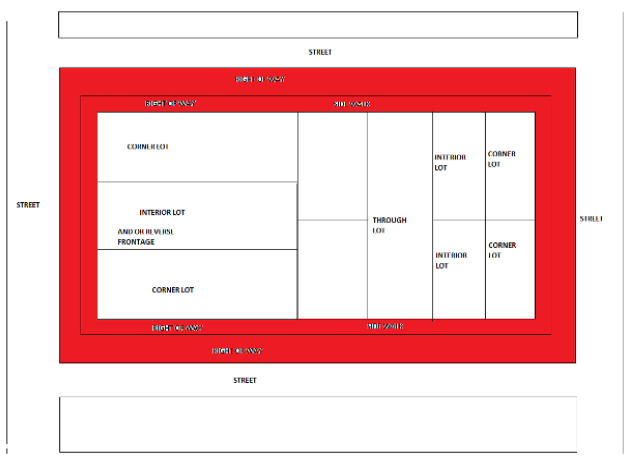
Block frontage. All of the property on one side of a street between two intersecting streets.
8.
Board. The board of adjustment, of Oelwein, Iowa.
9.
Building. Any structure designed or intended for the support, enclosure, shelter or protection of persons, animals, chattels, or property and forming a construction that is safe and stable.
10.
Building, height of. the vertical distance from the grade (elevation of the curb, sidewalk, or average elevation of the ground around the structure) to the highest point of coping of a flat roof, or to the deck line of a mansard roof, or to the mean height level between eaves and ridge for gable, hip, or gambrel roofs. The maximum height of accessory building shall be 15 feet to the peak.
11.
Building line. The extreme overall dimensions of a building from the foundation line. Distances are to be measured from the most outwardly extended position of the structure. See "Yard."
12.
Building permit. A written statement issued by the zoning administrator authorizing buildings, structures or uses consistent with the terms of this ordinance and for the purpose of carrying out and enforcing its provisions.
13.
Business. The word "business" or commercial when used herein refers to the engaging in the purchases, sale or exchange of goods or services, or the operation for profit of offices recreational or amusement enterprises.
14.
Business services. Any activity conducted for gain which renders services primarily to other commercial or industrial enterprises, or which services and repairs appliances and machines used in home or business.
15.
Carport. Space for the storage or housing of motor vehicles and enclosed on not more than two sides by walls, and not necessarily attached to the principal building.
16.
Cellar. A story having more than one-half of the height of all walls below the highest level of the adjoining ground. A cellar shall not be considered as a story for the purpose of this chapter.
17.
Clinic (dental or medical). A place used for the care, diagnosis and treatment of sick, ailing, infirm or injured persons and those who are in need of medical or surgical attention, but who are not provided with board or room or kept overnight on the premises.
18.
Commission. The planning commission of Oelwein, Iowa.
19.
Convalescent home. A building or premises on or on which care is provided for two or more invalid, infirm, aged, convalescent, or physically disabled or injured persons, not including insane or other mental cases, inebriate, or contagious cases. Nursing homes are convalescent homes.
20.
Day care center. The facilities of any dwelling, institution or organization which, for profit or non-profit, are used in the temporary care of six children or more at any one time.
21.
District. A section or sections of the area of the City of Oelwein for which regulations governing the use of buildings and premises or the height and area of buildings are uniform.
22.
Dwelling or residence. A building or structure used in whole or in part for human habitation.
23.
Dwelling or residence, single-family. A building containing one dwelling unit.
24.
Dwelling or residence, two-family. A building containing two dwelling units, commonly referred to as a duplex.
25.
Dwelling or residence, multiple. A dwelling or residence containing three or more dwelling units.
26.
Dwelling unit. One or more rooms arranged, designed, and used as living quarters for one family only. Individual bathrooms and complete kitchen facilities, permanently installed, shall always be included.
27.
Enforcing/administrative officer. The building inspector of the City of Oelwein, Iowa.
28.
Entertainment facilities. Any activity conducted for gain which is generally related to the entertainment field, such as but not limited to, motion picture theaters, bowling alleys, roller skating rinks, miniature golf, golf driving ranges, commercial swimming pools, carnivals, and related uses.
29.
Essential services. The erection, construction, alteration, or maintenance, but public utilities or municipal or other governmental agencies, or underground or overhead gas, electrical, steam or water transmission or distribution systems, collection, communication, supply or disposal systems, including poles, wires, mains, drains, sewers, pipes, conduits, cables, fire alarm boxes, police call boxes, traffic signals, hydrants, electrical substations, and other similar equipment and accessories in connection therewith; reasonably necessary for the furnishing of adequate service by such public utilities or municipal or other governmental agencies or for the public health or safety or general welfare, but not including buildings.
30.
Family. An individual, or two or more persons related to one another by blood, marriage, or legal adoption, including foster children, and not more than two roomers; or in the alternative, not more than three unrelated persons.
31.
Farm. An area which is used for the growing of the usual farm products such as vegetables, fruit trees and grain, and their storage, as well as for raising thereon of the usual farm poultry and farm animals such as horses, cattle, sheet and swine. The term "farming" includes the operating of such an area for one or more of the above uses, including dairy farms with the necessary accessory uses for treating or storing the produce; provided however, that the operation of any such accessory uses shall be secondary to that of the normal farming activities, and provided further that farming does not include the feeding of garbage or offal to swine or other animals.
32.
Floor area (usable). The sum of the gross horizontal areas of all floors of a building measured from the interior faces of the exterior walls, but not including cellar or basement space not used for retaining.
33.
Free standing sign. Any sign within the meaning of Definition No. 66 which is, in the opinion of the building inspector, safely constructed, sell-supporting, and detached from any building or structure on the site where located. For purposes of this ordinance, this does not include portable signs.
34.
Frontage. All the property abutting upon one side of a street measured along the right-of-way-line.
35.
Garage, private. A building used only for the housing of motor vehicles, without their equipage for operation, repair, hire, or sale.
36.
Home occupation. Any occupation or profession customarily conducted entirely within a dwelling and occupying no more than 50 percent of the floor area of one store of the dwelling; employment is limited to the proprietor and one person; signs are limited to size not to exceed six square feet in area and shall be non-illuminated; the dwelling and premises shall not be rendered objectionable or detrimental to the residential character of the neighborhood due to exterior appearance, the emission of odor, gas, smoke, dust, noise or similar activity and the structure shall not include any features by design not customarily found in residential buildings.
37.
Hotel. A building occupied as the more or less transient abiding place of individuals who are lodged with or without meals and in which sleeping rooms are usually occupied independently with meals served by an adjacent or attached commercial facility and where required parking is provided on adjacent lots.
38.
Industry, light. Any light manufacturing or industrial processing, which by nature of the materials, equipment, and process utilized are to a considerable measure clean, quiet, and free of any objectionable or hazardous element. Light manufacturing includes the uses listed below and any other uses that are determined by the board of adjustment to be of the same general character: Bakeries, bottling, jewelry, musical instruments, plastic products and sporting goods; processing and assembly of glass products, household appliances, electronic products, and parts for production of finished equipment; printing and engraving plants; cleaning and dyeing plants.
39.
Industry, heavy. Any heavy manufacturing or industrial processing, which by the nature of the materials, equipment and process utilized cannot eliminate entire objectionable features and influences but which, never the less, must be provided for somewhere in the city.
40.
lntermodal shipping container. A six-sided steel unit originally constructed as a general cargo container used for the transport of goods and materials. (See IBC 2021 Edition)
41.
Institutional homes. A building used for the full time care or home for three or more babies, children, adults, pensioners or the aged, except correctional or mental institutions.
42.
Intermodal shipping container. A six-sided steel unit originally constructed as a general cargo container used for the transport of goods and materials. (See IBC 2021 Edition)
43.
Junkyard or salvage yard. An open area on any lot or parcel of land which is used for storage, abandonment or keeping of junk, including scrap metals or scrap materials, or for the abandonment or dismantling of machinery, motor vehicles, or other vehicles or parts thereof.
44.
Lot. A parcel of land occupied or intended for occupancy by a use permitted in this ordinance including one main building together with its accessory building, open spaces, and parking spaces required by this ordinance, and having its principal frontage upon a street.
45.
Lot area. The area of a horizontal plan, bounded by the front, side and rear lot lines.
46.
Lot depth. The horizontal distance between the front line and the rear lot line.
47.
Lot, interior. An interior lot is any other lot than a corner lot.
48.
Lot width. The distance between the side lot lines. In the case of a lot of irregular shape, the maximum width shall be the lot width.
49.
Lot line, front. Any lot line abutting the public right-of-way. Lots with multiple frontages shall have their front lot line defined as the side pertaining to the lot address.
50.
Lot line, rear. The lot line opposite and most distant from the front lot line.
51.
Lot line, side. Any lot line, other than a front lot line, or a rear lot line.
52.
Lot, through. A lot running through the block from street to street.
53.
Lot of record. A lot or parcel of land, the deed to which has been recorded in the office of the county recorder prior to the adoption of this ordinance.
54.
Manufactured home. Any occupied vehicle used or so constructed as to permit it being used as a conveyance upon the public streets and highways and duly licensed as such, and shall include self-propelled or non-self-propelled vehicles so designed, constructed, reconstructed or added to by means of an enclosed addition or room in such a manner as will permit the occupancy thereof as a dwelling or sleeping place for one or more persons, having no permanent foundation and supported by wheels, jacks or similar supports.
55.
Manufactured home park. Any lot or parcel two or more acres used for one or more manufactured homes, mobile homes, trailer coaches, or other portable or mobile shelters used for living purposes. This term shall include trailer park and trailer court.
56.
Motel. A permanent building or group of buildings designed or arranged primarily for temporary occupancy, so laid out as to provide off-street space on the same lot for parking vehicles used by the traveling public. Such building or group of buildings may include quarters of a more permanent nature for the use of operating or attached commercial facility. Motel shall also include the terms auto courts, tourist courts, motor lodges, motor inns, motor hotels and similar terms.
57.
Non-conforming use. Any building or land lawfully occupied by a use at the time of passage of this ordinance which does not conform with the use regulations of the district within which it is located, in effect prior to the adoption of this ordinance.
58.
Parking space. A surfaced area, enclosed or unenclosed, sufficient in size to store one automobile (lot less than nine feet wide and 20 feet long) connected to a public street or alley by a surfaced driveway and permanently reserved for the parking and storage of one motor vehicle.
59.
Personal services. Any enterprise conducted for gain which primarily offers services to the general public such as shoe repair, valet service, watch repairing, barber shops, beauty parlors, and related activities.
60.
Pre-school, nursery. The facilities or any dwelling, institution or organization which, for profit or non-profit, are used in the temporary care of six children or more at any one time.
61.
Professional activities. The use of offices and related spaces for such professional services, such as but not limited to, as provided by doctors, dentists, lawyers, architects, engineers and realtors.
62.
Public uses. Public parks; schools; and administrative, cultural and service buildings, not including public land or buildings devoted solely to the storage and maintenance of equipment and material.
63.
Recreational facilities. Country clubs, riding stables, golf courses and other private non-commercial recreation areas and facilities or recreation centers including private community swimming pools.
64.
Recycling plant. A facility in which recyclables, such as newspapers, magazines, books, and other paper products; glass; metal cans; and other products, are recycled, reprocessed, and treated to return such products to a condition in which they may again be used in new products. This terms shall not include junk and/or salvage yards.
65.
Setback. The required distance between a lot line and the closest wall of a conforming structure on the lot.
66.
Sign. Any advertisement, announcement, director, or communication produced in whole or in part by the construction, erection, affixing, or placing of a structure on any land or on any other structure, or produced by painting on or posting or placing any printed, lettered, pictured, figured, or colored material on any building, structure, or surface. Signs placed or erected by governmental agencies or non-profit civic associations for a public purpose in the public interest shall not be included herein, nor shall this include signs which are part of the architectural design of a building.
67.
Semi-public uses. Churches, Sunday Schools, parochial schools, colleges, hospitals, and other institutions of an education, religious, charitable or philanthropic nature.
68.
Shipping containers include standardized reusable vessels that were:
A.
Originally designed for or used in the parking, shipping, movement or transportation of freight, articles, goods or commodities; and/or
B.
Originally designed for or capable of being mounted or moved by rail, truck or ship by means of being mounted on a chassis or similar transport device. This definition includes the terms "transport containers" and "portable site storage containers" having a similar appearance to and similar characteristics of shipping containers.
(69)
Social activities. Any building and land used for private or semi-private club activities, including lodges, fraternities and similar activities.
(70)
Special exception. A use not in specific conformity with the provisions of this ordinance, which may be allowed by the board of adjustment after public hearing.
(71)
Story. That portion of a building other than a cellar included between the surface of the floor next above it, or, if there is no floor above it, the space between the floor and the ceiling next above it.
(72)
Street. A right-of-way, dedicated to public use, which affords a primary means of access to the abutting property.
(73)
Structures. Anything constructed or erected, the use of which required permanent location on the ground.
(74)
Structural alteration. Any change in structural members of a building, such as walls, columns, beams, or girders.
(75)
Substantial damage. Damage of any origin sustained by a structure where by the cost of restoring the structure to its before damaged condition would equal or exceed 65 percent of the market value of the structure before the damage occurred.
(76)
Substantial improvement. A repair, reconstruction or improvement of a structure, the costs of which equals or exceeds 65 percent of the market value of the structure either: (a) before the improvement is started, or (b) if the structure has been damaged and is being restored before the damage occurred. Market value shall be determined by the local assessor's office or by two separate certified real estate evaluations. For the purposes of this definition, "substantial improvement" is considered to occur when the first alteration of any wall, ceiling, floor or other structural part of the building commences whether or not the alteration affects the external dimensions of the structure. The term does not, however, include any alteration or to comply with existing state or local health, sanitary, building or safety codes or regulations as well as structures listed in national or state registers of historic places.
(77)
Variance. A legal modification or variation of the provisions of this ordinance as applied to a specific piece of property.
(78)
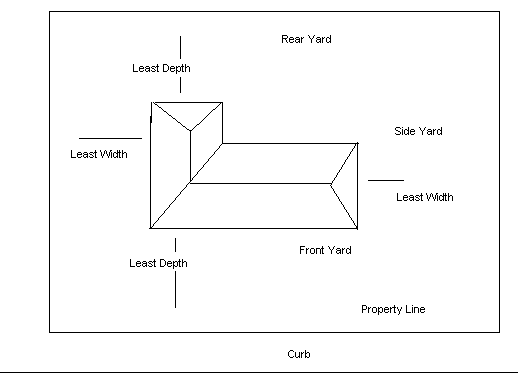
Yard. An open space on the same lot with a building unobstructed from the ground upward and measured as the minimum horizontal distance between the lot line and main building.
(79)
Yard, front. A yard extending across the front of a lot between the side lot lines and measured between the street line and the main building or any projection thereto, other than the projection of the usual steps, terraces, unenclosed porches, entrance ways, cornices, eaves or gutters.
(80)
Yard, rear. A yard extending across the rear of the lot between the side lot lines and measured between the rear lot line and the rear of the main building or any projection other than steps, unenclosed porches, entrance ways, cornices, eaves, or gutters.
(81)
Yard, side. A yard between the main building and the side line of the lot and extending from the front lot line to the rear lot line.
(Ord. No. 831, 3/12/1990; Ord. No. 1206, § 3, 12-19-2022; Ord. No. 1210, § 2, 2-12-2024)
Sec. 105. - Performance standards.
Activities shall be authorized only if they meet the following standards:
Fire hazard. The use shall not include any activity involving the use or storage of flammable or explosive material unless protected by adequate fire-fighting and fire suppression equipment and by such safety devices as are normally used in the handling of any such material.
Noise. At the lot or property line, the maximum sound pressure level radiated in each standard octave band by any use or facility (other than transportation facilities or temporary construction work) shall not exceed the values for octave bands lying within the several frequency limits given in Table I, after applying the correction shown in Table II. The sound pressure level shall be measured with a sound level meter and associated octave band analyzer conforming to standards prescribed by the American Standards Association. (American Standard Sound Level Meters for measurement of Noise and Other Sounds, Z24.3-1944, American Standards Association, Inc., New York, N.Y., and American Standard Specifications for an Octave-Band Filter Set for the Analysis of Noise and Other Sounds, Z24.10-1953, American Standards Association, Inc., New York, N.Y., shall be used.)
TABLE I
If the noise is not smooth and continuous and is not radiated between the hours of 10:00 p.m. and 7:00 a.m., one or more of the corrections in Table II shall be applied to the octave band levels given in Table 1.
TABLE II
Smoke. No emission shall be permitted at any point from any chimney or otherwise or visible grey smoke of a shade equal to or darker than No. 2 on the Power's Micro-Ringlemann Chart published by the McGraw-Hill Publishing Company, Inc., and copyright 1954 (being a direct facsimile reduction of a standard Ringlemann Chart as issued by the United States Bureau of Mines) except that visible grey smoke a shade equal to No. 3 on said chart may be emitted to four minutes in any 30-minute period of time.
Odors. No emission shall be permitted of odorous gases or other odorous matter in such quantities as to be readily detectable when diluted in the ratio of one volume of odorous air to four volumes of clean air, at the lot line. There is hereby established as a guide in determining such quantities of offensive odors, Table III, "Odor Thresholds," in Chapter 5, "Air Pollution Abatement Manual," copyright 1951 by Manufacturing chemists' Association, Inc., Washington, D.C.
Fly ash, dust, fumes, vapors, gases and other forms of air pollution. No emission shall be permitted which can cause any damage to health, animals, vegetation, or other forms of property, or which can cause any excessive soiling at any point at or beyond the property. No emissions shall be permitted in excess of the standards specified in Table I, Chapter 5, "Industrial Hygiene Standards, Maximum Allowable Concentrations," of the "Air Pollution Abatement Manual," copyright 1951 by the Manufacturing Chemists' Association, Inc., Washington, D.C. In no event shall any emission, from any chimney or otherwise, of any solid or liquid particles in concentrations, exceed 0.3 grains per cubic foot of the conveying gas at any point. For measurement of the amount of particles in gases resulting from combustion, standard corrections shall be applied to a stack temperature of 500 degrees Fahrenheit and 50 percent excess air.
Vibration. The use shall not include vibration which is discernible without instruments on any adjoining lot or property.
Glare. The use shall not involve any direct or reflected glare which is visible from any adjoining property or from any public street, road, or highway.
Traffic hazard. The use shall not involve any activity substantially increasing the movement of traffic on public streets unless procedures are instituted to limit traffic hazards and congestion.
Overtax public utilities and facilities. The use shall not involve any activity substantially increasing the burden on any public utilities or facilities, unless provision is made for any necessary adjustments.
Character of neighborhood. The use shall not involve any activity not in character with the majority of the uses in the neighborhood unless by design, set-back, nature of operation, and other devices of the character of the neighborhood will be maintained.
General welfare of the community. The use shall not involve any activity which adversely affects the general welfare of the community.

