
Orange County Unincorporated
City Zoning Code
City Zoning Code
ARTICLE XI
OFF-STREET PARKING AND LOADING REGULATIONS12
Cross reference— Landscaping of paved ground surface areas, § 24-26 et seq.
Sec. 38-1476.- Quantity of off-street parking.
(a)
Off-street parking spaces shall be provided for any use hereafter established or at the time of the erection of any main building or structure or at the time any main building, structure or occupational use is enlarged or increased in capacity by adding dwelling units, guest rooms, floor area, seats, or by increasing employment, according to the following minimum requirements:
If the use is not listed below, the parking requirements shall be determined by the zoning manager by adopting or utilizing the parking requirements for the listed use that the zoning manager determines is most similar.
(a)
Any other uses not specifically mentioned above shall meet the off-street parking requirements of the uses listed above deemed most similar, as determined by the zoning manager.
(b)
Parking for persons with disabilities, access ramps/aisles, and other accessibility features will be required according to state or federal regulations.
(c)
The preservation of specimen trees as per Section 15-283(a) and/or heritage trees as per Section 15-283(b) may be considered as the basis for granting a waiver by the Zoning Manager for a reduction from the number of required off-street parking spaces set forth in Section 38-1476. Evidence shall be provided that a waiver granted will allow for the preservation of healthy specimen and/or heritage trees through the reduction of the number of spaces, and the modified spacing and configuration of landscape islands or landscape wells.
The maximum parking spaces to be granted a reduction as a basis of this waiver shall not exceed the following:
(1)
Parcels smaller than ten thousand (10,000) square feet—Ten (10) percent of the number of parking spaces required or three (3) spaces, whichever is less.
(2)
Parcels between ten thousand (10,000) square feet and twenty thousand (20,000) square feet in size: commercial uses including restaurants—Ten (10) percent of the number of parking spaces required, or ten (10) parking spaces, whichever is less. Industrial and professional office uses, including medical offices—Up to twenty (20) parking spaces.
(3)
Parcels between twenty thousand (20,000) square feet and fifty thousand (50,000) square feet in size: commercial uses including restaurants—Ten (10) percent of the number of parking spaces required, or twenty (20) parking spaces, whichever is less. Industrial and professional office uses, including medical offices—Up to forty (40) parking spaces.
(4)
Parcels greater than fifty thousand (50,000) square feet in size: commercial uses, including restaurants and big box development—Ten (10) percent of the number of parking spaces required, or forty (40) parking spaces, whichever is less. Industrial and professional office uses—Up to sixty (60) parking spaces.
(P & Z Res., art. XIX, § 1; Ord. No. 98-37, § 28, 12-15-98; Ord. No. 2000-08, § 9, 4-11-00; Ord. No. 2007-01, § 19, 3-20-07; Ord. No. 2008-06, § 25, 5-13-08; Ord. No. 2016-19, § 41, 9-13-16; Ord. No. 2017-06, § 5, 4-25-17; Ord. No. 2023-46, § 75, 12-12-23)
Sec. 38-1477. - Location of off-street parking.
The parking spaces provided for herein shall be provided on the same lot where the principal use is located or within three hundred (300) feet from the principal entrance as measured along the most direct pedestrian route. For purposes of this section, a unified development (for example, a shopping center) shall be considered "on the same lot."
(P & Z Res., art. XIX, § 2; Ord. No. 2008-06, § 26, 5-13-08)
Sec. 38-1478. - Joint use of off-street parking.
No part of an off-street parking area required for any building or use for the purpose of complying with the provisions of this chapter shall be included as part off an off-street parking area similarly required for another building or use, except in the case where the parking demands of different uses occur at different times or where the uses are part of a unified development (for example, a shopping center). The following requirements must be satisfied in order to comply with this exception:
(1)
A notarized statement from all property owners involved indicating that the activities of each separate building or use which creates a demand for parking shall occur at different times. Such statement must include an agreement between the parties involved indicating responsibility for maintenance of the parking area.
(2)
Such agreement shall run with the duration of the occupational licenses of all buildings or uses involved in the agreement and shall be required to be renewed at the time of occupational license renewal. Where an occupational license is not required, then the agreement shall run with the duration of the uses.
Nothing in this resolution shall be construed to prevent the joint use of off-street parking spaces by two (2) or more buildings or uses, if the total of such spaces, when used together, shall not be less than the sum of the requirements for the various individual uses of buildings computed separately.
(P & Z Res., art. XIX, § 3; Ord. No. 2008-06, § 27, 5-13-08)
Sec. 38-1479. - Off-street parking lot requirements.
(a)
All parking areas shall have durable all-weather surfaces for vehicle use areas, shall be properly drained, shall be designed to separate pedestrian and vehicle circulation for safety, and shall meet all accessibility requirements of the most recent editions of applicable federal and state standards as adopted. For purposes of this article, a durable, all-weather surface shall consist of an improved surface, including concrete, asphalt, stone and other permanent surfaces, but not including gravel, wood chips, mulch or other materials subject to decay. Overflow parking on unimproved property used in conjunction with special events and/or holiday parking demands may be exempt from this condition subject to approval by the zoning manager, provided accessibility requirements are maintained.
(b)
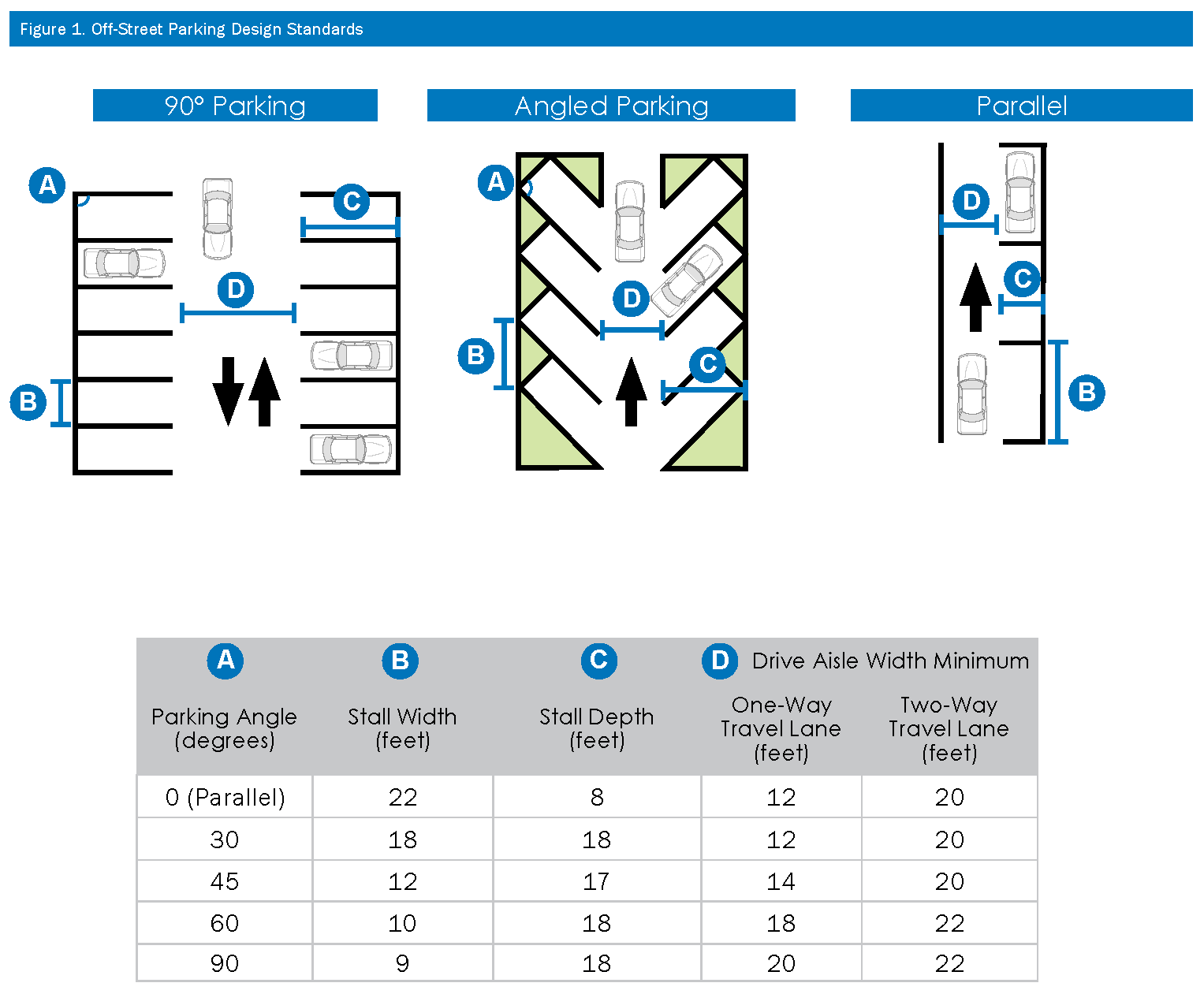
Regular parking space sizes shall be a minimum of nine (9) feet × eighteen (18) feet. The overhang of a vehicle, up to a maximum of two (2) feet, past a curb or wheel stop may be counted toward the minimum parking space depth and may be unpaved and sodded. Off-street parallel parking stalls shall be eight (8) feet × twenty-two (22) feet. Off-street turning and maneuvering space shall be provided for each lot so that no vehicle shall be required to back onto or from any public street. Suggested parking lot design standards are depicted in Figure 1 below.
(P & Z Res., art. XIX, § 4; Ord. No. 94-20, § 12, 7-25-95; Ord. No. 96-17, § 3, 7-9-96; Ord. No. 2004-01, § 16, 2-10-04; Ord. No. 2008-06, § 28, 5-13-08; Ord. No. 2016-19, § 41, 9-13-16; Ord. No. 2020-30, § 7NN, 10-13-20; Ord. No. 2023-46, § 76, 12-12-23)
Sec. 38-1480. - Off-street loading and unloading requirements of commercial vehicles.
There shall be provided on the same lot with each commercial building or structure adequate space for off-street loading, unloading and the maneuvering of commercial vehicles. There shall be no loading or unloading of commercial vehicles on the public street. Off-street maneuvering space shall be provided so that no backing onto or from a public street is required. All loading and maneuvering areas shall be surfaced with hard, dustless material, shall be properly drained, shall be designed with regard to pedestrian safety, shall have direct access to public streets and shall be screened from adjacent residentially zoned property as provided in section 38-1479.
(P & Z Res., art. XIX, § 5)
Sec. 38-1481. - Permanent reservation.
The area reserved for off-street parking or loading in accordance with the requirements of this article shall not be reduced in area or changed to any other use unless the permitted use which it serves is discontinued or modified, except where equivalent parking or loading space is provided.
(P & Z Res., art. XIX, § 6)
Sec. 38-1482. - Landscape requirements.
Landscaping must meet the requirements of chapter 24, article II (pertaining to landscaping of paved surface areas).
(P & Z Res., art. XIX, § 7)
Sec. 38-1483. - Compact car parking spaces.
Up to twenty-five (25) percent of the off-street parking spaces required by section 38-1476 may be designed as compact car parking spaces. Each compact car parking space shall be a minimum of eight (8) feet wide and sixteen (16) feet long. Compact car parking spaces shall be clearly marked or posted for "Compact Cars Only." All other provisions of this article relating to off-street parking requirements shall be met.
(P & Z Res., art. XIX, § 8)
Sec. 38-1484. - Bicycle parking spaces.
Bicycle parking spaces shall be provided as follows:
(1)
For developments that require up to ten (10) vehicular parking spaces, two (2) bicycle parking spaces shall be required.
(2)
For developments that require ten (10) or more vehicular parking spaces, two (2) bicycle parking spaces shall be required, plus one (1) additional bicycle parking space for each ten (10) vehicular parking spaces above ten (10); provided that no more than eight (8) bicycle parking spaces are required for any one (1) establishment within any zoning district other than a planned development. A planned development may be required to have more than eight (8) bicycle parking spaces. The zoning manager may approve reductions in the number of required bicycle parking spaces when bicycle lockers or other long-term bicycle parking alternatives are proposed at a ratio of six (6) bicycle parking spaces for every one (1) bicycle locker or other long-term bicycle parking alternative, provided that such reduction shall not result in any establishment providing less than the minimum eight (8) parking spaces. Bicycle lockers and other long-term bicycle parking alternatives shall be designed for the protection of bicycles from theft and weather. If eight (8) or more bicycle parking spaces are required, replacing a vehicle space with all or part of required bicycle parking in a "bicycle corral" configuration or replacing six (6) required bicycle parking spaces with a bicycle locker or other long-term bicycle parking alternative approved by the zoning manager shall be permitted, notwithstanding the requirements of section 38-1485.
(3)
For developments within the alternative mobility area or an urban transportation impact fee district, whichever one is applicable and governs, that require ten (10) or more vehicular parking spaces, two (2) bicycle parking spaces shall be required, plus one (1) additional bicycle parking space for every five (5) vehicular parking spaces above ten (10); provided that no more than twelve (12) bicycle parking spaces are required for any one (1) establishment within any zoning district other than a planned development. The zoning manager may approve reductions in the number of required bicycle parking spaces when bicycle lockers or other long-term bicycle parking alternatives are proposed at a ratio of six (6) bicycle parking spaces for every one (1) bicycle locker or other long-term bicycle parking alternative, provided that such reduction shall not result in any establishment providing less than the minimum eight (8) parking spaces. Bicycle lockers and other long-term bicycle parking alternatives shall be designed for the protection of bicycles from theft and weather. If eight (8) or more bicycle parking spaces are required, replacing a vehicle space with all or part of such required bicycle parking in a "bicycle corral" configuration or replacing six (6) of the required bicycle parking spaces with a bicycle locker or other long-term bicycle parking alternative approved by the zoning manager shall be permitted, notwithstanding the requirements of section 38-1485.
(4)
At least fifty (50) percent of the required bicycle parking shall be provided in bicycle racks located no more than one hundred twenty (120) feet from primary building entrances served, and should preferably be within fifty (50) feet. Bicycle racks serving secondary entrances shall be located no more than one hundred twenty (120) feet from secondary entrances, and should preferably be within fifty (50) feet. Racks shall not be placed so that they block any building entrance or impede pedestrian flow in or out of the building and shall maintain the accessibility of the building entrance. Bicycle racks are encouraged to be covered, such as by building soffits or by stairways in multifamily development, provided the accessibility of the entrance is maintained.
(5)
All bicycle parking spaces shall comply with the following standards: Each bicycle parking space shall have a minimum area of two (2) feet by six (6) feet to fully accommodate a parked bicycle, and shall have an overhead clearance of at least seven (7) feet. Bicycle parking spaces shall be accessible to users without users having to ascend or descend stairs, and shall be separated from vehicle parking spaces by physical barriers, such as curbs, wheel stops, bollards or other similar features, to protect bicycles from being damaged by vehicles.
(6)
The zoning manager may approve reductions of required bicycle parking spaces and waivers to other requirements of this section, with any appeals to be made to the development review committee.
(Ord. No. 2013-08, § 12, 3-26-13; Ord. No. 2020-30, § 7OO, 10-13-20)
Sec. 38-1485. - Bicycle racks.
(a)
All standard bicycle racks shall comply with the following performance standards:
(1)
Bicycle racks shall be an inverted "U"/hoop rack, post and ring rack, or similar device that accommodates two (2) bicycle parking spaces per rack and enables users to lock the frame and both wheels.
(2)
Bicycle racks shall have a minimum tube diameter of 1.9 inches and be powder coated, galvanized, or coated with another weather-proof surface as may be approved by the zoning manager.
(3)
Bicycle racks shall be a maximum height of three (3) feet, a minimum of three (3) feet on center between horizontal rows, and a minimum of three (3) feet from any parallel building wall and four (4) feet from any perpendicular building wall. They shall be anchored to a common base or mounting surface of concrete or pavement large enough to support bicycles locked to the rack. If more than one (1) row of bicycle racks is installed to create the required bike parking area, the installation shall provide a minimum of five (5) feet in an aisle in each row, assuming additional spacing for parked bicycles.
(4)
If a building has an arcade, colonnade, awning, or other shade structure installed to meet the requirements of section 9-554 or other applicable land development code provision, bicycle racks shall be installed under this feature to provide shaded parking, where possible, provided the accessibility of the building entrance is maintained.
(5)
A bicycle parking device shall not impede pedestrian travel, bus boarding, or freight loading and shall be designed and located to ensure a minimum of five (5) feet of continuous pedestrian access.
(6)
The zoning manager may approve waivers to the requirements of this section, with any appeals to be made to the development review committee.
(b)
Alternative bicycle rack designs may be approved, provided they comply with the following standards:
(1)
Alternative bicycle rack designs shall accept multiple bicycle frame sizes and styles and accommodate the use U-type locks. Alternative bicycle rack designs shall support a bicycle frame at two (2) points above the wheel hubs to allow the frame and at least one (1) wheel of the bicycle to be locked to the rack without lifting the bicycle onto the device.
(2)
Alternative bicycle rack designs shall be easy to understand and operate, with no moving parts. Alternative bicycle rack designs shall be visible to pedestrians and the visually impaired, but consistent with the scale of the bicycle locked to the device.
(3)
Alternative bicycle rack designs shall be powder coated, galvanized, or coated with another weather-proof surface as may be approved by the zoning manager and shall be anchored to a common base or mounting surface of concrete or pavement large enough to support bicycles locked to the rack.
(4)
Bicycle parking systems that utilize wheel-well stops or that feature spiral or wave designs are not permitted.
(Ord. No. 2013-08, § 13, 3-26-13; Ord. No. 2020-30, § 7PP, 10-13-20)

