
Orange County Unincorporated
City Zoning Code
City Zoning Code
ARTICLE IX
GENERAL SUPPLEMENTAL REGULATIONS
Sec. 38-1401.- Substandard lots of record.
(a)
If two (2) or more adjoining lots with continuous frontage were under single ownership on or after October 7, 1957, and one (1) or more of such adjoining lots has a frontage or lot area less than what is required by the zoning district in which such lot or lots are located, such substandard lot or lots shall be aggregated so as to create one (1) or more new lots, each of which shall conform to the minimum frontage and minimum lot area requirements of the zoning district in which the substandard lot or lots are located, and the lots so aggregated shall be considered one (1) tract.
(b)
If a lot or parcel has a frontage or lot area less than what is required by the zoning district in which it is located, but was a lot of record in Orange County, Florida, prior to October 7, 1957, then a principal or accessory use consistent with Section 38-77 may be constructed on such lot, provided the construction of the dwelling and customary accessory structure(s) will not violate the minimum yard requirements, minimum floor area requirements, or height requirements for the zoning district in which the lot is located.
(c)
No development permits may be issued for any lot or parcel which has a size or width less than what is required by the zoning district in which such lot or parcel is located, unless the lot or parcel is aggregated with adjacent property so that the required size or width complies with the zoning requirements.
(d)
A lot or parcel which contains less than the minimum lot width and lot area required by the zoning district and was not approved by Orange County Subdivision Regulations or is not a lawful nonconforming lot or parcel, shall not be grounds for granting a variance pursuant to section 30-43, Orange County Code.
(P & Z Res., art. XXV, § 1; Ord. No. 92-1, § 7, 1-21-92; Ord. No. 97-05, § 11, 4-29-97; Ord. No. 98-37, § 25, 12-15-98; Ord. No. 2004-01, § 12, 2-10-04; Ord. No. 2008-06, § 21, 5-13-08)
Sec. 38-1402. - Dog-friendly restaurants.
(a)
Local exemption authorized. There is hereby established a local exemption procedure to certain provisions of the Food and Drug Administration Food Code, as currently adopted by the Florida Division of Hotels and Restaurants, in order to allow patrons' dogs within certain designated outdoor portions of public food service establishments.
(b)
Limitations on exemption.
(1)
This exemption shall only provide a variance to those portions of the currently adopted Food and Drug Administration Food Code in order to allow patrons' dogs within certain designated outdoor portions of public food service establishments.
(2)
Without exception, any dog that has been classified or designated as a "dangerous dog" as defined by F.S. § 767.11, or for which Orange County's Animal Services Division has record of its propensity toward aggressive behavior, shall not be permitted within any portion of a public food service establishment.
(c)
Definitions.
(1)
DHR means the Division of Hotels and Restaurants of the State of Florida Department of Business and Professional Regulation.
(2)
Dog means an animal fully of the subspecies Canis lupus familiaris.
(3)
Employee(s) means any person(s) employed by, or acting on behalf of, the public food service establishment.
(4)
Outdoor dining area means an area that is subject to the zoning requirements and associated conditions for restaurants with outdoor seating as set forth in the use table in section 38-77.
(5)
Patron has the meaning given to "guest" by F.S. § 509.013.
(6)
Public food service establishment has the meaning given to it by F.S. § 509.013.
(d)
Permit requirements. In order to protect the health, safety, and general welfare of the public, participating public food service establishments shall annually apply for and receive a permit from Orange County before allowing patrons' dogs on their premises. Application for the permit shall be made to the county, on a form provided for such purpose, and shall include, along with any other such information deemed reasonably necessary by the county in order to implement and enforce the provisions of this part, the following information:
(1)
The name, location, and mailing address of the public food service establishment.
(2)
The name, mailing address, and telephone contact information of the permit applicant.
(3)
Notarized written authorization from the owner of the property on which the public food service establishment is located if the applicant is not the owner.
(4)
A diagram and description of the outdoor dining area to be designated as available to patrons' dogs, including dimensions of the designated area; a depiction of the number and placement of tables, chairs, and restaurant equipment, if any; the entryways and exits to the designated area and of other areas of outdoor dining not available for patrons' dogs; any fences or other barriers; surrounding property lines and public rights-of-way, including sidewalks and common pathways; and such other information reasonably required by the county. The diagram or plan shall be accurate and to scale but need not be prepared by a licensed design professional.
(5)
A description of the days of the week and hours of operation which patrons' dogs will be permitted in the designated outdoor dining area.
(6)
A written certification of commercial general liability insurance and an instrument in which the applicant and the property owner (if not the applicant) agree to indemnify and hold harmless Orange County and its Board of County Commissioners, officers, and employees against liability, including court costs and reasonable attorneys' fees, through all appellate proceedings, for any and all claims for damage to property, or injury to, or death of, persons arising out of or resulting from the issuance of the permit.
(7)
All application materials shall contain the appropriate DHR-issued license number for the subject public food service establishment.
(8)
Payment of a non-refundable application fee of an amount set by the Orange County Board of County Commissioners.
(e)
Regulations. In order to protect the health, safety, and general welfare of the public, and pursuant to F.S. § 509.233, the following regulations shall apply to establishments which obtain such a permit:
(1)
All public food service establishments shall report to Orange County's Animal Services Division any and all incidents in which, while on the premises of the public food service establishment, a dog bites, attacks, endangers, and/or inflicts injury upon:
a.
Any patron and/or employee of the public food establishment; or
b.
Any other live animal, whether domestic in nature or not.
(2)
Employees shall wash their hands promptly after touching, petting, or otherwise handling patrons' dogs.
(3)
Employees shall be prohibited from touching, petting, or otherwise handling patrons' dogs while serving food or beverages or handling tableware or before entering other parts of the public food service establishment.
(4)
Patrons in the designated outdoor dining area shall be advised that they should wash their hands before eating. Waterless hand sanitizer shall be provided at all tables in the designated outdoor dining area.
(5)
Employees and patrons shall be instructed that they shall not allow dogs to come into contact with serving dishes, utensils, tableware, linens, paper products, or any other items involved in food service operations. That notwithstanding, dishes specifically dedicated for use by dogs shall be permitted.
(6)
Patrons shall not leave their dogs unattended for any period of time. Patrons at all times shall keep their dogs on the ground, on a leash, and under control.
(7)
Employees and patrons shall not allow any part of a dog to be on the chairs, tables, or other furnishings.
(8)
All table and chair surfaces shall be cleaned and sanitized with an approved product between seating of patrons. Spilled food and drink shall be promptly removed from the floor or ground.
(9)
All dog waste shall be cleaned immediately and the area sanitized with an approved product. A kit with the appropriate materials for this purpose shall be kept near the designated outdoor area. Dog waste shall not be carried in or through indoor portions of the public food service establishment.
(10)
At least one (1) sign reminding employees of the applicable rules, including those contained in this section, and those additional rules and regulations, if any, included as further conditions of the permit by Orange County, shall be posted on the premises in a conspicuous location frequented by employees within the public food service establishment. The mandatory sign shall be not less than eight and one-half (8½) inches in width and eleven (11) inches in height (8½" x 11") and printed in easily legible typeface of not less than twenty (20) point font size.
(11)
At least one (1) sign reminding patrons of the applicable rules, including those contained in this section, and those additional rules and regulations, if any, included as further conditions of the permit by Orange County, shall be posted on the premises in a conspicuous location within the designated outdoor dining area of the public food service establishment. This notice must include notice to the patrons that dogs that have been classified or designated as "dangerous dogs" as defined by F.S. § 767.11, or for which Orange County's Animal Services Division has record of its propensity toward aggressive behavior, shall not be permitted within any portion of the public food service establishment. The mandatory sign shall be not less than eight and one-half (8½) inches in width and eleven (11) inches in height (8½" x 11") and printed in easily legible typeface of not less than twenty (20) point font size.
(12)
At all times while the designated outdoor dining area of the public food service establishment is available to patrons and their dogs, at least one (1) sign shall be posted in a conspicuous and public location near the entrance to the designated outdoor dining area, placing patrons on notice that the designated outdoor dining area of the public food service establishment is currently available to patrons accompanied by their dog or dogs. The mandatory sign shall not be less than eight and one-half (8½) inches in width and eleven (11) inches in height (8½" x 11") and printed in easily legible typeface of not less than twenty (20) point font size.
(13)
The permit issued by the county to the public food service establishment pursuant to this section, and the diagram that was submitted with the permit application, shall both be conspicuously displayed in the public food service establishment at all times.
(14)
Dogs shall not be permitted to travel through indoor or non-designated outdoor portions of the public food service establishment, and ingress and egress to the designated outdoor dining area of the public food service establishment must not require entrance into or passage through any indoor area of the public food service establishment.
(15)
The public food service establishment and designated outdoor dining area shall comply with all permit conditions and the approved diagram.
(f)
Permit expiration and renewal.
(1)
A permit issued pursuant to this section expires one (1) year from the date of issuance and a new permit must be obtained annually. Failure to obtain a current permit within five (5) days of a previous permit's expiration will require a late fee payment in an amount set by the Orange County Board of County Commissioners for the new permit in addition to the permit fee.
(2)
A permit granted pursuant to this section shall not transfer to a subsequent owner upon the sale of a public food service establishment but shall instead expire automatically upon the sale of the establishment. The subsequent owner shall be required to apply for a permit pursuant to this section if the subsequent owner wishes to continue to accommodate patrons' dogs.
(g)
Complaints and reporting.
(1)
In accordance with F.S. § 509.233(5), the county shall accept and document complaints related to this program within Orange County, Florida, and shall report quarterly to the DHR all such complaints and the county's enforcement response to such complaints.
(2)
The county shall also provide the DHR with a copy of all approved applications and permits issued.
(h)
Enforcement.
(1)
The ultimate responsibility for enforcement of this section falls upon the permitted public food service establishment, however, any person who violates any provisions of this section may, upon code enforcement action, be punished according to chapter 11, code enforcement, of the Orange County Code of Ordinances, as may be amended.
(2)
Any alleged violation of any of the provisions in this section may also be pursued by appropriate remedy, whether by injunctive, declaratory, or other civil remedy, at the county's option. The provisions of this section may also be enforced by the sheriff, deputy sheriffs, and any other authorized enforcement officer.
(i)
Revocation of permit.
(1)
A permit may be revoked by the zoning manager should the public food service establishment:
a.
Have its business or health permit, and any other state or local license required by law, be suspended, revoked, or cancelled;
b.
Fail to obtain, or maintain, the requisite insurance required by this section;
c.
Fail to comply with approved diagram and requirements of this section;
d.
Receive three (3) notice(s) of violation of the dog-friendly restaurants ordinance within the permitted year;
e.
Fail to correct a violation of the dog-friendly restaurants ordinance, or condition(s) of the permit issued pursuant to this section, within three (3) days of receipt of the correction notice; or
f.
Be found to have provided false or misleading information on the application which was material to the approval of the permit.
(2)
Upon revocation, the zoning manager shall give notice of such action to the public food service establishment in writing stating the action taken and the reason for that action. If the reason for revocation is a failure to maintain any required state or local license, the revocation may take effect immediately upon receipt of the notice of revocation by the public food service establishment. Otherwise, such notice shall become effective within five (5) days.
(3)
If a dog-friendly restaurant permit is revoked, no new permit may be approved for the public food service establishment until the expiration of one hundred eighty (180) days following the date of revocation.
(Ord. No. 2018-21, § 3, 10-16-18)
Sec. 38-1403. - Reasonable accommodation process.
(a)
Purpose, intent, and general provisions.
(1)
The purpose and intent of this Section is to establish a process where a person with a disability, as provided by the Federal Fair Housing Amendments Act ("FHA") or Title II of the Americans with Disabilities Act ("ADA"), may request the County for a reasonable accommodation from the Zoning Code standards to allow the disabled person, as that term is defined and recognized by federal, State or local law, or by judicial interpretation, to legally use and enjoy a dwelling.
(2)
A reasonable accommodation process is necessary because in some instances certain standards in the Zoning Code, if strictly applied, would inhibit or prevent the use of a dwelling due to a person's disability. As such, the process outlined in this Section is necessary where a disabled individual or individuals, or a person, entity or group acting on behalf of a disabled individual or individuals ("Applicant"), requests a reasonable accommodation and seeks relief from one (1) or more of such zoning standards in order to have an equal opportunity to legally use and enjoy a dwelling ("Request for a Reasonable Accommodation").
(3)
An Applicant may submit a Request for a Reasonable Accommodation on his/her own behalf or may be represented at all stages of the application process by a person designated by the Applicant as their authorized agent, attorney, or representative.
(4)
Each Request for a Reasonable Accommodation must be considered on a case-by-case basis based on an individualized assessment because the nature and extent of a disability and the surrounding facts and issues will necessarily vary as applicable in each case.
(5)
The granting of a Request for a Reasonable Accommodation shall not be deemed to constitute a rezoning of property, a special exception approval, or an approval to allow any other uses that would otherwise require a rezoning, special exception, variance, or waiver pursuant to the County Code.
(b)
Application.
(1)
A Request for a Reasonable Accommodation may be made by completing a written application on a form prescribed by the Zoning Division.
(2)
Such form shall instruct the Applicant regarding what information is required for the application to be deemed complete and sufficient. Such form shall, at a minimum, include sections for:
a.
The name and contact information of the Applicant or the Applicant's authorized representative;
b.
The property address and parcel identification number for the location where the accommodation is requested; and
c.
A description of the accommodation requested and the specific regulation or policy from which the relief is sought.
(3)
If Applicant is proposing to operate a residence that provides services or housing to disabled individuals, Applicant shall demonstrate that:
a.
Applicant is licensed or certified by the State of Florida to operate the proposed residence;
b.
For housing within a "recovery residence" as defined in F.S. § ch. 397, Applicant shall provide evidence of a certification or license from the Florida Association of Recovery Residences, National Alliance for Recovery Residences, or other nationally recognized accrediting agency or entity for recovery residences; or
If Applicant cannot provide one (1) of the above-referenced licenses or certifications, Applicant may still meet the requirement of this paragraph by demonstrating that all of the following four (4) criteria are met:
a.
The proposed residence will be operated in a manner effectively similar to that of a licensed or certified residence; and
b.
Staff will be adequately trained in accordance with standards typically required by licensing or state certification for such residence; and
c.
The residence will emulate a biological family and be operated to achieve normalization and community integration; and
d.
The rules and practices governing how the residence operates will protect the residents from abuse, exploitation, fraud, theft, neglect, insufficient support, use of illegal drugs or alcohol, and misuse of prescription medications.
(4)
Should the information provided by the Applicant to the County include medical information or records, including records indicating the medical condition, diagnosis, or medical history of the requesting individual, such individual may, at the time of submitting such medical information, request that the County, to the extent allowed by law, treat such medical information as confidential information of the requesting individual.
(c)
Application process.
(1)
Upon receipt of the Request for a Reasonable Accommodation application on the prescribed form, the Zoning Manager or authorized designee shall date-stamp the application.
(2)
Within thirty (30) calendar days after receipt, the Zoning Manager shall determine whether the application is complete and sufficient, and notify the Applicant in writing of the application's completeness and sufficiency. If it is determined that the application is incomplete or insufficient, the Zoning Manager's written notice shall identify what additional information is required. The Applicant shall have thirty (30) calendar days from the date of the written notice to respond to the request for additional information. If the Applicant fails to provide the requested additional information within the thirty-day period, a notification shall be issued to the Applicant advising the Applicant that the application is considered withdrawn.
(3)
Once the application is deemed complete and sufficient by the Zoning Manager, a final written decision shall be made within sixty (60) days. If a final written decision is not issued within the sixty-day period after receipt of a complete and sufficient application, the request shall be deemed approved, unless the Applicant and County agree jointly in writing to a reasonable extension of time.
(d)
Zoning Manager's decision. The Zoning Manager shall issue a final written decision on the application. The Zoning Manager's decision shall:
(1)
Grant the reasonable accommodation request;
(2)
Grant a portion of the request and deny the remaining portion;
(3)
Grant the request or a portion of the request, subject to conditions; or
(4)
Deny the request.
A decision denying a Request for Reasonable Accommodation, or a conditional or partial approval, shall state with specificity the objective, evidence-based reasons for denial and identify any deficiencies or actions necessary for reconsideration.
Such final written decision shall be sent to the Applicant via certified mail, return receipt requested, to the address specified by the Applicant on the application form and shall give notice to the Applicant of the right to appeal.
(e)
Criteria. The Applicant shall be required to establish that the requesting individual is disabled and protected under the FHA or ADA by demonstrating that the individual is disabled, as defined in the FHA or the ADA. Although the definition of disability may be subject to judicial interpretation, for purposes of this Section the Applicant must show:
(1)
A physical or mental impairment which substantially limits one (1) or more major life activities;
(2)
A record of having such impairment; or
(3)
The individual is regarded as having such impairment.
In evaluating a Request for a Reasonable Accommodation, the Zoning Manager shall consider competent evidence relating to the following:
(1)
Whether the individual claiming to be disabled meets the definition of a disabled person;
(2)
Whether there is an identifiable relationship, and a rational nexus, between the requested accommodation and the disabled individual's needs;
(3)
Whether a sufficient alternative to the request exists, if the request is determined to not be reasonable;
(4)
Whether granting the request would change the essential nature of the Zoning Code as compared to a strict application of the Zoning Code to the circumstances of the request;
(5)
Whether the request, if granted, would impose undue financial and administrative burdens on the County.
It shall also be the obligation of the Applicant to establish that granting the reasonable accommodation will not result in an over-concentration or clustering of similar uses that will fundamentally alter the residential character of the surrounding neighborhood.
The Zoning Manager is entitled to obtain information that is necessary to evaluate whether a requested reasonable accommodation may be necessary because of a disability. If an individual's disability is obvious, or otherwise known to the Zoning Manager, and if the need for the requested accommodation is also readily apparent or known, then the Zoning Manager may not request any additional information about the disability or the disability-related need for the accommodation. However, if the disability is known or readily apparent to the Zoning Manager, but the need for the accommodation is not readily apparent or known, the Zoning Manager may request only information that is necessary to evaluate the disability-related need for the accommodation. The Zoning Manager may not ordinarily inquire as to the nature and severity of a disability. However, the Zoning Manager may request reliable disability-related information that:
(1)
Is necessary to verify that the person meets the Fair Housing Amendments Act and Americans with Disability Act's definition of "disability;"
(2)
Describes the needed accommodation; and
(3)
Shows the relationship between the individual's disability and the need for the requested accommodation.
Depending on the individual's circumstances, information verifying that the individual meets the Act's definition of disability can usually be provided by the individual but also may come from a doctor or medical professional, a peer support group, a non-medical service agency, or a reliable third party who has direct knowledge about the individual's disability. Once the Zoning Manager has established that the individual meets the definition of a disabled person, he/she should seek only the information necessary to evaluate if the request is needed because of a disability.
(f)
Duration of reasonable accommodation; Revocation.
(1)
A Reasonable Accommodation shall be personal to the Applicant and shall not run with the land, and shall remain in place for only as long as:
a.
The Applicant's need for the accommodation exists or remains; or
b.
The Applicant resides at the dwelling.
(2)
It shall be the responsibility of the property owner to remove or correct any nonconforming Zoning Code standard authorized by the grant of a Request for a Reasonable Accommodation once the need for the accommodation ends, and to do so within a reasonable period of time.
(3)
Any reasonable accommodation received may be revoked by the County if the Applicant or the property upon which the accommodation is granted is found in violation of any provision or condition of the approval granting the reasonable accommodation.
(g)
Appeal. A decision on a Request for a Reasonable Accommodation is appealable to the Board of Zoning Adjustment ("BZA") pursuant to the procedures identified in Chapter 30. The BZA's review of the appeal shall be limited to a consideration of whether the criteria pertaining to a Request for a Reasonable Accommodation were properly and fairly considered and applied, taking into account all laws, ordinances, and judicial or legal precedent or guidance into consideration, and whether sufficient alternatives were evaluated.
(h)
No Fee. No fees or costs may be imposed by the County for a Request for a Reasonable Accommodation or for an appeal of a decision on such a request. The County shall not be obligated to pay the Applicant's attorney's or other fees and costs in connection with the application or an appeal.
(Ord. No. 2025-29, § 1, 12-2-25)
Editor's note— Ord. No. 95-16, § 31A, adopted June 27, 1995, repealed § 38-1403; and (Ord. No. 2025-29, § 1, adopted Dec. 4, 2025, enacted a new § 38-1403 as set out herein. The former § 38-1403 pertained to location of accessory buildings and uses in residential areas and derived from the Planning & Zoning Resolution, art. XXV, § 3.
Sec. 38-1404. - Reserved.
Editor's note— Ord. No. 95-16, § 31A, adopted June 27, 1995, repealed § 38-1402, which pertained to swimming pools, jacuzzies, etc.; tennis courts, and derived from the Planning & Zoning Resolution, art. XXV, § 4, and Ord. No. 91-14, § 3, adopted June 18, 1991.
Sec. 38-1405. - Yards.
(a)
Every part of a required yard shall be open from its lowest point to the sky, unobstructed, except for the ordinary projection of roofs, sills, belt courses, cornices, buttresses, chimneys, flues and eaves attached to the building. Projections may extend into any required yard a maximum of three (3) feet.
(b)
An open, unroofed porch or paved terrace may project into a required front yard for a distance not exceeding fifteen (15) feet.
(c)
Where setback distances have been established as provided for in article XV of Chapter 38, the front yard, side yard, side street yard and rear yard shall be subject to such setback distances as may be applicable to the lot.
(d)
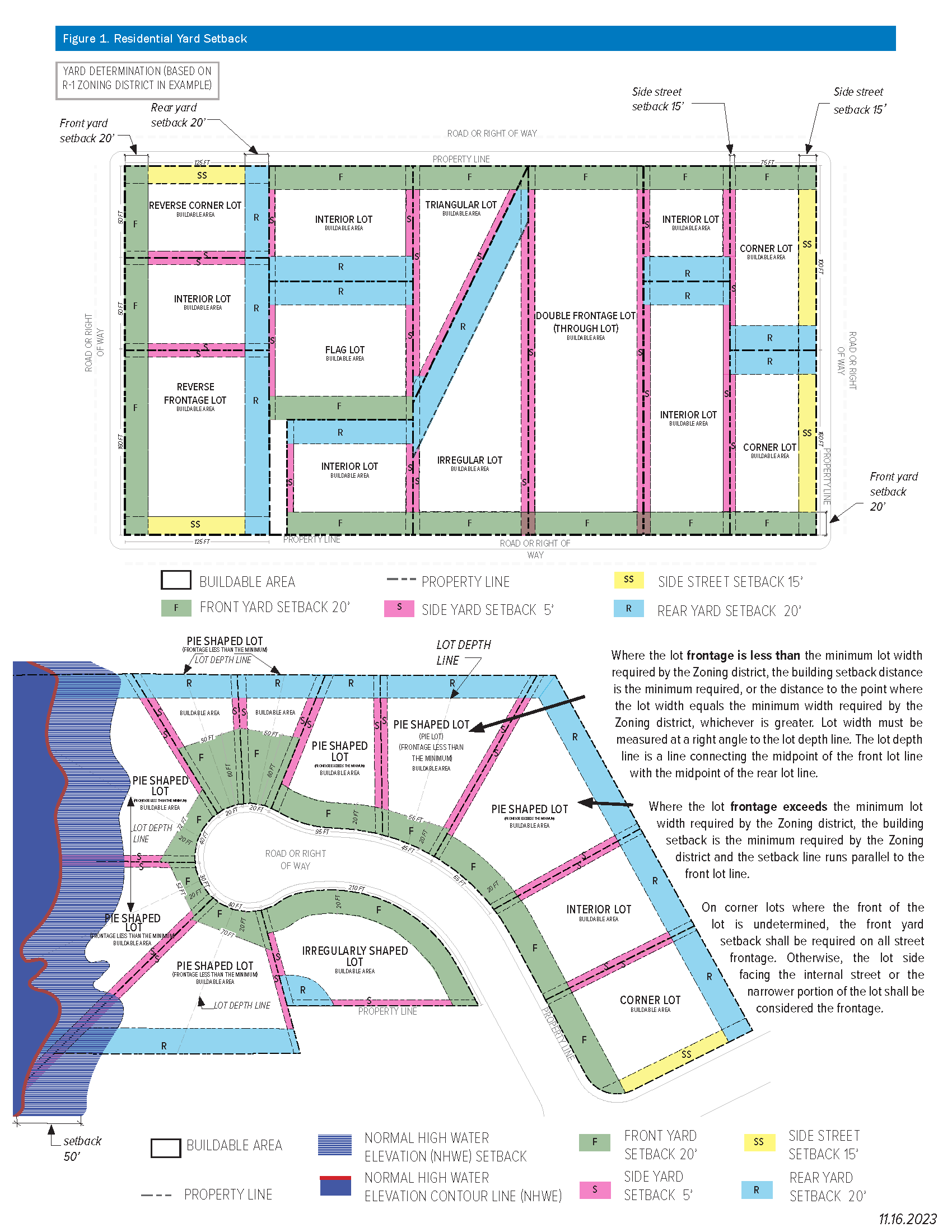
On double frontage lots, unless otherwise determined by the Zoning Manager the required front yard shall be provided on each street; except that when all lots in the block have been or will be developed with all of the buildings facing the same street, the second frontage of those lots shall be designated and utilized as rear yard. (See Figure 1 below.)
(e)
In cases of reversed frontages, the determination of yards shall be made by the zoning manager. After the reversed frontage determination has been made, the front door of the structure shall face the front yard. (See Figure 1 below.)
(f)
On a pie-shaped or irregularly-shaped lot, the required front yard shall be measured from the lot frontage. (See Figure 1 below.)
(g)
On a flag lot, the required front yard shall be measured from where the width satisfies the lot width requirement or the point where the required access strip widens to become the lot, whichever is less. (See Figure 1 below.)
(h)
For a lot that does not have frontage on a right-of-way, or where yard determinations are unclear, the Zoning Manager shall designate the yards.
(i)
In all districts, no structure shall be erected closer than fifteen (15) feet from any intersection street right-of-way except as otherwise provided for in this chapter. A twenty-five-foot corner triangle shall be required for sight line visibility on all commercially and industrially zoned property unless otherwise approved by the county engineer. A fifteen-foot corner triangle shall be required for sight line visibility on all residentially or agriculturally zoned property unless otherwise approved by the county engineer.
(j)
Submerged land and land that is below the normal high water elevation shall not be counted towards determining minimum requirements of this chapter.
(k)
Any part of a boat dock structure landward of the normal high water elevation shall be no wider than the width of the boat dock walkway.
(P & Z Res., art. XXV, § 5; Ord. No. 91-14, § 4, 6-18-91; Ord. No. 95-20, § 9, 7-25-95; Ord. No. 2004-01, § 13, 2-10-04; Ord. No. 2004-01, § 13, 2-10-04; Ord. No. 2023-46, § 62, 12-12-23)
Sec. 38-1406. - Reserved.
Editor's note— Ord. No. 95-16, § 31A, adopted June 27, 1995, repealed § 38-1406, which pertained to height limits, and derived from the Planning & Zoning Resolution, art. XXV, § 6.
Sec. 38-1407. - Reserved.
Editor's note— Ord. No. 95-16, § 31A, adopted June 27, 1995, repealed § 38-1407, which pertained to public and private utilities, and derived from the Planning & Zoning Resolution, art. XXV, § 7, and Ord. No. 91-14, § 5, adopted June 18, 1991.
Sec. 38-1408. - Fences and walls.
(a)
A fence shall be uniform in construction, design, material, color and pattern, and the fence material shall be a standard material conventionally used by the fence industry. No fence or wall shall encroach into the corner triangle at a street intersection, which is fifteen (15) feet for residentially and agriculturally zoned property and twenty-five (25) feet for commercially and industrially zoned property, unless otherwise approved by the county engineer.
(b)
Any fencing exceeding four (4) feet in height or exceeding fifty (50) percent opacity shall maintain a clear view triangle from the right-of-way line for visibility from driveways on the lot or on an adjacent lot. The clear view triangle area for a driveway is formed on each side of a driveway by measuring a distance of fifteen (15) feet along the right-of-way and fifteen (15) feet along the edge of the driveway.
(c)
Pillars, columns, and posts may extend up to twenty-four (24) inches above the height limitations provided such pillars and posts are no less than ten (10) feet apart.
(d)
No barbed wire, razor wire or electrically charged fence shall be erected in any location on any building site in residential or office districts except for security of public utilities, provided such use is limited to three (3) strands and eighteen (18) inches, a minimum of six (6) feet above the ground. In addition, walls and fences erected in any office or residential district shall not contain any substance such as broken glass, spikes, nails, barbs, or similar materials designed to inflict pain or injury to any person or animal.
(e)
(1)
Barbed wire or razor wire may be incorporated into or as an extension of the height of permitted walls and fences in commercial and industrial districts provided such wire is limited to three (3) strands, no more than eighteen (18) inches in height, and is a minimum of six (6) feet above the ground. The maximum height of the wall or fence with the barbed wire or razor wire shall be ten (10) feet.
(2)
Barbed wire may be permitted by special exception in residential and office districts as an extension of the height of permitted walls and fences along the property line separating the residential or office district from a commercial or industrial district where it is documented by substantial competent evidence that such an additional security measure is warranted or appropriate. The barbed wire fencing shall be subject to the criteria and dimensions set forth in subsection (e)(1).
(3)
Barbed wire and similar field fencing shall be allowed on agriculturally zoned properties only when used for agricultural purposes; i.e., groves, grazing and boarding of animals.
(f)
In no event shall barbed wire or razor wire be placed so that it projects outward over any sidewalk, street or other public way, or over property of an adjacent owner.
(g)
Fences and walls in residential (except in R-CE, R-CE-2, and R-CE-5) and P-O zoning districts may be erected as follows:
(1)
Limited to a maximum height of four (4) feet in the front yard setback. However, fences or walls located on arterial and collector roadways are limited to a maximum height of six (6) feet in the front yard setback.
(2)
Limited to a maximum height of six (6) feet in the side street yard setback, except on a reverse corner lot, where the maximum height is limited to four (4) feet in the side street yard setback.
(3)
Limited to a maximum height of eight (8) feet in the side and rear yards.
(4)
May be increased in height when the property is contiguous to a commercially or industrially zoned property along the common property lines pursuant to the height regulations for commercial and industrial districts.
(h)
Fences and walls in agricultural, R-CE, R-CE-2, and R-CE-5 districts may be erected as follows:
(1)
Limited to a maximum height of six (6) feet within the front or side street yard setback. However, for aluminum picket or chain link type fences on agricultural zoned properties, the maximum height is ten (10) feet;
(2)
Limited to a maximum height of eight (8) feet in the side and rear yards. However, for aluminum picket or chain link type fences on agriculturally zoned properties, the maximum height is ten (10) feet;
(3)
In agricultural districts, these regulations shall not apply to agricultural property used for bona fide agricultural purposes.
(i)
Fences and walls in commercial and industrial districts may be erected as follows:
(1)
Limited to a maximum height of eight (8) feet within the front yard setback.
(2)
Limited to a maximum height of eight (8) feet in the side and rear yards.
(j)
On a lakefront lot, a fence or wall within the normal high water elevation (NHWE) setback shall be limited to a maximum height of four (4) feet.
(k)
The fence/wall height shall be measured from where the fence/wall meets the existing grade to the highest point of the fence/wall.
(l)
In all zoning districts, a fence may only be permitted on a vacant parcel, provided the fence has less than fifty (50) percent opacity (except for a construction fence).
(m)
(1)
In all zoning districts, the applicant is responsible for ensuring that no fence or wall is constructed such that it adversely affects the property rights of others, including the right of ingress and egress to their property. No fence or wall shall be erected inside an ingress/egress easement unless authorized by all parties to the subject easement. In the event an easement is discovered on the property that is the subject of the application, the applicant shall execute the County's standard Easement Acknowledgment Form prior to issuance of any fence or wall permit. Failure to comply with this subsection shall constitute a material breach of the fence or wall permit and shall be grounds for its immediate revocation.
(2)
Issuance of a fence or wall permit does not convey to the applicant or create in the applicant any property right, or any interest in real property, authorize any entrance upon or activities upon property which is not owned or controlled by the applicant or convey any rights or privileges other than those specified in the permit, nor does a fence or wall permit warrant in any way that the applicant has property rights to construct any fence or wall and any such construction is done at the sole risk of the applicant. If any part of the fence or wall permitted hereunder is determined by a final adjudication issued by a court of competent jurisdiction to encroach on or interfere with an adjacent property owner's property right, the applicant agrees to either obtain written consent from such adjacent property owner or to remove the offending fence or wall encroachment within sixty (60) days from the date of the adjudication. Failure to comply shall constitute a material breach of the fence or wall permit and shall be grounds for its immediate revocation.
(P & Z Res., art. XXV, § 8; Ord. No. 95-20, § 10, 7-25-95; Ord. No. 98-37, § 26, 12-15-98; Ord. No. 2004-01, § 14, 2-10-04; Ord. No. 2008-06, § 22, 5-13-08; Ord. No. 2016-19, § 34, 9-13-16; Ord. No. 2023-46, § 63, 12-12-23)
Sec. 38-1409. - Reserved.
Editor's note— Ord. No. 2023-46, § 64, adopted December 12, 2023, repealed § 38-1409, which pertained to land use permits for algricultural purposes and derived from P & Z Res., art. XXV, § 9.
Sec. 38-1410. - Deed restrictions.
In instances when a deed restriction, which is of record prior to October 7, 1957, is in conflict with this chapter in such a manner that construction of any building will be prohibited, should both the deed restriction and this chapter be enforced, the board of zoning adjustment may authorize a permit for construction which would in effect modify this chapter and allow the deed restriction to control, upon receipt of an application for construction accompanied by a copy of the deed restrictions and review thereof by the board.
(P & Z Res., art. XXV, § 10)
Sec. 38-1411. - Reserved.
Editor's note— Ord. No. 2023-46, § 65, adopted December 12, 2023, repealed § 38-1411, which pertained to temporary structures and derived from P & Z Res., art. XXV, § 11; Ord. No. 92-1, § 9, adopted Jan. 21, 1992; Ord. No. 95-16, § 31B, adopted June 27, 1995; and Ord. No. 95-20, § 11, adopted July 25, 1995.
Sec. 38-1412. - Moving of buildings.
(a)
It shall be the purpose of this section to control the location, use and size of buildings being moved within the county. Inasmuch as the county building regulations set forth certain provisions for the moving of buildings, it is the intent that the provisions of such regulations shall control, except wherein specifically changed, altered or amended by this section.
(b)
All buildings which are moved shall comply with the zoning regulations imposed on the district of destination.
(c)
Substandard dwellings may be moved subject to the following regulations:
(1)
Prior to the moving of any dwelling which is substandard in living area for the district of its destination, the owner shall obtain a permit for the improvements necessary to meet the zoning district requirements.
(2)
In applying for such permit, the applicant must submit a plot plan and detailed construction plan of the proposed addition. Such improvements shall be completed within sixty (60) days after the issuance of such permit.
(3)
A performance bond acceptable to the board of county commissioners guaranteeing the construction of the required addition shall be provided by the owner. Such bond shall be in the amount of the estimated cost of such improvements based on six dollars ($6.00) per square foot for frame buildings, and seven dollars ($7.00) per square foot for concrete block buildings.
(d)
In cases where improvements are required to satisfy the minimum requirements of both the county building department and the planning and zoning regulations, both items may be covered by one (1) permit when a plot plan and detailed construction plan accompany the application and a performance bond acceptable to the board of county commissioners covering the combined estimated cost has been posted.
(P & Z Res., art. XXV, § 12)
Sec. 38-1413. - Adult entertainment uses.
(a)
An adult entertainment establishment shall not be allowed to open anywhere except in a I-2/I-3 industrial district or an I-4 industrial district.
(Ord. No. 95-16, § 31C, 6-27-95)
(b)
An adult entertainment establishment shall comply with the provisions of the adult entertainment code.
(P & Z Res., art. XXV, § 13; Ord. No. 92-13, § 12, 4-7-92)
Sec. 38-1414. - Prohibited areas for package sale of alcoholic beverages.
(a)
Definition. In this chapter, unless the context requires otherwise, "package sale vendor" means a person licensed pursuant to the Beverage Law [F.S. chs. 561-568] with a 3PS quota class alcoholic beverage license or a 4COP quota class alcoholic beverage license.
(b)
Package sale vendor; distance separation requirements. Within the unincorporated area of the county a package sale vendor may be permitted to operate its business of package sales at a location no closer than five thousand (5,000) feet of any preexisting package sale vendor's place of business within the unincorporated area of the county, and no closer than seven hundred and fifty (750) feet of any preexisting package sale vendor's place of business within a municipality in the county, except as set forth in Section 38-865.d(10) of the Orange County Code relating to the I-Drive District Overlay Zone.
(Ord. No. 2023-46, § 66, 12-12-23)
(c)
Criteria. The following criteria shall be met in order for a package sale vendor to obtain county zoning approval and commence package sales at a location:
The county shall be satisfied that the package sale vendor's location meets the applicable distance separation requirements set forth in subsection (b). However, if all preexisting package sale vendors within the applicable distance relinquish or commit to relinquish, in writing with a notarized statement, the right to carry out package sales at their respective location(s), the county may issue zoning approval contingent upon such other location(s) ceasing package sales prior to the commencement of package sales at the location, provided the land use and zoning of the location otherwise permits package sales. Once county zoning approval to allow package sales at the location is issued, failure to commence the package sales business shall not be a basis for the county to terminate or revoke zoning approval for package sales, provided the applicant undertakes and continues to make good-faith efforts necessary to construct and/or open the applicant's location for package sales.
(d)
Distance requirements not applied to renewal, change in name or ownership, or change in certain licenses. The distance requirements set forth above in subsections (b) shall not be applied to the location of an existing package sale vendor when there is:
(1)
A renewal of an existing license;
(2)
A transfer in ownership of an existing license;
(3)
A change in business name; or
(4)
A change in a state issued 4COP license for an existing package and lounge business, which did not choose to forego package sales, to a 3PS license, and any decrease in the numerical designation of a state issued license which is of the same series (type); provided that the physical location of the package sale vendor establishment does not change. No increase in the numerical designation of a series (type) of state issued license which is of the same series (type) shall be permitted at or for a location (new or existing) except in compliance with the provisions of sections 38-1414 and 38-1415.
(e)
Measurement of distances. The distances referenced in subsection (b) shall be measured by following the shortest route of ordinary pedestrian travel along the public thoroughfare from the proposed main entrance of a package sale vendor who proposes to operate the place of business to the main entrance of any other package sale vendor who is operating such a business.
(f)
Exemption for on-premises consumption only.
(1)
In those situations in which the package sale vendor has a 4COP quota class license (for both on-premises and off-premises consumption sales), such licensee may choose to expressly forego off-premises consumption sales for the location of business requested. In such a case, the licensee will not be deemed a package sale vendor under this section for such a location and will not be subject to the distance requirements set forth in subsections (b). To ensure that the public, safety and welfare are preserved, any licensee choosing to forego package sales for off-premises consumption, and thereupon not be deemed a package sale vendor at such location, shall so agree in writing with a notarized statement, as a condition of obtaining zoning approval, and prominently display at all times within the establishment in the vicinity of the main cash register a sign with letters no smaller than three (3) inches and printed in a legible style, stating "No Package Sales."
(2)
Such a 4COP quota class licensee may resume package sales for off-premises consumption at such location if:
a.
it relocates its business to a site that satisfies the distance requirements in subsection (b); or
b.
it rescinds in writing its earlier decision to forego package sales for off-premises consumption and satisfies the distance separation requirements in subsection (b).
(Ord. No. 2018-05, § 1, 2-6-18; Ord. No. 2018-24, § 1, 10-30-18)
Editor's note— Ord. No. 2018-05, § 1, adopted Feb. 6, 2018, amended § 38-1414 in its entirety to read as herein set out. Former § 38-1414 pertained to prohibited areas for sale of alcoholic beverages generally and derived from P & Z Res., art. XXV, § 15; Ord. No. 91-29, § 2(Exh. A), adopted Dec. 10, 1991; Ord. No. 92-7, § 1, adopted March 3, 1992; Ord. No. 93-01, § 2, adopted Jan. 19, 1993; Ord. No. 2004-01, § 15, adopted Feb. 10, 2004; and Ord. No. 2016-19, § 35, adopted Sep. 13, 2016.
Sec. 38-1415. - Distances between places of business for sale of alcoholic beverages and religious institutions, schools and adult entertainment establishments.
(a)
Places of business for the sale of alcoholic beverages containing more than three and two-tenths (3.2) percent of alcohol by weight for consumption on or off the premises may be located in the unincorporated areas of the county in accordance with and subject to this chapter and specifically those zoning regulations regulating the location of places of business selling alcoholic beverages containing fourteen (14) percent or more alcohol by weight. No such place of business shall be established within one thousand (1,000) feet of an established religious institution or school; except as follows:
(1)
Such a place of business that is licensed as a restaurant and derives at least fifty-one (51) percent of its gross revenues from the sale of food and nonalcoholic beverages, pursuant to F.S., ch. 509, and the sale of alcoholic beverages is for on-premises consumption only, may be established no closer than five hundred (500) feet of the school, except that such a place of business that is located on property designated as activity center mixed use in the county's comprehensive plan may be established no closer than three hundred (300) feet of the school; or
(2)
Such a place of business that is located on property designated as activity center mixed use, does not derive at least fifty-one (51) percent of its gross revenues from the sale of food and nonalcoholic beverages, and is licensed for the sale of alcoholic beverages for on-premises consumption only, may be established no closer than five hundred (500) feet from the school, except that such a place of business may be established no closer than three hundred (300) feet from the school, provided that the county, pursuant to F.S. § 562.45(2)(a), approves the location as promoting the public health, safety, and general welfare of the community under proceedings as provided in F.S. § 125.66(4).
These distance separations shall not apply to vendors of beer and wine containing alcohol of more than one (1) percent by weight for consumption off the premises only.
(b)
No place of business that in any manner sells or dispenses alcohol for on-premises consumption shall be established within two hundred (200) feet of an adult entertainment establishment, as defined in section 38-1.
(c)
Distance from such a place of business to a religious institution, school, or adult entertainment establishment shall be measured by following the shortest route of ordinary pedestrian travel along the public thoroughfare from the main entrance of the place of business to the main entrance door of the religious institution, the main entrance door of the school (except as may be otherwise provided by applicable state law), or the main entrance door of the adult entertainment establishment. Notwithstanding the foregoing, the distance from a package sale vendor's location to a school shall be measured by following the shortest route of ordinary pedestrian travel along the public thoroughfare from the main entrance of the place of business to a public right-of-way entrance to the property that is used by students, with "property" being defined as the property owned or leased by the school.
(d)
The location of all existing places of business subject to this section shall not in any manner be impaired by this section, and the distance limitation provided in this section shall not impair any existing licensed location heretofore issued to and held by any such vendor nor shall such vendor's right of renewal be impaired by this section; provided, however, that the location of any such existing license shall not be transferred to a new location in violation of this section.
(e)
Distance requirements not applied to renewal, change in name or ownership, or change in certain licenses. The distance requirements set forth above in subsections (a) and (b) shall not be applied to the location of an existing vendor when there is:
(1)
A renewal of an existing license;
(2)
A transfer in ownership of an existing license;
(3)
A change in business name; or
(4)
A change in a state issued 4COP license for an existing package and lounge business that did not choose to forego package sales, to a 3PS license, and any decrease in the numerical designation of a state issued license which is of the same series (type); provided that the physical location of the vendor establishment does not change. No increase in the series (type) of state issued license shall be permitted at or for a location (new or existing) except in compliance with the provisions of sections 38-1414 and 38-1415.
(f)
Subsequent establishment of religious institution or school. Whenever a vendor of alcoholic beverages has procured a license permitting the sale of alcoholic beverages and, thereafter, a religious institution or school is established within the applicable distance separation requirement set forth in subsection (a), the establishment of such religious institution or school shall not be cause for the discontinuance or classification as a nonconforming use of the business as a vendor of alcoholic beverages. In such a situation, an existing vendor licensed for on-site consumption may only increase a 1COP license (on-site beer consumption) to a 2 COP (on-site beer and wine consumption). Also, in the event a vendor for on-site consumption only ceases to operate at the location after the religious institution or school is established within the applicable distance separation requirement set forth in subsection (a), a new vendor with an equal or lesser series license for on-site consumption only may be established at the same location within five (5) years of the date when the previous vendor ceased to operate at the location. The burden of proving that the requirements for opening a new establishment have been met rests with the new vendor for on-site consumption.
(g)
Proposed location prior to building permit/construction. When a location for an alcoholic beverage license is submitted to the zoning division for review and there is no building permit for the use at the location, the applicant shall stake the location of the main entrance and submit a certified survey demonstrating the distances to all established religious institutions, schools and adult entertainment establishments. A construction sign as defined in chapter 31.5 which includes reference to the sale and consumption of alcoholic beverages shall be erected on the site within thirty (30) days of zoning approval and shall not be removed until permanent on site signage is erected.
(Ord. No. 2018-05, § 2, 2-6-18)
Editor's note— Ord. No. 2018-05, § 2, adopted Feb. 6, 2018, amended § 38-1415 in its entirety to read as herein set out. Former § 38-1415 pertained to same—distances from religious institutions, schools and/or adult entertainment establishments and derived from P & Z Res., art. XXV, § 14; Ord. No. 92-7, § 2, adopted March 3, 1992; Ord. No. 93-01, § 3, adopted Jan. 19, 1993; Ord. No. 2008-06, § 23, adopted May 13, 2008; and Ord. No. 2016-19, § 36, adopted Sep. 13, 2016.
Sec. 38-1416. - Reserved.
Editor's note— Ord. No. 2016-19, § 37, adopted Sept. 13, 2016, repealed § 38-1416, which pertained to permits for paving of parking lots and derived from P & Z Res., art. XXV, § 16.
Sec. 38-1417. - Reserved.
Editor's note— Ord. No. 95-16, § 31A, adopted June 27, 1995, repealed § 38-1417, which pertained to community residential homes, and derived from the Planning & Zoning Resolution, art. XXV, § 17, and Ord. No. 91-15, § 20, adopted June 18, 1991.
Sec. 38-1418. - Municipal deannexations or dissolutions.
If a municipality within the county is dissolved or property is deannexed from a municipality and such property is zoned by the county, any parcel of land which, as of the effective date of the zoning, does not comply with either the square footage or dimension requirements of the county for that zone, shall nevertheless be eligible for a building permit if it meets all building setbacks and county health department requirements, and satisfactory proof is presented to the zoning department which shows the date that the parcel was purchased or contracted to be purchased and that such date was prior to the effective date of the county zoning.
(P & Z Res., art. XXV, § 18)
Sec. 38-1419. - Reserved.
Editor's note— Ord. No. 95-16, § 31A, adopted June 27, 1995, repealed § 38-1419, which pertained to hobby kennels, and derived from the Planning & Zoning Resolution, art. XXV, § 19, and Ord. No. 92-1, § 11, adopted Jan. 21, 1992.
Sec. 38-1420. - Reserved.
Editor's note— Ord. No. 95-16, § 31A, adopted June 27, 1995, repealed § 38-1420, which pertained to day care homes and day care centers, and derived from the Planning & Zoning Resolution, art. XXV, § 20, and Ord. No. 93-11, § 10, adopted April 27, 1993.
Sec. 38-1421. - Similar and compatible uses.
Any similar and compatible use determination by the planning and zoning commission which has been approved by the board of county commissioners shall be deemed a permitted use in the zoning district for which the similar and compatible use determination was made.
(Ord. No. 92-1, § 6, 1-21-92)
Sec. 38-1422. - Reserved.
Editor's note— Ord. No. 95-16, § 31A, adopted June 27, 1995, repealed § 38-1422, which pertained to hobbyist aviculture, and derived from Ord. No. 92-1, § 14, adopted Jan. 21, 1992.
Sec. 38-1423. - Reserved.
Editor's note— Section 4 of Ord. No. 2011-13, adopted Oct. 18, 2011, repealed § 38-1423, which pertained to shooting galleries and firearm sales in the tourist district, and derived from Ord. No. 93-26, adopted Sept. 28, 1993; and Ord. No. 99-21, adopted Dec. 14, 1999.
Sec. 38-1424. - Ticket booths in the tourism district.
(a)
Applicability. This section shall apply only to ticket booths located or proposed to be located within the "tourism district," as the term is defined in section 38-1 of the Orange County Code, as it may be amended from time to time.
(b)
Legislative findings.
(1)
The economy of Orange County depends in large part upon the tourism industry.
(2)
The vitality of the tourism industry depends in part upon an atmosphere that is aesthetically pleasing and conducive to attracting tourists.
(3)
The proliferation of substandard and unsightly outdoor ticket booths in the tourism district degrades the aesthetics of the tourism district, which may reduce tourists' enjoyment and frequency of vacationing in the tourism district.
(4)
Ticket booths should be compatible with their surroundings in the tourism district, and not create a "carnival" atmosphere.
(5)
Ticket booths provide a service to tourists and the tourism industry by serving as off-site distributors of tourist services.
(6)
Ticket booths serve a unique purpose, and operate in a unique fashion, that requires distinct development standards.
(7)
Ample areas exist within the tourism district where ticket booths can locate in compliance with the standards established herein.
(8)
It is not the intent of this section to prohibit the operation of ticket booths.
(c)
Ticket booth defined. The term "ticket booth" means a booth, kiosk, stand, or similar structure situated outdoors or affixed to the exterior of another structure at which tickets, coupons, timeshares, and/or real estate are marketed. The term "ticket booth" does not include a structure serving the same purpose which is located within a primary structure, such as a hotel, retail establishment, restaurant, or the like.
(d)
Types of ticket booths.
(1)
Principal structure ticket booth. A ticket booth which exists as a freestanding primary structure.
(2)
Ancillary structure ticket booth.
a.
Detached ticket booth. A freestanding ticket booth which is not integrally attached to a primary structure, but which is instead ancillary to a primary structure.
b.
Attached ticket booth. A ticket booth which exists as an open air addition or extension of a primary structure and which is integrally attached to the primary structure.
(e)
Performance standards.
(1)
Principal structure ticket booths.
a.
Location. A principal structure ticket booth shall meet the performance standards, including parking, setbacks, signage, construction standards and height requirements, for the respective zoning district in which the principal structure ticket booth is located or is to be located.
b.
Minimum size. Three hundred (300) square feet.
c.
Restrooms. Restrooms shall be provided within the principal structure ticket booth.
(2)
Ancillary structure ticket booths - detached ticket booths.
a.
Location. A detached ticket booth may locate within a parking lot provided the ticket booth adjoins a pedestrian walkway, the ticket booth operations are oriented to the walkway, the ticket booth does not encumber any parking spaces needed to meet code requirements, and the ticket booth does not block or impede pedestrian or vehicular access to any required parking spaces for the primary use(s) on the property. Furthermore, a detached outdoor ticket booth may not locate in a stormwater management area, or an open space area where open space standards would be violated.
b.
Parking. On-site parking shall meet code requirements based on both the primary use(s) on the property and the ticket booth. Parking for the ticket booth shall be calculated at one (1) space for each three hundred (300) square feet in size of the ticket booth, with a minimum of one (1) space provided for each ticket booth. Where on-site parking is substandard, a joint use parking agreement shall be submitted for review and shall be subject to approval by the zoning manager.
c.
Setbacks. Front, side and rear setbacks shall be the same as for the primary structure.
d.
Minimum size. Seventy-five (75) square feet.
e.
Maximum size. Two hundred ninety-nine (299) square feet.
f.
Maximum height. Fifteen (15) feet.
g.
Construction standards.
1.
Standard building code. Type VI construction standards shall be met. The ticket booth shall be totally enclosed with operable windows. All operations shall be conducted at the operable windows.
2.
Exterior finish and architectural design. The exterior finish and architectural design shall be consistent with those of the primary structure.
3.
Roof. The pitch and roof cover shall be consistent with those of the primary structure, except that no flat roofs (minimum 2/12 pitch, equally pitched from center) may be allowed.
4.
Lighting. Ground fixtures, border neon, flashing or strobe lights, and similar lighting that draw undue attention shall be prohibited.
h.
Restrooms. Restrooms shall be provided within the ticket booth or the proprietor of the ticket booth shall submit a written notarized statement that the employees and customers of the ticket booth are permitted to utilize restrooms located within a primary structure on the property.
i.
Signs (as defined and referenced at chapter 31.5, tourist commercial sign standards, Orange County Code).
1.
Types. The ticket booth shall not have any roof, pole or ground signs. Only wall or awning signs may be permitted. The on-site multitenant sign for the property may advertise the ticket booth operation, consistent with the tourist commercial sign standards.
2.
Calculation of copy area. The copy area of wall and awning signs shall not exceed a figure equal to one (1) square foot per one (1) linear foot of the ticket booth's linear dimension which faces the primary public or private right-of-way.
3.
Banners, pennants, flags, etc. Banners, pennants, flags and the like shall be prohibited.
(3)
Ancillary structure ticket booths - attached ticket booths.
a.
Location. An attached ticket booth may locate within a parking lot, provided the ticket booth adjoins a pedestrian walkway, provided the ticket booth operations are oriented to the walkway, the ticket booth does not encumber any parking spaces needed to meet code requirements, and the ticket booth does not block or impede pedestrian or vehicular access to any required parking spaces for the primary use(s) on the property. Furthermore, a detached outdoor ticket booth may not locate in a stormwater management area, or an open space area where open space standards would be violated.
b.
Parking. On-site parking shall meet code requirements based on both the primary use(s) on the property and the ticket booth. Parking for the ticket booth shall be calculated at one (1) space for each three hundred (300) square feet in size of the ticket booth, with a minimum of one (1) space provided for each ticket booth. Where on-site parking is substandard, a joint use parking agreement shall be submitted for review and shall be subject to approval by the zoning manager.
c.
Setbacks. Front, side and rear setbacks shall be the same as for the primary structure.
d.
Minimum size. None.
e.
Maximum height. Same as for the primary structure.
f.
Construction standards.
1.
Construction type. Same as for the primary structure.
2.
Exterior finish and architectural design. Same as for the primary structure.
3.
Roof. A roof is not required. The ticket booth may utilize a canopy, umbrella or similar cover instead, provided the cover is a single color consistent with the primary structure to which the booth is attached.
4.
Lighting. Ground fixtures, flashing or strobe lights or similar lighting that draw undue attention shall be prohibited.
g.
Restrooms. Restrooms shall be provided within the ticket booth or the proprietor of the ticket booth shall submit a written notarized statement that the employees and customers of the ticket booth are permitted to utilize the restrooms located within the primary structure to which the ticket booth is attached.
(f)
Distance separation requirements.
(1)
No ancillary structure ticket booth shall locate within five hundred (500) feet of any primary structure ticket booth or other ancillary structure ticket booth which is legally established, existing and licensed at the time the application is submitted for the ancillary structure ticket booth, regardless of whether the primary structure ticket booth or other ancillary structure ticket booth is located within an unincorporated area or within a municipality.
(2)
The distance separation requirements set forth above shall not apply against an existing ancillary structure ticket booth when there is:
a.
A renewal of an existing occupational license;
b.
A transfer of ownership; or
c.
A change in business name.
(3)
The distances provided in this section shall be measured by drawing a straight line between the closest property lines of the parcel/lot on which the ancillary ticket booth is proposed and the parcel/lot on which the primary structure ticket booth or ancillary structure ticket booth is legally existing.
(g)
Number. Only one (1) ancillary structure ticket booth shall be permitted per parcel/lot.
(h)
Nonconforming ticket booths. Any ticket booth that was legally established and licensed on or before August 1, 1994, may remain subject to the following:
(1)
If it does not meet the distance requirements set forth herein, it may remain, subject to the general nonconforming use regulations in chapter 38, Orange County Code.
(2)
If it does not meet the performance standards established herein (setbacks, exterior finish, architectural design, roof type, lighting, restrooms and signs), it shall meet them on or before August 1, 1995. In meeting these performance standards, the legal nonconforming ticket booth may be reconstructed consistent with the performance standards established herein. However, any reconstructed ticket booth is still subject to the general nonconforming use regulations in chapter 38, Orange County Code. The failure of a legal nonconforming ticket booth to comply with any of the performance standards by August 1, 1995, shall result in the forfeiture of its legal nonconforming status, and/or may result in appropriate enforcement action.
(i)
Requirements for permitting.
(1)
A primary structure ticket booth shall comply with the commercial site plan review procedures set forth in chapter 30, article VIII, Orange County Code.
(2)
An ancillary structure ticket booth shall not only comply with the commercial site plan review procedures, but also shall provide the following information:
a.
A scaled site plan clearly indicating the location of the proposed ticket booth, and the location(s) of any existing primary structure ticket booths situated within five hundred (500) feet of any of the property lines on which the proposed ticket booth will be located. Property line to property line measurements shall be clearly indicated.
b.
Photographs and/or elevations of on-site primary use(s).
c.
Architectural elevations of the proposed ticket booth, including roof type.
d.
A notarized statement indicating that the ticket booth employees and customers are authorized to use the restrooms of the primary structure.
e.
Scaled sign dimensions, indicating the total copy area proposed, the total copy area allowed, and the proposed location of the signage on the ticket booth.
(Ord. No. 94-16, § 1, 8-9-94; Ord. No. 2015-17, § 30(f), 9-22-15)
Sec. 38-1425. - Bed and breakfast homestays, bed and breakfast inns and country inns.
Bed and breakfast homestays, bed and breakfast inns and country inns may be allowed to operate in the unincorporated area of the county as permitted uses and/or as special exceptions in the zoning districts specified below, provided that they comply with the performance standards and conditions specified in this section. (Any structure designated as a local historic landmark by the Orange County Historical Museum, under present or any future criteria established by the county for such purpose, or as listed on the National Register of Historic Places, shall be given special consideration to operate as a bed and breakfast homestay or inn as a permitted use and/or a special exception.) In addition, no bed and breakfast homestay, bed and breakfast inn, or country inn shall be located in any platted residentially zoned subdivision unless the subject site is designated commercial or industrial on the future land use map of the county's comprehensive plan or if approved as part of a planned development (P-D) land use plan.
(1)
Bed and breakfast homestays: A bed and breakfast homestay shall be a permitted use in the R-3 and P-O zoning districts and in a new P-D approved for R-3 or P-O uses or if designated as a land use during the land use plan approval process. Also, provided it is determined that it can be developed to be compatible with the character of the surrounding neighborhood or area, a bed and breakfast homestay shall be permitted as a special exception in the R-CE, R-CE-2, R-CE-5, A-1, A-2 or A-R zoning district, or as a special exception in an existing P-D approved for similar uses or if designated as a land use during the land use plan amendment process, subject to complying with the following performance standards:
a.
The facility shall be operated only at the principal residential structure, and the owner/operator shall reside in the structure.
b.
In an R-3 and P-O zoned district, the parcel on which the facility operates shall be at least an eighty-five-foot wide lot with fifteen thousand (15,000) square feet of land area. In all other zoned districts, the parcel on which the facility operates shall meet or exceed a minimum area of two (2) acres.
c.
A minimum of one (1) durable, all-weather parking space shall be provided on-site for each guest room at the facility, and a minimum of two (2) such parking spaces shall be provided for the owner/operator. The parking lot shall comply with the requirements of section 38-1479 of the Orange County Code.
d.
Only one (1) kitchen shall be permitted in the structure. No cooking facilities shall be provided in the guest rooms.
e.
Except for a facility in an R-3 or P-O zoned district, there shall be a minimum one-thousand-foot separation between the facility and any preexisting bed and breakfast homestay. (The one-thousand-foot separation distance between the facility and any preexisting bed and breakfast homestay shall be measured by drawing a straight line between the closest property lines of the facility and the preexisting facility.)
f.
Adequate water and wastewater capacity shall exist at the facility. Special exception approval of a bed and breakfast homestay shall not constitute approval for use of a septic system and/or a well. If a septic system and/or a well must be utilized, applicable county regulations shall control.
g.
Landscaping shall be provided in compliance with chapter 24 of the Orange County Code.
h.
All on-site signage shall comply with the sign ordinance.
i.
Fire protection measures, such as sprinklers, shall be required in accordance with the Florida State Building Codes for hotel/motel use.
(2)
Bed and breakfast inns: A bed and breakfast inn shall be a permitted use in the C-1, C-2 or C-3 zoning district, or as a permitted use in a new P-D if designated for commercial use on the approved land use plan. When it is a permitted use, it shall be subject to the same regulations and requirements as a hotel. Also, provided it is determined that it can be developed to be compatible with the character of the surrounding neighborhood or area, it shall be permitted as a special exception in the R-3 or P-O zoning district, as a special exception in the A-1, A-2 or A-R zoning district if the structure or site is designated as a local historic landmark by the Orange County Historical Museum, under present or any future criteria established by the county for such purpose, or as listed on the National Register of Historic Places, or as a special exception in an existing P-D approved for similar uses or if designated as a land use during the land use plan amendment process, subject to complying with the following performance standards:
a.
The facility shall be operated only at a principal residential structure, and the owner/operator shall reside in the structure.
b.
In an R-3 and P-O zoned district, the parcel on which the facility operates shall be at least an eighty-five-foot wide lot with fifteen thousand (15,000) square feet of land area. In an A-1, A-2 or A-R zoned district, the parcel shall be at least two (2) acres. In all other zoned districts, the parcel on which the facility operates shall meet or exceed the minimum area required for the zoning district.
c.
A minimum of one (1) durable, all-weather parking space shall be provided on-site for each guest room at the facility, and a minimum of two (2) such parking spaces shall be required for the owner/operator. The parking lot shall comply with the requirements of section 38-1479 of the Orange County Code.
d.
Only one (1) kitchen shall be permitted in the structure. No cooking facilities shall be provided in the guest room.
e.
Adequate water and wastewater capacity shall exist at the facility. Special exception approval of a bed and breakfast inn shall not constitute approval for use of a septic system and/or a well. If a septic system and/or a well must be utilized, applicable county regulations shall control.
f.
Landscaping shall be provided in compliance with chapter 24 of the Orange County Code.
g.
All on-site signage shall comply with the sign ordinance.
h.
Fire protection measures, such as sprinklers, shall be required in accordance with Florida State Building Codes for hotel/motel use.
(3)
Country inns: A country inn shall be a permitted use in the C-1, C-2 or C-3 zoning district, or as a permitted use in a new P-D if designated for commercial use on the approved land use plan. It shall be subject to the same regulations and requirements as a hotel.
(Ord. No. 95-2, § 2, 3-7-95; Ord. No. 99-17, § 5, 9-21-99; Ord. No. 2016-19, § 38, 9-13-16)
Sec. 38-1426. - Accessory structures and accessory dwelling units.
All accessory structures and accessory dwelling units shall meet the following requirements:
(1)
Accessory structures (excluding accessory dwelling units).
a.
The following requirements shall generally apply to all accessory structures regardless of the underlying zoning district:
1.
A principal structure shall exist onsite.
2.
An accessory structure may not be constructed prior to construction of the principal structure. However, an existing accessory structure may remain on a lot/parcel provided a principal use is erected on the lot/parcel within twelve (12) months.
3.
Kitchen facilities shall be prohibited in the accessory structure, unless part of an approved accessory dwelling unit per section 38-1426(2).
4.
Decorative water fountains and flag poles less than thirty-five (35) feet in height may be permitted in all zoning districts, provided they are located a minimum of five (5) feet from all property lines.
5.
Nonresidential farm buildings under F.S. (2018) § 604.50 shall not be subject to any of the accessory structure regulations herein.
b.
Within commercial, office, mixed-use, or industrial districts, accessory structures shall comply with the principal building setbacks of the applicable zoning district.
c.
The following requirements shall apply to all accessory structures within those residential and agricultural zoning districts where accessory structures are permitted pursuant to Section 38-77, Orange County Code:
1.
Attached accessory structures. Attached accessory structures include those that are physically connected to a principal structure by a fully enclosed or open-sided passageway that does not exceed twenty (20) feet in length. The following requirements apply to attached accessory structures:
(i)
The attached accessory structure and any connecting passageway shall have the same architectural design as the principal structure, including the roof, exterior finish and color;
(ii)
Doorways shall be provided at both ends of any connecting passageway;
(iii)
The attached accessory structure and any connecting passageway shall comply with all principal structure setbacks;
(iv)
Neither the height of the attached accessory structure or any connecting passageway shall exceed the height of the principal structure;
(v)
The cumulative square footage of all attached accessory structures may not exceed that of the principal structure; and
(vi)
In R-1, R-1A, R-1AA, R- 1AAA, R-1AAAA, R-CE, R-CE-2, R-CE-5, R-L-D, R-2, R-3, R- T-1, and R-T-2 zoning districts, the exterior and roof of any accessory structure greater than one hundred fifty (150) square feet, or greater than ten (10) feet in height (as measured from the finished grade to the top of the structure) shall be comprised of materials commonly used throughout Orange County for single family residential construction, such as, but not limited to, stucco, brick, vinyl, aluminum or wood, or materials consistent with the principal structure for the siding or walls; and shingles, tiles or corrugated metal for the roof.
2.
Detached accessory structures. Detached accessory structures include those that are not physically connected to the principal structure, or are connected to the principal structure via a fully enclosed or open-sided passageway that exceeds twenty (20) feet in length. The following requirements apply to detached accessory structures:
(i)
A detached accessory structure shall be limited to a maximum height of two (2) stories, not to exceed twenty-five (25) feet above grade;
(ii)
A detached accessory structure with a height of fifteen (15) feet or less shall be set back a minimum of five (5) feet from any side or rear lot line, and fifteen (15) feet from any side street lot line. A detached accessory structure with a height greater than fifteen (15) feet shall be set back a minimum of ten (10) feet from the rear property line and shall meet the side and side street setbacks of the primary structure. The setback from the Normal High Water Elevation contour shall be as outlined in Section 38-1501, footnote A;
(iii)
A detached accessory structure may not be located in front of the principal structure unless the entire principal structure is located in the rear half (½) of the lot/parcel, or when located on a lot/parcel with five (5) or more developable acres. In these situations, the detached accessory structure shall comply with all principal structure setbacks.
(iv)
A detached accessory structure used for enclosed or unenclosed covered parking in a multi-family residential district shall be considered a residential accessory use and shall be located a minimum of five (5) feet from side and rear property lines. Covered parking may not be located between the primary structure and the right-of- way. All other accessory structures shall comply with the principal structure setbacks of the applicable zoning district;
(v)
In R-1, R-1A, R-1AA, R-1AAA, R-1AAAA, R-CE, R-CE-2, R-CE-5, R-L-D, R-2, and R-3 zoning districts, unfinished shipping containers and mobile homes are not allowed as detached accessory structures. The exterior and roof of any accessory structure greater than one hundred fifty (150) square feet, or greater than ten (10) feet in height (as measured from the finished grade to the top of the structure) shall be comprised of materials commonly used throughout Orange County for single family residential construction, such as, but not limited to, shingles, tiles or corrugated metal for the roof; and stucco, brick, vinyl, aluminum or wood for the siding or walls. Galvanized metal siding may be permitted with the following standards:
A.
Must have a preinstalled finish (paint).
B.
Must utilize horizontal lap siding.
C.
Must have a corner trim.
(vi)
The cumulative square feet of all detached accessory structures shall be as follows:
A.
For parcels less than one (1) acre, limited to ten (10) percent of the net land area, or five hundred (500) square feet, whichever is greater, and the cumulative total may not exceed three thousand (3,000) square feet;
B.
For parcels between one (1) acre and ten (10) acres of net land area, the cumulative total may not exceed five thousand (5,000) square feet;
C.
For parcels greater than ten (10) acres of net land area, the cumulative total may not exceed fifteen thousand (15,000) square feet;
However, detached accessory structures located within parcels with greater than one (1) developable acre may exceed the maximum cumulative square feet established above, subject to obtaining a special exception and complying with all of the following standards:
I.
No detached accessory structure shall exceed five thousand (5,000) square feet in gross floor area; and
II.
These detached accessory structures shall be set back as follows:
i.
Front — Fifty (50) feet.
ii.
Side/side street — Twenty-five (25) feet.
iii.
Rear — Thirty-five (35) feet.
iv.
Normal high-water elevation — Fifty (50) feet.
(2)
Accessory dwelling units. The intent and purpose of this subsection is to allow for the development of accessory dwelling units (ADUs), as defined in Section 38-1, that support greater infill development and affordable housing opportunities while maintaining the character of existing neighborhoods.
a.
A maximum of one (1) accessory dwelling unit may be permitted by right on a lot or parcel in the zoning districts indicated in section 38-77, Orange County Code, including a planned development (PD) zoning district, in conjunction with a single family dwelling unit. In all cases, the accessory dwelling unit shall be subordinate to the primary dwelling unit, and shall not be constructed prior to the construction and occupation of the primary dwelling unit.
b.
A mobile home shall only be permitted as an accessory dwelling unit in agricultural zoning districts, and when the subject lot/parcel contains a minimum of two (2) developable acres.
c.
All accessory dwelling units shall be subject to the following performance standards and requirements:
1.
Attached vs. detached. An accessory dwelling unit that is physically connected to the primary dwelling unit via a fully enclosed or open-sided passageway that does not exceed twenty (20) feet in length, shall be considered an 'attached' accessory dwelling unit. An accessory dwelling unit that is not physically connected to the principal structure, or that connects to the principal structure via a fully enclosed or open-sided passageway that exceeds twenty (20) feet in length, shall be considered a 'detached' accessory dwelling unit.
2.
Ownership. The primary single-family dwelling unit and the accessory dwelling unit shall remain under single ownership at all times, the subject lot or parcel shall qualify as homestead property, and the primary dwelling unit or the accessory dwelling unit shall be occupied by the owner of the lot or parcel at all times. Approval of an accessory dwelling unit shall not and does not constitute approval for separate ownership or the division of the lot or parcel. Any request to divide the lot or parcel shall comply with and be subject to all applicable laws, ordinances and regulations, including zoning regulations and access requirements.
3.
Lot size. The minimum size of any lot or parcel where an accessory dwelling unit is proposed shall be equal to the minimum lot area required by the applicable zoning district.
4.
Living area. The maximum living area of an accessory dwelling unit shall not exceed fifty percent (50%) of the primary dwelling unit living area or one thousand (1,000) square feet, whichever is less, and shall not contain more than two (2) bedrooms. For lots/parcels equal to or greater than two (2) developable acres, the maximum living area of an accessory dwelling unit shall not exceed fifty percent (50%) of the primary dwelling unit living area or one thousand five-hundred (1,500) square feet, whichever is less.
5.
Open space. The open space requirements for a single-family lot or parcel shall be met notwithstanding the construction of an accessory dwelling unit.
6.
Setbacks.
(i)
Attached accessory dwelling unit. An attached accessory dwelling unit shall comply with all principal structure setbacks.
(ii)
Detached accessory dwelling unit. A detached accessory dwelling unit may not be located in front of the primary dwelling unit unless the primary dwelling unit is located entirely in the rear half of the lot. In this situation, the detached accessory dwelling unit shall comply with the minimum front yard setback for the principal structure. A one-story detached accessory dwelling unit shall be set back a minimum of five (5) feet from the rear property line and shall meet the minimum side and side street setbacks for a principal structure in the zoning district. A two-story detached accessory dwelling unit (or an accessory dwelling unit located above a garage or other use) shall be set back a minimum of fifteen (15) feet from the rear property line, and shall comply with all other principal structure setbacks. The setback from the Normal High Water Elevation contour shall be as outlined in Section 38-1501, footnote A.
7.
Height. An attached or detached accessory dwelling unit shall not exceed the maximum height permitted for the primary dwelling unit.
8.
Building entrance. An attached accessory dwelling unit may either share a common entrance with the primary dwelling unit or use a separate entrance. However, a separate entrance shall be located only on the side or rear of the primary structure.
9.
Parking. One (1) additional off-street parking space shall be required for an accessory dwelling unit. The additional space requirement may be met by the garage, carport or driveway of the primary dwelling unit.
10.
Appearance. The accessory dwelling unit shall be designed to be similar and compatible with the primary dwelling unit, with the same exterior finish material and similar architectural details. Examples of similar architectural details include, but are not limited to, windows, doors, roof style, cornice detailing, vents, and dormers. This design and appearance requirement does not apply to mobile homes used as accessory dwelling units, where permitted.
11.
Impact fees and capital fees. The impact fees for an accessory dwelling unit shall be assessed at the rates set forth in Orange County Code, Chapter 23. Water and wastewater capital fees for the accessory dwelling unit shall be subject to all other applicable laws, ordinances and regulations.
12.
Doors. For accessory dwelling units attached to a principal structure by a passageway, doors shall be provided at both ends of the connecting passageway.
13.
Limitation on cumulative square footage. Detached accessory dwelling units shall be subject to all cumulative square footage criteria described in section 38-1426.
14.
Transient rental. Transient rental or leasing (a period of thirty (30) days or less) of an accessory dwelling unit shall be prohibited, except as provided in section 38-77 related to the R-3 zoning district.
15.
Electrical. A detached accessory dwelling unit may apply for and obtain a separate power meter, subject to the approval of the utility company and complying with all applicable laws, ordinances and regulations. An attached accessory dwelling unit shall not have or obtain a separate power meter.
(Ord. No. 2019-15, § 3, 10-22-19; Ord. No. 2023-08, § 2, 2-21-23; Ord. No. 2023-46, § 67, 12-12-23)
Editor's note— Ord. No. 2019-15, § 3, adopted Oct. 22, 2019, amended § 38-1426 in its entirety to read as herein set out. Former § 38-1426 pertained to accessory dwelling units and derived from Ord. No. 95-21, § 2, adopted July 25, 1995; Ord. No. 98-37, § 27, adopted Dec. 15, 1998; Ord. No. 2008-06, § 24, adopted May 13, 2008; and Ord. No. 2016-19, § 39, adopted Sep. 13, 2016.
Sec. 38-1427. - Communication towers.
(a)
Legislative findings, intent and purpose. The board of county commissioners has on numerous occasions and with increasing frequency been confronted with requests to site communications towers. Prior to the adoption of this section, no specific procedures existed to address recurrent issues related to siting communication towers. Accordingly, the board of county commissioners finds that the promulgation of this section is warranted and necessary:
(1)
To direct the location of communication towers in unincorporated Orange County;
(2)
To protect residential areas and land uses from potential adverse impacts of communication towers;
(3)
To minimize adverse visual impacts of communication towers through careful design, siting, landscape screening, and innovative camouflaging techniques;
(4)
To accommodate the growing need for communication towers;
(5)
To promote and encourage shared use/co-location of existing and new communication towers as a primary option rather than construction of additional single-use towers;
(6)
To consider the public health and safety of communication towers;
(7)
To avoid potential damage to adjacent properties from tower failure through engineering and careful siting of tower structures.
(b)
Applicability.
(1)
All new communication towers in unincorporated Orange County shall be subject to these regulations and all other applicable regulations. For purposes of measurement, communication tower setbacks as listed in subsection (d)(1) and separation distances as listed in subsection (d)(2) shall be calculated and applied to facilities located in the county irrespective of municipal and county jurisdictional boundaries.
(2)
Those facilities which would be considered communications towers but for the fact that they are in excess of three hundred (300) feet shall be required to obtain a special exception and comply with the setback, separation distances from other uses, separation distances from other communication towers and notice requirements as set forth in subsections (d)(1), (d)(2), (d)(3), and (d)(8), respectively. For purposes of implementing subsection (d)(2)d. to towers in excess of three hundred (300) feet in height the separation distance required is limited to a maximum of one thousand five hundred (1,500) feet.
(Ord. No. 97-11, § 4, 6-23-97)
(3)
All new communication antennas which are not attached to communication towers shall comply with subsection (g).
(4)
All communication towers existing on September 8, 1995 (the effective date of this section) shall be allowed to continue their usage as they presently exist. Routine maintenance (including replacement with a new tower of like construction and height) shall be permitted on such existing towers. New construction other than routine maintenance on an existing communication tower shall comply with the requirements of this section.
(5)
Communications towers and communication antennas shall be regulated and permitted pursuant to this section and shall not be regulated by or subject to section 38-79, conditions for permitted uses and special exceptions, subsection (61), pertaining to public and private utilities.
(6)
For purposes of implementing this section, a communication tower that has received county approval in the form of either a special exception or building permit, but has not yet been constructed, shall be considered an existing tower so long as such approval is current and not expired.
(7)
For purposes of implementing this section, an AM array, consisting of one (1) or more tower units and supporting ground system which functions as one AM broadcasting antenna, shall be considered one (1) communication tower. Measurements for setbacks and separation distances shall be measured from the outer perimeter of the towers included in the AM array. Additional tower units may be added within the perimeter of the AM array by right.
(8)
For purposes of implementing this section, the term "memorandum of lease" shall mean a document in recordable form which shall indicate that one (1) or more other service providers have entered into an agreement and/or lease with the communication tower owner and that more than one (1) service provider is entitled to locate communication antennas on the tower and shall be located on the tower within three (3) years from the date the certificate of completion is issued for the communication tower. While the memorandum of lease must specifically name one (1) or more other service providers at the time it is recorded, it may or may not remain service provider specific throughout the three-year co-location period. Should the other service provider(s) on the initial recorded memorandum of lease fail to co-locate on the tower, for whatever reason, it is the responsibility of the tower owner to make a good-faith effort to accomplish co-location within the prescribed three-year period. Failure to have co-location accomplished within the three-year period may require the tower approval being subject to review under subsection 38-1427(m) and the county may seek to revoke the permit and proceed with removal of the tower at the owner's expense. If the zoning manager determines to pursue this option, he shall first prepare a report and forward it to the board of county commissioners and the towner owner. For the purpose of applying subsection 38-1427(m) to a memorandum of lease, the term "special exception" shall be read as "tower use permit."
(Ord. No. 97-11, § 4, 6-23-97)
(9)
For purposes of implementing this section, the term "co-location" shall mean the ability and right of two (2) or more different service providers (carriers) to place communication antennas on one (1) communication tower.
(Ord. No. 97-11, § 4, 6-23-97)
(10)
For purposes of implementing this section, the term "service provider" shall mean any individual or entity which locates a communication antenna on a communication tower.
(Ord. No. 97-11, § 4, 6-23-97)
(c)
Variances. Except as provided otherwise for communication towers in planned developments (see section 38-1236), a deviation from any of the requirements of this section shall require variance review and approval by the board of zoning adjustment and the board of county commissioners.
(d)
Performance standards.
(1)
Setbacks.
a.
Communication tower setbacks shall be measured from the base of the tower to the property line of the parcel on which it is located. Communication towers shall comply with the minimum setback requirements of the district in which they are located and the major street setbacks outlined in article XV of this chapter, zoning, of the County Code. In cases where there is a conflict between the minimum setback requirements and the major street setbacks, the greater setback shall apply.
b.
For towers located in planning developments (P-D's), the setback requirements for the parcel upon which the tower is located as required by the P-D shall apply.
c.
In cases where there are nonconforming residential uses on nonresidentially zoned property, a fifty (50) percent reduction of the side or rear yard setback opposite the nonconforming residential use may be permitted by the zoning manager, except if the side or rear yard proposed for reduction is adjacent to a residential land use.
(2)
Separation from off-site uses/designated areas.
a.
Communication tower separation shall be measured from the base of the tower to the closest point of off-site uses and/or designated areas as specified in the table set forth in subsection (d)(2)d.
b.
Separation requirements for communication towers shall comply with the minimum standards established in the table set forth in subsection (d)(2)d.
c.
Separation distances may be reduced by the zoning manager when notarized written consent is obtained from those affected property owners within the applicable separation distance.
d.
Communication tower separation from off-site uses/designated areas. (See "Exhibit B," below.)
(Ord. No. 97-11, § 5, 6-23-97)
EXHIBIT B
COMMUNICATION TOWER SEPARATION FROM
OFF-SITE USE OR DESIGNATED AREA
1 Includes modular homes and mobile homes used for living purposes, except when the applicable residential uses are classified as three (3) or fewer nonconforming residential uses.
2 Separation measured from base of tower to closest building setback line.
3 Includes any unplatted residential use properties without a valid preliminary subdivision plan or valid development plan approval and any multi-family residentially-zoned land greater than duplex.
4 For purposes of implementation of this subsection only, single-family or duplex residential units shall be considered to include hotel, motel, and timeshare units located in the Tourism District. However, if each of the following criteria are met—(1) the affected hotel, motel, or timeshare unit facility is approached by the service provider to place a communication antenna on top of the hotel/motel/timeshare facility in a manner consistent with subsection 38-1427(g); (2) the placement of such antenna is technically feasible; and (3) the service provider and hotel/motel/timeshare facility deal with each other in good faith to provide lease rental compensation consistent with reasonable market rates comparable for such usage—and the hotel, motel, or timeshare unit facility refuses to allow the service provider to locate the communication antenna on such facility, then the zoning manager shall determine that the hotel, motel, or timeshare facility is to be treated as non-residentially zoned lands for the purpose of implementation of this subsection. The zoning manager's determination under this subsection shall be appealable to a hearing officer, generally following the procedures set forth in subsection 38-1427(m) with the term "co-location" interpreted to mean "request for placement of a communication antenna on top of a hotel, motel, or timeshare unit facility.
(Ord. No. 97-11, Ex. B, 6-23-97)
(3)
Separation distances between communication towers.
a.
Separation distances between communication towers shall be applicable for and measured between the proposed tower and those towers that are existing and/or have received county land use or building permit approval after September 8, 1995 (the effective date of this section). The separation distances shall be measured by drawing or following a straight line between the base of the existing tower and the proposed base, pursuant to a site plan, of the proposed tower. The separation distances (listed in linear feet) shall be as follows:
EXISTING TOWERS—TYPES
(Ord. No. 97-11, § 6, 6-23-97)
NOTE: Tower separation requirements shall not be applicable where the existing tower(s) and the proposed tower are both located within any industrial (I-1 through I-4) and heavy commercial (C-3) zoning districts.
(Ord. No. 97-11, § 6, 6-23-97)
b.
The separation distances listed in subsection 38-1427(d)(3)a. above for proposed monopole towers shall be decreased by 500 feet for proposed towers eighty (80) feet and higher in height and decreased by one hundred (100) feet for proposed towers less than eighty (80) feet in height provided such proposed monopole towers provide a permit for an up-front, co-located facility (two (2) communication antennas detailed on the permit application and erected prior to certificate of completion).
(Ord. No. 97-11, § 6, 6-23-97)
c.
The separation distances between communication towers as set forth in subsection (d)(3)a. shall not be applicable to communication towers located within the "Communication Tower Broadcast Exemption Zones" where towers in excess of three hundred (300) feet of height presently exist and within which it is deemed appropriate and desirable for future communications towers to locate. The "Communication Tower Broadcast Exemption Zones" are depicted in Map 1 below.
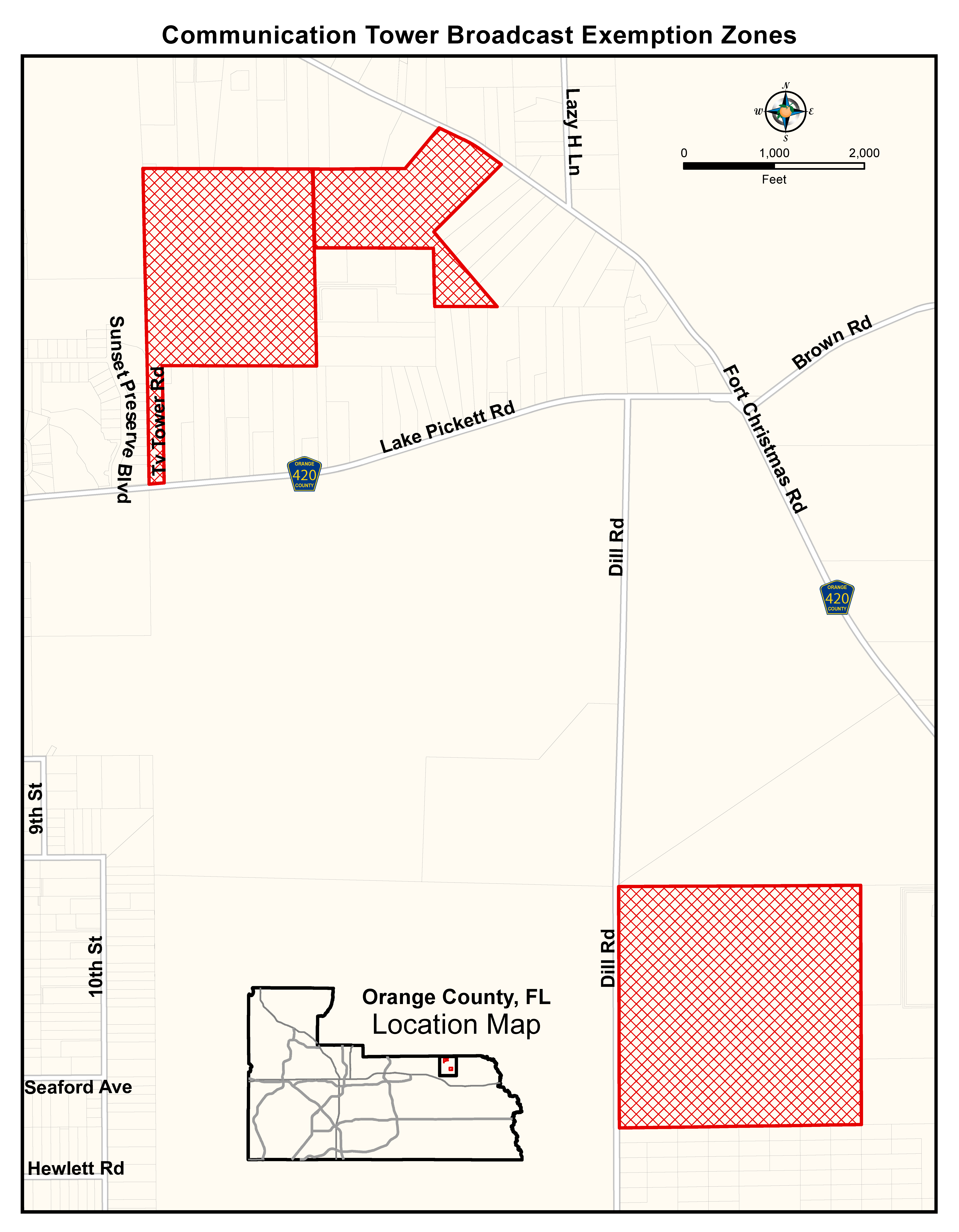
The proximity of other existing communications towers shall be a factor considered and addressed during the special exception hearing for any proposed communication tower located within the boundaries of a designated broadcast area. Those communications towers located within a broadcast area shall be considered existing towers for purposes of distance separation measurement by proposed towers located outside the above-designated broadcast areas.
(Ord. No. 97-11, § 6, 6-23-97; Ord. No. 2023-46, § 68, 12-12-23)
(4)
Method of determining communication tower height. Measurement of communication tower height shall include antenna, base pad, and other appurtenances and shall be measured from the finished grade of the parcel.
(5)
Illumination. Communication towers shall not be artificially lighted except to assure human safety or as required by the Federal Aviation Administration. At time of construction of the communication tower in cases where there are residential uses located within a distance which is three hundred (300) percent of the height of the tower from the tower, dual mode lighting shall be requested from the FAA.
(6)
Finished color. Communication towers not requiring FAA painting/marking shall have either a galvanized finish or painted a noncontrasting blue, gray, or black finish.
(7)
Structural design. Communication towers shall be constructed to the EIA/TIA 222-E Standards, as published by the Electronic Industries Association, which may be amended from time to time, and all county construction/building codes. Further, any improvements and/or additions (i.e., antenna, satellite dishes, etc.) to existing communication towers shall require submission of site plans sealed and verified by a professional engineer which demonstrate compliance with the EIT/TIA 222-E Standards in effect at the time of such improvement or addition. Such plans shall be submitted to and reviewed and approved by the county building department at the time building permits are requested.
(8)
Public notice. For purposes of this section, any special exception request, land use plan approval in a P-D, substantial change in a P-D land use plan, or appeal of the zoning manager's decision regarding this section, shall require public notice to all abutting property owners and all property owners of properties that are located within five hundred (500) feet of the perimeter of the parent parcel upon which the proposed communication tower is located. Further, authorized representatives of homeowners' and property owners' associations registered with or known to the county planning department within one thousand five hundred (1,500) feet of the perimeter of the parent parcel upon which the proposed communication tower is located will be provided public notice on a courtesy basis; however, inadvertent failure to supply such courtesy notice shall not invalidate the hearing procedure. For purposes of this section, any variance request shall require public notice to all abutting property owners and all property owners of properties that are located within the corresponding separation distance listed in subsection (d)(2).
(Ord. No. 97-11, § 7, 6-23-97)
(9)
Public information signage.
a.
Within twenty (20) days after final approval of a special exception, variance, land use plan approval in a P-D, substantial change to a P-D land use plan, or appeal of the zoning manager's decision by the applicant regarding this section, the communication tower owner/operator shall cause to be placed on the parcel signage designating the site as a future communication tower site.
b.
One four-foot by four-foot sign shall be placed along each right-of-way frontage bordering the parcel within a distance such that the copy is visible and legible from the right-of-way.
c.
Each sign shall be weather durable and include in addition to the designation, the company name of the communication tower owner/operator, and a phone number and contact person from whom additional information may be obtained.
d.
Appropriate county building permits shall be obtained prior to installation of the signage.
e.
Such signage may not be removed prior to the start of construction of the communication tower but shall be removed prior to the issuance of a certificate of completion for the communication tower. If the approval listed in subsection (d)(9)a. expires or otherwise becomes void, the signage shall be removed immediately.
f.
Other than the above requirements, such signage shall be exempt from all other provisions of the County Code regarding outdoor signs.
(10)
Fencing. A chain link fence or wall not less than eight (8) feet in height from finished grade shall be provided around each communication tower. Barbed wire shall be used along the top of the fence or wall. Access to the tower shall be through a locked gate.
(11)
Landscaping. The visual impacts of a communication tower shall be mitigated for nearby viewers through landscaping or other screening materials at the base of the tower and ancillary structures. The following landscaping and buffering of communication tower shall be required around the perimeter of the tower and accessory structures, except that the standards may be waived by the zoning manager for those sides of the proposed tower that are located adjacent to undeveloped lands and lands not in public view. Landscaping shall be installed on the outside of fences. Further, the use of existing vegetation shall be preserved to the maximum extent practicable and may be used as a substitute of or in supplement toward meeting landscaping requirements.
a.
A row of shade trees a minimum of eight (8) feet tall and a maximum of ten (10) feet apart shall be planted around the perimeter of the fence;
b.
A continuous hedge at least thirty (30) inches high at planting capable of growing to at least thirty-six (36) inches in height within eighteen (18) months shall be planted in front of the tree line referenced above;
c.
All landscaping shall be of the evergreen variety;
d.
All landscaping shall xeriscape tolerant or irrigated and properly maintained to ensure good health and viability.
(12)
Documentation, performance bond or deposit for removal. Prior to receiving a building permit for construction of the communication tower if the applicant does not provide a recorded memorandum of lease of co-location then the applicant shall provide either:
a.
Documentation supplied to the zoning manager sufficient to demonstrate that an adequate methodology and/or sufficient funds are dedicated to and available for removal of the tower structure upon abandonment (by way of example and not limitation, sufficient documentation would include evidence that the tower owner has the obligation under the governing lease to dismantle and remove the tower upon abandonment); or
b.
A twenty-year performance bond which shall be posted with the county in an amount sufficient to remove the tower structure upon abandonment. Upon construction of multiple towers under the control of one (1) service provider, the service provider may provide the county with one (1) twenty-year performance bond in an amount not to exceed sixty thousand dollars ($60,000.00) applicable to all of the service provider's towers for removal upon each tower's abandonment; or
c.
For placement into a communication tower removal account established with the county comptroller's office, the adequate amount of an irrevocable cash deposit to cover the cost of removal of the tower. The county shall be entitled to use the funds deposited into such account for the necessary removal of any communication tower within unincorporated Orange County. The adequate amount shall be thirty dollars ($30.00) per foot of height for monopole towers and one hundred dollars ($100.00) per foot of height for lattice or guyed towers. In no event shall any one (1) service provider be required to place more than thirty thousand dollars ($30,000.00) into the account for the cumulative number of towers under its control and located within unincorporated Orange County.
(Ord. No. 97-11, § 8, 6-23-97)
(e)
Reserved.
(Ord. No. 2023-46, § 68, 12-12-23)
(f)
Abandonment of communication towers.
(1)
Compelling public interest. The board of county commissioners finds and declares that, because of the national public policy of ensuring that the wireless communications industry and its evolving new technologies are accommodated notwithstanding the undesirable effects that communication towers may have on the aesthetics of communities and neighborhoods, there is a compelling public interest in ensuring that communication towers are promptly disassembled, dismantled, and removed once they are no longer being used. Further, the board finds that there is substantial risk that towers may cease being used in large numbers if there is a concentration or consolidation of competitors within the industry or if even newer technologies arise, obviating the need for towers.
(2)
Abandonment. In the event the use of any communication tower has been discontinued for a period of one hundred eighty (180) consecutive days, the tower shall be deemed to be abandoned. Determination of the date of abandonment shall be made by the zoning manager who shall have the right to request documentation and/or affidavits from the communication tower owner/operator regarding the issue of tower usage. Failure or refusal for any reason by the owner/operator to respond within twenty (20) days to such a request shall constitute prima facie evidence that the communication tower has been abandoned. Upon a determination of abandonment and notice thereof to the owner/operator, the owner/operator of the tower shall have an additional one hundred eighty (180) days within which to: (i) reactivate the use of the tower or transfer the tower to another owner/operator who makes actual use of the tower within the one-hundred-eighty-day period, or (ii) dismantle and remove the tower. At the earlier of one hundred eighty-one (181) days from the date of abandonment without reactivation or upon completion of dismantling and removal, any special exception and/or variance approval for the tower shall automatically expire.
(3)
Duty to remove abandoned towers. Notwithstanding the provisions of subsection (2), upon abandonment of a communication tower as determined under subsection (2) by the zoning manager and the failure or refusal by the owner/operator of the tower to either reactivate the tower or dismantle and remove it within one hundred eighty (180) days as required by subsection (2), the following persons or entities (the "responsible parties") shall have the duty jointly and severally to remove the abandoned tower:
a.
The owner of the abandoned tower (and, if different, the operator of the abandoned tower);
b.
The owner of the land upon which the abandoned tower is located;
c.
The lessee, if any, of the land upon which the tower is located;
d.
The sublessee or sublessees, if any, of the land upon which the tower is located;
e.
Any communication service provider who or which by ceasing to utilize the tower or otherwise failing to operate any of its transmitters or antennas on the tower for which it leased space or purchased the right to space on the tower for its transmitters or antennas and such ceasing or failure to utilize the tower in fact caused the tower to become abandoned;
f.
Any person to whom or entity to which there has been transferred or assigned any license issued by the Federal Communications Commission and under which the tower owner/operator operated the tower;
g.
Any person or entity which has purchased all or a substantial portion of the assets of the tower owner or operator;
h.
Any entity which has merged with, or which has arisen or resulted from a merger with, the tower owner or operator;
i.
Any person or entity which has acquired the owner or the operator of the abandoned tower;
j.
Any parent or subsidiary of any of the foregoing which happens to be a corporation;
k.
Any managing partner of any of the foregoing which happens to be a limited partnership; and
l.
Any partner of any of the foregoing which happens to be a general partnership.
The abandoned tower shall be removed on or before the ninetieth day after receipt by the responsible party or parties of a notice from the zoning manager ordering its removal. The duty imposed by this subsection shall supersede and otherwise override any conflicting provision of any contract, agreement, lease, sublease, license, franchise or other instrument entered into or issued on and after June 10, 1997.
(4)
Enforcement. The county chairman shall take such actions from time to time as are necessary or useful to enforce the duty and requirements imposed by this subsection, and in the course of enforcement the county chairman may avail himself/herself of any one (1) or more of the following:
a.
Proceedings to enforce this subsection may be brought before the code enforcement board in the manner allowed by general law and this county code.
b.
Proceedings to enforce this subsection may be brought before the circuit court in the Ninth Judicial Circuit of Florida, and in such proceedings the county shall be entitled to all remedies at law and in equity, including (but not limited to) injunctive relief. Further, upon a determination that a defendant has violated a duty or requirement of this subsection, the court shall award reasonable attorneys' fees and costs to the county, including fees and costs incurred by the county on appeal.
c.
Upon directive by the county chairman, the county may withhold from any person or entity in violation of this subsection all future development permits (as that term is defined by F.S. § 163.3164(8)) and otherwise may refrain from processing any applications by the violator for approval of any zoning changes, special exceptions, variances, site plans, subdivision plans, plats, developments of regional impact, substantial deviations from DRI development orders, substantial changes to planned developments, right-of-way utilization permits, building permits, cable television franchises (or renewals thereof or amendments thereto), or any other county regulatory permits or approvals.
d.
The county may remove the tower using the funds or surety bonds, if any, deposited under subsection (d)(12) by the responsible parties and thereafter initiate judicial proceedings against the responsible parties for any portion of the cost not covered by the deposited funds or surety bonds. If the responsible parties include the owner of the land on which the abandoned tower is or was located, such portion of the cost shall be assessed against the land, and the county may file a lien thereon. The lien of the assessment shall bear interest and shall have priority and be collectable at the same rate and in like manner as provided under state law and this Code for special assessments.
(Ord. No. 97-11, § 9, 6-23-97)
(g)
Communication antennas. Any communication antenna which is not attached to a communication tower, shall be a permitted ancillary use to any commercial, industrial, professional, institutional, or multifamily structure of at least three (3) stories in height provided:
(1)
The communication antenna and its ancillary supporting apparatus does not extend above the highest point of the structure the greater of thirty (30) feet or fifty (50) percent of height of building, not to exceed maximum combined height of sixty (60) feet for the antenna and its ancillary supporting apparatus, and further provided that the antenna and its ancillary supporting apparatus are not attached to the ground; and
(2)
The communication antenna complies with all applicable FCC and FAA regulations; and
(3)
The communication antenna complies with all applicable building codes.
(Ord. No. 97-11, § 10, 6-23-97)
(h)
Co-location of communication antennas. To minimize adverse visual impacts associated with the proliferation and clustering of communication towers, co-location of communication antennas by more than one (1) carrier on existing or new communication towers shall take precedent over the construction of new single-use communication towers as follows:
(1)
Proposed communication antennas may, and are encouraged to, co-locate onto existing communication towers. Provided such co-location is accomplished in a manner consistent with subsections (h)(2) through (h)(4), then such co-locations are permitted by right and new or additional special exception approval shall not be required.
(2)
Type of construction. A communication tower which is modified or reconstructed to accommodate the co-location of an additional communication antenna shall be either of the same tower type as the existing communication tower or a monopole tower that is replacing an existing lattice or guyed tower.
(Ord. No. 97-11, § 11, 6-23-97)
(3)
Height.
a.
Additional height which does not comply with distance separation requirements.
1.
An existing communication tower which meets or as of September 8, 1995, is in nonconformity with the separation requirements set forth in subsection (d)(2)d. or (d)(3) may be modified or rebuilt to a taller height, not to exceed forty (40) feet over the tower's existing height, to accommodate the co-location of additional communication antennas when the resulting taller height will not comply with the separation requirements set forth in subsection (d)(2)d. or (d)(3).
2.
The height change referred to in subsection (h)(3)a.1. may only occur one (1) time per communication tower.
3.
The additional height referred to in subsection (h)(3)a.1. shall not require an additional distance separation as set forth in either subsection (d)(2)d. or (d)(3). The communication tower's premodification height shall be used to calculate such distance separations.
b.
Additional height which does comply with the distance separation requirements.
1.
An existing communication tower may be modified or rebuilt to a taller height, not to exceed three hundred (300) feet to accommodate the co-location of additional communication antennas.
2.
Subject to subsection (h)(5), the height change referred to in subsection (h)(3)b.1. may occur provided the resulting height of the modified or rebuilt tower complies with the distance separation requirements set forth in subsections (d)(2)d. and (d)(3).
(Ord. No. 97-11, § 11, 6-23-97)
(4)
On-site location.
a.
A communication tower which is being rebuilt to accommodate the co-location of an additional communication antenna consistent with the height requirements of subsection (h)(3) above may be moved on-site within seventy-five (75) feet of its existing location. A communication tower which is being rebuilt to accommodate the co-location of an additional communication antenna consistent with the height requirements of subsection (h)(3) above may be moved on site within two hundred fifty (250) feet of its existing location provided the separation distances to residential units or residentially-zoned lands as established in subsection (d)(2) are maintained. Notwithstanding the foregoing, nothing shall prevent a new tower which replaces an existing tower provided: (1) the new tower is co-located; (2) the new tower meets the subsection (d)(2) tower-to-residential separation requirements; and (3)(i) if the new tower is on residentially-zoned property it meets the subsection (d)(3) tower-to-tower separation requirements, or (3)(ii) if the new tower is on commercial- or industrial-zoned property it meets the tower-to-tower separation requirements as set forth in subsection (h)(5).
b.
After the communication tower is rebuilt to accommodate co-location, only one (1) tower may remain on the site.
c.
A relocated on-site communication tower shall continue to be measured from the original tower location for purposes of calculating separation distances between communication towers pursuant to subsection (d)(3). The relocation of a tower hereunder shall in no way be deemed to cause a violation of subsection (d)(3).
(Ord. No. 97-11, § 11, 6-23-97)
(5)
Commercial or industrial zoning, limited exemption from separation requirements. A communication tower which co-locates two (2) or more communication antennas and which is located in a commercial or industrial zoning district as a permitted use pursuant to section 38-77 shall be exempted from the separation distances between communication towers as set forth in subsection (d)(3) from only those other towers that are located in either a commercial or industrial zoning district. A communication tower permitted under this subsection is still required to comply with the separation distances set forth in subsection (d)(2)d.
(Ord. No. 97-11, § 11, 6-23-97)
(i)
Certification of compliance with Federal Communication Commission (FCC) NIER Standards. Prior to receiving final inspection by the county building department, documented certification shall be submitted to the FCC, with copy to the county zoning department, certifying that the communications facility complies with all current FCC regulations for non-ionizing electromagnetic radiation (NIER).
(j)
Nonconforming uses.
(1)
Existing nonconforming uses. Notwithstanding subsection (f) above, bona fide nonconforming communications towers or antennas that are damaged or destroyed may be rebuilt without having to meet the separation requirements specified in subsections (d)(2)d. and (d)(3). The type, height, and location of the tower on-site shall be of the same type and intensity as the original facility approval. The rebuilt facility shall comply with the then applicable building codes, and the required building permits shall be obtained within one hundred eighty (180) days from the date the facility is damaged or destroyed. If no permit is obtained or if said permit expires, the communications facility shall be deemed abandoned as specified in subsection (f).
(2)
Future nonconforming uses. If at any time after January 1, 2013, the board of county commissioners finds (i) that the technologies pertaining to communication towers have changed such that wireless communications can be readily provided with no towers or with towers or other structures that are substantially less intrusive to residential and commercial areas and substantially more aesthetic for neighborhoods and commercial areas and (ii) that the service providers in the county are making frequent use of the new technologies in the installation of new communication systems or the expansion of existing systems (whether such installations or expansions are occurring in Orange County or elsewhere), the board may declare to be nonconforming uses all communication towers then existing in residential, professional office, and commercial zones (and in such corresponding areas within planned developments) in the county and which have been erected pursuant to building permits issued on or after July 1, 1997. The board shall declare such towers to be nonconforming uses in an ordinance which amends this Code to make such towers nonpermitted uses altogether in residential, professional office, and commercial zones (and such corresponding areas within planned developments) and, simultaneously, to make the new technologies permitted uses or special exceptions in those zones. The board may then set such time limits as are reasonable and legally permissible for the service providers and tower owners/operators to remove the nonconforming towers and replace them with the newer technologies. This subsection shall be effective only if and to the extent not prohibited or preempted by state or federal law.
(Ord. No. 97-11, § 13, 6-23-97)
(k)
Reserved.
(Ord. No. 97-11, § 14, 6-23-97)
(l)
Application submission requirements for special exception, variance, appeal of zoning manager decision, and building permit requests. The following information shall be submitted concurrent with special exception, variance, appeal of zoning manager decision, or building permit applications. The application may utilize any combination of site plans, surveys, maps, technical reports or written narratives necessary to convey the following information.
(1)
A scaled survey/site plan with dimensions drawn by a surveyor, architect or engineer clearly indicating the location, type and height of the proposed tower, on-site land uses and zoning, adjacent land uses and zoning (including when adjacent to other municipalities), adjacent roadways, wetlands, surface waters, proposed means of access, setbacks from property lines, elevation drawings of the proposed tower, and any other proposed structures.
(Ord. No. 2023-46, § 68, 12-12-23)
(2)
Legal description of the parent tract and leased parcel (if applicable).
(Ord. No. 2023-46, § 68, 12-12-23)
(3)
If not within the subsection (d)(2)d. separation distance from residential areas, approximate distance between the proposed tower and the nearest residential unit, platted residentially zoned properties, and unplatted residentially zoned properties. If within the subsection (d)(2)d. separation distance requirements, then exact distances, locations and identifications of said properties shall be shown on a map.
(Ord. No. 2023-46, § 68, 12-12-23)
(4)
If within the subsection (d)(3) separation distance from another tower, then the exact distance, location, and identification of other towers shall be shown on a map. The applicant shall also identify the type of construction of the existing tower(s) and the owner/operator of the existing tower(s), if known.
(Ord. No. 2023-46, § 68, 12-12-23)
(5)
A landscape plan showing specific landscape materials.
(Ord. No. 2023-46, § 68, 12-12-23)
(6)
Method of fencing, and finished color and, if applicable, the method of camouflage and illumination.
(Ord. No. 2023-46, § 68, 12-12-23)
(7)
A notarized letter signed by the applicant stating the tower will comply with all EIT/TIA 222-E Standards and all applicable county codes.
(Ord. No. 2023-46, § 68, 12-12-23)
(8)
A statement by the applicant as to whether construction of the tower will accommodate co-location of additional antennas for future users.
(Ord. No. 2023-46, § 68, 12-12-23)
(9)
An inventory of all communication towers located in Orange County which are under the applicant's control and/or are being used by the applicant. Information on each tower listed shall include:
(Ord. No. 2023-46, § 68, 12-12-23)
a.
The type of tower or structure;
b.
The height of the tower including antennas;
c.
Latitude and longitude location;
d.
Street address; and
e.
Indication whether the site is co-located and, if so, with whom.
(Ord. No. 97-11, § 12, 6-23-97)
(10)
a.
A copy of the recorded memorandum of lease evidencing co-location, if such memorandum exists.
(Ord. No. 2023-46, § 68, 12-12-23)
b.
When there is no memorandum of lease filed with the permit application, the application shall be held by the zoning manager for forty-five (45) days, and:
1.
Within fifteen (15) days of permit application being submitted to the county the applicant shall send by registered mail notice to each FCC-licensed service provider in the applicant's search ring and each FCC-licensed service provider who has registered for notice under this provision with Orange County. The notice shall include the location of the proposed tower (by street address and longitude and latitude), the height of the proposed tower, and a statement identifying the fair market value of leasing space on the tower for a second antenna by another service provider;
2.
After notice, if another service provider desires to locate on the proposed tower, but cannot reach agreement with the tower applicant then, prior to expiration of the forty-five-day period, the service provider may request a hearing under subsection 38-1427(m);
3.
The zoning manager shall take action on the permit application either after the forty-five-day period has run or upon final resolution of a matter forwarded to the hearing officer pursuant to subsection 38-1427(m), whichever is later;
4.
The applicant may provide registered mail notice to those service providers as required in subsection 1. above any time thirty (30) days before application is made to the county. Upon documentation of registered mail being sent, the forty-five-day period shall be reduced by the amount of days notice was sent prior to the application being filed.
(Ord. No. 97-11, § 12, 6-23-97)
(11)
If deemed necessary by the county, the zoning manager may require the applicant to hold a community meeting prior to the board of zoning adjustment hearing meeting in addition to the other requisite notice requirements.
(Ord. No. 97-11, § 12, 6-23-97; Ord. No. 2023-46, § 68, 12-12-23)
(12)
For all special exception and/or variance requests the applicant shall provide the RF search ring used to determine the location of the applicant's request. In addition, the applicant shall supply a report that other parcels within the applicant's search ring have been reviewed and, where appropriate, contacted. The applicant shall provide adequate documentation to substantiate the applicant's determination of feasibility of the selected site.
(Ord. No. 97-11, § 12, 6-23-97; Ord. No. 2023-46, § 68, 12-12-23)
(13)
In addition to the above, all communication towers/ antennas shall comply with the commercial site plan review requirements set forth in chapter 30, article VIII, of the County Code.
(Ord. No. 97-11, § 12, 6-23-97; Ord. No. 2023-46, § 68, 12-12-23)
(m)
Co-location condition for towers eighty (80) feet in height and taller.
(1)
Every special exception for a communication tower which is eighty (80) feet in height or taller and which is issued after June 23, 1997, shall include the following conditions:
a.
All new communication towers shall be designed and constructed to accommodate at least one (1) other service provider.
b.
The applicant for a new communication tower shall provide a notarized letter acknowledging that the communication tower is designed and will be constructed to accommodate at least one (1) other service provider.
c.
All service providers shall cooperate in good faith with other service providers to accomplish co-location of additional antennas on communication towers which are existing, permitted, or otherwise authorized by Orange County, where feasible.
(2)
Technical requirements, site constraints and reasonable terms and conditions are relevant factors in determining if co-location is feasible.
(3)
Any request for co-location by one (1) service provider to the applicant for or holder of a special exception for a communication tower shall be in written form and a copy forwarded by the requesting service provider to the zoning manager. A request for co-location shall also include: (i) a request for co-location by a third-party service provider under a memorandum of lease for a tower which is not yet physically co-located and (ii) an inquiry by the zoning manager as to whether a tower actually provides for co-location by physically supporting two (2) or more antennas after the prescribed three-year period set forth in a memorandum of lease applicable to the particular tower; provided, however, that the foregoing inquiry authority of the zoning manager under this clause (ii) and subsection (b)(8) shall not be exercised with respect to a particular communication tower more frequently than after three (3) years initially and thereafter annually.
(4)
Applicant for or holder of a special exception for a communication tower shall respond to the request for co-location in written form within forty-five (45) days of receipt of the request by:
a.
Granting the terms of co-location as mutually agreed upon by the parties;
b.
Denying such request if such denial clearly sets forth valid reasons for denial which shall include, but not be limited to: (i) refusal to accept or offer rent within market rates; (ii) availability of space on tower; (iii) technical reasons such as, but not limited to, interference; and
c.
Extending the time limits delineated in this subsection (4) by mutual agreement of the parties, not to exceed a total of one hundred twenty (120) days for the request to be either granted or denied from the date of the receipt of the original request.
d.
If responding to an inquiry from the zoning manager as to the status of provision of co-location under a memorandum of lease, by either establishing that two (2) or more antennas are physically located on the tower or by providing a report to the zoning manager detailing the good-faith efforts made to accommodate co-location. Failure to have physical co-location accomplished within a three-year period from the date of the memorandum of lease may require the tower approval to be subject to review under subsection (m)(6). If the zoning manager determines to forward the matter to a hearing officer, he shall first prepare a report and send it to the board of county commissioners and the holder of the special exception.
(5)
The service provider shall submit a second notice to the applicant for or holder of a special exception for a communication tower seven (7) days prior to the expiration of the response period set forth in subsection (4).
(6)
If the procedures set forth above are adhered to by the requesting service provider and the applicant for or holder of a special exception for a communication tower fails to comply with subsection (4) either within the time frame set forth therein or by not providing adequate evidence to substantiate its reason to deny the co-location request, either the county or the service provider seeking to co-locate may initiate actions at the county to revoke the tower's special exception. The matter shall be forwarded to a hearing officer and a date scheduled for a hearing in accordance with the following procedures.
a.
The request to initiate action before a hearing officer shall be made within thirty (30) days from the date of response by the holder of the special exception or the date such response would be due under subsection (4).
b.
In the utilization of the hearing officer(s) under this section, section 30-387(b), (c), (d), (e) and (g), pertaining, respectively, to term and compensation, ex parte communication, hearing officer prohibition from acting as an agent or attorney for subject matter, hearing procedures, and filing of a decision, shall generally be applicable.
c.
At the hearing, the hearing officer shall allow the zoning manager or his designee(s), the service provider seeking co-location, and the special exception holder an opportunity to present evidence and to examine and cross-examine witnesses. After considering the evidence and testimony, the hearing officer shall make a factual determination as to whether the special exception holder acted in violation of this section and issue an order. If the hearing officer makes a factual determination that the special exception holder has not acted in good faith and is in violation of this section, the order shall state what those violations are and provide a recommendation for final action to the board of county commissioners. The hearing officer's recommendation shall be forwarded to the board of county commissioners and upon confirmation shall become final unless appealed to the board or called for review by the board.
d.
Any appeal from a hearing officer's decision shall first go to the board of county commissioners and then may proceed to circuit court. Such an appeal shall generally follow the procedures set forth in section 30-388 of this Code, with references to "an application for a vested rights certificate" in this instance interpreted to mean "a hearing officer's decision on a co-location request issued pursuant to subsection (m). Further, the last sentence of subsection 30-388(a)(3) of this Code is specifically not applicable to proceedings under this section. An appeal from a hearing officer's decision shall stay all actions directed by such decision until the appeal is fully resolved.
e.
If at any time during this process the special exception holder submits to the zoning manager a recorded memorandum of lease with any other service provider the further proceedings hereunder shall be canceled since the tower will in fact be a co-located facility. Prior to canceling the hearing, the zoning manager will verify the memorandum of lease. The zoning manager shall notify the parties and the hearing officer of the cancellation of these proceedings. Upon termination of the co-location lease, subsections (m)(4), (5), and (6) shall again apply.
(7)
Failure to comply with subsection (1) and (4) herein is grounds for revocation of the tower's special exception.
(Ord. No. 97-11, § 15, 6-23-97)
(n)
Standards and criteria for review of special exception requests on communication tower facilities.
(1)
Intent and purpose. The intent and purpose of this subsection is to address and balance the concern that communication towers may not be appropriate uses in residential areas because of the aesthetic and compatibility conflicts that arise when these facilities are located in close proximity to residential uses and the recognized need of the services the communication towers provide to the public. These issues shall be reviewed on a case-by-case basis for each special exception request in accordance with the standards set forth in subsection 30-42(2) of this Code and section 38-78 of this chapter and the provisions of this subsection. The board of zoning adjustment (BZA) shall consider and weigh the aesthetic impact and compatibility issues with the public benefit derived from having an efficient and reliable wireless communications systems when determining whether or not to grant special exception approval. To assist the BZA in reaching such determination, the application shall provide the following information set forth in subsection (2) and may optionally supply that information set forth in subsections (3) through (6) below and comply with the procedures and requirements set forth in this subsection, including production of documentation to verify the completion of these requirements.
(2)
Visual aides. The applicant shall submit for BZA review photo simulations, renderings, and/or a video of the subject site depicting the proposed communication tower on the site and its proximity to neighboring residential lands and uses. The visual aides may be accompanied by a corresponding written visual impact analysis prepared by the applicant.
(Ord. No. 2023-46, § 68, 12-12-23)
(3)
Balloon test. The purpose of this test is to assist the BZA in determining aesthetic impact with respect to height and closeness of a communication tower in proximity to nearby residential uses and zoning. If a balloon test is deemed necessary or requested by the County, the following criteria shall be met:
a.
Balloon specifications:
1.
Balloon diameter no less than four (4) feet;
2.
Balloon color restricted to red, orange, or yellow;
3.
Balloon anchored to the ground;
4.
The height at which the balloon is flown shall be the same as the combined height of the tower and its antennas up to one hundred ninety-nine (199) feet; balloons for towers taller than one hundred ninety-nine (199) feet shall be flown at one hundred ninety-nine (199) feet;
b.
The balloon shall be flown after the public hearing poster is required to be erected on-site. Balloons shall be flown at a minimum, continuously between the hours of 7:00 a.m. and 10:00 a.m. each day it is required to be flown. The balloon shall be flown for a minimum of two (2) days. Failure to maintain the balloon as specified above may result in a delay of the public hearing in order to achieve compliance with same.
c.
Each notice required pursuant to section 30-44 of this Code shall include a statement that the balloon will be flown at least two (2) days during the morning hours prior to the public hearing date.
(Ord. No. 2023-46, § 68, 12-12-23)
(4)
Additional information. The applicant may submit any other bona fide documentation or evidence that he or she feels may assist the BZA in determining visual impact. Any person or party opposing the applicant's special exception request should submit bona fide evidence or documentation that a proposed tower will have a substantial adverse aesthetic impact on his/her property.
(5)
Camouflaged facilities. The purpose of this subsection is to assist the BZA in determining whether or not a tower as a camouflaged facility is appropriate in a given area. The applicant may use a camouflage agent in order to achieve compatibility with the nature and character of the surrounding area. Camouflaging shall be determined on a case-by-case basis. Any proposed camouflaging shall be submitted in conjunction with the special exception application. It shall include the following documentation:
a.
Colorized pictorial representation, artist's rendering, or the like;
b.
Design specifications as follows: total height, diameter, and colorations;
c.
A corresponding statement accompanying the graphic representation explaining the following:
1.
What is the nature and character of the area within which the camouflaged tower is proposed, with respect to: land use, surrounding environment, building heights and designs, and building/environment density;
2.
How will the proposed camouflaged agent blend in and harmonize with the nature and character of the area.
(6)
Separation distance reduction for camouflaged facilities. In the event the BZA, or the BCC if the property is zoned PD, using the standards set forth in subsection (n)(5) above, determines the camouflaging agent is compatible with the surrounding area, then the distance separation requirements set forth in subsections 38-1427(d)(2)d and (d)(3) for the proposed communication tower as a camouflaged facility shall be reduced by one-half (½) of the applicable monopole height requirement. The reduction should only be applicable to the placement of the camouflaged tower, and the measurement of distance separation from other towers to the camouflaged tower shall not be reduced.
(Ord. No. 2023-46, § 68, 12-12-23)
(7)
BZA special exception criteria. In determining a special exception request for a communication tower in addition to those criteria set forth in subsection 30-43(2) of this Code and section 38-78 of this chapter, the BZA shall take into consideration whether or not the proposed tower will have substantial adverse aesthetic impact on neighboring residential lands and compatibility of a camouflaged tower in a given area. The BZA's determination shall be based on relevant and competent evidence, documentation, and testimony received at the public hearing from the staff, the applicant and any party in support or opposition, or their respective representatives. The BZA shall utilize the following criteria in determining if a special exception is deemed approvable:
a.
Aesthetic impact. This means view of a tower that is not camouflaged. Aesthetic impact shall take into consideration, but not be limited to, the amount of the tower that can be viewed from surrounding residential zones in conjunction with its proximity (distance) to the residential zone, mitigation landscaping, existing character of surrounding area, or other visual options proposed by the applicant.
b.
Compatibility. This means the degree to which a tower is designed and located to be compatible with the nature and character of other land uses and/or with the environment within which the tower proposes to locate. The tower may be placed, designed or camouflaged to assist with mitigating the overall aesthetic impact of a tower. A camouflage agent shall be designed to be compatible with the surrounding land uses and the environment.
(8)
Minimum standards. In addition to the above, the minimum performance standards with respect to separation between towers, separation between residences and towers, etc., as referenced herein, shall be met. These standards, however, are minimum standards; the BZA is empowered to impose more restrictive conditions to a special exception in order to recommend approval so as to achieve the desired protection with respect to aesthetic impact and harmony and compatibility with the surrounding community. The determination by the BZA to impose more restrictive conditions shall be based on substantial competent evidence that supports the modification and the consistency of the modification with the purpose and intent of this section.
(Ord. No. 97-11, § 16, 6-23-97)
(o)
Utilization of existing pole-type structures. A communication antenna which is attached to an existing pole-type structure or the existing pole-type structure is replaced with a monopole tower to accommodate both its prior function and a communication antenna shall be a permitted ancillary use provided each of the following criteria are met:
(1)
The communication antenna attached to the existing pole-type structure or replacement monopole shall not extend above the highest point of the pole-type structure or replacement monopole more than twenty (20) feet, as measured from the height of the pre-existing pole-type structure.
(2)
a.
If the resulting structure/tower adds additional height over the pre-existing pole-type structure, the closest residential structure shall be away from the base of the pole-type structure or replacement tower a distance of at least one hundred ten (110) percent the height of the entire structure/tower.
b.
If no additional height over the height of the pre-existing pole-type structure is added by either (i) the attachment of the communication antenna to the existing pole-type structure, or (ii) the replacement tower including the communication antenna, then the structure/tower is permitted with no additional distance separation to residential structures over that which was provided by the pre-existing pole-type structure.
(3)
The communication antenna and support structure comply with all applicable FCC and FAA regulations.
(4)
The communication antenna, pole-type structure, and/or replacement monopole tower comply with all applicable building codes.
(5)
Pole-type structure (i) within side yard or rear yard residential subdivision easements, or (ii) if used for power distribution of fourteen (14) kilovolt service or less, shall not be eligible for use under this subsection (o). However, other pole-type structures within public road rights-of-way and within limited access road system rights-of-way are eligible for use under this subsection (o), provided the antenna shall be canister-type.
(6)
The utilization of an existing pole-type structure for placement of a communication antenna in compliance with the requirements of this subsection (o) shall supersede the separation requirements contained in subsections (d)(2)d. and (d)(3)a.
(7)
In the event that the utility pole or structure is abandoned for its initial/primary use as a utility pole, the secondary use as a communication tower shall also cease to operate and the structure and communication antenna removed.
(Ord. No. 95-25, § 4, 8-29-95; Ord. No. 96-10, §§ 3, 4, 4-30-96; Ord. No. 97-11, § 17, 6-23-97; Ord. No. 2016-19, § 40, 9-13-16)
Sec. 38-1428. - Casino gambling.
(a)
Findings and declaration of intent.
(1)
From time to time, proposals arise to authorize casino gambling or gaming in the State of Florida. As of the date of this ordinance, those proposals have all been rejected by the voters at statewide referendum.
(2)
The citizens of Orange County have an especially intense aversion to casino gambling, and it can be shown be referendum results. For example, in November 1994, the people of the State of Florida voted by a sixty-two (62) percent to thirty-eight (38) percent margin in the general election to reject an initiative to amend the Florida Constitution to authorize casino gambling. The people of Orange County voted by a seventy (70) percent to thirty (30) percent margin to reject the same initiative.
(3)
If casino gambling were to become lawful in the future, the people of Orange County would be adversely affected by establishments within Orange County engaging in gambling activity.
(4)
Orange County has the power and authority under the Florida Constitution, the laws of the State of Florida and the Orange County Charter to regulate land use matters, including zoning issues, relating to casino gambling.
(5)
Casino gambling occurs for the purpose of making a profit and, as such, is subject to regulation by Orange County for the purpose of protecting the health, safety, and welfare of the people of Orange County.
(6)
Activities which are illegal, immoral or unhealthful tend to accompany, concentrate around, and be aggravated by casino gambling activity. Such activities include, but are not limited to, non-violent crimes against persons and property, violent crimes against persons and property, prostitution, solicitation for prostitution, pandering, and sale or possession of controlled substances.
(7)
Casino gambling activity tends to attract an undesirable number of transients, blight neighborhoods, adversely affect nearby businesses, lower real property values, foster crime, particularly the kinds detailed in subsection (a)(6), and ultimately lead residents and businesses to move to other locations.
(8)
Orange County is a family-oriented area, especially with respect to its tourism industry.
(9)
Orange County is an area that is known for and whose economy is largely dependent upon its popular family-oriented tourist attractions.
(10)
The vitality of the tourism industry depends in large part upon an atmosphere that is conducive to attracting tourist families.
(11)
Casino gambling activity is not conducive to attracting tourist families.
(12)
Prohibiting casino gambling from locating within Orange County's tourism district will help protect the public and private investment in Orange County's tourism district and the county's tourism industry.
(13)
It is not the intent of this section to prohibit casino gambling as may be allowed by law, but instead to ensure that if and when it is ever allowed by law, it occurs only in the areas of Orange County where it will not have a material, adverse impact on the community's largest economic sector and the community's largest source of jobs.
(b)
"Casino gambling" defined. The term "casino gambling" means playing or engaging in, for money or any other thing of value, baccarat, blackjack or twenty-one, craps, keno, poker, roulette, any electronic gambling or gaming machine, any slot machine, or any other game of skill or chance, regardless of how named, labeled, or otherwise characterized, which game of skill or chance, when played for money or other thing of value, was unlawful under the Constitution or laws of the State of Florida as of July 1, 1995.
(c)
Prohibition from tourism district. If and when casino gambling is ever allowed under the Constitution and laws of the State of Florida and the Orange County Charter, it may occur only on land or waters properly zoned therefor and only on land or waters lying outside the tourism district, as that term is defined in section 38-1 and as the district may be changed from time to time by ordinance.
(Ord. No. 96-5, § 1, 1-30-96)
Editor's note— Ord. No. 96-5, § 1, adopted Jan. 30, 1996, set out provisions intended to create § 38-1427. Because a § 38-1427 already existed, and at the editor's discretion, these provisions have been codified as a new § 38-1428 instead.
Sec. 38-1429. - Reserved.
Editor's note— Ord. No. 2015-03, § 3, adopted Jan. 27, 2015, repealed § 38-1429, which pertained to a moratorium regarding cement, concrete, asphalt plants and other facilities under Major Group 14 of the 1987 edition of the Standard Industrial Classification Manual and derived from Ord. No. 2014-27, §§ 1—3, adopted Sept. 23, 2014.

