
Orangeburg County Unincorporated
City Zoning Code
City Zoning Code
ARTICLE 4
- APPEARANCE, BUFFERING, SCREENING, LANDSCAPING AND OPEN SPACE REGULATIONS
The regulations contained in this Article are intended to ensure land use compatibility, promote the greening of development, improve aesthetics, ensure adequate provision of open space, and protect trees.
Section 4.1-1. - Definition.
The bufferyard is a unit of yard together with the planting, fences, walls, and other screening devices required thereon.
Section 4.1-2. - Purpose.
The purpose of a bufferyard is to ameliorate any adverse impact between adjacent land uses, and promote land use compatibility.
Section 4.1-3. - Where Required.
Bufferyards shall be required for proposed new uses or substantially expanded uses (over 50 percent gross floor area) in accordance with the requirements of Table 3.
Table 3. Bufferyard Requirements
Section 4.1-4. - Specifications and Options.
Bufferyard Illustrations
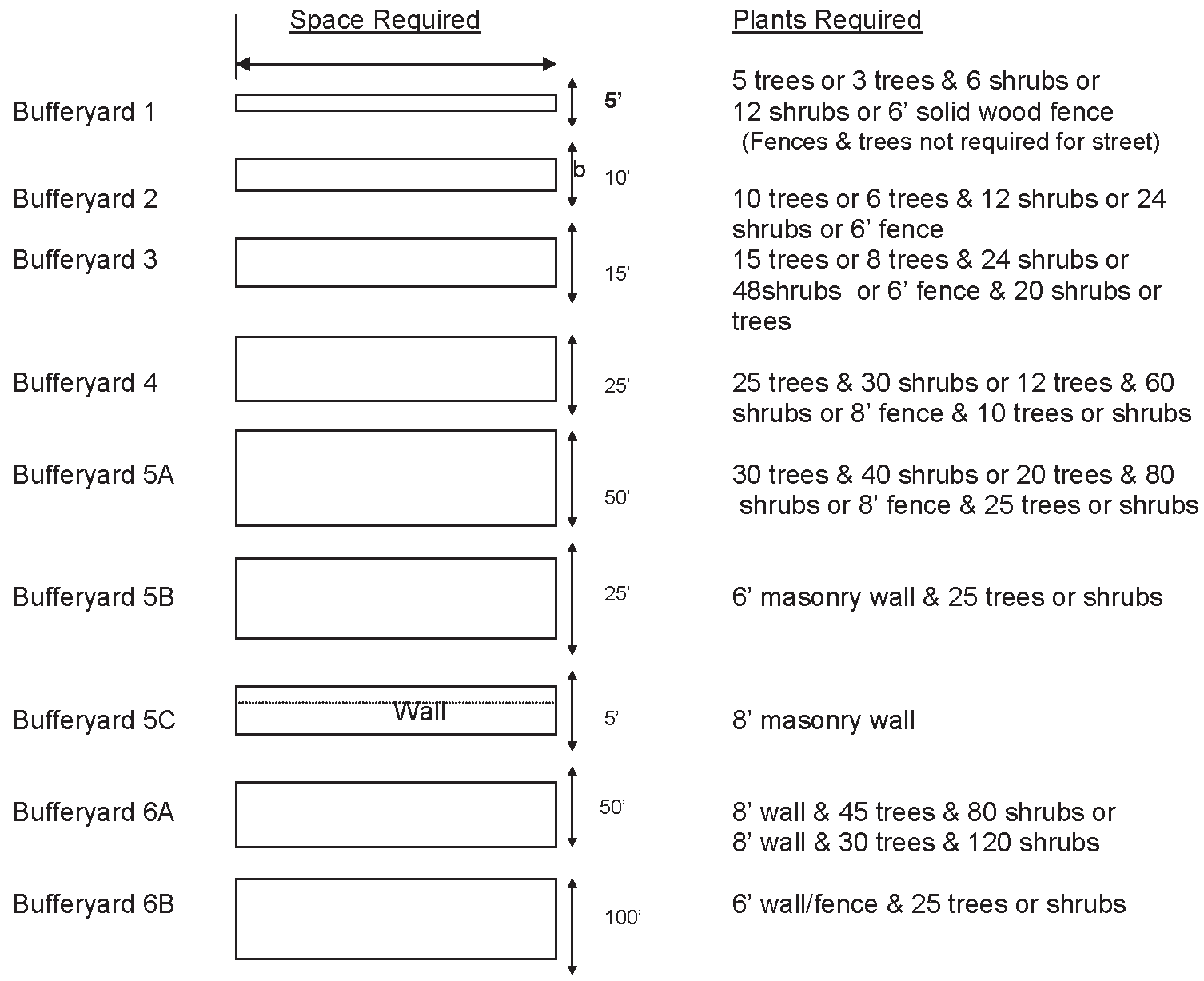
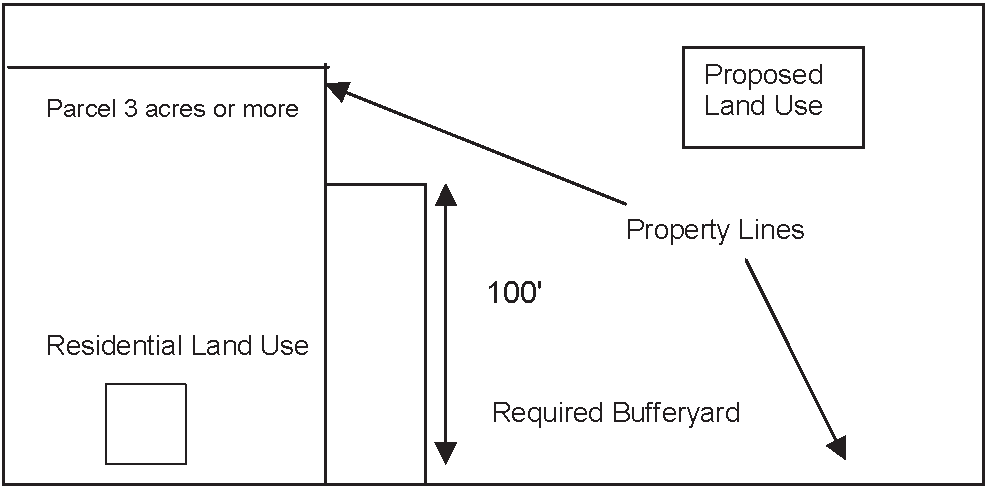
From Table 3, match the abutting use with the proposed new or expanded use to determine the type of bufferyard required. Should a question arise as to the land use classification of a proposed or abutting use the Zoning Administrator shall determine the classification. Next, refer to the Bufferyard Illustrations to determine the amount of bufferyard required. Several options of landscaping are available under each bufferyard. The requirements are given in 100-foot units as measured along the property line. Whenever a wall or fence is required, the location of the structure may be on either side of the required bufferyard.
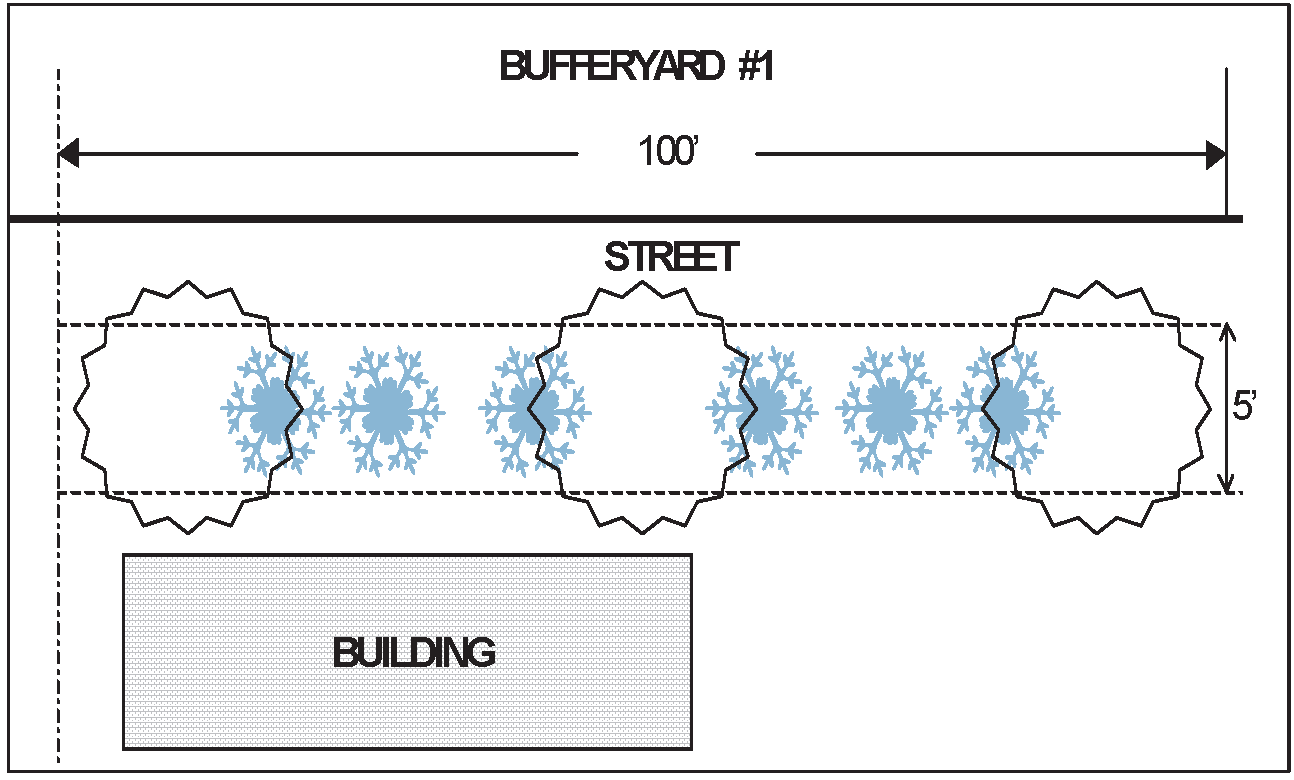
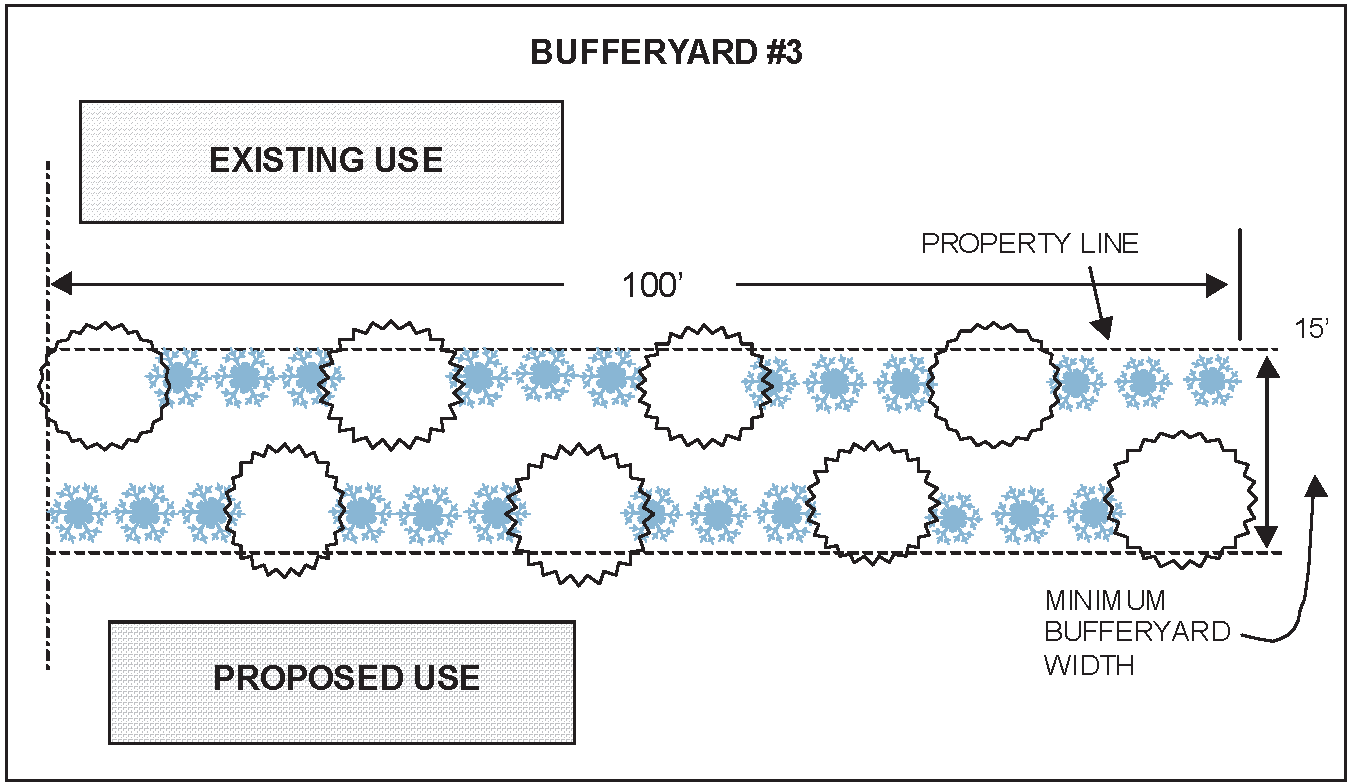
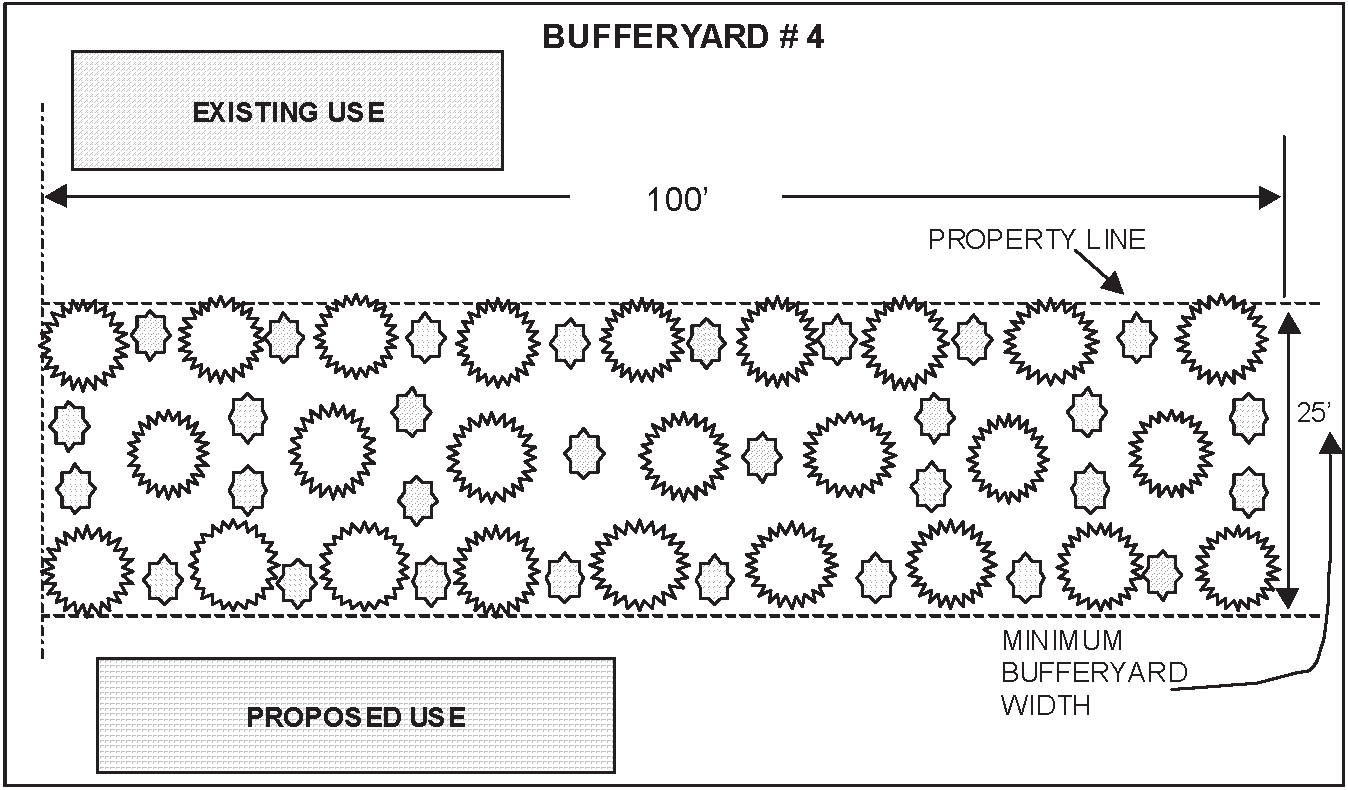
The length of a bufferyard shall extend the length of the property line separating two uses, except for property lines in excess of 200 feet, where the bufferyard need only extend 100 feet beyond either end of the existing building or use to be buffered.
Section 4.1-5. - Use of Existing Vegetation.
Existing vegetation, including all trees of any dimension, shall be retained to the extent practical and feasible. In no event shall a developer clear-cut the site of a required bufferyard. Instead, the developer shall conduct an Existing Tree Inventory, identifying the location, species, and diameter (breast high) of all trees in the bufferyard, and complement the presence of such trees with appropriate shrubs and other vegetation to meet all requirements of this Section.
Section 4.1-6. - Materials.
To achieve the desired results, only coniferous (evergreen) plants, suitable for local conditions, shall be used. When structures are used, the materials shall be durable and suitable for screening.
Section 4.1-7. - Plant Size and Caliper.
The minimum tree at planting shall be six to seven feet in height and two inches in diameter at a height of 18 inches above the ground. The minimum shrub shall be two to three feet in height. Both trees and shrubs shall be nursery stock with well-developed root systems unless plants found in place can be used. If the existing vegetation provides a screen equal to or greater than that which would be planted, no other plant material shall be required. In case of open woods, an additional planting of eye shrubs such as hemlock or pines may be needed to improve screening. A wooded site does not change fencing requirements.
Section 4.1.8. - Substitutions.
The following substitutions for opaque walls, fences, and plant materials may be made:
1.
Berms may be used to compensate for fences. An eight-foot-high opaque structure can be a combination of berm and fence to total eight feet.
2.
Chain link fences with evergreen hedge on the outbound side may be substituted for wooden fences. All plants must be sized and spaced to obscure the chain link fence within five years of planting.
3.
Any existing plant material that otherwise satisfies the requirements of this section may be substituted and counted toward satisfying the requirements of this section.
Section 4.1-9. - Fence and Wall Specifications.
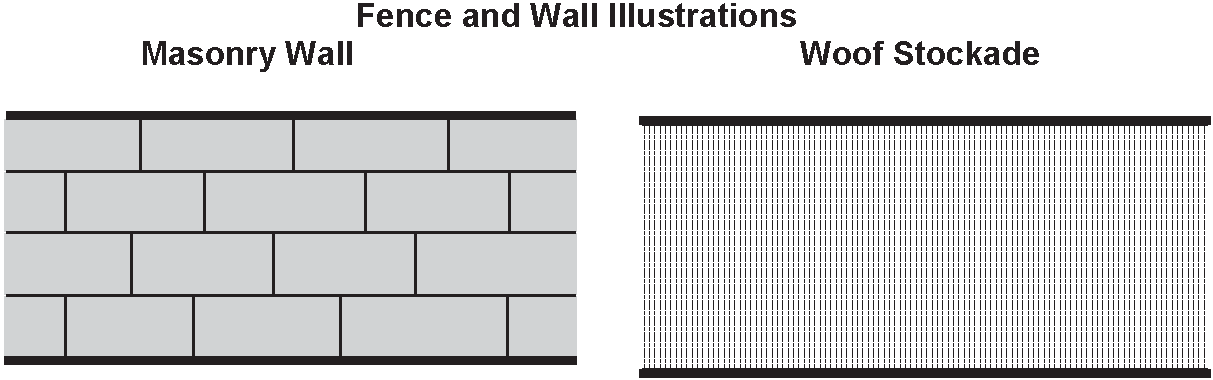
All fences and walls used as part of the bufferyard requirement must have the finished side facing outward. Fences shall be wooden or other durable or opaque material approved by the Zoning Administrator. Wooden fences shall be made of rot-resistant material such as locust, cedar or redwood. If made of pine, the post shall be rated for soil contact and the boards rated for outside use. Chain link fences with wood, plastic, or metal strips are expressly prohibited. However, a chain link fence with evergreen hedge is acceptable. Walls must be made of masonry materials including poured concrete, concrete block covered with stucco, and brick.
Section 4.1-10. - Responsibility.
It shall be the responsibility of the proposed new use to provide the bufferyard where required by this Ordinance, except that no new detached single-family dwelling or duplex shall be required to provide such bufferyard.
Section 4.1-11. - Required Maintenance.
The maintenance of required bufferyards shall be the responsibility of the property owner. All such areas shall be properly maintained so as to ensure continued buffering. All planted areas shall be provided with an irrigation system or a readily available water supply to ensure continuous healthy growth and development. Dead trees shall be removed; debris and litter shall be cleaned; and berms, fences, and walls shall be maintained at all times. Failure to do so is a violation of this Ordinance and may be remedied in the manner prescribed for other violations.
Section 4.1-12. - Use of Bufferyards.
A bufferyard may be used for passive recreation and may be interrupted by access driveways not exceeding 16 feet in width (exceptions for uses requiring wide curb cuts may be approved by the Zoning Administrator). All other uses are prohibited, including off-street parking.
Section 4.1-13. - Sight Clearance.
Bufferyards may not obscure a clear line of sight for vehicular traffic. Therefore, bufferyards should be placed no closer than 20 feet from street/road right-of-way lines.
Section 4.2-1. - Definition.
Screening is a type of buffer that is designed to block or obscure a particular element or use from view.
Section 4.2-2. - Purpose.
The purpose of screening is to minimize if not eliminate entirely the visual impact of potentially unsightly open storage areas and refuse disposal facilities.
Section 4.2-3. - Where Required.
Screening specified by this section shall be required of all open storage areas not devoted to retail sales visible from any public street, including open storage areas for shipping containers, building materials, appliances, trash containers of four or more cubic yards, salvage materials and similar unenclosed uses.
Section 4.2-4. - Type Screening Required.
Screening shall be accomplished by an opaque divide not less than six (6) feet high or the height of the object to be screened, whichever is greater. Screening may be accomplished by the use of sight obscuring plant materials (generally evergreens), earth berms, walls, fences, proper siting of disruptive elements, building placement or other design techniques approved by the Zoning Administrator.
Section 4.3-1. - Definition.
Landscaping is a type of open space permanently devoted and maintained for the growing of shrubbery, grass, other plants and decorative features to the land.
Section 4.3-2. - Purpose.
The purpose of landscaping is to improve the appearance of vehicular use areas and development abutting public rights-of-way; to enhance environmental and visual characteristics; to promote the greening of development, the reduction of noise pollution, stormwater runoff, air pollution, and artificial light glare; and to safeguard property values, protect public and private investments and promote high-quality development.
Section 4.3-3. - Where Required.
No proposed commercial, institutional, industrial or other nonresidential use, or multifamily project or manufactured home park, shall hereafter be established or re-established in an existing building or structure and subsequently used, unless landscaping is provided in accordance with the provisions of this section. No existing building, structure, or vehicular use area shall be enlarged by 50 percent or more unless the minimum landscaping required by the provisions of this section is provided throughout the building site.
Section 4.3-4. - Landscaping Plan.
A landscaping plan shall be submitted as part of the application for a building permit. The plan shall:
1.
Designate areas to be reserved for landscaping. The specific design of landscaping shall be sensitive to the physical and design characteristics of the site.
2.
Indicate the location and dimensions of landscaped areas, plant materials, decorative features, etc.
Section 4.3-5. - Landscaping Requirements.
Required landscaping shall be provided as follows:
1.
Along the outer perimeter of a lot or parcel, where required by the bufferyard provisions of this Article, to buffer and separate incompatible land uses. The amount specified shall be as prescribed by Section 4.1, Bufferyards.
2.
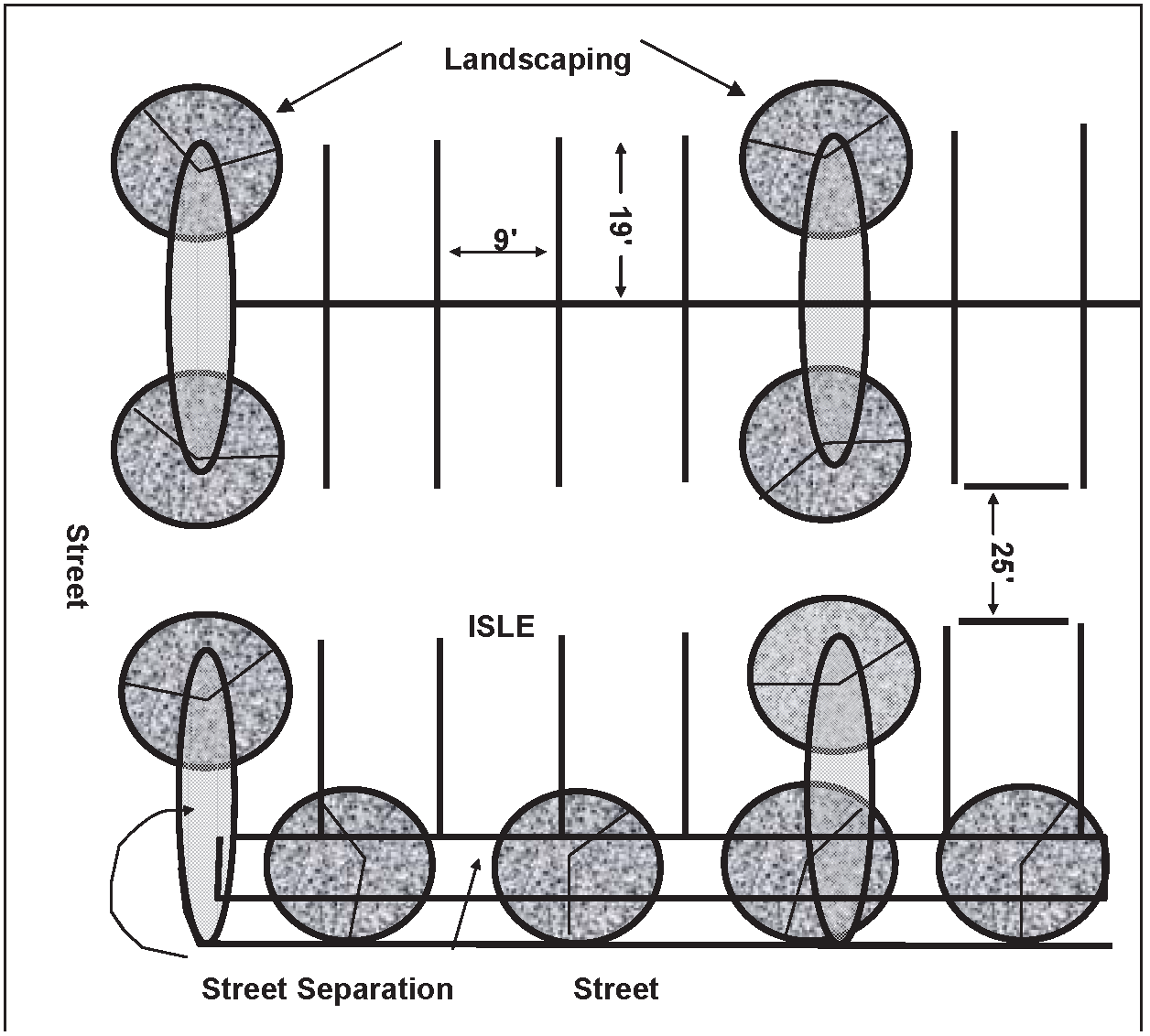
Within the interior, peninsula or island type landscaped areas shall be provided for any open vehicular use area containing 20 or more parking spaces. Landscaped areas shall contain one broad leaf canopy tree per ten parking spaces. Landscaped areas shall be located in such a manner as to divide and break up the expanse of paving and at strategic points to guide travel flow and direction.
3.
Elsewhere, landscaped areas shall be designed to soften and complement the building site, and where a retention pond is included in the site design, said pond shall be properly landscaped.
At a minimum, interior lot landscaping shall be provided as follows.
Landscaping along exterior building walls and structures is suggested to separate with greenery the building from the vehicular surface area.
Section 4.3-6. - Landscaped Areas.
All landscaped areas in or adjacent to parking areas shall be protected from vehicular damage by a raised concrete curb or an equivalent barrier of six inches in height. The barrier need not be continuous. Landscaped areas must be at least 36 square feet in size.
Section 4.3-7. - Required Maintenance.
The maintenance of required landscaped areas shall be the responsibility of the property owner. All such areas shall be properly maintained so as to assure their survival and aesthetic value, and shall be provided with an irrigation system or a readily available water supply. Failure to monitor such areas is a violation of this Ordinance, and may be remedied in the manner prescribed for other violations.
Section 4.4-1. - Definition.
Common open space is land and/or water bodies used for recreation, amenity or buffer; it shall be freely accessible to all residents and property owners of a development, where required by this Ordinance. Open space shall not be occupied by buildings or structures other than those in conjunction with the use of open space, roads, or parking nor shall it include the yards or lots of residential dwelling units required to meet minimum lot area or parking area requirements.
Section 4.4-2. - Purpose.
The purpose of this section is to ensure adequate open space for high density residential development; to integrate recreation, landscaping, greenery, and/or natural areas into such projects; to promote the health and safety of residents of such projects; and to compensate for the loss of open space inherent in single-family residential projects.
Section 4.4-3. - Where Required.
The following uses/projects consisting of seven or more units shall provide common open space in the amounts prescribed:
Note: Landscaped buffer areas provided to meet the requirements of Section 4.3 for multifamily projects and manufactured home parks may be applied toward meeting the above requirements if held in common ownership.
New Sites: No proposed development, building or structure in connection with the above shall hereafter be erected or used unless common open space is provided in accordance with the provisions of this section.
Existing Sites: No existing development, building or structure in connection with the above shall be expanded or enlarged unless the minimum common open space required by the provisions of this section are provided to the extent of the alteration or expansion.
Section 4.4-4. - Common Open Space Plan.
Proposed uses/projects set forth in 4.4.3 shall submit an open space or landscaping plan as part of the application for a building permit. The plan shall:
Designate areas to be reserved as open space. The specific design of open space shall be sensitive to the physical and design characteristics of the site.
Designate the type of open space which will be provided, and indicate the location of plant materials, decorative features, recreational facilities, etc.
Specify the manner in which common open space shall be perpetuated, maintained and administered.
Section 4.4-5. - Types of Common Open Space and Required Maintenance.
The types of common open space, which may be provided to satisfy the requirements of this Ordinance together with the maintenance required for each, are as follows:
Natural areas are areas of undisturbed vegetation or areas replanted with vegetation after construction. Woodlands and wetlands are specific types of natural areas. Maintenance is limited to removal of litter, dead trees, plant materials, and brush. Natural watercourses are to be maintained as freeflowing and devoid of debris. Stream channels shall be maintained so as not to alter floodplain levels.
Recreational areas are designed for specific active recreational uses such as tot lots, tennis courts, swimming pools, ball fields, and similar uses. Recreational areas shall be accessible to all residents of the development. Maintenance is limited to ensuring that there exists no hazards, nuisances, or unhealthy conditions.
Greenways are linear green belts linking residential areas with other open space areas. These greenways may contain bicycle paths, footpaths, and bridle paths. Connecting greenways between residences and recreational areas are encouraged. Maintenance is limited to a minimum or removal and avoidance of hazards, nuisances, or unhealthy conditions.
Landscaped areas shall consist of lawns and required buffer areas, including creative landscaped areas with gravel and tile, so long as the tile does not occupy more than two percent of the required open space. Lawns, with or without trees and shrubs, shall be watered regularly to ensure survival and mowed regularly to ensure neatness. Landscaped areas shall be trimmed and cleaned regularly.
Section 4.4-6. - Preservation of Open Space.
Land designated as common open space may not be separately sold, subdivided or developed. Open space areas shall be maintained so that their use and enjoyment as open space are not diminished or destroyed. Open space areas may be owned, preserved and maintained as required by this section by any of the following mechanisms or combinations thereof:
1.
Dedication of and acceptance by the County.
2.
Common ownership of the open space by a homeowner's association that assumes full responsibility for its maintenance.
3.
Deed restricted, private ownership, which shall prevent development and/or subsequent subdivision of the open space land and provide the maintenance.
In the event that any private owner of open space fails to maintain same, the county may in accordance with the Open Space Plan and following reasonable notice, demand that deficiency of maintenance be corrected, and enter the open space to maintain same. The cost of such maintenance shall be charged to those persons having the primary responsibility for maintenance of the open space.
Section 4.5.1. - Purpose.
The purpose of this section is to protect and sustain the intrinsic value of trees and their ability to promote the public safety, health, and welfare through the benefits such vegetation provides, including, but not limited to:
1.
Absorbing carbon dioxide and returning oxygen;
2.
Reducing air pollution;
3.
Providing shade and making outdoor areas more habitable;
4.
Reducing soil erosion and increasing infiltration; and
5.
Providing wildlife habitat, thus helping control insects.
Section 4.5.2. - Protected Trees and Protected Tree Areas.
Any tree measuring 30 inches DBH (Diameter Breast High) shall constitute a "significant tree" for purposes of this section and shall be protected to the extent practical and feasible. To this end, no person, firm, organization, society, association or corporation, or any agent or representative thereof shall directly or indirectly destroy or remove any tree in violation of the terms of this section.
Protected tree areas shall consist of required setback areas and yards, bufferyards and required open space. Trees located outside of these designated areas shall not be subject to the requirements of this section.
Section 4.5.3. - Exceptions.
Commercial timber, tree farms and nurseries, public utilities and agricultural operations and land disturbing activity of less than three acres on a single lot or parcel are exempt from the protective requirements of this Section. Existing developed lots and existing lots of record intended for single-family residential use also are exempt from the requirements of this Section. Property cleared under the exemptions of this section shall not be redeveloped and the county shall withhold any development permit for a period of 24 months.
Section 4.5.4. - Site Design/Plan Approval.
The design of any land development project or subdivision shall take into consideration the location of all significant trees identified on the tree survey. Lot and site design shall minimize the need to fell significant trees, of which no more than 25 percent may be removed to accommodate a proposed use or development. Where more than 25 percent of the number of Significant trees located within the protected area are required to be removed prior to construction, a replacement schedule, approved by the Zoning Administrator, shall specify the number, species, DBH, and location of replacement trees. The cumulative DBH of replacement trees shall at least equal the cumulative caliper of the Significant trees removed, on "inch for inch" basis, with individual replacement trees being not less than three inches DBH. Where the Zoning Administrator determines that planting the required number of trees on the site will result in an unacceptable density of trees based upon good forestry management, the Zoning Administrator may reduce the number.
The site design shall be presented on a site plan showing:
Existing location and size of all significant trees;
Trees to be removed;
Trees to be preserved;
Areas to be cleared;
Areas for proposed structures and improvements.
Site plan approval by the Zoning Administrator shall be prerequisite to the issuance of a grading and/or building permit.
Section 4.5.5. - Tree Protection and Replacement.
Prior to Development. Where a grading permit, building permit or subdivision approval has not been issued, the destruction of any significant tree, as defined by this Ordinance, without prior approval of the Zoning Administrator, which approval shall not be unreasonably withheld, shall be prohibited.
During Development. During grading and construction, a protected area equal to one foot for every inch of DBH of each tree shall be provided, within which paving, grading, or the storage of dirt, building materials, debris, or any other materials or any other equipment shall not be allowed. Each protected area shall be enclosed by a barrier constructed in a manner required and approved by the Zoning Administrator prior to issuance of a grading permit. Failure to maintain barriers may result in revocation of the building and/or grading permit. For projects not requiring a grading permit, the required barriers shall be constructed by the property owner and approved by the Zoning Administrator prior to issuance of a building permit. Protective barriers shall be maintained until issuance of a Certificate of Occupancy. The protected area shall be permanent and maintained by the property owner. No pavement shall be installed in the protected area. The Zoning Administrator may reduce the protected area or allow intrusions into it if such actions would not adversely affect the survival and health of the tree.
After Development. No person shall break, damage, remove, cut, kill or cause to be killed any significant tree, except for the following:
In the event that any tree shall be determined to endanger the public health, safety or welfare and require removal, written authorization may be given by the Zoning Administrator and the tree or parts thereof (i.e., dead limbs) removed.
During the period of an emergency, such as a hurricane, tornado, ice storm, flood or any other act of nature, the Zoning Administrator may waive the requirements of this section.
Where due to unusual site conditions or circumstances, the requirements of this section pose a constraint to development and/or the use of a site or parcel, the Zoning Administrator may adjust the requirements as necessary to moderate the constraint.
Trees involved in wetland mitigation.
Pine trees may be cut and removed from any site without regard to DBH dimensions (size).
Diseased (unhealthy) or nuisance trees, with approval of the Zoning Administrator.
Nothing in this section shall be construed to prevent an individual home owner from cutting down a Significant tree on his or her residential property without review and approval of the Zoning Administrator.
Section 4.5.6. - Significant Trees Removed Without Permits.
Where significant trees have been removed or where removal is necessitated at any time due to acts of negligence, or where sites were cleared of significant trees in violation of this section, replacement trees shall be planted in accordance with a replacement schedule approved by the Zoning Administrator, who shall specify the number, species, DBH, and location of replacement trees, using the following criteria:
Combined DBH of replacement trees is equal to or greater than three (3) times the DBH of the tree removed; or
Individual replacement trees are of the largest transplantable DBH available.

