Orangeburg County Unincorporated
City Zoning Code
City Zoning Code
ARTICLE 5
- SIGN REGULATIONS
The purpose of this Article is to protect the dual interest of the public and the advertiser. The regulations herein are designed to protect public safety and welfare and to ensure the maintenance of an attractive physical environment while satisfying the needs of sign users for adequate identification, communication, and advertising.
Section 5.1.- Applicability and Conformance.
This Article regulates the number, size, placement, and physical characteristics of signs; allows certain signs without permits; prohibits certain signs; and requires permits for certain signs.
From and after the adoption of this Ordinance, no sign may be erected or enlarged within the jurisdiction of this Ordinance unless it conforms to the requirements of this Article.
Section 5.2. - Signs on Private Property.
Signs shall be allowed on private property in accordance with Table 4. If the letter "A" appears for a sign type in a column, such sign is allowed without prior permit approval in the zoning district represented by that column. If the letter "P" appears for a sign type in a column, such sign is allowed only with prior permit approval in the zoning district represented by that column. If the letter "N" appears for a sign type in a column, such a sign is not allowed in the zoning district represented by that column under any circumstances.
All signs permitted by Table 4, including those designated by an "A," shall meet the conditional requirements of Table 5, as well as all other applicable requirements of this Section.
Table 4. REGULATIONS OF SIGNS
By Type, Characteristics and Zoning Districts
1 - Signs identifying or announcing land subdivisions, or residential projects.
2 - See Section 5.5
3 - This column does not represent a zoning district. It applies to institutional and other nonresidential uses permitted in residential zoning districts i.e., churches, school, parks, etc. and includes historical markers.
Table 5. Number, Dimension, and Location of Permitted Signs, By Zoning District
Table Notes:
NA = Not Applicable.
s.f. = square feet.
(A) - One identification sign is permitted for each entrance of a subdivision or residential project.
(B) - This column does not represent a zoning district. It applies to institutional and other nonresidential uses permitted in RS Zoning districts, i.e., churches, schools, parks, etc.
(C) - 500 ft. minimum distance required by this section shall be measured between billboards located on either side of the street along the centerline of the street from which the billboard is viewed, when meeting this requirement, a billboard may be located on the same lot or parcel with one "other" sign.
(D) - Lots fronting on two or more streets are allowed one additional sign for each street frontage, but signage cannot be accumulated and used on one street in excess of that allowed for lots with only one street frontage.
(E) - 600 square feet, except where located within 600 feet of an Interstate ROW, where the maximum shall be 1,200 square feet.
(F) - Three (3) square feet of signage per one foot of street frontage, not to exceed 160 square feet.
(G) - There is no height limitation on signs where located within 600 feet of an Interstate ROW (measured from the average roadway grade level); maximum height of signs not within this prescribed area shall not exceed 36 feet.
(H) - One per occupied lot only.
Section 5.3. - Common Signage Plan Required.
A Common Signage Plan shall be prerequisite to the issuance of any sign permit involving:
1.
Two or more contiguous lots or parcels under the same ownership,
2.
A single lot or parcel with more than one principal use or building (not including accessory uses or buildings) or qualifying on the basis of street frontage for more than one free-standing sign, and
3.
A PUD (Planned Use District) project.
The Plan shall contain all information required for sign permits generally and shall specify standards for consistency among all signs on the lot affected by the Plan with regard to:
Lettering or graphic style;
Lighting;
Location of each sign on the buildings;
Material; and
Sign proportions.
A Common Signage Plan shall limit the number of free-standing signs to a total of one for each street on which there is frontage and shall provide for shared or common usage of such signs; however, the maximum sign area may be increased by 25%.
Once approved by the Zoning Administrator, the Common Signage Plan shall become binding on all businesses and uses occupying the affected lots, but may be amended by filing a new or revised Plan in conformance with the requirements of this Ordinance.
If any new or amended Common Signage Plan is filed for a property on which existing signs are located, it shall include a schedule for bringing into conformance, within three years, all signs not conforming to the proposed amended Plan or to the requirements of this Ordinance in effect on the date of submission.
Section 5.4. - Signs in the Public Right-of-Way.
No sign shall be allowed in the public right-of-way, except for the following:
1.
Public signs erected by or on behalf of a governmental body to post legal notices, identify public property, convey public information, and direct or regulate traffic;
2.
Informational signs of a public agency or utility regarding its facilities;
3.
Church signs, in accordance with state law;
4.
Historical signs and markers;
5.
Emergency signs; and
6.
Directional signs of a temporary nature not to exceed three (3) square feet in area and 24 hours in duration for such events as yard sales, auctions, public gatherings, etc., provided they are located no closer than 500 feet apart.
Section 5.5. - Temporary Signs.
Table Notes:
A. A-Frame signs, where located on sidewalks, shall be located in such a manner as not to obstruct pedestrian movement.
B. Banners and pennants shall be properly secured and maintained at all times, and shall not interfere with pedestrian or vehicular movement.
C. Posters shall not be allowed on any telephone or power poles or any public right-of-way, and shall be placed no closer than five feet from a street or curb.
D. Portable signs shall be limited to one per establishment, shall have no colored or flashing lights, shall not be wired so as to obstruct or hinder pedestrian or vehicular traffic or pose any potential for such hindrance (i.e., exposed drop cord), shall not exceed six feet in height, shall be anchored in accordance with the Building Code, and shall not be converted to a permanent sign.
E. Inflatable signs shall be properly anchored and shall not interfere with airport traffic.
F. Temporary subdivision and work under construction identification signs shall adhere to the Development Standards of Section 5.7.
G. Political signs shall be removed within 60 days after an election.
Section 5.6. - Prohibited Signs.
All signs not expressly permitted by this ordinance are prohibited. Such signs include, but are not limited to:
1.
Signs painted on or attached to trees, fence posts, telephone or other utility poles, stationary vehicles, or natural features.
2.
Signs displaying intermittent lights resembling the flashing lights customarily used in traffic signals or in police, fire, ambulance, rescue vehicles or other warning signals, and signs using the words "stop," "danger," or any other word, phrase, symbol, or character in a manner that might mislead or confuse motorist.
3.
Signs that have been abandoned and no longer correctly direct or exhort any person, advertises a bona fide business, lessor, owner, product, or activity conducted or product available.
4.
Signs that have fallen into disrepair, are not properly maintained, are insecure or otherwise structurally unsound, have defective parts in the support, guys and/or anchors, or which are unable to meet minimum safety requirements of the Standard Building Code.
Section 5.7-1. - Visual Area Clearance.
No sign shall be located within a vision clearance area as defined in Section 7.6.
Section 5.7-2. - Vehicle Area Clearance.
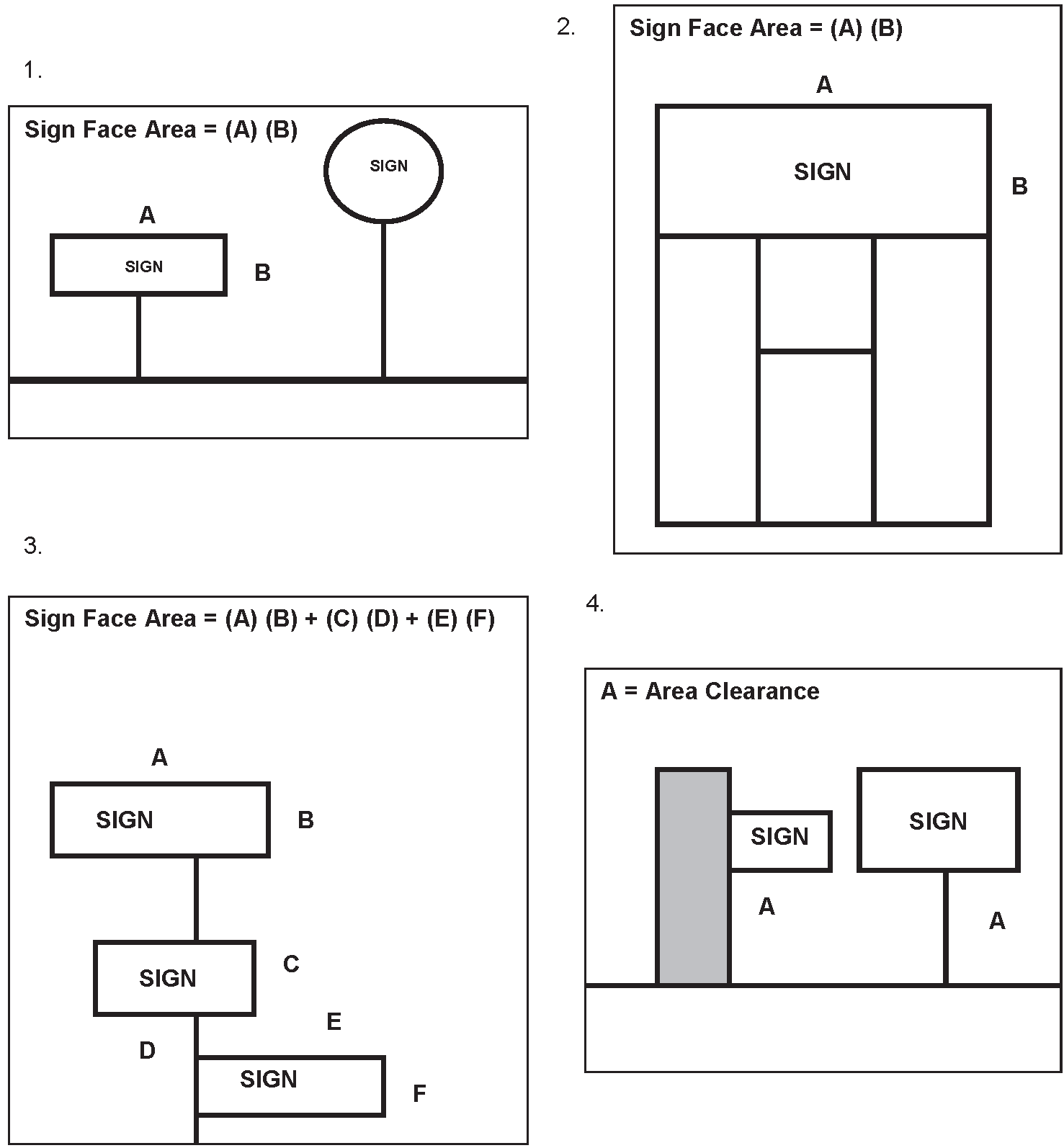
When a sign extends over an area where vehicles travel or park, the bottom of the sign structure shall be at least 14 feet above the ground. Vehicle areas include driveways, alleys, parking lots, and loading and maneuvering areas. (See Area Clearance Illustration, 4.)
Section 5.7-3. - Pedestrian Area Clearance.
When a sign extends over a sidewalk, walkway, or other space accessible to pedestrians, the bottom of the sign structure shall be at least eight feet above the ground. (See Area Clearance Illustration, 4).
Section 5.7-4. - Sign Materials; Code Compliance.
Permanent and temporary identification signs must be constructed in accordance with all applicable provisions of the Building Code and National Electrical Code, and consist of durable all-weather materials.
Images, logos, graphics, etc. painted on permanent signs or buildings must be performed in a professional and workmanlike manner. Permits for painted signs will only be issued to companies who are engaged as sign painters.
Section 5.7-5. - Sign Illumination.
Illuminated signs shall not directly shine on abutting properties. No illumination simulating traffic control devices or emergency vehicles shall be used, nor shall lights which are intermittently switched on and off, changed in intensity or color, or otherwise displayed to create the illusion of flashing or movement be permitted.
Section 5.8-1. - Sign Face Area.
The area of a sign enclosed in frames or cabinets is determined by measuring the outer dimensions of the frame or cabinet surrounding the sign face (Illustration 1). Sign area does not include foundations or supports. Only one side of a double-faced or V-shaped, free-standing sign is counted.
For signs on a base material and attached without a frame, such as a wood board or Plexiglas panel, the dimensions of the base material are to be used in the measurement, unless it is clear that part of the base contains no sign related display or decoration.
For signs constructed of individual pieces attached to a building wall, sign area is determined by a perimeter drawn around all pieces (Illustration 2).
For sign structures containing multiple modules oriented in the same direction, the modules are counted as one sign face (Illustration 3).
The maximum surface area visible at one time of a round or three-dimensional sign is counted to determine sign area.
For signs incorporated into awnings, the entire panel containing the sign is counted as the sign faces unless it is clear that part of the paned contains no sign related display or decoration.
Section 5.8-2. - Clearances.
Clearances are measured from the grade directly below the sign to the bottom of the sign structure enclosing the sign face (Illustration 4).
Section 5.9. - Removal of Signs.
1.
The lawful use of any permanently mounted sign existing at the time of the enactment of this Ordinance may be continued although such sign does not conform with the regulations herein, except those declared abandoned or dilapidated, which shall be removed or remedied upon notification by the Zoning Administrator.
2.
Non-conforming permanent signs shall be removed or brought into conformity whenever the following occurs:
a.
Property changes ownership and the name of the business is to be changed, or
b.
The occupancy classification of the building is changed.
3.
Any existing sign that is subsequently abandoned shall be removed, and any existing sign exceeding the allowable face area by 25 percent, and which is subsequently destroyed or damaged to the extent of 60 percent or more of its replacement cost, shall be removed or brought into conformity with these regulations.
4.
Any non-conforming temporary sign shall be removed or brought into conformity no later than 60 days following the effective date of this Ordinance.
5.
An order under this Section shall be issued, in writing, to the owner or responsible party of any such sign, or of the building or premises on which such sign is located to comply within 30 days' time. Upon failure to comply with such notice, the Zoning Administrator may cause the sign to be removed and any costs incurred in the process may be collected in a manner prescribed by law.
Sign Measurement Illustrations