
Orangeburg County Unincorporated
City Zoning Code
City Zoning Code
ARTICLE 7
- GENERAL AND ANCILLARY REGULATIONS
The regulations set forth in this Article are intended to clarify, supplement, or modify the regulations set forth elsewhere in this Ordinance.
Section 7.1.- Application of Regulations.
The various zoning district regulations established herein are declared to be the minimum requirements necessary to carry out the purpose of this Ordinance. These regulations apply to each class or kind of structure or land, and are the minimum standards for all site clearing, development, buildings, structures, or alterations to land or structures within the jurisdiction of this Ordinance.
No part of a yard, open space, or off-street parking required in connection with any building for the purpose of complying with the regulations of this Ordinance shall be included as part or all of the required yard, open space, or off-street parking for another building or structure, except as hereinafter provided.
Section 7.2. - Exceptions and Modifications.
1.
Setbacks - Corner Lots. The setback from the street upon which the principal building will face shall be the minimum required front yard. The setback from the street upon which the side of the building will face shall be the minimum required front yard setback for the street upon which it is contiguous.
2.
Setbacks - Through or Double Frontage Lots. Front yard setbacks for double frontage lots shall be provided for both streets upon which the lot has frontage, and any accessory use(s) shall be prohibited from the required front yard setback of the street upon which the principal building fronts.
3.
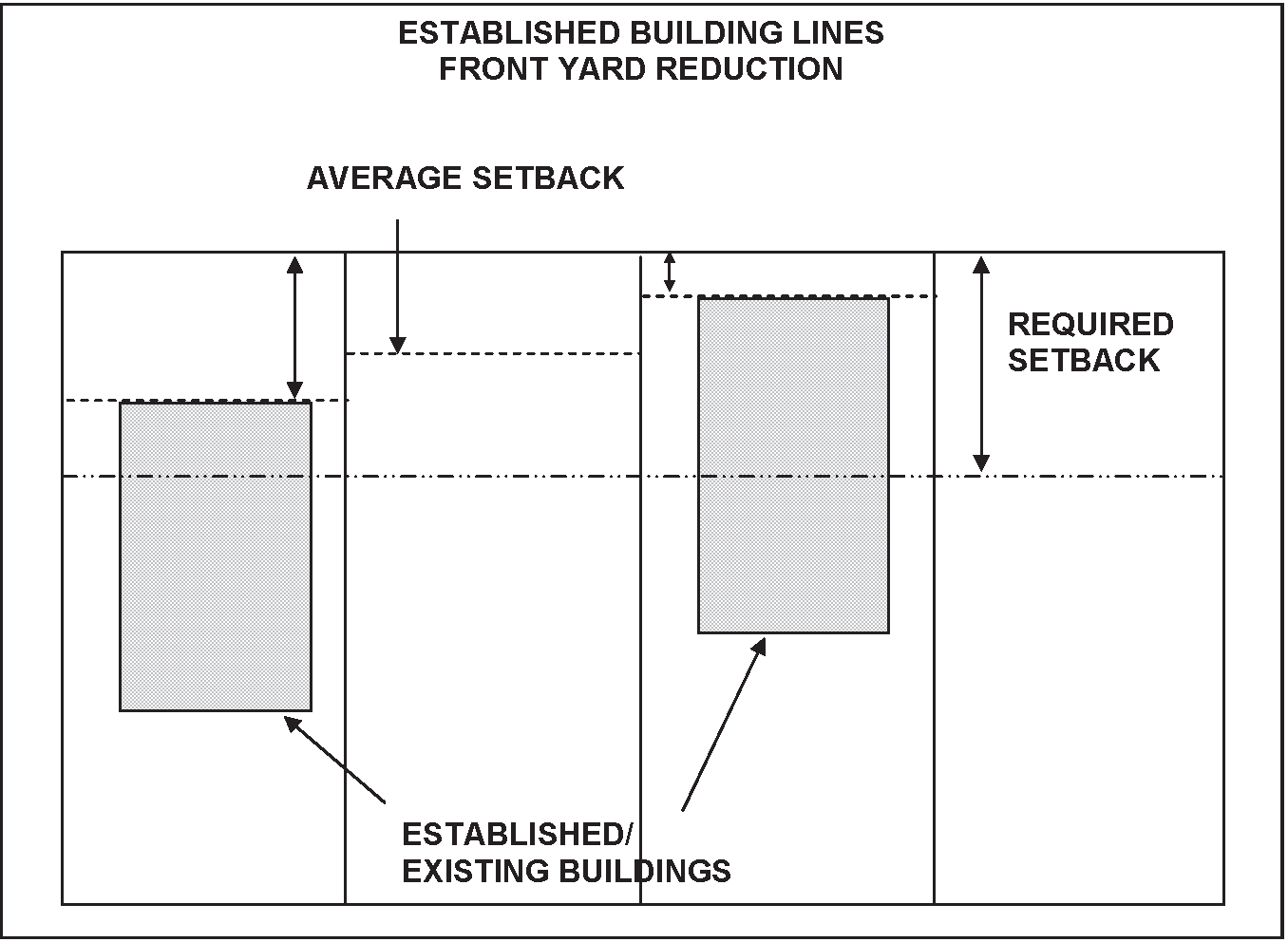
Setbacks - Partially Developed Areas. Where the majority of lots in a block fronting on the same side of a street between two intersecting streets are lawfully occupied with buildings having greater or lesser front yard depth than required by these regulations, no building hereafter erected or altered shall vary in the front yard setback by more than five feet from the average depth of said existing front yard setbacks without written approval of contiguous property owners. However, in no case shall setbacks be less than 15 feet.
4.
Setbacks - Multiple Buildings on Lot. Whenever more than one main building is to be located on a lot, the required yards shall be maintained around the group of buildings and a horizontal distance that is at least equal to the height of the highest adjacent building shall separate buildings.
5.
Setbacks - Accessory Uses. Unless specifically modified below, all accessory uses and structures shall observe the required setbacks applicable to the principal building or use, as set forth in Table 2.
TABLE 6. SETBACK MODIFICATIONS, ACCESSORY USES
6.
Height. The height limitations of this Ordinance shall not apply to the following, except in the AC, Airport Compatibility District:
Belfries.
Chimneys.
Church Spires.
Cupolas.
Domes.
Fire Towers.
Flag Poles.
Ornamental towers and spires.
Public Monuments.
Public utility poles.
Smoke stacks.
Silos.
Such features shall be erected only to such height as is necessary to accomplish the purpose they are intended to serve and no height extension shall serve as a place for human habitation.
The height of communication towers, antennas, and water tanks also shall be exempt from the height requirements of this Ordinance; provided such structures shall be separated from adjoining residential use, measured at the property line, a distance of one foot for each one foot in height.
7.
Projections.
The space in any required yard shall be open and unobstructed except for the ordinary projections of windowsills, cornices, eaves, window air conditioning units, and other architectural features, provided that such features shall project no more than two feet into any required yard.
Steps and heating and cooling units may project into a required yard a distance not to exceed five feet but no closer than three feet of a property line. Fences, walls, and hedges may be erected in any required yard or setback area or along the edge of a property line, provided that no such structure or hedge shall impede visibility at intersections.
Section 7.3. - Measurements.
1.
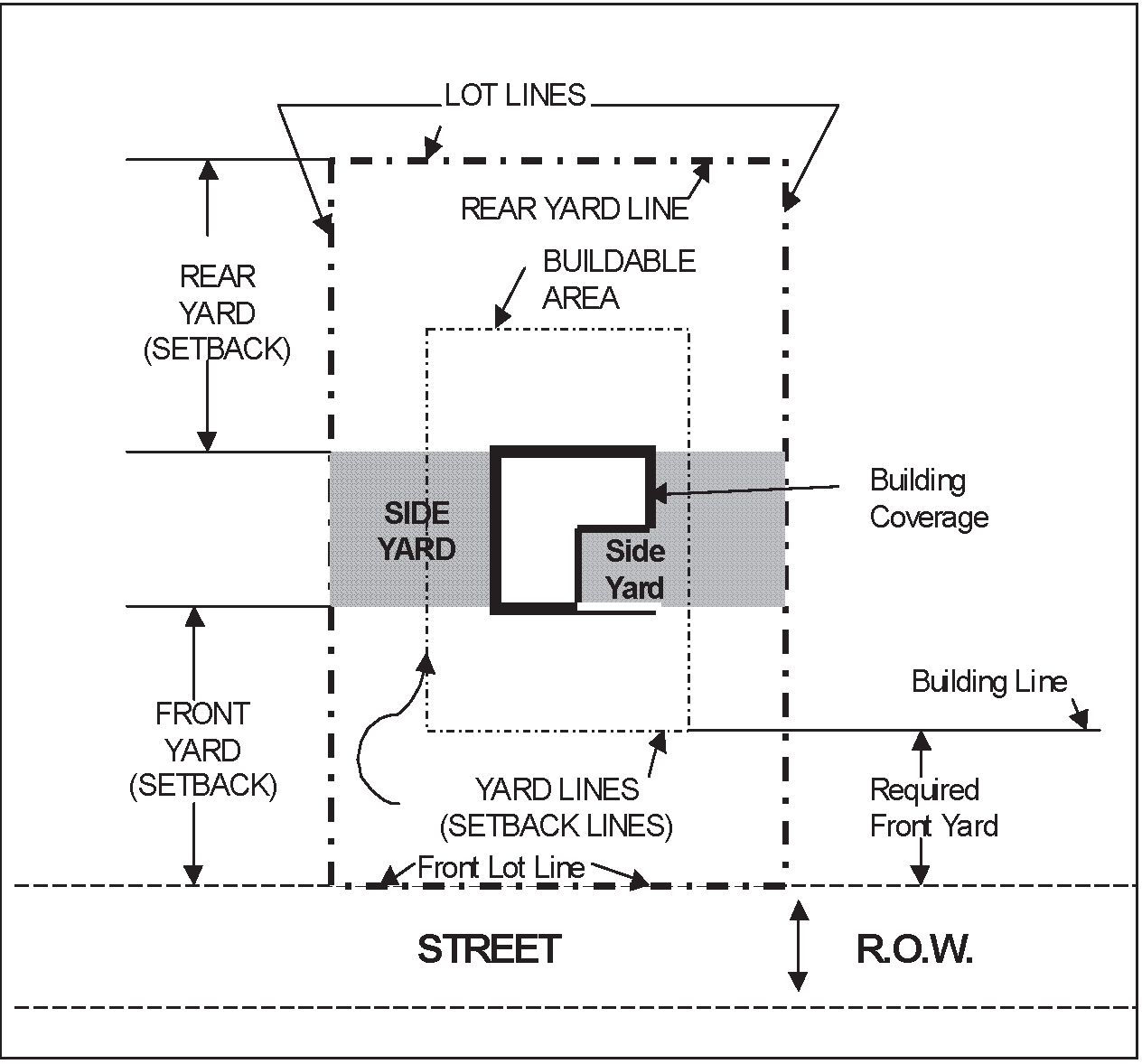
Yards, Setbacks, Buildable Area. The required front, side, and rear yards for individual lots, as set forth for by Table 2, shall be measured inward toward the center of said lot from all points along the respective front, side, and rear property lines of the lot. Once the yard areas of a given lot have been established, the remaining area of the lot which is not included in any required front, side, or rear lot shall be known as the "buildable" area within which the approved structure(s) shall be placed.
2.
Height. The height of a building or structure shall be measured from the average grade elevation within 20 feet of the structure or from the base of a tree when computing height in the Airport Compatibility Zone, to the highest point of the building, structure, or tree.
Section 7.4. - Number of Principal Buildings/Uses on a Lot.
Not more than one principal building or use may occupy a lot of record in the RS Zone. Not more than one single-family dwelling, duplex, patio home, modular or manufactured home may occupy a lot of record in the RG Zone. There is no limit on the number of other residential buildings on a lot of record in the RG Zone.
As many as five residential uses may be permitted on a lot in the FA and RC Zones; provided all applicable lot area and setback requirements are met for each principal use (dwelling), as if it were established on a single lot and so arranged to ensure public access in the event the property is subsequently subdivided for sale or transfer. Property owners may sketch dwelling location(s) on an existing plat or tax map copy to demonstrate setback compliance at the time of application.
There is no limit on the number of principal uses and buildings on a lot in all other zone districts, provided such uses shall meet lot area, setback and all other applicable requirements of this ordinance; further provided that where three or more manufactured homes are to be located on a lot, said homes shall by definition constitute a manufactured home park and, where permitted by Table 1, shall meet in full the development requirements of Section 3.15.
Section 7.5. - Accessory Buildings and Uses.
1.
No mobile or manufactured home or shipping container shall be used as an accessory building.
2.
If located within the buildable area, accessory buildings shall observe the height limits for the district within which they are located. If located in a required setback area, said buildings shall not exceed 12 feet in height.
3.
No accessory use shall occupy any part of a bufferyard.
Section 7.6. - Visibility at Intersections.
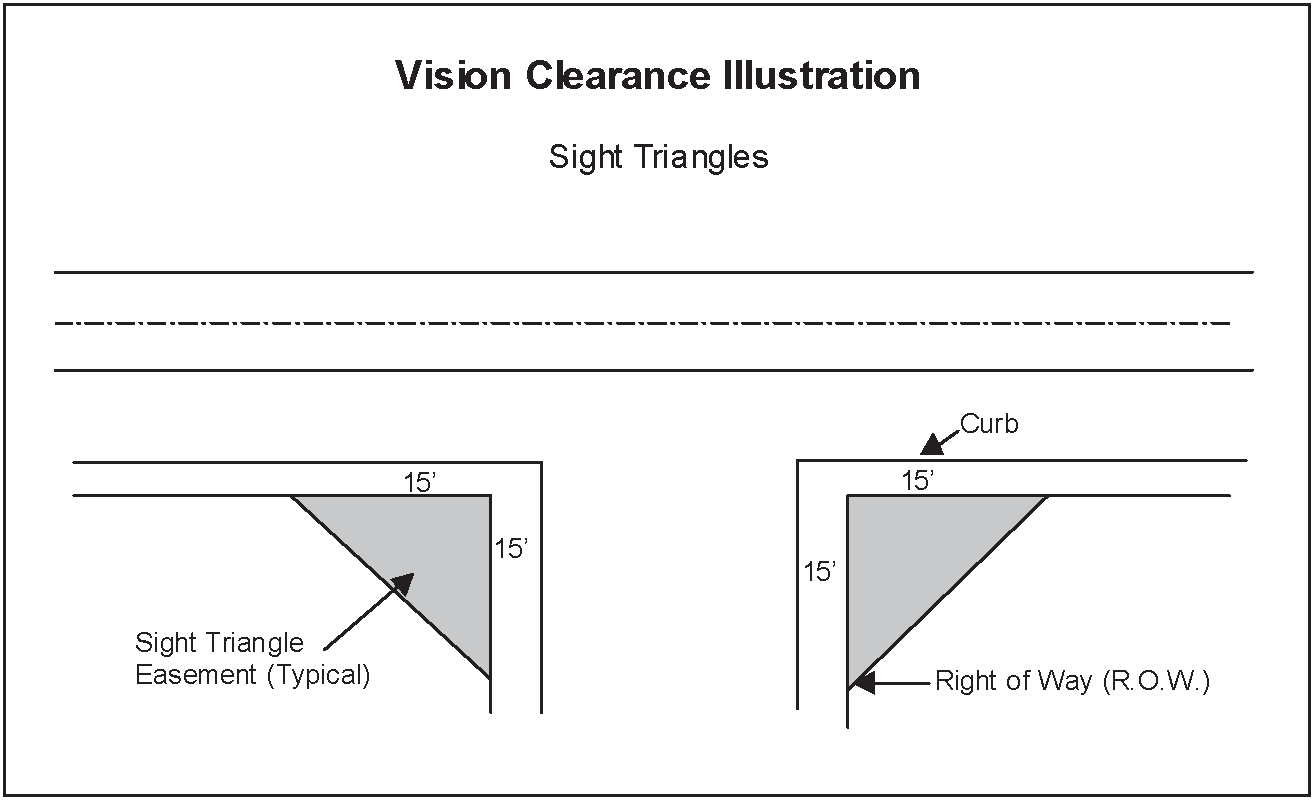
On any corner lot in any district, no planting shall be placed or maintained and no fence, building, wall, or other structure shall be constructed at any point between a height of 2½ feet and ten feet above the upper face of the nearest curb (or street centerline if no curb exists) and within the triangular area bounded on two sides by the street right-of-way lines and on the third side by a straight line connecting points on the two street right-of-way lines as required by the site triangular and vertical vision clearance illustration. However, poles and support structures less than 12 inches in diameter may be permitted in such areas.
Section 7.7-1. - Continuation.
Non-conforming uses, buildings, or structures are declared by this Ordinance to be incompatible with permitted construction in the districts in which they are located.
However, to avoid undue hardship, the lawful use of any such use, building, or structure at the time of the enactment, amendment, or revision of this Ordinance may be continued (Grandfathered) even though such use, building, or structure does not conform to the provisions herein.
Section 7.7-2. - Modification.
A proposed change or modification to a non-conforming use shall be governed by the following:
1.
Change of Non-conforming Use. If a change from one non-conforming use to another is proposed and no structural alterations are involved, the change may be permitted, provided:
a.
Non-conformity of dimensional requirements such as height, density, setbacks, or other requirements such as off-street parking shall not be increased; and
b.
The proposed change will have little discernable impact over the existing non-conforming use.
If a change to a permitted use is proposed which is non-conforming only as to dimensional requirements such as height, density, setbacks, or other requirements such as off-street parking, the change may be permitted, provided that all applicable requirements that can be reasonably complied with are met.
Compliance with a requirement is not reasonably possible if it cannot be achieved without adding land to the lot of the non-conforming use or moving the use if it is on a permanent foundation.
Whenever a non-conforming use of land or building has been changed to a more restricted use or to a conforming use, such use shall not thereafter be changed back to a less restricted or non-conforming use.
2.
Enlargement or Expansion of Non-conforming Use. Enlargement or expansion of a non-conforming building, use, or structure shall be permitted; provided such enlargement shall meet all applicable setbacks, bufferyard, and off-street parking requirements for the district within which it is located.
3.
Repair or alteration of Non-conforming Use, Building or Structure. The repair or alteration of a non-conforming use shall in no way increase the non-conformity of said use, except as otherwise permitted by Subsection 2 above.
4.
Replacement of Non-conforming Use.
A building permit for the replacement of a non-conforming building or structure where damaged or destroyed must be initiated within 12 months of the time of the damage or destruction or forfeit the right of replacement.
Replacement if initiated within 12 months of the time of damage or destruction shall adhere to all applicable requirements of Table 2.
Replacement of a non-conforming mobile or manufactured home once removed from a lot or parcel shall be accomplished within 30 days of removal or forfeit non-conforming status, and if replaced shall not infringe on established setbacks, and shall meet in full the requirements of Section 3.14 of this Ordinance.
Section 7.7-3. - Discontinuance.
No building or portion thereof used in whole or in part for a non-conforming use which remains idle or unused for a continuous period of six months, whether or not the equipment or fixtures are removed, shall again be used except in conformity with the regulations of the district in which such building or land is located.
Wrecking, scrap and salvage operations, as defined by this Ordinance, shall within five years of the effective date of this Ordinance be brought into compliance with the provisions of Section 3.3, or where located in a district in which the operations are not permitted, cease operations and clean the site of any scrap or salvageable material.
Section 7.7-4. - Lot of Record.
Where the owner of a lot at the time of the adoption of this Ordinance does not own sufficient land to meet the setback requirements of this Ordinance, such lot may nonetheless be used as a building site provided applicable setback requirements are not reduced by more than 40 percent. Setback reductions greater than 40 percent shall be referred to the Board of Zoning Appeals for consideration. If, however, the owner of two or more adjoining lots with insufficient land dimensions decides to build on or sell off these lots, they must first be combined to comply with the dimensional requirements of this Ordinance.

