
Oregon City Zoning Code
32.20 COMMERCIAL
DISTRICTS
32.20.010 General Requirements
- No building or premises shall be used, and no building shall be erected which is arranged, intended or designed to be used, nor shall any building be altered to be used for any kind of manufacture or treatment except as incidental to the conduct of a retail business for the sale of the larger portion of the products on the premises to the ultimate consumer, which manufacture or treatment shall not occupy to exceed 25 percent of the floor arrangement of the building or premises, except within the industrial district as indicated on the zoning map.
- Notwithstanding any other provisions in this Code to the contrary, it shall be unlawful for the plan commission to consider and to grant a "special use" permit for dwelling space below the second story in any commercial zoning district provided the following conditions are met in addition to other circumstances deemed relevant by the plan commission and the city council:
- The dwelling space must be at least 700 square feet in size and must leave not less than 1,200 square feet of space which complies with the applicable zoning classification of the building.
- The dwelling space must be located at the rear of the building and not be apparent from the front of the building.
- The dwelling space shall be the building owner's residence. In addition to the owner, only his immediate family may also reside there provided sufficient accommodations are located in the subject dwelling space. A solid door would need to be placed between the apartment and business.
- This special use is transferable to subsequent owners of the subject property provided the subsequent owner comply with the provisions of the city ordinances.
- At the time a building owner applies for a special use permit, he shall identify all persons who will reside in the dwelling space and shall provide a written description and sketch of the proposed dwelling space. The sketch will include designations of the various rooms and their sizes which shall be known as near to scale as feasible. If the special use permit is approved, the owner shall not deviate from the plan or allow anyone else to deviate from the plan without the written consent of the plan commission and city council.
- The owner shall comply with all laws, ordinances, rules and regulations applicable to dwellings, and special use permits, including, but not limited to, the Illinois Smoke Detector Act.
- Until the modification of the premises has been completed, or, in the event the owner undertakes to further modify the residential floor plan located below the second story after the special use was approved, the owner shall be deemed to have given the plan commission consent to inspect the dwelling space after the committee provides reasonable notice of its intent to inspect the premises. Notice given to the owner or his agent at least 48 hours prior to the inspection shall be considered "reasonable notice."
(Code 1970, § 10-4-1; Code 1987, § 7-201; Ord. No. 1191, § 1, 9-8-2003)
32.20.020 Use Restrictions; Generally
No building or premises shall be used, and no building shall be erected, which is arranged, intended or designed to be used, nor shall any building be altered to be used for any of the following purposes:
- Abattoir.
- Acetylene gas (liquid) manufacture.
- Acid manufacture.
- Ammonia, bleaching powder or chlorine manufacture.
- Arsenal.
- Asphalt manufacture or refining.
- Assaying (other than gold or silver).
- Brick, tile or terra cotta manufacture.
- Celluloid manufacture or treatment.
- Central station light and power plant.
- Cigar factory (employing more than five persons).
- Cooperage works.
- Crematory, other than one located in a cemetery.
- Creosote manufacture.
- Dextrine, glucose or starch manufacture.
- Disinfectants manufacture.
- Distillation of bones, coal or wood.
- Dyestuff manufacture.
- Emery cloth and sandpaper manufacture.
- Exterminators and insect poison manufacture.
- Fat rendering.
- Fertilizer manufacture.
- Fish smoking or curing.
- Gas (heating or illumination) manufacture.
- Glue, size and/or gelatin manufacture.
- Gunpowder, fireworks, or explosive manufacture.
- Incineration or reduction of dead animals, offal or garbage.
- Junkyard, including storage or bailing of scrap, iron or rags.
- Leather dressing, coloring, tanning, or curing; or storage of green salted hides or skins.
- Lime, cement, gypsum or plaster of Paris manufacture.
- Match manufacture.
- Oiled rubber manufacture.
- Paint, lithopone, white lead, red lead, oil, shellac, turpentine and varnish, whiting manufacture.
- Potash refining.
- Printing ink manufacture.
- Pyroxylin manufacture.
- Rubber, caoutchouc or gutta-percha manufacture or treatment.
- Salt works.
- Sauerkraut manufacture.
- Slaughtering of animals.
- Soda and compound manufacture.
- Stone yard or monument works.
- Sulphuric, nitric, or hydrochloric acid manufacture.
- Tallow, grease or lard manufacture or refining.
- Tar distillation or manufacture.
- Tar roofing or waterproofing manufacture.
- Vinegar manufacture.
- Wool pulling and scouring.
- Yeast plant.
- Any use which has been declared a nuisance in any court of record, or which is or may be injurious, obnoxious or offensive by reason of the emission of noise, smoke, odor, gas or dust.
- Special use:
- Any residential use.
- Halfway houses.
(Code 1970, § 10-4-2; Code 1987, § 7-202; Ord. No. 1194, 9-8-2003; Ord. No. 1223, 2-27-2006)
32.20.030 Use Restrictions; Gasoline Service Stations
No building or premises shall be used, and no building shall be erected, which is arranged, intended or designed to be used, nor shall any building be altered to be used for a gasoline service station, within the following described area: All of blocks 21, 22, 27 and 28; and lots 1, 2, 3, 4, 5 and all of lot 12 in block 33, of the original town now the City of Oregon.
(Code 1970, § 10-4-3; Code 1987, § 7-203)
32.20.035 B General Business District
- Purpose: The purpose of the General Commercial District is to:
- Provide for a wide range uses to support the needs of the community as well as provide employment opportunities.
- Provide for professional and general office uses at appropriate scales and locations.
- Establish a district for uses that combine service, retail, and light industrial/manufacturing activities.
- Ensure land use compatibility with residential and other adjacent uses.
- As new development and redevelopment occur, encourage quality and variety in building and landscape design.
- Improve the appearance of properties from pubic rights of way.
- Lot and Building Location Requirements:** Except those uses specifically identified in this B-District requiring a larger minimum lot size.
Minimum Area (sq. ft.)** Minimum Width (ft.) Setback Minimum Front (ft.) Setback Yards Rear (ft.) *** Setback Side Interior (ft.) *** Setback Corners (ft.) Maximum Bldg. Height (ft.) 15,000 100 50 30 20 20 60
*** Off-street parking facilities required a (10) ft. minimum setback when located in any side or rear yards.- Those uses exiting on a parcel on effective date shall be permitted uses on that parcel of property, and shall not be considered a nonconforming use. If a conflict exists between this provision and any other provision of this Chapter, this provision shall apply.
- Permitted Uses: The following uses of land are permitted in the B-General Business District:
- Animal hospitals and veterinary clinics, including accessory outdoor exercise yards and kennels which are complementary to principal use.
- Automobile dealerships and service facilities.
- Agricultural and construction equipment dealerships.
- Bike/walking paths.
- Building construction and supply.
- Car washes.
- Childcare facilities.
- Churches, temples, synagogues, and other places of worship. No use shall be constructed on a lot less than 2 acres.
- Clubs, lodges, and meeting rooms.
- Communications center - sales and/or service.
- Consumer Staples including: convenience stores/gas stations, drug stores and pharmacies, furniture and appliance stores, grocery stores, hardware stores, and other similar uses.
- Financial institutions/services including drive-through facilities.
- Funeral homes, memorial chapels.
- Greenhouse/lawn & garden center.
- Home improvement center/lumber yard.
- Hospitals, hospices, and nursing homes.
- Insurance offices, sales and claims services.
- Light manufacturing, warehousing, and assembly. No more than six (6) truck loading docks shall be permitted. Uses with more than 6 truck loading docks will require a Special Use.
- Mass merchandisers/department stores.
- Medical, dental, chiropractic offices, including outpatient facilities.
- Indoor and outdoor sports and recreational facilities including bowling alleys, miniature golf, fitness centers, and other similar uses.
- Movie theater.
- Office or office buildings.
- Office supplies/services.
- Pet store - Pet services, with indoor kennels.
- Public and private schools.
- Real estate offices; realtors; title companies, rental management.
- Rental center: Home and/or professional equipment.
- Restaurants (including those that offer the sale of alcoholic beverages to customers), including fast food and drive-thru facilities.
- Salons, spas, haircare facilities.
- Vehicle service and repair facilities. Overnight outdoor storage of vehicles awaiting repair must be screen from public roadway view by landscaping, fencing, or the repair facilities building.
- Mini Warehouse and Self-Storage Facilities including one dwelling unit for an onsite resident manager.
- Service facilities including barbershops and beauty shops; copying and parcel delivery services; artists' studios; photographers; locksmith; shoe repair; dry cleaners; music and dance instruction studios; tanning parlors and day spas; travel agencies; and other similar type uses.
- Specialty shops including antique shops; art and school supplies; bookstores; camera shops, including film developing; greeting card and stationery shops; candy shops; florists; newspaper and magazine stores; gift and novelty shops; jewelry stores; pet shops; record shops; hobby shops; and other similar type uses.
- Special Uses: The following uses of land are permitted as special uses in the B- General Business District.
- Commercial kennels, including outdoor facilities for the keeping of animals.
- Light Manufacturing, Warehousing, and Assembly/commercials supplies sales/service with more than 6 truck loading docks.
- Radio and television broadcast studios, excluding transmission towers that exceed thirty (30) feet in height.
- Taverns.
- All cannabis businesses as specified in OCC 32.08.040.
- All special uses listed in the B-1 Commercial Highway District.
- General Development, Site Plan, Landscape Improvement Standards: The general development and site plan review development standards in the B-1 Highway Commercial District (OCC 32.20.070, OCC 32.20.090, OCC 32.20.100, OCC 32.20.110) shall apply to all new construction, and major modifications to existing uses. All development within the B District may be reviewed and approved by planning and landscape professionals selected by the City.
- Consistency With City Official Plans:
- Additional Guidance: Design and architectural guidelines contained in the City of Oregon's Official Comprehensive Plan, and other design guidelines or design manuals that the City may adopt from time to time, shall provide general guidance for and clarification of issues pertaining to the development and redevelopment of land within the B District.
- Additional Guidance: Design and architectural guidelines contained in the City of Oregon's Official Comprehensive Plan, and other design guidelines or design manuals that the City may adopt from time to time, shall provide general guidance for and clarification of issues pertaining to the development and redevelopment of land within the B District.
32.20.040 B-2 Commercial Highway Business District
- Lot And Yard Requirements:
Lot and Yard Requirements for B-2 DistrictsCommercial highway districts located on Routes 2 and 64, River Road, and Ogle County roads Daysville, and West Pines shall maintain a minimum setback of 73 feet from the centerline of said highway if the required setback should produce a lesser distance.Minimum Area (square feet) Minimum Width (feet) Setback Minimum Front (feet) Setback Yards Rear (feet) Setback Side Interior (feet) Setback Corners (feet) Maximum Bldg. Height (feet) 15,000 100 50 30 20 20 60 - Permitted Uses: The following uses of land are permitted in this district:
- Animal hospitals and veterinary clinics, not including outdoor exercise yards and kennels.
- Automobile dealerships.
- Agricultural and construction equipment dealerships.
- Antique shops.
- Appliance stores.
- Bike/walking paths.
- Book stores.
- Car washes.
- Child care facilities.
- Churches, temples, synagogues, and other places of worship.
- Clubs, lodges, and meeting rooms.
- Communications center; sales and/or service.
- Convenience stores/gas stations.
- Candle manufacture.
- Drug store.
- Entertainment rental; video/DVD.
- Financial institutions/services including drive-through facilities.
- Furniture stores.
- Funeral homes, memorial chapels.
- Gift, souvenir shops.
- Government buildings and public or private schools.
- Greenhouse/lawn and garden center.
- Grocery store.
- Hardware store.
- Home improvement center/lumber yard.
- Hospitals, hospices, and nursing homes.
- Hotels/motels.
- Insurance offices, sales and claims services.
- Industrial/commercial supplies sales/service.
- Libraries or reading rooms.
- Mass merchandisers/department stores.
- Medical, dental, and chiropractic offices.
- Miniature golf and other miniaturized sports activities.
- Movie theater.
- Offices or office buildings.
- Office supplies/services.
- Pet store; pet services, outdoor kennels are not permitted.
- Police, fire, and postal stations.
- Radio and television broadcast studios, excluding transmission towers which exceed 30 feet in height.
- Real estate offices; realtors, title companies, rental management.
- Rental center; home and/or professional equipment.
- Restaurants, including fast food and drive through facilities.
- Salons, spas, haircare facilities.
- Soap manufacture.
- Taverns.
- Vehicle service and repair facilities. Overnight outdoor storage of vehicles awaiting repair must be screened from public roadway view by landscaping, fencing, or the repair facilities building.
- Special Uses: All business activities not listed as permitted uses, not restricted under this section, or not listed as a Permitted Use or Special Use in an Industrial District as defined in OCC 32.24 may apply for a special use permit under the conditions defined in OCC 32.08.020.
(Code 1987, § 7-204; Ord. No. 1163, 6-11-2001; Ord. No. 1189, 7-14-2003)
32.20.050 Use Restrictions; Generally
No building or premises shall be used, and no building shall be erected, which is arranged, intended or designed to be used, nor shall any building be altered to be used for any of the following purposes:
- Abattoir.
- Acetylene gas (liquid) manufacture.
- Acid manufacture.
- Ammonia, bleaching powder or chlorine manufacture.
- Arsenal.
- Asphalt manufacture or refining.
- Assaying (other than gold or silver).
- Brick, tile or terra cotta manufacture.
- Celluloid manufacture or treatment.
- Central station light and power plant.
- Cigar factory (employing more than five persons).
- Cooperage works.
- Crematory, other than one located in a cemetery.
- Creosote manufacture.
- Dextrine, glucose or starch manufacture.
- Disinfectants manufacture.
- Distillation of bones, coal or wood.
- Dyestuff manufacture.
- Emery cloth and sandpaper manufacture.
- Exterminators and insect poison manufacture.
- Fat rendering.
- Fertilizer manufacture.
- Fish smoking or curing.
- Forge plant.
- Gas (heating or illumination) manufacture.
- Glue, size and/or gelatin manufacture.
- Gunpowder, fireworks, or explosive manufacture.
- Incineration or reduction of dead animals, offal or garbage.
- Junkyard, including storage or bailing of scrap, iron or rags.
- Lampblack manufacture.
- Leather dressing, coloring, tanning, or curing; or storage of green salted hides or skins.
- Lime, cement, gypsum or plaster of Paris manufacture.
- Match manufacture.
- Oil cloth or linoleum manufacture.
- Oiled rubber manufacture.
- Paint, lithopone, white lead, red lead, oil, shellac, turpentine, varnish, whiting manufacture.
- Potash refining.
- Printing ink manufacture.
- Pyroxylin manufacture.
- Rubber, caoutchouc or gutta-percha manufacture or treatment.
- Salt works.
- Sauerkraut manufacture.
- Slaughtering of animals.
- Soda and compound manufacture.
- Stone yard or monument works.
- Sulphuric, nitric or hydrochloric acid manufacture.
- Tallow, grease or lard manufacture or refining.
- Tar distillation or manufacture.
- Tar roofing or waterproofing manufacture.
- Tobacco (chewing) or snuff manufacture.
- Vinegar manufacture.
- Wool pulling and scouring.
- Yeast plant.
- Any use of which has been declared a nuisance in any court of record, or which is or may be injurious, obnoxious or offensive by reason of the emission of noise, smoke, odor, gas or dust.
(Code 1970, § 10-4-2; Code 1987, § 7-205; Ord. No. 1163, 6-11-2001)
32.20.060 Use Restrictions; Gasoline Service Stations
No building or premises shall be used, and no building shall be erected, which is arranged, intended or designed to be used, nor shall any building be altered to be used for a gasoline service station, within the following described area: All of blocks 21, 22, 27 and 28; and lots 1, 2, 3, 4, 5 and all of lot 12 in block 33, of the original town now the City of Oregon.
(Code 1970, § 10-4-3; Code 1987, § 7-206; Ord. No. 1163, 6-11-2001)
32.20.070 General Development Standards
The following site development standards shall apply to all new construction requiring site plan review. All development along arterial streets shall be reviewed and approved by a landscape professional selected by the city.
- Building To Site Relationship:
- Preserve Natural Elements: The site design shall minimize disruption of existing natural features, and wherever possible incorporate them into the overall design concept and ensure that the natural drainage on the site is not diverted from existing points of exit, and the rate of runoff at all points of exit shall remain consistent with previous rates at each point of exit and that the overall velocity at which runoff is discharged is not affected and employ erosion control methods during construction.
- The following specific areas shall be preserved as undeveloped open space or shall be mitigated:
- Wetlands as described in section 404 Federal Water Pollution Control Act Amendments of 1972 and delineated on wetlands maps prepared by the U.S. Fish and Wildlife Service, verified by on-site inspection.
- Lands in a designated floodplain or floodway.
- Significant trees with a caliper of six inches or greater, or stands of trees.
- Natural vegetation cover on all portions of the site outside designated construction zones.
- Habitats of endangered wildlife as identified by the Federal and/or Illinois Department of Conservation.
- Service/Utility Areas: All services and utility areas which include, but are not limited to, loading docks, exterior storage areas, dumpsters and mechanical equipment such as plumbing vent stacks, HVAC transformers, fans and cooling towers, shall be screened from view by:
- Locating all service/utility areas away from public rights-of-way and concealing them from building entrances, pedestrian areas and adjacent residential structures.
- Providing for joint use of service areas by multiple adjoining buildings.
- Incorporating trash enclosures into building design.
- Preventing dumpsters in the middle of open spaces, parking lots or along circulation paths.
- Screening utility service areas from public view with building elements similar in appearance to the main structure.
- Providing below ground utility connections for all new developments.
- Screening rooftop mechanical equipment from view from adjoining properties by building elements such as parapet walls.
- Permanent or temporary exterior storage or display of inventory, business vehicles or personal vehicles is prohibited without the issuance of a permit.
- Public Spaces And Paths: Public spaces and paths intended for pedestrian use should be designed to incorporate natural features, building and landscape elements to create safe and comfortable environments.
- All areas intended for pedestrian use shall be lighted.
- Pedestrian paths or sidewalks should be clearly distinguished from vehicular paths by landscaping, paving materials or architectural elements.
(Code 1987, § 7-207; Ord. No. 1163, 6-11-2001)
32.20.080 Site Plan Standards
The following shall establish the standards for the preparation and submission of required plans for landscape, buffering and tree preservation:
- Landscape Plan Required: A landscape plan shall be required for all projects requiring site plan review approval.
- Content Of Landscape Plan: At a minimum, all landscape plans shall include or have attached thereto the following information:
- Titled, "Landscape Plan," name and location of project, name and address of project developer, location and names of abutting streets and rights-of-way, graphic and written scale, date of plan and any subsequent revision. The landscape plan shall be drawn at a scale of not smaller than 1" = 20'.
- Each site plan shall be accompanied by an analysis of the site describing: geology and soil; topography; existing vegetation, existing structures and road networks; visual features, and present use of site.
- The location and dimensions of all existing and proposed property lines, buildings, structures, parking lots and driveways, roadways and rights-of-way, easements, sidewalks, bicycle paths, ground signs, refuse disposal areas, fences, freestanding electrical equipment, light fixtures, other surface utility structures, signs and other freestanding structural features, recreational facilities, setbacks and easements.
- The location, quantity, installation size, mature size, and both scientific and common names of all proposed plant materials.
- Existing and proposed contours, including the location, slope ratios (horizontal-vertical) of all proposed berming, at one foot contour intervals. Location, extent and general elevations and slope ratios of all detention and retention areas and drainage ways. The elevations at top and bottom of all proposed retaining and screening walls and fences.
- The designation, location, type and size of all existing trees six inches and larger in diameter measured six inches above natural grade. Any trees to be removed should be clearly identified. In the event a significant number of trees exist in concentrated areas on the site, the boundaries of the tree grove/forest or woodland area shall be shown with only trees ten inches and larger in diameter indicated within the woodland areas.
- Details of fences and walls proposed to be constructed on the site.
- Elevation, cross sections and other site of construction details determined to be necessary by the building official or plan commission.
- Quantities indicating the number and total square feet of parking areas, percentage and number of square feet of the interior parking lot landscape area, total linear length of buffer yards, plant quantities provided within buffer yards, and number of square feet provided for property's interior open space.
(Code 1987, § 7-208; Ord. No. 1163, 6-11-2001)
32.20.090 Landscape Improvement Standards
The following shall establish standards for the landscape improvements recommended to be installed as part of the development of new buildings, structures and uses of land governed by OCC 32.20.070 (excludes additions or alterations to existing buildings).
- Recommendations: For all sites a minimum of 15 percent of total land area of the parcel shall be devoted to landscaped open space. The requirements contained in this section shall not apply to the B-1 zone except to the extent practical based upon the open space remaining after building construction.
- Detention and retention basins and ponds shall be landscaped and shall include shade and ornamental trees, evergreens, shrubbery, hedges and other live planting materials.
- However, the city recognizes that, because of the wide variety of types of developments and the relationships between them, it is neither possible nor prudent to establish inflexible landscape requirements. Therefore, the city may allow variances to satisfy the standards set forth in this title.
- Types Of Landscaped Area: This section regulates landscaping of four distinct areas of a parcel as follows:
- Interior parkway (front yard);
- Buffer yards (side and rear yards);
- Parking lots (on and off sites); and
- Site interior (adjacent to building walls).
- Each area shall be landscaped in accordance with the following criteria:
- Interior Parkway: Interior parkway planting is required of developments in order to achieve two goals:
- To screen vehicles which may be viewed from the public rights-of-way; and
- To enhance the image and character of the city along roadway corridors.
- Business Districts:
- Commercial developments shall provide at minimum a ten-foot wide interior parkway adjacent to all public rights-of-way.
- Shade trees shall be planted at a quantity of not less than one tree for every 40 linear feet of frontage parallel to and within the right-of-way or interior parkway.
- All surface areas of interior parkways shall be sodded or seeded where not otherwise planted.
- Where parking lots providing for five or more parking spaces are in view of the public right-of-way, there shall be installed.
- At minimum, one eight-foot ornamental or evergreen tree for every 30 feet of parkway frontage.
- A 100 percent screen of the parking lot frontage to a minimum height of three feet in the interior parkway, except for where vehicular sight lines may be impaired. Screening will consist of one or a combination of the following:
- Masonry walls compatible with proposed building design, and landscaped as a foundation wall.
- An earth berm to a minimum height of three feet and minimum slope of 3:1.
- Ornamental and evergreen trees, shrubs and ground covers. At a minimum, 30 percent of a planted screen shall be evergreen.
- Business Property Abutting Residential Property:
- A minimum 25 foot wide planting strip shall be provided along the entire length of the buffer yard, except where cross access, utilities or special circumstances prohibit.
- There shall be a screen fence or wall of wood or other approved material six feet high and at least 75 percent opaque, installed along the entire length of the buffer yard.
- At minimum, 25 percent of the buffer strip linear length shall be planted with shrubs three feet or greater in height.
- At minimum, 25 percent of all required shrubs shall be evergreen.
- There shall be a minimum quantity of one 2½ inch caliper tree provided for every 60 linear feet of the buffer yard. Spacing of required trees may vary according to design intent.
- Up to 25 percent of the trees may be ornamental or evergreen trees.
- All required plantings are required to be placed on residential side of the fence.
- Business Property Abutting Business Or Industrial Property: One or both of the following alternatives should be used:
- Alternative A:
- A minimum ten-foot wide planting strip shall be provided along the entire length of the buffer yard, except where cross access, utilities or special circumstances prohibit.
- At minimum, 30 percent of the buffer strip linear length shall be planted with shrubs three feet or greater in height.
- At minimum, 25 percent of all required shrubs shall be evergreen.
- There shall be a minimum quantity of one 2½ inch caliper tree provided for every 65 feet of buffer strip linear length. Spacing of required trees may vary according to design intent.
- Up to 25 percent of the trees may be ornamental or evergreen trees.
- At minimum, 30 percent of the buffer strip linear length shall be earth bermed to a minimum height of three feet and a maximum slope of 3:1 (vertical: horizontal).
- Alternative B:
- A minimum 25 feet wide planting strip shall be provided along the entire length of the buffer yard, except where cross access, utilities or special circumstances prohibit.
- At minimum, 20 percent of the buffer strip linear length shall be planted with shrubs three feet or greater in height.
- At minimum, 25 percent of all required shrubs shall be evergreen.
- There shall be a minimum quantity of one 2½ inch caliper tree provided for every 70 feet of the buffer yard. Spacing of required trees may vary according to design intent.
- Up to 25 percent of the trees may be ornamental or evergreen trees.
- At minimum, 20 percent of the buffer strip linear length shall be earth bermed to a minimum height of three feet and a maximum slope of 3:1 (vertical: horizontal).
- Alternative A:
- Parking Lots: Off-street parking areas shall not be allowed to dominate the image of any development. Parking lots serving all districts shall be lighted and landscaped. Parking lots serving or adjacent to residential developments shall be located to the rear or sides of buildings. All parking areas shall be located within 1,000 feet of the entrances to the building they are designated to serve. Landscaping shall be provided within all parking lots containing 20 or more parking spaces. Parking lot plantings are intended to provide screening, shade, subdivide space, and reduce glare and heat from pavement surfaces by meeting the following standards:
- Each parking row, regardless of its length, shall have a landscaped island at each end. Islands may be omitted to the extent necessary to ensure conformance with the required number of off street parking spaces. Landscape islands may be omitted in parking areas primarily used by trucks.
- There shall be a minimum total quantity of one three-inch caliper shade tree for every five parking spaces.
- All parking lots or portions of parking lots adjacent to buffer yards or interior parkways, and which are also adjacent to any residential property, shall be screened from view along its entire length.
- Parking lot landscape islands shall have barrier-type curbs.
- Parking lot landscape islands shall maintain a thirty-inch clear area measured from face of curb to vehicular overhang. This may be provided through the use of concrete carriage walks or the planting of ground cover or sod.
- All parking lot island planters should be over-excavated to a two foot depth for their entire width and length, backfilled with an appropriate mix of topsoil, peat moss and nutrients to replace the excavated material, and shall be compacted, leaving a crowned or mounded top.
- Parking lot landscape islands shall have a minimum width of seven feet measured from back of curb to back of curb and a depth equal to the depth of the parking stall.
- Parking lot layout and planting designs shall account for and provide adequate room within buffer yard and/or interior parkway areas for snow storage.
- Berming in parking islands shall not exceed a maximum slope of 2:1.
- To ensure visibility, all tree branching shall start no less than six feet above the parking lot pavement level, and shrubs shall not exceed a mature height of 30 inches above parking lot pavement level at the end of parking rows.
- To break up large expanses of parking, landscape islands shall be required such that no parking space may be greater than 90 linear feet away from either a landscape island or landscaping within a buffer yard, interior parkway or site interior landscaping. To achieve these objectives, one or both of the following alternatives shall be used:
- Alternative A: A continuous curbed landscape island between rows of parking shall be provided. When such a continuous island is provided, it shall be a minimum of seven feet in width and contain a minimum of one three-inch caliper shade tree for every 20 parking spaces.
- Alternative B: A maximum of 20 parking spaces shall be permitted in length of any parking row. A curbed island at least seven feet wide and as deep as the parking stalls shall be provided to divide the row length. There shall be a minimum of one three-inch caliper shade tree for each island.
- Site Interior: Site interior landscaping shall utilize plant materials, earth berming and other elements to screen and aesthetically enhance site and building, through the implementation of the following standards:
- A minimum four-foot wide landscape area shall be provided along 50 percent of building walls (excluding driveways, entrance areas, patios, and decks).
- 100 percent of this landscape area shall be planted with a mixture of ornamental and evergreen trees, shrubs and ground cover (excluding sod).
- These plantings shall emphasize the softening of large expanses of the building walls, accent building entrances and architectural features, and screen mechanical equipment adjacent to buildings.
- Interior Parkway: Interior parkway planting is required of developments in order to achieve two goals:
- Performance Guarantee And Maintenance: All required landscaping materials, both living and non-living shall be in place prior to the time of issuance of a final certificate of occupancy, weather permitting.
- Bond: In periods of adverse weather conditions, a temporary certificate of occupancy may be issued, subject to the posting of a cash escrow or irrevocable letter of credit in an amount equal to 1 1/2 times the estimated cost of the landscaping, with said estimated cost to be certified by a landscape contractor. The cash escrow or irrevocable letter of credit may be forfeited if the landscaping is not completed within one year after the issuance of the temporary certificate. Forfeiture of any cash escrow or irrevocable letter of credit shall not relieve the owner of the responsibility to complete the required landscaping. A statement shall also accompany the performance guarantee from the owner giving the city the right to enter upon the property to complete landscaping in the case of forfeiture.
- Maintenance: Trees, shrubs, and other landscaping materials depicted on landscaping plans approved by the city shall be considered to be elements of the project in the same manner as parking, building materials, and other details. The developer, its successor and/or subsequent owners and their agents shall be responsible for maintenance of landscaping on the property on a continuing basis for the life of the development. Plant materials, which exhibit evidence of insect pests, disease, and/or damage, shall be appropriately treated, and dead plants promptly removed and replaced within the next planting season after installation. All landscaping will be subject to periodic inspection by the plan commission, or its designee. Should landscaping not be installed, maintained and replaced as needed to comply with the approved plan, the owner and its agent or agents shall be considered in violation of the terms of the certificate of occupancy. The building inspector is empowered to enforce the terms of this section.
- Administrative Relief And Plan Revisions: A written application for administrative relief of the requirements may be filed with the building permit. Ten copies of the application and all supporting documentation shall be submitted. Such application shall be submitted with the landscape plan and demonstrate the following:
- The strict application of the regulation in question is unreasonable given the development proposal or the measures proposed by the applicant, or, that the property has extraordinary or exceptional physical conflicts that do not generally exist in nearby properties in the same zoning district and such conditions will not allow a reasonable use of the property in absence of relief.
- The site plan approving authority may or may not approve minor exceptions to this title. Such decisions may be appealed to the plan commission as provided.
- An application may be made following the initial submission of a landscape plan to propose alternatives or changes to the approved plan or any plans pending approval, or as may be requested by the city. Any alterations or changes to a plan document upon resubmission to the building official or zoning administrator shall include plan copies required, above together with a written statement indicating all changes made and a revision block on the face of the plan indicating each date of revision.
- All plan changes shall be represented on the face of the plan by notation encompassing the area of change and with reference to the written statement of changes. Except where changes are noted, the content of the plan is presumed to be that of the last plan accepted by the building official or zoning administrator.
- The building official or zoning administrator may reject any plan changes where insufficient documentation of the location and nature of the change tends the proposed revisions uninterpretable.
- Any proposed changes to a landscape plan following final action on the plan shall constitute a new application subject to the procedures and requirements of this section.
(Code 1987, § 7-209; Ord. No. 1163, 6-11-2001)
32.20.100 Lighting In B-2 Commercial Highway Business District
- Exterior Lighting Plan: A lighting plan shall be submitted to the building inspector to determine whether the requirements of this Code have been met. The lighting plan shall include the following:
- A catalogue illustration or photo of the luminaries including the mounting method.
- A photometric data test report of the proposed luminaries showing the lighting distribution around the luminary.
- A plot drawn to scale indicating the location of the proposed luminaries, the overall height of the luminaries, and the overall illumination levels in footcandles on the entire property and at the property lines. Light intensities shall be measured in footcandles one foot above grade level.
- Permitted Illumination: The photometric plan must demonstrate:
- The maximum permitted property line illumination in a Commercial/Highway Business District shall be one footcandle as measured at the property line.
- A variance to a property line illumination level may be granted by the city council if adjacent Commercial/Highway Business District property owners jointly apply to the city through the city plan commission for a variance of this requirement. In no case will overall light levels be allowed to exceed the maximum levels defined in this section.
- The average maintained light level shall not exceed 30 footcandles.
- The maximum light level shall not exceed 45 footcandles.
- Cut-off luminaries shall be used to minimize off-site glare.
- Search Lights:
- The use of search lights for advertising or special promotion purposes are permitted only with a permit from the city. Such permit may be issued at the discretion of the city clerk upon application and payment of the fee established by the city. If the city determines that the use of such search light will be disruptive to the community, the application will be declined.
- No location shall be granted more than two such permits in any calendar year.
- Outdoor Recreation Uses: Outdoor public or community recreational uses include, but are not limited to, ball diamonds, playing fields, golf driving ranges, basketball courts, volleyball courts and tennis courts. These have unique requirements for nighttime visibility and limited hours of operation. These uses may be exempted from the exterior lighting standards if the applicant can satisfy the building inspector, upon a site plan review that the following conditions are met:
- The site plan meets requirements of this Code.
- The maximum permitted illumination at the property lines shall not exceed one footcandle.
- A lighting plan is required to be submitted to the building inspector for review and approval.
- Nonconforming Lighting: All lighting fixtures shall be brought into conformity at such time that 50 percent or more of the poles or fixtures are changed, replaced or added on a property.
(Code 1987, § 7-210; Ord. No. 1177, 8-12-2002; Ord. No. 12-2016, 10-27-2016)
32.20.110 RF Riverfront Commercial District
- Purpose: The riverfront commercial district is established to promote a compatible mixture of commercial, recreational, cultural and residential uses in a compact, pedestrian-oriented, as an extension of its traditional setting invoking the historic character of the city's downtown. Development form and land use arrangements shall be consistent with the riverfront plan that is part of the official comprehensive plan, as amended, and other plans that the city may adopt from time to time. The map symbol and short name for this district shall be RF Riverfront District. Land use and design objectives for development within the RF district include:
- Maintain rectilinear patterns of connected streets and blocks;
- Mixed-use buildings, shops and workplaces located in close proximity to each other and to the public right-of-way to encourage walking;
- Accessible and pedestrian oriented riverfront greenway with usable public gathering places and landscaped streets dedicated to collective social activity, pedestrian movement, recreation and visual enjoyment;
- On-street parking and centralized parking facilities to collectively support business uses; and
- Cultural buildings that act as landmarks, symbols, and activity centers that serve as anchors and activity generators for local businesses.
- Lot And Yard Requirements: The following table of building standards indicates the requirements and parameters of new development and major reconstruction:
Building Standards for the RF DistrictBuilding Proportions and ElevationsA. Building Orientation and Setbacks Building orientation The principal building facades and the primary public entrances shall face a public street or walkway. Front setback minimum No minimum requirement. Front setback maximum New primary structures shall be located no more than ten feet from the right-of-way of an adjoining street. When secondary buildings are part of a unified planned development, these buildings may be set back greater than ten feet. Side setbacks No requirement, except when adjoining the Riverwalk path which shall be ten feet, and when adjoining a single-family residential property in a residential zoning district which shall be 15 feet. Rear setback No minimum requirement, except when adjoining the Riverwalk path which shall be ten feet, and when adjoining a single-family residential property in a residential zoning district which shall be 15 feet. River edge setback All principal buildings and accessory structures shall be set back a minimum of 20 feet from the river edge. B. Permitted Overhangs Balconies and oriels May extend over sidewalk or right-of-way by 12 inches. Turrets and eaves May extend over sidewalk or right-of-way by 24 inches. C. Building Bulk and Appearance Building height Minimum height shall be two stories; maximum height shall be three stories; towers, turrets, or other decorative devices may extend beyond the three-story height. Maximum lot coverage No maximum requirement. Building proportions and elevations Building facades and elevations facing a public street shall not be flat or devoid of articulation. Facades and street-facing elevations shall incorporate such elements as projections, recesses, and offsets in order to divide flat expanses of buildings. In general, the overall design objective shall be one where building, or building segment height appears to be two times building width. (See illustrations below.) Building details Pedestrian-scale elements shall be included in the facade of all building elevation fronting a public right-of-way other than an alley. Examples of such pedestrian-scale elements are: sconce lighting, gooseneck lighting, planters, and awnings. (See illustrations below.) Building mechanicals Mechanical units shall be hidden from views from public rights-of-way (except for alleys). Awnings HVAC ductwork shall not be placed on the exterior of walls. Doors Public entrances should be articulated with portals that are recessed into the building. Such recesses, when used, shall be limited to no more than four feet behind the shop-front windows. Front doors and main entrances must face a public street and be connected to the public sidewalk. (See illustrations below.) Roofs Parapets are required for flat roof structures; mansard roof types are prohibited. (See illustrations below.) Shutters Shutters, if used, shall be sized and mounted appropriately for the window. 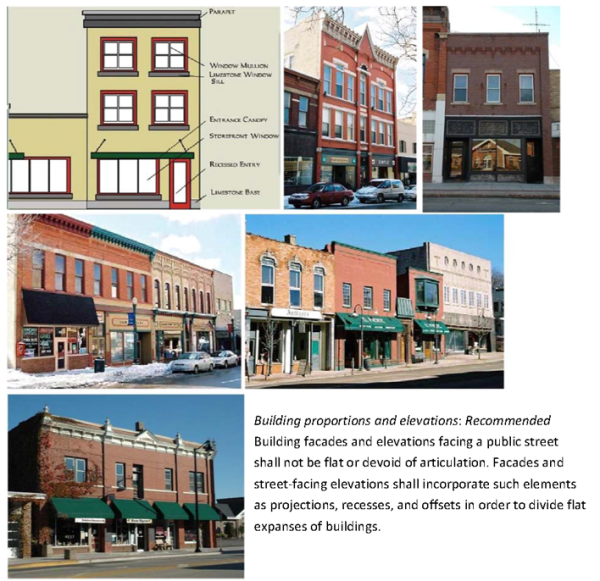
- Permitted Uses:
- The following uses of land are permitted in the RF district. Uses not listed are prohibited unless a recommendation is made by the planning commission to the city council that a use not listed below is similar to and compatible with a permitted use. The city council will either approve or deny the use.
- Antique shops.
- Art studios and retail shops.
- Bakery, fresh food or meat market (under 5,000 square feet, and limited to sales of goods produced for sale onsite only).
- Bookstores.
- Community kitchen.
- Conference facilities.
- Entertainment rental; video/DVD.
- Farmers market and fruit and vegetable stand.
- Financial institutions/services, not including drive-through facilities.
- Furniture stores.
- Gift, souvenir shops.
- Hotels/motels.
- Live theater or entertainment venue.
- Medical, dental, and chiropractic offices.
- New clothing and merchandise.
- Offices or office buildings.
- Outdoor sales, if associated with a principal use.
- Outdoor seating, if associated with a principal use.
- Pet store, pet services. Outdoor kennels are not permitted.
- Private professional or continuing education schools, or schools offering instruction in the arts or personal fitness.
- Restaurants, not including drive through facilities.
- River recreation, bike sales, repair and water recreation.
- Salons, spas, haircare facilities.
- Taverns, pubs, with or without food service.
- Tourism.
- Wind energy systems, up to 35 feet in height.
- Those uses existing on a parcel on the effective date of the ordinance from which this chapter is derived shall be permitted uses on that parcel of property, and shall not be considered a nonconforming use. If a conflict exists between this provision and any other provision of this chapter, this provision shall apply.
Note— Paragraph C,2 is intended to prevent any existing use within the riverfront district from becoming nonconforming.
- The following uses of land are permitted in the RF district. Uses not listed are prohibited unless a recommendation is made by the planning commission to the city council that a use not listed below is similar to and compatible with a permitted use. The city council will either approve or deny the use.
- Special Uses: The following special uses may be considered to be appropriate uses in the RF district subject to the application and review procedures and standards in OCC 32.08.020.
- Bakery, fresh food or meat market (under 5,000 square feet).
- Carryout or fast food, as part of a principal use, not free standing.
- Dry cleaners, which may include accessory equipment serving not more than the principal retail outlet for which this is a part.
- Package liquor store.
- Wind energy systems, if greater than or equal to 35 feet in height.
- Adult-Use Cannabis Dispensing Organization
- General Development, Site Plan, Landscape Improvement And Lighting Standards:
- The general development and site plan review development standards in the B-1 Highway Commercial District (OCC 32.20.070 through OCC 32.20.100) shall apply to all new construction, and major modifications to existing uses, with the following exceptions. All development within the RF district may be reviewed and approved by planning and landscape professionals selected by the city.
- B-1 General development, site plan and landscape improvement standards exceptions: There shall be no requirement to provide a minimum percentage of a property as landscaped open space, except for properties abutting the riverwalk setback and properties abutting a residential use. All parking areas shall comply with the landscape requirements.
- New Construction And Reconstruction Procedures:
- All construction of new structures within the RF district shall be approved in accordance with the provisions of this chapter and all other relevance requirements of this OCC 32.28.
Note— New construction and major reconstruction must comply with the RF district standards. Minor reconstruction, however, is exempt from zoning review, but must comply with all other applicable city codes. This approach is meant to ensure the adequate review of complex projects, or projects that may have impacts on surrounding land uses, while not overburdening existing business and property owners. It also allows property owners to make basic repairs to the site without the burden of obtaining city zoning approval beyond normal building permitting requirements. - All major remodeling or reconstruction of a previously existing structure, except for those structures used as a single-family residence, shall be approved in accordance with the provisions of this chapter, and all other relevance requirements of this title. Major remodeling or reconstruction is:
- A change in the height of the structure;
- A change, either an increase or decrease, in the footprint of the building;
- A change in the materials used on the exterior elevations;
- A change in the site layout (e.g., a reconfiguration of parking; a reduction in the amount or change in the type or extent of landscaping);
- The addition of a new land use that would increase the amount of parking as required under this chapter.
- Minor remodeling or reconstruction is exempt from the provisions of this section. Minor remodeling or reconstruction is:
- Interior renovations; or
- Re-painting of exterior or interior, re-roofing of structure, or other work undertaken to maintain the structure in good repair (e.g., replacement of gutters, tuck-pointing).
- Changes to the exterior that do not alter the character or bulk of the structure and are primarily for upkeep or to incorporate new technologies (e.g., replacement of windows when the new windows are the same size as the previous windows).
- All construction of new structures within the RF district shall be approved in accordance with the provisions of this chapter and all other relevance requirements of this OCC 32.28.
- Architectural Design Standards: The standards set forth in this section shall be applicable to all new structures, all major remodeling as defined in paragraph F, and the use of all land within the RF district. Existing single-family detached residential structures are exempt from the provisions of this section. The use of the term "shall" or "must" indicates required compliance with the standard. The use of the term "should" indicates that the incorporation of the standard is desired, but compliance is not required.
Architectural Design Standards for the RF DistrictConstruction Materials For walls visible from public right-of-way (other than an alley) Over 70 percent of each elevation (excluding windows) shall be of brick or limestone; other permitted materials for the remainder of the walls are native stone, and wood or wood equivalent (hardy board). Copper or metal treated to imitate a copper patina is allowed as part of architectural details. The use of concrete block, stucco or Dryvit is prohibited. Buildings with limestone bases are encouraged. The painting of brick, limestone, or other natural stone is prohibited; such materials shall retain their natural colors. Other accent materials and colors shall be considered on a case-by-case basis; when used, they shall be compatible with the other colors, and materials used on the building, and shall be consistent with the architectural style of the building. For roofs visible from public right-of-way Roofs visible from the street shall be earth tones (e.g., browns, dark green, sand, red-brown), and shall be composed of clay, faux clay; tile; slate or slate equivalent; asphalt or solar shingles. Window frames Anodized aluminum, wood, vinyl, or steel. Fenestration Ground story facade Ground story facades shall have between 60 and 90 percent fenestration; This fenestration shall be between two and ten feet above the sidewalk. Upper story facade Upper story facades shall include between 40 and 70 percent fenestration. All windows Upper story windows should incorporate muttons, or multiple divisions in the glass. Window glass Ground floor windows shall not be made opaque by any window treatment. Decorative windows Stained glass or leaded art glass windows are permitted. They may total up to 30 percent of the entire window area. Minimum Floor Area For Mixed Use Buildings Providing Residential Uses One-bedroom dwelling unit Dwelling unit shall be a minimum of 750 square feet. Two-bedroom dwelling unit Dwelling unit shall be a minimum of 900 square feet. Dwelling units with three or more bedrooms Dwelling unit shall be a minimum of 1,300 square feet. - Consistency With City Official Plans: Additional guidance. Design and architectural guidelines contained in the city's official comprehensive plan, and other design guidelines or design manuals that the city may adopt from time to time, shall provide general guidance for and clarification of issues pertaining to the development and redevelopment of land within the RF district.
Note— This section ties the zoning ordinance to the goals and recommendations of the city's comprehensive plan. - Parking Requirement Reductions: For new development within the RF district, the following parking standards shall also apply:
- Location Of Off-street Parking: Off-street parking shall not be located between the building facade and the street.
- Adaptive Reuse Of Buildings: Adaptive reuse of buildings, including remodeling and expansions up to 20 percent, shall be exempt from parking requirements, but must maintain existing parking.
- Reduction Of Parking Requirements: The parking requirements as expressed in OCC 32.32.050 may be reduced if the proposed development substantially conforms to the parking plan and standards provided for in each development district as described in the Riverfront Master Plan element of the city's comprehensive plan.
- The city council may authorize the payment of a fee in lieu of a portion or all of the parking required by this OCC 32.28. Such a fee schedule may be established from time to time by resolution of the city council, and money collected from such fees shall be placed into a city parking fund to be used for the acquisition and maintenance of public off-street parking and loading facilities to serve the RF district.
Note— Included within this section are new standards providing options for reducing parking requirements. Such reductions are typical in dense, mixed-use districts that promote a pedestrian-friendly environment. Strict adherence to the current parking standards, which are more appropriate for uses along highway corridors, could result in an abundance of surface area devoted to parking, impacting the economic feasibility of constructing desired uses.
- Sign Standards:
- The standards set forth in this section shall govern and control the erection, enlargement, expansion, alteration, operation, maintenance, relocation, and removal of all signs located within the RF district. All provisions and requirements set forth elsewhere in the OCC 28 inconsistent with the standards set forth in this section shall be inapplicable. Any uncertainty between the applicability of a standard or requirement set forth elsewhere in OCC 28 and the applicability of a standard set forth in this section shall be resolved in favor of the standard set forth in this section. The use of the term "shall" or "must" indicates required compliance with the standard. The use of the term "should" indicates that the incorporation of the standard is desired, but compliance is not required. Signs within the RF district shall comply with the following standards.
Note— It is important to bear in mind what the sign standards do not regulate: shape, design, corporate logos, or color. Flexibility is provided to property owners. The new sign standards are aimed at improving the visual quality and creating a unified image within the Riverfront area, while allowing property owners adequate flexibility and creativity in selecting sign type, design, shape, and color. - Prohibited Signs:
- All signs prohibited in OCC 28; and
- Internally illuminated signs
- Internally illuminated awnings
- Freestanding signs
- Permitted Signs: Permitted signs and their restrictions are provided in the table below.
Permitted Signs and Sign Standards in the RF DistrictType of Sign Number Maximum Display Area Maximum Height Location Other Awning sign One per awning, above ground story window or door. In accordance with OCC 28.12.030. In accordance with OCC 28.12.030. In accordance with OCC 28.12.030. Illumination shall be accent lighting attached to the building above the awning (such as "gooseneck" lights). Marquee and projecting sign In accordance with OCC 28.12.030. In accordance with OCC 28.12.030. In accordance with OCC 28.12.030. In accordance with OCC 28.12.030. Internal illumination is prohibited. Plastic or similar material for projecting signs is prohibited. Portable sign (menu board sign) One per establishment. Six square feet; signage may be on both sides of this area. Four feet. Shall be placed within two feet of the building facade and shall allow at least four feet of sidewalk clearance between the sign and the curb. Internal illumination is prohibited. Signs mounted on or attached to sawhorses are prohibited. The duration of display shall be limited and shall conform to the standards of OCC 28.12.070. Temporary sign In accordance with OCC 28.12.070. Wall sign In accordance with OCC 28.12.060. In accordance with OCC 28.12.030, except the maximum display area per sign shall not exceed 32 square feet. In accordance with OCC 28.12.030. In accordance with OCC 28.12.030. May only be externally illuminated with accent lighting.
- The standards set forth in this section shall govern and control the erection, enlargement, expansion, alteration, operation, maintenance, relocation, and removal of all signs located within the RF district. All provisions and requirements set forth elsewhere in the OCC 28 inconsistent with the standards set forth in this section shall be inapplicable. Any uncertainty between the applicability of a standard or requirement set forth elsewhere in OCC 28 and the applicability of a standard set forth in this section shall be resolved in favor of the standard set forth in this section. The use of the term "shall" or "must" indicates required compliance with the standard. The use of the term "should" indicates that the incorporation of the standard is desired, but compliance is not required. Signs within the RF district shall comply with the following standards.
- Sign Design Guidelines; Preferred Examples Of Sign Types: The following examples of sign types in intended to provide direction on the design and materials deemed appropriate and compatible with the traditional historic character of the RF district.
- Awning Signs: Fabric materials, not externally illuminated. Color consistent with the historic building materials.
Awning Signs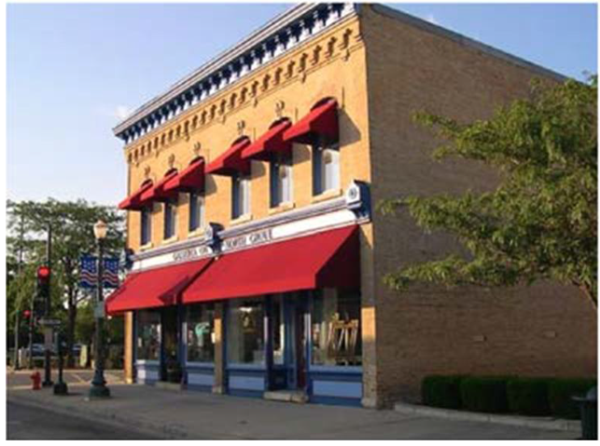
- Wall Signs: The traditional early 20th Century commercial buildings are adorned with signage enclosed within signboards. The signboards are of wood and are externally illuminated by gooseneck lighting.
Wall Signs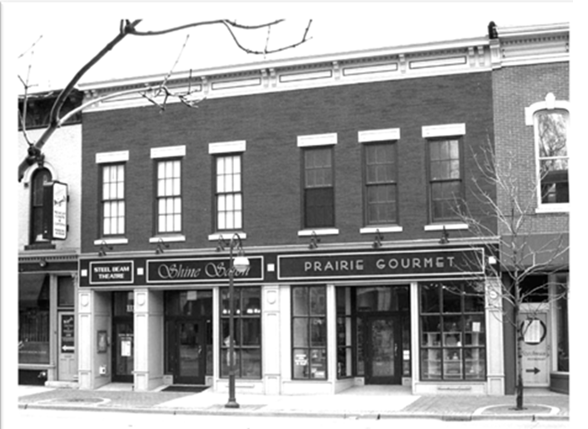
- Prohibited Wall Signs: Wall signs should only occupy a portion of a building facade to create architectural interest, and not dominate the building elevation.
Prohibited Wall Sign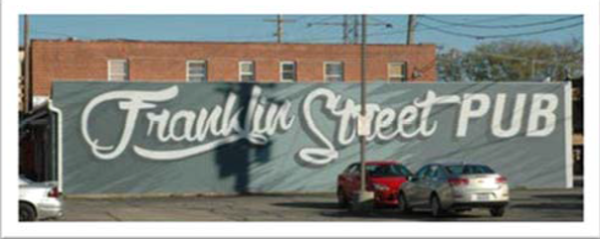
- Projecting Sign: Projecting signs should build on the historic precedents of the city. Strongly encourage the use of a variety of well-designed and appropriately scaled signs. Encourage sign sizes that fit within the architectural scale of the building facade. Projecting signs should fit within the existing features of the facade and not cover elements such as windows, transoms or cornices. Well scaled, projecting signs that have unique designs and quality craftsmanship can add great value to both historic and modern buildings.
Projecting Sign
- Awning Signs: Fabric materials, not externally illuminated. Color consistent with the historic building materials.
(Ord. No. 12-2016, 10-27-2016; Ord. No. 2016-115, 1-10-2017)

