
Orland City Zoning Code
CHAPTER 17
76 - GENERAL USE AND DESIGN REQUIREMENTS
Sections:
17.76.010 - Applicability.
In addition to the regulations specified in this title for each of the principal zones, the general regulations set forth in this chapter shall be applicable to each and every such zone. In the event of conflict between the particular regulations set forth in this chapter, the more restrictive regulations shall apply.
(Ord. 2007-05 § 3 (part))
17.76.020 - Accessory uses.
Accessory uses, as defined in this title, shall be permitted as appurtenant to any permitted use unless otherwise provided in this title, provided that no accessory use shall be conducted on any property in any R zone unless and until the main building is erected and occupied, or until a use permit is secured.
(Ord. 2007-05 § 3 (part))
17.76.030 - Assemblages of persons and vehicles.
No circus, carnival, open-air or drive-in theater, automobile racetrack, religious revival tent, outdoor concerts or similar assemblage of people and automobiles shall be permitted in any zone unless an administrative use permit is first secured in each case.
(Ord. 2007-05 § 3 (part))
17.76.040 - Convalescence of immediate family members.
A.
The use of a temporary dwelling to support the convalescence of immediate family members as permitted in this title is subject to the following requirements:
1.
Such usage contemplates and will permit only short-term use of a mobile home or recreational vehicles as temporary dwellings;
2.
Size of the temporary dwelling not to exceed forty (40) feet in length;
3.
The convalescent person must be a member of the immediate family of the application, or the convalescent person is the applicant and the temporary dwelling will be occupied by an immediate family member to assist the convalescent person;
4.
Applicant must validate the application with a certificate from the physician as to the health condition of the applicant's immediate family member;
5.
Applicant must certify as to inadequate housing arrangement in the main structure;
6.
Each permit shall only be for one year, there shall be no extensions granted, however, re-issuance is possible;
7.
The temporary dwelling must be removed within thirty (30) days after the convalescing person no longer needs aid;
8.
The director of public works and/or the building inspector must approve the water and sewer hookups;
9.
The applicant is responsible for and must seek approval of the county health department as to the living quarters;
10.
Each conditional use application must be concurrently with an agreement to pay additional current base rate sewer and water charges;
11.
All electrical and telephone wiring and plumbing must be a type allowed by the California Building Code for outside wiring, plumbing and must be approved by the building official subject to limitations by any local utility company requirements. Such services must be approved and permits obtained from the building department prior to occupancy.
B.
Any variations of the above requirements can only be altered by processing and receiving approval of a conditional use permit.
(Ord. 2007-05 § 3 (part))
17.76.050 - Height limitations and modifications.
A.
Height of buildings and structures shall be measured vertically from the average ground level of the ground covered by the building to the highest point of the roof, but chimneys, stacks, vents, flagpoles, conventional television reception antennas, elevator, ventilating and air-conditioning equipment and similar architectural and mechanical appurtenances shall be excluded in making such measurements. Height limitations provided in this title shall not apply to electric transmission lines and towers, except as provided in Section 17.76.150.
B.
Exceptions to height restrictions required within this title may be granted by processing a use permit.
(Ord. 2007-05 § 3 (part))
17.76.060 - Home occupations.
A.
A "home occupation use permit" which allows the operation of a business in a home located in a residential zone, may be issued by the city administrator or his/her nominee, without the necessity of public notice, a public hearing, or planning commission action, upon a finding that the following conditions exist:
1.
The proposed business activity involves only the use of telephone, internet and mail at the subject premises;
2.
The business does not involve shipping, receiving, repacking, or the storage of any materials on the subject premises;
3.
The business will not employ any persons at the subject premises who do not occupy the same as their residence;
4.
One unlit sign of one foot by one foot, attached to the building;
5.
No customers, clients, patients, salespersons, or other persons will be visiting the subject premises in connection with the business;
6.
There will be no other indications of business activity visible to neighbors or to the public, at the subject site, resulting from the use;
7.
There will not be any other significant negative impact upon the environment, public safety, or public welfare; and
8.
Require issuance of a business license.
B.
Any person who is denied a home occupation use permit by the city administrator pursuant to subsection A above may apply to the planning commission for the same.
(Ord. 2007-05 § 3 (part))
17.76.070 - Large family day care homes.
A.
Large family day care homes authorized by this title are subject to the following requirements as stated in H&S Code Section 1597.46:
1.
The operator of the large family day care home shall reside in the residence being used for the day care home.
2.
No large family day care home shall be located within five hundred (500) feet of another approved large family day care home.
3.
In addition to the required parking for the residence, an additional off-street parking space shall be provided for each employee on the maximum shift. Tandem parking may be used to meet these requirements.
4.
At least two on-street parking spaces shall be available directly in front of the subject property to be used for loading and unloading children.
5.
The operator shall provide evidence of receipt of a license from the State Department of Social Services.
6.
A solid fence or wall six feet in height shall be located between any outdoor play or activity area and adjacent single-family residential use. Said outdoor play or activity areas shall not be located in the required front yard.
B.
A large family day care home may provide care for more than twelve (12) children, but not more than fourteen (14) provided the requirements of Section 1597.46 of the California Health and Safety Code are satisfied.
(Ord. 2007-05 § 3 (part))
17.76.080 - Mining and removal of natural materials.
Mining and removal of minerals and natural materials, including materials to be used for commercial purposes, may be allowed in any zone, with the exception of any residential zoning district, with a use permit and compliance with the Surface Mining and Reclamation Act of 1975. A use permit shall not be required for on-site excavation and removal of materials for normal construction or underground facilities, or where such removal is primarily for building site grading and land leveling.
(Ord. 2007-05 § 3 (part))
17.76.090 - Manufactured home park standards.
All manufactured home parks shall be subject to the following requirements, plus other requirements that may be made conditions of use permit approval:
A.
Minimum lot area: five acres;
B.
Minimum recreation space: ten (10) percent of the total project site. The minimum size of any single outdoor recreation space shall be two thousand five hundred (2,500) square feet;
C.
Minimum yards around the perimeter of the park:
1.
Front, (abutting any street): twenty (20) feet (landscaped),
2.
Side and rear: ten (10) feet, suitably landscaped to provide effective screening. Fences or wall may be required as condition of approval of use permit as a means to achieve neighborhood compatibility;
D.
All areas not used for access, parking circulation, recreation or services shall be completely and permanently landscaped, and the entire site shall be maintained in a neat, clean and sanitary condition;
E.
All circulation roads shall be at least twenty-five (25) feet from curb to curb and shall be increased in width by ten (10) feet for curb parking space on each side of the street on which such curb parking is permitted. All roads and parking spaces shall be permanently paved. Two parking spaces or the equivalent thereof shall be provided for each mobile home site, plus one guest parking space for each ten (10) mobile home sites. The mobile home spaces may be provided as tandem parking;
F.
Each mobile home site shall have a minimum area of three thousand five hundred (3,500) square feet. In no instance shall the density of the site exceed the density permitted in the base zone district;
G.
The minimum distance between any mobile homes is ten (10) feet. The minimum distance between an accessory structure on one site and a mobile home on an adjacent site shall be ten (10) feet;
H.
The planning commission may modify the above requirements for an existing substandard park proposed to be enlarged or extended; provided, that the modifications are limited to the extent that the overall improvements in the design or standards of such existing park will result.
(Ord. 2007-05 § 3 (part))
17.76.100 - Parking and loading facilities.
Project site shall be conveniently accessible to both pedestrians and automobiles. Sufficient off-street parking shall be provided for every project. On-site circulation patterns shall be designed to adequately accommodate traffic. Potential negative impacts of parking areas on adjacent uses shall be minimized and mitigated.
A.
Off-street parking and loading spaces shall be provided in conformity with the following:
1.
In all zones, each standard parking space shall not be less than ten (10) feet wide, twenty (20) feet long, and seven feet high, and each loading space shall not be less than ten (10) feet wide, twenty-five (25) feet long and fourteen (14) feet high. Designated private employee and city employee vehicle parking spaces can be reduced to nine by eighteen (18) feet. A compact car space shall have a minimum size of eight and one-half feet in width and sixteen (16) feet in length. When ten (10) or more spaces are required by this chapter, ten (10) percent of the required space may be compact car spaces (See Appendix 1, Parking Lot Design Standards).
2.
All parking spaces and access thereto shall be improved with Portland cement or asphalt concrete.
3.
Loading areas shall be separated from pedestrian and automobile traffic.
4.
Loading areas shall not be immediately adjacent to residential uses or visible from public rights-of-way. Loading docks shall be screened from residential uses by a minimum six-foot high masonry wall with ten (10) foot wide landscaped strip.
5.
Loading door design shall be integrated into the design of the building. High quality material and non-bright colors shall be used for loading doors.
6.
In multi-building complexes, loading docks shall either be internalized or located in the rear of the complex in a service area.
7.
All outdoor storage areas (where allowed by the zoning district) and loading areas shall be located in the rear of sites and screened from view by solid walls or chain link fencing with slats and landscaping.
8.
Generally, no more than ten (10) percent of the parking spaces shall be dedicated as EV charging only spaces with the exception of hotels/motels, as defined in B2 below. EV charging only spaces representing more than ten (10) percent of the total parking spaces may be granted through the approval of administrative permit.
B.
Parking spaces shall be provided in all zones as follows:
1.
Day care centers: one space for each employee;
2.
Hotels/motels: one space per guest room. All newly constructed hotels and motels shall provide at least ten (10) percent of required parking to be fully conditioned EV charging spaces. All construction documents indicating parking shall identify the location of these spaces;
3.
Hospitals: one space per bed, and one additional space per each three staff members on the largest shift;
4.
Public assembly, including churches and theaters: one space per each six seats or two hundred (200) square feet of floor area, or whichever is greater;
5.
Medical and dental offices: two spaces for each exam room;
6.
Offices, professional and business: one space for each two hundred (200) square feet of floor area;
7.
Retail establishments: one space for each three hundred (300) square feet of floor area;
8.
Restaurants and licensed premises: one space for each four seats or one space for each two hundred (200) square feet of floor space, whichever yields the greatest number of spaces;
9.
Rest homes, nursing homes, convalescent homes, sanitariums, homes for aged: one space for each employee plus one space for each four beds;
10.
Wholesale, industrial and public utility buildings: one for each two employees, taking the largest number of employees on duty at any one time;
11.
Commercial uses occupying more than five thousand (5,000) square feet of floor area in any building shall provide one loading space and one additional loading space for every twenty thousand (20,000) square feet of floor area in excess of five thousand (5,000) square feet. Such facilities shall conform to the following:
a.
Each loading space shall not be less than ten (10) feet wide, twenty-five (25) feet long and fourteen (14) feet high clearance,
b.
Sufficient room for the turning and maneuvering of vehicles shall be provided on site,
c.
The loading area, access drives and aisles shall be paved so as to provide a durable and dustless surface, and shall be graded to drain as to dispose of surface water, with the design and specifications for such work being subject to the approval of the city engineer,
d.
If the loading area is illuminated, lighting shall be deflected away from abutting properties so as to not cause annoying glare to such properties;
e.
A loading area shall not be located in a required front yard, but may be located in a required side yard or rear yard;
12.
If an existing structure is unable to comply with the number of required off-street parking spaces because of lot size restrictions; the planning director or his/her authorized designee, on a case by case basis, without an appeal to the planning commission, may waive parking size and/or number of spaces that would be required for new construction.
C.
For uses not specified in this section or elsewhere in this title, the same number of spaces shall be provided as required for the most similar use as determined by the planning director.
D.
For the purposes of measuring floor area as used in this section, it means the gross floor area of the building, including all area enclosed by walls regardless of how such space may be used.
E.
Whenever there is a change in use, parking shall be provided to meet the requirement of the new use. If only a portion of a building is altered to a new use, and such change creates a need for an increase in the number of parking spaces, such increase shall be provided for the area occupied by the new use only.
F.
Whenever there is an addition or enlargement of an existing building which may not be conforming to the parking standards provided herein, and such addition or enlargement creates a need for an increase in the number of existing parking spaces by ten (10) percent or more, parking shall be provided based on the current standards for the entire building. In the event it creates a need for two or less additional spaces, no additional parking spaces shall be required.
G.
In instances where mixed uses are provided, the total requirements for parking shall be the sum of the requirements for the various uses computed separately. Off-street parking provided for one use shall not be considered as providing required parking for any other use except as herein specified for joint use.
H.
The planning commission may, upon written application by the owner of any property, authorize the joint use of parking facilities under the conditions specified herein;
1.
One hundred (100) percent of the parking facilities required for a use considered to be primarily a daytime use may be provided by parking facilities of a use considered to be primarily a nighttime use. Or, one hundred (100) percent of the parking facilities required for a use considered to be primarily a nighttime use may be provided by parking facilities of a use considered to be primarily a daytime use.
2.
The following uses are typical daytime uses: banks, business offices, personal service shops, clothing or shoe shops, or service shops, manufacturing or wholesale buildings and similar uses. The following uses are typical nighttime uses: dance halls, theaters, auditoriums other than that incidental to public or private schools or churches. This is not the complete list, and the planning commission may find other similar uses and circumstances where such sharing may be appropriate.
3.
The following are conditions required for joint use:
a.
The building or use for which the application is being made shall be located within six hundred (600) feet of the proposed joint use parking facility.
b.
The applicant shall show that there is no substantial conflict in the principal operating hours of the building or uses for which the joint use of off-street parking facilities is proposed.
c.
If the building, structure or improvement requiring parking space is in one ownership and the required parking space in another ownership, partially or wholly, there shall be a recording in the office of the county recorder of a covenant by such owners for the benefit of the city in a form approved by the city, that such owner or owners shall continue to maintain such parking space so long as the building, structure or improvement is maintained by the owner. The covenant herein required shall stipulate that the title to and right to use space is to be provided will be subservient to the title to the premises upon which the building is to be erected and that the parcel or parcels are not and will not be made subject to any other covenant or contract for use without prior written consent of the city.
I.
Common parking facilities may be provided in lieu of the individual requirement contained herein, but such facilities shall be approved by the planning commission as to size, shape and relationship to the sites being served. The total of such off-street parking spaces, when used together, shall not be less than the sum required for the various uses computed separately.
J.
Other design standards for parking facilities:
1.
All parking areas shall have adequate ingress and egress to and from a street or alley. Sufficient room for turning and maneuvering vehicles shall be provided on the site. Bumper rails or other barriers shall be provided where deemed necessary by the city to protect property.
2.
Entrances and exits to parking lots and other parking facilities shall be provided at locations approved by the city engineer and planning director.
3.
If the parking area is illuminated, lighting shall be deflected away from abutting residential areas.
4.
No commercial repair work or servicing shall be conducted in a parking area.
5.
The parking area, aisles, and access drives shall be constructed with a minimum of six-inch base and a double chip and seal so as to provide a durable, dustless surface, and shall be graded and drained as to dispose of surface water, with the design and specification so such work is subject to the approval of the city engineer.
6.
Minimize the use of surface parking in large office complexes to preserve open space and reduce visual effects.
7.
When surface parking is unavoidable, cluster parking spaces into small parking areas, dispersed around the site, to avoid large paved expanses.
8.
Limit curb cut entries into project sites to maintain sidewalk and streetscape continuity. Shared driveway access on adjacent nonsingle-family properties is encouraged.
9.
Design internal driveways for safety and convenience. For dimensional standards and requirements on driveways and parking spaces please refer to this section and Section 17.76.110 of the Orland Municipal Code.
10.
All parking lots shall include appropriately striped spaces for standard and compact cars as well as handicapped spaces.
11.
Avoid parking in required setback areas to maintain landscape strips along project boundaries.
12.
Separate pedestrian and automobile traffic paths, and minimize conflict areas for safety.
13.
Provide walkways to connect parking lots to building entrances. Define walkways by landscaping, lighting and paving.
14.
Completely enclosed areas for outdoor permanent storage areas shall be required.
15.
All parking spaces shall be striped in a manner clearly showing the layout of the individual parking spaces for standard and handicapped spaces. Such striping shall be permanently maintained in a clear, visible and orderly manner.
K.
Garage conversion:
1.
Any offstreet parking spaces lost through conversion of a garage to a non-garage use in a residential zone shall be replaced with enclosed space meeting the standards for the use as required by the applicable zone district unless the conversion is a ADU or JADU. Parking replacement requirements for these type of uses are identified in Section 17.76.130.
L.
Carports:
1.
If a new carport is being provided in an existing parking area where none existed previously, and the existing parking area is not paved, no further paving under the carport or access thereto is required. This would only apply in those instances where enclosed spaces are not required.
2.
Canvas, plastic and light metal parking structures: This type of parking cover shall not be located within a front yard or required setbacks of block emergency escape or egress routes which do not satisfy the requirements for covered parking. Placement review requires the submittal of a site plan and review fee established by the city council.
3.
Carport design, materials and colors shall be the same as main buildings. Enclose side elevations of carports to screen support columns on both ends.
4.
Where carports back up to the public streets or public view, provide rear carport walls to screen cars.
5.
Include facias in carport roof design to screen support beams and trusses.
6.
Carport roofs shall be the same as the roof design of the main building(s).
7.
Support columns shall be proportional to the structure in carports (match stick columns are not allowed).
8.
Carport sales and displays require a conditional use permit. Carport sales are not allowed in any residential zoning district.
M.
Parking Structures.
1.
Heavy metal parking structures and structures that are required to be installed on footings must meet the California Building Code requirements.
2.
Large commercial parking structures are not allowed in, or adjacent to, any residential zoning district.
3.
Elevation designs shall maintain similar proportions and rhythm of architectural elements with those on adjacent buildings for architectural harmony.
4.
Use the street level of parking structures for retail uses, or screen by dense landscaping and berming for visual relief.
(Ord. 2007-05 § 3 (part); Ord. No. 2022-02, Exh. A; Ord. No. 2022-03, Exh. A)
17.76.110 - Parking lot landscaping.
Landscaping shall be used to enhance sites and buildings, parking areas, control climate and noise, create transition between adjacent uses, unify various site components, and define and separate functions and activities.
A.
Landscaping shall be provided in new parking lots whenever ten (10) or more spaces are required. If the parking is required as an addition to an existing use, landscaping as required herein shall only be required for the new parking spaces.
B.
Prior to the issuance of a building permit and when ten (10) or more spaces are required, the applicant shall submit to the planning director a site plan setting forth the landscaping proposed to be developed in or adjacent to the parking area. Such site plan shall include any proposed landscaping strip, planter areas, trees, shrubs, vine or ground cover plantings. The plan shall be drawn to scale and plants clearly located and labeled as to the size, type and botanical or common name.
C.
The following landscaping standards apply to new development and required parking areas:
1.
Within the perimeter of a parking area, five percent of the parking area shall be planted with trees, shrubs and ground covers.
2.
Fully screen parking lots adjacent to public streets by landscaping and berming, as approved by the city of Orland. Screening shall be at least three feet high at the street level and shall be at least fifteen (15) feet wide.
3.
Fully screen below grade parking from public view at street level by landscaping and berming.
4.
Driveway entrances shall receive special landscape treatment to break up paving expanses and to define the site entrance.
5.
There shall be a minimum of one fifteen (15) gallon-sized tree of two and a half inch diameter at breast height (dbh) planted for each ten (10) parking spaces. The trees shall be planted in approved tree well designed to minimize root damage to the pavement. The trees shall be spaced to provide shade for the parking lot.
6.
Shrubs and ground covers shall be provided in a quantity and size to provide seventy-five (75) percent coverage of the required landscape area in three (3) years. Bark and decorative rock may be used in the interim to cover the ground until plants mature. Lawn may also be used to satisfy the five percent requirement when each lawn area contains at least one hundred fifty (150) square feet.
7.
Reserved.
8.
Utilize landscaping around the perimeter of new buildings to enhance buildings, not to cover an unacceptable design. Ivy on blank walls is prohibited.
9.
Landscape design shall demonstrate a concept and link various site components. Placement and type of plant materials shall relate to the site and buildings. When selecting landscape material for parking lots, trees with deep roots shall be selected to avoid damaging the pavement.
10.
Preserve and incorporate existing natural features, particularly trees, on a site into the landscape design(s) of projects.
11.
Use of a Certified Arborist or landscape architect to protect existing heritage trees during construction is encouraged.
12.
Properly landscape all areas not covered by structures and driveways.
13.
Landscaping shall always consist of live plant material. Use of colored rock, wood bark, and gravel in place of landscaping is not allowed, unless privately maintained.
14.
Choose a variety of plant material with different textures and colors.
15.
Landscaping shall be required to always combine trees and shrubs with living ground cover.
16.
Use of appropriate native vegetation is encouraged. Use water conserving plant materials in twenty-five (25) percent of all landscaped areas, where feasible.
17.
Where landscaping is provided, adequate irrigation and maintenance thereof shall be provided, including replacement of dead trees, shrubs, vines or other ground cover required pursuant to this section.
18.
Install street trees along street side of projects according to the department of public works.
a.
Trees recommended for planting in the city of Orland:
(i)
Small Trees:
Golden Rain Tree (Koelreuteria paniculata)—Deciduous, from twenty (20) to thirty (30) feet tall. Flowers are yellow panicles and fruit is a red-brown papery capsules. Fall color is not effective. They will take the sun, cold, salts, drought, wind and heavy clay soils if drained.
Autumn Gold (Ginkgo Biloba)—Deciduous, thirty (35) to fifty (50) feet tall, deep rooted, disease-free. Leaves turn gold in the fall. Specimens just west of Orland in Library Park. Plant only male trees since female trees produce messy fruit.
Flowering Plum (Krauter Vesuvius)—Deciduous, reaching twenty (20) feet tall. Dark purple leaves with fewer fruit than other varieties.
Bradford Pear (Pyrus Calleryana)—Deciduous, fifteen (15) to twenty-five (25) feet tall. White flowers with red foliage in the fall.
Washington Hawthorn (Crataegus Phaenopyrum)—Deciduous, reaching twenty-five (25) feet tall, and twenty (20) feet wide. Orange red foliage in the fall, bright Chinese red berries.
(ii)
Larger Trees:
Chinese Pistache (Pistacia Chinensis)—Deciduous, sixty (60) feet tall and fifty (50) feet wide. Stake and prune young trees above head height. Spectacular fall foliage.
Chinese Tallow (Sapium Sebiferum)—Deciduous, grows to thirty (30) feet tall, good fall color. Will take sun, acid soil. Good lawn tree but may sucker. Prune young tree for structure.
Holly Oak (Quercus Ilex)—Grows forty (40) to seventy (70) feet tall; growth rate is moderate depending on the soil and water conditions. Will take sun, wide drought, heavy pruning and makes a good lawn tree. Evergreen. Flowers are catkins.
Mayten Tree (Maytenus Boris)—Weeping evergreen, neater than weeping Willow. Slow growth to fifty (50) feet. Stake and prune when young.
Tulip Tree (Liriodendron Tulipifera)—Deciduous, erect growth to forty-five (45) feet or more. Tulip shaped lime/orange colored flowers. Takes the sun, cold. Susceptible to scale, aphids. Good lawn tree.
Village Green (Zelkova Serrata)—Deciduous, moderately fast growth to sixty (60) feet tall and equally wide. Stake and prune when young. Yellow/red fall foliage.
European Hackberry (Celtis Australis)—Deciduous, fifty (50) to seventy (70) feet tall, forty (40) to fifty (50) feet wide. Fast growth, has small purple berries, takes the sun and most soils.
Scarlet Oak (Quercus Coccinea)—Deciduous, sixty (60) to eighty (80) feet tall. Fast growth, scarlet fall foliage. Takes the sun and some drought conditions. Best oak for fall color. Fairly pest free.
19.
Incorporate design and location of walls and fences into the landscape design of projects.
20.
Highly visible areas of the site shall receive special landscape treatment.
21.
Incorporate all site furniture including planters, tree grates, newspaper racks, and light fixtures into the landscape design of projects. Bicycle lockers and/or racks shall be located near building entrances only and shall be clearly defined.
22.
Site furniture and light fixtures shall follow the same design concept as the major structures on the site.
23.
Always enhance automobile and pedestrian traffic paths by landscaping.
24.
Unless otherwise established and excepting required yards having a setback of less than five feet, provide a minimum of a five-foot wide landscape strip along all public street sides of development. Landscape strips of more than five feet are encouraged to enhance the public streetscape. Landscaping within this area shall include one, fifteen (15) gallon-sized tree for each one hundred (100) feet of frontage, and at least one gallon-sized shrub for each five feet of frontage. Such landscaped area may also be planted with lawn or ground cover plants. Other decorative non-plant ground covers may be used as long as they do not exceed twenty-five (25) percent of this landscaped area as approved by the city planner. None of this setback area landscaping shall qualify for the five percent requirement in subsection (C)(1) above. Landscaping shall not infringe on or conflict with any city public right-of-way. Caltrans may require landscaping for any development within its rights-of-way.
25.
Provide a minimum of a four-foot wide landscape strip along the sides and rear of all projects.
26.
Parking lot light poles shall not exceed sixteen (16) feet in height.
27.
New sidewalks shall be integrated into the existing frontage landscaping to maintain street continuity. Where new sidewalks are required, mature trees and landscaping shall be preserved as much as possible by meandering sidewalks around them.
28.
Natural features on a site such as mature trees, creeks, views, etc., shall be preserved and incorporated into the site design of the project.
29.
Landscape buffers shall always be provided between parking lots and public streets, and parking areas and buildings.
30.
Whenever security gates are provided, sufficient parking shall be provided outside of the gate area for visitors as approved by city staff.
31.
Parking lots shall have adequate directional signs for visitors, delivery vehicles and employees in accordance with Chapter 17.78, Sign Ordinance, of the Orland Municipal Code.
32.
Future phases of a project site already cleared and graded shall be adequately treated (e.g., hydro mulch) to prevent erosion and reduce aesthetic impacts.
33.
Sites adjacent to creeks and canals shall give special attention to the landscape, fence, and wall design in order to enhance natural features or minimize development impacts.
34.
Landscaping shall be adequately distributed throughout the parking lots to reduce the effects of heat and glare from pavement.
35.
When parking lots are adjacent to public rights-of-way, parking shall be screened by combining berms, shrubs and trees.
36.
When tree wells are provided, the wells shall be a minimum of five feet square. Interlocking pavement is recommended around tree wells.
(Ord. 2007-05 § 3 (part))
(Ord. No. 2015-01, § 1(Exh. A))
17.76.120 - Pre-manufactured structures.
Pre-manufactured structures, including mobilehomes, may be located on individual lots for residential or office use only under the following regulations as stated by Government Code Section 65852.3:
A.
Structures. Only structures certified by the Department of Housing and Urban Development as meeting the requirements of the National Mobile Home Construction and Safety Standards Act of 1974, or meeting all requirements of the California Building Code, will be allowed.
B.
Permanent Residential Use.
1.
Pre-manufactured structures for residential use may be located only in residential zones. Such structures shall be installed on a solid concrete or masonry foundation, extending a minimum of twelve (12) inches below grade, and the structure, foundation and anchorage system shall conform to the requirements of the California Building Code.
2.
The under-floor area of the structure shall be enclosed with permanent materials conforming to California Building Code requirements for contact with, or separation from, the soil.
3.
Roofing and exterior siding materials shall be of types customarily used on conventional dwellings. The planning commission shall adopt, and revise as appropriate, a list of materials which are approved.
4.
Manufactured single-family residential structures shall be of an integral unit design. Two or more structures, each of which is designed for use separately, shall not be installed on a single lot.
5.
The finished floor elevation of the pre-manufactured home shall be equal to or less than the immediately adjacent neighboring homes on either side of the pre-manufactured home fronting on the same street.
6.
A building permit shall be obtained for installation of a pre-manufactured residential structure. The application for a building permit shall include a site plan showing structure placement, sufficient foundation drawings and details to verify compliance with the foundation requirements of this section, and descriptive information and certification of the structure.
C.
Temporary Office Use.
1.
A pre-manufactured structure may be used as a temporary office, in commercial or industrial zones, for a period not exceeding six months, during reconstruction of a damaged structure, or alteration of an existing structure. The planning commission may extend the temporary use foran additional six-month period, provided substantial progress has been made in the permanent construction.
2.
Temporary installations may be made with temporary masonry or steel foundations. Adequate anchorage shall be constructed to conform to the California Building Code.
3.
A building permit shall be obtained for temporary installation of a pre-manufactured structure.
(Ord. 2007-05 § 3 (part))
17.76.130 - Accessory dwelling units and junior accessory dwelling units.
A.
Accessory Dwelling Units (ADUs) and Junior Accessory Dwelling Units (JADUs) are defined in § 17.08.145.
Applications for ADUs and/or JADUs:
1.
In single-family or multi-family residential zones are an allowed use in all single-family and multi-family zoning districts in the city and shall not be subject to a use permit or other discretionary action pursuant to California Government Code §§ 65852.2 and 65852.22 with the following additional requirements: and
2.
In industrial zones, ADUs and JADUs are allowed if the property has an existing or proposed single- or multi-family dwelling. The ADU or JADU shall not be subject to a use permit or other discretionary action pursuant to California Government Code §§ 65852.2 and 65852.22 with the following additional requirements:
a.
The increased floor area of an attached ADU shall not exceed fifty (50) percent of the proposed or existing primary dwelling living area, as long as the size limitation permits an ADU at least eight hundred (800) square feet. in size, at least sixteen (16) feet in height with four-foot side and rear yard setbacks, and that can be constructed in compliance with all other local development standards. Maximum allowed increase in floor area for an ADU is one thousand two hundred (1,200) square feet. Maximum allowed increase in floor area for a JADU is five hundred (500) square feet.
b.
An ADU or JADU is not intended for sale but may be rented for a period greater than thirty (30) days. Short-term rental (30 days or less) of these units is not allowed. An ADU shall not be sold separately from the primary dwelling unless the existing lot is divided into two or more lots consistent with city lot dimension and lot area standards resulting the primary and accessory residential structures being on individual lots. Full separate utility connections for all habitable structures shall be a requirement of approval of the lot division. Under no circumstances may a JADU be sold separately from the primary dwelling. The prohibition of the sale of a JADU separate from the primary dwelling must be recorded on a deed restriction.
c.
The lot contains an existing or proposed single- or multi-family dwelling.
d.
The lot in which the use is proposed is in a zoning district which allows for single- or multi-family use.
e.
Owner-occupancy of the parcel is not a requirement to apply for the construction of an ADU or JADU. Owner occupancy of an ADU on the property is not required between January 1, 2020 and January 1, 2025, However, owner occupancy of the single-family residence in which a JADU will be permitted is required. The owner may occupy either the remaining area of the primary dwelling or the JADU. The owner occupancy requirement associated with a JADU shall be recorded on the property deed.
f.
For a project which proposes a new single- or multi-family dwelling and an ADU or JADU, the primary dwelling shall be approved for occupancy prior to occupancy of the ADU/JADU.
g.
ADUs shall be either attached to the proposed or existing dwelling and located within the living area of the proposed or existing dwelling or detached from the proposed or existing dwelling and located on the same lot as the dwelling. JADUs shall be attached to the existing dwelling and located within the living area of the proposed or existing dwelling.
h.
No setback shall be required for an existing living area, garage, or accessory structure that is converted to an ADU or JADU. However, fire protection mechanisms, as determined by the fire marshal, may be required for fire and life safety in those dwelling units not meeting otherwise required setback standards.
A setback of four feet shall be required for an ADU that is not converted from an existing structure or a new structure constructed in the same location and to the same dimensions as an existing structure.
i.
An ADU or JADU shall not be subject to the following requirements: building coverage, surface coverage, minimum lot size, or any floor area ratios or open space requirements.
j.
With the exception of those requirements discussed in divisions h. and i. above, requirements relating to height, architectural review, site plan review, fees, charges, and other zoning requirements are generally applicable to residential construction in the zone in which the property is located.
k.
Parking requirements for ADUs and JADUs shall not exceed one parking space per unit or per bedroom, whichever is less. These spaces may be provided as tandem parking on an existing driveway. However, no parking requirements shall be mandatory for those ADUs and JADUs in any of the following instances:
i.
The ADU or JADU is located within one-half mile of public transit.
ii.
The ADU or JADU is located within an architecturally and historically significant historic district.
iii.
The ADU or JADU is part of the existing primary residence or an existing accessory structure.
iv.
When on-street parking permits are required but not offered to the occupant of the ADU or JADU.
v.
When there is a car share vehicle located within one block of the ADU or JADU.
l.
Offstreet parking shall be permitted in setback areas in locations determined by the city or through tandem parking, unless specific findings are made that parking in setback areas or tandem parking is not feasible based upon specific site or regional topographical or fire and life safety conditions, or that it is not permitted anywhere else in the jurisdiction.
m.
The replacement of parking spaces in an existing attached or detached garage, carport, or covered parking converted to an ADU or an existing attached or detached garage, carport, or covered parking demolished to construct a new ADU shall not be required for the construction and use of the ADU.
The replacement of parking spaces in an existing attached garage, carport or covered parking converted to a JADU or an existing attached garage, carport, or covered parking demolished to construct a new JADU shall not be required for the construction and use of the JADU.
n.
All ADUs and JADUs shall not be required to provide fire sprinklers if they are not required for the primary dwelling. However, other fire protection mechanisms, as determined by the fire marshal, may be required for fire and life safety in those ADUs and JADUs not meeting setbacks.
o.
For those ADUs or JADUs contained within the existing space of a single-family residence or accessory structure, which have an independent exterior access from the existing residence, and the side and rear setbacks are sufficient for fire safety shall not require a new or separate utility connection directly between the ADU or JADU and the utility, no related connection fee or capacity charge shall be imposed for this structure.
For purposes of providing service for water, sewer, or power, including a connection fee, a JADU shall not be considered a separate or new dwelling unit.
p.
Development impact fees for ADUs shall be based on the proportional size of the accessory dwelling unit to the primary dwelling. No development impact fees shall be required for ADUs of seven hundred fifty (750) sq, ft, or less in size.
q.
For an ADU that is not described in division o. above, a new or separate utility connection directly between the ADU and the utility shall be required. The connection is subject to a connection fee or capacity charge which shall be proportionate to the burden of the proposed accessory dwelling unit, based upon either its size or the number of its plumbing fixtures, upon the water or sewer system. This fee or charge shall not exceed the reasonable cost of providing this service.
r.
A maximum of one ADU and one JADU are allowed per lot occupied by a single-family residential unit if the following is met:
i.
The ADU or JADU is within the proposed space of a single-family dwelling or existing space of a single-family dwelling or accessory structure and may include an expansion of not more than one hundred fifty (150) square feet beyond the same physical dimensions as the existing accessory structure.
ii.
An expansion beyond the physical dimensions of the existing accessory structure shall be limited to accommodating ingress and egress.
iii.
The space has exterior access from the proposed or existing single-family dwelling.
iv.
The side and rear setbacks are sufficient for fire and safety.
v.
The ADU and JADU complies with the requirements of §§ 17.76.130 and 17.08.145.
s.
Multiple ADUs shall be allowed within the portions of existing multi-family dwelling structures that are not used as livable space, including, but not limited to, storage rooms, boiler rooms, passageways, attics, basements, or garages, if each unit complies with state building standards for dwellings.
At least one attached ADU and a maximum of 25 percent of the existing multi-family dwelling units shall be allowed in a multi-family structure.
Up to two detached ADUs that are located on a lot that has an existing multi-family dwelling shall be allowed on that multi-family lot. These detached ADUs are subject to a height limit of 16 feet and four-foot rear yard and side setbacks.
t.
The city shall ministerially review and act on a building permit application for an ADU and JADU within sixty (60) days after receiving the application. An ADU or JADU unit proposed with a permit application for a new primary dwelling unit shall not be approved until the primary dwelling receives approval.
u.
Newly constructed accessory dwelling units are subject to the 2019 California Energy Code (Cal. Code Regs., Title 24, Part 6, Subchapter 8, Section 151.1(14)) requirement, with exceptions, to provide a solar photovoltaic (PV) system if the unit is a newly constructed, non-manufactured, detached accessory dwelling unit. The solar panels can be installed on the ADU or on the primary dwelling unit. ADUs that are constructed within existing space, or as an addition to existing homes, including detached additions where an existing detached building is converted from non-residential to residential space, are not subject to the energy code requirement to provide a PV system.
v.
Additional JADU requirements:
i.
One JADU unit is allowed per residential lot zoned for single-family residences with a single-family residence built, or proposed to be built, on the lot.
ii.
The creation of a JADU must be within the walls of the proposed or existing single-family residence. JADUs are not allowed in accessory structures. Attached garages are eligible for JADU creation.
iii.
The JADU is required to include a separate entrance from the main entrance to the proposed or existing single-family residence but may also include shared access between the two units.
iv.
No passageway shall be required in conjunction with the construction of a JADU. For the purposes of this section, "passageway" means a pathway that is unobstructed clear to the sky and extends from the street to one entrance of the accessory dwelling unit.
(Ord. No. 2018-03, (Exh. A); Ord. No. 2020-06, (Exh. B); Ord. No. 2022-03, Exh. A)
Editor's note— Ord. No. 2018-03, Exh. A, adopted Aug. 20, 2018, repealed the former § 17.76.130, and enacted a new § 17.76.130 as set out herein. The former § 17.76.130 pertained to second dwellings and derived from Ord. No. 2007-05, § 3 (part); and Ord. No. 2015-01, § 1 (Exh. A); Ord. No. 2020-06, (Exh. B).
17.76.140 - Tract offices.
A.
When authorized herein by this title, tract offices shall satisfy the following requirements;
1.
Tract offices shall be removed within thirty (30) days of the sale of the last lot or home in the subdivision. If the office is located in a converted garage, the garage shall be converted back to garage usage within this thirty (30) day period.
2.
The tract office shall not be used for general real estate sales of properties located outside of the subdivision;
3.
The tract office shall meet all main building setback requirements for the zone in which it is located.
4.
A pre-manufactured structure may be used for the tract office subject to the provisions of Section 17.76.130, except that it shall only satisfy the length of stay and removal requirements of this section.
5.
In projects over twenty-five (25) lots or homes, off-street parking shall be provided for at least two vehicles, unless the city engineer determines there is adequate on-street parking available.
6.
Temporary exterior signage shall be limited to one sign not exceeding thirty-two (32) square feet. Additional signage may be permitted by approval of a use permit.
(Ord. 2007-05 § 3 (part))
17.76.150 - Transmission and distribution lines.
Transmission and distribution lines both overhead and underground, shall be permitted in all districts without limitation as to height, without the necessity of obtaining a use permit; provided, however, that the routes of all proposed gas, telephone, television cable and electric transmission lines shall be submitted to the planning commission for review and approval prior to the acquisition of rights-of-way or application to the public utility commission.
(Ord. 2007-05 § 3 (part))
17.76.160 - Yard sales.
Yard sales, as permitted in residential zones or as pursuant to this code, shall be subject to the regulations of this section.
A.
"Yard sales" means any event other than a sale actually operated in conjunction with a regularly licensed commercial or retail operation which is advertised by any means whatsoever as a place or location to which members of the public, at any time, may purchase identifiable or tangible personal property, for sale by an individual or group of individuals, which is conducted at a private residence as an occasional sale and not on a regular basis. Also included in this definition are garage sales, patio sales, estate sales, rummage sales or any similar sales.
B.
The term "yard sale," as used in this title, shall not include a rummage sale, conducted by a bona fide, nonprofit organization conducted at any public building, church or building in a commercial zone. Nothing contained in this title is intended, nor shall it prevent or prohibit various types of sales held by such charitable or social organizations.
C.
It shall be lawful for any person or persons to conduct a yard sale at a place of residence, provided that no such person or persons shall conduct more than three such yard sales per year, and such sale shall not take place over a longer period than two consecutive days. It shall be lawful for two or more persons having adjacent places of residence to join together in such a sale and each person joining in such sale shall not again participate in a yard sale for a period of at least one year. Goods sold at a yard shall be personal property owned by the seller or sellers, and shall not in any case include merchandise or personal property purchased elsewhere for resale at a yard sale. In any case where the state requires a resale permit for the sale of merchandise, the person or persons conducting the sale shall have first obtained such resale permit.
D.
All sales as defined in this title shall be conducted between the hours of eight a.m. and sunset. Goods shall not be displayed in the public right-of-way.
E.
It is unlawful for any person or persons to advertise a yard sale by attaching notices or posters to structures, signs or sign supports, utility poles or other supports, excepting upon the premises where the sale is being conducted, without first having obtained consent of the owner of such support to post such notice or poster. One sign not exceeding two feet by two feet in size may be posted on the property where the sale is being held during the sale only.
F.
All merchandise offered for sale shall be arranged so that fire, police, health and other officials may have access for inspection at all times during the sale.
G.
Any person or persons violating the provisions of this section shall be guilty of an infraction and upon conviction shall be punished as provided by law.
(Ord. 2007-05 § 3 (part))
17.76.170 - Storage containers.
A.
Use in Residential Zones. The permanent use of prefabricated exterior storage containers such as cargo containers or truck trailers is not permitted in residential zones. Temporary use of storage containers in residential zones may be approved subject to the following conditions:
1.
Any temporary use of storage containers will require an administrative use permit (AUP).
2.
Temporary uses are limited to a time period of thirty (30) days; extensions to this time period may be granted by the city.
3.
In the case of unforeseeable property damage or natural disaster, temporary use of storage containers will not require permit fees.
B.
Use in Commercial Zones. The use of storage containers in commercial zones as an accessory use to the primary permitted use on the same site is subject to the following conditions:
1.
Required conditional use permit (CUP) and site plan review.
2.
Subject to design review criteria and setback requirements defined for accessory structures in commercial zones.
3.
The planning commission shall determine appropriate siting, time limits, and other conditions as may be necessary to assure minimal impact to adjacent properties.
C.
Use in Industrial Zones. Storage containers are permitted in industrial zones as an accessory use to the primary permitted use on the same site, subject to the following conditions:
1.
Use in Heavy Industrial (HI) zones is permitted with an administrative use permit (AUP).
2.
Use in Light Industrial (LI) zones is subject to site plan review.
D.
General Requirements. The use of storage containers in any zone within the city limits must adhere to the following conditions:
1.
Storage containers may only be used for the storage of merchandise, inventory, shelving displays, or other incidental items related to the operation of the business.
2.
Business or sale of merchandise shall not be conducted from the storage container, nor shall the storage container be used a habitable space, office, or meeting area, and shall be kept closed and secured at all times other than when items are being moved to or from the storage container.
3.
Storage containers must be oriented to minimize the view from the public right-of-way. In no case shall storage containers be placed so as to cover, block, or otherwise impact required parking, or impact circulation and emergency access.
4.
Storage containers shall be painted in a color matching or similar to the field color of the primary structure and/or properly screened with screening walls and/or landscaping. Graffiti shall be removed within twenty-four (24) hours from any storage container or screening.
5.
The placement of any signs, advertising copy, banners, or similar item is prohibited on storage containers.
6.
No more than two storage containers with a combined floor area of no more than six hundred forty (640) square feet shall be allowed. Storage containers shall not exceed a height of ten (10) feet.
7.
Storage container location: Setbacks shall be the same as those for the underlying zone.
E.
Additional permitted temporary uses of storage containers include the following:
1.
Seasonal fireworks booths for sale and storage of fireworks.
2.
Construction sites.
F.
This section shall not apply to a location with a permitted business actively engaged in transporting cargo containers or truck trailers provided which container or trailer is only on the property temporarily and not utilized for outside storage purposes.
(Ord. No. 2016-03, § 3(Att. A))
17.76.180 - Exterior color palette: Commercial zones.
A.
Color Selection.
1.
Exterior facade colors of structures developed within Commercial zones shall be low reflectance, subtle, neutral or earth tone colors. The use of high-intensity or fluorescent colors is prohibited. The standard approved color palette is maintained at the planning department.
2.
Trim and accent areas up to a maximum of ten percent of the building facade may feature brighter, more intense colors, including primary colors.
3.
The transition between base and accent colors shall relate to changes in building materials or the change of building surface planes. Colors should not meet or change without some physical change or definition to the surface plane.
B.
Permit Required Where Color Not Included on the Standard Palette. No person shall paint or cause to be painted the exterior of any commercially zoned building owned by him or her or under his or her control within the city, without having first obtained an appropriate permit therefor from the planning department, if the intended paint color(s) is (are) not included on the standard palette.
C.
Application. An application for an exterior paint permit, required if the intended paint color(s) is (are) not included in the standard palette, shall provide the following information:
1.
The name, address and telephone number of the applicant.
2.
The address of the subject property.
3.
Samples of color(s) that are to be used, with designation of the manufacturer, the name of the color(s) and serial number.
D.
Permit Fee. There shall be a twenty-dollar fee required for the exterior paint permit.
E.
Appeal. The decision of the planning director or his designee may be appealed to the planning commission by the applicant pursuant to Chapter 17.92 of this Title 17.
F.
Compliance. The provisions of this section shall apply to all new construction and repainting proposed after the adopted ordinance [from which this section derives].
(Ord. No. 2017-03, § 2)
17.76.190 - Fence standards.
A.
Fence Setback Standards in the R-1 R-2 and R-3 Residential Zones are as follows:
1.
Front Yard: twenty (20) feet:
2.
Side Yard: five feet.
3.
Street Side Yard: Ten (10) feet.
4,
There is no fence setback requirement for fences in rear yards.
5.
Hedges, walls. and shrubs shall comply with the same setback requirements as fences.
a.
See fence height standards under item C below.
6.
No fences hedges walls or shrubs shall prevent home or building access by emergency personnel.
7.
No fence shall be located within three feet of a fire hydrant or any facility requiring access by a first responder or a utility company.
B.
Fence visibility triangle requirements:
1.
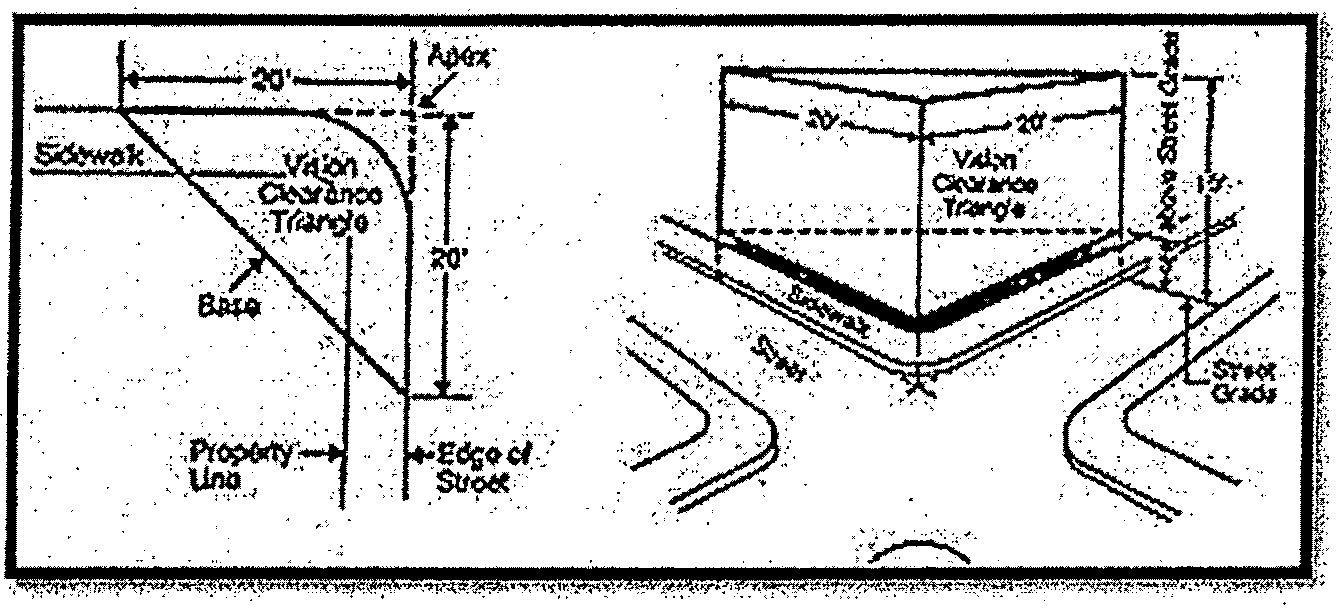
Fences located where two streets, alleys, driveways, or any combination of two meet at a corner apex 1 shall include a visibility cutout if located within ten (10) feet of a street or alley and over three feet in height. The visibility cutout is for protecting pedestrian and traffic safety.
a.
The visibility triangle size shall be based on the street type as shown in the table below. If two different street types meet at the apex the size of the visibility triangle shall be based on the street with the larger visibility triangle size requirement. Depending on the required visibility triangle dimensions, the visibility triangle shall extend either twenty (20) feet or thirty-three (33) feet in both directions from the triangle apex of the corner of the property.
b.
The visibility triangle shall be measured from the corner apex, even if the apex extends beyond the property line or the sidewalk.
1. The apex is the tip of the triangle, forming a point. The apex, as used here, is depicted in the figure below.
c.
Hedges, walls, and shrubs shall comply with the same visibility triangle requirements as fences.
C.
Fence height standards in the R-1 R-2 and R-3 residential zones are as follows:
1.
All fences within a front yard, side yard, or street side yard fence setback area shall not exceed three feet in height for the main body of the fence while intermittent decorative pillars and fence posts may extend up to forty-two (42) inches (3.5 feet) in height, as long as the visibility of the roadway is not obstructed. All fences not within such setback areas shall not exceed six feet in height. Such fences are permitted by right.
2.
In a location where six-foot fences are permitted by right, a fence between six and seven feet tall may be constructed, pursuant to the following requirements: Street side yard fences up to seven feet tall may be approved by the city through the use of an administrative fence permit if one foot of lattice (or other fifty (50) percent view permeable material) is incorporated into the top one foot of the fence design: and if there are no sight distance area problems as determined by the city manager or their designee.
3.
Hedges, walls, and shrubs shall comply with the same height requirements as fences.
4.
Fences, walls, hedges, and a combined fences and walls shall be measured in height from the uphill perspective if located on a grade or slope.
D.
Fence material standards in the R-1 R-2 and R-3 residential zones are as follows.
1.
Generally permitted materials:
a.
Lattice, non-pallet wood, prefabricated decorative wrought iron fence panels, prefabricated vinyl fence materials, chain link, brick or masonry block.
2.
Materials requiring city approval:
a.
Rock, composite stone any fence of non-standard design or materials.
3.
Prohibited materials:
a.
Ty-vek or like materials, corrugated materials, sheet metal of any type, bamboo, hay, twine, barbed wire, livestock or chicken wire, tarp, electric fencing, fabric, PVC pipes, thin plastic or plastic netting, materials that are potentially hazardous to people or animals (e.g. sharp, electric, etc.) and other like materials deemed by the city to be unacceptable are prohibited.
E.
Fence standards for the C-1 C-2 DT-MU C-H. M-L and the M-H zones are as follows;
1.
All fences and fencing materials require an administrative fence permit approved by the city manager or their designee prior to installation. Tv-vek or like materials, corrugated materials, tin, aluminum, bamboo, hay, and other like materials deemed by the city to be unacceptable are prohibited. All fencing material and fence construction shall be approved by the city in accordance with the Orland Municipal Code and the California Building Code, prior to construction of the fence.
2.
Any masonry and stucco walls require a building permit if greater than three feet in height.
3.
Fences and walls shall be compatible in style and material with the main structures on a site.
4.
To avoid the monotony of long solid walls and fences around the perimeter of projects, variation in height, texture and color is recommended with approval by the city.
5.
Signs, lights, and other street furniture incorporated into the design of fences and walls are encouraged.
6.
Barbed wire fencing may be used for security purposes only, in all zones listed under D above, extent the DT-MU Zone. All chain link fencing requires slats. In the DT-MU zone, barbed wire fencing is prohibited, and all chain link fencing requires slats.
7.
Screening devices shall be made of opaque (solid) materials such as wood or masonry blocks.
8.
Fences and walls used for noise control shall be made of materials most suited for noise reduction, and which minimize reflective sound.
9.
Security fencing and gates shall be of an open type to allow for maximum visibility of the secured area. Wrought iron and cast-iron fences are recommended for security fences and gates for all uses.
10.
Fencing shall be a maximum of six feet in height. Fencing over six feet in height, excepting subsection 2 above, shall require a building permit. All corner lots, including corners on alleys, shall be a maximum of three feet in height within the front and exterior side yard setback areas.
11.
All fences shall be made of durable and weather-resistant materials as approved by the city.
(Ord. No. 2021-01, (Att. B))

