
Orland City Zoning Code
CHAPTER 17
78 - SIGN ORDINANCE
Sections:
17.78.010 - Authority.
This chapter is adopted pursuant to the authority vested in the city of Orland and the state of California, including but not limited to: the State Constitution Article XI, Section 5, California Government Code Sections 65000 et seq., 38774, 38775, 65850(b), California Business and Professions Code Section 5230, and Penal Code 556.
(Ord. No. 2016-08)
17.78.020 - Findings and purpose.
The city council finds that unregulated and uncontrolled construction, erection, and lack of maintenance of signage in the city will result in excessive and inappropriate signage that has an adverse impact on the overall visual appearance of the city, which will adversely affect economic values. Unregulated and inappropriate signage can also increase risks to traffic and pedestrians by creating hazards and unreasonable distractions. It is, therefore, necessary to enact sign regulations to safeguard and preserve the health, property and public welfare of Orland residents through control of the design, construction, location and maintenance of signs as an information system, which preserves and enhances the aesthetic character and environmental values of the city of Orland, its residential neighborhoods and commercial/industrial districts consistent with the goals, policies, and strategies of the general plan while providing an effective means for members of the public to express themselves through the display of signs. Regulations within this chapter will minimize visual clutter, enhance safety through design and placement of signs, and preserve the aesthetics and character of the community. By adopting this chapter, the city council intends to balance the needs of the city's residents, businesses, institutions, and visitors for adequate identification, communication, and advertising with the objectives of protecting public safety and welfare and preserving and enhancing the aesthetic character and environmental values of the community, by:
A.
Encouraging communications that aid orientation and promote economic vitality while preventing visual clutter that will detract from the aesthetic character of the city;
B.
Applying basic principles of good design and sensitivity to community appearance to signage to avoid the creation of nuisances and privacy violations that will degrade the value of surrounding properties;
C.
Enhancing safety by ensuring that signs are designed, constructed, installed, and maintained in compliance with minimum standards necessary to provide adequate visibility and to avoid the creation of hazards or unreasonable distractions for pedestrians or drivers; and
D.
Ensuring that the constitutionally-guaranteed right of free speech is protected.
(Ord. No. 2016-08)
17.78.030 - Applicability and scope.
This chapter regulates signs, as defined herein, that are located or mounted on private property within the corporate limits of the city of Orland, as well as signs located or mounted on public property that is owned or controlled by public entities other than the city of Orland, and over which the city has land use or zoning authority. The provisions set forth in this chapter shall apply in all zoning districts of the city, except where expressly stated otherwise. No sign within the regulatory scope of this chapter shall be erected or maintained anywhere in the city except in conformity with this chapter. This chapter applies prospectively only. For the regulatory purposes of this chapter, the following are not within the definition of "sign":
A.
Architectural features: Decorative or architectural features of buildings (not including lettering, trademarks or moving parts);
B.
Symbols embedded in architecture: Symbols of noncommercial organizations or concepts including, but not limited to, religious or political symbols, when such are permanently integrated into the structure of a permanent building that is otherwise legal; also includes foundation stones, corner stones and similar devices;
C.
Manufacturers' marks: Marks on tangible products, that identify the marker, seller, provider or product, and that customarily remain attached to the product even after sale;
D.
Certain insignia on vehicles and vessels: on street legal vehicles and properly licensed watercraft: license plates, license plate frames, registration insignia, noncommercial messages, messages relating to the business of which the vehicle or vessel is an instrument or tool (not including general advertising) and messages relating to the proposed sale, lease or exchange of the vehicle or vessel;
E.
Newsracks and newsstands;
F.
Door mats, floor mats, welcoming mats and similar devices;
G.
Legally placed vending machines displaying only onsite commercial or noncommercial graphics, and drive-up or walk up service facilities such as gas pumps and automated teller machines.
H.
Shopping carts identifying the establishment to which they belong.
(Ord. No. 2016-08)
17.78.040 - Definitions.
Generally. As used in this title, the following words and phrases shall have the meanings respectively ascribed to them by this chapter. Explanatory diagrams of some of the sign definitions set forth herein are provided at the end of this chapter.
"Advertising surface (facing)" means the entire surface on which any type of letter, figure, emblem, trademark, logo, picture, or other advertising materials is placed, or may be placed unless otherwise described. For portable signs, the "advertising surface" area of the sign shall be calculated as the full exterior dimensions of the physical sign.
"Appurtenant sign" means a sign pertaining to the business or activity carried on at the premises upon which the sign is located, constructed or erected.
"Awning or canopy" includes any structure made of cloth, metal or other suitable material with a metal frame attached to a building and projecting over a public or private pedestrian walk and supported by the ground or building sidewall.
"Awning/canopy sign" means any advertising of any nature, which is painted, printed, sewed or otherwise attached to an awning or canopy.
"Building" means any structure having a roof supported by columns or by walls and designed for the shelter and housing of any person, animal or chattel, including any underground shelter, swimming pool, or any commercial or industrial structure designed for the sale, storage, or manufacture of anything of value.
"Bulletin board" means a place where people can leave public messages, for example, to advertise things to buy or sell, announce events, or provide information.
"Community event signs" means any temporary signs which are displayed for the purpose of identifying an upcoming community and/or non-profit event, such as a benefit dinner, a home and garden show, a sporting event, or a school theater performance.
"Corner lot" means a lot located and being at the junction to two or more intersecting streets with a boundary line thereof bordering on each of such streets and where such streets intersect at an interior angle of not more than one hundred thirty-five (135) degrees. If the intersection angle is more than one hundred thirty-five (135) degrees the lot is considered an interior lot. The shortest such street frontage shall constitute the front of a rectangular lot for purposes of determining front, side and rear yards. Where the front of a lot differs by the reason of the prevailing custom of the other buildings on the block, the planning director may determine the front lot line consistent with the orientation of other structures in the area.
"Curb line" means the line at the face of the curb nearest to the street or roadway. In the absence of a curb, the curb line shall be established by the director of public works.
"Digital display sign" means signs which use technologies such as LCD, LED and projection to display content such as digital images, video, streaming media, and information.
"Electrical Code" means the electrical code of the city of Orland.
"Electrical sign" means any sign which is wired to provide current employed in illuminating or animating any part of the sign, except flood lighting.
"Embellishments" means that portion of any sign structure or sign which contains no moving parts, is not animated, nor illuminated, and which contains no advertising copy, nor conveys any portion or all of any advertising message, and is generally located above the message portion of any sign and is constructed for aesthetic purposes as part of the decorative trim of the design of the overall sign structure.
"Erect" means to build, construct, attach, hang, place, suspend or affix to or upon any surface.
"Face of building" means the general outer surface of a structure or wall of a building facing a street.
"Facing or surface" means the surface of the sign upon, against, or through which the copy or message is displayed or illustrated on the sign.
"Flag signs" means any cloth, bunting, plastic, paper, or similar non-rigid material used for advertising purposes attached to any structure, staff, pole, line, framing, or vehicle.
"Frontage" means the full length of a plot of land or a building measured alongside the road on to which the plot or building fronts.
"Hanging sign" means a sign that is hanging from a permanent building canopy or marquee existing over a pedestrian walkway and is sized and located in a manner to service pedestrians using the walkway, advising them of the adjacent use.
"Joint tenant" refers to a business that uses a premise/facility to sell goods and is directly adjacent to the parcel of land at which the "joint tenant" sign is physically located.
"Marquee" means a permanent roofed structure, attached to and supported wholly by the building and projecting over a pedestrian walkway.
"Monument sign" is a freestanding ground mounted sign not exceeding eight feet above ground level.
"Multiple tenant sign" means a sign that includes as copy, only the names of two or more businesses, places, organizations, buildings or persons it identifies.
"Multi-user digital display pole/pylon sign" means a pole or pylon sign that allows for the digital display of multiple businesses on a single sign. These signs are only allowed in the Highway Business Area pursuant to Section 17.78.410.
"Noncommercial sign" means any sign not advertising or promoting a business entity, commercial activity or product for sale and sets forth the ideas or beliefs of the owner or occupant of the property upon which such sign is placed regarding political, sociological, religious, or economic subjects of public interest or general concern.
"Off-site sign" means a sign identifying a use, facility, service, event or product that is not located, sold, held, offered or manufactured on the same premises as the sign. Off-site signs shall not be permitted, except for temporary community event signs per Section 17.78.440.
"On-site sign" means a sign identifying a use, facility, service, or product that is located, sold, and/or manufactured on the same premises as the sign.
"Pole sign" or "post sign" means any advertising of any nature which is wholly supported by one or more pole or posts set in or attached to the ground.
"Portable sign" means any sign which is designed to be portable or readily moveable by a person to identify the location of a business, the sales of merchandise or to advertise an event and which is generally to be located on the ground or on a legal and permanent fixture attached to the ground. Sandwich signs; T-, H-, and A-frame signs; signs with wheels, banner signs, flag signs and similar types of signage are all considered to be portable signs.
"Projecting sign" means any sign other than a wall sign, which is suspended from or supported by any building, pole, post, or structure, which projects outward therefrom.
"Real estate sign" means any sign advertising for sale or lease of the lot or parcel of land upon which it is erected or maintained.
"Roof sign" means any sign of any nature, together with all its parts and supports, which is erected, constructed, or maintained on or above the roof or parapet of any building including wall signs which extend above the roof or parapet of any building. Roof signs are prohibited within the Orland city limits.
"Seasonal signs" means any signs which are displayed in conjunction with an approved use permit for a seasonal event, such as pumpkin patches, Christmas tree lots, and firework displays. Seasonal signs must adhere the conditions of the use permit and to Section 17.78.700 - Prohibited signs, but are otherwise exempt.
"Sign" means any medium including its structure and component parts, which is erected out of doors and which is used or intended to be used to attract public attention of the subject matter therein, including window signs as defined herein.
"Sign business" means the business of selling, offering for sale, leasing or renting, electric and non-electric signs and includes the business of painting, construction, erection, maintenance or repair of signs upon buildings, fences, windows, posts, structures and surfaces.
"Sniping" means advertising by the pasting, posting, sticking, tacking, hanging, affixing or placing of cloth, paper or cardboard bills, cards or posters, or metal signs, to or upon fences, posts, trees, buildings, structures or surfaces other than outdoor advertising structures. This definition does not include any sign or notice issued by any court or public office or posted by any public officer in performance of a public duty or by a private person in giving a legal notice, or any cloth, paper or cardboard sign advertising for sale or lease the property upon which it stands or any type of sign permitted elsewhere in this title.
"Special event signs" means any temporary signs which are displayed for the purpose of identifying a business, use, service or a special business-related event. Such signs shall not be used for the purpose of advertising specific products. Examples of special events are grand openings, special sales, and moving sales.
"Street" means a public or private thoroughfare which affords the principal means of access to abutting property, including an avenue, place, way, drive, lane, boulevard, highway, road and any other thoroughfare except an alley as defined herein.
"Structure" means anything constructed or erected, the use of which requires location on the ground or attachment to something having location on the ground or underground.
"Structural trim" means the molding, battens, cappings, nailing strips, latticing, platforms and letters, figures, characters or representations in cut out or irregular form which are attached to the sign structure.
"Temporary sign" means any sign constructed of durable weather-resistant material, such as cloth, canvas, light fabric, cardboard, wall board, or other light materials, with or without frames, intended to be displayed on a temporary basis. Regulation of temporary signs is provided in section 17.78.440.
"Use permits or conditional use permits" are conditional use permits as provided in Chapter 17.80 of Title 17 of the zoning ordinance, and shall comply with all procedures and requirements as provided therein.
"Wall" means any exterior surface of a building or any part thereof excluding the roof.
"Wall sign" means any sign of any nature which is attached to or supported by a wall of a building, or painted directly on the wall and shall include all parts and supports of such sign. Signs hanging from a porch or canopy and parallel to the face of the building shall be considered wall signs.
"Window sign" shall mean a sign that is applied or attached to a window or located within two and a half feet of the inside of a window and intended for view by the pedestrian or vehicular traffic.
(Ord. 2007-05 § 3 (part))
(Ord. No. 2013-04, § 17.78.035; Ord. No. 2013-05, §§ 17.78.012, 17.78.017.5, 17.78.025.5, 17.78.032, 17.78.038.5, 17.78.041.5; Ord. No. 2015-01, § 1(Exh. A); Ord. No. 2016-08; Ord. No. 2018-05, Exh. A; Ord. No. 2018-06, Exh. A; Ord. No. 2023-02 (Att. A))
Editor's note— Ord. No. 2016-08, adopted Oct. 17, 2016, renumbered former § 17.78.010 as § 17.78.040.
17.78.050 - General standards.
A.
Total Advertising Surface Limitations. The maximum, total exterior advertising surface permitted is as follows:
Single Use Parcel: One hundred (100) square feet maximum of total sign area for parcels with street frontage less than one hundred (100) linear feet measured from the longest single street frontage. For parcels equal to or greater than one hundred (100) linear feet of street frontage measured from the longest single street frontage: one additional square foot for every ten (10) linear feet of the longest single street frontage of one parcel subject to the other requirements of Chapter 17.78, with the ex- ception of an allowed increase of fifty (50) percent of permitted individual sign area described in Sections 17.78.100 through 17.78.400. This exception does not allow for the increase of accumulated sign area beyond those discussed previously. No combining of multiple parcel street frontages is allowed. Total sign area is not to exceed one hundred and fifty (150) square feet.
Multiple Use Parcel: Two hundred and fifty (250) square feet maximum for lots with street frontage less than one hundred (100) linear feet measured from the longest single street frontage. For lots equal to or greater than one hundred (100) linear feet of street frontage measured from the longest single street frontage: one additional square foot of area for every five (5) linear feet of a street frontage of one parcel subject to the other requirements of Chapter 17.78, with the exception of an allowed increase of fifty (50) percent of permitted individual sign area described in Sections 17.78.100 through 17.78.400. This exception does not allow for the increase of accumulated sign area beyond those discussed previously. No combining of multiple parcel street frontages is allowed. Total sign area is not to exceed three hundred and fifty (350) square feet.
A use permit may be granted by the planning commission to exceed the maximum sign area as provided in Chapter 17.80.
B.
Advertising Surface Calculation. The "advertising surface (facing)" of a sign shall be either the area of the entire sign face, or where individual sign letters and/or other components are mounted individually on a building surface, the area calculated by enclosing the extreme limits of all writing, logo, representation, emblem, or other display within no more than three parallelograms or triangles.
C.
Sphere Calculations. In the case of a sphere of any type, only one-half thereof shall be considered the "advertising surface (facing)" unless the sphere may be observed on all sides by the public, in which event the entire surface area of said sphere shall be considered the "advertising surface (facing)."
D.
Sign Height. No sign shall exceed the building height limits as set forth in each zone district as specified in Title 17 unless the proposed sign qualifies for an exception by use permit pursuant to Chapter 17.80.
E.
Sign Height Above Public Property. Signs projecting over public property, if permitted, shall comply with the minimum standard set forth in the latest edition of the California Building Code and the California Electrical Code. In no event shall the clearance be less than eight feet unless a use permit is obtained.
F.
Illumination of Signs. Illumination of signs shall be permitted; provided, however, when reflectors, flood lights, or spotlights are used, they shall be installed, focused and maintained as to concentrate their illumination upon the sign face or outdoor advertising structure face and shall not cause glare upon the street or adjacent private property or cause sky reflected glare. An administrative permit shall be required for all illumination signs to ensure compliance with city of Orland Municipal Code.
G.
Electric Signs and Outline Lighting. All electric signs and outline lighting shall comply with Article 600 of the current edition of the California Building Code. A building permit and approval by the building official is required prior to the installation of any such electrical sign or outline lighting.
H.
Quasi-Public Uses Identification. In addition to any other allowed signing, churches, schools, hospitals and other uses of a quasi-public nature, as determined by the planning director, shall be allowed one monument sign and one wall sign. However, the sign permit and the review and approval process shall be required. Said monument sign shall not exceed eight feet in height and the advertising surface shall not exceed twenty-four (24) square feet per side; the wall sign shall not exceed twelve (12) square feet in area. Both types of signs may be internally or externally illuminated.
I.
Visibility Triangles. Signs shall maintain a minimum seventy-five (75) foot visibility triangle at street intersections, a minimum thirty-three (33) foot visibility triangle at driveways, shall not be located less than ten (10) feet behind the edge of pavement and shall not be located so as to create a traffic hazard as determined by city staff.
J.
Engineering Plans Required. The following signs shall require engineered plans, and the building permit application shall include complete plans and calculations sealed by an engineer or architect registered in the state of California.
1.
Canopy and marquee signs, when the area of the face of one sign or the aggregate area of all signs exceeds twenty-five (25) square feet.
2.
Wall signs exceeding fifty (50) square feet in area, except:
a.
Wall signs constructed of cut-out letters and insignia attached directly to the building and for which no individual letter exceeds fifty (50) square feet in area.
b.
Any signs painted directly upon the wall of a building.
3.
Ground or pole signs when the area of the face of one sign or the aggregate area of all signs on the sign structure exceeds thirty-five (35) square feet and the structure exceeds six feet in height.
4.
As otherwise required by the city building official.
K.
Building Code Compliance. All signs shall be required to meet all stipulations of the Building Code.
L.
Sign Permits. All signs, except those exempted by Section 17.78.750, will require an administrative use permit, to be processed by the city planner, with appeal to the city manager, on forms as approved by the city of Orland.
M.
Permit Fees. A sign permit fee, to be established by resolution, shall be paid by the applicant upon application for a sign permit.
N.
Flashing Signs. All electrical signs intended to attract attention by any flashing on and off, or simulating any motion through a series of rapid light changes are only allowed in the "C-2" (Community Commercial), "C-H" (Highway Service Commercial), or "P-D" (Planned Development) Zoning Districts and shall require an approved administrative use permit. These signs shall be appropriate to the surrounding environment and shall not cause potential safety issues.
O.
Moving Signs. Signs with movement or moving parts which is generated by electronic means shall be allowed with an approved administrative use permit and engineered plans shall be required. Moving signs shall be evaluated prior to approval to ensure that they will not create a safety hazard.
P.
Marquee Signs. Marquee signs shall be prohibited except for theaters, religious facilities, schools, gasoline pricing signs, restaurants, and hotels/motels. These signs shall be allowed with an approved administrative use permit and shall not be larger than twenty-five (25) square feet. However, these signs may be a maximum of one hundred (100) square feet within six hundred (600) feet of Interstate 5.
Q.
Message Neutrality. It is the city's policy to regulate signs in a constitutional manner that does not favor commercial speech over noncommercial speech and is content neutral as to noncommercial messages which are within the protections of the First Amendment to the U.S. Constitution and the corollary provisions of the California Constitution.
R.
Regulatory Interpretations. All regulatory interpretations of this chapter are to be exercised in light of the city's message neutrality policy. Where a particular type of sign is proposed in a permit application, and the type is neither expressly allowed nor prohibited by this chapter, or whenever a sign does not qualify as a "structure" as defined in the building code, then the city shall approve, conditionally approve or disapprove the application based on the most similar sign type that is expressly regulated by this chapter.
S.
Substitution of Messages. Subject to the property owner's consent, a protected noncommercial message of any type may be substituted for any duly permitted or allowed commercial message or any duly permitted or allowed noncommercial message, provided that the sign structure or mounting device is legal without consideration of message content. Such substitution of message may be made without any additional approval or permitting. This provision prevails over any more specific provision to the contrary within this chapter. The purpose of this provision is to prevent any inadvertent favoring of commercial speech over protected noncommercial speech, or favoring of any particular noncommercial message over any other noncommercial message. This provision does not create a right to increase the total amount of signage on a parcel, lot or land use; does not affect the requirement that a sign structure or mounting device be properly permitted; does not allow a change in the physical structure of a sign or its mounting device; does not allow the substitution of an off-site commercial message in place of an on-site commercial message.
T.
Property Owner's Consent. No sign may be displayed without the consent of the legal owner(s) of the property on which the sign is mounted or displayed. For purposes of this policy, "owner" means the holder of the legal title to the property and all parties and persons holding a present right to possession, control or use of the property.
U.
Legal Nature of Signage Rights and Duties. As to all signs attached to property, real or personal, the signage rights, duties and obligations arising from this chapter attach to and travel with the land or other property on which a sign is mounted or displayed. This provision does not modify or affect the law of fixtures, sign-related provisions in private leases regarding signs (so long as they are not in conflict with this chapter), or the ownership of sign structures.
V.
Severance. If any section, sentence, clause, phrase, word, portion or provision of this chapter is held invalid or, unconstitutional, or unenforceable, by any court of competent jurisdiction, such holding shall not affect, impair, or invalidate any other section, sentence, clause, phrase, word, portion, or provision of this chapter which can be given effect without the invalid portion. In adopting this chapter, the city council affirmatively declares that it would have approved and adopted the chapter even without any portion, which may be held invalid or unenforceable.
(Ord. 2007-05 § 3 (part))
(Ord. No. 2015-01, § 1(Exh. A); Ord. No. 2016-08)
17.78.100 - Hanging signs.
A.
Permitting. Permits for a hanging sign shall be considered as part of the administrative use permit process defined in Chapter 17.80.
B.
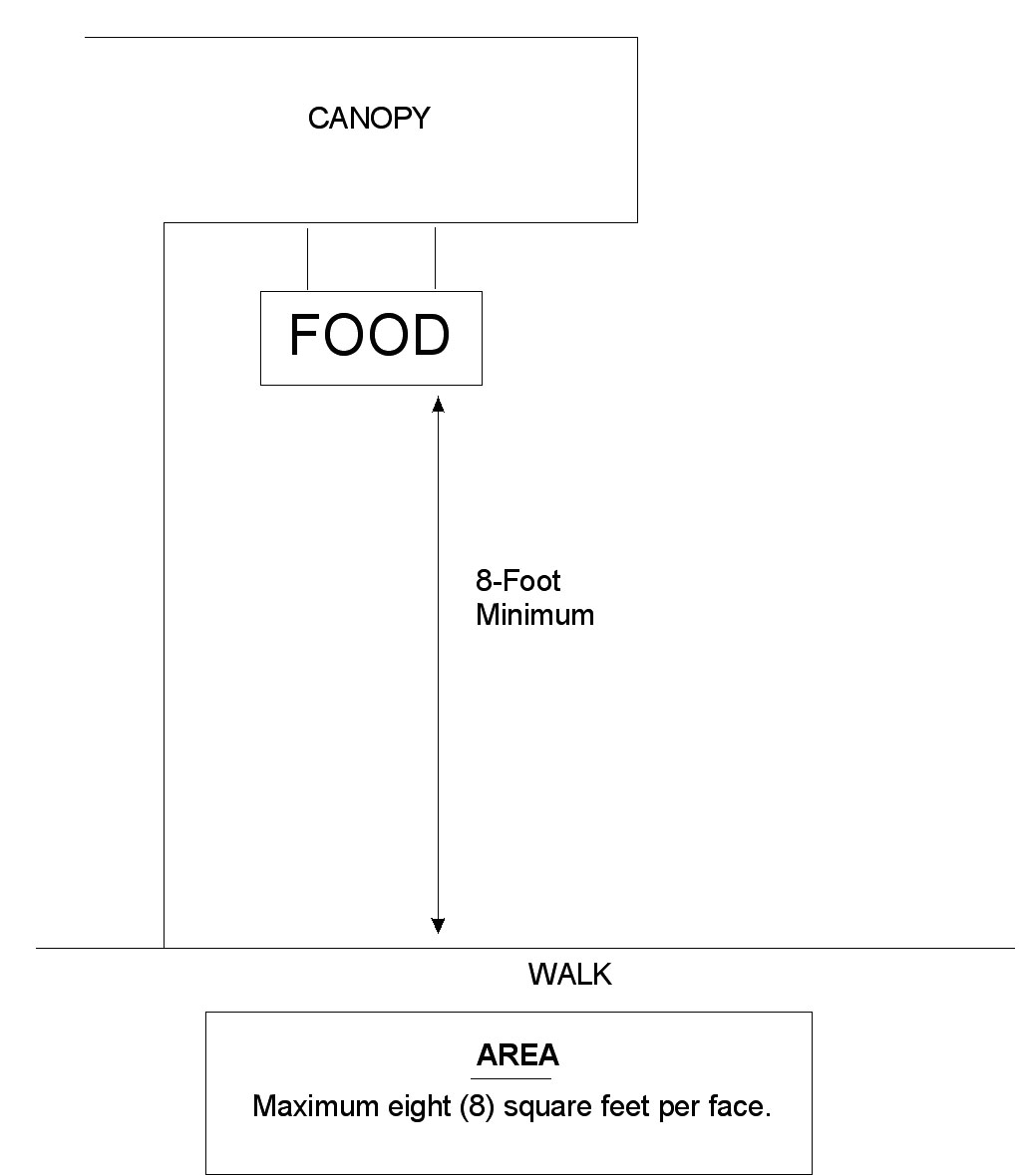
Standards. A hanging sign is a sign hanging over a covered pedestrian walkway. It shall be at least eight feet above the walkway. Such sign shall not be internally lighted and shall not exceed eight square feet in area per face. No more than one such sign shall be allowed per use per frontage. Such sign shall only identify the name and/or logo of the adjacent use.
(Ord. 2007-05 § 3 (part))
17.78.150 - Projecting signs.
A.
Permitting. Permits for a projecting sign shall be considered as part of the administrative permit process defined in Chapter 17.80.
B.
General Standards.
1.
Projecting signs shall be permitted as secondary identification signs (in addition to wall signs) for sites with a high degree of pedestrian traffic and where the view of the primary sign by pedestrians is limited.
2.
Projecting signs may be used as primary signs for buildings that do not possess adequate areas with proper visibility for the location of other types of identification signs.
3.
Projecting signs shall be placed perpendicular to the building frontage and shall not extend above the level of the building eave of a sloped roof or highest point on a flat roof.
C.
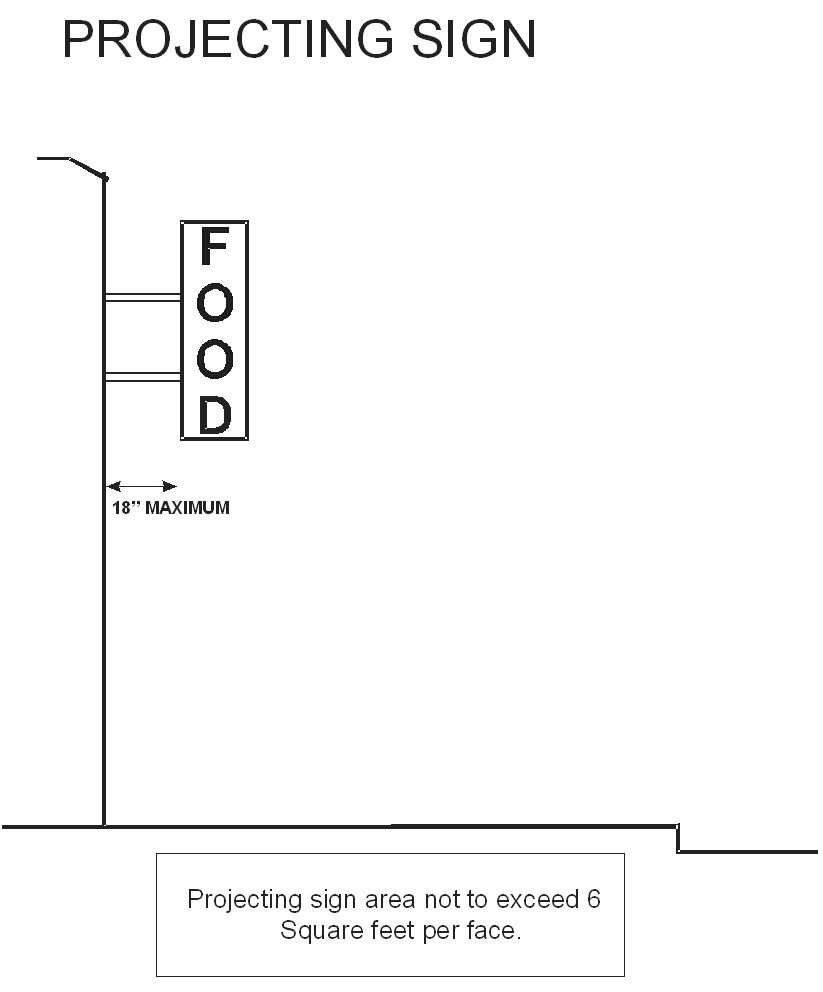
Area Limitations. Projecting signs shall not exceed six square feet each side. Only one such sign shall be allowed per each street frontage.
D.
Projection over Public Property. Signs projecting over public property shall comply with the minimum standard set forth in the latest edition of the California Building Code and the California Electrical Code. In no event shall the clearance be less than eight feet unless a use permit is obtained.
E.
Extension from Pole, Wall or Buildings. No projecting sign shall be erected with the nearest portion of the sign face extending a greater distance than eighteen inches from the pole or wall or building to which it is attached.
F.
Wind Pressure Requirements. All projecting signs shall be constructed in accordance with wind pressure requirements set forth by the Building Code.
(Ord. 2007-05 § 3 (part))
17.78.200 - Awning and canopy signs.
A.
Permitting. Permits for an awning or canopy sign shall be considered as part of the administrative permit process. Engineering plans may be required in accordance with Section 17.78.060.
B.
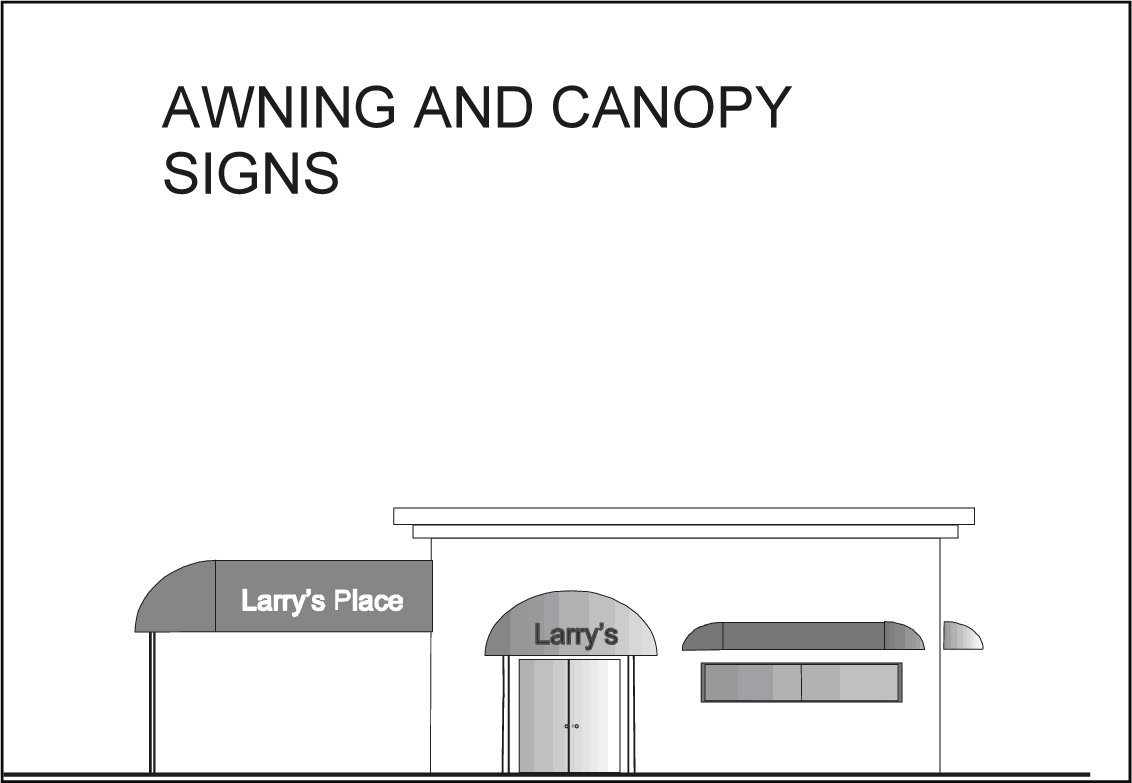
Awning Signs. Awning signs shall be placed upon the hanging border of an awning. The advertising surface of an awning sign shall not extend above or below the hanging border of the awning. The allowable area of the awning sign shall be limited to ten (10) percent of the awning surface or twenty-five (25) square feet, whichever is less. In no case shall an awning project beyond the back edge of a curb.
C.
Canopy Signs. The advertising surface of a canopy sign shall not extend above or below the canopy border. The area of the canopy sign shall be limited to ten (10) percent of the canopy surface or twenty-five (25) square feet, whichever is less.
(Ord. 2007-05 § 3 (part))
17.78.250 - Pole signs.
A.
Permitting. Permits for a pole sign shall be considered as part of the administrative permit process defined in Chapter 17.80, if the land is to be developed simultaneously with the pole sign, or is already developed. A conditional use permit, as defined in Chapter 17.80, shall be required for all pole signs that are to be located on land with no development.
B.
Design and Construction.
1.
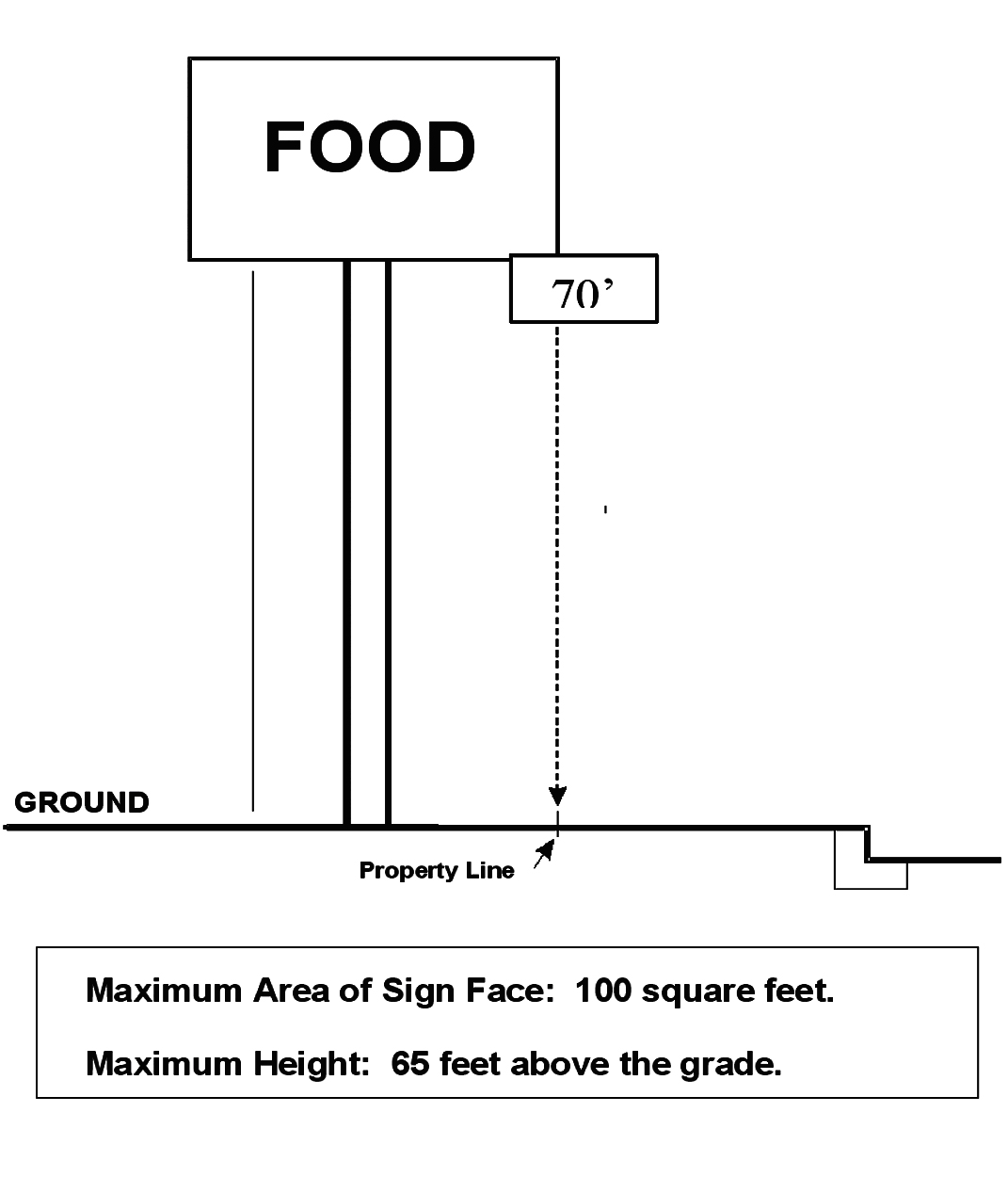
Maximum total sign area for pole or post signs shall be one hundred (100) square feet for a single (one use) sign and two hundred fifty (250) square feet for a multi-use sign.
2.
Maximum height of the pole or post for the sign shall not exceed seventy (70) feet above the finished grade, not including the sign. The sign area shall be limited to one hundred (100) square feet for a single use and two hundred fifty (250) square feet for multi-use.
3.
Pole signs shall only be allowed within six hundred (600) feet of Interstate "5" in the "C-2" (Community Commercial), "C-H" (Highway Service Commercial) or "PD" (Planned Development) Zoning Districts, only if the proposed use has been permitted by the city, subject to administrative review (subsection A of this section).
4.
Pole sign(s) shall be spaced a minimum of three hundred thirty (330) feet from an existing pole when possible. Where it is not possible to achieve a three hundred thirty (330) foot separation, the new pole sign shall be located as far from an existing pole sign(s) as practicable on the parcel and to the extent practicable shall not otherwise obstruct or block an existing sign.
5.
No pole or post sign shall project over any public right-of-way or sidewalk. Pole signs erected over a private vehicular drive shall be erected so as to provide not less than fifteen (15) feet vertical clearance.
6.
All such signs shall be required to provide an architecturally enhanced treatment for the sign base, pole and supports compatible with the individual business or the complex/center. Pole covers and sign base shall be a minimum of twenty-five (25) percent of the full sign width.
7.
Engineering plans shall be required in accordance with Section 17.78.050(J) for all pole signs.
8.
The ground area surrounding the pole base shall be clear of all brush, vegetation, weeds and debris within a fifteen (15) foot perimeter at all times.
a.
Multiple tenant signs may be added to and are allowed on existing pole signs as part of the administrative use permit process. The maximum allowable advertising surface per side for a multiple tenant pole sign is three hundred and fifty (350) square feet. Any additional signage added to an existing pole sign may not exceed the maximum allowable sign area. All requirements of the Orland Municipal Code shall apply.
9.
Pursuant to the provisions of Section 17.78.450, exceptions, a conditional use permit may be granted by the planning commission to exceed the allowable advertising surface for pole signs, to construct a pole sign within three hundred and thirty (330) feet of an existing pole sign or to exceed the maximum permitted pole sign height.
C.
Off Premises Joint-Tenant Multi-User Signs.
1.
Permits for a "joint-tenant" pole sign to be considered as part of the administrative permit process defined in OMC Chapter 17.80 if the land is to be developed simultaneously with the "joint tenant" pole sign or is already developed. A CUP, as defined in Chapter 17.80, shall be required for all "joint tenant" pole signs that are to be located on land with no development.
2.
All design and construction standards for pole signs (Section 17.78.250[B]) shall apply to all "joint-tenant" pole signs.
3.
"Joint-tenant" pole signs are allowed in the Freeway Influence Area (FIA) only (within one thousand seven hundred fifty (1,750) feet of the centerline of Interstate 5), and the subject properties must be zoned either C1, C2, CH, ML, MU, or PD and NOT in any 'R' (Residential) zoning districts.
4.
Only three off-site "joint-tenants" are permitted for each "joint-tenant" pole sign and only one off-site tenant is permitted for each off-site parcel.
5.
Off-site tenants must be on parcels of land directly adjacent (with no public Right of Ways in between) to the parcel of land at which the physical sign is erected and must be within the FIA.
6.
The "joint-tenant" pole sign owner is responsible for the maintenance and upkeep of the physical sign. Any advertising materials that may come loose for any reason, including but not limited to being blown off by winds, shall be repaired within thirty (30) days.
7.
In the case of a joint-tenant's business closing, that tenant's advertising on the "joint-tenant" pole sign shall be removed within ninety (90) days of the closing of the business. The empty advertising space left behind shall be filled with city staff-approved material.
8.
Individual sign leasing agreements made between the sign owner and off-site tenants shall be unique to each off-site tenant and shall remain in perpetuity with the lands.
9.
Pursuant to the provisions of Section 17.78.450, exceptions, a conditional use permit may be granted by the Planning Commission to exceed the allowable advertising surface for "joint-tenant" pole signs, to construct a "joint-tenant" pole sign within three hundred and thirty (30) feet of an existing pole sign, or to exceed the maximum permitted "joint-tenant" pole sign height.
D.
Freeway Influence Area.
The purpose of the Freeway Influence Area (FIA) is to define a boundary in which provisions of the Orland Municipal Code may apply to businesses surrounding the section of Interstate 5 (I-5) that is within one thousand seven hundred and fifty (1,750) feet due east and west of the centerline of I-5; no farther north than County Road 12 and no farther south than the current southern boundary (as defined at the time of the adoption of this ordinance) of the parcel of land to the south of the Butte College Glenn County Center (APN 040-350-003).
(Ord. 2007-05 § 3 (part))
(Ord. No. 2015-01, § 1(Exh. A); Ord. No. 2019-01; Ord. No. 2023-02 (Att. A))
17.78.300 - Monument signs.
A.
Permitting. Permits for a monument sign shall be considered as part of the administrative permit process defined in Chapter 17.80.
B.
Standards.
1.
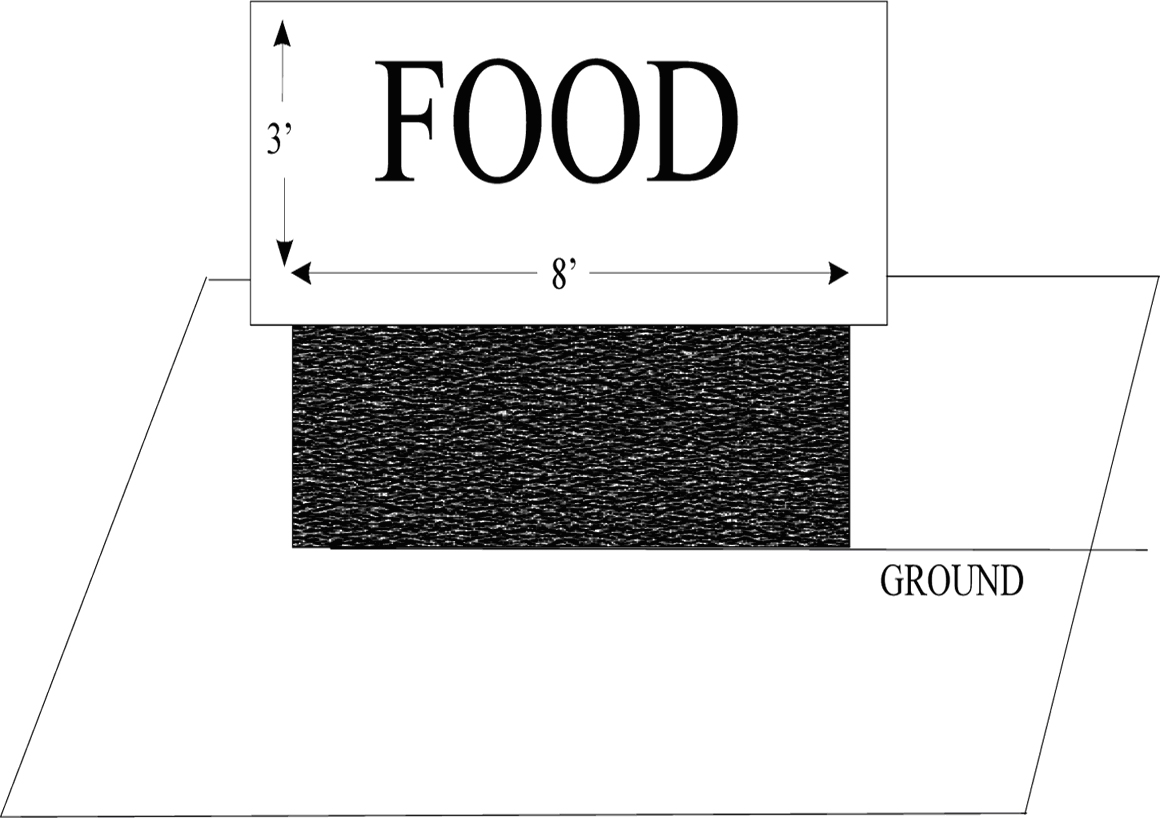
Monument signs shall not exceed a height of eight feet, including the base. The advertising surface of any sign face shall not exceed twenty-four (24) square feet per side. When practical, landscaping shall be provided around the base of the sign. Only one such sign is permitted for each street frontage. Provided that parcels with frontage exceeding two hundred (200) feet may have a maximum of two monument signs. The distance between monument signs on any one parcel shall not be less than fifty (50) feet.
2.
All such signs shall have monument-type bases of masonry construction. A comparable alternate basic material may be used upon approval by the city.
(Ord. 2007-05 § 3 (part))
17.78.350 - Multiple tenant signs.
A.
Permitting. Permits for commercial center signs pursuant to this chapter shall be considered as part of the administrative use permit process defined in Chapter 17.80.
B.
Multiple Tenant Identification Signs.
1.
A multi-tenant identification sign, which may include tenant directional signs, are permitted upon obtaining an administrative use permit (as defined in Chapter 17.80) pursuant to the following standards:
a.
Multi-tenant signs shall not be more than twelve (12) square feet in total area.
b.
Multi-tenant signs shall not exceed six feet in height above the finished grade.
c.
Exception: Pole or post signs in compliance with Section 17.78.250 and this title.
(Ord. 2007-05 § 3 (part))
17.78.400 - Wall signs.
A.
Permitting. Permits for a wall sign shall be considered as part of the administrative use permit process, as defined in Chapter 17.80.
B.
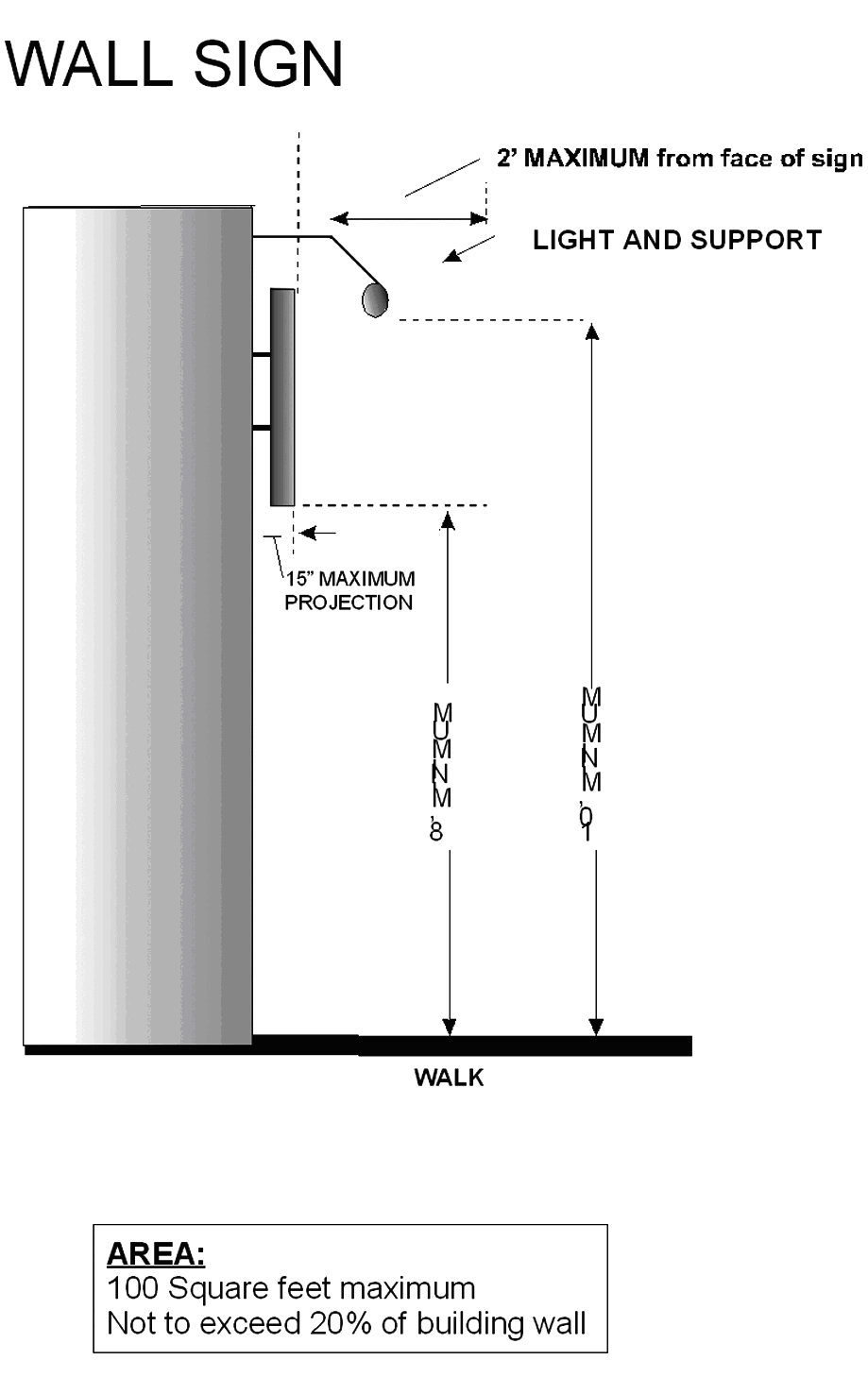
Location and Height. A wall sign shall not project more than fifteen (15) inches from the surface of the building to which it is attached. The face of any wall sign which extends over public property must be eight feet or more above the surface of the adjoining ground, sidewalk or pavement. Wall signs shall not extend above the roof line.
C.
Area Limit. The advertising surface of a wall sign or a combination of wall signs shall not exceed one hundred (100) square feet. Signs painted directly on the wall shall be included in the calculation of the one hundred (100) square foot maximum area. This includes any existing signs painted on the wall. In no event shall the area of the sign exceed twenty (20) percent of the area of the building wall upon which the sign is to be placed.
(Ord. 2007-05 § 3 (part))
17.78.405 - Digital display signs.
A.
Permitting. Permits for digital display signs shall be considered as part of the administrative use permit process, as defined in Chapter 17.80.
B.
Digital display signs are allowed as monument signs in the C-2, C-H and M-L zoning districts and a P-D district developed for commercial uses.
C.
Digital display signs are allowed as pole signs within the C-2 and C-H zoning districts and a P-D district developed for commercial uses.
D.
Digital display signs are allowed as wall signs within the C-2 and C-H zoning districts and a P-D district developed for commercial uses.
General Standards.
A.
Design and Construction.
1.
Digital display monument signs shall not exceed a height of eight feet, including the base. The advertising surface of any sign face shall not exceed twenty-four (24) square feet per side. When practical, landscaping shall be provided around the base of the sign. Only one such sign is permitted for each street frontage. Provided that parcels with frontage exceeding two hundred (200) feet may have a maximum of two monument signs. The distance between monument signs on any one parcel shall not be less than fifty (50) feet.
2.
Digital display monument signs shall have monument-type bases of masonry construction. A comparable alternate basic material may be used upon approval by the city.
3.
Digital display pole signs maximum total sign area shall be one hundred (100) square feet for a single (one use) sign and seven hundred fifty (750) square feet for a multi-use sign and a maximum height of the sign shall not exceed thirty (30) feet above the finished grade, including the sign with the exception of poles signs within six hundred (600) feet of Interstate 5. Digital display signs in this area are allowed a maximum height of seventy (70) feet above the finished grade, not including the sign.
4.
Digital display pole signs shall have architectural pole enclosures for the length of the pole(s) to add to the aesthetics of the design.
5.
No digital display pole sign(s) shall be allowed to be constructed within three hundred thirty (330) feet of any existing digital display pole sign unless otherwise permitted by the planning commission pursuant to the provisions of this section and Section 17.78.450, exceptions.
6.
Digital display wall signs shall not project more than fifteen (15) inches from the surface of the building to which it is attached. The face of any wall sign which extends over public property must be eight feet or more above the surface of the adjoining ground, sidewalk or pavement. Wall signs shall not extend above the roof line.
7.
The total surface area of a digital display wall sign or a combination of wall signs shall not exceed seven hundred fifty (750) square feet.
8.
Any digital displays shall display unanimated images and/or copy. For the purposes of this section, unanimated images and/or copy shall be defined as those which are changed no more than once per eight seconds.
9.
Digital displays shall not be brighter than the illumination limit recommended by the International Sign Association (ISA) for electronic message center signs, or 0.3 footcandles above ambient light when measured at the recommended distance as set forth by the ISA. Digital display signs shall be equipped with a photocell, timer, or other similar device which automatically dims the display during nighttime hours to prevent glare impacts to motorists.
10.
Pursuant to the provisions of Section 17.78.450, exceptions, a conditional use permit may be granted by the planning commission to exceed the allowable height and advertising surface for digital display sign(s).
(Ord. No. 2018-05, Exh. A)
17.78.410 - Off-premises multi-user signs.
A.
Permitting. Permits for off-premises multi-user signs shall be considered as part of the administrative use permit process, as defined in Chapter 17.80.
B.
Off-premises multi-user signs are only allowed in the Highway Business Area as defined by Figures 1A and 1B.
C.
Only one off-premises multi-user sign per Highway Business Area shown on Figures 1A and 1B is allowed.
D.
Off-premises signs for properties within the Highway Business Area are allowed to be displayed on the multi-user sign with approval by the city planner.
E.
The property owner on the parcel that the off-premises multi-user sign is located, is considered to be the sign owner by the city. The sign owner is responsible for all upkeep and maintenance of the sign.
General Standards
A.
Design and Construction.
1.
Sign can be either fully digital or fully non-digital. No mix of digital and non-digital signs are permitted with the exception that the digital sign may have a non-digital "banner" sign such has "City of Orland" or "Orland Mall" or other appropriate use.
2.
Maximum total sign area for pole or pylon off-premises multi-user sign(s) shall be seven hundred fifty (750) square feet.
3.
Maximum height of the pole or pylon for the sign shall not exceed seventy (70) feet above the finished grade, not including the sign.
4.
Multi-user pole signs shall only be allowed within three hundred (300) feet of Interstate "5" in the Highway Business Area.
5.
No off-premises multi-user sign(s) shall be allowed to be constructed within three hundred thirty (330) feet of any existing off-premises multi-user sign(s) unless otherwise permitted by the planning commission pursuant to the provisions of this section and Section 17.78.450, exceptions.
6.
The area of off-premises signs shall count towards the maximum allowed sign area for the multi-user digital display sign.
7.
Any digital displays shall display unanimated images and/or copy. For the purposes of this section, unanimated images and/or copy shall be defined as those which are changed no more than once per eight seconds.
8.
Digital displays shall not be brighter than the illumination limit recommended by the International Sign Association (ISA) for electronic message center signs, or 0.3 footcandles above ambient light when measured at the recommended distance as set forth by the ISA. Multi-user digital display pole signs shall be equipped with a photocell, timer, or other similar device which automatically dims the display during nighttime hours to prevent glare impacts to motorists.
9.
No off-premises multi-user sign(s) shall project over any public right-of-way or sidewalk. Pole signs erected over a private vehicular drive shall be erected so as to provide not less than fifteen (15) feet vertical clearance.
10.
All such signs shall be required to provide an architecturally enhanced treatment for the sign base, pole and supports. Pole covers and sign base shall be a minimum of twenty-five (25) percent of the full sign width.
11.
Engineering plans shall be required in accordance with Section 17.78.050(J) for all pole/pylon signs.
12.
The ground area surrounding the pole/pylon base shall be clear of all brush, vegetation, weeds and debris within a fifteen (15) foot perimeter at all times.
13.
Pursuant to the provisions of Section 17.78.450, exceptions, a conditional use permit may be granted by the planning commission to exceed the allowable advertising surface for off-premises multi-user sign(s), to construct an off-premises multi-user sign(s) within three hundred thirty (330) feet of an existing off-premises multi-user sign(s) or to exceed the maximum permitted pole/pylon sign height.
Figure 1A: Highway Business Area - Off-Premises Multi-User Signs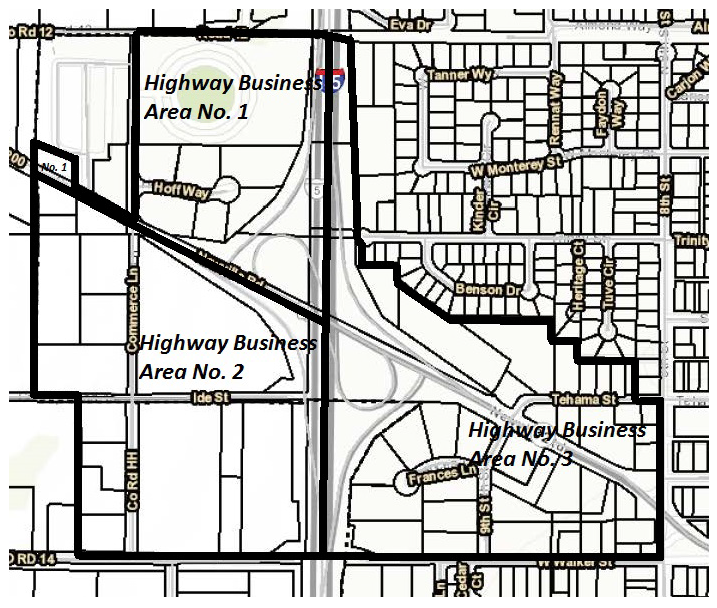
Figure 1B: Highway Business Area - Off-Premises Multi-User Signs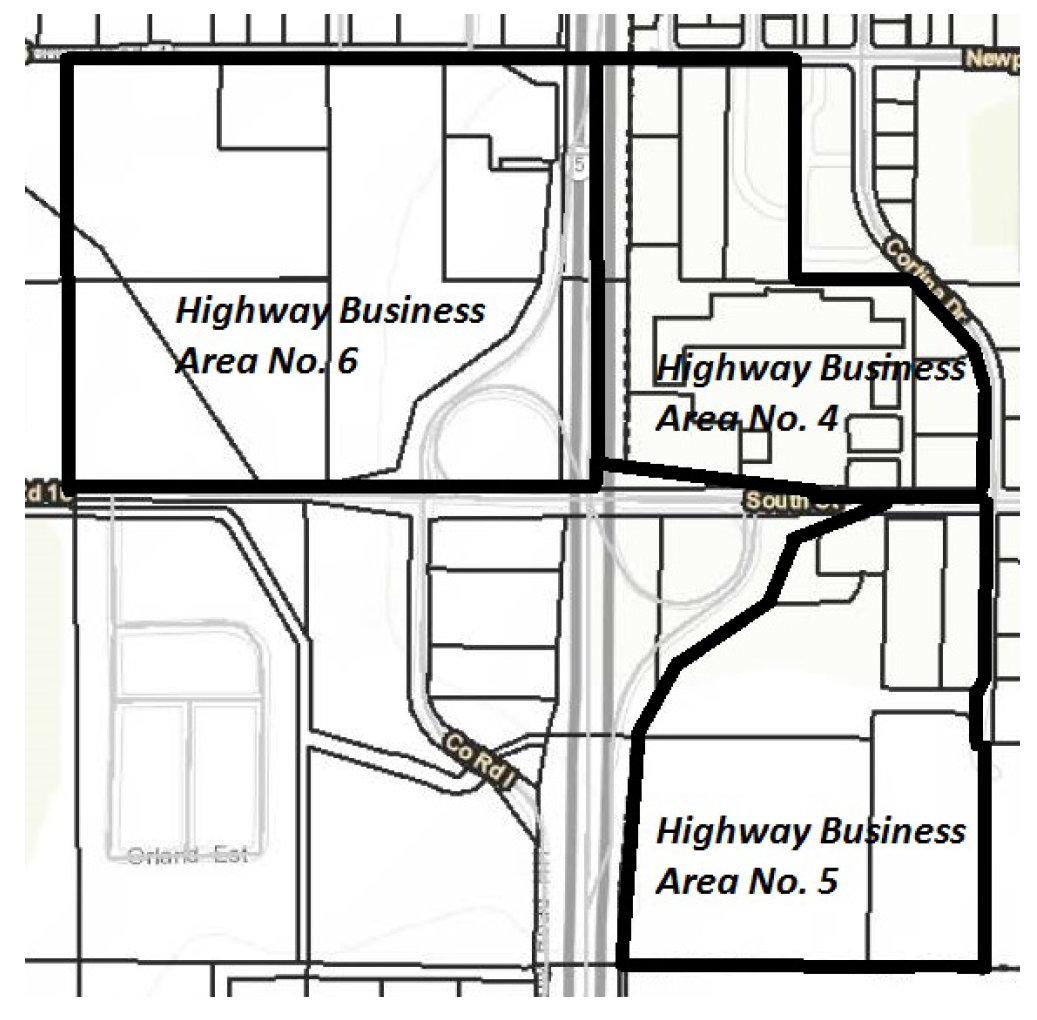
(Ord. No. 2018-06, Exh. A)
17.78.420 - Portable signs.
General Standards.
A.
A portable sign shall not exceed a maximum size of twelve (12) square feet in total area and shall not have any dimension greater than four feet. Only one side of a portable sign will be counted for the purposes of determining sign advertising area. The vertical dimension of the sign (height) including any support structures, handles or hinges may be no greater than forty-eight (48) inches.
B.
Portable signs may not be located in any residential zoning district and shall only be permitted within the mixed use designated commercial downtown area; on commercial zoned properties immediately adjacent to Walker Street, Newville Road, Sixth Street, and South Street; and on industrially zoned properties.
C.
Portable signs shall be prohibited in the public right-of-way, except in the mixed use designated commercial downtown area and as further defined in subsection (B).
Portable Sign Limitations. Portable signs, when permitted, shall meet the following standards and requirements:
A.
Portable signs shall be allowed to be displayed only during the business hours of the business for which the sign has been established;
B.
A maximum of one portable sign may be permitted per occupied tenant space or individual business;
C.
Portable signs shall not be placed within a street site visibility triangle area measuring (thirty (30) feet by thirty (30) feet) or in an area where they would in any way block the view of drivers of vehicles or pedestrians when at or approaching intersections or driveways;
D.
Portable signs shall not use, incorporate or affix materials or items to include streamers, balloons, wind socks, reflectors, etc., to increase visibility;
E.
Portable signs shall be weighted down or secured as to minimize sign-related hazards;
F.
Portable signs shall not be attached permanently or temporarily to any object, structure, or the ground (for example: utility poles, fences, trees, or traffic signs);
G.
In case the portable sign is removed from the public right-of-way due to safety concerns, contact information shall be identified on the sign;
H.
Portable signs shall only be placed immediately in front of the business to which the sign is advertising and shall be located so that it does not interfere with pedestrian movement or in a manner that presents a safety hazard to pedestrians or vehicles.
Enforcement. The city shall enforce the provisions of this section of the code with enforcement to include the physical removal of signs not legally placed pursuant to this section. In the event that the sign is removed from the public right-of-way due to safety hazard concerns, signs shall be stored by the city for a period of not less than sixty (60) days after which the time the sign may be disposed. Signs that are placed illegally but that are not determined to be safety hazards shall be subject to normal enforcement through the code enforcement process.
(Ord. No. 2013-04, §§ 17.78.421—17.78.423)
Editor's note— Ord. No. 2013-04, adopted Nov. 4, 2013, adopted provisions designated as ch. 17.78.420, §§ 17.78.421—17.78.423. In order to conform to the style of the code, and at the editor's discretion, said provisions have been redesignated as § 17.78.420.
17.78.430 - Flag and banner signs.
General Standards.
A.
Each flag or banner sign shall not exceed a maximum size of twenty-five (25) square feet in sign advertising area. Only one side of a flag or banner sign will be counted for the purposes of determining sign advertising area.
B.
The maximum single dimension of the sign (height) including any support structures, poles or hinges may be no greater than ten (10) feet.
C.
Flag or banner signs may not be located in a residential zoning district and shall only be permitted within the mixed use designated commercial downtown area; on commercial zoned properties; and on industrially zoned properties.
D.
Flag and banner signs shall be prohibited in the public right-of-way, except in the mixed use designated commercial downtown area and as further permitted in subsection (B).
Flag and Banner Sign Limitations. Flag and banner signs, when permitted, shall meet the following standards and requirements:
A.
Flag and banner signs shall be allowed to be displayed only during the business hours of the business for which the flag or banner sign has been established;
B.
One flag sign is permitted per fifty (50) linear feet of street frontage per occupied tenant space or individual business with no maximum amount of flag signs. All occupied tenant spaces or individual businesses are allowed at least one flag sign;
C.
One banner sign is permitted per fifty (50) linear feet of street frontage per occupied tenant space or individual business with the maximum of three banner signs. All occupied tenant spaces or individual businesses are allowed at least one banner sign;
D.
Flag or banner signs shall not be placed within a street site visibility triangle area measuring (thirty (30) feet by thirty (30) feet) or in an area where they would in any way block the view of drivers of vehicles or pedestrians when at or approaching intersections or driveways;
E.
Flag or banner signs shall not use, incorporate or affix materials accessory attachments not a part of the flag or banner itself (streamers, balloons, wind socks, reflectors, etc.) to increase visibility;
F.
Flag and banner signs shall not be attached to utility poles, light fixtures, traffic control devices or similar objects;
G.
Flag and banner signs shall only be placed immediately in front of the business to which the sign is advertising and shall be located so that it does not interfere with pedestrian movement or in a manner that presents a safety hazard to pedestrians or vehicles.
Enforcement. The city shall enforce the provisions of this section of the code with enforcement to include the physical removal of signs not legally placed pursuant to this section. In the event that the sign is removed from the public right-of-way due to safety hazard concerns, signs shall be stored by the city for a period of not less than sixty (60) days after which the time the sign may be disposed. Signs that are placed illegally but that are not determined to be safety hazards shall be subject to normal enforcement through the code enforcement process.
(Ord. No. 2013-05, §§ 17.78.431—17.78.433)
Editor's note— Ord. No. 2013-05, adopted Nov. 11, 2013, adopted provisions designated as ch. 17.78.430, §§ 17.78.431—17.78.433. In order to conform to the style of the code, and at the editor's discretion, said provisions have been redesignated as § 17.78.430.
17.78.440 - Temporary signs.
General Standards. Temporary signs may be displayed subject to the requirements of this section.
A.
Material. Temporary exterior signs shall be made of a durable weather-resistant material.
B.
Duration. Unless otherwise specified by these regulations, temporary signs may be displayed for a maximum of forty-five (45) consecutive days. The total number of days during which all temporary signage may be displayed shall not exceed ninety (90) days per year.
C.
Illumination. Temporary signs shall not be illuminated.
D.
Standards for Specific Temporary Sign Types.
1.
Real Estate Signs. One real estate sign, which advertises the sale, rental or lease of the premises is permitted on each parcel frontage as follows:
a.
Single-family residential zoned parcels, six square foot maximum area per sign.
b.
Multi-family residential zoned parcels, twelve (12) square foot maximum area per sign.
c.
Nonresidential zoned parcels, eight square foot maximum area per sign.
d.
The residential signs shall not exceed six feet in height above the ground, and the nonresidential signs eight feet above the ground. [Note: this is taken from [Section] 17.78.750.B.1.a.]
2.
Directional Signs for Open Houses. Notwithstanding any other provision in this chapter, up to three off-site signs directing the public to "open house" events for the viewing of lots, premises, dwellings or structures that are for sale, lease, or rent, are permitted subject to the approval of the property owner provided they comply with the following standards:
a.
No sign or signs shall exceed four square feet in area, or three feet in height from finished grade.
b.
The sign or signs may not be placed more than twelve (12) hours before the start or remain more than twelve (12) hours after the conclusion of the open house event.
3.
Subdivision Signs. In all zones, a maximum of three unlighted double-faced temporary subdivision signs, not exceeding forty (40) square feet in area per display face and fifteen (15) feet in overall height, may be erected and maintained with a subdivision during sale of the lots. Such signs shall be located within the subdivision and shall be a minimum distance of three hundred (300) feet apart from each other. All signs shall be removed at the close of escrow of the model complex houses.
4.
Protected Non-Commercial Political and Free Speech Signs. Non-illuminated temporary signs displaying protected non-commercial messages, maximum four feet in height, totaling no more than six square feet in area may be displayed upon any single property/parcel, with the permission of the property/parcel owner within the city at any time. However, during the period of time beginning sixty (60) days before a general, special, primary or runoff election, and ending fifteen (15) days after such election, the amount of display area may be doubled. Flags do not count toward the signage allowed under this provision. This display area allowance is in addition to that allowed under the message substitution policy.
5.
Special Event Signs.
a.
Special event signs may be displayed for a maximum of thirty (30) days within a ninety-day period.
b.
Special event signs shall be prohibited in the public right-of-way, except as permitted in Sections 17.78.420 and 17.78.430.
c.
Special event signs shall not use, incorporate, or affix materials or accessory attachments not a part of the sign itself (streamers, balloons, wind socks, reflectors, etc.) to increase visibility.
d.
Special event signs shall not be attached to utility poles, light fixtures, traffic control devices or similar objects.
e.
Special event signs shall not be placed within a street site visibility triangle area measuring (thirty (30) feet by thirty (30) feet) or in an area where they would in any way block the view of drivers of vehicles or pedestrians when at or approaching intersections or driveways.
f.
Special event signs shall be located so that they do not interfere with pedestrian movement or in a manner that presents a safety hazard to pedestrians or vehicles.
g.
Special event signs are prohibited in residentially zoned property.
h.
Special event sign standards:
(1)
No more than one such sign is allowed for each street frontage.
(2)
Maximum sign area not to exceed fifty (50) square feet. The area of an inflatable device shall be measured like a sphere as described in Section 17.78.050 and shall not exceed one hundred (100) square feet with an aggregate maximum of two hundred (200) square feet.
(3)
If temporary signs are placed in windows, they shall not exceed fifty (50) square feet or twenty (20) percent of the total window and glass door area, whichever is the most restrictive requirement.
6.
Community Event Signs:
a.
Community event signs may be displayed for a maximum of thirty (30) days before the event and must be removed within three days upon event completion.
b.
Except in the mixed use designated commercial downtown area, no community event sign shall be placed on public property or within any public right-of-way.
c.
No community event sign shall be placed on private property without the permission of the property owner.
d.
Community event signs shall not use, incorporate, or affix materials or accessory attachments not a part of the sign itself (streamers, balloons, wind socks, reflectors, etc.) to increase visibility.
e.
Community event signs shall not be attached to utility poles, light fixtures, traffic control devices or similar objects.
f.
Community event signs shall not be placed within a street site visibility triangle area measuring (thirty (30) feet by thirty (30) feet) or in an area where they would in any way block the view of drivers of vehicles or pedestrians when at or approaching intersections or driveways.
g.
Community event signs shall be located so that it does not interfere with pedestrian movement or in a manner that presents a safety hazard to pedestrians or vehicles.
E.
Enforcement. In addition to all remedies provided in this code, enforcement of this section of the code includes the physical removal of temporary signs by the city that do not comply with the time, place or manner provisions of this section.
(Ord. No. 2013-05, §§ 17.78.441—17.78.443; Ord. No. 2016-08)
Editor's note—
Ord. No. 2013-05, adopted Nov. 11, 2013, adopted provisions designated as ch. 17.78.440,
§§ 17.78.441—17.78.443. In order to conform to the style of the code, and at the editor's
discretion, said provisions have been redesignated as § 17.78.440.
Subsequently, Ord. No. 2016-08, adopted Oct. 17, 2016, changed the title of § 17.48.440 from "Special and community
event signs" to read as herein set out.
17.78.450 - Exceptions.
A.
Signs Urgently Needed. Any sign deemed by the city manager to be urgently needed due to undue economic hardship upon the applicant may be allowed temporarily by the city manager, upon submittal of an administrative use permit application for the sign, until such time as the appropriate approving authority approves or denies the application. In the event such application is ultimately denied, any such sign erected pursuant to this subsection shall be removed within fifteen (15) days from the date of such denial.
B.
Additional Signing Allowed by Conditional Use Permit.
1.
The planning commission, by way of a conditional use permit, may allow additional sign types, number of signs, size of signs, spacing of signs and number of locations. The applicant must submit a statement with the application supporting the request for the additional signing. Criteria for additional signing may include large parcel size, unusual configuration of location, size of buildings, multiple street frontages, number of independent businesses, location of the building on the parcel or unique qualities of the use of the parcel, any of which must relate to the finding which shall be required of the planning commission that the additional signing will not be contrary to the intent of this chapter or the public interest, safety, health and welfare.
2.
Under such conditional use permit sign request, the planning commission may increase each allowed sign area by up to fifteen (15) percent for any such sign.
C.
Height and Size Exceptions—Conditions for Granting.
i.
The planning commission, through a conditional use permit, may grant exceptions upon the verified application of any property owner as to the maximum overall height of any sign above natural ground level or as to the maximum square feet of advertising surface, whenever one or more of the conditions hereinafter set forth exist.
a.
The proposed sign location is located within freeway interchange properties designated by resolution of the city council and is a dining, lodging, vehicle fueling, vehicle service business, or unique tourist attraction whose primary clientele are the motoring public on Interstate 5.
b.
The proposed sign identifies a retail shopping center or industrial park or similar complex, involving a total of at least one hundred thousand (100,000) square feet of gross floor area, or an individual business with a gross floor area exceeding fifty thousand (50,000) square feet.
c.
The grade of the nearest adjacent street or highway, excluding the interstate freeway, to the proposed sign location is of an elevation ten (10) feet or more above the natural ground level of the sign site.
2.
In the exercise of the power herein delegated, the planning commission shall impose such conditions upon exceptions so granted as in its judgment may be necessary to assure compliance with the spirit and purpose of this title.
3.
As to the existence of any of the herein above set forth conditions and the necessity for exception from the provisions of this title, the burden of proof shall be upon the applicant.
D.
Public Service or Directional Signs.
1.
Permits for public services or directional signs shall be considered as part of the administrative use permit process defined in Chapter 17.80. Any such sign will provide only directional information as to the location of services or goods and shall contain no advertising content identifying a particular brand name or product or a particular business.
2.
Public service or traffic signs erected by the city are exempt from the provisions of this title.
3.
Exempt parking and directional signs are set forth in Section 17.78.650.
(Ord. 2007-05 § 3 (part))
(Ord. No. 2015-01, § 1(Exh. A))
17.78.500 - Federal and state law provisions.
A.
Federal Law. Nothing in this title, either by inclusion or omission, shall be deemed to be in conflict with Public Law 89-285, 89th Congress, S. 2084, October 22, 1965, known as the Highway Beautification Act of 1965, 79 Stat. 1028, or the State Scenic Highway Act of 1963, as such laws apply or may apply to the portions of the interstate system and the primary system of the federal and state highways now within or which may come within the limits of the city.
B.
State Law. Nothing in this title, either by inclusion or omission, shall be deemed to be in conflict with any of the laws of the state of California, as such laws apply or may apply to the portions of the interstate system and the primary system of federal and state highways now within or which may come within the limits of the city.
(Ord. 2007-05 § 3 (part))
17.78.550 - Noncommercial signs.
Noncommercial signs shall be allowed under the same conditions in which a commercial sign is allowed pursuant to this title. The city shall have the right to review, approve or disapprove the contents or copy of any such signs. The permit procedures shall otherwise be the same as for commercial signs.
(Ord. 2007-05 § 3 (part))
17.78.600 - Sign maintenance and materials.
A.
Sign Materials. All signs shall be comprised of materials that are not considered hazardous to public safety, as approved by the planning department.
B.
Prohibited Sign Materials. Signs of the following materials shall be prohibited within the city of Orland:
1.
Cardboard;
2.
Roof tin;
3.
Spray paint.
C.
Sign Maintenance.
1.
All signage within the city of Orland shall be maintained by the owner or person in possession of the property on which the sign is located. Maintenance shall be such that the signage continues to conform to all conditions stated in this section.
2.
Any damaged sign or sign base shall be repaired within thirty (30) days of notice to repair, issued by the building department.
3.
Any metal pole covers and sign cabinets shall be kept free of rust and rust stains.
4.
Any internally-illuminated sign cabinets or sign panels which have been damaged shall remain un-illuminated until repaired.
5.
All signs erected within the city limits shall be kept weed free.
(Ord. 2007-05 § 3 (part))
17.78.650 - Comprehensive sign plan.
A.
Purpose. A comprehensive sign plan shall be provided for groups of businesses or for the whole of a shopping center development. Such a plan shall regulate the location, size, height, color, orientation, lighting, and types of signs included in the area.
B.
Contents. The comprehensive sign plan:
1.
Shall propose signage which in height and area is no more than twenty (20) percent greater than is permitted in the zoning district in which the use is located;
2.
Shall not propose signage of a type that is otherwise prohibited by this code;
3.
Shall be limited to those projects which individually or collectively exceed ten (10) gross acres in size for nonresidential and one hundred (100) gross acres in size for residential, and/or are located immediately adjacent to, or within two hundred fifty (250) feet, of Interstate 5.
C.
Submittal. The applicant shall submit all of the documents, information, data, and other requirements for comprehensive sign plan approval to the city at the time of application. The applicant shall be responsible for furnishing any additional information and materials relevant to the application that the city may require.
D.
Review.
1.
Application for the review and approval of a comprehensive sign plan shall be submitted and reviewed concurrently with a site plan or preliminary subdivision plat and shall be acted upon by the city council following review and recommendation by the planning commission.
2.
Applications submitted for existing developments shall be submitted to and reviewed by the city and acted upon by the city council following review and recommendation by the planning commission. The city council may approve the comprehensive sign plan subject to any modifications, conditions, requirements, or standards that may be appropriate.
3.
Fees for the submittal and review of comprehensive sign plans shall be as set forth by the city council.
E.
Evaluation Criteria.
1.
Size and Height. All proposed signage shall be no larger than allowed in that zoning district. Factors to be considered in determining appropriate size and height include topography, traffic volumes, traffic speeds, visibility ranges, impact on adjacent properties, and copy size.
2.
Location and Orientation. All proposed signage shall respect both the developed and undeveloped surrounding environment. Signs shall be located and oriented appropriately to allow sufficient visibility and legibility. Factors that may be considered in reviewing the appropriateness of the sign location and orientation may include: location relative to the surrounding streets, traffic volumes and access points, visibility angles and topographic features.
3.
Color, Materials and Types of Illumination. Signs proposed under the comprehensive sign plan shall be compatible with the architecture and theme of the specific development in which the signs are located. Compatibility with the specific development shall include color, materials and architectural style. Signage shall compliment and enhance the character of the project.
F.
Amendments. All amendments to an approved comprehensive sign plan shall be processed in accordance with the following procedures. Fees for the submittal and review of comprehensive sign plan amendments shall be as set forth by the city council.
1.
Minor Amendments. Minor amendments shall include any change which does not increase the number of signs nor increase the size or height of any sign beyond what was approved under the original comprehensive sign plan approval. All changes processed under the minor amendment procedures shall comply with all provisions of this section and shall not deviate from the information provided in the original approval. Minor amendments shall be approved administratively by staff.
2.
Major Amendments. Major amendments shall be defined as those amendments not meeting the criteria set forth above to qualify as a minor comprehensive sign plan amendment. Major amendments shall be processed and approved in the same manner as the initial comprehensive sign plan submittal.
(Ord. 2007-05 § 3 (part))
17.78.700 - Prohibited signs.
A.
Nonconforming Signs.
1.
Any existing sign which was in compliance with all signage requirements when erected, but no longer complies with the provisions of this title shall not be substantially altered or reconstructed unless the sign, when so reconstructed or altered, complies with the applicable requirements of this title.
2.
Reasonable repairs and alterations may be made to nonconforming signs. However, in the event any such sign is hereafter damaged exceeding fifty (50) percent of the reproduction cost, according to appraisal thereof by competent appraisers, or is removed by any means whatsoever, including an act of God, such sign may be restored, reconstructed, altered, or repaired only to conform with the provisions set forth in this section.
3.
Whenever the business conducted on premises changes, the subsequent sign-modifications to reflect that change, whether it is in copy, size, or shape of signage, must bring the sign into conformance with regulations set forth in this section.
4.
Any nonconforming sign cannot be expanded or enlarged.
B.
Signs Which May Confuse Traffic.
1.
No sign shall be erected, constructed or maintained if which sign displays or makes use of the words "stop," "danger," or any other word, phrase, symbol or character, in such a manner as to interfere with, mislead or confuse traffic.
2.
Signs having red, green or amber lights that could be confused with traffic signals shall not be permitted if designed or located to be seen primarily by vehicular traffic. Such colors are not prohibited where, by the design of the sign or lights used, it is extremely unlikely that such lights could be confused with traffic signals by the driving public.
C.
Roof Signs. Roof signs are prohibited.
D.
Reserved.
E.
Obscene Signs. Obscene signs containing statements, words, pictures, or other representations, which are obscene as defined in Penal Code Section 311 are prohibited.
F.
Parking of Advertising Vehicles Prohibited. No person shall park any vehicle or trailer in a public right-of-way, or on private property so as to be visible from a public right-of-way, which has attached thereto or located thereon any sign or advertising device for the basic purpose of providing advertisement of products or directing people to a business. This section is not intended to apply to standard advertising or identification practices where such signs or advertising devices are painted on or permanently attached to a business or commercial vehicle and are used in conjunction with the business that it identifies or advertises including vehicles utilized for the delivery of business products.
G.
Unsafe Signs. The owner of any sign as defined and regulated by this title, including supporting structures, shall keep the same in a safe condition at all times. If the building official finds that any sign regulated herein is unsafe or insecure, or is a menace to the public, he or she may give written notice to the sign owner and to the property owner. If such sign owner fails to remove or alter the sign so as to comply with the standards herein set forth within thirty (30) days after such notice, the building official may cause such sign to be removed or altered to comply at the expense of the sign owner or owner of the property upon which it is located.
The building official may cause any sign, which is an immediate danger to persons or property to be removed summarily and without notice.
H.
Clearance from Electric Power and Communication Lines. No sign shall be constructed, installed or erected, which has less horizontal or vertical clearance from energized electric power lines and communication lines than prescribed by the California Penal Code, Section 385, the regulations of the California Public Utilities Commission, and the orders of the Division of Industrial Safety, state of California.
I.
Obstruction of Fire Escapes, Stairways, or Exterior Doors.
1.
No portion of any sign, or the supports thereof, shall be placed so as to obstruct any fire escape, stairway, exterior door or standpipe, nor shall any such outdoor advertising structure or sign or any of the supports thereof, be attached to or supported by any fire escape.
2.
No portion of any sign or the supports thereof shall be placed so as to interfere with human exit through any window of any room.
J.
Removal of Certain Advertising. Any advertising copy or message now or hereafter existing which advertises a business no longer in operation under the same name, a product or service which is no longer available, a public or private event which has already occurred, or a candidate for public office, the election for which has already taken place, shall be removed by the owner, agent or person having the beneficial use of the building, or structure or premises upon which such copy or message may be found, within thirty (30) days after written notice from planning director. Upon failure to comply with such notice within the time specified in such order, the planning director is authorized to cause the removal of the advertising copy or message, and the expense incident to such removal shall be the obligation of the owner of the building, or structure or premises on which the advertising copy or message is displayed.
K.
Obstruction to Traffic Signs. No sign shall be erected at any location where, by reason of its position, it will obstruct or interfere with the view of any authorized traffic sign, signal or device.
L.
Liability for Damages. The provision of this title shall not be construed as relieving, or limiting in any way, the responsibility or liability of any person erecting or owning any sign from person injury or property damage resulting from the placing of such sign, or resulting from the negligence or willful acts of such person, his agents, employees or workmen, in the construction, maintenance, repair or removal of any sign erected in accordance with a permit issued hereunder. Nor shall this title be construed as imposing upon the city, or its officers or employees, any responsibility or liability by reason of the approval of any signs, materials, or devices under the provisions of this title.
(Ord. 2007-05 § 3 (part))
(Ord. No. 2013-04)
17.78.750 - Exempt signs.
A.
General Compliance Requirements. All signs not expressly exempted by a provision of this chapter shall be subject to the provisions of this code and shall comply with all applicable provisions thereof.
B.
Exempt Signs.
1.
The provisions and regulations of this title shall not apply to the following signs:
a.
Window signs, the combined total of which do not exceed twenty (20) percent of the window area;
b.
Bulletin boards not over twelve (12) square feet in area for public, charitable or religious institutions when the same are located on the premises of such institutions, as part of an approved monument sign;
c.
Signs denoting the architect, engineer contractor, or financing institution when placed upon work under construction, and not exceeding twelve (12) square feet in area;
d.
Signs placed flat against the facade of a building that identifies the history and name of a building or historic events not exceeding three square feet in area and constructed of bronze, brass, or other like incombustible material;
e.
Traffic or other municipal signs, legal notices or railroad crossing signs;
f.
Signs of public service companies indicating danger, and aids to service or safety;
g.
Signs placed on the interior of a property and not seen from the public right-of-way;
h.
Gasoline price signs not exceeding twenty (20) square feet per side; with no more than two separate signs per parcel;
i.
California, United States and other flags not used as general advertising for hire;
j.
Signs placed in parking lots to direct traffic and inform users of parking requirements;
k.
Warning signs to indicate danger or to serve as an aid to public safety or to show the location of public utilities' underground facilities;
l.
Farmers' market signs. City approved farmers' markets are allowed two on-site signs with a maximum area of thirty-two (32) square feet each and two off-site signs with a maximum area of twelve (12) square feet with permission from the property owner. Each vendor may display one temporary sign with a maximum area of twenty (20) square feet. No sign shall be located in the public right-of-way.
2.
Ordinary maintenance and repair of an existing conforming advertising structure provided there is no structural modification including repainting with the same colors.
3.
Informational window signs shall be exempt as follows:
a.
Small non-illuminated informational signs related to the operation of the business located on the windows or glass doors are exempt from these provisions and are not included in the total allowed sign area. Examples of such signs are "open/closed" signs, credit card signs, rating or professional signs, and signs of a similar nature. Only one of each type of sign is allowed, not to exceed one square foot in area per sign with no more than four in number at any individual business.
b.
One neon or other "open" sign is permitted in the window per each street frontage as a sign exempt from the provisions of this title and shall not exceed four square feet in area. The area of the open sign is not included in the total allowed window sign area.
C.
Fee Exempt Signs. All temporary signs and signs erected by nonprofit or volunteer organizations are exempt from the requirement of paying application and sign permit fees. An application and sign permit for any such sign is required in the same manner as otherwise provided in this title. These signs shall not be displayed for more than ninety (90) days. An extension may be granted upon authorization by the city of Orland planning department.
D.
Exempt Parking and Directional Signs.
1.
Parking directional signs not exceeding eight square feet per side located in close proximity to driveway entrances are exempt.
2.
Directional signs located within a nonresidentially zoned parcel for the purpose of directing vehicular traffic or pedestrians to specific entrances or services at the business facility shall be exempt provided that the face of any such sign shall not exceed eight square feet.
(Ord. 2007-05 § 3 (part))
(Ord. No. 2013-05, § 17.78.752; Ord. No. 2016-08)

