
Oskaloosa City Zoning Code
CHAPTER 17
03 - DEFINITIONS
17.03.010 - Purpose.
This chapter shall be known as the "definitions." The purpose of this chapter is to promote consistency and precision in the interpretation of this title. The meaning and construction of words as set forth shall apply throughout this title, unless where modified in a specific section or where the context of such words or phrases clearly indicates a different meaning or construction.
(Ord. No. 1465, § 2(Att.), 9-11-2023)
17.03.020 - General construction.
The following general rules of construction apply to the text of this title.
A.
Headings. Section and subsection headings contained herein are provided for illustrative purposes only and shall not be deemed to limit, govern, modify, or otherwise affect the scope, meaning, or intent of any provision of this title.
B.
Illustration. In the case of any real or apparent conflict between the text of this title and any illustration explaining the text, the text shall control.
C.
Shall and May. "Shall" is always mandatory. "May" is discretionary.
D.
Tenses and Numbers. Words used in the present tense include the future tense. Words used in the singular include the plural, and the plural the singular, unless the context clearly indicates the contrary.
E.
Conjunctions. Unless the context clearly indicates the contrary, the following conjunctions shall be interpreted as follows:
1.
"And" indicates that all connected items or provisions apply.
2.
"Or" indicates that the connected items or provisions may apply singly or in any combination.
3.
"Either ... or" indicates that the connected items or provisions shall apply singly but not in combination.
F.
Referenced Agencies. Unless otherwise indicated, all public officials, bodies, and agencies referred to in this title are those of the city.
(Ord. No. 1465, § 2(Att.), 9-11-2023)
17.03.030 - Definition of terms.
For the purposes of this title, certain terms and words are defined. Certain sections contain definitions which are additional to those listed here. Where terms are not specifically defined, their ordinarily accepted meaning or meanings implied by their context shall apply.
"Abutting or adjacent" means having lot lines or district boundaries in common, including property separated by a public street or alley.
"Accessory use or structure" means a use or structure which is incidental to and customarily associated with a specific principal use or building on the same site. For accessory uses not stated in Section 17.04.120 Accessory Uses, or Section 17.04.130 Temporary Uses, "customarily incidental" shall be determined by the criteria in Subsection 17.04.110.D Uses That Are Not Listed.
"Addition" means any construction which increases the size of a building or structure in terms of site coverage, height, length, width, or gross floor area.
"Agent of owner" means any person showing written verification that they are acting for, and with the knowledge and consent of, a property owner.
"Alley" means a public right-of-way, other than a street and less than twenty feet wide which is used as a secondary means of access to abutting property.
"Alteration" means any construction or physical change in the internal arrangement of spaces, the supporting members, the positioning on a site, or the appearance of a building or structure.
"Attached" means having one or more walls in common with a principal building or connected to a principal building by an integral architectural element, such as a covered passageway, facade wall extension, or archway.
"Base zoning district" means a district established by this title which prescribes basic regulations governing land use and site development standards. No more than one base zoning district shall apply to any individually platted lot or parcel unless the lot or parcel is part of a planned unit development.
"Basement" means a level of a building below street level that has at least one-half of its height below the surface of adjacent ground.
"Beginning of construction" means the beginning of site work and grading.
"Block" means an area of land within a subdivision that is entirely bounded by streets, by streets and the exterior boundaries of the subdivision, or by a combination of the above with a watercourse, lake, railroad, or other significant natural or manmade barrier, and which has been designated as such on a plat for the purposes of legal description of a property.
"Block face" means the property abutting one side of a street and lying between the two nearest intersection streets, or between the one nearest intersecting street and a major physical barrier, including, but not limited to, railroads, streams, lakes, or the corporate limits of Oskaloosa.
"Board of adjustment" means a body, established by the city expressly for the purpose of granting relief from situations of hardship and to hear appeals as provided by this title.
"Bufferyard" means a landscaped area intended to separate and partially obstruct the view of adjacent land uses or properties from one another.
"Building" means a structure entirely separated from any other structure by space or by walls and having a roof and built to provide shelter, support, or enclosure for persons or property.
"Building coverage" means the area of a site covered by buildings or roofed areas, excluding allowed projecting eaves, balconies, and similar features. All dimensions shall be measured between the exterior faces of walls.
"Building envelope" means the three-dimensional space within which a structure is permitted to be on a lot after all zoning and other applicable municipal requirements have been met.
"Building official" means the city official, designated by the city manager, who is responsible for the enforcement of the applicable building code and conditional uses.
"Building line" means the outer boundary of a building established by the location of its exterior walls.
"Building permit" means a document that must be issued by the building official prior to erecting, constructing, enlarging, altering, repairing, moving, improving, removing, converting, or demolishing any building or structure regulated by this title or by the applicable building codes of the city. Issuance of a building permit follows review of plans by the building official to determine that the proposed use of building or land complies with the provisions of this title.
"Business" means activities that include the exchange or manufacture of goods or services on a site.
"Business center" means a building containing more than one commercial business, or any group of nonresidential buildings within a common development, characterized by shared parking and access.
"Carport" means a roofed structure not more than seventy-five percent enclosed by walls and attached to the principal building to provide shelter for one or more motor vehicles.
"Certificate of occupancy" means an official certificate issued by the building official or their designee prior to occupancy of a completed building or structure, upon finding of conformance with the applicable building code and this title.
"City" means the City of Oskaloosa, Iowa.
"City Council" means the City Council of Oskaloosa, Iowa.
"Common area" means an area held, designed, and designated for common or cooperative use within a development.
"Common development" means a development proposed and planned as one unified project not separated by a public street or alley.
"Common open space" means land within or related to a development that is not individually owned or dedicated for public use, designed, and generally intended for the common use of the residents or visitors of the development.
"Compatibility" means the degree to which two or more different land use types are able to exist together in close proximity, with no one use having significant negative effects on any other use.
"Comprehensive plan" means the duly adopted comprehensive development plan of the city.
"Conditional use permit" means a use with operating and/or physical characteristics different from uses permitted by right in a given zoning district which may, nonetheless, be compatible with those uses under special conditions and with adequate public review. Conditional use permit uses are allowed in a zoning district only at the discretion of and with the explicit permission of the board of adjustment. Conditional use permits are considered identical to special exception uses as authorized by the Code of Iowa.
"Conservation development" means a development design technique that concentrates buildings in specific areas on a site to allow remaining land to be used for recreation, common open space, or the preservation of historically or environmentally sensitive features.
"Construction batch plant" means a temporary demountable facility used for the manufacturing of cement, concrete, asphalt, or other paving materials intended for specific construction projects.
"County" means Mahaska County, Iowa.
"Courtyard" means an open, unoccupied space, bounded on two or more sides by the walls of the building.
"Density, gross" means the numerical value obtained by dividing the total number of dwelling units in a development by the gross area of the tract of land (in acres) within a development. This would include all nonresidential land uses and private streets of the development, as well as rights-of-way of dedicated streets; the result being the number of dwelling units per gross acre of land.
"Density, net" means the numerical value obtained by dividing the total number of dwelling units in a development by the area of the actual tract of land (in acres) upon which the dwelling units are proposed to be located and including common open space and associated recreational facilities within the area; the result being the number of dwelling units per net residential acre of land. Net density calculations exclude rights-of-way of publicly dedicated streets and private streets.
"Detached" means fully separated from any other building or jointed to another building in such a manner as not to constitute an enclosed or covered connection.
"Development" means any manmade change to improved or unimproved land, including but not limited to buildings or other structures, mining, dredging, filling, grading, paving, excavation, or drilling operations.
"Driveway" means a permanently paved, surfaced area providing vehicular access between a street and an off-street parking or loading area.
"Dwelling" means any building, or portion thereof, which is designed or used exclusively for residential purposes.
"Dwelling unit" means one or more rooms, designed, occupied, or intended for occupancy as a separate living quarter, with cooking, sleeping, and sanitary facilities provided within the dwelling unit.
"Easement" means a privilege or right of use granted on, above, under, or across a particular tract of for a specific purpose by one owner to another owner, public or private agency, or utility.
"Enclosed" means a roofed or covered space fully surrounded by walls.
"Encroachment" means the advancement of a structure or improvements beyond established limits, lot lines, easements, or service areas.
"Factory-built structure" means any structure which is, wholly or in substantial part, made, fabricated, formed, or assembled in manufacturing facilities for installation or assembly and installation on a building site. "Factory-built structure" includes the terms "mobile home," "manufactured home," and "modular home." (Subject to the Code of Iowa, Sec. 103A.3[9])
"Fascia" means a parapet-type wall used as part of the facade of a flat-roofed building and projecting no more than six feet from the immediately adjacent building face. Such a wall shall enclose at least three sides of the projecting flat roof and return to the parapet wall or the building.
"Federal" means pertaining to the government of the United States of America.
"Frontage" means the length of a property line of any one premises abutting and parallel to a public street, private way, or court from which access is permitted.
"Grade" means the horizontal elevation of the finished surface of ground, paving, or sidewalk adjacent to any building line.
1.
For buildings having walls facing one street only, the grade shall be the elevation of the ground at the center of the wall facing the street.
2.
For buildings having walls facing more than one street, the grade shall be the average elevation of the grades of all walls facing each street.
3.
For buildings having no walls facing a street, the grade shall be the average level of the finished surface of the ground adjacent to the exterior walls of the building.
"Gross floor area" means the total enclosed area of all floors of a building, measured to the inside surfaces of the exterior walls. This definition excludes the areas of basements, elevator shafts, airspaces above atriums, and enclosed off-street parking and loading areas serving a principal use.
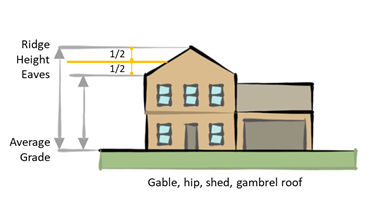
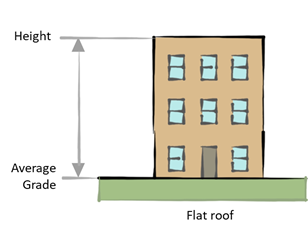
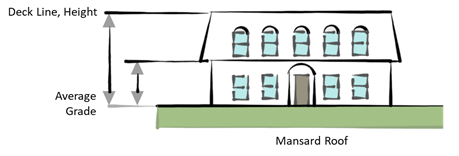
"Height" means the vertical distance from the established grade to the highest point of the coping of a flat roof, the deck line of a mansard roof, or to the average height between eaves and the ridge for gable, hip, shed, or gambrel roofs. For other cases, height shall be measured as the vertical distance from the established grade to the highest point of a structure as herein defined. Where a building or structure is located on a slope, height shall be measured from the average grade level adjacent to the building or structure.
"Impervious coverage" means the total horizontal area of all buildings, roofed, or covered spaces, paved surface areas, walkways and driveways, and any other site improvements that decrease the ability of the surface of the site to absorb water, expressed as a percent of site area. The surface water area of pools is excluded from this definition.
"Landscaped area" means the area within the boundaries of a given lot, site, or common development consisting primarily of plant material, including but not limited to grass, trees, shrubs, vines, ground cover, and other organic plant materials; or grass paver masonry units installed such that the appearance of the area is primarily landscaped.
1.
"Perimeter landscaped area" means any required landscaped area that adjoins the exterior boundary of a lot, site, or common development.
2.
"Interior landscaped area" means any landscaped area within a site exclusive of required perimeter landscaping.
"Loading area" means an off-street area used for the loading or unloading of goods from a vehicle in connection with the use of the site on which such area is located.
"Lot" means a parcel of property with a separate and distinct number or other identifying designation which has been created, assigned, and recorded in the office of the county recorder. Each individual lot is subject to the provisions of a particular base zoning district.
1.
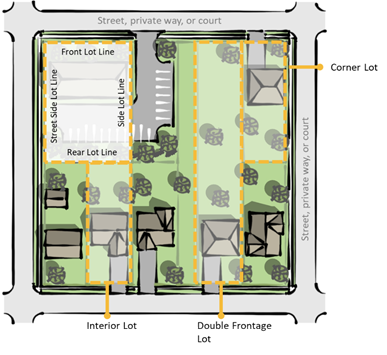
"Corner lot" means a lot located at the junction of at least two streets, private ways, or courts or at least two segments of a curved street, private way, or court, at which the angle of intersection is no greater than one hundred thirty-five degrees.
2.
"Double frontage lot" means a lot, other than a corner lot, having frontage on two streets, private ways, or courts. Primary access shall be restricted on a double frontage lot to the minor of the two streets or to the front line as determined at time of platting or as defined by this title. (Also known as a "through lot").
3.
"Interior lot" means a lot other than a corner lot.
"Lot area" means the total ground area within the lot lines of a lot.
"Lot depth" means the mean distance measured between the front and rear lot lines.
"Lot line" means a property boundary line(s) of record that divides one lot from another lot or a lot from the public or private street right-of-way or easement. Once established, lot lines may not be redefined due to a change of address which would result in a new definition of the prior defined lot lines.
1.
"Front lot line" means the lot line separating a lot and a public or private street right-of-way or easement.
a.
For an interior lot, the lot line separating the lot from the right-of-way or easement.
b.
For a corner lot, the shorter lot line abutting a public or private street or easement. In instances of equal line dimension, the front lot line shall be determined by the building official, or as may be noted on the final plat.
c.
For a double frontage lot, the lot lines separating the lot from the right-of-way or easement of the more minor street. In cases where each street has the same classification, the front lot line shall be determined by the Building Official at the time of application for the original building permit for the lot, or as may be noted on the final plat.
2.
"Rear lot line" means the lot line which is opposite and most distant from the front line.
3.
"Side lot line" means any lot line that is neither a front or rear lot line. A side lot line separating a lot from a street, private way, or court is a street side lot line. A side lot line separating a lot from another lot or lots is an interior side lot line.
"Lot width" means the horizontal distance measured between the side lot lines of a lot, at right angles to its depth along a straight line parallel to the front lot line at the minimum required setback line.
"Mixed use development" means a single development which incorporates complementary land use types into a single development.
"Nonconforming development" means a building, structure, or improvement which does not comply with the regulations for its zoning district set forth by this title but which complied with applicable regulations at the time of construction.
"Nonconforming lot" means a lot which was lawful prior to the adoption, revision, or amendment of this title but that fails by reason of such adoption, revision, or amendment to conform to the present requirements of this title.
"Nonconforming sign" means a sign that was legally erected prior to the adoption, revision, or amendment of this title but that fails by reason of such adoption, revision, or amendment to conform to the present requirements of this title.
"Nonconforming structure" means a structure which was lawful prior to the adoption, revision, or amendment of this title but that fails by reason of such adoption, revision, or amendment to conform to the present requirements of this title.
"Nonconforming use" means a land use which was lawful prior to the adoption, revision, or amendment of this title but that fails by reason of such adoption, revision, or amendment to conform to the present requirements of this title.
"Nuisance" means an unreasonable and continuous invasion of the use and enjoyment of a property right which a reasonable person would find annoying, unpleasant, obnoxious, or offensive.
"Open space" means area included on any site or lot that is open and unobstructed to the sky, except for allowed projections of cornices, overhangs, porches, balconies, or plant materials.
"Outdoor storage" means the outdoor storage or display of materials on private property, parts, or products that are related to the principal use of a site for a period exceeding forty-eight hours.
"Overlay district" means a district established by this title to prescribe special regulations to be applied to a site only in combination with a base district.
"Owner" means any person, agent, firm, corporation, or partnership alone, jointly, or severally with others shown on the records of the recorder of deeds of the county to be the owner of a particular property, presumed to be the person in control of that property. An owner:
1.
Has legal or equitable title to any premises, dwelling, or dwelling unit, with or without accompanying actual possession thereof; or
2.
Has charge, care, or control of any premises, dwelling or dwelling unit, as agent of the owner or as executor, administrator, trustee, or guardian of the estate of the beneficial owner.
"Parcel" means one or more lots which are designated by the owner or applicant as land to be used or developed, or which has been developed.
"Parking facility" means an area on a lot and/or within a building including one or more parking spaces, along with provision for access circulation, maneuvering, and landscaping meeting the requirements of this title. Parking facilities include parking lots, private garages, and parking structures. Vehicle storage is distinct from parking.
"Parking spaces" means an area on a lot and/or within a building intended for the use of temporary parking of a personal vehicle. This term is used interchangeably with "parking stall." Each parking space must have a means of access to a public street. Tandem parking stalls in single-unit detached, zero lot line, and townhome residential uses shall be considered to have a means of access to a public street.
"Paved" means permanently surfaced with poured concrete, concrete pavers, permeable pavers, or asphalt.
"Permitted use" means a land use type allowed as a matter of right in a zoning district, subject only to special requirements of this title.
"PZ commission" means the Planning and zoning commission of the city, as authorized pursuant to Chapter 414, Code of Iowa.
"Planned Unit Development (PUD)" means a development of land which is under unified control and is planned and developed in a single development operation or programmed series of development stages. The development may include streets, circulation ways, utilities, buildings, open spaces, and other site features and improvements.
"Porch, unenclosed" means a roofed or unroofed open structure projecting from an exterior wall of a building and having no enclosed features more than thirty inches above its floor other than wire screening and a roof with supporting structure.
"Premises" means a lot, parcel, tract, or plot of land, contiguous and under common ownership or control, together with the buildings and structure thereon.
"Principal use" means the main use of land or structures as distinguished from an accessory use.
"Private garage" means a building for the storage of motor vehicles where no repair service facilities are maintained and where no motor vehicles are kept for rental or sale.
"Prohibited use" means a use not permitted in a zoning district.
"Property line." See "Lot line."
"Recreational vehicle" means a vehicle towed or self-propelled on its own chassis or attached to the chassis of another vehicle and designed or used for temporary dwelling, recreational, or sporting purposes. Recreational vehicles include but are not limited to travel trailers, campers, motor coach homes, converted buses and trucks, boats, and boat trailers.
"Regulation" means a specific requirement set forth by this title which must be followed.
"Rezoning" means the action or process of assigning land or property to a different zoning district classification.
"Right-of-way" means a parcel of land owned by a local, state, or federal government entity upon which facilities such as highways, railroads, or utilities are constructed.
"Roof" means a structural covering over any portion of a building or structure including projections beyond the walls or supports of the building or structure.
"Routine maintenance" means repairs necessary to keep a structure in a safe and habitable condition that do not trigger a building permit, provided they are not associated with a general improvement of the structure or repair of a damaged structure. Such repairs include:
1.
Normal maintenance of structures such as re-roofing, replacing roofing tiles, and replacing siding.
2.
Exterior and interior painting, papering, tiling, carpeting, cabinets, counter tops, and similar finish work.
3.
Basement sealing.
4.
Repairing or replacing damaged or broken window panes.
5.
Repairing plumbing systems, electrical systems, heating, air conditioning systems, wells, or septic systems.
"Screening" means the method by which a view of one site from another adjacent site is shielded, concealed, or hidden. Screening techniques include fences, walls, hedges, berms, or other features as may be permitted by Chapter 17.08 Landscaping and Screening Standards of this title.
"Setback" means a line within a lot or other parcel of land generally parallel to a public road, street, or highway right-of-way line defining that distance between the building or other area, structure, or feature as may be required in this title and property line.
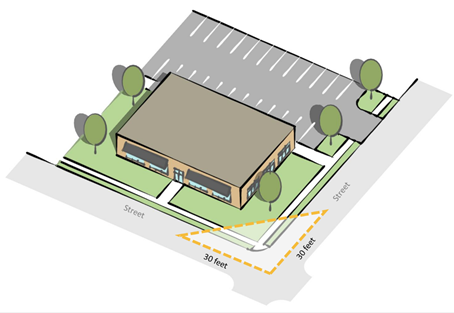
"Sight triangle" means a triangular area on a corner lot, two of the sides of such triangle being formed by extending two imaginary lines from the intersection of the two streets at the centerline at least thirty feet back to two points along the street centerlines of the streets parallel to the lot lines of the corner lot, the third side then being formed by the connection of such points.
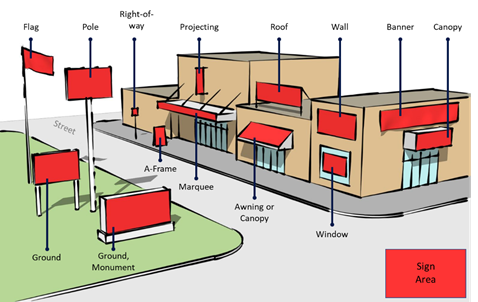
"Sign" Any device (including but not limited to letters, words, numerals, figures, emblems, pictures, or any part or combination) used for visual communication intended to attract the attention of the public and visible to the public right-of-way or other properties. The term "sign" shall not include any governmental unit, nor shall it include any item of merchandise normally displayed within a show window of a business.
1.
"Sign, A-Frame" means a portable and self-supporting sign used for advertising purposes, constructed in such a manner as to form an "A" or a tent-like shape, hinged or not hinged at the top (Syn. Sandwich Board Sign).
2.
"Sign, abandoned" means a sign, including sign face and supporting structure, which refers to a discontinued business, profession, commodity, service, or other activity or use formerly occupying the site or which contains no sign copy on all sign faces for a continuous period of six months.
3.
"Sign, attached" means a sign structurally connected to a building or structure, or depends upon that building for support.
4.
"Sign, awning" means a sign printed on such a temporary or movable shelter supported entirely from the exterior wall of a building and composed of non-rigid materials, except for a supporting framework.
5.
"Sign, banner" means material with a printed message or graphic secured or mounted from a structure in such a way as to allow wind movement.
6.
"Sign, billboard" means an off-premises sign which advertises or draws attention to a business, product, event, service, or activity not necessarily located on an adjacent or nearby property. Billboard signs are meant to advertise the business to passing motorists or pedestrians.
7.
"Sign, canopy" means a sign that is attached or made an integral part of a canopy.
8.
"Sign, detached" means a sign which is self-supporting and structurally independent from any building or structure.
9.
"Sign, double-faced" means a sign consisting of no more than two parallel or near parallel faces supported by a single structure.
10.
"Sign, electronic message" means a sign which uses an array of electrically illuminated lights, generally controlled by a computer or other electronic programming device, to display information or supporting graphics.
11.
"Sign, flag" means a sign that is emblazoned on a flag and is intended to be displayed in a free-flowing manner.
12.
"Sign, ground" means a detached on-premise sign built on a freestanding frame, mast, or pole(s) with a ground clearance no greater than three feet. This includes monument signs.
13.
"Sign, illuminated" means a sign with an artificial light source incorporated internally or externally (directly or indirectly) to illuminate the sign.
14.
"Sign, marquee" means a permanent roofed structure attached to and supported by a building and extending over a public right-of-way.
15.
"Sign, monument" means an on-premise detached sign with the appearance of a solid base.
16.
"Sign, moving" means a sign that conveys its message through rotating, changing, or animated elements.
17.
"Sign, nonconforming" means a sign that was legally erected prior to the adoption of this title but which violates the regulations of this title.
18.
"Sign, pole" means an on-premise sign built on a freestanding frame, mast, or pole(s) with a ground clearance greater than three feet.
19.
"Sign, portable" means a sign supported by frames or posts rigidly attached to bases not permanently attached to the ground or a building, capable of being moved from place to place and constructed of paper, cloth, canvas, light fabric, cardboard, plywood, light plastic, or other similar materials. Also known as a temporary sign.
20.
"Sign, projecting" means a sign other than a wall sign attached to and projects from a building or structure face.
21.
"Sign, residential" means a small detached or attached sign located on a parcel occupied by a residential use, conveying a message communicated by the owner or resident of the property.
22.
"Sign, roof" means a sign or part of sign erected upon, against, or directly above a roof or on top of or above the parapet or cornice of a building or structure.
23.
"Sign, temporary" means a sign designed or fabricated of materials that advertise or communicate messages that change frequently or that become outdated, are made of materials of relatively low durability, or are intended to be removed or replaced within a period of six months or less. Can also be known as a portable sign.
24.
"Sign, vertical banner" means a portable sign typically constructed of cloth, bunting, plastic, paper, or similar non-rigid material and attached to a vertically mounted pole that is securely fastened to the ground.
25.
"Sign, wall" means a sign attached to and parallel to the side of a building that does not project more than two feet from the building wall.
26.
"Sign, window" means a sign painted on or installed inside a window for the purpose of viewing from outside the premises.
"Sign area" means the area of the surface of a sign bounded by the top, bottom, and sides.
"Site" means the parcel of land to be developed or built upon. A site may encompass a single lot or a group of lots developed as a common development under the provisions of this title.
"Site plan" means a plan, prepared to scale, showing accurately and with complete dimensioning, the boundaries of a site and the location of all buildings, structures, uses, and principal site development features proposed for a specific parcel of land and any other information that may be reasonably requested by the city to make an informed decision on the associated request.
"State" means the State of Iowa.
"Story" means the portion of a building included between the surface of any floor and the surface of the next floor above it. If there is no floor above it, the space between such floor and the next ceiling above it.
"Story, half" means
1.
That portion of a building under a sloping roof, the wall plates of which, on at least two opposite exterior walls, are not more than four and one-half feet above the floor of such story; or
2.
A basement but only when half or more of the floor to ceiling height of a basement (over more than half of the floor area) is above grade. When more than half of the floor to ceiling height of a basement (over more than half of the floor area) is below grade, the basement shall not be counted as either a story or half story.
"Street" means a right-of-way, dedicated to public use, which affords a primary means of access to the abutting property. This definition is intended to be inclusive of the term as defined in Iowa Statute.
1.
"Street, arterial" means a street that serves or is designed to serve as a connection between uses which generate heavy traffic volumes or between other arterial streets, as defined by the Iowa Department of Transportation.
2.
"Street, collector" means a street that serves or is designed to serve as the connection from local streets to arterial streets, such as the main entrance street of a residential development, as defined by the Iowa Department of Transportation. Collector streets may also serve as a secondary connection between arterial streets.
3.
"Street, cul-de-sac" means a local street having one end open to vehicular traffic and the other end permanently closed with a vehicular turnaround.
4.
"Street, local" means a street designed to provide vehicular access to abutting property and to discourage through traffic, as defined by the Iowa Department of Transportation.
5.
"Street, private" means any road or street that is not publicly owned and maintained and used for access by the occupants of the development, their guests, and the general public.
"Street facade" means any separate external face of a building, including parapet walls and omitted wall lines, oriented to and facing a public street, private way, or court. Separate faces oriented in the same direction or within forty-five degrees of one another are considered part of the same street facade.
"Structure" means any object constructed or built and attached or anchored permanently or semi-permanently to the ground in such a way as to prevent routine movement.
"Structure alterations" means any replacement or change in the type of construction or in the supporting members of a building or structure as may be required for the safety of the building beyond ordinary repairs and maintenance, such as bearing walls or partitions, columns, beams, or girders.
"Substantial damage" means damage of any origin sustained by a structure whereby the cost of restoring the structure to its before damaged condition would equal or exceed fifty percent of the market value of the structure before the damage occurred.
"Tree, drip line" means line on the ground below the edge of the maximum overhead canopy of a tree.
"Use" means the conduct of an activity or the performance of a function or operation on a site or in a building or facility.
"Violation" means a failure of a use, structure, or other development to be fully compliant with the regulations in this title. In the floodplain district, a structure or other development without the elevation certificate, other certifications, or other evidence of compliance required in this title is presumed to be in violation until such time as that documentation is provided.
"Yard" means that portion of a lot which lies between a lot line and the corresponding building setback line or the required landscape area. This area shall be unoccupied and unobstructed from the ground upward except as may be specifically provided for or required by this title.
1.
"Front yard" means the space extending the full width of a lot lying between the front lot line and the front setback line. For a corner lot, the front yard shall normally be defined as that yard along a street which meets one of the following two criteria:
a.
The yard along the block face to which a greater number of structures are oriented; or
b.
The yard along a street that has the smaller horizontal dimension.
2.
"Rear yard" means the space extending the full width of a lot lying between the rear lot line and the rear setback line.
3.
"Side yard" means the space extending the depth of a lot from the front to rear lot lines lying between the side yard setback line and the interior lot line.
4.
"Street side yard" means, on a corner lot, the space extending from the front yard to the rear yard, between the street side yard setback line and the street side lot line.
"Zero lot line" means that the building setback is allowed to be the same as the property/lot line.
"Zoning administrator" means the designee of the city manager responsible for the interpretation, administration, and enforcement of this title.
"Zoning district" means a designated specified land classification within which all sites are subject to a unified group of use and site development regulations set forth in this title.
"Zoning map" means the official zoning map adopted through ordinance and subsequent amendments thereto by the city council.
(Ord. No. 1465, § 2(Att.), 9-11-2023)
17.03.040 - Definition of use types.
This section shall be known as the "use types." The purpose of this section is to establish a classification system for land uses and a consistent set of terms defining uses permitted or conditionally permitted within various zoning districts. This chapter also provides a procedure for determining the applicable use type of any activity not clearly within any defined use type.
A.
Classification of Uses. In the event of any question as to the appropriate use types of any existing or proposed use or activity, the zoning administrator shall have the authority to determine the appropriate use type. A determination of the zoning administrator may be appealed to the board of adjustment. In making such determinations, the zoning administrator and board of adjustment shall consider such characteristics or specific requirements of the use in common with those included as examples of use types. Those examples, when included in use type descriptions, are intended to be illustrative, as opposed to exclusive lists.
B.
Records. The zoning administrator shall make all such determinations of appropriate use types in writing. The record of the determination shall contain a report explaining the reasons for the determination.
C.
Agricultural Use Types. Agricultural use types include examples such as the on-site production and sale of plant and animal products by agricultural methods.
1.
Animal Production. The raising of animals or production of animal products such as eggs or dairy products on an agricultural or commercial basis. The use is on a site which is also used for crop production, where grazing of natural vegetation is the major feed source, or the raising of animals for recreational use. Typical uses include grazing, ranching, dairy farming, and poultry farming.
2.
Animal Raising, Personal. Premises where agricultural animals or insects are fed or kept for personal use and for agriculturally related projects by the owner or occupant of the premises. Roadside stands may be allowed as a permitted accessory use as indicated by the zoning district in this title. This definition does not include animal boarding or kennels. Examples include:
a.
Beekeeping/Apiary. A place in which a colony or colonies of bees are kept. For example, in a stand or shed for beehives, or a bee house containing a number of beehives.
b.
Horse, llama, or other equine and/or hoofed animals.
c.
Small animals and fowl such as birds, rabbits, chinchilla, and hamsters.
3.
Commercial Feedlots. The use of a site for the confined feeding or holding of livestock or poultry within buildings, lots, pens, or other close quarters which are not used for crop production or where grazing of natural vegetation is not the major feed source. Livestock and poultry shall include any animal or fowl which are used primarily for use as food or food products for human consumption, or for laboratory or testing purposes. A commercial feedlot does not include areas which are used for the raising of crops or other vegetation and upon which livestock are allowed to graze or feed.
4.
Community Garden. A private or public lot under one acre for cultivation of fruits, flowers, vegetables, or ornamental plants by more than one person or household.
5.
Crop Production. The raising and harvesting of tree crops or row crops for field crops on an agricultural or commercial basis. This definition may include accessory retail sales under certain conditions.
6.
Livestock Sales. The use of a site for the temporary confinement and exchange or sale of livestock. Typical uses include sales barns.
7.
Urban Farming and Production. A lot over one acre not in an agricultural zoning district, used to grow and harvest food crops and/or non-food crops for personal or commercial use. An orchard or tree farm that is a principal use is considered an urban farm. An urban farm may be divided into plots for cultivation by one or more individuals and/or groups or may be cultivated by individuals and/or groups collectively. The products of an urban farm may or may not be for commercial purposes.
D.
Residential Use Types. Residential use types include uses providing wholly or primarily no transient living accommodations. They exclude institutional living arrangements providing twenty-four hour skilled nursing or medical care, forced residence, or therapeutic settings.
1.
Boarding Home. A residential building, or portion of a residential building, containing rooms for accommodating, for compensation, three or more persons who are not transients. Lodging may or may not include the serving of meals to the lodgers. Facilities for lodgers may include sleeping or living quarters or rooms, and with or without individual bathrooms, but do not include individual cooking facilities. A boarding home does not include a facility, home, or program otherwise subject to licensure or regulation by the Iowa Department of Human Services, Department of Inspections and Appeals, or Department of Public Health.
2.
Dwelling, Multi-Unit. A residential structure designed for three or more dwelling units, each independent of each other. Dwelling units are separated by interior walls and/or floors. This does not include boarding homes, townhouses, or two-unit dwellings.
3.
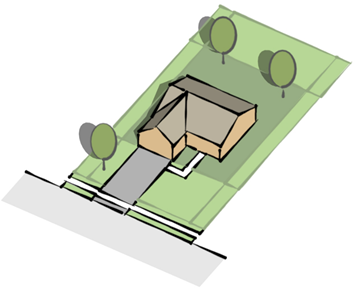
Dwelling, Single-Unit Detached. A residential structure designed to house a single unit with a private outside entrance and without common walls between other dwelling units.
4.
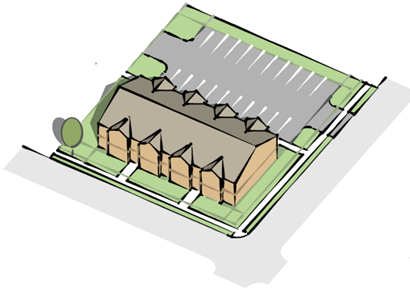
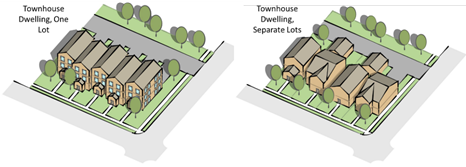
Dwelling, Townhouse. Three or more dwelling units in a single structure or attached structures, each of which could have a single lot, which are separated from each other by a dividing vertical wall. Such units may be side-by-side, back-to-back, or both. This is commonly known as a townhome or townhouse and does not include a multi-unit dwelling.
a.
A townhouse or townhome structure is a building formed by at least three and not more than twelve contiguous townhouses/townhome units with common or abutting walls.
5.
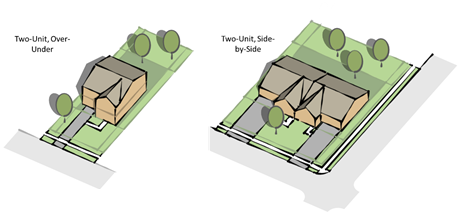
Dwelling, Two-Unit. The use of a legally described lot for two dwelling units living independently of each other. Such units may be side-by-side, back-to-back, or over-under a second story and/or basement.
6.
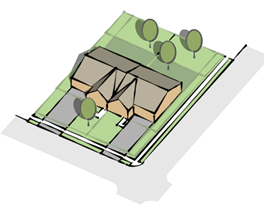
Dwelling, Zero Lot Line. A dwelling where the building setback is allowed to be the same as the property line on one side. This may include a building where the property line crosses a building and creates a separate dwelling unit on individual lots.
7.
Group Residential. The use of a site for a residence by more than four unrelated persons on a weekly or longer basis. Typical uses would include fraternities, sororities, or college dormitories.
8.
Manufactured Housing. A factory-built structure built under authority of 42 U.S.C. § 5403, that is required by Federal law to display a seal from the United States department of housing and urban development, and was constructed on or after June 15, 1976, and which is not constructed or equipped with a permanent hitch or other device allowing it to be moved other than to a permanent site; does not have permanently attached to its body or frame any wheels or axles and is placed on a permanent foundation. A mobile home constructed to the National Manufactured Home Construction and Safety Standards promulgated by the U.S. Department of Housing and Urban Development is not a manufactured home unless it has been converted to real property and is taxed as a site-built dwelling as is provided in the Code of Iowa Section 435.26 and is placed on a permanent foundation. For the purpose of any of these regulations, manufactured homes are considered the same as single-unit detached dwellings.
9.
Modular Home. A factory-built structure which is manufactured to be used as a place of human habitation, is constructed to comply with the State Building Code for modular factory-built structures, as adopted pursuant to Code of Iowa, Sec. 103A.7, and must display the seal issued by the State Building Code Commissioner. Modular homes shall be subject to the same regulations as site-built homes.
10.
Mobile Home. Any vehicle without motive power used or so manufactured or constructed as to permit its being used as a conveyance upon the public streets and highways and so designed, constructed, or reconstructed as will permit the vehicle to be used as a place for human habitation by one or more persons; but shall also include any such vehicle with motive power not registered as a motor vehicle in Iowa. A mobile home means any such vehicle built before June 15, 1976, which was not built to a mandatory building code and which contains no state or federal seals.
11.
Mobile Home Park. A site, lot, field, or tract of land upon which three or more mobile homes or manufactured homes, or a combination of any of these homes, are placed on developed spaces and operated as a for-profit enterprise with water, sewer or septic, and electrical services available. The term "mobile home park" shall not be construed to include manufactured or mobile homes, buildings, tents, or other structures temporarily maintained by any individual, educational institution, or company on their own premises and used exclusively to house their own labor or students.
12.
Mobile Home Subdivision. Division of a tract of land into lots that meet all the requirements of the city's subdivision ordinance for the location of mobile homes. Generally, a lot within a mobile home subdivision is owned by the owner of the mobile home placed upon such lot.
13.
Retirement Residence. A building or group of buildings which provide residential facilities for more than four residents and provides a range of residential building types and may also provide support services to residents, including but not limited to food service, general health supervision, medication services, housekeeping services, personal services, recreation facilities, and transportation services. The retirement residence may accommodate food preparation in independent units or meal service in one or more common areas. Retirement residences may include additional health care supervision or nursing care.
14.
Two-Unit Residential. The use of a site for two dwelling units, each in a separate building, excluding a mobile home unit. A two-unit residential use is separate from an accessory dwelling unit (ADU).
E.
Civic, Public, and Institutional Use Types. Civic, public, and institutional use types include examples such as the performance of utility, educational, recreational, cultural, medical, protective, governmental, and other uses which are non-commercial in nature but for broad public or semi-public use.
1.
Administration. Governmental offices providing administrative, clerical, or public contact services that deal directly with the citizen, together with incidental storage and maintenance of necessary vehicles. Typical uses include federal, state, county, and city offices.
2.
Animal Shelter and Kennels. Boarding and care services for dogs, cats, and similar small animals or large birds, or any premises on which three or more animals included under this definition are kept and maintained. Typical uses include boarding kennels, ostrich raising facilities, pet motels, and dog training centers.
3.
Campground. Facilities providing camping or parking areas and incidental services for travelers in recreational vehicles or tents which accommodate each guest or visitor for no more than seven consecutive days during any one month period.
4.
Cemetery. Land used or intended to be used for the burial of the dead and dedicated for cemetery purposes, including columbaria, mausoleums, and mortuaries when operated in conjunction with and within the boundary of such cemetery.
5.
Child Care Center. A facility providing child care or preschool services, as defined by Iowa Code Chapter 237A, for seven or more children, except when the facility is registered as a child development home with the state.
6.
Child Care Home. A person or program providing child care to any of the following children at any time that is not registered to provide child care as authorized under Iowa Code Chapter 237A:
a.
Five or fewer children.
b.
Six or fewer children, if at least one of the children is school-aged.
7.
Child Development Home. A person or program registered under Section 237A.3A of the Iowa Code that may provide child care to seven or more children at any one time.
8.
Convalescent Services. A use providing bed care and inpatient services for persons requiring regular medical attention but excluding a facility providing surgical or emergency medical services and excluding a facility providing care for alcoholism, drug addiction, mental disease, or communicable disease. Typical uses include nursing homes and retirement care facilities.
9.
Education (primary). A public, private, or parochial school offering instruction at the elementary school level in the branches of learning study required to be taught in schools within the state.
10.
Education (secondary). A public, private, or parochial school offering instruction at the junior high or high school level in the branches of learning and study required to be taught in the schools of the state.
11.
Education (university). An educational institution of higher learning which offers a course of study designed to culminate in the issuance of a degree certified by a generally recognized accrediting organization.
12.
Family Home. A community-based residential home or a child foster care facility to provide room and board, personal care, habilitation services, and supervision in a family environment exclusively for not more than eight with a developmental disability or brain injury and any necessary support personnel as permitted and as limited by the Code of Iowa, 414.22. This includes elder group homes.
13.
Group Care. A government-licensed or approved facility which provides for resident care and short or long-term, continuous multi-day occupancy of more than eight but no more than thirty unrelated persons, not including resident staff. Group care facilities include facilities which provide services in accordance with individual needs for the:
a.
Adaptation to living with, or rehabilitation from, the handicaps of physical disability.
b.
Adaptation to living with, or rehabilitation from, the handicaps of emotional or mental disorder or developmental disabilities.
c.
Rehabilitation from the effects of drug or alcohol abuse.
d.
Supervision while under a program alternative to imprisonment, including but not limited to pre-release, work-release, and probationary programs.
e.
Others who require direct adult supervision.
14.
Group Home. A facility licensed by the state in which at least three but no more than eight persons, not including resident managers or house parents, who are unrelated by blood, marriage, or adoption reside while receiving therapy, training, living assistance, or counseling for the purpose of adaptation to living with or rehabilitation from a physical or mental disability as defined by the relevant provisions of the Code of Iowa or by the Fair Housing Amendments Act of 1988.
15.
Health Care. A facility providing medical, psychiatric, or surgical service for sick or injured persons exclusively on an outpatient basis including emergency treatment, diagnostic services, training, administration and services to outpatients, employees, or visitors.
16.
Hospital. A facility providing medical, psychiatric, or surgical service for sick or injured persons primarily on an inpatient basis, including emergency treatment, diagnostic services, training, administration, and services to patients, employees, or visitors.
17.
Indoor Recreation. Private businesses or other organizations which may or may not be commercial by structure or by nature, which are primarily engaged in the provision or sponsorship of sports, entertainment, or recreation for participants or spectators. This phrase includes, but is not limited to:
a.
Community recreation centers.
b.
Health and exercise clubs.
c.
Bowling alleys.
d.
Movie theaters.
e.
Dance halls.
f.
Arcades.
g.
Indoor skating.
h.
Indoor swimming pools.
i.
Other indoor athletic facilities.
j.
Other functionally similar uses.
18.
Maintenance Facilities. A public facility supporting maintenance, repair, vehicular or equipment servicing, material storage, and similar activities including street or sewer yards, equipment service centers, and similar uses having characteristics of commercial services or contracting or industrial activities.
19.
Outdoor Commercial Recreation. Uses that provide commercial amusement outdoors that have higher traffic demands, space requirements, and external effects, including, but not limited to:
a.
Fairgrounds.
b.
Riding academies.
c.
Amusement parks.
d.
Mini golf.
e.
Golf driving ranges.
f.
Golf courses.
20.
Park and Recreation. Publicly owned and operated parks, playgrounds, recreation facilities, publicly owned community centers, and open spaces.
21.
Place of Assembly. An indoor place where people gather for civic or cultural purposes. The phrase "place of assembly" includes place of worship, meeting hall, lecture hall, fraternal organization, community center, or private club. The phrase "place of assembly" does not include the phrase "indoor recreation."
22.
Postal Facilities. Postal services, including post offices, bulk mail processing, or sorting centers operated by the United States Postal Service.
23.
Safety Services. Facilities for conduct of public safety and emergency services including police and fire protection services and emergency medical and ambulance services.
F.
Commercial Use Types. Commercial uses include the sale, rental, service, and distribution of goods, and the provision of services other than those classified under other use types. Office uses are also included and might include uses providing for administration, professional services, and similar activities.
1.
Agricultural Sales and Service. Establishments or places of business that sell feed, grain, fertilizers, farm equipment, pesticides, and similar goods from the premises or provide agriculturally related services with incidental storage on lots other than where the service is rendered. Typical uses include nurseries, hay, farm implement dealerships, feed and grain stores, and tree service firms.
2.
Alcoholic Beverage Sales. Establishments or places of business engaged in retail sale for off-premise consumption of alcoholic beverages. Typical uses include liquor stores, bottle shops, or any licensed sales of liquor, beer, or wine for off-site consumption.
3.
Automobile Rental or Sales. Sale or rental of automobiles, noncommercial trucks, motorcycles, motor homes, recreational vehicles, or boats, including incidental storage, maintenance, and servicing. Typical uses include dealerships for new and used cars, motorcycles, boats, trailers, and recreational vehicles.
4.
Automobile and Equipment Repair Services. Any building, structure, improvements, or land used for the repair and maintenance of automobiles, motorcycles, trucks, trailers, or similar vehicles or equipment including, but not limited to body, fender, muffler, or upholstery work, oil change and lubrication, painting, tire service, and sales.
5.
Brewpub. A restaurant which includes the brewing of beer as an accessory use. The brewing operation processes water, malt, hops, and yeast into beer or ale. Said establishments produce no more than ten thousand barrels of beer or ale annually. The area, by definition, used for brewing, including bottling and kegging, shall not exceed twenty-five percent of the total floor area of the commercial space.
6.
Car Wash. Mechanical facilities for washing or waxing private automobiles, light trucks and vans, but not commercial fleets, as an accessory use to an automobile service station.
7.
Construction Sales or Service. Establishments or places of business primarily engaged in the retail or wholesale sale, from the premises, of materials used in the construction of buildings or other structures other than retail sale of paint, fixtures, and hardware. This use type excludes those uses classified under automotive and equipment services. Typical uses include building materials sales, or tool and equipment rental or sales.
8.
Food Services, No Drive-Through. Establishments or places of business primarily engaged in the retail sale of food and household products for home consumption. Food sales establishments may include the sale of non-food items. However, the sales of non-food items generally account for no more than the lesser of twenty-five percent of the sales area or ten thousand square feet of the food sales establishment. Typical uses include groceries, delicatessens, meat markets, retail bakeries, and candy shops.
9.
Fuel Station. A building or portion of a building used chiefly in connection with tanks, pumps, and other appliances, that supply motor vehicles with gasoline, oil, compressed air, water, electrical charging, and other fuel supplies, but not for the purpose of making repairs. When the dispensing, sale, or offering for sale of motor vehicle fuel as retail is incidental to the conduct of an auto repair service, the premises shall be classified as "Automobile and Equipment Repair Services."
10.
Funeral Service. Establishments engaged in undertaking services such as preparing the human dead for burial and arranging and managing funerals. Typical uses include funeral homes or mortuaries.
11.
General Office, No Drive-Through. Use of a site for business, professional, or administrative offices. Typical uses include real estate, insurance, management, travel, business offices, organization and association offices, or professional offices.
12.
General Retail. Commercial and retail uses that do not include regular outside storage or sales. The phrase "commercial retail" includes uses that are comparable, but not limited to:
a.
Furniture and home furnishings stores.
b.
Electronics and appliance stores.
c.
Paint and wallpaper stores.
d.
Health and personal care stores.
e.
Clothing and clothing accessory stores.
f.
Sporting goods, hobby, book, and music stores.
g.
General merchandise stores.
h.
Miscellaneous store retailers.
13.
General Services. Establishments primarily engaged in providing services to customers by appointment or drop in basis, not including personal services. These uses may require additional on-site storage for inventory or vehicles. Typical uses include, but are not limited to:
a.
Television studios.
b.
Telecommunication service centers.
c.
Telegraph service offices.
d.
Film and sound recording facilities.
e.
Office equipment and supply firms.
f.
Small business machine repair shops.
g.
Hotel equipment and supply firms.
h.
Messenger and delivery services.
i.
Custodial or maintenance services.
j.
Convenience printing and copying.
k.
Automated banking machines.
l.
Appliance repair shops.
m.
Watch or jewelry repair shops.
n.
Musical instrument repair shops.
14.
Heavy Retail. Retail and/or service activities that have regular outside service or outside storage areas, larger than average enclosed floor areas devoted to commercial use, or partially enclosed structures that includes, but is not limited to, permanent retail operations that are located outside of enclosed buildings. Examples include, but are not limited to:
a.
Nurseries.
b.
Home centers.
c.
Lumber and other building materials.
d.
Lawn, garden equipment, and related supply stores.
e.
Warehouse clubs and super stores.
f.
Recreational equipment rental where the equipment is stored outside.
g.
Heavy truck or recreational vehicle leasing or sales.
h.
Manufactured home sales.
15.
Heavy Services. Establishments or places of business primarily engaged in providing services that are not retail or primarily dedicated to walk-in clientele. These services often involve services to construction or building trades and may involve a small amount of screened outdoor storage in appropriate zoning districts. Typical uses include shops or operating bases for plumbers, electricians, HVAC (heating, ventilating, and air conditioning) contractors, and laundry services.
16.
Home Based Business/Home Occupation. An accessory occupational use conducted entirely within a dwelling unit by its inhabitants, which is clearly incidental to the residential use of the dwelling unit or residential structure and does not change the residential character of its site.
17.
Hotels. A building in which lodging or boarding and lodging are provided and offered to the public for compensation, and in which ingress and egress to and from all rooms is made through an inside lobby or office supervised by a person in charge at all hours.
18.
Live/Work Unit. Buildings or spaces within buildings that are used jointly for commercial and residential purposes where the residential use of the space is secondary or accessory to the primary use as a place of work.
19.
Mixed-Use. Development in which a combination of residential and non-residential uses (e.g., residential over retail), or several classifications of non-residential uses (e.g., office and retail), are located on the same parcel proposed for development.
20.
Personal Services. Establishments or places of business primarily engaged in providing services of a personal nature. Typical uses include beauty and barber shops, seamstress, tailor, or shoe repair shops, photography studios, television or electronics repair, or dry cleaning stations serving individuals and households. Personal services include establishments providing for the administration of massage or massage therapy carried out by persons licensed by the state under the provisions of Chapters 148, 148A, 148B, 148C, 149, 150, 150A, 151, 152, 152B, 152C, 157 or 158 of the Code of Iowa when performing massage services as a part of the profession or trade for which licensed or persons performing massage services under the direction of a person so licensed; or persons performing massage services or therapy pursuant to the written direction of a licensed physician.
21.
Pet Services. Indoor retail sales, incidental pet health services, and grooming and boarding of dogs, cats, birds, fish, and similar small animals customarily used as household pets. Typical uses include pet stores, small animal clinics, dog bathing and clipping salons, and pet grooming shops, but exclude uses for livestock and large animals.
22.
Restaurants. A use engaged in the preparation and retail sale of food and beverages, including the sale of alcoholic beverages when conducted as a secondary feature of the use, producing less than fifty percent of the establishment's gross income.
a.
Restaurants (Drive-in). An establishment which principally supplies food and beverages in disposable containers and is characterized by high automobile accessibility and on-site accommodations, self-service, and short stays by customers.
b.
Restaurants (General). An establishment characterized by table service to customers and/or accommodation to walk-in clientele, as opposed to drive-in or fast food restaurants. Typical uses include cafes, coffee shops, and restaurants.
23.
Restricted Business. Any business activity which offers the opportunity to view sexual activities or view or touch anatomical areas for entertainment purposes in a manner that offends contemporary standards in the community of Oskaloosa, depicts or describes sexual conduct in a patently offensive way, and lacks serious literary, artistic, political, or scientific value. This category includes the sale or viewing of visual or print materials that meet these criteria. Typical uses include retail services or stores which are distinguished by an emphasis on activities or materials that emphasize sexual content; businesses which offer live performances characterized by exposure of specified anatomical areas; and adult theaters.
24.
Short-Term Rental. A lodging service that provides overnight or short-term accommodations to guests or visitors. These can include other provisions such as breakfast. For this definition, short-term rentals are always owned and operated by the resident owner or resident manager of the structure and include no more than eight units.
25.
Tavern/Bar. A use engaged in the preparation and retail sale of alcoholic beverages for consumption on the premises, including taverns, bars, cocktail lounges, and similar uses other than a restaurant as that term is defined in this section.
26.
Vehicle Storage (Short-Term). Short-term storage of operating or nonoperating vehicles for a period of no more than twenty-one days. Typical uses include storage of private parking tow-aways or impound yards but exclude dismantling or salvage.
27.
Veterinary Service. Veterinary services and hospitals for animals. Typical uses include pet clinics, dog and cat hospitals, pet cemeteries and crematoria, and veterinary hospitals for livestock and large animals.
G.
Industrial Use Types. Industrial use types include the on-site extraction or production of goods by nonagricultural methods and the storage and distribution of products.
1.
Artisan Industrial. Workspace for artists or artisans, including individuals practicing one of the fine arts or skilled in an applied art or craft. The establishment does not exceed three thousand square feet and can include space for the preparation, display, and sale of individually crafted artwork, jewelry, furniture, sculpture, pottery, leathercraft, hand-woven articles, and related items. The use may include instruction classes.
2.
Compost Disposal. A site on which decomposition processes are used on solid waste (including leaves, grass, manures, and nonmeat food production wastes received from residential, commercial, industrial non-hazardous, and community sources to produce compost, but not including bio-solids. Composting facilities do not include compost bins that are used to compost household waste and landscaping waste on and for an individual residential lot.
3.
Construction Yards. Establishments housing facilities of businesses primarily engaged in construction activities, including incidental storage of materials and equipment on lots other than construction sites. Typical uses are building contractor's yards.
4.
Extraction. A use involving on-site extraction of surface or subsurface mineral products or natural resources, excluding the grading and removal of dirt. Typical uses are quarries, borrow pits, sand and gravel operations, mining, and well drilling.
5.
Equipment Rental and Sales. Sale or rental of trucks, tractors, construction equipment, agricultural implements, mobile homes, and similar heavy equipment, including incidental storage, maintenance, and servicing. Typical uses include truck dealerships, construction equipment dealerships, and mobile home sales establishments.
6.
Heavy Industry. Enterprises involved in the basic processing and manufacturing of products, predominately from raw materials, with noticeable noise, odor, vibration, or air pollution effects across property lines; a use or process engaged in the storage of or processes involving potentially or actually hazardous, explosive, flammable, radioactive, or other commonly recognized hazardous materials; or other use with extensive external operating characteristics. Outdoor storage is permitted with proper screening. Examples include, but are not limited to:
a.
Animal meat processing or rendering.
b.
Coal cleaning plants with thermal dryers.
c.
Carbon black plants (furnace process).
d.
Coke oven batteries.
e.
Drycleaner processing plants.
f.
Fabrication of vehicles, manufacturing equipment, durable goods, or pre-fabricated homes or home components.
g.
Facilities used in the primary or secondary production of metals (e.g., primary zinc, copper, or lead smelters; primary aluminum ore reduction plants; iron and steel mills; sintering plants; secondary metal production plants; and blacksmith shops).
h.
Fossil fuel combustion (boilers or electricity generation) totaling more than two hundred fifty million BTUs per hour of heat input.
i.
Fossil fuel or other waste-to-energy power plants.
j.
Glass and plastic product manufacturing.
k.
Hot mix asphalt plants.
l.
Mineral plants.
m.
Petroleum refineries.
n.
Petroleum storage and transfer units (except retail gasoline stations) and bulk fuel dealers.
o.
Portland cement plants (not temporary batch plants).
p.
Railroad yards, equipment servicing facilities, and terminal facilities.
q.
Sawmills and pulp mills.
7.
Heavy Manufacturing. The manufacture or compounding process of raw materials. These activities or processes would necessitate the storage of large volumes of highly flammable, toxic matter or explosive materials needed for the manufacturing process. These activities may involve outdoor operations as part of their manufacturing process.
8.
Landfill, Refuse. An area of land or an excavation in which wastes are placed for permanent disposal. For the purposes of this zoning ordinance, the word "landfill" does not include clean debris, e.g., dirt, trees, rocks, etc.
9.
Light Industry. Establishments engaged in the manufacture or processing of finished products from previously prepared materials, including processing, fabrication, assembly, treatment, and packaging of such products, and incidental storage, sales, and distribution. These establishments are characterized by having no major external environmental effects across property lines and include no unscreened or unenclosed outdoor storage. Typical uses include, but are not limited to:
a.
Commercial bakeries.
b.
Dressed beef processing plants.
c.
Soft drink bottling.
d.
Apparel assembly from fabrics.
e.
Electronics.
f.
Manufacturing.
g.
Microbreweries.
h.
Print shops.
i.
Publishing houses.
10.
Outdoor Storage. The storage of material outdoors as a principal use of land for more than twenty-four hours.
11.
Recycling Collection and Processing. Any site which is used in whole or part for the receiving, collection, or for the processing of any post-consumer, nondurable goods including, but not limited to glass, plastic, paper, cardboard, aluminum, tin, or other recyclable commodities.
12.
Salvage Service. Places of business primarily engaged in the storage, sale, dismantling, or other processing of used or waste materials which are not intended for reuse in their original forms. Typical uses include automotive wrecking yards, junk yards, or paper salvage yards.
13.
Self-Storage Facility (Primarily indoor). A building or group of buildings containing varying sizes of individualized, compartmentalized, and controlled stalls or lockers for the storage of customer's goods or wares, excluding junk, explosive or flammable materials, and other noxious or dangerous materials. No business activities other than rental or storage units shall be conducted on the premises. Self-storage is also known as mini storage, convenience storage, or mini warehousing.
14.
Truck Terminal. A facility for the receipt, transfer, short term storage, and dispatching of goods transported by truck.
15.
Warehousing (Enclosed). Uses including storage, distribution, and handling of goods and materials within enclosed structures. Typical uses include wholesale distributors, storage warehouses, and van and storage companies.
16.
Warehousing (Open). Uses including open air storage, distribution, and handling of goods and materials. Typical uses include monument yards, grain elevators, and open storage.
17.
Vehicle Storage (Long-Term). Long-term storage of operating or nonoperating vehicles for a period exceeding twenty-one days. Typical uses include storage of private parking tow-aways or impound yards but exclude dismantling or salvage. Long-term storage of twenty-one days or less constitutes the commercial use type, vehicle storage (short-term).
H.
Miscellaneous Use Types.
1.
Airport. Landing fields, aircraft parking and service facilities, and related facilities for operation, service, fueling, repair, storage, charter, sales, and rental of aircraft, and including activities directly associated with the operation and maintenance of airport facilities and the provision of safety and security.
2.
Broadcasting Center. An establishment containing one or more broadcasting studios for over-the-air, cable, or satellite delivery of radio or television programs, or studios for the audio or video recording or filming of musical performances, radio, or television pro-grams or motion pictures. This term does not include a telecommunications tower.
3.
Drive-through facility. A business establishment so developed that its retail or service character is dependent on providing a driveway approach or parking spaces for motor vehicles to serve patrons while in the motor vehicle rather than within a building or structure.
4.
Electrical Substation. A part of an electrical generation, transmission, and distribution system where voltage is transformed, the type of current is changed, current is gathered from distributed power generation facilities, such as wind turbines or photovoltaic panels, current is switched to back-up lines, or circuits are parallelized in case of failure.
5.
Fireworks, Sales. A use or part of a use that sells consumer fireworks as defined by Iowa Code.
6.
Parking Lot. Surface parking of motor vehicles on a temporary basis on a privately or publicly owned property.
7.
Parking, Remote. A supply of off-street parking at a location not on the site of a given development the parking is intended to serve.
8.
Parking Structure. The use of a site for a multilevel building which provides parking for motor vehicles on a temporary basis, other than as an accessory to a principal use on the same site.
9.
Solar Energy System (SES). Any assembly, structure, or design, whose primary purpose is to provide for the collection, storage, and distribution of solar energy. Typical uses include attached solar panels, freestanding solar panels, solar energy devices integrated as part of the principal or accessory structure, and passive energy systems that include building elements without any mechanical or electrical systems.
a.
SES Primary. Solar energy systems are considered a primary use when the structures or assemblies are the only use on the property (aside from agriculture and open space). Commonly known as solar farms or solar fields.
b.
SES Accessory. Solar energy systems are considered an accessory use when attached to a structure, building integrated, freestanding, or otherwise integrated into existing permitted uses on a property.
10.
Telecommunication Tower. A tower, pole, or similar structure that supports a telecommunications antenna operated for commercial purpose above ground in a fixed location, freestanding, guyed, or on a building or other structure. The definitions below apply solely in administering and interpreting the telecommunication tower regulations of this zoning ordinance. The following words, terms, and phrases have the meanings ascribed to them, except where the context clearly indicates a different meaning.
a.
Applicant. Any person, or any person acting on behalf of another person, engaged in the business of providing wireless telecommunications services or the wireless telecommunications infrastructure required for wireless telecommunications services and who submits an application. This definition of "applicant" shall apply specifically to this section.
b.
Application. A request submitted by an applicant for any wireless telecommunications service use requiring conditional use approval or zoning compliance and siting review as set forth in this title. This definition of "application" shall apply specifically to this section.
c.
Base Station. Equipment not associated with a tower or a supporting structure that is not a tower, at a fixed location, that, at the time that the application is filed, supports or houses an antenna, transceiver, distributed antenna system (DAS) equipment, small cell equipment, or other associated equipment that enables FCC-licensed or FCC-authorized wireless communications between user equipment and a communications network and that has been previously reviewed and approved under the applicable zoning or siting process or under another state or local regulatory review process. "Base station" includes but is not limited to equipment associated with wireless communications services such as private, broadcast, and public safety services and unlicensed wireless services and fixed wireless services such as microwave backhaul, radio transceivers, antennas, coaxial or fiberoptic cable, regular and backup power supplies, and comparable equipment, regardless of technological configuration.
d.
Collocation. The mounting or installation of transmission equipment on an existing tower or base station for the purpose of transmitting or receiving radio frequency signals for communications purposes.
e.
Distributed Antenna System (DAS). A network of spatially separated antenna nodes connected to a common source via a transport medium that provides wireless service within a geographic area or structure.
f.
Eligible Facilities Request. A request for modification of an existing wireless tower or base station, including legal nonconforming structures, which involves collocation, removal, or replacement of transmission equipment, and that does not constitute a substantial change to the tower or base station. "Eligible facilities request" applies only to towers or base stations for which the state or local government has approved the construction of the structure with the sole or primary purpose of supporting covered transmission equipment, such as existing wireless towers, or where the state or local government has previously decided that the site is suitable for wireless facility deployed and approved the siting of transmission equipment that is part of a base station on that structure, such as other existing support structures. "Eligible facilities request" includes hardening through structural enhancement where such hardening is necessary for a covered collocation, replacement, or removal of transmission equipment and structural enhancement so long as the modification of the underlying tower or base station is performed in connection with and is necessary to support a collocation, removal, or replacement of transmission equipment, but does not include replacement of the structure upon which the transmission equipment is located.
g.
Equipment Cabinet. A cabinet mounted on the ground or on a wireless support structure used to support equipment associated with a wireless telecommunication facility.
h.
Existing. Previously reviewed and approved under applicable zoning or siting processes, or under another form of affirmative state or local regulatory review process. "Existing" includes a wireless tower that does not have a permit or other zoning approval because it was not in a zoned area when it was built but was otherwise lawfully constructed, and a structure that, at the time of the application, supports or houses a base station, even if the structure was not built for the sole or primary purpose of providing such support. "Existing" does not include a tower or base station that was constructed or deployed without proper review, was not required to undergo siting review, does not support transmission equipment that received another form of affirmative state or local regulatory approval, or any structure that is merely capable of supporting wireless transmission equipment whether or not it is providing such support at the time of the application.
i.
FCC. Federal Communications Commission.
j.
Notice. Written document provided by city to applicant stating all or continued deficiencies in an application relating to the city's applicable zoning regulations and building permit requirements, setting forth the City Code sections and city policies for reference, or identifying erroneous submittal of an application, or giving any other notice required by this title other than a written decision.
k.
Site. All of the following:
i.
For towers not within public right-of-way, the current boundaries of the leased or owned property surrounding the tower and any access or utility easements currently related to the site. This definition of "site" shall apply specifically to this section.
ii.
For other towers in the public right-of-way and all base stations, the area in proximity to the structure and to other transmission equipment deployed on the ground at the time of the application. This definition of "site" shall apply specifically to this section.
l.
Small Wireless Facilities. Operator-controlled, low powered radio access nodes, including those that operate in licensed spectrum and unlicensed carrier-grade Wi-Fi, with a range from ten meters to several hundred meters, and further defined as follows:
i.
Each antenna is no more than six cubic feet in volume.
ii.
All other equipment associated with the small wireless facility is cumulatively no more than twenty-eight cubic feet in volume.
iii.
For purposes of this "small wireless facility" definition, volume shall be measured by the external displacement of the primary equipment enclosure, not the internal volume of such enclosure. An associated electric meter, concealment, telecommunications demarcation box, ground-based enclosures, battery backup power systems, grounding equipment, power transfer switch, cutoff switch, cable, conduit, and any equipment that is concealed from public view within or behind an existing structure or concealment may be located outside of the primary equipment enclosure and shall not be included in the calculation of the equipment volume. "Small wireless facility" does not include any structure that supports or houses equipment described in this definition.
m.
Spectrum Act. The Federal Middle Class Tax Relief and Job Creation Act of 2012, Pub. L. No. 112-22, codified at 47 U.S.C. Section 1455 ("Section 6409 Wireless Facilities Deployment"), approved February 22, 2012.
n.
Tower (or Communication Tower or Wireless Tower). A structure constructed with the sole or primary purpose of supporting FCC-licensed or authorized transmission equipment, including transmission of personal wireless service, broadband service, and mobile and fixed broadband service.
o.
Transmission Equipment. Any equipment, other than equipment related to a "small wireless facility" as defined in this section, that facilitates transmission for any FCC-licensed or FCC-authorized wireless communication service, including, but not limited to, radio transceivers, antennas and other relevant equipment associated with and necessary to their operation, including coaxial or fiber-optic cable, and regular and backup power supply used in any technological configuration associated with any FCC-authorized wireless transmission, licensed or unlicensed, terrestrial or satellite, including commercial mobile, private mobile, broadcast service, and public safety services, as well as fixed wireless services such as microwave backhaul or fixed broadband. The term "related equipment," when used in this title in reference to a tower or a base station, includes but is not limited to "transmission equipment."
p.
Utility Pole. A pole or similar structure owned or installed by an applicant that is designed specifically for and used to carry one or more small wireless facilities and/or transmission equipment or wires for wireless telecommunications service use.
q.
Wireless Support Structure. A structure that exists at the time an application is submitted and is capable of supporting the attachment or installation of transmission equipment in compliance with applicable codes, including but not limited to water towers, buildings, and other structures, whether within or outside the public right-of-way. "Wireless support structure" does not include a tower or existing base station.
11.
Utilities. Installations, either above or below ground, necessary for the production, generation, transmission, delivery, collection, treatments, or storage of water, solid or fluid wastes, stormwater, energy media, gas, electronic or electromagnetic signals, or other services which are precedent to development and use of land.
12.
Wind Energy System (WES). An electrical generating facility or device comprised of a wind turbine which may include associated facilities including, but not limited to, power lines, transformers, substations, and equipment towers. WES are sub-classified as:
a.
Small Wind Energy System. A wind energy system not exceeding fifteen KW for roof mounted system and one hundred KW for freestanding system, and consisting of at least one of the following:
i.
A wind turbine, a tower, and associated control or conversion electronics.
ii.
Is intended exclusively to supply electrical power for onsite consumption.
iii.
Is incidental and subordinate to a permitted use on the same parcel.
b.
Commercial Wind Energy System. A wind energy system consisting of more than one wind turbine and tower or a wind energy system which will be used primarily for off-site consumption of power.
(Ord. No. 1465, § 2(Att.), 9-11-2023)

