
Palatka City Zoning Code
ARTICLE I
- IN GENERAL
Sec. 94-1.- Title of chapter.
The rules, regulations and map adopted by this chapter shall be known and cited as the Official Zoning Regulations, City of Palatka, Florida.
(Code 1981, app. C, § 26-1)
Sec. 94-2. - Definitions and rules of construction.
(a)
Rules of construction. For the purpose of this chapter, certain terms or words used in this chapter shall be interpreted as follows:
(1)
The word "person" includes a firm, association, organization, partnership, trust, company or corporation, as well as an individual.
(2)
The present tense includes the future tense, the singular number includes the plural, and the plural number includes the singular.
(3)
The word "shall" is mandatory; the word "may" is permissive.
(4)
The word "used" or "occupied" includes the words "intended, designed or arranged to be used or occupied."
(5)
The word "lot" includes the words "plot," "parcel" and "tract.
(6)
The word "structure" includes the word "building" as well as other things constructed or erected on the ground, attached to something having location on the ground, or requiring construction or erection on the ground.
(7)
The word "land" includes the words "water," "marsh" and "swamp."
(b)
Definitions. The following words, terms and phrases, when used in this chapter, shall have the meanings ascribed to them in this section, except where the context clearly indicates a different meaning:
Accessory use or structure means a use or structure of a nature customarily incidental and subordinate to the principal use or structure and, unless otherwise provided, on the same premises. The term "on the same premises," with respect to accessory uses and structures, shall be construed as meaning on the same lot or on a contiguous lot in the same ownership. Where a building is attached to the principal building, it shall be considered a part thereof, and not an accessory building. A facility for the service of malt, vinous or other alcoholic beverages shall be deemed an accessory use for a motel, hotel or private club, including a golf club, provided all other applicable requirements of state law and county regulations are met.
Alley means a public or approved private way which affords only a secondary means of access to property abutting thereon.
Alter and alteration mean any change in size, shape, occupancy, character or use of a building or structure.
Amusement game means a game or machine operated only for the bona fide entertainment of the general public which a person activates by inserting or using currency or a coin, card, coupon, slug, token, or similar device, and, by the application of skill, with no material element of chance inherent in the game or machine. The person playing or operating the game or machine controls the outcome of the game. The term does not include:
(1)
Any game or machine that uses mechanical slot reels, video depictions of slot machine reels or symbols, or video simulations or video representations of any other casino game, including, but not limited to, any banked or banking card game, poker, bingo, pull-tab, lotto, roulette, or craps.
(2)
A game in which the player does not control the outcome of the game through skill or a game where the outcome is determined by factors not visible, known, or predictable to the player.
(3)
A video poker game or any other game or machine that may be construed as a gambling device under the laws of this state.
(4)
Any game or device defined as a gambling device in 15 USC 1171, unless excluded under 15 USC 1178.
Amusement game, Type A, means an amusement game or machine that, upon activation and game play, does not deliver, entitle, or enable a person playing or operating the amusement game or machine to receive cash, billets, tickets, tokens, points, coupons, merchandise, or any other thing of value, including electronic credits to be exchanged for cash, regardless of whether such things are delivered or paid automatically from the machine or manually. However, Type A amusement games and machines may entitle or enable a person to replay the game without the insertion or use of any additional currency, coin, card, coupon, slug, token, or similar device, only if:
(1)
The amusement game or machine can accumulate and react to no more than 15 such replays;
(2)
The amusement game or machine can be discharged of accumulated replays only by reactivating the game or device for one additional play for each accumulated replay;
(3)
The amusement game or machine cannot make a permanent record, directly or indirectly, of any free replay;
(4)
The amusement game or machine does not entitle the player to receive anything of value other than a free replay;
(5)
An unused free replay may not be exchanged for anything of value, including merchandise or a coupon or a point that may be redeemed for merchandise; and
(6)
The amusement game or machine does not contain any device that awards a credit and contains a circuit, meter, or switch capable of removing and recording the removal of a credit if the award of a credit is dependent upon chance.
Amusement game, Type B, means an amusement game or machine that may, upon activation and game play, entitle or enable a person to receive a coupon or a point that may only be redeemed on-site for merchandise; and:
(1)
The coupon or point has no value other than for redemption on-site for merchandise;
(2)
The redemption value of the coupon or point that a person receives for a single game played does not exceed the maximum value determined under F.S. § 546.10(7). However, a player may accumulate coupons or points to redeem on-site for a single item of merchandise that has a wholesale cost of not more than 100 times the maximum value determined under F.S. § 546.10(7), or for a prize consisting of more than one item, unit, or part, only if the aggregate wholesale cost of all items, units, or parts does not exceed 100 times the maximum value determined under F.S. § 546.10(7); and
(3)
The redemption value of coupons or points that a person receives for playing multiple games simultaneously or competing against others in a multiplayer game does not exceed the maximum value determined under F.S. § 546.10(7).
Amusement game, Type C, means an amusement game or machine that allows the player to manipulate a claw or similar device within an enclosure that entitles or enables a person to receive merchandise directly from the game or machine, if the wholesale cost of the merchandise does not exceed ten times the maximum value determined under F.S. 546.10(7).
Automobile wrecking and automobile wrecking yard mean the dismantling, crushing, shredding or disassembling of used motor vehicles or trailers, or the storage, sale or dumping of dismantled, partially dismantled, obsolete or wrecked vehicles or their parts.
Automotive service station means an establishment whose principal business is the dispensing at retail of gasoline and oil and where grease, batteries, tires and automobile accessories may be supplied and dispensed at retail, principally for automobiles and not for trucks (or in connection with a private operation where the general public is excluded from the use of the facilities). Uses permissible at a filling station do not include major mechanical and body work, straightening of frames or body parts, painting, welding, storage of automobiles not in operating condition, operation of a commercial parking lot or commercial garage as an accessory use, or other work involving undue noise, glare, fumes, smoke or other characteristics to an extent greater than normally found in filling stations. An automotive service station is not a repair garage, a body shop or a truckstop.
Bait and tackle shop means a business whose primary activity is the sale of fishing tackle and equipment used for fishing and the sale of live bait, consisting of live worms, fish, insects, amphibians and the like, used for the purpose of taking fish and other aquatic animals as legally permitted by the laws and regulations of the state.
Balcony means a platform, typically enclosed by a railing or balustrade, projecting from the face of either an inside or outside wall of a building. Usually, an inside balcony is supported by columns or consoles, while an outside balcony is supported by brackets.
Bar, tavern, cocktail lounge and saloon mean any establishment devoted primarily to the retailing and on-premises drinking of malt, vinous or other alcoholic beverages, or any place where any sign visible from public ways is exhibited or displayed indicating that alcoholic beverages are obtainable for consumption on the premises.
Bed and breakfast accommodations means a private residential-type facility where there are one or more bedrooms for the accommodation only of those who are accepted as guests by the owner for definite periods of time, and where meals, primarily breakfast, are served to the guests by the owner family style in a common dining room. It shall not be a public place where persons may go and demand lodging as a matter of right and is to be distinguished from a roominghouse (where no meals are served) and a boardinghouse (where people stay for indefinite periods of time).
Boardinghouse means an establishment with lodging for two or more persons, where meals are regularly prepared and served for compensation, and where food is placed upon the table family style, without service or ordering of individual portions from a menu.
Boat yard and ways means any premises or site used as a commercial establishment for the provision of all such facilities as are customary and necessary to the construction or reconstruction or repair or maintenance or sale of boats or marine engines or marine equipment and supplies of all kinds, including but not limited to rental of covered or uncovered boat slips or dock space or enclosed dry storage space or marine railways or lifting or launching services.
Buildable area means the portion of a lot remaining after required yards have been provided. Buildings may be placed in any part of the buildable area, but limitations on percentage of the lot which may be covered by buildings may require open space within the buildable area.
Building means any structure, either temporary or permanent, having a roof impervious to weather, and used or built for the shelter or enclosure of persons, animals, chattels or property of any kind. This definition shall include tents, awnings, cabanas or vehicles situated on private property and serving in any way the function of a building, but does not include screened enclosures not having a roof impervious to weather.
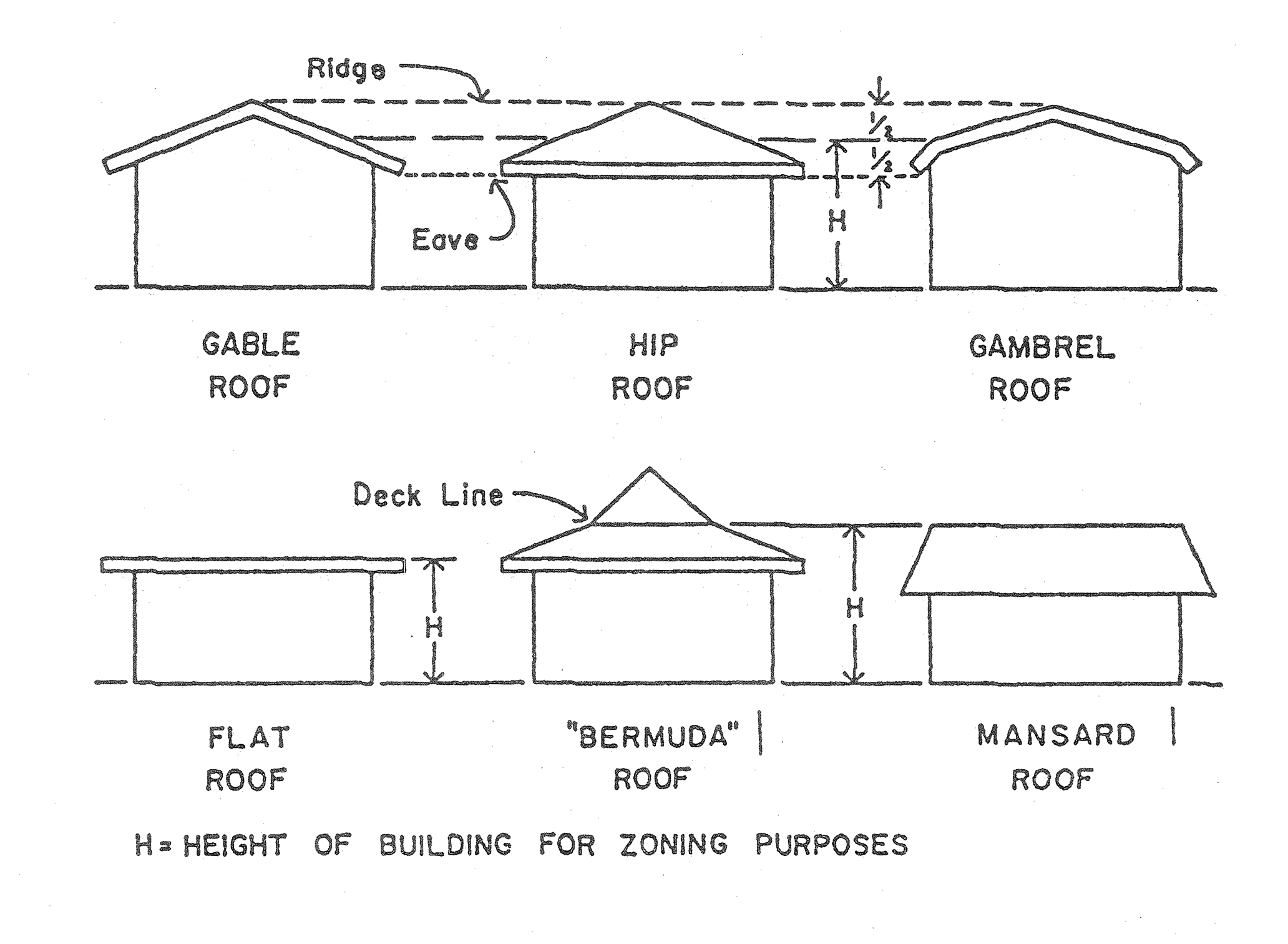
Building, height of means the vertical distance measured from the curb level to the highest point of the roof surface of a flat or Bermuda roof, to the deck line of a mansard roof, and to the mean height level between eaves and ridge of gable, hip and gambrel roofs. For buildings set back from the street line, the height of the building shall be measured from the average elevation of the finished grade along the front of the building, provided its distance from the street line is not less than the height of such grade above the established curb level. Where minimum floor elevations in floodprone areas have been established by law, which exceed the minimum point of measurement established by this section, the building height shall be measured from such required minimum floor elevations. (See the following illustration and section 94-184.)
Carnival means a traveling amusement show, having a Ferris wheel or other rides, sideshows and the like.
Cemetery means an area of land set apart for the sole purpose of the burial of bodies of dead persons or animals and for the erection of customary markers, monuments and mausoleums.
Child care facility means an establishment or arrangement where child care is regularly provided for five or more children, unrelated to the operator, and which receives a payment, fee or grant for any of the children receiving care, wherever operated and whether or not operated for profit. It does not include:
(1)
Public schools and nonpublic schools and their integral programs, except as provided in F.S. § 402.3025.
(2)
Summer camps having children in full-time residence.
(3)
Summer day camps.
(4)
Bible schools normally conducted during vacation periods.
Circus means a traveling company that performs public entertainment consisting of a variety of performances by acrobats, clowns and trained animals, typically held in a circular area surrounded by tiers of seats and often covered by a tent, in which such shows are performed.
Clinic, medical or dental means an establishment where patients, who are not lodged overnight, are admitted for examination and treatment by one person or a group of persons practicing any form of the healing arts, whether such persons be medical doctors, chiropractors, osteopaths, chiropodists, naturopaths, optometrists, dentists, or any such profession, the practice of which is regulated by the state. A public clinic is one operated by any governmental organization for the benefit of the general public. All other clinics are private clinics.
Club, private means those associations and organizations of a civic, fraternal or social character not operated or maintained for profit, and to which there is no unrestricted public access or use. The term "private club" shall not include casinos, nightclubs, bottle clubs or other establishments operated or maintained for profit.
Cluster housing means an arrangement of separately owned single-family dwellings on individual lots in a planned manner providing open space, recreation areas or park areas adjacent and common to all structures. Cluster housing shall consist of two or more dwelling structures, each containing one or two dwelling units, with no dwelling unit located above another dwelling unit, on a parcel of ground in single ownership at the time of development, with frontage on a public street or approved private street.
Completely enclosed building means a building separated on all sides from adjacent open space, or from other buildings or other structures, by a permanent roof and by exterior walls or party walls, pierced only by windows and normal entrance or exit doors.
Conditional use means a use that would not be appropriate generally or without restriction throughout the zoning district, but which, if controlled as to number, area, location or relation to the neighborhood, would promote the public health, safety, welfare, morals, order, comfort, convenience, appearance, prosperity or general welfare. Such uses may be permitted in such zoning district as conditional uses, if specific provision for such conditional use is made in this chapter. See section 94-3 for procedures.
Convalescent home. See Nursing home.
Coverage of a lot by buildings means that percentage of lot area that is covered or occupied by buildings, including accessory buildings, or that percentage of a lot that may be covered or occupied by buildings, including accessory buildings, under the terms of this chapter.
Day nursery. See Child care facility.
Density, residential means the number of residential dwelling units permitted per gross acre of land, and is determined by dividing the number of units by the total area of land within the boundaries of a lot or parcel, not including dedicated rights-of-way, except as otherwise provided for in this chapter. In the determination of the number of residential dwelling units to be permitted on a specific parcel of land, a fractional unit shall not entitle the applicant to an additional unit.
Dwelling (generally) means any building, or part thereof, occupied, in whole or in part, as the residence or living quarters of one or more persons, permanently or temporarily, continuously or transiently, with cooking and sanitary facilities.
Dwelling, multiple-dwelling use For purposes of determining whether a lot is in multiple-dwelling use, the following considerations shall apply:
(1)
Multiple-dwelling uses may involve dwelling units intended to be rented and maintained under central ownership and management or cooperative apartments, condominiums and the like.
(2)
Where an undivided lot contains more than one building and the buildings are not so located that lots and yards conforming to requirements for single-, two- or multiple-family dwellings in the district could be provided, the lot shall be considered to be in multiple-dwelling use if there are three or more dwelling units on the lot, even though the individual buildings may each contain less than three dwelling units.
(3)
Guesthouses and servants' quarters shall not be considered as dwelling units in the computation under subsection (2) of this definition.
(4)
Any multiple dwelling in which dwelling units are available for rental for periods of less than one week shall be considered a tourist home, motel, motor hotel or hotel, as the case may be.
Dwelling, multiple-family means a building containing three or more dwelling units.
Dwelling, one-family or single-family means a building containing only one dwelling unit. For regulatory purposes, the term is not to be construed as including mobile homes, travel trailers, housing mounted on motor vehicles, tents, houseboats, or other forms of temporary or portable housing.
Dwelling, two-family or duplex means one building containing only two dwelling units.
Dwelling unit means a room or rooms connected together, constituting a separate, independent housekeeping establishment for a family, for owner occupancy or rental or lease on a weekly, monthly or longer basis, and physically separated from any other rooms or dwelling units which may be in the same structure, and containing sleeping and sanitary facilities and one kitchen.
Electronic gaming establishment means any establishment which provides any electronic machines, games or devices, including, but not limited to, computers and gaming terminals, to conduct games of chance and/or a game promotion pursuant to F.S. § 849.094, including sweepstakes, and where cash, prizes, merchandise or other items of value are redeemed or otherwise distributed, whether or not the value of such redeemed or distributed items are determined by the electronic games played or by predetermined odds. Such games, machines and devices may hereinafter be referred to as electronic gaming devices. This term "electronic gaming establishment" includes, but is not limited to, internet cafes, internet sweepstakes cafes, cyber cafes, or sweepstakes cafes. This definition is applicable to any electronic gaming establishment, whether or not the electronic machine or device utilized, which:
(1)
Is server based;
(2)
Uses a simulated game terminal as a representation of the prizes associated with the results of the sweepstakes entries;
(3)
Uses software such that the simulated game influences or determines the winning or value of the prize;
(4)
Selects prizes from a predetermined finite pool of entries;
(5)
Uses a mechanism that reveals the content of a predetermined sweepstakes entry;
(6)
Predetermines the prize results and stores those results for delivery at the time the sweepstakes entry results are revealed;
(7)
Uses software to create a game result;
Erected includes built, constructed, reconstructed, moved upon, or any physical operation on the premises required for building. Excavation, fill, drainage, demolition of an existing structure and the like shall be considered part of erection. See Construction, actual.
Essential services are limited to certain utilities installations of water, sewer, gas, telephone and electrical systems such as substations, lift stations and similar installations. Electric or gas generation plants are not essential services under this definition.
Family means one or more persons occupying a single dwelling unit. The term "family" shall not be construed to mean a fraternity, sorority, club, monastery or convent, or institutional group, except persons occupying community residential homes where state statutes declare such residential homes to be single-family units.
Family day care home means an occupied residence in which child care is regularly provided for children from at least two unrelated families and which receives a payment, fee or grant for any of the children receiving care, whether or not operated for profit. A family day care home shall be allowed to provide care for one of the following groups of children, which shall include those children under 13 years of age who are related to the caregiver:
(1)
A maximum of four children from birth to 12 months of age.
(2)
A maximum of three children from birth to 12 months or age, and other children, for a maximum total of six children.
(3)
A maximum of six preschool children if all are older than 12 months of age.
(4)
A maximum of ten children if no more than five are preschool age and, of those five, no more than two are under 12 months of age.
Filling station. See Automotive service station.
Food pantry means a facility, run by a nonprofit 501(c)(3) organization, that distributes at no or low cost a non-prepared and non-cooked food, and can also distribute basic hygiene products, household supplies, and limited clothing.
Food truck means a readily moveable, licensed, motorized wheeled vehicle, containing a mobile food unit or a towed wheeled vehicle, designed and equipped to serve food, which is temporarily stored on a privately-owned lot or public right-of-way where food items are sold to the general public.
Frontage of a lot. See Lot frontage.
Garage, private means an accessory structure designed or used for inside parking of private passenger vehicles, recreation vehicles or boats, by the occupants of the main building. A private garage attached to or a part of the main structure is to be considered part of the main building. An unattached private garage is to be considered as an accessory building.
Garage, repair means a building or portion thereof, other than a private, storage or parking garage or automotive service station, designed or used for repairing, equipping or servicing of motor vehicles. Such garages may also be used for hiring, renting, storing or selling of motor vehicles.
Garage, storage means a building or portion thereof designed and used exclusively for the storage of motor vehicles or boats, and within which temporary parking may also be permitted.
Guesthouse and guest cottage means a dwelling unit in a building separate from and in addition to the principal residential building on a lot, but not exceeding 50 percent of the floor area of the principal residential building, intended for intermittent or temporary occupancy by a nonpaying guest.
Height of a building. See Building, height of.
Home occupation means an occupation conducted entirely in a dwelling unit.
Hospital means a building or group of buildings having facilities for overnight care of one or more human patients, providing services to inpatients and medical care to the sick and injured, and which may include as related facilities laboratories, outpatient services, training facilities, central service facilities and staff facilities; provided, however, that any related facility shall be incidental and subordinate to the principal hospital use and operation.
Hotel, motel, motor hotel, motor lodge and tourist court are considered synonymous, and mean a building or a group of buildings in which sleep accommodations are offered to the public and intended primarily for rental to transients with a daily charge, as distinguished from multiple-family dwellings (apartments) and roominghouses or boardinghouses, where rentals are for periods of a week or longer and occupancy is generally by residents rather than transients.
Housing for the aged means a facility, in the nature of multiple-family housing, with no provision for routine nursing and/or medical care. Where this chapter permits housing for the aged, such housing shall be used only for this purpose. If housing for the aged is changed to multiple-family use, then the full provisions of this chapter, including provision of off-street parking, shall be met for such multiple-family use and prior to any occupancy on a multiple-family basis.
Indoor recreational facility means any establishment that provides amusement, entertainment, or physical fitness services typically occurring indoors. Examples include art/dance/exercise studios, bowling alleys, gymnastics/martial arts studios, health club/fitness centers, ice skating and roller skating rinks, indoor play or sports facility, and similar uses. Such uses shall operate within soundproof buildings. Indoor recreational facility includes family amusement arcade establishments, only with Type A and C amusement games or machines on premises, which is operated for the entertainment of the general public and tourists as a bona fide amusement facility. Indoor recreational uses do not include electronic gaming establishments.
Junkyard means a place, structure or lot where junk, waste, discarded, salvaged or similar materials such as old metals, wood, slush, lumber, glass, paper, rags, cloth, bagging, cordage, barrels, containers, etc., are brought, bought, sold, exchanged, baled, packed, disassembled, stored or handled, including used lumber and building material yards, house-wrecking yards, heavy equipment wrecking yards, and yards or places for the storage, sale or handling of salvaged house wrecking or structural steel materials. This definition shall not include automobile wrecking and automobile wrecking yards, or pawnshops and establishments for the sale, purchase or storage of secondhand cars, clothing, salvaged machinery, furniture, radios, stoves, refrigerators, or similar household goods and appliances, all of which shall be usable, nor shall it apply to the processing of used, discarded or salvaged materials incident to manufacturing activity on the same site where such processing occurs.
Kindergarten. See Child care facility.
Landscaping shall consist of, but shall not be limited to, grass, ground covers, shrubs, vines, hedges, trees, berms and complementary structural landscape architectural features such as rock, fountains, sculpture, decorative walls and tree wells.
Loading space, off-street means a space logically and conveniently located for pickups and/or deliveries or for loading and/or unloading, scaled to delivery vehicles expected to be used, and accessible to such vehicles when required off-street parking spaces are filled. (See also section 94-261.)
Lot means a parcel of land of at least sufficient size to meet minimum zoning requirements for use, coverage and area, and to provide such yards and other open spaces as are required in this chapter; provided that certain nonconforming lots of record at the effective date of the ordinance from which this chapter is derived or at the effective date of an amendment to this chapter are exempted from certain of its provisions under the terms of section 94-114(b), pertaining to nonconforming lots of record. Such lot shall have frontage on a public street or on an approved private street, as set out in section 94-181, and may consist of:
(1)
A single lot of record.
(2)
A portion of a lot of record.
(3)
A combination of complete lots of record, or complete lots of record and portions of lots of record, or of portions of lots of record.
(4)
A parcel of land described by metes and bounds; provided that in no case of division or combination shall any residential lot or parcel be created which does not meet the requirements of this chapter.
Lot frontage. The front of an interior lot shall be construed to be the portion nearest the street. For the purpose of determining yard requirements on corner lots and through lots, all sides of a lot adjacent to streets shall be considered frontage, and yards shall be provided as set out in this chapter.
Lot measurement, depth. Depth of a lot shall be considered to be the distance between the midpoints of straight lines connecting the foremost points of the side lot lines in the front and the rearmost points of the side lot lines in the rear.
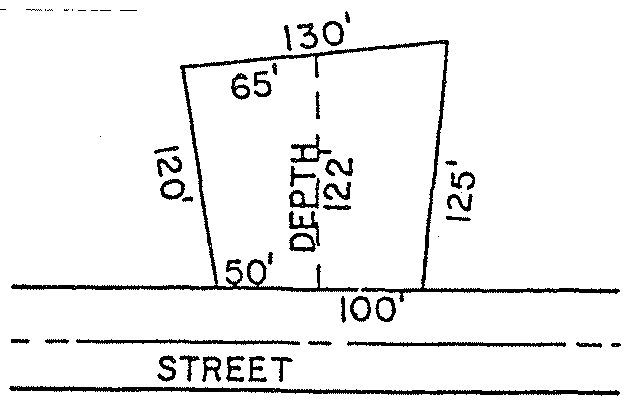
Lot measurement, width. Width of a lot shall be considered to be the average distance between straight lines connecting the front and rear lot lines at each side of the lot, measured as straight lines between the foremost points of the side lot lines in front (where they intersect with the street line) and the rearmost points of the side lot lines in the rear; provided, however, that the width between the side lot lines at their foremost points in the front shall not be less than 80 percent of the required lot width, except in the case of lots on the turning circle of a cul-de-sac, where the width shall not be less than 60 percent of the required lot width or 60 feet, whichever is smaller.
Lot of record means:
(1)
A lot which is part of a subdivision recorded in the office of the clerk of the circuit court of the county; or
(2)
A lot or parcel described by metes and bounds, the description of which has been so recorded on or before the effective date of the ordinance from which this chapter is derived. (See section 94-114(b) for provisions pertaining to nonconforming lots of record.)
Lot types. The diagram which follows illustrates terminology used in this chapter with reference to corner lots, interior lots, reversed frontage lots and through lots.
_____
ADD FIGURE page 1780
_____
In the diagram:
A = Corner lot, defined as a lot located at the intersection of two or more streets. A lot abutting on a curved street or streets shall be considered a corner lot if straight lines drawn from the foremost points of the side lot lines to the foremost point of the lot meet at an interior angle of less than 135 degrees. See lots marked A(1) in the diagram.
B = Interior lot, defined as a lot other than a corner lot with only one frontage on a street.
C = Through lot, defined as a lot other than a corner lot with frontage on more than one street. Through lots abutting two streets may be referred to as double frontage lots.
D = Reversed frontage lot, defined as a lot on which the frontage is at right angles or approximately right angles (interior angle less than 135 degrees) to the general pattern in the area. A reversed frontage lot may also be a corner lot (A-D in the diagram), an interior lot (B-D) or a through lot (C-D).
Marina means any premises or site with a waterfront location used as a commercial establishment for the provision of rental of covered or uncovered boat slips or dock space or enclosed dry storage space, rental and/or sale of boats and boat motors, repair and maintenance of boats and boat motors, marine fuel and lubricants, bait and fishing equipment, onshore restaurants, and small boat hauling or launching facilities. Such premises or site shall not include boat and/or motor manufacturing as an incidental use.
Minimum living area means the least amount of square footage required for the heated and cooled space of a dwelling utilized for living, sleeping, eating, cooking, bathing, washing and sanitation purposes by humans.
Mobile home means a detached single-family dwelling unit with all the following characteristics:
(1)
Designed for longterm occupancy, and containing sleeping accommodations, a flush toilet, a tub or shower bath, and kitchen facilities, with plumbing and electrical connections provided for attachment to outside systems;
(2)
Designed for transportation after fabrication on streets or highways on its own wheels; and
(3)
Arriving at the site where it is to be occupied as a dwelling complete, including major appliances and furniture, and ready for occupancy except for minor and incidental unpacking and assembly operations, location on jacks or other temporary or permanent foundations, connection to utilities and the like.
A travel trailer is not to be considered as a mobile home. A mobile home as defined in this section shall not be considered a modular home unless it meets the construction requirements of the Standard Building Code.
Mobile home park means premises where mobile homes are parked for nontransient living or sleeping purposes and where sites or lots are set aside or offered for lease or rent for use by mobile homes for living or sleeping purposes, including any land, building, structure or facility used by occupants of mobile homes on such premises.
Mobile home subdivision means premises where mobile homes are parked for nontransient living or sleeping purposes and where lots are set aside or offered for sale for use by mobile homes for living or sleeping purposes in accordance with the city subdivision regulations (chapter 74), including any land, building, structure or facility used by occupants of mobile homes on such premises.
Mobile medical unit means any use and activity contained within a travel trailer or similar vehicle, incidental and subordinate to principal medical clinic use and immediately adjacent to principal use, including specialized medical equipment, intended to provide a premises for medical testing, and intended to be used only for limited time periods. Use includes freestanding mobile units associated with state or federal agencies and the American Red Cross and similar quasi-public agencies, for example, like the "Bloodmobile."
Motel. See Hotel, etc.
Motor hotel and motor lodge. See Hotel, etc.
Nonconforming lot, structure, use of land, use of land and structure, etc. See section 94-114, pertaining to nonconformities.
Nursery school. See Child care facility.
Nursing home and extended care facility means a private home, institution, building, residence or other place, whether operated for profit or not, including those places operated by units of government, which undertakes through its ownership or management to provide, for a period exceeding 24 hours, maintenance, personal care or nursing for three or more persons not related by blood or marriage to the operator, who, by reason of illness, physical infirmity or advanced age, are unable to care for themselves; provided that this definition shall include homes offering services for less than three persons where the homes are held out to the public to be establishments which regularly provide nursing and custodial services.
Occupied includes arranged, designed, built, altered, converted to or intended to be used or occupied.
Office, business means an office for such activities as a real estate agency, advertising agency (but not a sign shop), insurance agency, travel agency and ticket sales, chamber of commerce, credit bureau (but not a finance company), abstract and title agency or insurance company, stockbroker and the like. It is characteristic of a business office that retail or wholesale goods are not shown to or delivered from the premises to a customer. A barbershop or beauty shop is not a business office.
Office, professional means an office for the use of persons generally classified as professionals, such as architects, engineers, attorneys, accountants, doctors, lawyers, dentists, veterinarians, psychiatrists, psychologists and the like. It is characteristic of professional offices that display advertising is prohibited as an unethical practice and that the use is characterized principally by offering of consultive services.
Original or historic use means the original use of a contributing structure within a historic district at the time of its construction or as occurring during the districts period of historic significance.
Package liquor store means a place where alcoholic beverages are dispensed or sold in containers for consumption off the premises.
Parking garage means a building or portion thereof designed or used for temporary parking of motor vehicles, and within which gasoline and oils may be sold only to parking patrons of the garage.
Parking space, off-street. An off-street parking space shall consist of a space adequate for parking a standard size automobile with room for opening doors on both sides, together with properly related access to a public street or alley and maneuvering room. Required off-street parking areas shall be so designed, maintained and regulated that no parking or maneuvering incidental to parking shall be on any public street, walk or alley, and so that any automobile may be parked and unparked without moving another. (See also section 94-261.)
Patio housing means single-family dwelling structures on individually platted lots which are designed to provide maximum usage of outdoor living space while ensuring privacy from adjacent housing by providing for a side yard or "patio" of greater than normal width on one side of the dwelling and no yard on the other. (See also section 94-197.)
Planned unit development. A planned unit development:
(1)
Is land under unified control, planned and developed as a whole in a single development operation or approved programmed series of development operations for dwelling units and related uses and facilities;
(2)
Includes principal and accessory uses and structures substantially related to the character of the development itself and the surrounding area of which it is a part;
(3)
Is developed according to comprehensive and detailed plans which include not only streets, utilities, lots or building sites, and the like, but also site plans, floor plans and elevations for all buildings as intended to be located, constructed, used and related to each other, and detailed plans for other uses and improvements on the land as related to the buildings; and
(4)
Includes a program for full provision of maintenance and operation of such areas, improvements, facilities and services as will be for common use by some or all of the occupants of the planned unit development, but will not be provided, operated or maintained at public expense.
Plot. See Lot.
Porch means a roofed-over space, with the roof impervious to weather, attached to the outside of an exterior wall of a building, which has no enclosure other than the exterior walls of such building. Open mesh screening shall not be considered an enclosure.
Produce truck means a box or semi-tractor trailer truck utilized to deliver and dispense fresh produce or cottage foods to approved locations within the city.
Restaurant means an establishment where food is ordered from a menu, prepared and served for pay primarily for consumption on the premises in a completely enclosed room, under the roof of the main structure, or in an interior court. A drive-in restaurant is not a restaurant. A cafeteria shall be deemed a restaurant for purposes of this chapter.
Restaurant, drive-in means any place or premises where provision is made on the premises for the selling, dispensing or serving of food, refreshments or beverages in automobiles and/or in other than a completely enclosed building on the premises, including those establishments where customers may serve themselves and may eat or drink the food, refreshments or beverages in automobiles on the premises and/or in other than a completely enclosed building on the premises. A restaurant which provides drive-in facilities of any kind in connection with regular restaurant activities shall be deemed a drive-in restaurant for purposes of this chapter. A barbecue stand or pit having the characteristics noted in this definition shall be deemed a drive-in restaurant.
Restaurant, fast food means an establishment where food is prepared and served to the customer in a ready-to-consume state for consumption either within the restaurant building, outside the building but on the same premises, or off the premises, and having any combination of two or more of the following characteristics:
(1)
A limited menu, usually posted on a sign rather than printed on individual sheets or booklets;
(2)
Self-service rather than table service by restaurant employees;
(3)
Disposable containers and utensils; or
(4)
A kitchen area in excess of 50 percent of the total floor area.
A cafeteria shall not be deemed a fast food restaurant for the purpose of this chapter.
Roadside vending means sales of food, animals, household goods, or other merchandise from any vehicle, tent, display area or temporary (nonpermanent) structure, typically along property bordering or in view of a public right-of-way. Roadside vending does not include arts, crafts and sales booths associated with annual festivals, civic gatherings, or other similar uses as determined by the zoning administrator.
Roominghouse means any public lodging establishment that may not be classified as a hotel, motel, boardinghouse, bed and breakfast inn, resort condominium, transient apartment, or nontransient apartment, and which does not have meal service or a food preparation area (kitchen), and does provide adequate sanitary facilities for the accommodation of its employees and guests. Such sanitary facilities may include but are not limited to a shower, handwash basin, toilet and bidets. Such sanitary facilities shall be connected to approved plumbing.
Service station. See Automotive service station.
Shopping center means a group of retail stores and/or service establishments planned and developed as a unit by one operator, owner, organization or corporation for sale or for lease for the site upon which they are built.
Sign means any device designed to inform or attract the attention of persons not on the premises on which the sign is located; provided, however, that the following shall not be included in the application of the regulations in this chapter:
(1)
Signs not exceeding one square foot in area and bearing only property numbers, post box numbers, names of occupants of premises, or other identification of premises not having commercial connotations.
(2)
Flags and insignia of any government except when displayed in connection with commercial promotion.
(3)
Legal notices, identification, or informational or directional signs erected or required by governmental bodies.
(4)
Integral decorative or architectural features of buildings, except letters, trademarks, moving parts or moving lights.
(5)
Signs not exceeding two square feet in area directing and guiding traffic and parking on private property, but bearing no advertising matter.
Street means a public or approved private thoroughfare which affords the principal means of access to abutting property. The term "street" includes lanes, ways, places, drives, boulevards, roads, avenues, or other means of ingress or egress, regardless of the descriptive term used. (See also the subdivision regulations (chapter 74).)
Structure. See Building.
Townhouse means three or more single-family structures separated by party walls or separated by not more than one inch from another townhouse. Townhouses are permitted as shown on the schedule of district regulations. A townhouse may be held in separate ownership. Side yards are not required for interior townhouses, but front and rear yards shall be required for all townhouses as for single-family dwellings for the district in which the townhouses are located. End units shall have side yards, or, if on a corner lot, front yards as for single-family dwellings in the district in which the townhouses are located.
Trailer, travel or camping means a vehicular portable structure built on a chassis, designed to be used as a temporary dwelling for travel, recreational and vacation purposes, which:
(1)
Is not more than eight feet in body width; and
(2)
Is of any length provided its body length does not exceed 35 feet.
Use means the purpose for which land or water or a structure thereon is designed, arranged or intended to be occupied or utilized, or for which it is occupied or maintained. The use of land or water in the various zoning districts is governed by this chapter.
Use of land or water means the use of land, water surface, and land under water to the extent covered by zoning districts, and over which the city has jurisdiction.
Utilities. See Essential services.
Variance means a relaxation of the terms of this chapter with regard to the height, area and size of structures or size of yards and open spaces. (See article III, division 2 of this chapter for procedures and limitations.)
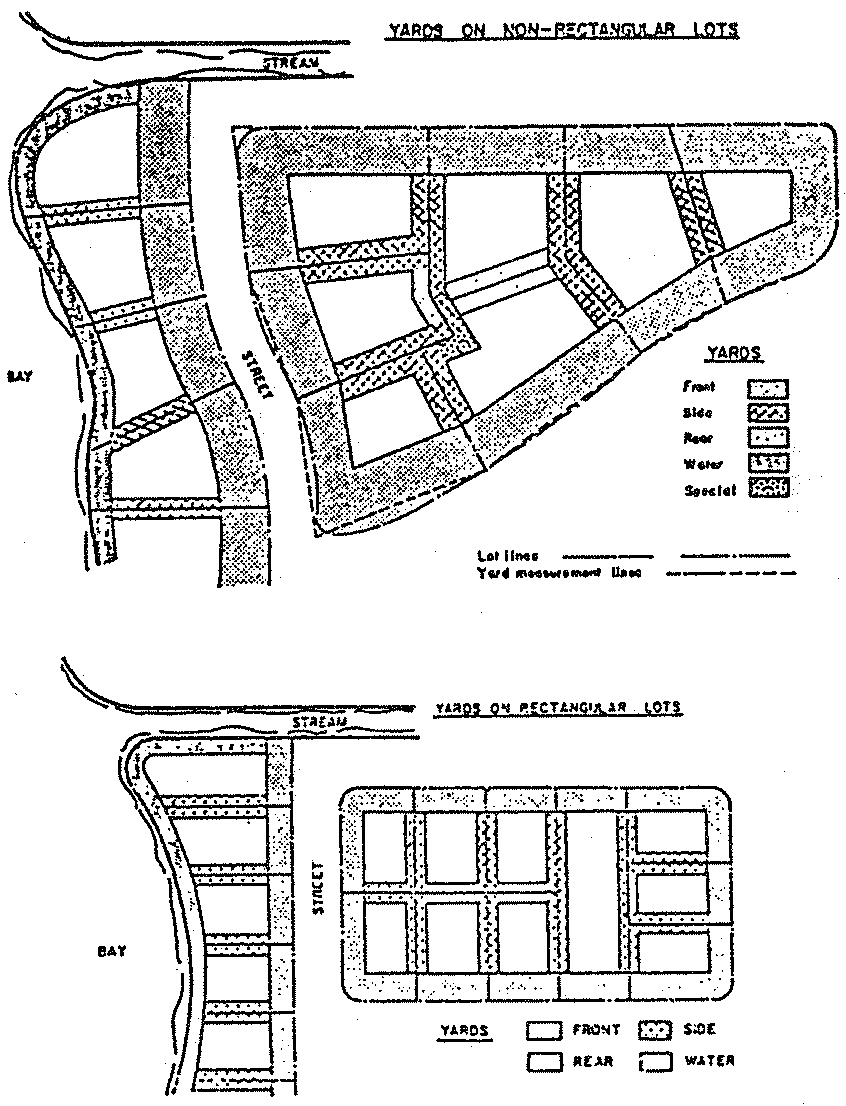
Yard means a required open space, other than a court, unoccupied and unobstructed by any structure or portion of a structure from 30 inches above the general ground level of the graded lot upward; provided, however, that fences, walls, hedges, poles, posts, children's play equipment and other customary yard accessories, ornaments, statuary and furniture may be permitted in any yard subject to height limitations and requirements limiting obstructions to visibility. (For an explanation as to how to measure various types of yards on rectangular and nonrectangular lots, see the following illustration.)
Yard, front.
(1)
A front yard is a yard extended between side lot lines across the front of a lot adjoining a street.
(2)
In the case of through lots, unless the prevailing front yard pattern on adjoining lots indicates otherwise, front yards shall be provided on all frontages. Where one of the front yards that would normally be required on a through lot is not in keeping with the prevailing yard pattern, the zoning administrator may waive the requirement for the normal front yard and substitute therefor a special yard requirement, which shall not exceed the average of the yards provided on adjacent lots.
(3)
Depth of a required front yard shall be measured at right angles to a straight line joining the foremost points of the side lot lines. The foremost point of the side lot line, in the case of rounded property corners at street intersections, shall be assumed to be the point at which the side and front lot lines would have met without such rounding.
(4)
Where lots in residential districts comprising 40 percent or more of the frontage on one side of a street between intersecting streets are developed with structures having an average front yard with a variation of not more than six feet, no building thereafter erected shall project beyond the average line so established. This provision applies in all residential districts.
Yard, rear.
(1)
A rear yard is a yard extending across the rear of the lot between inner side yard lines. In the case of through lots and corner lots, there will be no rear yards, but only front and side yards.
(2)
Depth of a required rear yard shall be measured in such a manner that the yard established is a strip of the minimum width required by district regulations with its inner edge parallel with the rear lot line.
Yard, side.
(1)
A side yard is a yard extending from the interior (rear) line of the required front yard to the rear lot line, or in the absence of any clearly defined rear lot line to the point on the lot farthest from the intersection of the lot line involved with the public street. In the case of through lots, side yards shall extend from the rear line of front yards required. In the case of corner lots, yards remaining after front yards have been established on both frontages shall be considered side yards.
(2)
Width of a required side yard shall be measured in such a manner that the yard established is a strip of the minimum width required by district regulations with its inner edge parallel with the side lot line.
Yard, special means a yard behind any required yard adjacent to a public street required to perform the same functions as a side or rear yard, but adjacent to a lot line and so placed or oriented that neither the term "side yard" nor the term "rear yard" clearly applies. In such cases, the zoning administrator shall require a yard with minimum dimensions as generally required for a side yard or a rear yard in the district, determining which shall apply by the relation of the portion of the lot on which the yard is to be located to the adjoining lots, with due regard to the orientation and location of structures and buildable areas thereon.
(Code 1981, app. C, § 26-19; Ord. No. 14-31, § 1, 11-20-2014; Ord. No. 14-32, § 1, 11-20-2014; Ord. No. 14-33, § 1, 12-11-2014; Ord. No. 15-41, § 1(Exh. A), 11-12-2015; Ord. No. 15-42, § 1(Exh. A), 11-12-2015; Ord. No. 15-43, § 1(Exh. A), 11-12-2015; Ord. No. 16-43, § 1, 9-22-2016; Ord. No. 2022-06, § I, 8-25-2022)
Cross reference— Definitions generally, § 1-2.
Sec. 94-3. - Conditional uses.
A conditional use is a use that would not be appropriate generally or without restriction throughout a zoning district, but which, if controlled as to number, area, location or relation to the neighborhood, would promote the public health, safety, welfare, morals, order, comfort, convenience, appearance, prosperity or general welfare. Such conditional uses may be permissible in a zoning district if specific provision for such a conditional use is made in this chapter. All petitions for conditional use shall be considered first by the planning board in the manner set out in this section.
(1)
Written petition. A written petition for conditional use shall be submitted indicating the provision of this chapter under which the conditional use is sought and stating the grounds on which it is requested, with particular reference to the types of findings which the planning board must make under subsection (4) of this section. The petition should include material necessary to demonstrate that the conditional use will be in harmony with the general intent and purpose of this chapter, and will not be injurious to the neighborhood or to adjoining properties or otherwise detrimental to the public welfare. Such material shall include but is not limited to the following, where applicable:
a.
Site plans at an appropriate scale showing proposed placement of structures on the property, provisions for ingress and egress, off-street parking and off-street loading areas, refuse and service areas, and required yards and other open spaces;
b.
Plans showing proposed locations for utilities hookup;
c.
Plans for screening and buffering with reference to type, dimensions and character;
d.
Proposed landscaping and provisions for trees protected by city regulations; and
e.
Proposed signs and lighting, including type, dimensions and character.
Where this chapter places additional requirements on specific conditional uses, the petition should demonstrate that such requirements are met. Where the rezoning of land as well as a conditional use is required simultaneously for the same parcel of land, both petitions may be processed concurrently in accordance with the procedures set forth in this section and section 94-38.
(2)
Public hearing required. A public hearing shall be held by the planning board. Any party may appeal personally or by agent or attorney.
(3)
Notice of public hearing. Notice of the public hearing shall be given at least 15 days in advance of the public hearing. The owner of the property for which the conditional use is sought, or his agent or attorney designated by him in his petition, shall be notified by mail. Notice of the public hearing shall be prominently posted on the property for which the conditional use is sought. Notice of the public hearing shall be advertised in a newspaper of general circulation in the city at least one time at least 15 days prior to the public hearing. Notice shall be given by mail to all owners of property within 150 feet of the boundary lines of the property for which the conditional use is requested; provided, however, that where the applicant is the owner of land not included in the applicant's application and such land that is not included in the application is a part of or adjoins the parcel for which the request is made, the 150-foot requirement shall be measured from the boundaries of the applicant's ownership, including the land not covered by applicant's application. For purposes of this subsection, owners of adjacent or nearby properties within the distance set out shall be deemed those whose names appear on the latest available tax rolls of the city. Failure of a property owner to receive mail notice shall not invalidate the hearing or subsequent action related thereto.
(4)
Findings. Before any conditional use shall be approved, the planning board shall make a written finding that the granting of the conditional use will not adversely affect the public interest and certifying that the specific requirements governing the individual conditional use, if any, have been met by the petitioner and that, further, satisfactory provision and arrangement has been made concerning the following matters, where applicable:
a.
Compliance with all applicable elements of the comprehensive plan.
b.
Ingress and egress to property and proposed structures thereon, with particular reference to automotive and pedestrian safety and convenience, traffic flow and control, and access in case of fire or catastrophe.
c.
Off-street parking and loading areas, where required, with particular attention to the items mentioned in subsection (4)b of this section and the economic, noise, glare or odor effects of the special exception on adjoining properties and properties generally in the district.
d.
Refuse and service areas, with particular reference to the items mentioned in subsections (4)b and c of this section.
e.
Utilities, with reference to location, availability and compatibility.
f.
Screening and buffering, with reference to type, dimensions and character.
g.
Signs, if any, and proposed exterior lighting, with reference to glare, traffic safety, economic effects, and compatibility and harmony with properties in the district.
h.
Required yards and other open space.
i.
General compatibility with adjacent properties and other property in the district.
j.
Any special requirements set out in the schedule of district regulations for the particular use involved.
k.
The recommendation and any special requirements of the historic preservation board for uses within the HD zoning district.
(5)
Conditions and safeguards.
a.
In approving any conditional use, the planning board may also require appropriate conditions and safeguards in conformity with this chapter. Violations of such conditions and safeguards, when made a part of the terms under which the conditional use is approved, shall be deemed a violation of this chapter.
b.
Any conditional use shall expire six months from the date of approval unless, upon request, an extension of time is granted by the planning board, if by that date the use for which the conditional use was granted has not been commenced. Any conditional use shall expire 12 months following the discontinuance of the use for which the conditional use was granted if the use has not been recommenced.
(6)
Denial. If the planning board shall deny a conditional use, it shall state fully in its record its reasons for doing so. Such reasons shall take into account the standards stated in subsection (4) of this section, or such of them as may be applicable to the action of denial, and the particular regulations relating to the specific conditional use requested, if any.
(7)
Appeals. Action taken by the planning board to approve a conditional use with appropriate conditions or safeguards or to deny a conditional use shall be deemed final unless a request is filed with the city clerk within 30 days from the date of such planning board decision requesting the city commission to review such decision. Any person aggrieved by an action of the city commission affirming, modifying or reversing such planning board decision may seek recourse to the courts as provided by the laws of the state.
(Code 1981, app. C, § 26-12; Ord. No. 11-72, § 1, 10-27-2011)
Sec. 94-4. - Provisions of chapter are minimum or maximum requirements; conflicting regulations.
In their interpretation and application, the provisions of this chapter shall be held to be minimum or maximum requirements, as the case may be, adopted for the promotion of the public health, safety, morals or general welfare. Wherever the requirements of this chapter are at variance with the requirements of any other lawfully adopted statute, rule, regulation, ordinance or code, the most restrictive, or that imposing the higher standards, shall govern.
(Code 1981, app. C, § 26-15)
Sec. 94-5. - Relationship of article to comprehensive plan.
This chapter implements and furthers the following objectives and policies of the city comprehensive plan 2005:
(1)
2.1, Future land use element:
a.
Policy A.1.1.4.
b.
Policy A.1.2.1.
c.
Policy A.1.7.1.
(2)
2.2, Traffic circulation element:
a.
Policy B.1.1.3.
b.
Policy B.1.1.5.
c.
Policy B.1.1.7.
d.
Policy B.1.1.8.
(Code 1981, app. C, § 26-9(4))

