
Palatka City Zoning Code
ARTICLE III
DISTRICTS
Sec. 94-111. - Establishment; official zoning map.
(a)
Districts generally. The city is hereby divided into zoning districts as provided in this section and as shown on the official zoning map, which, together with all explanatory material shown therein, is hereby adopted by reference and declared to be a part of this chapter.
_____
(b)
Relationship of districts. Districts as defined on the official zoning map must be consistent with adopted land uses as shown on the future land use map. Zoning districts, their relationship to land uses, and zoning abbreviations for symbol purposes are as follows:
GENERAL ZONING SPECIFICATIONS
NOTE: This table is for illustrative purposes only. Each specific land use in the city, including the overall development scheme for each use, should be analyzed for consistency with the entire comprehensive plan, regardless of the zoning district. Compliance with the requirements of the zoning district is only one step in that consistency analysis.
_____
(c)
Definitions of grouping of various districts.
(1)
Where the phrase "all residential districts," "residential districts," zoned residential" or "residentially zoned" are used in this chapter, the phrase shall be construed to include the R-1AA, R-1A, R-1, R-2, R-3 and R-4 districts.
(2)
Where the phrase "commercial districts" is used in this chapter, the phrase shall be construed to include the C-1A, C-1, C-2 and C-3 districts.
(3)
Where the phrase "industrial district" is used in this chapter, the phrase shall be construed to mean the M-1 district.
(d)
Identification of official zoning map; contents.
(1)
The official zoning map shall be identified by the signature of the mayor and attested by the city clerk and bear the seal of the city under the following words: "This is to certify that the map to which this seal is affixed is the official zoning map of the City of Palatka referred to and adopted by reference by Ordinance No. 82-2 of the City of Palatka, Florida, adopted January 28, 1982, plus amendments."
(2)
The boundaries of each district shall be shown on the official zoning map and the district symbol as set out in subsection (b) of this section shall be used to designate each district.
(e)
Changes in district boundaries to be shown on official zoning map. If, in accordance with the provisions of this chapter, changes are made in district boundaries or other matter portrayed on the official zoning map, such changes shall be entered promptly on the official zoning map after the amendment has been approved by the city commission, with an entry on the official zoning map as follows: "On ________, by Ordinance No. _______ of the City of Palatka, the official zoning map was changed as shown," which entry shall be attested by the city clerk. No amendment to this chapter which involves matter portrayed in the official zoning map shall become effective until such change and entry has been made on the official zoning map in the manner set out in this section. Such change shall be made within two working days after the effective date of the amendment.
(f)
Unauthorized changes to official zoning map. No changes of any nature shall be made in the official zoning map or any matter shown thereon except in conformity with the procedures set out in this chapter. Any unauthorized change, of whatever kind, by any person, shall be considered a violation of this chapter and punishable as provided by section 1-10.
(g)
Official zoning map to be final authority as to zoning. Regardless of the existence of purported copies of all or part of the official zoning map which may from time to time be made or published, the official zoning map, which shall be located in the office of the city clerk, shall be the final authority as to the current zoning status of all lands and waters in the city.
(h)
Retention of earlier zoning maps. All zoning maps, or remaining portions thereof, which have had the force and effect of official zoning maps for the city shall be retained as a public record and as a guide to the zoning status of land and water areas for the time periods involved.
(i)
Replacement of official zoning map.
(1)
If the official zoning map becomes damaged, lost, destroyed or difficult to interpret by reason of the nature or number of changes, the city commission may by resolution adopt a new official zoning map which shall supersede the prior official zoning map. The new official zoning map may correct drafting or other errors or omissions in the prior official zoning map, but no such correction shall have the effect of amending the original official zoning map.
(2)
The new official zoning map shall be authenticated as for the original, with wording to the following effect: "This is to certify that this official zoning map replaced the official zoning map adopted January 28, 1982, as part of Ordinance No. 82-2 of the City of Palatka, Florida."
(3)
Unless the prior official zoning map has been lost or has been totally destroyed, the prior map or any significant parts thereof remaining shall be preserved as a public record, together with all available records, minutes, ordinances or amendments pertaining to its adoption or amendment.
(Code 1981, app. C, § 26-2; Ord. No. 97-22, § 1, 9-11-1997; Ord. No. 05-30, § I, 6-9-2005; Ord. No. 12-02, § 2, 1-12-2012)
Sec. 94-112. - Rules for interpretation of district boundaries.
(a)
District regulations extend to all portions of district. Except as otherwise specifically provided, a district symbol or name shown within district boundaries on the official zoning map indicates that district regulations pertaining to the district extend throughout the whole area surrounded by the boundary line.
(b)
Uncertain boundaries. Where uncertainty exists as to the boundaries of districts as shown on the official zoning map, the following rules shall apply:
(1)
Boundaries indicated as approximately following the centerlines of streets or alleys shall be construed as following such centerlines as they exist on the ground, except where variation of the actual location from the mapped location would change the zoning status of a lot or parcel, in which case the boundary shall be interpreted in such a manner as to avoid changing the zoning status of any lot or parcel. In case of a street closure, the boundary shall be construed as remaining in its location except where ownership of the vacated street is divided other than at the center, in which case the boundary shall be construed as moving with the ownership, but not beyond the previous right-of-way line.
(2)
Boundaries indicated as approximately following lot lines, public property lines and the like shall be construed as following such lines; provided, however, that where such boundaries are adjacent to a street or alley and the zoning status of the street or alley is not indicated, the boundaries shall be construed as running to the center of the street or alley. In the event of street or alley closure, interpretation shall be as provided in subsection (b)(1) of this section.
(3)
Boundaries indicated as approximately following city limits shall be construed as following such city limits.
(4)
Boundaries indicated as following railroad tracks shall be construed as being midway between the main tracks.
(5)
Boundaries indicated as following shorelines or centerlines of streams, canals, lakes or other bodies of water shall be construed as following such shorelines or centerlines. In case of a change in a shoreline, or of the course or extent of bodies of water, the boundaries shall be construed as moving with the change except where such moving would change the zoning status of a lot or parcel, and in such case the boundary shall be interpreted in such a manner as to avoid changing the zoning status of any lot or parcel.
(6)
Boundaries indicated as entering any body of water but not continuing to intersection with other zoning boundaries or with the limits of jurisdiction of the city shall be construed as extending in the direction in which they enter the body of water to intersection with other zoning boundaries or with the limits of city jurisdiction.
(7)
Boundaries indicated as following physical features other than those mentioned in subsections (1) through (6) of this subsection shall be construed as following such physical features, except where variation of the actual location from the mapped location would change the zoning status of a lot or parcel, and in such case the boundary shall be interpreted in such manner as to avoid changing the zoning status of any lot or parcel.
(8)
Distances not specifically indicated on the official zoning map shall be determined by the scale of the map.
(c)
Cases not specifically covered. In cases not covered in this section, the zoning administrator shall interpret the official zoning map in accord with the intent and purpose of this chapter. Appeal from the interpretation of the zoning administrator shall be only to the board of zoning appeals in conformity with section 94-65.
(d)
Division of lot of record by district boundary. Where a district boundary divides a lot of record in existence at the time the boundary was established, and where the division makes impractical the reasonable use of the lot, the extension of the regulations for either portion of the lot may be permitted as a conditional use beyond the district line into the remaining portion of the lot.
(Code 1981, app. C, § 26-3)
Sec. 94-113. - Applicability of district regulations.
The regulations set by this chapter within each district shall be minimum or maximum limitations, as appropriate to the case, and shall apply uniformly to each class or kind of structure, use, or land or water. Except as provided in this chapter:
(1)
Use. No building or structure or land shall hereafter be used or occupied and no building or structure or part thereof shall be erected, constructed, reconstructed, moved or altered except in conformity with the regulations specified in this chapter for the district in which it is located.
(2)
Height of structures, population density, lot coverage, yards and open spaces. No structure shall hereafter be erected or altered:
a.
To exceed height or bulk limitations provided in this chapter;
b.
To provide a greater number of dwelling units or less lot area per dwelling unit than as permitted or required in this chapter;
c.
To provide less lot area per dwelling unit or to occupy a smaller lot than as permitted or required in this chapter;
d.
To occupy a greater percentage of lot area, or to provide narrower or smaller yards, courts or other open spaces, or lesser separation between buildings or structures or portions of buildings or structures, than required in this chapter; or
e.
In any other manner contrary to the provisions of this chapter.
(3)
Multiple use of required open space. No part of a required yard or other required open space, or off-street parking or off-street loading space, provided in connection with one structure or use shall be included as meeting the requirements for any other structure or use, except where specific provision is made in this chapter.
(4)
Reduction of lot area. No lot, combination of contiguous lots in common ownership, or yard, existing at the effective date of the ordinance from which this chapter is derived shall hereafter be reduced in dimension or area below the minimum requirements set forth in this chapter, except by reason of a portion being acquired for public use in any manner, including dedication, condemnation, purchase and the like. Lots or yards created after the effective date of the ordinance from which this chapter is derived shall meet at least the minimum requirements established by this chapter.
(5)
Limitation on number of principal buildings on lots in residential areas. Except as provided in this chapter, only one principal residential building, except for multifamily buildings and cluster developments, may hereafter be erected on any lot.
(6)
Continuity of zoning of annexed property. Where property is annexed to the city subsequent to the effective date of the ordinance from which this chapter is derived, such property shall continue to hold the zoning classification placed on it by the county; and the regulations applicable to it under the zoning regulation of the county shall be administered and enforced by the city until such time as the property has been reclassified in accordance with general law.
(7)
Planned unit development overlay threshold. Any proposed nonresidential development exceeding 20,000 square feet or residential development with project density exceeding five units per acre or residential development with more than five units shall be required to utilize a planned unit development overlay.
(Code 1981, app. C, § 26-4; Ord. No. 12-15, § 1, 3-8-2012)
Sec. 94-114. - Nonconforming lots, structures and uses.
(a)
Intent.
(1)
Within the districts established by this chapter or amendments that may later be adopted, there exist lots, structures, and uses of land and structures which were lawful before the ordinance codified in this chapter was passed or amended, but which would be prohibited, regulated or restricted under the terms of this chapter or future amendment.
(2)
It is the intent of this chapter to permit these nonconformities to continue until they are removed, but not to encourage their survival. Such uses are declared by this chapter to be incompatible with permitted uses in the districts involved. It is further the intent of this chapter that nonconformities shall not be enlarged upon, expanded or extended, or be used as grounds for adding other structures or uses prohibited elsewhere in the same district.
(3)
A nonconforming use of a structure, a nonconforming use of land, or a nonconforming use of a structure and land shall not be extended or enlarged after passage of the ordinance codified in this chapter by attachment on a building or premises of additional signs or by addition of other uses of a nature which would be prohibited in the district involved.
(b)
Nonconforming lots of record. Where a lot of record exists which was held in individual ownership and platted and recorded in the office of the clerk of the circuit court of the county prior to the time of adoption of the ordinance codified in this chapter, and such lot does not conform to the lot area or width requirements for the district in which it is located, the lot may be used for any use permitted in district provided all other development standards are met.
(c)
Nonconforming uses of land. Where, at the effective date of adoption or amendment of the ordinance codified in this chapter, lawful use of land exists that is made no longer permissible under the terms of this chapter as enacted or amended, such use may be continued, so long as it remains otherwise lawful, subject to the following provisions:
(1)
No such nonconforming use shall be enlarged, increased or expanded to occupy a greater area of land than was occupied at the effective date of adoption or amendment of the ordinance codified in this chapter.
(2)
No such nonconforming use shall be moved in whole or in part to any other portion of the lot or parcel occupied by such use at the effective date of adoption or amendment of the ordinance codified in this chapter.
(3)
If any such nonconforming use of land ceases for any reason for a period of more than six months, any subsequent use of such land shall conform to the requirements of this chapter for the district in which such land is located, and continuance of such use after such period is specifically prohibited.
(d)
Nonconforming structures. Where a lawful structure exists at the effective date of adoption or amendment of the ordinance codified in this chapter that could not be built under the terms of this chapter by reason of restriction on area, lot coverage, height, yards or other characteristics of the structure or its location on the lot, such structure may be continued so long as it remains otherwise lawful, subject to the following provisions:
(1)
No such structure may be enlarged or altered in a way which increases its nonconformity.
(2)
Should such structure be destroyed by any means to an extent of 60 percent or more of its replacement cost at time of destruction, it shall not be reconstructed except in conformity with the provisions of this chapter.
(3)
Should such structure be moved for any reason for any distance whatever, it shall thereafter conform to the requirements of the district in which it is located after it is moved.
(e)
Nonconforming uses of structures. If a lawful use of a structure, or of a structure and premises in combination, exists at the effective date of adoption or amendment of the ordinance codified in this chapter that would not be allowed in the district under the terms of this chapter, the lawful use may be continued so long as it remains otherwise lawful, subject to the following provisions:
(1)
No existing structure devoted to a use not permitted by this chapter in the district in which it is located shall be enlarged, extended, constructed, reconstructed, moved or structurally altered except in changing the use of the structure to a use permitted in the district in which it is located.
(2)
If no structural alterations are made, any nonconforming use of a structure, or structure and premises, may be changed to another nonconforming use, provided the board of zoning appeals may require appropriate conditions and safeguards in accord with the provisions of section 94-64.
(3)
Any structure, or structure and land in combination, in or on which a nonconforming use is superseded by a permitted use, shall thereafter conform to the requirements of the district in which such structure is located, and the nonconforming use may not thereafter be resumed.
(4)
When a nonconforming use of a structure, or structure and premises in combination, is discontinued or abandoned for six months, the structure, or structure and premises in combination, shall not thereafter be used except in conformance with the requirements of this district in which it is located.
(5)
Where nonconforming use status applies to a structure and premises in combination, removal or destruction of the structure shall eliminate the nonconforming status of the land.
(f)
Nonconforming characteristics of use. If characteristics of use, such as residential densities, signs, off-street parking or off-street loading, or other matters pertaining to the use of land and structures are made nonconforming by this chapter as adopted or amended, no change shall thereafter be made in such characteristics of use which increases nonconformity with the regulations set out in this chapter; provided, however, that changes may be made which do not increase, or which decrease, such nonconformity.
(g)
Repairs and maintenance. Nothing in this chapter shall be deemed to prevent the strengthening or restoring to a safe condition of any building or part thereof.
(h)
Casual, temporary or illegal use. The casual, temporary or illegal use of land or structures, or land and structures in combination, shall not be sufficient to establish the existence of a nonconforming use or to create rights in the continuance of such use.
(i)
Conditional uses not nonconforming uses. Any use which is permitted as a conditional use in a district under the terms of this chapter shall not be deemed a nonconforming use in such district, but shall without further action be deemed a conforming use in such district.
(j)
Limited nonconforming structure enlargement or alteration. The zoning board of appeals is authorized to permit the enlargement or alteration of a nonconforming structure, except any sign, as a variance upon application, notice by posting property, and public hearing, upon finding and determining the following:
(1)
The granting of the variance will not adversely affect the public interests;
(2)
Such enlargement or alteration is in harmony with the purpose and intent of this chapter and all amendments thereof;
(3)
The enlargement or alteration, if allowed, will not violate any height, yard, setback, area or density limitations imposed by the zoning district in which the property is located, or if the enlargement or alteration would increase such violation, such enlargement or alteration would not adversely affect traffic flow, safety and control, pedestrian safety and convenience or visibility at any street intersections, drives, rights-of-way, curbcuts or crosswalks;
(4)
Such enlargements or alteration shall be compatible with adjacent properties and other properties within that zoning district;
(5)
If in a commercial, business or industrial zone, that adequate buffers are provided between such structures and adjacent residential areas;
(6)
That adequate off-street parking shall be provided for any multifamily, commercial, industrial or business use upon the property; and
(7)
The enlargement or alteration will not increase gross floor area of the principal structure by more than 50 percent.
(Code 1981, app. C, § 26-5; Ord. No. 11-24, § 2, 8-25-2011)
Sec. 94-115. - Re-establishment of nonconforming uses.
In unusual cases where nonconforming uses are grounded in the community due to historical precedent and community support, should such uses cease to operate, their re-establishment shall be allowed within 36 months of the date the use ceased to function. Consideration of such requests shall be through the conditional use process.
(Ord. No. 12-16, § 1, 3-8-2012)
Sec. 94-141. - R-1AA single-family residential district.
(a)
Intent. The R-1AA district is intended to provide for single-family residential areas of low density. Certain structures and uses designed to serve governmental, religious, noncommercial recreational and other immediate needs of such areas are permitted or are permissible as conditional uses within the district, subject to restrictions and requirements necessary to preserve and protect its low density single-family residential character.
(b)
Permitted principal uses and structures. The following uses are permitted in the R-1AA district:
(1)
Single-family dwellings, including those community residential homes declared to be single-family units by state statutes.
(2)
Railroad rights-of-way.
(3)
Family day care homes.
(4)
Home occupations, with notice provided to property owners within 150 feet seven days prior to staff approval, and with conditional use approval required if a written objection is received by staff.
(c)
Permitted accessory uses and structures. Permitted accessory uses and structures in the R-1AA district are as follows:
(1)
Uses and structures which:
a.
Are customarily accessory and clearly incidental and subordinate to permitted or permissible uses and structures.
b.
Do not involve the conduct of business on the premises.
c.
Are located on the same lot as the permitted or permissible principal use or structure, or on a contiguous lot in the same ownership.
d.
Are not of a nature likely to attract visitors in larger numbers than would normally be expected in a residential neighborhood.
e.
Do not involve operations or structures not in keeping with the character of a low density single-family neighborhood.
(2)
Noncommercial gardens, plant nurseries and greenhouses, servants' quarters, private garages, tool houses, garden sheds and garden work centers, disaster shelters, children's play areas and play equipment, private barbecue pits, private swimming pools, private boathouses, docks and slips, and the like are permitted in these districts.
(d)
Prohibited uses and structures. The following uses and structures are prohibited in the R-1AA district: Any use or structure not specifically, provisionally or by reasonable implication permitted in this section, or permissible by conditional use.
(e)
Conditional uses. (Conditional uses are permissible after public notice and hearing and subject to the provisions of section 94-3.) Conditional uses in the R-1AA district are as follows:
(1)
Planned unit developments (PUD). (See article IV of this chapter and section 94-2, definitions.)
(2)
Patio housing. (See section 94-197 and section 94-2, definitions.)
(3)
Publicly owned and operated parks, recreation areas and utility structures.
(4)
Golf courses and related clubhouse facilities; except driving tees or ranges, miniature courses and similar uses operated for commercial purposes separately from golf courses.
(5)
Private bath, swim, tennis or country clubs and community owned and operated recreation clubs and associations.
(6)
Houses of worship.
(7)
Subdivision or other development entranceways when built in conformity with chapter 62.
(8)
Essential services. (See section 94-2, definitions.)
(9)
Child care facilities. (See section 94-2, definitions.)
(10)
Home occupations if written objection to staff approval of such uses is received. (See section 94-2, definitions.)
(f)
Development standards for all uses except PUD. The following development standards shall apply for all uses in the R-1AA district except PUDs. For PUDs, see section 94-233. See also appendix C.
(1)
Maximum density: 3.0 dwelling units per acre.
(2)
Minimum lot area: 10,000 square feet.
(3)
Minimum lot width: 80 feet.
(4)
Maximum lot coverage: 35 percent.
(5)
Maximum structure height: 35 feet.
(6)
Minimum yards:
a.
Front: 25 feet.
b.
Side: Ten feet.
c.
Rear: 30 feet.
(7)
All construction shall be on continuous perimeter poured concrete footers. All construction also shall include a continuous masonry enclosure wall from the ground to the bottom exterior of the floor system.
(8)
Minimum living area for single family dwelling units: 850 square feet.
(g)
Permitted signs. Permitted signs in the R-1AA district are as follows (see also chapter 62): Real estate signs not exceeding four square feet appertaining to the lease, rental or sale of the building or premises on which the sign is located. In addition, a ground sign shall be allowed for a church or child care facility limited to six feet in height and 30 square feet in size and also a wall sign limited to 30 square feet.
(Code 1981, app. C, § 26-6(1); Ord. No. 11-63, § 1, 10-27-2011; Ord. No. 13-18, § 1, 3-28-2013; Ord. No. 14-22, § 1, 9-11-2014; Ord. No. 2022-06, § II, 8-25-2022)
Sec. 94-142. - R-1A single-family residential district.
(a)
Intent. The R-1A district is intended to provide for single-family residential areas of low density. Cluster housing and certain structures and uses designed to serve governmental, educational, religious, noncommercial recreational and other immediate needs of such areas are permitted or are permissible as conditional uses within the district, subject to restrictions and requirements necessary to preserve and protect its low density residential character.
(b)
Permitted principal uses and structures. Permitted principal uses and structures in the R-1A district are the same as for the R-1AA district.
(c)
Permitted accessory uses and structures. Permitted accessory uses and structures in the R-1A district are the same as for the as for R-1AA district.
(d)
Prohibited uses and structures. Prohibited uses and structures in the R-1A district are the same as for the R-1AA district.
(e)
Conditional uses. (Conditional uses are permissible after public notice and hearing and subject to the provisions of section 94-3.) Conditional uses in the R-1A district are the same as for the R-1AA district, and in addition:
(1)
Schools, colleges and universities, both public and private.
(2)
Cluster housing. (See section 94-196 and section 94-2, definitions.)
(f)
Development standards. Development standards for the R-1A district are as follows, see also appendix C.
(1)
Maximum density: 4.0 dwelling units per acre.
(2)
Minimum lot area: 7,200 square feet. Not applicable to cluster housing (see section 94-196).
(3)
Minimum lot width: 60 feet. Not applicable to cluster housing (see section 94-196).
(4)
Maximum lot coverage: 35 percent. Not applicable to cluster housing (see section 94-196).
(5)
Maximum structure height: 35 feet.
(6)
Minimum yards:
a.
Front: 20 feet.
b.
Side: Ten feet. Not applicable to cluster housing (see section 94-196).
c.
Rear: 30 feet.
(7)
All construction shall be on continuous perimeter poured concrete footers. All construction also shall include a continuous masonry enclosure wall from the ground to the bottom exterior of the floor system.
(8)
Minimum Living Area for single family dwelling units: 850 square feet.
(g)
Permitted signs. Permitted signs in the R-1A district are the same as for the R-1AA district (see also chapter 62). In addition, a ground sign shall be allowed for a church or child care facility limited to six feet in height and 30 square feet in size and also a wall sign limited to 30 square feet.
(Code 1981, app. C, § 26-6(2); Ord. No. 11-63, § 1, 10-27-2011; Ord. No. 2022-06, § III, 8-25-2022)
Sec. 94-143. - R-1 single-family residential district.
(a)
Intent. The R-1 district is intended to provide for single-family residential areas of low density. Cluster housing, townhouses and certain structures and uses designated to serve governmental, religious, noncommercial recreational and other immediate needs of such areas are permitted or are permissible as conditional uses within the district, subject to restrictions and requirements necessary to preserve and protect its low density residential character.
(b)
Permitted principal uses and structures. Permitted principal uses and structures in the R-1 district are the same as for the R-1AA district.
(c)
Permitted accessory uses and structures. Permitted accessory uses and structures in the R-1 district are the same as for the R-1AA district.
(d)
Prohibited uses and structures. Prohibited uses and structures in the R-1 district are the same as for the R-1AA district.
(e)
Conditional uses. (Conditional uses are permissible after public notice and hearing and subject to the provisions of section 94-3.) Conditional uses in the R-1 district are the same as for the R-1A district, and in addition:
(1)
Townhouses. (See section 94-196 and section 94-2, definitions.)
(2)
Home occupations. (See section 94-2, definitions.)
(3)
Bed and breakfast accommodations in historic districts.
(4)
Original or historic uses in historic districts. (See section 94-2, definitions.)
(f)
Development standards. Development standards for the R-1 district are as follows, see also appendix C.
(1)
Maximum density: 5.0 dwelling units per acre, except that original or historic uses in historic districts may exceed this density up to the comprehensive plan future land use map maximum density.
(2)
Minimum lot area: 6,000 square feet. Not applicable to cluster housing or townhouses (see section 94-196).
(3)
Minimum lot width: 60 feet. Not applicable to cluster housing or townhouses (see section 94-196).
(4)
Minimum lot coverage: 35 percent. Not applicable to cluster housing or townhouses (see section 94-196).
(5)
Maximum structure height: 35 feet.
(6)
Minimum yards:
a.
Front: 15 feet.
b.
Side: Five feet. Not applicable to cluster housing or townhouses (see section 94-196).
c.
Rear: 15 feet.
(7)
All construction shall be on continuous perimeter poured concrete footers. All construction also shall include a continuous masonry enclosure wall from the ground to the bottom exterior of the floor system.
(8)
Minimum living area for dwelling units: 850 square feet.
(g)
Permitted signs. Permitted signs in the R-1 district are the same as for the R-1AA district (see also chapter 62). In addition, a ground sign shall be allowed for a church or child care facility limited to six feet in height and 30 square feet in size and also a wall sign limited to 30 square feet.
(Code 1981, app. C, § 26-6(3); Ord. No. 11-63, § 1, 10-27-2011; Ord. No. 14-31, § 1, 11-20-2014; Ord. No. 2022-06, § IV, 8-25-2022)
Sec. 94-144. - R-2 two-family residential district.
(a)
Intent. The R-2 district is intended to provide for single- and two-family residential areas of medium density. Cluster housing, townhouses and certain structures and uses designed to serve governmental, religious, noncommercial recreational and other immediate needs of such areas are permitted or are permissible as conditional uses within the district, subject to restrictions and requirements necessary to preserve and protect its medium density residential character.
(b)
Permitted principal uses and structures. Permitted principal uses and structures in the R-2 district are the same as for the R-1AA district, and in addition:
(1)
Two-family dwellings.
(2)
Patio houses.
(3)
Cluster housing.
(4)
Townhouses.
(c)
Permitted accessory uses and structures. Permitted accessory uses and structures in the R-2 district are the same as for the R-1AA district, except that the following shall be substituted for section 94-141(c)(1)e: Do not involve operations or structures not in keeping with the character of a medium density residential neighborhood.
(d)
Prohibited uses and structures. Prohibited uses and structures in the R-2 district are the same as for the R-1AA district.
(e)
Conditional uses. Conditional uses in the R-2 district are the same as for the R-1 district, except that patio houses, cluster housing and townhouses shall be permitted uses, and further, that beauty salons shall be considered a home occupation. (Conditional uses are permissible after public notice and hearing and subject to the provisions of section 94-3.)
(f)
Development standards. Development standards for the R-2 district are as follows, see also appendix C.
(1)
For single-family dwellings and patio houses: Same as for the R-1 district.
(2)
For two-family dwellings:
a.
Maximum density: 8.0 dwelling units per acre.
b.
Minimum lot area: 7,500 square feet. Not applicable to cluster housing or townhouses (see section 94-196).
c.
Minimum lot width: 70 feet. Not applicable to cluster housing or townhouses (see section 94-196).
d.
Maximum lot coverage: 35 percent. Not applicable to cluster housing or townhouses (see section 94-196).
e.
Maximum structure height: 35 feet.
f.
Minimum yards:
1.
Front: 25 feet.
2.
Side: 7.5 feet or ten percent of lot width, whichever is greater. Not applicable to cluster housing or townhouses (see section 94-196).
3.
Rear: 15 feet.
g.
All construction shall be on continuous perimeter poured concrete footers. All construction also shall include a continuous masonry enclosure wall from the ground to the bottom exterior of the floor system.
h.
Minimum living area for dwelling units:
1.
Single family: 850 square feet.
2.
Multifamily: 500 square feet.
(g)
Permitted signs. Permitted signs in the R-2 district are the same as for the R-1AA district (see also chapter 62). In addition, a ground sign shall be allowed for a church or child care facility limited to six feet in height and 30 square feet in size and also a wall sign limited to 30 square feet.
(Code 1981, app. C, § 26-6(4); Ord. No. 11-63, § 1, 10-27-2011; Ord. No. 2022-06, § V, 8-25-2022)
Sec. 94-145. - R-3 multiple-family residential district.
(a)
Intent. The R-3 district is intended to provide for high density districts, with emphasis on multiple-family use. Parcels in this district are situated so that they are well served by public and commercial services and have convenient access to thoroughfares and collector streets. In addition to high density residential uses, the district permits professional and institutional uses as conditional uses where appropriate.
(b)
Permitted principal uses and structures. Permitted principal uses and structures in the R-3 district are the same as for the R-2 district, and in addition:
(1)
Multiple-family dwellings.
(2)
Libraries.
(3)
Boardinghouses or roominghouses.
(4)
Housing for the aged (see section 94-2, definitions).
(c)
Permitted accessory uses and structures. Permitted accessory uses and structures in the R-3 district are as follows: Uses and structures which are customarily accessory and clearly incidental to permitted or permissible uses and structures.
(d)
Prohibited uses and structures. Prohibited uses and structures in the R-3 district are the same as for the R-1AA district.
(e)
Conditional uses. (Conditional uses are permissible if, after public notice and hearing and subject to the provisions of section 94-3.) Conditional uses and structures in the R-3 district are the same as for the R-2 district, and in addition:
(1)
Professional and business offices. (See section 94-2, definition of "office, professional" and "office, business.")
(2)
Public offices.
(3)
Medical and dental clinics.
(4)
Hospitals.
(5)
Nursing and convalescent homes.
(6)
Clubs, lodges and fraternal organizations.
(7)
Cemeteries.
(8)
Retail sale of groceries, but no food service and no motor fuel or special fuels and no alcoholic beverages.
(f)
Development standards. Development standards for the R-3 district are as follows, see also appendix C.
(1)
For single-family dwellings and patio houses: Same as for the R-1 district.
(2)
For two-family dwellings, cluster housing and townhouses: Same as for the R-2 district.
(3)
For all other permitted or permissible uses:
a.
Maximum density: 18.0 dwelling units per acre.
b.
Minimum lot area: 7,500 square feet.
c.
Minimum lot width: 100 feet.
d.
Maximum impervious surface coverage for structures:
1.
Fifty-five percent of parcel, with an additional one percent reduction of impervious surface for each foot of structure height exceeding 35 feet.
e.
Maximum structure height: 60 feet.
f.
Minimum yards:
1.
Front: 25 feet or one-half the height of the structure, whichever is greater.
2.
Side: Ten feet plus two feet for each three feet of structure height over 35 feet.
3.
Rear: 15 feet or one foot for each foot of height of the structure, whichever is greater.
(g)
All construction shall be on continuous perimeter poured concrete footers. All construction also shall include a continuous masonry enclosure wall from the ground to the bottom exterior of the floor system.
(h)
Minimum living area for dwelling units:
(1)
Single family: 1,200 square feet.
(2)
Multifamily: 500 square feet.
(Code 1981, app. C, § 26-6(5); Ord. No. 97-23, § 1, 9-11-1997; Ord. No. 11-63, § 1, 10-27-2011; Ord. No. 13-03, § 1, 1-10-2013; Ord. No. 13-31, § 1, 7-11-2013; Ord. No. 15-05, § 1, 2-26-2015; Ord. No. 2022-06, § VI, 8-25-2022)
Sec. 94-146. - R-4 mobile home/conventional home residential district.
(a)
Intent. With proper planning for compatibility and with time, it is possible that some designated mobile home communities may transition to a mixed construction. The R-4 district is intended to provide for single-family residential areas of medium density (up to ten units per acre) that may include a mixture of conventional and mobile/manufactured housing.
(b)
Permitted principal uses and structures. Permitted principal uses and structures in the R-4 district are as follows:
(1)
Mobile home parks including the following:
a.
One mobile home per mobile home site;
b.
Park recreation facilities, including a room or center, courts for games, docks, piers, boat launching areas and the like (but excluding facilities for boat repair requiring removal of boats from the water or dry storage);
c.
Park offices, maintenance facilities and laundry facilities; and
d.
Enclosed storage structures and storage garage facilities, with use limited to park residents only.
(2)
Mobile home subdivisions developed in full accord with applicable city regulations, including subdivision regulations (chapter 74). Such subdivisions may include uses as follows:
a.
One mobile home or conventional built home per lot up to ten units per acre.
b.
Permitted uses and development standards: Same as for the R-1 district.
(c)
Permitted accessory uses and structures. Permitted accessory uses and structures in the R-4 district are the same as for the R-1AA district.
(d)
Prohibited uses and structures. Prohibited uses and structures in the R-4 district are the same as for the R-1AA district.
(e)
Conditional uses. (Conditional uses are permissible after public notice and hearing and subject to the provisions of section 94-3.) Conditional uses in the R-4 district are as follows: child care facilities.
(f)
Development standards. Development standards for the R-4 district are as follows, see also appendix C.
(1)
Maximum density: 5.0 mobile homes per acre.
(2)
Minimum lot area:
a.
For total park or subdivision: Five acres.
b.
For lots in mobile home park: None.
c.
For lots in subdivision: 6,000 square feet.
(3)
Minimum lot width:
a.
For total park or subdivision: 200 feet.
b.
For lots in mobile home park: None.
c.
For lots in subdivision: 60 feet.
(4)
Maximum lot coverage: 50 percent.
(5)
Minimum yards:
a.
For total park or subdivision: 25 feet on all sides.
b.
For lots in mobile home parks:
1.
Front: 15 feet.
2.
Side: None, provided no mobile home shall be located closer than 20 feet to any other mobile home.
3.
Rear: 15 feet.
c.
For lots in subdivisions:
1.
Front: 15 feet.
2.
Side: Ten feet.
3.
Rear: 15 feet.
(6)
Streets: As required by chapter 74, except that streets may be 50 feet in width and culs-de-sac may have a 50-foot radius. There is no requirement for sidewalks. Utility easements may be ten feet in width.
(7)
Mobile home standards:
a.
All mobile homes shall have a base width of not less than 12 feet.
b.
All mobile homes shall have attached thereto a seal issued by the state department of highway safety and motor vehicles certifying that the mobile home meets or exceeds the standards as set out in the code (Uniform Standards Code, American Standards Association) for mobile homes as provided by state statutes.
c.
All mobile homes shall be installed and set up on concrete piers bearing on a continuous poured concrete footing of six-inch thickness and 12-inch width running the full length of the understructure of the unit.
d.
All foundation openings shall be enclosed so as to create no exposure between the concrete footing and the understructure of the unit.
e.
All mobile homes shall be anchored with those anchors formally approved by the state department of highway safety and motor vehicles and be tied down with 1¼-inch by 0.035-inch galvanized (0.30 oz. per square foot) steel strap conforming to federal specifications QQ-S-781F, type 1, class B, grade 1 (or approved equivalent) according to the following table:
The first over-the-roof and frame tie point must be within 24 inches or at the first stud and truss from each end. All frame ties shall be secured to the main steel beam that runs the length of the mobile home. Frame and over-the-roof ties shall be as equally spaced as is feasible. Doublewide mobile homes shall have ties installed within 24 inches of each end at intervals as described in this subsection.
(8)
For all structures other than mobile homes, construction shall be on continuous perimeter poured concrete footers. All construction also shall include a continuous masonry enclosure wall from the ground to the bottom exterior of the floor system.
(9)
Minimum living area for dwelling units: 850 square feet.
(g)
Permitted signs. Permitted signs in the R-4 district are the same as for the R-1AA district, and in addition, one ground sign not exceeding 32 square feet for each street frontage, and a ground sign shall also be allowed for a church or child care facility limited to six feet in height and 30 square feet in size and also a wall sign limited to 30 square feet. (See also chapter 62.)
(Code 1981, app. C, § 26-6(6); Ord. No. 11-63, § 1, 10-27-2011; Ord. No. 2022-06, § VII, 8-25-2022)
Sec. 94-147. - C-1A neighborhood commercial district.
(a)
Intent.
(1)
The C-1A district is intended to apply to areas where selected establishments may be appropriately located to serve within convenient traveling distance from one or several neighborhoods.
(2)
The C-1A district is not an automotive-oriented commercial district; therefore, automotive service stations, vehicle repair and sales, and similar automotive-oriented activities are prohibited. The district is not intended for use by major or large-scale commercial or service establishments, nor is it intended to encourage extension of strip commercial areas. Professional and business offices and other similar uses are encouraged. Orientation to and compatibility with the neighborhoods to be served are critical. The district is not a residential district, but is ancillary to the residential district which it serves.
(b)
Permitted principal uses and structures.
(1)
Permitted principal uses and structures in the C-1A district are as follows:
a.
Retail outlets for sale of food, wearing apparel, toys, sundries and notions, books and stationery, leather goods and luggage, jewelry (including watch repair but not pawnshops), art, cameras or photographic supplies (including camera repair), sporting goods, musical instruments, drugs and similar products, hobby shops, florist or gift shops, delicatessens, and bake shops (but not wholesale bakeries), provided that no establishment contains more than 2,400 square feet of floor area.
b.
Service establishments such as barbershops or beauty shops, shoe repair shops, restaurants (but not drive-in or fast food restaurants), photographic studios, dance or music studios, self-service laundries, tailors, drapers or dressmakers, laundry or dry cleaning pickup stations and similar activities.
c.
Small loan agencies, travel agencies, employment offices, newspaper offices (but not printing or circulation) and similar establishments.
d.
Professional and business offices, and medical or dental clinics.
e.
Private clubs and libraries.
f.
Railroad rights-of-way.
g.
Medical marijuana dispensary meeting supplementary district standards.
(2)
All permitted uses require site plan approval and are subject to the following limitations:
a.
The architectural appearance shall be compatible with the residential character of the area.
b.
Sale, display, preparation and repair incidental to sales and storage shall be conducted within a completely enclosed building (see section 94-2).
c.
Products shall be sold only at retail.
d.
No sale, display or storage of secondhand merchandise is permitted except as incidental to the sale of new merchandise.
e.
No sale of alcoholic beverages for on-premises consumption is permitted except with meals.
(c)
Permitted accessory uses and structures. Permitted accessory uses and structures in the C-1A district are as follows:
(1)
Uses and structures which:
a.
Are customarily accessory and clearly incidental and subordinate to permitted or permissible uses and structures.
b.
Are located on the same lot as the permitted or permissible use or structure, or on a contiguous lot in the same ownership.
c.
Do not involve operations or structures not in keeping with the character of the district.
(2)
On the same premises and in connection with permitted principal uses and structures, dwelling units only for occupancy by owners or employees thereof.
(d)
Prohibited uses and structures. The following uses and structures are prohibited in C-1A district: Any use or structure not specifically, provisionally or by reasonable implication permitted in this section, including the following, which is listed for emphasis: Residential uses, except as specified under C-1A accessory uses; and roadside vending.
(e)
Conditional uses. (Conditional uses are permissible after public notice and hearing and subject to the provisions of section 94-3.) Conditional uses in the C-1A district are as follows:
(1)
Essential services (see section 94-2).
(2)
Multiple-family dwellings.
(3)
Child care facilities.
(4)
Hospitals.
(5)
Schools.
(6)
Tattoo parlors.
(f)
Development standards. Development standards for the C-1A district are as follows, see also appendix C.
(1)
Maximum density: Not applicable.
(2)
Minimum lot area: None.
(3)
Minimum lot width: None.
(4)
Maximum impervious surface: 70 percent of parcel.
(5)
Maximum structure height: 35 feet.
(6)
Minimum yards.
a.
Front: 25 feet.
b.
Side: Ten feet.
c.
Rear: 15 feet, provided the minimum rear yard shall be five feet where abutting a dedicated alley.
(7)
All construction shall be on continuous perimeter poured concrete footers. All construction also shall include a continuous masonry enclosure wall from the ground to the bottom exterior of the floor system.
(8)
Minimum living area for dwelling units: 500 square feet.
(g)
Permitted signs. Awning signs, bracket signs, directional signs, ground signs, marquee signs, projecting signs, and wall signs.
(Code 1981, app. C, § 26-6(7); Ord. No. 11-24, § 2, 8-25-2011; Ord. No. 13-03, § 1, 1-10-2013; Ord. No. 15-10, § 1, 5-14-2015; Ord. No. 18-08, § 1, 9-27-2018; Ord. No. 2022-06, § VIII, 8-25-2022; Ord. No. 2023-17, § I, 5-25-2023)
Sec. 94-148. - C-1 general commercial district.
(a)
Intent. The C-1 district is intended for general commercial activity. Businesses in this category require larger land area and location convenient to automotive traffic. Pedestrian traffic will be found in this district. The district is not suitable for heavily automotive-oriented uses. It is not the intent of this district that it shall be used to encourage extension of strip commercial areas.
(b)
Permitted principal uses and structures.
(1)
Permitted principal uses and structures in the C-1 district are the same as for the C-1A district, and in addition:
a.
Retail outlets for sale of home furnishings, radios, televisions and appliances (including repair incidental to sales), office equipment or furniture, antiques, hardware or automotive parts (but no repair or installation), pet shops and grooming (but not animal kennels), and similar uses.
b.
Service establishments, such as movie, radio or television studios (but not transmitter towers), funeral homes, interior decorators, marinas, radio and television repair shops, health spas, letter shops and printing establishments not involving linotype or large-scale typesetting, frozen food lockers, employment agencies and similar uses.
c.
Vocational, trade and business schools, provided all activities are conducted in completely enclosed buildings.
d.
Miscellaneous uses, such as telephone exchanges, and commercial parking lots and parking garages.
e.
Manufacturing of goods for sale only at retail, on the premises.
f.
Union halls.
g.
Dry cleaning and laundry package plants in completely enclosed buildings using nonflammable liquids, such as perchlorethylene, and with no odor, fumes or steam detectable to normal senses from off the premises.
h.
Banks and financial institutions without drive-in facilities.
i.
Railroad sidings.
j.
Animal hospitals with boarding of animals in completely enclosed buildings.
k.
Existing single-family or two-family dwellings.
l.
Houses of worship.
m.
Art museums.
n.
Governmental buildings and uses.
o.
Air conditioning and heating sales and service.
(2)
These uses are subject to the following limitations: Sale, display, preparation and repair incidental to sales and storage shall be conducted within a completely enclosed building, except as permissible under conditional use regulations. (See section 94-2, definition of "completely enclosed building.")
(c)
Permitted accessory uses and structures. Permitted accessory uses and structures in the C-1 district are the same as for the C-1A district.
(d)
Prohibited uses and structures. The following uses and structures are prohibited in the C-1 district: Any use or structure not specifically, provisionally or by reasonable implication permitted in this section, including the following, which are listed for emphasis:
(1)
New single- or two-family dwellings.
(2)
Manufacturing activities, except as specifically permitted or permissible.
(3)
Warehousing or storage, except as accessory to and within the same structure as a permitted or permissible use.
(4)
Roadside vending.
(e)
Conditional uses. (Conditional uses are permissible after public notice and hearing and subject to the provisions of section 94-3.) Conditional uses are as follows:
(1)
Multiple-family dwellings, hotels, motels, and housing for the aged.
(2)
Residential dwellings and roominghouses located above the first floor of a commercial use.
(3)
Automotive service stations.
(4)
Carwash establishments.
(5)
Bars or taverns for on-premises consumption of alcoholic beverages, and package liquor stores.
(6)
Fast food restaurants.
(7)
Shopping centers.
(8)
Essential services. (See section 94-2, definitions.)
(9)
Child care facilities.
(10)
Indoor commercial recreational facilities, such as motion picture theaters, billiard parlors, swimming pools, bowling alleys and similar uses, provided such uses shall be in soundproof buildings.
(11)
Bait and tackle shops with the following limitations:
a.
Sale, display, preparation and repair incidental to sales and storage shall be conducted within a completely enclosed building.
b.
Products shall be sold only at retail.
c.
All other requirements for a conditional use shall be met (see section 94-2, definition of "conditional use").
(12)
Schools.
(13)
Tattoo parlors.
(f)
Development standards. Development standards for the C-1 district are as follows, see also appendix C.
(1)
Maximum density:
a.
Multiple-family dwellings: 18 dwelling units per acre.
b.
Hotels and motels: 45.0 dwelling units per acre.
(2)
Minimum lot area: None.
(3)
Minimum lot width: None.
(4)
Maximum impervious surface coverage:
a.
Residential uses: Same as for the R-3 district.
b.
All other uses: 70 percent of parcel.
(5)
Maximum structure height: 35 feet.
(6)
Minimum yards:
a.
Residential structures: Same as for the R-3 district.
b.
All other structures: Same as for the C-1A district, except that no side yard is required.
(7)
All construction shall be on continuous perimeter poured concrete footers. All construction also shall include a continuous masonry enclosure wall from the ground to the bottom exterior of the floor system.
(8)
Minimum living area for dwelling units: 500 square feet.
(g)
Permitted signs. Wall signs, awning signs, bracket signs, banner signs, pole signs, temporary signs, directional signs, ground signs, marquee signs, changing signs, and projecting signs.
(Code 1981, app. C, § 26-6(8); Ord. No. 11-24, § 2, 8-25-2011; Ord. No. 13-03, § 1, 1-10-2013; Ord. No. 15-10, § 1, 5-14-2015; Ord. No. 17-10, § 1, 1-26-2017; Ord. No. 2022-06, § IX, 8-25-2022; Ord. No. 2023-17, § II, 5-25-2023)
Sec. 94-149. - C-2 intensive commercial district.
(a)
Intent. The C-2 district is intended for intensive, highly automotive-oriented uses that require a conspicuous and accessible location convenient to streets carrying large volumes of traffic. Such activities generally require large land areas, do not cater directly in appreciable degree to pedestrians, and require ample off-street parking and off-street loading spaces. These districts permit uses not of a neighborhood or general commercial type and serve large sections of the city. This district is suitable for areas where commercial development has displaced or will displace residential uses, but it is not the intent that this district be used to encourage extension of strip commercial areas, since the pattern of existing development provides more than ample frontage for this purpose.
(b)
Permitted principal uses and structures. Permitted principal uses and structures in the C-2 district are the same as for the C-1 district (except that no new residential construction is permitted), and in addition:
(1)
Retail outlets for sale of new and used automobiles, motorcycles, trucks and tractors, boats, automotive vehicle parts and accessories (but not junkyards or automobile wrecking yards), secondhand merchandise in completely enclosed buildings, heavy machinery and equipment, dairy supplies, feed, fertilizer, lumber and building supplies, monuments, and package liquors.
(2)
Service establishments such as automobile service stations, repair and service garages, motor vehicle body shops, rental of automotive vehicles, trailers and trucks, carwashes, drive-in restaurants, fast food restaurants, catering establishments, bars or taverns for on-premises consumption of alcoholic beverages, auction houses or pawnshops, commercial laundries or dry cleaning establishments, animal boarding in soundproof buildings, book binding, pest control, plant nurseries or landscape contractors, carpenter or cabinet shops, home equipment rental, job printing or newspaper establishments, sign shops, upholstery shops, marinas, boat sales, boat storage, and commercial water softening.
(3)
Commercial recreation facilities such as open air motion picture theaters, golf driving ranges, par three golf courses, nightclubs and similar uses.
(4)
Air conditioning and heating sales and service.
(5)
Auditoriums and convention centers.
(6)
Beverage distributors, but not including bottling plants.
(7)
Banks and financial institutions with drive-in facilities.
(8)
Hotels and motels.
(9)
Dwelling units in Community Redevelopment Areas.
(10)
Mobile medical units associated with state or federal agencies and the American Red Cross and similar quasi-public agencies, meeting supplementary district standards to the greatest degree practicable.
(11)
Food trucks, meeting supplementary district standards.
(12)
Produce trucks, meeting supplementary district standards.
(c)
Permitted accessory uses and structures. Permitted accessory uses and structures in the C-2 district are the same as for the C-1 district, and in addition, warehousing as accessory to a retail use on the same property.
(d)
Prohibited uses and structures. Prohibited uses and structures in the C-2 district are the same as for the C-1 district, except that new residential uses are prohibited and wholesale and storage uses are permissible as conditional uses.
(e)
Conditional uses. (Conditional uses are permissible after public notice and hearing and subject to the provisions of section 94-3.) Conditional uses in the C-2 district are as follows:
(1)
Wholesale, warehouse or storage uses, but not bulk storage of flammable liquids.
(2)
Building trades contractors with storage yard for materials and equipment on the premises.
(3)
Crematories.
(4)
Television or radio transmitter towers.
(5)
Truckstops.
(6)
Carnivals or circuses, archery ranges, miniature golf courses, pony rides and skating rinks, and indoor pistol or rifle ranges.
(7)
Machine shops.
(8)
Manufacturing or processing which is clearly incidental to retail use, provided such manufacturing or processing is limited to that which employs not more than ten persons in the manufacturing and processing.
(9)
Boat yards and ways (see section 94-2, definitions).
(10)
Essential services (see section 94-2, definitions).
(11)
A single caretaker or manager dwelling unit for a nonresidential principal use.
(12)
Child care facilities.
(13)
Assembling, packaging or fabricating in completely enclosed buildings.
(14)
Indoor commercial recreational facilities.
(15)
Bait and tackle shops with the following limitations:
a.
Sale, display, preparation and repair incidental to sales and storage shall be conducted within a completely enclosed building.
b.
Products shall be sold only at retail.
c.
All other requirements for a conditional use shall be met (see section 94-2, definition of "conditional uses").
(16)
Shopping centers.
(17)
Mobile medical units, meeting supplementary district regulations.
(18)
Schools.
(19)
Food pantries.
(20)
Electronic gaming establishments.
(21)
Tattoo parlor.
(f)
Development standards (see division 3, supplementary district regulations, for additional standards for properties located in an area bounded by Main Street to the north, Reid Street to the south, North 4th Street to the east, and the CSX railroad tracks to the west). Development standards for the C-3 district are as follows, see also appendix C.
(1)
Maximum density: Not applicable.
(2)
Minimum lot area: None.
(3)
Minimum lot width: None.
(4)
Maximum lot impervious surface coverage: 70 percent of parcel, with an additional one percent reduction of impervious surface for each foot of structure height exceeding 35 feet.
(5)
Maximum structure height: 48 feet.
(6)
Minimum yards:
a.
Front: 25 feet.
b.
Rear: 15 feet, plus one additional foot for each foot of structure height exceeding 35 feet.
(7)
All construction shall be on continuous perimeter poured concrete footers. All construction also shall include a continuous masonry enclosure wall from the ground to the bottom exterior of the floor system.
(8)
Minimum living area for dwelling units: 500 square feet.
(g)
Permitted signs. Wall signs, awning signs, bracket signs, banner signs, pole signs, temporary signs, directional signs, ground signs, marquee signs, changing signs, and projecting signs.
(Code 1981, app. C, § 26-6(9); Ord. No. 09-01, § 3, 1-8-2009; Ord. No. 11-24, § 2, 8-25-2011; Ord. No. 13-03, § 1, 1-10-2013; Ord. No. 13-30, § 1, 7-11-2013; Ord. No. 13-38, § 1, 9-12-2013; Ord. No. 14-09, § 1(Exh. A), 3-27-2014; Ord. No. 14-32, § 1, 11-20-2014; Ord. No. 15-04, § 1, 2-26-2015; Ord. No. 15-10, § 1, 5-14-2015; Ord. No. 15-41, § 1(Exh. A), 11-12-2015; Ord. No. 15-42, § 1(Exh. A), 11-12-2015; Ord. No. 15-43, § 1(Exh. A), 11-12-2015; Ord. No. 16-43, § 2, 9-22-2016; Ord. No. 2021-18, § I, 6-24-2021; Ord. No. 2022-06, § X, 8-25-2022)
Sec. 94-150. - C-3 central commercial district.
(a)
Intent. The C-3 district is intended to be applied only to that area which forms the city's center for financial, commercial, governmental, professional, cultural and associated activities. The standards are designed to protect and enhance the district's suitability for these activities and to discourage uses not requiring a central city location or which are of a nature likely to create friction with pedestrian traffic and the primary activities for which the district is intended. High density multiple-family structures are permitted, but heavily automotive-oriented uses are prohibited.
(b)
Permitted principal uses and structures. Permitted principal uses and structures in the C-3 district are as follows:
(1)
As for the C-1A district, except that there is no limitation on floor area for retail uses.
(2)
As for the C-1 district.
(3)
As for the C-1 district, conditional uses as listed in section 94-148(e)(1), (2), (5) and (6).
(4)
Job printing or newspaper establishments.
(5)
Marinas.
(6)
Auditoriums and convention centers.
(7)
Reducing salons and gymnasiums.
(8)
Nightclubs.
(9)
Motorbus terminals, railway stations and similar transportation terminals.
(10)
Pawnshops in completely enclosed buildings.
(c)
Permitted accessory uses and structures. Permitted accessory uses and structures in the C-3 district are the same as for the C-2 district.
(d)
Prohibited uses and structures. Prohibited uses and structures in the C-3 district are the same as for the C-1 district.
(e)
Conditional uses. (Conditional uses are permissible after public notice and hearing and subject to the provisions of section 94-3.) Conditional uses in the C-3 district are as follows:
(1)
The expansion or reconstruction of any use which existed within the district on the effective date of the establishment of the district which is not otherwise permitted or permissible.
(2)
Automotive service stations and carwash establishments.
(3)
Banks and financial institutions with drive-in facilities.
(4)
Child care facilities.
(5)
Indoor commercial recreational facilities, such as motion picture theaters, billiard parlors, swimming pools, bowling alleys and similar uses, provided such uses shall be in soundproof buildings.
(6)
Bait and tackle shops with the following limitations:
a.
Sale, display, preparation and repair incidental to sales and storage shall be conducted within a completely enclosed building.
b.
Products shall be sold only at retail.
c.
All other requirements for a conditional use shall be met (see section 94-2, definition of "conditional uses").
(7)
Display and storage of rental trucks.
(8)
Auction houses.
(9)
Restaurants selling alcoholic beverages for consumption on the premises with meals within 500 to 300 feet of churches and/or schools.
(10)
Open-air farmer's markets.
(11)
Indoor pistol and rifle range.
(f)
Development standards. Development standards for the C-3 district are as follows, see also appendix C.
(1)
For residential uses: Same as for the R-3 district.
(2)
For all other uses:
a.
Maximum impervious surface coverage: 70 percent of parcel, with an additional one percent reduction of impervious surface for each foot of structure height exceeding 35 feet.
b.
Maximum structure height: 48 feet.
(3)
Minimum yards:
a.
Rear: 5 feet, plus one foot for each foot of structure height exceeding 35 feet.
(4)
All construction shall be on continuous perimeter poured concrete footers. All construction also shall include a continuous masonry enclosure wall from the ground to the bottom exterior of the floor system.
(5)
Minimum living area for dwelling units:
a.
Single family: 1,200 square feet.
b.
Multifamily: 500 square feet.
(g)
Permitted signs. (See also chapter 62.) Permitted signs in the C-3 district are as follows: Wall signs.
(Code 1981, app. C, § 26-6(10); Ord. No. 99-11, § 1, 8-12-1999; Ord. No. 00-17, § 1, 8-17-2000; Ord. No. 13-03, § 1, 1-10-2013; Ord. No. 2022-06, § XI, 8-25-2022)
Sec. 94-151. - M-1 light industrial district.
(a)
Intent. The M-1 district is intended for light manufacturing, processing, storage and warehousing, wholesaling and distribution. Residential uses are prohibited as not in character with the activities conducted in this district. Service and commercial activities relating to the character of the district and in support of activities conducted in the district are permitted. Certain commercial uses relating to automotive and heavy equipment sales and repair are permitted, but this district is not to be deemed commercial in character. Regulations are intended to prevent or reduce friction between uses in this district and also to protect nearby residential and commercial districts.
(b)
Permitted principal uses and structures. Permitted principal uses and structures in the M-1 district are as follows:
(1)
Wholesaling, warehousing, storage or distribution establishments and similar uses.
(2)
Light manufacturing, processing (including food processing, but not slaughterhouse), packaging or fabricating in completely enclosed buildings.
(3)
Printing, lithographing, publishing or similar establishments.
(4)
Bulk storage yards, not including bulk storage of flammable liquids, subject to the provisions of the city or state fire codes.
(5)
Outdoor storage yards and lots; provided that such outdoor storage yard shall not be located closer than 25 feet to any public street and that such yard shall be completely enclosed, except for necessary ingress and egress, by an opaque fence or wall not less than six feet high; and provided further that this provision shall not permit wrecking yards (including automobile wrecking yards), junkyards, or yards used in whole or in part for scrap or salvage operations or for processing, storage, display or sales of any scrap, salvage or secondhand building materials, junk automotive vehicles, or secondhand automotive vehicle parts.
(6)
Retail and repair establishments for sale and repair of new and used automobiles, motorcycles, trucks and tractors, mobile homes, boats, automotive vehicle parts and accessories (but not junkyards or automotive vehicle wrecking yards), heavy machinery and equipment, and farm equipment, and retail establishments for sale of farm supplies, lumber and building supplies, or monuments, and similar uses.
(7)
Service establishments catering to commerce and industry, including linen supply, freight movers, building trades contractors, communication services, business machine services, canteen services, restaurants (including drive-in restaurants), hiring and union halls, employment agencies, sign companies and similar uses.
(8)
Vocational, technical, trade or industrial schools and similar uses.
(9)
Medical clinics in connection only with industrial activities.
(10)
Miscellaneous uses such as express offices, telephone exchanges, commercial parking lots and parking garages, motorbus, truck, railroad or other transportation terminals, and related uses.
(11)
Radio and television stations and transmitters.
(12)
Railroad rights-of-way and sidings.
(c)
Permitted accessory uses and structures. Permitted accessory uses and structures in the M-1 district are as follows: Uses, including retail sales, and structures which are customarily accessory and clearly incidental and subordinate to permitted principal uses and structures; provided, however, that no residential facilities shall be permitted in the district except for watchmen or caretakers whose work requires residence on the premises or for owners or employees who will be quartered on the premises.
(d)
Prohibited uses and structures. The following uses and structures are prohibited in the M-1 district: Any use or structure not specifically, provisionally or by reasonable implication permitted in this section, including the following, which are listed for emphasis:
(1)
Dwelling units (including motels and hotels), except as provided under accessory uses.
(2)
Yards or lots for scrap or salvage operations or for processing, storage, display or sale of any scrap, salvage or secondhand building materials and automotive vehicle parts, including wrecking yards and junkyards.
(3)
Chemical and fertilizer manufacture.
(4)
Explosives manufacturing or storage.
(5)
Paper and pulp manufacture.
(6)
Petroleum refining.
(7)
Stockyards or feeding pens.
(8)
Slaughter of animals.
(9)
Tanneries, or the curing or storage of raw hides.
(10)
Roadside vending.
(e)
Conditional uses. (Conditional uses are permissible after public notice and hearing and subject to the provisions of section 94-3.) Conditional uses in the M-1 district are as follows:
(1)
Automotive service stations and truck stops, provided that all structures, including underground storage tanks, are placed not less than 30 feet from any property line. Points of access and egress shall be located not less than 20 feet from the intersection of street lines.
(2)
Bulk storage of flammable liquids subject to the provisions of city or state fire codes.
(3)
Radio and television transmitting towers.
(4)
Temporary storage yards for materials to be recycled; provided such storage yard shall not be located closer than 25 feet to any public street and that such yard shall be completely enclosed, except for necessary ingress and egress, by an opaque fence or wall not less than six feet high.
(5)
Any industrial use not specifically permitted or prohibited which is otherwise lawful.
(6)
Child care facilities.
(7)
Planned industrial developments (PID).
(8)
Outdoor pistol or rifle ranges.
(f)
Development standards. Development standards for the M-1 district are as follows, see also appendix C.
(1)
Maximum density: Not applicable.
(2)
Minimum lot area: None.
(3)
Minimum lot width: 100 feet.
(4)
Maximum impervious surface coverage: 90 percent, with an additional one percent less impervious surface for each foot of structure height exceeding 35 feet.
(5)
Maximum structure height: 48 feet.
(6)
Minimum yards:
a.
Front: 25 feet.
b.
Side: 15 feet plus two feet for each three feet of structure height over 35 feet.
c.
Rear: 20 feet plus two feet for each three feet of structure height over 35 feet.
(7)
All construction shall be on continuous perimeter poured concrete footers. All construction also shall include a continuous masonry enclosure wall from the ground to the bottom exterior of the floor system.
(8)
Minimum living area for dwelling units: 500 square feet.
(g)
Permitted signs. Wall signs, awning signs, bracket signs, banner signs, pole signs, temporary signs, directional signs, ground signs, marquee signs, and projecting signs.
(Code 1981, app. C, § 26-6(11) ; Ord. No. 10-08, § 1, 4-22-2010; Ord. No. 11-24, § 2, 8-25-2011; Ord. No. 12-30, § 1, 6-28-2012; Ord. No. 13-03, § 1, 1-10-2013; Ord. No. 2022-06, § XII, 8-25-2022)
Sec. 94-152. - ROS recreation/open space district.
(a)
Intent. The ROS district includes lands used for activities that are associated with recreation, whether in public and/or private ownership. Open space managed by the state, county or city is also included in this district.
(b)
Permitted principal uses and structures. Permitted principal uses and structures in the ROS district are as follows:
(1)
Private camps, camping grounds, and recreational exhibits and areas.
(2)
Public or private playgrounds and playfields.
(3)
Country clubs, including golf courses and playing courts.
(4)
Marinas.
(5)
Fairgrounds.
(6)
Open space, including natural vegetation and landscaping, water bodies, etc.
(c)
Permitted accessory uses and structures. Permitted accessory uses and structures in the ROS district are as follows:
(1)
Storage buildings for recreational equipment.
(2)
Meeting facilities.
(d)
Conditional uses. (Conditional uses are permissible after public notice and hearing.) Conditional uses in the ROS district are as follows: Essential services, subject to buffering.
(e)
Development specifications. Development specifications for the ROS district are as follows, see also appendix C.
(1)
Impervious surface land coverage in this district shall not exceed 50 percent for active recreational development, and ten percent for passive recreational development.
(2)
All construction shall be on continuous perimeter poured concrete footers. All construction also shall include a continuous masonry enclosure wall from the ground to the bottom exterior of the floor system.
(3)
Minimum living area for dwelling units: 500 square feet.
(f)
Permitted signs. Directional signs, ground signs, and wall signs.
(Code 1981, app. C, § 26-6(12); Ord. No. 11-24, § 2, 8-25-2011; Ord. No. 2022-06, § XIII, 8-25-2022)
Sec. 94-153. - PBG-1 public buildings and grounds district.
(a)
Intent. The PBG-1 district includes public use and/or public service activities. Facilities within this district may be publicly or privately owned. The PBG-1 district should have easy access to a roadway classified as a collector or arterial facility.
(b)
Permitted principal uses and structures. Permitted principal uses and structures in the PBG-1 district are as follows:
(1)
Public buildings serving the city, county, state or federal government, museums, schools, hospitals, libraries and community centers.
(2)
Churches, including rectories or similar uses.
(3)
Nursing homes.
(4)
Colleges and ancillary uses, including student residences, administrative offices, and sports facilities.
(5)
Clubs, lodges, and fraternal organizations.
(6)
Food trucks, meeting supplementary district standards.
(7)
Produce trucks, meeting supplementary district standards.
(c)
Conditional uses. (Conditional uses are permissible after public notice and hearing.) Conditional uses in the PBG-1 district are as follows:
(1)
Homes for the aged or orphans, and similar uses.
(2)
Community residential homes in accordance with F.S. § 419.001(2), (3).
(3)
Food pantries.
(d)
Development specifications. Development specifications for the PBG-1 district are as follows, see also appendix C.
(1)
The maximum height shall not exceed 60 feet.
(2)
Maximum impervious surface coverage: 65 percent, with an additional one percent less impervious surface for each foot of structure height exceeding 35 feet.
(3)
All construction shall be on continuous perimeter poured concrete footers. All construction also shall include a continuous masonry enclosure wall from the ground to the bottom exterior of the floor system.
(4)
Minimum living area for dwelling units: 500 square feet.
(e)
Permitted signs. Directional signs, ground signs, changing signs, and wall signs.
(Code 1981, app. C, § 26-6(13); Ord. No. 11-24, § 2, 8-25-2011; Ord. No. 12-14, § 1, 3-8-2012; Ord. No. 13-03, § 1, 1-10-2013; Ord. No. 15-04, § 1, 2-26-2015; Ord. No. 15-11, § 1, 5-14-2015; Ord. No. 15-41, § 1(Exh. A), 11-12-2015; Ord. No. 15-42, § 1(Exh. A), 11-12-2015; Ord. No. 15-43, § 1(Exh. A), 11-12-2015; Ord. No. 2022-06, § XIV, 8-25-2022)
Sec. 94-154. - PBG-2 other public facilities district.
(a)
Intent. The PBG-2 district includes public use and/or public service activities which are of a more intense level than the PBG-1 district. Facilities within this district may be under public or private ownership. The PBG-2 district should be adjacent to a roadway classified as a collector or arterial facility and the parcel should be of sufficient size to permit screening of the activity from the roadway.
(b)
Permitted principal uses and structures. Permitted principal uses and structures in the PBG-2 district are as follows:
(1)
Sanitary landfills and construction and demolition debris landfills.
(2)
Criminal justice facilities.
(3)
Yard waste composing facilities.
(4)
Communication and utility towers and tanks.
(c)
Conditional uses. Conditional uses in the PBG-2 district are the same as for the PBG-1 district. (Conditional uses are permissible after public notice and hearing.)
(d)
Development standards. Development standards for the PBG-2 district are as follows, see also appendix C.
(1)
Maximum impervious surface coverage: 25 percent.
(2)
Maximum height: 35 feet.
(3)
All construction shall be on continuous perimeter poured concrete footers. All construction also shall include a continuous masonry enclosure wall from the ground to the bottom exterior of the floor system.
(4)
Minimum living area for dwelling units: 500 square feet.
(e)
Permitted signs. Directional signs, ground signs, and wall signs.
(Code 1981, app. C, § 26-6(14); Ord. No. 11-24, § 2, 8-25-2011; Ord. No. 13-03, § 1, 1-10-2013; Ord. No. 2022-06, § XV, 8-25-2022)
Sec. 94-155. - CON conservation district.
(a)
Intent. The CON district contains land and wetland areas with valuable environmental resources such as sensitive vegetation, high value habitat or high aquifer recharge potential. The district permits uses which preserve the natural character of the land.
(b)
Permitted principal uses and structures. Permitted principal uses and structures in the CON district are as follows:
(1)
Recreation and open space uses not requiring site development.
(2)
Special management areas.
(c)
Conditional uses. Conditional uses in the CON district are as follows:
(1)
Residential development at a density of one unit per five acres.
(2)
Recreation uses requiring site development.
(d)
Development standards. Development standards for the CON district are as follows, see also appendix C.
(1)
All construction activity must be restricted to the upland portion of the site.
(2)
Maximum height: 20 feet.
(3)
All construction shall be on continuous perimeter poured concrete footers. All construction also shall include a continuous masonry enclosure wall from the ground to the bottom exterior of the floor system.
(4)
Minimum living area for dwelling units: 1,200 square feet.
(e)
Permitted signs. Directional signs, ground signs, and wall signs.
(Code 1981, app. C, § 26-6(15); Ord. No. 11-24, § 2, 8-25-2011; Ord. No. 2022-06, § XVI, 8-25-2022)
Sec. 94-156. - HD historic district.
(a)
Intent. Designated historic districts preserve visual evidence of the city's significant historical role in the development of northeast Florida. The historic districts represent distinctive elements of the city's cultural, social, economic, political and architectural past and foster civic pride in the community. Designation as a historic district provides controls needed to preserve the architectural character of the neighborhood.
(b)
Permitted principal uses and structures. Historic districts may contain a variety of land uses consistent with the original composition of the neighborhood. The moving, alteration or remodeling of a historic structure must be permitted through the historic preservation board. (Reference chapter 54, article III.)
(c)
Conditional uses.
(1)
Adaptive reuse. Historical structures may be permitted for a use other than their original design use when maintaining the original design use is no longer economically or socially feasible. In such cases, the new use of the structure will not be considered to be a nonconforming land use. Alternate uses of historic structures must be approved by the planning board with consideration of recommendations by the historic preservation board.
(2)
Original or historic use. Historical structures may be permitted for their original or historic design use when the current design use is no longer economically or socially feasible. Original or historic use must be approved by the planning board with consideration of recommendations from the historic preservation board and with consideration of the following factors along with the established conditional use criteria:
a.
The building or structure could not easily be retrofitted to comply with existing codes and criteria without such factors as significant costs, required variances, the vacation of right-of-way, the purchasing of adjacent property, extensive interior remodeling including wall removals or additions, or the removal of portions of the existing building.
b.
Projects shall provide as many required off-street parking spaces as can reasonably be provided on-site without destroying the integrity of the historic resource.
c.
Traditionally occurring on-street parking shall be credited toward parking requirements.
d.
Residential uses may not exceed 18 units per acre.
e.
Qualifying structures must retain the appearance of single-family homes to the greatest degree practicable, except that original and historic elements will not require modification or removal.
f.
Any approval must include the condition that if the structure is removed the property shall fully conform with current zoning standards.
g.
Life and safety related issues, as defined by the building official and fire marshal, shall not be waived in any case.
(d)
Development standards. Development standards for the historic district are as follows, see also appendix C.
(1)
Moving, altering or remodeling a historic structure must be approved by the city historic preservation board.
(2)
Development which intrudes upon a historically significant structure or site must provide buffering (as approved by the historic preservation board) between the new development and the historic structure/site.
(3)
All construction shall be on continuous perimeter poured concrete footers. All construction also shall include a continuous masonry enclosure wall from the ground to the bottom exterior of the floor system.
(4)
Minimum living area for dwelling units: 1,200 square feet.
(e)
Permitted signs. Directional signs, ground signs, educational/interpretative signs, and wall signs.
(Code 1981, app. C, § 26-6(16); Ord. No. 11-24, § 2, 8-25-2011; Ord. No. 13-10, § 1, 2-14-2013; Ord. No. 14-31, § 1, 11-20-2014; Ord. No. 2022-06, § XVII, 8-25-2022)
Sec. 94-157. - PUD planned unit development district.
(a)
Generally. See article IV of this chapter for planned unit development regulations.
(b)
Application of PUD overlay. The PUD district may be applied as an overlay district over any underlying land use.
(c)
Design standards. Design standards for PUD districts are as follows, see also appendix C.
(1)
References to residential, commercial, industrial and recreational land uses in the PUD shall carry the same density/intensity of use as provided for in individually designated districts.
(2)
The PUD may contain a mixture of residential, commercial, industrial and recreational land uses so long as these uses are made compatible through spatial, landscaping or structural buffering techniques.
(3)
Maximum height: 60 feet.
(4)
All construction shall be on continuous perimeter poured concrete footers. All construction also shall include a continuous masonry enclosure wall from the ground to the bottom exterior of the floor system.
(5)
Minimum living area for dwelling units: 500 square feet.
(d)
Permitted signs. Directional signs, ground signs, and wall signs.
(Code 1981, app. C, § 26-6(17); Ord. No. 11-24, § 2, 8-25-2011; Ord. No. 12-15, § 1, 3-8-2012; Ord. No. 13-03, § 1, 1-10-2013; Ord. No. 2022-06, § XVIII, 8-25-2022)
Sec. 94-158. - AP-1 airport zoning district.
(a)
Intent. The AP-1 district is established to control that portion of an airport directly related to aircraft activities. The district boundaries consist of the outermost of those lines:
(1)
Located 75 feet outbound from a parallel to taxiway centerlines;
(2)
Located 25 feet from and parallel to apron or tiedown areas; and
(3)
In line with runways and within the established hazard zone.
These boundaries are as shown on the marked 1992 airport map, which is included by reference as a part of this section.
(b)
Permitted principal uses and structures. Permitted principal uses and structures in the AP-1 district are as follows:
(1)
Airport runways, taxiways, clear zones and buffer zones.
(2)
Aircraft fueling and parking aprons.
(3)
Accessory utilities.
(4)
Structures related to the uses listed in this subsection.
(c)
Permitted additional uses and structures. (These uses and structures are permissible after review and favorable recommendation by the airport advisory committee and with the written permission of the airport manager.) Only uses and activities directly related to aeronautical activities will be permitted within the AP-1 district. Permitted additional uses and structures are as follows:
(1)
Shortterm (maximum of three calendar days) outside public events related to aircraft activities, such as air shows and fly-ins.
(2)
Compatible agricultural activities.
(d)
Prohibited uses and structures. The following uses and structures are prohibited in the AP-1 district: Any use that is not compatible with aircraft operations by intruding physically either horizontally or vertically into the required clear zones, or through the emission of smoke or other substances that may interfere with visibility or be hazardous to aircraft equipment or structures, or through electromagnetic radiation that may interfere with aircraft navigational instruments, or through light emission that may interfere with air crew night vision or the ready identification of the airport's navigational lights, or through attracting or sustaining birds which may be an air navigation hazard.
(e)
Conditional uses. (Conditional uses are permissible after public notice and hearing and subject to the provisions of section 94-3. All such uses must be consistent with the currently approved airport master plan.) Conditional uses in the AP-1 district are as follows: None.
(f)
Development standards. Development standards for the AP-1 district are as follows, see also appendix C.
(1)
Maximum density: Not applicable.
(2)
Minimum lot area: Not applicable.
(3)
Minimum lot width: Not applicable.
(4)
Maximum lot coverage: Not applicable.
(5)
Maximum structure height: Determined by Federal Aviation Administration (FAA) flight safety requirements and as established in the currently approved airport master plan.
(6)
Minimum yards: Not applicable.
(7)
Special provisions: Any proposed modification within the district requires a site plan review.
(8)
All construction shall be on continuous perimeter poured concrete footers. All construction also shall include a continuous masonry enclosure wall from the ground to the bottom exterior of the floor system.
(g)
Permitted signs. Directional signs, ground signs, and wall signs. Only those signs specified by FAA requirements and standard flight safety practices will be permitted within an aircraft operating area.
(Code 1981, app. C, § 26-6(18); Ord. No. 11-24, § 2, 8-25-2011; Ord. No. 2022-06, § XIX, 8-25-2022)
Sec. 94-159. - AP-2 airport related zoning district.
(a)
Intent.
(1)
The AP-2 district is established to control use of lands within the airport property boundaries which may not be directly involved in routine aircraft ground or flight operations. Exempted from this district and zoned separately are those areas external to the boundary fencing and designated as the airport industrial park.
(2)
This district is intended to promote the growth of not only aircraft-related businesses but also light industrial operations and transient public service operations that are compatible with the operation and safety requirements of the airport's prime mission of aircraft flight operations.
(b)
Permitted principal uses and structures. Permitted principal uses and structures in the AP-2 district are as follows:
(1)
Airport terminal.
(2)
Aircraft service and maintenance facilities.
(3)
Parking areas for aircraft and motor vehicles.
(4)
Accessory uses related to aviation activities, including aviation-related private businesses and social and civic activities of an aviation nature (e.g., CAP Squadron, Pilot's Association).
(5)
Airport-related utilities.
(6)
Aviation-related light manufacturing, processing (including food processing, but not slaughterhouse), packaging or fabricating in completely enclosed buildings.
(c)
Permitted additional uses and structures. (These uses and structures are permissible after review and favorable recommendation by the airport advisory committee and with the written permission of the airport manager. All such uses must be consistent with the currently approved airport master plan and must comply with the maximum occupancy limitation under subsection (d) of this section.) Permitted additional uses and structures in the AP-2 district are as follows:
(1)
Short term (maximum of six calendar days) promotional and civic events, and camping and RV parking related to these events.
(2)
Retail and repair establishments for sale and repair of new and used aircraft and aircraft parts and accessories (but not aircraft wrecking or salvage yards).
(3)
Aircraft piloting, vocational, technical, trade or industrial schools and similar uses.
(4)
Miscellaneous uses such as express offices, telephone exchanges, commercial parking lots and parking garages, motorbus, truck or other transportation terminals, and related uses.
(5)
Public accommodations, including service stations, automobile rental agencies, restaurants, motels and similar operations that will benefit both the flying and automotive traveling public.
(6)
Wholesaling, warehousing, storage or distribution establishments and similar uses.
(7)
Government facilities.
(d)
Prohibited uses and structures. The following uses and structures are prohibited in the AP-2 district:
(1)
Any use that is not totally compatible with aircraft and/or flight operations by intruding physically either horizontally or vertically into the required aircraft clear zones, or through the emission of smoke or other substances that may interfere with visibility or be hazardous to aircraft equipment or structures, or through electromagnetic radiation that may interfere with aircraft navigational instruments, or through light emission that may interfere with air crew night vision or the ready identification of the airport's navigational lights, or through attracting or sustaining birds which may be an air navigation hazard.
(2)
Residences except as specifically allowed in this district.
(3)
Theaters, churches or other concentrated indoor gathering places of greater than 50-person capacity in a single building, including any of the permitted uses delineated in subsection (c) of this section, due to the inherent hazards that exist within the flight operations zone.
(e)
Conditional uses. (Conditional uses are permissible after public notice and hearing and subject to the provisions of section 94-3. Any conditional use shall be reviewed for compliance with the provisions of the Airport Zoning Law of 1945 (F.S. ch. 333) and applicable FAA safety requirements and recommendations, and shall be reviewed by the city airport advisory committee, and its written recommendations and comments must accompany any application for conditional use.) Conditional uses in the AP-2 district are as follows:
(1)
Residential dwelling units, as defined in section 94-2, for airport security, custodians, maintenance personnel, and owners or employees quartered on the owner's premises. Residences shall include conventional construction and mobile homes.
(2)
Long-term (one week or more) camping and RV parking for airport-related events.
(3)
Bulk storage of flammable liquids, subject to the provisions of city or state codes.
(4)
Service establishments catering to commerce and industry, including freight movers, building trades contractors, communication services, hiring and union halls, and similar uses. The establishment's use of, and need for immediate access to, aircraft and flight operations shall be a major consideration for determining its suitability for location within this district.
(5)
Parks, recreation facilities and open space.
(6)
Non-aviation-related light manufacturing, processing (including food processing, but not slaughterhouse), packaging or fabricating in completely enclosed buildings.
(f)
Development standards. Development standards for the AP-2 district are as follows, see also appendix C.
(1)
Maximum density: Not applicable.
(2)
Minimum lot area: 2,500 square feet.
(3)
Minimum lot width: 50 feet.
(4)
Maximum lot coverage: Not applicable.
(5)
Maximum structure height: Determined by Federal Aviation Administration (FAA) flight safety requirements and as established in the currently approved airport master plan. Exceptions to the height requirements may not be granted.
(6)
Minimum yards:
a.
Front: Five feet.
b.
Side: Five feet.
c.
Back: Five feet.
(7)
Special provisions: All development within the district must be consistent with the currently approved airport master plan. Any proposed modification within the district requires site plan review.
(8)
All construction shall be on continuous perimeter poured concrete footers. All construction also shall include a continuous masonry enclosure wall from the ground to the bottom exterior of the floor system.
(9)
Exterior lighting shall be shielded and downcast to minimize glare and shall not blink, flash, fluctuate, be intermittent, or change color or intensity.
(10)
Buildings shall be designed, constructed, and operated to prevent hazardous reflection of lighting and glare, including, but not limited to such techniques as prohibiting reflective glass and other reflective building materials; and using overhangs, eaves, or shutters to shield windows.
(11)
Minimum living area for dwelling units: 500 square feet.
(g)
Permitted signs. (See also chapter 62.) Permitted signs in the AP-2 district are as follows:
(1)
For structures located adjacent to the flight operations area, wall signs for air crew information and building occupant identification may be located on structure walls facing the flight operations area, provided that any such sign shall not exceed a width of five feet or a height of three feet, and shall not extend above the roof of the supporting structure, and the design thereof must receive prior written approval of the airport manager. Only one such sign shall be permitted per structure for non-municipal buildings.
(2)
Wall signs and freestanding signs on the property side facing away from the flight operations area and toward the roadways and general public access areas for those structures located immediately adjacent to the flight operations area, and for all sides of structures located not adjacent to the flight operations area, shall be in accordance with chapter 62, article III.
(Code 1981, app. C, § 26-6(19); Ord. No. 11-24, § 2, 8-25-2011; Ord. No. 12-42, § 1, 9-27-2012; Ord. No. 2022-06, § XX, 8-25-2022)
Sec. 94-160. - OR open rural zoning district.
(a)
Intent. The OR district is intended to apply to areas which are sparsely developed and to include uses as normally found in rural areas away from urban and suburban activity. It is intended that commercial, industrial, institutional and multifamily residential development, and any subdivision of land, shall not be permitted in the OR district, but lands in such district may be rezoned to the proper district to accommodate such uses when conditions warrant rezoning, and subdivided as necessary.
(b)
Permitted principal uses and structures. Permitted principal uses and structures in the OR district are as follows:
(1)
Generally accepted agricultural, horticultural and forestry uses, including the keeping and raising of horses and cattle, provided structures for such use shall not be located within 100 feet of any property line, but specifically excluding poultry, sheep, goats and swine.
(2)
Riding academies, boarding stables and similar uses, provided structures for the housing of animals shall not be located within 100 feet of any property line.
(3)
Wildlife management areas, game preserves, fish hatcheries and fish farms, and similar uses.
(4)
Single-family dwellings.
(c)
Permitted accessory uses and structures. Permitted accessory uses and structures in the OR district are uses and structures which:
(1)
Are customarily accessory and clearly incidental and subordinate to the permitted uses and structures.
(2)
Are located on the same lot as the permitted uses and structures.
(3)
Do not involve operations or structures not in keeping with the character and intent of the district.
(d)
Prohibited uses, structures and activities. The following uses, structures and activities are prohibited in the OR district: Any use or structure not specifically, provisionally or by reasonable implication permitted in this section, including the following, which are listed for emphasis:
(1)
Permanent or temporary housing for farm labor.
(2)
Commercial, industrial or institutional uses.
(3)
Manufacturing, warehousing, meat storage or packing, or sawmill operations.
(4)
Roadside stands for sale of merchandise or agricultural products.
(5)
Poultry or egg production farms.
(6)
Mobile homes.
(7)
Subdivision of any lot into additional lots, roads, alleys or other divisions of land.
(e)
Conditional uses. (Conditional uses are permissible after public notice and hearing and subject to the provisions of section 94-3.) Conditional uses in the OR district are as follows:
(1)
Communication towers.
(2)
Golf courses and related clubhouse facilities.
(3)
Borrow pits, mining excavations and similar uses.
(f)
Development standards. Development standards for the OR district are as follows, see also appendix C.
(1)
Maximum density: One single-family residence per ten acres.
(2)
Minimum lot area: Ten acres.
(3)
Minimum lot width: 300 feet.
(4)
Maximum lot coverage: Ten percent.
(5)
Maximum structure height: 35 feet.
(6)
Minimum yards:
a.
Front: 100 feet for structures used for keeping and raising farm animals, and 30 feet for all other structures.
b.
Side: 100 feet for structures used for keeping and raising farm animals, and 30 feet for all other structures.
c.
Rear: 100 feet for structures used for keeping and raising farm animals, and 30 feet for all other structures.
(7)
Minimum living area for dwelling units: 1,200 square feet.
(8)
All residential construction shall be on continuous perimeter poured concrete footers. All residential construction also shall include a continuous masonry enclosure wall from the ground to the bottom exterior of the floor system.
(Ord. No. 97-22, § 2, 9-11-1997; Ord. No. 2022-06, § XXI, 8-25-2022)
Sec. 94-161. - DR downtown riverfront district.
(a)
Intent and purpose. The downtown riverfront (DR) district is established for the purpose of providing a pedestrian oriented, retail/entertainment area that has historically been downtown and its waterfront area. The boundaries of this district extend from the St. Johns River west along Reid Street, St. Johns Avenue and Laurel Street to South 4th Street, including portions of its intersecting streets and along the riverfront from Madison Street southward to the end of the city park. Within this area is the retail core, consisting of properties that front on St. Johns Avenue, and the periphery, which is the remainder of the district. It is further intended that this district would become an area of unique character with balanced commercial, residential, and public and other places in which people feel safe and comfortable. It is also intended that this district discourage uses within the retail core that are likely to create friction with pedestrian movement and the primary activities for which the district is intended.
(b)
Permitted principal uses, activities, and structures. Unless otherwise expressed herein, uses not specifically listed as permitted shall be prohibited. Uses referencing the periphery shall only be allowed within that area. Sale, display preparation, and repair incidental to sales and storage shall be conducted on private property only with the exception of items allowed on the sidewalk per section 70-31. Permitted principal uses, activities, and structures in the downtown riverfront district are as follows:
(1)
General retail establishments which include:
a.
Antiques and collectibles.
b.
Appliances.
c.
Arcades.
d.
Art.
e.
Arts and crafts.
f.
Auction houses.
g.
Bakeries (retail).
h.
Bait and tackle shops.
i.
Bicycle shops.
j.
Billiard parlors and indoor recreation and amusement facilities.
k.
Books and periodicals.
l.
Cameras (including incidental repair) and photographic supplies.
m.
Candy and confectionary shops.
n.
Convenience stores without gas pumps (periphery).
o.
Delicatessens.
p.
Department and discount stores.
q.
Electronics and appliances (including incidental repairs).
r.
Farmer's markets, as defined and regulated by section 94-201 of the zoning code.
s.
Flowers and gifts.
t.
Fish and seafood shops (retail).
u.
Furniture stores.
v.
Gifts.
w.
Gourmet shops.
x.
Grocery stores under 30,000 square feet.
y.
Hardware stores.
z.
Health food shops.
aa.
Hobby shops.
bb.
Jewelers (including incidental repair).
cc.
Leather goods and luggage.
dd.
Marine hardware and supplies shops.
ee.
Mobile food vendors and push carts.
ff.
Musical instruments and supplies.
gg.
Office equipment and furniture and supplies.
hh.
Pet stores.
ii.
Pharmaceuticals.
jj.
Plant shops.
kk.
Specialty foods.
ll.
Sporting goods.
mm.
Sundries and notions.
nn.
Wearing apparel.
oo.
Any retail establishment which incorporates any of the above.
(2)
General service establishments shall include:
a.
Aquariums.
b.
Barbershops and beauty shops.
c.
Bars, nightclubs, or taverns (See chapter 10).
d.
Coffee shops.
e.
Copy, mailbox, or shipping shops.
f.
Dance studios.
g.
Fitness centers.
h.
Fraternal organizations (periphery).
i.
Health spas.
j.
Interior designer studios.
k.
Job printing.
l.
Martial arts or comparable physical activities studios.
m.
Museums and galleries.
n.
Package liquor stores without drive-through facilities (See chapter 10) (periphery).
o.
Photographic studios.
p.
Restaurants, and restaurants with drive-in facilities (periphery).
q.
Shoe repair shops.
r.
Tailor shops.
s.
Travel agencies.
t.
Trophy and awards sales and assembly.
u.
Upholstery and reupholstery shops.
(3)
Professional establishments shall include all uses below in the periphery and all uses below in the retail core with ten or fewer employees:
a.
Architectural and related services.
b.
Attorney offices.
c.
Business offices.
d.
Dental offices.
e.
Financial offices without drive-through facilities.
f.
General professional services.
g.
Investment offices.
h.
Medical offices.
i.
Real estate offices and related services.
j.
Surveyors offices.
(4)
Houses of worship and accessory facilities (periphery).
(5)
Residential uses, subject to development standards of this section.
(6)
Food trucks, meeting supplementary district standards.
(7)
Produce trucks, meeting supplementary district standards.
(c)
Permitted accessory uses, activities, and structures. Permitted accessory uses, activities, and structures which are customarily accessory and clearly incidental and subordinate to permitted or permissible uses and structures are allowed and must be located on the same lot as the permitted or permissible use or structure, or on a contiguous lot in the same ownership. The operations and/or structures must be consistent with the character of the district. Unless otherwise expressed herein, uses not specifically listed as accessory shall be prohibited. Permitted accessory uses, activities, and structures are as follows:
(1)
Appurtenant structures (i.e., garages, sheds, swimming pools, decks, boat houses) as an accessory to existing residential dwellings (periphery).
(2)
Boat repair and sales as an integral part of a marina (periphery).
(3)
Laundry facilities as an integral part of a hotel or marina.
(4)
Outside sale and display of goods at city approved functions and events.
(5)
Warehousing and/or storage completely enclosed within the principal building.
(6)
Meeting space and limited retail sales as an accessory use to hotels.
(7)
Open air dining on public sidewalks provided a minimum horizontal clearance of four feet is maintained.
(8)
Making of goods for sale at retail on the premises, with no odor, fumes, or other emissions detectable to normal senses from off the premises.
(9)
Manufacturing, fabrication, and assembly activities associated with the retail sale of arts and crafts, with no odor, fumes, or other emissions detectable to normal senses from off the premises.
(10)
Other uses that in the written opinion of the planning director are customarily accessory and clearly incidental and subordinate to permitted or permissible uses, are located on the same premises as the permitted or permissible use or structure, and do not involve operations not in keeping with the character of the district.
(d)
Prohibited uses, activities, and structures. In addition to the expressly prohibited uses, activities, and structures listed herein, any uses, activities, or structures not specifically listed shall be prohibited. Prohibited uses, activities, and structures are as follows:
(1)
Adult entertainment establishments, uses, and activities (as defined and regulated by chapter 3 of the Municipal Code).
(2)
Communication towers.
(3)
Drive-through facilities.
(4)
Manufacturing, fabrication, and assembly activities, except as a conditional accessory use.
(5)
Outside sale, display, rental, or storage of construction equipment, rental trucks and trailers.
(6)
Roadside vending.
(7)
Rooming and boarding houses.
(8)
Warehousing and/or storage, except as an accessory use.
(e)
Conditional uses, activities, or structures. Unless otherwise expressed herein, uses not specifically listed as conditional shall be prohibited conditional uses, activities, or structures are as follows:
(1)
Car wash facilities (periphery).
(2)
Colleges, vocational schools and preschools (periphery).
(3)
Community production or movie theaters.
(4)
Convention facilities.
(5)
Dry cleaning and laundry retail service and self-service establishments (periphery).
(6)
Dwelling, one-family or single-family, excluding parcels abutting St. Johns Avenue (periphery).
(7)
Hotels and motels.
(8)
Marinas, with or without fuel dispensing facilities (periphery).
(9)
Multi-level parking facilities, and commercial parking lots (periphery).
(10)
Outdoor recreational activities (i.e., watercraft rentals; rental of bicycles; rental of mopeds or scooters with a motor rated not in excess of two brake horsepower and displacement not to exceed 50 cubic centimeters; trolleys or carriages for hire).
(11)
Outdoor amphitheaters (periphery), and parks.
(12)
Residential dwellings consisting of three or more units located above the first floor of a commercial use.
(13)
The expansion or reconstruction of any use which existed within the district on the effective date of the establishment of the district which is not otherwise permitted or permissible.
(f)
Conditional accessory uses, activities, or structures. Permitted conditional accessory uses, activities, and structures which are customarily accessory and clearly incidental and subordinate to permitted or permissible uses and structures are allowed and must be located on the same lot as the permitted or permissible use or structure, or on a contiguous lot in the same ownership. The operations and/or structures must be consistent with the character of the district. Unless otherwise expressed herein, uses not specifically listed as accessory shall be prohibited. Permitted conditional accessory uses, activities, and structures are as follows:
(1)
Child care facilities.
(2)
Making of goods for sale at retail on the premises.
(3)
Manufacturing, fabrication, and assembly activities.
(4)
Open air dining on public sidewalks provided a minimum horizontal clearance of four feet is maintained.
(5)
Wall graphics.
(g)
Development standards (see division 3, supplementary district regulations, for additional standards). See also appendix C.
(1)
For commercial uses:
a.
Maximum density: Not applicable.
b.
Minimum lot area: Unrestricted.
c.
Minimum lot width: 25 feet.
d.
Minimum lot coverage: Not applicable.
e.
Maximum building or structure height: 60 feet.
(2)
For residential uses: All new (after May 1, 2003) residential uses shall be above the first floor for buildings fronting on St. Johns Avenue as secondary to a permitted use and shall be complete residential dwelling units as defined by the Florida Building Code and shall be regulated as to size by the following:
a.
Efficiency/one bedroom: 300 total square feet.
b.
One bedroom: 500 total square feet
c.
Two bedroom: 650 total square feet.
d.
Three bedroom: 800 total square feet.
e.
Each additional bedroom: add 150 total square feet.
f.
Maximum building or structure height: 60 feet.
g.
Maximum density: 20 units per acre, as calculated for entire DB and DR zoning districts.
h.
Minimum living area for single family dwelling units: 1,200 square feet.
i.
All construction shall be on continuous perimeter poured concrete footers. All construction also shall include a continuous masonry enclosure wall from the ground to the bottom exterior of the floor system.
(h)
Marquees, banners, flags, canopies, and fixed awnings. All marquees, banners, flags, canopies, and fixed awnings shall have at least eight feet of vertical clearance, between the lowest point or projection and a sidewalk immediately below.
(i)
Off-street parking and loading. (See also section 94-261 of article V.) Parking requirements are as follows:
(1)
Residential: One space per dwelling unit, no additional parking spaces shall be required for three or less residential units located within any single "tax parcel". For purposes of this ordinance, "tax parcel" shall mean all real estate and improvements assessed under one tax parcel number by the Putnam County Property Appraiser and Putnam County Tax Collector.
(2)
Properties designated within local historic districts, or designated individually as historic, are exempt from minimum parking requirements.
(3)
Credit for one parking space shall be provided for an on-site bicycle rack holding at least three bicycles, up to 15 percent of required minimum parking.
(j)
Permitted signs.
(1)
Directional signs, ground signs limited to six feet in height, 30 square feet in size, and eight feet in width, and wall signs.
(2)
One A-frame, sandwich sign, or menu board with the following applicable standards:
a.
One sign per building front placed on a public sidewalk.
b.
Uniform size of two feet in width and three feet in height, as measured by any single face.
c.
Signs to be placed on the sidewalk in such a manner so as to maintain a minimum of 48 inches of clear area on the adjacent sidewalk for pedestrian movement.
d.
Signs are to be of rigid, weather resistant material such as wood, metal, or plastic.
e.
Signs allowed for special events, limited to not more than two signs on each side of the street within one block; with signs allowed one day prior to a weekly event, six days prior to an annual event; and with signs being removed within one day after the event.
(Ord. No. 03-11, § 1, 4-24-2003; Ord. No. 09-01, § 1, 1-8-2009; Ord. No. 09-06, § 1, 2-26-2009; Ord. No. 09-09, § 1, 4-23-2009; Ord. No. 10-31, § 3, 10-28-2010; Ord. No. 11-24, § 2, 8-25-2011; Ord. No. 11-64, § 1, 10-27-2011; Ord. No. 11-65, § 1, 10-27-2011; Ord. No. 12-03, § 2, 1-12-2012; Ord. No. 13-04, § 1, 1-10-2013; Ord. No. 13-16, § 1, 2-28-2013; Ord. No. 13-20, § 1, 3-28-2013; Ord. No. 13-39, § 1, 9-26-2013; Ord. No. 14-09, § 1(Exh. A), 3-27-2014; Ord. No. 15-42, § 1(Exh. A), 11-12-2015; Ord. No. 15-43, § 1(Exh. A), 11-12-2015; Ord. No. 2022-06, § XXII, 8-25-2022)
Sec. 94-162. - DB downtown business district.
(a)
Intent and purpose. The downtown business (DB) district is established for the purpose of providing a transitional buffer between the downtown riverfront (DR) district and the more intensive uses which would be inconsistent with the intent of the downtown riverfront (DR) district. This district would provide a broader range of activities and uses that would support development within the downtown riverfront (DR) district. The boundaries of this district extend along St. Johns Avenue and Reid Street from 4th Street to the railroad tracks and Oak Street and Laurel Street from 4th Street to the railroad tracks. Within this area is the retail core, consisting of properties that front on St. Johns Avenue, and the periphery, which is the remainder of the district.
(b)
Permitted principal uses, activities, and structures. Unless otherwise expressed herein, uses not specifically listed as permitted shall be prohibited. Uses referencing the periphery shall only be allowed within that area. Sale, display preparation, and repair incidental to sales and storage shall be conducted on private property only with the exception of items allowed on the sidewalk per section 70-31. Permitted principal uses, activities, and structures in the downtown business (DB) district are as follows:
(1)
General retail establishments which include:
a.
Antiques and collectibles.
b.
Appliances and electronics.
c.
Arcades.
d.
Art.
e.
Arts and crafts.
f.
Auction houses.
g.
Automotive parts (excluding repair and/or installation).
h.
Bakeries (retail).
i.
Bait and tackle shops.
j.
Bicycle shops.
k.
Billiard parlors and indoor recreation and amusement facilities.
l.
Books and periodicals.
m.
Cameras (including incidental repair) and photographic supplies.
n.
Candy and confectionary shops.
o.
Convenience stores without gas pumps (periphery).
p.
Delicatessens.
q.
Department and discount stores.
r.
Electronics and appliances (including incidental repairs).
s.
Farmer's markets, as defined and regulated by section 94-201 of the zoning code.
t.
Flowers and gifts.
u.
Fish and seafood shops (retail).
v.
Furniture stores.
w.
Gifts.
x.
Gourmet shops.
y.
Grocery stores.
z.
Hardware.
aa.
Health food shops.
bb.
Hobby shops.
cc.
Jewelers (including incidental repair).
dd.
Leather goods and luggage.
ee.
Marine hardware and supplies shops.
ff.
Mobile food vendors and push carts.
gg.
Musical instruments and supplies.
hh.
Office equipment and furniture and supplies.
ii.
Pet stores.
jj.
Plant shops.
kk.
Pharmaceuticals.
ll.
Specialty and gourmet foods.
mm.
Sporting goods.
nn.
Sundries and notions.
oo.
Toys.
pp.
Wearing apparel.
qq.
Any retail establishment which incorporates any of the above.
(2)
General service establishments shall include:
a.
Aquariums.
b.
Barbershops and beauty shops.
c.
Bars, nightclubs, or taverns (See chapter 10).
d.
Coffee shops.
e.
Copy, mailbox, or shipping shops.
f.
Dance studios.
g.
Fitness centers.
h.
Fraternal organizations (periphery).
i.
Funeral homes.
j.
Health spas.
k.
Interior designer studios.
l.
Job printing.
m.
Martial arts or comparable physical activities studios.
n.
Museums and galleries.
o.
Package liquor stores without drive-through facilities (See chapter 10)(periphery).
p.
Pet grooming without overnight boarding.
q.
Photographic studios.
r.
Restaurants, and restaurants with drive-in facilities (periphery).
s.
Shoe repair shops.
t.
Tailor shops.
u.
Travel agencies.
v.
Trophy and awards sales and assembly.
w.
Upholstery and reupholstery shops.
(3)
Professional establishments shall include all uses below in the periphery and all uses below in the retail core with ten or fewer employees:
a.
Architectural and related services.
b.
Attorney offices.
c.
Business offices.
d.
Dental offices.
e.
Financial offices without drive-through facilities.
f.
General professional services.
g.
Investment offices.
h.
Medical offices.
i.
Real estate offices and related services.
j.
Surveyors offices.
(4)
Houses of worship and accessory facilities (periphery).
(5)
Residential uses, subject to development standards of this section.
(6)
Food trucks, meeting supplementary district standards.
(7)
Produce trucks, meeting supplementary district standards.
(c)
Permitted accessory uses, activities, and structures. Permitted accessory uses, activities, and structures which are customarily accessory and clearly incidental and subordinate to permitted or permissible uses and structures are allowed and must be located on the same lot as the permitted or permissible use or structure, or on a contiguous lot in the same ownership. The operations and/or structures must be consistent with the character of the district. Unless otherwise expressed herein, uses not specifically listed as accessory shall be prohibited. Permitted accessory uses, activities, and structures are as follows:
(1)
Appurtenant structures (i.e., garages, sheds, swimming pools, decks, boat houses) as an accessory to existing residential dwellings (periphery).
(2)
Boat repair and sales as an integral part of a marina (periphery).
(3)
Laundry facilities as an integral part of a hotel or marina.
(4)
Outside sale and display of goods at city approved functions and events.
(5)
Warehousing and/or storage completely enclosed within the principal building.
(6)
Meeting space and limited retail sales as an accessory use to hotels.
(7)
Open air dining on public sidewalks provided a minimum horizontal clearance of four feet is maintained.
(8)
Making of goods for sale at retail on the premises, with no odor, fumes, or other emissions detectable to normal senses from off the premises.
(9)
Manufacturing, fabrication, and assembly activities associated with the retail sale of arts and crafts, with no odor, fumes, or other emissions detectable to normal senses from off the premises.
(10)
Other uses that in the written opinion of the planning director are customarily accessory and clearly incidental and subordinate to permitted or permissible uses, are located on the same premises as the permitted or permissible use or structure, and do not involve operations not in keeping with the character of the district.
(d)
Prohibited uses, activities, and structures. In addition to the expressly prohibited uses, activities, and structures listed herein, any uses, activities, or structures not specifically listed shall be prohibited. Prohibited uses, activities, and structures are as follows:
(1)
Adult entertainment establishments, uses, and activities (as defined and regulated by chapter 3 of the Municipal Code).
(2)
Communication towers.
(3)
Drive-through facilities.
(4)
Manufacturing, fabrication, and assembly activities, except as a conditional accessory use.
(5)
Outside sale, display, rental, or storage of construction equipment, rental trucks and trailers.
(6)
Roadside vending.
(7)
Rooming and boarding houses.
(8)
Warehousing and/or storage, except as an accessory use.
(e)
Conditional uses, activities, or structures. Unless otherwise expressed herein, uses not specifically listed as conditional shall be prohibited conditional uses, activities, or structures are as follows:
(1)
Car wash facilities (periphery).
(2)
Colleges, and vocational schools and preschools (periphery).
(3)
Community production or movie theaters.
(4)
Convention facilities.
(5)
Dry cleaning and laundry retail service and self-service establishments (periphery).
(6)
Dwelling, one-family or single-family, excluding parcels abutting St. Johns Avenue (periphery).
(7)
Hotels and motels.
(8)
Marinas, with or without fuel dispensing facilities (periphery).
(9)
Multi-level parking facilities, and commercial parking lots (periphery).
(10)
Outdoor recreational activities (i.e., watercraft rentals; rental of bicycles; rental of mopeds or scooters with a motor rated not in excess of two brake horsepower and displacement not to exceed 50 cubic centimeters; trolleys or carriages for hire).
(11)
Outdoor amphitheaters (periphery), and parks.
(12)
Residential dwellings consisting of three or more units located above the first floor of a commercial use.
(13)
The expansion or reconstruction of any use which existed within the district on the effective date of the establishment of the district which is not otherwise permitted or permissible.
(14)
Tattoo parlor.
(f)
Conditional accessory uses, activities, or structures. Permitted conditional accessory uses, activities, and structures which are customarily accessory and clearly incidental and subordinate to permitted or permissible uses and structures are allowed and must be located on the same lot as the permitted or permissible use or structure, or on a contiguous lot in the same ownership. The operations and/or structures must be consistent with the character of the district. Unless otherwise expressed herein, uses not specifically listed as accessory shall be prohibited. Permitted conditional accessory uses, activities, and structures are as follows:
(1)
Child care facilities.
(2)
Making of goods for sale at retail on the premises.
(3)
Manufacturing, fabrication, and assembly activities.
(4)
Open air dining on public sidewalks provided a minimum horizontal clearance of four feet is maintained.
(5)
Owner or employee occupied residence located on the first floor and accessible through a rear entrance or through the main entrance of the permitted principal use as a conditional accessory use only.
(6)
Wall graphics.
(g)
Development standards (see division 3, supplementary district regulations, for additional standards). See also appendix C.
(1)
For commercial uses:
a.
Maximum density: Not applicable.
b.
Minimum lot area: Unrestricted.
c.
Minimum lot width: 25 feet.
d.
Minimum lot coverage: Not applicable.
e.
Maximum building or structure height: 60 feet.
(2)
For residential uses: All new (after May 1, 2003) residential uses shall be above the first floor for buildings fronting on St. Johns Avenue as secondary to a permitted use and shall be complete residential dwelling units as defined by the Florida Building Code and shall be regulated as to size by the following:
a.
Efficiency/one bedroom: 300 total square feet.
b.
One bedroom: 500 total square feet
c.
Two bedroom: 650 total square feet.
d.
Three bedroom: 800 total square feet.
e.
Each additional bedroom: add 150 total square feet.
f.
Maximum building or structure height: 60 feet.
g.
Maximum density: 20 units per acre, as calculated for entire DB and DR zoning districts.
h.
Minimum living area for single family dwelling units: 1,200 square feet
i.
All construction shall be on continuous perimeter poured concrete footers. All construction also shall include a continuous masonry enclosure wall from the ground to the bottom exterior of the floor system.
(h)
Marquees, banners, flags, canopies, and fixed awnings. All marquees, banners, flags, canopies, and fixed awnings shall have at least eight feet of vertical clearance, between the lowest point or projection and a sidewalk immediately below.
(i)
Off-street parking and loading. (See also section 94-261 of article V.) Parking requirements are as follows:
(1)
Residential: One space per dwelling unit, no additional parking spaces shall be required for three or less residential units located within any single "tax parcel". For purposes of this ordinance, "tax parcel" shall mean all real estate and improvements assessed under one tax parcel number by the Putnam County Property Appraiser and Putnam County Tax Collector.
(2)
Properties designated within local historic districts, or designated individually as historic, are exempt from minimum parking requirements.
(3)
Credit for one parking space shall be provided for an on-site bicycle rack holding at least three bicycles, up to 15 percent of required minimum parking.
(j)
Permitted signs.
(1)
Directional signs, ground signs limited to six feet in height, 30 square feet in size, and eight feet in width, and wall signs.
(2)
One A-frame, sandwich sign, or menu board with the following applicable standards:
a.
One sign per building front placed on a public sidewalk.
b.
Uniform size of two feet in width and three feet in height, as measured by any single face.
c.
Signs to be placed on the sidewalk in such a manner so as to maintain a minimum of 48 inches of clear area on the adjacent sidewalk for pedestrian movement.
d.
Signs are to be of rigid, weather resistant material such as wood, metal, or plastic.
e.
Signs allowed for special events, limited to not more than two signs on each side of the street within one block; with signs allowed one day prior to a weekly event, six days prior to an annual event; and with signs being removed within one day after the event.
(Ord. No. 03-11, § 2, 4-24-2003; Ord. No. 09-01, § 2, 1-8-2009; Ord. No. 09-06, § 2, 2-26-2009; Ord. No. 09-09, § 2, 4-23-2009; Ord. No. 10-31, § 5, 10-28-2010; Ord. No. 11-24, § 2, 8-25-2011; Ord. No. 11-64, § 1, 10-27-2011; Ord. No. 11-65, § 1, 10-27-2011; Ord. No. 12-03, § 2, 1-12-2012; Ord. No. 13-04, § 1, 1-10-2013; Ord. No. 13-16, § 1, 2-28-2013; Ord. No. 13-20, § 1, 3-28-2013; Ord. No. 13-39, § 1, 9-26-2013; Ord. No. 14-09, § 1(Exh. A), 3-27-2014; Ord. No. 15-42, § 1(Exh. A), 11-12-2015; Ord. No. 15-43, § 1(Exh. A), 11-12-2015; Ord. No. 2021-18, § I, 6-24-2021; Ord. No. 2022-06, § XXIII, 8-25-2022)
Editor's note— Map is not set out herein but is on file and available for inspection in the office of the city clerk.
Sec. 94-163. - Planned industrial development district (PID).
(a)
Purpose. It is the purpose of this article to permit PID's which are intended to encourage the development of land as planned developments, encourage flexible and creative concepts of site planning; preserve the natural amenities of the land by encouraging scenic and functional open areas; accomplish a more desirable environment that would not be possible through the strict application of the minimum requirements of these regulations; provide for an efficient use of land resulting in smaller networks of streets and utilities where access to regional systems is impractical and thereby lowering development costs; and provide a stable environmental character compatible with surrounding areas. This district is designed to accommodate a wide range of industrial uses while providing certainty to the public regarding permitted uses and site design. A written plan of development and a master plan detailing the potential uses of the site must be approved as part of any rezoning to PID. All subsequent development will be required to be consistent with the approved written plan of development and master plan.
(b)
Permitted uses. Any use permitted in C-1A, C-1, C-2, C-3 or M-1 may be allowed; however, the specific proposed use(s) must be specifically listed as permitted in the written plan of development and the general location identified on the approved master plan.
(c)
Building height. No building or structure shall exceed 45 feet in height above the required minimum finished floor elevation.
(d)
Performance standards. See also appendix C.
(1)
Lot coverage. The maximum combined area occupied by all principle and accessory structures shall not exceed 70 percent of the total area. Also, the amount of impervious surface shall not exceed 80 percent of the lot area.
(2)
All development must meet the following criteria:
a.
The site must be two acres or more in size.
b.
The operation shall not utilize ingress and egress through any residential subdivision or residentially zoned land. Routes shall be chosen as to have the least impact on residential areas.
(3)
All development shall provide paved ingress/egress entrances from the right-of-way to all parking and shall pave all vehicular circulation on the site to reduce the impact of noise on the surrounding community.
(4)
All activity within 200 feet of a residential district boundary shall be conducted within completely enclosed buildings. All storage within 200 feet of a residential district boundary may be outdoors but shall be effectively screened by a solid wall, fence or planting so that the materials shall not be visible from the residential district. This requirement shall not apply to outside storage of aircraft.
(5)
Tree protection, landscaping and buffering shall comply with the provisions of article VI of the City Municipal Code.
(6)
Setbacks along collector or arterial roads. The minimum required building setback along a collector or arterial road shall be as follows:
a.
Along a collector road, the minimum required building setback shall be 25 feet.
b.
Along an arterial road, the minimum required building setback shall be 50 feet.
(7)
Waterfront setback. A minimum 50 feet setback from the waterfront is required for all new construction along the St. Johns River.
If any other setback requirement of this Code conflicts with the above requirements, the more restrictive requirement will apply.
(8)
Minimum living area for dwelling units: 500 square feet.
(e)
Procedure for approval of a planned industrial development. The procedure for obtaining approval for a planned industrial development shall be as follows:
(1)
Preliminary planned industrial development and master plan approval: The applicant shall submit to the planning director, an application for the approval of the planned industrial development and shall submit the following exhibits at the same time:
a.
A written plan of development describing the general purpose and character of the proposed development including:
1.
Total gross acreage.
2.
Total square footage of buildings.
3.
All building setbacks.
4.
Permitted accessory uses and structures.
5.
General location and total amount of open space including wetland preservation and upland buffers.
6.
Total amount of passive recreation space.
7.
Maximum building coverage and impervious surface coverage.
8.
Maximum height of structures.
9.
Points of ingress and egress and vehicular and non-vehicular circulation.
10.
Requirements for landscaping and buffering.
11.
Proposed signage.
12.
A description of the type and location of infrastructure needed to serve the project such as water, sewer, stormwater management facilities, fire protection, solid waste collection, and roadway improvements.
13.
A phasing schedule including commencement and completion dates.
b.
A vicinity map showing the location of the proposed planned development.
c.
A legal description of the property.
d.
A topographic survey. The most recent U.S.G.S. topographic survey may be utilized if no better topographic information is available.
e.
Aerial photograph of the subject property.
f.
A master plan, drawn at a scale suitable for presentation, showing and/or describing the following:
1.
General location of proposed land uses;
2.
General layout of internal street system and any necessary off-site road improvements such as turn lanes;
3.
Building setbacks. Proposed building setbacks shall be noted and shall define the distance buildings will be setback from:
(i)
Surrounding property lines.
(ii)
Proposed and existing streets and highways.
(iii)
Other proposed buildings.
(iv)
The high water line of lakes, rivers, streams, and canals.
(v)
Other manmade or natural features which would be affected by development.
4.
Proposed maximum height of buildings.
5.
Open spaces:
(i)
Natural areas to be conserved/preserved.
6.
Points of ingress and egress and connectivity to adjoining properties and uses, if applicable;
7.
Screening, buffering and landscaped areas.
(f)
Processing the PID. The PID rezoning application will be reviewed as any other rezoning application prior to scheduling the rezoning application for public hearing. Staff comments related to the PID master plan must be addressed prior to processing the rezoning application.
(g)
Action by planning board. After a public hearing, the planning board may recommend to the city commission that the planned industrial development request be granted, be granted subject to stated stipulations and conditions, or be disapproved. In making its recommendation, the planning board shall find that the plans, maps and documents submitted by the applicant and presented at the public hearing do or do not establish that the applicant has met the requirements of the Municipal Code and in addition that:
(1)
The tract for the proposed planned industrial development is suitable in terms of its relationship to the comprehensive plan and that the area surrounding the proposed planned industrial development can continue to be developed in coordination and substantial compatibility with the planned industrial development proposed.
(2)
The requested planned industrial development meets the regulations set forth in this article, based on the design and amenities incorporated in the site development plan.
(h)
Binding nature of approval. All terms, conditions, safeguards and stipulations made at the time of approval for planned industrial development shall be binding upon the applicant or any successors in interest. Deviations from approved plans not approved as a minor or substantial change as set forth in this ordinance or failure to comply with any requirement, condition or safeguard shall constitute a violation of these zoning regulations.
(i)
Revision of an approved PID. Any proposed major change in the approved PID master plan which affects the intent and character of the development, permitted use, density or land use pattern, or similar substantial changes, shall be reviewed in the same manner as the initial PID master plan approval. A request for a revision of the PID master plan shall be supported by a written statement and by revised plans demonstrating why the revisions are necessary or desirable.
Minor changes, and/or deviations from the PID master plan, which do not affect the intent or character of the development, shall be reviewed and identified by the planning director and administratively approved by the same. Upon approval of the revisions, the applicant shall make revisions to the plans and submittals and file with the planning director.
Examples of substantial and/or minor changes are:
Substantial changes:
Permitted uses;
Perimeter changes;
Major street relocation;
Change in building height, density, or land use pattern.
Minor changes:
Change in alignment, location, direction, or length of a local street;
Reorientation or slight shifts in building locations.
(j)
Building permits. No building permit shall be issued for any portion of a proposed Planned Development until the Final PID Site Plan has been approved.
(k)
Final PID site plan. If approval for the PID is granted, the applicant shall submit to the Planning Director a Final PID Site Plan covering all or that part of the approved PID Master Plan upon which construction is to begin, at least 60 days prior to the commencement of construction.
(l)
Identification of district on official zoning map. The boundaries of all land approved for development as a planned industrial development shall, after such approval, be indicated on the official zoning map, and the appropriate zoning district designation, together with the symbol "PID," shall be indicated therein (e.g., M-1/PID).
(m)
Time limit for commencement of construction; lapse of approval. If construction has not been commenced, as determined by the planning director or as described in the PID, within five years after approval of the PID or if the applicant fails to maintain the approved development plan phasing schedule, the approval of the development plan shall lapse and be of no further effect.
At its discretion and for good cause, the city commission may extend the phasing schedule, including commencement and completion dates, for one additional two year period for beginning construction. If the approval of a development plan lapses under this section, then a new rezoning petition will be required.
(Ord. No. 10-08, § 2, 4-22-2010; Ord. No. 2022-06, § XXIV, 8-25-2022)
Sec. 94-164. - Downtown overlay zoning.
(a)
Intent. The downtown overlay zoning is intended to recognize the unique and historic function and appearance of the downtown retail business district and the surrounding area. The overlay provides regulations to help ensure that new infill buildings and the renovation of existing buildings will blend with the fabric of the physical environment of downtown Palatka, its existing buildings and the overall streetscape and not present a jarring contrast with existing community character and architecture. The overlay also encourages uses that contribute to a vibrant and active shopping and business area.
(b)
Downtown zones. The downtown area consists of two specific areas: the retail core and periphery.
(1)
Retail core. This area includes properties fronting on St. Johns Avenue between the Riverfront Park and North/South 11th Street, excluding properties fronting on the north side of St. Johns Avenue between North 4th Street and North 6th Street.
(2)
Periphery. This area includes all areas zoned DB (downtown business) and DR (downtown riverfront), excluding the retail core and south historic district, and also includes areas within the C-2 zoning district south of Main Street between the riverfront and North 11th Street.
(Ord. No. 14-09, § 2(Exh. B, § I), 3-27-2014)
Sec. 94-182. - Buildings to have access.
Every building hereafter erected or moved shall be on a lot adjacent to a public street, or with access to an approved private street, and all structures shall be so located on lots as to provide safe and convenient access for servicing, fire protection and required off-street parking. No dwelling shall be erected on a lot or portion of a lot which does not abut on at least one public street or approved private street for at least 20 feet.
(Code 1981, app. C, § 26-7(1))
Sec. 94-183. - Location of accessory buildings and uses.
(a)
When an accessory building is attached to a main structure by a breezeway, passage or otherwise, it shall comply with the dimensional requirements of the main building.
(b)
A detached accessory building shall not be closer than five feet to the main building or other accessory building on the same lot.
(c)
No detached accessory building or use shall be located in the front yard or side yard, and with a setback of five feet from the rear property line. For corner lots, detached accessory buildings shall be located in the side yard, and will meet a five foot side yard setback.
(Code 1981, app. C, § 26-7(2))
Sec. 94-184. - Yards.
(a)
Projecting architectural features. The space in any required yard shall be open and unobstructed except for the ordinary projections of window sills, belt courses, cornices, eaves and other architectural features; provided that such features shall not project more than four feet into any required yard.
(b)
Porches. Any porch or carport having a roof shall be considered a part of the building for the determination of the size of yards or lot coverage.
(c)
Terraces. A paved terrace shall not be considered in the determination of yard sizes or lot coverage provided that such terrace is unroofed and without walls or parapets or other forms of enclosure.
(d)
Pump islands in front yards of service stations. Front yards required in business districts may contain pump islands of service stations, provided such pump islands are a minimum of 20 feet from all front property lines.
(e)
Accessory buildings in rear yards. Rear yards may contain accessory buildings, provided such buildings comply with section 94-182.
(f)
Corner lots. Corner lots in residence districts have two front yards. Houses whose fronts are oriented parallel to a street shall maintain the required front yard on such street. The front yard on the remaining street may be ten feet less than the normal front yard required, provided it is not less than 15 feet to the nearest point on the street line.
(Code 1981, app. C, § 26-7(3))
Sec. 94-185. - Exceptions to height limitations; aircraft obstruction marking and lighting.
(a)
Exceptions to height limitations. The height limitations of this chapter shall not apply to church spires, barns, silos, monuments, flagpoles, antennas, penthouses and domes not used for human occupancy, or to chimneys, water tanks and necessary mechanical appurtenances usually carried above the roof level. Such features, however, shall be erected only to such height as is necessary to accomplish the purpose they are to serve and shall not exceed in cross sectional area 20 percent of the ground floor area of the building.
(b)
Aircraft obstruction marking and lighting. All obstructions as defined by the Civil Aeronautics Board publication "Obstruction Marking and Lighting" shall be marked and lighted as specified by such publication, at the owner's expense.
(Code 1981, app. C, § 26-7(4))
Sec. 94-186. - Corner visibility.
On a corner lot in any residence district, no hedge, structure or planting, or other obstruction to vision between the heights of 2½ feet and ten feet above street level shall be erected, placed or maintained within the triangular area formed by the intersection of curblines and a straight line joining such curblines at points which are 30 feet distant from the point of intersection measured along the curblines.
(Code 1981, app. C, § 26-7(5))
Cross reference— Traffic and vehicles, ch. 82.
Sec. 94-187. - Setbacks for utility poles, fences and walls.
(a)
Utility poles as required by public utility companies shall not be required to meet the setback requirements for structures.
(b)
On residentially zoned property, fences and walls used as fences may be erected or maintained along or adjacent to a lot line to a height not exceeding six feet. Any fence constructed forward of the established front building line shall not be over four feet in height. However, no solid fence or wall shall be constructed forward of the established building line in front yards.
(Code 1981, app. C, § 26-7(7))
Sec. 94-188. - Disaster shelters.
(a)
Disaster shelters for unlimited occupancy are permitted as a principal or accessory structure in any business or industrial district.
(b)
Fallout shelters operated by a local, state or federal governmental agency may be located in any district.
(c)
Aboveground shelters intended for occupancy by not more than two families are permitted in any district as an accessory structure, subject to the requirements of section 94-182.
(d)
Underground shelters intended for occupancy by more than two families are permitted at any location in any yard, notwithstanding other provisions of this chapter, provided the structure or its overburden does not exceed 30 inches above the natural grade of the yard.
(e)
Disaster shelters intended for occupancy by more than two families may be permitted as conditional uses in accordance with division 2 of this article in cases where such use would not be damaging or injurious to surrounding land uses.
(f)
Nothing in this section shall be construed to prohibit the multiple use of a disaster shelter with other permitted uses of the district in which it is located.
(Code 1981, app. C, § 26-7(8))
Sec. 94-189. - Swimming pools.
No swimming pool shall be so located, designed, operated or maintained as to interfere with the rights of the adjoining property. Lights used to illuminate any swimming pool shall be so arranged and shadowed as to reflect light away from adjoining premises. Swimming pools shall be classed as an accessory use and shall be subject to all yard requirements of accessory uses. All swimming pools shall be enclosed by a fence, wall or equivalent barrier a minimum of six feet in height.
(Code 1981, app. C, § 26-7(9))
Cross reference— Swimming pool code, § 18-221 et seq.
Sec. 94-190. - Mobile homes for security of public and private facilities.
Upon the request of a public board or agency owning land within the city having public buildings and facilities located on such land, or upon the request of a private commercial facility doing business within the city, the city commission may grant permission for such public board or agency or private commercial facility to locate on its property a mobile home to be occupied and maintained by an authorized law enforcement officer, whether a city police officer, deputy sheriff, uniformed member of the Florida Highway Patrol, or other authorized law enforcement officer, for the purpose of maintaining security at its facilities. Such permission shall be at the sufferance of the city commission and may be revoked at the pleasure of the commission.
(Code 1981, app. C, § 26-7(10))
Sec. 94-191. - Use of residentially zoned property for access.
Except as specifically provided by this chapter, no land which is residentially zoned shall be used for driveway, walkway or access purposes to any land which is nonresidentially zoned, or used for any purpose not permitted in a residential district except for ingress and egress to an existing use which does not abut on a street.
(Code 1981, app. C, § 26-7(11))
Sec. 94-192. - Parking, storage or use of major recreational equipment.
For purposes of this section, major recreational equipment is defined as including boats and boat trailers, travel trailers, pickup campers or coaches (designed to be mounted on automotive vehicles), motorized dwellings, tent trailers, houseboats and the like, and cases or boxes used for transporting recreational equipment, whether occupied by such equipment or not. No major recreational equipment shall be used for living, sleeping or housekeeping purposes when parked or stored on a residentially zoned lot (except where permitted in an R-4 district), or in any other location not approved for such use.
(Code 1981, app. C, § 26-7(12))
Sec. 94-193. - Parking or storage of unlicensed vehicles and commercial vehicles in residential zones.
(a)
Automotive vehicles or trailers of any type without current license plates shall not be parked or stored other than in completely enclosed buildings on any residentially zoned property.
(b)
Commercial vehicles may not be parked in a residential district, except:
(1)
For one commercial vehicle per dwelling, with a rated capacity not to exceed one ton, when the vehicle is used by an occupant of the dwelling for personal transportation; or
(2)
When a commercial vehicle is engaged in a lawful construction or service operation on the site where it is parked.
(Code 1981, app. C, § 26-7(13); Ord. No. 03-10, § 1, 4-10-2003)
Sec. 94-194. - Moving of buildings or structures.
No building or structure shall be moved from one lot to another lot, or moved to another location on the same lot, unless such building or structure shall thereafter conform to all of the applicable provisions of this chapter and the building code regulations.
(Code 1981, app. C, § 26-7(14))
Sec. 94-195. - School bus shelters and bicycle racks; bus stop benches; telephone booths.
(a)
School bus shelters and bicycle racks. School bus shelters and bicycle racks may be located in any district. District setbacks are waived. Locations and setbacks shall be approved by the planning board as a conditional use after recommendation from the school board of the county. Advertising copy located on any school bus shelter or bicycle rack shall not include any product, good, or service that is not legally available or accessible to a minor. All advertising signs or copy installed on a school bus shelter or bicycle rack, where the school bus shelter or bicycle rack is reserved entirely for use by students, shall be reviewed by the school board prior to installation.
(b)
Bus stop benches and shelters. Bus stop benches and shelters may be located in any district. Locations and setbacks shall be approved by the planning board as a conditional use. Advertising copy located on any bus stop bench or shelter shall not include any product, good, or service that is not legally available or accessible to a minor.
(c)
Telephone booths. Telephone booths may be located in any district. District setbacks are waived. Locations shall be approved by the planning board if nearer a street line than the district front setback lines.
(Code 1981, app. C, § 26-7(15); Ord. No. 00-09, § 1, 4-25-2000)
Sec. 94-196. - Cluster housing; townhouses.
In certain districts, cluster housing or townhouses as defined in section 94-2 are permitted or are permissible as conditional uses. Such developments permit lot sizes smaller than normally required in each district without permitting an increase in density.
(1)
Procedure for development. Land to be used for cluster housing or townhouses shall be developed in accordance with the standards and procedures set out in the subdivision regulations for the city (chapter 74) except that all streets within such development may be approved private streets.
(2)
Certificate of ownership and encumbrance. A certificate of apparent ownership and encumbrance, satisfactory to the city attorney, together with the opinion of counsel representing the developer establishing that the developer has unified control of the concerned lands and the unrestricted right to impose all of the covenants and conditions upon the land as are contemplated by the provisions of this chapter, shall be submitted to the city commission prior to final plat approval.
(3)
Use of common open space. To compensate for reduced lot sizes, open space common to all lots shall be provided as set forth in this section. Such open space may be used for parks, playgrounds or other recreational uses. Land utilized for such common open spaces will be restricted by appropriate legal instrument satisfactory to the city attorney as open space perpetually or for a period of not less than 99 years. Such instrument shall be binding upon the developer and its successors and assigns, and shall constitute a covenant running with the land, and shall be in recordable form.
(4)
Maintenance of common areas. Prior to final approval, a program for continued maintenance of all common areas, including open space and recreation facilities, private streets, private utilities, etc., shall be submitted to the city commission. The submission shall include agreements, contracts, deed restrictions, sureties or other legal instruments to guarantee the installation and continued maintenance of such common areas and facilities.
(5)
Development standards; minimum required open space. Development standards shall be as for the appropriate zoning district, and in addition, minimum required open space shall be as follows:
a.
Cluster housing: 30 percent of total parcel area.
b.
Townhouses: 50 percent of total parcel area.
(Code 1981, app. C, § 26-7(16))
Sec. 94-197. - Patio houses.
(a)
In certain districts, the owner of three or more adjoining lots along a common public or approved private street may request a conditional use in accordance with the procedures set forth in section 94-3 for the purpose of construction of patio houses. Patio houses are single-family detached dwelling structures on individually platted lots which are designed to provide maximum usage of outdoor living space while ensuring privacy from adjacent housing by providing for a side yard or "patio" of greater than normal width on one side of the dwelling and no yard on the other.
(b)
All requirements of the subdivision regulations (chapter 74) and the zoning district in which such patio houses are located shall be complied with, except that no side yard shall be permitted on one side of each parcel and the combined side yard requirement of the applicable zoning district shall be required on the opposite side of each parcel. No patio house shall be located closer than that distance required as combined side yards to any other patio house, nor shall any patio house be located closer than the minimum setback of the applicable zoning district to the property line of any other dwelling unit not a patio house. Where patio houses are located at the property line, with no side yard as required in this section, no window, door or other opening below seven feet in height above the first floor level shall pierce the wall of such structure adjacent to the adjoining property. Concurrent with final approval and as a condition thereof, a covenant, in a form satisfactory to the city attorney, shall be recorded as part of the deed for the subject property setting forth the side yard setbacks for each lot within the subject property and the responsibility for maintenance of the common wall along the property line.
(Code 1981, app. C, § 26-7(17))
Editor's note— An illustration of typical patio house side yard requirements which accompanied the original ordinance at this point has not been printed in this publication, but is on file in the city offices.
Sec. 94-198. - Balconies extending beyond property lines.
(a)
Balconies extending beyond property lines are allowed only in the DB and DR zoning districts.
(b)
Balcony construction must be consistent with the requirements of the Florida Building Code as adopted by the City of Palatka.
(c)
Balconies must be built so that a perpendicular line from any outside edge of the balcony to the ground is not closer than three feet to the nearest paved roadway. Balconies may not be built so as to create an obstruction to vehicular or pedestrian traffic.
(d)
A building permit will not be issued for any balcony extending beyond a person's property line over a public right-of-way until such time as the person indemnifies and hold harmless the city for any and all damages, in perpetuity, via an agreement running with the land recorded in the county public records. A building permit will not be issued for any balcony extending beyond a person's property line over private right-of-way or property without a notarized letter from the owner of the adjacent property or right-of-way authorizing such construction.
(Code 1981, app. C, § 26-7(18); Ord. No. 10-15, § 1, 6-24-2009)
Sec. 94-199. - Communication antennas and communication towers.
(a)
Intent and purpose. Prior to the adoption of the ordinance codified in this section (Ordinance No. 97-19), the zoning regulations contained no provisions specifically related to siting communication towers. It is the intent of this section to promote the health, safety and general welfare of the citizens by regulating the siting of communication towers. Accordingly, the city commission finds that the promulgation of this section is warranted and necessary to accomplish the following purposes:
(1)
Direct the location of communication towers within the city.
(2)
Protect residential areas and land uses from potential adverse impacts of communication towers.
(3)
Minimize adverse visual and aesthetic impacts of communication towers through careful design, siting, landscape screening and innovative aesthetic mitigation.
(4)
Accommodate the growing need for communication towers.
(5)
Promote and encourage shared use/co-location of existing and new communication towers as the preferred option rather than construction of additional single-use towers.
(6)
Consider the public health and safety of communication towers.
(7)
Avoid or minimize potential damage to adjacent properties, from the perspective of public safety, from tower failure, through engineering and careful siting of tower structures.
(b)
Definitions. For purposes of this section, the following definitions shall apply:
Alternative tower structure means alternative-design mounting structures, including but not limited to manmade trees, clock towers, bell steeples, light poles, etc.
Antenna means any exterior apparatus designed to transmit and/or receive communications authorized by the Federal Communications Commission.
Communication tower means any structure that is designed and constructed primarily for the purpose of supporting one or more antennas, including self-supporting lattice towers, guy towers or monopole towers. The term "communication tower" shall not include towers utilized by amateur radio operators licensed by the Federal Communications Commission.
Tower site means a parcel of land, which may be smaller than the minimum lot size required in the zoning district, completely contained within a lot meeting the requirements of the zoning district, for the purposes of locating communication towers.
(c)
Applicability; use of existing structures.
(1)
All new communication towers in the city shall be subject to this chapter and all other applicable building and construction codes. In the event of any conflict between the zoning district regulations and the regulations contained in this section, the provisions of this section shall override and supersede such other regulations unless otherwise specifically set forth in this section.
(2)
All communication towers existing on May 8, 1997, shall be allowed to continue to be used as they presently exist. Routine maintenance (including replacement with a new tower of like construction and height and modifications to accommodate the co-location of an additional user) shall be permitted on such existing towers. New construction, other than routine maintenance and modifications to accommodate co-location on an existing communication tower, shall comply with the requirements of this section.
(3)
For purposes of this section, a communication tower that has received final approval in the form of either a variance or building permit, but has not yet been constructed, shall be considered an existing tower so long as such approval is valid and unexpired.
(4)
No rezoning or variance shall be required to locate a communication antenna on an existing structure; provided, however, that the antenna does not extend more than 20 feet above the existing structure. Such structures may include but are not limited to buildings, water towers, existing communication towers, recreational light fixtures and other essential public service structures.
(d)
Location on lot. A communication tower may be located on a lot utilized for other principal uses on a parcel smaller than the minimum lot size required in the zoning district. This parcel shall be considered as the tower site. The tower site, but not the entire lot, shall be subject to all of the requirements of this section, except as specifically provided in this section.
(e)
Minimum distance of towers from residential zoning districts.
(1)
Regardless of the zoning district in which the communication tower is located, the minimum distance of the tower shall be not less than 200 feet from the nearest residential lot line of any residential general or residential mobile home district and not less than 250 feet from the nearest lot line of any residential single-family district.
(2)
Minimum distances shall be measured from the center base of the communication tower to the lot line of the applicable residential zoning district or parcel, as the case may be.
(3)
Notwithstanding anything to the contrary in this chapter, no communication tower other than a monopole (freestanding) tower or alternative tower structure shall be located in any residential zoning district.
(f)
Maximum height.
(1)
Maximum height is as follows:
a.
In all residential districts:
1.
If constructed for a single user, up to 50 feet in height.
2.
If constructed for two or more users, up to 90 feet in height.
b.
In all zoning districts:
1.
If constructed for a single user, up to 90 feet in height.
2.
If constructed for two or more users, up to 150 feet in height.
(2)
A communication tower shall be considered to be constructed for more than one user if:
a.
It is constructed so as to provide sufficient excess capacity over the initial single user loading for one or more additional comparable users; and
b.
The applicant consents in writing with the city to permit one or more additional comparable communication providers to use the proposed tower where feasible and subject to reasonable terms (as such terms are defined in subsection (q) of this section).
(3)
Measurement of communication tower height shall include the antenna, base pad and other appurtenances, and height shall be measured from the finished grade of the tower site.
(g)
Minimum yard requirements. There are no minimum yard requirements for communication towers.
(h)
Illumination. Communication towers shall not be artificially lighted except as may be required by the Federal Aviation Administration. If lighting is required, the applicant must present the city commission with available lighting alternatives so that the city is assured that the design to be utilized will cause the least disturbance to the surroundings.
(i)
Finished color. Communication towers not requiring Federal Aviation Administration painting or marking shall have either a galvanized finish or be painted a dull blue or gray finish.
(j)
Structural design. Communication towers shall be designed and constructed to ensure that the structural failure or collapse of the tower will not create a safety hazard, according to EIA/TIA 222-F standards, or the most current equivalent standards, to adjoining properties. Communication towers shall be constructed to EIA/TIA 222-E standards, as published by the Electronic Industries Association, which may be amended from time to time, and all applicable city building codes. All plans for the construction of towers shall be sealed by a Florida registered professional engineer. Further, any improvements and/or additions (i.e., antennas, satellite dishes, etc.,) to existing communication towers shall require submission of a site plan, sealed and verified by a professional engineer, which demonstrates compliance with the EIA/TIA 222-E standards in effect at the time of the improvement or addition. The plans shall be submitted to and reviewed and approved by the building department at the time building permits are requested.
(k)
Fencing. A minimum six-foot finished masonry wall or fence, other than chainlink, with not less than 85 percent opacity, shall be required around all communication towers located in a residential or commercial zoning district. In all other zoning districts, the fence may be any type of security fence. Access to the tower shall be through a locked gate.
(l)
Advertising. Neither the communication tower nor the tower site shall be used for advertising purposes, and they shall not contain any signs for the purpose of advertising.
(m)
Landscaping. The visual impacts of residentially or commercially located communication towers shall be mitigated through landscaping or other screening materials at the base of the tower and ancillary structures.
(1)
The following landscaping and buffering of communication towers shall be required around the perimeter of the tower and accessory structures:
a.
A row of shade trees a minimum of ten feet tall and maximum of ten feet apart shall be planted around the perimeter of the fence.
b.
A continuous hedge at least 36 inches high at the time of planting, capable of growing to at least 48 inches in height within 18 months, shall be planted in front of the referenced tree line.
c.
All required landscaping shall be of the evergreen variety.
d.
All required landscaping shall be native drought-tolerant species and/or irrigated and properly maintained to ensure good health and variety.
(2)
Required landscaping shall be installed outside the fence or wall.
(3)
Existing vegetation shall be preserved to the maximum extent practicable and may be credited as appropriate toward landscaping requirements.
(4)
These standards may be waived by the building and zoning agency for those sides of the proposed tower that are located adjacent to undevelopable lands and lands not in public view.
(n)
Nonconforming towers. To the extent set forth in this section, the restrictions on nonconforming uses and structures contained in section 94-114 are modified and supplemented by this section. Bona fide nonconforming communication towers or antennas that are damaged or destroyed may be rebuilt, and all such towers or antennas may be modified or replaced, without meeting the minimum distance requirements specified in subsection (e) of this section. The type, height and location of the tower on the site shall be of the same type and intensity as the original facility approval. City structural requirements as specified in this section, however, shall be met, and a building permit shall be obtained within 180 days from the date the tower is damaged or destroyed. If no permit is obtained or if the permit expires, the communication tower shall be deemed abandoned as specified in subsection (o) of this section.
(o)
Abandonment. If the use of any communication tower has been discontinued for a period of 180 consecutive days, the tower shall be deemed to be abandoned. Determination of the abandonment shall be made by the building and zoning department based on documentation and/or affidavits from the communication tower owner/operator regarding the issue of tower usage. Upon the building and zoning department's determination of such abandonment, the owner/operator of the tower shall have an additional 185 days within which to:
(1)
Reactivate use of the tower or transfer the tower to another owner/operator who makes actual use of the tower; or
(2)
Dismantle and remove the tower.
At the earlier of 185 days from the date of abandonment without reactivation or upon completion of dismantling and removal, any exception and/or variance approval for the tower shall automatically expire.
(p)
Certification of compliance with NIER standards. Prior to receiving final inspection, adequate proof shall be submitted to the building department documenting that the communication tower complies with all current Federal Communications Commission regulations for non-ionizing electromagnetic radiation (NIER), and that the radio frequency levels meet the standards of the American National Standards Institute.
(q)
Supplemental information required for applications for variances. The following information shall be included with all applications for zoning variances. The applicant may use any combination of site plans, surveys, maps, technical reports or written narratives necessary to convey the following information.
(1)
A scaled site plan clearly indicating the tower site, the type and height of the proposed tower, the location of the accessory buildings, on-site land uses and zoning, adjacent land uses and zoning, adjacent roadways, proposed means of access, distances from property lines, elevation drawings of the proposed tower, and any other proposed structures.
(2)
A current zoning or tax map or aerial map, as maintained by the county property appraiser's office, showing the location of the proposed tower.
(3)
A legal description of the parent tract and tower site, if applicable.
(4)
If the proposed tower site meets the required minimum distance from residentially zoned lands which are used residentially, the approximate distance between the proposed tower and the nearest residential dwelling, platted residentially zoned properties, or unplatted residentially zoned properties. If the proposed tower site does not meet the minimum distance requirements, then exact distance, locations and identifications of such properties shall be shown on an updated zoning or tax map.
(5)
A landscape plan showing specific landscape materials.
(6)
The method of fencing, finished color if applicable, the method of aesthetic mitigation and illumination.
(7)
If the applicant is not co-locating (sharing space) on the proposed communication tower of another communication provider, evidence that it has made diligent but unsuccessful efforts to co-locate its antenna and associated equipment on an existing structure. Evidence submitted to demonstrate that no existing tower or structure can accommodate the applicant's proposed antenna may consist of any of the following:
a.
No existing towers or structures are located within the geographic area required to meet the applicant's engineering requirements.
b.
Existing towers or structures are not of sufficient height to meet the applicant's engineering requirements.
c.
Existing towers or structures do not have sufficient structural strength to support the applicant's proposed antenna and related equipment.
d.
The applicant's proposed antenna would cause electromagnetic interference with the antenna on the existing towers or structures, or the antenna on the existing towers or structures would cause interference with the applicant's proposed antenna.
e.
The fees or costs required to share an existing tower or structure or to adapt an existing tower or structure for sharing are unreasonable. Costs exceeding new tower development are presumed unreasonable.
f.
Property owners or owners of existing towers or structures are unwilling to accommodate the applicant's needs.
g.
The applicant demonstrates that there are other limiting factors that render existing towers and structures unsuitable.
(8)
The written consent by the applicant that any such variance shall be conditioned upon requiring the applicant to (i) construct the proposed communication tower so as to provide sufficient excess capacity over the initial single user loading for one or more additional comparable users, and (ii) permit at least one other comparable communication provider to use the proposed tower where feasible and subject to reasonable terms. The term "where feasible," as it applies to co-location, means that utilization of a tower by another tower would, at the time of such utilization, comply with sound engineering principles, would not materially degrade or impair the communication tower's utilization by existing users, would not duly burden the tower structurally, and would not otherwise materially and adversely impact existing users. Reasonable terms for use of a communication tower that may be imposed by the owner include a requirement for reasonable rent or fees, taking into consideration the capitalized cost of the communication tower and land, the amount of lease payments by the owner, the incremental cost of designing and constructing the tower so as to accommodate additional users, increases in maintenance expenses relating to the tower, and a fair return on investment, provided such amount is also consistent with rates paid by other co-locators at comparable tower sites.
(r)
Standards for variances from minimum distance requirements. Notwithstanding any other variance criteria in this chapter, with respect to actions upon applications for zoning variances from the minimum distance required pursuant to subsection (e) of this section, the board of zoning appeals shall grant a variance only if it finds from a preponderance of the evidence that the variance meets the following standards and criteria:
(1)
Certification is provided by a Florida licensed engineer that the proposed communication tower is reasonably necessary to serve adjacent or nearby residential areas.
(2)
The variance sought is the minimum necessary to address the need for the variance, subsequent to exploring all reasonable siting alternatives.
(3)
The location of the proposed communication tower in relation to the existing structures, trees and other visual buffers shall minimize, to the greatest extent reasonably practicable under the circumstances, any impact on affected residentially zoned property.
(4)
The location of the communication tower will not have a significant detrimental impact on adjacent property values.
(s)
Co-location.
(1)
In conjunction with the requirements of subsection (q) of this section, an applicant for a communication tower exception or variance, or an entity obtaining a development permit to construct a communication tower, shall cooperate with other communication providers in co-locating additional antennas on communication towers permitted or otherwise authorized by the city. Such applicant or permit holder shall exercise good faith in co-locating with other providers and sharing the permitted site, provided such shared use does not give rise to a substantial technical level impairment of the ability to provide the permitted use (i.e., a significant interference in broadcast or reception capabilities as opposed to a competitive conflict or substantial financial burden). Such good faith shall include sharing nonproprietary technical information to evaluate the feasibility of co-location to the extent permitted by applicable law. If a dispute arises as to whether an applicant or permit holder has exercised good faith in accommodating other users, the city may require a third party technical study at the expense of either or both of the parties to the proposed co-location.
(2)
All applicants shall demonstrate reasonable efforts in developing a co-location alternative for their proposal.
(3)
Failure to comply with the co-location requirements of this section may result in the denial of a permit request or revocation of an existing permit for the specific tower.
(t)
Bonding; agreements granting city access and permission to remove abandoned towers. Notwithstanding any other provision of this section, each application to the city for a development order or permit as defined in F.S. ch. 164, which will, if granted, have the effect of allowing of approving the location or construction of a communication tower, shall include the following:
(1)
A surety bond, issued by an entity rated "A" or better by A.M. Best Rating Guide, payable to the city in a form acceptable to the city manager. The amount of the bond shall be $25,000.00 or 150 percent of the current engineer-certified cost to disassemble and remove the communication tower. The bond shall be valid for a minimum of 15 years and shall be renewed for additional periods designated by the city manager if the subject communication tower is remaining in place at the end of the original 15-year period. The bond shall be payable on demand of the city to cover the city's cost of removal of the subject abandoned communication tower which is not reactivated or removed in accordance with subsection (o) of this section.
(2)
An irrevocable license or easement, granted by the fee owner of the land underlying the tower, in favor of the city, to access the tower communication site for removal of the subject tower not complying with subsection (o) of this section.
(3)
Written permission from all record owners, beneficial owners and leaseholders of the tower in a form acceptable to the city for city staff, agents or contractors to enter upon the subject site and to remove the subject communication tower located there if it is found to be in violation of subsection (o) of this section.
(u)
Rights reserved by city. Notwithstanding any other provision of this section, all owners and users of any type tower, both transmitting and receiving, are hereby placed on notice that the city may, in the future, subject to the common law vesting and other applicable law:
(1)
Require that towers constructed, permitted or otherwise authorized be dismantled and removed in their entirety at the licensee or permittee's sole expense if the U.S. federal government allows cities to:
a.
Reduce the number of towers in the city for any reason; and
b.
Regulate the location, spacing, size or use of such towers to a greater degree than is regulated or provided by this section.
(2)
Require the posting of a bond, payable to the order of the city, in the amount of $25,000.00 for each subject tower, to cover the city's expenses, if any, that may be incurred in enforcing such request.
(v)
Exemption for governmental entities. The city manager shall have the authority to exempt governmental entities from the provisions of this section if the communication tower is owned by the government entity and used for public purposes only.
(Ord. No. 97-19, § 1, 5-8-1997)
Sec. 94-200. - Outdoor promotional sales, special event sales and the sale of seasonal or temporary goods and commodities other than farmer's markets.
(a)
Intent and purpose. Prior to the adoption of the ordinance codified in this section (Ordinance Number 01-16), the zoning regulations contained no provisions specifically related to promotional, special event, or temporary sales. It is the intent of this section to promote the health, safety, and general welfare of the citizens by regulating the location and occurrence of outdoor promotional sales, special event sales, and the sale of seasonal and temporary goods and commodities, other than farmers markets. Accordingly, the city commission finds that the promulgation of this section is warranted and necessary to accomplish the following purposes:
(1)
Direct the location of outdoor promotional sales, special event sales, and the sale of seasonal and temporary goods and commodities within the city.
(2)
Protect incompatible land uses from potential adverse impacts of outdoor promotional sales, special event sales, and the sale of seasonal and temporary goods and commodities.
(3)
Minimize public safety impacts associated with outdoor promotional sales, special event sales, and the sale of seasonal and temporary goods and commodities.
(4)
Reimburse the city for the added expenses associated with the regulation and monitoring of outdoor promotional sales, special event sales, and the sale of seasonal and temporary goods and commodities within the city.
(b)
Definitions. For purposes of this section, the following definitions shall apply:
Outdoor promotional sales means a temporary sale, not to exceed 72 hours in duration, held outside of or away from a vendor's or merchant's normal business facility or location. Such sales may include those referred to as: "midnight madness", "truck sale", "tent sale", "sidewalk sale", "going out of business sale", "overstock sale", and similar promotions.
Seasonal goods or commodities means a temporary sale, not to exceed 45 days in duration, for the purpose of vending or selling goods or commodities relevant to the season, to include, but not be limited to, spring plant sales, Fourth of July fireworks sales, and Christmas tree sales.
Special event sales means a temporary sale held in conjunction with a parade, festival, or other such event, where the duration of the special event sale shall not exceed the specified period approved for the special event.
Temporary goods or commodities means a temporary sale, not to exceed 30 days in duration, for the purpose of vending or selling goods or commodities of a temporary nature, not in conjunction with a promotional, seasonal, or special event sale.
(c)
Procedures for review and approval. The planning director may approve the outdoor sale of certain goods and commodities which are strictly of a temporary nature in C-2 commercial zoning districts where sales of specific goods and commodities are included as permitted or accessory uses, provided the following conditions and requirements are met:
(1)
Such sales shall not be permitted on public rights-of-way; provided, however, that in areas zoned DB and DR, such sales and displays may be permitted on sidewalks only; and provided, further, that parades and art shows may be permitted on public rights-of-way under such conditions as are otherwise provided by ordinances and policies of the city commission.
(2)
No more than one use per location shall be issued in any given six-month period for seasonal and temporary-type sales, and no more than one use per location shall be issued in any given 90-day period of time for promotional sales.
(3)
Application for a use under the provisions herein shall be reviewed by the planning director to ensure protection of the public health, safety, and general welfare, with public notice provided in the form of a letter to adjacent property owners within 150 feet. The planning director in considering outdoor sales requests, shall utilize conditional use criteria set forth in section 94-3, with particular attention given to traffic flow and control, auto and pedestrian safety, and the effect which such use and activity will have on surrounding uses, particularly where the adjoining use is residential. Appeals of unfavorable staff decisions shall be considered by the planning board utilizing the conditional use process.
(4)
The vendor, merchant, or applicant shall be required to remit to the city, following approval of the outdoor sales use, a business regulatory fee, which shall be in addition to any occupational license previously applied for or issued by the city, or as required by the city for vendors or merchants operating within the city. The business regulatory fee shall be subject to the following:
a.
The business regulatory fee shall be based on the real value of goods and commodities offered or displayed for sale, and shall be equal to one-half of one percent of the total real and just value of all goods and commodities offered or displayed, but in no instance shall the business regulatory fee exceed $1,500.00 for any single sale.
b.
Proof of real and just value shall be required to be provided to the city at the time of fee payment. Such proof shall be in the form of an invoice, bill of lading, or other reasonable verification of the actual value of goods and commodities offered for sale.
c.
Nonprofit and not-for-profit designated charitable or philanthropic organizations, possessing the appropriate Internal Revenue Service designations for corporations exempt from taxes, shall be exempt from the payment of the business regulatory fee, provided that each organization operating as a temporary vendor or merchant provide verification of the designation to the city. Such verification shall be provided prior to initiating the use.
(5)
All applicable licenses, fees, and permits, including, but not limited to, special use, tent, and sign permits, shall be required as provided for within this Code. No provision within this section shall render any other section, article, or chapter of this Code as invalid.
(d)
Non-temporary outdoor display. Display of goods will be allowed in conjunction with a principal use within commercial zoning districts, with the following applicable development standards:
(1)
A clear pedestrian pathway of at least 48 inches must be maintained at all times on the sidewalk, along the sidewalk perpendicular to the business and to the building entrance;
(2)
Building entrances must not be blocked;
(3)
Display items shall be limited to outdoor-oriented merchandise such as plants, lawn equipment, and barbecue grills; clothing on tables or upright racks; vending machines; or other nonperishable items on tables;
(4)
Display items shall be brought inside the store or secured at the end of each business day; and
(5)
Display areas shall present an orderly and organized appearance
(e)
Non-temporary outdoor sales. Non-temporary outdoor sales are allowed as a principal use in the C-2 zoning district through the conditional use process in conjunction with a permanent enclosed structure that is minimum 600 square feet in size and is used for storage of goods, sales and display area, office, restrooms, etc. The following standards shall be met:
(1)
Minimum lot size of 1.0 acres, with a minimum frontage of 200 feet and a minimum lot depth of 300 feet.
(2)
A 20-foot setback is required from any right-of-way for outdoor display areas and parking areas, which shall be buffered by a landscaped buffer area that is maintained in a neat appearance. One shade tree every 50 feet is required to further screen activities (when power lines or other obstructions are present, understory trees may be utilized, or trees may be planted in the right-of-way with the approval of the controlling jurisdiction). Gaps of more than 50 feet without vegetative screening shall be planted with a centrally located grouping of at least five shrubs or two understory trees.
(3)
When adjacent to residential uses or zoning, six-foot high masonry wall, privacy fence, or hedge contained within 30-foot landscape buffer, and 100-foot setback from residential property lines.
(4)
Adequate refuse containers must be provided and must be screened with a six-foot tall privacy fence with a swinging gate.
(5)
All outdoor areas shall be cleaned of litter and refuse after each day of operation.
(6)
Adequate restroom facilities must be provided.
(7)
Sales may be operated by an individual vendor or by multiple vendors under the control of a central sales manager.
(8)
One parking space for each vendor must be provided, with an additional space for every 5,000 square feet of outdoor and indoor sales area with a minimum of four spaces.
(9)
Uses are subject to sign code. Signs are allowed for individual vendors and displays, limited to each display area and not more than 20 square feet in size. The following signs are prohibited: "human" signs, inflatable figures or objects, pennants and banners other than the allowance of two banners as defined in the sign code, snipe signs, and any other sign not allowed by the sign code.
(10)
Display items are to be arranged in an organized and neat manner, on tables or racks, and may not be sold from vehicles.
(11)
No automobiles, motorcycles, boats, or other motorized vehicles; heavy equipment; live animals; or personal services shall be offered for sale.
(12)
The sale of perishable goods or produce is allowed with a limitation that sales area not exceed 30 percent of outdoor display area.
(13)
All merchandise shall be brought into the building at the end of each business day except for larger items that are not easily moved, with such items being screened by temporary fencing or vegetation spaced around display areas that shall be maintained in an attractive and neat appearance.
(14)
The conditional use site plan shall require at a minimum the following elements: access roads, entrances and exits, parking, traffic lanes, fire lanes, refuse containers, fences, buildings, restroom facilities, lighting, landscaping and other improvements as required.
(15)
The conditional use site plan or narrative shall include verbiage regarding days and hours of operation; the means, such as stalls, tables or other structures by which merchandise is to be displayed; and the specific types of goods requested for sale.
(16)
The planning board may assign additional restrictions and standards to the use to ensure that the conditional use criteria will be satisfied.
(f)
Penalties. Any merchant or vendor, offering for sale any good or commodity in the City of Palatka in violation of this section shall be guilty of a violation of this Code and punishable by fine or imprisonment, or both, not to exceed a $500.00 fine and/or 60 days in the county jail. Additionally, any merchant or vendor, operating substantially in the same fashion, in whole or in part, who subsequently violates this section after an initial determination of a violation, occurring at any time following the adoption of this section, shall be subject to the revocation of, or denial of, occupational licenses within the city.
(Ord. No. 01-16, § 1, 7-11-2001; Ord. No. 11-65, § 1, 10-27-2011; Ord. No. 12-33, § 1, 8-16-2012; Ord. No. 13-15, § 1, 2-28-2013; Ord. No. 13-19, § 1, 3-28-2013; Ord. No. 13-46, § 1, 12-12-2013; Ord. No. 17-13, § 1, 2-23-2017)
Editor's note— Ord. No. 12-33, § 1, adopted Aug. 16, 2012, amended § 94-200 title to read as herein set out. Former § 94-200 title pertained to outdoor promotional sales, special event sales and the sale of seasonal or temporary goods and commodities.
Sec. 94-201. - Farmer's markets.
(a)
Definitions. For purposes of this section, the following definitions shall apply:
Farmer's markets means the sale of fruits and vegetables in an unprocessed state or condition; arts and crafts, cottage foods including but not limited to breads, cakes, cookies, candies, jams, jellies, and fruit pies; house plants; eggs; herbs; nuts; fresh seafood; and prepared food. The following products are also allowed for sale with a permit from the department of agriculture, which must be prominently displayed: fresh or dried meat or meat products including jerky; canned fruits, vegetables, vegetable butters, salsas and similar products; fish or shellfish products; canned pickled products such as corn relish, pickles, and sauerkraut; raw seed sprouts; bakery goods which require any type of refrigeration such as cream, custard, or meringue pies and cakes or pastries with cream cheese icings or fillings; milk and dairy products including hard, soft and cottage cheeses and yogurt; cut fresh fruits and/or vegetables and juices made from fresh fruits or vegetables; ice and/or ice products; barbeque sauces, ketchups, and/or mustards; and foccaccia-style breads with vegetables and/or cheeses. A vendor, whether stationary or mobile, located along a roadside or on a parcel with prominent frontage, shall not be considered a farmers market for purposes of this section.
(b)
Procedures for review and approval. The planning board may approve a conditional use for farmers markets provided the following conditions and requirements are met:
(1)
All commodities shall meet local and state requirements;
(2)
Non-amplified live entertainment shall be allowed subject to the provisions of section 30-101;
(3)
Each produce vendor shall post a sign in a conspicuous location that lists the place of origin of their products;
(4)
The market shall be limited to no more than two days during a week, on a Friday or weekend, and between sunrise to sundown;
(5)
Commodities must be sold from stalls and shall not be sold from vehicles;
(6)
Market layout shall allow for vehicle unloading from the rear of stalls, or if not, vehicles must unload within the first half-hour of operation and load within the last half-hour of operation;
(7)
Produce and food must be on tables at least 36 inches from the ground;
(8)
A site plan must be submitted showing stall locations with assigned vendors, pedestrian circulation, tables, tents, etc., and the site plan shall be kept up-to-date;
(9)
Nearby toilet facilities and parking are required;
(10)
A manager shall be identified to coordinate and enforce standards;
(11)
Daily trash removal is required as well as trash removal bonds;
(12)
Violation of standards will result in disqualification of vendors; and
(13)
A business tax is required for vendors, except that businesses selling merchandise or wares at a different location within downtown zoning districts may sell the same type of merchandise or wares sold at said location without obtaining an additional business tax receipt from the city.
(Ord. No. 11-65, § 1, 10-27-2011; Ord. No. 12-01, § 1, 1-12-2012)
Sec. 94-202. - Design standards for exterior alteration in downtown zoning districts.
The following standards are applicable to exterior alteration of existing buildings within the retail core and are applicable to the periphery if specifically noted. The standards apply along with existing zoning and sign code provisions; however, in the event of a conflict between these standards and zoning and sign code provisions, these standards shall prevail. In general, exterior alterations shall be in keeping with the materials and appearance of historic downtown Palatka as represented by the period of significance between the 1880s and 1940s.
(a)
Awnings and canopies.
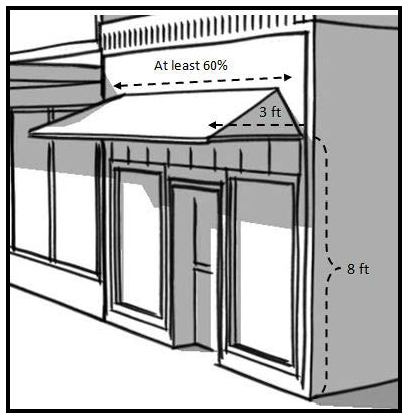
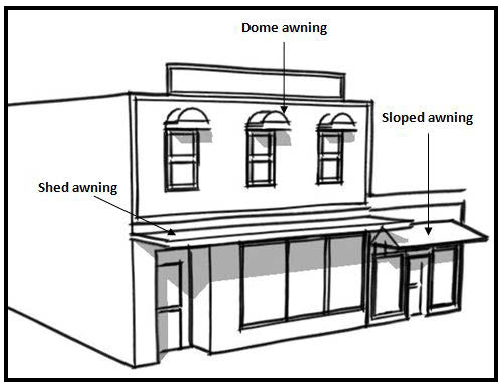
Fig. 2: Appropriate awning types
(1)
Location. When utilized shall either extend at least 60 percent of the length of the building or storefront, or placed above entrance doors. Awnings may project out up to three feet from the back of the curb, and be at least eight feet above sidewalk grade.
(2)
Types allowed. Allowable awning types include shed, sloped, or dome (over window or door); mansard awnings are not allowed.
(3)
Materials allowed (awnings). Allowable materials are canvas, acrylics, metal, aluminum, and poly-cotton fabrics.
(4)
Materials allowed (canopy). Allowable materials are wood, metal, and aluminum.
(5)
Multiple awnings. Multiple awnings (not canopies) are appropriate for storefronts within a single building, however the awnings shall be similar in terms of style and shape.
(6)
Obscuring architecture. Awnings and canopies shall not placed directly on important architectural features such as transoms or decorative glass and shall not obscure more than 30 percent of length of window.
(7)
Symmetry. Awnings shall be centered on the building, storefront façade, windows, or doors.
(b)
Balconies.
(1)
Clearance. Shall be at least eight feet above sidewalk grade.
(2)
Materials allowed. Shall be made of painted wood or steel, or shall match abutting wall material.
(3)
Projection. Can extend up to three feet from the back of curb.
(c)
Color.
(1)
Prohibited colors. Fluorescent colors are prohibited, as are luminous paints and synthetic reflective materials (also in periphery).
(2)
Unpainted natural elements. Unpainted natural elements such as stone or brick shall not be painted (not applicable to building exteriors that are currently painted).
(d)
Exterior materials.
(1)
Building materials. Building exteriors shall be brick or stucco , cast stone, terra cotta, granite, marble, but faux finishes are prohibited (also in periphery).
(2)
Window materials. Wood windows and doors, with cementitious fiberboard or similar material allowed if such material closely resembles wood finish. Metal windows and doors finished in enamel are allowed. Unfinished metal or raw aluminum windows and doors are prohibited.
(3)
Wood substitute. Cementitious fiberboard or similar material may be used as a substitute for wood, if such material closely resembles wood finish.
(e)
Illumination. Buildings shall have shielded/hooded lighting except that buildings and trees may be up-lit. Fixtures shall be consistent with period lighting such as goose-neck fixtures.
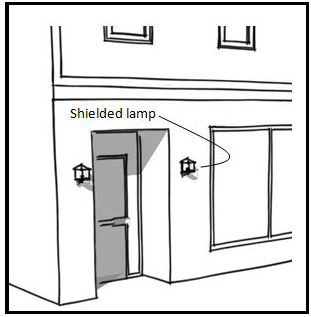
Fig. 3: Shielded light fixtures
;adv=6;(f)
Landscaping.
(1)
Street tree placement. Street trees should be strategically placed to provide for "gateways" at intersections, to provide for shade, and should not obscure architecturally significant buildings (also for periphery).
(2)
Street tree spacing. Street trees should be planted in conformance with an approved downtown streetscape plan (also for periphery).
(g)
Roofs. Decorative and nonfunctional roofs are prohibited. Façades including roofs shall have rectangular presentations, with parapets required when necessary to shield rooftop equipment from view.
(h)
Storefronts. Storefronts frequently define the character of commercial buildings and entrances, with display windows, trim, cornices, and decorative detailing being particularly important. Door and window location creates a distinct rhythm on the facade of a building. When rehabilitating a storefront, such original or historically significant features, materials, and design elements shall be retained and repaired.
(i)
Signs. In addition to standards set forth in chapter 62, section 94-149(g), section 94-161(j)(1), and section 94-162(j)(1), the following standards shall also apply:
(1)
Externally lit signs. Externally-lit signs shall be lit with incandescent-spectrum bulbs. Lighting shall be limited and directed to not allow for glare and spillover light trespass (also for periphery).
(2)
Internally lit signs. Internally lit signs are prohibited except for backlit channel letters used for wall signs.
(3)
Neon signs. Neon signs are limited to window and projecting signs and may flash, but scrolling or other movement shall not be allowed. "Open" signs are excluded from the two-sign maximum if they are less than ten square feet.
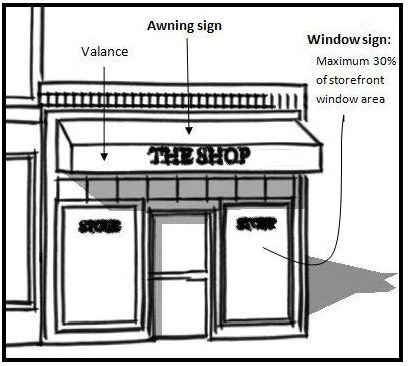
Fig. 4: Awning and window signs
(4)
Building name sign. A wall sign is allowed for a single building to indicate building name, construction date, and address, limited to areas immediately adjacent to the building parapet, with each sign not to exceed 20 square feet in size.
(5)
Sign material. Sign material shall be durable and include the following: metal (iron, steel, brass, copper, aluminum and other natural finishes); painted metal, including powder-coated or enameled metals; wood (painted or natural, including carved or sand-blasted lettering); vinyl or other sheet claddings (for backing panels or cut lettering only); glass; fiberglass, high-density urethane foam, and similar "cast" or formed materials to create three-dimensional objects, including individual lettering. The use of cardboard, plywood, paper, or similar impermanent material for sign material is prohibited.
(6)
Sign uniformity on single buildings. Signs located on a single storefront shall complement each other either with type (all awning signs for example), color, or design.
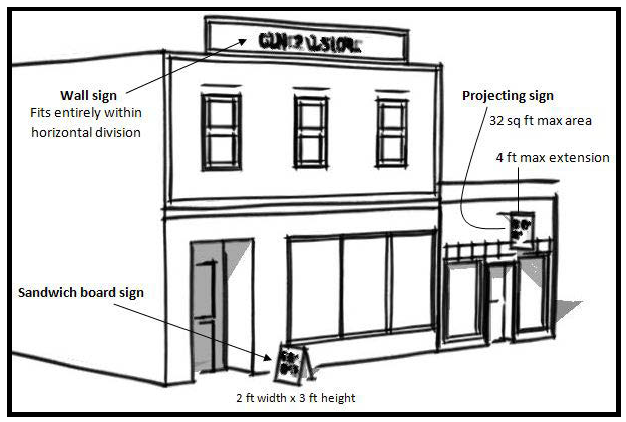
Fig. 5: Sign locations
(7)
Wall sign location. Wall signs shall fit entirely within horizontal elements of buildings and should not cover up architectural treatments. Acceptable areas include sign bands, continuous flat wall surface free of window and other openings or architectural features, areas between the top of the storefront and the sill of second floor windows, sign boards already in place and designed for such use, and panels at the top and bottom of show windows. Signage will fit entirely within horizontal divisions to the extent feasible. Where no architectural divisions exist or are evident, signage will be proportionately scaled to the façade and placed to respect window and door openings.
(8)
Wall sign material. Wall signs can take the form of mounted board signs or individually mounted (channel) letters.
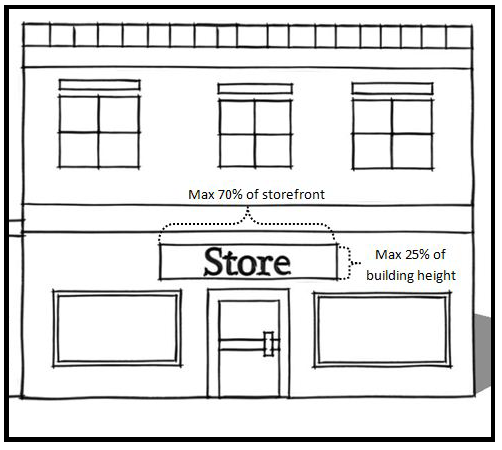
Fig. 6: Wall sign maximum height and width
(9)
Wall sign dimensions. Maximum size shall be 125 percent of storefront frontage linear feet, up to a maximum of 100 square feet. Maximum width shall be 70 percent of the storefront or overall façade width. Maximum height shall be 25 percent of building height.
(10)
Window sign area. Window sign area shall not exceed 50 percent of storefront window area, although gold leaf window signs can account for an additional 15 percent of window area, and all-gold leaf lettering can account for up to 75 percent of window area.
(11)
Window sign material. Window signs shall only be painted on the interior or exterior of the window or use decal materials, with the exception of "for sale" or "for rent" signs, which shall be limited to six square feet, one per storefront.
(j)
Windows. Windows shall be required on all elevations visible from public rights-of-way, with the following standards applicable only to the retail core:
(1)
First floor windows. First floor facades shall include storefront windows to occupy at least 60 percent of first floor wall area.
(2)
Muntins. Flush or snap-in muntins are historically inauthentic and are prohibited.
(3)
New windows. New windows shall be similar in shape and size to documented original windows or shall be or resemble one-over-one style.
(4)
Obscuring. Original upper floor windows shall not be obscured or removed.
(5)
Opacity. Windows shall contain clear glass and transmit at least 50 percent of visible daylight.
(6)
Upper floor windows required. Upper floor windows shall comprise between 20 percent and 60 percent of the total building wall area. No more than 15 feet of horizontal distance of wall shall be provided without windows.
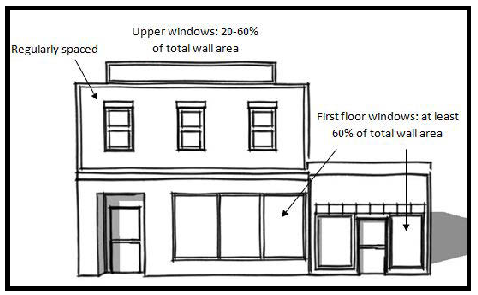
Fig. 7: Window spacing
(7)
Upper floor window spacing. Upper floor windows shall be regularly spaced.
(8)
Verticality. Doors and windows must be vertical and not horizontal (except for first-floor storefront windows). Sliding doors are prohibited.
(9)
Window regularity and ornamentation. Buildings shall have similar-shaped windows in regard to window hoods or trim.
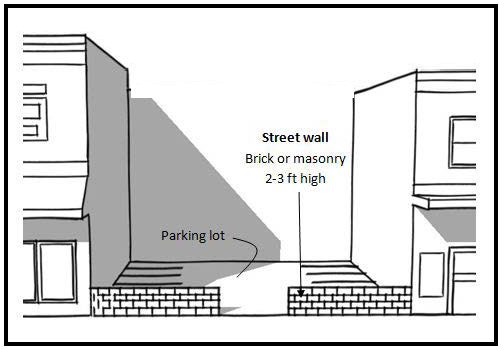
Fig. 8: Streetwall
(k)
Streetwalls. Streetwalls between two and three feet in height are required along the length of any parking lot, vehicular use area, or other interruption between buildings, excluding driveways. The streetwall must be masonry or brick that complements adjacent buildings architecture. Alternatively, streetwalls may be low decorative metal fences with masonry columns. Streetwalls shall be installed within five years after the adoption of this ordinance.
(l)
Fencing. Wrought iron or wood picket fencing is allowed, or fence material that closely resembles the appearance of these fencing types.
(Ord. No. 14-09, § 2(Exh. B, § II), 3-27-2014)
Sec. 94-203. - Design standards for new construction within downtown zoning districts.
The following standards are applicable to new construction, and redevelopment when improvement value exceeds 50 percent of property value within the retail core and are applicable to the periphery if specifically noted.
(a)
Driveways and parking lots. New driveways and parking lots are not allowed on St. Johns Avenue, and existing excess driveways shall be eliminated for new construction and also for property improvements that exceed 50 percent of the value of the property.
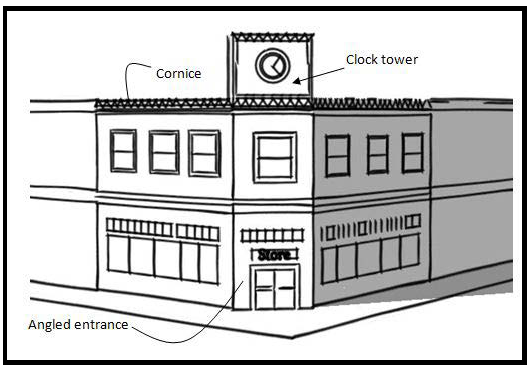
Fig. 9: Embellished corner building with angled entrance
(b)
Entrances. Buildings shall have front entrance designed to be attractive and prominent architectural feature. Buildings shall incorporate lighting and contrast in mass, surface detail, or finish to give emphasis to entrance.
(c)
Height. Buildings height shall be similar to that of adjacent buildings, except that any new building may have a height up to 60 feet, with a limitation of four stories.
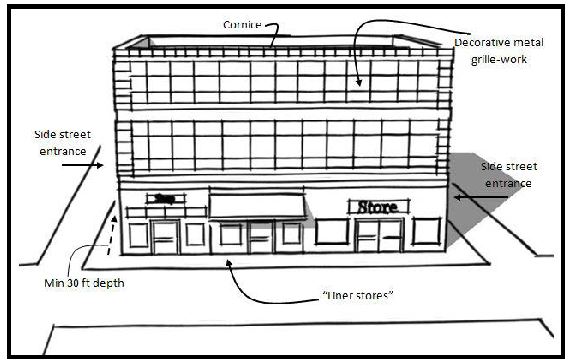
Fig. 10: Parking garage
(d)
Parking garages. Parking garages shall be located behind "liner stores" with minimum storefront depth of 30 feet; entrances shall be from side streets; architecture of parking garages fronting on public streets shall achieve an architectural unity with existing buildings; and design features shall include brick, stucco, cornices, or a combination of architectural features which enable the parking garage to better blend with the area. Exterior walls shall include decorative metal grille-work or similar detailing which provides texture and partially and/or fully covers the parking structure opening, or vertical trellis or other landscaping. (Also applicable for periphery.)
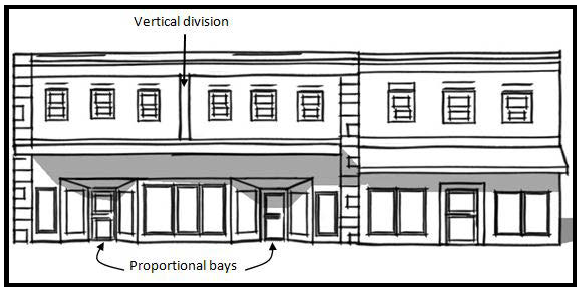
Fig. 11: Similar width and proportion of new construction
(e)
Proportion. New construction and facade rehabilitation shall maintain horizontal and vertical spacing of elements similar to other buildings on the block.
(f)
Roofs. Parapets shall be required when necessary to shield rooftop equipment from view (also for Periphery).
(g)
Setbacks. Buildings shall form a consistent, distinct edge, spatially delineating the public street through maximum building setbacks that vary by no more than five feet from those of the adjacent building.
(h)
Width. Where new buildings will exceed the historical 30 to 40 feet in width, the facade shall be visually subdivided into proportional bays, similar in scale to the adjacent buildings. This can be done by varying roof heights, or applying vertical divisions, materials and detailing to the facade.
(Ord. No. 14-09, § 2(Exh. B, § III), 3-27-2014)
Sec. 94-204. - Building exterior standards on major city thoroughfares.
(a)
Intent and purpose. The purpose of these regulations is to protect the city's appearance for residents and visitors; enhance desirability of property investment; foster civic pride and community spirit; and stabilize and improve property values and prevent potentially blighting influences.
(b)
Applicability. All new development on property abutting a major city thoroughfare (defined as 19th Street, Crill Avenue, Husson Avenue, Madison Street, Main Street, Moody Road, Moseley Avenue, Palm Avenue, Reid Street, St. Johns Avenue, State Road 19, US 17, and Zeagler Drive) shall conform to the requirements of this section. Single family detached and duplex units, properties in locally designated historic districts and sites, properties in a downtown overlay zone, and walls or roofs that are not visible from major city thoroughfares are not subject to the requirements of this section.
(c)
Building exterior standards.
(1)
Walls shall be staggered by changes in surface planes and architectural features to avoid a monolithic "box" appearance by integrating at least one of the following architectural features no less than every 50 horizontal feet:
a.
Porches;
b.
Sun-shading devices, such as awnings, canopies, and similar devices;
c.
Covered stairwells;
d.
Doors;
e.
Windows;
f.
Chimneys; or
g.
Columns or pilasters, inset or freestanding.
(2)
Walls shall not be comprised of aluminum, metal, or flat-faced concrete block, unless such materials are used for minor accents comprising less than 20 percent of the wall.
(3)
Walls shall have windows that make up at least 15 percent of the wall.
(4)
Roofs shall have multiple rooflines if the building is more than 50 feet wide.
(5)
Architecture as signage is prohibited. Buildings shall not be designed in a way in which the building's wall surface, through color or appearance, is a sign. All areas for signage shall be part of the site or building design.
(6)
Dumpsters and mechanical equipment such as air conditioners and compressors shall be screened from public view. The screening design shall be compatible with and part of the building design.
(7)
Building entrances shall be protected from the elements and give clear identity to the entrance.
(8)
If the use requires loading docks, garage doors, or mini-storage buildings and site conditions require them to be located along a major city thoroughfare, then they shall be screened using landscaping or architectural features.
(d)
Appeal for variance or waiver. Any person seeking a variance or waiver, partial or complete, from the application of the standards set forth herein to a particular parcel or development shall first make such request in writing to the planning director. The planning director shall approve or decline the request within three business days of receiving the request and shall notify the applicant through the most expedient method, i.e. preferably telephone or e-mail. In the event the planning director declines to grant the requested variance or waiver, the applicant may request, in writing, that the city manager review the planning director's decision. Any person with standing who is aggrieved by the city manager's decision may appeal the decision to the planning board. Both the city manager and the planning board shall have the authority to modify or reverse the decision brought to them for review upon a finding that a variance or waiver, partial or complete, would prevent a significant economic or practical hardship to the applicant property owner and that the requested variance or waiver would not substantially frustrate the purpose and intent of this section as same is stated above.
(14-10, § 1, 4-24-2014; Ord. No. 15-44, § 1, 11-12-2015)
Sec. 94-205. - Mobile medical unit.
(a)
Intent and purpose. To allow such uses, defined in section 94-2, in the C-2 (intensive commercial) zoning districts either as accessory uses in the case of public or quasi-public control, or as conditional accessory uses to a principal medical clinic use in the case of private businesses.
(b)
Criteria. The following standards shall be considered in the conditional use review of such uses:
(1)
The use and unit shall adhere to the requirements of the State of Florida Department of Business and Professional Regulations (DBPR).
(2)
The unit shall not encroach into required building setbacks or buffers outlined by the zoning district.
(3)
The unit shall be located on an approved paved vehicular use area and shall not occupy fire lanes, required drive aisles, or required minimum parking spaces.
(4)
The placement of the unit shall not alter or obstruct the flow of traffic or present a safety hazard to vehicles or pedestrians.
(5)
Proper Americans with Disabilities Act (ADA) and pedestrian access must be provided, and any accessory components shall meet the requirements of the land development code and the Florida Building Code.
(6)
All electrical items and connections shall conform to the National Electric Code and shall be properly protected.
(7)
Outdoor storage to accommodate the unit is prohibited.
(8)
Permanent or temporary landscaping and/or fencing shall be utilized to partially screen the trailer from public rights-of-way and adjacent properties.
(9)
Signage shall be limited to the following: signage that is permanently integrated into or part of the unit; a 20-square-foot banner permitted by the development services department, building division (streamers, flags, pennants, snipe, and other type of advertising is prohibited).
(10)
The use shall be allowed no more than two days per week or eight days per month; with the ability for the planning board to allow longer time periods in an individual conditional use application.
(11)
The use shall only be allowed when the principal medical clinic use is open for business.
(12)
Freestanding mobile medical units such as the "Bloodmobile" shall be allowed with staff approval, meeting these criteria when practicable.
(13)
Mobile medical units shall not locate within 1,000 feet of any approved and established mobile medical unit.
(14)
Applications shall be accompanied by proof of a valid City of Palatka business tax receipt for the primary business, copy of the license issued for the unit from the State of Florida (DBPR), written authorization from the owner of the host site allowing the placement of the mobile medical unit, contact information for the applicant, the primary business, the property owner, and the representative for the mobile medical unit, a site survey indicating the location of the unit, the dimension of the unit, existing buildings, existing landscaping, setbacks from buildings and property lines, location of parking spaces including handicapped spaces, location of drive aisles, number of existing and displaced parking spaces, proposed screening, and any other pertinent information.
(Ord. No. 14-32, § 1, 11-20-2014)
Editor's note— Section 1 of Ord. No. 14-32, adopted Nov. 20, 2014, added provisions to the Code designated § 94-202. Inasmuch as there were already provisions so designated, said provisions have been redesignated § 94-205 at the editor's discretion.
Sec. 94-206. - Home occupation standards.
(a)
No person other than members of the family residing on the premises shall be engaged in such occupation.
(b)
The use of the dwelling unit for the home occupation shall be clearly incidental and subordinate to its use for residential purposes by its occupants, and shall under no circumstances change the residential character thereof.
(c)
There shall be no change in the outside appearance of the building or premises, or other visible evidence of the conduct of such home occupation.
(d)
No home occupation shall occupy more than 20 percent of the first floor area of the residence, exclusive of the area of any open porch or attached garage or similar space not suited or intended for occupancy as living quarters. No rooms which have been constructed as an addition to the residence, nor any attached porch or garage which has been converted into living quarters, shall be considered as floor area for the purpose of this section until two years after the date of completion thereof, as shown by the records of the city building department.
(e)
No traffic shall be generated by such home occupation in greater volumes than would normally be expected in a residential neighborhood, and any need for parking generated by the conduct of such home occupation shall be met off the street and other than in the required front yard.
(f)
No equipment or process shall be used in such home occupation which creates noise, vibration, glare, fumes, odors or electrical interference detectable to the normal senses off the lot, if the occupation is conducted in a single-family residence, or outside the dwelling unit if conducted in other than a single-family residence. In the case of electrical interference, no equipment or process shall be used which creates visual or audible interference in any radio or television receivers off the premises.
(g)
The following shall not be allowed as home occupations: beauty shops and barbershops with more than one chair; musical instrument, dance, and swimming instruction for more than one student at a time; studios for group instruction; public dining facilities or tearooms; antique or gift shops; massage therapy for more than one client at a time; photographic studios; fortunetelling or similar activities; outdoor repair; food processing; retail sales; nursery schools; medical or dental laboratories; or kindergartens.
(h)
Fabrication of articles such as are commonly classified under the terms of arts and handicrafts may be deemed a home occupation, subject to the other terms and conditions of this section, and providing no retail sales are made at the home.
(i)
A home occupation shall be subject to all applicable city occupational license and other business taxes.
(Ord. No. 14-33, § 1, 12-11-2014)
Editor's note— Ord. No. 14-33, § 1, adopted Dec. 11, 2014, added provisions to div. 3 but did not specify further the manner of inclusion. Therefore, at the editor's discretion, said provisions have been added as § 94-206.
Sec. 94-207. - Produce trucks.
(a)
Allowable sales items include of fresh produce and cottage foods, the latter of which is defined in Florida Statutes.
(b)
Dispensation of goods is allowed from box or tractor-trailer trucks, or goods may be placed on a system of orderly-arranged tables outside such trucks.
(c)
Produce trucks are limited to parking lots or other paved areas.
(d)
Property owner must provide written permission for the activity.
(e)
Trucks shall not block driveways, emergency access lanes, sidewalks, or streets.
(f)
Trucks shall not utilize required minimum parking, but may utilize excess parking, or may utilize minimum parking outside hours of operation associated with the owner/user of the parking area.
(g)
Hours of operation are limited to daylight hours.
(h)
Produce trucks are allowed in the following zoning districts: DB (downtown business), DR (downtown riverfront), PBG-1 (public buildings and grounds), and C-2 (intensive commercial), and are also allowed in all city-owned parking lots with the written approval of the city manager.
(i)
An approved food truck program may not have more than two events per week.
(j)
Produce trucks must be parked at least 150 feet from a residentially-zoned property.
(k)
Produce truck locations must be kept neat and clean at all times. Any solid waste must be removed immediately after an event.
(l)
Produce truck programs must be run by a 501(c)(3) nonprofit organization, and must hold and display all required local, state, or federal licenses required for such a use.
(m)
Produce truck operators must provide liability insurance at an amount agreed to by the city, naming the City of Palatka as additional insured.
(Ord. No. 15-43, § 1(Exh. A), 11-12-2015)
Sec. 94-208. - Food trucks.
(a)
Uses must be located on private property, except that in the downtown overlay zone, food trucks shall be allowed in right-of-way parking areas, excluding St. Johns Avenue frontage, and only on spaces adjacent to undeveloped lots or parking lots. Food trucks must be at least 200 feet from a residentially-zoned property.
(b)
Property owner's written permission is required.
(c)
Required state and local permits and business licenses must be maintained and displayed.
(d)
Uses are limited to a self-contained truck/trailer.
(e)
Vehicles must be located at least 200 feet from the main entrance to any eating establishment (including other food truck), unless the owner of the establishment provides a letter of no objection.
(f)
Signage is limited those signs that are painted on or attached to the truck.
(g)
Hours of operation are limited to 6:00 a.m. to 10:00 p.m.
(h)
Available parking is required: in the C-2 and PBG-1 zoning districts, food trucks shall only occupy and utilize excess parking (above and beyond minimum parking requirements for existing uses), and in the downtown zoning districts food trucks shall have available public parking in the immediate vicinity (within 500 feet).
(i)
Vehicles must be maintained in a clean and orderly manner; litter and debris must be removed quickly.
(j)
Lidded trash can is required; no unscreened plastic bags or loose objects allowed.
(k)
Vendor must remove waste or trash at the end of each day or as needed to maintain the health and safety of the public. Liquid waste or grease shall be disposed of at an approved location and not placed in such places as storm drains or onto any sidewalk, street or other public space.
(l)
Due to temporary nature of use, public bathroom facilities and parking are not required; however, nearby toilet facilities are required for employees. An agreement with a nearby property owner (within 500 feet) to provide bathroom facilities for food truck workers is required.
(m)
Up to four outdoor tables seating 16 customers are allowed, which shall be maintained in an orderly appearance and not block pedestrian movement along sidewalks. Outdoor seating shall require bathroom facilities for customers.
(n)
Operators must hold and display all required local, state, or federal licenses required for such a use.
(o)
Proof of insurance shall be required. For operation on public property, insurance is required naming the business owner as insured and naming the city as additional insured with regard to coverage for claims for personal injury, death, and property damage in the amount of $500,000.00 per person and $1,000,000.00 per accident for personal injury/death and $300,000.00 for property damage.
(Ord. No. 15-42, § 1(Exh. A), 11-12-2015)
Sec. 94-209. - City of Palatka internet café ban.
(a)
Authority; intent; purpose; scope.
(1)
This article is adopted in the interest of the public health, peace, safety, and general welfare of the citizens and inhabitants of Palatka, Florida, pursuant to Florida Constitution Article IX, section 2(b), and F.S. ch. 166.
(2)
The intent and purpose of this article is to provide for regulation of simulated gambling devices and internet cafés, decrease the unwanted secondary effects associated with the operation of internet cafés, authorize the use of private property for lawful purposes, and deter illegal gambling. To do this, the city intends to broadly prohibit the possession or use of simulated gambling devices not authorized for legal use under Florida law, including any related activity or behavior which can be reasonably construed to be the use of simulated gambling devices. Further, the city commission in prohibiting simulated gambling devices in no way intends to locally approve the use of actual slot machines, other forms of casino gambling or other types of gambling devices. In addition, this prohibition is aimed directly at devices that simulate gambling activity, regardless of whether the devices or the simulations in and of themselves can be said to constitute gambling as that term may be defined elsewhere.
(b)
Definitions.
CO shall mean a certificate of occupancy.
Internet café means any location at which simulated gambling devices are made accessible for use by a person, except those places specifically excluded from this article
Person means an individual, association, partnership, joint venture, corporation, or any other type of organization, whether conducted for profit or not for profit, or a director, executive, officer or manager of an association, partnership, joint venture, corporation or other organization.
Simulated gambling device means any device that, upon connection with an object, is available to play or operate a computer simulation of any game, where the play or operation of the device may deliver or entitle the person or persons playing or operating the device to a payoff directly or indirectly from the owner or operator of the device or that person's designee. Simulated gambling device includes game promotion as defined in F.S. § 849.094. This term includes simulated gaming devices in internet cafés, internet sweepstakes cafés, cybercafés, sweepstakes cafés, or any other similar establishments. The following rules of construction apply to this definition of "simulated gambling device":
(1)
The term device means any mechanical or electrical contrivance, computer, terminal, video or other equipment that may or may not be capable of downloading games from a central server system, machine, computer or other device or equipment. The term "device" also includes any associated equipment necessary to conduct the operation of the device.
(2)
The term upon connection with means insertion, swiping, passing in range, or any other technical means of physically or electromagnetically connecting an object to a device, including by the manual input by any person of characters, numbers, or any combination thereof, or other code for the purpose of accessing or activating a device, or any other mechanism or method by which the object provides access to the device.
(3)
The term object means a coin, bill, ticket, token, card, gift card, characters, numbers, or any combination thereof, other code, or any other tangible or intangible access mechanism or method, obtained directly or indirectly through payment of consideration, or obtained as a bonus or supplement to another transaction involving the payment of consideration.
(4)
The terms play or operate and play or operation include the use of skill, the application of the element of chance, or both.
(5)
The term computer simulation includes simulations by means of a computer, computer system, video display, video system or any other form of electronic video presentation.
(6)
The term game includes slot machines, poker, bingo, craps, keno, any other type of game ordinarily played in a casino, a game involving the display of the results of a raffle, sweepstakes, drawing, contest or other promotion, lotto, sweepstakes; any game in which a user is given the results of the game before the user ever chooses to play or activate the game; any game in which the user can either know the results of the game before choosing to play or activate the game, or can choose not to know the outcome of the game prior to playing or activating the game; and any other game associated with gambling or which could be associated with gambling. The term "game" does not necessarily imply that actual gambling is involved.
(7)
The term payoff means cash, monetary or other credit, billets, gift cards, tickets, tokens, or electronic credits to be exchanged for cash or to receive merchandise or anything of value whatsoever, whether made automatically from the machine or manually.
(8)
The use of the word gambling in the term "simulated gambling device" is for convenience of reference only. The term "simulated gambling device" as used in this article is defined exclusively by this subsection and does not incorporate or imply any other legal definition or requirement applicable to gambling that may be found elsewhere.
(9)
For the purpose of determining the number of simulated gambling devices, each seat, terminal, or other interface at which a separate individual may use the device, shall be counted as a separate and distinct device, regardless of whether the device or any seat, terminal, or other interface is functional. For example, if a single table has six chairs at which six separate persons can play a game, on a common screen/display or otherwise, it shall be counted as six devices; if a stand-up game has three terminals or interfaces at which three people can use the device, it shall be counted as three devices.
Slot machine has the same meaning as specified in F.S. ch. 551.
(c)
Prohibition of simulated gambling devices.
(1)
It is unlawful for any person to manage, supervise, maintain, provide, produce, possess, or use a simulated gambling device for commercial, promotional or pecuniary gain or purpose.
(2)
For determining the allowable unit of prosecution, it is the intent of the city that each individual act of managing, supervising, maintaining, providing, producing, possessing, or using a simulated gambling device constitutes a separate violation of this section:
a.
For example, if a person possesses five simulated gambling devices, that person would be subject to a separate penalty for each of the five devices;
b.
For example, if a person possesses two simulated gambling devices that the person sells to another individual, the person will have committed four acts in violation of this section, and would be subject to a separate penalty for possessing each of the two devices and a separate sanction for providing each of the two devices.
c.
For example, if a person employed at an internet café supervises the establishment and the establishment has ten simulated gambling devices, that person would be subject to a separate penalty for each of the ten devices.
(3)
Any establishment or property which was lawfully in possession of either a CO or was operating unlawfully prior to the effective date of this article shall immediately cease the use of simulated gambling devices regulated by this article upon the effective date of this article.
(4)
All BTRs issued by the city shall be immediately suspended and deemed void upon the effective date of this article.
(5)
The city shall not accept any new BTR applications for internet cafés upon the effective date of this article.
(d)
Exemptions.
(1)
This article does not prohibit an individual's personal, recreational, and noncommercial ownership, possession, play, operation or use of a device which could be construed to be a simulated gambling device.
(2)
This article does not prohibit the ownership, possession, play, operation or use of any device expressly permitted by the Florida Statutes and not otherwise prohibited by the Florida Constitution.
(3)
This article does not prohibit a nonprofit, religious, or charitable organization from conducting a fund raising activity involving gaming, provided the nonprofit, religious, or charitable organization does not conduct the activity more than twice in one calendar year, the organization provides advance written notice to the city police department of the date, time, place, and nature of such activity and who will be conducting it, and the activity is not otherwise unlawful.
(4)
This article is specifically not intended to regulate in any manner any properly authorized bingo game establishment.
(e)
Conflict with state law. Nothing in this article is intended to conflict with the provisions of the Florida Constitution or F.S. ch. 849, concerning gambling. In the event of a direct and express conflict between this article and either the Florida Constitution or F.S. ch. 849, then the provisions of the Florida Constitution or F.S. ch. 849, as applicable, control.
(f)
Enforcement; penalties; civil remedies.
(1)
The City of Palatka's Police Department shall have jurisdiction to enforce the requirement of this article, as follows:
a.
By the issuance of a cease-and-desist order. Upon notice from the police department, occupancy or operation of any structure or property where any simulated gambling device is being used or operated in violation of this section shall immediately cease. Such notice shall be in writing and shall be given to the owner of the property or to his or her agent or to the person operating any establishment where any simulated gambling device is being used or operated in violation of the section. Failure to comply with the terms and conditions of a cease and desist order issued pursuant to this section shall constitute an additional violation of this section. Cease and desist orders may be lifted by the police department upon demonstration that all simulated gambling devices have been removed and all applicable civil penalties have been paid.
b.
By citation for civil penalties, as provided in this Code, as it may be amended. Civil penalties assessed pursuant to this subsection shall be $250.00 per violation per day for each violation.
c.
A violation of this article that is a civil violation may be reclassified to a misdemeanor of the second degree, punishable by up to 60 days imprisonment and a fine of up to $500.00, if, at the time of the violation:
1.
The violator manages, supervises, maintains, provides, produces, possesses, or uses five or more simulated gambling devices for commercial, promotional, or pecuniary gain or purpose.
2.
The violator has one or more prior convictions for a violation of this article or has been found, on one or more occasions, to have committed a violation of this article. For the purpose of this subsection, "conviction" means a determination of guilt that is the result of a plea or a trial, regardless of whether adjudication is withheld or a plea of nolo contendre is entered. A person may be found to have committed a violation of this article by any court or board empowered to impose a sanction for violation of this article.
3.
The violator has one or more prior convictions for a violation of any provision of F.S. ch. 849. For the purpose of this subsection, "conviction" means a determination of guilt that is the result of a plea or a trial, regardless of whether adjudication is withheld or a plea of nolo contendre is entered.
4.
The violator has previously entered in any pretrial intervention program or diversion program for any violation of this article, a substantially similar ordinance of another jurisdiction, or any provision of F.S. ch. 849; or
5.
The violator is in violation of a cease-and-desist order issued pursuant to this article at the time the violations occur.
d.
By an action for injunctive relief through a court of competent jurisdiction. An action for injunctive relief may be brought by the board of county commissioners, the state attorney, or any substantially affected person. If such action is successful, a judgment for reasonable attorney's fees and costs may be awarded by the court.
e.
Any person against whom a civil penalty is assessed pursuant to this article shall be prohibited from applying for any BTR or any certificate of occupancy for any property until such civil penalty has been paid in full. Prohibitions against application for a certificate of occupancy contemplated in this section shall not become effective until the judgment requiring payment of the civil penalty becomes final.
(Ord. No. 2024-12, § I(Exh. A), 10-14-2024)
Editor's note— Ord. No. 2024-12, § I(Exh. A), adopted Oct. 14, 2024, repealed the former § 94-209 and enacted a new § 94-209 as set out herein. The former § 94-209 pertained to electronic gaming establishments and derived from Ord. No. 16-43, § 3, adopted Sept. 22, 2016.
Sec. 94-210. - Medical marijuana dispensary.
(a)
Definitions. For the purposes of this section, the following definitions shall apply:
Cannabis (Low-THC): A plant of the genus, Cannabis, the dried flowers of which contain 0.8 percent or less of tetrahydrocannabinol and more than ten percent of cannabidiol weight for weight; the seeds thereof; the resin extracted from any part of such a plant; or any compound, manufacture, salt derivative, mixture or preparation of such plant or its seeds that is dispensed only from a medical marijuana dispensary.
Cannabis (Medical): A plant of the genus, Cannabis, whether growing or not; the resin extracted from any part of such a plant; or any compound, manufacture, salt derivative, mixture or preparation of such plant or its seeds that is dispensed only from a dispensing organization for medical use by an eligible patient as defined in F.S. § 499.0295.
Medical marijuana dispensary: A dispensary organization approved by the Florida Department of Health pursuant to and in accordance with the regulations set forth in the 'Compassionate Medical Cannabis Act of 2014' (as amended on March 25, 2016, and codified in F.S. § 381.986) to dispense low-THC and medical cannabis to Florida residents who have been added to the state compassionate use registry by a physician licensed under F.S. ch. 458 or F.S. ch. 459, because the patient is suffering from cancer or a physical condition that chronically produces symptoms of seizures or severe and persistent muscle spasms with no other satisfactory alternative treatment options or has a terminal condition as defined in F.S. § 499.0295.
(b)
Separation requirements for medical marijuana dispensaries.
(1)
Medical marijuana dispensaries shall be permitted only in those zoning districts in which medical marijuana dispensaries are listed as a permitted or conditional use.
(2)
Medical marijuana dispensaries shall be located at least 500 feet from existing schools.
(3)
Measurement shall be made from the nearest property line of that use that that is not a medical marijuana dispensary to the nearest property line of the medical marijuana dispensary. If the medical marijuana dispensary is located in a multi-tenant building, then the distance shall be measured from the nearest property line of the use that is not a medical marijuana dispensary to the nearest line of the leasehold or other space actually controlled or occupied by the medical marijuana facility.
(4)
The school separation shall apply only if the school is a public educational facility serving students in grades kindergarten through twelfth with an academic course of study approved by the Florida Department of Education.
(Ord. No. 18-08, § 2, 9-27-2018)
Sec. 94-211. - Dogs allowed in outdoor portions of restaurants; permit required; enforcement.
(a)
Purpose; intent; preemption. The purpose of this section is to provide a local exemption to certain provisions of the Food and Drug Administration Food Code, as authorized by F.S. § 509.233, in order to allow patrons' dogs within certain designated outdoor portions of restaurants. Nothing in this section is intended to conflict with, be inconsistent with, or preempt state or federal law. To the extent of any such conflict, inconsistency or preemption, the state or federal law shall prevail.
(b)
Permit. In order to protect the health, safety and welfare of the general public, each restaurant shall obtain a permit from the city manager or designee prior to allowing patrons' dogs within outdoor portions of the restaurant. Applicants shall submit a completed permit application on the form provided by the city along with the permit fee set forth in appendix A. The application shall be signed by the property owner and by the tenant or operator of the restaurant (if different from the property owner) and shall include such information deemed reasonably necessary to enforce the provisions of this section, but shall include, at a minimum, the following information:
(1)
The name, location and mailing address of the restaurant.
(2)
The name, mailing address, telephone number and email address of the permit applicant.
(3)
A diagram and description of the outdoor area to be designated as available to patrons' dogs, including dimensions of the designated area; a depiction of the number and placement of tables, chairs and restaurant equipment, if any; the entryways and exits to the designated outdoor area; the boundaries of the designated area and of other areas of outdoor dining not available for patrons' dogs; any fences or other barriers; surrounding property lines and public rights-of-way, including sidewalks and common pathways; and such other information reasonably required by the city. The diagram or plan shall be accurate and to scale but need not be prepared by a licensed design professional.
(4)
A description of the days of the week and hours of operation that patrons' dogs will be permitted in the designated outdoor area.
(5)
The license number for the restaurant issued by the Florida Division of Hotels and Restaurants.
A permit issued pursuant to this section shall not be transferred to a subsequent property owner, tenant or operator upon the sale, lease, or other transfer of the restaurant, but shall expire automatically upon the sale, lease or other transfer of the restaurant. The city shall provide the Florida Division of Hotels and Restaurants with a copy of all approved applications and permits issued.
(c)
Permit conditions. Each restaurant receiving a permit under this section shall be subject to and shall enforce the following requirements:
(1)
Dogs shall not be permitted to travel through indoor or non-designated outdoor portions of the restaurant. Ingress and egress to the designated outdoor portions of the restaurant shall not require entrance into or passage through any indoor area.
(2)
Patrons shall keep their dogs on a leash at all times and under reasonable control.
(3)
Dogs shall not be allowed on chairs, tables or other furnishings.
(4)
The restaurant shall instruct employees and patrons that dogs shall not be allowed to come into contact with serving dishes, utensils, tableware, linens, paper products or any other items involved in food service operations.
(5)
All table and chair surfaces shall be cleaned and sanitized with an approved product between seating of patrons. Spilled food and drink shall be removed from the floor or ground of the designated outdoor area between seating of patrons.
(6)
Accidents involving dog waste shall be cleaned immediately and the area sanitized. A kit with the appropriate materials for this purpose shall be kept near the designated outdoor area.
(7)
Employees shall wash their hands promptly after touching, petting or otherwise handling dogs. Employees shall be prohibited from touching, petting or otherwise handling dogs while serving food or beverages or handling tableware or before entering other parts of the restaurant.
(8)
The restaurant shall advise patrons in the designated outdoor area that they should wash their hands before eating.
(9)
Waterless hand sanitizer shall be provided at all tables in the designated outdoor area.
(10)
A sign or signs shall be posted on the premises notifying the public that the designated outdoor area is available for the use of patrons and patrons' dogs. In addition, a sign or signs shall be posted on the premises informing patrons and employees of the requirements set forth in this section.
(11)
Dogs shall not be permitted to travel through indoor or non-designated outdoor portions of the public food service establishment, and ingress and egress to the designated outdoor portions of the public food service establishment must not require entrance into or passage through any indoor area of the food establishment.
(d)
Complaints; enforcement.
(1)
Complaints regarding lack of compliance with this section may be made in writing to the city code enforcement division, which shall accept, document, and respond to all written complaints and shall report to the Florida Division of Hotels and Restaurants all complaints and the response to such complaints.
(2)
The city shall revoke a permit if, after providing notice and a reasonable period of time for correction as specified in the notice, a restaurant is found to be in violation of any provision of this section. The revocation shall be issued in the form of a final administrative order signed by the city manager or designee.
(3)
If a permit is revoked, no new permit may be approved for the restaurant until the expiration of 180 calendar days following the date of revocation.
(Ord. No. 18-20, § 1, 12-13-2018)
Sec. 94-212. - Accessory dwelling units.
(a)
Definitions.
Accessory dwelling unit means an ancillary or secondary living unit that has a separate kitchen, bathroom, and sleeping area existing within the same structure, or on the same lot, as the primary dwelling unit. The accessory dwelling unit may be a separate and detached unit, an attached unit to the principal structure, a repurposed existing space within the principal structure, an apartment over a garage, or a similar structural form.
Affordable rental means that monthly rent and utilities do not exceed 30 percent of that amount which represents the percentage of the median adjusted gross annual income for extremely-low-income, very-low-income, low-income, or moderate-income persons of Putnam County. Putnam County's median annual income is the basis, not the State of Florida median income.
Lot requirements means restrictions on lot size, setbacks, building coverage, and similar zoning requirements.
Short-term rental means the rental of a primary or accessory unit for 30 days or less.
(b)
Standards.
(1)
Accessory dwelling units are to be permitted as accessory uses to single-family detached dwellings in all residential districts.
(2)
Accessory dwelling units are prohibited in planned unit developments.
(3)
Accessory dwelling units may not be utilized for townhouses, condominiums, recreational vehicle (RV) parks, multifamily dwellings, churches, schools, or any similar public or semipublic facilities.
(4)
Accessory dwelling units may not be utilized in commercial or industrial districts.
(5)
Unless the accessory dwelling unit is used as a short-term rental, the owner must occupy either the principal or accessory dwelling unit.
a.
If used as a short-term rental, the owner must occupy the primary unit.
(6)
No more than one accessory dwelling unit shall be allowed on any residential lot or within any principal nonresidential structure.
(7)
An accessory dwelling unit may be constructed with or after the construction of the primary unit.
(8)
The establishment of a new accessory dwelling unit shall only be allowed if the lot area of the principal building is at least 5,000 square feet.
(9)
The accessory dwelling unit shall be subordinate to the principal building as to location, height, square footage, and building coverage. The design of the accessory dwelling unit shall be uniform, compatible, or complementary in appearance to the primary residence.
(10)
The habitable floor area of the accessory dwelling unit shall be no less than 300 square feet and no greater than 1,200 square feet. A variance to increase this amount may be requested provided that the total building coverage does not exceed district standards.
(11)
All accessory dwelling units shall meet the applicable zoning district setbacks. Total building coverage on the lot shall not exceed district standards. The accessory dwelling unit shall comply with the requirements of all applicable housing or buildings codes.
(12)
No additional parking spaces are required if there is designated on-street parking available within 100 feet of the parcel. If there is no designated on-street parking available, one off-street space is required unless the ADU is 500 square feet or less.
(13)
Accessory dwelling units are exempt from zone district density calculations.
(14)
The accessory dwelling unit must connect to existing water, sewer, and other existing utility connections.
(c)
Development review procedures.
(1)
Applications for accessory dwelling unit development shall be streamlined to the greatest extent possible.
(2)
Applicants may seek a variance from all structural and lot requirements.
(d)
Impact fees.
(1)
If used for affordable rental, impact fees shall be waived. An application for a building permit to construct an affordable rental must include an affidavit from the applicant which attests that the unit will be rented at an affordable rate to an extremely-low-income, very-low-income, low-income or moderate-income person or persons, as defined by state statutes. The City of Palatka will enter into deed restrictions or other agreements as necessary to ensure that the ADU is used for affordable housing purposes for at least a period of ten years.
(2)
If not used for affordable rental or the application does not include an affidavit which attests to the accessory dwelling unit as an affordable rental; impact fees will be assessed.
(Ord. No. 2025-09, Exh. A, 3-13-2025)
Sec. 94-213. - Short-term vacation rentals.
(a)
Purpose and intent. The purpose of this section is to establish reasonable regulations for the operation of short-term vacation rentals within the city to protect the health, safety, and welfare of residents and visitors, to ensure compliance with applicable life safety and fire prevention standards, and to provide a uniform registration and inspection process consistent with Florida law.
(b)
Authority. This section is adopted pursuant to the general powers granted to municipalities under F.S. ch. 166, and consistent with the provisions of F.S. ch. 509, regulating public lodging establishments.
(c)
Definitions. For purposes of this section, the following terms shall have the meanings ascribed to them:
Operator means the owner or person responsible for the management, maintenance, and operation of a short-term vacation rental.
Short-term vacation rental shall have the same meaning as set forth in F.S. § 509.242, as may be amended, and includes any unit or group of units in a condominium or cooperative or any individually or collectively owned single-family, two-family, three-family, or four-family house or dwelling unit that is also a transient public lodging establishment but that is not a timeshare project.
(d)
Permitted zoning districts. Short-term vacation rentals shall be permitted uses within the following zoning districts, subject to compliance with this section and all other applicable city codes:
(1)
R-1AA (single-family residential).
(2)
R-1A (single-family residential).
(3)
R-1 (single-family residential).
(4)
R-2 (two-family residential).
(5)
R-3 (multiple-family residential).
(6)
HD (historic district).
(7)
DR (downtown residential).
(8)
DB (downtown business).
(e)
Registration requirements.
(1)
Annual registration required. All short-term vacation rentals and transient public lodging establishments shall register annually with the city.
(2)
Administrative fee. A nonrefundable administrative fee of $300 shall be paid at the time of registration and upon annual renewal.
(3)
Registration contents. The registration shall include:
a.
Name and contact information of the owner and local responsible party.
b.
Street address and parcel identification number of the property.
c.
Proof of licensure or exemption from the Florida Department of Business and Professional Regulation (DBPR).
d.
Proof of current property insurance and local business tax receipt.
e.
Statement of maximum occupancy and parking plan.
(f)
Annual inspection and life safety requirements.
(1)
Inspection requirement. Each registered short-term vacation rental shall be subject to annual inspection by the city's fire department to verify compliance with life safety and fire prevention requirements, including, but not limited to:
a.
Functional smoke alarms and carbon monoxide detectors.
b.
Fire extinguishers in compliance with code.
c.
Unobstructed egress routes.
d.
Electrical safety standards.
e.
Compliance with the Florida Fire Prevention Code.
(2)
Certificate of inspection. Upon satisfactory inspection, a certificate of inspection shall be issued and must be displayed in a conspicuous place within the unit.
(3)
Failure to pass inspection. Failure to meet life safety standards shall result in suspension or revocation of the registration until deficiencies are corrected.
(g)
Business tax receipt. All short-term vacation rentals and transient public lodging establishments shall obtain and maintain a valid City of Palatka Business Tax Receipt pursuant to article V of the Code of Ordinances prior to operation.
(h)
Enforcement and penalties.
(1)
Operation of a short-term vacation rental without valid registration or inspection approval shall constitute a violation of this section.
(2)
Violations shall be subject to enforcement under F.S. ch. 162, and the city code enforcement provisions.
(3)
Repeated or willful violations may result in suspension or revocation of registration.
(Ord. No. 2025-19, §§ 1—8, 1-8-2026)

