
Palatka City Zoning Code
ARTICLE VI
LANDSCAPING AND TREE PROTECTION
Sec. 94-291.- Intent and general policy.
It is the intent of this article to promote the health, safety and welfare of the current and future residents of the city by establishing minimum standards for the installation and continued maintenance of landscaping and the protection of trees within the city in order to:
(1)
Improve the aesthetic appearance of commercial, governmental, industrial and residential areas through the incorporation of landscaping into development in ways that harmonize and enhance the natural and manmade environment.
(2)
Improve environmental quality by recognizing the numerous beneficial effects of landscaping upon the environment, including:
a.
Improving air and water quality;
b.
Maintaining permeable land areas essential to surface water management and aquifer recharge;
c.
Reducing and reversing air, noise, heat and chemical pollution through the biological filtering capacities of trees and other vegetation;
d.
Promoting energy conservation through the creation of shade, thereby reducing heat gain in or on buildings or paved areas;
e.
Reducing the temperature of the microclimate through the process of evapotranspiration; and
f.
Encouraging the conservation of water through the use of site-specific plants, various planting and maintenance techniques, and efficient watering systems.
(3)
Provide direct and important physical and psychological benefits to human beings through the use of landscaping to reduce noise and glare, and to break up the monotony and soften the harsher aspects of urban development.
(4)
Establish procedures and standards for the administration and enforcement of this section.
(5)
Promote creative site development concepts in order to promote water and energy conservation.
(6)
Increase and maintain the value of land by requiring a minimum amount of landscaping to be incorporated into development.
(7)
Preserve existing natural trees and vegetation and incorporate native plants, plant communities and ecosystems into landscape design where possible by promoting landscaping methods that provide for the preservation of existing plant communities.
(8)
Assist in public information, the education of its citizens, and the effective implementation of this article.
(Code 1981, app. C, § 26-7(6))
Sec. 94-292. - Definitions.
For purposes of this article, the following definitions shall apply:
Bona fide agricultural purposes means good faith commercial or domestic agricultural use of the land, any such determination of which shall be based upon, but not limited solely to, the following factors:
(1)
The length of time the land will be so utilized.
(2)
Size of the land, as it relates to specific agricultural use.
(3)
Whether such land is subject to a lease, and, if so, the effective length, terms and conditions of the lease.
(4)
The intent of the landowner to sell or convert the land for or to nonagricultural purposes.
(5)
The proximity of the property to existing urban or metropolitan development.
(6)
The productivity of land in its present use.
(7)
The relationship of the property to the comprehensive plan.
(8)
The classification placed upon such lands by the property appraiser pursuant to F.S. § 193.461.
(9)
The current zoning classification of such lands.
Buffer yard or strip means a strip of land, identified on a site plan or by zoning requirement, established to protect one type of land use from another land use that may be incompatible. The area is landscaped, maintained and kept in open space.
Caliper means the diameter of a tree measured six inches off the ground.
Crown means the main mass of branching of a plant above ground.
DBH means diameter at breast height, or the diameter of a tree measured 4½ feet above the ground level.
Developed area means that portion of a plot or parcel upon which a building, a structure, surface drive area, gravel or landscaping has been placed.
Development means any proposed material change in the use or character of the land, including but not limited to land clearing associated with new construction, the placement of any structure or site improvement on the land, or expansion of existing buildings.
Dripline means a vertical line extending from the outermost branches of a tree to the ground.
Ecosystem means a characteristic assemblage of plant and animal life with a specific physical environment, and all interactions among species and between species and their environment.
Exceptional specimen tree means any tree which is determined by the city commission to be of unique and intrinsic value to the general public because of its size, age, historic association or ecological value, or any tree designated a Florida State Champion, United States Champion or World Champion by the American Forestry Association. The building department shall keep a record of all specimen trees so designated and their location.
Frontage means the linear distance measured along all abutting street rights-of-way.
Ground cover means low-growing plants planted in such a manner as to form a continuous cover over the ground (not including grass).
Hedge means a landscape barrier consisting of a continuous dense planting of shrubs.
Irrigation system means a permanent artificial watering system designed to transport and distribute water to plants.
Landscape area means planted areas that are frequently maintained by mowing, irrigating, pruning, fertilizing, etc.
Landscape development means trees, shrubs, ground cover, vines or grass installed in planting areas for the purpose of fulfilling the requirements of this section, or an unenclosed area of land in which landscape materials are placed, planted and maintained.
Landscape plan means a scale drawing that indicates all planting areas, and existing and proposed plant materials, designating species, quantity and location.
Landscaping means any combination of living plants (such as grass, ground cover, shrubs, vines, hedges or trees) and nonliving landscape material (such as rocks, pebbles, sand, mulch, walls or fences).
Mulch means nonliving organic materials customarily used in landscape design to retard erosion and retain moisture.
Open space means all areas of natural plant communities or areas replanted with vegetation after construction, such as revegetated natural areas, tree, shrub, hedge or ground cover planting areas, and lawns; and all other areas required to be provided as natural ground and landscaping pursuant to this chapter.
Planting area means any area designed for landscape planting having a minimum of ten square feet of actual plantable area and a minimum inside dimension of 18 inches on any side.
Protected tree means any tree with a DBH greater than or equal to eight inches.
Relocation of a tree means an act to relocate a tree being removed to an appropriate new location on the site.
Removal of a tree means physical removal by mechanical methods, such as excavation, chain saw and stump removal.
Runoff water means water which is not absorbed by the soil or landscape to which it is applied and flows from the area.
Shrub means a self-supporting woody, deciduous, evergreen perennial and/or flowering species characterized by multiple stems and branches arising from a main root.
Street line means that line limiting the right-of-way of the street and being identical with the property line of persons owning property fronting on the street.
Trees means self-supporting woody perennial plants, having usually single self-supporting trunks, which normally grow to a minimum overall height of 15 feet and a mature crown spread greater than 15 feet. These trunks shall be clear of branches and limbs so that both trunk and canopy are distinct.
Vehicle means a form of transportation, including motorized and nonmotorized vehicles designed and required to be licensed for use upon a highway in the state.
Vehicle use areas means any surface drive areas (except public rights-of-way) used for the purpose of driving, parking, storing or display of vehicles, boats, trailers or mobile homes, including new and used car lots and other open lot uses. Parking structures, drive-in parking areas covered to the dripline of the covering, and garages shall not be considered as vehicle use areas.
Vines means any of a group of woody or herbaceous plants which may climb by twining, by means of aerial rootlets or by means of tendrils, or which may simply sprawl over the ground or other plants.
(Code 1981, app. C, § 26-7(6))
Cross reference— Definitions generally, § 1-2.
Sec. 94-293. - Tree committee.
The mayor shall appoint a tree committee consisting of one commissioner and six citizens who will serve at the pleasure of the commission.
(Code 1981, app. C, § 26-7(6); Ord. No. 98-6, § 1, 2-26-1998)
Sec. 94-294. - Tree protection.
(a)
Applicability. The provisions of this section shall apply to all protected and preserved trees within the city, unless specifically exempted in this subsection.
(b)
Removal of protected trees prohibited; exceptions.
(1)
No person, or any agent or representative thereof, directly or indirectly, shall cut down, remove, damage or destroy or shall authorize the cutting down, removal, damage or destruction of any protected tree as defined in section 94-292 of this section, or shall commit any act or authorize the commission of any act which physically removes a protected tree or causes a tree to die, such as damage inflicted upon the root system by heavy machinery, chemicals or paving, changing the natural grade above the root system, and tree damage permitting infection or pest infestation, without first having obtained a permit as provided in subsection (c) of this section and providing tree protection as provided in subsection (d) of this section.
(2)
The following protected trees are exempted from the provisions of this section:
a.
Any tree located on any property which is in use for bona fide agricultural purposes.
b.
Any tree located in botanical gardens or in state-approved government nurseries and groves which are grown for sale or public purpose.
c.
Any tree that poses imminent danger to the public health, welfare or safety, and requires immediate removal without delay. In such instance, verbal authorization to remove a protected tree may be given by the city manager or his designee.
d.
Any tree located on an existing or planned public recreation facility.
e.
Any tree located on all real property in areas inside and up to ten feet from an existing or proposed building foundation line.
f.
Any tree that a local electric company determines is an immediate or potential threat or hazard to existing or planned power lines.
g.
Any dead tree, scrub oak, Melaleuca spp., poison wood, camphor tree or Australian pine.
(3)
During the period of an emergency such as a hurricane, flood or other natural disaster, the requirements of this subsection may be temporarily waived by the city manager so that private or public work to restore order in the city will in no way be hampered.
(c)
Permit for removal, relocation or replacement of protected trees.
(1)
Permits for site clearing and the removal or relocation of a protected tree shall be obtained by filing an application with the building department. Approval of the application and issuance of a permit by the building department shall be required prior to any land clearing or grubbing, prior to any disturbance of the root system or site development, or prior to the occurrence of any changes to an existing developed site. The site shall be inspected to ensure compliance with the approved site plan prior to any additional permits being issued. Applications for site clearing and tree removal or relocation shall include the following: A site plan, at a scale which clearly illustrates the requirements of this section, showing the lot configuration; the location and identification of existing and proposed improvements, if any, including structures, water retention areas, paving grade changes, utilities, easements and street rights-of-way or approved private streets; and the location and identity, by botanical or common name and caliper, of protected trees to be removed, relocated or retained.
(2)
An application for a permit for site clearing or for removal or relocation of a protected tree with a DBH of 36 inches or less shall be reviewed by the building department, and a decision shall be made thereon within five working days after receipt of such application or concurrent with building permit application review.
(3)
An application for a permit for removal or relocation of a protected tree with a DBH greater than 36 inches or a specimen tree shall be reviewed by the planning board at the first available meeting of the planning board.
(4)
The approval, conditional approval or denial by the building department or planning board of an application for a tree removal permit, as required by this section, shall be based on the following criteria:
a.
The extent to which tree removal decreases aesthetic and environmental quality, land values and physical benefits to human beings.
b.
The necessity to remove trees which pose a safety hazard to pedestrian or vehicular traffic or threaten to cause disruption to public services.
c.
The necessity to remove trees which pose a safety hazard to buildings or other trees.
d.
The necessity to remove diseased trees or trees weakened by age, weather, storm, fire or acts of God or which are likely to cause injury or damage to people, buildings or other improvements on a lot or parcel of land.
e.
The extent to which tree removal is likely to result in damage to the property of other owners, public or private, including damage to lakes, ponds, streams or rivers through runoff or erosion.
f.
The proposed landscaping, including plans whereby the applicant has planted or will plant perennial vegetative cover to replace those trees which are proposed to be cleared.
g.
The topography of the land and the effect of tree removal on erosion, soil retention, and the diversion or increased flow of surface water.
h.
Construction of proposed improvements to allow access around the proposed structure for construction equipment, access to the building site for construction equipment, or essential grade changes.
i.
The land use and natural vegetative ground coverage of surrounding property.
j.
The extent of any damage or hardship to the applicant resulting from a denial of the requested permit.
k.
The species and size of the tree proposed for removal.
(5)
Any relocation of trees in compliance with this section shall be performed in accordance with accepted industry practices, including watering to ensure survival of transplanted stock.
(6)
Protected trees identified for removal on the site clearing or tree removal application shall be replaced with new planted trees, unprotected trees or transplanted trees. Protected live oaks (Quercus virginiana) and all trees with a DBH greater than 36 inches removed shall be replaced only with live oaks. The total DBH inches of replacement live oaks shall equal two-thirds of the total DBH inches of protected live oaks and trees with a DBH greater than 36 inches removed (i.e., one 12-inch live oak removed could be replaced with two four-inch live oaks ( 8/12 equals two-thirds)). For other removed protected trees, the total DBH inches of replacement trees shall equal one-third of the total DBH inches removed (i.e., one 12-inch tree removed could be replaced with one four-inch tree ( 4/12 equals one-third)). When there is significant loss of mature tree canopy or specimen trees on a particular site, the size of replacement trees may be increased by up to twice the minimum DBH by the building department in order to compensate for that loss. If multi-trunked trees are used as replacement trees, then the total caliper of the four largest trunks shall equal the replacement DBH. New palms may be used only to replace protected palms removed. Replacement species used shall be approved by the building department. No replacement will be required for protected trees which are determined by the building department to be dead or deteriorated as a result of age, insects, disease, storm, fire, lightning or other acts of nature.
a.
New replacement trees shall meet the minimum standards for landscape materials established by section 94-295(b).
b.
Existing trees which are not protected trees, but which are either transplanted or not removed, may be utilized to satisfy tree replacement requirements, consistent with city landscaping requirements contained in sections 94-295 and 94-296.
c.
Existing protected trees which would otherwise be removed from the site because of development may be utilized to satisfy tree replacement requirements if transplanted to a location on the site which meets the landscaping requirements contained in sections 94-295 and 94-296.
d.
If protected tree removal is associated with new development, the name, size and location of all replacement trees shall be shown on the required landscape plan and such trees shall be installed prior to the final building inspection. Otherwise, the name, size and location of the required replacement trees shall be shown on the site plan required for site clearing or tree removal and such trees shall be installed within the time limit stated on the site clearing or tree removal permit.
e.
Existing nonprotected trees, transplanted trees and new trees used for replacement become protected trees.
f.
Replacement trees shall be maintained pursuant to the requirements of section 94-295(b), pertaining to installation and maintenance.
g.
Replacement trees may be used to satisfy the tree requirements of sections 94-295 and 94-296.
h.
A tree used for replacement shall be at least ten feet from any other tree planted, transplanted or preserved.
i.
Replacement trees shall not include species identified under Florida Invasive Species Council.
(d)
Tree protection during development. All protected trees, and trees retained for tree credit under this section, shall be protected from injury during any land clearing or construction in the following manner:
(1)
Prior to any land clearing operations, tree limbs which interfere with construction shall be removed and temporary barriers shall be installed around all trees to remain within the limits of land clearing or construction and shall remain until the completion of the work. The temporary barrier shall be at least three feet high, shall be placed at least six feet away from the base of any tree, and shall include at least 50 percent of the area under the dripline of any protected tree retained for tree credit. The barrier shall consist of either a wood fence with two-by-four posts placed a maximum of eight feet apart with a two-by-four minimum top rail, or a temporary wire mesh fence, or other similar barrier which will limit access to the protected area.
(2)
No materials, trailers, equipment or chemicals shall be stored, operated, dumped, buried or burned within the protected areas. No attachment, wires (other than protective guy wires), signs or permits shall be attached to a protected tree.
(e)
Correction of violations; appeals; permit fee.
(1)
Correction of violations. A violation of this section shall be corrected as follows: By replacing the protected trees removed without a permit with new planted trees, unprotected trees or transplanted trees. The total DBH inches of replacement trees shall equal the total DBH inches removed (i.e., one 12-inch tree removed could be replaced with three four-inch trees). A tree replanting plan showing how the damage caused to the site by the violation will be mitigated shall be subject to the review and approval of the building department. No work shall be allowed on the property where the violation occurred without payment of required fees and approval of the tree replanting plan.
(2)
Appeals. A person aggrieved by an administrative order, determination or decision of the building department may appeal the order, determination or decision to the board of zoning appeals for a variance from the requirements of this subsection.
(3)
Permit fee. The fee for a site clearing and/or tree removal/relocation permit shall be as set out in appendix A to this Code, as amended from time to time.
(Code 1981, app. C, § 26-7(6); Ord. No. 2024-02, §§ 1,2(Exh. A), 3-28-2024)
Sec. 94-295. - General landscape requirements.
(a)
Scope. This section shall apply to all multifamily development of three or more units, and nonresidential development. In those instances where a structure is enlarged or a change of use occurs so that an increase in required parking or loading results under this chapter or any other city ordinance, landscaping shall be provided in accordance with this section and section 94-296. All areas and uses which require landscaping shall meet or exceed the general landscaping requirements in this section, which shall be considered complementary to the landscaping provisions of any other city ordinance.
(b)
Installation and maintenance. The installation and maintenance of landscaping shall be subject to the following:
(1)
Installation. All landscaping shall be installed according to accepted commercial planting procedures. All landscape areas shall be protected from vehicular encroachment by wheel stops or curbing. If curbing is used abutting landscaped areas, it shall be perforated to permit drainage from the surface drive area into the landscaped areas.
(2)
Maintenance; trimming of branches extending over public right-of-way.
a.
The owner of a property shall be responsible for the maintenance of all landscaping in good condition so as to present a neat, healthy and orderly appearance free of refuse and debris. All landscaped areas shall be provided with an irrigation system. This system shall consist of either an underground or exposed sprinkler equipped with a time or manual switch and/or a readily available water supply outlined on a landscaping plan, as required by section 94-296(d). Maintenance shall include the prompt replacement of all dead plant material.
b.
It shall be the duty of the owner, lessee or occupant, or the agent, representative or employee of any such owner, lessee or occupant, having control of any lot or parcel of real estate in the city, to maintain and control the limbs and foliage of trees and shrubs extending over the public right-of-way. Limbs and foliage are to be trimmed so as to provide clearance of at least ten feet above sidewalks and public rights-of-way, and of at least 14 feet over public streets and roadways. This subsection shall apply to all trees on private property, as well as to all trees planted by the owner, lessee or occupant, or the agent, representative or employee of any such owner, lessee or occupant, whether located on private property or located between private property lines and the street curb or edge.
(c)
Plant materials. Plant materials are subject to the following:
(1)
Quality. Plant materials used in conformance with the provisions of this subsection shall conform to the standards for Florida No. 1 or better as given in Grades and Standards for Nursery Plants, Part I, and current edition, Part II, State of Florida Department of Agriculture and Consumer Services, Tallahassee, or equal thereof. Plant materials determined as not meeting these standards shall not be counted towards meeting the required amount of landscape materials.
(2)
Trees. Trees planted for credit under section 9-295(d) shall be a minimum of ten feet in height and 1½ inches DBH, when measured immediately after planting. In the case of palms, the required measurement shall be six feet from ground level to the base of palm fronds. For the purpose of this subsection, two palm trees shall equal one tree credit. Trees shall be planted in planting areas having a minimum area of 25 square feet with a minimum distance of 2½ feet measured from the center of the tree trunk to the near edge of the landscape area.
(3)
Shrubs. Shrubs shall be a minimum of 24 inches high and 15 inches wide upon installation. Shrub species not commonly available from commercial nurseries that do not meet these requirements upon installation, but which will achieve required height and mass, may be used at the discretion of the building department. Good cause must be shown, with the burden of proof upon the applicant.
(4)
Vines. Vines shall be a minimum of 30 inches in height six months after planting and should be used in conjunction with fences, screens or walls to meet physical barrier requirements as specified.
(5)
Ground covers. Ground covers other than grass shall be planted in such a manner as to present a finished appearance and reasonably complete vegetative coverage within six months after planting.
(6)
Lawn grass. Solid sod grass shall be used in swales or other areas subject to erosion.
(7)
Permanent architectural planters. The use of permanent architectural planters may be permitted in fulfillment of land scape requirements. Such architectural planters shall contain not less than ten square feet and shall have a depth of not less than 15 inches.
(8)
Mulching or covering of planting areas. All planting areas shall be covered with grass or other ground cover (including inanimate materials such as bark, etc.,) where not otherwise landscaped. Mulch is required in all shrub beds. All other planting areas shall be covered with grass or ground cover.
(9)
Trees not eligible for landscape credit. The following trees are not native Florida tree species. They typically out-compete and cause the decline of native trees and have a high susceptibility to wind and cold damage. They are discouraged from use in landscaping in an effort to prevent additional distribution of the trees in the area. They may be used for landscaping, but will not count towards landscaping requirements noted in this section:
a.
Tallow tree (Chinese tallow tree).
b.
Camphor tree.
c.
Australian pine.
d.
Melaleuca (punk tree).
(d)
Credit for new trees and existing trees.
(1)
New trees. Credit shall be given for each tree in accordance with the schedule which follows: Each new tree must be planted in a landscaped area of not less than 25 square feet. To ensure the proper development of the tree's crown, no canopy trees counted as credit shall be planted closer than 15 feet on center. Chinese fan and cabbage (sabal) palms counted as credit shall be planted with a minimum of two plants to an area. A credit of one tree shall be allowed for every two palms.
(2)
Existing trees. Existing trees which are retained and preserved shall receive credit against the landscape area requirements according to the following schedule:
These credits shall apply where the preserved tree is in a planting area in which the area's least dimension is one-half of the radius of the crown spread of a tree up to ten feet, measured from the trunk center, and where no substantial grade changes within the landscape area are anticipated. In no case shall this least dimension be less than 2½ feet. To receive credit for trees, the applicant must submit a site plan locating all existing trees and indicating size and species. All trees retained for credit must be protected during all phases of construction, as set forth in subsection (c) of this section, pertaining to tree protection.
(3)
Ratio of required trees. The ratio of required trees is as follows:
Canopy trees = 50 percent minimum.
Understory trees = 50 percent maximum.
Palms = 15 percent maximum.
(Code 1981, app. C, § 26-7(6))
Sec. 94-296. - Specific landscape requirements.
(a)
Buffer zones.
(1)
A buffer zone is a landscaped strip along parcel boundaries that serves as a buffer between incompatible uses and zoning districts, as an attractive boundary of the parcel or use, or as both a buffer and attractive boundary. This shall not be interpreted to mean that parcels within a planned mixed use development must meet these requirements.
(2)
The width and degree of vegetation required depends on the nature of the adjoining thoroughfares and uses. The standards of subsections (a)(3) and (4) of this section prescribe the required width and landscaping of all buffer zones.
(3)
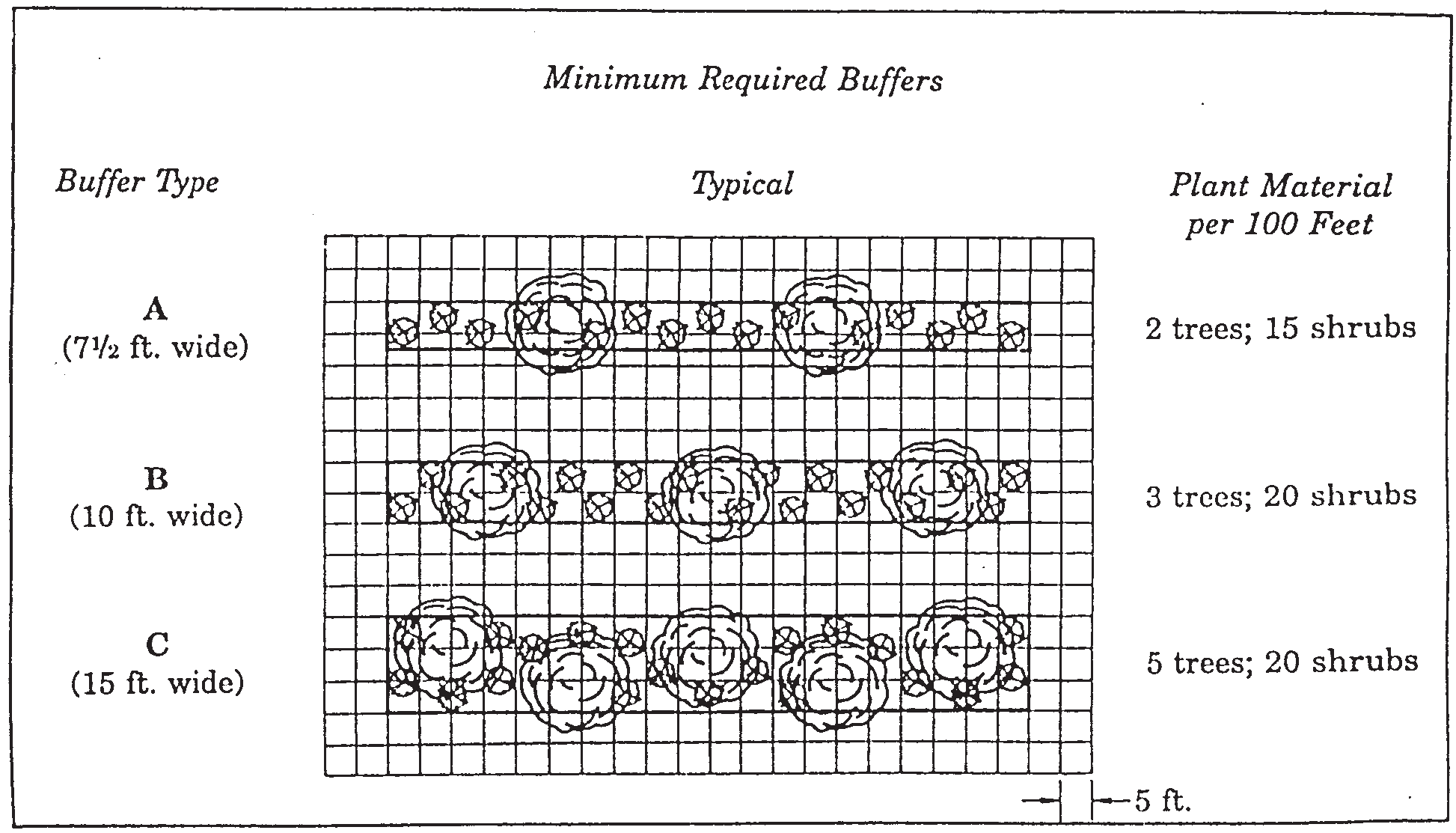
The standards for buffer zones are set out in the following illustrations that specify the number of plants required per 100 linear feet. To determine the total number of plants required, the length of each side of the property requiring a buffer shall be divided by 100 and multiplied by the number of plants shown in the illustration. The plants shall be spread reasonably evenly along the length of the buffer.
MINIMUM REQUIRED BUFFERS
(4)
The standards in subsection (a) of this section shall be applied between abutting parcels as follows:
(5)
Buffering for mixed use developments shall be based on the more intense use in the building or cluster of buildings.
(6)
If a developer proposes to landscape a buffer zone with existing native vegetation, a variance from the strict planting requirements of this subsection may be granted by the building department if:
a.
The variance is necessary to prevent harm to the existing native vegetation; and
b.
The buffering and/or aesthetic purposes of the buffer zone are substantially fulfilled despite the variance.
(7)
Responsibility for providing buffer zones.
a.
The desired width of a buffer zone between two parcels is the sum of the required buffer zones of the parcels. Where a new use is proposed next to an existing use that has less than the required buffer zone for that use, an inadequate buffer zone will be tolerated, except as provided in this subsection, until the nonconforming parcel is redeveloped and brought into conformity with the buffer zone requirements of this Code. The developer of the new adjoining use is encouraged to take into account the inadequacy of the adjoining buffer zone in designing the site layout of the new development.
b.
Where a residential use is proposed next to an existing nonresidential use, or a nonresidential use is proposed next to an existing residential use, and the existing use does not have a conforming buffer zone abutting the property proposed for development, the proposed use shall provide 80 percent of the combined required buffer zones of the two uses. Where the existing use has a buffer zone, but such zone does not meet the requirements of this Code, the proposed use may provide less than 80 percent of the combined required buffer zones if the provision of such lesser amount will create a buffer zone meeting 100 percent of the combined required buffer zone of the two uses. The building department shall determine which areas may be counted as buffer zone of the existing use based on the buffering qualities of the areas.
(b)
Interior landscaping. All parking areas shall have interior landscaping to provide visual and climatic relief from broad expanses of pavement, and to direct and define logical areas for pedestrian and vehicular circulation.
(1)
Off-street parking areas containing five parking spaces or in excess of 1,500 square feet shall contain at least ten square feet of interior landscaping for each parking space. Other vehicular use areas in excess of 1,000 square feet shall have 25 square feet of landscaped area for each 500 square feet or fraction thereof of paved area.
(2)
Each separate interior landscaped area shall contain a minimum of 100 square feet and shall be at least five feet wide. A minimum of one tree shall be planted for every 120 square feet of interior landscaping or fraction thereof, with the remaining area adequately planted with shrubs, ground cover or other approved landscaping materials.
(3)
All interior landscaping shall be protected from vehicle encroachment by curbing or wheel stops.
(4)
Interior landscaping shall be located in a manner which will divide or interrupt the broad expanse of paving. Landscaped areas shall subdivide parking areas into parking bays containing a maximum of 50 spaces, provided that no more than 12 spaces shall be in an uninterrupted row.
(5)
In other vehicular use areas where the strict application of this subsection will seriously limit the function of the area, such as off-street loading areas, the required landscaping may be located near the perimeter of the paved area. Such required interior landscaping which is relocated shall be in addition to the buffer zone requirements.
(6)
Interior landscaping layout or design shall be reviewed and approved by the building department.
(c)
Use of required landscape areas. No accessory structures, garbage or trash collection points or receptacles, parking, or any other functional use contrary to the intent and purpose of this Code shall be permitted in a required landscape area. This does not prohibit the combining of compatible functions such as landscaping and drainage facilities.
(d)
Appropriate site plans showing proposed landscape development shall be submitted to the city building department. Landscape plans for new nonresidential construction only, excluding renovations and additions, shall be prepared by a licensed, Florida registered Landscape Architect or other licensed professional authorized by law to practice in the area of landscape design. The site plan shall be drawn to scale normally of not less than one inch equals 30 feet. A different scale may be permitted for good cause shown. Landscape plan review will typically be done concurrent with building permit application review. Amendments or modifications to approved landscape plans shall be reviewed administratively within five working days. Such site plan shall include the following:
(1)
Plant name, size and location, number, spacing and size upon installation of all trees, shrubs and ground covers.
(2)
Existing and proposed landscape areas.
(3)
Existing and proposed parking areas, including access aisles, driveways, catchbasins and all vehicular use areas, scaled and/or dimensioned.
(4)
An irrigation system, including heads, valves and pump, that provides 100 percent coverage.
(5)
Locations of all existing and/or proposed structures, sidewalks, pools, fences and walls, all applicable utilities services, dumpsters and other improvements, properly dimensioned and referenced to property uses, setback and yard requirements.
(e)
Sight distance for landscaping adjacent to public right-of-way and points of access. When an accessway intersects a public right-of-way, all landscaping shall provide unobstructed cross-visibility at a level between 2½ and ten feet high within the areas of property on both sides of an accessway formed by the intersection of each side of the accessway and public right-of-way lines, with two sides of such triangle being ten feet in length from the point of intersection and the third side being a line connecting the ends of the two other sides; provided that trees having limbs and foliage trimmed in such a manner that no limbs or foliage extend into the cross visibility area shall be allowed, provided they are located so as not to create a traffic hazard. Landscaping, except required grass or ground cover, shall not be located closer than three feet to the edge of any accessway pavement.
(f)
Corner visibility. On a corner lot in any residential district, no hedge, structure or planting, or other obstruction to vision between the heights of 2½ feet and ten feet above street level shall be erected, placed or maintained within the triangular area formed by the intersection of curblines and a straight line joining the curblines at points which are 30 feet distant from the point of intersection measured along the curblines.
(g)
Appeals. A person aggrieved by an administrative order, determination or decision of the building department may appeal the order, determination or decision to the board of zoning appeals for a variance from the strict requirements of this section.
(Code 1981, app. C, § 26-7(6); Ord. No. 12-05, § 1, 10-6-2011)

