
Palmetto City Zoning Code
DIVISION III
SITE DEVELOPMENT REGULATIONS
Sec. 13-1.- Buildings and structures.
A.
Fences and Walls.
1.
Fences and walls in any Residential District shall not exceed six feet in height, measured from the natural grade to the uppermost portion of the fence.
2.
Fences and walls erected within the required front yard in any residential district shall not exceed four feet in height. This shall also apply to each front yard of a corner lot.
3.
Fences and walls shall not be erected within any public right-of-way.
4.
In the residential districts, if both sides of the fence are not identical, the finished side shall face the adjoining properties.
5.
Chain link fences shall not be erected in any front yard within a residential district, unless enclosing a retention pond that has been approved by the city.
6.
No barbed wire or above-ground electrified fence shall be located in any residential district, except where surrounding crops, orchards, pastures, or similar land devoted to a bona fide farm or garden.
7.
An eight-foot high, non-sight obscuring, security fence may be permitted around the perimeter of governmental or public utility service buildings and storage yard, towers, and approved outdoor storage areas in the commercial or industrial districts. The security fence may also include a maximum of two additional feet of barbed wire.
8.
Required walls shall be located inside the property line. The design of all walls, including openings for vehicular traffic or other purposes, shall only be as permitted by the zoning administrator.
B.
Unlawful Buildings and Use. Any building, use, or lot which has been unlawfully constructed, occupied, or created prior to the date of adoption of this ordinance shall continue to be unlawful, unless expressly permitted by this zoning ordinance. Such buildings, uses or lots shall not be considered to be nonconforming buildings or uses or lots of record under this ordinance.
C.
Temporary Buildings.
1.
Upon application, the zoning administrator may issue a permit for a temporary office building or yard for construction materials and/or equipment which is both incidental and necessary to construction at the site where located. Each permit shall be valid for a period of not more than six calendar months and may be renewed by the zoning administrator for additional successive periods of six months or less at the same location if the temporary building or storage yard is still incidental and necessary to construction at the site where located and provided the applicant possesses a current building permit for property within the development.
2.
Upon application, the zoning administrator may issue a permit for a temporary sales office or model home which is both incidental and necessary for the sale or rental of real property in a new subdivision or housing development. Each permit shall specify the location of the office and shall be valid for a period of not more than six calendar months and may be renewed by the zoning administrator for additional successive periods of six months or less each at the same location if the office or model home is still incidental and necessary for the sale or rental of real property in the subdivision or housing development where it is located.
Sec. 13-2. - Dimensional provisions.
A.
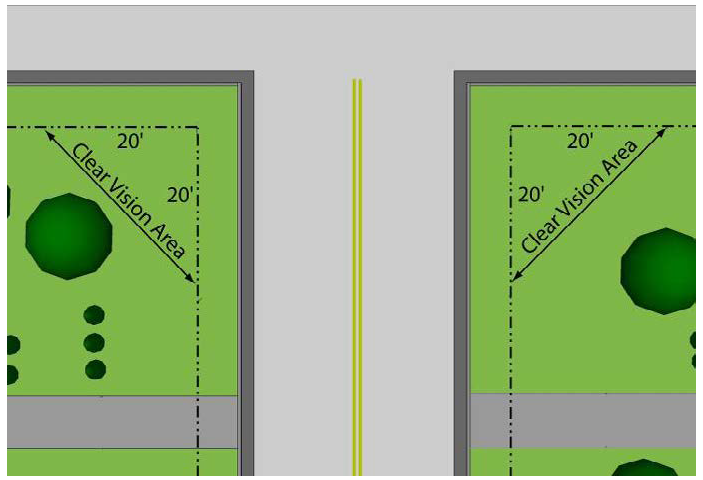
Clear Vision Corners. Fences, walls, structures, shrubbery or other potential obstructions to vision, except utility poles, lights and street signs, shall not be permitted to exceed a height of three feet within a triangular area formed by the intersection of the street right-of-way lines and a line connecting two points located on those intersecting right-of-way lines 20 feet from the point of intersection with the right-of-way lines.
B.
Minimum Lot Frontage. Any lot with a building, dwelling unit or structure shall have frontage on a public street, private street or approved access easement equal to the lot width required in the district. Any lot created after the effective date of this ordinance shall front upon a public street right-of-way, private street easement, or approved access easement.
C.
Cul-de-Sac Lots. In the case of lots abutting cul-de-sac streets, the minimum required lot width shall be measured at the required front setback line. Cul-de-sac lots shall have a minimum width of 40 feet at the front lot line. For lots in the RR zone which have their entire frontage on a cul-de-sac, a minimum lot width of 175 feet shall be achieved at a point 125 feet from the front lot line.
D.
Encroachment in Right-of-Way. No buildings, structures, service areas or required off-street parking and loading facilities, except driveways, shall be permitted to encroach on public rights-of-way.
E.
Height Exceptions. Farm buildings and related structures such as barns, silos, and grain elevators shall be exempt from height regulations in all districts. Other buildings and structures shall not exceed the maximum height limitations of the zoning district in which they are located; provided structures appurtenant to non-residential buildings including, but not limited to, parapet walls, chimneys, cooling towers, elevator bulkheads, fire towers, stacks, elevated water towers, stage towers, scenery lofts, monuments, cupolas, domes, spires, penthouses housing necessary mechanical appurtenances, and HVAC or similar equipment on the roof of the building may exceed the district height limitations.
F.
Maximum Width to Depth Ratio. In all zoning districts, except residential districts, no lot or parcel shall be created whose depth exceeds four times its width. In all residential districts, no lot or parcel shall be created whose depth exceeds three times its width; provided this prohibition shall not apply to cul-de-sac lots or parcels. Cul-de-sac lots or parcels located in a residential district shall not exceed a depth of four times their width, as measured at the front setback line.
G.
Front Setback Requirements. All yards abutting upon a public street right-of-way or private street easement shall be considered as front yards for setback purposes, except as provided for accessory buildings on double frontage lots.
H.
Projections into Required Setbacks. Certain structures and architectural features may project into the required yard setbacks as follows:
Table 13-02. Permitted Building Projections Into Required Yards
1. In the case of vehicle service stations, motels, funeral homes and similar uses canopies may be permitted over a driveway or walkway within the front yard but shall be no closer than 15 feet to the street right-of-way or easement line.
I.
Reduced Front Setback Requirements. The following setback requirements shall apply to all residential districts:
1.
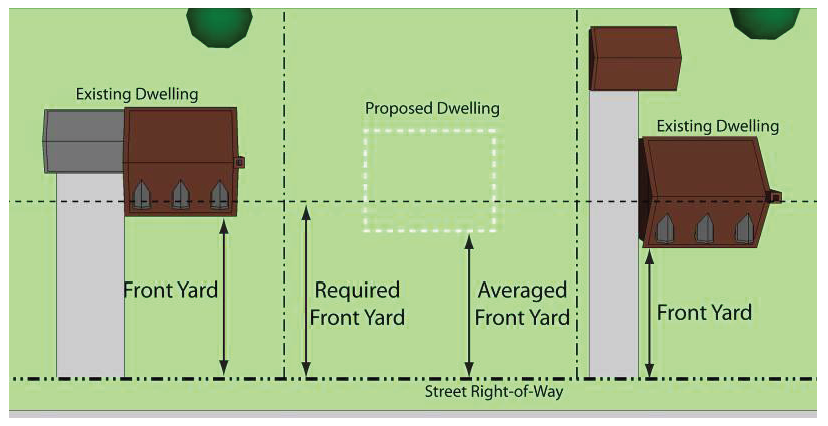
Where the established front yards for existing main buildings located within 200 feet of a side lot line of and in the same zoning district as, a subject lot are less than the required front yard for the zoning district of the subject lot, the required front yard for the subject lot shall be the average front yard of the existing main buildings on the same side of the street, on the same block and entirely or partially within 200 feet of the side lot lines of the subject lot.
2.
The front yard reduction provided for in this section shall only be permitted if two or more lots are occupied by main buildings within the area described for computing the average front yard.
3.
In no case shall the front yard setback resulting from the application of these provisions, be less than 25 feet.
J.
Required Yards or Lots. No lot or lots in common ownership and no yard, court, parking area or other space shall be so divided, altered, or reduced as to make the area or space less than the minimum size required under this ordinance. If already less than the minimum size required, the area or space shall not be further divided or reduced.
K.
Setbacks Adjacent to Railroad. Within any non-residential zoning district, setbacks shall not be required for side or rear yards abutting a railroad right-of-way.
Sec. 13-3. - Dwellings.
A.
Illegal Dwellings. The use of any basement for dwelling purposes is prohibited in any zoning district, unless the basement meets the appropriate city building codes. Buildings erected as garages or accessory buildings shall not be occupied for dwelling purposes.
B.
Minimum Requirements for Single Family Dwellings Outside Manufactured Home Communities. Any single-family dwelling on a lot, whether constructed and erected or a manufactured home, shall be permitted only if it complies with all of the following requirements:
1.
If the dwelling unit is a manufactured home, the manufactured home must either be new and certified by the manufacturer and/or appropriate inspection agency as meeting the Mobile Home Construction and Safety Standards of the U.S. Department of Housing and Urban Development, as amended, or any similar successor or replacement standards which may be promulgated, or used and certified by the manufacturer and/or appropriate inspection agency as meeting the HUD standards, and found, on inspection by the building inspector or his designee, to be in excellent condition and safe and fit for residential occupancy.
2.
The dwelling unit shall comply with all applicable building, electrical, plumbing, fire, energy and other similar codes which are or may be adopted by the city; provided, however, that if a dwelling unit is required by law to comply with any federal or state standards or regulations for construction which are different than those imposed by city codes, then those applicable state or federal standards or regulations shall apply. Appropriate evidence of compliance shall be provided to the building inspector.
3.
The dwelling unit shall comply with all restrictions and requirements of this ordinance, including, without limitation, the minimum lot area, minimum lot width, minimum residential floor area, required yard and maximum building height requirements of the zoning district in which it is located.
4.
If the dwelling unit is a manufactured home, the manufactured home shall be installed with the wheels removed.
5.
The dwelling unit shall be firmly attached to a permanent continuous foundation constructed on the building site. The foundation shall have a wall of the same perimeter dimensions as the dwelling unit and be constructed of such materials and type as required by the building code for on-site constructed single-family dwellings. If the dwelling unit is a manufactured home, its foundation shall fully enclose the chassis, undercarriage and towing mechanism.
6.
If the dwelling unit is a manufactured home, it shall be installed pursuant to the manufacturer's setup instructions and shall be secured to the building site by an anchoring system or device complying with applicable rules and regulations of the State of Georgia or any similar or successor agency having regulatory responsibility for manufactured home parks.
7.
In addition to meeting the minimum floor area requirement for single-family dwellings for the district in which it is located, the dwelling shall have a minimum core living area of at least 20 feet by 30 feet.
8.
Storage area of no less than 120 square feet shall be provided within a building. This storage area may consist of a basement, closet area, attic or attached garage in a main building, or in a detached accessory building which is in compliance with all other applicable provisions of this ordinance.
9.
The front entry to the dwelling shall be located on the ground floor. Permanently attached steps or porch areas at least three feet in width, but no more than three feet in height, shall be provided where there is an elevation difference greater than eight inches between the first floor entry of the dwelling unit and the adjacent grade.
10.
The exterior finish of the dwelling unit shall not cause reflection that is greater than that from siding coated with clean, white, gloss exterior enamel.
11.
The dwelling unit shall have no less than two exterior doors, with one being in either the rear or the side of the dwelling unit.
C.
Temporary Dwellings. No cabin, garage, basement, tent, recreational vehicle, or other temporary structure shall be used in whole or in part for dwelling purposes in any district; provided a manufactured home may be used as a temporary dwelling for a period not to exceed six months upon application to and approval of a permit for such occupancy by the zoning administrator upon determination that the following conditions exist and are met:
1.
The permanent dwelling of the resident applicant has become uninhabitable due to damage caused by fire, wind or other natural calamity or emergency.
2.
Due to undue hardship, the applicant is unable to obtain another dwelling unit as a temporary residence.
3.
The temporary dwelling is constructed so as to meet the minimum requirements for the health, safety and welfare of the occupants and the surrounding neighborhood.
4.
The temporary dwelling shall be served by sanitary sewer and potable water, approved by the city.
5.
The temporary dwelling will be removed prior to the issuance of a certificate of occupancy for the new dwelling.
Sec. 13-4. - Parking and storage.
A.
Outdoor Storage. Outdoor storage of merchandise, equipment, supplies, products or other materials shall only be permitted in those districts and under such conditions as specifically authorized by this ordinance.
B.
Recreational Vehicle Parking. It shall be unlawful for any person to park or cause to be parked any mobile home or recreational vehicle on any street, alley, highway, or other public place in the city and to use the same as a dwelling. This provision shall not prohibit the temporary occupancy for periods up to 48 hours of a recreational vehicle; provided the recreational vehicle contains sleeping accommodations, is parked on a lot in a residential district, and is for the use of the owner of that lot or guests of the owner.
C.
Storage and Repair of Vehicles.
1.
The repair, restoration and maintenance of vehicles in any residential district, shall be conducted entirely within an enclosed building, except for those activities that can be and are completed in less than 24 hours. All such repair shall take place on private property and may not be conducted within the public right-of-way.
2.
It shall be unlawful for the owner, tenant or lessee of any building or lands within the city to permit the open storage or parking of any inoperable motor vehicle, machinery or equipment, or parts thereof, outside of an enclosed garage or enclosed building, for a period of more than 48 hours. An inoperable motor vehicle for purposes of this subsection shall include motor vehicles which, by reason of dismantling, disrepair or other cause, are incapable of being propelled under their own power, or are unsafe for operation on the streets and highways of this state because of the inability to comply with the State Motor Vehicles and Traffic Code, or do not have a current license and registration as required for operation by the State Motor Vehicles and Traffic Code.
3.
It shall be unlawful for the owner, tenant or lessee of any lot or building in a residential district to permit the open storage or parking outside of a building of semi-truck tractors and/or semi-truck trailers, bulldozers, earth carriers, cranes or any other similar equipment or machinery, unless parked for purposes of construction being conducted on that lot.
4.
In the RR District, however, the owner, tenant or lessee of any lot may openly store or park semi-truck tractors and/or semi-truck trailers outside of a building for up to 20 days within any 30-day period. Those vehicles shall be parked so as to not block vision of drivers on or entering any adjacent street.
Sec. 13-5. - Uses.
A.
Principal Use per Lot. A lot or parcel shall not be devoted to more than one principal use, or contain more than one principal building, except for groups of multiple family dwellings, agricultural buildings, or commercial or industrial buildings determined by the zoning administrator to be a principal use collectively, based on meeting all of the following criteria:
1.
Individual buildings share common parking areas, signs, access and similar features;
2.
Buildings are under single ownership;
3.
Individual activities support one another (such as auto sales/vehicle repair or gas station/restaurant/convenience store); or
4.
Buildings are architecturally unified and compatible.
B.
Use. No building, structure or land shall be used or occupied and no building structure or part thereof shall be erected, constructed, reconstructed, moved, enlarged or structurally altered unless in conformity with the regulations of this ordinance.
C.
Use on a Lot. Every building, structure or use erected or established within the city shall be located on a legally recorded lot or parcel and shall conform to all applicable requirements of this ordinance.
D.
Voting Place. The provisions of this ordinance shall not be construed in any manner that would interfere with the temporary use of any property as a voting place in connection with a municipal, school or other public election.
Sec. 13-6. - Other provisions.
A.
Alterations to Grade and Site Clearance.
1.
The natural grade upon which a building is to be constructed shall not be altered in such a way that the top of the plates on the front foundation wall is more than 24 inches above the finished grade, nor shall any grade be altered in such a way as to cause adverse effects to neighboring properties.
2.
Grading or clearing vegetation for the purpose of preparing a lot or parcel for building construction shall not be permitted prior to receipt of a building permit for construction of a principal use on the property.
B.
Control of Heat, Glare, Fumes, Odor, Dust, Noise or Vibration. Every use shall be conducted and operated in a way that does not create a nuisance and is not dangerous by reason of heat, glare, fumes, odor, dust, noise or vibration beyond the lot on which it is located.
C.
Domestic Animals.
1.
The keeping of household pets, including dogs, cats, fish, birds, hamsters and other animals generally regarded as household pets is permitted as an accessory use in any residential district. However, no more than three dogs or cats, six months of age or older, in any combination thereof, shall be kept or housed in or at one dwelling unit.
2.
Agricultural animals such as, but not limited to, horses, cattle, goats, pigs, sheep and chickens are permitted in the RR District on parcels of three acres or more; provided that the total number of animals permitted on parcels of ten acres or less shall be limited to one animal per acre. Manure storage areas shall be located at least 75 feet from any adjoining property line.
3.
Any area where such permitted animals are kept shall be maintained in a safe and sanitary condition.
D.
Excavations or Holes. The construction, maintenance or existence within the city of any unprotected, unbarricaded, open or dangerous excavations, holes, pits or wells which constitute or are likely to constitute a hazard or menace to the public health, safety or welfare is hereby prohibited; provided, this section shall not apply to the following:
1.
Any excavation for which a permit has been issued by the city and which is properly protected and where warning signs have been posted in a manner approved by the city;
2.
Any excavation approved and operated as a special land use in accordance with this ordinance for mining extraction operations; and
3.
Streams, natural bodies of water or ditches, reservoirs and other bodies of water created or existing by authority of governmental units or agencies.
E.
Trash, Litter and Junk. It shall be unlawful for any person to accumulate, place, store or allow or permit the accumulation, placement or storage of trash, litter or junk on premises in the city, except in a lawful sanitary landfill or junkyard.
Sec. 14-1.- Conditional uses.
A.
Some land uses are considered generally appropriate in their respective zoning districts; however, controls and safeguards are necessary to ensure their compatibility with permitted principal uses. The conditional use permit procedure is intended to allow consideration of the impact of the proposed conditional use on surrounding property, and the application of controls and safeguards to assure that the conditional use will be compatible with its surroundings.
B.
A conditional use must comply with the area, height and placement requirements for the zoning district in which it is located. In addition, any specific requirements pertaining to the use listed in this article must also be met.
C.
An application for a conditional use shall be filed with the zoning administrator on a form provided for that purpose. The application shall be accompanied by a filing fee, as established by the city council.
D.
A site plan shall be submitted with the application, showing the proposed location of all existing and proposed buildings and structures on the site, access points, drainage, vehicular and pedestrian circulation patterns, parking areas, and the specific location of the use or uses to be made of the development, together with other information necessary to comply with the standards for a conditional use listed in this article and in other pertinent sections of this ordinance.
E.
In granting a conditional use, the zoning administrator must make the following findings:
1.
The conditional use will preserve the value, spirit, character and integrity of the surrounding area;
2.
The conditional use fulfills all other requirements of this article pertaining to the conditional use in question;
3.
Granting the conditional use permit will not be harmful to the public health, safety, convenience and comfort; and
4.
Sufficient setbacks, lot area, buffers or other safeguards are being provided to meet the above standards.
F.
In granting a conditional use, the zoning administrator may impose conditions necessary to ensure that the conditional use meets the requirements of this ordinance and the public health, safety and welfare are protected.
G.
The decision of the zoning administrator, including any conditions imposed upon an approved conditional use, may be appealed to the zoning board of appeals, in accordance with Article 23.
H.
Conditional use specific standards. In addition to the general findings in Section 14-1.E., the specific requirements for individual conditional uses, as listed in the following sections, shall be met.
Sec. 14-2. - Accessory uses and structures.
A.
Accessory buildings or garages shall be considered to be part of the principal building if structurally and architecturally integrated into the building, or if attached by an enclosed breezeway or similar enclosed structure not greater than ten feet in length.
B.
Detached accessory buildings shall be located not closer than ten feet to the main building.
C.
The area of accessory buildings is to be included in the maximum lot coverage.
D.
An accessory building or accessory structure shall not be located in any front yard.
E.
An accessory building or accessory structure shall not be constructed or occupied on a lot before the principal building or use on the lot is constructed.
F.
Except as provided in paragraph G below, accessory buildings and accessory structures shall meet the minimum side and rear yard setbacks required for principal buildings.
G.
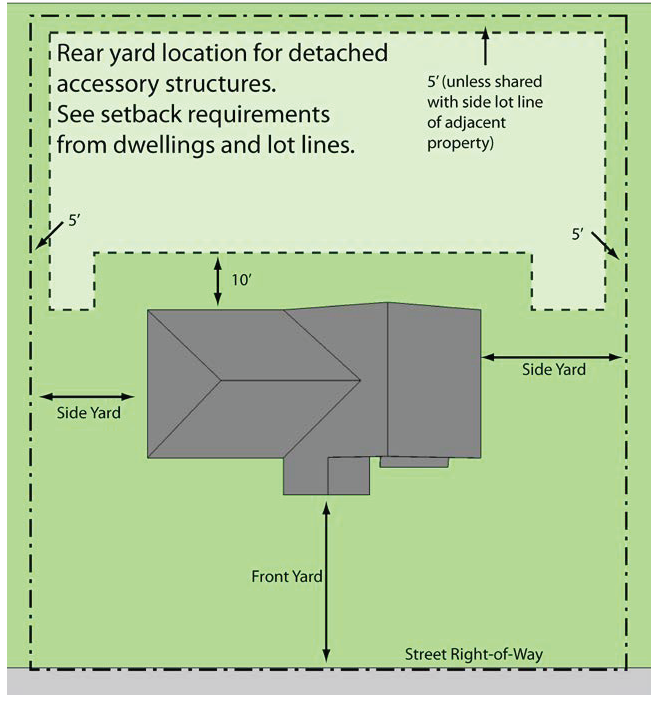
On lots in any residential district, an accessory building or accessory structure which is no larger than 100 square feet in area and ten feet in height may be located in a rear yard as near as five feet from the side and rear lot lines. However, if the rear lot line of the property on which the accessory building or accessory structure is located is also the side lot line of the neighboring property, then the accessory building or accessory structure shall be set back the same distance from the rear lot line as the required side yard setback for a principal building.
H.
A maximum of two accessory buildings shall be permitted on a residential lot; provided the total floor area of all accessory buildings does not exceed the maximum size limits specified in Table 14-3. Accessory buildings in any residential district shall be limited in building floor area as follows:
Table 14-2. Maximum Size of Accessory Residential Buildings
I.
Accessory buildings and structures in planned unit developments shall be subject to the same requirements as in the residential districts.
J.
Buildings and structures used in active commercial agricultural operations are not considered accessory buildings and shall not be subject to this section, except that no commercial agricultural buildings or structures shall be located within a required yard, and any such building greater than 1,200 square feet in area shall be located at least 50 feet from any rear or side lot line.
K.
Swing sets, playground equipment, garden trellises, well-head covers and similar above-ground yard equipment accessory to a residential use shall be exempt from the provisions of this zoning ordinance, except for height limitations, or unless specific provision is made for such equipment by city ordinance.
L.
Buildings accessory to non-residential uses shall meet the minimum setback requirements and height limitations for principal buildings in the respective zoning district.
Sec. 14-3. - Auction houses.
An auction house in the C-3 District shall be located on a tract with a minimum area of five acres.
Sec. 14-4. - Boarding and rooming house.
A.
The minimum size of a rooming unit shall be 70 square feet, with not less than seven feet in any dimension. An extra 50 square feet shall be required for each additional occupant within the unit.
B.
Twenty-four-hour on-site management must be provided.
C.
The rules and residency requirements governing the use shall be submitted with the conditional use application. The management will be solely responsible for the enforcement of all rules that are reviewed and approved as part of a conditional use permit.
D.
The building shall contain a minimum of 250 square feet of common space such as recreation areas, lounges, and living spaces. An additional 10 square feet of common space is required per rooming unit over 11.
E.
There shall be at least one flush water closet, one bathroom lavatory basin, and one bathtub or shower bath for each five persons or fraction thereof, except that in a rooming house, where rooming units are let only to males, flush urinals may be substituted for not more than one-half the required number of flush water closets.
F.
All bathroom facilities shall be so located within the dwelling as to be reasonably accessible to all persons sharing those facilities and from a common hall or passageway; provided that the facilities are not located more than one floor above or below the rooming unit or units served.
G.
Access doors to a rooming unit shall have operating locks to insure privacy.
H.
Every rooming unit shall comply with all the requirements of applicable building, housing, health and fire codes pertaining to a habitable room.
Sec. 14-5. - Building and lumber supply, fence material, rental and related construction oriented retail establishments.
A.
All outdoor storage areas shall be fenced with a minimum six-foot high opaque fence.
B.
Junk or discarded material shall not be stored or stacked outdoors.
Sec. 14-6. - Child care centers, commercial preschools and nurseries.
A.
At least 150 square feet of indoor or outdoor play area shall be provided per child; however, the total play area shall not be less than 5,000 square feet.
B.
An outdoor play area shall not be located in the required front yard nor abut a public right-of-way. It shall be located away from vehicular traffic and enclosed by a minimum four-foot tall ornamental or black vinyl-coated chain link fence. A six-foot tall privacy fence and/or approved landscaping shall be provided where a play area abuts an adjoining single-family residential lot.
C.
An on-site drive, arranged to allow one way traffic flow, shall be provided for drop-off and loading.
Sec. 14-7. - Child care facilities accessory to a principal use.
A.
All licensing and permitting shall be obtained from the State of Georgia.
B.
All applicable rules and regulations of the State of Georgia shall be adhered to.
C.
Monthly inspections shall be performed by the city to determine whether or not the facility is in compliance with these conditions.
Sec. 14-8. - Child caring institution, family.
A.
All licensing and permitting shall be obtained from the State of Georgia.
B.
All rules and regulations of the State of Georgia shall be adhered to.
C.
The owner of the dwelling shall reside on the premises.
D.
A family child caring institution shall not be located within 1,320 feet from any other family child caring institution.
E.
The occupants of all properties within 300 feet of the boundary of the lot where the family child caring institution is proposed shall be notified by the applicant, by certified mail, of the request to establish the proposed use. Proof of mailing shall be provided to the city zoning administrator. Monthly inspections shall be performed by the city to determine whether or not said facility is in compliance with these conditions.
Sec. 14-9. - Churches and customary related uses.
A.
All buildings, parking areas and outdoor activity areas (ball fields, playgrounds, bleachers, etc.) shall be setback a minimum of 40 feet from any side or rear property line abutting a residential district.
B.
A church shall be located on a tract of land not less than five acres in area with a street frontage of at least 200 feet.
Sec. 14-10. - Club or lodge, private.
A.
The minimum lot area shall be five acres.
Sec. 14-11. - Day care, family.
A.
All licensing and permitting shall be obtained from the State of Georgia.
B.
All rules and regulations from the State of Georgia shall be adhered to.
C.
The owner of the dwelling shall reside on the premises.
D.
A family day care home shall not be located within 1,320 feet from any other family day care home.
E.
The occupants of all properties within 300 feet of the boundary of the lot where the family day care home is proposed shall be notified by the applicant, by certified mail, of the request to establish the proposed use. Proof of mailing shall be provided to the city zoning administrator.
F.
Monthly inspections shall be performed by the city to determine whether or not said facility is in compliance with these conditions.
Sec. 14-12. - Dwelling units of watchmen and operating personnel and their families.
A.
No more than one dwelling unit per main building is permitted.
B.
The dwelling unit shall not exceed one 1,500 square feet GFA.
C.
The unit may only be occupied by an employee of the facility and his/her family, who is actively employed in security, maintenance or operations within the facility.
Sec. 14-13. - Foster care home, adult family.
At least 1,500 square feet of open space shall be provided for every bed, whether used or intended.
Sec. 14-14. - Golf courses and country clubs.
A golf course shall be laid out with a minimum of 18 holes over a distance of at least 5,500 yards and used exclusively for playing golf.
Sec. 14-15. - Greenhouses and nurseries (not including retail sales).
A.
The minimum lot area shall be two acres.
B.
The storage or display of all materials shall conform to the requirements of Section 14-18.
Sec. 14-16. - Home occupations.
A.
Only resident occupants and one non-resident employee shall be engaged in the home occupation.
B.
The use of the dwelling unit for the home occupation shall be clearly incidental and subordinate to its use for residential purposes by its occupants and not more than 25 percent of the gross floor area of the dwelling shall be used in the conduct of the home occupation.
C.
There shall be no change in the outside appearance of the dwelling or other visible evidence of the conduct of the home occupation, except that one sign, not exceeding two square feet, non-illuminated and mounted flat against the wall of the dwelling, may be permitted.
D.
The home occupation shall be operated in its entirety within the principal dwelling.
E.
The direct sale of goods, merchandise, supplies, products or services shall not be permitted to customers on the premises. Phone and internet sales may be permitted, provided the items purchased are shipped directly to the customer so no pick-up is required at the location of the home occupation.
F.
Outdoor storage, activities or displays shall be prohibited.
G.
No traffic shall be generated by the home occupation in greater volume than would normally be expected in a residential neighborhood. Any parking needed to accommodate the home occupation shall be provided off-street behind the required front setback line.
H.
No equipment or process shall be used in the home occupation which creates noise, vibration, glare, fumes, odors or electrical interference detectable to the normal senses off the premises, if the occupation is conducted in a single-family dwelling, or detectable outside the dwelling unit if conducted in an attached or multiple family dwelling. In the case of electrical interference, no equipment or process shall be used which creates visual or audible interference in any radio or television receivers off the premises or causes fluctuation in line voltage of the premises.
I.
Uses such as, but not limited to, clinics, hospitals, nurseries, day care centers, ambulance service, amusement arcades, vehicle repair or maintenance, pawn shop, fortune teller, veterinarian offices, permanent basement or garage sales or kennels shall not be considered home occupations.
Sec. 14-17. - Kennels.
A.
No portion of a building, pen or structure used to contain animals shall be located closer than 200 feet to any property line.
B.
The minimum lot area shall be five acres.
Sec. 14-18. - Outdoor storage related to a principal use.
A.
The sale or outdoor display of merchandise shall not be permitted within the required setback areas.
B.
The zoning administrator may require a fence or wall to be constructed along the rear and/or sides of the lot to keep trash, paper, and other debris from blowing off the premises.
C.
The lot area used for parking shall be hard-surfaced and the display or storage areas shall be provided with a permanent, durable, and dustless surface, and shall be graded and drained so as to dispose of all surface water.
D.
All lighting shall be shielded from adjacent residential areas.
Sec. 14-19. - Parking garage, structure or lot, commercial (as principal use).
Storage of inoperable vehicles is prohibited. All vehicles within the garage, structure or lot shall be operable and licensed.
Sec. 14-20. - Personal care home, family.
A.
All licensing and permitting shall be obtained from the State of Georgia.
B.
All rules and regulations from the State of Georgia shall be adhered to.
C.
The owner of the dwelling shall reside on the premises.
D.
A personal care family home shall not be located within 1,320 feet from any other personal care family home.
E.
The occupants of all properties within 300 feet of the boundary of the lot where the personal care family home is proposed shall be notified by the applicant, by certified mail, of the request to establish the proposed use. Proof of mailing shall be provided to the city zoning administrator.
F.
Monthly inspections shall be performed by the city to determine whether or not said facility is in compliance with these conditions.
Sec. 14-21. - Personal care home, group.
A.
All licensing and permitting shall be obtained from the State of Georgia.
B.
All rules and regulations from the State of Georgia shall be adhered to.
C.
The owner of the dwelling shall reside on the premises.
D.
A personal care group home shall not be located within 1,320 feet from any other personal care group home.
E.
The occupants of all properties within 300 feet of the boundary of the lot where the personal care group home is proposed shall be notified by the applicant, by certified mail, of the request to establish the proposed use. Proof of mailing shall be provided to the city zoning administrator.
F.
Monthly inspections shall be performed by the city to determine whether or not said facility is in compliance with these conditions.
Sec. 14-22. - Private non-commercial recreation.
A.
All structures and activity areas (courts, ball fields, playgrounds, etc.) shall be set back a minimum of 40 feet from any side or rear property line abutting a residential district.
B.
Lighting for night-time activity areas shall be directed and shielded so the light source is not visible from any residential use within 150 feet of the light fixture. All lighting, including building and security lighting, shall be located to prevent glare on adjacent properties and streets.
Sec. 14-23. - Public utility structures and lands.
A.
The materials, color and design of buildings shall be generally compatible with the surrounding neighborhood.
B.
Buildings and structures shall comply with the setback requirements of the district for principal buildings.
C.
Fencing or screening may be required in order to minimize the visual impact of the facility or improve its compatibility with adjoining properties.
Sec. 14-24. - Restaurant (outdoor seating area).
A.
An outdoor seating area may not be located within a required yard.
B.
The outdoor seating area shall be included in the determination of required parking spaces.
C.
An outdoor seating area shall be surrounded by a decorative fence or enclosure, at least four feet in height, with access only from within the building. A self-closing gate which can only be opened from within the enclosure shall be provided for emergency egress.
Sec. 14-25. - Riding stables and academies.
A.
A riding stable and/or academy shall be located on a parcel of not less than five acres.
B.
No barn or similar building and no manure storage shall be closer than 200 feet to any property line.
C.
A maximum of ten horses may be kept on five acres. One additional acre of land shall be required for each additional horse above ten.
Sec. 14-26. - Schools (elementary, middle and high).
A.
All buildings, parking areas and outdoor activity areas (ball fields, playgrounds, bleachers, etc.) shall be setback a minimum of 40 feet from any side or rear property line abutting a residential district.
B.
A six-foot high fence shall be constructed along any side or rear property line abutting a residential district.
C.
Lighting for night-time activity areas shall be directed and shielded so the light source is not visible from any residential use within 150 feet of the light fixture. All lighting, including building and security lighting, shall be located to prevent glare on adjacent properties and streets.
Sec. 14-27. - Sewage treatment plants.
A.
A sewage treatment plant shall be owned and operated by the City of Palmetto or other regulated utility provider. A treatment facility serving a specific allowed use may be permitted, however, provided that all treatment conforms to applicable city, county, state and federal law.
B.
All buildings, equipment and lagoons shall be located a minimum of 300 feet from any property line.
C.
Odor control measures shall be implemented.
Sec. 14-28. - Tire retreading establishments.
No outside storage is permitted.
Sec. 14-29. - Vehicle repair, minor.
A.
A building or structure shall be located at least 30 feet from any side or rear lot line abutting a residential district.
B.
Driveways, exclusive of curb returns, shall be at least 22 feet, but not more than 30 feet wide and shall be at least ten feet from any abutting property.
C.
Equipment, including hydraulic hoists, pits, and lubrication, greasing, and other automobile repairing equipment shall be located entirely within an enclosed building. Outdoor storage or display of merchandise, such as tires, lubricants and other accessory equipment is not permitted.
D.
All activities shall occur inside a building. All vehicles that are being worked on shall be located within a building. No vehicle may be stored on the property for more than 30 days.
E.
Above-ground storage tanks gasoline, liquefied petroleum gas, oil or other flammable liquids or gas are not permitted.
F.
All structures and tanks shall be at least 500 feet from a fire station, police station or place of public assembly.
G.
Floor drains shall not connect to the sanitary sewer system.
Sec. 14-30. - Wind energy conversion systems (single accessory).
A.
General Requirements.
1.
The minimum lot area for installation of a wind energy conversion system (WECS) shall be 12,000 square feet.
2.
The power rating of a single accessory WECS turbine shall not be greater than 25 kW.
3.
A single accessory WECS shall provide energy only to the structures and uses on the same property upon which the tower is located and must be owned or leased by the owner of the same property. However, this does not prevent power generated beyond the needs of the structures or uses on the property to be distributed to a local utility company through net metering. Except for the local utility company, power generated by the WECS may not be provided to any other property or entity.
4.
Sound attributed to a single accessory WECS in excess of 55 dB(A) shall not be discernible at the property line.
5.
A sign, not exceeding three square feet in area naming the manufacturer may be affixed to the base of the tower or to the nacelle; no other signs are permitted on the WECS.
6.
Lights on or directed toward a WECS are not permitted.
7.
A single accessory WECS shall be painted in a neutral matte color, such as gray or light blue, to blend with the sky. A building mounted WECS may be painted in colors complementary to those of the building.
8.
A single accessory WECS shall have an automatic braking, governing, or feathering system to prevent uncontrolled rotation or over speeding. Emergency shut-off information shall be posted on the tower in a location that can be easily seen.
9.
A single accessory WECS shall employ an anti-climbing device or be designed to prevent climbing and other unauthorized access.
10.
The installation of a single accessory WECS shall not interfere with signal transmission or reception of an existing fixed broadcast, re-transmission or reception antenna for radio, television or wireless phone or personal communication systems.
11.
The applicant shall provide written evidence that the WECS complies with all applicable federal, state and county requirements, in addition to city ordinances.
12.
All single accessory WECS installations shall comply with applicable ANSI (American National Standards Institute), National Electric Code and National Building Code standards, as adopted by the State of Georgia, Fulton County and the City of Palmetto.
13.
A WECS shall be removed when the device or equipment is no longer operating or when it has been abandoned. A WECS shall be deemed abandoned when it has not produced electrical energy for 12 consecutive months.
14.
An existing and approved single accessory WECS may be repaired and maintained; however, a WECS may only be replaced with a new WECS upon approval of the zoning administrator or designee, provided that the new WECS is of the same height, rotor diameter, setback, etc. as the WECS it replaces. A new or replacement WECS shall mean all of the WECS, excluding the tower or support structure.
B.
Ground-Mounted Single Accessory WECS.
1.
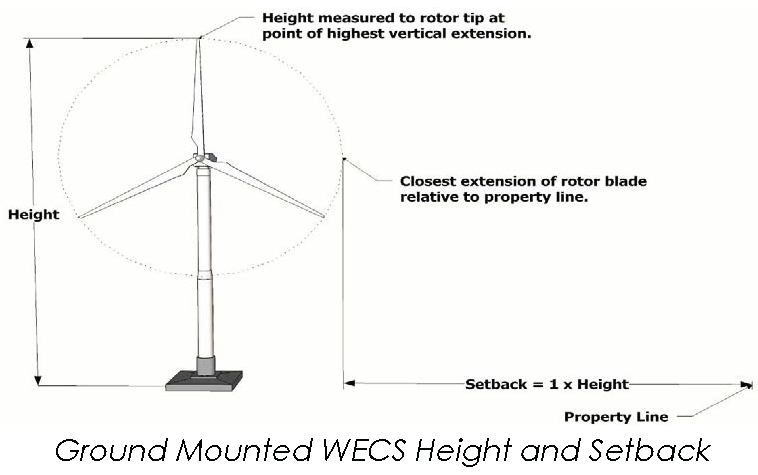
A ground mounted single accessory WECS shall be located on a property at a distance at least equal to its height from all property lines. The setback shall be measured from the property line (considered as a plane extending from the ground to the highest point of the WECS) to the closest extension of the rotor relative to the property line. No part of a single accessory WECS (including guy wire anchors) shall be located within or above a required setback.
2.
WECS height shall be limited based on the setback requirements in paragraph 1. above; however, WECS height shall not exceed 50 feet on a property at least 12,000 square feet but less than one acre in area; or 75 feet on a property one acre in area or greater.
3.
The minimum rotor blade tip clearance from grade shall be 20 feet.
4.
The minimum rotor blade tip clearance from any structure shall be 20 feet.
5.
The diameter of the rotor depends on maximum single accessory WECS height and rotor blade tip clearance, but in no case shall it exceed 50 feet.
6.
The tower used to support a WECS shall be adequately anchored and meet applicable standards, as certified by an engineer.
C.
Building Mounted Single Accessory WECS.
1.
The diameter of the rotor shall not exceed 20 feet.
2.
WECS height shall not exceed the maximum permitted height for principal buildings in the district, plus 15 feet.
3.
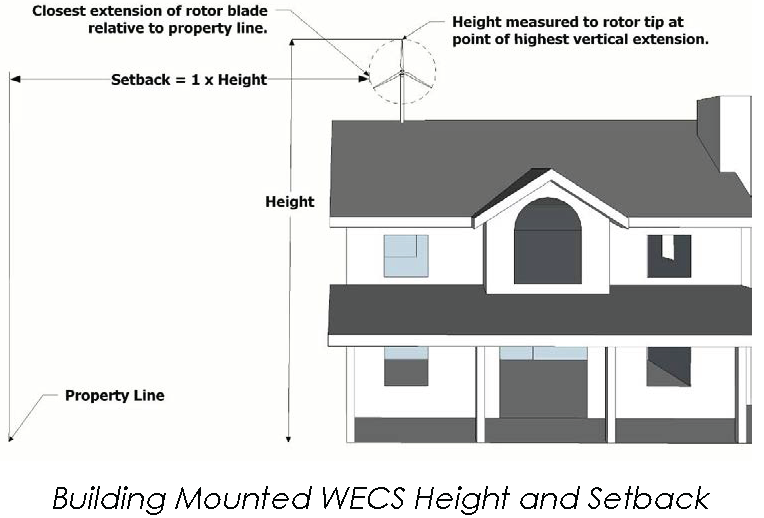
A single accessory WECS shall be located from adjoining property lines a distance equal to the combined height of the WECS and the portion of the building on which it is mounted. The setback shall be measured from the property line (considered as a plane extending from the ground to the highest point of the WECS) to the closest extension of the rotor relative to the property line.
4.
A building mounted single accessory WECS shall not be mounted to the vertical face of a gable end or dormer that is visible from the street. To the greatest degree possible, the WECS shall be mounted to the building in the least visible location.
5.
The mount and the structure used to support a building mounted WECS shall meet applicable standards, as certified by an engineer.
D.
Discretionary Conditions. The zoning administrator may impose other terms and conditions regulating the construction, installation, use, maintenance, repair and removal of a WECS, including, but are not limited to, the following:
1.
The preservation of existing trees and other existing vegetation not required to be removed for installation of a WECS.
2.
The reasonable replacement of trees or other vegetation removed or destroyed during the construction or installation of a WECS.
3.
Altering the location of the WECS to prevent impacts on neighboring properties, provided that all other requirements of this section are met.
4.
Requiring a performance bond or letter of credit, in accordance with the requirements of Section 21-5 and conditioned upon the timely and faithful performance of all required conditions, including but not limited to the timely and complete removal of a WECS, regulated under the terms of the section, when required. The performance bond or letter of credit shall remain in effect during and after the operation of a WECS until its operations have ceased and it has been removed.
Sec. 15-1.- Special uses.
Special uses are generally consistent with the purpose of the zoning district in which they are permitted but, due to unique operational characteristics, may not be desirable or compatible in all locations. Factors such as traffic, hours of operation, noise, odor or similar potential effects require that the special use be evaluated relative to its appropriateness on a case-by-case basis. Therefore, special uses may be permitted within a zoning district, with city approval, following a review of the use and its potential impact on its surroundings. This article establishes the review procedures for special uses and the general standards that must be met for all special uses. Some specific uses are also subject to additional standards and requirements to mitigate their potential negative impacts.
Sec. 15-2. - Scope.
A special use shall be permitted only when the city council has approved the proposed use and the associated site plan, after a review and recommendation by the planning and zoning board, as provided by this article and other applicable provisions of this ordinance. Except as otherwise expressly provided by this ordinance, the general procedures, standards, and requirements in this article shall apply to all special uses and shall be in addition to any other requirements applicable to particular special uses listed in this article. In those cases where the specific requirements of this article are more restrictive than other provisions of this ordinance, the special use requirements shall apply.
Sec. 15-3. - Application and review.
A.
Application. A person owning or having an interest in a property may apply for a special use as provided in this ordinance.
B.
Filing. An application shall be filed with the zoning administrator at least 30 days prior to the planning and zoning board meeting at which it is first to be considered. Further consideration and scheduling before the planning and zoning board shall not occur unless the application is found to be complete.
C.
Fees. A non-refundable fee shall be paid when an application is filed. The application shall not be considered until all fees, established by resolution of the city council, have been paid in full.
D.
Application requirements. A completed application, signed by the property owner, and accompanied by the following:
1.
Copies of a site plan that meet the standards and requirements of Article 20.
2.
A statement indicating that the proposed use complies with the general standards for approval in Section 20-6, any specific requirements for the use and with all other applicable ordinance requirements.
E.
Scheduling for Special Use and Site Plan Review. The zoning administrator will review the application and if determined to be complete, shall schedule the special use request before the planning and zoning board.
Sec. 15-4. - General standards for approval of special uses.
The planning and zoning board shall review the facts and circumstances of a special use application and shall make a recommendation of approval only when it meets all of the standards of this article and any specific standards that apply to the use as listed in Article 14.
A.
The proposed use will comply with the general objectives and land use policies of the City of Palmetto Comprehensive Plan.
B.
The proposed use will be designed, constructed, operated, and maintained so it is appropriate and harmonious with the intended character and appearance of the surrounding area; will be compatible with the intent of the zone district; and will not change the essential character of the surrounding area.
C.
The establishment, maintenance, location, or operation of the use will not impede the normal and orderly development and improvement of surrounding property for uses permitted in that zone district.
D.
The establishment, maintenance, location, or operation of the proposed use will not be detrimental to or endanger the health, safety, or general welfare of any persons; will not be injurious to or conflict with the use or enjoyment of neighboring property for the purposes permitted; and will not result in any significant adverse impact on the natural environment.
E.
The proposed use will not involve activities, processes, materials, and equipment or conditions of operation that will be detrimental to any persons, property, or the general welfare by reason of excessive production of traffic, noise, smoke, fumes, glare, or odors.
F.
Adequate utilities, highways, streets, access, drainage structures, police and fire protection, refuse disposal, schools, and other necessary services or facilities have been or will be provided to serve the proposed use; the proposed use will not place undue demands on public services or facilities that result in exceeding their capacity.
G.
The proposed use will, in all other respects, conform to the applicable regulations of the zone district in which it is located, specific requirements of Article 14, all conditions of approval, and all other applicable provisions of law, ordinance, or statute.
Sec. 15-5. - Conditions of approval.
Reasonable conditions may be imposed when approving a special use to achieve the following:
A.
Ensure public services and facilities affected by the proposed use or activity can accommodate increased service and facility loads resulting from the proposed use.
B.
Ensure that the use is compatible with adjacent land uses and activities.
C.
Protect natural resources, the health, safety, and welfare and the social and economic well-being of those who will use the land use or activity under consideration, residents and landowners adjacent to or directly affected by the proposed land use or activity, and the community as a whole.
D.
Relate to the valid exercise of governmental police power and purposes that are affected by the proposed use or activity.
E.
Meet the intent and purpose of this ordinance, be related to the standards established in the ordinance for the land use or activity under consideration, and be necessary to ensure compliance with those standards.
Sec. 15-6. - Special land use application procedures.
A.
At the scheduled meeting, or within a reasonable time afterward, the planning and zoning board shall recommend approval, approval with conditions, or denial of the special use request and accompanying site plan. The decision shall be incorporated in a statement of conclusions that specifies the basis for the decision and any conditions imposed related to an approval.
B.
The planning and zoning board shall also review the site plan submitted with the application and shall recommend approval, approval with conditions, or denial of the site plan in accordance with the standards and requirements for site plan review as provided by Article 20.
C.
The city council shall consider the recommendation of the planning and zoning board and shall approve, approve with conditions, or deny the special use request and its accompanying site plan.
D.
Upon approval or approval with conditions of both the special use request and the site plan, the zoning administrator shall issue a special use permit, which is subject to the conditions of approval imposed by the city council.
E.
Land disturbance permits shall not be issued for a special use and construction, grading, tree removal, soil stripping, or other site improvements and changes shall not begin until both the special use request and the required site plan have been approved by the city council and a special use permit has been issued. Construction, or any other site improvements or changes, shall be in strict compliance with the site plan as approved by the city council and any conditions imposed in connection with approval of the special use.
F.
The special use or activity must begin within 12 months of approval or it shall expire. The city council may approve one extension for up to twelve additional months, if a request is made by the applicant in writing prior to the initial expiration.
G.
A special use application that has been denied may not be re-submitted for one year from the date of denial, except when new evidence or information found sufficient by the planning and zoning board justifies an earlier re-application.
Sec. 15-7. - Performance guarantees.
To assure compliance with this ordinance and any conditions of approval, performance guarantees may be required by the city council for a special use, as authorized by Article 21-5.
Sec. 15-8. - Revocation of permit.
The city council shall have the authority to revoke a special use permit when the applicant has failed to comply with any of the applicable requirements of this article, other applicable sections of this ordinance, or the conditions of approval. The city council may revoke a previous approval if it finds that a violation exists and has not been remedied. The special use permit may be suspended or revoked according to the following procedures:
A.
Conditions that may result in a suspension or revocation proceeding include, but are not limited to, the following:
1.
The special use was not constructed in conformance with the approved plans, or the property is not being used in conformance with the approved special use;
2.
Compliance with the special use permit and any conditions have not been consistently demonstrated, and administrative attempts to secure compliance have been unsuccessful;
3.
The special use permit has been issued erroneously based on incorrect or misleading information supplied by the applicant and/or his/her agents;
4.
The operation of the use granted by the special use permit has created a risk or danger to the public health, safety or welfare; or
5.
The special use violates any provision of this ordinance or other city, county, state or federal regulations.
B.
If the zoning administrator determines that a special use permit should be suspended or revoked he/she shall prepare a report specifying the factual details of the violation and the reasons to suspend or revoke the permit.
C.
The zoning administrator shall file the report with the city council and provide a copy to the owner, authorized agent or employee by certified mail, return receipt requested.
D.
Within 30 days of filing the report with the city council, a hearing date will be set for the city council to consider the alleged violation(s) to determine if the special use permit should be suspended or revoked. The city shall notify the owner, authorized agent or employee personally or by certified mail, return receipt requested, not less than 15 days before the scheduled hearing.
E.
The owner shall have an opportunity to respond to any allegations made by: Questioning adverse witnesses; presenting witnesses on his/her behalf; and presenting arguments, personally or through legal counsel in his/her own behalf.
F.
The city council shall prepare a written report of its findings within 30 days of completing all hearings and provide them to the owner either personally or by certified mail, return receipt requested. If the city council concludes that the special use permit must be suspended or revoked, the owner shall immediately cease to conduct, operate or carry on the business or use for which the special use permit was granted.
Sec. 15-9. - Appeals.
A decision by the city council regarding a special use permit shall not be appealed to the zoning board of appeals. However, prior to planning and zoning board consideration of a special use, a variance to a dimensional requirement related to the building or property in question may be filed with the zoning board of appeals.
Sec. 15-10. - Accessory dwelling unit.
A.
An accessory dwelling unit shall only be located within or attached to a single-family detached dwelling.
B.
The accessory dwelling unit shall share the same sewage disposal and water supply systems as the principal dwelling unit.
C.
A minimum of one off-street parking space shall be provided for the accessory dwelling unit in addition to the off-street parking spaces required for the principal dwelling unit.
D.
The accessory dwelling unit shall be limited in size to a maximum of 25 percent of the total living area of the principal dwelling or 600 square feet, whichever is less.
E.
The accessory dwelling may contain no more than a living area, one bedroom, one bath and a kitchenette (including a small refrigerator, microwave oven, hot plate and sink).
F.
The owner of the principal dwelling shall live in the dwelling.
G.
The accessory dwelling unit shall be occupied by a maximum of two people.
H.
No new access points or driveways shall be created or installed for access to the accessory dwelling unit.
Sec. 15-11. - Automobile, trailer, truck, farm equipment, recreational vehicle or motorcycle sales.
A.
The minimum lot size shall be one-half acre with a minimum lot width of 200 feet.
B.
Signs shall conform to the requirements of the Palmetto Sign Ordinance. Flags, pennants, balloons, ribbons, or other attention getting devices are not permitted.
C.
Temporary or portable structures are not permitted.
D.
Outdoor display.
1.
Vehicles, for sale or otherwise, shall be parked on approved hard surfaces.
2.
Vehicle display areas shall meet the setback requirements for parking areas as required by Section 17-2.
3.
Vehicle display or storage shall not be allowed in areas required for visitor, employee or service parking, as required by Article 17.
4.
All other merchandise available for sale, including, but not limited to, clothing, accessories, collectibles etc. shall be sold and displayed within an enclosed building.
E.
All service work, including car washing, repair and general maintenance, shall be entirely conducted within an enclosed building.
F.
Audible paging systems or outdoor speakers are not permitted.
G.
The use of spotlights or similar equipment is prohibited.
Sec. 15-12. - Bed and breakfasts.
A.
A bed and breakfast shall be operated at all times in accordance with Fulton County and State of Georgia requirements.
B.
A bed and breakfast shall not provide more than five guest rooms plus a common area for use by all guests.
C.
A bed and breakfast establishment shall be located only in a detached single-family dwelling, designed and constructed for single-family use, which shall contain at least 1,500 square feet of useable floor area. For each guest room in excess of two, an additional 100 square feet of floor area shall be required.
D.
The bed and breakfast shall be the principal residence of the owner, who shall reside there when the bed and breakfast is in operation. If the owner is not in residence in the dwelling unit for 14 consecutive days or more, the bed and breakfast shall be closed until the owner returns.
E.
Meals shall be limited to breakfast and evening snack, and shall be served only to guests of the facility and members of the owner's family.
F.
There shall be at least one parking space provided for each guest room, in addition to the parking spaces required to serve the principal residence.
G.
One sign, not exceeding four square feet, shall be allowed for identification purposes only. Sign lighting shall be indirect and shielded from view off site. Internally lighted signs are not permitted.
H.
Cooking facilities in bed and breakfast guest rooms are prohibited.
I.
Exterior refuse storage facilities shall be screened from view on all sides by a six-foot solid decorative fence or wall, or by other screening approved by the city council.
J.
The maximum stay for any guest of a bed and breakfast shall be ten consecutive days, not to exceed a total of 30 days in any 12 month period. A guest register accurately showing the names of the guests and the dates and duration of their stays shall be maintained by the owner and made available to the city for inspection upon request.
K.
In addition to the site plan required by this article, a floor plan of the dwelling units and the use of each room shall also be submitted with the special land use application.
L.
A bed and breakfast that has been approved as a special use, may host special events such as wedding receptions, reunions and similar social gatherings, provided the following conditions are satisfied:
1.
The owner of the bed and breakfast shall obtain a special event permit from the zoning administrator, specifying the date, time, maximum number of guests and purpose of the special event.
2.
The bed and breakfast shall be on a lot or parcel of property at least two acres in size.
3.
The special event shall be conducted on the same property as the bed and breakfast.
4.
A maximum of two special events may be conducted on the property within any month.
5.
Parking shall be provided on the property or off-site at a ratio of one space per three persons invited to the special event. If any of the required parking will be provided off-site, written authorization from the owner of that property shall be required as part of the permit application.
6.
Outdoor structures and activity areas such as tents, band shells, toilet facilities, seating or dance floors shall be located a minimum of 100 feet from any dwelling unit other than the bed and breakfast.
7.
A sketch plan, drawn to scale, shall be submitted showing the bed and breakfast property, the location of the bed and breakfast; location of parking facilities on- and off-site; the number of parking spaces to be accommodated in each location; location of outdoor activities such as tents, band stand or picnic areas; number and location of toilet facilities; and the location of all dwellings within 200 feet of the bed and breakfast property.
8.
The zoning administrator may, in his/her sole discretion, refer the application to the mayor and city council for action. In any case, the zoning administrator or council, as applicable, may attach conditions intended to mitigate the potential impact on surrounding properties. Conditions may include, but are not limited to, event hours, valet parking, maximum number of guests, on-site security, music, lighting, trash removal and sanitary facilities.
Sec. 15-13. - Chemical manufacturing and storage.
A.
As part of the application, the applicant shall provide documentation, reports, studies and other materials required by the city specifying the materials to be handled, safety measures, existing soil conditions, methods of protecting groundwater and all other information required by the city in the course of reviewing the proposed use and its location.
B.
The facility shall at all times operate according to all applicable local, Fulton County, State of Georgia and Federal regulations. Adequate safety measures shall be implemented and in use at all times.
C.
There shall be no storage of hazardous materials outdoors, except in tanks or containers designed for that purpose that are inaccessible to anyone not authorized to process or handle such materials, and that meet all applicable safety regulations.
D.
The applicant shall provide a disaster mitigation plan and fire pre-plan, approved by the appropriate authorities, as part of the application for a special use.
E.
Truck routes to and from the facility shall be subject to approval by the city.
Sec. 15-14. - Child caring institutions; family, group and congregate.
A.
All licensing and permitting shall be obtained from the State of Georgia.
B.
All rules and regulations of the State of Georgia shall be adhered to.
C.
The owner of the dwelling shall reside on the premises.
D.
The proposed facility shall not be located within 1,320 feet from any other property on which a child caring institution is located.
E.
The occupants of all properties within 300 feet of the boundary of the lot where the facility is proposed shall be notified by the applicant, by certified mail, of the request to establish the proposed use. Proof of mailing shall be provided to the city zoning administrator.
F.
Monthly inspections shall be performed by the city to determine whether or not the facility is in compliance with these conditions and all applicable fire and safety rules.
Sec. 15-15. - Colleges and universities (including student housing).
A.
Primary vehicular access shall be from/to an existing arterial street.
B.
Buildings and parking lots shall be located at least 80 feet from lot lines.
C.
On-site student housing shall have 3,000 square feet of lot area per unit.
D.
Landscaping and screening shall meet the requirements of Article 19.
Sec. 15-16. - Commercial recreation, indoor and outdoor.
A.
The front, side and rear yard minimum setbacks shall be 50 feet for all buildings and outdoor components of the recreational facility; setbacks for any go-cart or vehicle track shall be a minimum of 600 feet from any residential district.
B.
The parking setback shall be 20 feet in the front, side and rear yards from lot lines in non-residential zoning districts and 50 feet from lot lines in residential districts.
C.
Whenever the use abuts a residential district, a transition buffer area of at least 100 feet in width shall be provided.
D.
Building design and materials shall be compatible with the existing or intended character of the surrounding area.
E.
An operations plan describing the nature of the use, hours of operation, etc. shall be provided.
F.
The city council may also establish conditions to minimize negative impacts on nearby uses and traffic operations along public streets, such as, but not limited to hours of operation, noise buffering and location of waste receptacles.
Sec. 15-17. - Community living arrangement.
A.
All licensing and permitting shall be obtained from the State of Georgia.
B.
All rules and regulations of the State of Georgia shall be adhered to.
C.
The owner of the dwelling shall reside on the premises.
D.
The occupants of all properties within 300 feet of the boundary of the lot where the community living arrangement is proposed shall be notified by the applicant, by certified mail, of the request to establish the proposed use. Proof of mailing shall be provided to the city zoning administrator.
E.
Monthly inspections shall be performed by the city to determine whether or not the facility is in compliance with these conditions and all applicable fire and safety rules.
( Ord. No. 2013-02 , § 6, 4-1-2013)
Editor's note— Ord. No. 2013-02 , § 6, adopted April 1, 2013, added a new § 15-17 and renumbered the former §§ 15-17—15-40 as §§ 15-18—15-41.
Sec. 15-18. - Concrete and gravel crushing.
A.
The site shall have a minimum lot size of five acres.
B.
The site shall have its required frontage on and access to an arterial street.
C.
Dust control measures shall be implemented.
D.
The site shall abut only land located within a M-2 District. No portion of the site shall be located closer than 1,320 feet from any residential district.
E.
A greenbelt, as required in Section 19-4, shall be provided along the entire frontage of the property.
F.
All vehicles shall be power-washed prior to leaving the site. Loads shall be covered to control dust.
( Ord. No. 2013-02 , § 6, 4-1-2013)
Editor's note— See editor's note at § 15-17.
Sec. 15-19. - Day care, group.
A.
All licensing and permitting shall be obtained from the State of Georgia.
B.
All rules and regulations of the State of Georgia shall be adhered to.
C.
The owner of the dwelling shall reside on the premises.
D.
The proposed facility shall not be located within 1,320 feet from any other property on which a group day care is located.
E.
The occupants of all properties within 300 feet of the boundary of the lot where the facility is proposed shall be notified by the applicant, by certified mail, of the request to establish the proposed use. Proof of mailing shall be provided to the city zoning administrator.
F.
Monthly inspections shall be performed by the city to determine whether or not the facility is in compliance with these conditions and all applicable fire and safety rules.
( Ord. No. 2013-02 , § 6, 4-1-2013)
Editor's note— See editor's note at § 15-17.
Sec. 15-20. - Drive-in and drive-through facilities for automated teller machines, banks, pharmacies and similar uses (not including drive-through restaurants).
A.
The drive up or drive through facility must be attached to a building; except that an automated teller machine may be in a stand-alone structure with a canopy or similar roof to protect users from the elements.
B.
The facility shall be screened from any adjacent residential district or use and lighting shall be limited and fully shielded to prevent glare and light trespass.
C.
Drive-through and stacking lanes and parking lot access shall be clearly identified and delineated.
D.
A drive-through shall have an escape lane to allow a vehicle to pass those waiting to be served. The city council may waive this requirement if the applicant can demonstrate that such a waiver will not adversely impact public safety or inconvenience patrons.
E.
All drive-through service windows shall be located on the side or rear of the building to minimize visibility from a public or private street.
F.
Amplified speakers and sound equipment shall be located at least 60 feet from any adjoining residential property. Additional landscaping and fencing shall be installed between such equipment and the adjoining residential property to minimize associated noise impacts.
G.
A least five stacking spaces shall be provided per each drive through lane.
H.
In addition to the above, a drive up/drive through facility in the CBD-Central Business form-based district shall be subject to the following:
1.
All facilities shall be behind the required building line and shall be screened, to the extent possible, from view of the street by the building served. Any portion of the facility visible from the street shall be screened by landscaping.
2.
Access to the stacking lanes shall not be from a public street.
( Ord. No. 2013-02 , § 6, 4-1-2013)
Editor's note— See editor's note at § 15-17.
Sec. 15-21. - Freight and intermodal terminals.
A.
The site shall have a minimum area of ten acres, provided the city council, after recommendation by the planning and zoning board, may reduce the site area to no less than five acres where the truck terminal operation will be compatible with other surrounding uses.
B.
The site shall be designed so all vehicles are able to enter and leave the site without having to back-out onto the street. Driveways shall be curbed for their full length in the front yard.
C.
The planning and zoning board and city council shall determine that traffic will be no more hazardous nor the volume of traffic any greater than is normal for the road involved, taking into consideration vehicular turning movements in relation to routes of traffic flow, proximity and adequacy of interchanges. All access to the site shall be from arterial streets built to a standard to accommodate heavy trucks.
( Ord. No. 2013-02 , § 6, 4-1-2013)
Editor's note— See editor's note at § 15-17.
Sec. 15-22. - Group care facility.
A.
One on-site parking space shall be provided for each employee in addition to the parking required for the dwelling unit.
B.
If the facility provides day programs for non-residents, a designated passenger loading/unloading area of adequate dimensions shall be provided near a barrier-free entrance to the home.
C.
A landscaped buffer shall be provided along all property lines that abut a less intense use and around the visible perimeters of all parking and loading/unloading areas.
D.
All exterior lighting of entryways, parking spaces, or loading/unloading areas shall not reflect onto adjacent properties and, preferably, should be motion activated.
E.
At least 1,500 square feet of open space shall be provided for every resident bed, based on licensed capacity.
F.
The owner of the dwelling shall reside on the premises.
G.
The proposed facility shall not be located within 1,320 feet from any other property on which a group care facility is located.
H.
The occupants of all properties within 300 feet of the boundary of the lot where the facility is proposed shall be notified by the applicant, by certified mail, of the request to establish the proposed use. Proof of mailing shall be provided to the city zoning administrator.
I.
Monthly inspections shall be performed by the city to determine whether or not the facility is in compliance with these conditions and all applicable fire and safety rules.
( Ord. No. 2013-02 , § 6, 4-1-2013)
Editor's note— See editor's note at § 15-17.
Sec. 15-23. - Heliports.
A.
The proposed heliport and all appurtenant facilities and equipment shall be constructed, operated and maintained in accordance with the published rules, regulations and guidelines of the Federal Aviation Administration and the Georgia Department of Transportation, Aviation Programs Division.
B.
The proposed heliport and all appurtenant facilities and equipment shall conform to NFPA Standard 418, Standards for Heliports, 2006 Edition, with the exception that Sec. 9.1.2, exempting certain heliports from the requirement to be equipped with portable fire extinguishers, shall not apply. Portable fire extinguishers shall be required at all heliports, at a location and stored in a manner approved by the Fire Chief.
C.
The use shall be located on a lot having a minimum area of ten acres.
D.
The touchdown and lift-off area (TLOF), as defined in Federal Aviation Administration Advisory Circular 150/5390-2B, or any successor advisory circular, shall comply with the following minimum separation distances:
1.
From the boundary of any property zoned Light Industrial (M-1I) or Heavy Industrial (M-2): 150 feet.
2.
From the boundary of property in any other zoning district: 300 feet.
3.
From a building on property, other than property owned by the applicant, zoned Light Industrial (M-1I) or Heavy Industrial (M-2): 200 feet.
4.
From a building on property in any other zoning district: 500 feet.
E.
A helicopter shall not remain in operation on the ground for a period of time greater than that necessary for startup/shutdown, loading and otherwise essential ground operations (generally no longer than 5 minutes).
F.
As a condition of special use approval, the city council may impose limits on:
1.
The size and type of rotorcraft permitted to use the facility;
2.
The allowable hours of use of the facility;
3.
The frequency of helicopter operations permitted at the facility; and
4.
The location, design, type, size, and use of any exterior lighting, buildings, fuel storage or other equipment or facilities associated with the heliport.
G.
The provisions of this section shall not apply to emergency operations conducted by law enforcement, public safety agencies or emergency medical service providers.
( Ord. No. 2013-02 , § 6, 4-1-2013)
Editor's note— See editor's note at § 15-17.
Sec. 15-24. - Mineral extraction operations.
A.
A special use permit shall be required for mineral extraction operations, including removal of soil sand or gravel, where more than 600 cubic yards will be removed in a one-year period. The special use permit may be reviewed annually by the city council to ensure that the operation conforms to all plans, progress, conditions, and sureties. Removal operations shall not begin until the special use is approved and a zoning compliance permit is issued.
B.
Application. In addition to the submittals for a special use outlined in Section 15-6, an application for a mineral extraction permit shall be accompanied by the following:
1.
A topographic map with two-foot contour intervals including the locations of all streets, buildings, and existing drainage facilities within 300 feet of the property.
2.
A topographic map with two-foot contour intervals showing final elevations, including the proposed locations of access drives, parking areas, and equipment.
3.
An estimated schedule for removal and an agreement conforming to all provisions of this section.
4.
A traffic control plan showing proposed truck routes to and from the site.
5.
A written description of proposed post removal use of the property.
6.
A fee, determined by resolution of the city council, to defray review, administration, and inspection costs.
C.
Conditions. A special use permit shall not be issued unless activities comply with all the following conditions. A special use permit may be revoked if the use is found in violation of any part of this section:
1.
Activities shall comply with applicable soil erosion and sedimentation control regulations.
2.
Final grades shall not exceed five percent and shall meet existing elevations at all property lines. Grades in excess of five percent may be permitted by the city council if the applicant demonstrates that an increase is essential to implement a plan for future use.
3.
Mineral extraction shall not create permanent depressions that may fill with water. All storm runoff must discharge into existing drainage systems.
4.
Since artificial lakes and water bodies can present threats of ground water pollution and stagnant water, thereby adversely affecting the public health, safety, and welfare, they shall not be created as part of removal operations unless the applicant demonstrates:
a.
Engineering and geological studies find there will be a positive source of unpolluted underground or stream-fed water in adequate amounts to produce positive water flow at all times;
b.
Plans for the proposed artificial lake or water body have received all State of Georgia approvals and conform to all federal, state, county, and municipal standards;
c.
A site plan of the proposed future development has been approved by the city; and
d.
In an artificial lake or water body, a channel or lagoon shall not project beyond the main body of water greater than two times the width of the lagoon or channel.
5.
Other conditions may also be imposed, to protect the public health, safety and welfare.
D.
The city may require a financial guarantee in accordance with Section 21-5 to ensure compliance with the zoning ordinance and any conditions of approval.
( Ord. No. 2013-02 , § 6, 4-1-2013)
Editor's note— See editor's note at § 15-17.
Sec. 15-25. - Open air businesses and outdoor storage related to a principal use.
A.
The outdoor storage and display area shall be arranged to provide safe pedestrian and vehicular circulation and safe emergency access. Maneuvering aisles shall be kept free of all obstruction.
B.
A drive shall be provided, graded, paved, and maintained from the street to the rear of the property, to permit free access of emergency service vehicles and firefighting equipment at any time.
C.
The sale or outdoor display of merchandise shall not be permitted within the required setback areas.
D.
Outdoor storage and display areas located on parking lots shall not reduce the available parking spaces to fewer than those required by Article 17.
E.
No outdoor display area or parking serving an outdoor display area shall be located within 50 feet of any residential district boundary line.
F.
The storage of soil, sand, mulch, and similar loosely packaged materials shall be contained and covered to prevent it from blowing into adjacent properties. The outdoor storage of fertilizers, pesticides, and other hazardous materials, unless packaged in approved containers, is prohibited.
G.
The city council may require an obscuring screen around any storage or display area, that meets maximum fence height requirements for the zoning district. Stored materials and stockpiles shall not be piled or stacked higher than the height of the obscuring screen.
H.
All outdoor display and sales areas shall be paved with a permanent, durable, and dustless surface and shall be graded and drained to dispose of all surface water.
I.
All loading and truck maneuvering shall be accommodated on-site or on a dedicated easement. Maneuvering in the public right-of-way is prohibited.
J.
Lighting for security purposes may be required, as determined by the city council. All lighting shall be shielded from adjacent residential areas.
( Ord. No. 2013-02 , § 6, 4-1-2013)
Editor's note— See editor's note at § 15-17.
Sec. 15-26. - Personal care home.
A.
All licensing and permitting shall be obtained from the State of Georgia.
B.
All rules and regulations of the State of Georgia shall be adhered to.
C.
The owner of the dwelling shall reside on the premises.
D.
The proposed facility shall not be located within 1,320 feet from any other property on which a personal care home is located.
E.
The occupants of all properties within 300 feet of the boundary of the lot where the personal care home is proposed shall be notified by the applicant, by certified mail, of the request to establish the proposed use. Proof of mailing shall be provided to the city zoning administrator.
F.
Monthly inspections shall be performed by the city to determine whether or not the facility is in compliance with these conditions and all applicable fire and safety rules.
( Ord. No. 2013-02 , § 6, 4-1-2013)
Editor's note— See editor's note at § 15-17.
Sec. 15-27. - Petroleum tank farms.
A.
Minimum lot size shall be 15 acres.
B.
The site shall have the required frontage on and direct access to an arterial street.
C.
An adequate separation zone shall be established between this use and surrounding industrial uses according to the city's fire code.
D.
The site shall be setback a minimum of 200 feet from any lot line in a residential district.
E.
The site shall be fully landscaped and screened, including a fence and a six foot berm around the perimeter of the site.
F.
As part of the application, an impact assessment shall be provided which shall assess the following:
1.
Effect of the proposed use on public utilities.
2.
Historic and archeological significance of the site and adjacent properties.
3.
Alteration of the character of the area by the proposed use.
4.
Effect of the proposed use on the city's tax base and adjacent property values.
5.
Compatibility of the proposed use with the existing topography, and topographic alterations required.
6.
Operating characteristics and standards of the proposed use.
7.
Proposed screening and other visual controls.
8.
Impact of the proposed use on current and projected traffic volumes.
9.
Existing soil conditions and groundwater levels.
10.
Safety controls and procedures to mitigate contamination.
( Ord. No. 2013-02 , § 6, 4-1-2013)
Editor's note— See editor's note at § 15-17.
Sec. 15-28. - Power generating plants.
The use shall conform to all applicable County of Fulton, State of Georgia and Federal regulations.
( Ord. No. 2013-02 , § 6, 4-1-2013)
Editor's note— See editor's note at § 15-17.
Sec. 15-29. - Processing, storage, transfer, disposal or incineration of solid waste, hazardous waste or medical waste.
A.
The use shall be located on a site of not less than 30 acres.
B.
All truck access to and from the site shall be from an arterial street.
C.
To ensure that the reasonable use of neighboring properties is not adversely affected and to reduce the potential for adverse health, odor or other environmental impacts, the proposed site shall abut the M-2 district on all sides and shall comply with the following separation distances:
1.
Two thousand six hundred forty feet from any property occupied by a hospital, nursing home, senior housing project, or any facility designed for use by the physically infirm, or where large numbers of people congregate, such as recreation centers, parks or playgrounds, public meeting halls, places of religious worship, schools or libraries.
2.
Six hundred sixty feet from any existing residential structure or any residential zoning district boundary.
3.
Additionally, the city shall determine that the proposed use shall not adversely affect nonconforming residential uses and that adequate separation is provided from existing industrial uses that may be particularly sensitive, such as food, beverage or drug processing facilities.
4.
The separation distances specified above may be reduced by not more than 50 percent upon a finding by the planning and zoning board and the city council that the distance is sufficient to prevent any occurrence of health or obnoxious odor problems or pollution of land, water courses or drainage systems.
D.
The minimum width and plant material requirements for greenbelts and landscape buffer zones for the site shall be increased by 50 percent above the basic greenbelts required in Section 19-4.
E.
Environmental Controls.
1.
All processing, treatment, recycling, transfer, unloading and storage shall be within a completely enclosed building or in approved storage tanks. The facility shall be constructed to enclose all equipment which generate significant levels of noise.
2.
All aggregate and bulk materials shall be stored in the building or in concrete bunkers or silos. The bunkers or silos shall be equipped to control fugitive dust and particles.
3.
The required site plan shall indicate that all motor vehicles, which have contained or been in contact with hazardous waste, recycled materials or sludge, shall be washed clean prior to leaving the site. The method and area for washing shall be specified on the site plan.
4.
The facility shall be equipped with an approved waste water recycling system to avoid contaminated water or liquids from being discharged to ground water, surface water or storm sewers. This shall include a wash-out, wash- down, and secondary containment system to recover and recycle impurities and other by-products processed from trucks, machinery products, supplies or waste.
5.
All surface areas involved in the loading, unloading, transfer or storage shall be constructed to prevent the runoff of any hazardous material to unpaved areas or non-designated drainage facilities. Potential waste shall be collected with a secondary containment system and processed or disposed of according to state or federal regulations. Any drainage of fluids shall be on a non-pervious platform so that all liquids will be contained and not discharge to the ground.
F.
All driveways, surface roads and storage areas on the premises shall be paved with concrete or deep strength asphalt. Deceleration lanes shall be provided in accordance with the City of Palmetto's Engineering Standards. Acceleration or passing lanes may be required by the city engineer. The city council shall take into consideration vehicular turning movements in relation to traffic flow, proximity of curb cuts and intersections.
G.
All areas of the site which are not paved for parking, driveways, loading or operation shall be landscaped and maintained in accordance with Article 19 of this ordinance.
H.
The facility and all of its operations shall strictly comply with all applicable Fulton County, State of Georgia, federal and local statutes, regulations, rules, orders and ordinances. Systems shall be employed to contain and process all discharged materials from the facility in an environmentally sound manner.
I.
Plans and/or reports shall be filed with the Palmetto Fire Department, indicating the types of materials and where they are located on the site.
J.
All approvals by the city shall be conditioned and subject to the applicant securing all required approvals and permits, as defined by local, Fulton County, State of Georgia and federal statutes and regulations.
K.
The city council shall establish fees to pay its costs of administration and inspections of the site and facility to ensure that the development is being operated in compliance with the conditions of the special land use approval.
( Ord. No. 2013-02 , § 6, 4-1-2013)
Editor's note— See editor's note at § 15-17.
Sec. 15-30. - Restaurant.
A.
Restaurant (alcohol and/or entertainment).
1.
The primary business activity of the restaurant or cafe shall be the serving of meals. Provision of entertainment and the sale and consumption of alcohol shall be an incidental and subordinate business activity of the restaurant.
2.
If a distinct or separate part of the establishment is designated or used primarily for the sale and consumption of alcohol, such as a lounge, that part shall not occupy more than one-third of the total floor area of the establishment that is accessible to customers.
3.
Outdoor seating may be permitted where it is determined that:
a.
The location of the outdoor seating area will be appropriately screened, if necessary.
b.
Outdoor seating capacity will be included in the computation of required parking.
c.
An outdoor seating area shall be surrounded by a decorative fence or enclosure, at least four feet in height, with access only from within the building. A self-closing gate, which can only be opened from within the enclosure, shall be provided for emergency egress.
d.
Hours of operation, noise, and/or lighting will not create nuisance effects upon surrounding properties.
B.
Restaurant (drive-in or drive-through).
1.
Sufficient vehicular stacking capacity for the drive-through portion of the operation shall be provided to ensure that traffic does not extend into the public right-of-way. A minimum of ten stacking spaces for each service ordering station shall be provided. Stacking spaces shall be located so as not to interfere with vehicular circulation, parking spaces and egress from the property by vehicles not using the drive-through portion of the facility.
2.
A minimum of three parking spaces shall be provided in close proximity to the exit of the drive-through portion of the operation, to allow for customers waiting for delivery of orders.
3.
Public access to the site shall be located at least 100 feet from any intersection or other driveway on the same side of the street, as measured from the nearest right-of-way line to the nearest edge of said access; provided, that sites located within the Arterial Corridor Overlay District shall comply with all requirements of Section 11-2.
4.
Internal circulation and access to/egress from the site shall not substantially impair the movement of other modes of transportation, such as bicycles and pedestrians, to and through the site.
5.
Devices for the transmission or broadcasting of voices or music shall be so directed or muffled as to prevent sound or music from being audible beyond the boundaries of the site.
( Ord. No. 2013-02 , § 6, 4-1-2013)
Editor's note— See editor's note at § 15-17.
Sec. 15-31. - Salvage yards.
A.
All vehicles, parts, material and equipment must be stored within enclosed buildings or within an area completely enclosed by a screening fence at least eight feet in height.
B.
The screening fence must be of such design as to completely obstruct vision. No chain link fence, with or without covering, shall be permitted.
C.
The screening fence shall be set back from all property lines in accordance with the minimum yard requirements of the zoning district.
D.
No materials shall be stacked higher than the screen fence.
E.
All materials shall be stockpiled in neat and orderly rows with adequate aisle space provided between rows to accommodate emergency vehicles and equipment.
F.
No storage area shall be located within 500 feet of a residential district or street adjacent to a residential district.
( Ord. No. 2013-02 , § 6, 4-1-2013)
Editor's note— See editor's note at § 15-17.
Sec. 15-32. - Sanitary landfill.
A.
The landfill shall be located on a parcel of land of not less than 200 acres.
B.
All buildings, structures and equipment are to be removed upon the completion of the landfill operation.
C.
The parcel shall be enclosed by a fence six feet high that is of such construction that it provides a visual screen and contains windblown debris.
D.
No burning of waste material will be allowed without a permit from the Georgia Department of Natural Resources.
E.
Where the landfill borders on a public right-of-way or abuts a residential district, the minimum width and plant material requirements for greenbelts and landscape buffer zones for the site shall be increased by 50 percent above the basic buffers and greenbelts required in Sections 19-2 and 19-4.
F.
The application shall be accompanied by a remediation and redevelopment plan for the site. Once the landfill operation is completed, the land is to be graded to smooth contours suitable for other uses.
G.
An Environmental Impact Assessment shall be submitted as part of the application.
H.
The city council may impose any other regulations which it deems necessary to protect the safety, health, and general welfare of the people of the city and will have the authority to make any change or alterations in such plans and modify any requirements and regulations herein prescribed, provided they are in the best public interest and such that the property may be developed in a reasonable manner, but, in so doing, complying with other applicable provisions of this ordinance.
I.
The city council may require a performance guarantee in an amount necessary to ensure that requirements are fulfilled, subject to Section 21-5.
( Ord. No. 2013-02 , § 6, 4-1-2013)
Editor's note— See editor's note at § 15-17.
Sec. 15-33. - Self-storage facilities, indoor and outdoor.
A.
The minimum size of the site shall be not less than four acres.
B.
All ingress and egress from the site shall be directly onto an arterial or collector street.
C.
No storage of combustible or flammable liquids, combustible fibers, or explosive materials, as defined in the fire prevention code, or toxic materials, shall be permitted within the self-storage buildings or upon the premises. However, storage of recreational vehicles containing fuel and other automotive fluids is permitted.
D.
The use of the premises shall be limited to storage of personal items and business items and shall not be used for operating any other business, maintaining or repairing vehicles or for any recreational activity or hobby.
E.
Limited retail sales of products and supplies incidental to the principal use, such as packing materials, packing labels, tape, rope, protective covers, locks and chains shall be permitted.
F.
The entire site shall be screened from view in accordance with the requirements of Section 19-3.
G.
A security manager may be permitted to reside on the premises. A minimum of two parking spaces shall be provided for the dwelling unit and the requirements of Article 17 shall be met.
( Ord. No. 2013-02 , § 6, 4-1-2013)
Editor's note— See editor's note at § 15-17.
Sec. 15-34. - Sexually-oriented businesses.
A.
Intent. In the development and execution of these zoning regulations, it is recognized that some uses, because of their very nature, may have serious objectionable operational characteristics, particularly when several of them are concentrated under certain circumstances, thereby causing a deleterious effect upon the adjacent areas. The proximity of sexually oriented businesses to certain uses considered particularly susceptible to the negative impacts of the concentration of sexually oriented uses tends to erode the quality of life, adversely affect property values, disrupt business investment, encourage residents and businesses to move or avoid the community, increase crime, and contribute to a blighting effect on the surrounding area. There is convincing documented evidence of the deleterious effect that sexually oriented businesses have on both existing businesses around them and the surrounding residential areas to which they be adjacent. Therefore, the following intents are served by these regulations:
1.
This section describes the uses regulated and the specific standards necessary to ensure that the adverse effects of these uses will not contribute to the deterioration of the surrounding neighborhood, to prevent undesirable concentration of these uses, and to require sufficient spacing from uses considered most susceptible to negative impacts.
2.
These provisions are not intended, nor shall they have the effect of, imposing a limitation or restriction on the content of any communicative materials including, but not limited to, sexually oriented materials that are protected by the First Amendment to the United States Constitution.
3.
Additionally, it is not the intent of the provisions of this section, nor shall it have the effect of, restricting or denying access by adults to sexually oriented materials that are protected by said federal and state constitutions.
4.
Further, it is not the intent of these provisions, nor shall they have the effect of, denying access by the distributors and exhibitors of sexually oriented entertainment to their target market.
5.
These regulations shall not be interpreted as intending to legitimize any activities that are prohibited by federal or state law, or by any other ordinance of the City of Palmetto.
B.
Uses Regulated. The following uses are regulated by this subsection and defined for purposes of regulating sexually oriented businesses:
1.
Adult arcade.
2.
Adult book store.
3.
Adult cabaret.
4.
Adult motel.
5.
Adult motion picture theater.
C.
Regulations.
1.
No sexually oriented business shall be permitted in a location in which any principal building or accessory structure, including signs, is within 1,320 feet of any principal building or accessory structure of another sexually oriented business.
2.
No sexually oriented business shall be established on a parcel within 1,320 feet of any parcel in a residential district or any parcel used for a single- or multiple-family residence, public park, school, child care facility, church or similar place of worship, public library, city hall, police department or fire department, youth center, or commercially operated school attended by children such as, for example, dance schools, gymnastic centers, etc. The distance between a proposed sexually oriented business and any such zoned area or existing use shall be measured in a straight line from the nearest property line upon which the proposed sexually oriented business is to be located to the nearest property line of that zoned area or existing use.
3.
Any sign or advertising for the sexually oriented business must comply with the provisions of this ordinance. No sign or advertising may include photographs, silhouettes, or drawings of any specified anatomical areas or specified sexual activities, or obscene representations of the human form and may not include animated or flashing illumination.
4.
The entrances to the proposed sexually oriented business at both the exterior and interior walls, in a location visible to those entering and exiting the business, must be clearly marked with lettering at least two inches in height stating:
5.
"Persons under the age of 18 are not permitted to enter the premises;" and
6.
"No alcoholic beverages of any type are permitted within the premises."
7.
No product or service for sale or gift, or any picture or other representation of any product or service for sale or gift, shall be displayed so as to be visible by a person of normal visual acuity from the nearest adjoining roadway or a neighboring property.
8.
Hours of operation shall be limited to 9:00 a.m. to 11:00 p.m., Monday through Saturday.
9.
All off street and on-site parking areas shall comply with this ordinance, based on the primary use (i.e., retail, assembly, etc.) and shall additionally be illuminated at all times.
10.
Any booth, room or cubical available in any sexually oriented business that is used by patrons for the viewing of any entertainment shall:
a.
Be unobstructed by any door, lock or other entrance and exit control device;
b.
Have at least one side totally open to a public, lighted aisle so that there is an unobstructed view at all times from the adjoining aisle of any occupant;
c.
Be illuminated such that a person of normal visual acuity looking into the booth, room or cubical from its entrance adjoining the public lighted aisle can clearly determine the number of people within;
d.
Have no holes or openings in any side or rear wall not relating to utility, ventilation or temperature control services or otherwise required by any governmental code or authority.
D.
Conditions of Approval. Prior to granting approval for the establishment of any sexually oriented business, the city council may impose any conditions or limitations upon the establishment, location, construction, maintenance, or operation of the sexually oriented business which is necessary for the protection of the public interest. Any evidence, bond, or other performance guarantee may be required as proof that the conditions stipulated in connection therewith will be fulfilled.
E.
Access to Minors. No person operating a sexually oriented business shall permit any person under the age of 18 to be on the premises of the business as an employee, customer, or otherwise.
( Ord. No. 2013-02 , § 6, 4-1-2013)
Editor's note— See editor's note at § 15-17.
Sec. 15-35. - Special events facility.
A.
The mayor and council, upon application by the property owner and recommendation by the planning and zoning board, shall issue a permit for a special event facility to any property owner satisfying the requirements of this section. Any special events facility permit issued under this section shall be issued to the owner of the property and shall not be transferrable. The special events facility permit shall apply only to the parcel or lot of property named in the application submitted by the property owner.
B.
General Requirements.
1.
The special events facility permit shall allow the use of property for certain special events that meet the requirements of this section. The permit shall become null and void if no events meeting the requirements of this section are held during any period of 12 consecutive months after the issuance of the permit.
2.
The property on which the special events are to be conducted shall be at least two acres in size.
3.
Parking shall be provided on the property or off-site at a ratio of one space per three guests invited to the special event. If any of the required parking will be provided off-site, written authorization from the owner of that property shall be required as part of the permit application.
4.
The property that is the subject of the application shall be served by public highways and/or streets to adequately serve the traffic created by the use of the property for special events, and entrances to the property shall not create a traffic hazard. The property shall be served by public water and shall be served by adequate public safety, refuse disposal, and sewerage disposal.
5.
Special events that are held pursuant to a special events facility permit shall end no later than 10:00 p.m. Sunday through Thursday or midnight Friday through Saturday. In addition, events that are held on the nights preceding holidays recognized by the City of Palmetto may extend as late as midnight.
6.
All other applicable regulations and laws of the City of Palmetto, including but not limited to the city's noise ordinance, shall apply to any event held pursuant to this section.
7.
At least 15 days prior to the meeting at which the planning and zoning board hears the request, the applicant shall send, by certified mail, written notice to all property owners within 200 feet of the subject property line(s) of the date and time of the planning and zoning board meeting and the purpose of the request. Proof of mailing and a list of names and addresses shall be provided by the applicant to the city clerk.
8.
The planning and zoning board may recommend and the mayor and city council may attach conditions intended to mitigate the potential impact on surrounding properties. Conditions may include, but are not limited to, event hours, valet parking, maximum number of guests, on-site security, noise levels, lighting, trash removal, and sanitary facilities.
C.
Application Requirements. The application submitted by the property owner shall include the following:
1.
The name and address of the property owner(s);
2.
An identification of the property that is the subject of the application;
3.
A general description of the anticipated special events that will be held under the permit;
4.
A sketch plan, drawn to scale, showing the property; the location of any buildings or structures on the property; location of parking facilities on- and off-site; the number of parking spaces to be accommodated in each location; the location of outdoor activities such as tents, band stands or picnic areas; the number and location of toilet facilities; and the location of all dwellings within 200 feet of the property;
5.
Written authorization from the owners of any property used for off-site parking; and
6.
Any information necessary to show that all other requirements of this section have been met.
( Ord. No. 2013-02 , § 6, 4-1-2013)
Editor's note— See editor's note at § 15-17.
Sec. 15-36. - Vehicle repair.
A.
Vehicle Repair, Major.
1.
All main and accessory structures shall be set back a minimum of 75 feet from a single-family residential district.
2.
There shall be a minimum lot frontage of 100 feet on an arterial or collector street; and all access to the property shall be from that street.
3.
Driveways or curb openings shall be located at least 100 feet from any intersection and 50 feet from any adjacent residential district boundary line. No drive shall be located nearer than 75 feet, as measured along the property line, to any other driveway. However, if the property is located within the Access Management Overlay District, the requirements of that district shall apply.
4.
A raised curb of six inches in height shall be constructed along the perimeter of all paved and landscaped areas.
5.
Overhead doors shall not face a public street or residential district. The city council can modify this requirement upon a determination that there is no reasonable alternative and the poor visual impact will be diminished through use of building materials, architectural features and landscaping.
6.
Where applicable, vehicle queuing space shall be provided in front of each service bay for at least two vehicles.
7.
All maintenance and repair work shall be conducted completely within an enclosed building.
8.
There shall be no outdoor storage or display of vehicle components and parts, materials, commodities for sale, supplies or equipment.
9.
Storage of wrecked, partially dismantled, or other derelict vehicles, or overnight parking of any vehicle except a tow truck shall be permitted up to 30 days in a designated area. Such area shall be appropriately screened from public view in accordance with the screening requirements of Section 19-3.
10.
If the use includes installation of oil or other automotive fluids except for fuel, the applicant shall submit a Pollution Incidence Protection Plan (PIPP). The PIPP shall describe measures to prevent groundwater contamination caused by accidental spills or leakage of gasoline or other hazardous materials, such as special check valves, drain back catch basins, and automatic shut off valves, as approved by the City of Palmetto Fire Department and city engineer.
B.
Vehicle Repair, Minor.
1.
A building or structure shall be located at least 40 feet from any side or rear lot line abutting a residential district.
2.
Driveways or curb openings shall be located at least 100 feet from any intersection and 50 feet from any adjacent residential district boundary line. No drive shall be located nearer than 75 feet, as measured along the property line, to any other driveway. However, if the property is located within the Access Management Overlay District, the requirements of that district shall apply.
3.
Equipment, including hydraulic hoists, pits, and lubrication, greasing, and other automobile repairing equipment shall be located entirely within an enclosed building. Outdoor storage or display of merchandise, such as tires, lubricants and other accessory equipment is not permitted.
4.
Storage of wrecked, partially dismantled, or other derelict vehicles, or overnight parking of any vehicle except a tow truck shall be permitted only in a designated area. Such area shall be appropriately screened from public view in accordance with the requirements of Section 19-3.
5.
All activities shall occur inside a building. No vehicle may be stored on the property for more than 30 days.
6.
Storage of gasoline, liquefied petroleum gas, oil or other flammable liquids or gas above ground shall not be permitted.
7.
Floor drains shall not connect to the sanitary sewer system.
8.
There shall be a minimum lot frontage of 75 feet on an arterial or collector street; and all access to the property shall be from that street.
9.
If the use includes installation of oil or other automotive fluids except for fuel, the applicant shall submit a Pollution Incidence Protection Plan (PIPP). The PIPP shall describe measures to prevent groundwater contamination caused by accidental spills or leakage of gasoline or other hazardous materials, such as special check valves, drain back catch basins, and automatic shut off valves, as approved by the City of Palmetto Fire Department and city engineer.
10.
If the use includes fuel sales, the requirements for a vehicle service station shall also be met.
( Ord. No. 2013-02 , § 6, 4-1-2013)
Editor's note— See editor's note at § 15-17.
Sec. 15-37. - Vehicle service stations.
A.
There shall be a minimum lot area of one acre and minimum lot width of 150 feet on an arterial street.
B.
Only one driveway shall be permitted from each street, unless the city council determines additional driveways will be necessary to ensure safe and efficient access to the site. Driveways or curb openings shall be located at least 100 feet from any intersection and 50 feet from any adjacent residential district boundary line. No drive shall be located nearer than 75 feet, as measured along the property line, to any other driveway. However, if the property is located within the Access Management Overlay District, the requirements of that district shall apply.
C.
Pump islands shall be a minimum of 30 feet from any public right-of-way or lot line. Tanks, propane, and petroleum products shall be set back at least 15 feet from any lot line.
D.
Overhead canopies shall be setback at least 20 feet from the right-of-way and constructed of materials consistent with the principal building. The proposed clearance of any canopy shall be noted on the site plan. All signs, logos, or identifying paint scheme shall be in accordance with the Palmetto Sign Ordinance. The canopy shall not exceed 18 feet in height. Lighting in the canopy shall be recessed, fully shielded, and directed downward to prevent off-site glare.
E.
The intensity of lighting within a site shall meet the requirements of Section 18-4.
F.
If the use includes installation of oil or other automotive fluids except for fuel, the applicant shall submit a Pollution Incidence Protection Plan (PIPP). The PIPP shall describe measures to prevent groundwater contamination caused by accidental spills or leakage of gasoline or other hazardous materials, such as special check valves, drain back catch basins, and automatic shut off valves, as approved by the City of Palmetto Fire Department and city engineer.
G.
In the event that a gasoline station use has been abandoned or terminated for a period of more than 12 months, all underground gasoline storage tanks shall be removed from the premises, in accordance with state requirements.
H.
A vehicle service station may be combined with other uses, such as convenience store, vehicle wash, and/or restaurants; provided all requirements, including parking, are met for each use and the most restrictive requirements applicable to any single use shall apply.
( Ord. No. 2013-02 , § 6, 4-1-2013)
Editor's note— See editor's note at § 15-17.
Sec. 15-38. - Vehicle wash facilities.
A.
All washing activities must occur inside a building.
B.
The building exit for washed vehicles must be at least 75 feet from the entrance drive that accesses the site.
C.
Required stacking spaces for waiting vehicles shall not be located within a public or private right-of-way and shall not conflict with maneuvering areas, parking spaces and other activities. Stacking lanes shall be designed to prevent vehicle queues from extending beyond the property.
D.
Wastewater must be recycled, filtered or otherwise cleansed to minimize discharge of soap, wax and solid matter into public sewers.
E.
Only one driveway shall be permitted from any street, unless the city council determines additional driveways will be necessary to ensure safe and efficient access to the site. Driveways or curb openings shall be located at least 100 feet from any intersection and 50 feet from any adjacent residential district boundary line. No drive shall be located nearer than 75 feet, as measured along the property line, to any other driveway. However, if the property is located within the Access Management Overlay District, the requirements of that district shall apply.
F.
For automated drive-through wash facilities, a by-pass lane is required that allows by-passing waiting vehicles.
G.
Overhead doors shall not face a street, except as approved by the city council in these circumstances:
1.
When the doors of a through-garage are located at the front and rear of a building;
2.
When a garage is located on a corner or through lot; or
3.
When determined that a rear garage door would negatively affect an abutting residential use or district.
H.
A vehicle wash facility building and any accessory buildings and uses, including vacuums, shall be located at least 100 feet from a street right-of-way line and any residential district boundary.
I.
The property owner or operator must comply with all city noise regulations. Air handling equipment shall be located on a roof, be equipped with intervening noise reduction baffles, be in proper working condition and must also comply with this provision.
( Ord. No. 2013-02 , § 6, 4-1-2013)
Editor's note— See editor's note at § 15-17.
Sec. 15-39. - Veterinary hospitals.
A.
Buildings within which animals are kept, dog runs, and/or exercise areas shall be set back a minimum of 100 feet from any residential district boundary. No dog runs or animal exercise areas shall be located in a front yard or in any required rear or side yard.
( Ord. No. 2013-02 , § 6, 4-1-2013)
Editor's note— See editor's note at § 15-17.
Sec. 15-40. - Wind energy conversion systems.
A.
Wind energy conversion systems (single accessory WECS). Where a single accessory wind energy conversion system requires a special use, it shall be evaluated subject to the conditional use requirements of Section 14-30.
B.
Wind energy conversion systems (commercial WECS):
1.
Number. The permitted number of commercial WECS on a lot shall be limited by the setback and spacing requirements of this section.
2.
Height. The height of a WECS shall be subject to the placement and required setback provisions of this section; however, the permitted maximum total height of a WECS shall be 250 feet (with the blade in the vertical position). The height shall further be limited by restrictions that may be imposed by the Federal Aeronautics Administration (FAA). The WECS shall not be located and erected to a height that would exceed the height limits imposed by the approach, transitional, horizontal or conical zones of any airport airspace.
3.
Setback. All commercial WECS towers shall be set back a distance at least equal to one and one-half times the WECS height from all property lines forming the perimeter boundary of the contiguous project area, measured to the base of the tower. In addition, no commercial WECS shall be closer than 1,000 feet to any principal structure in a residential zoning district.
4.
Rotor Clearance. The minimum blade or rotor clearance from the ground shall be 20 feet for a horizontal-axis WECS and ten feet for a vertical-axis WECS. The minimum blade or rotor clearance from a building, tree or utility line shall be 75 feet.
5.
Spacing. The minimum distance between two commercial WECS shall be equal to the combined height of both WECS.
6.
Tower. All commercial WECS shall be constructed with a tubular tower. Lattice towers and guy wires shall be prohibited.
7.
Climbing Devices. All commercial WECS shall be designed to prevent unauthorized access.
8.
Color. A commercial WECS shall be painted a non-obtrusive light color such as white, beige or light gray that is non-reflective. No striping or contrasting color shall be visible on the blades or tower.
9.
Lighting. There shall be no lighting on or directed to the WECS, unless a beacon is required by the FAA. The site plan and special use application shall include specification of any required lighting.
10.
Electrical Distribution Lines. All distribution lines from the commercial WECS to any building and/or the electrical grid connection shall be underground. The generator and all other electrical equipment, and controls shall be enclosed within the nacelle, pole or within a building.
11.
Sign. There shall be no signs on the WECS other than the name of the manufacturer and applicable safety information. If the facility is fenced, safety information signs shall be placed on the fence.
12.
Braking Systems. An accessory WECS shall have an automatic braking, governing, or feathering system to prevent uncontrolled rotation or over speeding. Emergency shut-off information shall be in a location easily accessible and viewable.
13.
Noise. Noise emissions from the operation of a WECS shall not exceed 60 decibels on the dBA scale, as measured at the nearest property line or street; however, at any property line adjoining a residential zoning district, noise emissions shall not exceed 45 dBA. Manufacturer's specifications indicating the operating noise levels of the WECS at full RPM shall be provided with the application. The zoning administrator may require the owner to pay for a sound evaluation by a qualified professional following installation to determine compliance with the requirements of this section.
14.
Electromagnetic Interference. WECS shall be designed, constructed and operated so as not to cause electromagnetic interference. In the event that electromagnetic interference is experienced, the applicant must provide alternate service to each individual resident or property owner affected.
15.
Applications. All applications for special use approval shall be accompanied by the following information, in addition to the special use application required by Section 15-3.
a.
Location and height of all existing and proposed buildings, structures, electrical lines, towers, security fencing, and other above ground structures associated with the WECS.
b.
Locations and height of all adjacent buildings, structures, and above ground utilities located within 300 feet of the exterior boundaries of the lot or parcel where the proposed WECS will be located; and any residential dwelling in a residential zoning district within 1,000 feet from the property in question. Specific distances to other on-site buildings, structures, and utilities shall also be provided.
c.
The location of all existing and proposed overhead and underground electrical transmission or distribution lines shall be shown.
d.
Existing and proposed setbacks and separation distances for the WECS from all structures located on the property where the WECS will be located.
e.
The site plan submittal shall contain a written description of the procedures to be used to maintain the WECS. The description shall include maintenance schedules, types of maintenance to be performed, and removal procedures and schedules in the event the WECS becomes obsolete or is abandoned.
f.
A copy of the manufacturer's installation instructions and blueprints shall be provided to the city, with sufficient information to show that the requirements of this subsection are met.
g.
Drawings and engineering calculations shall be certified by a registered engineer licensed in the State of Georgia.
h.
A noise modeling and analysis report showing noise levels at property lines at full RPM.
i.
A shadow flicker analysis shall be prepared. The analysis shall identify the locations of shadow flicker that may be caused by the WECS blade rotation and the expected durations of the flicker at these locations from sun-rise to sun-set over the course of a year. The analysis shall identify problem areas where shadow flicker may affect residents, livestock and traffic. The analysis shall also show measures that shall be taken to eliminate or mitigate the problems.
16.
Maintenance. All commercial WECS must be kept and maintained in good repair and condition at all times. If a commercial WECS is not maintained in operational and reasonable condition or poses a potential safety hazard or nuisance, the applicant shall take expeditious action to correct the situation. The applicant shall keep a maintenance log on each WECS, which the City can review on a monthly basis or as needed.
17.
Abandonment. Any commercial WECS not used for 12 successive months or longer shall be deemed to be abandoned and shall be promptly dismantled and removed from the property at the applicant's sole cost and expense. All above and below ground materials must be removed. The ground must be restored to its original condition within 60 days of removal.
18.
Transportation. Any public roads that will be used for transporting WECS equipment shall be identified with the application. The Fulton County Department of Public Works and the City of Palmetto Police Department shall approve the proposed routes on any public road. Any road damage caused by the transportation of WECS equipment shall be repaired to the satisfaction of the jurisdiction in which the damaged road is located. A performance guarantee for road repair shall be required in accordance with the provisions of Section 21-5.
19.
Performance Guarantee. The applicant shall furnish a performance guarantee to the city in order to ensure full compliance with this subsection and any conditions of approval. At a minimum, the performance guarantee shall be in an amount determined by the city to be sufficient to have the commercial WECS fully removed and the land returned to its original state should the structure or structures become abandoned, dangerous or obsolete, or not in compliance with this ordinance or the special use approval. The performance guarantee shall be kept in full force and effect during the entire time while a commercial WECS exists.
( Ord. No. 2013-02 , § 6, 4-1-2013)
Editor's note— See editor's note at § 15-17.
Sec. 15-41. - Wireless communication facilities and towers.
A.
Required Approvals. The placement of wireless communications facilities and towers shall meet the following approval requirements:
1.
Installation of New Antenna. The installation of new antenna(s) on existing towers, including legal non-conforming towers, and existing alternative structures (such as water towers, buildings, or church steeples) may be approved by the zoning administrator subject to all requirements of this section. Any new antenna that will add either ten percent or 25 feet, whichever is less, above the highest point of any existing tower or alternative structure shall be subject to the provisions of this chapter for the installation of new towers as described below.
2.
Installation of a New Tower. The installation of any new tower(s) shall be reviewed as a special use by the planning and zoning board and the city council.
3.
Installation of New Accessory Structures. The installation of new accessory structure(s), such as equipment buildings, to support the installation of additional antennas on existing towers or alternative structures may be approved by the zoning administrator.
B.
Removal. Any tower unused or left abandoned for 12 consecutive months shall be removed by the property owner at his/her expense. Regardless of the tower ownership, the property owner shall be responsible for removal. Upon the request of the zoning administrator, the operator of any facility to which this article applies shall provide documentation of the use of that facility for the purpose of verifying any abandonment.
C.
Interference with Public Safety Facilities. No new wireless communications facilities or tower shall result in any interference with public safety telecommunications.
D.
Required Documentation for all Facilities. In addition to the requirements provided in Section 15-3 for the receipt of special use approval and/or a zoning compliance permit, applications for new towers, new antenna, and new related facilities shall include the following. Where the equipment is mounted on an existing building, the comparable information for that structure shall be provided:
1.
Engineer's Report. A report from a professional engineer licensed in the State of Georgia that:
a.
Describes the height and design of any new tower and/or antenna including a cross-section, latitude, longitude, and elevation;
b.
Describes or updates (in the case of new antenna) the tower's capacity, including the type and number of antenna it can accommodate;
c.
Certifies compliance of the construction specifications with all applicable building codes (including but not limited to, the foundation for the tower, anchors for the guy wires if used, co-location, and strength requirements for natural forces; ice, wind, earth movements, etc.);
d.
Certifies that the facility will not interfere with established public safety telecommunication facilities; and
e.
Includes the engineer's seal and registration number.
2.
Letter of Intent. A letter of intent committing the tower owner, property owner, antenna owners, and their successors to allow the shared use of the tower.
3.
Proof of Compliance. Copies of any required approvals from the Federal Communications Commission (FCC), Federal Aviation Administration (FAA) and all other appropriate state and federal agencies.
4.
Removal Affidavit. A letter committing all parties, including the property owner and his/her successors, to remove the tower and all related accessory structures, fences, landscaping, and equipment if the tower is abandoned (unused for a period of 12 consecutive months). The removal affidavit shall be recorded in the Office of the Fulton County Clerk of Superior Court, with a copy of the recorded affidavit provided to the zoning administrator.
E.
Determination of New Tower Need. Any proposal for a new telecommunications tower shall only be approved if the applicant submits verification from a professional engineer licensed in the State of Georgia that the antenna(s) planned for the proposed tower cannot be accommodated on any existing or approved towers or other structures within a two mile radius of the proposed tower location due to one or more of the following reasons:
1.
Inadequate Structural Capacity. The antenna(s) would exceed the structural capacity of the existing or approved tower or other structure.
2.
Interference. The antennas would cause interference impacting the usability of other existing or planned equipment at the tower site.
3.
Inadequate Height. The existing or approved towers or structures within the search radius cannot accommodate the planned equipment at the height necessary.
4.
Land Availability. Additional land area is not available (when necessary).
F.
Design Requirements for new Towers and Related Facilities. All telecommunications facilities shall meet the following design requirements:
1.
Lighting. Tower lighting shall only be as required for safety or security reasons or as required by the FAA or other federal or state authority. All ground level security lighting shall be oriented inward so as not to project onto surrounding properties, and shall have 90 degree cut-off luminaries (shielded downlighting).
2.
Co-location. All telecommunication towers shall be designed, and engineered structurally, electrically and in all other respects to accommodate both the applicant's equipment and at least one additional user for every 50 feet in total tower height in excess of 75 feet.
a.
Each additional user shall be assumed to have an antenna loading equal to that of the initial user.
b.
Towers must be designed to allow for rearrangement of antennas and to accept antennas mounted at varying heights.
1.
Height. All towers and antenna shall conform to all FAA tall structure requirements. The maximum height of all accessory structures shall be 15 feet.
2.
Signs. Signs for all telecommunications facilities shall be permitted up to a total of four square feet per user.
G.
Site Requirements for new Towers and Related Facilities. All telecommunications facilities shall meet the following site requirements:
1.
Vehicular Access. Vehicle access drives may be gravel or paved and shall be located within an access easement that is a minimum of 20 feet in width. Any portion of the entrance located in a public right-of-way shall meet the applicable public street or road design, construction, and pavement requirements.
2.
Site Area. The lot (or lease area) where the tower is located shall be large enough to accommodate all future anticipated accessory structures needed by future antenna users. The size of the site shall also be of sufficient area to allow the location of one additional tower and associated support facilities.
a.
The arrangement of the initial tower and the topography of the site shall be considered in determining the sufficiency of the site area.
b.
At a minimum, the width and depth of the tower site shall be a distance equal to the tower height. The tower shall be placed within the property so that it is no closer to any lot line than one-half the tower height.
c.
All tower supporting and stabilizing wires shall be located within the site area.
3.
Setback. The required setbacks for the tower and related facilities shall be as follows:
a.
Side and Rear Setback. The minimum side and rear setback for all facilities, including the security fence, shall be 25 feet.
b.
Front Setback. The minimum front setback for all facilities shall be as specified by this ordinance for the zoning district in which it is located. No part of a wireless telecommunications facility, including the security fence, and any required guide wires or bracing shall be permitted in any required front setback.
c.
Additional Setback from Residential Zoning Districts. No facility shall be placed closer than one and one-half times the total height of the tower or 200 feet to any property included in any residential zoning district, whichever is greater.
d.
Additional Landscaping. Landscape screening in addition to the requirements of this chapter may be provided in the setback area.
4.
Encroachment. No part of any telecommunications facility nor associated lines, cables, equipment, wires or braces shall at any time extend across or over any part of a public right-of-way, sidewalk, or property line.
5.
Fencing. An eight-foot-high security fence shall completely surround the tower and accessory equipment building site. Barbed wire, concertina wire or sharpened stakes shall be at least six feet above grade.
a.
An area ten feet in width shall remain outside of the fence for the purpose of providing the landscape screening described in subsection H, below.
b.
In the single-family and multiple family zoning districts the required security fence enclosing the facility shall be 100 percent opaque and of wood, brick, or stone construction. Opaque, eight-foot-tall gates shall be provided for access. In no instance shall the use of chain link fencing or gates with screening inserts be considered as opaque.
H.
Landscape Screening. Evergreen buffer plantings shall be located and maintained around the outermost perimeter of the security fence of all wireless communications facilities. The landscape plan for the site shall provide plants in a number and design to provide a screen of the fence, all equipment and the base of the tower, as determined by the planning and zoning board and the city council.
a.
If evergreen shrubs are used they shall be planted a maximum of five feet apart on center.
b.
If evergreen trees are used they shall be planted a maximum of ten feet apart on center.
( Ord. No. 2013-02 , § 6, 4-1-2013)
Editor's note— See editor's note at § 15-17.
Sec. 17-1.- Off-street parking requirements.
A.
Applicability of Parking Requirements. For all buildings and uses established after the effective date of this ordinance, off-street parking shall be provided as required by this article.
1.
Whenever use of a building or lot is changed to another classification of use, off-street parking facilities shall be provided, as required by this article.
2.
If the intensity of use of any building or lot is increased, through the addition of floor area, increase in seating capacity, number of employees or other means, additional off-street parking shall be provided for such increase in intensity of use, as required by this article.
3.
Off-street parking facilities in existence on the effective date of this ordinance shall not be reduced below the requirements of this article, nor shall nonconforming parking facilities that exist as of the effective date of this ordinance be further reduced or made more nonconforming.
4.
An area designated as required off-street parking shall not be changed to another use, unless equal facilities are provided elsewhere in accordance with the provisions of this article.
B.
Off-street parking facilities required for all uses other than single and two-family dwellings shall be located on the lot or within 300 feet of the building(s) or use they are intended to serve, as measured along lines of public access from the nearest point of the parking facility to the building(s) or use served. Off-street parking facilities required for single-and two-family dwellings shall be located on the same lot or plot of ground as the building they are intended to serve, and shall consist of a parking strip, parking apron, and/or garage. All residential driveways shall meet city engineering standards. In the C-2 District parking facilities shall be located within 600 feet of the building or use to be served.
C.
Shared/Common Parking.
1.
Two or more buildings or uses may use a common parking facility provided that the number of parking spaces provided is equal to the required number of spaces for all the uses computed separately. Cumulative parking requirements for mixed-use developments or shared facilities may be reduced by the planning and zoning board where it can be determined that one or more of the factors listed in subsection D. below apply.
2.
Parking facilities for a church or place of worship may be used to meet not more than 50 percent of the off-street parking for theaters, stadiums and other places of public assembly, stores, office buildings and industrial establishments lying within 500 feet of a church or place of worship, as measured along lines of public access, provided that the other uses are not normally operating between the hours of 6:00 a.m. and 6:00 p.m. on Sundays and that the church or place of worship makes the spaces available.
D.
Modification of Parking Requirements. The reviewing authority may reduce the parking space requirements of this article for any use, based upon one or more of the following conditions:
1.
Shared parking by multiple uses where there will be a high proportion of multipurpose visits or uses having peak parking demands during differing times of the day or days of the week and meeting the following requirements:
a.
Pedestrian connections shall be maintained between the uses.
b.
For separate lots, shared parking shall be adjacent to each other, with pedestrian and vehicular connections maintained between the lots.
c.
Unless the multiple uses all are within a unified business center, office park or industrial park all under the same ownership, shared parking agreements shall be filed with the city clerk after approval by the zoning administrator.
2.
Convenient municipal off-street parking or on-street spaces are located adjacent to the subject property.
3.
Expectation of walk-in trade is reasonable due to sidewalk connections to adjacent residential neighborhoods or employment centers. To allow for a parking space reduction, the site design shall incorporate pedestrian connections to the site and on-site pedestrian circulation, providing safe and convenient access to the building entrance.
4.
Other forms of travel such as transit are available. In allowing a parking space reduction, the reviewing authority may require that the site design incorporate transit stops, pedestrian connections to nearby transit stops, or bicycle parking facilities.
5.
Where the applicant has provided a parking study, conducted by a qualified traffic engineer, demonstrating that another standard would be more appropriate based on actual number of employees, expected level of customer traffic, or actual counts at a similar establishment.
6.
The reviewing authority may require a parking study to document that any one or more of the criteria [of subsections] 1. through 4. above would be met.
E.
Deferred Parking.
1.
Where a reduction in the number of parking spaces is not warranted, but an applicant demonstrates that the parking requirements for a proposed use would be excessive, the city council may defer some of the required parking. The site plan shall designate portions of the site for future construction of the required parking spaces, meeting the design and dimensional requirements of this article. Any area so designated shall be maintained in a landscaped appearance and not occupy required greenbelts, or parking lot setbacks, or be used for any other purpose. Landscaping, such as parking lot trees, that would otherwise be required for the deferred spaces shall be installed within the deferred parking area.
2.
The deferred parking shall be required to meet ordinance requirements, if constructed. Construction of the additional parking spaces within the deferred parking area may be initiated by the owner or required by the city, based on parking needs or observation, and shall require administrative approval of an amended site plan.
F.
Required Off-Street Parking Spaces. The minimum number of required off-street parking spaces shall be provided and maintained on the premises or as otherwise allowed by this article, on the basis of the following schedule. As a condition of approval, the city council may require that a performance guarantee be posted, in accordance with the provisions of Section 21-5.
1.
When units or measurements determining the number of required parking spaces result in a fraction over one-half, a full parking space shall be required.
2.
In the case of a use not specifically mentioned, the requirement for off-street parking facilities for a specified use which is most similar, as determined by the zoning administrator, shall apply.
3.
Each 24 inches of bench, pew, or similar seating facilities shall be counted as one seat, except if specifications and plans filed with the building department specify a maximum seating capacity, that number may be used as the basis for required parking spaces.
4.
Unless otherwise indicated, floor area shall be usable floor area (UFA) as defined in Article 24.
5.
Where parking requirements are based upon maximum seating or occupancy capacity, the capacity shall be as determined by the building code and fire code.
6.
In order to minimize excessive areas of pavement that detract from aesthetics and contribute to high rates of storm water runoff, the minimum parking space requirements of this section shall not be exceeded by more than ten percent, unless approved by the planning and zoning board as part of site plan review. In approving additional parking space, the planning and zoning board shall determine that the parking is necessary, based on documented evidence, to accommodate the use on a typical day.
Table 17-1. Parking Requirements by Use
Sec. 17-2. - Off-street parking facility design.
A.
Off-Street Parking Location and Setbacks.
1.
Setback. Off street parking lots shall meet the setback requirements applicable to parking, as specified in the zoning district or the standards for the use.
2.
Front Yard Limitation. In the R-5, R-6 and C-3 districts, the required front yard setback shall not be used for off-street parking, loading or unloading, and shall remain open, unoccupied and unobstructed except for landscaping or vehicle access drives.
B.
Parking Construction and Development. The construction of any parking lot shall require approval of a site plan, in accordance with Article 20 Construction shall be completed and approved by the building department and the city engineer before actual use of the parking lot.
1.
Pavement. All parking lots and vehicle and equipment storage areas shall be paved with an asphalt or concrete binder, and shall be graded and drained so as to dispose of surface water which might accumulate. The planning and zoning board may approve alternative paving materials, such as permeable/grass pavers, for all or a portion of the parking areas, based upon the review and recommendation of the city engineer. For storage areas, the planning and zoning board may approve a substitute for hard-surfaced pavement upon a determination that there are no adverse effects on adjoining properties.
2.
Drainage. Surface water from parking areas shall be detained on site in accordance with the city engineering standards.
3.
Dimensions. Parking space and aisle dimensions shall meet the applicable requirements specified in Table 17-2.
a.
Angled parking between these ranges shall be to the nearest degree.
b.
Space length may be reduced by up to two feet if an unobstructed overhang, such as a landscaped area or sidewalk, of not less than two feet is provided. A sidewalk shall have a minimum width of seven feet where abutting a parking area. There shall be a minimum of seven feet between the parking lot curb and building. Where curbing does not exist, bumper blocks shall be provided to protect pedestrian space adjacent to the building.
c.
All parking lots shall be striped and maintained showing individual parking bays, in accordance with the following dimensions:
Table 17-2. Dimensional Requirements (feet)
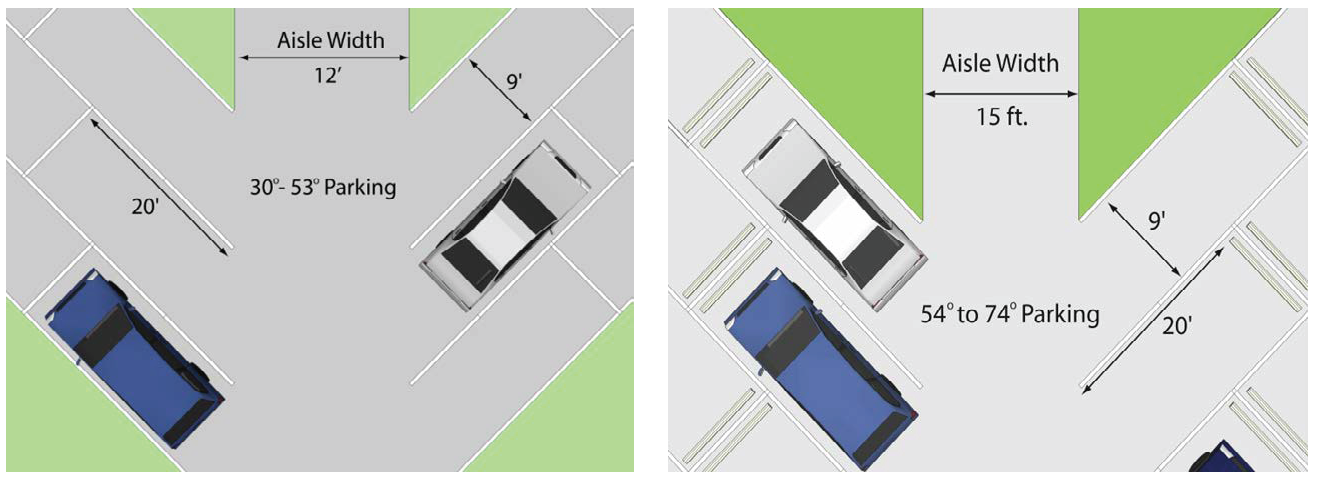
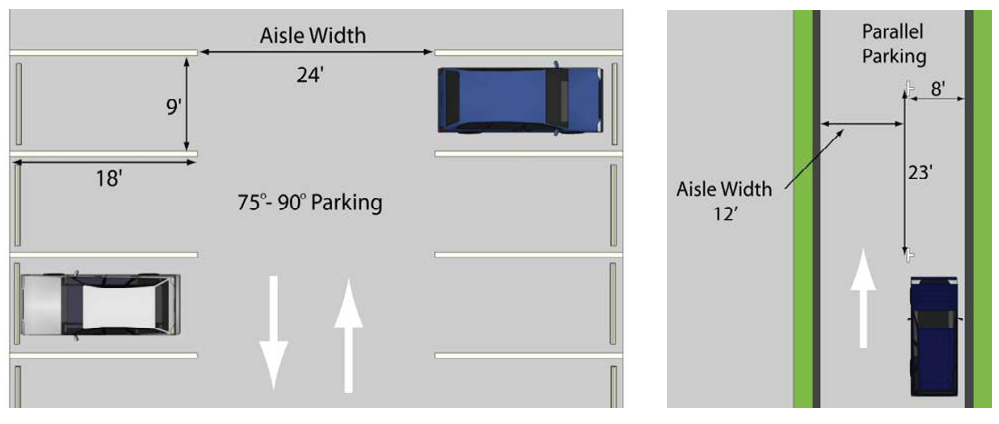
4.
Stacking Spaces. Waiting/stacking spaces for drive-through uses (such as banks, restaurants, car washes, pharmacies, dry cleaners and oil change establishments) shall be at least 24 feet long and ten feet wide. Stacking spaces shall not block required off-street parking spaces. Where the drive-through waiting lane provides for a single lane for five or more vehicles an escape lane shall be provided to allow vehicles to exit the waiting lane.
5.
Ingress and Egress. Adequate vehicular ingress and egress to the parking lot by means of clearly limited and defined drives shall be provided. All parking lots shall provide interior access and circulation aisles for all parking spaces. The use of public streets for maneuvering into or out of off-street parking spaces shall be prohibited. Ingress and egress to a parking lot in a non-residential zoning district shall not be through a residential district, except in instances where access is provided by means of an alley that forms the boundary between a residential and non-residential district.
6.
Curbing. A six inch concrete curb, or alternative as determined by the planning and zoning board, shall be provided around all sides of the parking lot to protect landscaped areas, sidewalks, buildings, or adjacent property from vehicles that might otherwise extend beyond the edge of the parking lot. Curb openings are allowed for stormwater drainage, as recommended by the city engineer. Plantings shall be set back two feet from curbs to allow for bumper overhang.
7.
Landscaping. Off-street parking areas shall be landscaped in accordance with the requirements of Article 19.
8.
Fire Lanes. Fire lanes shall be designated on the site and posted with signage prior to occupancy. Vehicle circulation shall meet turning radius requirements set by the fire department.
C.
Barrier Free Parking. Within each parking lot, signed and marked barrier free spaces shall be provided at a convenient location, in accordance with the Barrier Free Parking Space Requirements of the Georgia Department of Transportation. Barrier free spaces shall be located as close as possible to building entrances. Where a curb exists between a parking lot surface and a sidewalk entrance, an inclined approach or curb cut with a gradient of not more than a 1:12 slope and width of a minimum four feet shall be provided for wheelchair access.
D.
Parking Structures.
1.
Dimensional Requirements. Parking stalls and driving aisles shall meet the dimensional requirements specified in Table 17-2.
2.
Internal arrangement. Internal arrangement and design shall be reviewed by the city engineer for appropriate grades, traffic circulation, aisle length, column spacing, ceiling height, exit stairwell and elevator location.
3.
Access Points/Lanes. Storage areas for entering and exiting traffic should be long enough to minimize backups of traffic onto surrounding streets or within the structure.
4.
Lighting and Security. Adequate lighting shall be provided for the safe movement of vehicles and pedestrians and for the security of patrons and parked vehicles.
5.
Location and Setback Requirements. Parking structures shall meet the same setback requirements as for main buildings.
6.
Architecture. Parking structures shall be architecturally compatible with the buildings they serve and/or the surrounding buildings and shall be subject to the same architectural requirements contained in Article 18. Building materials and colors shall match or complement the principal building. Openings within the façade of the parking structure shall have proportions similar to the fenestration of the principal building on or adjacent to the site. Structures that are an integral part of a main building shall have the ground level floor area of the parking structure occupied by the main use. Exterior landscaping shall be provided in accordance with Article 19.
E.
Maintenance. All parking lots and structures shall be maintained free of trash and debris. Surface, curbing, light fixtures and signage shall be maintained in good condition.
F.
Limitations on Use of Parking Lots.
1.
It shall be unlawful for any person, firm, or corporation to use private property for vehicle parking without the express consent, authorization, or ratification of the owner, holder, occupant, lessee, agent or trustee of the property.
2.
Off-street parking areas are intended only for temporary vehicle parking for public safety. Except when land is used as storage space in connection with the business of a repair or service garage or an approved salvage yard, use of parking areas or open land is not permitted for the storage or parking of wrecked or junked cars, or for creating a junk yard or nuisance.
3.
Loading spaces, as required in Section 17-3, and parking spaces, required in Section 17-1, shall be considered separate and distinct requirements and shall be provided as individual components on the site. In no case shall one component be construed as meeting the requirements of the other.
4.
Parking lots and loading areas shall not be used for the storage of trucks or trailers, except for uses specifically approved for such storage in the industrial districts. Overnight parking or storage of commercial vehicles shall be prohibited, except for uses and locations approved for vehicle storage. This shall not be construed to prohibit the parking overnight of commercial fleet vehicles or the short-term parking of trailers in loading bays or staging areas.
5.
It shall be unlawful to use a parking lot or open area to store or park any vehicle for the purpose of displaying vehicles for sale, except in an approved vehicle sales dealership.
Sec. 17-3. - Off-street loading requirements.
A.
Uses Requiring Loading Area. On the same premises with every building, structure or part thereof, erected and occupied for manufacturing, storage, warehouse, retails sales, consumer services or other uses similarly involving the receipt or distribution of vehicles, materials or merchandise, there shall be provided and maintained on the lot adequate space for standing, loading and unloading services in order to avoid undue interference with public use of the streets, alleys and parking spaces.
B.
Loading Area Requirements. Loading and unloading spaces shall be paved and, unless otherwise adequately provided for, shall be ten feet by 50 feet, with 15-foot height clearance, according to the following schedule:
Table 17-3. Minimum Off-street Loading Requirements
C.
Orientation of Overhead Doors. Overhead doors for truck loading areas shall not face a public right-of-way and shall be screened to not be visible from a public street or an adjacent residential district. This provision shall not apply to industrial uses located in the M-1 and M-2 districts where the building is set back at least 200 feet and a landscaped greenbelt "*" in compliance with Section 19-4 is provided along the front property line.
Sec. 18-1.- Building appearance.
A.
Purpose. The purpose of this section is to provide exterior building wall material standards to enhance the visual environment of the city, thereby improving property values, stimulating investment in various business districts, encouraging quality industrial, and research and development projects, and enhancing the quality of life for city residents. The provisions of this section are to ensure that quality architecture is used to ensure that buildings retain their value, protect the investment of adjacent landowners, blend harmoniously into the streetscape, and create a positive image for business and employment districts.
B.
Applicability. This section shall apply to all new construction, except single-family detached and two-family residential structures, and shall consist of those materials and combinations of materials specified in this section. Architecture shall be reviewed by the zoning administrator or planning and zoning board, as applicable, as a part of site plan review under the requirements of Article 20.
C.
Building Materials. Minimum requirements for building materials are as follows. Calculations for material wall percentages do not include areas of the façade used for doors and windows.
1.
Residential. All multiple-family, townhouse, continuing care, retirement, nursing care and other residential buildings, except single family detached and two-family, located in any district shall meet the following elevation material requirements:
2.
Commercial, Office, and Institutional. All non-residential buildings located in a residential zoning district and all buildings located in the C-1, C-3 and C-4 zoning districts shall meet the following elevation material requirements. Sites in the C-2 for-based district shall meet the character requirements in Article 10.
D.
Allowance for Other Materials. The reviewing authority may waive or modify the material requirements of this section if it finds that a proposed building design and the materials or combinations of materials are in keeping with the purpose of this section. The reviewing authority shall also consider the desired character of the area, site visibility, proposed landscaping, building scale and design recommendations of the comprehensive plan. Acceptable substitute materials may include tilt-up panels, split-face block and similar high quality, durable and aesthetically compatible materials. However, metal siding, vinyl siding, and plain concrete block shall not be permitted.
E.
Design Standards. Buildings shall have architectural variety, but enhance the overall cohesive community character. At a minimum, the following standards shall be met:
1.
Buildings shall provide architectural features, details, and ornaments such as archways, colonnades, cornices, peaked roof lines, hip returns, operable window shutters, transoms, gas lights or towers to accent and add interest.
2.
Building walls over 100 feet long shall be broken up with varying building lines, vertical architectural features, windows, architectural accents, and trees.
3.
Building entrances shall utilize windows, canopies, and awnings; provide unity of scale, texture, and color; and clearly identify the entry.
4.
Building-mounted mechanical equipment shall be screened in accordance with Section 18-3.
5.
See Article 10 for additional architectural standards for sites in the form-based zoning districts.
F.
Site Elements. Signs and other site features shall be designed and located so they are aesthetically consistent and harmonious with the overall development. Sign bases shall be constructed of material which is compatible with the principal building. Mechanical equipment shall be screened in accordance with Section 18-3.
G.
Existing Buildings. The following shall apply to additions or remodeling of existing buildings or to accessory buildings on existing sites:
1.
Where a new wall material is proposed for an existing building wall, only that portion of the building being altered shall be subject to this section. However, in considering the proposed alteration, the reviewing authority may modify the material requirements of this section to ensure consistency with the architecture of the remainder building.
2.
Where an addition is proposed to an existing building, the reviewing authority may allow the use of existing or compatible wall materials for the addition; provided that the design of the alteration is consistent with the existing building wall design.
( Ord. No. 2022-01 , §§ 1, 2, 1-3-2022)
Sec. 18-2. - Building design for single and two-family dwellings.
A.
The exterior finish of the front elevations of all new single-family and two-family dwellings shall consist of clay masonry brick; natural stone; traditional three-coat stucco; hardiplank masonry lap siding (lap siding shall show no more than 7.5-inch face and no less than five-inch face); or natural wood painted or stained. The primary materials on the front elevation shall also be used on the side elevations. The use of architectural details is encouraged and must be approved as part of the "plan book."
B.
Foundations that are exposed above the ground must be parged with cement, stuccoed over, or made of brick or stone.
C.
All single-family detached and two-family detached residential dwellings shall have a minimum roof pitch of six to 12.
D.
Pitched roof materials are limited to architectural composite shingles, natural slate, wood shake or factory finished sheet metal in earth tones.
E.
Garages are required for all single-family dwelling units. Sufficient area shall be provided for storage of two standard size vehicles.
F.
For all proposed developments containing three or more single-family dwelling units, a minimum of 50 percent of the dwelling units shall have attached garages which feature side or rear entrances. A minimum of 50 percent of the remaining dwelling units shall have attached garages which feature front entrances recessed a minimum horizontal distance of four feet or which feature architectural amenities approved as part of the "plan book." No development shall have more than two consecutively adjacent dwelling units with front entrance garages which are not recessed or include approved architectural amenities.
Sec. 18-3. - Mechanical equipment.
Ground-, building-, and roof-mounted mechanical equipment and utility structures including, but not limited to, heating units, cooling units, air handling units, refrigeration units, blowers, ventilating fans, water and gas meters, elevator housing, tanks, generators, and utility transformers are subject to the following regulations:
A.
Ground- and Building-Mounted Equipment.
1.
Mechanical equipment and utilities visible to the public and located on or around any non-residential building shall be screened by landscaping or by decorative walls compatible with the material used on the building.
2.
Mechanical equipment may not be located within the required yard setback area, except as may otherwise be permitted by this ordinance. However, in a non-residential district, ground-mounted mechanical equipment shall not be located under any circumstances within 20 feet of a residential district boundary.
B.
Roof-Mounted Equipment.
1.
All roof-mounted equipment shall be screened by parapet walls or a pitched roof integrated into the architectural design of the building of sufficient height to screen the rooftop equipment and provide sound attenuation. The location, height, and screening methods shall be shown on the site plan.
2.
All roof-mounted mechanical units must be set back a minimum of 20 feet from the front of the building and any side of the building facing an adjacent residential district.
Sec. 18-4. - Lighting.
A.
Purpose. The purpose of this section is to permit reasonable uses of outdoor lighting for night-time safety, utility, security, productivity, enjoyment, and commerce while minimizing the effects of excessive or uncontrolled light to:
1.
Maintain consistent and uniform light levels for traffic and pedestrian safety along roadways, sidewalks, and in parking lots.
2.
Ensure uniform lighting for security and law enforcement.
3.
Minimize glare, obtrusive light, and artificial sky glow by limiting outdoor lighting that is misdirected, excessive, or unnecessary.
4.
Minimize light pollution and light trespass from light sources onto adjacent properties.
5.
Preserve the restful quality of nighttime by eliminating intrusive artificial light and lighting that unnecessarily contributes to "sky glow."
6.
Curtail and reverse the degradation of the nighttime environment and the night sky.
7.
Preserve the dark night sky for astronomy.
8.
Conserve energy and resources to the greatest extent possible.
B.
Light Levels. All outdoor lighting for non-residential uses shall be fully shielded to reduce glare and shall be arranged to reflect light away from adjacent residential districts or uses. Light levels on a site that is subject to site plan approval shall meet the following minimum and maximum requirements for the developed portion of the site containing buildings, drives, and parking lots. In addition, the uniformity ratio between the average and minimum illumination within the developed portion of the site shall not exceed four to one.
Table 18-4. Required Site Illumination
1. Lighting levels may be reduced to one-half footcandle with a uniformity ratio of not more than ten to one after 12:00 p.m., or after established hours of operation.
2. The minimum illumination levels shall not apply to portions of the site that are fenced to restrict public access, such as storage yards.
3. For automobile dealerships and other types of outdoor sales areas the maximum illumination may be increased to 15 footcandles, provided the limits at the property line are not exceeded.
4. These regulations shall not apply to ornamental street lighting, public street lights, or driveway/intersection lighting necessary for pedestrian and traffic safety.
5. The light level along a non-residential property line may be increased to up to five footcandles where there is shared access/vehicular connection with the adjacent use or the adjacent use is a similar use (e.g. commercial adjacent to commercial)
C.
Light Fixtures. Outdoor lighting on all non-residential sites shall be directed downward and confined to the ground areas of lawns or parking lots except as noted elsewhere in this section. Lighting shall utilize full cutoff fixtures that are recessed sufficiently so the light source is not visible from off site. Bollard lights are permitted to light driveways and pedestrian areas. All lamps shall be metal halide, unless otherwise approved by the city.
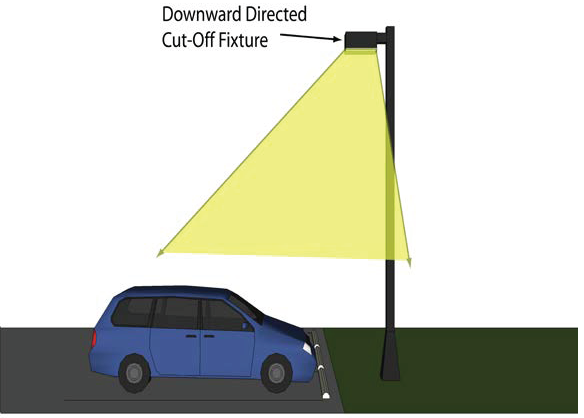
D.
Fixture Height. Light fixtures shall not be higher than 20 feet within 300 feet of a residential district. Otherwise, fixtures shall be no higher than 30 feet. Height shall be measured from the parking lot grade.
E.
Ornamental Lighting. The requirement for downward directed lighting may be waived for street lighting and ornamental lighting which is part of an overall architectural theme.
F.
Floodlighting Prohibited. Floodlight type fixtures shall be used only for building accent, landscaping, and sign lighting.
G.
Sign Lighting. Illumination of signs shall comply with the requirements of the city sign ordinance. Internally illuminated signs shall be permitted and light fixtures directed at a sign may be permitted where the fixtures are shielded so not to cause visible glare to persons on adjacent streets or adjacent property.
H.
Photometric Plan. A photometric plan is required to permit the city to determine potential adverse effects that site lighting may have on adjoining properties and motorists. Any site plan application for new or revised lighting shall include a photometric plan overlaid on the site plan illustrating the planned layout and footcandles of site lighting. The following are required for review:
1.
Lighting plan showing light pole and fixture locations and type designations;
2.
Photometric plan showing horizontal luminance levels in a point by point format with contour lines. Canopy lighting will also be included in luminance levels;
3.
Lighting manufacturers' equipment specifications and data sheets on the photometric plan; and
4.
Any other presentations required to convey the intent of the design.
Sec. 18-5. - Trash receptacle enclosures.
A.
Trash receptacle enclosures shall be required for all sites, except single-family detached and two family dwellings, in the R-4, R-5 R-6, C-1, C-3, C-4, M-1 and M-2 districts and for all non-residential uses in any residential district and shall meet the requirements of this section. Trash receptacle enclosure locations and construction details shall be shown on site plans.
1.
Location. Trash receptacle enclosures shall be located in the rear yard or non-required side yard, unless otherwise approved by the site plan reviewing authority. Trash receptacle enclosures for commercial and industrial sites shall be as far as practical from an adjoining residential district boundary.
2.
Access. Access to the trash receptacles by refuse vehicles shall be designed to prevent damage to automobiles in designated parking spaces; provided the enclosure doors shall not be highly visible from traffic entering the site from a public road.
3.
Base. The trash receptacle base shall be at least nine feet by nine feet, constructed of six inches of reinforced concrete pavement. The base shall extend six feet beyond the dumpster pad or gate to support the front axle of a refuse vehicle. Where grease disposal receptacles are used, curbing shall be provided around the enclosure base to contain any spillage.
4.
Screening. Trash receptacles shall have a lid or cover and be enclosed by a wall on three sides with a wood gate on the fourth side. The enclosure shall be constructed of brick or split face block that matches the building color with a height of six feet or at least one foot higher than the dumpster, whichever is greater. Other decorative masonry material may be approved if it matches the material used on the principal building. Poured concrete with false brick design or plain concrete slag blocks are not permitted.
B.
Exceptions. The site plan reviewing authority may waive the requirement for a trash receptacle enclosure for businesses, such as banks, that store all waste material indoors or other uses that provide alternate means of handling waste disposal.
Sec. 18-6. - Mail box clusters.
A.
The location of mailbox clusters shall not conflict with pedestrian or vehicular circulation. A dedicated pull-off area shall be provided that is out of the main travel lanes.
B.
The design of the mailbox cluster shall be integrated into the design of the overall development by utilizing decorative structures that are compatible with the site design and building architecture.
Sec. 19-1.- Intent.
It is the intent of this section to require landscaping and screening to buffer the negative impacts between incompatible land uses; to minimize the adverse effects of certain outdoor activities upon their surroundings; and to improve the appearance of parking areas and street frontages within the community. It is further intended to preserve and enhance the aesthetic qualities, character, privacy, and land values of property within the City of Palmetto. The requirements of this article shall be applied in addition to those requirements of Chapter 23.5 of the City of Palmetto Code of Ordinances. Where a conflict exists, the more restrictive provision shall apply.
Sec. 19-2. - Buffer zones.
A.
Buffer Zones Required.
1.
A buffer zone shall be required along common property lines between abutting zoning districts, as specified in table 19-2. The buffer shall be placed on the property within the less restrictive zoning district and shall be required even if the abutting property is undeveloped.
Table 19-2. Required Buffer Zones
2.
A buffer zone shall be required even if the adjacent parcel is unimproved land.
3.
When any developed parcel changes to a less restrictive zoning district, a buffer zone shall be provided, if applicable and as required by Table 19-2.
4.
If existing conditions are such that a parcel cannot comply with the buffer zone requirements, the zoning administrator shall determine the character of the buffer based on the following criteria:
a.
Traffic impacts,
b.
Building and parking lot coverage,
c.
Outdoor sales, display, or manufacturing area,
d.
Physical characteristics of the site and surrounding area such as topography, vegetation, etc.,
e.
Views and noise levels,
f.
Health, safety, and welfare of the City of Palmetto, and
g.
Proximity or potential proximity of residential uses.
B.
Buffer Zone Development Standards.
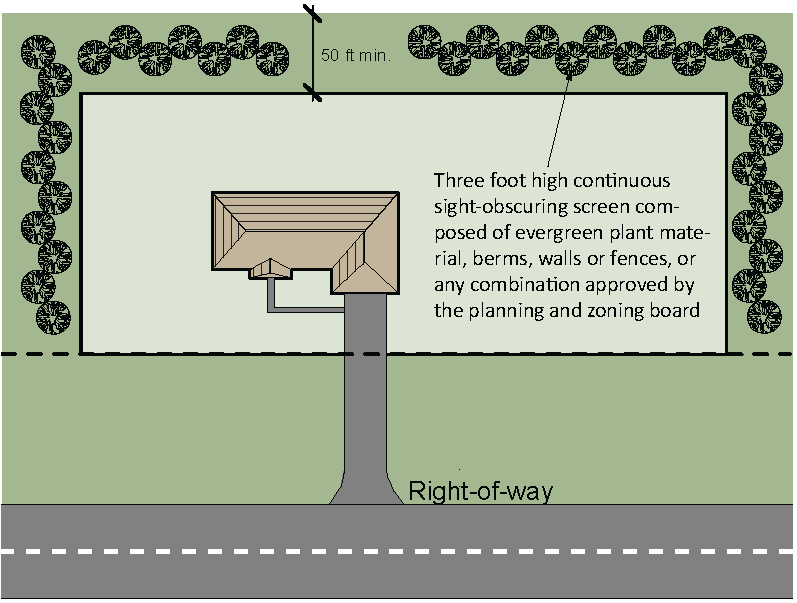
1.
Buffer Zone Level A shall meet the following requirements:
a.
Fifty-foot minimum width.
b.
Six foot high continuous sight-obscuring screen composed of evergreen plant material, berms, walls or fences, or any combination approved by the planning and zoning board.
c.
If berms are used for any part of the buffer, all required plant material shall be placed on the top and side slope facing the exterior property line.
d.
All areas within the buffer zone which do not contain trees or planting beds shall be planted and maintained with grass or other living ground cover.
e.
All plant material shall meet the minimum requirements of Chapter 23.5 of the City of Palmetto Code of Ordinances.
f.
All other applicable standards of this ordinance shall be met.
2.
Buffer Zone Level B shall meet the following requirements:
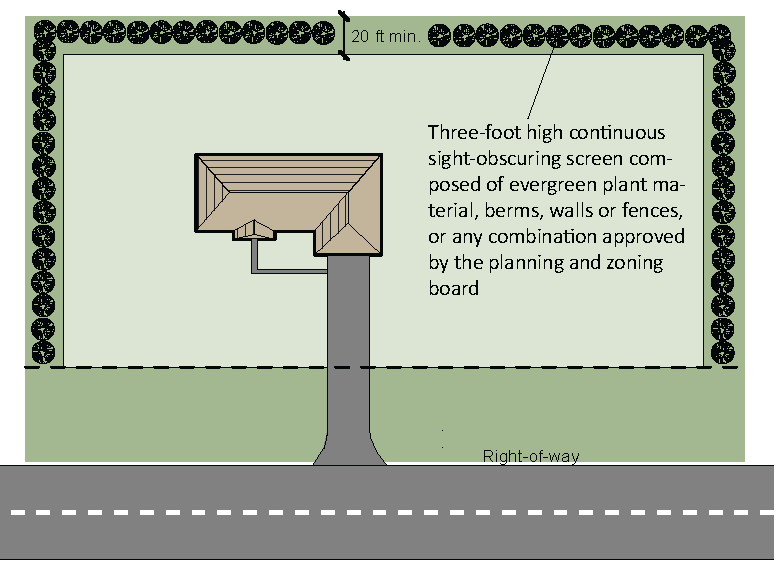
a.
Twenty-foot minimum width.
b.
Three-foot high continuous sight obscuring screen composed of plant material, berms, walls or fences, or any combination approved by the planning and zoning board.
c.
If berms are used for any part of the buffer, required plant material shall be placed on the top and side slope facing the exterior property line.
d.
All areas within the buffer zone which do not contain trees or planting beds shall be covered with grass or other living ground cover.
e.
All plant material shall meet the minimum requirements of Chapter 23.5 of the City of Palmetto Code of Ordinances.
f.
All other applicable standards of this ordinance shall be met.
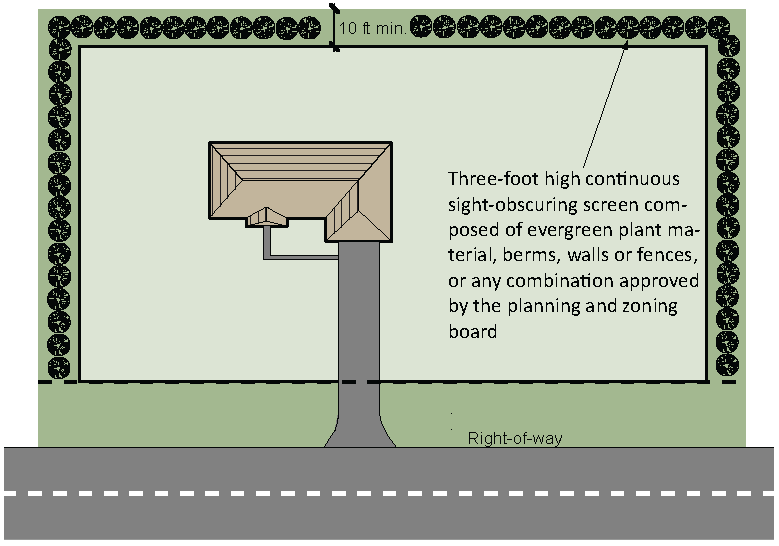
3.
Buffer Zone Level C shall meet the following requirements:
a.
Ten-foot minimum width.
b.
Three-foot high continuous sight obscuring screen composed of plant material, berms, walls or fences, or any combination approved by the planning and zoning board.
c.
If berms are used for any part of the buffer, required plant material shall be placed on the top and side slope facing the exterior property line.
d.
All areas within the buffer zone which do not contain trees or planting beds shall be covered with grass or other living ground cover.
e.
All plant material shall meet the minimum requirements of Chapter 23.5 of the City of Palmetto Code of Ordinances.
f.
All other applicable standards of this ordinance shall be met.
Sec. 19-3. - Screening.
A.
Screening Required.
1.
Screening shall be required as follows, except as may be provided elsewhere in this section:
a.
Around all trash dumpsters in all districts.
b.
Around designated outdoor storage areas in the C-3, C-4, M-1, and M-2 districts.
c.
Around any loading/unloading area or hospital emergency area.
d.
Around heating and colling units for all developments, including single-family dwellings.
e.
Around non-amenity detention ponds and other related storm water management facilities.
2.
Screening shall be required even if the surrounding area or adjacent parcels are unimproved.
3.
When any developed parcel changes to a more intense land use or a conditional or special land use approval or site plan review is required, screening shall be provided in compliance with this ordinance.
4.
If existing conditions on the subject parcel are such that a parcel cannot comply with the screening requirements, the zoning administrator shall determine the character of the screen based on the following criteria:
a.
Traffic impacts,
b.
Building and parking lot coverage,
c.
Outdoor sales, display, or manufacturing area,
d.
Physical characteristics of the site and surrounding area such as topography, vegetation, etc.,
e.
Views and noise levels,
f.
Health, safety, and welfare of the City of Palmetto, and
g.
Proximity or potential proximity of residential uses.
B.
Screening Standards. All required screens shall meet the requirements of Section 23.5-30 of the City of Palmetto Code of Ordinances.
Sec. 19-4. - Greenbelts.
A.
Greenbelts Required. Greenbelts shall be required in the following situations, except as may be provided elsewhere in this article:
1.
Within the front setback area of any non-residential property abutting a public right-of-way.
2.
Around any nonresidential parking lot abutting or within 100 feet of a residential district.
3.
Within any parking lot containing ten spaces or more.
B.
Greenbelt Standards for Front Setbacks. Greenbelts shall meet the requirements of Section 23.5-28 of the City of Palmetto Code of Ordinances.
C.
Parking Lot Greenbelts. Where greenbelts are required within parking lots, they shall meet the requirements of Section 23.5-27 of the City of Palmetto Code of Ordinances.
Sec. 19-5. - General requirements.
All required buffers, screens and greenbelts shall comply with the following requirements, in addition to all other applicable requirements of this article:
A.
Minimum Plant Material Standards.
1.
All plant materials shall be hardy to Fulton County, be free of disease and insects, and conform to the approved plant list contained in Appendix A of Chapter 23.5 of the City of Palmetto Code of Ordinances.
2.
Artificial plant material shall not be used within any required landscaped area. This shall not preclude the use of stone, shredded bark, wood chips, lava rock or similar accent materials within planting beds.
3.
All plant material shall be installed in such a manner so as not to alter drainage patterns on site or adjacent properties, or obstruct vision for safety of ingress or egress.
4.
All plant material shall be planted in a manner so as to not cause damage to utility lines (above and below ground) and public roadways.
5.
Existing plant material which complies with the standards and intent of this ordinance and the provisions of Chapter 23.5 may be credited toward meeting the landscape requirements.
6.
The overall landscape plan shall not contain more than 33 percent of any one plant species.
7.
Plant material shall not be placed closer than four feet to any fence or property line.
8.
Where trees are placed in two or more rows, planting shall be staggered in rows.
B.
Minimum Standards for Berms.
1.
Where possible, berms shall be constructed so as to maintain a side slope not to exceed a one foot rise to a three foot run ratio. When topography or other site conditions prevent construction of berms at this ratio, retaining walls or terracing may be permitted. If a berm is constructed with a retaining wall or by terracing, the earthen slope shall face the exterior of the site.
2.
Berm areas not containing planting beds shall be covered with grass or other living ground cover maintained in a healthy condition.
3.
Berms shall be constructed in such a manner so as not to alter drainage patterns on site or adjacent properties, or obstruct vision for safety of ingress or egress.
C.
Minimum Standards for Screen Walls and Fences.
1.
All walls and fences required for screening shall be constructed with new, durable, weather resistant, and easily maintainable materials. Chain link and barbed wire fences are not permitted to serve as screen fencing.
2.
Unless otherwise prohibited, the wall or fence may be constructed with openings that do not exceed 20 percent of the wall or fence surface. These openings shall not reduce the intended obscuring effect of the wall or fence.
3.
Screen walls or fences shall not be constructed so as to alter drainage on site or adjacent properties, or obstruct vision for safety or ingress or egress.
Sec. 20-1.- Purpose.
The purpose of this article is to establish a uniform set of requirements for the planning and design of developments within the community in order to achieve the following objectives: To determine compliance with the provisions of this ordinance; to promote the orderly development of the city; to prevent depreciation of land values; to ensure a consistent level of quality throughout the community; to ensure a harmonious relationship between new development and the existing natural and manmade surroundings; to achieve the purposes of the City of Palmetto Comprehensive Plan; to promote consultation and cooperation between applicants and the city in order that applicants may accomplish their objectives in the utilization of land, consistent with the public purposes of this ordinance and the comprehensive plan.
Sec. 20-2. - Applicability.
Site plan review shall be required, as applicable, under the following conditions:
A.
Level "A" Review. The zoning administrator shall review site plans in connection with the creation of a use or the erection of a building or structure in any of the following circumstances:
1.
Any "permitted" or "conditional" use within any zoning district.
2.
Additions to existing buildings in any zoning district.
3.
Changes in the use of any existing building in any zoning district, provided the use is a "permitted" or "conditional" use in that zoning district.
4.
When, in the opinion of the zoning administrator, a project which otherwise qualifies for level "A" site plan review may have an impact on surrounding properties, he may, in his sole discretion, submit the site plan to the planning and zoning board for review. In such cases, the planning and zoning board shall follow the review procedure for level "B" site plans and may require any additional information needed to make an informed decision.
B.
Level "B" Review. The city council, after review by the planning and zoning board, shall act upon all site plans, other than those provided for level "A" review, in connection with the creation of a use or the erection of a building or structure in any of the following circumstances:
1.
Any "special" use in any district.
2.
Any PUD.
3.
As otherwise required by this ordinance.
Sec. 20-3. - Exemptions.
Site plan review shall not be required for a single or two-family dwelling when permitted by right on a lot on which there exist no other building or use or for any home occupation or accessory building in a residential district.
Sec. 20-4. - Application and review.
The process of reviewing a site plan shall be as follows:
A.
Level "A" reviews shall be performed by the zoning administrator as follows:
1.
Five copies of a complete site plan and an electronic version, in a format specified by the city, shall be submitted to the zoning administrator along with an application for that purpose and a fee, as established by the city council.
2.
The zoning administrator shall review the site plan for completeness, and shall obtain comments, as he considers necessary, from city departments or consultants.
3.
The zoning administrator shall consider the site plan, any comments received, and the applicable standards of this ordinance and shall either approve the site plan, as submitted, if all applicable requirements and standards have been met; approve the site plan with conditions; or deny approval of the site plan, if applicable requirements and standards have not been met.
4.
The reasons for the zoning administrator's action, along with any conditions that may be attached, shall be stated in writing and provided to the applicant.
5.
If approved, two copies of the final site plan shall be signed and dated by the zoning administrator and the applicant. One copy shall be kept on file with the city and one copy shall be returned to the applicant or his designated representative. If the plan is approved with conditions, a revised plan shall be submitted reflecting those conditions and signed by the applicant and zoning administrator prior to issuance of any permits.
B.
Level "B" reviews shall be performed by the planning and zoning board as follows:
1.
Ten copies of a complete site plan and an electronic version, in a format specified by the city, shall be submitted to the zoning administrator along with an application for that purpose and a fee, as established by the city council.
2.
The zoning administrator shall review the site plan for completeness, and shall obtain comments, as he considers necessary, from the city departments or consultants.
3.
Once the zoning administrator determines that the site plan is complete, he shall transmit the site plan, along with comments from city departments and consultants to the planning and zoning board for consideration at its next meeting. The zoning administrator shall not be required to submit any site plan for review which was submitted less than 20 days prior to the next regularly scheduled planning and zoning board meeting.
4.
The planning and zoning board shall consider the site plan and shall recommend that the city council either approve the site plan, as submitted, if all applicable requirements and standards have been met; approve the site plan with conditions; or deny approval of the site plan if applicable requirements and standards have not been met. The planning and zoning board review shall be based on the requirements of this article and, specifically, the review standards of Section 20-6.
5.
The reasons for the planning and zoning board's recommendation, along with any proposed conditions shall be forwarded to the city council for final action on the request. The city council shall makes its decision based on the standards of Section 20-6.
6.
If approved, two copies of the final site plan shall be signed and dated by the mayor and the applicant. One copy shall be kept on file with the city and one copy shall be returned to the applicant or his designated representative. If the plan is approved with conditions, a revised plan shall be submitted reflecting those conditions and signed by the applicant and the mayor, prior to issuance of any permits.
Sec. 20-5. - Site plan requirements.
A.
Required Content. Each site plan submitted shall contain the following information, as applicable:
Table 20-5. Required Site Plan Content
B.
Information Waiver. Specific requirements of either a Level "A" or "B" site plan may be waived by the respective reviewer, zoning administrator or planning and zoning board, where it is determined that such information is not applicable to the subject request.
Sec. 20-6. - Review standards.
A site plan shall be approved only upon a finding of compliance with the following standards:
A.
The site plan must comply with all standards of this article and all applicable requirements of this ordinance and all other applicable laws and regulations.
B.
The site must be designed in a manner that is harmonious, to the greatest extent possible, with the character of the surrounding area.
C.
The site must be designed so as to minimize hazards to adjacent property, and to reduce the negative effects of traffic, noise, smoke, fumes and glare to the maximum extent possible.
D.
Unless a more specific design standard is required by the city through a different ordinance, all uses and structures subject to site plan review shall comply with the following design standards:
1.
Traffic Circulation. The number, location, size of access and entry points, and internal vehicular and pedestrian circulation routes shall be designed to promote safe and efficient access to and from the site, and circulation within the site. In reviewing traffic features, the number, spacing, and alignment of existing and proposed access points shall be considered relative to their impact on traffic movement on abutting streets and adjacent properties.
2.
Stormwater. Stormwater detention and drainage systems shall be designed so that the removal of surface waters will not adversely affect neighboring properties or public stormwater drainage systems. Unless impractical, stormwater shall be removed from all roofs, canopies and paved areas by underground surface drainage system.
3.
Landscaping. The landscape shall be preserved in its natural state, insofar as practicable, by minimizing unnecessary tree and soil removal, and any grade changes shall be in keeping with the general appearance of neighboring developed areas. Provision or preservation of landscaping, buffers or greenbelts may be required to ensure that the proposed uses will be adequately buffered from one another and from surrounding property.
4.
Screening. Where non-residential uses abut residential uses, appropriate screening shall be provided, in accordance with Article 19, so as to shield residential properties from noise, headlights and glare.
5.
Lighting. Lighting shall be designed so as to minimize glare on adjacent properties and public streets. As a condition of site plan approval, reduction of lighting during non-business hours may be required.
6.
Utility Service. All utility service shall be underground, unless impractical.
7.
Exterior Uses. Exposed storage areas, machinery, heating and cooling units, service areas, loading areas, utility buildings and structures, and similar accessory areas shall be located so as to have a minimum negative effect on adjacent properties, and shall be screened, if reasonably necessary, to ensure compatibility with surrounding properties.
8.
Emergency Access. All buildings and structures shall be readily accessible to emergency vehicles.
9.
Water and Sewer. Water and sewer installations shall comply with all city specifications and requirements.
10.
Signs. Permitted signs shall be located to avoid creating distractions and visual clutter.
11.
Building Design. New or substantially remodeled buildings shall be reasonably compatible in appearance with, or shall enhance, the established general character of other buildings in the immediate vicinity.
Sec. 20-7. - Conditions.
Conditions which are designed to ensure compliance with the intent of this ordinance and the Palmetto City Code may be imposed on site plan approval.
Sec. 20-8. - Changes to approved site plan.
Changes to an approved site plan shall be permitted only under the following circumstances:
A.
The holder of an approved site plan shall notify the zoning administrator of any proposed change to an approved site plan.
B.
Changes to a Level "A" site plan may be approved by the zoning administrator.
C.
Minor changes to a Level "B" site plan may be approved by the zoning administrator upon determining that the proposed revision(s) will not alter the basic design nor any specified conditions imposed as part of the original approval. Minor changes shall include the following:
1.
Reduction in building size or increase in building size up to five percent of total approved floor area.
2.
Movement of buildings or other structures by no more than ten feet.
3.
Replacement of plant material specified in the landscape plan with comparable materials of an equal or greater size.
4.
Changes in building materials to a comparable or higher quality.
5.
Changes in floor plans which do not alter the character of the use.
6.
Changes required or requested by the city or county, state, or federal regulatory agency in order to conform to other laws or regulations.
D.
A proposed change to a Level "B" site plan, not determined by the zoning administrator to be a minor change, shall be submitted to the planning and zoning board as a site plan amendment and shall be reviewed in the same manner as the original application.
Sec. 20-9. - Expiration.
Site plan approval shall expire 12 months after the date of approval, unless substantial construction has been commenced and is continuing. The zoning administrator, in the case of a Level "A" site plan, or the planning and zoning board, in the case of Level "B" site plan, may grant one extension of up to 12 additional months; provided the applicant requests, in writing, an extension prior to the date of expiration of the site plan. The extension shall be approved if the applicant presents reasonable evidence to the effect that the development has encountered unforeseen difficulties beyond the control of the applicant, and the project will proceed within the extension period. If the above provisions are not fulfilled or the extension has expired prior to construction, the site plan approval shall become null and void.
Sec. 20-10. - Appeal.
Any person having a special interest in a decision relating to the approval or denial of a site plan or the conditions imposed shall have the right to appeal the decision to the zoning board of appeals.

