
Peach County Unincorporated
City Zoning Code
City Zoning Code
ARTICLE XIV
DESIGN STANDARDS7
Cross reference— General principles of design, § 131 et seq.
Section 141.- Required design standards.
The design standards set forth in this article shall be observed in all plats which are required to be approved by the planning commission, except that standards for improvements shall be applicable only to those plats for which improvements or improvement plans are required as a condition of plat approval.
Section 142. - Streets.
142.1. The arrangements, character, extent, width, grade, and location of all streets shall conform to the major thoroughfare plan for the county and shall be considered in their relation to existing and planned streets, to topographical conditions, to public convenience and safety, and in their appropriate relation to the proposed uses of the land to be served by such streets.
142.2. Where such is not shown in the major thoroughfare plan for the county, the arrangement of streets in a subdivision shall either:
a.
Provide for the continuation or appropriate projection of existing streets in surrounding areas at the same or greater width, but in no case less than the required minimum width; or
b.
Conform to a plan for a neighborhood approved or adopted by the planning commission to meet a particular situation where topographical or other conditions made continuance or conformance to existing streets impracticable.
142.3. Minor streets shall be so laid out that their use by through traffic will be discouraged.
142.4. Where a subdivision contains a dead-end street other than a cul-de-sac, the planning commission may require the subdivider to provide a temporary vehicle turnaround within the right-of-way, when the planning commission considers such to be necessary for effective traffic circulation.
142.5. Where a subdivision abuts or contains an existing or proposed major street, the planning commission may require marginal access streets, double frontage lots with screen planting contained in a nonaccess reservation along the rear property lines, deep lots with rear service drives, or such other treatment as may be necessary for adequate protection of residential properties and to afford separation of through and local traffic.
142.6. Where a subdivision borders on or contains a railroad right-of-way, or limited access highway right-of-way, the planning commission may require a street approximately parallel to and on each side of such right-of-way, at a distance suitable for the appropriate use of the intervening land, as for park purposes in residential districts, or industrial purpose in appropriate districts. Such distances shall also be determined with due regard for the requirements of approach grades and future grade separations.
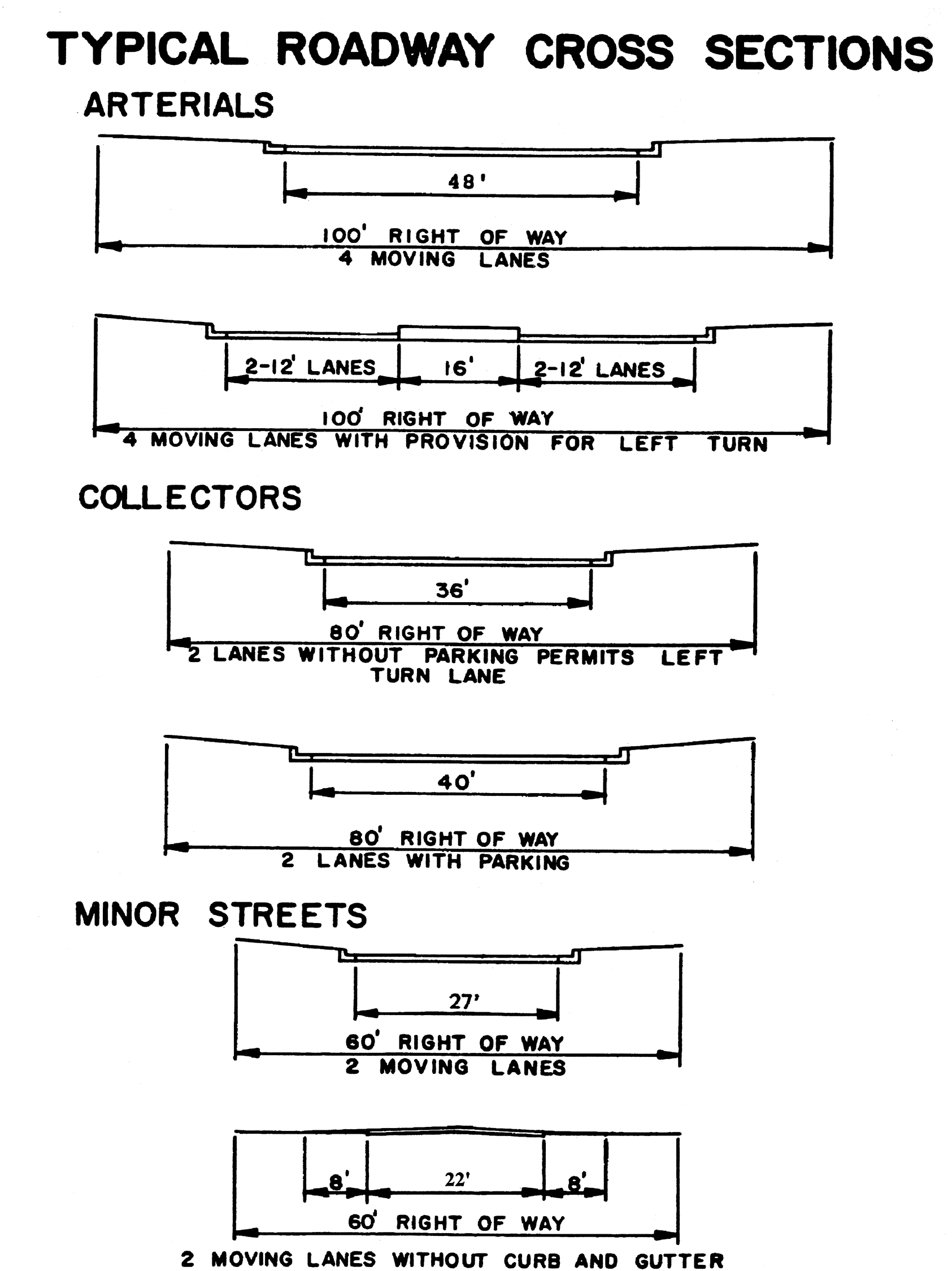
142.7. Minimum street right-of-way widths shall be as follows:
a.
Expressways: 200 feet.
b.
Arterial streets and highways: 200 feet.
c.
Collector streets: 200 feet.
d.
Minor streets:
(1)
60 feet (residential).
(2)
70 feet (commercial and industrial).
e.
Cul-de-sac and loop streets: 60 feet.
f.
Culs-de-sac turnaround (diameter): 100 feet.
g.
Marginal access or frontage roads: 40 feet.
h.
Alleys, service drives, or private drives: 22 feet.
i.
Unpaved roads: 200 feet.
142.8. A proposed subdivision that includes a platted street that does not conform to the minimum right-of-way requirements of this resolution shall provide for the dedication of additional right-of-way along either one or both sides of said street so that the minimum right-of-way required by this resolution can be established. If the proposed subdivision abuts only one side of said street, then a minimum of one-half of the required extra right-of-way shall be dedicated or reserved by such subdivision.
142.9. Street intersections shall be as nearly at right angles as possible, and no intersection shall be at an angle less than 75 degrees. Detailed designs of intersections may be required.
142.10. Curbline radius of street intersections shall be at least 22 feet and where the angle of street intersection is less than 90 degrees, the planning commission may require a greater radius.
142.11. Right-of-way radius at street intersections shall parallel the curbline radius.
142.12. Street jogs with centerline offsets of less than 200 feet shall not be permitted.
142.13. Cul-de-sac streets shall be designed so that the maximum desirable length shall be 600 feet and in no case shall exceed 800 feet in length, measured from the nearest through street, including circular turnaround, unless excepted by the planning commission as provided for under section 136 herein.
142.14. Alleys or service drives may be required on any lots to be used for multiple-family.
142.15. Half-streets shall be prohibited.
142.16. Reserve strips controlling access to streets, alleys, or public grounds shall not be permitted unless approved by the planning commission as being in accordance with the provisions of section 142.5.
142.17. Minimum street standards table.
MINIMUM STREET STANDARDS
1 Commercial and Industrial
2 Residential Cul-de-Sac
3 No Curb and Gutter
4 Curb and Gutter with on-street parking
5 Geometric design standards of the State Department of Transportation of Georgia shall represent minimum requirements and each project shall be reviewed on its own merits.
142.18. Typical roadway cross sections below.
(Res. of 6-13-2000, exhibit A; Ord. of 4-11-2023)
Section 143. - Blocks.
143.1. The lengths, widths, and shapes of blocks shall be determined with due regard to:
a.
Provision of adequate building sites suitable to the special needs of the type of use contemplated.
b.
Zoning requirements as to lot sizes and dimensions unless a planned unit development is contemplated.
c.
Needs for convenience access, circulation, control, and safety of street traffic.
d.
Limitations and opportunities of topography.
143.2. In general, residential blocks shall not be greater than 1,200 feet in length, or less than 600 feet in length. In blocks over 1,000 feet long, the planning commission may, when existing or proposed public gathering places so justify, require public crosswalks across the block.
143.3. Residential blocks shall be wide enough to provide two tiers of lots, except where fronting on expressways and arterials or prevented by topographical conditions or size of the property, in which case the planning commission may require and/or approve a single tier of lots.
Section 144. - Lots.
144.1. Insofar as practical, side lot lines shall be perpendicular or radial to street lines. Each lot shall abut upon a public street, except as herein provided.
144.2. The size, shape, and orientation of every lot shall be subject to approval of the planning commission for the type of development and use contemplated. No lot shall be more than four times as deep as it is wide at the building setback line, unless excepted by the planning commission as provided by section 136 herein.
144.3. Every residential lot shall conform to the minimum dimension and area requirements of the zoning regulations, provided that every lot not served by a public sewer or community sanitary sewage system and/or public water shall meet the dimension and area requirement of the health department.
144.4. Building setback lines shall conform to front, rear and side yard building setback requirements of the zoning regulations.
144.5. Double frontage, unless required by the planning commission, shall be prohibited except where essential to provide separation of residential development from traffic arteries or to overcome specific disadvantages of topography, orientation, and property size. A planting screen reservation of at least ten feet, and across which there shall be no right of access, may be required along the line of lots abutting such a traffic artery or other disadvantageous use.
144.6. Corner lots shall, as required in the zoning regulations, have extra width to permit appropriate building setback from and orientation to both streets.
144.7. Lot remnants (lots below minimum area or width left over after subdividing tracts of land) shall be prohibited. Such remnant areas shall be added to adjacent lots, rather than remain as unusable parcels.
144.8. The subdividing of the land shall be such as to provide each lot with direct abutting access to an existing public street or to a street contained within the proposed subdivision.

