
Peach County Unincorporated
City Zoning Code
City Zoning Code
ARTICLE IX
SPECIAL PROVISIONS
Section 91. - Mobile homes, campgrounds, and travel trailer parks.
91.1. Travel trailer parks and campgrounds. In any district where travel trailer parks are permitted, the applicant must submit a layout of the park subject to the following conditions:
91.1.1. No travel trailer park shall be located except with direct access to a county, state, or federal highway, with minimum lot width of not less than 50 feet for the portion used for entrance and exit. No entrance or exit shall be through a residential district, or shall require movement of traffic from the park through a residential district.
91.1.2. The minimum lot area per park shall be three acres.
91.1.3. Space in travel trailer parks may be used by travel trailers, provided they meet any additional laws and resolutions of Peach County.
91.1.4. Management headquarters, recreational facilities, toilets, showers, laundry facilities, and other uses and structures customarily incidental to the operation of a trailer park are permitted as accessory uses in any district in which trailer parks are allowed, provided:
(1)
Such establishments and the parking area primarily related to their operations shall not occupy more than ten percent of the area of the park.
(2)
Such establishments shall be restricted in their use to occupants of the park.
(3)
Such establishments shall present no visible evidence of their commercial character which would attract customers other than occupants of the park.
91.1.5. No space shall be so located that any part intended for occupancy for sleeping purposes shall be within 50 feet of the right-of-way line of any freeway, expressway, or collector street, or within 30 feet of the right-of-way of any minor street.
91.1.6. In addition to meeting the above requirements, the travel trailer park site plan shall be accompanied by a certificate of approval of the county health department.
91.2. Mobile home parks. In any district where mobile home parks are permitted, the applicant shall submit to the zoning enforcement official a layout of the park subject to the conditions of this section. The zoning enforcement official shall submit to the planning commission one copy of the mobile home park plan for its review and recommendations. The zoning enforcement official shall base his decision to issue the necessary permits, as required by this resolution, on the recommendation of the planning commission.
91.2.1. The following minimum standards shall apply to each mobile home space or stand:
(1)
Minimum size: 6,000 square feet for mobile homes on individual septic tanks 5,000 square feet for mobile homes on a centralized system approved by the county health official.
(2)
Minimum width at mobile home: 60 feet for mobile homes on individual septic tanks; 50 feet for mobile homes on an approved centralized system.
(3)
Minimum depth: 100 feet.
(4)
Minimum side yard: ten feet.
(5)
Minimum front yard: 30 feet.
(6)
Minimum rear yard: ten feet.
(7)
Minimum frontage on streets in park: 30 feet.
91.2.2. The following minimum standards shall apply to each mobile home park:
(1)
Minimum lot area per park: five acres.
(2)
Minimum lot width for the portion used for entrance and exit shall be 50 feet.
(3)
No mobile home shall be located closer than 30 feet to the right-of-way line of any roadway within the park, nor shall they be located closer than 50 feet to the right-of-way line of any street adjacent to the park.
91.2.3. The minimum number of spaces completed and ready for occupancy before the first occupancy is permitted shall be ten spaces.
91.2.4. No mobile home shall be admitted to any park unless it can be demonstrated that it meets the requirements of any additional laws, ordinances and resolutions of the county.
91.2.5. Convenience establishments of a commercial nature, including store, laundry and dry cleaning agencies, and beauty shops and barbershops, may be permitted in mobile home parks, provided that such establishments and the parking areas primarily related to their operations:
(1)
Shall not occupy more than ten percent of the area of the park;
(2)
Shall be subordinate to the residential use and character of the park;
(3)
Shall be located, designed, and intended to serve frequent trade or service needs of persons residing in the park;
(4)
Shall present no visible evidence of their commercial character from any portion of any residential district outside the park.
91.2.6. The following minimum standards shall apply to streets within each mobile home park:
91.2.6.1. General. Streets shall be provided on the site where necessary to furnish principal trafficways for convenient access to mobile home stands and the other important facilities on the property.
91.2.6.2. Definition. Streets located within mobile home parks shall be classified as minor or major streets. Major streets are those which carry traffic from minor streets to the system of streets and highways outside the mobile home park. Minor streets are those which are used primarily for access to mobile home stands.
91.2.6.3. Recognition of existing facilities. The street system shall be designed to recognize existing easements, utility lines etc., which are to be preserved; and to permit connection to existing facilities where necessary for the proper functioning of the drainage and utility systems.
91.2.6.4. Circulation. The street system shall provide convenient circulation by means of minor streets and properly located major streets. Closed ends of dead-end streets shall be provided with an adequate paved vehicular turning circle at least 70 feet in diameter.
91.2.6.5. Pavement widths. Pavements shall be of adequate widths to accommodate the contemplated parking and traffic load in accordance with the type of street.
91.2.6.5.1. All entrance streets and other major streets with guest parking: 40 feet minimum.
91.2.6.5.2. Major streets with no parking: 22 feet minimum.
91.2.6.5.3. Minor street with parking on one side: 30 feet minimum.
91.2.6.5.4. Minor or cul-de-sac street with no parking: 22 feet minimum.
91.2.6.5.5. One-way minor street with no parking (generally acceptable only if less than 500-foot total length and serving less than 25 mobile home stands): 11 feet minimum.
91.2.6.6. Alignment and gradient. Streets shall be adapted to the topography and shall have suitable alignment and gradient for traffic safety, satisfactory surface water and groundwater drainage, and proper functioning of sanitary and storm sewer systems.
91.2.6.7. Intersections. Street intersections should generally be at right angles. Offsets at intersections and intersections of more than two streets at one point should be avoided.
91.2.6.8. Extent of improvements. The street improvements shall extend continuously from the existing improved street system to the site. They shall provide suitable access to the mobile home stand and other important facilities on the property, adequate connections to existing or future streets at the boundaries of the property, and convenient circulation for vehicles.
91.2.6.9. Grading. Streets shall be graded for their full width to provide suitable finish grades for pavement and any sidewalks with (1) adequate surface drainage and (2) convenient access to the mobile home stands and other important facilities on the property.
91.2.6.10. Edging. Pavements and surfacing other than cement concrete shall be protected at the edges by suitable means where necessary to prevent ravelling of the wearing surface and shifting of the pavement base.
91.2.6.11. Subgrade. The subgrade shall be well-drained, uniformly graded, and compacted.
91.2.6.12. Flexible pavement. The pavement shall be flexible, as follows: a. Where a pavement base is necessary, it shall be a minimum of four inches thick and composed of crushed stone, gravel, or other appropriate durable material compacted to the maximum practical density. b. The wearing surface shall be of bituminous concrete and minimum of 1½ inches thick compacted to the maximum practical density.
91.2.6.13. Rigid pavement. Where Portland cement concrete is used, it shall not be less than five inches thick on the prepared subgrade, constructed in accordance with accepted practices, with expansion joints where driveways and walks abut each or the curb.
91.2.7. The following minimum standards shall apply to parking spaces in mobile home parks:
91.2.7.1. Numbers. Car parking spaces shall be provided in sufficient number to meet the needs of the occupants of the property and their guests without interference with normal movements of traffic. Such facilities shall be provided at the rate of at least one car space for each mobile home lot plus an additional car space for each four lots to provide for guest parking, for two-car tenants, and for delivery and service vehicles.
91.2.7.2. Location. Required car parking spaces should be located for convenient access to the mobile home stands. Usually one car space should be located on each lot and the remainder located in adjacent parking bays.
91.2.7.3. Size. [The following are size dimensions of parking spaces:]
a.
Width: 10 feet.
b.
Length: 20 feet.
91.2.8. Solid waste facilities in each mobile home park shall be in compliance with the comprehensive solid waste plan for Peach County and all subsequent laws, ordinances and resolutions adopted by the county commission pursuant to said plan. All mobile home park owners shall be responsible for removal of all solid waste from their park(s) to a county-approved collection point or county landfill.
91.2.9. In addition to meeting the above requirements, the mobile home park site plan shall be accompanied by a certificate of approval from the county health department.
91.2.10. Operator to maintain records. Every operator of a mobile home park within the limits of Peach County, Georgia, shall maintain records showing the given name and last name of each adult occupant of a mobile home located within the mobile home park so operated, and such operator shall maintain such records in a current manner so that at all times such records shall accurately reflect the name of each such actual adult occupant.
91.2.11. Same: Description. The records required by section 91.2.10 may be maintained in one or more alternative fashions, as follows:
(a)
If the mobile home park has an office located at the site of the park, the records prescribed may be maintained in said office, provided that the records shall be available for reference by any person legitimately entitled thereto including but not limited to law enforcement officials, 24 hours a day.
(b)
If the mobile home park does not have an office open 24 hours a day, then and in such event, the records required hereby shall be maintained in the office of the Sheriff of Peach County, Georgia.
(c)
The records need not be maintained in any particular form so long as they disclose the information required hereby. The records may consist of a plat of the mobile home park showing the lots by number upon which are listed the names of the adults occupying said lot, or the records may consist of a list of names of the occupants of the mobile home park alphabetically with an indication of the lot number upon which the mobile home occupied by them may be found or it may be a listing of lots by number showing the names of the adult occupants thereof. At a minimum, however, the records shall be such as will enable one inspecting them to determine the given and last names of every adult occupant of every mobile home in the park with a reference to the number of the lot upon which the mobile home occupied by them is located.
91.2.12. Lot numbers. To make the foregoing provisions effective, every operator of every mobile home park within the limits of Peach County, Georgia, shall devise a system of numbering the lots in the mobile home park operated by him in such manner that the lots are consecutively numbered in such fashion as will permit one seeking the location of a lot to find it with relative ease and through means of a sign on each lot or other similar device, each lot shall be identified by number so that a person traversing the thoroughfares of the mobile home park by automobile will be able to identify any lot by number. Lot numbers shall be three inches or more in height.
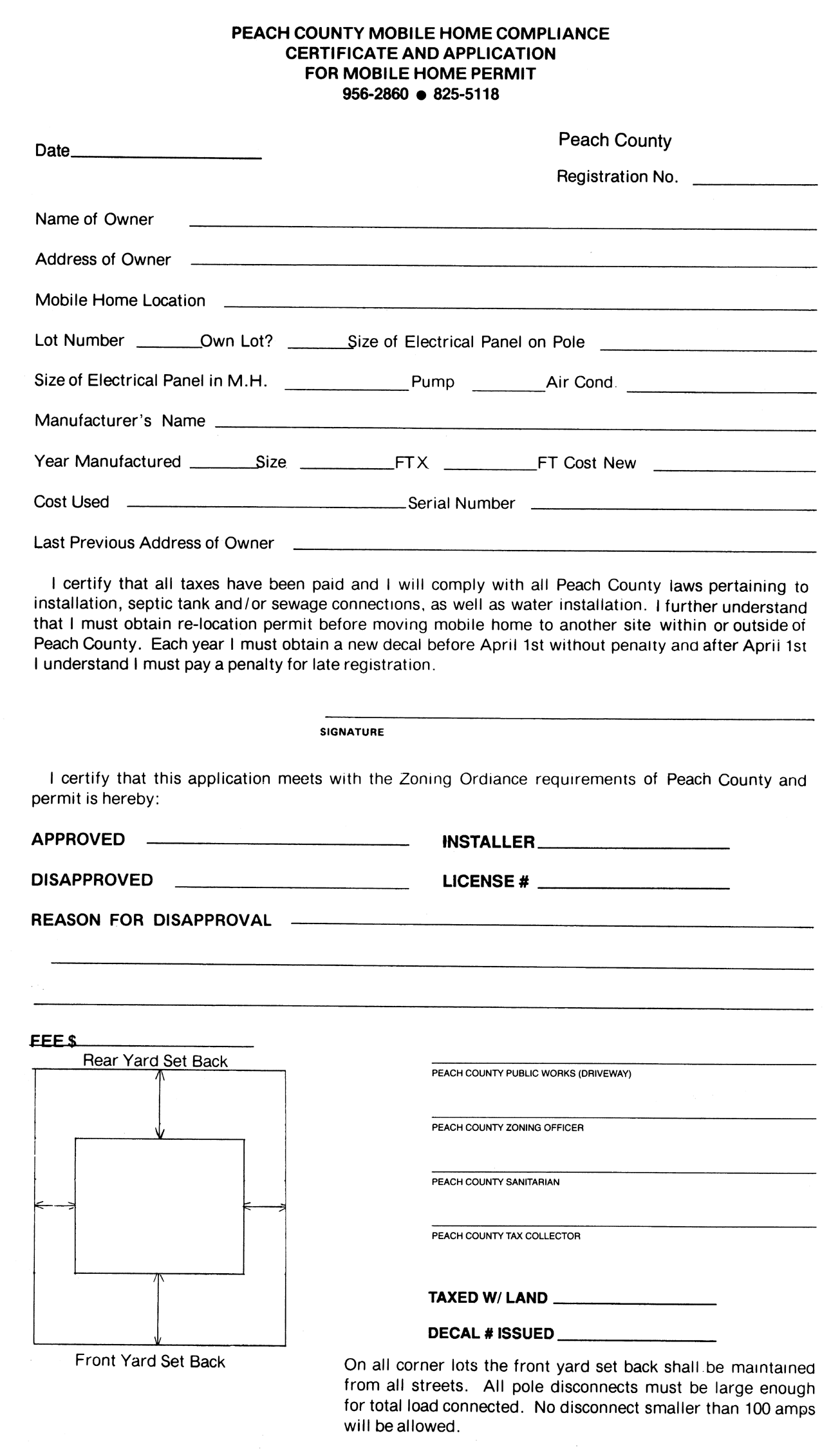
91.2.13. No mobile home permit or relocation permit shall be valid unless in an approved park or unless application and zoning compliance certificate has been approved by the Peach County zoning enforcement official and the Peach County Health Officer.
91.2.13.1. Each year every owner of a mobile home subject to taxation under O.C.G.A. § 48-5-440 et seq. shall return the mobile home for taxation and shall pay the taxes due on the mobile home at the time the owner applies for the mobile home location permit, or at the time of the first sale or transfer of the mobile home after December 31, or on May 1, whichever occurs first. If the owner returns such owner's mobile home for taxation prior to the date that the application for the mobile home location permit is required, such owner shall apply for the permit at the time such owner returns the mobile home for taxation. Such payment shall renew the decal, and the owner shall obtain a decal for the current year and shall affix the current year decal to the mobile home so as to be visible from the road or street.
91.2.13.2. No mobile home shall be moved from Peach County to another county or to another location within Peach County until it has been returned for taxes in the county in which it is located on the first day of January of the year in which it is moved.
91.2.13.3. Each year every owner of a mobile home which is eligible for homeowners exemption is required to make a return with the tax commissioner and obtain a decal to be affixed to the mobile home indicating that the mobile home has been returned for taxation. Any replacement mobile home to replace one returned for taxation must be treated as a new installation moving into Peach County and obtain a permit before occupancy.
91.2.13.4. Any person who fails to obtain a decal and display it on the mobile home shall be guilty of a misdemeanor and shall be fined not less than $25.00 nor more than $200.00 in magistrate court, except that upon receipt of proof of purchase of a decal prior to the date of issuance of a summons, the owner of the mobile home shall be fined $25.00.
91.2.14. Sample permit.
Section 92. - Townhouses.
Within the district permitting townhouses including the planned unit development district, the following requirements shall apply:
92.1. No more than ten or fewer than three continuous townhouses shall be built in a row with approximately the same (but staggered) front line.
92.2. No side yard is required except that on corner and interior lots the end of the building in any townhouse grouping shall conform to the side yard requirements of that district.
92.3. Not more than 40 percent of the lot area shall be occupied by buildings.
92.4. Insofar as practicable, off-street parking facilities shall be grouped in bays, either adjacent to streets or in the interior of blocks; and no off-street parking space shall be more than 140 feet by the most direct pedestrian route from a door of the dwelling unit it intends to serve. Maneuvering incidental to parking shall take place entirely within the townhouse complex.
92.5. All townhouse complexes shall be required to tie into the public sanitary sewer system. Other means of wastewater disposal shall be permitted.
92.6. All other requirements within the district in which the townhouses are located shall prevail.
92.7. In group development projects involving townhouses, and in all townhouse projects, additional common open space shall be provided as required under section 81.1. No buildings, parking, storage, or other use shall be made of this open space.
92.8. Provision for the maintenance of all common parking, open access, and other spaces and areas shall be included in the deed restriction of the properties.
Section 93. - Accessory and temporary building.
93.1. Accessory buildings. The location of accessory buildings and uses in residential districts must meet the following requirements:
93.1.1. Where an accessory building is attached to the main building, a substantial part of one wall of the accessory building shall be an integral part of the main building or such accessory building shall be attached to the main building in a substantial manner by a roof, and therefore such requirements applicable to the main building shall be applicable to the accessory building.
93.1.2. A detached accessory building in which flammable materials are stored shall not be closer than 20 feet to the main building nor closer than ten feet to the lot line. No accessory building can be so situated to interfere with or restrict minimum light, air and health standards as determined by the health official.
93.1.3. A detached accessory building, not more than two stories in height, may be constructed on not more than 30 percent of the rear yard.
93.1.4. No detached accessory building may be located on the front yard of a lot or closer than five feet to the side or rear lot lines.
93.2. Temporary buildings. A single mobile home or other temporary building may be used as an office in a subdivision by a developer, a temporary residence during construction, or for other special purposes for a period of one year (365 days) upon written approval from the zoning enforcement official.
Section 94. - Fallout shelters.
Fallout shelters are permissible as principal or accessory uses and structures in any district, subject to the following conditions:
94.1. If any portion of the structure extends above the ground, that portion above the ground must comply with the yard and lot coverage regulations of the district in which it is located, and the site plan for such shelter must be approved by the building inspector.
94.2. If the structure is completely underground, it need not comply with yard requirements or percentage of lot coverage requirements.
94.3. A fallout shelter, underground or aboveground, shall be confined to a side or rear yard and shall not be located in the front yard between the main building and the street on which it fronts.
94.4. Fallout shelters may contain or be contained in other structures or may be constructed separately.
94.5. Fallout shelters may be used for any permissible use in the district where situated.
Section 95. - Home occupations.
95.1. Special requirements. Home occupations, where permitted, must meet the following special requirements prior to the issuance of a zoning compliance permit for a home occupation:
95.1.1. The applicant must be the owner of the property on which the home occupation is to be located, or must have written approval of the owner of the property if the applicant is a tenant.
95.1.2. The home occupation shall be operated only by the members of the family residing on the premises, and no article or service shall be sold or offered for sale except as may be produced by members of the immediate family residing on the premises.
95.1.3. The home occupation shall be restricted to the main building only and shall not occupy more than 25 percent of the floor area within said building.
95.1.4. The home occupation shall not generate excessive traffic or produce obnoxious odors, glare, noise, vibration, electrical disturbance, or radioactivity or other conditions that will be a nuisance to the surrounding area.
95.1.5. Any business sign placed on the premises shall not be larger than two square feet in sign area, unlighted and fixed flat to a wall.
95.1.6 Home occupations shall not include yard sales, garage sales, or flea markets.
95.2. Expiration. A permit for home occupations shall expire under the following conditions:
95.2.1. Whenever the applicant ceases to occupy the premises for which the home occupation [permit] was issued, no subsequent occupant of such premises shall engage in any home occupation until he shall have been issued a new permit after proper application.
95.2.2 Whenever the holder of such a permit fails to exercise the same for any period of six consecutive months.
95.3 Yard sales/garage sales. For the purpose of this section, the term yard sale/garage sale shall mean the sale or trading of used clothing, furniture, household items, food, dishes, baked goods or other food items, antiques, or similar goods or merchandise. Said yard sale/garage sale shall not be allowed as a home occupation, but shall be allowed under the following conditions:
95.3.1. Said yard sales/garage sales shall be allowed up to two times in a 12-month period of time, with each event not lasting more than 48 hours.
95.3.2. Said yard sales/garage sales shall not include the selling of inventory purchased, received on consignment, or by donation with the intent to resell.
95.3.3. Signs for temporary yard sales/garage sales shall be subject to the following provisions:
(a)
On-premise signs shall be limited to one per parcel and a maximum area of three square feet.
(b)
Similar off-premise signs for directional purposes, not exceeding three square feet in area, may be allowed near street intersections on private property with the consent of the property owner. These signs shall not be erected in a public right-of-way.
(c)
All signs must be removed within 24 hours of the close of the sale.
95.4. Flea markets. For the purpose of this section, the term "flea market" shall mean the ongoing sale or trading of new or used clothing, furniture, household items, food, dishes, baked goods or other food items, antiques, or similar goods or merchandise on a commercially zoned lot or parcel of land within the county. Said individual or individuals operating a flea market shall be subject to the occupational tax ordinance and will be subject to the following regulations.
95.4.1. Flea markets shall not be allowed as a home occupation.
95.4.2. Such events shall be subject to health, zoning, or other regulatory ordinances as may effect.
95.4.3 Said flea market shall be conducted completely within an enclosed building.
95.4.4. Said flea market may include the selling of inventory obtained by purchase, on consignment, or by donation with the intent to resell.
(Amd. of 2-12-2008)
Section 96. - Automobile service stations.
Within the districts permitting automobile service stations, the following requirements shall apply:
96.1. Location. The property on which an automobile service station is located shall not be within 100 feet of any residential district, or any property containing a school, public playground, church, hospital, public library, or institution for children or dependents.
96.2. Site requirements. An automobile service station shall have a minimum frontage on the primary street of 120 feet and a minimum area of 12,000 square feet. All buildings shall be set back 40 feet from all street right-of-way lines and all canopies shall be set back 15 feet from all street right-of-way lines except in the C-H district in which these setbacks shall be 80 feet and 30 feet respectively.
96.3. Access to site. Vehicular entrances or exits at an automobile service station:
96.3.1. Shall not be provided with more than two curb cuts for the first 120 feet of street frontage or fraction thereof.
96.3.2. Shall contain an access width along the curbline of the street of not more than 40 feet as measured parallel to the street at its narrowest point and shall not be located closer than 20 feet to a street intersection or closer than ten feet to the adjoining property.
96.3.3. Shall not have any two driveways or curb cuts any closer than 20 feet at both the right-of-way line and the curb or edge of the pavement along a single street.
96.4. Gasoline pump islands. All gasoline pump islands shall be set back at least 15 feet from the right-of-way line, or where a future widening line has been established, the setback line shall be measured from such line; and where pump islands are constructed perpendicular to the right-of-way line, the pump island shall be located not less than 30 feet back of the right-of-way line. In the C-H district all pump islands shall not be located closer than 30 feet to the street right-of-way; when the pumps are perpendicular to the right-of-way the pump island shall be 60 feet from the right-of-way line.
96.5. Off-street parking. A minimum of two off-street parking spaces are required with an additional off-street parking space for each lubrication and wash bay.
96.6. Other site improvements. In addition to the above requirements, the following additional site improvements shall be adhered to:
96.6.1. A raised curb of at least six inches in height shall be erected along the street property lines, except for driveway openings.
96.6.2. A solid fence buffer or wall six feet in height shall be erected along all adjacent property lines facing any residential lot.
96.6.3. Exterior lighting shall be arranged so that it is deflected away from adjacent properties.
96.6.4. Signs, whether permanent or temporary, shall not be placed within the public right-of-way and shall be arranged so that they do not obstruct visibility for drivers or pedestrians.
96.6.5. All drives and parking, storage, and service areas shall be paved and curbed, and a good stand of grass shall be maintained on the remainder of the lot.
96.6.6. All commercial or rental vehicles parked at the premises shall be parked behind the front building line.
96.7. Storage of inflammable products. Outside aboveground tanks for the storage of gasoline, liquified petroleum gas, oil or other inflammable liquids or gases shall be prohibited at any automobile service station in all zoning districts.
Section 97. - Signs.
The provisions of this section shall govern the location, size, setback, and the height of sign in each of the use districts established in this resolution in order to insure [ensure] safe construction, light, air, and open space to reduce hazards at intersections, to prevent the accumulation of trash, and to protect property values of the entire community. In addition, the provisions set forth in the building code adopted by the county commission, all revisions and amendments thereto, shall also be adhered to.
97.1. General provisions.
97.1.1. All types of signs, except outdoor advertising signs and political advertising, shall be allowed without a permit in all zoning districts where they are permitted uses.
97.1.2. All outdoor advertising signs shall be subject to the same side yard and height limitations imposed upon buildings or structures in the use district in which said sign is located, except as otherwise provided herein.
97.1.3. For the purpose of computing sign area, both sides of a "V-type" or double-faced outdoor advertising sign shall be considered as one sign.
97.1.4. Rooftop outdoor advertising signs or sign structures shall not extend above the maximum building height in any zone. Rooftop outdoor advertising signs or sign structures shall not extend beyond or overhang any exterior wall of the building upon which secured.
97.1.5. No outdoor advertising sign or sign structure shall be placed upon any street or highway right-of-way.
97.1.6. No outdoor advertising sign or sign structure shall be located in such a manner as to materially impede the view of any street or highway intersection; or in such a manner as to materially impede the view of the intersection of a street or highway with a railroad grade crossing, as required in section 64.2 of this resolution.
97.1.7. No outdoor advertising sign shall be erected, relocated, or maintained so as to prevent free ingress to or egress from any door, window, or fire escape.
97.1.8. No portion of any outdoor advertising sign shall be less than ten feet above the level of a sidewalk or other pedestrians thoroughfare, nor shall be less than 16 feet above the level of a public driveway, alley, or street.
97.2. Signs other than outdoor advertising signs as permitted uses. Signs for the purpose of conveying information, knowledge, or ideas to the public about a subject directly relating to the premises on which it is located shall be permitted in the following zoning districts, provided the specified requirements are adhered to:
97.2.1. R-AG, RR-1, R-2, R-3 and MH residential districts.
97.2.1.1. A single non-illuminated professional or announcement sign per lot not exceeding 32 square feet in area and attached wholly to a building.
97.2.1.2. "For Sale" or "For Lease" signs not exceeding four square feet in area are allowed for a period of 90 days.
97.2.1.3. Permanent signs not exceeding 12 square feet in area identifying subdivisions of ten or more lots, or church bulletin boards not exceeding 18 square feet in area.
97.2.1.4. Signs for temporary yard sales/garage sales shall be subject to the following provisions:
(a)
On-premise signs shall be limited to one per parcel and a maximum area of three square feet.
(b)
Similar off-premise signs for directional purposes, not exceeding three square feet in area, may be allowed near street intersections on private property with the consent of the property owner. These signs shall not be erected in a public right-of-way.
(c)
All signs must be removed within 24 hours of the close of the sale.
97.2.2. C-1 Commercial district.
97.2.2.1. Professional or announcement signs having not more than 12 square feet of area.
97.2.2.2. Signs pertaining to the sale or lease of property upon which it is located.
97.2.2.3. Principal use identification signs limited to 40 square feet in area.
97.2.3. C-2 Commercial districts.
97.2.3.1. Professional or announcement signs having not more than 12 square feet of area.
97.2.3.2. Signs pertaining to the sale or lease of property upon which it is located.
97.2.3.3. One sign or billboard pertaining to the principal use of a building on the lot for each lot with 100 feet or less of lot frontage with one additional sign for each additional 100 feet or less of lot frontage under single ownership, provided said sign shall not exceed 400 square feet in area per structure facing. Where two signs, each not exceeding 200 square feet in area per structure facing, are supported by the same sign structure, one above the other, they shall be considered as a single sign.
97.2.4. M-1 and M-2 Wholesale and industrial districts. One sign or billboard pertaining to the principal use of a building on the lot for each lot with 75 feet or less of lot frontage with one additional sign for each additional 75 feet or less of lot frontage under single ownership, provided said sign shall not exceed 400 square feet in area per structure facing. Where two signs, each not exceeding 200 square feet in area per structure facing, are supported by the same sign structure, one above the other, they shall be considered as a single sign.
97.3. Outdoor advertising signs as permitted uses. For the purpose of this resolution, the state law (O.C.G.A. § 32-6-70 et seq.) governing outdoor advertising adjacent to any state-aid road which is also a part of the interstate or primary systems of highways is hereby made a part of this resolution and shall govern the placement and maintenance of signs in addition to the following provisions. Whenever this resolution is at variance with the state law the most restrictive shall govern.
97.3.1. R-AG, R-1, R-2, R-3, and MH residential districts, all PUD districts, and C-1 commercial districts. No outdoor advertising signs are permitted.
97.3.2 C-2 Commercial districts. Outdoor advertising signs such that the total sign area, including the sign area of all signs other than outdoor advertising signs, shall not exceed 1,500 square feet of display are on any one lot. The distance between each outdoor advertising sign on a state highway of county maintained road shall be one-half mile, and no outdoor advertising sign shall be permitted within one-half mile of any zoning district in which outdoor advertising signs are prohibited. Said distance shall be measured from the sign to the nearest point of a district boundary. The distance between each outdoor advertising sign on an interstate highway shall be determined by the Interstate Sign Ordinance.
97.3.3 M-1 and M-2 Wholesale and industrial districts. Outdoor advertising signs such that the total sign area, including the sign area of all signs other than outdoor advertising signs, shall not exceed 1,500 square feet of display area on any one lot. The distance between each outdoor advertising sign on a state highway or county maintained road, shall be one-half mile, and no outdoor advertising sign shall be permitted within one-half mile of any zoning district in which outdoor advertising signs are prohibited. Said distance shall be measured from the sign to the nearest point of a district boundary. The distance between each outdoor advertising sign on an interstate highway shall be determined by the Interstate Sign Ordinance.
97.4. Signs prohibited in all districts. The following signs are prohibited in all use districts:
97.4.1. Any sign erected or painted upon a sloping roof, fence, tree, standpipe, fire escape, or utility pole.
97.4.2. Any sign which uses the word "Stop" or "Danger" prominently displayed and/or which is a copy or imitation of official traffic control signs.
97.4.3. Any sign which contains flashing or intermittent red, green, or yellow illumination.
97.5. Maintenance and removal of outdoor advertising signs and other sign structures.
97.5.1. All outdoor advertising signs and other sign structures shall be kept in repair and in proper state off preservation. All unsafe signs must adhere to the provisions of the building code adopted by the county commission, including all revisions and amendments thereto.
97.5.2. Outdoor advertising signs and other sign structures which are no longer functional, or are abandoned, shall be removed, or relocated at the owner's expense, in compliance with the provisions of this resolution within 30 days following disfunction.
97.5.3. Any legally established nonconforming outdoor advertising sign or other sign structure shall be permitted without alteration in size or location, provided that the requirements of section 61 of this resolution are adhered to and provided that nothing herein shall prevent maintenance, repairing, partial or posting of legally established forming signs.
97.5.4. In the event of the destruction, partial or complete, of an outdoor advertising sign or other sign structure, the owner thereof shall have the right to reconstruct, rebuild, renovate or repair said sign substantially to the same condition as before said destruction, provided the provisions of section 61 of this resolution are adhered to.
97.6. Political advertising signs. Graphics pertaining to political campaigns or elections of any nature shall adhere to the following controls:
97.6.1. A ground, wall, or projecting graphics may be erected or displayed on the property or building being used as a campaign or election headquarters, provided that these graphics adhere to the regulations as set forth in section 97.1 of this ordinance.
97.6.2. R-AG, RR-1, R-1, R-2, R-3, and MH residential districts, all PUD districts and C-1 commercial districts. Temporary political advertisements during the normal campaign period for any election for public office provided:
a.
Such signs shall be removed within 30 days after the primary, general or run-off election;
b.
Only one sign may be placed on any lot;
c.
No sign shall exceed four square feet in area; and
d.
Only one permit per candidate shall be required; each applicant shall provide a listing of the locations of all eligible signs to the zoning enforcement official.
97.6.3. Political advertising shall be allowed for a period of not more than 60 days before a duly authorized election date as established by applicable federal, state or local law and shall be removed within 30 days of the expiration of the election date.
97.6.4. At no time will political graphics be allowed to be tacked, painted, posted, marked, or otherwise affixed on trees, fences, poles, or other like structures, or on rocks the ground itself or other natural features.
97.6.5. A performance bond shall be required of each political candidate or his appointed representative at such time as a permit for political advertising signs have been, removed to the satisfaction of the board of commissioners, the funds shall be returned to the candidate or his appointed representative.
(Amd. of 10-11-2005; Amd. of 4-11-2006; Amd. of 2-12-2008)
Section 98. - Cemeteries.
Within the districts permitting cemeteries, the following requirements shall apply:
98.1. The site proposed for a cemetery shall not interfere with the development of a system of collector or larger streets in the vicinity of such site. In addition, such site shall have direct access to a thoroughfare.
98.2. Any new cemetery shall be located on a site containing not less than 20 acres.
98.3. All structures shall be set back no less than 25 feet from any property line or street right-of-way line.
98.4. All graves or burial lots shall be set back not less than 25 feet from any property line or minor street right-of-way lines, and not less than 50 feet from any collector, arterial, expressway, or freeway right-of-way line.
98.5. The entire cemetery property shall be landscaped and maintained.
98.6. Any person or persons establishing a private cemetery, mausoleum or family burial plot shall comply with the following provisions:
98.6.1. No cemetery, mausoleum or burial plot shall be located closer than 250 feet from all property lines.
98.6.2. The cemetery, mausoleum or burial plot shall be platted, approved by the planning commission and recorded in the office of the Clerk of Superior Court.
98.6.3. All new grave sites in newly created private cemeteries shall be marked with a grave marker.
98.6.4. Fencing shall be installed around the perimeter of the cemetery of sufficient height and strength to keep dogs and wild animals from accessing the cemetery.
98.6.5. All human remains shall be buried in a casket and placed in a sealed vault.
98.6.6. No human remains shall be buried less than the depth that is customarily used in the funeral industry in Georgia and in accordance with minimum standards for interment as may be adopted by the Secretary of State.
98.6.7. The cemetery, mausoleum or burial plot shall be named and posted on the recorded property.
(Ord. of 5-14-2019)
Section 99. - Performance standards for nonresidential uses.
99.1. General requirements. The manufacturing, processing, fabrication, repair, and servicing of any commodity or product [shall be] subject to the following conditions:
99.1.1. Any such use as determined by the zoning enforcement official that may be of noxious or offensive by reason of the emission of odors, dust, smoke, gas, noise, or vibration shall be referred to the Environmental Protection Division of the Georgia Department of Natural Resources.
99.1.2. Prior to issuing a zoning compliance permit the applicant shall provide the zoning enforcement official with written approval of the nature, plans, and specifications of the said use from the Environmental Protection Division of the Georgia Department of Natural Resources.
99.1.3. All other requirements within the district in which these industrial activities can be located shall be met.

