
Pensacola City Zoning Code
CHAPTER 12
4.- OFF-STREET PARKING
Sec. 12-4-1.- Off-street parking spaces requirements.
Off-street parking is required in all zoning districts, except as provided below. The following off-street parking is required by this chapter:
(1)
General provisions.
a.
Area calculations based on gross square footage.
b.
Where the required number of parking spaces results in a fraction, the number of spaces required shall be construed to be the next whole number.
c.
Where parking spaces are required based on number of employees or students/clients, the number of employees must reflect the largest shift and the number of students/clients must reflect the maximum capacity allowed.
d.
For multiple land use developments, additional parking spaces will be required for each different land use and/or accessory use.
e.
Handicapped parking spaces are required as a percentage of total required parking spaces for all developments other than single-family, duplex or zero-lot-line residential.
f.
With respect to any parking lot that is required to be paved, the number of parking spaces required may be reduced by one, if the developer provides a bicycle rack or similar device that offers a secure parking area for at least five bicycles.
g.
Neither off-street parking in the city right-of-way nor creation of a parking space in the right-of-way shall be permitted without obtaining a license-to-use to do so.
h.
The number of off-street parking spaces provided for buildings constructed prior to October 13, 1994, shall be deemed in compliance with the requirements of this Code, for as long as the same land use is maintained within the same building footprint. Effective October 13, 1994, off-street parking requirements set forth in subsection (2) of this section shall be required for the following development or redevelopment activities except as specifically exempted in subsections (1)j. through l. of this section:
1.
New construction.
2.
Construction of an addition to an existing building. Whenever a building is enlarged or increased in floor area, number of dwelling units, seating capacity, intensity, density or in any manner so as to create a need for a greater number of parking spaces than currently existing, such additional spaces must be provided in accordance with subsection (2) of this section. The required number of additional parking spaces must be provided concurrently with the building enlargement. In the event that additional parking spaces are required, and the resulting number of spaces required for the whole building (existing and new) exceeds ten spaces, the entire parking lot shall comply with the provisions of section 12-4-3.
3.
A change in land use in an existing building or portion of a building. Whenever a land use is changed to another land use requiring a greater number of parking spaces than that existing, such additional spaces must be provided in accordance with subsection (2) of this section. The required number of additional parking spaces must be provided concurrently with the change in land use. In the event that additional parking spaces are required as a result of a change in land use for buildings constructed prior to October 13, 1994, the entire number of required parking spaces for the new land use must be provided in accordance with subsection (2) of this section. In the event that additional parking spaces are required, and the resulting number of spaces required for the new land use exceeds ten spaces, the entire parking lot shall comply with the provisions of section 12-4-3.
i.
Except as provided in subsections (4) and (5) of this section, all required parking spaces must be located on the same lot or parcel with the building or use served or on an adjacent lot or parcel owned or leased by the same owner of the building site for which the parking is required. If the required parking is provided on an adjacent property separated from the common boundary by a street, appropriate measures shall be undertaken to provide pedestrian safety. Such measures include, but are not limited to, pedestrian crosswalk, pedestrian crossing with automated traffic control, pedestrian overpass, and underground pedestrian tunnel.
j.
Off-street parking is not required in the HC-1 and HC-2 districts (see section 12-3-10(1)e.7.iii).
k.
Off-street parking is not required in the dense business area for residential land uses.
l.
New construction of buildings within the South Palafox business district that do not exceed 40 feet in height, or the renovation or change in land use of existing buildings that do not exceed 40 feet in height are exempt from the off-street parking requirements (see also section 12-3-13(4)f).
m.
New construction of buildings within the C-2A district that do not exceed 40 feet in height and 5,000 square feet in total floor area, or the renovation or change in land use of existing buildings that do not exceed 40 feet in height and 5,000 square feet in total floor area are exempt from the off-street parking requirements.
(2)
Parking requirements for specific land uses. The following list of requirements shall apply for any land use that is permitted or that is granted a conditional use within any zoning district.
(3)
All other uses. Any use not covered by this chapter shall require one parking space for each 300 square feet of gross floor area in the building.
(4)
Off-site parking. The off-street parking requirements set forth in subsection (2) of this section may be provided off-site through a shared parking facility or leased parking facility.
a.
Off-site parking may be provided as specified below:
1.
Shared use parking facility shared by uses that have different principal operating hours. The schedule of operation of all such land uses shall provide that none of the uses sharing the facilities normally require off-street parking facilities at the same time as other uses sharing them. The total number of required off-street parking spaces shall be determined by the combined peak hour parking requirement for all uses sharing the facility.
2.
Off-site parking spaces that are leased on an annual basis from a private owner or public agency.
3.
Off-site parking spaces located on a site owned and controlled by the owner/developer of the building site for which the off-street parking is required.
4.
When a portion or all of the required off-street parking is provided pursuant to one of the options specified above in subsections (4)a through c of this section a written agreement shall be drawn in a form satisfactory to the city attorney and executed by all parties concerned assuring the continued availability of the off-site parking facilities for the use they are intended to serve. Such written agreement shall be required as a prerequisite for the approval of a building permit for the new development or redevelopment proposed for which the parking is required. Such written agreement shall be reviewed annually as a condition for renewal of a business license required in chapter 7-2. If a written agreement securing the number of parking spaces is not provided as part of the annual business license certification, the license may be revoked by the city unless the required off-street parking is otherwise provided.
5.
When a portion or all of the required off-street parking is provided pursuant to one of the options specified above in subsections (4)a through c of this section a sign directing business patrons to the off-street parking shall be required and shall be placed in a clearly visible location in accordance with the provisions of section 12-5-4(g)(3).
6.
Off-site parking provided for businesses within the Brownsville Business Core must be located within the city limits.
b.
Approval of off-site parking will be based upon consideration of the following factors:
1.
The location of the business and the proposed off-site parking;
2.
The number of off-site parking spaces proposed;
3.
Intended users of the proposed off-site parking (i.e. employees, patrons or both);
4.
The distance of the proposed off-site parking measured along the shortest legal pedestrian route (i.e. along public sidewalks, crosswalks) from the nearest lot line of the building site for which the off-site parking is proposed to the nearest lot line of the off-site parking;
5.
Pedestrian safety;
6.
Nature of the business proposing the off-site parking;
7.
Potential conflicts/overlaps in any off-site shared parking arrangement;
8.
Recommendation of city attorney regarding the form of the written agreement specified in subsection (4)a.4 of this section.
(5)
The number of required parking spaces for the geographic areas and zoning districts identified in subsection (4) of this section may be reduced by the number of on-street parking spaces provided in accordance with the following criteria:
a.
The on-street parking space must be located between the extended property lines of the property requesting the reduction. If a parking space straddles two properties owned by different property owners each property may count the space towards the required parking. Where the right-of-way contains a median and parking is provided along the median, the property owner requesting the reduction may include those spaces provided they are located between the extended property lines and the centerline of the median.
b.
The on-street parking spaces must remain open for use by the public.
(6)
New construction, additions to existing buildings and changes in land use of existing buildings within the dense business area resulting in an increase of parking requirements may comply with the parking requirements through an in-lieu payment approved by the city council.
a.
All funds collected through the in-lieu payment process shall be utilized for the express purpose of parking capital improvement projects within the dense business area.
b.
The in-lieu payment will be calculated by the mayor and approved by the city council in accordance with the following formula:
In-lieu parking payment = (total spaces required to meet code - on-site spaces - approved off-site spaces - approved on-street parking spaces) × (in-lieu fee)
The in-lieu fee shall be based upon the cost of construction for parking spaces considering such factors as land acquisition, design fees, engineering, financing, construction, inspection, and other relevant factors.
(7)
Parking reductions for specific land uses. Parking reductions described in Table 12.4-1 shall apply to all established community redevelopment areas, also known as Tax Incremental Financing (TIF) districts.
TABLE 12.4-1. PENSACOLA CRA PARKING
REDUCTIONS
(Code 1986, § 12-3-1; Ord. No. 6-93, § 21, 3-25-1993; Ord. No. 29-93, § 26, 11-18-1993; Ord. No. 44-94, § 6, 10-13-1994; Ord. No. 33-95, § 9, 8-10-1995; Ord. No. 8-99, § 7, 2-11-1999; Ord. No. 44-99, § 3, 11-18-1999; Ord. No. 6-02, § 2, 1-24-2002; Ord. No. 05-06, § 1, 2-9-2006; Ord. No. 16-10, § 212, 9-9-2010; Ord. No. 39-13, § 1, 11-14-2013; Ord. No. 12-14, § 1, 3-27-2014; Ord. No. 29-21, § 2, 12-16-2021; Ord. No. 07-24, § 1, 2-22-2024)
Sec. 12-4-2. - Off-street loading.
All manufacturing, industrial, warehouses and similar establishments customarily receiving and distributing goods by motor vehicle shall provide loading and unloading facilities on the premises. No motor vehicle shall be allowed to extend onto a public street, sidewalk or alley while loading or unloading. Off-street loading berths shall be provided as follows:
(Code 1986, § 12-3-2)
Sec. 12-4-3. - Parking lots.
In addition to the provisions in this chapter all parking lots shall comply with tree preservation and landscaping provisions established in chapter 12-6. The following requirements are applicable to all parking lots and parking spaces, whether or not such lots or spaces are required by the provisions of this chapter:
(1)
Design of parking lots. All parking lot plans must be reviewed by the city engineer or his or her designee. Proper ingress and egress from the lot shall be required and adequate interior drives shall be required for all parking lots.
(2)
Grading and surfacing.
a.
Parking lots that include lanes for drive-in windows or contain more than ten parking spaces. Parking lots that include lanes for drive-in windows or contain more than ten parking spaces shall be graded and surfaced with asphalt, concrete or other material that will provide equivalent protection against potholes, erosion, and dust.
b.
Parking lots with ten or less parking spaces. Parking lots with ten or less parking spaces may be surfaced with alternative surface materials (crushed stone, gravel, or other suitable material) other than those specified in subsection (2)a of this section, with the approval of the city engineer, to provide a surface that is stable and will help to avoid dust and erosion. The perimeter of such parking shall be defined by bricks, stones, railroad ties, or other similar devices. In addition, whenever a parking lot abuts a paved street, the driveway leading from such street to such area (or, if there is no driveway, the portion of the parking area in the public right-of-way), shall be paved as provided in subsection (2)a of this section.
(3)
Demarcation of parking spaces. Parking spaces in areas surfaced in accordance with subsection (2)a. of this section shall be appropriately demarcated with painted lines or other markings. Parking spaces in areas surfaced in accordance with subsection (2)b. of this section shall be demarcated whenever practicable. All pavement markings/striping providing immediate access to the public right-of-way (stop bars, crosswalks, etc.) shall be thermoplastic.
(4)
Maintenance. Parking lots shall be properly maintained in all respects. Parking area surfaces shall be kept in good condition (free from potholes, etc.) and parking space lines or markings shall be kept clearly visible and distinct.
(5)
Lighting. Lighting shall be provided for parking lots with more than ten spaces, and this lighting shall be arranged to reflect away from the adjoining properties. The minimum illumination level required for the entire paved area shall be an average maintained 1.0 footcandle. The lowest footcandle value at any point on the pavement shall not be less than one-fourth of the required average.
(6)
Screening. Where a parking lot adjoins a residential district or fronts on a street adjoining a residential district, directly across said street, a solid wall, fence, or compact hedge not less than four feet high shall be erected along the lot lines, except that within a visibility triangle the height requirement shall be reduced to three feet.
(7)
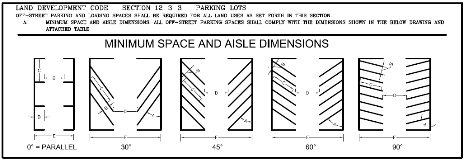
Measurement of parking stalls and/or drive aisles. All parking stalls shall measure not less than nine feet by 18 feet, across the contiguous paved/improved surface and shall exclude any portion of the curb or gutter except as provided for herein. For land uses that assign parking spaces to specific employees or residents, a maximum of 30 percent of all required vehicle parking spaces may be designed for compact cars. A compact car space may be a minimum of 7.5 feet by 16 feet across the contiguous paved/improved surface and shall exclude any portion of the curb or gutter. The occupant or owner of the principal use for which the parking is required shall enforce the use of such assigned compact car spaces. Parking stalls must be offset one stall width in either direction to be constructed at 90 degrees to one another for corners in order to avoid vehicular conflict. See attached drawing, "Minimum Space and Aisle Dimensions," below:
(8)
Fencing, wheelstops or bumper guards. Fencing, wheelstops or bumper guards are required along property and street lines to avoid the chance of encroachment on other properties or sidewalks.
(Code 1986, § 12-3-3; Ord. No. 6-93, § 22, 3-25-1993; Ord. No. 33-95, § 10, 8-10-1995; Ord. No. 9-96, § 12, 1-25-1996; Ord. No. 12-21, § 2, 6-17-2021; Ord. No. 29-21, § 3, 12-16-2021)
Sec. 12-4-4. - Nonresidential parking in R-1AAA, R-1AA, R-1A, R-ZL, R-2A, R-2, PR-1AAA and PR-2 districts.
Accessory off-street parking facilities serving nonresidential uses of property in R-2, PR-2, R-NC, C-1, PC-1, C-2, C-3 or SSD zones may be permitted in R-1AAA, PR-1AAA, R-1AA, R-1A, R-ZL, R-2A, R-2 or PR-2 zoning districts where such lot is contiguous to such commercial zoned area or is separated therefrom by an alley, and may be authorized by the planning board, subject to the requirements in section 12-3-93.
(Code 1986, § 12-3-4; Ord. No. 29-93, § 27, 11-18-1993)
Sec. 12-4-5. - Parking vehicles on residential property—Prohibited activity.
It shall be unlawful for any person to park a vehicle on residential property without having proper vehicular ingress and egress curb cuts to the property in order to prevent damage to adjacent sidewalks or curbs and to prevent interference with the free flow of vehicular and pedestrian traffic on adjacent streets, sidewalks and rights-of-way. This section may be enforced through the provisions of section 1-1-8 or 13-3-2.
(Code 1986, § 12-3-5; Ord. No. 11-14, § 1, 3-27-2014)

