
Perry City Zoning Code
ARTICLE 1
- GENERAL PROVISIONS
Sec. 1-1. - Title.
These regulations shall be officially known as the "Land Management Ordinance of the City of Perry," and may be referred to as "LMO," "zoning ordinance," or "this chapter."
(Ord. No. 2017-25, § 2, 12-19-17)
Sec. 1-2. - Authority.
1-2.1. General. The city council is authorized to adopt this chapter pursuant to the enabling authority contained in the Constitution of the State of Georgia and O.C.G.A. (Georgia Code) Title 36.
1-2.2. Reference to Georgia General Statutes. Whenever any provision of this chapter refers to or cites a section of O.C.G.A. and that section is later amended or superseded, this chapter shall be deemed amended to refer to the amended section or the section that most nearly corresponds to the superseded section.
(Ord. No. 2017-25, § 2, 12-19-17)
Sec. 1-3. - Purpose and intent.
The purpose and intent of this chapter is to guide development in accordance with the existing and future needs of the city and to promote the public health, safety, morals, convenience, order, appearance, prosperity, and general welfare of the property owners and residents of the city, and other members of the public. The purpose and intent of this chapter is more specifically to:
(A)
Light, air, open space. Provide for adequate light, air, and open space.
(B)
Prevent overcrowding, congestion. Prevent the overcrowding of land, to avoid undue concentration of population, and to lessen congestion in the streets.
(C)
Safety from fire, flood. Secure safety from fire, flood, and other dangers.
(D)
Promote diverse quality housing, protect neighborhoods. Promote quality housing, preserve neighborhoods, and encourage a diversity of housing options.
(E)
Downtown. Promote the downtown as a center of commerce, government, arts, entertainment, and residential life.
(F)
Commercial development along corridors. Ensure appropriate commercial development patterns along corridors.
(G)
Appropriate urban development and redevelopment. Encourage appropriate urban development and redevelopment.
(H)
Quality new development to blend with existing. Encourage quality development to blend with existing development.
(I)
Eliminate blight. Eliminate slums and blight citywide.
(J)
Create harmonious community. Facilitate the creation of a convenient, attractive, and harmonious community.
(K)
Protect scenic, historic and ecologically sensitive areas. Protect and preserve scenic, historic, or ecologically sensitive areas.
(L)
Open space. Protect and provide for open space.
(M)
Promote connectivity. Promote an inter-connected, walkable community.
(N)
Tree preservation. Provide standards and incentives for tree preservation and protection of existing trees.
(O)
Regulate the use, density, distribution, and character of land. Regulate the density and distribution of populations and the uses of buildings, structures and land for trade, industry, residence, recreation, agriculture, forestry, conservation, airports and approaches thereto, water supply, sanitation, protection against floods, public activities, and other purposes.
(P)
Facilitate adequate provision of public facilities and services. Facilitate the adequate provision or availability of transportation, police and fire protection, water, sewerage, schools, parks and recreation facilities, affordable housing, disaster evacuation, and other facilities and services that the city may provide to enhance the health, safety and welfare of its citizens.
(Ord. No. 2017-25, § 2, 12-19-17)
Sec. 1-4. - Official zoning district map.
1-4.1. Official zoning district map. The official zoning district map designates the location and boundaries of the various zoning districts established in this chapter within the city. The official zoning district map shall be kept on file in the office of the administrator and is available for public inspection during normal business hours.
1-4.2. Incorporated by reference. The official zoning district map and all the notations thereon are hereby incorporated by reference and made part of this chapter.
1-4.3. Zoning district boundaries. Unless otherwise specified, zoning district boundaries are lot lines or the centerline of streets, alleys, railroad rights-of-way, streams and rivers, or such lines extended. Where a zoning district boundary divides a land parcel under a single ownership into two (2) districts, then the entire parcel shall be zoned for the more restrictive use by the adjustment of the boundaries by the administrator, provided that the boundary adjustment is a distance of less than five hundred (500) feet.
1-4.4. Changes to zoning district map. Changes made in zoning district boundaries by the administrator or other matters portrayed on the official zoning district map shall be made in accordance with the provisions of this chapter. Changes shall be entered on the official zoning district map by the administrator promptly after the amendment has been approved by the city council.
1-4.5. Mapping disputes. The administrator shall have the authority to interpret the official zoning district map and determine where the boundaries of the different zoning districts fall, if in dispute.
1-4.6. Downtown development overlay district boundaries. The boundaries of the downtown development district shall be identical to the boundaries of the geographical area as depicted in Exhibit "A" dated November 2020, attached to the ordinance from which this section is derived and incorporated herein by reference, a copy of said exhibit to be attached to and replace the exhibit on the resolution activating the Downtown Development Authority of the City of Perry which resolution was adopted by the mayor and council on the 17th day of November, 1981. Said exhibit is incorporated into said resolution, as may be hereafter amended by reference.
The portion of said property designated as "Proposed Downtown Development District Parcels" on Exhibit "A" shall be considered an overlay district and as such an overlay district shall consist of the zoning, land use and regulatory controls in effect for said property as of December 15, 2020.
(Ord. No. 2017-25, § 2, 12-19-17; Ord No. 2020-35, § 1, 12-15-20)
Sec. 1-5. - Official street classification map.
The official street classification map designates all streets in the city as one of the classifications listed below. The official street map is adopted by city council and shall be kept on file in the office of the administrator and is available for public inspection during normal business hours.
(A)
Freeways are roadways which are used primarily for fast or heavy through traffic; and which are divided with full control of access and with grade separation at intersections.
(B)
Expressways are roadways which are used primarily for fast or heavy traffic; and which are divided with full or partial control of access and generally with.
(C)
Major arterial streets are roadways which are used primarily for fast or heavy through traffic.
(D)
Minor arterial streets are roadways which are used primarily to move traffic from one district of the city to another and which are not designed to serve individual residences.
(E)
Collector streets are roadways which carry traffic from minor streets to the major system of freeways, expressways, and arterial streets.
(F)
Minor residential streets are roadways which are used primarily for access to the abutting residential properties.
(G)
Minor commercial and industrial streets are roadways which are primarily for access to the abutting commercial and industrial properties.
(H)
Alleys are roadways which are used primarily for vehicular service access to the rear or side of properties otherwise abutting on a street.
(Ord. No. 2017-25, § 2, 12-19-17)
Sec. 1-6. - Applicability and jurisdiction.
1-6.1. General. The provisions of this chapter shall apply to all land, all land development, and the use of all structures on all lands and waters within the corporate limits of the city. The provisions of this chapter shall be considered the minimum standards necessary to promote and protect the public health, safety, morals, and general welfare.
1-6.2. Application to governmental units. Except as stated herein, the provisions of this chapter shall apply to all land, all land development, and the use of all structures and land owned or held in tenancy by the city or its agencies or departments; by the state its agencies, departments or political subdivisions; and to the full extent permitted by law, the government of the United States, its agencies, departments or corporate services.
1-6.3. No development until compliance with this chapter.
(A)
General. Except as specifically provided in this chapter, no structure, land or water shall hereafter be used and no structure or part thereof shall hereafter be located, erected, moved, reconstructed, extended, converted (change of use) or structurally altered without full compliance with the provisions of this chapter and all other applicable city, state and federal regulations.
(B)
Effect of permits. Development authorized by a permit shall not be carried out until the applicant has secured all other permits required by this chapter or any other applicable provisions of this chapter and O.C.G.A. Further, the issuance of a permit does not ensure the subsequent approval of other applications for development approval unless the relevant and applicable portions of this chapter and other provisions are met.
1-6.4. Exemptions.
(A)
Acquisition of interest in land by state for public purposes. The provisions of this chapter shall not require formal subdivision of land as a result of actions taken by the state and its political subdivisions to acquire land or interests in land for public rights-of-way and easements.
(B)
Emergency action by city. The city or city agencies or departments may be exempt from the provisions of this chapter when an emergency exists such that it is impossible to submit to the normal procedures and requirements of this chapter and quick and instant action is necessary to secure the public health, safety, or welfare. The city council shall ratify such exemption after the fact at its next regularly scheduled meeting, and shall base its ratification on specified findings of fact related to the emergency involved.
(Ord. No. 2017-25, § 2, 12-19-17)
Sec. 1-7. - Relationship to other codes, ordinances, and laws.
1-7.1. Conflicts with other city codes or laws. If the provisions of this chapter are inconsistent with one another or if the provisions of this chapter conflict with provisions found in other adopted codes or ordinances of the city, the more restrictive provision shall govern unless the terms of the provisions specify otherwise.
1-7.2. Conflicts with private agreements. If the provisions of this chapter conflict with the provisions of private easements, covenants or restrictions, the stricter of the requirements shall apply. The city shall not be responsible for monitoring or enforcing private covenants and restrictions, although the city may inquire as to whether land is subject to covenants and restrictions during the review of development applications.
1-7.3. Conflicts with state or federal law. If the provisions of this chapter are inconsistent with the law or regulations of the state or federal government, the more restrictive provision shall control to the extent permitted by law.
1-7.4. Relationship to comprehensive plan and land use policies. It is the intention of the city council that this chapter implement the planning policies and comprehensive plan adopted pursuant to the provisions of O.C.G.A. tit. 36, ch. 70.
(Ord. No. 2017-25, § 2, 12-19-17)
Sec. 1-9. - Severability.
It is the legislative intent of the city council in adopting this chapter that all provisions shall be liberally construed to guide development in accordance with the existing and future needs of the city as established in this chapter and to promote the public health, safety, morals, convenience, order, appearance, prosperity, and general welfare of the property owners and residents of the city. If any section, subsection, sentence, clause, or phrase of this chapter is for any reason held by a court of competent jurisdiction to be invalid, such decision shall not affect the validity of the remaining portions of this chapter. The city council hereby declares that it would have passed this chapter and any section, subsection, sentence, clause and phrase, thereof, irrespective of the fact that any one or more sections, subsections, sentences, clauses or phrases be declared invalid.
(Ord. No. 2017-25, § 2, 12-19-17)
Sec. 1-10. - Transitional provisions.
1-10.1. Effective date. The effective date of this chapter is January 1, 2018.
1-10.2. Violations continue. Any violation of the previous Perry Land Development Ordinance shall continue to be a violation under this chapter pursuant to section 1-10 of the City Code and shall be subject to the penalties and enforcement set forth in article 10, enforcement, and section 1-10 of the City Code, unless the use, development, construction, or other activity complies with the express terms of this chapter.
1-10.3. Completion of development plans commenced or approved under previous ordinances.
(A)
Completed applications.
(1)
Any complete application that has been submitted for approval, but upon which no final action has been taken by the appropriate decision-making body or person prior to the effective date of the ordinance from which this chapter is derived, shall be reviewed and considered in accordance with either the provisions of the ordinance in place on the date of submittal or this chapter, at the applicant's option.
(2)
If the applicant elects to have the complete application reviewed under the provisions of the ordinance in place on the date of submittal, the application shall be processed in good faith and shall comply with any time frames for review. If the application fails to comply with the required time frames, it shall expire and future development shall be subject to the requirements of this chapter.
(B)
Preliminary or final approval.
(1)
A development for which approval of a minor subdivision final plat, major subdivision preliminary plat, site plan permit, stormwater permit, planned development district, special exception permit, or variance permit was granted prior to the effective date of the ordinance from which this chapter is derived may be completed in accordance with the approved plat or development approval and any other approved permits and conditions, even if the development does not comply with one or more general development standards set forth in this chapter.
(2)
If the development for which preliminary or final approval was granted prior to the effective date of the ordinance from which this chapter is derived fails to comply with any time frames for development, the preliminary or final approval shall expire and future development shall be subject to the requirements of this chapter, consistent with the provisions of subsection 2-3.11.
(C)
Buildings or developments with previously issued building permits.
(1)
Any building or development for which a building permit was granted prior to the effective date of the ordinance from which this chapter is derived shall be permitted to proceed to construction even if such building or development does not conform to the provisions of this chapter.
(2)
If the development for which the building permit is issued prior to the effective date of the ordinance from which this chapter is derived fails to comply with the time frames for development established for the building permit, the building permit shall expire and future development shall be subject to the requirements of this chapter.
(Ord. No. 2017-25, § 2, 12-19-17)
Sec. 1-11. - Annexations.
1-11.1. Annexed property to be zoned. All land to be annexed into the corporate limits of the City of Perry shall be zoned in accordance with the procedures set forth in O.C.G.A. § 36-66-4(d).
1-11.2. Annexation required.
(A)
The entirety of a development shall be located within the corporate limits of the City of Perry prior to any permits being issued and/or any land disturbing activities. The entirety of the development shall include those areas with stormwater facilities and/or utilities designed specifically to serve the development and which will be privately maintained. The property required to be in the city shall be subdivided from the remainder of property remaining outside the corporate limits of the City of Perry.
(B)
Any development utilizing a City of Perry utility, prior to connection of said utility, shall be annexed into the corporate limits of the City of Perry unless granted a waiver by city council.
(Ord. No. 2017-25, § 2, 12-19-17)
Sec. 1-12. - Rules of interpretation.
The following rules shall apply for construing or interpreting the terms and provisions of this chapter:
1-12.1. Meanings and intent. All provisions, terms, phrases, and expressions contained in this chapter shall be construed according to the general purposes set forth in section 1-1.3 and the specific purpose statements set forth throughout this chapter. When a specific section of this chapter gives a different meaning than the general definition provided in this article, the specific section's meaning and application of the term shall control.
1-12.2. Headings, illustrations, and text. In the event of a conflict or inconsistency between the text of this chapter and any heading, caption, figure, illustration, table, or map, the text shall control.
1-12.3. Lists and examples. Unless otherwise specifically indicated, lists of items or examples that use terms such as "for example," "including," and "such as," or similar language, are intended to provide examples and are not exhaustive lists of all possibilities.
1-12.4. Computation of time. The time in which an act is to be done shall be computed by excluding the first day and including the last day. If a deadline or required date of action falls on a Saturday, Sunday, or holiday observed by the city, the deadline or required date of action shall be the next day that is not a Saturday, Sunday or holiday observed by the city. References to days are calendar days unless otherwise stated.
1-12.5. References to other regulations/publications. Whenever reference is made to a resolution, ordinance, statute, regulation, or document, it shall be construed as a reference to the most recent edition of such regulation, resolution, ordinance, statute, regulation, or document, unless otherwise specifically stated.
1-12.6. Delegation of authority. Any act authorized by this chapter to be carried out by the administrator may be carried out by a designee of the administrator.
1-12.7. Technical and nontechnical terms. Words and phrases shall be construed according to the common and approved usage of the language, but technical words and phrases that may have acquired a peculiar and appropriate meaning in law shall be construed and understood according to such meaning.
1-12.8. Public officials and agencies. All public officials, bodies, and agencies to which references are made are those of the city, unless otherwise indicated.
1-12.9. Mandatory and discretionary terms. The words "shall," "must," and "will" are mandatory in nature, establishing an obligation or duty to comply with the particular provision. The words "may" and "should" are permissive in nature.
1-12.10. Conjunctions. Unless the context clearly suggests the contrary, conjunctions shall be interpreted as follows:
(A)
The term "and" indicates that all connected items, conditions, provisions or events apply; and
(B)
The term "or" indicates that one or more of the connected items, conditions, provisions or events apply.
1-12.11. Tenses, plurals, and gender. Words used in the present tense include the future tense. Words used in the singular number include the plural number and the plural number includes the singular number, unless the context of the particular usage clearly indicates otherwise. Words used in the masculine gender include the feminine gender, and vice versa.
(Ord. No. 2017-25, § 2, 12-19-17)
Sec. 1-13. - Definitions.
The following words, terms and phrases, when used in this chapter, shall have the meanings ascribed to them in this section, except where the context clearly indicates a different meaning. Additional definitions of words, terms, and phrases may be included in specific sections of this chapter when the words, terms and phrases are specific to the content of such sections.
Agriculture means the cultivation or growth of a field or horticultural crop, including dairying, livestock and poultry-raising, bees and apiary products, aquiculture, forestry and other similar enterprises or uses. The process of producing food, feed, fiber, fuel and other goods by the systematic raising of plants and animals. This does not include the commercial slaughter of poultry, livestock, or other animals. Hobby beekeeping, home gardens and fruit trees, and animals in residential districts as described in subsections 4-4.3(L) and (M) and/or for the use of the homeowner and not for sale are specifically excluded from this definition.
Abut means to share a common boundary, or to be contiguous, with an adjoining parcel of land.
Accessory structure means a detached subordinate structure, the use of which is incidental to, and customarily associated with, the principal structure and located on the same lot as the principal structure.
Accessory use means a use of land or building (or a portion thereof) that is subordinate to, and customarily associated with, the principal use.
Addition means a new structure on a site with an existing structure, or a new component to an existing structure, which causes an extension or increase in floor area or height of a building or structure.
Adjacent. See Abut.
Administrative manual means the manual approved by the city manager outlining the procedures and criteria by which designers and the administrator design and evaluate utilities, streets, storm drainage and other improvements required by this chapter.
Administrator means the person or persons designated by the city manager to interpret, implement, and enforce all or portions of this chapter.
Airport means the Perry-Houston County Airport in Perry, Georgia, located northwest of the city in a quadrant formed by Walton Road on the west, Airport Road on the south, Todd Road on the east, and Buckeye Road on the north.
Airport elevation means the highest point of an airport's useable landing area, measured in feet from mean sea level.
Airport hazard means any structure or object of natural growth located on or in the vicinity of a public airport, or any use of land near such airport, which obstructs the airspace required for the flight of aircraft in landing or takeoff at such airport or is otherwise hazardous to such landing or takeoff of aircraft.
Airport landing area means the area of an airport used for landing, taking off or taxiing the aircraft.
Airport/landing strip means any area of land or water designed and set aside for the landing and takeoff of aircraft, including all necessary facilities for the housing and maintenance of aircraft. This use type is regulated under the "transportation terminals" use category in article 4, use regulations.
Alley means a low volume secondary route providing rear or side access to properties otherwise abutting a street.
Alteration means any horizontal or vertical enlargement of a building or structure or a change to the exterior architectural features of a structure.
Appeal means a request for review of an administrative official's or decision-making body's interpretation or decision made under this chapter.
Applicant means the landowner of record or a person, business or organization having rights in contract in a subject property or their designated representative.
Artisan production establishment means the use of land, confined within an enclosed building, engaged in the design and production by carving, painting, casting, or assembling of component parts of finished products which are:
(A)
Customarily used in residences, offices, restaurants, or retail establishments;
(B)
Intended to have an aesthetic and artistic appeal in addition to a functional use; and
(C)
Produced either one-at-a-time or in small lots. The use may include a show room and retail sales of the products.
The use does not emit vibrations, noises, odors, or dangerous gases.
Automobile parts store means the use of any land area for the display and sale of new or used parts for automobiles, panel trucks or vans, trailers, or recreation vehicles. This use type is regulated under the "retail sales and service" use category in article 4, use regulations.
Automobile rental and sales means premises on which new or used passenger automobiles, trailers, or trucks in operating condition are displayed for sale, lease, or rental. This use type is regulated under the "vehicle sales and service" use category in article 4, use regulations.
Automobile repair means general repair, rebuilding, or reconditioning of engines, motor vehicles, or trailers, including body and fender work, framework, welding, and painting service. This use type is regulated under the "vehicle sales and service" use category in article 4, use regulations.
Automobile service station means any area of land including structures thereon, used for the retail sale of gasoline or oil, automobile accessories, and incidental services including facilities for lubricating, hand cleaning and washing, or otherwise servicing automobiles, but excluding painting, major repair, or automatic washing.
Automobile servicing means the replacement of any part or repair of any part that does not require removal of the engine head or pan, engine transmission, or differential; and oil change and lubrication. This use type is regulated under the "vehicle sales and service" use category in article 4, use regulations.
Automobile tire store means the use of any land area for the display, sale, and installation of new or used tires for automobiles, trailers, or trucks.
Automobile wash and detailing means the use of a site for washing, cleaning, and detailing of passenger vehicles, recreational vehicles, or other light-duty equipment. This use type is regulated under the "vehicle sales and service" use category in article 4, use regulations.
Bank or financial institution means an establishment that provides retail banking services, mortgage lending, or similar financial services to individuals and businesses. This classification includes automated teller machines (ATMs) but does not include check-cashing facilities and bail bond brokers. This use type is regulated under the "retail sales and service" use category in article 4, use regulations.
Bar means an establishment having as its principal use the serving of beer, wine, or liquor for consumption on the premises. Sandwiches, light meals, snacks, and/or full service meals are available for consumption on the premises but are not the principal use of the establishment. This use type is regulated under the "retail sales and service" use category in article 4, use regulations.
Basement means a story having not less than one-half (½) its height below grade. A basement is counted as a story for the purpose of height regulation if subdivided and used for business or dwelling purposes.
Berm means an earthen mound formed to shield undesirable views, decrease noise, or add topographical interest.
Block means a parcel or group of parcels of land entirely surrounded by public or private streets or alleys.
Boardinghouse means a building other than a use classified as "visitor accommodations" where, for compensation and by prearrangement for definite periods, lodging or lodging and meals are provided for three (3) but not more than twenty (20) persons. This use type is regulated under the "group living" use category in article 4, use regulations.
Brewery means an establishment that manufactures beer and malt beverages. This use type is regulated under the "manufacturing and production" use category in article 4, use regulations.
Brewpub means any eating establishment in which malt beverages are manufactured, as further defined in section 3-1 of this Code. This use type is regulated under the "eating establishments" use category in article 4, use regulations.
Buffer means open spaces, landscaped areas, fences, walls, berms, or any combination thereof used to physically separate or screen one use or property from another.
Buffer yard means the designated area used to soften the impact of dissimilar land uses and provide screening to satisfy the requirements of this chapter.
Building means any structure having a roof supported by columns or walls and which is designed for shelter, storage, or enclosure of persons, animals, or property of any kind.
Building, height of means the vertical distance measured from the average elevation of the proposed finished grade at the front of the height level between the eaves and ridge for gable, hip, and gambrel roofs and to the deck line of a mansard roof.
Building setback line means a line establishing the minimum allowable distance between the nearest portion of any building and the property line when measured parallel thereto.
Business school means a specialized instructional establishment that provides on-site training of business, commercial, or trade skills, such as accounting, cosmetology, culinary arts, data processing, and computer repair. Activities associated with business schools are conducted wholly within a building and do not include on-site outdoor activities or storage. Incidental instructional services in conjunction with another primary use shall not be considered a business school. This use type is regulated under the "educational facilities" use category in article 4, use regulations.
Caretaker's residence means an accessory use which, due to the nature and operating characteristics of the principal use, may be authorized for residential occupancy to provide security and safekeeping of the principal use.
Carport, private means an accessory building used as shelter for an automobile vehicle with at least two (2) open sides, usually formed by a roof projecting from the side of a building, or supported by posts. A porte cochere would be considered as a private carport.
Cemetery, columbarium, mausoleum means a place used for the internment of human or animal remains or cremated remains, including a cemetery for earth internments, a columbarium for cinerary internments, a mausoleum for vault internments, or a combination thereof. This use type is regulated under the "parks and open areas" use category in article 4, use regulations.
Certificate of appropriateness means a document issued by the administrator, following a prescribed review procedure, certifying that the proposed actions by the applicant are found to be acceptable in terms of design criteria relating to the individual property and the applicable overlay district.
City means the City of Perry, Georgia.
Civic club means a membership organization that holds regular meetings and that may, subject to other regulations controlling such uses, maintain dining facilities, serve alcohol, or engage professional entertainment for the enjoyment of dues paying members and their guests. There are no sleeping facilities and they are also called a "lodge." This definition shall not include fraternities or sororities. This use type is regulated under the "retail sales and service" use category in article 4, use regulations.
Clinic means an establishment where patients, who are not lodged overnight, are admitted for examination and treatment.
Club means building and facilities owned or operated by a corporation, association, person or persons for social, educational or recreational purposes, but not primarily for profit or to render a service to the general public.
College or university means an institution other than a business/vocational school that provides full-time or part-time education beyond high school. This use type is regulated under the "educational facilities" use category in article 4, use regulations.
Columbarium. See Cemetery, columbarium, mausoleum.
Commercial vehicle means any propelled or nonpropelled vehicle designed or used for commercial purposes.
Commission means the Perry Planning Commission.
Communication tower, freestanding means a structure erected on the ground and used primarily for the support of broadcast and/or receiving equipment and utilized by commercial, governmental, or other public or quasi-public users. A communication tower includes structures supporting equipment used in the provision of personal wireless services, but does not include private home use of satellite dishes and television antennas or amateur radio operators as licensed by the Federal Communications Commission. This use type is regulated under the "utilities" use category in article 4, use regulations.
Communication tower, roof-mounted means a structure placed on a building used primarily for the support of broadcast and/or receiving equipment and utilized by commercial, governmental, or other public or quasi-public users. A communication tower includes structures supporting equipment used in the provision of personal wireless services, but does not include private home use of satellite dishes and television antennas or amateur radio operators as licensed by the Federal Communications Commission. This use type is regulated under the "utilities" use category in article 4, use regulations.
Community center means a building to be used as a place of meeting, recreation, or social activity and not operated for profit and in that neither alcoholic beverages nor meals are normally dispensed or consumed. This use type is regulated under the "community service" use category in article 4, use regulations.
Community garden means a private or public facility for cultivation of fruits, flowers, vegetables, or ornamental plants by more than one person or family. This use type is regulated under the "parks and open areas" use category in article 4, use regulations.
Comprehensive plan means the plan, developed by the planning commission and adopted by the city council intended to guide the physical development of the city, including any unit or part of such plan separately adopted and any amendment to such plan or parts thereof.
Condominium means a form of individual ownership of a unit, combined with joint ownership of common areas of the building and grounds in a development. ("Georgia Condominium Act," O.C.G.A. § 85-16E).
Construction means any preparation, building, or erection of a structure.
Contractor's materials means wholesaling, retailing, or rental of building supplies or equipment. This use type includes lumberyards, tool and equipment sales or rental establishments, and building contractor's yards. This use type is regulated under the "wholesale sales" use category in article 4, use regulations.
Contractor's office with on-site storage means a room or group of rooms used for conducting the affairs of business for a builder, contractor, subcontractor, or similar, that includes storage facilities on the premises. This use type is regulated under the "industrial services" use category in article 4, use regulations.
Convenience store means a general retail store that sells goods and services and that may include the sale of ready-to-eat food products (not intended for on-premises consumption), gasoline, groceries, and sundries. This use type is regulated under the "retail sales and service" use category in article 4, use regulations.
Convention center means a facility designed and used to accommodate three hundred (300) or more persons for conventions, conferences, seminars, product displays, recreation activities, entertainment functions, and similar activities. Accessory functions include temporary outdoor displays and food/beverage preparation and service for on-premises consumption.
Conventional construction means a building constructed on the building site from basic materials delivered to the site. A conventional building is subject to local codes and ordinances.
Council means the mayor and council for the City of Perry, Georgia.
County means Houston County, Georgia or Peach County, Georgia, as appropriate.
Critical root zone means the minimum area beneath a tree that must be left undisturbed in order to preserve a sufficient root mass to give a tree a reasonable chance of survival. The critical root zone is typically represented by a concentric circle centering on the tree trunk with a radius equal in feet to one times the number of inches of the trunk diameter: (CRZ in ft = 1 x diameter inches).
Cul-de-sac means a local street having one end open to traffic and being permanently terminated by a vehicular turnaround.
Curb lawn means the vegetated portion of a street section between the outside edge of the curb and the inside edge of the sidewalk.
Custodial care means assistance with day-to-day living tasks such as assistance with cooking, taking medications, bathing, using toilet facilities and other tasks of daily living. Custodial care includes persons receiving care who evacuate at a slower rate and/or who have mental or psychiatric complications.
Cut means a portion of land surface or area from which earth has been removed or will be removed by excavation; the depth below original ground surface to excavated surface. Also known as "excavation."
Data center means a facility of one or more buildings that can be exclusively owned and used by a private company or owned by a cloud storage service wherein IT infrastructure is housed for building, running, and delivering applications, or housing large amounts of data.
Day-care center means any place operated by a person, society, agency, corporation, or institution, or any other group wherein are received for pay seven (7) or more children under seventeen (17) years of age for group care, without transfer of custody, for more than four (4) hours and less than twenty-four (24) hours per day.
Day-care home means any place operated by any person who received for pay three (3) to six (6) children under seventeen (17) years of age for group care, without transfer of custody, for more than four (4) hours and less than twenty-four (24) hours per day.
Demolition means the razing of any structure, in whole or in part, including its ruin by neglect of maintenance or repairs.
Department means the Department of Natural Resources.
Department of transportation means the Georgia Department of Transportation.
Department or discount store means a business that is conducted under a single owner's name in which a variety of unrelated merchandise and services are housed, enclosed, exhibited, and sold directly to the consumer. This use type is regulated under the "retail sales and services" use category in article 4, use regulations.
Design and specification manual means the manual approved by the planning commission outlining the procedures and criteria by which designers and the administrator design and evaluate utilities, streets, storm drainage and other improvements required by this chapter.
Designer means a person permitted to prepare plans and studies required by this chapter.
Detention center means a facility for the judicially required detention or incarceration of people, where inmates and detainees are under 24-hour supervision by sworn officers, except when on an approved leave. Provided that the use otherwise complies with this definition, a detention center may include, by way of illustration, a prison, jail, probation center, or juvenile detention home. Detention centers do not qualify as group living facilities. This use type is regulated under the "government facilities" use category in article 4, use regulations.
Developable land area means that portion of a lot which does not consist of hydric soils (as identified by the Hydric Soil Map Unit List for Houston and Peach Counties developed by the Soil Conservation Service), slopes in excess of twenty-five (25) percent, areas reserved for storm water retention or detention, or special flood hazard areas (as identified by the National Flood Insurance Program).
Developer means any person who acts on his own behalf, or as an owner or as an agent for an owner of property, and who makes application for the permit necessary to disturb land or vegetation.
Development means any manmade change to improved or unimproved real estate, including, but not limited to, subdivision of land; construction or alteration of structures, roads, utilities, and other facilities; installation of septic systems; mining, dredging, grading, paving, excavation or drilling operations; deposit of refuse, debris, or fill materials; and, clearing of natural vegetative cover.
Diameter at breast height (DBH) means the diameter of a tree measured to the outside bark four and one-half (4.5) feet above the ground on the uphill side of the tree.
Director means the director of the Environmental Protection Division.
Distillery means an establishment where alcoholic beverages are produced by the distillation. This use type is regulated under the "manufacturing and production" use category in article 4, use regulations.
District means one of any number of continuous and contiguous geographic areas within which the provisions and regulations of this chapter apply uniformly to each class or kind of structure or land.
Dormer means a roof-mounted structural element with a gable roof and a window at its outer end that projects from a sloping roof of a building.
Dormitory means a building intended or used principally for sleeping accommodations where such building is related to an educational or public institution, including religious institutions. This use type is regulated under the "group living" use category in article 4, use regulations.
Drainage is a general term applied to the removal of surface or subsurface water from a given area either by gravity, natural means, or by systems constructed to remove water.
Dwelling, multiple-family means a residential building containing three (3) or more dwelling units located on a single lot. This use type is regulated under the "household living" use category in article 4, use regulations.
Dwelling, single-family means a building used exclusively as a place of residence for one family. This use type is regulated under the "household living" use category in article 4, use regulations.
Dwelling, single-family attached (townhouse) means a group of three (3) or more attached dwelling units each located on a separate lot in which each unit extends from foundation to roof and with a yard or public way on not less than two (2) sides. This use type is regulated under the "household living" use category in article 4, use regulations.
Dwelling, single-family detached means a residential building containing not more than one dwelling unit and not physically attached to any other principal structure, specifically excluding manufactured homes. This use type is regulated under the "household living" use category in article 4, use regulations.
Dwelling, two-family (duplex) means a residential building containing two (2) dwelling units located on a single lot. This use type is regulated under the "household living" use category in article 4, use regulations.
Dwelling unit means a building or portion of a building designed and used as independent living facilities for a single household and that includes permanent provisions for living, sleeping, cooking, eating, and sanitation.
Dwelling, upper story means a dwelling unit located on the second floor or higher of a building and usually located above a ground floor commercial use. This use type is regulated under the "household living" use category in article 4, use regulations.
Easement means a grant or reservation of one or more property rights by the owner of land for the use of such land by others.
Electric utility bucket truck means a truck with attached bucket lift operated by an electric utility serving the City of Perry and which does not exceed one hundred fifty-four-inch wheelbase and gross vehicle weight rating of thirty-five thousand (35,000) pounds.
Elevated building means a building without a basement built to have its lowest floor elevated above the ground level by means of fill, solid foundation perimeter walls, pilings, columns (posts or piers), shear walls, or breakaway walls.
Emergency response facility means a building or portion of a building used for police, fire, and/or medical equipment and personnel. This use type is regulated under the "government facilities" use category in article 4, use regulations.
Employee, as used in the context of a sexually oriented business, means a person who works for or performs in and/or for a sexually oriented business, regardless of whether or not the person is paid a salary, wage, or other compensation by the operator of the business.
Erosion means the process by which land surface is worn away by the action of wind, water, ice or gravity.
Establishment means, as used in the context of a sexually oriented business, any of the following:
(A)
The opening or commencement of any such business as a new business;
(B)
The conversion of an existing business, whether or not a sexually oriented business, to any of the sexually oriented businesses defined in this article;
(C)
The addition of any of the sexually oriented businesses to any other existing sexually oriented business; or
(D)
The relocation of any such sexually oriented business.
Event venue means a facility designed and used to accommodate fewer than three hundred (300) persons for conventions, conferences, seminars, product displays, recreation activities, entertainment functions, and similar activities. Accessory functions include temporary outdoor displays and food/beverage preparation and service for on-premises consumption.
Existing grade means the vertical location of the existing ground surface prior to cutting or filling.
Fall-out shelter means a structure or portion of a structure intended to provide protection to human life during periods of danger to human life from nuclear fall-out, air raids, storms or other emergencies.
Family means a person living alone, or a group of people, including domestic employees, living together as a single nonprofit housekeeping unit and sharing common living, sleeping, cooking, eating and sanitary facilities as distinguished from a group occupying a boardinghouse or other group living facility or visitor accommodations.
Farm winery means a winery which makes at least forty (40) percent of its annual production from agricultural produce grown in the state and:
(1)
Is located on premises, a substantial portion of which is used for agricultural purposes, including the cultivation of grapes, berries, or fruits to be utilized in the manufacture or production of wine by the winery; or
(2)
Is owned and operated by persons who are engaged in the production of a substantial portion of the agricultural produce used in its annual production.
Fee, generally, means the monetary amount charged by the city for processing and review of an application for development under this chapter.
Fence means an enclosure or barrier, composed of wood, masonry, stone, wire, iron or other materials approved by the department used as a boundary, means of protection, privacy screening, or confinement, including brick or concrete walls but not including hedges, shrubs, trees or other natural growth.
Fence, privacy means a fence that is impermeable to light and views through when viewed perpendicular to the plane of the fence.
Filling means the placement of any soil or other solid material either organic or inorganic on a natural ground surface or an excavation.
Fire apparatus access road means a road that provides fire apparatus access from a fire station to a facility, building or portion thereof. This is a general term inclusive of all other terms such as fire lane, public street, private street, parking lot lane and access roadway.
Flood means a general and temporary condition of partial or complete inundation of normally dry land areas from the unusual and rapid accumulation of runoff or surface waters from any source.
Flood hazard boundary map (FHBM) means an official map of a community on which the Federal Emergency Management Agency has delineated the boundaries of the special flood hazard areas.
Flood insurance rate map (FIRM) means an official map of a community on which the Federal Emergency Management Agency has delineated both the special flood hazard areas and the risk premium zones applicable to the community.
Flood insurance study means the official report provided by the Federal Emergency Management Agency. The report contains flood profiles, as well as the flood hazard boundary-floodway map and the water surface elevation of the base flood.
Flood light means any light fixture or lamp that incorporates a reflector or a refractor to concentrate the light output into a directed beam in a particular direction.
Floodway means the channel of a river or other watercourse and the adjacent land areas that must be reserved in order to discharge the base flood without cumulatively increasing the water surface elevation more than one foot during the 100-year flood.
Floodway fringe means the area between the floodway and the boundary of the 100-year flood.
Footcandle (FC) means a quantitative unit measuring the amount of light cast onto a given point, measured as one lumen per square foot.
Footprint means the area of land surface on the site that will be covered by the planned building. It shall equal the outside dimensions of the structures depicted on the plans used by the builder or contractor.
Fortune telling means a use involving the foretelling of the future in exchange for financial or other valuable consideration. Fortune telling shall be limited to uses where the fortune is told through astrology, augury, card or tea reading, cartomancy, clairvoyance, clairaudience, crystal gazing, divination, magic medium ship, necromancy, palmistry, psychometry, phrenology, prophecy, spiritual reading or any similar means. Fortune telling does not include forecasting based on historical trends or patterns, religious dogma, or any of the previously listed arts when presented in an assembly of people who purchase tickets or means in exchange for the presentation at a site licensed for such purpose.
Frontage means the distance between the side lot lines measured at the street right-of-way.
Full cutoff fixture means an outdoor light fixture shielded or constructed in such a manner that it emits no light above the horizontal plane of the fixture.
GDOT means the Georgia Department of Transportation.
Golf course means a large unobstructed acreage with at least nine (9) holes for playing a game of golf which is available for public use and may be improved with tees, greens, fairways, and hazards. This use type is regulated under the "parks and open areas" use category in article 4, use regulations.
Grade means a reference plane representing the average of finished ground level adjoining the building at all exterior walls. When the finished ground level slopes away from the exterior walls, the reference plane shall be established by the lowest points within the area between the building and the lot lines or between the building and a point six (6) feet from the building, whichever is closer to the building.
Grading means altering surfaces to specified elevations, dimensions, and/or slopes; includes stripping, cutting, filling, stockpiling, and shaping, or any combination thereof.
Grocery store means a retail establishment that primarily sells food, but may also sell other convenience and household goods. This use type is regulated under the "retail sales and service" use category in article 19-4, use regulations.
Gross floor area means the total horizontal area of all floors of a building, including interior balconies and mezzanines, measured from the interior faces of the exterior walls of a building.
Garage, parking means a building or portion thereof designed or used for storage of motor driven vehicles, and at which motor fuels and oils may be sold, and in connection with may be performed general automotive servicing as distinguished from automotive repair.
Garage, private means an accessory building or a portion of a main building used for the parking or storage of automobiles of the occupants of the main building.
Garage, repair means a building or portion thereof, other than a private or parking garage, designed or used for the storage, servicing, repairing, equipping or hiring of motor driven vehicles.
Health club or spa means a building or portion of a building designed and equipped for the conduct of sports, exercise, leisure time activities, or other customary and usual recreational activities. It may be operated for profit or not-for-profit and may be open only to bona fide members and guests of the organization or open to the public for a fee. This use type is regulated under the "retail sales and services" use category in article 4, use regulations.
Heavy equipment sales or rental means the display, sales, or rental of products and services outside of a building or structure, including, but not limited to, farm and construction equipment. This use type is regulated under the "industrial services" use category in article 4, use regulations.
Heavy manufacturing. See Manufacturing, heavy.
Height of building means the vertical distance from the grade to either the highest point of the coping of a flat roof; the deck line of a mansard roof; or the midpoint of the roof between the ridge line and the eave line.
Heliport means an area used or intended to be used for the landing and takeoff of helicopters, including operations facilities such as maintenance, loading and unloading, storage, fueling, or terminal facilities. This use type is regulated under the "transportation terminals" use category in article 4, use regulations.
Heritage tree means any tree having a DBH of twenty (20) inches or more that is located on either public or private property and within a required setback, and any understory or ornamental tree having a DBH of ten (10) inches or more in diameter that is located on either public or private property and within a required setback.
Historic tree means any tree having a DBH of thirty (30) inches or more that is located on either public or private property and within a required setback, and any understory or ornamental tree having a DBH of twenty (20) inches or more in diameter that is located on either public or private property and within a required setback.
Home occupation means an occupation, profession, or trade customarily and commonly carried out by an occupant in a dwelling unit as an accessory use which is clearly incidental and subordinate to the principal residential use.
Homeowners' association means a private nonprofit association which is organized by the developer or land owners of a residential development in which individual owners share common interests in open space and/or facilities and are responsible for preserving, managing, and maintaining the common property and enforcing certain covenants and restrictions.
Hospital means an establishment providing physical or mental health services with overnight accommodations for the sick and injured, including as an integral part of the establishment-related facilities such as laboratories, outpatient facilities, training facilities, and medical offices. This use type is regulated under the "health care facilities" use category in article 4, use regulations.
Hotel or motel means a building or group of buildings containing individual sleeping or living units designed for temporary occupancy of persons who, for compensation, are lodged with or without meals. This use type is regulated under the "visitor accommodations" use category in article 4, use regulations.
Household means a family living together in a single dwelling unit with common access to and common use of all living and eating areas and facilities for the preparation and serving of food within the dwelling unit.
IESNA means the Illuminating Engineering Society of North America, a nonprofit professional organization of lighting specialists that has established recommended design standards for various lighting applications.
Impervious surface means a natural or manmade substance covering a lot or site that is not porous and does not accept rain or surface water.
Indoor entertainment facility means an establishment having as its principal or predominant use the offering of participatory or spectator entertainment and which may sell alcohol for consumption on the premises. Sandwiches, light meals, snacks, and/or full service meals are available for consumption on the premises but are not the principal or predominant use of the establishment. Examples include, without limitation, cinemas, theaters, arcades, coliseums, and bowling alleys. This use type is regulated under the "retail sales and service" use category in article 4, use regulations.
Industrialized building (also modular building unit) means a building or building component manufactured in accordance with the Georgia Industrialized Building Act and the Rules of the Commissioner of Community Affairs issued pursuant thereto.
Internal refractive lens means a glass or plastic lens installed between the lamp and the sections of the outer fixture globe or enclosure. Refractive refers to the redirection (bending) of the light as it goes through the lens, softening and spreading the light being distributed from the light source thereby reducing direct glare.
Irrigation system means a device or combination of devices having a hose, pipe, or other conduit installed in the landscape which transmits city water, through which device or combination of devices city water or a mixture of city water and chemicals is drawn and applied to residential or commercial lawns, landscapes or greenspace.
Junk and salvage yard means any use involving storage and/or sale of disused, dismantled, or wrecked vehicles, equipment or machinery or the storage or processing of scrap metal, wastepaper, rags, wastes, construction wastes, industrial wastes or other scrap, salvage, waste or junk materials. This use type is regulated under the "waste-related services" use category in article 4, use regulations.
Kennel means a facility where four (4) or more dogs, cats, or other animals over three (3) months of age are kept, raised, sold, boarded, bred, shown, treated, or groomed. Such facilities may be entirely indoors or may have both indoor and outdoor components. This use type is regulated under the "retail sales and service" use category in article 4, use regulations.
Lamp means the component of a luminaire that produces the light.
Land means any ground, soil or earth, including marshes, swamps, drainageways and areas not permanently covered by water within the city.
Land-disturbing activity means any activity involving the clearing, cutting, excavating, filling, or grading of land or any other activity that alters land topography or vegetative cover.
Landing strip. See Airport/landing strip.
Landscape nursery means the growing, storage, and sale of garden plants, shrubs, trees, or vines for resale, including incidental retail sales conducted from within a building not exceeding twenty (20) percent of the combined wholesale and retail sales volume during any year. This use type is regulated under the "retail sales and service" use category in article 4, use regulations.
Landscape plan means a site plan depicting planned locations of trees, shrubs, lawns, and other landscaping that will be established on the site.
Landscaping means that aspect of property which is used to support the growth and maintenance of vegetation, whether of woody or herbaceous species, and which can include any variety of natural or artificially propagated species of plants. Such aspect shall not be unkempt or abandoned property that is predominantly covered with noxious weeds, but may contain fences, walls, or berms.
Laundromat means a business that provides home type washing, drying and/or ironing machines for hire.
Laundry and dry cleaning, pick up means a business that provides only for the convenience of taking and picking up of laundry, such as establishments not having any equipment for processing of the laundry.
Library means a public facility for the use, but not sale, of literary, musical, artistic, or reference materials. This use type is regulated under the "community service" use category in article 19-4, use regulations.
Light manufacturing. See Manufacturing, light.
Light source means the element of a lighting fixture that is the point of origin of the lumens emitted by the fixture.
Light trespass means effects of light that stray from the intended purpose and becomes an annoyance, a nuisance, or a determent to visual performance. As such, light trespass should always be considered negative, unlike spill light, which can have positive or negative attributes. Light trespass is the encroachment of light causing annoyance, loss of privacy, or other nuisance.
Liquor store means a place of business licensed by the state alcoholic beverage commission exclusively for the retail sale of alcoholic beverages, excluding beer and wine, in original packages for consumption off the premises where sold. This use type is regulated under the "retail sales and service" use category in article 4, use regulations.
Loading space means a space within the main building or on the same lot, providing for the standing, loading or unloading of trucks, and other carriers.
Lot means a parcel of land defined by plat or by metes and bounds description that has been legally recorded in the office of the county register of means conveyance. The term "lot" includes the term "plot."
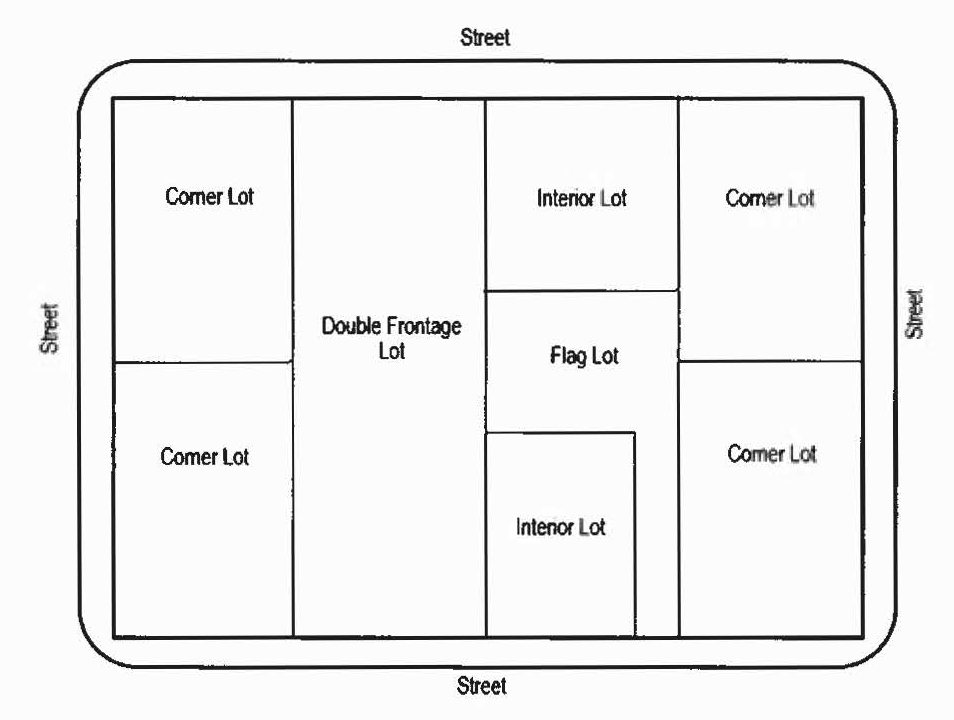
Lot, corner means a lot located at the intersection of two (2) or more streets. A lot abutting on a curved street or streets shall be considered a corner lot if straight lines drawn from the foremost point of the side lot lines to the foremost points of the lot (or an extension of the lot where it has been rounded by a street radius) meet an interior angle of less than one hundred thirty-five (135) degrees.
Lot, double frontage means a lot that extends through a block having frontage on two (2) streets that do not intersect at the boundary of the lot. A corner lot shall be considered having double frontage if it has access on three (3) or more sides.
Lot flag means a lot in which the bulk of, or buildable portion of the lot does not front on a public right-of-way but includes access with minimal frontage on a public right-of-way via only a narrow strip of land. A flag lot generally has the shape of an outstretched flag at the top of a flagpole in which the "flag" is the buildable portion of the lot, and the "pole" provides access to a public street.
Lot, interior means a lot other than a corner lot.
Lot of record means a lot that exists as shown or described on a recorded plat or deed in the records of the clerk of the superior court of Houston County.
Lot remnant means lots below minimum area and width left over after subdividing tracts of land.
Lot width means the distance between the side lot lines at the front setback line as measured along a line parallel to the front lot line or parallel to the chord thereof.
Lowest finished floor means the lowest finished floor of the lowest enclosed area, including basement. An unfinished or flood-resistant enclosure usable solely for parking of vehicles, building access, or storage located in an area other than a basement is not considered a building's lowest floor provided that such enclosure is not built to render the structure in violation of the applicable non-elevation design requirements of this section.
Lumen means a unit of luminous flux.
Luminaire means a complete lighting system, including a lamp and a fixture.
Maintenance, storage, and distribution facility means a use conducted by the city or another governmental entity to provide for the operation and maintenance of public facilities and infrastructure. This use type is regulated under the "government facilities" use category in article 4, use regulations.
Manufactured home means a structure that is transportable in one or more sections built on a permanent chassis and designed to be used with or without a permanent foundation when attached to the required utilities, and constructed to the Federal Mobile Home Construction and Safety Standards and rules and regulations promulgated by the U.S. Department of Housing and Urban Development. This use type is regulated under the "household living" use category in article 4, use regulations.
Manufactured home park or subdivision means a parcel or contiguous parcels of land divided into two (2) or more manufactured home lots for rent or sale. Sales or storage lots for unoccupied manufactured homes are not considered to be manufactured home parks. This use type is regulated under the "household living" use category in article 4, use regulations.
Manufacturing, heavy means a use engaged in the in the mechanical or chemical transformation of materials or substances into new products, including the assemblage of component parts, the creation of products, and the blending of materials. Heavy manufacturing includes those uses that produce noise, odor, vibration, dust, or hazard discernible beyond the property. Examples include, but are not limited to, refining or initial processing of raw materials, rolling, drawing, or extruding of metals; and log decking, storage, and ponding. This use type is regulated under the "manufacturing and production" use category in article 4, use regulations.
Manufacturing, light means manufacturing uses that do not produce odor, vibration, dust, or hazard discernible beyond the property. Examples include, but are not limited to, assembly of pre-fabricated parts, manufacture of electric, electronic, or optical instruments or devices; manufacture and assembly of artificial limbs, dentures, hearing aids, and surgical instruments; manufacture, processing, and packing of food products, cosmetics, and manufacturing of components, jewelry, clothing, trimming decorations, and any similar item. This use type is regulated under the "manufacturing and production" use category in article 4, use regulations.
Mausoleum. See Cemetery, columbarium, mausoleum.
Mean sea level means the average height of the sea for all stages of the tide.
Medical facility means a facility providing medical, psychiatric, or surgical service for sick or injured persons exclusively on an outpatient basis, including emergency treatment, diagnostic services, training, administration, and services to outpatients, employees, and visitors. This use type is regulated under the "health care facilities" use category in article 4, use regulations.
Mobile food vendor vehicle means a retail food establishment that reports to and operates from a commissary and is readily moveable as either:
(a)
A motorized wheeled vehicle designed and equipped to prepare and serve food ("motorized wheeled mobile food vendor vehicle"); or
(b)
A towed wheeled vehicle designed and equipped to prepare and serve food ("towed wheeled mobile food vendor vehicle").
Modular building unit. See Industrialized building.
Mortuary means an establishment engaged in undertaking services such as preparing the dead for burial or cremation and arranging and managing funerals. This use type is regulated under the "retail sales and service" use category in article 4, use regulations.
Motel. See Hotel or motel.
Mulch means a protective covering, such as pine straw, shredded bark, or other materials, spread evenly around trees, shrubs and ground covers to reduce evaporation, maintain even root temperatures, prevent erosion, and control weeds.
Multiple-family dwelling. See Dwelling, multiple-family.
Multiple-family dwelling (high-rise). See Dwelling, multiple-family (high-rise).
Multi-stem tree means where three (3) or more main stems arise from the ground from a single root crown or at a point just above the root crown and a tree whose mature height can be expected to exceed fifteen (15) feet and whose crown spread can be expected to exceed ten (10) feet.
Mural means a painting, mosaic, fresco, or other permanent artwork attached to or applied directly to the outside of a structure.
Museum means a building having public significance by reason of its architecture or former use or occupancy, or a building serving as a repository for a collection of natural, scientific, cultural, or literary curiosities or objects of interest or works of art and designed to be used by members of the public for loaning or viewing, with or without an admission charge. This use type is regulated under the "community service" use category in article 4, use regulations.
Nearly nude means a state of dress in which clothing covers no more than the genitals, pubic region, and areola of the female breast, as well as portions of the body covered by supporting belts, strips of cloth, straps or like devices, or a state of dress which leaves exposed a substantial portion of the buttocks so that the effect of achieved by such appearance is approximately the same as viewing nudity.
Nonconforming is a term applied to lots, structures, and uses of land which were lawful before the adoption of this chapter, or before the passage of an amendment to this chapter, but which are prohibited by, or which are not in compliance with, the requirements of this chapter.
Nude, nudity, and state of nudity.
(A)
The appearance of the human bare buttock, anus, male genitals, female genitals or the areola or nipple of the female breast; or
(B)
A state of dress which fails to opaquely and fully cover the human buttocks, anus, male or female genitals, pubic region or areola or nipple of the female breast.
Nursing home (rest home, convalescent) means an establishment which provides full-time convalescent or chronic care or both for three (3) or more individuals who are not related by blood or marriage to the operator and who, by reason of chronic illness or infirmity, are unable to care for themselves. No care for the acutely ill, or surgical or obstetrical services, shall be provided in such a home; a hospital or sanitarium shall not be construed to be included in this definition.
Office means a room or group of rooms used for conducting the affairs of a business, profession, or service industry. Examples include professional services such as lawyers, accountants, engineers, architects, or real estate agents; data processing; and sales offices.
Operator means the owner, permit holder, custodian, manager, operator, or person in charge of any permitted or licensed premises.
Ordinary repair and maintenance means any work, the purpose and effect of which is to correct or prevent any deterioration or decay of, or damage to, a structure or any part thereof and to restore the structure, as nearly as may be practicable, to its condition prior to such deterioration, decay or damage using materials which are of a design, color and outer appearance as close as practicable to the original.
Ornamental and understory street trees means any evergreen or deciduous tree whose mature height can be expected to exceed fifteen (15) feet and whose crown spread can be expected to exceed ten (10) feet.
Outdoor lighting means the nighttime illumination of an outside area or object by any manmade device located outdoors that produces light by any means.
Outdoor entertainment facility means an establishment having as its principal or predominant use the offering of outdoor participatory or spectator entertainment and which may sell alcohol for consumption on the premises. Sandwiches, light meals, snacks, and/or full service meals are available for consumption on the premises but are not the principal or predominant use of the establishment. Examples include, without limitation, stadiums and amphitheaters. This use type is regulated under the "retail sales and service" use category in article 4, use regulations.
Outdoor storage lot means any portion of a site where items are regularly stored, including, but not limited to, items such as pipe, building materials, lumber, plumbing supplies, damaged vehicles, or salvaged construction equipment. Not included in this definition is the short-term storage for sale of seasonal items such as grass seed, fertilizer, and plants. This use type is regulated under the "warehouse and freight movement" use category in article 4, use regulations.
Outparcel means a separate lot, site, parcel, or tract of land located within a larger development. An outparcel is typically associated with a retail shopping center or similar use.
Open space means a yard area which is not used for or occupied by a driveway, off-street parking, loading space, drying yard or refuse storage space.
Oversized vehicle means any vehicle that exceeds twenty-three (23) feet in length, eighty (80) inches in width, or eighty-five (85) inches in height, excluding recreational vehicles and electric utility bucket trucks.
Owner means the individual, partnership, firm, association, joint venture, public or private corporation, trust, estate, commission, board, public or private institution, utility, cooperative, state agency, municipality or other political subdivision, any interstate body, or any legal entity, who owns a legal interest in the property or the person in control of the property.
Parking lot means any area not within a structure used to maneuver and park vehicles. Areas used for the display or storage of farm and lawn equipment, golf carts, ATVs, utility trailers, and similar equipment for sale or rent are not considered parking lots. A parking lot may be an accessory use or a principal use. As a principal use, this use type is regulated under the "parking, commercial" use category in article 4, use regulations.
Parking structure means a multi-level structure designed to accommodate vehicular parking spaces that are fully or partially enclosed or located on the deck surface of a building. This definition includes parking garages, deck parking, and underground or underbuilding parking areas. This use type is regulated under the "parking, commercial" use category in article 4, use regulations.
Parking space, off-street means an area not located within a street right-of-way adequate for parking a motor vehicle with room for opening doors on both sides, together with properly-related access to a public street arranged so that no maneuvering incidental to parking shall occur on any public street and so that a vehicle may be parked or unparked without moving any other automobile.
Passenger terminal (surface transportation) means a facility or location that receives and discharges passengers and at which facilities and equipment required for their operation are provided. Examples include terminals for bus, trolley, taxi, light rail, railroad, shuttle van, or other similar vehicular services. This use type is regulated under the "transportation terminals" use category in article 4, use regulations.
Pawn shop means a business or use that regularly loans money on the security of pledged tangible goods such as jewelry, cameras, or like personality or that purchases such goods on the condition that they may be redeemed or repurchased by the seller for a fixed price within a fixed period of time. This use type is regulated under the "retail sales and services" use category in article 4, use regulations.
Permanent sign means any sign attached securely to a building, roof, wall or a canopy or the ground by means of concrete, bolts, metal braces, treated wood or cedar and continuing in the same state or without essential change to the sign structure.
Permit means the authorization necessary to begin a land use activity under the provisions of this chapter.
Permitted or licensed premises means any premises that requires a license and/or permit and that is classified as a sexually oriented business.
Permittee and licensee means a person in whose name a permit and/or license to operate a sexually oriented business has been issued, as well as the individual listed as an applicant on the application for a permit and/or license.
Person means any individual, partnership, firm, association, joint venture, public or private corporation, trust, estate, commission, board, public or private institution, utility, cooperative, state agency, municipality or other political subdivision of this state, any interstate body, or any legal entity.
Personal care home means buildings, structures, or portions thereof for persons who reside on a 24-hour basis in a supervised environment and who receive custodial care.
Personal care home, congregate means a personal care home which provides care to six (6) or more persons. This use type is regulated under the "institutional" use category in article 4, use regulations.
Personal care home, family means a personal care home in a single-family detached residence, which provides care to up to five (5) persons. This use type is regulated under the "household living" use category in article 4, use regulations.
Personal care homes, group means a personal care home in a residence or other type building or buildings, non-institutional in character, which offers care to seven (7) through fifteen (15) persons. This use type is regulated under the "group living" use category in article 4, use regulations.
Personal services, general means an establishment primarily engaged in the provision of frequent or recurrent needed services of a personal nature. Examples include, without limitation, beauty and barbershops, shoe repair shops, and tailor shops. This use type is regulated under the "retail sales and service" use category in article 4, use regulations.
Planned unit development (PUD) district means a zoning district where a variety of residential and nonresidential uses are permitted on the basis of a master plan and other specific development controls.
Planning commission means the City of Perry Planning Commission.
Plat means a map, plan or layout of a county, city, town, section or subdivision indicating the location and boundaries of properties.
Playschool means a school for pre-kindergarten children ranging in age from three (3) to four (4) years and which operates for less than four (4) hours a day.
Post office means a use which provides service windows for mailing packages and letters, post office boxes, offices, vehicle storage areas, and sorting and distribution facilities for mail. This use type is regulated under the "government facilities" use category in article 4, use regulations.
Prefabricated building display and sales means a retail sales and service use in which prefabricated buildings (fabricated off-site and transported to the use location) are displayed and sold. This use type is regulated under the "retail sales and service" use category in article 4, use regulations.
Preliminary plat means the preliminary plat of a subdivision submitted pursuant to the subdivision regulations (subsection 2-3.11).
Preschool means a school for children primarily between birth and five (5) years of age. This use type is regulated under the "day care" use category in article 4, use regulations.
Principal structure means a structure or building having significant or primary use and justifying its own utilization, such as a dwelling or office building, as contrasted to accessory structures which are incidental or subordinate to primary structures and do not alone justify their utilization, such as a tool shed or auto garage used in conjunction with a dwelling. Certain structures may be either principal or accessory depending upon utilization, such as a parking garage as an accessory structure to an apartment or as a principal structure when operated commercially in a business area.
Principal use means the significant or primary activity carried out within a structure or upon land.
Primary lot frontage means the primary lot frontage is the portion of a lot that abuts the street from which the lot derives its street address.
Privacy wall means a continuous visual screen not less than six (6) feet in height. The screen shall be a windowless wall, fence or other type of impenetrable and opaque material that is aesthetically compatible with existing development.
Private street/private access way means a means of vehicular access conveyed to property owner's association or condominium regime incorporated pursuant to O.C.G.A. and designed and constructed to the standards of the design and specifications manual.
Property owner of record means the person identified as owner by county tax records.
Public building means any building owned, leased or held by the United States, the state, the county, the city, any special purpose district, any school district, or any other agency or political subdivision of the state or the United States, which building is used for governmental or other public purposes.
Public park or recreation area means public premises which have been designated for park or recreational activities, including, but not limited to, a park, playground, nature trail, swimming pool, gymnasium, recreational center, reservoir, athletic field, basketball or tennis court, pedestrian/bicycle path, open space, wilderness area or similar public premises within the city which are under the control, operation or management of the city park and recreation authorities or the equivalent state, county or recreation district authorities. This use type is regulated under the "parks and open space" use category in article 4, use regulations.
Public property includes that property of the city or a city agency, including that owned entirely by such public body, or over which it holds a right-of-way or easement on any streets, roads, parks, malls, or other public land. Private property that is subject to ad valorem property taxes and all easements and rights-of-way across such property are excluded from this definition.
Rain sensor means an automatic device that will override the irrigation cycle of an irrigation system, thus turning it off, when a predetermined amount of rain has fallen.
Recreational vehicle means any vehicle designed and/or used for temporary living and sleeping or recreational purposes, including pick-up coaches (cab-over camper), motorized homes, boats, travel trailers, camping trailers, jet skis, and snowmobiles, and which does not meet the specifications required for a manufactured home. This definition includes trailers used to transport such vehicles.
Recreational vehicle park means a parcel of land which is used solely for the rental or lease of lots for transient campers, trailers, motor homes, or temporary parking of any recreational vehicle that is not a manufactured home. This use type is regulated under the "visitor accommodations" use category in article 4, use regulations.
Recreational vehicle rental and sales means the display and sales or rental of recreational vehicles. This use type is regulated under the "vehicle sales and services" use category in article 4, use regulations.
Recycling drop-off center means a parcel of land on which wastes or used and secondhand materials are bought, sold, exchanged, stored, processed, or handled. Materials include, but are not limited to, scrap iron, paper, rags, rubber tires, bottles, discarded goods, machinery, or two (2) or more inoperable motor vehicles. This use type is regulated under the "waste-related services" use category in article 4, use regulations.
Registered civil engineer means a civil engineer properly registered and licensed in the state by the state board of engineering examiners.
Registered land surveyor means a land surveyor properly registered and licensed in the state by the state board of land surveyors.
Registered landscape architect means a landscape architect properly registered and licensed in state by the board of licensing examiners.
Religious institution means a structure or place in which worship, ceremonies, rituals, and education pertaining to a particular system of beliefs are conducted, together with its accessory buildings and uses (including buildings used for educational and recreational activities), and which are operated, maintained, and controlled under the direction of a religious group. Accessory uses may include school facilities, parking, day care, cemeteries, columbaria, mausoleums, caretaker's housing, pastor's housing, and group living facilities such as convents. This use type is regulated under the "institutions" use category in article 4, use regulations.
Regulatory flood elevation, for purposes of this chapter, means the crest elevation in relation to mean sea level expected to be reached by the one percent flood (base flood elevation) plus two (2) feet.
Restaurant, drive-in means an eating and/or drinking establishment which caters to motor driven vehicle business where the person being served consumes his food and/or drink while sitting in a motor-driven vehicle, as opposed to a restaurant serving exclusively inside an enclosed building.
Retail sales and services, general means a commercial enterprise that provides goods and/or services directly to the consumer where such goods are available for immediate purchase and removal from the premises by the purchaser. Examples include, without limitation, stores selling, leasing, or renting consumer, home, and business goods such as art, art supplies, bicycles, cameras, clothing, dry goods, electronic equipment, fabric, furniture, gifts, hardware, home improvements, household products, jewelry, pet food, pharmaceuticals, indoor plants, printed material, stationary and videos; wineries; and, auction services. This use type is regulated under the "retail sales and service" use category in article 4, use regulations.
Right-of-way means an interest in land to the city or GDOT which provides for the perpetual right and privilege of the city or GDOT, its agents, franchise holders, successors, and assigns to construct, install, improve, reconstruct, remove, replace, inspect, repair, maintain, and use a public street, including related and customary uses of street rights-of-way such as sidewalks, bike paths, landscaping, mass transit facilities, traffic control, traffic control devices and signage, sanitary sewer, storm water drainage, water supply, cable television, electric power, gas, and telephone transmission and related purposes in, upon, over, below, and across the rights-of-way.
Right-of-way line means the dividing line between a lot, tract or parcel of land and a continuous street, railroad, or other public utility right-of-way.
Roadway means that portion of a street intended for the use by vehicular traffic.
Roadway drainage structure means bridges, culverts and ditches associated with roadway construction, which allow stream flows to move freely under a stream crossing or to convey stormwater runoff from a roadway to a stream.
Roof plane means one or more portions of a pitched roof that maintain the same pitch or cover the same portion of a building.
Roominghouse. See Boardinghouse.
Runoff means that portion of precipitation falling within a watershed basin that is not evaporated into the atmosphere; captured by vegetation; collected in depressions; or infiltrated into the soil that results in the flowing over the surface of the ground or collecting in channels or storm sewers.
Runway means a defined area on an airport prepared for landing and takeoff of aircraft along its length.
School, public or private means an institution at the elementary, middle, or high school level that provides educational instruction to students. This definition does not include business schools or colleges. This use type is regulated under the "educational facilities" use category in article 19-4, use regulations.
Screening means any constructed wall, fence, building or living plant material used for the purpose of visually or functionally separating adjacent land uses as required by this chapter.
Sediment means solid material, both mineral and organic, that is in suspension; is being transported; or has been moved from its site of origin by air, water, ice, or gravity as a product of erosion.
Sediment control plan means a plan for the control of soil erosion and sedimentation resulting from land-disturbing activity.
Sedimentation means the processes which operate at or near the surface of the ground that deposit soils, debris, and other materials either on other ground surfaces or in stream channels.
Self-service storage facility means a building or group of buildings divided into sections for use for storage of items, either temporary or long-term, and not to be used for any other purpose (such as small offices, garages, etc.). A self-service storage facility is also called a "mini-warehouse." This use type is regulated under the "self-service storage" use category in article 4, use regulations.
Self-service vending unit means a freestanding machine which is activated by inserting tokens or money into the machine or activated by use of electronic payment and dispenses individual or bulk merchandise to the customer and:
(A)
The full length of one of its longest sides is located more than one foot from a wall of a principal building; or
(B)
The unit is not located completely under the roof, overhang, awning, or colonnade of a principal building; or
(C)
Exceeds eighty (80) inches in height; or
(D)
Exceeds forty-eight (48) inches in width; or
(E)
Exceeds thirty-six (36) inches in depth.
Semi-cutoff fixture means an outdoor light fixture shielded or constructed in such a manner that it emits no more than five (5) percent of its light above the horizontal plane of the fixture and no more than twenty (20) percent of its light ten (10) degrees below the horizontal plane of the fixture.
Service and repair establishment means establishments primarily engaged in the provision of repair services to individuals and households, rather than businesses, but excluding automotive and equipment repair types. Typical uses include appliance repair shops, shoe repair, watch, or jewelry repair shops or repair of musical instruments. This use type is regulated under the "retail sales and service" use category in article 4, use regulations.
Setback means the minimum distance by which any building or structure must be separated from a street right-of-way or lot line.
Sexually oriented business means an adult bookstore or adult video store, an adult cabaret, an adult motion picture theater, a semi-nude model studio, or a sex paraphernalia store as defined in chapter 15, article VIII of the City Code.
Shade tree means any evergreen or deciduous tree whose mature height can be expected to exceed thirty-five (35) feet and whose crown spread can be expected to exceed thirty (30) feet.
Shielding means a design feature or a device that is applied to a luminaire to prevent its luminous output from being visible from selected locations or horizontal and/or vertical angles.
Shopping center means a group of stores planned and designed for the site on which it is built, functioning as a unit, with off-street parking, landscaped areas, and pedestrian malls or plazas provided on the property as an integral part of the unit. This use type is regulated under the "retail sales and service" use category in article 19-4, use regulations.
Short-term rental unit means a privately owned residential dwelling or any separable portion of such dwelling, rented for occupancy for lodging or sleeping purposes for a period of less than thirty (30) consecutive days, counting portions of calendar days as full days. This term is not applicable to other types of visitor accommodations, health care, or institutions. This use type is regulated under the visitor accommodations use category in article 4, use regulations.
Shrubs means self-supporting woody plants, either deciduous or evergreen, with several stems and a normal mature height of three (3) to twenty (20) feet.
Low-growing shrub means any shrub easily maintained at thirty (30) to forty (40) inches in height.
Intermediate shrub means any shrub easily maintained at four (4) to six (6) feet in height.
Major screening shrub means any shrub easily maintained at six (6) to twenty (20) feet in height.
Sight triangle means measured from the curb or edge of the pavement, the sight triangle is the triangular area created by a line connecting points on the front and side for lines at a distance as indicated in the design and specifications manual.
Site plan means a drawing which puts forth the pattern in the dimensions of the activity, circulation and visual form to take place on a particular piece of land.
Sky glow means the brightening of the night sky that results from the reflection of radiation (visible and nonvisible) scattered from the constituents of the atmosphere (gaseous molecules, aerosols, and particulate matter), in the direction of the observer. It is comprised of two (2) separate components: natural sky glow, that part of the sky glow attributable to radiation from celestial sources and luminescent processes in the earth's upper atmosphere; and artificial sky glow, that part of the sky glow attributable to manmade sources of radiation (e.g., outdoor electric lighting), including radiation emitted directly upwards and radiation reflected from the earth's surface.
Slope means an incline from the horizontal expressed in an arithmetic ratio of horizontal magnitude to vertical magnitude. (Example: Slope = 3:1 means three (3) feet horizontal to one foot vertical.)
Start of construction means the first placement of permanent construction of a structure (other than a manufactured home) on a site such as the pouring of slabs or footings or any work beyond the stage of excavation, including the relocation of a structure. Permanent construction does not include installation of streets and/or walkways; excavation for a basement, footings, piers or foundations; or erection of temporary forms. For a structure (other than a manufactured home) without a basement or poured footings, the start of construction includes the first permanent framing or assembly of the structure, or any part thereof, on its piling or foundation.
State means the State of Georgia.
Stormwater management means the collection, conveyance, storage, treatment, and disposal of stormwater runoff in a manner designed to minimize the following: channel erosion; flood damage; runoff rates; and water quality degradation.
Stormwater management facilities or systems means structures that are designed for the collection, conveyance, storage, treatment, and disposal of stormwater runoff.
Stormwater management plan means a plan for the control of stormwater runoff resulting from land-disturbing activity.
Stormwater master plan means a plan developed for a watershed, or part thereof, that has been approved by city council to guide the design and development of the drainage system addressed by the plan.
Story means that portion of a building included between the surface of any floor and the surface of the floor next above it, or if there is no floor above it, then the space between the floor and the ceiling next above it.
Story, half means a space under a sloping roof that has the line of intersection of roof decking and wall face not more than three (3) feet above the top floor level and in which space not more than two-thirds (⅔) of the floor area is finished for occupancy. A half story containing independent living quarters shall be counted as a full story.
Street means a public or private thoroughfare which affords the principal means of access to abutting property.
Street, half means a street which does not meet the minimum right-of-way widths as set forth in this chapter.
Street line means the dividing line between a lot, tract or parcel of land and a contiguous street.
Street width means the shortest distance between the lines delineating the rights-of-way of a street.
Structural alterations means any change to the supporting members of a building, such as foundation, bearing walls, columns, beams, girders, rafters, etc.
Structure means anything constructed or erected that requires permanent location on the surface of the land. The term "structure" does not include features such as ornamental pools, planting boxes, sculpture or bird baths, open terraces, walkways, driveways, walls or fences, recreational equipment, flagpoles, light standards, underground fallout shelters, mailboxes, gatehouses, burial vaults or bus shelters.
Subdivider means any person, individual, firm, partnership, association, corporation, estate or trust or any other group, agent, or combination thereof acting as a unit, dividing or proposing to divide land so as to constitute a subdivision as defined in this section.
Subdivision means the division of a tract or parcel of land into two (2) or more lots, building sites, or other divisions for the purpose, whether immediate or future, of sale, lease, or building development, and includes all divisions of land involving a new street or change in existing streets, and includes re-subdivision which would involve the further division or relocation of lot lines of any lot or lots within a subdivision previously made and approved or recorded according to law; or the alteration of any streets or the establishment of any new streets within any subdivision previously made and approved or recorded according to law, and includes combinations of lots of record.
Substantial damage means damage of any origin including fire, flood, lateral earth movement, war, or wind sustained by a structure where the cost of restoring the structure to its before-damaged condition would equal or exceed fifty (50) percent of its before-damaged market value. For purposes of this chapter, any structure flooded four (4) or more feet above its lowest finished floor shall be considered "substantially damaged."
Substantial enlargement of a sexually oriented business means the increase in floor areas occupied by the business by more than twenty-five (25) percent, as the floor areas exist on the effective date of the ordinance from which this article is derived.
Substantial improvement means for a structure built prior to the enactment of the ordinance from which this section is derived, any reconstruction, rehabilitation, addition, or other improvement of a structure the cost of which equals or exceeds fifty (50) percent of the market value of the structure before the start of construction of the improvement. This term "substantial improvement" includes structures that have incurred repetitive loss or substantial damage, regardless of the actual repair work performed. For the purpose of this definition, the term "substantial improvement" is considered to occur when the first alteration of any wall, ceiling, floor or other structural part of the building commences whether or not that alteration affects the external dimensions of the structure. The term "substantial improvement" does not, however, include either any project for improvement of a structure to comply with state or local health, sanitary or safety code specifications which are solely necessary to ensure safe living conditions; or any alteration of a structure listed on the National Register of Historic Places or a state inventory of historic places.
Suggested plant list means the list of trees, shrubs, and ground covers approved for use in the city for compliance with this chapter as reflected in the design and specification manual.
Tattoo/tattooing means to indelibly mark or color the skin by subcutaneous introduction of nontoxic dyes or pigments. The practice of tattooing does not include the removal of tattoos, nor the practice of micropigmentation, branding, cutting, scarification, skin braiding, or the mutilation of any part of the body.
Temporary means a specified period of time for which an activity or use is authorized.
Temporary sign means any sign that is not a permanent or portable sign.
Temporary vehicular turnaround means a designated surface area as specified by the administrator located within a right-of-way or easement that provides sufficient turning capacity for emergency vehicles.
Townhouse means a single-family dwelling unit which is erected in a row as part of a single building, on adjoined lots, each being separated from the adjoining unit or units by an approved fire resistant party wall or walls extending from the basement or cellar floor to the roof along the dividing lot line.
Towing service means a business that specializes in the removal of a motor vehicle by towing, carrying, hauling, or pushing from public or private property. This shall not include an automobile servicing use that has a tow truck and repair vehicles on site. This use type is regulated under the "vehicle sales and service" use category in article 4, use regulations.
Tract means an area, parcel, site, piece of land, or property that is the subject of a development proposal and application.
Trade school means a school conducted as a commercial enterprise for teaching skills in which machinery and outdoor activities are employed as a means of instruction. Trade schools may employ both indoor and outdoor classroom activities, such as truck driving, construction and carpentry, and vehicle repair. Incidental instructional services in conjunction with another primary use shall not be considered a trade school. This use type is regulated under the "educational facilities" use category in article 4, use regulations.
Transfer of ownership or control of a sexually oriented business means:
(A)
The sale, lease, or sublease of the business.
(B)
The transfer of securities that constitute a controlling interest in the business, whether by sale, exchange, or similar means.
(C)
The establishment of a trust, gift or other similar legal devise which transfers ownership or control of the business, except for transfer by bequest or other operation of law upon the death of a person possessing the ownership or control.
Tree means self-supporting woody plants of species that normally grow to an overall height of at least fifteen (15) feet.
Small tree means any tree normally maturing at a height of less than thirty (30) feet.
Intermediate deciduous tree means any deciduous tree normally maturing at a height between thirty (30) and fifty (50) feet.
Major deciduous tree means any deciduous tree normally maturing at a height of at least fifty (50) feet.
Small evergreen tree means any evergreen tree with a mature height of at least fifteen (15) feet.
Major evergreen tree means any evergreen tree with a mature height of at least thirty (30) feet.
Tree density standard means a minimum number of tree density units per acre that must be achieved on a property after development.
Tree density unit means a credit assigned to a tree, based on the diameter of the tree, in accordance with tables contained in this article.
Tree form shrub means a large deciduous or evergreen shrub that has been pruned of its lower limbs and other foliage, to a minimum height of four (4) feet, to reveal the main vertical supporting branches.
Tree protection zone (TPZ) means a designated area around a tree or group of trees to be saved usually set off from construction activity by the use of a fence or other protective barrier thereby keeping the critical root zone of the tree protected and free from unwanted harmful activities. The area of the TPZ should be equal to or greater than the critical root zone.
Trout streams means all streams or portions of streams within the watershed as designated by the Game and Fish Division of the Georgia Department of Natural Resources under the provisions of the Georgia Water Quality Control Act, O.C.G.A. § 12-5-20 et seq. Streams designated as primary trout waters are defined as water supporting a self-sustaining population of rainbow, brown or brook trout. Streams designated as secondary trout waters are those in which there is no evidence of natural trout reproduction, but are capable of supporting trout throughout the year.
Truck or freight terminal means an area and building where buses, trucks, and cargo are stored, where loading and unloading is carried on regularly, and where minor maintenance of these types of vehicles is performed. This use type is regulated under the "warehouse and freight movement" use category in article 4, use regulations.
Truck or trailer rental means the rental of truck or trailer equipment primarily intended for individual use and minor residential gardening and construction projects. This use does not include the rental, storage, or maintenance of large construction equipment. This use type is regulated under the "vehicle sales and service" use category in article 4, use regulations.
Truck stop or travel plaza means an establishment primarily engaged in the maintenance, servicing, storage, parking or repair of over-the-road trucks and similar commercial vehicles, including the sale of motor fuels or other petroleum products, and the sale of accessories or equipment for such vehicles. A truck stop or travel plaza may also include overnight accommodations, showers, vehicle scales, restaurant facilities, and/or other services intended mainly for use by truck drivers and interregional travelers. This use type is regulated under the "industrial services" use category in article 4, use regulations.
Unacceptable species means plant species which will not be counted toward the total tree requirements of this chapter.
Utility, major means services of a regional nature that normally entail the construction of new buildings or structures such as generating plants and sources; electrical switching facilities, stations and substations; water and wastewater treatment plants; and, similar facilities. This use type is regulated under the "utilities" use category in article 4, use regulations.
Utility, minor means services that are necessary to support development within the immediate vicinity and that involve only minor structures. Included in this use type are small facilities such as transformers, relay and booster devices; and well water and sewer pump stations. This use type is regulated under the "utilities" use category in article 4, use regulations.
Utility service area means that portion of a site occupied by items such as garbage dumpsters and compactors; large air-conditioning units; aboveground storage or fuel tanks; major electrical transformers; and similar equipment.
Variance means a grant of relief to a person from the requirements of this section which permits construction in a manner otherwise prohibited by this section where specific enforcement would result in unnecessary hardship.
Vehicular use area means any area which is not located within an enclosed structure, and which is devoted to a use by and for motor vehicles, including parking (accessory or non-accessory) or storage of automobiles, trucks or other vehicles, service areas and driveways. Areas designated solely for the display of new and used vehicles for sale or lease, and any area designed to be used solely for access between a street and a vehicular use area is not considered part of the vehicular use area.
Veterinary clinic means a facility for the care and treatment of small animals, including household pets. Such facilities may be entirely indoors or may have both indoor and outdoor components. This use type is regulated under the "retail sales and service" use category in article 4, use regulations.
Wall means an erection of stone, brick, or other material raised to some height and intended for purposes of security or enclosure.
Wall, bearing means a wall supporting imposed weight (live load) in addition to its own weight (dead load).
Wall pack means a type of light fixture typically surface-mounted on a vertical wall surface.
Wall, retaining means a wall designed to prevent the lateral displacement of soil or any other material.
Warehouse means a use engaged in storage and distribution of manufactured products, supplies, and equipment, excluding bulk storage of materials that are flammable or explosive or that present hazards or conditions commonly recognized as offensive. This use type is regulated under the "warehouse and freight movement" use category in article 19-4, use regulations.
Waste disposal or treatment operation means a facility or group of units used for the disposal or treatment of industrial or domestic wastes and for the reduction and handling of solids and gases removed from such wastes. This use type is regulated under the "waste-related services" use category in article 19-4, use regulations.
Watercourse means any natural or artificial watercourse, stream, river, creek, channel, ditch, canal, in which water flows either continuously or intermittently and which has a definite channel, bed and banks, and including any area adjacent thereto, subject to inundation by reason of overflow or floodwater.
Wholesale establishment means an establishment primarily engaged in selling and distributing merchandise to retailers, industrial, commercial, institutional, or professional business users, or to other wholesalers; and acting as agents or brokers by buying merchandise for, or selling merchandise to, such individuals or companies. Examples include, without limitation, feed mills, granaries, and elevators; household moving and general freight storage; cold storage plants, including frozen food lockers; major wholesale distribution centers; truck, or air freight terminals; bus barns; parcel services; major post offices; grain terminals; and the stockpiling of sand, gravel, or other aggregate materials. This use type is regulated under the "wholesale sales" use category in article 19-4, use regulations.
Yard means an open space at grade between a building and the adjoining lot lines.
Yard, front means an open space at grade between the front of a building and the front lot line, generally adjacent to a street, and extending the full width of the lot.
Yard, rear means an open space at grade between the rear of a building and the rear lot line and extending the full width of the lot.
Yard, side means an open space at grade between the side of a building and the side lot line extending from the front yard to the rear yard or from the front lot line to the rear lot line when a front and rear setback is not required.
Yard, special means an open space at grade between the side of a building and the side lot line adjacent to a street right-of-way extending from the front yard to the rear yard or from the front lot line to the rear lot line when a front and rear setback is not required.
Youth activity center means a boys club, a girls club or any other facility that is not a school but which provides entertainment, recreation, crafts, tutorials or other quality of life enhancements for minors, whether a nonprofit facility or otherwise. This use type is regulated under the "community service" use category in article 4, use regulations.
Zoning district map means a map that graphically delineates the boundaries of all mapped districts within the corporate boundary of the city.
Zoning ordinance means this chapter and any other adopted regulations of the city pertaining to the development and use of land.
(Ord. No. 2017-25, § 2, 12-19-17; Ord. No. 2018-08, §§ 1, 2, 6-19-18; Ord. No. 2019-18, § 1, 10-1-19; Ord. No. 2020-10, § 1, 7-21-20; Ord. No. 2021-16, §§ 1, 2, 8-17-21; Ord. No. 2021-17, § 1, 8-17-21; Ord. No. 2021-26, § 1, 12-7-21; Ord. No. 2022-20, § 1, 6-21-22; Ord. No. 2022-27, § 1, 8-2-22; Ord. No. 2022-32, §§ 1, 2, 9-20-22; Ord. No. 2022-39, §§ 1, 2, 10-18-22; Ord. No. 2023-26, §§ 1, 2, 8-1-23; Ord. No. 2023-28, § 1, 8-15-23; Ord. No. 2024-02, § 2, 1-16-24; Ord. No. 2024-10, § 1, 6-18-24; Ord. No. 2024-13, § 1, 7-2-24; Ord. No. 2025-01, § 1, 1-7-25; Ord. No. 2025-28, § 1, 9-16-25)

