
Perry City Zoning Code
ARTICLE 6
- DEVELOPMENT AND DESIGN STANDARDS
Sec. 6-1. - Off-street parking and loading.
6-1.1. Intent. The intent of this section is to allow flexible methods of providing an adequate number of parking and loading spaces, while creating or improving a pedestrian-oriented community, and reducing excessive paved surfaces which lead to unnecessary heat buildup and stormwater runoff.
6-1.2. Applicability.
(A)
General. The off-street parking, bicycle parking, and loading standards of this section shall apply to any new building constructed and to any new use established.
(B)
Exemptions and modifications.
(1)
The off-street parking requirements in Table 6-1-1 shall not apply to properties in the C-3 district. Loading standards of this section shall not apply in the C-3 district. However, prior to issuance of any building permit or certificate of occupancy, whichever is issued first, the owner of any new building constructed or any new use established in the C-3 district shall submit to the administrator an estimate of the parking requirements that the building or use is expected to generate, based on the ratios established in this section, and an indication of where or how that parking will be provided.
(2)
The off-street parking, bicycle parking, and loading standards of subsections 6-1.2 and 6-1.3 shall not apply to parking areas which constitute the principal use of a site (commercial parking lots and parking structures). The maximum off-street parking standards of subsections 6-1.2 and 6-1.3 shall not apply to developments which incorporate a multi-level parking structure.
(C)
Expansions and alterations. The off-street parking, bicycle parking, and loading standards of this section shall apply when an existing structure or use is expanded or enlarged. Additional off-street parking, bicycle parking, and loading spaces shall be required based on the enlarged or expanded area, provided that in all cases the number of off-street parking, bicycle parking, and loading spaces provided for the entire use (pre-existing plus expansion) must equal at least seventy-five (75) percent of the minimum ratio established in this section.
(D)
Change of use. Off-street parking, bicycle parking and loading shall be provided for any change of use pursuant to the following:
(1)
If the change of use constitutes less than fifty (50) percent of the floor area of a structure or lot accommodating one or more uses (within a five-year period), the property shall comply with the provisions of this section to the greatest extent practicable as determined by the administrator provided the off-street parking and loading requirements equal at least seventy-five (75) percent of the minimum ratio established by this section.
(2)
If the change of use constitutes fifty (50) percent or more of the floor area of a structure or lot accommodating one or more uses (within a five-year period), the property shall comply with the provisions of this section to the greatest extent practicable as determined by the administrator provided the off-street parking and loading requirements equal at least one hundred percent (100) percent of the minimum ratio established by this section.
6-1.3. Off-street parking requirements.
(A)
Schedule A. Unless otherwise expressly stated in this chapter, off-street parking spaces shall be provided in accordance with Table 6-1-1.
Table 6-1-1: Off-Street Parking Requirements Schedule A
(B)
Schedule B. Uses that reference "Schedule B" have widely varying parking and loading demand characteristics, making it impossible to specify a single off-street parking or loading standard. Upon receiving a development application for a use subject to Schedule B standards, the administrator shall apply the off-street parking and loading standard specified for the listed use that is deemed most similar to the proposed use or establish minimum off-street parking requirements on the basis of a parking and loading study prepared by the applicant. Such a study shall include estimates of parking demand based on recommendations of the Institute of Transportation Engineers (ITE), or other acceptable estimates as approved by the administrator, and should include other reliable data collected from uses or combinations of uses that are the same as or comparable with the proposed use. Comparability will be determined by density, scale, bulk, area, type of activity, and location. The study shall document the source of data used to develop the recommendations.
(C)
Off-street bicycle parking requirements. The minimum number of parking spaces for bicycles shall be equal to one percent of the total number of off-street parking spaces provided. A minimum of two (2) bicycle parking spaces shall be provided for all sites.
6-1.4. Off-street loading requirements. Unless otherwise approved by the administrator, every building or structure erected and used for business, trade, or industry shall provide space as indicated in this section for the loading and unloading of vehicles, with access to a public street or alley. The spaces shall be arranged so that no vehicle will be required to back onto a public street or way and so that vehicles may maneuver for loading and unloading entirely within the property lines of the premises. Off-street loading spaces shall be provided in the following numbers:
(A)
Commercial uses. Each use shall provide one loading space, measuring ten (10) feet by twenty-five (25) feet with overhead clearance of fourteen (14) feet, for each twenty thousand (20,000) square feet of gross floor area or fraction thereof.
(B)
Service and industrial uses. Each use shall provide loading spaces that measure ten (10) feet by fifty (50) feet with overhead clearance of fourteen (14) feet, based on the gross floor area as shown below:
Table 6-1-2: Off-Street Loading for Wholesale and Industrial Uses
(C)
Bus and truck terminals. Sufficient spaces to accommodate the maximum number of buses or trucks to be loading, unloading or stored at the terminal at any one time.
6-1.5. Computation of parking and loading requirements.
(A)
Fractions. When measurements of the number of required spaces result in a fractional number, any fraction of less than one-half (½) shall be rounded down to the next lower whole number and any fraction of one-half (½) or more shall be rounded up to the next higher whole number.
(B)
Multiple uses. Except as provided in subsection 6-1.8, lots containing more than one use must provide parking and loading in an amount equal to the total of the requirements for all uses.
(C)
Gross floor area. With regard to the parking standards in this section, square footage refers to the gross floor area of a building, excluding warehouse and storage space which is accessory to the primary use. With regard to the loading standards in this section, square footage refers to the total gross floor area of a building.
(D)
Parking for unlisted uses. Parking requirements for uses not specifically listed in Table 7-1-1 shall be determined by the administrator based on the provisions of Schedule B.
(E)
Reduction of automobile parking for alternative transportation vehicles. The administrator may reduce the required number of off-street parking spaces by one automobile space for every six (6) bicycle parking spaces provided. The administrator may reduce the required number of off-street parking spaces if spaces for vehicles such as golf carts or other types of alternative transportation vehicles are provided, on a case-by-case basis.
6-1.6. Parking design and location standards. In addition to the design standards listed in section 6-6, the following shall apply to all parking lots:
(A)
Surfacing and maintenance. All required parking and vehicular driving surfaces shall be graded for drainage in accordance with article 7, stormwater management. All parking and vehicular driving surfaces required pursuant to minimum spaces required in Table 6-1-1, except for parking and driveways for one-family detached and two-family dwellings, shall be surfaced with concrete or asphalt concrete pavement except as required or allowed in subsections 6-1.6(B), (D) and (E) of this section. Alternative materials may be approved by the administrator. Alternative materials shall only be considered if such material exhibits equivalent load bearing and wear characteristics as concrete or asphalt concrete. Gravel is not an acceptable alternative paving material except for overflow parking and vehicular use areas located in an M-1 or M-2 zoning district. All surfaces shall be maintained in sound condition free of potholes, weeds, dust, trash, and debris.
(B)
Low impact development (LID) techniques required. All parking areas, for uses other than single-family detached and two-family dwellings, which exceed the number of parking spaces required by the minimum spaces required column and equal to or less than the maximum spaces allowed column as listed in Table 6-1-1 should incorporate low impact development (LID) techniques for the area in which there are excess spaces. Each LID technique shall be approved by the administrator. Examples include, but are not limited to, bioretention areas and vegetative filter strips. The LID technique shall be sized to treat the first 0.5 inches of runoff from the excess spaces and will be in addition to the stormwater requirements set forth in article 7, stormwater management.
(C)
Reserved.
(D)
Overflow parking. All parking areas above the maximum number of spaces required in Table 6-1-1 are considered as overflow parking and shall be turf or an approved pervious paving system. Turf may be used for parking areas and vehicular driving surfaces only for parking areas which are designed to be used no more than ten (10) times per year.
(E)
Paving exemption for assembly uses. The administrator may waive the paving requirement for up to fifty (50) percent of the required parking spaces and vehicular driving surfaces for assembly uses (religious institutions, sports facilities, and the like). The waiver may be granted only if evidence is presented to the administrator that these parking spaces and vehicular driving surfaces will be used less than five (5) times per week and are not required for access by emergency vehicles. Parking areas for which paving is waived shall maintain a turf surface and be constructed with proper drainage.
(F)
Markings. All paved parking spaces shall be identified by surface markings and shall be maintained in a manner so as to be readily visible at all times. Such markings shall be arranged to provide for orderly and safe loading, unloading, parking, and storage of vehicles. Parallel parking spaces shall be marked with standard "cross" and "T" pavement markings as reflected in the design and specification manual. All striping shall be marked with four-inch lines. As appropriate, time and use restrictions may apply and signs shall be posted displaying the required information.
(G)
Backing movements prohibited. All off-street parking spaces and driveways, with the exception of parking areas for one-family detached and two-family dwellings, shall be arranged to require ingress and egress from the lot to a public street by forward motion of the vehicle. For single-family and two-family residences only, driveways may be used to satisfy minimum off-street parking requirements, provided that sufficient space is available to satisfy the minimum design standards.
(H)
Dimensions of parking stalls and driveways. All required parking spaces shall be designed to comply with the following minimum standards:
Table 6-1-3: Standards for Parking Stalls
(I)
Overhang protection. Wheel or bumper guards, curbing, or other methods approved by the administrator shall be provided, located and arranged so that no part of any parked vehicle will extend beyond the boundaries of the parking space and into a pedestrian area, landscape area or beyond the property line of the site.
(J)
Stacked parking. Generally, no parking spaces shall be located so as to require the moving of any vehicle on the premises in order to enter or leave any other space. However, the administrator may, on a case-by-case basis, allow stacking spaces provided for auto-related uses to count toward the minimum required parking as long as such spaces are not part of areas required for site ingress or egress or areas intended for fueling. For example, stacking spaces may be permitted if the parking is dedicated to one use only.
(K)
Bicycle parking. Bicycle parking areas shall be located for the convenient access to site amenities and primary building entrances. Bicycle parking areas shall be located on a hardscape surface, physically separated from automobile parking lots. They shall be designed to provide adequate space for ingress and egress, and not impede pedestrian and vehicle circulation. Bicycle racks shall be designed to support a bicycle frame in two (2) places in a stable, upright position. Bicycle racks shall be securely anchored to the lot surface. Bicycle parking areas and bicycle racks shall be designed and installed as specified in the design and specifications manual.
(L)
Parking in historic districts. In designated historic overlay districts, parking located in the front yard, including the front yard on corner lots, shall not be permitted on turf or other landscaped areas. All parking in the front yard shall meet the requirements of subsection (A) above.
6-1.7. Vehicle queuing spaces. The vehicle queuing standards of this section shall apply unless otherwise expressly approved by the administrator.
(A)
Minimum number of spaces. Off-street queuing spaces shall be provided as follows:
Table 6-1-4: Vehicle Queuing Areas
(B)
Design and layout. Required queuing spaces are subject to the following design and layout standards:
(1)
Size. Queuing spaces shall be a minimum of eight (8) feet by twenty (20) feet in size.
(2)
Location. Queuing spaces may not impede on-site or off-site traffic movements or movements into or out of off-street parking spaces.
(3)
Design. Queuing spaces shall be separated from other internal driveways by raised medians if deemed necessary by the administrator for traffic movement and safety.
6-1.8. Accessible parking for disabled persons. A portion of the total number of provided off-street parking spaces in each off-street parking area or facility shall be specifically designated, located, and reserved for the use by persons with physical disabilities. For more information about accessible parking requirements and specifications, reference the building and accessibility codes adopted by the state and referenced in chapter 5, buildings and building regulations, of the City Code.
(A)
Location of accessible parking spaces. Developments that include multiple buildings must locate accessible parking spaces in a manner that provides reasonable accommodation for access to each building.
(B)
Relationship to general off-street parking requirements. Accessible parking required by this section shall count towards the fulfillment of the general off-street parking requirements of subsection 6-1.3.
6-1.9. Parking alternatives. The administrator may approve alternatives to providing the number of off-street parking spaces required by subsection 6-1.3, in accordance with the following standards:
(A)
Shared parking. The administrator may approve shared parking facilities for developments or uses with different operating hours or different peak business periods if the shared parking complies with all of the following standards:
(1)
Location. If located off-site, the shared parking spaces must be located within six hundred (600) feet of the primary entrance of all uses served, unless remote parking shuttle bus service is provided.
(2)
Shared parking study. A shared parking study that clearly demonstrates the feasibility of shared parking shall be submitted to the administrator. The study must be provided in a form established by the administrator. It must address, at a minimum, the size and type of the proposed development, the composition of tenants, the anticipated rate of parking turnover, and the anticipated peak parking and traffic loads for all uses that will be sharing off-street parking spaces. Use of data provided in Table 6-1-6 may be accepted as a shared parking study.
Table 6-1-6: Shared Parking Demand by Land Use and Time of Day
(Percentages are based on minimum parking requirements)
(3)
Agreement for shared parking. A shared parking plan (where the minimum required parking spaces are provided off-site) will be enforced through written agreement among all owners of record. An attested copy of the agreement between the owners of record must be submitted to the administrator in a form established by the city attorney. Recordation of the agreement must take place before issuance of a building permit or certificate of occupancy for any use to be served by the shared parking area. A shared parking agreement may be revoked only if all required off-street parking spaces will be provided in accordance with the requirements of subsections 6-1.2 and 6-1.3.
(B)
Off-site parking. The administrator may approve the location of required off-street parking spaces on a separate lot from the lot on which the principal use is located if the off-site parking complies with all of the following standards:
(1)
Ineligible activities. Off-site parking may not be used to satisfy the required off-street parking standards for residential uses (except for guest parking), convenience stores, or other convenience-oriented uses. Required parking spaces for persons with disabilities shall not be located off-site.
(2)
Location. No off-site parking space may be located more than six hundred (600) feet from the primary entrance of the use served unless remote parking shuttle bus service is provided. Off-site parking spaces may not be separated from the use served by a street wider than three (3) lanes, unless a grade-separated pedestrian walkway, or other traffic control or remote parking shuttle bus service, is provided.
(3)
Agreement for off-site parking. In the event that an off-site parking area is not under the same ownership as the principal use served, a written agreement between the record owners will be required. The agreement must guarantee the use of the off-site parking area for at least ten (10) years. An attested copy of the agreement between the owners of record must be submitted to the administrator for recordation in a form established by the city attorney. Recordation of the agreement must take place before issuance of a building permit or certificate of occupancy for any use to be served by the off-site parking area. An off-site parking agreement may be revoked only if all required off-street parking spaces will be provided in accordance with the requirements of subsections 6-1.2 and 6-1.3. No use shall be continued if the parking is removed unless substitute parking facilities are provided, and the administrator shall be notified at least sixty (60) days prior to the termination of a lease for off-site parking.
(C)
Valet and tandem parking. The administrator may approve an off-street parking program utilizing limited tandem parking for commercial and industrial uses provided that the development requires fifty (50) or more parking spaces. No more than thirty (30) percent of the total number of spaces shall be designated as tandem. In addition, a valet parking attendant must be on duty during business hours.
(D)
On-street parking. Existing on-street parking spaces may be accepted by the administrator to meet the minimum parking requirements of this section.
(E)
Other eligible alternatives. The administrator may approve other alternatives to providing off-street parking spaces on the site of the subject development if the applicant demonstrates to the satisfaction of the administrator that the proposed plan will protect surrounding neighborhoods, preserve historic or heritage trees, maintain traffic circulation patterns, and promote quality urban design to at least the same extent as would strict compliance with otherwise applicable off-street parking standards.
6-1.10. Use of off-street parking areas.
(A)
General. Off-street parking areas shall be used solely for the parking of licensed motor vehicles in operating condition. Required spaces may not be used for the display of goods for sale or lease or for long-term storage of vehicles, boats, or building materials, except as expressly allowed in this section.
(B)
Oversized vehicles in residential districts. Oversized vehicles shall not be parked or stored in a residential district, except for ordinary delivery, loading and unloading of household goods, or during an active construction project. An electric utility bucket truck may be parked in a residential district when the electric utility employee assigned such truck is on call for after-hours emergency response, provided, however, the electric utility bucket truck shall not be parked in a residential district more than eight (8) days per calendar month.
(C)
Recreational vehicles in residential districts. In any residential district, recreational vehicles, travel trailers, campers, motorized homes, boats, boat trailers, ATVs or ATV trailers may be parked or stored in a completely enclosed building. Such vehicles or trailers not parked or stored in a completely enclosed building shall be limited to one per dwelling and shall be parked or stored in the side yard or rear yard of the lot.
(D)
Recreational vehicles in the C-3, central business district. Parking or storing any recreational vehicle, travel trailer, camper, motorized home, boat, boat trailer, ATV or ATV trailer in the central business district is prohibited outside of a completely enclosed building.
(E)
Utility trailers in residential districts. In any residential district, open or enclosed utility trailers may be parked or stored in a completely enclosed building. Such utility trailers not parked or stored in a completely enclosed building shall be limited to one per dwelling and shall be parked or stored in the side yard or rear yard of the lot. Utility trailers hitched to an operable vehicle used to transport the trailer to and from a worksite typically Monday through Friday may be parked on a paved or graveled driveway, including Saturday and Sunday when such trailer may not be attached to a vehicle, provided, however, the above limitation to one per dwelling and the requirement to be stored in the side yard or rear yard of the lot shall still apply to any trailers not stored in a completely enclosed building.
(F)
Utility trailers and towed wheeled mobile food vendor vehicles in the central business district. In the C-3, central business district, open or enclosed utility trailers and towed wheeled mobile food vendor vehicles may be parked or stored on a lot if located within a completely enclosed building, in a location which is not visible from any public street, or within an enclosure complying with the provisions of section 6-3.7. Utility trailers and towed wheeled mobile food vendor vehicles not parked or stored within a completely enclosed building must be associated with a tenant located on the lot used to park or store the utility trailer or mobile food vendor vehicles.
(G)
Motorized wheeled mobile food vendor vehicles in the central business district. In the C-3 central business district, motorized wheeled mobile food vendor vehicles may be parked or stored on any lot containing a restaurant operating under the same name provided the parking or storage location meets the standards of subsection 6-1.6(A).
(H)
Utility trailers and mobile food vendor vehicles in nonresidential districts. Within districts not otherwise regulated, utility trailers and mobile food vendor vehicles may be parked or stored on any lot occupied by a tenant with which the trailer or mobile food vendor vehicles is associated. Trailers and mobile food vendor vehicles shall not be parked or stored in required landscaping and buffer areas and shall not reduce the minimum required parking spaces for the property.
(Ord. No. 2017-25, § 2, 12-19-17; Ord. No. 2021-17, §§ 3, 4, 8-17-21; Ord. No. 2022-27, § 3, 8-2-22; Ord. No. 2022-42, § 1, 10-18-22; Ord. No. 2024-02, § 3, 1-16-24; Ord. No. 2024-13, § 2, 7-2-24)
Sec. 6-2. - Control of curb cuts and vision clearance.
6-2.1. The requirements for controlling curb cuts and maintaining vision clearance shall be as follows:
(A)
Curb cuts. No curb shall exceed fifty (50) feet in length, nor shall curb cuts be closer than twenty (20) feet to other curb cuts or closer than twenty (20) feet to an intersection of two (2) streets measured along the curb line. Curb cuts along state rights-of-way shall meet current Georgia Department of Transportation standards.
(B)
Vision clearance. In all districts except C-3 Central Business District (CBD), no fence, wall, shrubbery, sign, marquee or other obstruction to vision between the heights of two and one-half (2½) and ten (10) feet from ground level shall be permitted within twenty (20) feet of the intersection of the right-of-way lines of two (2) streets or railroad lines, or of a street intersection with a railroad line.
(Ord. No. 2017-25, § 2, 12-19-17)
Sec. 6-3. - Landscaping, buffering, and screening.
6-3.1. General.
(A)
Purpose and intent. The purpose of landscaping, buffering, and screening requirements is to provide an aesthetically pleasing environment for property owners and residents of the city and other members of the public. The requirements are intended to maintain and enhance property values, enhance the appearance of all developments, provide adequate buffers between different land uses, improve the character, appearance, and micro-climate of the city, improve heat and noise abatement, and reduce erosion and stormwater runoff.
(B)
Applicability. These regulations shall apply on a citywide basis for the following proposed development plans:
(1)
Subdivision, construction, or reconstruction of all residential and nonresidential developments.
(2)
Construction of a parking structure or a vehicular use area.
(3)
Expansion of a nonconforming parking lot pursuant to the provisions of section 9-6, nonconforming landscaping, buffering, and screening.
(4)
Demolition of a structure within the C-3 district resulting in a vacant lot.
(5)
Change of use pursuant to the provisions of section 9-6, nonconforming landscaping, buffering, and screening.
(C)
Exemptions.
(1)
These regulations shall not apply to lots containing a single-family detached or two-family dwelling. See subsection 6-4.2(B)(2) for tree protection and replacement requirements.
(2)
Industrial developments in an M-2 zoning district shall be exempt from the requirements of section 6-3.6, street buffer yards, and section 6-3.4, interior parking lot landscaping.
(D)
Landscape plan required. A landscape plan shall be submitted as part of a site plan permit application for all developments listed in subsection 6-3.1(B). The landscape plan shall meet the requirements listed in the administrative manual.
(E)
Maintenance. The owner of the property where landscaping is required shall be responsible for the maintenance and protection of all plant and screening material for the duration of the premises.
(1)
All landscape material, maintenance, and management shall conform to the minimum standards of the American National Standards Institute (ANSI) A300 Standards for Tree Care Operations.
(2)
Landscaped areas shall be maintained in good condition and kept free of dead plants, weeds, or debris. Failure to maintain or replace dead, damaged or diseased plant material or to repair a broken wall or fence within thirty (30) days of notification shall constitute a violation of this section. If a catastrophic event occurs which destroys a large quantity of vegetation, the owner or lessee shall replant within a reasonable time period determined by the administrator, normally during the next planting season, which is November through March. Replaced plant material must be in compliance with the minimum size, spacing, and quantity standards of this section.
(3)
Trees may not be severely trimmed beyond the standards of ANSI A300 Standards for Tree Care Operations. If aggressive trimming occurs, the property will be considered nonconforming and the property owner will be required to replace the trees with trees meeting the minimum size, spacing, and quantity standards of this section.
(4)
Buffer and screening material shall be maintained to meet the minimum size, spacing, and quantity standards of Table 6-3-2.
(F)
Species variety.
(1)
In order to prevent loss of all trees in the event disease or pests target certain species, a variety of tree species variety shall be included on the landscape plan based on the number of trees planted. The following minimum quantities shall be in the form of genus diversity:
Table 6-3-1: Tree Species Variety
(2)
In the case of unusual site limitations, an exception may be requested and a different mix and number of species may be proposed for review and approval. A description of the unusual site limitations and the reasons for the proposed actions must accompany the request upon submittal of the landscape plan.
6-3.2. Landscaping requirements.
(A)
General.
(1)
All planting areas shall be protected from vehicle damage by the installation of concrete curbing or other methods approved by the administrator. Alternative barrier designs which provide improved infiltration or storage of stormwater are strongly encouraged.
(2)
The plant materials used in and around parking lots and adjacent to street rights-of-way and pedestrian ways shall be designed to ensure visibility at intersections and safety of pedestrians.
(3)
All planting areas shall be stabilized with ground covers, mulches, or other approved materials to prevent soil erosion and to allow rainwater infiltration. Rubber mulch is not acceptable.
(4)
All plant and other materials used to comply with this section shall be placed in such a manner as to ensure maintenance access, to maintain unobstructed sight distances, to avoid encroachment on neighboring property, and shall be a species suitable for the proposed location, including conflicts with all utility easements and rights-of-way.
(5)
Plant height refers to the height of plants measured from the top of the root flare, and does not include the root ball or the plant's container.
(6)
The entire planting area must be scarified and contain amended on-site soil or a soil mix to a depth of eighteen (18) inches.
(7)
Rain sensors for irrigation systems.
(a)
New installation. All automatic irrigation systems installed after January 1, 2018 shall include rain sensors.
(b)
Required maintenance. All rain sensors shall be adjusted and set so that they automatically shut off the irrigation system after more than one-fourth (¼) inch of rainfall has occurred. All rain sensors shall be installed according to manufacturer's instructions in a location that will provide full exposure to rainfall such that accuracy of operation is ensured and shall be maintained in good working condition. No person shall, with the intent of circumventing the purpose of this section, adjust either the rain sensor or irrigation system so that the rain sensor is not able to override and turn off the irrigation system after one-fourth (¼) inch of rain has fallen.
(B)
Minimum planting size/height requirements. All landscape planting materials shall conform to the minimum size or height standards in Table 6-3-2 at the time of planting as well as meet the standards of ANSI Z60.1 American Standard for Nursery Stock.
(1)
For newly planted trees the caliper measurement of the trunk shall be taken six (6) inches above the top of the root flare up to and including four-inch caliper size. If the caliper at six (6) inches above the top of the root flare exceeds four (4) inches, the caliper shall be measured at twelve (12) inches above the top of the root flare.
(2)
For existing trees, the diameter measurement of the trunk shall be taken at DBH (diameter at breast height) four and one-half (4.5) feet above the average ground level.
Table 6-3-2: Minimum Planting Size/Height Requirements/Spacing
6-3.3. Street trees. Street trees shall be provided and maintained within, or adjacent to, all existing and proposed public street rights-of-way in accordance with the following requirements:
(A)
Street trees shall include only those trees listed in the approved list of tree species unless use of an alternative species is approved by the administrator.
(B)
Street trees shall be located in an area no further than ten (10) feet from the existing or proposed street right-of-way line.
(C)
Street trees shall be planted at a spacing of forty (40) feet on-center for shade trees or twenty (20) feet on-center for ornamental and understory trees along the entire length of the street frontage of the proposed development or as approved by the administrator based on the development plans. Ornamental and understory trees shall be used as street trees only when there is an overhead obstacle which would preclude the use of taller-growing shade trees. A list of acceptable street trees is available in the administrative manual.
(D)
Preserved existing trees of a three-inch DBH or greater may be used to satisfy the street tree requirement. Preserved existing trees shall meet all the requirements outlined in section 6-4, tree protection, be of an acceptable species as listed in the administrative manual, and be alive and healthy at the time of final inspection.
(E)
Trees used to comply with street tree requirements shall not count toward the minimum number of trees required to meet interior parking lot landscaping.
6-3.4. Interior parking lot landscaping.
(A)
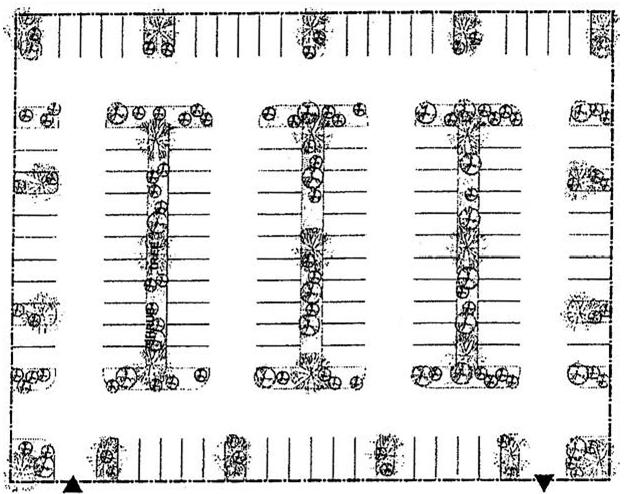
In addition to all other landscape requirements, all parking lots subject to this section 6-2 shall provide and maintain landscaped planting areas within the interior of the parking lot. These standards shall not apply to multi-level parking structures. Each planting area shall consist of at least one hundred eighty (180) square feet, or as approved by the administrator.
(B)
In cases where the area required for the construction of the minimum parking spaces as required by section 6-1, off-street parking requirements, would cause the removal of a historic or heritage tree, the administrator may modify the landscaping requirements and/or the parking requirements in order to preserve the affected historic or heritage tree.
(C)
Planting areas shall be designed within parking areas as:
(1)
Islands located at the end of parking bays;
(2)
Islands located between parallel rows of cars, used to visually separate parking areas into pods;
(3)
Driveway medians, which shall have a minimum width of six (6) feet;
(4)
Other options may be approved by the administrator.
(D)
Each parking lot shall include one shade tree and eight (8) shrubs for every two thousand five hundred (2,500) square feet, or portion thereof, of the total parking lot area, including drives and service areas.
(E)
Not more than ten (10) continuous parking spaces shall be allowed in a row of parking without separation by a one hundred eighty (180) square-foot median containing at least one shade tree.
(F)
Shade trees are not to be located closer than twenty-five (25) feet apart measured from trunk to trunk.
(G)
Proposed shade trees being used to meet the interior parking lot landscaping requirements shall be located no further than ten (10) feet and no closer than four (4) feet from the edge of pavement.
(H)
Existing shade trees may be used to meet the interior parking lot landscaping requirements at the discretion of the administrator if the trees meet the intent of the interior parking lot landscaping requirements and the tree protection requirements.
(I)
Trees used to comply with interior parking lot requirements shall not count toward the number of trees required to meet the street tree requirements.
(J)
No more than twenty-five (25) percent of required shrubs may be deciduous.
Figure 6-3-1: Illustration of Interior Parking Lot Landscaping
6-3.5. Perimeter buffering and screening requirements.
(A)
Purpose. Perimeter buffer yards and screening are required in order to reduce the impact of a use of land on adjacent uses that are of a significantly different character, density, or intensity, and to reduce the visual impact of service facilities. A buffer yard shall not include underground utilities and stormwater facilities. Perimeter buffer yards and screening shall be required in addition to any other landscaping requirement listed in this section.
(B)
Applicability. Perimeter buffer yards and screening shall be installed and maintained by the developer of:
(1)
A nonresidential development adjoining a residential zoning district;
(2)
A multi-family residential development adjoining lots used as or zoned for single-family detached dwellings.
(C)
Permitted screening materials. The following items are permitted for use as screening materials. Alternative screening materials that are not listed may be used if approved by the administrator.
(1)
Evergreen buffer vegetation that is listed on the acceptable evergreen screen/buffer shrub species list, in the administrative manual, and meet the minimum planting height and spacing requirements of Table 6-3-2.
(2)
An earth berm may be used to achieve a portion of the minimum required six-foot height. Berms shall be covered with grass or mulch and shall be planted with other landscaping materials designed to meet the requirements of subsections 6-3.2(A) and (B). The slope of the berm shall not exceed the ratio of 3:1.
(3)
A solid fence measuring at least six (6) feet in height, but not more than eight (8) feet in height. If wood is used, only treated or rot resistant wood is acceptable. Chainlink, barbed wire, stock wire, chicken wire, and similar type fences are not permitted.
(4)
Masonry walls measuring at least six (6) feet in height, but not more than eight (8) feet in height. Walls shall be finished with brick, stone, textured concrete masonry units, or stucco. Natural and painted concrete block walls are not permitted.
(D)
Screening standard. With the approval of the administrator, a developer may use any combination of the screening materials referenced in subsection 6-3.3(C), provided the screen provides complete opacity pursuant to the requirements of this section.
(1)
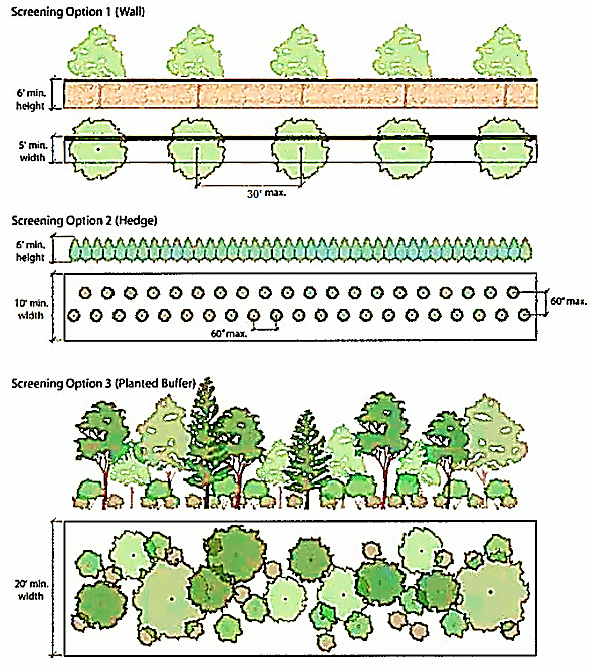
Developments for which perimeter buffer yards and screening is required shall provide one of the following screening treatments along all lot lines abutting single-family detached dwellings (see Figure 6-3-2):
(a)
A buffer yard with a minimum width of five (5) feet that includes a solid masonry wall measuring at least six (6) feet in height, meeting the requirements of subsection 6-6.1(A)(10), and shade trees, meeting the requirements of Table 6-3-1, planted along the inside perimeter with a maximum on-center spacing of thirty (30) feet; or
(b)
A buffer yard with a minimum width of ten (10) feet that includes an alternating double row of a variety of evergreen shrubs and may include a berm to achieve a minimum height at time of planting of six (6) feet, planted a maximum of sixty (60) inches on-center; or
(c)
A buffer yard with a minimum width of twenty (20) feet that includes vegetative screening meeting the following standards per one hundred (100) linear feet and the requirements of Table 6-3-1:
i.
Eight (8) shade trees (at least two (2) evergreen); and
ii.
Four (4) understory trees (at least one evergreen); and
iii.
Thirty (30) shrubs (at least twenty-one (21) evergreen shrubs).
Figure 6-3-2: Options for Buffering Residential Districts and Single-Family
Detached Dwellings
6-3.6. Street buffer yards. In addition to the requirements of subsection 6-3.2, landscaping requirements, and subsection 6-3.3, buffering and screening requirements, all multi-family residential and nonresidential developments shall be buffered from streets and rights-of-way according to the following requirements:
(A)
The minimum width for any buffer yard shall be five (5) feet with an average of ten (10) feet measured along the property lines at ten-foot intervals. Properties developed with a zero front setback are exempt from these requirements. Parking structures located in the C-3 district shall be exempt from the buffer yard requirement when fences, walls, or similar structures are located between the ground level parking and the street or right-of-way.
(B)
All areas used for street buffer yards shall be located on the property. In unusual or extraordinary circumstances, as determined by the administrator, the public right-of-way may be used to meet the requirements of this section provided the property owner obtains permission from the owner of the right-of-way.
(C)
The street buffer yard shall have a continuous shrub border, maintained at thirty (30) inches in height, along the entire street frontage of the lot, excluding driveways. Seventy-five (75) percent of the shrubs shall be evergreen. Plant material must meet the minimum planting height listed in Table 6-3-2.
(D)
Unless waived by the administrator, vacant lots resulting from the demolition of buildings within the C-3 district shall provide a street buffer.
6-3.7. Additional screening requirements. In addition to the landscaping and screening required in this section, additional screening shall be required to conceal specific areas of high visual impact or hazardous areas.
(A)
Plants and a solid fence or wall, at least the height of the item being screened, but not more than eight (8) feet tall, shall be installed around all sides, excluding access areas. Access gates to these areas shall be solid and, to the extent practical, not oriented to a public street. Plant material must meet the minimum planting heights listed on table 6-3-2 and shall be installed around the following areas:
(1)
Loading and service areas.
(2)
Dumpsters/refuse collection points/recycling drop-off centers.
(3)
Ground level mechanical, heating and air-conditioning equipment (except for single-family detached and two-family dwellings).
(4)
Outdoor electrical or other above-ground utility equipment.
(5)
Outdoor storage lots.
(6)
Storage tanks.
(7)
Ground level equipment associated with communication towers.
(8)
Utility trailers and towed wheeled mobile food vendor vehicles parked or stored in the C-3 district.
(B)
In addition to any fence that may be required by article 7, stormwater management, above-ground stormwater retention/detention facilities shall be screened with a continuous shrub border, maintained at thirty (30) inches in height, along the entire perimeter of the facility, excluding access gates. Seventy-five (75) percent of the shrubs shall be evergreen. Plant material must meet the minimum planting height listed in Table 6-3-2.
6-3.8. Alternative landscape plan. At the discretion of the administrator, alternate landscaping plans, plant material, planting methods, or landscape design may be used where unreasonable or impractical situations would result from application of landscaping requirements, or where necessary to protect existing vegetation, or where a more creative plan is proposed which substantially complies with the intent of these requirements. Landscaping requirements may be reduced if existing trees or other types of existing vegetation are preserved. Alternative plans, materials, or methods may be justified from natural conditions such as streams, natural rock formations, topography, and other physical conditions related to the site. Lot configuration and the presence and location of utility easements may justify an alternative landscaping plan.
(Ord. No. 2017-25, § 2, 12-19-17; Ord. No. 2021-08, § 4, 4-20-21; Ord. No. 2022-27, § 4, 8-2-22; Ord. No. 2024-02, § 4, 1-16-24)
Sec. 6-4. - Tree protection.
6-4.1. General.
(A)
Purpose. Protection of existing tree cover is intended to preserve the environmental and aesthetic qualities of Perry; to encourage site design techniques that preserve the natural environment and enhance the developed environment; to control erosion, slippage, and sediment runoff into streams and waterways; to increase slope stability; and, to protect wildlife habitat and migration corridors. Preservation or provision of trees near structures also serves to conserve energy by reducing heating and cooling costs.
(B)
Applicability. The requirements of this section shall apply to all existing and new development, except that the following developments and activities shall be exempt from this section:
(1)
The removal of dead or naturally fallen trees, or trees that are found by the administrator to be a threat to the public health, safety, or welfare;
(2)
The removal of pine trees, provided the minimum requirements of this section are maintained;
(3)
The selective and limited removal of trees or vegetation necessary to obtain clear visibility at driveways or intersections, or for the purpose of performing authorized field survey work;
(4)
The selective and limited clearing of utility easements to maintain their intended function; and
(5)
The removal of trees or vegetation on land zoned or lawfully used for:
(a)
Agricultural and forestry activities, including tree farms and approved forestry management practices, except that if a site is substantially cleared of trees pursuant to legitimate forestry activities, no development applications shall be accepted for thirty-six (36) months from the date the clearing is completed;
(b)
Commercial garden centers, greenhouses, or nurseries; or
(c)
Industrial developments in an M-2 zoning district.
6-4.2. Tree protection and replacement.
(A)
Tree inventory required. A tree inventory shall be submitted as part of an application for a site plan permit and land disturbance permit. The inventory shall be in a form approved by the administrator and contain the information as required in the administrative manual.
(B)
Tree protection and replacement.
(1)
All properties, except lots containing a single-family detached or two-family dwelling, to which this section applies shall provide and maintain a tree density of twelve (12) tree credit units per acre or pro rata portion of an acre, excluding building footprints and the area of athletic fields and courts.
(2)
Including required street trees, each lot containing a single-family detached or two-family dwelling shall provide or maintain one shade tree for each three thousand (3,000) square feet of lot area, excluding the building footprint. Each existing tree exceeding six (6) inches DBH which will be maintained shall count as two (2) trees.
(3)
The required tree density may be obtained by preserving existing trees and/or planting new trees which may include required street trees, interior parking lot landscaping, and heritage and historic tree replacements.
(4)
Tree credit units are established for existing and new trees based on each tree's caliper or diameter. The credit units are established in the administrative manual.
(5)
The form, size, quality, and proportions of preserved and proposed trees must meet the guidelines outlined in the ANSI Z60.1 American Standard for Nursery Stock.
(6)
Single-family residential subdivisions must comply with a required density factor of ten (10) units per acre, excluding individual single-family lots. This requirement may be met as an average for the total acreage of each phase of the subdivision development, rather than for each individual acre. Trees may be retained or planted along the street right-of-way, as buffer edge plantings along a development's perimeter, in entranceways, or in common open space. Emphasis shall be placed upon retaining existing trees. It is the responsibility of the current property owner to maintain and manage the required trees per the standards of this chapter.
(7)
If the minimum protection standards are not met, or if trees are observed by the city to be injured or threatened, they may be deemed ineligible for meeting these requirements and additional trees will be required.
(C)
Protection and replacement of heritage and historic trees.
(1)
In order to protect significant trees, the city has established the heritage and historic tree designations. A heritage tree is any tree greater than twenty (20) inches in diameter and a historic tree is any tree greater than thirty (30) inches in diameter. A heritage tree which is removed shall be replaced with a minimum of two (2) four-inch caliper shade trees. A historic tree which is removed shall be replaced with a minimum of four (4) four-inch caliper shade trees. Because their shallow root system and narrow growth habit combine to pose risk to life and property, pine trees are not considered to be heritage or historic trees.
(a)
New trees used to comply with heritage and historic tree replacement requirements shall not count toward the street tree requirements.
(b)
New trees used to comply with heritage and historic tree replacement requirements shall not count toward the interior parking lot landscaping requirements.
(c)
No construction, grading, equipment, or material storage, or any other activity, shall be allowed within the critical root zone of a heritage or historic tree unless the steps to be taken to adequately ensure the health of the tree are submitted to the administrator in writing.
(d)
Heritage or historic trees shall not be cut, removed, pushed over, killed, harmed, trimmed, sprayed, or destroyed without written approval by the administrator.
(e)
Permits for trimming, removing or replacing heritage or historic trees from the administrator.
(2)
If the administrator determines that there is insufficient space on the property to replace a heritage or historic tree, the replacement tree may be planted on public property approved by the administrator or a fee based on market price in lieu of the replacement cost may be paid to the city tree fund.
6-4.3. Tree protection during construction.
(A)
Protective fencing.
(1)
When and where required. Before grading begins, fencing shall be required, at a minimum, around the critical root zone of all trees that are to be preserved. Additional fencing shall be required around the critical root zone of trees on adjacent properties or located in a right-of-way.
(2)
Type of fencing. All fencing required by this section shall be a minimum of four (4) feet high and of durable construction; such as wood or metal fencing.
(3)
Signs. Signs shall be installed on the protective fence visible on all sides of the fenced-in area (minimum one on each side and/or every three hundred (300) linear feet). The size of each sign must be a minimum of one foot by one and one-half (1.5) feet and shall contain the following: "TREE PROTECTION ZONE: KEEP OUT."
(4)
Activity within a fenced tree protection zone. No construction, grading, parking, equipment, or material storage, or any other activity, shall be allowed within the fenced area.
(5)
Maintenance of fencing. For existing trees to be counted toward required tree credits, they must be protected during the entire development period, beginning prior to the commencement of site work. Encroachment within the tree protection zone is permitted to allow the landscape contractor access to complete site work.
(B)
Encroachments. Encroachments within the critical root zones of any tree being preserved to comply with required tree credits, or within designated tree protection zones, shall occur only in rare instances. If such an encroachment is anticipated, a written request must be made to the city parks and recreations administrator for allowance of encroachment. Request must detail preventative measures taken. If approved the following preventative measures shall be employed:
(1)
Clearing activities. The removal of trees adjacent to a tree protection zone can cause inadvertent damage to the protected trees. Wherever possible, it is advisable to cut minimum two-foot trenches along the limits of land-disturbance, so as to cut, rather than tear, roots. Trenching is required for the protection of historic and heritage trees.
(2)
Soil compaction. Where compaction might occur due to traffic or materials through the tree protection zone, the area must first be mulched with a minimum four-inch layer of processed pine bark or wood chips or a six-inch layer of pine straw. Equipment or materials storage shall not be allowed within tree protection areas.
(Ord. No. 2017-25, § 2, 12-19-17; Ord. No. 2021-08, § 5, 4-20-21)
Sec. 6-5. - Exterior lighting.
6-5.1. Purpose. Exterior lighting shall meet functional and security needs in a way that does not adversely affect adjacent properties or street rights-of-way. The degree to which exterior lighting affects a property or street right-of-way should consider the light source, level of illumination, hours of illumination, and the need for illumination.
6-5.2. Applicability. The requirements of this section shall apply to all lands within the city with the exception of properties owned by the City of Perry, Houston or Peach County, Houston County Board of Education, or State of Georgia. Lighting required by the Federal Aviation Administration and the Georgia Department of Transportation are exempt from these requirements.
6-5.3. General design standards. All exterior lighting shall meet the following design standards:
(A)
No blinking, flashing or fluttering lights or other illuminated device that have a changing light intensity, brightness, or color is permitted in any district except for temporary holiday displays.
(B)
Neither the direct nor reflected light from any outdoor light source shall create a hazard to operators of motor vehicles or to operators of aircraft and no colored lights may be used in such a way as to be confused or construed as street-traffic control or air-traffic control devices.
(C)
Background spaces such as parking lots shall be illuminated as unobtrusively as possible to meet the functional needs of safe circulation and protection of people and property. Foreground spaces, such as building entrances and outside seating areas, shall utilize local lighting that defines the space without glare.
(D)
Light sources shall be concealed or shielded to the maximum extent feasible to minimize the potential for direct glare and unnecessary diffusion on adjacent property and rights-of-way.
(E)
The style of light standards and fixtures shall be consistent with the style and character of architecture proposed on the site.
(F)
All outdoor lighting that is not necessary for security purposes shall be reduced, activated by motion sensors devices, or turned off during non-operating hours.
(G)
Light fixtures used to illuminate flags, statues, or any other objects mounted on a pole, pedestal, or platform shall use a narrow cone beam or light that shall not extend beyond the illuminated object.
(H)
For upward-directed architectural, landscape, and decorative lighting, direct light emissions shall not be visible above the building roofline.
(I)
Light fixtures shall be located on the periphery of the areas with light sources directed into parking areas. No light sources shall be located on building facades directed outward toward property boundaries or adjacent rights-of-way.
6-5.4. Specific standards for lighting.
(A)
Light fixtures within single- and multi-family residential districts shall be wall-mounted or mounted on poles no higher than fifteen (15) feet above finished grade. Bollard-type lighting fixtures shall have a height not less than three (3) feet or more than four (4) feet.
(B)
Light fixtures within nonresidential districts shall be wall-mounted or mounted on poles; with the exception of outdoor entertainment uses, athletic fields, and GDOT interstate interchange high-mast lighting, mounting heights shall not exceed thirty (30) feet above finished grade. Bollard-type lighting fixtures shall have a height not less than three (3) feet or more than four (4) feet.
(C)
Lighting levels.
(1)
Lighting for on-site parking areas, pedestrian walkways and sidewalks, and on-site streets and driveways shall maintain an average illumination of at least one (1) footcandle.
(2)
Light level shall be no greater than 0.3 footcandle when measured at the property line abutting property improved with a residential use and one (1) footcandle when measured at the property line abutting property improved with a nonresidential use or the public right-of-way.
(3)
The maximum light level at any point on a property shall not exceed twenty (20) maintained footcandles.
(4)
For property improved with nonresidential commercial and multi-family uses that abut a property line of a single-family detached residential use, exterior illumination levels shall be reduced to twenty-five (25) percent or less of the normal permitted levels one (1) hour after business closing to one (1) hour before business opening. Security lighting may be used within these restricted time periods. Security lighting shall be reduced to twenty-five (25) percent or less of the normal permitted levels. Motion sensor activation may be allowed to cause the light to resume normal permitted illumination levels only when activated and shall be programmed to be reduced back to twenty-five (25) percent or less of normal illumination levels within five (5) minutes after activation has ceased. Motion sensors must be configured such that they are not triggered by activity off of the property.
(D)
Outdoor entertainment uses shall comply with the following standards.
(1)
Luminaire mounting heights shall not exceed eighty (80) feet above finished grade.
(2)
Luminaires shall be equipped with glare control packages (louvers, shields, visors, or similar) and the fixtures shall be aimed to direct their beams within the primary performance area.
(3)
Luminaires shall be extinguished within one (1) hour of the end of an event, or as soon as all patrons exit the premises, whichever is earlier.
(E)
Canopy lighting. Areas under vehicular canopies shall have a maximum point of horizontal illuminance of twenty (20) maintained footcandles. The sides or top of the canopy shall not be illuminated, except as permitted by sign standards, section 6.9. Lighting under canopies shall be designed so as to not create glare beyond the outside edge of the canopy; acceptable methods include the following:
(1)
The use of recessed fixtures incorporating lens covers that are recessed or flush with the bottom surface (ceiling) of the canopy; or
(2)
The use of light fixture shields on the canopy edge itself.
6-5.5 Light measurement. Light measurements shall be made with an approved metering device at ground level (finished grade) consistent with manufacturer's specifications. The meter shall have an accuracy tolerance of no greater than plus or minus five (5) percent and shall have been calibrated within one (1) year of use. Light levels are specified, calculated, and measured in footcandles (FC). All FC values referenced in this section are maintained footcandles.
(Ord. No. 2017-25, § 2, 12-19-17; Ord. No. 2025-23, § 2, 6-17-25)
Sec. 6-6. - Design standards for nonresidential development.
6-6.1. Design standards for nonresidential development.
(A)
Purpose and intent. These standards are designed to promote and enhance the quality and character of the built environment in the city. More specifically, the purposes of this subsection are to:
(1)
Encourage high quality development as a strategy for investing in the city's future;
(2)
Ensure development remains compatible with its context;
(3)
Maintain and enhance the quality of life for the city's citizens;
(4)
Shape the city's appearance, aesthetic quality, and spatial form;
(5)
Promote compatibility between nonresidential development and adjacent residential uses;
(6)
Provide property owners, developers, architects, builders, business owners, and others with a clear and equitable set of parameters for developing land;
(7)
Encourage a pedestrian- and bicyclist-friendly environment;
(8)
Ensure greater public safety, convenience, and accessibility through the physical design and location of land-use activities.
(B)
Applicability.
(1)
These standards shall apply to new construction, renovation, or reconstruction of existing structures that exceeds twenty-five (25) percent of the current fair market value of the structure. The fair market value shall be based on a market appraisal performed by a certified appraiser at the applicant's expense or assessed value determined by the appropriate county tax assessor. This shall not be construed to require demolition of an existing structure in order to comply with these standards. In such cases, the administrator may grant a waiver of the requirements if presented with a certification by a registered architect or engineer that compliance is not practicable on an existing building. These standards shall not apply to routine maintenance and repair of a structure or other features on the surrounding site.
(2)
In the event of conflict between these design standards or other standards in this chapter, the more stringent or restrictive standard shall apply.
(C)
Exceptions. The standards of this section shall not apply to developments in the following areas or to the following uses:
(1)
M-2, general industrial district;
(2)
M-1, wholesale and light industrial district;
(3)
GU, government use district, although the standards should be considered;
(4)
DD, downtown development overlay district (see section 6-6.2 for standards applying to DD), where the adopted design standards and design guidelines are more stringent than the requirements of this section;
(5)
HP, historic preservation overlay district, where the adopted design standards and design guidelines are more stringent than the requirements of this section;
(6)
PUD, planned unit development district, where the adopted regulating plan and design standards are more stringent than the requirements of this section;
(7)
Form-based code districts (see Appendix A), where the adopted design standards are more stringent than the requirements of this section;
(8)
Utilities.
(D)
Timing of review. Compliance with the standards in this subsection shall be determined as part of the review for a site plan permit and building permit, as appropriate.
(E)
Nonresidential design standards.
(1)
Orientation.
(a)
Buildings shall be configured in a manner that enhances pedestrian activity, regardless of the location of the main entrance or building setbacks through any of the following features:
•
Orientation of the building towards adjacent streets, sidewalks, or open spaces;
•
The inclusion of storefront windows and awnings;
•
Avoidance of monolithic, unbroken facade wall planes;
•
Pedestrian-oriented entrances; and
•
Similar features that foster an active public realm.
(b)
Nonresidential and mixed-use development shall be configured in a manner that creates and enhances access to existing and planned transit features or bicycle/pedestrian trail.
(c)
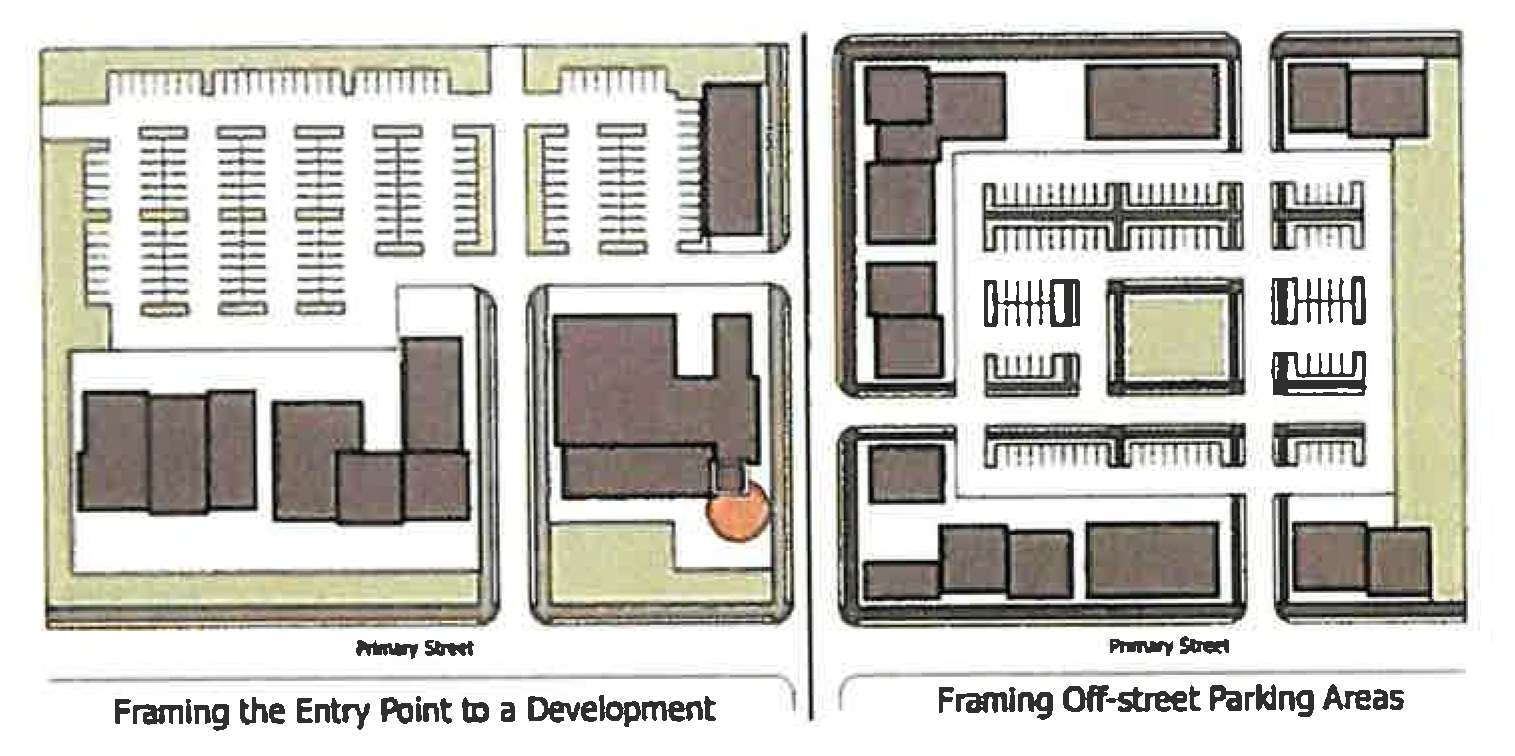
Multiple building developments shall be oriented in at least one (1) of the following formats (see Figure 6-6-1):
•
Buildings facing each other across a relatively narrow vehicular access area with pedestrian amenities in a "main street" character;
•
Buildings framing and enclosing at least three (3) sides of parking areas, public spaces, or other site amenities; or
•
Buildings framing and enclosing outdoor dining or gathering spaces for pedestrians between buildings.
Figure 6-6-1: Examples of the Orientation of Multiple Building Developments
(d)
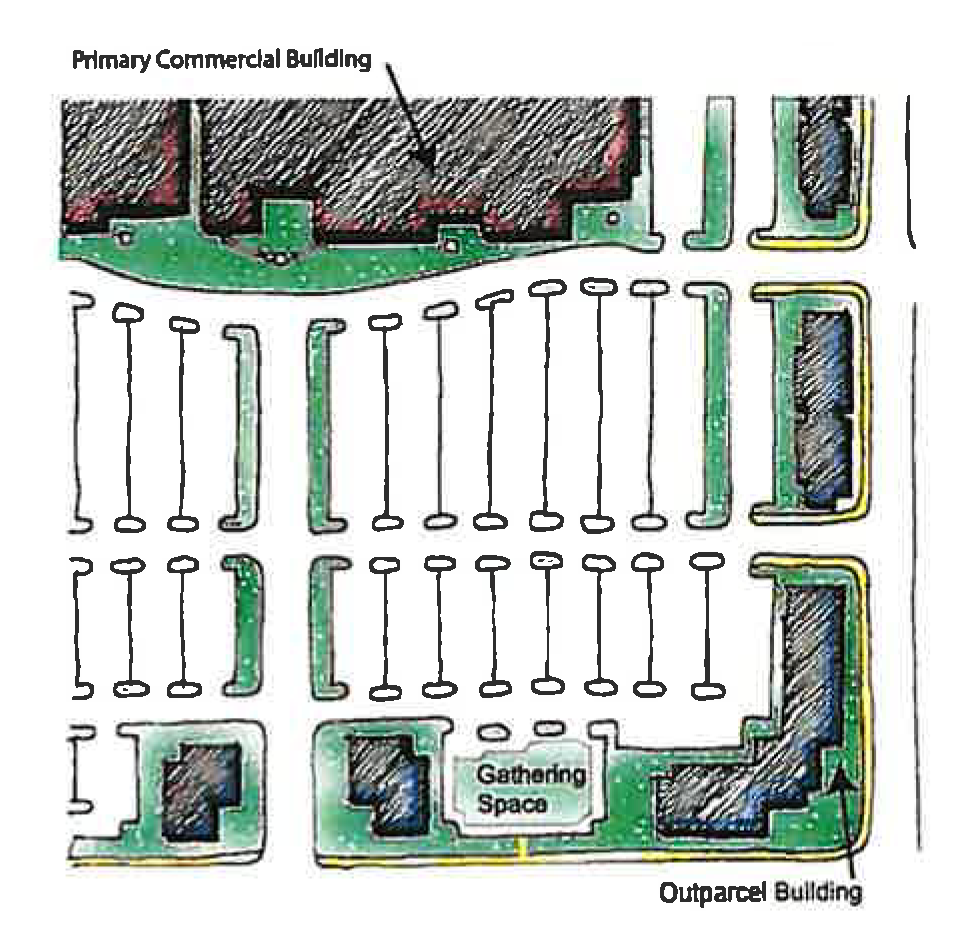
Outparcels.
•
To the maximum extent practicable, outparcels and their buildings shall be situated in order to define street edges, entry points, and spaces for gathering or seating between buildings (see Figure 6-6-2).
•
Spaces between buildings on outparcels should be configured with small scale pedestrian amenities such as plazas, seating areas, pedestrian connections, and gathering spaces.
•
Outparcels may be used to comply with the required orientation of multiple building developments.
Figure 6-6-2: Orientation of Outparcel Buildings
(e)
Nonresidential buildings shall not exceed twice the height of an adjacent single-family detached dwelling or shall be stepped back from the lot line such that the lowest portion of the building is the portion closest to the single-family detached dwelling.
(2)
Entrances.
(a)
Public/customer entrances shall incorporate the following features:
•
Overhangs, awnings, canopies, or other projections of at least five (5) feet from the building wall;
•
Exterior lighting to illuminate the entry way during hours of operation after sundown; and
•
Windows within or beside entry doors that allow entrants to see into the building.
(b)
Front entrances shall be provided that face the street from which the building derives its street address with exception allowed for multiple building development. Nothing in these standards shall prevent a secondary entrance from facing a parking lot or open space. Buildings on corner lots may incorporate an entrance on the corner.
(c)
Adjacent to single-family detached dwellings, front entrances shall not:
•
Face an adjacent single-family detached dwelling, excluding across the street.
•
Include gathering or patron waiting areas outside the building that face residential dwellings.
•
Include speakers or other devices that produce music or other noise that is audible beyond a lot line abutting a detached single-family dwelling.
(d)
For buildings over ten thousand (10,000) square feet in gross floor area, public/customer entrances shall be clearly defined and incorporate at least two (2) of the following features and entrances for retail sales and service uses over thirty thousand (30,000) gross square feet shall incorporate three (3) of the following features:
(e)
Covered roof projections of at least sixty (60) inches in depth that emphasize the primary entrance location;
(f)
Distinctive roof forms, towers, gables, roof ridges, peaks, or other features that differ in height by three (3) feet or more from the balance of the roof;
(g)
Window walls of uninterrupted glass with a minimum height of ten (10) feet and a minimum width of thirty (30) feet adjacent to the entryway doors;
(h)
Covered or shaded pedestrian courts, patios, or plazas of at least one hundred (100) square feet adjacent to the entrance;
(i)
Fountains, pools, or other water features;
(j)
Canopy trees planted no greater than forty (40) feet on-center along the front facade wall; or
(k)
Public art.
(3)
Building facades.
(a)
Blank monolithic walls with little or no architectural detail or items that add visual interest shall be prohibited from facing public streets or residential dwellings.
(b)
Buildings shall include awnings, canopies, arcades, or overhangs with a minimum projection of four (4) feet from the building wall adjacent to a public sidewalk for weather protection (see Figure 6-6-3).
Figure 6-6-3: Awnings Along a Public Sidewalk
(c)
Buildings of ten thousand (10,000) square feet in gross floor area or less shall incorporate two (2) or more of the following features on all facades visible from public streets, parking areas, and residential dwellings. Buildings of more than ten thousand (10,000) gross square feet shall incorporate three (3) or more of the following features on similar facades:
•
Recessed or display windows;
•
Offset surfaces, niches, insets, projections, or bas relief with a minimum depth of four (4) inches;
•
Window indentations that incorporate a differing building material, texture, or color, along with an awning or overhang;
•
Differentiated piers, columns, or pilasters;
•
Textured materials;
•
Roofline changes, coupled with correspondingly aligned wall offset or facade material changes, changes in the roof planes, or changes in the height of a parapet wall; or
•
Changes in wall plane (such as projections or recesses) with an offset or depth of at least one (1) foot and a width of at least ten (10) feet, located a minimum of every sixty (60) feet.
•
Foundation landscaping with plant material appropriately scaled to the building mass.
(d)
Buildings of two (2) or more stories should be configured to include a discernible base, middle, and top (see Figure 6-6-4).
Figure 6-6-4: Base, Middle, and Top
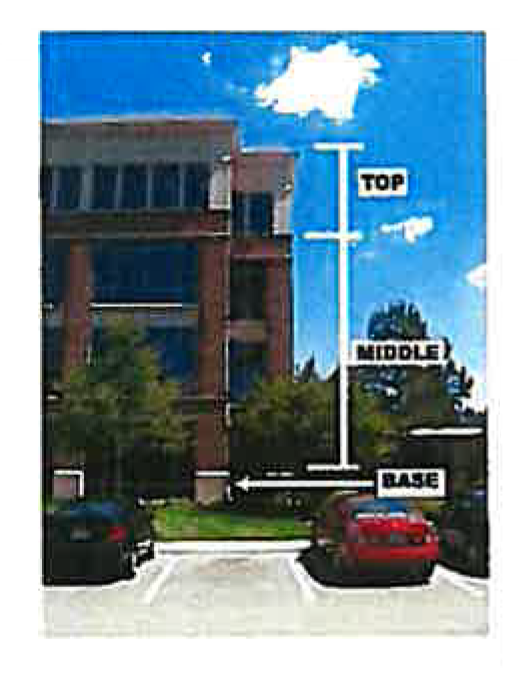
(e)
Single story commercial retail and service buildings over twenty (20) feet in height shall be designed with pedestrian-scaled articulation to mitigate the perception of height.
(f)
Side and rear building facades, if visible from public streets, shall have a similar architectural treatment as used on the primary or front facade. Facades facing a rear service alley are exempt from this requirement.
(g)
Prototypical or franchise designs shall be adapted to reflect the design standards of this subsection, the applicable base and overlay district standards, and the character of the city.
(h)
Commercial retail and service buildings shall include pedestrian walkways of at least five (5) feet in width along the entire front building facade. All or a portion of this requirement may be located in a public right-of-way, subject to approval of the right-of-way owner.
(i)
Commercial retail and service front building facades of fifty (50) feet or more in width shall be configured as a series of individual ground-floor storefronts, discrete building modules, wings, recesses, or projections from the primary facade wall (see Figure 6-6-5).
Figure 6-6-5: Example Configuration of a Retail Building Facade
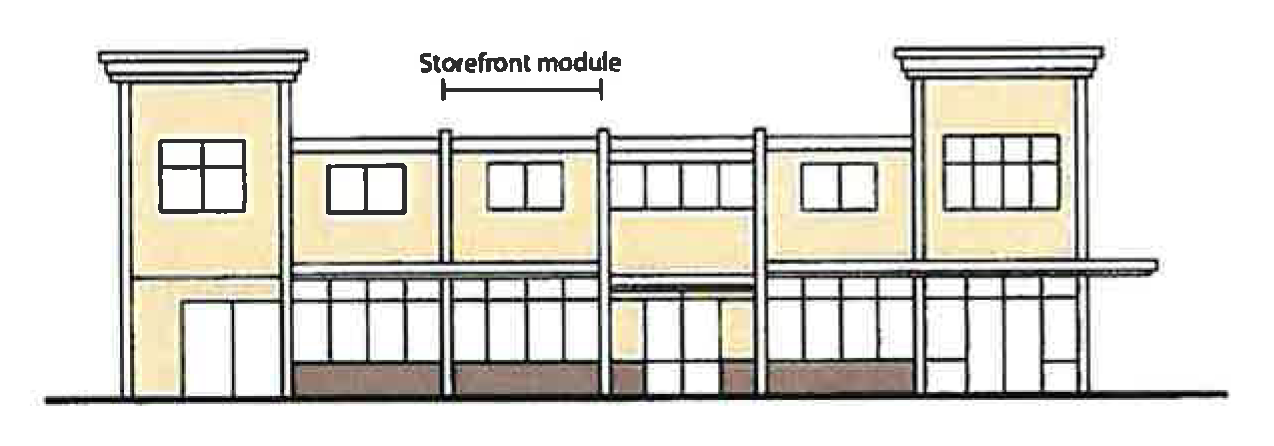
(j)
Outbuildings located in front of other buildings within the same development shall include a consistent level of architectural detail on all four (4) sides of the building as well as exterior materials and colors that are compatible with the primary building in the development.
(4)
Roof form.
(a)
Overhanging eaves and roof rakes on gable ends shall extend at least twelve (12) inches past the supporting walls.
(b)
Flat roofs shall incorporate parapet walls with cornice treatments designed to conceal the roof and roof-mounted mechanical equipment. All parapet walls visible from a public street shall be finished.
(c)
A parapet wall shall be the same or similar in color and material to the building and shall not exceed twenty-five (25) percent of the height of the supporting wall.
(d)
Except for cupolas and steeples, sloped roofs shall include two (2) or more sloping roof planes with greater than or equal to one (1) foot of vertical rise for every three (3) feet of horizontal run (1:3) and less than or equal to one (1) foot of vertical rise for every one (1) foot of horizontal run (1:1).
(e)
All roof vents, pipes, antennae and other roof penetrations should be of a color that will minimize their visual impact unless concealed by a parapet, located on the rear elevation, or configured to have a minimal visual impact as seen from the street or existing residential development.
(f)
Within developments with multiple buildings, building heights shall be varied to avoid the appearance of an elongated building mass. This can be achieved by stair-stepping building heights or by varying roof forms.
(g)
Green roofs, which use vegetation to improve stormwater quality and reduce runoff, are permitted as an alternative to the roof forms described in this subsection.
(h)
Buildings of more than ten thousand (10,000) gross square feet:
•
Shall include a variety of different roof forms or roofline changes. Roofline changes shall include changes in roof planes or changes in the top of a parapet wall.
•
When roofline changes are included on a facade that incorporates wall offsets or material or color changes, roofline changes shall be vertically aligned with the corresponding wall offset or material or color changes.
•
Parapet walls shall include a cornice or other form of cap appropriate to the architecture of the building.
(5)
Transparency.
(a)
Windows and doors shall be architecturally related to the style, materials, and details of the building they serve.
(b)
Nonresidential buildings open to the public shall provide visual transparency into interior spaces at entrances and along the street-facing facades in the form of clear glass windows, doors, or storefront systems (see Figure 6-6-6).
•
In buildings with ground floor eating establishments, retail sales and service uses, street-facing facades and facades adjacent to a public sidewalk or pedestrian pathways shall have at least sixty (60) percent transparency between two (2) feet and eight (8) feet above grade. Provided, however, that individual tenant spaces exceeding forty thousand (40,000) square feet in area and located behind buildings oriented to the street(s) shall have at least twenty (20) percent transparency between two (2) feet and eight (8) feet above grade and at least thirty (30) percent transparency achieved through the use of clerestory windows. Percentages are calculated based on length of each facade.
•
Windows on the ground floor of side facades may consist of clear, frosted, or spandrel glass, and may be organized into a display window configuration.
•
Windows or doors shall be positioned to avoid direct views into the windows of an existing adjacent residential dwelling.
•
Clerestory windows are encouraged on all facades.
•
Reflective or heavily tinted glass that obstructs views into the building shall not count towards transparency requirements.
Figure 6-6-6: Facade Transparency (Windows) Along a Street Facade
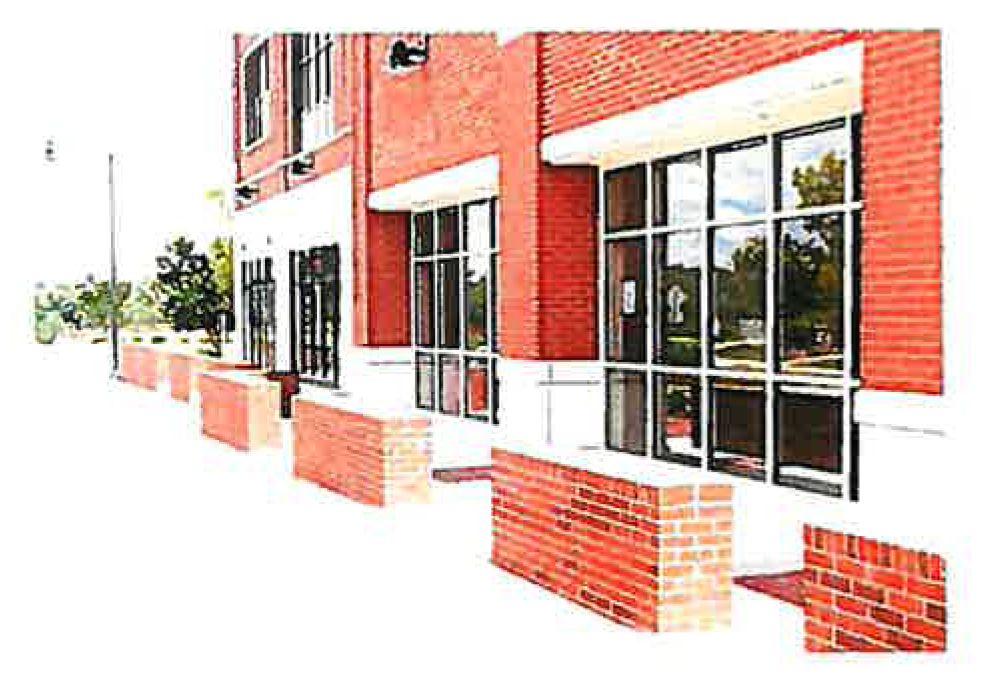
(6)
Materials.
(a)
All facades of a building visible from a public street or residential district shall present consistent materials and architectural style.
(b)
Accessory buildings and structures shall be similar in materials and architectural style to the primary building.
(c)
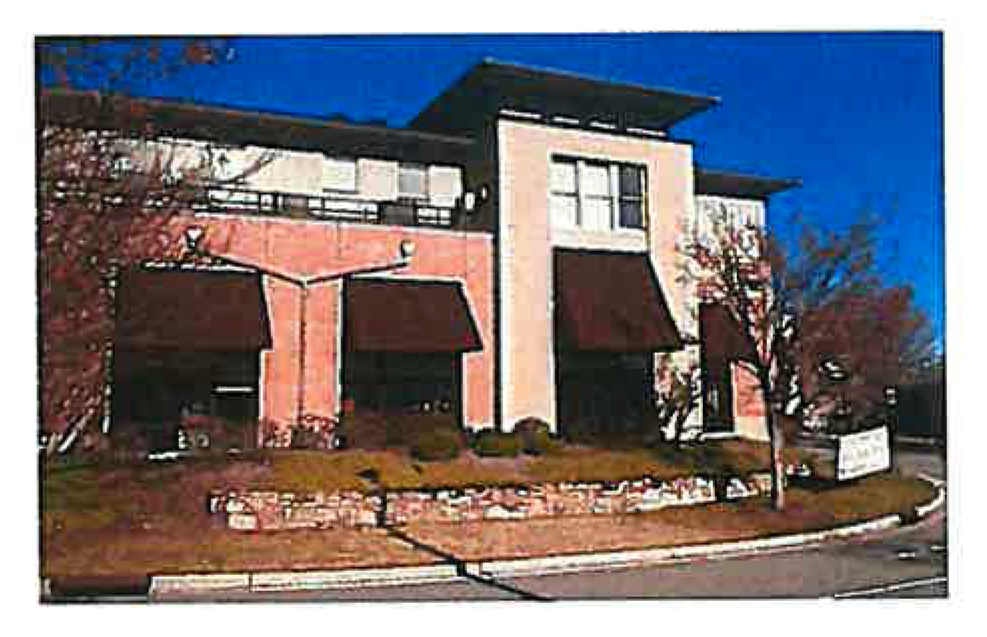
Where two (2) or more materials are proposed to be combined on a facade, the heavier and more massive elements shall be located below the lighter elements (e.g., brick shall be located below stucco). Use of a heavier material as a detail on the corner of a building or along cornices or windows is acceptable (see Figure 6-6-7).
Figure 6-6-7: Example of Multiple Building Materials
(d)
Primary facade materials shall not change at outside corners and shall continue around the corner to a logical point of conclusion such as a window or change in facade plane.
(e)
Material changes shall occur along a horizontal line or where two (2) forms meet. It is acceptable, however, that change of materials occur as accents around windows, doors, cornices, or as a repetitive pattern.
(f)
Brick shall be the primary material (at least fifty (50) percent of the facade excluding windows and doors) on all facades visible from a public street. The following materials shall not be used:
•
Corrugated metal siding, however, high quality architectural metal siding may be used;
•
Exposed smooth-finished concrete block;
•
Styrofoam-backed and synthetic stucco within twelve (12) feet of the grade level and within two (2) feet of any exterior doorjamb (reinforced Styrofoam-backed stucco is acceptable);
•
Vinyl siding;
•
Lap siding on the ground floor; or
•
Split-faced concrete masonry units exceeding fifteen (15) percent of front facades or facades facing public streets.
(g)
Field colors used on the main body of a building shall be subdued and of low reflectivity; fluorescent and metallic paints are prohibited. However, nothing in this section shall prohibit the use of reflective colors on building roofs.
(h)
Building materials shall either be similar to the materials already being used in the immediate area, or if dissimilar materials are being proposed, other characteristics such as scale and proportions, form, architectural detailing, color, and texture shall be utilized to ensure that enough similarity exists for the building to be compatible despite the differences in materials.
(i)
Where nonresidential buildings are adjacent to single-family detached dwellings, primary exterior building materials shall be similar in composition and arrangement to that used on surrounding single-family detached dwellings (see Figure 6-6-8).
Figure 6-6-8: Similar Building Materials to Adjacent Single-Family Dwellings
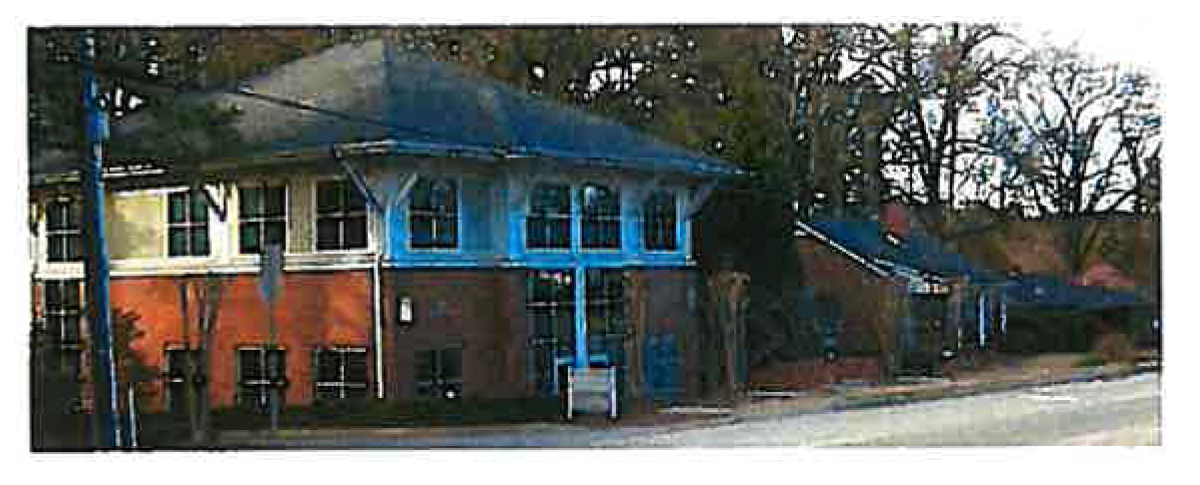
(7)
Drive-through.
(a)
If covered, the roof over a drive-through shall have the same architectural design and materials as the primary portion of the structure.
(b)
A drive-through ordering station and pay/pick-up windows shall not be located in front of a building or on the same building facade as the primary entrance.
(c)
A drive-through lane shall be located so as not to compromise the quality of the pedestrian experience at any public street edge.
(d)
Pedestrian pathways that cross queuing or stacking lanes shall be made prominent to ensure pedestrian visibility and safety.
(e)
In no instance shall a drive-through face residential dwellings.
(f)
Speakers shall be directed away from adjacent residential dwellings and shall not be audible beyond shared lot lines.
(8)
Service areas.
(a)
Refuse collection and service areas shall be fully screened from view from public streets or off-site public open space areas. These areas shall be integrated into the principal building architecture to the maximum extent practicable (see Figure 6-6-9).
Figure 6-6-9: Screening Elements Integrated with the Building
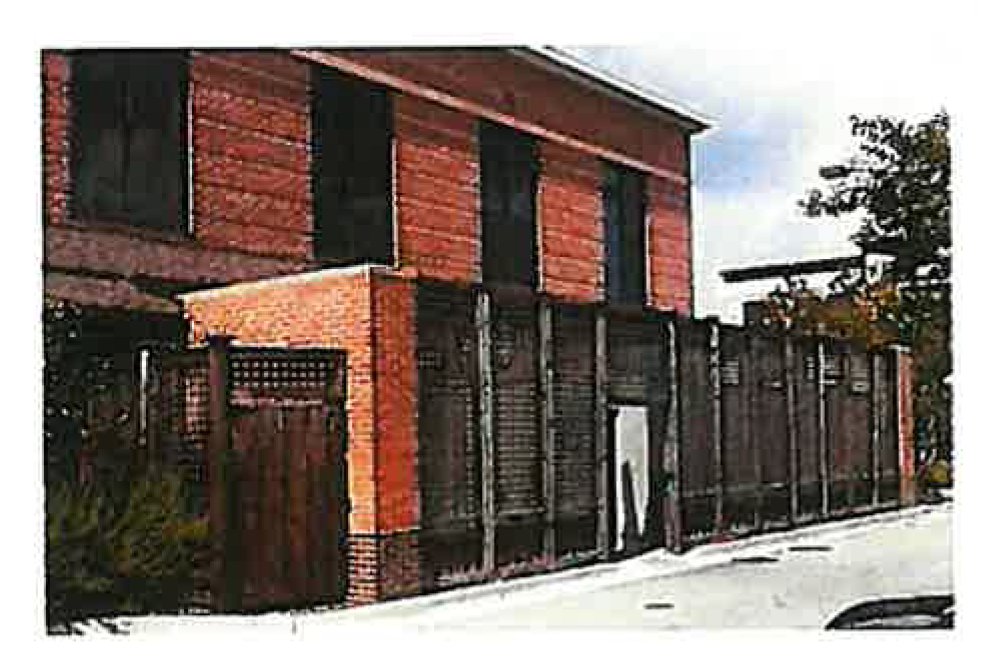
(b)
Above-ground refuse containers shall comply with the below standards (see Figure 6-6-10):
1.
Above-ground refuse containers shall comply with the applicable setback requirements. No above-ground refuse container shall be located less than fifteen (15) feet from the property line of any abutting property improved with a single-family detached use.
2.
Above-ground refuse containers shall be fully screened from the view of adjoining property and public streets. Above-ground refuse containers shall be screened in compliance with section 6-3.7. In-ground refuse containers shall be screened with evergreen plantings.
Figure 6-6-10: Example of Refuse Container Screening
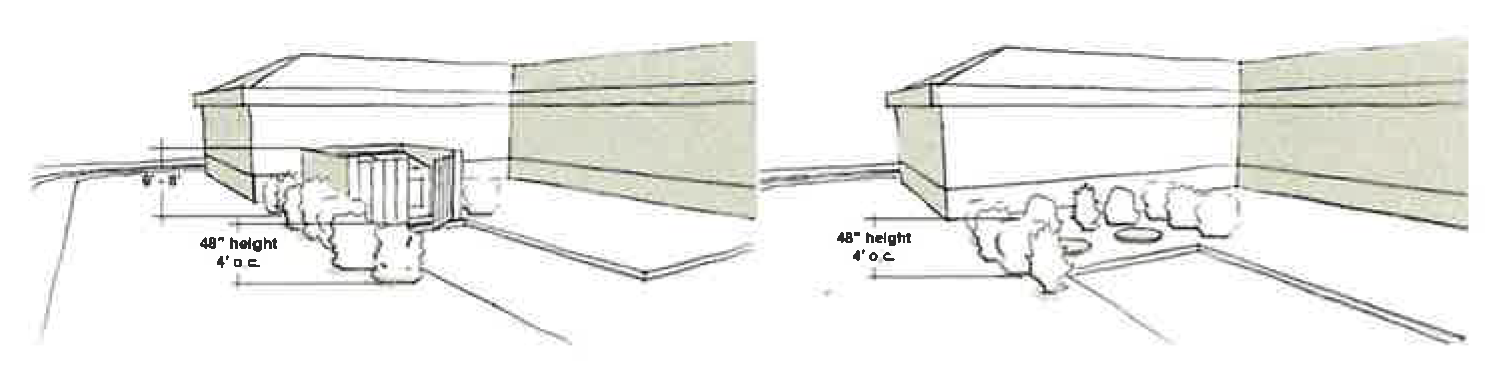
3.
Times of service. Deliveries, waste collection, and similar commercial activities are prohibited between the hours of 10:00 p.m. and 6:00 a.m.
(c)
Utility boxes and meters should not be located in front of street-facing facades.
(d)
Loading, service, and equipment areas that are associated with an outparcel building shall be screened through the use of structural elements and similar materials attached to and integrated with the building.
(e)
Automated teller machines (ATMs) shall use materials that reflect the architecture of the surrounding buildings and neighborhood. Walk-up ATMs shall be oriented to pedestrian walkways.
(f)
Vending machines, ATMs, service areas, mechanical equipment, loading areas, and similar functional elements shall be located away from residential districts, or shall be configured in a manner that prevents any negative impacts (visual, auditory, or otherwise).
(9)
Outdoor storage.
(a)
Areas for outdoor storage are permitted to the side or rear of the principal building, no closer than twenty (20) feet to any public right-of-way, sidewalk, or internal pedestrian way unless screened by a wall or fence with gate(s).
(b)
Areas for outdoor storage shall be fully screened from off-site view.
(c)
Outdoor display of goods for sale may be permitted in areas immediately adjacent to the entrance(s). Outdoor display areas shall be located within twenty (20) feet of the building facade wall and within forty (40) feet of a building entrance. In no instance shall an outdoor display obstruct pedestrian circulation or interfere with ingress to or egress from the building entrance (see Figure 6-6-11).
Figure 6-6-11: Outdoor Display of Goods at Store Entrance
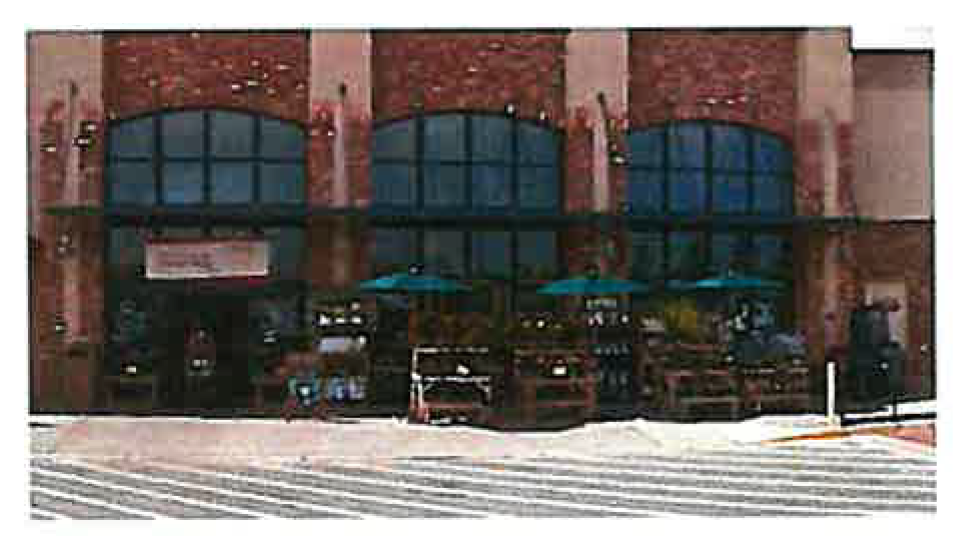
(10)
Outdoor dining. Outdoor dining or other outdoor activities that generate noise, as defined by noise standards, chapter 17, article III, section 55 of the City Code, or excessive lighting, as defined by lighting standards, section 6-5, shall not be located on any building side that abuts a single-family detached use. Any such outdoor dining or activity areas shall be positioned in such a manner that the building shall shield the dining or other outdoor activity from such residential use.
(11)
Stormwater facilities. Unless designed as a wet pond amenity, stormwater facilities shall be located behind building(s) or located underground.
(12)
Parking lot location.
(a)
Parking areas shall be located and designed to reduce or eliminate visual or operational impacts to surrounding properties and shall comply with all relevant off-street parking and landscaping requirements.
(b)
Surface parking lots containing one hundred (100) or more spaces shall be divided into discrete areas (pods) not exceeding fifty (50) parking spaces. An internal path or sidewalk located within landscaped areas between, and connecting, the parking pods is required where there are more than five (5) pods, or the configuration of the pods makes it difficult for pedestrians to access the building (see Figure 6-6-12).
Figure 6-6-12: Large Surface Parking Lot Configuration with Internal Pathways
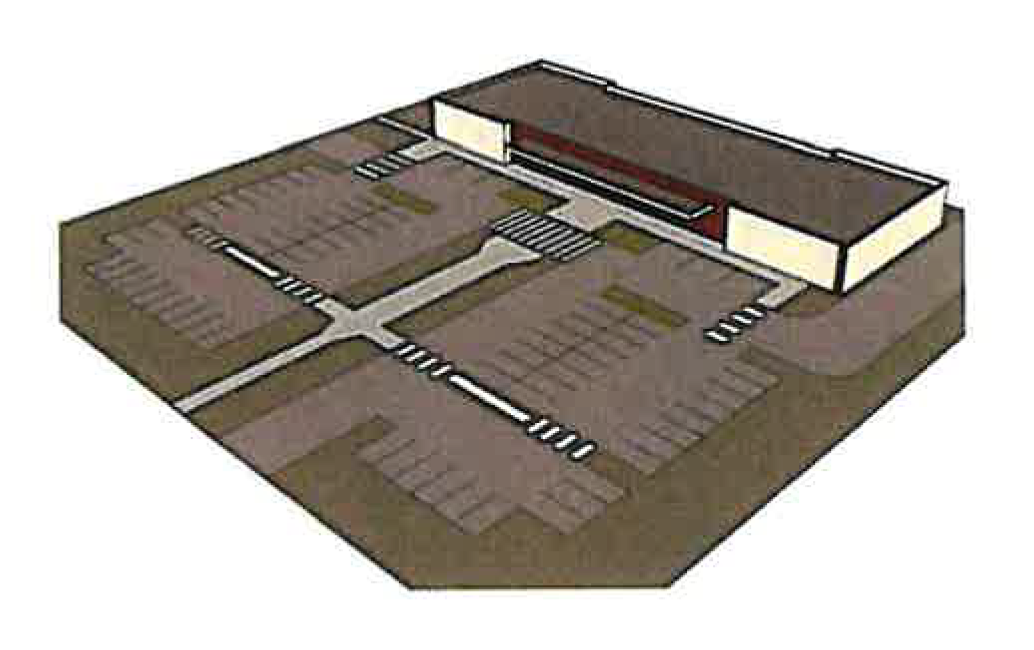
(c)
The drive aisle in front of the primary entrance(s) of a building shall include a pedestrian crossing area that is clearly marked by using a different material and color than the drive aisle.
(d)
No more than twenty (20) percent of the total parking spaces (up to a maximum of one hundred (100) spaces) designed as a single-loaded parking aisle may be located in the front yard adjacent to the primary street. If more than one (1) street abuts the property, the designation of the primary street shall be determined by the administrator.
(e)
No more than fifty (50) percent (length) of the first thirty (30) feet (depth) of the primary lot frontage may be occupied by off-street surface parking spaces. The primary lot frontage is the portion of a lot that abuts the street from which the lot derives its street address (see Figure 6-6-13).
Figure 6-6-13: Parking Spaces May Occupy up to Fifty Percent
of the Primary Lot Frontage
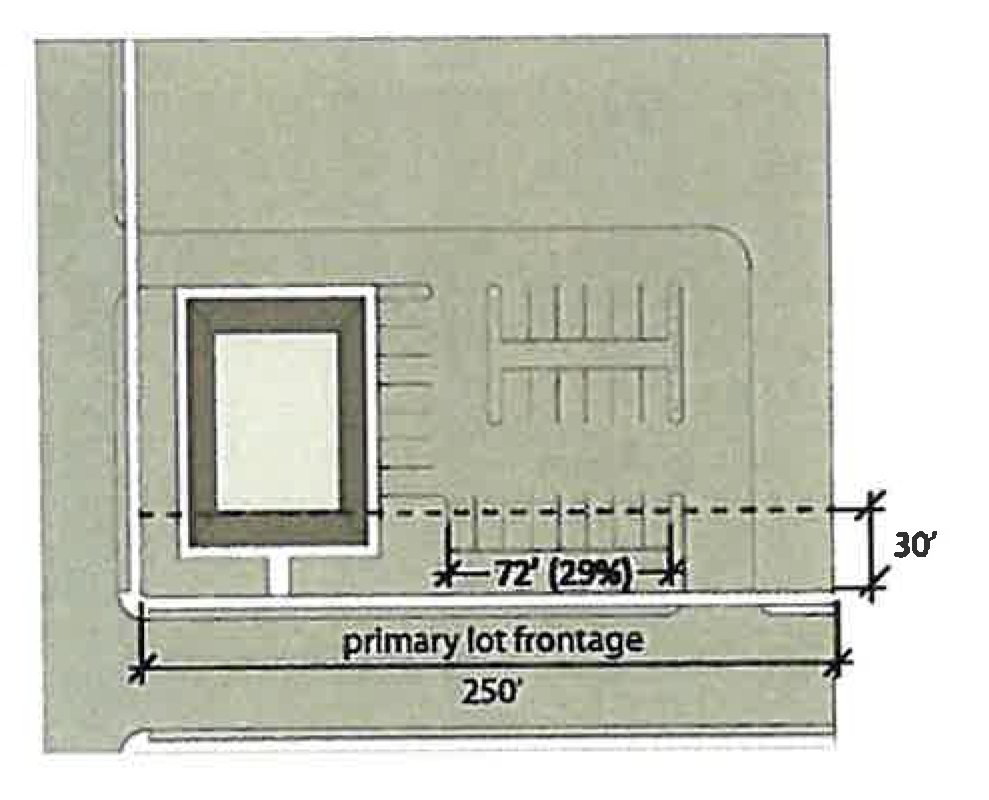
(f)
Off-street parking shall be located away from lot lines shared with detached single-family dwellings, to the maximum extent practicable.
(g)
Parking structures, when provided, shall include the following:
•
Clear sight lines of abutting streets, driveways, and pedestrian pathways;
•
Light-colored interior walls and ceilings;
•
Adequate and uniform interior lighting without glare to surrounding properties.
(13)
Circulation.
(a)
Clearly defined, safe, pedestrian access shall be provided from parking areas and adjacent public sidewalks to building entrances.
(b)
All internal pedestrian walkways shall be distinguished from driving surfaces through the use of durable low-maintenance surface materials such as pavers, bricks, or concrete of a different color than driving surfaces to enhance pedestrian safety and comfort of walkways (see Figure 6-6-14).
(c)
Adjacent nonresidential developments shall provide for vehicular and pedestrian circulation between sites, through alley or parking lot connections, hard surface walkways, and similar measures to the maximum extent practicable.
Figure 6-6-14: Pedestrian Walkway from Parking Area to Building Entrance
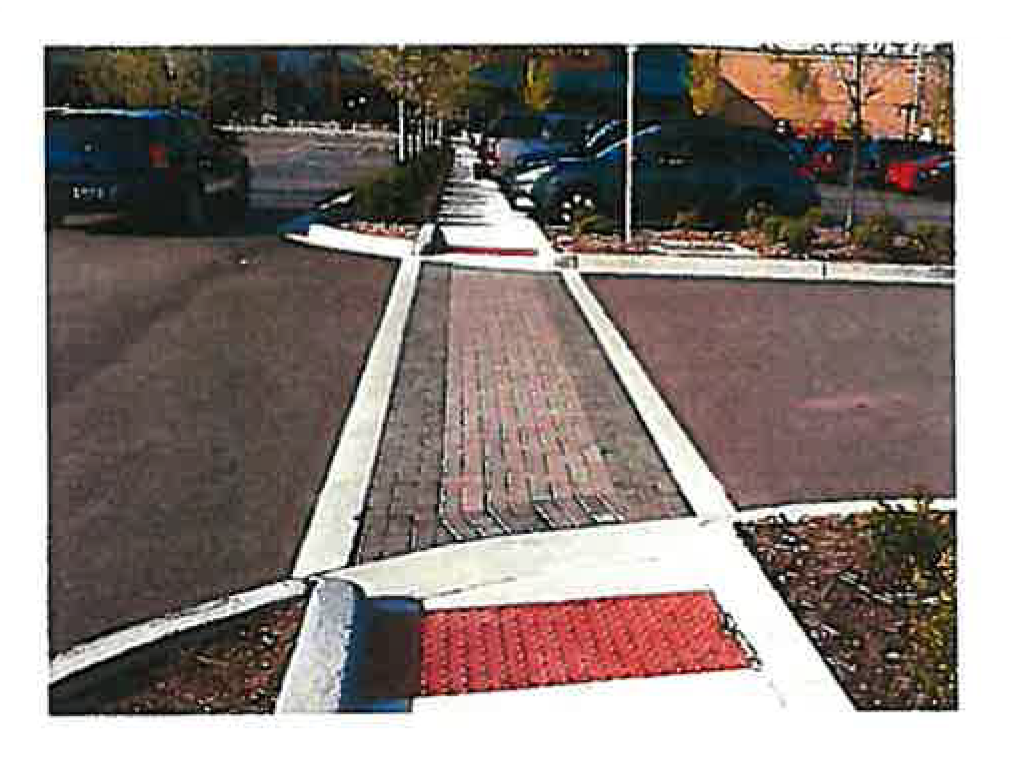
(F)
Other design elements. For Exterior lighting, see section 6-5; for landscaping, buffering, and screening, see section 6-3; for tree protection, see section 6-4; for fences, see subsection 4.4-3(H).
(G)
Alternative design. The administrator may approve an alternative to one (1) or more of these standards, other than materials used, when an applicant demonstrates in writing that a design meets the purpose and intent of this section and is more suitable for the architectural style of the proposed building(s).
6-6.2. Design standards for the downtown development district.
(A)
Intent. The intent of this section is to encourage and maintain the viability and visual compatibility of structures and sites in the downtown development overlay district.
(B)
Applicability. New construction and exterior modification of buildings and sites in the downtown development overlay district must obtain a certificate of appropriateness prior to starting such work. In addition to other design guidelines adopted by the Main Street Advisory Board, new construction and existing buildings, structures, and sites which are altered, reconstructed, or moved shall be consistent with the architectural styles of commercial buildings constructed prior to 1950 in the downtown development overlay district and the standards of this section.
(C)
Exemptions. Nothing in the section shall be construed to prevent the ordinary maintenance or repair of any exterior architectural feature of structures located in the downtown development overlay district when the repair does not involve a change in design, material, or outer appearance of the structure. Certificates of appropriateness are not required for alterations to the interior of a building or changes in the use of a building, although other permits may be required.
(D)
Sign standards. All signs shall require a certificate of appropriateness issued by the administrator prior to issuing a sign permit. The administrator may exempt signs which comply with the provisions of subsection 6-9.12(C).
(E)
Site design standards.
(1)
Orientation and setback. The orientation and setback of a building shall be consistent with adjacent buildings.
(2)
Spacing of buildings. The relationship of a building to open space between it and the adjoining buildings shall be visually compatible to the buildings and open spaces to which it is visually related.
(3)
Parking. Parking should be located to the side or rear of a building. When a parking lot must be located adjacent to a public right-of-way, a wall and/or landscape buffer should separate the parking lot from the right-of-way.
(4)
Courtyards and outdoor spaces. Walls, wrought iron fences, evergreen landscape buffers, and/or building facades shall form cohesive walls of enclosure along a street.
(F)
Building design standards.
(1)
Height. The height of the proposed building shall be visually compatible with adjacent buildings.
(2)
Proportion of building from facade. The relationship of the width of building to the height of the front elevation shall be visually compatible with buildings to which it is visually related.
(3)
Scale of a building. The size of a building, the building mass of a building in relation to open spaces, the windows, door openings, porches and balconies shall be visually compatible with the buildings to which it is visually related.
(4)
Proportion of openings within the facility. The relationship of the width of the windows in a building to the height of the windows shall be visually compatible with buildings to which it is visually related.
(5)
Rhythm of solids to voids in front facades. The relationship of solids to voids in the front facade of a building shall be visually compatible with buildings to which it is visually related.
(6)
Rhythm of entrance and/or porch projection. The relationship of entrances and porch projections to the sidewalks of a building shall be visually compatible to the buildings to which it is visually related.
(7)
Relationship of materials; texture and color. The relationship of the materials, texture, and color of the facade of a building shall be visually compatible with the predominant materials in the buildings to which it is visually related. Brick or mortared stone shall be the predominant materials on new construction.
(8)
Roof shapes. The roof shape of a building shall be visually compatible with the buildings to which it is visually related.
(9)
Colors. Colors should be in keeping with color palettes currently in use, or of historical significance to the City of Perry. The community development department may suggest or make available certain color palettes, which are not required to have a certificate of appropriateness.
(G)
Temporary structures. Temporary structures are permitted for construction projects or catastrophic loss. These structures require approval by the administrator, subject to section 4-5.
(Ord. No. 2017-25, § 2, 12-19-17; Ord. No. 2021-08, § 6, 4-20-21; Ord. No. 2022-50, § 3, 12-20-22; Ord. No. 2025-11, § 1, 2-18-25; Ord. No. 2025-23, § 2, 6-17-25)
Editor's note— Ord. No. 2025-23, § 2, adopted June 17, 2025, amended the title of § 6-6 to read as herein set out. The former § 6-6 title pertained to design standards.
Sec. 6-7. - Design standards for multifamily residential development.
(A)
Purpose and intent. This section establishes design standards for multifamily residential development. Multifamily development proposals shall be evaluated in the context of these standards and the decision-making body shall, to the extent feasible, balance the building and site-specific development issues with these standards. The objective of this process is to promote multifamily development that functions in a manner consistent with the provisions of section 1-3, purpose and intent, and the following:
(1)
Provide a range of housing types designed for various life stages, lifestyles, and incomes;
(2)
Ensure multifamily residential development takes place in a manner consistent with the nature, context, scale, and proportion of the natural and built environment within which it is located;
(3)
Promote greater compatibility between multifamily residential development and other allowable uses in the city, particularly single-family residential development;
(4)
Strengthen neighborhoods by incorporating best practice methods for multi-family development, such as Crime Prevention through Environmental Design (CPTED);
(5)
Establish a minimum level of quality for multifamily residential development; and
(6)
Preserve and improve property values and protect private and public investment.
(B)
Applicability.
(1)
Except where exempted by subsection 6-7(C), exemptions, these standards shall apply to all new construction, renovation, or reconstruction of existing structures accommodating three (3) or more dwelling units, excluding townhouses (see section 4-3.1(A)).
(a)
Renovation and reconstruction shall be defined as construction activity having a cost that exceeds twenty-five (25) percent of the current fair market value of the structures. Current fair market value shall be calculated by a licensed appraiser at the applicant's expense utilizing industry standards or the appraised values established by the appropriate county tax assessor.
(b)
In cases where an existing development cannot comply with these standards during renovation or reconstruction, the administrator may rely upon the certification of a licensed architect or structural engineer to verify that compliance is not practicable.
(2)
In the event of conflict between these design standards or other standards in this chapter, the more stringent or restrictive standard shall apply.
(C)
Exemptions. The following multifamily developments are exempt from the requirements of this subsection:
(1)
Structures located within the DD, downtown development overlay district, provided the overlay standards and adopted design guidelines are more restrictive than the requirements of this section;
(2)
Structure located within the HP, historic preservation overlay district, provided the overlay standards and adopted design guidelines are more restrictive than the requirements of this section;
(3)
Structures located within PUD, planned unit development districts that incorporate multifamily development design standards that are more restrictive than the requirements of this section;
(4)
Structures located within form-based code districts (Appendix A), provided the form-based code standards are more restrictive than the requirements of this section; and
(5)
Routine maintenance and repair of multifamily residential development.
(D)
Timing of review. Compliance with the standards in this subsection shall be determined as part of the review for a site plan permit and building permit, as appropriate.
(E)
Crime prevention through environmental design. Multifamily residential development shall adhere to the generally accepted principles of Crime Prevention through Environmental Design (CPTED), to the maximum extent practicable. These principles involve the design of walkways, fences, lighting, signs and landscape and placement of windows to enhance natural site surveillance, control access, and clearly define public and private spaces.
(F)
Multifamily design standards.
(1)
Orientation.
(a)
Multifamily residential buildings shall be configured in a manner that activates street frontages and enhances pedestrian activity by orienting buildings and entrances towards adjacent streets, sidewalks, and open spaces (see Figure 6-7-1).
(b)
Multi-building developments shall be configured so that buildings at the perimeter are similar in scale to adjacent development and there is a gradual transition to larger or more intense buildings.
(c)
Principal buildings shall be sited to maximize natural ventilation, solar access, and access to views, to the maximum extent practicable
Figure 6-7-1: Buildings Oriented Towards Streets and Sidewalks
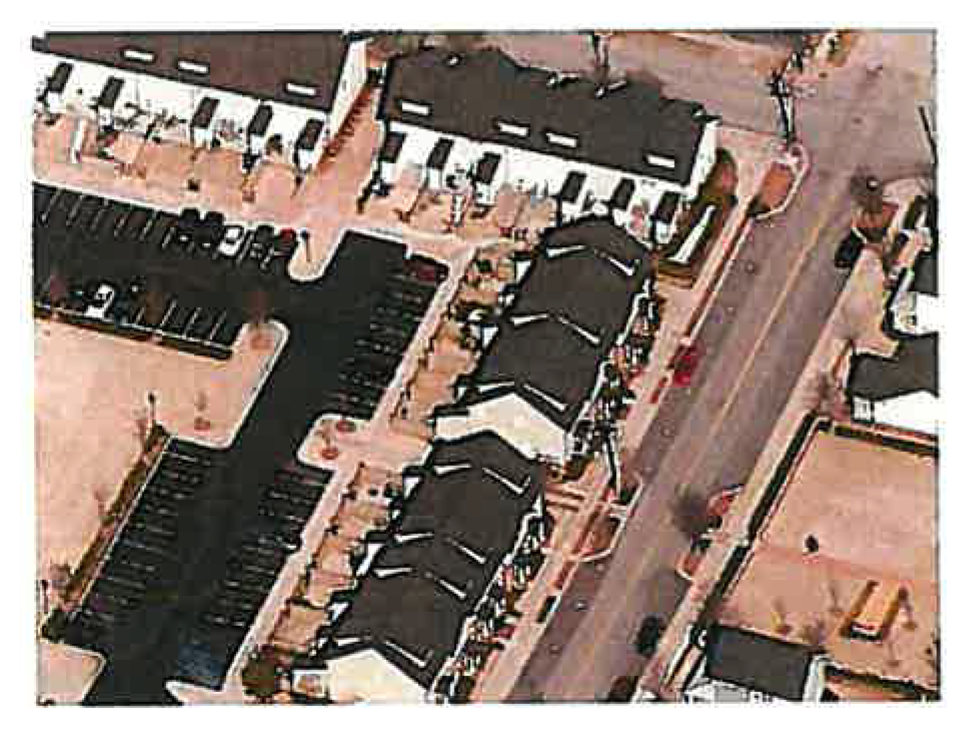
(2)
Setbacks.
(a)
Front setbacks shall be within seventy-five (75) and one hundred twenty-five (125) percent of the average setback of existing structures along the same block face, provided that no building shall encroach upon the minimum setback requirement (see Figure 6-7-2). In cases where the average front setback is not discernible (e.g., the block face is vacant or lacks more than one (1) building), the front setback shall be established by the base zoning district standards.
Figure 6-7-2: Allowable Front Setbacks
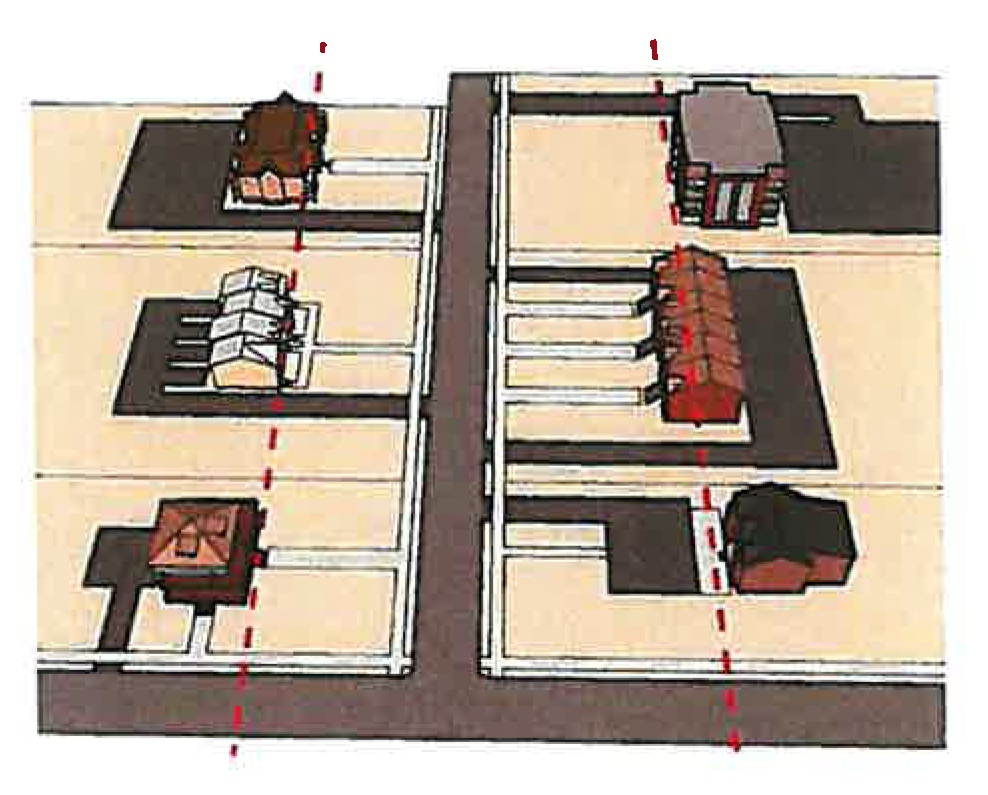
(b)
Multifamily residential buildings with three (3) or more levels of stacked units shall be stepped back an additional ten (10) feet from the minimum required setback for every floor above the second floor from property lines abutting single-family detached dwellings. Dormers and other minor roof features may project into the setback area.
(3)
Entrances.
(a)
All entrances shall be adequately illuminated and oriented to promote natural surveillance.
(b)
Street-level, street-facing multifamily units should have a street-oriented entrance or, in lieu thereof, a shared street-oriented entrance for every two (2) street-level, street facing units.
(c)
Street-facing entrances for individual dwellings should include at least thirty-six (36) square feet of usable porch or stoop area that is elevated above street level to create a separation of public and private space and to help activate the street.
(d)
Shared building entrances shall be pedestrian-scale and covered with canopies or overhangs.
(e)
Exterior open stairways and corridors serving more than one (1) dwelling and facing a public street or single-family detached dwelling are prohibited.
(4)
Building facades.
(a)
Multifamily building elevations facing a public street or single-family dwelling shall reflect consistent design, textures, colors, and features.
(b)
Front building facades of thirty (30) feet or more in width shall be configured as a series of individual building modules, wings, recesses, or projections from the primary facade wall with a minimum width of fifteen (15) feet and a maximum width of thirty (30) feet each. Modules, wings, recesses, or bump outs shall deviate from the primary building facade plane by a distance of at least four (4) feet.
(c)
Facade treatment. Multifamily residential building facades shall incorporate at least three (3) of the following design features (see Figure 6-7-4):
•
Changes in wall plane (such as projections or recesses) with an offset or depth of at least one (1) foot, a width of at least ten (10) feet, located a minimum of every twenty-five (25) feet;
•
Distinctive architectural features, such as a repeating pattern of pilasters, columns, recesses, or niches varying from the facade plane by a minimum of four (4) inches;
•
Roofline changes, coupled with correspondingly aligned wall offset or facade material changes, including changes in the roof planes or changes in the height of a parapet wall;
•
Awnings or other weather protection for pedestrians;
•
Distinct changes in texture and color of wall surfaces;
•
A covered front porch or other designated gathering area occupying at least twenty-five (25) percent of the front facade width;
•
Vertical accents or focal points such as towers, spires, cupolas, window walls, or widow walks;
•
Distinctive window trim:
•
Art work or bas relief;
•
Repetitive ornamentation, including decorative features such as wall-mounted light fixtures, with a maximum spacing of fifty (50) feet; or
•
Other comparable elements, as approved by the decision-making body.
(d)
Vents, exhaust vents, and downspouts shall be incorporated into the overall design.
(e)
All building facades should incorporate a base, middle, and cap; visually lighter elements shall progress from base to cap. Distinctive architectural features such as: porches, columns, pilasters, bay windows, dormers, projecting eaves, and awnings are encouraged.
(f)
Upper-story decks or patios should be configured to avoid direct views into the private spaces of adjacent single-family dwellings.
Figure 6-7-4: Facade Treatment with Covered Porches, Changes in Wall Plane, and Distinct Changes in Color and Texture
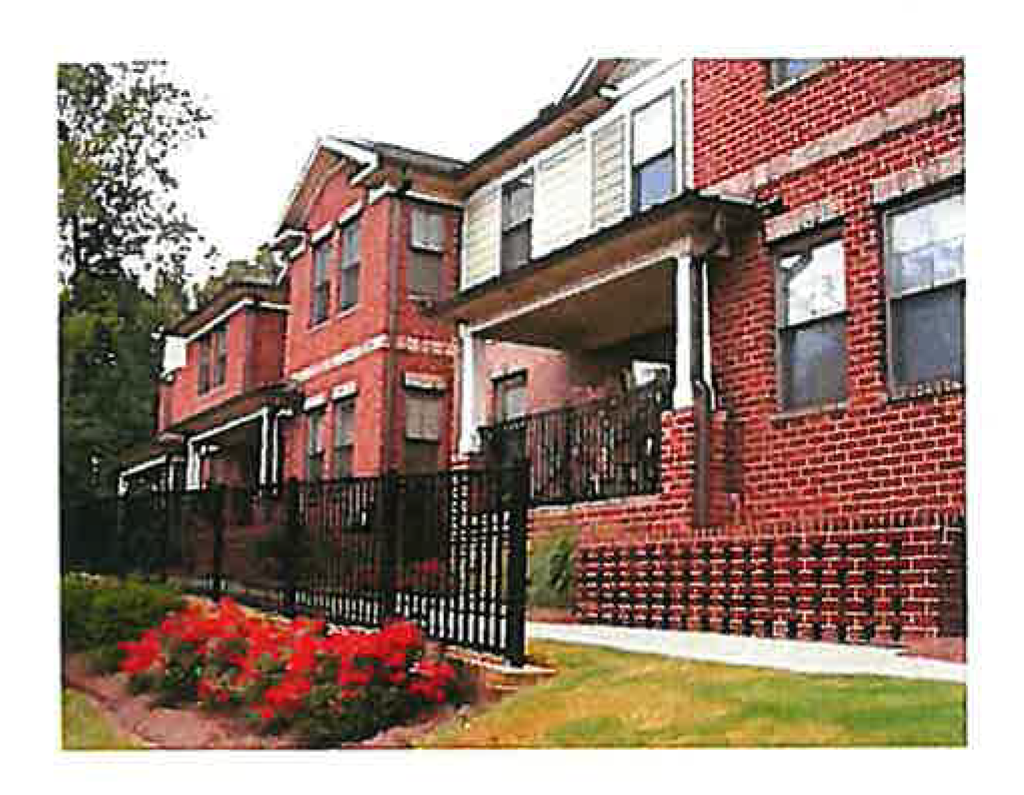
(5)
Service areas.
(a)
Private storage space shall be provided within, or immediately adjacent to, each dwelling.
(b)
Exterior mechanical equipment, vending machines, service and delivery areas, outdoor storage, trash storage, and accessory uses and structures that may produce noise, odors, glare, vibration, etc.:
•
Shall be screened from view of public and common areas and adjacent properties (see Figure 6-7-5); and
•
Shall be located away from adjacent residential dwellings or integrated into the building's architecture.
Figure 6-7-5: Service Area Screening
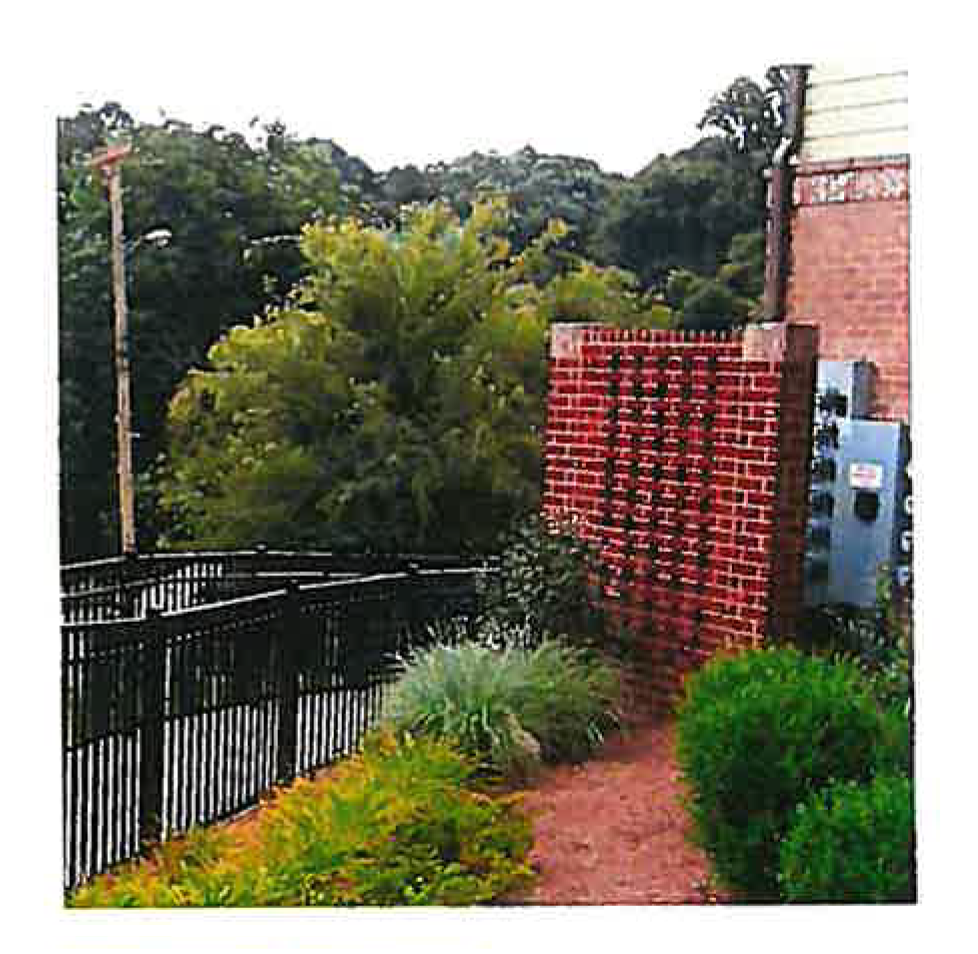
(c)
Above-ground refuse containers shall comply with the below standards (see Figure 6-7-6):
1.
Above-ground refuse containers shall comply with the applicable setback requirements. No above-ground refuse container shall be located less than fifteen (15) feet from the property line of any abutting property improved with a single-family detached use.
2.
Above-ground refuse containers shall be fully screened from the view of adjoining property and public streets. Above-ground refuse containers shall be screened in compliance with section 6-3.7. In-ground refuse containers shall be screened with evergreen plantings.
Figure 6-7-6: Example of Multiple Building Materials
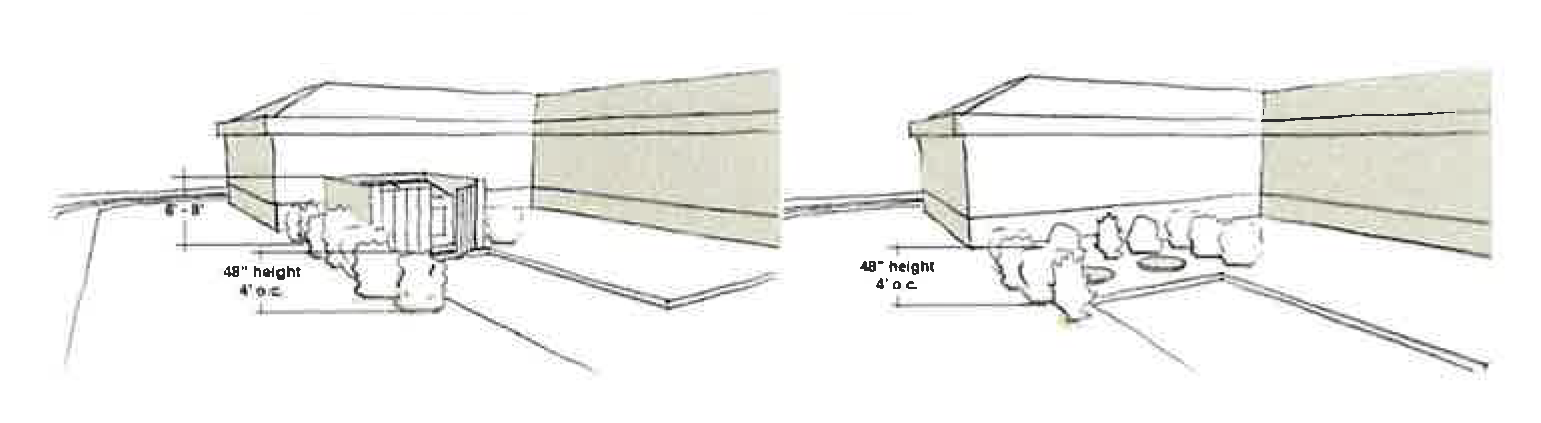
3.
Times of service. Deliveries, waste collection, and similar commercial activity is prohibited between the hours of 10:00 p.m. and 6:00 a.m.
(6)
Roof form.
(a)
Pitched roofs shall include variation in planes, slope, and features (see Figure 6-7-7).
(b)
Overhanging eaves and roof rakes on gable ends shall extend at least six (6) inches past the supporting walls.
(c)
Flat roofs shall incorporate parapet walls with three-dimensional cornice treatments designed to conceal the roof and roof-mounted mechanical equipment. All parapet walls visible from a public street shall be finished.
(d)
The parapet wall shall be similar in color and material to the building and shall not exceed twenty-five (25) percent of the height of the supporting wall.
(e)
Within developments with multiple buildings, building heights shall be varied to avoid the appearance of an elongated building mass. This can be achieved by stair-stepping building heights or by varying roof forms.
(f)
When adjacent to single-family detached dwellings, the roof form of multifamily residential buildings shall complement the character of surrounding structures.
(g)
Green roofs, which use vegetation to improve stormwater quality and reduce runoff, may be incorporated as an alternative to the roof forms described in this subsection.
(h)
All roof vents, pipes, antennae and other roof penetrations should be of a color that will minimize their visual impact unless concealed by a parapet, located on the rear elevation, or configured to have a minimal visual impact as seen from the street or existing residential development.
Figure 6-7-7: Gabled Roof Form
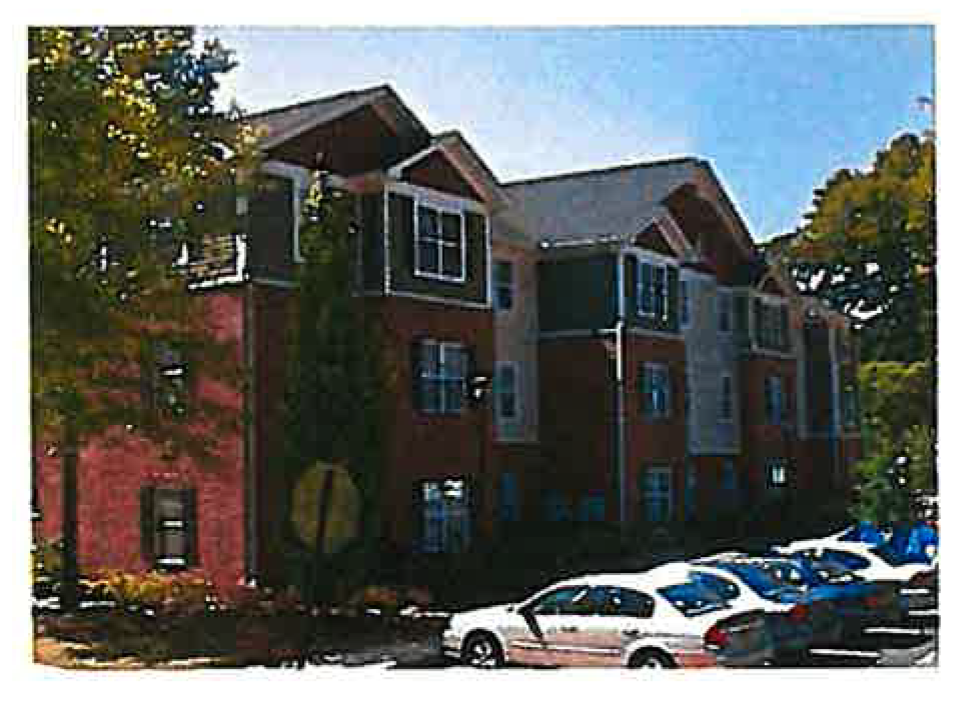
(7)
Transparency.
(a)
Street-facing facades shall have a minimum glazed area of twenty (20) percent. All other building facades shall have a minimum glazed area of ten (10) percent (see Figure 6-2-8).
(b)
Windows shall be provided on side facades and shall be positioned to avoid direct views into the windows of an existing adjacent residential dwelling.
(c)
Windows and doors of proposed dwelling units shall allow for casual surveillance of the parking and common open space areas.
(d)
Windows shall complement the rhythm, size, proportion, and trim of adjacent residential buildings.
Figure 6-7-8: Multifamily Window Transparency
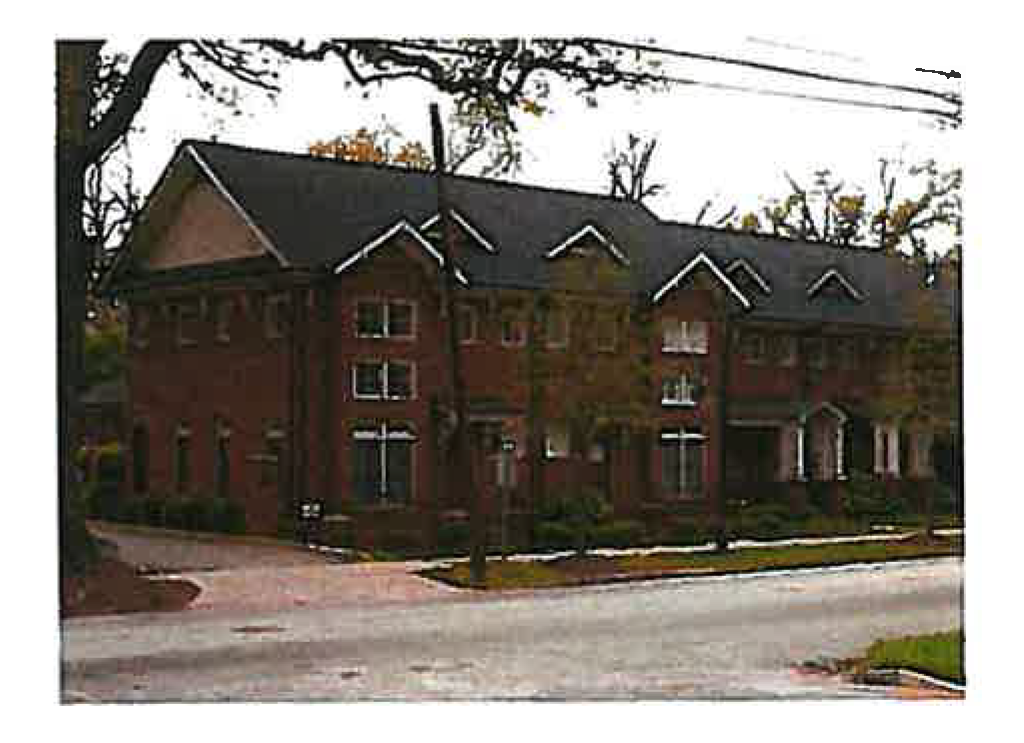
(8)
Materials.
(a)
Building facades shall incorporate a coordinated color scheme consisting of matte finishes. Gloss finishes may be used for trim and accent. Florescent and metallic paints are prohibited. However, nothing in this section shall prohibit the use of reflective colors on building roofs.
(b)
Colors and finishes shall be consistent throughout the development and all sides of the buildings.
(c)
Accessory buildings and structures shall be similar in materials and architectural style to the primary building.
(d)
Building materials shall either be similar to the materials already being used in the immediate area or, if dissimilar materials are being proposed, other characteristics such as scale and proportions, form, architectural detailing, color, and texture shall be utilized to ensure that enough similarity exists for the building to be compatible despite the differences in materials (see Figure 6-7-9).
Figure 6-7-9: Multifamily Development in Context with Similar Building Materials
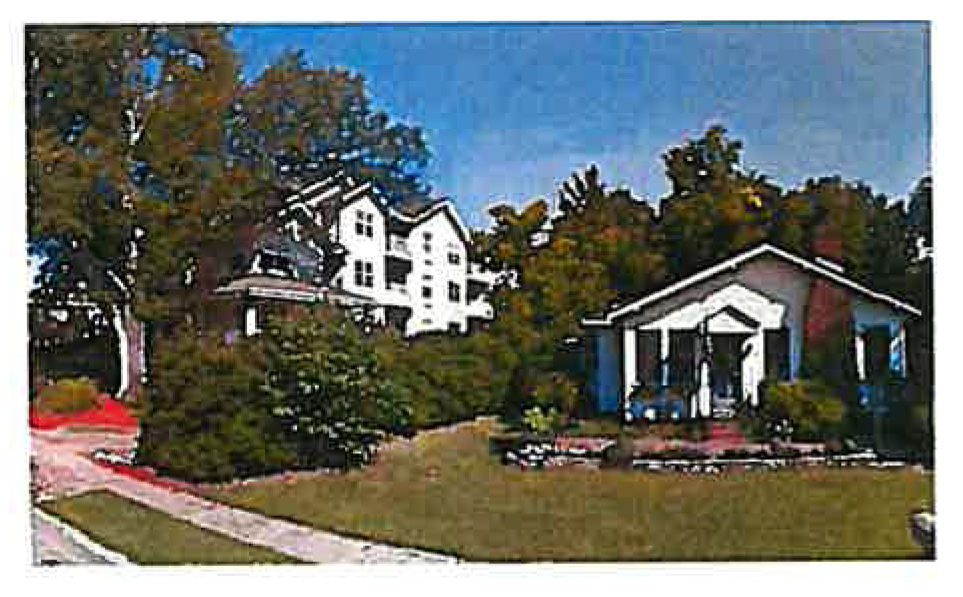
(e)
Where two (2) or more materials are proposed to be combined on a facade, the heavier and more massive elements shall be located below the lighter elements (e.g., brick shall be located below stucco). Use of a heavier material as a detail on the corner of a building or along cornices or windows is acceptable (see Figure 6-7-10).
Figure 6-7-10: Heavier Materials Below Lighter Elements
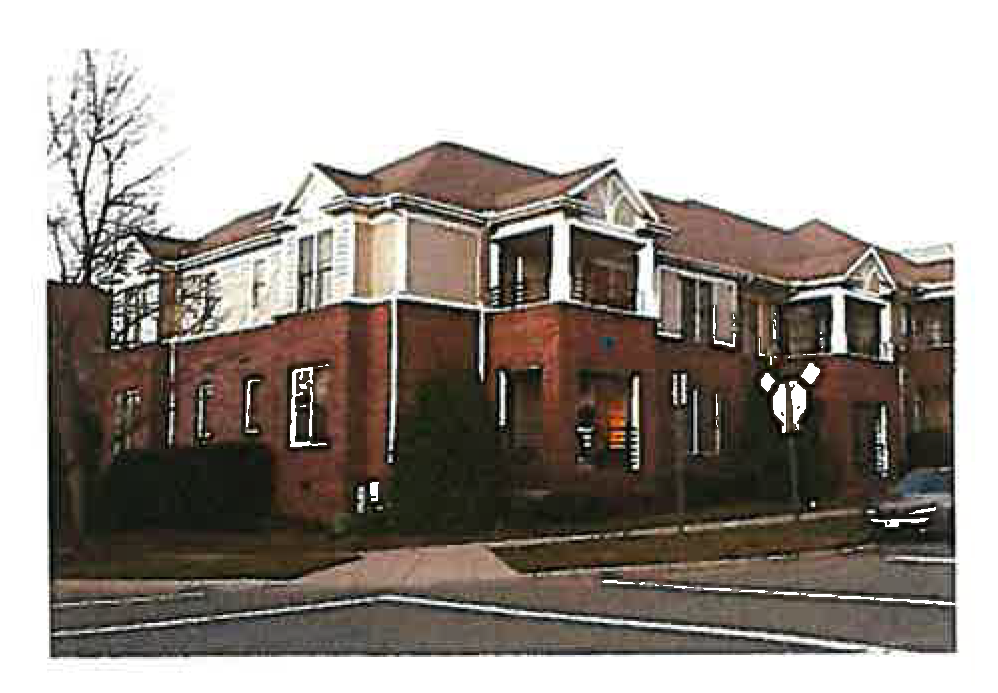
(f)
Primary facade materials shall not terminate or change at outside corners and shall continue a minimum distance of two (2) feet from the front corners along the side facades.
(g)
Material changes shall occur along a horizontal line or where two (2) forms meet. It is acceptable, however, that change of materials occur as accents around windows, doors, cornices, or as a repetitive pattern.
(h)
Brick shall be the primary material (at least fifty (50) percent) on all facades visible from a public street. The following materials shall not be used:
•
Corrugated metal siding, however, high quality architectural metal siding may be used;
•
Exposed smooth-finished concrete block;
•
Styrofoam-backed and synthetic stucco within twelve (12) feet of the grade level and within two (2) feet of any exterior doorjamb (reinforced Styrofoam-backed stucco is acceptable); or
•
Vinyl siding.
(9)
Open space.
(a)
A minimum of two hundred (200) square feet of open space per dwelling shall be provided, one-half (½) of which may be private. The decision-making body may waive the provision of "common open space" or apply an alternative condition to the standard, provided the property is within a quarter mile of public open space or contains twenty (20) or fewer dwellings.
(b)
Connections to adjacent greenways, parks, trails, etc., shall be provided.
(c)
Common open spaces shall be located adjacent to common facilities such as laundry rooms, mail rooms/sites and community centers; visual access to shared open spaces shall be enhanced via windows opening from kitchens, living rooms, and dining rooms.
(d)
Physical access to common open space shall be as direct as feasible from the dwellings and designed to discourage nonresident access. Outdoor seating shall be encouraged to accommodate adult supervision.
(e)
Active recreation facilities shall be located in a manner to reduce adverse impacts upon residents, both on- and off-site; it shall have well-defined edges such as walkways, buildings, or landscaping.
(f)
Passive and active recreation space and facilities shall be provided in a form and an amount appropriate to the anticipated types of residents in the development (e.g., families with young children, the elderly, etc.) (see Figure 6-7-11).
(g)
Some form of private open space (i.e., patio, porch, deck, balcony, yard, etc.) is encouraged for each dwelling with boundaries between private and common open space established by elements such as low walls and landscaping.
Figure 6-7-11: Active Recreation Facilities
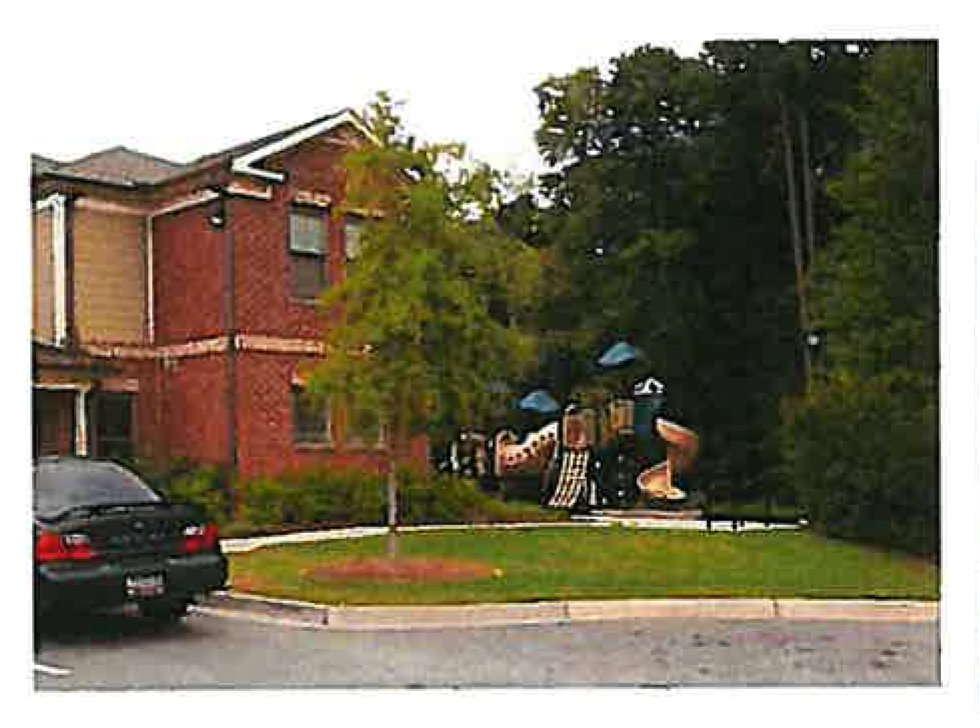
(10)
Parking lot location.
(a)
Parking areas shall be located and designed to reduce or eliminate visual and operational impacts on surrounding lands and shall comply with the provisions of section 6-1, off-street parking and loading and section 6-3, landscaping, buffering and screening.
(b)
Multi-level parking structures, when included, shall provide:
•
Building facade treatment and materials similar to facades with residential units;
•
Clear sight lines of abutting streets, driveways, and pedestrian pathways;
•
Light-colored interior walls and ceilings; and
•
Adequate and uniform interior lighting without glare to surrounding properties.
(c)
Parking areas for multifamily developments with at least twenty (20) units shall provide spaces dedicated for auto maintenance with access to water, electricity, and drainage.
(d)
At least seventy-five (75) percent of the off-street parking provided shall be located in the side or rear yards of multifamily residential buildings or within multi-level parking structures. Garage doors or vehicular entrance points to parking structures shall be located at least ten (10) feet behind the street-facing building facade.
(11)
Access and circulation.
(a)
Multifamily residential development located adjacent to routes serviced by mass transit shall provide pedestrian circulation and queuing locations, if applicable, to access mass transit vehicles.
(b)
Site entrance locations (vehicle and pedestrian) shall complement adjacent and opposite land use entrances in scale, design, and location. Entrances shall be located in a manner designed to retain the character of the adjacent land uses and not create adverse impacts.
(c)
Ingress and egress from off-street surface parking areas serving multifamily residential development adjacent to single-family detached dwellings shall be limited to the street fronting the development. In the case of corner lots, off-street parking areas may be accessed by either street fronting the development.
(12)
Landscaping and screening.
(a)
Site development shall minimize the alteration of site topography; preserve and enhance natural resources; utilize the natural carrying capacity of the land; and comply with the provisions of section 6-3, landscaping, buffering, and screening, and section 6-4, tree protection.
(b)
Installed landscaping shall be of a climate appropriate or native drought-tolerant species or shall be automatically irrigated.
(c)
Landscaping shall not obscure lighting.
(d)
Stormwater management facilities (such as retention ponds) should be incorporated with the landscape design of the site and be configured to serve as an active or passive recreation amenity for residents.
(e)
Building foundations shall be landscaped along the full length of each front and rear facade. Landscaping shall wrap around the corners and shall continue around building sides to a logical conclusion point or a minimum distance of ten (10) feet, whichever is less.
(f)
Foundation landscaping shall have an average depth of six (6) feet and a minimum depth of four (4) feet from buildings. Foundation landscaping depth along a sidewalk may be reduced by up to fifty (50) percent, where needed to provide for adequate pedestrian circulation or pedestrian amenities.
(13)
Exterior lighting.
(a)
The lighting of all parking areas, pedestrian walkways, entrances, and exterior portions of the site shall be designed for its specific task and shall comply with the provisions of section 6-5, exterior lighting.
(b)
Exterior lighting fixtures shall be:
1.
Vandal-resistant;
2.
Compatible with building architecture; and
3.
Scaled (dimension and intensity) to complement its context.
(c)
Adjacent to single-family dwellings:
1.
Exterior lighting heights, whether pole-mounted or wall-mounted, shall not exceed a maximum height of fifteen (15) feet above grade.
2.
Lighting levels at lot lines shall not exceed three (3) footcandles, as measured thirty (30) inches above grade.
3.
Uplighting of building or site features shall be directed away from adjacent properties.
4.
Internally illuminated signs or awnings are prohibited.
(14)
Pedestrian walkways.
(a)
Pedestrian walkways at least four (4) feet wide shall be provided between buildings, streets, driveways, community spaces, and off-street parking.
(b)
Changes of grade or sharp turns resulting in "blind spots" are discouraged.
(c)
Walkways shall transect common open space to enhance visual access while minimizing conflicts between vehicles, bicycles, and pedestrians.
(d)
Entry points and intersections of pedestrian walkways should be framed by landscaping consisting of plant, lighting, and hardscape materials scaled to the pedestrian context.
(15)
Fences and walls.
(a)
In addition to the provisions for fences in subsection 4-4.3(H), an eight-foot-tall masonry wall shall be constructed adjacent to single-family residential districts and single-story multifamily residential developments.
(b)
When located adjacent to an existing wall or fence on a different lot, fences and walls shall be configured to avoid creation of tight corners or areas difficult to maintain.
(G)
Alternative design. The administrator may approve an alternative to one (1) or more of these standards, other than materials used, when an applicant demonstrates in writing that a design meets the purpose and intent of this section and is more suitable for the architectural style of the proposed building(s).
(Ord. No. 2025-23, § 3, 6-17-25)
Sec. 6-9. - Sign standards.
6-9.1. Purposes.
(A)
It is the purpose of the mayor and city council in enacting these regulations to provide standards to safeguard life, public health, property, and welfare by regulating the location, size, illumination, erection, maintenance, and quality of materials of all signs. More specifically, signs have a powerful impact on the aesthetic environment of the community, and it is the purpose of this article to encourage an aesthetically attractive environment, allowing sufficient opportunities for communications to serve business, interest groups and the public, while complying with the federal and state constitutions and laws. Signs create visual clutter and therefore should be regulated in their size, location, construction, and illumination. Signs can detract from the beauty of the neighborhood and lower property values. In seeking to comply with federal and state law, the city has determined the following: large signs are, as the U.S. Supreme Court has recognized, an aesthetic harm; the state supreme court has upheld sign regulations on the basis of aesthetics and preserving the beauty of environment; and, the 11th Circuit has recognized portable signs are visual clutter and a potential traffic hazard. These holdings show that the city's ordinance is within the law and constitutional, which is a goal of the city. The goal of this article is to avoid being an impermissible content-based regulation, and instead to be a permissible time, place, and manner restriction.
(B)
Many signs can also be a hazard and negatively impact traffic safety by distracting drivers and blocking views of other vehicles and dangers, by making intersections more treacherous, and by making it difficult to see oncoming traffic when entering a roadway. Therefore, it is also the purpose of this article to prevent those harms by regulating signs to safe locations, safe sizes, with proper and safe illumination and construction.
6-9.2. Jurisdiction and applicability of code requirements.
(A)
This article shall apply to all properties within the incorporated areas of the city. This article shall not relate to the copy or message on signs within the city.
(B)
All signs and sign structures shall be constructed and maintained in conformance with the state minimum standard codes.
(C)
If any provisions or requirements of this article are in conflict with any other provision or requirement of this article or any other applicable governmental law, ordinance, resolution, rule, or other governmental regulation of any kind, the more restrictive rule or standard takes precedence.
6-9.3. General provisions and definitions.
(A)
No sign shall be placed or maintained within the city except in conformity with this article.
(B)
Notwithstanding any other restrictions in this article, any sign, display, or device allowed under this article may contain any commercial or non-commercial message, or any political or non-political message; except that such messages cannot depict obscenity, as defined by O.C.G.A. § 16-12-80, nor can they depict sexual conduct or sexually explicit nudity, as defined in O.C.G.A. § 36-60-3.
(C)
Height limitations in this article control over the general height limitations of this article and apply to any structure that contains a sign. For example, a church spire or radio antenna with a sign would be subject to the height limitations of this article, rather than general height limitations.
(D)
Definitions. The general definitions and interpretative rules of this chapter shall also be used. To the extent those general rules or definitions conflict with these specific definitions, these definitions shall control. The following words, terms, and phrases, when used in this article, shall have the meanings ascribed to them in this subsection, except where the context clearly indicates a different meaning:
A-frame sign means a sign which is normally in the shape of an "A" or some variation, which is usually two-sided.
Abandoned sign means a sign and/or sign structure which no longer correctly directs or exhorts any person, or advertises a bona fide business, lessor, owner, product, or service.
Animated sign means any sign that all or any part thereof visibly moves or imitates movement in any fashion whatsoever. Any sign that contains or uses for illumination any lights (or lighting devices) that change color, flash or alternate, show movement or motion, or change the appearance of said sign or any part automatically.
Area of sign (copy area) means the area within a continuous perimeter enclosing the limits of writing, representation, emblem, or any figure of similar character together with any frame, or material, open space, or color forming an integral part of the display or used to differentiate such sign from the background against which it is placed.
Banner means a sign hung either with or without a frame, possessing characters, letters, illustrations, or ornamentation applied to paper, plastic, or fabric of any kind. This definition expressly excludes flags.
Canopy means any permanent roof-like structure, including awnings and marquees, projecting beyond a building or extending along and projecting beyond the wall of a building, generally designed and constructed to provide protection from the weather.
Canopy sign means any sign attached to, or made a part of, the front, side, or top of a canopy. These signs are regulated as wall signs.
COA means a certificate of appropriateness issued by the Historic Preservation Commission or the administrator upon recommendation of the Main Street Advisory Board.
Copy means the wording or graphics on a sign surface in either permanent or removable form.
Erect means to build, construct, attach, hang, place, suspend, paint or affix.
Establishment means a commercial, industrial, institutional, educational, office, business, or financial entity.
Flag means any fabric sign, regardless of the message conveyed, mounted to a flagpole on one side only.
Freestanding sign means any sign which is independent from any building or other structure and is entirely supported by a single or multiple pedestals that are permanently attached at or below ground level. These signs are regulated as ground signs.
Frontage, building, means the length of an outside building wall facing a street, or portion thereof.
Frontage, street, means the length of the property line of any one parcel along a street on which it borders.
Ground sign means a sign that is anchored to the ground and is wholly independent of a building for support. Freestanding signs are included in this definition, as are signs on poles, frames, or other mounting structures other than buildings.
Illuminated sign means a sign which contains an internal source of light, or which is designed or arranged to reflect light from an artificial source.
Mansard roof sign means any sign attached to or erected within twelve (12) inches of an actual or simulated mansard roof of a building, with the sign face parallel to and within the limits of the building, but not exceeding the roofline, and not deemed to be a roof sign. These signs are regulated as wall signs.
Manual reader board means a portion of a ground sign on which copy is changed manually.
Monopole sign means a freestanding sign that is erected on a single pedestal attached to the ground for the display of messages irrespective of the number of faces or the configuration of the faces. These signs are regulated as ground signs.
Monument sign means a permanent sign with little or no open space between the ground and the sign face and constructed of brick, stone, concrete, masonry, stucco, or equal architectural material. These signs are regulated as ground signs.
Multiple-message sign means a sign or portion of a sign which changes the message or copy on the sign face mechanically or electronically by movement or rotation of panels or slats, or by changing electronic display on the sign face more than once per day.
Painted wall sign means any sign that is applied with paint or similar substance on the face of a wall.
Permanent sign means a sign permanently affixed to a building or the ground.
Person means any association, company, corporation, firm, organization, or partnership, singular or plural, of any kind.
Planned center means a nonresidential development with multiple establishments that are separately owned and operated.
Portable sign means any sign supported by its own frame or trailer, with or without wheels, that is designed to move from one place to another. Portable sign does not include A-frame signs.
Post and arm sign means a permanent sign supported by a single upright post with a horizontal arm from which a sign is suspended. These signs are regulated as ground signs.
Projecting sign means any sign affixed to a building or wall, which horizontally extends more than twelve (12) inches beyond the surface of a building or wall.
Roof sign means any sign erected, constructed, and maintained upon or over the roof of any building or projects above the roofline.
Roof sign (integral) means any sign erected or constructed as an integral part of a normal roof structure of any design. No part of the sign can extend vertically above the highest portion of the roof, and no part of the sign can be separated from the rest of the roof by a space of more than six (6) inches.
Setback means the distance from the property line to the nearest part of the applicable sign or sign structure, measured perpendicularly to the property line.
Sign means any display of words, shapes or images designed to convey a message to the viewer, located on the exterior of any dwelling, building or structure, or located anywhere on a lot upon a dedicated supporting structure or device, including poles, banners, windows, and similar devices.
Sign face means the actual message-carrying portion of the sign that can be used to display content, including any area that can display or does display words, pictures, or other communicative elements of the sign, including the background color.
Sign structure means and includes all the elements of the sign, including its supporting structure, sign face, base, lights, and every portion of the sign.
Street means any public or private right-of-way for automobile use. This excludes alleyways, parking lots and driveways.
Under canopy sign means a sign that is suspended from the underside of a canopy, is perpendicular to the wall surface of a building, and whose copy is not clearly visible from the public right-of-way.
Wall face means a measurement of area equal to the height of the structure from the ground to the coping or eave of the roof multiplied by the width of the wall associated with the individual business. The wall face is to be measured for each wall independently.
Wall sign means a sign that is fastened directly to or is placed or painted directly upon the exterior wall of a building and does not project more than twelve (12) inches from the building face.
Window sign means a sign having its message visible from the exterior of a building that is either located within a building so as to be visible through a window or affixed directly to the window either inside or outside the building.
6-9.4. Permitted signs.
(A)
Standard permitted signs. The following signs are permitted in the following zoning districts. If not otherwise stated, any sign not specifically authorized under this article shall be prohibited. These regulations apply to signs located on any lot or development.
(B)
Address required on ground signs. All ground signs except signs exempt from permit under section 6-9.13 shall include the address of the parcel on which the sign is located. When a sign is oriented to a street other than the street to which the address is assigned, the address shall include the street name of the assigned address.
6-9.5. Residential district sign standards.
Signs in residential districts. Signs permitted in the residential base zoning districts (R-Ag, R-1, R-2, R-2A, R-3, R-TH, RM-I, RM-2, R-MH, FBR) shall comply with the provisions in Table 6-9-1. Signs on one- and two-family lots are exempt from obtaining a sign permit.
6-9.6. Nonresidential district sign standards.
(A)
Ground signs in nonresidential districts. Ground signs permitted in the nonresidential base zoning districts, and the PC, DD, and NC overlay districts shall comply with the provisions in Table 6-9-2.
(B)
Wall, canopy, projecting and under canopy signs in nonresidential districts. Wall, canopy, projecting and under canopy signs in the nonresidential base zoning districts and PC, DD, NC overlay districts shall comply with the provisions of Table 6-9-3.
(C)
Additional standards for signs in the C-3 zoning district, and the DD overlay district.
(1)
Wall signs in a planned center shall be composed of individual letters not exceeding eighteen (18) inches in height.
(2)
Prohibited signs in C-3 and DD districts:
a.
Multiple message signs, except as authorized in section 6-9.9.
b.
Neon tube signs, including neon and rope light building or window/door outlining.
c.
Signs incorporating reflective and luminescent materials.
6-9.7. Additional ground signs. In addition to ground signs permitted in sections 6-9.5 and 6-9.6, additional ground signs are authorized during certain periods of time as described in Table 6-9-4. Such signs are exempt from obtaining a sign permit. Property address is not required on such signs.
6-9.8. Banners. Banners are permitted for any use except one- and two-family dwellings, subject to the following standards:
(A)
A banner shall be permitted for up to thirty (30) consecutive days, and not more than ninety (90) days per calendar year.
(B)
A banner shall not exceed sixteen (16) square feet in area.
(C)
One banner shall be permitted per tenant.
(D)
The banner shall be attached to a flat wall or to a rigid ground-mounted frame in a manner such that the banner does not become an animated sign.
(E)
A sign permit shall be required for each thirty-day display.
6-9.9. Multiple message signs.
(A)
Multiple message signs may be incorporated as part of the ground sign(s) otherwise permitted in each nonresidential zoning or overlay district, per the provisions of Table 6-9-5.
(B)
When the message of a multiple-message sign is changed mechanically, it shall be accomplished in three (3) seconds or less. When the message of a multiple-message sign is changed in an electronic manner, through the use of light emitting diodes, back lighting or other light source, the transition shall occur within two (2) seconds. No multiple-message sign may change its message or copy, or any pictures or images that are part of the message, more frequently than once every ten (10) seconds.
(C)
When any multiple-message sign is located within one hundred fifty (150) feet of any residential district, the display of multiple-messages shall discontinue between the hours of 11:00 p.m. and 6:00 a.m., and the sign shall be static and not display more than one message during that period.
(D)
Multiple message signs shall incorporate a photocell or similar technology that adjusts the brightness of the sign relative to the outdoor ambient light.
6-9.10. Regulations for signs.
(A)
Location, height, and setback.
(1)
The property owner must give permission for all sign placement on the owner's property, through the issuance of a letter signed by the owner.
(2)
All signs must comply with all side and rear setbacks of this chapter.
(3)
Signs can be located in front setback areas, but all signs and sign structures must be set back at least ten (10) feet from the public right-of-way. No portion of a sign or sign structure shall encroach on or overhang the public right-of-way, except for projecting and under-canopy signs as allowed in the Downtown Development Overlay District, or any other person's property. Furthermore, for safety reasons, no sign shall be located closer than ten (10) feet from the back of the curb of a public roadway, or if there is no curb, from the edge of the pavement.
(4)
Distances are measured from the closest portion of the sign (whether that is the base, sign face, or the sign structure) to the property line(s).
(5)
The height requirements of a sign shall be computed as the length of a straight vertical line from normal grade to the height of the highest attached component of the sign or sign structure. Normal grade shall be considered the lower of:
a.
Existing grade of the site of the sign prior to construction of the sign; or
b.
The newly established grade at the base of the sign after construction, exclusive of any filling, beaming, mounding, or excavating solely for the purpose of locating the sign.
(B)
Number. For the purpose of determining the number of signs, ground signs shall be equal to the number of sign structures. All other non-ground signs shall be considered to be a single display surface or display device containing elements organized, related, and composed to form a unit. A double-sided (double-faced) sign is counted as one sign.
(C)
Illumination.
(1)
Ground signs shall not be internally illuminated except where expressly permitted by this article. All signs, except those located on one- and two-family residential lots, may be externally illuminated. External illumination of any sign in any district shall be positioned and shielded so that the light source does not shine directly into the path of motorists on a public right-of-way or into the windows of adjacent dwellings or businesses without the permission of the owner and occupant thereof.
(2)
No sign shall give off light which glares, blinds, or has any other adverse effect on traffic or adjacent properties. The light from an illuminated sign shall be established in such a way that adjacent properties and roadways are not adversely affected and that no direct light is cast upon adjacent properties and roadways. This shall be determined by measuring the footcandles that fall on adjacent properties or the public right-of-way. No sign shall exceed one-half (0.5) footcandle at any adjacent property line in a residential district or two (2) footcandles at any public right-of-way.
(3)
Flashing, blinking or otherwise varying illumination is not permitted. No external or internal illumination that causes confusion with or distraction from any traffic signal or safety device shall be permitted.
(4)
All externally illuminated signs shall utilize low wattage luminaries, mounted in fixtures designed to direct the light and eliminate light trespass, such as light shining into residences or other neighboring structures.
(5)
All internally illuminated signs shall utilize low wattage luminaries designed to reduce light glow.
(6)
All illuminated signs over ten (10) feet in height shall either be internally illuminated, when authorized, or illuminated by external lighting fixtures not visible to passing motorists.
(D)
Calculation of area.
1.
The area of a sign is calculated by determining the area of the smallest rectangle which encloses the sign face and the structure surrounding the sign face. For example, the pole or base would not be included, but any frame holding the sign face in place would be counted. See examples:
Examples of Sign Face Area Measurements
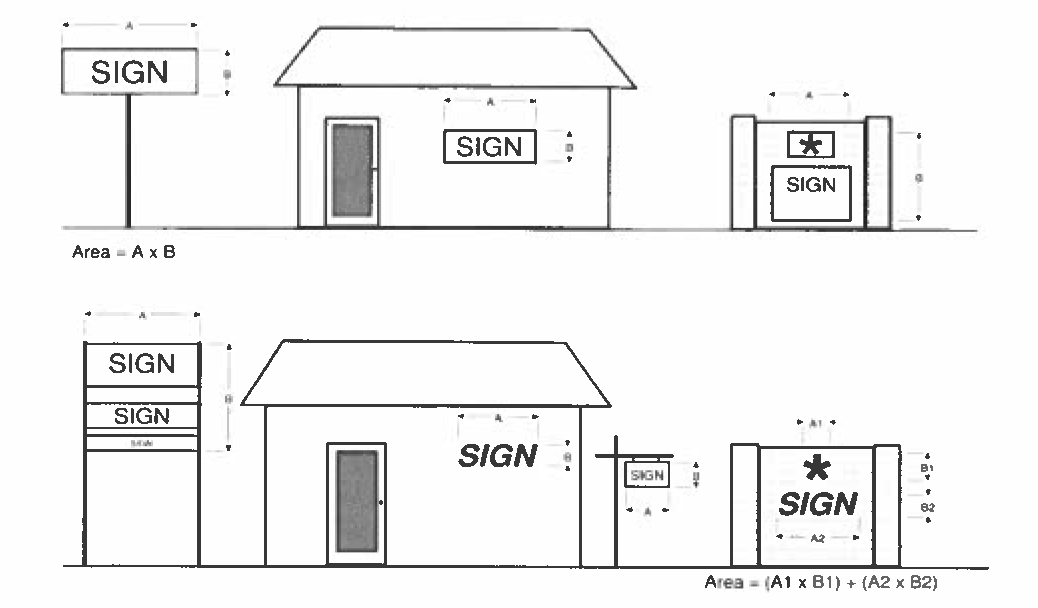
2.
The area of unusual-shaped signs shall be calculated based on the area within two (2) connected rectangles created with no more than eight (8) imaginary parallel or perpendicular lines which fully encompass all elements of the sign. See example:
Example of Measuring Unusual-shaped Signs
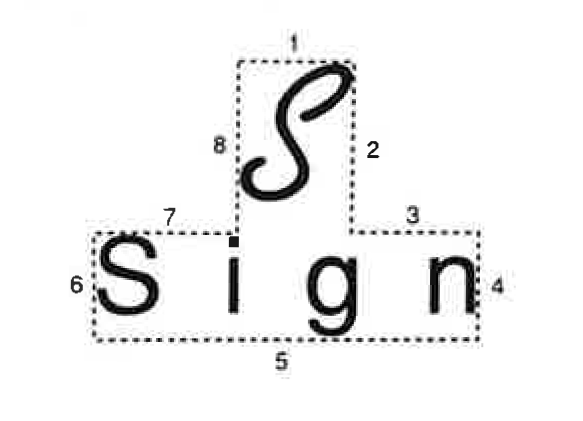
6-9.11. Safety and construction standards.
(A)
Engineering approval. All signs in excess of fifteen (15) feet in height shall be constructed according to plans approved by a state registered professional engineer. The sign owner shall produce such approved plans at the request of the administrator.
(B)
Official confusion. Signs which contain or are in imitation of an official traffic sign or signal are prohibited.
(C)
Fire safety. No sign or sign structure may be erected or maintained which obstructs any fire escape, ventilation, or door; nor shall any sign or sign structure be attached to a fire escape.
(D)
Corner visibility. No sign or sign structure above a height of three (3) feet shall be maintained within fifteen (15) feet of the intersection of the right-of-way lines of two (2) streets, or of a street intersection with a railroad right-of-way.
(E)
Traffic visibility. No sign shall obstruct the view of vehicles entering the roadway (i.e., the view of oncoming traffic by vehicles attempting to enter the road).
(F)
Good repair. All signs, together with all their supports, braces, guys, and anchors shall be kept in good repair. Sign face shall be maintained at all times. Any structure formerly used as a sign, but not in use for any other purpose, must be removed by the owner of the property within ten (10) days after written notification from the administrator or thirty (30) days after its use as a valid sign has ceased, after which time, the city may cause the removal of the sign at the owner's expense.
(G)
Removal of unsafe signs and safety hazards. The city may remove a sign in violation of this chapter, without giving notice to any party, if said sign is upon the public right-of-way or upon other public property, or said sign poses an immediate safety threat to the life or health of any members of the public.
6-9.12. Prohibited signs.
The following types of signs are prohibited:
(A)
Roof signs and roof signs (integral).
(B)
Signs with more than two (2) sides.
(C)
Animated signs, except where expressly permitted.
(D)
A-frame signs, except in DD overlay district.
(E)
Portable signs.
(F)
Signs which contain or are in imitation of an official traffic sign or signal.
(G)
Any sign not authorized by this article.
6-9.13. Signs not required to obtain a sign permit.
The following types of signs do not require a sign permit, provided they comply with the provisions of this article:
(A)
Signs located on one- and two-family dwelling lots.
(B)
Window signs.
(C)
Flags.
(D)
Signs installed on a public right-of-way by the City of Perry, Houston County, Peach County, the State of Georgia, or their authorized agent.
(E)
Signs authorized in section 6-9.7.
(F)
Signs located at drive-through ordering stations.
(G)
Signs up to three (3) square feet in area, up to thirty (30) inches in height, and located within five (5) feet of the vehicular access points of a lot.
(H)
Signs integral to, or attached to fuel pumps, electric charging devices, or vending machines other than self-service vending units.
6-9.14. Procedures; permits.
(A)
Except as specifically exempted from the provisions of this article, a person or firm may not legally maintain, post, display, enlarge, erect, move, or substantially change a sign that is taller than forty-eight (48) inches without first obtaining a permit from the administrator. Signs using electrical wiring and connections (i.e., illuminated signs), as well as larger signs, may require additional permits under the city building code.
(B)
All parties are advised to consult with the administrator to avoid erecting signs that violate this article. No person shall obtain a vested right to maintain a sign that does not comply with this article at the time it is erected. Signs erected in violation of this article shall be removed or reconstructed in compliance with this article.
(C)
See section 2-3.9 for application requirements and procedures.
6-9.15. Nonconforming signs.
Signs existing legally at the time of the adoption or amendment of the ordinance from which this article is derived, but which do not conform to newly adopted or amended provisions of this article solely because of a change in this article, and not because of a change to the sign, may remain as legal nonconforming signs, subject to the following provisions:
(A)
There must be existing property rights in the sign;
(B)
The right to continue a nonconforming sign is confined to the sign owner or his transferee;
(C)
A nonconforming sign may be restored to its original condition, provided that not more than fifty (50) percent of the sign is destroyed. The fifty (50) percent is to be determined by fifty (50) percent of the value of the materials of the sign, inclusive of poles and other structural members, immediately prior to damage;
(D)
A nonconforming sign when relocated or moved shall no longer be considered a nonconforming sign and thereafter shall be subject to all the provisions of law and of these rules;
(E)
The sign must remain substantially the same as it was on the effective date of the adoption of the ordinance from which this article is derived which rendered the sign nonconforming. Extension, enlargement, replacement, rebuilding, adding lights to a non-illuminated sign, re-erection of the sign, or replacing a manual reader board with a multiple message sign will be considered a change in the existing sign. The maintenance will be limited to:
(1)
Replacement of nuts and bolts, and light bulbs;
(2)
Additional nailing, riveting, or welding;
(3)
Cleaning and painting;
(4)
Manipulating to level or plumb the device, but not to the extent of adding guys or struts for stabilization of the sign structure;
(5)
A change of the message, including changing faces, as long as similar materials are used, and the sign face is not enlarged or modified in shape. Sign face shall be maintained at all times.
(F)
At no time may changes be made in a nonconforming sign which would increase the value of the sign;
(G)
A nonconforming sign may continue as long as it is not abandoned, destroyed, discontinued, or purchased by any governmental agency. Any sign suffering damage in excess of normal wear cannot be repaired without:
(1)
Notifying the administrator in writing of the extent of the damage, the reason the damage is in excess of normal wear, and providing a description of the repair work to be undertaken, including the value of the sign materials and the cost of the repair; and
(2)
Receiving written notice from the administrator authorizing the repair work as described above. If said repair is authorized by the terms of this article, the administrator shall mail such notice to the applicant within thirty (30) days of receipt of the information described in subsection (7)(a) of this section.
(H)
A nonconforming sign with a sign face exceeding two hundred (200) square feet in area which is destroyed or damaged by more than fifty (50) percent of its replacement value and is authorized to be reestablished under a permit issued by the Georgia Department of Transportation, shall only be reestablished as a monopole sign. Such reestablished sign shall not exceed the sign face area and height of the sign prior to damage or destruction.
(I)
Notwithstanding the foregoing, any removal of a nonconforming sign shall be in accordance with O.C.G.A. § 32-6-83.
(Ord. No. 2023-28, § 5, 8-15-23; Ord. No. 2024-16, § 1, 7-16-24; Ord. No. 2025-11, § 2, 2-18-25; Ord. No. 2025-26, §§ 1, 2, 8-19-25)
Editor's note— Ord. No. 2023-28, § 5, adopted Aug. 15, 2023, repealed the former § 6-9, §§ 6-9.1—6-9.16, and enacted a new § 6-9 as set out herein. The former § 6-9 pertained to signs, and derived from Ord. No. 2017-25, § 2, adopted Dec. 19, 2017; and Ord. No. 2020-10, §§ 4, 5, adopted July 21, 2020.
Sec. 6-10. - Site development and related infrastructure.
6-10.1. General design requirements.
(A)
Suitability of land. Land subject to flooding, improper drainage, or erosion, or which for topographical, geological or other reasons is unsuitable for residential use shall not be platted for residential use or for other uses that will continue to increase the danger to health, safety, or property destruction, unless the hazards can be and are corrected. No portion of a single-family or two-family residential lot shall be located within a 100-year floodplain.
(B)
Name of subdivision. The name of the subdivision must have the approval of the commission. The name shall not duplicate nor closely approximate the name of any existing subdivision.
(C)
Access. Access to every subdivision shall be provided over a public street.
(D)
Conformance to adopted major thoroughfare plans. All streets and other features of the major thoroughfare plan of the city shall be platted by the subdivider in the location and to the dimension indicated on the major thoroughfare plan adopted by the commission and/or council.
(E)
Through traffic. Minor streets shall be so laid out that their use by through traffic will be discouraged.
6-10.2. General requirements for streets and other rights-of-way.
(A)
Continuation of existing streets. Existing streets shall be continued at the same or greater width, but in no case less than the required width.
(B)
Connections with future subdivisions. Streets shall be reserved at strategic locations to provide for future access to adjoining properties which may be subdivided in the future. Each street connection shall interest property lines at a ninety-degree angle.
(C)
Street names. Street names shall require the approval of the commission. Streets that are obviously in alignment with streets already in existence and already named shall be given the name of the existing streets. Names of new streets shall not duplicate or closely approximate those existing streets.
(D)
Street jogs. Street jogs with centerline offsets less than one hundred twenty-five (125) feet shall not be permitted.
(E)
Culs-de-sac. Culs-de-sac, or dead-end streets, shall be provided at the closed end with a turnaround meeting the specifications of section 6-10.10, roadway surfacing and paving.
(F)
Development along major street, limited-access highway or railroad right-of-way. Where a subdivision abuts or contains an expressway, freeway, arterial or collector street, or a railroad right-of-way, the commission may require a street approximately parallel to and on each side of such right-of-way either as a marginal access street, or at a distance suitable for an appropriate use of intervening land, with a non-access reservation suitably planned. Due regard should be given requirements for approach grades and future grade separations in determining distances. Lots shall have no access to expressways, freeways, or arterial streets, but only to an accessible street in which case the commission may require double frontage lots.
(G)
Half streets. Half streets shall be prohibited except where essential to the reasonable development of the subdivision in conformity with the other requirements of these regulations, and where the commission finds it will be practical to require the dedication of the other half when the adjoining property is subdivided, the other half of the street shall be platted within such tract.
(H)
Alleys. The requirements for providing alleys within a subdivision are as follows:
(1)
Alleys shall be provided in multifamily commercial, and industrial districts, except where other definite and assured provision is made for service access such as off-street parking, loading and unloading consistent with and adequate for the uses proposed.
(2)
Alleys shall not be provided in one- and two-family residential developments unless the subdivider provides evidence satisfactory to the commission of the need for alleys.
(3)
Alley intersections and sharp changes in alignment shall be avoided, but where necessary, corners shall provide sufficient radius to permit safe vehicular movements.
(4)
Dead-end alleys shall be avoided where possible but if unavoidable, shall be provided with adequate turnaround facilities at the dead-end, as determined by the commission.
(I)
Reserve strips and easements.
(1)
Reserve strips controlling the access to streets shall be prohibited except where this control is definitely placed in the hands of the council under conditions approved by the commission. The commission may require access to expressways, freeways, arterial and collector streets by requiring all lots to face and have access to only minor streets.
(2)
Easements having a minimum width of ten (10) feet and located along the side or rear lot lines shall be provided, as is necessary for utility lines and underground mains and cables. Where a subdivision is traversed by a watercourse, drainage way, channel or stream, there shall be provided a stormwater or drainage right-of-way of adequate width. Parallel streets may be required by the commission therewith.
(J)
Fire apparatus access roads.
(1)
One- and two-family residential developments. Developments of one- and two-family dwellings where the number of dwelling units exceed thirty (30) shall provide two (2) separate and approved fire apparatus access roads. Where there are more than thirty (30) dwelling units accessed from a single fire apparatus access road and all dwelling units are equipped throughout with an approved automatic fire sprinkler system in accordance with the International Fire Code, access from two (2) directions shall not be required. The number of dwelling units accessed from a single fire apparatus access road shall not be increased unless fire apparatus access roads will connect to future development, as determined by fire code official. All fire apparatus access roads for one- and two-family residential developments shall meet City of Perry design standards for public streets. Notwithstanding the foregoing, the fire code official may approve the use of a construction gravel road to satisfy the second means of fire apparatus access in those unique situations in which GDOT will not approve a secondary access or curb cut or when other extenuating circumstances exist due to topography challenges or other unique characteristics of a parcel. A proposed gravel road must satisfy compaction standards as deemed appropriate by the fire code official.
(2)
Remoteness. Where two (2) fire apparatus access roads are required for any residential development, they shall, to the extent practicable, be placed a distance apart equal to not less than one-half (½) of the length of the maximum overall diagonal dimension of the property or area to be served, measured in a straight line between accesses.
6-10.3. Rights-of-way width requirements. The minimum street right-of-way widths shall be as stated in Table 6-10-1, minimum rights-of-way widths. The commission may require a larger right-of-way than those listed.
Table 6-10-1: Minimum Rights-of-Way Widths
6-10.4. Street design requirements.
(A)
Street intersections. Street intersections shall be as nearly at right angles as possible with no street intersection being at any angle of less than seventy-five (75) degrees.
(B)
Right-of-way radius. The streets right-of-way radius at street intersections shall be at least twenty (20) feet. Where the angle of street intersection is less than ninety (90) degrees, the commission may require a longer radius.
(C)
Additional width on existing streets. Subdivisions that adjoin existing streets shall dedicate additional rights-of-way if needed to meet the minimum right-of-way width requirements set forth in subsection 6-10.3.
(1)
The entire right-of-way shall be provided where any part of the subdivision is on both sides of the existing streets.
(2)
When the subdivision is located on only one side of an existing street, one-half (½) of the required right-of-way, measured from the centerline of the existing roadway, shall be provided.
6-10.5. Design standards for block and lots.
(A)
Design lengths and widths. Block length and widths shall be determined based on the following requirements:
(1)
Blocks shall not be greater than two thousand two hundred (2,200) feet nor less than four hundred (400) feet in length.
(2)
Blocks shall be wide enough to provide two (2) tiers of lots of minimum depth, except where abutting a major street, limited-access highways or railroads or where other situations make this requirement impractical in which case the commission may approve a single tier of lots of minimum depth.
(3)
Blocks shall have pedestrian walkways not less than ten (10) feet wide, where deemed essential, to provide circulation, or access to schools, playgrounds, shopping centers, transportation and other community facilities.
(B)
Lot sizes. Lot dimensions shall conform to the requirements set forth in the zoning districts in which the land to be subdivided is located. Residential corner lots shall have adequate width to permit appropriate building setback from and orientation to both abutting streets.
(C)
Building lines. A building line meeting the front and side yard setback requirements of the zoning district in which the subdivision is located shall be established on all lots.
(D)
Lots abutting public streets. Each lot shall abut a dedicated public street.
(E)
Double frontage lots. Double frontage lots should be avoided except where essential to provide separations of residential development from traffic arterials or to overcome specific disadvantage of topography and orientation. A planting screen easement of at least ten (10) feet, and across which there shall be no right of access, shall be provided along the line of lots abutting such a traffic artery of other disadvantage use.
(F)
Lot drainage. On all residential and commercial building sites, buildable lots shall be designed and graded to ensure the top of any exterior foundation of a building extends above the elevation of the street gutter at a point of discharge, or the inlet of an approved drainage device, not less than twelve (12) inches plus two (2) percent. Alternate elevations are permitted subject to the approval of the building official, provided that it can be demonstrated that the required drainage to the point of discharge and away from the structure is provided at all locations on the site.
6-10.6. Monuments. Right-of-way and property line monuments shall be placed in each subdivision in accordance with the following:
(A)
Right-of-way monuments. A concrete marker imbedded at least two (2) feet into the ground shall be required at the intersection of the centerline of all street rights-of-way. Such concrete markers shall be at least four (4) inches in diameter. The top surface of such concrete marker shall be level with the surface of the street.
(B)
Property line monument. An iron pin or concrete marker at least two (2) feet into the ground shall be required at each lot corner and each point where the property line changes direction. Such an iron pin shall be at least three-quarters inch in diameter. The top surface of such iron pin shall be approximately level with the ground surface. Such concrete marker shall be at least four (4) inches in diameter. The top surface of such iron pin shall be approximately level with the ground surface.
6-10.6.[1.] Special classification of streets for construction. All streets shall be classified for construction purposes only as follows:
(A)
Standard street. A standard street shall be paved, curbed and guttered in accordance with the specifications required herein, and shall be required in all zoning districts. Right-of-way width requirements shall be in accordance with subsection 6-8.3.
6-10.7. Additional street design requirements.
(A)
Grades, horizontal curves, tangents, and sight distances. The following street design requirements shall be adhered to in addition to other requirements stated herein:
Table 6-10-2: Grades, Horizontal Curves, Tangents, and Sight Distances
(B)
Vertical curves. All changes in grade shall be connected by vertical curves of minimum length in feet equal to fifteen (15) times the algebraic difference in percent of grades for expressways, freeways, arterial and collector streets, and one-half (½) this minimum length for other streets. Profiles of all streets showing natural and finished grades drawn to a scale of not less than one inch equals one hundred (100) feet horizontally and one inch equals twenty (20) feet vertically may be required by the commission.
6-10.8. Traffic control devices.
(A)
Installation. All required street name signs, traffic control signs and other traffic control devices in new development shall be installed by the developer at the developer's own expense.
(B)
Design and placement. The design and placement of all street name signs, traffic control signs and other traffic control devices shall meet the requirements of the Manual on Uniform Traffic Control Devices as adopted by the state department of transportation and revisions thereto.
(C)
Other signage. All other signage within the street right-of-way shall be the responsibility of the developer and/or the homeowner's association and for the perpetual maintenance of these devices. The signage shall provide "break-away" features and/or other appropriate safety measures prior to installation. The number, type and location of all other signage shall be approved by the public works department prior to installation.
6-10.9. Basic construction requirements for all streets.
(A)
Grading. All streets, roads and alleys shall be graded to their full width by the subdivider so that pavements and sidewalks, where required or if installed in the future, can be constructed on the same level plane. The preparation of the right-of-way before grading is started and the construction of cuts and fills shall be accomplished in accordance with the requirements herein and other specifications of the council.
(B)
Storm drainage. An adequate drainage system based on at least the ten-year rainfall frequency including necessary curb, pipes, culverts, headwalls, and ditches shall be provided for the proper drainage of all surface water.
(C)
Installation of utilities. After grading is completed and approved and before any base is applied all of the underground utilities—water main, sewer mains, gas mains, or any other underground utilities, and all service connections related thereto—shall be installed completely and proved throughout the length of the street and across the flat section. Service connections for sanitary sewer and water shall be extended to the right-of-way lines.
(D)
Slopes and shoulder improvements. The minimum ratio for all fill or cut slopes shall be two (2) to one and the minimum width for all shoulders from back edge of the curb, if installed, shall be eight (8) feet. All shoulders shall slope one-half-inch to the foot. When all construction is completed, all slopes and shoulders shall be cleared of all rubbish and shall have a stand of grass to prevent undue erosion, either by sprigging or seeding.
6-10.10. Roadway surfacing and paving. For standard streets, the following minimum requirements shall be adhered to for the surfacing and paving of said streets:
(A)
Pavement base. The pavement bases, not including the surface courses, shall be one of the following types and shall be of the following minimum thickness as designated for each street.
Table 6-10-3: Minimum Pavement Base
(B)
Thickness of pavement. The pavement shall be one of the following types and shall be designated for each street classification.
Table 6-10.4: Minimum Pavement Requirements
(C)
Minimum pavement width. All minor residential streets shall have a minimum pavement width of twenty-seven (27) feet from back of curb to back of curb. All other street width requirements shall be determined by the commission and the council as required. For culs-de-sac and other dead end streets, a turnaround meeting the standards in Appendix D of the International Fire Code, as adopted in the Georgia State Minimum Fire Safety Standards, shall be provided at the closed end of the street.
(D)
Pavement breaks for utility connections. When it is necessary for a subdivider, or any utility company, to break existing pavements for the installation of utilities, for drainage facilities, or for any other purposes, the subdivider, or utility company shall be financially responsible for the repair of the pavement. The pavement shall be in accordance with the specifications required herein for construction of streets.
(E)
Curbs and gutters. Either a six-inch standing curb and gutter or a four-inch roll-over concrete curb and gutter with a minimum over-all width of twenty-four (24) inches shall be constructed on all standard streets. Cement concrete valley gutter shall be permitted across minor residential streets at street intersections only when no storm sewers are available as determined by the zoning enforcement officer. Valley gutters shall be at least six (6) feet in width. Whenever driveway openings are provided for lots abutting the street, the driveway shall be six (6) inches thick and a minimum of ten (10) feet in width at the sidewalk or at the street right-of-way line. The driveway shall have a minimum three-foot radius at the curb line.
(F)
Temporary turnarounds. Temporary turnarounds shall be required at the discretion of the commission. Said turnarounds shall consist of one and one-half (1½) inches of asphalt with a pavement base as described in subsection 6-10-10(A). In lieu of a paved temporary turnaround, the commission may permit an unpaved temporary turnaround, provided that the temporary unpaved turnaround shall require an appropriate letter of credit, in an amount determined by the public works department, for a duration of two (2) years approved prior to final plat approval. Unpaved temporary turnarounds shall meet all other construction and size requirements, with the exception of the paving and curbs. A temporary unpaved turnaround shall have positive drainage to prevent undermining of the turnaround or the new road associated with it. If there are recurring maintenance problems with the unpaved temporary turnaround the letter of credit shall be deemed forfeited and the financial institution will be required to immediately pay all amount due to the city.
(G)
Quality control and testing requirements. It will be the responsibility of the developer or his authorized representative to insure that all tests required are made. The cost of all testing and quality control will be performed at the expense of the developer by qualified testing laboratories approved by the commission. In all test reports, thickness of base and asphaltic concrete will be shown.
Table 6-10.5: Quality Control and Testing Requirements
6-10.11. Installation of utilities.
(A)
Water. Water mains for both domestic use and fire protection shall be properly sized by the city and connected with the public system. The lines shall be constructed in such a manner as to adequately serve the subdivision. The lines shall be sized and installed in conformance with water specifications for the city. The governing body may participate in sharing the costs of construction and installation of water system for any difference in the cost to lay oversized pipe and outfall systems which are needed in excess of the required water facilities needed to exclusively serve the new subdivision as determined by mayor and council.
(B)
Sewer. A publicly connected sanitary sewer system shall be installed and the subdivider shall incur the cost for the installation of all sewer systems which are required to serve the new subdivision including the cost of installing and tying in with the existing sewer system. The governing body may participate in sharing the cost of construction and installation of sewer systems for any difference in the cost of oversized pipe and outfall systems which are needed in excess of the required sewer facilities needed to exclusively serve the new subdivision as determined by mayor and council. All sewer facilities shall be installed in accordance with the standards of the department of human resources of the state and with the sewer specifications for the city.
(C)
Gas. When gas mains are connected with the gas distribution system of the city, the lines shall be installed in such a manner as to serve adequately all lots shown on the subdivision plats. The gas line shall be constructed in conformance with the gas specifications for the city.
(D)
Underground electrical system. If the subdivider installs an underground electrical system, he shall provide the building inspector with detailed plans showing the exact location of the lines.
(1)
Overhead street lighting. In cases where an underground electrical system has been installed, the subdivider shall provide terminal facilities and lighting fixtures for street lighting. This fixture shall be placed on the street pavement and in a location so as not to hinder the flow of traffic.
(2)
Cost of overhead street lighting. In cases of underground electrical systems, the subdivider shall assume the entire cost for installation of terminal street lighting fixtures.
6-10.12. Sidewalks. Sidewalks shall be installed by the developer of streets as follows:
(A)
Sidewalk standards. All sidewalks shall comply with the following standards:
(1)
Sidewalks shall have a minimum width of five (5) feet, and a minimum thickness of four (4) inches. See additional construction details in the Design & Specifications Manual.
(2)
A 24-inch-wide planting strip shall be provided between the back of the street curb and the sidewalk.
(3)
Sidewalks shall meet specifications of the Americans with Disabilities Act (ADA).
(4)
ADA-compliant curb ramps shall be installed at all street intersections at which sidewalks cross, and where future sidewalks may cross the intersection of new streets and existing collector or arterial streets.
(5)
Marked crosswalks shall be required where sidewalks cross streets intersecting with collector and arterial streets.
(B)
Residential streets. Sidewalks shall be installed in all new residential subdivisions with specific locations determined on a case-by-case basis as part of the preliminary plat review process.
(1)
Sidewalks shall be located on all collector and arterial streets in the subdivision.
(2)
Sidewalks shall be located on only one (1) side of the streets. Sidewalks should be located on the side of the street which produces the least number of conflicts with intersecting streets.
(3)
Where practicable, sidewalks should be designed to create an exercise route within the subdivision or to connect to existing or planned external sidewalks, trails, or multi-modal pathways.
(4)
Sidewalks may be required along external streets to connect to parks and schools located up to one-quarter (¼) mile from the street entrance(s) of the subdivision.
(5)
Sidewalks may be constructed at the time of street construction or as each residential unit is constructed. However, any portion of a required sidewalk which is not adjacent to a residential building lot, such as open space or property not included in the subdivision, shall be completed prior to issuance of a certificate of completion.
(C)
Commercial streets. Sidewalks shall be installed along all new commercial streets.
(1)
Sidewalks shall be installed on both sides of commercial streets.
(2)
Sidewalks shall be completed prior to issuance of a certificate of completion.
6-10.13. Fire hydrant systems. In addition to pertinent provisions of other fire protection codes adopted by the City of Perry, fire hydrant systems shall comply with the following:
(A)
Access to structures. Where a portion of the facility or building hereafter constructed or moved into or within the jurisdiction is more than four hundred (400) feet from a hydrant on a fire apparatus access road, as measured by an approved route around the exterior of the facility or building, on-site fire hydrants and mains shall be provided where required by the fire code official.
Exceptions:
(1)
For Group R-3 and Group U occupancies, the distance requirement shall be six hundred (600) feet.
(2)
For buildings equipped throughout with an approved automatic sprinkler system installed in accordance with Sections 903.3.1.1 or 903.3.1.2 of the International Fire Code, the distance requirement shall be six hundred (600) feet.
(B)
Spacing along streets. The travel distance between one hydrant and the next hydrant along a street shall be no greater than five hundred (500) feet in residential developments and no greater than three hundred (300) feet in commercial developments. Hydrants shall be located prior to the entrance of a cul-de-sac and not within a cul-de-sac.
6-10.14. Pocket parks.
(A)
Intent. This section is intended to ensure residents' ability to access recreational facilities within walking distance of their homes to support improved public health, social opportunities, and a high quality of life. It is also intended to standardize the placement, size, furnishings and maintenance of such properties.
(B)
Applicability. The developer of a residential subdivision shall build and furnish a pocket park in accordance with this section. The developer may offer to dedicate the park(s) to the city for ownership and maintenance.
(C)
Exclusions. This section does not apply to new developments with fifty (50) unit[s]/lots or less that are within one thousand two hundred (1,200) feet of a public park or new developments with private amenities area(s) comparable to the requirements of this section. Proof of access to an existing public park(s) or detailed plans for the amenities area(s) shall be submitted at the time of preliminary plat review.
(D)
Irrigation. If irrigation is installed, an irrigation system approved by the public works department is required. Rain meters are also required if irrigation is installed.
(E)
Plan requirements. Preliminary plats without clearly identifiable parks will not be accepted for review. The administrator will assist applicants with identifying suitable placements for such park(s) prior to plat review submissions.
(1)
Plans for a pocket park must be submitted as part of the overall subdivision design plans.
(F)
Location. Pocket parks shall:
(1)
Be centrally located within the subdivision development;
(2)
Be situated so it is visible from the street(s) to increase safety;
(3)
Not be adjacent to any stormwater infrastructure or located within city easements or rights-of-way;
(4)
Not be in a floodplain, delineated wetland, or a stream buffer; and
(5)
Follow the size requirements in Table 6-10-6:
Table 6-10-6. Park Size Requirements
(G)
Furnishing requirements. Furnishings provided in pocket parks shall:
(1)
Be centrally situated on the lot to avoid potential safety hazards from street traffic; and
(2)
Must follow the requirements set in Table 6-10-7 below. Additional furnishings or substitutes are not permitted without approval of the administrator. Approved specifications are available in the administrative manual.
Table 6-10-7. Required Furnishings by Park Size
(Ord. No. 2017-25, § 2, 12-19-17; Ord. No. 2020-13, §§ 2, 3, 9-1-20; Ord. No. 2021-08, § 7, 4-20-21; Ord. No. 2022-51, §§ 1, 2, 12-20-22; Ord. No. 2024-15, § 1, 7-16-24; Ord. No. 2025-10, § 1, 2-18-25; Ord. No. 2025-11, § 2, 2-18-25; Ord. No. 2026-01, 1-20-26)
Sec. 6-11. - Private development standards.
6-11.1. Definitions. When used in this section, the following words and phrases shall have the meaning given. The words not defined below shall have the meaning given in section 1-13.
Common area means any area or space designed for joint use of tenants occupying the private development.
Density means the number of dwellings per gross acre.
Driveway means a private way used by vehicles and pedestrians on a private development or for common access to a group of lots or common facilities.
Governing authority means the mayor and council of the City of Perry, Georgia.
Management means the person who owns or has charge, care or control of the private development.
Occupied area means that area of an individual lot which has been covered by a dwelling and its accessory structures.
Private development means any development in which the infrastructure (water and sewer mains, streets, driveways, etc.) is not owned by the city. Private development shall include, but is not limited to, apartment complexes, manufactured home parks, private retirement communities, and condominiums.
Service building means a structure housing sanitary, operational, office, recreational, maintenance and other facilities build to conform to required standards.
Sewer connection means pipes, fittings and appurtenances from the drain outlet of the structure to the inlet of the corresponding sewer riser pipe of the sewer system serving the private development.
Travel trailer park means an area where one or more travel trailers can be parked, designed or intended to be used as temporary living quarters for one or more families and intended primarily for automobile transients, whether or not a charge is made for such accommodation.
Water connection means pipes, fittings and appurtenances from the water riser pipe to the water inlet pipe of the distribution system within the structure.
6-11.2. Private development. The purpose of this section is to promote the health, safety, morals and general welfare of the inhabitants of Perry, Georgia, by regulating the occupancy and maintenance of manufactured home parks, travel trailer parks, apartments, planned unit developments (PUD) and all other developments with privately maintained infrastructure. New private developments shall conform to the technical standards in this section.
(A)
Roadways, driveways and off-street parking.
(1)
Pavement. Roadways within the private development shall be constructed in accordance with city standards.
(2)
Width. Roadway pavement shall be of adequate width to serve the traffic of the private development and in any case shall meet the following minimum requirements:
(a)
Two-way streets—Twenty-three (23) feet.
(b)
One-way streets—Twelve (12) feet.
(c)
Cul-de-sac—Turn-around to meet the specifications set out in section 6-10.10, roadway surfacing and paving.
(3)
Minimum maintenance standards. Roadways shall be maintained free of ruts, holes, and standing water.
(4)
Inspections. All streets and driveways within private developments shall be subject to review and inspection by the city.
(5)
Access. All private developments shall be provided with safe and convenient vehicular access from abutting public streets or roads or highways. Said access shall be provided by streets, driveways or other means. Alignment and gradient shall be properly adapted to topography.
(6)
Driveways. Paved driveways shall be provided where necessary for convenient access to the private development. The minimum width shall be ten (10) feet.
(7)
Off-street parking. Off-street parking areas shall be provided in all private developments for the use of occupants and guests. All requirements found in section 6-1 shall apply.
(B)
All private developments shall comply with the landscaping requirements in section 6-3.
(C)
All private developments shall be furnished with lighting units so spaced and equipped with luminaries placed at such mounting heights as will sufficient levels of illumination for the safe movement of pedestrians and vehicles at night.
(D)
The ground surface in all parts of every private development shall be graded and equipped to drain all surface water in a safe, efficient manner in order to eliminate water pockets, low areas or bogs.
(E)
Exposed ground surfaces in all parts of every mobile home park shall be paved, or covered with stone screening, or other landscaping material, or protected with a vegetative growth that is capable of preventing soil erosion and of eliminating objectionable dust and/or mud.
(F)
An accessible, adequate, safe and potable supply of water shall be provided in each private development. Where a public supply of water of satisfactory quantity, quality and pressure is available, connection shall be made thereto and its supply used exclusively. When a satisfactory public water supply is not available, a private water supply system may be developed and used as approved by the Georgia Department of Public Health in accordance with rules and regulations for water supply quality control.
The water supply system of the private development shall be constructed and connected in accordance with the plumbing code of Perry, Georgia. Each dwelling or, in the case of two- and multi-family dwellings and commercial uses, each building, shall be provided with a water connection. Such connection shall be in accordance with the provisions of the plumbing code of Perry, Georgia.
(G)
An adequate and safe sewerage system shall be provided in all private development for conveying and disposing of all sewage. Each dwelling or, in the case of two- and multi-family dwellings and commercial uses, each building shall be provided with a sewer connection. Such system and connection shall be designed, constructed and maintained in accordance with the provisions of the plumbing code of Perry, Georgia.
(Ord. No. 2017-25, § 2, 12-19-17; Ord. No. 2020-13, § 3, 9-1-20)

