
Perry City Zoning Code
APPENDIX A
FORM BASED CODE
Sec. 86.1. - Title and Purpose.
86.1.1. Title
This ordinance shall be known as the "Perry Form Based Code" or may be internally citied as "this code."
86.1.2. General Purpose
The intent and purpose of this code is to enable and support the implementation of the following policies:
A.
That within the boundaries of the Perry Form Based Code, ordinary activities of daily life should be able to occur within walking or bicycling distance of most dwellings.
B.
That Perry should serve people of all ages and allow residents to remain in the community as they age.
C.
That interconnected networks of streets should be designed to disperse traffic and reduce the length and number of automobile trips.
D.
That a range of high-quality and aesthetically compatible housing options should be provided to accommodate different needs in the community.
E.
That the quality-of-life in existing neighborhoods should be preserved and protected.
F.
That development patterns should make walking and bicycling safer and more pleasant.
G.
That a range of useable open spaces including parks, squares, playgrounds, and preserved environmentally sensitive areas should be distributed throughout Perry.
H.
That buildings and landscaping should be coordinated in order to contribute to Perry's physical design and sense of place.
I.
That development should adequately accommodate automobiles while respecting the pedestrian and the design of public areas.
J.
That public buildings, gathering places, and areas for community events should be provided as locations that reinforce community identity.
K.
That public buildings should be distinctive and appropriate to a role more important than the other buildings that constitute the fabric of the area.
L.
That the harmonious and orderly development and redevelopment of Perry should be secured through these regulations.
(Ord. No. 2017-25, § 2, 12-19-17)
Sec. 86.2. - Applicability.
86.2.1. Territorial Application
This code applies within the applicable area shown on the Official Zoning Map and labeled "Perry Form Based Code."
86.2.2. Conformance Requirements
A.
All buildings, structures, or land, in whole or in part, must be used or occupied, in conformance with this code. All buildings or structures, in whole or in part, must be erected, constructed, moved, enlarged, or structurally altered in conformance with this code.
B.
Nothing in this code shall require any change in the plans, construction or intended use of a building or structure for which a lawful permit has been issued or a lawful permit application has been accepted before the effective date of this code, provided that the construction under the terms of such permit is diligently followed until its completion.
C.
Buildings, structures, and site improvements completed before the effective date of this code pursuant to a lawful permit shall not be considered non-conforming as to the design and dimensional standards of this code, provided however, that any exterior modification, including reconstruction due to damage, of buildings, structures, or site improvements completed after the effective date of this code shall comply with all provisions of this code to the extent practicable, as determined by the administrator.
86.2.3. Conflicting Provisions
A.
It is not the intent of this code to interfere with or abrogate or annul any easements, covenants or other agreements between parties; provided, however, that where this code imposes a greater restriction upon the use of property or premises or upon the height of buildings, or requires greater space than is imposed or required by other resolutions, rules or regulations, or by easements, covenants or agreements, the provisions of this code shall govern.
B.
Nothing herein shall be construed as repealing or modifying the conditions of operation or conditions of site development accompanying those zoning approvals, variances or use permits issued prior to the existence of this code; however, modification or repeal of these past conditions of approval may be accomplished through a zoning change in accordance Section 2-2.2 of the Perry Land Management Ordinance.
86.2.4. Regulating Plan
A.
The Official Regulating Plan shows the designation of property within the Perry Form Based Code. Alterations to the Official Regulating Plan shall be consistent with the requirements for zoning map amendment as described in Section 2-2.2 of the Perry Land Management Ordinance, or as may be amended from time to time.
B.
Regulating Plans shall consist of one or more maps showing the following:
1.
Form Based Zoning Districts and Civic Spaces;
2.
Street network, existing and planned;
3.
Mandatory Private Frontages;
4.
Any special requirements; and
5.
A record of any Variances.
C.
The City of Perry or the owner of a parcel or abutting parcels in the Official Regulating Plan may adjust the locations of proposed streets from those shown by up to a total of 300 horizontal feet by variance, provided that the interconnected network shown in the Official Regulating Plan is maintained.
86.2.5. Use of Words and Phrases
Terms used throughout this code may be defined in Article 4 Definitions of Terms. Article 4 contains regulatory language that is integral to this code. Those terms not defined in Article 4 shall be accorded their commonly accepted meanings. In the event of conflicts between these definitions and those of Section 1-13 of the Perry Land Management Ordinance, those of this code shall take precedence.
86.2.6. Text and Graphics
Illustrations, photos, and graphics are included in this code to illustrate the intent and requirements of the text. In the case of a conflict between the text of this code and any Illustrations, photos, or graphics, the text governs.
(Ord. No. 2017-25, § 2, 12-19-17; Ord. No. 2023-11, § 1, 2-21-23)
Sec. 86.3. - Form Based Zoning Districts.
86.3.1. Form Based Zoning Districts Established
A.
The following Zoning Districts are established within the area regulated by this code:
1.
Interstate Mixed Use (IMU)
2.
Mixed-Use Center (MUC)
3.
Neighborhood Mixed Use (NMU)
4.
Form Based Residential (FBR)
86.3.2. Zoning Changes
Zoning changes to a parcel within the Form Based Codes shall only occur in accordance with Section 2-2.2 of the Perry Land Management Ordinance.
(Ord. No. 2017-25, § 2, 12-19-17)
Sec. 87.1. - Applicability.
87.1.1. Applicability
A.
The requirements of this Article apply to all parcels in the Perry Form Based Code unless expressly stated otherwise in this Article.
B.
The requirements of the Perry Land Development Ordinance still apply unless expressly stated otherwise in this Article. In addition, State and Federal laws may also apply.
C.
When the word "street" is used in this Article it means both public and private streets unless stated otherwise.
(Ord. No. 2017-25, § 2, 12-19-17)
Sec. 87.2. - Block and Access.
87.2.1. Intent
A.
The intent of the block and access standards is to provide a well-connected street network. Large blocks with limited connectivity discourage walking, contribute to street congestion, and add driving distance that can negatively impact emergency services. New streets should also be designed to consider the future development identified in the Perry Future Land Use Plan.
B.
The intent of the access standards is to provide safe and convenient vehicular and pedestrian access within developments and between adjacent developments and to lessen traffic congestion and increase connectivity. Pedestrian, bike, and vehicular access should be safe, direct and convenient.
87.2.2. Blocks
A.
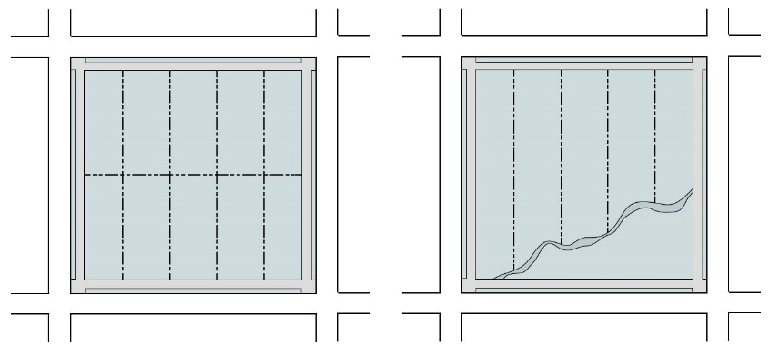
Sites greater than 4 acres in size must incorporate existing or new streets that terminate at other existing or new streets to form an interconnected network with the maximum block perimeter lengths that follow:
B.
In addition to the block standards above, blocks containing exclusively detached dwellings must be wide enough to provide two tiers of lots, except where fronting on arterial streets prevented by topographical conditions or size of the property, in which case the Community Developer Director or their designee may require and/or approve a single tier of lots.
C.
Other than stub-out streets, dead-end streets are not allowed unless a variance is granted for topographic hardship.
D.
Block Measurement
1.
A block is bounded by a public or private right-of-way (not including an alley). All public or private rights-of-way proposed as part of a development must be improved with a street.
2.
Block perimeter is measured along the edge of the property abutting the public or private right-of-way, except for the measurement of dead-end streets, which are measured from intersecting centerlines.
3.
The City Transportation Engineer may modify the block perimeter requirements when steep slopes in excess of 25%, preexisting development, tree protection areas, stream buffers, cemeteries, open space, or easements would make the provision of a complete block infeasible.
4.
Where the block pattern is interrupted by public parklands including greenways that are open and accessible to the public, pedestrian access points must be provided with a minimum spacing equal to half of the maximum block perimeter.
E.
No public or private street within the Form Based Code area, including alleys, may be gated.
87.2.3. Access
A.
General. When land is subdivided or otherwise developed, parcels and buildings must be arranged and designed so as to allow for the opening of future streets and must provide access to those areas not presently served by streets. No development may be designed to completely eliminate street access to abutting parcels without current street access.
B.
Stub-Out Streets
1.
Stub-Out Required
a.
Where a development abuts unsubdivided land, stub-out streets within the new development must be installed to the meet the block standards of Section 87.2.2.
b.
The stub-out street right-of-way, pavement, and curbing must extend to the boundary of the abutting parcel to the point where the connection to the anticipated street is expected.
c.
Where a stub-out street is provided, a sign noting the future street extension must be posted at the applicant's expense.
2.
Connecting to an Existing Stub-Out Street. If a stub-out street exists on an abutting parcel, the street system of any new development must connect to the stub-out street to form a through street.
3.
Exception. The City Transportation Engineer may eliminate the requirement for a stub-out street or require pedestrian and bicycle only access when steep slopes in excess of 25%, freeways, waterways, tree conservation areas, stream buffers, cemeteries, open space or easements would make the provision of a stub-out street infeasible.
87.2.4. Vehicle Cross-Access
All lots in districts allowing commercial uses, attached dwellings, and all lots where the adopted comprehensive plan land use classification would allow for rezoning to such district, that abut another lot in a district or land use classification allowing either commercial uses, or attached dwellings must comply with the following standards.
A.
Internal vehicular circulation areas must be designed and installed to allow for cross-access between abutting lots.
B.
Vehicle cross-access may not be gated.
C.
When an abutting lot is vacant or already developed, a stub for a future cross-access connection must be provided at the point where the connection to the abutting parcel is expected to occur in the future.
D.
If a cross-access driveway stub exists on an abutting parcel, the internal vehicular circulation area must connect to the stub to form a cross-access connection.
E.
When cross-access for vehicles is deemed impractical by the City Transportation Engineer on the basis of topography, the presence of natural features, or vehicular safety factors, the requirement for cross access may be waived. Bicycle and pedestrian connections must be provided between abutting properties when cross-access is waived.
F.
Property owners who establish cross-access easements must:
1.
Allow pedestrian and vehicular access to all properties on the same block face as the property owner establishing the cross-access. Pedestrian and vehicular access is contingent upon the granting of reciprocal vehicular, bicycle, and pedestrian access rights to the granting property;
2.
Record an easement allowing cross-access to and from properties served by the cross-access easement;
3.
Record a joint maintenance agreement requiring each property owner to maintain the vehicular, bicycle, and pedestrian access areas on their lot;
4.
Contain a provision prohibiting the erection of fences, walls and other obstructions that prevent the use of vehicular, bicycle, and pedestrian access ways;
5.
Include a statement that the cross-access agreement is conveyed with the land, is binding on all successors, heirs and assigns and that the easement rights are perpetual; and
6.
The cross access agreement must be signed by all of owners of the granting property.
G.
Exception. The Community Developer Director or their designee may eliminate the requirement for a cross-access easement when steep slopes in excess of 25%, freeways, waterways, tree conservation areas, stream buffers, cemeteries, open space or easements would make the provision of a cross-access easement infeasible.
(Ord. No. 2017-25, § 2, 12-19-17)
Sec. 87.3. - Streets.
87.3.1. Intent
A.
The intent of this Section is to provide a palette of street types and design elements that reflect the character of different areas within the Form Based Code area.
B.
The regulations provide adequate accommodations for vehicles, cyclists, and pedestrians.
C.
The street types defined in this Section provide a guide to balancing the needs of all modes of travel. Modifications to these types may be made by the Community Developer Director or their designee.
D.
The appropriate street type will be selected by the Community Developer Director or their designee based on the Perry Regulating Plan and engineering and land use context factors, including anticipated vehicle volumes.
87.3.2. Applicability
A.
When a development proposes the construction of a new public or private street, the requirements of this Section apply.
B.
When constructing a new street or reconstructing an existing street, sidewalks, bike lanes, curb and gutter, and street trees must be installed and constructed in accordance with this Section and the City of Perry Community Development Department/Public Works Design Standards.
C.
Existing streets may continue serving existing development in their current configuration; however, they must not be extended or substantially rebuilt except in conformance with this Section.
87.3.3. Street Types
A.
All new or extended public or private streets must meet the following standards unless modified by the Community Developer Director or their designee for the following public purposes:
1.
To provide on- or off-street bicycle facilities;
2.
To provide wider sidewalks or planters;
3.
To provide a median, left turn lane, or combination therefore;
4.
To provide bulb-outs;
5.
To provide hardscape surface in otherwise landscaped planters in order to provide pedestrian access to adjacent on-street parking;
6.
To increase or decrease the travel lane width; and
7.
To provide traffic calming or pedestrian safety measures.
B.
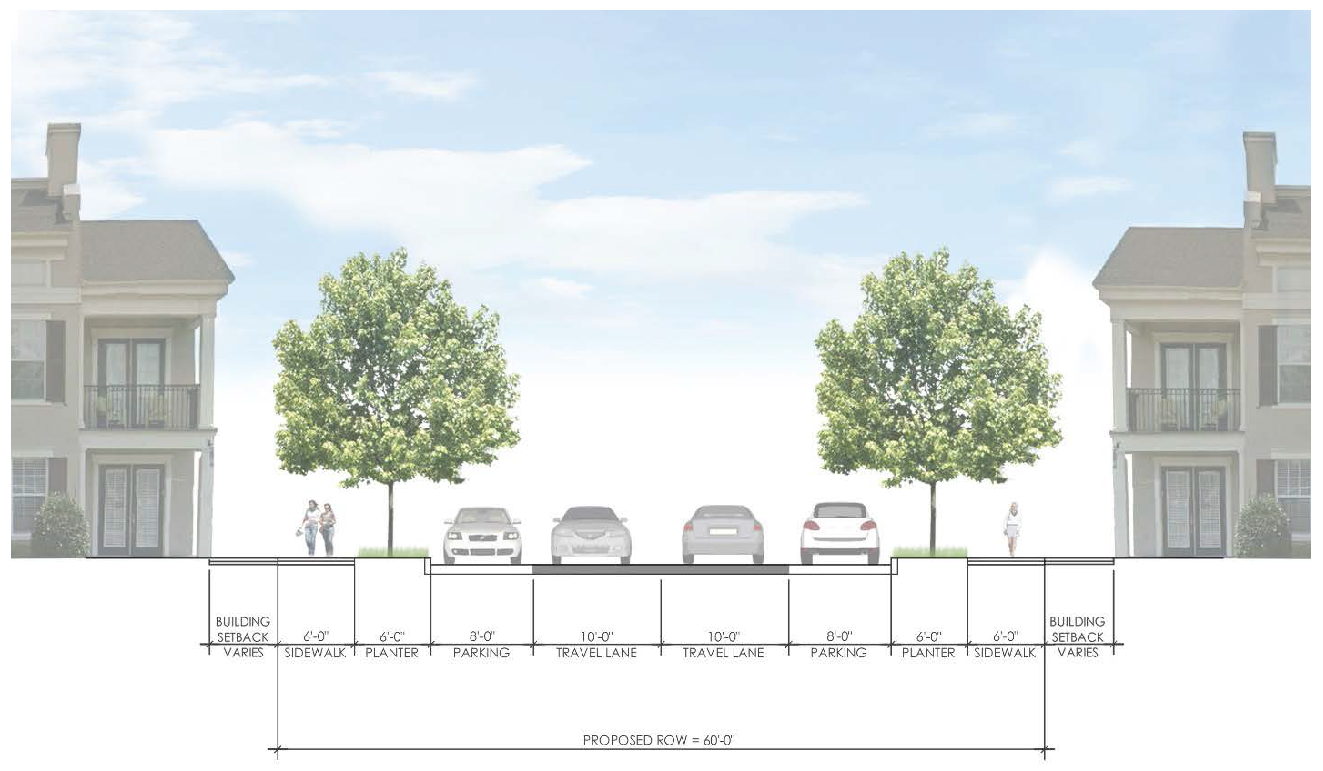
Arterial Street Residential
C.
Arterial Street Commercial/Mixed-Use
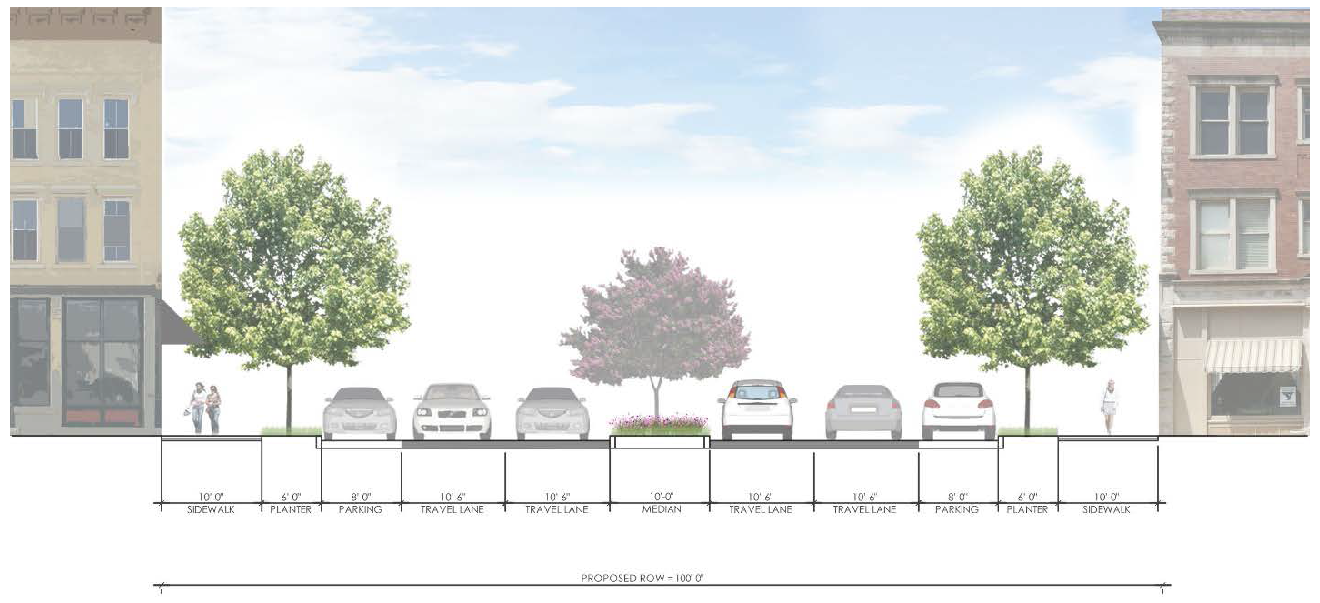
*Planter may be landscaped or hardscaped, but all trees shall be planted in a landscape area with a minimum size of 6 feet by 10 feet.
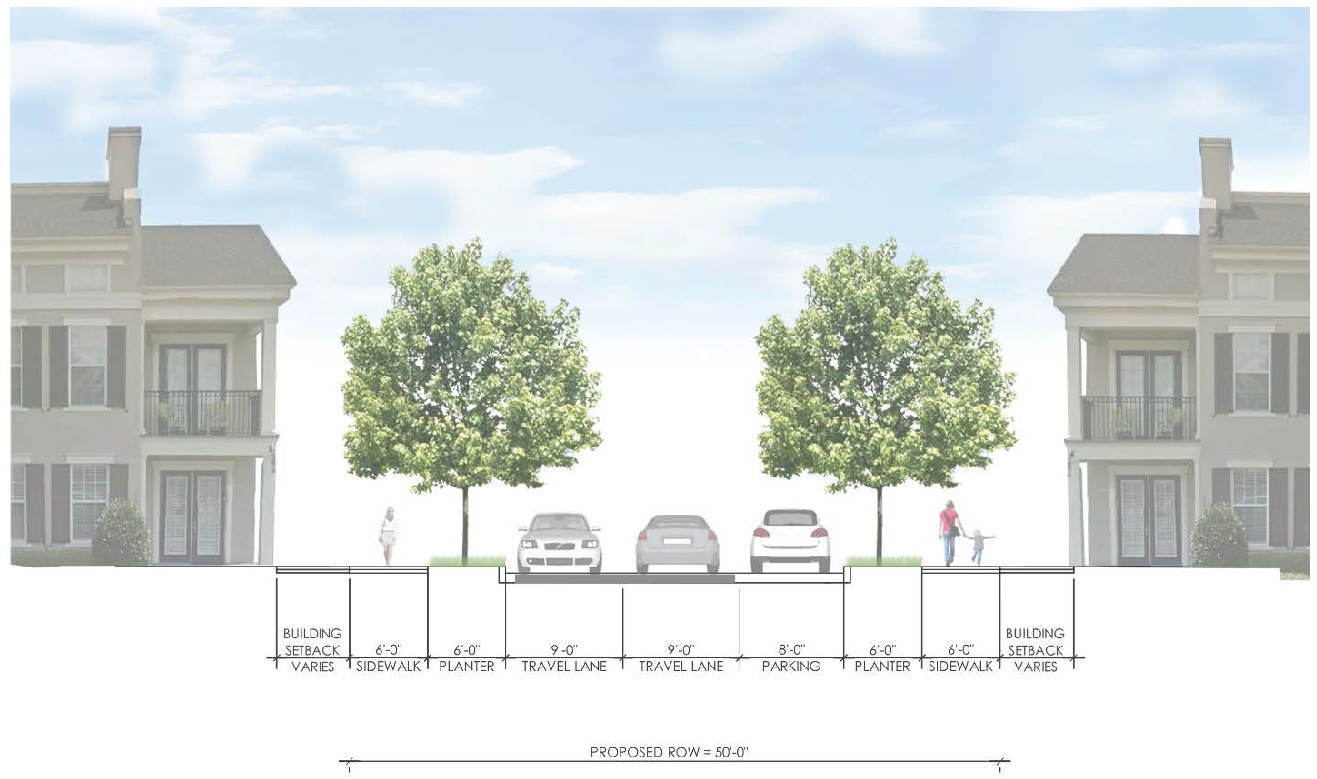
D.
Collector Street Residential
E.
Collector Street Commercial/Mixed-Use
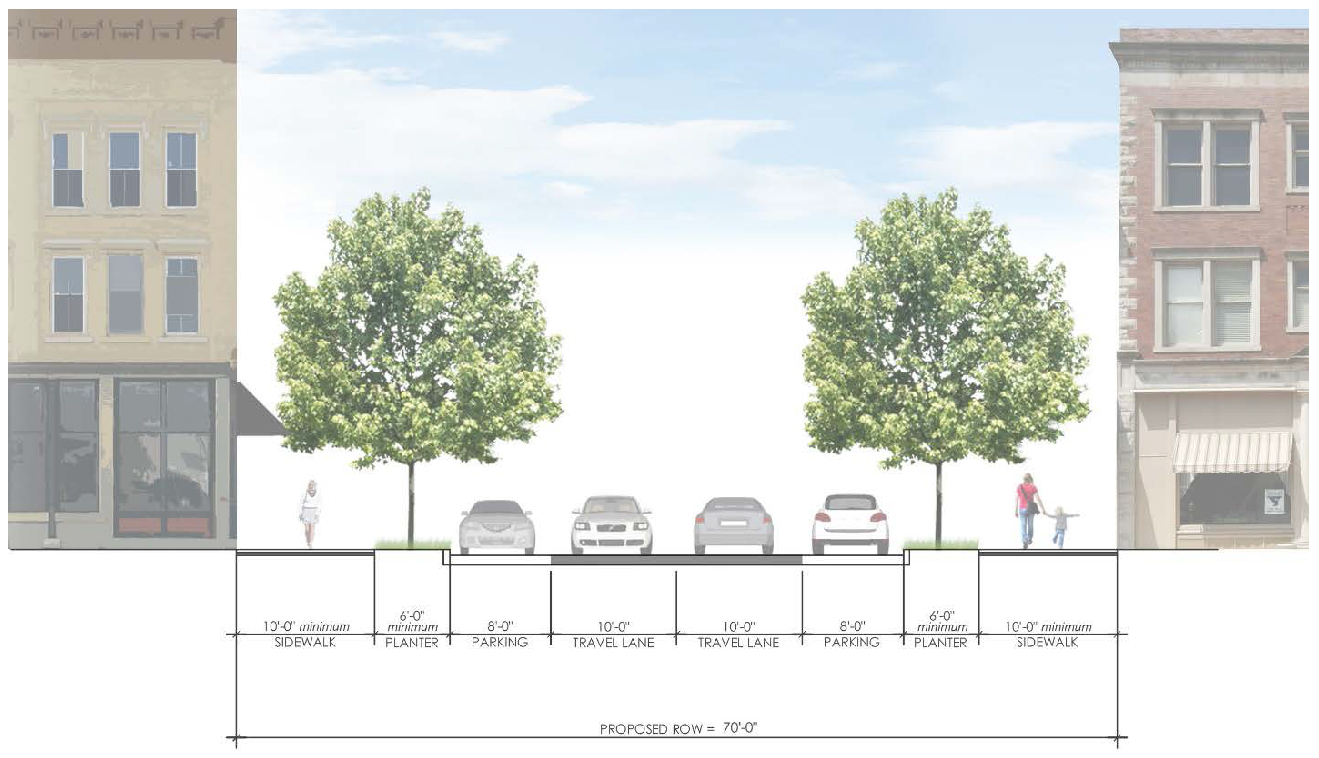
*Planter may be landscaped or hardscaped, but all trees shall be planted in a landscape area with a minimum size of 6 feet by 10 feet.
F.
Green Street
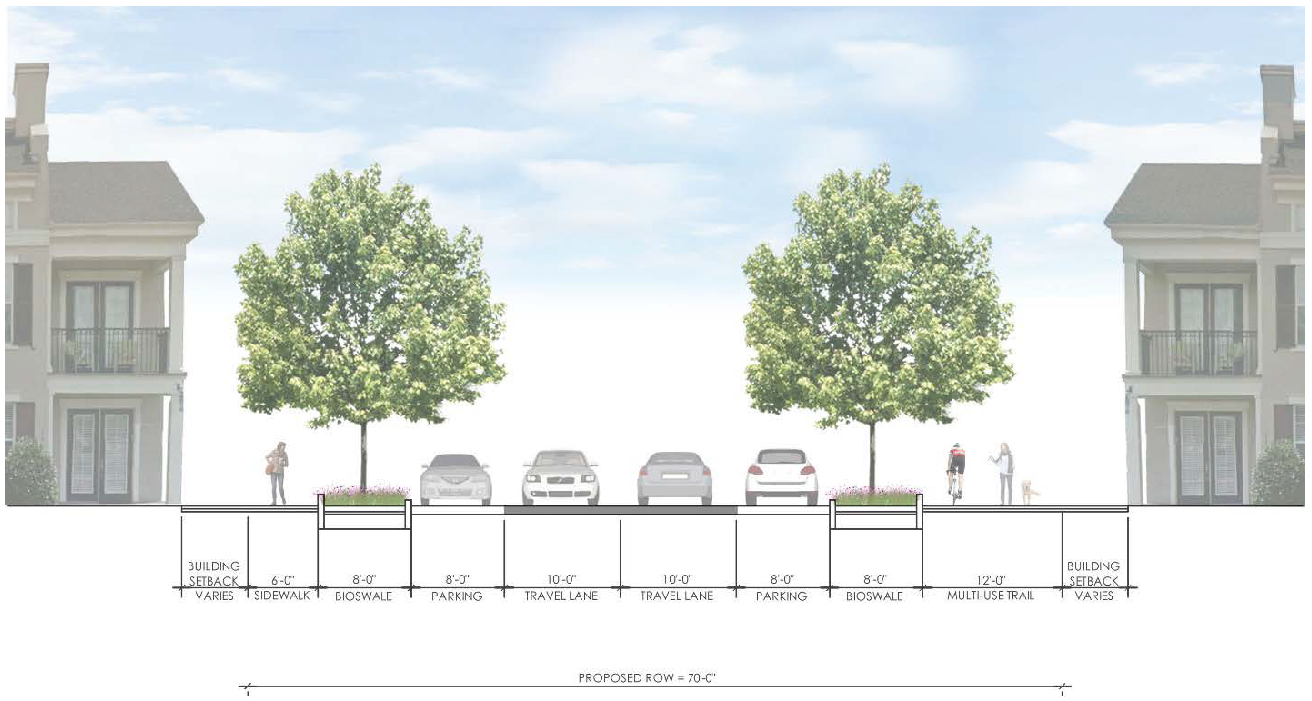
*The side of the street containing sidewalks and multi-use trails shall be as established by the Community Developer Director or their designee.
G.
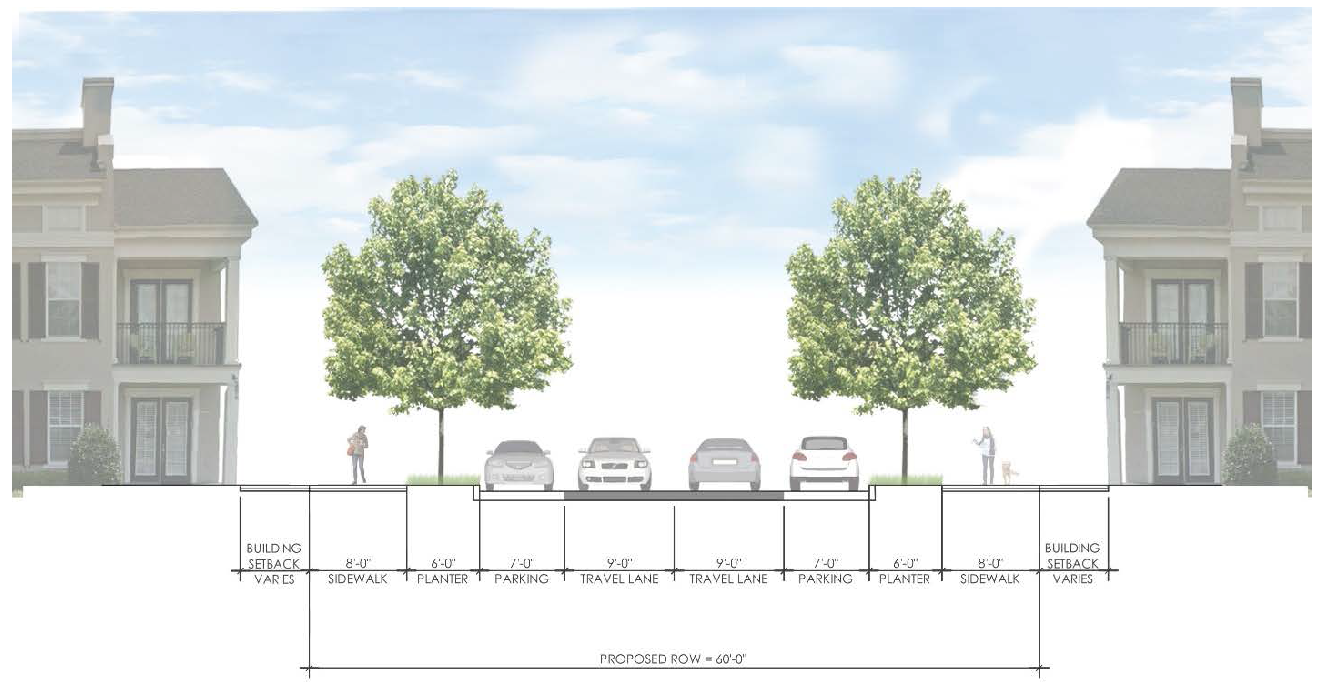
Local Street Residential
H.
Local Street Commercial/Mixed-Use
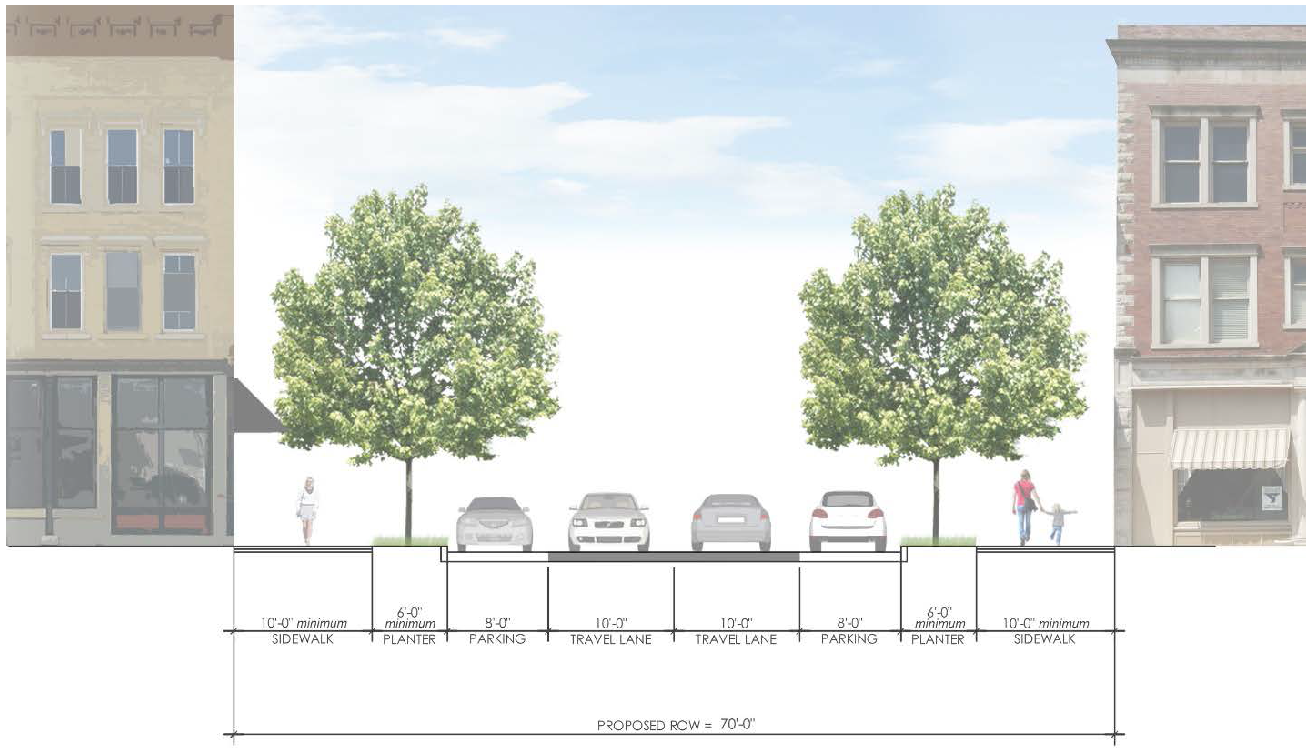
*Planter may be landscaped or hardscaped, but all trees shall be planted in a landscape area with a minimum size of 6 feet by 10 feet.
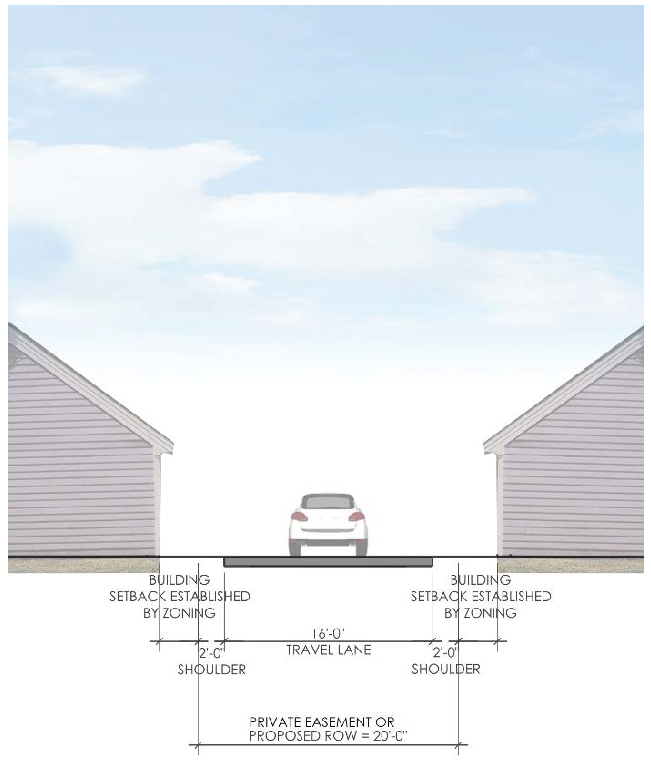
I.
Residential Alley
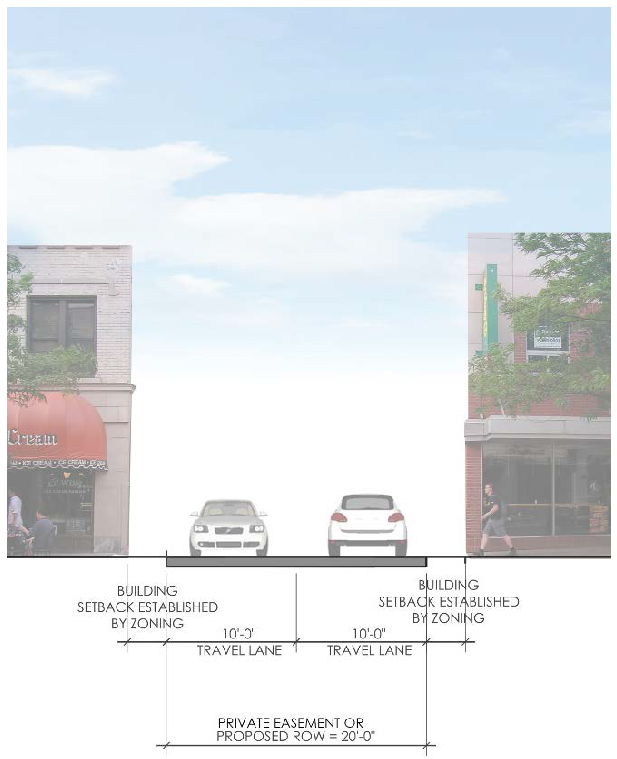
J.
Commercial/Mixed-Use Alley
87.3.4. Existing Streets, Streetscapes
A.
Applicability. A building or site may be renovated or repaired without meeting the requirements of this Section, provided any increase in gross floor area or improved site area does not exceed 25%.
B.
Exceptions. This does not apply as follows:
1.
On a parcel located within a recorded subdivision that existed on the date of adoption of this ordinance and when no sidewalks currently exist adjacent to the parcel.
2.
On a parcel for which a Land Disturbance Permit or Building Permit is issued but where the Director of Community Development determines that the permit is for an accessory use or structure to the principal use or structure or for minor repairs or additions to the principal building or structure in existence.
C.
Streetscapes Required
1.
Existing streets, planters, and sidewalk that do not meet the width and planting standards of the Perry Form Based Code Streetscape Table must be brought into compliance with the current standards prior to the issuance of Certificate of Occupancy.
2.
On existing streets where there is insufficient right-of-way for the required streetscape improvements, the right- of-way needed for such improvements may be expanded by mutual agreement between the property owner and the entity holding the right-of-way, or a public access easement may be provided to the City to meet the required improvements.
3.
Where an easement is provided to the City and a parcel is zoned part of the Form Based Code, the back of the minimum required sidewalk (adjacent to the lot) may be considered the lot line for the purpose of establishing yards, may not be included in lot coverage calculations, and may not be counted in minimum lot size requirements for new lots.
Perry Form Based Code Streetscape Table
4.
Where a publically funded streetscape project using alternative planter standards was installed adjacent to a parcel after the date of adoption, the planter standards of Perry Form Based Code Streetscape Table do not apply.
87.3.5. Multi-Use Trails
A.
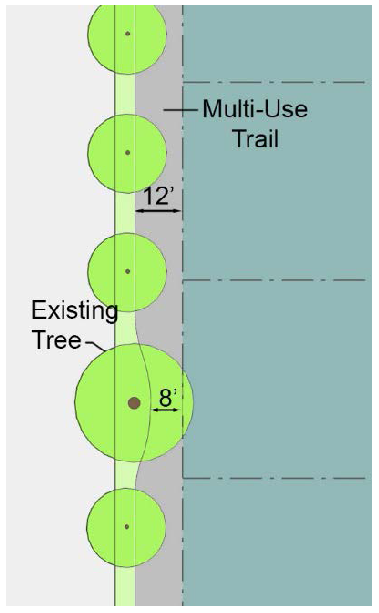
Multi-use trails shall have an average width of 12 feet, but their width may be periodically reduced to 8 feet where topography, wetlands, stream buffers, existing buildings, existing trees, or other existing conditions render this requirement infeasible. The maximum length of this reduced width is 400 feet.
B.
A multi-use trail may be required instead of a sidewalk along any new or existing street when the location is identified for a multi-use trail in the Official Regulating Plan or other plan that has been adopted by the City of Perry.
C.
Where a City of Perry park or access easement held by the City of Perry abuts a street subject to Section 87.3.5.A above, the multi-use trail may also be located in such park or easement.
D.
In approving a multi-use trail in lieu of a sidewalk, the Community Developer Director or their designee may reduce the planter width to a minimum width of 5 feet.
87.3.6. Improvements along State Roadways
A.
For any development that abuts a State highway or other right-of-way controlled by the State of Georgia, improvements to the roadway and the location and design of any street or driveway providing access from the State highway must comply with the standards and requirements of the Georgia Department of Transportation.
B.
An approved permit for proposed access or improvements is required by Georgia Department of Transportation and must be incorporated into the construction drawings for the project prior to the issuance of a Land Disturbance Permit.
87.3.7. Planter
A.
Defined. A zone adjacent to the curb intended for planting street trees and the placement of street furniture including light poles, litter receptacles and similar items.
B.
Street trees shall be planted in the planter as follows:
1.
Where no overhead utilities exist, shade trees must be planted a maximum of 40 feet on center in the planter. Newly planted trees shall be a minimum of 3½ inches in caliper, and shall be limbed up to a minimum of 7 feet.
2.
Where overhead utilities exist, one understory tree must planted a maximum of 25 feet on center in the planter, subject to approval of the overhead utility provider and the City Arborist.
3.
Trees shall have a minimum 6 feet by 10 feet pervious landscape planting area. Tree grates are not allowed unless the City Arborist determines that they will not negatively impact tree health.
(Ord. No. 2017-25, § 2, 12-19-17)
Sec. 87.4. - Parking and Loading.
87.4.1. Vehicle Parking
A.
Every use must provide and maintain vehicular parking in accordance with the vehicular parking requirements of Section 6-1 of the Perry Land Management Ordinance.
B.
Parking in the following locations may be used to satisfy the minimum parking requirements:
1.
Off-street parking located on the same site or lot as the use it serves;
2.
On-street parking located adjacent to and on the same side of the street as the site or lot contain the use it serves; and
3.
Off-site parking within 500 feet of the use it serves (as measured along a pedestrian walkway from the door of the use the parking serves).
C.
Shared Parking. A reduction of the parking requirements of 87.4.1.A may be permitted subject to the following:
1.
Applicants for shared parking shall submit the following to the Director of Community Development:
a.
A shared parking analysis using the Urban Land Institute (ULI) Shared Parking Model (latest edition);
b.
A to-scale map indicating location of proposed shared parking spaces; and
c.
Written consent of property owners and businesses agreeing to the shared parking arrangement, including copies of executed and court recorded agreements for off-site parking, as applicable.
2.
Uses providing shared parking must have either mutually exclusive or compatibly overlapping normal hours of operations.
3.
Reductions in the total number of required spaces for shared parking are not permitted unless the Planning and Zoning Administrator determines a reduction is appropriate on a case-by-case basis through use of the ULI Shared Parking Model.
4.
Renewed parking agreements shall be filed with the Director of Community Development. Lapse of a required lease agreement shall terminate the shared parking reduction.
5.
All shared parking spaces shall be clearly marked and signed as reserved during specified hours.
D.
When a use provides more than 100% of the minimum number of spaces required by the Vehicular Parking Requirements Table, any additional spaces in a surface parking lot must be constructed of pervious paving materials. For the purpose of conforming to this requirement, any on-street spaces or off-street spaces in parking structures must be counted towards satisfying the minimum requirement.
87.4.2. Bicycle Parking
A.
Facilities that provide or require 10 or more vehicle parking spaces must provide a minimum of 2 bicycle parking space, plus 1 space for each additional 25 provided vehicle parking spaces, provided that no site may have fewer than 2 spaces nor be required to exceed bicycle 30 spaces.
B.
Bicycle parking facilities must comply with the following provisions.
1.
Each required bicycle parking space must be at least 2 feet by 6 feet. Where a bike can be locked on both sides of a bicycle rack without conflict, each side can be counted as a required space.
2.
Bicycle racks must be securely anchored, be easily usable with both U-locks and cable locks, and support a bicycle at 2 points of contact to prevent damage to the bicycle wheels and frame.
3.
Bicycle parking must be provided in a well-lit area.
4.
Spacing of the bicycle racks must provide clear and maneuverable access.
5.
Bicycle parking may be placed within the public right-of-way, provided the encroachment is approved by the Community Developer Director or their designee.
6.
Bicycle parking spaces must be as close as or closer than the nearest vehicle parking space (as measured along a pedestrian walkway from the door of the use the parking serves).
87.4.3. Driveways
A.
Applicability. This following applies to driveways, including those serving alleys, but not to new streets in conformance with Section 87.3.3.
B.
Width. Unless approved by the Community Developer Director or their designee or required by the Georgia Department of Transportation along a State roadway, the maximum width of curb cuts, not including flares or returns at the throat of the facility, for entrances, exits, service drives and similar facilities shall be 24 feet for two-way entrances and 12 feet for one-way entrances.
C.
Number. The maximum number of driveways allowed on a site shall not exceed an amount equal to one driveway for every 300 feet of total street frontage or fraction thereof. All parcels are permitted at least one driveway.
D.
Location. Driveways may not be located on an arterial street when access is available from a collector or local street.
87.4.4. Design of Parking Structures
A.
When a parking structure fronts an arterial or collector street its ground story must have active uses (such as, but not limited to, residential, commercial, office or civic space) located between the parking structure and the closest adjacent street (not including an alley). Such active use shall have a minimum depth of 20 feet.
B.
Where upper stories of structured parking are adjacent to or visible from any street, they must be screened so that cars and ramps are not clearly visible from ground level view from the adjacent parcel or the adjacent street (not including an alley).
C.
Structured parking facades adjacent to or visible from any street must have the appearance of a horizontal storied building.
87.4.5. Loading
A.
On-site loading space is not required.
B.
Loading areas must be located to the rear of buildings. Loading areas must not be placed between a building and the closest adjacent street.
C.
Screening. If a loading area is provided, it must meet the following.
1.
Where a loading dock designed for tractor-trailers is placed between a shared lot line or building and the closest adjacent street (not including an alley), the entire length of the loading area must be screened.
2.
Screening must consist of either:
a.
An 8-foot high wall compatible with the principal building in terms of texture, quality, material and color; or
b.
Evergreen plant material that can be expected to reach a height of 8 feet with a spread of 4 feet within 3 years of planting.
87.4.6. Vehicle Access and Parking Locations
A.
No driveway or off-street parking lots may be located between a building and the closest street unless an intervening approved building type exists.
B.
Off-street parking for the following must be accessed from alleys:
1.
Townhouses on lots of any width.
2.
All other building types on lots less than 50 feet in width.
C.
Where a garage faces a street the garage must be recessed a minimum distance of 20 feet behind the front building façade.
(Ord. No. 2017-25, § 2, 12-19-17)
Sec. 87.5. - Landscaping and Screening.
87.5.1. Applicability
A.
New Construction. Any new building or site improvement must comply with the landscaping and screening requirements of this Section.
B.
Maintenance and Repair. An existing building or site may be repaired, maintained or modernized without providing additional landscaping or screening, provided there is no increase in gross floor area or improved site area.
C.
Additions.
1.
When an existing building, use or site is increased in gross floor area or improved site area by up to 25% cumulatively, landscaping and screening is required for the additional floor or site area only.
2.
When an existing building, use or site is increased in gross floor area or improved site area by more than 25% cumulatively, both the existing building, use or site and the additional floor or site area must conform to the landscaping and screening requirements of this Section.
D.
Change in Use. A change in use does not trigger the application of these requirements except when there is a specific use standard requiring landscaping or screening for the new use.
87.5.2. Yard Landscaping
A.
Yards between a parking lots and a street must comply with Section 87.5.3.
B.
Yards greater than 5 feet in depth and located between a building and the closest adjacent sidewalk along a street must be landscaped with grass, trees, shrubs, hedges and other landscaping materials for their entire width, with the exception of areas used for:
1.
Front porches and stoops;
2.
Outdoor dining or display;
3.
Pedestrian walkways used to access a street-facing pedestrian entrance;
4.
Driveways used to access off-street parking; and
5.
Amenity space, where required by Article 3.
C.
Yards greater than 10 feet in depth must be planted with one tree for each 30 feet of street frontage or portion thereof.
87.5.3. Parking Lot Landscape Strips
A.
Applicability. All surface parking areas (of any size) abutting a street (not including an alley) must be screened using one of the following options.
B.
Landscape Strip with Shrubs. A minimum 10 feet wide landscape strip planted with a minimum of 10 shrubs per 35 linear feet of street frontage, excluding driveway openings. Shrubs shall be provided to screen paved areas and parking lots from the right-of-way. Shrubs shall be at least 2 feet tall at time of planting. They must be planted 2 rows deep, and provide a screen within 3 years of planting.
C.
Landscape Strip with Wall.
1.
A 2.5 feet high wall in a minimum 4-foot planting strip.
2.
Walls must be close to the parking lot in order to provide a minimum 2-foot landscaped area facing the street.
3.
Walls must be closed and be constructed of one or a combination of the following: decorative blocks; brick; stone; cast-stone; split-faced block; or stucco over standard concrete masonry blocks.
D.
Landscape Strip with Berm.
1.
An earth berm a minimum of 2.5 feet higher than the finished elevation of the parking area, planted with 5 shrubs for every 35 linear feet of street frontage, excluding driveway openings.
2.
The berm must contain a rounded crown suitable for planting, and a stabilized side slope of no greater than 3:1.
E.
Landscape Strip with Grade Change. A 6-foot landscaped strip with a minimum 3-foot grade drop from the street to the parking area, planted with a minimum of 5 shrubs for every 35 linear feet of street frontage, excluding driveway openings.
F.
Location. A required landscape strip must be located at the outer perimeter of the parking area and must be provided along the entire parking area abutting the street, excluding breaks for pedestrians, bicycles and driveways.
G.
Plant Material. Required shrubs must be a minimum of 2.5 feet in height at time of planting. 70% of the required amount of shrubs must be evergreen.
87.5.4. Screening
A.
Service Areas.
1.
Trash and recycling collection and other similar service areas must be located to the side or rear of buildings and may not between a building and the street.
2.
Service areas must be screened on 3 sides by a wall a minimum 6 feet in height and on the 4th side by a solid gate at a minimum of 6 feet in height.
3.
The wall must be opaque and be constructed of one or a combination of the following: decorative blocks; brick; stone; cast-stone; split-faced block; or stucco over standard concrete masonry blocks.
4.
The gate must be self-locking and maintained in good working order.
B.
Roof-Mounted Equipment.
1.
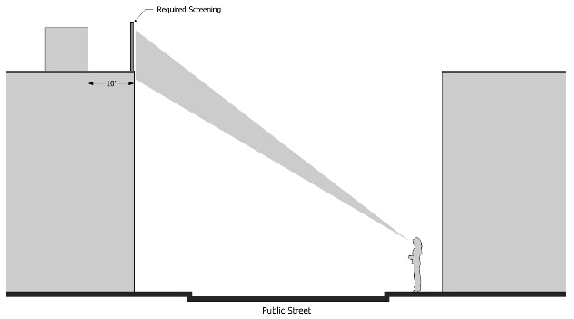
Roof-mounted equipment must be set back at least 10 feet from the edge of the roof and screened from ground level view from abutting parcel or abutting street (not including an alley).
2.
New buildings must provide a parapet wall or other architectural element that is compatible with the principal building in terms of texture, quality, material, and color that fully screens roof-mounted equipment from ground level view.
3.
For buildings with no or low parapet walls, roof mounted equipment must be screened on all sides by an opaque screen compatible with the principal building in terms of texture, quality, material, and color.
C.
Wall-Mounted Equipment.
1.
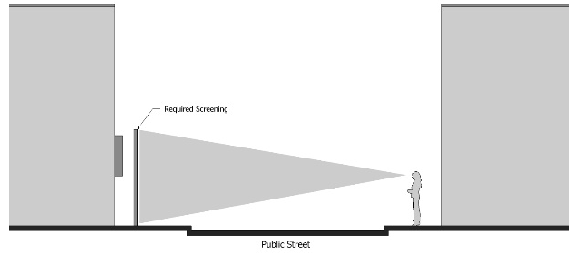
Wall-mounted equipment located on any surface that is visible from a street (not including an alley) must be fully screened by landscaping or an opaque wall or fence that is compatible with the principal building in terms of texture, quality, material, and color.
2.
Screening must be of a height equal to or greater than the height of the mechanical equipment being screened.
D.
Ground-Mounted Equipment
1.
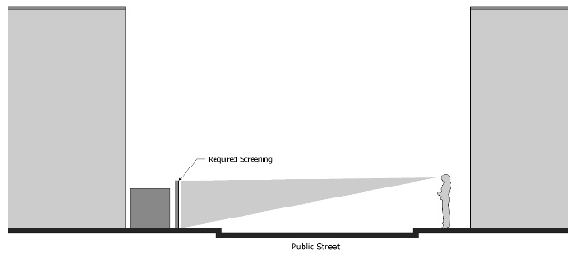
Ground-mounted mechanical equipment that is visible from a street (not including an alley) must be fully screened by landscaping or an opaque wall or fence that is compatible with the principal building in terms of texture, quality, material and color.
2.
Screening must be of a height equal to or greater than the height of the mechanical equipment being screened.
87.5.5. Design and Installation
A.
Plant Material.
1.
Plant materials must be hardy to zone 8 in accordance with the U.S. Department of Agriculture's Plant Hardiness Zone Map.
2.
Plant materials must be able to survive on natural rainfall once established with no loss of health.
3.
Tree height is measured from the top of the root ball to the tip of the main stem.
4.
No artificial plants, trees, or other vegetation may be installed as required landscaping and screening
87.5.6. Maintenance of Landscaping
A.
Responsibility. The property owner is responsible for maintaining all required landscaping and screening in good health and condition. Any dead, unhealthy, damaged or missing landscaping and screening must be replaced with landscaping and screening that conforms to this Section within 90 days (or within 180 days where weather concerns would jeopardize the health of plant materials) as approved by the City Arborist.
B.
Soil Erosion.
1.
All planting areas must be stabilized from soil erosion immediately upon planting and must be maintained for the duration of the use.
2.
Grass areas must be sodded prior to the issuance of a Certificate of Occupancy. If grass seed must be used, it must be a variety that may be reasonably expected to produce full coverage of the area.
C.
Pruning and Trimming
1.
All required landscaping must be allowed to reach its required size and must be maintained at no less than required size.
2.
To prevent long-term harm to the health of required landscaping, all pruning of shrubs and trees must be done in accordance with the International Society of Arboriculture Standards entitled "ANSI A300 Standards."
3.
"Topping," defined as removal of more than one-third of the leaves and branches of a tree, as measured from the lowest branch on the trunk of the tree to the top of the tree, is prohibited, except where necessary to maintain public overhead utilities.
(Ord. No. 2017-25, § 2, 12-19-17)
Sec. 87.6. - Neighborhood Compatibility.
87.6.1. Applicability
A.
Neighborhood compatibility measures are required when a lot zoned or used for a multifamily dwelling, office, institutional, commercial, industrial uses, or occupied by a non-detached residential use adjoins a protected district
B.
Protected district as used in this Section means any property zoned for or used exclusively for detached residential purposes.
87.6.2. Buffers
A.
A 25 feet wide undisturbed buffer is required as shown in the Form Based Buffer Table.
| Form Based Buffer Table | ||
| Depth (min.) | 25 ft. | 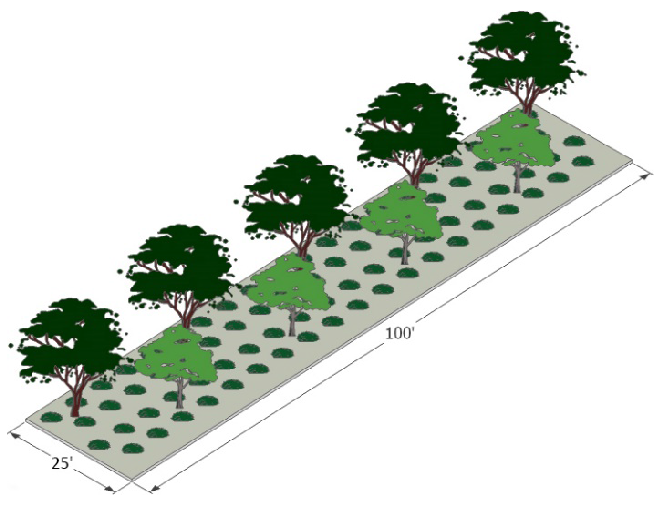 |
|
Fence/wall height
(min.) | Not required | |
| Shade trees (min. per 100 feet and evenly spaced) | 5 | |
| Understory trees (min. per 100 feet in length and evenly spaced) | 4 | |
| Shrubs (min. per 100 feet in length and evenly spaced) | 40 | |
B.
Except as otherwise provided, herein, the buffer shall be preserved in its natural undisturbed state, except that sparsely planted buffers shall be enhanced with additional plant material. Enhancement plants must provide an opaque screen within two years of planting and must meet the following standards:
1.
Plants must be a minimum of 5 feet in height at time of installation;
2.
At least 75% of the total number of plants installed must be evergreen species; and
3.
Plants will be planted and spaced as shown in the Form Based Buffer Table.
C.
Buffers may not contain any surface parking or storm water, detention facilities, or any structures except that the Director of Community Development may approve underground facilities within the buffer or the crossing of the buffer for the purpose of extending utilities.
D.
Stream buffers must be replanted where disturbed for approved access, detention and utility crossings. Replacement plants must be approved by the City Arborist.
E.
All buffer plantings are subject to the approval of the Director of Community Development.
87.6.3. Building Setbacks
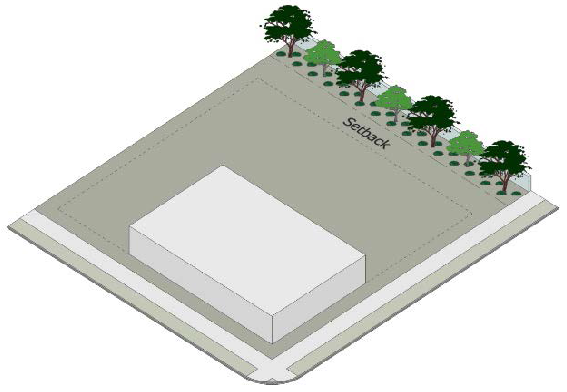
All building setbacks are measured from the inside edge of the required buffer.
87.6.4. Transitional Height Plane
A.
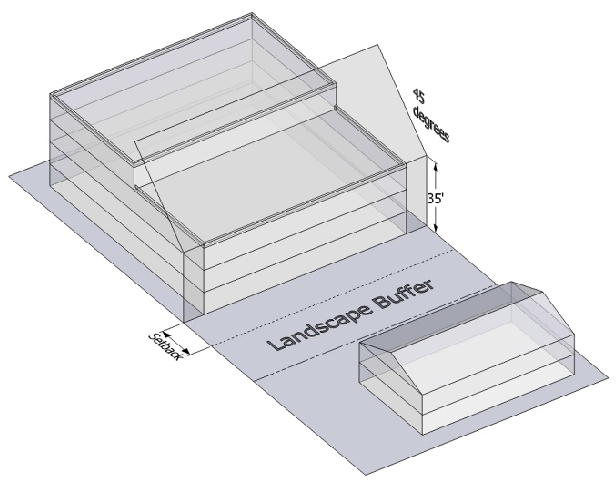
A building must not extend into a 45-degree angular plane projecting over the subject property measured from a height of 35 feet at the side interior or rear setback line.
B.
The transitional height plane ends at any public street (not including an alley) or 60 feet from the protected district lot line, whichever is less.
(Ord. No. 2017-25, § 2, 12-19-17)
Sec. 87.7. - Building Types.
The following rules apply to all buildings in the Perry Form Based Code.
87.7.1. Descriptions
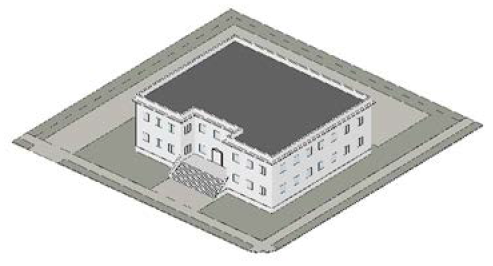
Within the Perry Form Based Code building types are used to regulate the design of buildings. Each building type is described below. A building's building type is determined by the Director of Community Development. All graphic depictions of building types are for illustrative purposes only. Note that these building types are for zoning purposes only, and not linked to the Building Code. Freestanding parking structures are not considered to be a building type.
A.
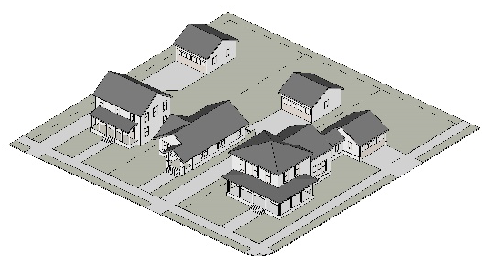
Detached House. A building type that accommodates one dwelling unit on an individual lot with yards on all sides. Not intended for nonresidential uses.
B.
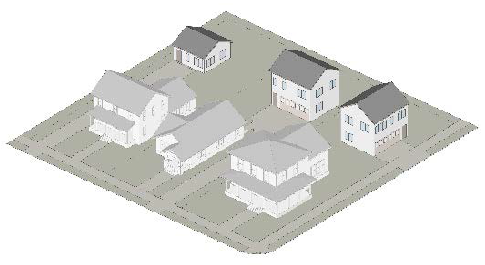
Carriage House. A small self-contained accessory dwelling unit located on the same lot as a detached house, duplex, or townhouse but physically separated, for use as a complete, independent living facility, with provisions for cooking, sanitation and sleeping.
C.
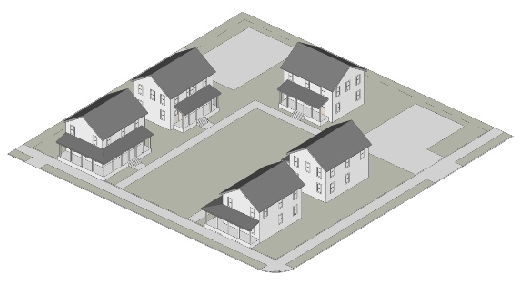
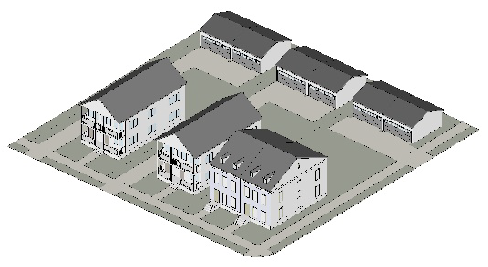
Cottage Court. A building type designed to accommodate 5 to 10 detached dwelling units organized around a shared internal courtyard. Units cannot be vertically mixed.
D.
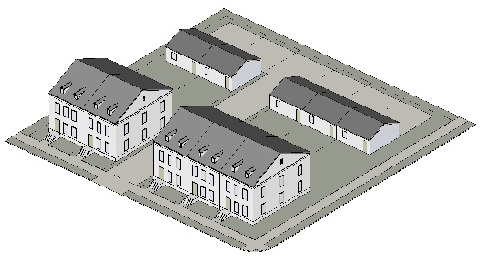
Duplex. A building type that accommodates two dwelling units arranged either horizontally or vertically. Not intended for nonresidential uses.
E.
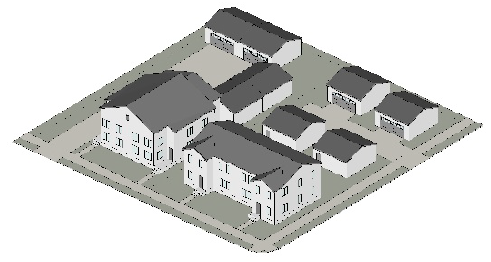
Townhouse. A building type that accommodates 3 or more dwelling units where each unit is separated by a common side wall. Units cannot be vertically mixed.
F.
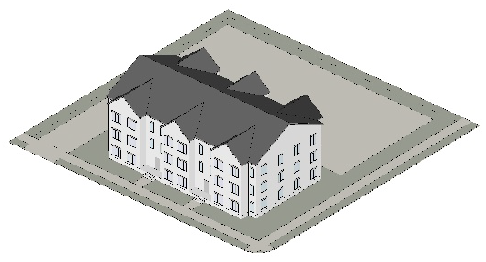
Walk-up Flat. A building type that accommodates 3 to 8 dwelling units vertically and horizontally integrated.
G.
Stacked Flat. A building type that accommodates 9 or more dwelling units vertically and horizontally integrated.
H.
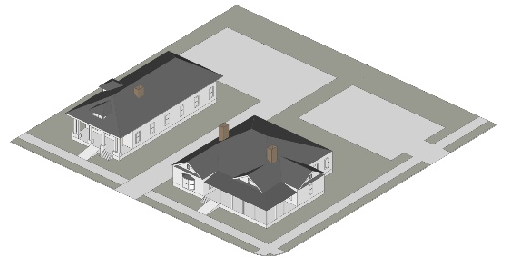
Commercial House. A building type that accommodates nonresidential uses in a building type that resembles a detached house. Not intended for residential uses.
I.
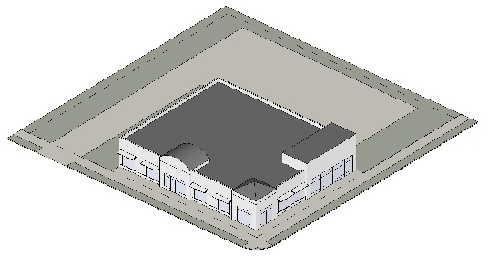
Shopfront. A single-story building type that typically accommodates single-use retail or commercial activity.
J.
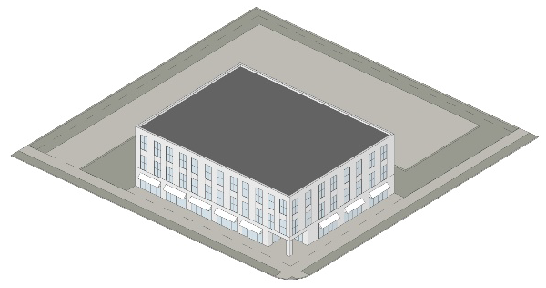
Mixed Use Building. A multi-story building type that typically accommodates ground story retail, office, or commercial uses with upper-story residential or office uses. Not for ground story street-facing residential uses along arterial or collector streets.
K.
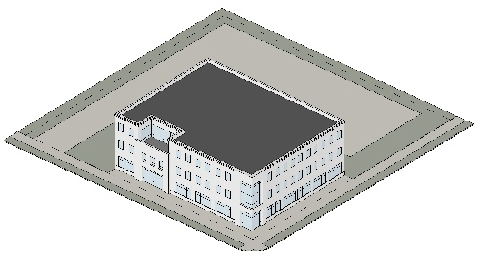
General Building. A multi-story building type that typically accommodates nonresidential uses such as industrial, hotel, or office uses on all stories.
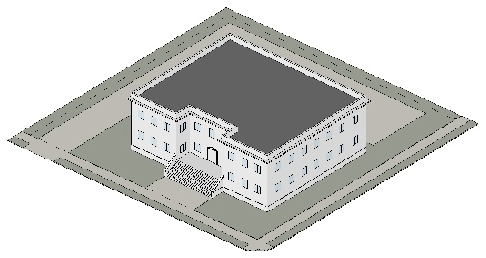
L.
Civic Building. A building type that accommodates civic uses. Not intended for commercial, retail, office, or residential uses.
87.7.2. Rules Specific to Building Types
A.
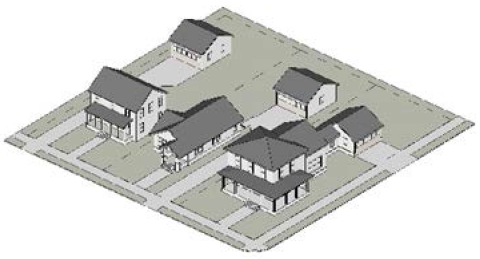
Detached House
A building type that accommodates one dwelling unit on an individual lot with yards on all sides. Not intended for nonresidential uses.
B.
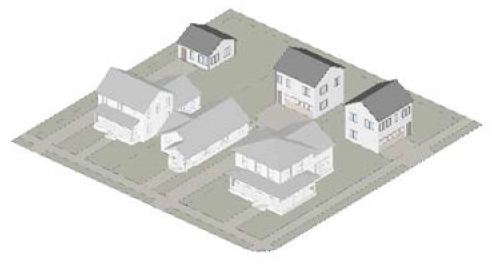
Carriage House
A small self-contained accessory dwelling unit located on the same lot as a detached house, duplex, or townhouse but physically separated, for use as a complete, independent living facility, with provisions for cooking, sanitation and sleeping.
C.
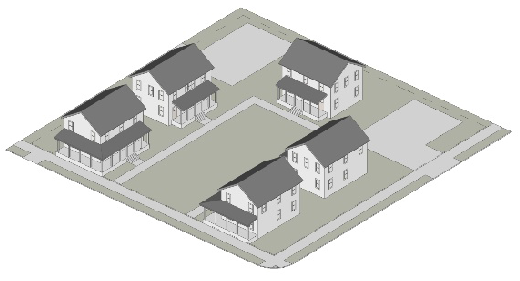
Cottage Court
A building type designed to accommodate 5 to 10 detached dwelling units organized around a shared internal courtyard. Units cannot be vertically mixed.
D.
Duplex
A building type that accommodates two dwelling units arranged either horizontally or vertically. Not intended for nonresidential uses.
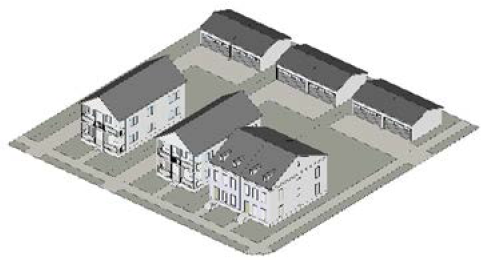
E.
Townhouse
A building type that accommodates 3 or more dwelling units where each unit is separated by a common side wall. Units cannot be vertically mixed. Not intended for nonresidential uses.
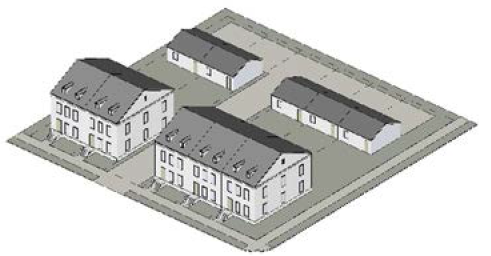
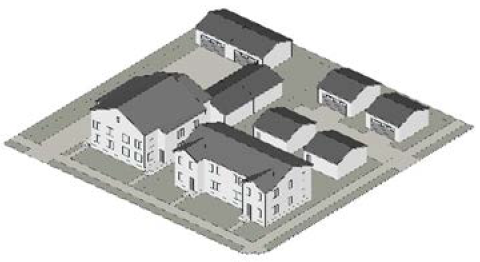
F.
Walk-up Flat
A building type that accommodates 3 to 8 dwelling units vertically and horizontally integrated.
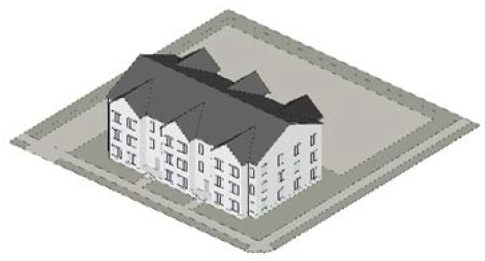
G.
Stacked Flat
A building type that accommodates 9 or more dwelling units vertically and horizontally integrated. Intended for primarily residential uses, but may include limited ground story commercial.
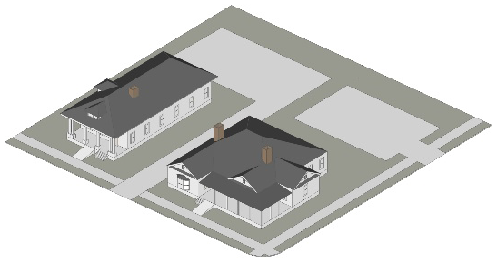
H.
Commercial House
A building type that accommodates nonresidential uses in a building type that resembles a detached house. Not intended for residential uses.
I.
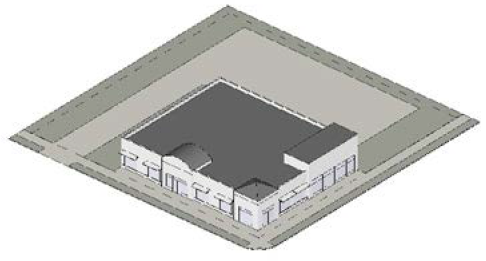
Shopfront
A single-story building type that typically accommodates single-use retail or commercial activity.
J.
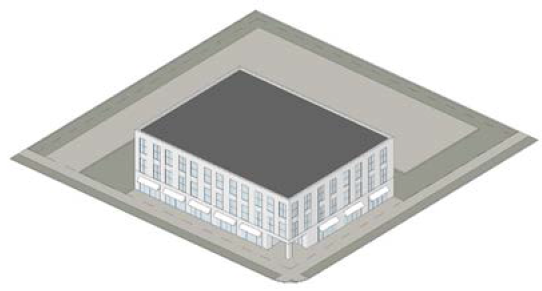
Mixed Use Building
A multi-story building type that typically accommodates ground story retail, office or commercial uses with upper-story residential or office uses. Not intended for ground story, street-facing residential uses along arterial or collector streets.
K.
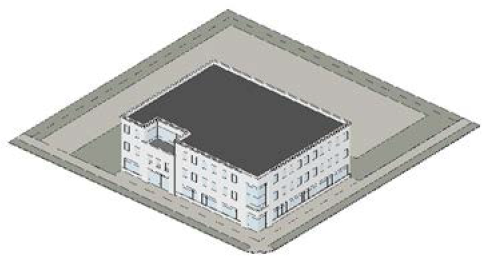
General Building
A multi-story building type that typically accommodates nonresidential uses such as industrial, hotel, or office uses on all stories.
L.
Civic Building
A building type that accommodates civic uses. Not intended for commercial, retail, office, or residential uses.
(Ord. No. 2017-25, § 2, 12-19-17; Ord. No. 2019-03, § 4, 2-5-19)
Sec. 87.8. - Building Design.
87.8.1. Applicable
This Section applies to the Building Types identified in Section Sec. 87.7.
87.8.2. Fenestration
A.
Fenestration is the minimum percentage of window and door glass that must cover a facade.
B.
Glass used to satisfy fenestration requirements must be unpainted, must have a transparency (visible light transmission) higher than 70%, and must have an external reflectance of less than 15%. Transparency and external light reflectance must be established using the manufacturer's specifications.
C.
Fenestration is measured from the top of the finished floor to the top of the finished floor above.
D.
When there is no floor above, fenestration is measured from the top of the finished floor to the top of the wall plate.
87.8.3. Pedestrian Access
A.
A pedestrian entrance and walkway providing both ingress and egress, operable to residents at all times and operable to customer, visitors, and employees during business hours, is required to meet the street-facing pedestrian entrance requirements. Additional entrances off another street, pedestrian area or internal parking area are permitted, but must have the same or shorter hours of operability as the street-facing entrance.
B.
An angled pedestrian entrance may be provided at either corner of a building along the street to meet the street-facing pedestrian entrance requirements.
C.
Where a lot has frontage on a civic space instead of a street, these requirement apply to and from the civic space.
87.8.4. Building Elements
A.
Intent. The following standards are intended to ensure that certain building elements that when added to a street-facing facade are of sufficient size to be both usable and functional and be architecturally compatible with the building they are attached to.
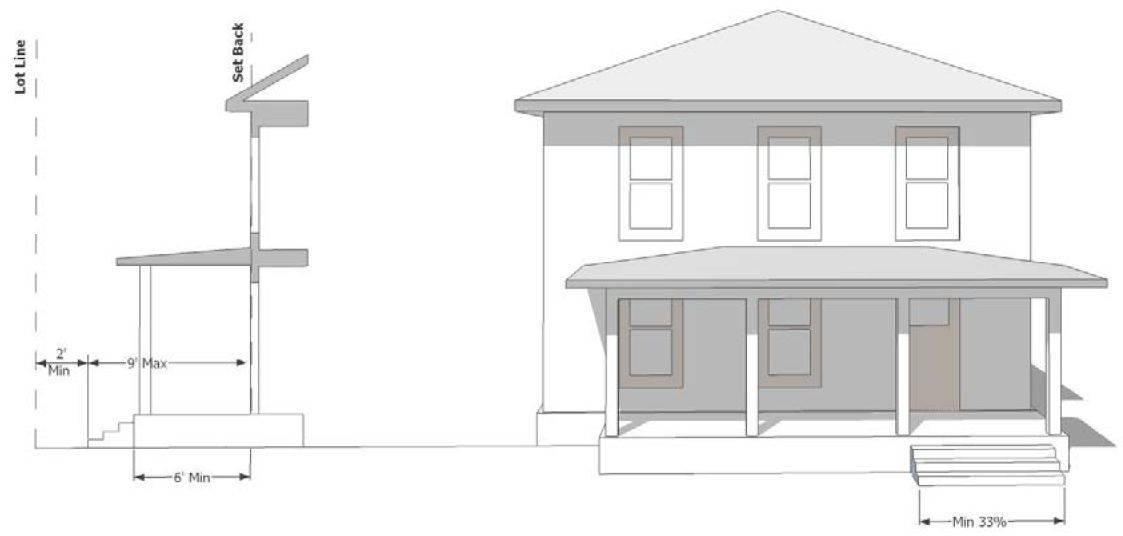
B.
Front Porch. A raised structure attached to a building, forming a covered pedestrian entrance to a doorway.
1.
A front porch must be at least 6 feet deep (not including the steps).
2.
A front porch must be contiguous, with a width not less than 33% of the building facade from which it projects.
3.
A front porch must be roofed and may be screened, but cannot be fully enclosed.
4.
A front porch may extend up to 9 feet, including the steps, into a required front setback, provided that such extension is at least 2 feet from the vertical plane of any lot line.
5.
A front porch must not encroach into the public right-of-way or required sidewalk.
6.
Steps leading to front porches must have enclosed risers.
7.
Front porch columns must be a minimum width of 8 inches.
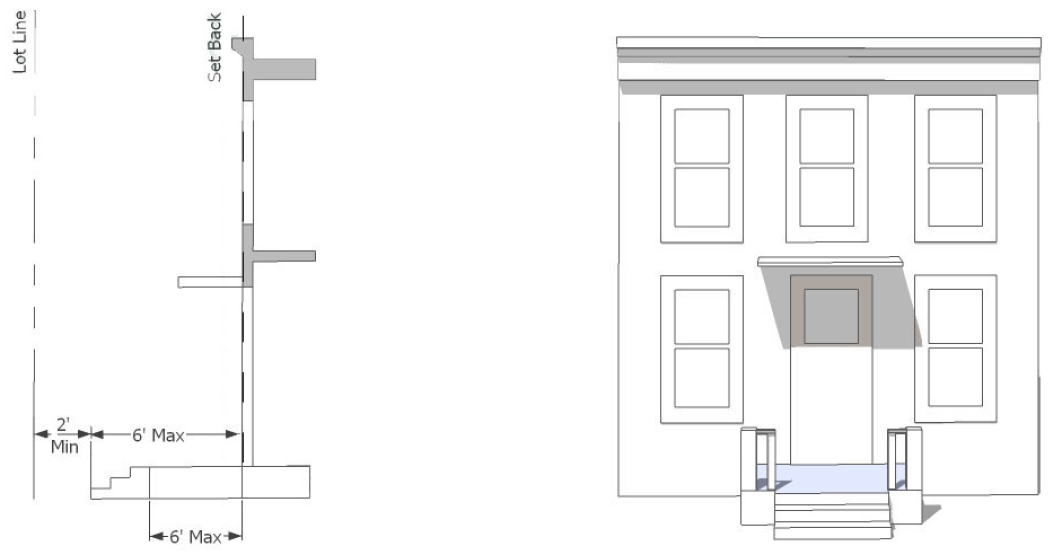
C.
Stoop. A small raised platform that serves as a pedestrian entrance to a building.
1.
A stoop must be no more than 6 feet deep (not including the steps).
2.
A stoop may be covered but cannot be fully enclosed.
3.
A stoop may extend up to 6 feet, including the steps, into a required setback, provided that such extension is at least 2 feet from the vertical plane of any lot line.
4.
A stoop must not encroach into the public right-of-way or required sidewalk.
5.
Steps leading to stoops must have enclosed risers.
6.
Stoop columns, where provided, must be a minimum width of 8 inches.
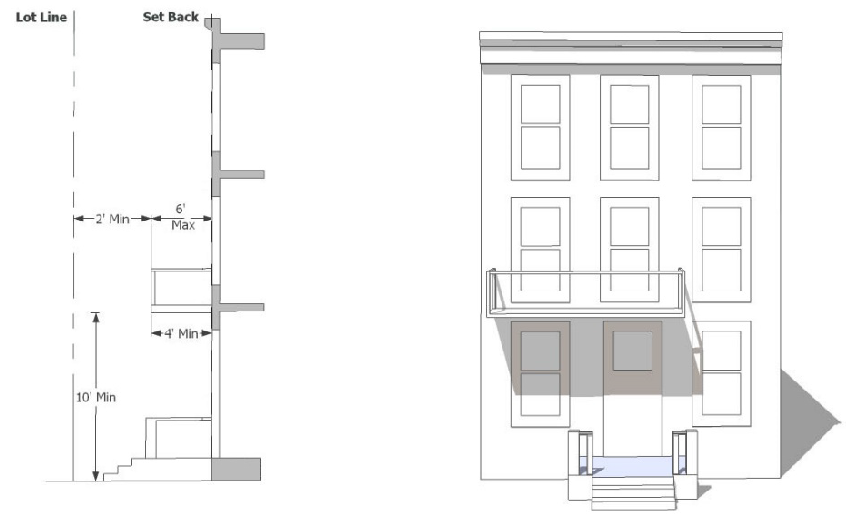
D.
Balcony. A platform projecting from the wall of an upper-story of a building with a railing along its outer edge, often with access from a door or window.
1.
A balcony must be at least 4 feet deep and may extend up to 6 feet into a required setback, provided that such extension is at least 2 feet from the vertical plane of any lot line.
2.
A balcony must have a clear height above the sidewalk of at least 10 feet.
3.
A balcony may be covered and screened, but cannot be fully enclosed.
4.
A balcony may encroach up to 6 feet into the public right-of-way or required sidewalk but must be at least 2 feet inside the curb line or edge of pavement, whichever is greater.
E.
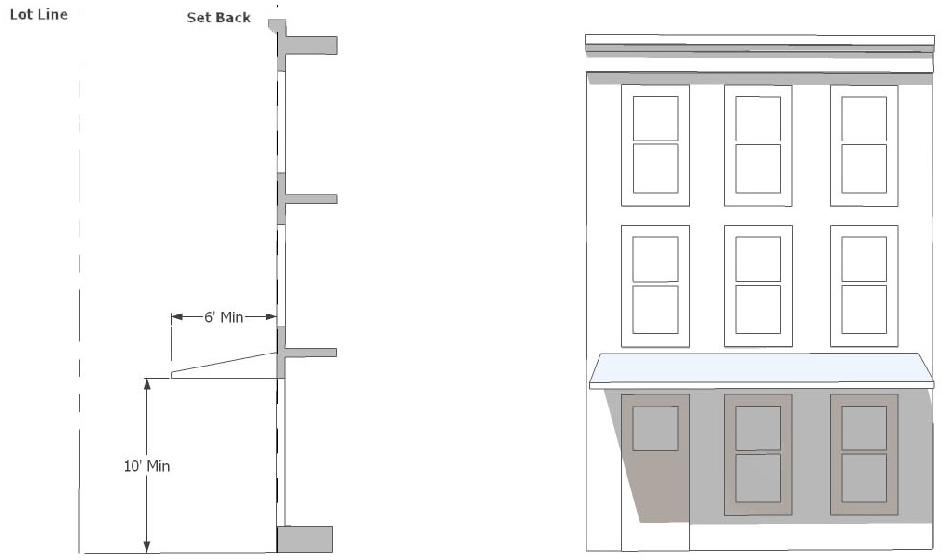
Awning/Canopy. A wall-mounted, cantilevered structure providing shade and cover from the weather for a sidewalk.
1.
An awning must be a minimum of 10 feet clear height above the sidewalk and must have a minimum depth of 6 feet.
2.
An awning may extend into a required setback.
3.
An awning may encroach up to 9 feet into the public right-of-way or required sidewalk but must be at least 2 feet inside the curb line or edge of pavement, whichever is greater.
4.
Awning must be made of canvas and may not be reflective or shiny.
5.
Awnings must have open ends called "shed awnings" to allow views into buildings.
6.
Awnings may not be internally lit.
7.
Awnings must be as wide as, or up to two feet wider than, the door or window opening that they serve. Where multiple doors and windows are less than two feet apart, multiple awnings may be combined into a single awning.
F.
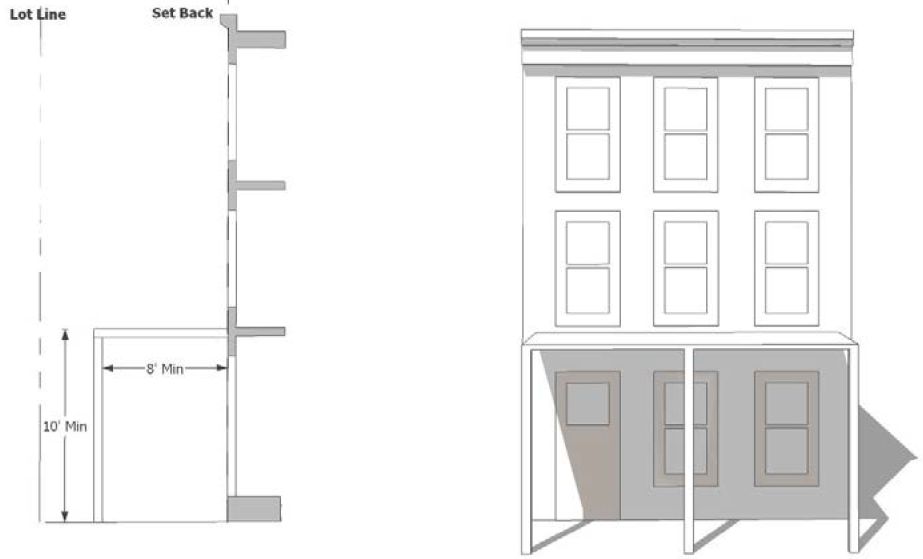
Gallery. A covered passage extending along the outside wall of a building supported by arches or columns that is open on 3 sides.
1.
A gallery must have a clear depth from the support columns to the building's facade of at least 8 feet and a clear height above the sidewalk of at least 10 feet.
2.
A gallery must be contiguous and extend over at least 75% of the width of the building facade from which it projects.
3.
A gallery may extend into a required setback.
4.
A gallery may encroach up 9 feet into the public right-of-way or required sidewalk but must be at least 2 feet inside the curb line or edge of pavement, whichever is greater.
87.8.5. General Architectural Standards
A.
Applicability
1.
The following applies to all buildings, except as specifically stated otherwise.
2.
Detached houses, carriages houses, cottage courts, duplexes, townhouses, walk-up flats, and stacked flats must comply with either the following or Section 87.8.6, at the discretion of the applicant.
B.
Building Materials
1.
Exterior finish materials on walls visible from a street or civic space must be limited to brick, manufactured stone, architectural block, natural stone, wood siding, cement-based siding, cement-based panels, and/or hard coat stucco.
2.
Hard coat stucco, when used as an exterior wall finish material on any individual building, is subject to the following additional standards:
a.
Hard coat stucco may not exceed 30% of the total wall area (excluding foundations) visible from a street or civic space. For the purpose of calculating conformance with this requirement, windows and doors are not included in the total wall area.
b.
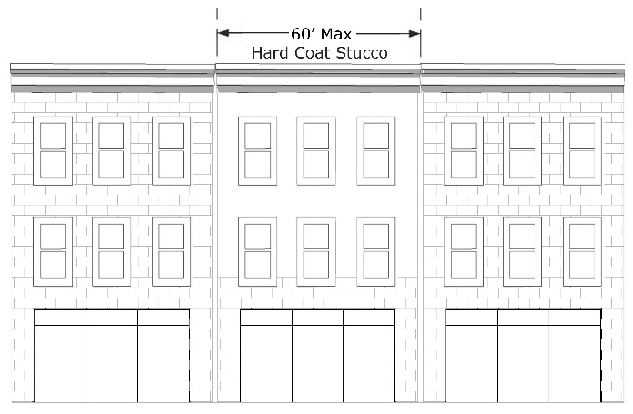
The maximum wall length (excluding foundations) visible from a street or civic space that is finished in any continuous or discontinuous hard coat stucco is 60 feet. Authorized wall lengths finished in hard coat stucco must be separated by a minimum wall length of 60 feet that contains no hard coat stucco.
3.
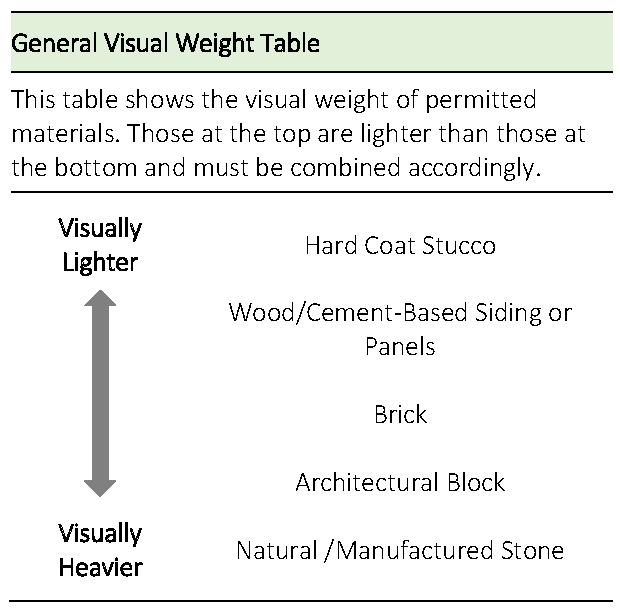
Exterior finish materials must be combined only horizontally, with the visually heavier below the lighter as shown in the General Visual Weight Table. This does not apply to architectural details such as cornices, window sills, and beltlines.
4.
No more than three different exterior finish materials, textures, colors, or combinations thereof may be used on a single building, excluding materials used on windows, doors, front porches, balconies, foundations, awnings, or architectural details.
5.
Foundations must be constructed as a distinct building element that is finished in a different material or color than the exterior wall. Exposed above-ground foundations must be coated or faced in cement, hard coat stucco, brick, manufactured stone, or natural stone to contrast with façade materials.
C.
Building Facade
1.
The following applies to all street-facing facades.
2.
Where used, shutters must match one half the width and shape of the window opening to which they are adjacent.
3.
Facades must provide visual divisions between the ground story and second story through architectural means such as courses, awnings, or a change in materials.
4.
Windows above the ground story must be equally sized, vertically oriented, equally spaced and arranged in a grid pattern.
5.
Window must be recessed a minimum of 3 inches and a maximum of 8 inches from the adjacent façade.
D.
Building Massing
1.
Facades over 50 feet in length must incorporate wall projections or recesses a minimum of 12 inches in depth. The combined length of said recesses and projections must constitute at least 20% of the total facade length.
2.
Variation in the roofline of buildings and offsets in pitched roofs and gables are required. Parapets in individual building facades exceeding 100 continuous linear feet must be varied in height and projection and must use decorative elements such as crown moldings, dentals, brick soldier courses, or similar details.
87.8.6. Small Residential Building Standards
A.
Applicability. The following applies to detached houses, carriages houses, cottage courts, duplexes, townhouses, walk-up flats, stacked flats, and commercial houses.
B.
Building Materials
1.
The exterior finish material on all walls is limited to brick, manufactured stone, natural stone, wood siding, cement-based siding and/or hard coat stucco.
2.
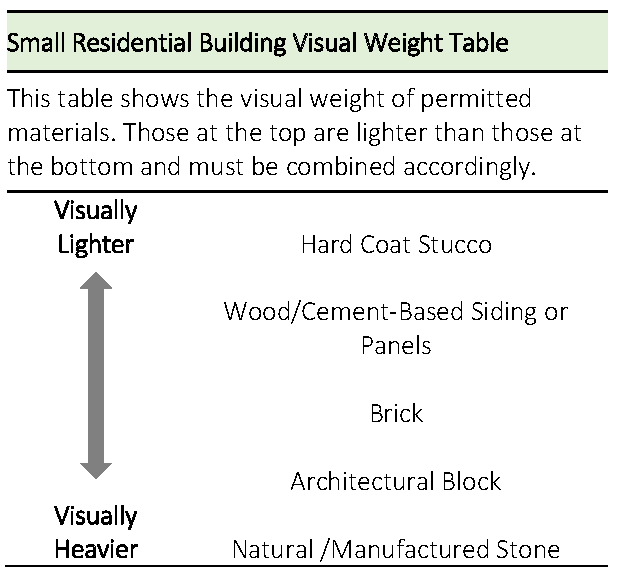
Exterior finish materials must be combined only horizontally, with the visually heavier below the lighter as shown in the Small Residential Building Visual Weight Table. This does not apply to architectural details such as cornices, window sills, and beltlines.
3.
No more than three different exterior finish materials, textures, colors, or combinations thereof may be used on a single building, excluding materials used on windows, doors, porches, balconies, foundations, or architectural details.
4.
Foundations must be constructed as a distinct building element that is finished in a different material or color than the exterior wall. Exposed above-ground foundations must be coated or faced in cement, hard coat stucco, brick, manufactured stone, or natural stone to contrast with façade materials.
C.
Building Facades
1.
The following apply to all street-facing facades.
2.
Windows and Doors
a.
Where used, shutters must match one half the width and shape of the window opening to which they are adjacent.
b.
Doors and windows that operate as sliders are prohibited
c.
All windows must be vertically shaped with a height greater than width. The top of said windows must generally be in alignment with the top of the adjacent door frame.
d.
Windows must have true or simulated divided lights or be one-over-one lights.
e.
Windows must include sills of wood, masonry, stone, cast stone, or terra cotta.
f.
Window frames must be recessed a minimum of 1.5 inches from the exterior façade.
3.
A stoop or front porch is required.
4.
Awnings are not allowed.
D.
Building Massing
1.
Pitched roofs, if provided, must be symmetrically sloped no less than 5:12, except that roofs for front porches and attached sheds may be no less than 2:12.
2.
Flat roofs must be enclosed by parapets a minimum of 42 inches high, or as required to conceal mechanical equipment by Section 87.5.4.
3.
All roofs must have a minimum 25-year roof life and no visible roll roofing.
4.
Chimneys, where provided, must extend to the ground and must be faced in brick or stacked stone.
(Ord. No. 2017-25, § 2, 12-19-17)
Sec. 87.9. - Tree Protection.
87.9.1. Applicability
A.
This Section applies to all sites in the Perry Form Based Code except detached residential lots.
B.
Detached residential lots must comply with the full requirements of Section 6-4 of the Perry Land Management Ordinance.
C.
Sites subject to this Section and with a building coverage under 70% must comply with the full requirements of Section 6-4 of the Perry Land Management Ordinance.
D.
Site subject to this Section and with a building coverage of 70% or more must comply with one of the following:
1.
The full requirements of Section 6-4 of the Perry Land Management Ordinance; or
2.
The requirements of Section 2.9.2 below.
87.9.2. Minimum Site Density Requirements
A.
A minimum of one Overstory tree must be provided on-site for every 400 square feet of a site not covered by buildings.
B.
The required Overstory tree must have a minimum 4-inch caliper.
C.
The required number of Overstory trees may be achieved by counting existing trees to be preserved, planting new trees according to the standards of this Section, or some combination of the two.
D.
All sites shall comply with the applicable street tree requirements in the adjacent street.
(Ord. No. 2017-25, § 2, 12-19-17)
Sec. 88.1. - Applicability.
A.
The requirements of this Article apply to all Form Based Zoning Districts.
B.
The requirements of the Perry Land Management Ordinance also apply in all Downtown Districts unless expressly stated otherwise in this Article.
(Ord. No. 2017-25, § 2, 12-19-17)
Sec. 88.2. - Rules of Interpretation.
88.2.1. Site
Defined. A site is any lot or group of contiguous lots owned or functionally controlled by the same person or entity, assembled for the purpose of development. Lots within a site may be separated by an existing public right-of-way.
88.2.2. Lot
A.
Lot Frontage.
1.
Every lot (except cottage court lots) and every cottage court site must have frontage upon:
a.
An existing public street, or
b.
A new public street or private street built to standards of Section 87.3.3, or
c.
A civic space meeting the standards of Section 88.2.3.B or an existing City of Perry park. No more than 20% of the total lots in a site (except cottage court lots) may front on a civic space or existing City park.
2.
Alleys may not be used to satisfy the lot frontage requirements of Section 88.2.2.A.1 above.
3.
The minimum lot frontage is 20 feet or the minimum lot width identified in district regulations, whichever is greater.
4.
Lots having frontage on a civic space or existing City park must still comply with fire lane access requirements, as applicable.
88.2.3. Open Space
A.
Defined. Open space is the horizontal outdoor area of a site reserved to provide separation, resource protection, scenic enjoyment, recreation, or amenity. It includes two types: civic space and amenity space.
B.
Civic space. Civic space is the portion of open space for public use defined by the combination of certain physical constants including the relationships among their intended use, their size, their landscaping, and their adjacent buildings. Civic spaces are limited to the following types:
1.
Park. An open space available for structured or unstructured recreation. A park may be independent of surrounding buildings at its edges. Its landscape may consist of paths and trails, meadows and lawns, water bodies, and woodlands. Recreation fields and courts may also be included. The minimum size for a park is one acre.
2.
Square. An open space available for unstructured recreation and civic purposes. A square is spatially defined by building or streets at its edges. Its landscape must consist of paths and trees, and may also include lawns and non-asphalt paved surfaces. The minimum size for a square is one-half acre.
3.
Plaza. An open space, available for civic purposes and commercial activities. A plaza must be spatially defined by building or streets at its edges. Its landscape must consist primarily of non-asphalt paved surfaces and trees. The minimum size for a plaza is one-quarter acre.
4.
Pocket Park. An open space, available for unstructured recreation. A pocket park may be spatially defined by buildings or streets at its edges. Its landscape must consist of lawn and trees. There is no minimum size for pockets parks.
5.
Playground. An open space designed and equipped for the recreation of children. A playground must be fenced and may include an open shelter. Playgrounds must be interspersed within residential areas, may be placed within a block, and may be included in parks and greens. There is no minimum size for playgrounds.
C.
Amenity space. Amenity space is the covered or uncovered, but unenclosed, outdoor areas of at least 100 square feet each for use by the occupants, invitees and guests of the development and specifically excluding Civic Spaces and required sidewalks. Amenity spaces may include, but are not limited to:
1.
Rooftop decks;
2.
Balconies;
3.
Patios and porches;
4.
Outdoor dining areas;
5.
Pool areas;
6.
Tennis courts, basketball courts, and similar uses;
7.
Yards, lawns, and gardens;
8.
Hardscape areas improved for pedestrian enjoyment; and
9.
Wooded areas.
D.
Open space may be privately or publically owned. Private open space is open space that is owned by a corporation, individual, or homeowners association. Public open space is open space owned by a governmental agency.
E.
Wetlands, lakes, ponds, streams, rivers, flood zones, and stream buffers may only be considered open space when located within one of the five types of civic spaces identified in Section 3.2.4.B.
F.
No required buffer, except for stream buffers, may be used to satisfy open space requirements.
G.
Stormwater management facilities may not be used to satisfy open space requirements.
H.
No areas used for vehicles, except for incidental service, maintenance, or emergency actions, may be used to satisfy open space requirements.
I.
A site's Open space requirements shall be considered completely satisfied when a development incorporates a historic building that complies with all of the following:
1.
The building is deemed fit for human habitation in accordance with the adopted Perry City Municipal Codes concerning buildings and structures; and
2.
A binding legal agreement that established a program for guaranteeing maintenance of said building through a condominium association, a homeowner association, bonding, or other protective maintenance guarantees is signed by all property owners and/or their prospective successors in title and is submitted to the City of Perry.
J.
When a historic building used to satisfy open space requirements in accordance with Section 3.2.3.I is subsequently completely destroyed, the applicable open space requirements of the zoning district must be satisfied within one year unless a variance is granted by the City Council.
(Ord. No. 2017-25, § 2, 12-19-17)
Sec. 88.3. - Building Types Allowed.
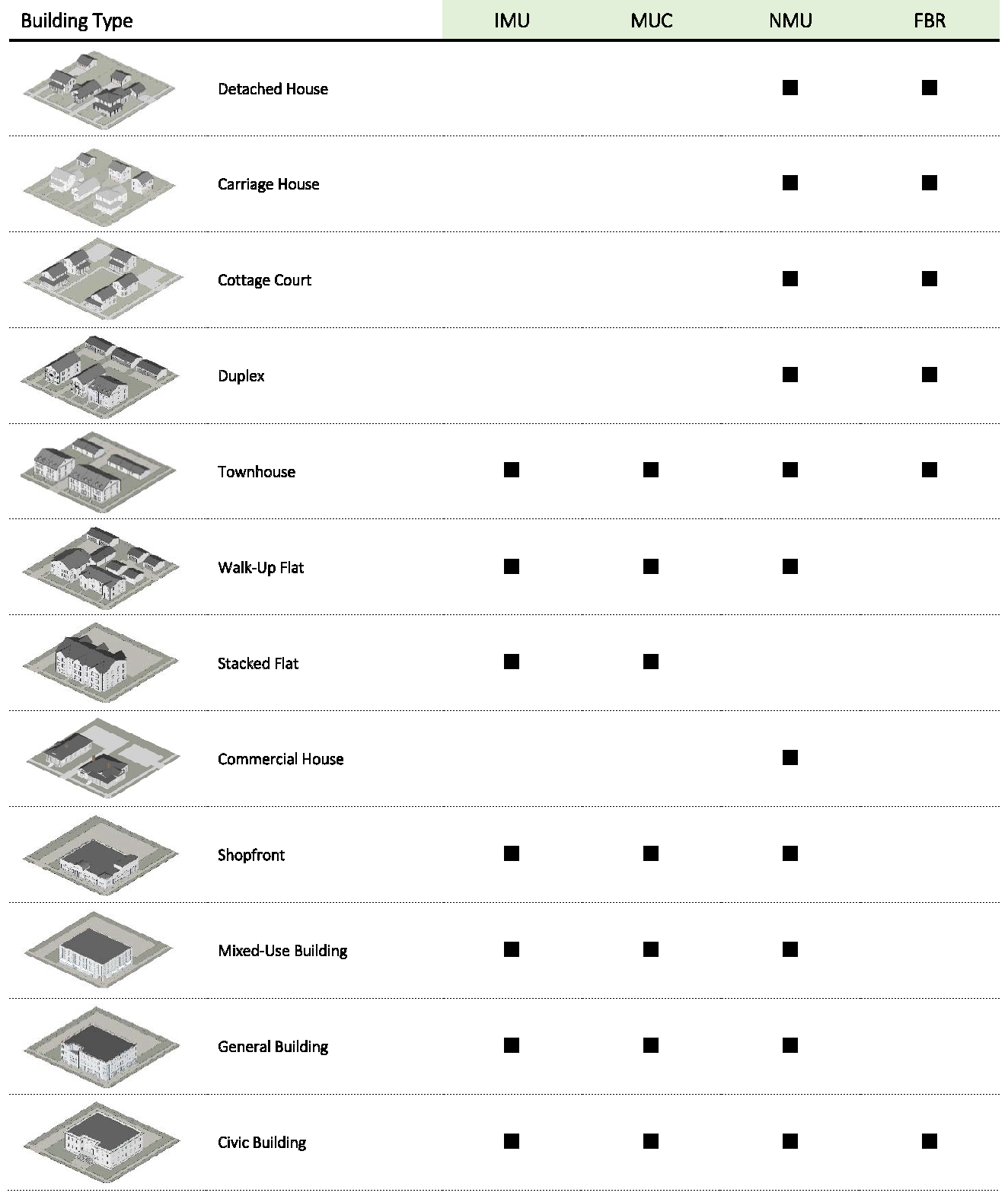
Building types are allowed by Form Based Zoning District as shown below.
(Ord. No. 2017-25, § 2, 12-19-17)
Sec. 88.4. - Uses Allowed by District.
88.4.1. Allowed Use Table
A.
Uses allowed in the Form Based Code districts are listed in the Table of Uses in Section 4-1 of the Perry Land Management Ordinance.
(Ord. No. 2017-25, § 2, 12-19-17)
Sec. 88.5. - IMU: Interstate Mixed Use.
88.5.1. Purpose
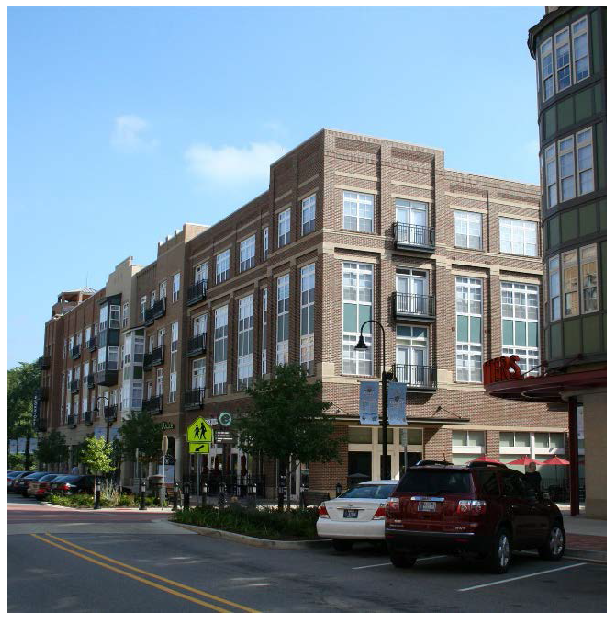
The purpose of this district is to provide for mixed-use development compatible with adjacent highway area and includes a variety of commercial uses serving the entire city, civic uses, and residential uses.
88.5.2. Building Types Allowed
The following building types are allowed:
A.
Townhouse
B.
Walk-Up Flat
C.
Stacked Flat
D.
Shopfront
E.
Flex Building
F.
Mixed-Use Building
G.
General Building
H.
Civic Building
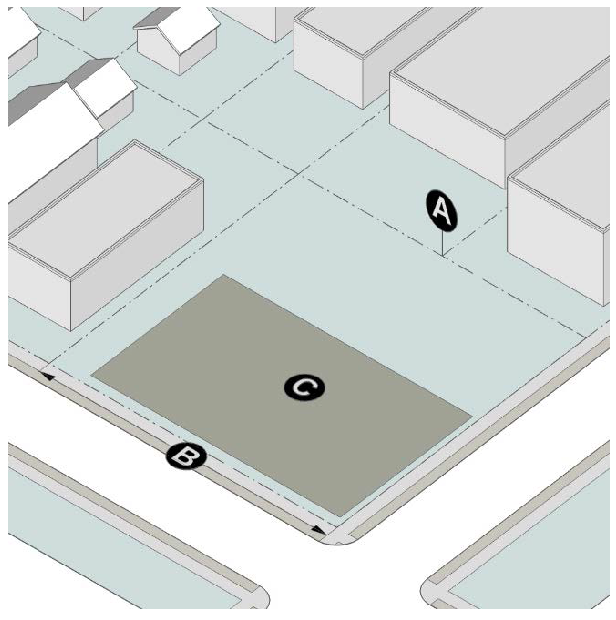
88.5.3. Dimensional Standards
88.5.4. Building Placement
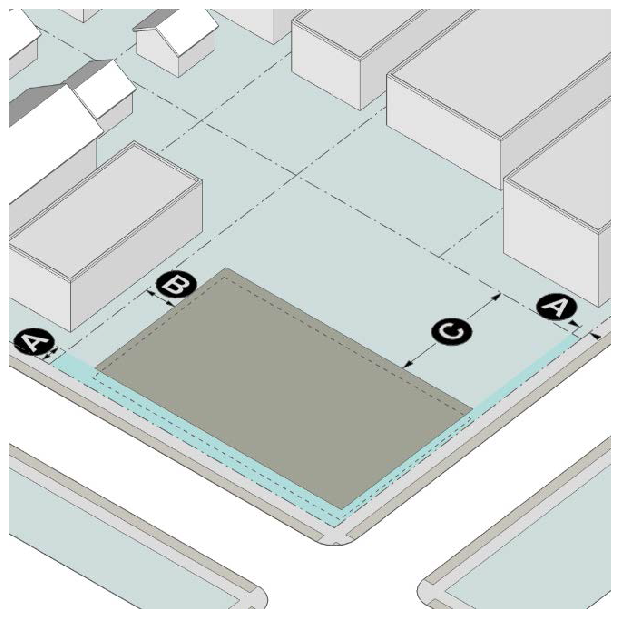
88.5.5. Bulk and Mass
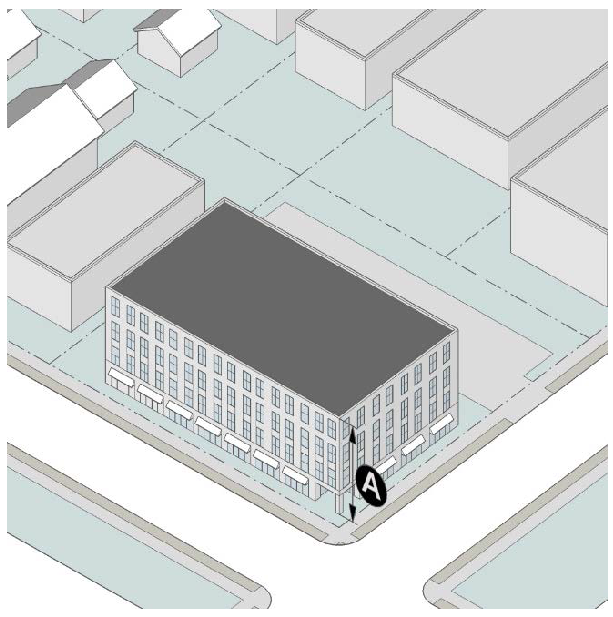
(Ord. No. 2017-25, § 2, 12-19-17)
Sec. 88.6. - MUC: Mixed-Use Center.
88.6.1. Purpose
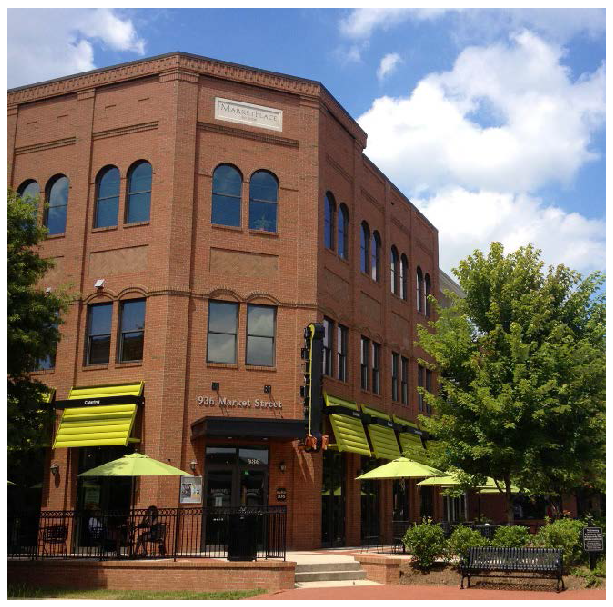
The purpose of this district is to provide for a variety of residential housing, commercial, and civic options along major nodes leading to Downtown Perry.
88.6.2. Building Types Allowed
The following building types are allowed:
A.
Townhouse
B.
Walk-Up Flat
C.
Stacked Flat
D.
Shopfront
E.
Mixed-Use Building
F.
General Building
G.
Civic Building
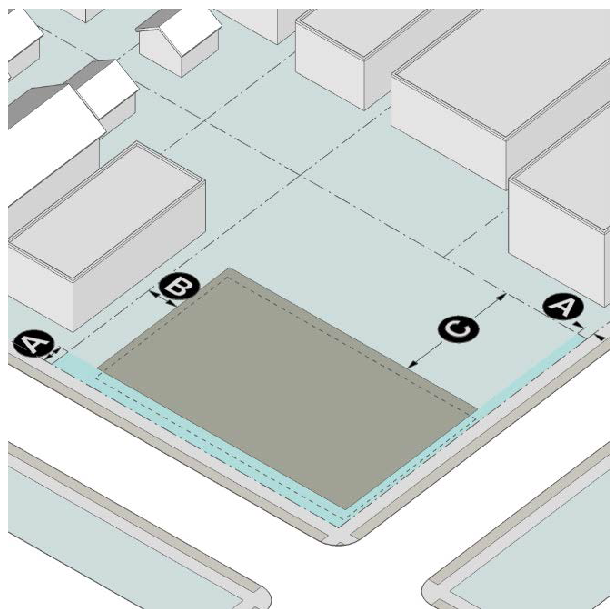
88.6.3. Dimensional Standards
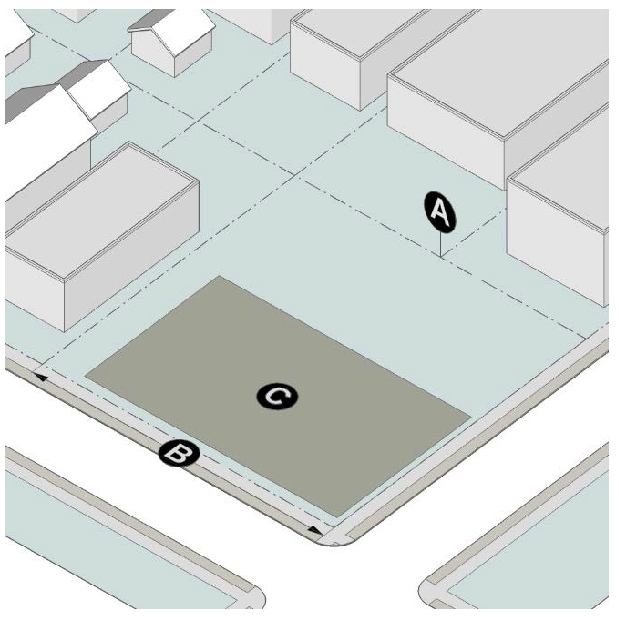
88.6.4. Building Placement
88.6.5. Bulk and Mass
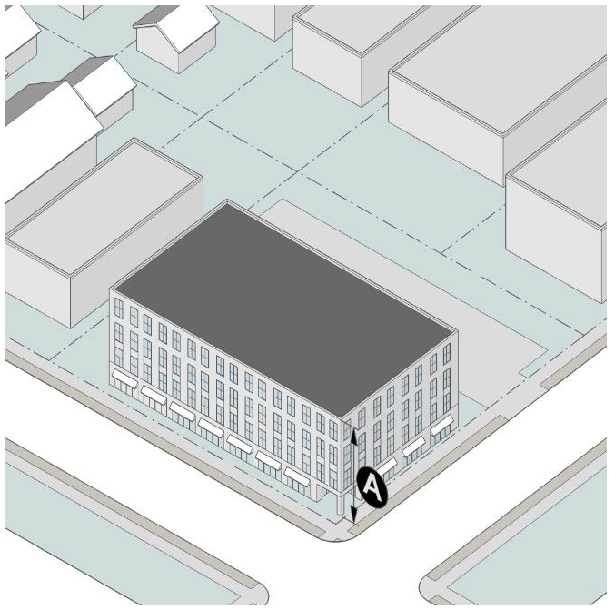
(Ord. No. 2017-25, § 2, 12-19-17)
Sec. 88.7. - NMU: Neighborhood Mixed-Use.
88.7.1. Purpose
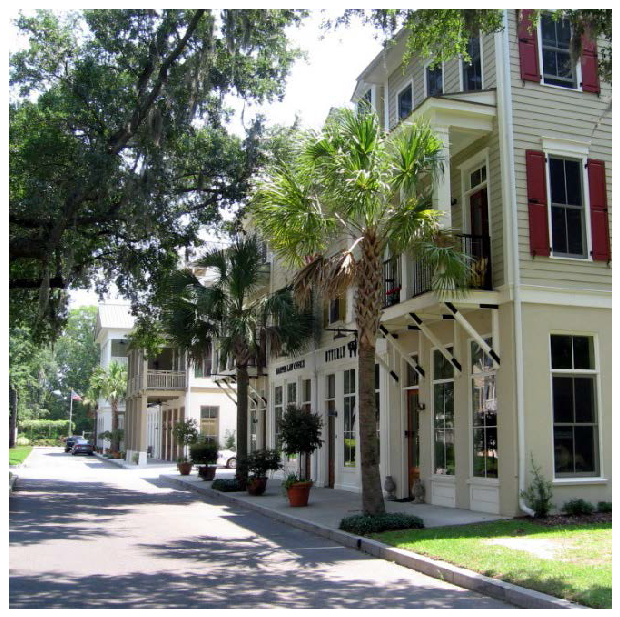
The purpose of this district is to provide for a variety of residential housing options, civic uses, and limited commercial uses and developments that are compatible with residential surroundings.
88.7.2. Building Types Allowed
The following building types are allowed:
A.
Detached House
B.
Carriage House
C.
Duplex
D.
Townhouse
E.
Cottage Court
F.
Walk-Up Flat
G.
Commercial House
H.
Shopfront
I.
Flex Building
J.
Mixed-Use Building
K.
General Building
L.
Civic Building
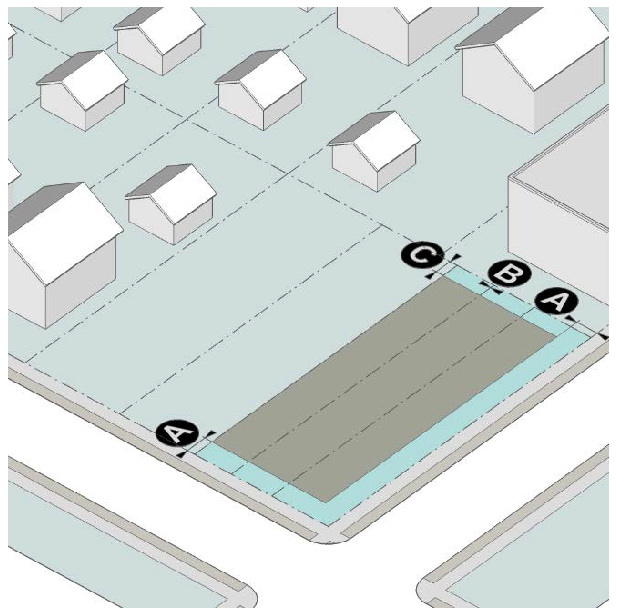
88.7.3. Dimensional Standards
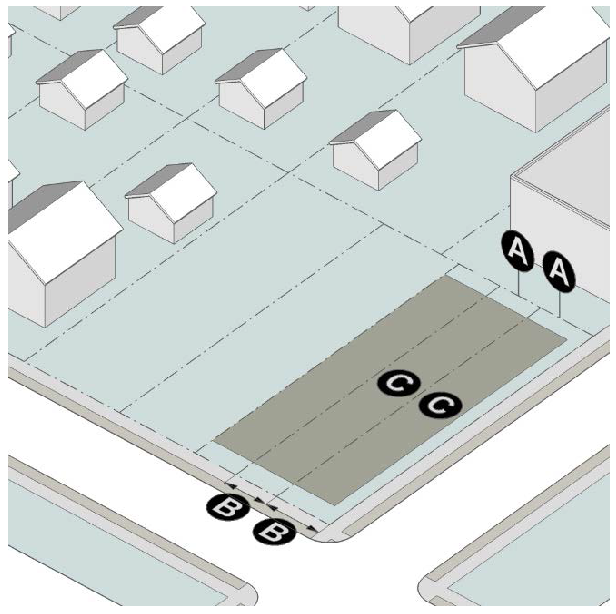
88.7.4. Building Placement
88.7.5. Bulk and Mass
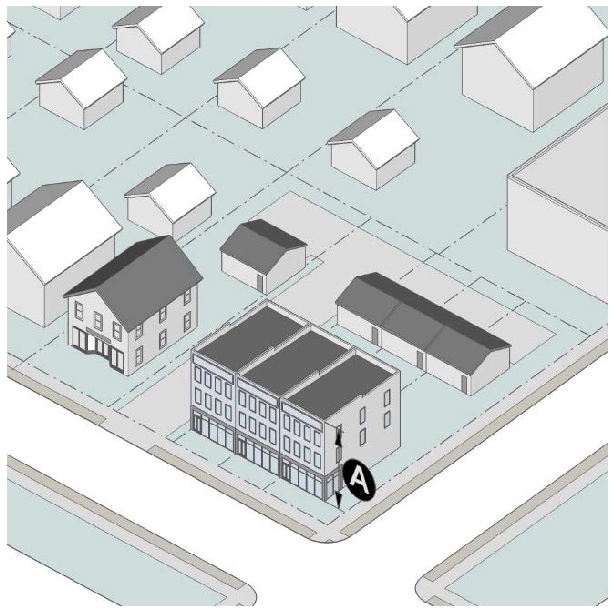
(Ord. No. 2017-25, § 2, 12-19-17)
Sec. 88.8. - FBR: Form Based Residential.
88.8.1. Purpose
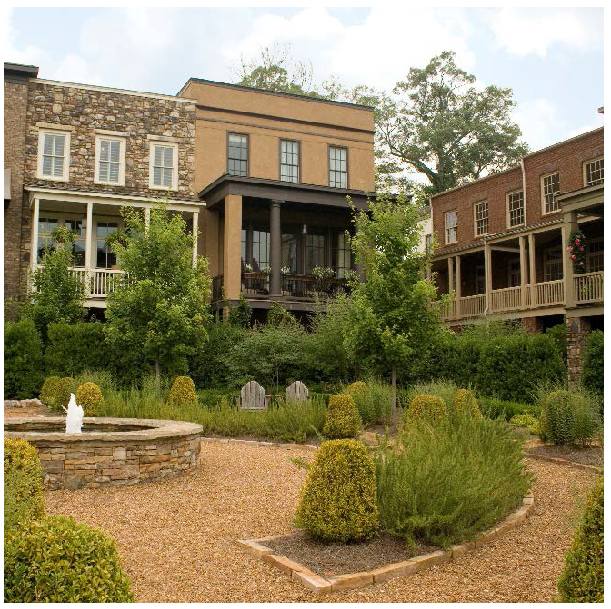
The purpose of this district is to provide for a variety of housing options in a residential setting.
88.8.2. Building Types Allowed
The following building types are allowed:
A.
Detached House
B.
Carriage House
C.
Duplex
D.
Townhouse
E.
Cottage Court
F.
Civic Building
88.8.3. Dimensional Standards
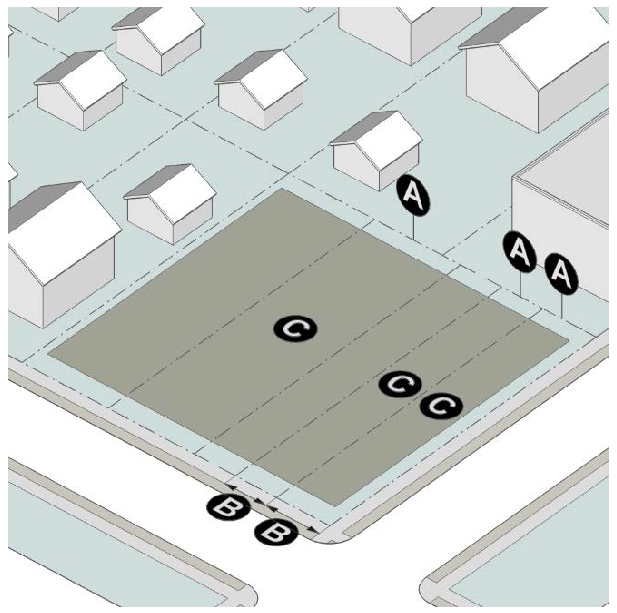
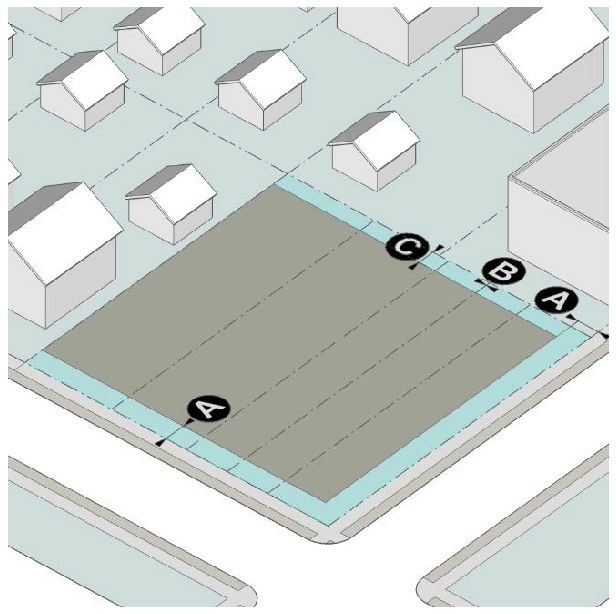
88.8.4. Building Placement
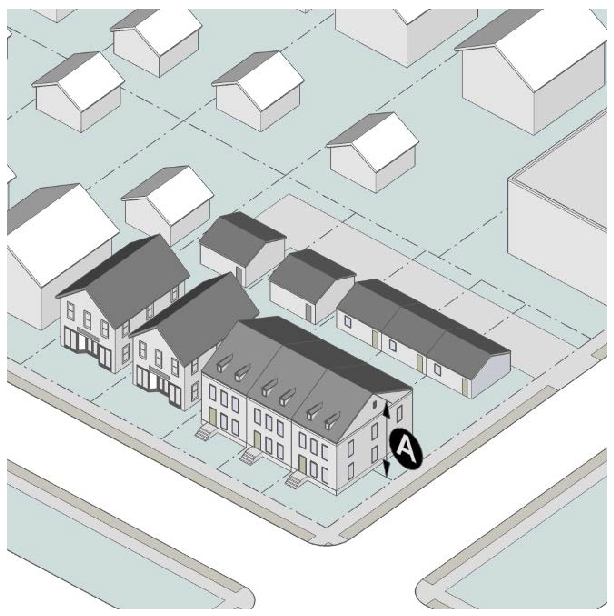
88.8.5. Bulk and Mass
(Ord. No. 2017-25, § 2, 12-19-17)
Sec. 89.1. - Defined Terms.
Live-Work. Nonresidential activity conducted wholly within a residential dwelling that allows employees, customers, clients or patrons to visit.
Stub-out. A shortened thoroughfare which is intended to provide connectivity at some point in the future.
Wall Plate. A horizontal load-bearing member in a wall assembly. The top of the wall plate is the top most structural piece of the wall.
(Ord. No. 2017-25, § 2, 12-19-17)

