
Plattville City Zoning Code
ARTICLE IV
- ZONING DISTRICTS
Sec. 36-241.- Districts.
For the purpose and provisions herein the County is hereby organized into twenty (20) districts. The minimum area that may constitute a separate or detached part of any zoning district shall be as follows:
(Ord. No. 2020-17, exh. G, § 6:01, 9-15-2020)
Sec. 36-242. - Zoning maps.
The boundaries of the zoning districts listed in Section 36-241 are hereby established as shown on the map entitled "Official Zoning Map of Kendall County, Illinois," found in the office of the County PBZ Department. A link entitled "Official Zoning Map of Kendall County, Illinois," found on the County PBZ Department's website, shall be a secondary source to view the official zoning map. The paper map found in the County PBZ Department shall be the official zoning map in cases of conflict between the paper and online maps. A paper copy of this map can be obtained in the County PBZ Department office. Said map shall have the same force and effect as if the zoning map, together with all notations, references, and other information shown thereon were fully set forth and described herein.
(Ord. No. 2020-17, exh. G, § 6:02, 9-15-2020)
Sec. 36-243. - District boundaries.
When uncertainty exists with respect to the boundaries of the various districts as shown on the Official Zoning Map, the following rules shall apply:
(1)
District boundary lines are either the centerlines of railroads, highways, streets, alleys or easements, or the boundary lines of sections, quarter sections, divisions of sections, tracts or lots, or such lines extended unless otherwise indicated.
(2)
In areas not subdivided into lots and blocks, wherever a district is indicated as a strip adjacent to and paralleling a street or highway, the depth of such strips shall be in accordance with the dimensions shown on the maps measured at right angles from the centerline of the street or highway, and the length of frontage shall be in accordance with the dimensions shown on the map from section, quarter section, or division lines, or centerlines of streets, highways, or railroad rights-of-way unless otherwise indicated.
(3)
Where a lot held in one (1) ownership and of record at the effective date of the ordinance from which this chapter is derived is divided by a district boundary line, the entire lot shall be construed to be within the less restricted district, provided that this construction shall not apply if it increases the less restricted portion of the lot by more than twenty-five (25) feet.
(Ord. No. 2020-17, exh. G, § 6:03, 9-15-2020)
Sec. 36-244. - Zoning of streets, alleys, public ways, waterways, and rights-of-way.
All streets, alleys, public ways, waterways and railroad rights-of-way, if not otherwise specifically designated, shall be deemed to be in the same zone as the property immediately abutting upon such alleys, street, public ways, waterways, and railroad rights-of-way. Where the centerline of a street, alley, public way, waterway or railroad right-of-way serves as a district boundary, the zoning of such areas, unless otherwise specifically designated, shall be deemed to be the same as that of the abutting property up to such centerline.
(Ord. No. 2020-17, exh. G, § 6:04, 9-15-2020)
Sec. 36-245. - Disconnected territory.
Any addition to the unincorporated area of the County, resulting from disconnection by municipalities or otherwise, or from submerged land which may be reclaimed hereafter, shall be automatically classified in the A-1 Agricultural District until such time as the County Board designates the permitted use of land in accordance with the administrative provisions of this chapter.
(Ord. No. 2020-17, exh. G, § 6:05, 9-15-2020)
Sec. 36-246. - Utilities.
(a)
The following utility facilities are exempted from regulation by this chapter: poles, towers, wires, cables, conduits, vaults, or any other similar distributing equipment of a public utility, as defined in the Public Utilities Act (220 ILCS 5/1-101 et seq.), if the public utility is subject to the Messages Tax Act (35 ILCS 610/1 et seq.), the Gas Revenue Tax Act (35 ILCS 615/1 et seq.) or the Public Utilities Revenue Act (220 ILCS 5/1-101), or if such facilities or equipment are located on any rights-of-way and are used for railroad purposes; except as regulated by Subsection (b) of this section.
(b)
Telecommunications carrier facilities shall be allowed in all zoning districts if they conform to the following standards:
(1)
Definitions. The following words, terms and phrases, when used in this section, shall have the meanings ascribed to them in this subsection, except where the context clearly indicates a different meaning:
Antenna means an antenna device by which radio signals are transmitted, received, or both.
County Board means the Kendall County Board.
County jurisdiction area means those portions of the County that lie outside the corporate limits of cities, villages, and incorporated towns that have municipal zoning ordinances in effect.
Equipment housing means a combination of one (1) or more equipment buildings or enclosures housing equipment that operates in conjunction with the antennas of a facility, and the equipment itself.
FAA means the Federal Aviation Administration of the United States Department of Transportation.
Facility means that part of the signal distribution system used or operated by a telecommunications carrier under a license from the FCC consisting of a combination of improvements and equipment, including:
a.
One (1) or more antennas;
b.
A supporting structure and the hardware by which antennas are attached;
c.
Equipment housing;
d
Ancillary equipment such as signal transmission cables and miscellaneous hardware.
Facility lot means the zoning lot on which a facility is or will be located.
FCC means the Federal Communications Commission.
Height of a facility means the total height of the facility's supporting structure and any antennas that will extend above the top of the supporting structure; however, if the supporting structure's foundation extends more than three (3) feet above the uppermost ground level along the perimeter of the foundation, then each full foot in excess of three (3) feet shall be counted as an additional foot of facility height. The height of a facility's supporting structure is to be measured from the highest point of the supporting structure's foundation.
Horizontal separation distance means the distance measured from the center of the base of the facility's supporting structure to the point where the ground meets a vertical wall of a principal residential building.
Lot line setback distance means the distance measured from the center of the base of the facility's supporting structure to the nearest point on the common lot line between the facility lot and the nearest residentially zoned lot. If there is no common lot line, the measurement shall be made to the nearest point on the lot line of the nearest residentially zoned lot without deducting the width of any intervening right-of-way.
Nonresidential zoning district means the County jurisdiction area except for those portions within a residential zoning district.
Nonresidentially zoned lot means a zoning lot in a nonresidential zoning district.
Principal residential building has its common meaning but shall not include any building under the same ownership as the land of the facility lot. The term "principal residential building" shall not include any structure that is not designed for human habitation.
Qualifying structure means a supporting structure that is:
a.
An existing structure, if the height of the facility, including the structure, is not more than fifteen (15) feet higher than the structure just before the facility is installed; or
b.
A substantially similar, substantially same-location replacement of an existing structure, if the height of the facility, including the replacement structure, is not more than fifteen (15) feet higher than the height of the existing structure just before the facility is installed.
Residential zoning district means a zoning district that is designated under this chapter and is zoned predominantly for residential uses.
Residentially zoned lot means a zoning lot in a residential zoning district.
Supporting structure means a structure, whether an antenna tower or another type of structure, that supports one (1) or more antennas as part of a facility.
Telecommunications carrier means a telecommunications carrier, as defined in the Public Utilities Act (220 ILCS 5/1-101 et seq.) as of January 1, 1997.
(2)
Location guidelines.
a.
A nonresidentially zoned lot is the most desirable location.
b.
A residentially zoned lot that is not used for residential purposes is the second most desirable location.
c.
A residentially zoned lot that is two (2) acres or more in size and is used for residential purposed is the third most desirable location.
d.
A residentially zoned lot that is less than two (2) acres in size and is used for residential purposes is the least desirable location.
e.
The size of a lot shall be the lot's gross area in square feet without deduction of any unbuildable or unusable land, any roadway, or any other easement.
(3)
Design guidelines.
a.
No building or tower that is part of a facility should encroach onto any recorded easement prohibiting the encroachment unless the grantees of the easement have given their approval.
b.
Lighting should be installed for security and safety purposes only. Except with respect to lighting required by the FCC or FAA, which shall be conventional red lighting at night and may be white strobe during the day (unless required by the FAA or FCC to be white strobe at night), all lighting should be shielded so that no glare extends substantially beyond the boundaries of a facility.
c.
No facility should encroach onto an existing septic field.
d.
Any facility located in a special flood hazard area or wetland should meet the legal requirements for those lands.
e.
Existing trees more than three (3) inches in diameter should be preserved if reasonably feasible during construction. If any tree more than three (3) inches in diameter is removed during construction, a tree three (3) inches or more in diameter of the same or a similar species shall be planted as a replacement if reasonably feasible. Tree diameter shall be measured at a point three (3) feet above ground level.
f.
If any elevation of a facility faces an existing, adjoining residential use within a residential zoning district, low-maintenance landscaping should be provided on or near the facility lot to provide at least partial screening of the facility. The quantity and type of that landscaping should be in accordance with any County landscaping regulations of general applicability, except that Subsection (b)(3)e of this section shall control over any tree-related regulations imposing a greater burden.
g.
Fencing should be installed around a facility. The height and materials of the fencing should be in accordance with any County fence regulations of general applicability.
h.
Any building that is part of a facility located adjacent to a residentially zoned lot should be designed with exterior materials and colors that are reasonably compatible with the residential character of the area.
(4)
Standards.
a.
Except as provided in this subsection (4), no yard or setback regulation shall apply to or be required for a facility.
b.
A facility may be located on the same zoning lot as other structures or uses without violating any ordinance or regulation that prohibits or limits multiple structures, buildings, or uses on a zoning lot.
c.
No minimum lot area, width, or depth shall be required for a facility, and unless the facility is to be manned on a regular, daily basis, no off-street parking spaces shall be required for a facility. If the facility is to be manned on a regular, daily basis, one (1) off-street parking space shall be provided for each employee regularly at the facility. No loading facilities are required.
d.
No portion of a facility's supporting structure or equipment housing shall be less than fifteen (15) feet from the front lot line of the facility lot or less than ten (10) feet from any other lot line.
e.
No bulk regulations or lot coverage, building coverage, or floor area ratio limitations shall be applied to a facility or to any existing use or structure coincident with the establishment of a facility. Except as provided in this section, no height limits or restrictions shall apply to a facility.
f.
The improvements and equipment comprising the facility may be wholly or partly freestanding or wholly or partly attached to, enclosed in, or installed in or on a structure.
(5)
Approval process.
a.
A facility is permitted if its supporting structure is a qualifying structure or if both of the following conditions are met:
1.
The height of the facility shall not exceed two hundred (200) feet, except that if a facility is located more than one and one-half (1½) miles from the corporate limits of any municipality with a population of twenty-five thousand (25,000) or more the height of the facility shall not exceed three hundred fifty (350) feet; and
2.
The horizontal separation distance to the nearest principal residential building shall not be less than the height of the supporting structure; except that if the supporting structure exceeds ninety-nine (99) feet in height, the horizontal separation distance to the nearest principal residential building shall be a least one hundred (100) feet or eighty (80) percent of the height of the supporting structure, whichever is greater. Compliance with this subsection shall only be evaluated as of the time that a building permit application for the facility is submitted. If the supporting structure is not an antenna tower, this section is satisfied.
b.
Unless a facility is permitted under Subsection (b)(5)a of this section, a facility can be established only after the County Board gives its approval following consideration of the provisions of Subsection (b)(5)c of this section. The County Board may give its approval after one (1) public hearing by the ZBA on the proposal, but only by the favorable vote of a majority of the members present at a meeting held no later than seventy-five (75) days after submission of a complete application by the telecommunications carrier; if the County Board fails to act on the application within seventy-five (75) days after its submission, the application shall be deemed to have been approved. No more than one (1) public hearing shall be required.
c.
For the purposes of Subsection (b)(5)b of this section, the following siting considerations, but no other matter, shall be considered by the County Board or any other body conducting the public hearing:
1.
The criteria in Subsection (b)(2) of this section regarding location guidelines;
2.
Whether a substantial adverse effect on public safety will result from some aspect of the facility's design or proposed construction, but only if that aspect of design or construction is modifiable by the applicant;
3.
The benefits to be derived by the users of the services to be provided or enhanced by the facility and whether public safety and emergency response capabilities would benefit by the establishment of the facility;
4.
The existing uses on adjacent and nearby properties;
5.
The extent to which the design of the proposed facility reflects compliance with Subsection (b)(3) of this section regarding design guidelines.
d.
The County's review of a building permit application for a facility shall be completed within thirty (30) days. If a decision of the County Board is required to permit the establishment of a facility, the County's review of the application shall be simultaneous with the process leading to the County Board's decision.
e.
Any public hearing authorized under this section shall be conducted in a manner determined by the County Board. Notice of any such public hearing shall be published at least fifteen (15) days before the hearing in a newspaper of general circulation published in the County.
f.
Any decision regarding a facility by the County Board or a County agency or official shall be supported by written findings of fact. The circuit court shall have jurisdiction to review the reasonableness of any adverse decision and the plaintiff shall bear the burden of proof, but there shall be no presumption of the validity of the decision.
(Ord. No. 2020-17, exh. G, § 6:06, 9-15-2020; Ord. No. 2022-22, § II, 8-16-2022)
Sec. 36-247. - Pipelines.
The purpose of this section is to minimize the negative agricultural impacts and to protect sensitive areas by affording minimal negative impact during and after pipeline construction. This section shall pertain to all pipelines to be located within agricultural properties with sensitive areas, including, but not limited to, wetlands and existing forested or natural areas, which are not constructed in relation to the direct development of property. Such pipelines shall meet the following standards:
(1)
Pipeline depth.
a.
Except for above-ground piping facilities, such as mainline block valves, tap valves, meter stations, etc., the pipeline will be buried with:
1.
A minimum of five (5) feet of top cover where it crosses cropland.
2.
A minimum of five (5) feet of top cover where it crosses pastureland or other agricultural land comprised of soils that are classified by the USDA as being prime soils.
3.
A minimum of three (3) feet of top cover where it crosses pastureland and other agricultural land not comprised of prime soils.
4.
A minimum of three (3) feet of top cover where it crosses wooded/brushy land or other sensitive areas.
5.
Substantially the same top cover as an existing parallel pipeline, but not less than three (3) feet, where the route parallels an existing pipeline within a one hundred (100) foot perpendicular offset.
b.
Notwithstanding the foregoing, in those areas where rock is in its natural formation and/or a continuous stratum of gravel exceeding two hundred (200) feet in length are encountered, the minimum cover will be thirty (30) inches.
(2)
Replacement of topsoil.
a.
The topsoil depth shall be determined by a properly qualified soil scientist or soil technician who will set stakes every two hundred (200) feet along the right-of-way identifying the depth of topsoil to be removed.
b.
The actual depth of the topsoil, not to exceed thirty-six (36) inches, will first be stripped from the area to be excavated above the pipeline, and from the adjacent subsoil storage area. The topsoil will be stored in a windrow parallel to the pipeline trench in such a manner that it will not become intermixed with subsoil materials.
c.
The topsoil must be replaced so that after settling occurs, the topsoil's original depth and contour (with an allowance for settling) will be restored. The same shall apply where excavations are made for road, stream, drainage ditch, or other crossings. In no instance will the topsoil materials be used for any other purpose.
d.
As the topsoil is replaced, all rocks greater than three (3) inches in dimension shall be removed from the topsoil.
(3)
Restoration of ground cover.
a.
All soil conservation practices (such as terraces, grassed waterways, etc.) which are damaged by the pipeline's construction will be restored to their pre-construction condition.
b.
Sensitive areas shall be restored by seeding or planting vegetation that will establish preexisting character or to the landowner's desire, not to exceed what was formerly present.
(4)
Restoration and/or repair of field tiles.
a.
The company will endeavor to locate all tile lines within the right-of-way prior to the pipeline's installation so repairs can be made if necessary. The company will contact affected landowners/tenants for their knowledge of the tile line locations prior to the pipeline's installation. All identified tile lines will be staked or flagged prior to construction to alert construction crews to the possible need for tile line repairs.
b.
All the tile lines that are damaged, cut or removed shall be staked or flagged with the stakes or flags in such a manner they will remain visible until permanent repairs are completed. Tile lines must be restored to their original route within fourteen (14) days of the pipeline being laid.
c.
Where tile lines are severed by the pipeline trench, angle iron, I-beams or an equivalent shall be used to support the repaired tile lines. The support member shall be sufficient to support a ten (10) ton point load on the surface directly above the repaired tile line.
(5)
Ingress and egress routes. Prior to the pipeline's installation, the company and the landowner/tenant will reach a mutually acceptable agreement on the route that will be utilized for entering and leaving the pipeline right-of-way should access to the right-of-way not be practical or feasible from adjacent segments of the pipeline right-of-way or public highway or railroad rights-of-way.
(6)
Property owner/tenant notification procedure.
a.
The property owners/tenants of the land on which the pipe will be located shall be notified of the project intent and approximate scheduling of the construction.
b.
Written permission shall be obtained from each property owner/tenant affected for pipelines not approved by the Federal Energy Regulatory Commission.
(7)
Special provisions pertaining to pipeline locations.
a.
All pipelines greater than ten (10) inches in diameter which carry/conduct flammable or hazardous material shall be located a minimum of five hundred (500) feet from any occupied principal structure.
b.
All pipelines which cross a regulatory floodplain must obtain a special use pursuant to Article II of this chapter.
(Ord. No. 2020-17, exh. G, § 6:07, 9-15-2020)
Sec. 36-304.- Purpose, goals and objectives.
(a)
The purpose of this section is to establish zoning parameters for residential projects which encourage creative development within designated growth areas of the unincorporated County, while preserving open space and protecting the rural character and natural environments within those areas. The open space and uncongested character of the County are major reasons why residents move to this area. Thus, protection of the County's rural character is critical to maintaining the resident's quality of life. This can be accomplished through clustering housing sites on portions of the land to be developed and retaining unbroken open space on the remaining portions of the land.
(b)
The regulations of this section also balance residential development with the County's commitment to maintain a viable agribusiness sector, because such residential development can impact the continued viability of agriculture. The increased population can make it difficult for farmers to move equipment to their lands.
(c)
This section also ensures that residential projects are designed to protect water resources from contamination and protect natural drainage areas, floodplains and wetlands to avoid costly man-made stormwater projects. Residential development creates additional demands on natural resources such as water (for irrigation of lawns, gardens and consumption). The goal is a safe, ample and reliable source of potable water available throughout the County, and the protection of all surface water and groundwater resources for recreation and preservation.
(d)
Overall, the goal of this division is economically viable development which respects the inherent environmental limitations of the County's natural resources and of the specific land to be developed.
(e)
There are four (4) residential zoning districts for all new residential developments proposed after the effective date of the ordinance from which this chapter is derived: R-1 One-Family Residential District, RPD-1 Residential Planned Development—One, RPD-2 Residential Planned Development—Two, and RPD-3 Residential Planned Development—Three. The RPD districts are distinguished based on the maximum gross residential density of the development and the location within the County's Land Resource Management Plan. The R-1 One-Family Residential District has been retained to provide property owners with a simple alternative for very low density residential developments. All other prior residential districts are maintained solely to permit regulation of developments approved under those prior districts.
(f)
Private streets are prohibited unless for limited access on unique sites with unusual topography, woodlands, or configuration.
(g)
The County has a long, rich tradition in agriculture and respects the role that farming and agricultural related businesses continue to play in shaping the economic viability of the County. Property that supports this industry is indicated by a zoning indicator A-1 or A-1 special use. Anyone constructing a residence or facility near this zoning should be aware that normal agricultural practices may result in occasional smells, dust, sights, noise, and unique hours of operations that are not typical in other zoning areas. Please be aware that certain special and permitted uses are in existence and can continue operations as approved.
(Ord. No. 2020-17, exh. I, § 8:01, 9-15-2020)
Sec. 36-327.- Purpose.
The R-1 district may be appropriate in any area suggested for residential use on the Land Resource Management Plan. Such development must meet the standards of this subdivision.
(Ord. No. 2020-17, exh. I, § 8:02(intro. ¶), 9-15-2020)
Sec. 36-328. - Permitted uses.
The following uses are permitted in the R-1 district:
(1)
Accessory uses. Accessory uses, structures, and buildings shall be permitted, provided such uses, structures or buildings comply with the regulations of Section 36-971.
(2)
Fire stations.
(3)
Group homes, subject to the following:
a.
No more than eight (8) persons, plus staff.
b.
Licensed or certified by the State.
c.
A minimum distance of one thousand (1,000) feet is maintained between group home and adjacent properties as measured from the lot line.
(4)
Home occupations, provided an affidavit is filled out in the PBZ office stating the conditions of this chapter are met.
(5)
Lands and buildings used for horticulture or farm purposes, including vegetable gardens as defined by the Garden Act (505 ILCS 87/1 et seq.).
(6)
Parks.
(7)
Roadside stands for the display, sale or offering for sale of agricultural products grown or produced on the property, provided that the stands and produce on display are located ten (10) feet back from the nearest right-of-way line.
(8)
Single-family detached dwellings.
(9)
Signs, as permitted and regulated by Article VI of this chapter.
(10)
Temporary buildings or structures for construction offices or storage, on the same zoning lot, for a period not to exceed such construction.
(11)
Farm-type animals shall be permitted in accordance with the following:
a.
On lots less than one (1) acre, no farm-type animals shall be permitted, except as outlined in this section.
b.
On lots at least one (1) acre but less than three (3) acres in size, a maximum of one (1) horse and a maximum combined total of five (5) ducks, rabbits, chickens, or goats, with the following exception: The number of horses permitted on lots less than three (3) acres in size created prior to October 17, 2000, shall be determined in accordance with the methodology as in Subsection (11)e of this section.
c.
On lots three acres or more in size, one (1) horse per acre shall be permitted, provided that twenty-one thousand seven hundred eighty (21,780) square feet of contiguous land is dedicated as pasture for each horse permitted on a lot. Any lot with more than three horses shall submit a manure management plan to PBZ staff for review. In addition, for lots over three (3) acres but less than five (5) acres, a maximum combined total of ten (10) ducks, rabbits, chickens, or goats is allowed. Additional farm-type animals may be permitted temporarily for 4-H projects.
d.
Lots at least one (1) acre in size but less than five (5) acres shall be permitted to keep up to twelve (12) chickens. Lots one (1) acre in size or smaller may keep up to six (6) chickens, provided the conditions contained in Section 36-465 are met.
e.
On lots of five (5) acres or more, the following animals are permitted in any combination, provided that there shall not be in excess of two-thirds (⅔) of an animal unit per acre in accordance with the following table. The animal unit permitted for any animal not listed shall be determined by the Director of Planning, Building and Zoning and shall as nearly as possible approximate one (1) of the listed animals:
The formula for calculating the number of animals allowed on parcels in excess of five (5) acres in size shall be as follows:
(acreage of the property × 0.66) = total number of animal units allowed
Example: 5.0 acres × 0.66 = 3.33 animal units.
Based on the table above, the following mix of animals would be permitted:
(2 dairy cattle = 2.8 animal units) + (1 goat = 0.4 animal units) + (1 sheep = 0.10 animal units) + (3 chickens = 0.03 animal units) = 3.33 total animal units.
(Ord. No. 2020-17, exh. I, § 8:02(A), 9-15-2020; Ord. No. 2023-27, §§ II, III, 6-27-2023)
Sec. 36-329. - Conditional uses.
The following uses shall be allowed as conditional uses in the R-1 district:
(1)
Beekeeping with the following conditions:
a.
Beekeeping and the honey produced from beekeeping shall be for personal use only.
b.
Permit shall be required, with fee set by the County Board.
c.
Minimum lot size of one (1) acre (43,560 square feet) with a maximum of two (2) colonies.
d.
No colony shall be permitted within a front yard setback.
e.
All colonies must be set back at least thirty (30) feet from any rear or side yard lot line except that, when abutting a right-of-way of a street or railroad, the colony must be a minimum of five (5) feet from the rear or side yard lot line (as long as there is no sidewalk or pathway).
f.
All colonies within one hundred (100) feet of an adjoining home shall require a flyway barrier with a six (6) foot minimum height.
g.
All colonies shall require a minimum four (4) feet fence surrounding the perimeter of the colonies or surrounding the perimeter of the entire property. Fencing must have a locking gate with caution signage on each gate.
h.
Notification shall be sent by the permit applicant to all adjacent property owners. Notification shall be sent via certified mail or certificate of mail and proof of mailing shall be submitted to the PBZ Department. Any property owner who receives notification shall have fourteen (14) calendar days from the postmarked date to send written objection to the PBZ Department. If any such objection is received, no colony shall be located within one hundred (100) feet of the adjoining home of the objecting property owner.
i.
During the application submittal, there must be documentation from the homeowners' association (HOA) stating they approve or deny the proposal. If there is no HOA, that must be submitted in writing and signed by the applicant.
j.
Prior to submitting a renewal application, an applicant is permitted to resend notification to a property that has previously objected. If the property owner does not object within fourteen (14) calendar days after receiving the resent notification, the applicant may locate a colony within one hundred (100) feet of the residence of the previously objecting property but shall maintain a distance of at least thirty (30) feet from all property lines at all times unless abutting a right-of-way, in which case the colony can be placed within five (5) feet of the property line.
k.
The Zoning Administrator has authority to approve all new and renewal permits. If the Zoning Administrator receives information that a renewal applicant has violated any of these requirements, caused injury to the public, impacted the safety and health of the public, or has had an adverse effect on surrounding properties as a result of keeping bees on the subject property, the Zoning Administrator may, at the Administrator's discretion, deny the renewal application.
l.
Any decision made by the Zoning Administrator may be appealed in writing to the PBZ Committee.
m.
A site plan indicating the location and distance to property lines and adjacent residences shall be submitted to the PBZ Department with the application.
n.
Proof of apiary registration with the State Department of Agriculture shall be submitted to the PBZ Department within thirty (30) days of the application submittal.
o.
All approved permits shall comply with the Bees and Apiaries Act of Illinois (510 ILCS 20).
(2)
Home-based retail and/or wholesale food operation.
(3)
Model homes, with the following restrictions:
a.
Limited to one (1) year duration, with annual one (1) year renewal periods at the discretion of the PBZ Department.
b.
Must have ownership of a minimum of four (4) lots which are being sold in the subdivision where the model home is located.
c.
Cannot advertise or sell lots or homes exclusively in other subdivisions with this model home.
(Ord. No. 2020-17, exh. I, § 8:02(B), 9-15-2020; Ord. No. 2023-24, § XV, 5-16-2023)
Sec. 36-330. - Special uses.
The following uses may be allowed in the R-1 district by special use permit, in accordance with the provisions of Article II of this chapter:
(1)
Agency-licensed family residential care homes, transitional.
(2)
Agency-licensed group residential care home, permanent.
(3)
Airport, private airstrip, heliports and aircraft landing fields, provided that airports and surrounding territory are subject to the rules and regulations of the Illinois Department of Transportation (IDOT) Division of Aeronautics and must comply with all IDOT Division of Aeronautics and Federal Aviation Administration (FAA) requirements and provisions as follows:
a.
Height of structures in areas surrounding the boundaries of airports having an established approach plan that has been approved by the IDOT Division of Aeronautics shall be in accordance with the requirements set forth in the approach plan.
b.
Height of structures, in areas ten thousand (10,000) linear feet beyond the boundaries of airports that do not have an established approach plan, shall be governed by the following:
1.
For an airport having the longest runway less than three thousand nine hundred fifty (3,950) linear feet in length, structures located just beyond the boundaries of the airport shall not be in excess of fifteen (15) feet in height, and for every two hundred (200) linear feet of additional distance from the airport boundaries the height of structures may be increased by not more than ten (10) feet.
2.
For an airport having a runway of three thousand nine hundred fifty (3,950) linear feet or more in length, structures just beyond the boundaries of the airport shall not be in excess of fifteen (15) feet in height; for every two hundred (200) linear feet of additional distance from airport boundaries, the height of structures may be increased by not more than five (5) feet and, where a runway has been designated as an instrument runway, the height of structures may be increased by not more than four (4) feet in every two hundred (200) linear feet of additional distance from airport boundaries, for the first ten thousand (10,000) linear feet, and for the area covered in the next forty thousand (40,000) linear feet, the height of structures may be increased by not more than five (5) feet in every additional two hundred (200) linear feet.
c.
Structures exceeding the limiting heights shall be considered obstruction to air navigation unless found not to be objectionable after special aeronautical study. Such structures may be specifically authorized as a variation after public hearing by the Zoning Board as provided by law.
(4)
Bed and breakfast establishments are permitted, subject to the conditions stated in Section 36-282(13).
(5)
Cemeteries, including crematories and mausoleums in conjunction therewith, if not located within five hundred (500) feet of any dwelling.
(6)
Child day care facilities.
(7)
Commercial solar energy facility and test solar energy systems subject to the conditions contained in Section 36-282(17).
(8)
Commercial wind energy facility and test wind towers subject to the conditions contained in Section 36-282(18).
(9)
Communications use.
(10)
Golf courses, regulation size, including "Par 3" golf courses, commercially operated driving ranges and planned unit development for conventional golf courses, including a driving range.
(11)
Group homes, subject to the following:
a.
More than nine (9) persons, plus staff.
b.
Licensed or certified by the State.
c.
A minimum distance of one thousand (1,000) feet is maintained between group homes and adjacent properties as measured from the lot line.
(12)
Halfway house, provided that it is located a minimum of one thousand (1,000) feet from any dwelling.
(13)
Hospice.
(14)
Philanthropic institutions.
(15)
Places of worship, subject to the conditions contained in Section 36-282(43).
(16)
Public or private utilities and service uses:
a.
Telecommunications hubs.
b.
Filtration plants, pumping stations, and water reservoirs.
c.
Sewage treatment plants.
d.
Electric substations and booster stations.
e.
Other similar uses.
(17)
Rest homes, nursing homes and sanitariums.
(18)
Schools: elementary, junior high, and high schools, including playgrounds, garages for school buses, and athletic fields auxiliary thereto.
(19)
Seminaries, convents, monasteries, and similar religious institutions, including dormitories and other accessory uses required for operation, provided such uses are located on a tract of land not less than five (5) acres.
(20)
Uses not otherwise listed herein may be granted special use approval if such uses conform to the purpose, goals and objectives of the residential zoning districts as described in Section 36-304.
(Ord. No. 2020-17, exh. I, § 8:02(C), 9-15-2020; Ord. No. 2023-24, § XVI, 5-16-2023)
Sec. 36-331. - Lot size.
Lot sizes in the R-1 district shall be as follows:
(1)
Permitted and conditional uses: one hundred thirty thousand (130,000) square feet minimum lot with a width at the established building line of not less than two hundred (200) feet.
(2)
Special uses: Lot size for special uses shall be specified in the special use permit.
(Ord. No. 2020-17, exh. I, § 8:02(D), 9-15-2020)
Sec. 36-332. - Yard areas.
Yard area regulations in the R-1 district shall be as follows:
(1)
Front yard. Every building hereafter erected or enlarged shall provide and maintain a front yard as follows:
a.
One hundred fifty feet (150) feet from the roadway centerline when fronting on a Federal, State or County roadway or one hundred (100) feet from the right-of-way, whichever is greater.
b.
Fifty (50) feet from the right-of-way or access easement on all township or private roadways, with the following exception: Where lots comprising fifty (50) percent of the frontage on the same side of the street within the same block as the subject property are developed, and the developed properties have front yards that vary from one another not more than ten (10) feet in depth, the average of such front yards shall establish the minimum front yard depth for the entire frontage of the subject property. However, in no case shall a front yard of more than fifty (50) feet be required.
(2)
Side yard. A side yard on each side of the zoning lot of not less than fifty (50) feet shall be proved.
(3)
Rear yard. A rear yard of not less than fifty (50) feet shall be provided.
(Ord. No. 2020-17, exh. I, § 8:02(E), 9-15-2020)
Sec. 36-333. - Lot coverage.
No more than ten (10) percent of the area of the zoning lot may be occupied by buildings and structures, including accessory buildings.
(Ord. No. 2020-17, exh. I, § 8:02(F), 9-15-2020)
Sec. 36-334. - Maximum building height.
No building or structure shall be erected or structurally altered to exceed the following heights:
(1)
One (1) family detached dwellings: forty (40) feet and not more than two and one-half (2½) stories.
(2)
Other nonresidential permitted or conditional buildings and structures: forty-five (45) feet and not more than three (3) stories.
(3)
Special uses: Maximum height limitations shall be specified with the granting of a special use permit.
(Ord. No. 2020-17, exh. I, § 8:02(G), 9-15-2020)
Sec. 36-357.- Purpose.
The RPD-1 district applies to development lying within the contiguous growth area or rural transition identified in the Land Resource Management Plan. Such development must meet the standards of this subdivision.
(Ord. No. 2020-17, exh. I, § 8:03(intro. ¶), 9-15-2020)
Sec. 36-358. - Density.
Base density for the RPD-1 district shall be thirty-three hundredths (0.33) dwelling units per acre of buildable acreage (excluding any density bonuses as permitted under Section 36-360), provided that not less than thirty (30) percent of the total acreage of the property is designated as open space. To determine the permitted number of dwelling units, the buildable area of the site shall be multiplied by the sum of the base density, plus any applicable density bonuses.
(Ord. No. 2020-17, exh. I, § 8:03(A), 9-15-2020)
Sec. 36-359. - Maximum density.
Maximum density for the RPD-1 district, including all density bonuses as provided in Section 36-360, shall not exceed forty-five hundredths (0.45) dwelling units per acre of buildable land (thirty-three hundredths (0.33) dwelling units per buildable acre base density, plus maximum incentive of twelve hundredths (0.12) dwelling units per buildable acre, subject to approval of the County Board). Provision of multiple amenities shall not entitle the applicant to a density which exceeds the maximum density of forty-five hundredths (0.45) dwelling units per buildable acre. Regardless of the application of density bonuses, at least thirty (30) percent of the total acreage must be designated as open space.
(Ord. No. 2020-17, exh. I, § 8:03(B), 9-15-2020)
Sec. 36-360. - Density incentives.
The following density incentives may be used to increase development density in the RPD-1 district up to the permitted maximum density in each RPD district. Provision of multiple amenities shall not entitle the applicant to a density which exceeds the maximum density for the applicable RPD district. Regardless of the application of density bonuses, at least thirty (30) percent of the total acreage must be designated as open space.
(1)
Provision of public access to open space areas (bonus not to exceed three hundredths (0.03) dwelling units per buildable acre, subject to approval by the County Board). Some examples would include trails (walking or bike), sidewalks, etc.
(2)
Innovative detention/retention facilities or sewage disposal methods (bonus not to exceed four hundredths (0.04) dwelling units per buildable acre, subject to approval by the County Board). The following are examples of improvements which may qualify for a density bonus:
a.
Significant use of native vegetation such as prairies and wetlands.
b.
Integration of natural landforms, existing soil filtration characteristics and natural landscaping into the drainage plan, in order to enhance water quality while reducing or eliminating stormwater runoff and the attendant flooding and erosion.
c.
Provision of alternatives to detention basins such as stormwater infiltration in naturalized swales, native prairie landscapes and gently sloped depressional areas through the development.
(3)
Secondary open space that is substantially more than the minimum size otherwise required for stormwater detention or through park dedication requirements (bonus not to exceed seven hundredths (0.07) dwelling units per buildable acre, subject to approval by the County Board).
(4)
Provision of recreational amenities, beyond minimum standards established in the subdivision regulations of Chapter 30, including, but not limited to, a golf course, ball fields, playground equipment, tennis courts, basketball courts, swimming pool, hiking and bicycling paths (beyond those on the County Transportation Plan), community centers, and exceptional landscape improvements such as native or natural plantings (bonus not to exceed one hundredths (0.01) dwelling units per buildable acre, subject to approval by the County Board).
(5)
Off-site and perimeter road improvements or an ownership and maintenance fund for management of open space in addition to those needed to provide adequate access solely for the proposed development (bonus not to exceed three hundredths (0.03) dwelling units per buildable acre, subject to approval by the County Board).
(6)
Conservation of traditional rural architecture reminiscent of the County's agricultural heritage, preservation of historical structures, or design of new structures which reflect these architectural themes (bonus not to exceed one hundredths (0.01) dwelling units per buildable acre, as determined by the County Board or as identified in a local historic preservation plan).
(7)
Enhancement or expansion of an existing wetland or creation of a new wetland beyond that required for compliance with Army Corps of Engineers Section 404 Permit requirements (bonus not to exceed one hundredths (0.01) dwelling units per buildable acre, subject to approval by the County Board).
(Ord. No. 2020-17, exh. I, § 8:03(C), 9-15-2020)
Sec. 36-361. - Lot size.
Due to the existing soils types which are prevalent throughout the County, a minimum lot size of forty-five thousand (45,000) square feet will be required in the RPD-1 district if the subdivision design contemplates the use of traditional septic leach fields and individual wells up to a maximum lot size of one hundred thirty thousand (130,000) square feet. Lot sizes of less than forty-five thousand (45,000) square feet down to a minimum size of twenty thousand (20,000) square feet may be considered under one (1) or more of the following circumstances:
(1)
The developer can demonstrate to the satisfaction of the County Health Department and PBZ Department that each lot has been appropriately sized to provide:
a.
An adequate area of undisturbed and unencumbered soils within each lot that can support a primary and secondary area for a conventional septic drain field which complies with the schedule for sizing of septic envelopes as specified in the County subdivision regulations set forth in Chapter 30;
b.
Sufficient buildable area outside the septic envelope to allow construction of a standard single-family residential dwelling which complies with all applicable setbacks and height bulk requirements of the corresponding RPD Zoning District, and which meets the required setbacks and separation requirements between the sewage disposal systems and potable water supply systems.
(2)
A centralized on-site wastewater treatment and disposal system is contemplated meeting the requirements of all applicable State and local government agencies.
(3)
A community well is proposed to serve the individual lots within the proposed development provided the developer has demonstrated that the individual lots comply with the requirements as stated under Subsection (1) of this section.
(Ord. No. 2020-17, exh. I, § 8:03(D), 9-15-2020)
Sec. 36-362. - Lot width.
Lot width shall not be less than one hundred (100) feet measured at the front building setback.
(Ord. No. 2020-17, exh. I, § 8:03(E), 9-15-2020)
Sec. 36-363. - Permitted uses.
The following uses are permitted in the RPD-1 district:
(1)
Accessory uses. Accessory uses, structures, and buildings shall be permitted, provided such uses, structures or buildings comply with the regulations of Section 36-971.
(2)
Attached dwelling units shall be limited to a maximum of seventy-five (75) percent of the total dwelling units in the planned development.
(3)
Chickens provided that the conditions contained in Section 36-465 are met.
(4)
Duplexes or two (2) family detached dwellings.
(5)
Farming.
(6)
Group homes, subject to the following:
a.
No more than eight (8) persons, plus staff.
b.
Licensed or certified by the State.
c.
A minimum distance of one thousand (1,000) feet is maintained between group home and adjacent properties as measured from the lot line.
(7)
Health clubs (public or private) and related accessory uses only when included in the original plan.
(8)
Home occupations provided an affidavit is filled out in the PBZ office stating the conditions of this chapter are met.
(9)
Lands and buildings used for horticultural or farm purposes.
(10)
Multiple-family dwellings.
(11)
Parks, forest preserves and recreational areas, when publicly owned.
(12)
Planned unit developments.
(13)
Police and fire stations.
(14)
Postal substations.
(15)
Roadside stands for the display or offering for sale of agricultural products grown or produced on the property, provided that the stands and produce on display are located ten (10) feet back from the nearest right-of-way line.
(16)
Signs, as permitted and regulated by Article VI of this chapter. However, no part of a sign in an RPD district shall be greater than ten (10) feet above ground level and no larger than thirty (30) square feet.
(17)
Single-family detached dwellings.
(18)
Temporary buildings or structures for construction offices or storage, on the same zoning lot, for a period not to exceed such construction.
(Ord. No. 2020-17, exh. I, § 8:03(F), 9-15-2020; Ord. No. 2023-27, §§ IV, V, 6-27-2023)
Sec. 36-364. - Conditional uses.
In residential planned developments containing over fifty (50) dwelling units, the following uses shall be allowed in the RPD-1 district, provided that the general conditions and use-specific conditions are met:
(1)
General conditions.
a.
Conditional uses shall not occupy more than fifteen (15) percent of the buildable acreage of the development.
b.
Conditional uses shall front arterial or major collector level streets, as defined in the County Transportation Plan. Model homes shall be excluded from this subsection.
(2)
Specific conditions.
a.
Home-based retail and/or wholesale food operation.
b.
Model homes, with the following restrictions:
1.
Limited to one (1) year duration, with annual one (1) year renewal periods at the discretion of the PBZ Department.
2.
Must have ownership of a minimum of four (4) lots which are being sold in the subdivision where the model home is located.
3.
Cannot advertise or sell lots or homes exclusively in other subdivisions with this model home.
c.
Places of worship, subject to the following:
1.
The maximum lot coverage of structures may not exceed thirty-five (35) percent; total impervious surfaces may not exceed seventy (70) percent of the lot area.
2.
Buildings shall maintain a minimum setback of eighty (80) feet from the center of the road and thirty (30) feet from all other property lines.
3.
The height for the towers and steeples shall not exceed seventy-five (75) feet and not more than forty-five (45) feet for the main structure.
4.
Other related uses, such as schools, child day care services, kindergartens shall be permitted to the extent that the activity is otherwise permitted and shall be subject to all applicable regulations, including parking.
d.
Schools: Elementary, junior high, and high schools, including playgrounds, garages for school buses, and athletic fields auxiliary thereto, subject to the following:
1.
The minimum lot area shall be one (1) acre.
2.
The minimum lot width requirement shall be one hundred twenty (120) feet.
3.
A front setback of eighty (80) feet from the center of the road shall be required.
4.
Side and rear yards of no less than twenty-five (25) feet shall be provided. Where any outdoor activity area, swimming pool, ball field or court adjoins a residential land use, such yards shall be buffered with landscaping across fifty (50) percent of the lot width.
5.
Hours of operation shall be limited to the following:
(i)
Outdoor group activities shall not be allowed after 10:00 p.m.
(ii)
The facility may not be used as a regular overnight domicile or shelter. However, the school may be used for overnight retreats or events for school members and guests.
(iii)
Lighted outdoor recreation facilities, parking lots and lighting shall be designed to avoid excessive light and glare impacts on adjacent properties. Restrictions on light pole height and types, deflectors and other such measures may be required to prevent overspill and excessive intensity of light.
(Ord. No. 2020-17, exh. I, § 8:03(G), 9-15-2020; Ord. No. 2023-24, § XVII, 5-16-2023)
Sec. 36-365. - Special uses.
(a)
The following uses may be allowed in the RPD-1 district by a special use permit in accordance with the provisions of Article II of this chapter if approved with the planned development or as an amendment to a planned development:
(1)
Agency-licensed group residential care home, permanent.
(2)
Airport, private airstrip, heliports and aircraft landing fields, provided that airports and surrounding territory are subject to the rules and regulations of the Illinois Department of Transportation (IDOT) Division of Aeronautics and must comply with all IDOT Division of Aeronautics and Federal Aviation Administration (FAA) requirements detailed in Section 36-330(3).
(3)
Cemeteries, including crematories and mausoleums in conjunction therewith, if not located within five hundred (500) feet of any dwelling.
(4)
Colleges and universities, including dormitories, fraternities, sororities and other accessory buildings and structures when located on the college or university grounds, but not including business colleges or trade schools when operated for profit.
(5)
Commercial solar energy facility and test solar energy systems subject to the conditions contained in Section 36-282(17).
(6)
Commercial wind energy facility and test wind towers subject to the conditions contained in Section 36-282(18).
(7)
Community centers.
(8)
Convenience establishments consistent with the permitted uses as specified in the B-1 district, subject to the following:
a.
The area, size, and uses to be included in convenience establishments shall be established and regulated in the planned development ordinance passed pursuant to Subdivision VI of this division.
b.
When one (1) or more convenience establishment is proposed, they shall be grouped, arranged and designed for maximum pedestrian convenience.
c.
Convenience establishments shall not have substantial adverse effects on residential uses within the RPD or adjoining uses by reason of their location, design, construction, manner or timing of operation, signs, lighting, parking or access arrangements. Signage and lighting requirements may be more restrictive than the signage requirements of Article VI of this chapter and the County subdivision regulations set forth in Chapter 30.
d.
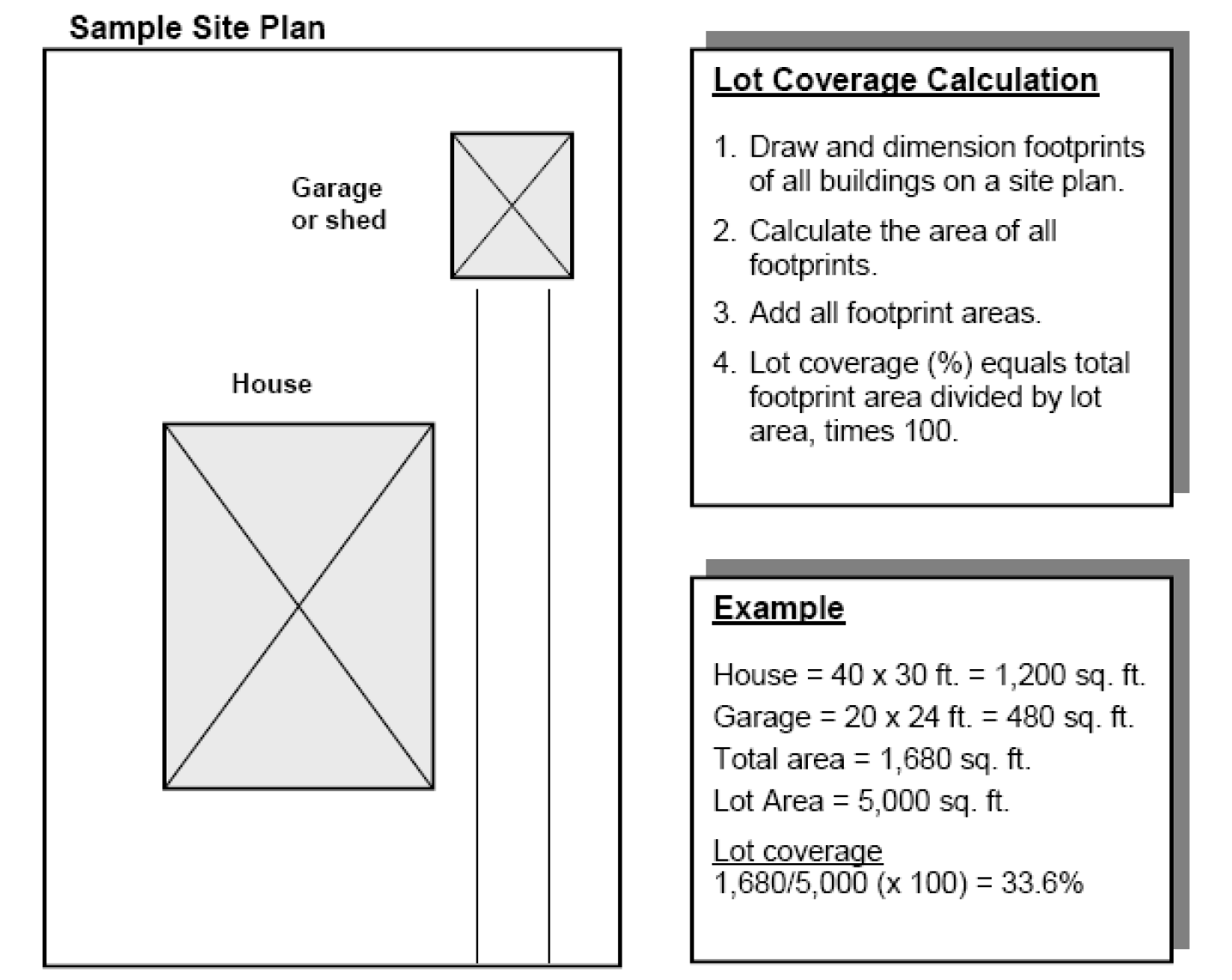
The maximum parcel size shall be one hundred thousand (100,000) square feet. No convenience establishment shall have a gross floor area in excess of five thousand (5,000) square feet per building. Lot coverage of all buildings shall not exceed thirty (30) percent of the area of the parcel, exclusive of rights-of-way of adjoining streets.
e.
Landscaped open space shall be utilized to protect the residential character of the RPD and surrounding uses, in an amount equal to or at least fifteen (15) percent of the area of the parcel, exclusive of rights-of-way of adjoining streets. Such space shall be landscaped or otherwise appropriately improved to provide convenient pedestrian circulation, play areas for children, passive recreation areas, and the like. Pedestrian sidewalks intended for circulation between parking areas and convenience establishments shall not be included as the improved open space required by this section.
f.
Convenience establishments shall have a front setback of at least thirty-five (35) feet, and rear setbacks of at least fifty (50) feet, or equal to the adjoining lot setbacks, whichever is greater. Side setbacks shall be at least ten (10) feet, or equal to the side setback of an adjacent residential use, whichever is greater.
g.
Transition landscaping shall be provided where the convenience establishment parcel abuts residential areas. Continuous landscaping shall be provided across one hundred (100) percent of the yard to a minimum mature height of six (6) feet. Plant material shall consist of approximately fifty (50) percent evergreen plants and fifty (50) percent deciduous material. Shrubs shall be spaced at a maximum of four (4) feet on center. A solid screen may be achieved by clustering shrubs beneath shade or ornamental trees, by using evergreen trees, or any mix thereof, or by providing a six (6) foot high solid commercial grade wood fence along the length of the property. Any fence shall be of one (1) material and one (1) color and shall have shade trees placed on the side of the fence closest to the commercial use, at the equivalent of one (1) tree for every fifty (50) linear feet.
(9)
Drug store if it is associated with a hospital.
(10)
Farm-type animals, except hens, on open space acreage as detailed in an approved special use permit.
(11)
Golf courses, club houses, country clubs and membership riding clubs, including "Par 3" golf courses, unlit commercially operated driving ranges, unlit miniature golf courses and planned unit development for conventional golf courses.
(12)
Group homes, subject to the following:
a.
More than nine (9) persons, plus staff.
b.
Licensed or certified by the State.
c.
A minimum distance of one thousand (1,000) feet is maintained between group homes and adjacent properties as measured from the lot line.
(13)
Personal and business service shops but not including uses regulated in Section 36-981.
(14)
Riding stables, including, but not limited to, polo clubs, rodeo clubs and similar uses subject to Section 36-283.
(15)
Secondary dwelling unit as approved on a case-by-case basis by the County Board, provided the following purpose is served and all of the following conditions are met:
a.
Purpose. To provide additional housing on a single parcel for family members and visiting guest of the owners of the single-family dwelling while maintaining and rehabilitating the historically significant structure as the principal or secondary dwelling unit.
b.
Conditions.
1.
At least one (1) of the structures has been identified by the County Board as having historical significance and must incorporate or involve the preservation of an existing structure that can be retrofitted for residential uses or unique buildings which add to the history and heritage of the County.
2.
The parcel must be greater than forty-five thousand (45,000) square feet in size and must be able to demonstrate the ability to provide adequate water and sanitary wastewater treatment facilities to service both the principal residence and secondary residential unit in accordance with all applicable Health Department regulations and guidelines in effect at the time of application for the special use.
3.
The units shall comply with the height bulk regulations and building setbacks of the RPD district.
4.
The property shall be maintained as a single parcel containing two (2) dwelling units unless otherwise approved by the County Board and provided the resulting lots can demonstrate compliance with all of the requirements of the RPD district and applicable Health Department regulations in effect at the time the parcel is divided.
5.
All secondary dwelling units shall not exceed the height of the main dwelling.
6.
All secondary dwelling units shall be served by the same address, electrical, water, and gas meters that serve the main single-family dwelling unit. No separate meters shall be allowed.
7.
Adequate off-street parking shall be available for the secondary dwelling unit.
8.
The materials, colors, and architectural style of the secondary dwelling unit shall be similar to the principal residence.
9.
The livable floor area of the secondary dwelling unit shall not exceed fifty (50) percent of the livable floor area of the principal residence.
10.
Construction of all secondary dwelling units shall meet applicable building codes.
11.
There must be a shared driveway between both dwelling units.
c.
Covenant or deed restrictions. As a condition of securing a building permit for construction of a secondary dwelling unit being added to an existing single-family home, the property owner shall record against the deed to the subject property, a covenant or deed restriction which shall prohibit the rental, lease or sale of the secondary dwelling unit separately from the rental, lease or sale of the main dwelling unit. Proof that such a covenant or deed restriction has been recorded shall be provided to the County Zoning Administrator prior to the issuance of the building permit for the secondary dwelling unit.
(16)
Seminaries, convents, monasteries, and similar religious institutions, including dormitories and other accessory uses required for operation, provided such uses are located on a tract of land not less than five (5) acres.
(b)
The following uses may be allowed in the RPD-1 district by special use permit, in accordance with the provisions of Article II of this chapter, without inclusion in the planned development or a subsequent amendment:
(1)
Agency-licensed family residential care homes, transitional.
(2)
Bed and breakfast establishments are permitted, subject to the conditions stated in Section 36-282(13).
(3)
Child day care facilities, subject to the following:
a.
Minimum lot area of forty-five thousand (45,000) gross square feet.
b.
Provision of appropriate outdoor play areas.
c.
Other standards as appropriate for the particular location and use, such as screening, buffering, and fencing or other provisions to promote the health, safety, and welfare of County residents.
(4)
Hospice.
(5)
Places of worship, subject to the following conditions:
a.
Must be located on an arterial or major collector street, as defined in the County Transportation Plan.
b.
The height for the towers and steeples shall not exceed seventy-five (75) feet and not more than forty-five (45) feet for the main structure.
c.
Other related uses, such as schools, child day care services, kindergartens, meeting facilities shall be permitted to the extent that the activity is otherwise permitted, and shall be subject to all applicable regulations, including parking.
(6)
Public or private utilities and service uses:
a.
Telecommunications hubs.
b.
Filtration plants, pumping stations, and water reservoirs.
c.
Sewage treatment plants.
d.
Electric substations and booster stations.
e.
Other similar uses.
(7)
Rest homes, nursing homes, hospitals and sanitariums.
(Ord. No. 2020-17, exh. I, § 8:03(H), 9-15-2020; Ord. No. 2023-24, §§ XVIII, XIX, 5-16-2023; Ord. No. 2023-27, § VI, 6-27-2023)
Sec. 36-366. - Development standards.
All developments in the RPD-1 district shall be developed according to the standards of the County subdivision regulations set forth in Chapter 30. In addition, the following requirements shall apply:
(1)
Streets access. No residential lot shall have direct access to arterial or major collector roads. Private streets and driveways may only be approved to alleviate unusual circumstances. Specifically, private streets may only be approved if there is some desirable feature on the site that would not otherwise be preserved. Such features may include significant trees, topography, water features, historic sites, etc. The design and construction of private driveways and streets shall conform to the standards in Section 30-165.
(2)
Sidewalks. Sidewalks are generally not required unless necessary to fulfill or complete an existing pedestrian circulation system. However, connections to local and regional trail systems shall be provided.
(3)
Parkway trees. Shade trees shall be provided such that the total number of trees shall equal or exceed the ratio of one (1) tree for each forty (40) feet of street frontage. Appropriate location of parkway tree planting shall be determined at the time of final plat approval. Parkway tree plantings shall generally be within the required front yard of home sites.
(4)
Landscaping. Building foundation landscaping shall be provided on those sides of permitted nonresidential buildings that face a public right-of-way. Loading docks, service yards, parking areas, and trash dumpsters shall be screened by a solid fence or continuous landscaping of at least six (6) feet in height.
(Ord. No. 2020-17, exh. I, § 8:03(I), 9-15-2020)
Sec. 36-367. - Yard/setback and height standards.
The following yard/setback and height standards shall apply in the RPD-1 district:
(1)
Yard area.
a.
Front yard: thirty (30) feet or greater, measured from the front property line.
b.
Side yards: ten (10) percent or greater of the lot width as measured at the front yard setback line.
c.
Rear yard: fifty (50) feet or greater from the rear property line.
(2)
Maximum building height. No building or structure shall be erected or structurally altered to exceed the following heights:
a.
Residential dwelling unit: forty (40) feet and not more than two and one-half (2½) stories.
b.
Other nonresidential permitted or conditional buildings and structures: forty-five (45) feet and not more than three stories.
c.
Special uses: Maximum height limitations shall be specified with the granting of a special use permit.
(Ord. No. 2020-17, exh. I, § 8:03(J), 9-15-2020)
Sec. 36-368. - Signs.
Signs in the RPD-1 district shall be in accordance with the regulations set forth in Article VI of this chapter or as specified in the planned development agreement.
(Ord. No. 2020-17, exh. I, § 8:03(K), 9-15-2020)
Sec. 36-369. - Off-street parking and loading.
Off-street parking and loading in the RPD-1 district shall be in accordance with the regulations set forth in Article V, Division 2 of this chapter.
(Ord. No. 2020-17, exh. I, § 8:03(L), 9-15-2020)
Sec. 36-370. - Minimum amount and size of open space.
In the RPD-1 district, the minimum percentage of land that shall be designated as permanent open space, not to be further subdivided, and restricted from further subdivision though a recorded permanent conservation easement held (at the County's option) by the County Forest Preserve, or a recognized land trust or conservancy, shall be specified as follows:
(1)
A minimum of thirty (30) percent of the total acreage of the development shall be used for open space. The open space areas shall include the following:
a.
All non-buildable acreage (except land within an existing road right-of-way); and
b.
A minimum of twenty-five (25) percent of the buildable acreage.
(2)
At least twenty-five (25) percent of the minimum required open space shall be suitable for active recreation purposes, but no more than fifty (50) percent of the total open space provided shall be utilized for that purpose. This maximum active recreation area may exceed fifty (50) percent for a golf course development. The uses for which open space areas are proposed shall be documented by the applicant.
(3)
The minimum width of any open space shall be fifty (50) feet.
(4)
Wherever practical, the open space areas shall generally be designated as undivided, contiguous open space, to facilitate easement monitoring and enforcement, and to promote appropriate management by a single entity according to approved land management standards.
(5)
Undivided open space shall be directly accessible to the largest practical number of residential lots within an RPD. The majority of house lots should abut undivided open space in order to provide direct views and access. Safe and convenient access to all lots not adjoining the open space shall also be provided. Where the undivided open space is designated as separate, noncontiguous parcels, no parcel shall consist of less than three (3) acres in area nor have a length-to-width ratio in excess of four to one (4:1), except such areas that are specifically designed as village greens, ball fields, buffers to wetlands, water bodies/watercourses, or trail links.
(6)
The required open space may be used for underground drainage fields for individual or community septic systems, and for spray fields or spray irrigation purposes in a land treatment sewage disposal system. However, mound systems protruding above grade and aerated sewage treatment ponds or spray fields shall be limited to no more than ten (10) percent of the required minimum open space.
(7)
Stormwater management ponds or basins may be included as part of the minimum required open space, as may land within the rights-of-way for underground utilities. However, land within the rights-of-way of overhead, high tension power lines shall not be included as comprising part of the minimum required open space. In no event shall the areas devoted to stormwater management ponds or basins constitute more than fifty (50) percent of the minimum required open space.
(Ord. No. 2020-17, exh. I, § 8:03(M), 9-15-2020)
Sec. 36-371. - Types and location of open space.
Open space shall be comprised of two (2) types of land: Primary open space and secondary open space.
(1)
Primary open space consists of all non-buildable areas (except existing road rights-of-way), specifically wetlands, lands that are generally inundated (under ponds, lakes, creeks, etc.), land within the one hundred (100) year floodplain, slopes exceeding twenty-five (25) percent and soils subject to slumping. The location of primary open space areas are predetermined by the locations of these features.
(2)
Secondary open space includes all buildable acreage protected as open space. Secondary open space areas shall include, at a minimum, a one hundred fifty (150) foot deep greenway buffer along all water bodies and watercourses, and a fifty (50) foot greenway buffer alongside arterial and major collector streets and wetlands. The location of secondary open space areas shall be guided by the maps and policies contained in the land resource and management area policies of the Land Resource Management Plan and shall typically include all or part of the following kinds of resources: the five hundred (500) year floodplain, mature woodlands, aquifer recharge areas, areas with highly permeable soil according to the County Soil Survey, significant wildlife habitats, sites listed by the Critical Trends Assessment Program of the State Department of Natural Resources, prime farmland, historic or traditional rural architecture reminiscent of the County's agricultural heritage, and scenic views into the property from existing public roads.
(3)
The location of open space conserved through compact residential development shall be consistent with the policies contained in the land resource and management area policies of the Land Resource Management Plan, the recommendations contained in this section and the development evaluation criteria of Section 36-372.
(4)
All lands within both the primary and secondary open space shall be permanently preserved as open space and protected from being developed for anything other than passive or active open space uses through one (1) or more of the following means:
a.
Through the donation or dedication of the proposed open space parcels to a Forest Preserve or local park district for use as perpetual open space. In such instances the donation or dedication shall be noted in any accompanying development agreements and the individual parcels planned for dedication or donation shall be noted as "Park Site" or "Forest Preserve" lands on the final plat.
b.
Imposition and recording of a deed restriction limiting the use of the property to passive or active open space in perpetuity and identifying the maintenance responsibilities of the individuals or entities having ownership of the properties (i.e., individual lot owners and/or homeowners' associations). Such restrictions shall be noted on the final plat and shall also be referenced in any accompanying development agreements.
c.
Through the recordation of a conservation easement that prohibits further development, and sets other standards safeguarding the site's special resources from negative changes, provided:
1.
The property contains significant wetlands, fens, native areas or tree stands that require specialized care and maintenance to ensure the preservation of specific natural features.
2.
An established conservation agency, land conservancy foundation, trust or group with the knowledge and skill to manage and oversee the maintenance of these specialized areas has agreed to either take title to the property or enforce the provisions of the easement.
3.
The easement provisions, restrictions and conditions shall be noted on the final plat and shall also be referenced in any accompanying development agreements.
(Ord. No. 2020-17, exh. I, § 8:03(N), 9-15-2020)
Sec. 36-372. - Development evaluation criteria.
In evaluating the layout, amount, and location of lots and open space, the County shall evaluate the extent to which the site plan does the following:
(1)
Protects floodplains, wetlands and steep slopes from clearing, grading, filling or construction.
(2)
Preserves and maintains mature woodlands, existing fields, pastures, meadows and orchards and creates a sufficient buffer area to minimize conflicts between residential and agricultural uses.
(3)
Locates development on open fields or pastures because of site constraints. Dwellings should be sited on the least prime agricultural soils or in locations at the far edge of a field, as seen from existing public roads.
(4)
Visually buffers development from existing public roads, such as by a planting screen primarily consisting of indigenous trees, shrubs and wildflowers as identified in Sections 30-191 and 30-192.
(5)
Maintains or creates an upland buffer of native species vegetation of at least fifty (50) feet in depth adjacent to wetlands and surface waters and one hundred fifty (150) feet deep greenway along all water bodies and watercourses.
(6)
Landscaped common areas, cul-de-sac islands, and both sides of new streets with native species shade trees and flowering shrubs with high wildlife conservation value. Deciduous shade trees shall be planted at forty (40) foot intervals in the front yards on both sides of new streets.
(7)
Designs around existing hedgerows and tree lines between fields or meadows and minimizes impacts on large woodlands (greater than five (5) acres), especially those containing many mature trees or a significant wildlife habitat, or those not degraded by invasive plants.
(8)
Protects wildlife habitat areas and ravines.
(9)
Leaves scenic views and vistas unblocked or uninterrupted, particularly as seen from public thoroughfares.
(10)
Avoids locating new construction on prominent hilltops or ridges, by taking advantage of lower topographical features.
(11)
Designs around and preserves sites of historic, archaeological value, or rural architecture reminiscent of the County's agricultural heritage.
(12)
Protects roadside rural character and improves public safety and vehicular carrying capacity by avoiding development fronting directly onto existing roads. Establishes buffer zones along the scenic corridor of rural roads with historic buildings, stones walls, hedgerows, etc., as identified in the County Transportation Plan.
(13)
Provides active recreational areas in suitable locations that offer convenient access by residents and adequate screening from nearby house lots.
(14)
Includes a pedestrian circulation system designed to ensure that pedestrians can walk safely and easily on the site, between properties and activities or special features within the neighborhood open space system. All roadside footpaths should connect with off-road trails, which in turn should link with potential open space on adjoining undeveloped parcels (or with existing open space on adjoining developed parcels).
(15)
Provides open space that is reasonably contiguous. To the greatest extent practicable, open space shall be designed as a single block with logical, straightforward boundaries.
(Ord. No. 2020-17, exh. I, § 8:03(O), 9-15-2020)
Sec. 36-373. - Ownership and management of open space.
(a)
The developer may cause to be endowed a permanent fund to offset continuing open space maintenance costs. Spending from this fund should be restricted to expenditure of interest, in order that the principal may be preserved. Assuming an annual average interest rate of five (5) percent, the amount designated for the endowment fund should be twenty (20) times the amount estimated to be required on a yearly basis to maintain the open space. This fund shall be transferred by the developer to the designated entity with ownership and maintenance responsibilities (such as a homeowners' association, a land trust, or the County). The applicants may receive a density bonus in accordance with the provisions of Section 36-360 for creation of this fund.
(b)
The developer shall agree to create an underlying special service area controlled by the County. This special service area shall be created at the time of final platting of the first phase of the planned development and shall include all phases of the planned development. In the event the entity that has ownership and maintenance responsibilities fails to adequately manage the open space, the County may assume maintenance responsibilities until such time as that or another appropriate entity can manage the open space. The County may assess the property of those within the special service area for the County's prior and estimated future cost of maintaining the open space.
(Ord. No. 2020-17, exh. I, § 8:03(P), 9-15-2020)
Sec. 36-405.- Purpose.
The RPD-2 district applies to all developments lying within a contiguous growth area, rural transition. Such developments shall meet the standards of this subdivision.
(Ord. No. 2020-17, exh. I, § 8:04(intro. ¶), 9-15-2020)
Sec. 36-406. - Base density.
Base density for the RPD-2 district shall be forty-five hundredths (0.45) dwelling units per acre of buildable land (excluding any density bonus which may be awarded in accordance with the provisions of Section 36-360), provided that not less than thirty (30) percent of the total acreage of the property is designated as open space.
(Ord. No. 2020-17, exh. I, § 8:04(A), 9-15-2020)
Sec. 36-407. - Maximum density.
(a)
Maximum density for the RPD-2 district, including all density bonuses as provided in Section 36-360, shall not exceed sixty-five hundredths (0.65) dwelling units per acre of buildable land (forty-five hundredths (0.45) dwelling units per buildable acre base density, plus maximum incentive of twenty hundredths (0.20) dwelling units per buildable acre). An additional density bonus of twenty hundredths (0.20) dwelling units per buildable acre (which would allow up to eighty-five hundredths (0.85) dwelling units per acre of buildable land) may be granted in the case of a proposed development that:
(1)
Is all or partially located within one hundred (100) feet of a Class A stream as defined by IDNR (i.e., the Aux Sable Creek and Big Rock Creek), or its tributaries;
(2)
Utilizes both community septic and community water services.
(b)
Such bonuses shall be subject to review and approval by the County Board. Examples of additional and significant public amenities may include, but shall not be limited to, contributions for off-site roadway improvements, construction of road improvements that facilitate the development of planned re-alignment of existing and/or future roads, land contributions to the Forest Preserve District in excess of the minimum amount required under the County's land cash donation (Chapter 26, Article II). Density transfers may be considered where land with unique natural features such as woodlands will be dedicated to the Forest Preserve District. Regardless of the application of density bonuses, at least thirty (30) percent of the total acreage must still be designated as open space.
(Ord. No. 2020-17, exh. I, § 8:04(B), 9-15-2020)
Sec. 36-408. - Other standards and uses.
All other standards and uses of the RPD-1 district shall apply to the RPD-2 district except the density regulations of Sections 36-358 and 36-359 and the maximum lot size under Section 36-361. The maximum lot size in the RPD-2 district shall be limited to ninety thousand (90,000) square feet.
(Ord. No. 2020-17, exh. I, § 8:04(C), 9-15-2020)
Sec. 36-430.- Purpose.
The RPD-3 district applies to all developments lying within contiguous growth area, urban. Such developments shall meet the standards of this subdivision.
(Ord. No. 2020-17, exh. I, § 8:05(intro. ¶), 9-15-2020)
Sec. 36-431. - Base density.
Base density for the RPD-3 district shall be eighty-six hundredths (0.86) dwelling units per acre of buildable land (excluding any density bonus which may be awarded in accordance with the provisions of Section 36-360), provided that not less than thirty (30) percent of the total acreage of the property is designated as open space.
(Ord. No. 2020-17, exh. I, § 8:05(A), 9-15-2020)
Sec. 36-432. - Maximum density.
Maximum density for the RPD-3 district, including all density bonuses as provided in Section 36-360, shall not exceed one (1) dwelling units per acre of buildable land eighty-six hundredths (0.86) dwelling units per buildable acre base density, plus maximum incentive of fourteen hundredths (0.14) dwelling units per buildable acre). Provision of multiple amenities shall not entitle the applicant to a density which exceeds the maximum density of one (1) dwelling units per buildable acre. Regardless of the application of density bonuses, at least thirty (30) percent of the total acreage must still be designated as open space.
(Ord. No. 2020-17, exh. I, § 8:05(B), 9-15-2020)
Sec. 36-433. - Other standards and uses.
All other standards and uses of the RPD-1 district shall apply to the RPD-3 district except the density regulations of Sections 36-358 and 36-359. The maximum lot size in the RPD-3 district shall be limited to sixty-five thousand (65,000) square feet.
(Ord. No. 2020-17, exh. I, § 8:05(C), 9-15-2020)
Sec. 36-465.- Permitted uses.
The following uses are permitted in the R-2 district:
(1)
Any permitted use in the R-1 One-Family Residential District (Section 36-328), except:
a.
Lands and buildings used for horticulture or farm purposes not including vegetable gardens as defined by the Garden Act (505 ILCS 87/1 et seq.) and roadside stands following the setback requirements in Section 36-328(7).
b.
Farm-type animals shall be prohibited in the R-2 district with the exception of chickens.
(2)
Keeping of chickens on a zoning lot, provided that:
a.
Up to twelve (12) chickens may be kept on lots that are a minimum of one (1) acre and up to six (6) chickens may be kept on lots less than one (1) acre.
b.
No roosters shall be kept on any zoning lot.
c.
No other poultry, including, but not limited to, geese, ducks, turkeys shall be kept on the property.
d.
All chickens shall be confined within a covered enclosure or an uncovered fenced enclosure at all times to prevent chickens from encroaching onto neighboring properties.
e.
All confinements shall be located at least ten (10) feet from all residentially zoned lots.
f.
All uncovered fenced enclosures shall be at least four (4) feet in height.
g.
No eggs or chickens shall be offered for sale on the premises.
h.
All lots where chickens are kept shall be used for single-family residential purposes.
(Ord. No. 2020-17, exh. I, § 8:06(A), 9-15-2020; Ord. No. 2022-03, arts. III, IV, 1-18-2022; Ord. No. 2023-27, § VII, 6-27-2023)
Sec. 36-466. - Special uses.
The following uses may be allowed in the R-2 district by special use permit, in accordance with the provisions of Article II of this chapter:
(1)
Any use permitted as a special use in the R-1 One-Family Residential District (Section 36-330), except commercial solar energy facilities, test solar energy facilities, commercial wind energy facilities, and test wind towers, and that planned developments may be considered where the zoning lot proposed for development has a gross area of not less than forty (40) acres.
(Ord. No. 2020-17, exh. I, § 8:06(B), 9-15-2020; Ord. No. 2023-24, § XX, 5-16-2023)
Sec. 36-467. - Conditional uses.
The following conditional uses may be permitted in the R-2 district only if specifically authorized by the Zoning Administrator:
(1)
Beekeeping with conditions as detailed in Section 36-329(1).
(2)
Home-based retail and/or wholesale food operation.
(3)
Model homes, with the following restrictions:
a.
Limited to one (1) year duration, with annual one (1) year renewal periods at the discretion of the PBZ Department.
b.
Must have ownership of a minimum of four (4) lots which are being sold in the subdivision where the model home is located.
c.
Cannot advertise or sell lots or homes exclusively in other subdivisions with this model home.
(Ord. No. 2020-17, exh. I, § 8:06(C), 9-15-2020; Ord. No. 2023-24, § XXI, 5-16-2023)
Sec. 36-468. - Lot size.
Lot sizes in the R-2 district shall be as follows:
(1)
One (1) family detached dwellings: ninety thousand (90,000) square feet minimum with a width at the established building line equal to forty (40) percent of the depth.
(2)
Nonresidential: All nonresidential principal uses of buildings as permitted in this subdivision shall be located on a tract of land having an area of not less than five (5) acres and a width at the established building line of not less than forty (40) percent of the depth of the lot, except municipal project and developments.
(3)
Special uses: Lot size for special uses shall be specified in the special use permit, unless specified as minimum herein.
(Ord. No. 2020-17, exh. I, § 8:06(D), 9-15-2020)
Sec. 36-469. - Yard areas.
(a)
Front yard. Every building hereafter erected or enlarged in the R-2 district shall provide and maintain a front yard of not less than fifty (50) feet with this exception: Where lots comprising fifty (50) percent of the frontage on the same street and within the same block are developed with buildings having front yards with a variation of not more than ten (10) feet in depth, the average of such front yards shall establish the minimum front yard depth for the entire frontage, but in no case shall a front yard of more than that stipulated above for the applicable classification of a street on which the property is located be required.
(b)
Side yard. A side yard on each side of the zoning lot of not less than twenty-five (25) feet shall be required, and, where a side yard adjoins a street, the minimum width shall be fifty (50) feet.
(c)
Rear yard. A rear yard of not less than fifty (50) feet shall be required.
(Ord. No. 2020-17, exh. I, § 8:06(E), 9-15-2020)
Sec. 36-470. - Lot coverage.
Not more than twelve (12) percent of the area of the zoning lot may be occupied by buildings and structures, including accessory buildings.
(Ord. No. 2020-17, exh. I, § 8:06(F), 9-15-2020)
Sec. 36-471. - Maximum building height.
The same maximum building height regulations shall apply in the R-2 district as permitted or required in the R-1 district.
(Ord. No. 2020-17, exh. I, § 8:06(G), 9-15-2020)
Sec. 36-472. - No rezoning.
No parcel originally larger than ten (10) acres in size shall qualify for rezoning to R-2 after January 16, 2001, unless an application has been submitted for such rezoning prior to that date.
(Ord. No. 2020-17, exh. I, § 8:06(H), 9-15-2020)
Sec. 36-498.- Permitted uses.
The following uses are permitted in the R-3 district:
(1)
Any permitted use in the R-1 One-Family Residential District (Section 36-328), except:
a.
Lands and buildings used for horticulture or farm purposes not including vegetable gardens as defined by the Garden Act (505 ILCS 87/1 et seq.) and roadside stands following the setback requirements in Section 36-328(7).
b.
Farm-type animals shall be prohibited in the R-3 district with the exception of chickens.
(2)
Keeping of chickens on a zoning lot, provided that the conditions contained in Section 36-465 are met.
(Ord. No. 2020-17, exh. I, § 8:07(A), 9-15-2020; Ord. No. 2022-03, arts. V, VI, 1-18-2022; Ord. No. 2023-27, § VIII, 6-27-2023)
Sec. 36-499. - Special uses.
The following uses may be allowed in the R-3 district by a special use permit in accordance with the provisions of Article II of this chapter:
(1)
Any use permitted as a special use in the R-1 One-Family Residential District (Section 36-330), except a bed and breakfast, commercial solar energy facilities, test solar energy facilities, commercial wind energy facilities, and test wind towers, and that planned developments may be considered where the zoning lot proposed for development has a gross area of not less than forty (40) acres.
(2)
Retail shop/office uses that can satisfy the following requirements:
a.
The site must have direct access onto an arterial roadway as designated on the Transportation Plan.
b.
No outside storage of any materials or outdoor display.
c.
No sign, other than one (1) identification sign, non-illuminated, non-flashing and thirty-two (32) square feet shall be allowed. All other regulations with regards to height and location must be followed as outlined in Article VI of this chapter.
d.
No more than three (3) employees are allowed to work on site at one time.
e.
Contact the Health Department to make sure the septic system is adequate for the proposed use.
f.
The office or retail use shall not generate noise, vibration, glare, fumes, odors, or electrical interference beyond that which normally occurs in the R-3 district.
g.
Expansion of a residential building, structure, or of any accessory building in which an office or retail use is proposed to be situated may be permitted upon the submission of a site plan and accurate drawings showing all elevations of such proposed building or structure to the Regional Planning Commission for its review and recommendation, and upon approval by the County Board. The current structures and any new structures must maintain a residential appearance and match the surrounding neighborhood architecture.
h.
The standards are intended to ensure compatibility with other permitted uses and maintain the residential character of the surrounding residential uses.
(Ord. No. 2020-17, exh. I, § 8:07(B), 9-15-2020; Ord. No. 2023-24, § XXII, 5-16-2023; Ord. No. 2023-26, § II, 6-27-2023)
Sec. 36-500. - Conditional uses.
The following conditional uses may be permitted in the R-3 district only if specifically authorized by the Zoning Administrator:
(1)
Beekeeping with the conditions in Section 36-329(1).
(2)
Home-based retail and/or wholesale food operation.
(3)
Model homes, with the restrictions in Section 36-467(3).
(Ord. No. 2020-17, exh. I, § 8:07(C), 9-15-2020)
Sec. 36-501. - Lot size.
The following lot size requirements shall apply in the R-3 district:
(1)
One (1) family detached dwellings:
a.
Lot: forty-five thousand (45,000) square feet minimum with a width at the established building line equal to forty (40) percent of the depth.
b.
Density: shall not exceed eight (8) dwelling units per each ten (10) gross acres.
(2)
Nonresidential: All nonresidential principal uses of buildings as permitted in this subdivision shall be located on a tract of land having an area of not less than five (5) acres and a width at the established building line of not less than forty (40) percent of the depth of the lot, except municipal projects and developments.
(3)
Special uses: Lot size for special uses shall be specified in the special use permit, unless specified as minimum herein.
(Ord. No. 2020-17, exh. I, § 8:07(D), 9-15-2020)
Sec. 36-502. - Yard areas.
(a)
Front yard. Every building hereafter erected or enlarged in the R-3 district shall provide and maintain a front yard of not less than fifty (50) feet with this exception: Where lots comprising fifty (50) percent of the frontage on the same street and within the same block are developed with buildings having front yards with a variation of not more than ten (10) feet in depth, the average of such front yards shall establish the minimum front yard depth for the entire frontage, but in no case shall a front yard of more than that stipulated above for the applicable classification of a street on which the property is located be required.
(b)
Side yard. For interior lots recorded prior to October 18, 2005, a side yard on each side of not less than ten (10) percent of the lot width shall be required. For interior lots recorded after October 18, 2005, a side yard on each side of not less than fifteen (15) feet or ten (10) percent of the lot width, whichever is greater, shall be required. Where a side yard is adjacent to a street, a setback of not less than thirty (30) feet shall be provided.
(c)
Rear yard. A rear yard of not less than fifty (50) feet shall be required.
(Ord. No. 2020-17, exh. I, § 8:07(E), 9-15-2020)
Sec. 36-503. - Lot coverage.
Not more than twenty (20) percent of the area of a zoning lot in the R-3 district may be covered by buildings or structures, including accessory buildings.
(Ord. No. 2020-17, exh. I, § 8:07(F), 9-15-2020)
Sec. 36-504. - Maximum building height.
The same maximum building height regulations shall apply in the R-3 district as permitted or required in the R-1 district.
(Ord. No. 2020-17, exh. I, § 8:07(G), 9-15-2020)
Sec. 36-505. - No rezoning.
No parcel originally larger than ten (10) acres in size shall qualify for rezoning to R-3 after January 16, 2001, unless an application has been submitted for such rezoning prior to that date.
(Ord. No. 2020-17, exh. I, § 8:07(H), 9-15-2020)
Sec. 36-534.- Termination of district.
The R-4 district shall not be considered for rezoning classifications after February 15, 2000.
(Ord. No. 2020-17, exh. I, § 8:08(intro. ¶), 9-15-2020)
Sec. 36-535. - Permitted uses.
The following uses are permitted in the R-4 district:
(1)
Accessory uses. See Section 36-971.
(2)
Chickens, provided that the conditions contained in Section 36-465 are met.
(3)
Home occupations, provided an affidavit is filled out in the PBZ office stating the zoning conditions are met.
(4)
Roadside stands for the display, sale or offering for sale of agricultural products grown or produced on the property, provided that the stands and produce on display are located ten (10) feet back from the nearest right-of-way line.
(5)
Single-family detached dwellings.
(6)
Signs.
(7)
Temporary buildings or structures for construction offices or storage, on the same zoning lot, for a period not to exceed such construction.
(8)
Vegetable gardens as defined by the Garden Act (505 ILCS 87/1 et seq.).
(Ord. No. 2020-17, exh. I, § 8:08(A), 9-15-2020; Ord. No. 2022-03, art. VII, 1-18-2022; Ord. No. 2023-27, §§ IX, X, 6-27-2023)
Sec. 36-536. - Special uses.
The following uses may be allowed in the R-4 district by special use permit, in accordance with the provisions of Article II of this chapter:
(1)
Child day care facilities.
(2)
Golf courses, regulation size, but not including "Par 3" golf courses or commercially operated driving ranges.
(3)
Places of worship, subject to the conditions contained in Section 36-282(43).
(4)
Planned residential or institutional developments, under single ownership or control, in which incidental business or recreational facilities for the convenience of the occupants may be furnished, provided the property proposed for development shall have a gross area of at least twenty (20) acres. For such developments, the County Board may vary the bulk regulations subject to the conditions in this chapter, provided such variations are consistent with the general purpose and intent of this chapter, and will result in better site planning and thus be of greater benefit to the occupants of the development and to the surrounding area.
(5)
Public or private utilities and service uses:
a.
Telecommunications hubs.
b.
Filtration plants, pumping stations, and water reservoirs.
c.
Sewage treatment plants.
d.
Electric substations and booster stations.
e.
Other similar uses.
(6)
Rest homes, nursing homes and sanitariums.
(7)
Seminaries, convents, monasteries and similar religious institutions, including dormitories and other accessory uses required for operation.
(8)
Schools: public, elementary, junior high, and high schools, including playgrounds, garages for school buses, and athletic fields.
(Ord. No. 2020-17, exh. I, § 8:08(B), 9-15-2020; Ord. No. 2023-24, § XXIII, 5-16-2023)
Sec. 36-537. - Conditional uses.
The following conditional uses may be permitted in the R-4 district only if specifically authorized by the Zoning Administrator:
(1)
Home-based retail and/or wholesale food operation.
(Ord. No. 2020-17, exh. I, § 8:08(C), 9-15-2020)
Sec. 36-538. - Lot size.
The following lot size requirements shall apply in the R-4 district:
(1)
One (1) family detached dwellings:
a.
Lot: thirty thousand (30,000) square feet minimum with a width at the established building line equal to forty (40) percent of the depth.
b.
Density: shall not exceed twelve (12) dwelling units per each ten (10) gross acres.
c.
Utilities: All lots in the R-4 district shall be served by public sewerage facilities.
(2)
Nonresidential: All nonresidential principal uses of buildings as permitted in this subdivision shall be located on a tract of land having an area of not less than five (5) acres and a width at the established building line of not less than forty (40) percent of the depth of the lot, except municipal projects and developments.
(3)
Special uses: Lot size for special uses shall be specified in the special use permit, unless specified as minimum herein.
(Ord. No. 2020-17, exh. I, § 8:08(D), 9-15-2020)
Sec. 36-539. - Yard areas.
(a)
Front yard. Every building hereafter erected or enlarged shall provide and maintain a front yard in accordance with the following requirements:
(1)
Freeway and arterial roads, as defined by the Land Resource Management Plan: forty (40) feet from the right-of-way line.
(2)
Major and minor collector roads, as defined by the Land Resource Management Plan: thirty (30) feet from the right-of-way line.
(3)
All other roads: twenty-five (25) feet from the right-of-way line.
Exception: Where lots comprising fifty (50) percent of the frontage on the same street and within the same block are developed with buildings having front yards with a variation of not more than ten (10) feet in depth, the average of such front yards shall establish the minimum front yard depth for the entire frontage, but in no case shall a front yard of more than that stipulated above for the applicable classification of a street on which the property is located be required.
(b)
Side yard. For interior lots a side yard on each side of the lot equal to ten (10) percent of the lot width shall be required. Where a side yard is adjacent to a street, a setback of not less than thirty (30) feet shall be provided.
(c)
Rear yard. A rear yard of not less than thirty (30) feet shall be required.
(Ord. No. 2020-17, exh. I, § 8:08(E)(1), 9-15-2020)
Sec. 36-540. - Lot coverage.
Not more than twenty (20) percent of the area of a zoning lot in the R-4 district may be covered by buildings or structures, including accessory buildings.
(Ord. No. 2020-17, exh. I, § 8:08(E)(2), 9-15-2020)
Sec. 36-541. - Maximum building height.
The same maximum building height regulations shall apply in the R-4 district as permitted or required in the R-1 district; see Section 36-334.
(Ord. No. 2020-17, exh. I, § 8:08(F), 9-15-2020)
Sec. 36-561.- Termination of district.
The R-5 district shall not be considered for rezoning classifications after February 15, 2000.
(Ord. No. 2020-17, exh. I, § 8:09(intro. ¶), 9-15-2020)
Sec. 36-562. - Permitted uses.
The following uses are permitted in the R-5 district:
(1)
Any permitted use in the R-4 district (Section 36-535).
(Ord. No. 2020-17, exh. I, § 8:09(A), 9-15-2020)
Sec. 36-563. - Special uses.
The following uses may be allowed in the R-5 district by special use permit, in accordance with the provisions of Article II of this chapter:
(1)
Any use permitted as a special use in the R-4 (Section 36-536), except that planned development may be considered where the zoning lot proposed for development has a gross area of not less than twenty (20) acres.
(Ord. No. 2020-17, exh. I, § 8:09(B), 9-15-2020)
Sec. 36-564. - Conditional uses.
The following conditional uses may be permitted in the R-5 district only if specifically authorized by the Zoning Administrator:
(1)
Home-based retail and/or wholesale food operation.
(Ord. No. 2020-17, exh. I, § 8:09(C), 9-15-2020)
Sec. 36-565. - Lot size.
The following lot size requirements shall apply in the R-5 district:
(1)
One (1) family detached dwellings.
a.
Lot: fifteen thousand (15,000) square feet minimum with a width at the established building line equal to forty (40) percent of the depth.
b.
Density: shall not exceed twenty-two (22) dwelling units per each ten (10) gross acres.
c.
Utilities: All lots in the R-5 district shall be served by public sewerage facilities.
(2)
Nonresidential. All nonresidential principal uses of buildings as permitted in this subdivision shall be located on a tract of land having an area of not less than five (5) acres and a width at the established building line of not less than forty (40) percent of the depth of the lot, except municipal projects and developments.
(3)
Special uses. Lot size for special uses shall be specified in the special use permit, unless specified as minimum herein.
(Ord. No. 2020-17, exh. I, § 8:09(D), 9-15-2020)
Sec. 36-566. - Yard area.
(a)
Front yard. Every building hereafter erected or enlarged in the R-5 district shall provide and maintain a front yard in accordance with the following requirements:
(1)
Freeway and arterial roads, as defined by the Land Resource Management Plan: forty (40) feet from the right-of-way line.
(2)
Major and minor collector roads, as defined by the Land Resource Management Plan: thirty (30) feet from the right-of-way line.
(3)
All other roads: twenty-five (25) feet from the right-of-way line.
Exception: Where lots comprising fifty (50) percent of the frontage on the same street and within the same block are developed with buildings having front yards with a variation of not more than ten (10) feet in depth, the average of such front yards shall establish the minimum front yard depth for the entire frontage, but in no case shall a front yard of more than that stipulated above for the applicable classification of a street on which the property is located be required.
(b)
Side yard. A side yard on each side of the lot equal to ten (10) percent of the lot width for interior side yards shall be required. A side yard to a street shall be not less than thirty (30) feet.
(c)
Rear yard. A rear yard of not less than thirty (30) feet shall be required.
(Ord. No. 2020-17, exh. I, § 8:09(E), 9-15-2020)
Sec. 36-567. - Hard surface coverage.
Not more than forty (40) percent of the surface area of a zoning lot in the R-5 district may be covered by hard surfaces.
(Ord. No. 2020-17, exh. I, § 8:09(F), 9-15-2020)
Sec. 36-568. - Maximum building height.
The same maximum building height regulations shall apply in the R-5 district as permitted or required in the R-1 district; see Section 36-334.
(Ord. No. 2020-17, exh. I, § 8:09(G), 9-15-2020)
Sec. 36-569. - Floor area ratio.
The maximum floor area ratio (FAR) in the R-5 district shall be four-tenths (0.4).
(Ord. No. 2020-17, exh. I, § 8:09(H), 9-15-2020)
Sec. 36-587.- Termination of district.
The R-6 district shall not be considered for rezoning classifications after February 15, 2000.
(Ord. No. 2020-17, exh. I, § 8:10(intro. ¶), 9-15-2020)
Sec. 36-588. - Permitted uses.
The following uses are permitted in the R-6 district:
(1)
Any permitted use in the R-4 district (Section 36-535).
(Ord. No. 2020-17, exh. I, § 8:10(A), 9-15-2020)
Sec. 36-589. - Special uses.
The following uses may be allowed in the R-6 district by special use permit, in accordance with the provisions of Article II of this chapter:
(1)
Any use permitted as a special use in the R-4 district (Section 36-536), except that planned development may be considered where the zoning lot proposed for development has a gross area of not less than twenty (20) acres.
(Ord. No. 2020-17, exh. I, § 8:10(B), 9-15-2020)
Sec. 36-590. - Conditional uses.
The following conditional uses may be permitted in the R-6 district only if specifically authorized by the Zoning Administrator:
(1)
Home-based retail and/or wholesale food operation.
(Ord. No. 2020-17, exh. I, § 8:10(C), 9-15-2020)
Sec. 36-591. - Lot size.
The following lot size requirements shall apply in the R-6 district:
(1)
One (1) family detached dwellings.
a.
Lot: seven thousand (7,000) square feet minimum with a width at the established building line equal to forty (40) percent of the depth.
b.
Density: shall not exceed three and one-half (3.5) dwelling units per each one (1) gross acre.
c.
Utilities: All lots in the R-6 district shall be served by public sewerage and water facilities.
(2)
Nonresidential: All nonresidential principal uses of building as permitted in this subdivision shall be located on a tract of land having an area of not less than five (5) acres and a width at the established building line of not less than forty (40) percent of the depth of the lot, except municipal projects and developments.
(3)
Special uses: Lot size for special uses shall be specified in the special use permit, unless specified as minimum herein.
(Ord. No. 2020-17, exh. I, § 8:10(D), 9-15-2020)
Sec. 36-592. - Yard area.
(a)
Front yard. Every building hereafter erected or enlarged in the R-6 district shall provide and maintain a front yard in accordance with the following requirements:
(1)
Freeway and arterial roads, as defined by the Land Resource Management Plan: forty (40) feet from the right-of-way line.
(2)
Major and minor collector roads, as defined by the Land Resource Management Plan: thirty (30) feet from the right-of-way line.
(3)
All other roads: twenty-five (25) feet from the right-of-way line.
Exception: Where lots comprising fifty (50) percent of the frontage on the same street and within the same block are developed with buildings having front yards with a variation of not more than ten (10) feet in depth, the average of such front yards shall establish the minimum front yard depth for the entire frontage, but in no case shall a front yard of more than that stipulated above for the applicable classification of a street on which the property is located be required.
(b)
Side yard. A side yard on each side of the lot equal to ten (10) percent of the lot width for interior side yards shall be required. A side yard to a street shall be not less than thirty (30) feet.
(c)
Rear yard. A rear yard of not less than thirty (30) feet shall be required.
(Ord. No. 2020-17, exh. I, § 8:10(E), 9-15-2020)
Sec. 36-593. - Hard surface coverage.
Not more than forty (40) percent of the surface area of a zoning lot in the R-6 district may be covered by hard surfaces.
(Ord. No. 2020-17, exh. I, § 8:10(F), 9-15-2020)
Sec. 36-594. - Maximum building height.
The same maximum building height regulations shall apply in the R-6 district as permitted or required in the R-1 district; see Section 36-334.
(Ord. No. 2020-17, exh. I, § 8:10(G), 9-15-2020)
Sec. 36-595. - Floor area ratio.
The maximum floor area ratio (FAR) in the R-6 district shall be four-tenths (0.4).
(Ord. No. 2020-17, exh. I, § 8:10(H), 9-15-2020)
Sec. 36-624.- Termination of district.
The R-7 district shall not be considered for rezoning classifications after February 15, 2000.
(Ord. No. 2020-17, exh. I, § 8:11(intro. ¶), 9-15-2020)
Sec. 36-625. - Permitted uses.
The following uses are permitted in the R-7 district:
(1)
Any of the permitted uses in the R-4 district (Section 36-535).
(2)
Multiple-family dwellings.
(3)
Single-family semi-detached dwellings.
(4)
Single-family attached dwellings, but not more than one hundred eighty (180) feet in length.
(5)
Two (2) family detached dwellings.
(Ord. No. 2020-17, exh. I, § 8:11(A), 9-15-2020)
Sec. 36-626. - Special uses.
The following uses may be allowed in the R-7 district by special use permit, in accordance with the provisions of Article II of this chapter:
(1)
Any use permitted as a special use in the R-4 district (Section 36-536), except that planned development may be considered where the zoning lot proposed for development has a gross area of not less than twenty (20) acres.
(2)
Mobile home park, on a lot not less than (10) acres in area.
(Ord. No. 2020-17, exh. I, § 8:11(B), 9-15-2020)
Sec. 36-627. - Conditional uses.
The following conditional uses may be permitted in the R-7 district only if specifically authorized by the Zoning Administrator:
(1)
Home-based retail and/or wholesale food operation.
(Ord. No. 2020-17, exh. I, § 8:11(C), 9-15-2020)
Sec. 36-628. - Lot area and allowable density.
The following lot area and allowable density requirements shall apply in the R-7 district:
(1)
One (1) family detached dwelling.
a.
Utilities: All lots in the R-7 district shall be served by public sewerage facilities.
b.
Every single-family detached dwelling and every two (2) family detached dwelling shall be on a lot conforming with the area requirements for a single-family detached dwelling in the R-6 district.
c.
All residential structures containing two (2) or more attached dwelling units shall be located on a lot which provides the following minimum land area per dwelling unit:
d.
For the purposes of determining lot area, any room other than a living room, dining room, kitchen or bath shall be counted as a bedroom.
e.
Density: The maximum density allowed based upon the gross area shall be fifteen (15) dwelling units per acre.
(2)
Nonresidential. All nonresidential principal uses of building as permitted in this section shall be located on a tract of land having an area of not less than five (5) acres and a width at the established building line of not less than forty (40) percent of the depth of the lot, except municipal projects and developments.
(3)
Special uses. Lot size for special uses shall be specified in the special use permit, unless specified as minimum herein.
(Ord. No. 2020-17, exh. I, § 8:11(D), 9-15-2020)
Sec. 36-629. - Lot width.
Every lot in the R-7 district shall have a width equal to at least forty (40) percent of the lot depth.
(Ord. No. 2020-17, exh. I, § 8:11(E), 9-15-2020)
Sec. 36-630. - Floor area ratio.
The floor area ratio (FAR) in the R-7 district shall be as follows:
(1)
For one and two (2) family dwellings: four-tenths (0.4).
(2)
For multiple-family buildings: five-tenths (0.5).
(3)
For permitted nonresidential uses: seven-tenths (0.7).
(Ord. No. 2020-17, exh. I, § 8:11(F), 9-15-2020)
Sec. 36-631. - Yard area.
(a)
All yard areas for single-family and two (2) family buildings in the R-7 district shall be the same as the regulations required in the R-6 district; see Section 36-592.
(b)
For multiple-family buildings, the following yards shall be provided:
(1)
Front yard. Every building hereafter erected or enlarged shall provide and maintain a front yard in accordance with the following requirements:
a.
Freeway and arterial roads, as defined by the Land Resource Management Plan: fifty (50) feet from the right-of-way line.
b.
Major and minor collector roads, as defined by the Land Resource Management Plan: forty (40) feet from the right-of-way line.
c.
All other roads: thirty (30) feet from the right-of-way line.
Exception: Where lots comprising fifty (50) percent of the frontage on the same street and within the same block are developed with buildings having front yards with a variation of not more than ten (10) feet in depth, the average of such front yards shall establish the minimum front yard depth for the entire frontage, but in no case shall a front yard of more than that stipulated above for the applicable classification of a street on which the property is located be required.
(2)
Side yard. Two (2) side yards each not less than ten (10) feet in width shall be required, except a side yard adjoining a street shall not be less than thirty (30) feet in width and for structures more than thirty (30) feet in length measured perpendicularly to the front lot line, an interior side yard shall be increased in width by one-half (0.5) foot for each one (1) foot the building exceeds thirty (30) feet in length.
(3)
Rear yard. A rear yard of not less than thirty (30) feet shall be required.
(Ord. No. 2020-17, exh. I, § 8:11(G), 9-15-2020)
Sec. 36-632. - Hard surface coverage.
Not more than forty (40) percent of the surface area of a zoning lot in the R-7 district may be covered by hard surfaces.
(Ord. No. 2020-17, exh. I, § 8:11(H), 9-15-2020)
Sec. 36-633. - Maximum building height.
(a)
For single-family detached dwellings, the same maximum building height regulations shall apply in the R-7 district as permitted or required in the R-1 district; see Section 36-334.
(b)
For all other dwelling types, the maximum building height shall not be more than two (2) stories or twenty-four (24) feet, whichever is lower.
(Ord. No. 2020-17, exh. I, § 8:11(I), 9-15-2020)
Sec. 36-279. - Purpose.
It is recognized that the public health and welfare of the citizens of the County are greatly dependent upon the sustenance and economic benefits provided by a viable agricultural industry. The A-1 district is intended to ensure that lands within the County which are well suited for agricultural production of food and fiber are retained for such production, unimpeded by the establishment of incompatible uses which would hinder farm operations and irretrievably deplete agricultural lands. Specific purposes for this district are to:
(1)
Establish a zoning district in which agriculture and certain related uses are encouraged as principal uses of the land.
(2)
Preserve fertile, tillable soils as a valuable natural resource.
(3)
Enhance and maintain the sound economic base that agricultural pursuits provide the County and region.
(4)
Provide open areas which contribute to the stability of the environment and enhancement of air and water quality.
(5)
Preserve woodlands and wetlands associated with farms which, because of their natural physical features, are useful as water retention and groundwater recharge areas, and as habitat for plant and animal life, but may not be conducive to the agricultural uses cited in this subdivision.
(6)
Prevent scattered, indiscriminate urban development within areas zoned agricultural.
(7)
Limit residential development of agriculturally zoned properties or those areas identified as agricultural uses in the County's Land Resource Management Plan to not more than one (1) dwelling unit per each forty (40) acres of land.
(Ord. No. 2020-17, exh. H, § 7:01(A), 9-15-2020)
Sec. 36-280. - Policy.
It shall be the policy of the County to:
(1)
Allow only those uses of land which are clearly and primarily best suited for agricultural purposes within the A-1 zoning district.
(2)
Prevent mixtures of urban and rural land uses which create conflicts and incompatibilities which directly or indirectly impose unbalanced tax loads on agriculture and which require urban services which, in turn, contribute to the premature termination and eventual elimination of agricultural uses.
(3)
Ensure that allowance of farm residences under this section shall not change the general character of agricultural use.
The County has a long, rich tradition in agriculture and respects the role that farming and agricultural related businesses continue to play in shaping the economic viability of the County. Property that supports this industry is indicated by a zoning indicator A-1 or A-1 special use. Anyone constructing a residence or facility near this zoning should be aware that normal agricultural practices may result in occasional smells, dust, sights, noise, and unique hours of operation that are not typical in other zoning areas. Please be aware that certain special and permitted uses are in existence and can continue operations as approved.
(Ord. No. 2020-17, exh. H, § 7:01(B), 9-15-2020)
Sec. 36-281. - Uses permitted.
The following uses shall be permitted in the A-1 district:
(1)
Accessory uses. Accessory uses, structures, and buildings shall be permitted, provided such uses, structures or buildings comply with the regulations of Section 36-971.
(2)
Crop and tree farming.
(3)
Dairy and livestock farming.
(4)
Dwelling unit for watchmen and families, including a caretaker.
(5)
Farming.
(6)
Farm animals.
(7)
Forest preserve.
(8)
Forestry.
(9)
Game breeding.
(10)
Grazing and forage.
(11)
Greenhouses and nurseries.
(12)
Group homes, subject to the following:
a.
No more than eight (8) persons, plus staff.
b.
Licensed or certified by the State.
c.
A minimum distance of one thousand (1,000) feet is maintained between group homes and adjacent properties as measured from the lot line.
(13)
Home occupation, provided it follows the definition in Section 36-2, meets the conditions in Section 36-972 and an affidavit is filled out in the PBZ office stating those conditions are met.
(14)
Horse breeding and raising.
(15)
Land application of domestic septage with approval from the Health Department in accordance with the requirements set forth in the most recent version of the County's private sewage disposal ordinance and the State EPA.
(16)
Roadside stands, with not more than six hundred (600) square feet of gross floor area, including outdoor display, and set back at least ninety (90) feet from the centerline of all adjacent roads, and with off-street parking for a minimum of five (5) cars, or one (1) space for each fifty (50) square feet of structure, whichever is greater. Sales shall be limited to only those products grown or produced on the premises. Sales are only permitted from March 15 through November 15.
(17)
Seasonal festivals.
(18)
Signs, as permitted and regulated by Article VI of this chapter.
(19)
Single-family residential use, provided:
a.
Standard lot. A new residence shall be permitted on a zoning lot forty (40) acres or larger. Prior to the construction of any new residence, the property owner shall file with the County PBZ Department a legal description detailing the location of the parcel, along with a sketch identifying the location of the proposed residence. The County will maintain records of parcels that have been allocated for single-family residences.
b.
Allocation. Parcels of forty (40) acres or more in size shall be entitled to one (1) allocation for a single-family residence for each forty (40) acres of available land within the overall zoning lot. Available land shall be determined as the total acreage of any parcel regardless of the number of existing residences on the premises or replacement homes for which the parcel may be eligible. The available allocations shall be registered in accordance with the procedures outlined in Subsection (19)e of this section. Prior to the construction of any new residence, the property owner shall file with the County PBZ Department a legal description detailing the location of the acreage to which the allocation is being assigned. All parcels upon which a single-family residence is to be constructed utilizing a building permit allocation shall be a minimum of one hundred thirty thousand (130,000) square feet with a minimum lot width of two hundred (200) feet at the front building setback line. The County will maintain records of parcels that have been registered for single-family residences and record the dimensions of the parcels upon which the single-family residences are built.
c.
Existing approved lots.
1.
Single-family dwellings on zoning lots approved pursuant to the applicable regulations prior to March 8, 1977, which are as follows:
(i)
Any three-quarter (¾) acre lot, or larger, existing prior to July 17, 1959.
(ii)
Any vacant three (3) acre parcel or larger that existed prior to August 8, 1971.
(iii)
Any vacant five (5) acre parcel or larger that existed prior to August 28, 1972.
(iv)
Any vacant twenty (20) acre parcel or larger that existed prior to March 8, 1977.
(v)
Any lot in a subdivision or group of lots combined to meet the minimum area requirements of a zoning lot except as otherwise permitted under Section 36-225(b).
2.
Parcels classified as "Existing Approved Lots" under this Subsection (19)c shall be registered on or before December 29, 2005. If an owner declines to register a parcel by this date, the burden of proof of the availability of a permit will shift to the owner, who shall be required to prove, by clear and convincing evidence, that a building permit allocation is applicable to the parcel in question. After December 29, 2005, the owner of a zoning lot meeting the standards of this Subsection (19)c shall file a petition with the County PBZ Department to construct a new single-family dwelling on an unregistered prior zoning lot. The petition shall be reviewed by the Zoning Administrator and approved, denied, or referred to the Planning, Building, and Zoning Committee of the County Board. In considering the petition, the Zoning Administrator shall consider the following findings of fact:
(i)
The petitioner must have purchased the property prior to May 1, 2000;
(ii)
The petitioner must demonstrate that the property was buildable under the applicable zoning regulations at the time it was purchased.
d.
Replacement home. A replacement home is defined as a residence intended to replace a preexisting home destroyed or damaged to the extent that it was demolished.
1.
A replacement home shall be permitted in those instances where the owner can supply physical evidence documenting the prior existence of a residence on the property and further provided that it is registered in accordance with the procedures and deadlines established in Subsection (19)e of this section. Evidence shall be submitted to the County PBZ Department and may include historic aerial photographs, tax records, plat maps or other legal documentation verifying the prior existence of a residential dwelling.
2.
Except for those parcels of land created prior to December 16, 2003, which are improved with existing residences or are eligible for a replacement home, all replacement home lots shall have a minimum area of one hundred thirty thousand (130,000) square feet.
3.
Lots created prior to December 16, 2003, which are less than one hundred thirty thousand (130,000) square feet in area and are improved with existing residences or are eligible for a replacement home shall be considered legally nonconforming and shall not be further reduced in size except as may result from the required dedication of additional right-of-way for an adjoining roadway.
4.
If the PBZ Department determines that adequate evidence is not provided to support a replacement home, the applicant may appeal the decision to the PBZ Committee of the County Board. Appeals of the PBZ Committee's decision shall be reviewed by the ZBA in accordance with Article II of this chapter.
e.
All existing zoning lots which meet the requirements of Subsection (19)a, b, c or d of this section shall be registered by the property owner with the County PBZ Department prior to the issuance of a building permit. One single-family residence shall be permitted for each registered allocation. All parcels upon which a single-family residence is to be constructed utilizing a building permit allocation shall be a minimum of one hundred thirty thousand (130,000) square feet with a minimum lot width of two hundred (200) feet at the front building setback line. The County will maintain records of parcels that have been registered for single-family dwellings in the A-1 zoning district along with the number of permit allocations available to each tract. As each available permit allocation is used, the PBZ Department shall record the location and dimensions of the parcels upon which the single-family residences are built and shall update the records to track the number of available allocations remaining.
f.
Allocations registered prior to December 16, 2003. Parcels in excess of sixty (60) acres in size which were registered for a single allocation prior to December 16, 2003, may register for additional allocations for each forty (40) acres of available land for any zoning lot in excess of forty (40) acres in size that remains within the original parent parcel. These additional allocations will be registered in the same manner as outlined in Subsection (19)e of this section.
(20)
Sod farms.
(21)
Storage of products when accessory to the pursuit of agriculture.
(22)
Truck farming.
(Ord. No. 2020-17, exh. H, § 7:01(C), 9-15-2020; Ord. No. 2022-01, art. II, 1-4-2022)
Sec. 36-282. - Special uses permitted.
The following special uses may be permitted in the A-1 district only if specifically authorized by the County Board as allowed in Article II of this chapter:
(1)
Adult day care or respite care.
(2)
Adult-use cannabis craft grower, subject to the following conditions:
a.
The facility may not be located within one thousand (1,000) feet of the property line of a preexisting public or private nursery school, preschool, primary or secondary school, day care center, day care home or residential care home. Learning centers and vocational/trade centers shall not be classified as a public or private school for the purposes of this section. The measurement shall be from the cannabis use.
b.
The facility may not be located within one thousand (1,000) feet of the property line of a preexisting property zoned or used for residential purposes, unless the residential use is owned by the same owner as the adult-use cannabis craft grower. The measurement shall be from the cannabis use.
c.
The facility may not be located within one thousand (1,000) feet of the property line of a preexisting forest preserve, public park, place of worship, public library, or game arcade to which admission is not restricted to persons twenty-one (21) years of age or older. The measurement shall be from the cannabis use.
d.
On properties zoned M-1 Limited Manufacturing District or M-2 Heavy Industrial District, adult-use cannabis craft growers may co-locate with adult-use dispensing organizations and adult-use cannabis infuser organizations, or both.
e.
The facility may not conduct any sales or distribution of cannabis other than as authorized by the Cannabis Regulation and Tax Act (410 ILCS 705/1-1 et seq.).
f.
At the time of application, the petitioner shall submit the following information:
1.
A statement regarding the impact of the proposed facility on existing or planned uses located within the vicinity of the subject property.
2.
Information on the proposed structure the facility will be located in, including total square footage, security installations/security plan, including type of security system and plans to address operations when security and surveillance systems malfunction and building code compliance.
3.
Anticipated number of employees and customers.
4.
Anticipated parking demand and available parking supply.
5.
Anticipated traffic generation in the context of adjacent roadway capacity and access to such roadways.
6.
Site design, including access points and internal site circulation.
7.
Proposed signage plan.
8.
Other criteria as may be necessary to determine findings of fact of the special use permit application.
g.
The operator of the business allowed by the special use permit shall provide the County Sheriff's Office access to security system and security plans upon request by the County Sheriff's Office.
h.
This use shall be in a stand-alone building.
i.
The petitioner shall file an affidavit with the County affirming compliance with the regulations contained in this chapter.
j.
In the event that the Cannabis Regulation and Tax Act (410 ILCS 705/1-1 et seq.) is amended, the more restrictive of the State or County regulation shall apply.
(3)
Adult-use cannabis cultivation center, subject to the following conditions:
a.
The facility may not be located within two thousand five hundred (2,500) feet of the property line of a preexisting public or private nursery school, preschool, primary or secondary school, day care center, day care home or residential care home. Learning centers and vocational/trade centers shall not be classified as a public or private school for the purposes of this section. The measurement shall be from the cannabis use.
b.
The facility may not be located within two thousand five hundred (2,500) feet of the property line of a preexisting property zoned or used for residential purposes. The measurement shall be from the cannabis use.
c.
The facility may not be located within two thousand five hundred (2,500) feet of the property line of a preexisting forest preserve, public park, place of worship, public library, or game arcade to which admission is not restricted to persons twenty-one (21) years of age or older. The measurement shall be from the cannabis use.
d.
The facility may not conduct any sales or distribution of cannabis other than as authorized by the Cannabis Regulation and Tax Act (410 ILCS 705/1-1 et seq.).
e.
At the time of application, the petitioner shall submit the following information:
1.
A statement regarding the impact of the proposed facility on existing or planned uses located within the vicinity of the subject property.
2.
Information on the proposed structure the facility will be located in, including total square footage, security installations/security plan, including type of security system and plans to address operations when security and surveillance systems malfunction and building code compliance.
3.
Anticipated number of employees and customers.
4.
Anticipated parking demand and available parking supply.
5.
Anticipated traffic generation in the context of adjacent roadway capacity and access to such roadways.
6.
Site design, including access points and internal site circulation.
7.
Proposed signage plan.
8.
Other criteria as may be necessary to determine findings of fact of the special use permit application.
f.
No outdoor storage is allowed.
g.
Electronic message boards and temporary signs are not allowed.
h.
Fences must be a minimum of eight (8) feet tall.
i.
The operator of the business allowed by the special use permit shall provide the County Sheriff's Office access to security system and security plans upon request by the County Sheriff's Office.
j.
This use shall be in a stand-alone building.
k.
The petitioner shall file an affidavit with the County affirming compliance with the regulations contained in this chapter.
l.
In the event that the Cannabis Regulation and Tax Act (410 ILCS 705/1-1 et seq.) is amended, the more restrictive of the State or County regulation shall apply.
(4)
Agency-licensed family residential care homes, transitional.
(5)
Agency-licensed group residential care home, permanent.
(6)
Agricultural implement sales and service.
(7)
Airports and heliports, including aircraft hangers, tie downs and aircraft service and repair, subject to the following restrictions:
a.
Site shall be a minimum of fifty (50) acres for a Basic Utility Stage 1 airport with a two thousand two hundred (2,200) foot runway. More area is required for larger airports. Airport size and layout shall conform to current FAA and IDOT Division of Aeronautics requirements.
b.
There shall be a minimum three hundred (300) foot distance between airport property and the nearest residence.
c.
Security fencing shall be provided to control access to runways and taxiways. The fencing shall be a minimum six (6) feet in height.
d.
Airports and surrounding territory are subject to the rules and regulations of the Illinois Department of Transportation (IDOT) Division of Aeronautics and to the following:
1.
Height of structures in areas surrounding the boundaries of airports having an established approach plan that has been approved by the IDOT Division of Aeronautics shall be in accordance with the requirements set forth in the approach plan.
2.
Height of structures, in areas ten thousand (10,000) linear feet beyond the boundaries of airports that do not have an established approach plan, shall be governed by the following:
(i)
For an airport having the longest runway less than three thousand nine hundred fifty (3,950) linear feet in length, structures located just beyond the boundaries of the airport shall not be in excess of fifteen (15) feet in height, and for every two hundred (200) linear feet of additional distance from the airport boundaries the height of structures may be increased by not more than ten (10) feet.
(ii)
For an airport having a runway of three thousand nine hundred fifty (3,950) linear feet or more in length, structures just beyond the boundaries of the airport shall not be in excess of fifteen (15) feet in height; for every two hundred (200) linear feet of additional distance from airport boundaries, the height of structures may be increased by not more than five (5) feet and where a runway has been designated as an instrument runway, the height of structures may be increased by not more than four (4) feet in every two hundred (200) linear feet of additional distance from airport boundaries, for the first ten thousand (10,000) linear feet, and for the area covered in the next forty thousand (40,000) linear feet, the height of structures may be increased by not more than five (5) feet in every additional two hundred (200) linear feet.
(iii)
Structures exceeding the limiting heights shall be considered obstruction to air navigation unless found not to be objectionable after special aeronautical study. Such structures may be specifically authorized as a variation after public hearing by the Zoning Board as provided by law.
(8)
Animal feed; preparation, grinding, mixing and storage.
(9)
Athletic field with lights, provided that the following conditions are met:
a.
The minimum site area shall be one hundred forty thousand (140,000) square feet.
b.
All structures, viewing, parking, and seating areas shall be set back at least one hundred (100) feet from any street or property line.
c.
Photometric lighting plans will be submitted and approved by the County. All lighting shall be directed downward and should minimize glare and light trespassing on adjacent property.
(10)
Auction facility.
(11)
Bait shop with items not produced on the property.
(12)
Banquet halls, subject to the following conditions:
a.
The facility shall have direct access to a road designated as an arterial roadway or major collector road as identified in the Land Resource Management Plan.
b.
The subject parcel must be a minimum of five (5) acres.
c.
The use of this property shall be in compliance with all applicable ordinances.
d.
Retail sales are permitted as long as the retail sales will be ancillary to the main operation.
e.
The noise regulations are as follows:
1.
Day hours. No person shall cause or allow the emission of sound during daytime hours (7:00 a.m. to 10:00 p.m.) from any noise source to any receiving residential land which exceeds sixty-five (65) dBA when measured at any point within such receiving residential land; provided, however, that point of measurement shall be on the property line of the complainant.
2.
Night hours. No person shall cause or allow the emission of sound during nighttime hours (10:00 p.m. to 7:00 a.m.) from any noise source to any receiving residential land which exceeds fifty-five (55) dBA when measured at any point within such receiving residential land; provided, however, that point of measurement shall be on the property line of the complainant.
3.
Exemption. Powered equipment, such as lawn mowers, small lawn and garden tools, riding tractors, and snow removal equipment which is necessary for the maintenance of property is exempted from the noise regulations between the hours of 7:00 a.m. and 10:00 p.m.
(13)
Bed and breakfast establishments, subject to the following conditions:
a.
Shall have no more than five (5) guest rooms for rent.
b.
Shall be in operation for not less than ten (10) nights in a twelve (12) month period.
c.
Shall maintain a guest register which shall be available at all times for inspection.
d.
Shall be located in a single-family detached dwelling, not an accessory building or garage.
e.
Shall satisfy all requirements of the County Health Department in accordance with the requirements set forth in Chapter 18, Article V, and Building Department prior to the issuance of occupancy permits.
f.
In addition to the parking requirements for a single-family detached dwelling, the bed and breakfast establishment shall provide one (1) additional space for each guest room. The off-street parking for a bed and breakfast establishment shall not be located in any required yard, but it shall be screened from adjacent properties by a landscape screen of at least fifty (50) percent opacity.
g.
Only one (1) sign shall be permitted for each bed and breakfast establishment. The maximum size of such sign shall be four (4) square feet per sign face.
h.
Each guest room may have its own private bath. No guest room shall have any kitchen facilities. As used herein, the term "guest room" shall mean sleeping room intended to serve no more than two (2) adult transient guests per night.
i.
Accommodations shall be provided in guest rooms only. The length of stay in a bed and breakfast establishment shall be a maximum of one (1) week.
j.
Any application for a special use shall include, in addition to all other documents required for a special use application, floor plans drawn to scale accurately showing the guest rooms in relation to the rest of the single-family detached dwelling.
(14)
Cemeteries, including crematoriums and mausoleums, provided no building shall be located less than one hundred (100) feet from a lot line.
(15)
Child day care facilities.
(16)
Clean up and restoration services with the following conditions:
a.
If zoned as an A-1 Agricultural District, the facility shall have direct access to a road designated as a major collector (or higher) on the County Land Resource Management Plan.
b.
All commercial vehicles are to be stored inside an accessory structure when not in use unless outdoor storage is screened from adjacent and surrounding properties and screening and storage is shown on the approving site plan.
c.
All operations are to take place inside an enclosed structure.
d.
A waste management plan must be submitted for approval and included as an exhibit to the approving ordinance.
e.
A material management plan must be submitted, including where items will be stored on site, including, but not limited to, chemicals and belongings.
f.
No materials that are brought in can be burned on the site.
g.
All signage shall comply with the provisions of Article VI of this chapter.
h.
All requirements of the County Health Department and Building Department shall be satisfied prior to the issuance of occupancy permits.
(17)
Commercial solar energy facility and test solar energy systems subject to the following conditions:
a.
All commercial solar energy facilities and test solar energy systems located within one and one-half (1½) miles of a municipality shall either annex to the municipality or obtain an annexation agreement with the municipality requiring the municipality's regulations to flow through the property.
b.
The setbacks for commercial solar energy facilities shall be measured from the nearest edge of any component of the facility as follows:
The above setbacks do not exempt or excuse compliance with electric facility clearances approved or required by the National Electrical Code, the National Electrical Safety Code, State Commerce Commission, Federal Energy Regulatory Commission, and their designees or successors.
c.
A commercial solar energy facility's perimeter shall be enclosed by fencing having a height of at least six (6) feet and no more than twenty-five (25) feet.
d.
No component of a solar panel as part of a commercial solar energy facility shall have a height of more than twenty (20) feet above ground when the solar energy facility's arrays are at full tilt.
e.
The above setback, fencing, and component height requirements may be waived subject to written consent of the owner of each affected nonparticipating property. This written consent shall be submitted at the time of application submittal.
f.
Sound limitations for components in commercial solar energy facilities shall follow the sound limitations established by the State Pollution Control Board.
g.
The County shall not require standards for construction, decommissioning, or deconstruction of a commercial solar energy system or related financial assurances to be more restrictive than agricultural impact mitigation agreement set in State law. The amount of any decommissioning payment shall be limited to the cost identified in the decommissioning or deconstruction plan, as required by the agricultural impact mitigation agreement, minus the salvage value of the project. A copy of the agricultural impact mitigation agreement shall be submitted with the application materials.
h.
A vegetative screening shall be placed around the commercial solar energy facility.
i.
Commercial solar energy facility applicants shall provide the results and recommendations from consultations with the State Department of Natural Resources obtained through the Ecological Compliance Assessment Tool (EcoCat) or a comparable successor tool. The commercial solar energy facility applicant shall adhere to the recommendations provided through this consultation.
j.
Commercial solar energy facility applicants shall provide the results of the U.S. Fish and Wildlife Service's information for planning and consulting environmental review or a comparable successor toll that is consistent with U.S. Fish and Wildlife Service land-based wind energy guidelines and any applicable U.S. Fish and Wildlife Service solar wildlife guidelines that have been subject to public review.
k.
A facility owner shall demonstrate avoidance of protected lands as identified by the State Department of Natural Resources and the State Nature Preserve Commission or consider the recommendations of the State Department of Natural Resources for setbacks from protected lands, including areas identified by the State Nature Preserve Commission.
l.
A facility owner shall provide evidence at the time of application submittal of consultation with the State Historic Preservation Office to assess potential impacts on State-registered historic sites under applicable State law.
m.
A commercial solar energy facility owner shall plant, establish, and maintain for the life of the facility vegetative ground cover consistent with State law and the guidelines of the State Department of Natural Resources' vegetative management plans. The vegetation management plan shall be required at the time of application submittal.
n.
The facility owner shall enter into a road use agreement with the jurisdiction having control over the applicable roads. The road use agreement shall follow applicable law. The facility owner shall supply the County Planning, Building and Zoning Department with a copy of the road use agreement. This provision shall be waived if the jurisdiction having control over the applicable roads does not wish to enter into an agreement.
o.
The facility owner shall repair or pay for the repair of all damage to the drainage system caused by the construction of the commercial solar energy system within a reasonable time after construction of the commercial solar energy facility is complete. The specific time shall be set in the special use permit.
(18)
Commercial wind energy facility and test wind towers subject to the following conditions:
a.
The following conditions apply to all commercial wind energy facilities located outside the one and one-half (1½) mile zoning jurisdiction of municipalities and within the one and one-half (1½) mile zoning jurisdictions of municipalities under intergovernmental agreements with the County for zoning services. All commercial wind energy facilities located within one and one-half (1½) miles of a municipality shall either annex to the municipality or obtain an annexation agreement with the municipality requiring the municipality's regulations to flow through the property, unless not required to do so by applicable law.
b.
1.
The setbacks for wind towers as measured from the center of the base of the wind tower shall be as follows:
2.
The above setbacks do not exempt or excuse compliance with electric facility clearances approved or required by the National Electrical Code, the National Electrical Safety Code, State Commerce Commission, Federal Energy Regulatory Commission, and their designees or successors.
3.
A wind tower of a commercial wind energy facility shall be sited so that industry standard computer modeling indicates that any occupied community building or nonparticipating residence will not experience more than thirty (30) hours per year of shadow flicker under planned operating conditions.
4.
The above setback may be waived subject to written consent of the owner of each affected nonparticipating property. This written consent shall be submitted at the time of application submittal.
c.
Sound limitations for wind towers in commercial wind energy facilities shall follow the sound limitations established by the State Pollution Control Board.
d.
The County shall not require standards for construction, decommissioning, or deconstruction of a commercial wind energy system or related financial assurances to be more restrictive than agricultural impact mitigation agreement set in State law. The amount of any decommissioning payment shall be limited to the cost identified in the decommissioning or deconstruction plan, as required by the agricultural impact mitigation agreement, minus the salvage value of the project. A copy of the agricultural impact mitigation agreement shall be submitted with the application materials.
e.
A vegetative screening shall be placed around the commercial wind energy facility.
f.
The commercial wind energy facility shall follow applicable Federal regulations pertaining to blade tip height maximums.
g.
Commercial wind energy systems applicants shall provide the results and recommendations from consultations with the State Department of Natural Resources obtained through the Ecological Compliance Assessment Tool (EcoCat) or a comparable successor tool. The commercial wind energy system applicant shall adhere to the recommendations provided through this consultation.
h.
Commercial wind energy systems applicants shall provide the results of the U.S. Fish and Wildlife Service's information for planning and consulting environmental review or a comparable successor toll that is consistent with U.S. Fish and Wildlife Service land-based wind energy guidelines and any applicable U.S. Fish and Wildlife Service solar wildlife guidelines that have been subject to public review.
i.
A facility owner shall demonstrate avoidance of protected lands as identified by the State Department of Natural Resources and the State Nature Preserve Commission or consider the recommendations of the State Department of Natural Resources for setbacks from protected lands, including areas identified by the State Nature Preserve Commission.
j.
A facility owner shall provide evidence at the time of application submittal of consultation with the State Historic Preservation Office to assess potential impacts on State-registered historic sites under applicable State law.
k.
The facility owner shall enter into a road use agreement with the jurisdiction having control over the applicable roads. The road use agreement shall follow applicable law. The facility owner shall supply the County Planning, Building and Zoning Department with a copy of the road use agreement. This provision shall be waived if the jurisdiction having control over the applicable roads does not wish to enter into an agreement.
l.
The facility owner shall repair or pay for the repair of all damage to the drainage system caused by the construction of the commercial wind energy system within a reasonable time after construction of the commercial wind energy facility is complete. The specific time shall be set in the special use permit.
(19)
Communication use.
(20)
Composting of landscape waste and food waste, subject to the following:
a.
The facility shall meet all State Environmental Protection Agency requirements as identified in Title 35, Subtitle G, Chapter 1, Subchapter 1, Part 830, Standards for compost facilities.
b.
Operational personnel shall be present on site during all hours which the facility is open for the receipt of landscape waste.
c.
The hours during which landscape waste may be received shall be 7:00 a.m. to 4:00 p.m. Monday through Friday and 7:00 a.m. to 12:00 noon Saturday. Processing operations shall cease after each day's receipts have been processed and placed in windrows, not to exceed three (3) additional hours.
d.
The decibel levels at the property line shall not exceed State Pollution Control Board standards.
e.
A locked gate shall restrict vehicle access during closed hours except that a lock-box shall allow access to emergency vehicles.
f.
Water samples shall be taken by an independent testing service and analyzed by an independent laboratory. The locations, methods and frequency of sampling and testing shall be approved by the County Environmental Health Department Director. The test results shall be sent to the Environmental Health Department within forty-five (45) days of sampling.
g.
Soil samples shall be taken by an independent testing service and analyzed by an independent laboratory. The locations, methods and frequency of sampling and testing shall be approved by the County Environmental Health Department Director. The test results shall be sent to the Environmental Health Department within forty-five (45) days of sampling.
h.
Authorized County personnel shall be allowed on site during business hours for inspection and testing.
i.
The facility operator shall send up-to-date copies of the State permit and related documents, including operational plan, surface water management plan, pest control plan, site drawing, and an annual report to the County Solid Waste Coordinator.
j.
Truck weights shall be limited to seventy-three thousand two hundred eighty (73,280) pounds.
k.
The operator shall provide weight receipts to the County.
l.
Off-site debris and trash generated by the site must be cleaned up daily on surrounding properties with the owner's permission.
m.
Other conditions as appropriate for the particular facility.
(21)
Correctional facilities, subject to the following:
a.
The facility shall be at least six hundred fifty (650) feet from the nearest property which is residentially zoned or used.
b.
The facility shall not be established within one thousand three hundred twenty (1,320) feet of a public or private school, day care or place of worship.
c.
The County may deny the permit when the use would be detrimental to nearby properties or may add conditions or safeguards to the approval in order to protect the health and welfare of citizens.
(22)
Fertilizer and seed sales, including bulk storage and mixing.
(23)
Golf courses, club houses, country clubs, and membership riding clubs.
(24)
Governmental buildings and facilities.
(25)
Grain storage, when not accessory to the pursuit of agriculture.
(26)
Group homes, subject to the following:
a.
More than nine (9) persons, plus staff.
b.
Licensed or certified by the State.
c.
A minimum distance of one thousand (1,000) feet is maintained between group homes and adjacent properties as measured from the lot line.
(27)
Halfway house, provided that it is located a minimum of one thousand (1,000) feet from any dwelling.
(28)
Hospice.
(29)
Indoor target practice with the following conditions:
a.
The indoor shooting range shall meet all applicable standards established in the NRA Range Source Book. Documentation indicating compliance with the aforementioned standards shall be submitted with the site plan. Plans require engineer certification for soundproofing and appropriate design.
b.
Must be at least one hundred fifty (150) feet from existing dwellings and property lines of schools, day cares, and places of worship.
c.
Hours of operation from 7:00 a.m. to 10:00 p.m.
d.
No alcohol allowed.
e.
Must meet all requirements of the County Health Department.
f.
Applicable Federal, State, EPA and County rules and regulations.
(30)
Kendall County Sheriff's Office shooting range with conditions to be set and approved by the County Board.
(31)
Kennels, provided that the kennels must be located inside and must be located a minimum of two hundred fifty (250) feet from the lot line of lots zoned residential or shown as residential on the Land Resource Management Plan map and one hundred fifty (150) feet from lots zoned other than residential or shown on the Land Resource Management Plan map as nonresidential. The animals must be indoors by sunset, except for the purposes of owners picking up and dropping off pets and regular bathroom breaks until 10:00 p.m.
(32)
Landscaping business, provided that:
a.
All vehicles, equipment and materials associated with a landscaping business shall be stored entirely within an enclosed structure, unless otherwise permitted under the terms of a special use permit.
b.
The business shall be located on, and have direct access to, a State, County or collector highway as identified in the County's Land Resource Management Plan, having an all-weather surface, designed to accommodate loads of at least seventy-three thousand two hundred eighty (73,280) pounds unless otherwise approved in writing by the agency having jurisdiction over said highway. Such approvals shall establish limitations as to the number of employees and types of vehicles coming to and from the site that are engaged in the operation of the use (including delivery vehicles). These restrictions shall be included as controlling conditions of the special use.
c.
No landscape waste generated off the property can be burned on the site.
(33)
Medical cannabis cultivation center, subject to the following conditions:
a.
The facility may not be located within two thousand five hundred (2,500) feet of the property line of a preexisting public or private nursery school, preschool, primary or secondary school, day care center, day care home or residential care home. Learning centers and vocational/trade centers shall not be classified as a public or private school for the purposes of this section. The measurement shall be from the cannabis use.
b.
The facility may not be located within two thousand five hundred (2,500) feet of the property line of a preexisting property zoned or used for residential purposes. The measurement shall be from the cannabis use.
c.
The facility may not be located within two thousand five hundred (2,500) feet of the property line of a preexisting forest preserve, public park, place of worship, public library, or game arcade to which admission is not restricted to persons twenty-one (21) years of age or older. The measurement shall be from the cannabis use.
d.
The facility may not conduct any sales or distribution of cannabis other than as authorized by the Compassionate Use of Medical Cannabis Program Act (410 ILCS 130/1 et seq.).
e.
At the time of application, the petitioner shall submit the following information:
1.
A statement regarding the impact of the proposed facility on existing or planned uses located within the vicinity of the subject property.
2.
Information on the proposed structure the facility will be located, including total square footage, security installations/security plan, including type of security system and plans to address operations when the security and surveillance systems malfunction and building code compliance.
3.
Anticipated number of employees and customers.
4.
Anticipated parking demand and available parking supply.
5.
Anticipated traffic generation in the context of adjacent roadway capacity and access to such roadways.
6.
Site design, including access points and internal site circulation.
7.
Proposed signage plan.
8.
Other criteria as may be necessary to determine findings of fact of the special use permit application.
f.
No outdoor storage is allowed.
g.
Electronic message boards and temporary signs are not allowed.
h.
Fences must be a minimum of eight (8) feet tall.
i.
The operator of the business allowed by the special use permit shall provide the County Sheriff's Office access to security system and security plans upon request by the County Sheriff's Office.
j.
This use shall be in a stand-alone building.
k.
The petitioner shall file an affidavit with the County affirming compliance with the regulations contained in this chapter.
l.
In the event that the Compassionate Use of Medical Cannabis Program Act (410 ILCS 130/1 et seq.) is amended, the more restrictive of the State or County regulation shall apply.
(34)
Micro distillery, subject to the following conditions:
a.
If zoned as an A-1 Agricultural District, the facility shall have direct access to a road designated as a major collector (or higher) on the County Land Resource Management Plan.
b.
Locally grown inputs shall be used to the greatest extent possible.
c.
The number of hours permitted to operate shall be on the approving ordinance.
d.
Parking shall be in accordance with Article V, Division 2 of this chapter, including lighting.
e.
All applicable Federal (including the Alcohol and Tobacco Tax and Trade Bureau), State (including the State Liquor Control Commission), and County rules and regulations shall apply.
f.
Shall contact and meet all requirements of the County Health Department.
g.
A waste management plan should be submitted to the County Health Department.
(35)
Nano breweries, subject to the following conditions:
a.
The facility shall have direct access to a road designated as a major collector (or higher) on the County Land Resource Management Plan.
b.
All applicable Federal (including the Alcohol and Tobacco Tax and Trade Bureau), State (including the State Liquor Control Commission), and County rules and regulations shall apply.
c.
Locally grown inputs shall be used to the greatest extent possible, with production utilizing crops grown on the same property or in combination with crops grown off site.
d.
Any tasting or sale of beer shall be subject to the County liquor control regulations set forth in Chapter 4.
(36)
Offices of architects, brokers, engineers, insurance agents, lawyers, real estate agents, planners and other professionals, medical and dental practitioners, clergy, salesmen, sales representatives or manufacturing representatives, provided that the subject parcel is not less than three (3) acres in size; is located within three-fourths (¾) of a mile of an existing or proposed commercial center as designated on the County Land Resource Management Plan; has hard-surfaced road frontage onto an arterial or major collector roadway as depicted on the County Land Resource Management Plan; is located in an area not designated on the Land Resource Management Plan as dedicated for agricultural uses.
a.
The following purposes are served:
1.
To encourage the preservation of existing farmhouses, barns and related structures and the pastoral setting and viewscapes they provide.
2.
To allow for the establishment of low-intensity office uses within existing structures that will serve as transitional uses between agricultural areas and advancing suburban development.
3.
To prevent spot zoning of parcels for commercial uses and the expansion of commercial strips along the County's arterial roadways.
b.
All special use permit applications for an office use must meet the following requirements:
1.
Unless otherwise approved by the County Board, the office use shall be conducted within one (1) or more buildings or structures on a qualifying zoning lot unless the applicant can demonstrate to the County's satisfaction that conversion of an existing structure is not feasible due to structural or other similar limitations.
2.
If any proposed additions or new structures are to be built on the property:
(i)
The architectural design of those structures must be reflective of the existing architecture on the site;
(ii)
The additional square footage may not exceed fifty (50) percent of the combined square footage of the existing structures on the parcel;
(iii)
Placement of any new structures or additions to existing buildings shall be done in a manner that does not detract from the maintenance of the existing viewscape of the locality.
3.
There shall be no outside display of goods or outside storage of equipment, materials, or motor vehicles utilized in conducting the office use.
4.
The office use shall not generate noise, vibration, glare, fumes, odors, or electrical interference beyond that which normally occurs in the A-1 zoning district.
5.
Limited demolition of an existing farmhouse, barn, or accessory structure may be permitted upon the submission of a site plan and architectural drawings for review and approval by the County as part of any such special use request for office uses, provided that such demolition shall not exceed fifteen (15) percent of the combined square footage of all existing structures on the premises. The combined square footage of existing structures shall be defined as the sum total of the square footage of all existing structures situated on a qualifying zoning parcel at the time of submission and approval of the first application for such a special use on said qualifying parcel.
6.
Submission of a site plan and drawings indicating the location of existing structures and any proposed or existing additions thereto shall be supplied to demonstrate how the special use will serve to preserve or enhance the architecture of the existing structures and agricultural character of the property. Such plans and drawings shall include details regarding facilities for traffic movement, parking and loading; the design and appearance of all sides of any existing or future buildings to be maintained on the premises, including any areas of demolition or expansion and the size thereof; details of any proposed landscaping or buffering as are necessary or appropriate to maintain the agricultural character of the premises and to fit harmoniously with the character, use and zoning of adjoining surrounding properties and to avoid any appreciable adverse effect upon such properties.
7.
No sign, other than one (1) identification sign as permitted in Article VI of this chapter, shall be allowed.
8.
Off-street parking shall be provided in accordance with the provisions of Article V, Division 2 of this chapter.
(37)
Outdoor commercial sporting activities, including, but not limited to, swimming facilities and motocross sports. Appropriate regulations for lighting, noise, and hours of operation shall be included in the conditions. Outdoor commercial sporting activities shall exclude outdoor target practice or shooting, athletic fields with lights, paintball facilities and riding stables, including, but not limited to, polo clubs, and similar uses.
(38)
Outdoor target practice or shooting (not including private shooting on your own yard) with the following conditions:
a.
At the time of application for a special use permit, petitioners desiring to operate an outdoor target practice or shooting range shall submit copies of all of the studies and plans suggested in the 2012 NRA Range Source Book, including, but not limited to, a safety plan, a business plan, a public relations plan, a maintenance plan, a noise plan, an environmental stewardship plan, and a closure plan. Two (2) copies of the 2012 NRA Range Source Book shall be available for public access in the County PBZ Department. One (1) of the copies of the 2012 NRA Range Source Book shall be made available for rent to members of the public.
1.
The above-referenced plans shall contain information as suggested by the National Rifle Association.
2.
Included in the above documents, the petitioner shall submit a detailed written narrative describing the proposed use. The narrative shall, at a minimum, describe the type of range (i.e., public, private, or government), the types of firearms and targets expected to be used and the proposed days and hours of operation.
3.
The safety plan shall describe the duties and qualifications of the range supervisors.
4.
In at least one (1) of the required studies or plans, a hazardous waste plan addressing lead management shall be included. The lead management plan shall conform to either the requirements of the National Rifle Association's standards, the standards of the National Shooting Sports Foundation's standards, or the United States Environmental Protection Agency's best management practices standards.
5.
In addition to the above requirements, the petitioner shall submit a water and drainage plan; this plan must be approved by the County Planning, Building and Zoning office.
6.
Any changes to the above-required studies and plans shall be promptly forwarded to the County PBZ Department.
7.
A bond shall be provided for site remediation. The specific dollar amount shall be determined by the County Board.
b.
Range layout requires conformity with the 2012 National Rifle Association standards with regard to layout and dimensions. The petitioner shall submit a site capacity calculation and a detailed site plan showing the layout and design of the proposed shooting range, including all required setbacks and landscaping and the existing and proposed structures, their floor areas and impervious surfaces. The scale of the site plan shall be no greater than one (1) inch equals one hundred (100) feet.
c.
The site plan for the proposed outdoor target practice of shooting range must show either sufficient berm height with sufficient downrange safety area or baffling that prevents projectiles from leaving the site.
1.
The safety area shall conform to 2012 NRA Range Source Book for the shape and width. The safety area shall have signs posted at intervals stated in the special use permit warning of the potential danger from stray bullets.
2.
For the purposes of this regulation, the term "downrange safety area" means the area away from the launching site towards the target. In case of shooting ranges where targets are not stationary, appropriate baffling shall be provided.
d.
Public ranges designed for the use of handguns and rifles shall provide berms at least twenty (20) feet high and six (6) feet thick at the top for ranges three hundred (300) feet in length, made of soft earth or other material that is unlikely to cause ricochets, and containing no large rocks. For every thirty (30) feet of firing line distance over twenty (20) feet, the berm height shall increase by ten (10) feet in height as an example. Berms shall be located as follows:
1.
Shotgun ranges: no berming required.
2.
Ranges for handguns and rifles:
(i)
Target placement not to exceed twenty (20) feet from the backstop.
(ii)
Lateral not closer than thirty (30) feet from the firing line.
3.
All required berms shall be constructed prior to the commencement of operations and shall be maintained for the duration of the special use permit.
4.
In addition to berms, appropriate baffling may be installed over the firing line creating a no blue sky to prevent projectiles from overshooting the berm.
5.
The range shall be located on site where an uninhabited downrange safety area is available. The required length of the safety area shall be as follows:
(i)
Shotgun ranges: one thousand five hundred (1,500) feet, provided that shot size is limited to #4 or smaller.
(ii)
Ranges for handguns and rifles not more powerful than a .22 long rifle: seven thousand (7,000) feet.
(iii)
Ranges for rifles more powerful than a .22 long rifle: thirteen thousand five hundred (13,500) feet.
(iv)
The downrange safety area requirement for handgun and rifle ranges may be waived if the firing line is provided with overhead baffling, berming, or a combination thereof, meeting the standards of the 2012 National Rifle Association's Source Book or appropriate baffling may be installed over the firing line creating a "no blue sky" to prevent projectiles from overshooting the berm.
e.
The range, including the safety area, must be under the control of the operator of the range, by ownership or lease.
f.
The firing line must be at least one thousand (1,000) feet from existing residential dwellings and property lines of schools, day cares, places of worship, airstrips, and residentially zoned property.
g.
The outdoor target practice or shooting range must have a sign that lists allowed firearm types based on the special use permit, rules of operation; hearing and vision protection is required.
h.
At least one (1) designated range safety officer must be present during operational hours when discharging of firearms is taking place. The term "range safety officer" means a person who is certified under the National Rifle Association's Range Safety Officer Program or other equivalent State or nationally recognized range safety officer certification program as approved by the County Board, for the type of shooting being supervised. The range safety officer shall enforce all range rules.
i.
At least one (1) range flag flown, a sign, cone, or red light lit at all times that firing is taking place.
j.
Everyone on the firing line is required to wear hearing protection and safety glasses.
k.
The range shall provide public bathroom facilities.
l.
The range shall require a minimum parcel size of twenty (20) acres.
m.
Hours and days of operation shall be specified in the special use permit and determined by the County Board. However, between October 1 and March 31, no firing shall take place prior to 10:00 a.m. or after 5:00 p.m. and between April 1 and September 30, no firing shall take place prior to 10:00 a.m. or after 8:30 p.m. However, notwithstanding the aforementioned hours of operation, up to twelve (12) night shoots per year shall be allowed ending no later than 10:00 p.m.
n.
Access must be controlled by a gated entrance. The range proper shall be gated and fenced in a manner so to prohibit entrance on the property by members of the public and shall have signs posted at one hundred (100) foot intervals warning members of the public of the danger. Berming may substitute for fencing.
o.
Must meet the existing setbacks of the zoning district.
p.
No alcohol, marijuana, or other illicit drugs allowed.
q.
No projectiles shall leave the boundaries of the site.
r.
The outdoor target practice or shooting range allowed by special use permit shall provide the County PBZ Department proof of accident and liability insurance prior to the commencement of operations; the insurance shall be at a level standard and customary for outdoor target practice or shooting range. An insurance policy meeting the above requirements must be maintained during the duration of the special use permit and the special use permit holder shall supply a copy of the insurance policy to the County PBZ Department annually on or before February 1 of each year.
s.
All applicable Federal, State and County rules and regulations shall be adhered to.
t.
Must adhere to the performance standards of Section 36-877. (Not more than sixty (60) percent of the area of the lot may be covered by buildings or structures, including accessory buildings.)
u.
Notwithstanding the hours of operations set in the special use permit, the range shall abide by the following noise regulations, so as not to exceed allowable residential noise in accordance with the following:
1.
Day hours. No person shall cause or allow the emission of sound during daytime hours (7:00 a.m. to 10:00 p.m.) from any noise source to any receiving residential use which exceeds sixty (60) dBA when measured at any point within such receiving residential land; provided, however, that point of measurement shall be on the property line of the complainant.
2.
Night hours. No person shall cause or allow the emission of sound during nighttime hours (10:00 p.m. to 7:00 a.m.) from any noise source to any receiving residential use which exceeds fifty-five (55) dBA when measured at any point within such receiving residential land; provided, however, that point of measurement shall be on the property line of the complainant.
3.
Exemption. Powered equipment, such as lawn mowers, small lawn and garden tools, riding tractors, and snow removal equipment which is necessary for the maintenance of property is exempted from the noise regulations between the hours of 7:00 a.m. and 10:00 p.m.
v.
Outdoor target practice and public or private shooting ranges in existence prior to May 7, 2019, shall be exempt from this Subsection (38), but they shall follow the restrictions on their respective special use permits.
w.
Outdoor target practice and shooting ranges open to the public established after May 7, 2019, must comply with the regulations of this Subsection (38) or secure applicable variances.
(39)
Paintball facilities, subject to the following conditions:
a.
Minimum lot size of twenty (20) acres.
b.
The facility shall have direct access to a road designated as a major collector (or higher) in the County Land Resource Management Plan unless the township board of supervisors finds that the type and amount of traffic generated by the facility is such that it will not cause an undue impact on the neighbors or adversely affect the safety of the road.
c.
Hours and days of operation as specified in special use permit to be determined by the County Board.
d.
All safe and spectator areas must be protected by special paintball netting, and participants and spectators must wear approved paintball goggles.
e.
No paintball activity shall leave the boundaries of the site, including fired paintballs.
f.
Requirement of netting to be installed around the property shall be determined by the County Board.
g.
Paintball guns shall only be powered by carbon dioxide (CO 2 ), high pressured air (HPA) or nitrogen (N 2 ).
h.
All signage shall comply with the provisions of Article VI of this chapter.
i.
Ammo for such paintball guns shall only include paintball pellets made of non-toxic, biodegradable water soluble substances.
j.
All applicable State and County rules and regulations pertaining to wastewater treatment and disposal, potable water supply, and food service shall be adhered to.
(40)
Parks.
(41)
Performing arts center, subject to the following conditions:
a.
The site shall have frontage on and access to a collector or arterial road, provided that the highway authority with jurisdiction over the subject road may approve alternative access.
b.
The site shall be shown as a commercial area on the Land Resource Management Plan.
c.
All signage shall comply with the provisions of Article VI of this chapter.
d.
The amount of students and type of events are listed in the approving ordinance.
e.
Shall satisfy all requirements of the County Health Department and Building Department prior to the issuance of occupancy permits.
f.
Must meet applicable Fire Protection District Codes.
(42)
Philanthropic institutions and institutions supported by charity.
(43)
Places of worship, subject to the following conditions:
a.
The height for the towers and steeples shall not exceed seventy-five (75) feet and not more than forty-five (45) feet for the main structure.
b.
Other related uses, such as schools, child day care services, kindergartens, meeting facilities shall be permitted to the extent that the activity is otherwise permitted, and shall be subject to all applicable regulations, including parking.
(44)
Public or private utilities and service uses:
a.
Telecommunications hubs.
b.
Filtration plants, pumping stations, and water reservoirs.
c.
Sewage treatment plants.
d.
Electric substations and booster stations.
e.
Other similar uses.
(45)
Private airstrip and/or heliports, provided it complies with all Illinois Department of Transportation (IDOT) Division of Aeronautics and Federal Aviation Administration (FAA) requirements and provisions of Section 36-330.
(46)
Private clubs or lodges not including indoor or outdoor gun clubs and uses regulated in Section 36-981.
(47)
Production and sale of sweet cider, hard cider, wine, jams, wine jams, jellies, pies, pickles, honey, sauces and similar items utilizing crops grown on the same property or in combination with crops grown off site where such production takes place on the premises. In addition the tasting of and wholesale or retail sale of items produced on site as well as the sales of ancillary items and products related to crops and products produced on site shall be permitted, provided all required licenses and permits have been secured. The total retail sales area on site within any building or combination of buildings shall not exceed one thousand (1,000) square feet. Said sales areas shall be set back at least ninety (90) feet from the centerline of all adjacent roads with off-street parking for a minimum of five (5) cars. Seasonal outdoor displays on above-listed items are also permitted.
(48)
Recreational camps and recreational vehicle parks subject to the following conditions:
a.
All applications for a permit to operate a recreational vehicle park or campground shall contain the following:
1.
Name, address and telephone number of applicant.
2.
Percentage of interest of the applicant and/or owners in the proposed campground.
3.
Name and address of all persons holding an interest or having an interest in the proposed campground.
4.
Location, address and legal description of the entire proposed campground.
5.
Existing zoning of subject property and all adjacent properties.
6.
Complete engineering plans and specifications of the proposed campground showing:
(i)
The area and dimensions of the entire tract of land;
(ii)
The number, location and size of all lots intended for use by recreational vehicles or tents;
(iii)
The number, location and size of all unimproved, partially improved and fully improved lots;
(iv)
The location, right-of-way and surfaced roadway width and surfacing materials of roadways and walkways;
(v)
The location of proposed interior vehicular and pedestrian circulation patterns;
(vi)
The location of service buildings, sanitary stations and any other existing or proposed structures;
(vii)
The location of water and sewer lines;
(viii)
Plans and specifications of all buildings constructed or to be constructed within the campground;
(ix)
Plans and specifications of the water supply, refuse and sewage disposal facilities, pet exercise and sanitation areas;
(x)
The location and details of lighting and electrical systems;
(xi)
The location of fire hydrants, if provided;
(xii)
Location of all drainage easements to comply with County drainage plans;
(xiii)
Quantity and point or area of departure of stormwater runoff prior to and subsequent to construction of the proposed RV park;
(xiv)
Erosion control and landscaping plans;
(xv)
The County Soil and Water Conservation District soils report;
(xvi)
The calendar months of the year during which the applicant will operate the proposed campground.
b.
Where a campground development is proposed for construction in a series of stages, a master plan for the development of the entire tract of land shall be submitted along with the detailed plans and specifications for the initial stage, as well as any subsequent stages.
c.
Every application for the construction, operation, maintenance and occupancy for a campground shall be accompanied with plans and specifications, fully setting out the trailer spaces, the position of each RV, motor vehicle parking spaces, the driveway giving access thereto and a plan of landscaping. Before any permit is issued for a campground and the use thereof, the plans and specifications shall first be approved by the PBZ Department and the County Health Department, taking into account all the provisions as set out herein, as well as such special conditions as may be imposed by the County Board or its specified subcommittee, and, provided further, that said plans and specifications are in accordance with State regulations governing campgrounds.
d.
After completing the necessary zoning requirements and when upon review of the application, the PBZ Department has determined that the proposed plan meets all requirements of this chapter, a permit shall be issued.
e.
The minimum parcel size must be twenty (20) acres.
f.
The park or campground must be screened from nearby agricultural and other land uses by a vegetative buffer other than multiflora rose or honeysuckle. The width of the buffer should vary in proportion to the maximum campground or park population up to a maximum of three hundred (300) feet.
g.
The periphery of the park or campground, except at designated access roads, must be completely enclosed and maintained by a fence which will not permit people or farm animals to pass through it.
h.
The park or campground must maintain litter control and refuse collection so as to prevent litter or refuse from blowing onto or otherwise being deposited on nearby lands.
i.
Traffic from the park or campground must not seriously impair the movement of or cause hazard to agricultural and vehicular traffic.
j.
All lands classified as floodplains shall remain in permanent open space.
k.
No more than twenty (20) percent of any forest shall be cleared or developed and the remaining eighty (80) percent shall be retained in permanent open space or a tree study with a tree mitigation plan approved by the PBZ Committee may be submitted. General maintenance shall be exempt from the requirements of this section and this provision does not apply to the clearing of invasive species. Invasive species shall be defined by the State Department of Natural Resources.
l.
All ponds, wetlands, and watercourses shall be left in permanent open space and no dredging, filling, or diversion of water shall be permitted.
m.
Stormwater runoff shall be limited to the rate which would occur under natural conditions.
n.
All ponds, wetlands, and watercourses are to be protected from erosion and sedimentation in accordance with the County's stormwater management regulations in Chapter 16, Article II.
o.
Areas with slopes greater than fifteen (15) percent are to be retained in permanent open space.
p.
Scenic views from public highways or adjoining lands must be maintained.
q.
The park or campground should provide separate circulation systems for vehicles and pedestrians.
r.
Access to the park must be safe and convenient.
s.
To ensure adequate open space and protection of resource areas, lots within the park or campground should be clustered.
t.
Internal roads, except one (1) main collector road, should be one (1) way and no wider than eighteen (18) feet.
u.
Collector roads should be no wider than twenty-four (24) feet.
v.
Recreation facilities within the park should be in proportion to the maximum park population.
w.
Recreational space within the park should be in proportion to the maximum park population and may include up to sixty (60) percent of the park or campground.
x.
Water supply and waste disposal facilities shall be designed, constructed and maintained in accordance with Health Department regulations.
y.
The storage, collection and disposal of refuse shall be performed as to minimize accidents, fire hazards, air pollution, odors, insects, rodents or other nuisance conditions.
z.
No parking is permitted on interior roads.
aa.
All outdoor cooking facilities shall be located, constructed, and maintained to minimize fire hazard and smoke nuisance.
bb.
All accessory uses should be limited to park residents.
cc.
There shall be no indication of retail accessory uses visible from any public road or street.
dd.
Lots in the park or campground must be at least one thousand five hundred (1,500) square feet and clearly marked on the ground with landmarks on the lot corners and lot signage approved by the local fire protection district.
ee.
Trailers and accessory structures must be separated from one another by at least ten (10) feet in all directions.
ff.
Traffic generated by the maximum park or campground population must not exceed capacities of the local traffic network or cause public funds to be used for traffic safety or control improvements.
gg.
Demands for public water or sanitary waste disposal must not overburden current facilities.
hh.
No recreational vehicle tent, or location within a recreational vehicle park or campground shall be used as a permanent place of abode. If the address of the recreational vehicle park or campground is listed as a person's address on any government-issued document, including, but not limited to, any government roll or registry (such as a voter roll or registry), or any application or enrollment information for a public, private, or parochial educational institution, the recreational vehicle park or campground shall be considered that person's permanent place of abode, regardless of the length of that person's occupancy. This provision shall not apply to campground caretakers.
ii.
Inspections.
1.
The PBZ Department and the Health Department are hereby authorized and directed to make such inspections as are necessary to determine satisfactory compliance with this chapter, but in no case shall such inspection take place less than once per year.
2.
The PBZ Department and the Health Department shall have the power to enter at reasonable times and upon reasonable notice upon any private property for the purpose of inspecting and investigating conditions relating to the enforcement of this chapter.
3.
The owner of the recreational vehicle park or campground, or agent or employee, shall be required to maintain a register containing a record of all campers, picnickers, and visitors registered in the park or campground. The PBZ Department, Health Department, law enforcement agency with jurisdiction, and the local fire protection district shall have the power to inspect the register upon request. The register shall be updated daily at minimum.
4.
It shall be the duty of the park management to give the PBZ Department and the Health Department free access to all lots and other areas at reasonable times and upon reasonable notice for the purpose of inspection.
5.
It shall be the duty of every camper or picnicker in the park to give the owner thereof or agent or employee access to any part of such recreational vehicle park at reasonable times for the purpose of making such repairs or alterations as are necessary to effect compliance with this chapter and to facilitate inspections.
jj.
All standards of the Health Department shall be met.
kk.
Must seek approval from the fire and police departments at the time of application submittal for the special use permit.
ll.
Adequate directional signage must be throughout the property, including street signs. All trails shall be marked at their beginnings and ends.
mm.
A map of the recreational vehicle park or campground shall be supplied to KenCom. At minimum, the map shall show the location and names or numbers of all lots and trails in the recreational vehicle park or campground and the location and names of all streets and trails. Changes to the map or any identification information on the map shall be reported to KenCom within thirty (30) days of the change.
(49)
Retail or wholesale sales yards for agricultural products, including, but not necessarily limited to, fruits, vegetables, flowers, plants, etc., that are not grown on the premises.
(50)
Retail or wholesale sale of pottery, art, or home decor products, alone or together with the operation of a tearoom, sit-down food sale area for food sales on the premises incidental to the operation of the primary retail sales use, provided that the subject parcel is not less than three (3) acres in size, has hard-surfaced road frontage onto an arterial or major collector roadway as depicted on the County Land Resource Management Plan; is located in an area not designated on the Land Resource Management Plan as dedicated for agricultural uses.
a.
The following purposes are served:
1.
To encourage the preservation of existing farmhouses, barns and related structures and the pastoral setting and viewscapes they provide.
2.
To allow for the establishment of low-intensity retail or wholesale uses within existing structures that will serve as transitional uses between agricultural areas and advancing suburban development.
3.
To prevent spot zoning of parcels for commercial uses and the expansion of commercial strips along the County's arterial roadways.
b.
All special use permit applications for a retail or wholesale use must meet the following requirements:
1.
Unless otherwise approved by the County Board, the retail or wholesale use shall be conducted within one (1) or more buildings or structures on a qualifying zoning lot unless the applicant can demonstrate to the County's satisfaction that conversion of an existing structure is not feasible due to structural or other similar limitations.
2.
If any proposed additions or new structures are to be built on the property:
(i)
The architectural design of those structures must be reflective of the existing architecture on the site;
(ii)
The additional square footage may not exceed fifty (50) percent of the combined square footage of the existing structures on the parcel;
(iii)
Placement of any new structures or additions to existing buildings shall be done in a manner that does not detract from the maintenance of the existing viewscape of the locality.
3.
There shall be no outside display of goods or outside storage of equipment, materials, or motor vehicles utilized in conducting the retail or wholesale use.
4.
The retail or wholesale use shall not generate noise, vibration, glare, fumes, odors, or electrical interference beyond that which normally occurs in the A-1 zoning district.
5.
Limited demolition of an existing farmhouse, barn, or accessory structure may be permitted upon the submission of a site plan and architectural drawings for review and approval by the County as part of any such special use request for retail or wholesale uses, provided that such demolition shall not exceed fifteen (15) percent of the combined square footage of all existing structures on the premises. The combined square footage of existing structures shall be defined as the sum total of the square footage of all existing structures situated on a qualifying zoning parcel at the time of submission and approval of the first application for such a special use on said qualifying parcel.
6.
Submission of a site plan and drawings indicating the location of existing structures and any proposed or existing additions thereto shall be supplied to demonstrate how the special use will serve to preserve or enhance the architecture of the existing structures and agricultural character of the property. Such plans and drawings shall include details regarding facilities for traffic movement, parking and loading; the design and appearance of all sides of any existing or future buildings to be maintained on the premises, including any areas of demolition or expansion and the size thereof; details of any proposed landscaping or buffering as are necessary or appropriate to maintain the agricultural character of the premises and to fit harmoniously with the character, use and zoning of adjoining surrounding properties and to avoid any appreciable adverse effect upon such properties.
7.
No sign, other than one (1) identification sign as permitted in Article VI of this chapter, shall be allowed.
8.
Off-street parking shall be provided in accordance with the provisions of Article V, Division 2 of this chapter.
(51)
Schools. Elementary, junior high, and high schools, including playgrounds, garages for school buses, and athletic field auxiliary thereto.
(52)
Service clubs.
(53)
Small poultry and small animal processing plants, subject to the following conditions:
a.
A maximum of twenty-one thousand (21,000) units a week. All animals are counted as one (1) animal unit except turkeys and geese are counted as four and one-half (4½) animal units.
b.
Facilities (the unloading area) must be located at least four hundred (400) feet from any principal structure.
c.
No rendering may take place on the site.
d.
Live animals may be held on the site for no more than twenty-four (24) hours.
e.
All slaughtering/processing permitted only in an enclosed building.
f.
The number of hours and days of operation as specified in special use permit to be determined by the County Board.
g.
Poultry processed to be sold for retail or wholesale sale shall be specified in the special use permit as a condition.
h.
Parking shall be in accordance with Article V, Division 2 of this chapter, including lighting.
i.
All applicable Federal, State and County rules and regulations shall apply.
j.
Other such conditions as approved by the County Board.
k.
Waste, byproducts or any decomposable residue which results from the slaughtering of animals must be kept in a sealed container and picked up within forty-eight (48) hours.
l.
All signage shall comply with the provisions of Article VI of this chapter.
m.
Shall satisfy all requirements of the County Health Department and Building Department prior to the issuance of occupancy permits.
n.
Performance standards. All activities shall conform to the performance standards set forth in Section 36-978.
(54)
Storage facilities for motor vehicles, boats, trailers, and other recreational vehicles, provided that the business shall be located on, and have direct access to, a State, County or collector highway as identified in the County's Land Resource Management Plan, having an all-weather surface, designed to accommodate loads of at least seventy-three thousand two hundred eighty (73,280) pounds. Unless specifically permitted under a special use permit, all storage shall be in enclosed buildings. Self-storage or mini-warehouse facilities are specifically prohibited in the A-1 Agricultural District.
(55)
Telecommunications stations.
(56)
Veterinary establishments, but not including the boarding of animals except for overnight stays for medical treatment and observation.
(Ord. No. 2020-17, exh. H, § 7:01(D), 9-15-2020; Ord. No. 2020-24, § V, 11-17-2020; Ord. No. 2023-21, § II, 5-16-2023; Ord. No. 2023-24, §§ XI—XIII, 5-16-2023)
Sec. 36-283. - Conditional uses.
The following conditional uses may be permitted in the A-1 district only if specifically authorized by the Zoning Administrator:
(1)
Accessory agricultural services such as a blacksmith; sale of farm supplies by farmers as agents, where grain elevators or similar commercial facilities are not maintained on the farm premises; or similar accessory use to a farm residence provided:
a.
The applicant shall send notice to all owners of property within five hundred (500) feet of the subject site by certified mail within five (5) days of filing the applications of the intent and location of the service. If any owner receiving notice as described above shall, within ten (10) days after the date of the notice, file a written objection with the Zoning Administrator thereto, the question of whether such application shall be granted shall be referred to the ZBA which shall consider the matter at its next regular or special meeting. A report summarizing the findings of fact and a recommendation of the ZBA shall be forwarded to the County Board for a determination.
b.
Such use shall be operated and storage maintained entirely within an enclosed building or screened on all sides by a solid fence not less than six (6) feet in height.
c.
Such use shall not utilize more that twenty-five (25) percent of the lot area or two (2) acres, whichever is less.
d.
On-site employees shall consist of immediate family members, and not more than three (3) other persons.
e.
Said business shall be owned by the owner of the residence.
f.
Such businesses shall provide a parking area to accommodate at least two (2) cars in addition to one (1) parking space for each on-site employee. Such off-street parking area shall be appropriately landscaped so that it does not detract from the residential character of the property or its surroundings.
g.
No more than one (1) business shall be permitted on a site.
h.
Such businesses shall produce no offensive noise, vibration, smoke, electrical interference, dust, odors, or heat on or off the premises of such use.
(2)
Agricultural labor housing or living quarters for a groomsman or an employee watchman, provided that the following conditions and restrictions are met:
a.
Shall be used in connection with an agricultural purpose, as defined in Section 5-12001 of the Counties Code (55 ILCS 5/5-12001), as hereafter amended.
b.
Shall meet all requirements of the County Health Department.
c.
Shall be used for agricultural labor housing or living quarters for a groomsman, an employee watchman and immediate family.
d.
Shall meet all required setbacks and minimum lot size.
(3)
Elderly cottage housing opportunities (ECHO housing), provided:
a.
One manufactured home is permitted on a separate ground area of not less than five (5) acres in an A-1 Agricultural District. Current health codes must be met.
b.
The following purpose is served:
1.
To permit adult offspring to provide small temporary residences for their aging parents who are in need of support while maintaining independence.
2.
To permit families to provide security and support for non-elderly relatives with serious health problems or physical disabilities.
3.
To reduce the degree to which frail elderly homeowners have to choose between increasing isolation in their own homes and institutionalization in nursing homes.
4.
To develop housing types in single-family neighborhoods that are appropriate for households at a variety of stages in the life cycle.
5.
To permit ECHO housing in a manner that protects the property values and single-family character of neighborhoods by ensuring that the units are compatible with the neighborhood and are easily removed.
c.
A conditional use permit must meet the following requirements for temporary ECHO:
1.
There can only be one (1) ECHO housing unit located on each parcel.
2.
The ECHO housing unit must comply with all setbacks within the respective zoning districts.
3.
The ECHO housing unit must not exceed one thousand two hundred (1,200) square feet of living space with not more than two (2) bedrooms.
4.
The ECHO housing unit must be compatible with the surrounding area.
5.
The ECHO housing unit must be an attached or detached pre-manufactured home with a removable foundation or a mobile home.
6.
Each ECHO housing unit may have one (1) parking space.
7.
The owner of the principal residence and at least one (1) occupant of the ECHO unit must be related by blood, marriage or adoption.
8.
The owners of the principal residence and lot must live in one (1) of the dwelling units on the lot. No more than two (2) occupants shall reside in an ECHO unit.
9.
In order to be eligible for ECHO housing, at least one (1) of the occupants of the ECHO unit must be over sixty-two (62) years of age, or unable to live independently because of mental or physical disabilities. All disabled occupants must submit a letter from a physician verifying the disability and stating the projected duration of the disability.
10.
The principal owner of the property must annually submit an affidavit to the Zoning Administrator, verifying that the unit is still occupied by the eligible residents. Once the unit is no longer occupied by the eligible residents, the principal owner has six (6) months to remove the unit from the property. If the unit is not removed within six (6) months, the County Zoning Department may remove the structure. The principal owner of the property will be held financially liable for the cost. If the principal owner has not cleared debts within thirty (30) days of notification, a lien may be placed against the property.
(4)
Feed yards, provided that the lot is not located nearer than one thousand (1,000) feet from a residential district.
(5)
Guest house with kitchen facilities, provided it meets the following conditions:
a.
The parcel must be three (3) acres or greater in size and must be able to demonstrate the ability to provide adequate water and sanitary wastewater treatment facilities to service both the principal residence and guest house in accordance with all applicable Health Department regulations and guidelines in effect at the time of application.
b.
The guest house shall comply with the building setbacks of the A-1 Agricultural District and shall be a minimum of twenty (20) feet from the principal structure.
c.
All guest houses shall not exceed the height of the main dwelling.
d.
Adequate off-street parking shall be available for the guest house.
e.
Covenant or deed restrictions. As a condition of securing a building permit for construction of a guest house being added to an existing parcel containing a single-family home, the property owner shall record against the deed to the subject property a covenant or deed restriction which shall prohibit the rental, lease or sale of the guest house separately from the rental, lease or sale of the main dwelling unit. Proof that such a covenant or deed restriction has been recorded shall be provided to the County PBZ Department prior to the issuance of the building permit for the guest house.
f.
The materials, colors, and architectural style of the guest house shall be similar to the principal residence.
g.
The livable floor area of the guest house shall not exceed fifty (50) percent of the livable floor area of the principal residence.
h.
Construction of all guest houses shall meet applicable building codes.
(6)
Home-based retail and/or wholesale food operation providing it meets all applicable County, State and Federal public health requirements.
(7)
Livestock sales and purchasing, but not a stockyard or slaughterhouse. Such uses may not be located nearer than one thousand (1,000) feet from a residential district.
(8)
Public 911 safety towers, provided:
a.
The height cannot exceed two hundred (200) feet if it is located within one and one-half (1½) miles from the corporate limits of any municipality with a population of twenty-five thousand (25,000) or more. If it is further than one and one-half (1½) miles from the corporate limits of a municipality with a population of twenty-five thousand (25,000) or more, it can be three hundred fifty (350) feet.
b.
No building or tower that is part of a public 911 safety tower should encroach onto any recorded easement prohibiting the encroachment unless the grantees of the easement have given their approval.
c.
Lighting should be installed for security and safety purposes only. Except with respect to lighting required by the FCC or FAA, all lighting should be shielded so that no glare extends substantially beyond the boundaries of a facility.
d.
No public 911 safety tower should encroach onto an existing septic field.
e.
Except as provided in this Subsection (8), no yard or setback regulation shall apply to or be required for a public 911 safety tower.
f.
No minimum lot area, width, or depth shall be required for a public 911 safety tower and unless the tower is to be manned on a regular, daily basis, no off-street parking spaces shall be required for a public 911 safety tower. If the tower is to be manned on a regular, daily basis, one (1) off-street parking space shall be provided for each employee regularly at the site. No loading facilities are required.
g.
No portion of a tower's supporting structure or equipment housing shall be less than fifteen (15) feet from the front lot line or less than ten (10) feet from any other lot line.
h.
Fencing should be installed around a public 911 safety tower. The height and materials of the fencing should be in accordance with any County fence regulations of general applicability.
(9)
Riding stables, including, but not limited to, polo clubs, rodeo clubs and similar uses, provided:
a.
The lot is not located nearer than five hundred (500) feet from an existing dwelling other than the owners' residence or a residential district.
b.
Not more than twenty-four (24) horses can be housed in said stable or on the premises at any one time.
c.
Except for security lighting at low wattage, there shall be no outside lighting of the riding arena. All lighting shall be directed away from surrounding properties to prevent glare or the migration of light onto adjoining or surrounding properties.
d.
Submission of a manure management plan for review and approval by the County Health Department.
e.
Hours of operation for the indoor arenas shall be restricted to 6:00 a.m. to 10:00 p.m. daily. Outdoor use of the property for riding horses shall be permitted from dawn to dusk daily.
f.
Off-street parking and loading at a ratio of not less than one (1) parking space per stall. Additional parking may be required as determined by the Zoning Administrator for employees and any related accessory or special uses (i.e., storage of horse trailers used in conjunction with the stable operation, blacksmith shop, on-site stable manager, tack shop, etc.)
g.
Provision of handicapped accessible bathroom facilities for customers and employees.
h.
Compliance with basic life safety requirements for building ingress and egress.
(10)
Single-family dwellings may be authorized under the following conditions:
a.
Each such dwelling shall be located on a zoning lot that meets the standards of single-family residential lots; one hundred thirty thousand (130,000) square feet minimum.
b.
Septic suitability is approved by the Health Department.
c.
It is the intent to limit such usage, and if, in the judgment of the County Board, contiguous parcels requesting approval hereunder represent an unwarranted expansion of this usage, then denial is warranted.
d.
That application shall be made on forms provided by the Zoning Administrator and shall include written and graphic evidence establishing that the site meets the following standards and that the site for the proposed use must be incompatible with agricultural use that may be evidenced by establishment of one (1) or more of the following criteria:
1.
Existing woodland coverage of a substantial portion of the site containing trees in excess of six (6) inches in diameter measured at breast height;
2.
Soils which have a land evaluation ranking from the County Soil and Water Conservation District of seventy-five (75) or less;
3.
Excessive slopes;
4.
Other physical features which serve as barriers to farm operations such as streams, rock outcroppings and property configuration in relationship to wetlands, floodprone areas or buildings.
e.
That such application shall be acted upon by the Zoning Administrator. The Zoning Administrator may, at the Administrator's discretion, refer the application to the PBZ Committee of the County Board for recommendation prior to taking action. It is the policy that allowance of dwellings under this section shall not change the general character of agricultural use in the surrounding area.
(11)
Truck and tractor amusement competition events, provided that the following conditions and restrictions are met:
a.
Event tracks, stands, booths, parking and other uses and facilities appurtenant to the site shall not be located within five hundred (500) feet of a residential district, or a residential structure located off the subject property unless written consent from the affected residents is provided to the PBZ office.
b.
The operator shall provide adequate parking on the site, such that no on-street parking will be required.
c.
The operator shall have adequate waste receptacles and toilet facilities on site as determined in writing from the Department of Health and Human Services.
d.
No alcohol shall be sold on the premises without a County liquor license.
e.
All food prepared or sold on site shall comply with the Department of Health and Human Services requirements.
f.
Events shall not exceed six (6) consecutive days in duration.
g.
Events shall not exceed two (2) times per calendar year on any particular property.
h.
Noise levels shall not exceed ninety (90) dB as measured at the nearest property line, not including any residences located on the subject property.
i.
The operator shall provide adequate crowd control and parking direction as reasonably determined by the County Sheriff's Office.
j.
Any event activities shall start no earlier than 9:00 a.m., and shall end no later than 9:00 p.m., any day of the week.
k.
Any truck and tractor amusement competition event which cannot meet these standards may still be permitted via a special use.
(Ord. No. 2020-17, exh. H, § 7:01(E), 9-15-2020; Ord. No. 2022-01, art. III, 1-4-2022; Ord. No. 2023-24, § XIV, 5-16-2023)
Sec. 36-284. - Accessory uses permitted.
Accessory uses, buildings, or other structures and devices customarily incidental to and commonly associated with a permitted or special use are permitted in the A-1 district, provided they are operated and maintained under the same ownership, on the same lot, and do not include structures or structural features inconsistent with the permitted use or special use.
(Ord. No. 2020-17, exh. H, § 7:01(F), 9-15-2020)
Sec. 36-285. - Site and structure requirements.
The following site and structure requirements apply in the A-1 district:
(1)
Minimum lot area and minimum lot width. Minimum lot area and minimum lot width (measured at the front building setback line) per the following table:
(2)
Setbacks.
a.
Principal buildings: one hundred (100) feet from a dedicated road right-of-way or one hundred fifty (150) feet from the centerline of all adjacent roads, and fifty (50) feet from all property lines dividing lots held in separate ownership.
b.
Accessory structures: one hundred (100) feet from a dedicated road right-of-way or one hundred fifty (150) feet from the centerline of all adjacent roads, and ten (10) feet from all property lines dividing lots held in separate ownership.
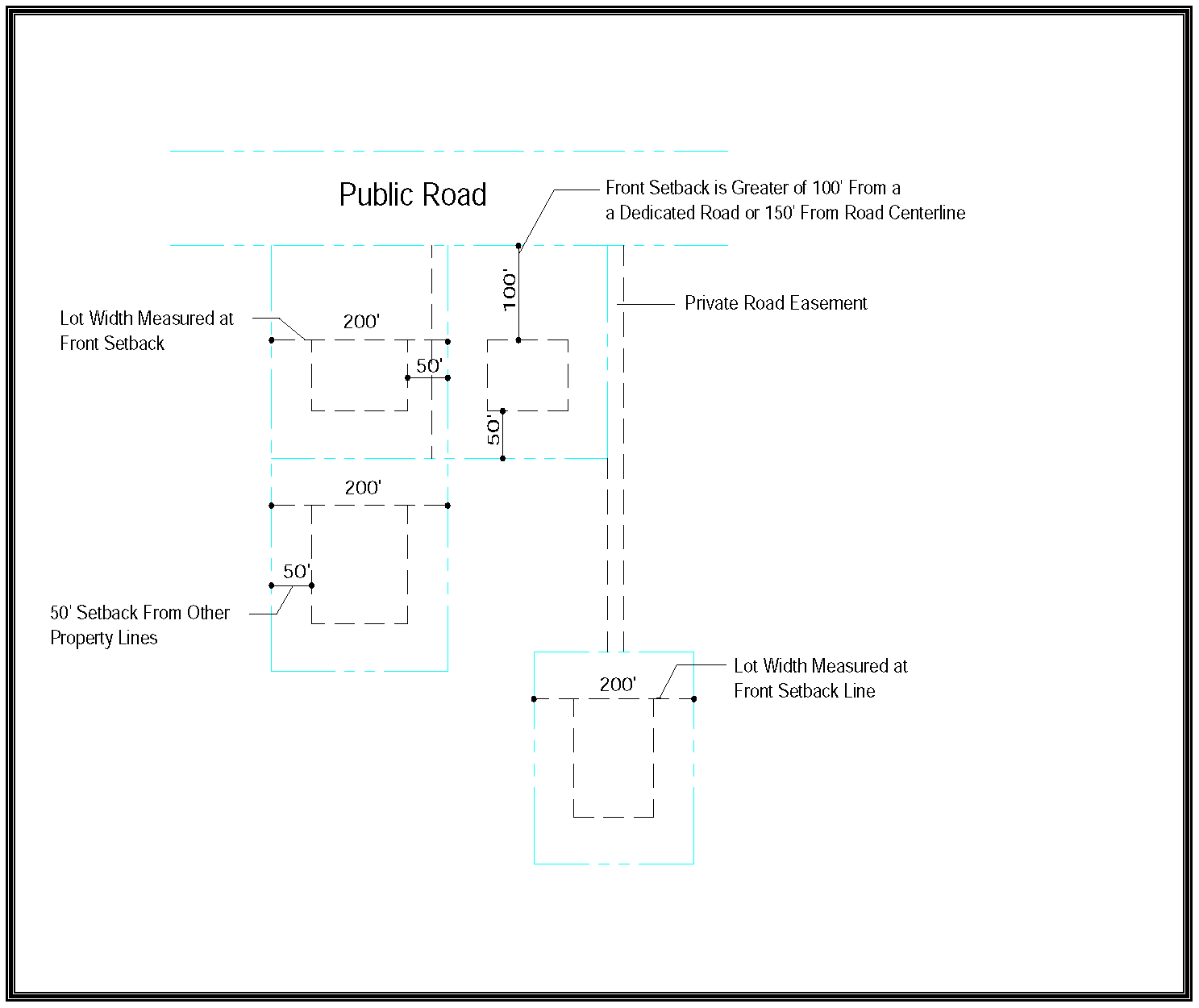
(Ord. No. 2020-17, exh. H, § 7:01(G), 9-15-2020)
Sec. 36-655. - Purpose.
(a)
The purpose of this division is to encourage the orderly development of commercial properties to serve and meet the needs of the citizens of the County. The establishment of new commercial districts shall follow the guidelines of the County Land Resource Management Plan. In general, areas designated as commercial/industrial or transportation corridors on the Land Resource Management Plan are appropriate for commercial development. Where properties proposed for commercial development are contiguous to existing municipalities, the County encourages the annexation of these properties.
(b)
More specifically, the commercial zoning districts are intended to provide for groupings of business and commercial establishments that are compatible in scope of services, methods of operation, and traffic generation.
(c)
The County has a long, rich tradition in agriculture and respects the role that farming and agricultural related businesses continue to play in shaping the economic viability of the County. Property that supports this industry is indicated by the zoning indicator A-1 or A-1 special use. Anyone constructing a residence or facility near this zoning should be aware that normal agricultural practices may result in occasional smells, dust, sights, noise, and unique hours of operation that are not typical in other zoning areas. Please be aware that certain special and permitted uses are in existence and can continue operations as approved.
(Ord. No. 2020-17, exh. J, § 9:00, 9-15-2020)
Sec. 36-684. - Purpose.
The B-1 Local Shopping District is composed of those areas of the County whose principal use is neighborhood-oriented, limited retail, service and repair business activities which serve the surrounding area. This district is provided to permit the development of these business activities, to protect adjacent areas against encroachment by incompatible uses, and to lessen congestion on public roads. To these ends, certain uses which would interfere with the operation of these business activities and the purpose of this district have been excluded.
(Ord. No. 2020-17, exh. J, § 9:01(A), 9-15-2020)
Sec. 36-685. - Permitted uses.
The following uses are permitted in the B-1 district:
(1)
Accessory uses. Accessory uses, structures, and buildings shall be permitted, provided they comply with the regulations of Section 36-971.
(2)
Adult day care or respite care.
(3)
Art galleries and studios.
(4)
Bait shop.
(5)
Barbershops, beauty parlors, massage or similar personal and business service shops.
(6)
Bicycle sales and repair.
(7)
Convenience store.
(8)
Custom dressmaking, millinery, tailoring or shoe repair shops.
(9)
Drug store.
(10)
Fire stations.
(11)
Gardening supplies and seed stores (retail sales only).
(12)
Governmental buildings and facilities.
(13)
Grocery and food sales under ten thousand (10,000) square feet.
(14)
Indoor business sales and service under ten thousand (10,000) square feet.
(15)
Indoor retail sales of goods under ten thousand (10,000) square feet, including repair of goods sold on the premises.
(16)
Nano breweries, subject to the conditions in Section 36-282(35).
(17)
Offices, business and professional, including medical clinics.
(18)
Personal and business service shops under ten thousand (10,000) square feet but not including uses regulated in Section 36-981.
(19)
Photography studios.
(20)
Police stations.
(21)
Postal substations.
(22)
Restaurants, cafes, cafeterias or other similar establishments, including, but not limited to, retail food stores.
(23)
Temporary buildings or structures for construction offices or storage, on the same zoning lot, for a period not to exceed such construction.
(24)
Tobacco shops.
(Ord. No. 2020-17, exh. J, § 9:01(B), 9-15-2020)
Sec. 36-686. - Special uses.
The following uses may be allowed in the B-1 district by special use permit, in accordance with the provisions of Article II of this chapter:
(1)
Book and stationery stores when services are intended to serve the immediate convenience needs of persons employed in the area.
(2)
Business planned developments.
(3)
Camera and photographic supply stores.
(4)
Clubs and lodges (non-profit), fraternal or religious institutions.
(5)
Communications use.
(6)
Currency exchange.
(7)
Child day care facilities.
(8)
Drive through or drive up windows for any permitted use excluding the sale of alcoholic beverages.
(9)
Dwelling units for watchmen and families, including a caretaker.
(10)
Musical instrument sales and repair (including lessons).
(11)
Places of worship, subject to the conditions contained in Section 36-282(43).
(12)
Public or private utilities and service uses.
a.
Telecommunications hubs or telecommunication stations.
b.
Filtration plants, pumping stations, and water reservoirs.
c.
Sewage treatment plants.
d.
Electric substations and booster stations.
e.
Other similar uses.
(13)
Veterinary establishments, but not including the boarding of animals except for overnight stays for medical treatment and observation.
(Ord. No. 2020-17, exh. J, § 9:01(C), 9-15-2020; Ord. No. 2023-24, § XXIV, 5-16-2023)
Sec. 36-687. - Conditional uses.
The following conditional uses may be permitted only if specifically authorized by the Zoning Administrator:
(1)
Dry-cleaning and pressing establishments, when employing facilities for the cleaning and pressing of not more than one thousand five hundred (1,500) pounds of dry goods per day, and when using carbon tetrachloride or other similar non-inflammable solvents approved by the State Fire Marshal.
(2)
Electrical appliance stores and repair with a size limit of ten thousand (10,000) square feet.
(3)
Laundries, automatic self-service types or hand employing not more than two (2) persons in addition to one (1) owner or manager, provided that laundry machines shall not exceed ten (10) pounds' capacity each.
(Ord. No. 2020-17, exh. J, § 9:01(D), 9-15-2020; Ord. No. 2023-24, § XXV, 5-16-2023)
Sec. 36-688. - Lot size.
Every lot or tract of land upon which a building is erected or maintained in the B-1 district shall have an area of not less than ten thousand (10,000) square feet and a width of not less than one hundred (100) feet as measured from the front building line.
(Ord. No. 2020-17, exh. J, § 9:01(E), 9-15-2020)
Sec. 36-689. - Yard areas.
No building shall be erected or enlarged in the B-1 district unless the following yards are provided and maintained in connection with such building:
(1)
Front yard. Every building hereafter erected or enlarged shall provide and maintain a front yard in accordance with the following requirements:
a.
Arterial roadways: fifty (50) feet from a dedicated road right-of-way or one hundred (100) feet from the centerline of all adjacent roads, whichever is greater.
b.
Major or minor collector roadways: forty (40) feet from a dedicated road right-of-way or ninety (90) feet from the centerline of all adjacent roads, whichever is greater.
c.
All other streets: thirty feet (30) from a dedicated road right-of-way or seventy-five (75) feet from the centerline of all adjacent roads, whichever is greater.
(2)
Side yard. The side yard shall be ten (10) feet from the property line. Where a side yard abuts a setback in an agricultural or residential district or a municipality, the required side yard shall be ten (10) feet, or equivalent to said adjacent setback, whichever is greater.
(3)
Rear yard. The rear yard shall be twenty (20) feet from the property line. Where a rear yard abuts a setback in an agricultural or residential district or a municipality, the required rear yard shall be twenty (20) feet, or equivalent to said adjacent setback, whichever is greater.
(Ord. No. 2020-17, exh. J, § 9:01(F), 9-15-2020)
Sec. 36-690. - Lot coverage.
(a)
Maximum floor area ratio. The maximum floor area ration in the B-1 district shall not exceed fifty (50) percent.
(b)
Impervious lot coverage (buildings, parking, drives, etc.). Impervious lot coverage in the B-1 district shall not exceed seventy-five (75) percent of the lot.
(Ord. No. 2020-17, exh. J, § 9:01(G), 9-15-2020)
Sec. 36-691. - Maximum building height.
No building hereinafter erected in the B-1 district shall exceed thirty-five (35) feet in height.
(Ord. No. 2020-17, exh. J, § 9:01(H), 9-15-2020)
Sec. 36-692. - Off-street parking and loading.
In accordance with the regulations set forth in Article V, Division 2 of this chapter, parking in the B-1 district shall not encroach upon the required front or side yard. Parking may encroach upon the required rear yard, provided that a landscaped buffer yard of at least ten (10) feet from the rear property line is maintained.
(Ord. No. 2020-17, exh. J, § 9:01(I), 9-15-2020)
Sec. 36-693. - Other provisions.
(a)
Performance standards. All activities in the B-1 district shall conform with the performance standards set forth in Section 36-978.
(b)
Refuse enclosures. Refuse or trash collection areas in the B-1 district shall be completely screened from view on all sides, with solid fencing of either wood or masonry construction, and shall include a concrete pad and an operable door of adequate width. Screening may also be of chain link, with a screen of dense landscape plantings.
(c)
Waste materials. No materials or wastes shall be deposited upon a lot in the B-1 district in such a form that they may be transferred off the property by natural causes or forces.
(d)
Screening and landscaping. Where a commercial use abuts or is across the street from a residential district, adequate screening and landscaping shall be provided as set forth in Article II, Division 4 of this chapter. All areas must include a landscaping plan for approval at the time the request for B-1 zoning is made.
(Ord. No. 2020-17, exh. J, § 9:01(J), 9-15-2020)
Sec. 36-715. - Purpose.
The B-2 General Business District is composed of those areas of the County whose principal use is general retail, service and repair business activities which serve persons and businesses in the County. This district is provided to permit the development of these business activities, to protect adjacent areas against encroachment by incompatible uses, and to lessen congestion on public roads.
(Ord. No. 2020-17, exh. J, § 9:02(A), 9-15-2020)
Sec. 36-716. - Permitted uses.
The following uses are permitted in the B-2 district:
(1)
All permitted uses in the B-1 district.
(2)
Private ambulance service.
(3)
Antique shops.
(4)
Art and school supply stores.
(5)
Auction facility when conducted wholly within an enclosed building and with no outside storage.
(6)
Banks and financial institutions.
(7)
Book and stationery stores.
(8)
Building material sales (retail).
(9)
Camera and photographic supply stores.
(10)
Catering establishments.
(11)
Copying/reproduction stores and banner or sign supplies.
(12)
Electrical appliance stores and repair.
(13)
Furrier.
(14)
Glass cutting and glazing establishments.
(15)
Grocery and food sales.
(16)
Indoor business sales and service in excess of ten thousand (10,000) square feet.
(17)
Indoor retail sales of goods in excess of ten thousand (10,000) square feet, including repair of goods sold on the premises.
(18)
Monument sales, but not including the cutting or grinding of stones.
(19)
Motor vehicle accessory store.
(20)
Musical instrument sales and repair (including lessons).
(21)
Packaged liquor store or any sale of alcoholic beverages.
(22)
Personal and business service shops in excess of ten thousand (10,000) square feet.
(23)
Pet shop when conducted wholly within an enclosed building.
(24)
Plumbing, heating, and roofing supply shops.
(25)
Schools (including music, dance, business, driving, commercial, or trade but excluding truck driving).
(26)
Veterinary establishments, but not including the boarding of animals except for overnight stays for medical treatment and observation.
(Ord. No. 2020-17, exh. J, § 9:02(B), 9-15-2020)
Sec. 36-717. - Special uses.
The following uses may be allowed in the B-2 district by special use permit, in accordance with the provisions of Article II of this chapter:
(1)
Agricultural implement sales and service on an open lot or within a building.
(2)
Boat, trailer and recreational vehicle sales or rental and service.
(3)
Child day care facilities.
(4)
Clubs and lodges (non-profit), fraternal or religious institutions.
(5)
Communications use.
(6)
Crematories/funeral homes.
(7)
Currency exchange.
(8)
Drive through or drive up windows for any permitted use excluding the sale of alcoholic beverages.
(9)
Dwelling units for watchmen and families, including a caretaker.
(10)
Fertilizer sales, including limited storage.
(11)
Hospital.
(12)
Indoor entertainment and recreation.
(13)
Indoor target practice with the conditions found in Section 36-282(29).
(14)
Kendall County Sheriff's Office shooting range with conditions to be set and approved by the County Board.
(15)
Meeting halls.
(16)
Motor vehicle service stations for retail sale of gasoline and oil for motor vehicles.
(17)
Motor vehicle/motorcycle service stations, including repair and rebuilding, or painting of motor vehicles.
(18)
Motor vehicle sales/motorcycle sales.
(19)
Motor vehicle washing, including the use of mechanical conveyers, blowers and steam cleaning.
(20)
Outdoor storage, provided such storage is screened from adjacent and surrounding properties.
(21)
Parking garages for storage of private passenger automobiles and commercial vehicles under one and one-half (1½) tons' capacity.
(22)
Places of worship, subject to the conditions contained in Section 36-282(43).
(23)
Public or private utilities and service uses.
a.
Telecommunications hubs and telecommunication stations.
b.
Filtration plants, pumping stations, and water reservoirs.
c.
Sewage treatment plants.
d.
Electric substations and booster stations.
e.
Other similar uses.
(24)
Taverns.
(Ord. No. 2020-17, exh. J, § 9:02(C), 9-15-2020; Ord. No. 2023-24, § XXVI, 5-16-2023)
Sec. 36-718. - Conditional uses.
The following conditional uses may be permitted in the B-2 district only if specifically authorized by the Zoning Administrator:
(1)
Contractor or construction services, such as building, cement, electrical, refrigeration, masonry, building, plumbing, roofing, air conditioning, heating and ventilating.
(2)
Contractors' offices and shops, where no fabrication is done on the premises and where all storage of material and equipment is within a building.
(3)
Dry-cleaning and pressing establishments, when employing facilities for the cleaning and pressing of not more than one thousand five hundred (1,500) pounds of dry goods per day, and when using carbon tetrachloride or other similar non-inflammable solvents approved by the State Fire Marshal.
(4)
Enclosed self-service storage facility, provided that:
a.
Each self-service storage facility shall be governed by the provisions of the Illinois Self-Service Storage Facility Act (770 ILCS 95/1 et seq.).
b.
A fence and landscaping shall be provided which completely encloses the facility and screens it from view of residential structures and residentially zoned property.
(5)
Laboratories (medical, dental, research, experimental and testing), provided no production or manufacturing of products takes place.
(6)
Laundries, automatic self-service types or hand, employing not more than two (2) persons in addition to one (1) owner or manager, provided that laundry machines shall not exceed ten (10) pounds' capacity each.
(7)
Outdoor displays may be permitted, subject to the following:
a.
Temporary seasonal displays.
1.
Seasonal displays not exceeding sixty (60) days per calendar year may be conducted on the same zoning lot as the principal business.
2.
A site plan must be submitted by the applicant and approved by the Zoning Administrator showing the location of the seasonal display, the items to be displayed and the duration of the display.
3.
Seasonal display areas shall be located at least ten (10) feet from any property line, shall not use required parking spaces, and shall not encroach into any required vision triangle areas.
b.
Permanent outdoor displays.
1.
Permanent outdoor displays shall only be permitted on the same zoning lot as the principal business and shall only display merchandise which is sold at the subject premises. Items which are not sold on the premises or which are general outdoor storage are not permitted.
2.
Permanent outdoor displays shall not exceed ten (10) percent of the subject area or one thousand (1,000) square feet in area, whichever is smaller.
3.
Permanent outdoor displays shall be subject to site plan review and approval by the Zoning Administrator.
4.
Permanent outdoor displays shall be located at least ten (10) feet from any property line, shall not use required parking spaces, and shall not encroach into any required vision triangle areas.
5.
Displays shall not be higher than fifteen (15) feet in height.
6.
A zoning certificate and fee are required for approval of an outdoor display area.
7.
Any outdoor display area shall be subject to review by the PBZ Committee and may be rescinded if deemed necessary.
8.
Any outdoor display area which does not meet these requirements may be permitted as a special use.
(8)
Processing or assembly, provided that space occupied in a building does not exceed six thousand (6,000) square feet of total floor space and basement space, not including stairwells or elevator shafts, provided such processing or assembly can be conducted without noise, vibration, odor, dust or any other conditions which might be disturbing to occupants of adjacent buildings. When manufacturing operations of the same or similar products demand space exceeding six thousand (6,000) square feet, they shall then be located in the M-1 Manufacturing District.
(Ord. No. 2020-17, exh. J, § 9:02(D), 9-15-2020; Ord. No. 2023-24, § XXVII, 5-16-2023)
Sec. 36-719. - Lot size.
Every lot or tract of land upon which a building is erected or maintained in the B-2 district shall have an area of not less than 10,000 square feet and a width of not less than one hundred (100) feet.
(Ord. No. 2020-17, exh. J, § 9:02(E), 9-15-2020)
Sec. 36-720. - Yard areas.
No building shall be erected or enlarged in the B-2 district unless the following yards are provided and maintained in connection with such building:
(1)
Front yard. Every building hereafter erected or enlarged shall provide and maintain a front yard in accordance with the following requirements:
a.
Arterial roadways: fifty feet (50) from the dedicated road right-of-way or one hundred (100) feet from the centerline of all adjacent roads, whichever is greater.
b.
Major or minor collector roadways: forty (40) feet from the dedicated road right-of-way or ninety (90) feet from the centerline of all adjacent roads, whichever is greater.
c.
All other streets: thirty (30) feet from the dedicated road right-of-way or seventy (70) feet from the centerline of all adjacent roads, whichever is greater.
Exception: Where lots comprising fifty (50) percent of the frontage on the same street and within the same block are developed with buildings having front yards with a variation of not more than ten (10) feet in depth, the average of such front shall establish the minimum front yard depth for the entire frontage, but in no case shall a front yard of more than that stipulated above for the applicable classification of a street on which the property is located be required.
(2)
Side yard. Side yards shall be ten (10) feet from the property line. Where a side yard abuts a setback in an agricultural or residential district or a municipality, the required side yard shall be ten (10) feet, or equivalent to said adjacent setback, whichever is greater.
(3)
Rear yard. Rear yards shall be twenty (20) feet from the property line. Where a rear yard abuts a setback in an agricultural or residential district or a municipality, the required rear yard shall be twenty (20) feet, or equivalent to said adjacent setback, whichever is greater.
(Ord. No. 2020-17, exh. J, § 9:02(F), 9-15-2020)
Sec. 36-721. - Lot coverage.
(a)
Maximum floor area ratio. The maximum floor area ration in the B-2 district shall not exceed fifty (50) percent.
(b)
Impervious lot coverage (buildings, parking, drives, etc.). Impervious lot coverage in the B-2 district shall not exceed seventy (70) percent of the lot.
(Ord. No. 2020-17, exh. J, § 9:02(G), 9-15-2020)
Sec. 36-722. - Maximum building height.
No building hereinafter erected in the B-2 district shall exceed thirty-five (35) feet in height.
(Ord. No. 2020-17, exh. J, § 9:02(H), 9-15-2020)
Sec. 36-723. - Off-street parking and loading.
In accordance with the regulations set forth in Article V, Division 2 of this chapter, parking shall not encroach upon the required front or side yard. Parking may encroach upon the required rear yard, provided that a landscaped buffer yard of at least ten (10) feet from the rear property line is maintained.
(Ord. No. 2020-17, exh. J, § 9:02(I), 9-15-2020)
Sec. 36-724. - Other provisions.
(a)
Performance standards. All activities in the B-2 district shall conform with the performance standards set forth in Section 36-978.
(b)
Outdoor sales. All outdoor sales space in the B-2 district shall be provided with a permanent durable and dustless surface and shall be graded and drained as to dispose of all surface water.
(c)
Refuse enclosures. Refuse or trash collection areas in the B-2 district shall be completely screened from view on all sides, with solid fencing of either wood or masonry construction, to a height of seven (7) feet; shall include concrete pad and an operable door of adequate width. Screening may also be of chain link, with a screen of dense landscape plantings.
(d)
Waste materials. No materials or wastes shall be deposited upon a lot in the B-2 district in such a form that they may be transferred off the property by natural causes or forces.
(e)
Screening and landscaping. Where a commercial use abuts or is across the street from a residential district, adequate screening and landscaping shall be provided as set forth in Article II, Division 4 of this chapter. All areas must include a landscaping plan for approval at the time the request for B-2 zoning is made.
(Ord. No. 2020-17, exh. J, § 9:02(J), 9-15-2020)
Sec. 36-747. - Purpose.
The B-3 Highway Business District is intended for major retail, service and repair establishments serving a large trade area, usually the entire County or beyond and oriented to the traveling public. The trade area population served by these establishments requires easy access, although patronage is more dispersed and visits to these establishments less frequent than in the B-1 district and B-2 district. It is the intent of the B-3 district regulations that establishments desiring location along major traffic routes are grouped with appropriate and adequate accessways provided.
(Ord. No. 2020-17, exh. J, § 9:03(A), 9-15-2020)
Sec. 36-748. - Permitted uses.
The following uses are permitted in the B-3 district:
(1)
All permitted uses identified in the B-2 district.
(2)
Agricultural implement sales and service on an open lot or within a building.
(3)
Animal hospital.
(4)
Banquet halls, subject to the conditions contained in Section 36-282(12).
(5)
Beverages, non-alcoholic, bottling and distributing.
(6)
Boat, trailer and recreational vehicle sales or rental and service.
(7)
Carpet and rug stores.
(8)
Clean up and restoration services with the conditions contained in Section 36-282(16).
(9)
Construction equipment sales and service.
(10)
Crematories/funeral homes.
(11)
Currency exchange.
(12)
Drive through or drive up windows for any permitted use excluding the sale of alcoholic beverages.
(13)
Dry-cleaning and pressing establishments, when employing facilities for the cleaning and pressing of not more than one thousand five hundred (1,500) pounds of dry goods per day, and when using carbon tetrachloride or other similar non-inflammable solvents approved by the State Fire Marshal.
(14)
Health clubs (public or private) and related accessory uses.
(15)
Hotel and/or motels.
(16)
Indoor entertainment and recreation.
(17)
Laboratories (medical, dental, research, experimental and testing), provided no production or manufacturing of products takes place.
(18)
Laundries, automatic self-service types or hand, employing not more than two (2) persons in addition to one (1) owner or manager, provided that laundry machines shall not exceed ten (10) pounds' capacity each.
(19)
Miniature golf courses.
(20)
Motor vehicle service stations for retail sale of gasoline and oil for motor vehicles.
(21)
Motor vehicle sales/motorcycle sales.
(22)
Motor vehicle/motorcycle service stations, including repair and rebuilding or painting of motor vehicles.
(23)
Motor vehicle washing facilities, including the use of mechanical conveyers, blowers and steam cleaning.
(24)
Nurseries and greenhouses.
(25)
Parking garages for storage of private passenger automobiles and commercial vehicles under one and one-half (1½) tons' capacity.
(26)
Restaurants, including the drive-in type where food is served to customers remaining in motor vehicles.
(27)
Taverns.
(Ord. No. 2020-17, exh. J, § 9:03(B), 9-15-2020)
Sec. 36-749. - Special uses.
The following uses may be allowed in the B-3 district by special use permit, in accordance with the provisions of Article II of this chapter:
(1)
Adult-use cannabis dispensing organization, subject to the following conditions:
a.
The facility may not be located within one thousand (1,000) feet of the property line of a preexisting public or private nursery school, preschool, primary or secondary school, day care center, day care home or residential care home. Learning centers and vocational/trade centers shall not be classified as a public or private school for the purposes of this subdivision. The measurement shall be from the cannabis use.
b.
The facility may not be located in a dwelling unit or within two hundred fifty (250) feet of the property line of a preexisting property zoned or used for residential purposes. The measurement shall be from the cannabis use.
c.
The facility may not be located within one thousand (1,000) feet of the property line of a preexisting forest preserve, public park, place of worship, public library, or game arcade to which admission is not restricted to persons twenty-one (21) years of age or older. The measurement shall be from the cannabis use.
d.
At least seventy-five (75) percent of the floor area of any tenant space occupied by a dispensing organization shall be devoted to the activities of the dispensing organization as authorized by the Cannabis Regulation and Tax Act (410 ILCS 705/1-1 et seq.) and no dispensing organization shall also sell food for consumption on the premises other than as authorized below in the same tenant space.
e.
On-site consumption of cannabis by the public shall not be allowed at adult-use cannabis dispensing organizations.
f.
On properties zoned M-1 Limited Manufacturing District or M-2 Heavy Industrial District, adult-use cannabis dispensing organizations may co-locate with adult-use craft growers and adult-use cannabis infuser organizations, or both. In a co-location, the floor requirements listed above shall not apply, but the co-located establishments shall be the sole use of the tenant space.
g.
On properties zoned B-3 Highway Business District, adult-use cannabis dispensing organizations may co-locate with adult-use cannabis infuser organizations. In a co-location, the floor requirements listed above shall not apply, but the co-located establishments shall be the sole use of the tenant space.
h.
On properties zoned B-3 Highway Business District, this use shall be within one thousand (1,000) feet of an interchange of an interstate highway and a County or State highway.
i.
The facility may not conduct any sales or distribution of cannabis other than as authorized by the Cannabis Regulation and Tax Act (410 ILCS 705/1-1 et seq.).
j.
At the time of application, the petitioner shall submit the following information:
1.
A statement regarding the impact of the proposed facility on existing or planned uses located within the vicinity of the subject property.
2.
Information on the proposed structure the facility will be located in, including total square footage, security installations/security plan, including type of security system and plans to address operations when security and surveillance systems malfunction and building code compliance.
3.
Hours of operation.
4.
Anticipated number of employees and customers.
5.
Anticipated parking demand and available parking supply.
6.
Anticipated traffic generation in the context of adjacent roadway capacity and access to such roadways.
7.
Site design, including access points and internal site circulation.
8.
Proposed signage plan.
9.
Other criteria as may be necessary to determine findings of fact of the special use permit application.
k.
No flashing light, search light, spotlights, or other similar lighting systems may be used on the exterior of the building.
l.
Electronic message boards and temporary signs are not allowed. Any additional merchandise packaging provided by an adult-use cannabis dispensing organization, such as bags, sacks, totes, or boxes shall be opaque and identify the name of the adult-use cannabis dispensing organization.
m.
Hours of operation are 6:00 a.m. until 10:00 p.m.
n.
The operator of the business allowed by the special use permit shall provide the County Sheriff's Office access to security system and security plans upon request by the County Sheriff's Office.
o.
This use shall be in a stand-alone building.
p.
The petitioner shall file an affidavit with the County affirming compliance with the regulations contained in this chapter.
q.
In the event that the Cannabis Regulation and Tax Act (410 ILCS 705/1-1 et seq.) is amended, the more restrictive of the State or County regulation shall apply.
(2)
Adult-use cannabis infuser organization, subject to the following conditions:
a.
The facility may not be located within one thousand five hundred (1,500) feet of the property line of a preexisting public or private nursery school, preschool, primary or secondary school, day care center, day care home or residential care home. Learning centers and vocational/trade centers shall not be classified as a public or private school for the purposes of this subdivision. The measurement shall be from the cannabis use.
b.
The facility may not be located in a dwelling unit or within two hundred fifty (250) feet of the property line of a preexisting property zoned or used for residential purposes. The measurement shall be from the cannabis use.
c.
The facility may not be located within one thousand five hundred (1,500) feet of the property line of a preexisting forest preserve, public park, place of worship, public library, or game arcade to which admission is not restricted to persons twenty-one (21) years of age or older. The measurement shall be from the cannabis use.
d.
At least seventy-five (75) percent of the floor area of any tenant space occupied by an infusing organization shall be devoted to the activities of the infusing organization as authorized by the Cannabis Regulation and Tax Act (410 ILCS 705/1-1 et seq.).
e.
On properties zoned M-1 Limited Manufacturing District or M-2 Heavy Industrial District, adult-use cannabis infuser organizations may co-locate with adult-use dispensing organizations and adult-use cannabis craft growers, or both. In a co-location, the floor requirements listed above shall not apply, but the co-located establishments shall be the sole use of the tenant space.
f.
On properties zoned B-3 Highway Business District, adult-use cannabis infuser organizations may co-locate with adult-use dispensing organizations. In a co-location, the floor requirements listed above shall not apply, but the co-located establishments shall be the sole use of the tenant space.
g.
On properties zoned B-3 Highway Business District, this use shall be within one thousand (1,000) feet of an interchange of an interstate highway and a County or State highway.
h.
The facility may not conduct any sales or distribution of cannabis other than as authorized by the Cannabis Regulation and Tax Act (410 ILCS 705/1-1 et seq.).
i.
At the time of application, the petitioner shall submit the following information:
1.
A statement regarding the impact of the proposed facility on existing or planned uses located within the vicinity of the subject property.
2.
Information on the proposed structure the facility will be located in, including total square footage, security installations/security plan, including type of security system and plans to address operations when security and surveillance systems malfunction and building code compliance.
3.
Hours of operation.
4.
Anticipated number of employees and customers.
5.
Anticipated parking demand and available parking supply.
6.
Anticipated traffic generation in the context of adjacent roadway capacity and access to such roadways.
7.
Site design, including access points and internal site circulation.
8.
Proposed signage plan.
9.
Other criteria as may be necessary to determine findings of fact of the special use permit application.
j.
The operator of the business allowed by the special use permit shall provide the County Sheriff's Office access to security system and security plans upon request by the County Sheriff's Office.
k.
This use shall be in a stand-alone building.
l.
The petitioner shall file an affidavit with the County affirming compliance with the regulations contained in this chapter.
m.
In the event that the Cannabis Regulation and Tax Act (410 ILCS 705/1-1 et seq.) is amended, the more restrictive of the State or County regulation shall apply.
(3)
Adult-use cannabis processing organization, subject to the following conditions:
a.
The facility may not be located within one thousand five hundred (1,500) feet of the property line of a preexisting public or private nursery school, preschool, primary or secondary school, day care center, day care home or residential care home. Learning centers and vocational/trade centers shall not be classified as a public or private school for the purposes of this subdivision. The measurement shall be from the cannabis use.
b.
The facility may not be located in a dwelling unit or within two hundred fifty (250) feet of the property line of a preexisting property zoned or used for residential purposes. The measurement shall be from the cannabis use.
c.
The facility may not be located within one thousand five hundred (1,500) feet of the property line of a preexisting forest preserve, public park, place of worship, public library, or game arcade to which admission is not restricted to persons twenty-one (21) years of age or older. The measurement shall be from the cannabis use.
d.
At least seventy-five (75) percent of the floor area of any tenant space occupied by a processing organization shall be devoted to the activities of the processing organization as authorized by the Cannabis Regulation and Tax Act (410 ILCS 705/1-1 et seq.).
e.
The facility may not conduct any sales or distribution of cannabis other than as authorized by the Cannabis Regulation and Tax Act (410 ILCS 705/1-1 et seq.).
f.
At the time of application, the petitioner shall submit the following information:
1.
A statement regarding the impact of the proposed facility on existing or planned uses located within the vicinity of the subject property.
2.
Information on the proposed structure the facility will be located in, including total square footage, security installations/security plan, including type of security system and plans to address operations when security and surveillance systems malfunction and building code compliance.
3.
Hours of operation.
4.
Anticipated number of employees and customers.
5.
Anticipated parking demand and available parking supply.
6.
Anticipated traffic generation in the context of adjacent roadway capacity and access to such roadways.
7.
Site design, including access points and internal site circulation.
8.
Proposed signage plan.
9.
Other criteria as may be necessary to determine findings of fact of the special use permit application.
g.
The operator of the business allowed by the special use permit shall provide the County Sheriff's Office access to security system and security plans upon request by the County Sheriff's Office.
h.
On properties zoned B-3 Highway Business District, this use shall be within one thousand (1,000) feet of an interchange of an interstate highway and a County or State highway.
i.
This use shall be in a stand-alone building.
j.
The petitioner shall file an affidavit with the County affirming compliance with the regulations contained in this chapter.
k.
In the event that the Cannabis Regulation and Tax Act (410 ILCS 705/1-1 et seq.) is amended, the more restrictive of the State or County regulation shall apply.
(4)
Child day care facilities.
(5)
Clubs and lodges (non-profit), fraternal or religious institutions.
(6)
Communication uses.
(7)
Community centers/after school programs/educational centers.
(8)
Consumer credit, payday loan offices, financing or financial offices.
(9)
Dwelling units for watchmen and families, including a caretaker.
(10)
Fertilizer sales, including limited storage.
(11)
Hospitals.
(12)
Indoor target practice with the conditions contained in Section 36-282(29).
(13)
Kendall County Sheriff's Office shooting range with conditions to be set and approved by the County Board.
(14)
Kennels with the conditions contained in Section 36-282(31).
(15)
Landscaping business, with the conditions contained in Section 36-282(32).
(16)
Medical cannabis dispensing organization, subject to the following conditions:
a.
The facility may not be located within one thousand (1,000) feet of the property line of a preexisting public or private nursery school, preschool, primary or secondary school, day care center, day care home or residential care home. Learning centers and vocational/trade centers shall not be classified as a public or private school for the purposes of this subdivision. The measurement shall be from the cannabis use.
b.
The facility may not be located in a dwelling unit or within two hundred fifty (250) feet of the property line of a preexisting property zoned or used for residential purposes. The measurement shall be from the cannabis use.
c.
The facility may not be located within one thousand (1,000) feet of the property line of a preexisting forest preserve, public park, place of worship, public library, or game arcade to which admission is not restricted to persons twenty-one (21) years of age or older. The measurement shall be from the cannabis use.
d.
On-site consumption of cannabis by the public shall not be allowed at medical cannabis dispensing organizations.
e.
The facility may not conduct any sales or distribution of cannabis other than as authorized by State law.
f.
At the time of application, the petitioner shall submit the following information:
1.
A statement regarding the impact of the proposed facility on existing or planned uses located within the vicinity of the subject property.
2.
Information on the proposed structure the facility will be located in, including total square footage, security installations/security plan, including type of security system and plans to address operations when security and surveillance systems malfunction and building code compliance.
3.
Hours of operation.
4.
Anticipated number of employees and customers.
5.
Anticipated parking demand and available parking supply.
6.
Anticipated traffic generation in the context of adjacent roadway capacity and access to such roadways.
7.
Site design, including access points and internal site circulation.
8.
Proposed signage plan.
9.
Other criteria as may be necessary to determine findings of fact of the special use permit application.
g.
No flashing lights, search lights, spotlights, or other similar lighting systems may be used on the exterior of the building.
h.
Electronic message boards and temporary signs are not allowed. Any additional merchandise packaging provided by a dispensary, such as bags, sacks, totes or boxes, shall be opaque and identify the name of the dispensing organization.
i.
Hours of operation are 6:00 a.m. until 10:00 p.m.
j.
The operator of the business allowed by the special use permit shall provide the County Sheriff's Office access to security system and security plans upon request by the County Sheriff's Office.
k.
On properties zoned B-3 Highway Business District, this use shall be within one thousand (1,000) feet of an interchange of an interstate highway and a County or State highway.
l.
This use shall be in a stand-alone building.
m.
The petitioner shall file an affidavit with the County affirming compliance with the regulations contained in this chapter.
n.
In the event that the Compassionate Use of Medical Cannabis Program Act (410 ILCS 130/1 et seq.) is amended, the more restrictive of the State or County regulation shall apply.
(17)
Meeting halls.
(18)
Micro brewery and/or winery.
(19)
Micro distillery with the conditions contained in Section 36-282(34).
(20)
Outdoor storage provided such storage is screened from adjacent and surrounding properties.
(21)
Outdoor amusement establishments, carnivals, kiddie parks, and other similar amusement centers, and including places of assembly devoted thereto, such as stadiums and arenas.
(22)
Pawn shop.
(23)
Performing arts center subject to the conditions contained in Section 36-282(41).
(24)
Places of worship, subject to the conditions contained in Section 36-282(43).
(25)
Production and sale of sweet cider, hard cider, wine, jams, wine jams, jellies, pies, pickles, honey, sauces and similar items utilizing crops grown on the same property or in combination with crops grown off site where such production takes place on the premises. In addition, the tasting of and wholesale or retail sale of items produced on site as well as the sales of ancillary items and products related to crops and products produced on site shall be permitted, provided all required licenses and permits have been secured. The total retail sales area on site within any building or combination of buildings shall not exceed one thousand (1,000) square feet. Said sales areas shall be set back at least ninety (90) feet from the centerline of all adjacent roads with off-street parking for a minimum of five (5) cars. Seasonal outdoor displays on above-listed items are also permitted.
(26)
Public or private utilities and service uses.
a.
Telecommunications hubs and telecommunication stations.
b.
Filtration plants, pumping stations, and water reservoirs.
c.
Sewage treatment plants.
d.
Electric substations and booster stations.
e.
Other similar uses.
(27)
Retail or wholesale sales yards for agricultural products, including, but not necessarily limited to, fruits, vegetables, flowers, plants, etc., that are not grown on the premises.
(28)
Self-service storage facilities.
(29)
Theaters: outdoor theaters (drive-in), indoor theaters and convention centers.
(30)
Truck driving school.
(31)
Truck stop.
(Ord. No. 2020-17, exh. J, § 9:03(C), 9-15-2020; Ord. No. 2023-21, § III, 5-16-2023; Ord. No. 2023-24, § XXVIII, 5-16-2023)
Sec. 36-750. - Conditional uses.
All conditional uses outlined in the B-2 General Business District (Section 36-718) may be permitted in the B-3 district only if specifically authorized by the Zoning Administrator except self-storage facilities.
(Ord. No. 2020-17, exh. J, § 9:03(D), 9-15-2020)
Sec. 36-751. - Lot size.
Every lot or tract of land upon which a building is erected or maintained in the B-3 district shall have an area of not less than ten thousand (10,000) square feet and a width of not less than one hundred (100) feet.
(Ord. No. 2020-17, exh. J, § 9:03(E), 9-15-2020)
Sec. 36-752. - Yard areas.
No building shall be erected or enlarged in the B-3 district unless the following yards are provided and maintained in connection with such building:
(1)
Front yard. Every building hereafter erected or enlarged shall provide and maintain a front yard in accordance with the following requirements:
a.
Arterial roadways: fifty (50) feet from a dedicated road right-of-way or one hundred (100) feet from the centerline of all adjacent roads, whichever is greater.
b.
Major or minor collector roadways: forty (40) feet from a dedicated road right-of-way or ninety (90) feet from the centerline of all adjacent roads, whichever is greater.
c.
All other streets: thirty feet (30) from a dedicated road right-of-way or seventy-five (75) feet from the centerline of all adjacent roads, whichever is greater.
(2)
Side yard. Side yards shall be twenty (20) feet from the property line. Where a side yard abuts a setback in an agricultural or residential district or a municipality, the required side yard shall be twenty (20) feet, or equivalent to said adjacent setback, whichever is greater.
(3)
Rear yard. Rear yards shall be twenty (20) feet from the property line. Where a rear yard abuts a setback in an agricultural or residential district or a municipality, the required side yard shall be twenty (20) feet, or equivalent to said adjacent setback, whichever is greater.
(Ord. No. 2020-17, exh. J, § 9:03(F), 9-15-2020)
Sec. 36-753. - Lot coverage.
(a)
Maximum floor area ratio. The maximum floor area ration in the B-3 district shall not exceed fifty (50) percent.
(b)
Impervious lot coverage (building, parking, drives, etc.). Impervious lot coverage in the B-3 district shall not exceed seventy (70) percent of the lot.
(Ord. No. 2020-17, exh. J, § 9:03(G), 9-15-2020)
Sec. 36-754. - Maximum building height.
No building hereinafter erected shall exceed thirty-five (35) feet in height.
(Ord. No. 2020-17, exh. J, § 9:03(H), 9-15-2020)
Sec. 36-755. - Off-street parking and loading.
In accordance with the regulations set forth in Article V, Division 2 of this chapter, parking in the B-3 district shall not encroach along the required front or side yard. Parking may encroach upon the required rear yard, provided that a landscaped buffer yard of at least ten (10) feet from the rear property line is maintained.
(Ord. No. 2020-17, exh. J, § 9:03(I), 9-15-2020)
Sec. 36-756. - Other provisions.
(a)
Performance standards. All activities in the B-3 district shall conform to the performance standards set forth in Section 36-978.
(b)
Outdoor sales. All outdoor sales space in the B-3 district shall be provided with a permanent durable dustless surface and shall be graded and drained as to dispose of all surface water.
(c)
Refuse enclosure. Refuse or trash collection areas in the B-3 district shall be completely screened from view on all sides, with solid fencing of either wood or masonry construction, to a height of seven (7) feet; shall include concrete pad and an operable door of adequate width. Screening may also be of chain link, with a screen of dense landscape plantings.
(d)
Waste material. No materials or wastes shall be deposited upon a lot in the B-3 district in such a form that natural causes or forces may transfer them off the property.
(e)
Screening and landscaping. Where commercial use abuts or is across the street from a residential district, adequate screening and landscaping shall be provided as set forth in Article II, Division 4 of this chapter. All areas must include a landscaping plan for approval at the time the request for B-3 zoning is made.
(Ord. No. 2020-17, exh. J, § 9:03(J), 9-15-2020)
Sec. 36-776. - Purpose.
The B-4 Commercial Recreation District is intended to accommodate commercial activities that serve the recreational needs of County residents, or which are dependent upon locations near recreational resources, such as lakes. This district is provided to permit the development of these business activities, to protect adjacent areas against encroachment by incompatible uses, and to lessen congestion on public roads.
(Ord. No. 2020-17, exh. J, § 9:04(A), 9-15-2020)
Sec. 36-777. - Permitted uses.
The following uses are permitted in the B-4 district:
(1)
Accessory uses.
(2)
Auction facility when conducted with another permitted use in this district.
(3)
Banquet halls, subject to the conditions contained in Section 36-282(12).
(4)
Boat launching ramp.
(5)
Boat, trailer and recreational vehicle sales or rental and service.
(6)
Child day care facilities.
(7)
Dwelling unit for watchmen and families, including a caretaker.
(8)
Fairgrounds.
(9)
Fire stations.
(10)
Golf courses (including miniature golf), golf driving range, club houses, county clubs, and membership riding clubs.
(11)
Governmental buildings and facilities.
(12)
Health clubs (public or private) and related accessory uses.
(13)
Non-profit recreational facilities and related accessory uses.
(14)
Performing arts center subject to the conditions contained in Section 36-282(41).
(15)
Philanthropic institutions and institutions supported by charity.
(16)
Police stations.
(17)
Postal substations.
(18)
Temporary buildings or structures for construction offices or storage, on the same zoning lot, for a period not to exceed such construction.
(19)
Truck and tractor amusement competition events subject to the conditions contained in Section 36-283(11).
(Ord. No. 2020-17, exh. J, § 9:04(B), 9-15-2020; Ord. No. 2022-01, art. IV, 1-4-2022)
Sec. 36-778. - Special uses.
The following uses may be allowed in the B-4 district by special use permit, in accordance with the provisions of Article II of this chapter:
(1)
Amphitheater, drive-in theater, auditorium, stadium and sports arena, provided that the following conditions are met:
a.
The minimum site area shall be two hundred thousand (200,000) square feet.
b.
All structures, viewing and seating areas shall be set back at least one hundred (100) feet from any street or property line.
c.
The site shall have frontage on and access to a collector or arterial street, provided that the highway authority with jurisdiction over the subject road may approve alternative access.
d.
The following accessory uses may be permitted as incidental to, and limited to patrons of, the principal use:
1.
Playground.
2.
Refreshment stand or booth.
3.
Souvenir stand or booths.
4.
Offices.
e.
For any drive-in theater:
1.
Theater screen shall not be visible from any collector street, arterial street, or freeway within one thousand two hundred (1,200) feet.
2.
The viewing/parking area shall be screened in such a manner that it cannot be observed from outside the property.
3.
Off-street space for automobiles of patrons awaiting admission to the theater shall be equal to a minimum of fifteen (15) percent of the capacity of the viewing area. All entrances and exits shall be separated, and internal circulation shall provide one-way traffic.
(2)
Athletic fields with lights subject to the conditions contained in Section 36-282(9).
(3)
Amusement park, including go-cart tracks, water parks and other rides, provided that the following minimum standards are met:
a.
The site shall be located and designed to minimize adverse impacts on adjacent uses.
b.
The site shall have frontage on and access to a collector or arterial road, provided that the highway authority with jurisdiction over the subject road may approve alternative access.
(4)
Bait shop.
(5)
Convenience store.
(6)
Hotel and/or motel.
(7)
Indoor entertainment and recreation.
(8)
Indoor target practice with the conditions contained in Section 36-282(29).
(9)
Kendall County Sheriff's Office shooting range with conditions to be set and approved by the County Board.
(10)
Kennels with the conditions contained in Section 36-282(31).
(11)
Places of worship, subject to the conditions contained in Section 36-282(43).
(12)
Planned developments, business.
(13)
Production and sale of sweet cider, hard cider, wine, jams, wine jams, jellies, pies, pickles, honey, sauces and similar items utilizing crops grown on the same property or in combination with crops grown off site where such production takes place on the premises. In addition the tasting of and wholesale or retail sale of items produced on site as well as the sales of ancillary items and products related to crops and products produced on site shall be permitted, provided all required licenses and permits have been secured. The total retail sales area on site within any building or combination of buildings shall not exceed one thousand (1,000) square feet. Said sales areas shall be set back at least ninety (90) feet from the centerline of all adjacent roads with off-street parking for a minimum of five (5) cars. Seasonal outdoor displays on above-listed items are also permitted.
(14)
Racetrack, provided that the following minimum standards are met:
a.
The minimum site area shall be twenty (20) acres.
b.
The racetrack and all building, viewing areas, seating areas, and structures for housing animals shall be located no closer than two hundred seventy-five (275) feet from any public road right-of-way or property line.
c.
If night racing is to be conducted, all parking areas and accessways shall be adequately lit, provided that such lighting, as well as lighting for the racetrack, shall meet the lighting standards set forth in Section 36-1013.
d.
If a vehicle racetrack is proposed, a noise study shall be prepared by a trained professional addressing anticipated noise levels during races or practice sessions. This study shall also address how excessive noise will be mitigated. The County shall reserve the right to obtain an independent review of this study and require additional noise mitigation beyond that outlined in the noise study.
e.
If an animal racetrack is proposed, all facilities for housing and maintaining equine shall comply with the following requirements:
1.
An approval for such facility from the County Health Department must accompany the application for a special use permit.
2.
A one hundred (100) foot wide area of vegetation cover, exclusive of pasture area, shall be maintained between any corral, un-vegetated exercise area, manure pile, or application area and any surface water or well, in order to minimize runoff, prevent erosion, and promote quick nitrogen absorption.
f.
The following accessory uses may be permitted as incidental to and limited to patrons of the principal use:
1.
Refreshment stands or booths.
2.
Souvenir stands or booths.
3.
Wagering facilities.
4.
Restaurants or lounges.
5.
Playgrounds or child day care facilities.
6.
Vehicle fuel and supplies sales limited to owners or operators of vehicles to be raced.
7.
Temporary campgrounds.
8.
Any other customary and incidental uses which are deemed appropriate by the County Board.
(15)
Recreational camps and recreational vehicle parks subject to the conditions contained in Section 36-282(48).
(16)
Riding stables, including, but not limited to, polo clubs, rodeo clubs and similar uses subject to the conditions in Section 36-283(9).
(17)
Seminaries, convents, monasteries, and similar religious institutions, including dormitories and other accessory uses required for operation.
(18)
Telecommunications stations.
(19)
Other business uses not specifically listed as permitted uses, when found to be similar and compatible with existing or permitted businesses in the B-4 district.
(Ord. No. 2020-17, exh. J, § 9:04(C), 9-15-2020; Ord. No. 2023-21, § IV, 5-16-2023; Ord. No. 2023-24, § XXIX, 5-16-2023)
Sec. 36-779. - Conditional uses.
There are no conditional uses for the B-4 district.
(Ord. No. 2020-17, exh. J, § 9:04(D), 9-15-2020; Ord. No. 2023-24, § XXX, 5-16-2023)
Sec. 36-780. - Lot size.
Every lot or tract of land upon which a building is erected or maintained in the B-4 district shall have an area of not less than twenty thousand (20,000) square feet and a lot width of one hundred (100) feet measured at the front building line.
(Ord. No. 2020-17, exh. J, § 9:04(E), 9-15-2020)
Sec. 36-781. - Number of buildings.
Due to the nature of the uses permitted in the B-4 district, multiple buildings may be permitted on a single zoning lot, without requiring planned development approval.
(Ord. No. 2020-17, exh. J, § 9:04(F), 9-15-2020)
Sec. 36-782. - Yard areas.
No building shall be erected or enlarged in the B-4 district unless the following yards are provided and maintained in connection with such building:
(1)
Front yard. Every building hereafter erected or enlarged shall provide and maintain a front yard in accordance with the following requirements:
a.
Arterial roadway: fifty (50) feet from the dedicated road right-of-way or one hundred (100) feet from the centerline of all adjacent roads, whichever is greater.
b.
Major or minor collector roadway: fifty (50) feet from the dedicated road right-of-way or one hundred (100) feet from the centerline of all adjacent roads, whichever is greater.
c.
All other streets: forty (40) feet from the dedicated road right-of-way or eighty (80) feet from the centerline of all adjacent roads, whichever is greater.
(2)
Side yard and rear yard. Side and rear yards shall be ten (10) feet from the property line. Where a side yard abuts a setback in an agricultural or residential district or a municipality, the required side yard and rear yard shall be ten (10) feet, or equivalent to said adjacent setback, whichever is greater.
(Ord. No. 2020-17, exh. J, § 9:04(G), 9-15-2020)
Sec. 36-783. - Lot coverage.
(a)
Maximum floor area ratio. The maximum floor area ration in the B-4 district shall not exceed twenty (20) percent.
(b)
Impervious lot coverage (buildings, parking, drives, etc.). Impervious lot coverage in the B-4 district shall not exceed seventy-five (75) percent of the lot.
(Ord. No. 2020-17, exh. J, § 9:04(H), 9-15-2020)
Sec. 36-784. - Maximum building height.
No building hereinafter erected in the B-4 district shall exceed fifty (50) feet in height.
(Ord. No. 2020-17, exh. J, § 9:04(I), 9-15-2020)
Sec. 36-785. - Other provisions.
(a)
Performance standards. All activities in the B-4 district shall conform with the performance standards set forth in Section 36-978.
(b)
Refuse enclosures. Refuse or trash collection areas in the B-4 district shall be completely screened from view on all sides, with solid fencing of either wood or masonry construction, to a height of seven (7) feet; shall include concrete pad and an operable door of adequate width. Screening may also be of chain link, with a screen of dense landscape plantings.
(c)
Waste materials. No materials or wastes shall be deposited upon a lot in the B-4 district in such a form that they may be transferred off the property by natural causes or forces.
(d)
Screening and landscaping. Adequate screening and landscaping for adjoining residential areas shall be provided as set forth in Article II, Division 4 of this chapter. All areas must include a landscaping plan for approval at the time the request for B-4 zoning is made.
(Ord. No. 2020-17, exh. J, § 9:04(J), 9-15-2020)
Sec. 36-795. - Purpose.
The B-5 Business Planned Development (BPD) District is intended to provide for greater freedom, imagination, and flexibility in the development of land while assuring appropriate development standards. To this extent it allows diversification and variation in the relationship of uses, structures, and open spaces in developments planned as comprehensive, cohesive projects which are unified by a shared concept. It is further intended to encourage the beneficial integration of different compatible land uses at a proper scale and to encourage better design, provision of amenities, and the efficient use of public services through the use of planned unit development procedures. The intensity and profile of the development within this district are intended to be compatible with all adjacent uses.
(Ord. No. 2020-17, exh. J, § 9:05(A), 9-15-2020)
Sec. 36-796. - Permitted uses.
Permitted uses in the B-5 district shall be consistent with the purpose of this district, including a wide variety of retail, office, general commercial and light industry. A permitted use list shall be developed and approved with each zoning request in the B-5 district.
(Ord. No. 2020-17, exh. J, § 9:05(B), 9-15-2020)
Sec. 36-797. - Lot, yard, coverage and height.
Uses in the B-5 district shall conform to a plan for the district, as adopted by ordinance by the County Board. The plan must include, at a minimum, the following:
(1)
Minimum yard requirements, including appropriate landscape easements.
(2)
Lot coverage permitted.
(3)
Building height permitted.
(4)
Minimum landscape and site open space standards.
(5)
Minimum architectural standards.
(6)
Lighting.
(Ord. No. 2020-17, exh. J, § 9:05(C), 9-15-2020)
Sec. 36-798. - Off-street parking and loading.
In accordance with the regulations set forth in Article V, Division 2 of this chapter, parking may encroach upon the required side or rear yard, provided that a landscaped buffer yard of at least ten (10) feet from the side or rear property line is maintained. Trucks and semitrailers shall not be parked or stored out-of-doors overnight, in the parking lot or on the premises, except within an area screened from adjacent properties by a walled and gated sight screen enclosure, fence or landscaped berm. However, temporary parking, overnight, not to exceed a twenty-four (24) hour time period, may be permitted for delivery vehicles which arrive after normal business hours.
(Ord. No. 2020-17, exh. J, § 9:05(D), 9-15-2020)
Sec. 36-799. - Other provisions.
(a)
Performance standards. All activities in the B-5 district shall conform with the performance standards set forth in Section 36-978.
(b)
Outdoor sales. All outdoor sales space in the B-5 district shall be provided with a permanent durable and dustless surface and shall be graded and drained as to dispose of all surface water.
(c)
Outdoor storage. No outdoor storage shall be permitted in the B-5 district unless approved as a part of the B-5 district.
(d)
Refuse enclosures. Refuse or trash collection areas in the B-5 district shall be completely screened from view on all sides, with solid fencing of either wood or masonry construction, to a height of seven (7) feet; shall include concrete pad and an operable door of adequate width. Screening may also be of chain link, with a screen of dense landscape plantings.
(e)
Waste materials. No materials or wastes shall be deposited upon a lot in the B-5 district in such a form that they may be transferred off the property by natural causes or forces.
(f)
Screening and landscaping. Where a commercial use abuts or is across the street from a residential district, adequate screening and landscaping shall be provided as set forth in Article II, Division 4 of this chapter. All areas must include a landscaping plan for approval at the time the request for B-5 zoning is made.
(Ord. No. 2020-17, exh. J, § 9:05(E), 9-15-2020; Ord. No. 2023-24, § XXXI, 5-16-2023)
Sec. 36-814. - Purpose.
The B-6 Office and Research Park District is intended to provide for innovative, well-designed and maintained office and nuisance-free research uses in an environment which is characterized by controlled ingress and egress to major streets and extensive setbacks and yard areas with imaginative landscaping. This district is provided to permit the development of these business activities, to protect adjacent areas against encroachment by incompatible uses, and to lessen congestion on public roads.
(Ord. No. 2020-17, exh. J, § 9:06(A), 9-15-2020)
Sec. 36-815. - Permitted uses.
The following uses are permitted in the B-6 district:
(1)
Accessory uses.
(2)
Banks and financial institutions.
(3)
Business or trade schools.
(4)
Colleges or universities, including dormitories, fraternities, sororities and other accessory buildings and structures when located on the college or university grounds, but not including business colleges or trade schools when operated for profit.
(5)
Consumer credit, payday loan offices, financing or financial offices.
(6)
Fire stations.
(7)
Governmental buildings and facilities.
(8)
Hospitals.
(9)
Laboratories (medical, dental, research, experimental and testing), provided no production or manufacturing of products takes place.
(10)
Offices, business and professional, including medical clinics.
(11)
Parking garages for storage of private passenger automobiles and commercial vehicles under one and one-half (1½) tons' capacity.
(12)
Planned developments, business.
(13)
Police stations.
(14)
Research laboratories, including the testing of products, but not including the manufacturing of products, except as incidental to the research and testing of products.
(15)
Schools (including music, dance, business, driving, commercial, or trade but excluding truck driving).
(16)
Temporary buildings or structures for construction offices or storage, on the same zoning lot, for a period not to exceed such construction.
(17)
Wholesale sales, displays and offices, but not including storage or warehousing.
(Ord. No. 2020-17, exh. J, § 9:06(B), 9-15-2020)
Sec. 36-816. - Special uses.
The following uses may be allowed in the B-6 district by special use permit, in accordance with the provisions of Article II of this chapter:
(1)
Book and stationery stores when services are intended to serve the immediate convenience needs of persons employed in the area.
(2)
Child day care facilities.
(3)
Convenience stores.
(4)
Dwelling unit for watchmen and families, including a caretaker.
(5)
Health clubs (public or private) and related accessory uses.
(6)
Hotel and/or motel.
(7)
Indoor target practice with the conditions contained in Section 36-282(29).
(8)
Kendall County Sheriff's Office shooting range with conditions to be set and approved by the County Board.
(9)
Light manufacturing and assembly.
(10)
Packaged liquor store or any sale of alcoholic beverages when associated with a brewery or winery.
(11)
Places of worship, subject to the conditions contained in Section 36-282(43).
(12)
Private clubs such as soccer, etc.
(13)
Public or private utilities and service uses:
a.
Telecommunications hubs.
b.
Filtration plants, pumping stations, and water reservoirs.
c.
Sewage treatment plants.
d.
Electric substations and booster stations.
e.
Other similar uses.
(14)
Restaurants and/or taverns.
(15)
Services or commercial uses intended primarily to serve the immediate convenience needs of persons employed in the area, including office supply stores, restaurants (but not drive-in facilities), dry cleaning (but not on-site plant) and similar uses.
(16)
Self-service storage facilities (enclosed).
(17)
Telecommunications stations.
(18)
Other business uses not specifically listed as permitted uses, when found to be similar and compatible with existing or permitted businesses in the B-6 Office and Research Park District.
(Ord. No. 2020-17, exh. J, § 9:06(C), 9-15-2020)
Sec. 36-817. - Conditional uses.
There are no conditional uses for the B-6 district.
(Ord. No. 2020-17, exh. J, § 9:06(D), 9-15-2020; Ord. No. 2023-24, § XXXII, 5-16-2023)
Sec. 36-818. - Lot size.
Every lot or tract of land upon which a building is erected or maintained in the B-6 district shall have an area of not less than one hundred fifty thousand (150,000) square feet and a width of not less than two hundred fifty (250) feet.
(Ord. No. 2020-17, exh. J, § 9:06(E), 9-15-2020)
Sec. 36-819. - Yard areas.
No building shall be erected or enlarged in the B-6 district unless the following yards are provided and maintained in connection with such building:
(1)
Front yard. Every building hereafter erected or enlarged shall provide and maintain a front yard in accordance with the following requirements:
a.
Arterial roadways: seventy-five (75) feet from the dedicated road right-of-way or one hundred twenty-five (125) feet from the centerline of all adjacent roads, whichever is greater.
b.
Major or minor collector roadways: fifty (50) feet from the dedicated road right-of-way or one hundred (100) feet from the centerline of all adjacent roads, whichever is greater.
c.
All other streets: forty (40) feet from the dedicated road right-of-way or ninety (90) feet from the centerline of all adjacent roads, whichever is greater.
(2)
Side yard. Side yards shall be thirty (30) feet from the property line. Where a side yard abuts a setback in an agricultural or residential district or a municipality, the required side yard shall be thirty (30) feet, or equivalent to said adjacent setback, whichever is greater.
(3)
Rear yard. Rear yards shall be forty (40) feet from the property line. Where a rear yard abuts a setback in an agricultural or residential district or a municipality, the required rear yard shall be forty (40) feet, or equivalent to said adjacent setback, whichever is greater.
(Ord. No. 2020-17, exh. J, § 9:06(F), 9-15-2020)
Sec. 36-820. - Lot coverage.
(a)
Maximum floor area ratio. The maximum floor area ration in the B-6 district shall not exceed fifty (50) percent.
(b)
Impervious lot coverage (buildings, parking, drives, etc.). Impervious lot coverage in the B-6 district shall not exceed seventy (70) percent of the lot.
(Ord. No. 2020-17, exh. J, § 9:06(G), 9-15-2020)
Sec. 36-821. - Maximum building height.
No building hereinafter erected in the B-6 district shall exceed seventy-five (75) feet in height. No building within three hundred (300) feet of a residential district shall exceed two (2) stories, nor shall it exceed forty (40) feet in height.
(Ord. No. 2020-17, exh. J, § 9:06(H), 9-15-2020)
Sec. 36-822. - Off-street parking and loading.
In accordance with the regulations set forth in Article V, Division 2 of this chapter, parking in the B-6 district may encroach upon the required side or rear yard, provided that a landscaped buffer yard of at least ten (10) feet from the side or rear property line is maintained. Trucks and semitrailers shall not be parked or stored out-of-doors overnight, in the parking lot or on the premises, except within an area screened from adjacent properties by a walled and gated sight screen enclosure, fence or landscaped berm. However, temporary parking, overnight, not to exceed a forty-eight (48) hour time period, may be permitted for delivery vehicles which arrive after normal business hours.
(Ord. No. 2020-17, exh. J, § 9:06(I), 9-15-2020)
Sec. 36-823. - Other provisions.
(a)
Performance standards. All activities in the B-6 district shall conform with the performance standards set forth in Section 36-978.
(b)
Outdoor sales. All outdoor sales space in the B-6 district shall be provided with a permanent durable and dustless surface and shall be graded and drained as to dispose of all surface water.
(c)
Outdoor storage. No outdoor storage shall be permitted in the B-6 district.
(d)
Refuse enclosures. Refuse or trash collection areas in the B-6 district shall be completely screened from view on all sides, with solid fencing of either wood or masonry construction, to a height of seven (7) feet and shall include a concrete pad and an operable door of adequate width. Screening may also be of chain link, with a screen of dense landscape plantings.
(e)
Waste materials. No materials or wastes shall be deposited upon a lot in the B-6 district in such a form that they may be transferred off the property by natural causes or forces.
(f)
Screening and landscaping. Where a commercial use abuts or is across the street from a residential district, adequate screening and landscaping shall be provided as set forth in Article II, Division 4 of this chapter. All areas must include a landscaping plan for approval at the time the request for B-6 zoning is made.
(Ord. No. 2020-17, exh. J, § 9:06(J), 9-15-2020)
Sec. 36-872. - Conditions of use.
All permitted uses in the M-1 district are subject to the following conditions:
(1)
Any production, processing, cleaning, servicing, testing, repair or storage of goods, materials or products shall conform with the performance standards set forth in Section 36-978.
(2)
All business, production, servicing and processing shall take place within completely enclosed buildings, unless otherwise specified. Within one hundred fifty (150) feet of a residential district, all storage shall be in completely enclosed buildings or structures; storage located elsewhere in this district may be open to the sky but shall be enclosed by solid walls or fences (including solid doors or gates thereto) at least eight (8) feet high, but in no case lower in height than the enclosed storage; suitably landscaped. However, open off-street loading facilities and open off-street parking of motor vehicles under one and one-half (1½) tons' capacity may be un-enclosed throughout the district, except for such screening of parking and loading facilities as may be required under the provisions of Article V, Division 2 of this chapter.
(3)
Uses established on the effective date of the ordinance from which this chapter is derived and by its provisions are rendered nonconforming shall be permitted to continue, subject to the regulations of Article III of this chapter.
(4)
Uses established after the effective date of the ordinance from which this chapter is derived shall conform fully to the performance standards hereinafter set forth for the district.
(Ord. No. 2020-17, exh. K, § 10:01(A), 9-15-2020)
Sec. 36-873. - Permitted uses.
The following uses are permitted in the M-1 district:
(1)
Accessory uses. Accessory uses, structures, and buildings shall be permitted, provided they comply with the regulations of Section 36-971.
(2)
Ambulance service (private).
(3)
Animal feed; preparation, grinding, mixing and storage.
(4)
Auction facility.
(5)
Banquet halls, subject to the conditions in Section 36-282(12).
(6)
Beverages, non-alcoholic, bottling and distributing.
(7)
Business or trade school.
(8)
Clean up and restoration services, subject to the conditions in Section 36-282(16).
(9)
Colleges or universities, including dormitories, fraternities, sororities and other accessory buildings and structures when located on the college or university grounds.
(10)
Construction equipment sales and service.
(11)
Contractors' offices and shops.
(12)
Dwelling units for watchmen and their families, including caretakers when located on the premises where they are employed in such capacity.
(13)
Glass cutting and glazing establishments.
(14)
Light manufacturing and assembly.
(15)
Micro distillery subject to the conditions in Section 36-282(34).
(16)
Motor vehicle sales/motorcycle sales, including truck sales.
(17)
Nano breweries, subject to the conditions contained in Section 36-282(35).
(18)
Offices, business and professional, including medical clinics.
(19)
Parking garages for storage of private passenger automobiles and commercial vehicles.
(20)
Public and community service uses, as follows:
a.
Bus terminals, bus storage (indoor and outdoor).
b.
Electric substations.
c.
Fire stations.
d.
Governmental buildings and facilities.
e.
Municipal or privately owned recreation buildings.
f.
Police stations.
g.
Sewage treatment plants.
h.
Telephone exchanges.
i.
Water filtration plants.
j.
Water pumping stations.
k.
Water reservoirs.
(21)
Production, publishing, processing, cleaning, testing, or repair, limited to the following uses and products:
a.
Apparel and other products manufactured from textiles.
b.
Art needle work and hand weaving.
c.
Motor vehicle painting, upholstering, repairing, reconditioning, and body and fender repairing when done within the confines of a structure.
d.
Awnings, venetian blinds.
e.
Bakeries.
f.
Beverages, non-alcoholic.
g.
Blacksmith shop.
h.
Books, hand binding and tooling.
i.
Bottling works.
j.
Brushes and brooms.
k.
Building equipment, building materials, lumber, coal, sand and gravel yards, and yards for contracting equipment of public agencies, or public utilities, or materials or equipment of similar nature.
l.
Cameras and other photographic equipment and supplies.
m.
Canning and preserving.
n.
Canvas and canvas products.
o.
Carpet and rug cleaning.
p.
Carting, express hauling or storage yards.
q.
Cement block manufacture.
r.
Ceramic products, such as pottery and small glazed tile.
s.
Cleaning and dyeing establishments when employing facilities for handling more than one thousand five hundred (1,500) pounds of dry goods per day.
t.
Clothing.
u.
Cosmetics and toiletries.
v.
Creameries and dairies.
w.
Dentures.
x.
Drugs.
y.
Electrical appliances, such as lighting fixtures, irons, fans, toasters and electric toys.
z.
Electrical equipment assembly, such as home radio and television receivers and home movie equipment, but not including electrical machinery.
aa.
Electrical supplies, manufacturing and assembly of, such as wire and cable assembly, switches, lamps, insulation and dry cell batteries.
bb.
Food products, processing and combining of (except meat and fish), baking, boiling, canning, cooking, dehydrating, freezing, frying, grinding, mixing and pressing.
cc.
Fur goods, not including tanning and dyeing.
dd.
Glass products, from previous manufactured glass.
ee.
Hair, felt and feather products (except washing, curing and dyeing).
ff.
Hat bodies of fur and wool felt.
gg.
Hosiery.
hh.
House trailer, manufacture.
ii.
Ice, dry and natural.
jj.
Ink mixing and packaging and inked ribbons.
kk.
Jewelry.
ll.
Laboratories, medical, dental, research, experimental, and testing, provided there is no danger from fire or explosion nor of offensive noise, vibration, smoke, dust, odors, heat, glare, or other objectionable influences.
mm.
Laundries.
nn.
Leather products, including shoes and machine belting, but not including tanning and dyeing.
oo.
Luggage.
pp.
Machine shops for tool, die and pattern making.
qq.
Meat products.
rr.
Metal finishing, plating, grinding, sharpening, polishing, cleaning, rustproofing and heat treatment.
ss.
Metal stamping and extrusion of small products, such as costume jewelry, pins and needles, razor blades, bottle caps, buttons and kitchen utensils.
tt.
Musical instruments.
uu.
Orthopedic and medical appliances, such as artificial limbs, braces, supports and stretchers.
vv.
Paper products, small, such as envelopes and stationery, bags, boxes, tubes and wallpaper printing.
ww.
Perfumes and cosmetics.
xx.
Pharmaceutical products.
yy.
Plastic products, but not including the processing of the raw materials.
zz.
Poultry and rabbits, slaughtering.
aaa.
Precision instruments, such as optical, medical and drafting.
bbb.
Products from finished materials: plastic, bone, cork, feathers, felt, fiber, paper, fur, glass, hair, horn, leather, precious and semi-precious stones, rubber, shell or yard.
ccc.
Printing and newspaper publishing, including engraving and photoengraving.
ddd.
Public utility electric substations and distribution centers, gas regulations centers and underground gas holder stations.
eee.
Copying/reproduction stores and banner or sign supplies.
fff.
Rubber products, small, and synthetic treated fabrics (excluding all rubber and synthetic processing), such as washers, gloves, footwear, bathing caps and atomizers.
ggg.
Silverware, plate and sterling.
hhh.
Soap and detergents, packaging only.
iii.
Soldering and welding.
jjj.
Sporting and athletic equipment, such as balls, baskets, cues, gloves, bats, racquets, and rods.
kkk.
Statuary, mannequins, figurines and religious and church art goods, excluding foundry operations.
lll.
Storage of household goods.
mmm.
Storage and sale of trailers, farm implements and other similar equipment on an open lot.
nnn.
Storage of flammable liquids, fats or oil in tanks each of fifty thousand (50,000) gallons or less capacity, but only after the locations and protective measures have been approved by local fire chief in the district in which the subject property is located.
ooo.
Textiles: spinning, weaving, manufacturing, dyeing, printing, knit goods, yard goods, thread, and cordage, but not including textile bleaching.
ppp.
Tool and die shops.
qqq.
Tools and hardware, such as bolts, nuts, and screws, doorknobs, drills, hand tools and cutlery, hinges, house hardware, locks, nonferrous metal castings, and plumbing appliances.
rrr.
Toys.
sss.
Truck, truck tractor, truck trailer, car trailer, or bus storage yard, when all equipment is in operable condition, but not including a truck or motor freight terminal, which shall be treated under Section 36-874.
ttt.
Umbrellas.
uuu.
Upholstering (bulk), including mattress manufacturing, rebuilding, and renovating.
vvv.
Vehicles, children's, such as bicycles, scooters, wagons and baby carriages.
www.
Watches.
xxx.
Wood products, such as furniture, boxes, crates, baskets and pencils and cooperage works.
yyy.
Any other manufacturing establishment that can be operated in compliance with the performance standards set forth in Section 36-978 without creating objectionable noise, odor, dust, smoke, gas, fumes, or vapor; and that is a use compatible with the use and occupancy of adjoining properties.
(22)
Retail and services as follows:
a.
Motor vehicle service station for the retail sale of gasoline and oil for motor vehicles, for minor services which may be conducted out of doors.
b.
Motor vehicle/motorcycle service stations (includes repair, rebuild, and painting).
c.
Banks and financial institutions.
d.
Carpet and rug stores.
e.
Catering establishments.
f.
Contractor or construction such as building, cement, electrical, refrigeration, masonry, building, plumbing, roofing, air conditioning, heating and ventilating, fuel oil, with a storage of fuel oils, gas and other flammable products limited to one hundred twenty thousand (120,000) gallons per tank, with total storage on zoning lot not to exceed five hundred thousand (500,000) gallons.
g.
Plumbing, heating, and roofing supply shops.
(23)
Signs.
(24)
Telecommunications stations.
(25)
Temporary buildings for construction purposes for a period not to exceed the duration of such construction.
(26)
Wholesaling and warehousing.
(Ord. No. 2020-17, exh. K, § 10:01(B), 9-15-2020)
Sec. 36-874. - Special uses.
The following uses may be allowed in the M-1 district by special use permit, in accordance with the provisions of Article II of this chapter:
(1)
Any use which may be allowed as a special use in B-3 district or B-4 district, but not including house trailer (mobile home) camps.
(2)
Any use permitted in the M-2 district, provided the performance standard set forth in Section 36-978, can be met in their entirety.
(3)
Adult regulated uses.
a.
The following uses are deemed to be regulated uses:
1.
Adult bookstore.
2.
Adult motion picture theater.
3.
Adult mini-motion picture theater.
4.
Adult entertainment facilities.
5.
Adult use.
6.
Adult massage parlors or spas.
7.
Tattoo parlors and permanent body art establishments.
8.
Striptease club or gentlemen's club.
9.
Adult video store.
b.
For the purposes of determining when a regulated use is allowed as a permitted or special use under this chapter, no regulated use shall be considered to be a retail business, service business, recreational or social facility, school, accessory use, or general land use.
c.
Restrictions on location of regulated uses. No regulated use, either as a permitted use or as a special use, shall be maintained:
1.
Within one thousand (1,000) feet of the area to be zoned;
2.
Within one thousand (1,000) feet of any of the following zoning districts or provided for under this chapter: A-1 SU PUD, all residential zoning districts, and all business zoning districts; or
3.
Within one thousand (1,000) feet of a zoned area or district lying within a municipality and zoned for any kind of residential, business or commercial office, or office-research use under an ordinance of that municipality.
d.
In addition to the preceding requirements, adult entertainment facilities shall also comply with the separation requirements as established under 55 ILCS 5/5-1097.5 from the property line of any school, child day care facility, cemetery, public park, forest preserve, public housing, and place of religious worship. These requirements shall supersede any less restrictive requirements set forth in this chapter.
(4)
Adult-use cannabis craft grower, subject to the conditions contained in Section 36-282(2).
(5)
Adult-use cannabis cultivation center, subject to the conditions contained in Section 36-282(3).
(6)
Adult-use cannabis transporting organization, subject to the following conditions:
a.
The facility may not be located within one thousand five hundred (1,500) feet of the property line of a preexisting public or private nursery school, preschool, primary or secondary school, day care center, day care home or residential care home. Learning centers and vocational/trade centers shall not be classified as a public or private school for the purposes of this subdivision. The measurement shall be from the cannabis use.
b.
The facility may not be located in a dwelling unit or within two hundred fifty (250) feet of the property line of a preexisting property zoned or used for residential purposes. The measurement shall be from the cannabis use.
c.
The facility may not be located within one thousand five hundred (1,500) feet of the property line of a preexisting forest preserve, public park, place of worship, public library, or game arcade to which admission is not restricted to persons twenty-one (21) years of age or older. The measurement shall be from the cannabis use.
d.
The transporting organization shall be the sole use of the tenant space in which it is located and shall not transport any other products beside cannabis, unless specifically allowed by the special use permit.
e.
The facility may not conduct any sales or distribution of cannabis other than as authorized by the Cannabis Regulation and Tax Act (410 ILCS 705/1-1 et seq.).
f.
At the time of application, the petitioner shall submit the following information:
1.
A statement regarding the impact of the proposed facility on existing or planned uses located within the vicinity of the subject property.
2.
Information on the proposed structure the facility will be located in, including total square footage, security installations/security plan, including type of security system and plans to address operations when security and surveillance systems malfunction and building code compliance.
3.
Hours of operation.
4.
Anticipated number of employees and customers.
5.
Anticipated parking demand and available parking supply.
6.
Anticipated traffic generation in the context of adjacent roadway capacity and access to such roadways.
7.
Site design, including access points and internal site circulation.
8.
Proposed signage plan.
9.
Other criteria as may be necessary to determine findings of fact of the special use permit application.
g.
The operator of the business allowed by the special use permit shall provide the County Sheriff's Office access to security system and security plans upon request by the County Sheriff's Office.
h.
This use shall be in a stand-alone building.
i.
The petitioner shall file an affidavit with the County affirming compliance with the regulations contained in this chapter.
j.
In the event that the Cannabis Regulation and Tax Act (410 ILCS 705/1-1 et seq.) is amended, the more restrictive of the State or County regulation shall apply.
(7)
Airports and heliports, including aircraft hangers, tie downs and aircraft service and repair, subject to the following restrictions:
a.
Site shall be a minimum of fifty (50) acres for a Basic Utility Stage 1 airport with a two thousand two hundred (2,200) foot runway. More area is required for larger airports. Airport size and layout shall conform to current FAA and IDOT Division of Aeronautics requirements.
b.
There shall be a minimum three hundred (300) foot distance between airport property and the nearest residential property line.
c.
Security fencing shall be provided sufficient to control access to runways and taxiways. The fencing shall be a minimum of six (6) feet in height.
(8)
Airport, private airstrip, heliports and aircraft landing fields, provided airports and surrounding territory are subject to the rules and regulations of the Illinois Department of Transportation (IDOT) Division of Aeronautics and must comply with all IDOT Division of Aeronautics and Federal Aviation Administration (FAA) requirements and provisions as follows:
a.
Height of structures in areas surrounding the boundaries of airports having an established approach plan that has been approved by the IDOT Division of Aeronautics shall be in accordance with the requirements set forth in the approach plan.
b.
Height of structures, in areas ten thousand (10,000) linear feet beyond the boundaries of airports that do not have an established approach plan, shall be governed by the following:
1.
For an airport having the longest runway less than three thousand nine hundred fifty (3,950) linear feet in length, structures located just beyond the boundaries of the airport shall not be in excess of fifteen (15) feet in height, and for every two hundred (200) linear feet of additional distance from the airport boundaries the height of structures may be increased by not more than ten (10) feet.
2.
For an airport having a runway of three thousand nine hundred fifty (3,950) linear feet or more in length, structures just beyond the boundaries of the airport shall not be in excess of fifteen (15) feet in height; for every two hundred (200) linear feet of additional distance from airport boundaries, the height of structures may be increased by not more than five (5) feet and where a runway has been designated as an instrument runway, the height of structures may be increased by not more than four (4) feet in every two hundred (200) linear feet of additional distance from airport boundaries, for the first ten thousand (10,000) linear feet, and for the area covered in the next forty thousand (40,000) linear feet, the height of structures may be increased by not more than five (5) feet in every additional two hundred (200) linear feet.
c.
Structures exceeding the limiting heights shall be considered obstruction to air navigation unless found not to be objectionable after special aeronautical study. Such structures may be specifically authorized as a variation after public hearing by the Zoning Board as provided by law.
(9)
Art galleries and studios.
(10)
Commercial solar energy facility and test solar energy systems, subject to the conditions contained in Section 36-282(17).
(11)
Commercial wind energy facility and test wind towers, subject to the conditions contained in Section 36-282(18).
(12)
Grain storage.
(13)
Indoor target practice, with the conditions contained in Section 36-282(29).
(14)
Kendall County Sheriff's Office shooting range with conditions to be set and approved by the County Board.
(15)
Kennels, with the conditions contained in Section 36-282(31).
(16)
Medical cannabis cultivation center, subject to the conditions contained in Section 36-282(33).
(17)
Motor freight terminals.
(18)
Motor vehicle/truck wash facilities, including the use of mechanical conveyers, blowers and steam cleaning.
(19)
Packaged liquor store or any sale of alcoholic beverages when associated with a brewery or winery.
(20)
Paintball facilities, subject to the conditions contained in Section 36-282(39).
(21)
Parks and recreational areas.
(22)
Planned developments, industrial.
(23)
Private clubs or lodges.
(24)
Private clubs such as soccer, etc., provided an event parking plan is provided with the application.
(25)
Racetrack, subject to the conditions of Section 36-778(14).
(26)
Schools (including music, dance, business, driving, commercial, or trade but excluding truck driving).
(27)
Stadiums, auditoriums and arenas.
(28)
Theaters, outdoor drive-in.
(29)
Transfer station as long as it conforms to the Solid Waste Plan and all EPA requirements.
(30)
Truck wash facility or motor vehicle wash facility.
(31)
Any use permitted in the M-2 Heavy Industrial District, provided the performance standards set forth in Section 36-978 can be met in their entirety.
(Ord. No. 2020-17, exh. K, § 10:01(C), 9-15-2020; Ord. No. 2023-24, § XXXIII, 5-16-2023)
Sec. 36-875. - Conditional uses.
There are no conditional uses for the M-1 district.
(Ord. No. 2020-17, exh. K, § 10:01(D), 9-15-2020; Ord. No. 2023-24, § XXXIV, 5-16-2023)
Sec. 36-876. - Yard area.
(a)
Front yard. Every building hereafter erected or enlarged in the M-1 district shall provide and maintain a front yard in accordance with the following requirements:
(1)
Primary thoroughfares: fifty (50) feet from the property line.
(2)
Collector thoroughfare: forty (40) feet from the property line.
(3)
All other streets: thirty (30) feet from the property line.
Exception: Where lots comprising fifty (50) percent of the frontage on the same street and within the same block are developed with buildings having front yards with a variation of not more than ten (10) feet in depth, the average of such front yards shall establish the minimum front yard depth for the entire frontage, but in no case shall a front yard of more than that stipulated above for the applicable classification of a street on which the property is located be required.
(b)
Side yard. On every zoning lot a side yard shall be provided along each side lot line of not less than ten (10) percent of the lot width but such side yard need not exceed twenty (20) feet in width.
(c)
Rear yard. On every zoning lot there shall be provided a rear yard of not less than forty (40) feet.
(Ord. No. 2020-17, exh. K, § 10:01(E), 9-15-2020)
Sec. 36-877. - Building coverage.
Not more than sixty (60) percent of the area of the lot in the M-1 district may be covered by buildings or structures, including accessory buildings.
(Ord. No. 2020-17, exh. K, § 10:01(F), 9-15-2020)
Sec. 36-903. - Condition of use.
Permitted uses in the M-2 district are subject to the conditions listed in Sections 36-872(1) and (2).
(Ord. No. 2020-17, exh. K, § 10:02(A), 9-15-2020)
Sec. 36-904. - Permitted uses.
The following uses are permitted in the M-2 district:
(1)
Any use permitted in the M-1 district except banks and financial institutions.
(2)
Production, processing, cleaning, servicing, testing, and repair, including the following products:
a.
Charcoal, lampblack and fuel briquettes.
b.
Chemicals, including acetylene, aniline dyes, ammonia, carbide, caustic soda, cellulose, chlorine, carbon black and bone black, cleaning and polishing preparation, creosote, exterminating agents, hydrogen and oxygen, industrial alcohol, nitrating of cotton or other materials, nitrates, (manufactured and natural) of an explosive nature, potash, plastic materials and synthetic resins, pyroxylin, rayon yard, hydrochloric, picric and sulfuric acids and derivatives.
c.
Coal, coke and tar products, including gas manufacturing.
d.
Electric central station, power and steam-generating plants.
e.
Fertilizers.
f.
Film, photographic.
g.
Flour, feed and grain, milling and processing.
h.
Incineration or reduction of garbage, offal and dead animals.
i.
Linoleum and oil cloth.
j.
Magnesium foundries.
k.
Matches.
l.
Metal and metal ores (except precious and rare metals), reduction, refining, smelting and alloying.
m.
Paint, lacquer, shellac, varnishes, linseed oil and turpentine.
n.
Petroleum products, refining, such as gasoline, kerosene, naphtha, lubricating oil and liquefied petroleum gases.
o.
Rubber (natural or synthetic).
p.
Soaps, including fat and oil rendering.
q.
Starch.
r.
Wood, coal, and bones, distillations.
s.
Wood pulp and fiber, reduction and processing, including paper mill operations.
t.
Any other production, processing, cleaning, servicing, testing, and repair which conforms with the performance standards established hereinafter for the M-2 district.
(3)
Storage, including the following uses and materials or products:
a.
Goods used in or produced by manufacturing activities permitted in this district.
b.
Grain.
c.
Manure, peat and topsoil.
d.
Petroleum and petroleum products.
(Ord. No. 2020-17, exh. K, § 10:02(B), 9-15-2020)
Sec. 36-905. - Special uses.
The following uses may be allowed in the M-2 district by special use permit, in accordance with the provisions of Article II of this chapter:
(1)
Any use which may be allowed as a special use in the M-1 district, unless already permitted under Section 36-904.
(2)
Commercial off-premises advertising structures in accordance with Section 36-1058.
(3)
Commercial solar energy facility and test solar energy systems subject to the conditions contained in Section 36-282(17).
(4)
Commercial wind energy facility and test wind towers subject to the conditions contained in Section 36-282(18).
(5)
Correctional facilities, subject to the conditions in Section 36-282(21).
(6)
Explosive, including storage, when not prohibited by other ordinance.
(7)
Junk yards and motor vehicle wrecking yards provided they are contained within completely enclosed buildings or screened by a solid wall or uniformly painted solid fence at least twelve (12) feet high.
(8)
The County government agency and other law enforcement shooting range with conditions to be set and approved by the County Board.
(9)
Railroad freight terminals, motor freight terminals, railroad switching and classification yards, repair shops and roundhouses.
(10)
Slaughterhouse.
(Ord. No. 2020-17, exh. K, § 10:02(C), 9-15-2020; Ord. No. 2023-24, § XXXVI, 5-16-2023)
Sec. 36-906. - Conditional uses.
There are no conditional uses for the M-2 district.
(Ord. No. 2020-17, exh. K, § 10:02(D), 9-15-2020; Ord. No. 2023-24, § XXXV, 5-16-2023)
Sec. 36-907. - Yard areas.
All yard areas in the M-2 district shall be the same as required in the M-1 districts. See Section 36-876.
(Ord. No. 2020-17, exh. K, § 10:02(E), 9-15-2020)
Sec. 36-908. - Building coverage.
Not more than seventy (70) percent of the area of a lot in the M-2 district may be covered by buildings or structures, including accessory buildings.
Ord. No. 2020-17, exh. K, § 10:02(F), 9-15-2020)
Sec. 36-909. - Performance standards.
The performance standards in the M-2 district shall be the same as in the M-1 district. See Section 36-978.
(Ord. No. 2020-17, exh. K, § 10:02(G), 9-15-2020)
Sec. 36-937. - Intent.
It is the purpose of this subdivision to establish regulations and standards for surface mining operations and to provide for conservation and reclamation of lands affected by surface mining in order to restore them to optimum future productive use. Aggregate materials extraction, processing and site reclamation shall be determined and permitted in compliance with standards as set forth herein.
(Ord. No. 2020-17, exh. K, § 10:03(A), 9-15-2020)
Sec. 36-938. - Permitted uses.
The following uses are permitted in the M-3 district:
(1)
Surface and/or open pit mining, extraction and/or processing of aggregate materials (e.g., sand, gravel, limestone), subject to the issuance of a permit as provided, including an office in relation to business.
(2)
Explosive, including storage, when not prohibited by other ordinance.
(Ord. No. 2020-17, exh. K, § 10:03(B), 9-15-2020)
Sec. 36-939. - Special uses.
The following uses may be allowed in the M-3 district by special use permit, in accordance with the provisions of Article II of this chapter:
(1)
Asphalt and/or concrete batch mixing plants with or without associated recycling facilities.
(2)
Commercial off-premises advertising structures in accordance with Section 36-1058.
(3)
Kendall County Sheriff's Office shooting range with conditions to be set and approved by the County Board.
(4)
Outdoor target practice or shooting (not including private shooting in person's own yard) with the conditions in Section 36-282(38).
(Ord. No. 2020-17, exh. K, § 10:03(C), 9-15-2020; Ord. No. 2023-24, § XXXVII, 5-16-2023)
Sec. 36-940. - Conditional uses.
There are no conditional uses for the M-3 district.
(Ord. No. 2020-17, exh. K, § 10:03(D), 9-15-2020; Ord. No. 2023-24, § XXXVIII, 5-16-2023)
Sec. 36-941. - Setback requirements.
(a)
Generally. Unless otherwise specifically provided in an applicable special use permit, production, processing and excavation shall not be conducted closer than two hundred (200) feet to the boundary of any zoning district where such operations are not permitted, nor closer than one hundred (100) feet from the boundaries of an adjoining property line, nor closer than one hundred fifty (150) feet to the right-of-way of any existing or platted street, road or highway, except in the following situations:
(1)
The bottom of the slope of the mined face of the excavation shall not be closer to said point above than a distance equal to one and one-half (1½) times the depth of the excavation (see diagram).
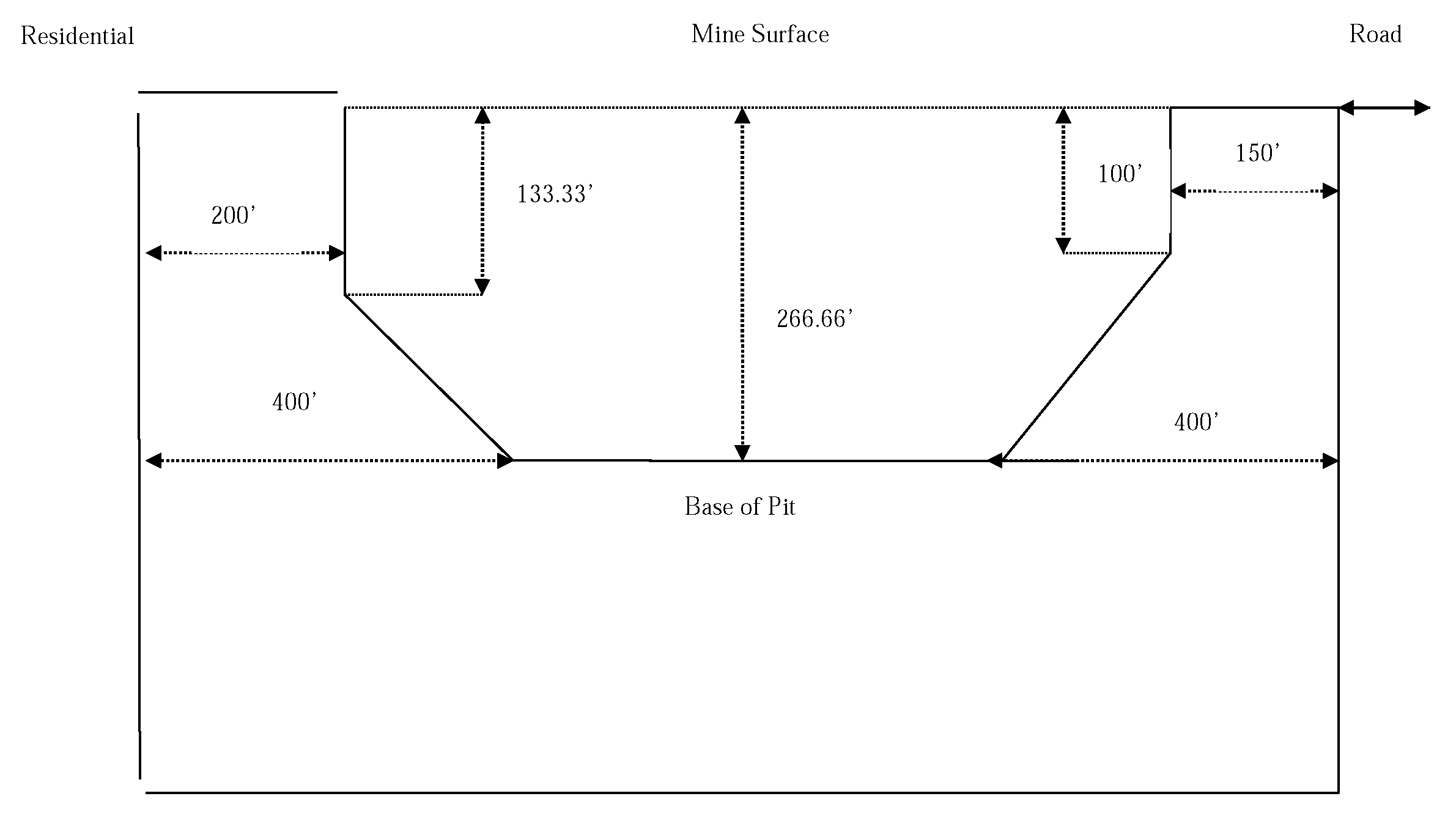
Diagram 36-941-1
(2)
If consolidated materials occur in the mined face, the slope of the face may be steeper than one and one-half (1½) to one (1) slope per Subsection (a)(1) of this section for the depths of those materials; however, all other mined slopes of unconsolidated materials shall be no steeper than two to one (2:1).
(b)
Buildings and structures.
(1)
Unless otherwise specified in the mining operations permit, every building and structure hereafter erected or enlarged shall provide and maintain a setback from a public or private street of not less than one hundred (100) feet from a dedicated road right-of-way or one hundred fifty (150) feet from the centerline of all adjacent roads, whichever is greater.
(2)
Unless otherwise specified in the mining operations permit, every building and structure hereafter erected or enlarged shall have a side and rear yard of not less than fifty (50) feet from all property lines dividing lots held in separate ownership.
(Ord. No. 2020-17, exh. K, §§ 10:03(E), 10.03.1, 9-15-2020)
Sec. 36-942. - Area requirements.
The minimum area required for each M-3 district shall be greater than ten (10) acres.
(Ord. No. 2020-17, exh. K, § 10:03(F), 9-15-2020)
Sec. 36-943. - Prohibited activity.
No person, firm or corporation shall hereafter engage in the extraction of aggregate materials on any land within the unincorporated areas of the County, without first obtaining from the County a mining operations permit in such form and in such a manner as shall hereinafter be provided. The inadvertent extraction of aggregate materials while in the process of land beautification, pond construction or such other activity unrelated to mining and processing uses are hereby excluded.
(Ord. No. 2020-17, exh. K, § 10:03(G), 9-15-2020)
Sec. 36-944. - Fencing.
Where required by the County Board in granting an M-3 district zoning to promote safety, a minimum seven (7) foot chain link fence shall be erected at the site of the operation and facilities which shall be of a nature and character to reasonably protect the general public from danger. The location of the fencing shall be depicted on the site plan submitted as part of the mining permit application.
(Ord. No. 2020-17, exh. K, § 10:03(H), 9-15-2020)
Sec. 36-945. - Request for location protection.
Within seven (7) days of filing any application for M-3 district zoning or M-3 district special use, the applicant shall give notice of such filing, and, at the applicant's expense, sent by registered mail through the PBZ office, a copy of such application as well as a copy of this complete section, to each owner as set forth on the tax assessor's records of all property located within one and one half (1½) miles of the parcel sought to be permitted. If, within fifteen (15) days of receipt of such notice, any owner or occupant of such property files with the PBZ Administrator (hereinafter referred to as "Administrator") a request for location protection, substantially in the form provided in Subsection (4) of this section, then the following shall occur; provided, however, if the proposed use of the property is for the surface mining of sand and gravel only (and includes no blasting or any special use), and the property is situated wholly within a township having a population in excess of twenty thousand (20,000), then notice shall only be sent to properties located with one thousand (1,000) feet of the parcel sought to be permitted.
(1)
Subject to different provisions being made by the County Board as provided in Subsection (3) of this section, any aggregate materials processing, ready-mix concrete, asphalt, and/or recycling equipment or plants on the subject property shall be located so as to provide maximum distance between the residence of any such owner or occupant and any such equipment or plant; if more than one (1) owner or occupant files a request for location protection, then any such equipment or plant shall be located on the property so as to provide as much distance as possible between such residences and such equipment or plant; provided, in any event, that setbacks otherwise required by this chapter shall be maintained.
(2)
Any owner or occupant filing for location protection, and/or agents, shall be invited to participate in County staff discussions with the applicants regarding the most effective and appropriate measures required to protect the residence sites from adverse impacts. The discussions shall include, but not be limited to, location of processing, ready-mix concrete, asphalt, and/or recycling equipment and plants, material storage and mining operations; size and shape of screening berms as they may interface with the residences; noise and dust abatement; site-specific landscaping for both short-term and long-term visual effect, and data reflecting the quality of aggregate materials to be excavated. The advice of a technically trained person selected by the County Board shall be utilized at the applicant's reasonable expense to review and make recommendations concerning the most effective and appropriate measures to protect the residence sites from adverse impact as provided in Subsection (1) of this section.
(3)
The County Board may approve a location for aggregate material processing, ready-mix concrete, asphalt, and/or recycling equipment and plants, other than a location at a maximum distance from the residences of the owners or occupants filing for location protection, if the County Board determines that, because of berming, landscaping, and/or other protections proposed for the property sought to be rezoned, such an alternate location, when compared to the location providing maximum distance, provides the residence sites as much or greater protection from adverse effects of such equipment and/or plants. No such alternate location may be approved by the County Board prior to the residence owners/occupants having at least a sixty (60) day period within which to review such alternative location, have it reviewed by the technically trained person provided for in Subsection (2) of this section, and make recommendations to the County Board concerning it.
(4)
The form hereinabove referred to is the following:
The undersigned, being an owner or occupant of a residence at ___________ (mailing address), hereby requests location protection pursuant the provisions of the Kendall County Zoning Ordinance on Earth Materials Extraction, Processing and Site Reclamation.
(Ord. No. 2020-17, exh. K, § 10:03(I), 9-15-2020)
Sec. 36-946. - Fees.
All applications for an M-3 district zoning designation shall be accompanied by a fee for map amendments in accordance with the fee structure as established by the County Board and as amended from time to time. The County Board may, at its discretion, retain the services of attorneys and professional consultants to assist the Board and County staff in the amendment and zoning process. The application fee shall serve as an initial deposit from which any costs and expenses incurred by the County as a result of the application for amendment and the hearing process set forth herein shall be deducted. Such costs shall include, but not be limited to, the fees and costs of County employees or staff review time, legal fees, expert witnesses, scientific testing, records or other investigations, data searches, notices, court reporters, transcription costs, consultants, the ZBA, and other expenses incurred by the County in reviewing the application, the public hearing, and decision, or any issues raised at any time during any hearings. If the actual costs incurred by the County in conducting its review and recommendation of the requested map amendment exceed the amount of the application fee deposit, the applicant shall be billed and shall be required to pay any all additional costs incurred by the County in the completion of their review and recommendation of the zoning map amendment. Costs in excess of the application fee deposit will need to be paid in full by the applicant prior to scheduling the matter for action by the County Board.
(Ord. No. 2020-17, exh. K, § 10:03(J), 9-15-2020)
Sec. 36-947. - Submittal requirements.
In order for the County to adequately determine the short- and long-term impact of the proposed mining operation on vegetation, wildlife, fish, land use, land values, local tax base, the economy of the County, employment opportunities, air pollution, water pollution, soil contamination, noise pollution and drainage, all applications for an M-3 district zoning designation shall be accompanied by the background information as outlined in Section 36-948(a)(4).
(Ord. No. 2020-17, exh. K, § 10:03(K), 9-15-2020)
Sec. 36-948. - Permitting.
(a)
Permit for mining.
(1)
a.
All operators extracting and/or processing aggregate materials shall apply for a permit jointly with the owner and any person who is entitled to legal possession of the property to be affected and shall comply with the operation and reclamation regulations in this section.
b.
Application for permit shall be made upon a form furnished by the Department. Such application shall be accompanied by a fee of one hundred dollars ($100.00) for every acre and fraction of an acre of land to be affected during the life of the permit.
(2)
An operator desiring to have a permit amended to cover additional land may file an amended application with the County with such additional fee and bond or security as may be required under the provisions of this chapter. Such amendment shall comply with all requirements of this section.
(3)
a.
It shall be unlawful for any owner/operator to engage in surface mining in an area where the overburden shall exceed ten (10) feet in depth or where the operation will affect more than ten (10) acres during the permit year without first obtaining from the State Department of Mines and Minerals a permit to do so, pursuant to the Surface-Mined Land Conservation and Reclamation Act (225 ILCS 715/1 et seq.), as amended.
b.
All owner/operators shall comply with the regulations of USEPA and all State and Federal regulatory agencies for occupational health and safety and obtain any necessary permits prior to issuance of the mining permit. Before the onset of any operations, the Zoning Administrator must be provided with copies of all necessary permits.
(4)
Every application, and every amendment to an application submitted under this section shall contain the following, except that the Administrator may waive the requirements of this subsection for amendments if the affected acreage is similar in nature to the acreage stated in the permit to be amended:
a.
Ownership of land;
b.
Aggregate materials to be mined;
c.
Character and composition of vegetation and wildlife on land to be affected;
d.
The proposed equipment to be used;
e.
The current and past uses to which the lands to be affected have been put;
f.
The current assessed valuation of the lands to be affected and the assessed valuation shown by the two (2) quadrennial assessments next preceding the currently effective assessment;
g.
The nature, depth, and proposed disposition of the overburden;
h.
The estimated depth to which the mineral deposit will be mined;
i.
The location of the existing roads, and anticipated access and haulage roads planned to be used or constructed in conducting surface mining;
j.
The technique to be used in surface mining;
k.
Drainage on and away from the lands to be affected, including directional flow of water, natural and artificial drain ways and waterways, and streams or tributaries receiving the discharge;
l.
The current location of existing buildings and utility lines and easements within the lands to be affected;
m.
Practices and methods proposed to be used to minimize noise, dust, air contaminants and vibration and to prevent pollution of surface water or underground water;
n.
The recycling of water used for washing and grading;
o.
The simultaneous reclamation plan, including methods of accomplishment, phasing, and timing, as an area is mined out to start reclamation;
p.
A detailed map of the land drawn at a scale of one (1) inch equals one hundred (100) feet showing at least the following specifics:
1.
Existing topographical features at two (2) foot contour intervals, up to and including seven (7) percent grade. Greater than seven (7) percent grade would require five (5) foot contours;
2.
Location and names of all streams, creeks, bodies of water, underground water resources (which are readily ascertainable from sources such as the Illinois State Geological Survey well drillings logs) and drainage systems within the lands to be affected;
3.
Outline of area to be excavated;
4.
The proposed location of sorting, grading, crushing and similar equipment necessary to the operation and initial distribution of the excavated products;
5.
The proposed location of any buildings, scale houses, equipment storage areas, and equipment repair sheds or areas;
6.
The current location of buildings, utility lines and easements within the lands to be affected.
q.
The term "affected lands" or "affected land" shall be defined as real property described within the application filed herein whenever the term "affected lands" or "affected land" is used in this section.
(5)
Prior to the issuance of a permit, the applicant must obtain the approval by the County of the reclamation plan and map as provided in Subsection (b) of this section. Such plan shall be forwarded to the ZBA for public hearing, review and recommendation in accordance with the procedures provided under Section 36-42. The recommendation of the Zoning Board of Appeals shall be forwarded to the County Board for action. If approved, the Board will enact an ordinance establishing a date by which the permit shall expire.
(6)
All permits issued hereunder shall expire ten (10) years from the date of issuance, unless the County Board passes an ordinance extending such expiration date.
(7)
Each renewal of a mining permit under this section shall be for a period of time not more than ten (10) years.
a.
A request to renew a mining permit that involves acreage or equipment in addition to that allowed in the original mining permit shall be treated in the same manner as the initial application.
b.
A request to renew a mining permit when no additional acreage or equipment will be brought into use shall be handled in the following manner:
1.
If an owner/operator is not able to finish mining the acreage described in the mining permit in the time specified, such owner/operator shall apply to the County. A public hearing will be held. The maps required by this section for the initial hearing shall be revised, updated and resubmitted along with a statement of the current status of the mining reclamation. A new map describing conditions present on the site shall be furnished as described in this section.
2.
The applicant shall furnish the County PBZ Department with a copy of the aforesaid maps, plans and other related exhibits for review of the revised or extended reclamation plan no less than thirty (30) days before the ZBA hearing.
3.
The PBZ shall prepare a written report and oral statement on the revised or extended reclamation plan and enter it into evidence at the ZBA hearing.
4.
Any application for a renewal of a mining permit shall be filed with the ZBA prior to one hundred twenty (120) days before the expiration date of the original mining permit or any renewal thereof. A failure to file a request for renewal within the required time designated in this subsection shall result in a required cessation of mining and sale of product upon the expiration of the mining permit.
(8)
An examination of the premises shall be made by the Administrator or designee at least annually during the term of the permit. The Administrator shall subsequently complete a mining inspection report, mailing to the operator one (1) copy by certified mail, return receipt requested, and retaining one (1) copy in the permanent files at the County.
(9)
A permit issued hereunder may be revoked or modified by the County Board after due hearing in the event the permittee violates any provision of Subsection (c) of this section.
(b)
Reclamation.
(1)
At the County Board's discretion, the advice of technically trained experts will be utilized at a reasonable cost to the owner/operator to review the reclamation plan for its appropriateness on the affected land.
(2)
The County shall consider the short- and long-term impact of the proposed mining on vegetation, wildlife, fish, land use, land values, local tax base, the economy of the County, employment opportunities, air pollution, water pollution, soil contamination, noise pollution and drainage.
(3)
The reclamation plan map and statement of sequential operation and reclamation shall be followed to produce a finished condition that complies with the reclamation plan map and the provisions of this section so as to provide for the return to a useful purpose of the affected land.
(4)
The operator shall provide with the application for permit a detailed reclamation plan and map drawn at a scale of one (1) inch equals one hundred (100) feet designating which parts of the land shall be reclaimed for forest, pasture, crop, horticultural, home site, recreational, industrial, or other uses, including food, shelter and ground cover for wildlife. The reclamation plan and map shall specify progress and completion dates of the reclamation plan; provided, however, the reclamation is to be completed prior to the expiration of three (3) years after the termination of the mining operation on the land. In the event the operator and the County shall mutually determine that characteristics of the area concerned have been found to be present during the conduct of mining, changes may be made in the original reclamation plan by mutual consent of the operator and the PBZ Committee of the County Board, which change shall preserve, as substantially as possible, the original reclamation plan, and shall also provide for the previously unknown variables. Contours shall conform to requirements of development proposed, but not less than those required for existing original topography.
(5)
The reclamation plan shall contain a written statement containing an explanation of the character of the site to be mined and of the surrounding territory, and an explanation of the schedule of development.
(6)
All reclamation provided for hereunder shall be carried to completion by the operator prior to the expiration of three (3) years after the termination of the mining operation, except that no other reclamation of any kind shall be required to be made within depressed haulage roads or final cuts or any other area where pools or lakes, capable of supporting aquatic life, may be formed by rainfall or drainage runoff from adjoining land or where the Administrator determines that a road, dry pit bottom or ditch is consistent with and necessary to the conservation and reclamation plan. All mined areas which in the reclamation plan call for vegetation shall be covered with sufficient topsoil and other materials from the case overburden which will support acceptable plant growth as outlined in the reclamation plan. The County shall have authority to require darkened surface soil be segregated from other overburden in the stripping process so as to accomplish the requirements of this subsection.
(7)
Extension of the reclamation period may be granted by the Administrator as necessary to accomplish acceptable reclamation. Such extension shall be made at the discretion of the Department; however, the Department shall not deny a reasonable extension when the operator shows that acts of God, strikes, inability to receive ordered equipment or extended periods of unreasonable weather have made completion within the time limits impossible. When determined to be appropriate, the Administrator, at the Administrator's discretion, may refer a request for such an extension to the County Board for review and recommendation prior to taking action on such request.
(8)
The County shall declare forfeiture of the surety, bond or security on such land not satisfactorily reclaimed, and shall use such funds to complete the reclamation. Any excess shall be remitted to the permittee.
(9)
Any reclamation plan must require that viable ground cover or similar vegetation will be placed on the site within one (1) year of final production.
(10)
Disposal areas shall be reclaimed within one (1) year from final production.
(11)
The reclamation plan shall protect persons against hazards remaining on the property.
(12)
A landscape plan shall be prepared by a qualified landscape professional in accordance with the reclamation plan. Said plan shall include details on phasing of the landscape plan as cells are exhausted and the anticipated timeline for the sequential restoration of the subject property.
(c)
Mining operation requirements; duties of operator. Every operator to whom a permit is issued pursuant to the provisions of this section may engage in surface mining upon the lands described in the permit upon the performance of and subject to the following requirements with respect to such lands:
(1)
All land affected by surface mining except as otherwise provided in this subdivision shall be graded to a rolling topography traversable by machines necessary for maintenance in accordance with planned use, with slopes that have no more than fifteen (15) percent (or eight (8) degrees and thirty-two (32) minutes) grade, except that in the case of those lands to be reclaimed in accordance with a filed plan for forest, plantation, recreational or wildlife, the outside slope of the box cut spoil, the slopes of all perimeter berms, all unconsolidated material in the pit sidewalls, and the outside slopes of all overburden deposition areas the grade shall not exceed thirty (30) percent (or sixteen (16) degrees and forty-two (42) minutes); the final cut spoil and the side slopes of haulage roads included can remain at a slope equal to the angle of repose of the material in order to retain or provide as much row crop of fifteen (15) percent slope land as possible, but such slopes need not be reduced to less than the original grade of the overburden of that area prior to mining; vertical highwalls can be left in competent material upon conclusion of the mining or pits formed by the aggregate mining industry.
(2)
In the case that the right-of-way has not been recently surveyed by a registered land surveyor and clearly marked, the right-of-way (ROW) line shall be assumed to be as follows, for the purpose of this section:
a.
When the adjoining roadway is classified as a local street, a minimum of seventy (70) feet of ROW (thirty-five (35) feet from the centerline) shall be provided.
b.
When the adjoining roadway is classified as a local subcollector, a minimum of eighty (80) feet of ROW (forty (40) feet from the centerline) shall be provided.
c.
When the adjoining roadway is classified as a minor collector, a minimum of ninety (90) feet of ROW (forty-five (45) feet from the centerline) shall be provided.
d.
When the adjoining roadway is classified as a major collector, a minimum of one hundred twenty (120) feet of ROW (sixty (60) feet from the centerline) shall be provided.
e.
When the adjoining roadway is classified as an arterial, a minimum of one hundred fifty (150) feet of ROW (seventy-five (75) feet from the centerline) shall be provided.
(3)
All storm runoff water shall be detained, impounded, drained or treated in accordance with Chapter 16, Article II, Division 2 so as to reduce soil erosion, damage to un-mined lands, construct earth dams, where lakes may be formed, in accordance with sound engineering practices if necessary to impound water, provided the formation of lakes or ponds will not interfere with underground or other mining operations, other subsequent uses of the area approved by the County, or damage adjoining property. Such water impoundments must be approved by the County based on the expected ability of the lakes or ponds to support desirable uses such as water for livestock or wildlife; if to be used for fish life, it shall have minimum depths in accordance with standards for fish stocking in the various areas of the State recommended by the County.
(4)
Acid-forming materials present in the exposed face of the mined aggregate material seam in the final cut shall be covered at all times with not less than four (4) feet of water, or other materials which shall be placed with slopes having no more than thirty (30) percent grade, capable of supporting plant and animal life. Final cuts or other depressed affected areas, no longer in use in mining operations, which accumulate toxic waters will not meet reclamation requirements.
(5)
Slurry must be confined in depressed or mine areas bounded by levees or dams constructed from material capable of supporting acceptable vegetation built in accordance with sound engineering practices.
(6)
All abandoned haulage roads and all mine drainage ditches must be removed and graded, except where the Administrator determines that a road or ditch is consistent with and necessary to the conservation and reclamation plan.
(7)
The soil shall be prepared and planted with trees, shrubs, grasses, and legumes to provide suitable vegetative cover, in accordance with the approved reclamation plan.
(8)
Clearing of the mine site may include the moving of existing trees and shrubs to such location as will provide screening as hereinafter provided when cost effective to do so, or as will conform to the reclamation plan for ultimate use of the property as shown on such a plan.
(9)
Maximum depth of excavation shall not be below existing groundwater, except in such cases where the reclamation plan indicates that a lake will be part of the final use of the land or where such plan indicates that adequate fill from overburden is to be used to refill such excavation for conformance to the approved reclamation plan.
(10)
Adequate planting, berming and/or fencing shall be provided along all public roads adjacent to the property involved, sufficient to screen the operation from public view, as reasonably as possible and as approved by the County Board in granting the zoning. The toe of any berm shall not be closer than ten (10) feet from the ROW line.
(11)
No more than one (1) entrance and one (1) exit from a highway or road shall be provided to the area of operation. Such entrance shall be subject to approval by the department of highways having jurisdiction and shall, preferably, be located along a secondary road, and shall be located as to avoid the routing of vehicles to and from the mining operation over streets that primarily serve abutting residential development. In the event the highway authority having jurisdiction over the roadway that provides access to the mining operations requires turning lanes, then said lanes shall conform to IDOT requirements for geometrics and pavement design. Furthermore, a paved road from the entrance and exit, at a distance of not less than three (300) hundred feet from the right-of-way line into the area of operation, shall be provided in order to minimize the deposit of dirt and gravel from trucks into the public highway. Such pavement shall be in accordance with the specifications of the County Highway Department or at the discretion of the highway department having jurisdiction over the roadway. A wheel wash shall be installed within the operation along that portion of the paved entrance/exit road that is furthest from the point at which it accesses the adjoining roadway so as to prevent the tracking of dirt, dust, sand, gravel and debris onto the public right-of-way. Entrances and exits shall be provided with the gates to be securely locked during hours of inoperation.
(12)
Trucks used in hauling materials from the site of excavation shall be loaded in such a manner as to prevent spillage onto the public roadway, including, at a minimum, a secure cover over the top of the bed of the truck carrying said material. Any spillage or tracking of material on said roadways shall be removed from said public roadways as needed to maintain a safe vehicular driving operation and a safe driving surface. At a minimum, the public roadway shall be reviewed for said spillage or tracking of material every eight (8) hours. All generally accepted industrial safety precautions shall be practiced and observed during such process of removal. Accessways and on-site roads shall be maintained in a dust-free condition using sweepers, water trucks or other appropriate methods of dust suppression.
(13)
The owner/operator shall, coincidental with commencement of operations, bring the adjacent roadway providing access to the site up to IDOT standards and specifications for eighty thousand (80,000) pound truck routes, including pavement designs and geometrics from the entrance to the subject site to the nearest intersecting eighty thousand (80,000) pound roadway. The design shall include full-depth concrete pavement at the entrance to the site and extending in each direction to the end of the radius returns. The owner/operator shall repair any section of road damaged as a result of trucks and heavy equipment accessing or servicing the aggregate excavation operation. This provision shall not be construed to require the operator to purchase additional right-of-way.
(14)
Except in the areas needed for plant and equipment, stockpiles, maintenance facilities, scale houses and roads, overburden shall not be removed in excess of the area to be mined within one (1) year. Development toward the final plan shall be carried on as excavation progresses. Ground cover or other planting shall be made in areas where excavation is completed and land is not being used for material storage before further overburden is removed in order to ensure development as operations proceed.
(15)
Hours of arrival and departure of transport vehicles shall be from 6:00 a.m. to 7:00 p.m. from April 1 until November 1. The rest of the year the arrival and departure of transport vehicles shall be restricted to 6:00 a.m. to 6:00 p.m. Hours may be extended during a public emergency during which sand, gravel or limestone is needed and upon the order of the County Superintendent of Highways.
(16)
The holder of a permit hereunder shall ensure the safe and continued use of all wells on surrounding properties located within one and one half (1½) miles of the boundaries of the parcel on which the mining operation is located and shall be required to post a bond or similar surety to guarantee the repair or replacement of any wells determined to have been adversely affected as a result of such mining operations. The amount of said bond shall be determined by multiplying the total number of wells located on those parcels for which location protection was properly filed times the average estimated cost for replacement as determined by a certified well expert or engineer's estimate of cost. No extraction operations shall be conducted in such a manner that the groundwater table of surrounding properties is harmfully lowered. Water pumped from the site for the purpose of washing of vehicles and/or product produced on site shall be retained in a settling pond until the silt and clay settles prior to the water being recycled in the area affected as provided for in this section.
(17)
Landscaping shall be regularly maintained to present a neat and orderly appearance and in such manner so as to discourage the encroachment of weeds and other unsightly or noxious vegetation from encroaching onto the premises or migrating off site and onto any adjoining properties.
(18)
The premises shall be neat and orderly, free from junk, trash or unnecessary debris. Buildings shall be maintained in a sound condition, in good repair and appearance. Salvageable equipment stored in a non-operating condition shall be suitably screened or garaged.
(19)
Enough topsoil must be stockpiled to meet the finished conditions in accordance with the approved reclamation plan, unless additional bonding to ensure the required quantities of topsoil has been furnished to the County.
(20)
Existing trees and ground cover along public road frontages shall be preserved and maintained in such a manner to preserve line of sight requirements.
(21)
Upon the completion of operations, the land shall be left in a condition so that sufficient drainage is provided in order to prevent water pockets or undue erosion; all final grading and drainageways shall exist such that natural stormwater leaves the entire property at the original and natural drainage points and without an excessive load on a particular drainage point. In the event the reclamation plan shall provide for the permanent establishment of a lake, the grading and drainage may be altered, but not in such a manner as to cause damage or inconvenience to surrounding or abutting properties.
(22)
Trees, shrubs, legumes, grasses, or ground cover shall be planted upon such area in order to avoid erosion, in accordance with the approved reclamation plan.
(23)
Within six (6) months after final production, all buildings, structures (except fences), and equipment shall be removed unless same are to be used in connection with the reclamation project.
(24)
Noise, dust, and odor.
a.
The noise level originating from a mining operation shall comply with the performance standards set forth in the standards adopted by the State Pollution Control Board, as from time to time amended; provided, however, that daytime hours are defined as 6:00 a.m. to 7:00 p.m. from April 1 until November 1 and from 6:00 a.m. to 6:00 p.m. during the rest of the year. Any variation of these regulations will constitute a violation of this section.
b.
The release of particulate emissions shall also comply with the performance standards in the standards adopted by the State Pollution Control Board, as from time to time amended.
c.
Operations shall be conducted so that noise levels and air and water quality standards comply with all applicable Federal and State standards and/or regulations.
(25)
Blasting operations at all permitted sites operated by the aggregate mining industry shall be conducted in accordance with existing State and Federal law and the rules promulgated by the departments having jurisdiction over such operations with the advice of the aggregate mining industry and in accordance with the provisions as outlined in 225 ILCS 715/6.5, as may be amended from time to time.
(d)
Reclamation bond. In order to ensure that the approved reclamation plan is completed, the owner/operator shall provide bonding in accordance with the provisions of the Surface Mined Land Conservation and Reclamation Act (225 ILCS 715/8), as may be amended from time to time. If the facility will affect less than ten (10) acres annually or the overburden depth is less than ten (10) feet or does not require bonding with IDNR per the Surface Mined Land Conservation and Reclamation Act (225 ILCS 715/8), a reclamation bond will be filed with the County. An engineer's estimate of reclamation cost should be performed annually to determine the bond amount.
(e)
Enforcement.
(1)
The Zoning Administrator, in conjunction with other appropriate departments, shall annually review each surface mining permit. In addition to the reclamation plan/map, the owner/operator shall provide the PBZ Department with an annual aerial photo of the total operation of the same, enlarged to a scale of one (1) inch equals one hundred (100) feet or other scale that would adequately display the property affected on a thirty (30) inch square format. All aerial photos shall meet the PBZ Department standards. The first photo shall be taken during the first year in operation and subsequent photos shall be taken in the same month of the following years. Each year's photo shall be presented at the same scale for the purpose of comparison. Photos shall be submitted prior to the issuance of the annual operating permit.
(2)
The Zoning Administrator, in conjunction with the PBZ Department, shall prepare a report and submit it to the PBZ Committee for their review. If it is determined that the operator is not in compliance with this subdivision, the bonding requirements, the simultaneous operation and reclamation statement or the reclamation plan/map, the Zoning Administrator shall issue a stop work order on all operations other than reclamation work needed to bring the operation into compliance.
(3)
Every three (3) years, at the time of the annual review, bonding, release of bond and re-bonding shall be checked as specified in Subsection (d) of this section. In addition, the operator shall provide the Zoning Administrator with a topographic survey with two (2) foot contours, at the same scale as the aerial photo, said topographic survey to show the status of existing conditions on the subject site.
(4)
Before release of bond, an on-site inspection of the acreage reclaimed shall be made by the Zoning Administrator in conjunction with other appropriate departments to check for compliance with the reclamation plan and any additional conditions of the mining permit. A random count procedure shall be used to check seeding, plantings and depth of topsoil.
(f)
Rules and regulations.
(1)
The County may adopt and promulgate reasonable rules and regulations respecting the administration of this section and conformity therewith.
(2)
Any act authorized to be done by the Administrator may be performed by any employee of the PBZ Department when so designated by the Zoning Administrator.
(g)
Exemptions. Any mining operation legally commenced prior to April 14, 1992, shall be exempt from the requirements hereof, except that said operations shall not be exempt from the requirements hereof pertaining to the hours of operation, the operation of motor vehicles, safety and noise regulations, as defined in Subsections (c)(14) and (23) of this section.
(Ord. No. 2020-17, exh. K, § 10:03.1, 9-15-2020)

