
Plattville City Zoning Code
ARTICLE V
- SUPPLEMENTAL DISTRICT REGULATIONS
Sec. 36-970. - Lot coverage.
(a)
Maintenance of yards, courts and other open spaces. The maintenance of yards, courts and other open space and minimum lot area required for a building shall be a continuing obligation of the owner of such building or of the property on which it is located, as long as the building is in existence. No required yards, courts, other open space or minimum lot area allocated to any building shall, by virtue of change of ownership or for any other reason, be used to satisfy requirements for any other building.
(b)
Division of zoning lot. No zoning lot improved with a building shall hereafter be divided into two (2) or more zoning lots and no portion of any zoning lot which is improved with a building shall be sold, unless all zoning lots resulting from each such division or sale and improved with a building comply with the bulk regulations of the zoning district in which the property is located.
(c)
Location of required open space. The location of required open spaces or yards or courts and other open space allocated to a building or dwelling group shall be located on the same zoning lot as such building or dwelling group, except as otherwise permitted in planned development and planned open spaces.
(d)
Required yards for existing buildings. No yards now or hereafter provided for a building existing on the effective date of the ordinance from which this chapter is derived shall subsequently be reduced below, or further reduced below if already less than, the minimum yard requirements of this chapter for equivalent new construction, except as provided in Section 36-221.
(e)
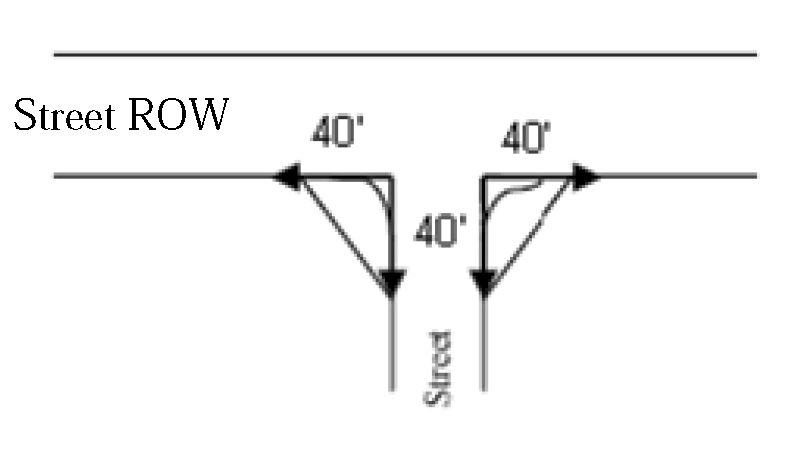
Corner clearance. There shall be no material obstruction to vision on any corner lot between a height of two (2) feet and a height of ten (10) feet above the finished grade of either street within a forty (40) foot triangle formed by the intersection street lines with the following exception: On corner lots within that part of a yard, court, or other open area located within a radius of twenty-five (25) feet from the point of intersection of the two (2) street right-of-way lines forming the lot corner, no buildings, structures, or shrubs as herein permitted as obstructions in front or side yards adjoining a street shall be erected, altered, or planted which have a height more than thirty (30) inches above the ground grade in this area, and trees planted in such areas shall be maintained in a manner that trees shall not have branches lower than eight (8) feet above the ground grade elevation in this area.
(Ord. No. 2020-17, exh. E, § 4:04, 9-15-2020)
Sec. 36-971. - Accessory buildings, structures and uses.
(a)
Accessory buildings or uses. The term "accessory building or use" includes, but is not limited to, the following:
(1)
A children's playhouse, garden house and private greenhouse.
(2)
A garage, shed or building for domestic storage.
(3)
Merchandise storage normally carried in stock on the same lot with any business use, unless such storage is excluded by the district regulations.
(4)
Storage of goods used in or produced by manufacturing activities on the same lot or parcel of ground with such activities, unless such storage is excluded by the district regulations.
(5)
Incinerators incidental to residential use.
(6)
A non-paying guest house (without kitchen facilities) or rooms for guests within an accessory building provided such facilities are used for the occasional housing of guests of the occupants of the principal building and not for permanent occupancy by others. (Only permitted on parcels of three (3) acres or more in the A-1 Agricultural District or R-1 district.)
(7)
Swimming pool, private, for use by the occupant and guests.
(8)
Off-street parking and loading facilities.
(9)
Signs (other than advertising signs) as permitted and regulated in each district incorporated in this chapter.
(10)
Carports as a separate structure.
(11)
Towers for personal use (i.e., radio towers, towers to receive Internet service).
(12)
Small wind energy system (permitted as accessory use only in the A-1, R-1, R-2, R-3, and all business and manufacturing districts; may also be approved as part of a residential planned development) subject to the conditions of Section 36-982.
(13)
Solar energy system, private, subject to the conditions of Section 36-983.
(14)
Home occupations (see Sections 36-972 and 36-973).
(15)
Short-term rental provided the property is annually registered with the County Planning, Building and Zoning Department.
(b)
Permitted obstructions in required yards.
(1)
The table in Subsection (b)(2) of this section identifies accessory buildings, structures and uses that are permitted as obstructions in required yards (setbacks) subject to the following restrictions:
a.
No structure shall be placed within a recorded easement.
b.
No other obstruction shall occur within a recorded easement unless the sole purpose of the easement is for service to only the subject property.
c.
No obstruction shall adversely impact drainage.
d.
Unless otherwise indicated in the table in Subsection (b)(2) of this section, no obstruction shall be closer than five (5) feet from a property line.
e.
No obstruction shall encroach onto a private septic system or private water well.
(2)
In the following table, an "X" indicates the obstruction is permitted:
(c)
Location. Except as otherwise provided for under this section, no part of any accessory building shall be located closer than five (5) feet from any side or rear property line, nor closer than ten (10) feet to any main buildings, unless attached and made a part of such main building. In the A-1 Agricultural District accessory structures must be ten (10) feet from all property lines dividing lots held in separate ownership. If an accessory structure is the first building on an A-1 Agricultural District lot it must meet principal building setbacks as set forth in Section 36-285(2).
(d)
Time of construction. Except in A-1 Agricultural Districts, no accessory building or structure shall be constructed on any lot prior to the start of construction of the principal building to which it is accessory.
(e)
Height of accessory buildings in required rear yards. No accessory building or portion thereof located in a required rear yard shall exceed the maximum height outlined below:
(f)
Footprint of accessory buildings. Any detached accessory building must have a footprint no larger than seventy (70) percent of the principal structure if located in the R-5, R-6 or R-7 zoning districts.
(g)
On reversed corner lots. On a reversed corner lot in a residential district, and within fifteen (15) feet of any adjacent property to the rear in a residential district, no accessory building or portion thereof located in a required rear yard shall be closer to the side lot line abutting the street than a distance equal to sixty (60) percent of the least depth which would be required under this chapter for the front yard on such adjacent property to the rear. Further, in the above instance, no such accessory building shall be located within five (5) feet of any part of a rear lot line which coincides with a side lot line or portion thereof of property in a residential district.
(Ord. No. 2020-17, exh. E, § 4:05, 9-15-2020; Ord. No. 2023-24, §§ VII, VIII, 5-16-2023)
Sec. 36-972. - Home occupation, agricultural.
Agricultural home occupations are allowed, provided that:
(1)
It is conducted entirely within the dwelling or permitted accessory building by a member of the family residing in the dwelling and when such home occupation is clearly incidental and secondary to the use of the dwelling as a residence.
(2)
A maximum sign of eight (8) square feet will be permitted but must meet setback requirements in Article VI of this chapter and be unlit.
(3)
No article shall be sold or offered for sale on the premises except as is produced by the occupation on the premises except that items incidental to the home occupation may be sold (i.e., hair products may be sold at a salon).
(4)
No person shall be employed on site other than members of the family residing on the premises and two (2) persons outside the family, providing that additional persons outside of the family may be permitted by the ZBA pursuant to an application for special use filed in accordance with the provisions of this chapter.
(5)
The number of off-street parking spaces for that use is provided as required by Division 2 of this article.
(6)
No mechanical equipment is used which may generate obnoxious fumes, excessive noise or other such related nuisances. No offensive noise, vibration, smoke, dust, odors, heat, glare, or electrical disturbance shall be produced which is perceivable at or beyond the lot lines, unless otherwise permitted by law.
(Ord. No. 2020-17, exh. E, § 4:06, 9-15-2020)
Sec. 36-973. - Home occupation, residential.
Residential home occupations are allowed, provided that:
(1)
It is conducted entirely within the dwelling by a member of the family residing in the dwelling and when such home occupation is clearly incidental and secondary to the use of the dwelling as a residence.
(2)
There are no signs, display or activity that will indicate from the exterior of the dwelling that it is being used for any use other than a dwelling except as allowed by the sign regulations for the district in which such home occupation is located.
(3)
No article shall be sold or offered for sale on the premises except as is produced by the occupation on the premises, except that items incidental to the home occupation may be sold (i.e., hair care products sold at a salon).
(4)
No more than ten (10) vehicle trips (customers, delivery persons or employees) may be made throughout a day to and from the home occupation.
(5)
No person shall be employed on site other than members of the family residing on the premises and one (1) person outside the family in all residential districts.
(6)
The number of off-street parking spaces for that use is provided as required by Division 2 of this article.
(7)
No mechanical equipment is used which may generate obnoxious fumes, excessive noise or other such related nuisances. No offensive noise, vibration, smoke, dust, odors, heat, glare, or electrical disturbance shall be produced which is perceivable at or beyond the lot lines, unless otherwise permitted by law.
(8)
Instruction in music, crafts and dance shall be limited to one (1) student at a time with a maximum of eight (8) per day. Exceeding this limit requires a variance.
(9)
Salons shall be limited to one (1) station (chair or nail table, commonly referred to as a station).
(Ord. No. 2020-17, exh. E, § 4:07, 9-15-2020)
Sec. 36-974. - Lot area and dimensions.
(a)
Contiguous parcels. When two (2) or more parcels of land, each of which lacks adequate area and dimension to qualify for a permitted use under the requirements of the use district in which they are located, are contiguous and are held in one (1) ownership, they shall be used as one (1) zoning lot for such use.
(b)
Lots or parcels of land of record. Any single lot or parcel of land held in one (1) ownership which was of record, May 10, 1960, that does not meet requirements for minimum lot width and area may be utilized for a permitted use, provided that yards, courts, or usable open spaces are not less than seventy-five (75) percent of the minimum required dimensions or area, except as provided in Section 36-225.
(Ord. No. 2020-17, exh. E, § 4:08, 9-15-2020)
Sec. 36-975. - Access to public streets.
(a)
Every principal building that is constructed on a lot shall have vehicular access by private driveway to a public street. Private driveways shall be located, designed, and constructed according to the subdivision standards in Chapter 30.
(b)
Individual driveways which provide access to one (1) lot and shared private driveways which provided access to two (2) lots shall be approved by the Zoning Administrator.
(c)
Shared private driveways which provide access to three (3) or more lots shall be approved by the County Board. In cases where the proposed access would be for lots that existed before March 17, 1998, the procedure for approval would be recommended by the Zoning Administrator, Plat Officer, Planning, Building, and Zoning Committee, and a vote by the County Board. Other cases would be part of the subdivision review procedure.
(Ord. No. 2020-17, exh. E, § 4:09, 9-15-2020)
Sec. 36-976. - Number of buildings on a zoning lot.
Except in the case of a planned development, not more than one (1) principal detached residential building shall be located on a zoning lot, nor shall a principal detached residential building be located on the said zoning lot with any other principal building.
(Ord. No. 2020-17, exh. E, § 4:10, 9-15-2020)
Sec. 36-977. - Tents.
Tents shall not be erected, used or maintained on any lot, except such small tents as are customarily used for recreational purposes and located on the same lot as a dwelling. Temporary use of tents for religious, amusement and recreation, business or manufacturing purposes shall be permitted. Temporary is defined as no longer than seven (7) days. If a tent will be erected longer than seven (7) days, a permit must be acquired from the Zoning Administrator or designee. Agriculturally zoned property is exempt from these provisions.
(Ord. No. 2020-17, exh. E, § 4:11, 9-15-2020)
Sec. 36-978. - Performance standards.
Any use established after the effective date of the ordinance from which this chapter is derived shall be so operated as to comply with the performance standards set forth in Title 35 of the Illinois Administrative Code and administered by the Illinois Pollution Control Board (www.ipcb.state.il.us). No use lawfully established on the effective date of the ordinance from which this chapter is derived shall be so altered or modified as to conflict with, or further conflict with, these performance standards.
(Ord. No. 2020-17, exh. E, § 4:12, 9-15-2020)
Sec. 36-979. - Existing special uses.
When a use is classified as a special use under this chapter and exists as a permitted use at the date of adoption of the ordinance from which this chapter is derived, it shall be considered as legal use, without further action of the County Board, the Zoning Administrator or the Board of Appeals.
(Ord. No. 2020-17, exh. E, § 4:13, 9-15-2020)
Sec. 36-980. - Fences.
(a)
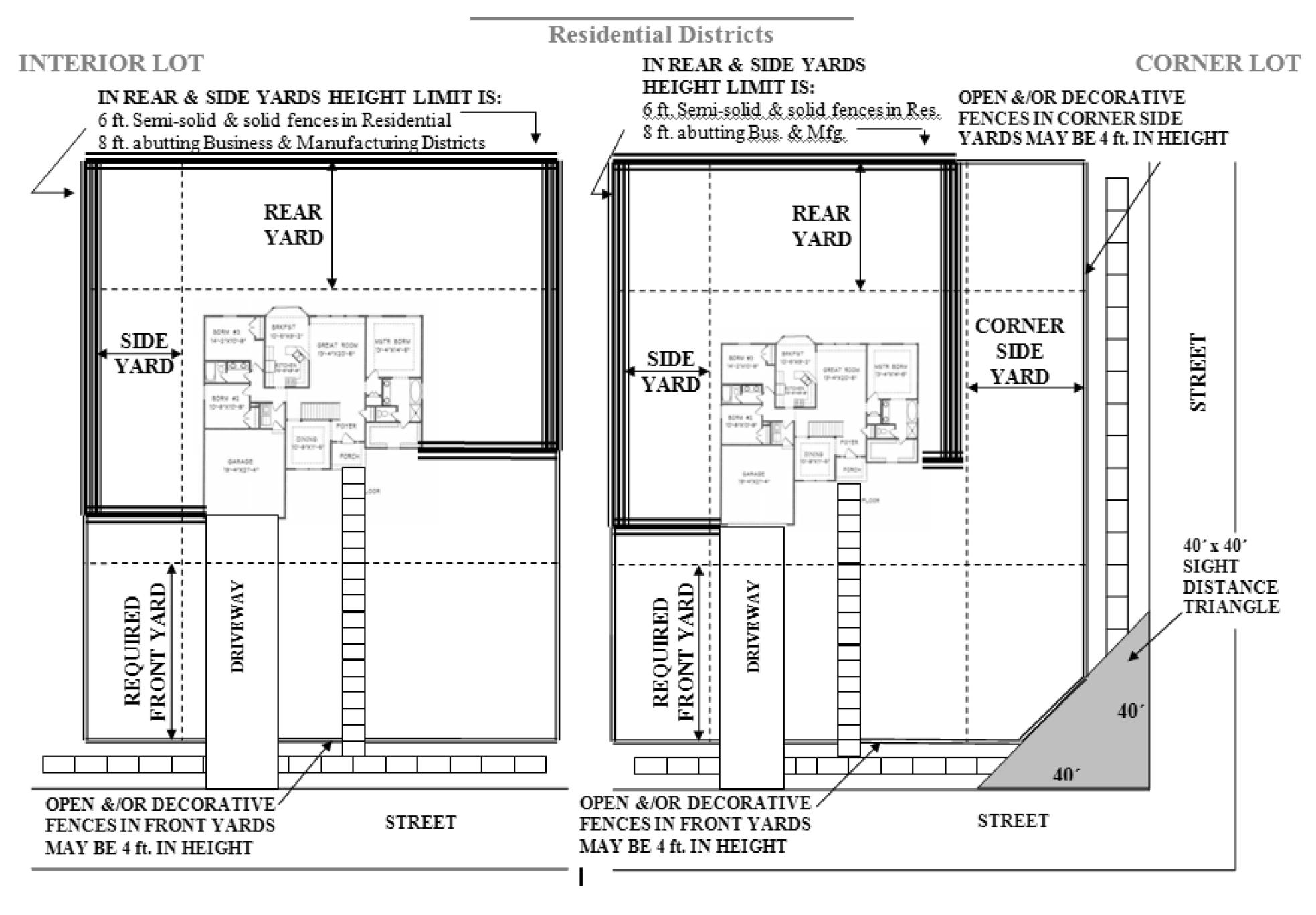
General. Fences that are open, semi-solid or solid are allowed in all districts and yards with the following conditions, unless otherwise regulated herein:
(1)
Fences located in the A-1 district shall be excluded from any fence height restriction or fence type restriction specified in this section.
(2)
Only decorative or open fences, which do not exceed four (4) feet in height, are allowed in a front yard. (The front yard is a yard lying between the roadway right-of-way line and the nearest line of the building.)
(3)
Semi-solid and solid fences shall be regulated as follows:
a.
In residential districts, solid and semi-solid fences are permitted up to six (6) feet in height in required side and rear yards with the finished side out, provided they do not extend into a required front or corner side yard. Where a side yard or rear lot line of a residentially zoned lot abuts property located in a business or manufacturing district, a solid or semi-solid fence of up to eight (8) feet in height may be permitted in the required side and rear yards with the finished side out, provided it does not extend into a required front or corner side yard.
b.
In business and manufacturing districts, solid and semi-solid fences are permitted up to eight (8) feet in height and may be placed along the lot line in required side and rear yards with the finished side out, provided they do not extend into a required front or corner side yard.
(4)
Fences may be placed up to a property line, provided that fences shall not encroach into rights-of-way.
(5)
Fences on corners of vehicular intersections shall comply with the corner clearance provisions of Section 36-970(e).
(6)
Except in the A-1 district and R-1 district, barbed-wire and above-ground electric fences shall not be located in any residential district or residential platted subdivision. The use of underground electric fences to contain domestic pets is permitted in any district.
(b)
Required fences, hedges, and walls.
(1)
A six (6) foot high fence or wall shall be constructed along the perimeter of all areas considered by the Board of Appeals to be dangerous to the public health.
(2)
When required by the Zoning Administrator, a six (6) foot high solid masonry wall shall be erected along the property line or zone boundary lines to separate industrial and commercial districts or uses from abutting residential districts as follows:
a.
Where the zone boundary is at a rear lot line which is not a street, the wall shall be on that line.
b.
Where the boundary is a side lot line, the wall shall be parallel to said side lot line and be reduced to three (3) feet in height in the area set forth as a required front yard for the abutting residential district. The wall paralleling the front property line shall be set back from said property line not less than ten (10) feet and the space between the wall and the property line shall be landscaped and maintained.
c.
Where the boundary is a street, the wall shall be set back from the property line ten (10) feet. The space between the wall and the property line shall be landscaped and maintained.
d.
Where the boundary is an alley, the wall shall be on the property line along the alley.
Nothing in this section shall be deemed to set aside or reduce the requirements established for security fencing by either local, State or Federal law.
(Ord. No. 2020-17, exh. E, § 4:14, 9-15-2020)
Sec. 36-981. - Regulated uses.
(a)
The following uses are deemed to be regulated uses:
(1)
Adult bookstore.
(2)
Adult motion picture theater.
(3)
Adult mini-motion picture theater.
(4)
Adult entertainment facilities.
(5)
Adult use.
(6)
Adult massage parlors or spas.
(7)
Tattoo parlors and permanent body art establishments.
(8)
Striptease club or gentlemen's club.
(9)
Adult video store.
(b)
For the purposes of determining when a regulated use is allowed as a permitted or special use under this chapter, no regulated use shall be considered to be a retail business, service businesses, recreational or social facility, school, accessory, or general land use.
(Ord. No. 2020-17, exh. E, § 4:16, 9-15-2020)
Sec. 36-982. - Small wind energy systems.
(a)
Total height. There is no limitation on tower height, except as imposed by setback, clear zone and FAA regulations.
(b)
Setback. The wind energy system shall be set back a distance equal to one hundred ten (110) percent of the hub height from all adjacent property lines. Additionally, no portion of the small wind energy system, including guy wire anchors, may extend closer than ten (10) feet to the property line.
(c)
Clear zone. The wind energy system shall maintain a circular clear zone that has a radius which is equivalent to one hundred ten (110) percent of the hub height. This clear zone shall be maintained free of any occupied structures on adjoining properties, tanks containing combustible/flammable liquids, and above-ground utility/electrical lines.
(d)
Noise. Wind energy systems shall not exceed sixty (60) dBA, as measured at the closest property line. The level, however, may be exceeded during short-term events such as utility outages and/or severe windstorms.
(e)
Tower security. Any climbing apparatus must be located at least twelve (12) feet above the ground, and the tower must be designed to prevent climbing within the first twelve (12) feet.
(f)
Lighting. Wind energy systems shall not be artificially lighted with accent lighting. For the protection of the flight patterns of aircraft and the protection of heliports, airports and landing strips, wind energy systems must be lighted in accordance to the regulations and guidelines of the Federal Aviation Administration (FAA) regulations or appropriate authorities.
(g)
Signs/advertising. No tower should have any sign, writing, or picture that may be construed as advertising.
(h)
Visual effects and safety. All reasonable visual and safety concerns of adjacent property owners must be resolved before a construction permit will be issued.
(i)
Multiple wind energy systems. Multiple wind energy systems are allowed on a single parcel as long as the owner/operator complies with all noncommercial wind farm regulations contained in these regulations. Units shall be installed in compliance with minimum setback and clear zone requirements, as defined by these regulations. The minimum distance between wind energy systems shall be equivalent to one hundred ten (110) percent of the hub height.
(j)
Approved wind turbines. At the time of application, the applicant must present a certification from the manufacturer that the system's turbine and other components equal or exceed the standards of one (1) of the following national certification programs such as the California Energy Commission, National Electrical Code (NEC), American National Standards Institute (ANSI), Underwriters Laboratories (UL), or any other small wind certification program recognized by the American Wind Energy Association.
(k)
On-site electrical use. On the construction/use permit application, the applicant must certify that the proposed system will be used primarily to reduce on-site consumption of electricity.
(l)
Compliance with the National Electrical Code. Construction/use permit applications for small wind energy systems shall be accompanied by a line drawing of the electrical components in sufficient detail to allow for a determination that the manner of installation conforms to the National Electrical Code. This information is frequently supplied by the manufacturer.
(m)
Removal of defective or abandoned wind energy systems. Any wind energy system found to be unsafe by an authorized County official shall be repaired by the owner to meet Federal, State and local safety standards or removed within six (6) months. If any wind energy system is not operated for a continuous period of twelve (12) months, the County will notify the landowner by registered mail and provide forty-five (45) days for a response. In such a response, the landowner shall set forth reasons for the operational difficulty and provide a reasonable timetable for corrective action. If the County deems the timetable for corrective action as unreasonable, they must notify the landowner and such landowner shall remove the turbine within one hundred twenty (120) days of receipt of notice from the County.
(Ord. No. 2020-17, exh. E, § 4:17, 9-15-2020; Ord. No. 2023-24, § IX, 5-16-2023)
Sec. 36-983. - Private solar energy system.
(a)
Roof mounted for on-site energy consumption. Solar panels located on the roof of an existing structure shall be permitted in all districts. Roof-mounted solar energy systems shall not extend beyond the exterior perimeter of the building on which the system is mounted. Roof-mounted solar energy systems shall not exceed the maximum allowed height in any zoning district. Roof-mounted or building-integrated private solar energy systems for residential or business use shall be considered an accessory use in all zoning districts where there is a principal structure and shall meet the regulations of this chapter. Roof-mounted solar panels used as accessory to agricultural uses and which the energy generated from the solar panels is consumed on site shall be exempt from building permits. The use of roof-mounted solar panels for on-site energy consumption shall comply with all applicable Federal, State, and local laws and the rules of the local electrical utility.
(b)
Freestanding for on-site energy consumption. Solar panels located on the ground or attached to a framework located on the ground shall be classified as accessory structures in all zoning districts, provided that the system is no larger than necessary to provide one hundred twenty (120) percent of the electrical and/or thermal requirements of the structure, planned development, commercial and industrial park, or subdivision to which it is accessory as determined by a contractor licensed to install photovoltaic and thermal solar energy systems. Private freestanding solar energy systems may be the first structure constructed on lots zoned residential, business, or manufacturing. Freestanding solar panels shall be permitted if they comply with the standards listed in this chapter. Ground- or pole-mounted solar energy systems shall not exceed the maximum height, when oriented at maximum tilt, for the zoning district in which they are located. Freestanding solar panels used as accessory to agricultural uses and which the energy generated from the solar panels is consumed on site shall be exempt from building permits. The use of freestanding solar panels for on-site energy consumption shall comply with all applicable Federal, State, and local laws and the rules of the local electrical utility.
(c)
Setback requirements. Unless otherwise stated in this chapter, the setback requirements for all solar energy systems shall meet the structure minimum setback requirements when the solar energy system is oriented at any and all positions. No solar energy system shall be located in any front yard of any residentially zoned or used property.
(d)
Design standards. Active solar energy systems shall be designed to conform to the County's Land Resource Management Plan and to blend into the architecture of the building or may be required to be screened from the routine view from public rights-of-way other than alleys. Screening may be required to the extent it does not affect the operation of the system. The color of the solar collector is not required to be consistent with other roofing materials.
(1)
Building-integrated photovoltaic solar energy systems shall be allowed regardless of whether the system is visible from the public right-of-way, provided the building component in which the system is integrated meets all required setback, land use or performance standards for the district in which the building is located.
(2)
Solar energy systems using roof-mounting devices or ground-mount solar energy systems shall not be restricted if the system is not visible from the closest edge of any public right-of-way or immediately adjacent to a residential structure.
(3)
All solar energy systems using a reflector to enhance solar production shall minimize glare from the reflector affecting adjacent or nearby properties. Measures to minimize glare include selective placement of the system, screening on the north side of the solar array, modifying the orientation of the system, reducing use of the reflector system, or other remedies that limit glare.
(4)
Damaged field drain tile shall be repaired or rerouted on a timetable approved by the County Planning, Building and Zoning Department.
(e)
Coverage. Roof- or building-mounted solar energy systems, excluding building-integrated systems, shall allow for adequate roof access for firefighting purposes to the south-facing or flat roof upon which the panels are mounted. Ground-mount private solar energy systems shall be exempt from impervious surface calculations if the soil under the collector is not compacted and maintained in vegetation. Foundations, gravel, or compacted soils are considered impervious.
(f)
Plan approval required. All solar energy systems shall require administrative plan approval by the County Building Official via the review of the application for a building permit.
(1)
Plan applications for solar energy systems shall be accompanied by horizontal and vertical (elevation) drawings. The drawings must show the location of the system on the building or on the property for a ground-mount system including the property lines.
(2)
For all roof-mounted systems other than a flat roof, the elevation must show the highest finished slope of the solar collector and the slope of the finished roof surface on which it is mounted.
(3)
For flat roof applications, a drawing shall be submitted showing the distance to the roof edge and any parapets on the building and shall identify the height of the building on the street frontage side, the shortest distance of the system from the street frontage edge of the building, and the highest finished height of the solar collector above the finished surface of the roof.
(4)
Applications that meet the design requirements of this chapter and do not require an administrative variance shall be granted administrative approval by the Zoning Administrator and not require Planning, Building and Zoning Committee review. Plan approval does not indicate compliance with building or electrical codes.
(g)
Approved solar components. Electric solar energy system components must have a UL listing approved equivalent and solar hot water systems must have an SRCC rating.
(h)
Compliance with Building Code. All active solar energy systems shall meet approval of County building officials; solar thermal systems shall comply with HVAC-related requirements of the Illinois State Energy Code. All County-adopted building codes will apply and take precedence where applicable.
(i)
Utility notification. All grid-intertie solar energy systems shall comply with the interconnection requirements of the electric utility. Off-grid systems are exempt from this requirement.
(j)
Building permit requirements and fees. All solar energy systems will be required to have a County building permit before any work can be started. A written plan and a plat/drawing for the proposed solar energy system shall be provided with the building permit application. The plat/drawing must show the location of the system on the building or on the property (for a ground-mount system, show arrangement of panels), with all property lines and setback footages indicated. Fees for processing the applications for building permits shall be established by the County Board. Any solar energy system for which construction has started before a building permit has been applied and paid for will be charged double the permit fee. The above fees do not apply to solar energy systems used to generate energy for on-site consumption of energy for agricultural purposes.
(k)
Decommissioning plan.
(1)
Upon the request of the County Planning, Building and Zoning Department, an owner of a solar energy system must provide documentation, within thirty (30) days, that the solar energy system is still in use. If the solar energy system is not in use, the owner of the system shall have one hundred eighty (180) days, after notification from the County Planning, Building and Zoning Department, to remove the solar energy system from the property.
(2)
Decommission of solar panels must occur in the event they are not in use for ninety (90) consecutive days.
(l)
Other requirements.
(1)
No fencing is required; however, if installed on the property, the fencing shall have a maximum height of eight (8) feet. The fence shall contain appropriate warning signage that is posted such that it is clearly visible on the site.
(2)
Reflection angles for solar collectors shall be oriented such that they do not project glare onto adjacent properties.
(3)
Electric solar energy system components must have a UL listing and must be designed with anti-reflective coatings.
(4)
Solar energy systems must be in compliance with all State plumbing and energy codes.
(5)
For solar energy systems located within five hundred (500) feet of an airport or within approach zones of an airport, the applicant must complete and provide the results of the Solar Glare Hazard Analysis Tool (SGHAT) for the airport traffic control tower cab and final approach paths, consistent with the Interim Policy, FAA Review of Solar Energy Projects on Federally Obligated Airports, or most recent version adopted by the FAA.
(m)
Applicability. The regulations in this section apply only to private solar energy systems and do not apply to commercial solar energy facilities.
(Ord. No. 2020-17, exh. E, § 4:18, 9-15-2020; Ord. No. 2023-24, § X, 5-16-2023)
Sec. 36-984. - Temporary uses permitted.
An owner seeking an approval of a permitted temporary use shall apply for a temporary use to be acted upon by the Zoning Administrator. The Zoning Administrator may, at the Administrator's discretion, refer the request for a temporary use to the PBZ Committee of the County Board for recommendation prior to taking action. In addition, the petitioner may appeal the decision of the Zoning Administrator or deputies in the review of a temporary use to the PBZ Committee. In such instances the PBZ Committee shall be the final authority in deciding upon such requests. Any permitted temporary use may be treated as a special use (per the procedures contained in Article II of this chapter) if the stated time limit is to be exceeded.
(1)
Christmas tree sales: each permit shall be valid for a period of not more than sixty (60) days in any agricultural or business district.
(2)
Concrete ready-mix or asphalt plants, when necessary and incidental to a major construction project in any agricultural, business or manufacturing district.
a.
Each such permit shall be valid for a period of not more than one (1) year and shall not be renewed for more than two (2) successive periods at the same location.
b.
The plant shall be located a minimum of one thousand (1,000) feet from any occupied principal structure.
c.
All facilities placed or located on the site shall be removed and the site restored to its original condition within the time frame of the permit. The operator of the facility shall guarantee the proper removal of all facilities with good and sufficient security as approved by the Zoning Administrator.
d.
The plant shall produce product only for the specific parcel for which the temporary use is permitted. Plants constructed to support a major road project shall be located adjacent to the roadway.
e.
Hours of operation must be 7:00 a.m. to 5:30 p.m. Monday through Saturday unless otherwise permitted.
f.
Before the issuance of the temporary use permits, the septic field shall be roped off and the water well shall be clearly staked to allow for the protection of both of these utilities. The areas shall remain marked or roped off through the duration of the project.
(3)
Temporary building, trailer, or yard for construction materials and/or equipment, both incidental and necessary to construction in the zoning district, provided that:
a.
Each permit shall specify the location of the building, trailer, or yard and the area of permitted operation.
b.
Each such permit shall be valid for a period of not more than six (6) calendar months and shall not be renewed for more than four (4) successive periods.
c.
Before the issuance of the temporary use permit, the septic field shall be roped off and the water well shall be clearly staked to allow for the protection of both of these utilities. The areas shall remain marked or roped off through the duration of the project.
d.
Trailers or mobile homes may be used for residential purposes only during the construction of a residence and must be removed within thirty (30) days of obtaining a certificate of occupancy or completion of construction. In no case shall a trailer or mobile home be permitted to remain on the premises for more than two (2) years.
(4)
Portable concrete crushing, screening and stockpiling of dirt, crushed concrete and RAP (recycled asphalt pavement), when necessary and incidental to a major construction project in any agricultural, business or manufacturing district as long as the following conditions are met:
a.
Each such permit shall be valid for a period of not more than one (1) year and shall not be renewed for more than two (2) successive periods at the same location.
b.
The operation shall be located a minimum of seven hundred fifty (750) feet from the lot line of any residential building and/or a minimum of three hundred (300) feet from the lot line from retail businesses.
c.
All facilities placed or located on the site shall be removed and the site restored to its original condition within the time frame of the permit.
d.
The operation shall have hard surface road frontage. If located in an A-1 Agricultural District, the operation must have frontage onto an arterial or major collector roadway as depicted on the County Land Resource Management Plan.
e.
Hours of operation must be 7:00 a.m. to 5:30 p.m. Monday through Saturday unless otherwise permitted.
f.
Before the issuance of the temporary use permit, the septic field shall be roped off and the water well shall be clearly staked to allow for the protection of both of these utilities. The areas shall remain marked or roped off through the duration of the project.
(5)
Temporary stockpiling of dirt on private property when necessary and incidental to a major construction project:
a.
Erosion control measures must be in place.
b.
Each such permit shall be valid for a period of not more than one (1) year and shall not be renewed for more than two (2) successive periods at the same location.
c.
Hours of operation must be 7:00 a.m. to 5:30 p.m. Monday through Saturday unless otherwise permitted.
d.
Before the issuance of the temporary use permit, the septic field shall be roped off and the water well shall be clearly staked to allow for the protection of both of these utilities. The areas shall remain marked or roped off through the duration of the project.
(Ord. No. 2020-17, exh. E, § 4:19, 9-15-2020)
Sec. 36-1012. - Scope of regulations.
(a)
Applicability. The off-street parking and loading provisions in this division shall apply as follows:
(1)
For all buildings and structures erected and all uses of land established after May 20, 2008, accessory parking and loading facilities shall be provided as required by the regulations of the district in which such buildings or uses are located.
(2)
When the intensity of use of any building, structure, or premises shall be increased through addition of dwelling units, gross floor area, seating capacity (eighteen (18) inches per bench seat), or other units of measurement specified herein, the new parking regulations or loading facilities for such increase in intensity shall apply.
(3)
Whenever the existing use of a building or structure shall hereafter be changed to a new use, parking or loading facilities shall be provided as required for such new use. However, if the said building or structure was erected prior to May 20, 2008, additional parking or loading facilities are mandatory only in the amount by which the requirements for the new use would exceed those for the existing use if the latter were subject to the parking and loading provisions herein.
(b)
Existing parking and loading facilities. Accessory off-street parking or loading facilities which are located on the same lot as the building or use served, and which were in existence on the effective date of the ordinance from which this chapter is derived, or were provided voluntarily after such effective date, shall not hereafter be reduced below, or if already less than, shall not be further reduced below the requirements of this chapter for a similar new building or use.
(c)
Permissive parking and loading facilities. Nothing in this chapter shall be deemed to prevent the voluntary establishment of off-street parking or loading facilities to serve any existing use of land or buildings, provided that all regulations herein governing the location, design, improvement and operation of such facilities are adhered to.
(d)
Damage and destruction. For any conforming or legally nonconforming building or use which is in existence on the effective date of the ordinance from which this chapter is derived, which subsequent thereto is damaged or destroyed by fire, collapse, explosion or other cause, and which is reconstructed, re-established or repaired, off-street parking or loading facilities need not be provided, except that parking or loading facilities equivalent to any maintained at the time of such damage or destruction shall be restored or continued in operation. However, in no case shall it be necessary to restore or maintain parking or loading facilities in excess of those required by this chapter for equivalent new uses or construction.
(e)
Control of off-site parking facilities. When required parking facilities are provided on land other than the zoning lot on which the building or use served by such facilities is located, they shall be and remain in the same possession or ownership as the zoning lot occupied by the building or use to which the parking facilities are accessory. No such off-site parking facilities shall be authorized and no occupancy permit shall be issued where the plans call for parking other than on the same zoning lot until and unless the ZBA has reviewed the plans and has heard the applicant and has made findings that the common ownership or possession of the zoning lot and that the site of the parking facilities are reasonably certain to continue and that the off-site parking facilities will be maintained at all times during the life of the proposed use or building.
(f)
Submission of plot plan. Any application for a building permit, or for a certificate of occupancy where no building permit is required, shall include therewith a plot plan, drawn to scale and fully dimensioned, showing any parking or loading facilities to be provided in compliance with this chapter. Such plot plan shall indicate ingress and egress to the area and traffic patterns in adjacent streets and alleys.
(Ord. No. 2020-17, exh. L, § 11:01, 9-15-2020)
Sec. 36-1013. - Additional regulations for parking.
(a)
Use of residential parking facilities. Unless otherwise specified elsewhere in this chapter, off-street parking facilities accessory to residential uses and developed in any residential district in accordance with the requirements of this division shall be used solely for the parking of passenger automobiles owned and operated by the permanent occupants, guests or visitors of the dwellings to which they are accessory. Further, the parking of not more than one (1) truck of not more than one and one-half (1½) tons' capacity used by occupants of the dwelling structures to which such facilities are accessory shall be permitted. Under no circumstances shall parking facilities accessory to residential structures be used for the storage of commercial vehicles, or for the parking of automobiles belonging to the employees, owners, tenants, visitors, or customers of business or manufacturing establishments. For the purposes of this section, the term "commercial vehicles" includes trucks in excess of one and one-half (1½) tons' capacity, and construction vehicles and equipment. Temporary parking of these types of vehicles shall be allowed provided the vehicles are engaged in the delivery of goods and services or the construction of improvements on the premises as may be necessary from time to time. In addition, the outdoor storage or parking of race cars or similar vehicles shall be prohibited in all residential zoning districts.
(b)
Joint parking facilities. Off-street parking facilities for different buildings, structures or uses, or for mixed uses, may be provided collectively in any zoning district in which separate parking facilities for each constituent use would be permitted, provided that the total number of spaces so located together shall not be less than the sum of the separate requirements for each use.
(c)
Shared parking facilities. Shared parking may be permitted upon written documentation submitted to the Regional Planning Commission and County Board demonstrating evidence that parking spaces will be shared at specific times of the day (where one (1) activity uses the spaces during daytime hours and another activity uses the spaces during evening hours).
(d)
Mixed uses. When two (2) or more uses are located on the same zoning lot or within the same building, parking spaces equal in number to the sums of the separate requirements for each such use shall be provided. No parking space or portion thereof shall serve as a required space for more than one (1) use unless otherwise authorized by the Regional Planning Commission and approved by the County Board.
(e)
Computation. When the required number of off-street parking spaces results in a fractional space, any fraction of one-half (½) or less may be disregarded while a fraction in excess of one-half (½) shall be counted as one (1) parking space.
(f)
Design and maintenance.
(1)
Open and enclosed parking spaces. Accessory parking spaces may be open to the sky or enclosed in a building. Accessory parking spaces located in a residential district elsewhere than on the same lot occupied by the use served shall be open to the sky except when otherwise allowed as a special use.
(2)
Surfacing.
a.
All required open off-street parking areas and access drives constructed or re-constructed after May 20, 2008, in all zoning districts shall be improved with a permanent, concrete, unit paver, asphalt surface or some other environmentally friendly surface or green design practices. Asphalt paving shall include a nine (9) inch compacted gravel base and three (3) inch asphalt covering, or equivalent. When more than four (4) parking spaces are required, pavement marking shall be provided to clearly identify each parking space.
b.
The Zoning Administrator may grant an exception to A-1, R-1, R-2, and R-3 single-family, and community service uses from Subsection (f)(2)a of this section where such uses generate low traffic volume. Handicapped parking stalls within the A-1 Agricultural District shall be improved with a permanent, concrete, unit paver or asphalt surface and shall also provide a hard surface to the entrance of the structure a minimum of six (6) feet wide. Such decisions made by the Zoning Administrator may be appealed to the PBZ Committee of the County Board.
(3)
Off-street parking dimensions.
a.
Required off-street parking spaces shall be designed in accordance with the following table:
Parking Table
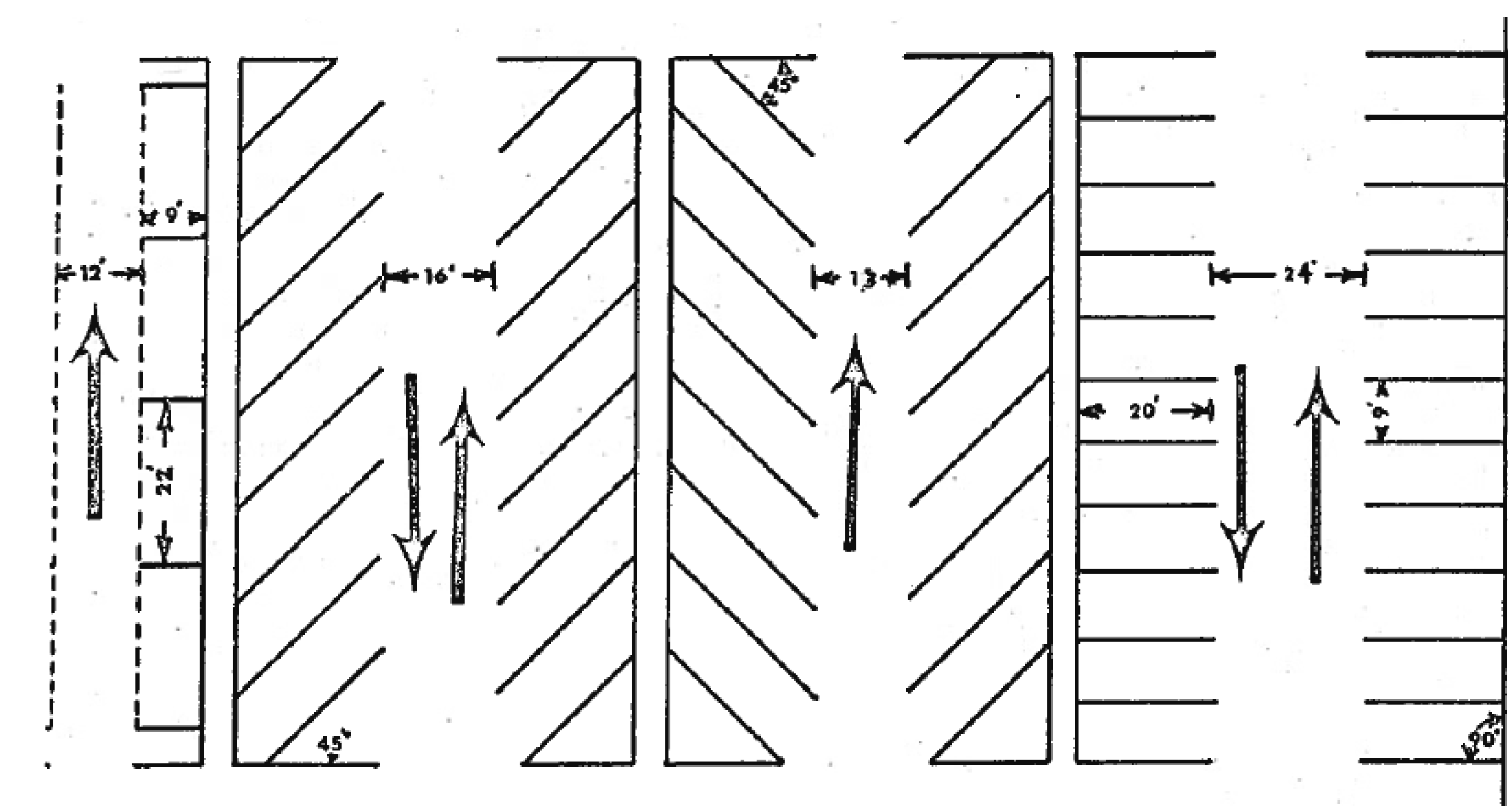
*Additional width may be required where the aisle serves as the principal means of access to on-site buildings or structures.
b.
In the event that the desired parking angle is not specified by the table in Subsection (f)(3)a of this section, the Zoning Administrator may specify other equivalent dimensions associated with the desired parking angle by interpolating from dimensions listed in the table.
(4)
Access. Each required off-street parking space shall open directly upon an aisle or driveway of such width as specified in the table in Subsection (f)(3)a of this section and designed to provide safe and efficient means of vehicular access to such parking space. All off-street parking facilities shall be designed with appropriate means of vehicular access to a street or alley in a manner that will least interfere with traffic movements.
(5)
Accessible parking. Please consult the Illinois Accessibility Code and the Americans with Disabilities Act for assessable parking regulations.
(6)
In yards. Off-street parking spaces in required setbacks shall conform to the following:
a.
Front yards.
1.
No parking and drive aisles are permitted in a required front setback except the interior one-half (½) of the front yard in an M-1 Limited Manufacturing District or M-2 Heavy Industrial District.
2.
Unless otherwise provided elsewhere in this chapter, parking is allowed in a front yard on a private driveway serving single-family and two (2) family dwellings but shall not be considered as satisfying the off-street parking requirements for such uses as set forth in this chapter.
b.
Side yards. Unless otherwise provided elsewhere in this chapter, parking is not permitted in any required side setback. Residential driveways, or parking in the A-1 zoning district is permitted in the required side setback with a minimum setback of five (5) feet from the lot line.
c.
Rear yards. Parking is permitted in any rear setback a minimum of five (5) feet with the following exceptions and requirements:
1.
In the M-1 Limited Manufacturing District or M-2 Heavy Industrial District when a rear yard is adjacent to an residential district there shall be no parking in the twenty (20) feet adjacent thereto.
2.
In any residential district no open off-street parking space shall be located nearer than ten (10) feet to a principal building.
(7)
Screening/perimeter landscaping. All required open automobile parking areas containing more than twenty (20) parking spaces shall be effectively screened as follows:
a.
On each side adjacent to any property situated in a residential district, business district, manufacturing district, or agricultural zoned property with a special use permit unless otherwise approved as part of the special use permit, a wall, fence, or densely planted compact hedge no less than three (3) feet in height across one hundred (100) percent of the length of the parking area is required. However, if the property owner can provide clear evidence indicating that less screening is required, the Regional Planning Commission may approve a reduction in the requirements of this section. Such decisions may be appealed to the Planning, Building and Zoning Committee.
b.
On each side across a public right-of-way from any property situated in a residential district, business district, manufacturing district, or agricultural zoned property with a special use permit unless otherwise approved as part of the special use permit, the landscaping shall consist of one (1) of the following options:
1.
A berm that is at least two (2) feet higher than the finished elevation of the parking lot (at the nearest point) and a minimum of one (1) tree and ten (10) shrubs for every thirty (30) feet of frontage shall be provided. Shrubs shall be placed on the property such that parking or vehicular uses are screened from view as seen from the street or neighboring properties. Perennials and groundcovers are encouraged to compliment the site design. All berms shall maintain a ten (10) foot setback from the edge of the existing or future right-of-way, whichever is greater.
2.
A minimum two (2) foot grade drop from the right-of-way line to the parking lot and a minimum of one (1) tree and ten (10) shrubs for every thirty (30) feet of frontage shall be provided. Shrubs shall be placed on the property such that parking or vehicular areas are screened from view as seen by the street or neighboring properties. Perennials and groundcovers are encouraged to compliment the site design.
3.
A wall, fence or natural vegetative screening no less than three (3) feet in height along the length of the parking area.
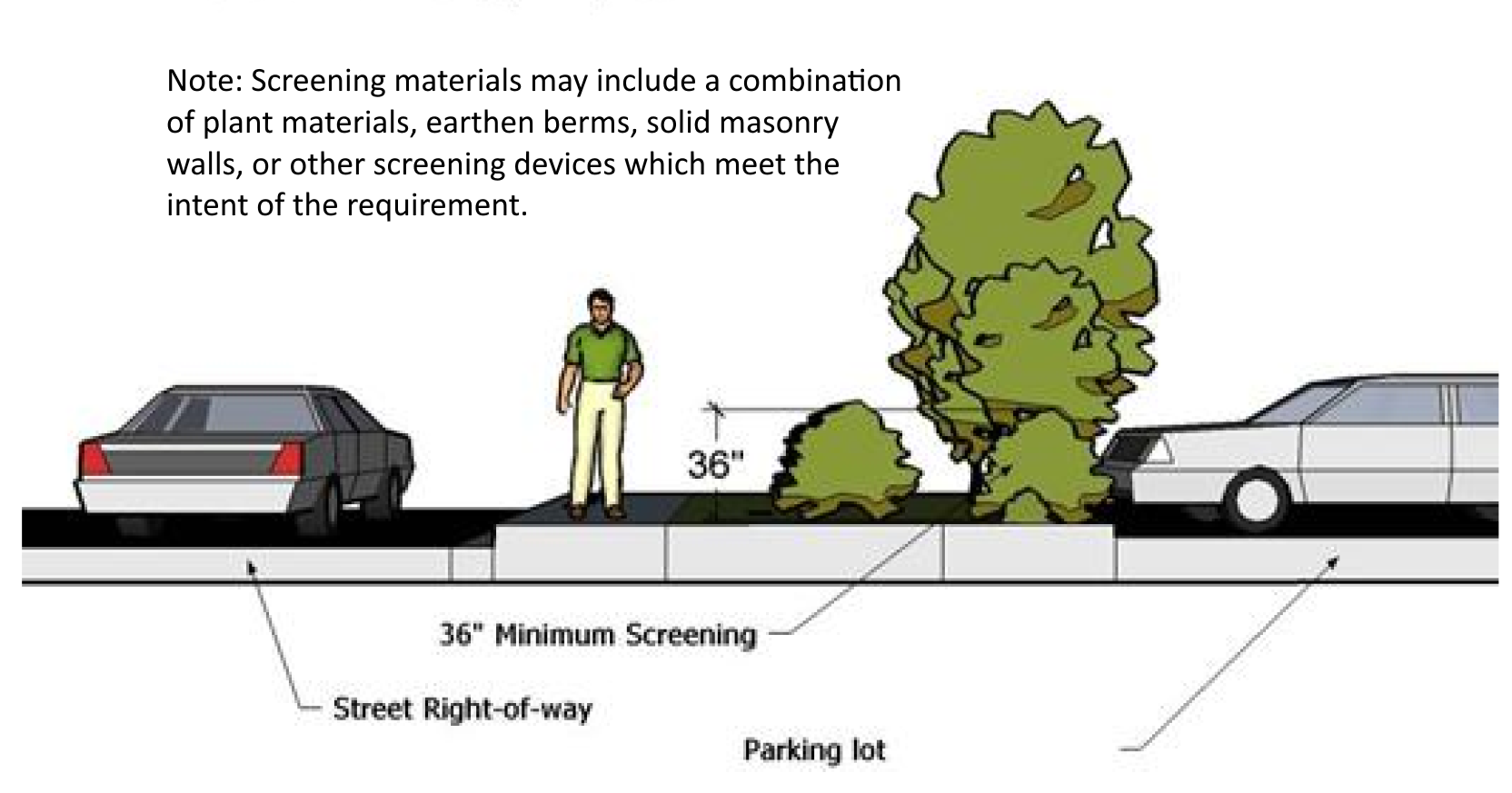
However, if the property owner can provide clear evidence indicating that less landscaping is required, the Regional Planning Commission may approve a reduction in the requirements of this section. Such decisions may be appealed to the Planning, Building and Zoning Committee.
c.
The minimum size for plant materials (at time of installation) shall be as follows:
1.
Shade tree: two and one-half (2½) inch caliper.
2.
Evergreen tree: six (6) feet height.
3.
Ornamental tree: two (2) inch caliper single trunk or six (6) feet height multi-trunk.
4.
Shrubs: twenty-four (24) inches in height.
d.
All driveways crossing a public sidewalk shall have a clear sight triangle inside the property measuring eight (8) feet by eight (8) feet.
(8)
Circulation. Circulation controls, including signs, landscape islands, and pavement markings, are encouraged and may be required by the Zoning Administrator only where safety concerns suggest a clear need for such enhancements.
(9)
Landscaped parking lot islands. Landscaped parking lot islands are encouraged.
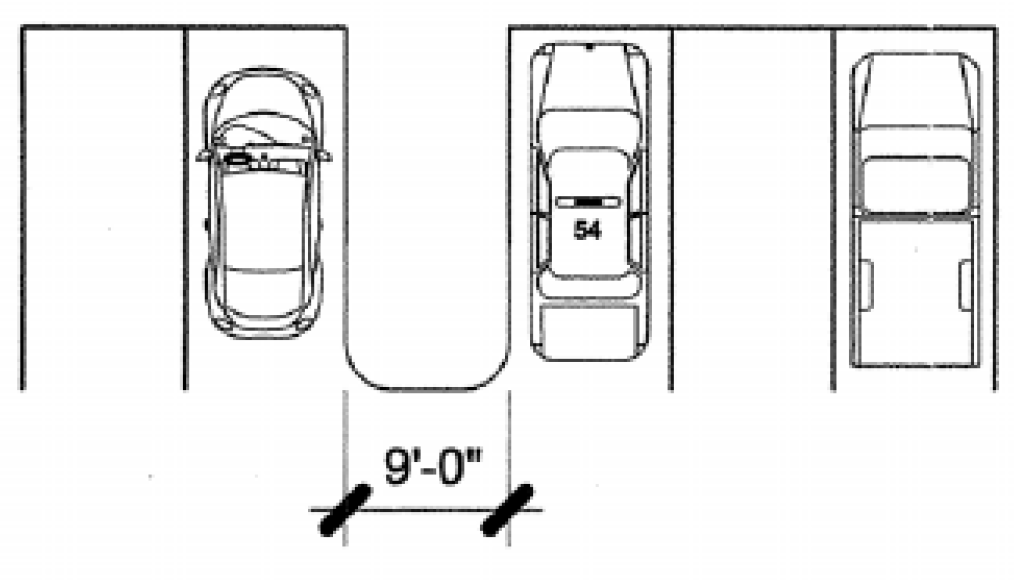
Minimum Required Width For Island - Parallel Spaces
(10)
Landscape sight triangle. No landscaping, including berms and vegetable gardens as defined by the Garden Act (505 ILCS 87/1 et seq.), shall be planted within a forty (40) foot sight triangle measured at the intersection of two (2) public streets.
(11)
Lighting. All off-street parking and loading facilities, other than residential driveways, shall be illuminated as approved during submittal of the final review phase (special use, final RPD, site plan review or amendments to the parking lot layout). Lighting shall be in accordance with the standards of Illuminating Engineering Society of North America (IESNA) as follows:
a.
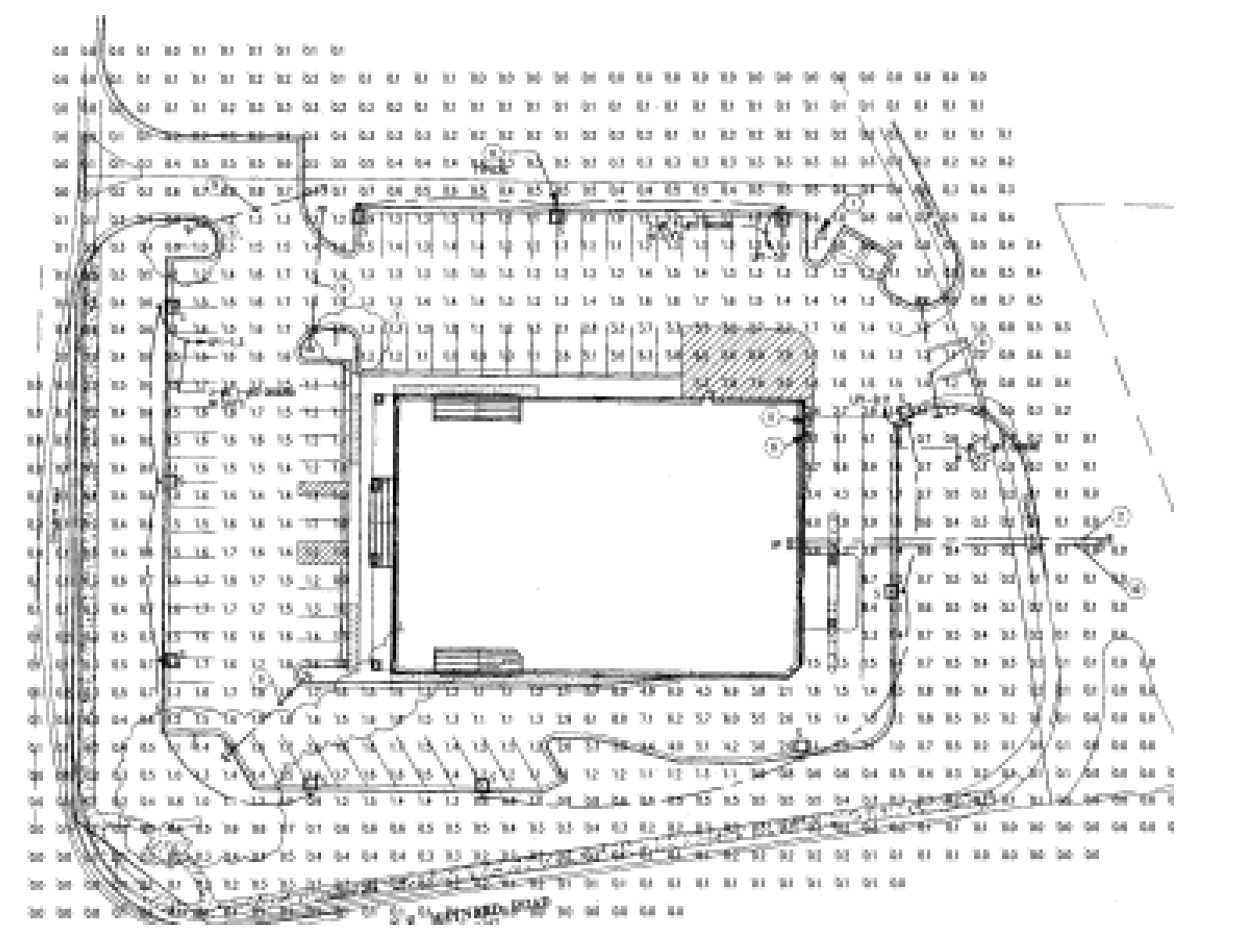
A photometric plan will be required as a supporting document for parking lots with equal to or greater than thirty (30) parking spaces. Said photometric plan must show the locations, size, height, orientation, design, construction details, catalog cuts and plans for all of the outdoor lighting and signs, including wall-mounted lighting. The plan must show the levels of illumination measured in horizontal footcandles at ground level in a regularly spaced grid pattern extending sufficiently past the project property lines. A catalog sheet showing the proposed lighting fixtures must be included. Example:
b.
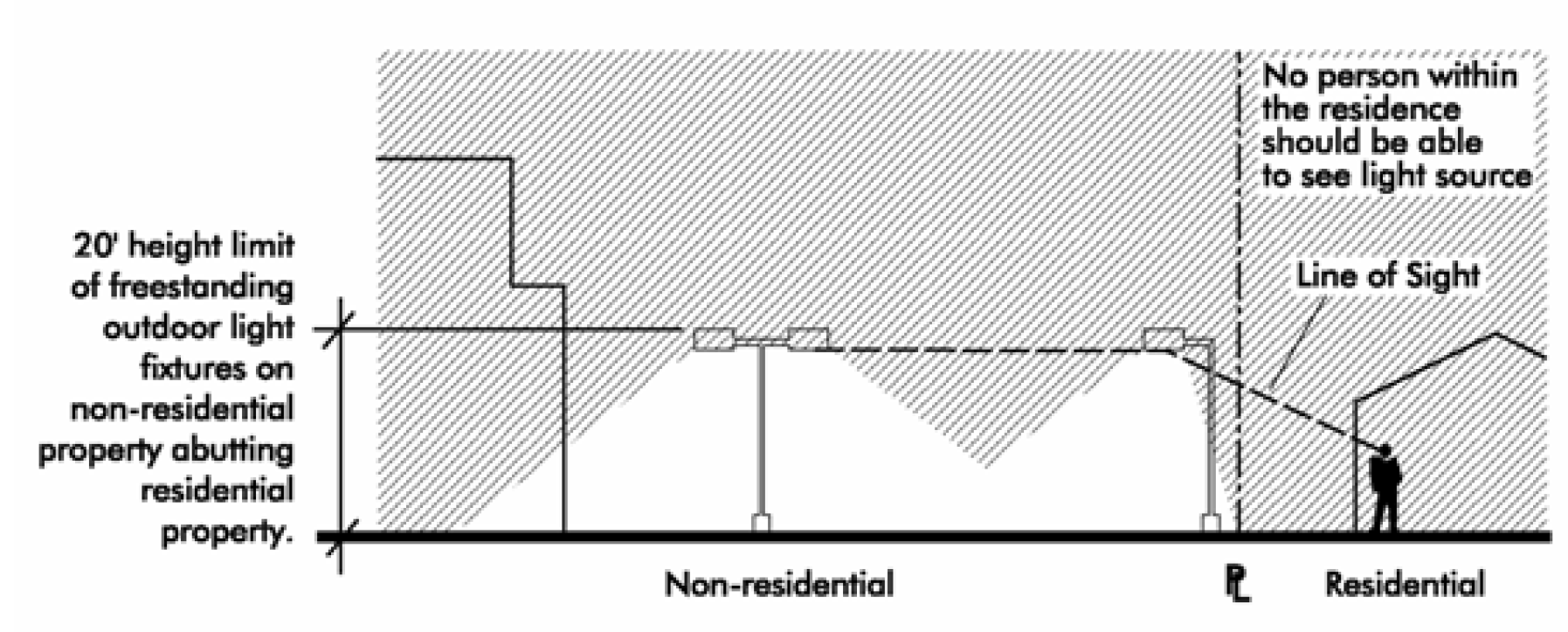
To reduce glare onto adjacent properties, only fully shielded or cut-off light fixtures are allowed. Fully shielded means that no light is emitted above the horizontal plane of the luminaries. Flat lenses are allowed. Sag lenses and wall packs are prohibited. Abutting or nearby residential properties shall not be able to see the actual light source unless the luminaries are less than one hundred (100) watt incandescent.
c.
All under-canopy lights must be fully recessed into the canopy.
d.
1.
Where nonresidential sites are adjacent to residential sites (existing or future residential areas as shown on the officially adopted version of the Land Resource Management Plan), the light level at the property line produced by the nonresidential lighting shall not exceed two-tenths (0.2) footcandles. The lighting shall be designed to avoid casting direct light or glare onto the adjacent residential property. Acceptable means to prevent glare or direct light onto the residential property include pole/luminary-mounted shields and dense vegetation. On abutting nonresidential properties (existing or future nonresidential as shown on the officially adopted version of the Land Resource Management Plan), or public streets the maximum illumination at the property line shall be five (5.0) footcandles. Where residential is across a street, the maximum illumination at the use's boundary shall be two (2.0) footcandles.
2.
Higher maintained footcandle levels may be appropriate for certain uses such as illuminated ball fields, auto dealerships, or gas stations. In such instances, information will be reviewed during site plan review. The Zoning Administrator may approve higher light levels for specific uses during the review process without the need for a variation. The Zoning Administrator may refer such instances to the Planning, Building, and Zoning Committee of the County Board. Such decisions made by the Zoning Administrator may be appealed to the Planning, Building, and Zoning Committee of the County Board.
e.
The maximum mounting height (including fixture, pole and base) for light standards located in a parking lot shall not exceed twenty (20) feet measured from ground level to the base of the lens.
f.
All nonresidential lighting is required to be turned off no later than sixty (60) minutes after business hours, only leaving lighting necessary for site security, unless otherwise approved by the Planning, Building, and Zoning Committee of the County Board.
g.
Nonresidential outlot lighting fixtures must be architecturally compatible with fixtures used elsewhere in the development.
h.
Decorative seasonal lighting shall be limited to a power rating of less than or equal to seventy-five (75) watts.
(12)
Repair and service. No motor vehicle repair work for compensation or sale of gasoline and motor oil of any kind shall be permitted in conjunction with open accessory off-street parking facilities provided in a residential district, except as may be permitted under an approved special use or planned unit development.
(Ord. No. 2020-17, exh. L, § 11:02, 9-15-2020; Ord. No. 2022-03, art. VIII, 1-18-2022)
Sec. 36-1014. - Location of accessory off-street parking facilities.
The location of off-street parking spaces in relation to the use served shall be as prescribed hereinafter. All distances specified shall be walking distances between such parking spaces and a main entrance to the use served.
(1)
For uses in a residential district, parking spaces accessory to dwelling shall be located on the same zoning lot as the use served.
(2)
For uses in business and manufacturing districts, all required parking spaces shall be within one thousand (1,000) feet from the entrance of the principal building being served. Spaces accessory to dwelling units (not including hotels) shall be within three hundred (300) feet of the use served. However, no parking spaces accessory to a use in a business or manufacturing district shall be located in a residential district, except that private, free, off-street parking accessory to such uses may be allowed by special use permit, in accordance with Article II of this chapter, in any residential district within two hundred (200) feet of and adjacent to any business or industrial use.
(Ord. No. 2020-17, exh. L, § 11:03, 9-15-2020)
Sec. 36-1015. - Schedule of parking requirements.
(a)
For the following uses, accessory off-street parking spaces shall be provided as required hereinafter. However, if the property owner can provide clear evidence indicating that less parking is required, the Regional Planning Commission may approve a reduction in the requirements of this section. Such decisions may be appealed to the Planning, Building and Zoning Committee. Parking spaces required on an employee basis shall be based on the maximum number of employees on duty or residing, or both, on the premises at any one time.
(b)
For uses not listed heretofore in Subsection (a) of this section, parking spaces shall be provided on the same basis as required for the most similar listed use, or as determined by the Zoning Administrator. Such determination may be appealed to the Regional Planning Commission or determined as part of review of an application for special use permit.
(Ord. No. 2020-17, exh. L, § 11:04, 9-15-2020)
Sec. 36-1016. - Parking and storage of recreational vehicles, recreational trailers, trailers and mobile homes.
(a)
Storage of unoccupied recreational vehicles, trailers and mobile homes.
(1)
Unoccupied recreational vehicles, trailers and their contents may be located on lots in any district, provided they comply with the following regulations:
a.
The number of recreational vehicles and trailers on a lot shall not be restricted when such recreational vehicles or trailers are located within the interior of a permitted structure or when fully screened from adjacent property. Screening shall consist of permitted solid fencing, structures, or evergreen landscaping such that the vehicle does not exceed the height of the permitted screening and so that the vehicle is not directly visible from adjacent properties when viewed at ground level.
b.
1.
Recreational vehicles trailers and their contents not stored within a permitted structure shall comply with the following parking requirements:
(i)
Except for the A-1, R-1, R-2 and R-3 districts, unless otherwise permitted in Section 36-1013, such vehicles shall be parked on a hard-surfaced all-weather pad constructed of concrete, asphalt, brick or stone pavers or comparable material.
(ii)
Recreational vehicles, trailers and their contents may not encroach into a required front, corner or side yard setback, shall not block any portion of a sidewalk or trail and shall not be parked or stored in a way that obstructs the visibility of oncoming traffic so as to create a safety hazard.
(iii)
Recreational vehicles may be stored or parked within a required rear or interior side yard setback.
2.
Exception:
(i)
An owner of a recreational vehicle located on property in an R-4, R-5, R-6 or R-7 residential district which cannot comply with the front yard setback provisions of the applicable zoning district as of June 20, 2006, and that has registered said vehicle with the County Planning, Building and Zoning Department, may be permitted to store such vehicle within the front yard setback provided said encroachment does not obstruct the required sight distance triangle, in the case of a corner lot, or create an obstruction so as to compromise the safety of pedestrians or other vehicles operating within the road right-of-way (ROW). Said exemption shall apply to the original recreational vehicle registered and any replacement of said recreational vehicle.
(ii)
This exception shall be non-transferable to any subsequent owners or occupants of the property and shall terminate upon either the sale of the property or change in occupancy of the dwelling unit should the owners choose to maintain it as a rental property.
(iii)
Owners shall be required to register their properties with the Planning, Building and Zoning Department on a form approved by the Department prior to December 29, 2006. The Planning, Building and Zoning Department shall keep a copy of the registration form and approved parking plan on file. Upon sale of the property, the owner shall be required to notify the Planning, Building and Zoning Department in writing and the Planning, Building and Zoning Department shall note in the file that the exemption has been terminated.
c.
When recreational vehicles or trailers and their contents are not fully screened from adjacent properties, the maximum number of unscreened recreational vehicles or trailers permitted to be parked or stored on a zoning lot shall be in accordance with the following table:
(2)
The number of unscreened recreational vehicles, trailers and their contents parked or stored on a lot in a residential district may exceed the number presented in the table above only under the following circumstances:
a.
For the purposes of conducting maintenance on, or the loading and unloading of, a recreational vehicle or trailer in preparation for a trip or similar recreational use, provided the duration does not exceed seventy-two (72) hours within a one (1) week period.
b.
When a visiting guest or relative of the property owner is in possession of, a recreational vehicle. The time period during which the recreational vehicle may be parked or stored on the lot shall be limited to fourteen (14) consecutive days within a one (1) year period or twenty-one (21) days (non-consecutive) within a one (1) year period unless otherwise approved in writing by the Zoning Administrator.
(3)
Unoccupied mobile homes can be stored only in commercial and industrial districts only as part of a permitted trailer storage or sales business.
(b)
Occupied recreational trailers and mobile homes.
(1)
Occupied recreational trailers and mobile homes may be located in "recreational camps" and subject to the standards and conditions of a special use permit.
(2)
Occupied recreational trailers and mobile homes may be located in residential districts only if:
a.
The preexisting home was made unsafe for occupancy by fire, tornado, flood, or other disaster; and
b.
The occupants will be the future occupants of the home to be repaired or constructed on the same zoning lot.
c.
When a visiting guest or relative of the property owner is in possession of a recreational vehicle. The time period during which the recreational vehicle may be occupied and stored on the lot shall be limited to fourteen (14) consecutive days within a one (1) year period or twenty-one (21) days (non-consecutive) within a one (1) year period unless otherwise approved in writing by the Zoning Administrator. This provision shall also apply to properties zoned A-1 Agricultural.
(3)
Occupied mobile homes utilized for the following purposes may be located in A-1 Agricultural Districts subject to the following restrictions:
a.
Medical care assistance.
1.
Limited to one (1) per zoning lot, provided the individual occupying the mobile home provides medical care or assistance to the occupant of the primary residence on the same zoning lot; and
2.
That the zoning lot on which the mobile home and principal residence to which it is accessory are located must be of sufficient size to provide a lot area of at least one hundred thirty thousand (130,000) square feet for each dwelling unit.
3.
Shall comply with all zoning and permit requirements and fees of the County.
b.
Temporary housing.
1.
Limited to one (1) per zoning lot, provided the individuals residing in said temporary housing will be the future occupants of a home to be repaired or constructed on the same zoning lot;
2.
Mobile homes serving as temporary housing for the repair or reconstruction of a farm residence are exempt from all zoning regulations and permit fees except those fees and permits as may be required per the County's floodplain regulations and fees, and the setback standards of the A-1 Agricultural District.
c.
Agricultural labor housing. Where the occupant is an individual whose employment is related to agricultural activities on the same zoning lot, the mobile home is exempt from all zoning regulations and permit fees except those fees and permits as may be required per the County's floodplain regulations and the setback standards of the A-1 Agricultural District. In addition, the zoning lot on which the mobile home and principal residence to which it is accessory are located must be of sufficient size to provide a lot area of at least one hundred thirty thousand (130,000) square feet for each dwelling unit.
d.
ECHO housing. Echo housing, provided such use complies with the provisions of Section 36-283(3).
(c)
Installation.
(1)
Occupied mobile homes must comply with the County regulations for sewage disposal.
(2)
Occupied mobile homes must comply with State regulations for tie-downs.
(3)
Wheels, tongue and hitch must remain attached.
(4)
Occupied mobile homes must be placed on piers having depth below the frost line.
(5)
Any stairs, decks, or other "add-ons" must comply with the County building regulations.
(d)
Permits.
(1)
Permits are required for recreational trailers and mobile homes that are to be occupied with the exception of those situations permitted under Subsection (b)(2)c of this section.
(2)
Occupied recreational trailers and mobile homes subject to permit requirements must show evidence of compliance with Federal HUD regulations or applicable State law.
(3)
Permits and annual renewals may be approved by the Zoning Administrator as follows:
a.
Medical care or assistance: Permits may be renewed annually provided a doctor's certification is provided indicating assistance is still required.
b.
New home construction or repair: Permits may be issued for a period of up to one (1) year and may be extended by the Planning, Building and Zoning Director by six (6) months if the applicant shows adequate progress in construction.
(4)
Permits may be rescinded by the PBZ Committee for failure to conform to this chapter.
(5)
Recreational trailers and mobile homes must be removed from the zoning lot within sixty (60) days of notice of the rescinded or expired permit, unless otherwise allowed by ordinance.
(6)
Permits for a temporary mobile home must be renewed annually or as stated above. The PBZ Committee may extend permits beyond the one (1) year and six (6) month limit as stated in Subsection (d)(3)b of this section. When the permit expires or when occupants of the trailer or mobile home do not meet the conditions set forth above, the trailer or mobile home must be removed within sixty (60) days.
(7)
Fees.
a.
Permit application form must be accompanied by a fee set by the County Board. Such fee is not refundable.
b.
An annual fee set by the County Board will be required on or before the renewable date stated on the approved permit.
(e)
Affidavit. All applications for a permit shall be accompanied by an affidavit, stating as follows:
(1)
Names and addresses of occupants.
(2)
Location of use.
(3)
Description of trailer.
(4)
Reason for application.
(5)
Statement that a change in usage, name or number of occupants, location, will be reported to the building and Zoning Office immediately.
(Ord. No. 2020-17, exh. L, § 11:05, 9-15-2020; Ord. No. 2023-19, § II, 5-16-2023)
Sec. 36-1017. - Additional regulations for off-street loading.
(a)
Location. All required loading berths shall be located on the same zoning lot as the use served. No loading berth for vehicles over two (2) tons' capacity shall be closer than fifty (50) feet to any property in a residential district unless completely screened by building walls, or a uniformly painted solid fence, natural vegetation screening providing one hundred (100) percent opacity, wall or any combination thereof, not less than six (6) feet in height. No permitted or required loading berth shall be located within thirty-five (35) feet of the nearest point of intersection of any two (2) streets.
(b)
Size. Unless otherwise specified, a required loading berth shall be at least twelve (12) feet in width by at least thirty (30) feet in length, exclusive of aisles and maneuvering space, and shall have a vertical clearance of at least fourteen (14) feet.
(c)
Access. Each required off-street loading berth shall be designed with appropriate means of vehicular access to a street or alley in a manner which will least interfere with traffic movements.
(d)
Surfacing. All open off-street loading berths shall be improved with a concrete pad.
(e)
Repair and service.
(1)
No motor vehicle repair work or service of any kind shall be permitted in conjunction with loading facilities provided in any residential, manufacturing or business district.
(2)
Space allocated to any off-street loading shall not, while so allocated, be used to satisfy the space requirements of any off-street parking facilities or portions thereof.
(f)
Landscaping for loading docks.
(1)
The landscaping shall consist of one (1) of the following options:
a.
A berm that is at least four (4) feet higher than the finished elevation of the loading dock (at the nearest point) and a minimum of one (1) tree and ten (10) shrubs for every thirty (30) feet of frontage shall be provided. Shrubs shall be placed on the property such that vehicular uses are screened from view as seen from the street or neighboring properties. Perennials and groundcovers are encouraged to compliment the site design.
b.
A minimum two (2) foot grade drop from the right-of-way line to the parking lot and a minimum of one (1) tree and ten (10) shrubs for every thirty (30) feet of frontage shall be provided. Shrubs shall be placed on the property such that parking or vehicular areas are screened from view as seen by the street or neighboring properties. Perennials and groundcovers are encouraged to compliment the site design.
c.
A wall, fence or natural vegetative screening no less than four (4) feet in height across the length of the loading dock.
(2)
The minimum size for plant materials (at time of installation) shall be as follows:
a.
Shade tree: two and one-half (2½) inch caliper.
b.
Evergreen tree: six (6) feet height.
c.
Ornamental tree: two (2) inch caliper single trunk or six (6) feet height multi-trunk.
d.
Shrubs: twenty-four (24) inches in height.
(g)
Schedule of loading requirements. For the uses listed in the following table, off-street loading berths shall be provided on the basis of the gross floor of the building or portions thereof devoted to such uses in the amount shown herein:
(Ord. No. 2020-17, exh. L, § 11:06, 9-15-2020)

