
Portage City Zoning Code
ARTICLE XI
DEFINITIONS3
Editor's note— Ord. No. 14-8, §§ 1 and 2, adopted Aug. 5, 2014, repealed Art. XI and enacted a new article as set out herein. The former Art. XI, §§ 90-11.1 and 90-11.2, pertained to similar subject matter and derived from Ord. No. 05-41, § 1, adopted Aug. 2, 2005; Ord. No. 06-55, §§ 1, 2, adopted Oct. 3, 2006; Ord. No. 10-19, Exh. B, adopted May 5, 2010; and Ord. No. 12-10, § 1, adopted June 5, 2012.
Sec. 90-11.1.- General.
The definitions contained in Article XI shall be observed and applied in the interpretation of all articles in the zoning ordinance, except where the context clearly indicates otherwise. Words used in the present tense shall include the future; words used in the singular number shall include the plural and the plural the singular; words used in the masculine gender shall include the feminine. Words no defined shall be defined by their common definitions.
(Ord. No. 14-8, § 2, 8-5-14)
Sec. 90-11.2. - Defined words.
The following terms shall have the following meanings:
Abandonment. The relinquishment of property or a cessation of the use of the property for a continuous period of one year by the owner with the intention neither of transferring rights to the property to another owner nor of resuming the use of the property.
Above ground utility facility. A permanently located and installed utility structure, including but not limited to electrical substations, generators, pipeline pumping stations, and telephone exchanges. For purposes of this zoning ordinance, typical utility facilities that are required as a part of a development/subdivision are not included in this definition.
ADA. Americans with Disabilities Act.
Adjacent property. See Property, Adjacent.
Advisory plan commission. A plan commission serving a single local government jurisdiction established as defined under IC 36-7-1-2 (1983) as amended. The City of Portage Advisory Plan Commission shall be the advisory plan commission/plan commission referred to by this zoning ordinance.
Airport. Any area of land designated and used for the landing and take-off of aircraft, including all necessary facilities for the housing and maintenance of said aircraft.
Alley. A public right-of-way, other than a street, road, crosswalk, or easement that provides secondary access for the special accommodation of abutting property.
Alteration. Any change, addition, or modification in construction or use of an existing structure or property.
Amateur radio tower. A freestanding or building mounted structure, including any base, tower, or pole, antenna and appurtenances, intended for airway communication purposes by a person holding a valid amateur radio license from the Federal Communications Commission.
Animal. Any live vertebrate creature, domestic or wild, excluding human beings.
Animal, domestic. Animals commonly used as household pets, protection, companions, and for the assistance of disabled persons. Domestic pets shall include animals that are cared for and treated in a manner acceptable for pet dogs, cats, and birds. Domestic pets shall include, but not be limited to, dogs, cats, parakeets, parrots, finches, lizards, spiders, guinea pigs, hamsters, gerbils, rats, mice, rabbits, aquarium fish, pot belly pigs, ferrets, and snakes if cared for in the manner described above.
Animal, farm. Any animal that customarily is raised for profit on farms and has the potential of causing a nuisance outside of rural areas or if not properly maintained.
Animal boarding. A commercial facility for the feeding, grooming, exercising, training, boarding or maintaining of domestic animals.
Antenna. Any system of wires, poles, rods, reflecting discs, or similar devices used for the purpose of receiving and/or transmitting signals, images, sounds, or information of any nature by radio, visual, or electromagnetic waves, including, but not limited to, directional or omni-directional antennas, panels, and microwave or satellite dishes external or attached to the exterior of any building.
Applicant. A person, persons, or company who owns a lot (or person who is authorized by the owner to act in relation to the lot) who makes application to the plan commission, board of zoning appeals, development review committee, and/or department of community planning and development for action affecting the lot owned under the terms of this zoning ordinance.
Application. The completed form or forms, together with any required materials, exhibits, and fees required of an applicant consistent with the procedures established by this zoning ordinance.
Appurtenance. A minor element of a larger structure, such as a bay window, stairs, light post, etc.
Assisted living facility. A residential facility where assistance with daily activities, such as taking medicine, dressing, grooming, and bathing are provide for the aged or infirm, or any other reasonably independent person in need of nursing/additional care; and which does not contain equipment for surgical care or for treatment of disease or injury, and is not primarily designed for patients being treated for mental illness or alcohol or drug addiction. Assisted living facilities have private rooms that are not shared by non-related persons.
Assisted living home. A residential home where assistance with daily activities, such as taking medicine, dressing, grooming, and bathing are provide for the aged or infirm, or any other reasonably independent person in need of nursing/additional care; and which does not contain equipment for surgical care or for treatment of disease or injury, and is not primarily designed for patients being treated for mental illness or alcohol or drug addiction. Assisted living homes shall provide care for no more than six residents at a time.
Auto repair center. A facility where the following services may be conducted: general repair, engine rebuilding, rebuilding or reconditioning of automobiles; collision service, such as body, frame, or fender straightening and repair; and/or overall painting and undercoating of vehicles.
Auto sales facility. The use of any lot or property, or portion thereof, for the conducting of any business involving the sale and/or rental of any automobile, truck, van and/or motorcycle, whether new or used. Such facilities may have an in-house service or repair component or other incidental use. For purposes of this zoning ordinance, this definition shall not prohibit the sale of up to two personally owned vehicles on a residential property.
Auto service center. A facility where the following services may be conducted for the servicing or minor mechanical repair of automobiles: oil change shop, vehicle detailing/accessory shop, tire shop, and/or auto glass repair. This use does not include as its primary function the disassembly, rebuilding, and replacement of motor vehicle engines, transmissions, or other major machinery components, nor auto body repair or painting.
Awning. A roof-like cover often made of fabric, metal, or glass designed and intended for protection from the weather or as a decorative embellishment, and which projects from a wall or roof of a structure over a window, walk, or door. Awnings include those that may be retracted or folded against the face of a supporting building.
Bakery (commercial). A facility for preparing, cooking, baking, and wholesale selling of products intended for off-site distribution and retail sales. See food and beverage production.
Bakery (retail). An establishment primarily engaged in the retail sale of baked products for consumption off-site. The products may be prepared on-site or off-site. See restaurant.
Balcony. A platform that projects from the wall of a building and is surrounded by a railing or parapet.
Bank. A facility for the custody, loan, or exchange of products, typically money. Also included is the extension of credit and facilitating the transaction of funds. See office, financial.
Banquet hall. A building for the primary purpose of hosting a party, banquet, reception, or other social event.
Barber shop. An establishment or place of business within which the practice of cutting hair is engaged in or carried on by one or more employees. See personal services.
Base district zone. The zoning classification of a parcel of land prior to the approval of a planned development or the application of an overlay district.
Base flood elevation. The elevation, expressed in feet above mean sea level, which is subject to a one percent or greater chance of flooding in any given year.
Basement. The portion of a building below the first, or ground, floor level and having less than four feet of clearance from its ceiling to the average finished grade of the building perimeter. A basement must have a portion of the floor area below grade (ground level) on all sides.
Beauty salon. Any commercial establishment whereby cosmetology is offered or practiced on a regular basis for compensation. See personal services.
Bed and breakfast homestay. A private owner occupied residence with one to three guest rooms where travelers for compensation are lodged for sleeping purposes with at least a morning meal provided. Stays are not to exceed four weeks in any one year period. Meals at such an establishment shall only be served to guests taking lodging in the residence. A bed and breakfast homestay is subordinate and incidental to the main residential use of the building. Rooms used for sleeping shall be part of the primary residential structure and shall not have been specifically constructed for rental purposes. A separate bathroom must be maintained for the owner occupants. No exterior alterations other than sign and those required by law to ensure the safety of the structure shall be made. The homestay operation shall not use more than 50 percent of the floor area of the principal residence. Common areas such as the kitchens are not included in this calculation.
Bed and breakfast inn. A building with four to 20 guest rooms where travelers for compensation are lodged for sleeping purposes with at least a morning meal provided. Stays are not to exceed four weeks in any one year period. Meals at such an establishment shall only be served to guests taking lodging in the residence. No more than three guest rooms shall be served by one bathroom and if owner or manager occupied, a separate bathroom must be maintained for said owner or manager.
Berm. A man-made mound of earth of an established height and grade used for the purpose of landscaping, screening, or obscuring.
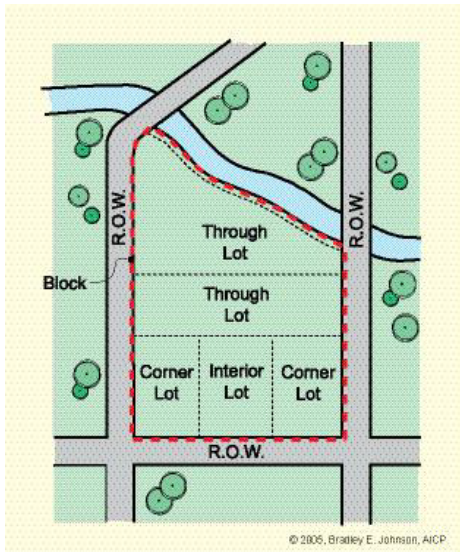
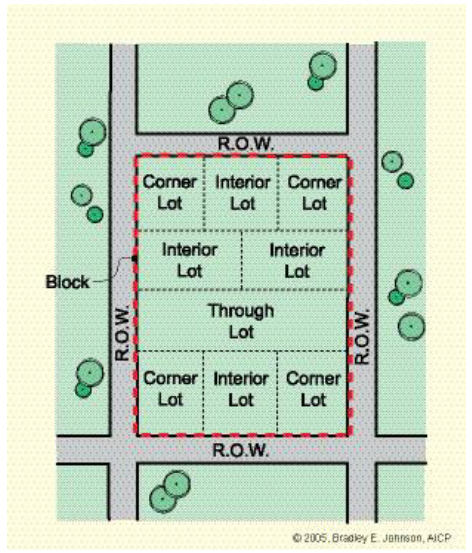
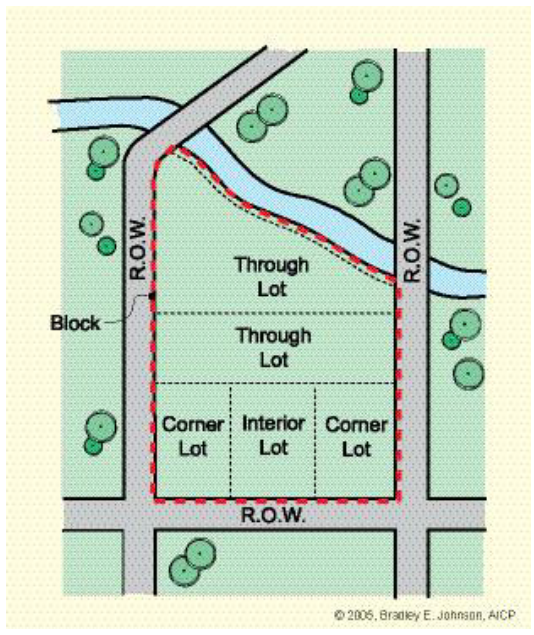
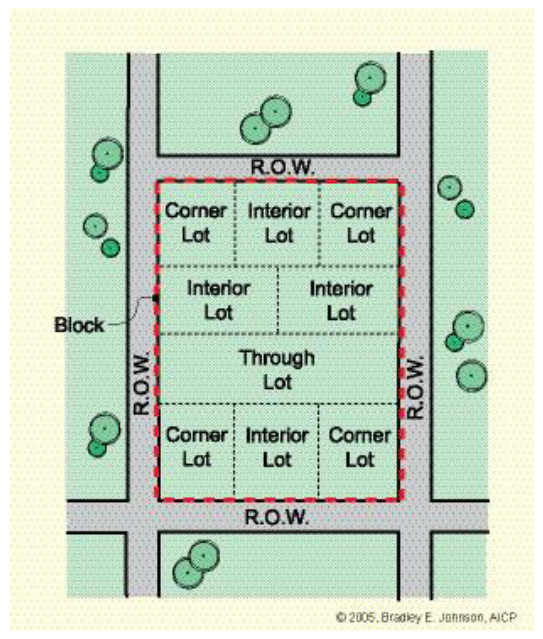
Block. Property abutting on one side of a street and lying between the two nearest intersecting streets (either crossing or terminating), railroad rights-of-way, lake, river, stream, or other physical boundary.
Board. See board of zoning appeals.
Board of zoning appeals. A board established consistent with IC 36-7-4-900 series. The City of Portage Board of Zoning Appeals is the board referred to by this zoning ordinance.
Bond. See surety.
Bookstore. A retail establishment that, as its primary business, engages in the sale, rental, or otherwise charge for use of books, magazines, greeting cards, postcards, video tapes, computer software, and/or any other printed or electronically conveyed media. See retail sales.
Bowling alley. An establishment that devotes a majority of its gross floor area (51 percent minimum) to bowling lanes, equipment, and laying areas. A bowling alley may include other incidental uses, such as other recreational activities, a restaurant, or bar. See commercial recreation facility.
Building. A structure having a roof, supported by columns or walls, for the shelter, support, or enclosure of persons, property, or animals. When separated by division walls from the ground up and without openings, each portion of such building may be deemed a separate building.
Building, accessory. See structure, accessory.
Building, attached. A building that is structurally connected to another by foundation, wall, or roofline.
Building, detached. A building that has no structural connection with the primary building or any other building or structure.
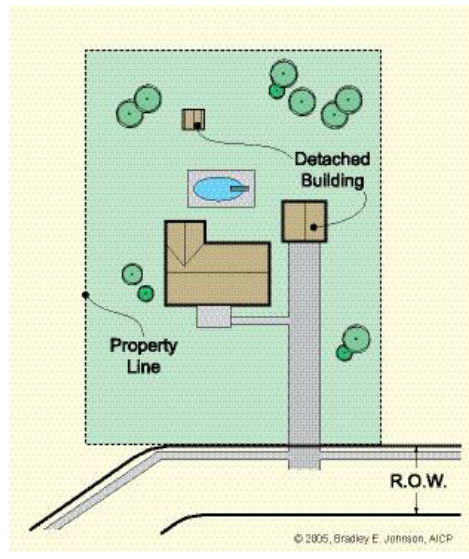
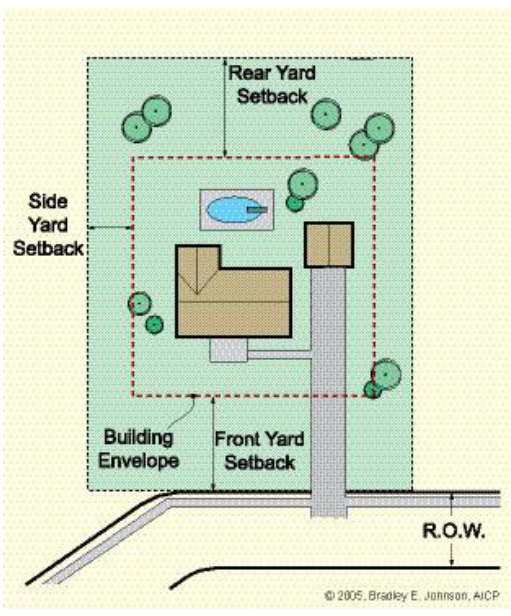
Building area. See building envelope.
Building code. The Indiana Building Code, which establishes the controls and standards for the construction of all forms of permanent structures and related matters. Also referred to as the City of Portage Building Code.
Building envelope. The maximum allowable construction/improvement area on a property. See diagrams below.
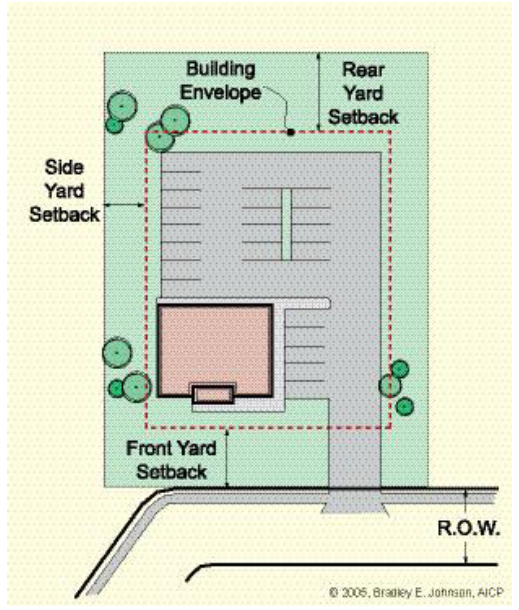
Building official. The person responsible for the enforcement of the City of Portage Building Code.
Building permit. An official certification issued by the building official authorizing the construction, alteration, enlargement, conversion, reconstruction, remodeling, rehabilitation, erection, demolition, moving, or repair to a building or other structure.
Business. The engaging in the purchase, sale, barter, or exchange of goods, wares, merchandise, or services, or the maintenance or operation of offices, recreational, or amusement enterprises.
BZA. See board of zoning appeals.
Car wash. The use of a property for the cleaning of passenger vehicles, recreational vehicles, or other light duty equipment.
Carport. A permanent structure, which includes a roof and roof supports but is not enclosed by walls, which is used as an accessory to a dwelling unit for the purpose of providing shelter to one or more vehicles.
Cellular communication equipment. Antennas and other transmitting and/or receiving devices or other associated devices used in the provision of telecommunications service.
Cemetery. Property used for interring of the dead. It includes any crematory, mausoleum, or mortuary operated in conjunction with and on the same property.
Central sewer system. A community sewer system including collection and treatment facilities owned and maintained by the City of Portage.
Certificate of occupancy. A certificate that is issued stating that the building, structure, site, and/or use had been constructed and complies with the provisions of this zoning ordinance, developer commitments, and all conditions of the plan commission, board of zoning appeals, and/or development review committee. A posting of surety may be accepted for incomplete requirements that will be completed as per a written agreement. The time period and amount of surety shall be determined by the director of community development or his/her designee.
Child care center. As defined by IC 12-7-2-28.4 for the purposes of IC 12-17.2-4 and this zoning ordinance, a nonresidential building where at least one child receives child care from a provider: (1) while unattended by a parent, legal guardian, or custodian; (2) for regular compensation; and (3) for more than four hours but less than 24 hours in each of ten consecutive days per year, excluding intervening Saturdays, Sundays, and holidays.
Child care home. As defined by IC 12-7-2-28.6 for the purposes of IC 12-17.2-5 and this zoning ordinance, a residential structure in which at least six children (not including the children for whom the provider is a parent, stepparent, guardian, custodian, or other relative or any child who is at least 14 years of age and does not require child care) at any time receive child care from a provider: (1) while unattended by a parent, legal guardian, or custodian; (2) for regular compensation; and (3) for more than four hours but less than 24 hours in each of ten consecutive days per year, excluding intervening Saturdays, Sundays, and holidays. The term includes a class I child care home and a class II child care home.
Child caring institution. As defined by IC 12-7-2-29 for the purposes of IC 12-26 and the zoning ordinance, an institution that: (1) operates under a license issued under IC 31-27-3; (2) provides for delivery of mental health services that are appropriate to the needs of the individual; and (3) complies with the rules adopted under IC 4-22-2 by the department of child services.
Church/place of worship. A facility principally used for people to gather together for public worship, religious training, or other religious activities. This use does not include home meetings or other religious activities conducted in a privately occupied residence.
City. City of Portage.
Club or lodge. A building used by an organized group of people for a common purpose that is social, philanthropic, cultural or educational in nature.
Clubhouse. A building used in association with a golf course, in which may be locker rooms, golf course administration offices, golf cart storage and maintenance, restrooms, lounges, meeting space, snack bar, banquet facilities and retail sales of golf related products. Retail sales shall constitute no more than 15 percent of the space accessible to public space of the club house.
College. See university.
Collocation. A space on an existing or proposed telecommunication tower that can be used for the installation and/or mounting of antennas or radio or cellular communication equipment that operates on a different frequency from the initial user.
Common area. Land within a development that is not individually owned or dedicated to the public, but which is designed and intended for the use, enjoyment, and maintenance of the property owners within that development or other specified area. The common area may include complimentary structures and/or other improvements.
Common council. Common council (city council) of the City of Portage, Indiana.
Community center. A building available to the public for community activities, meetings, banquets, projects, gatherings, and the like. A community center may be able to be reserved by the public for private parties and events.
Comprehensive plan. The City of Portage Comprehensive Plan. The plan includes goals, objectives, and strategies for land use, growth management, transportation/thoroughfares, community facilities and services, environmental concerns, infrastructure, aesthetics and identity, economic development, and parks and recreation. The plan was developed and adopted by the commission pursuant to IC 36-7-4-500 series and includes any part and/or policies separately adopted and any amendment to said plan and/or policies, or parts thereof.
Condition of approval. Stipulations or provisions set forth by the board of zoning appeals, plan commission, or development review committee required as a prerequisite for approval of a petition.
Concrete/asphalt production facility. A facility where raw materials are processed into concrete or asphalt for sale or immediate use. Facilities typically include all necessary equipment for both transport and application of the finished product.
Construction plans. Maps or drawings showing the specific location and design of improvements to be installed in accordance with the requirements of this zoning ordinance, the City of Portage Subdivision Control Ordinance, and the Indiana Building Code (IBC) as a condition of approval.
County. Porter County, Indiana.
Covenants. Private and legal restrictions of various kinds on the usage of lots, typically within a subdivision and applied by the subdivider. Unless specifically agreed to, covenants are not enforceable by the plan commission or its designees; however, they are enforceable in civil court by interested or affected parties.
Craft/fabric store. Any business that produces on the premises articles for sale of artistic quality or handmade workmanship, or business that primarily sells items and materials used in the creation of crafts and other such handiwork. See retail sales.
Cul-de-sac. See street, cul-de-sac.
Curb cut. The providing of vehicular ingress and/or egress between property and abutting public street.
Dance/martial arts studio. An establishment where patrons learn and/or practice dance or martial arts. See sports training facility.
DBH. Diameter-at-breast-height is a tree trunk diameter measured in inches at a height of 4.5 feet above the ground. If a tree splits into multiple trunks below 4.5 feet, the trunk is measured at its most narrow point beneath the split.
Deck. A platform, either freestanding or attached to a building, which is supported by pillars or posts.
Dedication. The voluntary transfer, or transfer as a condition of subdivision approval, of private property by its owner to the public for some public use, such as for streets or park land.
Deli (delicatessen). A store which sells cold cuts, cheeses, and a variety of salads, as well as (typically) a selection of unusual or foreign prepared foods. See restaurant.
Demolition. The complete removal or destruction of any structure excluding its foundation.
Density, gross. The numerical value obtained by dividing the total number of dwelling units in a development or area by the gross size of the area (in acres), including all nonresidential land use, rights-of-way, streets, and other features.
Density, net. The numerical value obtained by dividing the total number of dwelling units in a development or area of the actual tract of land (in acres) upon which dwelling units are located, or proposed to be located, including common open space, but excluding nonresidential uses, rights of way, and streets.
Design/planning office. See office, design/planning.
Designed fail area. The area surrounding a tower in which the tower may fall should it fail as structurally designed. The designed fail area is quantified in terms of linear distance from the tower to the perimeter of the designed fail area. A structural engineer licensed in the State of Indiana shall certify the area.
Detention area. An area that is designed to capture specific quantities of stormwater and to gradually release the water at a sufficiently slow rate in order to avert flooding.
Developer. An individual, partnership, corporation (or other agent thereof), or other entity that undertakes the responsibility for land development, particularly the designing of a subdivision plat or site development plan showing the layout of the land and public improvements involved therein. In as much as the subdivision plat is merely a necessary means to the end of assuring a satisfactory development, the term "developer" is intended to include the term "subdivider", even though the personnel involved in successive stages of the project may differ.
Development. Any man-made change to improved or unimproved real estate including, but not limited to: (1) construction, re-construction, or placement of a structure or any addition to a structure; (2) installation of a manufactured home on a site, preparing a site for a manufactured home or installing recreational vehicle on the site for a longer period than 180 days; (3) installing utilities, erection of walls and fences, construction of roads, or similar projects; (4) construction of flood control structures such as levees, dikes, dams, channel improvements, etc; (5) mining, dredging, filling, grading, excavation, or drilling operations; (6) construction and/or reconstruction of bridges or culverts; (7) storage of materials; or (8) any other activity that may change the direction, height, or velocity of flood or surface waters.
Development review committee. City of Portage Development Review Committee
Development standards. Regulations provided by this zoning ordinance that provide specific conditions for the development and use of buildings and property.
Display time. The amount of time a message and/or image is displayed on an electronic message center (EMC) sign.
Distribution facility. A use where goods are received and/or stored for delivery to the final consumer at remote locations.
District. An area with common social physical, economic, or land use characteristics.
Drainage. The outflow of water or other fluids from a site through either natural or artificial means.
Drainage system. All facilities, channels, and areas that serve to convey, filter, store, and/or receive stormwater, either on a temporary or permanent basis.
Drainage way. A man made conduit, open ditch, or drainage swale used to carry surface water runoff to a water body, watercourse, or public storm system.
DRC. See development review committee.
Drip line. An imaginary vertical line that extends from the outermost branches of a tree's canopy to the ground.
Drive, private. See street, private.
Drive-thru. A type of service provided by a business that allows customers to purchase products without leaving their cars. Orders are generally placed using a microphone and picked up in person at a window. For purposes of this zoning ordinance, gas bar pump islands and/or a car wash with dedicated bays are not included in this definition.
Driveway. A private roadway providing access for vehicles to a parking space, garage, dwelling, or other structure.
Driveway, common. An access shared by adjacent property owners.
Driving range. An area equipped with distance markers, clubs, balls, and tees for practicing golf shots and putting, which may or may not include a snack bar and pro shop, but does exclude golf courses and miniature golf courses. See commercial recreation facility.
Dry cleaners (commercial). A large scale establishment that cleans fabrics, textiles, wearing apparel, or articles of any sort by immersion and agitation in volatile solvents, and all related processes. Commercial cleaners serve businesses and clean uniforms, generally with the cleaners picking up and delivering the clothing to business clients.
Dry cleaners (retail). An establishment that cleans fabrics, textiles, wearing apparel, or articles of any sort by immersion and agitation in volatile solvents, and all related processes. Retail cleaners serve individuals on a walk-in basis, generally with patrons dropping off and picking up their clothing. See personal services.
Dune. A mound or ridge of loose sediments, usually sand based, lying landward of the beach, and deposited by natural or artificial means.
DU. Dwelling units.
Dumpster. A receptacle container that has a hooking mechanism that allows it to be raised and dumped into a sanitation truck, including dumpsters from trash, compacted materials, and recycling.
Dwelling. A building or structure or portion thereof, conforming to all requirements applicable to the district in which it is located, all building codes, and that is used exclusively for residential occupancy, including single-family dwelling units, two-family dwelling units, and multifamily dwelling units, but excluding hotels, motels, and boarding houses.
Dwelling, manufactured home. A single-family detached dwelling unit that is factory built to the National Manufactured Construction and Safety Standards Act in transportable section, or sections. Manufactured homes are divided into three categories, type I, II, and III as defined as follows:
•
Type I: A dwelling unit built in a factory bearing a seal of compliance with Federal Manufactured Housing Construction and Safety Standards (42 USCA 5401 et seq.) which is at least 23 feet in width for its entire length; has at least 950 square feet of occupied space; is installed and anchored on a permanent foundation with perimeter wall, according to the Indiana One- and Two-Family Dwelling Code, as amended; and its pitched roof and siding are of materials customarily used for site constructed dwellings.
•
Type II: A dwelling unit built in a factory bearing a seal of compliance with Federal Manufactured Housing Construction and Safety Standards (42 USCA 5401 et seq.) which is at least 320 square feet of occupied space; is installed and anchored on a permanent foundation with perimeter wall, according to the Indiana One- and Two-Family Dwelling Code, as amended; and its pitched roof and siding are of materials customarily used for site constructed dwellings.
•
Type III: A dwelling unit built in a factory bearing a seal of compliance with Federal Manufactured Housing Construction and Safety Standards (42 USCA 5401 et seq.) that does not meet the minimum requirements stated for Type I and Type II manufactured homes.
Dwelling, mobile home. A transportable dwelling unit that is a minimum of eight feet in width and is built on a permanent foundation when connected to the required utilities, and includes the plumbing, heating, air conditioning, and electrical system contained therein, and which was manufactured either (1) prior to June 15, 1976, and bears a seal attached under Indiana Public Law 135, 1971 certifying that it was built in compliance with the standards established by the Indiana Administrative Building Council, or (2) subsequent to, or on June 15, 1976, and bears a seal, certifying that it was built in compliance with the Federal Mobile Home Construction and Safety Standards.
Dwelling, multi-family. A building containing three or more dwelling units. The dwelling units are located on the same property.
Dwelling, multi-family (upper stories). A group of two or more dwelling units located above the main level in a mixed use building.
Dwelling, single-family (attached). A building which contains solely one dwelling unit and which is "attached" side by side to at least one other dwelling unit. Each dwelling is located on a separate lot.
Dwelling, single-family (detached). A building which contains solely one dwelling unit and which is not attached to any other building. A single-family dwelling shall be at least 23 feet in width for 60 percent of its length.
Dwelling, single-family (upper stories). One dwelling unit located above the main level in a mixed use building.
Dwelling, two-family. A building which contains solely two dwelling units and which is not attached to any other building. The two dwelling units are located on a one lot.
Dwelling site. A site within a manufactured home park and/or mobile home park with required improvements and utilities that is leased for the long-term placement of a manufactured home and/or mobile home.
Dwelling unit. Any building or portion thereof designed for or used for residential purposes as a self-sufficient or individual unit by one family or other similar social association of persons as a single housekeeping unit, and having permanently installed sleeping, cooking, and sanitary facilities.
Easement. A grant by a property owner (grantor) to a specific person, the general public, corporations, utilities, or others (grantee or easement holder), for the purpose of providing services or access to the property.
Employment service. An establishment that seeks and identifies available jobs for patrons seeking employment. See office, general.
Erosion. The detachment, movement, and wearing away of soil and rock fragments by flowing surface of subsurface water or by wind.
Executive secretary. The officer delegated the responsibility for the administration of the zoning ordinance's regulations by the plan commission.
Expressway. Any roadway that operates at a high service level, consists of limited access, is divided, carries region-wide traffic and is generally classified as part of the interstate system.
Facade. The portion of any exterior elevation on a building, extending from grade level to the top of the parapet, wall, or eaves for the entire width of the building.
Fair housing facility (Type 1). To prevent the discrimination of mentally or physically disabled persons, these facilities have been identified as types of housing that are permitted in any single-family or multi-family residential zoning districts, but still must meet "nondiscriminatory" health, fire, safety and building regulations. These facilities include:
Group homes for children in need of service under IC 31-34-1 or children who have committed a delinquent act under IC 31-37-2-2, IC 31-37-2-3, or IC 31-37-2-5; and specifically a facility that houses not more than ten children.
Residential facility for the developmentally disabled which provides residential services for eight developmentally disabled individuals or less as described in IC 12-28-4-8.
Fair housing facility (Type 2). To prevent the discrimination of mentally or physically disabled persons, these facilities have been identified as types of housing that are permitted in certain districts, but still must meet "nondiscriminatory" health, fire, safety and building regulations. These facilities include:
Group homes for children in need of service under IC 31-34-1 or children who have committed a delinquent act under IC 31-37-2-2, IC 31-37-2-3, or IC 31-37-2-5; and specifically a facility that houses more than ten children.
Residential facility for the developmentally disabled which provides residential services for more than eight developmentally disabled individuals as described in IC 12-28-4-8.
Residential facility for the mentally ill which provides residential services for mentally ill individuals as described in IC 12-28-4-7. A zoning ordinance may exclude a residential facility for individuals with a mental illness from a residential area if the residential facility will be located within 3,000 feet of another residential facility for individuals with a mental illness, as measured between lot lines.
Family. Two or more persons related by blood, marriage, or adoption living together as a single housekeeping unit in a dwelling unit. Also see housekeeping unit.
FCC. Federal Communications Commission.
Flood protection grade. The elevation of the lowest point around the perimeter of a building at which a 100-year flood may enter any finished floor area.
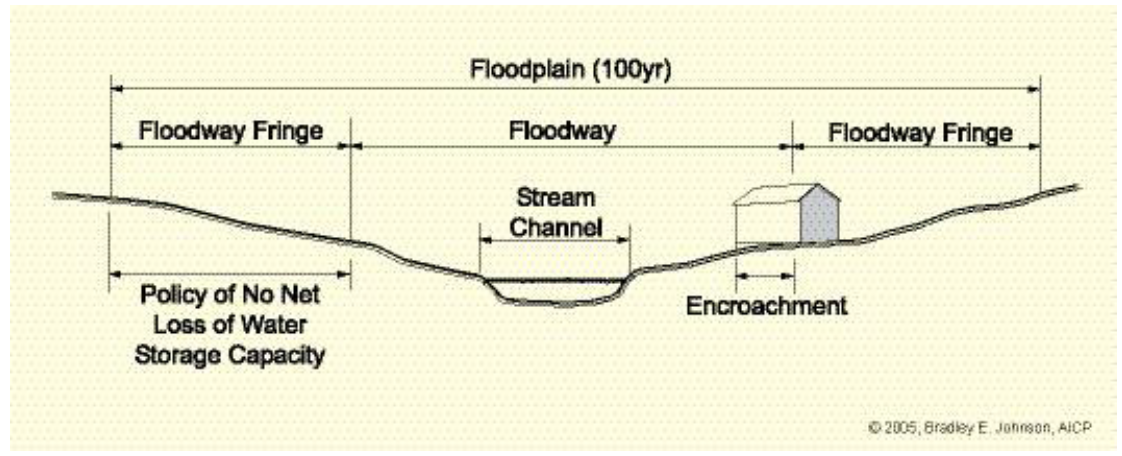
Floodplain. The relatively flat area or low land adjoining the channel of a river or stream, which has been or may be covered by flood water. The floodplain includes the channel, floodway, and floodway fringe. Floodplain boundaries are to be determined by using the floodway/flood boundary maps of the Federal Insurance Administration/Federal Emergency Management Administration.
_____
_____
Floodway. The channel of a river or stream and those portions of the floodplains adjoining the channel which are reasonably required to efficiently carry and discharge the peak flood flow of the regulation flood of any river or flooding stream.
Floodway fringe. Those portions of the floodplain lying outside the floodway. The floodway fringe is not necessary for carrying and discharging peak flow, but is subject to periodic flooding.
Floor, lowest. The lowest of the following:
•
The top of the basement floor;
•
The top of the garage floor, if the garage is the lowest level of the building;
•
The top of the first floor of a building elevated on pilings or constructed on a crawl space with permanent openings; or
•
The top of the floor level of any enclosure below an elevated building where the walls of the enclosure provide any resistance to the flow of flood waters unless: the walls are designed to automatically equalize the hydrostatic flood forces on the walls by allowing for the entry and exit of flood waters, by providing a minimum of two openings (in addition to doorways and windows) having a total area of one square inch for every one square foot of enclosed area subject to flooding. The bottom of all such openings shall be no higher than one foot above grade; such enclosed space shall be usable for the parking of vehicles and building access.
Floor area. The sum of all horizontal surface areas of all floors of all roofed portions of a building enclosed by and within the surrounding exterior walls or roofs, or to the center line(s) of party walls separating such buildings or portions thereof. Floor area of a building shall exclude exterior open balconies and open porches.
Floor area, finished. That portion of floor area constructed, completed, and usable for living purposes with normal living facilities which includes sleeping, dining, cooking, working, entertainment, common space linking rooms, areas for personal hygiene, or combination thereof. Floor area or portion thereof used only for storage purposes and not equipped for the facilities mentioned above shall not be considered finished floor area. The finished floor area of a primary structure does not include a garage, carport, deck, unfinished storage, patio, or open porch.
Floor area, ground. See floor area, main.
Floor area, main. That portion of finished floor area located on the first (or nearest ground level) floor of the dwelling unit. The main floor area of a primary structure does not include a garage, carport, deck, unfinished storage, patio, or open porch.
Food and beverage production. The large scale processing of raw ingredients and materials to create finished or unfinished foods and beverages, generally for sale to business clients.
Foot-candle. An English unit of measurement of the amount of light falling upon a surface (illuminance). One foot-candle is equal to one lumen per square foot. This measurement can be measured by means of an illuminance meter.
Foundation. The supporting member of a wall or structure.
Frontage. See lot frontage.
Frontage road. See road, frontage.
Garage. An attached or detached structure whose principal use is to house motor vehicles or personal property for the accommodation of related dwelling units or related business establishments.
Garden shop. A retail establishment that primarily sells garden implements, plants, landscaping materials, and related accessories. See retail sales.
Gas station. Any building, structure, or area of land used for the retail sale of automobile fuels, oils, and accessories, without any repair services.
General industrial production. Industrial production involving manufacturing, fabrication, and related processes.
Gift shop. An establishment that primarily sells keepsakes, trinkets, jewelry, cards, stationary, and other small gift related items. See retail sales.
Glare. The reflection of harsh, bright light producing an effect that causes annoyance, discomfort, or loss of visual performance and visibility.
Golf course. A tract of land laid out with at least nine holes improved with tees, greens, fairways, and hazards for playing a game of golf, including any associated clubhouse or shelters and excluding miniature golf courses, and other similar commercial enterprises.
Golf course, miniature. A theme-oriented recreational facility composed of a series of putting greens where patrons pay a fee to move in consecutive order from one green to the next. See commercial recreation facility.
Government facility. A building, group of buildings, and/or piece of property operated or occupied by a governmental agency to provide governmental service to the public. Government facilities include facilities for police/fire/rescue training and the storage and service of government vehicles, equipment, and supplies.
Government office. See office, government.
Grade. The finished surface of the ground adjacent to the exterior walls of a building.
Grade, existing. The vertical elevation of the ground prior to any excavation, filling, or other construction activity.
Grade, finished. The final elevation of the ground surface after manmade alterations have been completed.
Grandfathered. A description of the status of certain properties, uses, activities, and conditions that were legally existing prior to the effective date of this zoning ordinance. See also legal nonconforming.
Greenhouse. A building or structure constructed primarily of translucent materials, which is devoted to the protection or cultivation of flowers and other tender plants.
Greenhouse, commercial. A building or structure used for the growing of plants, all or some of which are sold at retail or wholesale either on or off-site.
Grocery store. See supermarket.
Ground floor area. See floor area, main.
Gymnastics center. An establishment where patrons learn and practice gymnastics. See sports training facility.
Hardscape. See landscape, hard (hardscape).
Hardship. A difficulty with regard to one's ability to improve land stemming from the application of the development standards of the zoning ordinance, which may or may not be subject to relief by means of variance. In and of themselves, self-imposed situations and claims based on a perceived reduction of or restriction on economic gain shall not be considered hardships. Self-imposed situations include: the purchase of land with actual or constructive knowledge that, for reasons other than physical characteristics of the property, the development standards herein will inhibit the desired improvement; any improvement initiated in violation of the standards of the zoning ordinance; any result of land division requiring variance from the development standards of the zoning ordinance in order to render that site buildable.
Hardship, unnecessary. A hardship which is subject to relief by means of variance, such as those that result from exceptional topographic conditions, exceptional physical conditions of a parcel, or other characteristics of the property that are unique from those of adjoining property in the same zoning district. Hardships, which are self-imposed, resulting from errors in judgment on the part of the property owner, or based on a perceived reduction in economic gain, shall not be considered unnecessary hardships.
Hardware store. A small- or medium-scale facility primarily engaged in the retail sale of various basic hardware lines, such as tools, builder's hardware, plumbing and electrical supplies, paint and glass, housewares and household appliances, and garden supplies and cutlery. A lumberyard may be included as in incidental use to the hardware retail sales. See retail sales.
Hazardous material. Any substance or materials mat by reason of their toxic, caustic, corrosive, abrasive, or otherwise injurious properties, may be detrimental to the health of any person handling or otherwise coming into contact with such material or substance.
Health and fitness center. A building where passive or active exercises and related activities are performed for the purpose of physical fitness, improved circulation or flexibility, and/or weight control. See Personal Services.
Health spa. A building where active exercise and related activities are performed utilizing weight control or muscle building equipment or apparatus for the purposes of physical fitness. Also a place or building that provides massage, exercise, and related activities with or without such equipment or apparatus. See personal services.
Heliport. An area used for the landing and take-off of helicopters, including any structures, buildings, and equipment associated with that use.
Home electronics/appliance store. An establishment that primarily sells home appliances, electronics, and related accessories. See retail sales.
Home occupation (Type 1). Specified activities or business practices that may be carried on in a residence which have little to no impact to structure or surroundings. These activities or business practices do not allow the loss of the zoning district's character or function as a neighborhood community. Standards for home occupations within the City of Portage can be found in Article VI of this zoning ordinance.
Home occupation (Type 2). Specified activities or business practices that may be carried on in a residence which have minimal impact to structure or surroundings. These activities or business practices do not allow the loss of the zoning district's character or function as a neighborhood community. Standards for home occupations within the City of Portage can be found in Article VI of this zoning ordinance.
Hospital. An institution providing primary health services and medical or surgical care to persons, primarily inpatients, suffering from illness, disease, injury, and other abnormal physical or mental conditions and including, as an integral part of the institution, related facilities, such as laboratories, outpatient facilities, training facilities, medical offices, and staff residences.
Hotel. A building in which temporary lodging or board and lodging are provided and offered to the public for compensation and in which ingress and egress to and from all rooms is made through an inside lobby or office supervised by a person in charge at all hours. As such, it is open to the public. Compensation is usually assessed on a day-to-day basis.
Housekeeping unit. One or more persons occupying a dwelling unit as a single housekeeping unit and therefore using common facilities for cooking, sanitation, and gathering. A housekeeping unit does not include any society, club, fraternity, sorority, or group living in a boarding house, hotel, motel, bed and breakfast facility, lodging house, rooming house, or club/ any group of individuals whose association with each other is seasonal or any individuals who are in a group living arrangement as a result of criminal activity. Also see family.
IAC. Indiana Administrative Code.
IC. Indiana Code.
Ice cream shop. An establishment that primarily offers ice cream and frozen desserts to be eaten on or off premises. See restaurant.
IDEM. Indiana Department of Environmental Management.
ILP. Improvement location permit.
Impervious surface. Any material that prevents absorption of stormwater into the ground such as concrete or asphalt. This does not include gravel, rock, or stone.
Improvement location permit. A permit issued under the zoning ordinance prior to receiving a building permit, permitting a person, firm, or corporation to erect, construct, enlarge, alter, repair, move, occupy, use, improve, remove, convert, or demolish any building or structure within its jurisdiction, or permitting a person to change the condition of the land.
Improvement location permit, temporary. A permit issued under the zoning ordinance permitting a temporary use or structure.
Incidental use. See use, incidental.
INDOT. Indiana Department of Transportation.
Infrastructure. Facilities and services needed to sustain industry, residential, commercial, and all other land use activities, including utilities and streets.
Initial user. The applicant, person, organization or corporation that originally applies to the City of Portage for approval for the installation of an antenna or other radio or cellular communication equipment or for approval for the construction of a telecommunication tower or facility.
Institutional facility for the developmentally disabled. An institutional facility that provides care, supervision, and protection for persons with developmental disabilities consistent with the provision of Indiana Code.
Institutional facility for the mentally ill. An institutional facility that provides, care, supervision, and protection for mentally ill persons consistent with the provisions of Indiana Code.
Interstate. See expressway.
Investment firm. Any office where the primary occupation is concerned with businesses that buy and sell stocks, bonds, and other notes of purchase. See office, financial.
Jewelry store. Store that primarily sells new jewelry, with limited sales of used merchandise. See retail sales.
Junk. Scrap or waste material of any kind.
Junk yard. A place where junk, including inoperable vehicles, appliance, wood, paper, rags, garbage, tires, glass, and any other worn-out, cast-off, or discarded items have been collected for re-sale, disposal, or storage.
Jurisdiction. Any area over which a unit of government exercises power and authority. See also planning jurisdiction.
Kennel. See animal boarding.
Landfill. The designated area where non-hazardous and non-medical, farm, residential, institutional, commercial, or industrial waste is buried.
Landscape, hard (hardscape). Landscape features other than plant materials, including, but not limited to such things as decorative pavers, planter boxes, walks, fences, and retaining walls.
Landscape, soft (softscape). Plant materials of a landscape plan.
_____
_____
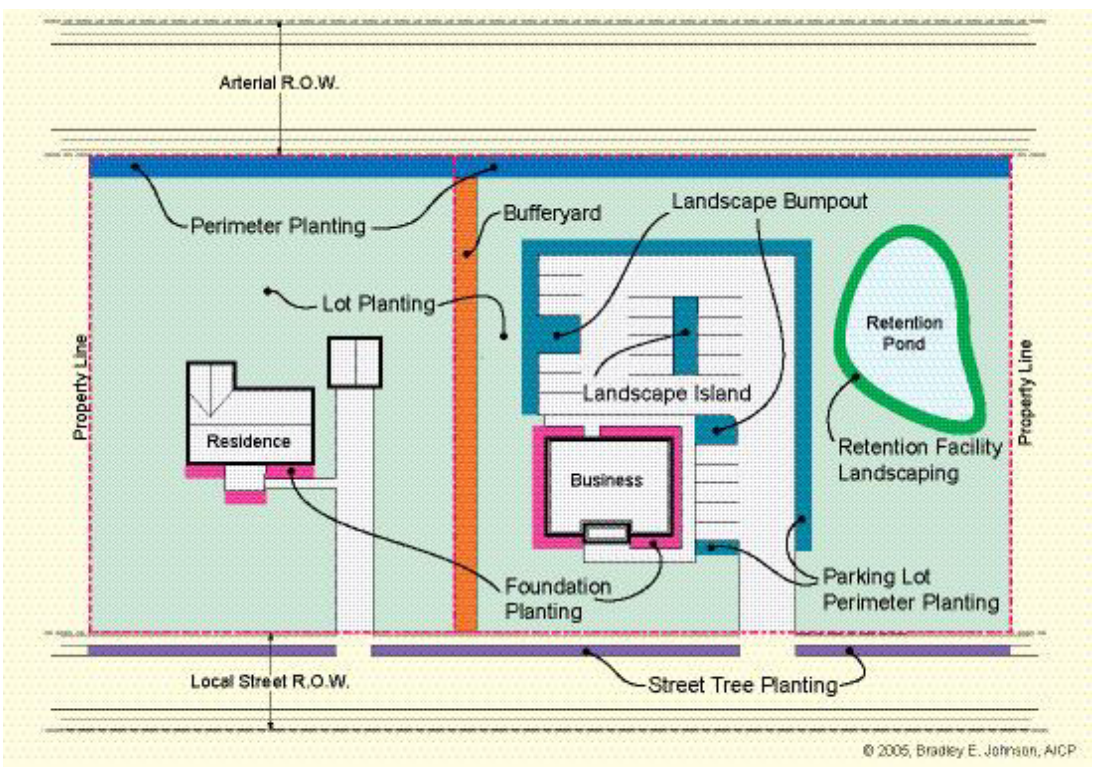
Landscape areas. Places on a lot or abutting right-of-way that are identified for application of landscaping regulations. Landscape areas include, but are not limited to: street tree planting areas, parking lot planting areas, foundation planting areas, buffer yard areas, and perimeter planting areas. The image on the previous page conceptually demonstrates the general location of each landscape area.
Landscape berm. A man-made, formed, earth mound of definite height and width used for landscaping and screening purposes, the intent of which is to provide a transition between uses of differing intensity or to screen uses from sight.
Landscape buffer. Any trees, shrubs, walls, fences, berms, space, or related landscaping features required under this zoning ordinance for buffering lots from adjacent properties or public rights-of-way for the purpose of increasing visual shielding or other aspects of privacy and/or aesthetics.
Landscape bufferyard. An area adjacent to front, side and rear property lines, measured perpendicularly from adjacent property lines and/or right-of-way lines, intended to provide attractive spaces to reduce the impacts of proposed uses on adjacent property or natural features and to screen incompatible uses from each other and from the right-of-way. Buffers also help to maintain existing trees or natural vegetation, to block or reduce noise, glare or other emissions and to maintain privacy. Bufferyards are in addition to (separate from) front, rear, or side yard setbacks.
_____
_____
Landscape material. Trees, shrubs, plants, decorative fences, retaining walls, walls, earthen mounds, irrigation systems, flower beds, decorative rocks, edging, mulch, stakes and the like. Artificial trees, shrubs, ground cover, and flowers are not considered landscape material.
Landscape mound. A landscape feature used for screening in which earth is piled up in irregular, round or oblong shapes. Particularly, mounds do not have consistent crest elevations, but are irregular in form and overlapping such to emulate a more natural landscape feature. Mounds in combination with other landscape material are used to block or partially block visibility from one side to the other.
Landscape mound (continuous). A landscape feature used for screening in which a continuous raised section of earth is used to block or partially block visibility from one side to the other. In particular, continuous mounds are linear with a top elevation (crest) relatively consistent from one end to the other.
Landscape structure. Decorative fences, walls, retaining walls edging and the like.
Landscaping. The improvements of a lot with grass, shrubs, trees, and other vegetation and/or ornamental objects. Landscaping may include pedestrian walks, flower beds, berms, fountains and other similar natural and man-made objects designed and arranged to produce an aesthetically pleasing effect.
Landscaping, defective. Dead or dying plant material, damaged berms, walls, fences, and/or other landscaping elements.
Lattice tower. See tower, lattice.
Legal nonconforming building. Any continuously occupied, lawfully established structure or building prior the effective date of this zoning ordinance, or its subsequent amendments, that no longer meets the development standards.
Legal nonconforming building or structure. Any continuously occupied, lawfully established structure or building prior to the effective date of the zoning ordinance, or its subsequent amendments that no longer meets the development standards.
Legal nonconforming lot. Any legally established and recorded lot prior to the effective date of this zoning ordinance, or its subsequent amendments that no longer meets the specific development standards.
Legal nonconforming lot of record. Any legally established and recorded lot prior to the effective date of the zoning ordinance, or its subsequent amendments, that no longer meet the lot-specific development standards.
Legal nonconforming sign. Any sign, lawfully existing on the effective date of this zoning ordinance, or amendment thereto, that does not conform to all standards and regulations of this ordinance.
Legal nonconforming use. Any continuous, lawful use of structures, land, or structures and land in combination established prior to the effective date of the zoning ordinance or its subsequent amendments that is no longer a permitted use in the district where it is located.
Legal nonconforming use. Any continuous, lawful use of structures, land, or structures and land in combination established prior to the effective date of this zoning ordinance or its subsequent amendments that is no longer a permitted use in the district where it is located.
Library. A public facility for the use, but not sale, of literary, musical, artistic, or reference material.
Light industrial assembly and distribution. Assembly and distribution of materials and products from processed or previously manufactured materials. Light industry is capable of operation in such a manner as to control the external effects of processing such as smoke, [noise], odor, etc.
Light industrial processing and distribution. Processing and distribution of materials and products from processed or previously manufactured materials. Light industry is capable of operation in such a manner as to control the external effects of processing such as smoke, [noise], odor, etc.
Liquor store. An establishment that offers retail and /or wholesale liquor, including wine or beer. See retail sales.
Loading berth. A space within a building or on the premises providing for the loading and unloading of merchandise and materials.
Lot. A separately defined, contiguous portion of a recognized subdivision with a written legal description which typically addresses permissions and/or constraints upon its development.
Lot, buildable. See lot, improved.
Lot, developed. A lot with buildings or structures situated thereon.
Lot, double frontage. See lot, through.
Lot, improved. A lot upon which a structure or building can be constructed and occupied as a result of the fact that it has frontage on and access to an improved street, meets minimum setback requirements, and has all necessary utilities available to the lot such as sewer, water, electricity, etc.
Lot, undeveloped. A lot of record upon which no improvements exist.
Lot area. The horizontal area within the exterior lines of a lot, including any easements, but excluding any rights-of-way or other similar dedications to the public.
Lot coverage. The percentage of the lot area covered by building, structures, parking areas, driveways, walkways, and other paved or impervious surface.
Lot depth. The horizontal distance between the front and rear lot lines. See diagrams below.
Lot frontage. The length of the property abutting a public right-of-way determined by measuring the distance between the front lot line corners using a straight line. See diagrams below.
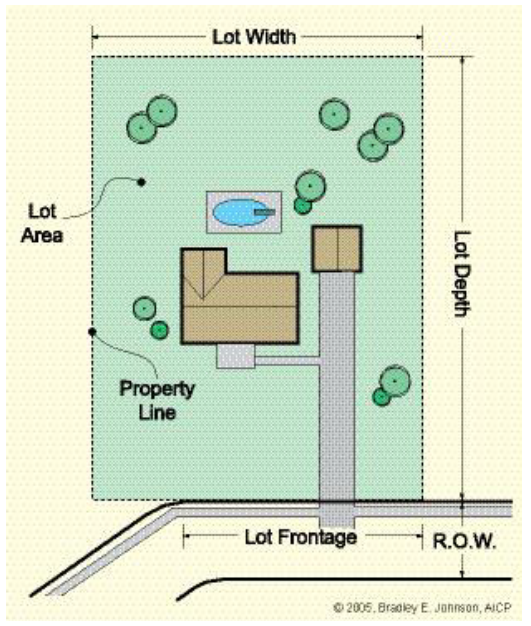
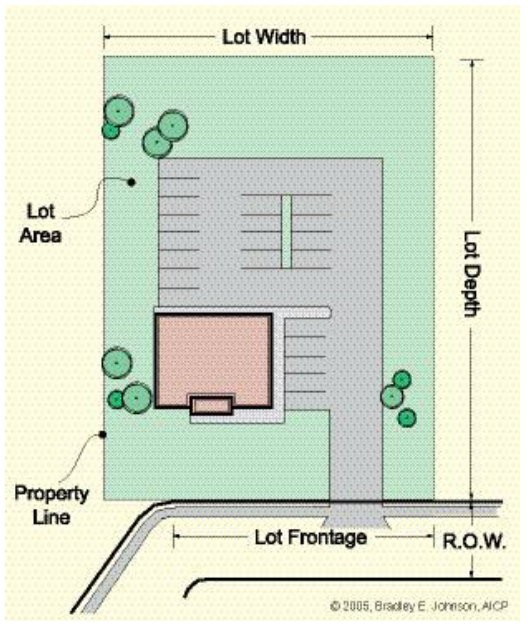
Lot of record. A lot that is part of a documented subdivision, the map of which has been recorded in the office of the Porter County Recorder, or a lot or parcel described by metes and bounds, the description of which has been recorded in the office of the Porter County Recorder, consistent with and in compliance with land development regulations in effect at the time of said recording.
Lot line. A line bounding a lot. Types of lot lines follow:
•
Lot line, front: For an interior or through lot, the line marking the boundary between the lot and the abutting street right-of-way. For a corner lot, the line marking the boundary between the lot and each of the abutting street rights of way.
•
Lot line, rear: The lot line that is opposite the front lot line and farthest from it, except that for a triangular or other irregularly-shaped lot, the line ten feet long, parallel to the front lot line, and wholly within the lot, that is farthest from the lot line (see graphic for rear yard).
•
Lot line, side: A lot boundary line other than a front or rear lot line.
Lot types. See diagrams below.
_____
•
Lot, corner: A lot situated at the intersection of two streets. Corner lots have two front yards. The side and rear yards are determined by the situation of the primary structure. See diagrams below.
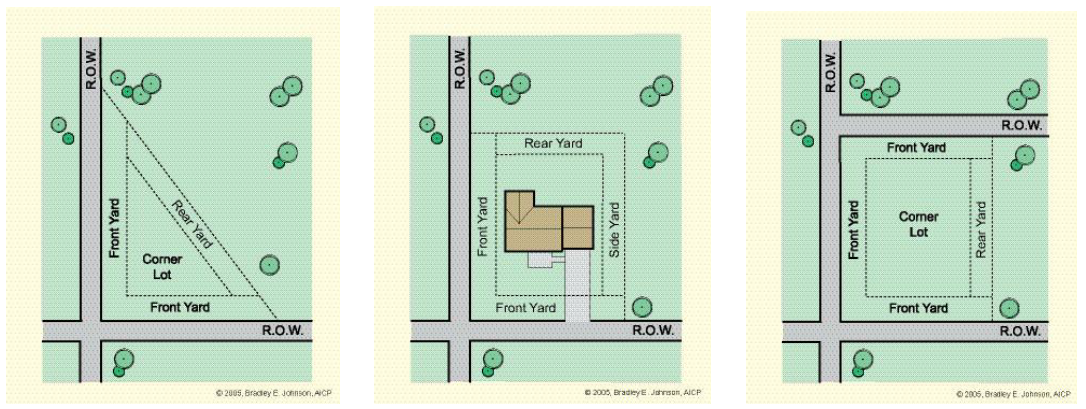
_____
•
Lot, interior: A lot other than a corner lot or a through lot.
•
Lot, through: A lot having frontage on two or more non-intersecting streets.
Lot width. The horizontal distance between side lot lines measured at the required minimum front setback line of the zoning district using the method determined by the subdivision control ordinance.
Lot, zoning. A single tract of land that, at the time of application for an improvement location permit, is designated by the applicant for the purpose of complying with this zoning ordinance as the tract to be used, developed, or built upon. A zoning lot or lots may coincide with one or more lots of record.
Main floor area. See floor area, main.
Manufactured home. See dwelling, manufactured home.
Manufactured home park. A parcel of land containing two or more dwelling sites, with required improvements and utilities, that are leased for the long term placement of mobile home dwellings and/or manufactured home dwellings, and shall include any street used or intended for use as part of the facilities of such manufactured home park. A manufactured home park does not involve the sales of mobile home dwellings or manufactured home dwellings in which unoccupied units are parked for inspection or sale.
Manufactured home sales. The sale and incidental storage of single-family detached housing that includes mobile homes and manufactured homes type I, II, and III. No facility shall store vacant manufactured or mobile home units on site unless each unit is located on an approved lot within an approved manufactured or mobile home park. Manufactured home sales does not include the storage of vacant or unsold units.
Manufacturing, heavy. The assembly, fabrication or processing of goods and materials using processes that ordinarily have greater than minimal impacts on the environment, or that otherwise do not constitute light manufacturing, and which may include open uses and outdoor storage. Heavy manufacturing generally includes processing and fabrication of products made from extracted or raw materials. Heavy manufacturing shall not include any use that is otherwise listed specifically in any zoning district as a permitted use or special exception.
Manufacturing, light. The assembly, fabrication or processing of goods and materials using processes that ordinarily do not create noise, smoke, fumes, odors, glare or health or safety hazards outside of the building or lot where such assembly, fabrication, or processing of goods are housed entirely within an enclosed building. Light manufacturing generally includes processing and fabrication of finished products predominantly from previously prepared materials. Light manufacturing shall not include any use that is otherwise listed specifically in any zoning district as a permitted use or special exception.
Marina. A facility located along a shoreline that has docks, moorings, supplies, and other services for watercraft and watercraft passengers.
Marine vehicle sales facility. The use of any lot or property, or portion thereof, for the conducting of any business involving the sale and/or rental of any boat, personal watercraft (PWC), or other vehicle designed and intended for use on the water, whether new or used. Such facilities may have an in-house service or repair component or other incidental use. For purposes of this zoning ordinance, this definition shall not prohibit the sale of up to two personally owned vehicles on a residential property.
Marine vehicle storage facility. A structure designed for the storage of watercraft and marine equipment.
Massage parlor. Any place where for any form of consideration or gratuity, massage, alcohol rub, administration of fomentations, electric or magnetic treatments, or any other treatment or manipulation of the human body occurs as part of or in connection with sexual conduct, or where any person providing such treatment, manipulation or service related thereto exposes specified anatomical areas.
Massage therapy. Any place where massage, reflexology, sport injury therapy, and the like are performed by licensed or certified professional message therapists or that is under direct supervision by a licensed or certified professional message therapist. See office, medical.
Master plan. See comprehensive plan.
Meat market (butcher). A market that primarily offers retail and/or wholesale meats, but may also sell related and incidental products. See retail sales.
Metes and bounds. A description of land prepared by a state-registered land surveyor providing measured distances and courses from a known or established point on the surface of the earth.
Microbrewery (brew pub). A facility for the production and packaging of malt beverages of low alcoholic content for distribution, retail or wholesale, on or off premise, with a capacity of not more than 15,000 barrels per year. The development may include other uses such as a standard restaurant, bar, or live entertainment. See food and beverage production.
Mini warehouse/self storage facility. A storage structure containing separate storage spaces of varying sizes, each for individual purchase or rental for the storage of household goods.
Mobile home. See dwelling, mobile home.
Mobile home park. See manufactured home park.
Mortuary. A facility for the storage and preparation of human dead prior to burial, including the conduction of funeral services.
Motel. An establishment consisting of a group of attached or detached living or sleeping accommodations with bathroom and closet space, located on a single zoning lot, and designed for use by transient automobile travelers. A motel furnishes customary services such as maid service and laundering of linen, telephone, secretarial, or desk service, and the use and upkeep of furniture.
Mural. See sign, mural.
Museum. A building having public significance by reason of its architecture or former use or occupancy, or a building housing a specific collection of natural, scientific, literary materials, objects of interest, or works of art, and designed to be use by the public with or without an admission charge. A museum may include, as an accessory use, the sale of goods to the public.
Natural condition. The condition that arises from, or is found in nature, unmodified by human intervention.
Natural drainage. Drainage channels, routes, and ways formed over time in the surface topography of the earth prior to any modification or improvements made by unnatural causes and/or human intervention.
Nature center. A facility and grounds in which plants, animals, and topographic features are protected and studied in their current, natural condition.
Nature preserve. A conservation area in which plants, animals, and topographic features are protected in their current, natural condition.
Nonconforming building. A building, structure, or portion thereof, which was designed, erected, or structurally altered such that it does not conform to the regulations of the district in which it is located.
Nonconforming lot. A lot that does not conform to the regulations of the zoning district in which it is located.
Nonconforming sign. A sign or portion thereof, which was designed, erected, or structurally altered such that it does not conform to the regulations of this zoning ordinance.
Nonconforming use. A use, which does not conform to the land use regulations of the zoning district in which it is located.
Nuisance. An interference with the enjoyment and use of property as defined by the nuisance ordinances of the City of Portage Municipal Code.
Objectionable odor. Odors that are nauseating, noxious, or generally recognized as unpleasant.
Office, financial. A building used by professionals in the financial industry for purposes of providing professional financial services.
Office/showroom, contractor. A building used by electrical contractors, general contractors, heating and cooling contractors, landscaping contractors, and plumbing contractor offices for the purposes of meeting with clients and conducting office tasks.
Office/warehouse, contractor. A building used by electrical contractors, general contractors, heating and cooling contractors, landscaping contractors, and plumbing contractor offices for the purposes of storing supplies. This use may or may not have an office component.
Office, design/planning. A building used by professionals in the fields of architecture, engineering, graphic design, and urban planning for purposes of providing professional design services.
Office, general services. A building used by employment services, temporary employment agency, insurance office, law office, membership associations, secretarial service, publishing, corporate offices, reading clinic, real estate office, service organization, title company, and travel agency.
Office, government. An office occupied by a governmental agency that provides a governmental service to the public.
Office, medical. A building, other than a hospital, used by one or more licensed physicians for the purpose of receiving and treating patients. Such offices include dental, medical, optical, therapeutic, and veterinary.
Office supply store. A large establishment that offers retail and wholesale office supplies, including items such as paper, writing utensils, computer equipment, and office furniture. See retail sales.
Official zoning map. A map of the City of Portage, Indiana, that legally denotes the boundaries of zoning districts as they apply to the properties within the planning jurisdiction. There is only one official zoning map, and it is kept up to date by the plan commission and the director of community development.
Official zoning map copies. A map of the City of Portage, Indiana, that legally denotes the boundaries of zoning districts as they apply to the properties within the planning jurisdiction. These maps may be out of date.
Oil change shop. A facility that provides lubrication, checking, changing, and the addition of those fluids and filters needed for automobile maintenance. Generally such services are provided while the customer waits. See auto service center.
Open space. An area of land not covered by buildings, parking structures, or accessory uses except for recreational structures. Open space may include nature areas, streams and flood plains, meadows or open fields containing baseball, football and soccer fields, golf courses, swimming pools, bicycle paths, etc. Open space does not include street rights-of-way, platted lot area, private yard, patio areas, or land scheduled for future development.
Outdoor storage. The keeping of items for sale, the products of manufacturing, materials used in production of vehicles, and other similar materials and/or equipment in an area outside of any building.
Owner. Any person, group of persons, firm, corporation, or any other legal entity having legal title to, or sufficient proprietary interest in the land, or their legal representative.
Owners association. An incorporated non-profit organization operating under recorded land agreements through which each lot owner is automatically a member and each lot is automatically subject to proportionate share of the expenses of the organization's activities, such as maintaining common property.
Parcel. A quantity of land identified for taxation purposes.
Park. A parcel of land for passive and/or active recreation.
Parking, off-street. A storage space for an automobile located outside of a street right-of-way.
Parking, on-street. A storage space for an automobile located within the right-of-way of a street.
Parking, shared. A parking area used jointly by two or more users. Shared parking can have a wide-ranging definition, from the most literal (on-street parking) to more formal use sharing agreements negotiated between private interests. The successful implementation of shared parking strategies can eventually curb the demand for more parking facilities to be built, as existing facilities are used more efficiently.
Parking space. A location that is designated for parking. A vehicle fits inside the space either by perpendicular parking, angled parking, or parallel parking.
Paved. A durable surface for parking, driving, riding or similar activities that utilizes asphalt, concrete, brick, paving blocks or similar material. Crushed gravel, stone, rock, or dirt, sand or grass are not considered a paved surface.
Permanent foundation. A structural system for transposing loads from a structure to the earth at a depth below the established frost line without exceeding the safe bearing capacity of the supporting soil.
Personal services. An establishment primarily engaged in the provision of frequent and recurrent services of a personal nature, such as beauty parlor, shop or salon, barber shop, tanning salon, health and fitness center, health spa, weight control establishment, jewelry/shoe repair, dry cleaner (retail), or any similar use.
Pet store. A retail sales facility primarily involved in the sale of domestic animals, such as cats, dogs, fish, birds, and reptiles, as well as domestic pet accessories. A pet shop does not include the retail sale of exotic or farm animals. See retail sales.
Petitioner. See applicant.
Pharmacy. A place where drugs and medicines are prepared and dispensed. Pharmacies also include the incidental retail sate of medical accessories and convenience goods and services. See retail sales.
Plan commission. See advisory plan commission.
Planned development. A large-scale unified development meeting the requirements for zoning approval under the provisions of Article VII of the zoning ordinance. Generally a planned development consists of a parcel or parcels of land, controlled by a single landowner, to be developed as a single entity which does not correspond in size of lots, bulk or type of buildings, density, lot coverage, and required open space to the regulations established in any district of the zoning ordinance. This may result in more attractive and affordable development than conventional developments would allow. Clustered housing (dwellings built in innovative lot arrangements around common open space) and zero lot line housing (dwellings built immediately adjacent to lot lines) are possible as part of planned developments. A planned development requires approval through a zoning map amendment.
Planning jurisdiction. All land within the corporate limits of Portage, Indiana.
Plat. See subdivision.
Plat, primary. The primary plat, pursuant to IC 36-7-4-700 series, is the plat and plans upon which the approval of a proposed subdivision are based. The primary plat and plans shall be subject to public notice and public hearing according to law and according to plan commission rules.
Plat, secondary. The secondary plat, pursuant to IC 36-7-4-700 series, is the final plat document in recordable form. A secondary plat shall substantially conform to the preceding primary plat, or section thereof. The secondary plat and plans are not subject to public notices and public hearings.
Police, fire or rescue station. An outpost station that serves as an office of operation for police, fire, and/or rescue services. Such stations include personnel, equipment, vehicles, and training facilities.
Porch. A roofed-over structure projecting out from the wall or walls of a main structure and commonly open to the weather in part.
Post office. A facility operated by the United States Postal Service that house service windows for mailing packages and letters, post office boxes, offices, vehicle storage areas, and sorting and distribution facilities for mail.
Practical difficulty. A difficulty with regard to one's ability to improve land stemming from regulations of the zoning ordinance. A practical difficulty is not a "hardship," rather it is a situation where the owner could comply with the regulations within the zoning ordinance, but would like a variance from the development standards to improve his site in a practical manner. For instance, a person may request a variance from a side yard setback due to a large tree which is blocking the only location that would meet the development standards for a new garage location.
Printing/shipping center. An office service center for the purposes of design, reproduction, transmittal, or sending of documents at the request of a customer.
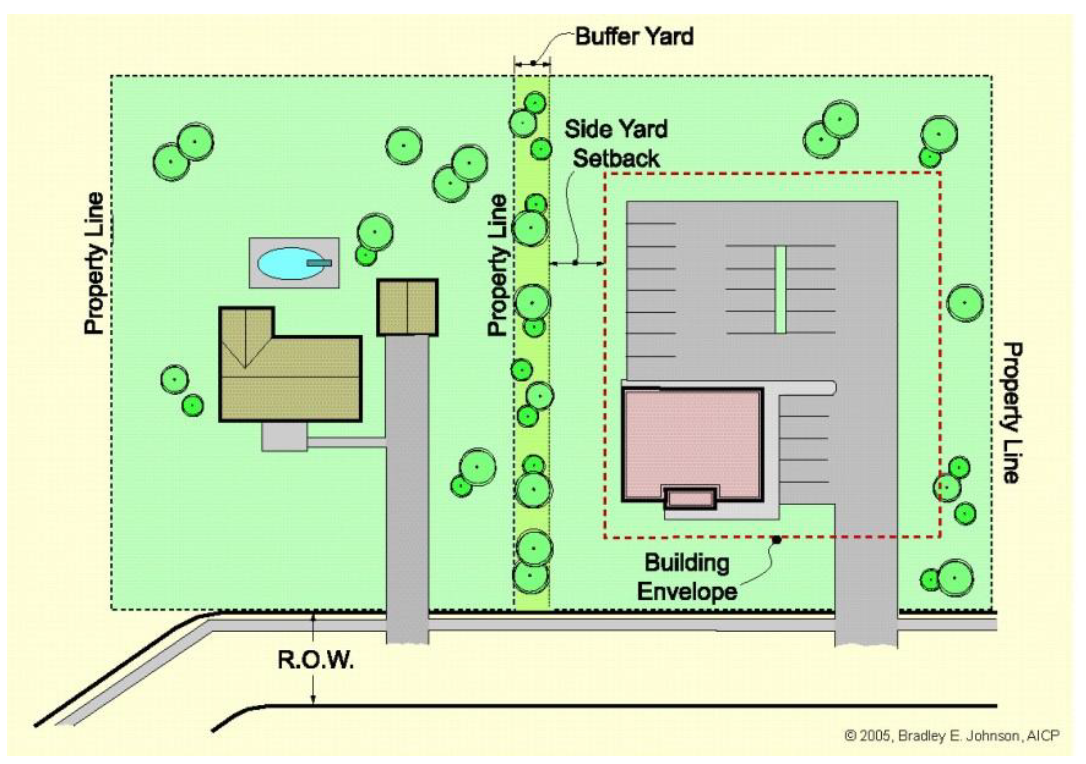
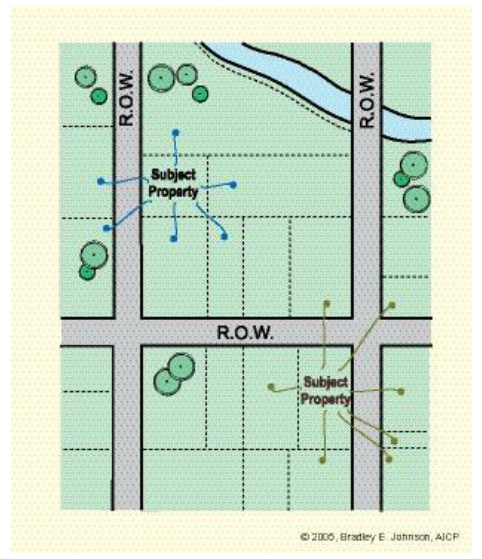
Property, adjacent. Any property adjacent to or directly diagonal to the subject property. Properties across a public right-of-way (ROW) are also considered adjacent. The illustration below notes the properties that would be considered adjacent to two different subject properties. See diagram below.
Property owner. The person(s) identified as the property owner on the most recent list prepared and maintained by the Porter County Auditor's Office. See also owner.
Public art. Any visual work of art that is accessible to public view and located on public or private property.
Public hearing. A formal meeting, announced and advertised in advance consistent with the requirements of this zoning ordinance, which is open to the public, and which members of the public have an opportunity to participate.
Public improvement. Any improvement, facility, or service which provides transportation, drainage, public utilities, or similar essential services which are typically or specifically required to be provided by a unit of government.
Public utility. Any person, firm, or corporation duly authorized to furnish under public regulation to the public, electricity, gas, steam, telephone, fiber optics, transportation, water, or sewage systems.
Record. The written documentation of the actions and expressions of a public body, such as the plan commission or board of zoning appeals.
Recreation facility, indoor (commercial). Predominantly participant sports and health activities conducted entirely within an enclosed building. Typical uses include bowling alleys, billiard parlors, ice/roller skating rinks, indoor climbing facilities, soccer areas, athletic clubs, and health clubs. This use does not include special studios or training facilities not open to the general public.
Recreation facility, outdoor (commercial). A facility open to the general public for various outdoor participant sports and types of recreation and which are not located at a public park, such as amphitheaters, golf driving ranges, miniature golf courses, amusement and theme parks, water slides.
Recreational vehicle. A vehicular-type portable structure without permanent foundation that can be towed, hauled, or driven and primarily designed as a temporary living accommodation for recreational, camping, and travel use and including but not limited to, travel trailers, truck campers, camping trailers, boats, and self-propelled motor homes. A recreational vehicle shall not be used as living quarters.
Recreational vehicle sales facility. The use of any lot or property, or portion thereof, for the conducting of any business involving the sale and/or rental of any recreational vehicle, whether new or used. Such facilities may have an in-house service or repair component or other incidental use. For purposes of this zoning ordinance, this definition shall not prohibit the sale of up to two personally owned vehicles on a residential property.
Registered land surveyor. A land surveyor properly licensed and registered or through reciprocity permitted to practice in the State of Indiana.
Registered professional engineer. An engineer properly licensed and registered or through reciprocity permitted to practice in the State of Indiana.
Regulatory flood. A flood having a peak discharge which can be equaled or exceeded on the average of once in a 100-year period, as calculated by a method and procedure which is acceptable to and approved by the Indiana Natural Resources Commission. Further, this flood is equivalent to a flood having a one percent probability of occurrence in any given year.
Regulatory floodway. The channel of a river or stream and those portions of the flood plains adjoining the channel which are reasonably required to efficiently carry and discharge peak flow of the regulatory flood of any river or stream and, is that area covered by floodwaters in significant downstream motion or covered by significant volumes of stored water during the occurrence of the regulatory flood.
Replat. A change in a recorded subdivision plat if such change affects any street layout or area reserved thereon for public use or any lot line or easement; or if it affects any map or plan legally recorded.
Research laboratory. A structure or group of structures use primarily for applied and developmental research where product testing is an integral part of the operation and goods or products used in the testing may be manufactured and stored.
Residential treatment center. Any facility licensed by the Indiana Department of Health, public or private, which regularly provides one or more people with 24-hour a day substitute care, food, lodging, training, education, supervision, habitation, rehabilitation, and treatment the require, but which for any reason cannot be furnished in the person's own home.
Restaurant. An establishment where food and drinks are prepared, served, and consumed either within the primary structure or taken off-site by the patrons to be consumed elsewhere.
Retail sales, high intensity. Retail businesses that have a high impact on neighboring properties, traffic generation, and public safety. Example businesses include building finishes store (large), building supply store (large), department store (large), furniture store (large), grocery/supermarket (large), home electronics/appliance store (large), office supplies (large), sporting goods (large), superstore, and variety store (large). For purposes of this zoning ordinance retail sales do not include the sale/rental of any vehicle.
Retail sales, low intensity. Retail businesses that have a low impact on neighboring properties, traffic generation, and public safety. Example businesses include book store (small), craft gallery (small), gift shop (medium), boutique (medium), jewelry store (small), flower shop (medium), and art gallery (medium). For purposes of this zoning ordinance retail sales do not include the sale/rental of any vehicle.
Retail sales, medium intensity. Retail businesses that have a moderate impact on neighboring properties, traffic generation, and public safety. Example businesses include: antique shop, apparel shop, art and craft supplies, auto part sales (new), book store (large), building finishes store (small), building supply store (small), computer sales, convenience store (large), craft gallery (large), department store (small), drug store (large), fabric shop, furniture store (small), garden shop, gift shop (large), golf/tennis pro shop, grocery/supermarket (small), meat market (small), home electronics/appliance store (small), convenience store (small), liquor sales, music/media shop, musical instruments store, office supplies (small), pawn shop, pet store (small), plant/tree shop, shoe sales, sporting goods (small), and variety store (small). For purposes of this zoning ordinance retail sales do not include the sale/rental of any vehicle.
Retail, special handling. Retail businesses that sell products that require special handling due to risks to public safety. Example businesses include: fireworks sales, gun sales, and hunting stores.
Retreat center. A facility used for professional, educational, or religious meetings, conferences, or seminars, which provides meals, housing, and recreation for participants during the period of the retreat or program.
Rezoning. An amendment to the official zoning map which has the effect of removing property from one zoning district and placing it in a different zoning district.
Right-of-way. A strip of land occupied or intended to be occupied by transportation facilities, public utilities, or other special public uses. Rights-of-way intended for any use involving maintenance by a public agency shall be dedicated to the public use by the maker of the plat on which such right-of-way is established.
Road. See street.
ROW. See right-of-way.
Satellite dish/antenna. An apparatus capable of receiving communications from a transmitter relay located in a planetary orbit, or broadcasted signals from transmitting towers.
School. A public or private institution which offers instruction in any of the branches of learning and study comparable to that taught in the public schools under the Indiana School Laws, including pre-kindergarten, kindergarten, elementary school, and junior and senior high schools, but excluding trade, business, or commercial schools.
School, trade or business. A specialized instructional establishment that provides onsite training of business, commercial, and/or trade skills such as accounting, data processing, and computer repair. Including vocational schools and career centers.
Scrap metal yard. A general industrial use established independent or ancillary to and connected with another general industrial use, which is concerned exclusively in new and salvaged metal pipes, wire, beams, angles, rods, machinery, parts, filings, clippings, and/or all other metal items of every type, and which acquires such items incidental to its connection with the other general industrial use or by purchase, consignment or bailment which stores, grades, processes, melts, cuts, dismantles, compresses, cleans, or in any way prepares said items for reuse by the connected other general industrial use or for storage, sale or shipment and/or use in other industries or businesses including open hearth, electric furnaces and foundry operations. Such an establishment shall not include junk yards, dumps, or automobile or other vehicle graveyards. The storage, dealing in or the permitting of the accumulation of significant quantities of combustible, organic or nonmetal scrap materials such as wood, paper, rags, garbage, bones and shattered glass on the premises of such an establishment will disqualify it from being classified as a scrap metal yard, and the same will be classified as a junk yard. See general industrial production.
Self-service laundry. A business with vending machine type washing, drying, dry-cleaning, and ironing equipment for use of customers on site. See personal services.
Setback, maximum. The maximum allowable horizontal distance between a lot line/right-of-way and a structure.
Setback, minimum. The minimum allowable horizontal distance between a lot line/right-of-way and a structure.
Sewage treatment plant. Any facility designed for the treatment of sewage that series an entire community, region, or specific geographic area.
Sexual conduct. Any of the following: the fondling or other touching of human genitals, pubic region, buttocks, or female breasts; ultimate sex acts, normal or perverted, actual or simulated; masturbation; and excretory functions as part of or in connection with any of the activities described above.
Sexually oriented bookstore. An establishment having ten percent or more of its stock in trade or its dollar volume in books, magazines, periodicals or other printed matter, or photographs, films, motion pictures, video cassettes, slides, tapes, records or other forms of visual or audio representations which are distinguished or characterized by their emphasis on matter depicting, describing or relating to sexual activities or sexual anatomical areas.
Sexually oriented business. Any commercial activity whether conducted intermittently or free time, which primarily involves the sale, display, exhibition, or viewing of books, magazines, films, photographs, or other materials, distinguished or characterized by an emphasis on matter depicting, describing, or relating to human sex acts, or by an emphasis on male or female genitals, buttocks, or female breasts. Such businesses shall include, but not be limited to: sexually oriented bookstores; sexually oriented motion picture theater; sexually oriented mini-motion picture theater; sexually oriented motel/hotel; sexually oriented motion picture arcade; cabaret; and massage parlor.
Sexually oriented entertainment. An adult bookstore, adult retail store, adult motion picture theater, or adult strip club, or the like.
Sexually oriented mini-motion picture theater. An enclosed building with a capacity of 50 persons or less used for presenting materials distinguished or characterized by an emphasis on matter depicting, describing, or relating to specified sexual activities, or specified anatomical area, for observation by patrons therein.
Sexually oriented motel/hotel. A motel/hotel wherein material is presented which is distinguished or characterized by an emphasis on depicting or describing sexual conduct or specified anatomical areas.
Sexually oriented motion picture arcade. Any place to which the public is permitted or invited wherein coin- or slug-operated or electronically, electrically, or mechanically controlled still or motion picture machines, projectors, or other image-producing devices are maintained to show images to five or fewer persons per machine at any one time, and where the images so displayed are distinguished or characterized by an emphasis on depicting or describing sexual conduct or specified anatomical areas.
Sexually oriented motion picture theater. A facility for audio and visual productions and performing arts specifically for presenting material having as a dominant theme material distinguished or relating to specified sexual activities or specified anatomical areas, for observation by patrons therein.
Sexually oriented retail store. An establishment having more than ten percent of its stock in trade or its dollar volume in devices, toys, audio or visual recordings, games, attire, or other items intended for adult sexual activities or used for erotic, pornographic, or related sexual activities.
Sexually oriented strip club. A facility (indoor or outdoor; and private or public) for audiences or individuals to observe nudity or partial nudity of any person, or any other services appealing to or designed to appeal to erotic or sexual appetites or inclinations.
Shoe repair shop. An establishment that primarily repairs shoes, with incidental sales of shoe related items. See personal services.
Sight triangle. See vision clearance triangle.
Sign. A structure, device, letter, word, model, figure, symbol, product, manner, balloon, flag, pennant, streamer, insignia, emblem, logo, painting, poster, or some quantity or combination of the above which is visible from a public place and is intended to direct public attention to a product, service, place, activity, person, institution, business, solicitation, or otherwise convey a message to the public. The graphic below depicts the primary types of signs. Regulations for the type of signs permitted vary by zoning district.
_____
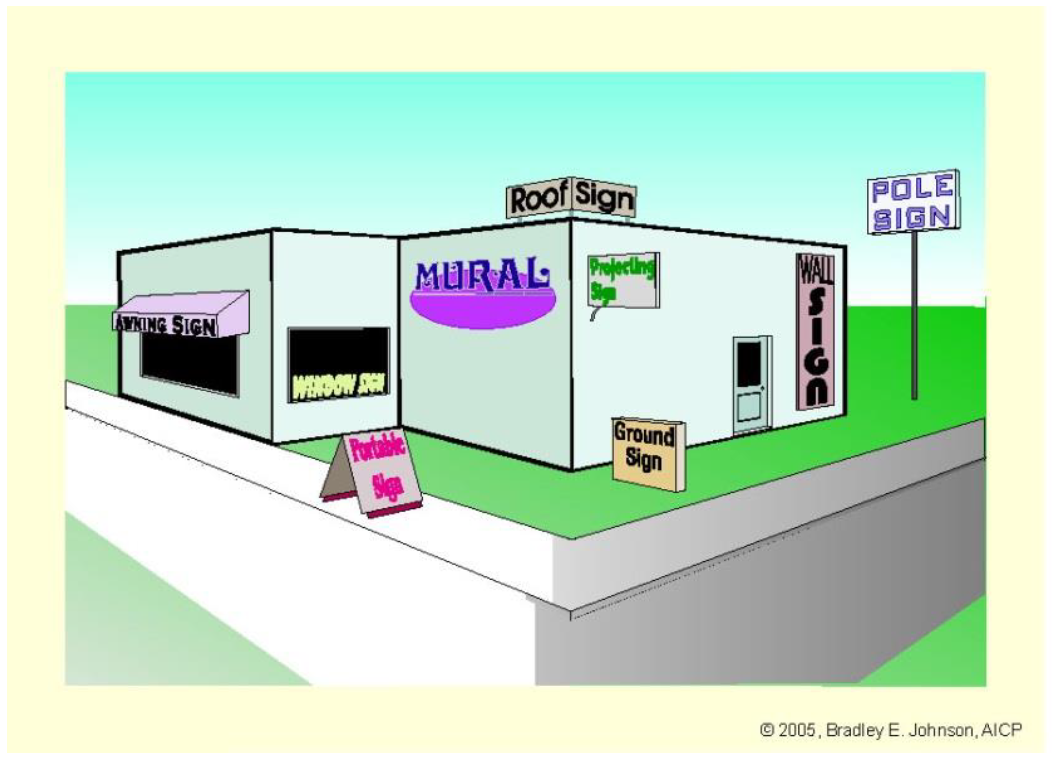
_____
Sign, abandoned. A sign that identifies or advertises a business, product, service, owner, or other activity that is no longer located or conducted on the property where the sign is displayed.
Sign, animated. A sign with action, motion, or changing colors or lights, any of which imitates movement. A flashing sign shall be considered an animated sign.
Sign, arcade. A sign suspended beneath a ceiling of an arcade, roof or marquee containing only the name of a business for the purpose of assisting pedestrian traffic traveling under the arcade, roof or marquee to identify the location of establishments within a shopping center or similar building.
Sign, awning. A type of building sign that typically includes letters, logos, symbols and/or designs and is integrated into an awning.
Sign, barber pole. A usually rotating pole with diagonal stripes of red and white or of red, white and blue used as a sign for a barbershop.
Sign, billboard. A billboard sign is a type of off-premises sign, regulated by Article VI of this zoning ordinance.
Sign, building. A sign that is attached directly to a building. For purposes of this zoning ordinance, building signage consists of wall signage, canopy signage, awning signage, and any approved projecting signage.
Sign, canopy. A type of building sign that typically includes letters, logos, symbols and/or designs and is integrated into an canopy.
Sign, changeable copy. A sign or portion thereof with characters, letters, or illustrations that can be manually or electronically changed or re-arranged without altering the face of the surface of the sign.
Sign, construction. A temporary sign located on a construction site that identifies the project and the project team, including but not limited to contractors, developers, architects, engineers, sponsors and/or lenders.
Sign, digital. A sign capable of displaying words, symbols, or images that can be electronically or mechanically changed by remote, automatic or electrical means.
Sign, directional—On-premises. A sign which directs and/or instructs vehicular or pedestrian traffic relative to parking areas, proper exits, loading areas, entrance points and similar information on the premises on which it is located.
Sign, directional—Off-premises. A sign erected by a government agency which directs and/or instructs vehicular or pedestrian traffic relative to the location of a public building or use or a semipublic building or use, such as a church, school, park, municipal building, or similar use and which is located in a public street right-of-way with the permission of the owner of the right-of-way or on premises other than the premises where said building or use is located with the permission of the owner. Off-premises directional signs shall not include billboards, as defined herein, or any other off-premises sign which contains information regarding any commercial or business use.
Sign, display time. The amount of time a message and/or graphic is displayed on an electronic message center.
Sign, double faced. A sign designed and/or used to display a message on the outer surface of two identical and opposite parallel panels.
Sign, drive-thru menu board. A freestanding sign located adjacent to a drive-thru lane used solely for advertising products and/or services offered at a drive-thru service at a business where customers remain seated in a vehicle occupying a drive-thru service lane to the point of a drive-thru service window or other service area of a business.
Sign, drive-thru preview menu board. A freestanding sign located adjacent to a drive-thru lane which details a limited list or pictorial display of products and/or services offered on a drive-thru menu board of a business. A preview menu-board precedes the drive-thru menu board for the purpose of expediting the ordering of products and/or services from the drive-thru menu board.
Sign, EMC. See sign, electronic message center.
Sign, EMC display methods. Methods by which an electronic message center (EMC) may convey its message. For purposes of this zoning ordinance, not all display methods are permitted. Refer to Article VI.
•
Static message: The EMC frame stays constant for a period of at least ten minutes. The display does not appear to change, move, scroll, vary color, or vary light intensity.
•
Alternating message: The EMC frame is held constant for a period of at least eight seconds. The display does not appear to change, move, scroll, vary color, or vary light intensity during that period. The display transitions to another EMC frame nearly instantaneously (in a transition of less than one-half second. See sign, EMC message transition.
•
Animated message: The display of all or part of the EMC changes or appears to move, scroll, vary color or vary light intensity. Animated message excludes:
•
Video message: A display on an EMC that contains images which vary in a continuous, non-repeating fashion, similar to television viewing. It includes messages or patterns of images that repeat in segments over 16 seconds, the allowable duration of two display frames.
•
Flashing: Flashing means a display that includes a pattern of sudden alteration, less than one-half second, between an illuminated EMC face and a face without illumination, or an EMC face where the copy color and the background color alternate or reverse color schemes rapidly, again in less than one-half second. This excludes a transition of less than one-half second between messages on an alternating message display.
•
Rapid scrolling: Rapid scrolling means any letter or character in a message that moves or appears to move across an EMC face faster than ten feet in two seconds. This excludes a transition of less than one-half second between messages on an alternating message display.
•
Strobe lights: Strobe lights are high intensity flashing lights that may impair vision.
Sign, EMC frame. A complete, static display screen on an electronic message center (EMC) sign.
Sign, EMC message transition. A visual effect on an electronic message center (EMC) sign to change from one message to another. See alternating message within sign EMC display methods. The following are types of message transitions:
•
Dissolve: A mode of message transition on an EMC accomplished by varying the light intensity or pattern, where the first message gradually appears to dissipate and lose legibility simultaneously with the gradual appearance and legibility of the subsequent message.
•
Fade: A mode of message transition on an EMC accomplished by varying the light intensity, where the first message gradually reduces intensity to the point of not being legible and the subsequent message gradually increases intensity to the point of legibility.
•
Scroll: A mode of message transition on an EMC where the message appears to move vertically across the display surface.
•
Travel: A mode of message transition on an EMC where the message appears to move horizontally across the display surface.
Sign, electronic message center (EMC). An electrically-activated changeable copy sign whose variable message and/or graphic presentation capability can be electronically programmed by computer from a remote location. Also known as an EMC. EMCs typically use light emitting diodes (LEDs) as a light source. See sign, EMC display methods.
Sign, freestanding. A sign supported completely by a frame, pole, or foundation and which is independent from all other structures on the property. Refer to pole sign, ground sign, monument sign, and integrated sign definitions herein.
Sign, fuel dispensing equipment. A permanently installed sign affixed to, or integrated into, an enclosure containing fuel dispensing equipment, such as a gasoline pump.
Sign, gateway. A freestanding sign or integrated sign at the main entrance(s) to a residential, business/commercial, or industrial development which identifies the development name or, in terms of the community as a whole, located near a key intersection of the community, which introduces or welcomes visitors to the community. Such a sign may include a common electronic message center (EMC) sign to share community information, and/or in the case of a business, commercial, or industrial subdivision, may advertise businesses located within the development.
Sign, ground. A monument sign or integrated sign generally having a low profile with little or no open space between the ground and the sign.
Sign, illuminated. A sign lighted or exposed to artificial lighting either by lights on or within the sign or directed toward the sign.
Sign, integrated. A sign that is integrated into the landscaping elements of a site, such as laser cut letters attached to hardscape.
Sign, monument. A sign having a support structure that is a solid-appearing base constructed of a permanent material such as concrete or brick.
Sign, multi-message. An electrically-activated changeable copy sign that uses mechanical movement to allow for the display of more than one sign copy, usually, but not necessarily, by rotation or revolution of sign components and may be referred to as a trivision or variable message sign. For purposes of this zoning ordinance, such technology may be used throughout the community with sign copy changing at time intervals of no less than eight seconds.
Sign, multiple faced. A sign that has two or more sign faces.
Sign, mural. A painting on the side of a building, wall, or structure; or a painting on the ground or ceiling of a building or structure. A mural that does not function as a sign is not regulated by the zoning ordinance. Murals that function as a sign are regulated by the zoning ordinance as a wall sign.
Sign, off-premises. A sign directing attention to a specific business, product, service, entertainment, or any other activity offered, sold, or conducted elsewhere than upon the lot where the sign is displayed.
Sign, on-premises. A sign directing attention to a product, service, entertainment, or any other activity offered, sold, or conducted upon the lot where the sign is displayed. For purposes of this zoning ordinance, community events and/or public service announcements shall be permitted on any on-premises sign.
Sign, permanent. A sign which, when installed, is intended and designed for permanent use.
Sign, pole. A sign visibly supported on a pole or poles and not attached to a building or wall.
Sign, portable. A sign not permanently attached to the ground or other permanent structure, or a sign designed to be transported.
Sign, poster. Any sign made of cardboard, metal, plastic, or other semi-rigid material which is attached to outdoor products, structures, or other features, or anchored into the ground with the use of stakes.
Sign, projecting. A type of building sign which is mounted to the wall surface of the building and projects perpendicular to the building wall.
Sign, public information. A sign displaying public information as the principal message in addition to information designed to assist, alert, or inform the public. Such signs may display only the name and corporate logo of the business or agency providing such information.
Sign, real estate. A temporary sign that relates to the sale, lease, or rental of property or structure, or to construction activity on site.
Sign, roof. A sign that is erected on or above a roof or that is installed, placed, or affixed in any fashion directly on a roof's surface.
Sign, rotating. A sign or portion of a sign that turns about an axis.
Sign, sandwich board. A freestanding sign located at grade level constructed in such a manner as to form an "A" by separating two opposite and parallel sign faces by a supporting structural member.
Sign setback. The distance between any property line or right-of-way and the nearest portion of any sign at or above ground level.
Sign, temporary. A sign that is not intended to be permanently installed.
Sign, time/temperature. An electronic or mechanical device which shoes time and/or temperature, but contains no business identification or advertising. The surface area of the time/temperature display shall be included in the total aggregate sign area.
Sign, vehicle. A sign that is attached to or painted on a parked vehicle for the purpose of drawing attention to a product, business, or property which is indicated on the sign.
Sign, wall. A type of building sign painted on, incorporated in, or attached directly to a building wall, with the exposed face of the sign in place parallel to the building wall. (For the purposes of this zoning ordinance, any approved projecting signage by the board of zoning appeals shall be included in the building signage allowance.)
Sign, wheeled. Any sign with a wheeled chassis that is portable and delivered to a site.
Sign, window. A sign attached to or within three feet of the inside of the window upon the premises where the sign is displayed which directs attention to the principal business, profession or industry or to the type of product sold, manufactured or assembled, or to services or entertainment offered on said premises.
Site plan. The plan indicating the location of existing and proposed buildings, structures, paved areas, walkways, vegetative cover, landscaping and screening within a site proposed for development which is to be submitted for approval prior to the release of improvement location permits on the site consistent with the requirements of IC 36-7-4-1400 series.
Skating rink. An establishment that provides facilities for patron skating. See commercial recreation facility.
Softscape. See landscape, soft (softscape).
Special exception. An authorization of a use that is designated as such by the zoning ordinance as being permitted in the district concerned if it meets special conditions, is found to be appropriate and upon application, is specifically authorized by the BZA.
Special exception use. See use, special exception.
Special handling retail. See retail sales, special handling.
Specified anatomical areas. Any of the following: Less than completely and opaquely covered human genitals or pubic region; buttocks; or female breast below a point immediately above the top of the areola; and human genitals in a discernibly turgid state, even if completely and opaquely covered.
Sporting goods shop. An establishment that primarily sells sporting equipment, sporting apparel, and related items. See retail sales.
Sports training facility. An indoor facility that provides training of amateur or professional athletes in a particular sport. These facilities typically operate on a by-appointment basis and often provide very small student-instructor ratios. Programs at these facilities are designed to enhance the skills necessary to succeed in a particular sport rather than for general exercise as at a health and fitness center.
Stationary shop. An establishment that primarily sells stationary, paper, cards, writing utensils, and various related items. See retail sales.
Stop work order. A written document issued by an official of the City of Portage, which requires the cessation of an activity.
Storage, outdoor. See outdoor storage.
Story. That portion of a building included between the surface of any floor and the surface of the floor next above it, or if there be no floor above it, then the space between the floor and the ceiling next above it.
Street. A public thoroughfare, including a road, highway, drive, land, avenue, place, boulevard, and any other thoroughfare that affords vehicular access to abutting property.
Street, arterial. A street which serves the major traffic movements within a community, as well as a majority of the vehicular traffic entering and leaving the city to travel to and from adjacent communities. Portage's arterial streets are identified on the thoroughfare plan map contained with the Portage Comprehensive Plan.
Street, collector. A street designed and suited to carry moderate volumes of traffic from local streets to arterial streets. Portage's collector streets are identified on the thoroughfare plan map contained with the Portage Comprehensive Plan.
Street, cul-de-sac. A street with a single common ingress and egress and with a turn around provided at the opposite end.
Street, intersecting. Any street that joins another at an angle, whether or not it crosses said street.
Street, local. A street designed and operating to provide vehicular access between individual properties and the collector and arterial street system. Portage's local streets are identified on the thoroughfare plan map contained with the Portage Comprehensive Plan.
Street, nonresidential. Any street where the primary land use of the lots, which the street proves access to, as well as the lots on either side of the street is not residential.
Street, private. Any street, which is privately owned and maintained, that is used to provide vehicular access to more than one property owner or dwelling unit.
Street, public. A street constructed and/or maintained by a unit of government within an officially deeded and accepted public right-of-way.
Street, residential. Any street where the primary land use of the lots, which the street provides access to, as well as the lots on either side of the street is residential.
Street frontage. The distance along which a property line of a lot abuts the right-of-way of an adjacent street.
Street intersection. The point of crossing or meeting of two or more streets.
Streetscape. The overall character and appearance of a street formed by buildings an landscape features that frame the public street, including but not limited to facades of buildings, street trees and plants, lighting, street furniture, and paving.
Structural alterations. Any change in the supporting members of a building or structure such as bearing walls, partitions, columns, beams, or girders, or any substantial change in footprint or increasing size of living space. Additionally, substantial roofing and siding work when repairs are made to the underlying structure.
Structure. Any building or other object that is constructed or erected that requires location on or under the ground or is attached to something on the ground.
Structure, accessory. A structure which is subordinate to and located on the same property as a primary structure. The use of an accessory structure must be an accessory use.
Structure, accessory (enclosed). An accessory structure which is fully or dominantly enclosed. As examples, a detached garage, pool house, summer kitchen, or shed are considered enclosed accessory structures. For the purposes of the zoning ordinance, a detached car port shall also be considered an enclosed accessory structure. See diagram below.
Structure, attached. A structure that is structurally connected to another structure by a foundation, wall, bridge, or roof line, or appears to be connected. Carports, garages, porch awnings and the like are considered attached structures and must abide by all regulations pertaining to primary structures.
Structure, detached. A structure that has no structural connection with the primary building or any other building or structure.
Structure, primary. A structure which accommodates the primary use of the site.
Structure height. The vertical distance measured from ground level to the highest point of the roof. See diagram below.
_____
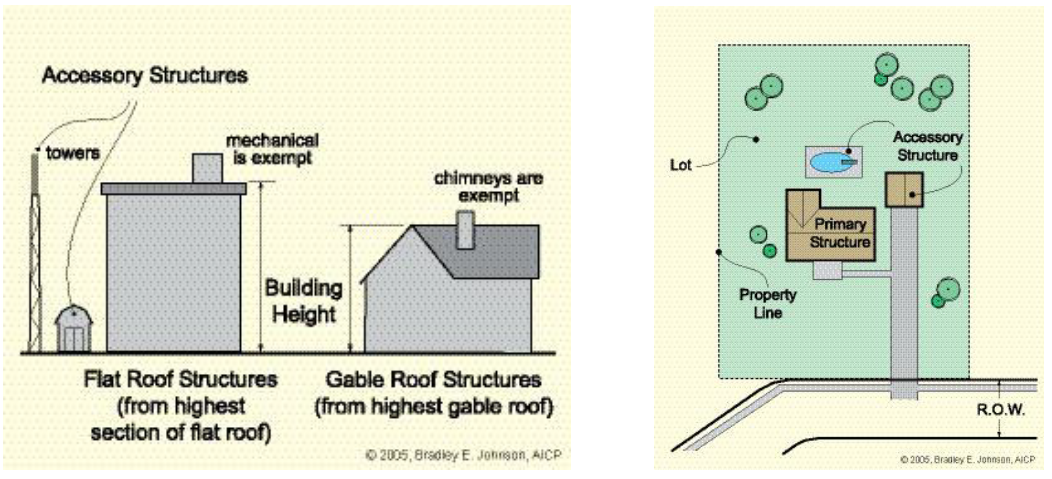
_____
Studio, art. A place of work of one or more persons who are engaged actively, and either gainfully or as a vocation in the following: the fine arts, including but not limited to, painting, printmaking, or sculpturing.
Subdivider. Any person or entity, which initiates proceedings to create a subdivision. See also developer.
Subdivision. An area of land which has been divided into two or more lots, tracts, parcels, or divisions of land for the purpose, whether immediate or future, of transfer of ownership or for building development, including all designations in street line, alley line, public area boundaries, lot lines, easements, rights-of-way, pavement width, curb lines, location and size of utilities, location and size of land areas to be dedicated.
Substantial improvement. Any reconstruction, rehabilitation, addition, or other improvement of a structure, the cost of which equals or exceeds 50 percent of the market value of the structure before the "start of construction" of the improvement. This term includes structures that have incurred "substantial damage" regardless of the actual repair work performed. This term does not include improvements to structures to correct existing violations of state or local health, sanitary, or safety code requirements or any alteration of a "historic structure," provided that the alteration will not preclude the structure's continued designation as a "historic structure."
Supermarket. Large-scale retailers of food and grocery supplies, typically also including flower shops, pharmacies, bakeries, branch banks, and other complementary and incidental uses. See retail sales.
Surety. An amount of money or other negotiable instrument provided by a developer to the city which guarantees that they will perform all actions required regarding an approved site development plan, plat, or other improvement, which provides that if the developer fails to comply with the requirements of approval, funds will be provided to the city to complete those requirements.
Survey marker. A stake, pipe, rod, nail, or any other object which is not intended to be a permanent point for record purposes.
Survey monument. A permanent physical structure which marks the location of a corner or other survey point.
Tailor shop. An establishment that alters and repairs clothing for patrons. See personal services.
Tanning salon. Any business which provides a service using artificial lighting systems, or cosmetic paints applied to a person to produce a tan on a person's body, including the incidental sales of tanning products. See personal services.
Telecommunications. The transmission of information between or among geographic points without change in the form or content of the information sent or received.
Telecommunications antenna. Any structure or device, including all appurtenances, used for the purpose of collecting or radiating electromagnetic waves, including those used to transmit cellular telephone service, data, radio, and television signals, and any other information.
Telecommunications facility. A land based facility, consisting of towers, antennae, accessory buildings and structures, or other structures intended for use in connection with the commercial transmission or receipt of radio or television signals, or any other spectrum-based transmissions/receptions.
Telecommunications tower. A mast, pole, monopole, guyed, or freestanding framework, or other vertical structure that acts as an antenna or to which an antenna is affixed or attached.
Temporary improvement location permit. See improvement location permit, temporary.
Temporary use. see use, temporary.
Theater. A facility for audio and visual productions and performing arts, excluding adult motion picture theaters and adult entertainment businesses. See commercial recreation facility.
Thoroughfare plan. The official plan, now and hereafter adopted, which includes a street plan, sets forth the location, alignment, dimensions, identification, and classification of existing and proposed streets, and other thoroughfares, as found in the City of Portage Comprehensive Plan.
Tool and dye shop. An establishment that processes, cuts, and molds metal into tools, molds, machine components, and similar products. See light industrial processing and distribution.
Topography. The configuration of the earth's surface, including the relative relief, elevations, and positions of land features.
Tower. See telecommunications tower.
Tower setback. The horizontal distance from the base of the tower to an abutting property line and/or proposed right-of-way.
Trail. A public way, separate from a street, alley, or other vehicle roadway, designed for and used by pedestrians, cyclists, and others using non-motorized transportation and recreation equipment.
Truck freight terminal. An area and building where trucks and cargo are stored, where loading and unloading is carried on regularly, and where minor truck maintenance is performed.
Truck sales and service. Any establishment that sells and services semis and other vehicles similar in size and purpose. Inoperable trucks may be temporarily stored on site only if they are to be serviced.
Two-page layout. Refers to the two-page layout accompanying each zoning district in Article III of the Zoning Ordinance. The two-page layout includes permitted uses, special exception uses, and basic zoning district information.
University or college. An institution for post-secondary education, public or private, offering courses in general, technical, or religious education and operated not-for-profit. It operates in structures owned or leased by the institution for administrative and faculty offices, student and faculty housing, classrooms, laboratories, chapels, auditoriums, lecture halls, libraries, student and faculty centers, community rooms and facilities, athletic facilities, fraternities, and sororities. A university may include for-profit businesses and facilities that are incidental to educational, cultural, and athletic functions and which lease space from the institution. A university shall not include trade schools operated for profit.
Use. The purposes for which land, building, or structure thereon is designed, arranged, or intended, or for which it is occupied, maintained, let, or leased.
Use, accessory. A use that is subordinate and customarily incidental to the primary use.
Use, change of. The discontinuation of the specific primary use of a lot or structure and the replacement of that use with a different specific use.
Use, existing. The use of a lot or structure present at the effective date of this zoning ordinance.
Use, illegal. Any use that is neither legal nonconforming or permitted by right or special exception in the zoning district in which it is located, as defined by this zoning ordinance.
Use, incidental. A minor occurrence or condition which is customarily associated with a permitted use and is likely to ensue from normal operations.
Use, nonconforming. A use which does not conform to the use regulations of the zoning district in which it is located.
Use, permitted. Any use listed as a permitted use in this zoning ordinance or which is an accessory or temporary use associated with the permitted use for the zoning district in which it is located.
Use, primary. The main use of land and/or structures, as distinguished from an accessory use. A primary use may be either a permitted use or a special exception use.
Use, special exception. A use that is designated by this zoning ordinance as being permitted in a specific zoning district if it is found to be appropriate and upon application, is specifically authorized by the board of zoning appeals.
Use, temporary. A land use established for a limited and fixed period of time with the intent to discontinue such use upon the expiration of said time period.
Use variance. See variance, use.
Utility substation. A building or structure used for the distribution or transmission of utilities such as water, gas, electricity, or sewer. See above ground utility facility.
Vacation. The termination or termination of interest in a plat, easement, or right-of-way or other public dedication.
Variance, development standards. A specific approval granted by the board of zoning appeals in the manner prescribed by the zoning ordinance, to deviate from the development standards (such as height, bulk, area) that the zoning ordinance otherwise prescribes.
Variance, use. The approval of a use by the BZA, which is not listed as a permitted or special exception use by this zoning ordinance and is not an accessory or temporary use associated with any primary use permitted by this chapter.
Variety store. A retail establishment that sells a multitude of consumer goods. See retail sales.
Vehicle. A device used as a mode of transportation of persons and/or goods including but not limited to automobiles, semi-tractor trailers, all types of trailers, snowmobiles, recreational vehicles, motorcycles, and like devices.
Vehicle detailing/accessory shop. An establishment that provides auto-detailing services and/or sells associated merchandise. Services offered are cosmetic in nature, and do not include mechanical upgrades or repairs. See auto service center.
Vehicle, inoperable. A vehicle, which, due to mechanical defect or failure, or incorrect or unapparent licensing, cannot physically or legally be operated.
Vision clearance triangle (sight triangle). An unoccupied triangular space at the street corner of a corner lot. The triangle is formed by connecting the point where each right-of-way line intersects and two points located 25 feet along each right-of-way line.
Warehouse. A facility for the storage, wholesale, and distribution of manufactured products, supplies, and equipment.
Water tower. A tower or standpipe that functions as a reservoir providing water to tie community. See above ground utility facility.
Wetland. Areas that are inundated and saturated by surface or groundwater at a frequency and duration sufficient to support vegetation typically adapted for life in saturated soil conditions as identified by the National Wetlands Institute and certified by an individual with the US Army Corps of Engineers Regulation 4 Jurisdictional Wetlands.
Wholesale facility. An establishment or place of business primarily engaged in selling and/or distributing merchandise to retailers, industrial, commercial, institutional, or professional business users, or to other wholesalers.
Winery. A facility in which wine products are grown and processed for commercial sales. The development may include other uses such as a retail shop, standard restaurant, bar, or live entertainment.
Yard. Open and unobstructed space on the same property as a primary structure except as otherwise authorized by the zoning ordinance. Yard types follow with diagrams:
•
Yard, front: The horizontal space between the foundation of a building or structure to the front lot line, extending to the side lines of the lot.
•
Yard, rear: The horizontal space between the foundation of a building or structure to the rear lot line, extending to the side lines of the lot.
•
Yard, side: The horizontal space between the foundation of a building or structure to the side lot line.
Yard sale. The sale or offering for sale to the general public, items of personal property on any portion of a lot in a residentially zoned district, either within or outside a structure.
Zoning district. A section of the City of Portage for which uniform zoning regulations governing use, height, area, size, intensity of use of buildings and land, and open spaces around buildings, are established by this zoning ordinance.
Zoning district, overlay. A zoning district that extends across one or more other zoning districts, which is intended to provide additional or alternate regulations for a specific critical feature or resource.
Zoning map. See official zoning map.
(Ord. No. 14-8, § 2, 8-5-14)

