
Portage City Zoning Code
ARTICLE VI
DEVELOPMENT STANDARDS2
Editor's note— Ord. No. 14-8, §§ 1 and 2, adopted Aug. 5, 2014, repealed Art. VI and enacted a new article as set out herein. The former Art. VI, §§ 90-6.1—90-6.72, pertained to similar subject matter and derived from Ord. No. 05-41, § 1, adopted Aug. 2, 2005; Ord. No. 06-55, § 3, adopted Oct. 3, 2006; Ord. No. 08-39, § 1, adopted Aug. 5, 2008; Ord. No. 10-19, Exh. A, adopted May 5, 2010; Ord. No. 11-06, § 1(Exh. A), adopted Feb. 7, 2011; Ord. No. 13-13, § 1, adopted July 2, 2013; and Ord. No. 13-14, § 1, adopted July 2, 2013.
Sec. 90-6.1.- Introduction.
All structures, buildings, land uses, land use changes, structural alterations, structural relocations, demolitions, structural additions, and structural enlargements that are constructed, created, established, or occur after the effective date of the zoning ordinance (except as may otherwise be provided within the zoning ordinance) are subject to all development standards and regulations for the applicable zoning district.
(Ord. No. 14-8, § 2, 8-5-14)
Sec. 90-6.2. - How to use this article.
Article VI contains development standards which are arranged by category. Refer to the two-letter or letter-number zoning district abbreviations identified at the top of each development standard section in Article VI. These abbreviations note that the development standard written in that section applies to that district.
The development standards assigned to each zoning district are considered appropriate for the permitted uses within that district; however, the development standards may not be considered appropriate for all special exception uses within a zoning district. The board of zoning appeals shall determine which development standard sections within Article VI shall apply to special exception applications. The development standards determined to apply shall be documented in the application and approval. If the special exception use is a permitted use within another district, the development standards for that district must be used as a guideline. In situations where the special exception use is not a permitted use in any district, the most stringent development standards may be assigned by the board of zoning appeals as appropriate.
(Ord. No. 14-8, § 2, 8-5-14)
Sec. 90-6.3. - Environmental standards.
This environmental standards section applies to the following districts:
CO PR R1 R2 R3 R4 M1 M2 M3 MP MW CR CM CC IS NC OC CI C2 HC BP LI HI
The following environmental standards apply:
A.
Excessive slope. Areas of land shall be deemed unsuitable for buildings when pre-development or post-development slopes are greater than 25 percent.
B.
Unsuitable land qualities. Areas of land shall be deemed unsuitable for buildings when it:
1.
Contains adverse soil or rock formations;
2.
Is highly susceptible to erosion;
3.
Has low percolation rate;
4.
Has low weight bearing strength; or
5.
Has any other feature likely to be harmful to the health, safety, prosperity, aesthetics, and general welfare of the community.
C.
Erosion prevention. All land, regardless of slope, from which structures or natural cover has been removed or otherwise destroyed, must be appropriately graded and seeded within 30 days after the removal or destruction of said natural cover to prevent erosion.
D.
Alterations to shoreline. No alteration of the shoreline or bed of a stream or creek shall be made until written approval is obtained from the Indiana Department of Natural Resources, Army Corp. of Engineers, and the provisions of this zoning ordinance are complied with. Alterations include, among other things, filling of a stream, creek, regulated ditch or wetlands, and dredging of a stream, creek or ditch.
E.
Retention, detention, and pond edges. The use of engineered hard edges is not permitted except around inlets and outlets. The use of engineered hard edges may not exceed five percent of the lineal feet of the total edge of any retention facility, detention facility, or pond. Under no circumstances will "riprap" be permitted above the water level.
F.
Waste disposal. No waste materials such as garbage, rubbish, trash, construction material, gasoline, oil, flammables, soils, tars, chemicals, greases, industrial or agricultural waste, or any other material of such nature, quantity, obnoxiousness, toxicity, or temperature that may contaminate, pollute, or harm the waters may be deposited, located, stored, or discharged on any lot in a way that would be likely to runoff, seep, or wash into surface or ground water.
G.
Fuel storage. No flammable or explosive liquids, solids, or gasses as specified by the state fire marshal may be stored in bulk above ground, except tanks or drums of fuel connected directly with energy devices or heating appliances located and operated on the same lot as the tanks or drums of fuel.
H.
Debris/refuse. Debris, refuse, trash, construction material, garbage, litter, unfinished buildings, scrap metals, or rotting wood may not accumulate on any property.
(Ord. No. 14-8, § 2, 8-5-14)
Sec. 90-6.4. - Floodplain standards.
This floodplain standards section applies to the following districts:
CO PR R1 R2 R3 R4 M1 M2 M3 MP MW CR CM CC IS NC OC CI C2 HC BP LI HI
The following floodplain standards apply:
A.
Development shall be prohibited within the floodplain unless provided otherwise in the zoning ordinance.
B.
All development must abide by the stormwater management and drainage ordinance (Chapter 42, Article III of this Code).
C.
All development must abide by the drainage ordinance (City Ordinance No. 92-5).
(Ord. No. 14-8, § 2, 8-5-14)
Sec. 90-6.5. - Public improvement standards.
This public improvement standards section applies to the following districts:
CO PR R1 R2 R3 R4 M1 M2 M3 MP MW CR CM CC IS NC OC CI C2 HC BP LI HI
A.
Developments are permitted only if the public streets, drainage facilities, and utilities are adequate to serve the proposed development. The director of community development, city engineer, department head, city official, and/or city board or commission must make a determination as to needed street, drainage and/or utility improvements. If a public street, drainage facility, or public utility is deemed inadequate to handle the anticipated impact of the development, the development project shall not be permitted.
B.
The petitioner may volunteer to overcome the inadequate public street, drainage facility, or public utilities by coordinating a remedy with the city engineer, board of public works, and/or common council. When public improvements are required, the developer or authorized representative is required to post performance and maintenance guarantees for such improvements. Upon execution of a written contract, the adequate public facility standard shall be deemed to be met.
C.
Any private streets must be constructed to the public street standards set forth in the subdivision control ordinance.
D.
All new utilities and service "drops" must be done so underground.
E.
Manufactured or mobile home parks must be in accordance with IC 16-11-27-1 et seq., Rule 410 IAC 6-6 and their subsequent amendments, the state board of health requirements, and the requirements of this zoning ordinance.
(Ord. No. 14-8, § 2, 8-5-14)
Sec. 90-6.6. - Lot standards.
This lot standards section applies to the following districts:
CO PR R1 R2 R3 R4 M1 M2 M3 MP MW CR CM CC IS NC OC CI C2 HC BP LI HI
The following lot standards apply:
A.
Minimum and/or maximum lot area. The minimum and/or maximum lot area shall be as per each division of Article III.
B.
Minimum and/or maximum lot width. The minimum and/or maximum lot width shall be as per each division of Article III.
C.
Minimum and/or maximum lot depth. The minimum and/or maximum lot depth shall be as per each division of Article III.
D.
Minimum lot frontage. The minimum lot frontage shall be as per each division of Article III.
E.
Minimum dwelling site area. The minimum dwelling site area shall be as per each division of Article III.
F.
Minimum dwelling site width. The minimum dwelling site width shall be as per each division of Article III.
G.
If one or more of the above listed lot standard does not appear in the division for a zoning district, then it does not apply to that particular zoning district.
(Ord. No. 14-8, § 2, 8-5-14)
Sec. 90-6.7. - Lot coverage standards.
This density and intensity standards section applies to the following districts:
CO PR R1 R2 R3 R4 M1 M2 M3 MP MW CR CM CC IS NC OC CI C2 HC BP LI HI
The following density and intensity standards apply:
A.
Maximum lot coverage. The maximum lot coverage shall be as per each division of Article III.
B.
If one or more of the above listed density or intensity standard does not appear in the division for a zoning district, then it does not apply to that particular zoning district.
(Ord. No. 14-8, § 2, 8-5-14)
Sec. 90-6.8. - General setback standards.
This setback standards section applies to the following districts:
CO PR R1 R2 R3 R4 M1 M2 M3 MP MW CR CM CC IS NC OC CI C2 HC BP LI HI
The following setback standards apply:
A.
Minimum and/or maximum front yard setback. The minimum and/or maximum front yard setbacks shall be as per each division of Article III. The front yard setback shall be measured from the future right-of-way based on the thoroughfare plan map in the Portage Comprehensive Plan. The minimum widths for rights-of-way shall be as follows:
•
Local streets: 50 feet right-of-way width.
•
Collector street: 70 feet right-of-way width.
•
Arterial street: Per department of community development.
•
Interstate or toll road: Per department of community development.
The director of community development may assign a special front yard setback (more or less) if the surrounding properties share a front yard setback which is inconsistent with the required setback, and where a negative impact to the aesthetics of the area would result by applying the required setback.
B.
Minimum Side Yard Setback. The minimum side yard setbacks shall be as per each division of Article III.
C.
Minimum and/or maximum rear yard setback. The minimum and/or maximum rear yard setbacks shall be as per each division of Article III.
D.
Maximum primary structure setback. The maximum primary structure setback shall be as per each division of Article III.
E.
Minimum dwelling site front yard setback. The minimum dwelling site front yard setbacks shall be as per each division of Article III.
F.
Minimum dwelling site side yard setback. The minimum dwelling site side yard setbacks shall be as per each division of Article III.
G.
Minimum dwelling site rear yard setback. The minimum dwelling site rear yard setback shall be as per each division of Article III.
H.
If one or more of the above listed types of setbacks does not appear on the division for a zoning district, then it does not apply to that particular zoning district.
I.
The following site features are exempt or partially exempt from the setback requirements as stated:
1.
Fences and walls are exempt from the setbacks in this section, but must abide by the fence and wall standards in Article VI.
2.
Utility poles, lines, and junction boxes are exempt from the setbacks in this section.
3.
Landscaping is exempt from this section, but must abide by the landscaping standards.
4.
Trails in parks and recreation facilities are exempt from the setbacks in this section.
5.
Sidewalks along any right-of-way and that connect buildings to the public sidewalk system are exempt from the setbacks in this section.
6.
Driveways in single family residential districts are exempt, but must not be closer than three-foot from side and rear property lines.
7.
Swimming pools shall meet the accessory structure setback requirements of the district, but in no instance shall a swimming pool be located closer than ten feet from a side or rear property lines.
8.
Entrances and driveways in commercial, industrial, multifamily and institutional districts are exempt from front yard setbacks, but must abide by the entrance and driveway standards in this article.
_____
9.
The following miscellaneous encroachments in the Central Avenue Business District (Downtown) are exempt:
Allowable setback encroachments in CR (CABD, residential) district:
Allowable setback encroachments in CM (CABD, mixed use) district:
Allowable setback encroachments in CC (CABD, commercial) district:
_____
(Ord. No. 14-8, § 2, 8-5-14)
Sec. 90-6.9. - Vision clearance standards.
This vision clearance standards section applies to the following districts:
CO PR R1 R2 R3 R4 M1 M2 M3 MP MW CR CM CC IS NC OC C1 C2 HC BP LI HI
The following vision clearance standards apply:
A.
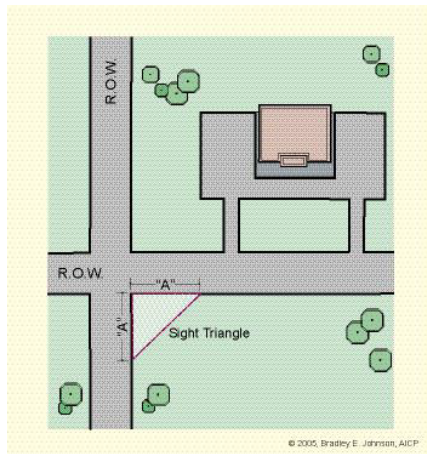
A clear area (known as a vision clearance triangle or a sight triangle) must be maintained at every intersection.
B.
The triangle leg lengths shall be 25 feet (see "A" in the illustration above).
C.
No primary or accessory structures, landscaping, fences or signs are allowed to be placed or to project into the vision clearance triangle except as noted below.
1.
Ground cover, annuals, perennials, and similar vegetation may be planted within the vision clearance triangle when the plants do not exceed 18 inches in height.
2.
Trees may be planted in the vision clearance triangle when they lowest limbs and canopy is at least five feet from the ground, allowing drivers to see through the triangle. No two trees may be placed within 20 feet of one another.
(Ord. No. 14-8, § 2, 8-5-14)
Sec. 90-6.10. - Structure quantity standards—General.
This structure quantity standards section applies to the following districts:
CO PR R1 R2 R3 R4 M1 M2 M3 MP MW CR CM CC IS NC OC CI C2 HC BP LI HI
The following structure quantity standards apply:
A.
Maximum primary structures. The maximum primary structures shall be as per each division of Article III.
B.
If the above listed structure quantity standard does not appear in the division for a zoning district, then only one primary structure is permitted per lot in that zoning district.
C.
Accessory structure quantities and development standards are regulated by the accessory structure standards section in this article.
D.
Street addresses. Street addresses must be posted on all primary structures and be visible from public right-of-way and/or be posted on mailbox or other suitable structures visible from public right-of-way. Street address numbers must be at least five inches in height.
(Ord. No. 14-8, § 2, 8-5-14)
Sec. 90-6.11. - Structure height standards—General.
This height standards section applies to the following districts:
CO PR R1 R2 R3 R4 M1 M2 M3 MP MW CR CM CC IS NC OC CI C2 HC BP LI HI
The following height standards apply:
A.
Maximum structure height. The maximum structure height shall be as per each division of Article III.
B.
If the above listed height standard does not appear in the division for a zoning district, then it does not apply to that particular zoning district.
C.
The following types of structures or building features are exempt or partially exempt from the maximum structure height standard as stated:
1.
Church steeples, bell towers, and religious symbols are allowed to extend up to a total height of 60 feet.
2.
Water towers are allowed up to a height of 150 feet.
3.
Chimneys are allowed to extend ten feet above the roof's highest point.
4.
Mechanical equipment, when mounted on a roof, is allowed to extend ten feet above the roof's highest point, but must be:
a.
Located such that it is not visible from adjacent private and public streets, or
b.
Shielded from view with a parapet or other architectural feature such that it is not visible from adjacent private or public streets.
5.
Elevator bulkheads are allowed to extend 15 feet above the roof's highest point, but must be:
a.
Located such that it is not visible from adjacent private and public streets, or
b.
Shielded from view with a parapet or other architectural feature such that it is not visible from adjacent private and public streets, or
c.
Be constructed with the same exterior building materials, or
d.
Be architecturally integrated into the building's designs as to not look like an elevator bulkhead.
6.
Radio and television towers not used for commercial transmission may extend up to 50 feet in height, including all antennae mounted on the tower.
(Ord. No. 14-8, § 2, 8-5-14)
Sec. 90-6.12. - Structure floor area standards—General.
This floor area standards section applies to the following districts:
CO PR R1 R2 R3 R4 M1 M2 M3 MP MW CR CM CC IS NC OC CI C2 HC BP LI HI
The following floor area standards apply:
A.
Minimum and/or maximum main floor area. The minimum and/or maximum main floor area shall be as per each division of Article III.
B.
Maximum main floor area. The maximum main floor area shall be as per each division of Article III.
C.
Minimum floor area per unit. The minimum floor area per unit shall be as per each division of Article III.
D.
If one or more of the floor area standard does not appear in the division for a zoning district, then it does not apply to that particular zoning district.
(Ord. No. 14-8, § 2, 8-5-14)
Sec. 90-6.13. - Structure standard—Residential lot and residential site.
This site and structure standards section applies to the following districts:
R1 R2 R3 R4 M1 M2 M3
The following site and structure standards apply:
A.
All roofs must have a minimum roof pitch of 4:12.
B.
All roofs must be either asphalt shingle, slate, raised seam metal, shake shingles or similar.
(Ord. No. 14-8, § 2, 8-5-14)
Sec. 90-6.14. - Structure standards—CABD (downtown).
This structure standards section applies to the following districts:
CR CM CC (with additional review)
Additional review: The director of community development and development review committee shall conduct an urban design review of structure proposals within the CR CM and/or CC districts (downtown) to determine whether or not such proposal is complementary to investment plans within the downtown.
The following structure standards apply:
A.
Building style.
1.
No single architectural style is appropriate in Downtown Portage.
2.
Architecture of any building shall consider the surrounding buildings, materials, and shall result in a cohesive mix.
B.
Building facades.
1.
The general scale of the design elements or components of the facade shall relate to pedestrian and slow-moving vehicle traffic.
2.
The top of the facade wall shall terminate with a decorative cornice, belt cornice, band or other decorative treatment.
3.
The front facade shall be presented in two components: the upper facade and the street level facade.
4.
Facades composed of brick or masonry construction shall be repointed and cleaned to a condition indicative of their original finish.
5.
All facades shall be designed to be consistent with the front facade.
6.
A return from the principal facade to the secondary facade is required.
C.
Corner clearance.
1.
At least 15 percent of a building corner shall be transparent and visually penetrable.
D.
Building materials.
1.
Principal facade material shall be brick. Accent materials for the principal facade include: stone, wood, and E.I.F.S.
2.
Secondary facade materials shall be brick, fluted concrete block, concrete block, stone, and/or E.I.F.S. The secondary facade shall be designed to be consistent with the principal facade.
E.
Roof forms.
1.
Hip and gable roofs shall have a minimum pitch of 6:12. Other roof types shall be appropriate to the architecture of proposed buildings. Roofs of commercial nature shall not be visible from the public right-of-way. The roof plane shall be hidden from view with parapet walls and/or false fronts that are less than two stories in height.
2.
The existing alignment of building cornices or rooflines shall be maintained.
F.
Principle facade and primary entry.
1.
The principal facade and primary entry of all buildings shall face the street. Buildings located on corner lots are considered to have two principal facades.
2.
The primary entry of a building located on a corner lot shall be reviewed by the development review committee.
G.
Windows and doors.
1.
Storefront glass shall dominate the first floor frontage along public streets with a minimum of 75 percent glass.
2.
The top of the storefront glass shall be at ten feet above grade level and visually related to adjacent buildings. If the top of the storefront glass is less than ten feet above grade, it shall be concealed with an awning.
3.
Ornamental lintels, belt courses, or similar elements shall be provided at the top of storefront glass.
4.
Storefront glass shall have a base of two to three feet constructed of material to match the primary building material of the facade.
5.
Storefront window frames shall be anodized aluminum, painted aluminum, or painted wood in white, black, or dark bronze. Other storefront materials and colors shall be reviewed by the development review committee on a per project basis.
6.
Second floor windows shall be individual or grouped windows coordinated with the design of the first floor storefront.
7.
Second floor window glass shall be clear or tinted.
8.
Reflective glass, ribbon windows, or all glass curtain wall systems shall be prohibited.
9.
The primary entrance of a building and/or store shall be covered with an awning or canopy.
10.
All commercial entry doors shall be glass.
11.
Security grilles or shutters shall be prohibited.
H.
Awnings.
1.
Awnings shall be canvas.
2.
Awnings, if provided, shall extend the full width of all first floor storefront glass.
3.
Internally illuminated awnings shall be prohibited.
4.
Awning configuration shall be shed design with a skirt and closed ends.
5.
An awning shall project a minimum of three feet from the face of the building. Top of an awning shall be ten feet above grade with the bottom skirt (7½ feet above grade level.
I.
Private outdoor spaces.
1.
All residential units shall have private outdoor spaces accessible from the unit.
•
Single-family (attached, 3-9): All units shall be arranged to provide a private outdoor space visually separated from the public right-of-way. The outdoor space shall have direct access from the interior space.
•
Single-family (upper stories)/multi-family: All units shall have a usable outdoor space directly accessible from the unit. The space may be patios, balconies, or porches.
J.
Mechanicals.
1.
Mechanical and electrical equipment, including air conditioning units, shall be concealed from street-level view.
2.
Any screens of building and roof-mounted equipment shall be constructed of the primary building materials of the facade and shall be integrated into the facade design. Raised parapet walls shall be preferred.
3.
Ground mounted equipment shall be screened with a wall constructed of the primary building material of the facade design or screened with perennial landscaping.
4.
Transom air conditioning units shall be prohibited unless there is no practical alternative, in which case it shall be concealed by an awning.
(Ord. No. 14-8, § 2, 8-5-14)
Sec. 90-6.15. - Manufactured/mobile park structure and site standards.
This site and structure standards section applies to the following districts:
MP
The following site and structure standards apply:
A.
Each manufactured or mobile home must be placed on a concrete pad.
B.
Manufactured or mobile home parks must be in accordance with IC 16-11-27-1 et seq., Rule 410 IAC 6-6 and their subsequent amendments, the state board of health requirements, and the requirements of this zoning ordinance.
C.
Each dwelling site must be clearly marked and defined.
D.
No more than one mobile home may be placed on a single dwelling site.
E.
Individual dwelling sites may only have driveways on interior roads.
F.
Each manufactured home park must contain a common park and recreation area with a minimum of 250 square feet per dwelling site.
G.
No mobile home shall be stacked, joined or combined in any way, and mobile homes must remain one story.
H.
All roads, walks and paths within the manufactured home community shall be hard surfaced.
I.
A greenbelt not less than 20 feet in width shall be located around the perimeter of the manufactured home park.
J.
Manufactured or mobile home parks with 40 or more dwelling sites shall have at least two access points shall be required into and out of the manufactured or mobile home park and individual dwelling sites may only have driveways on interior roads.
(Ord. No. 14-8, § 2, 8-5-14)
Sec. 90-6.16. - Accessory structure standards—General.
This accessory structure standards section applies to the following districts:
CO PR R1 R2 R3 R4 M1 M2 M3 MP MW CR CM CC IS NC OC CI C2 HC BP LI HI
The following accessory structure standards apply:
A.
Accessory structures shall comply with all development standards for the subject zoning district whether they are required to get a permit or not; unless specified otherwise.
B.
Accessory structures shall be for accessory uses of the primary structure. Storage is permitted as an accessory use unless specifically noted otherwise.
C.
Using an accessory structure for residential purposes is not permitted.
D.
An accessory structure shall not be used for a business.
E.
Accessory structures are not permitted on a lot prior to any primary structure being constructed. This provision does not apply to the CO district (conservation) or PR district (parks and recreation).
F.
Accessory structures must not encroach on any platted easement unless the owner of the easement gives written consent.
G.
An accessory structure must be located to the rear or side of the primary structure unless specifically permitted otherwise.
H.
Accessory structures shall be subordinate to the primary structure.
I.
Accessory structures shall be architecturally compatible with the primary structure. The exterior finish, facade and roof of each enclosed accessory structure must match or closely resemble the finish, facade materials and roof pitch used on the primary structure.
J.
A mobile home, manufactured home, recreational vehicle, semi-tractor trailer, boat or motor vehicle may not be used as an accessory structure in any district.
K.
Swimming pools must abide by the swimming pool standards section in this article as well as Indiana State Code.
L.
Dumpsters, compactors, and other trash receptacles are not regulated as accessory structures. See general waste/recycle receptacle standards section in this article.
M.
Radio and television towers and antennas, not used for commercial transmission of radio or television signals, are an allowed accessory use in all districts. The following requirements shall apply:
1.
Towers shall be placed in the center of the rear yard, or set back a minimum of 20 feet from the property line behind the primary structure.
2.
All towers shall not be more than 18 square inches the base and shall be set in a concrete foundation a minimum of 18 inches by 18 inches by 36-inch below grade.
3.
If a citizen band antenna or rotating beam is installed on a roof of an accessory structure or primary structure, it shall be installed on a tripod or towerette and have guide wires to secure it properly.
4.
Citizen band beam antennae that rotate should not swing closer than five feet from the property line.
(Ord. No. 14-8, § 2, 8-5-14)
Sec. 90-6.17. - Accessory structure standards—Residential lots.
This accessory structure standards section applies to the following districts:
R1 R2 R3 R4 M1 (MW as applicable)
The following accessory structure standards apply:
A.
No more than two enclosed accessory structures (i.e. detached garage, pool house, shed, etc.) are permitted.
B.
The cumulative square footage of all enclosed accessory structures cannot exceed 840 square feet.
(Ord. No. 14-8, § 2, 8-5-14)
Sec. 90-6.18. - Accessory structure standards—Residential sites.
This accessory structure standards section applies to the following districts:
M1 M2 M3 (MW as applicable)
The following accessory structure standards apply:
A.
No more than one detached garage or carport facility is allowed per primary structure.
B.
No more than one additional enclosed accessory structure (i.e. pool house, storage building, etc.) per primary structure.
C.
The cumulative square footage of all enclosed accessory structures and carports cannot exceed 50 percent of the square footage of the primary structure(s).
(Ord. No. 14-8, § 2, 8-5-14)
Sec. 90-6.19. - Accessory structure standards—Manufactured/mobile home park.
This accessory structure standards section applies to the following district:
MP
The following accessory structure standards apply:
A.
Management offices, sales offices, storage, mini-warehouses, laundry, dry cleaning facilities, and other structures customarily incidental to manufactured home parks or mobile home parks are permitted, provided the following criteria are met:
1.
The accessory structure is subordinate to the residential component of the park and adds aesthetic value to the park; and
2.
The accessory structure is located, designed and intended to serve only the needs of the park; and
3.
The establishments located within the accessory structure present no visible evidence of their business nature to areas outside the park.
B.
Each manufactured home or mobile home is entitled to one accessory structure per dwelling site in addition to a carport or garage. Written permission from management office required.
C.
The total area of all accessory structures may not exceed 20 percent of the dwelling site. Attached or detached garages, and carports are to be counted toward the total accessory building area.
D.
Model manufactured or mobile homes are permitted provided that the number of model homes is limited to five percent of the authorized number of dwelling sites in the park. Model homes must comply with all standards set forth in the MP district.
(Ord. No. 14-8, § 2, 8-5-14)
Sec. 90-6.20. - Accessory structure standards—Downtown.
This accessory structure standards section applies to the following districts:
CR CM CC (with additional review)
Additional review: The director of community development shall conduct an urban design review of accessory structure proposals within the CR CM and/or CC districts (downtown) to determine whether or not such proposal is complementary to investment plans within the downtown.
The following accessory structure standards apply:
A.
No more than one detached garage or carport facility is allowed per primary residential structure. Accessory garages and carports shall face the alley. Twenty-five feet shall be provided between the accessory garage or carport and the alley right-of-way. In the case an alley does not exist, site conditions shall be reviewed by the Director of Community Development and Development Review Committee.
B.
No more than one additional enclosed accessory structure (i.e. greenhouse, storage building, etc.) per primary residential structure. Such structure shall be located in the rear yard.
C.
The cumulative square footage of all enclosed accessory structures and carports cannot exceed 50 percent of the square footage of the primary structure(s).
D.
Accessory structures shall not be permitted for nonresidential uses.
(Ord. No. 14-8, § 2, 8-5-14)
Sec. 90-6.21. - Accessory structure standards—Businesses.
This accessory structure standards section applies to the following districts:
IS NC OC C1 C2 HC BP LI HI (MW as applicable)
The following accessory structure standards apply:
A.
Storage is not permitted as an accessory use.
B.
No more than one enclosed accessory structure (ie. detached garage, carport, shed, etc.) is permitted on a lot.
C.
The square footage cannot exceed 1,200 square feet or 50 percent of the square footage of the primary structure(s), whichever is less.
(Ord. No. 14-8, § 2, 8-5-14)
Sec. 90-6.22. - Entrance/drive standards.
This entrance and drive standards section applies to the following districts:
CO PR R1 R2 R3 R4 M1 M2 M3 MP MW IS NC OC C1 C2 HC BP LI HI CR CM and CC (with additional review)
Additional review: The director of community development shall conduct an urban design review of entrance/drive proposals within the CR, CM, and/or CC districts (downtown) to determine whether or not such proposal is complementary to investment plans within the downtown.
The following entrance and drive standards apply:
A.
Location. The entrance drive to a site shall be located perpendicular to the accessed street and in a way that does not undermine the intention of required setbacks. (All classification of roads referred to herein shall be based on the thoroughfare plan as found and maintained in the Portage Comprehensive Plan.)
1.
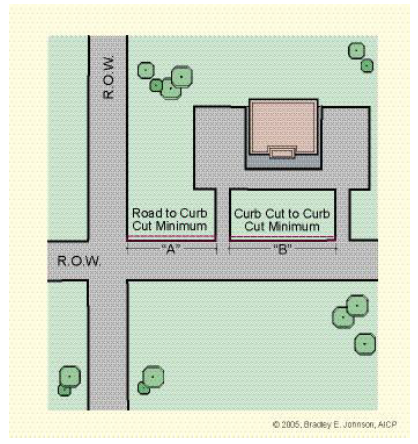
Distance from intersection. The distances for the standards shall be determined by measuring from right-of-way line to the curb or edge of pavement (whichever is less) of the entrance/drive. (See "A" in the illustration below.) Under no circumstances will an entrance/drive be allowed within 50 feet of any intersection.
•
Arterial/collector street: An entrance/drive shall be located at least 150 feet from any intersecting street. If the property is not large enough to achieve a 150-foot separation, then the entrance drive shall be installed at a location farthest from the intersection.
•
Local street: An entrance/drive shall be located at least 100 feet from any intersecting street. If the property is not large enough to achieve a 100-foot separation, then the entrance drive shall be installed at a location farthest from the intersection.
2.
Distance from another driveway. The distances for these standards shall be determined by measuring from the curb or edge of pavement to the curb or edge of pavement (whichever is less) of each entrance/drive. (See "B" in the illustration.)
•
Arterial/collector street: An entrance/drive shall be located at least 100 feet from any other entrance/drive. If the property is not large enough to achieve a 100-foot separation, then the entrance drive shall be installed at a location determined by the director of community development.
•
Local road: An entrance/drive shall be located at least 50 feet from any other entrance/drive unless lot widths do not permit such spacing. In the event 50 feet cannot be accomplished, the greatest reasonable distance shall be required. This regulation excludes single-family residential when it is to achieve paired driveways.
B.
Width. Entrance drives shall not exceed the following widths, measured from the outside edges of the curb or pavement (whichever is more) of the entrance drive:
•
Arterial/collector street: Business land uses which outlet onto an arterial or collector street shall have an entrance drive width of no more than 34 feet. Single-family (attached) and multi-family residential land uses which outlet onto an arterial or collector street shall have an entrance drive width of no more than 30 feet. Single-family (detached) and two-family land uses which outlet onto an arterial or collector street shall have an entrance drive width of no more than 28 feet.
•
Local street: Business land uses which outlet onto an arterial or collector street shall have an entrance drive width of no more than 30 feet. Single-family (attached) and multi-family residential land uses which outlet onto an arterial or collector street shall have an entrance drive width of no more than 28 feet. Single-family (detached) and two-family land uses which outlet onto an arterial or collector street shall have an entrance drive width of no more than 28 feet.
C.
Additional measures. The city engineer may determine that additional measures such as an acceleration/deceleration lane and/or passing blister at a new entrance/drive are necessary for the site to function properly.
(Ord. No. 14-8, § 2, 8-5-14)
Sec. 90-6.23. - Parking standards—General.
This parking standards section applies to the following districts:
CO PR R1 R2 R3 R4 M1 M2 M3 MP MW CR CM CC IS NC OC C1 C2 HC BP LI HI
The following parking regulations apply:
A.
Parking spaces. Each parking space must be at least ten feet wide and 20 feet long.
B.
Paved parking. All parking and circulation areas shall be surfaced with asphalt concrete or Portland cement concrete or other approved all-weather hard, non-eroding surface, except for those improved properties in residential zoning districts R1, R2, R3, R4, M1, M2 and M3 which shall require the use of cement concrete only. Such areas shall be designed and constructed to allow proper drainage.
C.
Parking in easements. Off-street parking spaces may not fully or partially be in a public right-of-way or utility easement.
D.
Maneuvering. All parking spaces (including garage spaces) required for any land use other than a detached single-family or two-family dwelling shall be designed and located to provide for vehicle maneuvering on the site so that vehicles will enter any adjacent public street (not alley) or private road in a forward direction.
E.
Obstruction. No vehicle may block a sidewalk or other passageway specifically intended for pedestrian traffic.
(Ord. No. 14-8, § 2, 8-5-14; Ord. No. 25-20, § 1, 3-4-25)
Sec. 90-6.24. - Parking standards—Residential lots.
This parking standards section applies to single-family (detached) dwellings and/or two-family dwellings the following districts:
R1 R2 R3 R4 M1 (MW as applicable)
The following parking regulations apply:
A.
Two off-street paved parking spaces are required per dwelling unit. Neither of the off-street parking spaces required may include spaces within a carport or garage unless the residential lot is 50 feet wide or less, in which case 50 percent of the off-street parking spaces required may include spaces within a carport or garage.
B.
Each lot is limited to one driveway per dwelling unit.
(Ord. No. 14-8, § 2, 8-5-14)
Sec. 90-6.25. - Parking standards—Residential sites.
This parking standards section applies to multi-family residential uses and/or multiple residential structures on the same property in the following districts:
M1 M2 M3 MP (MW as applicable)
The following parking regulations apply:
A.
Two paved off-street parking spaces are required per dwelling unit. Either/both of the off-street parking spaces required may include spaces within car ports or garages.
B.
At least two additional spaces per dwelling unit are required for visitor parking and shall be spread evenly throughout the development. Visitor parking spaces cannot include spaces in carports or garages.
C.
Each two-family dwelling or manufactured home dwelling site is limited to one driveway per dwelling unit.
(Ord. No. 14-8, § 2, 8-5-14)
Sec. 90-6.26. - Parking standards—CABD (downtown).
This parking standards section applies to the following districts:
CR CM and CC (with additional review)
Additional review: The director of community development shall conduct an urban design review of parking proposals within the CR, CM, and/or CC districts (downtown) to determine whether or not such parking proposal is complementary to investment plans within the downtown.
The following parking regulations apply:
A.
All surface parking downtown shall be shared parking. (Enclosed parking options for residential uses are addressed in the section pertaining to accessory structures.) Because parking shall be provided by the city, private off-street parking is prohibited unless it existed prior to the establishment of these guidelines or is granted approval by the development review committee. If off-street parking is approved by the development review committee, said body shall determine parking requirements using the parking standards sections in this article as a guide. The following standards shall supersede any discrepancies:
1.
A parking lot shall not be located in any front yard, adjoining street intersections, adjoining or across the street from parks or plazas.
2.
Entries into parking areas which cross sidewalks shall maintain the continuity of the sidewalk by ramping up to sidewalk level and using materials visually similar to the sidewalk.
3.
A parking lot that fronts a street or is adjacent to a residential use shall be screened from the street using walls, fences, hedges and/or other concealment of at least four feet in height to create a visual edge for pedestrians and motorists and to help define the streetscape intended for downtown.
4.
A parking lot that fronts a street shall maintain a landscaped area between the right-of-way line and the parking lot. The established setback of the street shall be respected. Ten feet shall be the minimum distance between the right-of-way line and the parking lot.
5.
Any additional parking lot landscaping shall be determined upon review and approval of off-street parking. Plantings to provide shade and help screen the parking lots from view are typically recommended.
B.
The city may employ temporary parking strategies to accommodate peak seasonal/event demand.
C.
Priority may be given to vehicles used for community transit.
D.
Bicycle racks to which bicycles can be located shall be provided at each nonresidential building site at a ratio of one per 1,000 square feet of building area.
(Ord. No. 14-8, § 2, 8-5-14)
Sec. 90-6.27. - Parking standards—All parking lots.
This parking standards section applies to the following districts:
PR IS NC OC C1 C2 HC BP LI HI
MW if residential complex or nonresidential use
M1 M2 M3 or MP if residential complex development
The following parking regulations apply to any parking lot:
A.
Parking lot design. Parking lots shall be designed using the following objectives and standards:
1.
Design sites such that vehicles are not the dominant feature. No portion of a parking lot shall encroach into any minimum yard setback. Periphery landscaping and large interior parking lot landscaping islands shall aid in softening the appearance of a parking lot.
2.
Provide necessary parking without large expanses of pavement. Expanses of parking shall be broken up with wide landscape divider medians. Such medians shall be incorporated into the parking lot design to aid site circulation measures and to provide aesthetic interest.
3.
Create a safe and comfortable environment for pedestrians and bicyclists as well as vehicles. Parking lot design shall incorporate pedestrian walkways for safe access through the site and connect to adjacent sites as appropriate.
B.
Parking lot delineation. All parking lots (including ingress/egress and all accessways) shall be curbed. All parking spaces shall be striped so as to identify each parking space. Parking spaces to accommodate people with disabilities shall be provided as required by ADA. Striping shall also be provided to aid in effective traffic circulation.
C.
Parking lot aisles. Minimum parking aisle widths shall be as follows:
•
90-degree angle space: 24 feet wide parking aisle for one- or two-way traffic.
•
60-degree angle space: 18 feet wide parking aisle for one-way traffic.
•
45-degree angle space: 14 feet wide parking aisle for one-way traffic.
D.
Parking lot landscape areas. One deciduous tree shall be planted per 60 feet of the linear length of the parking lot perimeter and any landscape divider median. Any interior parking lot landscape islands shall compliment site landscaping. All parking lot landscape areas shall be at least 20 feet in width. Shrubs shall compliment the parking lot landscape areas, prepared as part of the overall landscape plan. Refer to landscape standards section in this article.
E.
Parking lot lighting. Parking lot lighting shall be required. Refer to lighting standards in this article.
F.
Maintenance. It shall be the responsibility of the property owner to ensure that the surface is maintained free from significant cracks or holes, that landscaping is healthy, and that the site is litter-free.
G.
Number of parking spaces. The minimum number of parking spaces shall be determined by adding up the spaces required for each applicable statement below. The numbers below do not guarantee the quantity needed per use, only minimums are expressed. The petitioner must calculate additional parking spaces that may be necessary.
H.
Unidentified use. If a use is not clearly noted in Exhibit A, the director of community development shall determine into which category the uses best fit, therefore determining the parking requirements.
I.
Additional parking spaces. Additional parking spaces may be required by the director of community development if deemed necessary.
J.
Shared parking. A single or group of adjacent properties may utilize a shared parking area if the number of spaces required for each use is adequate. The following requirements apply:
1.
Each lot must have at least 80 percent of the total spaces required for its use available at any given time.
2.
A written reciprocal parking agreement signed by all property owners and be recorded on the deed for each property involved is required.
3.
The written reciprocal parking agreement must include provisions concerning at least maintenance, snow removal, ownership, and liability.
4.
The director of community development must approve the shared parking area and written parking agreement.
K.
Location. Parking spaces prescribed in this section must be located either on the premises or on a lot approved by the plan commission. All required off-street parking spaces, however, must be located within 800 feet of the subject lot.
(Ord. No. 14-8, § 2, 8-5-14)
Sec. 90-6.28. - Loading standards.
This loading standards section applies to the following districts:
PR IS NC OC C1 C2 HC BP LI HI (MW if nonresidential use)
CR CM and CC (with additional review)
The following loading standards apply:
A.
All off-street loading berths shall be located on the same property as the use to be served.
B.
Every effort shall be made to locate a loading zone in an area least visible to the public view. Loading areas shall be designed to minimize attention to the loading area.
C.
Any loading area shall have an adequate accessibility from an appropriate roadway, maneuvering apron and vertical clearance for truck deliveries. Truck maneuvering in the right-of-way shall not be permitted.
D.
Any loading or unloading berth or bay that faces or is visible from the public right-of-way shall be screened. Screening shall consist of a combination of elements used in the building facade and the landscape plan.
(Ord. No. 14-8, § 2, 8-5-14)
Sec. 90-6.29. - Waste/recycle receptacle standards.
This waste/recycle receptacle standards section applies to the following districts:
CO PR R1 R2 R3 R4 M1 M2 M3 MP MW IS NC OC C1 C2 HC BP LI HI
CR CM and CC (with additional review)
The following waste/recycle container standards apply:
A.
All receptacles shall be confined to portions of the site least visible to the public view.
B.
Dumpsters, compactors and similar containers must be screened on all sides by a fence or wall and must be constructed with the same exterior building materials as the primary structure; however, glass or similar translucent and breakable materials shall not be used.
C.
The height of the enclosure must be five feet or higher if the height does not block the view of the dumpster, compactor or similar container.
(Ord. No. 14-8, § 2, 8-5-14)
Sec. 90-6.30. - Drive-thru standards.
This drive-thru standards section applies to any drive-thru facility:
PR IS NC OC C1 C2 HC BP LI HI (MW if nonresidential use)
CR CM and CC if nonresidential use (with additional review)
Additional review: The director of community development shall conduct an urban design review of drive-thru proposals within the CR, CM, and/or CC districts (downtown) to determine whether or not such proposal is complementary to investment plans within the downtown.
The following drive-thru standards apply and shall be part of a site plan prepared by a licensed engineer and reviewed in the site plan approval process:
A.
General drive-thru design. Any drive-thru shall be designed using the following objectives and standards in order to promote compatible development that fits well with and improves its existing or planned context:
1.
District character. Protect and enhance the character and quality of the district and neighborhood where the drive-thru facility is located. Provide ample landscaping, in combination with building orientation, to enhance the streetscape and define the street edge when setting buildings back from the street is unavoidable. The number and width of driveways from the public street shall be minimized to help reduce interruptions to the public sidewalk.
2.
Community focus. Enhance public streets and contribute to high quality public space. Surface parking areas and stacking lanes shall be located at the side or rear of the building. Locating the stacking lane between the primary facade of the building and the public street shall be avoided.
3.
Neighborly consideration. Minimize impacts on adjacent land uses that could be caused by on-site activities. Use every effort to locate stacking lanes away from adjacent sensitive uses, such as residential and outdoor amenity areas, to reduce the impacts of noise and pollution that could be caused by stacking cars on such uses. Elements to add visual and environmental interest shall be used to help buffer potential impacts. Landscaping is preferred.
4.
Traffic circulation. Create efficient stacking movements on site. Each drive-thru aisle shall be separated from the circulation routes necessary for ingress or egress from the property or access to a parking space. The start point to the stacking lane shall be located in such a way that the queued vehicles do not block traffic along the public streets or the movement of other vehicles on site. Separate stacking lanes shall be provided when multiple drive-thru uses exist on the same site. Landscaped islands, decorative pavement, pervious islands and painted lines shall be used to separate stacking lanes when multiple drive-thru uses exist on the same site.
5.
Pedestrian environment. Create a safe and comfortable pedestrian environment on site. On-site circulation shall be designed to minimize the conflicts between pedestrians and vehicles. Entrance doors shall be directly accessible from both the public sidewalk and parking areas. Pedestrian walkways should not intersect the drive-thru drive aisles, but where they do, the walkways shall have clear visibility and shall be emphasized by enriched paving or striping. Landscaped islands, decorative pavement, pervious islands and painted lines shall be used to define and enhance pedestrian areas.
B.
Drive-thru aisle specifics. The minimum standards for drive-thru aisles are as follows:
1.
Each drive-thru aisle shall be constructed with Portland cement concrete.
2.
Each drive-thru aisle shall have a minimum ten-foot interior radius at curves and a minimum 12-foot width.
3.
Each drive-thru aisle shall queue at least four standard vehicles between the menu board and the entry point into the drive-thru aisle. If the drive-thru has a pick-up window, the drive-thru aisle shall accommodate the stacking of two standard vehicles between the window and the menu board. A stacking space is 12 feet wide by 20 feet long. (The city may approve a reduction of the stacking requirements of this section upon demonstration by a qualified traffic engineer that a reduction in the stacking requirements is appropriate for the applicant's proposed use given its proposed intensity or context. Minor deviations of these requirements that reduce the stacking distance by less than one stacking space may be approved by the approval body without a demonstration by a licensed traffic engineer if the applicant demonstrates that strict compliance with this section is impracticable or would lead to a lower quality of site design.)
4.
Stacking lanes shall not interfere with parking spaces, parking aisles, loading spaces, internal site circulation, or points of ingress and egress. Stacking spaces may not be used to satisfy any of the off-street parking requirements.
5.
Each entrance to an aisle and the direction of traffic flow shall be clearly designated by signs and pavement markings. Pedestrian walkways that intersect the drive-through drive aisles, shall have clear visibility, and be emphasized by enriched paving or striping.
6.
A 12-foot bypass lane is required adjacent to the stacking lane to allow vehicles to circumvent the stacking lane.
(Ord. No. 14-8, § 2, 8-5-14)
Sec. 90-6.31. - Lighting standards.
This lighting standards section applies to the following districts:
CO PR R1 R2 R3 R4 M1 M2 M3 MP MW CR CM CC IS NC OC CI C2 HC BP LI HI
The following lighting standards apply:
A.
Lighting in any pedestrian area shall have one foot-candle of illumination.
B.
All lot lighting must be shielded with opaque material to prevent direct lighting on streets, alleys, and adjacent properties.
C.
All ground lighting used to cast light on building facades, features of buildings or signs must have shields to assure that light does not project beyond the building or sign and must utilize the most minimum amount of light necessary to light the facade, building feature or sign. The light fixture and bulb must be shielded from view of any street, sidewalk, or parking lot.
D.
Parking lot lights must not exceed 25 feet in height.
E.
Sport field lights must not exceed 70 feet in height and shall be shut off by 11:00 p.m. on any given night.
F.
All freestanding lights and lights mounted on walls or facades must have cutoff luminaires with 90 degrees or less of an angle (downlighting).
G.
All lighting fixtures and poles within a single development must be consistent in style, design and color.
H.
Lighting from a property may not cause more than one-half foot-candle of illumination beyond the property line of that property. The only exception to this standard is as follows:
•
When the subject property is zoned for business use and the adjacent property is also zoned for business or industrial use, then the allowable light at the property line is two foot-candle (only on the sides of the property that are adjacent to the similar zoning district).
•
When the subject property is zoned for industrial use and the adjacent property is also zoned for industrial use, then the allowable light at the property line is two foot-candles (only on the sides of the property that are adjacent to the similar zoning district).
I.
Measurements of light readings shall be taken along any portion of a property line of the subject property with a light meter facing the center of the property at a height of five feet.
(Ord. No. 14-8, § 2, 8-5-14)
Sec. 90-6.32. - Fence and wall standards—General.
This fence and wall standards section applies to the following districts:
CO PR R1 R2 R3 R4 M1 M2 M3 MP MW IS NC BP LI HI
CR CM CC (see downtown fence and wall standards)
The following fence and wall standards apply:
A.
Fences and walls shall present the finished side (specifically, non-structural face) outward.
B.
Fences and walls are permitted up to the property line, except as identified for security fencing for high intensity uses and/or utility exceptions.
C.
Except as provided for in the downtown fence and wall standards section, fences and walls shall not be located in any front yard.
D.
Except as provided for in the high intensity use exceptions for fence and wall standards section, fences and walls shall not be greater than six feet in height.
E.
Except as provided for in the utility exceptions for fence and wall standards section, fences and walls shall not incorporate barbed wire, security wire, sharpened top spikes, electrified wires or the like.
(Ord. No. 14-8, § 2, 8-5-14)
Sec. 90-6.33. - Fence and wall standards—CABD (downtown).
This fence and wall standards section applies to the following districts:
CR CM and CC (with additional review)
Additional review: The director of community development shall conduct an urban design review of fence/wall proposals within the CR, CM, and CC districts (downtown) to determine whether or not such proposal is complementary to investment plans within the downtown.
The following fence and wall standards apply:
A.
Materials. Walls shall be constructed of stone, brick, or other decorative masonry material. Fences shall be constructed of cast iron or decorative metal. Chain link, concrete block and/or wood fencing shall be prohibited. A vinyl fence may be permitted for residential uses when private rear yards are provided. Location and impact to overall downtown aesthetic will be considered during review of such vinyl fence proposal. Fences in a residential development shall be of consistent material.
B.
Height. Fences located between the building facade and the right-of-way to define private yards in residential developments or to define business amenities such as outdoor dining areas shall be three feet in height. Fences in side or rear yards shall be six feet in height.
(Ord. No. 14-8, § 2, 8-5-14)
Sec. 90-6.34. - High intensity exceptions for exceeding general fence and wall standards.
This fence and wall standards section applies to the following districts:
MW IS NC BP LI HI
The following fence and wall standards apply:
A.
Height. Fences and/or walls shall not be greater than eight feet in height for high intensity business uses (as determined by the director of community development) in the districts listed above.
B.
Security. An approved eight-foot fence/wall may include security measures, but shall meet the following standards:
1.
It shall be at least 15 feet from any property line.
2.
The security fence shall be landscaped around the outside of the fence.
3.
All required landscaping shall be planted within 15 feet of the security fence.
4.
The minimum required landscaping includes one shrub per five lineal feet of security fence/wall and one ornamental tree per 15 feet of security fence/wall.
5.
Shrubs shall be planted at least three feet from one another and no more than six feet from one another.
6.
Ornamental trees shall be planted at least eight feet from one another and not more than 15 feet from one another.
7.
Barbed wire is permitted on security fences/walls, but shall not be used on any fence less than eight feet in height. Sharpened top spikes, electrified wires and the like are not permitted on any security or regular fences/walls.
(Ord. No. 14-8, § 2, 8-5-14)
Sec. 90-6.35. - Utility exceptions for exceeding general fence and wall standards.
This fence and wall standards section applies to the following districts:
CO PR R1 R2 R3 R4 M1 M2 M3 MP MW CR CM CC IS NC OC C1 C2 HC BP LI HI
A.
Security. A security fence/wall may be installed around utility sub-stations, wireless communication facilities, water towers and may be up to eight feet in height, but shall meet the following standards:
1.
It shall be at least 15 feet from any property line.
2.
It shall be landscaped around the fence.
3.
All required landscaping shall be planted within 15 feet of the security fence.
4.
The minimum required landscaping includes one shrub per five lineal feet of security fence/wall and one ornamental tree per 15 feet of security fence/wall.
5.
Shrubs shall be planted at least three feet from one another and no more than six feet from one another.
6.
Ornamental trees shall be planted at least eight feet from one another and not more than 15 feet from one another.
7.
Barbed wire is permitted on security fences/walls, but shall not be used on any fence less than eight feet in height. Sharpened top spikes, electrified wires and the like are not permitted on any security or regular fences/walls.
8.
When a security fence is required in a CR, CM or CC district (downtown), it shall be in combination with solid walls and pillars and decorative view ports or short solid wall segments and open wrought iron grille work and shall be reviewed by the director of community development and development review committee.
(Ord. No. 14-8, § 2, 8-5-14)
Sec. 90-6.36. - Landscape standards—General.
This landscaping standards section applies to the following districts:
CO PR R1 R2 R3 R4 M1 M2 M3 MP MW CR CM CC IS NC OC CI C2 HC BP LI HI
The following landscape standards apply:
A.
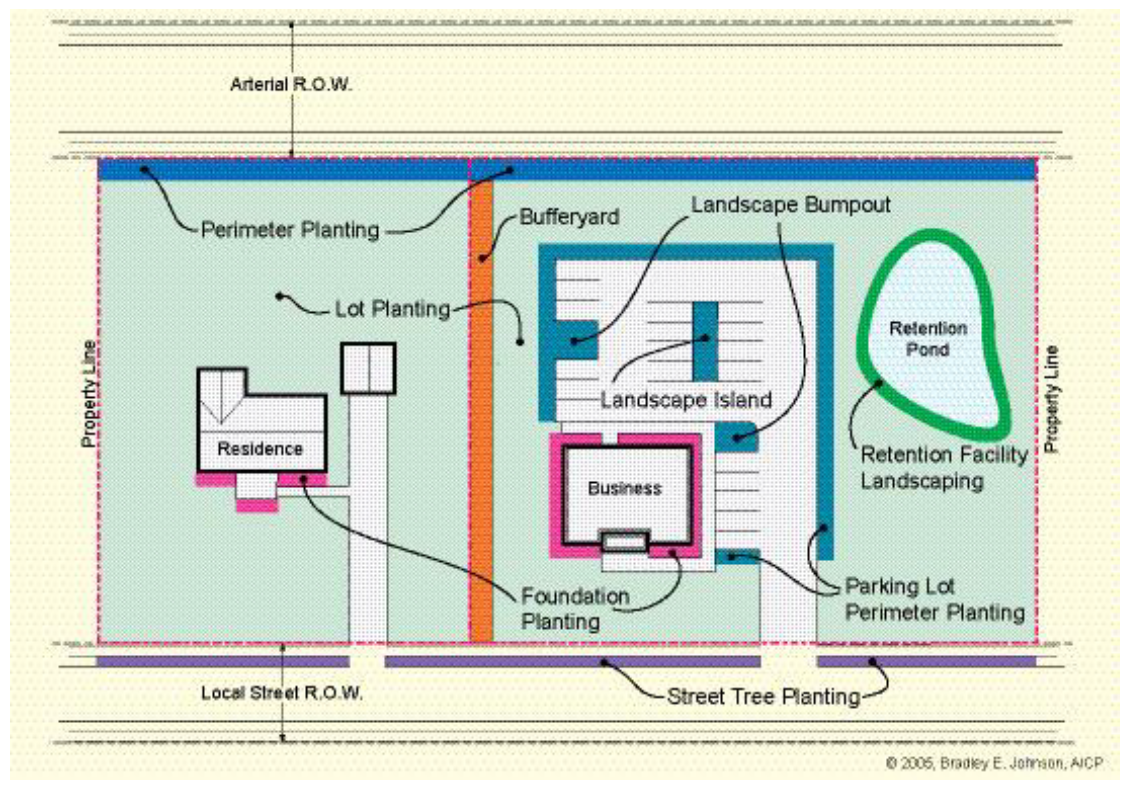
Planting areas. The zoning ordinance recognizes the need for landscaping requirements in four different areas on a property: lot planting areas, foundation planting areas, parking lot planting areas, and buffer yard areas. The following image conceptually demonstrates the location of each landscape area.
_____
_____
B.
Native planting requirements. Planting requirements vary by zoning district, as identified in this article. The use of species native to the region is required. All deciduous trees must have at least a two-inch caliper and all evergreens must be at least six feet in height when planted. All deciduous tree sizes must be measured using DBH, and all evergreen tree sizes must be determined by measuring height. Under no circumstances may any dead or artificial plant be installed and/or counted as part of the minimum planting required.
C.
Tree preservation. The preservation of an existing healthy tree shall constitute a credit toward the minimum landscape requirements in the zoning ordinance. A credit will be given per tree that contributes to and satisfies the intent of a particular section of the landscape standards in this article. Orange construction fencing must be installed during construction at or beyond the dripline of each tree to be preserved. These trees must also be marked "Do Not Remove" on the site plan. Any trees marked "Do Not Remove" on the site plan that are removed or injured beyond repair must be replaced by one or more similar specie trees with a cumulative DBH of 1.25 times the DBH of the tree which was to be preserved. The following credits shall be granted for an existing tree as follows:
•
Each preserved deciduous tree between four and eight inches DBH shall be granted credit for two deciduous trees.
•
Each preserved deciduous tree between eight and 12 inches DBH shall be granted credit for three deciduous trees.
•
Each preserved deciduous tree over 12 inches DBH shall be granted credit for four deciduous trees.
•
For each preserved evergreen tree over ten feet tall a credit for two evergreen trees shall be granted.
D.
Landscaping easements/right-of-way. Hardscape material and/or softscape material may extend into an existing or proposed easement with the written permission from the easement holder. Such landscape material may extend into the existing or proposed right-of-way with the written permission of the board of public works and safety. Such special permission is not necessary for the installation of street trees; however, utilities should always be marked prior to any planting.
E.
Maintenance. The landowner and their successors in interest are responsible for the regular maintenance of all landscaping elements. All hardscape material shall be refinished, repaired, cleaned and/or replaced periodically to maintain a structurally and aesthetically sound condition. All softscape material shall be maintained free from disease, pests, weeds, litter and erosion. Any softscape material required by this zoning ordinance, the plan commission, director of community development, or the board of zoning appeals that dies, or is otherwise removed, must be replaced within 60 days of death. The director of community development may grant up to a 90-day extension due to the weather.
F.
Substitutions. Substitutions or alterations of minimal planting required may be reviewed and approved by the director of community development, but must be equal to or greater than that which is required.
(Ord. No. 14-8, § 2, 8-5-14)
Sec. 90-6.37. - Landscape standards—Residential lots.
This landscape standards section applies to single-family (detached) dwellings and/or two-family dwellings the following districts:
R1 R2 R3 R4 M1 (MW as applicable)
The following landscape standards apply:
A.
A choice of one deciduous street tree per 40 feet of street frontage or deciduous trees planted in the lot planting area as identified below:
•
A lot with less than 10,000 square feet shall be required to plant two deciduous trees in the lot planting area.
•
A lot over 10,000 square feet but less than 20,000 square feet shall be required to plant three deciduous trees in the lot planting area.
•
A lot over 20,000 square feet shall be required to plant four deciduous trees in the lot area, plus one more per every 10,000 square feet over 20,000 square feet.
(Ord. No. 14-8, § 2, 8-5-14)
Sec. 90-6.38. - Landscape standards—Residential sites.
This landscaping standards section applies to multi-family residential uses and/or multiple residential structures on the same property in the following districts:
M1 M2 M3 MP (MW as applicable)
Landscaping may be spaced irregularly and in informal groupings. All landscaping shall be planted in good well-drained soil (preferred) or structural soil installed in and ten feet surrounding said planting area. The trunk of any shrub shall not be planted within five feet of the parking lot edge or other impervious surface. The trunk of any tree shall not be planted within ten feet of the parking lot edge or other impervious surface. Each tree shall be located in a well-established lawn area or dedicated planting bed if accompanied by other plantings.
The following plantings shall be part of a landscape plan prepared by an approved licensed landscape architect or professional landscaper:
A.
Lot planting area.
•
A residential site with less than 10,000 square feet shall be required to plant two deciduous trees in the lot planting area.
•
A residential site over 10,000 square feet but less than 20,000 square feet shall be required to plant three deciduous trees in the lot planting area.
•
A residential site over 20,000 square feet shall be required to plant four deciduous trees in the lot planting area, plus one more deciduous tree per every 10,000 square feet over 20,000 square feet.
•
Each manufactured/mobile home park shall be required to plant one deciduous tree per 10,000 square feet of lot area and one evergreen tree per 20,000 square feet of lot area. These planting may be located on dwelling sites or in common areas. For every ten dwelling sites in a manufactured/mobile home park one canopy tree must also be planted in the lot planting area.
B.
Foundation planting area.
1.
If the facade that the foundation plantings are to be placed in front of is less than 15 feet in height (exclusive of roof), then said structure shall have a minimum of one shrub planted per ten lineal feet of foundation facing street or parking area, located in dedicated planting beds at least ten feet wide and within 20 feet of the foundation wall. Clustering and variation of distance between the planting and the foundation is recommended.
2.
If the facade that the foundation plantings are to be placed in front of is greater than 15 feet in height (exclusive of roof), then said structure shall also have a minimum of one deciduous tree planted per 40 lineal feet of foundation facing street or parking area, located in dedicated planting beds at least 20 feet wide and within 40 feet of the foundation wall. Clustering and variation of distance between the planting and the foundation is recommended.
3.
Each dwelling site in a manufactured/mobile home park shall have a minimum of two shrubs or deciduous trees planted in the foundation planting area or next to the main entrance into the home. Said foundation planting shall be within six feet of the foundation.
C.
Parking lot planting area. One deciduous tree shall be planted for every 60 linear feet of parking lot perimeter and/or buffer strip.
D.
Buffer yard planting area. If any approved residential site land use is to abut a lesser intense land use, the approved residential site land use shall plant additional landscaping as determined in the approval process. An additional ten feet of setback along each affected property line shall be required.
(Ord. No. 14-8, § 2, 8-5-14)
Sec. 90-6.39. - Landscape standards—CABD (downtown) and parks.
This landscaping standards section applies to the following districts:
CO PR CR CM CC
A site-appropriate landscape plan shall be provided by an approved licensed landscape architect or professional landscaper. Such plan will be reviewed by the director of community development. Additional review and approval will be conducted as part of site development.
(Ord. No. 14-8, § 2, 8-5-14)
Sec. 90-6.40. - Landscape standards—Businesses.
This landscaping standards section applies to the following districts:
IS NC OC C1 C2 HC BP LI HI (MW as applicable)
Landscaping may be spaced irregularly and in informal groupings. All landscaping shall be planted in good well-drained soil (preferred) or structural soil installed in and ten feet surrounding said planting area. The trunk of any shrub shall not be planted within five feet of the parking lot edge or other impervious surface. The trunk of any tree shall not be planted within ten feet of the parking lot edge or other impervious surface. Root barriers shall be installed for tree plantings to promote roots to grow down and away from impervious surfaces. Each tree shall be located in a well-established lawn area or dedicated planting bed if accompanied by other plantings.
The following plantings shall be part of a landscape plan prepared by an approved licensed landscape architect or professional landscaper:
A.
Lot planting area.
•
A site with less than 20,000 square feet shall be required to plant two deciduous trees in the lot planting area.
•
A site over 20,000 square feet but less than 40,000 square feet shall be required to plant three deciduous trees in the lot planting area.
•
A site over 40,000 square feet shall be required to plant four deciduous trees in the lot planting area, plus one more deciduous tree per every 20,000 square feet over 40,000 square feet.
B.
Foundation planting area.
1.
If the facade that the foundation plantings are to be placed in front of is less than 15 feet in height (exclusive of roof), then said structure shall have a minimum of one shrub planted per ten lineal feet of foundation facing street or parking area, located in dedicated planting beds at least ten feet wide and within 20 feet of the foundation wall. Clustering and variation of distance between the planting and the foundation is recommended.
2.
If the facade that the foundation plantings are to be placed in front of is greater than 15 feet in height (exclusive of roof), then said structure shall also have a minimum of one deciduous tree planted per 40 lineal feet of foundation facing street or parking area, located in dedicated planting beds at least 20 feet wide and within 40 feet of the foundation wall. Clustering and variation of distance between the planting and the foundation is recommended.
C.
Parking lot planting area.
1.
One deciduous tree shall be planted for every 60 linear feet of parking lot perimeter and/or buffer strip.
2.
Any buffer strip shall use a planted groundcover.
D.
Buffer yard planting area. If any approved business land use is to abut a lesser intense land use, the approved business land use shall plant additional landscaping as determined in the approval process. An additional ten feet of setback along each affected property line shall be required if the use shall abut a residential site development. An additional 20 feet of setback along each affected property line shall be required if the use shall abut a residential lot development.
(Ord. No. 14-8, § 2, 8-5-14)
Sec. 90-6.41. - Sign standards—General.
This sign standards section applies to the following districts:
CO PR R1 R2 R3 R4 M1 M2 M3 MP MW CR CM CC IS NC OC CI C2 HC BP LI HI
The following sign standards apply:
A.
Noncommercial messages. Noncommercial messages are expressly permitted on all permitted signs.
B.
Permits. Except as otherwise provided herein, it shall be unlawful for any person to erect, install, construct, enlarge, move, or convert any sign without first obtaining a sign permit from the director of community development.
C.
Materials. Except as otherwise provided herein, all signs are required to utilize professional grade sign boards, material, and technique to assure long term durability and aesthetic.
D.
Construction. Any sign shall be professionally constructed/placed in such a fashion that it will withstand all wind and vibration forces that can normally be expected to occur in the vicinity and in compliance with all applicable codes.
E.
Multiple faced signs. Where a sign has two or more faces, the area of all faces shall be included in determining the area of the sign, except that where two faces are placed back to back and are at no point more than two feet from one another, the area of the sign shall be taken as the area of one face if the two faces are identical in face area and design. (This section does not apply to the BB-OL district.)
F.
Measurement, building sign. For a building sign which is framed, outlined, painted or otherwise prepared and intended to provide a background for a sign display, the area and dimensions shall include the entire portion within such background or frame. For a building sign comprised of individual letters, figures or elements on a wall or similar surface of the building or structure, the area and dimensions of the sign shall encompass a regular geometric shape (rectangle, circle, trapezoid, triangle, etc.), or a combination of regular geometric shapes, which form, or approximate, the perimeter of all elements in the display, the frame, and any applied background that is not part of the architecture of the building. When separate elements are organized to form a single sign, but are separated by open space, the sign area and dimensions shall be calculated by determining the geometric form, or combinations of forms, which comprises all of the display areas, including the space between different elements. Minor appendages to a particular regular shape, as determined by the director of community development, shall not be included in the total area of a sign.
G.
Measurement, ground sign. The height of all ground signs shall be measured from existing grade (final grade of the approved site plan) to the top of a sign including any poles or supports. In no instance shall sign height be measured from the top of a berm or other artificial grade. The area and dimensions of the sign shall encompass a regular geometric shape (rectangle, circle, trapezoid, triangle, etc.), or a combination of regular geometric shapes, which form, or approximate, the perimeter of all elements in the display, the frame, any applied background, the base, etc. Minor appendages to a particular regular shape, as determined by the director of community development, shall not be included in the total area of a sign.
H.
Illuminated signs. All electrical wiring shall be contained within conduit and meet the provisions within the International Code Council (ICC) Building Code as amended by the State of Indiana and the Indiana Electric Code. The direct or reflected light from any light source shall not create a hazard to pedestrians or operators of motor vehicles on public and/or private roadways. The light from any illuminated sign shall be directed such that the light intensity or brightness will not be objectionable to the surrounding properties. The lighting intensity for any sign shall not exceed 0.5 foot-candles of intensity at a property line. All illuminating elements shall be kept in satisfactory working condition and immediately be repaired or replaced if damaged or burned out.
I.
Electronic multi-message signs. Trivision signs and similar technology may be used throughout the community with sign copy changing at time intervals of no less than eight seconds. As only one message is conveyed at a time, such signage shall not be construed to be multiple-face signage.
J.
Electronic message center (EMC) signs. Such technology may be used throughout the community with the restrictions herein.
1.
Color: Monochromatic or multiple color text and/or images shall be permitted.
2.
Message transition: Message displays shall be limited to static displays or those that appear or disappear from the display through dissolve, fade, scroll or travel message transition modes. Animation and/or video are prohibited, as are flashing, blinking, or any other effect that gives the appearance of bursts of movement.
3.
Duration: Each frame must be displayed for a minimum of eight seconds. Any message change intervals shall be nearly instantaneous. A frame may reveal a message all at once or sequentially. Each sign message shall be completed in itself and shall not continue on a subsequent sign message, with the exception of traveling/scrolling, in which case the entire message shall be displayed in two message frames.
4.
Brightness: EMC signs shall come equipped with an automatic dimming feature which automatically adjusts the display's brightness based on ambient light conditions. The brightness level shall not increase by more than 0.3 foot-candles over ambient levels. Written certification from the sign manufacturer shall be provided by the property owner certifying that the light intensity of the sign has been preset not to exceed the illumination levels.
5.
Default screen: All such signs shall contain a default mechanism that will cause the sign to revert immediately to a black screen if the sign malfunctions.
K.
Restoration upon removal. Upon removal of any sign, the location of the removed sign shall be restored to a professional appearance, including but not limited to repairing hole damage and discoloration of the facade. Upon removal of any sign face, an opaque blank sign face shall be inserted as a placeholder if the sign of the subsequent user is not yet available. No sign cabinet shall have exposed electrical components.
L.
Inspection. All signs may be periodically inspected by the director of community development (or his/her designee) for compliance with this chapter.
M.
Safety. Signs shall not pose a risk to pedestrian or vehicular safety. If it is deemed a sign poses such a risk, the director of community development may cause the offending sign to be removed immediately.
N.
Abandoned signs. Any sign (including all mounting components, poles, frames, supports, and other structural, electrical, mechanical, and other elements) shall be removed by the owner or lessee of the premises upon which the sign is located when the business which it advertises has not been conducted for a period of six months or greater.
O.
Removal. The director of community development may order the removal of any sign or sign face erected or installed in violation of this chapter, at the cost of the property owner, consistent with Article X of this chapter. If a property owner and/or lessee fail to remove said sign, the director shall provide the owner 30 days written notice to remove it. Upon failure to comply with this notice, the director may cause the removal of the sign at the cost of the property owner. Any sign or sign face removed by the City of Portage may be disposed of in any manner deemed appropriate by the city.
(Ord. No. 14-8, § 2, 8-5-14)
Sec. 90-6.42. - Sign standards—Prohibited signs.
This sign standards section applies to the following districts:
CO PR R1 R2 R3 R4 M1 M2 M3 MP MW CR CM CC IS NC OC CI C2 HC BP LI HI
The following sign standards apply:
A.
Animations. Except as otherwise provided herein, signage shall not contain a message or display that appears to mirror, flash, strobe, search, undulate, pulse, portray explosions, fireworks, flashes of light, or blinking lights or otherwise appears to move toward or away from the viewer, expand or contract, bounce, rotate, spin, twist or make other comparable movements. This section shall not be construed to prohibit allowable message transitions for static messages or alternating messages on electronic message centers or near instantaneous changes of sign faces within electronic multi-message signs.
B.
Emissions. Signs that emit audible sound, odor, or visible matter including bird deterrent sounds.
C.
Color. Excessively bright, florescent, or glaring colors on signs.
D.
Imitation of official signs. Signs that purport to be, are in imitation of, or resemble an official traffic sign or signal, or which bear words such as "Stop," "Look," or "Danger," or other similar words, phrases, symbols, or characters in such a manner as to imply the need of stopping or the existence of danger.
E.
Imitation of emergency vehicles. Signs that may be construed as a light of an emergency or road equipment vehicle.
F.
Visual impairment. Signs that hide any traffic or roadway sign, signal, or device from view, or that interfere with the vision clearance triangle.
G.
Encroachment. Signs that are located in any right-of-way including those ported on utility poles or street signs.
H.
Obstruction. Signs that obstruct any door, fire escape, stairway, or opening intended to provide an entrance or exit for a building or structure.
I.
Vehicle signs. See sign, vehicle in Article XI. Signs displayed on vehicles parked for the purpose of lawfully making deliveries or random sales and service, vehicles which are customarily used for transporting persons or properties, or vehicles parked at a driver's place of residence during non-business hours or for incidental purposes are not construed to represent vehicle signs.
J.
Wheeled signs. See sign, wheeled in Article XI.
k.
Poster signs. See sign, poster in Article XI. This section shall not be construed to prohibit signs that exempt, temporary, or permitted signs as described by the zoning ordinance.
L.
Roof signs. See sign, roof in Article XI.
M.
Projecting signs. See sign, projecting in Article XI. Such signs may be appropriate for some buildings; however, projecting signs have been listed as prohibited since the architecture of a building and the siting of the building on the property need to be conducive to such a sign. (The variance from development standards process shall be the appropriate forum for discussing such a sign.)
N.
Pole/pylon signs. See sign, pole in Article XI.
O.
Rotating signs. See sign, rotating in Article XI. This section shall not be construed to prohibit one barber pole sign per barber shop. (See sign, barber pole in Article XI.)
P.
Off-premises signs. See sign, off-premises in Article XI. This section shall not be construed to prohibit billboard signage as allowed in this article. (This chapter acknowledges that temporary off-premises signs for community events may be permitted by the board of works with owner consent.)
Q.
Obscene signs. Signs or other advertising structure containing any obscene, indecent, or immoral matter.
R.
Unlawful sign. Any sign unlawfully installed, erected, or maintained; or any sign not in compliance with federal or state law.
S.
Unlawful use signs. Signs that are accessory to an unlawful use.
(Ord. No. 14-8, § 2, 8-5-14)
Sec. 90-6.43. - Sign standards—Exempt signs.
This sign standards section applies to the following districts:
CO PR R1 R2 R3 R4 M1 M2 M3 MP MW CR CM CC IS NC OC CI C2 HC BP LI HI
Exempt signs do not require a sign permit from the director of community development unless internally-illuminated (with the exclusion of holiday decorations). All exempt signs shall conform to the regulations herein, as well as to the general sign standards in this article. All signs identified in this section shall be professional in appearance with materials appropriate for the length of time the signs are to be in place. No sign manufactured, designed, or otherwise intended for use as a temporary sign, shall be used as a permanent sign, and in no instance shall this section be interpreted as temporarily or permanently permitting any sign prohibited elsewhere in this article.
The following sign standards apply:
A.
Integral identification features. Names of buildings, date of erection, monumental citations, commemorative tablets and the like when carved into stone, concrete, or similar material, or made of bronze, aluminum, or other permanent type construction and made an integral part of a structure.
B.
Flags. Flags of any country, state, unit of local government, institution of higher learning, or similar institutional flags.
C.
Utility marker signs. Utility signs necessary to mark cables and lines for public and private utilities unless such signs are determined to be a hazard by the director of community development.
D.
Emergency signs. Emergency signs, such as those used by fire or police department(s).
E.
Public signs. Public signs erected by or on the order of public officer(s) in the performance of public duty, such as signs to promote safety, no trespassing, or traffic signs; memorial plaques; signs of historical interest, community gateway signage, and/or signs directing people to public and quasi-public facilities.
F.
Fuel dispensing equipment signs. Minimally required signage permanently installed or affixed to or integrated into an enclosure containing fuel dispensing equipment, such as a gasoline pump, for the purpose of providing details regarding the fuel and/or safety information.
G.
Directional signs. On-premises vehicle directional signs, provided they are not more than four feet in height (if freestanding) and four square feet in area. All directional signs must be setback from the public right-of-way a minimum of two feet, and must contain language and icons to guide pedestrians and/or motor vehicles into, out of, or around a development.
H.
Sandwich board signs. One sandwich board sign is permitted for each business use located on a property. Such sign must be located within ten feet of the entrance of the business for which it is established and shall be placed a minimum of ten linear feet from the base of another sandwich board sign. Such sign shall be placed a minimum of ten feet from a building corner or pedestrian crosswalk. Such sign shall only be placed on a sidewalk and it may not obstruct a continuous pedestrian walkway of at least six feet in width. Sign placement shall also meet all Americans with Disabilities Act requirements. Such sign must be truly portable and cannot be permanently affixed to any structure or sidewalk. Such sign must be removed at the end of each business day. No sandwich board sign face may exceed three feet in height and/or two feet in width (excluding base which may add up to one foot to the height and supports which may add up to nine inches to the width). The sign base shall be weighted by design to ensure sign stability in windy conditions. Items placed on the base to weight it shall not be permitted. Sandwich board signs shall not be located within any right-of-way without permission from the board of works.
I.
Window signs. Window signs, such as professionally painted windows, posters placed in windows, or film/decals attached to windows. All window signs shall be placed in order for images to face outward, visible from the exterior of the building(s). Signs shall not substantially obscure light from entering the windows. Signs shall be removed or replaced if worn or damaged. If for an event/promotion, signs shall be removed within three days. (The director of community development shall conduct an urban design review of signage proposals within the CR CM and/or CC districts (downtown) to determine whether or not such signage proposal is complementary to investment plans within the downtown.)
J.
Umbrella signs. Signage located on umbrellas at approved outdoor seating venues. Such signage may identify the business and/or brands/products sold on the premises.
K.
Real estate signs. Signs shall not exceed six square feet in face area per sign for a single single-family (detached or attached) dwelling, two-family dwelling, or like-intensity land uses and 32 square feet in face area per sign for higher intensity land uses. Signs shall not exceed two per property. Such signs shall be located at least five feet from any right-of-way or property line. No sign shall be permitted within the required clear sight triangle.
L.
Sponsorship signs. Sponsorship signs, such as those located inside little league or softball diamonds and at other athletic and community facilities. Signs shall be oriented to those using and visiting the facility, in the opinion of the director of community development. Signs shall be removed or replaced if worn or damaged. Signs shall be removed within one week of the close of the season. Such signs shall be located at least five feet from any right-of-way or property line and at least ten feet from any roadways/driveways if not enclosed within the facility. No sign shall be permitted within the required clear sight triangle.
M.
Political and campaign signs. Political/campaign signs announcing or supporting political candidates or issues in connection with any vote or referendum pursuant to municipal, provincial or federal legislation. Signs shall be removed within one week of the vote/referendum. Such signs shall be located at least five feet from any right-of-way or property line. No sign shall be permitted within the required clear sight triangle.
N.
Expression signs. Freedom of speech expression signs. Signs may not contain a commercial message. Each dwelling unit is permitted one sign no larger than six square feet in area. Such signs shall be located at least five feet from any right-of-way or property line. No sign shall be permitted within the required clear sight triangle.
O.
Yard sale signs. Yard sale signs announcing the sale of items on a property of residential uses. Signs shall be removed within three days of sale. Such signs shall be located at least five feet from any right-of-way or property line. No sign shall be permitted within the required vision clearance triangle.
P.
Artwork. Two-dimensional or three-dimensional representation of a creative idea that is expressed in a form and manner as to provide aesthetic enjoyment for the viewer rather than to specifically convey the name of the business or a commercial message about the products or services offered on the property upon which the artwork is displayed.
(Ord. No. 14-8, § 2, 8-5-14)
Sec. 90-6.44. - Sign standards—Temporary signs.
This sign standards section applies to the following districts:
CO PR R1 R2 R3 R4 M1 M2 M3 MP MW CR CM CC IS NC OC CI C2 HC BP LI HI
Temporary signs require a temporary sign permit from the director of community development and shall conform to the regulations herein, as well as to the general sign standards in this article. All signs identified in this section shall be professional in appearance with materials appropriate for the length of time the signs are to be in place. No sign manufactured, designed, or otherwise intended for use as a temporary sign, shall be used as a permanent sign, and in no instance shall this section be interpreted as temporarily or permanently permitting any sign prohibited elsewhere in this article. Temporary signs shall not be internally-illuminated.
The following sign standards apply:
A.
Construction signs. A temporary signage plan shall be provided. Such plan will be reviewed by the director of community development for appropriateness to the scope of the construction project. Signs shall be replaced if worn or damaged. Signs shall be removed within one week of project completion. Signs shall be located at least five feet from any right-of-way or property line. No sign shall be permitted within the required vision clearance triangle.
B.
Construction/sales office signs or model home signs. A temporary signage plan shall be provided. Such plan will be reviewed by the director of community development for appropriateness to the scope of the project. Signs shall be replaced if worn or damaged. Signs shall be removed within one week of project completion. Signs shall be located at least five feet from any right-of-way or property line. No sign shall be permitted within the required clear sight triangle.
C.
Grand opening/event signs. Grand opening/event signs, including banner signs, streamers, pennants, inflatable objects, or wind socks, announcing a grand opening or special event. Sales shall not be considered a special event under this section, as non-temporary sign options exist for such advertising. A temporary signage plan shall be provided. Such plan will be reviewed by the director of community development for appropriateness to the scope of the event. Signs shall be replaced if worn or damaged. The combined use of such signs shall not exceed 60 days in a calendar year. Signs shall be removed or replaced if worn or damaged. Signs shall be removed within three days of the event. Signs shall be located at least five feet from any right-of-way or any property line. No sign shall be permitted within the required clear sight triangle.
D.
Banner signs. In rare circumstances, banner signs that are not grand opening/event signs may be permitted as temporary signs. Sales shall not be considered a special event under this section, as non-temporary sign options exist for such advertising. A temporary signage plan shall be provided. Such plan will be reviewed by the director of community development after the extenuating circumstances of need have been discussed. If approved, signs shall be short-term. Signs shall be removed as required by the temporary sign permit. Signs shall be located at least five feet from any right-of-way or any property line. No sign shall be permitted within the required clear sight triangle.
(Ord. No. 14-8, § 2, 8-5-14)
Sec. 90-6.45. - Sign standards—Subdivisions.
This sign standards section applies to the following districts:
CO PR R1 R2 R3 R4 M1 M2 M3 MP MW CR CM CC IS NC OC CI C2 HC BP LI HI
The following sign standards apply:
A.
Subdivision signage. Gateway signage for subdivision developments may be approved by the plan commission at the time of platting. Proper easements and maintenance protocols shall be established. Any sign shall be located at least five feet from any right-of-way or property line. Provisions for subdivision signage are as follows (all classification of roads referred to herein shall be based on the thoroughfare plan as found and maintained in the Portage Comprehensive Plan):
1.
Residential subdivision.
•
Collector/local street: The maximum size of a gateway sign shall be six feet in height and 60 square feet.
•
Arterial street: The maximum size of a gateway sign shall be eight feet in height and 80 square feet.
2.
Business subdivision.
•
Collector/local street: The maximum size of a gateway sign shall be 15 feet in height, not to exceed 200 square feet in area. The maximum area per tenant on such a sign shall be 50 square feet.
•
Arterial street: The maximum size of a gateway sign shall be 25 feet in height, not to exceed 300 square feet in area. The maximum area per tenant on such a sign shall be 60 square feet.
(Ord. No. 14-8, § 2, 8-5-14)
Sec. 90-6.46. - Sign standards—Parks.
This sign standards section applies to the following districts:
CO PR (other parks as determined by the director of community development)
The following sign standards apply to parks and related uses:
A.
Building signage. The preferred option for park complex building signage shall be integrated identification signage (exempt signage). Any other building signage for park complexes shall be reviewed by the director of community development and determined on a case by case basis, as building architecture and siting on the property in addition to complex amenities vary greatly between complexes.
B.
Ground signage. One ground sign is permitted at each main entrance to a park complex, as determined by the director of community development. Any such sign shall compliment the aesthetics of the complex by incorporating the same building materials used for the project. Any such sign shall not exceed eight feet in height or 80 square feet in area and shall be located at least five feet from any right-of-way or property line.
(Ord. No. 14-8, § 2, 8-5-14)
Sec. 90-6.47. - Sign standards—Residential sites.
This sign standards section applies to multi-family residential uses and/or multiple residential structures on the same property in the following districts:
M1 M2 M3 MP MW
CR CM (with additional review)
Additional review: The director of community development shall conduct an urban design review of signage proposals within the CR and/or CM districts (downtown) to determine whether or not such signage proposal is complementary to investment plans within the downtown.
The following sign standards apply to any residential development project that includes 20 or more dwelling units on a single site:
A.
Building signage. The preferred option for residential complex building signage shall be integrated identification signage (exempt signage). Any other building signage for residential complexes shall be reviewed by the director of community development and determined on a case by case basis, as building architecture and siting on the property in addition to complex amenities vary greatly between complexes.
B.
Ground signage. One ground sign is permitted at each main entrance to the complex, as determined by the director of community development. Any such sign shall compliment the aesthetics of the complex by incorporating the same building materials used for the project. Any such sign shall not exceed six feet in height or 60 square feet in area and shall be located at least five feet from any right-of-way or property line.
(Ord. No. 14-8, § 2, 8-5-14)
Sec. 90-6.48. - Sign standards—Businesses.
This sign standards section applies to the following districts:
MW IS NC OC CI C2 HC BP LI HI
CR CM and CC (with additional review)
Additional review: The director of community development shall conduct an urban design review of signage proposals within the CR, CM, and/or CC districts (downtown) to determine whether or not such proposal is complementary to investment plans within the downtown.
The following sign standards apply to any business/community use of a structure:
A.
Building signage. A significant percentage of the allowable building signage shall be placed on that primary structure's predominant facade; however, some building signage may be placed on other facades of said structure. Signage on awnings and/or canopies shall be included in the building signage allowance; however tone-on-tone imprints/embossing are excluded from the signage calculation. Building signage shall not obscure other building elements including, but no limited to, window cornices, or architectural features and such signage shall be located in the sign frieze if any facade includes such an area. All building signage on the predominant facade(s) within a development shall be consistent in type (i.e. reverse channel, box, etc.) and shall be mounted consistently on the face of the building in order to create a uniform appearance. Building signage for a multiple tenant structure shall not span more than 80 percent of the length of the tenant space to prevent crowding of signage.
•
Collector/local street: The maximum cumulative square footage of building signage shall be 1.5 times the length of the predominant facade of the business.
•
Arterial street: The maximum cumulative square footage of building signage shall be two times the length of the predominant facade of the business.
B.
Arcade signage. One arcade signage may be permitted per business in a building whose design is conducive to such signage, as determined by the director of community development. Any arcade signage shall allow eight feet of clearance between the arcade roof and pedestrian walkway. Such signage shall be consistent in type for the building/complex and shall be mounted consistently in order to create a uniform appearance. The size of the arcade signage prototype shall be an appropriate scale for the building. An arcade signage plan must be presented by the building/complex owner and reviewed for appropriateness by the director of community development.
C.
Ground signage. One ground sign is permitted at the primary entrance into a property provided there is adequate space for such a sign. Some properties such as, but not limited to, downtown businesses in close proximity to right-of-way or other site restrictions may not be conducive to having a ground sign. The director of community development shall review any ground signage proposal to ensure placement is not prohibitive of the site functioning properly. Any ground sign shall compliment the aesthetics of the structure(s) by incorporating the same building materials. Such sign shall be located at least five feet from any right-of-way or property line. The maximum size of any ground sign shall be as follows (all classification of roads referred to herein shall be based on the thoroughfare plan as found and maintained in the Portage Comprehensive Plan):
1.
Single tenant structure property.
•
Collector/local street: The maximum size of said ground sign shall be six feet in height and 60 square feet.
•
Arterial street: The maximum size of said ground sign shall be eight feet in height and 80 square feet.
2.
Multiple tenant structure(s) property.
•
Collector/local street. The maximum size of said ground sign shall be ten feet in height and 100 square feet. The maximum area per tenant on such a sign shall be 50 square feet.
•
Arterial Street: The maximum size of said ground sign shall be 15 feet in height and 180 square feet in area. The maximum area per tenant on such a sign shall be 60 square feet.
D.
Drive-thru signage. A drive-thru menu board shall be located in such a way that it does not cause a safety hazard and vehicles stack safely on the premises. It must be located adjacent to a drive-thru lane, it may be equipped with communication and/or point-of-sale equipment, and it may also include an order point canopy and entrance tower/vehicle height detectors with minimally necessary signage such as open or closed or height clearance. Every attempt shall be made to locate drive-thru signage in such a way that it is not visible from the right-of-way. The number of drive-thru menu boards and related accessory components shall not exceed the number of drive-thru lanes for the business, although a preview menu board may be permitted for each drive-thru menu board upon determination by the director of community development. The maximum size of any drive-thru menu board shall be reviewed by the director of community development and determined on a case by case basis, as quantity of available items/services varies between accommodating business uses. Any drive-thru menu board shall only be used to display those products and/or services offered at said drive-thru.
(Ord. No. 14-8, § 2, 8-5-14)
Sec. 90-6.49. - Sign standards—Billboards.
This sign standards section applies to the following districts:
PR M2 M3 MW CR CM CC IS NC OC CI C2 HC BP LI HI
Additional review: The director of community development shall conduct an urban design review of signage proposals within the CR, CM, and/or CC districts (downtown) to determine whether or not such proposal is complementary to investment plans within the downtown.
The following development standards apply:
A.
Location. A billboard sign may only be located within 100 feet of the rights-of-way of Interstate 94 and the Indiana Toll Road. Planned development overlay districts must specifically identify billboard signage for it to be allowable signage.
B.
Residential considerations. Any billboard sign shall be located at least 500 feet (measured radially from where the surface area display is visible) from any current residential use or planned residential area.
C.
Setback. Any billboard sign shall be located at least ten feet from any right-of-way or property line.
D.
Spacing. Any billboard sign shall be located at least 750 feet (measured radially from where the surface area display is visible) from any other sign, whether billboard sign or other sign. This section shall not be construed to prohibit back-to-back configuration or Trivision billboard technology.
E.
Size. The maximum height of any billboard sign shall be 50 feet, measured from the natural grade of the ground where the billboard structure will be located. The maximum dimensions of any billboard sign face shall be 48 feet wide by 14 feet in height, though the billboard sign face area may be increased an additional 20 percent for any signage that is irregular in form and projects beyond the outer dimensions of the sign board, frame, or cabinet. Each side of a double-faced billboard is a separate sign face for purposes of this section.
F.
Configuration. Back-to-back and v-build configurations, either enter mount or full flag mount, are permitted. Single-face configuration may be permitted if the back side is obscured by dense mature healthy evergreen foliage and not within any site line of traffic or on-premises users. No other configurations shall be permitted. This section shall not be construed to permit stacked, side-by-side or wallscape billboards or any other configuration, nor shall it be construed to allow multi-pole mount scenarios.
(Ord. No. 14-8, § 2, 8-5-14)
Sec. 90-6.50. - Wireless telecommunication facility standards.
This telecommunication facilities standards section applies to each wireless telecommunication facility approved as a special exception use in the following districts:
PR MW IS BP LI HI
The following telecommunication facility standards apply:
A.
Intent. The purposes of this section are as follows:
•
Regulate the construction, placement and modification of telecommunications facilities;
•
Preserve the aesthetic character and minimize the land use and visual impacts in the Portage community from uncontrolled sprouting of telecommunications facilities;
•
Consistently and fairly permit the construction, placement and modification of telecommunications facilities;
•
Provide the community with the benefits from new technological advances in telecommunications;
•
Promote front-end and long-range planning with telecommunications service providers as needs and technologies change; and
•
Protect the public health, safety and general welfare of the community.
B.
Compliance. All construction, placement and modification of telecommunications facilities within the City of Portage shall conform to the requirements of the telecommunication facility standards, all state and federal regulations, and the International Building Code.
C.
Exemptions. Radio and television towers and antennas not used for commercial transmission of radio or television signals are exempt from the telecommunication facility standards, but must comply with the requirements in the accessory structures standards section in this article. Satellite dishes not used for commercial transmission of television or radio signals are exempt from the telecommunication facility standards.
D.
Types of towers. The following types of towers are recognized by these regulations:
•
Guyed towers: A tower anchored by cables or wires, typically ranging in height from 100 to 300 feet, which can accommodate a variety of users and antennas. These towers need significantly more land than a freestanding tower.
•
Lattice towers: A freestanding tower, typically ranging in height from 60 to 200 feet, which can accommodate multiple users. These towers generally have three or four support steel legs and hold a variety of antennas.
•
Monopole towers: A freestanding tower, typically ranging in height from 25 to 200 feet, which can accommodate multiple users. These towers consist of a single pole, approximately three feet in diameter at the base and narrowing to roughly 1½ feet at the top, and hold a variety of antennas.
All other types of towers are prohibited.
E.
Classification. For the purpose of applying differing degrees of regulations, each telecommunications facility shall be in one of the following classifications:
1.
Attached telecommunications facility: A telecommunications facility is an attached telecommunications facility if it is affixed to a preexisting structure (including buildings, water tanks, telecommunications towers) provided such structure conforms to all applicable regulations, including building and zoning regulations.
2.
Minor telecommunications facility: A telecommunications facility is a minor telecommunications facility if it:
•
Is not an attached telecommunications facility or a major telecommunications facility;
•
Is of monopole construction and extends no higher than 125 feet above the ground from its base to its highest point; and
•
Is not located within one-half mile from any minor telecommunications facility of major telecommunications facility which currently exists, or does not yet exist but has, previous to the filing of this application, been applied for, provided that such other application has not yet been finally denied.
3.
Major telecommunications facility. A telecommunications facility is a major telecommunications facility if it is neither an attached telecommunications facility nor a minor telecommunications facility.
G.
General requirements. All telecommunications facilities shall comply with the following regulations as shown by the submission of necessary documentation and/or inclusion on a site plan or the making of written promises. No building permit shall be issued until complete compliance is demonstrated.
1.
Lighting. Towers shall not be illuminated by artificial means and shall not display strobe lights unless such is specifically required by the Federal Aviation Administration or other federal or state authority for a particular tower. When incorporated into the approved design of the tower, light fixtures used to illuminate ball fields, parking lots, or similar areas may be attached to the tower.
2.
Signs and advertising. The use of any portion of a telecommunications facility for signs other than warning or equipment information signs is prohibited.
3.
Abandoned/Unused Towers. All tower owners/operators shall present a report to the City of Portage notifying it of any discontinuation of use of any tower facility or portion of a tower and the date use will cease. Abandoned or unused telecommunications facilities shall be removed within 120 days from the date of ceasing operation. If at any time the use of the facility is discontinued for 120 days, excluding any dormancy period between the construction and the initial use of the facility, a designated official of the city may declare the facility abandoned. The facility's owner/operator shall receive a written notice from the city with instructions to either reactivate use of the facility within 120 days or dismantle and remove the same. If a facility is not reactivated or removed as required by this section, the city may remove or contract to have the facility removed, and assess the cost thereof to the owner/operator.
4.
Antenna capacity/wind load. telecommunications facilities shall be certified by a qualified and licensed professional engineer in the State of Indiana to conform to the latest structural standards and wind load requirements of the International Building Code and the Electronic Industry Association.
5.
Radio frequency (RF) emissions. Documentation of the proposed telecommunications facility will comply with the latest health and safety standards established by the Federal Communications Commission on RF emissions and exposures shall be provided.
6.
Liability insurance. Proof of adequate liability insurance shall be filed with the City of Portage annually.
7.
Tower color. The color of the proposed tower will be of a light tone or color so as to minimize visual impact, except as required by the Federal Communications Commission (FCC) or the Federal Aviation Administration (FAA).
8.
Telecommunications facility report. A report shall be submitted to the city describing the type of proposed telecommunications facility, its effective range, and the technical reasons for its design and placement. If the proposed telecommunications facility cannot be accommodated on an existing or approved facility within a one-mile search radius of the proposed site, the report shall specify the reasons and conditions along with supporting proof. In an effort to promote long-range planning to minimize the number of towers and their impact on the community, providers of commercial wireless communications service shall include a plan delineating existing and any proposed and/or anticipated facilities within Porter County.
9.
Visual impact statement. A statement and visual material (i.e. a plan, pictures, etc.) indicating where within a one-mile radius any portion of the proposed facility can be seen from ground level shall be provided.
10.
Bond. All applicants shall furnish a surety bond or make an equivalent cash deposit as per the city's policy in an amount to be determined by the city engineer to be necessary to remove an abandoned facility in the event the persons responsible for such removal default.
11.
Collocation information. Any applicant requesting permission to install a new tower shall provide evidence of written contact with all wireless service providers who supply service within a quarter mile of the proposed facility. The applicant shall inquire about potential collocation opportunities at all technically feasible locations. The contacted providers shall be requested to respond in writing to the inquiry within 30 days. The applicant's letter(s) as respons(es) shall be presented to the planning commission as a means of demonstrating the need for a new tower.
12.
Satellite transmission dishes. Satellite transmission dishes shall be mounted so that they will not have any environmental impact.
H.
All major telecommunications facilities and minor telecommunications facilities shall comply with the following regulations as shown by the submission of necessary documentation and/or inclusion on a site plan. No building permit shall be issued until complete compliance is demonstrated.
1.
Placement. Towers shall be sited within the rear yard unless located on a vacant lot or parcel.
2.
Setbacks. Minimum setback requirements for telecommunications facilities shall be based on the following, provided setbacks are not less than the requirements of the underlay or overlay zone:
a.
Monopole type towers shall provide a minimum setback of the tower designed fail area plus ten percent of the tower height.
b.
Guyed and lattice type towers shall provide a minimum setback of the tower designed fail area plus 25 percent of the tower height.
c.
Towers sited on a lot or parcel which borders on a residential and/or commercial district shall provide a minimum setback of 150 percent of the tower height from said residential district and 75 percent of the tower height from said commercial district unless 1. or 2. above is greater.
3.
Telecommunication ancillary buildings shall comply with setback requirements for accessory structures.
4.
Screening. The lowest ten feet of a telecommunications ancillary building and tower shall be visually screened on a year around basis with suitable vegetation and/or nearby buildings. The scale and nature of vegetation shall be of sufficient density to conform to the above requirements within three years.
5.
Security fence. Ground ancillary buildings and towers shall have an eight foot security fence with barbed wire erected within the visually screened area. (See fence and wall standards in this article.)
6.
Collocation agreement. A proposal for a new telecommunications tower shall be designed structurally, electrically, and in all respects, to accommodate both the applicant's antennas and comparable antennas for at least two additional users if the tower is over 100 feet in height and for at least one additional user if the tower is over 60 feet in height. The tower owner shall allow the shared use of the tower if additional users agree in writing to meet reasonable terms and conditions for shared use. The conditions and terms for shared use shall be submitted to the City of Portage. If the land for the tower is leased, a copy of the relevant portions of a signed lease allowing the tower owner to add additional users and associated facilities on the tower shall be submitted at the time of application to the city for tower erection.
I.
Permits. No person shall (through his own action or those of persons he hires or directs) commence to erect, alter, construct or relocate any telecommunications facility without first obtaining an improvement location permit from the department of community development, and a building permit from the building commissioner. No person shall engage in any work requiring a permit without having the written permit in his possession at the job site.
J.
Site plan review. Requests for the erection, placement or modification of a telecommunications facility shall require a site plan review in accordance with the zoning ordinance prior to making application for a building permit. Applications for an improvement location permit for any telecommunications facilities may be made by the owner or agent of the facility or by a person acting on the agent's behalf. Applications shall be accompanied by the required fee, shall be made on a form provided by the department of community development, shall comply with the requirements of an improvement location permit, and shall contain or have attached thereto the following additional information:
1.
Name, address and telephone number of the applicant;
2.
Name, address and telephone number of the owner of the property, (if not the applicant);
3.
Name, address and telephone number of the contractor who will erect, alter, construct or relocate the telecommunications facility (if not the applicant);
4.
Name, address and telephone number of the person or firm for whom the telecommunications facility is installed (if not the applicant);
5.
A detailed site plan of the parcel or lot showing the position of the telecommunications facilities in relation to building(s) or structure(s), easements, right-of-way, and applicable setback lines;
6.
A detailed site plan identifying any structure(s), height, use(s) within the tower designated fail area as certified by a structural engineer;
7.
Two blueprints or ink drawings to scale of the plans and specifications and method of construction, attachment to the building or other structure or placement in the ground;
8.
A copy of the stress sheets and calculations showing the structure's deadload and wind pressure capacities as certified by a structural engineer;
9.
A description of any right-of-way cuts and/or utility service to be installed;
10.
Written consent or other proof of authorization from the owner of the building, structure or land to which or on which the telecommunications facility is to be erected;
11.
Copies of any necessary easements;
12.
Such other information as the building commissioner may require to demonstrate full compliance with the telecommunication facility standards, other ordinances, or any applicable requirement of state or federal law; and
13.
It shall be the duty of the applicant to inform the City of Portage of any changes in ownership of the facility or ownership of the property in question. All engineering criteria will be reviewed by a consultant hired by the City of Portage. The applicant will be responsible for the expenses incurred by the City of Portage for this analysis.
K.
Building permit. After obtaining an improvement location permit, an application for a building permit may be submitted on a form provided by the building commissioner. The building commissioner shall grant such permit if, and only if:
1.
The application contains all necessary information;
2.
The appropriate building permit fee has been paid;
3.
The person erecting, altering, constructing or relocating a telecommunications facility holds a valid and current contractor's license with the city;
4.
If the telecommunications facility requires electrical service, proof that the electrical work will be done by an electrician who is in compliance with all state and local licensing requirements;
5.
The telecommunications facility complies with the telecommunication facility standards, all other city ordinances, and all applicable state and federal laws;
6.
Site plan approval has been obtained; and
7.
The building commissioner may grant a permit on the condition that the work be stopped at specified time(s) to permit inspection(s).
L.
School corporations and units permits. School corporations and units shall be required to obtain a permit prior to the erection, alteration, construction or relocation of a telecommunications facility. School corporations and units shall not be required to furnish a bond. Notwithstanding, telecommunications facilities to be constructed by school corporations and units shall be located behind existing structures or on an existing telecommunications facility. In addition, the height of a telecommunications facility may not exceed 100 feet in a residential zoning area or 150 feet in a commercial zoning area.
(Ord. No. 14-8, § 2, 8-5-14)
Sec. 90-6.51. - Sexually-oriented business standards.
This sexually oriented business standards section applies to the following districts:
C1
The following sexually oriented business standards apply:
A.
Prohibitions. The establishment, enlargement, reconstruction, resumption, or structural alteration of any adult business shall be prohibited if such business is within:
1.
One thousand feet of any church, public or private elementary or secondary school, private or public preschool or day care center, or public park.
2.
One thousand feet of any residential zoning district or mobile home park district.
B.
No adult business shall be established, enlarged, reconstructed, resumed, or structurally altered unless the site or proposed site is located in the C1 zoning district. An adult business shall be specifically excluded from all other zoning districts.
C.
The distance between an adult business and any church, school, park, day care center, residential zoning district, or mobile home park district shall be measured in a straight line, without regard to intervening structures or objects, from the closest exterior structural wall of the adult business to the nearest property line of the church, day care center, school, park, residential zoning district. If any adult business is part of or included within an integrated center, the portion of such center or leased space occupied by such adult business shall be included in determining the closest exterior structural wall of such establishment.
D.
Exterior display. No adult business shall be conducted in any manner that permits the observation of any material depicting, describing, or relating to specified sexual activities or specified anatomical areas by display, decorations, sign, show window or other opening from any public way.
(Ord. No. 14-8, § 2, 8-5-14)
Sec. 90-6.52. - Home occupation standards (Type 1).
This home occupation standards section applies to the following districts:
R1 R2 R3 R4 M1 M2 M3 MP MW CR CM NC
The following home occupation standards apply:
A.
The home occupation must not involve walk-in retail sales or manufacturing operations.
B.
The home occupation must not involve the employment of any person other than those residing at the location of the home occupation.
C.
The equipment used for the business must be limited to computers, fax machines, telephones, copy machines, and other small office equipment.
D.
There may not be any exterior storage or display of products, equipment or materials used in connection with the home occupation.
E.
No more than 15 percent of the total floor area of the primary structure may be used for the home occupation.
F.
There shall not be any exterior, structural or aesthetic alterations to the dwelling unit to accommodate the home occupation.
G.
There shall not be any room additions, structural or aesthetic alterations that change the residential character of the dwelling unit.
H.
There may not be additional entrances to the dwelling unit for the purpose of conducting business or to accommodate the business.
I.
Business operations in any accessory structure are not permitted.
J.
The home occupation may not generate any additional traffic.
K.
No signage for the business is allowed on or off the property.
L.
No business practice, function, equipment, or process shall create electrical interference, odors, noise, vibration, light, smoke, fumes, or anything offensive.
M.
The home occupation may not demand increasing or enhancing the size, capacity, or flow of the water, gas, septic, sewer, or electrical systems beyond what is standard for a residence.
N.
No additional parking may be added to the property on which the residence is located to accommodate the home occupation.
O.
Use of commercial vehicles for pickup and deliveries other than from the U.S. Postal Service, UPS, and other express couriers is not permitted.
P.
A home office, telecommuting office, professional service, design service, catalog business, internet business, clergy office or the like is permitted.
Q.
The following types of business are not permitted as home occupations:
•
Medical clinic of any kind.
•
Funeral home.
•
Tourist home.
•
Animal hospital.
•
Kennel.
•
Trailer rental.
•
Automobile, motor vehicle or equipment repair of any kind.
•
Painting of automobiles, motor vehicles, or equipment of any kind.
•
Photo developing.
•
Television, radio or other electronics repair.
•
Tooling, welding, or machining of any kind.
•
Tool or equipment rental of any kind.
•
Restaurant or similar establishment.
•
Salvage operations of any kind.
•
Freight or trucking operations of any kind.
R.
Any home occupation may be deemed not-permitted if in a public hearing on the matter the board of zoning appeals rules the home occupation to be a nuisance. any person reasonably affected by the home occupation or the director of community development may request such a hearing.
S.
Uses not specifically mentioned will be interpreted by the director of community development or BZA as to whether the use is permitted or not.
(Ord. No. 14-8, § 2, 8-5-14)
Sec. 90-6.53. - Home occupation standards (Type 2).
This home occupation standards section applies to each Type 2 home occupation approved as a special exception use in the following districts:
R1 R2 R3 R4 CR CM NC (MW as applicable)
The following home occupation standards apply:
A.
The home occupation must not involve walk-in retail sales or manufacturing operations.
B.
The home occupation must not involve the employment of any more than one person who is not related and does not reside at the location of the home occupation.
C.
At least one member residing on the premises must be the primary operator of the business and that business must be that person's primary work.
D.
The equipment used for the business must be limited to computers, fax machines, telephones, copy machines, small office equipment, and mechanical equipment used for purely domestic or hobby purposes.
E.
There must not be any exterior storage or display of products, equipment or materials used in connection with the home occupation.
F.
No more than 25 percent of the total floor area of the primary structure shall be used for the home occupation.
G.
There shall not be any exterior, structural or aesthetic alterations to the dwelling unit to accommodate the home occupation.
H.
There shall not be any room additions, structural or aesthetic alterations that change the residential character of the dwelling unit.
I.
There shall not be an additional entrances to the dwelling unit for the purpose of conducting business or to accommodate the business.
J.
Accessory structures may be used for business purposes, provided the use does not create a nuisance.
K.
Minimal traffic generation due to the business will be permitted.
L.
A small sign not exceeding two square feet will be allowed on the primary structure. No off-site signs or signs in the yard of the property shall be permitted.
M.
No business practice, function, equipment, or process shall create electrical interference, odors, noise, vibration, light, smoke, fumes, or anything offensive beyond the property lines for the dwelling unit.
N.
The home occupation may not demand increasing or enhancing the size, capacity, or flow of the water, gas, septic, sewer, or electrical systems beyond what is standard for a residence.
O.
No additional parking may be added to the property on which the residence is located on to accommodate the home occupation.
P.
Use of commercial vehicles for pickup and deliveries other than from the U.S. Postal Service, UPS, and other express couriers is not permitted.
Q.
A home office, telecommuting office, professional service, domestic crafts (i.e. weaving, sewing, dressmaking), furniture repair, art and music training, tutoring, hair cutting/styling, design service, catalog business, internet business, clergy office or the like is permitted.
R.
The following types of business shall not be permitted:
•
Medical clinic of any kind.
•
Funeral home.
•
Tourist home.
•
Animal hospital.
•
Kennel.
•
Trailer rental.
•
Automobile, motor vehicle or equipment repair of any kind.
•
Painting of automobiles, motor vehicles, or equipment of any kind.
•
Photo developing.
•
Television, radio or other electronics repair.
•
Tooling, welding, or machining of any kind.
•
Tool or equipment rental of any kind.
•
Restaurant or similar establishment.
•
Salvage operations of any kind.
•
Freight or trucking operations of any kind.
S.
Any home occupation may be deemed not-permitted if in a public hearing on the matter the board of zoning appeals rules the home occupation to be a nuisance. Any person reasonably affected by the home occupation or the director of community development may request such a hearing.
T.
Uses not specifically mentioned will be interpreted by the director of community development or BZA as to whether the use is permitted or not.
(Ord. No. 14-8, § 2, 8-5-14)
Sec. 90-6.54. - Temporary use/structure standards—General.
This temporary use/structure standards section applies to the following districts:
CO PR R1 R2 R3 R4 M1 M2 M3 MP MW CR CM CC IS NC OC C1 C2 HC BP LI HI
The following standards pertain to temporary uses or structures:
A.
Disclosure. The petitioner must disclose if the temporary use or structure is intended to become a permanent use or structure. Temporary uses or structures that are intended to transition into a permanent use or structure must meet all standards for a permanent use or structure. In the event that the intent is not disclosed on the application, the transition to a permanent use or structure will not be permitted for one year from the application date.
B.
Location. Temporary uses and structures shall not be located wholly or partially in the public right-of-way. Temporary structures shall maintain the required setbacks of the zoning district unless otherwise approved in writing by the director of community development.
C.
Site conditions. Upon removal of a temporary use or structure, the site shall be returned to its original condition within one week of the removal of the temporary use/structure unless otherwise approved in writing by the director of community development.
D.
Extension. The director of community development may extend the duration of a temporary use or structure one time with findings of substantial need. The duration of the extension cannot exceed the length of the originally permitted time without the application for another temporary use or structure permit.
(Ord. No. 14-8, § 2, 8-5-14)
Sec. 90-6.57. - Temporary use/structure standards—Residential.
This temporary use/structure standards section applies to the following districts:
R1 R2 R3 R4 M1 M2 M3 (MW as applicable)
CR and CM as applicable (with additional review)
Additional review: The director of community development shall review any temporary use/structure proposals for residential uses within the CR and CM districts (downtown) to determine whether or not such proposal would inhibit the proper function of downtown. Sight lines, traffic flow and parking restrictions are of foremost concern.
The following temporary uses are permitted for residential uses as described below:
A.
Model home. Such uses are permitted for up to 12 months. A temporary improvement location permit is required.
B.
Tents. Tents for a private party or event are permitted for a total of seven days per calendar year, per lot. No temporary improvement location permit is required unless the applicant wishes to exceed the permitted duration.
C.
Yard sales. Garage/yard sales are permitted for a total of seven days per calendar year, per lot. No temporary improvement location permit is required unless the applicant wishes to exceed the permitted duration.
D.
Recreational vehicles. No temporary improvement location permit is required unless the applicant wishes to exceed the permitted duration. At no time may anyone occupy or use a parked or stored recreational vehicle for living, sleeping or housekeeping purposes, except as outlined below:
1.
A property owner may allow a recreational vehicle to park on the owner's property for up to 15 consecutive days, but not to exceed 30 total days in any one calendar year to allow a visit by the recreational vehicle's occupant.
2.
The owner of a recreational vehicle may store or park the recreational vehicle behind or alongside the primary building in such a manner that no part of the vehicle projects beyond the front of the primary structure, side yard setback, or rear yard setback.
3.
No more than one recreational vehicle may be stored or parked outdoors on a residential parcel at any one time.
4.
A recreational vehicle shall not be parked on a parcel without a primary building.
(Ord. No. 14-8, § 2, 8-5-14)
Sec. 90-6.58. - Temporary use/structure standards—Nonresidential.
This temporary use/structure standards section applies to the following districts:
CO PR MW IS NC OC C1 C2 HC BP LI HI
CR CM and CC (with additional review)
Additional review: The director of community development shall review any temporary use/structure proposals for nonresidential uses within the CR, CM and CC districts (downtown) to determine whether or not such proposal would inhibit the proper function of downtown. Sight lines, traffic flow and parking restrictions are of foremost concern.
The following temporary uses are permitted as described below:
A.
Construction sales/office. Such uses are permitted for up to 12 months. A temporary improvement location permit is required.
B.
Outdoor sales/events. Outdoor sales or events (i.e. tent sale, product specials, seasonal sales) are permitted for up to three months per calendar year. A temporary improvement location permit is required and shall only be applied for by the owner of the property. Outdoor sales of anything explosive or hazardous is not permitted under any circumstances. Such temporary improvement location will require site plan details to verify sufficient vehicular and pedestrian access is maintained.
C.
Outdoor dining. Outdoor dining is permitted for up to six months per calendar year for a permitted restaurant use. A temporary improvement location permit is required for any establishment that does not have a dedicated outdoor dining area. Such temporary improvement location will require site plan details to verify sufficient vehicular and pedestrian access is maintained.
D.
Seasonal businesses. Indoor temporary uses (i.e. Halloween costume shop) are permitted for up to three months per calendar year in any vacant commercial building or store space. A temporary improvement location permit is required.
(Ord. No. 14-8, § 2, 8-5-14)
Sec. 90-6.59. - Outdoor storage standards.
This outdoor storage standards section applies to the following districts:
CO PR R1 R2 R3 R4 M1 M2 M3 MP MW CR CM CC IS NC OC C1 C2 HC BP LI HI
The following outdoor storage standards apply:
A.
Outdoor storage is prohibited unless listed as a permitted use or special exception use in a zoning district. Approved outdoor storage uses must be shielded from view from all sides with a privacy enclosure. Refer to fence and wall standard section.
B.
No vehicle or tractor/trailer of any type may be used for the purpose of personal storage.
C.
Expired/no license plate. Vehicles or trailers of any type outdoors without current license plates shall be deemed outdoor storage as they are not legally operable. They shall be prohibited unless located in a completely enclosed building. Vehicles and/or trailers for sale at sales facilities are excluded from this section.
D.
Inoperable vehicle. Vehicles or trailers of any type in an inoperable condition outdoors shall be deemed outdoor storage as they are not operable. They shall be prohibited unless located in a completely enclosed building or, in the case of a permitted business, fully screened.
(Ord. No. 14-8, § 2, 8-5-14)
Sec. 90-6.60. - Swimming pool standards.
This swimming pool standards section applies to the following districts:
CO PR R1 R2 R3 R4 M1 M2 M3 MP MW CR CM CC IS NC OC C1 C2 HC BP LI HI
The following swimming pool standards apply:
A.
Swimming pools must abide by this zoning ordinance as well as Indiana State Code.
B.
Definitions pertaining to swimming pools are as follows:
Swimming pool: A self-contained body of water that is at least 18 inches deep at any point and used for recreational purposes; or is identified by the manufacturer as a swimming pool; or requires a circulating pump or filter.
Swimming pool, permanent: Any swimming pool which requires hardware or permanent installation structures to be erected.
Swimming pool, seasonal: Any swimming pool that is erected above ground without the need for hardware or permanent installation structures.
C.
Private swimming pools shall be permitted as an accessory use within the rear or side yards only, provided they meet the following requirements:
1.
There shall be a minimum distance of not less than ten feet from the adjoining property lines and the outside of the pool wall. Side yard setbacks shall apply if greater than ten feet.
2.
There shall be a distance of not less than six feet between the outside pool wall and any building located on the same lot.
3.
There shall be a minimum distance of not less than ten feet horizontally from overhead power lines.
4.
There shall be a minimum distance of 22 feet of vertical clearance from overhead power lines.
5.
There shall be a minimum distance of five feet from an underground power line.
6.
A swimming pool shall not be located over an underground gas line.
7.
A swimming pool shall not be located in any easement.
8.
For the protection of the general public, all private swimming pools shall be completely enclosed by a fence not less than six feet in height. The gate shall be of self-closing and latching type, with a latch on the inside of the gate, not readily available for children to open. The gate shall be capable of being securely locked. The fence may enclose the pool itself or the yard in which the pool is located. The structural sides of an above-ground swimming pool may be used in satisfying a portion of the fence height requirement. In such cases, the six foot height shall be met by the addition of vertical fence extensions from the pool sides or other means.
9.
While the State of Indiana recognizes the difference in construction between permanent and seasonal/temporary pools, it makes no distinction between the two in the matter of safety; therefore, all swimming pools, whether permanent or seasonal, are required to have a six-foot fence surrounding the yard or the pool.
a.
Permanent. All permanent pools are required to have a six-foot fence surrounding the yard or the pool at all times of the year.
b.
Seasonal. All seasonal pools shall have at least a temporary or seasonal fence installed around the pool that is firmly anchored to the ground and structurally capable of restricting access. This temporary fence is required to be maintained around the seasonal pool and removed when the seasonal pool is removed. Material acceptable for a seasonal fence as structurally sound enough to provide safety may be lattice, farm/garden fencing or any other material approved by the building inspector. Material that is not acceptable for a seasonal fence as not structurally sound enough to provide safety include chicken wire, snow fence or any other material rejected by the building inspector.
(Ord. No. 14-8, § 2, 8-5-14)

