
Portage City Zoning Code
DIVISION 2
DEFINITIONS
Sec. 42-111.- Rules of construction.
A.
The following words, terms and phrases, when used in this article, shall have the meanings ascribed to them in this division, except where the context clearly indicates a different meaning.
B.
Rules of construction: The following rules of construction apply to this article:
(1)
The particular shall control the general. For terms used in this article, the use of a general term shall not be taken to be the same as the use of any other specific term. For example, a "dry cleaning retail establishment," as used in this article, shall not be interpreted to be the same as a "retail business supplying commodities on the premises," since each is listed as a separate and distinct use.
(2)
In case of any difference of meaning or implication between the text of this article and any caption or illustration, the text shall control.
(3)
A building or structure includes any part thereof.
(4)
The phrase "used for" includes "arranged for," "designed for," "intended for," "maintained for" and "occupied for."
(5)
Unless the context clearly indicates the contrary, where a regulation involves two or more items, conditions, provisions or events connected by the conjunctions "and," "or" or "either . . . or," the conjunction shall be interpreted as follows:
a.
"And" indicates that the connected items, conditions, provisions or events apply.
b.
"Or" indicates that the connected items, conditions, provisions or events may apply singly or in any combination.
c.
"Either . . . or" indicates that the connected items, conditions, provisions or events apply singly but not in combination.
(6)
[Reserved.]
(7)
Terms not defined in this article shall have the meaning customarily assigned to them.
(Ord. No. 03-01 (Exh. A, § 42-200), 2-18-2003)
Sec. 42-112. - Definitions.
Accessory building: A building or structure that is clearly incidental to, customarily found in connection with and located on the same zoning lot as the principal use to which it is related. When an accessory building is attached to the main building in a substantial manner, such as a wall or roof, the accessory building shall be considered a part of the main building for setback purposes.
Accessory use and accessory: A use that is clearly incidental to, customarily found in connection with and located on the same zoning lot as the principal use to which it is related.
Adult foster care (state licensed residential care facility).
(1)
Adult foster care family home: A private residence with the approved capacity to receive not more than six adults who are provided with foster care for five or more days a week and for two or more consecutive weeks.
(2)
Adult foster care large group home: An adult foster care facility with the approved capacity to receive at least 13 but not more than 20 adults to be provided with foster care.
(3)
Adult foster care small group home: An adult foster care facility with the approved capacity to receive not more than 12 adults who are provided with foster care.
State Law reference— Similar provisions, MCL 400.703(7), MSA 16.610(53), (7).
Agriculture:
(1)
General agriculture: The use of land for the growing and/or production of field crops, livestock and livestock products for the production of income, together with the dwelling used by the owner or person employed thereon, but excluding specialized agriculture and industrial agriculture.
(2)
Industrial agriculture: The use of land for mushroom production or the confined keeping of livestock or other animals, including fowl, for food, fur, resale or training purposes, in yards, pens, lots, buildings or other areas not normally used for pasture or crops and in which abnormal amounts of manure or related other animal wastes may originate by reason of keeping of animals and which uses emit noise, odors or other characteristics that may negatively influence adjacent land uses.
(3)
Specialized agriculture: The use of land for bedding plant greenhouses, orchards and fruit production, vineyards and similar activities, including cricket and worm production and buildings, together with the dwelling used by the owner or a person employed thereon, but excluding industrial agriculture.
Alley: A dedicated public way affording a secondary means of access to abutting property, not intended for general traffic circulation.
Alteration: Any change, addition or modification in construction or type of occupancy or any change in the structural members of a building, such as walls or partitions, columns, beams or girders, the consummated act of which may be referred to in this article as "altered" or "reconstructed."
Arbor: A freestanding structure that typically serves as a passageway to a yard or garden. The sides of an arbor are either open or covered with lattice or trellis. The roof of an arbor is open consisting slatted members. An arbor shall not be considered an accessory building for the purpose of lot cover and setback from the main building.
Assisted living facility: A combination of housing, personalized supportive services and health care designed to meet the individual needs of persons who need help with the activities of daily living, but do not need the skilled medical care provided in a convalescent/nursing home.
Auto collision/body shop: A place where automobile repair, collision and/or auto body services such as general repair, rebuilding or reconditioning of motor vehicles; body, frame or fender repair; painting; and undercoating of automobiles occurs.
Auto repair: A place where general automobile repair; servicing; or rebuilding engines, transmissions or similar vehicle components; and incidental replacement of parts occurs.
Auto service station: A place where gasoline or any other vehicular engine fuel (stored only in underground tanks), kerosene or motor oil and lubricants or grease (for operation of motor vehicles) are retailed directly to the public on the premises. Services may include the sale of minor accessories and the servicing and minor repair of automobiles.
Average grade: The ground elevation established for the purpose of regulating the height of the building. The building grade shall be the level of the ground adjacent to the walls of the building if the finished grade is level. If the ground is not entirely level, the average grade shall be determined by averaging the elevation of the ground for each face of the building. ("Average grade" shall also include "grade.")
Basement: That portion of a building between floor and ceiling which is partly below and partly above ground level but so located that the vertical distance from grade to the floor below is greater than the vertical distance from grade to the ceiling above. A basement shall not be counted as a story.
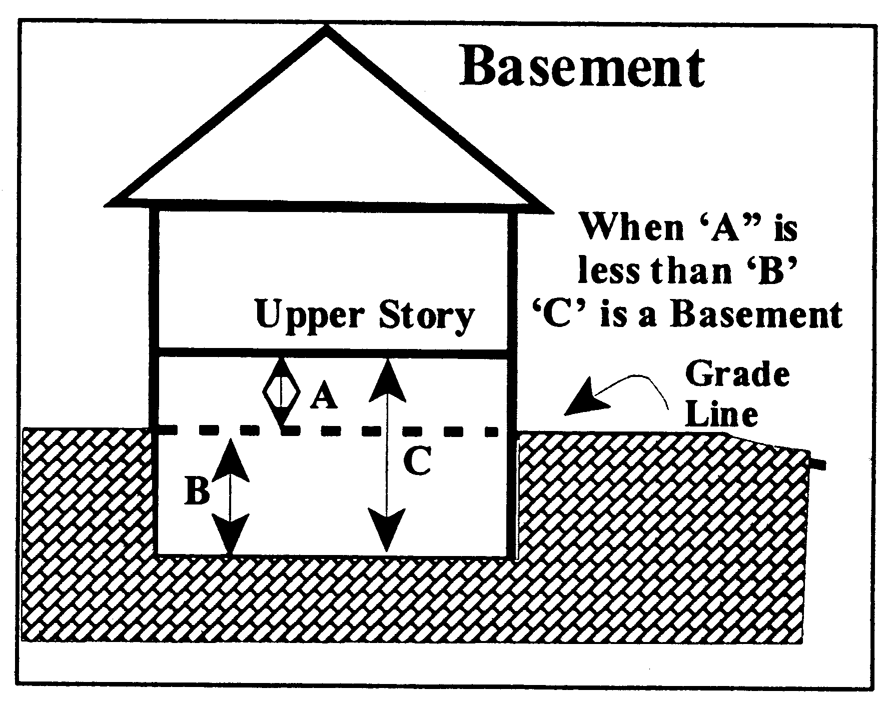
Basement fig. 1
Bed and breakfast establishment: A use which is subordinate to the main use of the dwelling unit as a single-family residence which offers sleeping accommodations to transient tenants in ten or fewer rooms for rent, at the innkeeper's primary residence while renting the rooms to transient tenants, and which serves breakfast to its transient tenants.
Berm and earth berm: A natural or manmade mound consisting of native soils meeting the requirements of all applicable ordinances.
Block: The property abutting one side of a street and lying between the two nearest intersecting streets (crossing or terminating); between the nearest street and any railroad right-of-way, unplatted acreage, lake, river or live stream; or between any railroad right-of-way, acreage, lake, river or stream and any other barrier to the continuity of development or corporate boundary line of the city.
Board or zoning board of appeals: The zoning board of appeals for the city.
Boathouse: A structure for sheltering one or more boats.
Building: A structure which is permanently affixed to the land; has one or more floors and a roof; and is bounded by either open area or the lot line of a zoning lot. "Building" does not include structures such as billboards, fences or radio towers or structures with interior surfaces not normally accessible for human use, such as gas holders, tanks, smokestacks, grain elevators, coal bunkers, oil cracking towers or similar structures.
Building height: The vertical distance measured from the established grade to the highest point of the roof surface for flat roofs, to the deck line of mansard roofs, and to the average height between the highest eaves and ridge for gable, hip and gambrel roofs. Where a building is located on sloping terrain, the height may be measured from the average grade. Height calculations shall disregard any fill or construction which the director finds to have no significant purpose other than elevating the grade. In reaching such finding, the director shall consider only those architectural, structural, safety, aesthetic, access or other purposes claimed by the developer and supported by reasonable evidence.
Building line: An imaginary line measured between the side lot lines at a distance from the front lot line as required by the district in which the lot is located. For the purposes of this chapter, a building line is the same as a front setback line.
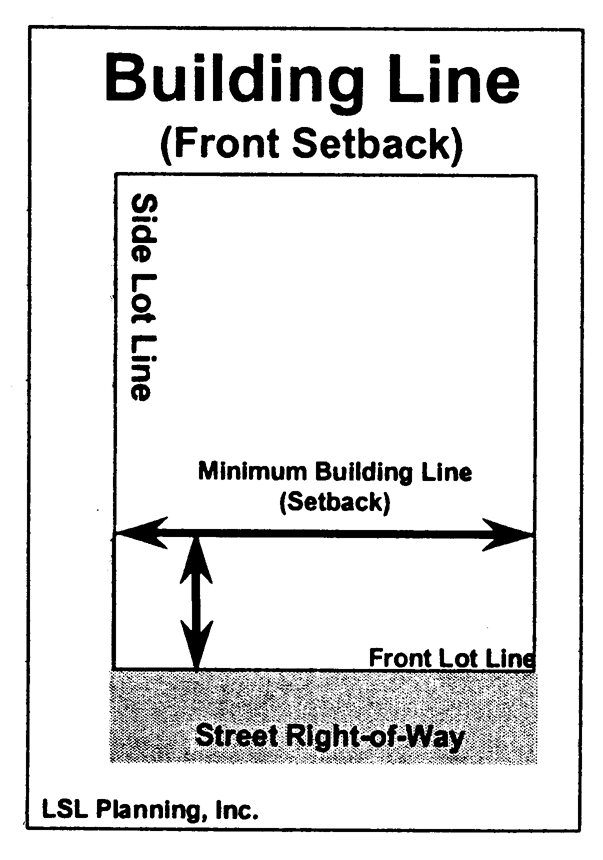
Building Line Fig. 3
Business owner or employee:
(1)
A person with a legal ownership interest in the commercial use or who has a right to receive a W-2 tax form from the commercial use; and
(2)
Participates in the operation of the commercial use on-site a minimum of 20 hours per week.
City: The City of Portage.
Clinic: An establishment where human patients who are not lodged overnight are admitted for examination and treatment by a group of physicians, dentists or similar professionals.
Club: An organization of persons for special purposes or for the promulgation of sports, arts, sciences, literature, politics or the like, not operated for profit.
Commission, or planning commission: The planning commission for the City of Portage.
Comprehensive plan: The comprehensive plan for the City of Portage, including appropriate graphic and written materials regarding the physical development of the city. The term "comprehensive plan" includes "master plan" and any unit or part of the plan and any amendment to the plan or parts thereof.
Congregate care facility: A semi-independent living facility that provides centralized amenities such as dining, housekeeping, transportation, care-giving and organized social/recreational activities.
Convalescent or nursing home: A structure with sleeping rooms where persons are housed or lodged and are furnished with meals, nursing and medical care.
Council or city council: The city council for the City of Portage.
Day care:
(1)
Family child care home: A private home that is licensed or has received a certificate of registration by the state in which one but not more than seven minor children are received for care and supervision for periods of less than 24 hours a day, unattended by a parent or legal guardian, except children related to an adult member of the family by blood, marriage or adoption. The term "family child care home" includes a home that gives care to an unrelated minor child for more than four weeks during a calendar year.
State law reference— Similar provisions, MCL 722.111(f)(iii).
(2)
Group child care home: A private home that is licensed or has received a certificate of registration by the state in which more than seven but not more than 14 minor children are given care and supervision for periods of less than 24 hours a day, unattended by a parent or legal guardian, except children related to an adult member of the family by blood, marriage or adoption. The term "group child care home" includes a home that gives care to an unrelated minor child for more than four weeks during a calendar year.
State law reference—Similar provisions, MCL 722.111(f)(iv).
(3)
Day care center: A facility, other than a private residence, that is licensed or has received a certificate of registration by the state receiving one or more preschool or school age children for care for periods of less than 24 hours a day and for not less than two consecutive weeks and where the parents or guardians are not immediately available to the child.
Development: The construction of a new building or other structure on a zoning lot, the relocation of an existing building on another zoning lot or the use of open land for a new use.
Director of community development, or director: The director of the department of community development for the City of Portage.
District, zoning district, zone district or zone: A portion of the incorporated area of the city within which certain regulations and requirements or various combinations thereof apply under this article.
Drive-in: An establishment with a retail or service character that is dependent on serving products to patrons while parked in a motor vehicle. Drive-in establishments are typically food service uses that provide service to patrons occupying a motor vehicle where the consumption of the food product by patrons principally occurs on-premise in the motor vehicle. In-building service is not typically provided.
Drive-through: An establishment with a retail or service character that is primarily dependent on providing the service or product to patrons while in motor vehicles where consumption or use by the patron principally occurs off-premise. Examples of drive-through establishments include banks, financial institutions, restaurants, dry cleaners, laundries and pharmacies but do not include auto repair uses, carwash uses, open air businesses, open front stores and similar uses. In-building service is typically provided.
Dwelling, accessory unit (ADU): is an attached or detached separate dwelling unit independent from but located on the same parcel or zoning lot as a principal residence. The ADU provides for living, sleeping, cooking, and bathroom facilities.
Dwelling unit: A building, or portion thereof, designed for occupancy by one family for residential purposes and having cooking facilities.
(1)
Dwelling, multifamily: A building, or a portion thereof, designed exclusively for occupancy by three or more families living independently of each other.
(2)
Dwelling, one-family: A detached building designed and occupied exclusively by one family.
(3)
Dwelling, one-family attached: A one-family dwelling erected side by side to another similar unit as a single building, each unit being separated from the adjoining unit by an uninterrupted wall extending from the basement floor to the roof. Units may be attached to each other only by one or more of the following methods:
a.
Through a common party wall which does not have over 80 percent of its area in common with an abutting dwelling wall;
b.
Reserved;
c.
Through a common party wall in only the garage portion of an abutting structure.
(4)
Dwelling, two-family: A building designed and occupied exclusively by two families living independently of each other.
Erected: Anything built, constructed, altered, reconstructed or moved upon, or any physical operation on the premises, which is required for construction. Excavation, fill, drainage, and similar activities are considered parts of erection.
Essential services: The erection, construction, alteration or maintenance, by public utilities or municipal departments, of underground, surface or overhead gas, electrical, steam, fuel or water transmission or distribution systems, or of collection, communication, supply or disposal systems, including towers, poles, wires, mains, drains, sewers, pipes, conduits, cables, fire alarms and police call boxes, traffic signals, hydrants and similar equipment in connection therewith, but not including buildings which are necessary for the furnishing of adequate service by such utilities or municipal departments for the general health, safety or welfare. Wireless communications towers and antennas are not considered essential services.
Excavation: Any breaking of ground, except common household gardening and ground care.
Family:
(1)
One or more persons related by blood, marriage, adoption or guardianship, occupying a dwelling unit and living as a single nonprofit housekeeping unit; or a collective number of individuals living together in one dwelling unit, having a relationship which is functionally equivalent to a family.
(2)
The relationship must be of a permanent and distinct character, cooking as a single housekeeping unit with a demonstrable and recognizable bond characteristic of a cohesive unit.
(3)
This functional family shall not include any society, club, fraternity, sorority, association, lodge, organization, coterie, combine, federation, organization which is not a recognized religious order, or group of students or other individuals where the common living arrangement or basis for the establishment of the housekeeping unit is temporary and/or of resort-seasonal character in nature.
(4)
The term "family" does not include any adult foster care facility licensed under Public Act No. 218 of 1979 (MCL 400.701 et seq., MSA 16.610(51) et seq.) except an adult foster care family home as defined in section 3 of that act (MCL 400.703, MSA 16.610(53)).
Farm: The land, buildings and machinery used in the commercial production of farm products, including field crops, livestock and livestock products, together with the dwelling used by the owner or a person employed thereon.
Fence: Any permanent fence, partition, structure or gate erected as a dividing structure, barrier or enclosure, and not part of a structure requiring a building permit.
Floor area: The term "floor area" includes basement space, elevator shafts or stairwells, floor space for mechanical equipment, penthouses, balconies, mezzanines, enclosed porches and accessory buildings and attic floor space, whether or not floor has been laid, providing structural headroom of seven feet, six inches. The term "floor area" does not include elevator or stair bulkheads, accessory water tanks or cooling towers, uncovered steps, attic space less than seven feet, six inches, and terraces, breezeways or open porches, provided that not more than 50 percent of the perimeter of any such terrace, breezeway or open porch is enclosed.
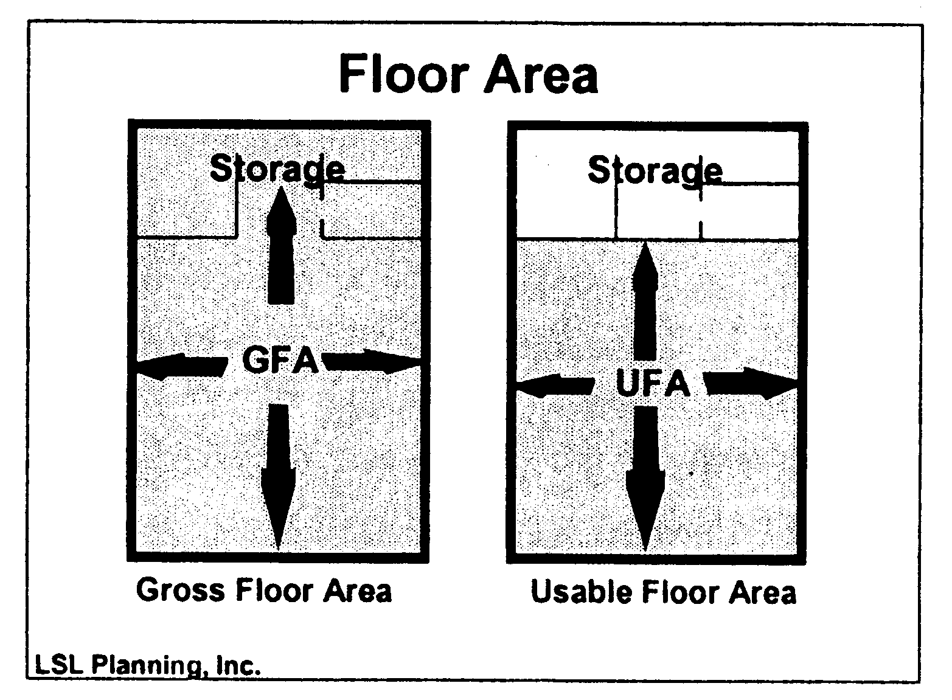
Floor Area Fig. 4
(1)
Gross floor area (GFA): The sum of the gross horizontal areas of the several floors of a building measured from the exterior walls or from the centerline of walls separating two buildings.
(2)
Gross leasable floor area (GLA): The total floor area designed for an individual tenant occupancy and exclusive use, including basements, mezzanines and upper floors, if any, expressed in square feet measured from the centerline of the joint partitions and from outside wall faces. Multiple tenant spaces within a single building shall be counted collectively for the purposes of computing GLA.
(3)
Floor area, residential: For the purpose of computing the minimum allowable floor area in a residential dwelling unit, the sum of the horizontal areas of each story of the building measured from the exterior faces of the exterior walls or from the centerline of walls separating two buildings. The floor area measurement is exclusive of areas of basements, unfinished attics, attached garages, breezeways and enclosed and unenclosed porches.
(4)
Floor area, usable (UFA): For the purpose of computing parking, that area used for or intended to be used for the sale of merchandise or services, or for use to serve patrons, clients or customers. Floor area used or intended to be used principally for the storage or processing of merchandise, for hallways, or for utilities or sanitary facilities shall be excluded from the computation of usable floor area. Measurement of usable floor area shall be the sum of the horizontal areas of the several floors of the building, measured from the interior faces of the exterior walls.
Frontage: The total length of the front lot line being the horizontal distance between the side lot lines, as measured at the front lot line.
Garage, private garage: An accessory building, detached from or attached to a main building, designed or used solely for the storage of motor-driven vehicles, boats and similar vehicles owned and used by the occupants of the building to which it is accessory.
Grade: The ground elevation established for the purpose of regulating the height of the building. The building grade shall be the level of the ground adjacent to the walls of the building if the finished grade is level. If the ground is not entirely level, the grade shall be determined by averaging the elevation of the ground for each face of the building. (Grade shall also mean "average grade.")
Heliport, public or private: An area used by helicopters which is more than a minimally developed helistop used for passenger and cargo facilities. A heliport includes one or more of the following: maintenance and overhaul, fueling service, storage space, tiedown space, hangars, accessory buildings and open spaces, and other similar facilities and/or services.
Helistop, public or private: An area used by not more than one helicopter at one time for the limited purpose of picking up or discharging passengers or cargo only. A helistop is minimally developed, and, to the extent more services or facilities are provided, the use would then be considered a heliport.
Home occupation: A home based activity or service conducted on a zoning lot used for residential purposes by an occupant(s) as a subordinate and accessory use involving the sale or exchange of services. The sale or exchange of products and goods is permitted only if incidental to the services of the home occupation or involve the sale of fruits, vegetables or flowers grown on site pursuant to the Michigan Right to Farm Act, Act 93 of 1981, as amended. Home occupations may include, but are not limited to: administrative offices, photographic studios, personal service establishments, and instruction in outdoor recreational activities. Instruction in a craft or fine art within the dwelling unit pursuant to MCLA 125.3204 is permitted as a home occupation. For purposes of this section, family day care homes shall not be considered a home occupation. Two types of home occupations are hereby established and permitted pursuant to the terms of this section as follows:
(1)
Passive home occupations: Home occupations of low intensity which satisfy the specific conditions and requirements for passive home occupations provided in section 42-129.A. A home occupation which does not meet all requirements of section 42-129.A. shall cause the home occupation to require planning commission approval as an active home occupation pursuant to section 42-129.B.
(2)
Active home occupations: Active home occupations are more intensive than passive home occupations and do not meet one or more of the requirements in section 42-129.A. Specific conditions and requirements for active home occupations are provided in section 42-129.B.
Hotel: A building or part of a building, with a common entrance, in which the dwelling units or rooming units are used primarily for transient occupancy and in which one or more of the following are offered: maid service; the furnishing of linen; telephone, secretarial or desk service; and bellboy service. A hotel may include a restaurant or cocktail lounge, public banquet hall, ballroom or meeting room.
Housing for the elderly: A building or group of buildings containing dwellings where the occupancy of dwellings is restricted to persons 60 years of age or older or couples where either the husband or wife is 60 years of age or older. This does not include a development that contains convalescent or nursing home as licensed under Act No. 139 of the Public Acts of 1956, as amended, being sections 331.651 to 331.660 of the Compiled Laws of 1948; or a mental hospital for mental patients licensed under sections 51 and 52 of Act No. 151 of the Public Acts of 1923, as amended, being sections 330.61 and 330.62 of the Compiled Laws of 1948.
Improved driveway: A private road of ingress and egress with a uniform surface of concrete, asphalt, porous pavement or pavers, or gravel which leads from a curb cut to a garage, carport or accessory parking space. An improved driveway may include a surfaced turnabout area, a circular driveway or an accessory parking space.
Indoor pool: Any swimming pool which is totally contained within a residential structure and surrounded on all sides by walls of the structure.
Junkyard: An open area where waste, used or secondhand materials are bought and sold, exchanged, stored, baled, packed, disassembled or handled, including but not limited to scrap iron and other metals, paper, rags, rubber tires and bottles. The term "junkyard" includes automobile wrecking yards and any area of more than 200 square feet used for the storage, keeping or abandonment of junk, but does not include uses established entirely within enclosed buildings.
Kennel, commercial: Any lot or premises on which three or more dogs, cats or other household pets, six months of age or older, are either permanently or temporarily boarded for a fee or other consideration. the term "commercial kennel" includes any lot or premises where household pets are bred or sold for a fee or other consideration.
Land Division Act: The Land Division Act of Michigan, Public Act 288 of 1967, as amended (formerly the Subdivision Control Act) (MCL 560.101 et seq., MSA 26.430(101) et seq.).
Loading space: An off-street space on the same lot with a building, or a group of buildings, for the temporary parking of a commercial vehicle while loading and unloading merchandise or materials.
Lot: A parcel of land occupied, or intended to be occupied, by a main building or a group of such buildings and accessory buildings, or utilized for the principal use and uses accessory thereto, together with such yards and open spaces as are required under this chapter. A lot may or may not be specifically designated as such on public records. A lot may also include a condominium unit and any limited common element under and surrounding the condominium unit, which together meet the minimum yard and area requirements of this chapter.
(1)
Lot area: The total horizontal area within the lot lines of the lot.
(2)
Lot, corner: A lot where the interior angle of two adjacent sides at the intersection of two streets is less than 135 degrees. A lot abutting on a curved street shall be considered a corner lot for the purposes of this chapter if the arc is of less radius than 150 feet and the tangents to the curve, at the two points where the lot lines meet the curve or the straight street line extended, form an interior angle of less than 135 degrees.
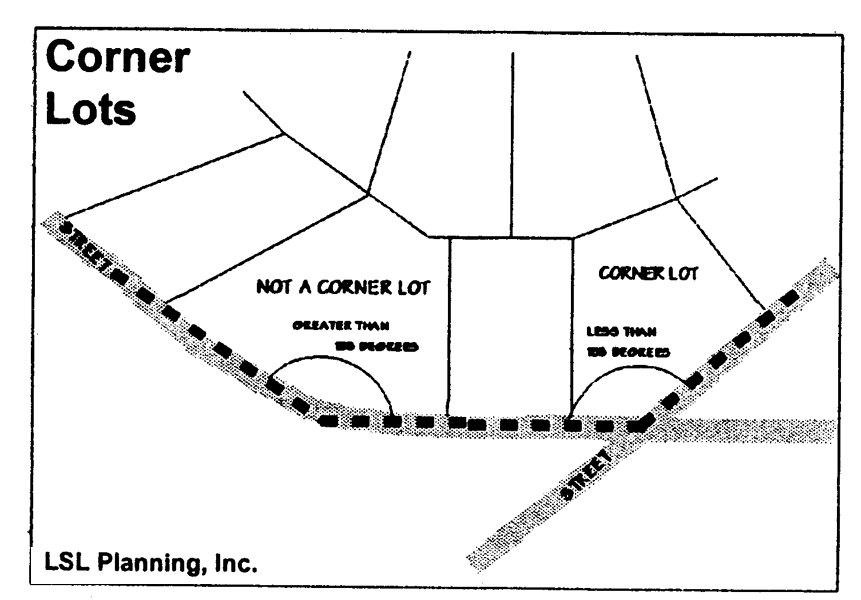
Corner Lots, Fig. 5
(3)
Lot coverage: The part or percentage of the lot occupied by buildings, including accessory buildings.
(4)
Lot depth: The horizontal distance between the front and rear lot lines, measured along the median between the side lot lines.
(5)
Lot, interior: Any lot other than a corner lot.
(6)
Lot, lakefront: Any lot having frontage directly upon any of the following lakes: Austin, Hampton, Gourdneck, Long, Mud/Sugarloaf, West.
(7)
Lot lines: The lines bounding a lot defined as follows:
a.
Front lot line: In the case of an interior lot, that line separating such lot from the street. In the case of a corner lot, or double frontage lot, the front lot line is that line separating the lot from either street.
b.
Rear lot line: That lot line opposite the front lot line. In the case of a lot pointed at the rear, the rear lot line shall be an imaginary line parallel to the front lot line, not less than ten feet long, lying farthest from the front lot line and wholly within the lot.
c.
Side lot line: Any lot line other than the front lot line or rear lot line. A side lot line separating a lot from a street is a side street lot line. A side lot line separating a lot from another lot is an interior side lot line.
Lot of record: A parcel of land, the dimensions of which are shown on a document or map on file with the county register of deeds or in common use by city or county officials, and which actually exists as so shown, or any part of such parcel held in a record ownership separate from that of the remainder thereof.
Lot, through: An interior lot having frontage on two more or less parallel streets as distinguished from a corner lot. In the case of a row of double frontage lots, all sides of such lots adjacent to streets shall be considered frontage, and front yards shall be provided as required.
Lot width: The horizontal distance between the side lot lines, measured at the two points where the building line or setback line intersects the side lot lines.
Lot, zoning: A single tract of land, located within a single block, which, at the time of filing for a building permit, is designated by its owner or developer as a tract to be used, developed or built upon as a unit under single ownership or control. A zoning lot shall satisfy this article with respect to area, size, dimensions and frontage as required in the district in which the zoning lot is located. A zoning lot, therefore, may not coincide with a lot of record as filed with the county register of deeds, but may include one or more lots of record.
Main building: A building in which is conducted the principal use of the lot upon which it is situated.
Manufactured home: A structure transportable in one or more sections, connected to required utilities which includes the plumbing, heating, air conditioning and electrical systems contained in the structure, built on a chassis and designed to be used as a single dwelling unit with or without permanent foundation.
Manufactured housing development: A parcel or tract of land which is under the control of one person, group or firm upon which three or more manufactured homes have been located on a continual non-recreational basis and which is offered to the public for that purpose regardless of whether a change is made therefore, together with any building, structure, enclosure, street, equipment, or facility used or intended for use incident to the occupancy of a manufactured home.
Mezzanine: An intermediate floor in any story which does not occupy more than one-third of the floor area of a story.
Motel: A series of attached, semidetached or detached rental units containing a bedroom, bathroom and closet space. These units shall provide for overnight lodging, are offered to the public for compensation and cater primarily to the public traveling by motor vehicle.
Municipality: The City of Portage.
Nonconforming building: A building or portion thereof lawfully existing at the effective date of this article or amendments thereto, that does not conform to the provisions of this article for the district in which it is located.
Nonconforming lot: A lot with area or dimension lawfully existing at the effective date of this chapter or amendments thereto with less than the minimum area, dimension or access requirements or other requirement of the zoning district in which it is located.
Nonconforming use: A use that lawfully occupied a building or land on the effective date of this article or any amendments thereto, that does not conform to the use regulations of the district in which it is located.
Nonresidential district: The OS-1, B-1, B-2, B-3, CPD, OTR, I-1, I-2, and P-1 districts.
Nuisance or nuisance factor: An offensive, annoying, unpleasant or obnoxious thing or practice, a cause or source of annoyance (especially a continuing or repeated invasion of any physical characteristic of activity or use across a property line which can be perceived by or affects a human being), or the generation of an excessive or concentrated movement of people or things. Nuisance factors may include, but are not limited to: noise; dust; smoke; odor; glare; fumes; flashes; vibration; shock waves; heat; electronic or atomic radiation; objectionable effluent; noise of congregation of people, particularly at night; passenger traffic; or the invasion of nonabutting street frontage by traffic.
Nursery, plant materials: A space, building or structure, or combination thereof, for the storage of live trees, shrubs or plants offered for retail sale on the premises, including products used for gardening or landscaping. The definition of nursery, within the meaning of this article, does not include any space, building or structure used exclusively for the sale of fruits, vegetables or Christmas trees.
Nursing home: See Convalescent home.
Off-street parking lot: A facility providing vehicular parking spaces, along with adequate drives and aisles for maneuvering, so as to provide access for entrance and exit for the parking of more than three vehicles.
Open air business: Includes uses operated for profit substantially in the open air including:
(1)
Outdoor display and sale of garages, motor homes, manufactured homes, snowmobiles, farm implements, swimming pools and similar activities.
(2)
Retail sales of trees, fruits, vegetables, shrubbery, plants, seeds, top-soil, humus, fertilizer, trellises, lawn furniture, playground equipment and other home garden supplies and equipment.
(3)
Indoor or outdoor recreation, including, but not limited to, tennis courts, archery courts, shuffleboard, horseshoe courts, miniature golf, golf driving range, children's amusement park or similar recreation uses (transient or permanent).
Open front store: A business establishment so developed that service to the patron may be extended beyond the walls of the structure, not requiring the patron to enter the structure. The term "open front store" does not include automobile repair or service stations.
Open space: That part of a zoning lot, including courts or yards, which is open and unobstructed from its lowest level to the sky; is accessible to all residents on the zoning lot; is not part of the roof of that portion of a building containing dwelling units; and is the roof of an attached garage if the roof is used for a swimming pool deck or recreation deck, is not higher than 23 feet above grade and is directly accessible by passageway from the residential building.
Parking space: An area of definite length and width, exclusive of drives, aisles or entrances giving access thereto, fully accessible for the storage or parking of permitted vehicles.
Pergola: A freestanding structure supported by columns or posts with a roof that is more than 50 percent open. A pergola shall not be considered an accessory building for the purpose of lot cover and setback from the main building.
Personal service establishment: A commercial business conducting services involving the care of a person or a person's apparel that are performed primarily on the premises such as barber or beauty shops and photographic studios.
Porch: A horizontal surface consisting of a deck, slab or other similar construction attached to a main building and designed for outdoor seating or as a means of entry to the building. The deck, slab or similar construction shall be open, unenclosed and uncovered.
Principal use: The primary use to which the premises are devoted and the primary purpose for which the premises exist.
Private home: For the purpose of family day care homes and group day care homes, a private residence in which the licensee or registrant permanently resides as a member of the household, which residency shall not be contingent upon caring for minor children.
Public utility: A person or a municipal department, board or commission duly authorized to furnish, and furnishing, under federal, state or municipal regulations, to the public, gas, steam, electricity, sewage disposal, communication, telegraph, transportation or water service. The term "public utility" does not include the erection, construction, alteration or maintenance of any radio tower, wireless communications towers and antennas, microwave tower, television transmitting tower or similar equipment used in connection with radio or television operations.
Recycling facility: A facility dedicated to the processing of recyclables for conversion into raw materials or new products. This definition does not include landfills, junk yards, or incinerators.
Residential district: The R-1A, R-1B, R-1C, R-1D, R-1E, R-1T, RM-1, RM-2, MHC, and PD districts.
Room: For the purpose of determining lot area, requirements and density in a multifamily district, a living room, dining room or bedroom equal to at least 80 square feet in area. The term "room" does not include the area in kitchens, sanitary facilities, utility provisions, corridors, hallways and storage. Plans presented showing one-bedroom, two-bedroom or three-bedroom units and including a den, library or other extra room shall count such extra room as a bedroom for the purpose of computing density.
Senior adult housing: Independent living units that include retirement communities and age-restricted housing projects without full centralized kitchen facilities and may include minimal safety-related on-site services.
Setback line or setback: The minimum horizontal required distance required by this article, measured from the front, side or rear lot line, as the case may be, which describes a distance termed the required setback area on a lot or parcel.
Short-term rental, dwelling: is a dwelling that is leased or rented for a period of 30 days or less.
Special event: An outdoor promotional event conducted by a conforming or nonconforming use. A special event may include but is not limited to grand openings, special holiday sales (Christmas trees, pumpkins, fireworks, etc.), tent sales and other special events. Special events are subject to review and approval per section 42-132.
Story: That part of a building, except a mezzanine, included between the surface of one floor and the surface of the next floor, or, if there is no floor above, then the ceiling next above. A story shall not be counted as a story when more than 50 percent, by cubic content, is below the height level of the adjoining ground.
Story, half: An uppermost story, lying under a sloping roof, having an area of at least 200 square feet, with a clear height of seven feet, six inches. For the purposes of this article, the usable floor area of a half story is only that area having at least four feet clear height between floor and ceiling.
Street:
(1)
Cul-de-sac street: A street having one end open for vehicular or pedestrian access and the other terminated by a vehicular turnaround.
(2)
Street, private: A roadway contained within a private street easement which is privately owned and maintained and which provides the principal means of access to one or more abutting lots.
(3)
Private street easement: An easement that is granted for private access to one or more parcels of land that contains a private street.
(4)
Street, public: A public, dedicated thoroughfare that affords traffic circulation and principal means of access to abutting property, e.g. avenue, place, way, drive, lane, boulevard, highway, road, and other thoroughfare, except an alley.
(5)
Major thoroughfare: An arterial street which is intended to serve as a large-volume traffic-way for both the immediate city area and the region beyond, and is designated as a major thoroughfare, parkway, freeway, expressway or equivalent term on the major thoroughfare plan to identify those streets composing the basic structure of the major thoroughfare plan.
(6)
Marginal access road: A service roadway parallel to a feeder road, which provides access to abutting properties and protection from through traffic.
Structure: Anything constructed or erected, the use of which requires location on the ground or attachment to something having location on the ground.
Swimming pool/pool: Any area capable of containing water and of being suited for swimming, wading or bathing, having a depth of two feet or more at any point and which is not an indoor pool.
Temporary use or temporary building: A use or building permitted in a specific district or permitted by the director or the zoning board of appeals, as applicable, which exists for a specifically defined temporary period of time.
Tower: The structure on which transmitting and/or receiving electronic devices such as antennas, repeaters and similar devices for radio, television, land-mobile and cellular uses are located.
Use: The principal purpose for which land or a building is arranged, designed or intended or for which land or a building is or may be occupied.
Variance: A modification of the literal provisions of this article granted when strict enforcement of this article would cause a practical difficulty or unnecessary hardship owing to circumstances unique to the individual property on which the variance is granted.
Vehicle fueling station: A place where gasoline or any other vehicular engine fuel (stored only in underground tanks), kerosene or motor oil and lubricants or grease (for operation of motors vehicles) are retailed directly to the public on the premises. Services may include the sale of minor auto accessories; retail sales of non-automotive related products including sundries such as gum, candy, beverages, newspapers, magazines and other individually packaged convenience items.
Vehicle repair, major: See "Auto repair station—Major."
Vehicle repair, minor: See "Auto repair station—Minor."
Veterinary hospital or clinic: A place where animals or pets are given medical or surgical treatment and the boarding of animals is limited to short-term care incidental to the hospital use.
Wireless telecommunication facilities and towers: A structure of lattice or monopole framework to which an antenna may be attached for the transmission and /or reception of radio, television, satellite or microwave signals that facilitates wireless communications including cellular, enhanced specialized mobile radio (ESMR), personal communication, or similar services, along with associated equipment necessary to operate these facilities.
Wireless communication antenna: The device for transmitting and/or receiving radio, television, satellite, cellular, enhanced specialized mobile radio, personal communication, microwave, or similar transmissions.
Work/live building: A building or portion of a building that combines a business or office use (hereinafter "commercial use") that is allowed as a principal permitted or special land use subject to conditions in the zoning district with one accessory residential dwelling unit per commercial use for the owner or employee of the commercial use and that person's family.
Yard: The open space on the same lot with a main building, unoccupied and unobstructed from the ground upward, except as otherwise provided in this article.
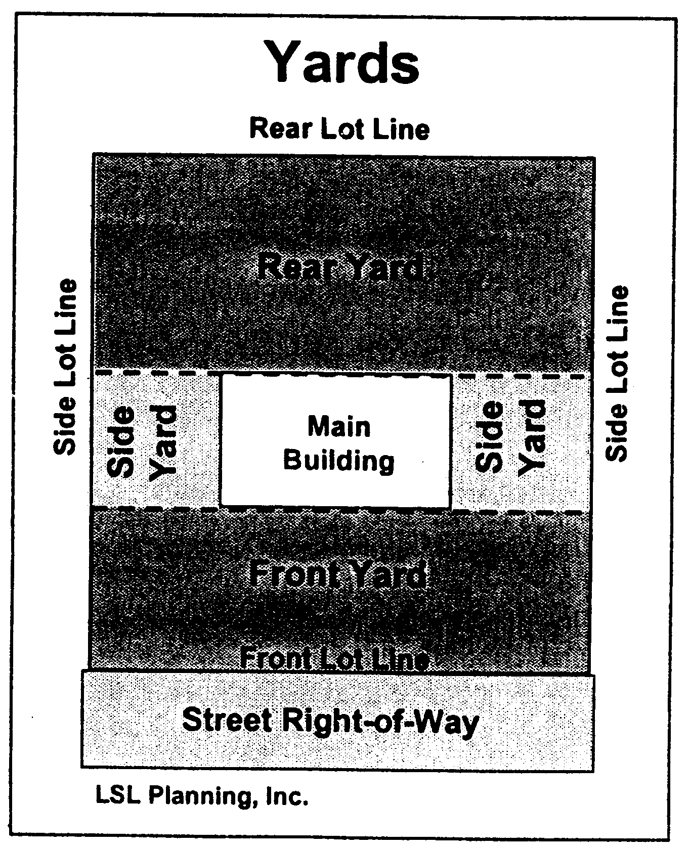
Yards Fig. 6
(1)
Front yard: An open space extending the full width of the lot, the depth of which is the minimum horizontal distance between the front lot line and the nearest point of the main building.
(2)
Rear yard: An open space extending the full width of the lot, the depth of which is the minimum horizontal distance between the rear lot line and the nearest point of the main building. In the case of a corner lot, the rear yard may be opposite either street frontage.
(3)
Side yard: An open space between a main building and the side lot line, extending from the front yard to the rear yard, the width of which is the horizontal distance from the nearest point on the side lot line to the nearest point of the main building.
(4)
Yard, required: A required yard is an open space on a lot prescribed by the requirements of the zoning district in which it is located.
Zoning Act: The City and Village Zoning Act of Michigan, Public Act 207 of 1921, as amended.
(Ord. No. 03-01 (Exh. A, § 42-201—42-223), 2-18-2-2003; Ord. No. 08-05, 7-22-2008; Ord. No. 09-03, 4-14-2009; Ord. No. 11-04, 3-8-2011; Ord. No. 11-13, 8-23-2011; Ord. No. 15-03, 4-28-2015; Ord. No. 16-11, 10-18-2016; Ord. No. 19-04, 10-15-2019; Ord. No. O-4-2023, 8-8-2023; Ord. No. O-7-2023, 12-5-2023; Ord. No. O-6-2024, § 2, 7-9-2024; Ord. No. O-9-2024, 10-22-2024)

