
Portage City Zoning Code
DIVISION 6
SITE DEVELOPMENT REQUIREMENTS
Sec. 42-520. - General requirements.
A.
There shall be provided in all districts, at the time of erection or enlargement of a main building or structure, automobile off-street parking space with adequate access to all spaces.
B.
The off-street parking spaces, in conjunction with all land or building uses, shall be provided, prior to the issuance of a certificate of occupancy.
C.
1.
Off-street parking for a nonresidential use shall not be allowed in a residential district.
2.
Off-street parking shall be on the same zoning lot it is intended to serve, except as provided below.
3.
Subject to planning commission review and approval, an off-street parking lot is not required to be located on the same zoning lot it is intended to serve only if such off-street parking meets all of the following criteria:
a.
The off-street parking lot shall be located within 500 feet of the public entrance of the main building it serves.
b.
A minimum four foot wide paved sidewalk from the parking lot to the building entrance is available for pedestrian use.
c.
The off-street parking lot shall not be on the opposite side of a major or minor arterial roadway (as defined in the comprehensive plan) unless access to a signalized intersection with a crosswalk or refuge island is available for pedestrians. The walking distance from the parking lot to the main building entrance by way of the signalized intersection shall not exceed 750 feet.
d.
The amount of off-site parking shall be limited to no more than 25 percent of the minimum Zoning Code requirement.
e.
A parking agreement must be executed between property owners of the affected parcels and recorded with the county register of deeds.
D.
No area once designated as required off-street parking shall be changed to any other use unless and until equal facilities are provided elsewhere.
E.
Off-street parking existing at the effective date of this article serving an existing use shall not be reduced in size to less than that required under the terms of this section.
F.
Parking shall be provided and maintained in proper ratio to any increase in floor area or building use capacity.
G.
Two or more buildings or uses may collectively provide the required off-street parking, in which case the required number of parking spaces shall be not less than the sum of the requirements for the individual uses computed separately.
H.
The storage of merchandise, motor vehicles for sale, trucks, or the repair of vehicles is prohibited.
I.
For those uses not specifically mentioned in this section, the requirements for off-street parking facilities shall be in accordance with a use that the director considers similar in type. Should the director determine that review by the planning commission is necessary due to unique or unusual circumstances, the director may, with ten-day written notice to the applicant, refer this matter to the commission. In addition, a person aggrieved by a final decision of the director may file an appeal with the planning commission specifying the grounds thereof within 30 days of receiving notice of the director's decision.
J.
When units or measurements determining the number of required parking spaces result in the requirement of a fractional space, a fraction up to and including one-half shall be disregarded and fractions over one-half shall require one parking space.
K.
For the purpose of computing the number of parking spaces required, the definition of floor area, usable (UFA) set forth in section 42-112, definitions, shall govern.
L.
Barrier-free parking shall be provided and constructed in accordance with the general rules of the state construction code commission.
M.
Deferred parking.
1.
Where an applicant demonstrates that the parking requirements for a particular proposed use would be excessive, a plan may be approved pursuant to division 5, subdivision 2, designating portions of required parking spaces and paving reserved for future use. Likewise, a parking deferment may be imposed upon a finding that the standard parking requirements would be initially excessive.
2.
The approval shall require reserved areas to be maintained in a landscaped appearance and shall include conditions under which the reserved parking areas must be paved.
3.
Alterations to the deferred parking area to add parking spaces may be initiated by the owner or required, based on parking needs, and shall require the submission and approval of an amended site plan, as required by division 5, subdivision 2, of this article.
N.
Maximum parking requirement.
1.
To minimize excessive areas of pavement which detract from the aesthetics of an area and contribute to high rates of storm water runoff, no parking lot shall have parking spaces totaling more than an amount equal to 25 percent greater than the minimum parking space requirements, as determined by section 42-523, schedule of off-street parking requirements, except as may be approved by the planning commission.
2.
In granting additional parking spaces, the planning commission shall determine such parking will be necessary to accommodate the use on a typical day, based on documented evidence provided by the property owner or applicant.
3.
This subsection shall apply only to those parking lots that require a minimum of 100 parking spaces as required in section 42-523, schedule of off-street parking requirements.
O.
Reduction in parking requirements.
1.
The minimum parking spaces as required in section 42-523, schedule of off-street parking requirements, shall apply, unless the applicant demonstrates by clear and convincing evidence, that there are substantial reasons for a reduction of no more than 25 percent of the required parking due to the existence of a combination of the following:
a.
The use requires less off-street parking than the minimum required based on the nature and character of the use, considering the unique, specialized operations causing the level of customer traffic or actual vehicular counts to be lower than those expected of the same or similar use contained in section 42-523, schedule of off-street parking requirements.
b.
Shared parking by multiple uses where there will be a high proportion of multipurpose visits or uses have peak parking demands during differing times of the day or days of the week. Pedestrian connections shall be maintained between the uses.
c.
Expectation of walk-in trade due to sidewalk connections to adjacent residential neighborhoods or employment centers which are of sufficient density and intensity. The site design shall incorporate pedestrian connections to the site and on-site pedestrian circulation providing safe and convenient access to the building entrance.
d.
Availability of other forms of travel such as the distance from a designated metro transit bus stop and the location of bike routes. The planning commission may require the site design incorporate transit stops, pedestrian connections to nearby transit stops, or bicycle parking facilities.
e.
Any other reason which, in the planning commission's determination, would provide a substantial reason for a reduction in the minimum parking requirements.
2.
The planning commission shall not grant a reduction in the minimum parking requirements if it determines that the lower demand for parking will or may be temporary in nature.
3.
The planning commission may also consider city policies regarding local traffic circulation, as well as all aspects of the city's comprehensive plan.
4.
Before relief is granted by the planning commission, the applicant shall demonstrate either of the following:
a.
The use involved is not specifically included in the minimum parking space requirements of section 42-523, schedule of off-street parking requirements; or
b.
If the use involved is included in section 42-523, then it possesses such specialized and unique characteristics causing it to be substantially different from the use so included in section 42-523.
5.
The planning commission may also require a parking study, conducted by a qualified transportation planner, traffic engineer, or other qualified individual that demonstrates a reduction in the number of parking spaces would be appropriate and not detrimental to the safety and welfare of the subject property or adjacent properties. The "average peak period parking demand" for the applicable land use as defined in the latest edition of the Institute of Traffic Engineers Parking Generation handbook should be considered in the review of the study.
6.
An applicant who desires relief from the minimum requirement of parking spaces shall file a request with the planning commission specifying the grounds thereof in accordance with this section. The planning commission may decide the request during site plan review or at such other time as determined by the director or the planning commission. The director shall transmit to the planning commission all the materials constituting the record needed to make its decision as well as a recommendation. If a request for relief under this section is heard at the same time as a site plan, or any other approval, the procedures, standards and requirements for each shall be satisfied.
7.
The planning commission shall hold a public hearing in accordance with the requirements of MCL 125.3101, et seq., (The Zoning Enabling Act) to consider an applicant's request for relief to reduce minimum parking requirements.
8.
In granting relief under this section, the planning commission may place reasonable conditions in conjunction with the decision to protect the health, safety and welfare of city residents as well as the traveling public to ensure adequate traffic circulation, to protect the residents and land owners immediately adjacent to the proposed land use activity and to assure that the reduction of the minimum parking requirements will not result in overcrowding, traffic hazards or other consequences which may arise from the relief granted or from the possibility of inadequate parking spaces.
(Ord. No. 03-01 (Exh. A, § 42-610), 2-18-2003; Ord. No. 16-11, 10-18-2016)
Sec. 42-521. - Design, construction and maintenance of parking areas.
A.
Whenever the off-street parking requirements of this article require the building of an off-street parking facility, or where P-1 vehicular parking districts are provided, such off-street parking lots shall be laid out, constructed and maintained in accordance with the standards and regulations of this section and chapter 66, article 3, access management.
B.
No parking lot shall be constructed unless and until a permit therefore is issued by the director. An application for such permit shall be submitted to the department of community development on a form provided by the city, and shall be accompanied by two sets of plans for the development and construction of the parking lot showing that this section will be fully complied with.
C.
Plans for the layout of off-street parking facilities shall be in accordance with the following minimum requirements:
D.
All spaces shall be provided adequate access by means of maneuvering lanes. Backing directly onto a street is prohibited.
E.
Adequate ingress and egress to and from the parking lot by means of clearly limited and defined drives shall be provided for all vehicles. Ingress and egress to and from a parking lot lying in an area zoned for other than one-family residential use shall not be across land zoned for single-family residential use.
F.
All maneuvering lane widths shall permit one-way traffic movement, except that the 90-degree pattern may permit two-way movement.
G.
Each entrance and exit to and from an off-street parking lot located in an area zoned for other than one-family residential use shall be at least 25 feet from adjacent property located in a one-family residential district.
H.
The off-street parking area shall comply with the landscaping requirements in division 6, subdivision 3 and lighting requirements of division 6, subdivision 4 of this article.
I.
The entire parking area, including parking spaces and maneuvering lanes, required under this section shall be provided with asphalted or concrete surfacing in accordance with specifications approved by the director of transportation and utilities. Parking areas shall be surfaced within one year of the date the permit is issued. All off-street parking areas shall maintain a safe, clean and durable surface reasonably free of significant holes, upheavals or cracks and shall be repaired in a timely manner upon notification by the department of community development.
J.
Off-street parking areas shall be drained so as to dispose of all surface water accumulated in the parking area in such a way as to preclude drainage of water onto adjacent property or toward buildings or unless a retention area intended to be shared by more than one site has been designated in accordance with specifications approved by the director of transportation and utilities and appropriate easements prepared and recorded.
K.
In all cases where a wall extends to an alley which is a means of ingress to and egress from an off-street parking area, the wall may be ended not more than ten feet from such alley line in order to permit a wider means of access to the parking area.
L.
Consistent with the city comprehensive plan and Complete Streets Policy, as amended, new or reconstructed off-street parking lots should incorporate the following:
1.
Low impact parking lot design alternatives such as rain gardens, bio-swales, pervious pavement, charging stations for electric vehicles and other green/sustainable techniques.
2.
Pedestrian connection from the public sidewalk to the main building entrance.
3.
Bicycle racks that accommodate a minimum of four bicycles.
(Ord. No. 03-01 (Exh. A, § 42-611), 2-18-2003; Ord. No. 16-11, 10-18-2016)
Sec. 42-522. - Loading facilities.
A.
On the same premises with a building, structure or part thereof involving the receipt or distribution of vehicles or materials or merchandise, there shall be provided and maintained on the lot adequate space for standing, loading and unloading in order to avoid undue interference with public use of dedicated rights-of-way. The space shall meet the requirements of this section.
B.
Except as otherwise required in section 42-522 E., below, off-street loading spaces shall be provided in commercial and industrial districts in the rear yard in the ratio of at least one space per each establishment and shall be provided in addition to any required off-street parking area. If the adjacent land area is zoned residential or designated for residential use in the planned development, the loading area may be located in the rear or side yard.
C.
In a business district, when a planned commercial or shopping center with 100,000 GLA or more is to be developed, off-street loading space may be provided either in the rear yard or in a loading area in the front or side yard which is completely screened from view and separate from fire lanes and in a manner that will not obstruct the flow of traffic in the parking area.
D.
All loading spaces in an industrial district shall be provided in the following ratio of spaces to floor area:
E.
Off-street loading and unloading space in an industrial district may be provided in either the side or rear and/or outside of the required front yard, provided that it is separate from fire lanes, maneuvering lanes and parking areas and does not obstruct the flow of traffic in the parking area.
F.
All spaces shall be laid out in the dimensions of at least ten feet by 50 feet, or 500 square feet in area, with a clearance of at least 14 feet in height. Loading dock approaches shall be provided with pavement having an asphalt or Portland cement binder so as to provide a permanent, durable and dustless surface.
G.
Deferred loading areas.
1.
Where an applicant demonstrates that the loading requirements for a particular proposed use would be excessive, a plan designating portions of required loading spaces and paving reserved for future use must be submitted in accordance with division 5, subdivision 2.
2.
Alterations to the deferred loading area to add loading spaces may be initiated by the owner or required, based on loading needs, and shall require the submission and approval of an amended site plan, as required by division 5, subdivision 2.
(Ord. No. 03-01 (Exh. A, § 42-612), 2-18-2003; Ord. No. 16-11, 10-18-2016; Ord. No. O-4-2026, 6-23-2026)
Sec. 42-523. - Schedule of off-street parking requirements.
SCHEDULE OF OFF-STREET PARKING REQUIREMENTS
(Ord. No. 03-01 (Exh. A, § 42-613), 2-18-2003; Ord. No. 08-05, 7-22-2008; Ord. No. 16-11, 10-18-2016; Ord. No. O-3-2023(2), 5-23-2023; Ord. No. O-4-2026, 6-23-2026)
Sec. 42-540. - Intent and purpose.
A.
This section is intended to regulate the use, construction, reconstruction, placement and design of signs, establish reasonable regulations regarding the size, type of construction and manner of anchoring signs, and to regulate the time, place and manner of their display in order to:
1.
Preserve the noncommercial character of residential neighborhoods, and provide reasonable, yet appropriate, conditions for identifying businesses and services rendered in commercial districts.
2.
Reduce traffic and pedestrian hazards by restricting signs, including signs with lights and/or motion, which exceed the viewer's capacity to receive information or which increase the probability of accidents created by distracting attention or obstructing vision.
3.
Promote expeditious and safe navigation and wayfinding for pedestrian and vehicle traffic through legible and appropriate signs.
4.
Preserve order and cleanliness, maintain open spaces, prevent blight, avoid the appearance of clutter, and prevent nuisances and invitations to vandalism.
5.
Require signs be constructed and maintained in a structurally sound condition.
6.
Maintain property values and ensure compatibility with surrounding landscape and architecture.
7.
Encourage the aesthetic quality and design, location, and size of signs.
8.
Protect the public peace, general health, safety and welfare, convenience, and comfort. Protect and encourage a more attractive economic business and overall physical appearance of the community and provide business with equal opportunity to attract the public.
9.
These regulations do not regulate every form and instance of visual communication that may be displayed anywhere within the jurisdictional limits of the city. Rather, they are intended to regulate those forms and instances that are most likely to meaningfully affect one or more of the purposes set forth above.
10.
These regulations do not eliminate all the harms that may be created by the installation and display of signs. Rather, they strike an appropriate balance that preserves ample channels of communication by means of visual display while still reducing and mitigating the extent of the harms caused by signs.
(Ord. No. 03-01 (Exh. A, § 42-620), 2-18-2003; Ord. No. 19-03, 6-25-2019)
Sec. 42-541. - Definitions.
A.
Sign.
1.
A "sign" is defined as a name, identification, description, illustration or device, illuminated or nonilluminated, which is affixed to, painted or represented directly or indirectly upon a building, located on the ground or other outdoor surface, which is visible from any public place or is located on private property and exposed to the public, and which directs attention to or is designed or intended to direct attention to the sign face or to an object, product, place, activity, person, institution, organization or business. A sign as defined above includes the support structure, sign pole and/or anchoring device to which the sign is attached. The definition does not include: (a) Murals as defined in section 42-138 C.; (b) Graphics, illustrations, architectural or landscape features used primarily for decorative purposes which do not direct attention to or are designed or intended to direct attention to an object, product, place, activity, person, institution, organization or business; and, (c) interior static window displays;
2.
A "sign face" is defined as the area of the sign which displays the name, identification, description, illustration or device which identifies, depicts, or otherwise advertises a product, service, place, activity, person, institution, business or use, or conveys a message. A sign face does not include any portion of the structural support of the sign.
B.
Types of signs referred to in this subdivision are defined as follows:
1.
Accessory sign: An advertising sign relating in subject matter to the main or principal use of the premises.
2.
Awning/canopy sign: Identification sign attached to a marquee, canopy or awning projecting from and supported by the building.
3.
Banner: Any cloth, or similar non-rigid material attached to any structure, staff, pole, rope, wire, or framing which is anchored on all corners and/or sides. Banners do not include flags.
4.
Directional sign: A sign that directs vehicular and pedestrian traffic to any place, area, or activity.
5.
Flag: Any sign printed or painted on cloth, canvas, or other like material with distinctive colors, patterns, or symbols attached to a pole or staff affixed to the ground or a building and anchored along only one edge or supported or anchored at only two corners. Flags do not include banners.
6.
Freestanding sign: A sign erected on a freestanding frame, mast or pole and not attached to a building.
7.
Government sign. A temporary or permanent sign erected by or on the order of the public official or quasi-public entity at the federal, state or local level in the performance of any duty including, but not limited to, noncommercial signs identifying a government building or service, traffic control signs, street name signs, street address signs, warning signs, safety signs, informational signs, traffic or other directional signs, public notices of events, public notice of government action, proposed changes of land use, any proposed rezoning, or any other government speech.
8.
Nonaccessory sign: A sign which directs attention to a business or service offered or existing elsewhere than upon the same lot where the sign is displayed.
9.
Nonconforming sign: A sign which lawfully occupied a building or land on the effective date of this article, that does not currently conform to the sign regulations of the district in which it is located.
10.
Obsolete sign or abandoned sign: A sign on a zoning lot with an unoccupied building; a wall sign on a vacant unoccupied building; or, a deteriorated or hazardous sign; or sign that is not adequately maintained, repaired, or removed within the specified time as ordered by this article.
11.
Property owner: The record owner of a zoning lot as well as the lessee of that part of a zoning lot the lessee holds a right to use exclusive of others (or the sole right to occupy). If there are multiple lessees of a zoning lot, then each lessee is a property owner as to the zoning lot the lessee leases and has the sole right to occupy.
12.
Projecting sign: A sign attached to a building wall that extends outward from the building wall or a sign suspended below an awning, canopy or marquee.
13.
Temporary sign: Any sign that is not constructed or intended for long term use and is not permanently attached to a building or structure.
14.
Wall sign: A sign attached directly to the exterior wall of a building extending not more than 18 inches from the wall, with the face of the sign running parallel to the plane of the building wall to which it is attached. Awing and/or canopy signs are considered wall signs for the purposes of calculating the total area. Awning and/or canopy signs may project more than 18 inches from the wall to which they are attached.
15.
Electronic message display. A sign capable of displaying words, symbols, figures or images that can be electronically or mechanically changed by remote or automatic means. The definitions below (a) through (c) are used in conjunction with an electronic message display ("EMD"):
a.
Frame. A complete, static display screen on an electronic message display.
b.
Frame effect. A visual effect on an electronic message display applied to a single frame to attract the attention of viewers.
c.
Transition. A visual effect used on an electronic message display to change from one message to another.
(Ord. No. 03-01 (Exh. A, § 42-621), 2-18-2003; Amend. of 10-2-2007; Ord. No. 11-16, 8-23-2011; Ord. No. 14-02, 3-11-2014; Ord. No. 19-03, 6-25-2019)
Sec. 42-542. - General requirements.
A.
Unless not required by this article, all signs shall be required to obtain a permit from the director of community development.
B.
Sign measurements.
1.
The entire area of one side of the sign face within a circle or four-sided polygon enclosing the extreme limits of writing, representation, emblem, or any figure of similar character. This area shall also include any frame or other material or color forming an integral part of the display or used to differentiate the sign from the background against which it is placed; excluding the necessary supports or uprights on which the sign is placed.
2.
Separated sign elements, not part of any frame, or separated by other material or color forming an integral part of the display that may be used to differentiate such sign from the background against which it is placed, shall have each element of the sign calculated separately for the purposes of determining the total area. The signs elements shall not exceed the total sign display permitted by the district in which it is located.
3.
The height of a sign is measured from the adjacent street grade or upper surface of the nearest street curb other than an elevated roadway that permits the greatest height to the highest point of such sign.
4.
For the purpose of property line setbacks, the setback distance for a freestanding sign shall be measured from that portion of the sign closest to the property line.
5.
The sign areas for wall signs shall be determined by taking that portion of the front wall of the building applicable to each tenant space, and computing sign requirements for that portion of the total wall.
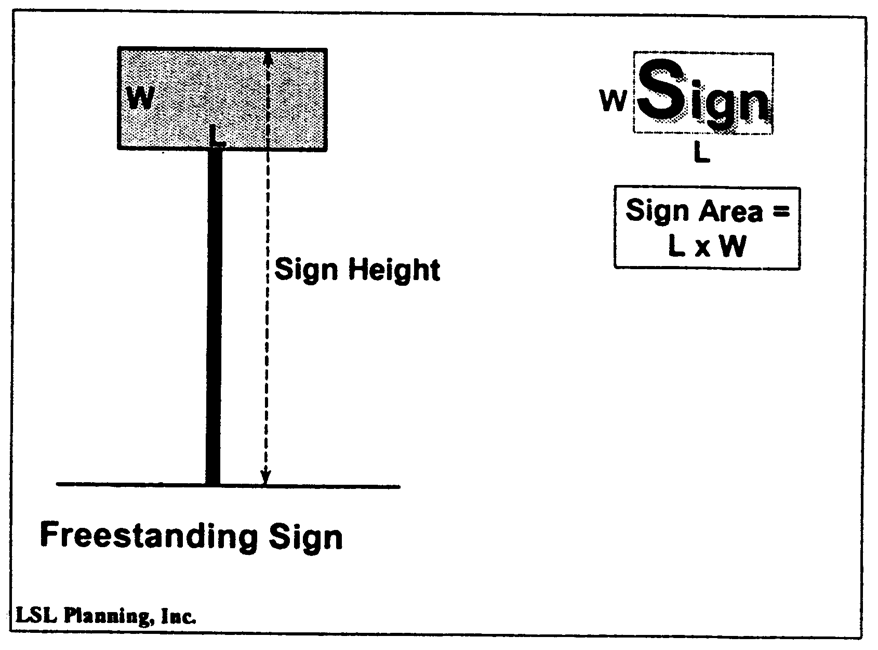
Sign Measurements Fig. 7
C.
All references to the term "lot width," "lot frontage" or "frontage" for the purposes of calculating allowable freestanding sign area shall require that width or frontage be on a public dedicated right-of-way and be measured at the front lot line, notwithstanding the definition and use of these terms in division 2 and division 3 of this article.
D.
Signs not permitted.
1.
A sign not expressly permitted by this article is prohibited.
2.
No person shall erect or maintain a sign which moves or which has moving or animated parts or images, whether the movement is caused by machinery, electronics, wind or otherwise, including swaying signs, except for an EMD as defined in section 42-541, Definitions, and as specified in section 42-542, General requirements.
3.
No person shall erect or maintain flags, strings of flags, streamers, pennants or balloons or other gas-filled figures, except as set forth and in subsection 42-542 F., Illumination and movement and in subsection 42-543 C., Flags.
4.
No person shall maintain a sign that in the opinion of the director threatens the health, safety or general welfare of the public by being: a) deteriorated or defective, b) constructed, or erected in an unsafe manner, or c) a hazard to vehicles or pedestrians.
5.
No person shall maintain an obsolete or abandoned sign for more than 30 days. The nonconforming status of any sign shall not be construed as eliminating or modifying this requirement.
E.
No sign, except those established and maintained by the city, county, state or federal government, shall be located in, project into or overhang a public right-of-way or a dedicated public easement.
F.
Illumination and movement.
1.
No person shall erect or maintain an illuminated sign where the light source:
a.
Moves or varies in intensity and color;
b.
Can shine directly into the eyes of an occupant of a vehicle traveling upon a highway, public or private street, driveway or parking are;
c.
Can shine into any window of a residence within 200 feet;
d.
Interferes with the visibility or readability of a traffic sign or device;
e.
Does not comply with the applicable provisions set forth in Subdivision 4, Lighting Standards. (Section 42-590 through 42-597.)
2.
Restrictions on movement and illumination set forth in this section and in section 42-595, Prohibition of outdoor lighting, shall not prevent the following:
a.
The erection or maintenance of strings of lights from the day after Thanksgiving of each year until the following January 2.
b.
EMD signs as defined in section 42-541, Definitions, and as specified in subsection 42-542(I), Electronic or mechanical sign elements.
G.
Lots without frontage.
1.
Any zoning lot not having frontage on a public dedicated right-of-way but which abuts a private street as defined in this subsection is permitted wall signs and one freestanding accessory sign. The permitted freestanding accessory sign shall be set back at least ten feet, as measured either from the back of the concrete curb or from the property line, whichever provides the greater setback.
2.
For purposes of this subsection a private street shall:
a.
Have a minimum concrete or asphalt surface width of 22 feet;
b.
Have a concrete curb and gutter;
c.
Not be part of an off-street parking facility; and
d.
Serve more than one zoning lot or principal use.
H.
Removal of hazardous signs. Any sign which, in the opinion of the director, is maintained in violation of the provisions of section 42-1284, removal of hazardous signs, shall be removed pursuant to the procedure of section 42-1284. The term "sign" as used herein includes the support structure, sign pole and/or anchoring device to which the sign is attached.
I.
Electronic or mechanical sign elements.
1.
An accessory sign permitted in the B-1, B-2, B-3, PD, CPD, OS-1, OTR, CCA, CCMU, I-1 and I-2 zoning districts, and a nonaccessory sign permitted in the I-1 and I-2 zoning districts, may include an EMD subject to the following requirements:
a.
Such display, whether located on the exterior or interior wall or window shall contain static or still frame messages only which may otherwise not have movement, or the appearance or optical illusion of movement, of any part of the sign structure, design, or pictorial segment of the sign, including the movement of any illumination or the flashing, scintillating or varying of light intensity. Transitions between frame messages may utilize effects such as dissolve, fade, traveling or scrolling text and/or images, provided such transitions occur over a period of time not exceeding one second, and such effects do not include text and/or images that expand or contract, rotate, twist, bounce, flash, undulate, pulse or utilize other similar movements or optical illusions.
b.
The maximum size of an EMD on an accessory or nonaccessory freestanding sign or accessory wall sign shall not exceed the sign measurements specified in this Code for the zoning district in which the zoning lot or use is located.
c.
Each message on the EMD is changed not more often than once every four seconds.
d.
The EMD shall be equipped with ambient light monitors which shall continuously monitor and automatically adjust the brightness level of the display based on ambient light conditions to prevent glare specified in the Lighting Standards provided in Subdivision 4 of the Zoning Code.
e.
When the EMD is 200 feet or less from a property line of a zoning lot that is located in a residential zoning district and such EMD is visible from any portion of a residential dwelling unit located within the residential zoning district, the EMD shall only:
i.
Operate between 7:00 a.m. and 10:00 p.m.; and
ii.
Display only one "frame" as defined in section 42-541 between 10:00 p.m. and 7:00 a.m.
f.
When a zoning lot or use incorporates an EMD on a freestanding sign or wall sign in the zoning districts listed in 42-542I.1. above, a "copy board" as set forth in section 42-543I. shall not be permitted on the sign that incorporates an EMD.
g.
Notwithstanding subsection 42-542I.1.f., if a conforming freestanding sign or wall sign with an EMD is in existence before the effective date of this section amendment and incorporates a "copy board" element consistent with the provisions of section 42-543I., said sign shall be considered a conforming sign.
2.
An accessory sign for a permitted use in the R-1A through R-1D one-family residential districts, the R-1T residential district, and the RM-1 and RM-2 residential districts, may include an EMD subject to the following requirements:
a.
One property line of the zoning lot must be abutting a major thoroughfare as designated on the major thoroughfare plan and the freestanding sign incorporating an electronic message display must be situated along the property line abutting the major thoroughfare.
b.
Such display whether located on the exterior or interior wall or window shall contain static or still frame messages only which may otherwise not have movement, or the appearance or optical illusion of movement, of any part of the sign structure, design, or pictorial segment of the sign, including the movement of any illumination or the flashing, scintillating or varying of light intensity. Transitions between frame messages may utilize effects such as dissolve, fade, traveling or scrolling text and/or images, provided such transitions occur over a period of time not exceeding one second, and such effects do not include text and/or images that expand or contract, rotate, twist, bounce, flash, undulate, pulse or utilize other similar movements or optical illusions.
c.
The maximum size of an EMD on an accessory or nonaccessory freestanding sign or accessory wall sign shall not exceed the sign measurements specified in this Code for the zoning district in which the zoning lot or use is located.
d.
Each message on such display is changed not more often than once every four seconds.
e.
The EMD shall be equipped with ambient light monitors which shall continuously monitor and automatically adjust the brightness level of the display based on ambient light conditions to prevent glare specified in the Lighting Standards provided in Subdivision 4 of the Zoning Code.
f.
When the EMD is visible from any portion of a one-family residential dwelling unit located within a residential zoning district, the EMD shall only:
i.
Operate between 7:00 a.m. and 12:00 midnight; and
ii.
Display only one "frame" as defined in section 42-541 between 9:00 p.m. and 12:00 midnight.
g.
When a zoning lot or use other than a dwelling unit incorporates an EMD on a freestanding sign or wall sign in the zoning districts listed in subsection 42-542 I.1., a "copy board" as set forth in subsection 42-543 I. shall not be permitted on the sign that incorporates an EMD.
h.
Notwithstanding subsection 42-542 I.2.G., if a conforming freestanding sign or wall sign with an EMD is in existence before the effective date of the ordinance from which this chapter derives amendment and incorporates a "copy board" element consistent with the provisions in section 42-543 I., said sign shall be considered a conforming sign.
J.
All exterior signs permitted within the City of Portage shall be subject to the regulations of this section as well as the regulations of article 11 of this chapter 42.
(Ord. No. 03-01 (Exh. A, § 42-622), 2-18-2003; Amend. of 10-2-2007; Ord. No. 10-05, 4-13-2010; Ord. No. 11-16, 8-23-2011; Ord. No. 14-02, 3-11-2014; Ord. No. 19-03, 6-25-2019; Ord. No. 19-04, 10-15-2019)
Sec. 42-543. - Signs permitted in all districts.
A.
Directional signs. Directional signs are permitted in conjunction with all nonresidential and multifamily uses, provided that the location of the sign does not cause a traffic vision obstruction, and that the face of each permitted sign shall not exceed six square feet in area per side. No permit is required for a directional sign.
B.
Government signs. Signs erected, maintained or posted by the State, federal or local government are allowed in every zoning district.
C.
Flags. Flags may be displayed without a permit as follows:
1.
A flag of the United States, a state, a foreign nation, or a local government that is adopted or sanctioned by law as the official flag of that governmental body may be displayed on all zoning lots.
2.
Either one flag not exceeding 24 square feet in area attached to a pole affixed to the ground, or one flag not exceeding 15 square feet in area attached to a pole affixed to a building, but not both, may be displayed on all zoning lots. For a zoning lot with frontage on more than one street, one additional flag is permitted for the other street frontage.
3.
No flag on any zoning lot shall be located in the right-of-way of any street.
D.
Temporary signs: The following temporary signs may be displayed:
1.
Zoning lots with a principal single-family residential use are allowed temporary signs that total not more than six square feet in area, provided the signs are maintained in good condition. No permit is required for this signage.
2.
Zoning lots with a principal use other than single-family residential are allowed one temporary sign with a sign face no larger 40 square feet for up to four display periods not to exceed a total of 30 days in any calendar year. The sign shall be: (a) setback ten feet from the property line; and (b) not exceed the height requirement for freestanding accessory signs in the district in which it is located. An EMD sign display may be utilized provided such signs comply with the provisions of section 42-542 I. A permit is required for this signage for each display period.
3.
On all zoning lots temporary signage with no more than 40 square feet of total sign area are allowed for a period of 45 days prior to, and five days after, an election involving candidates for a federal, state or local office, or involving an issue on the ballot of an election. No permit is required for this signage.
4.
One temporary sign with a sign face no larger than six square feet for zoning lots with a principal single-family residential use, and one temporary sign with a sign area of no larger 40 square feet for zoning lots with a principal use other than single-family residential, is permitted for a period ending 15 days following the date on which a contract of sale or a lease has been executed by a person purchasing or leasing a zoning lot, and when the following conditions are met:
a.
The owner consents and that property is being offered for sale or lease through a licensed real estate agent;
b.
If not offered for sale or lease through a real estate agent, when the sign is owned by the property owner and that property is offered for sale or lease by the owner through advertising of general circulation.
c.
No permit is required for this signage.
5.
Decorations or other displays customarily and commonly associated with a national or religious holiday are permitted on all zoning lots. No permit is required.
E.
Pedestrian oriented signs. In addition to the temporary signs permitted above, each nonresidential use is permitted one pedestrian oriented temporary sign not more than six square feet in area. Such sign shall be located within ten feet of the main customer entry for the business it serves, and may be displayed only when the use is open for business. In addition, the sign shall be located in a manner that does not obstruct or create a hazard for vehicular and pedestrian circulation on the property. No permit is required for temporary pedestrian oriented signs.
F.
Banner sign. For each zoning lot, there is permitted one banner. For a zoning lot with frontage on more than one street, one banner is permitted for each street frontage. For each zoning lot that exceeds two acres in area, an additional banner is permitted for each two acres. All banners shall be subject to the following conditions:
1.
The banner shall not: (a) project or extend into the public right-of-way; or (b) extend over a public sidewalk.
2.
The banner shall not exceed 25 feet in height.
3.
The banner shall not be less than eight feet from the surface of the ground.
4.
The banner shall not exceed 20 square feet in area per side.
5.
The banner shall not be attached to the surface of any building, to any existing freestanding sign or to any vehicle, or be stretched between poles or trees.
6.
The banner shall be kept clean, free from fading, decay and tears. The support structure and brackets shall be maintained in a structurally sound condition.
7.
A permit is required for the initial installation of the banner and support structure and/or anchoring device. Banners may be subsequently changed without a permit provided there are no changes to the support structure and/or anchoring device, and all conditions of this section remain satisfied.
G.
Copy board. Fifteen square feet per side of sign surface may be added to any freestanding sign in the city, regardless of zoning district classification and also regardless of being classified as a legal nonconforming sign, if the additional square footage is in the form of copy board. For the purposes of this section, the term "copy board" means a sign on which copy is changed manually on the site, i.e., reader boards with changeable letters or changeable pictorial panels.
H.
Holiday decorations. A decoration or other display customarily and commonly associated with a national, state, local or religious holiday is permitted, provided that such decoration shall not be displayed for more than ten days, except that such decoration may be displayed between November 1 and January 15. Holiday decorations shall not require a permit.
I.
Substitution clause. The owner of any sign which is otherwise allowed by this article may substitute noncommercial copy in lieu of any other commercial or noncommercial copy. This substitution of copy may be made without any additional approval or permitting. The purpose of this provision is to prevent any inadvertent favoring of commercial speech over noncommercial speech or favoring of any particular noncommercial message over any other noncommercial message. This provision prevails over any more specific provision to the contrary.
(Ord. No. 03-01 (Exh. A, § 42-623), 2-18-2003; Ord. No. 14-02, 3-11-2014; Ord. No. 19-03, 6-25-2019; Ord. No. O-5-2024, § 1, 7-23-2024)
Sec. 42-544. - Nonconforming signs.
A.
A lawfully erected sign, the maintenance of which is made unlawful by this article, may continue to be maintained exactly as such existed at the time when the maintenance thereof became otherwise unlawful under this article.
B.
No nonconforming sign shall:
1.
Be changed to another nonconforming sign;
2.
Be structurally altered to prolong the life of the sign or change the shape, size, type or design of the sign;
3.
Be reestablished after the activity, business or use to which it relates has been discontinued for 180 days or longer; or
4.
Be reestablished after damage by accident, vandalism or an act of God if the damage requires repair of the structural supports as a result of failure or collapse of the footings, columns or other structural supports as determined by the director
5.
Be continued after any substantial improvement has taken place involving the main building. For purposes of this subsection, substantial improvement shall mean any repair, reconstruction or improvement of a building, the cost of which exceeds 25 percent of the market value of the building either before the improvement or repair is started or, if the building has been damaged and is being restored, before the damage occurred. Substantial improvement is considered to occur when the first alteration of any wall, ceiling, floor or other structural part of the building commences, whether or not such alteration affects the external dimensions of the structure.
C.
The zoning board of appeals may permit variances from subsection B, above, or variances related to the alteration or maintenance of a nonconforming sign, only upon the following grounds:
1.
The standards of section 42-622B.1. are met; or
2.
That granting of a variance will reduce the degree of nonconformity of an existing sign; or
3.
The granting of a variance will result in the removal of a nonconforming sign and replacement by a sign that, while not meeting the requirements of this article, are, nonetheless, in keeping with the spirit and purpose of this article.
D.
Variances. A sign erected as a result of a lawful grant of a variance by the zoning board of appeals shall be subject to the same restrictions and requirements which apply to nonconforming signs in subsection B above and other provisions of this Code.
E.
The provisions of section 42-544B.2—5 above shall not apply to a nonconforming sign provided that the owner of the sign and owner of the zoning lot upon which the sign is located (if different from the owner of the sign) shall enter into a written agreement with the city which shall be recorded with the county register of deeds by the owner of the sign and the owner of the zoning lot, and which shall state all of the following:
1.
The entire nonconforming sign, which includes the entire face and structure, shall be removed within five years of entering into the agreement.
2.
At the conclusion of the five years, the owner of the sign and the owner of the zoning lot shall be responsible for the entire removal of the sign.
3.
The owner of the sign and the owner of the zoning lot (including subsequent owners) waive their rights to request variances from the zoning board of appeals a variance from the agreement or any other ordinance provision governing the sign.
4.
The agreement shall run with the land and become binding upon any subsequent owners of the sign and zoning lot.
5.
The replacement sign, erected at the conclusion of the five years, shall be conforming.
6.
A lien against the zoning lot and any structure on the zoning lot, in the amount of 1½ times the estimated cost of removing the nonconforming sign at the time the agreement is entered into (as established by the director on the date of the agreement) shall come into existence five years after entering into the agreement and remain in effect until the sign is removed.
(Ord. No. 03-01 (Exh. A, § 42-624), 2-18-2003; Ord. No. 14-02, 3-11-2014; Ord. No. 19-03, 6-25-2019)
Sec. 42-545. - RE and RN districts.
In any RE and RN residential district:
A.
For each dwelling unit, there is permitted one sign, not exceeding one square foot in area.
B.
For a permitted use other than a dwelling unit, there is permitted one freestanding accessory sign, not exceeding one square foot for each two and one-half feet of lot frontage. The maximum size of the sign may not exceed 50 square feet in area, provided that such freestanding sign:
1.
Is at least ten feet from any property line; and
2.
Does not exceed ten feet in height.
C.
For a permitted use other than a dwelling unit, there is also permitted a wall sign or signs, the combined area of which does not exceed 15 percent of the total area of the wall to which the sign or signs are attached. The combined total of all wall signs shall not exceed 100 square feet.
D.
A permanent sign at the street entrance of a single-family residential development may be permitted as provided in this section. The city council may approve an agreement between the city and a proprietor desiring a sign located on city owned property or right-of-way at the entrance of a single-family residential The agreement shall specify requirements and conditions regarding the sign including, but not limited to, the following:
1.
The size and height of the sign, shall be consistent with freestanding signs otherwise permitted in single-family zoning districts.
2.
The person responsible for maintaining and repairing the sign.
3.
A provision which indemnifies the city from liability as a result of any personal damage or personal injury resulting from the sign.
(Ord. No. 03-01 (Exh. A, § 42-625), 2-18-2003; Ord. No. 09-03, 4-14-2009; Ord. No. 10-05, 4-13-2010; Ord. No. 19-03, 6-25-2019; Ord. No. 19-04, 10-15-2019; Ord. No. O-4-2026, 6-23-2026)
Sec. 42-546. - RM districts.
In RM multifamily residential districts:
A.
For each dwelling unit, there is permitted one wall sign, not exceeding one square foot in area.
B.
For a rental or management office, there is permitted one wall sign, not exceeding two square feet in area.
C.
For a multifamily housing project, there is permitted one freestanding or wall sign, not exceeding 32 square feet in area per vehicular entrance, provided that such sign:
1.
Is at least ten feet from any property line; and
2.
Does not exceed ten feet in height.
D.
For a permitted use other than a dwelling unit, there is permitted one freestanding accessory sign, not exceeding one square foot for each two and one-half feet of lot frontage. The maximum size of the sign may not exceed 50 square feet in area, provided that such freestanding sign:
1.
Is at least ten feet from any property line; and
2.
Does not exceed ten feet in height.
E.
For a permitted use other than a dwelling unit, there is also permitted a wall sign or signs, the combined area of which does not exceed 15 percent of the total area of the wall to which the sign or signs are attached. The combined total of all wall signs shall not exceed 100 square feet.
(Ord. No. 03-01 (Exh. A, § 42-626), 2-18-2003; Ord. No. 10-05, 4-13-2010; Ord. No. 19-03, 6-25-2019; Ord. No. O-4-2026, 6-23-2026)
Sec. 42-547. - MHC district.
In an MHC manufactured home community district:
A.
For each dwelling unit, there is permitted one wall sign, not exceeding one square foot in area.
B.
For each manufactured home park vehicular entrance, there is permitted one freestanding sign, not exceeding 32 square feet in area per side, provided that such sign:
1.
Is at least ten feet from any property line; and
2.
Does not exceed ten feet in height.
(Ord. No. 03-01 (Exh. A, § 42-627), 2-18-2003; Ord. No. 19-03, 6-25-2019)
Sec. 42-548. - PD, planned development district.
In the PD planned development district:
A.
For a permitted use other than a dwelling unit, there is permitted one freestanding accessory sign per zoning lot, not exceeding one square foot for each 2½ feet of lot frontage, provided that the sign may not exceed 50 square feet in area for a lot with less than 300 feet of frontage. A zoning lot with more than 300 feet of frontage may have an additional sign based upon the ratio of one square foot of sign per each 2½ feet of lot frontage over the initial 300 feet of frontage. The maximum size of any one sign is 50 square feet.
B.
Where multiple use zoning lots are involved, for each additional use on a zoning lot beyond the initial use, eight additional square feet of sign area is permitted, the total area of all signs not to exceed 50 percent over the sign size originally permitted for the lot.
C.
Where the zoning lot abuts a one-family residential district, the setback distance shall be increased such that one foot of horizontal distance from the residential district is provided for each square foot of sign permitted on the lot, provided that all such signs:
1.
Are at least ten feet from any property line; and
2.
Do not exceed 15 feet in height.
D.
For each use on a zoning lot, there is permitted a wall sign or signs, the combined area of which does not exceed 15 percent of the total area of the wall to which the sign or signs are attached. The combined total of all wall signs shall not exceed 100 square feet per street frontage.
E.
If no freestanding sign is used, the percentage of total wall area for wall signs may be increased by 33 percent per street frontage. Lots with dual frontage may not combine permissible signs for one frontage with another frontage for the purpose of placing the combined area of signs on one frontage.
F.
Reserved.
G.
For each dwelling unit there is permitted one sign not exceeding one square foot in area.
H.
The signs permitted in section 42-543, and a sign as provided in section 42-545 B.
(Ord. No. 03-01 (Exh. A, § 42-628), 2-18-2003; Amend. of 10-2-2007; Ord. No. 09-03, 4-14-2009; Ord. No. 11-12, 8-9-2011; Ord. No. 14-02, 3-11-2014; Ord. No. 19-03, 6-25-2019)
Sec. 42-549. - P-1, parking district.
In a P-1 vehicular parking district:
A.
One freestanding or wall sign is permitted, not to exceed six square feet in area per side, provided that a freestanding sign:
1.
Is ten feet from any property line; and
2.
Does not exceed ten feet in height.
B.
Directional signs are permitted as provided in section 42-433 E.
(Ord. No. 03-01 (Exh. A, § 42-629), 2-18-2003; Ord. No. 19-03, 6-25-2019)
Sec. 42-550. - OS-1, office service and OTR, office, technology and research districts.
In an OS-1 office service or OTR, office, technology or research district:
A.
One freestanding accessory sign per zoning lot is permitted, not exceeding one square foot for each two and one-half feet of lot frontage, provided that the sign may not exceed 50 square feet in area for a lot less than 300 feet wide. For lots less than 80 feet in width, one freestanding sign not to exceed 32 square feet is permitted. A zoning lot in excess of 300 feet wide may have one additional sign based upon the ratio of one square foot of sign area per each two and one-half feet of lot frontage over the initial 300 feet of frontage. The maximum size for any one sign is 50 square feet. Where multiple-use zoning lots are involved, for each additional use on a zoning lot beyond the initial use, eight additional square feet of sign area is permitted, the total area of all signs not to exceed 50 percent over the sign size originally permitted for the lot. Where the zoning lot abuts a one-family residential district, the setback distance shall be increased such that one foot of horizontal distance from the residential area is provided for each square foot of sign permitted on the lot, provided that all such signs:
1.
Are at least ten feet from any property line; and
2.
Do not exceed 15 feet in height.
B.
For each use on a zoning lot, there is permitted a wall sign or signs, the combined area of which does not exceed 15 percent of the total area of the wall to which the sign or signs are attached. The combined total of wall signs shall not exceed 100 square feet per street frontage. If no freestanding sign is used, the percentage of total wall area for wall signs may be increased by 33 percent per street frontage. Lots with dual frontage may not combine permissible signs for one frontage with another frontage for the purpose of placing the combined area of signs on one frontage.
C.
In addition to the sign area allowed in this subsection, one additional freestanding sign may be erected at each vehicular entrance to identify the development and facilities located in an OTR zone therein, provided that such sign:
1.
Does not exceed 50 square feet in area per side;
2.
Is ten feet from any property line; and
3.
Does not exceed 15 feet in height.
(Ord. No. 03-01 (Exh. A, § 42-629.1), 2-18-2003; Ord. No. 10-05, 4-13-2010)
Sec. 42-551. - B-1, local business district.
In a B-1 local business district:
A.
One freestanding accessory sign per zoning lot is permitted, not exceeding one square foot for each two and one-half feet of lot frontage, provided that the sign may not exceed 50 square feet in area for a lot less than 300 feet wide. For lots less than 80 feet in width, one freestanding sign not to exceed 32 square feet is permitted. A zoning lot in excess of 300 feet wide may have one additional sign based upon the ratio of one square foot of sign area per each two and one-half feet of lot frontage over the initial 300 feet of frontage. The maximum size for any one sign is 50 square feet. Where multiple-use zoning lots are involved, for each additional use on a zoning lot beyond the initial use, eight additional square feet of sign area is permitted, the total area of all signs not to exceed 50 percent over the sign size originally permitted for the lot. Where the zoning lot abuts a one-family residential district, the setback distance shall be increased such that one foot of horizontal distance from the residential area is provided for each square foot of sign permitted on the lot, provided that all such signs:
1.
Are at least ten feet from any property line; and
2.
Do not exceed 15 feet in height.
B.
For each use on a zoning lot, there is permitted a wall sign or signs, the combined area of which does not exceed 15 percent of the total area of the wall to which the sign or signs are attached. The combined total of wall signs shall not exceed 100 square feet per street frontage. If no freestanding sign is used, the percentage of total wall area for wall signs may be increased by 33 percent per street frontage. Lots with dual frontage may not combine permissible signs for one frontage with another frontage for the purpose of placing the combined area of signs on one frontage.
(Ord. No. 03-01 (Exh. A, § 42-629.2), 2-18-2003; Ord. No. 10-05, 4-13-2010; Ord. No. 11-12, 8-9-2011; Ord. No. 14-02, 3-11-2014)
Sec. 42-552. - B-2, community business; B-3, general business; and CPD, commercial planned development districts.
In a B-2, community business district, B-3, general business district, or a CPD, commercial planned development district:
A.
For each zoning lot, there is permitted one freestanding accessory sign, up to 50 square feet in area per side, for lots 125 feet or less in width, to be increased at a ratio of one square foot per each 2½ feet of lot frontage in excess of the initial 125 feet, up to a lot 300 feet wide. A zoning lot having in excess of 320 feet of frontage may have one additional sign based upon the same ratio of one square foot of sign area for each 2½ feet of lot frontage over the initial 320 feet of frontage. The maximum size for any one sign is 120 square feet.
B.
When multiple-use zoning lots are involved, for each additional use on the zoning lot beyond the initial use, 15 square feet of sign area is permitted, the total area of freestanding signs not to exceed 50 percent over the sign size originally permitted for the lot.
C.
For a lot with frontages on more than one street, each frontage may be treated as a separate frontage for the purpose of establishing permitted freestanding sign area and number.
D.
For a corner lot, the distance between permitted freestanding signs shall be not less than 100 feet, as measured along the property lines, but in no case shall there be a distance of less than 70 feet between such signs. Each such sign shall be oriented to the street frontage it serves. If one freestanding sign is used, then the percentage of freestanding sign area permitted on one street frontage may be increased 100 percent to a maximum of 120 square feet in area per side, provided that such sign is located not more than 25 feet from both street frontages.
E.
Where a zoning lot is permitted to have more than one freestanding accessory sign under this section, the distance between such freestanding signs shall not be less than 300 feet.
F.
Signs may not exceed 25 feet in height.
G.
Signs must be at least ten feet from any property line.
H.
For each use on a zoning lot, there are permitted wall signs, the combined area of which shall not exceed 15 percent of the total area of the wall to which the signs are attached. The total shall not exceed 100 square feet per street frontage. If no freestanding sign is used, the percentage of total wall area for wall signs may be increased by 33 percent per street frontage. Lots with dual frontages may not combine permissible signs for one frontage with another frontage for the purpose of placing a combined area of sign area on one frontage.
I.
In addition to the wall signage permitted in subsection H above, the permitted wall sign area may be increased if the criteria listed below is satisfied:
1.
For buildings with wall frontage at the main building entrance that exceeds 99 lineal feet:
2.
For buildings with wall frontage at the main building entrance that exceeds 99 lineal feet and with a setback greater than 299 feet from a public or private street:
(Ord. No. 03-01 (Exh. A, § 42-629.3), 2-18-2003; Ord. No. 01-06, 2-14-2006; Ord. No. 11-12, 8-9-2011; Ord. No. 14-02, 3-11-2014)
Sec. 42-553. - I-1, light industrial and I-2, heavy industrial districts.
In an I-1 light industrial or an I-2 heavy industrial district:
A.
Industrial parks.
1.
One freestanding or wall sign may be erected at each vehicular industrial park entrance, provided that such sign:
a.
Does not exceed 32 square feet in area per side;
b.
Is ten feet from any property line; and
c.
Does not exceed 15 feet in height.
2.
One wall sign is permitted per use, not exceeding ten percent of the total area of the wall to which it is attached, to a maximum of 100 square feet.
3.
In addition to the signs allowed in subsection A, 1 and 2 of this section, one freestanding accessory sign is permitted per zoning lot, not to exceed 32 square feet in area per side, provided that such sign:
a.
Is ten feet from any property line; and
b.
Does not exceed ten feet in height.
B.
Industrial uses and developments outside industrial park boundaries.
1.
One freestanding accessory sign is permitted per zoning lot, not to exceed 48 square feet in area per side, provided that such sign:
a.
Is ten feet from any property line; and
b.
Does not exceed 25 feet in height.
2.
One wall sign is permitted per use, not to exceed ten percent of the total area of the wall to which it is attached, to a maximum of 100 square feet.
C.
Nonaccessory signs. Nonaccessory signs are permitted in I-1 and I-2 districts, subject to the following conditions:
1.
Nonaccessory signs shall be spaced no closer than 1,000 feet between signs on the same side of the right-of-way.
2.
Nonaccessory signs shall have a display surface not to exceed 300 square feet per sign.
3.
Nonaccessory signs shall be located at least 50 feet from abutting properties and at least 500 feet from abutting residential districts.
4.
Nonaccessory signs shall not exceed 40 feet in height.
5.
The setback from the right-of-way line of a nonaccessory sign shall equal 15 percent of the number of square feet of display area on one side of the sign structure, with a minimum of 20 feet.
D.
Corporate flags. One corporate symbol or logo flag is permitted for a zoning lot in the I-1 light industrial and I-2 heavy industrial district, provided that it is flown along with the American flag, state flag, and/or city flag, and it is not larger than four feet by seven feet in size.
(Ord. No. 03-01 (Exh. A, § 42-629.4), 2-18-2003; Ord. No. 01-06, 2-14-2006; Ord. No. 19-03, 6-25-2019)
Sec. 42-554. - CCA, city centre area - mixed use floating district.
In the CCA, city centre area - mixed use floating district:
A.
One freestanding accessory sign per zoning lot may be erected at each vehicular entrance that provides access to an accessory off-street parking lot located in the side or rear yard, provided that such sign:
1.
Does not exceed 32 square feet in area per side;
2.
Is at least five feet from any property line; and
3.
Does not exceed 15 feet in height.
B.
For each use on a zoning lot, there are permitted wall signs, awning and/or canopy signs, and projecting wall signs, the combined area of which does not exceed 15 percent of the total wall area of the wall to which the signs are attached. The total shall not exceed 100 square feet per street frontage. Lots with dual frontage may not combine permissible signs for one frontage with another frontage for the purpose of placing the combined area of signs on one frontage. The following requirements apply:
1.
Wall signs shall not extend above the sill of the second story window or 16 feet in height, whichever is less.
2.
Projecting wall signs shall meet the following requirements:
a.
The area of the sign attached to a building wall shall not exceed 20 square feet per side.
b.
Signs attached to a building wall shall not extend above the sill of the second story window or 16 feet in height, whichever is less.
c.
Signs suspended below an awning, canopy or marquee shall not exceed four square feet in area per side.
d.
The minimum height as measured from grade to the bottom edge of the sign shall not be less than eight feet.
3.
Awning and canopy signs shall not extend above the sill of the second story window or 16 feet in height, whichever is less.
C.
Marquee signs.
1.
A marquee sign is only permitted in conjunction with a theater, cinema or performing arts facility and may include changeable copy or electronic message display.
2.
The permitted area of the marquee sign shall be determined by the planning commission consistent with the design and scale of the building and the surrounding environment.
(Ord. No. 11-16, 8-23-2011; Ord. No. 14-02, 3-11-2014; Ord. No. 19-03, 6-25-2019)
Sec. 42-570. - Intent and purpose.
The impact of urban development on the form, function and environment of the community is significant. In an effort to address this impact, this subdivision is intended to accomplishing the following objectives:
A.
Promote the public health, safety and general welfare by reducing noise, air pollution, light glare, soil erosion and heating of the environment.
B.
Encourage the retention of existing significant vegetation.
C.
Establish screening and buffering between conflicting land uses and zoning districts.
D.
Improve the appearance of off-street vehicular parking areas and loading/unloading areas when adjacent to and visible from an abutting public right-of-way.
E.
Improve pedestrian travel within parking areas and along public rights-of-way.
F.
Decrease soil erosion and increase water retention.
(Ord. No. 03-01 (Exh. A, § 42-630), 2-18-2003)
Sec. 42-571. - Applicability.
Landscaping and screening as provided in this subdivision shall be required on the site in the following cases:
A.
Whenever a building permit is required for the erection of a main building or structure, other than a one- or two-family residential dwelling or accessory building related thereto.
B.
Whenever a building permit is required for a structural alteration, addition or repair to a building when the estimated expense of such construction exceeds 25 percent of the appraised replacement cost of the entire building or structure, exclusive of the foundation, prior to its improvement (as determined by the department of community development).
C.
Whenever an existing building is changed to or occupied by a use of a different classification or type.
D.
Whenever a parking lot is expanded by 25 percent or more, substantially altered, or a new but separate parking lot constructed on-site.
(Ord. No. 03-01 (Exh. A, § 42-631), 2-18-2003)
Sec. 42-572. - Parking lot and building landscaping.
Parking lots and buildings shall have the following perimeter and interior landscaping:
A.
Perimeter landscaping. Parking lots, or parts thereof, that are adjacent to and/or visible from a public right-of-way, must include the following perimeter landscaping and screening between the parking lot and right-of-way with the exception of permitted driveways, sidewalks and utilities (applies to public alleys only when a residential district or use is located across from a public alley):
1.
A landscaped greenstrip at least ten feet in width with grass, groundcover or other live material. Where plant material is used for screening along the perimeter of the parking lot greenstrip, it may consist of evergreen or deciduous shrubs or a combination thereof.
2.
One deciduous tree for every 30 feet or fraction thereof of the parking lot. Arrangement of trees in clusters or groupings is permitted, but in no case shall trees be more than 75 feet apart.
3.
A hedge, berm, wall or combination thereof forming a continuous screen at least 36 inches in height above the parking lot, located in the greenstrip to provide maximum screening of the parking lot. If shrubs are used to form the continuous screen, the shrubs shall be spaced no more than 36 inches on-center. If a wall is used, one 36-inch high shrub must be provided for every ten lineal feet and planted on the street side of the wall. Arrangement of shrubs in clusters or groupings is permitted, but in no case shall the clusters or groupings be more than ten feet apart. The building may also be used to screen the parking lot. Relocation of the hedge, berm, wall or combination thereof may be allowed to prevent traffic hazards, vision obstruction or other public safety dangers.
4.
Parking lots situated at an elevation of 30 or more inches below street grade and with a greenstrip that has vertical slope no greater than three to one (or retaining wall) are not subject to the installation of a hedge, berm, wall or combination thereof forming a continuous screen at least 36 inches in height above the parking lot. The greenstrip is subject to the requirements of subsection A, 2 above.
B.
Interior landscaping. Parking lots greater than 10,000 square feet, in addition to subsection A, above, must meet the following interior landscaping requirements:
1.
Within the interior of the parking lot there shall be one square foot of landscaped area for each 15 square feet of parking lot. In computing the lot area for this subsection, the paved area within 20 feet of the perimeter landscaping may be excluded.
2.
Landscaped areas within the interior of a parking lot shall be protected by concrete or bituminous curbing.
3.
Each interior landscaped area shall have at least 150 square feet exclusive of the curbing and have a minimum dimension of eight feet in any direction.
4.
The interior landscaped areas shall be located in a manner that breaks up the expanse of paving throughout the parking lot.
5.
There shall be at least one deciduous tree for each 150 square feet, or fraction thereof, of interior landscaped area. Each tree shall be provided with an open land area of not less than 75 square feet.
C.
Site landscaping. buildings that are adjacent to and/or visible from a public right-of-way but not required to meet the landscaping requirements stated in subsection A, above, must include the following landscape improvements between the building and public right-of-way:
1.
One deciduous tree for every 30 lineal feet excluding permitted openings.
2.
Five shrubs for every 40 lineal feet excluding permitted openings.
3.
Arrangement of shrubs and/or trees in clusters or groupings is permitted, but in no case shall the clusters or groupings be more than 30 feet apart.
(Ord. No. 03-01 (Exh. A, § 42-632), 2-18-2003)
Sec. 42-573. - Conflicting land use screening.
A.
The intent of this section is to protect neighboring residential and park properties from any adverse external effects and negative impacts of nonresidential development. A screen and buffer required by this section is intended to limit visual contact between uses and to create a strong impression of spatial separation.
B.
Screening materials.
1.
Screening materials shall consist of evergreen trees and shrubs, walls, fences and berms or a combination thereof and be opaque in all seasons of the year from the ground to a height of at least six feet.
2.
Screening fences shall not be constructed of corrugated metal, corrugated fiberglass, sheet metal, chain link or wire mesh. If a long stretch of screening is required, options should be combined or alternated, or plant materials should be varied.
3.
Other creative options, such as changes in elevation, existing vegetation, or plant materials within a buffer area, are encouraged, but the applicant must demonstrate that comparable or superior screening will be provided.
C.
Except as provided in subsection G, below, a zoning lot that contains a parking lot, office, commercial, industrial use or any combination thereof which abuts a public park facility or a residential district or use shall be separated by screening as specified in subsection B, above, between it and all abutting areas of such park or residential district or use. In addition to the above screening, there shall be required a landscaped greenstrip of at least ten feet in width and one tree for each 30 feet or fraction thereof of land adjacent to the parking lot and use.
D.
An industrial or research park development, or combination thereof abutting a public park facility or a residential district or use must have as separation screening an earth berm with a minimum height of eight feet. The berm shall meet the requirements of section 42-576.I in regards to slope and erosion control. The berm shall also be landscaped with at least one tree and five shrubs per 30 lineal feet.
E.
Non-residential uses with a minimum zoning lot area of three acres abutting a public park or land principally used or zoned for residential purposes shall have a separation screening and earth berm with a minimum height of six feet. The berm shall meet the requirements of section 42-576(I) material standards in regards to slope and erosion control. The berm shall also be landscaped with at least one tree and five shrubs per 30 lineal feet.
F.
Existing screening.
1.
For the purposes of C, D and E, above, the planning commission may approve screening consisting of existing vegetation, planted vegetation and topographic characteristics of the land or a combination thereof if it satisfies the intent and purpose of this subdivision concerning opaque screening.
2.
The planning commission shall consider the characteristics of the land and vegetation present, the adequacy of the screening proposed, and other factors which impact upon adjoining residential and park uses.
3.
The planning commission on approving the use of existing topographical characteristics of the land or existing and/or planted vegetation may condition such approval on the planting of new vegetation in the number, size and type to satisfy the intent and purpose of this section.
G.
Additional landscaping.
1.
The planning commission may increase the height of the separation screening and/or require additional landscaping as part of the site plan review under division 5, subdivision 2 if the minimum requirements of subsection B would not adequately protect existing or future abutting residential uses.
2.
In deciding whether the requirements of subsection B protect abutting residential uses, the planning commission may consider factors which include, but are not limited to, the topography of the land, the type(s) of use(s) involved, the materials and vegetation to be utilized and the distance between structures and uses.
(Ord. No. 03-01 (Exh. A, § 42-633), 2-18-2003; Ord. No. 01-06, 2-14-2006)
Sec. 42-574. - Refuse containers.
A.
The regulations of this section shall be applicable to any refuse container, including waste receptacles and compactors (other than those associated with one- and two-family uses).
B.
Refuse containers shall be designed, constructed and maintained according to the following:
1.
Refuse containers shall be located in the rear yard or non-required side yard, unless otherwise approved by the director and shall be as far as practical, and in no case be less than, 20 feet from any adjacent residential district or use property line.
2.
Containers shall be screened from view of any public right-of-way or residential district with a solid wall, fence or live landscape material at least six feet high. The use of chain link fencing with interwoven slats is not permitted. Landscape plantings are encouraged when a wall or fence is used to better screen the refuse containers and protect adjacent property.
3.
A change in refuse container location or size shall require a modification to screening as required by this section.
(Ord. No. 03-01 (Exh. A, § 42-634), 2-18-2003)
Sec. 42-575. - Accessory site components.
In addition to the required screens or walls, air conditioner units, utility boxes and similar equipment, including rooftop mechanical areas, shall be screened from view from any public right-of-way or adjacent residential district or use by a wall, fence or live landscape material.
(Ord. No. 03-01 (Exh. A, § 42-635), 2-18-2003)
Sec. 42-576. - Material standards.
Materials used to comply with this subdivision must meet the following standards:
A.
No artificial plants or trees may be used. All plant material shall be maintained in a healthy and growing condition, be free of disease and insects and conform to the American Standard for Nursery Stock of the American Association of Nurserymen. Diseased, dying, dead and/or damaged materials must be replaced.
B.
Fences and walls.
1.
Where a wall or fence is used in conjunction with landscaping, with the exception of walls abutting a public right-of-way, the wall or fence shall be set adjacent to and within one foot of the property line, except where natural features prevent the use of the property line or where underground utilities interfere.
2.
Where a wall is used in conjunction with landscaping, the wall shall be an opaque masonry structure with a footing depth as required by the adopted city construction code.
3.
If concrete blocks are used for walls, they must be decorative or brick-faced.
4.
If a fence is used in conjunction with landscaping, the fence shall be an opaque structure with a footing depth and material as required by the adopted city construction code. Vertical and horizontal members that support the fence shall be concealed within the fence or be exposed only on the nonresidential side of the fence.
5.
Whenever a wall or fence is required, deciduous trees shall be planted in the ground adjacent to the wall or fence.
6.
All fences and walls must be maintained so as to ensure the continuity of the fence and/or wall.
C.
Perimeter landscaped areas adjacent to a public right-of-way shall be covered with grass, or live vegetative ground cover not to exceed 18 inches in height. Organic mulch, stone or aggregate or a combination thereof may be used in and around planting beds. Grass or other live ground cover shall be planted and maintained so as to present a finished landscaped appearance within one growing season.
D.
Interior landscaped areas shall be covered not less than 50 percent with grass or live vegetative ground cover not to exceed 18 inches in height. Adequately prepared and weed-retardant stone beds, or bark or wood chip mulch may be used in combination with grass or other live ground cover so long as it covers less than 50 percent of the interior landscaped area. Grass or other live ground cover shall be planted and maintained so as to present a finished landscaped appearance within one growing season.
E.
Tree requirements.
1.
When required by this subdivision, deciduous trees shall have a mature crown spread of greater than 15 feet. At planting, trees must have a minimum caliper of 2½ inches at six inches above the root ball, a burlap ball size of at least ten times the caliper size, and a clear stem of at least four feet.
2.
Permitted trees include Norway maples, oaks, lindens, ashes, London planes, honey locusts, beeches, and also other types of trees with city approval. They do not include catalpas, elms, horse chestnuts, silver maples, poplars, willows or box elders.
F.
When required by this subdivision, evergreen trees shall be a minimum of five feet in height with a minimum spread of three feet, and a burlap ball size of at least ten times the caliper size.
G.
Existing vegetation on the property may be used to meet the requirements of this subdivision if it meets the size, species and opacity requirements.
H.
Water outlets shall be provided within 150 feet of all required plant material.
I.
Berms shall have slopes no greater than one vertical foot for each three horizontal feet and shall have at least two feet of flat area on top and shall have adequate protection to prevent erosion.
J.
When units of measurements, utilized in determining the required number of plantings result in a fractional number, any fraction shall be rounded to the nearest whole number.
(Ord. No. 03-01 (Exh. A, § 42-637), 2-18-2003)
Sec. 42-577. - Landscaping plan.
A.
A landscaping plan must be submitted to the department of community development showing the location, type and size of all screening and landscaping in sufficient detail for a determination that the landscaping and screening conforms to this subdivision. If it conforms to the requirements of this subdivision, it shall be approved by the director or his appointed representative.
B.
Rearrangement of landscaping may be required to prevent traffic hazards, vision obstructions or other dangers to public safety. The landscaping plan may be made part of the site plan required by division 5, subdivision 2, but the landscaping plan shall not be subject to planning commission approval.
(Ord. No. 03-01 (Exh. A, § 42-637), 2-18-2003)
Sec. 42-578. - Performance guarantee.
If a temporary certificate of occupancy is requested before completion of the landscape improvements, the performance guarantee requirements specified in section 42-655 must be fulfilled.
(Ord. No. 03-01 (Exh. A, § 42-638), 2-18-2003)
Sec. 42-590. - Intent and purpose.
The purpose of this subdivision is to protect the health, safety and welfare of the public by recognizing the need for buildings and sites to be illuminated for safety, security and visibility for pedestrians and motorists, balanced against the often detrimental affects associated with the improper use of outdoor lighting. This subdivision provides standards for various forms of lighting that will: enhance customer and employee safety; contribute to improving visibility; reduce the potential for off-site light pollution; minimize intrusive artificial light and lighting that unnecessarily contributes to sky glow; and reduce light pollution and light trespass from light sources onto adjacent properties.
(Ord. No. 03-01 (Exh. A, § 42-640), 2-18-2003)
Sec. 42-591. - Applicability.
The standards in this subdivision shall apply to any light source visible beyond the property from which it is emanating. The director may review any building or site to determine compliance with the requirements under this subdivision. Whenever a person is required to obtain a building permit, electrical permit for outdoor lighting or illuminated signs, a special land use approval, subdivision approval or site plan approval from the city, the applicant shall submit sufficient information to ensure conformance with this subdivision.
(Ord. No. 03-01 (Exh. A, § 42-641), 2-18-2003)
Sec. 42-592. - Lighting definitions.
The following words, terms and phrases, when used in this subdivision, shall have the meanings ascribed to them in this section, except where the context clearly indicates a different meaning:
Canopy structure: Any overhead protective structure, which is constructed in a manner to allow pedestrians/vehicles to pass under.
Flood light: A fixture designed to "flood" a well-defined area with light.
Foot-candle (fc): A unit of illumination produced on a surface all points of which are one foot from a uniform point source equivalent to one candle in brightness of illumination.
Glare: The sensation produced by a bright source within the visual field that is sufficiently brighter than the level to which the eyes are adapted to cause annoyance, discomfort, or loss in visual performance and visibility; blinding light. The magnitude of glare depends on factors such as the size, position, brightness of the source, and on the brightness level to which the eyes are adapted.
Lamp: The component of the luminaire that produces the actual light including luminous tube lighting.
Light fixture: The assembly that holds a lamp and may include an assembly housing, a mounting bracket or pole socket, a lamp holder, a ballast, a reflector or mirror, and a refractor or lens. A light fixture also includes the assembly for luminous tube and fluorescent lighting.
Light pollution: Artificial light which causes a detrimental effect on the environment, enjoyment of the night sky or causes undesirable glare or unnecessary illumination of adjacent properties.
Light trespass: The shining of light produced by a luminaire beyond the boundaries of the property on which it is located.
Luminaire: The complete lighting system including the lamp and light fixture.
Mounting height: The vertical distance between the surface to be illuminated and the bottom of the light source.
Outdoor light fixtures: Outdoor artificial illuminating devices, outdoor fixtures, lamps and other similar devices, permanently installed or portable, used for flood lighting, general illumination or advertisement.
Shielded fixture: Outdoor light fixtures shielded or constructed so that light rays emitted by the
fixture are projected below the horizontal plane passing through the lowest point
on the fixture from which light is emitted, i.e. a shoebox-type fixture. The fixtures
almost always have a flat, horizontally oriented lens and opaque (usually metal) sides.
A luminaire mounted in a recessed fashion under a canopy or other structure so that
the surrounding structure effectively shields the light in the same manner is also
considered fully shielded for the purposes of this subdivision.
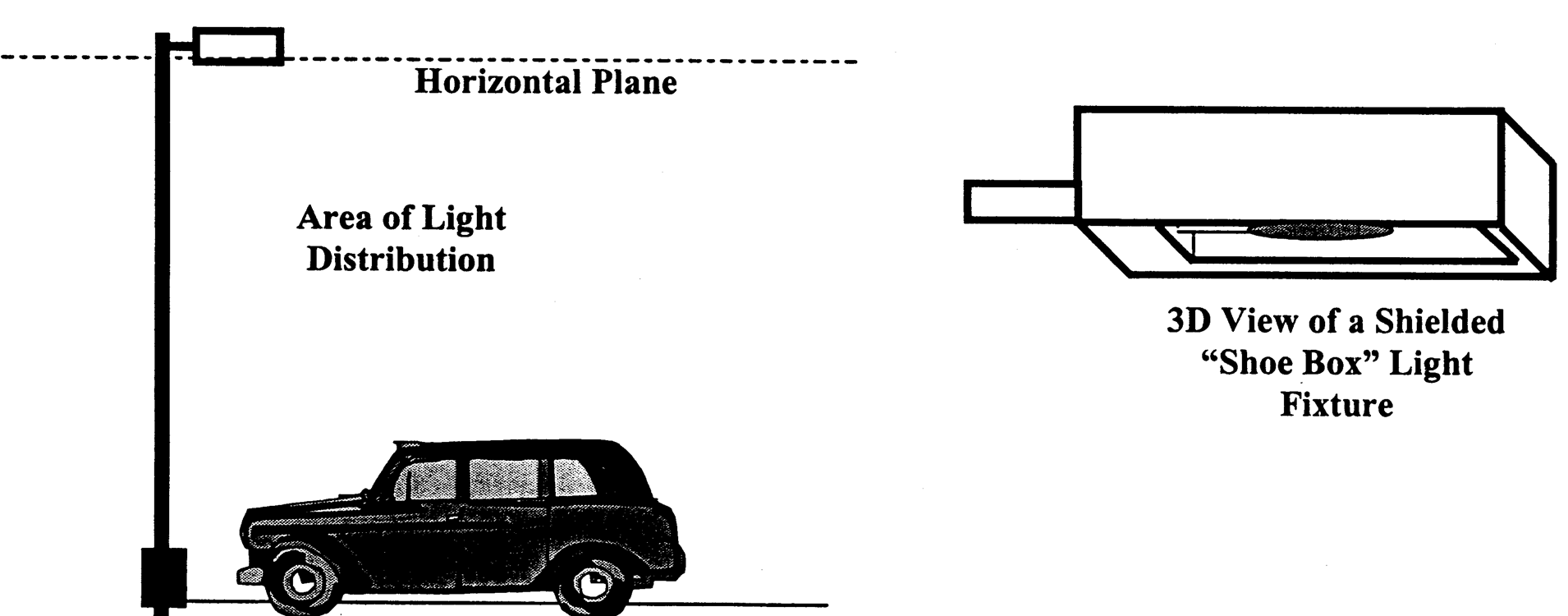
Area of Light Distribution/"Shoe Box" Light Fixture Fig. 8
Spot light: A lighting assembly designed to direct the output of a contained lamp in a specific tightly focused direction (a beam) with a reflector located external to the lamp.
(Ord. No. 03-01 (Exh. A, § 42-642), 2-18-2003)
Sec. 42-593. - Submittal requirements.
In addition to the site plan requirements of section 42-482, the following information must be included for all projects, except one- and two-family dwellings under separate ownership and located on separate lots, that include new exterior lighting or modifications to existing exterior lighting. Where site plan approval is not required, prior to issuance of any approval to install new lighting or modify any existing exterior lighting subject to these regulations, the following shall be submitted:
A.
Location of all outdoor lighting fixtures, including but not limited to, freestanding pole fixtures, building-mounted and canopy light fixtures on the site and building elevations.
B.
For parking lots which exceed 10,000 square feet and abut a public park, or residential district or use property, a photometric grid overlaid on the proposed site plan, or landscaping plan, indicating the light intensity throughout the site (in foot-candles). Measurements must be at ground level and shown at ten-foot spacing.
C.
Manufacturer's specification sheets and details for the type of fixture being proposed including but not limited to the total lumen output, type of lamp, distribution type and method of shielding;
D.
Use of fixture(s) proposed; and
E.
Any other information deemed necessary by the director in accordance with the intent and purpose of this subdivision.
(Ord. No. 03-01 (Exh. A, § 42-643), 2-18-2003)
Sec. 42-594. - General standards.
A.
Unless otherwise permitted by this subdivision, only shielded fixtures as defined in section 42-592 may be used for site lighting.
B.
It is recognized that metal halide and fluorescent lamps are superior lights for color and object recognition when compared to older lamp types such as low and high-pressure sodium or mercury vapor. Therefore, use of metal halide and fluorescent lamps is highly encouraged over low or high-pressure sodium or mercury vapor lamps. It is also recognized that new lamp types are occasionally introduced that may have similar characteristics as the currently preferred types that may also be desirable for use in outdoor lighting.
C.
The intensity of light on a site shall not exceed three-tenths foot-candle at any property line that abuts a public park or residential district or use property. For information purposes, it is recognized that on a clear night with low humidity the light from a full moon is approximately four-tenths foot-candle.
D.
The maximum height of parking lot light fixtures shall be 25 feet, except that the planning commission, when required in accordance with section 42-481.B, or director may permit up to 35 feet in a business or industrial district when the poles are no closer than 150 feet to a public park or residential district boundary or use or public or private roadway.
E.
Other.
1.
Any interior light fixtures that are deemed to be causing glare visible outside the building or structure in which it is located, and therefore not meeting the purpose or intent of this subdivision, shall be shielded to prevent glare at the property line.
2.
Means of egress illumination and the minimum illumination levels as established by the adopted building code of the city shall be fulfilled, when applicable.
3.
Certain decorative fixtures using lamps with low wattages do not have to be shielded. These include incandescent lamps of 160 watts or less, glass tubes filled with neon, argon and krypton and any other light source of 50 watts or less. Decorative luminaries above 50 watts shall have internal and/or external reflectors that shield the light source.
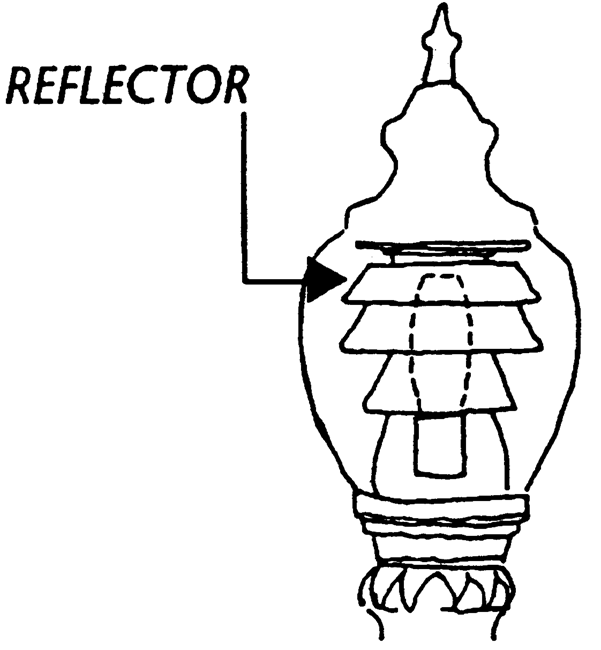
Reflector, Fig. 9
4.
Indirect illumination of signs, canopies and buildings is permitted provided a maximum 125 watt bulb is utilized and there is no glare. The director may permit a bulb with higher wattage when dark surfaces are being illuminated and the intent and purposes of this subsection are not compromised.
(Ord. No. 03-01 (Exh. A, § 42-644), 2-18-2003)
Sec. 42-595. - Prohibited outdoor lighting.
A.
The use of laser light source, searchlights or any similar high intensity light for outdoor advertisement is prohibited.
B.
Lighting shall not be of a flashing, moving or intermittent type.
(Ord. No. 03-01 (Exh. A, § 42-645), 2-18-2003)
Sec. 42-596. - Exemptions.
The following are exempt from the lighting requirements of this subdivision, provided that no glare or other detrimental effects on adjoining streets or property owners is determined:
A.
Private swimming pools;
B.
Holiday decorations;
C.
Pedestrian walkway lighting;
D.
Under(recessed) soffit lighting;
E.
Single-family and two family residential lighting; and
F.
Street lights.
(Ord. No. 03-01 (Exh. A, § 42-646), 2-18-2003)
Sec. 42-597. - Administration.
A.
Outdoor lighting shall be approved using a form from the department of community development if the planning commission, when required in accordance with section 42-481.B and/or the director determines that a proposal fulfills the requirements and intent and purpose of this subsection. The approval shall list what is being approved and contain copies of relevant documents.
B.
The director has the discretion to require the re-direction of existing light fixtures after installation when it is determined that the fixture is creating off-site glare.
(Ord. No. 03-01 (Exh. A, § 42-647), 2-18-2003)

