
Portola City Zoning Code
ARTICLE IV
- Special Area and Specific Use Requirements
Chapter 17.47 - FLOODPLAIN MANAGEMENT ORDINANCE
Sections:
Chapter 17.48 - COMMUNITY CARE FACILITY, LARGE
Sections:
Chapter 17.49 - LOCATION AND AMORTIZATION OF ADULT-ORIENTED BUSINESSES
Sections:
Chapter 17.50 - OPEN AIR VENDING
Sections:
Chapter 17.51 - SHORT-TERM RENTALS
Sections:
Chapter 17.52 - ANTENNAS AND COMMUNICATIONS FACILITIES
Sections:
Chapter 17.55 - HOME OCCUPATION[3]
Sections:
Editor's note— Ord. No. 331, adopted Aug. 12, 2009, amended Ch. 17.55 in its entirety to read as herein set out. Former Ch. 17.55, §§ 17.55.010—17.55.050, pertained to similar subject matter, and derived from Ord. 289 § 2 (Exh. A (part)), 2002.
Chapter 17.58 - MOBILE HOME PARKS
Sections:
Chapter 17.61 - OUTDOOR RESTAURANT SEATING
Sections:
Chapter 17.64 - PERSONAL STORAGE FACILITIES
Sections:
Chapter 17.65 - MARIJUANA[4]
Sections:
Editor's note— Ord. No. 346, § 1, adopted Nov. 8, 2017, deleted the former Ch. 17.65, §§ 17.65.010—17.65.060, and enacted a new Ch. 17.65 as set out herein. The former Ch. 17.65 pertained to medical marijuana dispensaries and derived from Ord. No. 336, § 2, adopted Feb. 23, 2011.
Chapter 17.67 - RECYCLING COLLECTION CENTERS
Sections:
Chapter 17.70 - ACCESSORY DWELLING UNITS[5]
Sections:
Editor's note— Ord. No. 352, § 1, adopted Nov. 28, 2018, amended Ch. 17.70 in its entirety to read as herein set out. Former Ch. 17.70, §§ 17.70.010—17.70.040 was entitled "Second Dwelling Units," and derived from Ord. 289 § 2 (Exh. A (part)), 2002.
Chapter 17.73 - TEMPORARY USES
Sections:
Chapter 17.76 - SIGNS[6]
Sections:
Editor's note— Ord. No. 339, § 1, adopted Apr. 24, 2013, amended Ch. 17.76 in its entirety to read as herein set out. Former Ch. 17.76, §§ 17.76.010—17.76.250, pertained to similar subject matter, and derived from Ord. 287 § 2 (Exh. A (part)), adopted 2001; Ord. 303 § 1, adopted 2003; and Ord. No. 328, § 1, adopted Aug. 13, 2008.
17.47.010 - Statutory authorization, findings of fact, purpose and methods.
A.
Statutory Authorization. The Legislature of the State of California has in Government Code Sections 65302, 65560 and 65800 conferred upon local governments the authority to adopt regulations designed to promote the public health, safety, and general welfare of its citizenry. Therefore, the city council of Portola does hereby adopt the following floodplain management regulations.
B.
Findings of Fact.
1.
The flood hazard areas of the City of Portola are subject to periodic inundation which results in loss of life and property, health and safety hazards, disruption of commerce and governmental services, extraordinary public expenditures for flood protection and relief, and impairment of the tax base, all of which adversely affect the public health, safety, and general welfare.
2.
These flood losses are caused by uses that are inadequately elevated, floodproofed, or protected from flood damage. The cumulative effect of obstructions in areas of special flood hazards which increase flood heights and velocities also contributes to flood losses.
C.
Statement of Purpose. It is the purpose of this chapter to promote the public health, safety, and general welfare, and to minimize public and private losses due to flood conditions in specific areas by legally enforceable regulations applied uniformly throughout the community to all publicly and privately owned land within flood prone, mudslide (i.e., mudflow) or flood related erosion areas. These regulations are designed to:
1.
Protect human life and health;
2.
Minimize expenditure of public money for costly flood control projects;
3.
Minimize the need for rescue and relief efforts associated with flooding and generally undertaken at the expense of the general public;
4.
Minimize prolonged business interruptions;
5.
Minimize damage to public facilities and utilities such as water and gas mains; electric, telephone and sewer lines; and streets and bridges located in areas of special flood hazard;
6.
Help maintain a stable tax base by providing for the sound use and development of areas of special flood hazard so as to minimize future blighted areas caused by flood damage;
7.
Ensure that potential buyers are notified that property is in an area of special flood hazard; and
8.
Ensure that those who occupy the areas of special flood hazard assume responsibility for their actions.
D.
Methods of Reducing Flood Losses. In order to accomplish its purposes, this chapter includes regulations to:
1.
Restrict or prohibit uses which are dangerous to health, safety, and property due to water or erosion hazards, or which result in damaging increases in erosion or flood heights or velocities;
2.
Require that uses vulnerable to floods, including facilities which serve such uses, be protected against flood damage at the time of initial construction;
3.
Control the alteration of natural floodplains, stream channels, and natural protective barriers, which help accommodate or channel floodwaters;
4.
Control filling, grading, dredging, and other development which may increase flood damage;
5.
Prevent or regulate the construction of flood barriers which will unnaturally divert floodwaters or which may increase flood hazards in other areas; and
6.
These regulations take precedence over any less restrictive conflicting local laws, ordinances and codes.
(Ord. 317 (part), 2007)
17.47.020 - Definitions.
Unless specifically defined below, words or phrases used in this chapter shall be interpreted so as to give them the meaning they have in common usage and to give this chapter its most reasonable application.
"A Zone." See "Special flood hazard area."
"Accessory structure" means a structure that is:
1.
Solely for the parking of no more than two cars;
2.
A small, low cost shed for limited storage, less than one hundred fifty square feet and one thousand five hundred dollars in value.
"Accessory use" means a use which is incidental and subordinate to the principal use of the parcel of land on which it is located.
"Alluvial fan" means a geomorphologic feature characterized by a cone or fan-shaped deposit of boulders, gravel, and fine sediments that have been eroded from mountain slopes, transported by flood flows, and then deposited on the valley floors, and which is subject to flash flooding, high velocity flows, debris flows, erosion, sediment movement and deposition, and channel migration.
"Apex" means a point on an alluvial fan or similar landform below which the flow path of the major stream that formed the fan becomes unpredictable and alluvial fan flooding can occur.
"Appeal" means a request for a review of the floodplain administrator's interpretation of any provision of this chapter.
"Area of shallow flooding" means a designated AO or AH zone on the flood insurance rate map (FIRM). The base flood depths range from one to three feet; a clearly defined channel does not exist; the path of flooding is unpredictable and indeterminate; and velocity flow may be evident. Such flooding is characterized by ponding or sheet flow.
"Area of Special Flood Hazard." See "Special flood hazard area."
"Base flood" means a flood which has a one percent chance of being equaled or exceeded in any given year (also called the "one hundred-year flood"). Base flood is the term used throughout this chapter.
"Base flood elevation" (BFE) means the elevation shown on the flood insurance rate map for Zones AE, AH, A1-30, VE and V1-V30 that indicates the water surface elevation resulting from a flood that has a one percent or greater chance of being equaled or exceeded in any given year.
"Basement" means any area of the building having its floor subgrade - i.e., below ground level - on all sides.
"Building." See "Structure."
"Development" means any man-made change to improved or unimproved real estate, including, but not limited to, buildings or other structures, mining, dredging, filling, grading, paving, excavation or drilling operations or storage of equipment or materials.
"Encroachment" means the advance or infringement of uses, plant growth, fill, excavation, buildings, permanent structures or development into a floodplain which may impede or alter the flow capacity of a floodplain.
"Existing manufactured home park or subdivision" means a manufactured home park or subdivision for which the construction of facilities for servicing the lots on which the manufactured homes are to be affixed (including, at a minimum, the installation of utilities, the construction of streets, and either final site grading or the pouring of concrete pads) is completed before May 1, 1995.
"Expansion to an existing manufactured home park or subdivision" means the preparation of additional sites by the construction of facilities for servicing the lots on which the manufactured homes are to be affixed (including the installation of utilities, the construction of streets, and either final site grading or the pouring of concrete pads).
"Flood boundary and floodway map (FBFM)" means the official map on which the Federal Emergency Management Agency or Federal Insurance Administration has delineated both the areas of special flood hazards and the floodway.
"Flood insurance study" means the official report provided by the Federal Insurance Administration that includes flood profiles, the flood insurance rate map, the flood boundary and floodway map, and the water surface elevation of the base flood.
"Flood insurance rate map (FIRM)" means the official map on which the Federal Emergency Management Agency or Federal Insurance Administration has delineated both the areas of special flood hazards and the risk premium zones applicable to the community.
"Flood, flooding," or "floodwater" means:
1.
A general and temporary condition of partial or complete inundation of normally dry land areas from the overflow of inland or tidal waters; the unusual and rapid accumulation or runoff of surface waters from any source; and/or mudslides (i.e., mudflows); and
2.
The condition resulting from flood-related erosion.
"Floodplain administrator" is the community official designated by title to administer and enforce the floodplain management regulations.
"Floodplain management" means the operation of an overall program of corrective and preventive measures for reducing flood damage and preserving and enhancing, where possible, natural resources in the floodplain, including, but not limited to, emergency preparedness plans, flood control works, floodplain management regulations, and open space plans.
"Floodplain management regulations" means this chapter and other zoning ordinances, subdivision regulations, building codes, health regulations, special purpose ordinances (such as grading and erosion control) and other application of police power which control development in flood-prone areas. This term describes federal, state or local regulations in any combination thereof which provide standards for preventing and reducing flood loss and damage.
"Floodplain" or "flood-prone area" means any land area susceptible to being inundated by water from any source. See "Flooding."
"Floodproofing" means any combination of structural and nonstructural additions, changes, or adjustments to structures which reduce or eliminate flood damage to real estate or improved real property, water and sanitary facilities, structures, and their contents. For guidelines on dry and wet floodproofing, see FEMA Technical Bulletins TB 1-93, TB 3-93, and TB 7-93.
"Floodway" means the channel of a river or other watercourse and the adjacent land areas that must be reserved in order to discharge the base flood without cumulatively increasing the water surface elevation more than one foot. Also referred to as "regulatory floodway."
"Floodway fringe" is that area of the floodplain on either side of the "regulatory floodway" where encroachment may be permitted.
"Fraud and victimization" as related to Section 17.47.060 of this chapter, means that the variance granted must not cause fraud on or victimization of the public. In examining this requirement, the city council will consider the fact that every newly constructed building adds to government responsibilities and remains a part of the community for fifty to one hundred years. Buildings that are permitted to be constructed below the base flood elevation are subject during all those years to increased risk of damage from floods, while future owners of the property and the community as a whole are subject to all the costs, inconvenience, danger, and suffering that those increased flood damages bring. In addition, future owners may purchase the property, unaware that it is subject to potential flood damage, and can be insured only at very high flood insurance rates.
"Functionally dependent use" means a use which cannot perform its intended purpose unless it is located or carried out in close proximity to water. The term includes only docking facilities, port facilities that are necessary for the loading and unloading of cargo or passengers, and ship building and ship repair facilities, and does not include long-term storage or related manufacturing facilities.
"Governing body" is the local governing unit, i.e., county or municipality, that is empowered to adopt and implement regulations to provide for the public health, safety and general welfare of its citizenry.
"Hardship" as related to Section 17.47.060 of this chapter means the exceptional hardship that would result from a failure to grant the requested variance. The city council requires that the variance be exceptional, unusual, and peculiar to the property involved. Mere economic or financial hardship alone is not exceptional. Inconvenience, aesthetic considerations, physical handicaps, personal preferences, or the disapproval of one's neighbors likewise cannot, as a rule, qualify as an exceptional hardship. All of these problems can be resolved through other means without granting a variance, even if the alternative is more expensive, or requires the property owner to build elsewhere or put the parcel to a different use than originally intended.
"Highest adjacent grade" means the highest natural elevation of the ground surface prior to construction next to the proposed walls of a structure.
"Historic structure" means any structure that is:
1.
Listed individually in the National Register of Historic Places (a listing maintained by the department of interior) or preliminarily determined by the Secretary of the Interior as meeting the requirements for individual listing on the National Register;
2.
Certified or preliminarily determined by the Secretary of the Interior as contributing to the historical significance of a registered historic district or a district preliminarily determined by the Secretary to qualify as a registered historic district;
3.
Individually listed on a state inventory of historic places in states with historic preservation programs which have been approved by the Secretary of Interior; or
4.
Individually listed on a local inventory of historic places in communities with historic preservation programs that have been certified either by an approved state program as determined by the Secretary of the Interior or directly by the Secretary of the Interior in states without approved programs.
"Levee" means a man-made structure, usually an earthen embankment, designed and constructed in accordance with sound engineering practices to contain, control or divert the flow of water so as to provide protection from temporary flooding.
"Levee system" means a flood protection system which consists of a levee, or levees, and associated structures, such as closure and drainage devices, which are constructed and operated in accord with sound engineering practices.
"Lowest floor" means the lowest floor of the lowest enclosed area, including basement (see "basement" definition).
1.
An unfinished or flood resistant enclosure below the lowest floor that is usable solely for parking of vehicles, building access or storage in an area other than a basement area, is not considered a building's lowest floor provided it conforms to applicable non-elevation design requirements, including, but not limited to:
a.
The flood openings standard in Section 17.47.050.A.3.c;
b.
The anchoring standards in Section 17.47.050.A.1;
c.
The construction materials and methods standards in Section 17.47.050.A.2; and
d.
The standards for utilities in Section 17.47.050.B.
2.
For residential structures, all subgrade enclosed areas are prohibited as they are considered to be basements (see "basement" definition). This prohibition includes below-grade garages and storage areas.
"Manufactured home" means a structure, transportable in one or more sections, which is built on a permanent chassis and is designed for use with or without a permanent foundation when attached to the required utilities. The term "manufactured home" does not include a "recreational vehicle."
"Manufactured home park or subdivision" means a parcel (or contiguous parcels) of land divided into two or more manufactured home lots for rent or sale.
"Market value" is defined in the City of Portola substantial damage/improvement procedures. See Section 17.47.040.B.2.a.
"Mean sea level" means, for purposes of the National Flood Insurance Program, the National Geodetic Vertical Datum (NGVD) of 1929, North American Vertical Datum (NAVD) of 1988, or other datum, to which base flood elevations shown on a community's flood insurance rate map are referenced.
"New construction," for floodplain management purposes, means structures for which the "start of construction" commenced on or after May 1, 1995, and includes any subsequent improvements to such structures.
"New manufactured home park or subdivision" means a manufactured home park or subdivision for which the construction of facilities for servicing the lots on which the manufactured homes are to be affixed (including at a minimum, the installation of utilities, the construction of streets, and either final site grading or the pouring of concrete pads) is completed on or after May 1, 1995.
"Obstruction" includes, but is not limited to, any dam, wall, wharf, embankment, levee, dike, pile, abutment, protection, excavation, channelization, bridge, conduit, culvert, building, wire, fence, rock, gravel, refuse, fill, structure, vegetation or other material in, along, across or projecting into any watercourse which may alter, impede, retard or change the direction and/or velocity of the flow of water, or due to its location, its propensity to snare or collect debris carried by the flow of water, or its likelihood of being carried downstream.
"One Hundred-Year Flood" or "100-Year Flood." See "Base flood."
"Program deficiency" means a defect in a community's floodplain management regulations or administrative procedures that impairs effective implementation of those floodplain management regulations.
"Public safety and nuisance" as related to Section 17.47.060 of this chapter, means that the granting of a variance must not result in anything which is injurious to safety or health of an entire community or neighborhood, or any considerable number of persons, or unlawfully obstructs the free passage or use, in the customary manner, of any navigable lake, or river, bay, stream, canal, or basin.
"Recreational vehicle" means a vehicle which is:
1.
Built on a single chassis;
2.
Four hundred square feet or less when measured at the largest horizontal projection;
3.
Designed to be self-propelled or permanently towable by a light-duty truck; and
4.
Designed primarily not for use as a permanent dwelling but as temporary living quarters for recreational, camping, travel, or seasonal use.
"Regulatory floodway" means the channel of a river or other watercourse and the adjacent land areas that must be reserved in order to discharge the base flood without cumulatively increasing the water surface elevation more than one foot.
"Remedy a violation" means to bring the structure or other development into compliance with state or local floodplain management regulations, or if this is not possible, to reduce the impacts of its noncompliance. Ways that impacts may be reduced include protecting the structure or other affected development from flood damages, implementing the enforcement provisions of the ordinance or otherwise deterring future similar violations, or reducing state or federal financial exposure with regard to the structure or other development.
"Riverine" means relating to, formed by, or resembling a river (including tributaries), stream, brook, etc.
"Sheet flow area." See "Area of shallow flooding."
"Special flood hazard area (SFHA)" means an area in the floodplain subject to a one percent or greater chance of flooding in any given year. It is shown on an FHBM or FIRM as Zone A, AO, A1-30, AE, A99, or, AH.
"Start of construction" includes substantial improvement and other proposed new development and means the date the building permit was issued, provided the actual start of construction, repair, reconstruction, rehabilitation, addition, placement, or other improvement was within one hundred eighty days from the date of the permit. The actual start means either the first placement of permanent construction of a structure on a site, such as the pouring of slab or footings, the installation of piles, the construction of columns, or any work beyond the stage of excavation; or the placement of a manufacture home on a foundation. Permanent construction does not include land preparation, such as clearing, grading, and filling; nor does it include the installation of streets and/or walkways; nor does it include excavation for a basement, footings, piers, or foundations or the erection of temporary forms; nor does it include the installation on the property of accessory buildings, such as garages or sheds not occupied as dwelling units or not part of the main structure. For a substantial improvement, the actual start of construction means the first alteration of any wall, ceiling, floor, or other structural part of a building, whether or not that alteration affects the external dimensions of the building.
"Structure" means a walled and roofed building that is principally above ground; this includes a gas or liquid storage tank or a manufactured home.
"Substantial damage" means damage of any origin sustained by a structure whereby the cost of restoring the structure to its before damaged condition would equal or exceed fifty percent of the market value of the structure before the damage occurred.
"Substantial improvement" means any reconstruction, rehabilitation, addition, or other improvement of a structure, the cost of which equals or exceeds fifty percent of the market value of the structure before the "start of construction" of the improvement. This term includes structures which have incurred "substantial damage," regardless of the actual repair work performed. The term does not, however, include either:
1.
Any project for improvement of a structure to correct existing violations or state or local health, sanitary, or safety code specifications which have been identified by the local code enforcement official and which are the minimum necessary to assure safe living conditions; or
2.
Any alteration of a "historic structure," provided that the alteration will not preclude the structure's continued designation as a "historic structure."
"Variance" means a grant of relief from the requirements of this chapter which permits construction in a manner that would otherwise be prohibited by this chapter.
"Violation" means the failure of a structure or other development to be fully compliant with this chapter. A structure or other development without the elevation certificate, other certifications, or other evidence of compliance required in this chapter is presumed to be in violation until such time as that documentation is provided.
"Water surface elevation" means the height, in relation to the National Geodetic Vertical Datum (NGVD) of 1929, North American Vertical Datum (NAVD) of 1988, or other datum, of floods of various magnitudes and frequencies in the floodplains of coastal or riverine areas.
"Watercourse" means a lake, river, creek, stream, wash, arroyo, channel or other topographic feature on or over which waters flow at least periodically. Watercourse includes specifically designated areas in which substantial flood damage may occur.
(Ord. 317 (part), 2007)
17.47.030 - General provisions.
A.
Lands to Which this Chapter Applies. This chapter shall apply to all areas of special flood hazards within the jurisdiction of the City of Portola.
B.
Basis for Establishing the Areas of Special Flood Hazard. The areas of special flood hazard identified by the Federal Emergency Management Agency (FEMA) in the countywide "Flood Insurance Study (FIS) for Plumas County and Incorporated Areas" dated March 2, 2005, with accompanying flood insurance rate maps (FIRM's), dated March 2, 2005, and all subsequent amendments and/or revisions, are adopted by reference and declared to be a part of this chapter. This FIS and attendant mapping is the minimum area of applicability of this chapter and may be supplemented by studies for other areas which allow implementation of this chapter and which are recommended to the city council by the floodplain administrator. The study and FIRM's are on file at City Hall, 35 Third Avenue, Portola, California.
C.
Compliance. No structure or land shall hereafter be constructed, located, extended, converted, or altered without full compliance with the terms of this chapter and other applicable regulations. Violation of the requirements (including violations of conditions and safeguards) shall constitute a misdemeanor. Nothing herein shall prevent the city council from taking such lawful action as is necessary to prevent or remedy any violation.
D.
Abrogation and Greater Restrictions. This chapter is not intended to repeal, abrogate, or impair any existing easements, covenants, or deed restrictions. However, where this chapter and another ordinance, easement, covenant, or deed restriction conflict or overlap, whichever imposes the more stringent restrictions shall prevail.
E.
Interpretation. In the interpretation and application of this chapter, all provisions shall be:
1.
Considered as minimum requirements;
2.
Liberally construed in favor of the governing body; and
3.
Deemed neither to limit nor repeal any other powers granted under state statutes.
F.
Warning and Disclaimer of Liability. The degree of flood protection required by this chapter is considered reasonable for regulatory purposes and is based on scientific and engineering considerations. Larger floods can and will occur on rare occasions. Flood heights may be increased by man-made or natural causes. This chapter does not imply that land outside the areas of special flood hazards or uses permitted within such areas will be free from flooding or flood damages. This chapter shall not create liability on the part of city council, any officer or employee thereof, the State of California, or the Federal Emergency Management Agency, for any flood damages that result from reliance on this chapter or any administrative decision lawfully made hereunder.
G.
Severability. This chapter and the various parts thereof are hereby declared to be severable. Should any section of this chapter be declared by the courts to be unconstitutional or invalid, such decision shall not affect the validity of the ordinance as a whole, or any portion thereof other than the section so declared to be unconstitutional or invalid.
(Ord. 317 (part), 2007)
17.47.040 - Administration.
A.
Designation of the Floodplain Administrator. The city manager is appointed to administer, implement, and enforce this chapter by granting or denying development permits in accord with its provisions.
B.
Duties and Responsibilities of the Floodplain Administrator. The duties and responsibilities of the floodplain administrator shall include, but not be limited to, the following:
1.
Permit Review. Review all development permits to determine:
a.
Permit requirements of this chapter have been satisfied, including determination of substantial improvement and substantial damage of existing structures;
b.
All other required state and federal permits have been obtained;
c.
The site is reasonably safe from flooding;
d.
The proposed development does not adversely affect the carrying capacity of areas where base flood elevations have been determined but a floodway has not been designated. This means that the cumulative effect of the proposed development when combined with all other existing and anticipated development will not increase the water surface elevation of the base flood more than one foot at any point within the City of Portola; and
e.
All letters of map revision (LOMR's) for flood control projects are approved prior to the issuance of building permits. Building permits must not be issued based on conditional letters of map revision (CLOMR's). Approved CLOMR's allow construction of the proposed flood control project and land preparation as specified in the "start of construction" definition.
2.
Development of Substantial Improvement and Substantial Damage Procedures.
a.
Using FEMA publication FEMA 213, "Answers to Questions About Substantially Damaged Buildings," develop detailed procedures for identifying and administering requirements for substantial improvement and substantial damage, to include defining "market value."
b.
Assure procedures are coordinated with other departments/divisions and implemented by community staff.
3.
Review, Use and Development of Other Base Flood Data. When base flood elevation data has not been provided in accordance with Section 17.47.030.B, the floodplain administrator shall obtain, review, and reasonably utilize any base flood elevation and floodway data available from a federal or state agency, or other source, in order to administer Section 17.47.050.
Note: A base flood elevation may be obtained using one of two methods from the FEMA publication, FEMA 265, "Managing Floodplain Development in Approximate Zone A Areas — A Guide for Obtaining and Developing Base (one hundred-year) Flood Elevations" dated July 1995.
4.
Notification of Other Agencies.
a.
Alteration or relocation of a watercourse:
i.
Notify adjacent communities and the California Department of Water Resources prior to alteration or relocation;
ii.
Submit evidence of such notification to the Federal Emergency Management Agency; and
iii.
Assure that the flood-carrying capacity within the altered or relocated portion of said watercourse is maintained.
b.
Base flood elevation changes due to physical alterations:
i.
Within six months of information becoming available or project completion, whichever comes first, the floodplain administrator shall submit or assure that the permit applicant submits technical or scientific data to FEMA for a letter of map revision (LOMR).
ii.
All LOMR's for flood control projects are approved prior to the issuance of building permits. Building permits must not be issued based on conditional letters of map revision (CLOMR's). Approved CLOMR's allow construction of the proposed flood control project and land preparation as specified in the "start of construction" definition.
Such submissions are necessary so that upon confirmation of those physical changes affecting flooding conditions, risk premium rates and floodplain management requirements are based on current data.
c.
Changes in corporate boundaries. Notify FEMA in writing whenever the corporate boundaries have been modified by annexation or other means and include a copy of a map of the community clearly delineating the new corporate limits.
5.
Documentation of Floodplain Development. Obtain and maintain for public inspection and make available as needed the following:
a.
Certification required by Sections 17.47.050.A.3.a and D (lowest floor elevations);
b.
Certification required by Section 17.47.050.A.3.b (elevation or floodproofing of nonresidential structures);
c.
Certification required by Section 17.47.050.A.3.c (wet floodproofing standard);
d.
Certification of elevation required by Section 17.47.050.C.1.c (subdivisions and other proposed development standards);
e.
Certification required by Section 17.47.050.F.2 (floodway encroachments); and
f.
Maintain a record of all variance actions, including justification for their issuance, and report such variances issued in its biennial report submitted to the Federal Emergency Management Agency.
6.
Map Determination. Make interpretations where needed, as to the exact location of the boundaries of the areas of special flood hazard, where there appears to be a conflict between a mapped boundary and actual field conditions. The person contesting the location of the boundary shall be given a reasonable opportunity to appeal the interpretation as provided in subsection D of this section.
7.
Remedial Action. Take action to remedy violations of this chapter as specified in Section 17.47.030.C.
8.
Biennial Report. Complete and submit biennial report to FEMA.
9.
Planning. Assure community's general plan is consistent with floodplain management objectives herein.
C.
Development Permit. A development permit shall be obtained before any construction or other development, including manufactured homes, within any area of special flood hazard established in Section 17.47.030.B. Application for a development permit shall be made on forms furnished by the City of Portola. The applicant shall provide the following minimum information:
1.
Plans in duplicate, drawn to scale, showing:
a.
Location, dimensions, and elevation of the area in question, existing or proposed structures, storage of materials and equipment and their location;
b.
Proposed locations of water supply, sanitary sewer, and other utilities;
c.
Grading information showing existing and proposed contours, any proposed fill, and drainage facilities;
d.
Location of the regulatory floodway when applicable;
e.
Base flood elevation information as specified in Section 17.47.030.B or subsection B.3;
f.
Proposed elevation in relation to mean sea level, of the lowest floor (including basement) of all structures; and
g.
Proposed elevation in relation to mean sea level to which any nonresidential structure will be floodproofed, as required in Section 17.47.050.A.3.b of this chapter and detailed in FEMA Technical Bulletin TB 3-93.
2.
Certification from a registered civil engineer or architect that the nonresidential floodproofed building meets the floodproofing criteria in Section 17.47.050.A.3.b.
3.
For a crawl-space foundation, location and total net area of foundation openings as required in Section 17.47.050.A.3.c of this chapter and detailed in FEMA Technical Bulletins 1-93 and 7-93.
4.
Description of the extent to which any watercourse will be altered or relocated as a result of proposed development.
5.
All appropriate certifications listed in subsection B.5 of this section.
D.
Appeals. The city council of the City of Portola shall hear and decide appeals when it is alleged there is an error in any requirement, decision, or determination made by the floodplain administrator in the enforcement or administration of this chapter.
(Ord. 317 (part), 2007)
17.47.050 - Provisions for flood hazard reduction.
A.
Standards of Construction. In all areas of special flood hazards the following standards are required:
1.
Anchoring. All new construction and substantial improvements of structures, including manufactured homes, shall be adequately anchored to prevent flotation, collapse or lateral movement of the structure resulting from hydrodynamic and hydrostatic loads, including the effects of buoyancy.
2.
Construction Materials and Methods. All new construction and substantial improvements of structures, including manufactured homes, shall be constructed:
a.
With flood-resistant materials, and utility equipment resistant to flood damage for areas below the base flood elevation;
b.
Using methods and practices that minimize flood damage;
c.
With electrical, heating, ventilation, plumbing and air conditioning equipment and other service facilities that are designed and/or located so as to prevent water from entering or accumulating within the components during conditions of flooding; and
d.
Within Zones AH or AO, so that there are adequate drainage paths around structures on slopes to guide floodwaters around and away from proposed structures.
3.
Elevation and Floodproofing.
a.
Residential Construction. All new construction or substantial improvements of residential structures shall have the lowest floor, including basement:
i.
In AE, AH, A1-30 zones, elevated to at least one foot above the base flood elevation.
ii.
In an AO zone, elevated above the highest adjacent grade to a height equal to or exceeding the depth number specified in feet on the FIRM plus one foot, or elevated at least three feet above the highest adjacent grade if no depth number is specified.
iii.
In an A zone elevated to at least one foot, without BFE's specified on the FIRM (unnumbered A zone), elevated to or above the base flood elevation; as determined under Section 17.47.040.B.3.
Upon the completion of the structure, the elevation of the lowest floor, including basement, shall be certified by a registered civil engineer or licensed land surveyor, and verified by the community building inspector to be properly elevated. Such certification and verification shall be provided to the floodplain administrator.
b.
Nonresidential Construction. All new construction or substantial improvements of nonresidential structures shall either be elevated to conform with subsection A.3.a of this section or:
i.
Be floodproofed, together with attendant utility and sanitary facilities, below the elevation recommended under subsection A.3.a of this section, so that the structure is watertight with walls substantially impermeable to the passage of water;
ii.
Have structural components capable of resisting hydrostatic and hydrodynamic loads and effects of buoyancy; and
iii.
Be certified by a registered civil engineer or architect that the standards of subsections A.3.b.i and A.3.b.ii of this section are satisfied. Such certification shall be provided to the floodplain administrator.
c.
Flood Openings. All new construction and substantial improvements of structures with fully enclosed areas below the lowest floor (excluding basements) that are usable solely for parking of vehicles, building access or storage, and which are subject to flooding, shall be designed to automatically equalize hydrostatic flood forces on exterior walls by allowing for the entry and exit of floodwater. Designs for meeting this requirement must meet the following minimum criteria:
i.
For non-engineered openings:
(A)
Have a minimum of two openings on different sides having a total net area of not less than one square inch for every square foot of enclosed area subject to flooding;
(B)
The bottom of all openings shall be no higher than one foot above grade;
(C)
Openings may be equipped with screens, louvers, valves or other coverings or devices provided that they permit the automatic entry and exit of floodwater; and
(D)
Buildings with more than one enclosed area must have openings on exterior walls for each area to allow floodwater to directly enter; or
ii.
Be certified by a registered civil engineer or architect.
d.
Manufactured Homes.
i.
Manufactured homes located outside of manufactured home parks or subdivisions shall meet the elevation and floodproofing requirement in subsection A.3 of this section.
ii.
Manufactured homes placed within manufactured home parks or subdivisions shall meet the standards in subsection D of this section. Additional guidance may be found in FEMA Technical Bulletins TB 1-93 and TB 7-93.
e.
Garages and Low Cost Accessory Structures.
i.
Attached Garages.
(A)
A garage attached to a residential structure, constructed with the garage floor slab below the BFE, must be designed to allow for the automatic entry of floodwaters. See subsection A.3.c of this section. Areas of the garage below the BFE must be constructed with flood-resistant materials. See subsection A.2 of this section.
(B)
A garage attached to a nonresidential structure must meet the above requirements or be dry floodproofed. For guidance on below grade parking areas, see FEMA Technical Bulletin TB-6.
ii.
Detached Garages and Accessory Structures.
(A)
"Accessory structures" used solely for parking (two-car detached garages or smaller) or limited storage (small, low-cost sheds), as defined in Section 17.47.020, may be constructed such that its floor is below the base flood elevation (BFE), provided the structure is designed and constructed in accordance with the following requirements:
(1)
Use of the accessory structure must be limited to parking or limited storage;
(2)
The portions of the accessory structure located below the BFE must be built using flood-resistant materials;
(3)
The accessory structure must be adequately anchored to prevent flotation, collapse and lateral movement;
(4)
Any mechanical and utility equipment in the accessory structure must be elevated or floodproofed to or above the BFE;
(5)
The accessory structure must comply with floodplain encroachment provisions in subsection F of this section; and
(6)
The accessory structure must be designed to allow for the automatic entry of floodwaters in accordance with subsection A.3.c of this section.
(B)
Detached garages and accessory structures not meeting the above standards must be constructed in accordance with all applicable standards in subsection A of this section.
B.
Standards for Utilities.
1.
All new and replacement water supply and sanitary sewage systems shall be designed to minimize or eliminate:
a.
Infiltration of floodwaters into the systems; and
b.
Discharge from the systems into flood waters.
2.
On-site waste disposal systems shall be located to avoid impairment to them, or contamination from them during flooding.
C.
Standards for Subdivisions and Other Proposed Development.
1.
All new subdivisions proposals and other proposed development, including proposals for manufactured home parks and subdivisions, greater than fifty lots or five acres, whichever is the lesser, shall:
a.
Identify the special flood hazard areas (SFHA) and base flood elevations (BFE).
b.
Identify the elevations of lowest floors of all proposed structures and pads on the final plans.
c.
If the site is filled above the base flood elevation, the following as-built information for each structure shall be certified by a registered civil engineer or licensed land surveyor and provided as part of an application for a letter of map revision based on fill (LOMR-F) to the floodplain administrator:
i.
Lowest floor elevation;
ii.
Pad elevation;
iii.
Lowest adjacent grade.
2.
All subdivision proposals and other proposed development shall be consistent with the need to minimize flood damage.
3.
All subdivision proposals and other proposed development shall have public utilities and facilities such as sewer, gas, electrical and water systems located and constructed to minimize flood damage.
4.
All subdivisions and other proposed development shall provide adequate drainage to reduce exposure to flood hazards.
D.
Standards for Manufactured Homes Within Manufactured Home Parks or Subdivisions. All manufactured homes in special flood hazard areas shall meet the anchoring standards in subsection A.1 of this section, construction materials and methods requirements in subsection A.2 of this section, flood openings requirements in subsection A.3.c of this section, and garages and low cost accessory structure standards in subsection A.3.e of this section.
Note: Manufactured homes located outside of manufactured home parks or subdivisions shall meet the elevation and floodproofing requirement in subsection A.3 of this section.
1.
All manufactured homes that are placed or substantially improved, on sites located: (1) in a new manufactured home park or subdivision; (2) in an expansion to an existing manufactured home park or subdivision; (3) or in an existing manufactured home park or subdivision on a site upon which a manufactured home has incurred "substantial damage" as the result of a flood shall:
a.
Within Zones A1-30, AH, and AE on the community's flood insurance rate map, be elevated on a permanent foundation such that the lowest floor of the manufactured home is elevated to or above the base flood elevation and be securely fastened to an adequately anchored foundation system to resist flotation, collapse and lateral movement.
2.
All manufactured homes to be placed or substantially improved on sites in an existing manufactured home park or subdivision within Zones A1-30, AH, and AE on the community's flood insurance rate map that are not subject to the provisions of subsection D.1 of this section will be securely fastened to an adequately anchored foundation system to resist flotation, collapse, and lateral movement, and be elevated so that either the:
a.
Lowest floor of the manufactured home is at or above the base flood elevation; or
b.
Manufactured home chassis is supported by reinforced piers or other foundation elements of at least equivalent strength that are no less than thirty-six inches in height above grade.
Upon the completion of the structure, the elevation of the lowest floor including basement shall be certified by a registered civil engineer or licensed land surveyor, and verified by the community building inspector to be properly elevated. Such certification and verification shall be provided to the floodplain administrator.
E.
Standards for Recreational Vehicles.
1.
All recreational vehicles placed in Zones A1-30, AH, and AE will either:
a.
Be on the site for fewer than one hundred eighty consecutive days;
b.
Be fully licensed and ready for highway use. A recreational vehicle is ready for highway use if it is on its wheels or jacking system, is attached to the site only by quick-disconnect type utilities and security devices, and has no permanently attached additions; or
c.
Meet the permit requirements of Section 17.47.040.C of this chapter and the elevation and anchoring requirements for manufactured homes in subsection D.1 of this section.
F.
Floodways. Since floodways are an extremely hazardous area due to the velocity of floodwaters which carry debris, potential projectiles, and erosion potential, the following provisions apply:
1.
Until a regulatory floodway is adopted, no new construction, substantial development, or other development (including fill) shall be permitted within Zones A1-30 and AE, unless it is demonstrated that the cumulative effect of the proposed development, when combined with all other development, will not increase the water surface elevation of the base flood more than one foot at any point within the City of Portola.
2.
Within an adopted regulatory floodway, the City of Portola shall prohibit encroachments, including fill, new construction, substantial improvements, and other development, unless certification by a registered civil engineer is provided demonstrating that the proposed encroachment shall not result in any increase in flood levels during the occurrence of the base flood discharge.
3.
If subsections F.1 and F.2 of this section are satisfied, all new construction, substantial improvement, and other proposed new development shall comply with all other applicable flood hazard reduction provisions of this section.
(Ord. 317 (part), 2007)
17.47.060 - Variance procedure.
A.
Nature of Variances. The issuance of a variance is for floodplain management purposes only. Insurance premium rates are determined by statute according to actuarial risk and will not be modified by the granting of a variance.
The variance criteria set forth in this section of the ordinance are based on the general principle of zoning law that variances pertain to a piece of property and are not personal in nature. A variance may be granted for a parcel of property with physical characteristics so unusual that complying with the requirements of this chapter would create an exceptional hardship to the applicant or the surrounding property owners. The characteristics must be unique to the property and not be shared by adjacent parcels. The unique characteristic must pertain to the land itself, not to the structure, its inhabitants, or the property owners.
It is the duty of the city council to help protect its citizens from flooding. This need is so compelling and the implications of the cost of insuring a structure built below flood level are so serious that variances from the flood elevation or from other requirements in the flood ordinance are quite rare. The long-term goal of preventing and reducing flood loss and damage can only be met if variances are strictly limited. Therefore, the variance guidelines provided in this chapter are more detailed and contain multiple provisions that must be met before a variance can be properly granted. The criteria are designed to screen out those situations in which alternatives other than a variance are more appropriate.
B.
Conditions for Variances.
1.
Generally, variances may be issued for new construction, substantial improvement, and other proposed new development to be erected on a lot of one-half acre or less in size contiguous to and surrounded by lots with existing structures constructed below the base flood level, providing that the procedures of Sections 17.47.040 and 17.47.050 of this chapter have been fully considered. As the lot size increases beyond one-half acre, the technical justification required for issuing the variance increases.
2.
Variances may be issued for the repair or rehabilitation of "historic structures" (as defined in Section 17.47.020 of this chapter) upon a determination that the proposed repair or rehabilitation will not preclude the structure's continued designation as an historic structure and the variance is the minimum necessary to preserve the historic character and design of the structure.
3.
Variances shall not be issued within any mapped regulatory floodway if any increase in flood levels during the base flood discharge would result.
4.
Variances shall only be issued upon a determination that the variance is the "minimum necessary" considering the flood hazard, to afford relief. "Minimum necessary" means to afford relief with a minimum of deviation from the requirements of this chapter. For example, in the case of variances to an elevation requirement, this means the city council need not grant permission for the applicant to build at grade, or even to whatever elevation the applicant proposes, but only to that elevation which the city council believes will both provide relief and preserve the integrity of the local ordinance.
5.
Any applicant to whom a variance is granted shall be given written notice over the signature of a community official that:
a.
The issuance of a variance to construct a structure below the base flood level will result in increased premium rates for flood insurance up to amounts as high as twenty-five dollars for one hundred dollars of insurance coverage; and
b.
Such construction below the base flood level increases risks to life and property. It is recommended that a copy of the notice shall be recorded by the floodplain administrator in the office of the Plumas County Recorder and shall be recorded in a manner so that it appears in the chain of title of the affected parcel of land.
6.
The floodplain administrator will maintain a record of all variance actions, including justification for their issuance, and report such variances issued in its biennial report submitted to the Federal Emergency Management Agency.
C.
Appeal Board.
1.
In passing upon requests for variances, the city council shall consider all technical evaluations, all relevant factors, standards specified in other sections of this chapter, and the:
a.
Danger that materials may be swept onto other lands to the injury of others;
b.
Danger of life and property due to flooding or erosion damage;
c.
Susceptibility of the proposed facility and its contents to flood damage and the effect of such damage on the existing individual owner and future owners of the property;
d.
Importance of the services provided by the proposed facility to the community;
e.
Necessity to the facility of a waterfront location, where applicable;
f.
Availability of alternative locations for the proposed use which are not subject to flooding or erosion damage;
g.
Compatibility of the proposed use with existing and anticipated development;
h.
Relationship of the proposed use to the comprehensive plan and floodplain management program for that area;
i.
Safety of access to the property in time of flood for ordinary and emergency vehicles;
j.
Expected heights, velocity, duration, rate of rise, and sediment transport of the flood waters expected at the site; and
k.
Costs of providing governmental services during and after flood conditions, including maintenance and repair of public utilities and facilities such as sewer, gas, electrical, and water system, and streets and bridges.
2.
Variances shall only be issued upon a:
a.
Showing of good and sufficient cause;
b.
Determination that failure to grant the variance would result in exceptional "hardship" to the applicant; and
c.
Determination that the granting of a variance will not result in increased flood heights, additional threats to public safety, or extraordinary public expense, create a nuisance (see "Public safety and nuisance"), cause "fraud and victimization" of the public, or conflict with existing local laws or ordinances.
3.
Variances may be issued for new construction, substantial improvement, and other proposed new development necessary for the conduct of a functionally dependent use provided that the provisions of subsections C.1 through C.4 of this section are satisfied and that the structure or other development is protected by methods that minimize flood damages during the base flood and does not result in additional threats to public safety and does not create a public nuisance.
4.
Upon consideration of the factors of subsection B.1 of this section and the purposes of this chapter, the city council may attach such conditions to the granting of variances as it deems necessary to further the purposes of this chapter.
(Ord. 317 (part), 2007)
17.48.010 - Purpose.
The purpose of this chapter is to regulate large community care facilities in residential zones. The following standards shall apply to the operation of large community care facilities in residential zones where allowed, following issuance of an administrative permit.
(Ord. No. 352, § 1, 11-28-2018)
17.48.020 - Permit required.
Large community care facilities may be permitted in residential districts, subject to the approval of an administrative permit by the city manager or his or her designee.
(Ord. No. 352, § 1, 11-28-2018)
17.48.030 - Development standards.
A.
Off-street parking shall be provided in accordance with Section 17.40.030.
B.
A six-foot high fence and/or wall shall be erected around the side and rear property lines in accordance with Section 17.34.030.C.6.
C.
Design will minimize to the degree possible, excessive noise impacts to adjoining properties.
D.
Facilities will not interfere with traffic and circulation of the neighborhood and shall be facilitated in a safe and effective manner.
E.
No signs advertising the use of the property as a large community care facility shall be permitted.
F.
The applicant shall comply with any conditions imposed by the city manager or his or her designee deemed necessary to satisfy the findings of approval in this section.
G.
A required hearing shall be held in accordance with Section 17.88.020 for an administrative permit. The approving authority is the city manager or his or her designee.
(Ord. No. 352, § 1, 11-28-2018)
17.48.040 - Findings for approval.
The approval or conditional approval of an administrative permit for a large community care facility shall be based on a finding by the city manager or his or her designee that the establishment, maintenance, or operation of the use and facility will not, under the circumstances of the particular case, be detrimental to the health, safety, or general welfare of persons residing or working in the neighborhood of such proposed use, or be detrimental or injurious to property and improvements in the neighborhood, or to the general welfare of the city.
(Ord. No. 352, § 1, 11-28-2018)
17.48.050 - Display of permit.
The approved permit shall be prominently displayed at all times at the approved location.
(Ord. No. 352, § 1, 11-28-2018)
17.49.010 - Purpose.
It is the intent of this chapter to prevent community-wide adverse economic impacts, increased crime, decreased property values, and the deterioration of neighborhoods which can be brought about by the concentration of adult-oriented businesses in close proximity to each other or proximity to other incompatible uses such as schools for minors, churches, child or family-oriented business and residentially zoned districts or uses. The city council finds that it has been demonstrated in various communities that the concentration of adult-oriented businesses causes an increase in the number of transients in the area, and an increase in crime, and in addition to the effects described above can cause other businesses and residents to move elsewhere. It is, therefore, the purpose of this article to establish reasonable and uniform regulations to prevent the concentration of adult-oriented businesses or their close proximity to incompatible uses, while permitting the location of adult-oriented Businesses in certain areas.
(Ord. 289 § 2 (Exh. A (part)), 2002)
17.49.020 - Definitions.
A.
Establishment of an Adult-Oriented Business. As used herein, to establish an adult-oriented business shall mean and include any of the following:
1.
The opening or commencement of any adult-oriented business as a new business;
2.
The conversion of an existing business, whether or not an adult-oriented business, to any adult-oriented business defined herein;
3.
The addition of any of the adult-oriented businesses defined herein to any other existing adult-oriented business; or
4.
The relocation of any such adult-oriented business.
(Ord. 289 § 2 (Exh. A (part)), 2002)
17.49.030 - Minimum proximity requirements.
No adult-oriented business shall be established or located in any zone in the city other than, SC or BP/LI, or within certain distances of certain specified land uses or zones as set forth below:
A.
No such business shall be established or located within two hundred feet of any other adult-oriented business.
B.
No such business shall be established or located within three hundred feet of any existing residential zone or use, park, church, school or child-oriented business as defined in this section.
C.
The distances set forth above shall be measured as a radius from the primary entrance of the adult-oriented business to the property or lease lines of the property so zoned or used without regard to intervening structures.
(Ord. 289 § 2 (Exh. A (part)), 2002)
17.49.040 - Amortization of nonconforming adult-oriented business uses.
Any use of real property existing on the effective date of the ordinance codified in this chapter, re-enacting this chapter, which does not conform to the provisions of Section 17.49.030, but which was constructed, operated, and maintained in compliance with all previous regulations, shall be regarded as a nonconforming use which may be continued until five years after the effective date of this ordinance codified in this chapter. On or before such date, all such nonconforming uses shall be terminated unless an extension of time has been approved by the city council in accordance with the provisions of Section 17.85.050.
A.
Abandonment. Notwithstanding the above, any discontinuance or abandonment of the use of any lot or structure as an adult-oriented business for a period of sixty days or more shall result in a loss of legal nonconforming status of such use.
B.
Amortization of Annexed Property. Any adult-oriented business which was a legal use at the time of annexation of the property and which is located in the city, but which does not conform to the provisions of Section 17.49.030 shall be terminated within one year of the date of annexation unless an extension of time has been approved by the city council in accordance with the provisions of Section 17.85.050.
(Ord. 289 § 2 (Exh. A (part)), 2002)
17.50.010 - Purpose.
The purpose of this chapter is to regulate open air vending facilities selling, vending, supplying, or providing any goods, wares, merchandise, produce, prepared food, fresh cut flowers or plants, crafts, or any other item determined by the city manager or his or her designee to be consistent with this type of use, from an open air vending facility. Uses are similar to a farmer's market, a produce stand, a food truck, or a craft show. The following regulations shall apply to the operation of open air vending where allowed, following issuance of an administrative permit.
(Ord. No. 352, § 1, 11-28-2018)
17.50.020 - Definitions.
"Open air vending" means selling, vending, supplying, or providing any goods, wares, merchandise, produce, prepared food, fresh cut flowers or plants, crafts or any other items determined by the city managers or his or her designee to be consistent with this type of use, from an open air vending facility.
"Open air vending facility" means a location where one or more stand, cart, pushcart, vehicle, truck, trailer, wagon, bicycle, or structure on wheels, of any type, or similar structure not firmly fixed to a permanent foundation, can operate for open air vending.
"Open air vendor" means open air vending from a stand, cart, pushcart, vehicle, truck, trailer, wagon, bicycle, or structure on wheels, of any type, or similar structure not firmly fixed to a permanent foundation.
(Ord. No. 352, § 1, 11-28-2018)
17.50.030 - Exemptions.
A.
Open air vending facilities located within enclosed retail buildings.
B.
Open air vending facilities operating in conjunction with special events in accordance with Chapter 9.33, Special Events.
(Ord. No. 352, § 1, 11-28-2018)
17.50.040 - Permit required, open air vending facility.
A.
Open air vending facilities may be permitted in commercial or industrial zoning districts, subject to the approval of an administrative permit by the city manager or his or her designee.
B.
A business license must be obtained in accordance with the provisions of Chapter 5, Business Licenses and Regulations.
C.
Except as permitted as a special event in accordance with Chapter 9.33, Special Events, open air vending facilities shall not be located within the public right-of-way.
D.
The administrative permit is valid for one year.
(Ord. No. 352, § 1, 11-28-2018)
17.50.045 - Permit required, open air vendor.
A.
Open air vendors may be permitted within an open air vending facility, subject to the approval of an administrative permit by the city manager or his or her designee.
B.
A business license must be obtained in accordance with the provisions of Chapter 5, Business Licenses and Regulations.
C.
Except as permitted as a special event in accordance with Chapter 9.33, Special Events, open air vendors shall not be located within the public right-of-way.
D.
The administrative permit is valid for one year.
(Ord. No. 352, § 1, 11-28-2018)
17.50.050 - Development standards.
A.
Location.
1.
An open air vending facility may be located on improved or unimproved private property;
2.
If operated as an accessory use, open air vending shall not occupy more than ten percent of the property's existing parking area, or more than four hundred square feet, whichever is less, and will not obstruct any parking space for any concurrent use required by this code or any permit issued pursuant to this code. The vending area shall be identified in the application;
3.
The facility shall not be within two hundred feet of another open air vending facility;
4.
The facility shall not be within fifteen feet of any fire hydrant;
5.
At an intersection, the facility shall be located outside of the clear vision triangle; and
6.
The facility shall be located on a generally level portion of the site and an adequate breaking system be provided for, as necessary.
B.
Operation.
1.
A representative of the facility and/or vendor shall attend the facility and/or vendor during operating hours.
2.
Hours of operation shall not commence earlier than seven a.m. or continue later than ten p.m.
3.
The vendor shall not connect to any temporary or permanent on-site water, gas, electricity, telephone or cable sources.
4.
The facility and/or vendor shall include trash receptacle(s) and such receptacles shall be maintained, by the vendor, so as not to create an offending odor or visual nuisance.
5.
The facility, as designed and at the location requested, will not create a potentially adverse impact on pedestrian, motorist, vehicle or bicycle safety or impede traffic circulation.
6.
The facility and/or vendor shall not reflect undesirable light and glare from the designated premises.
7.
The facility and/or vendor shall not use, play or employ any sound, outcry, amplifier, loudspeaker, radio or any other instrument or device for the production of sound in connection with the promotion of the facility and/or vendor.
8.
The facility and/or vendor shall be maintained so as not to create an offending odor or visual nuisance or to create a public or private nuisance of any type.
9.
No vendor within the facility shall be greater than ten feet in height.
10.
Sale of product shall be from the approved vendor and not from additional accessory stands, tables, chairs, or any other devices other than those indicated on the approved application.
11.
Storage and handling of food shall comply with all applicable county and state requirements.
12.
The vendor shall display in a manner legible visible to its clientele:
a.
The name and telephone number of the vendor;
b.
The business license issued by the city for operation of the vendor and/or facility; and
c.
The health permit issued by the county health officer, if any is required, for operation of the vendor.
13.
The facility and/or vendor shall be kept in a good state of repair.
14.
The vendor shall maintain a written agreement, with a copy provided to the city, giving the vendor and his/her agents the right to use permanent sanitary facilities located no more than three hundred feet from the vending facility.
15.
The facility and/or vendor shall not be used to sell any merchandise to any person who is in a motor vehicle within a travel lane at the time of a sale.
16.
Operation of the facility and/or vendor shall adhere to all applicable city and/or county health standards and requirements.
C.
Signs.
1.
No freestanding signs are allowed to be used or displayed in connection with the operation of any open air vending facility.
2.
A maximum of three signs or thirty-six square feet, whichever is less, of signage is permitted for each vendor.
3.
Signs shall be mounted or attached to the vendor. The dimensions of mounted or attached signs shall be including in measuring the area of coverage and the height of the vendor.
4.
No sign shall revolve, rotate, move or create the illusion of movement, rotation or revolution or have any visible moving, revolving or rotating surface parts.
5.
No sign shall be illuminated directly or indirectly; but this restriction does not preclude the incidental illumination of such signs by service lighting needed in the conduct of nighttime operations.
6.
No sign shall emit or broadcast any sound, outcry or noise.
7.
Except as specifically set forth in this chapter, signs shall comply with other applicable city ordinances.
(Ord. No. 352, § 1, 11-28-2018)
17.50.060 - Application.
The city manager shall prescribe the forms and documents to be filed for an application for an open air facility and open air vendor. The forms and documents shall be filed with the city manager and accompanied by the following, as applicable:
A.
A description of the property and site where the facility will operate, which may include a map drawn to scale showing lot lines and dimensions, ingress and egress points, improved areas, grading plans, parking and traffic control locations. In addition, a description and location of the facility, its signs and equipment, such as tables, chairs, etc., on the property may also be required;
B.
A business license application and fee as specified in the current city council fee resolution;
C.
Written authorization of the owner of the property, or his/her designated representative, where the facility will operate agreeing to the placement and operation of the facility, if applicable;
D.
A written statement describing the nature of business and hours of operation to be conducted at the facility;
E.
Such other information as the city administrator deems necessary to process the application.
(Ord. No. 352, § 1, 11-28-2018)
17.50.070 - Findings for approval.
The approval or conditional approval of an administrative permit for an open air facility or open air vendor shall be based on a finding by the city manager or his or her designee that the establishment, maintenance, or operation of the use and facility will not, under the circumstances of the particular case, be detrimental to the health, safety, or general welfare of persons residing or working in the neighborhood of such proposed use, or be detrimental or injurious to property and improvements in the neighborhood, or to the general welfare of the city.
(Ord. No. 352, § 1, 11-28-2018)
17.50.080 - Display of permit.
The approved permit shall be prominently displayed at all times at the approved location.
(Ord. No. 352, § 1, 11-28-2018)
17.51.010 - Purpose and findings.
A.
The city council hereby finds that unregulated transient occupancy uses in residential and commercial districts presents a threat to the public welfare.
B.
The purposes of this chapter are to establish a permitting process and appropriate restrictions and standards for short-term rental of residential dwellings; to ensure the collection and payment of transient occupancy taxes; to minimize the negative secondary effects of short-term rental use on surrounding residential neighborhoods; and to retain the character of the neighborhoods in which any such use occurs.
C.
The city council hereby finds that the adoption of an ordinance regulating the issuance of and operating conditions attached to short-term rental permits is necessary to protect the public health, safety and welfare.
(Ord. No. 352, § 1, 11-28-2018)
17.51.020 - Administrative permit required.
No person shall use or maintain, nor shall any person authorize, aid, facilitate or advertise the use of, any residential dwelling on any parcel in any zoning district for short-term rental without an administrative permit.
(Ord. No. 352, § 1, 11-28-2018)
17.51.030 - Restrictions and standards.
Short-term rentals shall be subject to the following restrictions and standards:
A.
The administrative permit shall be in the name of the applicant, who shall be an owner of the real property upon which the short-term rental use is to be permitted. The permit shall not be transferable.
B.
The total number of guests staying in the short-term rental dwelling at any one time shall be no greater than two times the number of bedrooms plus two persons.
C.
Short-term rental dwellings shall meet all applicable building, health, fire and related safety codes at all times, including the installation and maintenance of a smoke detector and carbon monoxide detector, and shall be inspected by the building department and/or fire department before any short-term rental activity can occur.
D.
A minimum of two off-street parking spaces shall be provided for use by the short-term rental occupants.
E.
The owner/applicant shall keep on file with the city the name, telephone number, cell phone number, and e-mail address of a local contact person who shall be responsible for responding to questions or concerns regarding the operation of the short-term rental. This information shall be posted in a conspicuous location within the short-term rental dwelling. The local contact person shall be available twenty-four hours a day to accept telephone calls and respond physically to the short-term rental within thirty minutes when the short-term rental is rented and occupied.
F.
The owner/applicant shall post "house policies" in the main living area of the dwelling. The house policies shall be included in the rental agreement, which must be signed by the renter and shall be enforced by the owner/applicant or the owner/applicant's designated contact person. The house policies at a minimum shall include the following provisions:
1.
Commercial activities at the short-term rental are not allowed as part of the short-term rental.
2.
Quiet hours shall be maintained from ten p.m. to seven a.m., during which noise within or outside the short-term rental dwelling shall not disturb anyone on a neighboring property.
3.
Amplified sound that is audible beyond the property boundaries of the short-term rental dwelling is prohibited at any time.
4.
Except as permitted by the city manager or his or her designee, vehicles shall be parked in the designated off-street, on-site parking area.
5.
Parties, group gatherings, and any other similar events that exceed the maximum number of allowed guests and/or which have the potential to cause traffic, parking, noise or other problems in the neighborhood are prohibited from occurring at the short-term rental property.
G.
The owner/applicant shall ensure that the occupants and/or guests of the short-term rental use do not create unreasonable noise or disturbances, engage in disorderly conduct, or violate provisions of this code or any state law pertaining to noise, disorderly conduct, the consumption of alcohol, or the use of illegal drugs.
H.
The owner/applicant, upon notification that occupants and/or guests of his or her short-term rental use have created unreasonable noise or disturbances, engaged in disorderly conduct or committed violations of this code or state law pertaining to noise, disorderly conduct, the consumption of alcohol or the use of illegal drugs, shall prevent a recurrence of such conduct by those occupants or guests.
I.
The owner/applicant shall maintain city business licenses and pay all transient occupancy taxes in accordance with Chapter 5, Business Licenses and Regulations.
(Ord. No. 352, § 1, 11-28-2018)
17.51.040 - Procedures for application.
A.
Owner/applicants of a short-term rental use shall apply for an administrative permit with the city manager or his or her designee in accordance with the provisions of this chapter and on a form provided by the city.
B.
The application shall be accompanied by a fee in an amount to be fixed from time to time by resolution to cover the administrative costs of issuing a short-term rental permit, including but not limited to, inspection of the short-term rental dwelling.
C.
The application shall include the following information:
1.
The name, address and phone number of the owner/applicant, and verification that the applicant is the owner of the property.
2.
The assessor's parcel number of the lot on which the short-term rental use is proposed.
3.
Certification that the permit will be nontransferable.
4.
Certification that the local contact person is available twenty-four hours a day to accept telephone calls and respond physically to the short-term rental within thirty minutes when the short-term rental is rented and occupied.
5.
A site and floor plan identifying the location of parking on the site and the location of any bedrooms to be used for short-term rental use.
7.
Acknowledgement of receipt and inspection of a copy of all regulations pertaining to the operation of a short-term rental use.
8.
Additional information as may be requested by the city manager to determine impact and mitigation measures.
(Ord. No. 352, § 1, 11-28-2018)
17.51.050 - Permit processing.
A.
Administrative permit applications shall be reviewed by the city manager or his or her designee. The city manager shall either approve or deny the application pursuant to the requirements of this chapter after considering the effects the proposed use would have on surrounding uses and the cumulative impacts within the community. In approving the application, the city manager must make the following findings:
1.
The establishment of a short-term rental at the subject property is consistent with the purpose of the general plan.
2.
The establishment of a short-term rental at the project site is compatible with and will not be detrimental to the character of the neighborhood and surrounding land uses.
B.
The city manager may impose conditions on the granting of an application for a short-term rental permit to mitigate any impacts of the proposed land use.
C.
Short-term rental permits shall be subject to any changes to this chapter that the city council may make and conditions that the council may impose subsequent to the issuance of the permit.
(Ord. No. 352, § 1, 11-28-2018)
17.51.060 - Appeals.
Any person whose application for an administrative permit has been denied by the city manager, or whose permit has been suspended or revoked, may appeal to the planning commission pursuant to Chapter 17.91. The appeal shall be accompanied by a filing fee, if any, as established by city council resolution.
(Ord. No. 352, § 1, 11-28-2018)
17.51.070 - Inspections.
A.
The building manager or his or her designee shall have the right to enter upon any property at any reasonable time to make inspections and examinations for the purpose of enforcement of this chapter, subject to the provisions of Code of Civil Procedure Section 1822.50 et seq.
B.
The building and/or fire department may annually inspect the short-term rental dwelling.
C.
The city manager or his or her designee shall have the right to inspect any records related to the use and occupancy of the short-term rental to determine that the objectives and conditions of this chapter are being fulfilled.
(Ord. No. 352, § 1, 11-28-2018)
17.51.080 - Revocation.
A.
The city manager may revoke a short-term rental permit if it is determined that:
1.
The owner-applicant gave false or misleading information during the application process;
2.
There has been a violation of any of the terms, conditions and restrictions on the use of the dwelling unit for short-term rental use or any provisions of this chapter;
3.
The owner-applicant has failed to timely pay the transient occupancy tax as required by this code.
B.
If an owner-applicant's short-term rental permit is revoked, the owner-applicant may not reapply for another permit for one year after the date of revocation.
(Ord. No. 352, § 1, 11-28-2018)
17.51.090 - Violations, enforcement and civil penalties.
A.
Any property owner or responsible person who uses, or allows the use of, or advertises or causes to be printed, published, advertised or disseminated in any way, the availability of residential property in violation of this chapter is guilty of a misdemeanor for each day in which such residential property is used, or allowed to be used, in violation of this chapter. Such violation shall be punishable pursuant to Chapter 1.08, General Penalty Provisions. For purposes of this chapter, "responsible person" shall mean and include any manager or other person responsible for allowing property to be used for short-term rental in violation of this chapter.
B.
Short-term rental use, and/or advertisement for use, of a residential property in violation of this chapter is a threat to public health, safety or welfare and is thus declared to be unlawful and a public nuisance. Any such nuisance may be abated and/or restored by the enforcement official and also may be abated pursuant to Chapter 18.06, Procedure for Abatement of Nuisance, except that the civil penalty for a violation shall be two hundred fifty dollars. Each day the violation occurs shall constitute a separate offense.
C.
Any property owner or responsible person who violates this chapter shall be liable and responsible for a civil penalty of two hundred fifty dollars per violation per day such violation occurs. The city may recover such civil penalty by either civil action or administrative citation. Such penalty shall be in addition to all other costs incurred by the city, including without limitation the city's staff time, investigation expenses and attorney's fees.
D.
Any violation of this chapter may also be abated and/or restored by the code enforcement officer and also may be abated pursuant to Chapter 18.06, Procedure for Abatement of Nuisance, except that the civil penalty for a violation shall be two hundred fifty dollars.
E.
Each day the violation of this chapter occurs shall constitute a separate offense.
F.
The remedies under this chapter are cumulative and in addition to any and all other remedies available at law and equity.
(Ord. No. 352, § 1, 11-28-2018)
17.52.010 - Purpose.
This section establishes standards for the placement of antennas and towers in all zoning districts. It is the intent of this chapter to minimize the adverse impacts of such equipment and structures on neighborhoods and surrounding developments by limiting the height, number and location of such devices.
(Ord. 289 § 2 (Exh. A (part)), 2002)
17.52.020 - Permit requirements.
Antennas and communications facilities are permitted as identified in Article II. Satellite dish antennas and ham radio antennas are permitted as accessory structures pursuant to Section 17.34.030.
(Ord. 289 § 2 (Exh. A (part)), 2002)
17.52.030 - General standards.
The following requirements apply to antennas in all zone districts, except where a more restrictive standard is required by Section 17.52.040 for satellite dish antennas:
A.
Setbacks. All antennas shall meet the minimum setbacks required by the applicable zoning, except that:
1.
No antenna shall be located between a building and an adjacent street, even if the required setbacks are satisfied, unless approved by the planning commission.
2.
Any antenna located on a lot adjacent to a residential zone district shall be set back from the residential zone two feet for each one foot of total height. The required setback shall be measured at its widest potential position.
B.
Height Limit.
1.
Antennas installed on buildings. Antennas shall not exceed a height of more than one-half the height of the building on which the antenna will be located.
2.
Antennas installed on developed or undeveloped lots. Antennas shall not exceed sixty feet in height.
3.
Conditional use permit for increase in height. An antenna that exceeds the requirements of subsections B.1 or B.2 above, may be approved upon securing a conditional use permit.
C.
Advertising on Antenna. No advertising or display is permitted on any antenna.
(Ord. 289 § 2 (Exh. A (part)), 2002)
17.52.040 - Satellite dish antennas.
The following requirements apply to satellite dish antennas greater than three feet in diameter:
A.
Residential Standards. In addition to the general requirements in Section 17.52.030, above, the following shall apply:
1.
Maximum Height. Six feet from the grade at the base of the antenna.
2.
Roof-Mounting Prohibited. No satellite antenna shall be mounted on a building roof in residential zones. Satellite dish antennas shall be ground-mounted, and shall not be visible from public streets.
3.
Screening Required. Satellite antennas shall not be placed in front yards and shall be screened from public view from streets and adjacent properties by fences, or walls of six feet in height and/or landscaping.
C.
Commercial and Industrial Standards. The following requirements shall apply to satellite antennas in all commercial and industrial zones established by Article II:
1.
Setbacks. If the zoning district abuts a residential zone, any satellite antenna higher than six feet shall be located a minimum of ten feet from the residential property line. For each foot of height above six feet, the satellite antenna shall be located two additional feet back from the residential district.
2.
Maximum Height, Ground-Mounted Antenna. Twenty feet above natural grade.
3.
Roof-Mounted Antenna. Screened so as to not be visible from surrounding streets.
C.
Height Measurement. The height of a moveable or adjustable antenna shall be measured at its highest potential position (i.e., with the face plane of a satellite dish antenna parallel to the support post) from natural grade.
(Ord. 289 § 2 (Exh. A (part)), 2002)
17.55.010 - Purpose.
The purpose of these regulations is to permit and regulate nonresidential activities to be performed within a structure in residential zones as home occupations.
(Ord. No. 331, 8-12-2009)
17.55.020 - Home occupation defined.
A home occupation is an accessory, nonresidential business activity carried on within a dwelling by its inhabitants, incidental to the residential use of the dwelling, that does not change the character of the surrounding residential area by generating more traffic, noise or storage of material than would normally be expected in a residential zone.
(Ord. No. 331, 8-12-2009)
17.55.030 - Limitation on use.
Only one home occupation shall be permitted in a dwelling. The following uses or activities are prohibited as home occupations:
A.
Fire arms and ammunition sales;
B.
Kennel services;
C.
Vehicle or vehicle body, repair or painting; or
D.
Any use or activity that affects the character of the surrounding residential neighborhood by generating more noise, odors, junk or debris, or traffic than would be normally expected in a residential zone.
(Ord. No. 331, 8-12-2009)
17.55.040 - Permit requirements.
A.
A home occupation shall not be conducted prior to approval of a home occupation permit. Prior to issuing a home occupation permit it may be necessary for the city to conduct an inspection of the premises to ensure compliance with this code. Renters shall provide written evidence of owner approval of a home occupation with their application for a home occupation permit.
B.
The home occupation must comply with the performance standards in the tiered checklist. If a home occupation most closely conforms to the performance standards of Tier A or Tier B, then the city planner can review and approve the home occupation application. If a home occupation most closely conforms to the performance standards of Tier C, the director will forward the application to the planning commission for approval of a conditional use permit pursuant to Chapter 17.82.
(Ord. No. 331, 8-12-2009)
17.55.050 - Performance standards.
A home occupation application approval shall be subject to the following standards based on a tiered checklist:
(Ord. No. 352, § 1, 11-28-2018; Ord. No. 331, 8-12-2009)
17.55.060 - Permit exemptions.
(a)
Residential daycare operations for six or fewer children are exempt from the home occupancy permit requirements herein.
(b)
Business that do not require a business license because the gross receipts (as defined in the Business License Ordinance) are less than two thousand dollars, are exempt from the home occupancy permit requirements herein.
(Ord. No. 331, 8-12-2009)
17.58.010 - Purpose.
It is the purpose of this chapter to establish standards for the development, expansion, modification and operation of mobile home parks.
(Ord. 289 § 2 (Exh. A (part)), 2002)
17.58.020 - Permit procedures and development standards.
Mobile home parks are subject to conditional use permit review and shall be constructed in the following manner:
A.
Individual mobile home space minimum setbacks shall be measured from the edge of internal streets and space lines as follows:
1.
Front - ten feet
2.
Side - five feet on each side, or zero lot line on one side with ten feet on the opposite side.
3.
Rear - ten feet
4.
Structural separation - ten foot minimum between dwelling units.
B.
Maximum mobile home space coverage (mobile home and its accessory structure) shall be seventy-five percent.
C.
All mobile homes erected in the City of Portola must be placed on a foundation approved by the city building inspector, as required pursuant to Chapter 15.20 of the Portola Municipal Code.
D.
Each mobile home shall be equipped with skirting, or provided with a support pad that is recessed to give the appearance of the mobile home being located on-grade.
E.
All on-site utilities shall be installed underground.
F.
Each mobile home shall be provided with parking as required by Chapter 17.40.
G.
Each mobile home park shall be inspected by fire and/or code enforcement personnel on an "as needed" basis.
(Ord. 289 § 2 (Exh. A (part)), 2002)
17.61.010 - Purpose.
The purpose of this chapter is to establish standards for the placement of outdoor seating in association with existing restaurant uses.
(Ord. 289 § 2 (Exh. A (part)), 2002)
17.61.020 - Regulations.
Outdoor restaurant seating is permitted provided the following conditions are met:
A.
A minimum horizontal clearance of four feet from the street curb to the tables and chairs shall be maintained at all times, free from open car doors, car bumper overhangs, or other encroachments;
B.
Tables and chairs shall be limited to the area immediately adjacent to the restaurant use;
C.
Outdoor restaurant seating may be uncovered, partially covered, or fully covered by means of umbrellas, awnings or canopies;
D.
Decorative or accent lighting may be incorporated into the awning or canopy;
E.
Tables and chairs shall be movable unless otherwise approved by the planning commission;
F.
Full service food establishments using outdoor restaurant seating shall provide one off-street parking space for every one hundred square feet of outdoor seating area in addition to indoor parking requirements identified in Section 17.40.030. Fast food establishments using outdoor restaurant seating shall provide one space for every fifty square feet of outdoor seating area in addition to indoor parking requirements;
G.
Outdoor restaurant seating areas shall be maintained free of garbage and other debris; and
H.
Outdoor restaurant seating areas shall not violate any condition of a conditional use permit.
(Ord. 289 § 2 (Exh. A (part)), 2002)
17.61.030 - Approval.
An encroachment permit must be obtained prior to placement of seats, tables, umbrellas or awnings in a public right-of-way. (Ord 289 § 2 (Exh. A (part)), 2002)
17.64.010 - Purpose.
This chapter provides requirements and standards for the operation and design of personal storage facilities as defined and permitted by Article II of this title.
(Ord. 289 § 2 (Exh. A (part)), 2002)
17.64.020 - Limitations on use.
The following uses or activities are prohibited in personal storage facilities:
A.
Automotive repair that includes, but is not limited to, auto body and paint shop facilities;
B.
Practice facilities for musical bands;
C.
Wood, metal, or other working shops for business or as a hobby;
D.
Office and other business uses, except the office for the facility and the storage of personal belongings;
E.
Living quarters for human habitation or the keeping of animal life, except caretakers/managers quarters;
F.
Storage of hazardous materials as listed in Title 8, California Code of Regulations, Section 5194 as amended, or its successor section or statute.
1.
Rental agreements shall contain language prohibiting the storage of hazardous materials as outlined above.
2.
The operator of the facility shall maintain a copy of said section and ensure compliance with these regulations.
G.
Sewer, water, or electrical services to each of the storage units except electrical services needed for lighting purposes.
H.
When adjacent to residential land uses the hours of operations shall be as follows:
7:00 am until 7:00 p.m. (Monday through Friday)
8:00 am until 8:00 p.m. (Saturday, Sunday, and holidays)
(Ord. 289 § 2 (Exh. A (part)), 2002)
17.64.030 - Design standards.
The approving authority may apply the following to protect public health, safety and welfare and to ensure design compatibility.
A.
Architecture. The facility, including the caretakers/managers residence, the storage units and the office shall be designed using roof and building materials and colors compatible with adjacent developments.
B.
Site Design. To minimize visual impact on the adjacent residences, personal storage facilities shall be designed to:
1.
Locate the project entry/exit as far as possible from the residential land use;
2.
Locate the caretakers/managers residence and office as close as possible to the project entrance;
3.
Setback the outdoor storage of materials a minimum of twenty feet from the property lines adjacent to residential land uses;
4.
Setback personal storage building over one story a minimum of thirty feet from the property lines adjacent to residential land uses.
C.
Security. To ensure security when personal storage facilities are adjacent to residential land uses the police department may require security measures, such as controlled access, alarms or video cameras.
D.
Lighting. To minimize visual impacts in the adjacent properties, personal storage facilities shall provide the following:
1.
No off-site glare through the use of cut-off lenses.
2.
Wall mounted lights shall be located on the building below the roofline of the storage facility and shall be directed downward.
3.
Parking lot lighting, in conjunction with vehicle storage, shall not exceed sixteen feet in height, and shall be setback a minimum of fifty feet from the property line adjacent to the residential land use, or as approved by the planning commission if the parking lot is adjacent to a residential area.
E.
Screening. To protect the views from adjacent residential land uses, the person storage facility shall provide adequate screening that may include:
1.
A minimum six foot high masonry screen wall shall be provided along the property line adjacent to the residential land use. The height of the wall shall be measured from the highest grade (either on site or the adjacent site); and/or,
2.
Landscaping, within the storage facility, a minimum ten foot wide landscape planter with shrubs (minimum five gallon size) and evergreen trees (minimum fifteen gallon size placed a minimum twenty feet on center) shall be provided along the property line adjacent to the residential land use.
(Ord. 289 § 2 (Exh. A (part)), 2002)
17.65.010 - Purpose and intent.
A.
It is the purpose and intent of this chapter for the city council to exercise its police powers derived from Section 7 of Article XI of the California Constitution and state law to promote the health, safety, and general welfare of the residents and businesses of the City of Portola by prohibiting the cultivation, manufacturing and distribution, and to regulate the personal cultivation of marijuana and delivery of marijuana within the city's jurisdictional limits, unless preempted by federal or state law, and except as provided in this chapter.
B.
Nothing in this chapter is intended to impair any defenses available under the applicable state law. Nothing in this section is intended to authorize any use, possession, cultivation, manufacture, transportation, or distribution of marijuana in violation of state law.
(Ord. No. 346, § 1, 11-8-2017)
17.65.020 - Definitions.
[The following words, terms and phrases, when used in this chapter, shall have the meanings ascribed to them in this section, except where the context clearly indicates a different meaning:]
"Accessory structure" means a completely enclosed structure which is exempt from the permit requirements of the California Building Code, as adopted by the city ("CBC"), is on the same parcel of land as a private residence and is physically detached from the private residence.
"Certificate of compliance" means a self-completed form available from city hall or online on the city's website.
"Commercial cannabis activity" means any activity defined in California Business and Professions Code Sections 19300, et seq., as amended.
"Fully enclosed and secure structure" means a structure that complies with the CBC and has a complete roof enclosure supported by connecting walls extending from the ground to the roof, a foundation, slab or equivalent base to which the floor is secured by bolts or similar attachments, is secure against unauthorized entry, and is accessible only through one or more lockable doors. In order to qualify as a fully enclosed and secure structure, the walls and roofs must be constructed of solid materials that cannot be easily broken through, such as two-inch by four-inch or thicker studs overlaid with three-eighths-inch or thicker plywood or the equivalent. Plastic sheeting, regardless of gauge, or similar products, are not considered solid materials.
"Greenhouse" means a completely enclosed structure whose structural members are made of pre-formed, rigid construction materials that can reasonably be expected to maintain its integrity while exposed to harsh weather conditions. The walls, roof, and ends are typically covered using a transparent material that is fixed in place, which allows solar radiation to penetrate the surface and affect the growing environment of the plants inside.
"Indoors" means within a private residence, accessory structure, greenhouse or a fully enclosed and secure structure on the same property of a private residence.
"Marijuana" means any or all parts of the plant Cannabis sativa Linnaeus, Cannabis indica, or Cannabis ruderalis, whether growing or not, the seeds thereof, the resin or separated resin, whether crude or purified, extracted from any party of the plant; and every compound, manufacture, salt, derivative, mixture, or preparation of the plant, its seeds or resin, including marijuana infused in foodstuff or other ingestible or consumable product containing marijuana. The term "marijuana" shall also include "medical marijuana" as defined in California Health and Safety Code section 11362.5 and "medical cannabis", "medical cannabis product" and "cannabis product" as defined in Business and Professions Code section 19300.5(ag), or as may be amended.
"Medical marijuana dispensary", "marijuana dispensary" or "dispensary" means any business, office, store, facility, location, retail storefront, or wholesale component of any establishment, cooperative or collective that delivers (as defined in California Business and Professions Code section 19300.5(m), or as may be amended) whether mobile or otherwise, dispenses, distributes, exchanges, transmits, transports, sells or provides marijuana to any person for any reason, including members of any medical marijuana cooperative or collective consistent with the purposes set forth in California Health and Safety Code section 11362.5, or as may be amended.
"Marijuana cultivation" or "cultivation" means any activity involving the planting, growing, harvesting, drying, curing, grading, trimming, or processing of marijuana.
"Marijuana delivery" or "delivery" means the commercial delivery, transfer or transport, or arranging for the delivery, transfer or transport, or the use of any technology platform to arrange for or facilitate the commercial delivery, transfer or transport of marijuana, marijuana edibles, and/or any marijuana products to or from any location within the jurisdictional limits of the city, and any and all associated business and/or operational activities.
"Marijuana processing" or "processing" means any method used to prepare marijuana, marijuana edibles and/or marijuana byproducts for commercial retail and/or wholesale sales, including, but not limited to: cleaning, curing, preparation, laboratory testing, manufacturing, packaging, and extraction of active ingredients to create marijuana related products and concentrates.
"Outdoor" means any location within the city, on private grounds, that is exposed to the open air not within an accessory structure, greenhouse, enclosed and secure structure or private residence.
"Primary caregiver" shall have the same meaning as set forth in California Business and Professions Code section 19300.5(h), as may be amended, as that section now appears, or may hereafter be amended or renumbered.
"Private residence" means a house, an apartment unit, a mobile home, or other similar dwelling unit.
"Property" means a parcel of land upon which is built or placed a private residence.
"Qualified patient" means a patient that uses or ingests medical cannabis as that term is defined in California Business and Professions Code section 19300.5(ag) and who is entitled to the protections of California Health and Safety Code section 11362.5.
"Solid fence" means a fence constructed in compliance with the PMC and is of substantial material, such as wood or metal that prevents viewing the contents from one side to the other side of the fence.
(Ord. No. 346, § 1, 11-8-2017)
17.65.030 - Marijuana dispensaries as a prohibited use and/or activity.
A marijuana dispensary as defined in Section 17.65.020 is prohibited in all zones within the city's jurisdictional limits. No permit, whether conditional or otherwise, shall be issued for the establishment of such use.
(Ord. No. 346, § 1, 11-8-2017)
17.65.040 - Commercial cannabis activity, including cultivation of marijuana, as a prohibited use and/or activity.
Commercial cannabis activity, including marijuana cultivation, by any person or entity, including, but not limited to, clinics, collectives, cooperatives and dispensaries, is prohibited in all zones within the city's jurisdictional limits. No permit, whether conditional or otherwise, shall be issued for the establishment of such activity. Any cultivation that takes place in violation of any provision of this chapter is unlawful, and is hereby declared a public nuisance. Nothing in this chapter is intended to, nor shall it be construed to, make legal any cultivation activity that is otherwise prohibited under California law. Nothing in this chapter is intended to, nor shall it be construed to, preclude any landlord from limiting or prohibiting marijuana cultivation by its tenants.
(Ord. No. 346, § 1, 11-8-2017)
17.65.050 - Processing of marijuana as a prohibited use and/or activity.
Marijuana processing by any person or entity, including, but not limited to, clinics, collectives, cooperatives and dispensaries, is prohibited in all zones within the city's jurisdictional limits. No permit, whether conditional or otherwise, shall be issued for the establishment of such activity. Any processing that takes place in violation of any provision of this chapter is unlawful, and is hereby declared a public nuisance. Nothing in this chapter is intended to, nor shall it be construed to, preclude any landlord from limiting or prohibiting marijuana processing by its tenants.
(Ord. No. 346, § 1, 11-8-2017)
17.65.060 - Delivery of marijuana.
Marijuana delivery by any person or entity, including, but not limited to, clinics, collectives, cooperatives and dispensaries, is prohibited in the city except when such delivery occurs in accordance with the following reasonable regulations. Any delivery that takes place in violation of any provision of this chapter is unlawful, and is hereby declared a public nuisance. Nothing in this chapter is intended to, nor shall it be construed to, make legal any delivery activity that is otherwise prohibited under California law.
A.
Primary Caregivers. A primary caregiver, who is not subject to the MMRSA, engaged in the delivery of marijuana to a qualified patient is exempt from the prohibition prescribed in this chapter.
B.
Delivery by Marijuana Dispensary. It is unlawful for any marijuana dispensary to deliver, which includes, but is not limited to, dispense, distribute, exchange, transmit, transport, sell or provide, marijuana to a qualified patient or a primary caregiver without a valid permit as specified herein.
1.
Application. The form and content of the application for a permit shall be specified by the city manager. The application shall be signed under the penalty of perjury, and the following standards constitute the minimum standards to qualify for a permit to deliver marijuana to a qualified patient or primary caregiver:
a.
Name and address of the applicant; if the applicant is a corporation or limited liability company, the names and addresses of its directors or members respectively.
b.
Certificate of insurance demonstrating ability to comply with the insurance requirements set forth in this section in a form acceptable to the city.
c.
Applicant's trade name and business address.
d.
Copies of applicable authorizing state and local licenses and permits issued to applicant allowing it to operate a marijuana dispensary in a neighboring jurisdiction.
e.
Listing of all vehicles and devices to be used for delivery of marijuana to a qualified patient or primary caregiver within the city, which includes the vehicle's make, model, year, license plate number and vehicle identification number.
f.
Identifying all persons who will deliver marijuana on behalf of the dispensary to qualified patients or primary caregivers located in the city. Such individuals must be at least twenty-one years of age at the time of submittal of the application.
2.
Review of application. The city manager shall consider the application, as well as the criminal records, if any, and personal references, if demanded by the city manager, of individuals identified in the application, and any other results from investigation into the application as deemed necessary by the city manager.
3.
Disapproval of application. If the city manager disapproves an application, he or she shall notify the applicant in writing, stating the reasons for the disapproval. Notification of disapproval shall be delivered by first class mail to the applicant. No permit shall issue unless a successful appeal of the disapproval is made within the requisite time frame.
4.
Appeal of disapproval:
a.
Within twenty days after the city manager serves notification of disapproval, an applicant may appeal the disapproval by notifying the city clerk in writing of the appeal, the reasons for the appeal, and paying any applicable fees.
b.
The city clerk shall set a hearing on the appeal and shall fix a date and time certain, within forty-five days after the receipt of the applicant's appeal, unless the city and the applicant agree to a longer time, to consider the appeal. The city clerk shall provide notice of the date, time and place of hearing, at least ten days prior to the date of the hearing.
c.
The city manager shall appoint a hearing officer to hear the appeal and determine the order of procedure, and rule on all objections to admissibility of evidence. The applicant and the city manager shall each have the right to submit documents, call and examine witnesses, cross-examine witnesses and argue their respective positions. The proceeding shall be informal, and the strict rules of evidence shall not apply, and all evidence shall be admissible which is of the kind that reasonably prudent persons rely upon in making decisions.
d.
The hearing officer shall issue a written decision within twenty days after the close of the hearing. The decision of the hearing officer shall be final.
5.
Grounds for denial, revocation or suspension of permit. The granting of a permit or a renewal thereof may be denied and an existing permit revoked or suspended if the applicant or permittee, or any individual engaged by the applicant or permittee to deliver marijuana in the city:
a.
Has knowingly made a false statement in the application or in any reports or other documents furnished to the city.
b.
Engages vehicles or devices for delivery that are neither maintained nor operated in a manner and in a condition required by law and applicable regulations.
c.
Is required to register as a sex offender under Section 290 of the California Penal Code.
d.
Has been convicted of any offense relating to the use, sale, possession or transportation of narcotics or habit-forming drugs.
e.
Has been under suspension, revocation or probation by the department of motor vehicles for a cause involving the safe operation of a motor vehicle, or has been convicted of any of the following offenses: driving while under the influence, or reckless driving involving bodily injury, or who does not possess a valid driver's license.
f.
Has been convicted of any offense punishable as a felony, or has been convicted within a five-year period immediately preceding the crime of theft in either degree.
g.
Has been convicted of any offense involving moral turpitude.
h.
Has been involved within the two years immediately preceding the application in any motor vehicle accident causing death or personal injury.
i.
Has been in three or more motor vehicle accidents within the year immediately preceding the application.
j.
Engages individuals to deliver marijuana who were not identified in the application.
k.
Fails to pay required city fees and taxes.
l.
Violates any provision of this chapter.
6.
Suspension and revocation.
a.
If the city manager deems continuation of the operation of delivery by the marijuana dispensary will cause a significant threat to the health, safety or welfare of the public, the city manager may suspend the permit and all rights and privileges thereunder until a hearing officer renders a written decision on the revocation of the permit.
b.
The city manager shall give notice to a marijuana dispensary of his or her intent to revoke a permit in the same manner as notice of disapproval and provide the city clerk with a copy of the notice.
c.
The hearing for the revocation of the permit shall be set and conducted in the same manner as an appeal of disapproval. The decision of the hearing officer shall be final.
7.
Permittee's obligations. Permittee's duties and obligations shall include all of the following:
a.
Comply with all applicable state and local laws.
b.
Obtain and maintain a business license from the city.
c.
Maintain at all times all licenses and permits as required by California state law and the laws of the local jurisdiction in which the permittee is located, and provide immediate notification to the city manager if any license or permit is suspended or revoked.
d.
Package the marijuana to be delivered in compliance with California Business Professions Code section 19347 and any other regulations promulgated by the state department of public health.
e.
Any person who delivers marijuana from a marijuana dispensary must have in possession a copy of the permit, which shall be made available upon request to law enforcement.
f.
Delivery vehicles shall not advertise any activity related to marijuana nor shall it advertise the name of the permittee.
g.
Delivery of the marijuana shall be directly to the residence or business address of the qualified patient or the qualified patient's primary caregiver; deliveries to any other location are prohibited.
h.
Deliveries of marijuana shall occur only between the hours of 9:00 a.m. and 5:00 p.m.
i.
No permittee shall transport or cause to be transported marijuana in excess of the limits established by the state bureau of medical marijuana during the course of delivering marijuana; until the state bureau of medical marijuana establishes the limit, the limit is eight ounces of dried marijuana or its marijuana product equivalent within the city.
j.
All orders to be delivered shall be packaged by the names of the qualified patient or qualified patient and primary caregiver, if delivery is made to the primary caregiver, with a copy of the request for delivery with each package.
k.
Maintain at all times commercial general liability providing coverage at least as broad as ISO CGL Form 00 01 on an occurrence basis for bodily injury, including death, of one or more persons, property damage and personal injury with limits of not less than one million dollars per occurrence and comprehensive automobile liability (owned, non-owned, hired) providing coverage at least as broad as ISO Form CA 00 01 on an occurrence basis for bodily injury, including death, of one or more persons, property damage and personal injury, with limits of not less than one million dollars. The commercial general liability policy shall provide contractual liability, shall include a severability of interest or equivalent wording, shall specify that insurance coverage afforded to the city shall be primary, and shall name the city, its officials and employees as additional insured. Failure to maintain insurance as required herein at all times shall be grounds for suspension of the permit immediately, and ultimately, revocation.
l.
By accepting the permit, each permittee agrees to indemnify, defend and hold harmless to the fullest extent permitted by law, the city, its officers, agents and employees from and against any [and] all actual and alleged damages, claims, liabilities, costs (including attorney's fees), suits or other expenses resulting from and arising out of or in connection with permittee's operations, except such liability causes by the active negligence, sole negligence of willful misconduct of city, its officers, agents and employees.
m.
Maintain for a minimum of three years, a written accounting or ledger of all cash, receipts, credit card transactions, and reimbursements (including any in-kind contributions) as well as records of all operational expenditures and costs incurred by the permittee in accordance with generally accepted accounting practices and standards typically applicable to business records, which shall be made available to the city during business hours for inspection upon reasonable notice by the city manager.
8.
Fees. Applicants and permittees shall pay all applicable fees as set forth in the city's master fee schedule adopted by resolution. Applicants and permittees also shall pay the amount as prescribed by the department of justice of the State of California for the processing of applicant's fingerprints. None of the above fees shall be prorated, or refunded in the event of a denial, suspension or revocation of the permit.
9.
Term. All permits issued pursuant to this section shall be for a period of one year from the date of issuance. Permit holders shall submit an application for renewal of the permit at least 60 days prior to the expiration of the permit. The renewal of the permit shall be processed in the same manner as the initial application.
10.
City manager or designee. Any action required by the city manager under this section may be fulfilled by the city manager's designee.
(Ord. No. 346, § 1, 11-8-2017)
17.65.070 - Noncommercial, personal cultivation, possession and use of marijuana.
A.
Personal Cultivation. Cultivation of marijuana is prohibited in all zoning districts of the city and no owner, renter or occupant may use or permit the use of any property owned by or under its control within the city's jurisdictional limits in violation of this chapter, except when such cultivation occurs on property with a private residence and in accordance with the following reasonable regulations:
1.
A self-completed certificate of compliance shall be completed, executed and returned to the city within sixty days of the effective date of this ordinance [from which this section is derived] or prior to any cultivation and/or construction of any accessory structure, green house, or fully enclosed and secure structure used for growing marijuana.
2.
There shall be no more than six plants of personal cannabis cultivation per residence, regardless of the number of people who reside at the residence.
3.
The marijuana cultivation shall be for noncommercial purposes only. No sale, trade, or other commercial exchange of marijuana or marijuana products shall occur.
4.
Marijuana cultivation is permitted only on a property with a private residence. The primary purpose of the property on which the cultivation occurs shall be as a private residence and cultivation must remain at all times a secondary or accessory use to the residential use of the property.
5.
The marijuana cultivation shall not be upon any property containing a school, day care center or youth center, unless the marijuana plants and cultivation area are separate, secure and non-detectable from areas used for the school, day care center or youth center.
6.
Cultivation shall not exceed one hundred square feet in cumulative area and shall not displace any space for on-site parking.
7.
Lights, heaters, fans, generators, or other mechanical equipment that cause a nuisance to neighbors shall be prohibited.
8.
Volatile solvents (solvents that are or produce a flammable gas or vapor that, when present in the air in sufficient quantities, will create explosive or ignitable mixtures), including but not limited to butane, propane, hexane and ethanol, are strictly prohibited and may not be used for the cultivation or processing of marijuana.
9.
Only chemicals or substances approved for agricultural use in the State of California may be used or applied for the cultivation of marijuana or stored at any property where marijuana is cultivated.
10.
Outdoor cultivation of marijuana is prohibited in all zoning districts of the city and no owner, renter or occupant may use or permit the use of any property owned by or under its control for the cultivation of marijuana.
11.
Cultivation must fully comply with all provisions of the PMC, including its building code and fire code, as well as, the state's building code set forth in Title 24 of the California Code of Regulations.
12.
All marijuana plants shall be reasonably secured to prevent access by minors or theft, to a standard satisfactory to an officer of law enforcement, or responsible health and welfare agency.
13.
All grow lighting systems and fixtures shall be shielded to confine light and glare to the interior of the residence, fully enclosed and secure accessory structure, or greenhouse, comply with the city building code and fire prevention code, as well as the state's building code set forth in Title 24 of the California Code of Regulations, and are subject to inspection. Total wattage of grow lighting may not exceed 600 watts.
14.
The residence, fully enclosed and secure structure, accessory structure, or greenhouse used for marijuana cultivation must install a filtered ventilation and filtration system that will prevent marijuana plant odors from exiting the interior of the structure. The filtered ventilation system must be in compliance with the state's building code set forth in Title 24 of the California Code of Regulations, approved by the city building official and installed prior to commencing cultivation.
15.
The marijuana cultivation shall not create offensive odors; create excessive dust, heat, noise, smoke, traffic, or other impacts that are disturbing to people of normal sensitivity residing or present on adjacent or nearby property or areas open to the public; or be hazardous due to use or storage of materials, processes, products, or wastes.
16.
Marijuana cultivation shall be concealed from public view at all stages of growth and there shall be no exterior evidence of cultivation occurring at the premises from a public right-of-way or from an adjacent parcel. If the accessory structure has windows, they must be made of translucent material. Greenhouses used for cultivation must be surrounded by a solid fence at least six-feet high with a lockable gate. The fully enclosed and secure structure, accessory structure or residence may compromise a portion of the fence. The fence is not required to extend to the property boundary.
17.
Marijuana cultivation areas, whether in a fully enclosed and secure structure, accessory structure, greenhouse, or inside a residence, shall not be accessible to juveniles who are not qualified patients or primary caregivers.
18.
A portable fire extinguisher, that complies with the regulations and standards adopted by the California State Fire Marshal and other applicable law, shall be kept in the area of cultivation at all times in a location that is easily accessible.
19.
Accessory structures or greenhouses used for cultivation of marijuana shall also adhere to the following:
a.
Not be located in the front yard of the property and be located behind the plane of the front of the residence.
b.
Maintain a minimum setback from all side and rear property lines of at least five feet. Setback distance shall be measured in a straight line from the nearest exterior wall of the accessory structure, or, if a greenhouse, from the nearest fence surrounding the greenhouse, to the nearest property line.
c.
Made of durable construction materials and designed to ensure the security of the interior space equal to or better than the security of the residence.
B.
Restriction on Possession or Use.
1.
It shall be unlawful for any individuals under twenty-one years of age to possess, process, transport, purchase, obtain or give away marijuana or marijuana products.
2.
Individuals twenty-one years of age or older may possess, process, transport, purchase, obtain or give away twenty-eight and one-half (28.5) grams (approximately one ounce) or less of non-concentrated marijuana and eight grams or less of concentrated marijuana, subject to compliance with all provisions of this section and all provisions of state law, as may be amended.
3.
Smoking or ingesting of marijuana shall not be permitted within any public place within the city, or within one thousand feet of a school or in any location where tobacco is prohibited.
(Ord. No. 346, § 1, 11-8-2017)
17.65.080 - Enforcement.
A.
Public Nuisance. The violation of this section or the use or permission to use any property by the owner, renter or occupant in violation of this section is hereby declared to be a public nuisance and may be enforced pursuant to the provisions of Chapter 17.103 or Title 18 of the PMC or any applicable provision of state law.
B.
Right of Entry. The code enforcement officer, building official, planning director, sheriff, fire inspector, or a designee is authorized to enter upon and inspect private properties to ensure compliance with the provisions of this section. Reasonable advance notice of any such entry and inspection shall be provided and, before entry, consent shall be obtained in writing from the owner or other person in lawful possession of the property. If consent cannot for any reason be obtained, an inspection warrant shall be obtained from a court of law prior to any such entry and inspection.
C.
Abatement. The city attorney, in the name of and on behalf of the city and/or the people of the city, may bring a civil action in a court of competent jurisdiction to enforce any provision of this section, or to restrain or abate any violation of the provisions of this section as a public nuisance pursuant to the procedures set forth in Chapter 17.103 or Title 18 of the PMC or any applicable provision of state law.
D.
Violation. Cultivation of marijuana that does not comply with this section constitutes a violation of the zoning ordinance and is subject to the penalties and enforcement as provided in Chapter 17.103 or Title 18 of the PMC or any applicable provision of state law.
E.
Penalties Not Exclusive. The remedies and penalties provided herein are cumulative, alternative and nonexclusive. The use of one does not prevent the use of any others and none of these penalties and remedies prevent the city from using any other remedy at law or in equity which may be available to enforce this section or to abate a public nuisance.
(Ord. No. 346, § 1, 11-8-2017)
17.67.010 - Purpose.
The following regulations shall apply to the operation of a recycling collection center permitted as an accessory use pursuant to Section 17.34.020.E.7.
(Ord. 289 § 2 (Exh. A (part)), 2002)
17.67.020 - Permit required.
A conditional use permit shall be obtained for the operation of a recycling collection center, except for mobile recycling units such as trucks and trailers, if not located on a given parcel; recognized shopping centers; or property of a single business entity, for more than one day in any calendar month.
(Ord. 289 § 2 (Exh. A (part)), 2002)
17.67.030 - Operation and maintenance.
An approved recycling collection center shall comply with the following regulations:
A.
Receptacles shall not obstruct any required parking spaces or disrupt either automobile or pedestrian traffic to or within the site. Receptacle(s) shall be located so as not to be detrimental to the appearance of the neighborhood or so as to create a public or private nuisance.
B.
Collection receptacles shall be kept clean, well maintained, neatly painted, and in good operating condition.
C.
Each collection receptacle shall be clearly marked with the name of the nonprofit organization doing the collection, the recycling business sponsoring or collecting the materials, and the local telephone numbers of each.
D.
Collection receptacles shall be emptied on a regular basis of not less than once every two weeks. In no event shall material be allowed to overflow the containers. External stacking or collection of materials outside of the collection receptacles is prohibited.
E.
Any litter or spillage shall be immediately removed and cleaned.
F.
Upon termination of a collection campaign or program, receptacles shall be removed and the site restored to its original condition within forty-eight hours.
(Ord. 289 § 2 (Exh. A (part)), 2002)
17.67.040 - Scavenging prohibited.
It is unlawful for any person to scavenge in or remove materials from any collection receptacle at a recycling collection center without prior authorization from the nonprofit organization conducting the collection.
(Ord. 289 § 2 (Exh. A (part)), 2002)
17.70.010 - Purpose.
This chapter provides criteria for the approval of accessory dwelling units. This chapter is adopted pursuant to the authority of Government Code Section 65852.2.
(Ord. No. 352, § 1, 11-28-2018)
17.70.020 - Accessory dwelling unit defined.
An accessory dwelling unit shall be as defined by Government Code Section 65852.2 and shall mean an attached or detached residential dwelling unit that is accessory to an existing legally established primary single-family residential dwelling, which provides complete independent living facilities for one or more persons and provides permanent provisions for living, sleeping, eating, cooking, and sanitation. It also includes an efficiency unit and a manufactured home as defined in the Health and Safety Code.
(Ord. No. 352, § 1, 11-28-2018)
17.70.040 - Design and development standards.
One accessory dwelling unit may be either attached to, detached from, or within the primary dwelling unit. Accessory dwelling units shall be allowed only in compliance with the following standards:
A.
Minimum Lot Area. Five thousand square feet.
B.
Maximum Coverage. The maximum combined building coverage of both units shall not exceed forty-five percent.
C.
Setbacks. An accessory dwelling unit shall maintain all required setbacks for the zoning district in which it is located. In addition, a minimum of ten feet shall be maintained between the primary dwelling and a detached second unit.
D.
Floor Area. Total floor area shall not exceed either: i) fifty percent of the floor area of the primary dwelling, excluding garages, or ii) one thousand two hundred square feet.
E.
Minimum Facilities. The accessory dwelling unit shall include permanent provisions for independent living, sleeping, eating, cooking and sanitation within the unit.
F.
Appearance. The unit shall be designed and constructed so as to be compatible with the existing neighborhood in terms of height, form, and materials and the unit shall be subordinate to the primary residence.
G.
Parking Requirement. Parking required by this section is in addition to that required for the primary residence on the site by Chapter 17.40. Each one bedroom or studio second unit shall provide at least one off-street parking space. The parking requirement can be met by providing one required parking space within the twenty-foot front yard setback.
I.
Accessory Dwelling Unit With Nonconforming Primary Structure. An accessory dwelling unit is permitted when the primary structure is nonconforming, provided that the accessory dwelling unit does not increase the nonconformity.
J.
Use Limitations. The accessory dwelling unit shall not be sold separately from the principal dwelling unit and may be rented separately from the principal dwelling unit. Accessory dwelling units must comply with all provisions of this section as well as the underlying zoning district. State law does not prohibit homeowner's associations abilities to regulate accessory dwelling units and does not override covenants, conditions, and restrictions (CC&Rs).
(Ord. No. 352, § 1, 11-28-2018)
17.73.010 - Purpose.
This chapter establishes the standards for which an administrative permit may be approved for a temporary use, and the limitations that may be placed on such use.
(Ord. 289 § 2 (Exh. A (part)), 2002)
17.73.020 - Permitted temporary uses.
The following temporary uses are permitted on a parcel without issuance of any permit:
1.
Construction trailer for an approved project.
2.
A model home complex within an approved subdivision for sale of residential units within that same subdivision, provided the complex complies with the standards as identified in Section 17.73.050.
(Ord. 289 § 2 (Exh. A (part)), 2002)
17.73.030 - Temporary uses permitted with an administrative permit.
The following temporary uses shall be permitted upon compliance with the conditions set forth in this section, through the issuance of an administrative permit:
A.
Residential Temporary Uses.
1.
A temporary sales office or trailer within an approved subdivision for sale of residential units within that same subdivision. The temporary sales office may be operated with or without a model home complex.
2.
A recreational vehicle, trailer, coach, or mobile home as a temporary residence of the property owner when a valid residential building permit is in force. The permit may be granted for up to one hundred eighty days, or upon expiration of the building permit, whichever occurs first. Under no circumstance will the temporary residential use of a recreational vehicle, trailer, coach, or mobile home be permitted on a developed or undeveloped residential lot without the issuance of a building permit for construction of a residential structure, except as permitted by this chapter.
3.
Garage sales are permitted in residential districts so long as they meet the following requirements:
a.
A no-fee permit has been obtained at City Hall, upon furnishing by the applicant of the information required for the permit.
b.
Each household shall be allowed only three garage sales per year, per residential address.
c.
The garage sale shall not exceed three consecutive days, and shall be held at least four days apart.
d.
All merchandise admitted to the garage sale shall be arranged so that fire, sheriff, and other officials may have access for inspection at all time during the time of operation.
e.
The permit must be displayed on the site and shall be able to be easily viewed from the street.
f.
Enforcement of this provision shall be performed by the director of public works or his or her designee.
4.
A recreational vehicle, trailer, coach, or mobile home may be used as a temporary residence to accommodate visitors for a period of time not to exceed fourteen days on a continual basis during any calendar year or thirty days on an intermittent basis during any calendar year on land owned or leased by the host and on which there is located a permanent dwelling occupied by the host. The property owner or host must obtain an administrative permit prior to occupancy of the recreational vehicle, trailer, coach, or mobile home.
B.
Nonresidential Temporary Uses.
1.
Fairs, festivals, circuses, rodeos, carnivals, and concerts when not held on premises designed to accommodate such events, such as auditoriums, stadiums, or other public assembly facilities.
2.
Weekend fundraising events conducted at locations that can accommodate the event in compliance with all provisions of this title. Such events shall not be conducted on more than two weekends per month at any one location and may include but are not limited to, car washes and pancake breakfasts. An administrative permit, with no public hearing or notice required, shall be obtained for events that extend longer than a weekend (Saturday and Sunday) except for long weekends that include a Friday and/or Monday due to a holiday.
3.
Outdoor promotional display, sales, and events in conjunction with an established commercial business within a commercial zoning districts, limited to three events per calendar year. An event is from five p.m. on a Friday to eight a.m. on the following Monday and includes only merchandise customarily sold on the premises by a permanently established business. The duration of the event may be extended to incorporate holidays that create longer weekends.
4.
Temporary outdoor fundraising activities associated with a non-profit organization may be conducted for periods not exceeding ten consecutive days. Not more than five events shall be conducted on one site in a calendar year.
5.
Christmas tree sale lots, provided such activity shall be only held from November 1st through January 5th of each year.
6.
Pumpkin sales lots, provided such activity shall be only held from October 1st through November 5th of each year
7.
Enclosed storage containers (e.g., cargo containers, seatrains, shipping containers, etc.) for temporary on-site storage associated with a permitted use. The enclosed storage containers may not be located on-site for more than seventy-five days.
C.
Industrial Temporary Uses. In addition to those uses permitted in association with non-residential uses, the following use is permitted in industrial zone districts:
1.
Temporary office buildings, provided that the temporary office space is not used for a period exceeding twelve months, unless otherwise approved by an administrative permit.
D.
Temporary Uses in all Districts.
1.
On- and off-site contractors' construction yards in conjunction with an approved development project. Any off-site location shall be approved by the planning commission.
2.
Watchman's or caretaker's trailer associated with other approved temporary uses or during construction of a project.
3.
Similar temporary uses which, in the opinion of the director are compatible with the zoning district and surrounding land uses.
(Ord. No. 352, § 1, 11-28-2018; Ord. 289 § 2 (Exh. A (part)), 2002)
17.73.040 - Conditions of approval.
In approving an administrative permit, the director may impose conditions deemed necessary to ensure that the temporary use or development will be compatible with the zone district and surrounding uses. These conditions may involve any pertinent factors affecting the operation of such temporary use or development, and may include but are not limited to:
A.
Requirements for improved parking facilities, including vehicular ingress and egress;
B.
Regulation of nuisance factors such as, but not limited to, prevention of glare or direct illumination on adjacent properties, noise, vibration, smoke, dust, dirt, odors, gases, and heat;
C.
Regulation of temporary structures and facilities, including placement, height and size, location of equipment and open spaces, including buffer areas and other yards;
D.
Provision for sanitary and medical facilities;
E.
Provision for solid, hazardous and toxic waste collection and disposal;
F.
Provision for security and safety measures;
G.
Regulation of signs;
H.
Submission of a performance bond or other surety devices, satisfactory to the city attorney, to ensure that any temporary facilities or structures used will be removed from the site within a reasonable time following the event and that the property will be restored to its former condition;
I.
A requirement that approval of the administrative permit is contingent upon compliance with applicable provisions of this code; and
J.
Any other conditions which will ensure the operation of the proposed temporary use, will protect public health and safety and in accordance with the intent and purpose of this title.
(Ord. 289 § 2 (Exh. A (part)), 2002)
17.73.050 - Standards for a model home complex.
In addition to the conditions specified in Section 17.73.040, the following conditions shall be applied to a model home complex:
A.
The location and number of lots used for the complex shall be identified on a composite subdivision map;
B.
Improved street access (including utilities, curb, gutter, sidewalks and street identification signs) to the complex shall be complete prior to issuance of a temporary final for model homes;
C.
Water service adequate for fire suppression shall be provided as required by the fire department;
D.
A paved off-street parking lot including two spaces per model home unit, handicapped parking consistent with Title 24 of the Uniform Building Code, and landscaping shall be provided. On-street parking may be utilized where it is demonstrated that two spaces per model home can be accommodated immediately in front of the model home complex, no parking spaces will be located in front of an occupied residence, and handicapped accessibility to the sales office, consistent with Title 24 of the Uniform Building Code, can be maintained;
E.
Individual utility connections to each model home unit shall be provided;
F.
The model home sales office, any arbor not meeting standard setback requirements, and any off-street parking shall be converted back to residential use and/or removed prior to the issuance of the final occupancy permit or within fourteen days from the sales of the last lot in the subdivision, whichever occurs first;
G.
The model home complex is approved for sales of units within the subdivision in which the complex is located only;
H.
If a temporary sales trailer is used, it shall be handicap accessible and shall have an attractive screen skirt around the base of the trailer prior to its use;
I.
Use of the temporary sales trailer shall not begin until the parking area has been improved and any landscaping installed;
J.
The temporary sales trailer shall be removed within seven days of the issuance of the temporary final for the model homes;
K.
The temporary sales trailer shall comply with the building code requirements for restroom facilities for a work place with employees;
L.
Model home complexes shall comply with the approved conditions of approval for the subdivision in which they are located and for sale; and
M.
A portable fire extinguisher with a minimum rating size of 2A-10B:C shall be provided for use by the occupants within the temporary office. Said extinguisher shall be accessible at all times and shall be installed per fire department guidelines.
(Ord. 289 § 2 (Exh. A (part)), 2002)
17.76.010 - Purpose and intent.
The City of Portola, pursuant to its police power, has the authority to take appropriate action to address concerns regarding traffic safety and aesthetics, as they relate to signs, Metromedia Inc. v. City of San Diego, 453 U.S. 490 (1981). The city council recognizes that signs constitute speech protected under the First Amendment of the United States Constitution and by Art. 1, Sec. 2, of the Constitution of the State of California, and that its regulation of signs must be reasonable and consistent with these protections. The city council finds that an uncontrolled proliferation of signs within the city is harmful to the public's health, safety and welfare, in that such signs are aesthetically displeasing and can cause traffic hazards if the time, place, and manner of the presentation of such signs are not reasonably regulated, including such concerns as drivers dangerously distracted when attempting to read an excessive number of signs placed in a haphazard manner. The City of Portola has a substantial interest in regulating signs in the reasonable manner set forth in this chapter, and the regulations modified and adopted hereby further the city's substantial interests in traffic safety and aesthetics, in particular. National Advertising Co. v. City of Orange, 861 F.2d 246, 248 (9th Cir. 1988); Foti v. City of Menlo Park, 146 F.3d 629 (9th Cir. 1998). The city council finds that the citizens of and visitors to Portola have a substantial interest in visiting, living and working in an aesthetically pleasing city. The city council also finds that the citizens of Portola and all those who travel in and through the city have a substantial interest in traffic safety within the city. The city council recognizes that individuals have an interest in expressing commercial and noncommercial ideas within the city. The city council finds that the city can balance its interests in aesthetics and traffic safety with the interests of free speech by limiting and regulating all temporary signs in the public right-of-way, and by reasonably limiting and regulating the time, place and manner of placement of noncommercial signs on private property within the city. This section constitutes a statement of purpose regarding the city's substantial interest sought to be implemented by the regulations. Desert Outdoor Advertising, Inc. v. City of Moreno Valley, 103 F.3d 814, 819 n.2 (9th Cir. 1996), cert. denied, 522 U.S. 912 (1997); Central Hudson Gas & Electric Corp. v. Public Service Commission of New York, 447 U.S. 557 (1980). The city intends, by adoption of these regulations, to eliminate any exemptions and/or regulations of signs based on content, in order that its sign regulations are content-neutral and entitled to the least restrictive constitutional analysis. See, e.g., National Advertising Co. v. City of Orange, 861 F.2d 246 (1987); Simon & Schuster, Inc. v. Members of N.Y. State Crime Victims Board, 502 U.S. 105 (1991); Police Department of the City of Chicago v. Mosley, 408 U.S. 92 (1972). The city council finds that a proliferation of temporary, oversized signs in the public right-of-way can be detrimental to the aesthetic quality of the streets and sidewalks, can interfere with traffic safety, pedestrian access to public sidewalks and streets, can obstruct the entrance to businesses and residences, cannot be regulated absent size, quantity, and time regulation, and can be a source of unfair access absent such regulation. It is the city council's intent that all temporary signs be removed no later than sixty days after it is erected, or seven days following the date of the event or activity to which the sign pertains, whichever occurs first to maintain the city's aesthetic attractiveness.
(Ord. No. 339, § 1, 4-24-2013)
17.76.020 - Scope—Constitutionality.
A.
The provisions of this chapter shall apply to all signs located or to be located in the city. Where this chapter is inconsistent with any other ordinance contained in this code, the provisions of this chapter shall control.
B.
If any section, sentence, clause or phrase of this ordinance codified in this chapter is for any reason held to be invalid or unconstitutional by a decision of any court of competent jurisdiction, such decision shall not affect the validity of the remaining portions of this chapter. The planning commission hereby declares that it would have passed this chapter and adopted this chapter and each section, sentence, clause or phrase thereof, irrespective of the fact that any one or more sections, sections, sentences, clauses or phrases be declared invalid or unconstitutional.
(Ord. No. 339, § 1, 4-24-2013)
17.76.030 - Short title.
The title of this chapter shall be known as the "Sign Ordinance of the City of Portola".
(Ord. No. 339, § 1, 4-24-2013)
17.76.040 - Definitions.
"Address sign" means a sign with the purpose of identifying the address of a building.
"Alteration" means any change of size, shape, illumination, position, location, construction or supporting of an existing sign.
"Animated sign" means a sign with action, motion, rotating, flashing or color changes, excepting therefrom wind-actuated elements such as flags, banners, streamers, whirligigs or other similar devices, and public service signs such as time and temperature signs.
"Announcement sign" means a temporary sign with the purpose of announcing a special occasion or event, which may include balloons.
"Awning or canopy sign" means any sign that is part of a projecting awning, canopy or other fabric, plastic or structural protective cover over a door, entrance or window, or outdoor service area, or otherwise attached to a building face.
"Balloon" means a standard twelve-inch or less inflatable device used to draw attention.
"Banner" means a temporary sign constructed of a strip of cloth, paper, plastic, or other flexible material upon which copy is written and that is supported between poles or sticks or fastened to buildings or other structures.
"Blade and bracket/pedestrian-oriented sign" means a sign that is erected perpendicular to the sidewalk or thoroughfare bordering the business and is designed for and directed towards pedestrians so they can easily and comfortably read the sign as they stand adjacent to the business.
"Building complex" means a building or group of buildings on one or more lots or building sites containing two or more separate businesses or industrial uses and sharing common parking facilities.
"Building face" means the outermost surface of any exterior wall of a building, but not including cornices, bay windows, balconies or other architectural features which extend beyond the general outermost surface of such exterior wall.
"Bulletin board sign" means a permanent freestanding sign or sign affixed to a building that is used for announcements.
"Business directory sign" means an off-site sign listing the names of different businesses and/or locations throughout the City of Portola, that is maintained on private property by an established community or business organization.
"Business nameplates/door sign" means any sign that indicates the name of a business or occupant and is typically located on or adjacent to the business entrance.
"Cabinet (can) sign" means a sign that contains all the text and/or logo symbols within a plastic single-faced area, which may or may not be internally illuminated, and is held within a structural casing usually fabricated of sheet metal. This sign structure is referred to as a sign cabinet.
"Changeable copy sign" means a sign that is designed so that the individual characters, letters, or illustrations can be changed or rearranged on a regular basis without altering the face of the surface of the sign, regardless of the method of attachment or the materials of construction. Changeable copy signs include, but are not limited to, dry erase boards and chalkboard signs installed on the exterior of the building.
"Channel letters" means individual three-dimensional letters, characters, logos or figures mounted individually on a wall surface. Channel letter signs are used in wall signs.
"Commercial signage" means any sign with wording, logo or other representation that, directly or indirectly, names, advertises or calls attention to a business, product, service or other commercial activity.
"Commercial speech" means any message, that relates primarily to economic interests such as the exchange of goods and services.
"Community event" means a temporary event offered by any group or organization that is open to the general public, occurring in Portola, and planned for a time period of less than five days. Community events may include, but are not limited to special events as described in Chapter 9.33 of this municipal code. Typical community events include; blood drives, non-profit events, school-related events, athletic events, Portola Railroad Days, craft fairs, carnivals, vehicle shows, and tool sales.
"Community event sign" means any temporary sign used to advertise a community event.
"Dormer" means a structure located above the height of a wall projecting from a sloping roof that is enclosed on both sides and top, and does not project above the top of the roof structure.
"Dwelling unit" means any building or portion thereof which contains living facilities, including provisions for sleeping, eating, cooking and sanitation.
"Election signage" means signage with the intent of promoting a candidate or position in a local, state or national election.
"Enforcement officer" means any city official or agent designated by the city manager as having authority to enforce the provisions of this chapter.
"Facade" means the exterior walls of a building that are exposed to public view.
"Feather sign" means a type of portable sign of flexible material that is plain or includes copy and/or graphics and is supported by a horizontal or vertical pole, including but not limited to, feather, flutter, bow, and tear drop signs.
"Flag" means a device, generally made of flexible materials, usually cloth, paper or plastic, usually used as a symbol of a government, school or religion, and not containing a commercial message.
"Freestanding bracket sign" means a portable sign that is not attached to a building or other permanent structure, and is capable of standing without support or attachment. Freestanding bracket signs are also commonly referred to as A-frames, sandwich boards, and sidewalk signs.
"Freestanding sign" means a sign that is independent of or not affixed to any building or structure, permanent in nature, entirely supported by one or more poles with a solid base or other structural elements and either placed on or anchored in the ground. Pursuant to this chapter, pole signs, monument signs and ground signs are all considered to be freestanding signs.
"Front facade" means the main building elevation containing the primary entrance of the building that typically faces a public street. In cases where a business is located in a multiple tenant commercial or industrial center, the front facade shall be the main entrance to the business.
"Garage sale or yard sale sign" means a temporary, on- or off-site sign advertising a garage or yard sale.
"Ground sign" means any freestanding sign greater than six feet in height and supported wholly by uprights, braces, or poles in or upon the ground and where any supports are enclosed in a wood, plastic, metal or other decorative form, such that the supports are not visible. The entire bottom of a ground sign is generally in contact or in close proximity to the ground.
"Hazardous sign" means a sign that may interfere with the free use of a fire escape, exit, or standpipe, or obstruct a required ventilator, door, stairway, or window above the first story, or create other hazardous situations.
"Height" means the height of any sign is the measure of the vertical distance from the grade adjacent to the sign footing to the top of the sign, including the support structure and any design elements.
"Home occupation sign" means a sign located at a residence advertising a business, profession, occupation, product, good, or service sold or conducted at the site or by persons residing at the residence.
"Illegal sign" means any sign placed without all required governmental approvals and/or permits at the time said sign was placed or an existing sign which was not constructed in accordance with the ordinances and other applicable laws in effect on the date of construction, did not receive governmental approval and/or permits, or a legal nonconforming sign that has exceeded its authorized amortization period. An illegal sign shall also include signs that have been abandoned. A sign is abandoned when for a period of ninety days or more, there is no sign copy appearing on the sign, or where the establishment with which the sign is associated has ceased operation, or where it is relatively clear that the sign has been forsaken or deserted. Any sign which is a conforming sign not in use, but which could be reused in conjunction with the ownership or operation of a new business on a property, shall not be considered an abandoned sign.
"Illuminated sign" means any sign employing the use of lighting sources for the purpose of decorating, outlining, accentuating or brightening the sign area.
"Incidental sign" means any sign, generally information, that has a purpose secondary to the use of the lot on which it is located, such as "no parking", "entrance", "loading only", "telephone" and other similar directives. A sign that also includes a commercial message, such as "store-wide sale", is not considered incidental.
"Individual use" means a nonresidential use of a property located in a core commercial, commercial mixed use, service commercial, or business professional/light industrial zone, but not located in a building complex.
"Inflatable device" means a balloon or other object larger than twelve inches inflated with lighter-than-air gaseous elements for buoyancy, which is attached or anchored to any building, structure or the ground, and shall include all parts, portions, units and material composed of the same, including the support or anchor.
"Institutional" means uses whose primary function is furtherance of the public health, safety and welfare, generally, not exclusively noncommercial in nature, including, but not limited to the following: Hospitals and similar health care facilities, airports, cemeteries, recreational clubs and lodges, museums, theaters and similar cultural institutions, churches and similar religious institutions, detention facilities, fire and police stations, emergency shelters, marinas, parks and similar recreational facilities, schools and similar educational institutions, public utility facilities and offices used for other than-business purposes.
"Legal nonconforming sign" means a sign that was legal when first erected, with all necessary governmental approval and/or permits, but due to a change in the law, it became nonconforming.
"Logo" means a logo is a product trademark or company graphic or symbol.
"Lot" means any piece or parcel of land or a portion of a subdivision, the boundaries of which have been established by some legal instrument of record, that is recognized and intended as a unit for the purpose of transfer of ownership.
"Lot frontage" means those portions of a lot or building site that abut a public street. For purposes of determining frontage on corner lots and through lots, all sides of a lot abutting a public thoroughfare (excluding an alley) shall be considered frontage.
"Marquee sign" means a building-mounted or freestanding sign, comprised mostly of changeable copy board, which identifies a movie theater, playhouse or performing arts center, or similar use, and advertises current shows or events on the premises.
"Monument sign" means a freestanding sign not exceeding six feet in height which is supported by a base which extends the entire length of the sign area and is an integral part of the design.
"Moving sign" means a sign that has undulating, swinging, rotating or otherwise moving parts to attract attention.
"Mural" means a large painting or picture, which may be pictorial or abstract, applied to or made a part of a wall, or a large painting done on a panel, which is then affixed to a wall.
"Noncommercial signage" means any signage which is not commercial signage, as defined herein. Typical uses for noncommercial signage include advertising displays erected by non-profit organizations for fundraisers and related purposes and signs containing political, election, civic, public service, or religious messages.
"Noncommercial speech" means any message which is not commercial speech in nature, as defined herein. Such speech typically relates to debatable matters of public concern, such as by way of example and not limitation, advocacy on politics, religion, arts, science, philosophy, commentary on governmental policy, etc.
"Obscene signs" means signage, when taken as a whole, which to the average person applying contemporary community standards, appeals to the prurient interest and as a whole depicts or describes in a patently offensive way sexual conduct which lacks serious literary, artistic, political or scientific value.
"Off-site signage" means signage that is not located on the site of the business, accommodations, person, event, commercial activity, or service not conducted sold, manufactured, offered, or located on the site on which the sign is located.
"On-site signage" means a sign advertising or pertaining to the business, accommodations, person, event, commercial activities provided, or services conducted, sold, manufactured, offered, or located on the site on which the sign is located.
"Open house directional sign" means a temporary sign, either on-site or off-site, that indicates the location of an open house for a private residence offered for sale.
"Painted sign" means a sign that is painted directly onto a building or other permanent fixture or structure.
"Pennant" or "windsock" means any sign of lightweight fabric or similar material that is attached to a building or other structure erected for another purpose. They do not contain any sign copy and are primarily intended to draw attention. Flags, as defined in this section, shall not be considered pennants or windsocks.
"Permanent sign" means any legal sign designed or used in excess of sixty days.
"Permitted sign" means signs permitted pursuant to this chapter.
"Pole sign" means a sign wholly supported by one or more poles and otherwise separated from the ground by air.
"Prohibited sign" means any sign not specifically permitted by this code.
"Project entrance sign" means an on-site sign used to identify the name of an apartment housing complex, mobile home park, condominium subdivision or other residential subdivision.
"Projecting sign" means any sign which projects more than twelve inches from the exterior face of a building wall or facade and which uses the building wall as its primary source of support.
"Public service sign" means a noncommercial sign that provides general information that benefits the public, such as electronic changeable time and temperature signs.
"Publicly owned sign" means any sign erected, owned or maintained by the City of Portola or other public entity for traffic direction, city entrance or for designation of or direction to any public facility. Such sign may include a city entrance sign or marker indicating the location of a park.
"Real estate sign" means a sign advertising residential and commercial buildings or properties for sale, lease or rent.
"Repair" means the renewal of any part of an existing sign for the purpose of its maintenance.
"Roof sign" means a sign erected upon or above a roof or a parapet of a building or structure, and not contained within a dormer.
"Setback area" means the setback area shall be that area defined as the "required minimum yard" as specified by the zoning ordinance for each designation, unless a specific setback is designated within this chapter.
"Sign" means any device, fixture, placard or structure that uses any color, form, graphic, illumination, symbol or writing to advertise, announce the purpose of, or identify the purpose of a persons or entity, or to communicate information of any kind to the public with the exception of the following:
1.
Such devices not exceeding one square foot in area and bearing only property numbers, post box numbers, names of occupants or other similar identification on a site.
2.
Flags and other insignia of any government not displaying a commercial message.
3.
Legal notices, identification, information or directional/traffic controlling devices erected or required by government agencies.
4.
Decorative or architectural features of buildings, except letters, trademarks or moving parts.
5.
Holiday or seasonal decorations and lights.
6.
Government traffic controlling devices are not considered signs for purposes of this chapter due to their distinctive purpose.
"Sign
area" means the entire area contained within the frame, cabinet or fixture, including all ornamentation or decoration used to attract attention. In the case of pole signs, that area above the supporting column, providing that such supporting column is not decorated or displayed with advertising.
"Sign
copy" means any words, letters, numbers, figures, designs or other symbolic representation incorporated into a sign with the purpose of attracting attention to the subject matter.
"Sign
face" means the surface of the sign upon, against or through which the message is displayed or illustrated on the sign.
"Sign
permit" means a permit issued by the city manager or his or her designee or planning commission approving a sign or sign program pursuant to the provisions of this chapter.
"Sign
program" means an adopted master sign plan providing coordinated signs for a site using one or more common design elements such as colors, materials, lettering, sign type or style or illumination.
"Sign
structure" means any structure that supports or is capable of supporting any sign as defined in this chapter. A sign structure may be a single pole and may or may not be an integral part of the building.
"Site"
means a lot or group of contiguous lots, with or without development, in single ownership, or having multiple owners, all of who join in an application for signage.
"Street"
means a public or private highway, road or thoroughfare that affords the principal means of access to adjacent lots.
"Street
frontage" means the length of a lot or parcel of land contiguous with or adjacent to a public right-of-way, street or highway, excluding an alley.
"Temporary sign" means any sign that is not permanently placed and is displayed for a limited period of time as defined in this chapter and which is used for commercial or noncommercial use such as for advertising, promotion or directing of the public interest to: The sale or lease or change of ownership or management of a business or property; announcement of a special sales event or promotional activities; election posters and campaign literature; charitable causes; banners; and personal announcement signs, including balloons, pennants, and windsocks, such as for a birth, birthday, anniversary, garage sale or other similar event.
"Temporary sign permit" means a permit issued by the city manager or his or her designee or the planning commission approving a temporary sign pursuant to the provisions of this chapter.
"Time and temperature sign" means a sign that displays the current time or outdoor temperature, or both, and which does not display any commercial advertising or identification and is intended to be used as a public service sign.
"Vehicle sign" means any sign that is attached to or painted on a vehicle that is parked on or adjacent to any property, the principal purpose of which is to attract attention to a product sold or to a business located on the property.
"Wall or fascia sign" means any sign attached to, erected against, or painted or inscribed upon the wall of a building or structure, with the exposed face of the sign in a plane parallel to the plane of said wall and not located above the roofline, parapet, or facade (except when enclosed within a dormer), which does not project more than twelve inches from the building wall.
"Window sign" means a permanent or temporary sign displayed on the inside or outside of a window, temporarily painted on a window, or within twelve inches of a window that is intended to be seen from the exterior of a building through a window, facing a street, right-of-way, parking lot or walkway.
(Ord. No. 352, § 1, 11-28-2018; Ord. No. 339, § 1, 4-24-2013)
17.76.050 - City manager's discretion.
When exercising discretion pursuant to any section of this chapter, the city manager or his or her designee shall make the decision in light of, and in a manner consistent with, the purposes of this chapter, consideration for the health, safety and welfare of Portola residents, and consideration for the aesthetic appeal of the City of Portola.
(Ord. No. 339, § 1, 4-24-2013)
17.76.060 - Application for sign permit.
A sign permit application shall be required for all permanent signs to be erected except for address signs, business nameplates/door signs, incidental signs, single-family residential signage, multi-family lot signage, vehicle signs, and window signs. Electrical signs required an additional permit. All signs shall be subject to the requirements of the most recent versions of the Uniform Building Code, Uniform Electrical Code and Uniform Sign Code. All sign applicants shall attend the planning commission meeting if the sign is to be submitted to the planning commission for approval.
A.
An electrical permit is required for all illuminated signs or signs utilizing electricity.
B.
Sign Permit Application Information. The sign permit application shall include the following information:
1.
Name, address and telephone number of the applicant.
2.
Location of the proposed sign(s).
3.
Two copies of a scaled drawing showing the lot and building(s) and structure(s) to which the sign(s) is/are to be attached or erected. The exact position of the sign(s) shall be noted on the drawing. If the sign is to be mounted on a parapet wall, the drawing should show the wall section and the sign's relationship to the actual roofline.
4.
Two copies of a scaled drawing or plan of the sign(s) showing construction details for the sign(s) including all dimensions, letter sizes and styles, foundation and/or mounting requirements, and height of sign above grade, as applicable.
5.
Two copies of a plot plan showing the property lines, building locations, driveways, and the proposed location of the sign. Driveway locations on adjacent lots must also be depicted.
6.
A concise description of the construction materials and colors of all sign components.
7.
Evidence that the applicant has complied with any applicable requirements imposed by other governmental agencies, including but not limited to, the California Department of Transportation (Caltrans) for all applications relating to signs in Caltrans right-of-way. A copy of the applicant's Caltrans encroachment permit, or any other required documentation, must be submitted prior to issuance of the sign permit.
8.
If required by the city manager or his or her designee, a listing of all necessary calculations showing that the structure: (1) is designed for dead load and constructed to withstand wind pressure of not less than thirty-five pounds per square foot; (2) snow weight of eighty pounds per square foot; and (3) is seismically-sound. All calculations must be certified by a licensed structural engineer.
9.
Date when the sign is to be erected and the date when the sign is to be removed, if applicable.
(Ord. No. 339, § 1, 4-24-2013)
17.76.070 - Permit fee.
A nonrefundable permit fee will be charged for each sign requested at the time of sign application. The sign permit fee shall set from time to time by the City of Portola City Council through a fee schedule. Approved sign permits are valid for six months. Anyone erecting a sign without a permit will be charged double the normal permit fee in addition to having to correct any city code violations, including taking down the sign, if necessary.
(Ord. No. 339, § 1, 4-24-2013)
17.76.080 - Sign permit—Terms of issuance.
A.
Submittal. Upon submittal to the City of Portola of a completed application of one of the signs identified in Section 17.76.150 of this chapter, the planner or his or her designee shall refer the application and all other relevant documents to the city manager for consideration and decision. The city manager may require the applicant or other interested parties to submit additional information regarding the proposed sign.
B.
Approval. The city manager shall approve an application submitted pursuant to this section and shall direct the planner to issue a sign permit if, based on the sign permit application and all other reliable and relevant evidence, documents, and information, the city manager determines that the proposed sign complies and is consistent with the provisions of this chapter. All applications shall be approved or denied within thirty days of the date of application.
C.
Conditions. The city manager may approve a sign permit pursuant to this section subject to such conditions as the city manager shall deem necessary to protect the public welfare and to achieve the purposes of this chapter.
D.
Denial. If the sign permit application and consideration of all reliable and relevant evidence, documents and information reveal that the applicant has not satisfied the conditions of this section, then the city manager shall promptly notify the applicant that the sign permit application is denied and that no sign permit pursuant to this section shall be issued.
E.
Hearing Before the Planning Commission. Sign permit applications as determined by the city manager, sign permit applications for signs facing public open space, publicly-owned signs, and all sign programs for multi-tenant buildings, may be required to be approved by the planning commission. The planning commission shall consider the application at a public meeting commenced within thirty days after the completed application is submitted to the city manager or his or her designee. The city manager or his or her designee shall provide the applicant seven days' advance notice of the date of the hearing, unless otherwise agreed by the applicant. At the meeting, the applicant and all interested parties shall have an opportunity to be heard and to present testimony and documentary evidence relating to the proposed sign or sign program.
F.
Planning Commission Approval. The planning commission shall approve a sign application and direct the city manager to issue a sign permit, if, based on the sign application, the testimony, and other information presented at the hearing and all other reliable and relevant evidence, documents and information, the planning commission determines that the proposed sign or sign program, including illumination plans if applicable, complies and is consistent with the provisions of this chapter.
G.
Planning Commission Conditions. The planning commission may approve a sign permit subject to such conditions as the planning commission deems necessary to protect the public welfare and to achieve the purposes of this chapter.
H.
Exceptions. In the event that the planning commission deems a sign necessary and desirable that does not conform to the provisions contained herein, which may include exceptions to size, height and other requirements, a written request may be made to the city council. Upon request, the city council may require such conditions as it deems appropriate, safe and acceptable. All special requests shall be subject to published notice and public hearing. Upon receipt of such request, the city clerk shall publish a notice of public hearing within fourteen days and a hearing shall be conducted within thirty days of the receipt of the request.
I.
Planning Commission Denial. If the sign permit application and consideration of the testimony and other evidence presented at the hearing as well as all other reliable and relevant evidence, documents and information reveal that the applicant has not satisfied the conditions of this section, then the planning commission shall promptly notify the applicant that the sign permit application is denied and that no sign permit shall be issued.
J.
Revocation. Any sign permit issued pursuant to this section may be revoked or suspended by the city manager if the holder of the sign permit violates the terms of the sign permit or any other provisions of this chapter.
K.
Appeal From Decisions of the Planning Commission. Appeal from any decision of the planning commission issuing a sign permit pursuant to subsections F. and G. of this section, or denying a permanent sign permit application pursuant to subsection I. of this section, may be taken by the applicant or any other person adversely affected by any such decision. All such appeals shall be taken pursuant to the procedures provided in subsection M. of this section.
L.
Appeal From Decisions of the City Manager. Appeals from any decision of the city manager issuing or revoking an electrical sign permit pursuant to subsection 17.76.060.A of this chapter or revoking a sign permit application pursuant to subsection B. of this section, may be taken by the holder of the permit or any other person adversely affected by any such decision. All such appeals shall be taken pursuant to the procedures provided in subsection M. of this section.
M.
Appeal to the City Council. All appeals provided pursuant to subsections K. and L. of this section shall be taken to the City of Portola City Council by filing a written notice of appeal with the city manager within five days following receipt or notice of the decision from which the appeal is taken. The city council shall review the relevant sign permit application and any other reliable and relevant evidence, documents or information, and may receive and consider new evidence. Within thirty days after receipt of the written notice of appeal of the decision from which the appeal is taken, the city council shall render its written decision at a regularly scheduled meeting. The action taken by the city council shall be final.
(Ord. No. 339, § 1, 4-24-2013)
17.76.090 - Sign inspections.
Prior to and during construction of an approved sign, the following inspections will be required, if applicable:
A.
Footing Inspections. Footing inspections are required for all freestanding signs, prior to the placement of any concrete, if applicable.
B.
Electrical Inspections. Electrical inspections are required for any illuminated or electrified signs.
C.
Final Sign Inspections. A final sign inspection is made once the sign is erected.
(Ord. No. 339, § 1, 4-24-2013)
17.76.100 - Temporary sign permits.
If required by Section 17.76.160, a temporary sign permit is required. There is no fee associated with a temporary sign permit. The city manager or his or her designee may issue a temporary sign permit. A temporary sign permit shall authorize the erection, installation and maintenance of a temporary sign for a time period not to exceed sixty days, as permitted in subsection 17.76.160.F of this chapter, and shall conform to the construction requirements as set forth herein depending upon the nature and type of sign.
(Ord. No. 339, § 1, 4-24-2013)
17.76.110 - Sign illumination.
Illuminated signs within one hundred fifty feet of property located within a residential district shall not be illuminated between the hours of eleven p.m. and six a.m.
A.
Installation. Illumination shall be installed or applied only: (a) through a translucent surface; (b) recessed into the sign structure; or (c) if the light source is external to the sign, directed to and concentrated solely on the sign.
B.
Backlit Wall Signs. Wall signs that are backlit shall be permitted to extend an additional three inches from the wall surface for the sole purpose of providing space for the lighting apparatus.
C.
Unshielded Lights. The use of unshielded lights, including incandescent bulbs on or strung on poles, wires, or any other type of support to illuminate any sign, or area in the vicinity of any sign, is prohibited. Floodlights, gooseneck reflectors or other external sources of illumination shall be contained within a protective casing.
D.
External Light Sources. External light sources shall be directed and shielded as to limit direct illumination of any object other than the sign.
E.
Illumination shall be constant in intensity and color, and shall not consist of flashing, animated, chasing, scintillating or other illumination conveying a sense of movement. Signs which exhibit only time and temperature are permitted, if they otherwise comply with this chapter.
F.
Electrical equipment or wiring used to illuminate signs shall not be visible on any building faces. All electrical equipment including lights, lamps, and fixtures illuminating ground level signs shall be screened from view. All receptacles or devices used to provide external illumination for wall and freestanding signs shall not protrude more than nine inches from the face of the sign except for ground lighting.
G.
An electrical permit from the City of Portola Building Department is required for all illuminated signs.
(Ord. No. 339, § 1, 4-24-2013)
17.76.120 - Sign maintenance.
Signs and supporting hardware, including temporary signs and time/temperature signs shall be structurally safe, clean, free of visible defects and functioning properly at all times. Repairs to signs shall be equal to or better in quality of materials and design than the original sign.
(Ord. No. 339, § 1, 4-24-2013)
17.76.130 - Sign design regulations for permanent signs adopted.
The planning commission may adopt sign design regulations for permanent signs in this chapter, as written in Section 17.76.250. The purpose of adopting sign design regulations is to assist and guide the planning department in reviewing applications made pursuant to this chapter. Sign design regulations for permanent signs will be available to the public at Portola City Hall.
(Ord. No. 339, § 1, 4-24-2013)
17.76.140 - Special sign districts.
The planning commission may initiate the formation of special sign districts, such as "riverwalk" or "old town", within specific zones. Upon recommendation of the planning commission, the proposed special sign district formation will be submitted to the city council for approval. Should the planning commission not recommend formation of the special sign district, any individual or entity may request that the city council consider formation of a special sign district. Any special sign district will be approved by ordinance of the city council, where it is found that special architectural and sign program considerations exist on a large number of parcels under separate ownership, which may be reasonably grouped into a district for modification to the regulations and limitations of the chapter. Special sign districts may involve the adoption of specific sign design regulations that applies only to the special district.
(Ord. No. 339, § 1, 4-24-2013)
17.76.150 - Permitted signs.
Signs are permitted within the following zoning classifications, unless otherwise specified in this section: "Core Commercial", "Commercial Mixed Use", "Service Commercial", and "Business Professional/Light Industrial".
Any sign that is located so as to be subject to the restrictions and/or requirements of another governmental agency, including but not limited to Caltrans, must also comply with that organization's restrictions.
Each individual use that is not subject to a sign program pursuant to Section 17.76.210 shall be allowed a maximum of five permitted permanent signs.
The following types of signs are permitted signs for individual uses and building complexes as set forth in this article:
A.
Awning or Canopy Signs. The size of the letters and/or business logo, symbols or other commercial speech or commercial signage on an awning or canopy sign shall be no less than five inches and no greater than the maximum letter height for wall signs as specified in subsection P. of this section, and may be placed on any panel of the awning or canopy.
Such awnings or canopy signs shall be constructed and erected consistent with the standards for "projections" from buildings found in the latest edition of the Uniform Building Code adopted by the city.
Awning or canopy structures shall be limited to a maximum of two colors that may be imprinted on any of the panel faces. One additional color may be imprinted for the lettering and/or business logo, symbols or other commercial speech or commercial signage.
Awnings or canopies shall not be internally illuminated. Lighting directed downwards that does not illuminate the awning or canopy is allowed.
Awning or canopy signs shall be regularly cleaned and kept free of dust and visible defects.
Any signage on a canopy shall be included in the total allowable wall sign area for that use and must meet the sign area, length and copy standards for wall signs.
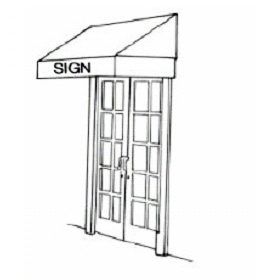
Figure 1. Awning or Canopy Sign
B.
Address Signs. Such signs shall not exceed two square feet in total surface area per officially assigned address, or the size required by the law, order, rule or regulation, whichever is greater. Address signage shall be required on all residential and nonresidential structures. A sign permit is not required.
C.
Blade and Bracket/Pedestrian-Oriented Signs. Blade and bracket/pedestrian-oriented signs are encouraged, especially in areas with significant pedestrian traffic. It is desirable and encouraged to include a blade and bracket/pedestrian-oriented sign as one of the permitted signs for a business. Blade and bracket/pedestrian-oriented signs are signs that are designed for and directed towards pedestrians so that they can easily and comfortably read the sign as they stand adjacent to the business.
Blade and bracket/pedestrian-oriented signs shall be placed only on a ground floor facade, except for businesses located above the ground level with direct exterior pedestrian access.
The maximum sign area shall be six square feet. The lowest point of a blade or bracket sign shall be at least eight feet above the level of the sidewalk or the public thoroughfare.
Sign supports and brackets shall be compatible with the design and scale of the sign.
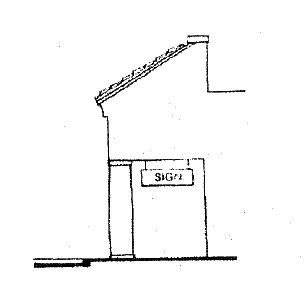
Figure 2. Blade and Bracket/Pedestrian-
Oriented Sign
D.
Bulletin Board Signs. Bulletin board signs, whether freestanding or mounted on a building shall not exceed thirty square feet (including support members) in total surface area and shall not exceed a maximum of seven feet in height. The area around the bulletin board sign shall be maintained clear of any debris by the business owner and/or property owner.
E.
Business Directory Sign. One off-site business directory sign shall be permitted within the city limits of the City of Portola. The sign permit application shall be reviewed and approved by the planning commission. The sign shall meet the following requirements:
1.
Be continuously maintained by an established community or business organization.
2.
Be located on private property with property owner's permission.
3.
The property owner is ultimately responsible for repair, maintenance, and removal.
4.
All advertised businesses listed on the sign are to be located within the City of Portola city limits.
5.
All advertised businesses are to hold a current, active City of Portola business license.
6.
All advertised businesses are to be selected by the community or business organization.
7.
Standards applicable to the type of sign (i.e. monument, changeable copy, wall, etc.) shall apply to the business directory sign.
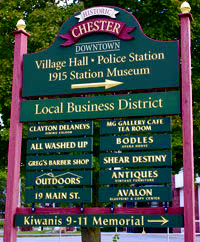
Figure 3. Business Directory Sign
F.
Business Nameplates/Door Signs. One nameplate per proprietor of a lawful business may be erected if the door is the only available signage location for the premises, owner, occupant or business. No more than one door sign identifying the owner, occupant or business on the premises shall be allowed. Said sign shall be placed so as not to interfere with the safe ingress and egress through said door. The lettering of all door signs shall not exceed five inches in height. A sign permit is not required.
G.
Changeable Copy Signs. Changeable copy signs are allowed:
1.
In conjunction with facilities used exclusively for the presentation of theatrical, cultural or religious events subject to the approval of a sign program as described in Section 17.76.210 of this chapter and limited to maximum sign area of eight square feet; or
2.
To advertise products, services, and prices in conjunction with a retail business and limited to a maximum sign area of six square feet.
3.
As approved by the planning commission, to be compatible with the building frontage, size of the building, and size of the lot.
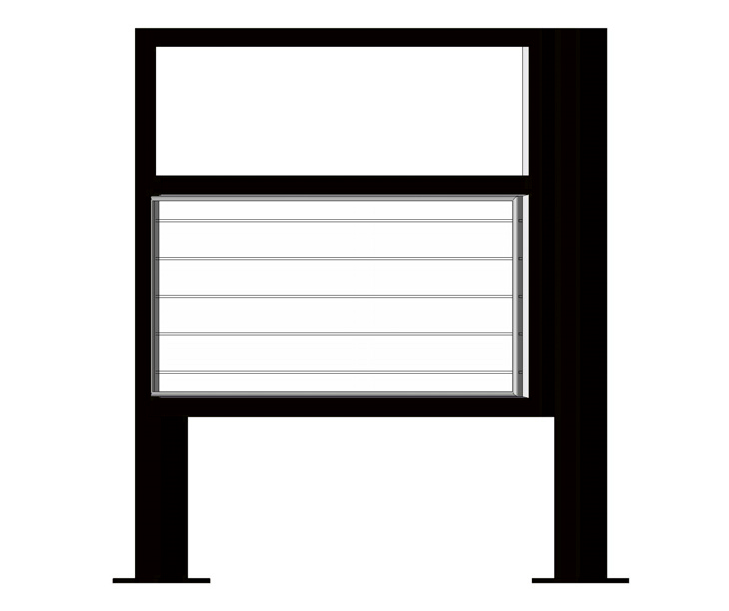
Figure 4. Changeable Copy Sign
H.
Incidental Signs. Incidental signs shall be no more than three feet high and three square feet. A sign permit is not required.
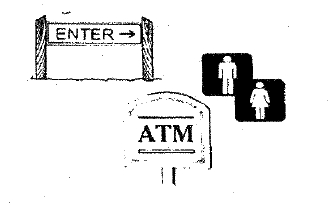
Figure 5. Incidental Signs
I.
Ground or Pole Signs. A ground or pole sign may be allowed for properties adjacent to a major highway (Highway 70) that have a street frontage along the major highway of at least one hundred feet. No more than one ground or pole sign shall be permitted for each three hundred feet of street frontage for each building complex or one ground or pole sign for a single user.
The sign may be located only along a major highway (Highway 70) street frontage. The sign shall be located so as not to create a pedestrian or traffic hazard.
Maximum total sign area for a ground or pole sign shall be as follows, based on building square footage: (a) 1—10,000 s.f. = 50 s.f.; (b) 10,001—20,000 s.f. = 100 s.f.; (c) over 20,000 s.f. = 150 s.f. maximum.
Maximum height of a pole or ground sign shall be as follows, based on total building square footage: (a) 1—20,000 s.f. = 20 feet; (b) over 20,000 s.f. = 25 feet maximum.
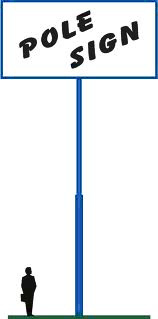
Figure 6. Ground or Pole Sign
J.
Monument Signs. A monument sign shall be allowed when the city manager or his or her designee determines that a wall sign would not be easily seen from the street and there is sufficient area on the site to accommodate a freestanding monument sign. No more than one monument sign shall be permitted per each two hundred fifty feet of street frontage for each building complex or one monument sign for a single user.
The sign may be located only along a site frontage adjoining a public street. Street frontage on a site where a monument sign is located must be at least one hundred feet, unless it is determined by the city manager that a monument sign is a necessary type of signage due to the design and/or location of the building.
The sign shall have a maximum height of six feet and a maximum sign area of forty-eight square feet.
The design of the monument sign shall be consistent with the overall scale of the building. The design and placement of the sign shall not obstruct traffic safety sight areas. In addition, monument signs shall be a minimum of ten feet from any common property line and shall be a minimum of one hundred feet apart unless otherwise determined by the planning commission or city council.
Landscaping shall be provided at the base of the supporting structure equal to twice the area of one face of the sign. For example, twenty square feet of sign area = forty square feet of landscaped area. The city manager may reduce or waive this requirement if it is determined that the additional landscaping would not contribute significantly to the overall aesthetic character of the project.
Figure 7. Monument Sign
K.
Multi-Tenant Signage. Retail, industrial, office or manufacturing buildings that house more than one business on a parcel or within a building complex are required to conform to a sign program as described in Section 17.76.210 of this chapter.

Figure 8. Multi-Tenant Sign
L.
Murals. Murals for aesthetic purposes that will improve the character and design of the City of Portola are encouraged. All murals shall comply with the sign design regulations for permanent signs as described in Section 17.76.250 of this chapter.
M.
Publicly-Owned Signs. The City of Portola or a public entity, as defined in this section, with a building located in the City of Portola may erect, own or maintain a publicly-owned sign as defined in this section. Publicly-owned signs are subject to the review and approval of the planning commission.
N.
Residential Use. Signage for residential uses is allowed, except off-site signage and other signage specifically prohibited by the ordinance codified in this chapter. For the purposes of this chapter, a home occupation is not considered to be a residential use. No signage displaying a commercial message shall be permitted in a residential zone, except a home occupation sign approved through a conditional use permit for an approved home occupation. All residential signage must comply with all ordinances of this code, specifically, the zoning ordinance.
Off-site real estate signs are prohibited. Off-site directional signs to residential open houses are permitted during the hours of the open house.
All signs are to remain in good repair and are not to appear faded or tattered. Any signs that falls out of good repair may be removed by the city in accordance with Section 17.76.240.
Signage for residential uses must comply with the following standards:
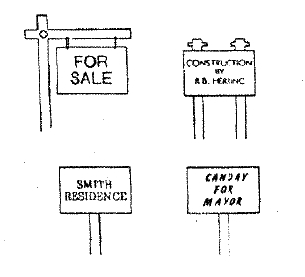
Figure 9. Residential Use (Single-Family and
Multi-family Lot Signage)
1.
Single-Family Lot Signage, Including Real Estate Signs.
a.
Total sign area shall not exceed six square feet per lot.
b.
Maximum total number of separate signs per lot is two.
c.
The maximum allowable height of freestanding signs is five feet.
d.
Signs shall not be located on public property and shall not create a traffic or pedestrian hazard.
e.
Signs in the corner of a property on a corner lot shall not exceed thirty inches in height and shall not create a traffic sight obstruction or other traffic or pedestrian hazard.
f.
Real estate signage is to be removed within seven days of the close of escrow of the property.
g.
No sign permit is required for single-family lot signage.
2.
Multifamily Lot Signage.
a.
Total sign area shall not exceed two square feet per dwelling unit with an allowable combined site maximum of thirty-two square feet.
b.
There shall be no more than two signs having a sign area greater than two square feet.
c.
Signs shall not be located on public property and shall not create a traffic or pedestrian hazard.
d.
Signs in the corner of a property on a corner lot shall not exceed thirty inches in height and shall not create a traffic sight obstruction or other traffic or pedestrian hazard.
e.
No sign permit is required for multifamily lot signage.
3.
Project Entrance Signage.
a.
Project entrance signs are allowed in addition to signage allowed under subsection N. of this section.
b.
Two signs are allowed per site entrance, each sign not to exceed thirty-two square feet and four feet high.
c.
The signs must be designed as an integral part of a wall or fence or as a monument sign.
d.
The signs must be placed within a maintained landscape area and within an acceptable easement or open space lot authorized for signage.
e.
The signs must be placed at the main street intersection of the major entrances to the project in such a location as to not obstruct sight distance.
f.
Signs may not be located in the public right-of-way.
g.
A sign permit is required for project entrance signage.
Figure 10. Project Entrance Signage
O.
Roof Signs. Roof signs that comply with the most recent versions of the Uniform Building Code, Uniform Electrical Code and Uniform Sign Code, as verified by the city building official, are permitted.
Roof signs shall have a maximum height of six feet above the roofline of the structure and maximum sign area of sixty square feet. The roof sign must be compatible with the size and design of the structure and surrounding uses.
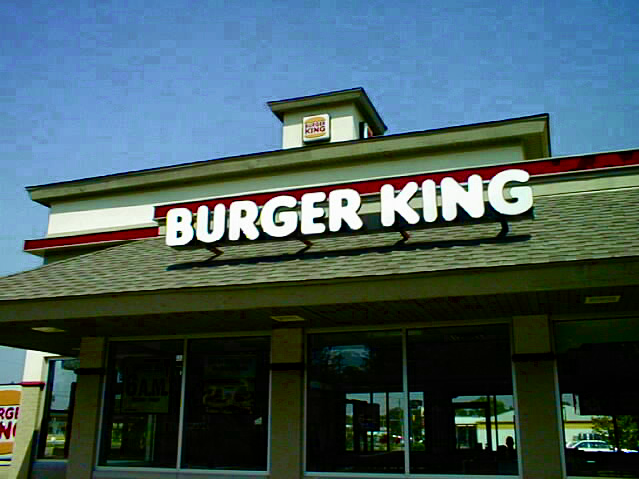
Figure 11. Roof Sign
P.
Time and Temperature Signs. A time and/or temperature sign, used as a public service sign, may be permitted in addition to the other signs allowed by this chapter.
The sign shall have a maximum height of twenty feet and a maximum sign area of one hundred square feet. The time and/or temperature sign must be compatible with the size and design of surrounding signs.
Q.
Vehicle Signs. Vehicle signs are permitted so long as the vehicle is otherwise in conformance with the California Vehicle Code and Title 10 of this Municipal Code, and the vehicle is not blocking another business or pedestrian or vehicular traffic. A sign permit is not required.
R.
Wall or Fascia Signs. Wall or fascia signs are intended to be the primary signage for most uses. No more than one wall or fascia sign shall be permitted per business on the front facade of the building. The sign shall not be placed to obstruct any portion of a window, doorway, transom or other architectural detail.
Channel letters or painted signs may be used as sign copy in a wall or fascia sign.
The maximum size of a wall sign, including a logo, shall be two square feet of sign area for each lineal foot of building frontage. Building frontage shall be measured along that side of building for which the sign is proposed. Said sign shall be no more than twelve inches in depth and shall be placed flush to the face of the building on which it is attached.
The length of the front wall sign may be up to seventy percent of the building frontage, to a maximum of fifty feet. An additional sign on a corner building with frontage on two public streets shall be permitted. The length of a side or rear wall sign may be up to fifty percent of the building frontage, to a maximum of thirty feet.
Said sign shall not be permitted to extend above the fascia line or coping line of the wall to which the sign is attached the building.
Maximum letter height for wall signs shall be as follows, based on building frontage length: (a) zero to thirty feet = eighteen inches; (b) thirty-one to sixty feet = thirty inches; (c) sixty-one to one hundred feet = forty-two inches; and (d) over one hundred feet = forty-eight inches maximum.
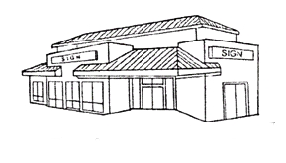
Figure 12. Wall or Fascia Signs
S.
Window Signs. Window signs are permitted. A sign permit is not required.
(Ord. No. 339, § 1, 4-24-2013)
17.76.160 - Temporary signs.
Temporary signs are permitted with a temporary sign permit as described in Section 17.76.100, unless specifically noted below. Temporary signs shall be no larger than six square feet in any shape, unless specified for a specific sign type below. A maximum of sixty square feet of temporary signage is permitted per parcel, including all temporary signs.
A.
Temporary Sign Standards.
1.
Temporary signs shall be no larger than six square feet in any shape, unless otherwise specified for a specific sign type.
2.
The maximum height for any freestanding temporary sign is five feet, unless otherwise specified for a specific sign type.
3.
Temporary signs shall not be placed on public property or in the public right-of-way (i.e., public streets, roads, walkways, alleys) including Caltrans right-of-way, unless specifically permitted in this chapter or an encroachment permit is obtained. A Caltrans encroachment permit is required for any sign proposed in Caltrans' right-of-way.
4.
Temporary signs shall be securely affixed to the property on which they are placed.
5.
All signage within the public right-of-way shall be self-supporting and freestanding, unless authorized through the issuance of an encroachment permit.
6.
Permission of the owner or tenant in possession of that property where the temporary sign is placed shall first be obtained.
7.
Temporary signs shall not be placed so as to interfere with utility poles, street trees, traffic control devices, fire hydrants, meter boxes or private- or publicly-owned signs.
8.
Unless otherwise permitted, a temporary sign shall be removed no later than sixty days after it is erected, or seven days following the date of the event or activity to which the sign pertains, whichever occurs first.
9.
The owner of the temporary sign is responsible for its removal. If the temporary sign owner fails to remove the sign within the time requirements stated in this section and if the sign is on private property not belonging to the owner of the sign, then it shall be the responsibility of the owner or tenant in possession and who granted permission for placement of the sign to remove the sign within the time requirements of this section.
10.
The city reserves the right to remove any sign that does not comply with this chapter. Whenever the enforcement officer causes the removal of a temporary sign, the cost incurred by the city in removing such sign shall constitute a debt owed to the city by the responsible party. The city manager or his or her designee is authorized to take such action as may be deemed necessary, including the commencement of a civil action in a court of competent jurisdiction to recover any such costs.
11.
Temporary signs shall not interfere with public safety in any way and shall not obstruct pedestrians' or motorists' view of oncoming or crossing vehicular or pedestrian traffic at street intersections, alleys and driveways. Further, temporary signs in the corner of a property on a corner lot shall not create a traffic sight obstruction or other traffic or pedestrian hazard and shall not impeded the clear vision triangle. A clear vision triangle is a triangular-shaped portion of land located at a corner and intended to provide clear vision for vehicular and pedestrian traffic. Signs shall not exceed thirty inches in height, measured from the grade of the roadway, in the clear vision triangle. Signs shall not impede a pedestrian's free use of the sidewalk and shall be placed to maintain a minimum of four feet unobstructed access.
a.
Commercial Clear Vision Triangle. The triangular area created by the diagonal connection of two points measured thirty feet back from the intersection of the prolongation of points measured along the front and corner street side back of curb.
b.
Residential Clear Vision Triangle. The triangular area created by the diagonal connection of two points measured twenty-five feet along the front and seventy-five feet along the side of the property measured from back of curb.
12.
Flags are not considered temporary signs and do not require a permit regardless of content. Any flagpoles permitted by the city manager shall be no greater than thirty feet in height and shall be set back a minimum of ten feet from all property lines. Flagpoles shall be subject to review of the city building official who may require the flagpole to be engineered.
13.
Prior to posting any temporary sign in the public right-of-way, unless otherwise specified in this section, the private party responsible for the posting and maintenance of such signs, hereinafter referred to as the "responsible party", shall provide the following information to the code enforcement officer:
a.
A sign permit application shall be filed with the planning department by the responsible party. This application shall be in a form as required by the city, and shall include a description of the sign(s) and the name, address and telephone number of the responsible party, and the erection and removal dates for the sign(s).
b.
No permit is required for the posting of temporary signs on public property by the City of Portola.
B.
Banner Signs.
1.
A temporary sign permit is required.
2.
Banner signs are permitted for commercial and industrial uses.
3.
Banner signs may not exceed sixty square feet.
4.
Banner signs are included in the total maximum square footage of temporary signage per parcel.
5.
Banner signs containing commercial speech may be erected on private property and are not permitted in the public right-of-way.
6.
Banner signs containing noncommercial speech are permitted to be erected in the public right-of-way (i.e., over the Gulling Street bridge) with an encroachment permit pursuant to Subsection 17.76.160.A.3. of this section. A Caltrans encroachment permit is required for any sign proposed in Caltrans' right-of-way.
C.
Feather Signs.
1.
A temporary sign permit is required.
2.
Temporary sign permits are required to be updated annually.
3.
Feather signs are permitted for commercial and industrial uses.
4.
Feather signs are permitted to be installed for an indefinite period of time, so long as the temporary sign permit is updated annually, and the sign remains in good repair and does not appear faded or tattered. Any sign that falls out of good repair may be removed by the city in accordance with Section 17.76.240.
5.
There shall be a maximum of two feather signs per business.
6.
Feather signs are included in the total maximum square footage of temporary signage per parcel.
7.
Feather signs may be erected on private property and are not permitted to extend into the public right-of-way.
8.
Off-site feather signs are not permitted.
9.
The city is not responsible for damage related to snow removal activities.
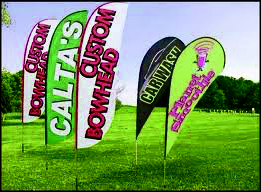
Figure 13. Feather Signs
D.
Freestanding Bracket Signs.
1.
A temporary sign permit is required.
2.
Temporary sign permits are required to be updated annually.
3.
Freestanding bracket signs are permitted to be located on private property or in the public right-of-way. A Caltrans encroachment permit is required for any sign proposed in Caltrans' right-of-way.
4.
If located in the public right-of-way, freestanding bracket signs shall be placed to maintain a minimum of four feet unobstructed access.
5.
Freestanding bracket signs are permitted to be installed for an indefinite period of time, so long as the temporary sign permit is updated annually, and the sign remains in good repair and does not appear faded or tattered. Any sign that falls out of good repair may be removed by the city in accordance with Section 17.76.240.
6.
There shall be a maximum of one freestanding bracket sign per business.
7.
The freestanding bracket sign shall only be present during business hours.
8.
The freestanding bracket sign shall be located on the street side of the thoroughfare.
9.
The area surrounding the freestanding bracket sign shall be well-lit for safety.
10.
The maximum square footage for any freestanding bracket sign shall be six square feet.
11.
The business owner is responsible for pedestrian and vehicular safety and any damage associated with the freestanding bracket sign.
12.
Off-site freestanding bracket signs are not permitted.
13.
The city is not responsible for damage related to snow removal activities.
14.
An encroachment permit is not necessary if all requirements for a freestanding bracket sign are met.
Figure 14. Freestanding Bracket Sign
E.
Garage Sale/Yard Sale Signs.
1.
A garage sale/yard sale permit, pursuant to Section 17.34.020.C.2, is required for garage/yard sales held in the City of Portola. No separate temporary sign permit is required.
2.
Garage sale/yard sale signs are permitted on private property or in the public right-of-way.
3.
All signs shall be secure and properly weighted.
4.
If located in the public right-of-way, garage sale signs shall be placed to maintain a minimum of four feet unobstructed access.
5.
Signs must not be placed on public property (including, but not limited to street signals or other traffic control devices, utility poles, street trees, fire hydrants, meter boxes, and city fences).
6.
The garage/yard sale sign may be placed up to twenty-four hours in advance of the sale and must be removed within twenty-four hours of the end of the sale.
7.
An encroachment permit is not necessary if all requirements for the garage/yard sale sign are met.
F.
Temporary Community Event Sign.
1.
A temporary sign permit is required.
2.
Temporary community event signs are permitted on private property, with property owner's permission, or in the public right-of-way. A Caltrans encroachment permit is required for any sign proposed in Caltrans' right-of-way.
3.
If located in the public right-of-way, freestanding bracket signs shall be placed to maintain a minimum of four feet unobstructed access.
4.
The maximum square footage for any freestanding bracket sign shall be six square feet.
5.
The community event representative is responsible for pedestrian and vehicular safety and any damage associated with the freestanding bracket sign.
6.
The city is not responsible for damage related to snow removal activities.
7.
Signs may be placed ten days before the community event and must be removed within twenty-four hours following the end of the event.
8.
Off-site temporary community event signage is permitted.
9.
If the sign is located on private property, then the property owner is responsible to remove the sign within twenty-four hours following the end of the event.
10.
If the sign is located in the public right-of-way, then the community event representative is responsible to remove the sign with twenty-four hours following the end of the event.
11.
An encroachment permit is not necessary if all requirements for a freestanding bracket sign are met.
(Ord. No. 352, § 1, 11-28-2018; Ord. No. 339, § 1, 4-24-2013)
17.76.180 - Signs not permitted.
The following types of signs are not permitted in the City of Portola:
A.
Inflatable signs or inflatable attention getting devices. Inflatable signs or other inflatable attention getting devices are not permitted, except for temporary signs permitted in Section 17.76.160 of this chapter.
B.
Hazardous signs. Signs erected in a manner that a portion of their surface or supports will interfere with the free use of a fire escape, exit, or standpipe, or obstruct a required ventilator, door, stairway or window above the first story, or create other hazards.
C.
Moving signs. Undulating, swinging, rotating or otherwise moving signs or similar devices in view of any street or highway, except for temporary signs permitted in Section 17.76.160 of this chapter.
D.
Obscene signs.
E.
Signs utilizing colored lights. Signs utilizing colored lights at any location, or in any manner, where they may be confused or construed as traffic control devices.
F.
Signs emitting audible sounds, odors or visible matter.
G.
Signs of any nature affixed to any public or tree, rock, or fire hydrant, street pole, light pole or similar structure, except for address and government signs.
H.
Signs using words, colors, symbols or characters in a manner that interferes with, misleads, or confuses pedestrian or vehicular traffic and safety.
I.
Temporary illuminated signs. Temporary illuminated signs, except for such temporary signs as permitted in Section 17.76.160 of this chapter.
(Ord. No. 339, § 1, 4-24-2013)
17.76.190 - Restricted signs.
A.
Cabinet (Can) Signs. Cabinet (Can) signs with translucent plastic faces and internal illumination, except as approved by the city manager or his or her designee or planning commission upon approval of a sign program.
B.
Animated Signs. Animated, moving, flashing, blinking, reflecting, revolving or other similar signs or signs that incorporate these elements, except as approved as a changeable copy sign.
C.
Internally Illuminated Awning or Canopy Signs. Awning or canopy signs that are internally illuminated except as approved by the city manager or planning commission.
E.
Electronic graphic signs, except time/temperature signs as approved by the city manager.
F.
Off-Site Commercial Signage. Off-site commercial signage is prohibited, except for community event signs as described in this section, an off-site business directory sign as described in this section, and off-site directional signs to residential open houses as described in this section.
G.
Painted Signs. Painted signs on fences or roofs, except address signage and signage approved for institutional uses.
H.
Pennants, Flags, and Windsocks. Pennants, flags, windsocks and similar signs except as allowed for temporary use under Section 17.76.160 of this chapter.
(Ord. No. 352, § 1, 11-28-2018; Ord. No. 339, § 1, 4-24-2013)
17.76.200 - Nonconforming signs.
A.
Authority to Continue. The use of any nonconforming sign may be continued so long as is otherwise remains lawful, subject to the regulations contained in subsections B—G of this section and is not an illegal sign as defined in Section 17.76.040.
B.
Ordinary Repair and Maintenance. Normal maintenance and incidental repair or replacement of non-bearing sign elements and electrical wiring and fixtures may be performed on any nonconforming sign; provided; however, that any repair or replacement shall, whenever possible, eliminate or reduce any nonconformity in the element being repaired or replaced and provided further, that this subsection B shall not be deemed to authorize any violation of subsections A—G of this section.
C.
Alteration, Enlargement, Moving. No nonconforming sign shall be changed or altered in any manner that would increase the degree of its nonconformity; be enlarged or expanded; be structurally altered to prolong its useful life, be moved in whole or in part to any other location where it would remain nonconforming; or be altered so as to advertise or identify any use, activity, event, or circumstance other than the use, activity, event, or circumstance advertised and/or identified as of the date on which the sign become a nonconforming sign pursuant to this chapter. A change in sign message that does not otherwise violate the provisions of this section or this chapter shall be deemed to be prohibited by this section.
D.
Alteration of Sign. A nonconforming sign that has been altered to eliminate its nonconformity, or any element of its nonconformity, shall not thereafter be changed to restore such nonconformity or nonconforming element.
E.
Damage or Destruction. Any nonconforming sign damaged or destroyed, by any means, to the extent of thirty-five percent or more of its replacement cost new shall not be restored but shall be removed or brought into conformity with the provisions of this chapter.
F.
Compliance or Removal. Any nonconforming sign that loses its status as a nonconforming sign pursuant to subsections A—E of this section shall be brought immediately into compliance with the provisions of this chapter. In the event it is not feasible to immediately bring the nonconforming sign into compliance with the provision of this chapter, the property owner shall submit a timeline for conformity or removal to the city manager or his or her designee. Such timeline shall be submitted within forty-eight hours. The timeline shall indicate that the nonconforming sign shall be brought into compliance or removed within thirty days.
G.
Removal. Upon determination that a sign is nonconforming, the city manager or his or her designee will issue written notice to the owner or user of the sign or to the owner of the property on which the nonconforming sign is located, requiring conforming or removal therefore if unable to conform, subject to the provision of this subsection G. Every on-site sign becoming nonconforming as a result of this ordinance shall not be required to be removed, except as provided for in California Business and Professions Code Sections 5492, 5493, 5495 and 5497. Every off-site sign or billboard becoming nonconforming as a result of the ordinance from which this chapter derives, may be removed in accordance with the provisions of California Business and Professions Code Sections 5412, 5412.1, 5412.2 and 5412.3. Nothing in this chapter shall preclude any owner or user from voluntarily bringing a nonconforming sign into conformity at any time prior to the expiration of the removal period.
(Ord. No. 339, § 1, 4-24-2013)
17.76.210 - Sign program/program requirements.
A.
The following types of businesses require a sign program and must meet the conditions therefore:
1.
Single-business. A sign program is required when the city manager determines that special project characteristics exist. Special project characteristics may include, but are not limited to, the large size of proposed signs, limited site visibility, the existence of a business within a business, and a site's proximity to major transportation routes.
2.
Multi-tenant Building or Building Complex. A sign program is required when two or more separate tenant spaces are to be created within the same building or building complex.
B.
Sign Program Approval. The sign program can be approved through the granting of a sign permit, as directed by the city manager or his or her designee or the planning commission.
C.
The sign program shall comply with the purpose of this chapter, sign design regulations as described in Section 17.76.250, and the overall intent of this section.
D.
The signs shall enhance the overall development of, be in harmony with, and relate visually to other signs included in the sign program, to the structures and or developments they identify and to surrounding developments.
E.
The sign program shall accommodate future revisions that may be required because of changes in use or tenants.
F.
The sign program shall comply with the standards of this chapter, except that flexibility is allowed with regard to sign area, number, location and/or height to the extent that the sign program will enhance the overall aesthetic development of the city and accomplish the purposes of this chapter.
G.
Revisions to the Sign Program. Revisions to the sign program may be approved by the city manager if the intent of the original approval is not affected. Revisions that would substantially deviate from the original approval shall require the approval of a new sign program.
(Ord. No. 339, § 1, 4-24-2013)
17.76.220 - Sign removal or replacement.
When a sign is removed or replaced, all brackets, poles and other structural elements that supported the sign shall also be removed. Affected building surfaces shall be restored to match the adjacent portion of the structure.
(Ord. No. 339, § 1, 4-24-2013)
17.76.230 - Enforcement.
Any violations of this chapter shall be subject to the enforcement remedies and penalties provided by this chapter, the City of Portola Zoning Ordinance, the City of Portola Municipal Code, and by state and federal law. Each day each sign is placed in violation of this chapter shall constitute a separate misdemeanor violation of this chapter. It shall be a misdemeanor to place, fail to remove or maintain any sign without a permit if a permit is required by this chapter. It shall also be a violation to place, fail to remove or maintain any sign in violation of this chapter. The city may pursue enforcement of this chapter by seeking criminal penalties of up to six months in county jail and/or a fine of up to one thousand dollars, nuisance abatement, injunction, or other remedies available by law. All such penalties may be cumulative.
A.
Criminal Enforcement. It is illegal to use, occupy or maintain signs in violation of this chapter. Any violation or failure to comply with the provisions of this chapter shall render a person guilty of a misdemeanor each day the violations exist, and any such person shall be published in accordance with the provisions of the City of Portola Municipal Code or other remedies provided by law.
B.
Administrative Remedies. In addition to the criminal penalties prescribed in subsection A. of this section, other remedies as prescribed in the City of Portola Municipal Code may be imposed for violations of this chapter.
(Ord. No. 339, § 1, 4-24-2013)
17.76.240 - Sign abatement.
A.
Nuisance Declared and Prohibited. All illegal signs are hereby declared to be a public nuisance. It shall be unlawful for any person to place an illegal sign located on any property in the City of Portola.
B.
Notice of Illegal Signs. Whenever an illegal sign is found to exist, the city manager or his or her designee shall cause notice of such nuisance ("illegal sign notice") to be served upon: (i) the owner and the occupant of the property where the illegal sign is located; and (ii) the holder of the relevant sign permit (collectively the "notice recipients"). The illegal sign notice shall be sent either by certified mailing with return receipt requested, or by personal delivery. In the illegal sign notice, the city manager or his or her designee shall order the notice recipients to abate the nuisance within the applicable period of time set forth below (the "response period"):
1.
For permanent illegal signs, within fourteen days after recipient's receipt of or personal delivery of the illegal sign notice;
2.
For temporary illegal signs, within forty-eight hours after recipient's receipt of or personal delivery of the illegal sign notice; or
3.
For signs that are unsafe or insecure or otherwise constitute an immediate danger to public health or safety, immediately upon receipt of the illegal sign notice.
C.
Additional Content of Illegal Sign Notice. The illegal sign notice shall also include the following information:
1.
Notification to the notice recipients that unless the nuisance is abated within the response period, the city may proceed to abate the nuisances, assess all direct and indirect costs and expenses incurred in connection therewith, including the cost of collection ("abatement costs"), jointly and severally against the notice recipients, and pursuant to and to the fullest extent provided by California law, impose a lien for the abatement costs on the property on which the illegal sign is located;
2.
A copy of this chapter and identification of the illegal sign and the property on which the illegal sign is located; and
3.
Be personally served or sent by registered mail to each of the notice recipients.
D.
Right of Entry. When it is necessary to make an inspection to enforce the provisions of this chapter, or when the enforcement officer has reasonable cause to believe that there exists any sign or a condition which makes such sign unsafe, abandoned, illegal or nonconforming, the enforcement officer may petition the court to enter the lot, building or premises on which such sign is located at all reasonable times to inspect the sign or to perform any duty imposed by this chapter.
E.
Opportunity to Abate Nuisance. Within the response period, the notice recipients shall cause the nuisance to be removed or otherwise abated. If the notice recipients neglect or refuse to abate the nuisance as required by the illegal sign notice, the city manager shall promptly employ such city resources as are necessary to abate or remove the nuisance. If the city manager causes the abatement or any nuisance, the abatement costs shall be assessed jointly and severally against the notice recipients.
F.
Special Lien Authorization. In the event that the abatement costs incurred by the city to abate the public nuisance pursuant to this section are not paid in full upon billing, the city clerk may, pursuant to and to the fullest extent provided by California law, file a lien for any unpaid abatement costs against the property on which any such public nuisance is located.
(Ord. No. 339, § 1, 4-24-2013)
17.76.250 - Sign design regulations for permanent signs.
A.
Design Compatibility and Appearance. Because residential and commercial uses generally exist in close proximity, signs will be designed and located so that they have little or no impact on adjacent residential uses, as approved by city staff. All types of signs should be compatible with the building and existing signage. Signs should complement the architecture of the building and should be constructed with similar building materials as the building, when applicable.
B.
Color. Color is one of the most important aspects of signage. Colors can be used to catch the eye or to communicate ideas or feelings. Colors should be selected to contribute to legibility and design integrity. Even the most carefully thought-out sign may be unattractive because of poor color selection. Too many colors used thoughtlessly can confuse and negate the intent of a sign.
Contrast is an important influence on the legibility of signs. A substantial contrast should be provided between the color and material of the background and the letters or symbols to make the sign easier to read in both day and night. Light letters on a dark background or dark letters on a light background are most legible.
Colors or color combinations that interfere with legibility of the sign copy or that interfere with viewer identification of other signs should be avoided. Small accents of several colors may make a sign unique and attractive, but the competition of large areas of many different colors often decreases readability. Sign colors should complement the colors used on the structures and the project as a whole.
It will be necessary to prepare a color board as an attachment to the sign application as described in subsection 17.76.060.B.6 of this chapter.
C.
Creative Design. Creatively designed signs are encouraged. Signs should make a positive contribution to the general appearance of the street and commercial area in which they are located. A well-designed sign can be a major asset to a building. The city encourages imaginative and innovative sign design.
D.
Materials. All signs shall be of sufficient durability to prevent rapid deterioration. Temporary sign materials for permanent signs are prohibited. The following sign materials are encouraged to ensure an aesthetically-pleasing sign:
1.
Wood (carved, sandblasted, etched and property sealed, primed and painted or stained).
2.
Metal (formed, etched, cast, engraved and property primed and painted or factory-coated to protect against corrosion).
3.
High-density pre-formed foam or similar material. New materials may be very appropriate if properly designed in a manner to be consistent with the approved sign design, and painted or otherwise finished to compliment the architecture.
Sign materials should be compatible with the design of the facade where they are placed. The selected materials should contribute to the legibility of the sign. For example, glossy finishes are often difficult to read because of glare and reflections. Furthermore, the selected materials should complement the architecture of the building and building materials.
Paper and cloth signs are not suitable for exterior use (except on awnings and canopies) because they deteriorate quickly. Paper and cloth signs are appropriate for interior temporary use only. The use of interior signs on paper or cloth should be the result of careful thinking about readability and the image of the business.
E.
Size and Scale. The scale and size of signs should be proportionate and appropriate for the building on which they are placed and the area in which they are located.
F.
Sign Legibility. An effective sign should do more than attract attention. It should communicate a message. Usually, this is a question of readability of words and phrases. The most significant influence on legibility is lettering.
Signs should be smaller in scale if they are oriented to pedestrians. The pedestrian-oriented sign is usually read from a distance of fifteen to twenty feet; whereas the vehicle-oriented sign is viewed from a much greater distance. The closer a sign's viewing distance, the smaller that sign need be. For example: The minimum character size for an intended viewing distance of: (a) ten feet = one inch; (b) twenty feet = one and a half inches; (c) thirty feet = two inches; (d) forty feet = two and a half inches; and (e) fifty feet = three inches.
Letters and words should not be spaced too close together. Crowding of letters, words, or lines will make any sign more difficult to read. Conversely, over-spacing these elements causes the viewer to read each item individually, again obscuring the message. As a general rule, letters should not occupy more than seventy-five percent of sign panel area.
Use individual letters. As an alternative to an attached sign, lettering may be painted directly on the building façade. However, signs should not be painted directly over ornamental and architectural features or over brick and stone surfaces of buildings.
The number of lettering styles should be limited on order to increase legibility. A general rule to follow is to limit the number of different letter styles to no more than two for small signs and three for larger signs. Intricate typefaces and symbols that are difficult to read reduce the sign's ability to communicate. Handwritten and stencil signs for businesses are subject to the design standards contained in this chapter.
Symbols and logos can be used in place of words wherever appropriate. Pictographic images will usually register more quickly in the viewer's mind than a written message.
Illuminated signage specifications. Use illumination only if necessary. Consider if the sign needs to be lighted at all. Lights in the display window may be sufficient to identify the business. This is particularly true if good window graphics are used. Often, nearby streetlights provide ample illumination of a sign after dark.
Back-lighted, solid letters are encouraged. Signs consisting of opaque individually cut letters mounted directly on a structure can often use a distinctive element of the structure's facade as a backdrop, thereby providing a better integration of the sign with the structure.
Address signage should be illuminated to increase safety and visibility.
(Ord. No. 339, § 1, 4-24-2013)

