
Powhatan County Unincorporated
City Zoning Code
City Zoning Code
ARTICLE II
ADMINISTRATION
Sec. 83-121.- Development review.
(a)
Board of zoning appeals. The board of zoning appeals (BZA) has been established in accordance with Code of Virginia § 15.2-2308 et seq.
(1)
Membership, appointment, and terms of office.
a.
General.
1.
The BZA shall consist of five members, appointed by the circuit court.
2.
Members shall be residents of the county.
3.
Members shall be appointed for five-year, staggered terms.
4.
Members may serve an unlimited number of terms.
5.
Members shall continue to serve until their successors are appointed.
6.
Vacancies occurring for reasons other than expiration of terms shall be filled for the period of the unexpired term only.
(2)
Powers and duties. In accordance with Code of Virginia § 15.2-2309, the BZA shall have the following powers and duties:
a.
Application review. To review and decide applications for:
1.
To hear and decide appeals from any order, requirement, decision or determination made by an administrative officer in the administration or enforcement of this article or of any ordinance adopted pursuant thereto. The decision on such appeal shall be based on the board's judgment of whether the administrative officer was correct. The board shall consider the purpose and intent of any applicable ordinances, laws and regulations in making its decision;
2.
A variance permit (zoning or floodplain); and
3.
Appeals of the following decisions:
i.
Decisions of the zoning administrator;
ii.
To hear and decide applications for interpretation of the district map where there is any uncertainty as to the location of a district boundary;
iii.
Zoning compliance permits;
iv.
Post-disaster temporary dwelling permits; and
v.
Notices of zoning violations.
b.
Other powers and duties. To carry out any other powers and duties delegated to it by the board of supervisors, consistent with the Code of Virginia.
(b)
Director of community development (director). The director is designated by the county administrator to administer and enforce the provisions of the zoning ordinance.
(1)
Powers and duties. The director, or his designee, shall have the following powers and duties under this chapter:
a.
General.
1.
Invoke any other lawful procedure available to the county, such as injunction, abatement or otherwise, as may be necessary to prevent, restrain, correct or abate any violation of the zoning ordinance.
2.
Review and decide all questions with respect to the interpretation and application of the zoning ordinance.
b.
Recommendation. To review and make recommendations on applications for the following:
1.
Text Amendments;
2.
Zoning district map amendments (rezonings);
3.
Conditional zonings;
4.
Planned developments;
5.
Conditional use permits;
6.
Certificates of approval;
7.
Site plans (inside of the Route 711 Special Area Plan Overlay District);
8.
Private road approvals.
(c)
Zoning administrator (administrator). The zoning administrator (administrator) is designated by the county administrator to administer this chapter.
(1)
Powers and duties. The administrator shall be charged with the administration and enforcement of this chapter in accordance with Code of Virginia § 15.2-2286, and:
a.
Review and decide. To review and decide applications or take actions regarding the following:
1.
Temporary business permits;
2.
Sign permits;
3.
Floodplain permits;
4.
Zoning compliance permits;
5.
Interpretations to this chapter (including the boundaries of the zoning district map), except for chapter 68: Subdivisions; and
6.
Notices of violations.
b.
Recommendation. To review and make recommendations on applications for the following:
1.
Variance permits (zoning);
2.
Variance permits (floodplain);
3.
Appeals (zoning); and
4.
Appeals (floodplain).
c.
Additional duties. The administrator shall have the following additional duties:
1.
Review applications and submit staff reports to advisory and decision-making bodies, as appropriate;
2.
Maintain the zoning district map and related materials;
3.
Provide expertise and technical assistance to the county's other review and decision-making bodies, upon request, and as appropriate; and
4.
Enforce this chapter in accordance with Article X: Enforcement.
(Ord. No. O-2014-12, 6-2-14)
Sec. 83-122. - Standard procedures.
(a)
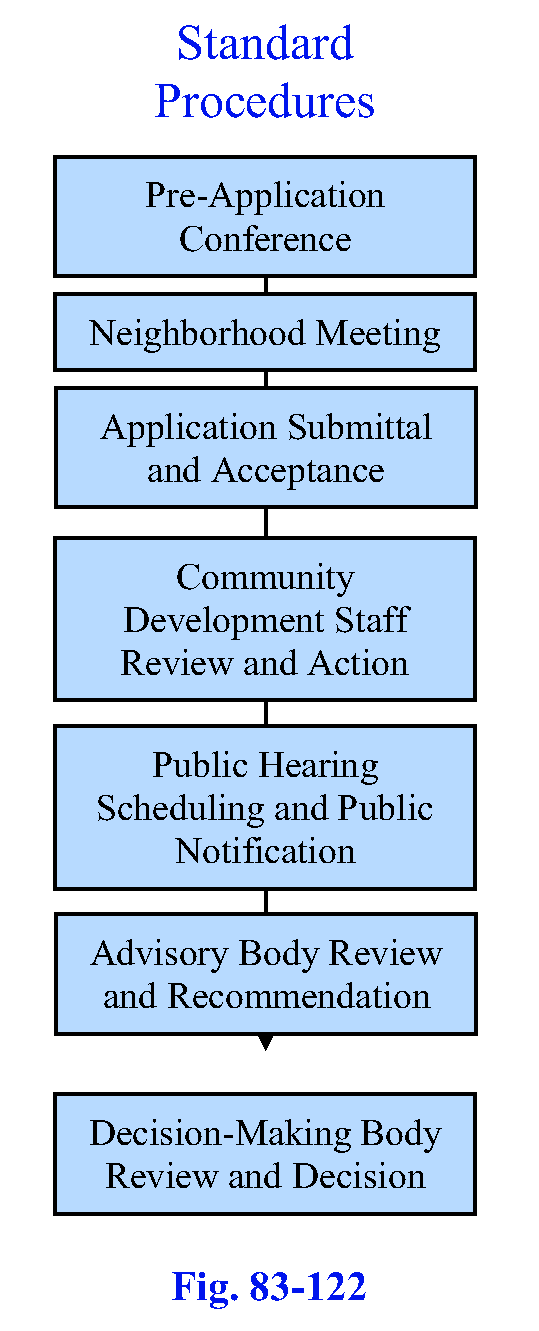
General. This section describes the standard procedural steps and other rules that are generally applicable to all development applications reviewed under this chapter, unless otherwise expressly exempted or alternative procedures are specified in section 83-123, Specific review procedures. The procedural flow charts in section 83-123, Specific review procedures, generally depict the procedural steps that apply to the review of the particular type of development application.
(b)
Pre-application conference.
(1)
Purpose. The purpose of a pre-application conference is to provide an opportunity for the applicant to determine the submittal requirements and the procedures and standards applicable to an anticipated development application. A pre-application conference is also intended to provide an opportunity for the community development staff to become familiar with, and offer the applicant preliminary comments about, the scope, features, and impacts of the proposed development, as it relates to the standards in this chapter.
(2)
Applicability.
a.
Pre-application conference required. A pre-application conference between the applicant and the community development staff shall be held before submittal of the following applications:
1.
Zoning district map amendments (rezonings);
2.
Conditional zonings;
3.
Planned developments;
4.
Conditional use permits;
5.
Certificates of approval;
6.
Site plans;
7.
Temporary business permits;
8.
Variance permits (zoning); and
9.
Variance permits (floodplain).
b.
Pre-application conference optional. A pre-application conference may be requested and held at the applicant's option for any development application other than those listed in section 83-122(B)(2)(a), Pre-application conference required.
(3)
Required information submitted prior to conference.
a.
Except for a pre-application conference associated with a zoning district map amendment (rezoning), the applicant shall submit a conceptual plan or conceptual drawings that show the location, general layout, and main elements of the development to be proposed as part of the application. Conceptual plans or conceptual drawings shall be submitted to the community development staff at least three business days before the pre-application conference.
b.
Pre-application conferences related to an application for a zoning district map amendment (rezoning) shall include a written description of the nature and purpose of the zoning district map amendment (rezoning).
(4)
Scheduling. Upon receipt of the request for a pre-application conference, the community development staff shall schedule the pre-application conference and notify the applicant of the time and place of the pre-application conference.
(5)
Conference determinations. Community development staff shall review the materials submitted by the applicant prior to the conference, and at the conference, ask the applicant questions about the proposed application, and identify any concerns, problems, or other factors the applicant should consider about the application.
(6)
Effect. The pre-application conference is intended as a means of facilitating the review process. Discussions held in accordance with this section are not binding on the county. Processing times for review of development applications do not begin until a formal application is submitted and determined to be complete.
(c)
Neighborhood meeting.
(1)
Purpose. The purpose of the pre-application neighborhood meeting is to inform owners and occupants of nearby lands about a proposed development application that is going to be reviewed under this chapter, and to provide the applicant an opportunity to hear comments and concerns about the development proposal as a means of resolving conflicts and outstanding issues, where possible.
(2)
Favored practice. Neighborhood meetings are encouraged as opportunities for informal communication between applicants and the owners and occupants of nearby lands, and other residents who may be affected by development proposals.
(3)
Procedure. If a neighborhood meeting is held by the applicant, it shall comply with the following procedures:
a.
Time and place. The meeting shall be held at a place that is convenient and accessible to neighbors residing in close proximity to the land subject to the proposed application. It shall be scheduled after 5:00 p.m. on a weekday.
b.
Notification.
1.
Mailed notice.
i.
The applicant shall mail notice of the meeting a minimum of ten days in advance of the meeting to the director and all persons to whom mailed notice of a public hearing on the development application is required (see section 83-130, Public hearing notice).
ii.
If a public hearing is not required for the application, mailed notice shall be provided to all landowners and occupants within 300 feet of the lot lines of the land subject to the application.
2.
Posted notice. The applicant shall post notice of the neighborhood meeting on the land subject to the application for at least ten days before the date fixed for the meeting, in a form established by the director.
3.
Notice content. The notice shall state the time and place of the meeting and general nature of the development proposal.
c.
Conduct of meeting. At the meeting, the applicant shall explain the development proposal and application, inform attendees about the application review process, respond to questions and concerns neighbors raise about the proposed application, and discuss ways to resolve conflicts and concerns.
d.
Written summary of neighborhood meeting. The applicant shall prepare a written summary of the meeting that includes a list of meeting attendees, a summary of attendee comments, discuss issues related to the development proposal, and any other information the applicant deems appropriate. The meeting summary shall be included with the application materials and be made available to the public for inspection.
e.
Response to summary. Any person attending the neighborhood meeting may submit a written response to the applicant's meeting summary to the community development staff after the application is determined complete. The response may state their understanding of attendee comments, discuss issues related to the development proposal, and include any other information they deem appropriate. All written responses to the applicant's summary of the neighborhood meeting shall be transmitted to the community development staff and applicant, and included with the application materials.
(d)
Application submittal and acceptance.
(1)
Authority to file applications.
a.
Unless expressly stated otherwise in this chapter, development applications reviewed under this chapter shall be submitted by:
1.
The owner, contract purchaser, or any other person having a recognized property interest in the land on which development is proposed; or
2.
A person authorized to submit the application on behalf of the owner, contract purchaser, or other person having a recognized property interest in the land, as evidenced by a letter or document signed by the owner, contract purchaser, or other person.
b.
If there are multiple owners, contract purchasers, or other persons authorized to submit the application, all such persons shall sign the application or a letter or document consenting to the application.
(2)
Application content.
a.
Requirements for the content and form for each type of specific development application reviewed under this chapter are set forth in the appendix and/or administrative manual. The applicant bears the burden of ensuring that an application contains sufficient information to demonstrate compliance with all applicable standards.
b.
Applications for a zoning district map amendment (rezoning), conditional use permit, special exception permit, and variance (zoning or floodplain) shall include satisfactory evidence that any delinquent real estate taxes owed to the county that have been assessed against the property subject to the application have been paid.
(3)
Application fees. The board of supervisors is authorized to establish application fees, by ordinance, and may amend and update those fees as necessary.
(4)
Submittal and review schedule. The director is authorized to and shall establish specific rules for the submittal and review schedule (including time frames for review, if appropriate, and consistent with this chapter and the Code of Virginia) for the various types of development applications. The director may amend and update these rules as is determined necessary to ensure effective and efficient review under this chapter.
(5)
Application submittal. Applications shall be submitted to the community development staff in the form established by the director, along with the appropriate application fee.
(6)
Determination of application completeness.
a.
Completeness review. On receiving an application, the community development staff shall, within ten business days, determine whether the application is complete or incomplete. A complete application is one that:
1.
Contains all information and materials required by this chapter, as required for submittal of the particular type of application;
2.
Is in the form required by this chapter as required for submittal of the particular type of application;
3.
Includes information in sufficient detail to evaluate the application to determine whether it complies with the applicable review standards of this chapter; and
4.
Is accompanied by the fee established for the particular type of application.
b.
Application incomplete.
1.
Upon determining that the application is incomplete, the community development staff shall provide the applicant written notice of the submittal deficiencies. The applicant may correct the deficiencies and resubmit the application for a completeness determination.
2.
If the applicant fails to resubmit an application within 45 calendar days after being first notified of submittal deficiencies, the application shall be considered withdrawn.
3.
The community development staff shall not process an application for further review until it is determined to be complete.
c.
Application complete. On determining that the application is complete, the community development staff shall accept the application for review in accordance with the procedures and standards of this chapter.
(7)
Application revision.
a.
An applicant may revise an application after receiving initial staff review comments on the application, or upon requesting and receiving permission from an advisory or decision-making body after that body has reviewed but not yet taken action on the application. Revisions shall be limited to changes that directly respond to specific requests or suggestions made by the staff, or the advisory or decision-making body, as long as they constitute only minor additions, deletions, or corrections and do not include significant substantive changes to the development proposed in the application.
b.
Any other revisions to the application may be submitted at any time during the review procedure, but the revised application shall be submitted to the community development staff and reviewed as if it were a new application. The revised application submittal may be subject to additional application fees to defray the additional costs of processing the revised application.
(8)
Application withdrawal.
a.
An applicant may withdraw a development application at any time by submitting a letter of withdrawal to the community development staff.
b.
Applications withdrawn before required notice of any public hearing scheduled for the application shall not be subject to limitations on the subsequent submittal of similar applications (see section 83-122(g), Limitation on subsequent similar applications). One-half (50 percent) of the application fees shall be refunded.
c.
Applications withdrawn after required notice of any public hearing scheduled for the application shall be subject to limitations on the subsequent submittal of similar applications (see section 83-122(g), Limitation on subsequent similar applications). Application fees shall not be refunded for withdrawn applications.
(e)
Community development staff review and action.
(1)
Staff review.
a.
When an application is determined complete, it shall be distributed by community development staff to all appropriate staff and review agencies for review and comment, and the preparation of a staff report.
b.
In considering the application, the community development staff, or other county staff (as appropriate), shall review the application, relevant support material, and any comments or recommendations from other staff and review agencies to which the application is referred.
(2)
Staff report and recommendation. Upon completion of the community development staff review on an application, community development staff shall prepare a written staff report on the application, unless the director or administrator is to review and make a decision on the application, in which case section 83-122(e)(4)a.1. below applies. The staff report shall conclude whether the application complies with applicable review standards of this chapter, and in cases where additional review by an advisory or decision-making body is required, recommend one of the decisions authorized for the particular type of application, based on the review standards applicable to the application type, as set forth in section 83-123, Specific review procedures. The staff report may identify and recommend conditions of approval addressing how compliance deficiencies might be corrected and adverse effects of the development application might be mitigated.
(3)
Distribution and availability of application and staff report. In cases where a development application is subject to review by an advisory or decision-making body, community development staff shall take all the following actions within a reasonable time period before the meeting or public hearing at which the application is scheduled for review:
a.
Schedule and ensure notice (if appropriate) of any required public hearing on the application in accordance with the Code of Virginia and table 83-130, Public hearing notification timing under the Code of Virginia;
b.
Transmit the application, related materials, and the staff report to the appropriate advisory or decision-making body;
c.
Transmit a copy of the staff report to the applicant; and
d.
Make the application, related materials, and the staff report available for examination by the public in the community development department during normal business hours, and make copies of such materials available at a reasonable cost.
(4)
Applications subject to decision by director or administrator.
a.
Decision.
1.
If an application is subject to staff review and a final decision by the director or administrator, as appropriate, a staff report may be prepared at the discretion of the county official reviewing and making a decision on the application.
2.
After review of the application, the director or administrator, as appropriate, shall approve, approve subject to conditions, or disapprove the application, based on the review standards set forth in section 83-123, Specific review procedures, for the particular type of application. If the decision is to disapprove the application, the director or administrator, as appropriate, shall provide the applicant, in writing, the specific reasons for disapproval, and in general terms, any such modifications or corrections that will allow approval of the application.
3.
In instances where the application is disapproved, the applicant may revise the application in response to the specific reasons identified for the disapproval, within six months, and resubmit it for reconsideration.
4.
After review of the resubmitted application, the director or administrator, as appropriate, shall approve, approve subject to conditions (if appropriate), or disapprove the application, based on the review standards set forth in section 83-123, Specific review procedures, for the particular type of application.
b.
Conditions of approval. If permitted by law and if appropriate for the particular type of application, conditions of approval shall be limited to those deemed necessary to ensure compliance with the standards of this chapter. They shall be related in both type and amount to the anticipated impacts of the proposed development on the public and surrounding development. All conditions of approval shall be expressly set forth in the development permit or approval.
c.
No change to relied-upon decision. In no event shall a written order, requirement, decision, or determination (hereinafter, "decision") made by either the director or administrator, as appropriate, or other administrative officer be subject to change, modification, or reversal by the director, administrator, or any other administrative officer after 60 days have elapsed from the date of the decision, where the person aggrieved has materially changed his position in good faith reliance on the action of the director, administrator, or other administrative officer, unless it is demonstrated that the decision was obtained through malfeasance of the director, administrator, or other administrative officer or through fraud. The 60-day limitation period shall not apply where, with the concurrence of the county attorney, modification is required to correct clerical or other nondiscretionary errors.
(f)
Deferral of application. An applicant may request that consideration of a development application at a public hearing be deferred by submitting a written request for deferral to the community development staff.
(1)
Director action. If public notification has not been provided, the director shall consider and decide the deferral request. A request for deferral shall be approved only for good cause.
(2)
Action.
a.
If public notification has been provided, the request for deferral shall be placed on the public hearing agenda on the date the application is to be considered and acted upon by the body. The body may approve the request for deferral for good cause.
b.
The applicant shall be responsible for a re-advertising fee which shall be paid in full, prior to the application being placed on an upcoming public agenda.
(g)
Limitation on subsequent similar applications.
(1)
Application denial. If a development application requiring a public hearing is denied, no application proposing the substantially same development on all or part of the same land shall be submitted within one year after the date of denial unless the decision-making body waives this time limit in accordance with subsection (2) (Request to waive time limit) below.
(2)
Request to waive time limit. The owner of land subject to this subsection, or the owner's authorized agent, may submit a written request for waiver of the time limit, along with a fee to defray the cost of processing the request, to the community development staff, who shall transmit the request to the decision-making body. The decision-making body may grant a waiver of the time limit only on a finding by two-thirds of its membership that the owner or agent has demonstrated that the new application proposed to be submitted is not substantially the same as the prior application.
(3)
Application withdrawal after required public notification. If a development application requiring a public hearing is withdrawn after required public notification of the public hearing is provided, but before a decision on the application, no application proposing the substantially same development on all or part of the same land shall be submitted within six months after the date of withdrawal.
(Ord. No. O-2014-12, 6-2-14; Ord. No. O-2016-44, 9-26-16)
Sec. 83-123. - Specific review procedures.
(a)
Overview.
(1)
General. This section sets forth supplemental procedures, standards, and related information for each of the specific review procedures for development applications reviewed under this chapter. They apply in addition to, or instead of, the standard procedures set forth in section 83-122, Standard procedures.
(2)
Structure of procedures. For each type of development application reviewed under this chapter, the following sections state the purpose of the section and/or type of permit or development approval, and whether each of the steps in the standard procedure set forth in section 83-122, Standard procedures, is applicable, optional, or not applicable. The following sections also include, for each step, any variations of, or additions to, the standard procedures. This is followed by the review standards for the application, and provisions addressing expiration and amendment.
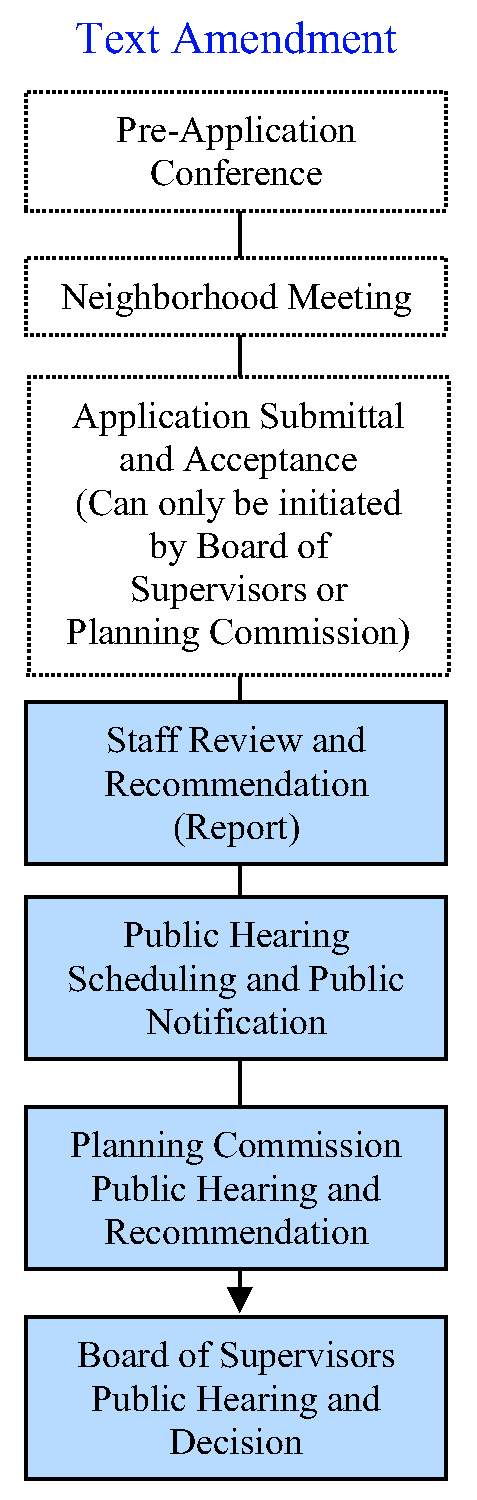
Fig. 83-123(b)
(b)
Text amendment.
(1)
Purpose. The purpose of this section is to provide a uniform means for amending the text of this chapter whenever the public necessity, convenience, general welfare, or good zoning practice requires doing so.
(2)
Text amendment procedure.
a.
Pre-application conference. Not applicable.
b.
Neighborhood meeting. Not applicable.
c.
Application submittal and acceptance. Not applicable. Text amendments may be initiated by the board of supervisors or the planning commission.
d.
Staff review and action. Applicable (see section 83-122(e)).
e.
Public hearing scheduling and public notification. Applicable (see section 83-130).
f.
Advisory body review and recommendation. Applicable.
1.
In addition, and before the public hearing on the application, the planning commission may conduct a workshop on the application.
2.
The Planning Commission, following a public hearing, shall make a recommendation on an application for a text amendment.
g.
Decision-making body review and decision. Applicable. The board of supervisors, following a public hearing, shall decide an application for a text amendment.
(c)
Zoning district map amendment (rezoning).
(1)
Purpose. The purpose of this section is to provide a uniform means for reviewing and deciding proposed amendments to the zoning district map (rezoning) whenever the public necessity, convenience, general welfare, or good zoning practice requires doing so.
(2)
Zoning district map amendment procedure.
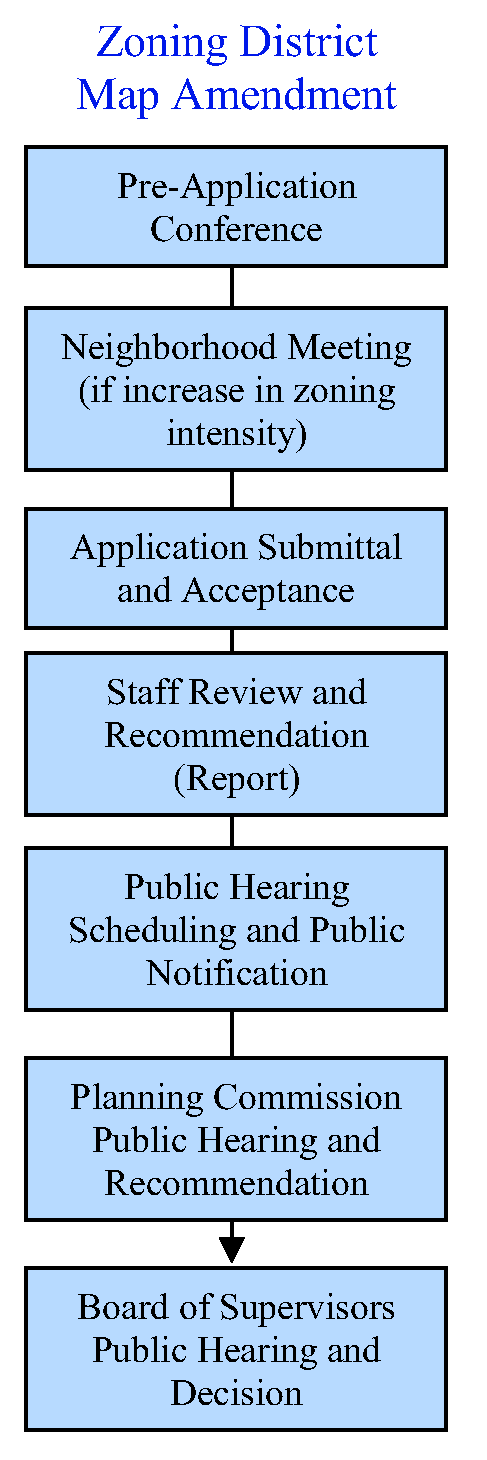
Fig. 83-123(c)
a.
Pre-application conference. Applicable (see section 83-122(b)).
b.
Neighborhood meeting. Applicable, if increases intensity of base zoning district (see section 83-122(c)).
c.
Application submittal and acceptance. Applicable (see section 83-122(d)).
d.
Staff review and action. Applicable (see section 83-122(e)). Zoning district map amendment (rezoning) applications may not be initiated by anyone other than the owner(s) of the subject land or their authorized representatives the board of supervisors or the planning commission.
e.
public hearing scheduling and public notification. Applicable.
f.
Advisory body review and recommendation. Applicable. The planning commission, following a public hearing, shall make a recommendation on the application.
g.
Decision-making body review and decision. Applicable. The board of supervisors, following a public hearing, shall decide an application for a zoning district map amendment.
(d)
Conditional zoning.
(1)
Intent. It is the policy of the county, in accordance with the provisions of this chapter, to provide for the orderly development of land for all purposes, through zoning and other land development regulations. Frequently, where competing and incompatible uses conflict, traditional zoning methods and procedures are inadequate and more flexible and adaptable zoning methods are needed to permit differing land uses, and at the same time to recognize the effects of change. It is the purpose of this section to provide a zoning method, in accordance with the provisions Code of Virginia §§ 15.2-2296 through 15.2-2303, to address situations found in such zoning districts through the use of conditional zoning, whereby a zoning reclassification may be allowed, subject to certain conditions proffered by the owner or the owner's agent with the owner's written consent for the protection of the community, that are not generally applicable to land similarly zoned. The provisions of this article shall not be used for the purpose of discrimination in housing.
(2)
Conditions as part of a rezoning or amendment to the zoning map.
a.
The owner, or owner's agent with power of attorney, in accordance with Code of Virginia § 15.2-2303, may voluntarily proffer, in writing, reasonable conditions to be placed on the approval of the rezoning prior to a public hearing of the board of supervisors. Signed proffers shall be submitted on the approved county form to the planning director not less than 15 business days prior to the public hearing of the application before the planning commission in order that the proposed proffers might be properly considered as part of the application. The planning commission may accept from the applicant, additional proffers, or modifications or amendments to previously submitted proffers at the planning commission public hearing. All such proffers shall be signed and submitted in final form to the planning director not less than ten business days prior to the public hearing before the board of supervisors. By a majority vote, the board may waive this policy to accept proffers made during the ten business days prior to the public hearing.
b.
Any landowner applying for rezoning may voluntarily proffer to restrict the use of his land, in addition to the regulations provided for the zoning district or zone by this chapter, as a part of the rezoning or amendment to the zoning map. Any proposed amended proffers shall be in writing and shall be signed by the owner of record, or an agent with power of attorney, of all the property subject to zoning amendment, in a form approved by the county attorney, prior to the acceptance of the amended proffers by the board.
c.
The board of supervisors may rezone the property on the condition that the landowner and his heirs and assigns abide by such conditions. Such conditions shall have the same force and effect as the regulations provided for the zoning district by this chapter.
(3)
Enforcement. The zoning administrator shall be vested with all authority on behalf of the county to administer and enforce conditions attached to a rezoning or amendment to the zoning map. (Pursuant to Code of Virginia § 15.2-2299 as amended, Article II: Administration and Article X: Enforcement of this chapter.
(4)
Records. The zoning map shall show by an asterisk (*) the existence of conditions attached to a zoning map. The zoning administrator shall keep in his office and make available to the public a conditional zoning index. The index shall provide ready access to the ordinance creating conditions in addition to the regulations provided for in the particular zoning district.
(5)
Petition for review of decision. Any zoning applicant who is aggrieved by the decision of the zoning administrator pursuant to Code of Virginia § 15.2-2301, may petition the governing body for the review of the decision of the zoning administrator.
(6)
Amendments and variations of conditions. There shall be no amendment or variation of conditions created pursuant to the provisions of this section until, after a duly advertised public hearing by the governing body.
(7)
Permitted uses. Permitted uses shall be limited to those uses specifically approved by the governing body upon granting of conditional zoning.
(8)
Minimum area. Minimum area shall be as set forth in this chapter or as specified by the terms of conditional zoning whichever is most strict.
(9)
Side and rear yards. Side and rear yard requirements shall be governed by this chapter or through conditions of the rezoning, whichever is more restrictive.
(10)
Lot coverage. The minimum lot coverage shall be as prescribed by this chapter unless superseded by conditions placed upon the rezoning.
(11)
Building height. Building heights shall conform to those set forth in this chapter unless superseded by conditions placed upon rezoning.
(12)
Building and construction setback. The minimum setback shall be as specified by the appropriate zoning classification in this chapter unless otherwise specified as a condition of rezoning
(13)
Screening and landscaping. Screening and landscaping shall be set forth as conditions of the proposed rezoning.
(14)
Utilities. All utilities shall conform to section 6.8 of the Powhatan County Subdivision Ordinance.
(15)
Signs. All signs shall be approved as to size and type as a condition of rezoning under this section.
(16)
Parking. Plans for parking shall be presented at the public hearing and the location, number and type of parking spaces shall be set as a condition of the rezoning.
(17)
Traffic impact analysis. A traffic impact analysis, if required by Article 10 of the subdivision ordinance, shall be provided with all rezoning applications. The applicant shall be responsible for providing actual traffic counts for public roads included in the traffic impact analysis if actual traffic counts conducted by the Virginia Department of Transportation (VDOT) are more than 12 months old. Traffic counts shall be performed in accordance with VDOT regulations.
(18)
Survey plat requirement. A survey plat which accurately reflects the current property boundaries, drawn to scale and depicting any existing structures, shall be submitted with all rezoning applications. A compiled plat shall not be considered a survey plat for the purposes of this subsection.
(e)
Planned development.
(1)
Purpose. A planned development is a development that is planned and developed under unified control in accordance with more flexible standards and procedures that are conducive to creating more mixed-use, pedestrian-oriented, and otherwise higher quality development than could be achieved through base zoning district regulations. The purpose of this section is to provide a uniform means for amending the zoning district map to establish any of the three planned development (PD) zoning districts allowed by this chapter: the VR-PD village residential planned development; the VC-PD village center planned development; and the CC-PD commerce center planned development.
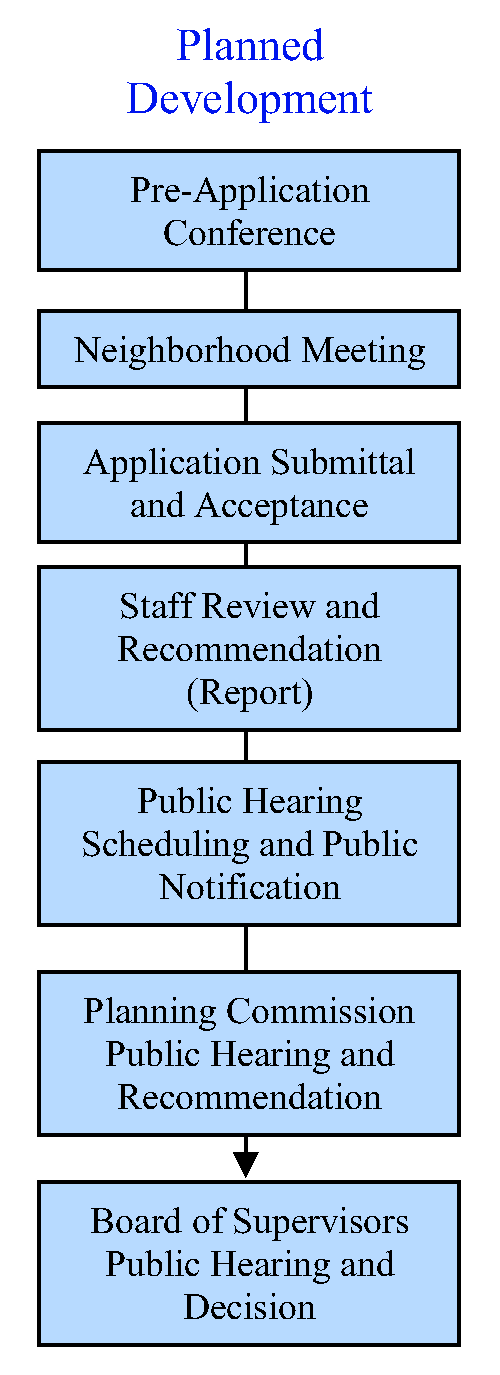
Fig. 83-123(e)
(2)
Scope. A planned development is established by a conditional zoning amendment to the zoning district map to rezone land to a planned development zoning district classification that is defined by a master plan and a terms and conditions document, and proffers.
(3)
Planned development procedure.
a.
Pre-application conference. Applicable (see section 83-122(b)).
b.
Neighborhood meeting. Applicable (see section 83-122(c)).
c.
Application submittal and acceptance. Applicable (see section 83-122(d)).
1.
Planned development applications may not be initiated by anyone other than the owner(s) of the land subject to the application, or their authorized representative(s).
2.
The application shall include a master plan proffered by the applicant that depicts the general configuration and relationship of the principal elements of the proposed development, including land uses, general building types, density/intensity, resource protection, pedestrian and vehicular circulation, open space, public facilities, and phasing.
3.
The application shall include a survey plat that accurately reflects the current property boundaries, drawn to scale and depicting any existing structures.
4.
The application shall also include a terms and conditions document proffered by the applicant that specifies terms and conditions defining development parameters, providing for environmental mitigation, and outlining how public facilities will be provided to serve the planned development.
5.
To ensure unified control, the application shall also include a copy of the title to all land that is part of the proposed PD zoning district classification.
d.
Staff review and action. Applicable (see section 83-122(e)).
e.
Public hearing scheduling and public notification. Applicable (see section 83-130).
f.
Advisory body review and recommendation. Applicable.
1.
The planning commission may suggest revisions to the master plan, terms, and conditions proffered by the applicant. The commission may include in its recommendations additional or amended proffers from the applicant made prior to or at the planning commission public hearing on the application, provided such additional or amended proffers are signed and submitted in final form to the director not less than 15 business days before the hearing (unless waived by a majority vote of the commission).
2.
The planning commission, following a public hearing, shall make a recommendation on the application.
g.
Decision-making body review and decision. Applicable.
1.
The board of supervisors may suggest revisions to the conditions proffered by the applicant. The board may include in its decision additional or amended proffers from the applicant made prior to or at the board of supervisors public hearing on the application, provided such additional or amended proffers are signed and submitted in final form to the director not less than ten business days before the hearing (unless waived by a majority vote of the board of supervisors). After the public hearing is opened, the only proffer amendments that may be accepted are ones that do not materially affect the overall proposal.
2.
The board of supervisors, following a public hearing, shall make a decision on the application.
(4)
Designation on the zoning district map. Designation of a PD zoning district on the zoning district map shall note the ordinance number approving the PD zoning classification.
(5)
Effect of approval. Lands rezoned to a PD district shall be subject to the approved PD master plan and the approved PD terms and conditions. The master plan and terms and conditions are binding on the land as an amendment to the zoning district map. The applicant may apply for and obtain subsequent permits and development approvals necessary to implement the PD master plan in accordance with the appropriate procedures and standards set forth in this chapter. Any permits or development approvals shall comply with the PD master plan and the PD terms and conditions.
(6)
Expiration. Unless otherwise stated in the terms and conditions of approval, if no application for approval of a preliminary plat or site plan for any part of the approved PD master plan is submitted within four years after approval of the planned development, the director shall advise the board of supervisors and the board may initiate a zoning district map amendment application to rezone the land back to its prior zoning district classification or any other base zoning district classification determined to be appropriate, unless the landowner/developer, within 60 days after receiving notice of the expiration of the four-year time period, submits an application requesting re-approval of the PD zoning district classification, master plan, and terms and conditions. Such time period shall not be extended with transfer of ownership.
(7)
Minor deviation.
a.
General. Subsequent plans and permits for development within an approved planned development may include minor deviations from the PD master plan or PD terms and conditions, provided the director determines that such deviations are limited to changes addressing technical considerations that could not reasonably be anticipated during the PD zoning district classification process or any other change that has no material effect on the character of the approved planned development or any of its approved terms or conditions. The following shall constitute minor deviations and may be approved by the director:
1.
Driveway locations;
2.
Structure floor plan revisions;
3.
Minor shifts in building size or location that do not result in any substantive change or impacts to the site elements; and
4.
Facility design modifications for amenities and the like.
b.
Material changes are amendments. Changes that materially affect the basic concept of the PD master plan or basic parameters set by the PD terms and conditions are not considered minor deviations, and shall only be changed as amendments to the PD master plan or PD terms and conditions.
(8)
Amendments.
a.
General. If an applicant determines it is necessary to alter the concept or intent of the PD master plan or the PD terms and conditions, the PD master plan or PD terms and conditions shall be amended, extended, or modified only in accordance with the procedures and standards for its original approval (see section 83-123(e)(3)).
b.
Amendments defined. The following items are considered an alteration of the concept or intent of the PD master plan or PD terms and conditions and are treated as an amendment:
1.
Changes in use designations;
2.
Density/intensity increases;
3.
Decreases in open space;
4.
Substantial changes in the location of streets (particularly if streets are to be deleted or access points to the development moved so traffic flows both inside and outside the development are affected);
5.
Change in the location of any public easement, at the request of the landowner/developer; or
6.
Change in the proportion of housing types by more than 15 percent.
(f)
Conditional use permit.
(1)
Purpose. A use designated as a conditional use in a particular zoning district is a use that may be appropriate in the district, but because of its nature, extent, and external effects, requires special consideration of its location, design, and methods of operation before it can be deemed appropriate in the district and compatible with its surroundings. The purpose of this section is to establish a mechanism to review conditional uses to ensure they are appropriate for a particular zoning district.
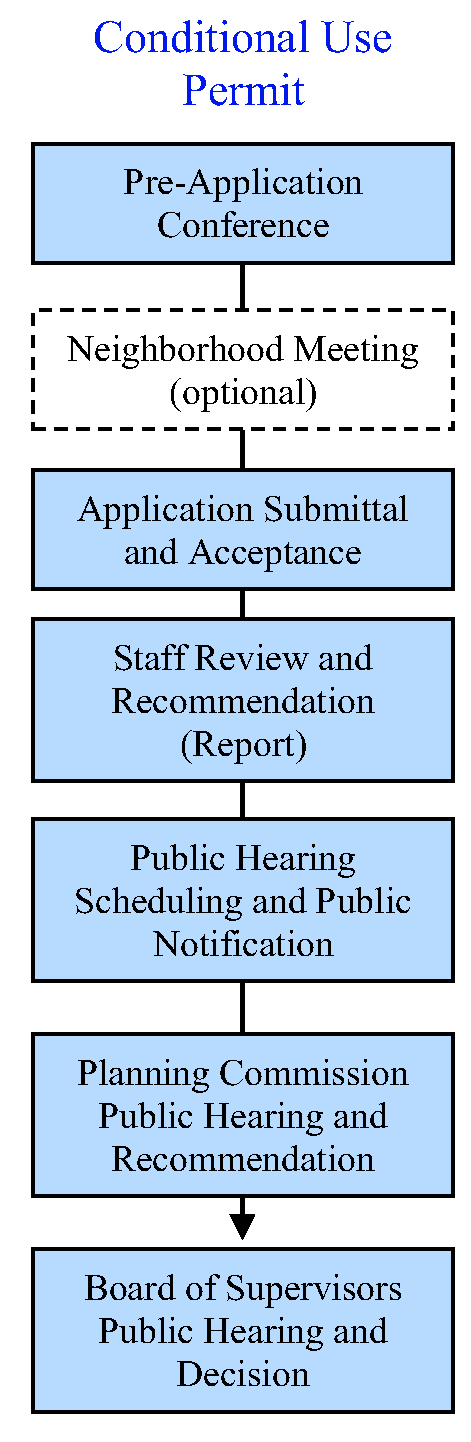
Fig. 83-123(f)
(2)
Applicability. Prior to development of a conditional use identified in articles III, IV, V, and VI, it shall receive approval of a conditional use permit in accordance with this section.
(3)
Conditional use permit procedure.
a.
Pre-application conference. Applicable (see section 83-122(b)).
b.
Neighborhood meeting. Optional (see section 83-122(c)).
c.
Application submittal and acceptance. Applicable (see section 83-122(d)).
d.
Staff review and action. Applicable (see section 83-122(e)).
e.
Public hearing scheduling and public notification. Applicable (see section 83-130).
f.
Advisory body review and recommendation. Applicable.
1.
The planning commission, following a public hearing, shall make a recommendation on the application.
2.
The planning commission's recommendation may include proposed conditions of approval.
g.
Decision-making body review and decision. Applicable.
1.
The board of supervisors, following a public hearing, shall decide an application in accordance with section 83-123(f)(4), Conditional use permit review standards.
2.
The board of supervisors may attach conditions of approval and performance bond(s), as appropriate.
(4)
Conditional use permit review standards. A conditional use permit shall be approved if the applicant demonstrates the proposed conditional use:
a.
Is consistent with the purposes, goals, objectives, and policies of the comprehensive plan and other applicable county-adopted plans;
b.
Complies with all applicable zoning district-specific standards in articles III through VI;
c.
Complies with all applicable use-specific standards Article VII: Use Standards;
d.
Complies with all applicable development and design standards in Article VIII: Development Standards;
e.
Complies with all relevant subdivision and infrastructure standards in chapter 68: Subdivisions of the Powhatan County Code;
f.
Is appropriate for its location and is compatible with the general character of surrounding lands and the uses allowed in the zoning district where proposed;
g.
Adequately screens, buffers, or otherwise minimizes adverse visual impacts on adjacent lands;
h.
Avoids significant adverse odor, noise, glare, and vibration impacts on surrounding lands regarding refuse collection, service delivery, parking and loading, signs, lighting, and other site elements;
i.
Avoids significant deterioration of water and air resources, scenic resources, and other natural resources;
j.
Maintains safe and convenient ingress and egress and traffic flow onto and through the site by vehicles and pedestrians, and safe road conditions around the site;
k.
Complies with all other relevant county, state and federal laws and standards; and
l.
Is required by the public necessity, convenience, general welfare, or good zoning practice.
(5)
Expiration. A conditional use permit shall expire in accordance with any expiration date or provisions in a condition of its approval. A conditional use permit shall automatically expire if a building permit, site plan, or other county approval, whichever occurs first, for the development granted by the conditional use permit, is not obtained within two years after the date of approval of the conditional use permit, or if no subsequent county approval is required, the development is not completed and operational within two years.
(g)
Site plan.
(1)
Purpose. Site plan review is intended to ensure that the layout and general design of proposed development is compatible with surrounding uses and complies with all applicable standards in this chapter and all other applicable county regulations. The purpose of this section is to establish the procedure and standards for review of site plans.
(2)
Applicability. All development in the county, unless exempted in accordance with subsection (3) (Exemptions) below, shall receive site plan approval in accordance with the procedures and standards of this section prior to issuance of a zoning compliance permit.
(3)
Exemptions. The following development shall be exempt from the requirements of this section (but not from other applicable provisions of this chapter):
a.
Agricultural development and activities, except agricultural/animal confinement (A-C) development and activities;
b.
Single-family detached development;
c.
A change in use when the new use will generate less than 50 cumulative external trip ends per day; and
83-123(g)(4)d.
d.
The expansion of an existing conforming development by less than 20 percent or 3,000 square feet of floor area over a three year period, whichever is less, when the expansion will generate less than 30 additional external trip ends per day.
(4)
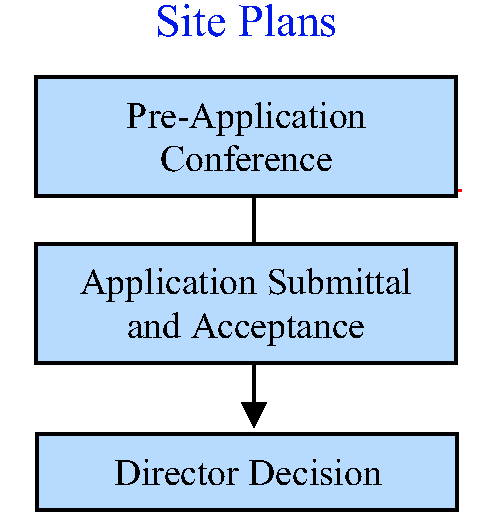
Site plan approval procedure.
a.
Pre-application conference. Applicable (see section 83-122(b)).
b.
Neighborhood meeting. Not applicable.
c.
Application submittal and acceptance. Applicable (see section 83-122(d)).
d.
Staff review and action. Applications for development shall be subject to a decision by the director in accordance with section 83-122(e)(4).
e.
Public hearing scheduling and public notification. Not applicable.
f.
Advisory body review and recommendation. Not applicable.
(5)
Time limit for action on site plan application. The director, as appropriate, shall decide the application within 60 days after the date the application is accepted as complete in accordance with section 83-122(d)(6), Determination of application completeness. This time period may be extended if a portion of the application is required to be reviewed and approved by a state department or agency, in accordance with Code of Virginia § 15.2-2259.A.
(6)
Site plan review standards. An application for Site Plan approval shall be approved upon a finding the applicant has demonstrated the proposed development:
a.
Complies with the applicable district, use-specific, development, design, and subdivision design standards of this chapter;
b.
Complies with all other applicable standards of this chapter and other applicable County regulations; and
c.
Complies with all standards, conditions, and proffers of any prior applicable permits or development approvals.
(7)
Appeal. A decision by the director on an application for site plan approval may be appealed to the Circuit Court of Powhatan County in accordance with Code of Virginia § 15.2-2259.
(8)
Effect. Approval of a site plan authorizes the submittal of a development application for a zoning compliance permit, a building permit, a land disturbance permit, and any other development application that may be required before construction or other development authorized by this chapter.
(9)
Expiration. Unless otherwise specified in the site plan approval, an application for a building permit shall be applied for and obtained for at least one building in the site plan within five years of the date of the approval of the site plan; otherwise, the site plan shall become null and void, and automatically expire. When a building permit is approved, the site plan approval shall run concurrent with the validity of the building permit. Permitted timeframes do not change with successive owners.
(10)
Subsequent submittal and reconsideration of denied site plan applications. If a site plan application is denied, the applicant may revise the application to correct the specific deficiencies identified as reasons for its previous denial. If the revised application is submitted within six months after its previous denial, the director or planning commission shall consider the previously identified deficiencies and any deficiencies that have arisen as a result of the revisions, and decide the revised application within 45 days after the date the revised application is submitted.
(11)
Amendment. Applicable.
(h)
Certificate of approval.
(1)
Purpose. The purpose of this section is to establish a mechanism to review development as defined by section 83-123(h)(2)a. proposed within a Historic Overlay District to ensure architectural compatibility with the historic properties within the district.
(2)
Applicability.
a.
General. Except as provided in subsection b. below, no building or structure, including signs, within any Historic Overlay District shall be erected, reconstructed, altered, restored, razed, demolished, moved, or relocated except in accordance with a certificate of approval approved in accordance with this section.
b.
Exemptions.
1.
Minor works and actions. Minor works or actions determined by the administrator as not having a permanent effect on the historic or architectural character of the site or the Historic Overlay District shall be exempt from the requirement for a certificate of approval. Minor works and actions shall include, but are not limited to, the following activities. The planning commission may adopt guidelines to assist the administrator in determining whether these or other activities qualify as minor works or actions exempt from the requirement for a certificate of approval.
i.
Appurtenances such as gutters, storm doors, storm windows, portable air conditioners installed in windows, or similar devises that would not significantly affect the appearance of the structure;
ii.
Antennas, skylights, or solar collectors located so as not to be visible from a public street right-of-way;
iii.
Landscaping involving minor grading, walkways, retaining walls no more than 30 inches high, temporary fencing, small fountains, ponds, and similar minor landscaping features that would not substantially affect the character of the property or district;
iv.
Alterations or repainting of the interiors of buildings; and
v.
Additions to or subtractions from existing buildings that would involve less than 120 square feet in floor area, would not be visible from a public street right-of-way, and would not significantly change the architectural character of the property.
2.
Emergency repairs. Where a building or structure within a Historic Overlay District is damaged due to a fire, flood, or other natural disaster or similar event beyond the control of the property owner, emergency repairs to the building or structure may be made without a certificate of approval—provided an application for any normally required certificate of approval is submitted within 30 days after the event creating the need for the emergency repairs.
(3)
Certificate of approval procedure.
a.
Pre-application conference. Applicable (see section 83-122(b)).
b.
Neighborhood meeting. Optional (see section 83-122(c)).
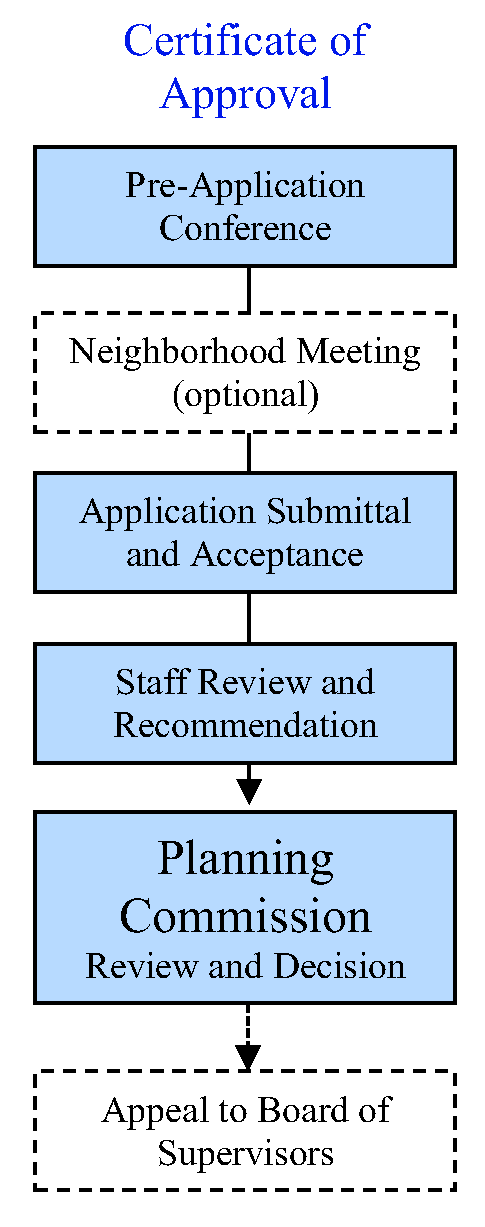
Fig. 83-123(h)
c.
Application submittal and acceptance. Applicable (see section 83-122(d)).
d.
Staff review and action. Applicable (see section 83-122(e)).
e.
Public hearing scheduling and public notification. Not applicable.
f.
Advisory body review and recommendation. Not applicable.
g.
Decision-making body review and decision. Applicable. The planning commission shall decide an application in accordance with section 83-123(h)(4), Certification of approval review standards.
(4)
Certificate of approval review standards. A certificate of approval shall be approved only if the applicant demonstrates the proposed development is architecturally compatible with the character of the historic landmarks, buildings, or structures within the Historic Overlay District. In reviewing and deciding an application for a certificate of approval, the planning commission may not consider the interior arrangement of buildings or structures, or features not visible from a public street right-of-way—but shall consider the following factors:
a.
General.
1.
The Secretary of the Interior's Standards for the Treatment of Historic Properties;
2.
Any design guidelines adopted by the planning commission for the particular Historic Overlay District that are incorporated into this chapter by reference;
3.
The architectural or historical significance of the building or structure;
4.
The scale, massing, style, arrangement, shape, texture, material, color, and fenestration of the building or structure and its components, and their compatibility with existing buildings or structures that contribute to the character of the Historic Overlay District; and
5.
The extent to which denial of a certificate of approval would deprive the property owner a reasonable use of the property.
b.
Razing or demolition. In reviewing and deciding an application for a certificate of approval for the razing or demolition of a building or structure, the planning commission shall consider the following factors in addition to those in subsection a. above:
1.
The importance of the building or structure to the ambience and character of the Historic Overlay District;
2.
The difficulty or the impossibility of reproducing such a building or structure because of its design, texture, material, detail, or unique location;
3.
Whether the building or structure is one of the last remaining examples of its kind in the neighborhood, the county, or the region; and
4.
Whether the owner of the property has made, without success, a bona fide offer to sell the building or structure, and associated land, at a price reasonably related to its market value, to a person or other entity willing to preserve and restore the building or structure for the time period set forth in Code of Virginia § 15.2-2306 for such sale offers.
c.
Move or relocation. In reviewing and deciding an application for a certificate of approval for the moving or relocation of a building or structure, the planning commission shall consider the following factors in addition to those in subsection a. above:
1.
The historic character and aesthetic interest the building or structure contributes to its present setting;
2.
Whether the building or structure can be moved without significant damage to its physical integrity; and
3.
Whether the proposed relocation area is compatible with the historical and architectural character of the building or structure.
(5)
Appeal. A decision by the planning commission on an application for a certificate of approval may be appealed to the board of supervisors, provided such appeal is filed with the director within 30 days after the date of the decision by the planning commission.
(6)
Expiration. A certificate of approval shall expire in accordance with any expiration date or provisions in a condition of its approval. A certificate of approval shall automatically expire if a building permit, site plan, or other county approval, whichever occurs first, for the development granted by the certificate of approval, is not obtained within two years after the date of approval of the certificate of approval, or if no subsequent county approval is required, the development is not completed and operational within two years.
(7)
Amendment. Applicable.
(i)
Temporary business permit.
(1)
Purpose. The purpose of this subsection is to establish a uniform mechanism for reviewing temporary businesses to ensure they comply with the standards in Article VII, Division 3: Standards for Temporary Uses and Structures.
(2)
Applicability. The provisions of this section shall apply to all proposed temporary use and structures identified in each zoning district as requiring a temporary business use permit.
(3)
Temporary business permit procedure.
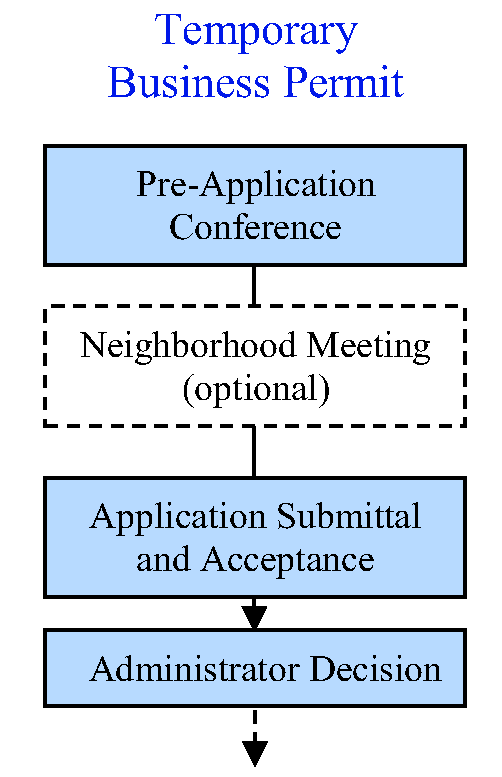
Fig. 83-123(i)
a.
Pre-application conference. Applicable (see section 83-122(b)).
b.
Neighborhood meeting. Optional (see section 83-122(c)).
c.
Application submittal and acceptance. Applicable (see section 83-122(d)).
d.
Staff review and action. Applicable (see section 83-122(e)). The administrator shall decide applications for temporary business permit in accordance with section 83-122(e)(4), Applications subject to decision by director or administrator, and section 83-123(i)(4), Temporary business permit review standards.
e.
Public hearing scheduling and public notification. Not applicable.
f.
Advisory body review and recommendation. Not applicable.
g.
Decision-making body review and decision. Not applicable.
(4)
Temporary business permit review standards. A temporary business permit shall be approved on a finding the applicant demonstrates the proposed temporary business complies with the relevant standards in Article VII, Division 3: Standards for Temporary Uses and Structures.
(5)
Expiration. Approval of a temporary business permit shall be effective beginning on the date of approval and shall remain effective for the period indicated in the permit, unless an extension of time period is authorized in accordance with Article VII, Division 3: Standards for Temporary Uses and Structures.
(6)
Amendment. Applicable.
(j)
Sign permit.
(1)
Purpose. The purpose of this section is to provide a uniform mechanism for reviewing applications for sign permits to ensure all signs comply with the standards of section 83-488, Signage, under Article VIII: Development Standards.
(2)
Applicability. All signs, except those not requiring a permit, shall obtain a sign permit in accordance with the procedures and standards of this section before being erected, replaced, relocated, or altered.
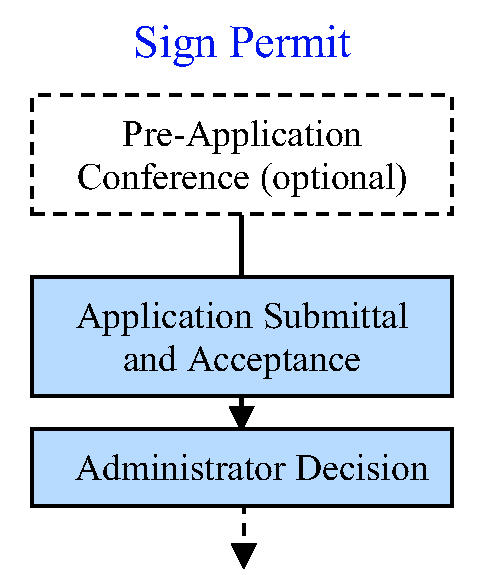
Fig. 83-123(j)
(3)
Sign permit procedure.
a.
Pre-application conference. Optional (see section 83-122(b)).
b.
Neighborhood meeting. Not applicable.
c.
Application submittal and acceptance. Applicable (see section 83-122(d)).
d.
Staff review and action. Applicable (see section 83-122(e)). The administrator shall decide applications for a sign permit in accordance with section 83-122(e)(4), Applications subject to decision by director or administrator, and section 83-123(j)(4), sign permit review standards.
e.
Public hearing scheduling and public notification. Not applicable.
f.
Advisory body review and recommendation. Not applicable.
g.
Decision-making body review and decision. Not applicable.
(4)
Sign permit review standards. A sign permit shall be approved only upon a finding the application complies with the standards in section 83-488, Signage, under Article VIII: Development Standards, all relevant standards of this chapter, and any other applicable county requirements.
(5)
Amendment. Applicable.
(k)
Floodplain permit.
(1)
Purpose. The purpose of a floodplain permit is to ensure development complies with the standards in the Floodplain Overlay District.
(2)
Applicability. All development in the Floodplain Overlay District shall receive approval of a floodplain permit prior to issuance of a building permit.
(3)
Floodplain permit procedure.
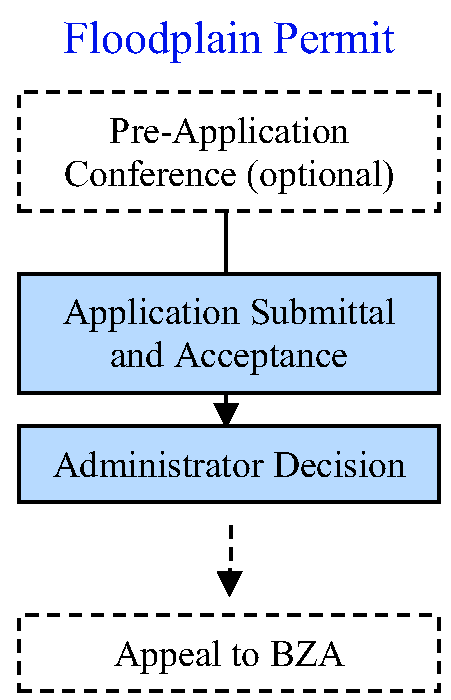
Fig. 83-123(k)
a.
Pre-application conference. Optional (see section 83-122(b)).
b.
Neighborhood meeting. Not applicable.
c.
Application submittal and acceptance. Applicable (see section 83-122(d)).
d.
Staff review and action. Applicable (see section 83-122(e)). The administrator shall decide an application in accordance with section 83-122(e)(4), Applications subject to decision by director or administrator, and section 83-123(k)(4), Floodplain permit review standards.
e.
Public hearing scheduling and public notification. Not applicable.
f.
Advisory body review and recommendation. Not applicable.
g.
Decision-making body review and decision. Not applicable.
(4)
Floodplain permit review standards. A floodplain permit shall be approved upon a finding the applicant demonstrates the proposed development complies with all applicable standards in the Floodplain Overlay District.
(5)
Appeal. A decision by the administrator on a floodplain permit may be appealed to the BZA (see section 83-123(r), Appeal (floodplain)).
(6)
Expiration. Approval of a floodplain permit shall automatically expire if the development activity it authorizes is not commenced within one year after the date of approval.
(7)
Amendment. Applicable.
(l)
Zoning compliance permit.
(1)
Purpose. The purpose of a zoning compliance permit is to ensure development complies with the requirements of this chapter before it is issued a building permit.
(2)
Applicability. A zoning compliance permit is required before issuance of a building permit.
(3)
Zoning compliance permit procedure.
a.
Pre-application conference. Optional (see section 83-122(b)).
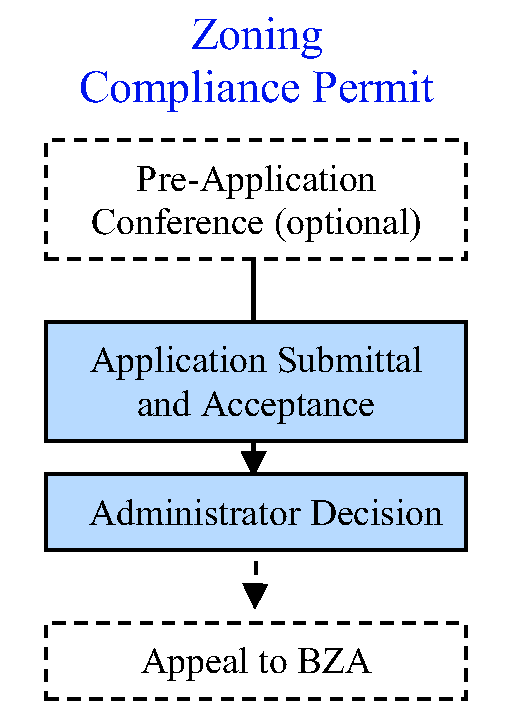
Fig. 83-123(l)
b.
Neighborhood meeting. Not applicable.
c.
Application submittal and acceptance. Applicable (see section 83-122(d)).
d.
Staff review and action. Applicable (see section 83-122(e)). The Administrator shall decide an application in accordance with section 83-122(e)(4), Applications subject to decision by director or administrator, and section 83-123(l)(4), Zoning compliance permit review standards.
e.
Public hearing scheduling and public notification. Not applicable.
f.
Advisory body review and recommendation. Not applicable.
g.
Decision-making body review and decision. Not applicable.
(4)
Zoning compliance permit review standards. A zoning compliance permit shall be approved upon a finding the applicant demonstrates the proposed development complies with all applicable standards in this chapter and all applicable conditions of permits or development approvals under this chapter.
(5)
Expiration. Approval of a zoning compliance permit shall automatically expire if the building permit for which it is approved expires.
(6)
Appeal. A decision by the administrator on a zoning compliance permit may be appealed to the BZA (see section 83-123(q), Appeal (zoning)).
(7)
Amendment. Applicable.
(m)
Variance permit (zoning).
(1)
Purpose. The purpose of a variance is to allow, in accordance with Code of Virginia § 15.2-2309, certain deviations from the dimensional or other numerical standards of this chapter (such as size of area of a parcel of land; the size, area, bulk, or location of a building; building height; yard depth; lot coverage, or similar numerical standards) when the landowner demonstrates that, owing to special circumstances or conditions beyond the landowner's control (exceptional narrowness, shallowness, size, or shape of a specific piece of property at the time of the effective date of this chapter or an amendment thereto, or exceptional topographic conditions or other extraordinary situation or condition of the piece of property, or the condition, situation, or development of property immediately adjacent thereto), the strict application of the standards of this chapter would effectively prohibit or unreasonably restrict the utilization of the property, or the granting of the variance would alleviate a clearly demonstrable hardship, as distinguished from a special privilege or convenience sought by the applicant.
(2)
Applicability. A variance permit procedure may be used to seek hardship relief from the dimensional or other numerical standards in this chapter. No variance permit (zoning) may be sought that increases development density (e.g., units per acre) beyond that allowed in a base zoning district. In addition, no variance permit (zoning) may be sought that would permit a use not allowed in a zoning district, or that would have the effect of allowing a prohibited use.
(3)
Variance permit (zoning) procedure.
a.
Pre-application conference. Optional (see section 83-122(b)).
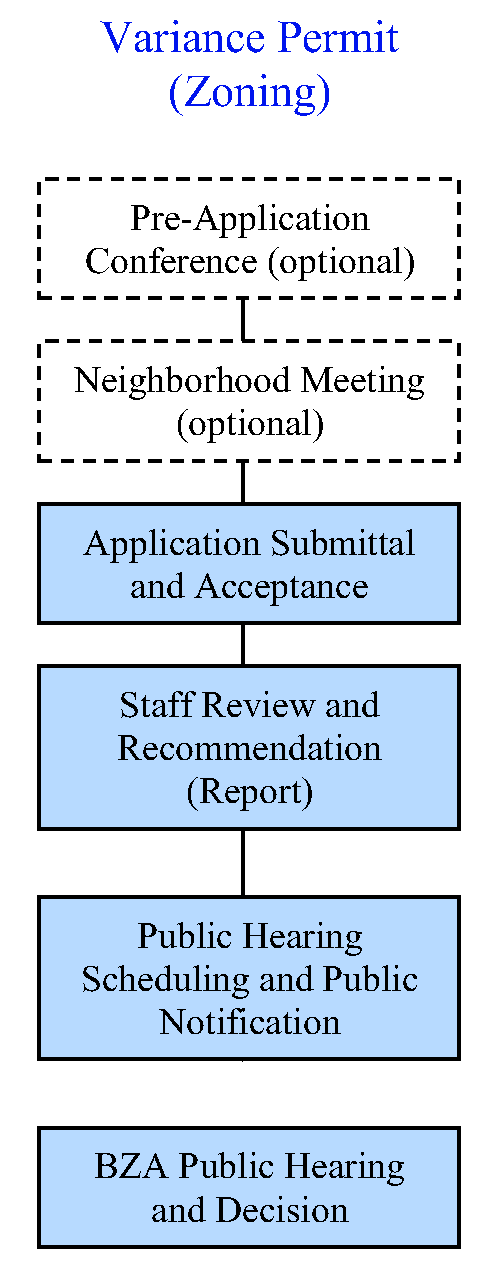
Fig. 83-123(m)
b.
Neighborhood meeting. Optional (see section 83-122(c)).
c.
Application submittal and acceptance. Applicable (see section 83-122(d)).
d.
Staff review and action. Applicable (see section 83-122(e)).
e.
Public hearing scheduling and public notification. Applicable.
f.
Advisory body review and recommendation. Not applicable.
g.
Decision-making body review and decision. Applicable. The BZA, following a public hearing, shall make a decision on the application for a variance permit in accordance with section 83-123(m)(4), Variance permit (zoning) review standards. The concurring vote of a majority of a quorum of the BZA shall be necessary to approve a variance permit.
(4)
Variance permit (zoning) review standards.
a.
General. A variance permit (zoning) shall be approved on a finding the applicant demonstrates all of the following standards are met:
1.
The property for which the variance is requested was acquired in good faith;
2.
Strict application of this chapter would produce undue hardship relating to the property—i.e., would effectively prohibit or unreasonably restrict the utilization of the property by reason of:
i.
The exceptional narrowness, shallowness, size, or shape of the property at the time of the effective date of this chapter or an amendment thereto;
ii.
Exceptional topographic conditions or other extraordinary situation or condition of the property; or
iii.
The condition, situation, or development of other property immediately adjacent to the property.
3.
The situation or condition producing the hardship is not self-created;
4.
The hardship is not shared generally by other properties in the same zoning district and the same vicinity;
5.
The authorization of the variance permit (zoning) alleviates this clearly demonstrated hardship (as distinguished from a special privilege or convenience sought by the applicant);
6.
The authorization of the variance permit (zoning) is in harmony with the intended spirit and purpose of the ordinance;
7.
The authorization of the variance permit (zoning) will not be of substantial detriment to adjacent properties;
8.
The character of the zoning district in which the land is located will not be changed by the granting of the variance permit (zoning);
9.
The condition or situation of the land is not of so general or recurring in nature as to make reasonably practicable the formulation of a regulation or standard to address the condition or situation; and
10.
The variance permit (zoning) authorized by the BZA is the least possible deviation from the standards necessary to afford relief.
b.
Prohibitions.
1.
No provision of this chapter shall be construed as granting the BZA the power to rezone property.
2.
No variance permit (zoning) shall be granted to allow a use or development condition not permitted by right or proffer.
3.
No variance permit (zoning) shall be granted to any standard or requirement in any other part of the Code of the County of Powhatan, Virginia.
4.
No variance permit (zoning) shall be granted that allows a principal or accessory building to exceed any applicable maximum size standards set out in articles III through VI, or Article VII: Use Standards.
(5)
Conditions of approval.
a.
General. In authorizing a variance, the BZA may impose such conditions regarding the location, character, and other features of the proposed structure or use granted the variance as it may deem necessary in the public interest to ensure compliance with the requirements of this section. Conditions, where imposed, shall be included as part of the approval.
b.
Guarantee or bond. The BZA may require a guarantee or bond to insure compliance with the conditions imposed.
(6)
Appeal. Any person jointly or severally aggrieved by any decision of the BZA, or any aggrieved taxpayer or any officer, department, board, or commission of the county, within 30 days of the date of the final decision of the BZA, may appeal the decision of the BZA to the Circuit Court of Powhatan County in accordance with the Code of Virginia.
(7)
Effect. Approval of a variance permit (zoning) authorizes only the particular regulatory relief approved. It does not exempt the applicant from the responsibility to obtain all other approvals required by this chapter and any other applicable laws, and does not indicate that the development for which the variance is granted should receive other permits or development approvals under this chapter unless the relevant and applicable portions of this chapter or any other applicable laws are met.
(8)
Expiration. Unless it expires, a variance permit (zoning), including any conditions of approval, shall run with the land, shall be binding on the landowners and their successors and assigns, and shall not be affected by a change in ownership.
(9)
Amendment. Applicable.
(n)
Variance permit (floodplain).
(1)
Purpose. The purpose of a floodplain variance is to allow certain deviations from Floodplain Overlay District standards of this chapter when the landowner demonstrates that, owing to special circumstances or conditions beyond the landowner's control, a literal application of the standards of this chapter would result in undue and unique hardship to the landowner and the deviation would not be contrary to the public interest.
(2)
Applicability. A variance permit (floodplain) procedure may be used to seek hardship relief from the standards of the Floodplain Overlay District. No variance permit (floodplain) may be sought that increases development density (e.g., units per acre) beyond that allowed in a base zoning district.
(3)
Variance permit (floodplain) procedure.
a.
Pre-application conference. Optional (see section 83-122(b)).
b.
Neighborhood meeting. Optional (see section 83-122(c)).
c.
Application submittal and acceptance. Applicable (see section 83-122(d)).
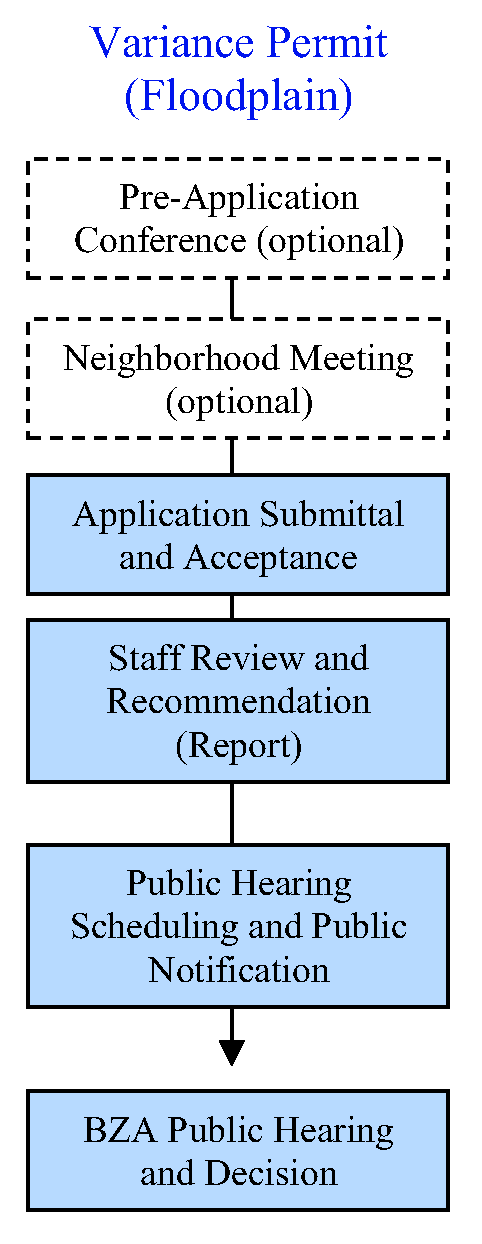
Fig. 83-123(n)
d.
Staff review and action. Applicable (see section 83-122(e)).
e.
Public hearing scheduling and public notification. Applicable (see section 83-130).
f.
Advisory body review and recommendation. Not applicable.
g.
Decision-making body review and decision. Applicable. The BZA, following a public hearing, shall make a decision on the application for a variance permit in accordance with section 83-123(n)(4), Variance permit (floodplain) review standards.
(4)
Variance permit (floodplain) review standards.
a.
Findings. A variance permit (floodplain) shall be approved upon a finding the applicant shows good and sufficient cause and demonstrates that all of the following standards are met:
1.
Failure to grant the variance permit (floodplain) would result in exceptional—i.e., undue and unique—hardship to the applicant;
2.
The variance permit (floodplain) is the minimum required to provide relief from the exceptional hardship;
3.
Granting of the variance permit (floodplain) will not:
i.
Result in unacceptable or prohibited increases in flood heights;
ii.
Result in additional threats to public safety;
iii.
Result in extraordinary public expense;
iv.
Create nuisances;
v.
Cause fraud or victimization of the public; or
vi.
Conflict with any other part of this chapter or other county laws or ordinances;
4.
If granted within any floodway district, the variance permit (floodplain) will not cause any increase in the 100-year flood elevation; and
5.
If the variance permit (floodplain) is sought for the repair or rehabilitation of a designated historic structure, such repair or rehabilitation will not preclude the structure's continued designation as a historic structure and the variance permit (floodplain) is the minimum necessary to preserve the historic character and design of the structure.
b.
Additional factors to consider. In making its findings and decision on an application for a variance permit (floodplain), the BZA shall consider the following additional factors:
1.
The danger to life and property due to increased flood heights or velocities caused by encroachments.
2.
The danger that materials may be swept onto other lands or downstream to the injury of others.
3.
The proposed water supply and sanitation systems and the ability of these systems to prevent disease, contamination, and unsanitary conditions.
4.
The susceptibility of the proposed facility and its contents to flood damage and the effect of such damage on the individual owners.
5.
The importance of the services provided by the proposed facility to the community.
6.
The requirements of the facility for a waterfront location.
7.
The availability of alternative locations not subject to flooding for the proposed use.
8.
The compatibility of the proposed use with existing development and development anticipated in the foreseeable future.
9.
The relationship of the proposed use to the comprehensive plan and floodplain management program for the area.
10.
The safety of access by ordinary and emergency vehicles to the property in time of flood.
11.
The expected heights, velocity, duration, rate of rise, and sediment transport of the flood waters expected at the site.
12.
The historic nature of a structure.
13.
Such other factors which are relevant to the purposes of this chapter's floodplain regulations.
(5)
Conditions of approval.
a.
General. In authorizing a variance permit (floodplain), the BZA may impose such conditions regarding the location, character, and other features of the proposed structure granted the variance as it may deem necessary in the public interest to ensure compliance with the requirements of this section and to prevent or minimize adverse effects from the proposed variance. Conditions, where imposed, shall be included as part of the approval.
b.
Guarantee or bond. The BZA may require a guarantee or bond to ensure compliance with the conditions imposed.
(6)
Applicant notification of risks. Subsequent to approval of a variance permit (floodplain), the community development staff shall notify the applicant, in writing, of the approval, and that issuance of a variance that allows development below the 100-year floodplain elevation (1) increases the risks to life and property and (2) will result in increases to premium rates for flood insurance.
(7)
Effect. Approval of a variance permit (floodplain) authorizes only the particular regulatory relief approved. It does not exempt the applicant from the responsibility to obtain all other approvals required by this chapter and any other applicable laws, and does not indicate that the development for which the variance is granted should receive other permits or development approvals under this chapter unless the relevant and applicable portions of this chapter or any other applicable laws are met.
(8)
Expiration. Unless it expires, a variance permit (floodplain), including any conditions of approval, shall run with the land, shall be binding on the landowners and their successors and assigns, and shall not be affected by a change in ownership.
(9)
Appeal. A decision of the BZA on an application for a variance permit (floodplain) may be appealed to the Circuit Court for Powhatan County in accordance with the Code of Virginia.
(10)
Amendment. Applicable.
(o)
Interpretation (zoning).
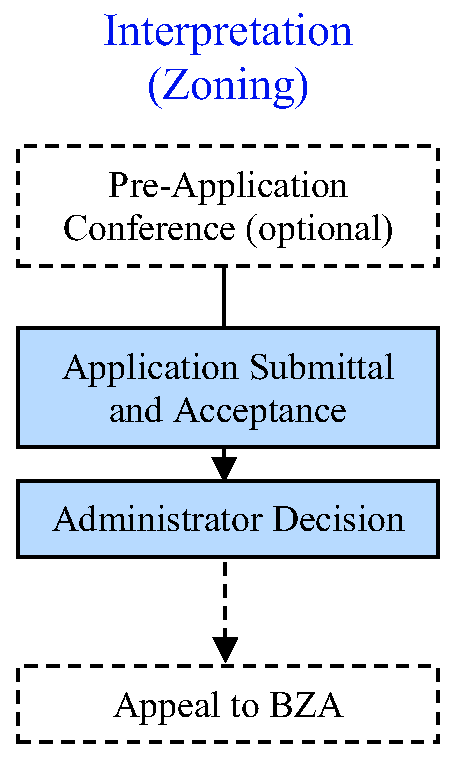
Fig. 83-123(o)
(1)
Purpose. The purpose of this section is to provide a uniform mechanism for rendering formal written interpretations of the text of this chapter (except for section 83-420, Floodplain overlay (FP) District) and the boundaries or classifications on the zoning district map.
(2)
Applicability. The administrator is responsible for making interpretations of all provisions of this chapter, including, but not limited to:
a.
Interpretations of the text;
b.
Interpretations of the zoning district boundaries;
c.
Interpretations of whether an unlisted use in a zoning district and in Article VII: Use Standards, is comparable to a listed use or not, and should be allowed in a zoning district or prohibited in that district; and
d.
Interpretations of compliance with a condition of approval.
(3)
Interpretation (zoning) procedure.
a.
Pre-application conference. Optional (see section 83-122(b)).
b.
Neighborhood meeting. Not applicable.
c.
Application submittal and acceptance. Applicable (see section 83-122(d)). An application for a formal written interpretation may be initiated by the board of supervisors, the planning commission, any resident or landowner in the county, or any person having a contractual interest in land in the county.
d.
Staff review and action. Applicable (see section 83-122(e)). The administrator shall make interpretations in accordance with section 83-122(e)(4), Applications subject to decision by director or administrator, and section 83-123(o)(4), Interpretation (zoning) standards. Prior to rendering an interpretation the administrator shall consult with the director, the county attorney, and other affected county officials.
e.
Public hearing scheduling and public notification. Not applicable.
f.
Advisory body review and recommendation. Not applicable.
g.
Decision-making body review and decision. Not applicable.
(4)
Appeal. The administrator's interpretation may be appealed to the BZA (see section 83-123(q), Appeal (zoning)).
(p)
Interpretation (floodplain).
(1)
Purpose. The purpose of this section is to provide a uniform mechanism for rendering formal written interpretations of the text of section 83-420, Floodplain Overlay (FP) District and the FP district and subdistrict boundaries or classifications on the Flood Insurance Study (FIS) and Flood Insurance Rate Maps (FIRM).
(2)
Applicability. The administrator is responsible for making interpretations of all provisions of section 83-420, Floodplain overlay (FP) District including, but not limited to:
a.
Interpretations of the text; and
b.
Interpretations of the FP district and subdistrict boundaries.
(3)
Interpretation (floodplain) procedure.
a.
Pre-application conference. Optional (see section 83-122(b)).
b.
Neighborhood meeting. Not applicable.
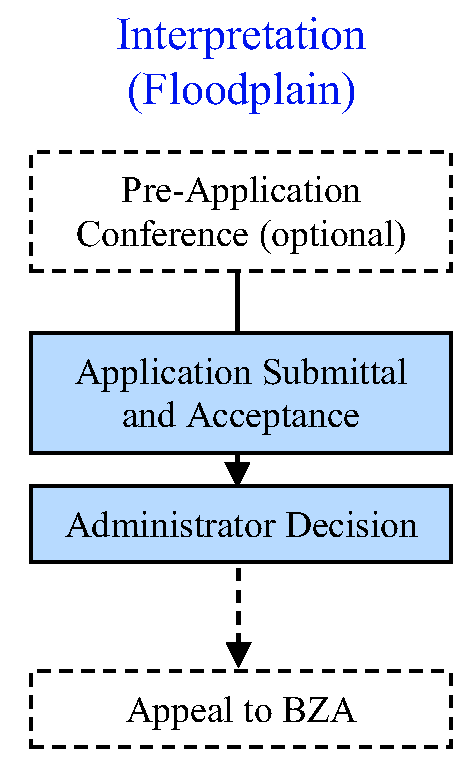
Fig. 83-123(p)
c.
Application submittal and acceptance. Applicable (see section 83-122(d)). An application for a formal written interpretation may be initiated by the board of supervisors, the planning commission, the BZA, any resident or landowner in the county, or any person having a contractual interest in land in the county.
d.
Staff review and action. Applicable (see section 83-122(e)). The administrator shall make interpretations in accordance with section 83-122(e)(4), Applications subject to decision by director or administrator, and section 83-123(p)(4), Interpretation (floodplain) standards. Prior to rendering an interpretation the administrator shall consult with the director, the county attorney, and other affected county officials.
e.
Public hearing scheduling and public notification. Not applicable.
f.
Advisory body review and recommendation. Not applicable.
g.
Decision-making body review and decision. Not applicable.
(4)
Appeal. The administrator's interpretation may be appealed to the BZA (see section 83-123(r)).
(q)
Appeal (zoning).
(1)
Purpose. The purpose of this section is to establish a procedure and standards for any person aggrieved by any administrative decision in accordance with Code of Virginia § 15.2-2311 related to any part of this chapter—except a decision on a floodplain permit, or an interpretation under section 83-420, Floodplain Overlay (FP) District—to appeal the decision or interpretation to the BZA.
(2)
Applicability. Any person aggrieved, or any officer, department, board, or commission of the county affected, by a decision of the administrator or from any order, requirement, decision, or determination made by any other administrative officer in the administration or enforcement of this chapter—except a decision or interpretation on a floodplain permit, or an interpretation under section 83-420, Floodplain Overlay (FP) District—may appeal the order, requirement, decision, determination, or interpretation (hereinafter "decision") to the BZA in accordance with the procedures and standards of this section.
(3)
Initiation. An appeal shall be initiated by filing a written notice of appeal with the administrator, within 30 days of the date of the decision being appealed.
(4)
Appeal procedure.
a.
Pre-application conference. Optional (see section 83-122(b)).
b.
Neighborhood meeting. Not applicable.
c.
Application submittal and acceptance. Applicable (see section 83-122(d)). The written notice of appeal shall include a statement of the error or improper decision, the date of that decision, the grounds for the appeal, and all related support materials.
d.
Staff review and action. Applicable (see section 83-122(e)). Upon accepting a notice of appeal application, the administrator shall transmit to the BZA the appeal and the record of material considered by the administrator in making the decision (including but not limited to, for example, provisions of this chapter, the application and support materials, staff report, the comprehensive plan and other plans, documents, reports, and studies considered in making the decision, and any minutes, transcripts, or record of the meetings held to consider and make the decision).
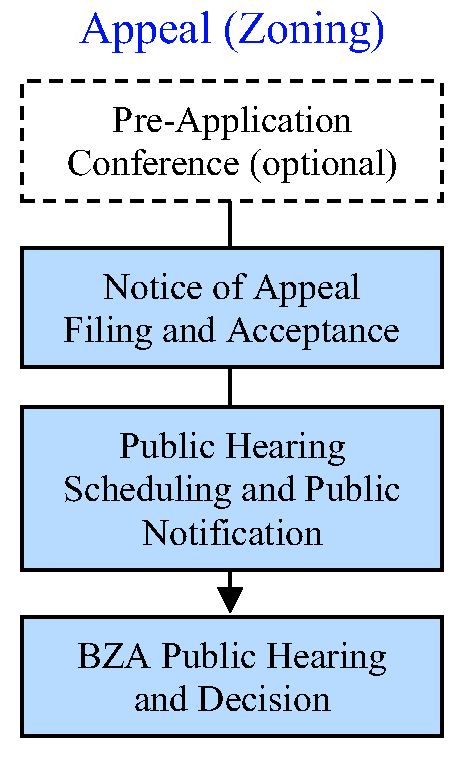
Fig. 83-123(q)
e.
Public hearing scheduling and public notification. Applicable (see section 83-130). Notice of the public hearing also shall be provided to the applicant for the decision being appealed, if different from the appellant. If the decision being appealed pertains to a particular property, notice also shall be provided to the owner of the property.
f.
Advisory body review and recommendation. Not applicable.
g.
Decision-making body review and decision. Applicable. The public hearing shall be on the record of the appeal, with presentations limited to testimony and arguments on the record of the appeal as it relates to the grounds for appeal specified in the appeal application. Following the public hearing, the BZA shall make a decision on the appeal. The decision shall be based solely on the record of the appeal, as supplemented by arguments presented at the public hearing, and the standards in section 83-123(q)(6), Appeal (zoning) review standards. The final decision of the BZA shall be one of the following:
1.
Affirmation of the decision (in whole or in part);
2.
Modification of the decision (in whole or in part); or
3.
Reversal of the decision (in whole or in part).
The concurring vote of a majority of the membership of the BZA shall be necessary to reverse the decision being appealed.
(5)
Time limit for action on appeal (zoning). The BZA shall decide an appeal within 90 days after the date the notice of appeal is filed in accordance with section 83-123(q)(3), Initiation.
(6)
Appeal (zoning) review standards. A decision by the administrator or other administrative officer shall be presumed correct, and may not be reversed or modified unless there is evidence in the record that the decision is not correct, based on the relevant procedures and standards of this chapter. The BZA shall consider the purpose and intent of any applicable provisions of this chapter and other relevant ordinances, laws, and regulations in making its decision.
(7)
Appeal. Any person jointly or severally aggrieved by any decision of the BZA, or any aggrieved taxpayer or any officer, department, board, or commission of the county, within 30 days of the date of the final decision of the BZA, may appeal the decision of the BZA to the Circuit Court of Powhatan County in accordance with the Code of Virginia.
(8)
Effect. An appeal shall stay all administrative proceedings by the county in furtherance of the action appealed, unless the administrator certifies that a stay would cause imminent peril to life or property, in which case the administrative proceedings shall not be stayed unless a restraining order is granted by the BZA or by the Circuit Court for Powhatan County, on application and on notice to the Administrator and for good cause shown.
(r)
Appeal (floodplain).
(1)
Purpose. The purpose of this section is to establish a procedure and standards for any person aggrieved by any administrative decision in accordance with Code of Virginia § 15.2-2311 related to a decision on a floodplain permit or an interpretation under section 83-420, Floodplain Overlay (FP) District, to appeal the decision or interpretation to the BZA.
(2)
Applicability. Any person aggrieved, or any officer, department, board, or commission of the county affected, by a decision of the administrator on a floodplain permit or an interpretation under section 83-420, Floodplain Overlay (FP) District, may appeal the decision or interpretation (hereinafter "decision") to the BZA in accordance with the procedures and standards of this section.
(3)
Initiation. An appeal shall be initiated by filing a written notice of appeal with the administrator, within 30 days of the date of the decision being appealed.
(4)
Appeal procedure.
a.
Pre-application conference. Optional (see section 83-122(b)).
b.
Neighborhood meeting. Not applicable.
c.
Application submittal and acceptance. Applicable (see section 83-122(d)). The written notice of appeal shall include a statement of the error or improper decision, the date of that decision, the grounds for the appeal, and all related support materials.
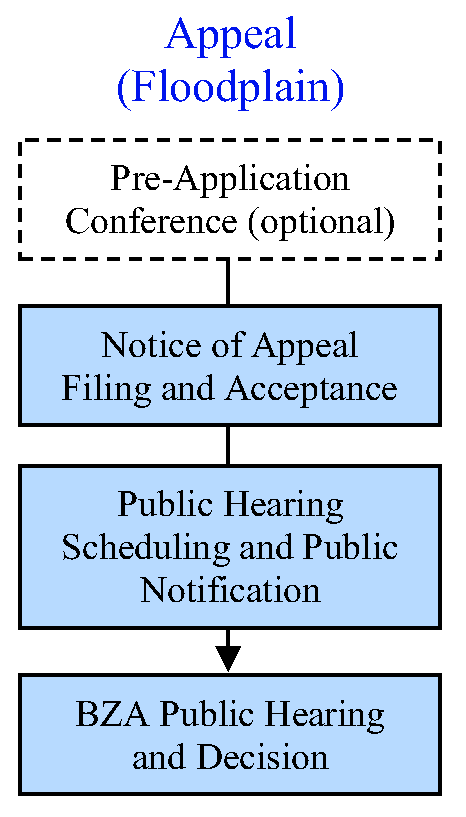
Fig. 83-123(r)
d.
Staff review and action. Applicable (see section 83-130). Upon accepting a notice of appeal application, the administrator shall transmit to the BZA the appeal and the record of material considered by the administrator in making the decision (including but not limited to, for example, provisions of this chapter, the application and support materials, staff report, the comprehensive plan and other plans, documents, reports, and studies considered in making the decision, and any minutes, transcripts, or record of the meetings held to consider and make the decision).
e.
Public hearing scheduling and public notification. Applicable (see section 83-130). The administrator shall provide notice of the public hearing to the applicant for the decision being appealed, if different from the appellant. If the decision being appealed pertains to a particular property, notice also shall be provided to the owner of the property.
f.
Advisory body review and recommendation. Not applicable.
g.
Decision-making body review and decision. Applicable. The public hearing shall be on the record of the appeal, with presentations limited to testimony and arguments on the record of the appeal as it relates to the grounds for appeal specified in the appeal application. Following the public hearing, the BZA shall make a decision on the appeal. The decision shall be based solely on the record of the appeal, as supplemented by arguments presented at the public hearing, and the standards in section 83-123(r)(5), Appeal (floodplain) review standards. The final decision of the BZA shall be one of the following:
1.
Affirmation of the decision (in whole or in part);
2.
Modification of the decision (in whole or in part); or
3.
Reversal of the decision (in whole or in part).
The concurring vote of a majority of the membership of the BZA shall be necessary to reverse the decision being appealed.
(5)
Appeal (floodplain) review standards. A decision by the administrator or other administrative officer shall be presumed correct, and may not be reversed or modified unless there is evidence in the record that the decision is not correct, based on the relevant procedures and standards of this chapter. The BZA shall consider the purpose and intent of any applicable provisions of this chapter and other relevant ordinances, laws, and regulations in making its decision.
(6)
Appeal. Any person jointly or severally aggrieved by any decision of the BZA, or any aggrieved taxpayer or any officer, department, board, or commission of the county, within 30 days of the date of the final decision of the BZA, may appeal the decision of the BZA to the Circuit Court of Powhatan County in accordance with the Code of Virginia.
(7)
Effect. An appeal shall stay all administrative proceedings by the county in furtherance of the action appealed, unless the administrator certifies that a stay would cause imminent peril to life or property, in which case the administrative proceedings shall not be stayed unless a restraining order is granted by the BZA or by the Circuit Court for Powhatan County, on application and on notice to the administrator and for good cause shown.
(s)
Post-disaster temporary dwelling permit.
(1)
Purpose. The purpose of a post-disaster temporary dwelling permit is to allow the establishment of temporary living quarters on the site of a home made uninhabitable by a fire, hurricane, tornado, or other physical disaster while the damaged or destroyed home is being repaired or reconstructed.
(2)
Applicability. A post-disaster temporary dwelling permit is required to authorize the establishment and use of a temporary dwelling pending the repair or reconstruction of a single-family detached dwelling on the same lot that has been damaged or destroyed by a fire, hurricane, tornado, or other physical disaster.
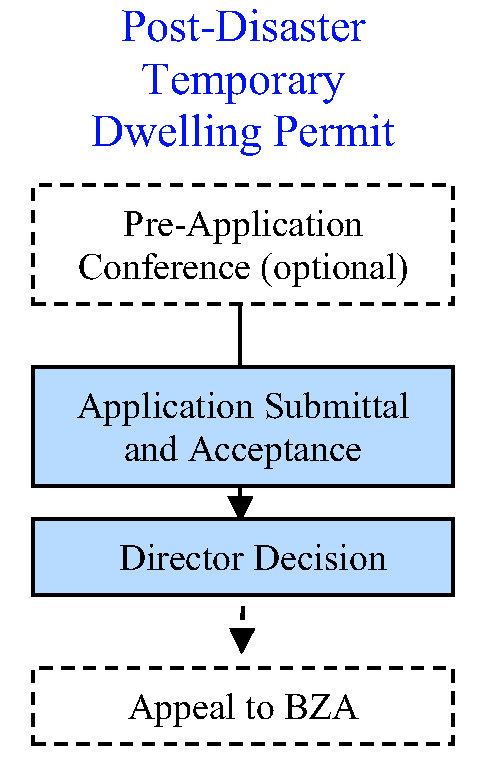
Fig. 83-123(s)
(3)
Post-disaster temporary dwelling permit procedure.
a.
Pre-application conference. Not applicable.
b.
Neighborhood meeting. Not applicable.
c.
Application submittal and acceptance. Applicable (see section 83-122(d)), except that the application may be submitted after establishment of the proposed temporary dwelling in an emergency situation, provided the application is submitted as soon as is reasonably practicable.
d.
Staff review and action. Applicable (see section 83-122(e)). The director shall decide an application in accordance with section 83-122(e)(4), Application subject to decision by director or administrator.
e.
Public hearing scheduling and public notification. Not applicable.
f.
Advisory body review and recommendation. Not applicable.
g.
Decision-making body review and decision. Not applicable.
(4)
Post-disaster temporary dwelling permit review standards. A post-disaster temporary dwelling permit shall be approved upon a finding that the applicant demonstrates:
a.
That a single-family detached dwelling on the same lot has been damaged or destroyed to an extent that it is not inhabitable; and
b.
The temporary dwelling complies with all applicable standards in section 83-445(f), Post-disaster temporary dwelling.
(5)
Notice to adjoining property owners. Within five days after approving a post-disaster temporary dwelling permit, the director shall provide written notice of the approval to the owners of all properties adjoining the property on which the temporary dwelling is approved.
(6)
Expiration.
a.
Approval of a post-disaster temporary dwelling permit shall expire 18 months after its issuance. In no case shall a temporary dwelling be used as the principal dwelling for more than three years unless authorized by a longer time period set forth in a declaration of emergency issued by authorized officials in response to the catastrophe.
b.
The temporary dwelling shall be removed or converted to a use authorized on the lot within 60 days after issuance of the certificate of occupancy for the repaired or reconstructed single-family permanent principal dwelling or expiration of the approval of the temporary dwelling, whichever occurs earlier.
(7)
Appeal. A decision by the director on a post-disaster temporary dwelling permit may be appealed to the BZA (see section 83-123(q), Appeal (zoning)).
(8)
Amendment. Applicable.
(Ord. No. O-2014-12, 6-2-14)
Sec. 83-130. - Public hearing notice.
(a)
Timing of public hearing notification. Public notification of a public hearing on a development application is provided in accordance with the timing shown in the table below for the type of application and the type of notice. In computing the time periods, the day the notice is published, mailed, or posted is not to be included, but the day of the hearing is included.
(b)
Published notice procedures.
(1)
When notice of a public hearing is to be provided, the community development staff is responsible for preparing the content of the notice and ensure publication of the notice in a newspaper of general circulation in the county, in accordance with the requirements of the Code of Virginia.
(2)
The community development staff responsible for preparing the notice will also prepare an affidavit affirming that notice meeting the content requirements of this subsection has been delivered to a newspaper of general circulation in the county. The affidavit is included in the support materials of the application, along with a copy of the published notice.
(3)
A copy of the published notice is maintained in the community development department for public inspection during normal business hours.
(c)
Mailed notice requirements.
(1)
When mailed notice is provided, the community development staff is responsible for preparing the content of the written notice and mailing it, in accordance with the requirements of the Code of Virginia.
(2)
Notice is mailed to:
a.
Those landowners and persons identified in table 83-130: Public Hearing Notification Timing, for receipt of notice for the specific type of development application; and
b.
In the case of a condominium or cooperative, written notice may be mailed to the unit owners' association or proprietary lessees' association, respectively.
(3)
Notice is deemed mailed by its deposit in the United States mail, first class, properly addressed, postage paid, to the last known address of such owner or occupant, as shown on the current real estate tax assessment books or the current real estate tax assessment record.
(4)
The community development staff responsible for preparing the notice will also prepare an affidavit affirming that notice meeting applicable requirements was mailed. The affidavit is included in the support materials of the application.
(5)
A copy of the mailed notice is maintained in the community development department for public inspection.
(Ord. No. O-2014-12, 6-2-14)

