
Powhatan County Unincorporated
City Zoning Code
City Zoning Code
ARTICLE VIII
DEVELOPMENT STANDARDS
Sec. 83-450.- In general.
(a)
This zoning ordinance and the Powhatan County Subdivision Ordinance (County Code chapter 68, Subdivisions) are the county's primary regulatory tools to implement Powhatan County's 2010 Long-Range Comprehensive Plan. These ordinances provide standards that development must meet and therefore are the links between the recommendations of the plan and the resulting development in the county.
(b)
These development standards apply to all districts created and adopted after August 1, 2013.
(Ord. No. O-2013-08, 9-16-13)
Sec. 83-451. - Access and circulation.
See chapter 68 (Subdivisions), Code of Ordinances for standards for vehicular, bicycle, and pedestrian access and circulation.
Except that the following modified development standards shall apply within the 711 Village Special Area Plan in addition to the standards in article VIII: Development Standards.
(1)
Access and circulation.
a.
An existing parcel fronting Route 711 may have a single driveway access connection on Route 711, provided that additional driveway connections on Route 711 may be allowed where the parcel has 625 feet or more of frontage along Route 711 or where a traffic impact analysis demonstrates that proposed additional driveway connections will improve the safety and efficiency of travel along Route 711.
b.
Access to new lots created along Route 711 shall be provided via shared access, service drives, and/or internal subdivision streets.
c.
Residential, commercial, and mixed-use developments shall provide right turn lanes/tapers from Route 711 into the development site that are at least 400 feet long, and shall provide left turn lanes from Route 711 into the development site where recommended by VDOT.
(Ord. No. O-2013-08, 9-16-13; Ord. No. O-2015-06, 5-4-15)
Sec. 83-455. - Off-street parking and loading.
(a)
Purpose and intent. The purpose of this section is to ensure provision of off-street parking and loading facilities in proportion to the generalized parking and loading demand of the different uses allowed by this chapter. The standards in this section are intended to provide for adequate off-street parking and loading while allowing the flexibility needed to accommodate alternative solutions. The standards are also intended to achieve county policies of preservation of rural patterns of growth while supporting development and redevelopment within targeted village growth areas. The standards intend to accommodate appropriate infill development, and encourage pedestrian-oriented development while avoiding excessive paved surface areas, promoting low impact development, and safeguarding historic resources.
(b)
Applicability.
(1)
New development. All new development shall provide off-street parking and loading areas in accordance with the standards of this section.
(2)
Existing development.
a.
Change in use. Except within the Court House Square Center (CHSC) District, any change in use of a legally existing development shall be accompanied by provision of any additional off-street parking and loading spaces required for the change in use to comply with this section to the maximum extent practicable.
b.
Expansion and enlargement. Except within the Court House Square Center (CHSC) District, if an existing structure or use is expanded or enlarged (in terms of the number of dwelling units, floor area, number of employees, seating capacity, or other size unit used in this section to determine the minimum number of off-street parking spaces or loading spaces required for the applicable use), additional off-street parking and loading spaces shall be provided in accordance with the requirements of this section as applied to only the expanded or enlarged part of the structure or use.
(3)
Parking and loading plan required. A parking and loading plan is required for all uses other than agricultural uses and single-family detached and manufactured home dwellings. Such plan may be subject to site plan approval (see site plan provisions of Article II, Administration). The parking and loading plan shall accurately designate the required parking spaces and loading spaces, access aisles, and driveways, and the relation of the off-street parking and loading facilities to the development they are designed to serve, including how the parking and loading facilities coordinate with the vehicular and pedestrian access and circulation systems for the development.
(c)
General standards for off-street parking and loading areas.
(1)
Use of parking and loading areas.
a.
Except as otherwise provided in section 83-438(q), off-street parking and loading areas required by this section may not be used to park or store unlicensed or inoperable motor vehicles or trailers.
b.
Not for display, sale, storage, or servicing. Required parking spaces and loading spaces may not be used for the display of goods for sale, or the sale, lease, storage, dismantling, or service of any vehicles, boats, motor homes, campers, mobile homes, building materials, equipment, or supplies.
c.
Identified as to purpose and location. Off-street parking areas of three or more spaces and all off-street loading areas shall include methods of identifying individual parking spaces and loading spaces and distinguishing such spaces from aisles.
(2)
Surfacing.
a.
Required surfacing.
1.
Except as provided for in subsection (ii) below, all off-street parking and loading areas for new development in village growth area districts shall be surfaced with asphalt, gravel, crushed stone, concrete, brick, stone, pavers, aligned concrete strips, or an equivalent material, or an alternative material authorized in accordance with subsection (b) below. These surfaces shall be maintained in a smooth, well-graded, clean, orderly, and dust-free condition.
2.
Parking and loading areas accessed only by a "private entrance" or "low volume commercial entrance" (as defined by VDOT's access management regulations) shall be surfaced with tar and gravel, or at least six inches of gravel or stone—provided that the perimeter of any graveled parking area is delineated by bumper blocks, railroad ties, timbers or similar treatments to maintain the integrity of the parking area dimensions.
b.
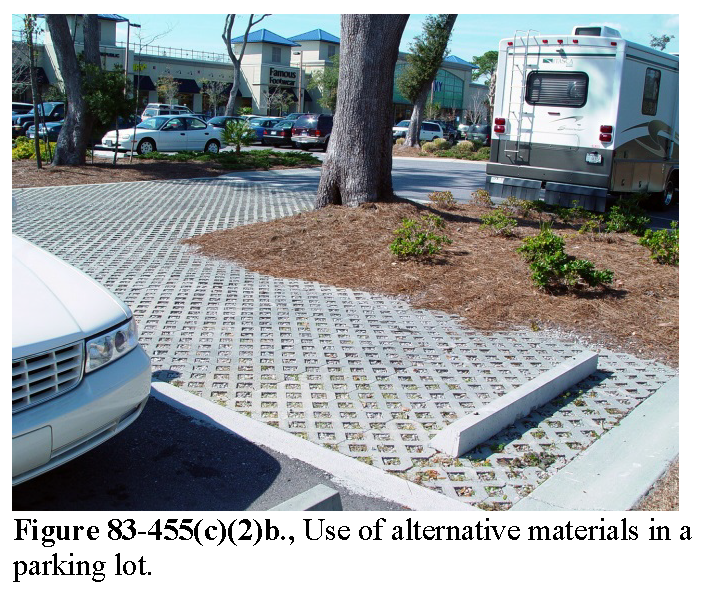
Alternative materials. Pervious or semi-pervious parking area surfacing materials—including, but not limited to, grass, mulch, shell, "grass-crete," or recycled materials such as glass, rubber, used asphalt, brick, block, and concrete—may be used for off-street parking and loading areas on a site, provided such areas are properly maintained and shown on the stormwater management plan. Where possible, such materials should be used in areas proximate to and in combination with on-site stormwater control devices, as shown on the stormwater management plan. (See figure 83-455(c)(2)b., Use of alternative materials in a parking lot.)
(3)
Location and arrangement.
a.
Safe and convenient access.
1.
Off-street parking and loading areas shall be provided with safe and convenient access to and from a street using a driveway entrance that complies with the driveway access and design standards in the vehicular access management provisions of chapter 68 (Subdivisions) of the Code of Ordinances.
2.
Each off-street parking space and loading space shall have adequate, unobstructed means for the ingress and egress of vehicles.
3.
Each off-street parking space and loading space shall be designed so that cars will not back into an egress/ingress lane, if there is only one on a site.
4.
Off-street parking areas with three or more spaces shall be arranged so no parking or maneuvering incidental to parking shall occur on a public street or sidewalk, and so an automobile may be parked or unparked without moving another automobile.
5.
Off-street loading areas shall be arranged so no loading space extends into the required aisle of a parking lot, and so that no vehicle extends into any public or private drive or street used for traffic circulation during the process of loading and unloading.
6.
Off-street loading spaces shall be designed to permit loading and unloading without requiring the moving of any parked motor vehicle.
b.
Backing onto streets prohibited. Except for parking areas serving single-family detached, duplex, individual townhouse, and manufactured home dwellings, all off-street parking and loading areas shall be arranged so that no vehicle is required to back out from such areas directly onto a street.
c.
Placement. The location or placement of off-street parking and loading areas on a development site shall be limited in accordance with the standards of section 83-476, Multifamily and townhouse development standards in village growth area districts; section 83-477, Institutional, commercial, and mixed-use development standards; section 83-480, Large retail establishment standards, and section 83-482, Industrial development standards, as appropriate.
d.
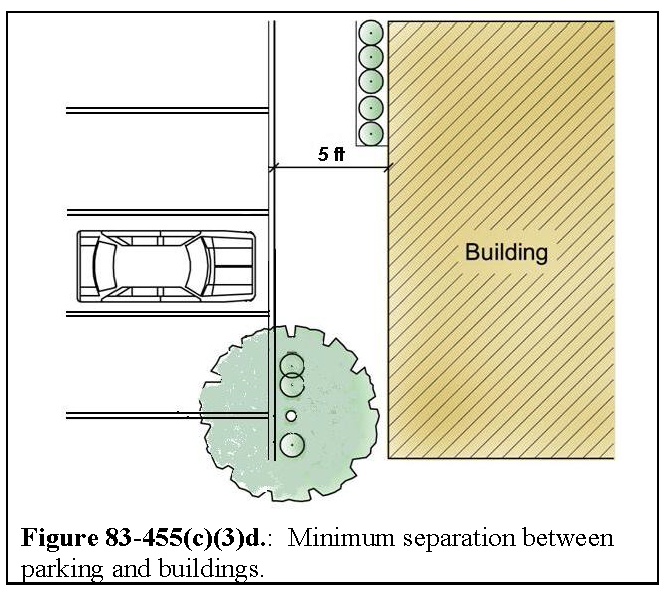
Minimum separation. All off-street parking areas in village growth area districts shall be separated at least five feet from buildings to allow room for pedestrian movement and/or landscaping between the building and the parking area. This separation may be eliminated to the rear of buildings in areas designed for unloading and loading of materials. (See figure 83-455(c)(3)d.: Minimum separation between parking and buildings.)
(4)
Markings.
a.
Except for parking areas serving single-family detached, duplex, individual townhouse, and manufactured home dwellings, each required off-street parking area and space, and each off-street loading area and space, shall be identified by surface markings that are arranged to provide for orderly and safe loading, unloading, parking, and storage of vehicles. Such markings—including striping, directional arrows, lettering on signs and in handicapped-designated areas, labeling of the pavement, and field color—shall be maintained so as to be readily visible at all times.
1.
Spaces in parking areas with concrete and asphalt surfacing shall be marked by durable painted lines.
2.
Spaces in gravel parking lots shall be delineated at the end of the space by an individual block, railroad tie, or timber.
b.
One-way and two-way accesses into required parking facilities shall be identified by directional arrows. Any two-way access located at any angle other than 90 degrees to a street shall be marked with a traffic separation stripe running the length of the access. This requirement does not apply to aisles.
(5)
Drainage. All off-street parking and loading areas shall be properly drained so as to eliminate standing water and prevent damage to abutting land and public streets and alleys, and shall be designed to comply with the requirements of the Powhatan County Erosion and Sedimentation Control Ordinance.
(6)
Exterior lighting. Lighting of off-street parking and loading areas shall comply with the standards of section 83-469, Exterior lighting.
(7)
Landscaping. Off-street parking area shall include landscaping in accordance with the standards of section 83-461, Landscaping and buffers.
(8)
Curbs and motor vehicle stops.
a.
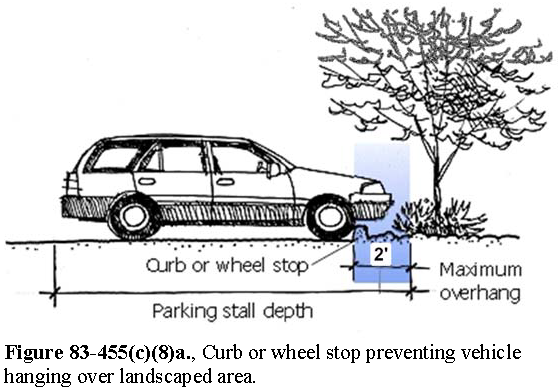
Except for parking areas serving single-family detached, duplex, individual townhouse, and manufactured home dwellings, each off-street parking space shall have curbing or permanently anchored wheel stops to prevent vehicles from overhanging a public right-of-way, sidewalk, walkway, or adjacent property, or from overhanging a landscaped area by more than two feet. (See figure 83-455(c)(8)a., Curb or wheel stop preventing vehicle hanging over landscaped area.)
b.
When the site will utilize depressed landscape islands, rain gardens, or other techniques to accommodate storm water, appropriate design methods shall be utilized to allow storm water to flow into such areas.
(9)
Maintained in good repair.
a.
Maintained at all times. All off-street parking and loading areas shall be maintained in safe condition and good repair at all times so as not to constitute a hazard to public safety or a visual or aesthetic nuisance to surrounding land.
b.
Periodically restored. All off-street parking and loading areas shall be periodically painted or otherwise restored to maintain a clear identification of separate parking spaces or loading spaces
(10)
Completion. All off-street parking and loading areas shall be completed prior to the issuance of a certificate of occupancy for the development they serve. In the case of phased development, off-street parking and loading areas should only be provided for the phase being developed.
(d)
Off-street parking space requirements.
(1)
Minimum number of off-street parking spaces. New development shall provide the minimum number of off-street parking spaces in accordance with table 83-455(d)(1), Minimum number of off-street parking spaces, based on the principal use(s) involved and the extent of development. Interpretation of the off-street parking space requirements for uses with variable parking demands or unlisted uses shall be in accordance with subsection (2), below, Uses with variable parking demand characteristics and unlisted uses.
(2)
Uses with variable parking demand characteristics and unlisted uses. For some listed uses, table 83-455(d)(1), Minimum number of off-street parking spaces, refers to this subsection because the use has widely varying parking and loading demand characteristics, making it difficult to establish a single appropriate off-street parking or loading standard. On receiving an application proposing such a use, or proposing a use not expressly listed in table 83-455(d)(1), the administrator is authorized to:
a.
Apply the minimum off-street parking space requirement specified in table 83-455(d)(1) for the listed use that is deemed most similar to the proposed use; or
b.
Establish the minimum off-street parking space requirement by reference to standard parking resources published by the National Parking Association or the American Planning Association; or
c.
Establish the minimum off-street parking space requirement based on a parking demand study prepared by the applicant that estimates parking demand based on the recommendations of the Institute of Traffic Engineers (ITE) or other acceptable source of parking demand data, and that includes relevant data collected from uses or combinations of uses that are the same or comparable to the proposed use in terms of density, scale, bulk, area, type of activity, and location.
(3)
Multiple use developments. Developments containing more than one principal use shall provide parking spaces in an amount equal to the total of the requirements applied to all individual principal uses. This provision shall not limit the opportunity to reduce the minimum number of required off-street parking spaces through approval of an alternative parking plan that justifies the feasibility of shared parking (see subsection (g), Off-street parking alternatives, below).
(4)
Maximum number of off-street parking spaces. For any use listed under the commercial use classification in table 83-455(d)(1), Minimum number of off-street parking spaces, the number of off-street parking spaces shall not exceed 125 percent of the minimum number of parking spaces required, except as may be allowed through approval of an alternative parking plan in accordance with subsection (g), Off-street parking alternatives, below.
(5)
On-street parking. Except as authorized as part of an alternative parking plan in the on-street parking provisions of subsection (g), Off-street parking alternatives, on-street parking on streets or driveways shall not be used to satisfy the off-street parking standards of this section.
(6)
Driveways used to satisfy requirements. For single-family detached, duplex, individual townhouse, and manufactured home dwellings, driveways may be used to satisfy minimum off-street parking space requirements, provided sufficient space is available to satisfy the standards of this section and this chapter.
(7)
Exemption for existing structures in Court House Square Center District. Legally existing structures as of the effective date of this chapter within the Court House Square Center (CHSC) District are exempt from the parking requirements of table 83-455(d)(1), Minimum number of off-street parking spaces.
(e)
Accessible parking spaces for physically disabled persons. Parking spaces and passenger loading facilities reserved for use by persons with physical disabilities ("accessible parking spaces") shall be provided, located, and designated in accordance with requirements in chapter 11 of the Uniform Statewide Building Code, Volume I.
(f)
Dimensional standards for parking spaces and aisles.
(1)
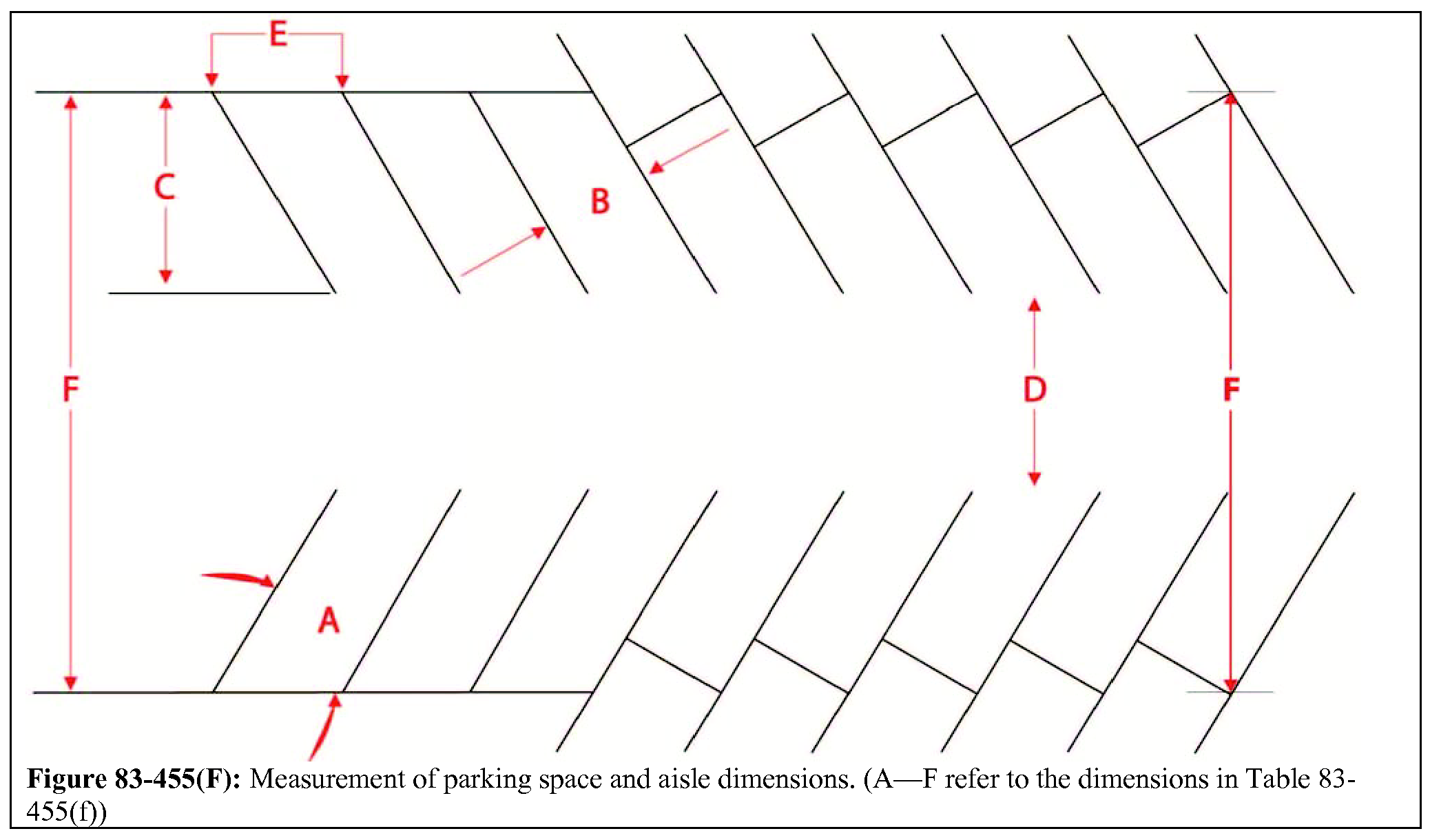
General. Standard vehicle parking spaces and parking lot aisles shall comply with the minimum dimensional standards established in table 83-455(f), Dimensional standards for parking spaces and aisles.
(2)
Compact car spaces.
a.
When allowed. The administrator is authorized to approve the use of compact car parking spaces for up to 20 percent of required parking upon determining that the need for compact car parking spaces is supported by a parking study prepared by the applicant.
b.
Compact space standards.
1.
Each compact car parking space shall be at least eight feet wide and 16 feet deep.
2.
Compact car parking spaces shall be located no closer to the primary building entrance than any standard parking spaces.
3.
Compact car spaces shall be designated by signage and/or pavement marking.
(3)
Vertical clearance. All off-street parking spaces must have a minimum overhead clearance of seven feet.
(g)
Off-street parking alternatives.
(1)
General; alternative parking plan. The administrator is authorized to approve an alternative parking plan that proposes alternatives to providing the minimum number of off-street parking spaces required by table 83-455(d)(1), Minimum number of off-street parking spaces, in accordance with the standards listed below. The alternative parking plan shall be submitted with an application for site plan approval (see Article II, Administration) or zoning compliance permit (see Article II, Administration), as appropriate.
(2)
Provisions over maximum allowed. An alternative parking plan may propose to exceed the maximum number of off-street parking spaces allowed by section 83-455(d)(4), Maximum number of off-street parking spaces, and shall comply with the following standards:
a.
Parking demand study. An alternative parking plan proposing to exceed the maximum number of off-street parking spaces allowed shall include a parking demand study prepared by a qualified traffic engineer demonstrating how the maximum number of parking spaces specified by section 83-455(d)(4), Maximum number of off-street parking spaces, is insufficient for the proposed development.
b.
Minimum amount required. The maximum number of off-street spaces allowed shall be limited to the minimum number of additional spaces recommended as needed by the required parking demand study.
(3)
Shared parking. An alternative parking plan may propose to meet a portion of the minimum number of off-street parking spaces required for a use with shared parking—that is, use of parking spaces to meet the minimum number of off-street parking spaces required for more than one use—in accordance with the following standards:
a.
Maximum shared spaces. Up to 50 percent of the number of parking spaces required for a use may be used to satisfy the number of parking spaces required for other uses that generate parking demands during different times of the day or different days of the week.
b.
Location.
1.
Shared parking spaces shall be located within 500 linear feet of the primary entrances of all uses served, unless remote shuttle bus service is provided.
2.
Shared parking spaces shall not be separated from the use they serve by an arterial or collector street unless pedestrian access across the arterial or collector street is provided by a grade-separated pedestrian walkway or appropriate traffic controls, or remote parking shuttle bus service is provided.
c.
Pedestrian access. Adequate and safe pedestrian access must be provided between the shared parking areas and the primary entrances to the uses served by the parking.
d.
Directional signage. Signage that complies with the standards of this chapter shall be provided to direct the public to the shared parking spaces.
e.
Justification. The alternative parking plan shall include a shared parking plan justifying the feasibility of shared parking. The shared parking plan shall address, at a minimum, the size and type of the uses proposed to share off-street parking spaces, the composition of their tenants, the anticipated peak parking and traffic demands they generate, and the anticipated rate of parking turnover in parking space use.
f.
Recorded agreement.
1.
An approved shared parking plan shall be enforced through written agreement among all owners of record. The agreement shall provide all parties the right to joint use of the shared parking spaces for at least 20 years, and shall ensure that as long as the off-site parking is needed to comply with this chapter, land containing either the off-site parking area or the served use will not be transferred except in conjunction with the transfer of land containing the other. The agreement shall be submitted to the administrator for review and approval. An attested copy of an approved agreement shall be recorded with the office of the clerk of the circuit court before issuance of a zoning compliance permit for any use to be served by the shared parking area.
2.
Any termination of the agreement does not negate the parties' obligations to comply with parking requirements and thus shall constitute a violation of this chapter unless any required parking spaces lost due to the termination have been replaced with parking spaces provided in accordance with this section.
(4)
Off-site parking. An alternative parking plan may propose to meet a portion of the minimum number of off-street parking spaces required with off-site parking—that is, location of off-street parking spaces required for a use on a lot separate from the lot containing the use—and shall comply with the following standards:
a.
Restrictions for certain uses; maximum off-site spaces. Off-site parking may not be used to satisfy the minimum number of off-street parking spaces required for residential uses (except for guest parking), restaurants, convenience stores, or other convenience-oriented uses, and may be used to satisfy no more than 50 percent of the minimum number of off-street parking spaces required for any other use. In addition, required parking spaces reserved for persons with disabilities may not be located off-site.
b.
Zoning classification. The zoning district classification of the off-site parking area shall be the same or a more intensive zoning classification than that required for the use served.
c.
Location.
1.
Off-site parking spaces shall be located within 500 linear feet from the primary entrance of the use served, unless a remote parking shuttle bus service is provided.
2.
Off-site parking spaces shall not be separated from the use they serve by a major arterial street or minor arterial street unless pedestrian access across the street is provided by a grade-separated pedestrian walkway or appropriate traffic controls (e.g., signalized crosswalk), or remote parking shuttle bus service is provided.
d.
Off-site parking agreement.
1.
If land containing the off-site parking area is not under the same ownership as land containing the principal use served, the off-site parking arrangement shall be established in a written agreement between the owners of land containing the off-site parking area and the land containing the served use. The agreement shall provide the owner of the served use the right to use the off-site parking area for at least 20 years. The agreement shall be submitted to the administrator for review and approval. An attested copy of an approved agreement shall be recorded with the office of the clerk of the circuit court before issuance of a zoning compliance permit for any use to be served by the shared parking area.
2.
Any termination of the agreement does not negate the landowner's obligations to comply with parking requirements and thus shall constitute a violation of this chapter unless any required parking spaces lost due to the termination have been replaced with parking spaces provided in accordance with this section.
(5)
Deferred parking. An alternative parking plan may propose to defer construction of up to 30 percent of the number of off-street parking spaces required by table 83-455(d)(1), Minimum number of off-street parking spaces, minimum number of off-street parking spaces, and shall comply with the following standards:
a.
Justification. The alternative parking plan shall include a study demonstrating that because of the location, nature, or mix of uses, there is a reasonable probability the number of parking spaces actually needed to serve the development is less than the minimum required by table 83-455(d)(1), Minimum number of off-street parking spaces.
b.
Reserve parking plan. The alternative parking plan shall include a reserve parking plan identifying:
1.
The amount of off-street parking being deferred;
2.
The location of the area to be reserved for future parking, if future parking is needed.
c.
Parking demand study.
1.
The alternative parking plan shall provide assurance that within 18 months after the initial certificate of occupancy is issued for the proposed development, an off-street parking demand study evaluating the adequacy of the existing parking spaces in meeting the off-street parking demand generated by the development will be submitted to the administrator.
2.
If the administrator determines that the study indicates that the existing parking is adequate, then construction of the remaining number of parking spaces shall not be required. If the administrator determines that the study indicates additional parking is needed, it shall be provided consistent with the reserve parking plan and the standards of this section.
d.
Limitations on reserve areas. Areas reserved for future parking shall be brought to the finished grade and shall not be used for buildings, storage, loading, or other purposes.
e.
Landscaping of reserved areas required. Areas reserved for future off-street parking shall be landscaped with an appropriate ground cover, and if ultimately developed for off-street parking, shall be landscaped in accordance with section 83-461(d), Vehicular use area landscaping.
(6)
Valet and tandem parking. An alternative parking plan may propose to use valet and tandem parking to meet a portion of the minimum number of parking spaces required for a development with commercial uses in accordance with the following standards:
a.
No more than 30 percent of the total number of parking spaces provided shall be designated for valet or tandem spaces.
b.
The development shall provide a designated drop-off and pick-up area. The drop-off and pick-up area may be located adjacent to the building served, but may not be located in a fire lane or where its use would impede vehicular and/or pedestrian circulation or cause queuing in a public street or internal drive aisle serving the development.
c.
Guarantees shall be provided that a valet parking attendant will be on duty during hours of operation of the uses served by the valet or tandem parking.
(7)
On-street parking. An alternative parking plan may propose to meet a portion of the minimum number of off-street parking spaces required for a use with on-street parking spaces, in accordance with the following standards:
a.
The use is located within a village center (VC) or any planned development (-PD) district;
b.
The on-street parking spaces are located along the development site's street frontage or within 150 linear feet of walking distance from the primary entrance of the proposed use;
c.
The on-street parking spaces are not counted towards meeting the off-street parking requirement for any other development;
d.
No more than 25 percent of the off-street parking requirement is met through the use of on-street parking; and
e.
There is no negative impact to existing or planned traffic circulation patterns.
(h)
Stacking spaces for drive-through and related uses.
(1)
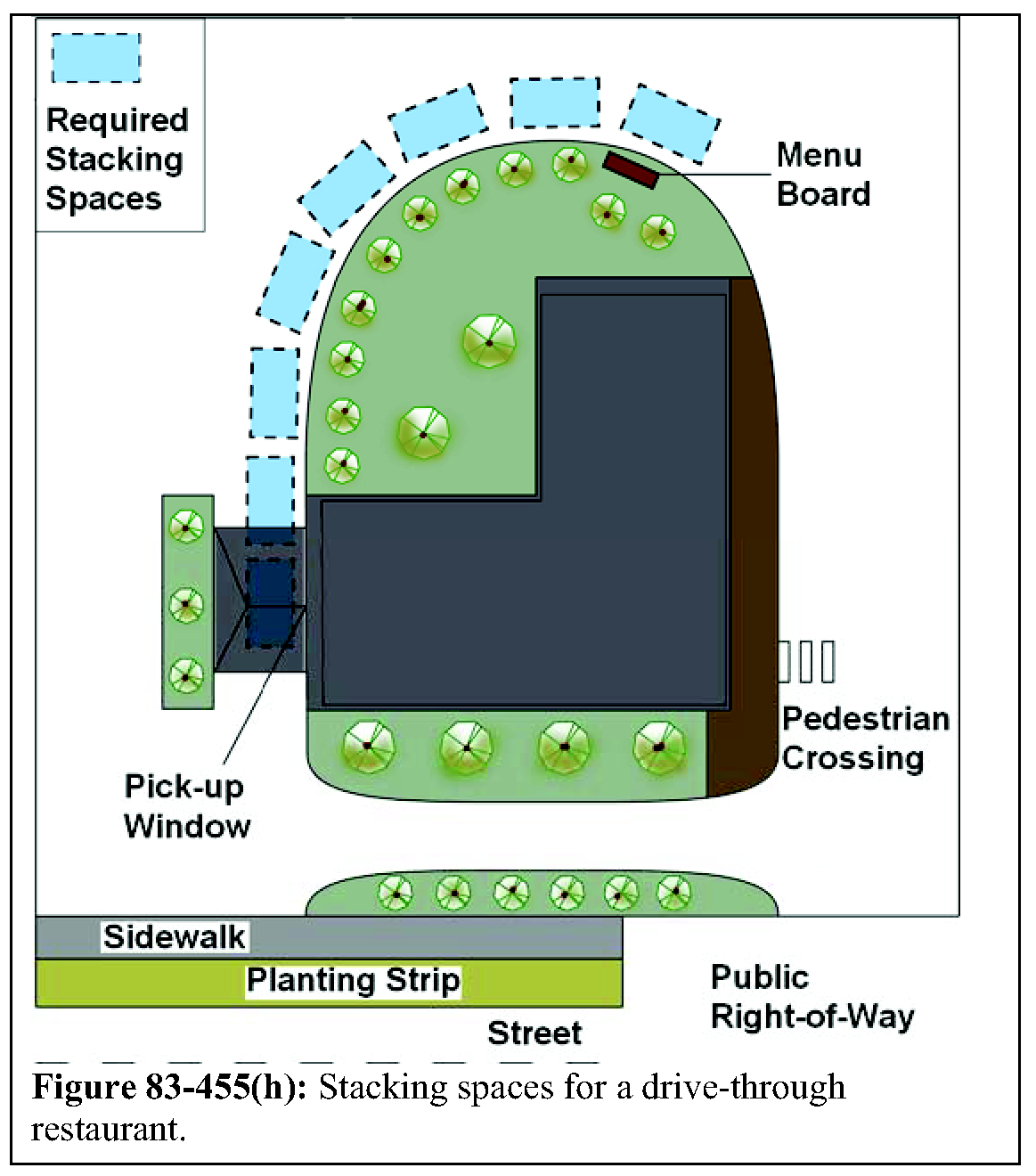
Required number of stacking spaces. In addition to meeting the off-street parking standards in table 83-455(d)(1), Minimum number of off-street parking spaces, uses with drive-through facilities and other auto-oriented uses where vehicles queue up to access a service facility shall provide at least the minimum number of stacking spaces established in table 83-455(h), Minimum stacking spaces for drive-through and related uses.
(2)
Design and layout. Required stacking spaces are subject to the following design and layout standards:
a.
Stacking spaces shall be a minimum of nine feet wide and 16 feet long.
b.
Stacking spaces shall not impede onsite or offsite vehicular traffic movements or movements into or out of off-street parking spaces.
c.
Stacking spaces shall not impede onsite or offsite bicycle or pedestrian traffic movements.
d.
Stacking spaces shall be separated from other internal driveways by raised medians if deemed necessary for traffic movement and safety by the director.
1.
Bicycle parking facilities. The following standards shall apply to new development in village growth area districts:
i.
Bicycle racks required. All parking areas for mixed use developments and within CC District containing more than ten parking spaces shall provide bicycle racks or lockers sufficient to accommodate the parking of at least three bicycles. One additional bicycle space shall be provided for each additional 20 parking spaces. No more than ten bicycle parking spaces shall be required in any one parking area.
ii.
Bicycle rack location. Required bike racks shall be located in visible, well-lit areas conveniently accessible to the primary entrances of a development's principal building(s). They shall be located where they do not interfere with pedestrian traffic and are protected from conflicts with vehicular traffic.
(j)
Loading area standards.
(1)
Minimum number of off-street loading spaces.
a.
New development involving the routine vehicular delivery or shipping of goods, supplies, or equipment to or from the development site shall provide a sufficient number of off-street loading spaces to accommodate the delivery and shipping operations of the development's uses is a safe and convenient manner.
b.
Table 83-455(j)(1), Minimum number of off-street loading spaces, sets forth the minimum number of loading spaces that presumptively satisfies the loading space needs of medium-sized and large-sized delivery/shipping trucks based on the use classification or category of the principal use and the size of the development. It is assumed that the needs of small delivery/shipping trucks can be met with the temporary use of parking spaces or vehicle use areas.
c.
The administrator may require a greater or fewer number of loading spaces than called for by table 83-455(j)(1) upon determining that the characteristics of the particular development warrant such an increase or decrease and the general standard in subsection a. is met.
(2)
Dimensional standards for loading areas.
a.
Each loading space shall be of sufficient size to accommodate the types of delivery/shipping vehicles likely to use the loading area.
b.
The size of a loading space that presumptively satisfies the needs of a medium-sized truck is at least 12 feet wide and 35 feet long, and has at least 13 feet of vertical clearance.
c.
The size of a loading space that presumptively satisfies the needs of a large-sized truck is at least 12 feet wide and 55 feet long, and has at least 14 feet of vertical clearance.
d.
The administrator may require larger or smaller loading spaces than called for by subsections b. and c. above upon determining that the characteristics of the particular development warrant such a variation and the general standard in subsection a. is met.
(3)
Location of loading areas. Where possible, a loading area shall be located to the rear of the principal building(s) it serves. In addition, the loading area shall be located adjacent to the building's loading doors, in an area that promotes its practical use.
(Ord. No. O-2013-08, 9-16-13; Ord. No. O-2015-29, 11-2-15; Ord. No. O-2018-18, 6-25-18; Ord. No. O-2019-20, 4-24-19; Ord. No. O-2021-13, 6-28-21)
Sec. 83-460. - Tree protection.
(a)
Purpose and intent. The purpose and intent of this section is to recognize the importance and contribution of mature trees in Powhatan County. Specifically, the standards in this section are intended to:
(1)
Preserve the visual and aesthetic qualities of the county;
(2)
Encourage site design techniques that preserve the natural environment and enhance the developed environment;
(3)
Provide for a separation of uses and establish a sense of privacy;
(4)
Minimize the impact of incompatible land uses;
(5)
Reduce glare, dust, heat, and noise;
(6)
Preserve and enhance air and water quality;
(7)
Increase slope stability, and control erosion and sediment run-off into waterways;
(8)
Conserve energy by reducing heating and cooling costs; and
(9)
Maintain and enhance the quality of life in the county.
(b)
Applicability.
(1)
General. Except as otherwise provided in subsection (2) below, the standards in section 83-460, Tree protection, shall apply to all new development.
(2)
Exemptions. The following tree removal activities are exempt from the standards of this section:
a.
The removal of dead or naturally-fallen trees;
b.
The removal of diseased trees posing a threat to adjacent trees;
c.
The selective and limited removal of trees or vegetation necessary to obtain clear visibility within sight triangles;
d.
Tree removal activities on individual lots containing single-family detached, duplex, or manufactured home dwellings; and
e.
Tree removal activities associated with agricultural and silvicultural activities.
(c)
General standard. Preservation of existing trees and shrubs shall be maximized wherever practicable. As an incentive, an existing tree or shrub that is protected during construction or site development may be included for credit in accordance with this section.
(d)
Credits for tree protection. Where existing healthy trees are preserved, fully protected during and after development, and incorporated into the landscape plan, the number of tree plantings required by the landscaping provisions shall be reduced within the required landscaped areas according to table 83-460(d), Credits for protected trees.
(e)
Tree and vegetation protection during construction.
(1)
Owner's responsibility. During development, the owner or developer shall be responsible for the erection of any and all barriers necessary to protect any existing or installed vegetation from damage both during and after construction.
(2)
Tree save area.
a.
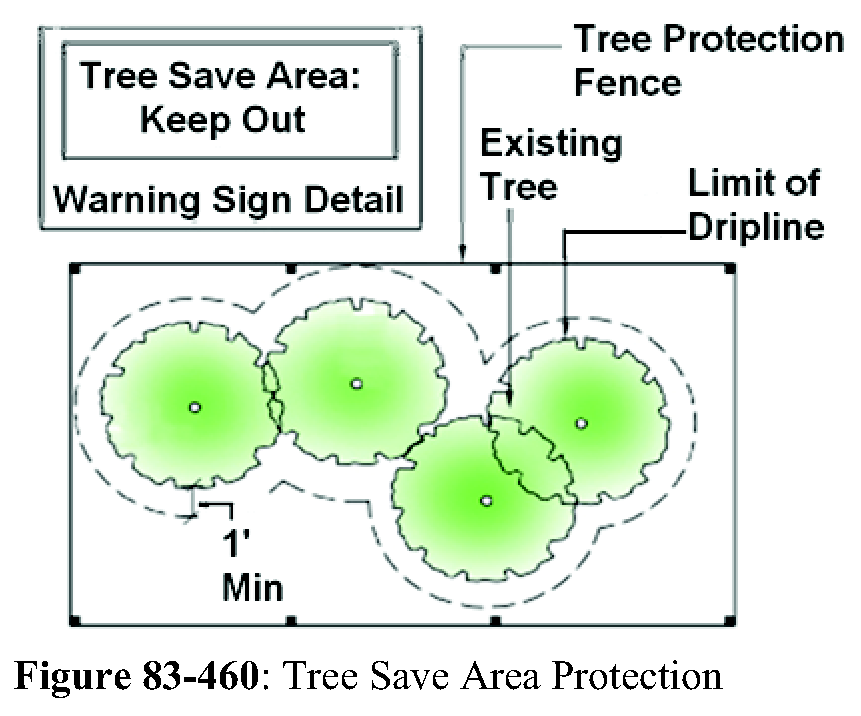
Trees proposed to be preserved or used for credit towards required landscaping shall be surrounded by a tree save area that is protected with fencing, marking, and signage provided in accordance with the standards in this subsections (3) to (7) below.
b.
The tree save area shall generally include all area within and one foot outside the drip lines of the tree(s) to be preserved. The administrator shall consider existing site conditions in determining the exact boundaries of the tree save area.
(See figure 83-460: Tree save area protection.)
(3)
Protective fencing. In or near land areas proposed to be disturbed as part of development activities, the perimeter of the tree save area shall be fenced with a sturdy and visible fence. Such fencing shall be at least four feet high and of durable construction (e.g., chain link, wooden post with two-by-four wire mesh, or metal posts with highly visible (bright orange) construction fencing). Posts shall be located no more than ten feet on-center.
(4)
Protective marking. In areas remote from areas proposed for land disturbance, the perimeter of the tree save area may be fenced in accordance with subsection (3) above or marked with highly visible (e.g., bright orange), continuous, and durable taping (at least four inches wide).
(5)
Signage. Warning signs shall be installed along any required tree protection fencing at points no more than 150 feet apart. The signs shall be clearly visible from all sides of the outside of the fenced-in area. The size of each sign shall be a minimum of two feet by two feet and contain the following language: "TREE SAVE AREA: KEEP OUT."
(6)
Duration of protective fencing, marking. Required protective fencing, marking, and signage shall be erected before any grading or other development activity begins and shall be maintained throughout the period of development activity, until after final site inspection.
(7)
Limits on activity within tree save areas. No construction, grading, equipment or material storage, or any other similar activity shall be allowed within a tree save area.
(Ord. No. O-2013-08, 9-16-13)
Sec. 83-461. - Landscaping and buffers.
(a)
Purpose and intent. It is the purpose of this section to provide for the planting and maintenance of trees, shrubs, and other plants within the county so as to:
(1)
Ensure and encourage the planting, maintenance, restoration and survival of trees, shrubs, and groundcover;
(2)
Ensure the protection of community residents and visitors from personal injury and property damage, and the protection of the county from property damage, caused or threatened by the improper planting, maintenance, or removal of trees, shrubs, or other plants;
(3)
Mitigate against erosion and sedimentation;
(4)
Reduce storm water runoff and associated costs;
(5)
Preserve and protect the water table and surface waters;
(6)
Reduce audible noise from automobiles and land uses;
(7)
Restore soils and land denuded as a result of construction or grading;
(8)
Increase the tree canopy to provide shade and moderate the effect of urban heat islands;
(9)
Limit glare created by exterior lighting;
(10)
Reduce visual pollution from the urban environment and increase privacy between incompatible uses;
(11)
Protect and enhance property values and aesthetic qualities;
(12)
Help differentiate streets and other areas of the public realm from private lands;
(13)
Provide additional improvements to air quality through the carbon dioxide uptake process provided by trees and landscaping; and
(14)
Provide visual screening, where appropriate.
(b)
Applicability.
(1)
General. The requirements in this subsection shall apply to developments and uses that are subject to site plan approval (see Article II, Administration).
(2)
Change in use. Changes in use that require site plan approval (see Article II, Administration), or a change in use of an existing development where an existing use is replaced with a new more intense use (e.g., from a residential use to an institutional use, or from a commercial use to an industrial use), shall be subject to these landscaping standards to the maximum extent practicable.
(3)
Upgrading of nonconforming landscaping. Nonconforming landscaping on the site of a remodeled structure or expanded structure or use area shall comply with the requirements of this section in accordance with the standards of Article IX, Nonconformities.
(4)
Review for compliance. Review for compliance with the standards of this section shall occur during review of an application for a conditional use permit (article II, Administration), site plan approval (article II), or zoning compliance permit (article II), whichever occurs first.
(5)
Landscape plan required.
a.
Uses subject to the standards in this section shall include a landscape plan as a part of any application for a conditional use permit (article II), site plan approval (article II), or zoning compliance permit (article II), as appropriate.
b.
Landscape plans shall include the information specified in Article XIII, Appendix of this Code chapter.
c.
A Virginia certified landscape architect, a certified member of the Virginia Society of Landscape Designers, a certified Virginia Nurseryman with experience preparing planting plans and landscape construction drawings, a land surveyor, or a professional engineer shall prepare a landscape plan required for this section.
(c)
General requirements for landscaping.
(1)
New planting standards.
a.
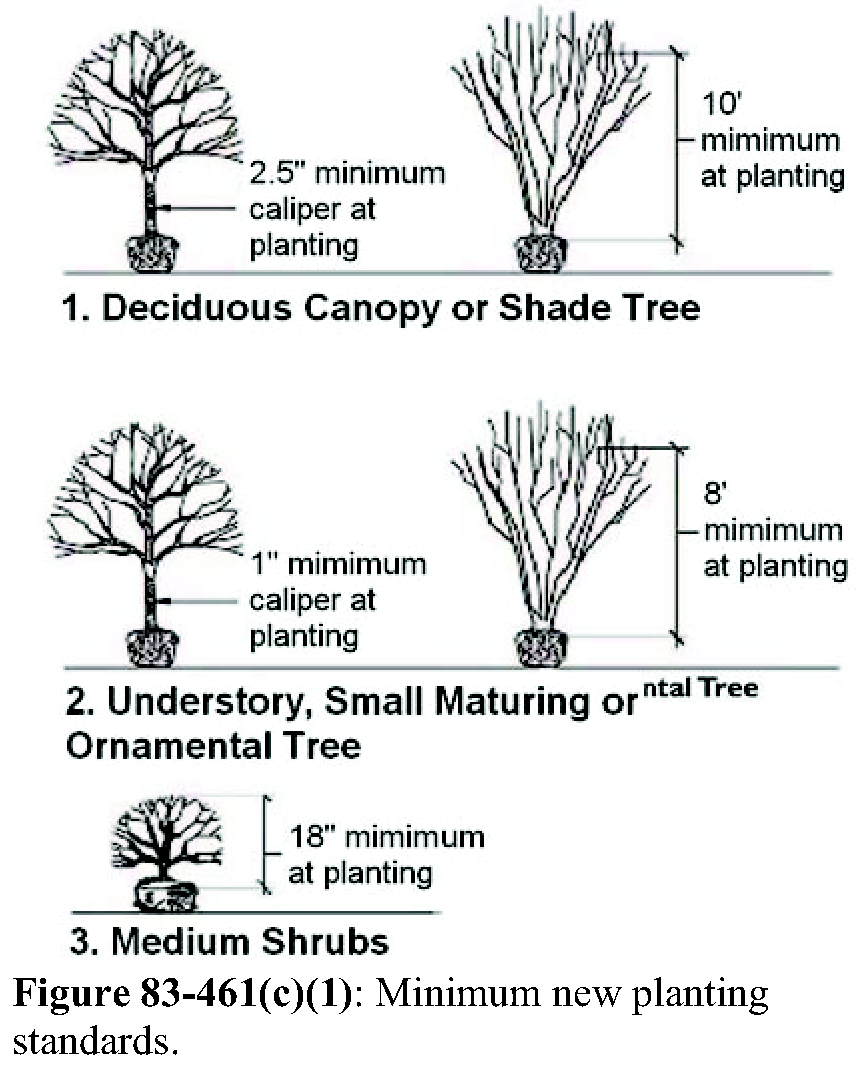
At the time of planting, vegetation included as part of required landscaping shall comply with the size standards.
1.
Deciduous canopy or shade trees shall have a caliper of at least two-and-one-half inches and shall be at least ten feet in height above ground level.
2.
Understory, small maturing, or ornamental trees shall have a caliper of at least one inch and shall be at least eight feet in height above ground level.
3.
Evergreen trees shall be at least six feet in height above ground level.
4.
Shrubs shall be upright in nature and at least 18 inches in height above ground level.
b.
Where application of the requirements in this subsection result in a fraction in the number of shrubs to be provided, the minimum number of shrubs or trees to be provided shall be rounded upwards to the next highest whole number.
c.
All landscape plant materials shall be of standard quality or better, true to name and type of species or variety.
d.
The use of native, drought-tolerant vegetation known to thrive in the Virginia region is strongly encouraged.
e.
Required landscaping areas shall be protected from vehicular damage by the installation of curbing, wheel stops, or extra width in the landscaping strip.
(2)
Existing vegetation. The use of existing healthy, well-formed canopy trees, understory trees, evergreen trees, and shrubs shall be maximized wherever practical to comply with these landscaping standards. The use of existing trees shall be credited towards meeting landscaping standards in accordance with table 83-460(d), Credits for protected trees. Trees, provided the vegetation meets the minimum size standards of this chapter, and is protected before and during development of the site in accordance with section 83-460(e), Tree and vegetation protection during construction, and maintained thereafter in a healthy growing condition.
(3)
Stabilization. All required landscape planting areas shall be stabilized and maintained with turf, ground covers, mulches, or other approved materials to prevent soil erosion and allow rainwater infiltration.
(4)
Easements. Nothing except groundcover shall be planted or installed within any underground or overhead utility, drainage or gas easement, or within three feet of a fire protection system, without the consent of the utility provider, easement holder, or the county, as appropriate.
(d)
Vehicular use area landscaping.
(1)
Applicability. The vehicular use areas of developments shall include landscaping both within the interior of the vehicular use area and around its perimeter as a means of mitigating the parking area's microclimate and visual impacts.
(2)
Use for stormwater management. Perimeter landscaping strips and interior planting islands may be used for stormwater management purposes as long as the landscaped areas are designed as site amenities and comply with these vehicular use area landscaping standards.
(3)
Perimeter landscaping strips. Where a vehicular use area abuts a street right-of-way, vacant land, or any other development (except another vehicular use area), a perimeter landscaping strip shall be provided and maintained within the strip of land between the vehicular use area and the abutting right-of-way or property line in accordance with the following standards, except where such strip is crossed by an authorized vehicular or pedestrian access way:
a.
Location and configuration. Perimeter landscaping strips shall be located on the same property as the vehicular use area and placed to assure visibility and safety of pedestrians on the street and within the vehicular use area.
b.
Composition. Perimeter landscaping strips shall be comprised of:
1.
Canopy trees spaced between 40 and 50 feet on center, provided that understory trees spaced between 20 and 30 feet on center may be substituted for canopy trees in areas beneath overhead utilities or exterior lighting fixtures; and
2.
Evergreen shrubs planted to form a continuous, opaque hedge along the perimeter of the vehicular use area, provided that:
i.
A solid masonry wall or opaque ornamental fence may be substituted for all or part of the required hedge; and
ii.
Any hedge or wall abutting a street shall be maintained at a maximum height of three feet above the elevation of the adjacent vehicular use area to allow security surveillance of parking areas; and
3.
Ground cover or grass planted in all areas not covered by trees, shrubs, or walls.
c.
Width. The perimeter landscaping strip shall be a least six feet wide.
d.
Credit towards perimeter buffers. Perimeter landscaping strips associated with a vehicular use area may be credited towards perimeter buffer standards (see section 83-461(e), Perimeter buffers).
(4)
Interior landscaping standards. Vehicular use areas, except those outside village growth area districts and containing 15 or fewer parking spaces, shall provide and maintain landscaped planting areas within the interior of the vehicular use area in accordance with the standards in this subsection. These standards shall not apply to parking structures or vehicle display areas.
a.
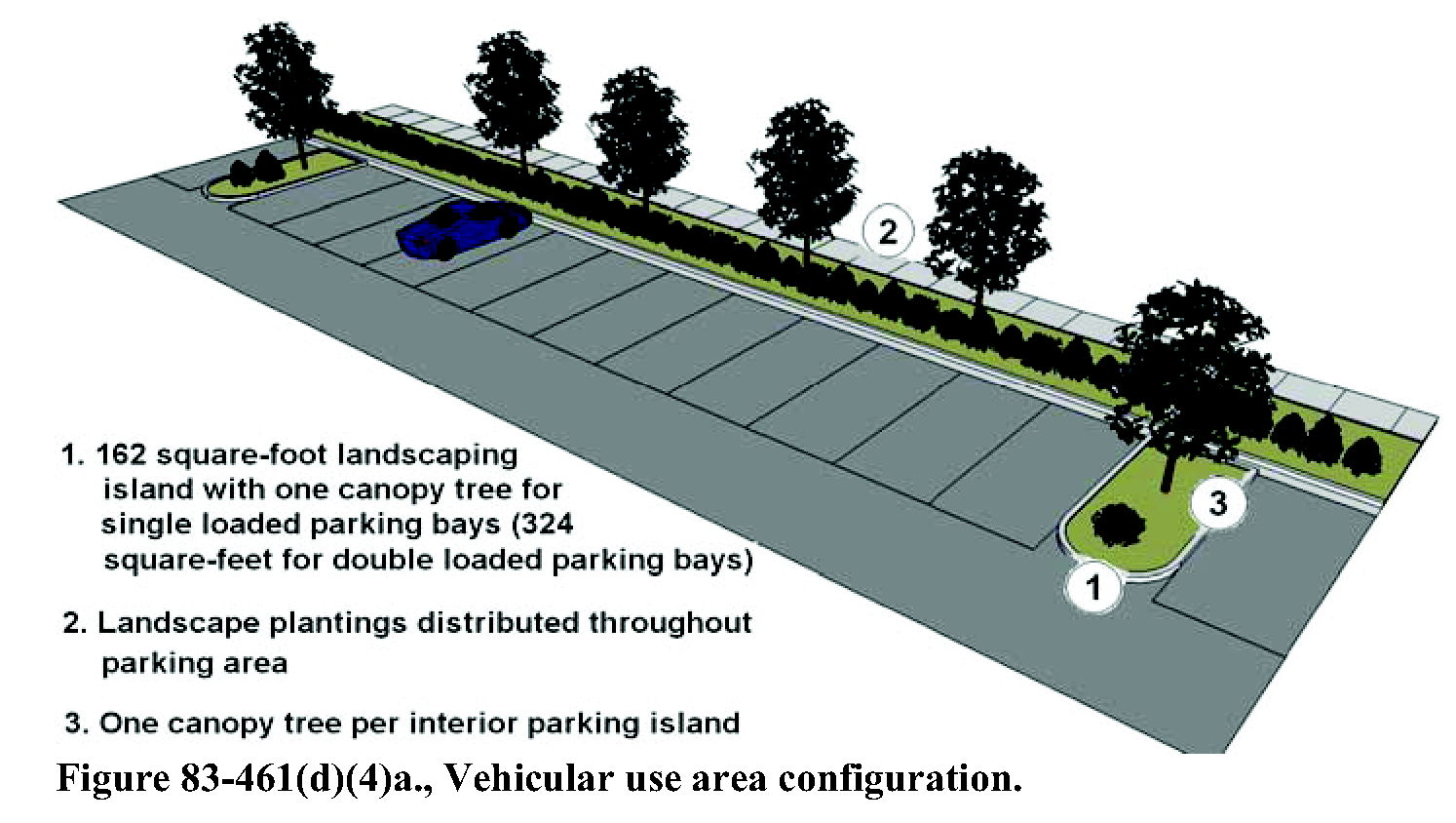
Configuration. Vehicular use areas shall include interior planting areas designed in accordance with the following standards (see figure 83-461(d)(4)a., Vehicular use area configuration):
1.
Interior landscaping area shall include at least 16 square feet of area per parking space in the vehicular use area.
2.
Planting islands shall be provided to separate at least every three abutting parking bays and at the end of each row of parking spaces. Where a row of parking spaces contains more than 20 spaces, planting islands shall be provided at a spacing no greater than one island at the end of every 15 contiguous parking spaces.
3.
Planting islands at the ends of single loaded parking bays shall be at least 162 square feet in area. Planting islands at the ends of double-loaded bays shall be at least 324 square feet in area. The minimum width of planting islands shall be nine feet.
4.
Each planting island shall contain at least one canopy tree, with the remainder of the island landscaped with trees, shrubs, or groundcover, and material such as mulch. Understory trees may be substituted for canopy trees in areas underneath overhead utilities or exterior lighting fixtures.
5.
Planting islands and required canopy trees shall be distributed and sited so as to maximize shading of pavement and pedestrian routes through the parking area.
b.
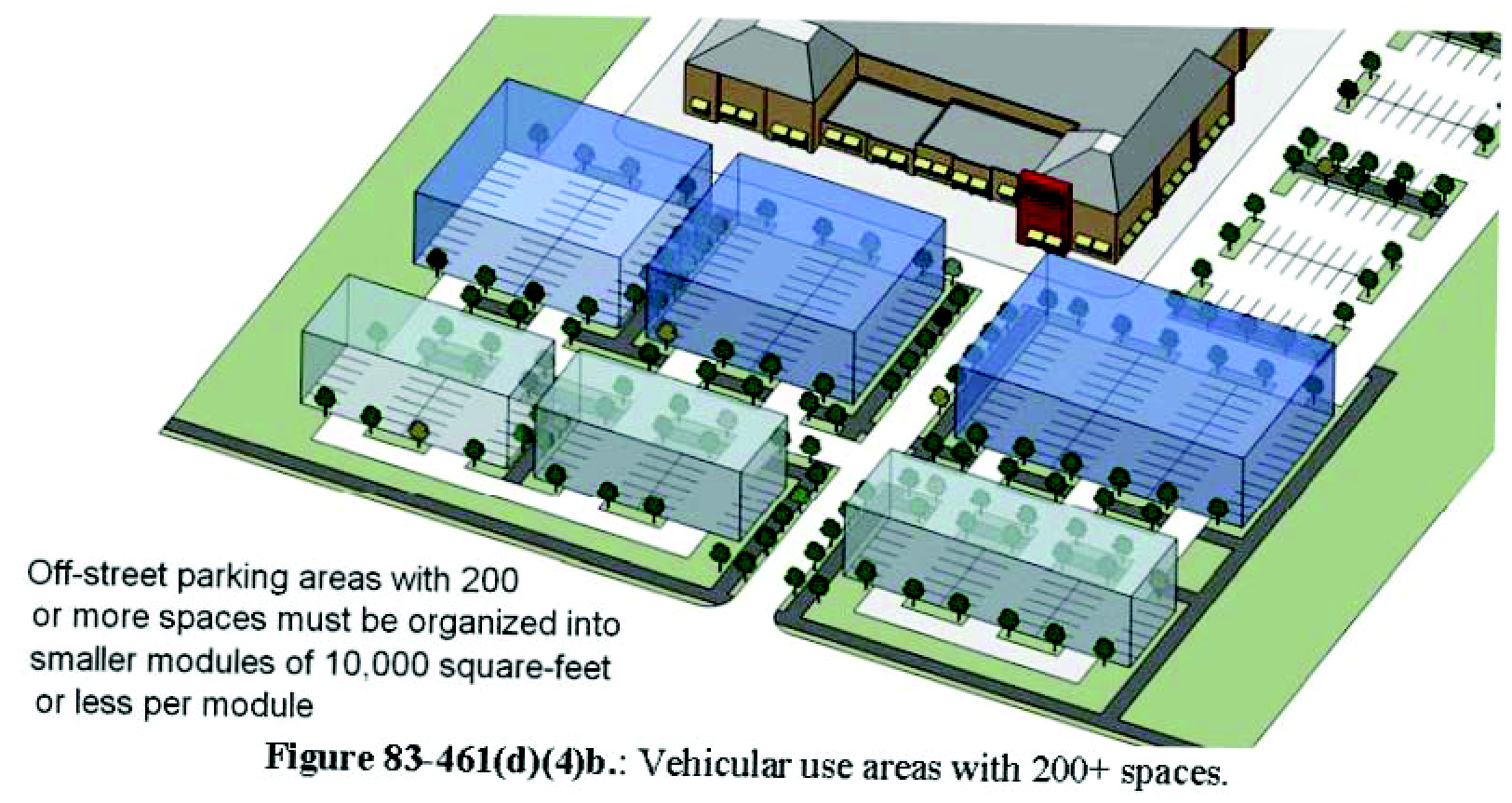
Areas with 200 or more spaces. Vehicular use areas with 200 or more parking spaces shall be organized into a series of smaller modules of 10,000 square feet or less per module, and be visually separated by continuous landscaped areas. (See figure 83-461(d)(4)b.: Vehicular use areas with 200+ spaces.)
 |
(e)
Perimeter buffers.
(1)
Purpose and intent. Perimeter buffers are intended to mitigate potential negative effects of contiguous uses in different zoning districts to provide basic screening between different types of development.
(2)
Applicability. Development shall provide a perimeter buffer to separate it from a less intense existing use on abutting land, or from vacant abutting land located in a less intense zoning district, in accordance with table 83-461(e)(3), Buffer types and table 83-461(e)(4), Buffer type application.
(3)
Buffer types. Table 83-461(e)(3), describes three different types of perimeter buffers in terms of their function, opacity, width, and planting requirements.
| Table 83-461(e)(3): Buffer Types | ||
|---|---|---|
| Buffer Type and Function | Minimum Width and Screening Requirements 1, 2, 3 | |
| Option 1 | Option 2 | |
| Type A — Basic Buffer | ||
| This perimeter buffer functions as a basic edge demarcating individual properties with a slight visual obstruction from the ground to a height of ten feet. | ||
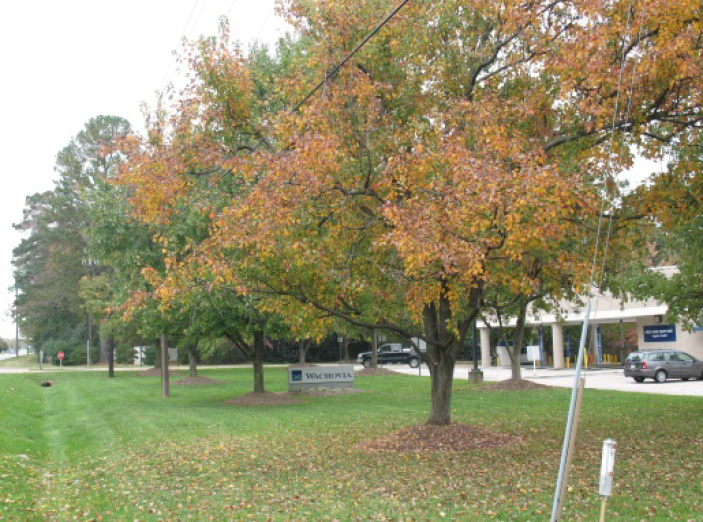 |
8 feet wide
+ 2 canopy trees per 100 linear feet + 4 understory trees per 100 linear feet + 10 shrubs per 100 linear feet |
25 feet wide
+ 1 canopy tree per 100 linear feet + 2 understory trees per 100 linear feet + 6 shrubs per 100 linear feet |
| Type B — Intermittent Buffer | ||
| This perimeter buffer functions as an intermittent visual obstruction from the ground to a height of at least 20 feet, and creates the impression of spatial separation without significantly interfering visual contact. | ||
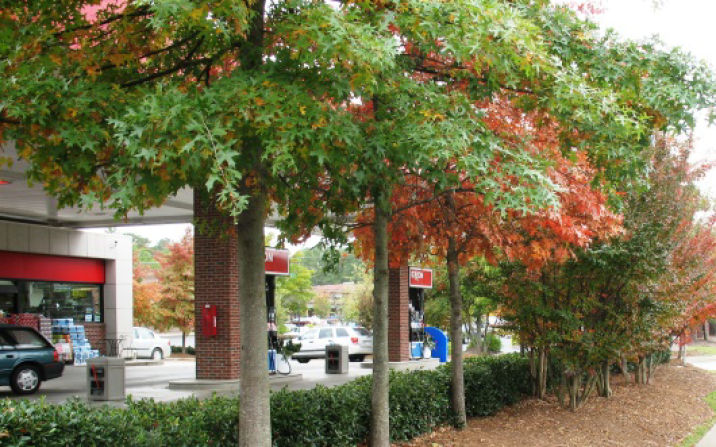 |
15 feet wide
+ 4 canopy trees per 100 linear feet + 7 understory trees per 100 linear feet + 12 shrubs per 100 linear feet |
40 feet wide
+ 2 canopy trees per 100 linear feet + 4 understory trees per 100 linear feet + 8 shrubs per 100 linear feet |
| Type C — Opaque Buffer | ||
| This perimeter buffer functions as an opaque screen from the ground to a height of at least six feet. This type of buffer prevents visual contact and creates a strong impression of total separation. | ||
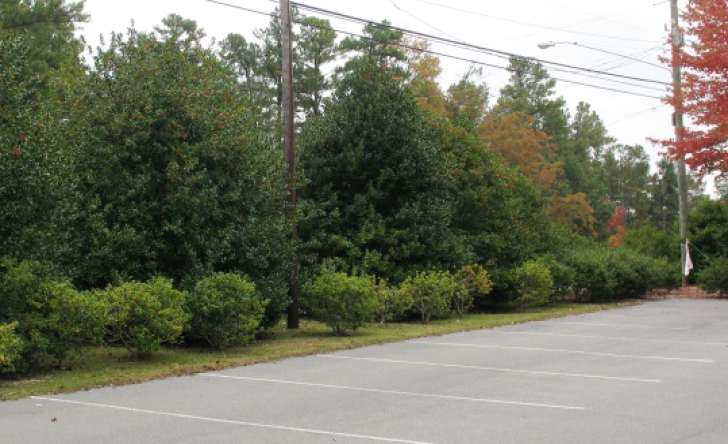 |
30 feet wide
+ 4 canopy trees per 100 linear feet + 5 understory trees per 100 linear feet + 14 evergreen shrubs per 100 linear feet + A solid fence or wall at least 6 feet high or a solid evergreen hedge at least 6 feet high and 3 feet wide |
65 feet wide
+ 4 canopy trees per 100 linear feet + 6 understory trees per 100 linear feet + 11 evergreen trees per 100 linear feet + 22 shrubs per 100 linear feet |
|
Notes:
1. Required canopy trees shall generally be distributed evenly along the length of the buffer (e.g., 4 canopy trees per 100 linear feet should result in canopy trees spaced approximately every 25 feet of buffer length) and spaced to maximize their future health and effectiveness. Other required vegetation shall be distributed within the buffer as appropriate to the function of the buffer. 2. Where an adjacent use is designed for solar access, understory trees can be substituted for canopy trees. 3. Fences or walls within a perimeter buffer shall comply with the standards of section 83-466, Fences and walls. | ||
(4)
Buffer type application. Table 83-461(e)(4), Buffer type application, specifies the type of perimeter buffer that new development shall provide between it and adjacent property, based on the proposed use type on the development site and the existing use type on the abutting property, the zoning district in which abutting vacant property is located, or whether there is an abutting street. The type of buffer to be provided is indicated by a letter corresponding to one of the three buffer types depicted in table 83-461(e)(3), Buffer types.
(5)
Alternative configuration. Applicants may propose an alternative perimeter buffer location, width, or planting configuration through submittal of an alternative landscape plan (section 83-462, Alternative landscape plan).
(6)
Development within required perimeter buffers.
a.
The required perimeter buffer shall not contain any development, impervious surfaces, or site features (except fences or walls or landscaped stormwater features) that do not function to meet the standards of this section or that require removal of existing vegetation or any grading or construction to take place, unless otherwise permitted in this chapter.
b.
Sidewalks, trails, and other elements associated with passive recreation may be placed in perimeter buffers if all required landscaping is provided and damage to existing vegetation is minimized to the maximum extent practicable.
c.
Overhead and underground utilities required or allowed by the county are permitted in perimeter buffers, but shall minimize the impact to vegetation to the maximum extent practicable. Where required landscaping material is damaged or removed due to utility activity within a required buffer, the landowner shall be responsible for replanting all damaged or removed vegetation necessary to ensure the buffer meets the standards in this chapter.
(f)
Corridor buffers.
(1)
Purpose and intent. Corridor buffers are intended to help retain the historic and natural character of Powhatan County by reducing the visual impacts of parking areas, buildings, and structures and protecting, preserving, and enhancing the area's natural wooded character.
(2)
Applicability. Commercial, institutional, and mixed-use development within the R-U, R-C, C, O, CC, I-1, and I-2 zoning districts shall provide a corridor buffer along roads designated as major thoroughfares in the comprehensive plan.
(3)
Buffer width, planting requirements, and arrangement. The design of the corridor buffer shall meet the following requirements:
a.
The corridor buffer shall be at least 30 feet in width and located adjacent to the right-of-way of major thoroughfares. Where utility easements are adjacent to the right-of-way or in close proximity to the right-of-way, the corridor buffer shall be measured from the edge of said utility easement that is farthest from the right-of-way.
b.
At a minimum, the corridor buffer shall include at least two canopy trees per 100 linear feet of road frontage, one evergreen tree per 100 linear feet of road frontage, two understory trees per 100 linear feet of road frontage, and six shrubs per 100 linear feet of road frontage. Upon written request of the applicant and at the discretion of the director, these requirements may be modified, if there are overhead utilities or other infrastructure that could be negatively impacted by the planting of trees and shrubs.
c.
Natural-appearing landscape forms are strongly encouraged. Straight rows of plantings are discouraged and trees, shrubs, flowering plants, and other material types shall be interspersed within one another.
d.
Canopy trees located within 30 feet of the edge of the right-of-way may be credited towards street tree requirements established in this subsection and Chapter 68 (Subdivision Ordinance).
(4)
Preservation of existing mature trees. Existing healthy trees 12 inches or more in diameter measured at breast height (four and one-half feet from ground level) shall not be removed from within the required corridor buffer unless:
a.
Removal of the existing mature tree(s) is necessary to accommodate necessary entrances and utilities and/or preservation of the tree would create or perpetuate demonstrable hazards to public health, safety, or welfare, as determined by the director in writing; or
b.
The applicant requests removal of an existing mature tree(s) and the director determines, in writing, that removal of the tree(s) will not negatively impact the character of the area. Each existing mature tree removed shall be replaced by at least two canopy trees that each have a caliper of three inches at the time of planting.
Existing healthy trees that are preserved will be able to receive credit towards planting requirements, in accordance with Table 83-460(d).
(5)
Consistency with corridor buffers on adjacent properties. To help create a cohesive streetscape, the corridor buffer shall incorporate some of the plant species and design elements used within the approved corridor buffers of adjacent properties.
(6)
Reductions in width. At the discretion of the director, the minimum width of the required corridor buffer may be reduced to 15 feet in width if two or more of the following conditions are satisfied:
a.
Parking areas are located away from public view behind buildings or screened by other architectural features, such as a decorative brick wall or fence that adheres to standards set forth in section 83-466;
b.
Innovative grading and/or existing topography screen parking areas from view;
c.
Pedestrian amenities that exceed the minimum ordinance requirements, such as the use of brick pavers, decorative street lighting, and/or decorative benches and street furniture, are provided between the principal building and adjacent roadways;
d.
The only freestanding signage permitted within the development, either through deed restrictions and/or proffered conditions, are monument signs no more than eight feet in height with features that compliment nearby architecture and incorporate brick and/or stone into their base.
In approving the reduction request, the director may require additional plantings beyond the minimum ordinance requirements; alter the mixture of plant types provided; and/or specify the type of plantings to be used to ensure that the corridor buffer provides adequate screening and reflects the character of the surrounding area.
(g)
Foundation plantings.
(1)
Purpose and intent. Foundation plantings are intended to soften the visual impact of building foundations and provide for the even dispersal of shrubs along building facades facing streets. They consist of evergreen and deciduous shrubs planted around a building's foundation to help soften its appearance.
(2)
Foundation planting required. New development requiring site plan approval shall plant evergreen or deciduous shrubs along any building foundations facing a street. This requirement shall not apply to a building foundation constructed along or within one foot of the street right-of-way boundary.
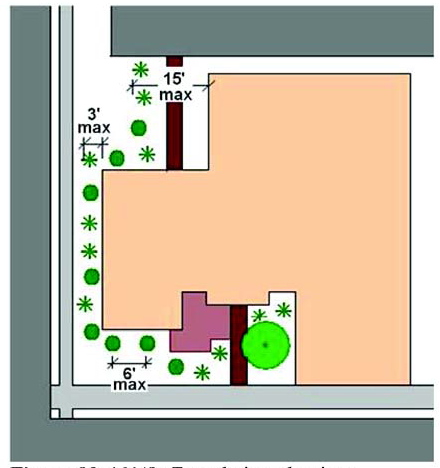
Figure 83-461(g), Foundation planings.
(3)
Foundation planting standards.
a.
Required shrubs shall be planted within three feet of the building foundation. If a street sidewalk is located between the building foundation and the street, required shrubs may be planted up to 15 feet from the foundation.
b.
Required shrubs shall maintain a maximum on-center spacing of six feet, and be evenly-distributed along foundation walls.
c.
Required shrubs may be planted in the ground, within planters, or in decorative pots. (See figure 83-461(g), Foundation plantings.)
(h)
Street trees. See chapter 68 (Subdivisions) of the Code of Ordinances for standards for street trees.
(i)
Other landscaping standards.
(1)
Time for installation of required landscaping.
a.
All required landscaping (including groundcover) shall be installed in accordance with the required planting standards set forth in this section prior to issuance of a certificate of occupancy.
b.
The certificate of occupancy may be issued prior to the completion of the landscaping if the owner or developer provides the county a performance guarantee that ensures completed installation of the required landscaping, in accordance with the performance guarantees provisions of chapter 68 (Subdivisions) of the Code of Ordinances. The director may, for good cause shown, grant extensions to the above time limit to allow a delay in the installation of required landscaping. Circumstances that may warrant an extension include, but are not limited to, the following:
1.
Unusual environmental conditions, such as drought, hurricanes, or over-saturated soil (deep mud);
2.
The inappropriateness of the current season for planting the approved plant species (in which case the approved plant species shall be planted during the next planting season); or
3.
Utility work occurring in a proposed landscaped area that is incomplete or delayed.
(2)
Maintenance of landscaping materials.
a.
The owner shall be responsible for maintaining all required landscape areas and landscaping materials in accordance with the approved landscape plan or alternative landscape plan and the standards of this section.
b.
Required landscaping shall be maintained in a healthy condition and landscape areas shall be kept in an orderly appearance, free from refuse and debris.
c.
All required trees shall be maintained in their characteristic natural shape and shall not be severely pruned, sheared, topped, or shaped as shrubs. Trees that have been severely pruned, sheared, topped, or shaped as shrubs no longer serve the intended buffering or screening function and shall be considered as damaged vegetation in need of replacement.
d.
Actions shall be taken to protect required trees and landscaping from unnecessary damage during all facility and site maintenance operations.
e.
Plants shall be maintained in a way that does not obstruct sight visibility within sight triangles at roadway and driveway intersections, obstruct traffic signs or devices, or interfere with the use of bikeways, sidewalks, or pedestrian trails.
f.
Landscaping may be altered through replacement or relocation by a maximum of ten percent over the life of the project without submittal of a revised landscaping plan provided that the overall landscaping remains in compliance with this section. A revised plan shall not be required for plantings that exceed the requirements of this section.
g.
If landscaping materials required to meet the standards of this section die, are seriously damaged, or removed, they shall be replaced with landscaping materials meeting the standards of this section during the next growing season. In determining the extent of replacement required, the administrator shall consider the type and location of the required landscaping materials as well as the propensity for natural re-vegetation.
h.
All initial and replacement landscaping shall be subject to a two-year performance guarantee that ensures proper maintenance and replacement, in accordance with the performance guarantees provisions of chapter 68 (Subdivisions) of the Code of Ordinances.
i.
The county staff shall inspect the plantings required by these landscaping and buffer standards one year after their installation or the issuance of the certificate of occupancy, whichever occurs later, to assure the survival of such plantings.
(3)
Coordination of landscaping within shopping centers and industrial and office parks. Landscaping for individual parcels in shopping centers and industrial and office parks shall be designed to coordinate with the types of plantings in the overall project.
(Ord. No. O-2013-08, 9-16-13; Ord. No. O-2015-06, 5-4-15; Ord. No. O-2019-09, 2-25-19)
Sec. 83-462. - Alternative landscape plan.
(a)
General. An alternative landscape plan may be approved where a deviation from the standards in section 83-460, Tree protection, section 83-461, Landscaping and buffers, is justified because of site or development conditions that make strict compliance with such standards impossible or impractical. An alternative landscape plan shall indicate how the proposed deviations are justified by site or development conditions and illustrate how compliance with the standards of this section can be achieved to the maximum extent practicable. Conditions justifying approval of an alternative landscape plan may include:
(1)
Natural conditions, such as watercourses, natural rock formations, or topography;
(2)
The likelihood that landscaping material would be ineffective at maturity due to topography, placement, or other existing site conditions;
(3)
Lot size or configuration;
(4)
Infill development or redevelopment on small lots;
(5)
The presence of utility or other easements;
(6)
The potential for interference with public safety; and
(7)
Other situations where strict adherence to the landscaping or tree protection standards in this chapter are determined to be impractical by the administrator.
(b)
Submittal and review. An applicant may submit an alternative landscape plan as part of an application for a conditional use permit (article II, Administration), site plan approval (article II), or zoning compliance permit (article II), as appropriate. The director shall approve an alternative landscape plan if it meets the purpose and intent of the tree protection standards in section 83-460, Tree protection, and the landscaping standards in section 83-461, Landscaping and buffers, as appropriate.
(c)
Allowable deviations. Allowable deviations from the tree protection standards in section 83-460, and the landscaping standards in section 83-461 include, but are not limited to, the following:
(1)
Reduced planting rates due to public facilities. An adjustment to planting locations or reduction of up to 20 percent in the total number of required trees or shrubs may be allowed when underground connections to public facilities or public utilities, or public easements or rights-of-way, are located upon or in close proximity to the parcel.
(2)
Reduction in standards due to nature of parcel. A reduction in the count or spacing standards by up to 20 percent may be allowed when desirable in terms of enhanced protection of existing natural resources, greater consistency with the goals of the comprehensive plan, or a site design that exceeds the quality of what would otherwise result under a strict application of the standards in this chapter.
(3)
Reduction in standards due to site size. A reduction in the count, configuration, or location of required landscaping materials may be allowed in cases where a lot is nonconforming in terms of dimensional requirements or yard depths, or in cases of redevelopment on existing small lots not capable of supporting the minimum amount of landscaping material required.
(4)
Upgrading of nonconforming landscaping. An adjustment to planting locations or spacing may be allowed in conjunction with an upgrading of nonconforming landscaping in accordance with the nonconforming site features provisions of Article IX, Nonconformities.
(Ord. No. O-2013-08, 9-16-13)
Sec. 83-465. - Screening.
(a)
Screening of mechanical equipment.
(1)
Applicability. The following exterior mechanical equipment and similar features shall be screened from view from adjacent streets and properties in accordance with the standards of this subsection:
a.
Electrical and gas-powered mechanical equipment and power systems equipment (e.g., permanent electrical generators, refrigeration equipment and ductwork, swimming pool pumps, back-flow prevention devices); and heating, ventilating, and air conditioning equipment, tanks, and ductwork (e.g., air conditioning condensers and compressors, heat pump condensers and evaporators, bottled gas tanks).
b.
Roof or wall-mounted antennas, vent openings, tower and blades or a small wind energy system, or the solar panels or modules of a solar energy collection system shall not be considered exterior mechanical equipment for purposes of these screening standards.
(2)
Screening standards.
a.
Roof-mounted mechanical equipment. Mechanical equipment mounted on the roof of a building shall be screened by a parapet wall, roof screen, or similar device that is integrated into the building's building form and of a height equal to or greater than the height of the mechanical equipment being screened.
b.
Ground-mounted mechanical equipment. Mechanical equipment mounted on or near ground-level shall be screened by any combination of sight-obscuring dense evergreen vegetation or decorative walls or fences that incorporates at least one of the primary materials or colors of the nearest wall of the primary structure on the lot. The height of the vegetation, wall, or fence shall equal or exceed that of the mechanical equipment being screened.
(b)
Screening of off-street loading and service areas.
(1)
All off-street loading areas and services areas (e.g., refuse or recyclables collection area, equipment cleaning area) shall be located and designed to reduce the adverse visual and acoustic impacts of their use on adjacent streets and properties.
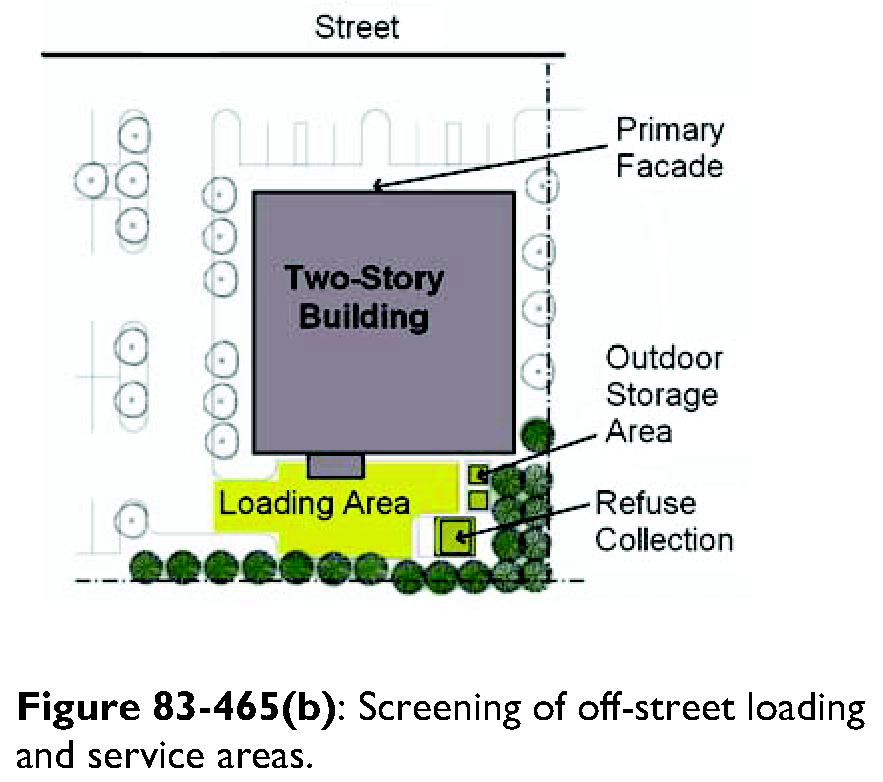
(2)
Exterior off-street loading and service areas shall be screened from view from adjacent streets and properties by any combination of durable, sight-obscuring walls, fences, and/or dense evergreen vegetation that is at least six feet in height. Points of vehicular access into or from the loading or service area need not be screened, provided they are located and designed to minimize direct views into the service or loading area from adjacent streets and properties.
(3)
Screening vegetation shall be of a type and quality as that used for site landscaping.
(c)
Location and screening of commercial containers.
(1)
Applicability.
a.
Except as otherwise provided in subsection (b), below, all exterior commercial containers—including, but not limited to, garbage dumpsters and compactors, cardboard receptacles and compactors, large recyclable containers, grease/oil tanks—shall be screened from view from adjacent streets and properties in accordance with the standards in this subsection.
b.
These standards shall not apply to commercial containers placed by or on authority of the county on a temporary basis or placed for the temporary purpose of disposing of waste generated during construction (e.g., construction waste bins) or demolition activity on the site.
(2)
Location. Commercial containers shall not be placed in the following locations:
a.
Any front yard or street side yard;
b.
Any fire lane;
c.
Any off-street parking space;
d.
Any location that blocks vehicular, bicycle, or pedestrian traffic;
e.
Within a sight triangle required at a driveway or street intersection; and
f.
Any location that interferes with utilities.
(3)
Screening standards.
a.
Commercial containers shall be screened on three sides by durable, sight-obscuring walls constructed of brick, masonry, stone, or similar material, and on the fourth side by a wood or metal gate.
b.
If a container is one regularly accessed by pedestrians, the required walls shall include an opening at least three feet wide for pedestrian access. This pedestrian opening shall be screened from view by an "L"-shaped extension of a screening wall.
c.
The height of the screening walls and gate shall be at least one foot higher than the height of the container.
d.
Where the container is located next to a building wall, the building wall may serve as a screening wall, and the other screening walls or fences shall incorporate at least one of the primary materials or colors of the adjacent building wall.
e.
The external sides of walls screening a commercial container shall have a "finished" surface (e.g., textured or painted) and shall be landscaped to soften their visual impact in accordance with section 83-466(f), Appearance.
(d)
Outdoor storage areas. Screening of outdoor storage areas shall comply with the standards in section 83-432(f)(4)a., Outdoor storage (as a principal use) or section 83-438(p), Outdoor storage (as an accessory use), as appropriate.
(e)
Alternative screening plan. The director may approve an alternative screening plan that proposes alternative screening materials or configurations to those required by the standards in this subsection upon determining that the alternative materials or configuration provide an equivalent or superior screening function and comply with all other standards of this chapter.
(Ord. No. O-2013-08, 9-16-13; Ord. No. O-2015-29, 11-2-15)
Sec. 83-466. - Fences and walls.
(a)
Purpose. The purpose of this section is to regulate, primarily in village growth area districts, the location, height, and appearance of fences and walls to maintain visual harmony within neighborhoods and the county, protect adjacent properties from the indiscriminate placement and unsightliness of fences and walls, and ensure the safety, security, and privacy of properties.
(b)
Applicability. The provisions of this subsection shall apply in village growth area districts to all construction, substantial reconstruction, or replacement of fences or walls not required for support of a principal or accessory structure, or any other linear barrier intended to delineate different portions of a lot. If there is any inconsistency between the provisions of this section and any screening standard in section 83-465, Screening, the standards in section 83-465, shall control.
(c)
General requirements for fences and walls.
(1)
Location. Fences and walls are permitted along the perimeters of properties and within front, side, and rear yards except where expressly prohibited by this chapter, the building code, or other county ordinance.
(2)
Temporary fences. Temporary fences for construction sites or a similar purpose shall comply with the requirements of the building code adopted by the county and all applicable standards of Article VII, Division 3, Standards for Temporary Uses and Structures.
(3)
Fences and walls near fire hydrants. Fences and walls shall not be located where they would prevent immediate view of, or access to, fire hydrants or other fire-fighting water supply devices, in accordance with the fire prevention code.
(4)
Fences in easements. Fences shall be prohibited within utility easements except to the extent approved by the director after finding the fence would not impede the purpose or function of the easement. The county shall not be responsible for damage to, or the repair or replacement of, fences that must be removed to access such easements. In no instance shall this provision be construed to prevent fencing around stormwater retention or detention facilities that may be required by this chapter.
(5)
Blocking natural drainage flow. No fence shall be installed so as to block or divert a natural drainage flow on to or off of any other land.
(6)
Fences and walls within buffers. Fences and walls shall be installed so as not to disturb or damage existing vegetation or installed plant material within required perimeter buffers.
(7)
Integration with other required landscaping. Required landscape screening for fences or walls may be integrated into the landscaping required for vehicular use area screening or perimeter buffers, provided the standards in section 83-461, Landscaping and buffers, are maintained.
(d)
Height requirements for fences and walls.
(1)
Applicability.
a.
General. Except where exempted by subsection b., below, fences or walls shall comply with the height limits in this subsection. Fence or wall height is measured from natural grade.
b.
Exemptions.
1.
Sight triangles. A fence or wall within the sight triangle required at the intersections of streets and driveways in accordance with VDOT access management regulations shall comply with height limitations in those regulations.
2.
Required screening. A fence or wall provided to meet the standards of section 83-465, Screening, is exempted from the height standards of this subsection, but in no case shall the fence or wall exceed a height of ten feet.
3.
Recreational fencing. Customary fencing provided as a part of a permitted tennis court, athletic field, or other recreational facility shall be exempt from the height restrictions of this subsection.
4.
Public safety use fences and walls. Major utilities, wireless communication towers, government facilities, and other public safety uses shall be allowed to increase maximum fence or wall heights to ten feet in front, side, and rear yards, unless further increased through an approved security plan—see subsection 5, below.
5.
Security plan fences and walls. An owner or tenant of property or a representative of a public agency responsible for a public facility may submit to the director a site security plan proposing fences or walls taller than those permitted by this subsection, or the use of barbed or concertina wire atop a fence or wall. The director shall approve, or approve with conditions, the site security plan and its proposed exemption of fences or walls from the standards of this subsection, on finding that:
i.
The condition, location, or use of the land, or the history of activity in the area, indicates the land or any materials stored or used on it are in significantly greater danger of theft or damage than surrounding land; and
ii.
The proposed taller fences or walls, or use of barbed or concertina wire, will not have a significant adverse effect on the security, functioning, appearance, or value of adjacent lands or the surrounding area as a whole.
(2)
Fences on retaining walls or berms. If a fence is constructed on top of a wall or berm, the combined height of the fence and wall or berm shall not exceed the maximum height that would apply to the fence or wall alone.
(3)
Fences and walls in R-2 and VR Districts. The following height limits shall apply to fences and walls within the single-family residential-2 (R-2) or Village Residential (VR) District:
a.
No solid fence or wall within a front yard or a street side yard shall exceed a height of four feet, provided that a solid fence or wall in a street side yard may be up to six feet in height if set back at least four feet from the street side lot line.
b.
No fence or wall within an interior side yard or a rear yard shall exceed a height of eight feet.
(4)
Fences and walls in VC and CC Districts. No fence or wall within the Village Center (VC) or Commerce Center (CC), District shall exceed a height of eight feet, provided that a fence or wall abutting an industrial zoning district may be up to ten feet in height.
(5)
Fences and walls in I-1 and I-2 Districts. No fence or wall within the Light Industrial (I-1) or Heavy Industrial (I-2) District shall exceed a height of ten feet.
(e)
Perimeter fences and walls abutting street rights-of-way. Fences or walls located within 15 feet of a street right-of-way shall:
(1)
Be located outside the right-of-way;
(2)
Be of a uniform style;
(3)
Be constructed of brick, stone, or concrete (when covered with stucco or similar finish), vinyl, or vertical wooden boards; and
(4)
Include breaks, offsets, access points, or other design details in the fence or wall plane at least every 200 feet. (See figure 83-466(e), Fence and wall offsets.)
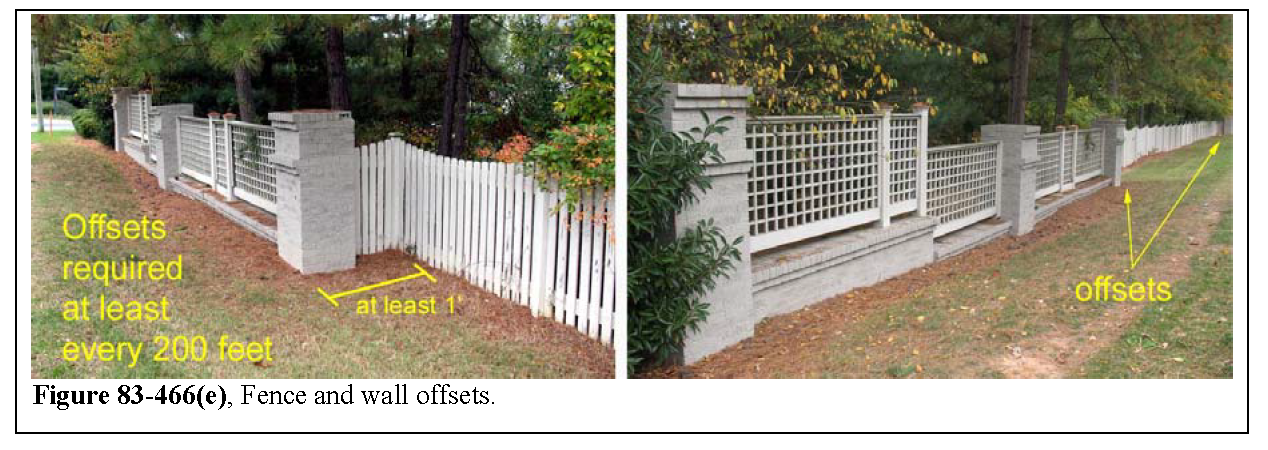
(f)
Appearance.
(1)
Customary materials. Fences shall be constructed of any combination of treated wood posts and planks, rot-resistant wood (such as cypress or redwood), wrought iron, decorative metal materials, or chain link, except for multifamily, townhouse, institutional, commercial, and mixed use development in the village growth area districts where chain link or wire fences are prohibited. Walls shall be constructed of brick, stone, masonry materials, or products designed to resemble these materials. Where certain materials are specified for particular types of screening or buffering fences or walls, all other materials are prohibited.
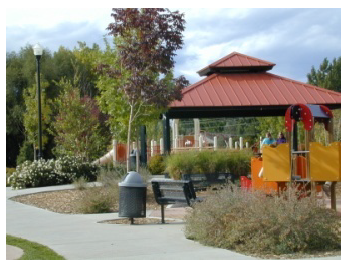
(2)
Finished side to outside. Wherever a fence or wall is installed, if one side of the fence or wall appears more "finished" than the other (e.g., one side of a fence has visible support framing and the other does not, or one side of a wall has a textured surface and other does not), then the more "finished" side of the fence shall face the perimeter of the lot rather than the interior of the lot. (See figure 83-466(f)(2), Fence with finished side out.)
(3)
Compatibility of materials along a single lot side. All fencing or wall segments located along a single lot side shall be composed of a uniform style and colors compatible with other parts of the fence and with any nearby primary buildings on the lot.
(4)
Fence and wall landscaping.
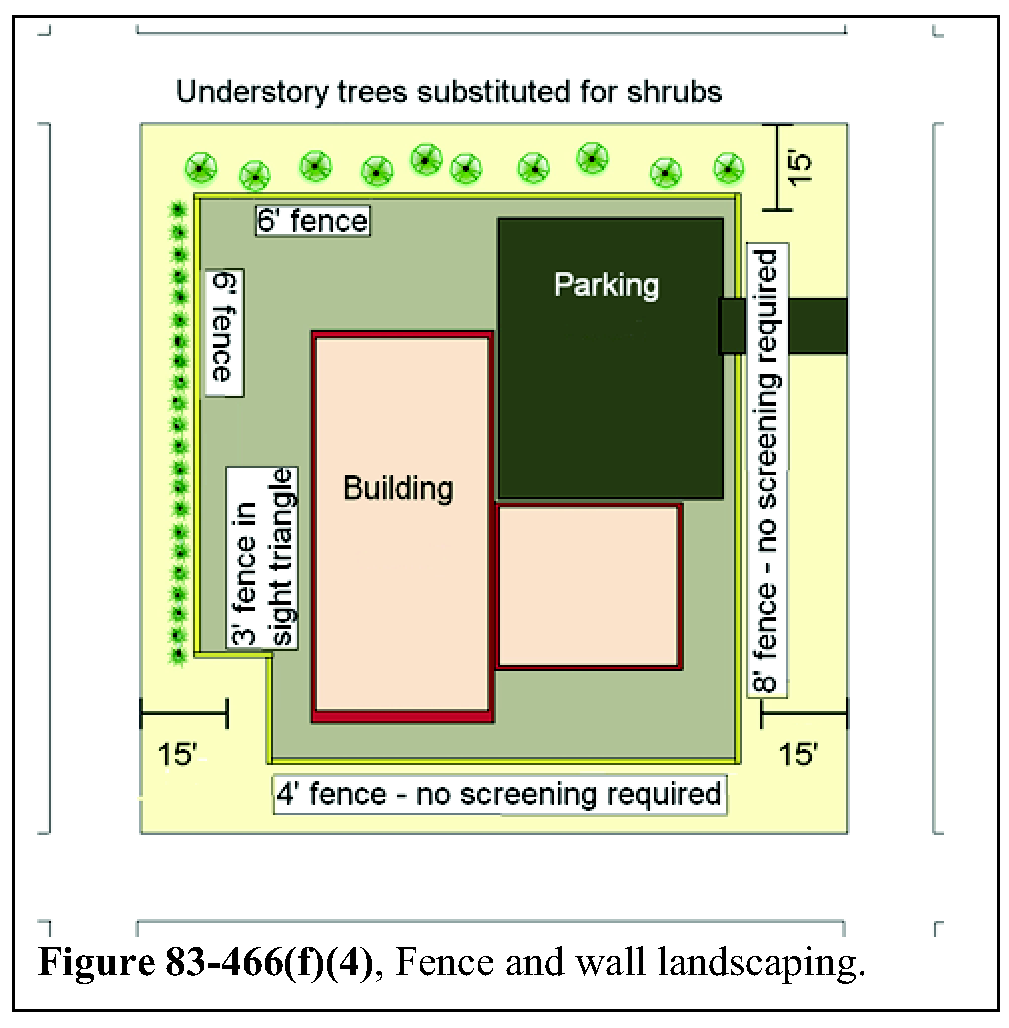
a.
General. All chain link fences and all fences and walls exceeding four feet in height, if located within 15 feet of a street right-of-way, shall be supplemented with landscape screening in accordance with the standards in (b) and (c) below, to soften the visual impact of the fence. These standards shall apply to fences in single-family residential zoning districts only if they are located within 15 feet of the right-of-way of a major arterial street or minor arterial street. (See figure 83-466(f)(4), Fence and wall landscaping.)
b.
Shrubs required. One evergreen shrub shall be installed for every five linear feet of fence or wall, and on the side of the fence or wall facing the public street right-of-way. Shrubs shall meet the size standards of section 83-461(c)(1), New planting standards, and may be installed in a staggered, clustered, grouped, or linear fashion.
c.
Substitution of understory trees. One understory or ornamental tree may be substituted for every three evergreen shrubs, provided that the tree meets the size standards of section 83-461(c)(1), New planting standards.
(g)
Fences around swimming pools. Outdoor swimming pools shall be enclosed with a fence or wall in accordance with swimming pool barrier enclosure standards in the building code.
(h)
Prohibited fences.
(1)
Barbed wire, concertina wire, and above ground electrified fences. Fences using barbed or concertina wire and aboveground electrified fences shall be prohibited unless used in association with agricultural activities or allowed through an approved security plan (see security plan fences and walls provisions of section 83-466(d)). Underground electric fences designed for control of domestic animals are allowed.
(2)
Debris, junk, rolled plastic, sheet metal, plywood, or other waste materials. Fences or walls made of debris, junk, rolled plastic, sheet metal, plywood, or waste materials are prohibited in all districts except the agricultural zoning districts, unless such materials have been recycled and reprocessed for marketing to the general public as building materials that resemble new building materials (e.g., picket fencing made from recycled plastic and fiber).
(i)
Maintenance required. All fences and walls and associated landscaping shall be maintained in good repair and in a safe and attractive condition, including, but not limited to, the repair or replacement of missing, decayed, or broken structural and decorative elements.
(Ord. No. O-2013-08, 9-16-13; Ord. No. O-2015-06, 5-4-15)
Sec. 83-469. - Exterior lighting.
(a)
Purpose. The purpose of this section is to regulate exterior lighting to:
(1)
Permit the use of exterior lighting at the minimum levels necessary for nighttime safety, utility, security, productivity, enjoyment, and commerce;
(2)
Ensure exterior lighting does not adversely impact land uses on adjacent lands by minimizing light trespass, obtrusive light, and glare;
(3)
Ensure the safety of motorists by minimizing light spillage and glare onto adjacent streets;
(4)
Curtail light pollution, reduce sky glow, and preserve the nighttime environment for astronomy, wildlife and the enjoyment of residents and visitors;
(5)
Conserve energy and resources to the greatest extent possible; and
(6)
Ensure security for persons and properties.
(b)
Applicability.
(1)
General. The provisions of this section shall apply to all development unless exempted in accordance with section 83-469(b)(4), Exemptions.
(2)
Lighting plan required. A lighting plan shall be submitted with an application for a conditional use permit (article II, Administration), or site plan (article II), as appropriate. The lighting plan shall include a photometric plan, specifications for proposed lighting devices, and descriptions of other measures proposed to control light spillover. (See site plans provisions in Article XIII, Appendix.)
(3)
Nonconforming lighting. Exterior lighting in existence before the effective date of this zoning ordinance, that does not comply with this chapter may remain, but shall be subject to the standards in Article IX, Nonconformities,—i.e., no changes to the use, location, height, or features of exterior lighting fixtures shall be allowed except in conformance with current exterior lighting standards. Changing the housing or lenses in a lighting fixture and routine lighting fixture maintenance (such as changing lamps or light bulbs, ballast, starter, photo control, or other similar components) are allowed if such actions do not result in a higher lumen output.
(4)
Exemptions. The following are exempted from the exterior lighting standards of this section:
a.
Lighting within a public street right-of-way or easement that is used principally for illuminating a roadway—but not lighting within a street right-of-way or easement that is designed to illuminate areas outside the right-of-way or easement;
b.
Lighting exempt from this chapter under state or federal law;
c.
FAA-mandated lighting associated with a utility tower or airport;
d.
Lighting for public monuments and statuary;
e.
Lighting for flags permitted in accordance with section 83-488, Signage;
f.
Lighting solely for signage (subject to standards in section 83-488, Signage);
g.
Temporary lighting for circuses, fairs, carnivals, theatrical and other performance areas—provided such lighting is discontinued upon completion of the performance;
h.
Temporary lighting of construction sites—provided such lighting is discontinued upon completion of the construction activity;
i.
Temporary lighting for emergency situations—provided such lighting is discontinued upon abatement of the emergency situation;
j.
Security lighting controlled and activated by motion sensor devices for a duration of 15 minutes or less;
k.
Lighting associated with barns, paddock areas, and other structures and areas used for agricultural purposes—but not including lighting of residential buildings or parking areas associated with a farm or agricultural use;
l.
Underwater lighting in swimming pools, fountains, and other water features; and
m.
Holiday or festive lighting—provided such lighting does not create unsafe glare on street rights-of-way.
(c)
Prohibited lighting. The following lighting is prohibited:
(1)
Luminaires that imitate an official highway or traffic control light or sign;
(2)
Luminaires in the direct line of vision with any traffic control light or sign;
(3)
Luminaires that have a flashing or intermittent pattern of illumination, except for time and temperature displays;
(4)
Privately owned luminaires located in the public right-of-way;
(5)
Searchlights, except when used by federal, state or local authorities;
(6)
Mercury vapor luminaires;
(7)
Luminaires equipped with adjustable mounting devices permitting alteration of luminaire aiming in the field.
(d)
Exterior lighting standards for single-family and duplex dwellings. The following standards shall apply to exterior lighting associated with single-family detached dwellings, manufactured home dwellings, and duplex dwellings.
(1)
Shielding. For dwellings on residentially-zoned properties, all luminaires shall be fully shielded—i.e., be a full cut-off luminaire or a decorative luminaire with full cut-off optics, and constructed and installed such that all light emitted by the luminaire is projected below the horizontal plane running through the luminaire's lowest light-emitting part.
(2)
Spillover light. Spillover light, whether vertical or horizontal, shall not exceed 0.5 foot-candle at the property line.
(3)
Lamp intensity. Luminaires shall be limited to lamps with a maximum flux of 1,800 lumens per luminaire.
(e)
Exterior lighting standards for other than single-family and duplex dwellings, nonresidential development, and mixed-use development.
(1)
General.
a.
Shielding. Except where expressly provided otherwise in this subsection, all luminaires shall be fully shielded—i.e., shall be a full cut-off luminaire or a decorative luminaire with full cut-off optics, and be constructed and installed such that all light emitted by the luminaire is projected below the horizontal plane running through the luminaire's lowest light-emitting part.
b.
Focused lighting. All lighting shall be aimed and controlled so directed light is confined to the object intended to be illuminated. Directional control shields shall be used where necessary to limit stray light.
c.
Spillover light. Spillover light, whether vertical or horizontal, shall not exceed 0.5 foot-candle at the property line. For developments approved with multiple lots (e.g. townhouse developments, office parks, shopping centers) and a unified lighting plan, this standard shall apply to the perimeter of the development as a whole.
d.
Mounting height. The maximum height of the bottom of a luminaire above grade level shall be 20 feet for lighting associated with residential development and 25 feet for lighting associated with all other development except outdoor recreational facilities (see subsection (4), below).
(2)
Parking areas, loading areas, sales areas, and display areas. Lighting of a parking area, loading area, sales area, or display area shall not exceed an average horizontal illumination level at grade level of 2.5 foot-candles.
(3)
Canopies.
a.
Luminaires shall be either:
1.
Recessed ceiling lights with bulbs recessed into the canopy ceiling so that the bottom of the luminaire is flush with the ceiling and all light emitted by the luminaire is projected below an angle of 85 degrees from the vertical; or
2.
Indirect lighting that is directed upward to and reflected downward from the underside of the canopy, with luminaires shielded so that direct illumination is focused exclusively on the underside of the canopy.
b.
Lights shall not be mounted on the top or sides (fascia) of the canopy and the sides of the canopy shall not be illuminated, with the exception of an internally illuminated logo sign.
c.
The lighting for new facilities (pump islands and under canopies) shall be subject to a uniformity ratio (ratio of average to minimum illuminance) no greater than 4:1. The standards herein are based on the Illuminating Engineering Society of America (IESNA) RP-33, Lighting for Exterior Environments.
(4)
Outdoor recreational facilities.
a.
Purpose. These standards are intended to permit adequate illumination for nighttime outdoor events, while minimizing sky-glow and reducing glare and lighting spillover onto surrounding streets and properties.
b.
Lighting focused on playing areas. Where playing fields, courts, tracks, or other recreational areas other than those accessory to a residential use are to be illuminated, the following standards shall apply:
1.
Luminaires shall be specified, mounted, and aimed so that their beams fall within the primary playing area.
2.
Direct illumination shall be confined to within the property lines of the recreational use. External shields may be required in order to reduce spillover light.
3.
The average maintained illumination levels must be within the parameters of the activity recommended by the Illumination Engineering Society of North America (IESNA).
c.
Hours of illumination.
1.
All outdoor recreational events shall be scheduled so as to complete all activity before or as near to 11:00 p.m. as practical, but under no circumstances shall any illumination of playing areas be permitted after 11:00 p.m. except as necessary to conclude an event that was reasonably scheduled to conclude prior to 11:00 p.m.
2.
All newly lighted playing areas, or existing fields being upgraded or refitted, shall be equipped with override timing devices that will automatically cut off lights to ensure compliance with the standard in subsection 1 above.
(f)
Alternative lighting plan. The director may approve an alternative exterior lighting plan that proposes alternative lighting equipment, materials, or methods of installation to those required by the standards in this subsection on determining that the alternative equipment, materials, or methods of installation provide equivalent or superior lighting control and comply with all other standards of this chapter.
(Ord. No. O-2013-08, 9-16-13)
Sec. 83-470. - Open-space set-asides.
(a)
Purpose. The purpose of this subsection is to ensure that a portion of development sites in the village growth area districts is set aside as open space for the use and enjoyment of the development's occupants and users. Open space set-asides serve numerous purposes, including preservation and protection of natural areas and features, providing opportunities for passive and active recreation, and limiting paved surfaces that adversely impact water quality and the heat island effect.
(b)
Applicability. The provisions of this section shall apply to all new development in the Village Residential (VR), Village Center (VC), and Commerce Center (CC) Districts that are subject to site plan approval (see site plan provisions of Article II, Administration). They shall also apply to village residential Planned Development (VR-PD), Village Center Planned Development (VC-PD), and Commerce Center Planned Development (CC-PD) Districts.
(c)
Open-space set-aside standards.
(1)
Amount of open-space set-aside required.
a.
Development in the Village Residential (VR) or Village Residential Planned Development (VR-PD) District shall set aside at least 20 percent of the area of the development site as an open space set-aside.
b.
Development in the Village Center (VC), Commerce Center (CC), Village Center Planned Development (VC-PD), or Commerce Center Planned Development (CC-PD) Districts shall set aside at least 15 percent of the area of the development site as an open space set-aside.
(2)
Areas counted as open-space set-aside. The features and areas identified in table 83-470(c)(2), Open space set-aside features, shall be credited towards compliance with the open space set-aside standards of this section:
| Table 83-470(c)(2): Open-Space Set-Aside Features | ||
|---|---|---|
| Area Counted as Common Open Space Set-Asides | Description |
Design and
Maintenance Requirements |
| Natural Features | ||
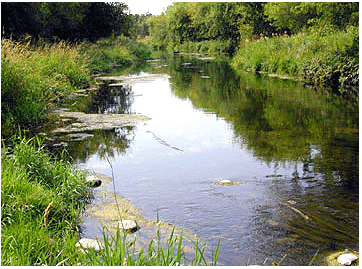 | Natural water features (including lakes, ponds, rivers, streams, rivers, wetlands, drainageways, and other riparian areas), riparian buffers, flood hazard areas, steep slopes (15 percent or more), and wildlife habitat areas. |
Preservation of any existing natural features shall have highest priority for locating
open space set-asides, except in the Village Center District.
Maintenance is limited to the minimum removal and avoidance of hazards, nuisances, or unhealthy conditions. |
| Active Recreational Areas | ||
| Land occupied by areas and facilities used for active recreational purposes, such as pools, playgrounds, tennis courts, jogging trails, ball fields, and clubhouses. |
Active recreational areas may occupy up to 100 percent of the open space set-aside
(if no natural features exist on the site), and shall occupy no less than 40 percent
of the total open space set-aside area within a residential or mixed-use development.
Land shall be compact and contiguous unless used to link or continue an existing or planned open space resource. Areas shall abut at least one street, if reasonably practical. |
| Formal Plantings and Gardens | ||
 | Formally planned and regularly maintained open areas that provide passive recreation opportunities, including arranged plantings, gardens, gazebos, and similar structures. | Formal plantings and gardens shall have at least one direct access street, and be oriented to surrounding development. |
| Squares, Forecourts, Plazas, and Parks | ||
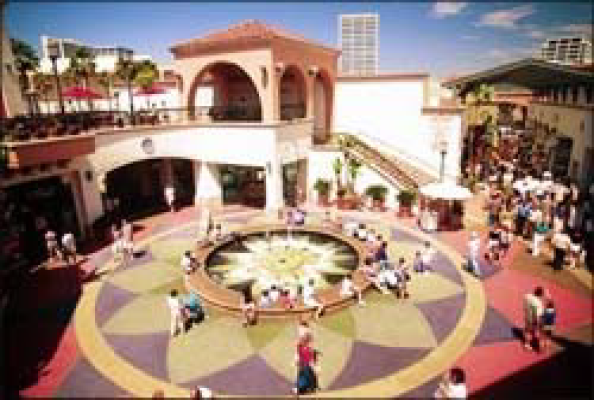 | Squares, forecourts, plazas, and parks that provide active and passive recreational opportunities and help create special places. |
Such features shall be at least 200 square feet, but no more than one acre, in area.
Such features shall have at least one direct access street. Surrounding buildings shall be oriented toward the square, forecourt, plaza, or park when possible and a connection shall be made to surrounding development. Squares, forecourts, plazas, and parks are encouraged in the Village Center District. |
| Required Landscape Areas | ||
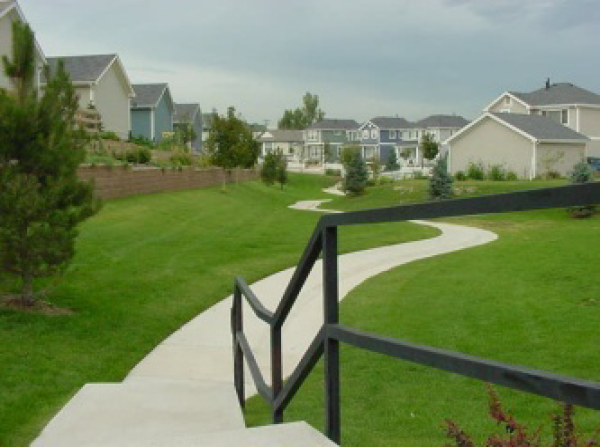 | All areas occupied by required site tree protection areas, landscaping, perimeter buffers, vegetative screening, and riparian buffers, except landscaped area within parking lots. | See tree preservation standards (section 83-460), landscaping, and buffer standards (section 83-461), screening standards (section 83-465), and riparian buffer standards (section 83-471). |
| Stormwater Management Devices | ||
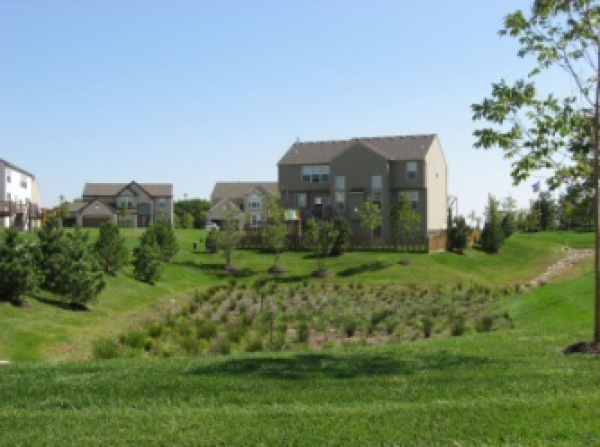 | Up to 75 percent of the land area occupied by stormwater management devices (including retention and detention ponds and other bioretention devices), when such features are treated as an open space site amenity. | To qualify, stormwater management devices shall support passive recreation uses by providing access, gentle slopes (less than 3:1), and pedestrian elements such as paths and benches. |
| Public Access Easements | ||
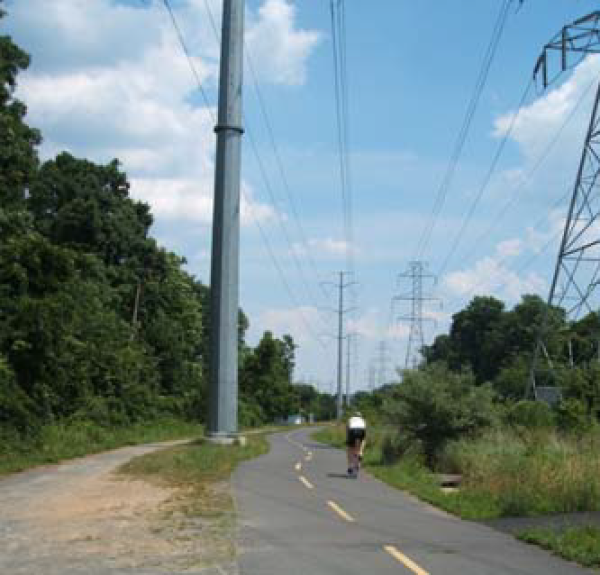 | Public access easements (which often combine utility easements with paths or trails) that are available for passive recreational activities such as walking, running, and biking. | Such public access easements shall include at least one improved access from a public sidewalk, street, trail, or easement that includes signage designating the access point. |
(3)
Areas not counted as open-space set-aside. The following areas shall not be counted as open space set-aside:
a.
Private yards not subject to an open space or conservation easement;
b.
Street rights-of-way or private access easements, including sidewalks located within those rights-of-way or easements;
c.
Open parking areas and driveways for dwellings;
d.
Land covered by structures not designated for active recreational uses;
e.
Designated outdoor storage areas; and
f.
Stormwater ponds, unless located and designed as a site amenity (e.g., with low fencing, vegetative landscaping, gentle slopes, fountain or other visible water circulation device, and pedestrian access or seating).
(4)
Design standards for open-space set-asides. Land used as an open space set-aside shall meet the following design standards:
a.
Location. Open space shall be located so as to be readily accessible and useable by occupants and users of the development. Where possible, a portion of the open space set-aside should provide focal points for the development through prominent placement or easy visual access from streets.
b.
Configuration.
1.
Open space lands shall be compact and contiguous unless a different configuration is needed to continue an existing trail or accommodate preservation of natural features.
2.
If the development site is adjacent to existing or planned trails, parks, or other public open area land, the open space set-aside shall, to the maximum extent practicable, be located to adjoin, extend, and enlarge the trail, park, or other open area land.
3.
If a passive recreation open space set-aside area, with a minimum width of 20 feet or more, abuts an existing or planned open space area, no perimeter buffer (section 83-461(e), Perimeter buffers) shall be required between the two open space areas.
c.
Orientation of adjacent buildings. Buildings adjacent to required open space set-asides shall have at least one entrance facing the open space set-aside.
d.
Prioritization of open space set-aside. To the maximum extent practicable, open space set-asides shall be located and organized to include, protect, or enhance as many of the following open areas and features as possible:
1.
Natural features such as riparian areas, riparian buffers, flood hazard areas, steep slopes, and wildlife habitat areas;
2.
Water features such as drainages, canals, ditches, lakes, natural ponds, and retention and detention ponds;
3.
Protected trees and other mature trees;
4.
Perimeter buffers or visual transitions between different types or intensities of uses;
5.
Natural or geologic hazard areas or soil conditions, such as unstable or potentially unstable slopes, faulting, landslides, rockfalls, expansive soils, or floodplains; and
6.
Areas that accommodate multiple compatible open space uses rather than a single use.
(5)
Development in open-space set-asides. Development within open space set-asides shall be limited to that appropriate to the purposes of the type(s) of area set aside as open space (see table 83-470(c)(2), Open space set-aside features). Where appropriate, such development may include, but is not limited to, walking, jogging, and biking paths or trails; benches or other seating areas; tables, shelters, grills, and other picnicking facilities; docks and other facilities for fishing; environmental education guides and exhibits; gazebos and other decorative structures; fountains or other water features; play structures for children; gardens or seasonal planting areas; pools; athletic fields and courts; and associated clubhouses.
(6)
Ownership, management, and maintenance of open-space set-asides.
a.
Open space set-asides shall be managed and maintained as permanent open space through one or more of the following options:
1.
Conveyance of open space set-aside areas to a property owners' or homeowners' association that holds the land in common ownership and will be responsible for managing and maintaining the land for its intended open space purposes; or
2.
Conveyance of open space set-aside areas to a third party beneficiary such as an environmental or civic organization that is organized for, capable of, and willing to accept responsibility for managing and maintaining the land for its intended open space purposes; or
3.
Establishment of easements on those parts of individually-owned lots including open space set-aside areas that require the areas to be managed consistent with the land's intended open space purposes and prohibit any inconsistent future development.
b.
All options involving private ownership of open space set-aside area shall include deed restrictions, covenants, or other legal instruments that ensure continued use of the land for its intended open space purposes and provide for the continued and effective management, operation, and maintenance of the land and facilities.
c.
Responsibility for managing and maintaining open space set-aside areas lies with the owner of the land comprising the areas. Failure to maintain open space set-aside areas in accordance with the approved development shall be a violation of this chapter.
(Ord. No. O-2013-08, 9-16-13)
Sec. 83-471. - Environmental protection.
(a)
Riparian buffers.
(1)
Purpose. These riparian buffer standards are intended to protect the quality and quantity of the surface waters on which Powhatan County citizens rely for drinking, storm mitigation, fishing, and the recreational and scenic functions that contribute so much to the county's economic health. Specifically, they are intended to limit development and land disturbance adjacent to surface watercourses and wetlands and encourage retention of native vegetation as necessary to protect public and private water supplies, trap sediment and other pollutants in surface runoff, promote bank stabilization, protect wetlands, protect wildlife habitat, protect fisheries, and preserve scenic beauty.
(2)
Riparian buffer required.
a.
General. Except as otherwise provided in subsection (b) below, all new development shall provide and maintain a riparian buffer abutting perennial streams and intermittent streams shown on USGS quadrangle topographic maps and jurisdictional wetlands contiguous to such perennial or intermittent streams, as determined by federal law.
b.
Exceptions. The requirement for provision or maintenance of a riparian buffer shall not apply to development of single-family detached dwellings, duplex dwellings, or manufactured home dwellings on lots within subdivisions for which an application for plat approval was filed before September 8, 2008.
(3)
Riparian buffer width.
a.
Required riparian buffer width.
1.
The width of a riparian buffer abutting a perennial stream shall be at least 100 feet.
2.
The width of a riparian buffer abutting an intermittent stream or wetlands shall be at least 50 feet.
b.
Reduction of riparian buffer width. The director may allow development to reduce the minimum riparian buffer width required by subsection a. above by up to 50 percent in the village growth area districts on determining that the development incorporates stormwater best management practices that will manage stormwater runoff to eliminate or reduce pollution of the stream or wetlands to a degree exceeding that provided by a forested buffer meeting the full minimum width standard.
c.
Measurement of riparian buffer width. The width of the buffer shall be measured perpendicular from the bank of a stream or the upland boundary of wetlands. (See figure 83-471(a)(2), Required riparian buffer along a perennial stream.)
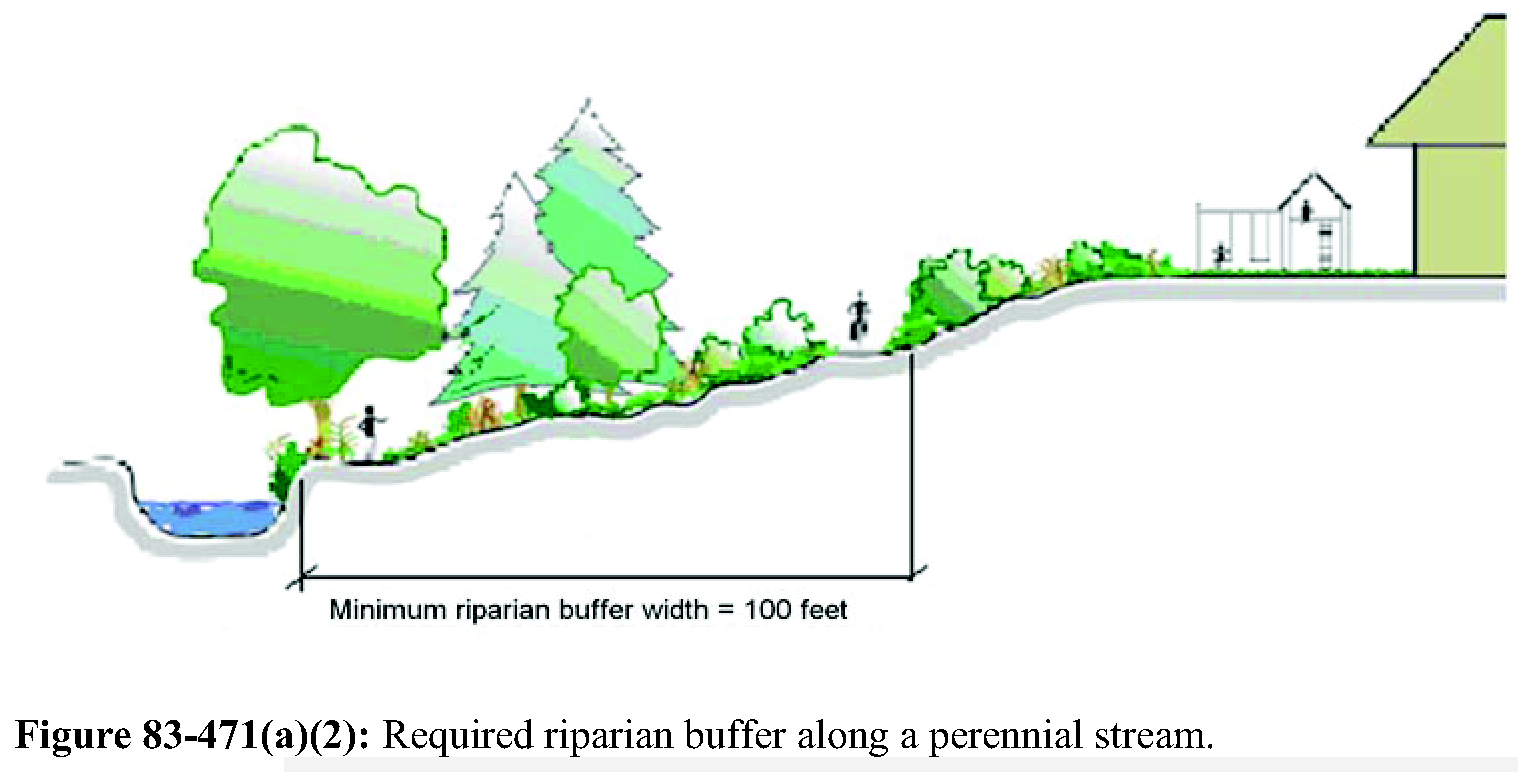 |
(4)
Required maintenance of riparian buffers. Required riparian buffers shall be maintained as vegetated areas composed of an assemblage of trees, shrubs, and other vegetation that can effectively stabilize banks and slow down and filter stormwater runoff. If the buffer is not currently so vegetated, it shall be restored or allowed to develop into such a buffer.
(5)
Allowable development within riparian buffers. Development allowed within a riparian buffer is limited to:
a.
Flood control structures;
b.
Crossings by roadways and driveways (including associated sidewalks, stormwater management facilities, and utility lines), railroad tracks and associated maintenance corridors, and utility lines and associated maintenance corridors, where the director determines that there are no reasonable alternatives to the crossing and the crossing is perpendicular to the buffer or otherwise aligned to minimize encroachment into the buffer and adverse effects on water quality;
c.
Bikeways and walkways, and other passive recreational facilities and uses that involve minimal removal of vegetation and are not impervious;
d.
Stormwater management facilities and sediment and erosion control devices, where determined to be necessary by the director;
e.
Temporary watercourse, watercourse bank, wetland, and vegetation restoration projects intended to restore the watercourse, wetland, or riparian buffer to an ecologically healthy state;
f.
Water dependent structures and other structures that, by their nature, cannot be located anywhere except within a riparian buffer, such as docks, boat launches, public water supply intake structures, and public wastewater treatment plant sewer lines and outfalls;
g.
Wildlife and fisheries management activities consistent with state law and programs established by the Virginia Department of Game and Inland Fisheries; and
h.
Vegetation management, including:
1.
Planting of native vegetation to enhance the purposes served by the riparian buffer;
2.
Pruning of forest vegetation that does not compromise the vegetation's continued health and function;
3.
Removal of individual trees that pose a danger to human life or nearby buildings, or as necessary to preserve other vegetation from extensive pest infestation;
4.
Removal of poison ivy or other understory nuisance or invasive vegetation; and
5.
Removal or disturbance of vegetation as part of emergency fire control measures.
(6)
Location of riparian buffers in common areas. For developments providing common areas (including open-space set-asides), riparian buffers shall be located within such common areas and outside individual building lots. Riparian buffers may be located within an individual building lot, however, if the buffer is subject to a permanent conservation easement or other legal instrument that provides for preservation of the buffer in compliance with the requirements of this subsection. A copy of the legal instrument shall be submitted to the director before issuance of a building permit for development of the lot.
(7)
Signage identifying riparian buffers. Where a development site includes a riparian buffer, the developer shall install signage identifying the landward boundary of the buffer.
(8)
Setback from riparian buffers. No part of any structure other than those expressly allowed by section 83-471(a)(5) shall be located with 25 feet of the boundary of a riparian buffer.
(b)
Floodplain management. See Floodplain Overlay (FP) District in Article VI, General Overlay Districts.
(c)
Erosion and sedimentation control. See erosion and sedimentation control in chapter 68 (Subdivisions).
(d)
Stormwater management. See stormwater management in chapter 68 (Subdivisions).
(e)
Drinking water. See drinking water in chapter 68 (Subdivisions).
(f)
Sanitary sewer. See sanitary sewage in chapter 68 (Subdivisions).
(g)
Solid waste. See solid waste in chapter 68 (Subdivisions).
(Ord. No. O-2013-08, 9-16-13)
Sec. 83-475. - Reserved.
Editor's note— Ord. No. O-2018-18, adopted June 25, 2018, repealed § 83-475, which pertained to architectural design standards for businesses and derived from Ord. No. O-2013-08, adopted September 16, 2013 and Ord. No. O-2015-06, adopted May 4, 2015.
Sec. 83-476. - Multifamily and townhouse development standards in village growth area districts.
(a)
Purpose. These multifamily and townhouse residential development standards, which apply in the village growth area districts, are intended to:
(1)
Establish a minimum level of development quality for multifamily and townhouse residential development;
(2)
Promote greater compatibility between such multifamily and townhouse residential development and other allowable uses;
(3)
Foster sustained value and stability within neighborhoods;
(4)
Emphasize the unique character of the village growth area districts;
(5)
Shape the quality and spatial form of the village growth area districts; and
(6)
Provide property owners, developers, architects, builders, business owners, and others with a clear and equitable set of parameters for developing land.
(b)
Applicability.
(1)
General. Unless exempted by subsection (2) below, the standards in this subsection shall apply in village growth area districts to:
a.
All new multifamily and townhouse dwelling development; and
b.
Any expansion or alteration of an existing multifamily and townhouse development where the expansion increases the development's gross floor area by 50 percent or more, or the alteration involves 50 percent or more of the development's gross floor area.
(2)
Exemptions. The standards in this subsection shall not apply to individual upper-story dwellings in the village growth area districts that are located on floors above a nonresidential use.
(3)
Review for compliance. Review for compliance with the standards of this subsection shall occur during review of an application for site plan approval (article II, Administration) or a zoning compliance permit (article II), as appropriate.
(c)
Site access. New development with 50 or more dwelling units shall have:
(1)
At least one secondary point of vehicular access to or from the site to ensure emergency vehicle access.
(2)
No primary vehicular access along a local street serving existing single-family detached development—provided, however, that secondary vehicle access for emergency vehicles may be provided along such a local street.
(d)
Parking location.
(1)
No more than 50 percent of the required number of off-street parking spaces shall be surface parking located between the front of the principal building(s) and the street it faces unless the parking is screened from view from the street by other buildings or landscaping.
(2)
Where a multifamily or townhouse dwelling includes garages for individual units, guest and overflow parking associated with those units shall be located to the side or rear of the dwelling.
(See figure 83-476(d), Multifamily/townhouse parking location.)
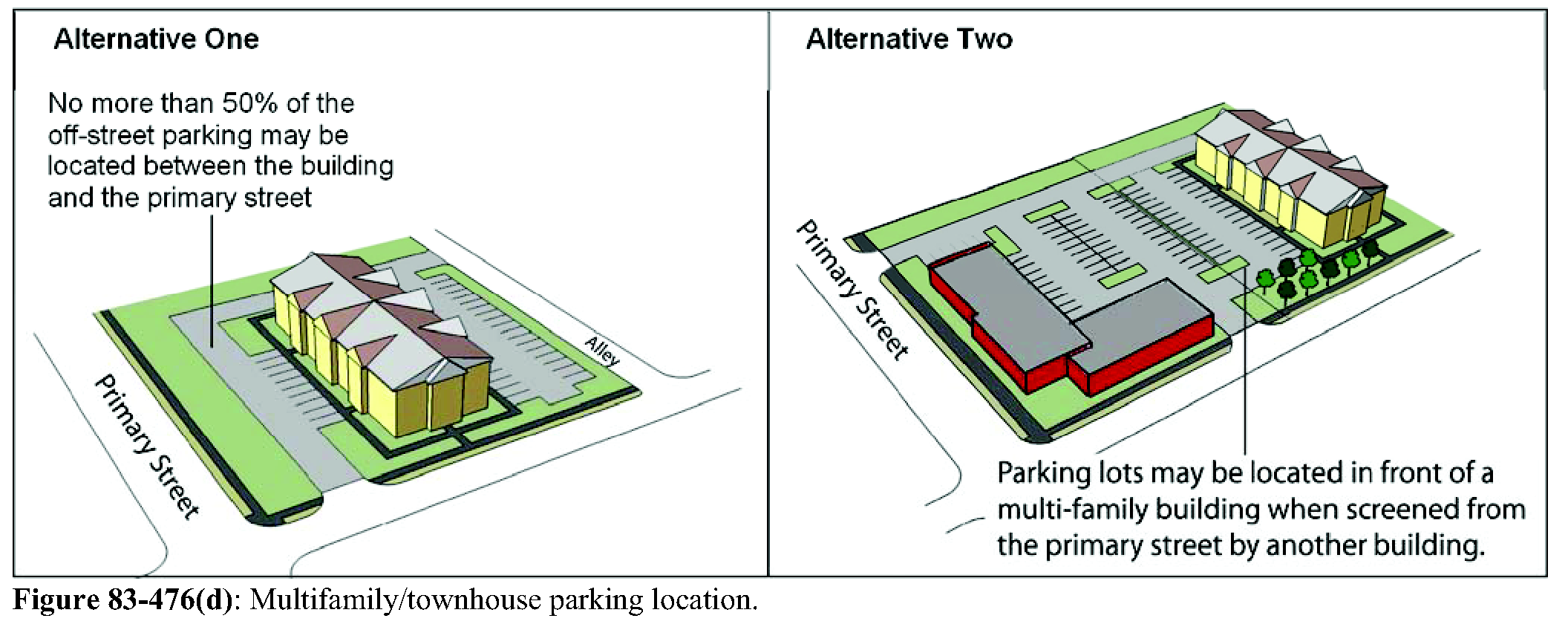
(e)
Building orientation and configuration.
(1)
To the maximum extent practicable, buildings shall be configured so that their primary facade and primary entrances orient towards:
a.
An abutting internal or external street; or
b.
Common open space, such as interior courtyards, parks, or on-site natural areas or features with a clearly defined and easily accessible pedestrian circulation system.
(See figure 83-476(e), Multifamily/townhouse building orientation.)
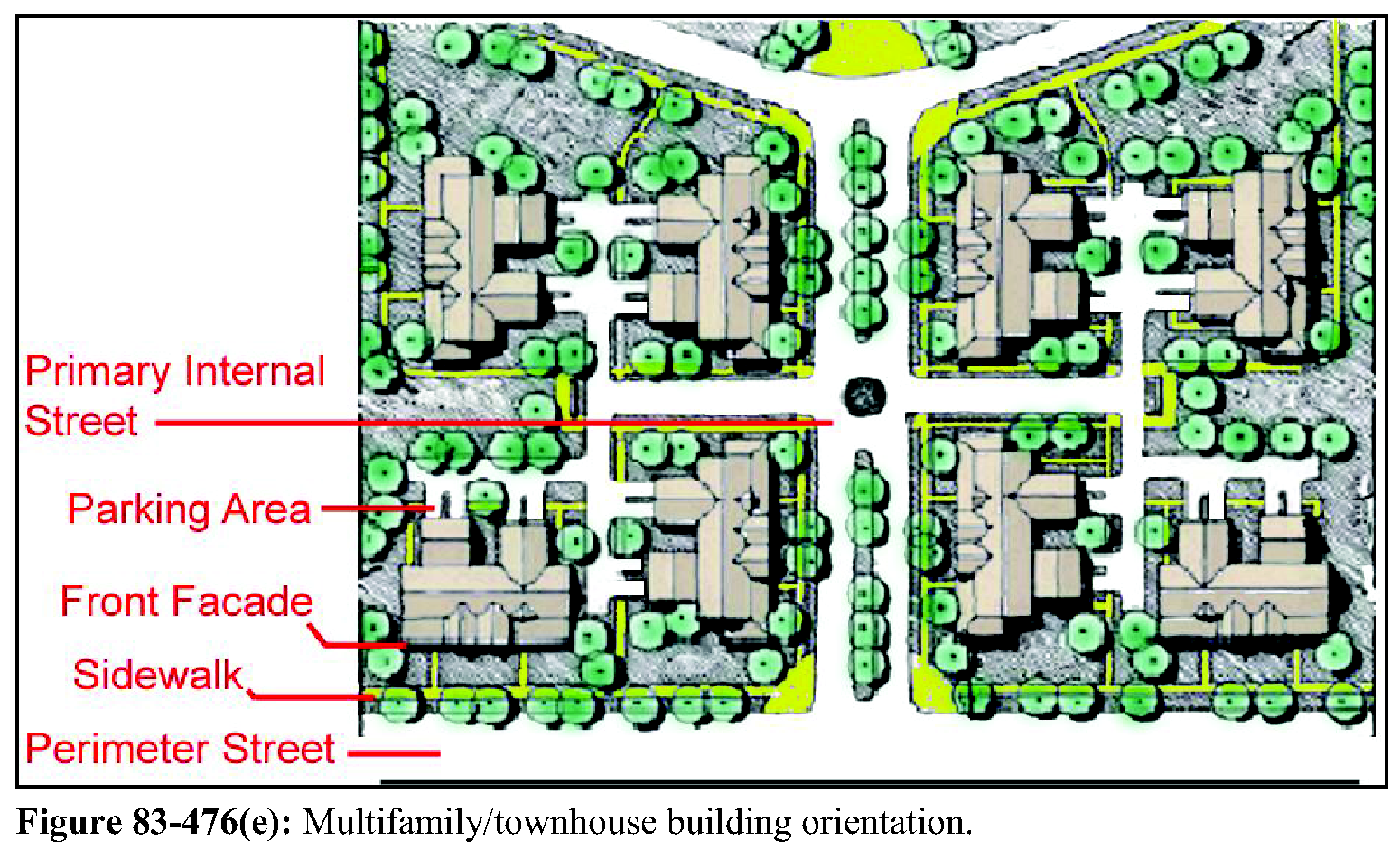 |
(2)
Upper-story dwelling units in a multifamily building shall be accessed via internal corridors, common stairways, or individual stairways.
(f)
Maximum building size in village center districts.
(1)
In the Village Center (VC) district, individual structure footprints shall not exceed a maximum of 15,000 square feet and total building area shall not exceed 45,000 square feet.
(2)
The maximum length of any multifamily or townhouse structure shall be 250 feet, regardless of the number of units.
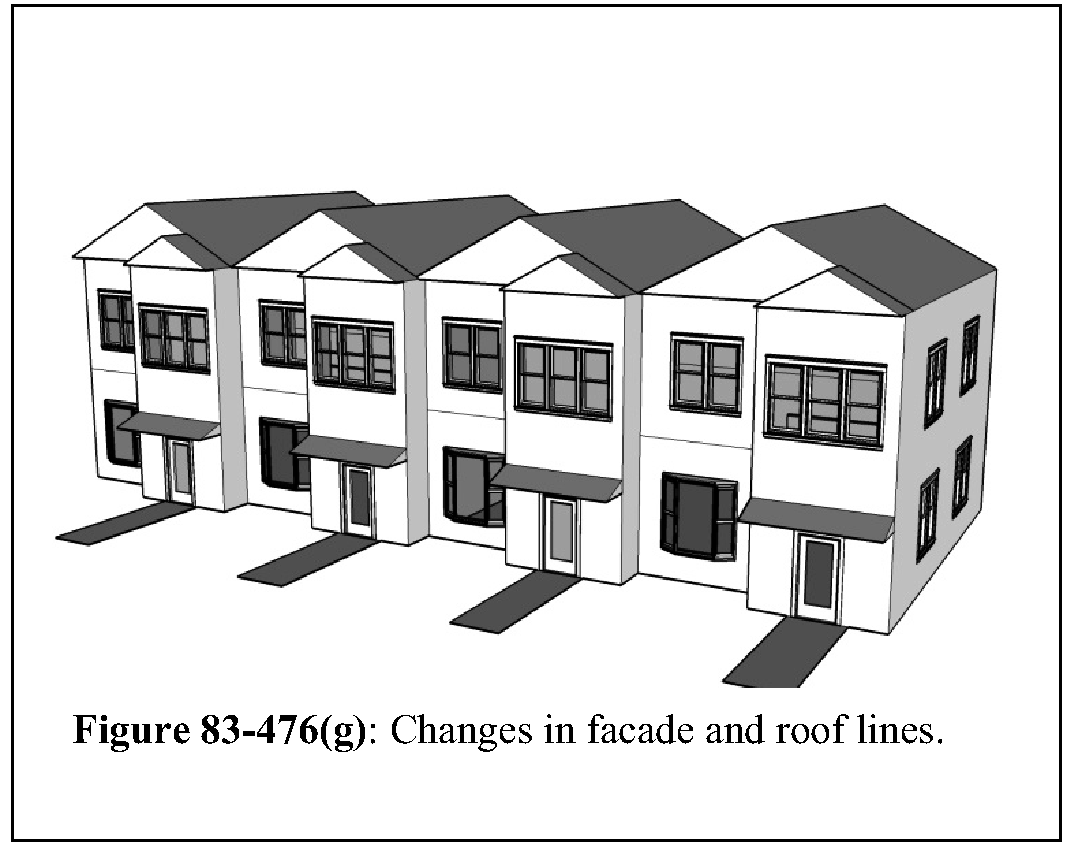
(g)
Facade articulation.
(1)
Street-facing facades shall incorporate wall offsets, in the form of projections or recesses in the facade plane, spaced no more than 30 feet apart.
(2)
Wall offsets shall have a minimum depth of two feet.
(3)
In addition to wall offsets, facades shall provide a minimum of three of the following facade articulation features for each residential unit fronting onto a public street:
a.
One or more dormer windows or cupolas;
b.
A recessed entrance;
c.
A covered porch;
d.
Pillars, posts, or columns adjacent to the doorway;
e.
One or more bay windows projecting at least 12 inches from the facade plane;
f.
Eaves projecting at least six inches from the facade plane;
g.
Raised corniced parapets over the entrance door;
h.
Multiple windows with a minimum four-inch-wide trim; or
i.
Integrated planters that incorporate landscaped areas or places for sitting.
(h)
Roofs.
(1)
Principal buildings shall incorporate roof pitches between 3:12 and 12:12, or incorporate a parapet at least three feet high with a three-dimensional cornice around a flat roof. Alternative roof forms or pitches may be allowed for small roof sections over porches, entryways, or similar features.
(2)
All roof vents, pipes, antennas, satellite dishes, and other roof penetrations and equipment (except chimneys) shall be located on the rear elevations or otherwise be configured, to the maximum extent practicable, to have a minimal visual impact as seen from the street.
(i)
Garage standards.
(1)
Detached garages or carports shall be located to the side or rear of the building(s) containing the dwelling units.
(2)
Attached garages shall be accessed from alleys or interior streets or driveways where practicable. If the door of an attached garage faces the street, the facade containing such garage door shall be set back at least two feet behind the street-facing facade of the dwelling it serves.
(j)
Infill development. Multifamily or townhouse development located along a block face where more than 75 percent of existing homes are single-family detached dwellings shall help reduce the overall bulk and mass of individual buildings and maintain the low-density residential character along the block face by:
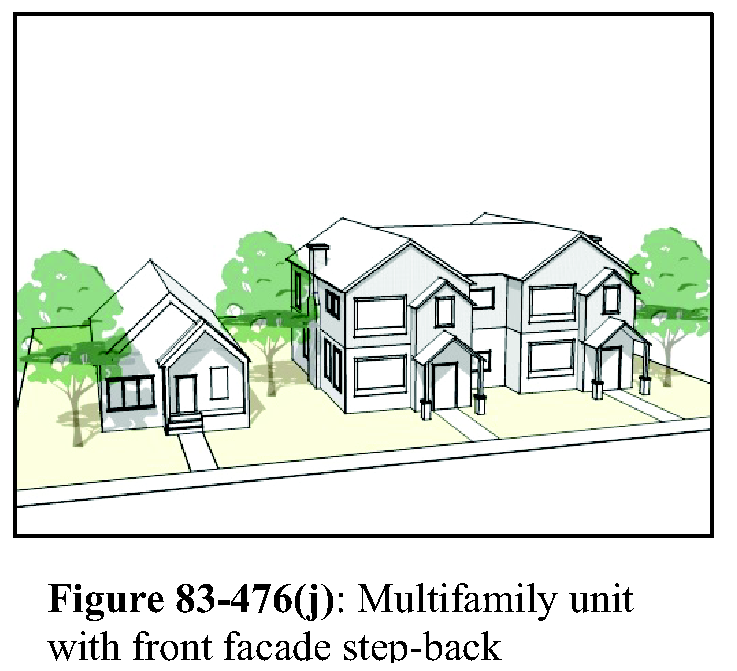
(1)
Articulating the front facade so that the building appears from the street to be separate homes "stepping back" the front facade a minimum of ten feet in the space where the side yards would typically be found between two single-family detached dwellings along the block face (see figure 83-476(j): Multifamily unit with front facade step-back); or
(2)
Organizing units around a central courtyard that maintains the impression of the side yard depths typically found between single-family detached dwellings along the block face.
(Ord. No. O-2013-08, 9-16-13; Ord. No. O-2018-34, 11-26-18)
Sec. 83-477. - Institutional, commercial, and mixed-use development standards.
(a)
Purpose. These institutional, commercial, and mixed-use development standards are intended to:
(1)
Protect and enhance a pleasant environment for working and shopping and promote the desirability of investment and occupancy in business and other properties;
(2)
Protect and enhance community property values in order to provide an adequate tax base to the county to enable it to provide required services to its citizens;
(3)
Encourage originality, flexibility, and innovation in site planning and development;
(4)
Encourage establishment of a strong sense of place with vibrant institutional, commercial, and mixed-use development in village growth areas and other appropriate locations;
(5)
Encourage a more pedestrian-friendly environment through attention to human-scale development;
(6)
Foster greater compatibility between adjacent residential and nonresidential development; and
(7)
Limit the negative impacts of automobile-oriented development.
(b)
Applicability.
(1)
General. Except as provided otherwise in this section, the standards in this section shall apply to:
a.
All new institutional, commercial, and mixed-use development, including large retail establishments;
b.
Any expansion or alteration of an existing institutional, commercial, or mixed-use development where the expansion increases the development's gross floor area by 50 percent or more, or the alteration involves 50 percent or more of the development's gross floor area.
(2)
Review for compliance. Review for compliance with the standards of this subsection shall occur during review of an application for site plan approval (article II, Administration) or a zoning compliance permit (article II, Administration), as appropriate. Site plan applications shall include drawings, renderings, or perspectives of a professional quality which illustrate the scale; massing; roof shape; window size, shape, and spacing; and exterior materials of the structure and their color.
(c)
Parking location.
(1)
Village center districts. In Village Center (VC) and Village Center Planned Development (VC-PD) Districts, all required off-street surface parking shall be located to the side or rear of the front facade of the principal building(s).
(2)
All other districts. In all other instances, no more than 50 percent of the number of off-street parking spaces shall be surface parking located between the front of the principal building(s) and the street it faces.
(3)
Modifications. Upon request by the property owner or applicant, the director may approve modifications to this subsection to allow additional parking between the front of the principal building(s) and adjacent streets, provided that off-street parking spaces located between the front of the principal building(s) and adjacent streets are screened with a landscaped berm, a decorative wall or fence, or landscaping that exceeds the minimum requirements established by this chapter. Such approval shall be in writing and include justification for the modification, such as lot size or configuration, natural conditions (such as the presence of watercourses or topography), or other unique site conditions and/or characteristics of the associated use.
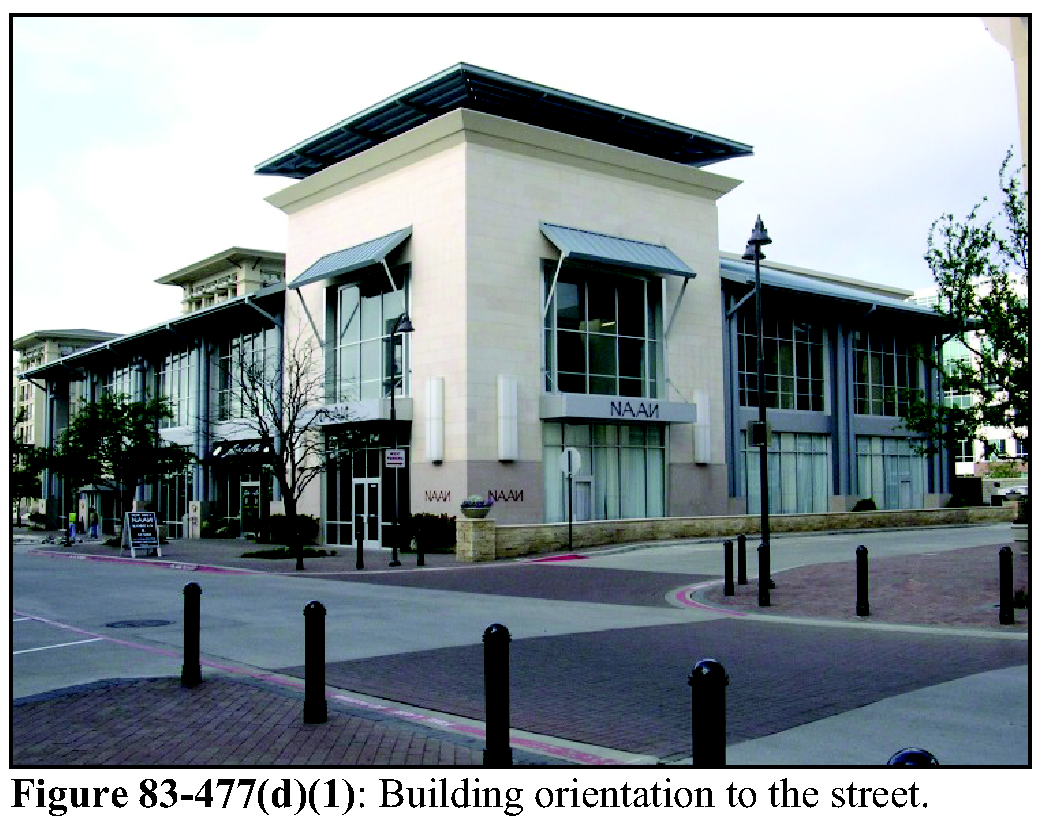
(d)
Building orientation and configuration.
(1)
The primary entrances of buildings shall be oriented towards a street along the perimeter of the development, towards streets or driveways interior to the development, or towards open space areas, courtyards, or plazas.
(2)
Buildings on corner lots shall include a prominent architectural feature of greater height than the rest of the roof, such as a tower or similar feature, at the corner of the building closest to the intersection.
(e)
Pedestrian-oriented facades. Building facades facing streets, open space areas, courtyards, or plazas shall incorporate a combination of pedestrian entrances, arcades, awnings, pedestrian-level display windows, and storefronts that provide shade, provide visual interest, and otherwise encourage pedestrian activity along the building frontage.
(f)
Building architecture and design.
(1)
Projects with multiple buildings (including shopping centers) shall have a consistent and distinct identity through the use of similar and compatible architectural design of buildings and roofs, including materials, colors, and style.
(2)
For all commercial and mixed-use development, a development design pattern book must be submitted to the planning commission for review and approval prior to approval of any site plan within the development to ensure that the architecture of proposed structures is compatible with surrounding development; recommendations made within the comprehensive plan; recommendations made within the countywide development guidebook; and standards set forth in this section. All structures within the development must adhere to guidelines established by the approved development design pattern book, and any deviations from those guidelines must be approved by the director, with written documentation justifying the request. The development design pattern book shall include:
a.
Written descriptions and graphics explaining how the development complements existing development in the surrounding area and relates to recommendations made in the comprehensive plan and countywide development guidebook; and
b.
Written descriptions and graphics explaining the theme and physical form of the project's architectural design. The written description shall identify specific materials, colors, and architectural details that are permitted within the development.
(3)
Development composed of multiple buildings totaling 20,000 or more square feet of gross floor area shall be configured to:
a.
Break up the site into a series of smaller "blocks" defined by vehicle accessways, pedestrian walkways, or other circulation routes;
b.
Frame the corner of an adjacent street intersection or entry point to the development;
c.
Frame and enclose a "Main Street" pedestrian or vehicle access corridor within the development site;
d.
Frame and enclose on at least three sides of parking areas, public spaces, or other site amenities; or
e.
Frame and enclose outdoor dining or gathering spaces for pedestrians between buildings.
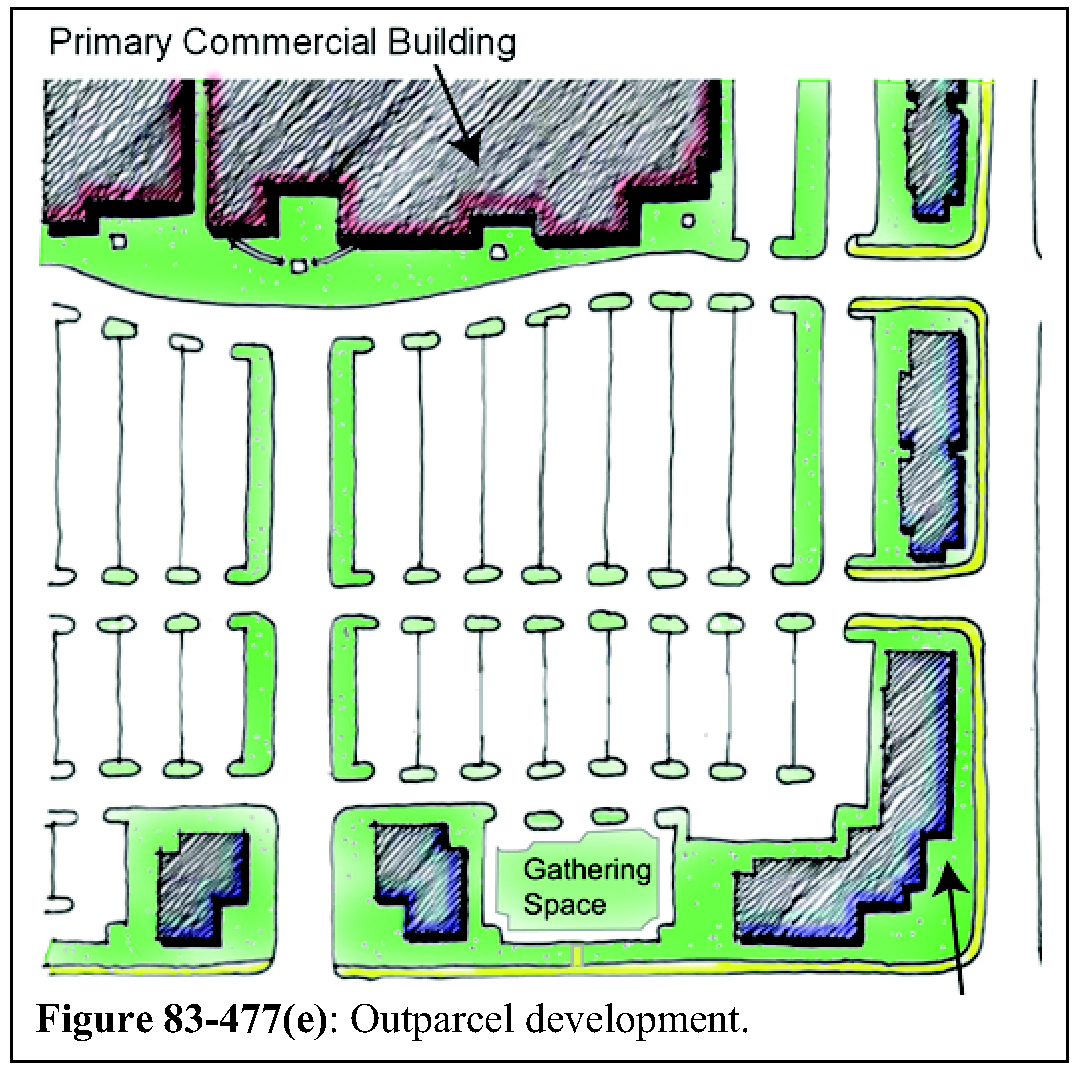
(g)
Outparcel development.
(1)
To the maximum extent practicable, outparcels and their buildings shall be configured and located to define street edges, development entry points, and spaces for gathering or seating between buildings.
(2)
Spaces between buildings on outparcels shall be configured with small scale pedestrian amenities such as plazas, seating areas, pedestrian connections, and gathering spaces. (See figure 83-477(e), Outparcel development.)
(h)
Materials.
(1)
Building façade materials shall be limited to wood, brick, stone, decorative block, stucco, or other materials with a similar appearance, durability, and quality. The use of metal or vinyl siding is subject to review and approval by the director.
(2)
At least 70 percent of building façades visible from existing or planned roadways shall be constructed of wood, brick, stone, and/or other materials with a similar appearance, durability, and quality. No more than 30 percent of building facades visible from existing or planned roadways shall be adorned with stucco or decorative block.
(3)
No building exterior visible from existing or planned roadways shall be constructed entirely of metal or unadorned concrete block, or of architectural materials inferior in quality, appearance, or detail to any other exterior of the same building.
(4)
Chain link security fencing shall have a dark vinyl coating rather than a bare galvanized steel finish.
(5)
Wall-mounted exhaust fans shall be painted to match the building or screened from view.
(i)
Colors.
(1)
Façade colors for all portions of the building shall be low reflectance, subtle, neutral or earth-tone colors (no primary colors). Building trim and accent areas may feature brighter colors that complement the building's overall appearance.
(2)
Junction and accessory boxes, including meter boxes (excluding glass), and any pipes or conduit to boxes shall be the same color as the building.
(j)
Roofs.
(1)
Principal buildings shall incorporate roof pitches between 3:12 and 12:12, or incorporate a parapet at least three feet high with a three-dimensional cornice around a flat roof. Alternative roof forms or pitches may be allowed for small roof sections over porches, entryways, or similar features.
(2)
Any roof visible from an adjoining street or property shall be constructed of wood, tile, standing seam metal, heavy-grade architectural fiberglass shingles, slate, or other materials with a similar appearance, durability, and quality.
(3)
All roof vents, pipes, antennas, satellite dishes, and other roof penetrations and equipment (except chimneys) shall be located on the rear elevations or otherwise be configured, to the maximum extent practicable, to have a minimal visual impact as seen from the street.
(4)
Buildings with multiple uses or in excess of 25,000 square feet shall have alternating roof structures to give the appearance of multiple buildings unless a different design is approved by the director.
(k)
Façade articulation.
(1)
Offsets required. Street-facing front building facades that are greater than 60 feet wide shall be articulated with wall offsets (e.g. projections or recesses in the façade plane) that are at least one foot deep, at least ten feet wide, and spaced no more than 40 feet apart.
(2)
Offset alternatives. The following alternatives can be used alone or in combination as an alternative to the required front façade offsets:
a.
Distinct changes in façade texture, materials, or color that follow the same dimensional standards as the offset requirements;
b.
Roofline variations that vertically align with a corresponding wall offset or change in façade texture, materials, or color, including changes in roof form and/or the height of parapet walls; or
c.
Vertical accents or focal points.
(3)
Side facades. The side facades of buildings visible to the general public from any roadway and/or public view shall be articulated with the same façade details as provided on the building's front façade, or be screened from off-site views through fences, walls, or landscaping at least eight feet high. Unless such screening is provided, architectural details and materials on the front of the building shall not abruptly end but be continued to the side walls.
(4)
Outbuildings. Outbuildings located in front of other buildings within the same development shall include a consistent level of façade articulation and building form detail on all sides of the building as well as exterior materials and colors that are compatible with the primary building in the development.
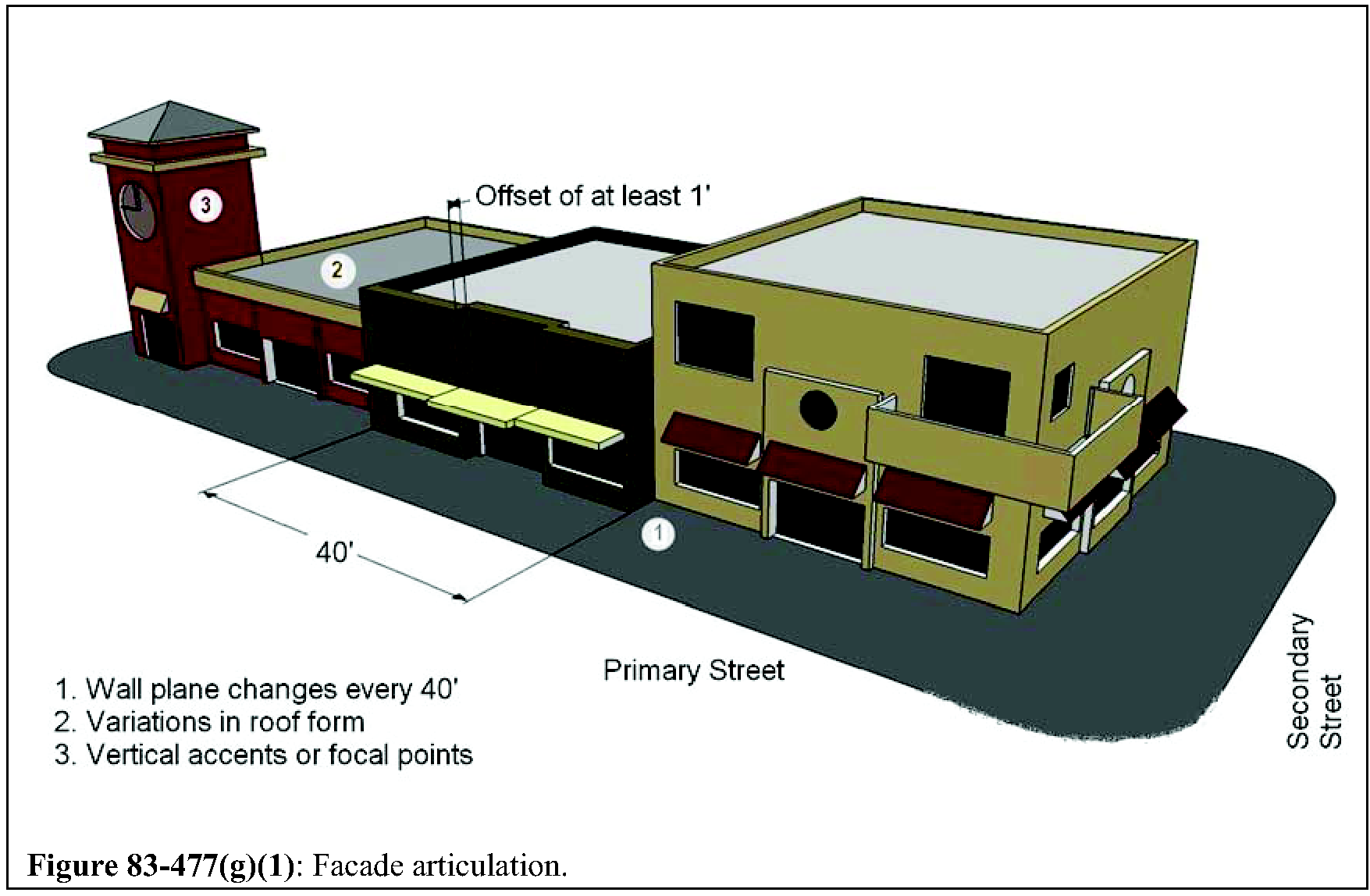
(l)
Fenestration/transparency. At least 30 percent of the street-facing façade area of the ground-level floor of buildings (as measured from the grade to the underside of the eave, top of the parapet, or the story line denoting the second floor) shall be occupied by doorways or transparent windows. Upon request by the property owner or applicant, the director may approve modifications to this subsection, provided that other architectural features are incorporated into street-facing façades to add visual interest, and such approval is in writing with justification for the modification.
(m)
Loading, service, and equipment areas.
(1)
Loading, service, and equipment areas shall be located in a manner that minimizes their visibility from off-site areas, to the maximum extent practicable.
(2)
Loading, service, and equipment areas that are associated with an outparcel building shall be screened through the use of structural elements and similar materials attached to and integrated with the building.
(3)
Outdoor storage areas shall be screened in accordance with the standards for outdoor storage in article VII, Use Standards.
(n)
Pedestrian amenities. Architectural pedestrian amenities such as benches, fountains, decorative light fixtures, plantings, and awnings shall be provided subject to review and approval by the director.
(o)
Mixed-use buildings in Village Center Districts. Mixed-use buildings in the Village Center (VC) and Village Center Planned Development (VC-PD) districts shall meet the following standards:
(1)
The ground level shall be devoted to commercial space; and
(2)
Ground-level commercial space shall be located along those facades adjacent to or most visible from primary street frontages or major pedestrian walkways.
(p)
Maximum building size in village center districts. In the Village Center (VC) and Village Center Planned Development (VC-PD) districts, total building area shall not exceed 45,000 square feet, unless a conditional use permit (CUP) is approved by the Board of Supervisors.
(Ord. No. O-2013-08, 9-16-13; Ord. No. O-2015-06, 5-4-15; Ord. No. O-2018-18, 6-25-18)
Sec. 83-480. - Large retail establishment standards.
(a)
Applicability.
(1)
General. A single-tenant building in any district that has a gross floor area of 60,000 square feet or more and devotes 60 percent or more of the total floor area to retail sales activities ("large retail buildings") shall comply with the general institutional, commercial, and mixed-use development standards in section 83-477(c) through section 83-477(l) above and the standards in this subsection. If there is a conflict between the standards in section 83-477(c) through section 83-477(l) and those in this subsection, the standards in this subsection shall control. (See figure 83-480, Examples of large retail establishments.)
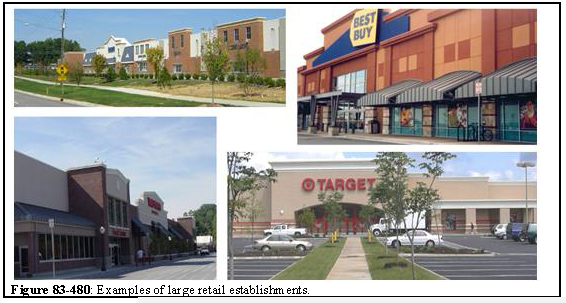
(2)
Review for compliance. Review for compliance with the standards of this subsection shall occur during review of an application for site plan approval (article II, Administration) or a zoning compliance permit (article II), as appropriate.
(b)
Location of surface parking.
(1)
Except in Village Center (VC) and Village Center Planned Development (VC-PD) Districts, up to 60 percent of the total off-street surface parking provided may be located between the front facade of the building and the street it faces. In Village Center (VC) and Village Center Planned Development (VC-PD) Districts, up to 30 percent of the total off-street surface parking provided may be located between the front facade of the building and the street it faces.
(2)
Off-street surface parking lots with 200 or more spaces shall be organized into a series of modules in accordance with section 83-461(d)(4)b., Areas with 200 or more spaces.
(See figure 83-480(b), Large retail parking location.)
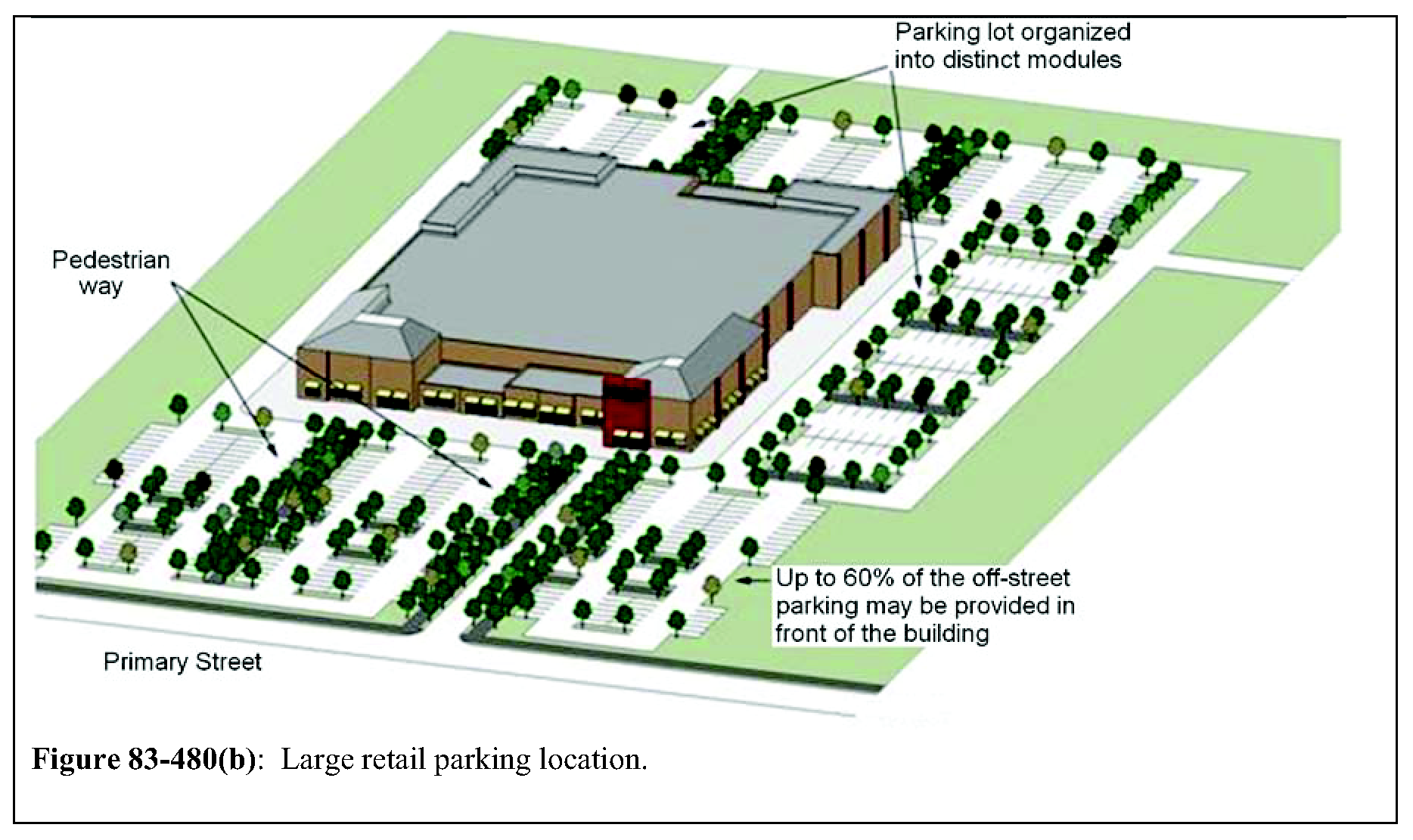
(c)
Pedestrian circulation.
(1)
To the maximum extent practicable, there shall be pedestrian circulation from the perimeter of the site to the primary customer entrances to all buildings. Within the site, there shall be pedestrian connections to all pedestrian activities, including: transit stops, street crossings, open space, building and store entry points, and adjacent pedestrian circulation systems.
(2)
Pedestrian walkways shall be provided through parking areas and shall be distinguished from other surfaces through a combination of two or more of the following features:
a.
Six-inch vertical curb;
b.
Special railings;
c.
Bollards;
d.
Special paving;
e.
Low seating wall or similar feature;
f.
Pedestrian scale lighting; or
g.
Traffic calming devices.
(d)
Building entrances. Buildings shall have clearly defined, highly visible customer entrances featuring at least three of the following features:
(1)
Canopies or porticos above the entrance;
(2)
Roof overhangs above the entrance;
(3)
Entry recesses or projections (such as enclosed vestibules);
(4)
Arcades that are physically integrated with the entrance;
(5)
Raised corniced parapets above the entrance;
(6)
Gabled roof forms or arches above the entrance;
(7)
Outdoor patios or plazas adjacent to the entrance;
(8)
Display windows that are directly adjacent to the entrance; or
(9)
Integral planters or wing walls that incorporate landscaped areas or seating areas.
(e)
Facades and massing. To reduce their perceived mass and scale, buildings shall incorporate two or more of the following elements on each street-facing facade:
(1)
Variations in roof form and parapet heights;
(2)
Pronounced wall offsets that are at least two feet deep;
(3)
Distinct changes in texture and color of wall surfaces;
(4)
Ground level arcades and second floor galleries or balconies;
(5)
Protected and recessed entries; and
(6)
Vertical accents or focal points.
(See figure 83-480(e), Example of large retail building entrances and massing.)
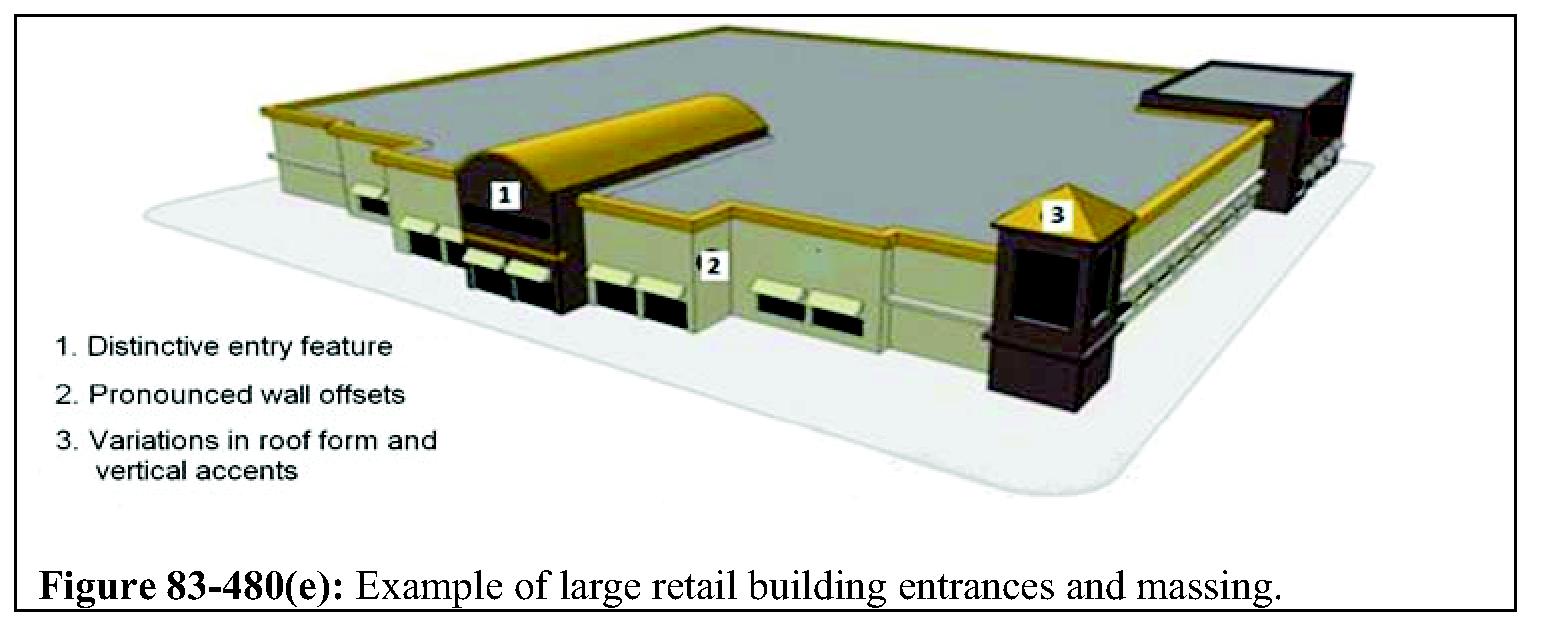
(Ord. No. O-2013-08, 9-16-13)
Sec. 83-482. - Industrial development standards.
(a)
Purpose. These industrial development standards are intended to identify the county's goals and expectations for industrial development, resulting in greater predictability during the development review process. Recognizing that the form of industrial developments is based on the function of the uses within the development, the focus of these standards is minimizing the industrial development's potential negative impacts on adjacent land uses and improving the appearance of industrial development along the gateways and entrances to the county.
(b)
Applicability.
(1)
General. Except as provided otherwise in this section, the standards in this section shall apply to all industrial development.
(2)
Review for compliance. Review for compliance with the standards of this subsection shall occur during review of an application for site plan approval (article II, administration) or a zoning compliance permit (article II), as appropriate.
(c)
Building orientation and configuration.
(1)
Single-building development. A development composed of a single building shall orient the building facade containing its primary patron entrance to face the street from which the building derives its street address.
(2)
Concealment of operations and loading areas. A development shall locate and configure buildings to conceal operations and loading areas from off-site views.
(3)
Accessory structures and uses. Accessory structures and uses shall not front a street and shall be located in a manner that minimizes their impacts on adjacent uses.
(d)
Entrance. Each principal building shall have clearly defined, highly visible primary entrances for occupants and patrons that incorporate at least one of the following features to emphasize the importance of the entrance:
(1)
Canopy or portico;
(2)
Roof overhang;
(3)
Horizontal recess or projection;
(4)
Arcade or arch;
(5)
Peaked roof form;
(6)
Outside patio;
(7)
Display window;
(8)
Tile work or moldings integrated into the form of the building facade;
(9)
Integrated planters or wing walls that incorporate landscaped area or seating areas; or
(10)
Similar building form features not found on the remainder of the building facade.
(e)
Facade articulation. General design standards in section 83-477, Institutional, commercial, and mixed-use development standards, shall not apply. Instead, each street-facing building facade shall be horizontally and/or vertically articulated to avoid long, blank wall planes, by meeting at least one of the following standards:
(1)
Wall plane horizontal articulation. Each facade greater than 100 feet in length shall be articulated with wall offsets (e.g., projections or recesses in the facade plane), changes in facade color or material, or similar features that visually interrupt the wall plane horizontally such that the width of uninterrupted facade does not exceed 100 feet.
(2)
Vertical articulation. Each facade greater than 30 feet in height shall incorporate a change in the wall surface plane or in facade color or material that visually interrupts the wall plane vertically such that the height of uninterrupted facade does not exceed 30 feet.
(3)
Roof line variation. The facade shall include variations in roof planes and/or in the height of a parapet wall at least every 60 feet of roofline length along the facade.
(f)
Loading and service areas. Loading and service areas shall be separated from patron parking, pedestrian areas, and main drive aisles, and shall be located as far as practicable from any abutting single-family residential development.
(Ord. No. O-2013-08, 9-16-13; Ord. No. O-2018-18, 6-25-18)
Sec. 83-484. - Residential compatibility standards.
(a)
Purpose. These residential compatibility standards are used to provide a proper transition and compatibility between single-family detached residential development and more intense multifamily residential, nonresidential, and mixed-use development. More specifically, it is the intent of these standards to:
(1)
Provide effective transitions between single-family residential uses and more intense uses;
(2)
Protect the character of existing single-family residential development from negative impacts resulting from more intense adjacent forms of development;
(3)
Use development form and design treatments to ensure compatibility instead of large vegetated buffers that consume excessive amounts of available land;
(4)
Limit interruptions in vehicular and pedestrian connections created by efforts to segregate uses; and
(5)
Establish or maintain vibrant pedestrian-oriented areas where differing uses can operate in close proximity to one another.
(b)
Applicability.
(1)
General. Unless exempted below, these residential compatibility standards shall apply to the following forms of development:
a.
Multifamily and townhouse residential, nonresidential, and mixed-use development located on land abutting or across a local street or alley from existing single-family detached residential development.
b.
Any expansion or alteration of an existing multifamily or townhouse residential, nonresidential, or mixed-use structure located on land abutting or across a local street or alley from existing single-family detached residential development, where the expansion increases the structure's floor area by 50 percent or more, or the alteration involves 50 percent or more of the structure's floor area.
(2)
Exemptions. Multifamily and townhouse residential, nonresidential, and mixed-use development located on lots separated from single-family detached residential development by a street with four or more lanes are exempt from these standards.
(3)
Conflict. In the case of conflict between these standards and other development standards in this article, the residential compatibility standards in this section shall control.
(4)
Review for compliance. Review for compliance with the standards of this subsection shall occur during review of an application for site plan approval (article II, Administration) or a zoning compliance permit (article II), as appropriate.
(c)
Compatibility standards. All multifamily and townhouse residential, nonresidential, and mixed-use development subject to this section shall comply with the following standards:
(1)
Use intensity. For multi-building development that includes varying uses and/or development intensities in different buildings, the development shall locate buildings with the least intense use and/or development nearest to the abutting single-family detached residential development.
(2)
Building height.
a.
Buildings within 50 feet of a lot line shared with existing single-family dwelling may not exceed the lesser of the maximum height for the district where located or a maximum height of 35 feet.
b.
Buildings over three stories in height shall be broken up into modules or wings with the smaller and shorter portions of the structure located nearest the adjacent single-family dwelling.
(See figure 83-484(c)(2), Compatible building heights.)
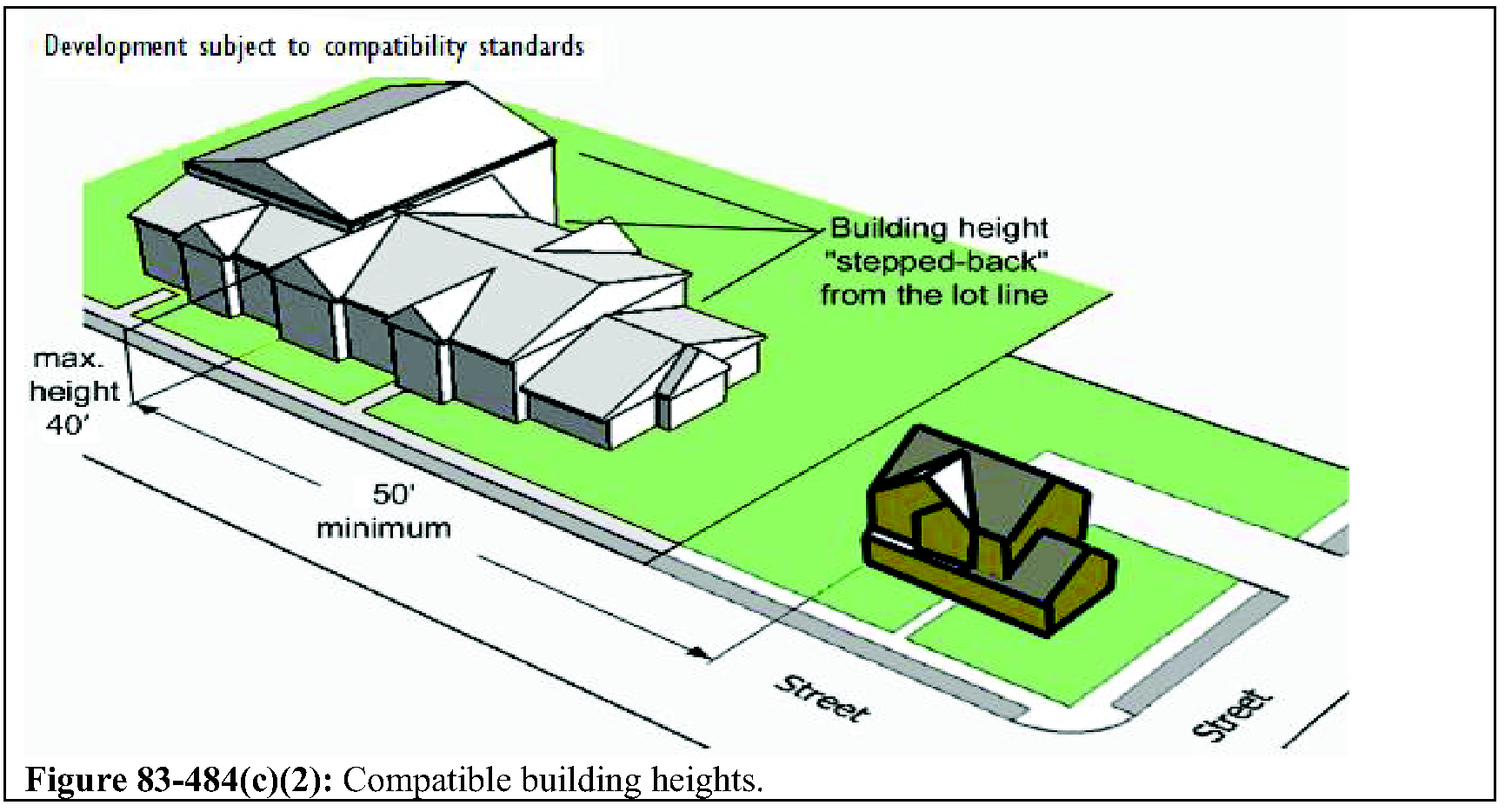
(3)
Building setbacks. Setbacks of buildings from the street shall be consistent with those for other buildings on the block face and across the street to maintain a consistent plane along the public street frontage. Building setbacks shall vary no more than ten percent from those of abutting buildings.
(4)
Building standards.
a.
Buildings shall:
1.
Use a similar roof type to adjacent single-family dwellings in terms of slope and arrangement to prevent abrupt changes in roof form; and
2.
Orient porches, balconies, and outdoor activity areas away from adjacent single-family dwellings.
b.
Retail commercial buildings that face single-family development shall be developed to appear as a series of discrete storefronts, with no single storefront occupying more than 50 percent of the total facade width.
(See figure 83-484(c)(4), Compatible building development.)
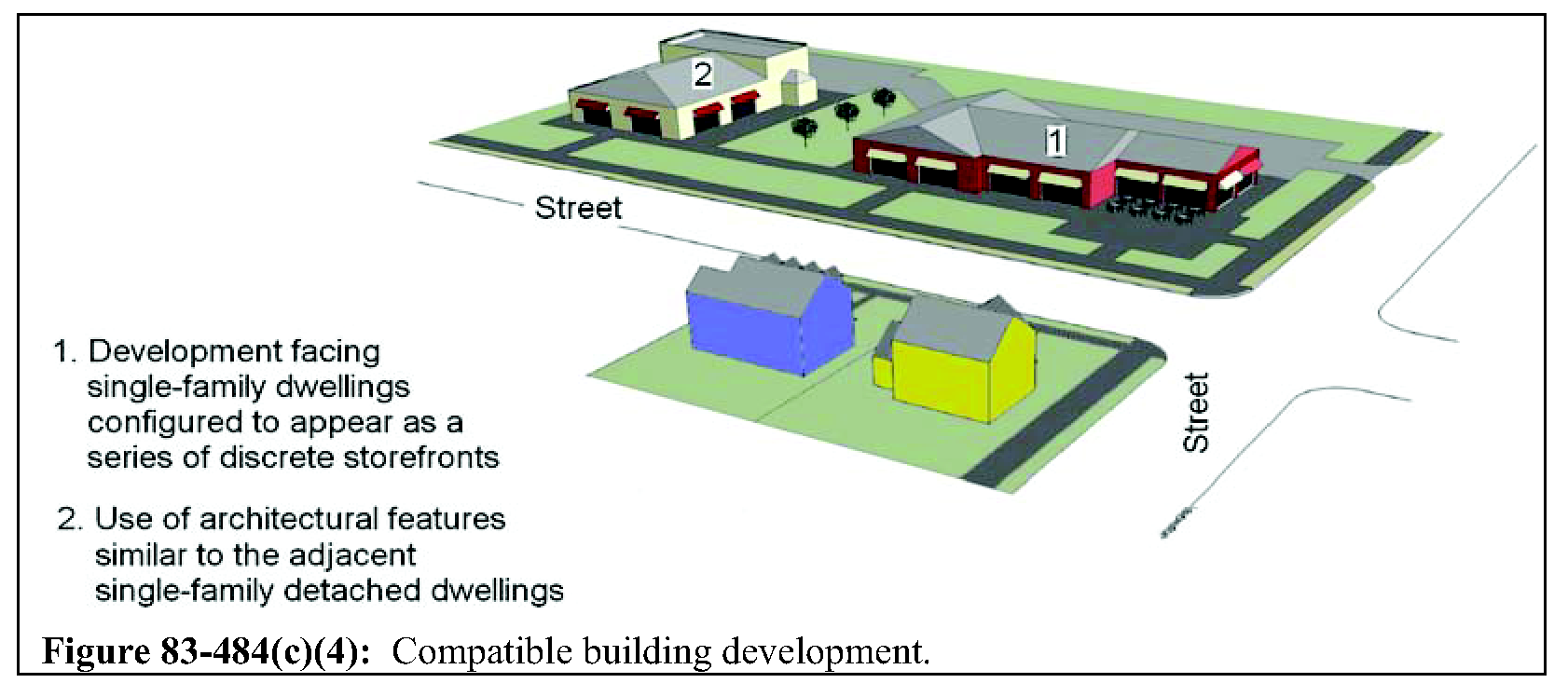
(5)
Off-street parking areas.
a.
Off-street parking on lots adjacent to a single-family dwelling shall be located as follows (listed in priority order):
1.
Adjacent to off-street parking lots serving nonresidential uses on abutting lots;
2.
Adjacent to lot lines abutting nonresidential development;
3.
Adjacent to lot lines abutting mixed-use development;
4.
Within a lot's corner side yard;
5.
Behind the building;
6.
In front of the building; or
7.
Adjacent to lot lines for the abutting single-family dwelling.
b.
The facade of any parking structure facing adjacent single-family residential development shall be developed to appear as a solid building wall to soften its visual impact.
c.
Off-street surface parking areas located adjacent to single-family residential development shall be screened by a type C perimeter buffer, in accordance with section 83-461(e), Perimeter buffers.
(6)
Loading, service, and refuse areas. Loading, service, and refuse areas shall be:
a.
Screened from view of single-family dwellings using materials that are the same as, or of equal quality to, the materials used for the principal building; and
b.
Incorporated into the overall layout of the building and landscaping so that the adverse impacts of these functions are fully contained and out of view from adjacent properties and public streets.
(7)
Exterior lighting. Exterior lighting shall:
a.
Be full-cut-off, or be fully shielded such that the source of illumination is not visible from off-site views; and
b.
Maintain maximum illumination values of 0.5 foot-candles or less at lot lines abutting an existing single-family dwelling.
(8)
Operational standards. Uses subject to these residential compatibility standards shall:
a.
Cease outdoor dining or other outdoor activities after 10:00 p.m. on Sunday through Thursday nights and after midnight on Fridays and Saturdays;
b.
Limit trash collection or other service functions to between the hours of 7:00 a.m. and 7:00 p.m.; and
c.
Extinguish amplified music, singing, or other forms of noise audible at lot lines shared with single-family dwelling after 10:00 p.m. on Sunday through Thursday nights and after midnight on Fridays and Saturdays.
(Ord. No. O-2013-08, 9-16-13)
Sec. 83-485. - Farmland compatibility standards.
(a)
Purpose. The purpose of these farmland compatibility standards is to promote development that is compatible with existing farms and agricultural uses in Powhatan County. Specifically, the standards in this section are intended to:
(1)
Ensure new nonagricultural development does not negatively impact the continuation of agricultural operations and activities on abutting land;
(2)
Complement state right-to-farm laws that provide that properly conducted agricultural operations do not constitute nuisances;
(3)
Maintain and promote rural character in agricultural areas; and
(4)
Ensure greater compatibility between existing farms and new nonagricultural development.
(b)
Applicability.
(1)
General. These standards are applicable to new residential, institutional, commercial, or industrial development proposed on land that abuts land zoned agricultural-20 (A-20), agricultural-10 (A-10), or agricultural/animal confinement (A-C) and is currently used for on-going agricultural operations—that is, operations and activities directly associated with an agriculture use as described in the agricultural uses provisions of Article XII, Interpretations. These standards do not apply to properties located within Courthouse Village or 711 village special area plan areas as designated in the comprehensive plan.
(2)
Review for compliance. Review for compliance with the standards of this subsection shall occur during review of an application for site plan approval (article II, Administration) or a zoning compliance permit (article II), as appropriate, for the new residential, institutional, commercial, or industrial development.
(c)
Compatibility standards.
(1)
Agricultural buffer.
a.
Buffer required. The new development shall provide and maintain a vegetative buffer along all property lines abutting land used for agricultural operations for as long as the agricultural operations continue.
b.
Buffer width.
1.
The agricultural buffer shall be at least 100 feet wide, except for properties located within Route 60 Corridor East Special Area Plan area, as designated in the comprehensive plan, where a 50-foot agricultural buffer shall be required for properties 100 acres or greater and that no agricultural buffer shall be required for properties less than 100 acres.
2.
The director may allow the buffer width to be reduced by up to 20 percent upon determining that the reduced buffer width is justified by the type or intensity of the adjacent agricultural operations, an intervening topographic change, an intervening riparian buffer, or the existence or provision of vegetation in addition to that required in subsection (c) below.
c.
Buffer materials.
1.
Agricultural buffers should consist of a mix of trees, shrubs, berms, and natural features sufficient to reduce noise, spray drift and dust, diffuse light, and act as a physical separation between nonagricultural and agricultural uses. All buffers shall incorporate a vegetative screening component to reduce conflict potential between residential and agricultural uses.
2.
A buffer may incorporate a wall or fence to provide additional screening and/or limit access between the development and the abutting agricultural land.
3.
Where the agricultural buffer is directly adjacent to a residential dwelling or residential lot, the length of the buffer running parallel to the dwelling along the property line shall be landscaped as follows in addition to any other vegetative buffer or fence:
i.
The buffer shall be planted with a minimum of two off-set rows of trees planted that provides an average spacing between trees of ten feet or less.
ii.
Each tree shall be a minimum height of eight feet and minimum caliper of two inches when planted.
iii.
Each tree shall be a native species that can be expected to attain a minimum height of 35 feet and have a crown width of 25 feet or greater at maturity.
d.
Uses permitted in buffer. Development allowed within an agricultural buffer is limited to:
1.
Landscaping with native plants, trees, or hedgerows;
2.
Crossings by roadways, driveways, railroad tracks, and utility lines (and associated maintenance corridors), where the crossing is aligned to minimize any reduction of the buffer's effectiveness;
3.
Trails that involve minimal removal or disturbance of buffer vegetation;
4.
Stormwater management facilities to the extent determined to be necessary by the administrator;
5.
Vegetation management, including the planting of vegetation or pruning of vegetation, removal of individual trees that pose a danger to human life or nearby buildings, removal of individual trees to preserve other vegetation form extensive pest infestation, removal of understory nuisance or invasive vegetation, or removal or disturbance of vegetation as part of emergency fire control measures; and
6.
Any other development determined by the administrator to be consistent with the use of the property as an agricultural buffer.
e.
Maintenance.
1.
Property owner(s) are responsible for all aspects of continuous maintenance of buffer areas.
2.
Property owner(s) shall be responsible for maintaining landscape plants in a healthy and attractive condition. Dead or dying plants shall be replaced with materials of equal size and similar variety within three months, weather permitting.
3.
If the development consists of multiple parcels that may be held under separate ownership, a homeowners association, property owners association, or similar entity shall be required to maintain buffers to control litter, fire hazards, pests, and other maintenance problems.
4.
Buffer maintenance requirements shall be stipulated through inclusion in covenants, conditions, and restrictions.
(2)
Location and configuration of open-space set-asides. Where the new development includes open space set-asides, such open space set-asides shall, to the maximum extent practicable, be located between the abutting existing agricultural use and buildings in the new development, and be configured to accommodate the agricultural buffer required in subsection (1) above.
(3)
Preservation of direct access. The new development shall be configured to retain direct access for farm vehicles between the abutting agricultural land and an adjacent street.
(Ord. No. O-2013-08, 9-16-13; Ord. No. O-2014-14, 2-18-14)
Sec. 83-486. - Sustainability; incentives for sustainable development practices.
(a)
Purpose. The purpose of this subsection is to promote sustainable development practices as a means of protecting and conserving natural resources and ensuring a high quality of life for future county residents. More specifically, it is intended to provide incentives that encourage new development in village growth areas to use site and building development options that conserve energy, promote a healthy landscape, support public health and safety, and otherwise increase the development's sustainability.
(b)
Type of incentives.
(1)
Development integrating sustainable development practices in accordance with the provisions of this section shall be eligible for the following incentives:
a.
A density bonus of up to one additional dwelling unit per acre beyond the maximum allowed in the village growth area districts;
b.
An increase in the maximum allowable building coverage by ten percent beyond the maximum allowed in the village growth area districts;
c.
A modification to the off-street parking requirements resulting in a reduction from the minimum requirements by 15 percent, or an increase to the maximum allowable number of spaces provided by 15 percent (without an alternative parking plan);
d.
An increase in the maximum allowable sign area or maximum height for wall or freestanding signs by ten percent; or
e.
A reduction in the amount of required open space set-aside by ten percent.
(2)
Development may include a sufficient number of sustainable development practices to take advantage of more than one type of incentive, but in no instance shall the amount of an incentive be increased or decreased (as appropriate) beyond the maximum listed in this subsection.
(c)
Applicability. New development in the village growth area districts and village growth area planned development districts that provide sustainable features in accordance with this subsection shall be eligible for the incentives listed in table 83-486(c), Sustainable development practice incentives below.
(d)
Conflict with neighborhood compatibility standards. In cases where bonuses in this section conflict with the neighborhood compatibility standards in section 83-476, Multifamily and townhouse development standards in village growth area districts, the neighborhood compatibility standards shall control.
(e)
Procedure.
(1)
Applicants seeking to use the sustainability incentives shall include a written request with the development application.
(2)
Review for compliance with this section, and granting of requests in accordance with this section, shall occur during review of a site plan (article II, Administration) or zoning compliance permit (article II), as appropriate.
(3)
The incentive granted shall be based on the number of sustainable development practices provided, in accordance with table 83-486(c), Sustainable development practice incentives, and section 83-486(f), Menu of sustainable development practices.
(f)
Menu of sustainable development practices. Table 83-486(f), Sustainable Development practices, below lists sustainable development practices that an applicant may offer and provide as part of a proposed development to qualify for the sustainability incentives set forth in section 83-486(b), Type of incentives.
(g)
Failure to install or maintain sustainable development practices. The failure to install or maintain approved sustainable development practices is a violation of this chapter, shall render the subject development nonconforming, and may result in revocation of the authorization for use of sustainable development practice incentives.
(Ord. No. O-2013-08, 9-16-13)
Sec. 83-488. - Signage.
(a)
Purpose. The following sign regulations are established to protect and enhance the character of roadways and surrounding areas; to prevent diminishing property values due to excessive signage; to safeguard the public use and nature of roadways; to minimize visual distractions to motorists along public roads; to promote maximum legibility of signs and to prevent their over concentration as well as excessive height, bulk, and area; to promote the safety of persons and property by requiring that signs not create a hazard due to collapse, fire, collision, decay or abandonment; and to enable customers and other persons to identify and locate a business.
(b)
Applicability.
(1)
General.
a.
No person, except a public officer or employee in performance of a public duty, shall paste, post, print, nail, tack, erect, place, maintain, or fasten any sign, banner, pennant, outdoor advertising sign, billboard, or notice of any kind—or cause the same to be done—that faces or is visible from any public street or public open space without a sign permit, except as otherwise provided in subsection (2) below or elsewhere in this section.
b.
A sign permit must be approved prior to the release of a temporary certificate of occupancy. An approved sign must be installed prior to the release of the final certificate of occupancy.
c.
All signs requiring a sign permit shall be registered with the director.
(2)
Signs not requiring a sign permit. The following signs may be erected without a sign permit:
a.
Signs of a duly-constituted governmental body, including traffic or similar regulatory devises, legal devices, or warning at railroad crossings.
b.
Memorial tablets or signs, grave stones.
c.
Signs required to be maintained by law or governmental order, rule, or regulation.
d.
Signs that are within a ball park or other similar private recreational use and which cannot be seen from a public street or adjacent properties.
e.
Flags or emblems of any political unit, government, civic, philanthropic, educational, or religious organization, provided that no flag pole shall exceed 40 feet in height.
f.
Internal directional signs displayed for the direction or convenience of the public on private property but bearing no advertising material indicating whether to enter, exit, whether the use is open or closed, stop, one-way, employee parking, shipping, and similar activities as well as signs identifying restrooms, public telephones, and other such facilities available for the general public, provided that such signs shall not exceed four square feet in area and five feet in height.
g.
Signs placed by a public utility showing the location of underground facilities.
h.
Residential yard sales signs not more than eight square feet in area, provided the sign is only posted at the location of the sale and is removed within 48 hours after the event.
i.
One temporary on-site real estate sign advertising the sale or rental of the residential premises, provided the sign does not exceed eight square feet in area and seven feet in height, and is removed after the sale or rental of such property.
j.
Temporary off-site real estate signs directing the way to the residential premise for sale or rent, provided the sign is located outside the public right-of-way, does not exceed four square feet in area, and is removed promptly when the property has been sold or rented.
k.
One temporary sign advertising the sale of farm products grown or produced on the premises, provided the sign does not exceed 12 square feet in area and ten feet in height, and is removed within ten days after the growing season.
l.
Temporary signs containing political campaign messages, provided the sign does not exceed 50 square feet in area and eight feet in height, and is removed within five days after the election event.
m.
Signs used for the purposes of displaying the name of a home occupation for a single-family residence, provided the sign is not illuminated, is no larger than one square foot in area, and is mounted flat against the wall of the principal building.
n.
Signs prohibiting trespassers, hunting, fishing, solicitors, or parking, or announcing adoption of highways for litter control, posted property, crime watch areas, or the towing of unauthorized vehicles, provided the sign is not illuminated and is not more than three square feet in area.
o.
County and Powhatan Courthouse entry way signs.
p.
Off-site directional signs for places of worship, schools, hospitals, parks, libraries, historic areas, or other similar institutional or public uses, provided that the sign does not exceed eight square feet in area and seven feet in height, and is not located in the public rights-of-way.
(c)
Prohibited signs. The following signs shall be prohibited:
(1)
Unauthorized signs located at the intersection of any streets in such a manner as to create a traffic hazard by obstructing vision between heights of two and one-half and eight feet; or at any other location where it may interfere with, obstruct the view of, or be confused with any authorized traffic sign.
(2)
Attention-getting devices, unless approved as a temporary sign in accordance with section 83-488(h), Temporary signs. Search lights are prohibited for use as attention-getting devices.
(3)
Signs that emit visible smoke, vapor, particles, or odor.
(4)
Signs erected, constructed, or maintained so as to obstruct, or be attached to any fire-fighting equipment, window, door, or opening used as a means of ingress or egress or for firefighting purposes, or placed so as to interfere with any opening required for proper light and ventilation.
(5)
Signs with any lighting or control mechanism which causes radio or television or other communication interference.
(6)
Signs with flashing, animated, or intermittent illumination, except electronic message signs (EMS) and signs displaying time, date, temperature, and fuel process, or signs approved as a temporary sign in accordance with section 83-488(h), Temporary signs.
(7)
Signs that imitate or resemble any official traffic sign, signal or device or use the words "Stop" or "Danger" prominently displayed, or that present or imply the need or requirement of stopping or the existence of danger on any highway.
(8)
Signs that are not effectively shielded so as to prevent beams or rays of light from being directed on adjoining property or on any portion of the traveled ways of a street or highway and that are of such intensity or brilliance as to cause glare or to impair the vision of the driver of any vehicle.
(9)
Signs advertising any activities determined by appropriate authorities to be illegal under state or federal law or regulations in effect at the location of such sign or at the location of such activities.
(10)
Signs that are obsolete or inconsistent with state law or the provisions of this chapter.
(11)
Signs extending above the roof line of a building.
(12)
Signs located within the public rights-of-way, except those posted by or on behalf of a governmental body.
(13)
Red and green lighted signs within 100 feet of a signaled intersection.
(14)
Portable, mobile type signs, unless approved in accordance with a temporary sign permit.
(15)
Outdoor advertising signs.
(16)
Any sign displayed on a stationary vehicle or truck trailer prominently facing the adjacent public roads and used for the purpose of a business sign unless the vehicle is in the act of loading/unloading or is parked in a designated parking space.
(17)
With the exception of an illuminated logo sign, canopies or awnings that are internally lighted and covered with a translucent material.
(d)
General sign standards.
(1)
Illumination. Signs may be internally or externally illuminated provided the external illumination shall be concealed or screened and properly focused upon the sign itself as to prevent glare upon the adjoining public streets and properties, except in the 711 Village Special Area Plan where internally illuminated signage shall be prohibited.
(2)
Landscaping. Grass, live ground cover, shrubs, trees, and/or mulch consistent with other site plantings shall be provided around each individual permanent freestanding sign.
(3)
Visibility at commercial entrances. No sign shall be erected or allowed to be erected adjacent to a commercial entrance in such a manner as materially to impede vision between a height of two and one-half and ten feet above the center grade of the street.
(4)
Material. All structural elements shall be covered with a material having a similar color and finish to the building that it advertises.
(e)
Sign standards for business uses.
(1)
Applicability. The standards in this subsection regulate the posting of onsite signage identifying commercial and industrial business operations. Such signage may be building-mounted signs, freestanding signs, or temporary signs.
(2)
Building-mounted signs. Any business or industrial use is permitted building- and canopy-mounted signs pertaining to the use in accordance with the following standards:
a.
Total sign area.
1.
The total area of such signs shall not exceed one and one-half square foot per lineal foot of each building facade, up to a maximum of 150 square feet—provided that a minimum total sign area of 25 square feet is permitted. For buildings having facades exceeding 150 feet, the maximum total building-mounted sign area may be increased one square foot for each additional three linear feet of facade.
2.
Building-mounted signs shall be calculated based on the length of each building facade, excluding any canopy.
3.
The sign area of building-mounted signs made up of individually mounted letters or logos shall be calculated by measuring the sum of the area within a series of rectangles that encompass each individual letter or logo. The sign area for other building-mounted signs shall be calculated by measuring the area within a rectangle that encompasses the limits of all letters, logos, advertising surfaces, background, framing, ornamentation, or sign can.
4.
The maximum total building-mounted sign area may be increased by 50 percent for buildings on lots located at the intersection of public roads, provided that the sign area exposed to any single street is not increased beyond what is normally permitted under subsection 1 above.
b.
Other standards.
1.
Building-mounted signs shall be attached against the wall of the building.
2.
Building-mounted signs shall not project above the roof line or coping nor face the side lot of an adjoining residential property.
3.
Building-mounted signs shall be in general conformity to the structure, and the surrounding architecture.
4.
Signage displayed on or attached to a canopy—including stripes and logos—shall not cover more than 25 percent of the area of any one canopy side.
5.
Within shopping centers with a pedestrian canopy running along the fronts of stores, each such store is permitted one sign located under and attached to the canopy provided the sign does not exceed eight square feet in area, is located in front of the store's main entrance, and is mounted perpendicular to the store front.
(3)
Freestanding signs. Freestanding signs are permitted in accordance with the following standards:
a.
General.
1.
Calculation of freestanding sign area. The area of a freestanding sign shall be calculated by means of the smallest square, circle, rectangle, or triangle that will encompass the limits of the writing, emblem, color, or other display, but not including any supporting framework or decorative wall or fence clearly incidental to the sign face display itself. For a sign consisting or two or more sides, where the interior angle between any of the sides exceeds 60 degrees, the third and each succeeding sign face shall be counted when calculating sign area.
2.
Measurement of freestanding sign height. The height of a freestanding sign shall be measured from the street grade or the normal finished grade of the site, whichever allows for the greater height, to the top of the highest attached component of the sign or structure.
b.
Type. Freestanding signs may be monument signs, pylon signs, or mast arm style signs.
c.
Corner lots. Where a site fronts two streets, a freestanding sign is allowed on each street frontage. The sign on the primary frontage shall comply with the standards in table 83-488(e)(3)d. below. A sign on the secondary frontage shall be limited to one-half the area and height of the primary frontage sign. Each sign shall be installed so it is perpendicular to its respective street frontage.
d.
Sign area and height standards. The area and height of freestanding identification signs for business uses shall comply with the standards set forth in table 83-488(e)(3)d. below for the development, use, or building type listed, except that in the Route 711 Special Area Plan all signs shall have a maximum height not to exceed six feet, and a maximum sign area of 24 square feet, or 50 square feet for commercial planned developments, office parks, shopping centers, and unified mixed-use developments.
e.
Setbacks.
1.
Monument signs shall be set back at least five feet from any property line, except in the Route 711 Special Area Plan where all signs shall be setback at least ten feet from any property line or public street right-of-way.
2.
All other freestanding signs shall be set back at least ten feet from any property line.
(4)
Signage for commercial planned development, shopping centers, office parks, and industrial parks.
a.
System of signage and graphics. Applications for a commercial planned development, shopping center, office park, or industrial park shall propose a system of signage and graphics, subject to the following standards:
1.
The proposed sign package shall indicate the type, colors, sizes, lighting, and location of the signs within the development.
2.
The proposed sign package shall provide that either sign cans or individually mounted letters shall be used throughout the development and shall provide a unified selection of colors to be used by tenants.
3.
The letter style, graphic display, and color of all signs and graphics within the development shall be similar.
b.
Unified sign standards.
1.
A unified sign shall be located at the development entrance, shall include the name of the commercial planned development, shopping center, office park, or industrial park.
2.
A unified sign shall provide a maximum of ten spaces for individual business names and graphics or a minimum number of spaces to accommodate every business in the development, whichever number is less.
3.
If an individual business's name and/or graphics/logo are located on a unified sign, then the individual business shall be limited to a monument sign on the lot the business is located. The monument sign shall be a maximum of six foot in height and not exceed 36 square feet.
c.
Directional signage. Applications for a commercial planned development, shopping center, office park, or industrial park may propose a system of directional signage to direct visitors and patrons to individual businesses within the center or park, subject to the following standards:
1.
Signage shall not exceed four square feet in area and five feet in height.
2.
Each sign shall include either the business name or corporate logo and a directional arrow.
3.
Signage shall be placed at internal intersections within the commercial planned development, shopping center, office park, or industrial park and at shared entrances serving two or more businesses. Signage shall not be permitted at any other internal locations or at the external entrances to the shopping center, office park, or industrial park.
(f)
Sign standards for nonbusiness uses.
(1)
Sign area and height standards. The area and height of freestanding identification signs for nonbusiness uses shall comply with the standards set forth in table 83-488(f)(1) below for the development, use, or building type listed.
(g)
Electronic messages.
(1)
How allowed. Electronic messages are allowed only as part of a monument sign that meets the standards in section 83-488(e)(3), Freestanding signs. The area of the electronic message display shall count as part of the sign area for the monument sign.
a.
Electronic message displays are limited to no more than three lines of alphabetical and numerical text only. No graphics are allowed in any form.
b.
The current message displayed must remain on for three minutes before another message can take its place. This time interval is for all messages.
c.
Changing messages shall enter and exit the face of the electronic message display area by scrolling only.
(2)
Where allowed. Signs displaying electronic messages are allowed only on lots zoned residential commercial (R-C), commercial (C), light industrial (I-1), or heavy industrial (I-2) that front on US Highway 60, and only along the lot's frontage with US Highway 60.
(h)
Temporary signs.
(1)
Temporary on-site real estate signs. The following temporary on-site signs are allowed:
a.
Residential development. One temporary on-site real estate sign advertising the sale or rent of lots or dwelling units within a residential development, provided the sign has a maximum sign area of 32 square feet and a maximum height of ten feet, and is removed when construction is completed.
b.
Institutional, commercial, or industrial development.
1.
One temporary on-site real estate sign advertising the use(s) to be made of a commercial development under construction and/or the firms responsible for the development, provided the sign has a maximum sign area of 32 square feet and a maximum height of ten feet, and is removed upon occupancy of the development.
2.
One temporary on-site real estate sign advertising the sale or rent of land for a commercial or industrial use, provided the sign has a maximum sign area of 32 square feet and a maximum height of ten feet, and is removed after the sale or rental of the land.
(2)
Other temporary signs. Temporary signs (including banners) advertising special promotions, community events, or new businesses may be permitted in accordance with the sign permit provisions of Article II, Administration, subject to the following standards:
a.
The sign shall not solely advertise a business name and/or logo.
b.
A maximum of one sign may be displayed at a time, subject to the following exceptions:
1.
One additional sign may be displayed for the sole purpose of advertising the onsite activities of a nonprofit organization.
2.
A maximum of two signs may be displayed for tenants of a nonresidential community or shopping center, along each arterial road frontage. Each tenant that has a separate exterior customer entrance is a separate entity for the purpose of this provision, and may individually display a maximum of one sign at a time.
3.
Businesses and organizations located outside of a nonresidential community or shopping center, on properties fronting on more than one arterial road, may simultaneously display a maximum of two signs, with a maximum of one banner per arterial road frontage.
c.
The maximum sign area shall be 50 square feet and the maximum height shall be eight feet.
d.
The sign may be displayed a maximum of 30 consecutive days, subject to the following provisions:
1.
Temporary signs advertising special promotions may be displayed an individual maximum of 30 consecutive days per sign and a cumulative maximum of 60 days during a calendar year on the same property.
2.
Temporary signs advertising community events of nonprofit organizations may be displayed an individual maximum of 30 consecutive days per temporary sign, and a cumulative maximum of 120 days during a calendar year on the same property.
3.
Temporary signs advertising community events of nonprofit organizations held on vacant property may be displayed a maximum of ten days prior to the advertised event. Such signs shall be removed within five days of completion of the event.
e.
The sign shall be located on the same property as the sponsoring business or organization.
f.
The sign shall be freestanding.
g.
The sign shall not be attached to trees or shrubs.
h.
A temporary sign constituting an attention-getting device may be permitted for a maximum of ten consecutive days subject to the following provisions:
1.
The device display may be permitted up to three times per calendar year on the same property. A permit is required for each display.
2.
The display shall not occupy any required parking space, be placed in the public right-of-way, or obstruct or deter ingress or egress to any business or interfere with sight distance.
3.
The display shall not contain flashing lights.
4.
Attention-getting device displays used to celebrate a holiday shall not require a permit so long as the holiday display does not contain advertising for the business's products or services.
(i)
Construction and conformance.
(1)
All signs must conform to the Virginia Uniform Statewide Building Code and other county ordinances and regulations.
(2)
All signs permitted by this article shall be constructed of durable materials and must be kept in good condition and repair. If a sign is not kept in good condition and repair, the administrator may order that the sign be repaired or removed within a specified time period, and if it is not so repaired or removed, the county may remove the sign or take other action to require prompt compliance with this chapter.
(Ord. No. O-2013-08, 9-16-13; Ord. No. O-2014-27, 10-6-14; Ord. No. O-2015-06, 5-4-15; Ord. No. O-2019-20, 4-24-19)

