
Prince William County Unincorporated
City Zoning Code
City Zoning Code
ARTICLE II
- ADMINISTRATION, PUBLIC USES AND USES OF A PUBLIC NATURE, GENERAL STANDARDS FOR PLANNED DEVELOPMENT DISTRICTS
PART 230.- PROVISIONAL USES[2]
Editor's note— Part 230, §§ 32-230.01—32.230.25 was repealed by the Board of County Supervisors on Dec. 21, 2004, pursuant to Ord. No. 04-78.
Sec. 32-200.01.- Purpose and intent of the chapter.
This chapter, as adopted and amended, is for the general purpose of promoting the health, safety, and general welfare of the public; providing for development of new community centers with adequate highway, utility, health, educational and recreational facilities; recognizing and providing for the needs of agriculture, industry and business; providing that the growth of the community be consonant with the efficient and economical use of public funds; and implementing the intent, goals, policies and action strategies of the adopted Comprehensive Plan. To these ends, it is the intent of this chapter to:
(1)
Provide for adequate light, air, convenience of access, and safety from fire, flood and other dangers;
(2)
Reduce or prevent congestion in the public streets;
(3)
Facilitate the creation of a convenient, attractive and harmonious community;
(4)
Facilitate the provision of adequate police and fire protection, disaster evacuation, civil defense, transportation, water, sewerage, flood protection, schools, parks, forests, playgrounds, recreational facilities, airports and other public requirements;
(5)
Protect against destruction of or encroachment upon historic areas;
(6)
Protect against overcrowding of land, undue density of population in relation to the community facilities existing or available, obstruction of light and air, danger and congestion in travel and transportation, and loss of life, health, or property from fire, flood, panic or other dangers;
(7)
Encourage economic development activities that provide desirable employment and enlarge the tax base;
(8)
Provide for the preservation of agricultural and forestal lands and other lands of significance for the protection of the natural environment;
(9)
Protect approach slopes and other safety areas of licensed airports, including United States government and military air facilities;
(10)
Promote the creation and preservation of affordable housing suitable for meeting the current and future housing needs of the County;
(11)
Protect surface water and groundwater, as defined in Code of Virginia, § 62.1-255; and
(12)
Provide safety from crime.
(13)
Provide reasonable modifications in accordance with the Americans with Disabilities Act of 1990 (42 U.S.C. § 12131 et seq.), or state and federal fair housing laws, as applicable.
This chapter is adopted pursuant to the provisions of Code of Virginia, Title 15.2, Chapter 22, Article 7 (§§ 15.2-2280 et seq.).
(Ord. No. 94-1, 1-11-94; Ord. No. 04-78, 12-21-04; Ord. No. 18-55, Attch., 11-20-18)
Editor's note— Amended to incorporate General Acts of Assembly 2018 Chapter 757.
Sec. 32-200.02. - Adoption and designation of chapter and zoning map.
For the purpose of promoting health, safety, order, prosperity, the conservation of natural and historical resources, and the general welfare, this chapter is hereby adopted as the Zoning Ordinance of Prince William County, Virginia, together with the Zoning Map of Prince William County, Virginia, which shall consist of the maps, plats, files, and records preserved in the office of the Zoning Administrator expressly readopted herewith as an integral part of the zoning ordinance.
(Ord. No. 04-78, 12-21-04)
Sec. 32-200.03. - Uses not specified or prohibited.
(a)
Except as otherwise expressly provided herein, this chapter shall be deemed exclusive in nature, and only those uses specified shall be permitted in the various zoning districts. If a use is not specified in a zoning district, it shall be prohibited in that district. In the event that a use is not permitted in any zoning district, it may only be permitted after appropriate amendment to the text of this chapter.
(b)
Without limiting the provisions of subsection (1) of this section, any use, condition, or activity defined in Part 100 (Section 100) of this chapter which is not specifically permitted in a zoning district shall be prohibited in that district. Further, when any defined use, condition or activity is permitted in a district subject to restrictions, such use, condition, or activity is prohibited if it is being conducted in violation of those restrictions.
(Ord. No. 95-77, 9-5-95; Ord. No. 04-78, 12-21-04)
Sec. 32-200.04. - Severability.
If any word, clause, sentence, section, subsection, or other part or parts of this chapter shall be held by a court of competent jurisdiction to be unconstitutional or otherwise invalid, such unconstitutionality or invalidity shall not affect any of the remaining parts of this chapter, nor shall it affect any application of this chapter that may be given effect without the unconstitutional or invalid parts, and to this end, all provisions of this chapter are hereby declared to be severable.
Sec. 32-200.05. - Interpretation when more than one standard applies.
Whenever more than one regulation or standard applies to any use, structure, activity or undertaking subject to any provision of this chapter, the most restrictive or stringent shall govern.
Sec. 32-200.06. - Effective date; repeal; saving provision; effect on pending applications.
(a)
The Zoning Ordinance of Prince William County, as herein presented, is hereby adopted on October 22, 1991, and becomes effective at 5:00 p.m. on November 21, 1991. The Zoning Ordinance of Prince William County as enacted May 4, 1982, and subsequently amended heretofore, is simultaneously repealed, except those provisions expressly retained herein, upon this chapter taking effect.
(b)
This chapter shall not be construed as abating any legal action now pending under, or by virtue of, the prior existing zoning ordinance, or as discontinuing, abating, modifying or altering any penalty accruing or about to accrue, or as affecting the liability of any person, or as waiving any right of the County under any section or provision existing at the time of adoption of this chapter or as vacating or annulling any rights obtained by any person, by lawful action of the County, except as specifically provided for in this chapter.
(c)
Except as may be otherwise provided upon adoption, all provisions of this chapter shall apply to every application for any permit, approval, or other decision pending upon the date of adoption, unless the landowner secures a determination of development rights pursuant to Part 602, or has been determined to be vested by final order of a court of competent jurisdiction, under provisions repealed upon the adoption of this chapter.
(d)
At the effective date of this chapter, all property in Prince William County shall retain the zoning classification as provided under the zoning ordinance of May 4, 1982, as amended, except as provided by this ordinance, by ordinance adopted concurrently herewith, or as specifically provided in this section.
(e)
At the effective date of this ordinance, the following classes of property, as designated under the 1982 zoning ordinance, shall be designated by the corresponding classification under this chapter, as follows:
Editor's note— Pursuant to Ord. No. 04-78 adopted Dec. 21, 2004, the 1991 zoning classifications noted above are renamed as follows: RR-5 becomes SR-5, SRR-1 becomes SR-1, SR-6 becomes R-6 and RE is eliminated. Many residential zoning districts have been renamed based on allowed density; see Art. III.
Sec. 32-200.10. - Zoning Administrator.
The Board of County Supervisors hereby delegates to the County Executive the authority to appoint a Zoning Administrator and such assistant Zoning Administrators as may be required to interpret, administer and enforce the provisions of this chapter, and authorizes the County Executive further to delegate this authority to such other person in the County service as appropriate. The compensation of the Zoning Administrator and any assistants may be included in any uniform pay plan or uniform position description plan, adopted by the Board of County Supervisors.
(Ord. No. 04-78, 12-21-04)
Sec. 32-200.11. - Duties and responsibilities.
(a)
The Zoning Administrator shall be responsible for the interpretation and administration of this chapter, and for investigating all complaints of violations of this chapter, and shall have all necessary authority, on behalf of the Board of County Supervisors to enforce this chapter to insure compliance herewith, including the issuance of violation notices, injunction, abatement, or other appropriate legal proceeding.
(b)
Unless otherwise specified in this chapter, the Zoning Administrator shall issue all permits required to be issued by this chapter, and make and maintain records thereof, and shall perform such other duties as may be assigned by this chapter, the County Executive, or the Board of County Supervisors.
(c)
Unless otherwise provided in this chapter, the Zoning Administrator shall make all determinations and issue all rulings and orders authorized herein or otherwise necessary in the interpretation and enforcement of this chapter. This shall include any conclusions of law and findings of fact by the County Attorney in conjunction with the administration, application, and enforcement of this ordinance as well as determinations of accruing vested rights.
(d)
Any written notice of a zoning violation or a written order or determination of the Zoning Administrator shall inform the recipient of a right to appeal a notice, written order, or determination in accordance with section 32-900.20 of the Prince William County Code. It shall also state that the Zoning Administrator's decision shall be final and unappealable if not appealed within 30 days.
(Ord. No. 94-1, 1-11-94; Ord. No. 04-78, 12-21-04; Ord. No. 09-30, 5-19-09)
Sec. 32-200.12. - Zoning approval.
(a)
No building, structure, or use may be started, constructed, reconstructed, enlarged, or altered in any way, and no permits, licenses or other approvals therefore may be issued by any public authority, until the developer or owner shall have obtained approval from the Zoning Administrator or his designee. The Zoning Administrator's approval shall be evidenced by signature on plats, plans, or permit or license applications, or by other appropriate means.
(b)
The Zoning Administrator shall indicate approval when in his judgment the proposed use or structure complies with all applicable requirements of this chapter.
(c)
Any person aggrieved by a decision of the Zoning Administrator may appeal as provided in section 32-900.20.
(Ord. No. 04-78, 12-21-04)
Sec. 32-200.13. - Occupancy permits.
No building, or addition thereto, constructed after the effective date of this chapter, and no addition to a previously constructed building, shall be occupied until a certificate of occupancy has been issued by the Building Official in accordance with the Uniform Statewide Building Code and this chapter. No change in use of property or any structure shall be permitted until such a certificate is issued. Each certificate of occupancy shall comply with all relevant provisions of this chapter, and that it has been inspected by appropriate public officials and meets all requirements of applicable building codes, fire codes, and other laws, ordinances, rules and regulations governing the construction and use of structures and property. No occupancy permit shall be issued until the Zoning Administrator certifies in writing to the Building Official that any purpose, structure or use required to obtain a certificate of occupancy complies with the applicable requirements of this chapter.
(Ord. No. 04-78, 12-21-04)
Sec. 32-200.14. - Issuance of permits and licenses.
All departments, officials and public employees of this County vested with the duty or authority to approve plans or issue permits or licenses, shall conform to the provisions of this chapter. They shall approve plans or issue permits or licenses for uses, structures or purposes only when such are in conformance with the provisions of this chapter. Any plan, permit or license, if issued in conflict with the provisions of this chapter, shall be null and void and shall confer no lawful status. Any structure, improvement, or use not in conformance with the approved permit shall be in violation of this section.
(Ord. No. 04-78, 12-21-04)
Sec. 32-200.15. - Service of notice, etc.
Whenever any notice or order is authorized or required to be served by the Zoning Administrator, then in addition to any manner of delivering process authorized by law, it shall be sufficient if such notice or order shall be sent by registered or certified mail to, or posted at, the last known address of the property owner as shown on the current real estate tax assessment books or current real estate tax assessment records.
(Ord. No. 04-78, 12-21-04; Ord. No. 09-30, 5-19-09)
Sec. 32-200.16. - Filing of certified copies of chapter.
A certified copy of this chapter shall be filed in the office of the Zoning Administrator and in the Office of the Clerk of the Circuit Court of the County.
Sec. 32-200.17. - Divisions of ordinance.
The Zoning Ordinance of Prince William County is organized into, and may be cited with reference to, the following divisions:
(1)
Chapter: The Chapter (32) of the Prince William County Code comprising the zoning ordinance in its entirety.
(2)
Article: A division of the ordinance in which related parts are found, e.g., this Article II, comprising parts bearing numbers between 200 and 299.
(3)
Part: The division of an article in which all sections grouped bear the same three (3) digits following the chapter designation and preceding the decimal point; e.g., this Part 200.
(4)
Section: The individual numbered and captioned ordinance provisions, e.g., this section 32-200.17.
(5)
Subsection: The individual numbered or lettered divisions of a section, e.g., this subsection (5) of section 32-200.17.
Sec. 32-200.18. - Use lists to be alphabetized and sequentially numbered.
(a)
The Zoning Administrator is directed to list in alphabetical order in each section all uses permitted in a zoning district and to number them sequentially.
(b)
Whenever a use list is amended by adding or deleting any use, the Zoning Administrator is authorized to alphabetize and renumber the resulting list, provided that a record is made of such ordinance amendments and their effective date so that the provisions of this chapter can be accurately reconstructed.
Sec. 32-200.19. - Establishment of boundary lines.
Unless district boundary lines are fixed by dimensions or otherwise clearly shown or described, and where uncertainty exists with respect to the boundaries of any of the districts, as shown on the zoning map, the following rules shall apply:
(1)
Where district boundaries are indicated as approximately following, or being at right angles to, the center lines of streets, highways, alleys or railroad main tracks, such center lines or lines at right angles to such center lines shall be construed to be such boundaries, as the case may be.
(2)
Where a district boundary is indicated as following a river, creek or branch, or other body of water, such boundary shall be construed to follow the center line (if tidal) at low water, or to be at the limit of the jurisdiction of the County.
(3)
If no distance, angle, curvature, description or other means is given to determine a boundary line accurately, the same shall be determined by the use of the scale shown on the zoning map and, in case of dispute in the use thereof, the determination of the Zoning Administrator shall be final. Any person aggrieved by the Zoning Administrator's application of these rules may appeal that determination to the Board of Zoning Appeals as provided in section 32-900.20 of this chapter.
Sec. 32-200.20. - Reserved.
Editor's note— Former section 32-200.20 derived unchanged from Ord. No. 91-127, adopted Oct. 22, 1991, pertained to misdemeanor violations and penalties, and was repealed pursuant to Ord. No. 00-10, adopted Jan. 18, 2000.
Sec. 32-200.21. - Zoning of property added by boundary adjustment.
Whenever property shall be added to the County by the adjustment of County boundaries, such property automatically shall be zoned A-1, Agricultural, without any further action, effective upon the date the boundary adjustment shall have been finally approved by a court of competent jurisdiction. Subsequent rezoning of such property shall be made in accordance with the provisions of Part 700, as soon as may feasibly be done.
Sec. 32-201.01.- In general.
The purpose of this part is to identify general standards applicable to public uses and uses of a public nature, regardless of ownership, authorized in more than one zoning district.
Sec. 32-201.10. - Public uses and facilities.
Public facilities, structures, parks, and uses, as those terms are used herein, shall include but not be limited to streets, connections to existing streets, parks or other public areas public buildings or public structures, public utility facilities, or public service corporation facilities, whether publicly or privately owned, but shall not include railroad facilities, high power electrical transmission lines in excess of 150 kilovolts which are subject to review and approval by the Virginia State Corporation Commission, or a public telecommunications facility (not including television and radio towers and structures not necessary to house electronic apparatus) that has received approval and funding by the Virginia Public Broadcasting Board pursuant to Code of Virginia, § 2.2-2426. For purposes of this section, the foregoing facilities, structures, and uses shall be referred to as public facilities. The term "public facility" or "public use" shall not, however, include the business office of any of the foregoing unless owned and operated by a governmental body.
(Ord. No. 98-62, 7-7-98; Ord. No. 04-78, 12-21-04; Ord. No. 24-01, 1-16-24)
Sec. 32-201.11. - Public facilities permitted in all zoning districts, subject to review in accordance with Code of Virginia, § 15.2-2232.
1.
Public facilities, except electric substations and solar energy facilities, may be located within any zoning district in Prince William County, subject to Code of Virginia, § 15.2-2232 and this chapter.
2.
Electric Substations may be located in any zoning district within the Data Center Opportunity Zone Overlay District, subject to the public facility review requirements of the Code of Virginia, § 15.2-2232 and this chapter. Electric substations may be permitted by Special Use Permit within any zoning district outside of the Data Center Opportunity Zone Overlay District.
(Ord. No. 92-59, 6-16-92; Ord. No. 98-62, 7-7-98; Ord. No. 04-78, 12-21-04; Ord. No. 16-21, Attch., 5-17-16; Ord. No. 18-15, Attch., 4-10-18)
Sec. 32-201.12. - Exceptions and special provisions for public facility determinations under Code of Virginia, § 15.2-2232C. and D.
(a)
The Planning Director shall deem public areas, facilities, parks, or uses as features already shown in the Comprehensive Plan when they are identified within, but are not the entire subject of, a subdivision plan submitted in accordance with section 110 of the Design and Construction Standards Manual, or of a site plan for development submitted in accordance with?section 32-800.10, and:
(1)
When the general or approximate location, character, and extent of those facilities is consistent with the provisions of the Comprehensive Plan or a part thereof and the Design and Construction Standards Manual contains standards for such construction, or that the board has, by ordinance or resolution, defined standards governing the construction, establishment, or authorization of such public area.
(2)
The public areas, facilities, parks, or uses are the subject of a proffer accepted under the County's conditional zoning system.
(3)
Notwithstanding the provisions of subsection (1), above, construction plans which relate solely to the construction of such public facilities may be accepted and reviewed if those facilities are shown on the approved preliminary subdivision plan of which the construction plans are an integral part.
(b)
Paving, repair, reconstruction, improvement, drainage or similar work and normal service extensions of public utilities or public service corporation facilities shall not require a public facility determination. For purposes of this section, widening, narrowing, extension, enlargement, vacation or change of use of streets or public areas shall be subject to the requirement of a public facility determination.
(c)
Telecommunications facilities, other than County-owned or County-leased telecommunications facilities, shall also comply with sections 32-240.00 et seq., including yard and setback requirements therein.
(Ord. No. 98-62, 7-7-98; Ord. No. 04-78, 12-21-04; Ord. No. 24-01, 1-16-24)
Editor's note— Former § 32-201.12 entitled "Location of Public Facilities; determination of Need for Review," which derived from Ord. No. 91-127, adopted Oct. 22, 1991, amended pursuant to Ord. No. 92-59 enacted June 16, 1992 and Ord. 94-76 enacted Nov. 1, 1994, was deleted in its entirety pursuant to Ord. No. 04-78, adopted Dec. 21, 2004, and combined with former § 32-201.13; subsequent §§ 32-201.13—32-201.19 renumbered accordingly.
Sec. 32-201.13. - Requirement of full review under Code of Virginia, § 15.2-2232, where no exception applies.
Any public facility that the Planning Director cannot reasonably determine to be a feature shown in section 32-201.11 or subject to an exception to plan conformity review as set forth in section 32-201.12, shall be submitted to the planning commission for its review in accordance with the provisions of this section. Notwithstanding the above, all proposed water towers, water storage facilities, sewage treatment plants, and correctional facilities shall be scheduled for a formal public facility determination with a public hearing before the planning commission.
(Ord. No. 04-78, 12-21-04)
Note— See editor's note following section 32-201.12.
Sec. 32-201.14. - Procedure for consideration of applications for public facility determinations.
(a)
Application procedures. Submission of a site or subdivision plan shall constitute sufficient application for a determination as to plan conformity review under the provisions of this section unless the Planning Director requests more information under this section, or separate application may be made where no site or subdivision plan is submitted. The Planning Director may require any applicant to provide such additional information as needed to identify the nature, general or approximate location, character, and extent of the public use, structure, park, or facility proposed, in accordance with procedures adopted by the Planning Office.
The Planning Director shall examine the application to determine whether it is in proper form, and shall advise the applicant of the date on which his application was accepted for review, or what further information is required to constitute a satisfactory application.
(b)
When the Planning Director determines that the application is complete, the applicant and the planning commission shall be advised. Prior to a public hearing, all public facility determinations shall be advertised in accordance with Section 32-700.60. The Planning Commission shall hear and decide the application within 60 days, unless such time is extended by the Board of County Supervisors prior to the expiration of the said 60 days. Notwithstanding the above, the Planning Commission shall hear and decide all applications for telecommunication facilities within 90 days, unless such time is extended by the Board of County Supervisors by no more than 60 additional days, or the applicant has agreed to a voluntary extension of time. Failure of the Commission to make a final decision as required hereby shall be deemed approval of the submission under consideration.
(c)
The Planning Commission shall communicate in writing its determinations to the Board of County Supervisors. The Planning Director shall communicate the Commission's determination with respect to any application presented to it hereunder to the Board of County Supervisors and the County Attorney. The Planning Director may incorporate an applicant's request for an extension of the 60-day time frame for the Planning Commission to hear and act upon those determinations scheduled for public hearing.
(Ord. No. 94-76, 11-1-94; Ord. No. 04-78, 12-21-04; Ord. No. 18-26, Attch., 5-15-18; Ord. No. 24-01, 1-16-24)
Note— See editor's note following section 32-201.12.
Sec. 32-201.15. - Appeals.
An applicant aggrieved by the public facility determination of the planning commission hereunder may appeal that determination to the Board of County Supervisors, by written petition giving the reasons for such appeal, filed with the clerk to the board within ten days after the commission's decision. The board shall hear and decide such appeal within 60 days after the date upon which the appeal was filed with the clerk, and its decision thereon shall be final. A majority vote of the board shall overrule the commission.
(Ord. No. 04-78, 12-21-04)
Note— See editor's note following section 32-201.12.
Sec. 32-201.16. - Powers of the Board of County Supervisors.
The Board of County Supervisors may overrule the decision of the planning commission rendered hereunder by vote of the majority of the membership.
(Ord. No. 04-78, 12-21-04)
Note— See editor's note following section 32-201.12.
Sec. 32-201.17. - Delegation of duties of the Planning Director.
The Planning Director may delegate any of the duties assigned to him by this Part 201 to the Zoning Administrator, or any other person within his office as he shall determine.
(Ord. No. 04-78, 12-21-04)
Note— See editor's note following section 32-201.12.
Sec. 32-201.18. - Lots for public use; restrictions on use.
Lots for any public use, except public buildings, may be developed and used even if not meeting the minimum area or other regulatory requirements of the applicable zoning district. Except where otherwise required in accordance with Table 8-1 of the Design and Construction Standards Manual, public lots or uses containing a permanent structure above three feet in height shall be screened on all sides pursuant to County Code Sec. 32-250.31.
(a)
Lots upon which public buildings are constructed shall meet all setback and yard requirements of the district in which they are located but shall otherwise be treated the same as other public facilities.
(b)
The following language shall be contained on the subdivision plat and deed conveying the property, or any site plan submitted in connection with the establishment of a public use:
"This lot is being created solely for use as a public use facility and cannot be used for any other purpose. If the public use of this lot shall cease, no further use of the lot may commence until such time as all the requirements of the zoning ordinance are met, whether by aggregation with other properties, or otherwise".
(Ord. No. 94-1, 1-11-94; Ord. No. 95-5, 1-3-95; Ord. No. 96-6, 1-16-96; Ord. No. 98-62, 7-7-98; Ord. No. 04-78, 12-21-04; Ord. No. 23-46, 10-24-23)
Note— See editor's note following section 32-201.12.
Sec. 32-201.19. - Use of manufactured or modular classrooms.
The use of a manufactured or modular unit for public school classrooms may be authorized by the Zoning Administrator in any zoning district without a site plan submission.
(Ord. No. 04-78, 12-21-04)
Note— Section 32-201.19 was previously a part of section 32-201.20, below. Pursuant to Ord. No. 04-78 adopted Dec. 21, 2004, this section was set out separately herein.
Sec. 32-201.20. - Use of manufactured, modular, or mobile offices by public uses.
The Zoning Administrator may authorize in any zoning district the use of a manufactured, modular or, mobile office in conjunction with an operation providing public facilities or services, provided a site plan is submitted in accordance with Part 800 of this chapter.
(Ord. No. 04-78, 12-21-04)
Sec. 32-201.21. - Use of manufactured or modular homes by public uses.
Operations providing public facilities and services may, in any zoning district, upon the issuance of a Special Use Permit, use a manufactured, modular, or mobile home for an employee (and his family) when it is necessary that the employee live on-site, such as a watchman or caretaker. Such a manufactured or modular home shall be set back at least 50 feet from all property lines, and shall be located to blend harmoniously with the adjacent properties.
(Ord. No. 04-78, 12-21-04)
Sec. 32-201.22. - Emergency use of manufactured or modular homes by public uses.
The Zoning Administrator may authorize in any zoning district the temporary use of a manufactured or modular home by any public agency or entity on an emergency basis, for a period not to exceed 18 months, provided that the County Executive may authorize one 18-month renewal, and provided that sanitary facilities approved by the health department shall be provided.
(Ord. No. 04-78, 12-21-04)
Sec. 32-201.30. - Uses of a public nature.
(a)
The provisions of sections 32-201.30, et seq., shall apply to uses of a public nature, as defined herein, regardless of ownership, when permitted in the zoning district in which they are established or proposed.
(b)
As used herein, uses of a public nature shall mean community facilities including parks, recreation areas, swimming pools, stormwater management facilities, approved well lots, open space and other uses and facilities impressed with a public nature but not publicly owned, designated and intended to serve primarily the community in which they are located.
(c)
The provisions of sections 32-201.30 et seq. and the term "use of a public nature" shall not apply to uses or facilities in public ownership, subject to the provisions of sections 32-201.10 et seq.
(Ord. No. 04-78, 12-21-04)
Sec. 32-201.31. - Same—Standards.
(a)
Lots upon which uses of a public nature are proposed may be created which do not meet the minimum area or lot size requirements of the particular district provided that all other performance standards and requirements of the zoning district are met.
(b)
Whenever a lot is created for a use of a public nature which fails to comply with all requirements of the particular district in which it is located, the following language shall be contained on the subdivision plat or site plan submitted in connection with establishing such use and in the deed conveying the property:
"This lot is being created solely for establishing a use of a public nature, as provided in the Zoning Ordinance of Prince William County, and cannot be used for any other purpose. If such use of this lot shall cease, no further use of the lot may be made until such time as all the requirements of the Zoning Ordinance are met, whether by aggregation with other properties, or otherwise".
Sec. 32-201.40. - Advanced density/intensity credit.
(a)
Advanced density/intensity credit may be allowed when an area of a lot or parcel is needed by the County for a public park, school site, other public facility site or public street right-of-way and there are no encumbrances to the title to such area which would interfere with its use subject to the following:
(1)
The area to be conveyed shall be deeded to the County conveying fee simple absolute title by general warranty deed.
(2)
The conveyance shall not be made in exchange for monetary compensation.
(3)
The area to be conveyed is needed for the public facility or use in accordance with the Comprehensive Plan. Where such proposed public use requires approval under Code of Virginia, § 15.2-2232 (sections 32-201.10 through 32-201.18 of this chapter), such approval must be granted prior to the granting of advanced density/intensity credit under this section.
(b)
The decision to grant advanced density/intensity credit shall be made prior to, but conditioned, on approval of a plat and deed for the Planning Director and the office of the County Attorney that shows the land area to be divided, the resultant lot or parcel and a note acknowledging the advanced density/intensity credit pursuant to Code of Virginia, § 15.2-1803. This approved plan and deed shall be immediately recorded in the land records at the applicant's expense. A note shall be placed on the plat stating that any subsequent subdivision of the residual lot or parcel shall be subject to proration of such density or intensity credit as part of subdivision approval by the Planning Director.
(c)
Entitlement to advanced density/intensity credit shall be determined by an application to the Board of County Supervisors through the Planning Office.
(d)
An advanced density/intensity credit shall be computed as follows:
(1)
The advanced density/intensity credit shall be allowed only for the developable area of the lot or parcel that is to be divided and conveyed.
(2)
The lot or lots or parcels to which the advanced density/intensity credit may later be applied shall be abutting or adjacent to the lot or parcel for which the advanced density/intensity credit is calculated. If the residual lot or parcel is later sold, or subdivided in accordance with the provisions of section 32-210.40.2, the lot(s) or parcel(s) would still be entitled to any advanced density/intensity credit.
(3)
A advanced density/intensity credit can only be applied for once; however, subsequent conveyances are not precluded from being made to the County.
(4)
Procedural guidelines to apply for an advanced density/intensity credit are available in the Planning Office.
(Ord. No. 98-66, 7-21-98; Ord. No. 04-78, 12-21-04)
Sec. 32-210.01.- Temporary activities.
The following temporary uses and activities, and activities of a similar nature, may be administratively approved in any zoning district by the Zoning Administrator through the issuance of a temporary activity permit when, in his judgment, the proposal will not impair the purpose and intent of the zoning ordinance, and when the use is not so recurring in nature as to constitute a permanent use not otherwise approved on a site plan. The following temporary uses are permitted:
1.
Roadside stands for a period not to exceed 30 days, except as provided in subsection (a) below and provided that:
(a)
No more than six such permits shall be issued for the same lot during a calendar year and of these one may be issued for a period of more than 30 days but not more than 120 days; or 150 days for fresh seafood sales and ice cream sales; and
(b)
Adequate parking for the intended activity as determined by the Zoning Administrator at the time of permit issuance shall be provided on-site or on property immediately contiguous to the site, but shall not be less than eight parking spaces. Parking or stopping in public right-of-way shall be prohibited, unless approved by the Virginia Department of Transportation.
2.
Carnivals, circuses, craft fairs, concerts (outdoor), flea markets and car shows, for a period not to exceed 14 days, provided that:
(a)
No more than two such permits shall be issued for the same lot during a calendar year.
3.
Outdoor meetings, tent revivals, business events, organization picnics, professional golf tournaments, horse shows, and similar activities planned for, involving, or which may reasonably expect more persons than can be accommodated by the properly designated parking spaces available on the property [provided that]:
(a)
No more than six such permits shall be issued for the same property or premises during a calendar year;
(b)
Any organized special event conducted at a site or facility typically intended, used, and designed for such event shall be exempt.
4.
In addition to any other temporary activity permit issued, on-premise promotional sales events may be permitted at permanent retail stores whether freestanding or in a shopping center, selling their own merchandise, provided that:
(a)
Such events shall not exceed 14 days and each such event shall be separated by a period of not less than 90 days; and
(b)
No more than three such permits shall be issued during a calendar year.
5.
Portable storage units shall be permitted on lots three acres or less, with a residential use, subject to the following standards:
(a)
The total area encompassed by any single portable storage unit or two or more adjoining portable storage units shall not exceed 256 square feet.
(b)
Portable storage units shall only be located in the side or rear yard, unless located on a driveway or in areas designated by the HOA or property management company. If located in the side or rear yard, the unit(s) shall meet the required setbacks per section 32-300.03 of this chapter and shall not be located within any storm water management/best management practices facilities, easements, buffers, conservation areas, landscape strips or open space areas designated on a lot. Portable storage units shall be located no further than 50 feet from the dwelling unit and shall be no closer than five feet from the dwelling, as measured from the nearest point of the portable storage unit to the dwelling.
(c)
A portable storage unit or units shall be located on a lot for a maximum of 60 days, consecutive or not, including redelivery, within a 180-day period. A temporary activity permit shall only be required if the portable storage unit is proposed to be on the property for more than 60 days. The Zoning Administrator may extend the maximum time permitted in cases of emergency.
(d)
In the case of a portable storage unit or units located on the lot for the purpose of storing construction materials, equipment and household goods during the remodeling, alteration or expansion of a residential dwelling or accessory structure, the portable storage unit or units may be permitted, with an approved temporary activity permit, on the property for up to 180 days or until a final inspection has been completed by the County, whichever is shorter. The portable storage unit must be removed within two weeks after the final inspection. An extension of the temporary activity permit may be requested by the applicant.
(e)
No portable storage unit shall be used to store solid waste, business inventory, or commercial goods. Any goods for property other than goods generated from the lot on which the portable storage unit is located shall not be stored within the portable storage unit.
(f)
Portable storage units shall be permitted on lots greater than three acres with a principal use.
(Ord. No. 94-41, 7-5-94; Ord. No. 94-76, 11-1-94; Ord. No. 98-62, 7-7-98; Ord. No. 04-78, 12-21-04; Ord. No. 07-33, 5-1-07; Ord. No. 08-11, 2-5-08; Ord. No. 15-17, Attch., 3-30-15)
Sec. 32-210.02. - General standards.
1.
Temporary activity permits shall be issued in accordance with the following standards:
(a)
Unless otherwise stated in section 32-210.01, each activity or event shall be separated by a minimum of 21 consecutive days; and
(b)
No structure of a permanent nature shall be constructed; and
(c)
Removal of temporary structures shall be guaranteed in writing, and such structures shall be subsequently removed; and
(d)
Written approval of the property owner shall be obtained. This approval shall identify the site address, owner's name, owner's mailing address, owner's telephone number, owner's acknowledgement of proposed activity and date(s) of activity. The owner is responsible for ensuring that the site is cleared of all trash, debris, signs and temporary structures and for ensuring that the temporary activity does not remain on the site after expiration of the permit; and
(e)
Adequate and safe ingress and egress, such that the normal traffic pattern shall not be disrupted, shall be provided; and
(f)
Removal of all signs, trash, and debris from the site and the immediate vicinity upon termination of the activity, shall be guaranteed in writing and subsequently accomplished; and
(g)
Adequate sanitary facilities shall be provided for the activity and, when necessary, shall be subject to approval by the health department. Documentation or permission statements shall be provided that state that restrooms or other sanitary facilities are available for the duration of the activity.
2.
Except as provided in section 32-210.01.4, only one temporary activity permit shall be active on a lot at any time, unless an event or activity is sponsored, managed or operated by a nonprofit organization, and in the judgment of the Zoning Administrator, adequate space exists for two temporary activities and the goals of sections 32-210.01 et seq., are not jeopardized. In the event the Zoning Administrator so finds, no more than two events or activities can be active on the same lot at the same time.
3.
Nonprofit organizations shall submit a copy of tax exempt status or other documentation, including, but not limited to, financial statements or sworn statements, with temporary activity permit applicants to demonstrate bona fide nonprofit or not for profit status.
4.
For any temporary activity sponsored, managed or operated by a nonprofit organization, a representative from the nonprofit organization shall be present at the activity at all times it is in operation and an affidavit shall be submitted to this effect.
5.
All temporary activities and any appurtenant structures, signs, goods and other features must be set back from any public right-of-way at least 20 feet.
6.
No temporary activity permit shall be issued to an applicant until at least 21 days after any permit issued to that applicant on an adjoining lot has expired.
7.
The Zoning Administrator may deny approval of all temporary activities on a site or portion of a site for a period of up to one year if any temporary activity is commenced without or prior to all required approvals by the County or other agencies, or if the conditions of a previously issued permit were violated.
8.
Temporary activities authorized in accordance with section 32-210.01 shall be subject to all other applicable County permits and approvals including but not limited to schematic site plans, occupancy permits, hazardous use permits, itinerant vendor licenses, live entertainment certificates, sign permits and similar requirements.
9.
Additional conditions may be required, as deemed necessary by the Zoning Administrator, for any temporary activity.
(Ord. No. 94-41, 7-5-94; Ord. No. 04-78, 12-21-04; Ord. No. 15-17, Attch., 3-30-15; Ord. No. 17-70, Attch., 9-5-17)
Sec. 32-210.10. - Temporary use of manufactured, modular or mobile homes or manufactured, modular or mobile office.
The temporary use of manufactured, modular or mobile homes or offices may be authorized by the Zoning Administrator in all zoning districts and under the circumstances set forth in sections 32-210.11 through 32-210.15 hereafter.
(Ord. No. 04-78, 12-21-04)
Sec. 32-210.11. - Manufactured, modular or mobile offices and storage containers for construction purposes.
Manufactured, modular or mobile offices, and storage containers (also known as sea-containers) for construction firms may be authorized by the Zoning Administrator in any zoning district subject to the following standards:
(1)
A final site plan or subdivision plat has been approved, and is valid, for the site on which the manufactured, modular, or mobile office, and/or storage container will be located; and
(2)
A building permit, grading permit, or construction permit has been issued, and is current, for the site on which the manufactured, modular, or mobile office, and/or storage container will be located; and
(3)
Adequate utilities, either public or approved by the health department, shall serve the manufactured, modular or mobile office; and
(4)
The applicant shall submit a sketch of the site, identifying the location of the manufactured, modular or mobile office, and/or storage container, and construction plans; and
(5)
The Zoning Administrator's authorization shall expire ten days after a certificate of occupancy is issued for the last building within the development to be constructed. The manufactured, modular or mobile office, and any storage containers shall be removed by the person to whom the authorization was issued before expiration; and
(6)
No such manufactured, modular or mobile office, or storage container shall be used as a sales or rental office; and
(7)
The location of any manufactured, modular or mobile office, or storage container shall be subject to the setbacks of the zoning district where located.
(Ord. No. 04-78, 12-21-04; Ord. No. 06-77, 9-5-06)
Sec. 32-210.12. - Manufactured, modular or mobile sales office during construction.
Manufactured, modular or mobile offices may be used during construction of a residential development for sales and rental activities, or during renovation or reconstruction of a primary permanent structure for commercial, office or industrial uses if the following criteria are met:
1.
A final site plan or subdivision plat has been approved, and is valid, for the site on which the manufactured, modular or mobile office will be located; and
2.
For a residential development, an approved preliminary subdivision or site plan, which is valid, shall have been issued for the project and final plans accepted in conformance therewith, provided, however, that for projects pending approval and recordation of final plans, the applicant shall post a notice in one or more prominent locations in such offices that no sales can be made until final plans have been approved and recorded and provided further that such office shall be permitted only if final plans are approved within 12 months of approval for such office.
3.
Such offices shall be subject to approval on an individual basis by the Zoning Administrator.
4.
The applicant shall submit a sketch of the site identifying the location of the manufactured, modular or mobile office, and construction plans.
5.
The manufactured modular or mobile office shall be subject to the minimum setbacks of the zoning district in which it is located.
6.
For a residential development, the manufactured, modular or mobile office shall be located within the boundary of the project in which lots or units are to be sold or rented.
7.
No sleeping accommodations shall be provided within the manufactured, modular or mobile home.
8.
A minimum of three parking spaces shall be provided for each modular office. Temporary off-street parking may be provided on a lot without a principal structure abutting or adjacent to a modular/mobile sales office or model home if minimum parking requirements cannot be met on the lot on which the modular/mobile office or model home is located. The requirements of section 32-250.10.3(b) for off-street parking and loading may be waived (except for required buffer areas) if the temporary off-street parking lot is intended to serve a mobile sales office on an adjoining lot.
9.
The office shall be securely attached and underpinned. Foundations for the office shall be screened from public view.
10.
For a residential development, hours of operation shall be between 8:00 a.m. and 9:00 p.m. For all manufactured, modular or mobile offices, outdoor lighting meeting the standards of subsections 32-250.200 et seq., shall be provided for hours of operation after sunset.
11.
More than one manufactured, modular or mobile office may be permitted on a lot, if approved by the Zoning Administrator. Each manufactured, modular or mobile office shall not exceed one story in height and 750 square feet of floor area. The location of any office shall be subject to the setbacks of the zoning district where located.
12.
Except for authorizations expiring under the provisions of subsection (2) above, the Zoning Administrator's authorization for the manufactured modular or mobile office used in conjunction with a residential development shall expire upon the sale or rental of the last lot or unit on the property or within the development. The office shall be removed within 30 days of the expiration date. A manufactured, modular or mobile office used during renovation or reconstruction of a primary permanent structure for commercial, office or industrial uses may remain on the property no longer than one year. One 30-day extension may be requested and approved at the discretion of the Zoning Administrator. A temporary modular office shall be removed within 15 days of final building inspection and approval for occupancy. The site on which the modular or mobile office is located must be restored to its original condition after removal of the modular or mobile office.
13.
Sanitary facilities are subject to approval by the health department. A copy of the health department approval must be submitted with the application.
14.
The appropriate permits must also be obtained from the Planning Office and the department of development services.
(Ord. No. 92-59, 6-16-92; Ord. No. 04-78, 12-21-04; Ord. No. 09-30, 5-19-09; Ord. No. 12-56, Attch. A, 10-2-12)
Sec. 32-210.13. - Emergency use of manufactured or mobile homes.
The Zoning Administrator may authorize in any zoning district the temporary use of a manufactured or mobile home for residential use on an emergency basis, subject to the following conditions:
1.
The Fire Marshal or Building Official shall certify in writing that the permanent dwelling unit has been destroyed or is uninhabitable; and
2.
The manufactured or mobile home shall be located upon the same lot as the destroyed or uninhabitable dwelling unit; and
3.
The manufactured or mobile home shall be occupied by the same family who inhabited the destroyed or uninhabitable dwelling unit; and
4.
The manufactured or mobile home shall be removed as soon as reconstruction or renovation is complete, but in any event within 18 months, provided that the Zoning Administrator may authorize one, 18-month renewal; and
5.
Adequate sanitary facilities shall be approved by the health department.
(Ord. No. 04-78, 12-21-04)
Sec. 32-210.14. - Temporary use of manufactured or modular units by religious institutions and private schools.
Manufactured or modular units may be utilized as accessory structures by religious institutions, for purposes related to the religious institution, and private schools, for temporary classroom purposes, with a Special Use Permit. The Special Use Permit may be granted for any period up to five years and may be renewed for one additional five-year period in accordance with section 32-700.50. As used in this section, "church purposes" shall not include care facilities as defined in this chapter.
(Ord. No. 04-78, 12-21-04)
Editor's note— Former § 32-210.15 entitled "Temporary Use of Modular or Manufactured Units by Private Schools" was deleted pursuant to Ord. No. 04-78, adopted Dec. 21, 2004, and combined with this section 32-210.14.
Sec. 32-210.15. - Temporary use of manufactured, modular, or mobile units by golf courses.
Manufactured or modular units may be authorized by the Zoning Administrator for use by golf courses for operational purposes on a temporary basis if the following criteria are met:
1.
A final site plan or subdivision plat has been approved, and is valid, for the site on which the manufactured, modular or mobile office will be located; and
2.
Such units shall be subject to approval on an individual basis by the Zoning Administrator for a maximum of one year, and may be renewed for one additional year; and
3.
The applicant shall submit a sketch of the site identifying the location of the manufactured, modular or mobile unit; and
4.
The manufactured, modular or mobile unit shall be subject to the minimum setbacks of the zoning district in which it is located; and
5.
No sleeping accommodations shall be provided within the manufactured, modular or mobile office; and
6.
A minimum of three parking spaces shall be provided; and
7.
The unit shall be securely attached and underpinned. Foundations for the office shall be screened from public view; and
8.
The manufactured, modular or mobile unit shall not exceed one story in height and 750 square feet of floor area; and
9.
The unit shall be removed within 30 days of the expiration date, or at the time a permanent facility is constructed, whichever is sooner; and
10.
Sanitary facilities are subject to approval by the health department. A copy of the health department approval must be submitted with the application; and
11.
The appropriate permits shall be obtained from the Planning Office.
(Ord. No. 04-78, 12-21-04)
Sec. 32-210.16. - Temporary family health care structures.
One temporary family health care structure, as a permitted accessory use, may be placed on any property zoned for a single-family detached dwelling owned or occupied by a caregiver as his or her residence subject to the following:
1.
The temporary family health care structure (the structure) shall be limited to one occupant who shall be the mentally or physically impaired person, or, in the case of a married couple, two occupants, one of whom is a mentally or physically impaired person, and the other who requires assistance with one or more activities of daily living as defined in Code of Virginia, § 63.2-2200.
2.
The structure shall have a maximum gross floor area of 300 square feet.
3.
The structure shall comply with applicable provisions of the Industrialized Building Safety Law and the Uniform Statewide Building Code.
4.
The structure shall not be placed on a permanent foundation.
5.
The structure shall comply with the applicable standards for accessory buildings as set forth in section 32-300.03, except all yard setbacks shall be the same as those that apply to the primary structure.
6.
The structure shall be required to connect to any water, sewer, and electric utilities that are serving the primary residence on the property and shall comply with all applicable requirements of the Virginia Department of Health.
7.
No signage that advertises or promotes the structure shall be permitted on the structure or elsewhere on the property.
8.
Written certification verifying the status of the occupant or occupants of the structure (as established in subsection 1 above) shall be provided by a physician licensed by the Commonwealth.
9.
Evidence of compliance with this section must be provided annually on the anniversary date of the initial zoning approval, including a current written certification by a physician licensed by the Commonwealth.
10.
The structure shall be removed within 60 days of the date on which the temporary family health care structure was last occupied by a mentally or physically impaired person receiving services or in need of the assistance for which the structure was provided.
(Ord. No. 11-05, 1-11-11; Ord. No. 14-17, Attch., 4-15-14)
Secs. 32-230.01—32-230.25.- Reserved.
Editor's note— Former § 32-230.01 entitled "In General", derived unchanged from Ord. No. 91-127, adopted Oct. 22, 1991. Section 32-230.02 entitled "General Standards" derived unchanged from Ord. No. 91-127, adopted Oct. 22, 1991. Section 32-230.03 entitled "Application for Provisional Use Permit" derived unchanged from Ord. No. 91-127, adopted Oct. 22, 1991. Section 32-230.04 entitled "Submission Requirements" derived from Ord. No. 91-127, adopted Oct. 22, 1991, amended pursuant to Ord. No. 96-6 enacted Jan. 16, 1996. Section 32-230.05 entitled "Renewal of Special Use Permits" derived unchanged from Ord. No. 91-127, adopted Oct. 22, 1991. Section 32-230.06 entitled "Options After Denial of a Provisional Use Permit" derived unchanged from Ord. No. 91-127, adopted Oct. 22, 1991. Section 32-230.07 entitled "Revocation of Provisional Use Permit" derived unchanged from Ord. No. 91-127, adopted Oct. 22, 1991. Section 32-230.10 entitled "Provisional Uses and Requirements" derived unchanged from Ord. No. 91-127, adopted Oct. 22, 1991. Section 32-230.11 entitled "Taxi and Limousine Dispatching" derived unchanged from Ord. No. 91-127, adopted Oct. 22, 1991. This section was moved and readopted as § 32-400.16. Section 32-230.12 entitled "Ambulance Service Maintenance Facility; Company Vehicle Service Facility; Taxi and Limousine Operations and Service Facility" derived from Ord. No. 91-127, adopted Oct. 22, 1991, and amended pursuant to Ord. No. 94-67, enacted Oct. 4, 1994. This section was moved and readopted as § 32-400.17. Section 32-230.13 entitled "Motor Vehicle Sales, Ancillary to Motor Vehicle Repair" derived from Ord. No. 91-127, adopted Oct. 22, 1991, and amended pursuant to Ord. No. 94-1, enacted Jan. 11, 1994. Section 32-230.14 entitled "Ground Level Helistop" derived unchanged from Ord. No. 91-127, adopted Oct. 22, 1991. This section was moved and readopted as § 32-400.18. Section 32-230.15 entitled "Restaurant, Limited Service" derived unchanged from Ord. No. 91-127, adopted Oct. 22, 1991. Section 32-230.16 entitled "Quick Service Food Store" derived from Ord. No. 91-127, adopted Oct. 22, 1991, and amended pursuant to Ord. No. 92-59, enacted June 16, 1992 and Ord. No. 99-50, enacted July 6, 1999. Section 32-230.17 entitled "Restaurant, Drive-in, Drive-up or Drive-through" derived unchanged from Ord. No. 91-127, adopted Oct. 22, 1991. Section 32-230.18 entitled "Commercial Recreation Facility—Indoor" derived from Ord. No. 91-127, adopted Oct. 22, 1991. Section 32-230.19 entitled "Commercial Recreation Facility—Outdoor" derived from Ord. No. 91-127, adopted Oct. 22, 1991, and amended pursuant to Ord. No. 92-70, enacted July 7, 1992 and Ord. No. 98-30, adopted April 21, 1998. Section 32-320.20 entitled "Private Recreational Facility" derived from Ord. No. 91-127, adopted Oct. 22, 1991, and amended pursuant to Ord. No. 96-6, enacted Jan. 16, 1996 and Ord. No. 98-30, adopted April 21, 1998. Section 32-230.21 entitled "Watchman's Dwelling" derived unchanged from Ord. No. 91-127, adopted Oct. 22, 1991. Section 32-230.22 entitled "Equipment Storage" derived from Ord. No. 91-127, adopted Oct. 22, 1991, and amended pursuant to Ord. No. 96-6, enacted Jan. 16, 1996. This section was moved and readopted as section 32-400.19. Section 32-230.23 entitled "Home Employment" derived from Ord. No. 91-127, adopted Oct. 22, 1991, and amended pursuant to Ord. No. 94-1, enacted Jan. 11, 1994, Ord. No. 96-6, enacted Jan. 16, 1996, Ord. No. 96-34, enacted April 16, 1996, Ord. No. 97-88, enacted Oct. 7, 1997, Ord. No. 98-30, adopted April 21, 1998 and Ord. No. 00-43, enacted June 27, 2000. Section 32-230.24 entitled "Motor Vehicle Parts with Service—Limited and Motor Vehicle Service—Limited" derived from Ord. No. 91-127, adopted Oct. 22, 1991, and amended pursuant to Ord. No. 92-46, enacted April 21, 1992, Ord. No. 94-67, enacted Oct. 4, 1994 and Ord. No. 96-6, enacted Jan. 16, 1996. Section 32-230.25 entitled "Pharmaceutical Product Manufacturing (non-HAZMAT)" derived unchanged from Ord. No. 02-33, enacted April 16, 2002. This section was moved and readopted as § 32-400.20.
Sec. 32-240.01.- Purpose and intent.
This article, as adopted and amended, is for the general purpose of establishing parameters for the siting of mobile and land-based telecommunications facilities, including monopoles, towers, antennas, satellite dish antennas, and related equipment. The intent of this ordinance is to:
1.
Encourage the location of monopoles and towers in nonresidential areas;
2.
Minimize the total number of monopoles and towers throughout the County;
3.
Encourage the use of public properties for new monopoles, towers, antennas, satellite dish antennas, and related equipment;
4.
Strongly encourage the joint use of new and existing monopole and tower sites;
5.
Encourage users of monopoles and towers to locate them, to the extent possible, in areas where the adverse impact on the community is minimal;
6.
Encourage users of monopoles and towers to configure them in a way that minimizes the adverse visual impacts through careful design and siting;
7.
Ensure public health, safety, welfare, and convenience;
8.
Conform with federal and state laws that allow certain antennas to be exempt from local regulations; and
9.
Locate monopoles and towers in accordance with the Comprehensive Plan map.
(Ord. No. 98-62, 7-7-98; Ord. No. 04-78, 12-21-04)
Sec. 32-240.02. - Applicability.
1.
The requirements set forth in this part shall govern the location of commercial monopoles and towers that are 50 feet in height or greater, amateur radio towers, and satellite dish antennas, and shall establish performance standards for antennas and related equipment used in association with existing structures, roof tops, utility distribution structures, and replacement utility distribution structures that are designed to accommodate antennas and associated equipment. Commercial monopoles and towers that are less than 50 feet in height, and amateur radio towers less than 75 feet in height shall be permitted by right in all zoning districts, subject to the provisions of this part. The requirements set forth in this part shall also govern the use and location of individual commercial satellite dish antennas greater than 50 feet in height and/or greater than three feet in diameter and commercial satellite dish antenna earthstation installations with two or more dishes.
2.
Telecommunications equipment for private residential use, including amateur radio service and satellite dishes shall be permitted in all districts as an accessory use. Other than the provisions of sections 32-240.10.2 through 32-240.10.4 and 32-240.11, the requirements set forth in this part shall not govern the use and location of amateur radio service towers that are 75 feet or less in height.
(Ord. No. 98-62, 7-7-98; Ord. No. 04-78, 12-21-04)
Editor's note— Portions of § 32-240.02.2 were relocated from Parts 300 and 400 to this section pursuant to Ord. No. 04-78, adopted Dec. 21, 2004.
Sec. 32-240.03. - Removal of telecommunications facilities.
All unused equipment and facilities at a telecommunications facility shall be removed by the property owner within 12 months of cessation of use, or the expiration of the land lease, whichever occurs first, and the site shall be restored as closely as possible to the condition before the facilities were constructed.
(Ord. No. 98-62, 7-7-98; Ord. No. 04-78, 12-21-04)
Sec. 32-240.04. - Minor Modifications to Existing Telecommunications Facilities.
1.
This section implements Section 6409(a) of the Middle Class Tax Relief and Job Creation Act of 2012 ("Spectrum Act"), as interpreted by the Federal Communications Commission's ("FCC" or "Commission") Acceleration of Broadband Deployment Report & Order, which requires a state or local government to approve an Eligible Facilities Request for a modification of an existing tower or base station that does not result in a substantial change to the physical dimensions of such tower or base station.
2.
For the purpose of this section, the terms used have the following meanings:
(a)
Base Station. A structure or equipment at a fixed location that enables FCC-licensed or authorized wireless communications between user equipment and a communications network. The term does not encompass a tower as defined herein or any equipment associated with a tower. Base Station includes, without limitation:
(1)
Equipment associated with wireless communication services such as private, broadcast, and public safety services, as well as unlicensed wireless services and fixed wireless services such as a microwave backhaul.
(2)
Radio transceivers, antennas, coaxial or fiber-optic cable, regular and backup power supplies, and comparable equipment, regardless of technological configuration (including Distributed Antenna Systems ("DAS") and small-cell networks).
(3)
Any structure other than a tower that, at the time the relevant application is filed under this section, supports or houses equipment described in paragraphs (a)(1)—(a)(2) that has been reviewed and approved under the applicable zoning or siting process, or under another State or local regulatory review process, even if the structure was not built for the sole or primary purpose of providing that support.
The term does not include any structure that, at the time the relevant application is filed under this section, does not support or house equipment described in (a)(1)—(2) of this section.
(b)
Collocation. The mounting or installation of transmission equipment on an eligible support structure for the purpose of transmitting and/or receiving radio frequency signals for communications purposes.
(c)
Eligible Facilities Request. Any request for modification of an existing tower or base station that does not substantially change the physical dimensions of such tower or base station, involving:
(1)
Collocation of new transmission equipment;
(2)
Removal of transmission equipment;
(3)
Or Replacement of transmission equipment.
(d)
Eligible support structure. Any tower or base station as defined in this section, provided that is existing at the time the relevant application is filed under this section.
(e)
Existing. A constructed tower or base station is existing for purposes of this section if it has been reviewed and approved under the applicable zoning or siting process, or under another State or local regulatory review process, provided that a tower that has not been reviewed and approved because it was not in a zoned area where it was built, but was lawfully constructed, is existing for purposes of this section.
(f)
Site. For towers other than towers in public rights-of-way, the current boundaries of the leased or owned property surrounding the tower and any access or utility easements currently related to the site, and, for other eligible support structures, further restricted that area in proximity to the structure and to other transmission equipment already deployed on the ground.
(g)
Substantial Change. A modification substantially changes the physical dimensions of an eligible support structure if it meets any of the following criteria:
(1)
For towers other than towers in the public rights-of-way, it increases the height of the tower by more than 10% or by the height of one additional antenna array with separation from the nearest existing antenna not to exceed twenty feet, whichever is greater; for the other eligible support structures, it increases the height of the structure by more than 10% or more than ten feet, whichever is greater;
(2)
For towers other than towers in the public rights-of-way, it involves adding appurtenance to the body of the tower that would protrude from the edge of tower more than twenty feet, or more than the width of the Tower structure at the level of the appurtenance, whichever is greater; for other eligible support structure that would protrude from the edge of the structure by more than six feet;
(3)
For any eligible supportive structure, it involves installation of more than the standard number of new equipment cabinets for the technology involved, but not to exceed four cabinets; or, for towers in the public rights-of-way and base stations, it involves installation of any new equipment cabinets on the ground if there are no pre-existing ground cabinets associated with the structure, or else involves installation of ground cabinets that are more than 10% larger in height or overall volume than any other ground cabinets associated with the structure;
(4)
It entails any excavation or deployment outside the current site;
(5)
It would defeat the concealment elements of the eligible support structure; or
(6)
It does not comply with conditions associated with the siting approval of the construction or modification of the eligible support structure or base station equipment, provided however that this limitation does not apply to any modification that is non-compliant only in a manner that would not exceed the thresholds of identified in paragraphs (g)(1)—(g)(4) of this section.
(h)
Transmission Equipment. Equipment that facilitates transmission for any FCC-licensed or an Authorized wireless communication service, including, but not limited to, radio transceivers, antennas, coaxial or fiber-optic cable, and regular and backup power supply. The term includes equipment associated with wireless communications services including, but not limited to, private, broadcast, and public safety services, as well as unlicensed wireless services and fixed wireless services such as microwave backhaul.
(i)
Tower. Any structure built for the sole or primary purpose of supporting any FCC-licensed or authorized antennas and their associated facilities, including structures that are constructed for wireless communications services including, but not limited to, private, broadcast, and public safety services, as well as unlicensed wireless services and fixed wireless services such as microwave backhaul, and the associated site.
3.
Applications for an Eligible Facilities Request shall be processed in accordance with the following:
(a)
The Planning Director or his designee shall prepare and make publically available an application form which shall be limited to the information necessary to consider whether and application is an Eligible Facilities Request. The application may not require the applicant to demonstrate a need or business case for the proposed modification.
(b)
Upon receipt of an application for an Eligible Facilities Request pursuant to this section, the Planning Director or his designee shall review such application to determine whether the application so qualifies.
(c)
Within 60 days of the date on which an applicant submits an application seeking approval under this section, the Planning Director or his designee shall approve the application unless it determines that the application is not covered by this section.
(d)
The 60-day review period begins to run when the application is filed, and may be tolled only by mutual agreement by the Planning Director or his designee and the applicant, or in cases where Planning Director or his designee determines that the application is incomplete. The timeframe for review is not tolled by a moratorium on the review of applications.
(1)
To toll the time frame for incompleteness, the Planning Director or his designee must provide written notice to the applicant within 30 days of receipt of the application, specifically delineating all missing documents or information required in the application.
(2)
The timeframe for review begins running again when the applicant makes a supplemental submission in response to the Planning Director or his designee's notice of incompleteness.
(3)
Following a supplemental submission, the Planning Director or his designee will notify the applicant within 10 days that the supplemental submission did not provide the information identified in the original notice delineating missing information. The timeframe is tolled in the case of second or subsequent notices pursuant to the procedures identified in paragraph (d) of this section. Second or subsequent notices of incompleteness may not specify missing documents or information that were not delineated in the original notice of incompleteness.
(e)
Interaction with the Federal Telecommunications Act of 1997 (Telecommunications Act). If the Planning Director or his designee determines that the applicant's request is not covered by the Spectrum Act as delineated under this section, the presumptively reasonable timeframe under the Telecommunications Act, as prescribed by the FCC's Shot Clock order, will begin to run from the issuance of the Planning Director or his designee's decision that the application is not a covered request. To the extent such information is necessary; the Planning Director or his designee may request additional information from the applicant to evaluate the application under the Telecommunications Act, pursuant to the limitations applicable to other Telecommunications Act reviews.
(f)
In the event the Planning Director or his designee fails to approve or deny a request seeking Approval under this section within the timeframe for review (accounting for any tolling), the request shall be deemed granted. The deemed grant does not become effective until the applicant notifies the Planning Director in writing after the review period has expired (accounting for any tolling) that the application has been deemed granted.
(g)
Applicants and the County may bring claims related to the Spectrum Act to any court of competent jurisdiction.
(Ord. No. 16-33, Attch., 8-3-16)
Sec. 32-240.10. - General performance standards for commercial monopoles and towers.
1.
Commercial mobile and land-based telecommunications facilities shall be permitted in any zoning district, or within any public right-of-way when such use is in accordance with the provisions of this part. In addition, such uses shall be subject to the requirements of Code of Virginia, § 15.2-2232.
2.
Signals, lights, or illumination shall be permitted as required by the Federal Communications Commission, Federal Aviation Administration, or other federal authorities, state authorities, or the County. If given the option by the Federal Communications Commission and/or Federal Aviation Administration red incandescent lights shall be used at night in lieu of white lights. Nonfunctional signals, lights, or illumination shall be repaired by the property owner within 24 hours.
3.
Telecommunications facilities used for mobile and land-based telecommunications shall not display any commercial advertising.
4.
Telecommunications facilities shall not interfere with or obstruct any County two-way radio or point-to-point microwave communications system. Requests for new telecommunications facilities shall be reviewed by and receive determinations from the County's telecommunications engineers that no interference to the public safety radio system shall be caused by the proposed facility.
5.
Commercial monopoles and towers shall be set back as follows:
(a)
Two feet for every foot in height of the monopole or tower from an abutting property zoned residential or agricultural;
(b)
A minimum of 200 feet from a public street. Monopoles and towers greater than 200 feet in height shall be setback one foot for each foot in height;
(c)
Any other yard and setback requirements of the district.
6.
Monopoles and towers shall be installed in conformance with ANSI/EIA/TIA-222, Structural Standards for Steel Antenna Towers and Antenna Supporting Structures, as amended or superseded.
7.
The base of monopoles and towers, including anchors, and any accessory facility or building shall be screened from public streets and from adjoining property with a minimum 15-foot wide buffer in accordance with the Design and Construction Standards Manual unless waived or modified by the Planning Director or his designee.
8.
Unmanned equipment buildings used in association with monopoles, towers, and antennas shall meet the yard and setback requirements of the zoning district in which they are located, unless otherwise specified herein.
9.
Each unmanned equipment building located on the ground shall neither contain more than 360 square feet of gross floor area per user or carrier nor be more than 12 feet in height.
10.
Prior to issuance of building permits for a monopole or tower, the applicant shall verify that the applicable regulations of the Federal Communications Commission (FCC) and Federal Aviation Administration (FAA) have been met and a finding from the FAA that the proposed facility is not a hazard or obstruction to aviation.
11.
Monopoles and towers must be designed to collapse within the lot lines of the property upon which they are constructed.
(Ord. No. 98-62, 7-7-98; Ord. No. 04-78, 12-21-04)
Sec. 32-240.11. - Amateur radio service antennas, satellite dishes, and associated supporting structures for private residential use.
Amateur radio service antennas, satellite dishes, and associated supporting structures used for private residential use in any zoning district shall be allowed as accessory uses as follows:
1.
Located in the rear and side yards only;
2.
If less than 20 feet in height, setback a minimum of five feet from the rear and side property lines, and in the case of a corner lot, a minimum of 20 feet from the side property line adjacent to the street;
3.
If greater than 20 feet in height, then subject to the yard and setback requirements of the zoning district in which the facility is located; and
4.
If greater than 75 feet in height, then allowed with a Special Use Permit.
(Ord. No. 04-78, 12-21-04)
Editor's note— Section 32-240.11 was relocated from Parts 300 and 400 pursuant to Ord. No. 04-78, adopted Dec. 21, 2004.
Sec. 32-240.12. - Commercial antennas mounted on existing structures and rooftops.
1.
Commercial antennas and related unmanned equipment are permitted in all zoning districts on buildings and structures in accordance with this part.
2.
Antennas and related unmanned equipment may exceed the maximum building height limitations, provided the antenna and related unmanned equipment is in accordance with the performance standards of this section.
3.
Each antenna mounted on existing structures and rooftops with any related unmanned equipment may be developed subject to the following performance standards:
(a)
Omnidirectional or whip antennas shall not exceed 20 feet in height and not exceed seven inches in diameter and shall be of an industry standard material and color which is identical to, or closely compatible with the color of the supporting structure so as to make the antenna and related equipment as visually unobtrusive as possible.
(b)
Directional or panel antennas shall not exceed ten feet in height and not exceed two feet in width and shall be of an industry standard material and color which is identical to, or closely compatible with the color of the supporting structure so as to make the antenna and related equipment as visually unobtrusive as possible.
(c)
Cylinder-type antennas shall not exceed six feet in height and shall not exceed 12 inches in diameter.
(d)
Satellite and microwave dish antennas shall not exceed ten feet in diameter and such facilities greater than three feet in diameter shall be screened with an appropriate architectural treatment that is compatible with or integral to the architecture of the building to which they are attached.
(Ord. No. 98-62, 7-7-98; Ord. No. 04-78, 12-21-04)
Sec. 32-240.13. - Commercial antennas mounted on existing or replacement utility distribution structures and other structures.
Commercial antennas mounted on existing and replacement utility distribution structures, light poles, overhead highway signs, and camera standards, with related unmanned equipment buildings, shall be permitted in all zoning districts, except as noted in subsection 5. below. Such antennas may exceed building height limitations, and shall be subject to the following performance standards.
1.
Omnidirectional or whip antennas shall not exceed 20 feet in height or seven inches in diameter.
2.
Directional or panel antennas shall not exceed ten feet in height or two feet in width.
3.
Cylinder-type antennas shall not exceed six feet in height or 12 inches in diameter.
4.
Satellite and microwave dish antennas shall not be permitted.
5.
Antennas in agricultural and residential districts shall be subject to the following performance standards:
(a)
Omnidirectional or whip antennas shall not exceed 12 feet in height or two inches in diameter.
(b)
Directional or panel antennas shall not exceed nine feet in height or two feet in width.
(c)
An equipment building or enclosure, when mounted on a pole or standard, shall not exceed four cubic feet.
(d)
No more than nine whip/omnidirectional antennas shall be mounted on a pole or standard.
6.
Any other such antennas shall not exceed standards as set forth in subsections 1. through 5. above.
7.
Unmanned equipment buildings in agricultural and residential districts shall meet the setbacks of the zoning district in which they are located.
8.
A replacement pole or standard in an agricultural or residential district, may exceed the height and diameter of the existing pole or standard by not more than 25 percent with a maximum finished height of 80 feet, including the antennas, except that if the existing pole or standard exceeds 80 feet and is located in a utility easement, the finished height, including antennas, of the replacement pole or standard shall be no more than 15 feet higher.
9.
A replacement pole or standard in a commercial or industrial district may exceed the height or diameter of the existing pole or standard by not more than 25 percent with a maximum finished height of 100 feet, including the antennas. If the existing pole or standard exceeds 100 feet in height, the height, including the antennas, of the replacement pole or standard shall be no more than 15 feet higher.
10.
A replacement pole or standard in an interstate highway right-of-way may exceed the height or diameter of the existing pole or standard by 25 percent with a maximum finished height of 100 feet. If the existing pole or standard exceeds 100 feet in height, the height, including the antennas, of the replacement pole or standard shall be no more than 15 feet higher.
11.
Replacement or new cross bars may be permitted on poles and standards, provided that the cross bar is the same color as that of the existing pole or standard, and the width of the cross bar does not exceed 15 feet.
(Ord. No. 98-62, 7-7-98; Ord. No. 04-78, 12-21-04)
Sec. 32-240.14. - Commercial monopoles, general performance standards.
Commercial monopoles with a related unmanned equipment building shall be subject to the following general performance standards:
1.
The minimum lot size in agricultural and residential districts shall be one acre.
2.
The height of the monopoles, including the antennas, shall not be more than 199 feet, as measured from the ground elevation at the base of the structure.
3.
The monopole shall be designed to accommodate at least three telecommunications providers.
4.
Commercial satellite and microwave dish antennas attached to a monopole shall not exceed six feet in diameter.
5.
Unless otherwise required by the Federal Communications Commission or the Federal Aviation Administration, monopoles shall have a galvanized silver or gray finish or other visually unobtrusive finish.
(Ord. No. 98-62, 7-7-98; Ord. No. 04-78, 12-21-04)
Sec. 32-240.15. - Commercial monopoles, permitted by right.
1.
Commercial monopoles not exceeding 199 feet in height, including the antennas and related unmanned equipment buildings shall be permitted by right, subject to a public facilities determination by the Planning Director, in nonresidential districts in accordance with the general performance standards of sections 32-240.10 and 32-240.14.
2.
Commercial monopoles shall be permitted within utility easements, subject to the following:
(a)
A public facility determination shall be required.
(b)
The utility easement shall be a minimum of 100 feet in width.
(c)
The easement shall contain overhead utility distribution structures that are 80 feet and greater in height.
(d)
The easement shall be located within property owned, controlled, or leased by a governmental agency or utility company.
(e)
The height of the monopole located within a utility easement containing overhead utility distribution structures, as approved by the state corporation commission pursuant to Code of Virginia, § 56-46.1, may exceed 199 feet provided the height of the monopole does not exceed the height of the utility distribution structures by more than 30 feet in any circumstance. Monopoles and equipment buildings located within a utility easement shall be set back a minimum of 35 feet from all utility easement lines.
(f)
The performance standards of sections 32-240.10 and 32-240.14.2. through 32-240.14.4. shall be met.
(Ord. No. 98-62, 7-7-98; Ord. No. 04-78, 12-21-04)
Sec. 32-240.16. - Commercial monopoles, permitted with a Special Use Permit.
1.
Commercial monopoles that are 50 feet or greater in the agricultural and residential districts.
2.
Commercial monopoles not meeting one or more of the performance standards of sections 32-240.10, 32-240.14 and 32-240.15.
(Ord. No. 98-62, 7-7-98; Ord. No. 04-78, 12-21-04)
Sec. 32-240.17. - Commercial towers, general performance standards.
Commercial towers with a related unmanned equipment building, where permitted by right, shall be subject to the following general performance standards. If any of these standards are not met they still require a Special Use Permit pursuant to section 32-240.19.
1.
Minimum lot size in agricultural and residential districts shall be one acre.
2.
The tower shall be designed to accommodate at least four telecommunications providers.
3.
Satellite and microwave dish antennas attached to a tower shall not exceed ten feet in diameter.
4.
Unless otherwise required by the Federal Communications Commission, the Federal Aviation Administration, towers shall have a galvanized silver or gray finish or other visually unobtrusive finish.
(Ord. No. 98-62, 7-7-98; Ord. No. 04-78, 12-21-04)
Sec. 32-240.18. - Commercial towers, permitted by right.
Commercial towers not exceeding 199 feet in height, including the antennas, shall be permitted in all nonresidential districts, subject to a public facility determination by the Planning Director, in accordance with the general performance standards of sections 32-240.10 and 32-240.16.
(Ord. No. 98-62, 7-7-98; Ord. No. 04-78, 12-21-04)
Sec. 32-240.19. - Commercial towers, permitted with a Special Use Permit.
1.
Commercial towers that are 50 feet or greater in the agricultural and residential districts.
2.
Commercial towers not meeting one or more of the performance standards of sections 32-240.10, 32-240.17 and 32-240.18.
3.
Amateur radio towers greater than 75 feet in height in the agricultural and residential districts.
(Ord. No. 98-62, 7-7-98; Ord. No. 04-78, 12-21-04)
Sec. 32-240.20. - Application and submission requirements for telecommunications monopoles, towers and secondary buildings and facilities.
All monopole and tower applications shall include the following requirements. Applications for Special Use Permits shall also conform to the general application and submission requirements contained in sections 32-700.50 et seq.
1.
Address, site geographic parcel identification number (GPIN), geographic coordinates (latitude and longitude), datum reference, and site ground elevation above mean sea level.
2.
Written description and scaled drawings of the proposed antenna support structure, including structure height, ground and structure design, proposed materials, proposed buildings and fences on-site, adjacent forested areas, and uses and buildings on adjacent properties.
3.
Number and type of antennas and their height above ground level, including the proposed placement of antennas on the support structure.
4.
A statement that there will be no conflict with other licensed telecommunications facilities.
5.
Details of the facility design capacity for additional antennas and other associated equipment.
6.
An inventory of other telecommunications facilities in the County owned by the applicant.
7.
Propagation maps and a statement of the technical and operational requirements for the proposed facility, the service area to be covered, evaluation of the existing telecommunications facilities, water tanks, utility distribution structures, and tall buildings within one mile of the proposed facility in the development area identified in the Comprehensive Plan and within two miles of the proposed facility in the rural areas.
8.
When locating within a residential area, a written technical and operational analysis of why a monopole or similar structure at a height less than 100 feet cannot be used.
9.
Line-of-sight diagram or photo montage, showing the proposed monopole or tower set against the skyline and viewed in at least four directions within the surrounding areas.
10.
A statement clearly justifying why collocation of proposed facilities with existing facilities or other structures is not feasible. A certified statement from a licensed professional engineer must be provided if radio-frequency interference or signal quality is used as the rationale for ruling out collocation on an existing facility. Propagation maps or certified engineering statements must be submitted to demonstrate the existing telecommunications facilities, buildings, or structures are not suitable for the proposed facility. In addition, verifiable evidence must be submitted of the applicant's attempt to collocate on existing facilities.
11.
A statement that the proposed monopole will be able to accommodate at least three providers of telecommunications services and the proposed tower will be able to accommodate at least four providers of telecommunications services.
12.
A statement that other providers will be allowed to use the monopole or tower at fair market value such that all of the excess capacity of the facility is used. The statement must be signed by an officer of the company or individual duly authorized to commit the company to this requirement.
13.
A color-drawing or sample of the materials to be used on the monopole, towers, antennas, and unmanned equipment buildings.
14.
If the telecommunications facility is to be located in an area which is not designated as the highest priority/order of preference, pursuant to tele-policy 2 of the telecommunications chapter of the Comprehensive Plan, the applicant shall provide a justification statement supporting their choice of location.
15.
If a telecommunications monopole or tower over 150 feet in height is proposed to be built for the purpose of leasing space for wireless services, the applicant or builder of the monopole or tower must submit at least one letter from another entity stating their intent to lease the facility.
(Ord. No. 98-62, 7-7-98; Ord. No. 04-78, 12-21-04)
DIVISION 2. - SIGN REGULATIONS[3]
Editor's note—Ord. No. 19-68, adopted Dec. 10, 2019, amended Div. 2 in its entirety to read as herein set out. Former Div. 2, §§ 32-250.21—32-250.28, pertained to similar subject matter, and derived from Ord. No. 94-1, adopted Jan. 11, 1994; Ord. No. 94-28, adopted May 3, 1994; Ord. No. 02-76, adopted July 3, 2002; Ord. No. 04-78, adopted Dec. 21, 2004; Ord. No. 08-12, adopted Feb. 5, 2008; Ord. No. 09-30, adopted May 19, 2009; Ord. No. 13-58, adopted Dec. 3, 2013; Ord. No. 14-18, Attch., adopted April 15, 2014; and Ord. No. 15-16, Attch., adopted March 30, 2015.
DIVISION 12. - OUTDOOR LIGHTING[4]
Editor's note— Ord. No. 04-78, adopted Dec. 21, 2004, added new sections 32-250.200—32-250.208, pertaining to outdoor lightning.
Sec. 32-290.01.- Authority and Purpose.
This Affordable Dwelling Unit Ordinance is adopted pursuant to Virginia Code § 15.2-2305.1, to address housing needs, promote a full range of housing choices, and encourage the construction and continued existence of housing affordable to low-and-moderate-income members of the public by providing for increases in density to the applicant in exchange for the applicant voluntarily electing to provide such affordable housing.
(Ord. No. 25-35, Att., 6-3-25)
Sec. 32-290.02. - Eligibility.
a.
Any affordable dwelling unit development with a density greater than one dwelling unit for every one acre of gross land area regardless of the applicable zoning district that is the subject of an application for rezoning, special use permit, site plan review, or subdivision approval shall be eligible for the incentives in this article.
b.
Projects providing a minimum of five affordable dwelling units qualify for eligibility under this article.
c.
Rezoning, site plan, or subdivision plan applications that result in the redistribution of existing affordable dwelling units within the same development to newly zoned property, without increasing the overall affordable dwelling unit count, are not eligible for the incentives in this article.
d.
Notwithstanding any provisions to the contrary within this article, the rezoning application process shall remain unaffected. This article does not supersede any approved proffers and Special Use Permit conditions. Should bonus density be granted through conditional zoning by the Board of County Supervisors, those specific conditions shall be adhered to accordingly.
(Ord. No. 25-35, Att., 6-3-25)
Sec. 32-290.03. - Density Bonus.
In accordance with Virginia Code § 15.2-2305.1, a density bonus shall be approved as set forth below. A density bonus is calculated based on the maximum allowable residential density. To receive a density bonus, an affordable dwelling unit development shall include the following percentage of affordable dwelling units:
a.
A minimum of ten percent of the total units of an affordable dwelling unit development for low-income households. For affordable dwelling unit developments under this subsection (a), the density bonus shall be calculated as follows:
b.
A minimum of five percent of the total units of an affordable dwelling unit development for very-low-income households. For affordable dwelling unit developments under this subsection (b), the density bonus shall be calculated as follows:
(Ord. No. 25-35, Att., 6-3-25)
Sec. 32-290.04. - Affordable Dwelling Unit Standards.
All affordable dwelling units provided shall match the overall quality of construction of market-rate units within the same housing development. Developments utilizing the low-income housing tax credit program shall be exempt from the requirements of this section with the exception of County Code Sec. 32-290.04(c). Affordable dwelling units shall be constructed to match as at least one of the market rate types, and shall satisfy all of the following requirements:
a.
The exterior appearance of the affordable dwelling units shall be compatible with that of the market-rate units within the same affordable dwelling unit development.
b.
The average number of bedrooms in the affordable dwelling units shall be comparable to the average number of bedrooms in the market-rate units within the same affordable dwelling unit development. The affordable dwelling units shall be dispersed within the residential development, with affordable dwelling units' locations comparable to those of the market-rate units.
c.
The affordable dwelling units shall have access to and enjoyment of common open space, parking, and other facilities in the residential development.
d.
Affordable dwelling units shall be available for occupancy concurrently with the market-rate units within the same affordable dwelling unit development. For this subsection, "concurrently" will be defined in the Affordable Housing Development Administrative Procedures.
e.
All affordable dwelling units shall be subject to a resale restriction, deed of trust, and/or regulatory agreement recorded against the property for execution by the Director of Housing & Community Development, or their designee, in a form reviewed and approved by the County Attorney's Office, to ensure the continued affordability of the affordable dwelling units. The prices for the sales and rentals of affordable dwelling units subsequent to the initial sale or rental transaction shall be controlled by the Director of Housing & Community Development, or their designee, for a period of not less than 15 years nor more than 50 years, after the initial sale or rental transaction for each affordable dwelling unit, provided that this article further provides for reasonable rules and regulations to implement a price control provision as defined within the Affordable Dwelling Unit Policies, Guidelines and Procedures. Approved site plans and/or recorded subdivision plats shall identify the specific number of for-sale units and/or percentage of units for rent that are to be regulated as affordable dwelling units, pursuant to this section. All site plans or plats for developments containing affordable dwelling units for sale shall identify specific affordable dwelling units for sale.
(Ord. No. 25-35, Att., 6-3-25)
Sec. 32-290.05. - Application and Review Procedures for Density Bonus.
a.
All density bonus applications shall be filed with the Zoning Administrator, or their designee, who shall be required to review the application within 30 days of receipt of an application to make an official determination in writing regarding the following: (i) the amount of density bonus, calculated pursuant to County Code Sec. 32-290.03 for which the applicant is eligible; (ii) if the applicant requests a parking ratio pursuant to subsection (c) of this section, the parking ratio for which the applicant is eligible; and (iii) if the applicant requests waivers or reductions of development standards pursuant to subsection (d) of this section, whether the applicant has provided adequate information for the County to make a determination as to those waivers or reductions of development standards.
b.
An appeal by a party aggrieved of an official determination pursuant to this section shall be made to the Board of Zoning Appeals pursuant to Virginia Code § 15.2-2311 and County Code Sec. 32-900.00 et seq. If denied, the applicant shall be provided with the basis for denial. Any such denial may be appealed in accordance with County Code Sec. 32-900.20 et seq. and Virginia Code § 15.2-2309.
c.
An applicant for a density bonus pursuant to County Code Sec. 32-290.03 may request a waiver or reduction in any County parking ratios or requirements. The Zoning Administrator, or their designee, shall grant the waiver or reduction unless the Zoning Administrator, or their designee, is able to make a written determination that such waiver or reduction would have a specific, adverse impact upon health, safety, or the physical environment of residents of the County. The Zoning Administrator, or their designee, may also recommend to the applicant modifications of the initial request for waiver or reduction of County development standards that would satisfy the Zoning Administrator's, or their designee's, concerns. This section does not preclude the Board of County Supervisors from reducing or eliminating a parking requirement for development projects of any type in any location.
d.
An applicant for a density bonus pursuant to County Code Sec. 32-290.03 may request a waiver or reduction of County development standards that (i) physically preclude the construction of a project at the density permitted by County Code Sec. 32-290.03 or (ii) impact the financial feasibility of a project submitted pursuant to this County Code Sec. 32-290.05. The Zoning Administrator, or their designee, shall grant the waiver or reduction of County development standards requested by the applicant unless the Zoning Administrator, or their designee, is able to make a written determination that such waiver or reduction would have a specific, adverse impact upon health, safety, or the physical environment. The Zoning Administrator, or their designee, may also recommend to the applicant modifications of the initial request for waiver or reduction of County development standards that would satisfy the Zoning Administrator's, or their designee's, concerns. Nothing in this subsection shall be interpreted to require the County to waive or reduce development standards that would have an adverse impact on any real property that is listed in the Virginia Landmarks Register or National Register of Historic Places or would be contrary to state or federal law. Development standard shall not mean nor include use or unit type.
(Ord. No. 25-35, Att., 6-3-25)
Sec. 32-290.06. - Application Submittal Requirements.
The following are the submittal requirements for a density bonus application:
a.
In addition to the site plan standards in Zoning Ordinance Article VIII, Site Plans, and the regulations and standards in the Prince William County Design and Construction Standards Manual, a site plan subject to the provisions of this article shall also identify the following:
1.
The specific lots for all single-family dwelling units in an affordable dwelling unit development.
2.
The specific units by type and by building for all multifamily affordable dwelling units in an affordable dwelling unit development.
b.
A description, both written and graphic, of the affordable dwelling units including, but not limited to:
1.
Square footage;
2.
Number of bedrooms and bathrooms;
3.
Floor plan of each unit type;
4.
Proposed location of affordable dwelling units within the affordable dwelling unit development; and
5.
The number and percentage of affordable dwelling units by unit type as compared to the number of market-rate units within the development.
c.
A sworn, signed, and acknowledged statement from the applicant stating that those units designated as affordable dwelling units meet the minimum standards for affordable dwelling units established by this section.
d.
All site plans for developments containing affordable dwelling rental units shall include information concerning the number of each type of unit, by bedroom count, which shall be maintained as affordable.
e.
The Zoning Administrator, or their designee, shall have no more than 280 days in which to process site or subdivision plans proposing the development or construction of affordable housing or affordable dwelling units. The calculation of this review period shall include only the time that plans are in review and shall not include such time as may be required for revision or modification to comply with lawful requirements outlined in applicable ordinances and County regulations.
(Ord. No. 25-35, Att., 6-3-25)
Sec. 32-250.01. - Purpose.
1.
The purpose of the provisions in this part is to group performance standards generally applying to structures and uses as permitted in one or more zoning districts.
2.
Every use commenced or structure erected shall conform to the applicable standards of this chapter, the Design and Construction Standards Manual and all other applicable laws.
(Ord. No. 12-61, Attch., 11-20-12)
Sec. 32-250.02. - General setback provisions.
1.
Unless specifically exempted, setbacks shall apply to all buildings, structures or uses. Special provisions for setbacks applicable to buildings, structures and uses accessory to residential uses may be found in specific sections of this ordinance.
2.
Underground or above ground public utility lines and appurtenant structures shall be exempt from setback requirements.
3.
Parking lots shall be set back in accordance with section 32-250.10 and section 600 of the Design and Construction Standards Manual.
4.
Setback requirements applicable to storm water management facilities (excluding drop inlets, feeder or discharge pipes, inlets and outfalls, or other portions of the storm water management system not directly part of the pond itself) are established in section 32-250.73.
5.
Public facilities as defined in this chapter shall be set back as required by the provisions of section 32-201.18.
(Ord. No. 94-67, 10-4-94; Ord. No. 96-6, 1-16-96; Ord. No. 04-78, 12-21-04)
Editor's note— Buffer provisions previously part of this section 32-250.02 were deleted pursuant to Ord. No. 04-78, adopted Dec. 21, 2004, and relocated to sections 32-250.30 et seq., below.
Sec. 32-250.10. - Off-street parking and loading.
1.
Off-street parking and loading spaces shall be provided for every use allowed by this chapter in accordance with the provisions of this section, part 350 of this chapter, and section 600 of the Design and Construction Standards Manual.
2.
Parking credits, parking deferrals, parking lot layout and design, and stacking spaces, except for development in the V, village district shall also be in accordance with section 600 of the Design and Construction Standards Manual.
3.
Parking and loading spaces, except for developments in the V, village district and residential dwellings in the agricultural and residential districts, shall meet the following minimum setback requirements:
(a)
Ten feet from any street right-of-way.
(b)
Ten feet from all other property lines, except: (i) where required buffer areas require a greater setback; or (ii) where proposed property lines are created around existing or new buildings shown on an approved site plan; or (iii) where a parking lot of a development in the commercial, office, industrial district or on public or institutional facilities abuts the parking lot of another development in a commercial, office, or industrial district or other public or institutional facilities if provisions of applicable section 32-250.82.2 and section 32-400.25.6 of this chapter are satisfied.
(c)
Interior driveways shall be subject to the setbacks in subsection (a) and (b). Entrances and exits shall be subject to the setbacks in subsection (b).
4.
Off-site parking facilities, constructed in accordance with section 600 of the design and construction manual and [section] 32-305.20.3., shall be subject to setbacks as set forth in subsection 3. above.
5.
A parking structure providing off-street parking and loading spaces shall be subject to the required setbacks of the zoning district in which it is located.
6.
Off-street parking and loading for developments in the V, village district shall meet the provisions set forth in section 32-351.00 of this chapter.
7.
All setback areas required under this section and section 32-351.00 of this chapter shall be landscaped and/or screened as provided for in section 800 of the Design and Construction Standards Manual and may provide adequate width for location of utility easements.
8.
For each tenant occupancy permit, paved parking designed in accordance with this chapter and the Design and Construction Standards Manual shall be demonstrated to be available.
(Ord. No. 92-41, 4-7-92; Ord. No. 92-59, 6-16-92; Ord. No. 92-70, 7-7-92; Ord. No. 94-16, 3-15-94; Ord. No. 94-67, 10-4-94; Ord. No. 96-6, 1-16-96; Ord. No. 96-47, 5-7-96; Ord. No. 04-78, 12-21-04; Ord. No. 14-04, Attch., 2-11-14; Ord. No. 15-11, Attch., 3-17-15)
Sec. 32-250.11. - Same—Modifications.
Modifications of the side setback where joint driveways and or joint entrances are proposed may be approved by the Planning Director.
(Ord. No. 04-78, 12-21-04)
Editor's note— This section was previously part of section 32-250.10, above, and was set out separately herein pursuant to Ord. No. 04-78, adopted Dec. 21, 2004.
Secs. 32-250.12—32-250.15. - Reserved.
Editor's note— Ord. No. 94-67, adopted Oct. 4, 1994, renumbered then-section 32-250.14 as § 32-250.10.2. herein. Said ordinance also repealed then-sections 32-250.11—32-250.15. Formerly, §§ 32-250.11—32-250.15 pertained to parking credit allowance; parking deferrals; layout and design; setbacks; and off-street stacking spaces, respectively. Then-section 32-250.11 derived from Ord. No. 92-59, adopted June 16, 1992, and Ord. No. 94-1, adopted Jan. 11, 1994; § 32-250.12 derived from Ord. No. 92-59; § 32-250.13 derived unchanged from Ord. No. 91-127, adopted Oct. 22, 1991; § 32-250.14 derived from Ord. Nos. 92-59 and 94-1; and § 32-250.15 derived unchanged from Ord. No. 91-127.
Sec. 32-250.21. - Findings, purpose and intent; interpretation.
1.
The purpose of this article is to regulate the size, color, illumination, movement, materials, location, height and condition of all signs placed on private property for exterior observation. The following regulation of signs encourages vibrant and thriving commercial activity while enabling the protection of property values and the character of neighborhoods in Prince William County. In addition, these regulations serve the purposes of creating a convenient, attractive and harmonious community, protecting against destruction of or encroachment upon historic areas, and enhancing the safety and welfare of pedestrians and wheeled traffic. Signs serve a fundamental role in providing convenience to citizens and encouraging economic development. This article allows adequate communication through signage while encouraging aesthetic quality in the design, location, size and purpose of all signs. The implementation of these sign regulations can help eliminate sightline obstructions, reduce motorist distraction, foster alternative uses for land, and solve other problems that legitimately call for regulation. This article shall be interpreted in a manner consistent with the First Amendment guarantee of free speech.
2.
Signs not expressly permitted as being allowed by right or by special use permit, rezoning, or proffer amendment under this article, by specific requirements in another portion of this chapter, or otherwise expressly allowed by the Board of County Supervisors are not permitted.
3.
A sign placed on land or on a building for the purpose of identification, protection or directing persons to a use conducted therein shall be deemed to be an integral but accessory and subordinate part of the principal use of land or building. Therefore, the intent of this article is to establish limitations on signs in order to ensure they are appropriate to the land, building or use to which they are appurtenant and are adequate for their intended purpose while balancing the individual and community interests identified in subsection 1 of this section.
4.
These regulations are intended to promote signs that are compatible with the use of the property to which they are appurtenant, landscape and architecture of surrounding buildings, are legible and appropriate to the activity to which they pertain, are not distracting to motorists, and are constructed and maintained in a structurally sound and attractive condition.
5.
Furthermore, the intent of these regulations is to promote and protect the public health, safety, and welfare, and further the goals of the Comprehensive Plan.
6.
When these regulations conflict with other provisions of this chapter, the more restrictive shall apply.
(Ord. No. 19-68, Attch., 12-10-19)
Sec. 32-250.22. - Exempt signs.
Unless otherwise expressly governed by the proffers or conditions of a rezoning, proffer amendment, or special use permit, the following signs are entirely exempt from the provisions of this division:
1.
Signs within a stadium, open-air theater, shopping center, arena, industrial park, or other similar use, which signs are not visible from a public street, and can be viewed only by persons within such stadium, open-air theater, shopping center, arena, industrial park, or other similar use.
2.
Any sign on a truck, bus, or other vehicle that is used in the normal course of a business for transportation or signage required by the Commonwealth of Virginia or Federal government.
3.
Signs installed or required by Prince William County, the Commonwealth of Virginia, the Federal government, or an authorized transit agency.
4.
Any warning signs or traffic safety signs required by public utility providers.
5.
Any sign located on umbrellas or similarly related private patio furniture or seating provided it is located outside of a public street and complies with any other applicable standards of the Prince William County Code.
6.
Signs displaying official notices or advertisements posted or displayed by or under the direction of any public or court officer in the performance of his or her official or directed duties. Any such sign shall be removed no later than 10 days after the last day it is required to be displayed.
(Ord. No. 19-68, Attch., 12-10-19)
Sec. 32-250.23. - Sign permits—Generally.
1.
Except when a sign permit is not required as provided in subsection 7 of this section, no sign shall be erected, constructed, posted, painted, altered, or relocated unless and until an approved sign permit has been issued by the Zoning Administrator in accordance with County Code section 32-200.10 of this chapter. Sign permits are required for each change in use.
2.
Application for permit. An application for a sign permit shall be filed with the Prince William County Department of Development Services on forms furnished by that department. Unless otherwise specifically permitted in this division, sign permits shall be required for each sign. A sign permit may be combined with a building permit or other such County permit. Sign permit applications shall be accompanied by the following submission materials:
(a)
Scale drawings of the sign showing all dimensions;
(b)
Sign area, measured in conformance with County Code section 32-250.25;
(c)
For freestanding signs, sign height;
(d)
Sign copy;
(e)
Sign colors;
(f)
Construction material to be used in sign fabrication;
(g)
Structural and architectural supports or backgrounds;
(h)
If illuminated, method of illumination, along with the proposed hours of illumination for each day of the week;
(i)
A scaled location plan of the site showing the following:
(1)
For freestanding signs, the proposed location of the sign, with setback distances from all property lines to the closest projecting edge of the sign;
(2)
For façade signs, the location of the building with distances from all property lines, and the length (in feet) of all façades of the building upon which a sign will be placed as well as the projection (in inches) from façade or wall;
(3)
Location and name of abutting streets; and,
(4)
Zoning classification of the property and all abutting properties.
(j)
For temporary signs, the dates intended for erection and removal of the sign;
(k)
Application review fee, as set by the Board of County Supervisors; and
(l)
Written consent of the property owner, or agent thereof, that the sign may be placed at the desired property location.
3.
Approval of sign permit. The Zoning Administrator or authorized person shall promptly process the sign permit application and (i) approve the application, (ii) reject the application, or (iii) notify the Applicant of deficiencies. Any application that complies with all provisions of this Zoning Ordinance shall be approved. If the application is rejected, the Zoning Administrator or authorized person shall provide a list of the reasons for the rejection.
4.
Period of validity for sign permits. All signs shall be erected within six months from the date of the issuance of the sign permit; otherwise, the sign permit shall become null and void and a new sign permit shall be required. The Zoning Administrator or authorized person may grant one extension of the sign permit for a period of six (6) months, but in no case shall a sign permit be valid for more than a total of 12 months. Extensions may be granted only when the proposed sign is in compliance with all current applicable regulations.
(a)
Notwithstanding the aforementioned timeframe, all temporary signs shall be erected within 30 days from the date of the issuance of the sign permit; otherwise, the sign permit shall become null and void and a new sign permit shall be required. Temporary sign permits which have expired are not eligible for the extension under subsection 4 of this section.
(b)
The Zoning Administrator or authorized person may revoke a sign permit under any of the following circumstances:
(1)
A determination is made that information in the application was materially false or misleading;
(2)
The sign as installed does not conform to the dimensions and specifications submitted with the sign permit application; or,
(3)
The sign violates the Zoning Ordinance, Building Code, or other applicable regulations.
5.
Historic Overlay District compliance. No sign permit for signs to be located in a Historic Overlay District shall be approved prior to the issuance of a Certificate of Appropriateness by the Architectural Review Board (ARB), except when a sign permit is not required as provided in subsection 7 of this section. For signs requiring ARB review and approval, the ARB shall review and render a decision for the Certificate of Appropriateness associated with the proposed sign in accordance with section 32-502.05. If the sign permit application complies with all provisions of this Zoning Ordinance, the Zoning Administrator or authorized person shall issue a zoning approval certificate following approval by the ARB.
6.
Special Use Permits/Rezonings. The Board of County Supervisors may approve modifications to the standards set forth in this Division by approval of a specific proffer or by conditions of a special use permit, provided that the modified sign regulations that shall apply shall be, in the case of a rezoning, specifically defined in a proffer by the Applicant and accepted by the Board of County Supervisors, or, in the case of a special use permit, the modified sign standards that shall apply shall be defined as part of the conditions of approval. Modifications to sign standards may include the approval of prohibited signs listed in Section 32-250.24. In considering whether to approve or deny a request for a modification of the sign regulations, the Board of County Supervisors shall consider the general criteria of County Code section 32-700.43.4 for a rezoning and County Code section 32-700.54 for a Special Use Permit. The Board of County Supervisors shall also consider the following factors:
(a)
The compatibility of the proposed sign(s) with the existing and/or approved buildings, landscaping, on-site amenities, overall design character of the on-site development, and design character of development adjacent to the subject property.
(b)
The ability of the proposed sign(s), particularly when accompanied by landscaped treatments and lighting, to improve the scenic quality of highly visible areas along interstate highways, regional highways, and major County thoroughfares, with particular emphasis for signs proposed in proximity to the County's major gateways as identified in the Comprehensive Plan.
(c)
In the case where the proposed sign or signs would be installed in a mixed use development, the consistency of the design for the proposed sign(s) with a comprehensive sign program.
(d)
The degree of deviation from the sign regulations, considering whether the proposed sign design represents the minimum amount of modification necessary to provide adequate identification of the proposed use while still remaining consistent with the purpose and intent of County Code section 32-250.21.
(e)
The existence of a special visual obstruction or difficulty in locating the use, due to unique challenges associated with the location, topography, size, or configuration of the lot, including access to the lot, which makes the customary application of the sign regulations unreasonably restrictive.
(f)
Whether the proposed sign would be located within a Highway Corridor Overlay District (HCOD).
7.
Permit not required. The following signs shall be subject to the standards of this Division but shall not require a sign permit. Unless otherwise expressly required by the proffers or conditions of a rezoning, proffer amendment, or special use permit, the following signs may be erected, constructed, posted, painted, altered, or relocated without a sign permit:
(a)
Displays of letters and numbers indicating a property's address located on a building or structure not exceeding a sign area of six (6) square feet.
(b)
Changes to the sign face where there is no change to the sign structure, including no change in the sign face area, height, location, or alteration of the sign cabinet, if applicable. An example includes, but is not limited to, the replacement or repainting of a sign face.
(c)
Changes of copy on changeable copy signs and electronic message board signs.
(d)
A-frame (portable). Signs located 50 feet or more from the nearest public street, with a maximum sign area of 12 square feet and a maximum height of four (4) feet. Example provided below:

(e)
Pavement markings, which include signs applied directly and entirely to and flush with an asphalt, concrete, or similar paved surface.
(f)
Window signs. All window signs shall meet the following standards:
(1)
Window signs shall be permitted in commercial, office, and industrial districts, and shall not occupy more than 25 percent of the aggregate area on each window or glass door.
(2)
Window signs are those visible outside the window that are attached to or located within 18 inches in front of or behind the surface of a window or glass door.
(g)
Development subject to a site development plan, or subdivision plan, or lot that is marketed for sale, rent, or lease shall be permitted the following signage:
(i)
A single-family attached or detached dwelling unit that is marketed for sale, rent or lease shall meet the following requirements:
1.
For lots or development with more than one hundred-sixty (160) feet of front lot line, the total maximum size permitted for the sign shall not exceed thirty-two (32) square feet.
2.
For lots with less than one hundred sixty (160) feet of front lot line, the total maximum size of the sign shall be eight (8) square feet.
(ii)
All other development that is marketed for sale, rent, or lease shall meet the following requirements:
1.
For subdivisions or other development with more than one hundred-sixty (160) feet of front lot line, the total maximum size permitted for the sign shall not exceed more than thirty-two (32) square feet for a facade sign or freestanding sign.
2.
For lots or development with one hundred-sixty (160) feet or less of front lot line, the total maximum size of the facade sign or freestanding sign shall be sixteen (16) square feet.
(iii)
All signs permitted during periods of property sale, rent, or lease marketing are subject to the following:
1.
There shall not be more than one (1) free-standing sign or façade sign per street frontage of the property.
2.
Freestanding signs shall not exceed ten (10) feet in height. Façade signs shall not be mounted on or above the roofline of any building.
3.
All sign(s) shall be removed within fourteen (14) days of settlement, rental, or lease of the property or fourteen (14) days after final acceptance by Virginia Department of Transportation "VDOT" or the County approves the private road construction and has released bonds related to the private roads within a subdivision, whichever comes last or within fourteen days after the expiration or revocation of a permit.
(h)
Development subject to a site development plan or subdivision plan, or a lot subject to a County approved building permit for construction, remodeling, or renovation, shall be permitted the following signage:
(i)
A single-family attached or detached dwelling unit that is under construction, remodeling, or renovation, shall meet the following requirements:
1.
For lots or development with more than one hundred-sixty (160) feet of front lot line, the total maximum size permitted for the sign shall not exceed thirty-two (32) square feet.
2.
For lots with less than one hundred-sixty (160) feet of front lot line, the total maximum size for the sign shall not exceed eight (8) square feet in area.
(ii)
All other development, as defined by Part 100 of this chapter, that is under construction, remodeling, or renovation shall meet the following requirements:
1.
For lots or development with more than one hundred-sixty (160) feet of front lot line, the total maximum size permitted for a freestanding sign or façade sign shall not exceed thirty-two (32) square feet per street frontage of the property.
2.
For lots or development with one hundred sixty (160) linear feet or less of front lot line, the total maximum size of the sign shall be sixteen (16) square feet.
(iii)
All signs permitted during periods of construction, remodeling, or renovation shall meet the following requirements:
1.
There shall not be more than one (1) free-standing or façade sign per street frontage of the property.
2.
Freestanding signs shall not exceed ten (10) feet in height. Façade signs shall not be mounted on or above the roofline of any building.
3.
All sign(s) shall be removed within fourteen (14) days after issuance of the final building certificate of occupancy and acceptance of all roads by the VDOT or the County approves the private road construction and has released bonds related to the private roads within a subdivision, whichever comes last, or within fourteen days after expiration or revocation of a building permit.
(i)
Yard Signs: A residential use or residential project shall be permitted three (3) yard signs per 1,000 linear feet of road frontage, separated by a minimum of 250 feet. Each sign shall have a maximum sign area of six (6) square feet and shall have a maximum height of five (5) feet.
These signs are intended to be temporary in use, and shall be the responsibility of the property owner for maintenance in accordance with County Code section 32-250.26. Examples of yard signs provided below:
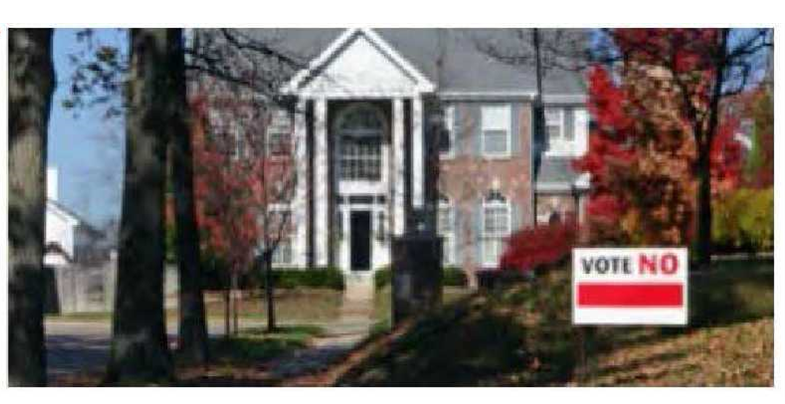
(j)
A clearance sign which indicates only the maximum height allowable to safely navigate a drive-in lane or travelway shall be permitted. The clearance sign shall not exceed three (3) square feet and shall be excluded from the allowable sign area permitted on the property.
(k)
General maintenance, painting, repainting, cleaning and other normal maintenance and repair of a sign or any sign structure, unless a structural change is made.
(l)
Signs associated with a public institution installed on public property.
(m)
Any sign that is required to be constructed, placed, or maintained by the federal government, the Commonwealth of Virginia, or Prince William County.
(n)
A display of two square feet or less in area shall be considered a sign, however, such display does not require a sign permit.
8.
Nonconforming signs. Any existing sign that does not meet the regulation contained in this division, which was lawful on the date of this amendment, and has not been discontinued for a period of two years, shall be deemed a lawfully non-conforming sign and shall not be required to be verified under the provisions of section 32-601.60 of this chapter.
(Ord. No. 19-68, Attch., 12-10-19; Ord. No. 24-37, 6-4-24; Ord. No. 24-38, 6-4-24)
Sec. 32-250.24. - Prohibited signs.
The following types of signs are prohibited:
1.
Signs that violate any law of the Commonwealth of Virginia relating to outdoor advertising.
2.
Signs affixed to trees, utility poles, benches, trash receptacles, or any other unapproved supporting structure, or otherwise placed in the public street. Examples provided below:
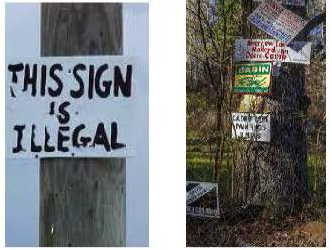
3.
Signs simulating, or which are likely to be confused with, a traffic control sign or any other sign displayed by a public authority. Any such sign is subject to immediate removal and disposal by an authorized County official as a nuisance.
4.
Signs that employ any parts or elements which revolve, rotate, whirl, spin, or otherwise make use of motion to attract attention. This shall not include electronic message display signs as referenced in this division.
5.
Flashing signs or other signs displaying flashing, scrolling, or intermittent lights or lights of changing degrees of intensity.
6.
Signs that emit smoke, flames, visible vapors, particles, mist, aerosol, liquid, gas, and normally detectable sound or odor.
7.
Strings of flags, pennants, streamers, balloons and inflatable signs, or animated signs, such as wind-activated devices. Examples provided below:
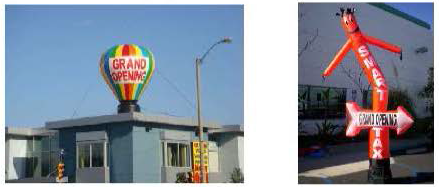
8.
Beacons and searchlights, except for emergency purposes.
9.
Signs mounted on or above the roofline of any building.

10.
Signs which are not securely affixed to the ground or otherwise affixed in a permanent manner to an approved supporting structure, unless specifically permitted as a temporary sign.
11.
Signs that obstruct or substantially interfere with any window, door, fire escape, stairway, ladder, or opening intended to provide air, ingress, or egress to any building.
12.
Any sign displayed without complying with all applicable regulations of this chapter, Building Code, Design and Construction Standards Manual (DCSM), and other applicable regulations.
13.
Signs located in public right-of-way shall be prohibited unless in conformance with the following standards:
(a)
The sign was installed by Prince William County, the Commonwealth of Virginia, or an approved transit agency in conformance with the Manual on Uniform Traffic Control Devices (MUTCD).
(b)
The sign is a warning sign or traffic safety sign required by a public utility provider.
Examples of prohibited signage in a public right-of-way:
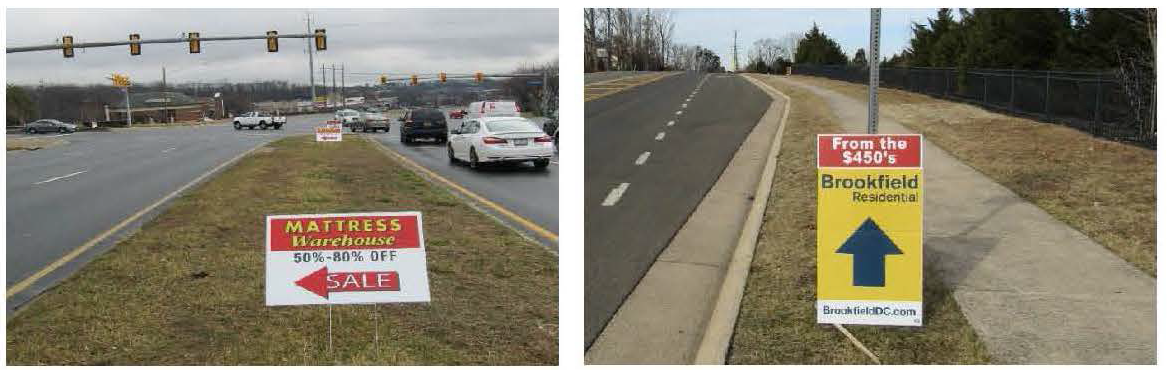
14.
Vehicle or trailer sign. This sign type shall mean a sign displayed on or attached to a vehicle if the vehicle or trailer is used for the primary purpose of advertising a business establishment, product, service or activity. The primary purpose of the vehicle or trailer shall not be for purposes of advertisement. Specifically, any such vehicle or trailer shall, without limitation, be considered to be used for the primary purpose of advertising if it fails to display current license plates, inspection sticker, or municipal decal, if the vehicle is inoperable, if evidence of paid-to-date local taxes cannot be made available, or if the sign alters the standard design of such vehicle or trailer.
15.
Feather signs. Example of a feather signs provided below:

(Ord. No. 19-68, Attch., 12-10-19)
Sec. 32-250.25. - Measurements of sign area.
1.
Sign area shall be calculated in the following manner:
(a)
For sign copy mounted or painted on a background panel, cabinet, or other surface, the sign area shall be computed by means of the smallest square or rectangle that encompasses the extreme limits of the background panel, cabinet, or surface. Example provided below:
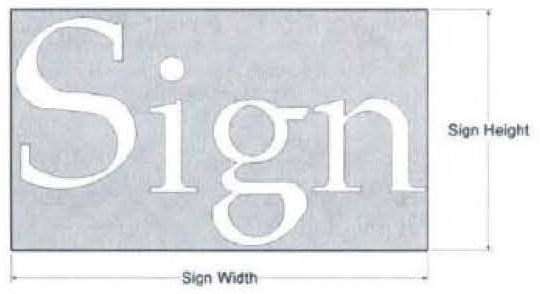
Freestanding Sign (monument style) example: Sign area = (A)(B)
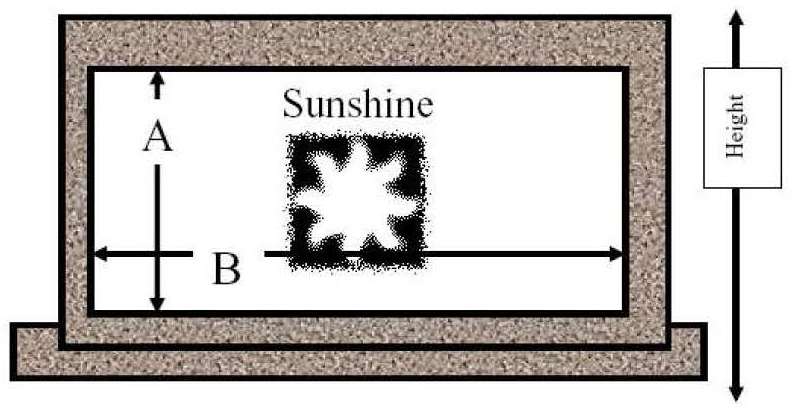
(b)
When two identical, flat sign faces are placed back-to-back or at angles of 45 degrees or less, so that both faces cannot be viewed from any one point at the same time, and when such sign faces are part of the same sign structure and are not more than 24 inches apart, the sign area shall be computed by the measurement of one of the faces. If the two faces are unequal, the sign area shall be calculated based on the larger of the two faces.
(c)
When two flat sign faces are placed at angles greater than 45 degrees, and when such sign faces are part of the same sign structure and are not more than 24 inches apart, the sign area shall be computed by totaling the measurement of both faces.
(d)
For projecting signs with a thickness of four inches or more, the visible sides of the sign shall be considered sign faces for the purpose of calculating maximum sign area.
2.
The total area of the building façade or the total area of a freestanding structure shall not be included in the calculation of sign area. Sign area shall be calculated based on the size of the sign face enclosing the sign copy as specified in subsection 1 of this section. When sign copy is directly affixed to a building façade, sign area shall be calculated as specified in subsection 2(a) of this section.
(a)
The area of a sign shall mean and shall be computed as the entire area within a single continuous rectilinear perimeter of not more than eight (8) straight lines enclosing the extreme limits of writing, representation, emblems or a figure of similar character together with all material, color or lighting forming an integral part of the display or used to differentiate the sign from the background against which it is placed. Example provided below:
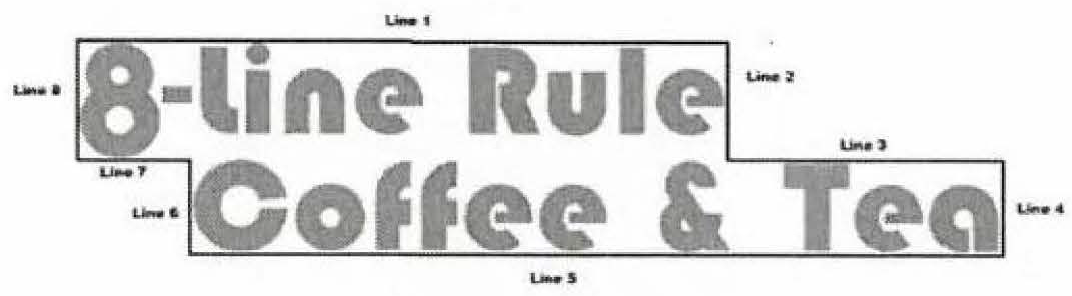
3.
All fractions shall be rounded to the closest integral number, using the same measurement standard specified in section 32-250.28. For example, 29.76 square feet shall be rounded to 30 square feet, while 15.23 feet in height shall be rounded to 15 feet in height.
4.
Sign height shall be calculated in the following manner:
(a)
The height of a sign shall be calculated as the distance from the base of the sign at grade to the top of the highest attached component of the sign. Any filling, berming, mounding, or excavating solely undertaken for the purpose of locating or increasing the height of the sign shall be included in the sign height calculation.
(b)
In cases where grade established at the base of the sign is below grade established at street level, sign height shall be computed on the assumption that the elevation of the normal grade at the base of the sign is equal to the elevation of the nearest point of the crown of a public or private street. An example is provided below:
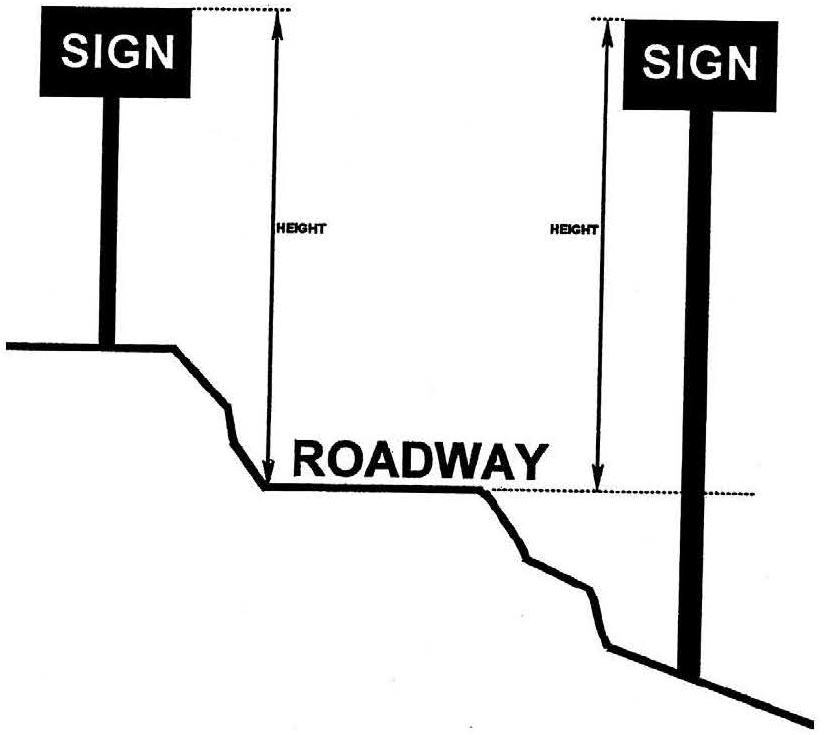
5.
All sign setbacks shall be measured as the distance in feet from the property's lot lines to the closest point on the sign structure.
(Ord. No. 19-68, Attch., 12-10-19)
Sec. 32-250.26. - Maintenance and removal.
1.
All signs shall be constructed and mounted in conformance with the Virginia Uniform Statewide Building Code and the Prince William County Design and Construction Standards Manual.
2.
All signs and components thereof shall be maintained in good repair and in a safe, neat and clean condition. Any sign which becomes a safety hazard or which is not kept in a reasonably good state of repair shall be put in a safe and good state of repair within 30 days of a written notice to the owner and permit holder. Signs which constitute a nuisance may be abated under Virginia Code § 15.2-900 and/or § 15.2-906.
3.
The Building Official may cause to have removed or repaired immediately, without written notice, any sign which, in his or her opinion, has become insecure, in danger of falling, or otherwise unsafe to a degree which presents an immediate threat to the safety of the public. If such action is necessary to render a sign safe, the cost of such emergency repair or removal shall be at the expense of the owner or lessee thereof as provided in chapter 5 of this Code.
4.
The owner of any sign displaying advertising associated with a use or business that has ceased operating shall, within 60 days of the cessation of use or business operation, replace the sign face with a blank face until such time as a use or business has resumed operating on the property.
(Ord. No. 19-68, Attch., 12-10-19)
Sec. 32-250.27. - Permitted signs and general regulations for all sign types.
1.
Permitted as an accessory use. Signs are accessory uses that shall be incidental to, and customarily associated with, a principal use permitted by the Zoning Ordinance.
2.
Awning and canopy signs. These signs shall meet the following standard:
(a)
When calculating the maximum square footage of allowable sign area for façade signs, the sign area attributed to awning shall be included.
(b)
No more than two (2) canopy signs shall be permitted per canopy, and shall not count against the allowable façade sign area.
3.
Light pole banner signs. The installation of light pole banner signs shall be permitted for nonresidential uses and residential projects as defined in this chapter. Additionally, light pole banner signs are subject to the following standards:
(a)
Up to two (2) double-sided light pole banner signs permitted per pole.
(b)
Signs shall be a maximum sign area of six (6) square feet per sign.
(c)
Shall be installed below the lighting fixture and have a maximum height of 24 feet.
(d)
Signs along rights-of-way will require Prince William County Transportation and VDOT approval.
Example of Light Pole
Banner Sign:

4.
Changeable copy signs. Changeable copy may constitute up to 50% of the total permitted sign face.
5.
Drive-through signs. Drive-through signs shall be permitted in any zoning district where drive-through facilities are either permitted by right or permitted with a Special Use Permit. Drive-through signs shall meet the following standards:
(a)
Up to three (3) freestanding drive-through signs shall be allowed for each drive-through lane or off-street stacking space. The maximum sign area for all drive-through signs shall be seventy-two (72) square feet. Individual drive-through signs shall have a maximum sign area of forty (40) square feet.
(b)
Drive-through signs shall be excluded from the total calculated maximum sign area for a property under the remainder of this division. Signs attached to a façade of a building or structure shall be calculated in accordance with the measurement standards specified in County Code section 32-250.25.
(c)
Drive-through signs shall have a maximum sign height of eight (8) feet, measured from the grade of the adjacent drive-in lane surface to the top of the sign.
(d)
Drive-through signs may be internally or externally illuminated, subject to the illumination standards specified in this section.
(e)
The Board of County Supervisors may increase the number and/or size of drive-through signs subject to approval of a special use permit granting such increase in sign size and/or number.
6.
Electronic message boards. Electronic message board signs may be permitted in any zoning district subject to the approval of a special use permit or rezoning/proffer amendment by the Board of County Supervisors. When permitted, electronic message board signs shall meet the following standards:
(a)
Electronic message board display shall only be permitted as part of a freestanding sign.
(b)
Any message display shall contain static messages only, changed only through subtle transitions that do not have the appearance of moving, scrolling, or travelling text or images.
(c)
Each message shall be displayed for a minimum of five (5) seconds between transitions.
(d)
The electronic message board sign shall contain a default mechanism that shall cause the sign to revert immediately to a black screen if the sign malfunctions.
(e)
The background of the sign face of the electronic display shall not be white, off-white, or yellow.
(f)
The electronic display shall include a photo cell to control brightness and shall automatically dim at sunset.
7.
Façade signs. Façade signs shall meet the following standards:
(a)
Façade signs may project a maximum of 18 inches beyond the façade upon which they are mounted.
(b)
Façade signs may project a maximum of 18 inches into any required yard or setback.
(c)
Façade signs made up only of individual letters attached directly to a building façade shall be considered façade signs and the sign area shall be calculated as specified in County Code section 32-250.25(2).
(d)
Façade signs shall be mounted and oriented parallel to the building façade upon which attached.
8.
Flag signs. Flag signs shall meet the following standards:
(a)
Flag signs shall have a setback from the nearest lot line equivalent to the height of the flagpole to which the flag is attached.
(b)
Façade-mounted poles used for flag signs may project a maximum of six (6) feet beyond the façade upon which they are mounted.
(c)
Flags attached to a façade-mounted pole shall maintain a minimum clearance of eight (8) feet above grade.
9.
Freestanding signs. Sign area permitted is based on the linear length of street frontage for a property and the maximum height is subject to the zoning district or use as permitted in County Code section 32-250.28. For freestanding signage associated with Residential Projects there may be two signs, each constructed at either side of the entrance(s) into the Residential Project.
10.
Illuminated signs. Sign illumination shall be of enclosed lamp design or indirect lighting from a shielded source and shall not cause a glare or nuisance beyond the property lines. No sign shall be illuminated by flashing, occulting, revolving, or intermittent lighting.
11.
Location of signs. Unless otherwise specified in this division, all signs shall be completely located within the property lines of the lot on which it is anchored and/or installed. Signs shall not project over any parcel or lot lines or public street.
12.
Marquee signs. Marquee signs shall have a minimum clearance of eight (8) feet from the sidewalk and 16 feet above any driveway or travelway area. Example is provided below:
13.
Minor signs. Minor signs shall meet the following standards:
(a)
Minor signs may be installed as freestanding signs.
(b)
Minor signs shall not exceed four (4) square feet in sign area.
(c)
Minor signs shall not exceed five (5) feet in height.
(d)
Minor signs shall not be illuminated.
14.
Neon signs. Neon signs may be used anywhere signs are permitted, except in residential and agricultural districts, so long as the neon sign is a permitted sign type for that zoning district. The maximum number of signs and sign area permitted is subject to sign type.
15.
Off-premises signs. Off-premises signs shall be permitted subject to the sign standards specified for each district in section 32-250.28. Off-premises signs shall not result in an individual property exceeding the maximum number of permitted signs, maximum permitted sign area, or maximum permitted sign height. Property owner signature shall be provided as part of the requirements for approval for sign permits.
16.
Painted signs. The number of painted signs, sign area, and sign height shall be determined using the standards for single-tenant façade signs.
17.
Projecting signs. Projecting signs shall be limited to the first floor and the sign area shall be calculated as part of the total façade sign area permitted. No single projecting sign shall exceed eight (8) square feet. Projecting signs shall have a minimum clearance of eight (8) feet and shall not project beyond the property line. Example is provided below:

18.
Sign setback. Unless otherwise provided for in this section, freestanding signs shall be located either a minimum of ten (10) feet from any lot line or one foot for each foot in sign height, whichever is greater. The sign setback shall be measured from the closest projecting edge of the sign to the closest lot line.
19.
Curbside Pick-up Signs. Curbside pick-up signs shall be permitted as an accessory use in any zoning district. These signs shall meet the following standards:
(a)
Each curbside pick-up space is permitted one sign up to six (6) square feet in sign area. Such signage shall not exceed ten (10) feet in height.
(b)
Property containing a curbside pick-up area(s) is permitted one additional sign which shall not exceed six (6) square feet in sign area and shall not exceed ten (10) feet in height for each pick-up area. A curbside pick-up area includes one or more contiguous curbside parking space(s).
(c)
Curbside pick-up signs shall not be internally or externally illuminated.
(d)
Curbside pick-up signs shall be excluded from the total calculated maximum sign area for a property under the remainder of this division. Signs attached to a façade of a building shall be calculated in accordance with county code section 32-250.25.
(e)
The Board of County Supervisors may increase the number and/or size of curbside pick-up signs subject to approval of a special use permit granting such increase in sign size and/or number.
20.
Drive-in signs. Drive-in signs shall be permitted in any zoning district where drive-in facilities are permitted if a special use permit is approved for the drive-in use. Drive-in facility signs shall meet the following standards:
(a)
Drive-in facilities shall be permitted one (1) sign measuring up to fifteen (15) square feet in area for each parking space.
(b)
Drive-in signs shall be excluded from the total calculated maximum sign area for a property under the remainder of this division. Signs attached to a façade of a building or structure shall be calculated in accordance with the measurement standards specified in county code section 32-250.25.
(c)
Drive-in signs shall have a maximum sign height of ten (10) feet, measured from the grade of the adjacent drive-in lane surface to the top of the sign.
(d)
Drive-in signs may be internally or externally illuminated, subject to the illumination standards specified in this chapter. Drive-in signs and may include an audio communication system.
(e)
The Board of County Supervisors may increase the number and/or size of drive-in signs subject to approval of a special use permit granting such increase in sign size and/or number.
(Ord. No. 19-68, Attch., 12-10-19; Ord. No. 24-37, 6-4-24)
Sec. 32-250.28. - Location, number, size, height and code reference for signs.
Signs shall be permitted in accordance with the tables found in this section.
(Ord. No. 19-68, Attch., 12-10-19; Ord. No. 24-37, 6-4-24)
Sec. 32-250.29. - Temporary signs.
1.
Temporary signs shall meet the definition of a temporary sign listed in Article I of the Zoning Ordinance and be allowed as provided in section 32-250.28. The following sign types shall be permitted as temporary signs:
(a)
Banner (façade) signs.
(b)
A-frame (portable) signs.
(c)
Freestanding signs.
2.
Unless otherwise specified in this section, temporary signs shall be reviewed and approved in accordance with the standards specified in County Code section 32-250.23.
3.
Temporary signs shall not be illuminated.
4.
Temporary signs shall be removed immediately once the permitted period of display has ended.
5.
Unless authorized by other provisions of this section for period of display, temporary signs may be erected for a maximum of 60 days.
(a)
Notwithstanding the aforementioned time frame, the Zoning Administrator or authorized person may authorize an alternative period of validity for banner signs. Such alternatives may include, but shall not be limited to, permitting the banner sign to be erected for shorter time periods on a recurring basis. The alternative period of validity, the frequency of recurrence, and other details pertaining to when the banner sign will be erected shall be specified by the Applicant, and this frequency shall be reviewed and approved by the Zoning Administrator or authorized person in his or her approval of a sign permit application. The Applicant shall adhere to the alternative period of validity. Changes to such alternatives shall be subject to the review and approval of the Zoning Administrator as part of a subsequent sign permit application.
6.
No temporary sign shall require a foundation, support, wiring, fittings, or elements that requires a building permit or electrical permit.
7.
No temporary sign shall be mounted, attached, affixed, installed, or otherwise secured so as to protrude above the roofline of a structure.
8.
Mobile signs on wheels, runners, casters, parked trailers, or other temporary or movable signs shall not be permitted unless otherwise specifically stated in this article.
9.
Due to the nature of materials typically used to construct temporary signs, and to avoid unsightliness of deteriorating signs and all safety concerns which accompany such a condition, temporary signs shall be removed or replaced when such sign is deteriorated.
10.
Only one sign permit for a temporary sign or signs shall be issued to the same address or premise address, on the same site, for the same business at any one time.
11.
Temporary activity permit signage. If a temporary activity permit has been approved in accordance with Part 210 of this chapter, only the temporary signs as specified in County Code section 32-250.29.1 shall be permitted.
12.
Notwithstanding the limits on the maximum number of temporary signs listed in County Code section 32-250.28, when limited by the amount of linear street frontage, an address or premise address on a corner lot may be permitted one temporary sign for each public or private street frontage when the total amount of linear street frontage would prohibit the installation of two temporary signs.
(Ord. No. 19-68, Attch., 12-10-19)
Sec. 32-250.30. - Generally.
Certain uses permitted by this chapter, when abutting each other, are incompatible and create conflict that may be reduced or eliminated by appropriate measures. Buffer areas established between incompatible uses minimizes these conflicts and the adverse impact of such essentially incompatible development. These provisions are intended to provide a mechanism whereby adjoining properties may be shielded from the adverse consequences of such development.
(Ord. No. 04-78, 12-21-04)
Sec. 32-250.31. - General policy; buffer area required.
1.
Buffer areas are required on properties in accordance with the circumstances and widths specified in section 800 of the Design and Construction Standards Manual. The minimum buffer width is generally a uniform dimension across the entire length of the common property line. An existing required buffer area on an abutting property shall not be used to satisfy buffer requirements on a subject property, unless a reciprocal agreement has been recorded in the land records agreeing to providing the buffer or unless modified pursuant to section 32-250.32.
2.
Notwithstanding the requirements of the Design and Construction Standards Manual, a parcel created and zoned before May 4, 1982, shall be required to provide no more than ten percent of its total area for such buffer, subject to the provision of an absolute minimum buffer of 15 feet on each parcel. The buffer area for lots eligible for the ten percent buffer requirement shall be calculated as follows: Total lot area times ten percent divided by the length of the common property line for which the buffer zone is required.
3.
Every use requiring establishment of a buffer area shall note the following restriction regarding the use of such buffer on a plat or other instrument recorded among the land records:
"Land designated as buffer area shall preserve existing vegetation, as appropriate, or shall be landscaped and may only be used for uses or facilities in accordance with the requirements of the Prince William County zoning ordinance and the Design and Construction Standards Manual".
4.
Buffer areas shall be established as separate common open space in residential areas when conveyed to a homeowners association or similar entity created to own and maintain common open space within the project. Buffer areas platted within residential lots by deed restriction shall be located such as to provide the minimum yard depth and lot area outside the buffer area required by the zoning ordinance. Said deed restriction shall specify maintenance in accordance with County standards and limitations on the use of the buffer area.
5.
Buffer areas may be counted as open space and may be used to meet the requirements of sections 32-250.40 et seq.
6.
Community facilities, such as community recreational facilities or meeting houses when constructed as freestanding uses internal to a residential development, shall be treated as non-residential development for buffering purposes. Except when located internal to a multifamily development, a minimum 15-foot wide landscaped area shall be established and maintained around the perimeter of the community facility and landscaped in accordance with the buffer requirements of the Design and Construction Standards Manual. All parking areas associated with the community facility shall meet the requirements of section 800 of the Design and Construction Standards Manual. When a community facility is located along a property boundary at the edge of the residential development it serves, a buffer shall be provided in accordance with the Design and Construction Standards Manual.
7.
A 50-foot wide buffer, in accordance with section 800 of the Design and Construction Standards Manual, shall be required between a golf course and any adjoining property if the property is zoned, used as, or planned for residential or agricultural uses.
8.
A 100-foot wide buffer, in accordance with section 800 of the Design and Construction Standards Manual, shall be required between railroad right-of-way and adjoining property if the property is zoned, used as or planned for residential or agricultural uses.
(Ord. No. 94-1, 1-11-94; Ord. No. 96-6, 1-16-96; Ord. No. 04-78, 12-21-04; Ord. No. 12-61, Attch., 11-20-12)
Sec. 32-250.32. - Buffer area standards.
1.
Buffer areas shall preserve existing vegetation, as appropriate, or shall be landscaped in accordance with section 800 of the Design and Construction Standards Manual. All plants and other screening shall be maintained by the owner of the buffer in a state of good repair and shall be replaced or repaired promptly as appropriate.
2.
Utility and other easements shall not be located within any buffer area except as otherwise expressly permitted in this chapter. Minimal easement crossings, and sidewalks and trails shall be permitted in accordance with section 800 of the Design and Construction Standards Manual.
3.
For non-residential lots of three acres or less, up to a 25% reduction of a buffer width shall be allowed for landscaped runoff reduction BMP facilities (bioretention, etc.) and for utility easements proposed parallel to one edge of the buffer. The maximum reduction of the buffer shall be 25% and shall be subject to the following conditions:
For landscaped runoff reduction BMP facilities:
(a)
The buffer reduction shall include the required stormwater easement for the facility;
(b)
Equivalent landscaping plant units required by the Design and Construction Standards Manual are provided within the buffer;
(c)
Environmental requirements (ex. tree cover, open space) shall still be met;
(d)
Stormwater requirements shall still be met;
(e)
Riparian/RPA/floodplain buffers shall still be met;
(f)
Highway Corridor Overlay District requirements shall still be met; and
(g)
The buffer widths abutting residentially zoned or planned lot lines shall not be modified, except as otherwise provided in Section 800 of the Design and Construction Standards Manual.
For utility easements proposed parallel to one edge of the buffer:
(a)
The easement holder must agree in writing to allow planting of the easement in accordance with the planting requirement of the buffer it reduces;
(b)
Such agreement will be incorporated into the approved site/subdivision plan;
(c)
The easement must be planted in accordance with the planting requirements of the buffer it reduces. If permission cannot be obtained to plant within the easement, the plantings that would be required within the eliminated portion of the buffer may be approved to be placed within the remaining buffer by the Planning Director and Public Works Director through a request at site plan;
(d)
Environmental requirements (ex. tree cover, open space) shall still be met;
(e)
Stormwater requirements shall still be met;
(f)
Riparian/RPA/floodplain buffers shall still be met;
(g)
Highway Corridor Overlay District requirements shall still be met; and
(h)
The buffer widths abutting residentially zoned or planned lot lines shall not be modified, except as otherwise provided in Section 800 of the Design and Construction Standards Manual.
Any property not meeting the requirements and conditions of this Section shall retain its right to request all other waivers and modification provided for within the DCSM.
4.
Concurrent with its approval of a rezoning or special use permit, the Board of County Supervisors may waive or modify buffer area standards in lieu of buffer areas shown on the master zoning plan, general development plan, or Special Use Permit plan associated with the application. The Board of County Supervisors may consider the alternative compliance criteria specified in section 800 of the Design and Construction Standards Manual when considering a request for a waiver or modification of a buffer.
The Board may approve the waiver or modification upon finding that the waiver or modification will not have an adverse impact on the existing or future development of the adjacent property or properties.
5.
Except where otherwise permitted in this chapter or the Design and Construction Standards Manual, buildings, structures, retaining walls three feet or greater in height (except when placed at the inside edge and used to retain existing vegetative cover), active recreation facilities, parking areas, loading areas, sidewalks, trails, and golf cart paths shall not be located in the buffer areas between dissimilar uses.
6.
For non-residential lots of three acres or less, a 6-foot-tall board on board, solid masonry fence/wall, or equivalent barrier may be substituted for 50% of the plant unit required by the Design and Construction Standards Manual.
(Ord. No. 96-6, 1-16-96; Ord. No. 04-78, 12-21-04; Ord. No. 18-02, Attch., 1-16-18; Res. No. 18-031, Attch., 1-16-18)
Editor's note— Section 32-250.32 entitled "Effect on Existing Development" was repealed pursuant to Ord. No. 04-78, adopted Dec. 21, 2004. Former section 32-250.33 is renumbered as section 32-250.32 herein.
Secs. 32-250.33, 32-250.34. - Reserved.
Editor's note— Ord. No. 96-6, adopted Jan. 16, 1996, repealed section 32-250.33, which pertained to density allowance and derived unchanged from Ord. No. 91-127, adopted Oct. 22, 1991, and renumbered section 32-250.35 entitled "Effect on Existing Development" as section 32-250.33. Ord. No. 96-6, adopted Jan. 16, 1996, repealed section 32-250.34 in its entirety. Formerly section 32-250.34 pertained to agreements to develop to compatible uses and derived unchanged from Ord. No. 91-127, adopted Oct. 22, 1991.
Sec. 32-250.40. - Landscaping requirements—Purpose and intent.
The landscaping requirements are intended to require the replacement and planting of trees and credit the preservation of trees on sites and in subdivisions to provide a minimum percentage of tree canopy cover in ten years that will contribute to the quality of life. Minimum tree canopy cover standards are prescribed by the Code of Virginia and are designed to protect the public health and welfare. The preservation and replacement of trees will aid in stabilizing the environment's ecological balance by contributing to the processes of air purification, oxygen regeneration, groundwater recharge, and stormwater runoff retardation, while at the same time aiding in noise, glare, and heat abatement. Revegetation standards are also appropriate to ensure that the local stock of native trees and vegetation is replenished, as well as creating wildlife habitats.
The purpose of these provisions is to preserve and protect the unique identity and environment of the County by preserving and replacing trees to preserve the economic base attracted to the County, by enhancing property values, and by raising the quality of life. Whenever feasible, retention of existing woodland is encouraged, especially within areas visible from streets or from adjacent incompatible uses.
(Ord. No. 04-78, 12-21-04)
Sec. 32-250.41. - Same—Applicability.
1.
The provisions of sections 32-250.40 et seq., shall apply to all development where site plans or subdivision plans are required to be submitted for review and approval in accordance with Part 800 of this chapter. Landscaping plans depicting the replacement and/or preservation of trees in accordance with these sections shall be submitted in accordance with the requirements of the Design and Construction Standards Manual.
2.
All trees to be planted shall meet the specifications of the AmericanHort. The planting of trees shall be done in accordance with either the standardized landscape specifications jointly adopted by the Virginia Nursery and Landscape Association, the Virginia Society of Landscape Designers and the Virginia Chapter of the American Society of Landscape Architects, or the Guidelines for Plantings Along Virginia Roadways of the Virginia Department of Transportation.
3.
Landscaped areas contained in required buffer areas may be utilized in meeting the requirements of section 32-250.42, in accordance with the provisions of the Design and Construction Standards Manual.
4.
All required landscaping on a property, as shown on the approved site or subdivision plan, shall be maintained by the property owner and kept in a state of good repair. Plants that are irreparably damaged or dead shall be replaced promptly, as appropriate. The obligation to maintain required landscaping extends in perpetuity.
(Ord. No. 96-6, 1-16-96; Ord. No. 04-78, 12-21-04; Ord. No. 18-55, Attch., 11-20-18)
Editor's note— Amended to incorporate General Acts of Assembly 2018 Chapter 399.
Sec. 32-250.42. - Same—Tree canopy coverage.
1.
The development of all land shall be subject to tree canopy cover requirements as set forth in section 800 of the Design and Construction Standards Manual.
2.
The percent estimate of tree canopy cover measured at ten-year maturity shall be provided on the landscaping plans submitted as part of the site and/or subdivision plan. The ten-year maturity tree canopy cover estimate shall be based on the area within the boundaries of the development and the County's tree selection guide contained in the Design and Construction Standards Manual. Site conditions must be appropriate for trees to reach a normal ten-year maturity for the particular species.
3.
Trees planted to fulfill tree canopy cover requirements shall be located within the open space areas, parking lot landscape areas, setback areas, basic landscaping areas, and/or buffer areas of the site, all as defined herein and implemented in accordance with the Design and Construction Standards Manual.
(Ord. No. 96-6, 1-16-96)
Sec. 32-250.43. - Reserved.
Editor's note— Former section 32-250.43 derived from Ord. No. 94-1, adopted Jan. 11, 1994, and entitled "Residential and Nonresidential Landscaping Requirements" was repealed pursuant to Ord. No. 04-78, adopted Dec. 21, 2004, and combined with section 32-250.42, above.
Sec. 32-250.44. - Parking lot landscaping requirement.
Surface off-street parking areas with 20 or more spaces shall contain interior planting strips or islands comprising at least five percent of the total parking area, except that parking and loading areas for tractor trailer trucks shall not be required to provide interior parking lot landscaping. Such landscaping shall meet the requirements of section 800 of the Design and Construction Standards Manual and shall be in addition to any buffering or screening required elsewhere in this chapter. The interior of the parking lot is defined as the total area of aisles, parking spaces, planting islands, curbed areas, loading spaces, and corner areas within the parking lot.
(Ord. No. 92-59, 6-16-92; Ord. No. 96-6, 1-16-96)
Editor's note— Ord. No. 96-6, adopted Jan. 16, 1996, renumbered section 32-250.44 as section 32-250.43.2. [now section 32-250.42.3]; Ord. No. 96-6 also renumbered former sections 32-250.45—32-250.49 as sections 32-250.44—32-250.48 as set out herein.
Sec. 32-250.45. - Phasing of landscaping.
When a site is developed in phases or sections, each phase or section shall contain the required percentage of tree canopy cover, unless the percentage of canopy cover for each section has been specifically identified on a comprehensive landscaping plan submitted and approved as part of the preliminary residential plan or nonresidential sketch plan of the entire site such that the entire site as a whole meets the required percentage. Notwithstanding, all basic landscaping and buffer area requirements of section 800 of the Design and Construction Standards Manual shall be met.
(Ord. No. 96-6, 1-16-96; Ord. No. 04-78, 12-21-04)
Note— See editor's note following section 32-250.44.
Sec. 32-250.46. - Emergency tree removal.
When it is necessary to expedite the removal of damaged or destroyed trees in the interest of public safety, health, and general welfare following high winds, storms, tornadoes, hurricanes, floods, freezes, fires, or other natural or man-made disasters, the requirements of this section may be suspended by the Zoning Administrator for a period of up to 30 days in the affected areas, which can be extended as necessary by the Zoning Administrator.
(Ord. No. 96-6, 1-16-96; Ord. No. 04-78, 12-21-04)
Note— See editor's note following section 32-250.44.
Sec. 32-250.47. - Exemptions for uses not required to comply with tree canopy cover requirements.
In accordance with Code of Virginia, § 15.2-961, under active commercial production or management of agriculture; landfills; wetland preservation areas, dedicated school sites, playing fields, and other non-wooded recreation areas, lease lots or parcels for uses such as jails, pump stations, switching stations, water towers, utility rights-of way 40 feet or greater in width, or similar uses, are exempted from tree canopy cover requirements. Public uses not specifically exempted above shall comply with the tree canopy cover requirements, except where exempted by the Planning Director for reasons of public health or safety.
(Ord. No. 92-59, 6-16-92; Ord. No. 94-1, 1-11-94; Ord. No. 96-6, 1-16-96; Ord. No. 04-78, 12-21-04)
Note— See editor's note following section 32-250.44
Sec. 32-250.48. - Reserved.
Editor's note— See editor's note following section 32-250.44. Section 32-250.48 entitled "Penalties" derived from Ord. No. 96-6, adopted Jan. 16, 1996, and was repealed pursuant to Ord. No. 04-78, adopted Dec. 21, 2004.
Sec. 32-250.51. - Purpose and intent.
The purpose and intent of this section is to establish protective regulations for vegetation in the County in order to better control problems of flooding, soil erosion, air pollution and noise, to make the County a healthier, safer and more aesthetically pleasing place in which to live. The further intent of this section is to prevent increases in the cost of drainage systems occasioned by increased flow and diversion of surface waters, to dissuade unnecessary clearing, disturbing and deforestation of land so as to preserve insofar as is practicable the natural and existing growth of vegetation, and to control the destruction and removal of vegetation in the County so as to benefit its citizens and at the same time to make such controls and regulations reasonably consistent with the enjoyment of private property interests. This article is intended to supplement the Virginia Erosion and Sediment Control Law, Code of Virginia, § 10.1-560, and applicable zoning requirements.
Sec. 32-250.52. - Applicability.
1.
No person may engage in any land disturbing activity in any zoning district, except as permitted by this chapter, until the area is the subject of an approved site development permit, land disturbance permit, or similar County approval. A site development plan, as applicable, shall be reviewed and approved in accordance with the zoning ordinance and the Design and Construction Standards Manual by the Planning Director upon written recommendation from the Director of Public Works.
2.
Where appropriate, the grading plan shall provide for phased development and indicate land-disturbing activity only for areas under active construction.
3.
Areas having soils that are highly erodible, highly permeable, and/or marine clay on slopes greater than 15 percent may be disturbed only if mitigation measures are approved and used in accordance with the requirements of the Design and Construction Standards Manual.
4.
Slopes 25 percent and greater shall not be disturbed unless mitigation measures are used to preclude adverse impacts. Wooded slopes of 25 percent and greater that abut perennial streams and have a contiguous area of 10,000 square feet or greater shall be placed within conservation areas. Such slopes shall not be disturbed before, during, or after development, except for installation of utilities and road crossings as approved on a site or subdivision plan. Exceptions to the requirement to establish conservation areas may be considered by the Zoning Administrator where an applicant demonstrates that full compliance is impossible or impractical, or improved environmental quality would result from an alternative design.
5.
No more land shall be disturbed than is reasonably required to accommodate the intended use.
(Ord. No. 04-78, 12-21-04)
Sec. 32-250.53. - Timbering.
1.
Timbering, harvesting, or clearing of wooded areas in A-1, Agricultural districts, as permitted by this chapter, shall not occur within 50 feet of any property lines adjoining areas or other properties which are zoned to a different classification than A-1, Agricultural or whose primary use is residential.
2.
Before beginning timbering, the owner of the property, the owner of the timber rights, or the operator of the timbering activity shall secure a timbering permit which may necessitate a survey to be performed by a licensed surveyor who shall clearly mark the boundaries of the property to be timbered. The surveyor in such instances shall also clearly mark the location of the 50-foot wide undisturbed area based on the location of these boundaries.
3.
Once timbering has been conducted on a property, disturbance within 50 feet of any property line, as required by this section, shall not be permitted without the approval of the Planning Director. Such approval shall only be granted by the Director upon a finding that disturbance is appropriate for the following purposes and under the following guidelines:
(a)
Construction, installation, operation, and maintenance of electric, gas, and telephone transmission lines, railroads, and public roads and their appurtenant structures may be permitted.
(b)
Construction, installation, and maintenance of water lines, sewer lines, and local gas lines may be permitted, provided that:
(1)
To the degree possible, such utilities and shall cross at a right angle and not run parallel to the property line within 50 feet of that property line;
(2)
No more land shall be disturbed than is necessary to provide for the desired utility installation;
(3)
All installation and maintenance of such utilities and facilities shall be in compliance with applicable state and federal requirements and permits and designed and constructed in a manner that limits disturbance within 50 feet of the property line.
(Ord. No. 94-1, 1-11-94; Ord. No. 04-78, 12-21-04)
Editor's note— Section 32-250.53 derived from Ord. No. 92-59, adopted June 16, 1992, entitled "Definitions", subsequently amended pursuant to Ord. No. 94-1, adopted Jan. 11, 1994, and Ord. No. 94-67, adopted Oct. 4, 1994, was relocated to Part 1, Definitions, pursuant to Ord. No. 04-78, adopted Dec. 21, 2004. Former section 32-250.54 entitled "Timbering" was subsequently renumbered as section 32-250.53 herein.
Sec. 32-250.61. - Storage of inoperative vehicles prohibited except for certain uses.
Notwithstanding any other provision of this chapter, inoperative vehicles shall be permitted only as follows:
1.
In a lawful motor vehicle graveyard; or
2.
In a lawful licensed vehicle impoundment yard for a maximum of 90 days; or
3.
Secondary to a lawful motor vehicle repair facility for a maximum of 90 days; or
4.
An accessory use to a lawful residential use for up to four inoperative vehicles. Inoperative vehicles shall be stored in a fully enclosed building or shall be fully screened from view from abutting property and streets, in an approved parking area.
(Ord. No. 04-78, 12-21-04)
Sec. 32-250.62. - Storage of commercial vehicles.
Commercial vehicles stored on a property, if otherwise permitted, shall be stored in enclosed garages or in the rear or side yard of principal structures, and shall not be visible from residential districts and public rights-of-way.
Sec. 32-250.63. - Reserved.
Editor's note— Section 32-250.63 entitled "Outdoor Lighting" derived from Ord. No. 92-59, adopted June 16, 1992, and was repealed pursuant to Ord. No. 04-78, adopted Dec. 21, 2004. See new sections 32-200 et seq., adopted pursuant to Ord. No. 04-78.
Sec. 32-250.71. - Reserved.
Editor's note— Attachment A to Ord. No. 16-30, adopted July 12, 2016, repealed § 32-250.71, which pertained to underground utilities and derived from Ord. No. 92-59, adopted June 16, 1992; and Ord. No. 04-78, adopted Dec. 21, 2004.
Sec. 32-250.72. - Interparcel connections.
In every zoning district, projects shall be laid out so as to provide vehicular interparcel connections with surrounding properties, in a location and design consistent with the Design and Construction Standards Manual, provided that the Director of the Department of Public Works is satisfied that such connection will not promote cut through traffic inconsistent with the design and function of the roadway.
(Ord. No. 94-67, 10-4-94)
Sec. 32-250.73. - SWM and BMP facilities.
1.
SWM facilities, when required by this chapter or the Design and Construction Standards Manual, shall be permitted in any zoning district in accordance with the provisions of this section, provided that the provisions of parts 501 and 504 permit them where and to the extent proposed. Such facilities may serve property in a different zoning district only if:
(a)
They also serve property in the district where located or if such location is specifically approved as part of a rezoning application or Special Use Permit approved in accordance with the requirements of part 700 of this chapter; or
(b)
They serve as a regional SWM facility, unless located in the A-1, Agricultural, zoning district, endorsed by the Department of Public Works.
2.
Setback requirements.
(a)
SWM and BMP facilities serving a single parcel shall be located on-site and shall meet minimum setback requirements for principal structures in the zoning district in which they are located, unless a lesser setback is required by section 700 of the Design and Construction Standards Manual. If a road has been incorporated into the structural design of a pond and approved by the Director of Public Works, setback shall be provided in accordance with section 700 of the Design and Construction Standards Manual.
(b)
When a facility serving more than one lot is located on a lot with no principal building, front, side and rear yards, the setback shall be determined by reference to the assigned address or as approved by the Zoning Administrator.
(c)
All applicable setbacks for SWM and BMP facilities shall be measured from the limit of the 100-year ponding limits to the property lines, except as identified otherwise in section 700 of the Design and Construction Standards Manual.
3.
Buffer requirements.
(a)
SWM and BMP facilities and associated easements serving a single use or a lot shall not be located in buffer areas required by the provisions of section 32-250.32.
(b)
SWM and BMP facilities serving more than one use or lot may encroach in the buffer areas as long as they comply with the buffer planting and setback requirements contained in the Design and Construction Standards Manual.
(c)
Buffer area and setback requirements shall not apply to drop inlets, feeder or discharge pipes, inlets and outfalls, or other portions of the system not directly part of the pond itself, provided such features are oriented perpendicular to the buffer.
4.
SWM and BMP facilities shall be landscaped in accordance with the requirements of the Design and Construction Standards Manual. Landscaping features shall include trees and shrubs.
5.
SWM and BMP facilities shall be constructed concurrently with or prior to construction or occupancy of the site or sites to be served.
(Ord. No. 92-59, 6-16-92; Ord. No. 94-67, 10-4-94; Ord. No. 96-6, 1-16-96; Ord. No. 04-78, 12-21-04; Ord. No. 14-10, Attch., 3-11-14)
Sec. 32-250.74. - Development to be on public water.
1.
When available to the site, connection to the public water system shall be required for development of:
(a)
Newly created lots for residential uses in the urban or suburban areas (as defined in the Comprehensive Plan);
(b)
Newly created lots for residential uses in the semi-rural areas (as defined in the Comprehensive Plan); however, the Board of County Supervisors may consider requests to create lots for residential uses served by private wells in connection with a rezoning or Special Use Permit application; and
(c)
Nonresidential uses in the urban, suburban or semi-rural areas.
2.
Lots within the rural area (as defined in the Comprehensive Plan) may connect to the public water system.
3.
Minimum lot size for any lot not served by public water facilities shall be one acre.
4.
For the purposes of this section, public water shall be deemed available if located within 2,500 feet of the site and capable of being connected to in accordance with the Comprehensive Plan and other applicable law.
(Ord. No. 94-67, 10-4-94; Ord. No. 04-78, 12-21-04)
Sec. 32-250.75. - Development to be on public sewer.
1.
When available to the site, connection to the public sewer system shall be required for development of:
(a)
Newly created lots for residential development in the urban or suburban areas (as defined in the Comprehensive Plan);
(b)
Nonresidential uses within the urban or suburban areas (as defined in the Comprehensive Plan).
2.
Residential and nonresidential uses within the semi-rural areas (as defined in the Comprehensive Plan) may connect to the public sewer system.
3.
Residential and nonresidential uses within the rural areas (as defined in the Comprehensive Plan) shall not connect to the public sewer system, except in accordance with the Comprehensive Plan.
4.
Minimum lot size for any lot not served by public sewerage facilities shall be one acre.
5.
For the purposes of this section, public sewer shall be deemed available if located within 1,000 feet of the site and capable of being connected to in accordance with the Comprehensive Plan and other applicable law.
6.
Existing structures with failed septic systems that have no on-site remediation, or no off-site remediation pursuant to Section 23-40(b) of the County Code, and that are within three hundred (300) feet of public sewer with available capacity, shall connect to the public sewer system.
(Ord. No. 04-78, 12-21-04; Ord. No. 15-46, Attch., 10-6-15)
Editor's note— The provisions in this section 32-250.75 were previously part of section 32-250.74, above. Pursuant to Ord. No. 04-78 adopted Dec. 21, 2004, public water provisions were set out in section 32-250.74 and public sewer provisions were set out in section 32-250.75 herein.
Sec. 32-250.81. - Conversion to condominium ownership.
In all zoning districts, a structure or use may convert to condominium ownership only if all requirements of this chapter, the subdivision ordinance, the Design and Construction Standards Manual, and the Comprehensive Plan can be met. There shall be no vested right to convert to condominium ownership without such conformance; however, conversion may be allowed without such conformance with a Special Use Permit, or, if otherwise authorized, a variance.
Sec. 32-250.82. - Use of two or more lots to satisfy zoning requirements.
1.
Two or more contiguous lots under the same ownership may be used to satisfy zoning requirements (such as setbacks, yard, lot coverage, parking, etc.) only after a subdivision plat has been approved and recorded eliminating the common, internal lot line(s), provided that this provision shall not operate to conflict with subsection 2, following.
2.
For commercial, office, and industrial centers or public and institutional facilities developed as a single entity, but which include lots under separate ownership, the zoning ordinance standards for parking, travelways, lot coverage, landscaping, and open space may be satisfied by all of the property included within the center or public or institutional facilities as a whole, instead of individually by each lot within the center or public or institutional facilities. In such event, permanent easements shall be noted on the approved site plan and subdivision plat, and covenants recorded in the land records providing for the joint use and maintenance of parking, travelways and open space by all occupants of the center or public or institutional facilities. Such easements and covenants shall be approved by the Zoning Administrator and the County Attorney's office, and shall not be changed without such prior approval.
(Ord. No. 94-1, 1-11-94; Ord. No. 14-04, Attch., 2-11-14; Ord. No. 15-11, Attch., 3-17-15)
Sec. 32-250.83. - Storage containers, etc., to be screened.
Storage containers used for shipping purposes or truck compartments or trailers shall only be permitted in the M-1, Heavy Industrial, and M/T, Industrial Transportation, districts and shall be screened from view of public rights-of-way and adjacent uses in accordance with section 800 of the Design and Construction Standards Manual. Notwithstanding the provisions of this section, storage containers used for construction purposes are temporarily permitted in accordance with section 32-210.11.
(Ord. No. 96-6, 1-16-96; Ord. No. 04-78, 12-21-04; Ord. No. 06-77, 9-5-06)
Sec. 32-250.84. - Recycling collection point.
Recycling collection points where permitted shall meet the following standards:
1.
Storage container shall be of a design and size and contain appropriate labeling as approved by the Department of Public Works and the health department for the purposes intended.
2.
The containers shall be placed in a manner so that their location and use does not restrict internal site traffic circulation.
3.
Containers shall be located in well-lit, well-traveled areas.
4.
The landowner and recycling point operator shall assure appropriate hauling and trash removal services to the site. A schedule of pickup and site maintenance services approved by the Director of Public Works shall be provided by the landowner and recycling point operator.
5.
The area devoted to the recycling collection point shall not exceed 900 square feet unless deemed appropriate by the Department of Public Works.
6.
The recycling collection points located in residential areas shall be screened from view on the sides and rear. The screening shall be accomplished with landscaping and/or fencing in accordance with section 800 of the Design and Construction Standards Manual.
(Ord. No. 92-68, 6-23-92; Ord. No. 96-6, 1-16-96)
Sec. 32-250.85. - Storage of material and equipment during construction.
If construction is delayed or put in abeyance for 120 days or longer, construction material and equipment stored outside, excluding stock piles, must be removed from the premises or stored on the property completely screened from view. Extension for good cause may be approved by the Zoning Administrator.
(Ord. No. 09-30, 5-19-09)
Sec. 32-250.91. - Purpose of regulations.
These provisions are designed to regulate all uses of all underground storage tanks, as defined herein, in Prince William County unless otherwise excepted. These provisions are intended to supplement State and federal law pertaining to underground storage tanks, including the Hazardous and Solid Waste Disposal Amendments of 1984 to the Resource Recovery and Conservation Recovery Act, 42 U.S.C. sections 6991 et seq., and regulations promulgated thereunder. These provisions shall be read consistent with all such state and federal laws and regulations.
These provisions incorporate existing state and local requirements governing underground storage tanks, in particular the Uniform Statewide Building Code, sections 36-97 et seq. of the Code of Virginia, as adopted by section 5-16 of the Prince William County Code, and all regulations promulgated thereunder, as well as the BOCA Basic Fire Prevention Code, adopted by Chapter 9 of the Prince William County Code. The respective duties under the foregoing provisions of the Director of Public Works and the Fire Marshal shall remain unchanged. The Zoning Administrator, however, shall coordinate the activities of these departments, as well as the health department, in administering this underground storage tank ordinance.
(Ord. No. 92-59, 6-16-92; Ord. No. 04-78, 12-21-04)
Sec. 32-250.92. - Definitions.
Underground storage tank shall mean any one or combination of tanks (including underground pipes connected thereto) that is used to contain an accumulation of substances, including motor vehicle fuels, kerosene, heating oil, and other such substances including those which are regulated by any law or regulation of the United States or this Commonwealth, and the volume of which (including the volume of underground pipes connected thereto) is ten percent or more beneath the surface of the ground, but not including manholes for storm and sanitary sewers.
Release shall mean any spilling, leaking, emitting, discharging, escaping, leaching, or disposing from an underground storage tank into groundwater, surface water or subsurface soils.
Nonoperational storage tank shall mean any underground storage tank in which the aforesaid substances will not be deposited or from which regulated substances will not be dispensed for a period of three months or more after the effective date of this section.
Operator shall mean any person in control of, or having responsibility for, the daily operation of the underground storage tank.
(Ord. No. 04-78, 12-21-04)
Sec. 32-250.93. - Setback requirements.
All underground storage tanks shall be set back from property lines either in accordance with the requirements for setbacks for accessory structures for the zoning district in which they are located, or in accordance with health department standards, whichever is stricter.
Editor's note— Former section 32-250.93 derived from Ord. No. 92-59, adopted June 16, 1992, and entitled "Permit Requirements" is superseded by state and federal requirements and repealed pursuant to Ord. No. 04-78, adopted Dec. 21, 2004.
Secs. 32-250.94, 32-250.95. - Reserved.
Editor's note— Former section 32-250.94 entitled "Installation, Maintenance and Testing Requirements" and section 32-250.95 entitled "Enforcement," derived from Ord. No. 92-59, adopted June 16, 1992, were repealed pursuant to Ord. No. 04-78, adopted Dec. 21, 2004
Sec. 32-250.100. - Generally.
In addition to all other requirements of this chapter, any adult business shall conform to the following requirements:
1.
The business shall be located at least 500 feet away from any residential or agricultural zoning district, and at least 500 feet from the property line of any land used for any of the following:
(a)
A residence.
(b)
A nursing home, assisted living facility, or similar institution.
(c)
An adult day center.
(d)
A child day care center.
(e)
A public or private school, college or university.
(f)
A public park.
(g)
A public library, museum or cultural center.
(h)
A church or other place of worship.
(i)
A hotel, motel or boardinghouse.
(j)
Any other adult business.
2.
Adult merchandise shall not be visible from any point outside the establishment.
3.
Signs or attention-getting devices for the business shall not contain any words or graphics depicting, describing or relating to specified sexual activities or specified anatomical areas.
4.
Such businesses shall not begin service to the public or any outside activity before 9:00 a.m. Hours of operation for any adult business shall not extend after 12:00 midnight.
5.
Adult merchandise shall be located in a separate room or other area inaccessible to persons under 18 years of age.
6.
All owners, managers, and employees shall be at least 18 years of age.
7.
The owner or operator shall provide adequate lighting for all entrances, exits and parking areas serving the adult business, and all areas of the establishment where the adult business is conducted. "Adequate lighting" means sufficient lighting for clear visual surveillance.
(Ord. No. 03-57, 7-22-03; Ord. No. 24-75, 11-19-24)
Sec. 32-250.110. - Preservation of existing cemeteries.
A.
All cemeteries shall be subject to the following requirements:
1.
In order to preserve existing cemeteries, parcels containing cemeteries that are not separately platted or established by an easement within the boundaries of such parcels or not otherwise clearly delineated with limits of burials, shall be required at the time of site or subdivision plan review to have a professionally prepared archeological delineation of the limits of burials within the cemetery. The delineation shall be conducted in accordance with standard archaeological practices, such as, but not limited to, the digging of a series of shallow trenches around the perimeter of the visible areas of the cemetery and removing topsoil to allow a view of grave shaft soil discolorations or systematic probing with rods that detect differences in soil compaction. Soil removed during the delineation process shall be replaced within 30 days of its removal in a manner that shall not disturb the identified burials. Any associated vegetation shall be replaced in a manner that shall not disturb the identified burials.
2.
The limits of burials shall be used to establish the perimeter boundary of the cemetery. The boundary of a cemetery shall be indicated on the site plan or subdivision plat and plan as determined by the archeological delineation.
3.
A minimum of a twenty-five (25)-foot wide cemetery preservation area shall be established around the perimeter of the cemetery and indicated on the site plan or subdivision plat and plan. The cemetery and associated cemetery preservation area shall be shown as a permanent easement or as a separate cemetery parcel that can be conveyed to an appropriate entity that shall be responsible for the perpetual maintenance of the cemetery.
4.
The cemetery preservation area shall be managed in a natural setting that maintains sight lines into the cemetery. At a minimum, management consists of the following: selective pruning to maintain unobstructed sight lines; removal of poisonous plants by hand; planting of native or historical ground covers, including grasses and periwinkle; and provision of safe and adequate pedestrian access to the cemetery from the nearest right-of-way or other public access point.
5.
The cemetery preservation area shall not include any platted utility easement.
6.
Pedestrian access to the cemetery shall be provided on the site plan or subdivision plat and plan either with a minimum of fifteen (15) feet of frontage on a street or as an easement that shall be a minimum of fifteen (15) feet wide from a street or other point of public ingress.
7.
A cemetery fence as defined in Section 810.16 of the Design and Construction Standards Manual between three and four feet tall shall be placed around the boundary of the cemetery as established per subsection 2 of this section, and shall not be opaque. The fence shall be located on the interior edge of the cemetery preservation area and shall not be located within the cemetery preservation area.
8.
The cemetery grounds, fence, and cemetery preservation area shall be maintained and the responsibility for maintenance shall be established and reflected by a note on the applicable site plan or subdivision plat and plan. The party responsible for maintenance shall be indicated as one of the following:
(a)
owner of the property on which the cemetery is delineated;
(b)
homeowner association, where an association is established and the cemetery is created as a separate out-lot, easement, or part of the common open space within a subdivision; or
(c)
other applicable association or entity, such as a business association, trust, or foundation.
9.
Any grading shall occur outside the cemetery preservation area. In no circumstance shall such grading be sloped more than three (3) to one (1) from the existing grade of the cemetery for a distance of fifty (50) feet beyond the cemetery preservation area. If the existing grade is greater than 3 to 1, it shall not be made greater.
10.
Subsections 1 through 8 of this section shall not preclude removal and re-interment of burials in accordance with the Code of Virginia.
11.
Modification of the Required Cemetery Preservation Area and Fence.
(a)
An applicant may request a modification to the required cemetery preservation area under the following conditions:
(1)
An existing non-conforming structure, as defined in the zoning ordinance, encroaches into a portion of the cemetery preservation area; or
(2)
An existing right-of-way or existing utility easement accommodating an underground utility passes through the cemetery preservation area.
(b)
An applicant may request a modification to the fence required in subsection 7 of this section to approve an existing fence.
(c)
Modifications requested under subsections 11(a)(1) and (2) and 11(b) of this section shall be forwarded to the Prince William County Planning Director, or their designee, who shall have thirty (30) days from receipt of such modification request to notify the applicant in writing that the modification was determined to meet or not meet the conditions above. This time period shall not include any period of time a modification request is deferred at the request of the applicant or the Planning Director, or designee, has requested additional information or clarification from the applicant regarding the modification request. In determining whether to approve the modification request, the Planning Director or designee shall consider whether the modification request will result in the cemetery being sufficiently preserved consistent with the intent of this section and other applicable County ordinances, regulations, and policies, and whether any impacts on the security of the cemetery and its susceptibility to graffiti are sufficiently mitigated.
(Ord. No. 18-58, Attch., 12-11-18)
Editor's note— Section 32-250.110 was adopted pursuant to Ord. No. 04-78, on Dec. 21, 2004.
Sec. 32-250.201. - Purpose and intent.
The purpose and intent is to establish outdoor lighting standards that reduce the impacts of glare, light trespass, overlighting, skyglow, and poorly shielded or inappropriately directed lighting fixtures, and that promote safety and encourage energy conservation.
(Ord. No. 04-78, 12-21-04)
Sec. 32-250.202. - General outdoor lighting standards.
1.
All outdoor lighting fixtures shall be designed, shielded, aimed, located and maintained to shield adjacent properties and to not produce glare onto adjacent properties or roadways. Parking lot light fixtures and light fixtures on buildings shall be full cut-off fixtures.
2.
Street lighting shall be provided in accordance with the requirements of the Design and Construction Standards Manual.
3.
Flashing, revolving, or intermittent exterior lighting visible from any property line or street shall be prohibited. High intensity light beams, such as, but not limited to, outdoor searchlights, lasers or strobe lights shall be prohibited.
4.
In parking lots, light fixture poles shall not be more than 30 feet in height, unless modified pursuant to either section 32-300.05 or 32-400.03.
5.
The average maintained lighting level shall be determined by multiplying the initial raw lamp output specified by the manufacturer by a light loss factor of not less than 0.72.
(Ord. No. 04-78, 12-21-04)
Sec. 32-250.203. - Outdoor lighting standards for nonresidential uses.
1.
The average maintained lighting levels for nonresidential uses shall not exceed the following standards:
(a)
Five foot-candles for parking lot and other areas. However, the maximum lighting level to average lighting level ratio shall not exceed 2.5 to 1.
(b)
Ten foot-candles along fronts of buildings and along main drive aisles. The maximum lighting level to average lighting level ratio shall not exceed 2.5 to 1.
(c)
Thirty foot-candles for high security areas, such as, but not limited to automated teller machines (ATMs), motor vehicle display areas and vehicle fuel station canopies, but not including parking lots. The maximum to average ratio shall not exceed 1.5 to 1 for canopy lighting, and 2.5 to 1 for pole- or building-mounted lighting. Lighting levels shall be reduced to a maximum of ten foot-candles after the close of business.
2.
Light fixtures under any canopy shall be recessed into the canopy ceiling with a flat lens to prevent glare. The bottom of the fixtures may protrude a maximum of two inches from the ceiling. The portions of the canopy not included in the sign area shall not be illuminated.
3.
Lighting levels shall not exceed 0.5 foot-candles at any common property line with property zoned, used as or planned for residential or agricultural uses.
4.
Property owners may demonstrate compliance with the standards contained within this section by submitting a current photometric plan (less than 30 days old) that has been certified by a licensed lighting engineer to the Planning Office.
(Ord. No. 04-78, 12-21-04)
Sec. 32-250.204. - Outdoor lighting standards for recreational sports facilities lighting.
1.
The average maintained lighting levels for recreational uses, other than professional sports teams, shall not exceed the following:
(a)
Fifty foot-candles in the infield and 30 foot-candles in the outfield for baseball/softball. However, the maximum lighting level to average lighting level ratio shall not exceed two to one.
(b)
Fifty foot-candles for football/soccer fields. However, the maximum lighting level to average lighting level ratio shall not exceed two to one.
(c)
Fifty foot-candles for tennis courts. However, the maximum lighting level to average lighting level ratio shall not exceed two to one.
(d)
Thirty foot-candles for basketball courts. However, the maximum lighting level to average lighting level ratio shall not exceed two to one.
(e)
Five foot-candles for golf related facilities (20 foot-candles maximum for driving range tees). However, the maximum lighting level to average lighting level ratio shall not exceed two to one.
(f)
Five foot-candles for parking lots. However, the maximum lighting level to average lighting level ratio shall not exceed 2.5 to one.
2.
All light fixtures/light poles shall be set back a minimum of one foot for every foot in height from any residential property line or right-of-way.
3.
Lighting levels shall not exceed 0.5 foot-candles at any common property line with property zoned, used as, or planned for residential or agricultural uses.
4.
All newly lighted fields shall be turned off within one-half hour after the games are over, preferably with override timing devices which will automatically turn off the lights.
(Ord. No. 04-78, 12-21-04)
Sec. 32-250.205. - Outdoor lighting standards for multifamily uses.
The average maintained lighting levels for multifamily units shall not exceed the following:
1.
0.5 foot-candles at property line boundaries.
2.
Ten foot-candles at buildings, parking lots and other areas. The maximum to average ratio shall not exceed 2.5 to one.
(Ord. No. 04-78, 12-21-04)
Sec. 32-250.206. - Outdoor lighting standards for buildings, statues, other man-made objects and landscapes.
Spotlighting or floodlighting used to illuminate buildings, statues, signs or any other objects mounted on a pole, pedestal or platform, or used to accentuate landscaping shall consist of full cut-off or directionally shielded lighting fixtures that are aimed and controlled so that the directed light shall be substantially confined to the object intended to be illuminated to minimize glare, sky glow and light trespass. The beam width shall not be wider than that needed to light the feature with minimum spillover. The lighting shall not shine directly into the window of a residence or directly into a roadway. Light fixtures attached to a building shall be directed downward.
(Ord. No. 04-78, 12-21-04)
Sec. 32-250.207. - Exemptions from lighting ordinance.
1.
Airport lighting, lighting of the American flag, and lighting not subject to this chapter by state or federal law.
2.
Street lighting installed per the Design and Construction Standards Manual, the Virginia Department of Transportation, and/or the building code.
3.
Security lighting controlled and activated by motion sensor devices for a duration of 15 minutes or less.
4.
Construction and emergency lighting used by construction workers or police, firefighting, or medical personnel, provided said lighting is temporary and is discontinued immediately upon completion of the construction work or abatement of the emergency requiring said lighting.
(Ord. No. 04-78, 12-21-04)
Sec. 32-250.208. - Site and subdivision plan requirements for outdoor lighting.
1.
As part of the submission for a site plan or a building, electrical or sign permit to install outdoor lighting fixtures as part of the application, the applicant shall submit evidence that the proposed work complies with this section.
2.
A photometric plan shall be prepared by a licensed lighting engineer and submitted with a site plan.
(Ord. No. 04-78-12-21-04)
Sec. 32-280.01. - Purposes of the planned development district.
1.
General purposes. The planned development district is a flexible land development zoning category intended to promote efficient use of land, allow a compatible mix of land uses on a single parcel or group of parcels, obtain design flexibility not otherwise possible, ensure efficient traffic circulation and the preservation of open space and sensitive environmental and historic features, ensure compatibility of the development with surrounding properties and the public utilities and services necessary to the development and to implement the purposes of zoning set forth in Code of Virginia, § 15.2-2283.
2.
Enumeration of planned districts. Planned development districts providing principally for nonresidential uses shall be categorized as mixed use (PMD) or business (PBD). Planned development districts providing principally for residential uses shall be established as planned mixed residential (PMR). A town center may be established in any planned development district permitting residential uses in accordance with the provisions of sections 32-280.30 et seq. The RPC District, while functioning as a planned development district, is created under the framework provided by Part 305 and, due to structural differences in its creation and regulatory framework, shall not be deemed included by use of the term "planned development district" unless specifically mentioned.
3.
Specific objectives. The specific objectives of the planned development districts are:
(a)
To facilitate the efficient use of land through a more economical arrangement of buildings, circulation systems, land use and utilities;
(b)
To preserve the existing sensitive environmental areas to utilize such features in a harmonious fashion, and to promote environmentally sustainable development patterns;
(c)
To provide for more usable and suitably located recreation facilities and other public common facilities that would not otherwise be provided using conventional land development controls; and
(d)
To combine and coordinate architectural styles, building forms and building relationships within the planned development.
4.
Relationship to Comprehensive Plan. In accordance with the general purposes and specific objectives stated above, planned development districts are generally intended to be consistent with and implement the intent, goals, objectives, policies and action strategies of the Comprehensive Plan. The PMR, planned mixed residential district is intended to implement the suburban residential low, suburban residential medium, suburban residential high and community employment center land use classifications of the Comprehensive Plan. The PMD, planned mixed use district is intended to implement the community employment center and regional employment center land use classifications of the Comprehensive Plan. The PBD, planned business district is intended to implement the office, flexible use employment center, and regional employment center land use classifications of the Comprehensive Plan.
(Ord. No. 99-6, 1-19-99; Ord. No. 04-78, 12-21-04)
Sec. 32-280.02. - Purpose of master zoning plan.
A master zoning plan demonstrates how the proposal provides a planned cohesive development and achieves the purpose of planned development by ensuring efficient use of property, efficient traffic circulation, and preservation of open space and sensitive environmental and historic features. The master zoning plan guides the progress of a planned development district by identifying designations where compatible uses are proposed. Master zoning plans shall conform with the submission requirements identified in section 32-700.23.
Editor's note— Former section 32-280.02, entitled "Submission Requirements," derived unchanged from Ord. No. 91-127, adopted Oct. 22, 1991, was deleted pursuant to Ord. No. 04-78, adopted Dec. 21, 2004, relocated to section 32-700.22 and new provision adopted as set out herein.
Secs. 32-280.03—32-280.09. - Reserved.
Editor's note— Former section 32-280.03, entitled "Requirements for a Master Zoning Plan," derived from Ord. No. 91-127, adopted Oct. 22, 1991, amended pursuant to Ord. No. 92-59, adopted June 16, 1992, amended pursuant to Ord. No. 94-1, adopted Jan. 11, 1994, was deleted pursuant to Ord. No. 04-78 adopted Dec. 21, 2004, and relocated to section 32-700.23. Former section 32-280.04, entitled "Format for the Development Analysis," derived from Ord. No. 91-127, adopted Oct. 22, 1991, amended pursuant to Ord. No. 92-59, adopted June 16, 1992, amended pursuant to Ord. 94-67, adopted Oct. 4, 1994, amended pursuant to Ord. No. 96-6, adopted Jan. 16, 1996, was deleted pursuant to Ord. No. 04-78 adopted Dec. 21, 2004, and relocated to section 32-700.24. Former section 32-280.05, entitled "Interpretation of Master Zoning Plan; Role of Development Analysis," derived unchanged from Ord. No. 91-127, adopted Oct. 22, 1991, was deleted pursuant to Ord. No. 04-78, adopted Dec. 21, 2004, and relocated to sections 32-700.32-700.23, 32-700.24 and 32-700.45. Former section 32-280.06, entitled "Procedure for Establishment and Amendment," derived unchanged from Ord. No. 91-127, adopted Oct. 22, 1991, was deleted pursuant to Ord. No. 04-78, adopted Dec. 21, 2004. The provisions contained in former section 32-280.06 were relocated to Part 306, PMR, Part 404, PBD and Part 405, PMD. Former section 32-280.07, entitled "Waiver Provisions," derived unchanged from Ord. No. 91-127, adopted Oct. 22, 1991, was deleted pursuant to Ord. No. 04-78 adopted Dec. 21, 2004, and relocated to section 32-700.25. Former section 32-280.08, entitled "Site Planning Criteria," derived from Ord. No. 91-127, adopted Oct. 22, 1991, amended pursuant to Ord. No. 92-59, adopted June 16, 1992, was repealed pursuant to Ord. No. 04-78, adopted Dec. 21, 2004, and relocated to section 32-800.11. Former section 32-280.09, entitled "Variations from Approved Master Zoning Plan," derived from Ord. No. 91-127, adopted Oct. 22, 1991, amended pursuant to Ord. No. 92-59, adopted June 16, 1992, was repealed pursuant to Ord. No. 04-78, adopted Dec. 21, 2004, and relocated to section 32-280.13, below.
Sec. 32-280.10. - General provisions applicable to planned development districts.
Unless specifically modified in the provisions for a particular planned development district, the standards set out in the following sections and in Part 250 of this chapter shall generally govern development in the planned development district.
Sec. 32-280.11. - Land bay designations.
1.
Planned development districts shall be divided into land bays shown on the master zoning plan. Land bays shall be sequentially numbered or lettered. Land bays may contain more than one designation to achieve a mix of uses, but the designations shall be depicted and a list of uses identified to ensure compatibility with the land use classifications of the Comprehensive Plan and the purposes and objectives of this part.
(a)
Residential land bays shall designate the uses and the standards found in Article III, and shall be established in accordance with the following density ranges:
(1)
Areas of low density residential (one to four dwellings per acre) (LDR);
(2)
Areas of medium density residential (four to six dwellings per acre) (MDR);
(3)
Areas of high density residential (eight to 16 dwellings per acre) (HDR);
(4)
Areas of urban density residential (16 to 30 dwellings per acre) (UDR); and
(5)
Areas of urban high density residential (minimum of 31 dwellings per acre) (UHDR).
(b)
Non-residential areas shall designate the uses and the standards, found in Article IV, and shall be established in accordance with the following zoning districts:
(1)
B-1, General Business.
(2)
B-2, Neighborhood Business.
(3)
O(L), Office Low-Rise.
(4)
O(M), Office Mid-Rise.
(5)
O(H), Office High-Rise.
(6)
O/F, Office/Flex.
(7)
M-2, Light Industrial.
(c)
Areas to remain as open space or conservation areas shall be labeled as such or may be incorporated into a land bay as OS.
2.
Upon creation of a planned development district, uses permitted in each land bay shall be determined by its use designation, subject to any restrictions in the particular planned district regulations, the master zoning plan and any applicable proffers or Special Use Permit conditions.
3.
The designation of permitted uses by land bay as required by subsections 1. and 2. above shall not be required in planned development districts approved prior to November 22, 1991, provided that if the owners shall substantially change the project from the approved in the original rezoning, the Planning Director may require that any application for amendment of the master zoning plan conform to the requirements of this part.
(Ord. No. 92-59, 6-16-92; Ord. No. 94-16, 3-15-94; Ord. No. 04-78, 12-21-04; ; Ord. No. 05-41, 6-7-05; Ord. No. 05-65, 9-6-05)
Editor's note— New zoning districts adopted Dec. 21, 2004, pursuant to Ord. No. 04-78, were as follows: R-U; R-30 formerly RM-2; R-16 formerly RM-1; R-6 formerly SR-6 and R-4 formerly R-10. The names of the districts represented the maximum number of dwelling units per acre permitted in each district; RU allowed a minimum of 31 dwelling units per acre. Ord. No. 05-41, adopted June 7, 2005, amended the districts further as set out above.
Sec. 32-280.12. - General development standards for nonresidential areas.
1.
The height maximums established by Part 400 may be increased in accordance with the provisions of section 32-400.03.
2.
Outdoor storage shall be prohibited within planned development districts, unless specifically approved by proffer or Special Use Permit condition for M-2, Light Industrial, uses.
3.
Except in town centers, all buildings and other principal structures shall be set back at least 30 feet from all street rights-of-way.
4.
No rear or side yards are required except that every building shall have access for emergency response purposes, approved by the Fire Marshal.
(Ord. No. 99-6, 1-19-99; Ord. No. 04-78, 12-21-04)
Editor's note— Former section 32-280.12, entitled "Effect of Land Bay Use Designations," derived from Ord. No. 91-127, adopted Oct. 22, 1991, amended pursuant to Ord. No. 94-1, adopted Jan. 11, 1994, amended pursuant to Ord. No. 94-16, adopted March 15, 1994, was repealed pursuant to Ord. No. 04-78, adopted Dec. 21, 2004; former section 32-280.13 entitled "General Development Standards for Nonresidential Area" is renumbered and set out herein as 32-280.12.
Sec. 32-280.13. - Approval of comparable uses for planned development districts and minor variations.
1.
The Zoning Administrator, in pursuit of his duties as specified by section 32-200.11 is empowered to interpret the uses permitted in any planned development district contained in this chapter, as provided in this section.
2.
The Zoning Administrator may find that, upon submission of appropriate materials, a use, which is not otherwise specifically allowed or disallowed by this chapter but which otherwise meets the intent and standards of this chapter may be ruled to be a "comparable use" and thus be permitted to exist in a planned development district. The applicant shall demonstrate that the proposed comparable use is similar to uses which are otherwise specifically permitted by the planned development district and shall comply with the following:
(a)
All of the development standards of the planned development district must be met;
(b)
All standards regarding all environmental factors within the planned development district in which the comparable use is proposed must be met; and
(c)
Submission of the following:
(1)
A letter from the owner of the building or the land on which the comparable use will exist approving establishment of the proposed comparable use;
(2)
A plat showing the property on which the proposed use is to be located;
(3)
A plan of the building in which the use is to be located showing any and all modifications to the building;
(4)
A plan or list of equipment which will be placed in the building;
(5)
A statement signed by the applicant indicating the types and amount of air pollutants, water and noise emissions from the proposed comparable use; and
(6)
A statement indicating the type and amount of vehicular traffic generated by the proposed comparable use.
3.
Minor variations in site development plans and subdivision plats from the approved master zoning plan may be permitted by the Zoning Administrator and Director of Public Works upon finding that such variations are: generally in keeping with the intent and concept of the approved master zoning plan; in accordance with conditions or modifications required by the board in their approval; and in accordance with the regulations currently in effect. Said variations shall allow for the shifting of features shown on the master zoning plan that results in an improvement and/or reduces the impact of the development.
4.
Nothing in this section shall authorize a waiver or modification of density, intensity, or height restrictions.
5.
Amendments to a planned development district master zoning plan may be made through the zoning map amendment process set forth in Part 700 of this chapter.
Editor's note— Former section 32-280.14, entitled "General Development Standards for Residential and Nonresidential Land Bays," derived from Ord. No. 96-6, adopted Jan. 16, 1996, was repealed pursuant to Ord. No. 04-78, adopted Dec. 21, 2004.
Editor's note— Former section 32-280.15 entitled "Approval of Comparable Uses for Planned Development Districts," derived from Ord. No. 91-127, adopted Oct. 22, 1991, amended pursuant to Ord. No. 96-6, adopted Jan. 16, 1996, was amended and renumbered, and set out herein as 32-280.13 pursuant to Ord. No. 04-78, adopted Dec. 21, 2004.
Secs. 32-280.20—32-280.24. - Reserved.
Editor's note— Section 32-280.20 entitled "Site Planning Requirements," derived unchanged from Ord. No. 91-127, adopted Oct. 22, 1991, repealed pursuant to Ord. No. 04-78, adopted Dec. 21, 2004, and relocated to Part 800. Section 32-280.21 entitled "Site Planning External Relationships," derived from Ord. No. 91-127, adopted Oct. 22, 1991, amended pursuant to Ord. No. 94-1, adopted Jan. 11, 1994, amended pursuant to Ord. No. 96-6, adopted Jan. 16, 1996, repealed pursuant to Ord. No. 04-78, adopted Dec. 21, 2004 and relocated to section 32-800.11. Section 32-280.22 entitled "Site Planning Internal Relationship," derived from Ord. No. 91-127, adopted Oct. 22, 1991, amended pursuant to Ord. No. 94-67, adopted Oct. 4, 1994, repealed pursuant to Ord. No. 04-78, adopted Dec. 21, 2004, and relocated to section 32.800.11. Section 32-280.23 entitled "Off-Site Parking for Nonresidential Areas," derived from Ord. No. 91-127, adopted Oct. 22, 1991, amended pursuant to Ord. No. 96-47, adopted May 7, 1996 and repealed pursuant to Ord. No. 04-78, adopted Dec. 21, 2004. Section 32-280.24 entitled "Comprehensive Sign Program," derived from Ord. No. 91-127, adopted Oct. 22, 1991, amended pursuant to Ord. No. 96-47, adopted May 7, 1996 and repealed pursuant to Ord. No. 04-78, adopted Dec. 21, 2004.
Sec. 32-280.30. - Town center provisions.
Town centers shall be established by Special Use Permit in any PMD or PMR zoning district. Development plans shall be submitted meeting the requirements of section 32-700.50 and the provisions of this section.
Town centers are intended to implement the regional employment center and community employment center land use classifications of the Comprehensive Plan where the purposes set forth below are accomplished.
The purpose of town centers is to promote the development of a pedestrian-oriented and fully-integrated mixed use community where public facilities and services can be efficiently provided and where environmental characteristics are sensitively considered. These town center provisions are created in the urban convention prevalent in the United States from colonial times to the 1940's.
The following elements characterize town centers:
1.
A community with clearly defined built limits.
2.
Consists of land bays containing mixed uses that comprise a substantial amount of land area within the town center.
3.
Pedestrian-oriented circulation system with a continuity of streets, sidewalks, and blocks so all parts of the community are easily accessible by pedestrians, motor vehicles and bicycles.
4.
Close proximity of uses such that one may live, shop, recreate and work generally within a quarter of a mile and accessible by pedestrians.
5.
A variety of housing types through land bay designations.
6.
Civic buildings and parks, plazas, squares, and open space or recreational uses that act as focal points centrally located for the community and provide places of assembly or services for residents.
7.
Consistent coordination and compatible architectural character and urban design concepts.
8.
Densities that promote a compact and efficient use of land.
(Ord. No. 99-6, 1-19-99)
Editor's note— Former §§ 32-280.30—32-280.34, pertaining to "downtown districts," derived from Ord. No. 91-127, adopted Oct. 22, 1991, amended pursuant to Ord. No. 99-6, adopted Jan. 6, 1999, as §§ 32-280.30—32-280.81, and became known as development standards for town centers.
Sec. 32-280.31. - Establishment of town centers.
1.
A town center shall be no less than 40 contiguous acres and no more than 250 contiguous acres in size.
2.
Land bays within town centers shall only incorporate the uses and development standards, found in Articles III and IV, of the following zoning districts. A minimum of one land bay containing a mix of non-residential and residential uses shall be provided:
(a)
Residential land bays shall designate the uses and the standards found in Article III, and shall be established in accordance with the following density ranges:
(1)
Areas of low density residential (one to four dwellings per acre) (LDR);
(2)
Areas of medium density residential (four to six dwellings per acre) (MDR);
(3)
Areas of high density residential (eight to 16 dwellings per acre) (HDR);
(4)
Areas of urban density residential (16 to 30 dwellings per acre) (UDR); and
(5)
Areas of urban high density residential (minimum of 31 dwellings per acre) (UHDR).
(b)
Non-residential land bays shall designate the uses and the standards found in Article IV and shall be established in accordance with the following zoning districts:
(1)
B-1, General Business.
(2)
B-2, Neighborhood Business.
(3)
O(L), Office Low-Rise.
(4)
O(M), Office Mid-Rise.
(5)
O(H), Office High-Rise.
(c)
Areas to remain as open space or conservation areas shall be labeled as such or may be incorporated into a land bay as OS.
3.
Density and intensity in the town centers shall be determined by the classification of individual land bays and blocks. For purposes of this sections 32-280.30 et seq., land bays are defined in Part 100 and are further defined to consist of one or more blocks. Density and intensity shall be controlled by the uses allowed and the lot size limits established for each land bay as set forth by the terms of the Special Use Permit in accordance with the provisions of this sections 32-280.30 et seq.
4.
A minimum of one land bay shall contain public or private civic uses including, but not limited to, post offices, fire stations, police stations, plazas, parks or squares, administrative offices, marinas or libraries.
5.
Additional land area, which may consist of less acreage than would be required for an initial application, may be added to an existing town center if this land area abuts or is contiguous to an existing town center, forms a logical addition thereto and does not increase the town center to more than 250 acres. Such addition shall require a new Special Use Permit application.
6.
Unless otherwise specified in the Special Use Permit for a town center, when any lot or use is partially located within the town center, the remainder of the lot or use shall not be subject to the provisions in this sections 32-280.30 et seq.
7.
Conditions, Covenants and Restrictions shall be established and recorded in the Prince William County Land Records for the town center. The conditions, covenants, and restrictions shall be in effect prior to occupancy of the first use in the town center. These conditions, covenants, and restrictions must:
(a)
Create one and only one property owners' association with mandatory membership for each property owner for the purpose of enforcing the conditions, covenants, and restrictions;
(b)
Establish architectural standards in accordance with approved design guidelines pursuant to subsections 32-280.35.1(a) through (q);
(c)
Create an Architectural Review Board;
(d)
Provide for the ownership, development, design review, management, and maintenance of open spaces, common areas, private alleys and streets;
(e)
Provide for the maintenance of landscaping;
(f)
Require the collection of assessments;
(g)
Be in effect for a term of not less than 99 years;
(h)
Before a property owners' association is dissolved, require that the property owners' association obtain the approval of the Board of County Supervisors regarding the disposition and management of open space, community parking, and other common areas;
(i)
Provide that a town center cannot secede from Prince William County either by incorporating or through annexation to another town or city, and that the town center shall affirmatively oppose any efforts to secede from Prince William County.
(j)
Provide that the conditions, covenants, and restrictions may not be amended without the vote of two-thirds of the property owners within the town center and may not, in any event, be amended to conflict with this town center ordinance.
(Ord. No. 99-6, 1-19-99; Ord. No. 04-78, 12-21-04; Ord. No. 05-65, 9-6-05)
Sec. 32-280.32. - Reserved.
Editor's note— Former section 32-280.32 entitled "Site Planning Criteria," derived from Ord. No. 91-127, adopted Oct. 22, 1991, amended pursuant to Ord. No. 99-6, adopted Jan. 6, 1999, repealed pursuant to Ord. No. 04-78, adopted Dec. 21, 2004.
Sec. 32-280.33. - Town center boundaries.
Town center boundaries shall be set in accordance with the provisions of section 32-700.50.
(Ord. 99-6, 1-19-99)
Note— See editor's note following § 32-280.30.
Sec. 32-280.34. - Waivers/modification provisions for town centers.
1.
Special Use Permit waiver/modification. As part of a town center Special Use Permit application, an applicant may request that a waiver of or modification to specific development standards of the subdivision ordinance, this chapter or the requirements of the Design and Construction Standards Manual be granted by the Board of County Supervisors.
2.
Site or subdivision plan waiver/modification. At the time of site or subdivision plan review, provisions of the design and construction standards Manual may be waived or modified in accordance with the provisions of the Design and Construction Standards Manual and section 32-280.13.
3.
Design and Construction Standards Manual waiver/modification requests during construction. During the stages of development/construction after site or subdivision plan approval due to unforeseen circumstances, waivers to construction standards or modifications to specific requirements in the Design and Construction Standards Manual may be granted by the Director of Public Works or the Planning Director pursuant to the standards within the Design and Construction Standards Manual and consistent with the provisions of section 32-280.13.
4.
Waiver/modification requests for town centers. Any requests for waivers or modifications shall be made in accordance with section 32-700.25.
(Ord. No. 99-6, 1-19-99; Ord. No. 04-78, 12-21-04)
Note— See editor's note following § 32-280.30.
Sec. 32-280.35. - Criteria for design guidelines.
The following elements shall be contained in design guidelines in narrative and graphic form submitted with a town center Special Use Permit application. Development within a town center shall proceed only in accordance with the design guidelines adopted within a Special Use Permit approved by the Board of County Supervisors.
1.
Architecture. Architectural features are to be included in the design of buildings and structures in the town center and shall be integrated in the design guidelines to promote the characteristics of a pedestrian-oriented and compact community as set forth in section 32-280.30. Consistency, compatibility and the maintenance of continuity throughout the town center of the use of materials, colors, and styles of features is required. The following must be addressed in the guidelines in accordance with applicable County Code unless waived or modified pursuant to section 32-280.34:
(a)
Renderings or other graphic exhibits demonstrating materials and colors for buildings and structures.
(b)
Architecturally appropriate and coordinated cornice lines, rooflines and eave projections and treatments to modulate long building walls and roof planes.
(c)
Signage and symbolization for individuals with disabilities access.
(d)
Size of maintenance easements for any zero lot line property containing detached buildings.
(e)
Heights and materials for walls, hedges and fences.
(f)
Rooftop mechanical equipment screening materials and dimensions.
(g)
External freestanding and facade lighting fixtures pursuant to section 32-250.200.
(h)
Noise level mitigation of mechanical equipment.
(i)
Heights for lights on public or private streets.
(j)
Building amenities such as awnings and flags, decks, canopies, porches or verandas and proposed projections.
(k)
Energy efficient measures including types of materials used and passive solar design.
(l)
Screening for ground level HVAC units in accordance with section 800 of the Design and Construction Standards Manual.
(m)
Style and location of public amenities such as newspaper racks and public phones.
(n)
A comprehensive sign plan providing the overall theme or design for all signs that address the following elements. Where appropriate and necessary, the sign regulations in sections 32-250.20 et seq., shall supplement the sign plan:
(1)
Sign projection with bracketed signs for buildings to be encouraged.
(2)
Window signs.
(3)
Facade sign size, number and locations on buildings.
(4)
Sign materials and no-glare illumination techniques.
(5)
Freestanding sign size, height, number and location.
(6)
Temporary sign size, number and location.
(o)
Materials and styles of public street signs, street and parking lot lights, traffic signalization poles, bike racks, planters, waste containers and seating.
(p)
Outside storage or display of materials, merchandise, supplies, equipment or vending machines including, but not limited to, such items as beverages, beverage machines, firewood, etc.
(q)
Refuse enclosure materials and location.
2.
Streets, alleys, bicycle paths, trails, paths and sidewalks. Features of transportation improvements are to be included in the design of streets, alleys, bicycle paths, trails, paths, and sidewalks in the town center and shall be integrated in the design guidelines to promote the characteristics of a pedestrian-oriented and compact community as set forth in section 32-280.30. Consistency, compatibility, and the maintenance of continuity throughout the town center of the use of materials, colors, and styles of features is required. The following must be addressed in the Guidelines in accordance with applicable County Code unless waived or modified pursuant to section 32-280.34:
(a)
Materials used and widths for sidewalks, paths and/or trails, and vehicular access surfaces.
(b)
Transportation related improvements that are to be dedicated.
(c)
Measures to permanently fasten street furniture such as benches, litter bins, water fountains, planters and other fixtures.
(d)
Street lamp placement and styles.
(e)
Locations for utility meters and valves.
3.
Parking. Features of parking improvements are to be included in the design of parking lots and parking structures in the town center and shall be integrated in the Design Guidelines to promote the characteristics of a pedestrian-oriented and compact community as set forth in section 32-280.30. Consistency, compatibility and the maintenance of continuity throughout the town center of the use of materials, colors, and styles of features is required. The following must be addressed in the Guidelines in accordance with applicable County Code unless waived or modified pursuant to section 32-280.34:
(a)
Reservation of parking spaces for ridesharing vehicles.
(b)
Surface, off-street parking interior and exterior landscaping.
(c)
Appearance of off-street parking decks and lots and materials used in construction.
(d)
Screening for service, maintenance and loading areas in accordance with section 800 of the Design and Construction Standards Manual.
(e)
Materials and styles for parking meters, if provided. Methods for collecting meter revenue and parking enforcement.
4.
Landscaping. Features of landscaping improvements are to be included in the town center and shall be integrated in the design guidelines to promote the characteristics of a pedestrian-oriented and compact community as set forth in section 32-280.30. Consistency, compatibility and the maintenance of continuity throughout the town center of the use of materials, colors and styles of features is required. The following must be addressed in the guidelines in accordance with applicable County Code unless waived or modified pursuant to section 32-280.34:
(a)
Landscaping within building and structure setback areas.
(b)
Tree species and landscaping with locations and spacings within public spaces that do not conflict with vehicular traffic functions and, when within public street right-of-way, can be approved by the Virginia Department of Transportation; and, protection and maintenance devices.
5.
Open space. Features of open space improvements are to be included in the town center and shall be integrated in the design guidelines to promote the characteristics of a pedestrian-oriented and compact community as set forth in section 32-280.30. Consistency, compatibility, and the maintenance of continuity throughout the town center of the use of materials, colors and styles of features is required. The following must be addressed in the guidelines in accordance with applicable County Code unless waived or modified pursuant to section 32-280.34:
(a)
Amenities within parks, plazas or squares such as walkways, paths, trails, benches, ponds, sculptured elements, art or fountains, and whether or not ponds can serve as storm water facilities or to satisfy best management practices requirements.
(b)
Size of parks, plazas and squares.
(Ord. 99-6, 1-19-99; Ord. No. 04-78, 12-21-04; Ord. No. 24-05, 3-12-24)
Editor's note— Former section 32-280.35 entitled "Special Use Permit Submission Requirements for Town Centers," derived from Ord. No. 99-6, adopted Jan. 16, 1996, was repealed pursuant to Ord. No. 04-78, adopted Dec. 21, 2004, and relocated to section 32-700.51. Former section 32-280.36 entitled "Overall Site Planning and Site Development Standards," was amended and renumbered, and set out herein as 32-280.35 pursuant to Ord. No. 04-78, adopted Dec. 21, 2004.
Sec. 32-280.41. - Overall site planning and site development requirements applicable to non-residential and mixed residential/commercial land bays.
1.
Notwithstanding the provisions of Articles III and IV, the following uses are specifically prohibited in non-residential and mixed residential/commercial land bays:
(a)
Commercial kennel.
(b)
Drive-in facility, in accordance with the standards for drive-in facilities specified in section 32-400.07.
(c)
Drive-in theater.
(d)
Drive-through facility, in accordance with the standards for drive-through facilities specified in section 32-400.07.
(e)
Feed and grain retail store.
(f)
Greenhouse or nursery.
(g)
Gun store.
(h)
Home improvement center.
(i)
Indoor shooting range.
(j)
Mobile home or office sales.
(k)
All motor vehicle related uses including sales, leasing, service, repair, towing, impoundment, fuel.
(l)
Racetracks.
(m)
Recreation vehicle camp park.
(n)
Self-storage center.
(o)
Tool and equipment rental.
(p)
Truck stop.
2.
For purposes of this section 32-280.41.1., a shopping center as defined in Part 100 is allowed provided no motor vehicle parking related travelways, travel lanes, and spaces are located on the property between the front of buildings or building groups and the right-of-way and further provided that on-site motor vehicle parking related travelways, travel lanes and spaces do not project past the front of buildings or building groups.
3.
At least 50 percent of the aggregate net floor area in the mixed residential and commercial land bay(s) shall contain residential dwellings that shall only be permitted on the second or higher floors or buildings. Lobbies or entries serving residential dwelling uses are permitted on the ground floor.
4.
Architectural standards in non-residential and mixed residential and commercial land bays:
(a)
The maximum height for any building or structure shall be 100 feet. The minimum height shall be 30 feet.
(b)
Buildings may have zero lot line yards and setbacks.
5.
Parking standards in the non-residential and mixed residential and commercial land bays:
(a)
Parking requirements shall be suspended for the outdoor terrace portions of restaurants.
(b)
On-street parking within the public right-of-way shall be parallel only.
(c)
Parking, for all uses in this land bay, shall be calculated pursuant to standards in the Design and Construction Standards Manual and is subject to a sharing formula in the parking impact analysis. On-street parking within the public right-of-way can be used to satisfy minimum parking requirements.
(Ord. No. 99-6, 1-19-99; Ord. No. 04-78, 12-21-04; Ord. No. 24-37, 6-4-24)
Sec. 32-280.51. - Overall site planning and site development requirements applicable to residential multifamily, mid- to high-rise land bays.
1.
The principal uses allowed in this land bay shall be multifamily buildings and mid- to high-rise buildings which shall be located entirely within blocks. The only other allowed uses include:
(a)
Adult day center, with a Special Use Permit.
(b)
Child day-care facility, with a Special Use Permit.
(c)
Churches or religious institutions and satellite parking lots, with a Special Use Permit.
(d)
Community operated recreation facility.
(e)
Guest quarters for temporary personal guests of residents.
(f)
Home occupation.
(g)
Home business, with a Special Use Permit.
(h)
Home sales office.
(i)
Libraries.
(j)
Nursing homes or homes for the aged providing medical and convalescent care.
(k)
Parks, plazas or squares.
(l)
Post office.
(m)
Recreation, meeting, administrative and other community-serving facilities.
(n)
Recycling collection points, pursuant to the standards of section 32-250.84.
(o)
Schools, public or private, excluding boarding, with a Special Use Permit.
2.
Architectural standards in residential multifamily, mid- to high-rise land bays:
(a)
Multifamily and mid- to high-rise buildings in this land bay are subject to the Performance Standards in section 32-306.12, respectively. Buffers and yards and setbacks for other uses shall be determined at the time of their respective Special Use Permit reviews or in accordance with the Design and Construction Standards Manual.
(b)
The front of all multifamily or mid- to high-rise buildings shall depict a residential facade and be at least three stories. Minimum height of all multifamily or mid- to high-rise buildings shall be 35 feet. Heights for other uses, except for public uses, shall be determined at the time of their respective Special Use Permit reviews.
(c)
For multifamily or mid- to high-rise buildings and any attachments thereto, there shall be a minimum separation of 20 feet.
(d)
For multifamily or mid- to high-rise buildings, landscaped courtyards or plazas shall be provided.
3.
Parking standards in residential multifamily, mid- to high-rise land bays:
(a)
On-street parking within the public right-of-way shall be parallel only.
(b)
For multifamily or mid- to high-rise buildings any garages or multispaced carports shall be placed to the rear of buildings accessible by way of an alley; or garages shall be underground.
(c)
Parking, for all uses in this land bay only, shall be calculated pursuant to standards in the Design and Construction Standards Manual and is subject to a sharing formula in the parking impact analysis. On-street parking within the public right-of-way may be used to satisfy minimum parking requirements.
(Ord. No. 99-6, 1-19-99; Ord. No. 04-78, 12-21-04; Ord. No. 24-75, 11-19-24)
Sec. 32-280.61. - Overall site planning and site development requirements applicable to residential townhouse land bays.
1.
The principal use allowed in this land bay shall be townhouses which shall be located entirely within blocks. The only other allowed uses include:
(a)
Adult day center, with a Special Use Permit.
(b)
Child day-care facility, with a Special Use Permit.
(c)
Community operated recreation facility.
(d)
Home occupation.
(e)
Home business, with a Special Use Permit.
(f)
Home sales office.
(g)
Libraries.
(h)
Parks, plazas or squares.
(i)
Recycling collection points.
(j)
Religious institutions, or places of religious worship and satellite parking lots, with a Special Use Permit.
(k)
Schools, public or private, excluding boarding, with a Special Use Permit.
2.
Architectural standards in residential townhouse land bays:
(a)
Townhouse uses may have zero lot line yards and setbacks except the rear setback shall be at least 30 feet and for corner lots, the side setback shall be ten feet. Unroofed landings, porches, decks, steps, and stoops, in any combination, may encroach up to 20 feet into the required rear yard setback of 30 feet. Buffers and yards and setbacks for other uses, except for public uses, shall be determined at the time of their respective Special Use Permit reviews or in accordance with the Design and Construction Standards Manual.
(b)
Townhouse unit widths shall be a minimum of 14 feet to a maximum of 40 feet.
(c)
For townhouses, fences or walls in rear and side yards may be placed on a lot line for any fence or wall that does not exceed eight feet in height. For any fence or wall that exceeds eight feet in height, the provisions of subsection 32-300.02.3(b) shall apply. In the front yard, fences or walls shall not exceed six feet in height. These provisions are not intended to apply to retaining walls. Notwithstanding these provisions, sight distances pursuant to section 600 of the Design and Construction Standards Manual shall be provided.
(d)
The front of all townhouse units shall depict a residential facade and be at least three stories visible at the finished front grade to the top of the unit. Maximum townhouse building height shall be 50 feet. Heights for other uses, except for public uses, shall be determined at the time of their respective Special Use Permit reviews.
(e)
No more than ten townhouse units shall be allowed to a group, with a maximum building length of 150 feet. Separation between townhouse building groups and any attachments thereto shall be a minimum of 20 feet.
3.
Parking standards in residential townhouse land bays:
(a)
On-street parking within the public right-of-way shall be parallel only.
(b)
Any detached garages for a townhouse use shall be placed behind units that are accessed by an alley and shall be setback a minimum of five feet from the side and rear lot lines. A maximum lot coverage of 75 percent shall be allowed. Garage units within townhouses shall only be allowed as rear entry garages.
(c)
Parking, for all uses in this land bay shall be calculated pursuant to standards in the Design and Construction Standards Manual. On-street parking within the public right-of-way can be used to satisfy minimum parking requirements. Calculations for parking shall be subject to the sharing formula contained in the parking impact analysis.
(Ord. No. 99-6, 1-19-99; Ord. No. 04-78, 12-21-04; Ord. No. 24-75, 11-19-24)
Sec. 32-280.71. - Overall site planning and site development requirements applicable to residential single-family detached land bays.
1.
The principal use allowed in this land bay shall be single-family detached dwelling units which shall be located entirely within blocks. The only other allowed uses include:
(a)
Adult day center, with a Special Use Permit.
(b)
Child day-care facility, with a Special Use Permit.
(c)
Community operated recreation facility.
(d)
Group home.
(e)
Home business, with a Special Use Permit.
(f)
Home occupation.
(g)
Home sales office.
(h)
Libraries.
(i)
Parks, plazas or squares.
(j)
Religious institutions, places of religious worship, and satellite parking lots, with a Special Use Permit.
(k)
Schools, public or private, excluding boarding, with a Special Use Permit.
2.
Architectural standards in residential single-family detached land bays:
(a)
Pipestem or flag-shaped lots shall be prohibited. All lots shall have frontage on a public street except lots used for public uses or community operated recreation facilities.
(b)
The front of all single-family detached dwellings shall depict a residential facade and be at least two stories visible at the finished front grade to the top of the unit.
(c)
For single-family detached dwellings, the lot width minimum is 50 feet and the maximum is 70 feet.
(d)
A majority of dwellings shall have a front porch provided in accordance with the approved design guidelines.
(e)
The front setback for single-family detached dwellings shall be ten feet measured to the front porch, excluding steps. The rear setback for the principal dwelling shall be at least 30 feet and side setbacks can be zero feet with maintenance easements, except for corner lots the side setback, including any porches, shall be ten feet. Unroofed landings, porches, decks, steps, and stoops, in any combination, may encroach up to 20 feet into the required rear yard setback of 30 feet. Buffers and yards and setbacks for other uses, except for public uses, shall be determined at the time of their respective Special Use Permit reviews or in accordance with the Design and Construction Standards Manual, except for community operated recreation facilities which are subject to the standards contained in section 32-250.31.6. Home occupation and home employment uses are subject to the standards in section 32-300.07.2. and section 32-300.07.3., respectively.
3.
Parking standards in the residential single-family detached land bays:
(a)
On-street parking within the public right-of-way shall be parallel only.
(b)
For single-family detached dwellings, all garages shall be located in the rear yard and shall be connected to the street with a driveway or by an alley. Only porte-cocheres shall be allowed in the side yard; carports shall be prohibited.
(c)
Parking, for all uses in this land bay, shall be calculated pursuant to standards in the Design and Construction Standards Manual and is subject to a sharing formula in the parking impact analysis. On-street parking within the public right-of-way can be used to satisfy minimum parking requirements.
(Ord. No. 99-6, 1-19-99; Ord. No. 04-78, 12-21-04; Ord. No. 24-75, 11-19-24)
Secs. 32-280.80, 32-280.81. - Reserved.
Editor's note— Former sections 32-280.80 entitled "Elderly Age Restricted" and 32-280.81 entitled "Overall Site Planning and Site Development Requirements that shall be applicable within the Elderly Age Restricted Land Bay (EAR)," derived from Ord. No. 99-6, adopted Jan. 6, 1999, repealed pursuant to Ord. No. 04-78, adopted Dec. 21, 2004.

