
Prince William County Unincorporated
City Zoning Code
City Zoning Code
ARTICLE III
- AGRICULTURAL AND RESIDENTIAL DISTRICTS
PART 302.- SEMI-RURAL RESIDENTIAL DISTRICTS[5]
Editor's note— Pursuant to Ord. No. 04-78, adopted Dec. 21, 2004, former Part 302 entitled "Rural Residential Districts" was amended to "Semi-Rural Residential Districts" as set out herein.
Sec. 32-300.01.- General regulations.
Structures and uses in agricultural and residential districts shall be governed by the following regulations.
(Ord. No. 13-10, Attch., 2-19-13)
Sec. 32-300.02. - Accessory uses.
Accessory uses shall be permitted in all agricultural and residential districts, subject to the following limitations:
1.
Motor vehicle parking and storage. Vehicles and motor vehicles shall be permitted in the agricultural, residential and residential portions of planned development districts as follows:
(a)
Commercial vehicles on lots of three or more acres. Except for the prohibited vehicles listed in subsection (e) below, commercial vehicles may be parked in any agricultural, residential or residential portion of a planned district on lots greater than or equal to three acres in size provided the occupant of the dwelling unit is the operator of the vehicle.
(b)
Commercial vehicles on lots of less than three acres. Except for the prohibited vehicles listed in subsection (e) below, not more than one commercial vehicle may be parked in any agricultural, residential, or residential portion of a planned district on lots less than three acres in size provided the occupant of the dwelling unit is the operator of the vehicle.
(c)
All permitted commercial vehicles must be kept in a garage, accessory building, or in designated improved parking spaces within off-street parking areas which meet or exceed standards and regulations of this chapter and the Design and Construction Standards Manual.
(d)
Location and area of vehicle parking and storage on lots less than one acre. All vehicles that are permitted to be parked or stored on residential properties of less than one acre shall be parked or stored only on an improved parking surface, meaning an area surfaced with asphalt, poured or precast concrete, brick, pavers, or other similar material commonly used for parking surfaces. In no event shall a vehicle be parked or stored on a gravel, grass, dirt, or other unimproved surface. Gravel shall not constitute an improved parking surface. If pervious material is used, it must be permanently distinguishable from the adjacent grass/landscaped areas. Such parking or storage areas and similarly improved driveways shall not occupy more than 35 percent of or 720 square feet of the minimum required front yard, whichever is greater. When the parking (excluding driveway) area exceeds 720 square feet, the parking (excluding driveway) area in excess of 720 square feet shall be constructed with a pervious pavement improved surface material as outlined above (gravel is not an acceptable pervious surface for the purposes of this requirement). The improved surface must be under the entire vehicle. Improved parking surfaces only under each tire or partially under a vehicle does not meet the definition of an improved parking surface for the purposes of this section. Modification of the pervious pavement requirement for parking areas exceeding 720 square feet may be requested at time of site plan, provided the applicant demonstrates why pervious pavement will not work in a specific location.
(1)
In the case of pipestem lots, areas that are contained within the ingress and egress easement shall not be included when calculating the coverage of the front yard by parking areas and driveways.
(2)
This maximum coverage requirement may be varied as a part of the consideration of a modified dwelling unit type requested pursuant to subsection 32-306.12.2. or 32-306.12.5.
(e)
Prohibited vehicles regardless of weight. Except as permitted by section 13-327 of the County Code and subsections (g) and (h) below, the following types of vehicles shall not be parked or stored in any residential district or residential portion of a planned district, or on lots of less than ten acres in agricultural districts:
(1)
Cement trucks.
(2)
Construction equipment.
(3)
Dump trucks.
(4)
Garbage, refuse or recycling trucks.
(5)
Passenger buses (excluding school buses).
(6)
Tractors or trailers of a tractor-trailer truck.
(7)
Tow trucks.
(f)
Prohibited vehicles. Except as permitted by section 13-327 of the County Code and subsections (g) and (h) below, the following vehicles registered with the Virginia Department of Motor Vehicles or any other state or government agency as having a gross vehicle weight of 10,100 pounds or more, shall not be parked or stored in any residential district or residential portion of a planned district, or on lots of less than ten acres in agricultural districts:
(1)
Box trucks.
(2)
Flat bed trucks.
(3)
Stake bed trucks.
(4)
Step vans.
(5)
Trailers.
(g)
Construction equipment. Construction equipment and construction-related vehicles shall not be parked or stored in any agricultural, residential, or residential portion of a planned district except during the tenure of construction, and only when being used for construction purposes on the lot where parked or stored. Valid building and/or site development permits and continuous pursuit of completion of the permitted construction or development shall be required to demonstrate the existence of bona fide construction activity.
(h)
Agricultural uses and service to residential properties. The provisions of the foregoing subsections 1(a) through (f) shall not be construed to prohibit the parking in any agricultural district of any vehicle or equipment used in bona fide agricultural operations, nor shall the provisions be construed to prohibit the use of any vehicle for deliveries or pick-ups of goods or intermittent home services in residential or agricultural districts.
2.
Motor vehicle repair.
(a)
Repair or service of motor vehicles in agricultural districts on lots less than one acre in size or in any residential district or residential portion of a planned development district shall be limited to permitted vehicles titled and registered to the owner and/or occupant or a member of the immediate family of the owner or occupant of the dwelling unit where service or repairs are taking place. For purposes of this subsection, a member of the immediate family is defined as any person who is naturally or legally defined offspring, spouse, sibling, grandchild, grandparent or parent of the owner/occupant.
(b)
Repair, restoration, painting or service of motor vehicles as a hobby in agricultural and semi-rural districts on lots greater than one acre shall be permitted subject to the following limitations:
(1)
A maximum of two unrelated acquaintances, in addition to the owner or occupant, or member of the immediate family of the owner or occupant may repair, restore, service or paint up to two of their own vehicles at any one time.
(2)
The repair, restoration, painting or service shall be within an entirely enclosed accessory building, which shall be setback a minimum of 50 feet from the nearest property line.
(3)
The storage and maximum number of inoperable vehicles shall conform to the requirements of section 32-250.61.4.
(4)
All material and equipment associated with such work must be stored inside or be fully screened from view from abutting property and streets.
(5)
No commercial motor vehicle repair, restoration, service or painting shall be permitted.
(c)
Vehicles used for agricultural operations shall be exempt from these limitations.
3.
Fences, except those used in connection with a public use, shall be governed by the following standards:
(a)
Electrified fences (other than underground fences) and fences using barbed wire shall be prohibited in all residential districts and on agricultural lots less than two acres. An A-1 Agriculture lot less than two acres with a principal dwelling may be permitted to have an electrified or barbed wire fence along the property line(s) abutting an A-1 Agriculture lot that pastures livestock.
(b)
In all R-4, R-6, Residential Planned Community (RPC) and Planned Mixed Residential (PMR) Zoning Districts with low and medium density housing groups, except for multifamily dwellings, the following conditions shall apply:
(1)
Fences shall not exceed six feet in height within the side and rear yards unless the fence is set back from the property line one foot for every one foot in height of the fence.
(2)
On corner lots, fences shall not exceed 42 inches in height within the side and rear yard on the street side of the lot unless the fence is set back from the property line one foot for every one foot in height of the fence. When commonly owned open space exists between the street right-of-way and the property line, the fence may be constructed at a height of one foot for every foot it is set back from the right-of-way, but shall not exceed six feet in height at the property line.
(3)
Fences within the front yard shall not exceed 42 inches in height.
(4)
Fences located within the front yard, or on a corner lot within the front and side yards on the street side, shall not be opaque, except for fences that are setback in accordance with (2) above.
(5)
Fences adjacent to a pedestrian facility shall be set back a minimum of two feet from the edge of the facility.
(c)
In all other residential districts and on agricultural lots less than three acres, fences shall not exceed six feet in height unless the fence is set back from the property line one foot for every one foot in height of the fence.
(d)
Fences shall not be of temporary or semi-temporary materials, such as a silt or non-fabricated plastic, except for erosion or siltation controls during construction.
(e)
Retaining walls over two feet in height shall be permitted under the requirements of the Design and Construction Standards Manual, and if greater than four feet in height shall meet the setbacks established in section 32-300.06.3.
(f)
On waterfront lots of two acres or less, fences located between the dwelling unit building line closest to the water and the waterfront shall be limited to a height of 42 inches, except for fences surrounding swimming pools, in which case the minimum fence height required by the building code shall not be exceeded. Fences on waterfront lots larger than two acres in all residential and agricultural districts shall not be of opaque construction.
(g)
No fencing shall be erected so as to restrict access by emergency equipment to any building.
4.
Fences, landscaping and other improvements shall be located and maintained in a manner that does not obscure sight distances required by section 600 of the Design and Construction Standards Manual.
5.
Outdoor lighting shall meet the requirements of section 32-250.200.
6.
Farm animals (such as cattle, pigs, hogs, goats, sheep, and other livestock, horses, mules and other equines, and similar utilitarian animals) shall not be permitted as an accessory use in any residential district or on lots of less than ten acres with a residential principal use in any agricultural district, except as follows:
(a)
Horses, and other domesticated equines, shall be permitted as an accessory use to a residential principal use in the A-1, Agricultural, zoning district on lots of two acres or greater in size at the rate of one such animal per acre over one.
(b)
Horses, and other domesticated equines, shall be permitted as accessory use to a residential use in all SR zoning districts on lots of two acres or greater in size at the rate of one such animal per acre over one.
(c)
Chickens and other fowl shall be permitted on all A-1 zoned lots on one acre or larger with or without a principal residence within the Domestic Fowl Overlay District (see Part 508) and on A-1 lots of ten acres or larger outside the Domestic Fowl Overlay District.
(d)
Chickens and other fowl may be permitted by Special Use Permit on SRR zoned lots of one acre or larger with or without a principal residence within the Domestic Fowl Overlay District.
(e)
Cattle shall be permitted as an accessory use to a residential principal use in the A-1, Agricultural, zoning district within the Domestic Fowl Overlay District, on lots of two acres or greater in size at the rate of one such animal per acre over one. Fencing shall be allowed provided it meets the standards of section 32-300.02.3.
7.
Small animals normally kept as pets (excluding farm animals as defined in subsection 6. above) shall be permitted as an accessory use in all agricultural and residential zoning districts, regardless of lot size, except that no more than four dogs, which are six months of age or older; shall be allowed unless zoning approval for a kennel has been obtained. Any dogs, when not kept in the dwelling unit, shall be securely restrained by pens, fences or other restraining devices, except when otherwise under the control of the owner. Such facilities shall be located only in the side or rear yard(s), and shall be set back at least ten feet from all property lines.
8.
The noncommercial keeping or breeding of exotic birds and miniature animals (other than dogs) shall be permitted in the A and SRR districts; provided that no retail sales shall be permitted except by Special Use Permit; no signs or customers relating to such activities shall be permitted on the premises; ancillary shipping shall be permitted; and no outside facilities or structures relating to such activities shall be permitted. These provisions shall not apply to a petting farm use approved by Special Use Permit.
9.
A noncommercial kennel, as defined by this chapter; shall be permitted as an accessory use as follows:
(a)
A noncommercial kennel shall be permitted in the A-1, Agricultural, SR-5 zoning districts, provided that no more than eight dogs may be kept in the kennel. A noncommercial kennel for more than eight dogs shall be permitted in such zoning districts upon approval of a Special Use Permit.
(b)
A noncommercial kennel shall be permitted in the SR zoning districts upon approval of a Special Use Permit.
(c)
Dogs kept as a part of a noncommercial kennel shall be securely restrained by pens, runs, fences or other restraining devices, except when otherwise under the control of the owner. Any structure or other facility or use associated with a noncommercial kennel shall be located only in the rear or side yard(s), and shall be set back a minimum of 25 feet from all property lines. When a Special Use Permit is required for a noncommercial kennel, in addition to other reasonable conditions, a greater setback may be required and a limit on the number of adult dogs may be established as a condition of approval of the Special Use Permit.
10.
The keeping of honeybees in four beehives or less shall be permitted as an accessory use to a residential principal use on any lot. On any lot of 10,000 square feet in size or larger, more than four beehives may be kept, provided there is an additional lot area of 2,500 square feet for each hive. In all instances, there shall be one adequate and accessible water source provided on site and located within 50 feet of the beehive(s). In addition, if the landing platform of a hive faces and is within ten feet of any lot line, there shall be a flight path barrier, consisting of a fence, structure or plantings not less than six feet in height, located in front of the hive.
11.
A wayside food stand shall be a permitted accessory use in all agricultural districts.
12.
For lots ten acres or greater in size in agricultural districts, one dwelling unit for farm employees shall be permitted as an accessory use for every ten acres of lot area.
13.
Outside storage, including but not limited to refuse removal areas, shall be permitted only behind a solid, uniformly colored fence of sufficient height to block the stored material from view. Not withstanding the aforementioned provision, the storage of debris, appliances and trash on open porches and within carports shall not be permitted. In no case shall outside storage occupy more than 25 percent of any yard area. Trash or garbage containers may be stored in the rear or side yards only, in accordance with the requirements of this subsection, or may be effectively blocked from view by vegetation; otherwise, such containers shall be stored within a principal or accessory structure. When provided, dumpsters shall be located within a screening enclosure, constructed as required by section 800 of the Design and Construction Standards Manual.
14.
Telecommunications equipment for private residential use or for amateur service use shall be permitted in all agricultural and residential districts in accordance with the standards in sections 32-240.01 et seq.
15.
Family day homes, as defined in Code of Virginia, § 63.2-100, shall be subject to the following standards effective July 1, 2016:
(a)
Family day homes on lots with 5,000 square feet or more and in a single-family detached dwelling unit:
(1)
The keeping of four or less children, in addition to a provider's own children, shall be subject to the same conditions imposed on residences occupied by persons related by blood, marriage, or adoption.
(2)
The keeping of five to 12 children, in addition to a provider's own children, as defined in part 100, shall be in accordance with the requirements of Code of Virginia, §§ 63.2-1700 through 63.2-1738. A home occupation certificate and certificate of occupancy shall be required. Prior to approval by the Zoning Administrator, notification shall be sent by certified mail to the last known address of each adjacent property owner. If the Zoning Administrator receives no written objection from a person so notified within 30 days of the date of sending the letter and determines that the family day home may otherwise complies with the provisions of this section, the Zoning Administrator may issue a permit for the family day home. An applicant who is denied a permit through the aforesaid administrative process may request a hearing before the Board of County Supervisors following public notice as provided in Code of Virginia, § 15-2-2204. The board may, in its discretion, either approve, subject to conditions as agreed upon by the applicant and the locality, or deny the zoning permit application for a family day home serving five through 12 children.
(b)
Family day-homes in single family detached dwelling units on lots with less than 5,000 square feet or in other permitted dwelling unit types;
(1)
The keeping of four or less children, in addition to a provider's own children, within a mobile home, townhouse, two-family dwelling, multifamily dwelling, other dwellings as defined in this ordinance, or a single family detached dwelling unit on a lot with less than 5,000 square feet, shall be subject to the same conditions imposed on residences occupied by persons related by blood, marriage, or adoption.
(2)
The keeping of five to nine children, in addition to the provider's own children, within a mobile home, townhouse, two-family dwelling, multifamily dwelling, other dwellings as defined by this ordinance, or a single-family detached dwelling unit on a lot with less than 5,000 square feet, shall require, in addition to a certificate of occupancy, a Special Use Permit and the requirements of Code of Virginia, §§ 63.2-1700 through 63.2-1738, shall apply.
(c)
Dwelling units in which a family day-care home is operated shall not be altered structurally or with respect to external decoration so as to be incompatible with surrounding dwelling units.
(d)
Notwithstanding the provisions of section 32-700.55, site plan approval shall not be required unless such approval is made a specific condition of a Special Use Permit.
16.
The use of biosolids for land application is permitted as an accessory use in the A-1, Agricultural zoning district, on properties designated AE by the Comprehensive Plan, provided that the use is accessory to a primary agricultural use, and provided that provisions of all federal, state and local laws and regulations, are complied with. In addition, the property owner and/or the person applying the biosolids to the property shall not apply any biosolid within 200 feet from any occupied residence which is located on adjacent property.
For the purposes of this chapter, the term "biosolids" shall mean: a sewage sludge that has received an established treatment for required pathogen control and is treated or managed to reduce vector attraction to a satisfactory level and contains acceptable levels of pollutants, such that it is acceptable for use for land application, marketing, or distribution in accordance with all applicable federal, state and local laws and regulations. The Director of Public Works shall determine whether any sludge proposed for land application has "acceptable" characteristics for the purposes of this definition.
17.
Secondary food preparation areas may be permitted in single-family detached dwellings by the Zoning Administrator when the following conditions are met and subject to criteria available from the Planning Office:
(a)
Secondary food preparation areas shall be contained within the principal dwelling unit or within an attached addition; and
(b)
The addition or portion of the dwelling containing the second kitchen shall not be used for commercial rental or other commercial purposes; and
(c)
Secondary food preparation areas shall be located for the convenience and use by all residents of a dwelling and shall not create separate or private living areas.
18.
Boarders or lodgers. Providing sleeping facilities in exchange for compensation or as a provision of employment (as for an au pair, nanny, or other domestic employee) for unrelated persons in a single-family home is permitted as an accessory use in all agricultural, residential and residential portions of planned development districts as follows:
(a)
In agricultural districts on lots less than ten acres in size or in any residential district or residential portion of a planned development district, the total number of lodgers or boarders shall not exceed two.
(b)
In agricultural districts on lots of ten or more acres in size, the total number of lodgers or boarders, not including domestic employees, nurses and therapists, shall not exceed two.
(c)
The room or rooms provided for the lodgers or boarders shall not contain separate cooking or eating facilities.
(d)
No alterations may be made to the structure to create independent living facilities for the use of the boarders or lodgers.
19.
A small wind-driven energy system accessory to a bona fide agricultural use is permitted, with a Special Use Permit, in the A-1 district subject to the following standards unless modified as part of the Special Use Permit:
(a)
Unless otherwise required by the Federal Aviation Administration, the system shall maintain a galvanized silver, gray or other visually unobtrusive finish.
(b)
The system shall not be artificially lighted unless required by the Federal Aviation Administration or appropriate authority.
(c)
No tower shall have any sign that may be construed as advertising.
(d)
The noise level of the system shall not exceed 60 decibels, as measured at the closest property line. The level may be exceeded during short-term events such as utility outages and/or severe windstorms.
(e)
The system shall be located on a parcel that is a minimum of ten acres.
(f)
The tower height, excluding blade assembly, shall not exceed 120 feet.
(g)
The minimum distance between the ground and any protruding blades utilized on a system shall be 15 feet.
(h)
The supporting tower shall also be enclosed with a six-foot tall fence at the base of the tower and the base of the tower shall not be climbable for a distance of 12 feet.
(i)
The system shall be setback a minimum distance of one and one-half foot for every foot of the tower height plus the blade length from all property lines and from any dwelling.
(j)
Any system found to be unsafe shall be repaired by the owner to meet federal, state and local safety standards or removed within six months. Any wind energy system that is not operated for a period of 12 months shall be considered abandoned and the owner shall remove the turbine within 90 days of receipt of notice from the County.
(k)
The owner shall be responsible to mitigate any electromagnetic interference created by the small wind-driven energy system.
(l)
The applicant must provide an affidavit stating that the system will be used primarily to reduce on-site consumption of utility power.
(m)
No more than one system shall be permitted as an accessory use for every ten acres of parcel area.
(Ord. No. 92-70, 7-7-92; Ord. No. 94-1, 1-11-94; Ord. No. 94-76, 11-1-94; Ord. No. 96-6, 1-16-96; Ord. No. 98-62, 7-7-98; Ord. No. 99-27, 4-20-99; Ord. No. 99-46, 6-22-99; Ord. No. 00-79, 10-17-00; Ord. No. 03-4, 1-7-03; Ord. No. 04-78, 12-21-04; Ord. No. 06-27, 3-7-06; Ord. No. 06-77, 9-5-06; Ord. No. 08-11, 2-5-08; Ord. No. 09-23, 4-21-09; Ord. No. 11-22, 4-19-11; Ord. No. 12-11, Attch., 2-7-12; Ord. No. 13-10, Attch., 2-19-13; Ord. No. 13-22, Attch., 5-7-13; Ord. No. 14-29, Attch., 6-3-14; Ord. No. 14-47, Attch., 8-5-14; Ord. No. 15-45, Attch., 10-6-15; Ord. No. 18-50, Attch., 10-16-18; Ord. No. 21-10, Attch., 2-2-21)
Sec. 32-300.03. - Accessory buildings and structures.
1.
Accessory buildings and structures shall be permitted in all agricultural and residential districts, subject to the following limitations:
(a)
In the A-1, SR-5, SR-3, SR-1, R-2, R-4, RPC, PMD and PMR (other than areas of single-family attached dwellings) zoning districts, accessory structures, antennas and their supporting structures, and in-ground swimming pools on lots greater than three acres shall be subject to the required yards, setbacks and lot coverage of the zoning district in which they are located, except as provided for in section 32-301.06.2. Accessory structures on lots of three acres or less shall be subject to the following requirements:
(1)
Accessory buildings, antennas and their supporting structures, and in-ground swimming pools shall be allowed only in the rear and side yards.
(2)
The maximum coverage for all accessory buildings on a lot shall be 25 percent of the yard in which the accessory buildings, or any portion thereof, is located.
(3)
The aggregate gross floor area of all accessory buildings on a lot shall not exceed 30 percent of the gross floor area of the principal building, provided that every lot of record with a principal building shall be entitled to an aggregate of 576 square feet of gross floor area for all accessory buildings.
(4)
Accessory structures in the rear yard, including aboveground pools and antennas and their supporting structure which are less than 20 feet in height, shall be set back a minimum of five feet from the rear and side property lines, and in the case of a corner lot a minimum of 20 feet from the side property line adjacent to the side street.
(5)
Accessory structures in the side yard shall be subject to the yard and setback requirements for principal buildings in the zoning district in which they are located.
(6)
Freestanding antennas and their supporting structure more than 20 feet in height in the side and rear yard shall be subject to the yard and setback requirements of the zoning district in which they are located and also subject to the provisions of section 32-300.05(3). Antennas and their supporting structure which are more than 20 feet in height and attached to buildings shall also meet the setback requirements cited herein.
(7)
In-ground swimming pools shall be governed by this subsection, unless constructed on lots of more than three acres, in which event the provisions of subsection 2(c), below, shall apply.
(8)
Accessory buildings shall not exceed a height of 18 feet.
(b)
In the R-16 and R-30 Districts, accessory structures shall be set back at least ten feet from all property lines, and shall not exceed a height of 15 feet.
(c)
In the R-6 district and townhouse areas in the RPC, PMD and PMR Zoning Districts, for individual townhouse unit lots, and in the RMH, Residential Mobile Home, Zoning District for individual mobile home lots, accessory buildings shall not exceed 12 feet in height, shall not cover more than 50 percent of the yard in which they are located, and shall be allowed only in the rear yard.
(d)
Unless otherwise provided for by this chapter, no accessory structure in any agricultural or residential district shall be used as a dwelling, dwelling unit, or other place of residence, nor for housekeeping purposes. No accessory structure shall be used as part of a home occupation or home business, unless otherwise provided for in this chapter.
(e)
No accessory building shall be constructed, erected, or otherwise placed on a lot that is not occupied by a principal building, provided that an accessory building shall be permitted when a valid building permit has been issued for a principal building and construction of that principal building is diligently pursued.
(f)
Detached accessory buildings and structures shall be located not less than five feet from any principal structure. An accessory building or structure connected to a principal structure by means of a breezeway, walkway, steps or other impervious surface or structure, whether or not at grade, shall not be considered to be attached to the principal structure. Such accessory structure shall meet all required yard setbacks and the area covered by an enclosed breezeway shall be counted in the total square footage of the accessory structure.
(g)
Except as permitted per Part 210, temporary structures, storage containers, and containers used for shipping purposes or truck compartments or trailers shall not be deemed principal or accessory structures or buildings and shall not be permitted.
(h)
Accessory buildings and structures shall not be located so as to restrict access to structures by emergency equipment.
(i)
Private garages shall be permitted as accessory structures in the A, SR and R districts and residential areas of planned development districts, in accordance with the standards set forth in this subsection:
(1)
If attached to the principal structure, all setbacks for the principal structure shall be met.
(2)
Parking credit allowance may be given only as provided in section 32-250.10 and section 600 of the Design and Construction Standards Manual.
(3)
Private garages shall be used solely by the occupants of the dwellings to which they are accessory and only for noncommercial purposes.
2.
Accessory structures other than buildings shall be permitted in all agricultural and residential zoning districts, provided they are designed and located so as to minimize any adverse impact on streets or other public places, and on the full use and enjoyment of adjacent properties subject to the following limitations:
(a)
Retaining walls greater than three feet height in height as measured by the building code shall require zoning approval.
(b)
No accessory structure shall be constructed, erected or otherwise placed on a lot that is not occupied by a principal building, provided that an accessory structure shall be permitted when a valid building permit has been issued for a principal building and construction of that principal building is diligently pursued. Notwithstanding the previous sentence, drainfields and septic systems may be located on a lot without a primary use when serving a parcel in accordance with section 23-40(b) of the County Code.
(c)
In-ground swimming pools on lots of more than three acres shall be permitted in any yard and are subject to setbacks unless otherwise provided in this chapter. Other in-ground pools shall be governed by the provisions of subsection 1(a)(7), above.
(d)
Subject to the provisions of sections 32-250.75 and 32-250.93, drainfields and septic systems shall be permitted without regard to setbacks or yard restrictions, provided that health department approval shall be secured for any drainfield or septic tank.
(Ord. No. 04-78, 12-21-04; Ord. No. 06-50, 5-2-06; Ord. No. 07-33, 5-1-07; Ord. No. 09-30, 5-19-09; Ord. No. 15-46, Attch., 10-6-15)
Sec. 32-300.04. - Reserved.
Editor's note— Former § 32-300.04 entitled "Additional Provisions for Accessory Structures Other Than Buildings," derived unchanged from Ord. No. 91-127, adopted Oct. 22, 1991, was repealed pursuant to Ord. No. 04-78, adopted Dec. 21, 2004, and relocated to section 32-300.03, above.
Sec. 32-300.05. - General height regulations.
1.
Except as otherwise provided for in this section or elsewhere in this chapter; the maximum height for all structures in all agricultural and residential districts shall be 35 feet.
2.
The maximum building height for a religious institution, barn, silo or other agricultural building, library, hospital, or building owned by a public use shall be 60 feet, provided that all required yards and setbacks shall be increased one foot for each foot in height the building is constructed over 35 feet.
3.
The height limit set forth in subsections 1. and 2. shall not apply to structures, flagpoles, chimneys, cupolas, bell towers, and domes not used for human occupancy, sky lights, solar collectors and supporting structures of antennas used by residents of a dwelling unit, provided that such structures or features shall be created only to a height necessary to accomplish the purpose intended, and further provided that the Building Official approves all such structures or features.
4.
The Board of County Supervisors may, as a part of a proffered rezoning application or a Special Use Permit application, approve heights for buildings and other structures in excess of the maximums set forth in this section, subject to the following conditions:
(a)
For a rezoning application the maximum height(s) shall be proffered by the applicant and accepted by the Board of County Supervisors; for a Special Use Permit application the maximum height(s) shall be made a condition of approval of the permit; and
(b)
The Board of County Supervisors shall be satisfied that the proposed height shall not have a substantial adverse impact on the light and air of adjacent and nearby properties; and
(c)
The County Fire Marshal has certified in writing that the proposed building or other structure can be properly protected, and will not endanger improvements on adjacent properties, in case of fire; and
(d)
All other requirements of this chapter for a conditional rezoning or Special Use Permit have been met; and
(e)
The proposal shall not constitute a hazard to aerial navigation. When the Board of County Supervisors believes a proposal may be such a hazard, the proposal shall not be approved unless the Federal Aviation Administration certifies in writing that the proposal does not constitute a hazard to aerial navigation.
5.
Heights for accessory buildings shall not exceed heights for principal buildings and shall be further governed by the provisions of section 32-300.03 of this chapter.
(Ord. No. 94-76, 11-1-94; Ord. No. 04-78, 12-21-04)
Sec. 32-300.06. - Setbacks for architectural features and accessory structures.
The required yard or setback area for all properties shall be unoccupied and open to the sky except for architectural features and accessory structures as permitted by this chapter. Architectural features and accessory structures shall be set back from property lines subject to the following standards:
1.
Architectural features such as, but not limited to, windows, sills, cornices, eaves, and gutters, but excluding floor area supported by cantilevered construction:
2.
Open car ports, only in the R-4 and R-2 Zoning Districts, excluding cluster developments:
(1)
Car ports shall be attached to the principal dwelling.
(2)
Car ports that do not meet the minimum setbacks for the principal structure shall remain open on the three sides that do not abut the principal dwelling and shall not be enclosed in the future.
(3)
Car port setbacks shall be permitted in one side yard only.
(4)
The standards of this section do not apply to carports permitted under the provisions of section 32-303.16.5.
3.
Except for dwellings constructed pursuant to the provisions of section 32-306.12.6, unroofed landings, porches, decks, steps, stoops, patios, walkways, sidewalks, chimneys, retaining walls four feet or higher, as determined by the building code, and driveways constructed greater than eight inches above existing grade in any combination:
4.
Open fire escapes shall be subject to the same setbacks identified in subsection 3., above, and shall not comprise more than 25 percent of the length of any one side of a building on which they are located.
5.
No setback shall apply to unroofed patios, walkways, sidewalks, and driveways constructed eight inches or less above existing grade within five feet of said feature of the contour of the land.
(a)
Above-grade structures such as railings, planters, benches, or other appurtenances installed on such landings, porches, decks, steps, stoops, patios, walkways, sidewalks, and driveways are subject to the setback requirements of subsections 1. through 3., above.
(b)
Notwithstanding subsection (a), above, no setback shall apply to safety railings for below-grade stairwells.
6.
Roofed landings, porches, decks, steps, stoops, patios, walkways, sidewalks, and driveways shall be subject to the setback requirements for primary structures for the zoning district in which they are located.
7.
An unroofed ramp to serve individuals with disabilities shall be permitted to encroach into a required yard when there are no other reasonable alternatives for the location of such ramp on the property or other means of ingress/egress into or from the residence.
8.
Notwithstanding the above, these standards for setbacks shall in no case:
(a)
Allow architectural features and/or accessory structures (except for ramps to serve individuals with disabilities) to encroach into required buffer areas; or
(b)
Increase the lot coverage allowed in the zoning district in which they are located; or
(c)
Reduce required setbacks along side streets in the zoning district in which they are located.
(Ord. No. 05-41, 6-7-05; Ord. No. 05-65, 9-6-05; Ord. No. 06-28, 3-7-06; Ord. No. 06-77, 9-5-06; Ord. No. 24-05, 3-12-24)
Editor's note— Former § 32-300.06 entitled "Yard Encroachments," derived from Ord. No. 91-127, adopted Oct. 22, 1991, amended pursuant to Ord. No. 93-20, adopted May 4, 1993, amended pursuant to Ord. No. 94-1, adopted Jan. 11, 1994, amended pursuant to Ord. No. 96-17, adopted Mar. 5, 1996, amended pursuant to Ord. No. 97-29, adopted Apr. 1, 1997, amended pursuant to Ord. No. 00-36, adopted June 6, 2000, was repealed pursuant to Ord. No. 04-78, adopted Dec. 21, 2004, and readopted as § 32-300.06 entitled "Setbacks for Architectural Features and Accessory Structures" as set out herein.
Sec. 32-300.07. - Generally permitted uses.
The following uses shall be permitted in all agricultural and residential zoning districts (unless specifically noted otherwise), subject to the standards set forth for each use:
1.
A home sales office for the sale of new homes within the development, until all new homes in the development are sold. In lieu of a home sales office, modular or mobile sales units shall be permitted only in accordance with the provisions of section 32-210.12. This use shall not be permitted in the A-1, Agricultural, Zoning District unless located in a legally platted subdivision containing ten or more lots.
2.
A home occupation, regardless of lot size, subject to the following standards: Home occupations not meeting any one or more of these standards may be considered a home business or home employment use.
(a)
No signs shall be permitted.
(b)
No employees shall be permitted to work on the premises, except for family members residing in the dwelling unit.
(c)
One company vehicle shall be permitted as accessory to a home occupation, provided, however, that overnight parking shall be limited as provided for in subsection 32-300.02.1.
(d)
No outside storage shall be permitted. Commercial deliveries and pick-ups of supplies associated with the use shall be limited to not more than one per day and shall be made only during business hours.
(e)
The area devoted to the home occupation shall not exceed 25 percent of the gross floor area of the dwelling unit.
(f)
No customers or clients may be seen at the home, except for customers of family day home care or daytime adult care.
3.
Home employment in the A, SR, R-2, R-, RPC, PMR, PMD Zoning Districts if the requirements of section 32-300.16 are met.
4.
A home business, regardless of lot size, subject to a Special Use Permit and the standards set forth in the definition of the term and the permit.
5.
A group home as defined by Code of Virginia, § 15.2-2291, shall be permitted in any agricultural or residential district as a use by right and shall include group residences for ambulatory elderly persons, whether or not special accommodations are required, but shall not include nursing homes or hospitals.
6.
Community operated parks, clubhouses, swimming pools, racquet ball and tennis courts, health and fitness facilities, and other recreational or civic facilities, as secondary uses to a principal residential development for the exclusive use of the residents of the development and their guests.
7.
Religious institutions, with a Special Use Permit; and the addition of or expansion to facilities within the definition of religious institutions, and no others, where permitted with a Special Use Permit, shall meet the following minimum standards:
(a)
The minimum lot size in an agricultural district shall be two acres and the minimum lot size in a residential district shall be one acre.
(b)
Religious institutions shall be subject to a maximum lot coverage of 85 percent and shall not be subject to minimum lot area requirements of the zoning district in which they are located.
8.
Satellite parking lot for religious institutions, as a secondary use, with a Special Use Permit for no more than 50 percent of the required off-street parking, provided that said parking is constructed in accordance with sections 32-250.10, 32-250.44 and the off-street parking requirements of the Design and Construction Standards Manual; and provided that said satellite parking lot, regardless of lot size, is located within 500 feet of the principal religious institution parcel; and further provided that such off-street parking areas are landscaped in accordance with requirements of section 802 of the Design and Construction Standards Manual. No satellite parking lot shall be approved where any portion of the required off-street parking for the religious institution is being met on an adjacent parcel under the provisions of the Design and Construction Standards Manual. A satellite parking lot for the use of a religious institution, and no others, where permitted with a Special Use Permit, shall meet the following minimum standards:
(a)
The principal lot or parcel which will be served by the satellite parking lot must meet all requirements of section 32-300.07.8; the satellite parking lot must meet all minimum lot development standards for a religious institution use in the given zoning district.
(b)
Only directional signs, as defined in this ordinance, will be permitted on the satellite parking lot parcel.
(c)
A site plan showing all entrances, parking layout, landscaping, pavement materials, and storm water management must be prepared and submitted concurrently to the County. More than 50 percent of the landscaping shall be indigenous, drought-tolerant species as listed in the Design and Construction Standards Manual.
(d)
A minimum of one pedestrian crosswalk, including signalization if warranted, shall be provided for any satellite parking lot, the location and design of which shall be subject to the approval of the Virginia Department of Transportation and Prince William County Public Works; no satellite parking lot shall be approved with an at-grade pedestrian crossing without signalization, across any road designated as a minor arterial or greater classification, subject to warrants and approval by the Virginia Department of Transportation.
(e)
The approval of the Special Use Permit is subject to the approval of a site plan by relevant County agencies and Virginia Department of Transportation, and subsequent bond release after construction.
9.
The use of a single-family dwelling to provide a recovery home, subject to a Special Use Permit and the following standards:
(a)
The outside of the dwelling shall not be structurally altered to appear as any use other than a single-family dwelling.
(b)
At least one adult supervisor shall be on the premises at all times.
(c)
No more than two adults (18 years old or older) per bedroom shall reside in the dwelling at any one time.
10.
A farm winery, or brewery with a limited brewery license subject to the provisions of Code of Virginia, § 15.2-2288.3:1, in the A-1 district, on lots of two acres in area or greater only, shall be permitted by right.
(a)
The following shall be considered by-right accessory uses at farm wineries, and breweries with limited brewery licenses:
i.
The production and harvesting of fruit, barley, other grains, hops and other agriculture products;
ii.
The manufacturing of wine, mead, cider and similar beverages and/or beer (up to a maximum of 15,000 barrels per calendar year);
iii.
The storage and sale of wine, mead, cider and similar beverages and/or beer produced by the winery or brewery including retail sales, direct sales and shipment, as well as wholesaling;
iv.
The on-premises sale, tasting, or consumption of wine, mead, cider or similar beverages or beer produced by the winery or brewery during regular business hours within the normal course of business of such winery or licensed brewery;
v.
The provision of on-site winery and/or brewery tours.
(b)
In addition to the above by-right accessory uses, the following restrictions shall apply:
i.
A restaurant and/or commercial kitchen shall be allowed only on a farm winery, or brewery with a limited brewery license, of ten or more acres.
ii.
Special events shall be permitted only on a farm winery, or brewery with a limited brewery license, of ten acres or larger. Any special event in which more than 150 people are anticipated will require a temporary activity permit. Special events include, but are not limited to, meetings, conferences, banquets, dinners, wedding receptions, private parties and other events conducted for the purpose of marketing wine, mead, cider and similar beverages and/or beer, produced on the premises.
iii.
Music, art or other entertainment and cultural activities shall be allowed as accessory activities to a special event.
11.
Adaptive reuse of a historic building in the A-1 district only, subject to a Special Use Permit and the following:
(a)
The property must be classified as a designated cultural resource in the Comprehensive Plan or determined eligible for listing in the National Register of Historic Places.
(b)
The uses shall be limited to events such as weddings, receptions, catered events, lodging, and similar uses, and/or any other uses consistent with the Comprehensive Plan and considered appropriate by the Board of County Supervisors relative to the historic nature of the property, as part of a Special Use Permit.
(Ord. No. 92-38, 3-17-92; Ord. No. 92-41, 4-7-92; Ord. No. 92-68, 6-23-92; Ord. No. 94-1, 1-11-94; Ord. No. 94-26, 5-3-94; Ord. No. 94-67, 10-4-94; Ord. No. 94-76, 11-1-94; Ord. No. 96-6, 1-16-96; Ord. No. 98-30, 4-21-98; Ord. No. 98-62, 7-7-98; Ord. No. 00-43, 6-27-00; Ord. No. 04-78, 12-21-04; Ord. No. 05-41, 6-7-05; Ord. No. 05-65, 9-6-05; Ord. No. 09-30, 5-19-09; Ord. No. 13-22, Attch., 5-7-13; Ord. No. 14-60, Attch., 11-18-14; Ord. No. 15-28, Attch., 5-12-15)
Secs. 32-300.08, 32-300.09. - Reserved.
Editor's note— Former § 32-300.08, entitled "Sanitary Facilities", and § 32-300.09, entitled "Calculation of Minimum Lot Areas", derived unchanged from Ord. No. 91-127, adopted Oct. 22, 1991, were repealed pursuant to Ord. No. 04-78, Dec. 21, 2004. See §§ 32-250.74 and 32-250.75 for provisions pertaining to public water and sewer.
Sec. 32-300.10. - Multiple principal uses of residential lot prohibited.
No nonresidential principal use may be established on a lot on which a principal residential use is conducted. For purposes of this section, residential uses lawfully established on parcels principally used for bona fide agricultural purposes shall be deemed accessory thereto.
Sec. 32-300.11. - Multiple residential buildings on a single lot prohibited; exceptions.
1.
Unless otherwise permitted by this section, no more than one building used for residential purposes may be placed upon a lot.
2.
The prohibition of this section shall not apply to tenant houses accessory to a bona fide agricultural use, in accordance with the provisions of subsection 32-300.02.12 and to temporary family healthcare structures in accordance with the provisions of section 32-210.16.
3.
The prohibition of this section shall not apply to buildings used for residential purposes subject to a lawful condominium, horizontal property or cooperative regime, nor to multifamily structures under a single ownership and used for rental purposes. The exemption provided by this subsection shall apply only to residential structures conforming to the requirements of subsection 4 below and of the zoning district in which such structures are located.
4.
Each building proposed for a residential use shall be located in such manner and reviewed as though every such building were to be located upon its individual lot and the requirements of this chapter and any other applicable law shall be met with regard thereto. This review standard shall not be deemed to require subdivision into such lot or parcel, unless subdivision shall otherwise be required, but only that such structure shall be reviewed in conformity with construction and development standards without regard to form of ownership.
5.
The prohibition of this section shall not apply to temporary modular or mobile homes used for dwelling purposes while a principal dwelling is being constructed or reconstructed. It shall also not apply to using existing dwellings temporarily while a new dwelling is being constructed on the property. Temporary use of existing dwellings or modular or mobile homes shall only be permitted for a maximum of 18 months, subject to issuance of zoning approval and deposit of adequate bond or guarantee to ensure diligent construction or reconstruction of a principal dwelling and removal of the temporary dwelling or modular or mobile home.
(Ord. No. 04-78, 12-21-04; Ord. No. 11-05, 1-11-11)
Sec. 32-300.12. - Dump heap prohibited.
Keeping or maintaining a dump heap, as defined herein, shall be prohibited on property in all agricultural or residential districts.
(Ord. No. 00-10, 1-18-00)
Sec. 32-300.13. - Limitation on occupancy of a dwelling unit.
1.
A dwelling unit may be occupied by not more than one (1) of the following:
(a)
One person or two or more persons related by blood or marriage with any number of offspring, foster children, stepchildren or adopted children subject to the maximum occupancy limitations in subsection (2) and not to exceed two roomers or boarders as permitted by section 32-300.02.18, "Accessory Uses - Boarders/Lodgers".
(b)
Two single parents or guardians with their dependent children, including offspring, foster children, stepchildren, or adopted children, living and cooking together as a single housekeeping unit.
(c)
A group of not more than three persons not necessarily related by blood or marriage living and cooking together as a single housekeeping unit; provided that the limitation on the number of unrelated persons shall not apply to residents in a housekeeping unit by individuals with disabilities within the meaning of Section 3602 of the Fair Housing Act (42 USC 3601, et seq., as amended).
(d)
Those groups identified in the Fair Housing Act, Code of Virginia, § 15.2-2291, or like groups licensed by the Virginia Department of Social Services which otherwise meet the criteria of Code of Virginia, § 15.2-2291.
2.
The maximum occupancy of a single-family dwelling unit is as follows:
i.
For a dwelling with a total finished area up to 1,000 square feet, no more than three adult occupants.
ii.
For a dwelling with a total finished area from 1,001 square feet to 1,500 square feet, no more than four adult occupants.
iii.
For a dwelling with a total finished area from 1,501 square feet to 2,000 square feet, no more than five adult occupants.
iv.
For a dwelling with a total finished area from 2,001 square feet to 2,500 square feet, no more than six adult occupants.
v.
For a dwelling with a total finished area from 2,501 square feet to 3,000 square feet, no more than seven adult occupants.
vi.
For a dwelling with a total finished area from 3,001 square feet to 3,500 square feet, no more than eight adult occupants.
vii.
For a dwelling with a total finished area from 3,501 square feet to 4,000 square feet, no more than nine adult occupants.
viii.
For a dwelling unit over 4,000 square feet of total finished area, no more than ten adult occupants.
3.
The total finished area (plus finished basement area) listed in the County residential property record card shall be prima facie evidence, subject to rebuttal, of the actual total finished living area for purposes of this section.
4.
For dwelling units on private septic systems, the standards of the Virginia Department of Health relative to occupancy load supersede the dwelling unit standards of this section.
(Ord. No. 99-46, 6-22-99; Ord. No. 09-30, 5-19-09; Ord. No. 24-05, 3-12-24)
Sec. 32-300.14. - General provisions for rural home businesses.
Where permitted, rural home businesses shall meet the following minimum standards:
1.
The lot on which such a business is conducted shall be at least five acres in size.
2.
Outside storage shall be set back at least 50 feet from all property lines, and blocked from view from adjacent properties and roadways by a board on board fence or a double row of evergreens.
3.
Accessory buildings shall be set back at least 50 feet from all property lines.
4.
The business shall be allowed one unlighted facade or freestanding sign not to exceed four square feet in area, nor five feet in height, and which must be set back at least five feet from all property lines. No other signs shall be permitted.
5.
No more than two employees outside of family members residing in the dwelling unit shall be permitted, and employee parking shall be provided behind a screened area.
6.
The area of the dwelling unit devoted to the business shall not exceed 25 percent of the dwelling's gross floor area; the area of the lot used for outside storage and parking shall not exceed 20,000 square feet; and the total gross area of accessory buildings shall not exceed 10,000 square feet.
7.
As a condition of a Special Use Permit, the governing body may modify the standards set forth in subsections 1 through 6, if such modification is in keeping with the standards set forth by this chapter for consideration of Special Use Permits.
(Ord. No. 04-78, 12-21-04)
Editor's note— This section was previously included in Part 100, as the definition for "Home business, rural" and relocated here as § 32-300.14 pursuant to Ord. No. 04-78, adopted Dec. 21, 2004.
Sec. 32-300.15. - General provisions for bed and breakfasts.
When permitted, bed and breakfasts shall meet the following standards:
1.
The lot shall be at least one-half acre in size, except as permitted in the A-1, Agricultural, Zoning District.
2.
Outside storage shall be prohibited.
3.
The outside of the dwelling shall not be structurally altered to appear as any other use than a single-family detached dwelling.
(Ord. No. 04-78, 12-21-04)
Editor's note— Section 32-300.15 was adopted Dec. 21, 2004, pursuant to Ord. No. 04-78.
Sec. 32-300.16. - General provisions for home employment.
Home employment uses as defined in Part 100 of this chapter shall meet the following standards:
1.
A home employment use shall be conducted as an accessory use entirely within a single-family detached dwelling unit and shall not change the character of the dwelling unit nor have any exterior evidence other than a sign as provided for in this section.
2.
Only product sales accessory to a home employment use shall be allowed.
3.
Outside storage associated with the business shall be prohibited. Pet grooming services shall be permitted to use a portion of a rear or side yard, if blocked from view from adjacent properties by a six-foot high solid board fence, for use by not more than three pets at any time.
4.
One company vehicle, as defined by Part 100 of this chapter, may be permitted as accessory to the use; provided, however, that overnight parking at the dwelling shall be limited as provided in subsection 32-300.02.1.
5.
Hours of operation, excluding tutoring, education or training, shall be limited to between 7:00 a.m. and 7:00 p.m. Monday through Friday, 9:00 a.m. to 7:00 p.m. Saturday and Sunday. Hours of operation for tutoring, education or training shall be limited to between 7:00 a.m. and 9:00 p.m. Monday through Friday, 9:00 a.m. to 9:00 p.m. Saturday and Sunday.
6.
Customers shall be received by appointment only. No more than five customers per day and no more than one customer at a time shall be scheduled, however, this shall not apply to adult day center and tutoring. A customer shall be deemed: an individual or a group of individuals that arrive as a single unit at a destination usually by means of a motor vehicle.
7.
Minimum lot size: 5,000 square feet.
8.
No more than one employee, who is not a family member residing in the dwelling unit shall be permitted for a dwelling on a lot which is less than 10,000 square feet. No more than two employees shall be permitted for a dwelling on a lot which is 10,000 square feet or larger.
9.
A home employment use shall be allowed either one unlighted facade sign not to exceed one square foot in area; or one unlighted mailbox mounted sign not to exceed one square foot in area nor three feet in height from ground level when the dwelling unit is set back more than 35 feet from the front property line, no other signs shall be permitted.
10.
The area devoted to the home employment use shall not exceed 25 percent of the gross floor area of the dwelling unit.
11.
Adequate parking shall be provided to accommodate the use.
12.
Commercial deliveries and pickups of supplies associated with the use shall be limited to one per day and shall be made only during business hours.
13.
The operator of a home employment use shall secure a business license, if required, and certificate of occupancy in advance of commencing the use.
14.
Provisions for disposal of waste generated by or associated with the home employment use shall be approved by the Zoning Administrator. Clippings and refuse from pet grooming service shall be cleaned up and properly bagged daily.
15.
For pet grooming service, all animals shall be kept inside and no animals may be kept overnight or boarded.
16.
An application for a home employment use may be made by any property owner, and any lessee, contract purchaser, official, department, board or bureau of any government or its agent.
17.
The application shall be filed with the Zoning Administrator on forms provided by the Planning Office. All information required for evaluation of the application in accordance with the standards of this part shall be supplied and the applicant shall remit the fee established for such permits. No application shall be deemed filed until submission requirements are complete and found to be acceptable by the Planning Office.
18.
The Zoning Administrator shall approve or disapprove an application for a home employment use within 45 days of filing. Failure by the Zoning Administrator to act within the time period provided may, at the option of the applicant, be deemed approved. The reasons for disapproval of any application and the conditions attached to approval of any permit shall be stated in writing.
19.
An application for a home employment use, in addition to other items that my be required for combined permits, shall include:
(a)
A filing fee;
(b)
A copy of the latest deed or lease agreement;
(c)
A copy of the plat or house location survey;
(d)
A drawing showing the floor area of the home and shall identify the total area that will be subject to the proposed home employment use;
(e)
A statement identifying the proposed hours of operation, the estimated number of patrons, and any other information to help describe the proposed home employment use; and
(f)
Any further information or documentation required by the Zoning Administrator to demonstrate compliance with the provisions of this section.
20.
An application for home employment use shall be transmitted to the planning commission and Board of County Supervisor member(s) of the affected magisterial district(s), as well as to any other appropriate County agency.
21.
Whenever a home employment use is denied by the Zoning Administrator, the applicant may take any of the following actions in lieu of accepting the decision as final:
(a)
Revise the application to satisfy the stated reason for denial, in which event it shall be handled as a new application;
(b)
Appeal the denial to the Board of Zoning Appeals as provided by part 900 of this chapter; or
(c)
Apply for a Special Use Permit for such proposed use in accordance with the requirements of Part 700 of this chapter.
22.
Approval of a home employment use shall be revocable on the order of the Zoning Administrator at any time because of the failure of the owner or operator of the use covered by the approval to observe all requirements of law with respect to the maintenance and conduct of the use and all conditions imposed in connection with the approval.
23.
Approval of a home employment use shall stand revoked, without any action by the Zoning Administrator, if the use authorized has been intentionally abandoned, has ceased for a period of one year, or has not commenced within one year of approval.
(Ord. No. 04-78, 12-21-04; Ord. No. 24-75, 11-19-24)
Editor's note— This section was previously included in Part 230 (§ 32-230.23 entitled "Home Employment," § 230.03 entitled "Application for Provisional Use Permit," § 32-230.04 entitled "Submission Requirements," § 32-230.06 entitled "Options after Denial of a Provisional Use Permit" and § 32-230.07 entitled "Revocation of Provisional Use Permit,", which derived from Ord. No. 91-127, adopted Oct. 22, 1991, subsequently amended pursuant to Ord. No. 94-1, adopted Jan. 11, 1994; Ord. No. 96-6, adopted Jan. 16, 1996; Ord. No. 96-34, adopted Apr. 16, 1996; Ord. No. 97-88, adopted Oct. 7, 1997; Ord. No. 98-30, adopted Apr. 21, 1998; Ord. No. 00-43, adopted June 27, 2000) and relocated here as § 32-300.16 pursuant to Ord. No. 04-78, adopted Dec. 21, 2004.
Sec. 32-300.17. - General provisions for cemeteries.
The following uses shall be included in the approval of a cemetery without further zoning approval being required: all uses necessarily or customarily associated with interment of human remains, benches, ledges, walls, graves, roads, paths, landscaping, and soil storage consistent with federal, state, and local laws on erosion and sediment control.
(Ord. No. 14-17, Attch., 4-15-14)
Sec. 32-300.40. - Rural cluster development.
1.
Rural cluster developments shall be permitted in the rural area, as designated in the Comprehensive Plan, on land in the A-1, Agricultural Zoning District. Rural cluster development shall be subject to subdivision plan review in accordance with the subdivision ordinance and the Design and Construction Standards Manual. The subdivision plan shall include provisions for establishment of a homeowner's association or recorded covenants and restrictions that shall be responsible for the maintenance and/or use of the required open space area in accordance with this section.
2.
Within rural cluster developments, the permitted uses shall be as follows:
(a)
One-family dwellings.
(b)
Home occupations.
(c)
Home employment.
(d)
Agricultural uses and their accessory uses and buildings and structures, as permitted in the A-1 Agricultural Zoning District and as determined under the homeowners' association covenants or other recorded covenants and restrictions pursuant to section 32-300.42.
(e)
Special uses as determined under the homeowners' association covenants or other recorded covenants and restrictions pursuant to section 32-300.42.
3.
If the property contains an existing farm house and associated buildings and structures, a single-family dwelling that is a designated cultural resource in the Comprehensive Plan, or other single-family dwelling that is determined eligible for listing in the National Register of Historic Places, that farm or historic resource may be part of the required open space area of the rural cluster development, as established under the homeowners' association covenants or other recorded covenants and restrictions pursuant to section 32-300.42. The use of the farm or the historic resource other than for farming and dwelling purposes shall require a Special Use Permit pursuant to section 32-300.42. If a separate lot is created for the farm buildings or the historic building, it shall be a minimum of three acres. The farm dwelling or historic dwelling shall not count as one of the dwellings that would otherwise be allowed pursuant to section 32-400.41.5 and a separate lot created for such features shall be allowed to count toward the required open space.
(Ord. No. 99-26, 4-20-99; Ord. No. 06-30, 3-7-06)
Sec. 32-300.41. - Design standards.
1.
Any proposed rural cluster development shall be designed so as to foster the preservation of open space or existing farmland; to protect the distinct visual quality and the natural landscape, topographic, and natural resource features of the rural area; to provide landowners in the rural area an alternative use of their property; and to uphold the general intent of the A-1, Agricultural Zoning District.
2.
A minimum rural cluster development area of 50 acres shall be required. Additions to existing rural cluster developments may be less than 50 acres but must meet all other provisions of sections 32-300.40 through 32-300.43.
3.
No rural cluster development shall be further divided or otherwise redeveloped, except in accordance with sections 32-300.40 through 32-300.43.
4.
The minimum size of lots for residential use shall be three acres and the maximum size of lots for residential use shall be five acres, except that some lots may exceed five acres in size to accommodate topographic features, fit within a particular road layout, or address other design considerations.
5.
The total number of dwellings within a rural cluster development shall not exceed one dwelling for each ten acres of land, except that a farm dwelling or historic dwelling is allowed in addition to the cluster subdivision lots, pursuant to section 32-400.40.3.
6.
The rural cluster development shall have no more than one access to a public street external to that development, except for the following:
(a)
More than one access is required pursuant to section 600 of the Design and Construction Standards Manual;
(b)
A second or separate entrance is needed for a use located in the open space area;
(c)
A topographic or other environmentally sensitive feature would be avoided or protected with a second entrance.
The access shall be consistent with the minimum state entrance requirements contained in section 600 of the Design and Construction Standards Manual.
7.
All buildings, including accessory structures, shall be set back a minimum of 35 feet from the front lot line.
8.
A 100-foot wide buffer shall be created and maintained between any external street and the edge of the rural cluster development. This buffer shall be used for the purpose of partially screening the view of a cluster-lot subdivision from the public right-of-way external to the rural cluster development and from an existing farm or a historic house on the property. If an existing farm or historic house is to remain on the property along the frontage of the external street, the buffer shall be placed between the farm or historic house and the cluster lots. This screening shall be achieved in one of the following ways:
(a)
Where the 100-foot wide buffer already contains existing healthy trees, shrubs, or other vegetation adequate to provide the equivalent of a 100-foot wide rural buffer, the existing vegetation shall be retained during the development process and maintained in perpetuity.
(b)
Where the buffer does not already contain vegetation, native landscaping in accordance with Table I-2 of the Design and Construction Standards Manual shall be provided adequate to screen the development from the external street, existing farm, or historic house, appropriate to a rural location and maintained in perpetuity. Landscaping shall be appropriate to a rural location and may include vegetation types such as old field successional trees and shrubs, flowering meadows, and meadow grasses. The provisions of the DCSM 802.12C and D shall not apply to rural cluster buffers.
(c)
Only stone walls, brick walls, split-rail fences, and board rail fences are allowed, in the required buffer in conjunction with plantings or tree preservation areas.
9.
The maximum lot coverage for lots containing dwellings shall be 25 percent.
10.
No fence or wall over four feet high shall be permitted along the frontage of the rural cluster development or each lot within that development, provided that such fences that are needed to contain permitted animals may exceed four feet.
11.
Ponds, meeting the requirements of section 700 of the Design and Construction Standards Manual, may be used as stormwater management facilities.
12.
A subdivision sign, when provided, shall be integrated into the landscape and be in accordance with sections 32-250.20 et. seq. Internally illuminated subdivision signs are prohibited.
(Ord. No. 99-26, 4-20-99; Ord. No. 04-78, 12-21-04; Ord. No. 06-30, 3-7-06)
Sec. 32-300.42. - Open space.
1.
That portion of the gross acreage of a rural cluster development that is not developed as residential lots and as internal street(s) shall be provided as open space. The open space shall not be less than 50 percent of the gross acreage of the rural cluster development. The buffer required under section 32-300.41(7) shall be included in the open space calculation.
2.
The open space shall be maintained in its natural, scenic, open and/or wooded condition and/or planted and maintained in perpetuity with indigenous species and/or species appropriate to rural locations. Agricultural use of all or a portion of this open space is permitted, as well as uses allowed in subsection 3. below.
3.
The open space shall be conveyed to one or a combination of the following:
(a)
An authorized public or private grantee, as described in the Conservation Easement Act, Code of Virginia, ch. 10.1, §§ 10.1-1009, et seq.
(b)
A homeowners' association.
(c)
An entity allowed by the homeowners' association or by other recorded covenants and restrictions, to live in an existing farm dwelling and operate a farm.
(d)
An entity allowed by the homeowners' association or by other recorded covenants and restrictions, to live in and maintain an existing historic building.
(e)
An entity allowed by the homeowners' association or by other recorded covenants and restrictions, to obtain a Special Use Permit for one of the following uses:
(1)
Adaptive reuse of a historic building, subject to the standards of section 32-300.07.
(2)
Bed and breakfast.
(3)
Cemetery.
(4)
Commercial riding facility, equestrian center, polo club, or recurring horse show or equestrian events.
(5)
Community operated park.
(6)
Farm winery.
(7)
Garden center.
4.
The open space shall be governed by recorded restrictive covenants that shall reaffirm and provide notice of, at a minimum, the development restrictions set forth in this section. The restrictive covenants shall be achieved through a deed conveying the land to one of the entities identified in this section. This deed must be binding upon the party to which this open space is conveyed and that party's successors and assigns, unless modified with approval from the Director of Planning.
5.
Except with a formal public facility review under Code of Virginia, § 15.2-2232, no portion of any land provided as open space may be used or disturbed for any public use. Such open space may, however, be permitted to contain any required stormwater management facilities.
6.
Maintenance of the open space shall be the responsibility of the party or parties identified above.
7.
Open space in rural cluster developments shall be laid out so as to provide adequate setbacks and other appropriate transitions to and from surrounding land uses.
(Ord. No. 99-26, 4-20-99; Ord. No. 04-78, 12-21-04; Ord. No. 06-30, 3-7-06)
Sec. 32-300.43. - Internal streets.
1.
Streets internal to the rural cluster development shall be public or private and shall be platted in accordance with section 600 of the Design and Construction Standards Manual. Pipestem lots leading from such private streets are prohibited. Common driveways serving a maximum of two lots are, however, permitted if constructed in accordance with the standards contained in the Design and Construction Standards Manual. All internal streets shall be built to the RL-1 standards contained in the Design and Construction Standards Manual, unless a higher standard is required to accommodate traffic generated by a permitted special use.
2.
All cluster lots within a rural cluster development shall have direct access on internal streets. No cluster lots shall have direct access to a street that is external to the rural cluster development.
(Ord. No. 99-26, 4-20-99; Ord. No. 06-30, 3-7-06)
Sec. 32-300.50. - Semi-rural cluster development—Generally.
1.
Cluster development of one-family dwellings in accordance with the standards set forth in these sections may be permitted in the SR-5, SR-3 and SR-1 residential districts. In addition to the requirements set forth in these sections, all such cluster development proposals shall meet the applicable design criteria established in the underlying district regulations.
2.
Upon approval of final plans for a cluster development, the property shall thereafter be depicted upon the zoning map as SR-5C, etc., as appropriate, until the final plan is voided or the property is rezoned.
(Ord. No. 99-26, 4-20-99)
Sec. 32-300.51. - Same—General design standards.
1.
The proposed semi-rural cluster development shall be located within an area designated in the Comprehensive Plan for suburban residential purposes and shall be designed so as to protect natural vegetation and the topographic features of the site and concentrate construction so as to minimize the intrusion of manmade improvements upon the surrounding area.
2.
No minimum development area shall be required for lots served by public water and sewerage facilities. A minimum of 25 acres for lots on well and septic shall be required unless the development area is part of and fully integrated into a larger cluster or planned residential project.
3.
Additions less than the minimum development area required in section 32-300.51.2 may be made to existing cluster developments provided all other design criteria of these provisions are met, the proposed addition is fully integrated into and compatible with the project to which it is to be added, and the existing homeowners' association or other appropriate parties agree in writing to accept the new area.
4.
Notwithstanding the minimum lot size permitted for a cluster development in these provisions, the total number of units permitted shall not exceed that allowed in the regulations for the underlying zoning district.
5.
A minimum of 35 percent of the gross acreage shall be designated as open space for semi-rural cluster developments. Such open space may be conveyed to a homeowners' association, the park authority, or to an authorized public or private grantee, agreeing, in writing, to accept the land into an approved open space or preservation program.
6.
Absent approval by the Planning Director, no portion of any land dedicated for a public school site, library site, or commuter parking facility may be counted as part of the required open space. Public parkland for passive recreational purposes beyond that otherwise required for such project, may be counted as part of the required open space, excluding land improved by structures or other impervious surfaces. All property dedicated for public uses not qualifying as open space (excluding street right-of-way) shall be deducted from the gross acreage of the project for calculation of open space required by subsection 5. above.
7.
Unless approved as part of a plan to establish significant vegetation, land disturbance in the designated open space shall be limited to the minimum necessary to permit extension of required utilities, construct required street crossings or connections, install drainage or other storm water management facilities, or create lakes or ponds as approved by the Director of Public Works. Disturbed areas outside of utility easements shall be replanted in accordance with an approved landscaping plan and shall thereafter remain undisturbed, except for required maintenance.
(Ord. No. 92-59, 6-16-92; Ord. No. 99-26, 4-20-99; Ord. No. 01-105, 12-4-01; Ord. No. 04-78, 12-21-04)
Sec. 32-300.52. - Same—Lot standards.
1.
The minimum residential lot size for semi-rural cluster developments served by public water and sewer shall be 20,000 square feet.
2.
The minimum residential lot size for semi-rural cluster developments not served by public water and sewer shall be one acre in the SR-5, SR-3 and SR-1 districts.
3.
Minimum lot sizes established in subsections 1. and 2. shall be determined excluding slopes 15 percent and greater adjacent to perennial streams, 100-year floodplain, and Chesapeake Bay Resource Protection Area.
(Ord. No. 94-1, 1-11-94; Ord. No. 01-105, 12-4-01; Ord. No. 04-78, 12-21-04)
Sec. 32-300.53. - Development standards.
1.
Semi-rural cluster developments served by public water and sewer shall have public streets and meet the following development standards:
(a)
Maximum lot coverage shall be 30 percent.
(b)
Minimum setbacks shall be 35 feet from the front property line; minimum side setback shall be ten feet; minimum rear setback shall be 25 feet.
(c)
Minimum lot width shall be 100 feet; corner lots shall have 100 feet of lot width along both streets. Minimum lot width for lots abutting cul-de-sacs shall be 80 feet, measured at the building restriction line.
2.
Semi-rural cluster developments not served by public water and sewer may have public or private streets and shall meet the following standards:
(a)
Maximum lot coverage shall be 25 percent.
(b)
Minimum setbacks shall be 35 feet from the front property line; minimum side setback shall be ten feet; minimum rear setback shall be 25 feet.
(c)
Minimum lot width shall be 100 feet; corner lots shall have minimum 100 feet of lot width along both streets. Minimum lot width for lots abutting cul-de-sacs shall be 80 feet, measured at the building restriction line.
3.
All semi-rural cluster developments shall lay out lots and open space so as to integrate the projects perimeter with surrounding land uses developed in conformity with the Comprehensive Plan.
(Ord. No. 94-1, 1-11-94; Ord. No. 01-105, 12-4-01; Ord. No. 04-78, 12-21-04)
Sec. 32-300.60. - Suburban cluster development—Generally.
1.
Cluster development of one-family dwellings may be permitted in the R-2 and R-4 residential districts if the following design criteria, in addition to any specific design criteria for cluster developments set out in the regulations for each district are met.
2.
Upon approval of preliminary plans for a cluster development, the property shall thereafter be depicted upon the zoning map as R-2C or R-4C, as appropriate, until the preliminary plan is voided or the property is rezoned.
(Ord. No. 04-78, 12-21-04)
Sec. 32-300.61. - Same—General design standards.
1.
The proposed cluster development shall be designed so as to protect natural vegetation and the topographic features of the site and concentrate construction so as to minimize the intrusion of manmade improvements upon the surrounding area.
2.
No minimum development area shall be required for a cluster development. The cluster development may be a part of a larger planned residential or mixed use project approved in one preliminary subdivision or site plan, in which case the cluster development area shall be specifically set forth on such plan. Additions may be made to existing cluster developments provided that all other design criteria of this section are met, and the existing homeowners association agrees in writing to accept the new area as part of its association.
3.
A minimum of 30 percent of the gross acreage shall be designated as open space. Open space area shall be equitably and logically distributed throughout the development or concentrated in environmentally sensitive areas, particularly on slopes adjacent to perennial streams.
4.
Land within a major utility easement or right-of-way for existing above-ground utilities shall not represent more than ten percent of the area needed to satisfy the open space requirement, or be counted as any part of a required dedicated open space area. For the purpose of this section, a major utility easement or right-of-way for existing above-ground utilities shall be one having a width of 25 feet or greater and used to support above-ground structures, existing at the time of final subdivision approval, that are associated with a public utility.
5.
A 50-foot wide perimeter landscaped buffer area surrounding the edge of suburban cluster developments shall be provided in accordance with section 800 of the Design and Construction Standards Manual. When these buffer areas contain mature trees and other vegetation adequate to screen the development from the street, such vegetation may be used to satisfy the buffer area requirement; however, when the buffer areas are devoid of any significant vegetation, landscaping as set forth in the Design and Construction Standards Manual shall be provided. These buffer areas may be crossed by necessary street and utility connections, and necessary temporary disturbance of these buffer areas along the edges of such connections may be permitted, provided any disturbed areas are thereafter landscaped. Except for such temporary disturbance and the installation of landscaping, these buffer areas shall remain undisturbed. Buffer areas conveyed to a homeowners association or other authorized grantee accepting the buffer area into its approved open space program may be counted as a part of the required open space.
6.
Adequate access to and within the development for vehicular and pedestrian traffic shall be provided, including common walkways to open space areas.
7.
No portion of any residential lot shall be platted in the Chesapeake Bay Resource Protection Area as defined in Part 504 of this chapter, any nontidal wetland area, any 100-year floodplain, perimeter buffers, any major utility easement or right-of-way for existing above-ground utilities, as that term is defined in subsection 4. above, or on slopes greater than 15 percent adjacent to a perennial stream.
8.
No street shall be located in any wetland area (tidal or upland) or in any 100-year floodplain except for necessary crossings or access points.
9.
Lot size, yard, coverage and lot width standards shall be governed by the following schedule:
Note: The "pipestem area" of pipestem lots shall not be included in calculations of minimum lot size; the minimum lot sizes set forth in subsection 32-300.61.10(a) shall be considered to be exclusive of said pipestem areas and shall be calculated as provided in the Design and Construction Standards Manual. For the purposes of this section, the "pipestem area" shall be defined as any portion of the lot narrower than the minimum lot width set forth in subsection 32-300.61(10)(g) for nonpipestem lots.
10.
Pipestem lots may be permitted only in accordance with the following standards:
(a)
No more than 20 percent of the total number of lots shall be pipestem lots.
(b)
Pipestem lots shall be designed to take advantage of the natural land features, and shall be located, to the extent possible, so as to abut areas of common or dedicated open space.
(c)
No more than five pipestem lots shall be served by a common driveway easement not less than 40 feet in width. No more than one pipestem driveway connection shall be permitted on the cul-de-sac portion of any public street; and the one driveway permitted shall be permitted only if there is no driveway connection on the cul-de-sac for a common driveway permitted by subsection 32-300.61.11(d) of this chapter.
(d)
No more than ten pipestem lots shall be served by a common driveway built to private street standards as set forth in the Design and Construction Standards Manual. Such driveways shall be privately maintained by a bona fide homeowners association. No more than one such driveway connection shall be permitted on the cul-de-sac portion of any public street, and then only if there is no driveway connection on the same cul-de-sac for a driveway permitted by subsection 32-300.61.11(c) of this chapter. Such driveways shall have two public street connections, shall not connect with any other pipestem common driveway, and shall be permitted only in locations specifically approved.
(e)
Minimum front, side and rear setback requirements shall be met for all pipestem lots. The minimum front setback for a pipestem lot shall be measured parallel to the common driveway property line, not to easement boundary lines or the edge of the driveway. If any lot in a cluster subdivision has the required minimum lot width on a public right-of-way, such lot is not a pipestem lot and the front setback is measured parallel to the public right-of-way line.
(f)
For lots located at the end of a group of pipestem lots, the minimum front setback shall be measured from the lot line where the common driveway enters the main body of the property.
(Ord. No. 94-1, 1-11-94; Ord. No. 96-6, 1-16-96; Ord. No. 04-78, 12-21-04)
Sec. 32-301.01.- A-1, Agricultural, Zoning District; purpose and intent.
The A-1, Agricultural Zoning District is intended to implement the agricultural or estate classification of the Comprehensive Plan. The district is designed to encourage conservation and proper use of large tracts of real property in order to assure available sources of agricultural products, to assure open spaces within reach of concentrations of population, to conserve natural resources, prevent erosion, and protect the environment; and to assure adequate water supplies. The intent is to encourage private land owners to protect these values and thereby create an environment favorable for the continuation farming and other agricultural pursuits; to preserve prime agricultural land, forest land and/or open space; and to reduce the demand for costly public facilities and services that are inconsistent with the character of the rural areas within Prince William County.
(Ord. No. 99-26, 4-20-99; Ord. No. 11-30, Attch., 7-19-11)
Sec. 32-301.02. - Uses permitted by right.
The following uses shall be permitted by right in the A-1 district:
1.
Except for the keeping of domestic fowl as regulated in Part 508, agricultural uses, the keeping of livestock, and fishery uses, farm wineries and breweries with limited brewery licenses in accordance with section 32-300.07.10, on lots two acres or greater. For lots principally used for agricultural purposes, the limits on the number of horses and other domestic equines provided in subsection 32-300.02.6. shall not apply for lots ten acres or larger in size. Accessory structures such as, but not limited to, barns, sheds, and stables shall be permitted as required for bona fide agricultural uses.
2.
Group home, as defined by Code of Virginia, § 15.2-2291, including group residences for ambulatory elderly persons, whether or not special accommodations are required, but shall not include nursing homes or hospitals.
3.
Home employment, subject to standards in section 32-300.16.
4.
Home occupation, subject to standards in section 32-300.07.2.
5.
Home sales office, subject to standards in section 32-300.07.1.
6.
Lodging house, on lots ten acres or greater in size.
7.
Noncommercial keeping or breeding of exotic birds and miniature animals (other than dogs), pursuant to the standards of section 32-300.02.8.
8.
Nursery, greenhouse, selling only produce, flowers or other plant life raised to a mature state for harvest or through several growing seasons, on lots ten acres or greater in size; limited retail sales of incidental products and the storage and use of equipment to maintain plant life shall be permitted, however, landscaping businesses and garden centers shall be permitted only by a Special Use Permit.
9.
Stables, private or commercial; for lots principally used as stables, the limits for the number of horses and other domesticated equines established by subsection 32-300.02.6. shall not apply provided such lots are ten acres or greater in size.
10.
Temporary sawmill.
11.
One-family dwelling, and manufactured homes on a permanent foundation and subject to all requirements of this chapter applicable to one-family dwellings, one per lot. One-family dwellings and manufactured homes on nonconforming lots, including those allowed by subsection 12. following, shall be governed by the provisions of subsections 32-601.33.2. and 32-601.40.2. of this chapter.
12.
One-family dwelling, and manufactured homes on a permanent foundation and subject to all requirements of this chapter applicable to one-family dwellings, (one per lot) on a lot created under the provisions of section 25-6 of the Prince William County Code.
13.
Rural cluster developments, with lots of less than ten acres, created under the provisions of sections 32-300.40 et seq.
14.
Timbering, subject to the restrictions contained in Part 504, sections 32-250.53 et seq., and any other applicable provisions of this chapter.
(Ord. No. 94-1, 1-11-94; Ord. No. 95-76, 9-5-95; Ord. No. 99-26, 4-20-99; Ord. No. 99-64, 9-7-99; Ord. No. 04-78, 12-21-04; Ord. No. 11-22, 4-19-11; Ord. No. 14-60, Attch., 11-18-14)
Sec. 32-301.03. - Secondary uses.
The following uses shall be permitted by right in the A-1 district only in conjunction with a permitted principal use, as specifically identified below, existing or proposed:
1.
Community operated parks, clubhouses, swimming pools, racquet ball and tennis courts, health and fitness facilities, and other recreational or civic facilities, as secondary uses to a principal residential development for the exclusive use of the residents of the development and their guests.
2.
Dwelling unit for farm employees. One dwelling unit shall be permitted as an accessory use for every ten acres of lot area, for lots ten acres or greater in size.
3.
Satellite parking, secondary to a religious institution or place of religious worship only, with a Special Use Permit, subject to standards in section 32-300.07.8.
4.
Tack shop, secondary to a stable use only.
Editor's note— Section 301-03 adopted Dec. 21, 2004, pursuant to Ord. No. 04-78, and includes provisions relocated from §§ 32-300.02 and 32-300.07. Former §§ 32-301.03—32-301.06 renumbered accordingly.
Sec. 32-301.04. - Special uses.
The following uses shall be permitted in the A-1 district on existing lots of any size with a Special Use Permit:
1.
Adaptive reuse of a historic building, subject to the standards of section 32-300.07.
2.
Adult day center.
3.
Airport, heliport, private airstrip.
4.
Bed and breakfast, subject to the standards of section 32-300.15.
5.
Cemetery.
6.
Child care facility.
7.
Civic club.
8.
Commercial kennels.
9.
Commercial recreation facility, outdoor, excluding laser tag facilities.
10.
Commercial riding facility, equestrian center, polo club, or recurring horse show or equestrian events.
11.
Community operated parks, clubhouses, swimming pools, racquet ball and tennis courts, health and fitness facilities, and other recreational or civic facilities, as secondary uses to a principal residential development, for the use of the residents of the development and others.
12.
Country club.
13.
Extraction of mineral resources (mining, quarrying, etc.).
14.
Farmer's market/flea market.
15.
Garden center.
16.
Horse racetrack (excluding training tracks for horses, which are permitted by right).
17.
Home business
18.
Landscaping service.
19.
Lodging house (on lots smaller than ten acres in size).
20.
Mortuary, funeral home, crematory accessory to a cemetery which is a minimum size of 20 acres and which is operated as a commercial enterprise or associated with a religious institution.
21.
Paintball facilities, including all land devoted to shooting ranges, as well as any accessory buildings or structures, shall be permitted in the A-1 district with a Special Use Permit, and shall meet the following minimum standards:
(a)
Facilities shall be located entirely within areas designated AE, Agricultural or Estate in the Comprehensive Plan.
(b)
Minimum lot size for the use shall be 50 acres.
(c)
Facilities shall not be located within 500 feet of any occupied dwelling.
22.
Petting farm.
23.
Private camp.
24.
Private school.
25.
Recovery home, subject to the standards of section 32-300.07.9.
26.
Religious institution or place of religious worship, subject to the standards of section 32-300.07.7.
27.
Retail sales/breeding of exotic birds and miniature animals (other than dogs)
28.
Rifle, pistol, skeet, trap, archery range, turkey shoots; indoor shooting ranges.
29.
Rural home business, subject to the standards of section 32-300.14.
30.
Satellite parking lot for religious institution subject to the standards of section 32-300.07.8.*
31.
Shelters for the homeless.
32.
Solar energy facility.
33.
Storage or disposal of nonagricultural excavation material, if the excavation material is not generated on the farm, shall require a Special Use Permit when the proposed or actual number of dump truck deliveries of stored or disposed nonagricultural excavation material transported to the property exceeds 15 deliveries on any day. A Special Use Permit shall also be required when the total proposed or actual number of dump truck deliveries exceed 300 over a one-year period, regardless of the number of dump truck deliveries per day.
Nonagricultural excavation material shall include only soil and rock. Nothing herein shall be deemed to allow dump heaps or the storage or disposal of waste or construction debris.
34.
Travel trailer and camp park.
35.
Veterinary hospital.
* The requirement for an SUP is set out in section 32-300.07. It is repeated here for ease of reference and consistency with all other special uses indicated in section 32-300.07.
(Ord. No. 92-70, 7-7-92; Ord. No. 94-1, 1-11-94; Ord. No. 94-41, 7-5-94; Ord. No. 98-49, 6-2-98; Ord. No. 99-64, 9-7-99; Ord. No. 04-78, 12-21-04; Ord. No. 05-41, 6-7-05; Ord. No. 05-65, 9-6-05; Ord. No. 09-30, 5-19-09; Ord. No. 11-30, Attch., 7-19-11; Ord. No. 13-53, Attch., 11-19-13; Ord. No. 18-15, Attch., 4-10-18; Ord. No. 24-75, 11-19-24)
Editor's note— Former § 32-301.03 entitled "Special Uses" was renumbered as § 32-301.04 pursuant to Ord. 04-78, adopted Dec. 21-2004, and includes uses relocated from section 32-300.07.
Sec. 32-301.05. - Development standards.
1.
Minimum lot size for new lots shall be ten acres, except that for a lot created under the provisions of section 25-6 of the Prince William County Code, the minimum lot size shall be one acre and except as otherwise provided for in section 32-300.40 or Part 301.
2.
Lots shall have a minimum lot width of 100 feet or shall have at least 100 feet of width at the setback line and be served by a private road. Lots created after November 21, 1991, shall have access to a street via an exclusive and unobstructed easement not less than 18 feet in width unless served by a public or private road. If served by a private road, the following conditions shall be met:
(a)
The road shall be of a width and design as required by the Design and Construction Standards Manual.
(b)
The road shall be used only to serve permitted A-1 uses and the road right-of-way shall be zoned A-1. In the event such road is accepted by the state for maintenance, the provisions of this subsection shall not apply, provided that such road is consistent with the Comprehensive Plan.
3.
The height limitations identified in section 32-300.05 shall not apply to structures for secondary uses to bona fide agricultural uses on lots ten acres or greater.
(Ord. No. 94-1, 1-11-94; Ord. No. 94-67, 10-4-94; Ord. No. 99-26, 4-20-99; Ord. No. 04-78, 12-21-04)
Editor's note— Former § 32-301.04 entitled "Development Standards" renumbered as § 32-301.05 pursuant to Ord. No. 04-78, adopted Dec. 21, 2004.
Sec. 32-301.06. - Setbacks.
1.
All buildings, including accessory structures, shall be set back at least 35 feet from the front lot line, all streets, and all private access easements or rights-of-way.
2.
An agriculturally-related accessory structure shall be located no closer than five feet from the right-of-way on lots greater than three acres. The lot shall be within the rural area as defined by the Comprehensive Plan and the right-of-way shall be a category I or II residential local street per Section 600 of the Design and Construction Standards Manual. Additionally, the structure shall not be permitted unless adequate sight distances are met in accordance with Section 600 of the Design and Construction Standards Manual.
3.
The minimum rear setback shall be 25 feet.
4.
The minimum side setback shall be 15 feet, except the side setback may be reduced to ten feet when properties of similar acreage within the vicinity have a ten-foot sideyard setback.
(Ord. No. 04-78, 12-21-04; Ord. No. 05-41, 6-7-05; Ord. No. 05-65, 9-6-05; Ord. No. 06-50, 5-2-06)
Editor's note— Former § 32-301.05 entitled "Yards and Setbacks" amended and was renumbered as § 32-301.06 pursuant to Ord. No. 04-78, adopted Dec. 21, 2004.
Sec. 32-301.07. - Site plans required for commercial uses.
No commercial use, except for agricultural, fishery or forestry uses, shall be commenced in the A-1 district without approval of a site plan therefor, in accordance with the requirements of Part 800 of this chapter.
(Ord. No. 04-78, 12-21-04)
Editor's note— Former § 32-301.05 entitled "Yards and Setbacks" amended and renumbered as § 32-301.06 pursuant to Ord. No. 04-78, adopted Dec. 21, 2004.
Sec. 32-302.01.- SR-1 Zoning District; purpose and intent.
The semi-rural residential district SR-1 (formerly SRR-1) is intended to implement the suburban residential low and semi-rural residential land use classifications of the Comprehensive Plan. This district is designed to encourage and transition the appropriate use of real property to those areas designated Agricultural or Estate in the Comprehensive Plan, including providing for large-lot single-family development along with certain generally compatible special uses in a semi-rural setting. It is the purpose of this district to encourage landowners to protect the environment, conserve natural resources and limit the type and density of development so that a harmonious relationship of land uses in semi-rural area is insured.
(Ord. No. 04-78, 12-21-04)
Sec. 32-302.02. - Uses permitted by right.
The following uses shall be permitted by right in the SR-1 district:
1.
Group home, as defined by Code of Virginia, § 15.2-2291, including group residences for ambulatory elderly persons, whether or not special accommodations are required, but shall not include nursing homes or hospitals.
2.
Home employment, subject to standards in section 32-300.16.
3.
Home occupation, subject to standards in section 32-300.07.2.
4.
Home sales office, subject to standards in section 32-300.07.1.
5.
Noncommercial keeping or breeding of exotic birds and miniature animals (other than dogs), pursuant to the standards of section 32-300.02.8.
6.
One-family dwelling (one per lot).
(Ord. No. 04-78, 12-21-04)
Editor's note— Section 32-302.02 amended pursuant to Ord. No. 04-78, adopted Dec. 21, 2004, and includes provisions relocated from §§ 32-300.07 and 32-300.02.
Sec. 32-302.03. - Secondary uses.
The following uses shall be permitted by right in the SR-1 only in conjunction with a permitted principal use, as specifically identified below, existing or proposed:
1.
Community operated parks, clubhouses, swimming pools, racquet ball and tennis courts, health and fitness facilities, and other recreational or civic facilities, as secondary uses to a principal residential development for the exclusive use of the residents of the development and their guests.
2.
Satellite parking, secondary to a religious institution or place of religious worship only, with a Special Use Permit, subject to standards in section 32-300.07.8.
(Ord. No. 04-78, 12-21-04)
Editor's note— Section 302-03 was adopted Dec. 21, 2004 pursuant to Ord. No. 04-78 and includes provisions relocated from §§ 32-300.02 and 32-300.07. Former §§ 32-302.03—32-302.06 renumbered accordingly.
Sec. 32-302.04. - Special uses.
The following primary uses shall be permitted in the SR-1 district with a Special Use Permit:
1.
Adult day center.
2.
Bed and breakfast, subject to the standards of section 32-300.15.
3.
Child care facility.
4.
Civic club.
5.
Community operated parks, clubhouses, swimming pools, racquet ball and tennis courts, health and fitness facilities, and other recreational or civic facilities, as secondary uses to a principal residential development, for the use of the residents of the development and others.
6.
Country club.
7.
Golf course.
8.
Home business.
9.
Lodging house.
10.
Nursing home.
11.
Private school, including boarding of students.
12.
Recovery home.
13.
Recreation facility, commercial, (outdoor, but excluding golf driving ranges unless secondary to a golf course. Miniature golf, baseball hitting ranges, laser tag facilities and paintball facilities are not permitted).
14.
Religious institution or place of religious worship, subject to standards in section 32-300.07.7.
15.
Retail sales/breeding of exotic birds and miniature animals (other than dogs).
16.
Shelters for the homeless.
(Ord. No. 99-64, 9-7-99; Ord. No. 04-78, 12-21-04; Ord. No. 24-75, 11-19-24)
Editor's note— Former § 32-302.03 entitled "Special Uses" renumbered as § 32-302.04 pursuant to Ord. No. 04-78, adopted Dec. 21, 2004, and includes uses relocated from §§ 32-300.07 and 32-300.02.
Sec. 32-302.05. - Site plan required for nonresidential uses.
No primary nonresidential use may be commenced in any semi-rural residential district except upon approval of a site plan in accordance with the requirements of Part 800.
(Ord. No. 04-78, 12-21-04)
Editor's note— Former § 32-302.04, entitled "Site Plan Required for Nonresidential Uses", was renumbered as § 32-302.05 pursuant to Ord. No. 04-78, adopted Dec. 21, 2004.
Sec. 32-302.06. - Development standards.
1.
The minimum lot size shall be one acre; one dwelling unit per lot shall be allowed.
2.
The minimum lot width shall be 100 feet, with frontage on a public street.
3.
The maximum lot coverage shall be 25 percent.
4.
Cluster development shall be allowed in accordance with sections 32-300.50 et seq.
(Ord. No. 94-67, 10-4-94; Ord. No. 04-78, 12-21-04)
Editor's note— Former § 32-302.05 entitled "Development Standards in RR Districts" was amended and renumbered as § 32-302.06 pursuant to Ord. No. 04-78, adopted Dec. 21, 2004.
Sec. 32-302.07. - Setbacks.
1.
All buildings shall be setback a minimum of 35 feet from the front property line.
2.
The minimum rear setback shall be 25 feet.
3.
The minimum side setback shall be ten feet.
4.
For a corner lot, the minimum side setback abutting a side street shall be 20 feet. For corner lots, front and side yards shall be fixed in conjunction with building permits and shall be noted in the zoning approval.
5.
Where adjoining property is zoned commercial or office, the minimum setback for the principal building from the common property line shall be 25 feet; and where an adjoining property is zoned industrial, such minimum setback shall be 35 feet. If buffering requirements provided in sections 32-250.00 et seq. are greater, they shall apply in lieu of the setback.
(Ord. No. 94-1, 1-11-94; Ord. No. 04-78, 12-21-04; Ord. No. 05-41, 6-7-05; Ord. No. 05-65, 9-6-05)
Editor's note— Former § 32-302.06 entitled "Yards and Setbacks" amended and was renumbered as § 32-302.07 pursuant to Ord. No. 04-78, adopted Dec. 21, 2004.
Sec. 32-302.08. - Reserved.
Editor's note— Former § 32-302.07 entitled "Minimum Lot Size in RR-7.5 District" and § 32-302.08 entitled "Minimum Lot Size in RR5 District," derived from Ord. No. 91-127, adopted Oct. 22, 1991, were repealed pursuant to Ord. No. 04-78, adopted Dec. 21, 2004.
Sec. 32-302.10. - SR-3 Zoning District.
Editor's note— Sections 32-302.11 through 32-302.17 were adopted Dec. 21, 2004, pursuant to Ord. No. 04-78. Provisions pertaining to the former SRR-3 district have been amended and relocated herein from § 32-302.20.
Sec. 32-302.11. - SR-3 Zoning District; purpose and intent.
The semi-rural residential district SR-3 (formerly SRR-3) is intended to implement the semi-rural residential land use classifications of the Comprehensive Plan. This district is designed to encourage and transition the appropriate use of real property to those areas designated Agricultural or Estate in the Comprehensive Plan, including providing for large-lot single-family development along with certain generally compatible special uses in a semi-rural setting. It is the purpose of this district to encourage landowners to protect the environment, conserve natural resources and limit the type and density of development so that a harmonious relationship of land uses in semi-rural area is insured.
(Ord. No. 04-78, 12-21-04)
Note— See editor's note following § 32-302.10.
Sec. 32-302.12. - Uses permitted by right.
The following uses shall be permitted by right in the SR-3 district:
1.
Group home, as defined by Code of Virginia, § 15.2-2291, including group residences for ambulatory elderly persons, whether or not special accommodations are required, but shall not include nursing homes or hospitals
2.
Home employment, subject to standards in section 32-300.16.
3.
Home occupation, subject to standards in section 32-300.07.2.
4.
Home sales office, subject to standards in section 32-300.07.1.
5.
Noncommercial keeping or breeding of exotic birds and miniature animals (other than dogs), pursuant to the standards of section 32-300.02.8.
6.
One-family dwelling (one per lot).
(Ord. No. 04-78, 12-21-04)
Note— See editor's note following § 32-302.10.
Sec. 32-302.13. - Secondary uses.
The following uses shall be permitted by right SR-3 only in conjunction with a permitted principal use, as specifically identified below, existing or proposed:
1.
Community operated parks, clubhouses, swimming pools, racquet ball and tennis courts, health and fitness facilities, and other recreational or civic facilities, as secondary uses to a principal residential development for the exclusive use of the residents of the development and their guests.
2.
Satellite parking, secondary to a religious institution or place of religious worship only, with a Special Use Permit, subject to standards in section 32-300.07.8.
(Ord. No. 04-78, 12-21-04)
Note— See editor's note following § 32-302.10.
Sec. 32-302.14. - Special uses.
The following primary uses shall be permitted in the SR-3 with a Special Use Permit:
1.
Adult day center.
2.
Bed and breakfast, subject to the standards of section 32-300.15.
3.
Child care facility.
4.
Civic club.
5.
Community operated parks, clubhouses, swimming pools, racquet ball and tennis courts, health and fitness facilities, and other recreational or civic facilities, as secondary uses to a principal residential development, for the use of the residents of the development and others.
6.
Country club.
7.
Golf course.
8.
Home business.
9.
Lodging house.
10.
Nursing home.
11.
Private school, including boarding of students.
12.
Recovery home.
13.
Recreation facility, commercial, (outdoor, excluding golf driving ranges unless secondary to a golf course. Miniature golf, baseball hitting ranges, laser tag facilities and paintball facilities are prohibited).
14.
Religious institution or place of religious worship, subject to standards in section 32-300.07.7.
15.
Retail sales/breeding of exotic birds and miniature animals (other than dogs).
16.
Shelters for the homeless.
(Ord. No. 04-78, 12-21-04; Ord. No. 24-75, 11-19-24)
Note— See editor's note following § 32-302.10.
Sec. 32-302.15. - Site plan required for nonresidential uses.
No primary nonresidential use may be commenced in any semi-rural residential district except upon approval of a site plan in accordance with the requirements of Part 800.
(Ord. No. 04-78, 12-21-04)
Note— See editor's note following § 32-302.10.
Sec. 32-302.16. - Development standards.
1.
The minimum lot size shall be three acres; one dwelling unit per lot shall be allowed.
2.
The minimum lot width shall be 100 feet, with frontage on a public street.
3.
The maximum lot coverage shall be 25 percent.
4.
Cluster development shall be allowed in accordance with sections 32-300-50 et seq.
Note— See editor's note following § 32-302.10.
Sec. 32-302.17. - Setbacks.
1.
All buildings shall be set back a minimum of 35 feet from the front property line and any side street.
2.
The minimum rear setback shall be 25 feet.
3.
The minimum side setback shall be ten feet.
4.
For a corner lot, the minimum side yard abutting the side street shall be 20 feet. For corner lots, front and side yards shall be fixed in conjunction with issuance of building permits and shall be noted in the zoning approval.
5.
Where adjoining property is zoned commercial or office, the minimum setback for the principal building from the common property line shall be 25 feet; and where an adjoining property is zoned industrial, such minimum setback shall be 35 feet. If buffering requirements provided in sections 32-250.30 et seq. are greater; they shall apply in lieu of the setback.
(Ord. No. 04-78, 12-21-04)
Note— See editor's note following § 32-302.10.
Sec. 32-302.20. - SR-5 Zoning District.
Editor's note— Former §§ 32-302.20—32-302.28 pertaining to the SRR-1 and SRR-3 Zoning Districts were amended Dec. 21, 2004, pursuant to Ord. No. 04-78 and relocated to §§ 32-302.01—32-302.07 (SR-1), and to §§ 32-302.10—32-302.17 (SR-3), respectively. Sections 32-302.20 through 32-203.28 as set out herein pertain to SR-5 Zoning District provisions.
Sec. 32-302.21. - SR-5 Zoning District; purpose and intent.
The semi-rural residential districts SR-5 (formerly RR-5) is intended to implement the semi-rural residential land use classification of the Comprehensive Plan. This district is designed to encourage the appropriate use and transition of real property to those areas designated Agricultural or Estate in the Comprehensive Plan, including providing for large lot single-family development along with certain generally compatible special uses in a semi-rural setting.. It is the purpose of this district to encourage land owners to protect the environment, conserve natural resources and limit the type and density of development so that a harmonious relationship of land uses in the semi-rural area is insured.
(Ord. No. 04-78, 12-21-04)
Note— See editor's note following § 32-302.20.
Sec. 32-302.22. - Uses permitted by right.
The following uses shall be permitted by right in the SR-5 district:
1.
Group home, as defined by Code of Virginia, § 15.2-2291, including group residences for ambulatory elderly persons, whether or not special accommodations are required, but shall not include nursing homes or hospitals.
2.
Home employment, subject to standards in section 32-300.16.
3.
Home occupation, subject to standards in section 32-300.07.2.
4.
Home sales office, subject to standards in section 32-300.07.1.
5.
Noncommercial keeping or breeding of exotic birds and miniature animals (other than dogs), pursuant to the standards of section 32-300.02.8.
6.
One-family dwelling (one per lot).
(Ord. No. 04-78, 12-21-04)
Note— See editor's note following § 32-302.20.
Sec. 32-302.23. - Secondary uses.
The following uses shall be permitted by right SR-5 only in conjunction with a permitted principal use, as specifically identified below, existing or proposed:
1.
Community operated parks, clubhouses, swimming pools, racquet ball and tennis courts, health and fitness facilities, and other recreational or civic facilities, as secondary uses to a principal residential development for the exclusive use of the residents of the development and their guests.
2.
Satellite parking, secondary to a religious institution or place of religious worship only, with a Special Use Permit, subject to standards in section 32-300.07.8.
(Ord. No. 04-78, 12-21-04)
Editor's note— See editor's note following § 32-302.20.
Sec. 32-302.24. - Special uses.
The following primary uses shall be permitted in the SR-5 with a Special Use Permit:
1.
Adult day center.
2.
Bed and breakfast, subject to the standards of section 32-300.15.
3.
Child care facility.
4.
Civic club.
5.
Community operated parks, clubhouses, swimming pools, racquet ball and tennis courts, health and fitness facilities, and other recreational or civic facilities, as secondary uses to a principal residential development, for the use of the residents of the development and others.
6.
Country club.
7.
Golf course.
8.
Home business.
9.
Lodging house.
10.
Nursing home.
11.
Private school, including boarding of students.
12.
Recovery home.
13.
Recreation facility, commercial, (outdoor, excluding golf driving ranges unless secondary to a golf course. Miniature golf, baseball hitting ranges, laser tag facilities, and paintball facilities are prohibited).
14.
Religious institution or place of religious worship, subject to standards in section 32-300.07.7.
15.
Retail sales/breeding of exotic birds and miniature animals (other than dogs).
16.
Shelters for the homeless.
(Ord. No. 04-78, 12-21-04; Ord. No. 24-75, 11-19-24)
Editor's note— Former § 32-302.23 entitled "Special Uses" amended and renumbered as § 32-302.24 pursuant to Ord. No. 04-78, adopted Dec. 21, 2004.
Sec. 32-302.25. - Site plan for nonresidential uses.
No primary nonresidential use may be commenced in any semi-rural district except upon approval of a site plan in accordance with the requirements of Part 800.
(Ord. No. 04-78, 12-21-04)
Editor's note— Former § 32-302.24 entitled "Site Plan for Nonresidential Uses" amended and renumbered as § 32-302.25 pursuant to Ord. No. 04-78, adopted Dec. 21, 2004.
Sec. 32-302.26. - Development standards.
1.
The minimum lot size shall be five acres; one dwelling unit per lot shall be allowed.
2.
The minimum lot width along all streets shall be 100 feet and shall be served by either a public or private street. Lots shall have access to a street via an exclusive and unobstructed easement unless served by a public street. The standards for easements and private streets shall be as follows:
(a)
Easement serving up to two lots: Minimum 18 feet wide.
(b)
Easement serving more than two lots: Minimum 40 feet wide.
(c)
The private street shall be of a width and design as required by the Design and Construction Standards Manual.
(d)
The private street shall be used only to serve permitted SR uses and the street right-of-way shall be zoned the same as the use served. In the event such street is accepted by the state for maintenance, the provisions of this subsection shall not apply, providing that such street is consistent with the Comprehensive Plan.
(e)
Parking shall not be permitted on private streets.
3.
Maximum lot coverage shall be 25 percent.
4.
Cluster development shall be allowed in accordance with sections 32-300.50 et seq.
(Ord. No. 04-78, 12-21-04)
Editor's note— Former § 32-302.25 entitled "Development Standards for SRR Districts" amended and renumbered as § 32-302.26 pursuant to Ord. No. 04-78, adopted Dec. 21, 2004.
Sec. 32-302.27. - Setbacks.
1.
All buildings shall be set back a minimum of 50 feet from the front property line.
2.
The minimum rear setback shall be 25 feet.
3.
The minimum side setback shall be 15 feet.
4.
For a corner lot, the minimum side setback abutting the side street shall be 20 feet. For corner lots, front and side yards shall be fixed in conjunction with issuance of building permits and shall be noted in the zoning approval.
5.
Where adjoining property is zoned commercial or office, the minimum setback for the principal building from the common property line shall be 25 feet; and where adjoining property is zoned industrial, such minimum setback shall be 35 feet. If buffering requirements provided in sections 32-250.30 et seq., are greater, they shall apply.
(Ord. No. 94-1, 1-11-94; Ord. No. 04-78, 12-21-04)
Editor's note— Former § 32-302.26 entitled "Yards and Setbacks" amended and renumbered as § 32-302.27 pursuant to Ord. No. 04-78, adopted Dec. 21, 2004.
Sec. 32-302.28. - Reserved.
Editor's note— Former § 32-302.27 entitled "Minimum Lot Size in SRR-3 Districts" and § 32-302.28 entitled "Minimum Lot Size in SRR-1 Districts," derived from Ord. No. 91-127, adopted Oct. 22, 1991, were repealed pursuant to Ord. No. 04-78, adopted Dec. 21, 2004.
DIVISION 3. - R-U URBAN RESIDENTIAL DISTRICT[6]
Editor's note— The provisions previously contained within former §§ 32-304.30—32-304.36 pertaining to the Suburban Residential Elderly Zoning District were repealed pursuant to Ord. No. 04-78, adopted Dec. 21, 2004, and incorporated into §§ 32-304.20—32-304.26, above. The R-U Urban Residential District, which allows multifamily dwellings and mixed use buildings with a minimum density of 31 dwelling units per acre, was adopted Dec. 21, 2004, pursuant to Ord. No. 04-78.
Sec. 32-305.01.- Purpose and intent.
1.
The RPC, Residential Planned Community, Zoning District is intended to implement the general purpose, intent, goals, objectives, policies and action strategies of the Comprehensive Plan by promoting residential development consistent with the land use classifications of the plan in planned developments of not less than 500 contiguous acres under one ownership or control in those areas of the County where provisions for sanitary sewers, sewage disposal facilities, adequate highway access and public water supply are assured. Within such planned communities, the location of all residential, commercial, industrial and governmental uses, school sites, parks, playgrounds, recreational areas, commuter parking areas and other open spaces shall be controlled in such a manner as to permit a variety of housing accommodations and land uses in orderly relationship to one another.
2.
A Comprehensive Plan amendment consistent with the proposed RPC may be heard concurrently with the rezoning application. If approved at the time of the rezoning, the Comprehensive Plan shall be amended to reflect creation of the RPC.
3.
The master RPC zoning plan for a RPC District, when approved, shall constitute a part of the zoning regulations for the RPC subject thereof.
4.
Application for creation of an RPC shall be made in accordance with the requirements of this Part 305 and Part 700 of this chapter. An RPC shall not be deemed to be included by use of the term "planned development district" unless otherwise specifically provided.
Sec. 32-305.02. - Waiver/modifications provisions for RPC Districts.
1.
For an RPC District application, an applicant may request that a waiver of or modification to specific requirements of the subdivision ordinance, this chapter or the requirements of the Design and Construction Standards Manual be granted.
2.
An applicant shall provide written justification for all proposed waivers or modifications that demonstrates that the request results in an improvement, is necessary due to the unique characteristics of the specific property, the activity proposed, or is based on previously submitted and approved submission documents, provided such waivers or modifications will not conflict with the fulfillment of the purpose of this section, but instead will promote the purpose of this section, et seq.
3.
The applicant shall propose an alternative or modified approach to fulfill the intent of the standard being waived or modified.
4.
All modifications or waivers must demonstrate that the alternative proposal fulfills or exceeds the intent and purpose of the regulation being modified or the Comprehensive Plan.
5.
The Board of County Supervisors may approve or disapprove such request, in whole or in part.
6.
The approval of waiver or modification requests will be reflected in the approved rezoning.
7.
The depiction of a modification or waiver upon plans required by this section shall not of itself authorize such waiver or modification.
(Ord. No. 04-78, 12-21-04)
Sec. 32-305.03. - Definitions.
For the purpose of Part 305, RPC Districts, the following terms are defined.
Master RPC zoning plan shall consist of a drawing or drawings and text which show the proposed general layout, the general location of the various types of land uses, the proposed densities of population in residential areas, a major thoroughfare plan, a general public utility plan, a general storm drainage plan and a plan showing the location of recreational spaces, parks, schools and other public or community uses.
The master RPC zoning plan shall include a phasing schedule which describes when, within the development of the RPC, the required school sites, library sites, recreation and open space, major streets, commuter parking lots, and similar amenities or community facilities will be dedicated or reserved.
The phasing schedule shall include the timing of providing all proffered improvements. The phasing schedule shall also consider the need for future amendments, due to the trend of development in the RPC and the County. The Directors of the Offices of Planning and of Public Works may jointly approve minor revisions to the phasing schedule where it can be shown to be in the best interests of the RPC and the County.
Gross residential acreage means total tract acreage less areas set aside for commercial or industrial use.
(Ord. No. 92-59, 6-16-92; Ord. No. 94-1, 1-11-94)
Sec. 32-305.04. - Procedure for establishment and amendment.
1.
A RPC District may be established through the zoning map amendment process set forth in Part 700 of this chapter. In addition to the requirements set forth in that part, the applicant shall submit at the time of application the master RPC zoning plan, which shall meet all of the standards of sections 32-700.20 et seq., and shall be considered as the general development plan.
2.
An applicant for a RPC District shall dedicate to the public or community group, as appropriate, recreation areas, open space, library sites, fire station sites, streets, commuter parking areas, and other sites for necessary public facilities or services generated by the development. Sites for elementary and middle schools shall also be dedicated, and sites for senior high schools may be dedicated, but shall in all events be reserved. The dedication and conveyance of property shall conform to the requirements of the Design and Construction Standards Manual.
3.
Development in a RPC District shall be governed by the approved master RPC zoning plan. Amendments to that plan including the redesignation of any land use areas shall be made through the zoning map amendment process set forth in Part 700 of this chapter.
4.
Upon creation of a RPC District, preliminary and final subdivision and site plans shall be submitted to the Planning Office. The submission of these plans shall conform to the approved phasing schedule. These plans shall be reviewed and approved in accordance with the Design and Construction Standards Manual. Any required dedications, reservation, or required improvements shall be made in accordance with the phasing schedule, and must be provided with the approval of final subdivision or site plans.
(Ord. No. 92-59, 6-16-92; Ord. No. 94-1, 1-11-94)
Sec. 32-305.05. - Permitted population density.
1.
The overall population density permitted in a RPC District shall not exceed 11 persons per acre. This overall density shall be calculated using the entire acreage of the RPC District, including designated areas of nonresidential use, and the following factors:
(a)
Three and nine tenths persons per one-family dwelling;
(b)
Three persons per unit of a two-family, townhouse and multifamily dwelling (except high-rise multifamily buildings, and buildings exclusively for housing elderly individuals or individuals with disabilities).
(c)
One and five-tenths persons per unit of a high-rise multifamily building (which is any multifamily building that exceeds 45 feet in height).
(d)
One and one-tenth persons per unit in buildings exclusively for housing elderly individuals or individuals with disabilities.
2.
The following densities shall be permitted in the RPC District, and shall be designated on the master RPC zoning plan:
(a)
Low density area, which shall permit up to 3.9 persons per gross residential acre.
(b)
Medium density area, which shall permit up to 13 persons per gross residential acre.
(c)
Medium high density area, which shall permit 30 persons per gross residential acre.
(d)
High density area, which shall permit 60 persons per gross residential acre.
(Ord. No. 24-05, 3-12-24)
Sec. 32-305.10. - Regulations and uses within residential areas.
Regulations and uses, in addition to uses permitted in section 32-300.07, within areas designated on the master RPC zoning plan for residential use shall be as follows:
1.
Residential uses shall be permitted in accordance with this subsection or subsection 2. below:
(a)
Single-family dwellings shall be permitted in all density areas, provided that every single-family dwelling (or addition thereto) shall be constructed not less than ten feet from each lot line. Single-family dwellings constructed before November 22, 1991, may have additions which encroach into the required ten-foot setback, provided the following conditions are met:
(1)
Dwellings have been constructed on adjoining lots;
(2)
The addition shall be located not less than 24 feet from any other dwelling;
(3)
The property owner of the dwelling located closest to the proposed addition has agreed in writing to the encroachment;
(4)
Construction of the addition shall begin within one year of the date of the issuance of the zoning approval.
(b)
Two-family dwellings shall be permitted in all density areas except the low density area.
(c)
Townhouses shall be permitted in all density areas except the low density area, and shall be subject to the standards set forth in subsections 32-303.45.1 and 2.
(d)
Multifamily dwellings, except high-rise buildings, shall be permitted in all density areas except the low density area.
(e)
High-rise multifamily dwellings shall be permitted only in the high density area.
(f)
Adult day centers and childcare facilities shall be permitted in all density areas with a Special Use Permit.
2.
In lieu of the residential uses designated by subsection (1) above, residential uses in an RPC may be established in accordance with the standards of Part 306 of this chapter, subject to the following limitations:
(a)
The low density areas shall permit housing types A, B, C and D.
(b)
Housing type H shall be permitted only in high density areas.
(c)
Except as limited by subsections (a) and (b) above, every housing type permitted in Part 306 of this chapter shall be permitted in all density areas of an RPC.
3.
All industrial and major commercial uses shall be prohibited. However, neighborhood commercial uses as set forth in sections 32-401.21 and 32-401.22 of this chapter may be permitted and those uses set forth in section 32-401.23 of this chapter may be permitted with a Special Use Permit, if designated with reasonable specificity on the master RPC zoning plan, provided:
(a)
Such use shall be reasonably necessary to serve a neighborhood area which does not exceed 1,000 persons.
(b)
Such use is reasonably compatible with the surrounding residential uses.
(c)
Such use is reasonably compatible with the proposed traffic pattern and has adequate access for both vehicles and pedestrians.
(d)
Such use meets the standards set forth in subsections 32-401.24.1. through 5. of this chapter, when not located within a multifamily building.
(e)
When located within a multifamily building, such use shall be on a separate floor from dwelling units, or the entrance to such use shall be on a separate side of the building from the main residential entrance.
4.
No residential dwelling unit may be converted to any other type of residential dwelling unit, as defined by this chapter, after construction of such unit is completed.
5.
Private schools.
6.
Property designated for open space or recreational uses may be located in residential areas and may include outdoor recreational uses.
7.
Religious institution or place of religious worship, with a Special Use Permit.
(Ord. No. 93-65, 12-21-93; Ord. No. 94-1, 1-11-94; Ord. No. 98-30, 4-21-98; Ord. No. 04-78, 12-21-04; Ord. No. 24-75, 11-19-24)
Sec. 32-305.20. - Regulations within commercial and industrial areas.
Regulations within areas designated on the master RPC zoning plan for commercial or industrial use shall be as follows:
1.
Those uses set forth in sections 32-401.11 and 32-401.12 of this chapter shall be permitted by right or secondary, respectively, in areas designated for commercial use and those uses set forth in section 32-401.13 of this chapter shall be permitted in such areas with a Special Use Permit subject to the standards set forth in sections 32-401.14 and 32-401.15 of this chapter, and further subject to site plan approval as set forth in Part 800 of this chapter.
2.
Those uses set forth in sections 32-403.21 and 32-403.22 of this chapter shall be permitted by right, or secondary thereto, respectively, in areas designated for industrial use; subject to the standards set forth in sections 32-403.24 and 32-403.25 of this chapter, and further subject to site plan approval as set forth in Part 800 of this chapter.
3.
Off-site parking, as defined in this chapter, may be located in areas designated on the RPC master zoning plan for commercial or industrial use in accordance with section 32-400.17.
(Ord. No. 96-47, 5-7-96; Ord. No. 04-78, 12-21-04)
Secs. 32-305.30—32-305.35. - Reserved.
Editor's note— Former §§ 32-305.30—32-305.35 pertaining to standards for retirement and/or life care centers were deleted pursuant to Ord. No. 04-78 adopted Dec. 21, 2004.
Sec. 32-306.01.- Purpose and intent; application requirements.
1.
The PMR District is intended to implement the general purpose, intent, goals, objectives, policies, and action strategies of the Comprehensive Plan by promoting residential development consistent with the suburban residential low, suburban residential medium, suburban residential high, and community employment center land use classifications of the Comprehensive Plan in planned developments. The PMR District is designed to permit and encourage the establishment of communities of varied housing types in planned developments of ten or more contiguous acres, incorporating appropriate public, community and supportive commercial and employment services. This district is intended to provide flexibility, and the opportunity for specialized application of planning principles.
2.
Within the PMR development, all public services and utilities, parks, open spaces, transportation network, and housing types shall be planned and located in such mix and fashion as to harmonize with natural features of the property, the overall planned development and surrounding uses.
3.
Application for creation of a PMR District shall be made in accordance with the requirements of sections 32-280.01 et seq.
(Ord. No. 04-78, 12-21-04)
Sec. 32-306.02. - PMR Master Zoning Plan.
In accordance with the requirements of section 32-700.23, the PMR Master Zoning Plan shall consist of drawings and text which show the proposed general layout, transportation network, community open space and parks, general location and extent of proposed housing types, commercial, neighborhood commercial, employment and other uses. The master zoning plan shall depict the major road network, utility network, general storm drainage plan and community and public facilities.
Sec. 32-306.03. - Residential density and land bays.
The maximum residential density of each PMR District shall be established by reference to the Comprehensive Plan. PMR densities shall be established and designated on the master zoning plan as described for the land bay designations contained in section 32-280.11. Housing unit types shall be permitted in any combination in accordance with the schedule in section 32-306.10.
(Ord. No. 04-78, 12-21-04; Ord. No. 05-41, 6-7-05; Ord. No. 05-65, 9-6-05)
Sec. 32-306.10. - Minimum housing mix, permitted unit types in residential areas.
1.
Within the range of housing types permitted for the designated PMR density group, each PMR development shall provide at least the minimum mix of housing types required by the following schedule:
(a)
From ten to 75 acres: two unit types.
(b)
Over 75 acres: three unit types.
2.
Housing unit types in the following combinations shall be permitted in PMR density groups as hereafter provided:
(a)
PMR low: Housing unit types A, B, C, D.
(b)
PMR medium: C, D, E, and, F.
(c)
PMR high: F and G.
(d)
PMR urban: G, H, and I.
(e)
PMR urban high: H, and I.
3.
The performance standards applicable to each housing unit type are established in the schedule of housing unit types in section 32-306.12. The Zoning Administrator shall determine on request of any applicant which housing type applies to the applicant's proposed project.
(Ord. No. 04-78, 12-21-04)
Sec. 32-306.11. - Secondary uses in residential areas.
1.
Neighborhood commercial and office uses shall be permitted as secondary uses at locations designated on the PMR Master Zoning Plan.
2.
Secondary office uses except a data center use shall be permitted, by right, as provided in section 32-402.11, as permitted by section 32-402.12 as secondary uses, and as provided by section 32-402.13 by Special Use Permit.
3.
Secondary commercial uses shall be permitted by right, as provided in section 32-401.31, uses as provided by section 32-401.32 as secondary uses, uses as provided by section 32-401.33 by Special Use Permit.
4.
Secondary uses shall be established as part of a planned mixed residential development and shall be in accordance with the following standards:
(a)
Such use is reasonably compatible with the surrounding residential uses.
(b)
Such use is reasonably compatible with the proposed traffic pattern and has adequate access for both vehicles and pedestrians.
(c)
Such use meets the standards set forth in subsections 32-401.24.4 and 32-401.24.5 of this chapter, when not located within housing type H or I.
(d)
When located within a multifamily building, such use shall be on a separate floor from dwelling units, or the entrance to such use shall be on a separate side of the building from the main residential entrance.
5.
Uses accessory to residential uses shall be permitted as provided in Part 300. In addition, the following uses shall be permitted by right in residential PMR areas, in conjunction with a permitted principal use, as specifically identified below, existing or proposed:
(a)
Community operated parks, clubhouses, swimming pools, racquet ball and tennis courts, health and fitness facilities, and other recreational or civic facilities, as secondary uses to a principal residential development for the exclusive use of the residents of the development and their guests.
(b)
Satellite parking, secondary to a religious institution or place of religious worship only, with a Special Use Permit, subject to standards in section 32-300.07.8.
6.
The following uses shall be permitted by Special Use Permit in residential areas:
(a)
Assisted living facility.
(b)
Country club.
(c)
Golf course.
(d)
Home business.
(e)
Hospital.
(f)
Nursing home.
(g)
Recovery home, in single-family dwellings, subject to the standards in section 32-300.07.9.
(h)
Recycling collection points, in areas of townhouse and multifamily development, subject to the standards of section 32-250.84.
(i)
Religious institution or place of religious worship, subject to standards in section 32-300.07.7.
(Ord. No. 04-78, 12-21-04; Ord. No. 16-21, Attch., 5-17-16)
Sec. 32-306.12. - PMR housing unit types and performance standards.
1.
The housing unit types provided in this section shall be permitted in the residential areas of any PMR, except as restricted by section 32-306.10 or by provision of any proffer or master zoning plan restriction.
2.
In addition to the specific housing types provided in this section, the Zoning Administrator may approve a housing type proposed for construction and shall specify the minimum performance standards consistent with section 32-280.01.3 and after comparison to the performance standards for the most comparable housing unit types provided herein.
3.
Except for corner lots, as part of an application for rezoning, the Board of County Supervisors may consider a request for a reduction in the required ten-foot side setback to no less than five feet. For corner lots, no reduction shall be allowed for side yards abutting streets or travelways. A request for a reduction in side setback shall be subject to the following criteria:
(a)
Proffered conditions relating to the reduction in side setback shall provide exterior sidewall construction that is non-combustible or has a minimum fire resistive rating equivalent to two-hours between dwelling units, or where each dwelling unit is modified to have a fire sprinkler system; and
(b)
The Board of County Supervisors shall be satisfied that the proposed reduction in side setback shall not have a substantial adverse impact on the light and air of adjacent and nearby properties; and
(c)
All other requirements of this chapter for a conditional rezoning have been met.
4.
No architectural features shall encroach into a setback that has been reduced to five feet.
5.
The Zoning Administrator may approve modifications in any of the minimum development standards provided in this section, other than relating to required side setbacks. No standard shall be reduced by more than 20 percent of the required minimum and the minimum standards for the housing unit type shall collectively be met or exceeded in the area where the modification is proposed.
6.
The following housing types shall be permitted in the PMR in accordance with the standards provided for each:
A.
Cluster houses. This dwelling type consists of fully detached, single-family residences located on individual lots.
(1)
Minimum lot area .....7,500 sq. ft.
(2)
Maximum lot coverage .....0.45
(3)
Maximum building height .....35 ft.
(4)
Minimum setbacks, for principal structures: .....
(a)
Front .....25 ft.
(b)
Side .....10 ft.
(c)
Corner lot (side) .....20 ft.
(d)
Rear .....20 ft.
(5)
Minimum setbacks for unroofed decks, stoops, landings, and similar features: .....
(a)
Front .....15 ft.
(b)
Side .....5 ft.
(c)
Corner lot (side) .....20 ft.
(d)
Rear .....8 ft.
(6)
Lot width .....70 ft.
(7)
Pipestem standards—Per section 32-300.61.10.
B.
Reduced setback house. This dwelling type consists of a single-family, fully detached residence located on an individual lot which is set not closer than five feet of any lot line. In addition, the following table specifies the minimum standards for a lot-line house.
(1)
Minimum lot area .....7,000 sq. ft.
(2)
Maximum lot coverage .....0.50
(3)
Maximum building height .....35 ft.
(4)
Minimum setbacks: .....
(a)
Front .....20 ft.
(b)
Side .....10 ft.
(c)
Corner lot (side) .....20 ft.
(d)
Rear .....30 ft.
(5)
Minimum setbacks for unroofed decks, stoops, landings, and similar features: .....
(a)
Front .....15 ft.
(b)
Side .....5 ft.
(c)
Corner lot (side) .....20 ft.
(d)
Rear .....8 ft.
(6)
Minimum lot width .....70 ft.
(7)
Pipestem standards—Per section 32-300.61.10.
C.
Village house. This dwelling type is a single-family residence which is fully detached from neighboring structures. The village house is distinguished by small front and side yards. The streetscape of village houses is a critical element given the small setbacks from the street, thus each plan using this housing type shall demonstrate good design practices. The following table and text specify the minimum standards for a village house.
(1)
Minimum lot area .....6,000 sq. ft.
(2)
Maximum lot coverage .....0.60
(3)
Maximum building height .....35 ft.
(4)
Minimum setbacks: .....
(a)
Front setback to house .....20 ft.
(b)
Side .....10 ft.
(c)
Corner lot (side) .....20 ft.
(d)
Rear lot line to house .....25 ft.
(e)
Rear lot line to garage .....5 ft.
(5)
Minimum setbacks for unroofed decks, stoops, landings, and similar features: .....
(a)
Front .....15 ft.
(b)
Side .....5 ft.
(c)
Corner lot (side) .....20 ft.
(d)
Rear .....8 ft.
(6)
Minimum lot width .....60 ft.
(7)
Pipestem standards—Per section 32-300.61.10.
D.
Patio house. This dwelling type is a detached or semi-detached unit, for a single-family, with one dwelling unit from ground to roof. Each dwelling unit's lot shall be fully enclosed by a wall located at the lot line, thus creating a private yard between the house and the wall. Walls shall be a maximum of six feet in height. That portion of the yard or patio area comprising "minimum patio area" is this housing type's minimum yard area. All living spaces, such as living rooms, dens, and bedrooms, shall face into the yard or patio. The following table specifies the minimum standards for a patio house.
(1)
Minimum lot area .....5,000 sq. ft.
(2)
Maximum lot coverage .....0.75
(3)
Maximum building height .....35 ft.
(4)
Minimum setbacks: .....
(a)
Front setback to house .....15 ft.
(b)
Front setback to garage .....22 ft.
(c)
Minimum side yard setback, for portions not attached .....10 ft.
(d)
Corner lots (side) .....20 ft.
(5)
Minimum setbacks for unroofed decks, stoops, landings, and similar features: .....
(a)
Front .....10 ft.
(b)
Side, for portions not attached .....5 ft.
(c)
Corner lot (side) .....20 ft.
(6)
Minimum lot width .....50 ft.
(7)
Minimum yard width .....8 ft.
(8)
Minimum patio area .....1,000 sq. ft.
(9)
Minimum patio width .....20 ft.
(10)
Pipestem standards—Per section 32-300.61.10.
E.
Duplex house. This dwelling type consists of a building containing two dwelling units with not more than one family occupying each dwelling unit. It has only one dwelling unit from ground to roof and only one wall in common with another dwelling unit. The following table specifies the minimum standards for a duplex house.
(1)
Minimum lot area, per unit lot .....4,500 sq. ft.
(2)
Maximum lot coverage .....0.50
(3)
Maximum building height .....35 ft.
(4)
Minimum setbacks: .....
(a)
Front setback to house .....20 ft.
(b)
Side, not attached .....10 ft.
(c)
Corner lots (side) .....20 ft.
(d)
Rear .....15 ft.
(5)
Minimum setbacks for unroofed decks, stoops, landings, and similar features: .....
(a)
Front .....15 ft.
(b)
Side, not attached .....5 ft.
(c)
Corner lot (side) .....20 ft.
(d)
Rear .....8 ft.
(6)
Minimum lot width .....50 ft.
F.
Townhouse, back-to-back townhouse, live/work unit. This dwelling type consists of a single-family attached unit, with individual outside access. Rows of townhouses shall contain no more than six dwelling units in a group, except as may be allowed in town centers. Back-to-back townhouses shall contain no more than 12 dwelling units in a group. Live/work units may be either townhouse or back-to-back townhouse developments, subject to residential and non-residential parking requirements in the Design and Construction Standards Manual. Residential uses shall not be located on the first story of live/work units. The following table specifies the minimum standards:
(1)
Minimum lot width .....20 ft.
(2)
Group setback .....20 ft.
(3)
Maximum building height .....35 ft.
(4)
Minimum setbacks: .....
(a)
Front (with off-street parking) .....10 ft.
(b)
Front (with garage) .....20 ft.
(c)
Setback from any public right-of-way .....20 ft.
(d)
Side (end unit) .....10 ft.
(e)
Rear (shall not apply to back-to-back townhouses) .....20 ft.
(5)
Minimum setbacks for unroofed decks, stoops, landings, and similar features: .....
(a)
Front (with off-street parking) .....5 ft.
(b)
Front (with garage) .....15 ft.
(c)
Side (end unit) .....10 ft.
(d)
Rear .....8 ft.
(6)
Minimum building footprint .....720 sq. ft.
(7)
Open space for development using townhouse housing type .....30%
NOTE:
1)
Setbacks shall be varied at least two feet for all townhouse units within a group, except that two abutting units may have the same setback, provided no more than four units in the group have the same setback.
2)
Architectural treatment shall vary so that no more than two abutting units are substantially the same, and so that no more than four units in any group are substantially the same.
3)
The rear yard setback for townhouses constructed under the standards in effect prior to April 21, 1998, is ten feet. An unroofed deck in the rear yard of a townhouse constructed prior to that date, and with an actual rear yard of ten feet, may encroach up to six feet into the required setback.
4)
For an individual section or phase of a multiphase project, one-half of the required open space, or 15 percent, shall be provided within that phase or section. The remaining 15 percent may be provided on a project-wide basis.
G.
Multifamily buildings. Multifamily buildings are buildings comprising multiple dwelling units. The minimum lot area required shall be the sum of the areas required for each unit within the structure. Multifamily buildings shall contain three or more units in a single structure. The following table specifies the minimum standards for multifamily buildings in the PMR.
H.
Mid-rise residential buildings. This structure type may consist of tenant housing or condominium ownership, or both, with a minimum of four dwelling unit entrances sharing an internal corridor per floor. The entire dwelling unit does not necessarily have to be on the same floor. External corridors are not permitted. Structures shall be a minimum height of 40 feet in height, and shall have a minimum of two elevators if over 60 feet in height or over 100 units. Appropriate fire detection and suppression equipment design shall be included.
I.
High-rise residential buildings. This structure type may consist of tenant housing or condominium ownership, or both, with a minimum of four dwelling unit entrances sharing an internal corridor per floor. The entire dwelling unit does not necessarily have to be on the same floor. External corridors are not permitted. Structures shall be a minimum of 80 feet in height, and shall have a minimum of two elevators. Appropriate fire detection and suppression equipment design shall be included.
(Ord. No. 96-6, 1-16-96; Ord. No. 98-26, 4-21-98; Ord. No. 04-78, 12-21-04; Ord. No. 12-57, Attch. A, 10-2-12)
Editor's note— Former § 32-306.12 was amended pursuant to Ord. No. 04-78, adopted Dec. 21, 2004, and resulted in the deletion of provisions for weak link house, deck townhouse, terrace house and multiplex, and the addition of high-rise residential buildings.
Sec. 32-306.20. - PMR nonresidential uses and performance standards.
1.
Nonresidential areas in the PMR shall be depicted on the master zoning plan in accordance with the requirements of Part 280 of this chapter.
2.
A minimum of 30 percent of the total PMR area shall be designated for open space, consistent with the objectives identified in Part 280 of this chapter.
3.
Except as may be otherwise specifically provided, additional land area, which that may consist of less acreage than would be required for an initial application, may be added to an existing PMR if it adjoins an existing district, and forms a logical addition thereto. Such addition shall be treated as an amendment of the original master zoning plan.
(Ord. No. 04-78, 12-21-04)
Editor's note— Section 32-306.20 was amended pursuant to Ord. No. 04-78 adopted Dec. 21, 2004, and contains provisions relocated from § 32-380.06.
Sec. 32-306.21. - Required nonresidential uses.
Every PMR District greater than 50 acres shall incorporate at least one area of non-residential secondary uses within the area designated for residential uses on the master zoning plan, in accordance with the standards established in section 32-306.11.
(Ord. No. 04-78, 12-21-04)
Sec. 32-306.30. - Reserved.
Editor's note— Former § 32-306.30 entitled "Retirement/Life Care Centers" was repealed pursuant to Ord. No. 04-78 adopted Dec. 21, 2004.
Sec. 32-350.01.- Purpose and intent.
The purpose of the Potomac Communities Districts established in the following sections is to implement the strategies, policies and recommendations of the Potomac Communities Revitalization Plan. The districts encourage the redevelopment and revitalization of those areas identified within Potomac Communities as having unique characteristics or opportunities for mixed-use development, and provide the framework to enhance of those characteristics. In order to achieve the intended mixed-use atmosphere, deviations from some requirements of the Design and Construction Standards Manual, as well as some general provisions of the zoning ordinance, are prescribed herein. The use of these districts is limited to those areas of Potomac Communities identified for mixed-use development:
1.
Village mixed-use (VMU); and
2.
Urban mixed-use (UMU).
(Ord. No. 06-69, 7-25-06)
Sec. 32-351.01.- Purpose and intent.
The Village (V) District is intended to implement the VMU land use classification of the Potomac Communities Revitalization Plan. This district is designed to provide for, and encourage development of, residential and neighborhood commercial uses, intermingled in a neighborhood of small lots, laid out in a traditional street grid. Development within the village district should be oriented toward the pedestrian rather than the automobile, minimizing potential points of conflict between pedestrians and vehicles. Other considerations should include the scale and arrangement of buildings, with specific attention to street-level facades, and a mix of uses that contribute to a vibrant community.
(Ord. No. 06-69, 7-25-06)
Sec. 32-351.02. - General standards.
1.
The following definitions shall apply in the V District:
a.
Mixed-use building: A building that houses both nonresidential use(s) and apartment and/or condominium dwelling unit(s), as permitted by the underlying zoning district.
b.
Parking, public: A publicly-owned surface parking lot, parking deck or garage providing off-street parking spaces not in connection with any specific residential or nonresidential use.
c.
Through lot: A lot that has frontage on two parallel public rights-of-way.
2.
No waiver or modification may be granted from any regulation or restriction imposed by the V District except as specifically provided herein.
(Ord. No. 06-69, 7-25-06)
Sec. 32-351.03. - Uses permitted by right.
The following uses shall be permitted by right in the V District:
1.
Adult day center.
2.
Attached single-family dwellings on lots up to one acre.
3.
Barber shop, beautician studio, tanning and toning salon (one set of toning equipment only).
4.
Bicycle service.
5.
Business school.
6.
Cafeteria/lunchroom/snack bar/automat.
7.
Child-care facility.
8.
Commercial artist or photographer's studio.
9.
Computer and network services.
10.
Cultural arts center.
11.
Dry cleaning/garment processing facility, retail less than 3,000 square feet.
12.
Dry cleaning pick-up facility.
13.
Duplex dwelling.
14.
Financial institution.
15.
Greenhouse or nursery.
16.
Household equipment and appliance service.
17.
Institute for special education and training.
18.
Interior design and decorating shop.
19.
Laundromat.
20.
Lawn mower service.
21.
Locksmith.
22.
Medical or dental offices and clinic.
23.
Mixed-use buildings.
24.
Multi-family dwellings on lots up to one acre.
25.
Office.
26.
Optical and eye care facility.
27.
Package, telecommunications and courier service.
28.
Parking, public.
29.
Pet grooming service.
30.
Place of religious worship or assembly.
31.
Private school (boarding prohibited).
32.
Quick service food store.
33.
Recycling collection points, subject to standards in section 32-250.84.
34.
Religious institution.
35.
Restaurant.
36.
Retail store.
37.
School of special instruction.
38.
Shoe repair.
39.
Single-family detached dwelling.
40.
Tailor, seamstress shop.
41.
Theater (indoor).
42.
Tool and equipment rental (minor).
43.
Travel agency.
44.
Veterinary hospital.
(Ord. No. 06-69, 7-25-06; Ord. No. 16-21, Attch., 5-17-16; Ord. No. 17-84, Attch., 10-17-17; Ord. No. 24-75, 11-19-24)
Sec. 32-351.04. - Secondary uses.
The following uses shall be permitted by right in the V District only in conjunction with, and secondary to, a permitted principal use, existing or proposed for concurrent construction in accordance with the provisions of section 32-400.14 herein:
1.
Live entertainment in accordance with the provisions of section 32-400.15.
2.
Medical or dental laboratory, ancillary to medical or dental clinic.
3.
Photographic processing laboratory, ancillary to retail store.
(Ord. No. 06-69, 7-25-06; Ord. No. 17-70, Attch., 9-5-17)
Sec. 32-351.05. - Special uses.
The following uses shall be permitted in the V District with a Special Use Permit:
1.
Attached single-family dwellings on lots in excess of one acre.
2.
Bed and breakfast, subject to the standards of section 32-300.15.
3.
Car wash, manned or self-service.
4.
Catering, commercial.
5.
Drive-in facility, in accordance with the standards for drive-in facilities specified in county code section 32-400.07.
6.
Drive-through facility, in accordance with the standards for drive-through facilities specified in county code section 32-400.07.
7.
Farmers' market.
8.
Motor vehicle fuel station, retail.
9.
Multi-family dwellings on lots in excess of one acre.
10.
Nonresidential and mixed-use buildings that do not meet one or more of the development standards described in section 32-351.08 below.
(Ord. No. 06-69, 7-25-06; Ord. No. 17-70, Attch., 9-5-17; Ord. No. 17-84, Attch., 10-17-17; Ord. No. 24-37, 6-4-24)
Sec. 32-351.06. - Residential development standards.
1.
All setbacks as required herein shall be measured from lot lines or proposed public rights-of-way, whichever is more restrictive.
2.
Single family detached dwellings shall comply with the minimum standards of the village house, as described in section 32-306.12.C herein.
3.
Duplex dwellings shall comply with the minimum standards of the duplex house, as described in section 32-306.12.E herein.
4.
Single-family attached dwellings shall comply with the minimum standards of townhouses, as described in section 32-306.12.F herein, except that the group setback shall be at least ten feet but shall not exceed 20 feet. An illustrative example is found in section 32-351.07.1 below.
5.
Multi-family dwellings shall comply with the minimum standards of multi-family buildings, as described in section 32-306.12.G herein, except that:
a.
The front setback shall be at least ten feet but shall not exceed 35 feet;
b.
Side setbacks shall be at least 20 feet; and
c.
Through lots shall be treated as if they have two frontages.
An illustrative example is found in section 32-351.07.2 below.
6.
Buffer areas normally required by table 8-1 of the Design and Construction Standards Manual shall not be required.
7.
No fence within a front setback or any setback abutting a public right-of-way shall exceed four feet in height.
8.
Parking:
a.
Parking for single-family detached and duplex dwellings shall be permitted within the front setback area, provided the parking surface does not exceed 33 percent of the total front setback area.
b.
Parking for single-family attached dwellings shall be permitted within the front setback area, provided the parking surface does not exceed 50 percent of the total front setback area. An illustrative example is found in section 32-351.07.1 below.
c.
Parking for multi-family dwellings shall not be permitted within the front setback or within the first ten feet of the side setback area. An illustrative example is found in section 32-351.07.2 below.
d.
Parking setback areas for multi-family dwellings, as required in subsection c. above, shall be landscaped in accordance with section 802.43(B) of the Design and Construction Standards Manual.
9.
Signage:
a.
Signage for home business uses shall be as described in section 32-250.24 herein.
b.
Signage for attached single-family and multi-family dwelling developments shall be limited to one monument sign at each entrance to the project parking area, provided the entrances are at least 60 feet apart if on the same public right-of-way. Each monument sign shall be limited to no more than four feet in height and 20 square feet per sign face and shall be located within the parking area setback.
(Ord. No. 06-69, 7-25-06)
Sec. 32-351.07. - Illustrative examples of residential development standards.
1.
Attached single-family:
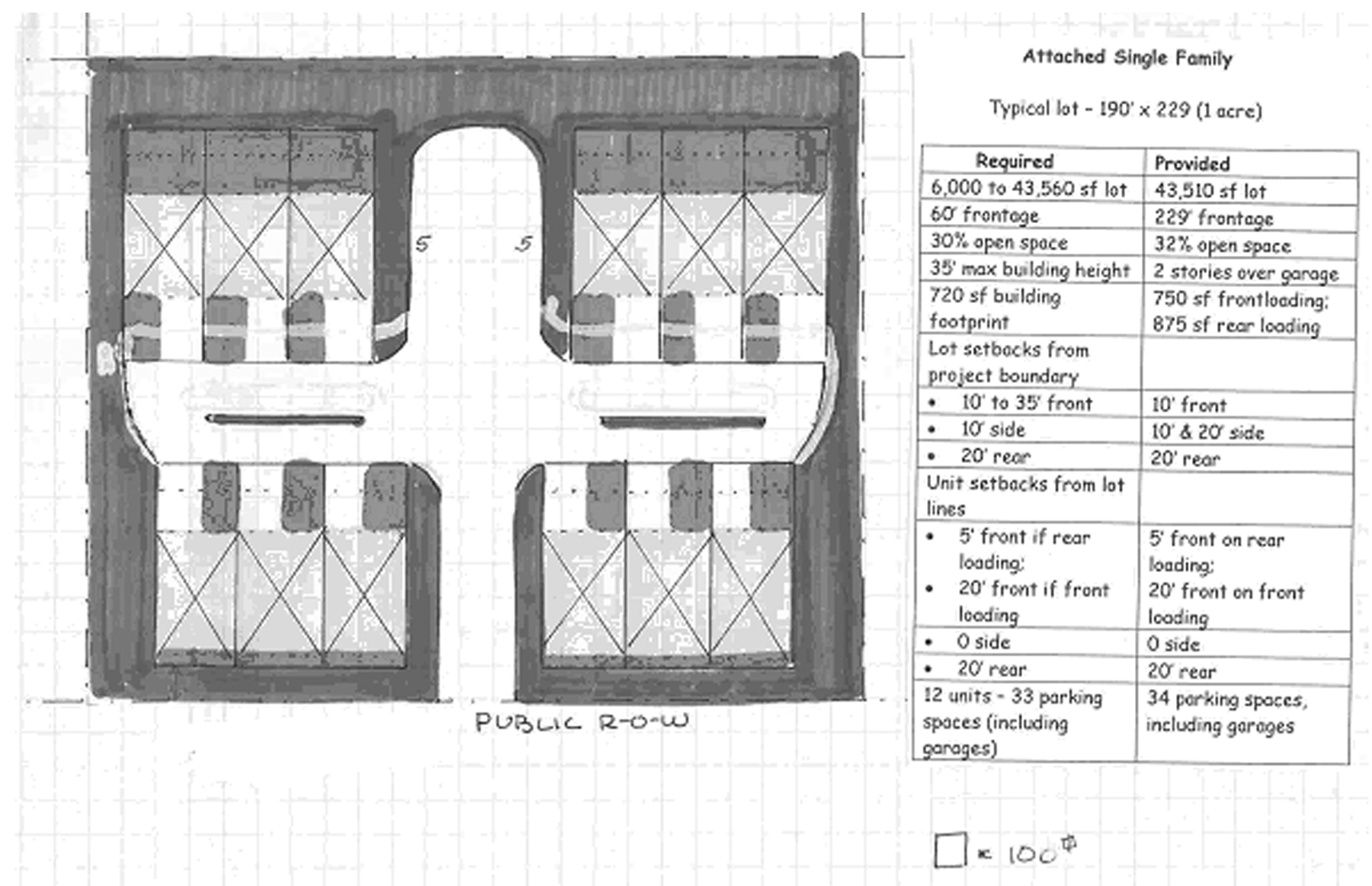
Figure 1. Attached single-family
2.
Multi-family:
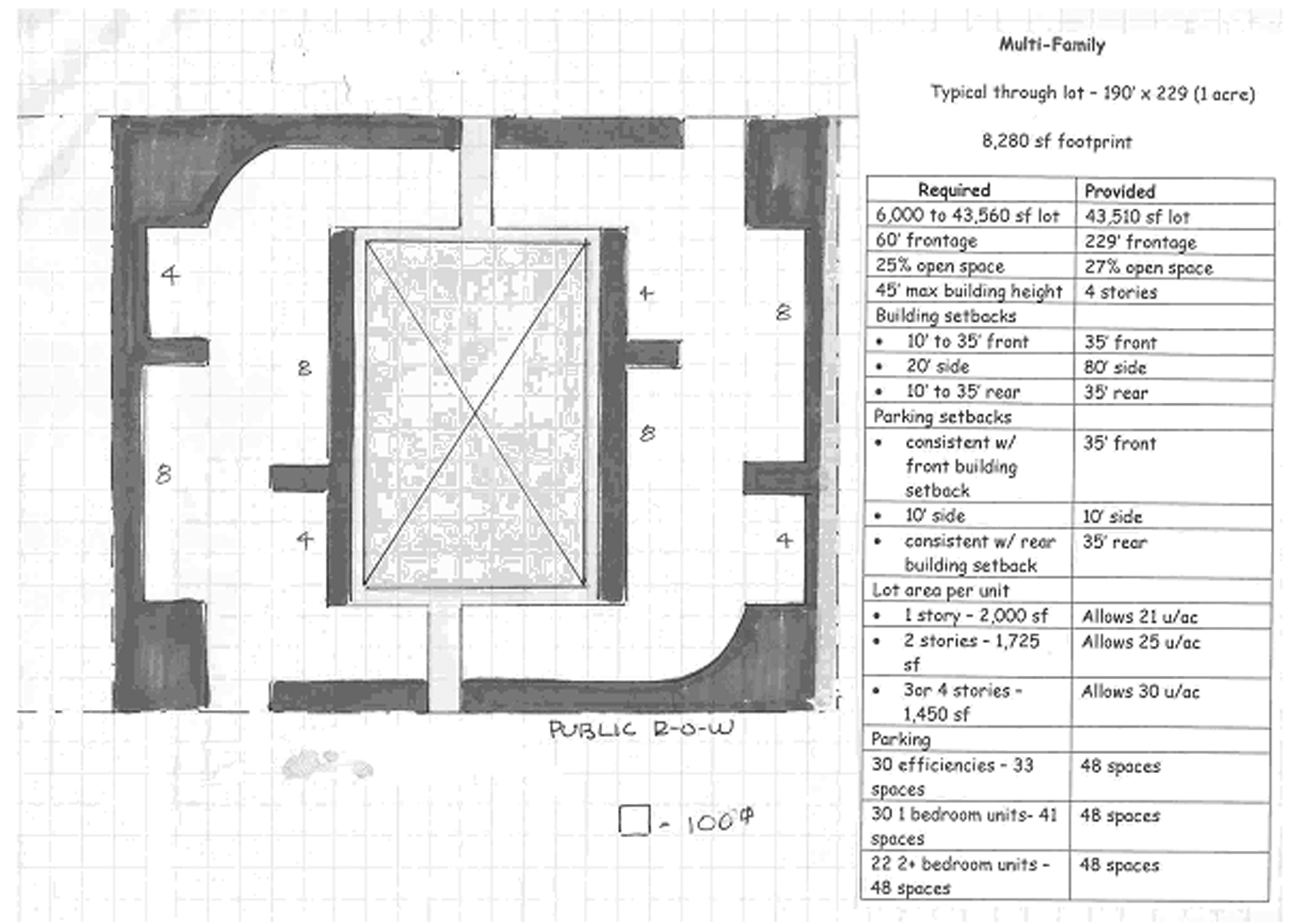
Figure 2. Multi-family
(Ord. No. 06-69, 7-25-06)
Sec. 32-351.08. - Nonresidential and mixed-use development standards.
Nonresidential and mixed-use buildings shall comply with the following standards, except upon approval of a Special Use Permit that assesses the proposal's impact on the village context and imposes conditions to make the development consistent with the village context:
1.
Lot size shall be no less than 10,000 square feet, but shall not exceed one acre.
2.
Lot frontage shall be no less than 60 feet, but shall not exceed 190 feet.
3.
Lot coverage shall not exceed 75 percent of the total lot area.
4.
The ground floor of any mixed-use building shall be limited to nonresidential uses.
5.
The building height shall not exceed 45 feet.
6.
Individual nonresidential uses shall be limited to a maximum building area of 8,000 square feet.
7.
Buffer areas normally required by Table 8-1 of the Design and Construction Standards Manual shall not be required.
8.
All setbacks as required herein shall be measured from lot lines or proposed rights-of-way, whichever is more restrictive.
a.
Building setbacks:
1.
The front setback shall be no less than ten feet and no greater than 20 feet. Through lots shall be treated as if they have two frontages for setback purposes, but not for signage purposes.
2.
The side setback shall be no less than 20 feet; however, corner lots shall provide a minimum of ten feet and a maximum of 20 feet along the side facing the public right-of-way.
3.
Except for through lots, as provided in subsection a. above, the rear building setback shall be no less than 20 feet.
b.
Parking setbacks:
1.
Parking shall not be permitted within any front setback area or within the provided side setback area on a corner lot.
2.
All parking must be set back at minimum of ten feet from the side and rear lot lines.
c.
Illustrative examples are provided in section 32.501.09 below.
9.
To promote the compatibility of nonresidential and residential uses, the following shall apply:
a.
Flat roofs are prohibited; roof pitch shall be a minimum of 1:3, with a maximum of 1:1. Roofs shall be designed with at least one change or break in plane within every 60 foot segment. Vertical roof changes, porch roofs and dormers are examples of acceptable plane changes.
b.
Windows shall cover between ten percent and 50 percent of any exterior wall fronting on a public right-of-way.
c.
Concrete masonry units, precast concrete panels, vertical ribbed metal exteriors or highly reflective materials shall not be used as primary exterior finishes.
10.
Open space, landscaping, screening and fencing:
a.
At least 25 percent of the total lot area shall be maintained as open space.
b.
The front building setback shall be landscaped in accordance with section 802.42(B) of the Design and Construction Standards Manual.
c.
Parking setback areas, as required in (8) above, shall be landscaped in accordance with section 802.43(B) of the Design and Construction Standards Manual.
d.
All dumpsters and exterior utility boxes shall be located and/or screened so as not to be visible from any public right-of-way.
e.
No fence within a front setback or in any setback abutting a public right-of-way shall exceed four feet in height.
f.
When a nonresidential or mixed-use lot abuts a residentially developed lot and the residential structure is within five feet of the joint lot line, the nonresidential or mixed-use lot shall provide an opaque screen along that joint lot line. Such opaque screen shall be at least four feet in height at installation, but shall be maintained at a height between four feet and six feet. Chain link fencing with slats or fabric shall not be used to provide the required opaque screen.
11.
In lieu of the provisions of section 32-250.20 et seq herein, signage for nonresidential and mixed-use lots shall be limited to one facade sign on each building face fronting a public right-of-way, and either one monument sign or one perpendicular projecting sign per lot, as follows:
a.
Facade signs shall be located below the top of the first story, and shall not exceed one-half square foot for every linear foot of building frontage, with a maximum of 50 square feet per sign.
b.
Monument signs shall be located within the front building setback and shall not exceed four feet in height or 20 square feet in sign area per face.
c.
Perpendicular projecting signs shall be located such that the bottom of the sign is at least nine feet, but not more than 12 feet, from the finished grade. Total sign area shall not exceed 20 square feet per face. Perpendicular signs shall not project over existing or proposed public right-of-way.
d.
Waivers or modifications to these sign regulations shall not be permitted through the Special Use Permit process.
(Ord. No. 06-69, 7-25-06)
Sec. 32-351.09. - Illustrative examples of non-residential and mixed-use development standards.
1.
Retail commercial:
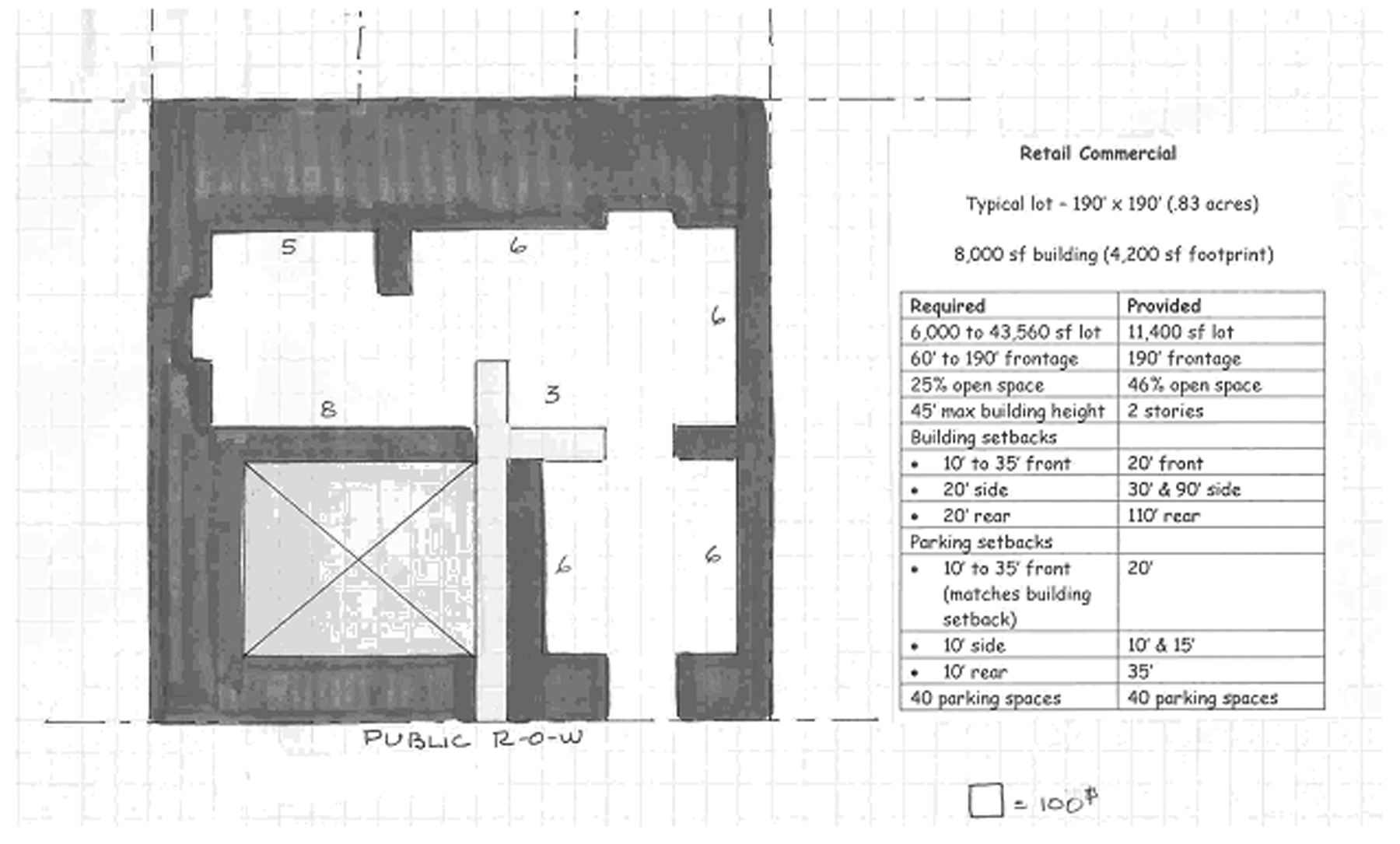
Figure 3. Retail commercial
2.
Mixed-use:
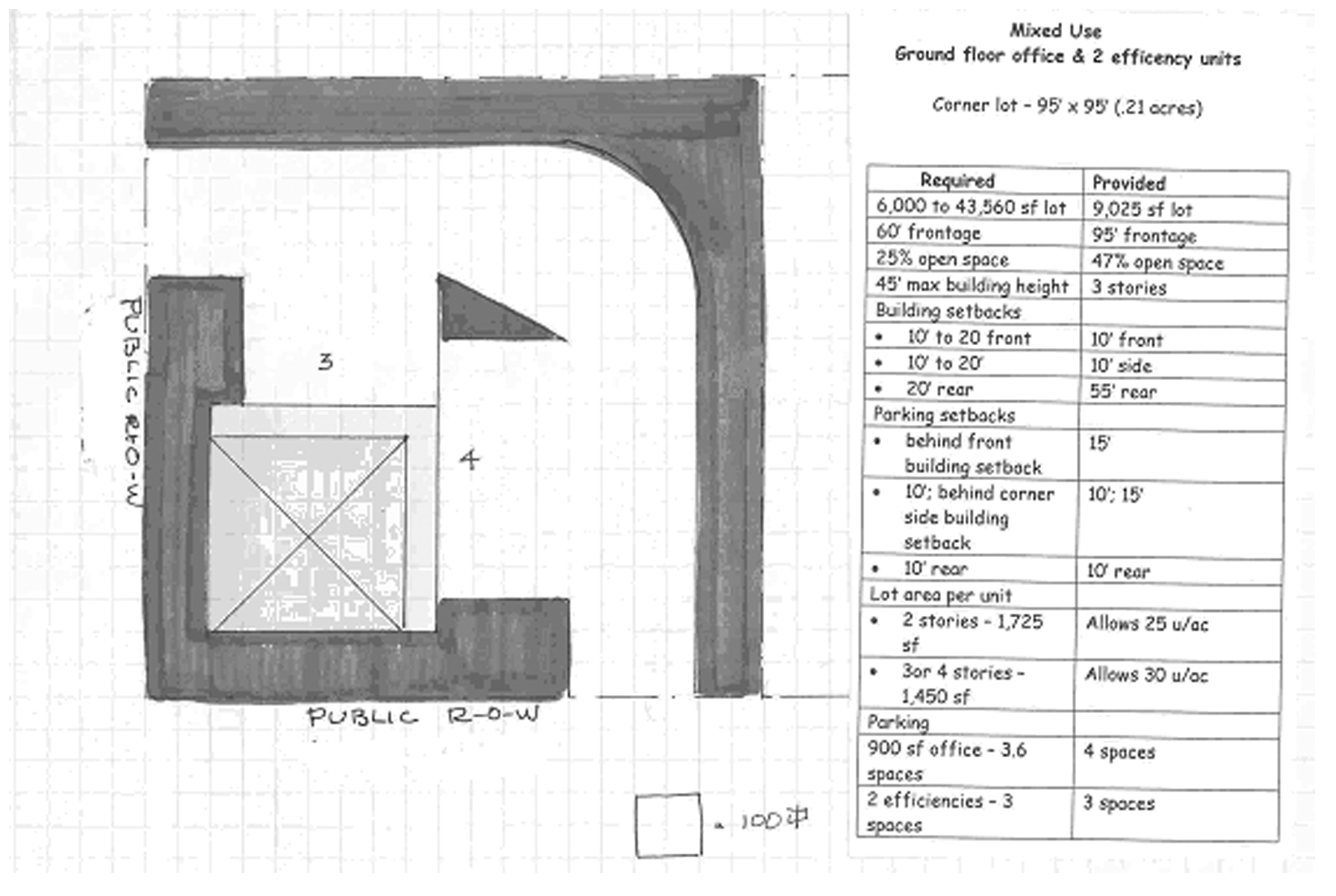
Figure 4. Mixed use
(Ord. No. 06-69, 7-25-06)
Sec. 32-351.10. - Off-street parking and loading.
Off-street parking and loading shall be provided as required by Table 6-8 of the Design and Construction Standards Manual, with the following additional provisions:
1.
Parking provided shall not exceed 120 percent of the minimum parking requirement, unless a parking structure is provided.
2.
When public parking is provided within 500 feet of the site, nonresidential developments may request a modification of up to 50 percent of the parking standard. The request for modification must include a parking tabulation study for all nonresidential development within 500 feet of the public parking facility.
(Ord. No. 06-69, 7-25-06)
Sec. 32-303.01. - Purpose and intent.
The R-2 district (formerly R-20) is intended to implement the suburban residential-low land use classification of the Comprehensive Plan. This district is designed to provide for and encourage development of quality one-family dwellings at a low suburban density of approximately two dwelling units per acre or less.
(Ord. No. 04-78, 12-21-04)
Sec. 32-303.02. - Uses permitted by right.
The following uses are permitted by right in the R-2 district:
1.
Group home, as defined by Code of Virginia, § 15.2-2291, including group residences for ambulatory elderly persons, whether or not special accommodations are required, but shall not include nursing homes or hospitals.
2.
Home employment, subject to standards in section 32-300.16.
3.
Home occupation, subject to standards in section 32-300.07.2.
4.
Home sales office, subject to standards in section 32-300.07.1.
5.
One-family dwellings.
(Ord. No. 04-78, 12-21-04)
Editor's note— Section 32-303.02 amended pursuant to Ord. No. 04-78, adopted Dec. 21, 2004, and includes provisions relocated from § 32-300.07.
Sec. 32-303.03. - Secondary uses.
The following uses shall be permitted by right in the R-2 districts only in conjunction with a permitted principal use, as specifically identified below, existing or proposed:
1.
Community operated parks, clubhouses, swimming pools, racquet ball and tennis courts, health and fitness facilities, and other recreational or civic facilities, as secondary uses to a principal residential development for the exclusive use of the residents of the development and their guests.
2.
Satellite parking, secondary to a religious institution or place of religious worship only, with a Special Use Permit, subject to the standards of section 32-300.07.8.
(Ord. No. 04-78, 12-21-04)
Editor's note— Section 303-03 adopted Dec. 21, 2004, pursuant to Ord. No. 04-78, and includes provisions relocated from § 32-300.07. Former §§ 32-303.03—32-303.06 renumbered accordingly.
Sec. 32-303.04. - Special uses.
The following uses shall be permitted in the R-2 district with a Special Use Permit:
1.
Adult day center.
2.
Bed and breakfast, subject to the standards of section 32-300.15.
3.
Child care facilities.
4.
Community operated parks, clubhouses, swimming pools, racquet ball and tennis courts, health and fitness facilities, and other recreational or civic facilities, as secondary uses to a principal residential development, for the use of the residents of the development and others.
5.
Country club.
6.
Home business.
7.
Private school.
8.
Recovery home, subject to the standards of section 32-300.07.9.
9.
Religious institution or place of religious worship, subject to standards in section 32-300.07.7.
(Ord. No. 04-78, 12-21-04; Ord. No. 24-75, 11-19-24)
Editor's note— Former § 32-303.03 entitled "Special Uses" renumbered as § 32-303.04 pursuant to Ord. No. 04-78, adopted Dec. 21, 2004, and includes uses relocated from section 32-300.07.
Sec. 32-303.05. - Development standards.
1.
The minimum lot size shall be 20,000 square feet; one dwelling unit per lot shall be allowed.
2.
The minimum lot width shall be 100 feet, with frontage on a public street. Minimum lot width for lots abutting cul-de-sacs shall be 80 feet, with frontage on a public street.
3.
The maximum lot coverage shall be 30 percent.
4.
Cluster development shall be allowed subject to the standards set forth in section 32-300.60 of this chapter.
(Ord. No. 04-78, 12-21-04)
Editor's note— Former § 32-303.04 entitled "Development Standards" renumbered as § 32-303.05 pursuant to Ord. No. 04-78, adopted Dec. 21, 2004.
Sec. 32-303.06. - Setbacks.
1.
All buildings shall be set back a minimum of 35 feet from the front property line.
2.
The minimum rear setback shall be 25 feet.
3.
The minimum side setback shall be ten feet.
4.
For a corner lot the minimum side yard abutting the side street shall be 20 feet. For corner lots, front and side yards shall be fixed in conjunction with issuance of building permits and shall be noted in the zoning approval.
5.
Where an adjoining property is zoned commercial or office, the minimum setback for the principal building from the common property line shall be 25 feet; and where an adjoining property is zoned industrial, such minimum setback shall be 35 feet. If buffering requirements provided in sections 32-250.30 et seq. are greater, they shall apply in lieu of the setback.
(Ord. No. 94-1, 1-11-94; Ord. No. 04-78, 12-21-04)
Editor's note— Former § 32-303.05 entitled "Yards and Setbacks" amended and renumbered as § 32-302.06 pursuant to Ord. No. 04-78, adopted Dec. 21, 2004.
Sec. 32-303.10. - R-4 Zoning District; purpose and intent.
The R-4 district (formerly R-10) is intended to implement the suburban residential-low, suburban residential-moderate, and community employment center land use classifications of the Comprehensive Plan. This district is designed to provide for and encourage development of quality one-family dwellings at a low to moderate suburban density of approximately four dwelling units per acre or less.
(Ord. No. 04-78, 12-21-04; Ord. No. 09-30, 5-19-09; Ord. No. 09-30, 5-19-09)
Sec. 32-303.11. - Uses permitted by right.
The following uses are permitted by right in the R-4 district:
1.
Group home, as defined by Code of Virginia, § 15.2-2291, including group residences for ambulatory elderly persons, whether or not special accommodations are required, but shall not include nursing homes or hospitals.
2.
Home employment, subject to standards in section 32-300.16.
3.
Home occupation, subject to standards in section 32-300.07.2.
4.
Home sales office, subject to standards in section 32-300.07.1.
5.
One-family dwellings.
(Ord. No. 04-78, 12-21-04; Ord. No. 09-30, 5-19-09)
Editor's note— Former § 32-303.10 was amended and renumbered as § 32-303.11 pursuant to Ord. No. 09-30, adopted May 19, 2009. Prior to this amendment, Section 303.12, was amended Dec. 21, 2004, pursuant to Ord. No. 04-78, and includes provisions relocated from § 32-300.07.
Sec. 32-303.12. - Secondary uses.
The following uses shall be permitted by right in the R-4 district only in conjunction with a permitted principal use, as specifically identified below, existing or proposed:
1.
Community operated parks, clubhouses, swimming pools, racquet ball and tennis courts, health and fitness facilities, and other recreational or civic facilities, as secondary uses to a principal residential development for the exclusive use of the residents of the development and their guests.
2.
Satellite parking, secondary to a religious institution or place of religious worship only, with a Special Use Permit, subject to standards in section 32-300.07.8.
(Ord. No. 04-78, 12-21-04; Ord. No. 09-30, 5-19-09)
Editor's note— This section was previously denoted as § 32-400.13 amended and renumbered as § 32-400.12 pursuant to Ord. No. 09-30, adopted May 19, 2009. Prior to this amendment, section 32-303.13, adopted Dec. 21, 2004 pursuant to Ord. No. 04-78, includes provisions relocated from § 32-300.07. Former §§ 32-303.13—32-303.16 were renumbered accordingly.
Sec. 32-303.13. - Special uses.
The following uses shall be permitted in the R-4 district with a Special Use Permit:
1.
Adult day center.
2.
Bed and breakfast, subject to the standards of section 32-300.15.
3.
Child care facilities.
4.
Community operated parks, clubhouses, swimming pools, racquet ball and tennis courts, health and fitness facilities, and other recreational or civic facilities, as secondary uses to a principal residential development, for the use of the residents of the development and others.
5.
Country club.
6.
Home business.
7.
Private school.
8.
Recovery home, subject to the standards of section 32-300.07.9.
9.
Religious institution or place of religious worship, subject to standards in section 32-300.07.7.
(Ord. No. 04-78, 12-21-04; Ord. No. 09-30, 5-19-09; Ord. No. 24-75, 11-19-24)
Editor's note— This section was previously denoted as § 32-303.14 amended and renumbered as § 32-400.13 pursuant to Ord. No. 09-30, adopted May 19, 2009. Prior to this amendment, former § 32-303.13 entitled "Special Uses" was renumbered as § 32-303.14 pursuant to Ord. No. 04-78, adopted Dec. 21, 2004, and includes uses relocated from § 32-300.07.
Sec. 32-303.14. - Development standards.
1.
The minimum lot size shall be 10,000 square feet; one dwelling unit per lot shall be allowed.
2.
Lots shall have frontage on a public street. The minimum lot frontage along all streets shall be 70 feet, except 100 feet along both streets for corner lots (measured from the point of intersection of the extended lot lines coterminous with the street rights-of-way). For lots that have road frontage abutting the circular arc portion of a cul-de-sac, the lot frontage shall be a minimum of 45 feet and the minimum lot width, measured at the required building setback line, shall be 70 feet. For lots on the outside of a street with a centerline radius less than 200 feet, the minimum lot frontage shall be 60 feet. The Board of County Supervisors may approve lots with frontage on a private street upon approval of a Special Use Permit.
3.
The maximum lot coverage shall be 40 percent.
4.
Cluster development shall be allowed subject to the standards set forth in section 32-300.60 of this chapter.
(Ord. No. 04-78, 12-21-04; Ord. No. 06-29, 3-7-06; Ord. No. 09-30, 5-19-09)
Editor's note— This section was previously denoted as § 32-303.15 amended and renumbered as § 32-400.14 pursuant to Ord. No. 09-30, adopted May 19, 2009. Prior to this amendment, former § 32-303.14 entitled "Development Standards" renumbered as § 32-303.15 pursuant to Ord. No. 04-78, adopted Dec. 21, 2004, and includes uses relocated from former § 32-303.12.
Sec. 32-303.15. - Setbacks.
1.
All buildings shall be set back a minimum of 30 feet from the front property line.
2.
The minimum rear setback shall be 25 feet.
3.
The minimum side-setback shall be ten feet.
4.
For a corner lot the minimum side setback abutting the side street shall be 20 feet. For corner lots, front and side yards shall be fixed in conjunction with issuance of building permits and shall be noted in the zoning approval.
5.
Open and enclosed carports attached to a principal dwelling, on lots recorded prior to 1965, in the R-4, Suburban Residential district, and constructed prior to the adoption of this amendment, shall be set back a minimum of three feet from the side property line. Open carports meeting the above requirements may be enclosed after the adoption of this amendment provided exterior side wall construction is noncombustible or has a minimum fire resistive rating equivalent to two-hours between dwelling units.
6.
Where an adjoining property is zoned commercial or office, the minimum setback for the principal building from the common property line shall be 25 feet; and where an adjoining property is zoned industrial, such minimum setback shall be 35 feet. If buffering requirements provided in section 32-250.30, et seq. are greater, they shall apply in lieu of the setback.
(Ord. No. 94-1, 1-11-94; Ord. No. 04-78, 12-21-04; Ord. No. 06-28, 3-7-06; Ord. No. 09-30, 5-19-09)
Editor's note— This section was previously denoted as § 32-400.16 amended and renumbered as § 32-400.15 pursuant to Ord. No. 09-30, adopted May 19, 2009. Prior to this amendment, former § 32-303.15 entitled "Yards and Setbacks" amended and renumbered as § 32-303.16 pursuant to Ord. No. 04-78, adopted Dec. 21, 2004.
Secs. 32-303.30—32-303.34. - Reserved.
Editor's note— Sections 32-303.30 through 32-303.34 pertaining to "two-family dwellings" in the R-D Zoning District were repealed pursuant to Ord. No. 04-78, adopted Dec. 21, 2004. Duplex uses are permitted in the PMR Zoning District, Part 306.
Sec. 32-303.41. - Purpose and intent.
The R-6 (formerly SR-6) district is intended to implement the suburban residential medium and community employment center land use classifications of the Comprehensive Plan. Properties developed prior to April 21, 1998, shall be considered lawfully nonconforming with respect to the development standards of the R-6. The R-6 district is designed to provide for a mixture of single-family residential dwelling types at a density not to exceed six dwelling units per net acre so long as appropriate standards are maintained to insure a reasonable amount of open space and architectural variety, together with public and community buildings (schools, churches, etc.) and facilities necessary for or as are normally compatible with residential surroundings.
(Ord. No. 93-28, 6-1-93; Ord. No. 98-26, 4-21-98; Ord. No. 04-78, 12-21-04)
Note— See section 32-200.06(e) for 1982, 1991 and 2004 zoning classifications.
Sec. 32-303.42. - Uses permitted by right.
The following uses are permitted by right in the R-6 district:
1.
Group home, as defined by Code of Virginia, § 15.2-2291, including group residences for ambulatory elderly persons, whether or not special accommodations are required, but shall not include nursing homes or hospitals.
2.
Home occupation, subject to standards in subsection 32-300.07(2).
3.
Home sales office, subject to standards in subsection 32-300.07(1).
4.
Single-family detached dwellings.
5.
Single-family attached dwellings.
(Ord. No. 93-28, 6-1-93; Ord. No. 98-26, 4-21-98; Ord. No. 04-78, 12-21-04)
Editor's note— Section 32-303.42 amended pursuant to Ord. No. 04-78, adopted Dec. 21, 2004, and includes provisions relocated from § 32-300.07.
Sec. 32-303.43. - Secondary uses.
The following uses shall be permitted by right in the R-6 district only in conjunction with a permitted principal use, as specifically identified below, existing or proposed:
1.
Community operated parks, clubhouses, swimming pools, racquet ball and tennis courts, health and fitness facilities, and other recreational or civic facilities, as secondary uses to a principal residential development for the exclusive use of the residents of the development and their guests.
2.
Satellite parking, secondary to a religious institution or place of religious worship only, with a Special Use Permit, subject to standards in section 32-300.07.8.
(Ord. No. 04-78, 12-21-04)
Editor's note— Section 32-303.43 was adopted Dec. 21, 2004, pursuant to Ord. No. 04-78, and includes provisions relocated from § 32-300.07. Former §§ 32-303.43—32-303.45 were renumbered accordingly.
Sec. 32-303.44. - Special uses.
The following uses shall be permitted in the r-6 district with a Special Use Permit:
1.
Adult day center.
2.
Child care facilities.
3.
Community operated parks, clubhouses, swimming pools, racquet ball and tennis courts, health and fitness facilities, and other recreational or civic facilities, as secondary uses to a principal residential development, for the use of the residents of the development and others.
4.
Country club.
5.
Home business.
6.
Hospital.
7.
Recovery home, subject to the standards of section 32-300.07.9.
8.
Recycling collection points, subject to the standards of section 32-250.84.
9.
Religious institution or place of religious worship, subject to standards in section 32-300.07.7.
(Ord. No. 93-28, 6-1-93; Ord. No. 98-26, 4-21-98; Ord. No. 04-78, 12-21-04; Ord. No. 24-75, 11-19-24)
Editor's note— Former § 32-303.43 entitled "Special Uses" was amended and renumbered as § 32-303.44 pursuant to Ord. No. 04-78, adopted Dec. 21, 2004.
Sec. 32-303.45. - Development standards.
1.
The performance standards of the PMR, Planned Mixed Residential Zoning District for the village house, patio house, duplex house, townhouse, and other comparable housing units and standards approved by the Zoning Administrator shall apply, in accordance with section 32-306.12.
2.
Thirty percent open space shall be required for developments proposing an average lot size of less than 6,000 square feet. For an individual section or phase of a multi-phased development, one-half of the required open space, or 15 percent, shall be provided within that phase or section. The remaining 15 percent may be provided on a project-wide basis.
(Ord. No. 93-28, 6-1-93; Ord. No. 94-1, 1-11-94; Ord. No. 98-26, 4-21-98; Ord. No. 04-78, 12-21-04)
Editor's note— Former § 32-303.44 entitled "Development Standards" was amended and renumbered as § 32-303.45 pursuant to Ord. No. 04-78, adopted Dec. 21, 2004.
Sec. 32-303.46. - Site plan requirement.
Development in the R-6 district shall require site plan approval as set forth in Part 800 of this chapter or subdivision approval in accordance with the provisions of Chapter 25, as applicable.
(Ord. No. 93-28, 6-1-93; Ord. No. 98-26, 4-21-98; Ord. No. 04-78, 12-21-04)
Sec. 32-303.61. - Purpose and intent.
The general purpose and intent of the RMH, Residential Mobile Home District is to promote moderate priced housing opportunities by allowing development of mobile home subdivisions or parks within the suburban residential low and suburban residential medium land use classifications of the Comprehensive Plan in accordance with sound planning principles, while preventing detrimental effects to the use or development of adjacent properties.
(Ord. No. 04-78, 12-21-04)
Sec. 32-303.62. - Uses permitted by right.
The following uses are permitted by right in the RMH District:
1.
Group home, as defined by Code of Virginia, § 15.2-2291, including group residences for ambulatory elderly persons, whether or not special accommodations are required, but shall not include nursing homes or hospitals.
2.
Home occupation, subject to standards in section 32-300.07.2.
3.
Home sales office, subject to standards in section 32-300.07.1.
4.
Mobile homes, and the facilities necessary to operate a mobile home park, shall be permitted by right in the RMH District. Such parks may offer lots for lease or for sale.
5.
The mobile homes permitted in this district are those which meet the requirements set forth in the A.N.S.I. Al19.1 Standard for Mobile Homes or its revisions, and are intended for permanent single-family residential use (one story only, one per lot and not be constructed to include any other residential structure or to allow more than one family in one mobile home). This excludes dependent mobile homes and travel trailers.
(Ord. No. 04-78, 12-21-04)
Editor's note— Section 32-303.62 was amended pursuant to Ord. No. 04-78, adopted Dec. 21, 2004, and includes provisions relocated from § 32-300.07.
Sec. 32-303.63. - Secondary uses.
The following uses shall be permitted by right in the RMH District only in conjunction with a permitted principal use, as specifically identified below, existing or proposed:
1.
Community operated parks, clubhouses, swimming pools, racquet ball and tennis courts, health and fitness facilities, and other recreational or civic facilities, as secondary uses to a principal residential development for the exclusive use of the residents of the development and their guests.
2.
Satellite parking, secondary to a religious institution or place of religious worship only, with a Special Use Permit, subject to standards in section 32-300.07.8.
(Ord. No. 04-78, 12-21-04)
Editor's note— Section 32-303.63 was adopted Dec. 21, 2004, pursuant to Ord. No. 04-78, and includes provisions relocated from § 32-300.07. Former §§ 32-303.63—32-303.66 renumbered accordingly.
Sec. 32-303.64. - Special uses.
1.
Adult day center.
2.
Child care facilities.
3.
Community operated parks, clubhouses, swimming pools, racquet ball and tennis courts, health and fitness facilities, and other recreational or civic facilities, as secondary uses to a principal residential development, for the use of the residents of the development and others.
4.
Home business.
5.
Hospital.
6.
Recovery home, subject to the standards of section 32-300.07.9.
7.
Religious institution or place of religious worship, subject to standards in section 32-300.07.7.
(Ord. No. 04-78, 12-21-04; Ord. No. 24-75, 11-19-24)
Editor's note— Former § 32-303.63 entitled "Special Uses" was amended and renumbered as § 32-303.64 pursuant to Ord. No. 04-78, adopted Dec. 21, 2004, and includes provisions relocated from § 32-300.07.
Sec. 32-303.65. - Development standards.
The following development standards shall apply in the RMH District.
1.
The minimum lot size for single-width mobile homes shall be 5,000 square feet, and for double-width mobile homes 7,500 square feet.
2.
The minimum lot width shall be 30 feet, which may be reduced to 15 feet for lots on a cul-de-sac.
3.
The maximum density for a mobile home park shall not exceed six dwelling units per acre, and the density in any one area of the park shall not exceed seven dwelling units per acre.
4.
Each mobile home lot shall have an appropriate outdoor living space to supplement the interior space of a mobile home and shall include but not be limited to the following minimum requirements:
(a)
The minimum size of each mobile home patio shall be 200 square feet of paved or hard surface area not less than eight feet in width exclusive of pedestrian walkways, driveways and porches. Walkways shall be included as necessary to provide walking surfaces between the patio and entrances.
(b)
Every patio shall be convenient to the entrance of the mobile home, appropriately related to open areas of the lot and other facilities, adapted to terrain and natural features and related to the anticipated type of mobile home. FHA standards for patio construction are required.
5.
Open space areas and facilities for active recreational purposes appropriate to the needs of the occupants shall be provided in all mobile home parks, with the following minimum standards:
(a)
Not less than ten percent of the gross site area shall be devoted to recreational facilities. Provision of both adult and tot lot recreation areas is encouraged.
(b)
Recreation areas must be developable for recreational purposes. At least 50 percent of the required recreational area must be developable, which is to be considered land not within a 100 year floodplain and not having a slope greater than 15 percent.
6.
Streets in mobile home developments shall be designed and constructed in accordance with the Design and Construction Standards Manual, and standards appropriate for projected use and vehicle counts.
7.
Sidewalks or trails shall be provided for safe, convenient, all season pedestrian access in accordance with the Design and Construction Standards Manual.
8.
The developer shall arrange for individual yard lights, controlled by photo electric switches, approved by the Director of Public Works, to be constructed on each lot in the mobile home park. Final layout and design shall be submitted to and approved by the Director of Public Works prior to final plan approval.
9.
Off-street parking shall be provided for the use of occupants in accordance with the Design and Construction Standards Manual.
10.
Any part of each lot not used for building or other structures, or off-street parking, recreational uses, drives and pedestrian walks, central laundry, drying yards, or garbage and trash collection stations shall be planted in accordance with the Design and Construction Standards Manual.
11.
Each mobile home, together with all enclosed extensions or structural additions thereto, shall be installed upon and securely anchored to a mobile home stand to prevent the mobile home from shifting or overturning in accordance with the requirements of the National Fire Protection Association, and shall be suitably treated so as to conceal the undercarriage.
12.
Premises storage of garbage, refuse and rubbish shall comply with provisions of the County Code. It shall be the responsibility of the owner of the property to collect or contract for collection on a frequency of not less than twice weekly all garbage, refuse and rubbish, insuring that such collection is provided on a lot by lot curb side collection basis.
13.
Gasoline, liquefied petroleum, gas or oil storage tanks shall be installed in compliance with all County, state and federal fire prevention and protection regulations.
14.
It shall be unlawful for any person to maintain or operate a mobile home park within Prince William County without a license in accordance with the County Code.
15.
Structures less than 30 inches in height are not considered yard encroachments. Every part of every required yard shall be open and unobstructed above 30 inches, except as hereinafter provided, or as otherwise permitted in this chapter:
(a)
Cornices, overhang, eaves and gutters may not project into any required yard over 18 inches.
(b)
Planters, poles, antennas, play equipment, wires, lights, mail boxes, fences and walls shall not be deemed to be encroachments in required yards.
(Ord. No. 94-67, 10-4-94; Ord. No. 94-76, 11-1-94; Ord. No. 96-6, 1-16-96; Ord. No. 04-78, 12-21-04)
Editor's note— Former § 32-303.64 entitled "Development Standards" was amended and renumbered as § 32-303.65 pursuant to Ord. No. 04-78, adopted Dec. 21, 2004.
Sec. 32-303.66. - Setbacks.
1.
No part of any mobile home shall be located within 25 feet of any public road, nor within 15 feet of any private street, nor within 20 feet of any exterior boundary.
2.
Access shall be such to permit fire protection vehicles and other apparatus to approach within 75 feet of each mobile home.
3.
No part of any mobile home shall be within eight feet of any common driveway.
4.
A landscaped buffer area of 15 feet in width which meets or exceeds buffer type A standards of the Design and Construction Standards Manual shall be maintained around the perimeter of the mobile home park, including any areas abutting streets having a classification lesser than major collector. When the park abuts any street classified as major collector or greater, the landscaped buffer area shall meet or exceed the standards set forth in table 8-7 of section 800 of the Design and Construction Standards Manual.
5.
No mobile home shall be less than 25 feet from another mobile home.
6.
Swimming pools/enclosures shall not be less than five feet from the side and rear lot lines and located to rear of the principal building.
(Ord. No. 96-6, 1-16-96; Ord. No. 04-78, 12-21-04)
Editor's note— Former § 32-303.65 entitled "Yards and Setbacks" amended and renumbered as § 32-303.66 pursuant to Ord. No. 04-78, adopted Dec. 21, 2004.
Sec. 32-303.67. - Site plan requirement.
Development in the RMH District shall require site plan approval as set forth in Part 800 of this chapter.
(Ord. No. 04-78, 12-21-04)
Editor's note— Former § 32-303.66 entitled "Site Plan Requirement" was amended and renumbered as § 32-303.67 pursuant to Ord. No. 04-78, adopted Dec. 21, 2004.
Sec. 32-304.01. - R-16 Suburban Residential District; purpose and intent.
The R-16 District (formerly RM-1) is intended to implement the suburban residential high and the residential component of the community employment center land use classifications of the Comprehensive Plan. The R-16 District is designed to provide for and encourage quality development at urban densities in locations well-served by public utilities and roadways, not to exceed 16 dwelling units per net acre.
(Ord. No. 93-28, 6-1-93; Ord. No. 98-26, 4-21-98; Ord. No. 04-78, 12-21-04; Ord. No. 09-30, 5-19-09)
Sec. 32-304.02. - Uses permitted by right.
The following uses are permitted by right in the R-16 District:
1.
Group home, as defined by Code of Virginia, § 15.2-2291, including group residences for ambulatory elderly persons, whether or not special accommodations are required, but shall not include nursing homes or hospitals
2.
Home occupation, subject to standards in section 32-300.07.2.
3.
Home sales office, subject to standards in section 32-300.07.1.
4.
Single-family attached dwellings.
5.
Multifamily dwellings.
(Ord. No. 93-28, 6-1-93; Ord. No. 94-1, 1-11-94; Ord. No. 98-26, 4-21-98; Ord. No. 04-78, 12-21-04; Ord. No. 09-30, 5-19-09; Ord. No. 20-54, 12-15-20)
Editor's note— Section 304.02, was amended Dec. 21, 2004, pursuant to Ord. No. 04-78, and includes provisions relocated from § 32-300.07.
Sec. 32-304.03. - Secondary uses.
The following uses shall be permitted by right in the R-16 District only in conjunction with a permitted principal use, as specifically identified below, existing or proposed:
1.
Community operated parks, clubhouses, swimming pools, racquet ball and tennis courts, health and fitness facilities, and other recreational or civic facilities, as secondary uses to a principal residential development for the exclusive use of the residents of the development and their guests.
2.
Satellite parking, secondary to a religious institution or place of religious worship only, with a Special Use Permit, subject to standards in section 32-300.07.8.
(Ord. No. 04-78, 12-21-04)
Editor's note— Section 304-03 adopted Dec. 21, 2004, pursuant to Ord. No. 04-78, and includes provisions relocated from § 32-300.07. Former §§ 32-304.03—32-304.06 renumbered accordingly.
Sec. 32-304.04. - Special uses.
The following uses shall be permitted in the R-16 District with a Special Use Permit:
1.
Adult day center.
2.
Continuing care retirement community.
3.
Child care facilities.
4.
Community operated parks, clubhouses, swimming pools, racquet ball and tennis courts, health and fitness facilities, and other recreational or civic facilities, as secondary uses to a principal residential development, for the use of the residents of the development and others.
5.
Home business.
6.
Hospital.
7.
Recycling collection points, subject to the standards of section 32-250.84.
8.
Religious institution or place of religious worship, subject to standards in section 32-300.07.7.
(Ord. No. 93-28, 6-1-93; Ord. No. 04-78, 12-21-04; Ord. No. 09-30, 5-19-09; Ord. No. 24-75, 11-19-24)
Editor's note— Former § 32-304.03 entitled "Special Uses" was renumbered as § 32-304.04 pursuant to Ord. No. 04-78, adopted Dec. 21, 2004, and includes uses relocated from § 32-300.07.
Sec. 32-304.05. - Development standards.
1.
The performance standards of the PMR, Planned Mixed Residential Zoning District for multifamily buildings, mid-rise residential buildings, and other comparable housing units and standards approved by the Zoning Administrator shall apply, in accordance with section 32-306.12.
2.
The maximum density shall 16 dwellings per acre.
3.
The minimum density shall be six dwelling units per net acre.
(Ord. No. 93-28, 6-1-93; Ord. No. 94-1, 1-11-94; Ord. No. 98-26, 4-21-98; Ord. No. 04-78, 12-21-04)
Editor's note— Former § 32-304.04 entitled "Development Standards" renumbered as § 32-304.05 pursuant to Ord. 04-78, adopted Dec. 21, 2004.
Sec. 32-304.06. - Site plan requirement.
Development in the R-16 District shall require site plan approval as set forth in Part 800 of this chapter.
(Ord. No. 93-281, 6-1-93; Ord. No. 04-78, 12-21-04)
Editor's note— Former § 32-304.05 entitled "Site Plan Requirement" renumbered as § 32-304.06 pursuant to Ord. No. 04-78, adopted Dec. 21, 2004.
Sec. 32-304.21. - R-30 Urban Residential District[; purpose and intent].
The R-30 District (formerly RM-2) is intended to implement the residential component of the regional employment center land use classification of the Comprehensive Plan and to afford opportunities for providing the full range of supporting services to elderly individuals by allowing the mix of nonresidential uses and residential uses under certain circumstances. The R-30 District is designed to provide for and encourage quality multifamily development at urban densities not to exceed 30 dwelling units per net acre in locations well-served by public utilities and roadways.
(Ord. No. 94-1, 1-11-94; Ord. No. 04-78, 12-21-04; Ord. No. 09-30, 5-19-09; Ord. No. 24-05, 3-12-24)
Sec. 32-304.22. - Uses permitted by right.
The following uses shall be permitted by right in the R-30 District:
1.
Group home, as defined by Code of Virginia, § 15.2-2291, including group residences for ambulatory elderly persons, whether or not special accommodations are required, but shall not include nursing homes or hospitals
2.
Home occupation, subject to standards in section 32-300.07.2.
3.
Home sales office, subject to standards in section 32-300.07.1.
4.
Multifamily dwellings.
(Ord. No. 94-1, 1-11-94; Ord. No. 04-78, 12-21-04; Ord. No. 09-30, 5-19-09)
Editor's note— Section 304.22, amended Dec. 21, 2004, pursuant to Ord. No. 04-78, and includes provisions relocated from § 32-300.07.
Sec. 32-304.23. - Secondary uses.
The following uses shall be permitted by right in the R-30 District only in conjunction with a permitted principal use, as specifically identified below, existing or proposed:
1.
Community operated parks, clubhouses, swimming pools, racquet ball and tennis courts, health and fitness facilities, and other recreational or civic facilities, as secondary uses to a principal residential development for the exclusive use of the residents of the development and their guests.
2.
Medical and dental offices and pharmacies for the exclusive patronage of residents.
3.
Satellite parking, secondary to a religious institution or place of religious worship only, with a Special Use Permit, subject to standards in section 32-300.07.8.
Editor's note— Section 304-23 was adopted Dec. 21, 2004, pursuant to Ord. No. 04-78, and includes provisions relocated from § 32-300.07. Former §§ 32-304.23 and 32-304.25 were renumbered accordingly.
Sec. 32-304.24. - Special uses.
The following uses shall be permitted in the R-30 District with a Special Use Permit:
1.
Continuing care retirement community.
2.
Community operated parks, clubhouses, swimming pools, racquet ball and tennis courts, health and fitness facilities, and other recreational or civic facilities, as secondary uses to a principal residential development, for the use of the residents of the development and others.
3.
Home business.
4.
Hospital.
5.
Recycling collection points, subject to the standards of section 32-250.84.
6.
Religious institution or place of religious worship, subject to standards in section 32-300.07.7.
7.
Uses listed in section 32-401.21 of this chapter shall be permitted in the R-30 District, provided they are for exclusive patronage of the residents, and are located in a building containing dwelling units.
(Ord. No. 93-28, 6-1-93; Ord. No. 04-78, 12-21-04; Ord. No. 09-30, 5-19-09)
Editor's note— Former § 32-304.23 entitled "Special Uses" was renumbered as § 32-304.24 pursuant to Ord. No. 04-78, adopted Dec. 21, 2004, and includes uses relocated from § 32-300.07.
Sec. 32-304.25. - Development standards.
1.
The performance standards of the PMR, Planned Mixed Residential Zoning District for multifamily buildings, mid-rise and high-rise residential buildings and other comparable housing units and standards approved by the Zoning Administrator shall apply in accordance with section 32-306.12.
2.
The maximum density shall 30 dwellings per acre.
3.
The minimum density shall be 16 dwelling units per acre.
(Ord. No. 94-1, 1-11-94; Ord. No. 04-78, 12-21-04)
Editor's note— Former § 32-304.24 entitled "Development Standards" was renumbered as § 32-304.25 pursuant to Ord. No. 04-78, adopted Dec. 21, 2004.
Sec. 32-304.26. - Site plan requirement.
Development in the R-30 District shall require site plan approval as set forth in Part 800 of this chapter.
(Ord. No. 94-1, 1-11-94; Ord. No. 04-78, 12-21-04)
Editor's note— Former § 32-304.25 entitled "Site Plan Requirement" was renumbered as § 32-304.26 pursuant to Ord. No. 04-78, adopted Dec. 21, 2004.
Sec. 32-304.31. - R-U Urban Residential District[; purpose and intent].
The R-U District is intended to implement the urban residential and mass transit node land use classifications of the Comprehensive Plan and to afford opportunities for providing the full range of supporting services by allowing a mix of nonresidential and residential uses under certain circumstances. The R-U District is designed to provide for and encourage quality multifamily development at urban densities not less than 31 units per acre in locations well served by public infrastructure.
(Ord. No. 04-78, 12-21-04; Ord. No. 09-30, 5-19-09)
Sec. 32-304.32. - Uses permitted by right.
The following uses shall be permitted by right in the R-U District:
1.
Group home, as defined by Code of Virginia, § 15.2-2291, including group residences for ambulatory elderly persons, whether or not special accommodations are required, but shall not include nursing homes or hospitals.
2.
Home occupation, subject to standards in section 32-300.07.2.
3.
Home sales office, subject to standards in section 32-300.07.1.
4.
Mixed-use buildings.
5.
Multifamily dwellings.
(Ord. No. 04-78, 12-21-04; Ord. No. 09-30, 5-19-09)
Sec. 32-304.33. - Secondary uses.
The following uses shall be permitted by right in the R-U District only in conjunction with a permitted principal use, as specifically identified below, existing or proposed:
1.
Community operated parks, clubhouses, swimming pools, racquet ball and tennis courts, health and fitness facilities, and other recreational or civic facilities, as secondary uses to a principal residential development for the exclusive use of the residents of the development and their guests.
2.
Medical and dental offices and pharmacies for the exclusive patronage of residents.
3.
Satellite parking, secondary to a religious institution or place of religious worship only, with a Special Use Permit, subject to standards in section 32-300.07.8.
(Ord. No. 04-78, 12-21-04)
Sec. 32-304.34. - Special uses.
The following uses shall be permitted in the R-U District with a Special Use Permit:
1.
Continuing care retirement community.
2.
Community operated parks, clubhouses, swimming pools, racquet ball and tennis courts, health and fitness facilities, and other recreational or civic facilities, as secondary uses to a principal residential development, for the use of the residents of the development and others.
3.
Home business.
4.
Hospital.
5.
Recycling collection points, subject to the standards of section 32-250.84.
6.
Religious institution or place of religious worship, subject to standards in section 32-300.07.7.
7.
Uses listed in section 32-401.21 of this chapter shall be permitted in the R-U District, provided they are for exclusive patronage of the residents, and are located in a building containing dwelling units.
(Ord. No. 04-78, 12-21-04; Ord. No. 09-30, 5-19-09)
Sec. 32-304.35. - Development standards.
1.
The performance standards of the PMR, Planned Mixed Residential Zoning District for mid-rise and high-rise residential buildings and other comparable housing units and standards approved by the Zoning Administrator shall apply in accordance with section 32-306.12.
2.
The minimum density shall 31 dwellings per acre.
(Ord. No. 04-78, 12-21-04)
Sec. 32-304.36. - Site plan requirement.
Development in the R-U District shall require site plan approval as set forth in Part 800 of this chapter.
(Ord. No. 04-78, 12-21-04)
Sec. 32-307.01. - Purpose and intent.
1.
The purpose of the Mixed Use District (MXD) is to provide a flexible land development zoning category intended to promote transit oriented development by encouraging a mix of residential and commercial uses in a single zoning designation for multiple, integrated, and related structures on a single parcel or group of parcels to achieve efficient use of land and design flexibility not otherwise possible, ensure efficient traffic circulation and the preservation of open space and sensitive environmental and historic features, ensure compatibility of the development with surrounding properties and the public utilities and services necessary to the development and, to implement the purposes of zoning set forth in Code of Virginia, § 15.2-2283.
2.
The Mixed Use District (MXD) is intended to:
(a)
Create a mix of commercial, office, and residential uses,
(b)
Allow for a range of densities and heights,
(c)
Locate employment and retail activity in proximity to housing,
(d)
Minimize auto travel,
(e)
Prioritize Multi-modal connectivity,
(f)
Conveniently link businesses and residences,
(g)
Establish housing and employment centers in areas served by transit,
(h)
Create a pedestrian-oriented and scaled built environment, and
(i)
Conserve land resources.
3.
Subject to the standards in County Code Sec. 32-700.20 et seq., the MXD can be implemented pursuant to County Code section 32-700.01 in the locations identified in a small area plan(s) in the Comprehensive Plan or areas identified in the Long-Range Land Use designations that allow mixed uses below in this subsection.
(a)
MXD can be implemented in all small area plan areas through a rezoning application.
(b)
An applicant may apply for the MXD outside of a small area plan area in the following Long-Range Land Use Map classifications. Such application shall be processed as a rezoning application:
i.
Mass Transit Node (MTN),
ii.
Regional Commercial Center (RCC),
iii.
Regional Employment Center (REC),
iv.
Community Employment Center (CEC),
v.
Village Mixed Use (VMU), and
vi.
Urban Mixed Use (UMU).
4.
The Mixed Use District provide a range of zoning district types based on transects and allowable density. The three zoning district types are herein defined as Mixed Use-Neighborhood (MXD-N), Mixed Use-Community (MXD-C), and Mixed Use- Urban (MXD-U).
(Ord. No. 21-19, 3-2-21)
Sec. 32-307.10. - Mixed Use District-Neighborhood (MXD-N), purpose and intent.
The Mixed Use District-Neighborhood (MXD-N) is intended for smaller scale mixed use developments surrounded by lower density residential areas, as well as on neighborhood corridors, or at the edges of town centers. The commercial uses permitted are those commonly used by neighborhood residents. The intensity of commercial uses are limited to minimize impacts on adjacent residential uses. Buildings in this zone are generally up to three stories. Buildings should be street-oriented with windows and door openings fronting the public right-of-way. Development is intended to be pedestrian-oriented and generally compatible with the scale of surrounding development. Residential and non-residential developments are in accordance with the transects denoted hereinafter. Transect 2 allows for a residential density of 0—4 du/acre and non-residential density of 0—0.23 FAR.
(Ord. No. 21-19, 3-2-21)
Sec. 32-307.11. - Uses permitted by right.
The following uses shall be permitted by right in the MXD-N District.
1.
Adult day center.
2.
Animal grooming.
3.
Assisted Living Facilities.
4.
Bank, financial Institution.
5.
Barber shop, beautician studio, tanning and toning salon (one set of toning equipment only).
6.
Bicycle service.
7.
Civic club.
8.
Commercial artist or photographer's studio.
9.
Coffee shop, tea house.
10.
Craft Brewery.
11.
Dry cleaning pick-up facility.
12.
Duplex Dwelling.
13.
Insurance office, real estate office, sales office.
14.
Funeral Home.
15.
Garage.
16.
Garden Center.
17.
General retail.
18.
Greenhouse.
19.
Merchant craftsman/artisan shop.
20.
Motor vehicle parts/repairs.
21.
Small Appliance repair.
22.
Sporting goods store.
23.
Pet care facility.
24.
Pet grooming service.
25.
Pet store, in accordance with the provisions of County Code Sec. 32-400.24.
26.
Place of Worship or assembly.
27.
Religious institution.
28.
Single-family detached dwelling.
29.
Village House.
30.
Winery.
(Ord. No. 21-19, 3-2-21; Ord. No. 24-75, 11-19-24)
Sec. 32-307.12. - Secondary uses.
The following uses shall be permitted by right in the MXD-N District only in conjunction with, and secondary to, a permitted principal use, existing or proposed for concurrent construction in accordance with County Code section 32-400.14.
1.
Bed and Breakfast establishment.
2.
Child-care facility.
3.
Farmer's market.
(Ord. No. 21-19, 3-2-21)
Sec. 32-307.13. - Special uses.
The following uses shall be permitted in the MXD-N District with a Special Use Permit:
1.
Kennel.
2.
Range, indoor shooting.
3.
Limited Craft Brewery.
4.
Motor vehicle fuel station, retail.
5.
Private school (boarding prohibited).
(Ord. No. 21-19, 3-2-21)
Sec. 32-307.20. - Mixed Use District (MXD-C) zoning district, purpose, and intent.
The MXD-C zone is intended for sites in a variety of centers and corridors, and in smaller mixed use areas that are well served by transit. The MXD-C encourages diversification of uses, including residential, commercial, and civic uses, in order to enhance the vitality and appeal of these areas. Buildings in this zone are generally expected to be up to four stories unless height and floor area incentive densities are used to provide additional public benefits. Development is intended to be pedestrian-oriented and complement the scale of surrounding areas. Residential and non-residential developments are in accordance with the transects denoted in this section. Transect 3 allows for a residential density of 4—12 du/acre and non-residential density of up to 0.57 FAR. Transect 4 allows for a residential density of 8—24 du/acre and non-residential density of up to 0.1.38 FAR.
(Ord. No. 21-19, 3-2-21)
Sec. 32-307.21. - Uses permitted by right.
The following uses shall be permitted by right in the MXD-C District.
1.
Adult day center.
2.
Alarm systems operations, office.
3.
Assembly (non-HAZMAT)
4.
Assisted living facility.
5.
Bakery, industrial
6.
Barber shop, beautician studio, tanning and toning salon (one set of toning equipment only).
7.
Bicycle service.
8.
Blacksmith, welding, or machine shop.
9.
Boat building and repair yard.
10.
Brewery and bottling facility.
11.
Business school.
12.
Cafeteria/lunchroom/snack bar/automat.
13.
Catering- Commercial (on or off premises).
14.
Child-care facility.
15.
Civic club.
16.
College, university, or seminary.
17.
Continued care retirement community
18.
Commercial artist or photographer's studio.
19.
Computer and network services.
20.
Craft brewery (not to exceed production of 10,000 barrels per year.)
21.
Cultural arts center.
22.
Distillery.
23.
Dry cleaning/garment processing facility, retail less than 3,000 square feet.
24.
Dry cleaning pick-up facility.
25.
Duplex dwelling.
26.
Food Store.
27.
Funeral Home.
28.
Gunsmith shop.
29.
Event Center/meeting hall.
30.
Financial institution.
31.
Furniture repair, dipping and stripping, upholstery.
32.
Garden Center.
33.
Greenhouse or nursery.
34.
Hospital.
35.
Hotel or motel.
36.
Household equipment and appliance service.
37.
Institute for special education and training.
38.
Interior design and decorating shop.
39.
Laundromat.
40.
Lawn mower service.
41.
Locksmith.
42.
Marble/tile processing, cutting, and polishing.
43.
Medical or dental laboratory.
44.
Medical or dental offices and clinic.
45.
Merchant craftsman/artisan shop.
46.
Motor vehicle parts/repairs.
47.
Mixed-use buildings.
48.
Motor vehicle parts, retail.
49.
Multi-family dwellings.
50.
Office.
51.
Office equipment sales, lease, and services.
52.
Optical and eye care facility.
53.
Package, telecommunications, and courier service.
54.
Parking, public.
55.
Pet care facility.
56.
Pet store, in accordance with the provisions of County Code Sec. 32-400.24.
57.
Pet grooming service.
58.
Place of religious worship or assembly.
59.
Private school (boarding prohibited).
60.
Publishing and printing.
61.
Quick service food store.
62.
Radio or TV broadcasting station.
63.
Recording studio.
64.
Recovery home.
65.
Recycling collection points, subject to standards in County Code section 32-250.84.
66.
Recreation facility, commercial (indoor).
67.
Religious institution.
68.
Research and development (non-HAZMAT).
69.
Restaurant.
70.
Restaurant, carry-out.
71.
Retail store, less than 80,000 square feet.
72.
School of special instruction.
73.
Shoe repair.
74.
Shopping Center A, B, C, or D (see part 100).
75.
Single family-attached dwelling.
76.
Single-family detached dwelling.
77.
Tailor, seamstress shop.
78.
Theater (indoor).
79.
Theater (outdoor).
80.
Townhouse.
81.
Tool and equipment rental (minor).
82.
Trade, conference, or convention center.
83.
Trade, technical or vocational school.
84.
Travel agency.
85.
Veterinary hospital.
86.
Village House.
87.
Warehousing (non-HAZMAT).
88.
Wholesaling (non-HAZMAT).
89.
Continuing Care Retirement Community.
(Ord. No. 21-19, 3-2-21; Ord. No. 24-75, 11-19-24)
Sec. 32-307.22. - Secondary uses.
The following uses shall be permitted by right in the MXD-C District only in conjunction with, and secondary to, a permitted principal use, existing or proposed for concurrent construction in accordance with the provisions of County Code section 32-400.14.
1.
Catalog sales, contractor, tradesman, or industrial equipment (without showroom).
2.
Farmers market.
3.
Live entertainment in accordance with the provisions of County Code section 32-400.15.
4.
Photographic processing laboratory, ancillary to retail store.
5.
Watchman's dwelling.
6.
Attached single-family dwellings on land bays in excess of one acre.
7.
Janitorial Services.
(Ord. No. 21-19, 3-2-21)
Sec. 32-307.23. - Special uses.
The following uses shall be permitted in the MXD-C District with a Special Use Permit:
1.
Bed and breakfast, subject to the standards of County Code 32-300.15.
2.
Drive-in facility, in accordance with the standards for drive-in facilities specified in county code section 32-400.07.
3.
Drive-through facility, in accordance with the standards for drive-through facilities specified in county code section 32-400.07.
4.
Electronic equipment and component manufacturing, assembly, processing, and distribution.
5.
Heliport.
6.
Manufacturing of musical instruments and toys.
7.
Manufacturing, cosmetics, and perfume.
8.
Manufacturing, pharmaceuticals (non-HAZMAT process).
9.
Manufacturing, pottery, ceramics (using only previously pulverized clay and kiln fired only by electricity or gas).
10.
Metal fabrication of signs.
11.
Motor vehicle fuel station, retail.
12.
Parking Commercial, secondary only.
13.
Range, indoor shooting.
14.
Retail store, greater than 80,000 square feet.
15.
Self-storage center, in accordance with the provisions of County Code Section 32-400.16.
16.
Small Urban Data Center outside the Data Center Opportunity Zone Overlay District.
17.
Stadium or arena, indoor or outdoor.
18.
Testing and experimental labs (HAZMAT processes).
19.
Uses not set forth herein that are designed as interim uses.
(Ord. No. 21-19, 3-2-21; Ord. No. 24-37, 6-4-24)
Sec. 32-307.30. - Mixed Use District (MXD-U), purpose and intent.
The Mixed use District-Urban (MXD-U) is established to encourage the development or redevelopment of mixed-use centers that combine new or existing retail development with a variety of housing, offices, studios, live-work space, civic buildings, and other complementary uses arranged in a cohesive, compact, and walkable environment. The MXD-U zone shall be located along existing or planned high-capacity multi-modal transportation corridors.
Development is intended to be pedestrian-oriented, and urban in both form and density. Encourage appropriate transitions between higher-intensity uses within Mixed-use centers and adjacent lower-density residential districts. Where building setbacks exist, they should be used for pedestrian amenities like plazas or outdoor dining. Driveway access should be located via side streets and alleys to the extent possible. When surface parking is provided, it should be located to the rear of buildings and screened. Residential and non-residential developments are in accordance with the transects denoted in this section. Transect 5 allows for a residential density of 20-50 du/acre and non-residential density of up to 2.30 FAR. Transect 6 allows for a residential density of 50 -100 du/acre and non-residential density of up to 3.0 FAR.
(Ord. No. 21-19, 3-2-21)
Sec. 32-307.31. - Uses permitted by right.
The following uses shall be permitted by right in the MXD-U District.
1.
Adult day center.
2.
Alarm systems operations, office.
3.
Assembly (non-HAZMAT).
4.
Assisted living facility.
5.
Bakery, industrial.
6.
Barber shop, beautician studio, tanning and toning salon (one set of toning equipment only).
7.
Bicycle service.
8.
Blacksmith, welding, or machine shop.
9.
Boat building and repair yard.
10.
Boat sales, rental or lease, storage, service, or repair.
11.
Brewery and bottling facility.
12.
Business school.
13.
Cafeteria/lunchroom/snack bar/automat.
14.
Catering—Commercial (on or off premises).
15.
Child-care facility.
16.
Civic club.
17.
College, university, or seminary.
18.
Commercial artist or photographer's studio.
19.
Computer and network services.
20.
Commercial bus station.
21.
Commercial bus terminal.
22.
Continuing Care Retirement Community.
23.
Craft brewery (not to exceed production of 10,000 barrels per year.)
24.
Cultural arts center.
25.
Distillery.
26.
Dry cleaning/garment processing facility, retail less than 3,000 square feet.
27.
Dry cleaning pick-up facility.
28.
Duplex dwelling.
29.
Gunsmith shop.
30.
Event Center/meeting hall.
31.
Farmer's market
32.
Financial institution.
33.
Food Store
34.
Furniture repair, dipping and stripping, upholstery.
35.
Garden Center.
36.
Greenhouse or nursery.
37.
Hospital.
38.
Hotel or motel.
39.
Household equipment and appliance service.
40.
Institute for special education and training.
41.
Interior design and decorating shop.
42.
Laundromat.
43.
Lawn mower service.
44.
Locksmith.
45.
Marble/tile processing, cutting, and polishing.
46.
Medical or dental laboratory.
47.
Medical or dental offices and clinic.
48.
Mixed-use buildings.
49.
Motor vehicle parts, retail.
50.
Multi-family dwellings.
51.
Office.
52.
Office equipment sales, lease, and services.
53.
Optical and eye care facility.
54.
Package, telecommunications, and courier service.
55.
Parking, public.
56.
Pet store, in accordance with the provisions of County Code section 32-400.24.
57.
Pet grooming service.
58.
Place of religious worship or assembly.
59.
Private school (boarding prohibited).
60.
Publishing and printing.
61.
Quick service food store.
62.
Radio or TV broadcasting station.
63.
Recording studio.
64.
Recycling collection points, subject to standards in County Code section 32-250.84.
65.
Recovery home.
66.
Recreation facility, commercial (indoor).
67.
Religious institution.
68.
Research and development (non-HAZMAT).
69.
Restaurant.
70.
Restaurant, carry-out.
71.
Retail store, less than 80,000 square feet.
72.
School of special instruction.
73.
Shoe repair.
74.
Shopping Center A, B, C, or D (see part 100 of this chapter).
75.
Single-family attached dwelling.
76.
Tailor, seamstress shop.
77.
Theater (indoor).
78.
Theater (outdoor).
79.
Townhouse.
80.
Tool and equipment rental (minor).
81.
Trade, conference, or convention center.
82.
Trade, technical or vocational school.
83.
Travel agency.
84.
Veterinary hospital.
85.
Village House.
86.
Warehousing (non-HAZMAT).
87.
Wholesaling (non-HAZMAT).
(Ord. No. 21-19, 3-2-21; Ord. No. 24-75, 11-19-24)
Sec. 32-307.32. - Secondary uses.
The following uses shall be permitted by right in the MXD-U District only in conjunction with, and secondary to, a permitted principal use, existing or proposed for concurrent construction in accordance with the provisions of section 32-400.14 herein:
1.
Catalog sales, contractor, tradesman, or industrial equipment (without showroom).
2.
Live entertainment in accordance with the provisions of section 32-400.15.
3.
Photographic processing laboratory, ancillary to retail store.
4.
Watchman's dwelling.
5.
Attached single-family dwellings on lots in excess of one acre.
6.
Janitorial Services
(Ord. No. 21-19, 3-2-21)
Sec. 32-307.33. - Special uses.
The following uses shall be permitted in the MXD-U District with a Special Use Permit:
1.
Bed and breakfast, subject to the standards of County Code Section 32-300.15.
2.
Drive-in facility, in accordance with the standards for drive-in facilities specified in county code section 32-400.07.
3.
Drive-through facility, in accordance with the standards for drive-through facilities specified in county code section 32-400.07.
4.
Electronic equipment and component manufacturing, assembly, processing, and distribution.
5.
Funeral home
6.
Heliport.
7.
Manufacturing of musical instruments and toys.
8.
Manufacturing, cosmetics, and perfume.
9.
Manufacturing, pharmaceuticals (non-HAZMAT process).
10.
Manufacturing, pottery, ceramics (using only previously pulverized clay and kiln fired only by electricity or gas).
11.
Metal fabrication of signs.
12.
Marina.
13.
Motor vehicle fuel station, retail.
14.
Parking Commercial, secondary only.
15.
Range, indoor shooting,
16.
Retail store, greater than 80,000 square feet.
17.
Small Urban Data Center outside the Data Center Opportunity Zone Overlay District.
18.
Self-storage center, in accordance with the provisions of County Code section 32-400.14.
19.
Stadium or arena, indoor or outdoor.
20.
Taxi or limousine dispatching service.
21.
Testing and experimental labs (HAZMAT processes).
22.
Uses not set forth herein that are designed as interim uses.
23.
Wedding chapel.
(Ord. No. 21-19, 3-2-21; Ord. No. 24-37, 6-4-24)
Sec. 32-307.40. - Form based design review.
1.
In addition to the submission requirements in County Code section 32-700.22 and section 32-700.23, the applicant shall identify on the MXD Master Zoning Plan the following site layout elements:
(a)
Maximum and minimum site density for each land bay by utilizing a transect designation in section 32-307.80.
(b)
Minimum and maximum block lengths that support pedestrian activity.
(c)
Street facade locations that support a pedestrian- oriented walkable environment, and maximum street setback ratios that create pedestrian scale at the street level.
(d)
Street framing that encourages pedestrian activity.
(e)
Building façade permeability.
(f)
The proposed connectivity index.
(g)
Proposed transects.
2.
In the MXD-C and MXD-U areas within a Mixed Use District, an application meeting the ideal ranges as described below in this subsection for each of the form based elements, as well as the building height limits identified in section 32-307.80, will not be required to submit a design based proffer with their application.
3.
An applicant that does not meet the ideal ranges of a form based element shall provide a design based proffer or apply for an alternative compliance modification for deviations from the design standards in accordance with Sec. 32-307.60 and reviewed in accordance with section 32-307.70.
4.
The Master Zoning Plan shall include suitable assurances that each phase could be completed in a manner that would not result in an adverse effect upon the community as a result of termination at that point.
(Ord. No. 21-19, 3-2-21)
Sec. 32-307.50. - Criteria for design guidelines.
The following elements shall be contained in design guidelines in narrative and, where applicable, in graphic form submitted with a request for a zoning determination or a MXD rezoning application that is part of a planned development of 20 acres or more pursuant to County Code section 32-250.01 et seq. A MXD rezoning application must be in accordance with section 32-700.01 et seq. and section 32-280.30 et seq. and should be designed to promote the development of a pedestrian oriented and compact community.
1.
Architecture. Architectural features are to be included in the design of buildings and structures in the Mixed Use District and shall be integrated in the design guidelines to implement a pedestrian-oriented and compact community as set forth in County Code section 32-280.30. Consistency, compatibility, and the maintenance of continuity throughout the Mixed Use District of the use of materials, colors, and styles of features is required. The following shall be addressed in the guidelines in accordance with applicable County Code unless waived or modified pursuant to County Code section 32-280.34.
(a)
Renderings or other graphic exhibits demonstrating facades and colors for buildings and structures.
(b)
Architecturally appropriate and coordinated cornice lines, rooflines, and eave projections and treatments to modulate long building walls and roof planes.
(c)
Size of maintenance easements for any zero lot line property containing detached buildings.
(d)
If applicable, heights and materials for walls, hedges, and fences.
(e)
External freestanding and facade lighting fixtures.
(f)
Noise level mitigation of mechanical equipment.
(g)
Heights for lights on public or private streets.
(h)
Building amenities such as awnings and flags, decks, canopies, porches, or verandas and proposed projections.
(i)
If applicable, energy efficient measures including types of materials used and passive solar design.
(j)
Screening for ground level HVAC units in accordance with section 800 of the Design and Construction Standards Manual.
(k)
Type and location of public amenities.
(l)
Comprehensive sign guidelines providing the overall theme or design for all signs in accordance with County Code section 32-250.23.
2.
Streets, alleys, bicycle paths, trails, paths, and sidewalks. The following must be addressed in the design guidelines in accordance with applicable County Code unless waived or modified pursuant to County Code section 32-280.34.
(a)
Materials used and widths for sidewalks, paths, and/or trails, and vehicular access surfaces.
(b)
Transportation related improvements that are to be dedicated to the County, VDOT, PRTC, VRE or any other governmental agency.
(c)
Streetlamp placement and styles.
3.
Parking. The following must be addressed in the design guidelines in accordance with applicable County Code unless waived or modified pursuant to County Code section 32-280.34:
(a)
If applicable, reservation of parking spaces for ridesharing vehicles.
(b)
Surface, off-street parking interior and exterior landscaping.
(c)
Appearance of off-street parking decks and lots.
(d)
Screening for service, maintenance, and loading areas in accordance with section 800 of the Design and Construction Standards Manual.
4.
Landscaping. The following must be addressed in the design guidelines in accordance with applicable County Code unless waived or modified pursuant to County Code section 32-280.34:
(a)
Landscaping within setback areas.
(b)
Landscaping within public spaces that do not conflict with vehicular traffic functions and, if planted within public street right-of-way, can be approved by the Virginia Department of Transportation.
5.
Open space. The following must be addressed in the design guidelines in accordance with applicable County Code unless waived or modified pursuant to County Code section 32-280.34:
(a)
Amenities within parks, plazas, or squares, such as walkways, paths, trails, benches, ponds, sculptured elements, art, or fountains, and whether or not ponds can serve as storm water facilities or to satisfy best management practices requirements.
(b)
Size of parks, plazas, and squares.
6.
Revised design guidelines. The design guidelines for a MXD may be modified from time-to-time as the area is developed in accordance with the provisions of the Design and Construction Standards Manual and County Code section 32-280.13.
(Ord. No. 21-19, 3-2-21)
Sec. 32-307.60. - Alternate compliance provisions for mixed use district.
As part of a Mixed Use District rezoning or SUP application, an applicant may request a modification to specific development standards of the subdivision ordinance, this chapter or the requirements of the Design and Construction Standards Manual be granted. Any requests for modifications shall be made in accordance with County Code section 32-700.25 and include the following:
1.
Alternative compliance with a rezoning or SUP application. An applicant shall provide written justification for all proposed modifications or alternate compliance that demonstrates that the request is necessary due to the unique characteristics of the specific property provided such modifications will not conflict with the fulfillment of the purpose of this section, but instead will promote the purpose of County Code section 32-280 et seq.
a.
The applicant shall propose an alternative to fulfill the standard being modified.
b.
All modifications must demonstrate that the alternative proposal fulfills or exceeds the regulation being modified or the Comprehensive Plan.
c.
In rezoning or special use permit cases, the Board of County Supervisors may approve such request as specifically identified in the board's ordinance, in whole or in part.
d.
In rezoning or special use permit cases, the approval of any alternative compliance or modification requests will be reflected in the approved rezoning or special use permit.
e.
The depiction of a modification upon plans required by this section shall not of itself authorize such alternative compliance.
2.
Alternate compliance of an approved plan that may be requested include:
a.
Site or subdivision plan modification. At the time of site or subdivision plan review, provisions of the design and construction standards manual may be modified in accordance with the provisions in the County Code section 32-280.13.
b.
Design and Construction Standards Manual modification requests during construction. During the stages of development/construction after site or subdivision plan approval due to unforeseen circumstances, waivers to construction standards or modifications to specific requirements in the Design and Construction Standards Manual may be granted by the Director of Public Works or the Planning Director pursuant to the standards within the Design and Construction Standards Manual and consistent with the provisions of County Code section 32-280.13. Any minor adjustments or deviations from the final site plan will be done in accordance with County Code section 32-800.60.
c.
Minor modifications in site development plans and subdivision plats from the approved master zoning plan may be permitted by the Zoning Administrator and Director of Public Works upon finding that such modifications are generally consistent the approved master zoning plan; in accordance with conditions or modifications required by the board in their approval; and in accordance with applicable regulations. Said modifications shall allow for the shifting of features shown on the master zoning plan that results in an improvement and/or reduces the impact of the development.
(Ord. No. 21-19, 3-2-21)
Sec. 32-307.70. - Procedure for administrative review, approval, disapproval of alternative compliance requests in the mixed use district.
1.
An applicant shall file the proposed modification at the Planning Office. The Planning Office shall then refer such application to the appropriate reviewing agencies for their comments.
2.
The Planning Director or his designee shall approve or disapprove modifications by considering the reviewing authorities' comments and recommendations, and in accordance with the intent and standards of the Design and Construction Standards Manual and following the provisions in County Code section 32-280.13.
3.
For a revision of an approved site plan which in the opinion of the Planning Director constitutes an amendment, the applicant shall submit a revised site plan in accordance with the provisions of the Design and Construction Standards Manual.
4.
One or more of the minimum requirements set forth in the Design and Construction Standards Manual may be waived by either the Planning Director or the Director of Public upon a showing by the applicant in accordance with the requirements of the Design and Construction Standards Manual.
(Ord. No. 21-19, 3-2-21)
Sec. 32-307.80. - General development standards for non-residential and mixed-use areas.
The standards set forth below may be modified pursuant to County Code Section 32-307.60.
1.
Except for entrances and lobbies, the ground floor of a mixed-use building shall be limited to non-residential uses in areas designated as commercial in the Master Zoning Plan.
2.
All setbacks as required in this subsection shall be measured from proposed rights-of-way.
a.
Parking setbacks:
i.
Parking shall not be permitted within any front setback area or within the side setback area on a corner lot.
ii.
All parking shall be set back a minimum of ten feet from the side and rear lot lines.
3.
Floor area ratio. The maximum floor area ratio (FAR) for each zone will be determined by the transect specified within the Master Zoning Plan as described in the table below.
4.
Building height. The maximum and minimum building heights for each zone is specified in the table below where applicable. The minimum building height pertains to the primary building with street frontage. Minimum height requirements may be reduced through a modification for special situations or interim phasing of a development.
5.
Open space, landscaping, screening, and fencing:
i.
The Master Zoning Plan shall include open space suitable to the type and character of development proposed, including for projects with residential components, a mix of structured and natural spaces for use by residents and visitors.
ii.
At least 20 percent of the total lot area shall be maintained as open space in the MXD-N and MXD-C zones and at least 10 percent of the total lot area in the MXD-U zone as identified in the Master Zoning Plan.
iii.
For an individual section or phase of a multiphase project, at least half of the required open space shall be provided within that phase or section. The remaining half shall be provided on a project-wide basis.
iv.
Aggregated open space. Open space may be aggregated into larger parks, plazas, and squares for one development site, rather than calculated per parcel, subject to approval by the Planning Director. The Planning Director will approve requests if the overall development site provides the equivalent or greater open space required for the MXD district. If the request is approved, the parcel(s) required to meet any open space requirement must be identified and noted on the approved site plan.
v.
If an applicant would like to use areas that are not defined as open space in County Code Ch. 32 Part 100, such as roof top or terrace spaces dedicated to public use, to meet open space requirements then the applicant may request a modification and demonstrate how those respective areas contribute to open space requirements.
vi.
All dumpsters and exterior utility boxes shall be located and/or screened so as not to be visible from any public right-of-way.
vii.
No fence within a front setback or in any setback abutting a public right-of-way shall exceed four feet in height.
(Ord. No. 21-19, 3-2-21)

