Pueblo City Zoning Code
CHAPTER 10
Signs
Sec. 17-10-01.- Purpose and intent.
The compelling purpose of this Chapter is to promote the public health, safety and welfare by establishing standards and criteria for the construction, installation, maintenance and operation of signs in the City. More specifically, this Chapter is intended to:
(1)
Enhance and protect the physical appearance of the City.
(2)
Protect property values.
(3)
Promote and maintain visually attractive, high value residential, retail, commercial and industrial districts.
(4)
Promote the economic well-being of the community by creating a favorable physical image.
(5)
Ensure that signs are located and designed to:
a.
Provide an effective means of way-finding in the community.
b.
Promote the efficient communication of messages.
c.
Promote safety of persons and property by regulating signs so as not to confuse or distract motorists or impair drivers' ability to see pedestrians, obstacles, other vehicles, or traffic directional signs.
d.
Minimize the disruption of the scenic views which, when maintained, protect important community values.
e.
Afford businesses, individuals and institutions a reasonable opportunity to use signs as an effective means of communication.
(6)
Provide review procedures that assure that signs are consistent with the Municipality's objectives and within the Municipality's capacity to efficiently administer the regulations.
(7)
Prohibit all signs not expressly permitted by this Chapter.
(8)
Curb the proliferation of signs.
(Ord. 7348 §1, 7-25-05; Ord. No. 9200 §1, 11-27-17)
Sec. 17-10-02. - Application of this Chapter.
(a)
The regulations contained in this Chapter shall apply to signs generally outside of the public right-of-way and on the property to which the standard or regulation refers, except when specifically stated otherwise. A sign shall only be erected, established, painted, created or maintained in conformance with the standards, criteria, procedures and other applicable requirements of this Chapter.
(b)
Unless otherwise stated in this Chapter, all determinations, findings and interpretations shall be made by the Administrative Official or designee.
(c)
The following signs and displays are exempted from this Chapter:
(1)
Any sign required by a valid and applicable federal, state or local law, ordinance or regulation or deemed necessary for by a federal, state or local governmental or quasi-governmental agency;
(2)
Flags of any nation, government or noncommercial organization;
(3)
Any sign inside a building that is not attached to the window or door and is not legible from a distance of more than three (3) feet beyond the lot on which the sign is located;
(4)
Any traffic control sign as defined in the Manual on Uniform Traffic Control Devices (MUTCD), including traffic control signs located on private property that meet applicable governmental standards pertaining to such signs;
(5)
Identification signs maintained by federal, state, local government or agency thereof;
(6)
Product dispensers and trash receptacles;
(7)
Mascots for educational institutions with primarily academic curricula;
(8)
Signs on athletic fields and scoreboards intended for on-premises viewing;
(9)
Construction signs of up to thirty-two (32) square feet;
(10)
Menu signs at drive-in restaurants;
(11)
Signs in the public right-of-way that comply with the requirements of Section 9-10-87 of this Code concerning those signs constructed, placed or affixed on any bus stop shelter, building, kiosk, structure or bench upon any street, sidewalk or public right-of-way.
(12)
Real estate signs no more than six (6) square feet, nor over four (4) feet tall, in residential zone districts, and no more than thirty-two (32) square feet, nor over eight (8) feet tall, in all other zone districts.
(Ord. 7348 §1, 7-25-05; Ord. No. 9200 §2, 11-27-17)
Sec. 17-10-03. - General rules for all zone districts.
The following requirements shall apply to all signs in all zone districts unless otherwise indicated.
(1)
All local, state and federal laws, rules and regulations, including but not limited to Chapter 9 of this Title.
(2)
No provision of this Chapter shall be interpreted as authorizing the erection or maintenance of any sign or display that is regulated under the State of Colorado Division of Highways (CDOT) authorized by Sections 43-1-415 and 24-4-103, C.R.S.
(3)
All signs in a commercial or industrial zone district adjacent to the state highway system must obtain a state sign permit if the sign is located in an area within CDOT jurisdiction.
(4)
Large-scale development performance standards, Section 17-4-46, supercede the standards set forth in this Chapter where applicable.
(5)
No sign shall be placed on any curb, sidewalk, post, pole, hydrant, bridge, structure, tree or other surface located on public property, including the posting of handbills, except as may otherwise expressly be authorized by this Chapter.
(6)
Temporary signs six (6) square feet or less do not require a permit from the Department of Land Use Administration.
(7)
A protected noncommercial message of any type may be substituted, in whole or in part, for the message displayed on any sign for which the sign structure or mounting device is legal without consideration of message content. This provision applies to all signs, including outdoor general advertising devices or billboards allowed under this Chapter. Such substitution of message may be made without any additional approval, permitting, registration or notice to the City.
(8)
If any section, subsection, paragraph, term or provision of this Chapter is determined to be illegal, invalid or unconstitutional by any Court or agency of competent jurisdiction, such determination shall have no effect on the validity of any other section, subsection, paragraph, term or provision of this Chapter, all of which will remain in full force and effect.
(9)
All non-wall signs, including the sign base, structure, overhang, or decorative features must be placed on the property, and not within any right-of-way.
(Ord. 7348 §1, 7-25-05; Ord. No. 9200 §3, 11-27-17; Ord. No. 9469 §11, 5-28-19)
Sec. 17-10-04. - Computations, measurements, rules and definitions.
(a)
Determining sign area or dimensions of signs.
(1)
The sign area shall include the face of all the display areas of the sign. Architectural features that are either part of the building or part of a freestanding structure are not considered signs and are thus exempt from this Chapter.
a.
For a sign that is framed, outlined, painted or otherwise prepared and intended to provide a background for a sign display, the area of the sign shall be the area of not more than three (3) geometric shapes that encompasses the entire area of the sign faces, including the background or frame.
(2)
For a sign comprised of individual letters, figures, elements on a wall or similar surface of a building or structure, or an irregular shaped freestanding sign or, the area of the sign shall be the area of not more than three (3) regular geometric shapes that encompasses the perimeter of all the elements in the display.
(3)
Up to five percent (5%) of the permitted sign area may be considered minor protrusions and extend outside of the maximum limitation of three (3) geometric shapes and are, therefore, exempted from being included as part of the sign area.
a.
For freestanding and projecting signs, the sign area shall be computed by the measurement of one (1) of the faces when two (2) display faces are joined, are parallel or are within thirty degrees of being parallel to each other and are part of the same sign structure. For any sign that has two (2) display surfaces that do not comply with the above regulations or has more than two (2) display surfaces, then each surface shall be included when determining the area of the sign.
(4)
The height of a freestanding sign shall be measured from the elevation of the edge of the property immediately adjacent to, or nearest the sign structure, to the highest point of the sign, its frame or decorative features.
(b)
Determining building frontage.
(1)
For the purposes of this Chapter and for determining allowable wall sign area, the building frontage shall include the building walls that: face a public street, face a parking lot which serves the use or contain a public entrance to the uses therein. For the purposes of these regulations, a public alley is not considered a public street. The building frontage shall be measured along such building wall between the exterior faces of the exterior sidewalls.
(2)
In the case of an irregular wall surface, a single straight line approximating such wall surface shall be used to measure the wall's length.
(3)
For multi-occupant buildings, the portion of a building that is owned or leased by a single occupant shall be considered a building unit. The building frontage for a building unit shall be measured from the centerline of the party walls defining the building unit.
(c)
Determining public street frontage.
(1)
The primary frontage shall be the portion of a frontage that serves as the main access point to a building or building unit. In most instances, the building frontage is that side on which the property is addressed.
(2)
The secondary frontage shall be all other frontages.
(d)
Determining sign setbacks. The required setbacks for the sign shall apply to all elements of the sign, including its frame and base.
(e)
Definitions. For purposes of this Chapter the following words shall have the meanings herein set forth:
(1)
Abutting means having a common border with or being separated from such a common border by a right-of-way, alley or easement.
(2)
Architectural feature means any construction attendant to, but not an integral part of, the sign, which may consist of landscape, building or structural forms that enhance the site in general; also, graphic stripes and other architectural painting techniques applied to a structure that serve a functional purpose, or when the stripes or other painting techniques are applied to a building, provided that such treatment does not include lettering, logos or pictures.
(3)
Building frontage means the length of any side of a building or store which fronts upon a public street, customer parking area or pedestrian mall and which has one (1) or more entrances to the main part of the building or store.
(4)
Building wall means any vertical surface of a building or structure (other than a pitched roof) that is integral to and could reasonably be constructed as part of the architecture of the building when a sign is not being contemplated. Examples of building walls include: awnings, canopies, marquees, the vertical portion of gable roofs and parapets.
(5)
Canopy means a roof-like cover, or a freestanding or projecting cover above an outdoor service area, such as at a gasoline service station. A marquee is not a canopy.
(5.1)
Electronic variable message (EVM) sign means a sign with a fixed or changing display/message composed of a series of lights that may be changed through electronic means.
(6)
Flag means any fabric or bunting containing distinctive colors, patterns or symbols, used as a symbol of a government, political subdivision, corporate or commercial entity or institution, attached to a fixed pole and kept at least ten (10) feet above the ground. This does not include "wind-sail flags" or "feather flags," which are considered temporary signs.
(7)
Nonresidential business use means a commercial establishment whose activity is at a scale greater than a home based business. Examples of nonresidential business use include office, service and retail shops.
(8)
Residential business use means a business whose primary service is for the lodging of guests or care of children, (e.g., hotel, bed and breakfast, childcare center and similar uses) or whose activity is not at a scale greater than home industry.
(9)
Sign means any device designed to inform or attract the attention of persons not on the premises on which the sign is located and including any words, lettering, figures, numerals, phrases, sentences, devices, designs, pictures, symbols or trademarks by which anything is made known, whether placed on natural objects or on a building, fence or other man-made structure, which are visible from any public street or public road right-of-way.
(10)
Sign, abandoned means a sign pertaining to a purpose which has been inactive for a period of one hundred eighty (180) consecutive days or longer, or a sign which contains structural components but no display for a period of one hundred eighty (180) consecutive days or longer.
(11)
Sign, off-premises means a sign which directs attention to a business, product, activity or service which is not conducted, sold or offered upon the premises where such a sign is located.
(12)
Sign, animated (moving) means any sign having a conspicuous and intermittent variation in the physical position of any part of the sign. Inflatable devices are excluded.
(13)
Sign, animation means the presentation of pictorials and graphics on signs displayed in a progression of frames, which give the illusion of motion, including but not limited to the illusion of moving objects, moving patterns, bands of light or expanding or contracting shapes.
(14)
Sign, banner means a sign made of lightweight fabric or similar material with no enclosing framework that is mounted to a building or other structure at one (1) or more edges.
(15)
Sign, billboard (off-premises sign) means a sign structure directing attention to an establishment, merchandise, event, service or entertainment, which is not sold, produced, manufactured or furnished at the property on which the sign is located; and any other outdoor sign prohibited by the provisions of Section 43-1-415, C.R.S. and Section 24-4-103, C.R.S.
(15.1)
Sign, channel letter means individual letters constructed to be applied singly in the formation of a sign, typically mounted on a raceway. Channel letters may be illuminated or nonilluminated but are not panel signs with raised letters.
(16)
Sign, freestanding means a sign supported from the ground and not attached to any building. A freestanding sign may be supported by one (1) or more poles or structures. For the purposes of this Chapter, a monument sign is not considered a freestanding sign.
(17)
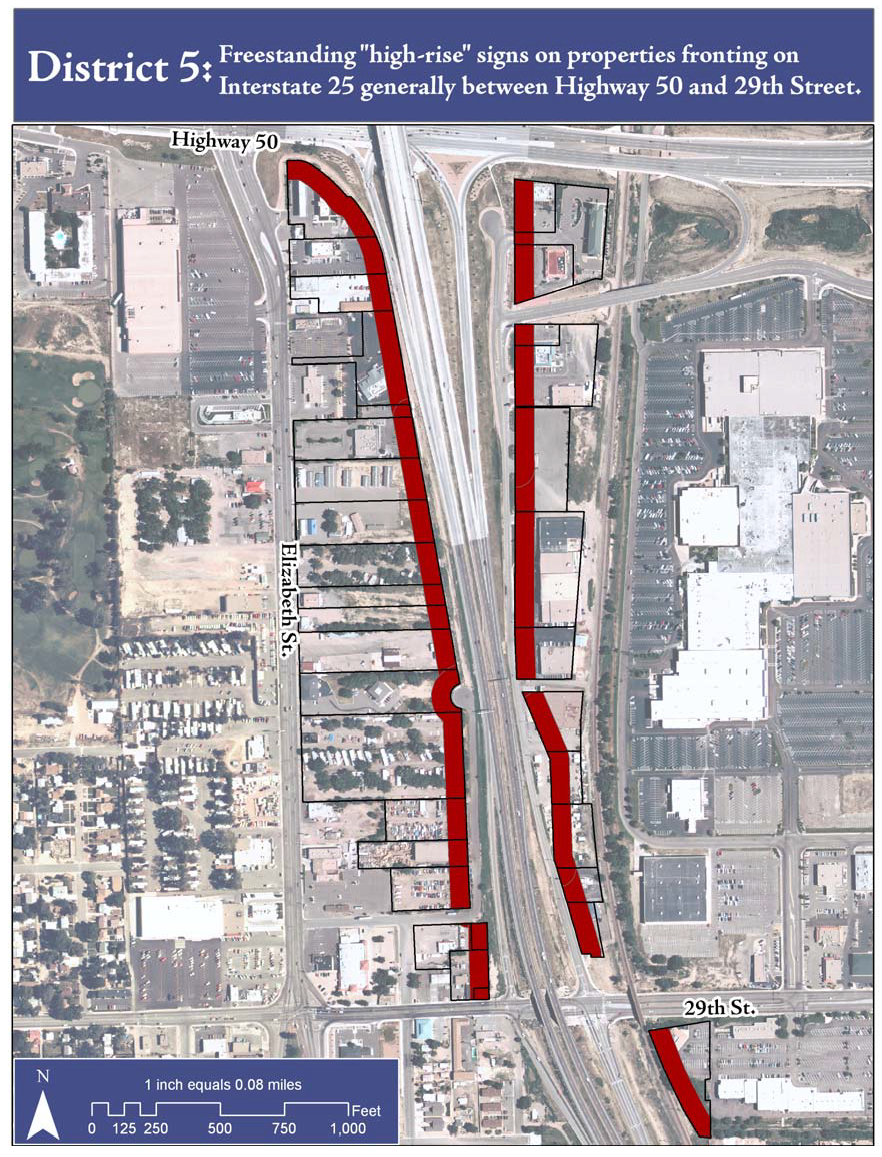
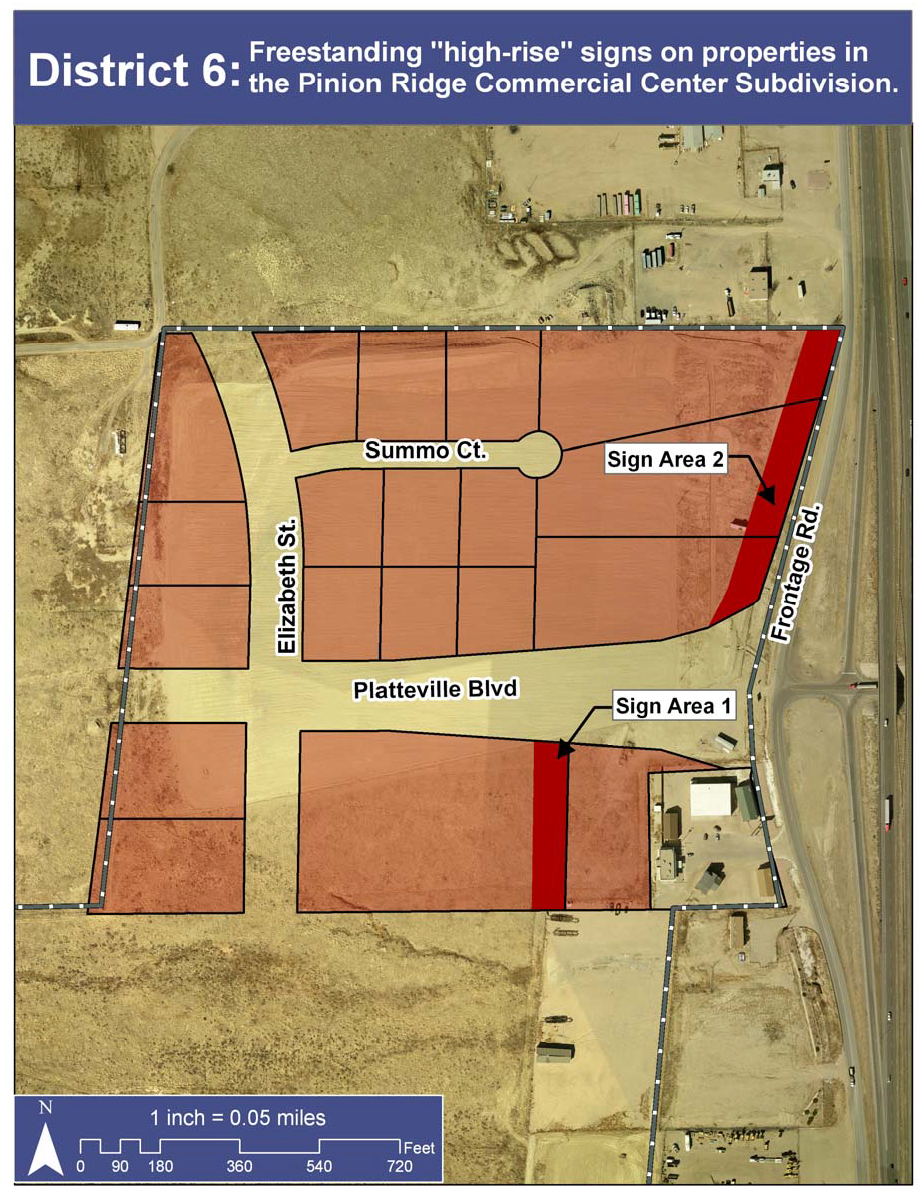
Sign, high-rise means a freestanding sign that exceeds fifty (50) feet in height.
(18)
Sign, inflatable means any inflatable shape or figure designed or used to attract attention to a business event or location. Inflatable promotional devices shall be considered to be temporary signs under the terms of this Chapter and subject to the regulations thereof.
(19)
Sign, instructional means a sign that has a purpose secondary to the use on the premises and is for public safety or necessity, including a sign erected by a public authority, utility, public service organization or private industry that is intended to control traffic, direct, identify or inform the public or provide needed public service as determined by the rules and regulations of governmental agencies or through public policy.
(20)
Sign, monument means a sign supported primarily by an internal structural framework, or integrated into landscaping or other solid structural features other than support poles.
(21)
Sign, multiple tenant means a sign that serves as a common or collective identification for two (2) or more uses on the same premises. For purposes of this Subsection, the term premises shall mean all the parcels of real property comprising the premises as evidenced by either:
a.
A private declaration, covenant, restriction or other document identifying the parcels of real property which comprise such premises; or
b.
A City-approved site plan identifying the parcels of real property which comprise such premises, irrespective of the fact that various portions of such premises may be owned by different owners or leased by different tenants. If applicable pursuant to Subsection 17-4-46(b), signs shall conform with the large scale development performance standards set forth in Subsection 17-4-46(l); or
c.
A Master Sign Plan.
(22)
Sign, on-site means a sign related to the premises on which it is located or to the products, accommodations, services or activities on the premises on which it is located. On-site signs do not include billboard (off-premises) signs.
(23)
Sign, perimeter wall means a permanent on-premises sign fastened to or painted on a wall at the perimeter of a subdivision identifying a vehicular entrance, residential complex or institutional use.
(24)
Sign, plate means a building sign not exceeding two (2) square feet.
(25)
Sign, pole means a freestanding sign that is affixed, attached or erected on a pole or pole structure that is not itself an integral part of or attached to a building or structure.
(26)
Sign, portable means any sign designed to be transported on wheels, skids, runners or brackets or has a frame to which wheels, skids, runners or brackets or similar mechanical devices can be attached to or support the sign. A portable sign also includes sandwich signs, inflatable devices and mobile signs, such as parked utility trailers (less than two thousand (2,000) pounds empty weight) or vehicles, which include signs visible from the public right-of-way unless such vehicle is used in the normal day-to-day operations of the business.
(27)
Sign, projecting means a sign that is attached to a building wall and extending perpendicular to (or approximately perpendicular to) the building wall and fifteen (15) inches or more beyond the face of the wall.
(27.1)
Sign, Public-Private Partnership (PPP) means off-premises signs that may be Electronic Variable Message (EVM) signs that are installed, maintained, and operated upon land zoned for government use or any City-owned land by a private party licensed by the City. Agreements regarding PPP signs (which may be leases or license agreements) may be entered into at the discretion of the City Council. PPP signs are not considered public improvements.
(28)
Sign, roof means a sign, or any portion thereof, erected, constructed or projecting upon or over the roof or parapet wall of any building, whether the principal support for the sign is on the roof, wall or any other structural element of the building.
(29)
Sign structure means the supports, uprights, bracing or framework of any structure exhibiting a sign, be it single-faced, double-face, V-type or otherwise.
(30)
Sign, temporary means a sign that is designed to be used only temporarily and is not intended to be permanently attached to a building or structure or permanently installed in the ground. This includes any banner, blimp, wind or fan-driven sign, wind-sail flag or feather flag, or other sign constructed of light fabric, cardboard, wallboard, plywood, sheet metal, paper or other light materials, with or without a frame. Temporary signs may be displayed as window signs.
(31)
Sign, wall means a sign fastened to or painted on a building wall in such a manner that the wall is the supporting structure for or forms the background surface of the sign and which does not project more than fifteen (15) inches from such building wall.
(32)
Sign, window means a sign that is applied or attached to a window or door, or a sign located near a window within a building for the purpose of being visible to and read from the outside of the building, except for signs that are not attached to a window or a door and that are not legible from a distance of more than three (3) feet beyond the building lot on which such sign is located.
(33)
Trailer means any wheeled vehicle, without motive power and having an empty weight of more than two thousand (2,000) pounds, which is designed to be drawn by a motor vehicle and to carry its cargo load wholly upon its own structure and which is generally and commonly used to carry and transport property over the public highways.
(Ord. No. 7348 §1, 7-25-05; Ord. No. 7798 §1, 5-12-08; Ord. No. 8148 §1, 2-22-10; Ord. No. 8933 §15, 11-23-15; Ord. No. 9123 §1, 5-8-17; Ord. No. 9200 §4, 11-27-17; Ord. No. 11071, §3, 11-10-25)
Sec. 17-10-05. - Sign standards.
(b)
Residential: R-3, R-4, R-5, R-6,
(b.1)
Residential: RCN.
(c)
Manufactured home park: R-7.
(c.1)
Nonresidential use: R-1, R-2, R-2U, R-3, R-4 and RCN.
(d)
Nonresidential commercial use: R-5, R-6.
(e)
Neighborhood office district: O-1.
(f)
Nonresidential Districts: B-1, B-2, B-3, B-4, B-P, I-1, I-2, I-3.
(g)
Commercial Charter Neighborhood District (CCN):
(h)
Nonresidential Districts: HB, HARP-1, HARP-2, HARP-3. Signs in the HB must comply with the Historic Business District Guidelines. Signs in the HARP-1, HARP-2 and HARP-3 Districts are regulated by the Planning and Zoning Commission.
(i)
Off-premises sign.
(j)
Temporary signs.
(k)
Instruction signs: All districts.
(l)
Display of Flags. In all districts, a maximum of three (3) flagpoles may be erected on any parcel, provided that:
(1)
A maximum of three (3) flags may be displayed simultaneously;
(2)
The maximum height or length of the flagpole shall be thirty (30) feet;
(3)
The total maximum size of all flags displayed shall not exceed one hundred twenty (120) square feet. Subject to the total maximum (aggregate) size of flags, one (1) commercial or noncommercial organization flag may be displayed alongside a national or governmental flag, provided the commercial or noncommercial organization flag is not larger than the national or governmental flag.
(m)
Supplemental standards, all districts:
(Ord. No. 7348 §1, 7-25-05; Ord. No. 7659 §§8—11, 9-10-07; Ord. No. 7798 §§2—8, 5-12-08; Ord. No. 8078 §4, 9-28-09; Ord. No. 8080 §1, 9-28-09; Ord. No. 8183 §1, 4-26-10; Ord. No. 9056 §1, 10-24-16; Ord. No. 9200 §5, 11-27-17; Ord. No. 10132, §4, 3-14-22; Ord. No. 11071, §4, 11-10-25)
Sec. 17-10-06. - Special Sign Districts.
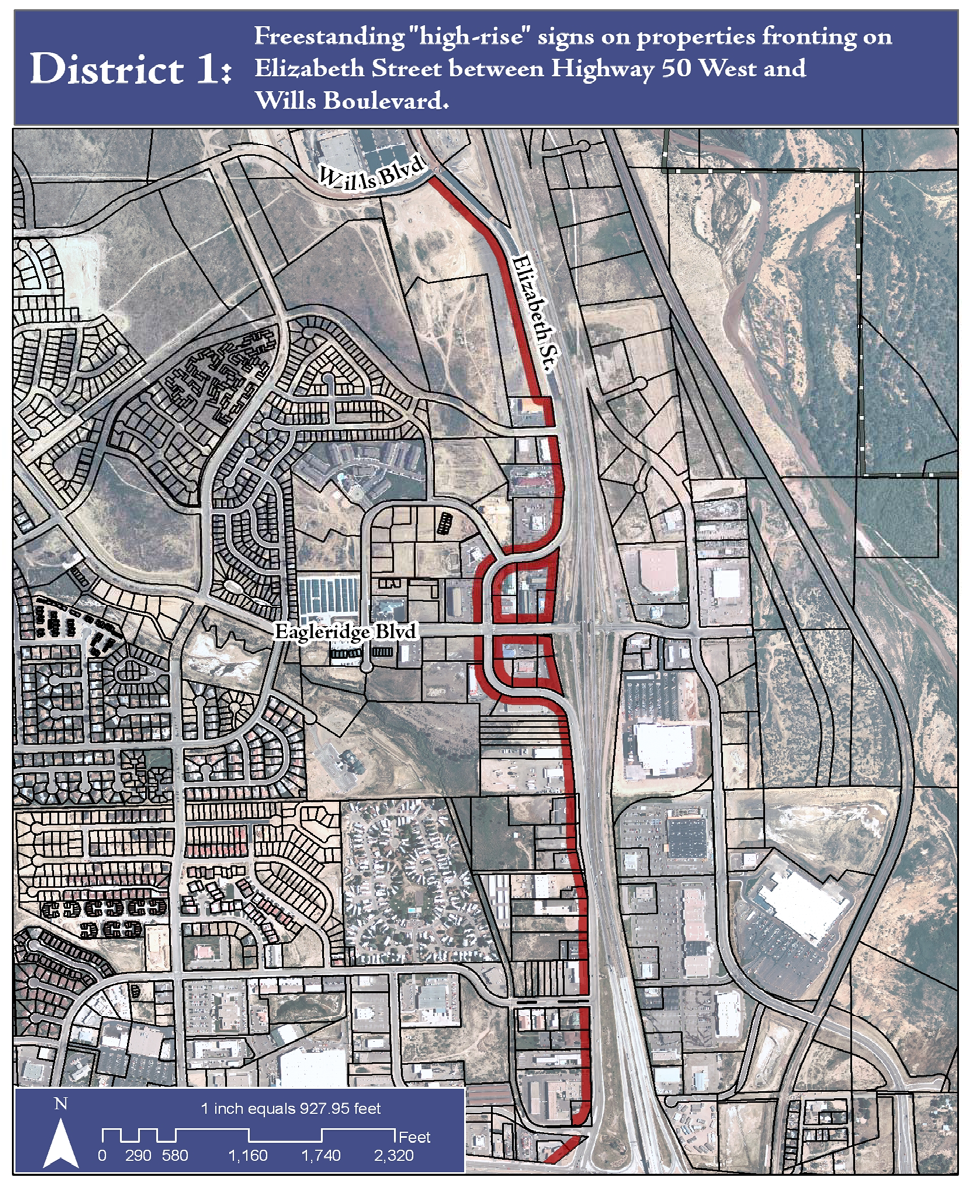
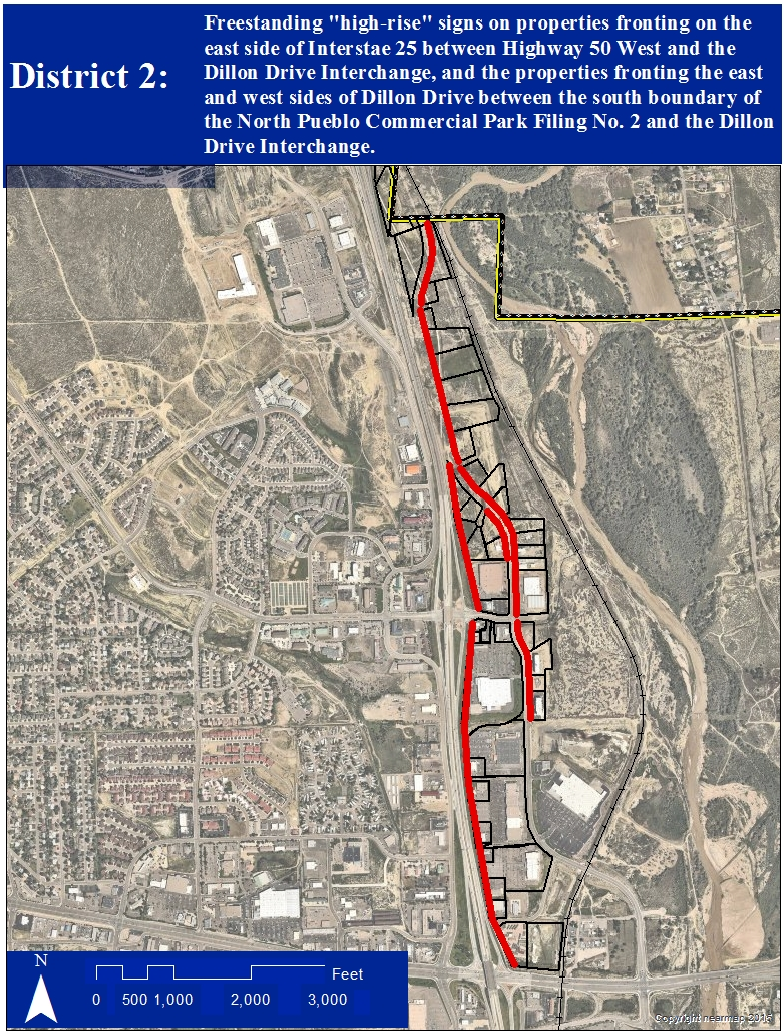
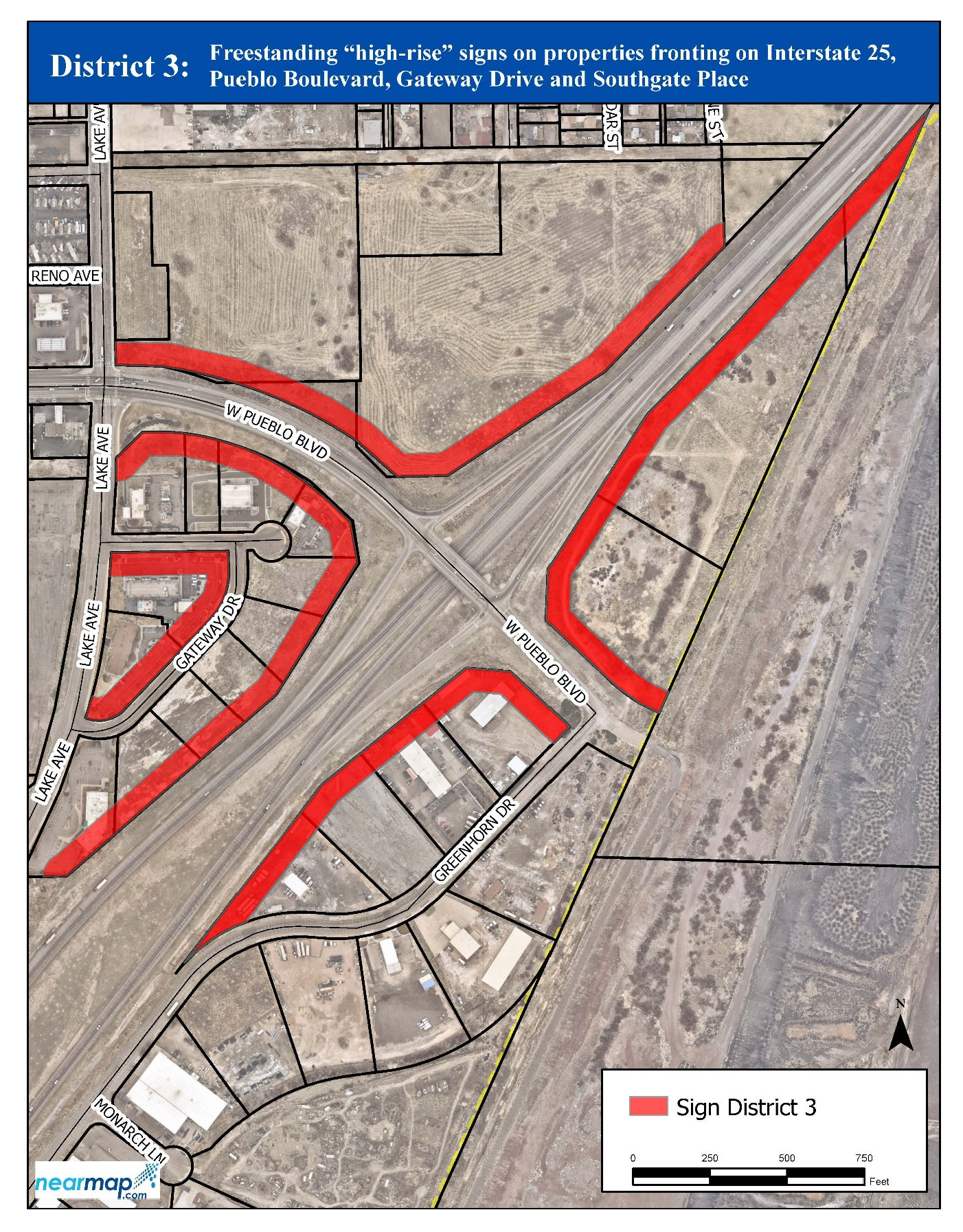
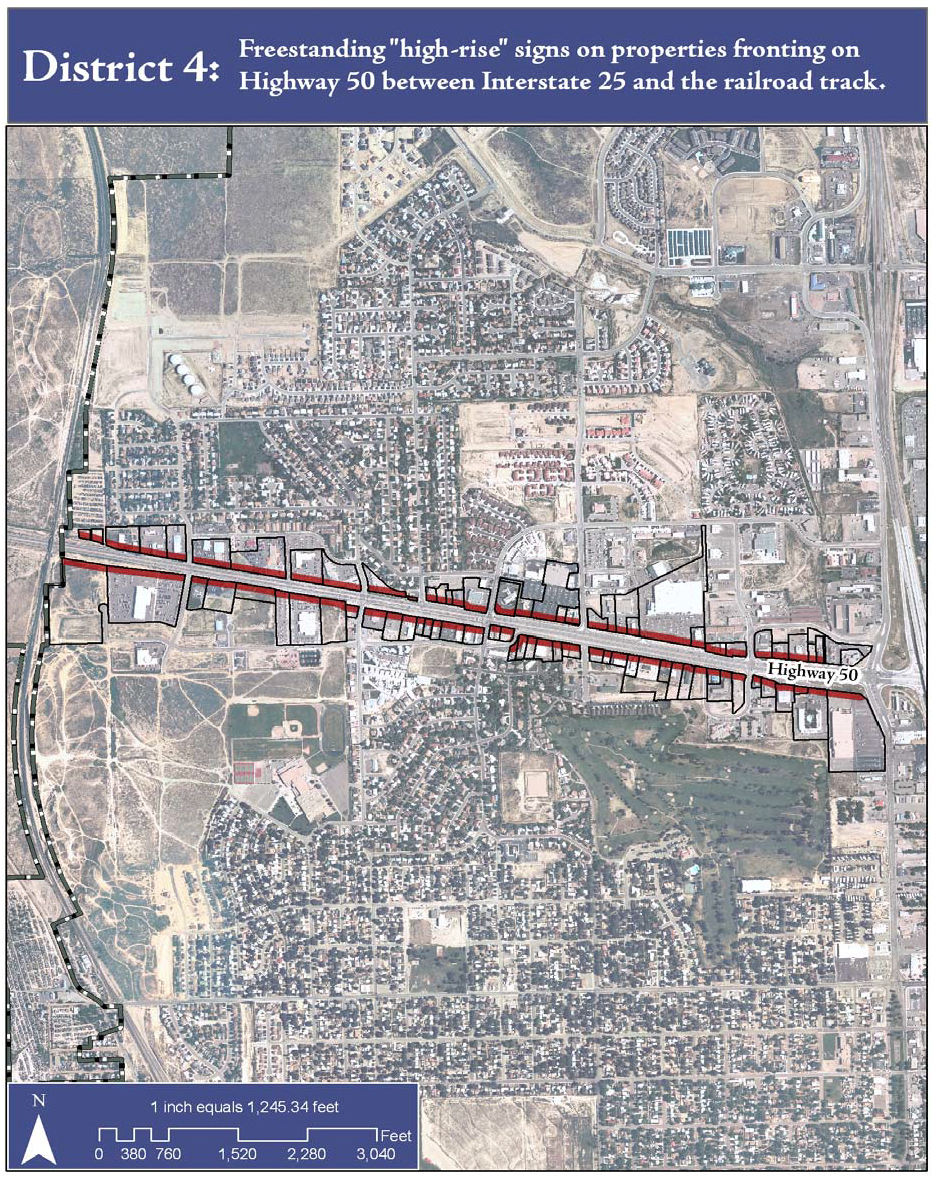
Special Sign Districts have been established to prescribe special regulations to modify or supplement sign regulations of the properties identified in Appendix A, Special Sign Districts, 17-10-15. Properties located in the Special Sign Districts either front Interstate 25, Highway 50 West, and/or arterial roadways, which warrant high profile signs and additional low-profile signs to aid travelers and customers in wayfinding.
(b)
Master sign program. The purpose of the master sign program is to allow the development of a creative and cohesive alternative Master Sign Plan (Plan) in order to achieve, not circumvent, the intent of the Sign Code. Any aspect of proposed signage that is not addressed in the Plan shall be in compliance with the Sign Code, Chapter 10, Title XVII of the Pueblo Municipal Code.
(1)
Applicability.
a.
A Master Sign Plan may be submitted for approval for the following types of developments:
1.
Developments that span multiple lots or properties; or
2.
Multi-tenant centers, buildings or developments with two (2) or more separate tenant spaces that share the same parcel, building or structure, or use common access, parking facilities, or public spaces, such as multi-tenant commercial and office buildings, shopping centers, office parks, and mixed use developments.
b.
A Master Sign Plan may be required by the Planning and Community Development Department due to special circumstances (e.g., the number of signs proposed, size or location of the project, constrained visibility of the site, etc.)
(2)
Application requirements. The following information is required for a complete application of a Master Sign Plan.
a.
Application form. Must include signature(s) of all legal property owner(s) as well as the applicant. If the land is owned by an entity other than an individual, provide a completed and notarized Statement of Authority.
b.
Application fee.
c.
Master Sign Plan text. Include the following information as appropriate:
1.
Details of all permanent signs, including the location, type, and size of each sign;
2.
Drawings of all permitted options for the type and placement of each sign, indicating the font style, letter size, colors, and materials;
3.
Drawings and written criteria for temporary and window signs;
4.
General requirements, limitations and regulations, e.g., responsibility for installation and maintenance, hours of illumination, any allowances for minor variations;
5.
Prohibited signs;
6.
Definitions; and
7.
An explanation of all modifications to the standards or regulations required by the Sign Code, along with an explanation describing how these modifications would result in a superior design.
d.
Key plan. A key plan showing location of each sign type, including freestanding signs.
e.
Site plan. A site plan showing location of all existing and proposed attached and freestanding signs, including property lines, location of buildings, length of building frontage and street frontage, location of tenant spaces, frontage improvements, parking and landscaped areas.
f.
Building elevations. Building elevations showing locations for all proposed sign options, showing maximum size (height and width). Include overall sign dimensions and dimensions for spacing between the sign and the edges of the walls/facade/roofline.
g.
Detailed sign drawings. Provide drawings and standards for each type or variation of sign with minimum and maximum size (square footage), dimensions and method of illumination.
h.
Sign area summary. Provide a table listing each sign to show the number of signs, type and cumulative area, as follows:
i.
Photos/photo-simulation. Provide photos of the buildings and site showing all existing signs intended to remain and all proposed signs.
(3)
Approval procedures.
a.
The Planning and Zoning Commission may approve, approve with conditions, or deny a request for any Master Sign Plan or any modification of a Master Sign Plan.
b.
The Technical Advisory Committee, as defined by Section 17-8-2, may approve, approve with conditions, or deny a request for minor modification of an approved Master Sign Plan. The Technical Advisory Committee may also refer a minor modification to the Planning and Zoning Commission for review and consideration.
(4)
Review criteria. All Master Sign Plans shall be reviewed according to the following criteria. The Master Sign Plan may contain any conditions necessary to ensure compliance with these criteria.
a.
The Plan is consistent with the purpose of the sign code;
b.
The Plan represents a creative alternative design in which sign design, size, height, illumination, and number of signs are appropriate and compatible with the buildings, structures and features of the site; and
c.
The proposed Plan will not negatively affect the visual character of the area, cause future variance requests, or contribute to degradation of the visual environment through sign proliferation.
(5)
Control provisions.
a.
Upon approval of a Master Sign Plan, all proposed signage shall be changed to comply with the Plan;
b.
Variances from the Sign Code shall not be permitted for any sign located within an approved Master Sign Plan; and
c.
The Master Sign Plan and tenants' mandatory compliance therewith shall be incorporated into all tenant leases.
(Ord. No. 7348 §1, 7-25-05; Ord. No. 7798 §9, 5-12-08; Ord. No. 7987 §1, 3-23-09; Ord. No. 8183 §2, 4-26-10; Ord. No. 9123 §2, 5-8-17; Ord. No. 9221 §1, 1-8-18; Ord. No. 10219 §1, 7-11-22)
Sec. 17-10-07. - Prohibited signs.
The following signs and sign structures are prohibited:
(1)
Roof signs placed on the roof surface.
Exception: The Administrative Official may permit channel letter signs to be applied to the vertical or nearly vertical portion of a mansard style roof, so long as the area of the sign is included in the allowable area for wall signs, and so long as they do not extend above the top of the mansard roof line or hang below the eave.
(2)
Off-premise signs except for permitted billboards.
(3)
Signs that mechanically alter their physical position in space.
(4)
Signs attached to antennae or towers except for warning signs and identification placards.
(5)
Signs which contain statements, words, or pictures describing or depicting sexual activities or sexually explicit anatomical areas.
(6)
Signs which contain, or are an imitation of, an official traffic sign or signal or contain the words: "STOP," "GO SLOW," "CAUTION," "DANGER," "WARNING" or similar words, except official traffic signs or signals.
(7)
Signs which are of a size, location, movement, content, coloring or manner of illumination which may be construed as a traffic control device or which hide from view any traffic or street sign or signal.
(8)
Signs erected after adoption of this Chapter that do not comply with the provisions of this Chapter.
(9)
Signs in, on, over or above the public right-of-way without a revocable permit therefor.
Exception: Wall-mounted signs having a projection of not more than fifteen (15) inches and a minimum clearance of not less than eight (8) feet and conforming to all other provisions of this Chapter.
(10)
Parked motor vehicles and/or trailers intentionally located so as to serve as a sign for a use, product or service.
(11)
Revolving beacon lights.
(12)
Overly bright or glaring signs, which constitute a nuisance as defined by Section 7-1-1(a) of this Code as determined by the Administrative Official.
(Ord. No. 7348 §1, 7-25-05; Ord. No. 7798 §§10, 11, 5-12-08; Ord. No. 8148 §2, 2-22-10; Ord. No. 8245 §4, 7-26-10; Ord. No. 9073 §2, 12-12-16; Ord. No. 9200 §6, 11-27-17)
Sec. 17-10-08. - Regulations for nonconforming signs.
(a)
A legal nonconforming sign shall immediately lose its legal nonconforming status, and thereafter shall be brought into conformance with this Chapter or removed, when any of the following occur:
(1)
The size or shape of the sign is changed.
(2)
The sign structure is altered. Alteration does not include repairs and/or maintenance.
(3)
The legal nonconforming sign is accessory to a nonconforming use that has lost its nonconforming status.
(4)
A land use application has been filed to change the use or dimensions of the subject property.
(b)
A nonconforming sign shall not be structurally altered, relocated or replaced unless the sign is brought into compliance with the provisions of this Chapter.
(c)
If a sign and/or sign structure is damaged to the extent that the repair cost exceeds fifty percent (50%) of the replacement cost of the sign or sign structure, the sign or sign structure shall be removed or brought into compliance with the provisions of this Chapter. If the repair costs do not exceed fifty percent (50%) of the replacement cost of the sign or sign structure, the Administrative Official may authorize the sign or sign structure to be repaired, provided that all repair work is completed within ninety (90) days (subject to the Administrative Official extending the time for good cause) of the date the Administrative Official determines the sign or sign structure requires replacement or authorized repairs. In no event may a sign be maintained in an unsafe condition.
(Ord. No. 7348 §1, 7-25-05; Ord. No. 9469 §12, 5-28-19; Ord. No. 9525 §5, 8-26-19)
Sec. 17-10-09. - Construction standards.
(a)
Signs shall be structurally sound and located so as not to pose any threat to pedestrian or vehicular traffic.
(b)
Nontemporary signs shall be fabricated on and of materials that are of good quality and durability.
(c)
Electric signs and all nontemporary signs involving structural requirements of the building code shall be installed, repaired, altered and serviced only by a contractor licensed to perform such tasks.
(d)
No sign shall be erected in such a way as to obstruct any window, door, fire escape, balcony, platform, stairway, ladder, vent or other means of ingress and egress of any building.
(e)
No sign shall be attached to a utility pole, tree, trash receptacle or other structure not intended or approved as a sign support.
(f)
Temporary signs shall be durable and weather-resistant and fastened or anchored sufficiently to remain in place whether attached to the building or positioned in the ground.
(g)
No sign regulated by any of the provisions of this Chapter shall be erected in the right-of-way, in proximity to railroad crossings, or at the intersection of any streets in a manner to obstruct free and clear vision or at any location where, by reason of the position, shape or color, it may interfere with, obstruct the view of or be confused with any authorized traffic sign signal or device, or which makes use of the words "STOP," "LOOK," "DANGER" or any other word, phrase, symbol or character in such a manner as to interfere with, mislead or confuse traffic.
(h)
In the event there is a conflict between the provisions of this Section and the provisions of any applicable building or sign code, the more restrictive or higher standard shall control.
(No. 7348 §1, 7-25-05)
Sec. 17-10-10. - Maintenance.
(a)
All signs and sign structures shall be maintained in good repair, in a safe and secure condition and in compliance with this Chapter, the International Building Code (IBC) as adopted in Title 4, Chapter 2 of this Code and applicable building codes.
(b)
All signs and sign structures shall be kept in a neat, clean and presentable condition. All sign information shall be kept clearly legible and compatible with its intended use.
(c)
A sign which fails to serve the purpose for which it was intended, shall either be removed or the sign area shall be replaced by a neutral single background color panel or similar cover. If the sign is composed of individual raised letters, the letters shall be removed.
(d)
Except as provided in the IBC or applicable building codes, a sign face may be removed for purpose of repair, refurbishing or repainting without permit or payment of fees, provided:
(1)
The sign base and sign structures are not altered or remodeled;
(2)
The sign and sign structures are not enlarged or increased; and
(3)
The sign is accessory to a legally permitted, conditional or nonconforming use.
(Ord. 7348 §1, 7-25-05; Ord. No. 9200 §7, 11-27-17)
Sec. 17-10-11. - Administrative provisions.
(a)
To ensure compliance with this Chapter, proposed signs or sign structures shall be required to receive a permit from the Department of Land Use Administration, except as exempted within this Chapter.
(b)
An application for a sign permit shall be made to the Administrative Official on the forms provided by the Department of Land Use Administration and in the manner required herein. At a minimum, the following shall be submitted to the Department of Land Use Administration for approval:
(1)
Easements and/or rights-of-way.
a.
Setbacks - distance to property lines from buildings, parking areas and driveways;
b.
Lighting plans as required in Section 17-4-52; and
c.
Graphics, including:
1.
Building signs shall include drawings or pictures, at a minimum size of 8.5" × 11", showing proposed building signs, sizes, square footages, placement, elevations and dimensions.
2.
Freestanding and monument signs shall include drawings or pictures, at a minimum size of 8.5" × 11", showing proposed signs, sizes, square footages, height, placement and property lines.
3.
The applicant shall provide drawings or pictures, at a minimum size of 8.5" × 11", showing proposed building signs, sizes, square footages, placement, elevations and dimensions for all existing signage.
4.
Other requirements adopted by the Department of Land Use Administration to comply with this Section.
(2)
The Administrative Official shall review and act on the sign applications for nontemporary signs for which a permit is required to assure compliance with the standards set forth in this Chapter.
(c)
The Administrative Official may grant exceptions to the provisions of this Chapter whenever a sign or property has been designated a Historic Sign pursuant to the eligibility criteria adopted by the Historic Preservation Commission. These criteria provide for Historic Sign status for signs that are:
(1)
Associated with historic figures, events or places.
(2)
Significant as evidence of the history of the product, business or service advertised.
(3)
Significant as reflecting the history of the building or the development of the historic district. A sign may be the only indicator of a building's historic use.
(4)
Characteristic of a specific historic period, such as gold leaf on glass, neon or stainless steel lettering.
(5)
Integral to the building's design or physical fabric, as when a sign is part of a storefront made of Carrara glass or enamel panels, or when information is rendered in stone, metal or tile. In such cases, removal can harm the integrity of a historic property's design or cause significant damage to its materials.
(6)
Outstanding examples of the sign maker's art, whether because of their excellent craftsmanship, use of materials or design.
(7)
Local landmarks; that is, signs recognized as popular focal points in a community.
(8)
Elements important in defining the character of a historic district, such as marquees in a theater district.
(Ord. 7348 §1, 7-25-05; Ord. No. 9200 §8, 11-27-17)
Sec. 17-10-12. - Variances and appeals.
(a)
The Zoning Board of Appeals shall have power to authorize variances from the terms of this Chapter with respect to maximum sign area, maximum sign height, sign location and the number of signs located on a parcel.
(b)
In evaluating a request for a variance to the maximum sign height, the Zoning Board of Appeals may consider whether there are special topographical circumstances that would result in a material impairment of visibility of the sign from the adjacent roadway which significantly diminishes the sign owner's or user's ability to communicate adequately and effectively with the public through the use of the sign.
(c)
The Zoning Board of Appeals may not grant a variance which exceeds the specific requirement of this Chapter by more than twenty-five percent (25%).
(d)
Any person aggrieved by any decision of the Administrative Official concerning the interpretation or administration of this Chapter may appeal such decision to the Zoning Board of Appeals in the time and manner provided in Section 17-5-22 of this Code.
(Ord. 7348 §1, 7-25-05)
Sec. 17-10-13. - Enforcement, violations and penalties.
(a)
The Administrative Official is authorized to enforce a final order to remove, alter or repair a sign or sign structure. All costs incurred in enforcing such order shall be paid by the responsible party within thirty (30) days after notification of such costs. All unpaid costs, together with interest thereon at the rate of ten percent (10%) per annum, shall, upon recording in the offices of the County Clerk and Recorder a statement under oath of the Mayor showing the cost of such enforcement and describing the parcel upon which the sign or sign structure is located, be and constitute a perpetual lien on such parcel, having priority over all other liens except general property taxes. Such lien shall remain in full force and effect until such costs and interest have been paid in full. The remedies of the City hereunder and under this Chapter and Title shall be cumulative.
(b)
The sign owner and owner of the parcel upon which a sign is located shall be jointly and severally responsible for the sign and sign structure.
(c)
Any person violating any provision of this Chapter shall be punished as provided in Section 17-7-3 of this Title.
(Ord. No. 7348 §1, 7-25-05; Ord. No. 9296 §1, 6-11-18)
Sec. 17-10-14. - Short title.
This Chapter shall be known and cited as the "Pueblo Sign Code."
(Ord. No. 7348 §1, 7-25-05)