
Pueblo City Zoning Code
CHAPTER 4
Zone Districts; Regulations; Use Index
Sec. 17-4-1. - District regulations.
District regulations shall be as set forth in the various articles of this Chapter.
(1957 Code, App. A §5)
Sec. 17-4-2. - Schedule of District Regulations (Part I, Residential).
SCHEDULE OF DISTRICT REGULATIONS (Part I, Residential)
(A)
Accessory Buildings need only be set back five feet, except when Section 17-4-6 is applicable. Also note exceptions listed in Section 17-4-23.
(B)
See Section 17-4-4 for lot size requirements for multiple unit housing.
(C)
See Section 17-4-6(1).
(D)
See Section 17-4-4(g).
(E)
See Section 17-4-4 for front yard setbacks.
(F)
See Section 17-4-4 for side yard setbacks.
(1957 Code, App. A, §5(1); Ord. No. 3419, 1-25-71; Ord. No. 3738, 8-27-73; Ord. No. 3868, 5-27-74; Ord. No. 7309 §1, 5-23-05; Ord. No. 7659 §1, 9-10-07; Ord. No. 8933 §2, 11-23-15)
Sec. 17-4-3. - Schedule of District Regulations (Part II, Non-Residential).
SCHEDULE OF DISTRICT REGULATIONS (Part II, Non-Residential) (B)
(A)
Does not apply on the portion of the parcel adjacent to another parcel also in a Business or Industrial zone. It does apply when the portion of the parcel is adjacent to a residential or special zone (streets or alleys not considered).
(B)
See Section 17-4-5 and Section 17-4-6 for additional requirements.
(C)
See Section 17-4-51(28)c.
(D)
Reserved.
(E)
See Section 17-4-6.
(F)
25 feet for single-family or two-family residential; no minimum setback for other uses.
(G)
See Section 17-4-5 for side yard setbacks.
R -
Review and approval by Planning and Zoning Commission required in each case.
(1957 Code, App. A, §5(2); Ord. No. 3868, 5-27-74; Ord. No. 3983, 2-10-75; Ord. No. 4109, 12-8-75; Ord. No. 7659 §2, 9-10-07; Ord. No. 8639 §1, 10-15-13; Ord. No. 8933 §3, 11-23-15; Ord. No. 9469 §3, 5-28-19)
Sec. 17-4-4. - Schedule of District Regulations (Part III, Multiple Residential, Special Residential and Mobile Homes).
(a)
R-4 District:
(1)
Three (3) to five (5) family dwelling unit structures shall have one thousand five hundred (1,500) square feet of lot area per dwelling unit.
(2)
Six (6) or more family dwelling unit structures shall have a minimum of eight thousand (8,000) square feet of lot area or one thousand (1,000) square feet per dwelling unit, whichever is greater, and shall provide at least twenty percent (20%) of the parcel in landscaped open space.
(b)
R-5 District:
(1)
Three (3) to five (5) family dwelling unit structures shall have one thousand five hundred (1,500) square feet of lot area per dwelling unit.
(2)
Six (6) or more family dwelling unit structures shall have a minimum of eight thousand (8,000) square feet of lot area or one thousand (1,000) square feet per dwelling unit, whichever is greater and, other permitted uses shall provide at least five thousand (5,000) square feet of lot area. Residential structures, if one (1) to three (3) habitable stories, shall provide at least twenty percent (20%) of the parcel in landscaped open space; or if four (4) or more habitable stories, shall provide at least fifty percent (50%) of the parcel in landscaped open space. The performance standards in Section 17-4-5 shall apply in the R-5 District.
(c)
R-6 District:
(1)
Three (3) to five (5) family dwelling unit structures shall have one thousand five hundred (1,500) square feet of lot area per dwelling unit.
(2)
Six (6) or more family dwelling unit structures shall have a minimum of eight thousand (8,000) square feet of lot area or one thousand (1,000) square feet per dwelling unit, whichever is greater; each room or rental unit for transients in a hotel and/or motel shall provide at least eight hundred (800) square feet of ground area; and other permitted uses shall provide at least five thousand (5,000) square feet of lot area. Residential structures, if one (1) to three (3) habitable stories, shall provide at least twenty percent (20%) of the parcel in landscaped open space; if four (4) or more habitable stories, shall provide at least fifty percent (50%) of the parcel in landscaped open space. The performance standards in Section 17-4-5 shall apply in the R-6 District.
(d)
R-7 District:
(1)
Mobile home parks shall comply with minimum standards of layout and construction set forth in Chapter 8 of Title 8 of this Code. In the event of conflict between that Chapter and this Ordinance, the more restrictive provisions shall govern. No mobile home or accessory building shall exceed thirty-five (35) feet in height. Walkways, driveways and service buildings shall be well-lighted, but all outdoor lighting shall be directed away from adjacent properties.
(2)
An accessory structure to a mobile home such as an awning, carport, windbreak or porch which has a top or roof, shall be considered to be part of the mobile home.
(3)
Exposed ground surfaces in all parts of every mobile home park shall be paved, covered with stone screenings or other solid material, or protected with a vegetative growth that is capable of preventing soil erosion and of eliminating objectionable dust.
(4)
No mobile home park shall be operated until a permit and license are issued in accordance with established procedures.
(e)
R-8 District:
(1)
No more than one (1) home shall be permitted on each platted lot.
(2)
Each home shall comply with the requirements as defined in Section 17-2-1 of this Title.
(3)
Storage is not permitted beneath the home, except when located upon a basement.
(4)
All homes shall have their wheels, axles and removable towing apparatus removed and be secured to a permanent foundation.
(5)
All homes, including towing apparatus, shall be skirted with an impervious material which is compatible with the home exterior and impedes the passage of wind beneath the home. A removable partition or section at least eighteen (18) inches by thirty-six (36) inches shall be so located in the skirting as to provide convenient access beneath the home for the inspection and repair of utilities.
(f)
Residential Charter Neighborhood (RCN) District.
(1)
Three (3) to five (5) family dwelling unit structures shall have one thousand five hundred (1,500) square feet of land area per dwelling unit.
(2)
Six (6) or more family dwelling unit structures shall have a minimum of eight thousand (8,000) square feet of land area or one thousand (1,000) square feet per dwelling unit, whichever is greater, and shall provide at least twenty percent (20%) of the parcel in landscaped open space.
(3)
Setback dimensions shall be determined as described below. However, the Zoning Administrator may review and approve setback reductions when the precedent pattern of development on the subject and immediately adjacent blocks is less than the current requirement. It will be the responsibility of the party requesting the reduction to provide a survey, or other suitable documentation, which verifies the existing setbacks on the adjacent properties. The following yard setback requirements shall apply within the Residential Charter Neighborhood District.
a.
The front yard setback for all buildings, except commercial buildings on a corner lot, shall be the average of the existing building setbacks on adjacent lots. If there is only one (1) adjacent lot with a building, the setback shall be equal to its setback. If both adjacent lots are vacant, the setback shall be the average of all existing building setbacks on the block. If there are no houses on the block, the setback shall be twenty-five (25) feet.
b.
The minimum front yard setback for commercial buildings on a corner lot is zero (0) feet.
(4)
Side yard setbacks shall be as follows:
a.
Lot width of thirty-five (35) feet or fewer:
1.
Side yard setbacks for one- and two-family residential units and their accessory structures on lots thirty-five (35) feet or fewer in width shall be three (3) feet. Projections shall not extend to a point closer than two (2) feet from the property line.
2.
Other buildings: five (5) feet.
3.
Two (2) one-family residences may be constructed on two (2) separate parcels, connected to each other (zero setbacks) on one (1) side with a side yard setback of five (5) feet on the other side, provided that the residences are built at the same time.
b.
Side yard setbacks for lots greater than thirty-six (36) feet in width: five (5) feet.
(5)
Performance standards.
a.
Not more than fifty percent (50%) of the front yard setback shall be covered with an impervious surface.
b.
Parking is allowed in the front yard of a residence only on a driveway that leads directly to the garage door. The driveway shall be no wider than ten (10) feet to provide access to the garage. If the property can be accessed from an alley and no garage exists, or if garage access is from other than the front, no parking is allowed in the front yard of the residence.
c.
Except as restricted by Section 15-3-2 of this Code, the height of fences, walls and hedges for parcels containing one-family, two-family, and three- and four-family residences, and townhouses shall not exceed four (4) feet in the front yard area and six (6) feet in other yard areas.
d.
Fencing materials shall not include or incorporate razor or concertina wire; barbed wire; electrically charged wire; plywood surface; or fabric, sheet or corrugated metal, or plastic sheeting.
e.
Parking.
1.
Detached carports shall not be located closer than two feet six inches (2.5 feet) from the side yard lot line without a variance.
2.
Any remodeling, rehabilitation or addition smaller than fifty percent (50%) of an existing residence on a parcel smaller than ten thousand (10,000) square feet, and not resulting in additional dwelling units, shall not require an increase in the number of existing off-street parking spaces.
3.
Off-street parking for residences that are more than four-family in size, and for all nonresidential uses installed after the effective date of this Section shall be located in the rear half of the lot unless the parking is completely enclosed within the main structure.
f.
Alleys.
1.
Backing into an alley from parking lots and off-street parking spaces will be allowed, provided that the parking lots or spaces serve single-family or two-family residences.
2.
Any new construction, expansion of a use or building or improvement, to either one (1) single-family or one (1) two-family residence, shall not require the applicant to pave any or all of any alley, but may require the applicant to surface the alley with an all-weather, dust-proof material to the point where the alley meets the nearest street.
3.
Existing alleys may be vacated only for purposes consistent with an adopted neighborhood plan and subject to requirements of applicable law.
(6)
Guidelines. The City Council may adopt development design guidelines for the RCN District by resolution for different types of uses, structures or other matters to preserve the character of the neighborhood while allowing flexibility in the design and building process. If guidelines are so adopted, the Administrative Official shall review all development for consistency with the intent of the guidelines. If the Administrative Official determines the intent of the guidelines is met, the Administrative Official may approve a building permit or business license application provided that all other applicable requirements of this Title have been met or complied with. A person aggrieved by the decision of the Administrative Official may appeal such decision to the Zoning Board of Appeals pursuant to the provisions of Section 17-5-22 of this Title. A building permit shall not be issued until the Administrative Official has approved the development for compliance with the requirements of this district (RCN) and the guidelines.
(g)
R-2U District.
(1)
Performance standards.
a.
The minimum front yard setback shall be eighteen (18) feet. The garage and the required off-street parking space for the lot shall be at least twenty (20) feet from the back of the public sidewalk.
b.
Unless located beneath a habitable room or story, unenclosed porches, even if the porch is covered by a roof, may encroach up to eight (8) feet into the front yard setback.
c.
A minimum lot area of four thousand five hundred (4,500) square feet is permissible when utilized within a block of mixed lot widths. The average lot area of the block, however, shall be at least five thousand (5,000) square feet. Alternative lot width configurations may be as narrow as forty-five (45) feet, but the average lot width of the block shall be no less than fifty (50) feet. Lot depth shall not exceed three (3) times the average lot width unless the lot abuts an alley.
d.
Driveways shall be located to provide at least one (1) on-street parking space per lot within the block except lots on the turning circle of cul-de-sacs. The City Traffic Engineer shall approve all driveway curb cut locations on corner lots as provided in Section 17-4-44(h) of this Code before a building permit is issued for such lot.
e.
Notwithstanding anything to the contrary in the Roadway Classification Design Standards and Policies for the City of Pueblo, adopted by Resolution 10264, or as the same may be subsequently amended, local public streets shall neither be wider than thirty-two (32) feet nor narrower than thirty (30) feet, as measured from flow-line to flow-line.
f.
Homeowners' associations or individual property owners shall be responsible to install and maintain all landscaping in public rights-of-way adjoining their respective lots.
(1957 Code, App. A, §5(3); Ord. No. 3419, 1-25-71; Ord. No. 3738, 8-27-73; Ord. No. 5631, 9-24-90; Ord. No. 7659 §3, 9-10-07; Ord. No. 8117 §1, 11-23-09; Ord. No. 8933 §4, 11-23-15)
Sec. 17-4-5. - Schedule of District Regulations (Part IV, Nonresidential).
The applicant shall submit proof that he or she can or will meet the applicable performance standards listed below.
(1)
O-1, B-1, B-2, B-3, B-4 and CCN Districts; performance standards.
a.
All portions of the land area of the parcel and the adjacent street rights-of-way and alleys upon which it fronts shall be landscaped, graded, paved, fenced, planted or covered by buildings, so that no dust will blow off the site and no soil or debris will be washed upon the sidewalks, alleys or streets from the parcel in the event of a rainstorm.
b.
All outdoor storage areas shall be enclosed by tight fencing, walls or closely planted landscape material, sufficient in height to totally obscure the storage areas as seen from a height of five (5) feet along the property line, and such areas and all others shall be constructed, used and maintained to have an orderly appearance at all times.
c.
No sound, smoke, odor, vibration, dust, glare or heat shall be measurable beyond the outer boundaries of the parcel.
d.
In a B-3 zone district no unauthorized sign, signal, marking or device shall be placed, maintained or displayed which (1) is located in the right-of-way of any street, alley or highway, or encroaches into the air space above the right-of-way; (2) flashes or blinks; (3) uses the colors of red, amber or green in such manner as to be confused with an official traffic control device or railroad sign or signal; or (4) violates the Model Traffic Code for Colorado Municipalities, Section 15-12, "Unauthorized signs, signals, or markings."
e.
In an O-1 Zone District, only business wall signs and permanent window signs shall be permitted and shall be regulated as follows:
1.
No wall sign shall extend more than fifteen (15) feet above building grade.
2.
Only one (1) business wall sign shall be permitted and displayed to each street frontage.
3.
Window signs shall not have a sign area in excess of ten percent (10%) of the area of the window to which it is affixed.
4.
The combined total sign area of the wall sign and window signs displayed to a street shall not exceed two (2) times the square root of the property's frontage onto said street. Examples are as follows:
5.
Signs shall be illuminated solely by stationary, shielded light sources directed to the sign; or by internal light sources producing not more than one (1) foot-candle of illumination at a distance four (4) feet from the sign.
6.
Signs shall not: (a) flash, blink, be animated or emit noise; or (b) violate Section 15-12, "Unauthorized signs, signals, or markings" of the Model Traffic Code for Colorado Municipalities as adopted by Section 15-1-1 of this Code.
f.
In a CCN, setback dimensions for residential structures and uses shall be determined as described below. However, the Zoning Administrator may review and approve setback reductions when the precedent pattern of development on the subject and immediately adjacent blocks is less than the current requirement. It will be the responsibility of the party requesting the reduction to provide a survey, or other suitable documentation, which verifies the existing setbacks on the adjacent properties. The following yard setback requirements shall apply within the Commercial Charter Neighborhood District:
1.
The front yard setback for all residential buildings shall be the average of the existing building setbacks on adjacent lots. If there is only one (1) adjacent lot with a building, the setback shall be equal to its setback. If both adjacent lots are vacant, the setback shall be the average of all existing building setbacks on the block. If there are no houses on the block, the setback shall be twenty-five (25) feet.
2.
Side yard setbacks for one- and two-family residential units and their accessory structures on lots thirty-five (35) feet or fewer in width shall be three (3) feet. Projections shall not extend to a point closer than two (2) feet from the property line.
3.
Side yard setbacks for other buildings: five (5) feet, except that no side yard setback is required between two (2) commercial buildings.
4.
Two (2) one-family residences may be constructed on two (2) separate lots, connected to each other (zero [0] setback) on one (1) side with a side yard setback of five (5) feet on the other side, provided that the residences are built at the same time.
5.
Side yard setbacks for lots greater than thirty-six (36) feet in width: five (5) feet.
g.
CCN performance standards.
1.
Outdoor storage. The following provisions apply to all outdoor storage except designated off-street parking areas and lots used to display vehicles that are immediately available for sale or rent.
(a)
In addition to meeting the provisions of the CCN district above, the wall or fence surrounding the storage area shall be kept in a clean, neat and painted condition, and free of graffiti. Fencing made of chain links with slats, salvage materials such as plywood, metal or fiberglass roofing materials or attached fabric materials to existing fences are prohibited.
(b)
Outdoor storage shall be confined to the rear of the main structure or the rear two-thirds (⅔) of the site, whichever is more restrictive.
(c)
All gates to access the storage area shall swing inwardly or slide sideways. The gates shall be kept closed when not in use except that the gate may remain open during business hours if the interior or contents of the storage yard cannot be seen from residential areas and public streets.
(d)
If the storage area is adjacent to any residential zone district, no items shall be stored closer than five (5) feet from the property line.
(e)
The provisions of Section 17-4-28, relating to the parking and storage of certain vehicles, shall apply to all parcels and lots in the CCN district.
(f)
Outdoor storage on any vacant parcel or lot is prohibited.
(g)
Building materials for construction on the same lot may be stored outdoors on the lot provided that a valid building permit is in effect.
2.
Alleys.
(a)
Backing into an alley from parking lots and off-street parking spaces is allowed.
(b)
Any new construction, expansion of a use or building or home improvements shall not require the applicant to pave any or all of any alley. The applicant, however, shall be required to surface the alley with an all-weather, dustproof material to the point where the alley meets the nearest street.
(c)
Existing alleys may be vacated only for purposes consistent with an adopted neighborhood plan and subject to the requirements of applicable law.
3.
Curb cuts. The width of new curb cuts shall not exceed twenty (20) feet. New curb cuts should be no closer than twenty-two (22) feet from the nearest existing curb cut to aid traffic circulation and increase the safety of pedestrians.
4.
Parking.
(a)
To promote flexibility in design, preserve existing commercial areas and encourage pedestrian uses, the off-street parking requirements set forth in this Chapter may be reduced or waived by the Zoning Board of Appeals based on existing remote parking access, shared spaces and the magnitude of the parking demand from the proposed project. A parking study may be required from the project proponent.
(b)
Parking areas shall be located in the rear half of the parcel unless the parking is completely enclosed within the main structure.
(c)
Surface parking lots shall comply with landscaping and screening requirements of Section 17-4-7 of this Chapter except that any fence, berm or landscaping feature at maturity shall comply with Section 15-3-2 of this Code.
5.
The following provisions apply to areas adjacent to minor arterials, collectors and local streets.
(a)
New drive-through or drive-in uses shall not be allowed.
(b)
The main entrance to a building shall be from the abutting street.
(c)
The building façade abutting the street shall have at least thirty percent (30%) of the street-level façade area, as measured from the street level upward a maximum of twelve (12) feet, devoted to display windows or windows affording views into the interior area.
(d)
Awnings or canopies over display windows, doors and entryways may extend over the sidewalk to not more than two (2) feet inward from the edge of the curb or to the point where they interfere with street trees and shall have a minimum clearance of eight (8) feet above the sidewalk.
(e)
All mechanical equipment on the roof of buildings shall be architecturally screened or enclosed to blend with the roof surface as seen from public rights-of-way. Solar energy collection panels, wireless communications antennas and satellite dish antennas should be blended into architectural features or incorporated into building designs.
(f)
Outdoor dining is allowed subject to the requirements of Section 9-10-84 of this Code, and provided that a clear distance (unobstructed width) of four (4) feet is maintained for all sidewalks along public streets.
6.
Mixed-use and residential projects. The following provisions are applicable to mixed use projects (projects that combine residential and commercial uses within the same building) and residential-only buildings with three (3) or more dwelling units.
(a)
Three- to five-family dwelling unit structures shall have a minimum of four thousand five hundred (4,500) square feet of land area or one thousand five hundred (1,500) square feet per dwelling unit, whichever is greater.
(b)
Six- or more family dwelling unit structures shall have a minimum of eight thousand (8,000) square feet of land area or one thousand (1,000) square feet per dwelling unit, whichever is greater.
(c)
In calculating the floor area ratio, only fifty percent (50%) of the area devoted to residential uses shall be included.
(d)
Balconies for residential units may extend for a distance of six (6) feet into a required yard facing a street, provided that the balconies are a minimum of ten (10) feet above the ground level and do not extend into the public right-of-way.
(e)
Open space shall be provided as follows:
1.
Private outside open area for residential units shall provide no fewer than one hundred (100) square feet per dwelling unit.
2.
Common outside open area for residential units shall provide no fewer than one hundred (100) square feet per dwelling unit.
3.
Residents shall have access to useable outside open area, whether public or private, for recreation and social activities. The design and orientation of these areas shall take advantage of available sunlight and shall be sheltered from the noise and traffic of adjacent streets or other incompatible uses.
4.
The common outside open area shall be located conveniently for the majority of dwelling units.
5.
Private outside open areas shall be contiguous to the dwelling units they serve, be screened from public view and have a minimum dimension of six (6) feet in any direction.
(f)
A separate area having a minimum of three hundred (300) cubic feet of private and secure storage space shall be provided for each residential unit.
1.
The storage area may be located within a garage, provided that it does not interfere with garage use for automobile parking.
2.
Normal closet and cupboard space within the living spaces of the dwelling unit shall not count toward meeting this requirement.
(g)
All primary ground-floor common entries and individual dwelling unit entries for mixed-use projects fronting on streets shall be oriented to the street, not to the interior or to a parking lot.
(h)
The residential units in mixed-use projects shall be designed to ensure the security of residents through the provision of secured entrances and exits that are separate from the nonresidential uses. Nonresidential and residential uses shall not have common entrance hallways or common balconies except when one (1) residential unit is located above or behind one (1) commercial space.
(i)
On-site pedestrian circulation for mixed-use projects shall be continuous and connect various uses on site, as well as connect to off-site transit stops and parking.
(j)
Security lighting that meets the current City lighting standards shall be used in all parking areas and pedestrian walkways within the residential portions of projects.
(k)
All mechanical equipment shall be screened from view of the on-site residential units, with the exception of solar energy collection panels, wireless communications antennas and satellite dish antennas. Such screening should be made to appear to be an integrated part of the overall architectural design.
(l)
The following provisions are required to enhance the compatibility of uses within mixed-use projects:
1.
Residential portions of a mixed-use project shall be designed to limit the interior noise caused by the commercial and parking portions of the project to a maximum of forty-five (45) db(A) in any habitable room with windows closed. Proper design may include, but shall not be limited to, building orientation, double or extra-strength windows, wall and ceiling insulation and orientation and insulation of vents. Where it is necessary that windows be closed to achieve the required level, means shall be provided for ventilation or cooling to provide a habitable environment.
2.
No use, activity or process within a mixed-use project shall produce continual vibrations or noxious odors that are perceptible without instruments by a reasonable person within the interior of on-site residential units.
3.
All exterior lighting shall be adequately controlled and shielded to prevent glare and undesirable illumination to on-site residential units.
7.
Guidelines. The City Council may adopt development design guidelines for the CCN district by resolution for different types of uses, structures or other matters to preserve the character of the neighborhood while allowing flexibility in the design and building process. If guidelines are so adopted, the Administrative Official shall review all development for consistency with the intent of the guidelines. If the Administrative Official determines the intent of the guidelines is met, the Administrative Official may approve a building permit or business license application, provided that all other applicable requirements of this Title have been met and complied with. The decision of the Administrative Official may be appealed to the Zoning Board of Appeals pursuant to the provisions of Section 17-5-22 of this Title. A building permit shall not be issued until the Administrative Official has approved the development for compliance with the requirements of the CCN district and the guidelines.
(2)
I-1 District; performance standards.
a.
No sound resulting from the industrial or business activity shall be measurable at the outer boundaries of the parcel.
b.
No vibrations resulting from the industrial or business activity shall be measurable at the outer boundaries of the parcel.
c.
No odors resulting from the industrial or business activity shall be discernible at the outer boundaries of the parcel.
d.
No observable smoke shall be emitted. Only electricity, fuel oil or gas shall be used as fuels.
e.
No dust or dirt resulting from the industrial or business activity shall be discernible beyond the outer boundaries of the parcel.
f.
No noxious gases resulting from the industrial or business activity shall be discernible beyond the outer boundaries of the parcel.
g.
No glare or heat shall be discernible beyond the outer boundaries of the parcel.
h.
All outdoor storage areas shall be enclosed in tight fencing or closely planted landscape material, sufficient in height to totally obscure the storage areas as seen from the height of five (5) feet along the property line, and such areas and all others shall be maintained and constructed to have an orderly appearance at all times.
i.
The front yard and side yards shall be landscaped and maintained in lawn, rocks, plant material, mosaic or other attractive landscaping materials.
(3)
I-2 District; performance standards.
a.
Sounds resulting from the industrial or business activity shall not exceed an intensity of sixty (60) decibels at the outer boundaries of the parcel.
b.
No vibration resulting from the industrial or business activities shall be measurable at the outer boundaries of the parcel.
c.
No obnoxious or noxious odors resulting from the industrial or business activities shall be discernible at the outer boundaries of the parcel.
d.
Smoke emission shall not exceed Number 2 on the Ringelmann Chart.
e.
No dust, dirt or fly ash shall exceed two-tenths (.2) grain per cubic foot of flue gas at a stack temperature of five hundred degrees (500º) Fahrenheit.
f.
No noxious gases resulting from the industrial or business activity shall be discernible at the outer boundaries of the parcel.
g.
No glare or heat shall be discernible beyond the outer boundaries of the parcel.
h.
Industrial wastes shall be so deposited, stored and transmitted from the parcel as to not be objectionable to adjacent properties or create a public nuisance.
i.
All outdoor storage areas shall be suitably fenced.
(4)
BP District; performance standards.
a.
Performance standards:
1.
Noise from industrial, commercial or business activity shall comply with Section 11-1-607 of this Code applicable to light industrial zone districts, provided that if located within three hundred (300) feet of a residential zone district the industrial or business activity shall comply with Section 11-1-607 of this Code applicable to commercial zones.
2.
No vibrations resulting from any industrial, commercial or business activity shall be measurable at the outer boundaries of the lot.
3.
No odors resulting from any industrial, commercial or business activity shall be discernible at the outer boundaries of the lot.
4.
No observable smoke shall be emitted from the parcel.
5.
No dust or dirt resulting from any industrial, commercial or business activity shall be discernible beyond the outer boundaries of the lot.
6.
No noxious gases resulting from any industrial, commercial or business activity shall be discernible beyond the outer boundaries of the lot.
7.
No glare or heat generated from any industrial, commercial or business activity shall be discernible beyond the outer boundaries of the lot.
8.
No use that would cause interference with or disrupt utility service including, without limitation, electrical, cable, television or telecommunications services to surrounding properties shall be allowed.
9.
Outside storage of debris, rubbish, materials, supplies and equipment shall be enclosed on all sides by a screening wall or solid fence at least six (6) feet, but no more than ten (10) feet, in height. Neither debris, rubbish, materials, supplies nor equipment shall be stacked or stored to a height exceeding the height of the screening wall or fence.
b.
Dimension standards:
1.
Minimum lot site: twenty thousand (20,000) square feet.
2.
Minimum setback dimensions:
(a)
Front yard: twenty-five (25) feet.
(b)
Side yard: ten (10) feet.*
(c)
Rear yard: twenty-five (25) feet.*
(d)
Minimum lot width: one hundred (100) feet.
*There shall be no setback limitations for that portion of any lot that abuts property located in business or industrial zone districts.
3.
Minimum distance of structures from an existing residential zone: one hundred (100) feet.
4.
Maximum percentage of the lot to be covered by buildings or structures: fifty percent (50%).
5.
Maximum height of buildings: thirty-five (35) feet for buildings that are within one hundred fifty (150) feet of a residential zone district. The maximum building height may then increase at a rate of twenty-five (25) vertical feet for every additional one hundred (100) horizontal feet (25'/100') that the building is away from a residential zone district.
(Example: If a building is 300' away from any residential zone district, the maximum building height shall be (150' distance = 35' height) + (150' additional distance = 37.5' height) = 72.5' height).
(5)
H-B, HARP-1, HARP-2 and HARP-3 Districts; performance standards.
a.
Historic Business Zone District (H.B.):
1.
Performance standards.
(a)
No building permit shall be issued nor shall any work be undertaken or commenced to construct, reconstruct, remodel, repair, paint, rehabilitate or in any way alter or modify the exterior of any building in any historic business zone district until the Historic Preservation Commission as established and described in Section 4-14-04 of this Code has reviewed, approved and issued a written certificate of compliance for such work.
(b)
All exterior additions, alterations and renovations shall be approved by the Historic Preservation Commission prior to commencement of work or before the issuance of a building permit where one is required.
(c)
All trash shall be stored in a tightly enclosed fenced area of sufficient height to totally obscure the storage area from a height of five (5) feet along any adjacent public right-of-way. All trash storage areas shall be kept and maintained in a neat and orderly appearance at all times.
(d)
Fencing or screening of vacant lots shall obtain prior approval of the committee and such fencing material shall be constructed of material compatible in color, texture and design with adjacent structures and screening.
(e)
Rehabilitation reconstruction. All buildings, structures and sites shall be considered products of their own time. Changes which have taken place in the course of time may be reflected in the development of a building; however, all rehabilitation shall preserve the character and distinguishing original qualities of the building, structure, site and surrounding environment. Applicants for a certificate of compliance to perform exterior work shall demonstrate:
(1)
That no historic material or distinctive architectural feature will be altered or removed.
(2)
That distinctive stylistic features and skilled craftsmanship that characterize the building, structure or site will be preserved.
(3)
That deteriorated architectural features shall, wherever possible, be repaired rather than replaced. When replaced, such material shall match the material being replaced as closely as possible in composition, design, color, texture and other qualities.
(4)
That surface cleaning of the structure will be undertaken with a method that is most likely to preserve the integrity and appearance of the structure. Sandblasting and other cleaning methods that will damage the historic building materials are prohibited.
(5)
That reinforcement required for structural stability or the installation of life, safety or updated building code requirements shall be concealed wherever possible to avoid concealment of aesthetic or historical qualities.
(6)
That reconstruction of a portion of a structure will be undertaken only when such work is necessary to reproduce a significant missing feature of a building or structure.
(f)
Alteration and new construction. Alterations shall not destroy the significant historical, architectural or cultural materials of the building or structure, and shall be constructed in such a manner to preserve the essential form and integrity of the structure. All alterations and new construction shall be compatible with the size, scale, architectural detail and character of the existing building. The following requirements shall apply to all remodeling, renovation, construction and reconstruction of any existing or proposed building or structure:
(1)
Height: The height of the proposed alteration or addition shall not be twenty-five percent (25%) higher than the average height of buildings or structures within a one-hundred-foot radius of the property.
(2)
Front setback: Additions or alterations shall not project beyond the uniform existing setback line established by adjoining structures.
(3)
Side setbacks: Additions and alterations shall maintain the general pattern of spaces between buildings as found within the district.
(4)
Scale: The addition or alteration shall not be inconsistent with the size of the existing building and its relationship with adjoining structures within the district.
(5)
Proportion: The proportion and relationship between doors and windows proposed in the addition or alteration shall be compatible with the architectural style and character of the existing structure. New windows and doors shall be of similar size and shape and shall incorporate other facade elements and patterns established in the existing structure.
(6)
Direction alignment: Window frames, transom windows, first floor display windows, sign boards, moldings and cornices shall align and be compatible with the dominant horizontal and vertical expression of the existing structure.
(7)
Roof shapes: The design of the roof of the addition or alteration shall be compatible with the architectural style of the existing structure.
(8)
Architectural detail: Architectural details, including but not limited to material, color and texture shall be compatible with the architectural style of the existing structure.
(g)
Demolition and removal. It is the intent of this Chapter to discourage, wherever possible, the partial or total demolition of any historically significant building or structure. The committee shall consider the following factors in determining whether to approve the demolition of any building or structure:
(1)
Whether or not the demolition or removal of such structure would negatively impact an historic business zone district.
(2)
Whether any beneficial use can be conducted on the property in its present or rehabilitated condition.
(3)
Whether the property presently or in the future will yield a reasonable economic return to its owner.
(4)
Whether a licensed engineer or architect, experienced in rehabilitation of structures, has found that the building or structure is unsound and unsuitable for rehabilitation.
(h)
The City Council may by resolution adopt guidelines to implement the performance standard set forth in Subsection e. above, provided, however, that if any provision of the guidelines conflicts with the provisions of Section 17-4-5 (a), the provisions of Section 17-4-5(a) shall control.
2.
Appeals.
(a)
Any person adversely affected by a decision of the Historic Preservation Commission may appeal such decision to the City Council by filing with the City Clerk, within twenty (20) days after Commission's decision, a written request for review. Such appeal must specify in detail the provisions of the Commission's decision the person contends are arbitrary or capricious or is beyond the jurisdiction of the Commission, and the supporting grounds and reasons together with a copy of the Commission's decision. The City Council shall conduct a hearing to review the provisions asserted to be arbitrary or capricious or beyond the jurisdiction of the Commission, and the supporting grounds and reasons specified in the request for review. The person seeking review and the Commission shall be given written notice of the date, time and place of the review hearing at least ten (10) days before the hearing date. Notice to the person seeking review shall be given by first-class mail, postage prepaid, at the person's address stated in the appeal. No other notice need be given for such a hearing. The City Council may sustain the decision of the Commission if it finds that the Commission exceeded its jurisdiction or acted in an arbitrary or capricious manner. If City Council finds the Commission exceeded its jurisdiction or acted in an arbitrary or capricious manner, the City Council will remand the appeal to the Commission for a redetermination within thirty (30) days. Such determination shall be limited to and consistent with the City Council's written findings. The appeal hearing shall be conducted as near as practicable according to the procedures set forth in Chapter 7 of Title I of this Code. The Commission's decision will be stayed until the City Council rules on the appeal.
(b)
Any person adversely affected after the Commission makes a final determination, after a review and decision by City Council, may seek judicial review by the District Court, Pueblo County, Colorado, in the manner provided in Rule 106(a)(4), of the Colorado Rules of Civil Procedure. A complaint seeking such review shall be filed in Pueblo District Court no later than thirty (30) days after the Commission's final decision.
b.
Historic Arkansas Riverwalk of Pueblo Zone District - One (HARP - 1):
1.
No building permit shall be issued nor shall any work be undertaken or commenced to construct, reconstruct, remodel, repair, paint, rehabilitate or in any way alter or modify the exterior of any building in a Historic Arkansas Riverwalk of Pueblo Zone District until the Planning and Zoning Commission has reviewed, approved and issued a written certificate of compliance for such work.
2.
Performance standards—Building facades that abut a street right-of-way or parking facility.
(a)
Area. The provisions of these performance standards apply to those facades of buildings which abut a street right-of-way or parking facility. Other facades of the same buildings may fall under a different set of performance standards.
(b)
Purpose. The purpose of these performance standards is to ensure a commercial streetscape that reflects and respects the downtown architecture that is found in the Union Avenue Historic District. The architecture of the buildings borrows from the same scale, rhythm and materials of the older buildings without imitating them. This zone district plays the role of both back door and front door to the Historic Arkansas Riverwalk of Pueblo which makes it necessary for the building designs to be succinct, easy to read, inviting and a smooth architectural transition between the Victorian architecture at street level and the more free-flowing architecture facing the Riverwalk.
(c)
Design objectives. Design objectives for the building facades abutting a street right-of-way or parking lot are to:
(1)
Complement the traditional architecture design of the Union Avenue Historic District.
(2)
Provide a smooth visual transition from the street level to the river level.
(3)
Provide an inviting physical entryway into the HARP.
(4)
Take on the appearance and function of a specialty retail cluster.
(5)
Provide a continuity of storefronts located along the sidewalk's edge that creates a pedestrian-oriented shopping environment.
(d)
Structure mass and orientation. Building orientation shall meet the following conditions:
(1)
Maximum gross floor area is five (5) times the building footprint.
(2)
Maximum height is five (5) stories from the river level or seventy (70) feet, whichever is less.
(3)
There are no setback requirements. The outside building walls are encouraged to be located on the outermost parcel boundaries.
(4)
Each business located at street grade is required to have at least one (1) direct access to a public walkway at street grade.
(5)
The building facade abutting the street right-of-way or parking facility shall have at least fifty percent (50%) of the street level floor facade area (measured from the street level upward a maximum of twelve [12] feet) devoted to display window and/or windows affording views into the interior area.
(e)
Exterior architectural design. Exterior architectural design shall meet the following conditions:
(1)
Each business adjoining a street right-of-way or parking facility shall have an articulated or marked facade.
(2)
Each facade shall incorporate traditional facade components such as those seen on Union Avenue, including kickplates, display windows, transom windows, recessed entries, sign panels, parapet caps or cornices.
(3)
The distinction between upper and lower floors shall be maintained.
(4)
The first floor is primarily transparent while upper floors are more solid with smaller openings.
(5)
With the exception of the row of windows directly below the parapet, windows on upper stories shall have double-hung windows that are taller than they are wide.
(6)
The row of windows directly below the parapet may show a different design or shape than the other exterior windows.
(7)
Awnings are encouraged to provide depth to the facade and to shade the storefront glass.
(8)
Naturally ventilated parking on the ground level must be recessed below finish grade by at least fifty percent (50%) of the overall height of that story.
(f)
Exterior building materials and exterior color. Exterior building materials and exterior color shall meet the following conditions:
(1)
Brick shall be the predominant building component. Brick color shall be in red tones (within 1997 Summit 500 series or suitable replacement).
(2)
Where used as the predominant building material, brick shall not be painted.
(3)
Mortar shall be of a natural, color.
(4)
Building trim shall be of brick and stone masonry, finished lumber, finished painted metal, ceramic tiles or concrete used as lintels and columns.
(5)
Colors used for mullions and trim shall be from an accepted commercial historic color palette.
(g)
Building roofs. Building roofs shall be flat, and mechanical equipment on the roof should not be visible from the highest roadway point of any bridge crossing the HARP.
(h)
Illumination. All lighting or illumination on the exterior of the building shall conform to Section 17-4-52 of this Chapter concerning outdoor lighting performance standards.
(i)
Signs. In addition to complying with Section 17-2-1 of this Title and the Uniform Building Code, signs shall meet the following conditions: signs shall comply with the Historic Business Zone District standards for signs or approved by Planning and Zoning Commission.
(j)
Parking. Due to the desire for downtown development, dual-use opportunities and mass transit, the following off-street parking spaces will be required of each use for properties not owned or controlled by the City:
(1)
Residential units: One (1) parking space per unit.
(2)
Retail: One (1) parking space per five hundred (500) gross square feet.
(3)
Office: One (1) parking space per five hundred (500) gross square feet.
(4)
Restaurants: One (1) parking space for each five (5) persons of rated occupancy load as established by the edition of the Uniform International or Building Code adopted by City Council.
(5)
Parking requirements for other uses are listed in Section 17-4-43.
(6)
Variances: If these parking requirements do not appear reasonable to a specific use or combination of uses, or because of available parking in a public parking facility, the City Council may grant by resolution a variance. The variance may reduce some or all of the required number of parking spaces. In determining a variance to the required number of spaces, the City Council, in addition to other relevant factors, shall consider the following:
a)
The general planning of the City with respect to land use, density, parking, traffic and parking facilities;
b)
The availability of adequate parking, both in number of spaces and distance from the intended use;
c)
The public welfare and interest in the City and surrounding area. The City Council shall determine the number of parking spaces required for the development of each lot.
3.
Performance standards—Building facades that abut the Riverwalk grade or a part of the Riverwalk public area.
(a)
Area. The provisions of these design guidelines apply to the building facades abutting the Riverwalk grade or public area associated with the HARP other than a street right-of-way or parking facility. Other facades on the buildings may fall under a different set of performance standards.
(b)
Purpose. The purpose of the performance standards for building facades abutting the Riverwalk is to ensure that building facades integrate the HARP's pedestrian areas and event plazas. The facades adjoining the Riverwalk show creativity and uniqueness of design while using elements that will age well and remain interesting over time.
(c)
Design objectives. Design objectives for the building facades that abut the Riverwalk grade are to:
(1)
Relate to the river and the pedestrian environment surrounding the river.
(2)
Relate to events held within the HARP.
(3)
Open itself to outdoors.
(4)
Create an environment of celebration.
(d)
Structure mass and orientation. Building orientation shall meet the following conditions:
(1)
Maximum gross floor area is five (5) times the building footprint.
(2)
Maximum height is five (5) stories from the river level or seventy (70) feet, whichever is less.
(3)
There are no setback requirements. The outside building walls are encouraged to be located on the outermost parcel boundaries.
(4)
Each business shall have at least one (1) direct access to the public Riverwalk area.
(e)
Exterior architectural design. Exterior architectural design shall meet the following conditions:
(1)
Building facades that abut the Riverwalk may use a range of architectural styles as long as the results are visually compatible with the general character of the Riverwalk.
(2)
Each facade shall incorporate facade components that connect to the outdoors, such as balconies, porches, sunroofs and similar exposures.
(3)
The second through fifth floor facades shall have a minimum of fifty percent (50%) and maximum of sixty percent (60%) glass. Each floor containing balconies may go up to one hundred percent (100%) glass on that floor's facade.
(4)
Awnings shall reflect the storefront and/or upper window shapes and dimensions.
(5)
Translucent lighted awnings are not allowed.
(f)
Exterior building materials and exterior colors. Exterior building materials and exterior colors shall meet the following conditions:
(1)
Acceptable primary building materials include brick and stone masonry, lumber and ceramic tiles.
(2)
Acceptable trim materials include brick and stone masonry, stucco, finished lumber, finished painted metal, ceramic tiles or concrete.
(3)
If brick is used as the predominant building component, the brick color shall be in red tones (within 1997 Summit Brick and Tile 500 series or equal or comparable alternative).
(4)
The colors used in building facades are flexible as long as a color scheme for the entire building facade conveys a unified image.
(5)
Bright colors are reserved for special accents such as to emphasize entryways or to highlight special ornamentation.
4.
Appeals.
(a)
Any person adversely affected by a decision of the Planning and Zoning Commission may appeal such decision to the City Council by filing with the City Clerk, within twenty (20) days after Commission's decision, a written request for review. Such appeal must specify in detail the provisions of the Commission's decision the person contends are arbitrary or capricious or is beyond the jurisdiction of the Commission, and the supporting grounds and reasons together with a copy of the Commission's decision. The City Council shall conduct a hearing to review the provisions asserted to be arbitrary or capricious or beyond the jurisdiction of the Commission, and the supporting grounds and reasons specified in the request for review. The person seeking review and the Commission shall be given written notice of the date, time and place of the review hearing at least ten (10) days before the hearing date. Notice to the person seeking review shall be given by first-class mail, postage prepaid, at the person's address stated in the appeal. No other notice need be given for such a hearing. The City Council may sustain the decision of the Commission if it finds that the Commission exceeded its jurisdiction or acted in an arbitrary or capricious manner. If City Council finds the Commission exceeded its jurisdiction or acted in an arbitrary or capricious manner, the City Council will remand the appeal to the Commission for a redetermination within thirty (30) days. Such determination shall be limited to and consistent with the City Council's written findings. The appeal hearing shall be conducted as near as practicable according to the procedures set forth in Chapter 7 of Title I of this Code. The Commission's decision will be stayed until the City Council rules on the appeal.
(b)
Any person adversely affected after the Commission makes a final determination, after a review and decision by City Council, may seek judicial review by the District Court, Pueblo County, Colorado, in the manner provided in Rule 106(a)(4), of the Colorado Rules of Civil Procedure. A complaint seeking such review shall be filed in Pueblo District Court no later than thirty (30) days after the Commission's final decision.
c.
Historic Arkansas Riverwalk of Pueblo Zone District - Two (HARP - 2):
1.
No building permit shall be issued nor shall any work be undertaken or commenced to construct, reconstruct, remodel, repair, paint, rehabilitate or in any way alter or modify the exterior of any building in a Historic Arkansas Riverwalk of Pueblo Zone District until the Planning and Zoning Commission has reviewed, approved and issued a written certificate of compliance for such work.
2.
Performance standards.
(a)
Design objectives. Design objectives for the building facades abutting the Riverwalk are to:
(1)
Complement the architectural design of the Pueblo Convention Center, City Hall and other nearby buildings.
(2)
Provide a smooth visual transition from the street level to the Riverwalk level.
(3)
Provide an inviting physical presence and entryway into the HARP.
(4)
Establish an appropriate architectural presence along the waterfront.
(b)
Structure mass and orientation. Building orientation shall meet the following conditions:
(1)
Roof towers shall not exceed ten percent (10%) of the overall roof area of the structure.
(2)
Minimum height from the Riverwalk level shall be no less than twenty-five (25) feet or two (2) times the gross floor area of the building footprint, whichever is more.
(3)
Each building shall provide full access to the Riverwalk and to the closest street right-of-way.
(c)
Exterior architectural design. Exterior architectural design shall meet the following conditions:
(1)
Building facades that abut the Riverwalk may use a range of architectural styles as long as the results are visually compatible with the general character of the surrounding buildings. In order to achieve this, masonry designs are encouraged, and flat facades are strongly discouraged as described below.
(2)
Each facade shall incorporate facade components that connect to the outdoors such as balconies, porches, sunroofs and similar exposures.
(3)
Windows shall be punched with repetitive shapes with nonreflective glass.
(4)
Balconies are encouraged for hotel rooms that overlook the Riverwalk and are above the first floor.
(5)
Naturally ventilated parking on the ground level must be recessed below finish grade by at least fifty percent (50%) of the overall height of that story.
(d)
Exterior building materials. Exterior building materials and exterior color shall meet the following conditions:
(1)
The predominant building component shall consist of brick or other natural, durable and attractive building material.
(2)
If brick is the predominant building material, the color shall be within 1997 Summit Brick and Tile 500 series or equal comparable alternative.
(3)
Building trim shall be of brick and stone masonry, finished lumber, finished painted metal, ceramic tiles or concrete.
(4)
Tinted brick mortar is encouraged.
(5)
Ornamental detailing of wrought iron, tile, stone, brick and terra-cotta is encouraged.
(6)
The colors used in building facades are flexible as long as a color scheme for the entire building facade conveys a unified image.
(e)
Roofs shall meet the following conditions:
(1)
Roofs shall be hip or gabled.
(2)
Roof color shall be warm earth tone reds.
(3)
Rooftop mechanical equipment shall be incorporated into the design of the building in order not to be visible from the highest roadway point of a bridge crossing the HARP.
(f)
Illumination. All lighting or illumination on the exterior of the building shall conform to Section 17-4-52 of this Chapter concerning outdoor lighting performance standards.
(g)
Signs. In addition to complying with Section 17-2-1 of this Title and the Uniform Building Code, signs shall meet the following conditions: signs shall comply with the Historic Business Zone District standards for signs or approved by Planning and Zoning Commission.
(h)
Parking. Due to the desire for downtown development, dual-use opportunities and mass transit, the following off-street parking spaces will be required of each use for properties not owned or controlled by the City:
(1)
Residential units: One (1) parking space per unit.
(2)
Retail: One (1) parking space per five hundred (500) gross square feet.
(3)
Office: One (1) parking space per five hundred (500) gross square feet.
(4)
Restaurants: One (1) parking space for each five (5) persons of rated occupancy load as established by the edition of the Uniform Building Code adopted by City Council.
(5)
Transient lodging: One (1) per hotel room.
(i)
Amenities. Mailboxes, TV antennae, satellite dishes, window-mounted air-conditioning units, etc., shall be incorporated into the design of the structure and shall be minimally visible to passersby.
3.
Appeals.
(a)
Any person adversely affected by a decision of the Planning and Zoning Commission may appeal such decision to the City Council by filing with the City Clerk, within twenty (20) days after Commission's decision, a written request for review. Such appeal must specify in detail the provisions of the Commission's decision the person contends are arbitrary or capricious or is beyond the jurisdiction of the Commission, and the supporting grounds and reasons together with a copy of the Commission's decision. The City Council shall conduct a hearing to review the provisions asserted to be arbitrary or capricious or beyond the jurisdiction of the Commission, and the supporting grounds and reasons specified in the request for review. The person seeking review and the Commission shall be given written notice of the date, time and place of the review hearing at least ten (10) days before the hearing date. Notice to the person seeking review shall be given by first-class mail, postage prepaid, at the person's address stated in the appeal. No other notice need be given for such a hearing. The City Council may sustain the decision of the Commission if it finds that the Commission exceeded its jurisdiction or acted in an arbitrary or capricious manner. If City Council finds the Commission exceeded its jurisdiction or acted in an arbitrary or capricious manner, the City Council will remand the appeal to the Commission for a redetermination within thirty (30) days. Such determination shall be limited to and consistent with the City Council's written findings. The appeal hearing shall be conducted as near as practicable according to the procedures set forth in Chapter 7 of Title I of this Code. The Commission's decision will be stayed until the City Council rules on the appeal.
(b)
Any person adversely affected after the Commission makes a final determination, after a review and decision by City Council, may seek judicial review by the District Court, Pueblo County, Colorado, in the manner provided in Rule 106(a)(4), of the Colorado Rules of Civil Procedure. A complaint seeking such review shall be filed in Pueblo District Court no later than thirty (30) days after the Commission's final decision.
d.
Historic Arkansas Riverwalk of Pueblo Zone District - Three (HARP 3):
1.
No building permit shall be issued nor shall any work be undertaken or commenced to construct, reconstruct, remodel, repair, paint, rehabilitate or in any way alter or modify the exterior of any building in a Historic Arkansas Riverwalk of Pueblo Zone District until the Planning and Zoning Commission has reviewed, approved and issued a written certificate of compliance for such work.
2.
Performance standards.
(a)
Design objectives. Design objectives for the building facades abutting the Riverwalk are to.
(1)
Complement the architectural design of the Pueblo Convention Center, City Hall and other nearby buildings.
(2)
Provide a smooth visual transition from the street level to the river level.
(3)
Provide an inviting physical entryway into the HARP.
(4)
Establish an appropriate architectural presence along the waterfront.
(b)
Structure mass and orientation. Building orientation shall meet the following conditions:
(1)
Roof towers shall not exceed ten percent (10%) of the overall roof area of the structure.
(2)
Minimum height from the Riverwalk level shall be no less than fifty-five (55) feet or five (5) times the gross floor area of the building footprint, whichever is more.
(3)
Each building shall provide full access to the Riverwalk and to the closest street right-of-way.
(c)
Exterior architectural design. Exterior architectural design shall meet the following conditions:
(1)
Building facades that abut the Riverwalk may use a range of architectural styles as long as the results are visually compatible with the general character of the surrounding buildings.
(2)
Each facade shall incorporate facade components that connect to the outdoors, such as balconies, porches, sunroofs and similar exposures.
(3)
Windows shall be punched with repetitive shapes with nonreflective glass.
(4)
Balconies are encouraged for hotel rooms that overlook the Riverwalk and are above the first floor.
(5)
Naturally ventilated parking on the ground level must be recessed below finish grade by at least fifty percent (50%) of the overall height of that story.
(d)
Exterior building materials. Exterior building materials and exterior color shall meet the following conditions:
(1)
The predominant building component shall consist of brick, stucco or other natural, durable and attractive building material.
(2)
If brick is the predominant building material, the color shall be within 1997 Summit Brick and Tile 500 series or equal comparable alternative.
(3)
Building trim shall be of brick and stone masonry, finished lumber, finished painted metal, ceramic tiles or concrete.
(4)
Tinted brick mortar is encouraged.
(5)
Ornamental detailing of wrought iron, tile, stone, brick and terra-cotta is encouraged.
(6)
The colors used in building facades are flexible as long as a color scheme for the entire building facade conveys a unified image.
(e)
Roofs. Roofs shall meet the following conditions:
(1)
Roofs shall be hip or gabled.
(2)
Roof color shall be warm earth-tone reds.
(3)
Rooftop mechanical equipment shall be incorporated into the design of the building in order not to be visible from the highest roadway point of a bridge crossing the HARP.
(f)
Illumination. All lighting or illumination on the exterior of the building shall conform to Section 17-4-52 of this Chapter concerning outdoor lighting performance standards.
(g)
Signs. In addition to complying with Section 17-2-1 of this Title and the Uniform Building Code, signs shall meet the following conditions: signs shall comply with the Historic Business Zone District standards for signs or approved by Planning and Zoning Commission.
(h)
Parking. Due to the desire for downtown development, dual-use opportunities and mass transit, the following off-street parking spaces will be required of each use for properties not owned or controlled by the City:
(1)
Residential units: One (1) parking space per unit.
(2)
Retail: One (1) parking space per five hundred (500) gross square feet.
(3)
Office: One (1) parking space per five hundred (500) gross square feet.
(4)
Restaurants: One (1) parking space for each five (5) persons of rated occupancy load as established by the edition of the Uniform Building Code adopted by City Council.
(5)
Transient lodging: One (1) per hotel room.
(6)
Variances: If these parking requirements do not appear reasonable to a specific use or combination of uses, the Traffic Engineer, the Director of Transportation or the applicant may apply to the Planning and Zoning Commission for a variance. The Planning and Zoning Commission shall hold a public hearing and then make its recommendation to the City Council, which shall make the final decision. The variance may reduce some or all of the required number of parking spaces. In determining a variance to the required number of spaces, the Planning and Zoning Commission and the City Council, in addition to other relevant factors, shall consider the following:
a)
The general planning of the City with respect to land use, density, parking, traffic and parking facilities;
b)
The availability of adequate parking, both in number of spaces and distance from the intended use;
c)
The public welfare and interest in the City and surrounding area. The City Council shall determine the number of parking spaces required for each lot and the City Council may, in its discretion, as a condition to the granting of any variance, impose a parking investment fee for each lot not to exceed the amounts set forth in Subsections g)1) and 2) below.
(7)
Parking investment fees:
a)
To meet parking requirements, the owner of each lot may provide the required parking on site or within three hundred (300) feet, less right-of-way, or may pay to the City a parking investment fee of eight thousand dollars ($8,000.00) for each required parking space.
b)
Parking investment fees: All parking investment fees shall be deposited in an interest-bearing account which shall clearly identify that such account is to be used to provide parking areas, facilities or structures within one thousand three hundred twenty (1,320) feet of the lot, less right-of-way, for nonexclusive use by the owner, occupants or users of the lot for which the parking investment fee has been paid. The payment of a parking investment fee shall not preclude the City from charging a fee to park in the parking spaces so provided.
(i)
Amenities. Mailboxes, TV antennae, satellite dishes, window-mounted air conditioning units and similar items shall be incorporated into the design of the structure and shall be minimally visible to passersby.
3.
Appeals.
(a)
Any person adversely affected by a decision of the Planning and Zoning Commission may appeal such decision to the City Council by filing with the City Clerk, within twenty (20) days after Commission's decision, a written request for review. Such appeal must specify in detail the provisions of the Commission's decision the person contends are arbitrary or capricious or is beyond the jurisdiction of the Commission, and the supporting grounds and reasons together with a copy of the Commission's decision. The City Council shall conduct a hearing to review the provisions asserted to be arbitrary or capricious or beyond the jurisdiction of the Commission, and the supporting grounds and reasons specified in the request for review. The person seeking review and the Commission shall be given written notice of the date, time and place of the review hearing at least ten (10) days before the hearing date. Notice to the person seeking review shall be given by first-class mail, postage prepaid, at the person's address stated in the appeal. No other notice need be given for such a hearing. The City Council may sustain the decision of the Commission if it finds that the Commission exceeded its jurisdiction or acted in an arbitrary or capricious manner. If City Council finds the Commission exceeded its jurisdiction or acted in an arbitrary or capricious manner, the City Council will remand the appeal to the Commission for a redetermination within thirty (30) days. Such determination shall be limited to and consistent with the City Council's written findings. The appeal hearing shall be conducted as near as practicable according to the procedures set forth in Chapter 7 of Title I of this Code. The Commission's decision will be stayed until the City Council rules on the appeal.
(b)
Any person adversely affected after the Commission makes a final determination, after a review and decision by City Council, may seek judicial review by the District Court, Pueblo County, Colorado, in the manner provided in Rule 106(a)(4), of the Colorado Rules of Civil Procedure. A complaint seeking such review shall be filed in Pueblo District Court no later than thirty (30) days after the Commission's final decision.
(1957 Code, App. A, §5(4); Ord. No. 3842, 4-8-74; Ord. No. 8933 §5, 11-23-15; Ord. No. 10643 §§1—4, 1-30-24)
Sec. 17-4-6. - Schedule of District Regulations (Part V, Unlimited Height Districts and the B-3 Zone District).
Rear Yard and Side Yard Setback. In all unlimited height zone districts and the B-3 Zone District the following side yard and rear yard setback regulations shall apply at all property lines or portions thereof which abut an existing legal conforming residential structure, or property having a zone classification in which residences are a use by right.
(1)
Structures of thirty-five (35) feet or less in height shall have at least a five-foot side yard setback, except that A-1, A-2, B-3 and I-3 shall have at least fifteen (15) feet; all shall have at least a rear yard setback at fifteen (15) feet.
(2)
Structures greater than thirty-five (35) feet in height shall provide additional side yard and rear yard setback at the minimum rate of one (1) foot of setback for each one (1) foot, or portion thereof, in height in excess of thirty-five (35) feet. For example, an excess height of twelve (12) feet seven (7) inches requires at least thirteen (13) feet additional setback.
(3)
Additional side yard setback shall not be required under this Section when a side yard setback of fifty (50) feet is achieved. Additional rear yard setback shall not be required under this Section when a rear yard setback of fifty (50) feet is achieved.
(Ord. No. 3868, 5-27-74; Ord. No. 4109, 12-8-75)
Sec. 17-4-7. - Landscape Performance Standard.
(a)
This Section is intended to provide uniform standards for the development and maintenance of landscaping required by the provisions of Subsection (b)(2) below.
(b)
The landscape performance standards will be used to enhance compatibility of adjacent uses as well as enhance the aesthetic and environmental character and value of surrounding neighborhoods and thereby promote the general welfare of the community.
(1)
Definitions. Definitions for the terms used in the landscape performance standards are as follows:
a.
Berm means an earthen mound designed to provide visual interest, screen undesirable views and/or decrease noise. To promote efficient irrigation and maintenance measures, berms shall not exceed a slope of three (3) horizontal units to one (1) vertical unit and shall be graded to appear as smooth, rounded, naturalistic forms.
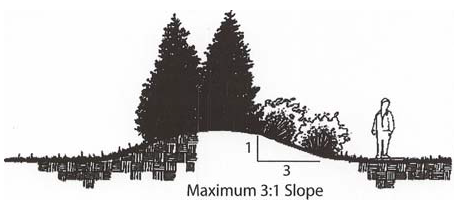
b.
Buffer means a combination of physical space and vertical elements, such as plants, berms, fences or walls, the purpose of which is to separate and screen incompatible land uses from each other.
c.
Designated review agency. The review agency for the purpose of this Section shall be appointed by the Mayor.
c.1
Developed lot means platted land with all adjacent public improvements installed but does not include any buildings or structures.
d.
Evergreen tree means a tree with foliage that persists and remains green year around.
d.1
Genus means a closely related and definable group of plants comprising one (1) or more species.
d.2
Infill development means new buildings constructed in the space available between existing structures within the Established Development Area.
e.
Landscape setback area. The landscape setback area extends into the private property contiguous to a street right-of-way.
f.
Living landscape materials means living trees, shrubs, vines, flowers, grasses, lawn and ground covers.
g.
Nonliving landscape materials means crushed rock, sand, wood chips, outdoor furniture, ornamental pieces and structural features.
h.
Ornamental tree means a small deciduous tree, twenty-five (25) feet or less in height at maturity, planted primarily for its ornamental value such as flowers, leaf color, size or shape.
h.1
Parking lot island means an area, protected by standard curb, and typically surrounded on at least two (2) sides by parking spaces or drive aisle.
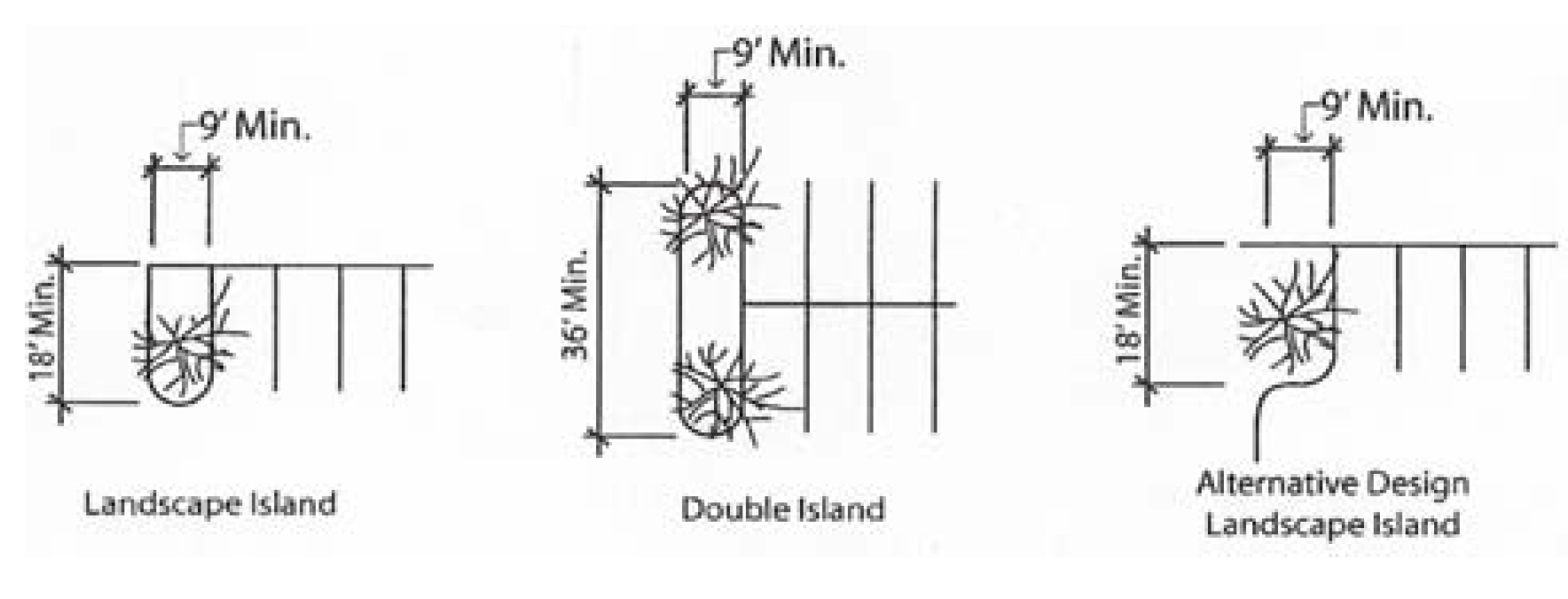
i.
Parking lot tree means a shade tree that is planted in a designated area within a parking lot.
j.
Public right-of-way is that area between the property line and the edge of asphalt, or back of curb and gutter associated with a public road also defined as sidewalk in Section 42-1-102(90), C.R.S.
k.
Screen means a method of reducing the impact of noise and unsightly visual intrusions with less offensive or more harmonious elements such as plants, berms, fences, walls or any appropriate combination thereof.
l.
Shade tree means a deciduous tree exceeding twenty-five (25) feet in height at maturity planted for its high crown of foliage or overhead canopy.
m.
Shrub means a woody plant, smaller than a tree, consisting of several small stems from the ground, or small branches near the ground, and may be deciduous or evergreen.
n.
Sight distance triangle, for purposes of this Section, refers to:
1.
Intersections, as described in Section 17-4-21; and
2.
Driveways and Alleys: For any driveway or alley in the zones as described in Subsection (2), nothing shall be erected, placed, planted or allowed to grow in such a manner as materially to impede vision between a height of two (2) and eight (8) feet, above the roadway sidewalk grade in the area bounded by the center line of a driveway or alley and the curbline of a street and a line joining a point along said street line one hundred fifty (150) feet from the center line of the driveway or alley to a point along said centerline ten (10) feet from the curbline. Such distances may be increased or decreased at the discretion of the City Traffic Engineer based on unusual roadway speeds or traffic condition.
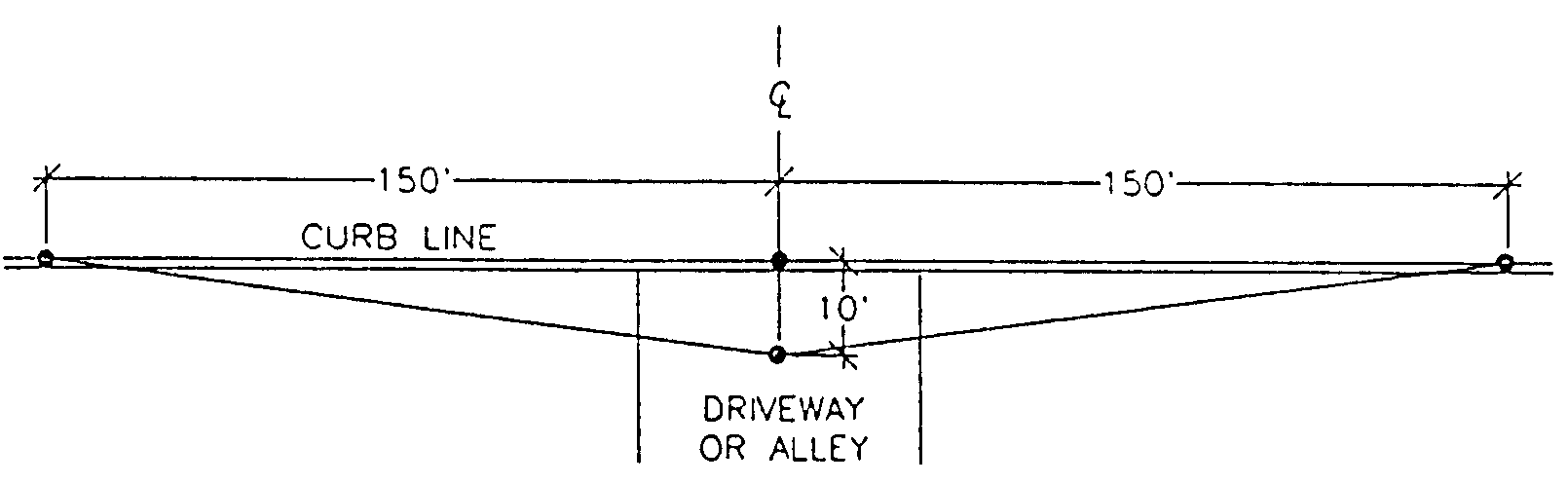
o.
Street tree means a shade tree, planted or growing within fifteen (15) feet of the edge of asphalt or back of curb.
o.1
Tree-lawn means the area between the back of curb and the detached sidewalk typically characterized by ground cover lawn and shade trees.
p.
Unimproved lot. A lot shall be considered unimproved when there is no building existing upon it.
q.
Weed means weeds, grass, brush or other rank or noxious vegetation and a detriment to the public health and safety.
(2)
Applicable zones: Unless provided through a Special Area Plan or Planned Unit Development, the provisions of this Section shall apply in the following zone districts: R-4, R-5, R-6, RCN, B-1, B-2, B-3, B-4, BP, PUD (when the PUD does not establish its own landscaping regulations), H-B, Industrial-Zoned properties in the designated high-visibility areas, O-1, CCN, S-1, S-4 and S-5 when at least one (1) of the following occurs within the above-mentioned zones:
a.
The construction or placement of any building or structure upon any lot. Exceptions to this requirement include constructing or placing any one (1) family, residence or two (2) family residence, and constructing or placing accessory structure(s) with a singular or cumulative ground floor area of 1,000 square feet or fewer.
b.
Any structural addition of thirty-five percent (35%) or more of the ground floor area to an existing building, except a residence, one (1) family and a residence, two (2) family. An addition of ten thousand (10,000) square feet of ground floor area or more to an existing building in any Industrial district. Additional increases in floor area, based on the above zone districts, shall be a maximum allowable limit of expansion whether cumulative or not, based on structure size after 2017.
c.
The use of five thousand (5,000) square feet of unimproved contiguous land or land in the same ownership for off-street parking or the conversion of existing use of five thousand (5,000) square feet or more of contiguous land or land in the same ownership to off-street parking.
d.
Off-street parking areas of five thousand (5,000) or more square feet shall be paved with asphalt, concrete or pavers. That portion of the driveway connecting from the curb line to the back of sidewalk property shall be paved with concrete materials. Off-street parking areas of five thousand (5,000) or more square feet shall meet and comply with the requirements of Subsections 17-4-44(b), (c), (d), (e), (h), (i), (j), (k) and (p).
e.
The provisions of Subparagraph c. above shall not apply to improved off-street parking areas of five thousand (5,000) or more square feet existing and in use on June 22, 1998.
f.
The City Center Streetscape Standards adopted by Resolution 12599, as may be amended, prescribe special regulations to modify or supplement the requirements of the Landscape Code for rights-of-way located within that portion of Downtown Pueblo identified below:
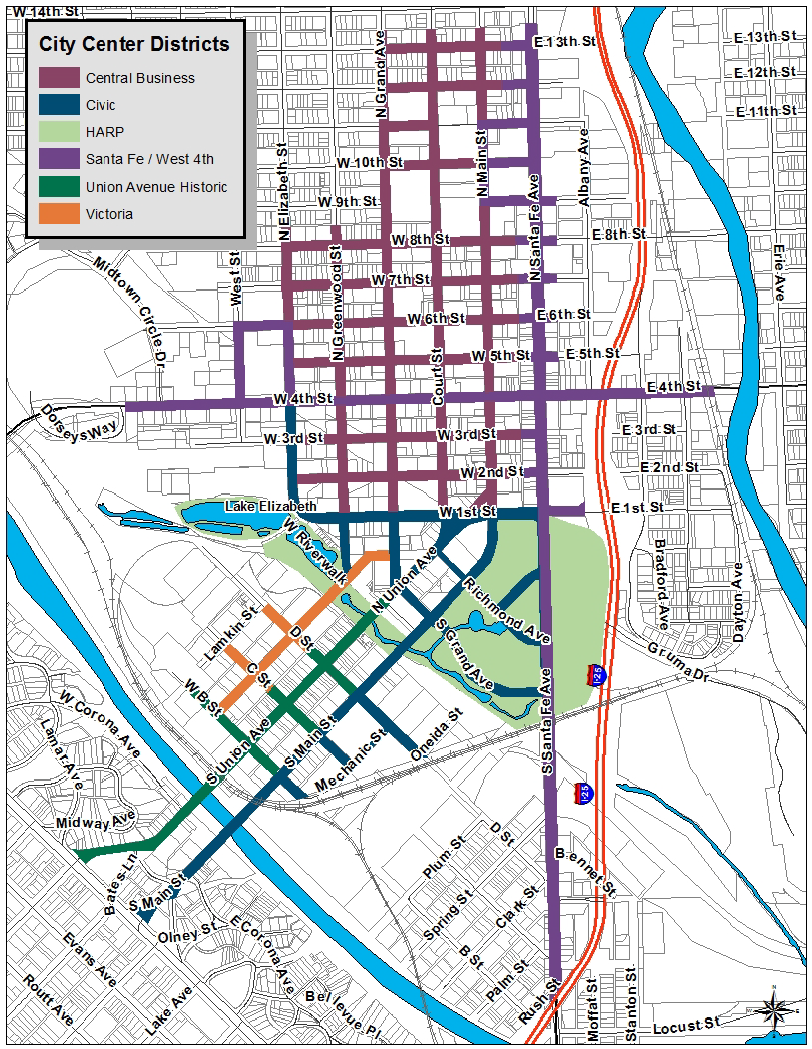
g.
Those properties located in the City's "Established Development Area", as illustrated on the map adopted by City Council Resolution and on file in the Community Development Department, are eligible for adjustments to the Landscape Performance Standards for the landscaping locations/functions described in Section 17-4-7(b)(3), as follows:
1.
A building addition greater than thirty-five percent (35%) of the existing building's gross square footage shall not require compliance with the requirements of Section 17-4-7(b)(3) in the "Landscape Setback", "Parking Lot", and "Landscaped Open Space" areas, when it has been determined by the Land Use Administrator that omitting landscaping from the proposed construction project would not be considered a significant visual impact nor detriment to the health, safety, and welfare of the neighborhood. However, additions to existing buildings within the size ranges described in this paragraph must comply with the standards described in paragraph (b)(2) g.2 below. Criteria used in determining whether this waiver shall be allowed include:
a)
The site improvements are occurring on a lot that is substantially built upon, preventing accommodation of the additional landscape areas and/or parking;
b)
The proposed landscape areas would not be visible from the street, or minimally visible considering existing and/or adjacent obstructions.
2.
Any new building construction or expansion in the City's Established Development Area shall trigger the requirement to re-establish the traditional treelawn (containing trees and turf only) in the right-of-way by the applicant. Planting Plans for re-establishing the traditional treelawn are required to be submitted for review but are not required to be prepared by a Landscape Architect.
3.
Establishment or expansion of parking areas between five thousand (5,000) and ten thousand (10,000) square feet may receive a waiver from providing parking lot islands from the Land Use Administrator, under criteria similar to those contained in section (b)(2)g.1 above. Establishment or expansion of parking areas over ten thousand (10,000) square feet must comply with all landscape requirements and performance standards.
4.
The requirement to provide landscape plans prepared by a licensed Landscape Architect may be waived for infill development when the Land Use Administrator determines that limited landscape requirements apply, and the plans do not involve design services.
(3)
Landscape Locations.
a.
Landscape Setback Area.
1.
The landscape setback shall be at least ten (10) feet wide and contain at least one (1) shade tree and five (5) shrubs or twenty-five (25) square feet of living ground cover instead of each shrub shall be provided in the landscape setback area for every thirty (30) linear feet, or portion thereof, of frontage, excluding driveway openings.
a)
Up to fifty percent (50%) of the total shade tree requirement may be comprised of evergreen or ornamental trees.
2.
Trees planted in the landscape setback area can be located in groups of up to three (3) trees or in irregular alignment instead of uniform spacing.
3.
On such sites where landscaping of the public right-of-way would comply with the general intent of this Section, the transfer of the area requirements, or a portion thereof, from within the property line to the public right-of-way may be approved by the designated review agency; provided that:
a)
The area measurement shall not be less than that required by Subparagraph (b)(3)a. and shall comply with all other design standards and requirements of this Section.
b)
The general planning of the City, with particular respect to the transportation system, will not be jeopardized.
c)
Execution of a revocable permit between the City and the owner for the use of right-of-way for the purpose of landscaping, with the owner accepting full financial responsibility for all costs for the movement, replacement and relocation of the landscaping thereon to the landscape setback should such permit be revoked by the City. In cases where the City requests a tree-lawn with a detached sidewalk that is located on property, a revocable permit shall not be required.
4.
Tree-lawns with detached sidewalks in the right-of-way are encouraged and should be used or restored whenever possible.
5.
To prevent gaps of nonlandscaped rights-of-way and to enhance the appearance of the overall project and community, the applicant must extend appropriate landscaping from the property line to abutting curb and maintain said landscaping. Right-of-way landscaping shall count towards the required seventy percent (70%) living landscape as required by Paragraph (b)(4).
6.
When the placement of a building or structure, as permitted by the zone district regulations, prohibits the installation of the landscape setback, other treatments located in the right-of-way, including but not limited to tree pits, tree-lawn, flower pots, movable planters or brick pavers, may be permitted by the Administrative Official, if compatible with the surrounding neighborhood, as official substitutes for the landscape setback and shall not require a variance. However, slopes greater than 4:1 shall not be allowed in the landscape setback area.
7.
Parking lots, additions, and new buildings within the City's Established Development Area may encroach into the front yard setback up to the average front yard setback of the existing principal structures on adjacent lots on the same street frontage. In these cases, the Landscape Setback Area requirement may be modified by the Land Use Administrator to be narrower than ten (10) feet, provided that alternate landscape treatments are installed that meet the intent of Subparagraphs (b)(3)a.5 and 6.
b.
Parking Lot.
1.
Parking lots with more than five (5) regular parking spaces shall provide end cap landscape islands at each end of all rows of parking spaces and internal landscape islands within the row of parking spaces so that there are no more than ten (10) to fifteen (15) consecutive parking spaces without a landscape island.
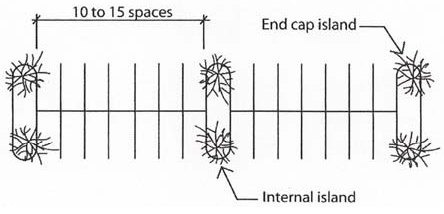
2.
Parking lot landscaping must be located in islands.
a)
Landscape islands, measured from the outer edge of curb, must be at least nine (9) feet wide and eighteen (18) feet long, or equal to the length of the adjacent parking stall if angled parking is used.
b)
Landscape islands, which are also used as a pedestrian walkway, shall not reduce the width of the landscape island to less than six (6) feet where a tree is planted.
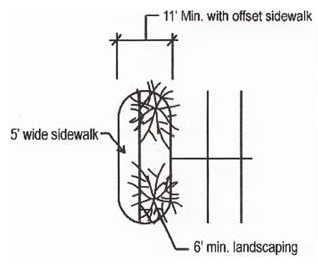
3.
One (1) shade tree and four (4) ground cover shrubs or one (1) shade tree and twenty-five (25) square feet of living ground cover instead of each shrub shall be planted in each island. Islands larger than the minimum size shall provide one (1) additional ground cover shrub for each additional twenty-five (25) square feet.
4.
Landscape shall be protected by standard curb head.
c.
Parking Lot Screen.
1.
Parking lots and drive-throughs contiguous to a street shall be screened from view from public streets by vegetative barriers consisting of at least one (1) tree per thirty (30) linear feet in combination with one (1) of the following:
a)
Ten (10) shrubs per thirty (30) linear feet. The shrubs shall have a minimum height of three (3) feet at maturity;
b)
A berm, where feasible, at least three (3) feet high, as measured from the top of the berm to the parking lot elevation, with seventy percent (70%) living ground cover; or
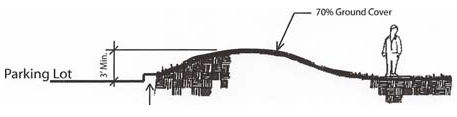
c)
Opaque structure at a minimum height of three (3) feet with landscape setback requirements planted on right-of-way side of wall.
2.
Trees planted in the landscape setback area can be located in groups of up to three (3) trees or in irregular alignment instead of uniform spacing.
3.
Parking lot screen requirements may be located in setback area.
4.
Screening located within the driveway sight distance triangles shall have a maximum height of two (2) feet at maturity.
5.
Landscape shall be protected by standard curb head or bumper block.
d.
Buffer.
1.
A buffer shall be provided between residential and nonresidential land uses. The buffer shall abut the property line and extend into the nonresidential property.
2.
The buffer shall be at least ten (10) feet wide except for that area abutting a permanent structure that is built to the edge of the zone district setback, and shall consist of the following: At least one (1) tree for every twenty (20) feet of length of the property line and an approved opaque fence or structure at least six (6) feet in height, except where such a structure does not meet the sight distance triangle provided in Subparagraph (1)n. Metal or plastic chain link fence slats, corrugated metal and fiberglass shall be prohibited.
3.
The Administrative Official may permit a reduction of the buffer requirement, provided that: 1) the building service functions must still be screened from view of residential properties; 2) the residential and nonresidential properties are separated by a street, alley or other public right-of-way; and 3) the reduction of the buffer will not negatively impact the adjacent properties.
4.
Trash enclosures, drive aisles and parking spaces shall not be located in the buffer.
e.
Outdoor Trash Storage.
1.
Trash containers shall be completely screened from public view of adjacent nonindustrial property and public streets. Containers shall be screened by a building, an approved opaque fence or wall, or an evergreen planting creating a continuous screen at least five (5) feet in height at the time of installation. Metal or plastic chain link fence slats shall be permitted only in conjunction with evergreen planting.
2.
Trash containers shall be located within property lines and not on public rights-of-way, or within landscape setback areas.
3.
Access to containers shall be located at a designated drive and not on public rights-of-way, excluding alleys, or within landscape setback areas.
f.
Landscaped Open Space.
1.
Designated landscaped open space areas as provided in Subsections 17-4-4(a), (b) and (c) shall have a minimum of seventy percent (70%) living landscape material.
2.
At least one (1) shade tree and seventy percent (70%) living ground cover shall be provided for every one thousand (1,000) square feet of required landscaped open space.
a)
Up to fifty percent (50%) of the total shade tree requirement may be composed of evergreen or ornamental trees.
3.
Up to fifty percent (50%) of the area of the required open space may be provided in the form of: balconies which are at least four (4) feet wide, roofs developed and maintained as garden or recreation areas, swimming pools or alternative surface recreation fields and courts deemed appropriate by the Administrative Official. Off-street parking, loading areas, sidewalks, trails, road access ways or other required landscape areas shall not be counted as open space.
4.
The Administrative Official may permit a cash payment in lieu of open space if the property is within one-quarter-mile walking distance of an improved park, provided that: 1) the park is accessible to reasonably serve the proposed development and its future residents; and 2) the park is at least as large as the required area of open space.
a)
All cash payments made in lieu of open space shall be equal to the fair market value of the area of land that is required for open space in a developed lot plus landscaping improvements. If the applicant and the City cannot agree on the property's fair market value, an independent Certified General Appraiser shall determine the land's fair market value. The applicant and City shall each pay one-half (½) of the cost of such appraisal.
b)
Cash payments made in lieu of providing open space shall be deposited with the City before a Certificate of Occupancy is issued. Such funds will be held in an interest-bearing account to be used solely to acquire and develop park and recreational facilities in the same park district that the property is located. All interest and dividends earned shall be credited to the account. The City may use four percent (4%) of the cash payments made in lieu of open space property to offset the costs of collection and administering such accounts.
g.
On-Site Stormwater Facilities.
1.
Private, on-site stormwater facilities shall be landscaped with turfgrass or other type of sod or seed mix. Such grasses must tolerate occasional fluctuating water levels and shall have an irrigation system as needed to establish and maintain grass.
2.
Trees planted in a stormwater detention pond must be able to tolerate occasional excess and fluctuating water levels and soil conditions.
(4)
Minimum Landscape Requirements.
a.
Living Landscape Material. At least seventy percent (70%) of the minimum required landscape area in the setback, parking lot, parking lot screen and open space areas, as measured at the ground surface, shall consist of ground cover by living plant material. Each five-gallon ground cover shrub will equal twenty-five (25) square feet of living ground cover.
1.
The foliage crown of trees shall not be used toward the seventy-percent requirement.
2.
Ground cover shrubs shall be plant material that grows low to the ground, typically under twenty-four (24) inches in height at maturity, and where appropriate may include turf and native grasses. Native grasses must be weed-free and maintained at a maximum height of ten (10) inches, unless permitted by the City's Landscape Architect. Spreading shrubs used as ground cover shall be planted at a maximum spacing of five (5) feet on center for five-gallon material per twenty-five (25) square feet or three (3) feet on center for two-gallon material per twenty-five (25) square feet.
3.
Perennials, vines or flowers used as ground cover shall be planted at a maximum spacing of eighteen (18) inches. Lawn can be used as ground cover.
4.
Water features, with recirculating water systems, may count for up to fifty percent (50%) of the minimum living landscape requirement upon approval of the designated review agency.
5.
In no event shall weeds be considered ground cover.
b.
Nonliving Landscape Material. No more than thirty percent (30%) of the required landscape area in the setback, parking lot, parking lot screen and open space areas as measured at the ground surface shall consist of ground cover by nonliving plant material.
c.
Irrigation Requirement. All required landscape areas shall include a permanently installed automatic irrigation system, unless a planting and maintenance plan not dependent on a permanent system has been approved by the Administrative Official. The use of irrigation system water conservation best management practices are recommended. Native grasses shall be at least temporarily irrigated until established as determined by the City's Landscape Architect.
d.
No outdoor storage, display or sales area shall encroach onto or restrict the growth of any portion of a landscaped area.
e.
Sidewalks may encroach in any required landscape area, provided that the width of required landscape area is not reduced below the minimum requirement, unless otherwise permitted by Subparagraphs (b)(3)a.4.c) or (b)(3)b.2.b) of this Section.
f.
Before planting, all landscape areas shall be thoroughly loosened, and soil amendments shall be required as determined by the Licensed Landscape Architect. Sites which do not require plans prepared by a Licensed Landscape Architect shall provide soil amendments as recommended by the City's Landscape Architect. In addition, all foreign waste materials, including concrete, plastic, wire and similar material, along with rocks larger than three (3) inches, shall be removed from the top six (6) inches of soil. The Licensed Landscape Architect, or City-approved designee, if a Licensed Landscape Architect is not required, shall represent in writing that, to the best of his or her knowledge, such soil amendments have been installed in general conformance with improvement plans as approved by the City before a certificate of occupancy will be issued.
(5)
Landscape Material Specification.
a.
Minimum planting/installation specifications.
1.
Minimum size for a shade tree shall be one-and-one-half-inch caliper measured six (6) inches above ground and shall have an expected height of twenty-five (25) feet or more at maturity.
2.
Minimum size for an ornamental tree shall be one-and-one-half-inch caliper measured six (6) inches above ground and shall have an expected height of twenty-five (25) feet or less at maturity.
3.
Minimum size for an evergreen tree shall be five (5) feet in height above ground.
4.
Minimum size for a shrub shall be a five-gallon container (or five [5] one-gallon or three [3] two-gallon sizes as equivalents), except when used for ground cover standards.
5.
Minimum size for a ground cover and vines shall be two-and-one-quarter-inch container planted at a minimum spacing of eighteen (18) inches on center.
6.
The landscape plan shall incorporate a variety and mixture of genus to avoid destruction of a single genus through blight and/or disease and shall be required based on the following:
7.
Plant material shall conform to the requirements as described in the latest edition of the American Standard for Nursery Stock which is published by the American Association of Nurserymen.
8.
Plant materials shall be selected from the City of Pueblo Recommended Plant List. The City's Landscape Architect may approve a genus or species not included in the recommended plant list, provided that the genus or species is not on the City's Prohibited Plant list. Unless otherwise permitted, artificial plant materials, including but not limited to plastic trees, shrubs and synthetic turf, are prohibited within required landscape areas.
b.
Native Plant Material. The use of native, drought resistant nursery stock is encouraged.
c.
Restricted Use or Prohibited Landscape Species.
1.
It shall be unlawful to plant in any public right-of-way in the City any tree of the Populus genus, except the cottonless varieties of cottonwood, or fruit-bearing mulberry; and no upright evergreen trees or shrubs or hedges shall be planted in any public right-of-way except upon approval of the designated review agency.
2.
Planting the box-elder (Acer negundo) tree is prohibited.
(6)
Installation Requirements.
a.
No tree, as measured from its center, shall be located as follows:
1.
Within ten (10) feet of a street light pole.
2.
Within five (5) feet of a fire hydrant.
3.
Within ten (10) feet of a vehicular access way.
4.
Within four (4) feet of a public sidewalk or curb unless a root barrier device is used.
b.
No shrub, as measured from its perimeter, and with mature height exceeding twelve (12) inches, shall be located as follows:
1.
Within five (5) feet of a fire hydrant.
2.
Within five (5) feet of a vehicular accessway if the planted or mature height is greater than two (2) feet.
c.
All landscape material located within the sight distance triangle shall be two (2) feet or less in height, or have a clearance of at least eight (8) feet beneath the lowest branch or projection.
d.
No permanent impervious surface or subsurface shall be located within a minimum of two (2) feet from center of the base of any tree or shrub.
(7)
Landscape and Irrigation Plan Requirements. A landscape and irrigation plan or a site plan designating the area to be landscaped must be submitted and preliminarily approved by the designated review agency before a building permit is issued by the Southern Colorado Building Department. The landscape plan shall include at least the following information:
a.
A linear scale, north arrow, name and address of person or firm preparing the plan, common and legal description of the property, names of streets contiguous to the property lines, and the total square footage to be contained in the area to be landscaped.
b.
Location of the sight distance triangle when applicable.
c.
Location and identification of all landscape material to be installed and a general rendering of any ornamental piece or structure which will cover more than twenty-five (25) square feet. Plant material shall be drawn at mature size.
d.
A plant inventory giving the botanical and common name, and square foot coverage, quantity and approximate installation size of trees, shrubs, vines, flowers, grasses, ground covers and other landscape materials to be used in the landscape area.
e.
The landscape plan shall be prepared and stamped by a Colorado-licensed landscape architect except landscape plans for single- and multi-family residential properties of four (4) or fewer units, not including common areas.
(8)
Review Procedure, Enforcement and Maintenance.
a.
The landscape plan review procedure shall be as follows:
1.
The landscape plan designating area to be landscaped shall be submitted to and preliminarily approved by the City's designated review agency before a building permit is issued.
2.
A complete plan shall be submitted for review to the designated review agency. The designated review agency shall either approve, approve with modifications or reject the landscape plan within twenty (20) days from the date of submission.
a)
If the plan is approved with modifications or rejected, the applicant shall be immediately notified in writing as to the reason and the right of appeal as provided in Subsection (9) below.
b)
If the applicant has not been notified within twenty (20) days, the landscape plan shall be considered approved as submitted.
3.
The City shall retain at least one (1) approved copy of the landscape plan.
4.
The landscape plan may be revised from time to time, provided that all revisions are approved by the designated review agency.
5.
All landscaping as shown on the landscape plan shall be installed before a certificate of occupancy is issued. Prior to landscape inspection, the Licensed Landscape Architect, or project Architect if a Licensed Landscape Architect is not required, shall represent in writing that, to the best of his or her knowledge, the landscaping has been constructed and installed in general conformance with improvement plans as approved by the City. General conformance shall include, but not be limited to, compliance with approved species, quantities, size and general placement of all plant material and landscape structures (trash enclosure, buffer, screen fence, etc.). If there are extenuating circumstances, such as adverse weather, where a certificate of occupancy is requested before completing the landscaping, an escrow in the amount of one and one-half (1½) times the cost of the landscaping, materials and labor may be accepted. A cost estimate for incomplete landscaping must be submitted for approval by the Department of Planning and Community Development. The escrow will not be released until all planting and finish materials shown on the approved landscape plan are installed and accepted. If the required landscaping is not properly installed when the escrow expires, the City may use such funds to have the required landscaping installed. Any costs incurred by the City in excess of the funds provided by the escrow shall be paid to the City. The Director of Planning and Community Development may accept an irrevocable letter of credit instead of an escrow based on the type of project, amount of escrow required and funding of the project.
b.
Maintenance.
1.
The owner shall install and maintain all landscaping in a healthy, neat and orderly appearance, free from refuse and debris. Maintenance shall include the replacement of all dead plant material within thirty (30) days of the citation, weather permitting.
2.
Regular and normal maintenance of landscaping includes weeding, fertilizing, pruning, mowing and irrigating. It shall be the responsibility of the property owner to maintain any landscaping in the public rights-of-way as defined in this Section.
c.
Enforcement.
1.
The Director of the Department of Zoning Administration representative shall serve notice of noncompliance upon the property owners in accordance with the provisions of Section 1-1-11.
2.
If the property is not brought into compliance within thirty (30) days from receipt of the above notice, the Director of the Department of Zoning Administration may take any of the following actions:
a)
Contract with a licensed landscape contractor to bring the property into compliance with the approved landscape plan. The cost of such work plus twenty-five percent (25%) for incidental costs fee, but not less than one hundred dollars ($100.00), shall be charged against the lot or premises upon which such expense was incurred or pursued as a civil debt with costs and attorney's fees payable by property owners.
b)
Seek enforcement in accordance with Section 17-7-3.
c)
Revoke the certificate of occupancy.
(9)
Appeal Procedures; Variances.
a.
In the event these landscaping requirements do not appear reasonable when applied to a specific use or combination of uses, the applicant may apply to the Zoning Board of Appeals for a variance, but, unless otherwise permitted, the variance may not reduce the required amount of landscaping by more than fifty percent (50%).
b.
In the granting of such a variance, the Planning and Zoning Commission may take into consideration the following:
1.
The general planning of the City with respect to land use and the location of the required landscape;
2.
The effect strict adherence to the requirements of this Section would have on the appropriate development of the land and use;
3.
The public welfare and interest of the City and surrounding area.
(10)
The provisions of this Section shall not apply to the following:
a.
Freestanding pole signs of not more than one hundred (100) square feet and not more than twenty-five (25) feet high, only as permitted by Chapter 10 of this Title;
b.
Monument signs of not more than sixty-four (64) square feet and not more than ten (10) feet high, only as permitted by Chapter 10 of this Title;
c.
Light, flag and telephone poles;
d.
Fences six (6) feet tall or shorter;
e.
Product vending machines, such as movie kiosks, soda pop machines, automatic teller machines (ATMs);
f.
Site furnishings, such as art, benches, trash receptacles and similar improvements and fixtures;
g.
Temporary fabric shade or tent structures that do not require a building permit;
h.
Fences that do not require a building permit;
i.
Structures under two hundred (200) square feet.
(Ord. No. 3990, 3-10-75; Ord. No. 4281, 2-14-77; Ord. No. 5991, 7-10-95; Ord. No. 6324, 6-22-98; Ord. No. 6630, 12-26-00; Ord. No. 7659 §5, 9-10-07; Ord. No. 7888 §1, 9-22-2008; Ord. No. 7975 §4, 3-23-09; Ord. No. 8117 §2, 11-23-09; Ord. No. 8150 §2, 2-22-10; Ord. No. 8310 §1, 2-14-11; Ord. No. 8578 §1, 2-25-13; Ord. No. 9261 §§1—3, 4-23-18; Ord. No. 9296 §1, 6-11-18; Ord. No. 9381 §1, 11-26-18; Ord. No. 9469 §4, 5-28-19; Ord. No. 10218 §1, 7-11-22; Ord. No. 10642 §1, 1-30-24; Ord. No. 11082, §3, 11-24-25)
Sec. 17-4-8. - Solid wastes transfer station performance standards.
(a)
Every solid wastes transfer station shall be screened with a nontransparent type of fencing of a height not less than six (6) feet and have a restraining extension to block windblown debris.
(b)
Solid wastes collected at any transfer station shall be held no longer than forty-eight (48) hours at the transfer station.
(c)
All solid wastes shall be stored or held in sealed or covered containers.
(d)
Sound levels of noise resulting from the operation of a waste transfer station shall not exceed seventy (70) decibels between 7:00 a.m. to 7:00 p.m. daily, and sixty-five (65) decibels from 7:00 p.m. to 7:00 a.m. daily, in a light industrial zone district. In a heavy industrial zone district, the maximum sound levels of noise shall be eighty (80) decibels between 7:00 a.m. and 7:00 p.m. daily and seventy-five (75) decibels from 7:00 p.m. to 7:00 a.m. daily. Noise sources shall be measured at least twenty-five (25) feet from the property line of the property on which the transfer station is located.
(e)
No vibration resulting from this activity shall be discernible at the outer boundaries of the parcel of property on which the transfer station is located.
(f)
No obnoxious or noxious odors resulting from a waste transfer station shall be detected after the odorous air has been diluted with six (6) or more volumes of odor-free air by a certified operator using the Barneby-Chaney Scentometer at the outer boundaries of the parcel of property on which the transfer station is located.
(g)
The owner or operator of the transfer station shall take measures to control all insects, pests and vermin attracted to the site, including flies, rats, mice and mosquitoes.
(h)
Solid wastes shall be so deposited, stored and transmitted from the parcel so as not to be objectionable to adjacent properties or create a public nuisance. The area in and around the transfer station shall be well drained for storm runoff.
(i)
All area used for vehicular parking, storage or access for loading or unloading at the transfer station shall be paved with asphalt or concrete Portland cement.
(j)
If solid wastes collection is conducted within a structure, the structure shall be constructed of fireproof material and shall contain an approved sprinkler system. The transfer station shall provide fire fighting equipment as determined and approved by the City Fire Department.
(k)
Public water shall be provided at the site by means of a fire hydrant with a flow of not less than five hundred (500) gallons per minute and of pressure not less than sixty (60) pounds per square inch, and such hydrant shall be located within three hundred (300) feet of the property on which the transfer station is located. If solid wastes collection is conducted in the open, a water stand pipe with hose shall be provided by the owner or operator of the transfer station.
(Ord. No. 5123, 1-23-84)
Sec. 17-4-9. - Homeless shelter performance standards.
(a)
All homeless shelters shall be restricted to the zone district in which they are permitted according to Section 17-4-51. No shelter shall be permitted within one thousand (1,000) feet of any existing homeless shelter.
(b)
Special use permit applications shall include a description of the persons to be served by the shelter, the services offered, anticipated staffing and a site plan of the proposed facility. Any substantial change in a permittee's services, persons served or facilities shall require approval of the Zoning Board of Appeals after notice and a hearing.
(c)
Neither alcoholic beverages nor controlled substances shall be allowed within the facility. No person under the influence of drugs or alcohol will be admitted or permitted to remain at the facility.
(d)
At least one (1) staff person shall be present on the premises at all times the shelter facility is open.
(Ord. No. 5475, 5-23-88; Ord. No. 8933 §6, 11-23-15)
Sec. 17-4-10. - Bed and breakfast home performance standards.
(a)
Administration. Any person wishing to operate a bed and breakfast home shall upon a form provided by the City give the following information to the Director of the Department of Zoning Administration:
(1)
Proof of ownership.
(2)
Building layout showing locations of guest bedrooms, common areas and owner/resident's living quarters.
(3)
Proposed parking.
(4)
Proof of compliance with all applicable state and City health, building and fire codes.
(5)
Application fee as set by resolution of City Council.
(b)
Regulations.
(1)
Bed and breakfast homes operating under a special use permit may be reviewed by the Zoning Board of Appeals within twelve (12) months of approval at the discretion of the Board. The permit is subject to review by the Board on a complaint basis as determined by the Director of the Department of Zoning Administration.
(2)
The operator shall provide and maintain a guest register. Such register shall be available for inspection by City officials and law enforcement authorities. The maximum stay for guests shall not exceed thirty (30) consecutive days.
(3)
The owner of a bed and breakfast home shall provide one (1) on-site paved parking for each guest unit in addition to the required parking for the zone district in which the home is located. Such parking shall preserve the residential character of the property and surrounding neighborhood. The City Traffic Engineer shall review and approve the parking layout submitted with the application.
(4)
A bed and breakfast home shall be restricted to two (2) non-self-illuminated signs limited to no more than four (4) square feet for each sign. The sign(s) shall be limited to the name, address and telephone number of the bed and breakfast home. The location and design of any sign must be approved by the City Director of the Department of Zoning Administration or the Director's designee.
(5)
The bed and breakfast home shall be in compliance with all applicable health, fire, building and safety regulations. After initial approval, periodic safety and health inspections shall be performed by inspectors from the City/County Health Department, the Southern Colorado Building Department and the Fire Department. Such inspections shall also verify the following safety equipment and measures are present or enforced:
a.
Smoke alarms are located upon all floors;
b.
Fire extinguishers are located upon all floors;
c.
Fire escape routes are present, if deemed necessary; and
d.
No cooking shall be permitted in guest rooms.
(6)
The bed and breakfast home shall acquire and maintain a valid City business license.
(c)
Restrictions. All bed and breakfast homes shall:
(1)
Be owner occupied in a detached, single-family residence with at least one thousand six hundred (1,600) square feet of net usable floor area.
(2)
Have no more than three (3) guest units in the principal structure only.
(3)
Have no other bed and breakfast facilities located within one hundred fifty (150) feet of the exterior property boundaries of the home.
(4)
Have no exterior alterations to accommodate its use, such as additions or additional entries.
(5)
Have no other commercial functions allowed such as meetings, receptions and similar functions. Home based businesses shall not be permitted.
(6)
Have only a breakfast meal served only to registered guests. Dining and other facilities shall not be open to the public.
(7)
Shall have a refuse area screened from the view of persons from adjacent properties and public rights-of-way.
(d)
Other factors and considerations for approval by the Zoning Board of Appeals. All bed and breakfast homes:
(1)
Shall not constitute an annoyance or nuisance to surrounding residents by reason of noise, smoke, odor, electrical disturbance, night lighting or the creation of unreasonable traffic to the premises.
(2)
Shall not create an adverse impact on the residential character of the surrounding neighborhood.
(3)
Shall be compatible and harmonious with surrounding land uses.
(Ord. No. 6228, 7-28-97; Ord. No. 8933 §7, 11-23-15; Ord. No. 11082, §3, 11-24-25)
Sec. 17-4-11. - Residential placement standards.
The purpose of these standards is to require that homes be placed within neighborhoods in a manner that assures that the homes are compatible with adjacent properties and reflect the character of the neighborhoods in the City.
(1)
Any person wishing to place a one-family or two-family residence on a lot of record within the City shall provide to the City Administrative Official or authorized designee the following on a form provided by the City or copies of original documents.
a.
Scaled building site plan for the lot showing proposed location of the single-family home on the lot, including all setbacks required in the zone district, all adjacent rights-of-ways, lot lines, and lot dimensions.
b.
Location of required off-street parking space(s).
c.
Proof of compliance with Section 17-2-2(84) (where applicable).
d.
All existing and proposed sidewalks, curb cuts/drive access, handicapped ramps.
(2)
Regulations: All one-family or two-family residences shall:
a.
Be placed on a subdivided lot of record.
b.
Use at least eight (8) of the following design features:
1.
The front of the dwelling shall be parallel (within thirty [30] degrees) to the front lot line (see Figure 1);
2.
A roof with a pitch that is 4/12 or greater;
3.
A hip roof;
4.
Have masonry or other contrasting material that project from the wall plane on the building façade that is parallel (within thirty [30] degrees) to the front lot line;
5.
An architecturally similar garage or carport;
6.
One (1) or more dormers that are parallel (within thirty [30] degrees) to the front lot line (see Figure 2);
7.
Three (3) or more gables (see Figure 3);
8.
Building face or roof offsets (minimum twelve-inch offset) that are parallel (within thirty [30] degrees) to the front lot line (see Figure 4);
9.
Two (2) or more windows, with a combined minimum of twenty [20] square feet of glazed area, that are parallel (within thirty [30] degrees) to the front lot line, at least one of which has minimum operable opening of 20" wide × 24" high;
10.
Bay or bowed windows that are parallel (within thirty [30] degrees) to the front lot line;
11.
Window shutters on front, side and rear windows;
12.
Minimum ten-inch eaves (all house eaves);
13.
One (1) or more of the following types of exterior siding:
a)
Horizontal lap siding, including simulated horizontal lap siding;
b)
Vertical siding, with a pattern repeat of less than twelve (12) inches;
c)
Beveled siding; or
d)
Stucco;
14.
A recessed front entry (minimum eighteen [18] inches) which is parallel (within thirty [30] degrees) to the front lot line;
15.
A covered porch entry (minimum five-foot depth) for the front entrance. When the front entrance is not parallel to the front lot line, the porch shall be visible from the street (see Figure 5);
16.
Have wood or composition trim, nominal four-inch for exterior siding;
17.
Have more than one (1) exterior material or contrasting color (not including trim material).
(3)
Restrictions: All one-family or two-family residences shall:
a.
Obtain all building permits required by the Southern Colorado Building Department;
b.
Comply with Section 12-3-23 of the Pueblo Municipal Code and with the Public Works Department Specifications, Standards and Details handbook;
c.
Have a paved (asphalt or concrete) driveway, off-street parking spaces, as required, and sidewalk from either the public sidewalk or driveway to the front entry;
d.
Be placed on a permanent masonry or poured-in-place concrete perimeter foundation with no more than twelve (12) inches (average) of masonry or concrete exposed above the grade on the street face, which meet all applicable codes as determined from plans and specifications submitted to obtain a building and siting permit(s);
e.
Have any exterior wall used to support backfilled material on one (1) side be suitably engineered and constructed of masonry or concrete materials;
f.
Have a consistent, continuous façade (material, color, pattern) from the bottom of the soffit (top of wall section) downward to within eight (8) inches of the grade, if not placed on a concrete or masonry foundation.
(4)
Obtain all applicable permits from the Southern Colorado Building Department (including covered steps, porches, carports and similar improvements) for all extensions and attachments to one-family and two-family residences not part of the original dwelling.
a.
Additions totaling more than five hundred (500) square feet of gross floor area or forty percent (40%) of the existing gross floor area of the residence, whichever is greater, shall be architecturally compatible with the existing structure. For the purposes of this Section, architectural compatibility shall mean construction using similar materials and details, which shall include similar siding materials and colors, and similar roofing materials, colors and pitch.
b.
Additions to historically registered buildings may be subject to the Pueblo Historic Preservation Code.
c.
For an addition to a building that is eligible for listing on a historic register, the Administrative Official may permit the use of other architectural forms and high-quality materials that are not architecturally compatible if use of the materials complements the overall design, retains the unique character-defining features of the existing building, and does not create a visually false sense of history.
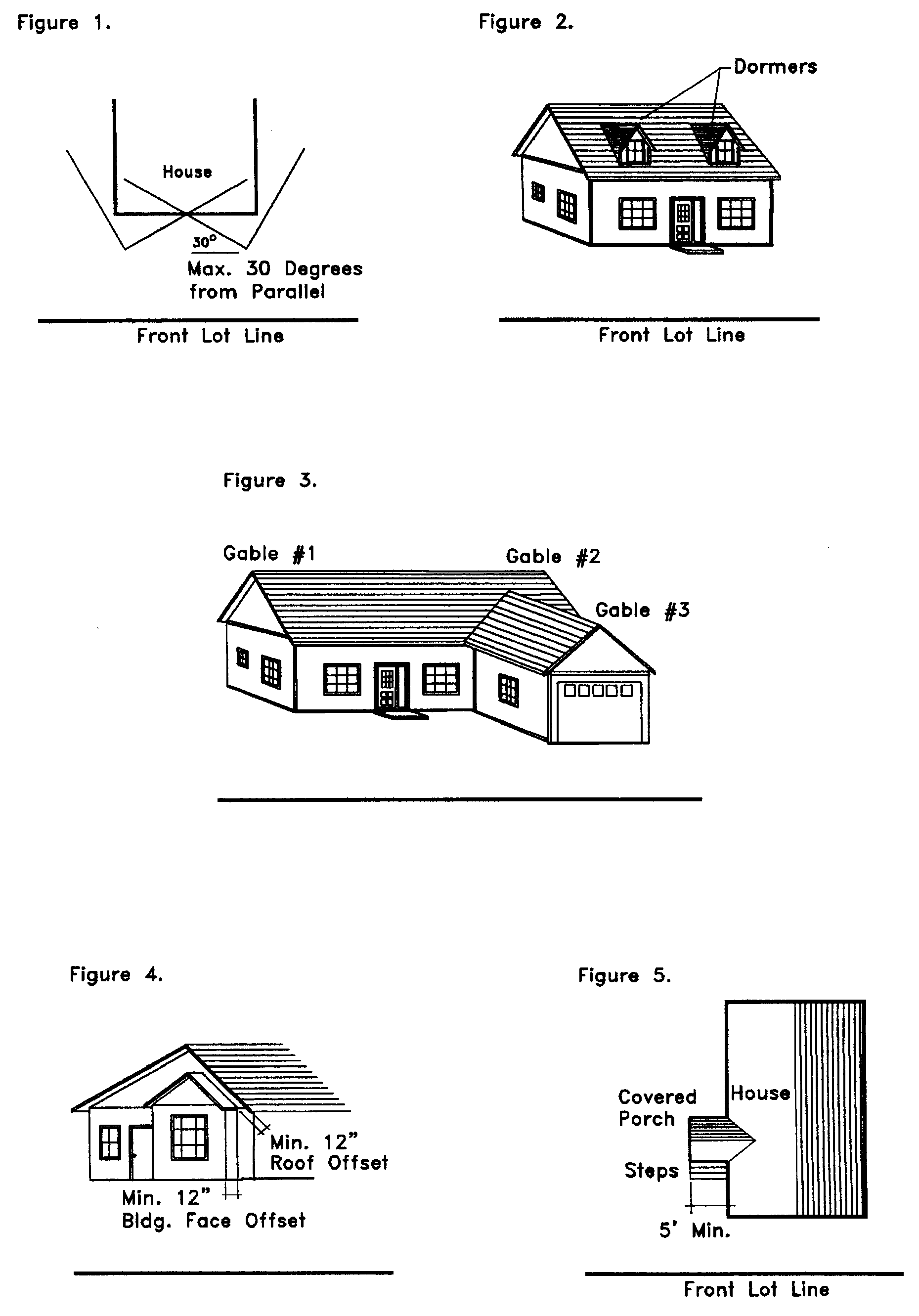
(Ord. No. 6906 §1, 11-11-02; Ord. No. 8933 §8, 11-23-15; Ord. No. 9469 §5, 5-28-19; Ord. No. 9525 §2, 8-26-19; Ord. No. 11082, §3, 11-24-25)
Sec. 17-4-12. - Student housing performance standards.
(a)
All student housing projects shall be restricted to the zone district in which they are permitted as a use by review.
(b)
Prior to the issuance of a building permit, all student housing projects must obtain a special use permit from the Zoning Board of Appeals, as well as site plan approval by the Planning and Zoning Commission.
(c)
The Zoning Board of Appeals shall review and approve all requests for student housing subject to the procedures and requirements of Section 17-5-33 of this Title.
(d)
The Planning and Zoning Commission, after notice and public hearing has been held in the manner required for a zoning map amendment, is authorized to approve, deny or approve with conditions the development plan and major revisions. The Planning and Zoning Commission may require such changes, restrictions or conditions upon the site plan or major revisions as deemed necessary to protect the public health, safety and welfare based on the impacts to the community, including but not limited to:
(1)
Potential effects of the project on the surrounding neighborhoods;
(2)
Building architecture;
(3)
Density;
(4)
Lot coverage;
(5)
Minimum and maximum parking requirements, including bicycle and motorcycle parking;
(6)
Landscaped open space and recreation availability;
(7)
Trash and refuse facilities;
(8)
Sanitary sewer, including but not limited to grinder pumps, grease traps and similar devices;
(9)
Drainage and detention;
(10)
Access for occupants, visitors and emergency service vehicles;
(11)
Lighting as required by Section 17-4-52;
(12)
Landscaping as required by Section 17-4-7;
(13)
Laundry facilities; and
(14)
Roadway, sidewalk and off-street trail access to the college, university or nonprofit organization.
(e)
The Technical Advisory Committee, as defined by Section 17-8-2, may by majority vote of all members approve, deny or approve with conditions minor revisions to an approved student housing site plan.
(1)
A denial by the Technical Advisory Committee may be appealed to the Planning and Zoning Commission.
a.
An appeal must be filed within fifteen (15) days with the Administrative Official.
b.
The Planning and Zoning Commission will hear and decide the appeal within sixty (60) days from the date of filing after proper notice and payment of the required fee by the applicant.
(2)
Minor revision means a change in the approved student housing site plan, including modifications to the location, siting, height or architecture of buildings or structures, which are required by engineering or other circumstances not foreseen when approval of the site plan was given. Such changes must have no adverse impact on adjacent or surrounding land uses or plan elements. A minor revision may be approved for only the following:
a.
Change in the dimension of a building or structure which is ten percent (10%) or less;
b.
Change in the location of a building or structure which is five (5) feet or fewer in any direction;
c.
Change in the capacity of an off-street parking area of ten percent (10%) or less;
d.
Change in the type of landscape materials if such is to be replaced by an ecologically equal or better variety; or
e.
Other revisions deemed to be minor in nature by the Administrative Official.
(Ord. No. 8001 §2, 4-27-09)
Sec. 17-4-13. - Community gardens performance standards.
(a)
Intent. The intent of this Section is to provide regulatory authorization for community gardens and establish guidelines so that their development may remain harmonious with surrounding properties. Community gardens provide important access to local fresh food, facilitate community development and may provide care of lots that could otherwise become a nuisance in the neighborhood. Properly maintained community gardens beautify a neighborhood and provide supplementary access to affordable food.
(b)
Overview. This Section clarifies zoning requirements applicable to community gardens and facilitates and provides for their expansion, permitting and maintenance as well as providing protections for neighboring land uses in the event that such community gardens are not maintained.
(c)
Applicability.
(1)
Accessory Use. Community gardens, as an accessory use to a lawfully permitted principal use, are permitted as accessory use by right in all Zone Districts. Community gardens as accessory use do not require a Community Garden permit. No community garden is allowed on City-owned property or right-of-way unless and until a revocable permit therefor is granted and a community garden permit is issued. The incidental sale or donation of harvested goods or plants is not permitted on-site, unless otherwise permitted as a use by right in the Zone District where the community garden is located.
(2)
Principal Use. Community gardens are allowed as a use by right in all Zone Districts, provided they comply with the regulations set forth in this Section.
(d)
Administration. Any person wishing to operate a community garden as a principal use of land shall obtain a community garden permit from the Administrative Official, and in connection therewith, provide to the Administrative Official or authorized designee the following information:
(1)
Application on a form provided by the Department of Planning and Community Development;
(2)
Proof of ownership, or approval to operate the community garden from the property owner of record;
(3)
Operating plan, including but not limited to outlining codes of conduct, hours of operation and how the community garden will comply with all relevant Pueblo Municipal Codes relating to noise, nuisances, construction of buildings and structures, lighting and the disposal of solid wastes; and
(4)
Plans showing location, dimensions and height of proposed amenities, buildings or structures, including but not limited to sheds, gazebos, pergolas and freestanding lights in relationships to property lines. All proposed amenities and structures must comply with all setback requirements and obtain all applicable building permits and comply with all other applicable Codes and Ordinances effective at the time of installation.
(5)
Additional information as required by the Administrative Official.
(e)
Regulations.
(1)
Community gardens must be maintained in a clean and neat manner, and kept free of trash, weeds and residual clippings, year-round, including seasons or years when the garden is fallow.
(2)
The hours of operation. Community gardens shall only be open and active during the hours of 7:00 a.m. to 9:00 p.m.
(3)
Compost must be kept at least twenty (20) feet away from adjacent single-family residential homes.
(4)
Incidental sales of harvested goods or plants are prohibited on-site, unless otherwise lawfully permitted in the Zone District where the community garden is located.
(f)
Legal nonconforming community gardens.
(1)
Community gardens as a principal use, in operation at the effective date of this Section are considered legal nonconforming uses. Legal nonconforming community gardens must obtain a Certificate of Nonconforming Use from the Planning and Community Development Department within thirty (30) days of the effective date of this Section and must demonstrate to the satisfaction of the Administrative Official that the community garden was in operation prior to the effective date of this Section.
(2)
Community gardens that cease to operate for any reason for a period of more than one hundred eighty (180) days shall thereafter conform to the regulations specified herein.
(3)
Existing legal nonconforming community gardens are encouraged to abide by the performance standards contained herein.
(g)
Enforcement.
(1)
The Administrative Official is authorized to enforce a final order to remove or alter any community garden which fails to comply with the approved permit or regulations contained herein.
(2)
Upon receiving a complaint regarding any community garden the Administrative Official will investigate such claims. If the community garden is found to be in violation of their permit, is determined to be a nuisance to the neighborhood, as defined in Subsection 7-1-1(a) of this Code, or is no longer operating as an active community garden, the Administrative Official is authorized to revoke the permit. The community garden may reapply for a permit at any time but must demonstrate the ability to correct the reasons for their prior permit revocation.
(Ord. No. 8370 §2, 7-11-11)
Sec. 17-4-14. - Multifamily housing development design standards.
(a)
Intent. Encourage visually distinct buildings, support affordable development, and promote livability and accessibility within the City.
(b)
Applicability. The following multifamily residential development is subject to the requirements of this section in addition to complying with all other applicable Code requirements:
(1)
New construction: the standards in this section shall apply to all new construction of multifamily structures within the City.
(2)
Redevelopment: the standards in this section shall also apply to any structural additions that equal thirty-five percent (35%) or more of the existing multifamily residential structure footprint.
(3)
Conversion: the standards in this section shall also apply to any property in which there is a change of use resulting in a use classified as residential, multifamily.
(c)
Exceptions: Development in zone or area districts that have a regulatory design review process, such as the Historic Business (HB) Zone District and HARP Zone Districts are exempt from the standards of this section. Mixed-use buildings in a business district with a commercial use on the first floor are subject to review under the applicable development performance standards for large, medium, small and industrial development.
(d)
Primary façades: A building's primary façade(s) includes all façade(s) adjacent to public rights-of-way. A primary façade shall serve as the main access point to a building or building unit. In situations where it is not possible for a building's primary entrance to be located adjacent to a public right-of-way, façade(s) adjacent to a major access drive and/or primary parking area serve as the primary façade(s). A parcel or lot may have multiple primary facades depending upon the location of adjacent rights-of-way and the structure's primary entrance.
(e)
Secondary façades: A building's secondary façades shall consist of all other facades that are not defined as a primary façade.
(f)
Requirement for four-sided design: a building's special architectural features and treatments shall not be restricted to a single façade. All sides of a building open to view, whether viewed from public or private property, shall display appropriate architectural interest as required in this subsection
(1)
Primary façades must include all of the following design elements.
a.
Building facades shall be multi-colored. Each building façade shall include not less than two (2) distinct colors. Colors may be from the same hue family but be distinct from each other;
b.
Changes in texture and material;
c.
Windows. Windows shall be provided in repeating intervals and sized appropriate to the scale of the façade;
d.
Projections, recesses and reveals; and
e.
Horizontal or vertical breaks
(2)
The Administrative Official may allow the following design elements to be substituted for one (1) or more of the required design elements listed above, if the applicant is able to provide justification that the substitution will provide visual interest and aesthetic appeal;
a.
Graphic patterning;
b.
Other similar techniques compliant with section 17-4-14(o)
(3)
Secondary façades shall provide at least two (2) of the following design elements:
a.
Change in colors. Colors may be from the same hue family, but shall be distinct from each other;
b.
Changes in texture and material;
c.
Windows. Windows shall be provided in repeating intervals and sized appropriate to the scale of the façade.
d.
Graphic patterning;
e.
Projections, recesses and reveals;
f.
Horizontal or vertical breaks; or
g.
Other similar techniques compliant with section 17-4-14(o)
(h)
Roofs. All roof vents, pipes, antennas, satellite dishes, HVAC, roof mounted mechanical equipment and other roof penetrations (except chimneys & solar panels) shall be located on or adjacent to secondary facades, or otherwise be configured, to the degree practicable, to have a minimal visual impact as seen from the street. Roof designs shall incorporate the following design features:
(1)
Flat roofs must incorporate a parapet sufficient to screen roof mounted mechanical equipment
(2)
All pitched roof designs must use the following design features:
a.
Varying roof design, which may include but not be limited to the use of dormers, varying planes, slopes and/or projections; and
b.
Pitches between 3:12 and 12:12
(i)
Entrances. Each multifamily residential building with a common entrance shall have a clearly defined and highly visible residential entry that uses at least one (1) of the following design features:
(1)
Canopies, porticos, arcades and/or covered porch;
(2)
Raised or peaked cornice parapets over the entrance.
(j)
Outdoor activity areas. Outdoor activity areas, porches, balconies, decks, vending areas, and other similar site attributes shall be located away or fully screened from adjacent existing single-family residential uses or single-family residential zone districts.
(k)
Color. Multifamily developments that include more than three (3) multifamily structures shall be made to avoid using identical façade colors in the same pattern on adjacent structures, within the same development. Colors may be from the same hue family, but shall be distinct from each other
(l)
Pedestrian circulation in multifamily developments. A clearly defined, visible, and identifiable pedestrian network shall be provided between residential structures, parking spaces, open spaces, outdoor activity areas and other community facilities within the development site. The pedestrian circulation network shall be connected to adjacent public rights-of-way, public parks, and open spaces.
(m)
Accessory structures. All accessory structures including but not limited to garages, storage closets, lockers, sheds, carports, and other accessory functions located in separate structures on the same site shall be complementary to the overall design of the site, and the architectural style of the primary structure. Materials, colors and designs, including roof design, shall conform with and complement the predominant materials and colors of the principal structure(s).
(n)
Parking. Off-street parking areas are encouraged to be located along a secondary façade or to the rear of a multifamily structure rather than between the structure and public right-of-way.
(o)
Administration. The Administrative Official shall review all development for consistency with the intent of the section 17-4-14. If the Administrative Official determines the intent of the section is met, the Administrative Official may modify or substitute, any of the requirements listed above when the changes to the existing building will not have a negative impact on health, safety, and welfare of the surrounding neighborhood.
(Ord. No. 10132 §2, 3-14-22)
Sec. 17-4-15 - Natural medicine, business performance regulations.
(a)
Definitions. As used in this Code, unless the context otherwise requires:
(1)
Natural medicine means the following substances: psilocybin, or psilocin. It may include the following substances if, and only once they are approved by the state licensing authority: dimethyltryptamine, ibogaine, and/or mescaline but not peyote (Lophophora williamsii Lemaire). Natural medicine does not include any synthetic, or synthetic analog of these substances, and does not include a derivative of naturally occurring compound of natural medicine that is produced using chemical synthesis, chemical modification, or chemical conversion.
(2)
Natural medicine business means any of the following entities licensed under the State Regulatory Act and includes a natural medicine healing center, a natural medicine cultivation facility, a natural medicine products manufacturer, or a natural medicine testing facility, or another licensed entity created by the state licensing authority.
(3)
Natural medicine healing center means a facility where an entity is licensed by the state licensing authority that permits a facilitator as defined by state laws and regulations, to provide and supervise natural medicine services for a participant as defined by state laws and regulations, which includes a participant consuming and experiencing the effects of regulated natural medicine or regulated natural medicine product under the supervision of a facilitator.
(4)
Natural medicine product means a product infused with natural medicine that is intended for consumption as provided and defined by this code and state laws and regulations.
(5)
Natural medicine services means a preparation session, administrative session, and integration session, as provided by state laws and regulations.
(6)
Participant means an individual who is twenty-one (21) years of age or older who receives natural medicine services prescribed by and under the supervision of a licensed facilitator, as provided by state laws and regulations.
(7)
Regulated natural medicine means natural medicine that is cultivated, manufactured, tested, stored, distributed, transported, or dispensed, as provided by state laws and regulations.
(8)
Regulated natural medicine product means a natural medicine product that is cultivated, manufactured, tested, stored, distributed, transported, or dispensed, as provided by state laws and regulations.
(9)
State licensing authority means the authority created under the Regulatory Act, state laws and regulations for the purpose of regulating and controlling the licensing of the cultivation, manufacturing, testing, storing, distribution, transfer, and dispensation of regulated natural medicine and regulated natural medicine product.
(b)
Regulations:
(1)
Natural medicine businesses shall use an air filtration and ventilation system designed to ensure that the odors from natural medicine and natural medicine products are confined to the premises and are not detectable beyond the property boundaries on which the facility is located.
(2)
All storage for natural medicine businesses shall be located within a permanent structure with a fixed location on the ground.
(3)
No natural medicine business shall operate out of a building that is within [one thousand (1,500) feet] of a childcare center or childcare home; preschool; elementary, middle, junior or high school which offers in person classes, testing, and/or programs; or a residential childcare facility. The [1,500-foot] distance requirement does not apply to a licensed natural medicine facility located on land owned by the City or the state of Colorado or apply to a licensed facility that was actively doing business under a valid license issued by the state licensing authority before the school, childcare center, or childcare home was established.
(4)
Processing of Natural Medicine:
a.
The processing of natural medicine that includes the use of hazardous materials, including, without limitation, and by way of example, flammable and combustible liquids, carbon dioxide, and liquified petroleum gases, such as butane, is prohibited.
b.
Nonhazardous materials used to process natural medicine shall be stored in a manner so as to mitigate and ensure odors are not detectable beyond the property boundaries on which the processing facility is located, or the exterior walls of the processing facility associated with the processing of natural medicine.
c.
The processing of natural medicine shall meet the requirements of all adopted City building and life/safety codes.
(Ord. No. 10941 §2, 4-28-25)
Sec. 17-4-16. - Accessory dwelling unit development performance standards.
(a)
Applicability. One accessory dwelling unit is allowed as an accessory use to a one-family residence in any zone district where a one-family residence is allowed, including in any Planned Unit Development (PUD) Districts that allow one-family residences. A one-family residence includes a detached single-family dwelling unit and a manufactured home placed on a permanent foundation designed by a Colorado registered design professional, but excludes a two-family residence, townhouse, multi-family residence, mobile home, or recreational vehicle.
(b)
The following standards apply to all accessory dwelling units.
(1)
The owner of a lot must demonstrate occupancy of the lot when an application is submitted to construct a new accessory dwelling unit on a lot that already contains a one-family residence or to convert part of an existing one-family residence into an accessory dwelling unit. Proof of occupancy may include, but not be limited to, a computer-generated utility or medical bill, first-class mail, or bank statement that includes the subject property address and is dated within 12 months of applying to construct or convert an accessory dwelling unit.
(2)
The accessory dwelling unit shall not be sold separately from the one-family residence on the same lot; nor shall the lot on which the accessory dwelling unit and one-family residence are situated be further subdivided or rearranged to create individual lots for the purpose of separating ownership of the accessory dwelling unit from the ownership of the one-family residence.
(3)
The construction or conversion of an accessory dwelling unit or modifications to an existing accessory dwelling unit located on properties in a Historic District or on a designated or landmarked historic property shall follow design standards and procedures of that district.
(4)
Prefabricated homes such as manufactured homes are allowed for use as an accessory dwelling unit if placed on a permanent foundation designed by a Colorado registered design professional.
(5)
Mobile homes, recreational vehicles, or other structures not placed on a permanent foundation designed by a Colorado registered design professional shall be prohibited for use as an accessory dwelling unit.
(6)
No more than one (1) accessory dwelling unit shall be located on any lot and only in conjunction with a one-family residence.
(7)
The gross floor area of the accessory dwelling unit shall not exceed one hundred percent (100%) of the gross floor area of the one-family residence on the same lot or eight hundred (800) square feet, whichever is less.
(8)
Height.
a.
Attached accessory dwelling units shall comply with the maximum building height of the zone district.
b.
Detached accessory dwelling units shall not exceed the height of the one-family residence on the same lot.
(9)
Setbacks.
a.
Attached accessory dwelling units shall comply with the minimum rear-yard setback requirements of the zone district.
b.
Detached accessory dwelling units sixteen (16) feet or lower in height may be placed as close as five (5) feet to the rear property line. A detached accessory dwelling unit higher than sixteen (16) feet shall comply with the minimum rear-yard setback requirements of the zone district.
c.
All accessory dwelling units shall comply with the minimum front-yard and side-yard setback requirements of the zone district.
(10)
Parking. One (1) off-street parking space shall be provided in connection with the construction or conversion of an accessory dwelling unit if all three conditions are met:
a.
The lot does not have an existing off-street parking space that could be used for the accessory dwelling unit, including an existing driveway, garage, or tandem parking space;
b.
The lot is in a zone district that, as of January 1, 2024, requires one or more parking spaces for the one-family residence; and
c.
The lot is located on a block where on-street parking is prohibited.
(11)
If the three conditions listed under subsection c. are not met, but the accessory dwelling unit is located on a lot containing an existing driveway, garage, tandem parking space, or other off-street parking space at the time of construction or conversion of the accessory dwelling unit that is not designated for use by the one-family residence, one such parking space shall be designated for use by the accessory dwelling unit.
(c)
Design Standards.
(1)
Attached accessory dwelling units shall be architecturally compatible with the one-family residence on the same lot. Architectural compatibility shall mean construction using similar exterior siding materials and colors, and similar roofing materials and colors.
(2)
Detached accessory dwelling units shall be complimentary to the one-family residence on the same lot by using similar exterior colors and similar architectural detailing.
(3)
Detached accessory dwelling units shall also use a minimum of seven (7) of the following seventeen (17) design features:
a.
The front door of the accessory dwelling unit shall be parallel to the front lot line;
b.
A roof with a pitch that is 2/12 or greater;
c.
A hip roof;
d.
A flat roof with a parapet wall;
e.
Have masonry or other contrasting material that projects from the wall plane on the building façade that is parallel to the front lot line;
f.
One (1) or more dormers that are parallel to the front lot line;
g.
Three (3) or more gables;
h.
Building face or roof offsets (minimum twelve-inch offset) that are parallel to the front lot line;
i.
Two (2) or more windows, with a combined minimum of twenty (20) square feet of glazed area, that are parallel to the front lot line;
j.
Bay or bowed windows that are parallel to the front lot line;
k.
Window shutters on front, side and rear windows;
l.
Minimum ten-inch eaves (all house eaves);
m.
One (1) or more of the following types of exterior siding:
1.
Horizontal lap siding, including simulated horizontal lap siding;
2.
Vertical siding, with a pattern repeat of less than twelve (12) inches;
3.
Beveled siding; or
4.
Stucco;
n.
A covered porch entry (minimum three-foot depth) for the front entrance. When the front entrance is not parallel to the front lot line, the porch shall be visible from the street;
o.
Have wood or composition trim, four inches wide, on all exterior facades;
p.
Have more than one (1) exterior material or contrasting color (not including trim material); or
q.
Have an attached pergola, balcony, or similar attached outdoor amenity.
(Ord. No. 11022 §3, 8-25-25)
Sec. 17-4-20. - Interpretation and application of performance standards.
(a)
In their interpretation and application, the performance standards set forth in this Chapter shall be held to be minimum requirements, adopted for the promotion of the public health, safety, morals or general welfare. Wherever the performance standards set forth in this Chapter are at variance with the requirements of any other lawfully adopted rules, regulations, ordinances, deed restrictions or covenants, the most restrictive or that imposing the higher standards shall govern.
(b)
Any failure to perform, comply with or otherwise meet and fulfill the performance standards set forth in this Chapter shall constitute a violation and a municipal offence subject to enforcement pursuant to Section 17-7-3 of this Code.
(Ord. No. 7746 §1, 2-11-08)
Sec. 17-4-21. - Visibility at intersections.
Nothing shall be erected, placed, planted or allowed to grow in such a manner as to constitute a sight obstruction at an intersection and a nuisance as defined in Chapter 3 of Title XV of this Code.
(1957 Code, App. A §6(1); Ord. No. 7395 §1, 11-14-05)
Sec. 17-4-22. - Fences, walls and hedges.
Except as prohibited in Chapter 3 of Title XV of this Code, fences, walls and hedges may be permitted in any required yard, or along the edge of any yards.
(1957 Code, App. A §6(2); Ord. No. 7395 §21, 11-14-05)
Sec. 17-4-23. - Accessory buildings and structures.
(a)
General provisions. All accessory structures shall comply with the following general conditions:
(1)
Be clearly incidental and customarily used in connection with the principal use;
(2)
Be located on the same lot as the principal use and structure;
(3)
Except as provided in Paragraphs 17-4-23(c)(3) and 17-4-23(d)(4) below, no accessory structure shall be built or placed within any required front, side or rear yard setback;
(4)
No accessory structure shall be placed upon land within any recorded easement, including all deeded and dedicated easements, or be permitted to encroach into any public right-of-way;
(5)
All roofed or covered accessory structures shall be subject to lot coverage maximums in combination to the principal structure of the zone district in which the accessory structure is located;
(6)
No accessory structure shall be built or placed on any lot before the principal structure to which it is an accessory has been completed and issued a certificate of occupancy or equivalent approval from the Southern Colorado Building Department unless the principal structure and accessory structure are being constructed at the same time; and
(7)
All accessory dwelling units, including established accessory dwelling units, are exempt from the provisions of this section.
(b)
Attached accessory structures, including but not limited to private garages, carports, porches and decks, built as an integral part of the principal structure shall not be subject to size limitations, provided that they are smaller than the habitable portion of the principal structure. Attached accessory structures shall be attached to and shall not exceed the height of the principal structure. Attached accessory structures shall be architecturally compatible with the principal structure (as defined in Sec. 17-4-23 (c) (5) b.) unless they meet the following criteria, in which case only the color of the accessory structure must match or be complimentary to the principal structure:
(1)
The structure has a roof pitch no greater than 2:12,
(2)
The structure is enclosed on no more than three (3) sides, and
(3)
The structure is located to the side or the rear of the principal structure.
(c)
Unless otherwise specified, all detached accessory structures shall comply with the following:
(1)
No detached accessory structure or combination of structures shall exceed fifteen percent (15%) of the lot area, up to a maximum of one thousand five hundred (1,500) square feet, or one hundred percent (100%) of the footprint of the principal structure, whichever is smaller;
(2)
Only one (1) detached accessory structure larger than two hundred (200) square feet shall be permitted for each principal structure on the building site;
(3)
Only one-story detached accessory structures sixteen (16) feet or lower in height may be placed as close as five (5) feet to the rear or side property lines. The Director of Land Use Administration, with concurrence of the City Traffic Engineer, may allow a detached accessory structure to be placed up to two (2) feet from a deeded or dedicated alley at the rear property line if the prevailing development pattern of the neighborhood historically allowed for the placement of similar accessory structures;
(4)
Any detached accessory structure more than one (1) story or higher than sixteen (16) feet shall comply with the minimum setback requirements of the zone district;
(4.1)
Structures less than two hundred (200) square feet, and less than ten (10) feet at the highest point shall be of similar color as the principal structure. The Administrative Official may waive or modify these requirements that do not specifically match the color of the primary structure but are determined to be complementary to the primary structure and do not detract from the aesthetic character of neighboring lands.
(5)
Detached accessory structures two hundred (200) square feet or more shall be approved by the Planning and Community Development Department prior to installation, and shall comply with the following requirements:
a.
Structures larger than two hundred (200) square feet, or higher than ten (10) feet at the highest point shall be architecturally compatible with the principal structure;
b.
For the purposes of this Section, compatibility shall mean construction of similar material and details, which shall include similar siding material and color, and similar roofing material, color and pitch;
(6)
More than one (1) detached accessory structure may be located on conforming lots within the A-4 zone district as a use by review as provided in Section 17-5-33;
(7)
Detached accessory structures located within zone districts in which density is regulated by floor area ration are not subject to the limitations of paragraphs 17-4-23(c)(1) and 17-4-23(c)(2); and
(8)
Detached accessory structures located within the A-1, A-2, A-3 and A-4 zone districts, and upon property which meets the minimum lot size requirements of the zone, are not subject to the limitations of Paragraphs 17-4-23(c)(1) and 17-4-23(c)(2); provided that the aggregate footprint of all of the accessory structures upon the property cannot exceed fifteen (15%) of the total lot size or three thousand (3,000) square feet, whichever is less. This exception shall only apply provided that the use is restricted to limited agricultural activities for the exclusive use of the single-family residence's occupants only. For the purposes of this Section, limited agricultural activities specifically excludes commercial auto storage, warehousing, fabrication, rebuilding, manufacturing or production. All accessory structures that otherwise meet the provisions of this Section may apply for a variance to exceed three thousand (3,000) square feet upon demonstration that the size restriction inhibits the reasonable use of their property. Variances to this Section shall be in accordance with procedures set forth in Section 17-5-34.
(9)
Unless otherwise permitted in Subsection (c)(10) or Subsection (d)(5) of Section 17-4-23, prefabricated metal structures, permanent shipping containers located in residential zone districts or residential properties, pole barns, or the use of metal panels as a siding material are strictly prohibited and the Zoning Board of Appeals shall not have the authority to provide a variance from this Section;
(10)
Pole barns and prefabricated metal structures located on agriculturally-zoned properties are permitted upon compliance with the following conditions:
a.
May not be located closer to the front right-of-way than the front of the principal structure,
b.
Shall be similar in color to the principal structure,
c.
If over sixteen (16) feet in height, must be located fifteen (15) from the side and rear property lines; and,
d.
Prefabricated metal carports shall only be allowed if the requirements of Section 17-4-23(d)(5) are met.
(11)
Shipping containers shall comply with the requirements listed below:
a.
Temporary shipping containers in residential zone districts and residential properties are permitted during construction, for up to six (6) months as long as there is an active building permit for the property. Prior to placement of the temporary shipping container, the applicant must obtain approval from the Planning and Community Development Department. The Planning Department will issue a permit, a minimum size of eleven (11) inches × seventeen (17) inches, which outlines the dates of approval, the date the container must be removed by, and the address of the property the container is permitted to. The sign must be posted on the outside of the container, visible from the street at all times during the permit. The Administrative Official may grant a one (1) time extension for up to an additional six (6) months for just cause. The request for extension must be requested, in writing, fifteen (15) days prior to the expiration of the permit. Upon extension approval, a revised sign will be issued which provides new dates of approval.
b.
Temporary shipping containers are permitted in commercial zone districts, for construction storage only when an active building permit exists for the property. The Zoning Board of Appeals may grant a variance to permit permanent shipping containers in commercial zone districts. The Zoning Board of Appeals shall have the authority to add reasonable conditions of approval related to mitigating the negative impact of the container. These conditions may include but are not limited to painting the container to match the principal structure, prohibit the use of signage on the container, fully screen the container by an opaque fence, clad the container to be architecturally compatible with the principal structure, require the container to be placed so it is not visible from a public or private right-of-way, and/or residential properties.
c.
Temporary shipping containers are permitted in industrial zone districts for construction storage when an active building permit exists for the property.
d.
Permanent shipping containers located on high-visibility, industrial zoned properties are permitted, subject to the following requirements:
1.
Be located behind the principal structure and away from public or private rights-of-way;
2.
If on a corner lot, be located in the rear portion of the property; and
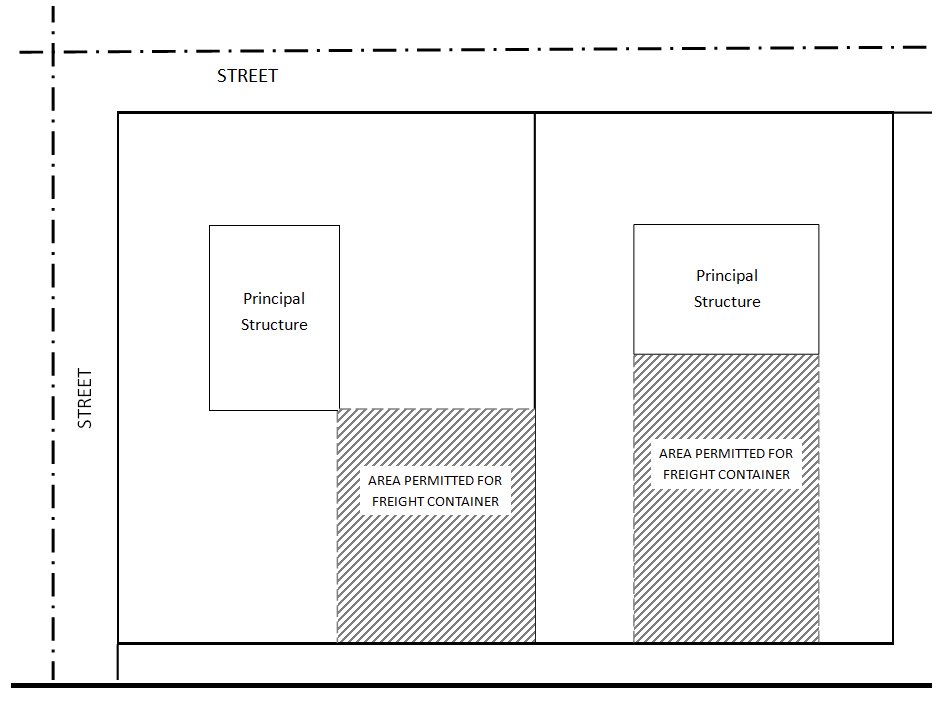
3.
If visible from a right-of-way or non-industrial-zoned properties, shall be clad with architecturally compatible materials or fully screened by an opaque fence.
e.
Permanent shipping containers located on low-visibility industrial zoned properties are permitted, subject to the following requirements:
1.
Be located no closer to the right-of-way than the front edge of the principal structure;
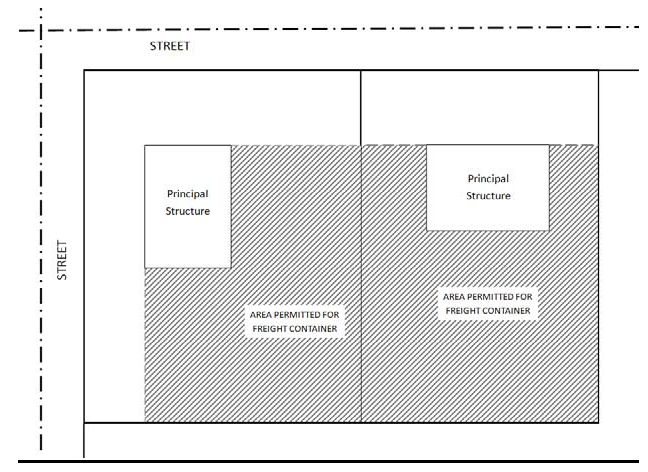
2.
Be painted to match the principal structure;
3.
Be screened fully so it is not visible from residential properties.
f.
The Administrative Official may waive or modify the requirements d. and e. above, for shipping containers in industrial zones, if the conditions required for a variance, according to Section 17-5-34(4), are met.
(12)
The Zoning Board of Appeals may only grant a variance, according to Section 17-5-34 of the Title, to the architectural compatibility requirement for the following:
1.
Greenhouse structures accessory to single family residential uses; or
2.
Agricultural buildings located on agriculturally zoned lots as long as the building color is similar to the principal structure.
(13)
The Administrative Official may waive the requirement of architectural compatibility for accent structures, such as pergolas, gazebos, canopies and other freestanding temporary structures which are not used for storage of any kind, so long as the structure is maintained in a manner that does not detract from the aesthetics of the property or neighborhood.
(d)
Exceptions from accessory building and structure provisions:
(1)
Uncovered accessory structures such as patios and decks fewer than thirty (30) inches in height from adjacent finished grade;
(2)
Swimming pools are not subject to the size limitations in Paragraph 17-4-23(c)(1) provided that no part of the structure is placed in front of the building setback established by the principal structure;
(3)
Removable playhouses and children's play equipment lower than eight (8) feet in height;
(4)
Detached accessory structures are allowed in side and rear yards, provided that:
a.
The projected roof area of the structure does not exceed seventy-five (75) square feet;
b.
The maximum height of the structure at the highest point does not exceed seven (7) feet;
c.
The structure is not placed on a permanent aggregate foundation; and
d.
No part of the structure may be placed in front of the building setback established by the location of the principal structure.
(5)
Prefabricated metal carports will be allowed on a single-family residential lot, provided that the following conditions are met:
a.
The property contains a single-family residence that does not have an attached or detached garage, carport, carriage house or similar parking structure;
b.
The lot is located in a subdivision created before February 1, 1972;
c.
The structure is maintained in a manner that does not detract from the aesthetics of the neighborhood;
d.
The carport is built behind the principal structure and not in any setbacks; and
e.
If the property owner later applies for a building permit to construct any accessory structure, the prefabricated metal carport shall be removed from the property before such permit is issued.
(e)
Appeal procedures; variances. To obtain a variance from the requirements of this Section, the property owner must prove that a variance is needed to avoid unnecessary hardship and will not undermine the purpose and intent of the zoning ordinances. The alleged hardship cannot be self-imposed and must be of a type unique to the property owner; that is, a hardship not generally shared by other property owners in the zone district.
(1957 Code, App. A §6(3); Ord. No. 3611, 10-9-72; Ord. No. 5234, 6-24-85; Ord. No. 6990 §1, 5-12-03; Ord. No. 7285 §1, 4-11-05; Ord. No. 7599 §1, 6-11-07; Ord. No. 8422 §1, 12-12-11; Ord. No. 8834 §1, 1-26-15; Ord. No. 9380 §2, 11-26-18; Ord. No. 9394 §1, 12-26-18; Ord. No. 9469 §6, 5-28-19; Ord. No. 11022 §2, 8-25-25; Ord. No. 11043 §1, 9-22-25; Ord. No. 11082, §3, 11-24-25)
Sec. 17-4-24. - Erection of more than one principal structure on a lot.
(a)
In any nonresidential district, more than one (1) structure housing a permitted or permissible principal use may be erected on a single lot, provided that yard and other requirements of this Title shall be met for each structure as though it were on an individual lot.
(b)
In all residential zone districts, the number of structures erected on a single lot, provided that yard and other requirements of this Title shall be met for each structure as though it were on an individual lot, shall not be more than the number of dwelling units allowed in the zone district.
(1957 Code, App. A §6(4); Ord. No. 8933 §9, 11-23-15)
Sec. 17-4-25. - Exceptions to height regulations.
The height limitations contained in the Schedule of District Regulations do not apply to spires, belfries, cupolas, water tanks, ventilators, chimneys or other appurtenances usually required to be placed above the roof level and not intended for human occupancy, except as otherwise provided in S-2 districts. Towers (antenna) and antennas are subject to the specific height limitations and other restrictions set forth in Sections 17-4-61 through 17-4-69 of this Title. Wind turbines are subject to specific height limitations and other restrictions set forth in Section 17-4-72 of this Title.
(1957 Code, App. A §6(5); Ord. No. 6470, 8-23-99; Ord. No. 7975 §5, 2-23-09)
Sec. 17-4-26. - Structures to have access.
Every building hereafter erected or removed shall be on a lot adjacent to a public street, or with access to an approved private street, and all structures shall be so located on lots as to provide safe and convenient access for servicing, fire protection and required off-street parking.
(1957 Code, App. A §6(6))
Sec. 17-4-27. - Parking, storage or use of major recreational equipment.
For purposes of these regulations, major recreational equipment is defined as including boats and boat trailers, travel trailers, pick-up campers or coaches (designed to be mounted on automotive vehicles), motorized dwellings, tent trailers and the like, and cases or boxes used for transporting recreational equipment, whether occupied by such equipment or not. No major recreational equipment shall be parked or stored on any street or street right-of-way for any period of time other than for the loading or unloading thereof. No such equipment shall be stored on any lot in a residential district in such a manner as to impede visibility of pedestrian or vehicular traffic. No such equipment shall be used for living, sleeping or housekeeping purposes when parked or stored on a residential lot, or in any location not approved for such use.
(1957 Code, App. A, §6(7); Ord. No. 5771, 9-14-92)
Sec. 17-4-28. - Parking and storage of certain vehicles.
(a)
No inoperable vehicle, vehicle parts or accessories shall be stored or parked on any residentially zoned property other than in an enclosed accessory building. Collector's items and parts cars shall not be stored or parked on residentially zoned property other than in an enclosed accessory building or in an effectively screened outdoor storage area. Outdoor storage areas shall be kept and maintained free of weeds, trash and other objectionable items and in such a manner that the outdoor storage area, collector's items and parts cars do not constitute a health, safety or fire hazard. As used in this paragraph, unless the context otherwise requires:
(1)
Inoperable vehicle means a motor vehicle, trailer or tractor of any kind which meets any one (1) or more of the following conditions:
a.
Without current license plates;
b.
Apparently inoperable; or
c.
Extensively damaged, such damage including but not limited to broken window or windshield or both, or missing wheel, tire, motor or transmission.
The term inoperable vehicle does not include a registered and licensed or stickered collector's item kept by the owner on his or her private property for the purposes of maintenance, repair, restoration, rebuilding or renovation.
(2)
Outdoor storage area means an area in the rear yard of a collector's private property located outside rear and side yard setbacks which effectively screens collector's items and parts cars from public view by means of a solid fence, trees, shrubbery or other appropriate means.
(3)
Collector, collector's item and parts car shall have the same meanings as set forth in Section 42-12-101, C.R.S.
(4)
Accessory building means an enclosed building or structure meeting the requirements of Section 17-4-23.
(b)
No vehicle whose manufacturer's rated chassis or carrying capacity is greater than one (1) ton shall be parked, kept, stored or maintained on any public or private property in any residential zone district, or on any property zoned A-3 or A-4, except during the loading or unloading of such vehicle or while currently being used for on-site construction work. Such prohibited vehicles shall include, but not be limited to, commercial delivery trucks, commercial vehicle hauling trailers, flatbed trucks, dump trucks, stake-side trucks, semitrucks, semitractors, semitrailers, tow trucks, contractor equipment trucks and trailers, trash or refuse trucks, transit mix concrete trucks, tank trucks, tank trailers, school buses and other such vehicles. In addition, it shall be unlawful to store, park or maintain any farm or construction equipment in any residential zone district. Recreation vehicles, such as campers, travel trailers, motorhomes and boats, shall be regulated in accordance with Section 17-4-27 of this Code.
(c)
It shall be an affirmative defense to any alleged violation under this Section if it is established that such vehicle is actually used in conjunction with and in furtherance of a permitted use of the property under the zone district wherein the property is located.
(1957 Code, App. A, §6(8); Ord. No. 5014, 11-22-82; Ord. No. 5607, 6-25-90; Ord. No. 5855, 2-14-94)
Sec. 17-4-29. - Special area plans.
(a)
In any zone district after or in conjunction with approval of a subdivision plan, pursuant to Chapter 4, Title XII of this Code, for any contiguous land or land composed of two (2) or more contiguous parcels, a plan may be submitted to the Planning and Zoning Commission which proposes the unique development of such land or the rehabilitation or redevelopment of an existing area with unique planning, building or ownership techniques not adequately recognized by the terms of this Title for the zone district in which the land is located. A public hearing shall be held as required by Chapter 6 of this Title. If the Planning and Zoning Commission finds the following objectives and requirements can and will be satisfied, the Commission shall submit to The City Council its recommendation on the proposed development within thirty (30) days after the hearing is concluded. Such recommendation shall be to approve, approve with conditions or disapprove the plan.
(1)
If residential, the overall net density of the area so planned, exclusive of the street rights-of-way, shall not be greater than if each individual parcel were built upon with a lot size conforming to the requirements of the zone district.
(2)
The plan shall provide for the use and continuous maintenance of any remaining open space as well as only land common to all properties or controlled by a corporation or homeowners association composed of all present and future owners of all property within the proposed development and provision is made for the recording of such with each deed. Any land dedicated to public use and formally accepted by The City Council need not be maintained by such corporation or homeowners association.
(3)
The plan may provide for exceptions to minimum setback and lot width and depth requirements for each building if such can reasonably be made so that the public health, safety and general welfare will be protected.
(4)
The plan shall provide that all setbacks on the periphery of the area shall not be less than those required for the zone district in which the building complex is located; provided, however, that front setback requirements on interior streets or service drives may be changed.
(5)
The plan shall be in accordance with the City's Comprehensive Land Use Plan and shall provide appropriate conditions and safeguards in harmony with the general purpose and intent of this Title.
(6)
The plan shall provide the area property with adequate access to transportation, water supply, waste disposal, fire and police protection, and other needed public facilities and services in accordance with the approved subdivision plat.
(7)
The street plan shall be in conformity with the most recently adopted major street plan known as the Pueblo Area Transportation System Plan. The street plan, including interior circulation for the special area plan, shall be designed so that no undue traffic congestion or unnecessary traffic hazards will be created in the special area plan or in any adjoining neighborhood.
(8)
The plan shall provide traffic accessways, interior circulation ways and parking and loading spaces as required for the zone district in which the land is located.
(9)
The plan shall be designed so that there will not be a substantially adverse effect upon the character of the neighborhood or upon adjacent property or property values in the area.
(10)
The plan shall incorporate adequate safeguards, including but not limited to, screening, fences and landscaping to protect and maintain harmony with the surrounding area.
(11)
After review of the plan by the Planning and Zoning Commission and final approval of the plan and subdivision plat by the City Council, building permits may be issued. No subsequent major change in the plan may be made unless prior approval is granted by the Commission and the City Council after a public hearing. Subsequent minor changes may be made by the Commission without a public hearing. No changes which would be incompatible with the subdivision plat upon which the Special Area Plan is located may be granted unless approved by the City Council.
(12)
Twelve (12) copies of the proposed plan shall be submitted to the Subdivision Review Committee, as defined in Section 12-4-3(10) of this Code, not less than fourteen (14) days prior to the time the Planning and Zoning Commission will schedule a public hearing on the plan. Said Committee shall submit its recommendations to the Planning and Zoning Commission at the public hearing on the plan.
(13)
The plan shall provide the development sequence of the land within the plan if development is to be done in phases. Subdivision plats shall be submitted for the land proposed to be developed in the same development sequence.
(14)
The plan shall provide the location and dimensions of all existing and proposed buildings, structures, rights-of-way, easements and improvements.
(15)
The applicant seeking review of a Special Area Plan by the Planning and Zoning Commission shall deposit with the Finance Department a nonrefundable application fee as adopted by resolution.
(b)
The above provisions are specifically intended to facilitate and encourage unique or inventive development ideas such as cluster plans, variable density arrangements, condominium arrangements, cluster housing and townhouses, garden apartments, shopping centers, industrial parks, common grounds and facilities.
(1957 Code, App. A, §6(9); Ord. No. 3860, 5-13-74; Ord. No. 4221, 8-9-76; Ord. No. 4702, 1-28-80; Ord. No. 5470, 4-25-88; Ord. No. 11053, §2, 10-14-25)
Sec. 17-4-30. - Public utilities.
(a)
For purposes of all districts, a public utility is defined to be a water, irrigation, sewer, gas, electric, telephone, bus, taxi, ambulance or railroad system or installation which serves five (5) or more customers, whether or not it is franchised or organized as a corporation or district. Public utility installations shall be subject to the following requirements:
(1)
Subject to compliance with all requirements of any applicable franchise and as otherwise provided herein, utility distribution, transmission and service lines and routes requiring simple easements or installation in public rights-of-way or installed under franchise agreement with the City and/or County and usual customer service lines shall not be subject to zoning requirements. Overhead electrical feeder lines shall not be constructed unless a special use permit has been approved by the Planning and Zoning Commission. Approval or denial of a special use permit by the Planning and Zoning Commission shall be made after notice and a public hearing has been held in the manner required for a zoning map amendment. In determining whether to approve or deny a special use permit to place an overhead electrical feeder line above ground, the Planning and Zoning Commission shall consider the following criteria:
a.
The general policy of the City that all new and relocated utility lines be placed underground wherever possible;
b.
Whether the overhead electrical feeder line is compatible with the surrounding area;
c.
Whether the overhead electrical feeder line is in harmony with the character of the surrounding area;
d.
The effect of the overhead electrical feeder line upon the immediate area;
e.
The effect of the overhead electrical feeder line upon the future development of the area;
f.
Whether the land surrounding the overhead electrical feeder line route can be reasonable planned in coordination with the public utility;
g.
Whether adequate open space and visual corridors will be preserved; and
h.
Whether there are reasonably available and economically feasible alternatives for the public utility or property owner.
(2)
Utility service facilities, the major use of which involves either office, manufacturing, warehousing, retailing, vehicle storage or maintenance functions, shall be constructed only in those zone districts in which a private firm not in the utility business would be permitted to establish a similar function or use.
(3)
Special utility facilities, such as water reservoirs, sewage lagoons, switching yards, pumping stations and other component equipment installations on land owned or leased and where the equipment is fenced or placed in a building shall not be constructed until a special use permit has been issued by the Zoning Board of Appeals.
(4)
These regulations shall in no way prohibit the installation of temporary facilities of the types described in Subsections (2) and (3) above in cases of emergency conditions, provided that, within a reasonable period of time, application is made for approval of installation of permanent facilities.
(b)
Neither wireless telecommunications providers, nor the towers, antennas or other facilities used by wireless telecommunications providers, shall be considered as a public utility for purposes of this Title.
(c)
Neither emergency standby engines or emergency generators, nor any use thereof, shall be considered as a public utility or public utility installation for purposes of this Title.
(d)
Alternative means of energy production, including solar panels and wind turbines, located upon individual lots or properties and used to produce power consumed, in whole or part, upon such lots or properties, shall not be considered public utilities or public utility installation for purposes of this Title.
(1957 Code, App. A, §6(10); Ord. No. 6470, 8-23-99; Ord. No. 6504, 1-24-00; Ord. No. 7560 §3, 1-8-07; Ord. No. 7975 §6, 2-23-09)
Sec. 17-4-31. - Projections and encroachments into yards.
Except for the following specified projections and encroachments, yards and courts shall be open and unobstructed to the sky:
(1)
Cornices and eaves. Cornices and eaves may project not more than twenty-four (24) inches into any required yard.
(2)
Ornaments, belt courses, etc. Sills, leaders, belt courses and similar ornamental features may project not more than six (6) inches into the required yard.
(3)
Bay windows, oriels, balconies. A bay window, oriel or balcony which is not more than eight (8) feet in width, and the lowest part of which shall be not less than eight (8) feet above grade, may project into any required front or rear yard by not more than thirty (30) inches.
(4)
Chimneys. Chimneys of no more than six (6) feet in length may project into the front, side or rear setbacks not more than two (2) feet, provided that the width of the required setback is not reduced to less than three (3) feet.
(5)
Encroachment into front yard setbacks. A new principal structure, or an addition to an existing principal structure, may encroach into the required front yard setback up to the average existing front yard setback of the existing principal structures on adjacent lots on the same street frontage. If there are no existing principal structures on adjacent lots, no encroachment shall be made into the front yard setback. An addition to an existing principal structure may also encroach into the required front yard setback, provided that it does not exceed the front yard setback of the existing principal structure. No existing driveway shall be reduced in length below eighteen (18) feet as provided in Section 17-4-44(c).
(6)
Awnings meeting and complying with the provisions of Section 17-4-33.
(1957 Code, App. A, §6(11); Ord. No. 4345, 6-27-77; Ord. No. 6990 §2, 5-12-03; Ord. No. 7091 §2, 12-22-03)
Sec. 17-4-32. - Temporary and interim uses.
(a)
Uses authorized. Upon satisfaction of the requirements of this Section, the Director of Finance may issue a temporary use permit for any activity, occupation or business which is permitted in the zone district wherein the use is sought to be conducted, provided that such temporary use does not exceed thirty (30) days in any calendar year. Upon issuance of an interim use permit by the Administrative Official, as authorized below, the Director of Finance may issue a temporary use for a period to exceed thirty (30) days in any calendar year. The Administrative Official shall only issue an interim use permit upon satisfaction of the requirements of subsection (e) below.
(b)
Application. A written application for a temporary use permit shall be submitted to the Director of Finance containing the following information:
(1)
The applicant's name and address and the name and address of any person, firm or corporation represented by such applicant in the application.
(2)
The interest of the applicant and the interest of the person, firm or corporation represented by the applicant, be it legal, sales, development, operation or other interest.
(3)
The nature of the temporary use, the street address, legal description and property owner of the property for which the temporary use permit is requested.
(4)
A brief statement of facts which the applicant believes justifies the temporary use permit.
(5)
A plat drawn to scale showing the dimensions of the property and the location of improvements with respect to property lines for which the temporary use permit is requested.
(6)
The Administrative Official, or his or her designee, shall verify the proposed temporary use is permitted in the zone district where the use is sought to be conducted, and verify authorization by the property owner to conduct the proposed use on his or her property.
(c)
Issuance of permit. After consultation with or inspection by the appropriate representatives of the Police, Fire and Southern Colorado Building Departments, and after any other necessary permits are obtained, the Director of Finance may issue a nontransferable temporary use permit to the applicant, provided that it is determined that no danger to the health, safety or welfare of the public is presented.
(d)
Permit fee. Each applicant for a temporary use permit shall submit with the application a permit fee of one hundred dollars ($100.00), seventy-five dollars ($75.00) of which shall be refundable at the conclusion of the proposed activity; provided, however, that all appropriate sales tax is paid to the City and the property is cleaned of all trash, garbage, debris or temporary buildings and structures attributable to the proposed activity. All clean-up costs shall be deducted from the amount to be refunded.
(e)
Interim use permit. The Administrative Official may issue an Interim Use Permit upon satisfaction of all of the requirements below:
(1)
The use shall not be operated from a truck, trailer, or other vehicle with motive power, wheels and/or axels, nor shall the structure be placed on a permanent foundation.
(2)
The use shall only be permitted for a period of two (2) years, with the ability of the Administrative Official to grant one (1) extension, not to exceed a total of three (3) years.
(3)
The structure may not be connected to permanent utilities, except power.
(4)
The Department of Transportation shall review and approve all requests for a drive-thru, or for the removal of any parking spaces. In addition, they may require the installation of handicap parking spaces.
(5)
The applicant shall execute an agreement with the Administrative Official, which states all conditions of approval as well as the length of time the permit is issued.
(6)
Upon expiration of the interim use permit, the applicant must remove the structure, or bring the site into compliance with all applicable codes current at the time of expiration of the interim use permit. This shall include, but not be limited to, parking, stormwater improvements, public improvements, and landscaping for the parcel from which the use is operated.
(7)
The Administrative Official may include additional conditions of approval as may be appropriate to protect the health, safety and welfare of the general public.
(Ord. No. 5102, 12-12-83; Ord. No. 8748 §1, 6-23-14; Ord. No. 11082, §3, 11-24-25)
Sec. 17-4-33. - Awning standards for awnings projecting over public property.
(a)
Definitions.
(1)
Awning means a hood or cover that projects from the wall of a building, which is entirely supported by the exterior wall. An awning may be set in place or retractable.
(2)
Internally illuminated means any awning illuminated from a light source within the awning or its structure.
(b)
Permitted Awnings. No awning shall be erected, enlarged or moved unless it complies with the requirements of this Section and conforms to the zone district regulations where the awning is to be located.
(1)
Support. All awnings shall be securely attached to and supported by a building and must have no posts or columns which extend beyond any setback line.
(2)
Height. All awnings shall be constructed so that the lowest portion of any awning frame must be at least eight (8) feet above the level of any private or public sidewalk. Awnings over driveways or alleys must have a minimum clearance of fifteen (15) feet six (6) inches.
(3)
Obstruction. No awning shall be installed to hinder or prevent a clear and unobstructed view of all traffic control devices and all official public and traffic signs. Except as otherwise permitted by this Section, no awning shall be placed within the clear sight triangle, as defined by this Code.
(4)
Signs. Signs or advertising on awnings shall be limited to the restrictions of the zone district where the awning is located. Addresses on awnings will not be considered as signage.
(5)
Illumination. Awnings not meeting the following standards must have prior approval by the Zoning Board of Appeals as a use by review:
a.
Fluorescent fixtures affixed to the building or frame and contained entirely within the frame of the awning; and
b.
Clear awning fabric is not allowed.
(6)
Appearance. The size, location, design, texture, color and materials of all awnings shall neither detract from the use and enjoyment of the building and the surrounding properties, nor violate performance standards of any applicable zone district.
(c)
Public Right-of-Way. No awning shall project or extend into any public right-of-way, except that the Administrative Official may issue a permit for temporary placement of an awning over public sidewalks or alleys. An application for such permit, together with the fee therefor, shall be filed on approved forms with the Administrative Official. No permit shall authorize any awning to project or extend more than three-quarters (¾) of the width of a sidewalk, five (5) feet into an alley or be located nearer than two (2) feet from the edge of any curb line. Each permittee shall (1) indemnify and hold harmless the City, its officers and employees from all damage, liability or expense resulting from or arising, directly or indirectly, out of the issuance of the permit or the installation and maintenance of the awning, (2) maintain and keep in force commercial general liability insurance with combined single limits of not less than six hundred thousand dollars ($600,000.00) per occurrence naming the City as an additional insured, and (3) deliver a certificate of such insurance to the Administrative Official at the time of filing the application and annually thereafter. A permit shall automatically terminate if the required certificates of insurance are not delivered to the Administrative Official.
(d)
Appeals. Any person, firm or corporation aggrieved by any permit denial or decision of the Administrative Official concerning awning regulations may appeal and seek review of such decision to the Zoning Board of Appeals, provided that such appeal is timely and properly filed.
(e)
Maintenance. All awnings shall be maintained in a manner to prevent them from being a hazard to the public. Subject to Subsection (d) above, the Administrative Official shall have the authority to order the owner or building tenant of the awning to remove any awning which does not comply with the provisions of this Section and to remove, repair or replace any damaged or unsafe awning.
(Ord. No. 7091 §1, 12-22-03)
Sec. 17-4-41. - Off-street loading.
All buildings hereinafter constructed for nonresidential use shall provide at least one (1) accessible off-street loading space, at least ten (10) feet wide, fifty (50) feet long and fourteen (14) feet high, except in B-1 Districts where such space shall be at least thirty (30) feet long, for up to twenty-five thousand (25,000) square feet of gross square feet of floor area; one (1) additional space for the next twenty-five thousand (25,000) square feet of floor area; one (1) additional space for each of the next two (2) increments of fifty thousand (50,000) square feet, and one (1) additional space for each additional increment of up to one hundred thousand (100,000) square feet of floor area. The City Traffic Engineer may grant an exemption from this Section for a building constructed in a business district where alleys are available for loading and unloading or the proposed use does not warrant an off-street loading space. Uses that may be considered for exemption include, but are not limited to, professional offices, lodging, and commercial services.
(1957 Code, App. A, §7(1); Ord. No. 9190 §1, 10-23-17)
Sec. 17-4-42. - Off-street parking residential.
(a)
Each one-family or two-family residence constructed or relocated after the effective date of the ordinance from which this provision is derived shall provide on the building site at least one (1) accessible and usable off-street parking space for each dwelling unit, unless additional off-street parking spaces are required by the Roadway Classification Design Standards and Policies. Said parking space may be open or covered; however, no portion of the building site which is required for front or side yard setbacks shall be used as a part of the required off-street parking spaces. The parking space shall be permanent in character, shall be provided with a permanent driveway to a public or private right-of-way, and both the parking space and the driveway shall be paved with asphalt concrete, Portland cement concrete, pavers or equivalent material. Any addition more than five hundred (500) gross square feet in living spaces or the construction or expansion of a covered parking area, regardless of square footage, may require public improvements including concrete or asphalt paving, curb and gutter, sidewalk and driveway in the public right-of-way. Public improvements associated with a covered parking area shall be only the improvements which provide access from the street to the garage. When a building permit is issued, the applicant shall deposit with the City fifty percent (50%) of the value of the public improvements. A deposit will be reimbursed upon acceptance of the completed public improvements. The Director of Public Works may modify installing any or all public improvements if existing conditions, neighborhood pattern, or the proximity of construction to public facilities warrant modification.
(1)
Exceptions.
a.
No off-street parking shall be required for residential adaptive re-use development within those areas designated by statute and identified by the HB24-1304 Minimum Parking Requirements Map maintained by the Colorado Department of Local Affairs. For the purposes of this Section, adaptive re-use means the conversion of an existing structure from the use for which it was constructed to a new use by maintaining elements of the structure and adapting such elements to a new use.
(b)
Multifamily residences hereafter constructed or relocated shall provide on the building site at least one and one-half (1½) accessible and usable off-street parking spaces for each dwelling unit. Said parking spaces may be located on any portion of the building site, shall be permanent in character, shall be provided with a permanent driveway to a public or private right-of-way, and both the parking spaces and driveway shall be paved with asphalt concrete, Portland cement concrete, pavers, or equivalent materials.
(1)
Exceptions.
a.
Multifamily residences which are specifically designed and occupied exclusively by persons sixty (60) years of age or older or handicapped, and which are wholly or partially financially supported by public funds or a nonprofit tax-exempt institution, shall provide on the building site at least three-fourths (¾) of an accessible and usable off-street parking space for each dwelling unit.
b.
No off-street parking shall be required for multifamily residential adaptive reuse development within those areas designated by statute and identified by the HB24-1304 Minimum Parking Requirements Map maintained by the Colorado Department of Local Affairs. For the purposes of this section, adaptive re-use means the conversion of an existing structure from the use for which it was constructed to a new use by maintaining elements of the structure and adapting such elements to a new use.
c.
No off-street parking shall be required for newly constructed multifamily development within those areas designated by statute and identified by the HB241304 Minimum Parking Requirements Map maintained by the Colorado Department of Local Affairs, unless the following requirements are met, in which case one parking space per dwelling unit shall be provided.
1.
The multifamily development is a new development project containing twenty (20) or more dwelling units, or contains regulated affordable housing as defined in C.R.S. 29-36-102.
2.
Within nintey (90) days after receipt of a complete application for the proposed multifamily development, the City has published, in a daily newspaper of wide distribution and general circulation, written findings that not imposing or enforcing a minimum parking standard in connection with the proposed multifamily development would have substantial negative impact on:
a.
Safe pedestrian, bicycle, or emergency access to the multifamily development, or;
b.
Existing on-or off-street parking spaces within one-eighth mile of the multifamily development.
3.
The findings required in Subsection (2) must:
a.
Be supported by substantial evidence in support of such findings;
b.
Include parking utilization data collected from the area within one-eighth mile of the multifamily development;
c.
Demonstrate that the City's implementation of strategies to manage demand for on-street parking in the area within one-eighth mile of the multifamily development would not be effective to mitigate the substantial negative impacts contained in such findings; and
d.
Have been reviewed and approved by a professional engineer, as defined in C.R.S. 12-120-202(7).
(1957 Code, App. A, §7(2); Ord. No. 5015, 11-22-82; Ord. No. 6940 §1, 1-27-03; Ord. No. 9190 §2, 10-23-17; Ord. No. 11070, §1, 11-10-25)
Sec. 17-4-43. - Off-street parking nonresidential.
(a)
Application. The off-street parking requirements herein contained shall apply only to buildings and uses newly constructed, moved, extended or enlarged by more than ten thousand (10,000) square feet of gross floor area, not to exceed one hundred percent (100%) of an existing structure in I-2 and I-3 zones, and one thousand (1,000) square feet of gross floor area not to exceed one hundred percent (100%) of existing structure in all other zone districts, and shall not apply to buildings lawfully repaired or improved where no increase of floor area is made. The regulations in this Section shall apply to all parking spaces, lots, garages, buildings or portions thereof to be provided in meeting the requirements of this Section. The addition of an adjacent building, whether attached or detached, shall constitute an increase in floor space and shall be included in any calculation of area to meet the requirements of this Section. Additional increases in floor area, based on the above zone districts, shall be a maximum allowable limit of expansion whether cumulative or not based on structure size after 2017. All required parking spaces shall be permanent in character and provided with a permanent driveway to a public way. The driveway and parking spaces shall be paved with asphalt, concrete, Portland cement concrete or pavers.
(b)
Required number of parking spaces.
(1)
The number of parking spaces required for any governmentally owned facility in an S-1 zone shall be determined by the Planning and Zoning Commission. In determining the required number of spaces, the Commission, in addition to other relevant factors, shall consider the following:
a.
The general planning of the City with respect to land use, density, parking, traffic and off-street parking facilities;
b.
The availability of adequate off-street parking, both in number of spaces and distance from the intended use;
c.
The public welfare and interests of the City and surrounding area; and,
d.
The number of spaces that would be required for the particular use if the land were not zoned S-1.
(2)
Professional or medical offices and medical or dental clinics shall be provided with at least five (5) parking spaces, plus one (1) additional parking space for each two hundred fifty (250) square feet of gross floor area in excess of one thousand two hundred fifty (1,250) square feet.
(3)
Day care centers shall be provided with one (1) parking space per employee on the largest shift, plus two (2) parking spaces for the first ten (10) children, plus one (1) parking space for every ten (10) additional children or fraction thereof.
(4)
Retail uses in O-1, B-1, B-2 and BP zone districts shall be provided with at least ten (10) parking spaces, plus one (1) additional parking space for each two hundred (200) square feet of gross floor area in excess of two thousand (2,000) square feet.
(5)
Retail uses in B-3, R-5, R-6, I-2 and I-3 zone districts shall be provided with at least ten (10) parking spaces, plus one (1) additional parking space for each two hundred fifty (250) square feet of gross floor area in excess of two thousand five hundred (2,500) square feet.
(6)
Retail uses in B-4, CCN, and H.B. zone districts shall be provided with at least one (1) parking space for each three hundred (300) square feet of gross floor area.
(7)
Restaurants, bars and night clubs shall be provided with at least one (1) parking space for each three (3) persons of rated occupancy load as established by the Uniform Building Code, as amended and adopted by the City.
(8)
Hotels and motels shall be provided with at least one (1) parking space for each rental unit, plus two (2) additional parking spaces for the owner or manager.
(9)
Hospitals shall be provided with at least one (1) parking space for every three (3) approved beds, plus one (1) parking space for every two (2) employees anticipated to be employed on the largest shift, plus one (1) parking space for each staff physician on the largest shift.
(10)
Senior housing and independent living shall be provided with one and one-half (1½) parking space per dwelling unit. Senior means a person over sixty (60) years of age.
(11)
Assisted living, nursing homes, skilled nursing, hospice, or memory care housing shall be provided with one (1) parking space for every three (3) approved or Colorado licensed beds.
(12)
Private places of assembly such as theaters, auditoriums and school or seminar rooms shall be provided with at least one (1) parking space for every four (4) seats. Twenty (20) inches of undivided seating shall constitute one (1) seat.
(13)
Institutional uses such as schools and religious institutions shall be provided with at least one (1) parking space for every four (4) adults expected to be present in the building at the time of maximum occupancy. Off-street space shall be required, if necessary, for the safe and convenient loading and unloading of students.
(14)
Wholesale, warehouse, industrial and manufacturing uses shall provide one (1) parking space for each two hundred fifty (250) gross square feet of office and retail area, plus one (1) additional parking space for each eight hundred (800) gross square feet of floor area.
(15)
Self storage facilities shall provide at least three (3) parking spaces for an office or caretakers unit, if on site.
(16)
Auto dealerships shall provide at least one (1) parking space for each four hundred fifty (450) gross square feet of floor area. This includes the showroom, office, service area and parts storage areas.
(17)
Other uses. In the case of a use not specifically mentioned the requirement for off-street parking facilities for a use which is mentioned and to which such use is similar shall apply, if no similar use exists, or the parking data indicates the required parking ratios do not accurately apply to a specific use, the parking requirement shall be based on the rate of one (1) parking space for each four (4) occupants of the facility or as determined by a parking code study to be conducted by the applicant and approved by the City Traffic Engineer.
(18)
Mixed uses. In the case of mixed uses within the same building or structure, the requirements for off-street parking facilities shall be the sum of the requirements for each use based upon the area occupied by the individual use.
(c)
Required number of bicycle parking spaces. Bicycle parking shall be provided for institutional, commercial and multi-family zone districts. For automobile parking areas providing twenty (20) or more parking spaces, a minimum number of bicycle parking spaces equivalent to five percent (5%) of the total number of automobile parking spaces shall be provided. Parking areas with fewer than twenty (20) automobile parking spaces will be encouraged but not required to provide bicycle parking.
(1957 Code, §7(3); Ord. No. 3842, 4-8-74; Ord. No. 3867, 5-27-74; Ord. No. 4866, 4-27-81; Ord. No. 5015, 11-22-82; Ord. No. 5469, 4-25-88; Ord. No. 6630, 12-26-00; Ord. No. 6980, 4-28-03; Ord. No. 7435, 1-9-06; Ord. No. 7659 §6, 9-10-07; Ord. No. 8115 §1, 11-23-09; Ord. No. 8933 §10, 11-23-15; Ord. No. 9190 §3, 10-23-17; Ord. No. 9525 §3, 8-26-19)
Sec. 17-4-44. - Off-street parking general requirements.
(a)
Variances.
(1)
In the event these off-street parking requirements do not appear reasonable when applied to a specific use or combination of uses, the City Traffic Engineer or the applicant may apply to the Zoning Board of Appeals for a variance, but, unless otherwise permitted, the variance may not reduce or increase the required number of spaces by more than fifty percent (50%), unless the property is located within the City of Pueblo's Established Development Boundary, as adopted by City Council Resolution. Properties located within the City's Established Development Boundary, may apply for a variance up to one hundred percent (100%) of the required off-street parking requirements. The Zoning Board of Appeals may grant a variance to the minimum parking requirements if the applicant demonstrates that the project will not generate additional parking or traffic demands, or increase the rated occupancy load. Applicant must also prove that parking demand can be met with an existing parking availability to include public or private parking facilities; or that the proximity of transit services, bicycle facilities, or pedestrian demand as a neighborhood service do not warrant strict adherence to the required off-street parking requirements for the zone district and proposed use.
(2)
The Zoning Board of Appeals may grant a variance up to one hundred percent (100%) of the off-street parking requirements for any building in the Historic Business Zone District. In granting the variance, the Zoning Board of Appeals shall only grant the minimum amount of variance necessary and the applicant must demonstrate that legal off-street parking spaces cannot otherwise be provided.
(b)
Plan of Parking Area. Whenever parking is required, provided, changed or redesigned, plans must be submitted to the City Traffic Engineer to show how the required parking spaces shall be arranged in the area supplied for that purpose and to indicate sufficient space for turning maneuvers, as well as adequate ingress and egress to the parking area.
(c)
Design Standards. The design standards are controlled by parking regulations of this Title. The number and location of access entrances and all curb cuts shall be limited and subject to the requirements of this Title and approval by the City Traffic Engineer. Parking standards, including parking angles and space dimensions, that must be complied with are set forth in Section 17-4-45 of this Chapter. Except for compact cars and handicapped parking spaces, all angle parking spaces shall be a minimum of nine (9) feet by eighteen (18) feet in size. Each parallel parking space shall be a minimum of eight (8) feet by twenty-two (22) feet in size. All traffic control devices, pavement markings, and signs shall comply with the latest edition of the Manual on Uniform Traffic Control Devices.
(d)
Compact Car Spaces. Up to thirty percent (30%) of all required parking spaces may be designated as compact car spaces. The required dimensions of a compact car space may be a minimum of eight and one-half (8½) feet by sixteen (16) feet for angle and eight (8) feet by twenty (20) feet for parallel spaces. These spaces shall be permanently designated by signs or by pavement markings. For purposes of this Section, a compact car shall be considered one which has a maximum wheel base of one hundred six (106) inches.
(e)
Handicapped Parking. All parking facilities shall comply with the Code of Federal Regulations 28 C.F.R. Part 36 as published by the Department of Justice and the Americans with Disabilities Act Accessibility Guidelines for Facilities and Buildings (ADAAG).
(1)
Required number of parking spaces. Except as noted, the required number of accessible spaces is:
Exceptions:
a.
For hospital outpatient facilities and treatment facilities, ten percent (10%) of the total spaces shall be handicap accessible. Doctors' offices, independent clinics or other facilities not located in hospitals are not considered hospital outpatient facilities with respect to the ADAAG guidelines.
b.
At units or facilities that specialize in physical therapy or provide services for persons with mobility impairments, twenty percent (20%) of the total number of spaces shall be accessible.
(2)
Minimum handicapped parking space dimensions shall be as follows:
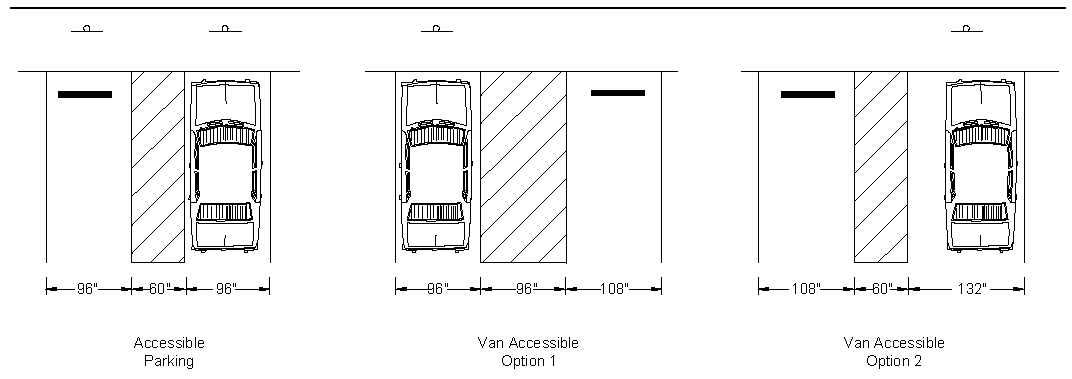
_____
(3)
Parking and Passenger Loading Zones.
a.
Location. Accessible parking spaces required at a particular building shall be located on the shortest accessible route of travel from adjacent parking to an accessible building entrance. In parking facilities that do not serve a particular building, accessible parking shall be located on the shortest accessible route of travel to an accessible pedestrian entrance of the parking facility. In buildings with multiple accessible entrances with adjacent parking, accessible parking spaces shall be dispersed and located closest to the accessible entrances. Access aisle serving the accessible parking spaces shall adjoin an accessible route.
b.
Parking Spaces and Access Aisle. Accessible parking spaces shall be at least ninety-six (96) inches (2,440 mm) wide. Parking access aisles shall be part of an accessible route to the building or facility entrance, shall not overlap the vehicular way and shall comply with ADAAG accessible route requirements. Two (2) accessible parking spaces may share a common access aisle (see Paragraph (2) above). Access aisles shall be permitted to be placed on either side of the parking space except for angled van parking spaces in which the access aisle shall be located on the passenger side of the parking space. Parked vehicle overhangs shall not reduce the clear width of an accessible route. Parking spaces and access aisles shall be level with surface slopes not exceeding 1:50 (2%) in all directions.
c.
Van Spaces. One (1) in every six (6) accessible spaces, but not less than one (1), shall be served by an access aisle ninety-six (96) inches (2,440 mm) wide, or shall have a parking space width of one hundred thirty-two (132) inches (3,350 mm) minimum (see Paragraph (2) above) and shall be designated "Van Accessible" by an additional sign mounted below the symbol of accessibility (see Figure below). The vertical clearance for such spaces shall comply with Subparagraph (3)e below. All such spaces may be grouped on one (1) level of a parking structure.
d.
Signage. Accessible parking spaces shall be designated as reserved by an official upright sign showing the symbol of accessibility. Spaces complying with Subparagraph (3)c above shall have an additional sign "Van Accessible" mounted below the symbol of accessibility. Such signs shall be located so they cannot be obscured by a vehicle parked in the space. The sign shall be an R7-8 and, if applicable, an R7-8p sign as described in the Manual on Uniform Traffic Control Devices (as shown below). The bumper stop or curb head shall be painted with the standard handicapped blue color. The painted handicapped symbol shall not be required; however, if the symbol is painted, it shall conform to the International Symbol of Accessibility Proportions, Subsection (4) below.
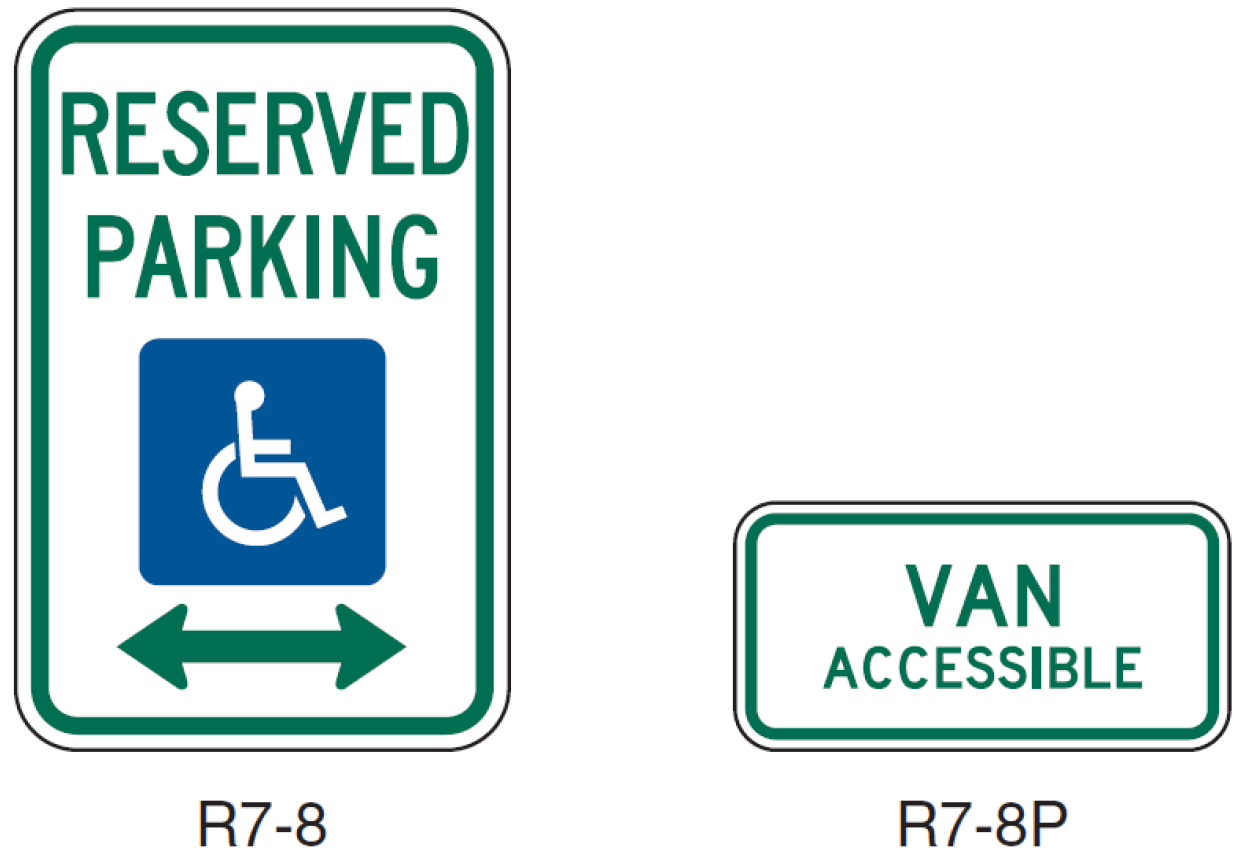
_____
e.
Vertical Clearance. Minimum vertical clearance of one hundred fourteen (114) inches (2,895 mm) at accessible passenger loading zones and along at least one (1) vehicle access route to such areas from site entrances and exits shall be provided. "Van Accessible" spaces shall be provided a minimum vertical clearance of ninety-eight (98) inches (2,490 mm) at the parking space and along at least one (1) vehicle access route to such spaces from site entrances and exits.
f.
Passenger Loading Zones. If provided, vehicle pull-up space shall be at least ninety-six (96) inches (2,440 mm) wide and twenty (20) feet (6,100 mm) in length; and passenger loading zones shall provide an access aisle parallel to the vehicle pull-up space, be at least sixty (60) inches (1,525 mm) wide and extend the full length of the pull-up spaces. Vehicle standing spaces and access aisles shall be level with surface slopes not exceeding 1:50 (2%) in all directions. At least one (1) passenger loading zone shall be provided at an accessible entrance to licensed medical care and licensed long-term care facilities where the period of stay exceeds twenty-four (24) hours.
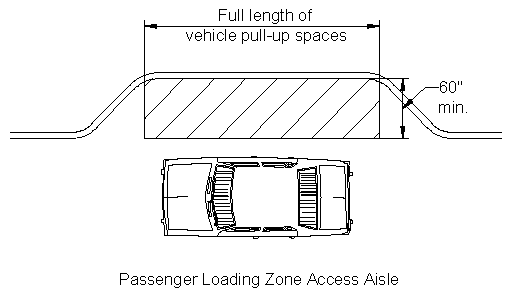
g.
Curb Ramps. Curb ramps shall be provided on accessible routes and shall meet the minimum requirements as follows:
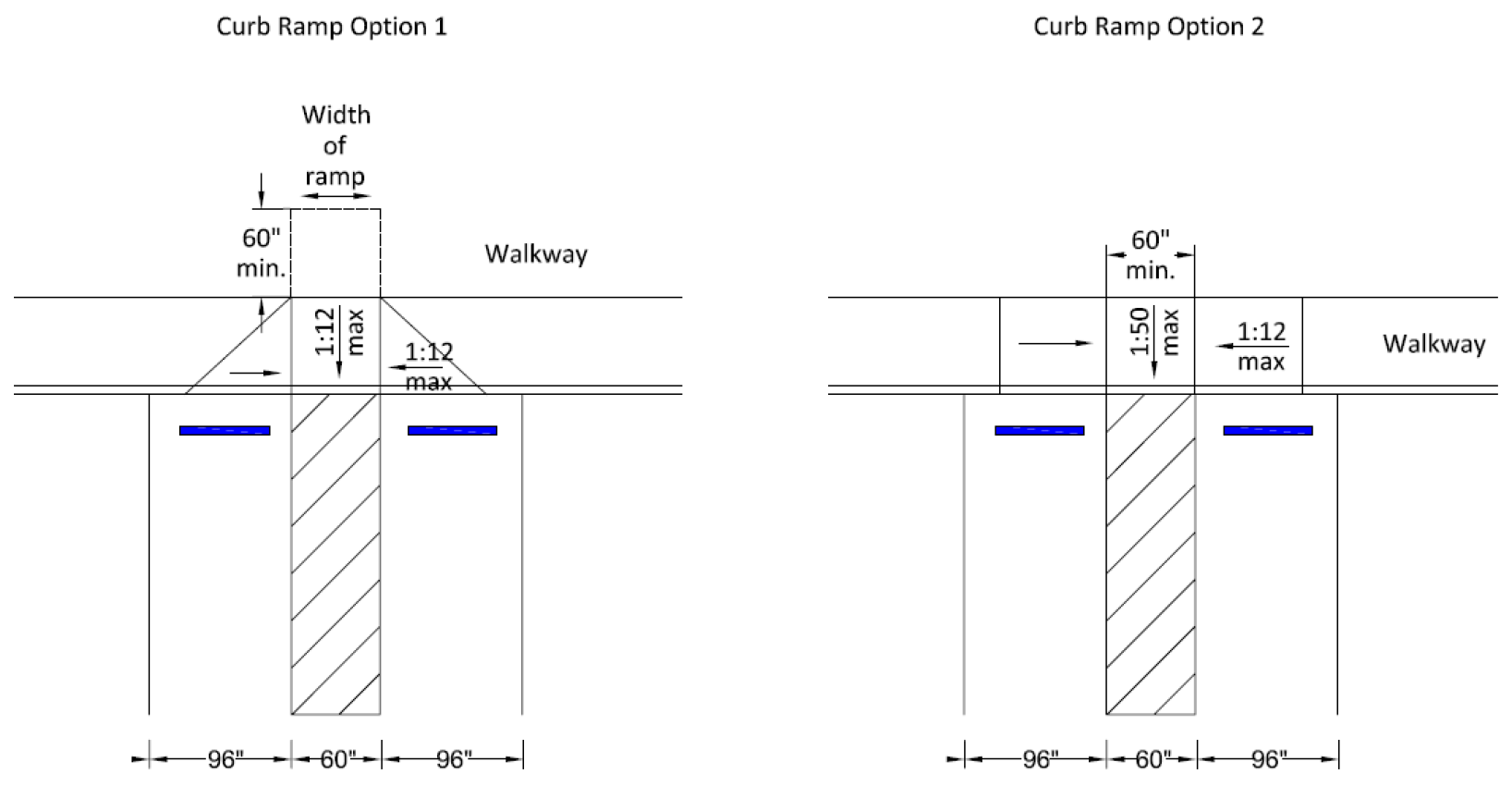
_____
(4)
The following International Symbol of Accessibility Proportions shall be used:
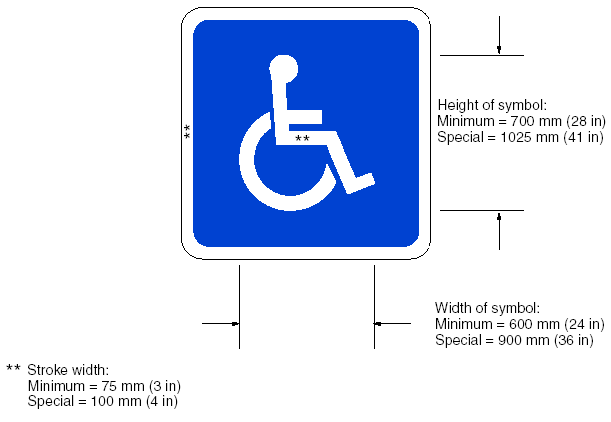
(f)
Location. Off-street parking, whether open or closed, shall be provided upon the same parcel of land containing the use for which it is required, or on separate parcels as follows:
(1)
Within a radius of one hundred (100) feet, excluding public ways in residential zone districts, except for single-family and two-family residential structures.
(2)
Within a radius of three hundred (300) feet, excluding public ways in all business, office and industrial districts.
(g)
Ownership. Except as provided in Subsections (l) and (m) below, parking areas which are to be located on separate lots shall be owned or leased by the person or entity required to provide off-street parking. Providing off-street parking shall be required to approve a use in a given location on an initial and continuing basis. Failure to continue to provide such parking shall constitute a violation of these zoning requirements and shall be grounds for the Director of the Department of Zoning Administration to revoke the certificate of occupancy for the property which use requires off-street parking to be provided.
(h)
Access-Minimum. Unobstructed and direct accessways (driveways) shall be provided to the parking area from a public street or alley. Driveways shall be approximately perpendicular to the street or alley and shall be located no closer than forty (40) feet from the nearest intersection except in severe hardship instances, subject to approval by the City Engineer. All curb cuts for driveways shall be approved by the City Engineer. Alley access must provide paving from the point of access to the nearest roadway and may also require improvements to the alley apron at the intersecting roadway as determined by the Director of Public Works.
(i)
Backing Across Right-of-Way Lines. No parking space shall be approved where the vehicle must back across any street right-of-way line except in single-family and two-family areas, or for any parking space that is blocked off by another vehicle. Backing across alley right-of-way lines is permitted for conforming parking spaces, with approval of the City Traffic Engineer.
(j)
Barriers. All parking aisles and parking spaces shall be within property lines and not on a public right-of-way. Parking spaces shall be arranged and physical barriers shall be erected so that no part of any vehicle will overhang on to the public right-of-way or adjacent properties.
(k)
Gates. Any gate constructed to control vehicular access, regardless of automation, shall open inward or slide parallel to the roadway, and shall be installed at least twenty (20) feet from the face of curb of the adjoining public or private roadway. Key pads may be installed in the public right-of-way if a revocable permit is issued.
(l)
Joint Use. Different portions of the same off-street parking lot or garage may be used by different adjacent or nearby uses for purposes of meeting these off-street parking requirements if located as required in Subsection (f) above; provided, however, that no off-street parking space required for any building or use for the purpose of complying with the provisions of this Section shall be included as an off-street parking space similarly required for another building or use, except as permitted in Subsection (n) below.
(m)
Multiple Use. The same space in an off-street parking lot or garage may be counted by other uses as meeting their individual parking requirements if those uses characteristically do not need the same spaces during the same hours of the day.
(n)
Proof of Compliance. Each applicant for a building permit or certificate of zoning compliance involving the provision of required parking spaces off the premises shall submit written proof of ownership of the land or building, or proof of contractual arrangements with the owner, which guarantees the continuous use of the required parking spaces for the particular uses intended. Guaranteed continuous use shall mean a bona fide written lease with a term not less than twenty (20) years. If such lease is terminated during the required term, such termination shall constitute grounds for the Director of the Department of Zoning Administration to revoke the certificate of occupancy for the property, which use requires off-street parking to be provided.
(o)
Drive-up Facilities. All drive-up facilities shall be designed in compliance with Section 17-4-51(e)(17) of this Code and shall be designed with adequate off-street vehicular storage space so that no vehicle will at any time be required to stop, stand or park in a public right-of-way.
(p)
Public Sidewalks and Improvements. Five-foot public sidewalks, as a minimum, shall be provided in all R-1, R-2, R-2U, R-3 and R-4 zone districts. Six-foot public sidewalks, as a minimum, shall be provided in all other zone districts. In areas of high pedestrian densities, the City Traffic Engineer may require wider sidewalks. Non-compliant or damaged public facilities including concrete or asphalt paving, curb and gutter, sidewalks, driveways, and curb ramps shall be removed and replaced and shall comply with Americans with Disabilities Act (ADA) Public Rights-of-Way Accessibility Guidelines published by the US Access Board.
(q)
Primary Pedestrian Connection. At least one (1) ADA accessible route shall be provided within the boundary of the site to the accessible building entrance from the following: public transportation stops if provided, accessible parking spaces, passenger loading zones if provided, and public sidewalks.
(1)
Accessible routes shall be a minimum of five (5) feet in width. Accessible routes parallel to a travel way which are not vertically separated shall be visually separated by white pavement markings.
(2)
Accessible routes may use parking lot landscape areas at the discretion of the Land Use Administrator.
(3)
Lots with multiple frontages shall provide at least one (1) accessible route to the street frontage where the main entrance faces. If the main entrance does not face a public or private roadway, the accessible route shall be made to either roadway.
(r)
Bicycle Parking. Bicycle parking facilities shall include provisions to store and lock bicycles, either in lockers or secure racks, or an equivalent installation for the user to lock the bicycle frame or wheels.
(1)
Bicycle parking areas shall be located in a highly visible area at the public entrance without interfering with pedestrian traffic.
(2)
Bicycle parking areas may also be located in landscape areas not to exceed forty (40) square feet.
(3)
The ground surface surrounding and beneath the bicycle storage facility shall be surfaced to prevent accumulation of mud and dust. Surfaces may include, but are not limited to, pavers, grass, gravel or concrete.
(4)
Trees, fences, light poles, benches, public art and other outdoor furnishing or improvements shall not be used as designated bicycle parking facilities.
(5)
Bicycle parking areas shall be provided on the same lot or parcel they serve.
(Ord. No. 5015, 11-22-82; Ord. No. 5469, 4-25-88; Ord. No. 5545, 6-26-89; Ord. No. 5593, 5-14-90; Ord. No. 5769, 8-24-92; Ord. No. 6324, 6-22-98; Ord. No. 7238 §1, 12-13-04; Ord. No. 7309 §3, 5-23-05; Ord. No. 8115 §2, 11-23-09; Ord. No. 8149 §1, 2-22-10; Ord. 8150 §3, 2-22-10; Ord. 8372 §1, 7-11-11; Ord. No. 8933 §11, 11-23-15; Ord. No. 9190 §4, 10-23-17; Ord. No. 11006 §1, 7-28-25)
Sec. 17-4-45. - Parking dimension standards.
The required parking standards, including parking angle and space dimensions referred to in Section 17-4-44(c), shall be as follows:
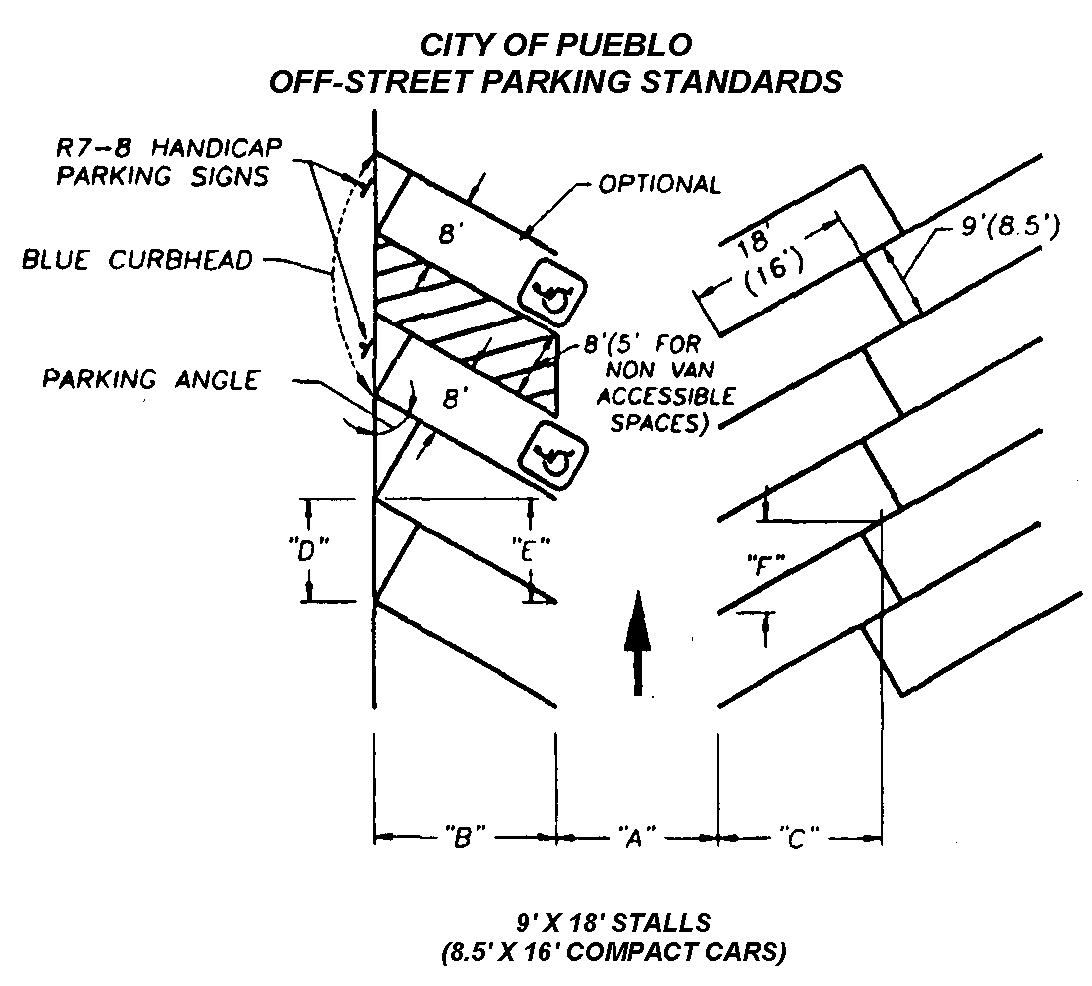
(Ord. No. 5015, 11-22-82; Ord. No. 5769, 8-24-92)
Sec. 17-4-46. - Large-scale development performance standards.
(a)
Intent. The intent of this Section is to encourage visual design interest and a pedestrian site design for large-scale buildings. These structures shall be designed to reduce the massive scale and uniform, monolithic appearances. Building design shall also promote a safe and comfortable pedestrian-oriented site with a mixture of uses and sizes of structures. Careful attention to local community design issues will also ensure a greater likelihood of reuse of the structure for subsequent tenants.
(b)
Overview. To further design excellence and creativity within the community, and to encourage an individual design, applicants for large scale development proposals shall maximize the overall design of the site and structures. Within the context of an individual design for Pueblo, three (3) design styles have historically been identified as part of Pueblo's historic and built environment: Mediterranean/Mission ("CF & I/Santa Fe Railroad influence"), Pueblo's National Park style, and the Pueblo or Adobe style. Therefore, the Administrative Official may allow minor changes in the design standards listed in this Section if the objectives of this Section continue to be adhered to in the overall development design. Appeals to the Planning and Zoning Commission concerning the interpretation or administration of this Section may be taken by any person aggrieved by any decision of the Administrative Official. Written notice of appeal specifying the grounds and reasons therefor shall be filed in the office of the Department of Land Use Administration within ten (10) days after the date of the decision being appealed; otherwise, the decision of the Administrative Official shall be final. The Planning and Zoning Commission shall fix a reasonable time for the hearing on appeal, give due notice of the hearing to interested parties at least five (5) working days before the hearing, and decide the appeal within a reasonable time. The decision of the Planning and Zoning Commission shall be final subject to judicial review under C.R.C.P. 106(a)(4).
(c)
Definitions.
(1)
Arcade means an area contiguous to a street or plaza that is open and unobstructed and accessible to the public at all times. Arcades may include building columns, landscaping, statuary and fountains. Arcades do not include off-street loading/unloading areas, driveways or parking areas.
(2)
Articulate means to give emphasis to or distinctly identify a particular element.
(3)
Building face, front means any building face or portions thereof that can be touched by a line drawn perpendicular to the street or as extended toward the building.
Figure 3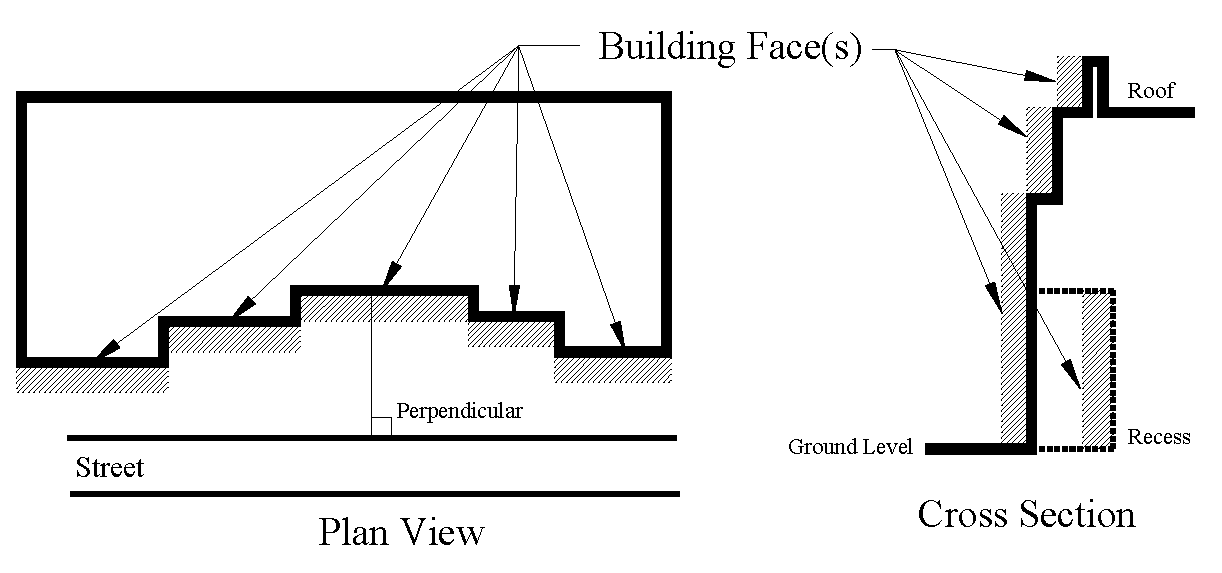
(4)
Canopy orportico means a porch or walkway with a roof supported by columns, often leading to the entrance of the building.
(5)
Entrance means the front door to an establishment intended as the primary customer access point. The area of an entrance shall include the area on either side of the door for a distance of at least ten (10) feet.
(6)
Facade means the portion of any exterior elevation on the building extending from grade to the top of the parapet, wall or eaves and extending the entire length of the building.
(7)
Outdoor patio means an open outdoor eating and gathering area of at least five hundred (500) square feet which may be covered, but must remain open on at least three (3) sides.
(8)
Parapet means the portion of a wall that extends above the roof line.
(9)
Plaza or piazza means an open area available to the public at all times.
(10)
Portal means a large and impressive entrance door or gateway.
(11)
Public art means any work of art or design created by an artist recognized in the area and sited in a public place.
(12)
Supermarket means a retail establishment that sells food products.
(d)
Applicability. The following development is subject to the requirements of this Section in addition to complying with all other Code requirements:
(1)
New construction equal to or exceeding forty thousand (40,000) gross square feet of single-plate ground floor and serving a single tenant or multiple tenants in a single development;
(2)
Additions of thirty-five percent (35%) or more to an existing structure that is already thirty thousand (30,000) gross square feet or larger, or an addition that results in a structure of at least forty thousand (40,000) gross square feet or more after the addition;
(3)
Any addition to a structure or development that has previously been reviewed under this Section; and
(4)
Pad sites with structures of fewer than forty thousand (40,000) square feet which are associated with the primary development and which are included in the original subdivision and/or master plan of the overall development.
(5)
Zone or area districts that have a regulatory design review process, such as the H.B. Zone District, HARP Zone Districts, and Industrial Zone Districts are exempt from these standards.
(e)
Design standards, which shall include the following:
(1)
All design standards contained within this Section shall be applicable unless specified otherwise.
(2)
Prefabricated metal building facades are prohibited. Corrugated metal, unfinished smooth face concrete block, tilt-up concrete panels, prefabricated steel panels and vinyl siding are discouraged as an exterior building facade material unless it can be demonstrated to the satisfaction of the Land Use Administrator that their use complements the overall design of the development.
(3)
Predominant exterior building materials shall be high quality materials such as: wood, brick, sandstone, other native stone or tinted, textured concrete masonry units, or stucco.
(4)
Landscaping. To complement the large scale of the structures and parking areas, the following shall be included: landscaping as defined in this Section is in addition to the requirements of Section 17-4-7, Landscape Performance Standard.
a.
Trees planted under this Section or Section 17-4-7 shall be a minimum of two-and-one-half-inch caliper and specimen quality as certified by the American Standard of Nursery Stock (ASNS). Park grade trees are prohibited.
b.
The required landscape setback area as defined in Section 17-4-7 shall be a minimum of ten (10) feet, with an overall landscaped area equivalent to a depth of twenty-five (25) feet across the entire frontage. This will allow flexibility in the width of the landscaped area along the frontage.
c.
Landscape islands which separate rows of parking stalls shall be a minimum of twelve (12) feet wide.
d.
Landscape islands shall be provided every one hundred (100) linear feet of aligned parking spaces.
e.
A minimum of thirty percent (30%) of the required parking lot landscape islands as described above shall be a minimum of fifteen (15) feet wide and eighteen (18) feet long. It is encouraged that these be placed in proximity to the front of the buildings.
(5)
Provisions for outdoor employee smoking, lunch and break areas shall be screened from public view and incorporated into the building and site design.
(6)
Facades greater than one hundred (100) feet in linear length shall be articulated with recesses or projections, which total at least twenty-five percent (25%) of that facade. Recesses or projections must be a minimum of ten (10) feet in depth. See Figure 4.
(7)
Ground floor facades that face public streets or public ways shall have arcades, display windows, entry areas, awnings or other such design features along no less than sixty percent (60%) of that facade. This requirement includes the facade of the building that functions as the rear, yet faces a street. See Figure 4.
Figure 4
Building Facades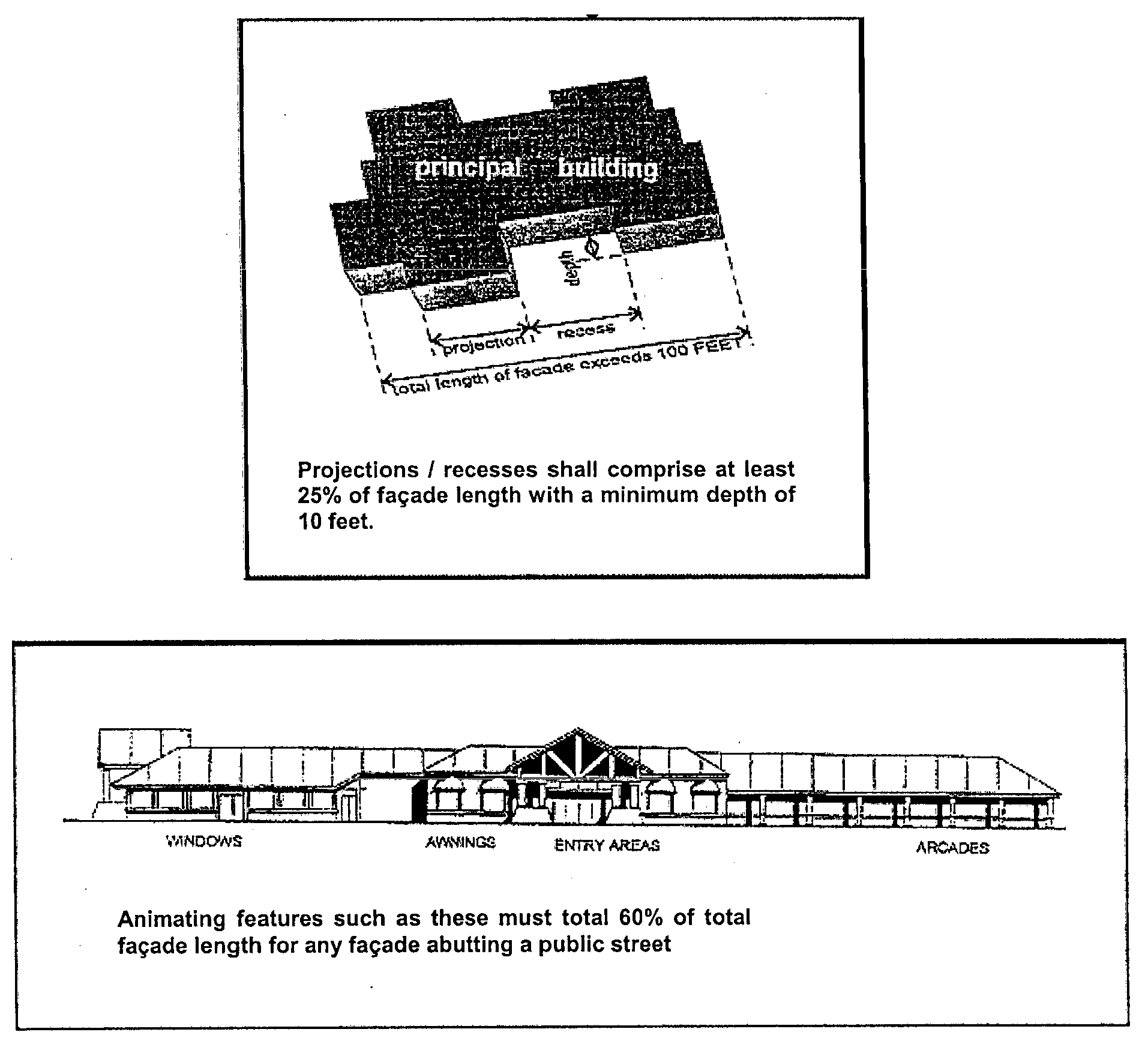
(f)
Facade Treatments. All facades must use at least five (5) of the following design features:
(1)
Have more than two (2) exterior contrasting colors (not including trim material) and have more than three (3) exterior material or texture changes.
(2)
Have building face offsets (minimum twelve-inch offset) that are parallel to the front lot line.
(3)
Have covered pedestrian walkway across the entire front facade of the structure.
(4)
Have clear glass window display area with colored mullions that covers at least twenty-five percent (25%) of one (1) facade, or thirty percent (30%) of two (2) facades.
(5)
Public Art — Building. To further create an individual identity to the City, artistic detailing such as tile work, murals, sculptures and similar features, which are integrated into the design of the structure, are encouraged. If tile work or murals, or similar detailing on the building is used, it must cover at least twenty percent (20%) of that facade which is not devoted to the entrance areas:
a.
One percent (1%) of the hard and soft construction cost, which shall include all associated landscaping, parking, design, engineering and all other costs, for the subject property shall be allocated and used to purchase and install public art for the building.
b.
Calculation of the construction cost shall exclude real property acquisition and shall be verified by the Southern Colorado Building Department.
c.
The following expenses may be included in the public art allocation:
1.
The artwork itself, including the artist's fee for design, structural engineering and fabrication;
2.
Transportation and installation of the work at the site;
3.
Identification plaques; and
4.
Mountings, anchorages, containment, pedestals, bases or other materials necessary for the installation of the artwork;
d.
The following expenses shall be excluded from the public art allocation:
1.
The cost of locating the artist;
2.
Architect and landscape architect fees;
3.
Land costs;
4.
Landscaping, utility connections and fees associated with activating the artwork; and
5.
Publicity, public relations, photographs or dedication ceremonies.
(6)
Public Art — Site. To further create an individual identity to the City, artistic detailing shall be integrated into the design of the site. In addition to sculpture, innovative locations for public art, such as at the architectural entrance to the site, are encouraged:
a.
One percent (1%) of the hard and soft construction cost, which shall include all associated landscaping, parking, design, engineering and all other costs, for the subject property shall be allocated and used to purchase and install public art for the site.
b.
Calculation of the construction cost shall exclude real property acquisition and shall be verified by the Southern Colorado Building Department.
c.
Expenses set forth in subparagraph (f)(5)(c) may be included in the public art allocation.
(7)
Integral planters or walls constructed parallel to the face of the building and incorporate living landscaped areas and/or places for sitting. Such areas shall be a minimum of two (2) feet wide for sitting and five (5) feet wide for a planter and cover at least fifty percent (50%) of that facade.
(g)
Roofs. Roof design shall incorporate the following design features:
(1)
Flat roof designs shall be constructed with parapets to screen HVAC and other roof-mounted mechanical equipment from public view. Such parapets shall not exceed one-third (⅓) of the height of the supporting wall and shall be constructed with a three-dimensional cornice treatment;
(2)
Asphalt roofing material is prohibited when visible from public view. Tile roofing materials are encouraged; and
(3)
All roof designs must use at least one (1) of the following design features:
a.
Three (3) or more roof slope planes; and/or
b.
Overhanging eaves, which extend no fewer than three (3) feet past the supporting walls.
(h)
Entrances. Each retail establishment shall have a clearly defined and highly visible customer entrance or portal, which incorporates the following design features:
(1)
A pedestrian plaza of at least twenty (20) feet in depth immediately in front of the entrance. It is encouraged that this area be large enough to plant shade trees.
(2)
With the exception of interior malls, multiple and separate stores located in the same structure shall have at least one (1) exterior customer entrance. For the purposes of this Subsection, accessory uses within the primary store are not required to comply.
(3)
Diagonal parking on both sides of the travel lane along the front facade of the structure shall be encouraged to create a "Main Street" type atmosphere.
(4)
Each portal shall use at least three (3) of the following design features. These design features shall be in addition to those required above:
a.
Canopies, porticos, arcades and/or outdoor patios;
b.
Raised or peaked cornice parapets over the entrance;
c.
Architectural or artistic details such as tile work and moldings that are integrated into the design of the entrance; and/or
d.
Integral planters or walls that incorporate living landscaped areas and places for sitting that are built perpendicular to the facade and frame the entrance. Such areas shall be a minimum of two (2) feet wide for sitting and twenty (20) feet wide for a planter and shall be a minimum of ten (10) feet in overall length.
(i)
Parking and Circulation. The parking lot design and pedestrian circulation routes shall provide a safe, convenient and efficient access for vehicles, pedestrians and bicyclists. Pedestrian circulation via internal public sidewalks shall be encouraged. The placement of structures shall enhance and promote pedestrian circulation on the site.
(1)
Artistic detailing and paving patterns are encouraged in pedestrian walkways, plazas and gathering areas.
(2)
Except for supermarkets, no more than sixty percent (60%) of the overall proposed parking for a single structure development shall be located between the front facade and the abutting street.
(3)
Internal continuous sidewalks of at least five (5) feet wide (clear) shall be provided from the public street to the entrances. At a minimum, walkways shall connect focal points of pedestrian activity, such as transit stops, street crossings or store entry points, and shall feature adjoining landscaped areas to provide a separated and pedestrian-friendly access route for no less than fifty percent (50%) of their overall length.
(4)
All internal pedestrian walkways shall be physically separated from the drive lanes. Additionally, they shall be visually distinct from the driving surface by the use of pavers, bricks or scored concrete.
(5)
Sidewalks, at least eight (8) feet in width, shall be provided along the full length of any facade featuring a customer entrance and along any facade abutting public parking areas. Such sidewalks shall be located at least six (6) feet from the facade of the building to provide planting beds for living foundation landscaping, except where features such as arcades or entryways are part of the facade. Such live foundation landscaped areas shall be a minimum of six (6) feet wide, and shall be a minimum of fifteen (15) feet in overall length.
(6)
An off- and/or on-street bus stop for customers and employees shall be provided when the site is located on an established or planned Pueblo Transit bus route.
(7)
Where applicable, pedestrian and recreational path linkages shall be made with adjoining properties.
(8)
Bike racks shall be provided adjacent to entrances.
(9)
Overnight parking of RVs, mobile homes and other vehicles providing transient residency is prohibited unless approved in advance as a use by review.
(j)
Outdoor Storage, Trash Collection and Loading Areas. These areas, due to their visual and noise impacts onto adjacent properties and visitors to the site, shall be screened, recessed or enclosed:
(1)
No area for outdoor storage, trash collection or compaction, loading or other such uses shall be located within twenty (20) feet of any public street, public sidewalk or internal pedestrian walkway.
(2)
Outdoor cart storage areas shall be provided in the parking lot for the customers, and adjacent to the buildings if they are not available at the entrance.
(3)
Loading docks, truck parking, outdoor storage, utility meters, HVAC equipment, trash dumpsters, trash compaction and other such service functions shall be incorporated into the overall design of the structure and landscaping so that the visual and acoustic impacts of these functions are fully contained and out of the view from general passersby. Screening materials shall be the same as those used on the structure to avoid visual detection of the service function.
(4)
The parking or storage of trucks, trailers or containers as accessory outdoor storage is prohibited. Trucks and trailers shall be in an active state of loading or unloading.
(k)
Outdoor Sales. Permanent and seasonal outdoor sales areas shall be incorporated into the design of the building and site.
(1)
Nonenclosed areas for the sale and storage of seasonal inventories shall be permanently defined and screened with walls and/or fences; materials, colors and designs of the screening walls and/or fences shall conform with and complement the predominant materials and colors of the main structure. If such areas are to be covered, the covering shall also conform and complement the predominant materials and colors of the main structure.
(2)
Anti-theft devices for the areas shall be identified.
(3)
No outdoor display or sales area shall encroach onto any portion of a walkway, drive aisle, parking or landscaped area.
(l)
Signs. Signs shall be incorporated into the design of the structure and shall use architecturally compatible materials. Signs shall be designed for both the pedestrian and the motorist.
(1)
Roof-mounted signs are prohibited.
(2)
Freestanding signs shall meet the following:
a.
Shall be constructed with a base of the same materials as the structure to provide for a pedestrian scale and to unify the sign with the structure;
b.
Shall have one (1) freestanding sign per separate street frontage devoted to the overall site; and
c.
Shall have a maximum height of fifty (50) feet, with an overall size of eight hundred (800) square feet.
(3)
Architectural gateway or entrance elements, which identify the address of the site, which are less than ten (10) feet in overall height, shall not constitute a freestanding sign.
(4)
Wall signs shall not exceed twenty percent (20%) of the façade to which they are attached, including windows, door area and cornices.
(5)
Signs painted on or affixed to the inside or outside of windows shall be included in the above computation when the sign exceeds twenty-five percent (25%) of the area of the window it is occupying. For the purposes of this Subsection, a window sign is affixed to the window if placed within eighteen (18) inches of the glass area.
(6)
All projecting signs shall be placed a minimum of eight (8) feet above the sidewalk. For the purposes of this Subsection, a projecting sign is a sign that projects more than fifteen (15) inches.
(7)
No sign or advertising device with visible moving or flashing animated or intermittent illumination shall be erected unless approved in advance as a use by review by the Planning and Zoning Commission.
(m)
Canopies. Gasoline canopies, car washes and other accessory functions located in separate structures on the same subject site shall be complementary to the overall design of the site and the architectural style of the primary structure. Materials, colors and designs, including roof design, shall conform with and complement the predominant materials and colors of the main structure.
(n)
Miscellaneous. Internal traffic signs, handicapped parking signs, transformers and other such site necessities shall be integrated into the overall design of the site.
(1)
Traffic and parking signs shall comply with the Manual on Uniform Traffic Control Devices. Sign housings and posts shall be designed to be a visual and design amenity for the site. Creativity in design is encouraged.
(2)
Transformers shall be integrated into the overall design of the site and shall be heavily screened with living landscaping and/or enclosures to minimize their visual impact.
(o)
Submission Requirements. The following shall be submitted to the Land Use Administration Department for approval of a large scale development:
(1)
Proposed site plan to scale, indicating the following:
a.
Perimeter outline, including dimensions of all structures including decks, patios, parking areas with spaces delineated, driveways, walkways, freestanding signs, light fixtures, transformers, fences, and retaining walls;
b.
Easements and/or rights-of-way;
c.
Setbacks - distance to property lines from buildings, parking areas and driveways;
d.
Proposed landscaping, including species, sizes and planting intervals; and
e.
Proposed topographic grade changes (minimum five-foot contours).
(2)
Full building elevations (to scale), clearly showing all exterior materials, colors, lighting and signs on the building;
(3)
Manufacturer cut sheets or similar representation of proposed site fixtures, such as traffic signs and light fixtures (site and on-building);
(4)
Lighting plans as required in Section 17-4-52; and
(5)
Other requirements imposed by the Land Use Administration Department to comply with this Section.
(Ord. 7067 §1, 10-27-03; Ord. No. 9381 §2, 11-26-18; Ord. No. 11082, §3, 11-24-25)
Sec. 17-4-47. - Medium-scale development performance standards.
(a)
Intent. The intent of this Section is to encourage visual design interest and a pedestrian scale for medium-scale buildings. These structures should be designed and implemented in a manner so as to reduce their scale and potentially uniform, monolithic and nondescript appearance. Building design shall also promote a safe and comfortable pedestrian scale environment, and a mixture of uses and sizes of structures. Careful attention to local community design issues will also ensure a greater likelihood of reuse of the structure for subsequent occupants.
(b)
Overview. In order to further design excellence and creativity within the community, and to encourage an individual design, applicants are encouraged to work with the Administrative Official in order to maximize the overall design of the site and structure(s). Therefore, the Administrative Official, in consultation with the Planning and Zoning Commission, may allow flexibility of the design standards listed herein, if the overall objective of this Section continues to be adhered to in the overall design of the development.
(c)
Definitions. See Subsection 17-4-46(c) for applicable definitions.
(d)
Applicability. The following development is subject to the requirements of this Section in addition to complying with all other applicable Code requirements:
(1)
New construction equal to or exceeding ten thousand (10,000) to thirty-nine thousand, nine hundred ninety-nine (39,999) gross square feet of single-plate ground floor and serving a single tenant or multiple tenants in a single development; and/or
(2)
Additions of thirty-five percent (35%) or more to an existing structure that results in a structure equal to or exceeding ten thousand (10,000) to thirty-nine thousand, nine hundred ninety-nine (39,999) gross square feet of single-plate ground floor area after the addition.
(3)
Development in zone or area districts that have a regulatory design review process, such as the H.B. Zone District, HARP Districts, and Industrial Zone Districts are exempt from the standards of this Section.
(e)
Design standards, which shall include the following:
(1)
Building façade materials shall be high quality materials such as: brick, stone, cultured stone, stucco, and tinted or textured concrete and decorative concrete masonry units. Other materials may be permitted if used as an accent or if their use complements the overall design of the development as determined by the Administrative Official.
(2)
Corrugated metal, gray concrete and nondecorative concrete masonry units, prefabricated steel panels and vinyl siding are prohibited as an exterior building façade material unless it can be demonstrated to the satisfaction of the Administrative Official that their use complements the overall design of the development, is used as an accent and/or is compatible with the existing surrounding structures.
(3)
Prefabricated metal buildings are prohibited, and no variance shall be granted or allowed.
(4)
Each façade greater than fifty (50) feet in length, measured horizontally, shall incorporate wall plane projections or recesses having a depth of at least twenty-four (24) inches and extending at least twenty percent (20%) of the length of the façade. No uninterrupted length of any façade shall exceed twenty-five (25) horizontal feet.
(5)
Façades that face public or private streets or public ways, other than an alley, shall incorporate surface treatments, including balconies, patios, windows, arcades, awnings, towers, masonry materials, such as brick or stone, or other such design features along not less than forty percent (40%) of that façade. This requirement includes the façades of the building that functions as the rear, yet faces a street.
(6)
The primary façade and entrance shall be oriented to face the street. On corner lots, the primary façade and entrance shall be in accordance with the prevailing pattern of the street or may face the corner. Not required for existing structures unless the primary façade or entrance is being changed.
(f)
Façade Treatments. All façades must use at least four (4) of the following design features:
(1)
Have at least three (3) exterior contrasting colors;
(2)
Have at least two (2) exterior material or texture changes;
(3)
Have building face or roof offsets (minimum twenty-four-inch offsets) that are parallel to the front lot line;
(4)
Covered pedestrian walkway;
(5)
Windows that cover at least twenty percent (20%) of the street facing façades;
(6)
Public art.
(g)
Roofs. Roof designs shall incorporate the following design features:
(1)
Flat roofs and roofs with a pitch of less than 2:12 shall be constructed with parapets in order to screen HVAC and other roof mounted mechanical equipment. Such parapets shall not exceed one-third (⅓) of the height of the supporting wall and shall be constructed with a three-dimensional, articulated cornice treatment;
(2)
All pitched roof designs must use both of the following design features:
a.
Varying roof design, with dormers, multiple heights, slopes and/or projections; and
b.
Overhanging eaves, which extend not less than eighteen (18) inches past the supporting walls.
(h)
Entrances. Each retail establishment shall have a clearly defined and highly visible customer entrance that uses at least two (2) of the following design features. When multiple stores are located in the same structure, each store shall have at least one (1) exterior customer entrance.
(1)
Canopies, porticos, arcades and/or outdoor patios;
(2)
Raised or peaked cornice parapets over the entrance;
(3)
Other design feature that clearly defines and highlights the customer entrance.
(i)
Outdoor storage, trash collection and loading areas. These areas, due to their visual and noise impacts onto adjacent properties and visitors to the site, shall be screened, recessed or enclosed.
(1)
No area for outdoor storage, trash collection or compaction, loading or other such uses shall be located within twenty (20) feet of any public street, public sidewalk or internal pedestrian walkway.
(2)
Loading docks, truck parking, outdoor storage, utility meters, HVAC equipment, trash dumpsters, trash compaction and other such service functions shall be incorporated into the overall design of the structure and landscaping so that the visual and acoustic impacts of these functions are fully contained and out of the view from general passersby. Screening materials shall be the same as those used on the structure in order to avoid visual detection of the service function.
(3)
Nonenclosed areas used for the sale and storage of seasonal inventories shall be permanently defined and screened with walls and/or fences; and materials, colors and designs of the screening walls and/or fences shall conform with and complement the predominant materials and colors of the main structure. If such areas are to be covered, the covering shall also conform and complement the predominant materials and colors of the main structure.
(4)
Whenever possible, provide off-street parking on the side or rear of the building, rather than between the building and the primary street.
(j)
Accessory Structures. In addition to the requirements of Section 17-4-23, accessory structures, including but not limited to gasoline canopies, car washes and other accessory functions located in separate structures on the same site shall be complementary to the overall design of the site, and the architectural style of the primary structure. Materials, colors and designs, including roof design, shall conform with and complement the predominant materials and colors of the main structure.
(Ord. 8373 §1, 7-11-11; Ord. No. 9381 §3, 11-26-18)
Sec. 17-4-48. - Small-scale development performance standards.
(a)
Intent. The intent of this Section is to encourage visual design interest and a pedestrian scale for small-scale buildings. These structures shall be designed and implemented in a manner so as to reduce their potentially uniform, monolithic and nondescript appearance. Building design shall also promote a safe and comfortable pedestrian scale environment, and a mixture of uses and sizes of structures. Careful attention to local community design issues will also ensure a greater likelihood of reuse of the structure for subsequent occupants.
(b)
Overview. In order to further design excellence and creativity within the community and to encourage an individual design, applicants are encouraged to work with the Land Use Administrator in order to maximize the overall design of the site and structure(s). Therefore, the Land Use Administrator, in consultation with the Planning and Zoning Commission, may allow flexibility of the design standards listed herein, if the overall objective of this Section continues to be adhered to in the overall design of the development.
(c)
Definitions. See Subsection 17-4-46(c) for applicable definitions.
(d)
Applicability. The following development is subject to the requirements of this Section in addition to complying with all other applicable Code requirements:
(1)
New construction equal to or less than ten thousand (10,000) gross square feet of single-plate ground floor area serving a single tenant or multiple tenants in a single development; and/or
(2)
Additions of thirty-five percent (35%) or more to an existing structure that results in a structure equal to or less than ten thousand (10,000) gross square feet of single-plate ground floor area after the addition.
(3)
Development in zone or area districts that have a regulatory design review process, such as the H.B. Zone District, HARP Districts, and Industrial Zone Districts are exempt from the standards of this Section.
(e)
Design standards, which shall include the following:
(1)
Building façade materials shall be high quality materials such as: brick, stone, cultured stone, stucco, and tinted or textured concrete and decorative concrete masonry units. Other materials may be permitted if used as an accent or if their use complements the overall design of the development as determined by the Administrative Official.
(2)
Corrugated metal, gray concrete and nondecorative concrete masonry units, prefabricated steel panels and vinyl siding are prohibited as an exterior building façade material unless it can be demonstrated to the satisfaction of the Administrative Official that their use complements the overall design of the development, is used as an accent and/or is compatible with the existing surrounding structures.
(3)
Prefabricated metal buildings are prohibited, and no variance shall be granted or allowed.
(4)
Each façade greater than fifty (50) feet in length, measured horizontally, shall incorporate wall plane projections or recesses having a depth of at least twenty four (24) inches and extending at least twenty percent (20%) of the length of the façade. No uninterrupted length of any façade shall exceed twenty-five (25) horizontal feet.
(5)
Façades that face public or private streets or public ways, other than an alley, shall incorporate surface treatments, including balconies, patios, windows, arcades, awnings, towers, masonry materials, such as brick or stone, or other such design features along not less than forty percent (40%) of that façade. This requirement includes the façades of the building that functions as the rear, yet faces a street.
(6)
The primary façade and entrance shall be oriented to face the street. On corner lots, the primary façade and entrance shall be in accordance with the prevailing pattern of the street or may face the corner. Not required for existing structures unless the primary façade or entrance is being changed.
(f)
Façade Treatments. All façades must use at least three (3) of the following design features:
(1)
Have at least two (2) exterior contrasting colors;
(2)
Have at least two (2) exterior material or texture changes;
(3)
Have building face or roof offsets (minimum twenty-four-inch offsets) that are parallel to the front lot line;
(4)
Covered pedestrian walkway;
(5)
Windows that covers at least twenty percent (20%) of the street facing façades;
(6)
Public art.
(g)
Roofs. Roof designs shall incorporate the following design features:
(1)
Flat roofs and roofs with a pitch of less than 2:12 shall be constructed with parapets in order to screen HVAC and other roof mounted mechanical equipment. Such parapets shall not exceed one-third (⅓) of the height of the supporting wall and shall be constructed with a three-dimensional, articulated cornice treatment;
(2)
All pitched roof designs must use both of the following design features:
a.
Varying roof design, with dormers, multiple heights, slopes and/or projections; and
b.
Overhanging eaves, which extend not less than eighteen (18) inches past the supporting walls.
(h)
Entrances. Each retail establishment shall have a clearly defined and highly visible customer entrance that uses at least two (2) of the following design features. When multiple stores are located in the same structure, each store shall have at least one (1) exterior customer entrance.
(1)
Canopies, porticos, arcades and/or outdoor patios;
(2)
Raised or peaked cornice parapets over the entrance;
(3)
Other design feature that clearly defines and highlights the customer entrance.
(i)
Outdoor storage, trash collection and loading areas. These areas, due to their visual and noise impacts onto adjacent properties and visitors to the site, shall be screened, recessed or enclosed.
(1)
No area for outdoor storage, trash collection or compaction, loading or other such uses shall be located within twenty (20) feet of any public street, public sidewalk or internal pedestrian walkway;
(2)
Loading docks, truck parking, outdoor storage, utility meters, HVAC equipment, trash dumpsters, trash compaction and other such service functions shall be incorporated into the overall design of the structure and landscaping so that the visual and acoustic impacts of these functions are fully contained and out of the view from general passersby. Screening materials shall be the same as those used on the structure in order to avoid visual detection of the service function;
(3)
Nonenclosed areas used for the sale and storage of seasonal inventories shall be permanently defined and screened with walls and/or fences; and materials, colors and designs of the screening walls and/or fences shall conform with and complement the predominant materials and colors of the main structure. If such areas are to be covered, the covering shall also conform and complement the predominant materials and colors of the main structure.
(4)
Whenever possible, provide off-street parking on the side or rear of the building, rather than between the building and the primary street.
(j)
Accessory Structures. In addition to the requirements of Section 17-4-23, accessory structures, including but not limited to gasoline canopies, car washes and other accessory functions located in separate structures on the same site shall be complementary to the overall design of the site, and the architectural style of the primary structure. Materials, colors and designs, including roof design, shall conform with and complement the predominant materials and colors of the main structure
(Ord. 8373 §2, 7-11-11; Ord. No. 9381 §4, 11-26-18)
Sec. 17-4-49. - Building and site design standards for Industrial Zone Districts.
(a)
General Intent. The Building and Site Design Standards for Industrial Zone Districts are intended to promote the health, safety, general welfare and visual appearance of industrial development; enhance economic vitality; promote street and neighborhood character; and to strengthen the health and well-being of the community by providing aesthetic improvements and opportunities for social interaction within urbanized industrial areas. Industrial zoned development sites within designated high visibility areas, as identified in Figure 4.49.1, are required to provide a higher degree of architectural improvements than industrial zoned sites in lower visibility areas. Figure 4.49.1 delineates high visibility sites that are currently zoned industrial and those that could potentially be zoned industrial in the future, all other industrial zoned properties are considered low visibility areas or sites. An application for a variance, of specific requirements within this Section may be considered by the Zoning Board of Appeals under the provisions of Section 17-5-34 through Section 17-5-38 of the Pueblo Municipal Code.
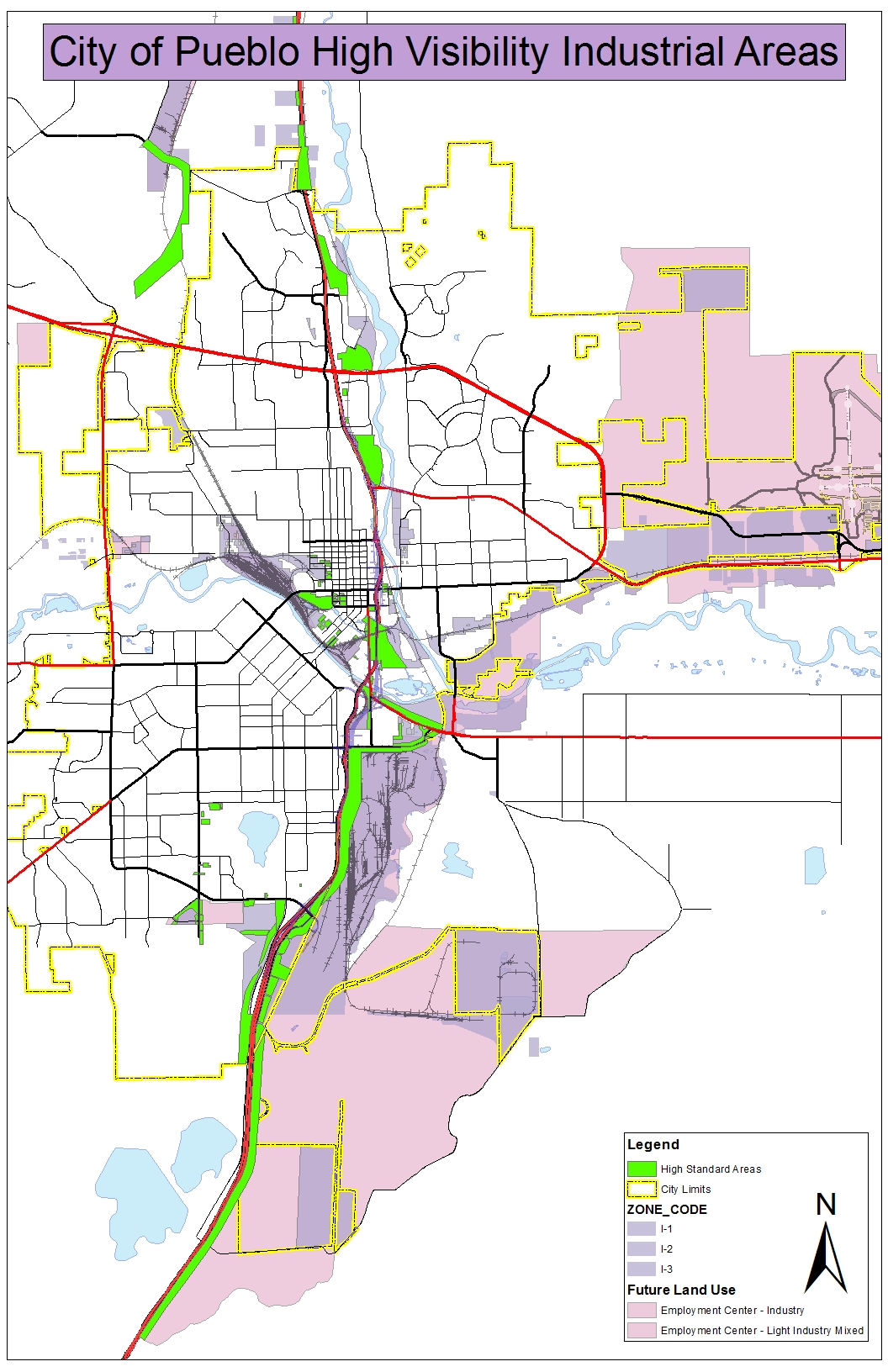
Figure 4.49.1
(b)
Applicability.
(1)
Provisions of this Section shall apply to all industrial zoned properties for which an application for development has been submitted after the effective date of the approval of these standards within high visibility and low visibility areas identified on the attached Figure 4.49.1 unless otherwise specified.
(2)
Provisions of this Section shall apply to the following:
a.
Construction of a New Structure.
b.
Additions to a building that increases the total square footage of the structure by thirty-five percent (35%) or more. If the addition equals or exceeds thirty-five percent (35%) of the existing structure, the original structure must be brought into compliance with, and the new addition must adhere to, the building and site design standards for Industrial Zone Districts.
(c)
Building Orientation.
(1)
Primary Facades: A building's primary façade(s) includes all façade(s) adjacent to public rights-of-way. A primary façade shall serve as the main access point to a building or building unit. In situations where it is not possible for a building's primary entrance to be located adjacent to a public right-of-way, façade(s) adjacent to a major access drive and/or primary parking area serve as the primary façade(s). A parcel or lot may have multiple primary facades depending upon the location of adjacent rights-of-way and the structure's primary entrance.
(2)
Secondary Façades: A building's secondary façades shall consist of all other facades that are not defined as a primary façade.
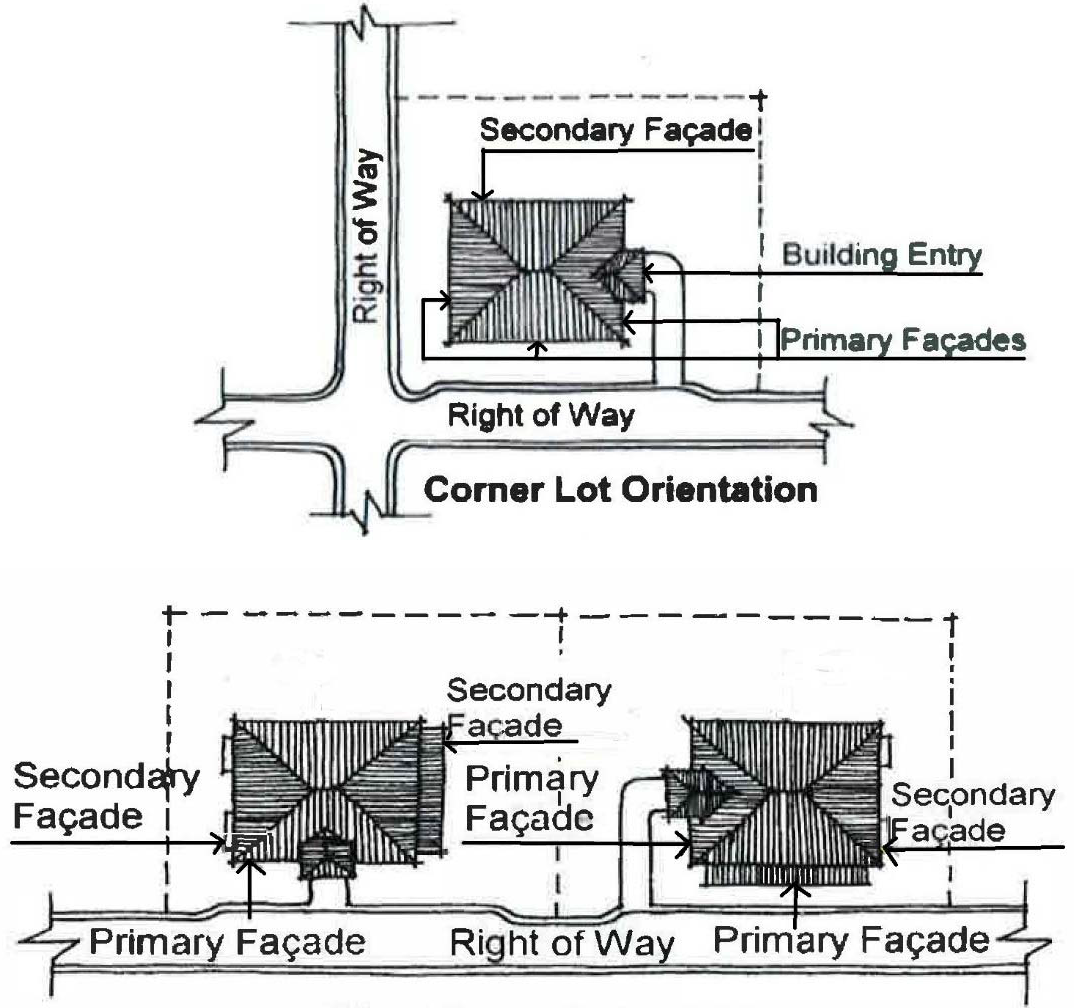
Mid-Block Orientation
(d)
Screening.
(1)
Chain link fencing, with or without screening attachments, is not an acceptable screening mechanism along primary facades. Chain link fencing may be used for screening or security purposes along secondary facades, as long as the fence is set back from the right-of-way and is not visually obtrusive.
(e)
Design Standards High Visibility Areas. These standards apply to all industrial zoned properties within high visibility areas identified on the attached Figure 4.49.1 unless otherwise specified.
(1)
Building Architectural Standards.
a.
Requirement for four-sided design: a building's special architectural features and treatments shall not be restricted to a single façade. All sides of a building open to view, whether viewed from public or private property, shall display appropriate architectural interest as required in Subsection 17-4-49(e)(1)c.1.
b.
Building entry and office space: entry and office spaces shall be distinguished from the building mass.
c.
Building mass and form: large, square, "box-like" structures with unbroken flat walls are not an acceptable form. Architectural elements with smaller forms stepping outwards and down shall be encouraged. The design of all buildings shall employ a variety of elements as required in Subsection 17-4-49(e)(1)c.1.
1.
An industrial building's primary façades shall incorporate a minimum of five (5) of the following elements. Secondary facades shall incorporate a minimum of two (2) of the following elements:
i.
Change in color;
ii.
Graphical patterning;
iii.
Changes in texture or material;
iv.
Projections, recesses and reveals;
v.
Windows and fenestration;
vi.
Awnings or canopies;
vii.
Arcades and pergolas;
viii.
Towers;
ix.
Gable projections;
x.
Horizontal or vertical breaks; or
xi.
Other similar techniques.
d.
Building roofs: all roof areas visible from any public or private right-of-way, shall be surfaced with attractive and durable materials.
1.
Flat roofs with less than a 1/12 roof pitch, shall incorporate roof treatments that break up the roof plain, which may include a variety of vertical, horizontal or step-out treatments.
2.
Pitched roofs shall incorporate overhanging eaves that extend twelve (12) inches from the facade; varying rooflines that may include dormers, multiple heights, slopes, and/or projections.
(2)
Building Site Development Standards.
a.
Service and loading areas: service and loading areas shall not be located along primary facades. The Administrative Official has the authority to allow service and loading areas along primary facades in situations where a documented physical hardship exists, precluding the construction of the service and/or loading areas from being constructed on a secondary façade.
b.
Accessory buildings: all accessory buildings visible from a public street shall be similar in color and material to the principle structure on a site.
c.
Outdoor storage areas: all outdoor storage areas must be located behind or to the side of the principle structure along secondary facades or within the rear yards of the site. Outdoor storage areas shall be fully screened with closely planted evergreen landscape material, architecturally compatible material or complimentary opaque screening materials that provide visual interest.
d.
Refuse and/or recycling containers: refuse and/or recycling collection containers shall not be visible from the public rights-of-way, pedestrian areas and adjacent residential properties. Refuse and/or recycling containers shall be fully screened with closely planted evergreen landscape material, architecturally compatible material or complimentary opaque screening materials that provide visual interest.
e.
Parking: parking areas located adjacent to the primary facade shall be used for passenger vehicles only. All commercial vehicles shall be parked in the rear or side portions of the property. If the property has multiple frontages, the higher classification roadway shall be considered the front with respect to the location of parking.
(3)
Mechanical Equipment Screening.
a.
Roof-mounted mechanical equipment: equipment whether located on flat or pitched roofs, shall be completely screened from the ground level and the public right-of-way by parapet walls or structural features that are consistent with the architectural elements, materials, and colors of the primary structure.
b.
Wall-mounted mechanical: mechanical and electrical equipment mounted on primary and secondary facades are discouraged. If equipment is mounted on a wall, the equipment should be screened by dense evergreen foliage or other architecturally compatible screening mechanisms and be mounted on a secondary façade. Wall-mounted mechanical equipment on secondary facades shall be painted to match the color of the subject building or screened by other acceptable devices.
c.
Ground mounted mechanical equipment: ground-mounted mechanical equipment, excluding transformers, adjacent to primary facades shall be screened through use of walls, earth berms, dense evergreen foliage or other acceptable screening devices. Secondary facades have no screening requirements.
(4)
Landscaping. Industrial site landscaping will be used to enhance compatibility of adjacent uses as well as enhance the aesthetic character of the industrial site. Industrial zoned properties, including I-3, Heavy Industrial properties, in the designated high visibility areas, shall comply with the requirements of Section 17-4-7(b)(2), Landscape Performance Standard with the following exceptions:
a.
Industrial site improvements: all portions of the industrial parcel, adjacent street rights-of-way, and alleys upon which it fronts shall be landscaped, paved, fenced, planted or covered by buildings, so that no dust will blow off the site and no soil or debris will be washed upon the sidewalks, alleys or streets from the parcel in the event of a rainstorm.
b.
New freestanding or monument sign: the installation of a new freestanding or monument sign, on a previously developed site, shall require compliance with sign landscaping in lieu of full landscaping as required by Section 17-4-7 of this Title. Sign landscaping shall consist of a twenty (20) foot wide landscaped area, around the entire perimeter of the sign, and include a mixture of two (2) of the following landscaping elements: trees, shrubs, grasses and boulders to accentuate the sign. The Administrative Official may allow a reduction in the required twenty (20) foot width of the perimeter landscaping, if it can be demonstrated that a development site hardship exists, and appropriate visual appeal is achieved within the reduced width.
c.
Shade trees: the number of shade trees required by Section 17-4-7(b)(3)a.1. of this Title is reduced to one (1) shade tree for every fifty (50) linear feet of street frontage.
d.
Parking strips: parking strips may be used in lieu of parking lot islands. The parking strip shall have a minimum width of nine (9) feet and extend the entire length of the parking area and include one (1) shade tree every fifty (50) feet.
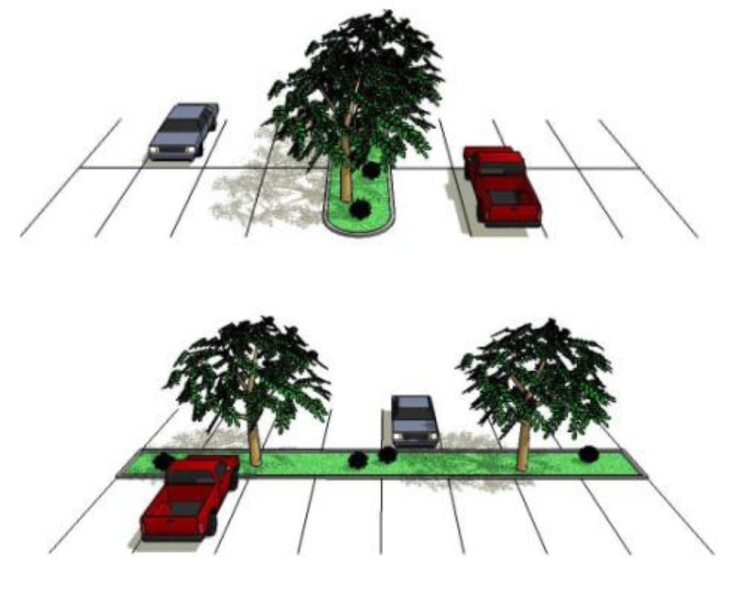
Parking Island/Parking Strip Diagram
e.
Stormwater drainage and detention: on-site stormwater drainage and detention facilities shall be constructed in compliance with the City's Drainage Criteria Manual (June 9, 1997) and the City's Standard Construction Specifications and Standard Details (March 25, 2005) or as same may be later amended. On-site stormwater facilities are not required to be landscaped with turfgrass if placed behind the building structure and are not visible from public rights-of-way.
f.
Fencing and screening walls: all fences and screening walls in line with or along primary facades, shall be constructed with decorative blocks, brick, stone, treated wood or ornamental metal. Expanses of screening walls fifty (50) linear feet or greater, shall be broken up with material, plain and elevation changes, which may include curvilinear design, periodic columns, insets, or landscape pockets. Chain link fencing is only permitted to be used along secondary frontages.
g.
Vehicular circulation and access: on-site vehicular circulation shall have an adequate length of stacking for industrial facilities, including but not limited to loading, docks, gated entrances, and terminals that do not interfere with the movement of vehicular and pedestrian traffic (on or off-site) and minimize vehicular impacts to adjacent properties.
(f)
Design Standards Low Visibility Areas. Low visibility standards apply to all industrial zoned properties that are not identified as high visibility areas on Figure 4.49.1 unless otherwise specified.
(1)
Building Architectural Standards.
a.
Requirement for façade design: a building's special architectural features and treatments in a low visibility area may be limited to primary facades that front a street right-of-way and major access drives.
b.
Building entry and office space: entry and office spaces shall be distinguished from the building mass.
c.
Building mass and form: the design of primary facades shall employ a variety of the following elements: textured surfaces, projections, recesses, shadow lines, color, window patterns, overhangs, reveals, three-dimensional cornice treatments, changes in parapet heights and similar architectural features to avoid monolithic primary facades and to emphasize building entries.
1.
An industrial building's primary façade shall incorporate a minimum of three (3) of the following elements:
i.
Change in color;
ii.
Graphical patterning;
iii.
Changes in texture or material;
iv.
Projections, recesses and reveals;
v.
Windows and fenestration;
vi.
Awnings or canopies;
vii.
Arcades and pergolas;
viii.
Towers;
ix.
Gable projections;
x.
Horizontal or vertical breaks; or
xi.
Other similar techniques.
(2)
Building Site Development Standards.
a.
Service and loading areas: service and/or loading areas are encouraged to be located along secondary facades. If a service and/or loading area is located along a primary façade, the service and/or loading area shall be incorporated into the overall architectural design of the primary structure.
b.
Mechanical equipment: mechanical equipment attached to a building is encouraged to be placed on the roof or along secondary facades. All mechanical equipment placed on primary facades shall be properly screened with architecturally compatible materials or materials that provide visual interest.
c.
Outdoor storage areas: all outdoor storage areas must be located behind or to the side of the principle structure along secondary facades or within the rear yards of the site.
d.
Refuse and or recycling containers: refuse and or recycling collection containers shall not be visible from the public rights-of-way, pedestrian areas and adjacent residential properties.
(3)
Landscaping. Low visibility area industrial landscaping will be used to enhance compatibility of adjacent uses as well as enhance the aesthetic character of the industrial site. I-1, Light Industrial, and I-2, Industrial District, zoned properties in the designated low visibility areas, are not required to comply with Section 17-4-7 Landscape Performance Standards; however, these sites are required to comply with the following landscape standards:
a.
Industrial site improvements: all portions of the industrial parcel, adjacent street rights-of-way, and alleys upon which it fronts shall be landscaped, paved, fenced, planted or covered by buildings, so that no dust will blow off the site and no soil or debris will be washed upon the sidewalks, alleys or streets from the parcel in the event of a rainstorm.
b.
New freestanding or monument sign: the installation of a new freestanding or monument sign, on either a newly or previously developed site, shall require compliance with sign landscaping consisting of a twenty (20) foot wide landscaped area, around the entire perimeter of the sign, and include a mixture of two (2) of the following landscaping elements: trees, shrubs, grasses and boulders to accentuate the sign. The Administrative Official may allow a reduction in the required twenty (20) foot width of the perimeter landscaping, if it can be demonstrated that a development site hardship exists, and appropriate visual appeal is achieved within the reduced width.
c.
Driveway entrance landscaping: a landscape area, with a minimum width of ten (10) feet shall be established adjacent to both sides of a driveway entrance. The landscape area shall include a mixture of trees, shrubs, grasses, and ground cover. Living ground cover is encouraged but not required.
d.
On-site stormwater drainage and detention facilities: on-site stormwater drainage and detention facilities shall be constructed in compliance with the City's Drainage Criteria Manual (June 9, 1997) and the City's Standard Construction Specifications and Standard Details (March 25, 2005) or as same may be later amended. On-site stormwater facilities are not required to be landscaped with turfgrass if placed behind the building structure and not visible from any streets adjacent to the primary or secondary facades.
(Ord. No. 9381 §5, 11-26-18)
Sec. 17-4-51. - Permitted use of land and buildings.
Any use of land or structure not authorized herein as a use by right, conditional use, or use by review upon issuance of a Special Use Permit in a designated zone district is unlawful. Except as otherwise provided, no building permit or certificate of zoning compliance shall be issued for a use not specifically mentioned or described in this Section.
(a)
Zone districts.
(1)
Agricultural One (A-1) and Two (A-2) Districts:
Purpose. The standards of these districts (A-1 and A-2) are designed to retain and promote the appropriate use of dry range, irrigated and forest lands and encourage other open use of land in keeping with its natural characteristics and agricultural functions.
(2)
Agricultural Three (A-3) and Four (A-4) Districts:
Purpose. The standards of these districts (A-3) and (A-4) are designed to provide and retain certain lands for orderly low density residential development in a rural atmosphere, with rights retained for limited agricultural activity for the exclusive use of the occupants.
(3)
Single-Family Residential District (R-1):
Purpose. The standards of this district (R-1) are designed to retain and provide areas of low-medium density development characteristically and exclusively for single-family dwelling units.
(4)
Single-Family Residential District (R-2):
Purpose. The standards of this district (R-2) are designed to retain and provide areas primarily for single-family development of medium density.
(5)
Single-Family Residential District (R-2U):
Purpose. The standards of this district (R-2U) are designed to retain and provide areas primarily for single-family development of medium density, while providing opportunities for a variety of blocks, lots and setbacks. It is the intention of this district to allow mixed-lot sizes and housing sizes along the same street and the same block, while not increasing the gross density of the development. A homeowners' association shall be created to provide for the maintenance of common areas, private open spaces and other neighborhood assets.
(6)
One and Two-Family Residential District (R-3):
Purpose. The standards of this district (R-3) are designed to retain and provide areas of higher density development characterized by single-family and two-family dwelling unit structures.
(7)
Mixed Residential District (R-4):
Purpose. The standards of this district (R-4) are designed to retain and provide areas with commingling of single-family dwelling units and limited multifamily dwelling unit structures.
(8)
Mixed-Residential and Office District (R-5):
Purpose. The standards of this district (R-5) are designed to retain and provide areas of high-density multifamily dwelling unit structures with limited commingling of professional offices and studios.
(9)
Multiple-Residential and Commercial District (R-6):
Purpose. The standards of this district (R-6) are highway-oriented and designed to retain and provide areas of mixed residence, commercial use and accommodations for transients.
(10)
Mobile Home Residential District (R-7):
Purpose. The standards of this district (R-7) are designed to retain and provide areas of high density residence for mobile home parks.
(11)
Manufactured Home Residential District (R-8):
Purpose. The standards of this district (R-8) are designed to retain and provide areas of medium density for single-family manufactured homes located on individually owned lots.
(12)
Residential Charter Neighborhood (RCN):
a.
Purpose. The standards of this district (RCN) are designed to maintain the character of the City's original neighborhoods, sometimes referred to as Charter Neighborhoods, while meeting modern needs and standards. These developed neighborhoods have a traditional neighborhood pattern with a diversity of affordable housing types on a variety of lot sizes with small lots predominating. There are tree-lined streets with sidewalks, alleys, neighborhood parks and a mixture of uses within the residential fabric. The neighborhoods historically functioned at a pedestrian scale, with most residences, public amenities, and neighborhood goods and services accessible with little dependence on an automobile. There are some nonresidential uses that present actual or potential compatibility problems. The standards of this district are intended to maintain and enhance these and other such desirable neighborhood characteristics and resolve questions of the compatibility of adjacent uses.
b.
Conditions for nonresidential uses by review. This Subsection applies to nonresidential uses in the RCN district.
1.
The intent of the nonresidential uses allowed is to (i) provide ongoing services to the neighborhood residents; (ii) provide small-scale employment opportunities for neighborhood residents; and (iii) encourage the continuation of existing commercial uses that contribute to the character of the neighborhood. To qualify for a special use permit, a proposed nonresidential use must meet two (2) of the above three (3) intent criteria.
2.
Nonresidential uses shall be limited to two (2) per block face and to two (2) per intersection. Existing commercial uses, including those in mid-block locations, shall be considered uses by right, and may be exempted from all off-street parking regulations by the Zoning Board of Appeals. For purposes of this Subparagraph, home occupations shall not be considered a nonresidential use.
3.
Nonresidential uses involving on-site sale of food or beverages shall be located at the corner of two (2) public rights-of-way (alleys or streets).
4.
Residential uses in the same structure may be located above or behind a nonresidential use.
5.
To ensure compatibility of uses, the Zoning Board of Appeals may set limits on the hours of operation and the amount of noise generated.
6.
If the floor area of an existing nonresidential use is expanded, the Zoning Board of Appeals may waive compliance with one hundred percent (100%) of the off-street parking requirements of this Title. Factors considered by the Zoning Board of Appeals in waiving compliance with off-street parking requirements shall include the amount of increase in the occupancy load of the building, parking demand for the use, new infrastructure required, increased impact on existing infrastructure and demonstrated demand for surrounding neighborhood parking.
(13)
Neighborhood Office District (O-1):
Purpose. The standards of this district (O-1) are designed to provide areas for limited office and adjunct uses which may be introduced into residential areas without reduction of the character of the area.
(14)
Commercial Charter Neighborhood (CCN):
Purpose. The standards of the CCN district are designed to retain and conserve suitable areas for commercial, office and mixed-use development that primarily serve the residents of the surrounding charter neighborhood. This type of development should enhance rather than detract from the primarily residential character of the area and function as a continuous element of the pedestrian-oriented CCN district. The table of permitted uses in Section 17-4-51 depends on the type of street along the front of the building containing the use. In the case of corner lots the uses allowed shall be based on the front of the building where the entrance to the building is located.
(15)
Neighborhood Business District (B-1):
Purpose. The standards of this district (B-1) are designed to retain and provide areas for the sale at retail of those convenience type goods and services required by the residents of the immediate neighborhood and for those outlets which by their nature create no nuisances and serve a trade territory of only one (1) neighborhood.
(16)
Subregional Business District (B-2):
Purpose. The standards of this district (B-2) are intended to provide areas for the sale at retail of convenience type goods and services required by residents of a subregion provided that the outlets create no nuisance.
(17)
Highway and Arterial Business District (B-3):
Purpose. The standards of this district are intended to provide areas along highways and arterial streets for location of business and services.
(18)
Central Business District (B-4):
Purpose. The standards for this district (B-4) are intended to provide areas for the location of business and other central services required by the region at large.
(19)
Historic Business Zone District (H.B.):
Purpose. The standards of this district are intended to preserve existing historic structures and to control and regulate the architectural styles and aesthetic quality of building, constructing, altering, painting, renovating, modifying, repairing, moving or demolishing any building or structure within this zone district.
(20)
Historic Arkansas Riverwalk of Pueblo Zone District - One (HARP-1):
Purpose. The purpose of the Historic Arkansas Riverwalk of Pueblo Zone District One (HARP-1) is to promote retail development that is pedestrian in character, scale and ambiance and that encourages interesting and attractive architectural design solutions for new development while promoting pedestrian and commercial activities, particularly at the river and street levels. As used in this Subsection, Riverwalk shall mean the public areas adjacent to the river channel, and Union Avenue Historic District shall mean the portion of Union Avenue designated as a historic district on the National Register of Historic Places.
(21)
Historic Arkansas Riverwalk of Pueblo Zone District - Two (HARP-2):
Purpose. The purpose of the Historic Arkansas Riverwalk of Pueblo Zone District - Two (HARP-2) is to promote development that is pedestrian in character, scale and ambiance and that encourages interesting and attractive architectural design for new development. As used in this Subsection, Riverwalk shall mean the public areas adjacent to the river channel, Lake Elizabeth and Union Avenue Historic District shall mean the portion of Union Avenue designated as a historic district on the National Register of Historic Places.
(22)
Historic Arkansas Riverwalk of Pueblo Zone District - Three (HARP-3):
Purpose. The purpose of the Historic Arkansas Riverwalk of Pueblo Zone District - Three (HARP-3) is to promote commercial development that is pedestrian in character, scale and ambiance and that encourages interesting and attractive architectural design for new development. As used in this Subsection, Riverwalk shall mean the public areas adjacent to the river channel and Union Avenue Historic District shall mean the portion of Union Avenue designated as a historic district on the National Register of Historic Places.
(23)
Business Park District (BP):
Purpose. The standards of this district (BP) are designed to provide for a limited number of retail, office, warehouse, light industrial and manufacturing uses within a business park. Since some BP property may be located near residential zone districts, it is necessary that high development and performance standards be established and that all manufacturing, processing or assembling of materials and products be conducted in a manner not injurious or offensive to the residents of surrounding properties.
(24)
Light Industrial District (I-1):
Purpose. The standards of this district (I-1) are designed to retain and provide areas for the development of light manufacturing or wholesaling activities in a park-like atmosphere to the exclusion of noncompatible uses or operations.
(25)
Industrial District (I-2):
Purpose. The standards of this district (I-2) are designed to retain and provide areas for the manufacture, warehousing and limited retailing of products which by their inherent characteristics and the operations involved are not obnoxious to one another or surrounding uses.
(26)
Heavy Industrial District (I-3):
Purpose. The standards of this district (I-3) are designed to retain and provide areas for industrial uses which, because of the products used or produced, the nature and extent of the products used or produced, and the nature and extent of the operations, should not be located in close proximity to residential activities.
(27)
Governmental Use District (S-1):
a.
Purpose. The standards of this district are designed to retain and provide land areas held, used or controlled for governmental purposes by or for any department or branch of government, federal, state, county, municipal, school or special district, either as owner or under contract or lease with another person, and to place the public and all elected officials and public agencies on notice of proposed changes in the use and development of such public lands.
b.
Development Plan. When any property zoned S-1 is to be developed or redeveloped, the development plan therefor shall be first submitted for review and approval by the Planning and Zoning Commission. The decision of the Planning and Zoning Commission shall be made after notice and public hearing has been held in the manner required for a zoning map amendment. The Planning and Zoning Commission may approve, disapprove, or approve the development plan with conditions normally imposed or required for development of similarly situated private property, including but not limited to the effect of the development plan on adjacent properties, matters relating to lot area, dimensions and coverage, building heights, setbacks, landscaping, loading zones, parking and lighting.
c.
Use by review. Issuance of a special use permit may be granted by the Planning and Zoning Commission after notice has been given and a public hearing has been held in the manner required for a zoning map amendment. Before any special use permit is issued, the Planning and Zoning Commission shall determine that the proposed use is in compliance with and satisfactory provisions and arrangements have been made concerning the matters set forth in Subsections 17-5-33(5)a through h. The Planning and Zoning Commission shall determine the length of time for which a special use permit may be granted, and it may schedule review hearings on the permit at time intervals deemed reasonable. The Commission may also attach reasonable conditions to the special use permit that relate to the health, safety, morals and general welfare of the public.
(28)
Airfield District (S-2):
a.
Purpose. The standards of this overlay district (S-2) are designed to give added protection to the population, buildings, structures and aircraft in close proximity to airfields and supersede the height standards of the use district over which they may be applied.
b.
Zone requirements. The zone requirements within each zone district shall apply where the airfield district is superimposed, except for the building height requirements.
c.
Building height. Within the airfield zone district, the height of structures, buildings, trees or fences shall not exceed the limits as herein defined and shown on the zone maps for:
1.
Approach surface. Defined by an inclined plane with a slope of 50:1, 40:1 or 20:1 as shown on the zone maps.
2.
Horizontal surface. Defined by a horizontal surface located one hundred fifty (150) feet above the established airport elevation and radiating out from the airport as shown on the zone maps.
3.
Conical surface. Extends upward from the periphery of the horizontal surface (defined in Subsection 2. above) at a slope of 20:1 and outward a distance shown on the zone maps.
4.
Transitional surface. Extends upward from lines parallel to the centerline of the runway at an angle of 7:1 a distance shown on the zone maps.
(29)
Flood Plain District (S-3):
Purpose. The standards of this district (S-3) are designed to retain and provide areas for the unobstructed passage of flood waters and give protection from flood to the population, buildings and structures located therein and in the surrounding areas.
(30)
Parking District (S-4):
Purpose. The standards of this district (S-4) are designed to retain and provide land area for off-street parking primarily for uses in an adjacent zone district in those instances where rezoning to permit all the uses permitted in that adjacent zone district would have an adverse effect on the neighborhood.
(31)
Private Open Space District (S-5):
a.
Purpose. The standards of this district (S-5) are designed to provide areas for a variety of park, open space and recreational uses on land not in public ownership; to designate areas in private ownership that are scheduled or anticipated for transfer to the public domain; or to encourage the multi-sequential use of land by permitting interim uses which do not preclude or discourage the future public use or private recreational use to which the area is intended.
b.
Development plan. When any property zoned S-5 is to be developed or redeveloped, the development plan therefor shall be first submitted for review and approval by the Planning and Zoning Commission. The decision of the Planning and Zoning Commission shall be made after notice and a public hearing has been held in the manner required for a zoning map amendment. The Planning and Zoning Commission may approve, disapprove, or approve the development plan with conditions normally imposed or required to develop similarly situated property, including but not limited to the effect the development will have on adjacent properties, matters relating to lot area, dimensions and coverage, building heights, setbacks, landscaping, loading zones, parking and lighting.
c.
Uses by review. A use by review is permitted only upon issuance of a special use permit by the Planning and Zoning Commission. The Administrative Official shall provide to the Commission a written statement on any proposed facility, structure or use stating whether the proposal complies with the purpose of the district. The required development plan shall be the primary exhibit for the use by review process. The Commission may impose such conditions or restrictions necessary to preserve the purpose of the district or to protect the public health, safety and welfare. In the case of an interim use, the Commission may establish a date of termination and/or periodic review of the special use permit. The Commission shall not issue a special use permit for a facility, structure or use which does not comply with the purpose of the district. A special use permit may be granted by the Commission only after a public hearing has been held. Notice of such hearing shall be given as if for an amendment to the zoning map.
(32)
Planned Unit Development (PUD):
a.
Purpose. The purpose of this Planned Unit Development Zone District (PUD) is to encourage flexibility in the development of land to promote its most appropriate use; to improve the design, character and quality of new development and redevelopment; to facilitate the adequate and economical provisions of streets and utilities; to preserve natural and scenic features of open space; to permit the commingling of uses permitted within other zone districts within the City; and to grant diversification in the location of structures and other site qualifications while ensuring adequate standards relating to public health, safety, welfare, comfort and convenience.
b.
Development standards. See Chapter 8 for development standards and permitted uses for the PUD Zone District.
(33)
Master Planned Community Zone District (MPCD):
a.
Purpose. The Master Planned Community Zone District (MPCD) is established to permit and encourage the development of unique, large-scale, comprehensively planned communities controlled by one (1) or more owners under a unified development plan.
b.
Development standards. See Chapter 14 for specific Development Standards for the MPCD Zone District.
(b)
Permitted Uses Table Legend.
(1)
This Section indicates which uses are permitted in each of the zone districts. The Permitted Uses Table contained in Section 17-4-51(c) identifies those uses that are permitted by right, conditionally permitted, use by review and not permitted.
(2)
In terms of any land use defined by these standards, the following shall apply:
a.
Any use not specifically listed in the Table of Permitted Uses is not allowed unless it is determined by the Administrative Official, upon written application, to be similar to a specific use that is permitted by the Table of Permitted Uses, based on similar situations and relative impacts.
b.
Terms, which are used in these standards and are not defined herein shall be given their ordinary meaning, unless the context requires or suggests otherwise. In case of ambiguity or uncertainty concerning the meaning of a particular term, whether or not defined, the Administrative Official shall have the authority to assign an interpretation which is consistent with the intent and purpose of these standards, or an interpretation which is consistent with previous usage or interpretation.
c.
All uses must comply with the Use Performance Standards listed in Section 17-4-51(d) regardless if the use is allowed by right, conditionally permitted or a use by review. The Zoning Board of Appeals has the authority to modify or waive any of the Specific Use Conditions through a variance in accordance with Section 17-5-34 of this Title.
d.
Accessory uses may be permitted so long as is 1) is customarily incidental to the principal use, 2) occupies no more than thirty percent (30%) of the gross floor area of the principal use, and 3) must be individually permitted in the zone district if listed as an accessory use on the Table of Permitted Uses.
e.
Permitted Uses (P): The use is permitted by right within the designated Zone District.
f.
Conditional Use Permits (C):
1.
A use may be permitted as a conditional use if certain minimum conditions contained in the applicable ordinances have been satisfied as determined by the Administrative Official.
2.
The Administrative Official shall have thirty (30) days to complete the review of an application after it has been determined to be complete, except that the Administrative Official shall have ninety (90) days to complete the review of an application for all marijuana facilities after it has been determined to be complete.
3.
If the Administrative Official, after reviewing the application, determines one (1) or more of the conditions required for the permit cannot be satisfied, the applicant may seek approval of a special use permit for the proposed use in accordance with Section 17-5-33 of the Pueblo Municipal Code.
4.
All conditional use permits for marijuana uses shall expire one (1) year after issuance. Application for a renewal of the conditional use permit shall be per Section 17-15-5.
5.
Failure to comply with all requirements of the permit, as well as any zoning violations, may be grounds for revocation of the conditional use permit.
6.
The Administrative Official shall have the authority to require review or inspection of any conditional use permit for compliance with the requirements of the permit, as well as any suspected zoning violations.
g.
Special Use Permits (S): Certain uses may be permitted in the designated Zone District only after obtaining a Special Use Permit in accordance with Section 17-5-33, compliance with specific conditions contained in Section 17-4-51 and any additional conditions deemed appropriate by the Zoning Board of Appeals. The Zoning Board of Appeals may add to or deviate from the specific conditions listed in Section 17-4-51, as deemed appropriate.
h.
Limited Use Permits (L): Certain uses may be permitted in the designated Zone District only after obtaining a Limited Use Permit in accordance with Section 17-5-32, compliance with specific conditions contained in Section 17-4-51 and any additional conditions deemed appropriate by the Zoning Board of Appeals. The Zoning Board of Appeals may add to or deviate from the specific conditions listed in Section 17-4-51, as deemed appropriate.
i.
Not permitted: A blank space indicates that the use is not permitted in that zone district.
(c)
Permitted Uses Table:
(c)
Permitted Uses Table:
(d)
Use performance standards. In addition to all other requirements, the following use performance standards shall apply to each of the uses in all districts, whether permitted by right, by review, temporary use, limited use or as a conditional use:
(1)
Bar, tavern.
RCN and CCN zone districts:
a.
Shall not exceed three thousand two hundred fifty (3,250) square feet in gross floor area.
(2)
Beauty salon or barbershop.
RCN zone district:
a.
No more than two (2) workstations are allowed.
(3)
Brewpub.
RCN and CCN zone districts:
a.
Shall not exceed three thousand two hundred fifty (3,250) square feet in gross floor area.
b.
Drive-in restaurants not permitted.
(4)
Health club.
RCN, B-1, B-2, and CCN zone districts:
a.
Shall not exceed three thousand two hundred (3,200) square feet in gross floor area.
(5)
Offices, general, medical and professional.
RCN zone district:
a.
Shall not exceed four (4) businesses in any building
b.
Total building area devoted to office use does not exceed three thousand two hundred (3,200) square feet in size.
(6)
Outdoor sales, seasonal.
a.
Maximum time is ninety (90) consecutive days,
b.
May only sell a specific item or items once per calendar year, regardless of the location. Once that items has been sold, it cannot be sold again until the following year.
c.
May not move to another location during the same calendar year.
(7)
Pigeon and dove keeping.
a.
Shelter of a sufficient size and design and constructed of material that can be maintained in a clean and sanitary condition, including at least one (1) square foot of floor space in any shelter for each adult bird;
b.
No more than one hundred (100) adult birds;
c.
Feed to be stored in containers as to protect against intrusion by other animals;
d.
Birds shall be fed and kept within the confines of the shelter, except for limited periods necessary for exercise, training, and competition; and
e.
Birds shall not be released for flying which have been fed within the previous four (4) hours.
(8)
Recreation facility, indoor only.
B-2, and CCN zone districts:
a.
Shall not exceed three thousand two hundred (3,200) square feet in gross floor area.
(9)
Recreational park performance standards.
a.
The purpose of these performance standards is to establish design, operational and development standards necessary to protect the public health, safety and general welfare.
b.
All recreational parks must be located on subdivided property. The following standards will apply to recreational parks, based on classification:
c.
The following standards will apply to all recreational parks unless stated otherwise:
1.
Condition of soil, groundwater level, drainage and topography will not create hazards to the property, health or safety of the occupants. The site will not be exposed to objectionable smoke, noise, odors or other adverse influences. No portion of the site will be subject to unpredictable or sudden flooding, subsidence or erosion or will be used for any purpose which would expose persons or property to hazards.
2.
Exposed ground surfaces, including recreational vehicle sites, in all parts of the recreational park will be paved, covered with gravel or other solid materials, or protected with a vegetative growth that prevents soil erosion and eliminates objectionable dust. All roadways shall be paved with asphalt concrete, Portland cement concrete or pavers, shall be properly drained and shall be designed to handle all anticipated loadings.
3.
Recreational vehicles will be separated from each other and from other structures by at least ten (10) feet. Awnings, fold out and expandable sides or other extensions to the vehicle will be considered part of the vehicle for measuring purposes.
4.
Entrances and exits to recreational parks will be designed for safe and convenient movement of traffic access to and from the park and to minimize interference with traffic movement on adjacent streets. All traffic into and out of the park will be through designated entrances and exits. Radii of curves and pavements at intersections must provide for easy turning movements for vehicles with attached trailers. A sight distance triangle will be provided at all entrances and exits to ensure that no material impediment to visibility will be created or maintained which obscures the view of an approaching driver. The City Traffic Engineer will review and approve all intersection angles and radii of curves and will establish the sight distance triangle requirements for each proposed recreational park, based on anticipated vehicle speeds and the site's slope and relief. The following minimum curve alignment and access standards will apply:
Recreational Park
Curve Alignment
and Access Standards
Minimum curve radius for design speeds on local collector and access roads for recreational parks (without superelevation):
Minimum tangent length between curves will be as follows:
For major access roads serving recreational parks, the following minimum radius and tangents and maximum rate of superelevation apply:
The minimum curve length will be two hundred (200) feet for design speeds of thirty (30) mph or less, three hundred (300) feet for design speeds between thirty (30) mph and forty (40) mph, and four hundred (400) feet for design speeds of forty (40) mph and above. Angle points less than one (1) degree (delta angle) require no curve radius. Coordination will be required between horizontal and vertical alignment. Particular care must be used to maintain proper sight distance at all times. Sharp horizontal curves introduced at or near the top of defined crests or bottoms of sag vertical curves should be avoided. Maximum (preferred) widths of access control at curb cuts in curb and gutter will be thirty-five (35) feet.
5. The following minimum roadway widths are required:
Minimum Roadway Widths
d.
Accessory uses permitted in a recreational park may include management headquarters, caretaker's residence, picnic areas, recreational facilities, toilets, dumping stations, showers and coin-operated laundry facilities. Destination recreational parks may also include a convenience store as an accessory use, provided that such store presents no visible evidence from any road outside the park of its commercial character to attract customers other than occupants of the park.
e.
Solid waste (garbage) collection receptacles will be required to be provided within the recreational park. Destination recreational parks will also provide a sanitary waste dump station to accept discharge from the recreational vehicle holding tanks.
f.
The recreational park must comply with the "Standards and Regulations for Campground and Recreational Areas" of the Colorado Department of Health; however, overnight parks will be considered as semi-developed for these standards.
g.
A development plan must be submitted with every application for a special use permit. The plan will be drawn to a scale of one (1) inch = one hundred feet (100) and must provide for not less than the following:
1.
The area and dimensions of the entire tract of land proposed for use as the recreational park;
2.
Land use and activity areas proposed within the park;
3.
The number, size, location and surfacing materials of the proposed vehicle sites and other parking areas;
4.
The location, roadway and right-of-way widths, and surfacing materials of public roadways providing access to the park;
5.
The proposed interior vehicular circulation pattern, including widths, surfacing materials and proposed design speeds; and the pedestrian circulation pattern;
6.
The location of existing or proposed structures, and identification of their proposed use;
7.
The location of solid waste collection receptacles;
8.
The location and capacity of sanitary waste dump stations, if proposed;
9.
Location of potable water distribution system, including proof of the water's source, quality and quantity, if proposed;
10.
Location of sanitary sewer collection and treatment system, including capacity, if proposed;
11.
Location of lighting, gas and electric systems, if proposed;
12.
Location of fences, buffering and landscaped areas;
13.
Roadway data, including widths, radii, tangents and superelevation; and
14.
Location of other features or facilities existing or proposed within the park to assist in reviewing the special use permit.
The recreational park must be developed and maintained in accordance with its development plan. Minor changes to the zoning development plan may be approved by the Director of the Department of Zoning Administration provided that such changes are in writing. Major changes to the development plan must be approved by the Zoning Board of Appeals after a public hearing.
(10)
Restaurant.
RCN, and B-1 zone districts:
a.
Shall not exceed three thousand two hundred (3,200) square feet in gross floor area.
b.
Drive-thru restaurants not permitted.
(11)
Restaurant, carry-out.
RCN, and B-1 zone districts:
a.
Shall not exceed three thousand two hundred (3,200) square feet in gross floor area.
b.
Drive-thru restaurants not permitted.
(12)
Retail sales, intermittent.
a.
Use permitted on an intermittent bases, for a maximum of thirty (30) days per year. Each location, specifying the days used, must be approved prior to use.
b.
Use/structure must be moved to a new location after the approved days, regardless of the amount of those days used.
(13)
Storage facility, self-storage.
B-4 zone district:
a.
Shall not have individual entrances to storage units from the exterior of the structure.
(e)
Conditional uses. In addition to the other requirements, the following conditions shall apply to each of the uses in districts where they are indicated with a "C" in the Land Use Table. The conditions are listed below.
(1)
Adult entertainment.
a.
Must comply with Chapter 11 of Title XVII of this Code.
(2)
Antenna.
a.
Must comply with Article VI, Tower and Antenna Requirements of Chapter 4 of Title XVII of this Code.
(3)
Artist studio.
a.
No outdoor storage of materials or supplies.
b.
Retail sales not permitted unless otherwise allowed in the zone district.
c.
In addition, HARP-1, HARP-2, HARP-3:
1)
Harp Authority review and approval required.
2)
Retail only, with accessory on site production permitted.
(4)
Automobile repair, lube shop.
a.
One (1) drive cut permitted per street frontage.
b.
All storage and repair must be located in a building or structure. Outdoor storage or repair is not permitted.
c.
Overnight storage or keeping of vehicles is not permitted.
(4.5)
Automobile repair, paintless dent repair.
a.
All storage and repair must be located in a building or structure. Outdoor storage or repair is not permitted.
b.
Overnight storage or keeping of vehicles is not permitted.
(5)
Automobile repair, repair shop.
a.
One (1) drive cut permitted per street frontage.
b.
All storage and repair must be located in a building or structure. Outdoor repair is not permitted unless screened by a fully opaque fence. Chain link with slats is not a permitted screening method.
(6)
Bakery, retail.
a.
Retail only, with accessory on site production permitted.
b.
Wholesale of product produced on site not permitted.
c.
In addition, HARP-1, HARP-2, HARP-3:
1)
Harp Authority review and approval required.
2)
Retail only, with accessory on site production permitted.
(7)
Beauty salon or barbershop.
a.
In addition, CCN:
1)
No more than two (2) work stations permitted.
b.
In addition, HARP-1, HARP-2, HARP-3:
1)
Not permitted on the Riverwalk level.
2)
Harp Authority review and approval required.
(8)
Brewpub.
a.
There must not be any brewing equipment or storage visible from the outside unless architecturally significant and integrated into the style and design of the building as determined by the Administrative Official.
(9)
Carnival.
a.
Assess the neighborhood impact regarding parking, circulation, noise, and duration.
(10)
Child care home.
a.
The applicant must be granted and maintain a State of Colorado Home Child Care permit. The applicant is to provide proof of the State permit to the office of Land Use Administration within one hundred eighty (180) days of this hearing or this permit shall be null and void.
b.
Applicant shall obtain a business license prior to initiating their child care home occupation.
c.
Off-street parking shall be provided, within the subject property, for parking and drop off, to ensure the neighborhood will not be negatively impacted by the use. Each parking space must be a minimum of nine (9) feet wide × eighteen (18) feet deep, and must be located completely within the property, such that the space does not encumber the public sidewalk. In addition, the required off-street parking space shall be permanent in character and paved with asphalt, concrete, or pavers. The space must remain open and available to customers during business hours. The number of spaces is based on the street frontage, as measured along the street curb.
1)
Lots with a street frontage of at least forty-five (45) feet wide, shall provide at least one (1), open and unenclosed, off-street parking space.
2)
Lots with a street frontage of less than forty-five (45) feet wide, shall provide at least two (2), open and unenclosed, off-street parking spaces.
d.
Other than family members residing within the dwelling unit located on the lot or parcel, there shall be no other employee working at the child care home.
e.
All outdoor recreation areas shall be completely screened and enclosed by a six-foot-high solid fence with solid self-closing and self-latching gates.
(11)
Child care home, existing.
a.
Existing prior to October 22, 2001.
b.
Must comply with 17-3-3, 17-3-5 and 17-3-7 of the PMC.
(12)
Commercial patio.
a.
Only permitted as accessory to commercial use.
b.
The outdoor patio must located on the same lot as the principal structure and is either not roofed or covered, or is covered but is open and unenclosed for not more than thirty percent (30%) the total area of the walls. The area of the openings cannot include doors, windows or any other fittings that can be opened or closed.
(13)
Community garden.
a.
Must comply with Section 17-4-13 of the PMC.
(14)
Construction yard.
a.
Located on or immediately adjoining development/subdivision.
b.
Permitted to remain as long as there is an active building permit.
c.
Must be completely screened and enclosed by a six-foot-high solid fence with solid gates.
(15)
Development in floodplain.
a.
See definitions in 17-9-1.
b.
Must comply with requirements of Chapter 9 Title XVII.
c.
Provide proof of stormwater permit.
(16)
Disposal of nonhazardous solid waste generated on-site.
a.
Must comply with and provide proof of compliance with Colorado Department of Public Health and Environment.
(17)
Drive-thru.
All zone districts:
a.
If drive-thru is established, then the remainder of the conditions are encouraged.
b.
The following conditions are required for all new drive-thrus, even if the business is existing.
c.
Drive-cut must comply with the following requirements:
1)
Two (2) drive-cuts per property permitted. If possible, drive-cuts shall be located on separate street frontages;
2)
Drive-cut must provide access to the parking lot and the drive-thru.
3)
Drive-thru access may be provided from the alley.
4)
Drive-thru may not inhibit parking spaces.
d.
Queuing: must provide queuing per the table below:
Vehicle Stacking Requirements
(stacking space is twelve (12) feet wide by twenty (20) feet long, except where otherwise
noted)
e.
Drive thru, menu boards, and service windows may not be located in front of the building, between the building and street.
f.
The provision of drive-through service facilities shall not justify a reduction in the number of required off-street parking spaces for the accompanying use.
g.
Drive-through lanes shall be separated from parking areas and drive aisles and location of a drive-through shall be placed so that queuing shall not encroach into the public right-of-way.
h.
Also, B-4:
1)
Drive-thru lane shall not pass by the front of the building, nor be adjacent to the sidewalk.
(18)
Emergency generator.
a.
Emergency standby engines and emergency generators intended for and operated solely and exclusively for use in emergency situations and for reasonable testing, maintenance or demonstration of operational readiness not exceeding six (6) hours per calendar month shall be permitted; provided that no such emergency standby engine or emergency generator shall be operated for any nonemergency purposes in said zone districts unless permitted as an accessory use by review in accordance with the provisions of Section 17-5-33 of this Title;
(19)
Farming or ranching.
a.
Must be for the exclusive use of the occupants only.
b.
Does not permit feed lots, kennels or other commercial activities.
c.
Provide at least one-fourth (¼) acre of land for each horse or other large animal
d.
Stables and corrals must be set back at least fifteen (15) feet from the property lines.
(20)
Financial institution.
a.
Not permitted on the Riverwalk level.
b.
Harp Authority review and approval required.
(21)
Food warehousing uses.
a.
Truck traffic contained within the site. No use of public right-of-way for maneuvering.
b.
Outdoor storage screened.
(22)
Health club.
a.
Shall not exceed three thousand two hundred fifty (3,250) square feet in building area.
b.
Harp Authority review and approval required.
(23)
Home based business.
a.
Property owner must authorize use of home as a home office.
b.
No person other than members of the family residing on the premises shall be engaged in the business.
c.
Hazardous chemicals or materials shall not be permitted.
d.
There shall be no change in the outside appearance of the building or premises, other visible evidence of the conduct of such home business.
e.
The business may not be conducted in accessory structure; however, an accessory structure may be used for storage of items normally found at a single family residence which will also be used for the business.
f.
No outside storage, display or work and there shall be no visual evidence of a business being conducted on the premises.
g.
No activity shall be carried on and no equipment or process shall be used in such home occupation which creates noise, vibration, glare, fumes, odors or electrical interference detectable to the normal senses off the lot, if the occupation is conducted in a single-family residence, or outside the dwelling unit if conducted in other than a single-family residence. In case of electrical interferences, no equipment or process shall be used which creates visual or audible interference in any radio or television receivers off the premises, or causes fluctuations in line voltage off the premises.
h.
Commercial vehicles are not permitted to be stored at the residence.
i.
Signage is not permitted unless located on a vehicle, and is less than two (2) square feet.
j.
The use of the dwelling unit must be clearly incidental and subordinate to its use for residential purposes by its occupants
k.
Not more than twenty-five percent (25%) of the net floor area of the dwelling unit shall be used in the conduct of the business.
l.
No customers or clients permitted at home.
m.
No on-site sale of materials or supplies
n.
Production of small, hobby-type craft items for sale off-site is permitted, as determined by the administrative official; however, on-site sale of items produced is not permitted.
o.
Non compliance with the above requirements will require a limited use permit.
(24)
Live-work unit.
a.
One (1) residential unit plus any one (1) allowable nonresidential unit.
b.
Residential occupant must run/operate business.
c.
Business portion of building may not be leased to anyone except occupant of residence.
d.
Also, CCN:
1)
See Section 17-4-51(9.3)d.
2)
Customers allowed.
3)
One (1) residential unit plus any one (1) allowable nonresidential unit.
4)
Residential occupant must run/operate business.
5)
Business portion of building may not be leased to anyone except occupant of residence.
(24.1)
Medical marijuana cultivation facility.
a.
The facility shall not be located within one thousand (1,000) feet of a legally operational school, as determined by direct measurement from the property line of the facility to the closest property line of the school. Establishing a school within the required buffer after the Conditional Use Permit is issued shall not be grounds to suspend, revoke or decline to renew the Permit for such facility provided the Permit and license for the facility remains lawfully in effect. The Zoning Board of Appeals shall have the authority to grant a variance from the one thousand (1,000) foot school buffer only if the property line of the school, by direct measurement, is one thousand (1,000) feet from the building of the marijuana facility.
b.
The facility shall demonstrate compliance with all ordinances, including but not limited to drainage, detention, water quality, parking, landscaping, sewer, and public improvements.
c.
All grow operations shall be conducted in an enclosed building or greenhouse.
d.
Outdoor grow operations shall be prohibited.
e.
Grow operations shall not be located in any structure containing a residential use.
f.
Notwithstanding anything to the contrary, all facilities shall provide, at a minimum, the following improvements:
1)
Install landscaping according to Section 17-4-7 of this Title, regardless of the applicability stated in Subsection 17-4-7(b)(2).
2)
Comply with architectural requirements according to the zone district. Industrial zoned properties shall comply with Section 17-4-49. All other zoned properties shall comply with Sections 17-4-46, 17-4-47 or 17-4-48 based on the building size. The Administrative Official has the authority to require alternative requirements for architecture, in cases where the zoning requirements are not appropriate for a particular building or structure.
3)
Provide parking according to Subsection 17-4-43(b), 17-4-44, Section 17-4-45. All required parking spaces shall be permanent in character and provided with a permanent driveway to a public way. The driveway and parking spaces shall be paved with asphalt, concrete, Portland cement concrete or pavers.
4)
Provide public improvements to bring the site and adjacent rights-of-way into compliance with applicable City standards, including but not limited to repairing or replacing broken sidewalks, curbs and gutters, and providing an ADA driveway "walk-around."
5)
Provide drainage, detention, and water quality in compliance with Storm Drainage Design Criteria and Drainage Policies for the City of Pueblo, June 9, 1997 (City Stormwater Criteria). Provide erosion and sediment control in compliance with City Stormwater Criteria and Colorado Department of Public Health and Environment.
6)
Provide a maintenance plan for improvements required to be installed as part of the Conditional Use Permit.
7)
The Administrative Official shall have the authority to modify, or substitute additional requirements for, any of the requirements listed above when the changes to the existing building will have a negative impact on the health, safety, and welfare of the surrounding neighborhood.
8)
The Administrative Official has the authority to reduce the requirements listed above for facilities which only lease a portion of an existing structure.
g.
Each licensed location is permitted one (1) "green cross" sign, up to ten (10) square feet.
h.
Existing windows may be screened from the interior of the building, but shall not be removed or covered from the exterior.
(24.2)
Medical marijuana product manufacturing facility.
a.
The facility shall not be located within one thousand (1,000) feet of a legally operational school, as determined by direct measurement from the property line of the facility to the closest property line of the school. Establishing a school within the required buffer after the Conditional Use Permit is issued shall not be grounds to suspend, revoke or decline to renew the Permit for such facility provided the Permit and license for the facility remains lawfully in effect. The Zoning Board of Appeals shall have the authority to grant a variance from the one thousand (1,000) foot school buffer only if the property line of the school, by direct measurement, is one thousand (1,000) feet from the building of the marijuana facility.
b.
The facility shall demonstrate compliance with all ordinances, including but not limited to drainage, detention, water quality, parking, landscaping, sewer, and public improvements.
c.
All medical marijuana products shall be prepared in a building or facility that is used exclusively for the manufacture and preparation of marijuana products.
d.
All medical marijuana products shall be prepared using equipment that is used exclusively for the manufacture and production of marijuana infused products.
e.
Notwithstanding anything to the contrary, all facilities shall provide, at a minimum, the following improvements:
1)
Install landscaping according to Section 17-4-7 of this Title, regardless of the applicability stated in Subsection 17-4-7(b)(2).
2)
Comply with architectural requirements according to the zone district. Industrial zoned properties shall comply with Section 17-4-49. All other zoned properties shall comply with Sections 17-4-46, 17-4-47 or 17-4-48 based on the building size. The Administrative Official has the authority to require alternative requirements for architecture, in cases where the zoning requirements are not appropriate for a particular building or structure.
3)
Provide parking according to Subsection 17-4-43(b), Section 17-4-44, Section 17-4-45. All required parking spaces shall be permanent in character and provided with a permanent driveway to a public way. The driveway and parking spaces shall be paved with asphalt, concrete, Portland cement concrete or pavers.
4)
Provide public improvements to bring the site and adjacent rights-of-way into compliance with applicable City standards, including but not limited to repairing or replacing broken sidewalks, curbs, and gutters, and providing an ADA driveway "walk-around."
5)
Provide drainage, detention, and water quality in compliance with Storm Drainage Design Criteria and Drainage Policies for the City of Pueblo, June 9, 1997 (City Stormwater Criteria). Provide erosion and sediment control in compliance with City Stormwater Criteria and Colorado Department of Public Health and Environment.
6)
Provide a maintenance plan for improvements required to be installed as part of the Conditional Use Permit.
7)
The Administrative Official shall have the authority to modify, or substitute additional requirements for, any of the requirements listed above when the changes to the existing building will have a negative impact on the health, safety, and welfare of the surrounding neighborhood.
8)
The Administrative Official has the authority to reduce the requirements listed above for research facilities which only lease a portion of an existing structure.
f.
Each licensed location is permitted one (1) "green cross" sign, up to ten (10) square feet.
g.
Existing windows may be screened from the interior of the building, but shall not be removed or covered from the exterior.
(24.3)
Medical marijuana center.
a.
The facility shall be located beyond the required separation distances, as determined by direct measurement from the property line of the facility to the closest property line of the buffered use. Establishing a use within the required separation distance after the conditional use permit is issued shall not be grounds to suspend, revoke or decline to renew the permit for such facility provided the permit and license for the facility remains lawfully in effect. In the event these separation distance restrictions do not appear reasonable when applied to a specific location, the applicant may apply to the Zoning Board of Appeals for a variance, but the variance may not reduce the separation distance requirements by more than ten percent (10%), except that schools may only be reduced as stated below.
1)
One thousand (1,000) feet of a legally operational school, which holds classes, licensed childcare center, publicly owned or maintained buildings or facilities open for use to the general public, alcohol or drug rehabilitation facility, drinking place and another marijuana facility. The Zoning Board of Appeals shall have the authority to grant a variance from the one thousand (1,000) foot school buffer if the property line of the school, by direct measurement, is one thousand (1,000) feet from the building of the marijuana facility.
2)
Five hundred (500) feet of Interstate 25 right-of-way or a hospital.
3)
Two hundred fifty (250) feet of Highway 50A right-of-way, between I-25 and the ATSF railroad right-of-way, and Residential Zone Districts and uses.
b.
Each medical marijuana center shall be operated from a permanent location.
c.
No medical marijuana center shall be permitted to operate from a moveable, mobile or temporary location, within a building or structure that contains a dwelling unit, as a home-based business.
d.
All product storage shall be indoors.
e.
All products, accessories and associated paraphernalia shall not be visible from a public sidewalk or right-of-way.
f.
The facility shall demonstrate compliance with all ordinances, including but not limited to drainage, detention, water quality, parking, landscaping, sewer, and public improvements.
g.
Notwithstanding anything to the contrary, all facilities shall provide, at a minimum, the following improvements:
1)
Install landscaping according to Section 17-4-7 of this Title, regardless of the applicability stated in Subsection 17-4-7(b)(2).
2)
Comply with architectural requirements according to the zone district. Industrial zoned properties shall comply with Section 17-4-49. All other zoned properties shall comply with Sections 17-4-46, 17-4-47 or 17-4-48 based on the building size. The Administrative Official has the authority to require alternative requirements for architecture, in cases where the zoning requirements are not appropriate for a particular building or structure.
3)
Provide parking according to Subsection 17-4-43(b), Section 17-4-44, and Section 17-4-45. All required parking spaces shall be permanent in character and provided with a permanent driveway to a public way. The driveway and parking spaces shall be paved with asphalt, concrete, Portland cement concrete or pavers.
4)
Provide public improvements to bring the site and adjacent rights-of-way into compliance with applicable City standards, including but not limited to repairing or replacing broken sidewalks, curbs and gutters, and providing an ADA driveway "walk-around."
5)
Provide drainage, detention, and water quality in compliance with Storm Drainage Design Criteria and Drainage Policies for the City of Pueblo, June 9, 1997 (City Stormwater Criteria). Provide erosion and sediment control in compliance with City Stormwater Criteria and Colorado Department of Public Health and Environment.
6)
Provide a maintenance plan for improvements required to be installed as part of the conditional use permit.
7)
The Administrative Official shall have the authority to modify, or substitute additional requirements for, any of the requirements listed above when the changes to the existing building will have a negative impact on the health, safety and welfare of the surrounding neighborhood.
8)
The Administrative Official has the authority to reduce the requirements listed above for research facilities which only lease a portion of an existing structure.
h.
Each licensed location is permitted one (1) green cross sign, up to ten (10) square feet.
i.
Existing windows may be screened from the interior of the building but shall not be removed or covered from the exterior.
(24.4)
Medical marijuana testing facility.
a.
The facility shall not be located within one thousand (1,000) feet of a legally operational school, as determined by direct measurement from the property line of the facility to the closest property line of the school. Establishing a school within the required buffer after the conditional use permit is issued shall not be grounds to suspend, revoke or decline to renew the permit for such facility provided the permit and license for the facility remains lawfully in effect. The Zoning Board of Appeals shall have the authority to grant a variance from the one thousand (1,000) foot school buffer only if the property line of the school, by direct measurement, is one thousand (1,000) feet from the building of the marijuana facility.
b.
The facility shall demonstrate compliance with all ordinances, including but not limited to drainage, detention, water quality, parking, landscaping, sewer, and public improvements.
c.
Notwithstanding anything to the contrary, all facilities shall provide, at a minimum, the following improvements:
1)
Install landscaping according to Section 17-4-7 of this, regardless of the applicability stated in Section 17-4-7(b)(2).
2)
Comply with architectural requirements according to the zone district. Industrial zoned properties shall comply with Section 17-4-49. All other zoned properties shall comply with Sections 17-4-46, 17-4-47 or 17-4-48 based on the building size. The Administrative Official has the authority to require alternative requirements for architecture, in cases where the zoning requirements are not appropriate for a particular building or structure.
3)
Provide parking according to Section 17-4-43(b), Section 17-4-44, Section 17-4-45. All required parking spaces shall be permanent in character and provided with a permanent driveway to a public way. The driveway and parking spaces shall be paved with asphalt, concrete, Portland cement concrete or pavers.
4)
Provide public improvements to bring the site and adjacent rights-of-way into compliance with applicable City standards, including but not limited to repairing or replacing broken sidewalks, curbs and gutters, and providing an ADA driveway "walk-around."
5)
Provide drainage, detention, and water quality in compliance with Storm Drainage Design Criteria and Drainage Policies for the City of Pueblo, June 9, 1997 (City Stormwater Criteria). Provide erosion and sediment control in compliance with City Stormwater Criteria and Colorado Department of Public Health and Environment.
6)
Provide a maintenance plan for improvements required to be installed as part of the conditional use permit.
7)
The Administrative Official shall have the authority to modify, or substitute additional requirements for, any of the requirements listed above when the changes to the existing building will have a negative impact on the health, safety and welfare of the surrounding neighborhood.
8)
The Administrative Official has the authority to reduce the requirements listed above for research facilities which only lease a portion of an existing structure.
d.
Existing windows may be screened from the interior of the building but shall not be removed or covered from the exterior.
(25)
Mixed-use.
a.
HARP-1, HARP-2, HARP-3:
1)
HARP Authority review and approval required.
2)
Must be a commercial structure with commercial use limited to Riverwalk and street level with residential use above street level.
b.
B-4 and H-B:
1)
Commercial uses shall be located adjacent to the primary street right-of-way or public access point and provide a commercial storefront.
2)
Non-commercial uses shall be located above, behind, or stepped back from commercial uses along a primary right-of-way or building access point. Non-commercial uses may be located adjacent to a secondary public right-of-way or access point.
(26)
Mobile auto repair.
a.
Maximum thirty (30) consecutive days per location in a calendar year.
b.
The administrative official may permit an extension of time or additional types of mobile auto repair for emergency or weather purposes.
c.
Also, B-3, B-4:
1)
Paintless dent repair and windshield/glass repair.
(27)
Mobile food unit requirements:
a.
Shall comply with all requirements of local, state and federal law including without limitation City business license and permit requirements, state and local requirements related to retail food establishments, state and local prohibitions on the sale or service of marijuana or alcohol, noise restrictions, signage restrictions, traffic and parking requirements and all requirements and limitations herein set forth.
b.
Reserved.
c.
Shall keep the sidewalks, roadways and other spaces adjacent to the mobile food unit clean and free of paper, peelings and other refuse of any kind generated from the operation of the mobile food unit. All trash or debris accumulating within twenty-five (25) feet of any mobile food unit shall be collected by the operator of the mobile food unit and deposited in a trash container maintained by the operator in good condition and constructed of non-corrodible and watertight material, sufficient to hold the refuse generated by the business. Such container shall be removed by the operator whenever the mobile food unit moves to another location or at the close of business.
d.
Only pedestrian service shall be allowed, and no vehicle or drive-thru service shall be permitted.
e.
Shall not be located in a park or within one-hundred (100) feet of a park, as determined by direct measurement from the property line of the park to the closest point of the mobile food unit, unless authorized in writing by the Director of the City's Department of Parks and Recreation. The operator of the mobile food unit shall have such written authorization available for inspection at all times.
f.
Mobile food units may operate on private property within the districts in which the use is approved provided they comply with the following requirements and limitations:
1)
The operator of the mobile food unit shall obtain prior written permission from the owner of the private property and shall have said written permission available for inspection at all times; and
2)
The mobile food unit shall be parked on a paved or suitable maintained surface outside any designated fire lane and outside the sight distance triangle as that term is defined in Title XVII of this Code.
g.
Mobile food units may operate upon the public right-of-way within the districts in which the use is approved provided they comply with the following requirements and limitations:
1)
The mobile food unit shall be parked in a legal parking space and shall comply with all City and state parking restrictions;
2)
The mobile food unit shall only serve customers from an adjacent sidewalk or the curbside of the vehicle. In the absence of a sidewalk or curbside, customers shall only be served from the side of the mobile food unit that is furthest from the area of right-of-way customarily used for motor vehicle travel; and
3)
No mobile food unit shall be authorized under this Subsection 17-4-51(c)(27) to operate within the public right-of-way where such right-of-way has been closed pursuant to a validly issued revocable permit or procession permit.
4)
Shall not be located within one-hundred (100) feet of a restaurant, as determined by direct measurement from the front property line of the restaurant to the closest point of the mobile food unit.
(28)
Model home.
a.
One (1) model home with combined office permitted per builder in each subdivision.
b.
Only permitted during active subdivision development. At least one (1) building permit must be active within the subdivision.
c.
Model home must be returned to a residence once development subsides.
(29)
Mobile home, one-family.
a.
Must be replacing an existing mobile home, one-family.
(30)
Office, general, medical and professional.
a.
HARP-1, HARP-2, HARP-3:
1)
Offices shall not be located on Riverwalk level at the storefront.
2)
HARP Authority review and approval required.
(31)
Outdoor sales, seasonal.
a.
Maximum time is ninety (90) consecutive days.
b.
May only sell a specific item or items once per calendar year, regardless of the location. Once that items has been sold, it cannot be sold again until the following year.
c.
May not move to another location during the same calendar year.
(32)
Pawnshop, automobile.
a.
Outdoor storage must be screened by a fully opaque fence, minimum of six (6) feet tall. Chain link with slats not permitted.
(33)
Pharmacy/drugstore.
a.
Drive-thru is not permitted.
b.
Shall not exceed three thousand two hundred fifty (3,250) square feet in gross floor area.
(34)
Recreational vehicle, sales and service.
a.
Service must be accessory use to the sales of the recreational vehicles.
b.
Service as a permitted use only shall require a special use permit.
(35)
Rental shop, equipment.
a.
No outdoor storage or display.
(36)
Rental shop, general.
a.
No outdoor storage or display.
(37)
Repair shop, consumer items.
a.
No outdoor storage or repair permitted.
b.
All items waiting pick up or repair must be stored indoors.
c.
No display of items for retail outdoors.
d.
Repair on appliances not permitted.
(38)
Repair shop, durable goods.
a.
All items waiting pick up or repair must be stored indoors.
b.
Outdoor display of retail goods not permitted.
c.
All outdoor storage or repair shall be screened by a fully opaque fence. Chain link with slats is not a permitted screen.
(39)
Restaurant.
a.
Drive-thru not permitted.
b.
Shall not exceed three thousand (3,000) square feet in gross floor area.
(40)
Restaurant, carry-out.
a.
Drive-thru not permitted.
(41)
Retail marijuana cultivation facility.
a.
The facility shall not be located within one thousand (1,000) feet of a legally operational school, as determined by direct measurement from the property line of the facility to the closest property line of the school. Establishing a school within the required buffer after the Conditional Use Permit is issued shall not be grounds to suspend, revoke or decline to renew the Permit for such facility provided the Permit and license for the facility remains lawfully in effect. The Zoning Board of Appeals shall have the authority to grant a variance from the one thousand (1,000) foot school buffer only if the property line of the school, by direct measurement, is one thousand (1,000) feet from the building of the marijuana facility.
b.
The facility shall demonstrate compliance with all ordinances, including but not limited to drainage, detention, water quality, parking, landscaping, sewer, and public improvements.
c.
All grow operations shall be conducted in an enclosed building or greenhouse.
d.
Outdoor grow operations shall be prohibited.
e.
Grow operations shall not be located in any structure containing a residential use.
f.
Notwithstanding anything to the contrary, all facilities shall provide, at a minimum, the following improvements:
1)
Install landscaping according to Section 17-4-7 of this, regardless of the applicability stated in Subsection 17-4-7(b)(2).
2)
Comply with architectural requirements according to the zone district. Industrial zoned properties shall comply with Section 17-4-49. All other zoned properties shall comply with Sections 17-4-46, 17-4-47 or 17-4-48 based on the building size. The Administrative Official has the authority to require alternative requirements for architecture, in cases where the zoning requirements are not appropriate for a particular building or structure.
3)
Provide parking according to Subsection 17-4-43(b), Section 17-4-44, Section 17-4-45. All required parking spaces shall be permanent in character and provided with a permanent driveway to a public way. The driveway and parking spaces shall be paved with asphalt, concrete, Portland cement concrete or pavers.
4)
Provide public improvements to bring the site and adjacent rights-of-way into compliance with applicable City standards, including but not limited to repairing or replacing broken sidewalks, curbs and gutters, and providing an ADA driveway "walk-around."
5)
Provide drainage, detention, and water quality in compliance with Storm Drainage Design Criteria and Drainage Policies for the City of Pueblo, June 9, 1997 (City Stormwater Criteria). Provide erosion and sediment control in compliance with City Stormwater Criteria and Colorado Department of Public Health and Environment.
6)
Provide a maintenance plan for improvements required to be installed as part of the Conditional Use Permit.
7)
The Administrative Official shall have the authority to modify, or substitute additional requirements for, any of the requirements listed above when the changes to the existing building will have a negative impact on the health, safety and welfare of the surrounding neighborhood.
8)
The Administrative Official has the authority to reduce the requirements listed above for research facilities which only lease a portion of an existing structure.
g.
Each licensed location is permitted one (1) "64" sign, up to ten (10) square feet.
h.
Existing windows may be screened from the interior of the building, but shall not be removed or covered from the exterior.
(42)
Retail marijuana product manufacturing facility.
a.
The facility shall not be located within one thousand (1,000) feet of a legally operational school, as determined by direct measurement from the property line of the facility to the closest property line of the school. Establishing a school within the required buffer after the Conditional Use Permit is issued shall not be grounds to suspend, revoke or decline to renew the Permit for such facility provided the Permit and license for the facility remains lawfully in effect. The Zoning Board of Appeals shall have the authority to grant a variance from the one thousand (1,000) foot school buffer only if the property line of the school, by direct measurement, is one thousand (1,000) feet from the building of the marijuana facility.
b.
The facility shall demonstrate compliance with all ordinances, including but not limited to drainage, detention, water quality, parking, landscaping, sewer, and public improvements.
c.
All retail marijuana products shall be prepared in a building or facility that is used exclusively for the manufacture and preparation of marijuana products.
d.
All retail marijuana products shall be prepared using equipment that is used exclusively for the manufacture and production of marijuana infused products.
e.
Notwithstanding anything to the contrary, all facilities shall provide, at a minimum, the following improvements:
1)
Install landscaping according to Section 17-4-7 of this, regardless of the applicability stated in Subsection 17-4-7(b)(2).
2)
Comply with architectural requirements according to the zone district. Industrial zoned properties shall comply with Section 17-4-49. All other zoned properties shall comply with Sections 17-4-46, 17-4-47 or 17-4-48 based on the building size. The Administrative Official has the authority to require alternative requirements for architecture, in cases where the zoning requirements are not appropriate for a particular building or structure.
3)
Provide parking according to Subsection 17-4-43(b), Section 17-4-44, Section 17-4-45. All required parking spaces shall be permanent in character and provided with a permanent driveway to a public way. The driveway and parking spaces shall be paved with asphalt, concrete, Portland cement concrete or pavers.
4)
Provide public improvements to bring the site and adjacent rights-of-way into compliance with applicable City standards, including but not limited to repairing or replacing broken sidewalks, curbs and gutters, and providing an ADA driveway "walk-around."
5)
Provide drainage, detention, and water quality in compliance with Storm Drainage Design Criteria and Drainage Policies for the City of Pueblo, June 9, 1997 (City Stormwater Criteria). Provide erosion and sediment control in compliance with City Stormwater Criteria and Colorado Department of Public Health and Environment.
6)
Provide a maintenance plan for improvements required to be installed as part of the Conditional Use Permit.
7)
The Administrative Official shall have the authority to modify, or substitute additional requirements for, any of the requirements listed above when the changes to the existing building will have a negative impact on the health, safety and welfare of the surrounding neighborhood.
8)
The Administrative Official has the authority to reduce the requirements listed above for research facilities which only lease a portion of an existing structure.
f.
Each licensed location is permitted one (1) "64" sign, up to ten (10) square feet.
g.
Existing windows may be screened from the interior of the building, but shall not be removed or covered from the exterior.
(42.5)
Retail marijuana store facility.
a.
The facility shall be located beyond the required separation distances, as determined by direct measurement from the property line of the facility to the closest property line of the buffered use. Establishing a use within the required separation distance after the Conditional Use Permit is issued shall not be grounds to suspend, revoke or decline to renew the Permit for such facility provided the Permit and license for the facility remains lawfully in effect. In the event these separation distance restrictions do not appear reasonable when applied to a specific location, the applicant may apply to the Zoning Board of Appeals for a variance, but the variance may not reduce the separation distance requirements by more than ten percent (10%), except that schools may only be reduced as stated below.
1)
One thousand (1,000) feet of a legally operational school, which holds classes. The Zoning Board of Appeals shall have the authority to grant a variance from the one thousand (1,000) foot school buffer if the property line of the school, by direct measurement, is one thousand (1,000) feet from the building of the marijuana facility.
2)
Five hundred (500) feet of a hospital or substance abuse treatment center.
3)
Three hundred (300) feet of a residential zone district.
b.
The facility shall demonstrate compliance with all ordinances, including but not limited to drainage, detention, water quality, parking, landscaping, sewer, and public improvements.
c.
Notwithstanding anything to the contrary, all facilities shall provide, at a minimum, the following improvements:
1)
Install landscaping according to Section 17-4-7 of this Title, regardless of the applicability stated in Subsection 17-4-7(b)(2).
2)
Comply with architectural requirements according to the zone district. Industrial zoned properties shall comply with Section 17-4-49. All other zoned properties shall comply with Sections 17-4-46, 17-4-47 or 17-4-48 based on the building size. The Administrative Official has the authority to require alternative requirements for architecture, in cases where the zoning requirements are not appropriate for a particular building or structure.
3)
Provide parking according to Subsection 17-4-43(b), Section 17-4-44, and Section 17-4-45. All required parking spaces shall be permanent in character and provided with a permanent driveway to a public way. The driveway and parking spaces shall be paved with asphalt, concrete, Portland cement concrete or pavers.
4)
Provide public improvements to bring the site and adjacent rights-of-way into compliance with applicable City standards, including but not limited to repairing or replacing broken sidewalks, curbs and gutters, and providing an ADA driveway "walk-around."
5)
Provide drainage, detention, and water quality in compliance with Storm Drainage Design Criteria and Drainage Policies for the City of Pueblo, June 9, 1997 (City Stormwater Criteria). Provide erosion and sediment control in compliance with City Stormwater Criteria and Colorado Department of Public Health and Environment.
6)
Provide a maintenance plan for improvements required to be installed as part of the Conditional Use Permit.
7)
The Administrative Official shall have the authority to modify, or substitute additional requirements for, any of the requirements listed above when the changes to the existing building will have a negative impact on the health, safety and welfare of the surrounding neighborhood.
8)
The Administrative Official has the authority to reduce the requirements listed above for research facilities which only lease a portion of an existing structure.
d.
Each licensed location is permitted one (1) "64" sign, up to ten (10) square feet.
e.
Existing windows may be screened from the interior of the building, but shall not be removed or covered from the exterior.
(43)
Retail marijuana testing facility.
a.
The facility shall not be located within one thousand (1,000) feet of a legally operational school, as determined by direct measurement from the property line of the facility to the closest property line of the school. Establishing a school within the required buffer after the Conditional Use Permit is issued shall not be grounds to suspend, revoke or decline to renew the Permit for such facility provided the Permit and license for the facility remains lawfully in effect. The Zoning Board of Appeals shall have the authority to grant a variance from the one thousand (1,000) foot school buffer only if the property line of the school, by direct measurement, is one thousand (1,000) feet from the building of the marijuana facility.
b.
The facility shall demonstrate compliance with all ordinances, including but not limited to drainage, detention, water quality, parking, landscaping, sewer, and public improvements.
c.
Notwithstanding anything to the contrary, all facilities shall provide, at a minimum, the following improvements:
1)
Install landscaping according to Section 17-4-7 of this, regardless of the applicability stated in Subsection 17-4-7(b)(2).
2)
Comply with architectural requirements according to the zone district. Industrial zoned properties shall comply with Section 17-4-49. All other zoned properties shall comply with Sections 17-4-46, 17-4-47 or 17-4-48 based on the building size. The Administrative Official has the authority to require alternative requirements for architecture, in cases where the zoning requirements are not appropriate for a particular building or structure.
3)
Provide parking according to Subsection 17-4-43(b), Section 17-4-44, Section 17-4-45. All required parking spaces shall be permanent in character and provided with a permanent driveway to a public way. The driveway and parking spaces shall be paved with asphalt, concrete, Portland cement concrete or pavers.
4)
Provide public improvements to bring the site and adjacent rights-of-way into compliance with applicable City standards, including but not limited to repairing or replacing broken sidewalks, curbs and gutters, and providing an ADA driveway "walk-around."
5)
Provide drainage, detention, and water quality in compliance with Storm Drainage Design Criteria and Drainage Policies for the City of Pueblo, June 9, 1997 (City Stormwater Criteria). Provide erosion and sediment control in compliance with City Stormwater Criteria and Colorado Department of Public Health and Environment.
6)
Provide a maintenance plan for improvements required to be installed as part of the Conditional Use Permit.
7)
The Administrative Official shall have the authority to modify, or substitute additional requirements for, any of the requirements listed above when the changes to the existing building will have a negative impact on the health, safety and welfare of the surrounding neighborhood.
8)
The Administrative Official has the authority to reduce the requirements listed above for research facilities which only lease a portion of an existing structure.
d.
Each licensed location is permitted one (1) "64" sign, up to ten (10) square feet.
e.
Existing windows may be screened from the interior of the building, but shall not be removed or covered from the exterior.
(44)
Reserved.
(45)
Retail sales, building construction.
a.
No outside storage or display of lumber or building materials, or permitted if is fully screened from right-of-way.
b.
Required screen fence shall not be chain link with slats.
(46)
Retail sales, garden center.
a.
Plants must be sold at retail only, with any storage or growing limited to within a non-greenhouse structure which does not to exceed thirty percent (30%) of the gross floor area of the retail portion of the building.
(47)
Retail sales, general.
a.
Shall not exceed three thousand two hundred fifty (3,250) square feet in gross floor area.
b.
Limited to neighborhood retail uses, as determined by the Administrative Official.
c.
Outdoor display, storage, or drop-off facilities are prohibited.
(48)
School, trade.
a.
Use being trained on must be a permitted use in the zone district.
b.
All other uses being trained on shall require a special use permit.
(49)
Smoking lounge.
a.
Medical marijuana and retail marijuana not permitted.
b.
No alcohol permitted.
(50)
Solar array.
a.
Building mounted only or one (1) detached if no other detached accessory structures. If detached must comply with accessory structure ordinance.
b.
In addition HARP-1, HARP-2, HARP-3:
1)
Building mounted only.
2)
HARP Authority review and approval required.
(51)
Tower (antenna).
a.
Must comply with Article VI, Tower and Antenna Requirements, of Chapter 4 of Title XVII.
(52)
Veterinary clinic.
a.
No outdoor storage.
b.
Pens must be screened.
c.
No large animals permitted.
d.
Overnight boarding is prohibited except when necessary in the medical treatment of the animal and only when kennels are indoors.
(53)
Warehousing uses.
a.
Bulk storage of materials that are flammable or explosive or that present hazards or conditions commonly recognized as offensive are not permitted except with a special use permit.
(54)
Woodworking (furniture, cabinet making).
a.
All indoor. No outdoor storage or production.
b.
Retail on-site only.
c.
No wholesale permitted.
(1957 Code, App. A §8; Ord. No. 3483, 9-13-71; Ord. No. 3522, 1-24-72; Ord. No. 3738, 8-27-73; Ord. No. 3842, 4-8-74; Ord. No. 3845, 4-22-74; Ord. No. 3983, 2-10-75; Ord. No. 4747, 5-27-80; Ord. No. 4953, 3-22-82; Ord. No. 5000, 8-23-82; Ord. No. 5084, 9-26-83; Ord. No. 5123, 1-23-84; Ord. No. 5175, 9-24-84; Ord. No. 5194, 12-10-84; Ord. No. 5254, 9-23-85; Ord. No. 5319, 5-27-86; Ord. No. 5475, 5-23-88; Ord. No. 5631, 9-24-90; Ord. No. 5983, 7-10-95; Ord. No. 6055, 1-22-96; Ord. No. 6120, 9-23-96; Ord. No. 6228, 7-28-97; Ord. No. 6261, 9-22-97; Ord. No. 6310, 4-27-98; Ord. No. 6470, 8-23-99; Ord. No. 6545, 5-22-00; Ord. No. 6582, 9-11-00; Ord. No. 6630, 12-25-00; Ord. No. 6687 §1, 5-29-01; Ord. No. 6745 §§4-11, 10-22-01; Ord. No. 6849 §1, 6-24-02; Ord. No. 6942 §§4-6, 1-27-03; Ord. No. 6966 §§2—7, 4-14-03; Ord. No. 6993 §§3, 4, 5-27-03; Ord. No. 7075 §§1—3, 11-10-03; Ord. No. 7083 §1, 11-24-03; Ord. No. 7123 §1, 04-12-04; Ord. No. 7256, §1, 12-27-04; Ord. No. 7257, §1, 12-27-04; Ord. No. 7309 §2, 5-23-05; Ord. No. 7322 §1, 6-27-05; Ord. No. 7565 §§1—3, 2-12-2007; Ord. No. 7590 §1, 5-14-07; Ord. No. 7659 §7, 9-10-07; Ord. No. 7842 §§2, 3, 7-28-2008; Ord. No. 7913 §§1, 2, 11-10-08; Ord. No. 7975 §§7—14, 2-23-09; Ord. No. 8001 §3, 4-27-09; Ord. No. 8078 §2, 9-28-09; Ord. No. 8184 §1, 4-26-10; Ord. No. 8206 §1, 5-24-10; Ord. No. 8207 §1, 5-24-10; Ord. No. 8245 §2, 7-26-10; Ord. No. 8327 §2, 3-28-11; Ord. No. 8381 §1, 8-22-11; Ord. No. 8476 §1, 4-23-12; Ord. No. 8477 §1, 4-23-12; Ord. No. 8489 §3, 6-11-12; Ord. No. 8593 §1, 5-28-13; Ord. No. 8734 §2, 5-12-14; Ord. No. 8747 §2, 6-23-14; Ord. No. 8933 §12, 11-23-15; Ord. No. 9073 §1, 12-12-16; Ord. No. 9082 §2, 12-27-16; Ord. No. 9085 §18, 12-27-16; Ord. No. 9109 §1, 3-27-17; Ord. No. 9139 §3, 6-26-17; Ord. No. 9161 §1, 8-28-17; Ord. No. 9207 §2, 12-11-17; Ord. No. 9469 §§7, 8, 5-28-19; Ord. No. 9482 §5, 6-10-19; Ord. No. 9525 §4, 8-26-19; Ord. No. 9709 §§2, 3, 5-26-20; Ord. No. 9710 §§2, 3, 5-26-20; Ord. No. 10132, §2, 3-14-22; Ord. No. 10941 §3, 4-28-25; Ord. No. 11022 §4, 8-25-25; Ord. No. 11071, §2, 11-10-25)
Sec. 17-4-52. - Outdoor lighting performance standards.
The intent of these standards is to focus on the physical effects of outdoor lighting, as well as the effect lighting may have on the surrounding neighborhood in all zone districts. Exterior lighting shall be evaluated in the development review process to ensure that the functional and security needs of the project are met in a way that will not adversely affect the adjacent properties or the surrounding neighborhood. The degree to which exterior night lighting affects a property owner or neighborhood will be examined based upon the light source, level of illumination, hours of illumination and the need for illumination in relation to the effects of lighting on adjacent property owners and the neighborhood.
(1)
Definitions:
a.
Color rendering index (CRI) means the measured effect of light on objects. To determine the CRI of a lamp, the color appearances of a set of standard color chips are measured with special equipment under a reference light source with the same correlated color temperature as the lamp being evaluated. If the lamp renders the color of the chips identical to the reference light source, the CRI is one hundred (100). If the color rendering differs from the reference light source, the CRI is less than one hundred (100). A low CRI indicates that some color may appear unnatural when illuminated by the lamp.
b.
Fixture means luminare.
c.
Foot-candle means a unit of measure for illuminance. A unit of illuminance on a surface that is everywhere one (1) foot from a uniform point source of light of one (1) candlepower and equal to one (1) lumen per square foot.
d.
Full cut-off type fixture means a luminare or light fixture that, by design of the fixture housing, does not allow any light dispersion or direct glare to shine above a ninety-degree, horizontal plane from the base of the fixture.
e.
Glare means the direct light emitting from a luminare that causes reduced vision or momentary blindness.
f.
High pressure sodium (HPS) means a high intensity discharge lamp where radiation is produced from sodium vapor at relatively high partial pressures. HPS is considered a point source.
g.
Horizontal illuminance means the measurement of brightness from a light source, usually measured in foot-candles or lumens, which is taken through a light meter's sensor at a horizontal position.
h.
Lamp or bulb means the light-producing source installed in the socket portion of the luminare.
i.
Light trespass means light emitted by a luminare that shines beyond the boundaries of the property on which the luminare is located.
j.
Low-pressure sodium (LPS) means a discharge lamp where the light is produced by radiation from sodium vapor at a relatively low partial pressure. LPS is a tube source and is a monochromatic light.
k.
Luminare means the complete lighting system, including the lamp and fixture.
l.
Metal-halide lamp means a high intensity discharge lamp where the light is produced by radiation from metal-halide vapors.
m.
Mounting height means the overall height of the fixture or lamp above the ground.
n.
Photometry means the quantitative measurement of light level and distribution.
o.
Security purpose lighting means reduced lighting levels as per Subsection 17-4-52(2)(j), which do not exceed 0.5 foot-candles.
p.
Shielding means that no light rays are emitted by a fixture above the horizontal plane running through the lowest point of the fixture where light is emitted.
q.
Sky glow means the result of scattered light in the atmosphere above urban areas and the haze or glow of light that currently surrounds populated areas and reduces the ability to review the nighttime sky.
r.
Uniformity ratio(UR) means the average level of illumination in relation to the lowest level of illumination for a given area. Example: UR ratio = 4:1 for the given area, the lowest level of illumination, one (1) should be no more than four (4) times the average level of illumination.
s.
Uplighting means any source that distributes illumination above a ninety-degree horizontal plane.
The following images at Figure 5 depict fixtures that do not pollute the sky and neighboring properties with their light spill. Such fixtures are energy-efficient; the maximum amount of generated light is projected onto the area they are intended to illuminate. In addition, they do not produce sideways glare that may annoy neighbors and can hamper surveillance by police and private security.
Figure 5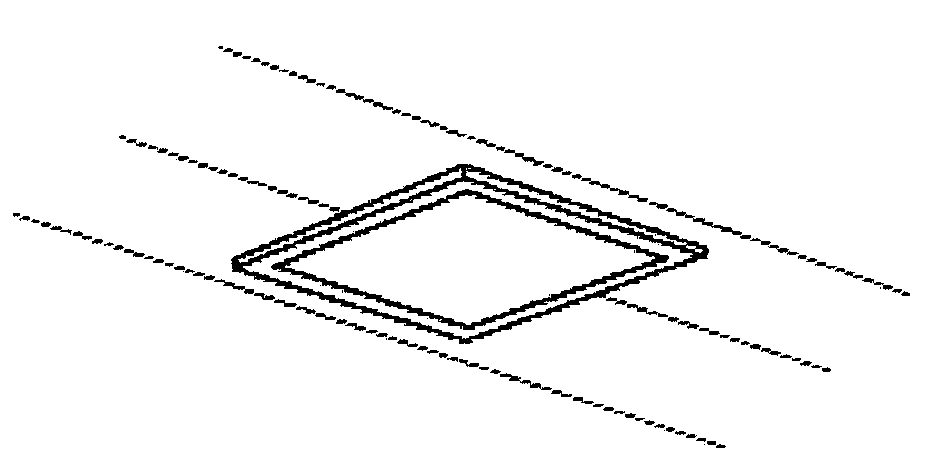
Figure 5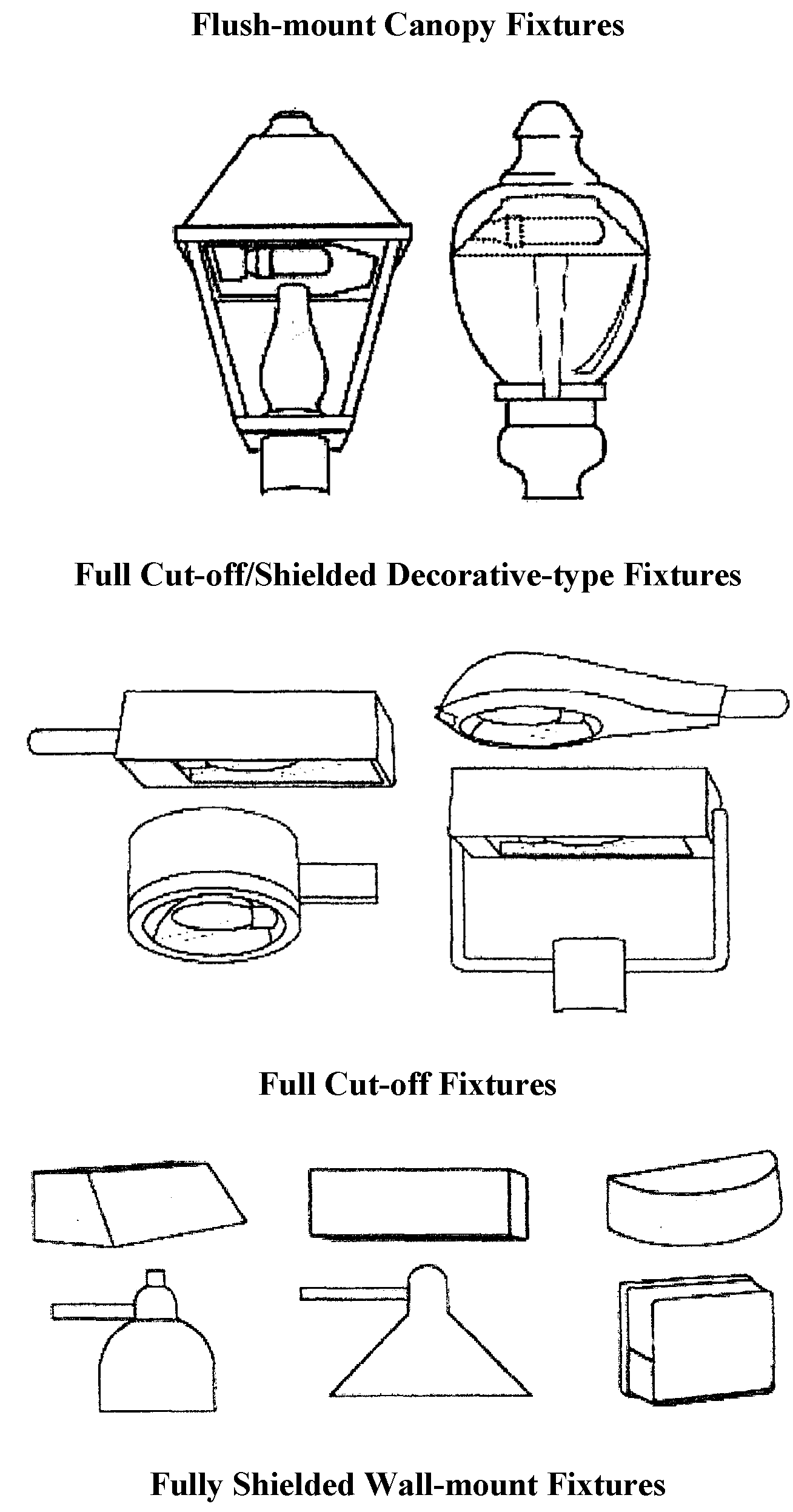
(2)
All exterior lights and illuminated signs shall:
a.
Be designed, located, installed and directed in such a manner to prevent objectionable light at and across the property lines and to prevent glare at any location on or off the property;
b.
Be of a white light, such as metal halide, incandescent or a lamp with a color rendering index above seventy (70);
c.
Not exceed the maintained horizontal illuminance recommendations set by the Illuminating Engineering Society of North America (IES) or an average illumination level of one and five-tenths (1.5) foot-candles for the illuminated area;
d.
Not exceed one-tenth (0.1) foot-candle as a direct result of the on-site lighting measured twenty (20) feet beyond the property line of the development site;
e.
Be full cut-off style fixtures for all parking area lighting. (See Figure 5);
f.
Be illuminated with flush-mounted, flat lens light fixtures for all under-canopy fueling areas. (See Figure 5);
g.
Be shielded to prevent glare and/or light trespass from all building, site and aesthetic lighting;
h.
Uplighting is prohibited for externally illuminated signs except for monument signs of less than six (6) feet overall height;
i.
Be full cut-off or a shielded type fixture (wallpack style fixtures are not acceptable) for all building lighting for security or aesthetics. Floodlighting is discouraged; however, if used, it shall be shielded to prevent the following:
1.
Glare for pedestrians or drivers;
2.
Light trespass beyond the property line; and
3.
Light above a ninety (90) degree horizontal plane;
j.
Be required to be turned off after business hours between midnight and 6:00 a.m., leaving only the necessary lighting for site and building security for all nonessential lighting. For purposes of this Subsection, nonessential lighting shall include display, aesthetic and sign lighting, and may include parking lot lighting. Outdoor display lots for vehicle sales and leasing shall also comply with the requirements of this Subsection by reducing the light levels between midnight and 6:00 a.m. to illumination levels sufficient for security purposes only;
k.
Not be installed, illuminated or maintained with a permanent beacon or searchlight; and
l.
Have the following maximum mounting height;
1.
Twenty-four (24) feet when the fixture is located within seventy-five (75) feet of the site's boundary; or
2.
Forty (40) feet when the fixture is located beyond seventy-five (75) feet from the site's boundary; and
3.
Constructed without wood poles.
(3)
Exemptions:
a.
Except for Subparagraph (2)i. above, outdoor lighting for sports and athletic fields shall:
1.
Be installed with internal louvers and external shields to minimize sky glow;
2.
Not have floodlights aimed above sixty-two (62) degrees;
3.
Have poles used for aerial sports such as baseball or softball at least seventy (70) feet in height to minimize sky glow and the effect upon surrounding uses;
4.
Be shut off within one (1) hour after the game or event has ended.
b.
Seasonal decorations with individual lights displayed no longer than sixty (60) days per calendar year.
c.
Residential incandescent lighting of one hundred fifty (150) watts or fewer for each light fixture, and/or fluorescent lights of twenty (20) watts or fewer per fixture.
d.
Temporary lighting for fire, police, emergency or repair workers.
e.
Temporary lighting for construction activity or periodic events (such as fairs, fiestas, carnivals and similar temporary uses), if approved in advance by the Director of the Department of Land Use Administration after consulting with the Department of Transportation.
f.
Colored lights used as an accent to building facades and signage if the structure incorporating the accent lighting is neither located adjacent to, nor directed at, a residential use.
g.
Lighting adjacent to the Historic Arkansas Riverwalk of Pueblo (HARP), provided that the Administrative Official makes the following findings of fact:
1.
Ambient light levels for outdoor gathering spaces and dining areas within and adjacent to the HARP are not greater than six (6) foot-candles;
2.
Pedestrian walkways are provided with a maximum ambient light level of three (3) foot-candles; and
3.
Appropriate on-site lighting has been provided despite anything to the contrary in Subparagraphs 17-4-52(2)c. and d. above.
h.
Uplighting intended to highlight building entrances, architectural features, flags, landscaping and works of art, provided that the Administrative Official makes the following findings of fact:
1.
The illumination source is shielded so it is not visible from adjacent properties;
2.
The illumination source is not a floodlight mounted on a freestanding pole;
3.
All building facade illumination is located as close to the wall as possible and confined to light the building as an accent and not fully illuminate any building facade or project into the sky; and
4.
Uplighting measurable at the ground level has been included in the maximum allowable light levels allowed for the site.
(4)
Lighting plan submission requirements for existing and proposed lighting:
a.
Plans indicating the location, type and height of the luminaries, including both building and ground mounted;
b.
A description of the luminaries, including lamps, poles or other supports, and shielding devices, which may be provided as catalogue cut sheets from the manufacturer;
c.
Photometric data, such as that furnished by the manufacturer, showing the angle of the light emissions; and
d.
Additional information as may be required by the Director of the Department of Land Use Administration in order to determinate compliance with this Section.
(4.5)
Regulations for nonconforming lights, light fixtures and light poles. All legal nonconforming lights, light fixtures and light poles shall immediately lose their legal nonconforming status and, thereafter, shall be brought into full compliance with the outdoor lighting performance standards or removed, when any one (1) of the following occur:
a.
The construction or erection of any building or structure upon any lot.
b.
The addition of five hundred (500) square feet or ten percent (10%) of the gross floor area to any building or structure, whichever is smaller.
c.
The legal nonconforming lights are accessory to a nonconforming use which has lost its nonconforming status.
d.
A land use application has been approved to change the use or dimension of the property.
e.
If a single light fixture or light pole is damaged more than fifty percent (50%), then only that fixture or pole must be brought into compliance or removed.
f.
If a nonconforming light fixture or pole is replaced, then only that fixture or pole must be brought into compliance.
(5)
Any person who installs or permits the installation of outdoor lights which do not comply with the performance standards set forth in this Section shall be guilty of a Class 2 municipal offense and punished as provided in Section 1-2-1.
(Ord. No. 7032 §1, 8-11-03; Ord. No. 7058 §1, 10-14-03; Ord. No. 7797 §1, 5-12-08; Ord. No. 7887 §§1, 2, 9-22-2008; Ord. No. 9239 §58, 2-26-18)
Sec. 17-4-61. - Applicability; purpose and goals.
(a)
All new towers or antennas within the City shall be subject to these requirements, except as provided in Subsections (b) through (d) below.
(b)
This Article shall not govern any tower, or the installation of any antenna, that is under seventy (70) feet in height and is either owned and operated by a federally licensed amateur radio station operator or is used exclusively as a receive-only antenna.
(c)
Preexisting towers and preexisting antennas shall not be required to meet the requirements of this Article, other than the requirements of Sections 17-4-62(f) and (g) and Section 17-4-67.
(d)
For purposes of implementing this Article, an AM array, consisting of one (1) or more tower units and supporting ground system which functions as one (1) AM broadcasting antenna, shall be considered one (1) tower. Measurements for setbacks and separation distances shall be measured from the outer perimeter of the towers included in the AM array. Additional tower units may be added within the perimeter of the AM array by right.
(e)
The purpose of this Article is to establish general guidelines for the siting of wireless communications towers and antennas. The goals of this Article are to:
(1)
Protect residential areas and land uses from potential adverse impacts of towers and antennas;
(2)
Encourage the location of towers in nonresidential areas;
(3)
Minimize the total number of towers throughout the community;
(4)
Strongly encourage the joint use of new and existing tower sites as a primary option rather than construction of additional single-use towers; (5) encourage users of towers and antennas to locate them, to the extent possible, in areas where the adverse impact on the community is minimal; (6) encourage users of towers and antennas to configure them in a way that minimizes the adverse visual impact of the towers and antennas through careful design, siting, landscape screening and innovative camouflaging techniques; (7) enhance the ability of the providers of telecommunications services to provide such services to the community quickly, effectively and efficiently; (8) consider the public health and safety of communication towers; and (9) avoid potential damage to adjacent properties from tower failure through engineering and careful siting of tower structures. In furtherance of these goals, the Zoning Administrator and Zoning Board of Appeals shall give due consideration to the City's master plan, zoning map, existing land uses and environmentally sensitive areas in approving sites for the location of towers and antennas.
(Ord. No. 6470, 8-23-99)
Sec. 17-4-62. - General requirements.
(a)
Principal or Accessory Use. Antennas and towers may be considered either principal or accessory uses. A different existing use of an existing structure on the same lot shall not preclude the installation of an antenna or tower on such lot.
(b)
Lot Size. For purposes of determining whether the installation of a tower or antenna complies with district development regulations, including but not limited to setback requirements, lot coverage requirements and other such requirements, the dimensions of the entire lot shall control, even though the antennas or towers may be located on leased parcels within such lot.
(c)
Inventory of Existing Sites. Each applicant for an antenna and/or tower shall provide to the Zoning Administrator an inventory of its existing towers, antennas or sites approved for towers or antennas that are within the City and within three (3) miles of the corporate boundary thereof, including specific information about the location, height and design of each tower. The Zoning Administrator may share such information with other applicants applying for administrative approvals or special use permits under this Article or other organizations seeking to locate antennas within the City; provided, however, that the Zoning Administrator is not, by sharing such information, in any way representing or warranting that such sites are available or suitable.
(d)
Aesthetics. Towers and antennas shall meet the following requirements:
(1)
Towers shall either maintain a galvanized steel finish or, subject to any applicable standards of the FAA, be painted a neutral color so as to reduce visual obtrusiveness.
(2)
At a tower site, the design of the buildings and related structures shall, to the extent possible, use materials, colors, textures, screening and landscaping that will blend them into the natural setting and surrounding buildings.
(3)
If an antenna is installed on a structure other than a tower, the antenna and supporting electrical and mechanical equipment must be of a color that is identical to, or closely compatible with, the color of the supporting structure so as to make the antenna and related equipment as visually unobtrusive as possible.
(e)
Lighting. Towers shall not be artificially lighted, unless required by the FAA or other applicable authority. If lighting is required, the lighting alternatives and design chosen must cause the least disturbance to the surrounding views and neighborhoods.
(f)
State or Federal Requirements. All towers must meet or exceed current standards and regulations of the FAA, the FCC and any other agency of the state or federal government with the authority to regulate towers and antennas. If such standards and regulations are changed, then the owners of the towers and antennas governed by this Article shall bring such towers and antennas into compliance with such revised standards and regulations within six (6) months of the effective date of such standards and regulations, unless a different compliance schedule is mandated by the controlling state or federal agency. Failure to bring towers and antennas into compliance with such revised standards and regulations shall constitute grounds for the removal of the tower or antenna by the City at the owner's expense.
(g)
Building Codes, Safety Standards. To ensure the structural integrity of towers, the owner of a tower shall ensure that it is erected and maintained in compliance with standards contained in applicable state and local building codes and the applicable standards for towers that are published by the Electronic Industries Association, as amended from time to time. If, upon inspection, the City concludes that a tower fails to comply with such codes and standards and constitutes a danger to persons or property, then upon notice being provided to the owner of the tower, the owner shall have thirty (30) days to bring such tower into compliance with such standards. Failure to bring such tower into compliance within said thirty (30) days shall constitute grounds for the removal of the tower or antenna at the owner's expense.
(h)
Measurement. For purposes of measurement, tower setbacks and separation distances shall be calculated and applied to facilities located within the City irrespective of municipal and county jurisdictional boundaries.
(i)
Other Approvals. To the extent applicable, owners and/or operators of towers or antennas for telecommunication purposes shall certify that necessary authorization from the FCC and the Colorado Public Utilities Commission for operation of a wireless communications system in Pueblo has been obtained and file a copy of all such authorizations with the Zoning Administrator.
(j)
In the event the owners and/or operators of any towers or antennas use or intend to use a backhaul network in connection with such towers or antennas that involve placement of lines, wire, fiber, conduit or other facilities within the public rights-of-way of the City, such owner or operator shall first have obtained either a duly authorized franchise or written consent of the City to do so. This requirement shall not apply to the extent an owner or operator's backhaul network involves only the use of lines, wire, fiber, conduit or other facilities owned by a third party telecommunications provider or cable television provider which has previously been granted a franchise or received such consent with respect to such lines, wire, fiber, conduit or other facilities.
(k)
Public Notice. For purposes of this Article, any special use request, variance request or appeal of an administratively approved use or special use shall require public notice to all abutting property owners and all property owners of properties that are located within the corresponding separation distance listed in Section 17-4-65(b)(5)b, Table 2, in addition to any notice otherwise required by the Zoning Ordinance. In order to effectuate this Subsection (k), the applicant shall furnish with the application or appeal a list of names and addresses of all owners of land within said separation distances, which list shall be certified as being correct according to the records of the County Clerk and Recorder.
(l)
Signs. No signs shall be allowed on an antenna or tower, except for required or appropriate signs located not more than six (6) feet above ground level warning of high voltage or other hazards.
(m)
Buildings and Support Equipment. Buildings and support equipment associated with antennas or towers shall comply with the requirements of Section 17-4-66.
(n)
Multiple Antenna/Tower Plan. The City encourages the users of towers and antennas to submit a single application for approval of multiple towers and/or antenna sites. Applications for approval of multiple sites shall be given priority in the review process.
(Ord. No. 6470, 8-23-99; Ord. No. 9469 §9, 5-28-19)
Sec. 17-4-63. - Permitted uses.
(a)
General. The uses listed in this Section are deemed to be permitted uses and shall not require administrative approval or a special use permit.
(b)
Permitted Uses. The following uses are specifically permitted:
(1)
Antennas or towers located on property owned, leased or otherwise controlled by the City provided a lease consistent with the purpose and goals of Section 17-4-61 of this Chapter authorizing such antenna or tower has been approved by the City Council. Nothing in this Subsection (b)(1), however, shall be construed to require any such lease, the granting or denial of same being within the discretion of the City Council.
(2)
Antennas or towers located in an I-3 Zone District, provided the location is not less than one thousand (1,000) feet from any residentially zoned property.
(Ord. No. 6470, 8-23-99)
Sec. 17-4-64. - Administrative approval of certain uses.
(a)
General. Except for eligible facilities requests made pursuant to Section 17-4-64.5, the following provisions shall govern the issuance of administrative approvals for towers and antennas:
(1)
The Zoning Administrator may administratively approve the uses listed in this Section.
(2)
Each applicant for administrative approval shall apply to the Zoning Administrator providing the information set forth in Sections 17-4-65(b)(1) and 17-4-65(b)(3) of this Article and a nonrefundable fee as established by resolution of the City Council to reimburse the City for the costs of reviewing the application.
(3)
The Zoning Administrator shall review the application for administrative approval and determine if the proposed use complies with Sections 17-4-62 and 17-4-65(b)(4) and 17-4-65(b)(5) of this Title.
(4)
The Zoning Administrator shall respond to each such application within sixty (60) days after receiving it by either approving or denying the application. If the Zoning Administrator fails to respond to the applicant within said sixty (60) days, then the application shall be deemed to be denied.
(5)
In connection with any such administrative approval, the Zoning Administrator may, in order to encourage shared use, administratively waive any zoning district setback requirements in Section 17-4-65(b)(4) or separation distances between towers in Section 17-4-65(b)(5) by up to fifty percent (50%).
(6)
In connection with any such administrative approval, the Zoning Administrator may, in order to encourage the use of monopoles, administratively allow the reconstruction of an existing tower to monopole construction.
(7)
If an administrative approval is denied or deemed to be denied, the applicant shall file an application for a special use permit pursuant to Section 17-4-65 prior to filing any appeal that may be available under the Zoning Ordinance.
(b)
List of Administratively Approved Uses. The following uses may be approved by the Zoning Administrator after conducting an administrative review:
(1)
Locating a tower or antenna, including the placement of additional buildings or other supporting equipment used in connection with said tower or antenna, in any I-3 or S-3 zone district.
(2)
Except for eligible facilities requests approved pursuant to Section 17-4-64.5, locating antennas on existing structures or towers consistent with the terms of Subsections a and b below.
a.
Antennas on existing structures. Any antenna which is not attached to a tower may be approved by the Zoning Administrator as an accessory use to any commercial, industrial, professional, institutional or multifamily structure of eight (8) or more dwelling units, provided:
1.
The antenna does not extend more than thirty (30) feet above the highest point of the structure;
2.
The antenna complies with all applicable FCC and FAA regulations; and
3.
The antenna complies with all applicable building codes.
b.
Antennas on existing towers. An antenna which is attached to an existing tower may be approved by the Zoning Administrator and, to minimize adverse visual impacts associated with the proliferation and clustering of towers, collocation of antennas by more than one (1) carrier on existing towers shall take precedence over the construction of new towers, provided such collocation is accomplished in a manner consistent with the following:
1.
A tower which is modified or reconstructed to accommodate the collocation of an additional antenna shall be of the same tower type as the existing tower, unless the Zoning Administrator allows reconstruction as a monopole.
2.
Height.
a)
An existing tower may be modified or rebuilt to a taller height, not to exceed thirty (30) feet over the tower's existing heights to accommodate the collocation of an additional antenna.
b)
The height change referred to in paragraph 2a) above may only occur one (1) time per communication tower.
c)
The additional height referred to in paragraph 2a) above shall not require an additional distance separation as set forth in Section 17-4-65. The tower's premodification height shall be used to calculate such distance separations.
3.
Onsite location.
a)
A tower which is being rebuilt to accommodate the collocation of an additional antenna may be moved onsite within fifty (50) feet of its existing location.
b)
After the tower is rebuilt to accommodate collocation, only one (1) tower may remain on the site.
c)
A relocated onsite tower shall continue to be measured from the original tower location for purposes of calculating separation distances between towers pursuant to Section 17-4-65(b)(5). The relocation of a tower hereunder shall in no way be deemed to cause a violation of Section 17-4-65(b)(5).
d)
The onsite relocation of a tower which comes within the separation distances to residential units or residentially zoned lands as established in Section 17-4-65(b)(5) shall only be permitted when approved by the Zoning Administrator.
(3)
Locating any new tower in an A-1, A-2, B-3, B-4, I-1 or I-2 zoning district, provided a licensed professional engineer certifies the tower can structurally accommodate the number of shared users proposed by the applicant, the Zoning Administrator concludes the tower is in conformity with the goals set forth in Section 17-4-61 and the requirements of Section 17-4-62; the tower meets the setback requirements in Section 17-4-65(b)(4) and separation distances in Section 17-4-65(b)(5); and the tower meets the following height and usage criteria:
a.
For a single user, up to eighty (80) feet in height;
b.
For two (2) users, up to one hundred ten (110) feet in height; and
c.
For three (3) or more users, up to one hundred thirty (130) feet in height.
(4)
Locating any alternative tower structure in an A-1, A-2, B-3, B-4, I-1 or I-2 zoning district that in the judgment of the Zoning Administrator is in conformity with the goals set forth in Section 17-4-61 of this Chapter.
(5)
Installing a cable microcell network through the use of multiple low-powered transmitters/receivers attached to existing wireline systems, such as conventional cable or telephone wires, or similar technology that does not require the use of towers.
(Ord. No. 6470, 8-23-99; Ord. No. 9069 §1, 11-28-16)
Sec. 17-4-64.5. - Eligible facilities requests.
(a)
Definitions. When used in this Section:
(1)
Base Station means a structure or equipment at a fixed location that enables FCC-licensed or authorized wireless communications between user equipment and a communications network. The term does not encompass a tower as defined herein or any equipment associated with a tower. Base Station includes, without limitation:
a.
Equipment associated with wireless communications services such as private, broadcast, and public safety services, as well as unlicensed wireless services and fixed wireless services such as microwave backhaul.
b.
Radio transceivers, antennas, coaxial or fiber-optic cable, regular and backup power supplies, and comparable equipment, regardless of technological configuration (including Distributed Antenna Systems ("DAS") and small-cell networks).
c.
Any structure other than a tower that, at the time the relevant application is filed with the Zoning Administrator under this Section, supports or houses equipment described in the above Subsections 17-4-64.5(a)(1)a. and b. that has been reviewed and approved under this Chapter or constitutes a preexisting tower or antenna.
The term does not include any structure that, at the time the relevant application is filed with the Zoning Administrator under this Section, does not support or house equipment described in the above Subsections 17-4-64.5(a)(1)a. and b.
(2)
Collocation means the mounting or installation of transmission equipment on an eligible support structure for the purpose of transmitting and/or receiving radio frequency signals for communications purposes.
(3)
Eligible Facilities Request means any request for modification of an existing tower or base station that does not substantially change the physical dimensions of such tower or base station, involving:
a.
Collocation of new transmission equipment;
b.
Removal of transmission equipment; or
c.
Replacement of transmission equipment.
(4)
Eligible support structure means a tower or base station as defined in this Section, provided that it is existing at the time the relevant application is filed with the Zoning Administrator under this Section.
(5)
Existing means a constructed tower or base station which has been reviewed and approved under this Chapter or constitutes a preexisting tower or antenna.
(6)
Site. For towers other than towers in the public rights-of-way, the current boundaries of the leased or owned property surrounding the tower and any access or utility easements currently related to the site, and, for other eligible support structures, further restricted to that area in proximity to the structure and to other transmission equipment already deployed on the ground.
(7)
Substantial Change. A modification substantially changes the physical dimensions of an eligible support structure if it meets any of the following criteria:
a.
For towers other than towers in the public rights-of-way, it increases the height of the tower by more than ten percent (10%) or by the height of one (1) additional antenna array with separation from the nearest existing antenna not to exceed twenty (20) feet, whichever is greater; for other eligible support structures, it increases the height of the structure by more than ten percent (10%) or more than ten (10) feet, whichever is greater;
b.
For towers other than towers in the public rights-of-way, it involves adding an appurtenance to the body of the tower that would protrude from the edge of the tower more than twenty (20) feet, or more than the width of the tower structure at the level of the appurtenance, whichever is greater; for other eligible support structures, it involves adding an appurtenance to the body of the structure that would protrude from the edge of the structure by more than six (6) feet;
c.
For any eligible support structure, it involves installation of more than the standard number of new equipment cabinets for the technology involved, but not to exceed four (4) cabinets; or, for towers in the public rights-of-way and base stations, it involves installation of any new equipment cabinets on the ground if there are no pre-existing ground cabinets associated with the structure, or else involves installation of ground cabinets that are more than ten percent (10%) larger in height or overall volume than any other ground cabinets associated with the structure;
d.
It entails any excavation or deployment outside the current site;
e.
It would defeat the concealment elements of the eligible support structure; or
f.
It does not comply with conditions associated with the siting approval of the construction or modification of the eligible support structure or base station equipment, provided however that this limitation does not apply to any modification that is non-compliant only in a manner that would not exceed the thresholds identified in the above Subsections 17-4-64.5(7) a.—d.
(8)
Transmission Equipment. Equipment that facilitates transmission for any FCC-licensed or authorized wireless communication service, including, but not limited to, radio transceivers, antennas, coaxial or fiber-optic cable, and regular and backup power supply. The term includes equipment associated with wireless communications services including, but not limited to, private, broadcast, and public safety services, as well as unlicensed wireless services and fixed wireless services such as microwave backhaul.
(9)
Tower. Any structure built for the sole or primary purpose of supporting any FCC-licensed or authorized antennas and their associated facilities, including structures that are constructed for wireless communications services including, but not limited to, private, broadcast, and public safety services, as well as unlicensed wireless services and fixed wireless services such as microwave backhaul, and the associated site.
(b)
Application Review.
(1)
Application. The Zoning Administrator shall prepare and make publicly available an application form which shall be limited to the information necessary for the Zoning Administrator to consider whether an application is an Eligible Facilities Request. The application may not require the applicant to demonstrate a need or business case for the proposed modification.
(2)
Type of Review. Upon receipt of an application for an Eligible Facilities Request pursuant to this Chapter, the Zoning Administrator shall review such application to determine whether the application so qualifies.
(3)
Timeframe for Review. Subject to the tolling provisions set forth in Subsection 17-4-64.5(b)(4), within sixty (60) days of the date on which an applicant submits an application seeking approval under this Section, the Zoning Administrator shall approve the application unless it determines that the application is not covered by this Section.
(4)
Tolling of the Timeframe for Review. The sixty-day review period begins to run when the application is filed, and may be tolled only by mutual agreement by the Zoning Administrator and the applicant, or in cases where the Zoning Administrator determines that the application is incomplete. The timeframe for review is not tolled by a moratorium on the review of applications.
a.
To toll the timeframe for incompleteness, the Zoning Administrator must provide written notice to the applicant within thirty (30) days of receipt of the application, specifically delineating all missing documents or information required in the application.
b.
The timeframe for review begins running again when the applicant makes a supplemental submission in response to the Zoning Administrator's notice of incompleteness.
c.
Following a supplemental submission, the Zoning Administrator will notify the applicant within ten (10) days that the supplemental submission did not provide the information identified in the original notice delineating missing information. The timeframe is tolled in the case of second or subsequent notices pursuant to the procedures identified in this Subsection 17-4-64.5(b)(4). Second or subsequent notices of incompleteness may not specify missing documents or information that were not delineated in the original notice of incompleteness.
(5)
Failure to Act. In the event the Zoning Administrator fails to approve or deny a request seeking approval under this Chapter within the time frame for review, accounting for any tolling, the request shall be deemed granted. The deemed grant does not become effective until the applicant notifies the applicable reviewing authority in writing after the review period has expired, accounting for any tolling, that the application has been deemed granted.
(6)
Remedies. Applicants and City may bring claims related to Section 6409(a) of the Middle Class Tax Relief and Jobs Creation Act of 2012, 112 Pub. L. 96, codified at 47 U.S.C. §1455, to any court of competency.
(Ord. No. 9069 §2, 11-28-16)
Sec. 17-4-65. - Special use permits.
(a)
The following additional provisions shall govern the issuance of special use permits for towers or antennas by the Zoning Board of Appeals:
(1)
If the tower or antenna is not a permitted use under Section 17-4-63 of this Chapter or permitted to be approved administratively pursuant to Section 17-4-64 of this Chapter, then a special use permit shall be required for the construction of a tower or the placement of an antenna in all zoning districts where allowed as a use by review.
(2)
Applications for special use permits under this Section shall be subject to the procedures and requirements of Section 17-5-33 of Chapter 5 of this Title, except as modified by this Section.
(3)
In granting a special use permit, the Zoning Board of Appeals may impose reasonable conditions to the extent the Zoning Board of Appeals concludes such conditions are necessary to minimize any adverse effect of the proposed tower on adjoining properties.
(4)
Any information of an engineering nature that the applicant submits, whether civil, mechanical or electrical, shall be certified by a licensed professional engineer.
(5)
An applicant for a special use permit shall submit the information described in this Section and a nonrefundable fee as established by resolution of the City Council to reimburse the City for the costs of reviewing the application.
(b)
Towers.
(1)
Information required. In addition to any information required for applications for special use permits pursuant to Section 17-5-33 of Chapter 5 of this Title, applicants for a special use permit for a tower shall submit the following information:
a.
A scaled site plan clearly indicating the location, type and height of the proposed tower, on-site land uses and zoning, adjacent land uses and zoning, Master Plan classification of the site and all properties within the applicable separation distances set forth in Subsection (b)(5) of this Section, adjacent roadways, proposed means of access, setbacks from property lines, elevation drawings of the proposed tower and any other structures, topography, parking and other information deemed by the Zoning Administrator to be necessary to assess compliance with this Article VI.
b.
Legal description of the parent tract and leased parcel (if applicable).
c.
The setback distance between the proposed tower and the nearest residential unit, platted residentially zoned properties and unplatted residentially zoned properties.
d.
The separation distance from other towers described in the inventory of existing sites submitted pursuant to Section 17-4-62(c) shall be shown on an updated site plan or map. The applicant shall also identify the type of construction of the existing tower(s) and the owner/ operator of the existing tower(s), if known.
e.
A landscape plan showing specific landscape materials in accordance with the requirements of this Chapter or the requirements of Section 17-4-7, whichever requirements are greater.
f.
Method of fencing, and finished color and, if applicable, the method of camouflage and illumination.
g.
A descriptive statement indicating compliance with Section 17-4-62(c), (d), (e), (i), (j), (l) and (m), and Subsections (b)(4) and (b)(5) of this Section and all applicable federal, state and local laws.
h.
A notarized statement by the applicant as to whether construction of the tower will accommodate collocation of additional antennas for future users.
i.
Identification of the entities providing the backhaul network for the tower(s) described in the application and other cellular sites owned or operated by the applicant within the City.
j.
A description of the suitability of the use of existing towers, other structures or alternative technology not requiring the use of towers or structures to provide the services to be provided through the use of the proposed new tower.
k.
A description of the feasible location(s) of future towers or antennas within the City based upon existing physical, engineering, technological or geographical limitations in the event the proposed tower is erected.
(2)
Factors considered in granting special use permits for towers. In addition to any standards for consideration of special use permit applications pursuant to Section 17-5-33 of Chapter 5 of this Title, the Zoning Board of Appeals shall consider the following factors in determining whether to issue a special use permit, although the Zoning Board of Appeals may waive or reduce the burden on the applicant of one (1) or more of these criteria if the Zoning Board of Appeals concludes that the goals of this Article are better served thereby:
a.
Height of the proposed tower;
b.
Proximity of the tower to residential structures and residential district boundaries;
c.
Nature of uses on adjacent and nearby properties;
d.
Surrounding topography;
e.
Surrounding tree coverage and foliage;
f.
Design of the tower, with particular reference to design characteristics that have the effect of reducing or eliminating visual obtrusiveness;
g.
Proposed ingress and egress; and
h.
Availability of suitable existing towers, other structures or alternative technologies not requiring the use of towers or structures, as discussed in Subsection (b)(3) of this Section.
(3)
Availability of suitable existing towers, other structures or alternative technology. No new tower shall be permitted unless the applicant demonstrates to the reasonable satisfaction of the Zoning Board of Appeals that no existing tower, structure or alternative technology that does not require the use of towers or structures can accommodate the applicant's proposed antenna. An applicant shall submit information requested by the Zoning Board of Appeals related to the availability of suitable existing towers, other structures or alternative technology. Evidence submitted to demonstrate that no existing tower, structure or alternative technology can accommodate the applicant's proposed antenna may consist of proof of any of the following:
a.
No existing towers or structures are located within the geographic area which meet the applicant's engineering requirements.
b.
Existing towers or structures are not of sufficient height to meet the applicant's engineering requirements.
c.
Existing towers or structures do not have sufficient structural strength to support the applicant's proposed antenna and related equipment.
d.
The applicant's proposed antenna would cause electromagnetic interference with the antenna on the existing towers or structures, or the antenna on the existing towers or structures would cause interference with the applicant's proposed antenna.
e.
The fees, costs or contractual provisions required by the owner in order to share an existing tower or structure or to adapt an existing tower or structure for sharing are unreasonable. Costs exceeding new tower development are presumed to be unreasonable.
f.
The applicant demonstrates that there are other limiting factors that render existing towers and structures unsuitable.
g.
The applicant demonstrates that an alternative technology that does not require the use of towers or structures, such as a cable microcell network using multiple low-powered transmitters/receivers attached to a wireline system, is unsuitable. Costs of alternative technology that exceed new tower or antenna development shall not be presumed to render the technology unsuitable.
(4)
Setbacks. The following setback requirements shall apply to all towers for which a special use permit is required; provided, however, that the Zoning Board of Appeals may reduce the standard setback requirements if the goals of this Article VI would be better served thereby:
a.
Towers must be set back a distance equal to at least seventy-five percent (75%) of the height of the tower from any adjoining lot line.
b.
Guys and accessory buildings must satisfy the minimum zoning district setback requirements.
(5)
Separation. The following separation requirements shall apply to all towers and antennas for which a special use permit is required; provided, however, that the Zoning Board of Appeals may reduce the standard separation requirements if the goals of this Article would be better served thereby:
a.
Separation from off-site uses/ designated areas.
1.
Tower separation shall be measured from the base of the tower to the lot line of the off-site uses and/or designated as specified in Table 1, except as otherwise provided in Table 1.
2.
Separation requirements for towers shall comply with the minimum standards established in Table 1.
Table 1
1 Includes modular homes and mobile homes used for living purposes.
2 Separation measured from base of tower to closest building setback line.
3 Includes any unplatted residential use properties without a valid preliminary subdivision plan or valid development plan approval and any multifamily residentially zoned land greater than two-family residential units.
b.
Separation distances between towers.
1.
Separation distances between towers shall be applicable for and measured between the proposed tower and preexisting towers. The separation distances shall be measured by drawing or following a straight line between the base of the existing tower and the proposed base, pursuant to a site plan of the proposed tower. The separation distances (listed in linear feet) shall be as shown in Table 2.
Table 2
Existing Towers - Types
(6)
Security fencing. Towers shall be enclosed by security fencing not less than six (6) feet in height and shall also be equipped with an appropriate anti-climbing device; provided, however, that the Zoning Board of Appeals may waive such requirements, as it deems appropriate.
(7)
Landscaping. The following requirements shall govern the landscaping surrounding towers for which a special use permit is required; provided, however, that the Zoning Board of Appeals may waive such requirements if the goals of this Article would be better served thereby:
a.
Tower facilities shall be landscaped with a buffer of plant materials that effectively screens the view of the tower compound from property used for residences. The standard buffer shall consist of a landscaped strip at least four (4) feet wide outside the perimeter of the compound.
b.
In locations where the visual impact of the tower would be minimal, the landscaping requirement may be reduced or waived.
c.
Existing mature tree growth and natural land forms on the site shall be preserved to the maximum extent possible. In some cases, such as towers sited on large, wooded lots, natural growth around the property perimeter may be sufficient buffer.
(Ord. No. 6470, 8-23-99; Ord. No. 8933 §13, 11-23-15)
Sec. 17-4-66. - Buildings or other equipment storage.
(a)
Equipment cabinets or uninhabited structures used in association with antennas shall comply with all provisions of this Title applicable to accessory buildings and comply with all applicable building codes.
(b)
Antennas Mounted on Utility Poles or Light Poles. The equipment cabinet or structure used in association with antennas mounted on utility poles or light poles shall be located in accordance with the following:
(1)
In residential districts (where allowed), the equipment cabinet or structure may be located:
a.
In a front or side yard provided that the cabinet or structure is no greater than four (4) feet in height and thirty-six (36) square feet of gross floor area and the cabinet/structure is located a minimum of ten (10) feet from all lot lines. The cabinet/structure shall be screened by an evergreen hedge with an ultimate height of at least forty-eight (48) inches and a planted height of at least thirty-six (36) inches.
b.
In a rear yard, provided the cabinet or structure is no greater than six (6) feet in height or seventy-two (72) square feet in gross floor area. The cabinet/structure shall be screened by an evergreen hedge with an ultimate height of eight (8) feet and a planted height of at least thirty-six (36) inches.
(2)
In commercial districts, the equipment cabinet or structure shall be no greater than twelve (12) feet in height or one hundred twenty (120) square feet in gross floor area. The structure or cabinet shall be screened by an evergreen hedge with an ultimate height of eight (8) feet and a planted height of at least thirty-six (36) inches. In all other instances, structures or cabinets shall be screened from view of all residential properties which abut or are directly across the street from the structure or cabinet by a solid fence eight (8) feet in height or an evergreen hedge with an ultimate height of eight (8) feet and a planted height of at least thirty-six (36) inches.
(c)
Antennas Located on Towers. The related unmanned equipment structure shall not contain more than two hundred (200) square feet of gross floor area or be more than fifteen (15) feet in height, and shall be located in accordance with the minimum yard requirements of the zoning district in which located.
(d)
Modification of Building Size Requirements. The requirements of Subsections (a) through (c) may be modified by the Zoning Administrator in the case of administratively approved uses or by the Zoning Board of Appeals in the case of uses permitted by special use in order to encourage collocation.
(Ord. No. 6470, 8-23-99)
Sec. 17-4-67. - Removal of abandoned antennas and towers.
Any antenna or tower that is not operated for a continuous period of twelve (12) months shall be considered abandoned, and the owner of such antenna or tower shall remove the same within ninety (90) days of receipt of notice from the Zoning Administrator notifying the owner of such abandonment. Failure to remove an abandoned antenna or tower within said ninety (90) days shall be grounds for the City to remove the tower or antenna at the owner's expense. If there are two (2) or more users of a single tower, then this provision shall not become effective until all users cease using the tower.
(Ord. No. 6470, 8-23-99)
Sec. 17-4-68. - Nonconforming uses.
(a)
Not Expansion of Nonconforming Use. Towers that are constructed, and antennas that are installed, in accordance with the provisions of this Article VI shall not be deemed to constitute the expansion of a nonconforming use or structure.
(b)
Preexisting Towers. Preexisting towers shall be allowed to continue their usage as they presently exist. Routine maintenance (including replacement with a new tower of like construction and height) shall be permitted on such preexisting towers. New construction other than routine maintenance on a preexisting tower shall comply with the requirements of this Article.
(c)
Rebuilding Damaged or Destroyed Nonconforming Towers or Antennas. Notwithstanding Section 17-4-67, bona fide nonconforming towers or antennas that are damaged or destroyed may be rebuilt without having to first obtain administrative approval or a special use permit and without having to meet the separation requirements specified in Sections 17-4-65(b)(4) and (b)(5). The type, height and location of the tower onsite shall be of the same type and intensity as the original facility approval. Building permits to rebuild the facility shall comply with the then-applicable building codes and shall be obtained within one hundred eighty (180) days from the date the facility is damaged or destroyed. If no permit is obtained or if said permit expires, the tower or antenna shall be deemed abandoned as specified in Section 17-4-67.
(Ord. No. 6470, 8-23-99)
Sec. 17-4-69. - Severability.
The various parts, sections and clauses of this Article VI are hereby declared to be severable. If any part, sentence, paragraph, section or clause is adjudged unconstitutional or invalid by a court of competent jurisdiction, the remainder of the Article shall not be affected thereby.
(Ord. No. 6470, 8-23-99)
Sec. 17-4-70. - Applicability; purpose and goals.
(a)
All new wind turbines shall be subject to these requirements, except as provided below:
(1)
This Article shall not govern wind turbines which are operated by franchised public utilities as defined in Section 17-4-30 of this Chapter.
(2)
This Article shall not govern ornamental windmills which, together with their tower, are not more than eight (8) feet tall and with blades or vanes not exceeding two (2) feet in length, which are intended for decorative purposes only.
(b)
The purpose of this Article is to establish guidelines for the locating of wind turbines. The goals of this Article are to:
(1)
Protect residential areas and other land uses from potential adverse impacts of wind turbines;
(2)
Encourage the use of alternative energy generation methods;
(3)
Consider the public health and safety in regards to wind turbines; and
(4)
Avoid potential damage to adjacent property and structures from wind turbine failure through standards and careful siting.
(Ord. No. 7975 §15, 2-23-09)
Sec. 17-4-71. - Requirements for special use permit.
(a)
Requirements:
(1)
Each wind turbine shall require individual consideration of a special use permit and therefore requires a separate application for each proposed wind turbine;
(2)
Applications for special use permits under this Section shall be subject to the procedures and requirements of Section 17-5-33 of this Title;
(3)
Applications for special use permit shall demonstrate compliance with the Wind Turbine Performance Standards contained in Section 17-4-72 below, prior to the acceptance of the special use permit application; however, the Zoning Board of Appeals may waive or modify the requirements of height limitations for industrial-type wind turbines in the I-2 and I-3 Zone Districts;
(4)
In granting a special use permit, the Zoning Board of Appeals may impose reasonable conditions to the extent the Zoning Board of Appeals concludes such conditions are necessary to minimize any adverse aesthetic, noise, health and safety impacts on adjoining properties; and
(5)
In addition to any standards for consideration of a special use permit, the Zoning Board of Appeals shall consider the following factors in determining whether to approve the special use permit:
a.
Height of the proposed wind turbine;
b.
Proximity of the wind turbine to residential structures and residential district boundaries;
c.
Nature of uses on adjacent and nearby properties;
d.
Surrounding topography;
e.
Possible negative impacts on surrounding properties, including but not limited to noise, shadow flicker, low frequency vibrations and the disruption of scenic views, which, when maintained, protect important community values;
f.
Aesthetics of the wind turbine, including but not limited to wind vanes, color, type, size and the visibility of the turbine;
g.
Design and maintenance of the wind turbine, with particular reference to braking mechanisms, maintenance requirements and life span of the turbine.
(b)
Information required. In addition to any standard information required for application for special use permit, applicants for a special use permit for a wind turbine shall submit the following information:
(1)
A scaled site plan clearly indicating the location, type and height of the proposed wind turbine, on-site land uses and zoning, and adjacent land uses and zoning;
(2)
Legal description of the lot;
(3)
A landscape plan in accordance with the requirements of Section 17-4-7 of this Chapter;
(4)
Manufacturer's product information, including specific model information, photos, rendering and/or elevations; and
(5)
Any other information deemed necessary by the Administrative Official to determine compliance.
(Ord. No. 7975 §15, 2-23-09)
Sec. 17-4-72. - Wind turbine performance standards.
(a)
Aesthetics. All wind turbines shall meet the following requirements:
(1)
The tower structure shall be a monopole design without the use of guy wires;
(2)
Wood poles are not permitted;
(3)
The structure is designed and maintained in a manner that does not detract from the aesthetics of the surrounding area; and
(4)
The tower shall maintain a manufacturer's provided finish in a neutral color so as to reduce visual obtrusiveness.
(b)
Lot size. The placement of wind turbines is not permitted on lots or parcels of less than one-half (½) acre in size.
(c)
Height.
(1)
Wind turbines shall not exceed a height of forty-two (42) feet as measured from the adjacent ground to the tip of the blade at its highest vertical point above the ground;
(2)
The Zoning Board of Appeals may waive the height limitations for industrial size wind turbines of greater than forty-two (42) feet in the I-2 and I-3 Zone Districts.
(d)
Setbacks. All wind turbines shall have setbacks which are at least equal to the height of the windmill.
(e)
Placement on lot. All wind turbines must be placed behind the principal structure, if any. In the case of corner lots, the wind turbine may not be placed in front of the setback established by the principal structure, if any. If no principal structure exists, the wind turbine must meet both the required setback requirements applicable for a principal structure and the requirement of Subsection (d) above.
(f)
Parking and access. In addition to the requirements of Article IV, Off-Street Parking Requirements, the following parking spaces and access shall be required:
(1)
A minimum of one (1) off-street parking space shall be provided for the erection of the tower;
(2)
Parking for all buildings and support equipment shall be provided in accordance with Section 17-4-43 of this Chapter.
(3)
Access to the tower and off-street parking spaces shall be provided in accordance with Section 17-4-43 of this Chapter.
(g)
Signs. No signs shall be allowed on the wind turbine, except for required or appropriate warning signs located not more than six (6) feet above ground level.
(h)
Buildings and support equipment. Buildings and support equipment associated with the tower shall be defined as accessory structures and must comply with Section 17-4-23 of this Chapter.
(i)
Construction standards and maintenance:
(1)
Wind turbines shall be structurally sound so as not to pose any health and/or safety threats;
(2)
All wind turbines must be constructed and maintained in a safe and secure condition and in compliance with this Article, the International Building Code (IBC) as adopted in Title 4, Chapter 2 of this Code and all other applicable building codes;
(3)
Preventative maintenance must be performed at regular intervals, as determined by the wind turbine manufacturer, to prevent failure; and
(4)
Any wind turbine which is determined to be nonoperational or unsafe must be removed within thirty (30) days.
(Ord. No. 7975 §15, 2-23-09)

