
Ramsey City Zoning Code
ARTICLE I
- IN GENERAL
Sec. 106-100.- Title.
This chapter may be known, cited, and referred to as the "Ramsey Zoning Code" or "zoning code," except as referred to herein where it may be known as "this chapter."
(Ord. No. 23-14, § 3, 11-14-2023)
Sec. 106-101. - Authority.
This chapter is enacted pursuant to the authority granted by the Municipal Planning Act, Minn. Stats. §§ 462.351 to 462.364, as amended from time to time.
(Ord. No. 23-14, § 3, 11-14-2023)
Sec. 106-102. - Purpose.
The following zoning provisions and the zoning map established hereby have been enacted in accordance with an adopted comprehensive plan of land use for the purpose of: Promoting the health, safety, morals, comfort, convenience, prosperity, and general welfare of the residents of the city; dividing the city into zones or districts restricting and regulating therein the location, erection, construction, reconstruction, alteration, and use of buildings, structures, and land for specified uses; regulating the intensity of the use of land; regulating and determining the area of open spaces surrounding buildings in order to prevent the overcrowding of land and to ensure adequate light and air; protecting waterways and natural resources; establishing building lines and the location of buildings designed for specified industrial, commercial, residential and other uses within such areas and fixing standards to which buildings or structures shall conform therein; prohibiting uses, buildings, or structures incompatible with the character of the specified districts; preventing additions to and alterations or remodeling of existing buildings or structures in such a way as to avoid the restrictions and limitations imposed hereunder; limiting congestion in the public streets by providing for off-street parking and loading and unloading of vehicles; providing for the gradual elimination of nonconforming uses of land, buildings and structures; and conserving the economic value of land and buildings throughout the city.
(Ord. No. 23-14, § 3, 11-14-2023)
Sec. 106-103. - Coordination with other codes.
This chapter is intended to work in tandem with the adopted state building codes and state fire codes and any locally-adopted optional chapters as amended from time to time. It is also intended to work in tandem with the regulations set forth from the local watershed management organization. Nothing in this chapter is intended to preclude or supersede any requirements in those codes or regulations.
(Ord. No. 23-14, § 3, 11-14-2023)
Sec. 106-104. - Rules of construction and interpretation.
(a)
Conflicting conditions. Where the conditions imposed by any provision of this chapter are either more or less restrictive than comparable conditions by another provision of this chapter or by other chapters of this Code, rule or regulation of the city, the provision which imposes the more restrictive condition, standard, or requirement shall prevail.
(b)
Language rules of construction. The language set forth in the text of this chapter shall be interpreted in accordance with the following rules of construction:
(1)
All measured distances expressed in feet shall be the nearest tenth of a foot. All distances unless otherwise specified shall be measured horizontally.
(2)
The present tense includes the past and future tenses; and the future tense includes the present tense.
(3)
The singular number includes the plural; and the plural number includes the singular.
(4)
The words "shall" and "must" are mandatory and the words "should" and "may" are permissive.
(Ord. No. 23-14, § 3, 11-14-2023)
Sec. 106-105. - Definitions.
If a word or term defined in this chapter appears in the text, its meaning may be construed as set forth in the definition of the word or term as found this section, except where the context clearly indicates a different meaning. If a word is not defined herein, a term is defined by commonly used English language dictionaries.
Several definitions are identified by (MRCCA) and (Shoreland) representing the meanings used in their respective overlay district regulations.
Access path means an area designated to provide ingress and egress to public waters.
Accessory structure means any subordinate building located on the same lot as the principal building containing a use which is incidental to that of the principal building.
Accessory use means a use naturally and normally incidental to, subordinate to, and auxiliary to the principal permitted use of the premises.
Addition means a physical enlargement of an existing structure.
Adjacent means having a boundary that physically touches or adjoins.
Adult use — Body painting studio means an establishment or business which provides the service of applying paint or other substance, whether transparent or non-transparent, to or on the body of a patron when such body is wholly or partially nude in terms of specified anatomical areas.
Adult use — Bookstore means a building or portion of a building used for the barter, rental or sale of items consisting of printed matter, pictures, slides, records, audio tape, videotape, or motion picture film or any other audio or visual media if such building or portion of a building is not open to the public generally but only to one or more classes of the public excluding any minor by reason of age or if a substantial or significant portion of such items are distinguished or characterized by an emphasis on the depiction or description of specified sexual activities or specified anatomical areas.
Adult use — Cabaret means a building or portion of a building used for providing dancing or other live entertainment, if such building or portion of a building excludes minors by reason of age or if such dancing or other live entertainment is distinguished or characterized by an emphasis on the presentation, display, depiction or description of specified sexual activities or specified anatomical areas.
Adult use — Companionship establishment means a companionship establishment which excludes minors by reason of age, or which provides the service of engaging in or listening to conversation, talk or discussion between an employee of the establishment and a customer, if such service is distinguished or characterized by an emphasis on specified sexual activities or specified anatomical areas.
Adult use — Conversation/rap parlor means a conversation/rap parlor which excludes minors by reason of age, or which provides the service of engaging in or listening to conversation, talk, or discussion, if such service is distinguished or characterized by an emphasis on specified sexual activities or specified anatomical areas.
Adult use — Health/sport club means a health/sport club which excludes minors by reason of age, or if such club is distinguished or characterized by an emphasis on specified sexual activities or specified anatomical areas.
Adult use — Hotel or motel means adult hotel or motel means a hotel or motel from which minors are specifically excluded from patronage and wherein material is presented which is distinguished or characterized by an emphasis on matter depicting, describing or relating to specified sexual activities or specified anatomical areas.
Adult use — Massage parlor, health club means a massage parlor or health club which restricts minors by reason of age, and which provides the services of massage, if such service is distinguished or characterized by an emphasis on specified sexual activities or specified anatomical areas.
Adult use — Mini-motion picture theater means a building or portion of a building with a capacity for less than 50 persons used for presenting material if such building or portion of a building as a prevailing practice excludes minors by reason of age, or if such material is distinguished or characterized by an emphasis on specified sexual activities or specified anatomical areas for observation by patrons therein.
Adult use — Modeling studio means an establishment whose major business is the provision, to customers, of figure models who are so provided with the intent of providing sexual stimulation or sexual gratification to such customers and who engage in specified sexual activities or display specified anatomical areas while being observed, painted, painted upon, sketched, drawn, sculptured, photographed, or otherwise depicted by such customers.
Adult use — Motion picture arcade means any place to which the public is permitted or invited wherein coin or slug-operated or electronically, electrically or mechanically controlled or operated still or motor picture machines, projectors or other image-producing devices are maintained to show images to five or fewer persons per machine at any one time, and where the images so displayed are distinguished or characterized by an emphasis on depicting or describing specified sexual activities or specified anatomical areas.
Adult use — Motion picture theater means a building or portion of a building with a capacity of 50 or more persons used for presenting material if such building or portion of a building as a prevailing practice excludes minors by virtue of age or if such material is distinguished or characterized by an emphasis on specified sexual activities or specified anatomical areas for observation by patrons therein.
Adult use — Novelty business means a business which has as a principal activity the sale of devices which stimulate human genitals or devices which are designed for sexual stimulation.
Adult use — Sauna means a sauna which excludes minors by reason of age, or which provides a steam bath or heat bathing room used for the purpose of bathing, relaxation, or reducing, utilizing steam or hot air as a cleaning, relaxing or reducing agent, if the service provided by the sauna is distinguished or characterized by an emphasis on specified sexual activities or specified anatomical areas.
Adult use — Steam room/bathhouse facility means a building or portion of a building used for providing a steam bath or heat bathing room used for the purpose of pleasure, bathing, relaxation, or reducing, utilizing steam or hot air as a cleaning, relaxing or reducing agent if such building or portion of a building restricts minors by reason of age if the service provided by the steam room/bathhouse facility is distinguished or characterized by an emphasis on specified sexual activities or specified anatomical areas.
Adult uses include adult bookstores, adult motion picture theaters, adult motion picture rental, adult mini-motion picture theaters, adult massage parlors, adult steam room/bathhouse/sauna facilities, adult companionship establishments, adult rap/conversation parlors, adult health/sport clubs, adult cabarets, adult novelty businesses, adult motion picture arcades, adult modeling studios, adult hotels/motels, adult body painting studios, and other premises, enterprises, establishments, businesses or places open to some or all members of the public, at or in which there is an emphasis on the presentation, display, depiction or description of specified sexual activities or specified anatomical areas which are capable of being seen by members of the public.
(1)
Specified anatomical areas.
a.
Less than completely and opaquely covered human genitals, pubic region, buttock, anus, or female breast below a point immediately above the top of the areola; and
b.
Human male genitals in a discernibly turgid state, even if completely and opaquely covered.
(2)
Specified sexual activities means actual or simulated sexual intercourse, oral copulation, anal intercourse, oral-anal copulation, bestiality, direct physical stimulation of unclothed genitals, flagellation or torture in the context of a sexual relationship, or the use of excretory functions in the context of a sexual relationship, and any of the following sexually oriented acts or conduct:
a.
Anilingus, buggery, coprophagy, coprophilia, cunnilingus, fellatio, necrophilia, pederasty, pedophilia, piquerism, sapphism, zooerasty;
b.
Clearly depicted human genitals in the state of sexual stimulation, arousal or tumescence;
c.
Use of human or animal ejaculation, sodomy, oral copulation, coitus, or masturbation;
d.
Fondling or touching of nude human genitals, pubic region, buttocks, or female breast;
e.
Situations involving a person, any of whom are nude, clad in undergarments or in sexually revealing costumes, and who are engaged in activities involving the flagellation, torture, fettering, binding or other physical restraint of any such persons;
f.
Erotic or lewd touching, fondling or other sexually oriented contact with an animal by a human being;
g.
Human excretion, urination, menstruation, vaginal or anal irrigation.
Adult uses — Accessory means a use, business, or establishment having ten percent of its stock in trade or floor area allocated to, or 20 percent of its gross receipts derived from movie rentals or magazine sales.
Adult uses — Principal means a use, business, or establishment having more than ten percent of its stock in trade or floor area allocated to, or more than 20 percent of its gross receipts derived from, any adult use.
Agricultural use means the raising, cultivation, drying, or storage of agricultural products for sale, or the storage of machinery or equipment currently used in support of agricultural production by the same farm entity in addition to the production for sale of livestock, dairy animals, dairy products, poultry or poultry products, fur bearing animals, horticultural or nursery stock, fruit, vegetables, forage, grains, or bees and apiary products. Wetlands, pasture, and woodlands accompanying land in agricultural use shall be deemed to be in agricultural use.
Alternative design means subdivision design methods such as conservation design, transfer of development density, or similar zoning and site design techniques that protect open space and natural areas.
Amortization means the establishment of a time schedule over which the cost of an investment is depreciated.
Animal service business means a business that provides veterinary care, grooming, training, and/or boarding to pets and animals.
Applicant means a person who is applying for a land use application approval as required by this chapter. The term "applicant" also means that person's agents, employees, and others acting under this person's direction.
Assisted living, memory care, and nursing home facilities means a state-licensed residential structure where varying levels of medical care are provided for its residents.
Attached (structures) means structures physically sharing foundations and walls.
Auto salvage. See Vehicle wrecking yard.
Barge fleeting means temporarily parking and securing barges on the river, on or off channel, while tows are assembled or broken up.
Base flood elevation means the elevation of the "regional flood". The term "base flood elevation" is used in the flood insurance study.
Basement means any area of a structure, including crawl spaces, having its floor or base subgrade (below ground level) on all four sides, regardless of the depth of excavation below ground level.
Berm means an earthen mound designed to provide visual interest, screen undesirable views, and/or decrease noise.
Best management practices (BMPs) means erosion and sediment control and water quality management practices that are the most effective and practicable means of controlling, preventing, and minimizing degradation of surface water, including construction-phasing, minimizing the length of time soil areas are exposed, prohibitions, and other management practices published by state or designated area-wide planning agencies. (Refer to the current versions of the Minnesota Pollution Control Agency's publications, "Protecting Water Quality in Urban Areas," and, "Storm-Water and Wetlands: Planning and Evaluation Guidelines for Addressing Potential Impacts of Urban Storm-Water and Snow-Melt Runoff on Wetlands," the United States Environmental Protection Agency's, "Stormwater Management for Construction Activities: Developing Pollution Prevention Plans and Best Management Practices," and the state department of transportation's, "Erosion Control Design Manual" for suitable BMPs.)
Biological and ecological functions means the functions of vegetation in stabilizing soils and slopes, retaining and filtering runoff, providing habitat, and recharging groundwater.
Bluff (Shoreland) means a topographic feature such as a hill, cliff, or embankment having the following characteristics (an area with an average slope of less than 18 percent over a distance for 50 feet or more shall not be considered part of the bluff):
(1)
Part or all of the feature is located in a shoreland area;
(2)
The slope rises at least 25 feet above the ordinary high water level of the water body;
(3)
The grade of the slope from the toe of the bluff to a point 25 feet or more above ordinary high water level average 30 percent or greater; and
(4)
The slope must drain toward the waterbody.
Figure 1. Illustration of Bluff (Shoreland)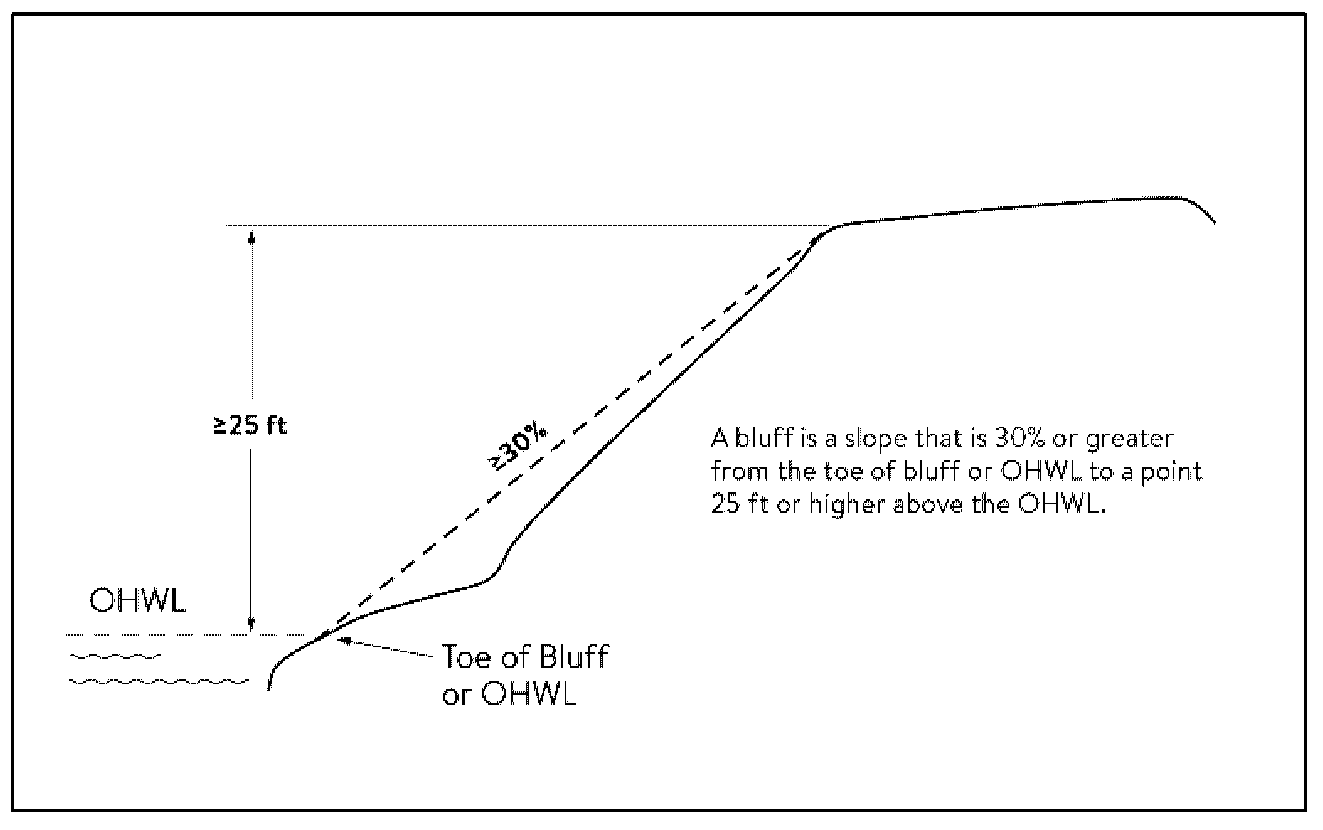
Figure 2. Exception to Bluff (Shoreland)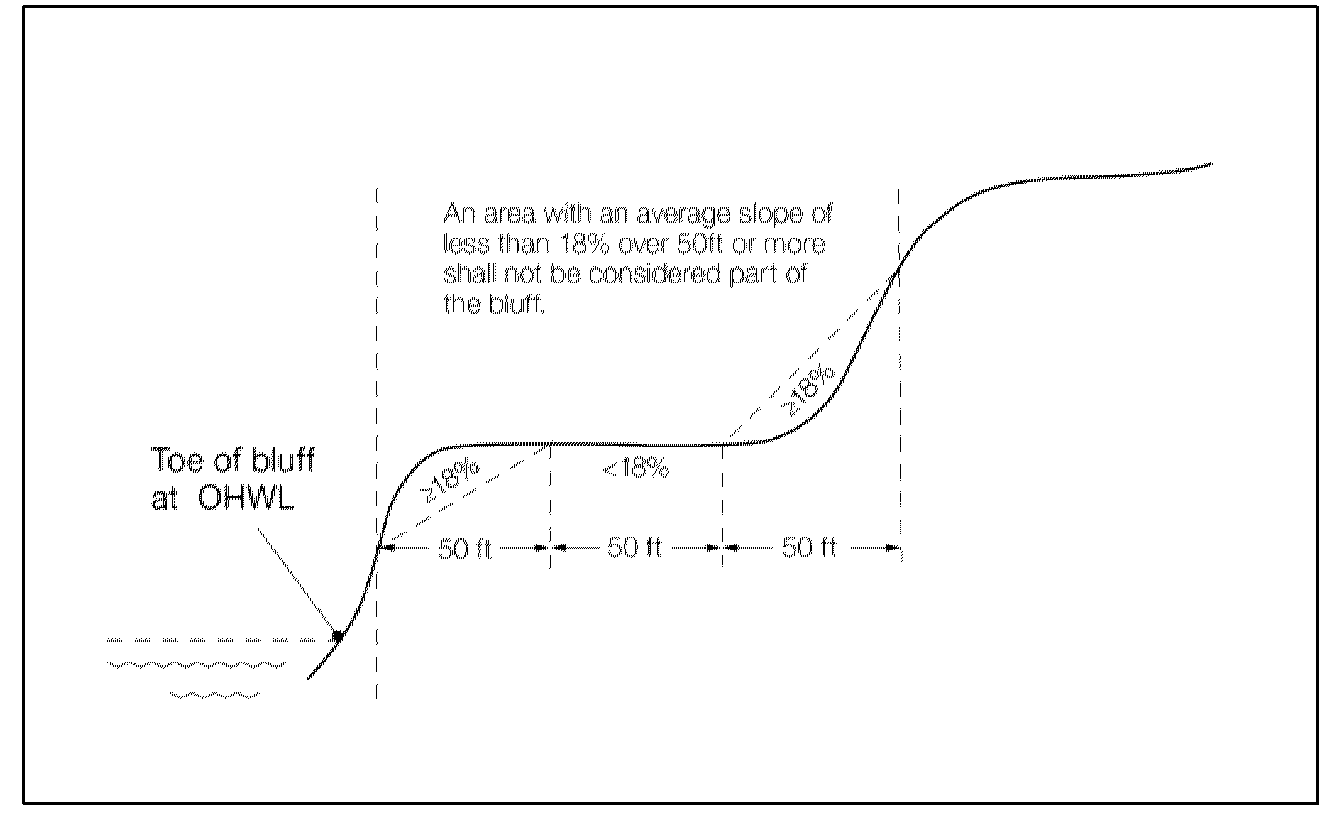
Bluff (MRCCA) means a natural topographic feature having:
(1)
A slope that rises at least 25 feet where the grade of the slope averages 18 percent or greater, measured over a horizontal distance of 25 feet, from the toe of the slope to the top of the slope. Where the slope begins below the ordinary high water level, the ordinary high water level is the toe of the slope. See Figure 1; or
Figure 1. Bluff (MRCCA)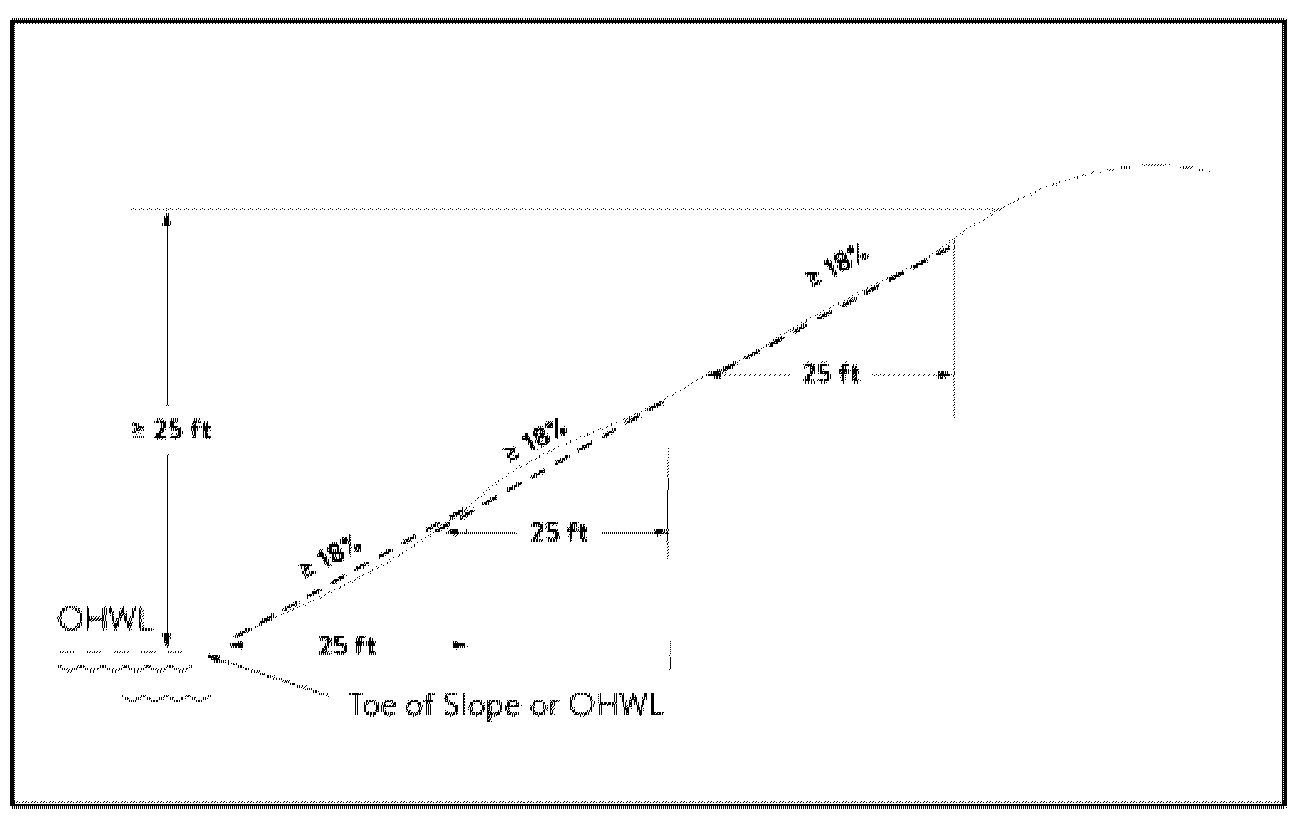
(1)
A natural escarpment or cliff with a slope that rises at least ten feet above the ordinary high water level or toe of the slope, whichever is applicable, to the top of the slope, with a slope of 75 degrees or greater. See Figure 2.
Bluff impact zone (shoreland) means a bluff and land located within 20 feet from the top of a bluff.
Figure 1. Bluff Impact Zone and Top of Bluff (Shoreland)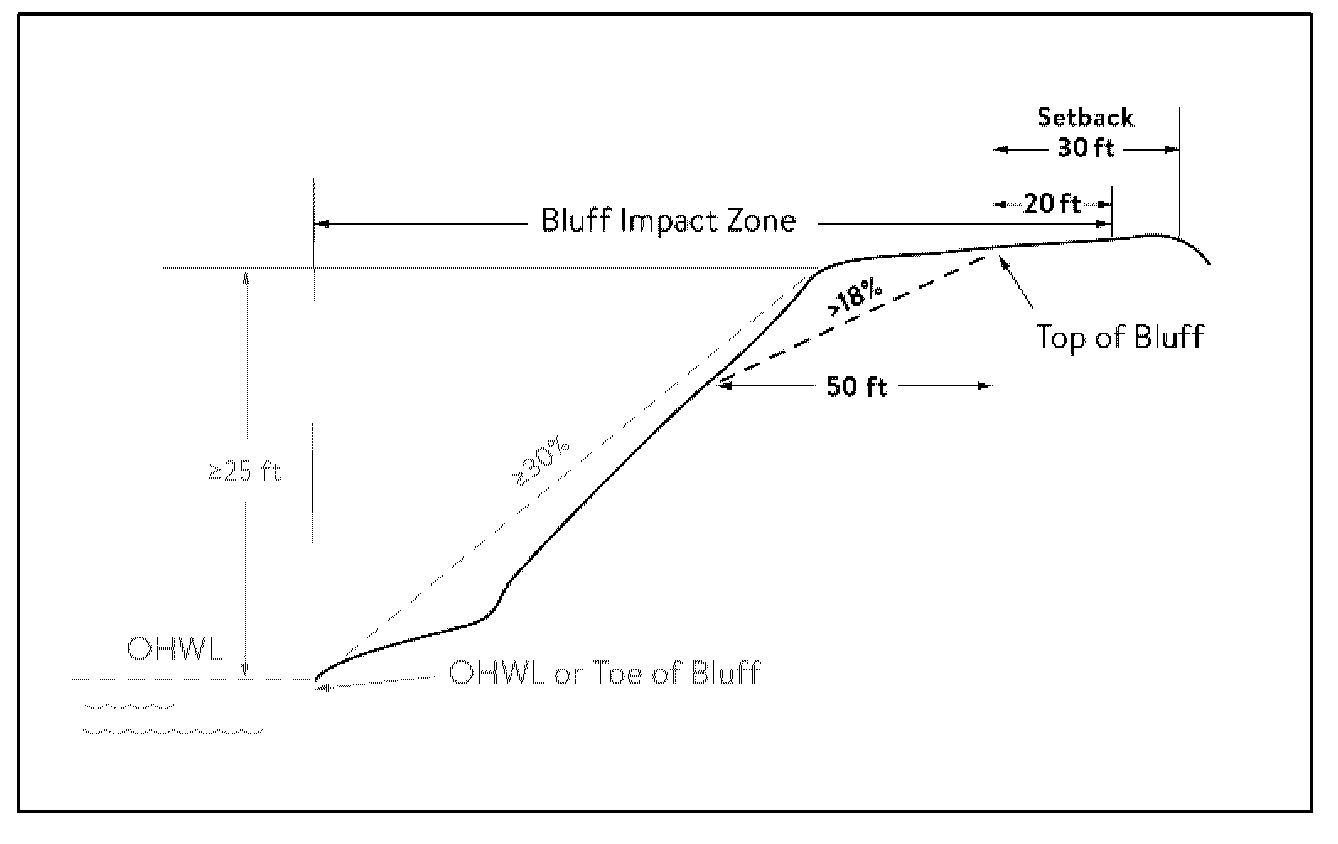
Bluff impact zone (MRCCA) means a bluff and land located within 20 feet of the bluff. See Figure 1.
Figure 1. Bluff Impact Zone, Bluffline, Toe of Bluff, and Top of Bluff (MRCCA)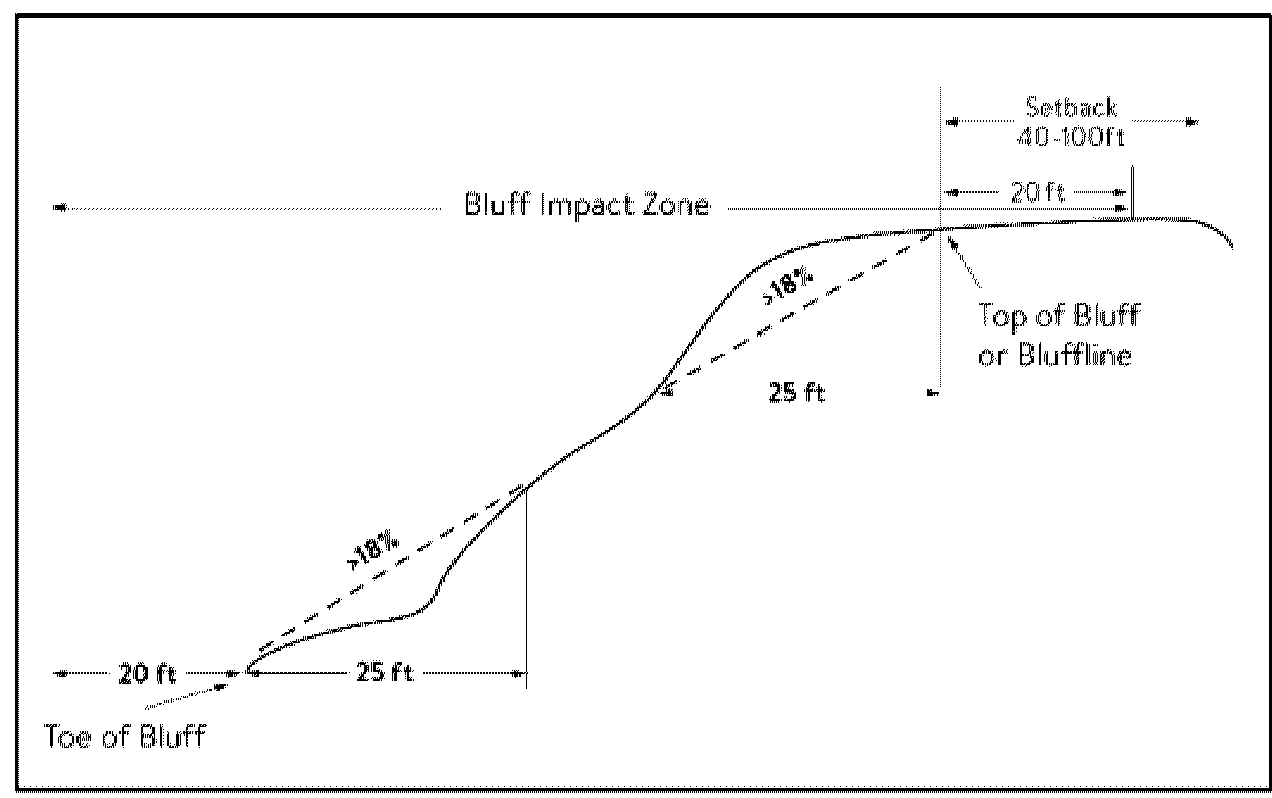
Bluffline (MRCCA) means a line delineating the top of the bluff. More than one bluffline may be encountered proceeding landward from the river. See Figure 1 — Bluff impact zone (MRCCA).
Bluffline (wild and scenic) means:
(1)
A line along the top of a slope connecting the points at which the slope of land becomes more than 13 percent. This applies to those slopes within the land use district which are beyond the setback provisions from the ordinary high water level; or
(2)
The line which generally follows the river bank where the slope changes from steep (more than 12 percent) to less than 12 percent).
Bluff, toe of (MRCCA) means a line along the bottom of a bluff, requiring field verification, such that the slope above the line exceeds 18 percent and the slope below the line is 18 percent or less, measured over a horizontal distance of 25 feet. See Figure 1 — Bluff impact zone (MRCCA).
Bluff, top of (MRCCA) means a line along the top of a bluff, requiring field verification, such that the slope below the line exceeds 18 percent and the slope above the line is 18 percent or less, measured over a horizontal distance of 25 feet. See Figure 1 — Bluff impact zone (MRCCA).
Boathouse means a structure designed or used solely for the storage of boats or boating equipment.
Boulevard means that part of the property not covered by sidewalk or other paving, lying between the property line and the curb line of any street. In the absence of a curb, the curb line of a street shall be deemed to be the edge of that portion of the public right-of-way maintained and open to the use of the public for purposes of public travel.
Brewpub means a business operating as defined and regulated by Minn. Stats. ch. 340A.
Buffer area means the outer area of a site where the site activity is screened, distanced, or muffled from adjacent land uses. At a minimum the buffer area must be consistent with the intent of Minn. Stats. § 473.823, subd. 3.
Buildable area means the area upon which structures may be placed on a lot or parcel of land and excludes areas needed to meet requirements for setback, rights-of-way, bluff impact zones, historic properties, wetlands, designated floodways, land below the ordinary high water level of public waters, and other unbuildable areas.
Building (MRCCA) means a structure with two or more outside rigid walls and a fully secured roof and affixed to a permanent site.
Building means any structure, with the exception of enclosed trailers with or without axles or shipping containers, having a roof which may provide shelter, support, protection or enclosure of persons, animals or property of any kind.
Building height means a distance to be measured from the mean ground level to the highest point of a flat roof, or average height of the highest gable of a pitched or hip roof.
Carport means an automobile shelter open on two or more sides and shall be considered an accessory structure.
Certificate of compliance means a document written after a compliance inspection, certifying that the development is in compliance with applicable requirements at the time of the inspection.
Certified arborist means any person holding a valid and current arborist certification as issued by the International Society of Arboriculture (ISA).
Certified forester means any person holding a valid and current forester certification as issued by the Society of American Foresters (SAF).
CFR means the Code of Federal Regulations.
Club means a business operating as defined and regulated by Minn. Stats. ch. 340A.
Commercial recreation — Indoor means private recreational facilities that are inside a building operated for profit and open to members and/or the general public including tennis and racquetball clubs, indoor swimming pools, video arcades (amusement centers), indoor batting cages, pool halls, and the like, excluding health and fitness clubs.
Commercial recreation — Outdoor means private recreational facilities primarily occurring outside of a building operated for profit or not and open to members and/or the general public including golf courses and driving ranges, miniature golf, riding stables, skating rinks, outdoor swimming pools, archery or trapshooting ranges, batting cages, softball, baseball, volleyball, soccer, or football facilities, and the like.
Commissioner means the commissioner of the applicable state agency.
Community amenity building means a structure or use that is accessory to a multi-family building, townhome association, or single-family homeowners' association that is intended for the enjoyment of its residents such as a swimming pool with or without restrooms, gazebo, clubhouse, or fitness facilities.
Comprehensive plan means a computation of goals, policy statements, standards, programs and maps for guiding the physical, social, and economic development, both public and private, as defined in Minn. Stats. § 462.352, and includes any part of such plan separately adopted and any amendment to such plan or parts thereof.
Conservation design means a pattern of subdivision that is characterized by grouping lots within a portion of a parcel, where the remaining portion of the parcel is permanently protected as open space.
Construction equipment trailer/field office means a mobile trailer or structure used for equipment storage or as a field office for contractors and subcontractors, which is not open to the general public.
Covenant means a contract between two individuals which constitutes a restriction of a particular use of land that is not enforced by the city, county, state, or federal government.
Conventional subdivision means a pattern of subdivision that is characterized by lots that are spread regularly throughout a parcel in a lot and block design.
Data center means a facility that houses information technology (IT) infrastructure for building, running, and delivering applications and services and for storing and managing the data associated with those applications and services.
Daycare centers means a licensed business that provides supervision of and care for children, physically or mentally disabled adults, or the elderly for a portion of the day or night.
Deck means a horizontal, unenclosed, aboveground level structure open to the sky, with or without attached railings, seats, trellises, or other features, attached or functionally related to a principal use or site.
Density means a number expressing the ratio of dwelling units to an acre of land. Net density deducts waterbodies and wetlands.
Detailing services means a business that provide comprehensive cleaning and reconditioning of both a vehicle's interior and exterior.
Developer. Has the meaning given under Minn. Stats. § 116G.03.
Development. Has the meaning given under Minn. Stats. § 116G.03.
Discharge means the conveyance, channeling, runoff, or drainage, of stormwater, including snowmelt, from a site.
Discretionary action means an action under this chapter related to land use that requires a public hearing by local ordinance or statute, such as preliminary plats, final subdivision plats, planned unit developments, conditional use permits, interim use permits, variances, appeals, and rezonings.
Distribution facility means an establishment where shipments of tangible personal property are processed for delivery to customers.
Dock. Has the meaning given under Minnesota Rules, chapter 6115.
Driveway means an onsite prepared surface traffic lane, which shall be the traffic lane leading directly from a public street to the primary garage or a parking pad or lot on the subject parcel.
Dustless surface consists of compacted bituminous millings or crushed rock. The crushed rock must all be similar in size with no fine particles. Aggregate material similar to state DOT class 5 is not considered dustless.
Dwelling, manufactured home, means a structure, transportable in one or more sections, which in the traveling mode, is eight body feet or more in width and 40 body feet or more in length, or, when erected on site, is 320 or more square feet, and which is built on a permanent chassis and designated to be used as a dwelling with or without a permanent foundation when connected to the required utilities, and includes the plumbing, heating, air conditioning, and electrical systems contained therein; except that the term includes any structure which meets all the requirements and with respect to which the manufacturer voluntarily files a certification pursuant to Minn. Stats. §§ 327.31—327.36. The term "dwelling, manufactured home," does not include "recreational vehicle" as defined herein.
Dwelling, multiple-family, means a building designed with three or more dwelling units exclusively for occupancy by three or more families living independently of each other but sharing hallways and main entrances and exits.
Dwelling, senior living, means a building designed with three or more dwelling units exclusively for occupancy where at least one of the residents in each unit is aged 55 or greater living independently of each other but sharing hallways and main entrances and exits.
Dwelling, single-family detached, means a dwelling unit designed exclusively for occupancy by one family.
Dwelling, townhomes (attached), means structures housing two or more dwelling units contiguous to each other only by the sharing of one or more common walls; such structures are of the back-to-back or row-house type as contrasted to multiple dwelling apartment structures.
Dwelling, townhomes (detached), means a dwelling unit not attached to another dwelling or structure and have outdoor areas and/or indoor centers that are commonly owned or maintained by a homeowners' association.
Dwelling, two-family attached, means a structure designed exclusively for occupancy by two families having separate kitchen, bathroom, and living spaces.
Easement means a grant by a property owner for use of a strip of land by the public or any person for any specific purpose, or purposes of construction and maintaining utilities and/or roadways.
EIFS means exterior insulation and finish system.
Electric power facilities means equipment and associated facilities for generating electric power or devices for converting wind energy to electrical energy as identified and defined under Minn. Stats. § 216E.
Equal degree of encroachment means a method of determining the location of floodway boundaries so that floodplain lands on both sides of a stream are capable of conveying a proportionate share of flood flows.
Equipment, commercial use, means a variety of heavy machines, either specifically designed or used for commercial purposes, which perform specific construction or demolition functions, such as hoisting, excavating, hauling, grading, paving, drilling, or pile driving, under power. Trailers, either enclosed or flatbed, 6×12 or smaller, are exempt unless they have a department of transportation certificate or number; trailers used for transport of recreational vehicles and not used for any commercial use are exempt.
A licensed, self-propelled vehicle which:
(1)
Has a gross vehicle weight rating (GVWR) of 10,001 pounds or more and contains print or logos which advertise a business; or
(2)
Has external modifications to the structure or body, where external modifications are defined as both dealer and non-dealer modifications which result in pick-up trucks that do not have the traditional pick-up truck bed and side walls, and vans that have an expanded cargo area that is taller or wider than a passenger van, except those modified for use as either a recreational vehicle or to accommodate handicapped passengers and which are currently being utilized for this purpose. Motorized vehicles that have racks, storage boxes, or shells added to the traditional pick-up bed are exempt from this definition.
Equipment, private use, means any motorized or non-motorized apparatus whose primary use is for personal activities not related to generating revenue or profit.
Erosion means the wearing away of the ground surface as a result of the movement of wind, water and/or ice or any process that wears away the surface of the land by the action of water, wind, ice, or gravity. Erosion can be accelerated by the activities of people and nature.
Erosion and sediment practice specifications or practice means the management procedures, techniques, and methods to control soil erosion and sedimentation as officially adopted by either the city, county or local watershed group, whichever is more stringent.
Essential services means underground or overhead gas, electrical, communications, steam, or water distribution, collection, supply, or disposal systems, including stormwater. Essential services include poles, wires, mains, drains, pipes, conduits, cables, fire alarm boxes, traffic signals, hydrants, navigational structures, aviation safety facilities or other similar equipment and accessories in conjunction with the systems. Essential services does not include buildings, treatment works as defined in Minn. Stats. § 115.01, electric power facilities or transmission services.
Exterior solid fuel-fired heating device means an external device designed for solid fuel combustion so that usable heat is derived for the interior of a building, and includes solid fuel-fired stoves, fireplaces, solid fuel-fired cooking stoves, and combination fuel furnaces or boilers which burn solid fuel. Solid fuel-fired heating devices do not include natural gas-fired fireplace logs.
Family means an individual; two or more persons related by blood, marriage, adoption, or foster care; or not more than six persons not related by blood, marriage, adoption, or foster care occupying a dwelling unit as an individual housekeeping organization.
Farm means a tract of land used for agricultural uses which is under cultivation or is fenced and utilized as pasture.
Farm fence means an open type fence of posts and wire, which is permitted to accommodate agricultural activities and the raising of livestock and animals in certain zoning districts, and is not considered to be a structure with regard to floodplain regulations.
Farming means process of operating a farm for the growing and harvesting of crops which shall include those necessary accessory buildings, related to operating a farm, and the keeping of domestic farm animals. See also Agriculture.
Feedlot. Has the meaning given for animal feedlots under Minnesota Rules chapter 7020.
Fence means any partition, structure, wall or gate erected as a dividing marker, barrier or enclosure.
Fill means a deposit of earth material placed by artificial means so as to elevate the grade of a work site.
Fitness center means a gym, health club, or exercise business and auxiliary uses customary to them such as locker rooms, swimming pools, and the like.
Flood means a temporary increase in the flow or stage of a stream or in the stage of a wetland or lake that results in the inundation of normally dry areas.
Flood frequency means the frequency for which it is expected that a specific flood stage or discharge may be equaled or exceeded.
Flood fringe means that portion of the floodplain outside of the floodway. The term "flood fringe" is synonymous with the term "floodway fringe" used in the flood insurance study for the city.
Floodplain. Having the meaning given the meaning given under Minnesota Rules chapter 6120.
Floodproofing means a combination of structural provisions, changes, or adjustments to properties and structures subject to flooding, primarily for the reduction or elimination of flood damages.
Floodway means the channel of the watercourse and those portions of the adjoining floodplain which are reasonably required to carry and discharge the regional flood.
Floor area means the sum of the gross horizontal areas of the several floors of a building or buildings measured from the exterior faces of exterior walls or from the centerline of party walls.
Floor area ratio means the total floor area on a zoning lot divided by the total site area of the lot or parcel being developed.
Forest land conversion means the clear-cutting of forested lands to prepare for a new land use other than reestablishment of a subsequent forest stand.
Forestry means the use and management, including logging, of a forest, woodland or plantation, and related research and educational activities, including the construction, alteration or maintenance of woodroads, skidways, landings, and fences.
Fully reconstructs means the reconstruction of an existing impervious surface that involves site grading and subsurface excavation so that soil is exposed. Mill and overlay and other resurfacing activities are not considered fully reconstructed.
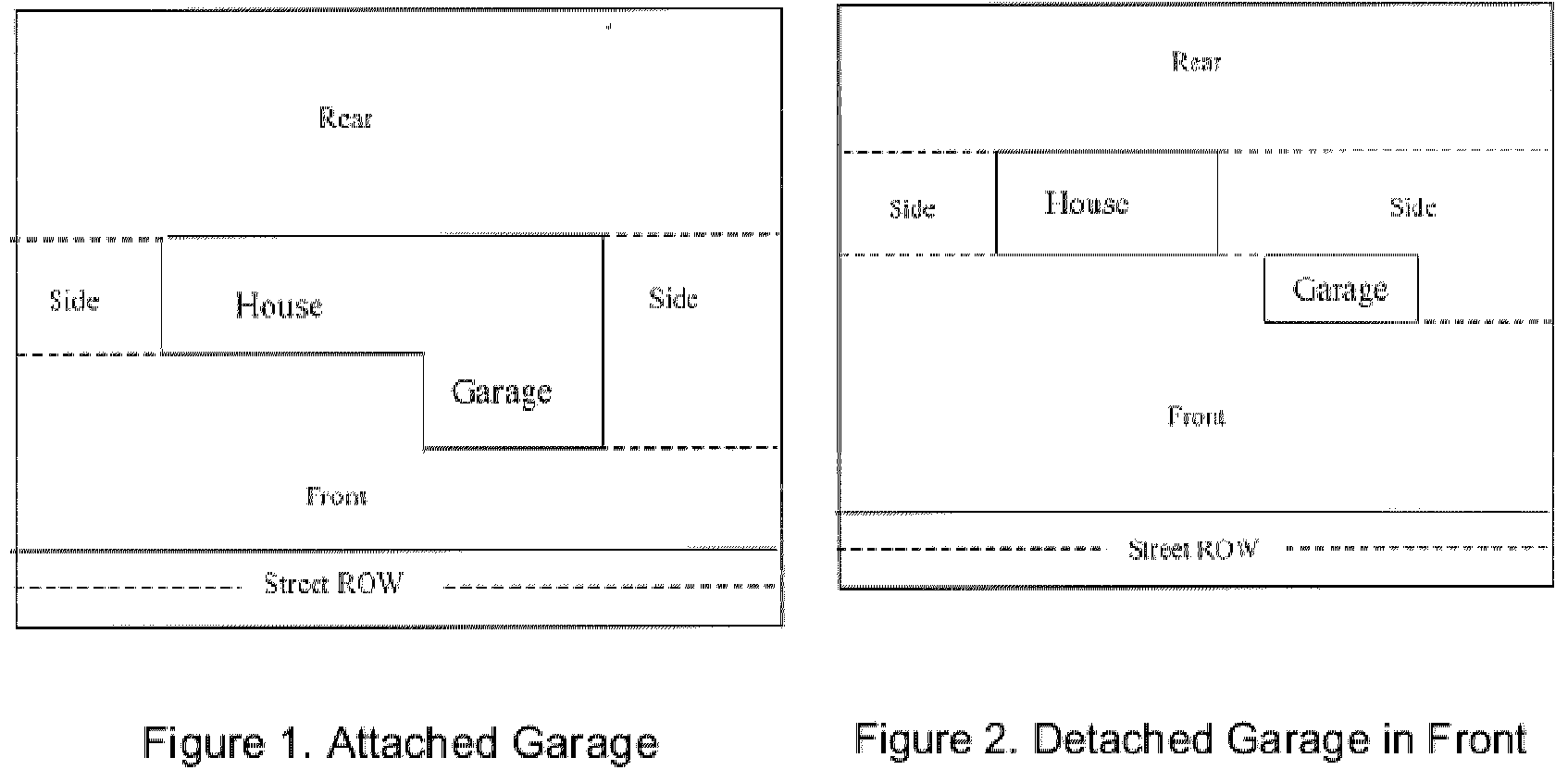
Garage, primary residential, means a garage attached to the principal building or dwelling, or a detached garage where an attached garage does not exist, intended for the storage of vehicles and items accessory to the principal use of the property. Primary residential garages, attached or detached, shall be considered accessory structures.
Glare means direct light emitting from a luminaire that causes reduced vision or momentary blindness.
Ground source heat pump system(geothermal system) means a system that uses the relatively constant temperature of the earth or a body or water to provide heating in the winter and cooling in the summer. System components include open or closed loops of pipe, coils, or plates; fluid that absorbs and transfers heat; and a heat pump unit that processes heat for use or disperses heat for cooling; and an air distribution system.
Grade means the vertical rise or drop from any fixed horizontal line or point.
Grading means:
(1)
Changing the natural or existing topography of land; or
(2)
The placement, removal or movement of earth by use of mechanical equipment on a property.
Groundcover means turf grass or natural native landscaping.
Hard-surface trail means a trail surfaced in asphalt, crushed aggregate, or other hard surface, for multi-purpose use, as determined by local, regional, or state agency plans.
Hedge means a row of closely planted shrubs or low growing trees forming a fence or boundary.
Historic property means an archaeological site, standing structure, site, district, or other property that is:
(1)
Listed in the national register of historic places or the state register of historic places or locally designated as a historic site under Minn. Stats. ch. 471;
(2)
Determined to meet the criteria for eligibility to the national register of historic places or the state register of historic places as determined by the director of the Minnesota Historical Society; or
(3)
An unplatted cemetery that falls under the provisions of Minn. Stats. ch. 307, in consultation with the office of the state archaeologist.
Home occupation means any occupation or profession engaged in by the occupant of a residential dwelling unit which is clearly incidental and secondary to the residential use of the premises, does not change the character of said premises, and satisfies the requirement of this Code.
Homeowners' association (HOA) means an organization comprising neighbors concerned with managing the common areas of a subdivision, governed by a board, that create a set of bylaws, in addition to city regulation, to govern themselves. These boards own and maintain commonly-held land within a townhouse or single-family development, and are responsible for private street maintenance, snow removal, landscaping, and/or building maintenance. Each homeowners' association varies in its scope and responsibilities. The homeowners' association is responsible for enforcing any covenants, conditions, and restrictions that apply to the property.
Horse boarding, commercial, means the housing or keeping of horses for profit. Horse boarding will be considered to be commercial when horse care is offered to the general public through any form of advertising.
Horse boarding, noncommercial, means the housing or keeping of horses for friends, neighbors, and relatives when the charge for such boarding is limited to the actual costs incurred and the person providing the service has not attempted to solicit business through any form of advertising.
Hotel means a building or group of detached, semi-detached or attached buildings containing guestrooms or units, each of which has a separate entrance directly from the outside of the building or corridor, with garage or parking space conveniently located to each unit, and which is designed, used or intended to be used primarily for the accommodation of transient guests.
Hydroponics (hydrophytic vegetation) means macrophytic (large enough to be observed by the naked eye) plant life growing in water, soil or on a substrate that is at least periodically deficient in oxygen as a result of excessive water content.
Impervious surface means constructed hard surface that either prevents or retards the entry of water into the soil and causes water to run off the surface in greater quantities and at an increased rate of flow than prior to development. Examples include rooftops, decks, sidewalks, patios, parking lots, storage areas, and driveways, including those with concrete, asphalt, or gravel surfaces.
Improvements means the construction or installation of public or private utilities, including but not limited to, potable water, sanitary sewer systems, storm sewers, roads and other thoroughfares, sidewalks, curbs and gutters, paving barricades, trees and other plantings, lighting, fuel or energy and the transmission thereof, transportation systems or facilities connected therewith and communication systems which are necessary, desirable or convenient in the maintenance of the health, safety and the general welfare.
Incinerator means any furnace or other device used in the process of burning solid waste, hazardous waste, medical waste or special waste for the purpose of reducing the volume of the waste by removing combustible material.
Intensive vegetation clearing means the removal of all or a majority of the trees or shrubs in a contiguous patch, strip, row, or block.
Interim use means a use having the meaning given under Minn. Stats. chs. 394 and 462.
Land alteration means an activity that exposes the soil or changes the topography, drainage, or cross section of the land, excluding gardening or similar minor soil disturbances.
Land disturbance activity means any land change that may result in soil erosion from water or wind and the movement of sediments into or upon waters or lands within this government's jurisdiction, including clearing and grubbing, grading, excavating, transporting and filling of land. Within the context of this rule, land disturbance activity does not mean:
(1)
Minor land disturbance activities such as home gardens and an individual's home landscaping, repairs, and maintenance work.
(2)
Construction, installation, and maintenance of electric, telephone, and cable television, utility lines or individual service connection to these utilities, which result in creating under 500 square feet of exposed soil.
(3)
Tilling, planting, or harvesting of agricultural, horticultural, or silvicultural crops.
(4)
Installation of fence, sign, telephone, and electric poles and other kinds of posts or poles which result in creating under 500 square feet of exposed soil.
(5)
Emergency work to protect life, limb, or property and emergency repairs, unless the land disturbing activity would have otherwise required an approved erosion and sediment control plan, except for the emergency. If such a plan would have been required, then the disturbed land area shall be shaped and stabilized in accordance with the city's requirements as soon as possible.
Landscape plan means the design and specifications for the placement of any live plant materials such as trees, shrubs, ground cover and grasses as well as humanmade structures such as walls, fences, and berms. This also includes the retention of existing vegetation for the purposes of enhancing property value and aesthetics, protecting the community's environment, and minimizing negative impacts on visual order of the community.
Landscaping means the use of natural plant materials including but not limited to, ground covers, shrubs, and trees (deciduous and evergreen). Landscaping also involves the placement, preservation, and maintenance of such plant materials and includes such elements as fences, walls, lighting, and earth mounding.
Licensed residential facilities means a state-licensed 24-hour supervised residential care facility housing up to six unrelated individuals.
Local government means counties, cities, and townships.
Lot (MRCCA). Has the meaning given under Minnesota Rules chapter 6120.
Lot (Shoreland) means a parcel of land designated by plat, metes and bounds, registered land survey, auditors plot, or other accepted means and separated from other parcels or portions by said description for the purpose of sale, lease, or separation.
Lot line means a property boundary line of any lot held in single or separate ownership; except that where any portion of the lot extends into the abutting street or alley, the lot line shall be deemed to be the street or alley right-of-way.
Lot of record means any lot which individually, or as part of a subdivision, was a separate parcel of record on April 28, 1972.
Lot, depth of, means a mean horizontal distance between the front and rear lot lines measured in the mean direction of the side lot lines.
Lot, frontage, means the front of a lot shall be, for purposes of complying with this Code, that boundary abutting a public right-of-way having the least width.
Lot, interior, means a lot, other than a corner lot, including through lots.
Lot width means the uniform width measured at the property line abutting the street at the minimum building setback line of the underlying zoning district. In the case of a lot abutting a cul-de-sac, the lot width is the width measured at right angles to the depth at the building setback requirement.
Lot width (MRCCA and shoreland). The shortest distance between lot lines measured at both the ordinary high water level and at the required structure setback from the ordinary high water level. See Figure 1.
Figure 1. Lot width (MRCCA and Shoreland)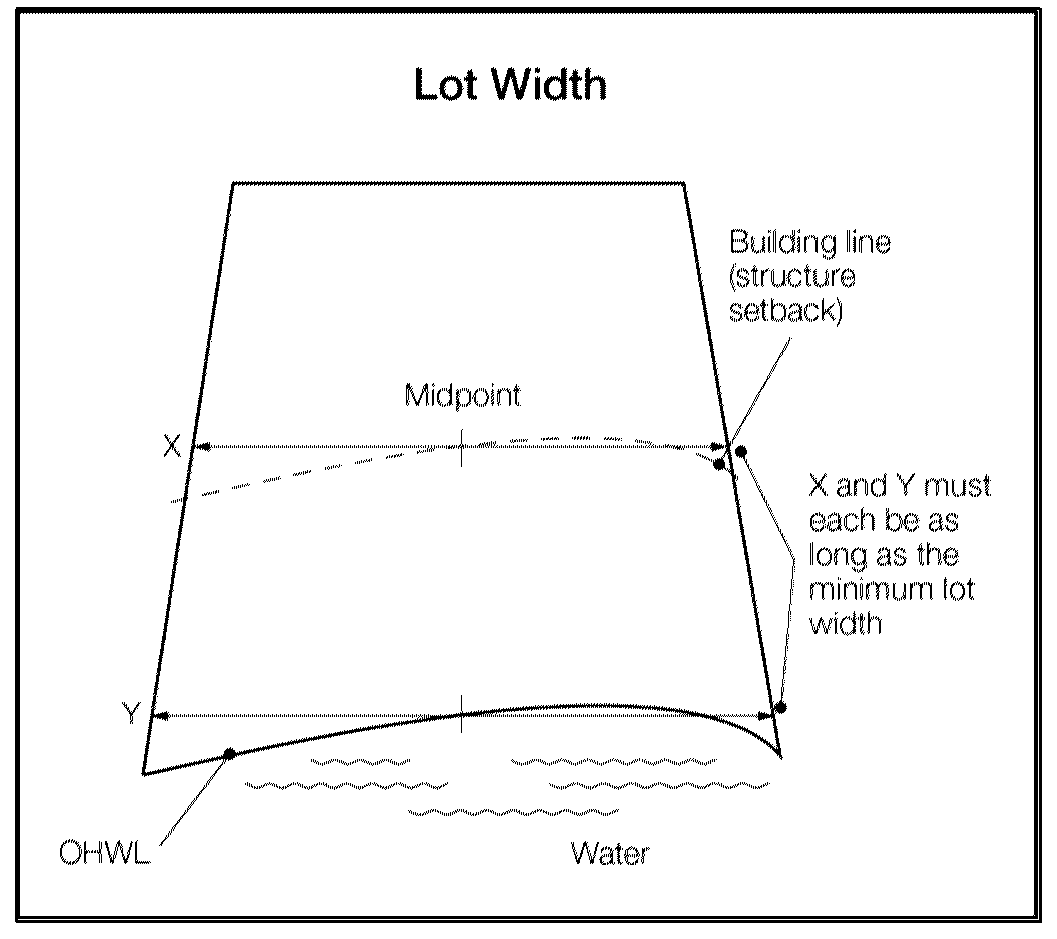
Lowest floor means the lowest floor of the lowest enclosed area (including basement). An unfinished or flood resistant enclosure, used solely for parking of vehicles, building access, or storage in an area other than a basement area, is not considered a building's lowest floor.
Marina. Has the meaning given under Minnesota Rules chapter 6115.
Manufacturing means the processing or assembly of raw materials or parts into finished goods through the use of tools, human labor, machinery, and chemical processing. This definition includes hydroponics as well as state-regulated cannabis cultivation.
Mississippi River Corridor Critical Area (MRCCA) means the area within the River Corridor Boundary.
Mississippi River Corridor Critical Area (MRCCA) Plan means a chapter or other element in the City of Ramsey Comprehensive Plan.
Model home means a dwelling in a developing subdivision, located on a legal lot of record, that is limited to temporary use as a sales office for the subdivision and to provide an example of the dwellings which have been built or which are proposed to be built within the same subdivision.
Mooring facility. Has the meaning given under Minnesota Rules chapter 6115.0170.
Motor fuel station means a place where gasoline is stored only in underground tanks, kerosene or motor oil and lubricants or grease, for operation of vehicles.
Motor vehicle, commercial use, means any self-propelled or towed vehicle used on a public road in to transport passengers or property when the vehicle has:
(1)
A weight of over 10,000 lbs.;
(2)
The capacity to transport more than 15 passengers, including the driver; or.
(3)
Used to transport hazardous materials in a quantity that requires placards under federal hazardous materials regulations.
Motor vehicle, private use, means any device which is designed to be self-propelled, and not deriving its power from overhead wires. This shall also include standard passenger automobiles, pickup trucks and vans displaying company logos and/or advertisements.
Motor vehicle repair means general repair, rebuilding or reconditioning engines, motor vehicles or trailers, collision service, including body, frame or fender straightening or repair, overall painting or paint job, minor repairs, replacement of parts, and motor services.
Motor vehicle sales and showrooms means a business that is licensed by the State of Minnesota as defined by Minn. Stats. § 168.27, subd. 1(f) for new motor vehicle dealers, used motor vehicle dealers, motor vehicle brokers, wholesalers, auctioneers, lessors of new or used motor vehicles. This definition does not include scrap metal processors, used vehicle parts dealers, and salvage pools.
Native plant community means a plant community that has been identified as part of the Minnesota Biological Survey or biological survey issued or adopted by a local, state, or federal agency.
Natural area means an area that does not include noxious weeds that is purposely left to grow in a natural state and contains vegetation that can maintain itself in a stable condition.
Natural-surface trail means a trail composed of native soil and rock or compacted granular stone, primarily intended for hiking, equestrian, or mountain bike use, as determined by local, regional, or state agency plans.
Natural vegetation means any combination of ground cover, understory, and tree canopy that, while it may have been altered by human activity, continues to stabilize soils, retain and filter runoff, provide habitat, and recharge groundwater.
Nonconforming use means any use of land established before the effective date of the ordinance from which this chapter is derived which does not conform to the use restrictions of a particular zoning district. This should not be confused with substandard dimensions of a conforming use.
Nonconforming use, illegal, means a building, structure, premises, or use which at the time of its establishment did not comply or conform with the applicable conditions or provisions of this Code which were in effect at such date, and which continues such noncompliance and nonconformance with the present Code.
Nonconforming use, legal, means a building, structure, premises, or use which at the time of its establishment was in compliance and conformance with the applicable conditions and provisions of this Code which were in effect at such date, but which does not now comply or conform to conditions and provisions of the current Code.
Nonconformity. Has the meaning given under Minn. Stats. § 394.22.
Noncomplying sewage treatment system has the same meaning as in chapter 113.
Nonmetallic mining means construction, reconstruction, repair, relocation, expansion, or removal of any facility for the extraction, stockpiling, storage, disposal, or reclamation of nonmetallic minerals such a stone, sand, and gravel. Nonmetallic mining does not include ancillary facilities such as access roads, bridges, culverts, and water level control structures. For purposes of this subpart, "facility" includes all mine pits, quarries, stockpiles, basins, processing structures and equipment, and any structures that drain or divert public waters to allow mining.
Obstruction means any dam, wall, wharf, embankment, levee, dike, pile, abutment, projection, excavation, channel modification, culvert, building, wire, fence, stockpile, refuse, fill, structure, or matter in, along, across, or projecting into any channel, watercourse, or regulatory floodplain which may impede, retard, or change the direction of the flow of water, either in itself or by catching or collecting debris carried by such water.
Off-premise advertising signs means those signs that direct attention to a product, service, business, or entertainment venue that is not exclusively related to the premises where the sign is located.
Off-street loading space means a space accessible from the street, alley or way, in a building or on the lot for the use of trucks while loading or unloading merchandise or materials. Such space shall be of such size as to accommodate one truck of the type typically used in the particular business and shall be exclusive of general public and employee parking spaces.
On site means any location within the boundaries of a site.
One hundred-year floodplain means lands inundated by the regional flood.
Open space means an area set aside for the preservation of natural open spaces to counteract the effects of urban congestion and monotony.
Open space recreation uses means recreation use particularly oriented to and utilizing the outdoor character of any area; including hiking and riding trails, primitive campsites, campgrounds, waysides, parks and recreational areas.
Operable motor vehicle means a vehicle that can be presented in a self-propelled condition within seven days of the city's request for such action.
Ordinary high water level (OHWL). Has the meaning given under Minn. Stats. § 103G.005.
Outdoor display means an area of land where goods are displayed and which are available for sale to the general public from inside a retail outlet or warehousing facility.
Outdoor sales means an outdoor area where goods are sold and displayed for sale and is freely accessible to the public.
Outdoor storage means the exterior storage of goods, inventory, materials, equipment, or other items which are not necessarily intended for sale nor accessible to the public.
Outlot means a parcel that is not a developable piece of property unless re-platted in accordance with city ordinances.
Owner means any person, firm or corporation, or any other legal entity, or a combination of any of them, having sufficient legal proprietary interest in the land sought to be subdivided to commence and maintain proceedings to subdivide the same under this chapter.
Overlay district means a zoning district that is applied over one or more previously established zoning districts, establishing additional or stricter standards and criteria for covered properties in addition to those of the underlying zoning district. Overlay districts are often used to protect historic features and natural resources such as shoreland or floodplain.
Parcel (MRCCA). Has the meaning given under Minn. Stats. § 116G.03.
Parcel means an individual lot or tract of land
Park includes any city public spaces designated for recreation and/or conservation.
Patio means a constructed hard surface located at ground level with no railings and open to the sky.
Paved means a surface made of concrete, asphalt, pervious pavement, driveway quality pavers.
Permitted use means a use which may be lawfully established in a particular district, provided it conforms with all requirements, regulations, and performance standards (if any) of such districts.
Person means an individual, firm, partnership, association, corporation or organization of any kind.
Personal services means a retail business that provides a service rather than a product for sale. Examples of such uses are barbershops, salons, massage studios, body art studios, and photography studios.
Pervious surface means a surface that permits the entry of water into the soil. Examples include lawns, planting beds and paving brick surfaces designed to infiltrate water into the underlying soils.
Picnic shelter means a roofed structure open on all sides, accessory to a recreational use.
Planned unit development means a method of land development that merges zoning and subdivision controls, allowing developers to plan and develop a large area as a single entity, characterized by a unified site design, a mix of structure types and land uses, and phasing of development over a number of years. Planned unit development includes any conversion of existing structures and land uses that utilize this method of development.
Plat. Has the meaning given under Minn. Stats. chs. 505 and 515B.
Port means a water transportation complex established and operated under the jurisdiction of a port authority according to Minn. Stats. ch. 458.
Post-secondary educational facility means a private or public facility engaged in for-credit or skill and trade certifications of students post high-school age. Examples include, but are not limited to, beauty schools, business schools, and trade schools.
Primary conservation areas (MRCCA) means key resources and features, including shore impact zones, bluff impact zones, floodplains, wetlands, gorges, areas of confluence with tributaries, natural drainage routes, unstable soils and bedrock, native plant communities, cultural and historic properties, and significant existing vegetative stands, tree canopies, and other resources identified in local government plans.
Primitive campsites means an area that consists of individual remote campsites accessible only by foot or water.
Principal use or structure means all uses or structures that are not accessory uses or structures.
Private facilities means private roads, driveways, and parking areas, private water access and viewing facilities, decks and patios in setback areas, and private signs.
Professional engineer means an engineer licensed to practice in Minnesota.
Professional services means a business that provides a service in an office setting rather than a product for sale, other than medical or dental services. Examples of such uses are law offices, engineering services, architectural services, and consulting services.
Property owner means the person owning such property as shown by the county auditor's plat of the City of Ramsey, Minnesota.
Protective covenants means contracts made between private parties as to the manner in which land may be used, with the view to protecting and preserving the physical and economic integrity of a given area.
Public facilities means public utilities, public transportation facilities, and public recreational facilities.
Public recreation facilities means recreational facilities provided by the state or a local government and dedicated to public use, including parks, scenic overlooks, observation platforms, trails, docks, fishing piers, picnic shelters, water access ramps, and other similar water-oriented public facilities used for recreation.
Public river corridor views means views toward the river from public parkland, historic properties, and public overlooks, as well as views toward bluffs from the ordinary high water level of the opposite shore, as seen during the summer months and documented in the MRCCA plan/chapter of the comprehensive plan.
Public transportation facilities means all transportation facilities provided by federal, state, or local government and dedicated to public use, such as roadways, transit facilities, railroads, and bikeways.
Public utilities means electric power facilities, essential services, and transmission services.
Public waters means any public waters as defined in Minn. Stats. § 103G.005. However, no lake, pond or flowage of less than ten acres in size and no river or stream having a total drainage area less than two square miles shall be regulated for the purposes of these regulations.
Reach means a hydraulic engineering term to describe a longitudinal segment of a stream or river influenced by a natural or manmade obstruction. In an urban area, the segment of a stream or river between two consecutive bridge crossings would most typically constitute a reach.
Readily visible means land and development that are easily seen from the ordinary high water level of the opposite shore during summer months.
Recreation field or building means an area of land, water, or any building in which amusement, recreation or athletic sports are provided for public or semi-public use, whether temporary or permanent, except a theater, whether provision is made for the accommodation of an assembly or not. A golf course, arena, baseball park, stadium, circus or gymnasium is a recreation field or building for the purpose of this Code.
Recreational vehicle means a vehicle that is built on a single chassis, is 400 square feet or less when measured at the largest horizontal projection, is designed to be self-propelled or permanently towable by a light duty truck, and is designed primarily not for use as a permanent dwelling but as a temporary living quarters for recreational, camping, travel, or seasonal use. For the purposes of subdivision III (floodplain overlay districts), the term recreational vehicle is synonymous with the term 'travel trailer/travel vehicle'.
Regional flood means a flood which is representative of large floods known to have occurred generally in Minnesota and reasonably characteristic of what can be expected to occur on an average frequency in the magnitude of the 100-year recurrence interval. The term "regional flood" is synonymous with the term "base flood" used in the flood insurance study.
Regulatory flood protection elevation means an elevation no lower than one foot above the elevation of the regional flood plus any increases in flood elevation caused by encroachments on the floodplain that result from designation of a floodway.
Religious institution means a building, together with its accessory buildings and uses, where persons regularly assemble for religious worship and which building, together with its accessory buildings and uses, is maintained and controlled by a religious body organized to sustain public worship.
Resource agency means a federal, state, regional, or local agency that engages in environmental, natural, or cultural resource protection or restoration activities, including planning, implementation, and monitoring.
Retaining wall means a vertical or nearly vertical structures constructed of mortar and rubble masonry, rock, or stone regardless of size, vertical timber pilings, horizontal timber planks with piling supports, sheet pilings, poured concrete, concrete blocks, or other durable materials.
Right-of-way means the area within the limits of a street, alley, pedestrian way, thoroughfare or easement.
River corridor boundary means the boundary approved and adopted by the Metropolitan Council under Minn. Stats. § 116G.06, as approved and adopted by the legislature in Minn. Stats. § 116G.15, and as legally described in the State Register, volume 43, pages 508 to 518.
River-dependent use means the use of land for commercial, industrial, or utility purposes, where access to and use of a public water feature is an integral part of the normal conduct of business and where the use is dependent on shoreline facilities.
Rock riprap means natural coarse rock placed or constructed to armor shorelines, streambeds, bridge abutments, pilings and other shoreline structures against scour, or water or ice erosion.
Sales yard means a place outdoors where products for sale are kept and/or displayed.
Sediment means the product of an erosion process; solid material both mineral and organic, that is in suspension, is being transported, or has been moved by water, air, or ice, and has come to rest on the earth's surface either above or below water level.
Sediment control means the methods employed to prevent sediment from leaving the development site. Sediment control practices include silt fences, sediment traps, earth dikes, drainage swales, check dams, subsurface drains, pipe slope drains, storm drain inlet protection, and temporary or permanent sedimentation basins.
Sedimentation means the process or action of depositing sediment caused by erosion.
Selective cutting means the removal of single scattered trees.
Selective vegetation removal means the removal of isolated individual trees or shrubs that are not in a contiguous patch, strip, row, or block and that does not substantially reduce the tree canopy or understory cover.
Setback means the minimum horizontal distance between a use and lot line or other distinguished area. Distances are to be measured from ground level except as provided hereinafter.
Setback (MRCCA) means a separation distance measured horizontally.
Semi-public use means the use of land by a private, nonprofit organization to provide a public service that is ordinarily open to some persons outside the regular constituency of the organization.
Sewage treatment system means:
(1)
Any system for the collection, treatment and dispersion of sewage including but not limited to septic tanks, soil absorption systems and drain fields; or
(2)
Septic tank and soil absorption system or other individual or cluster type sewage treatment system as described and regulated in this chapter.
Shore impact zone (Shoreland) means land located between the ordinary high water level of a public water and a line parallel to it at a setback of 50 percent of the structure setback.
Shore impact zone (MRCCA) means land located between the ordinary high water level of public waters and a line parallel to it at a setback of 50 percent of the required structure setback or, for agricultural use, 50 feet landward of the ordinary high water level. See Figure 1.
Figure 1. Shore Impact Zone (MRCCA)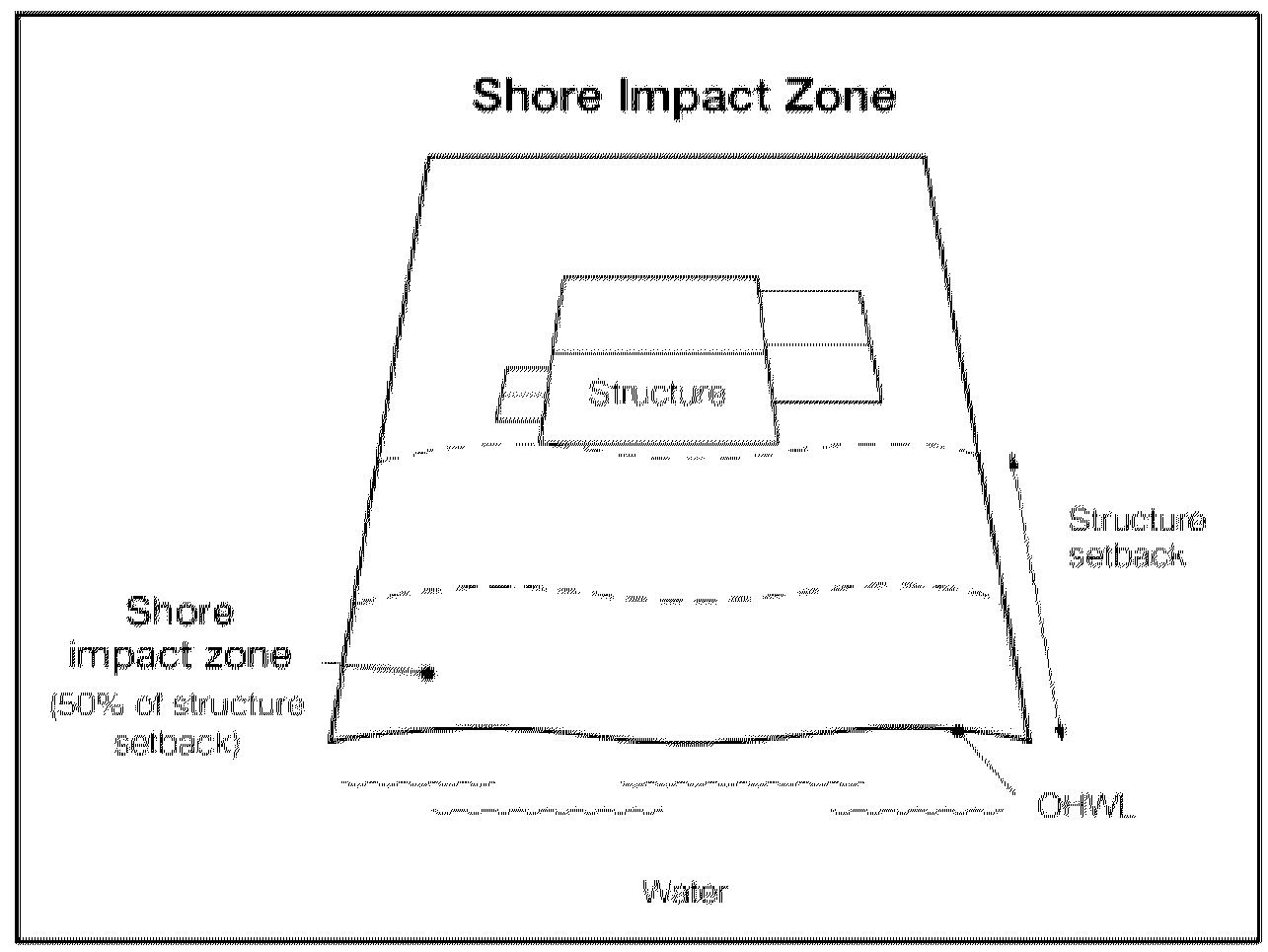
Shoreland means the land within the following distances from public waters: 1,000 feet from the ordinary high water level of a lake, pond, or flowage; and 300 feet from a river or stream, or the landward extent of a floodplain designated by ordinance on a river or stream, whichever is greater. The limits of shorelands may be reduced whenever the waters involved are bounded by topographic divides which extend landward from the waters for lesser distances and when approved by the commissioner.
Shoreline facilities means facilities that require a location adjoining public waters for ingress and egress, loading and unloading, and public water intake and outflow, such as barge facilities, port facilities, commodity loading and unloading equipment, watercraft lifts, marinas, short-term watercraft mooring facilities for patrons, and water access ramps. Structures that would be enhanced by a shoreline location, but do not require a location adjoining public waters as part of their function, are not shoreline facilities, such as restaurants, bait shops, and boat dealerships.
Significant historic site means any archaeological site, standing structure, or other property that meets the criteria for eligibility to the National Register of Historic Places or is listed in the state register of historic sites, or is determined to be an unplatted cemetery that falls under the provisions of Minn. Stats. § 307.08. A historic site meets these criteria if it is presently listed on either register or if it is determined to meet the qualifications for listing after review by the state archaeologist or the director of the Minnesota Historical Society. All unplatted cemeteries are automatically considered to be significant historic sites.
Slope means the degree of deviation of a surface from the horizontal, usually expressed in percent, degrees, or ratio.
Special purpose units of government means the University of Minnesota, the St. Paul Port Authority, watershed management organizations established under Minn. Stats. ch. 103B, watershed districts established under Minn. Stats. ch. 103D, and any other unit of government other than local government or a state or regional agency.
State or regional agency means the Metropolitan Airports Commission, Minnesota Historical Society, University of Minnesota, Department of Natural Resources, Department of Transportation, Metropolitan Council, and other state agencies.
Steep slope (MRCCA) means a natural topographic feature with an average slope of 12 to 18 percent, measured over a horizontal distance equal to or greater than 50 feet, and any slopes greater than 18 percent that are not bluffs.
Storage yard means a place outdoors where products, vehicles, trailers, boats, recreational vehicles, equipment, machinery, or materials, and other items are kept for the sole purpose of storing them.
Stormwater management facilities means facilities for the collection, conveyance, treatment, or disposal of stormwater.
Story means that portion of a building including beneath the upper surface of a floor and upper surface of floor next above, except that the topmost story shall be that portion of a building included between the upper surface of the topmost floor and the ceiling or roof above. If the finished floor level directly above a basement or cellar, or unused underfloor space is more than six feet above grade as defined herein for more than 50 percent of the total perimeter or is more than 12 feet above grade as defined herein at any point, such basement, cellar, or unused underfloor space shall be considered a story.
Street frontage means the proximity of a parcel of land to one or more streets. An interior lot has one street frontage and a corner lot has two such frontages.
Structure (MRCCA and Shoreland) means a building, sign, or appurtenance thereto, except for aerial or underground utility lines, such as sewer, electric, telephone, or gas lines, and utility line towers, poles, and other supporting appurtenances.
Structure means either:
(1)
Anything which is built, constructed or erected; an edifice or building of any kind; or any piece of work artificially built up and/or composed of parts joined together in some definite manner whether temporary or permanent in character, in eluding towers, poles and other supporting appurtenances.
(2)
Anything manufactured, constructed or erected which is normally attached to or positioned on land, including portable structures, earthen structures, roads, parking lots, and paved storage areas.
(3)
Any building, sign, or appurtenance thereto, except aerial or underground utility lines, such as sewer, electrical, telephone, telegraph, or gas lines, including towers, poles, and other supporting appurtenances, and fences used to control livestock or delineate boundaries.
Structure, principal, means anything that houses or facilitates the principal use of a property.
Subdivision. Has the meaning given under Minn. Stats. § 462.352.
Substandard use (Wild and Scenic) means any use within the land use district existing prior to the date of enactment of the ordinance from which this chapter is derived which is permitted within the applicable land use district but does not meet the minimum lot area, length of water frontage, structure setbacks or other dimensional standards of this chapter.
Subsurface sewage treatment system. Has the meaning given under Minnesota Rules, part 7080.1100.
Surface water-oriented commercial use means the use of land for commercial purposes, where access to and use of a surface water feature is an integral part of the normal conductance of business. Marinas, resorts, and restaurants with transient docking facilities are examples of such use.
Temporary real estate office means a structure with or without a foundation or footings, used only as a temporary real estate office, which is open to the general public.
Topsoil means black dirt composed of unconsolidated material, largely undecomposed organic matter that is a suitable foundation for vegetative growth. The composition of topsoil should contain no more than 35 percent sand content.
Tow yard. See Vehicle wrecking yard.
Transmission services.
(1)
Electric power lines, cables, pipelines, or conduits that are:
a.
Used to transport power between two points, as identified and defined under Minn. Stats. § 216E.01, subd. 4; or
b.
For mains or pipelines for gas, liquids, or solids in suspension, used to transport gas, liquids, or solids in suspension between two points; and
(2)
Telecommunication lines, cables, pipelines, or conduits.
Treeline means the more or less continuous line formed by the tops of trees in a wooded area when viewed from a particular point. The treeline is determined during all seasons as if under full foliage.
Truck terminal means a building, structure or land where trucks and/or tractor trailers are rented, leased, or stored, or are dispatched for hire as common carriers.
Twin Cities Metropolitan area means the area over which the Metropolitan Council has jurisdiction according to Minn. Stats. § 473.121, subd. 2.
Unlicensed supportive living facility means a residential dwelling that is not licensed as a licensed residential facility that provides congregate and supportive living environment for no more than six unrelated individuals classified under the Americans with Disabilities Act (ADA).
Use, principal, means the purpose or activity for which the land or building thereon is designated, arranged, or intended, or for which it is occupied, utilized or maintained, and shall include the performance of such activity as defined by the performance standards of this chapter.
Variance. Has the meaning given under Minn. Stats. § 394.22.
Vegetation means the sum total of plant life in some area; or a plant community with distinguishable characteristics.
Vehicle wrecking yard means any place where vehicles not in running condition and/or not licensed, or parts thereof, are stored in the open or any land used for wrecking or storing of such motor vehicles or parts thereof, and including any commercial salvaging and scavenging of any other goods, articles or merchandise.
Water access ramp. A boat ramp, carry-down site, boarding dock, and approach road, or other access that allows launching and removal of a boat, canoe, or other watercraft with or without a vehicle and trailer.
Water body means a body of water (lake, pond) in a depression of land or expanded part of a river, or an enclosed basin that holds water and is surrounded by land.
Water-oriented accessory structure or facility (shoreland) means a small, above ground building or other improvement, except stairways, fences, docks, and retaining walls, which, because of the relationship of its use to a surface water feature, reasonably needs to be located closer to public waters than the normal structure setback. Examples of such structures and facilities include boathouses, gazebos, screen houses, fish houses, pump houses, and detached decks.
Water-oriented accessory structure (MRCCA) means a small building or other improvement, except stairways, fences, docks, and retaining walls, that, because of the relationship of its use to public waters, needs to be located closer to public waters than the normal structure setback. Examples include gazebos, screen houses, fish houses, pump houses, and detached decks and patios.
Water quality impact zone means land within the shore impact zone or within 50 feet of the boundary of a public water, wetland, or natural drainage way, whichever is greater.
Wetland. Has the meaning given under Minn. Stats. § 103G.005.
Wharf. Has the meaning given under Minnesota Rules, part 6115.0170.
Wholesale sales means sales of products to a business or person who will resell the articles in the regular course of business or incorporate the article into another product that will be sold.
Wind energy conversion system (WECS) means any device such as a wind charger, wind mill, or wind turbine and associated facilities that converts wind energy to electrical energy. This equipment includes any base, blade, foundation, generator, nacelle, rotor, tower, transformer, vane, wire, inverter, or other component used in the system.
Yard means an open space on the lot which is unoccupied and unobstructed from its lowest level to the sky. A yard extends along a lot line at right angles to such lot line to a depth or width specified in the yard regulations for the zoning district in which such lot is located.
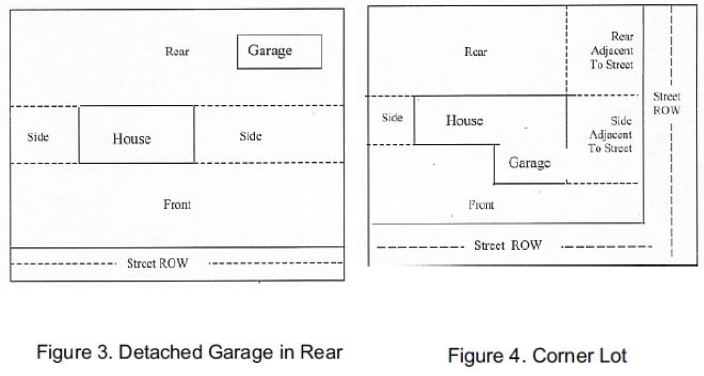
Yard, front, means that area extending along the full length of a front lot line between side lot lines and to the depth required in the yard regulations for the district in which it is located. In the case of a corner lot abutting one or more major roads, both yards shall be considered front yards. A major road is any road that is of a collector designation or greater.
Yard, rear, means a yard extending across the full width of the lot and lying between the rear line of the lot and the nearest line of the principal building.
Yard, side, means a yard between the side line of the lot and the nearest line of the principal building and extending from the front line of the structure to the rear property line.
Zoning administrator means the community development department.
Zoning district means an area within the limits of the city for which the regulations and requirements governing use are uniform.
Zoning district, overlay, means a zoning district containing regulations superimposed upon other zoning district regulations and may supersede the underlying zoning district if more restrictive than the underlying zoning district regulations.
Zoning district, underlying, means all zoning districts except overlay zoning districts.
Zoning map means the map incorporated into this chapter as a part thereof, designating the zoning districts.
Zoning Code means the zoning ordinance of the city, as amended from time to time by the City.
(Ord. No. 23-14, § 3, 11-14-2023; Ord. No. 24-13, § 2, 10-22-2024)
Sec. 106-106. - Applicability and compliance.
From and after the effective date of the ordinance from which this chapter is derived, the use of all land and every building or portion of a building erected, altered in height and area, added to, or relocated, and every use within a building, or use accessory thereto, in the city shall be in conformity with the provisions of this chapter and after the lawful issuance of all required permits.
(Ord. No. 23-14, § 3, 11-14-2023)
Sec. 106-110. - Administration.
Sections 111-140 establish the administration and enforcement powers of this chapter.
(Ord. No. 23-14, § 3, 11-14-2023)
Sec. 106-111. - Zoning administrator.
The zoning administrator shall:
(1)
Administer and enforce the provisions of this chapter in accordance with its literal terms and shall not have the power to permit any construction or any use or change of use which does not conform to this chapter;
(2)
Maintain the official zoning map;
(3)
Maintain a permanent file of all zoning applications as public records.
(Ord. No. 23-14, § 3, 11-14-2023)
Sec. 106-120. - Official zoning map.
(a)
The boundaries of the zoning districts and overlay districts are delineated on the official zoning map, which is adopted by reference and declared to be a part of this chapter. Such map shall be on permanent file and available for public inspection in City Hall. It shall be the responsibility of the zoning administrator to maintain and keep the map up to date and to revise or update the map with each amendment thereto within 30 days after official publication of the ordinance adopting the amendment.
(b)
District and development area boundaries shown within the lines of roads, streams, and transportation rights-of-way shall be deemed to follow the centerlines. The vacation of roads shall not affect the location of such district or development area boundaries. When the zoning administrator cannot definitely determine the location of a district or development area boundary by such centerlines, by the scale or dimensions stated on the zoning map, or by the fact that it clearly coincides with a property line, the zoning administrator shall interpret the location of the district or development area boundary with reference to the scale of the zoning map and the purposes set forth in all relevant provisions of this Code. When a district or development area boundary line divides a lot of record into two or more districts or into both development areas, any portion of the lot within 50 feet of such division may be used for any use of either district or development area as approved by the planning commission or as appealed by the city council. The Metropolitan Urban Service Area (MUSA) boundary line as shown in the comprehensive plan, however, defines the limits of sewered areas. Any area outside of the MUSA boundary shall not be served with sewer.
(Ord. No. 23-14, § 3, 11-14-2023)
Sec. 106-130. - Enforcement.
(a)
Any violation of this chapter may be enjoined by the council through proper legal channels. Each day a violation is permitted to exist shall constitute a separate offense.
(b)
In case any building, structure, or land is proposed to be erected, reconstructed, altered, converted, maintained or used in violation of this chapter, the council, in addition to other remedies, may institute in the name of the city any appropriate action or proceeding to prevent, restrain, correct or abate such building, structure, or land, or to prevent, in or about such premises, any act, conduct, business, or use constituting a violation, as prescribed in chapter 2.
(c)
Violation of any provision of this chapter is considered a misdemeanor.
(d)
Appeals are provided in the same manner as prescribed in chapter 2.
(Ord. No. 23-14, § 3, 11-14-2023)
Sec. 106-140. - Nonconformities.
(a)
Intent. It is the purpose of this section to provide for the regulation of nonconforming buildings, structures, site improvements, and uses and to specify those requirements, circumstances, and conditions under which nonconforming buildings, structures, and uses will be operated and maintained. This chapter establishes separate districts, each of which is an appropriate area for the location of uses that are allowed in that district. It is necessary and consistent with the establishment of these districts that nonconforming buildings, structures, site improvements, and uses not be allowed to continue without restriction. Furthermore, it is the intent of this section that all nonconforming uses shall be eventually brought into conformity or terminated.
(b)
Regulations.
(1)
Whenever a lawful nonconforming use of a structure or land or occupancy is discontinued for a continuous period of one year, any future use of said structure or lands shall be made to conform with the provisions of this chapter.
(2)
Notwithstanding any other provisions of this chapter, any nonconformity, including the lawful use or occupation of land or premises existing at the time of the adoption of an additional control under this chapter, may be continued, including through repair, replacement, restoration, maintenance, or improvement, but not including expansion, unless it is a nonconforming use that is destroyed by fire or other peril to the extent of greater than 50 percent of its market value, and no building permit has been applied for within 180 days of when the property is damaged. In this case, the city may impose reasonable conditions upon a building permit in order to mitigate any newly created impact on adjacent property. Any subsequent use or occupancy of the land or premises shall be a conforming use or occupancy.
(c)
Creation of nonconformities by public action.
(1)
Where there exists as of the date of adoption of this section a conforming land use, lot of record, sign, structure, and/or site improvement and a subsequent taking by a governmental body occurs under eminent domain or negotiated sale which renders such land use, lot of record, structure, or site improvement in violation of one or more provisions of this chapter, such land use, lot of record, sign, structure or site improvements becomes a legal non-conformity and may be used thereafter only in accordance with the provisions of this section.
(2)
The planning commission may consider government taking as a practical difficulty used with a request for a variance to a setback regulation for pre-existing buildings, parking lots, and/or signs.
(d)
Lots of record. Any lot of record existing at the effective date of the ordinance from which this chapter is derived may be used for the erection of a dwelling conforming to the use regulations of the district in which it is located, even though its area is less than the minimum requirements of this chapter. This provision shall not apply to lots with widths below the district minimum, meaning that all lots of record must meet district lot width minimums to qualify.
(e)
Expansion of a non-conforming principal structure, deck, or parking lot by way of setbacks is permitted provided the improvement does not increase the level of nonconformity. This provision does not apply in the Shoreland Overlay or Wild and Scenic River Overlay.
(f)
Additional standards for nonconformities within the Mississippi River Corridor Critical Area Overlay District are found in section 106-910.
(Ord. No. 23-14, § 3, 11-14-2023)

