
Rialto City Zoning Code
CHAPTER 18
102 - REGULATION OF SIGNS AND ADVERTISING STRUCTURES
Sections:
18.102.010 - Findings—Intent—Purpose.
A.
The city council finds that the lack of a comprehensive control and regulation of signs has resulted in a deterioration of the physical environment of the community, characterized by the competition for the public eye through the proliferation, increased height and size, and visual unattractiveness of signs. The city council further finds that through the use of proper sign controls, the city can become both an economically stable and visually attractive community.
B.
The intent of this chapter is to develop standards, procedures and guidelines for the regulation of the zoning aspects of signs. Where a provision of any other ordinance of the city is inconsistent with any of the provisions hereof, the ordinance codified in this chapter shall control and supersede any such inconsistent provisions.
C.
The purposes of this chapter are to safeguard and enhance property values; to protect public and private investment in buildings and open spaces; to preserve and improve the appearance of the city as a place in which to live and work, and as an attraction to nonresidents who come to visit or shop; to encourage sound signing practices as an aid to business and for the information of the public, but to prevent excessive and confusing sign displays; to reduce hazards to motorists and pedestrians; and to promote the public health, safety and general welfare.
(Ord. 917 (part), 1984)
18.102.020 - Categorization of signs.
A.
A "sign" means any words, letters, figures, numerals, emblems, artwork, pictures, paintings, designs or other marks shown on any card, cloth, paper, metal, glass, wood, plaster, stone or other surface or device of any kind or character by which anything is made known or communicated and used to attract attention or communicate a message to any individual by visual images, and not otherwise defined by statute, ordinance or regulation as graffiti.
B.
For the purpose of this chapter, signs within the city shall be classified in one or more of the following categories:
1.
Advertising Structure. An on-site or off-site sign structure of any kind or character other than the main business identification sign which is erected or maintained for outdoor advertising purposes, upon which any poster, bill, printing, painting or other advertisement of any kind whatsoever may be placed, including statuary, for advertising purposes. A billboard sign structure is included in this category;
2.
Comprehensive Directory Sign. A sign structure intended to allow combined groupings of small identification and directory signs for individual residential subdivisions in strategic locations throughout the community;
3.
Construction Sign. A sign stating the names of those individuals or businesses directly connected with the construction of a project, their addresses and their telephone numbers;
4.
Convenience Sign. A sign which conveys information necessary for public safety or convenience such as "no parking," "restrooms" or similar words and which is designed to be viewed on-site by pedestrians and/or motorists. Signs that convey advertising, products or business identification shall not be considered a convenience sign;
5.
Directional Sign. A sign which contains words such as "entrance," "enter," "exit," "in," "out" or other similar words or a sign containing arrows or characters indicating traffic directions. No directional sign shall contain any advertising or trade name information. A subdivision directional sign is not included in this category;
6.
Flashing Sign. Any sign which contains or is illuminated by lights which are intermittently on and off, which change intensity, or which create the illusion of motion in any manner;
7.
Freestanding Sign. A sign which is permanently supported by one or more uprights, braces, poles or other similar structural components when utilizing the ground as a primary supportive base;
8.
Identification Sign. A sign which advertises or directs attention to an occupancy, major business, commodity, service or entertainment conducted, sold or offered only upon the premises where the sign is located;
9.
Monument Sign. A low-profile freestanding sign not in excess of eight feet in height which is detached from a building, and the support structure is a solid base constructed of materials accenting the architectural theme of the building(s) on the same premises;
10.
Nameplate Sign. A sign naming the occupant of the premises, the business and/or the address;
11.
Noncommercial Sign. A sign which communicates any message or idea relating to political, philosophical, religious, or personal noncommercial message or otherwise is not intended to advertise a commercial product, service, or venture;
12.
Off-Site Sign. A sign which advertises or informs, in any manner, businesses, services, goods, persons or events at some location other than that upon which the sign is located;
13.
On-Site Sign. A sign which advertises or informs, in any manner, businesses, services, goods, persons or events which are located on the same premises where the sign is located, and which has been designed, constructed, created, intended or engineered to have a useful life of fifteen years or more;
14.
Painted Sign. A sign or medium for advertising purposes painted on the exterior wall surfaces of a building or structure;
15.
Portable Sign. A sign which is not designed to be permanently attached to a structure or to the ground;
16.
Poster Sign. A sign or placard posted in a public place which may be visible from adjacent streets or highways;
17.
Projecting Sign. Any sign, other than a wall sign, which is suspended from or supported by a building or structure, and which projects from the face of the building or structure. This category includes any such sign suspended under a marquee, porch, walkway covering or similar covering structure;
18.
Real Estate Sign. A sign advertising the sale or lease of the property upon which the sign is located, and the identification of the firm handling such sale, lease or rent;
19.
Revolving Sign. A sign, which all or a portion of may rotate either on an intermittent or constant basis;
20.
Roof Sign. A sign erected, constructed, painted or otherwise placed upon or over a roof or parapet wall of a building and which is partly or wholly supported by the building;
21.
Subdivision Sign. An on-site or off-site sign intended for the purpose of identifying and advertising the model homes and other residential units for sale within a subdivision development;
22.
Temporary Advertising Sign. A banner, flag, pennant or sign intended to be displayed for a short period of time associated with the advertisement of the initial opening of a business or the change in ownership of the business; special events for nonprofit, religious, charitable, or fraternal organizations; or special merchandise sales or sales promotional activity;
23.
Vehicle Sign. A sign which is attached to a vehicle and placed on any property so as to attract attention to a product, activity or business and which is in addition to the main business identification sign;
24.
Wall Sign. A sign which is attached to or erected against the wall of a building or structure, the exposed face of which is in a plane parallel to the plane of the wall and which projects not more than twelve inches from the building or structure;
25.
Window Sign. A sign which is painted, attached, glued or otherwise affixed to a window or otherwise easily visible from the exterior of the building.
(Ord. 1276 § 1, 1998: Ord. 917 (part), 1984)
18.102.030 - Definitions.
For the purposes of this chapter, the following words and phrases shall have the meanings ascribed to them by this section:
A.
Area of Sign. The "area of a sign" shall include the entire area within any type of perimeter or border which may enclose the outer limits of any writing, representation, emblem, figure or character, together with any other material or color forming an integral part of the display or used to differentiate such sign from the background on which it is placed. The area of a sign having no such perimeter shall be computed by enclosing the entire area within parallelograms, triangles or circles in a size sufficient to cover the entire area and computing the size of such area. In case of a double-faced sign, the area shall be computed as including only the maximum single display surface which is visible from any ground position at one time. The supports or uprights on which any sign is supported should not be included in determining the sign area unless such supports or uprights are designed in such a manner as to form an integral background of the sign. In the case of any cylindrical sign the total area shall be computed on the total area of the surface of the sign.
B.
"Building face" means the area of the front building elevation in which the business is located. If more than one business is located in a single building, then such area shall be limited to that portion which is occupied by each individual business.
C.
"Freeway" means a highway in respect to which the owners of abutting lands have no right or easement of access or in respect to which such owners have only limited or restricted right or easement of access, and which is declared to be such in compliance with the Streets and Highways Code of the state of California.
D.
Frontage of Building. The frontage of a building used in calculating the permitted sign area includes the frontages whereon a public entry to the occupancy is located. If applicable, separate calculations may be made for front, side and rear entrances and separate signs may be placed on each of the building frontages.
E.
"Frontage of lot" means that portion of land abutting a street which is developed or will be developed as a building site, together with the required parking and landscaping areas. Unless otherwise provided, in land use zones where lot frontage provides the criteria for the number and/or size of free-standing signs, corner lots or lots fronting on two or more streets may be credited with only the frontage along one of the streets.
F.
"Grade" means the elevation of the nearest public sidewalk adjoining the property upon which a sign or building is erected or the natural surface of the ground supporting a sign or building, whichever is the lower surface.
G.
Height of Sign. The height of signs shall be measured from grade to the top of the sign.
H.
"Illuminated" means a source of light on the surface of the sign, in the interior of the sign itself or which has a source of light located such that the beam of the light falls upon the surface of the sign.
I.
"Nonconforming sign" means an existing sign which has been lawfully erected at the time of the adoption of this chapter but which is not in conformity with the regulations and provisions contained herein.
J.
"Sign structure" means and includes the supports, uprights, bracings, cables and framework of a sign or outdoor display.
K.
"Zone" is used in this chapter in reference to such zones or districts as defined in Title 18, Zoning, of this code.
(Ord. 917 (part), 1984)
18.102.040 - Administration.
A.
Permits—Required. It is unlawful for any person to erect, alter or relocate within the city any sign or advertising structure, unless exempted by this chapter, without first obtaining a sign permit issued by the building division. Where signs are illuminated by lighting, a separate electrical permit shall be obtained from the building division.
B.
Permits—Application. Application for a sign permit shall be made in writing upon forms provided by the building division. Such application shall contain the location by street and number of the proposed sign structure, together with the name and address of the owner and the sign contractor or erector. Two copies of the sign plans shall be filed with the application including the following:
1.
Plot plan, fully dimensioned, indicating location of proposed sign together with the location, size and height of all existing signs on the premises. The street frontage(s) shall be clearly indicated on the plan;
2.
Elevation plan, indicating the height and size of proposed sign, method of illumination, colors, and materials of construction;
3.
Structural details and calculations prepared by a state-registered engineer or architect, as determined by wind load factors and requirements of the building division;
4.
Payment of all applicable permit and inspection fees in the amounts established by resolution of the city council;
5.
Such other information as the building division may require to determine full compliance with city ordinance and resolution requirements.
C.
Review—Planning Division. Prior to the issuance of a sign permit by the building division, the applicant shall submit the two copies of the sign review and approval. It shall be the responsibility of the planning division to determine that the sign proposal is in conformance with the intent, purpose and requirements of this chapter.
D.
Interpretation of Provisions.
1.
The provisions of this chapter are not intended to abrogate any easements, covenants, or other existing agreements which are more restrictive than the provisions of this chapter.
2.
Whenever the application of this chapter is uncertain due to ambiguity of its provisions, the question shall be referred to the planning commission for determination. The planning commission shall then authorize sign requirements which best fulfill the intent of this chapter.
3.
If any section, subsection, sentence, clause, phrase or portion of this chapter is for any reason held invalid or unconstitutional by any court of proper jurisdiction, such portion shall be deemed a separate, distinct and independent provision and such holdings shall not affect the validity of the remaining portions hereof.
(Ord. 1276 § 2, 1998; Ord. 1234 (part), 1995: Ord. 917 (part), 1984)
18.102.050 - General provisions.
A.
Exempt Signs. The following signs shall be exempt from the application, permit and fee requirements of this chapter. An electrical permit, however, may be required.
1.
Permanent window signs not exceeding three square feet in area and limited to business identification, hours of operation, address and emergency information only;
2.
Real estate signs for residential sales, lease or rent not exceeding four square feet in area and four feet in height, provided the sign is not illuminated and is removed within seven days after the close of escrow or the rental or lease has been accomplished;
3.
Contractor of Construction Signs. One directory sign shall be permitted on the construction site for all contractors (may include bank, realtors, subcontractors, etc.) not exceeding thirty-two square feet in area unless legally required by any government contracts, administrative rule, regulation or statute to be larger. No sign shall exceed eight feet in overall height and shall be set back a minimum of ten feet from any property line. Any such sign shall be removed upon the completion of such project;
4.
Future Tenant Identification Sign. Future tenant identification signs may be placed on vacant or developing property to advertise the future use of the property and where this information may be obtained. One such sign shall be permitted per parcel and be limited to a maximum of thirty-two square feet in area and eight feet in overall height, and be set back a minimum of ten feet from any property line. Any such sign shall be removed upon completion of such project;
5.
Real Estate Signs for Sale of Industrial or Commercial Property. One sign per street frontage not to exceed thirty-two square feet in area to advertise the sale, lease or rent of such property. No such sign shall exceed eight feet in overall height and shall be set back a minimum of ten feet from any property line. Where a property has a street frontage in excess of six hundred feet, an additional sign is allowed for every six hundred lineal feet;
6.
Interior signs within a structure not visible from off site or from outside of building;
7.
Memorial tablets, plaques or directional signs for community historical resources, installed by the Rialto Historical Society or a recognized civic organization;
8.
Residential building identification signs used to identify individual residences and not exceeding two square feet in area;
9.
Official and legal notices issued by the court, public body, person, or officer in performance of his or her public duty or in giving legal notice;
10.
Directional, warning, or informational signs or structures required or authorized by law or by federal, state, county or city authority;
11.
Convenience signs which are necessary for public convenience and not exceeding three square feet in area;
12.
Official flags of the United States of America, the state of California, the county, and official flags of internationally and nationally recognized organizations, when on a flagpole or otherwise properly displayed;
13.
Signs of public utility companies, indicating danger or which serve as an aid to public safety or which indicate the location of underground facilities or public telephones;
14.
Safety signs on construction sites;
15.
Time and temperature signs that convey time and temperature only and not exceeding twelve square feet in area or eight feet in overall height;
16.
Temporary Advertising Signs. Any banner, flag, pennant or sign (portable or otherwise) intended to be displayed for a short period of time associated with special events for nonprofit, religious, charitable or fraternal organizations. The display of such temporary signs shall not exceed a period of thirty days unless the time is extended by action of the city council;
17.
Noncommercial signs on private property.
B.
Prohibited Signs. All signs not expressly permitted are prohibited in all zones, including, but not limited to, the following:
1.
Roof signs;
2.
Flashing signs, except in time and temperature signs;
3.
Revolving signs;
4.
Vehicle signs, when used on property to identify a business;
5.
Portable signs, except where permitted in this chapter;
6.
Signs within the public right-of-way, except where required by a governmental agency, or an encroachment permit has been obtained from the city engineer in accordance with Section 11.04.070 of this code;
7.
Signs blocking doors or fire escapes;
8.
Commercial banners, flags and pennant, except for temporary advertising as provided for in this chapter;
9.
Tethered balloon or balloons.
C.
Signs Relating to Inoperative Activities. Signs pertaining to activities or businesses which are no longer in operation shall be removed from the premises or the sign copy shall be removed or obliterated within ninety days after the premises has been vacated. Any such sign not removed within the specified time period shall constitute a nuisance and shall be subject to removal under the provisions of this chapter.
D.
Construction and Maintenance of Signs.
1.
Every sign and all parts, portions and materials shall be manufactured, assembled and erected in compliance with all applicable federal, state and city regulations and the Uniform Building Code.
2.
Every sign and all parts, portions and materials shall be maintained and kept in proper repair. The display surface of all signs shall be kept clean, neatly painted and free from rust and corrosion. Any unmaintained or damaged portion of a sign shall be repaired or replaced within thirty days following notification by the city. Noncompliance with such a request will constitute a zoning violation and will be enforced under the provisions of this code.
E.
The police chief or his or her designated representative is authorized and directed to enforce the sign requirements and provisions of this chapter. The police chief or his or her designated representative has the authority under this chapter to designate a representative of the code enforcement division to implement the provisions of this chapter. Enforcement, legal procedures and penalties shall be in accordance with enforcement procedures established by this code. Additionally, illegal signs located within the public right-of-way may be summarily abated by the city and held, pending notification of the owner by the city. The owner may obtain said illegal sign from the city upon payment to the city of any storage and removal charge that may have been incurred by the city.
(Ord. 1331 § 1, 2002; Ord. 1276 § 3, 1998; Ord. 1234 (part), 1995: Ord. 1203 § 1 (part), 1993; Ord. 1157 § 1 (part), 1991; Ord. 1136, 1991; Ord. 917 (part), 1984)
18.102.060 - Sign requirements.
Sign permits may be issued for signs that are permitted in this section, provided the signs are in compliance with all other applicable laws and ordinances.
A.
Permitted Signs—Noncommercial Signs. Noncommercial signs as defined in Section 18.102.020(B)(11) of this chapter are permitted in all zones and are exempt from all application, permit and fee requirements of this chapter in accordance with the following provisions:
1.
A noncommercial sign shall not be placed, posted or otherwise displayed within the public right-of-way or on any public property without an encroachment permit from the city engineer in accordance with the provisions of Section 11.04.070 of this code.
2.
Noncommercial signs within all residential zones shall not exceed sixteen square feet in area and six feet in height per sign and shall not be illuminated.
3.
Noncommercial signs shall not be placed on any property without the permission of the owner or owners of the property. No signs shall be placed or posted in a manner that would obstruct visibility of pedestrian or vehicle traffic.
B.
Permitted Signs—Subdivision Advertising and Directory Signs. On-site and off-site advertising and directional signs used to direct potential homebuyers to residential subdivision developments within the city permitted in various zoning districts subject to the following provisions:
1.
Temporary On-Site Subdivision Advertising Signs. On-site subdivision advertising signs are intended for the purpose of identifying and advertising the model homes and other residential dwellings for sale within a subdivision development. Approved signs are to be located within the development site and designed to minimize the disturbance to adjacent residential uses subject to the following provisions:
a.
The plot plan and elevation details indicating the location, height and size of the proposed sign(s) shall be submitted to the planning department for review and approval prior to the issuance of a sign permit. The design and location of the proposed sign(s) shall conform with the following standards:
i.
The sign may be double-faced and shall not exceed six feet by eight feet in size per face.
ii.
The minimum height from grade to base of sign face shall not be less than six feet. The overall height of the sign shall not exceed twelve feet.
iii.
The sign shall be set back a minimum of five feet from the public right-of-way.
iv.
No sign shall be illuminated, either directly or indirectly.
v.
A maximum of two on-site subdivision advertising signs are allowed for each residential subdivision.
b.
Approved signs shall be removed within ten days from the date of the final sale of the land and/or residences within the subdivision.
c.
A cash deposit in the amount of two hundred dollars per sign shall be deposited with the building division prior to issuance of the sign permit to ensure removal of the sign at the end of the approval period. If the sign is not removed, the cash deposit will be declared forfeit and the city will proceed to remove the sign.
2.
Temporary Off-Site Subdivision Directional Signs. Off-site directional signs are intended to allow moderate-sized temporary directional advertising signs for the purpose of directing prospective homebuyers to residential developments being offered for sale. Approved signs are to be located on properties within the C-2, C-3, C-M, M-1 and M-2 zoning districts within the city and designed to not adversely affect the aesthetic qualities of the community, and shall conform with the following provisions:
a.
The plot plan and elevation details indicating the location, height, size and design of the proposed sign structure shall be submitted to the planning department for review and approval prior to the issuance of a sign permit. The design and location of the proposed sign(s) shall conform with the following standards:
i.
The sign may be double-faced and shall not exceed eight feet by twelve feet in size per face.
ii.
The minimum height from grade to base of sign face shall not be less than six feet. The total height of the sign shall not exceed fourteen feet.
iii.
Signs shall be located only adjacent to secondary and major highways and shall be set back a minimum of five feet from the public right-of-way.
iv.
No sign shall be illuminated, either directly or indirectly.
v.
A maximum of two off-site directional signs will be allowed for each subdivision.
vi.
The sign shall be located a minimum of two hundred feet from a previously approved off-site directional sign.
b.
Each sign shall be approved for a period of time not to exceed one year or until the last unit of the subdivision is sold, whichever time is shorter.
c.
A cash deposit in the amount of five hundred dollars per sign shall be deposited with the building division prior to issuance of the sign permit to ensure removal of the sign at the end of the approval period. If the sign is not removed, the cash deposit will be declared forfeit and the city will proceed to remove the sign.
3.
Permitted Signs—Comprehensive Subdivision Directory Signs. Comprehensive subdivision directory sign structures are intended to allow combined groupings of small identification and directory signs for individual residential subdivisions in strategic locations throughout the city. The purpose of these sign structures is to direct prospective homebuyers to residential developments being offered for sale. Comprehensive subdivision sign structures shall be permitted in any zoning district subject to the following provisions:
a.
The plot plan and elevation details indicating the location, height, size and design of the proposed sign structure shall be submitted to the planning department for review and approval prior to the issuance of a sign permit. The design and location of the proposed comprehensive sign structures shall be uniform throughout the city and conform with the following standards:
i.
The sign structure may be designed to contain up to four display faces and shall not exceed an overall size of eight feet in height and five feet in width.
ii.
The individual subdivision directory signs affixed to the sign structure shall uniformly be only nine inches in height and sixty inches in width. All directory signs shall be attached to the structure in a uniform manner.
iii.
The individual subdivision directory signs shall contain only the name of the residential development, developer logo and a directional arrow. The color and display of each sign shall adhere to a uniform design scheme.
iv.
Sign structures may be placed on private property with written consent of the property owner, or within the public right-of-way with issuance of an encroachment permit by the city engineer. Each sign structure shall be located a minimum distance of twelve hundred feet from a similarly approved directory sign structure.
b.
Any approved sign structure shall not be enlarged or structurally altered without prior approval of the planning division.
c.
There shall be no additions, banners, flags, pennants, streamers, display boards or other appurtenances added to the sign structure as approved. Other types of subdivision directional signs, such as posters and trailer signs, are expressly not permitted.
C.
Permitted Signs—A-1 Agricultural Zone. Signs are permitted in the agricultural zone subject to the following provisions:
1.
All signs specifically enumerated in subsection D of this section for single-family residential zones are permitted in the agricultural zone.
2.
One nonilluminated single or double-faced sign pertaining only to the sale, lease or hire of the premises, or of the products produced upon the premises. The sign shall not exceed twelve square feet in area per sign face or exceed an overall height of four feet.
D.
Permitted Signs—R-1A-10,000, R-1A, R-1B, and R-1C Single-family Residential Zones. Signs are permitted on each lot or parcel within the single-family residential zones subject to the following provisions:
1.
One real estate sign for the purpose of residential sales, lease or rent, not exceeding four square feet in area and six feet in height, provided the sign is not illuminated and is removed within seven days after close of escrow, or after the rental or lease has been accomplished;
2.
One residential building identification sign used to identify an individual residence and/or name of occupant, with the sign not exceeding two square feet in area;
3.
One nonilluminated sign not exceeding three square feet in area for the purpose of advertising the sale of personal property as permitted in Section 18.10.020M of this title. The sign may only be displayed during the period of the sale;
4.
One nonilluminated sign not exceeding three square feet in area for the purpose of declaring improvements being made on the premises. The sign shall be removed within seven days after completion of the improvements;
5.
Official and legal notices issued by the court, public body, person or officer in performance of his or her public duty or in giving legal notice.
E.
Permitted Signs—R-3 and R-4 Multiple-Family Residential, PRD Planned Residential Development and MHD Mobile Home Development Zones. Signs are permitted within the multiple-family residential, planned residential development and mobile home development zones subject to the following provisions:
1.
All signs specifically enumerated in subsection D of this section for single-family residential zones are permitted in the multiple-family residential zones.
2.
An identification sign indicating only the name and/or the address of a multiple-family apartment complex, planned residential development or mobile home development is permitted subject to the following standards:
a.
The maximum sign area shall not exceed twelve square feet for residential developments containing twelve units or less, or exceed twenty square feet for developments containing over twelve units.
b.
One identification sign is permitted per street frontage with a maximum of two such signs permitted for each residential development.
c.
A freestanding identification sign shall be set back a minimum of five feet from the public right-of-way and shall not exceed an overall height of five feet above grade.
d.
An identification sign attached to the wall of the building shall not extend above the roof or eave line.
e.
An identification sign attached to a perimeter wall shall not extend above the top of the wall.
f.
Identification signs may only be illuminated with an indirect source of light on the surface of the sign.
3.
Directional and convenience signs designed to convey information necessary for public safety or convenience within the residential development, provided that each sign shall not exceed three square feet in area.
F.
Permitted Signs—A-P Administrative-Professional Zone. Signs are permitted within the administrative-professional zone subject to the following provisions:
1.
All signs specifically enumerated in subsection D of this section for single-family residential zones are permitted in the administrative-professional zone.
2.
When a property located in the administrative-professional zone is used for multiple-family residential purposes in accordance with the provisions of the A-P zone, all signs specifically enumerated in subsection E of this section for the multiple-family residential zone are permitted as applicable.
3.
For nonresidential uses in the administrative-professional zone, signs are permitted subject to the following standards:
a.
One illuminated wall sign attached to the face of the building for each business. The wall sign shall not exceed one square foot of sign each for each linear foot of building frontage, or portion thereof, involved. If the building frontage of any business is less than twenty-five feet in width, the wall sign may contain a maximum area of twenty-five square feet.
b.
One monument sign per lot or parcel, provided that the maximum sign area shall not exceed twenty square feet and the overall height shall not exceed five feet above grade. The monument sign shall be set back a minimum of five feet from the public right-of-way.
c.
Illuminated signs shall be designed having an intensity and/or arrangement that will not create glare or a disturbance for abutting residential properties.
d.
Window signs, commercial and noncommercial, provided that the total area of the displayed window signs shall not exceed fifty percent of the total window area for the front building elevation and side building elevations facing a public street, and twenty-five percent of the total window area on all other building elevations. The placement of window advertisement signs is exempt from the requirement of a sign permit.
e.
Temporary banners, flags, pennants or signs (portable or otherwise) intended to be displayed to advertise an initial opening of a business, change in ownership, special merchandise sales or promotional activities, subject to approval of a temporary sign permit by the planning division and payment of a sign permit fee determined by resolution of the city council. The display of such temporary signs shall not exceed a total of thirty days within any ninety-day period. All approved temporary advertising displays shall be maintained in good condition and all display surfaces kept clean. Any unmaintained or damaged signs shall be repaired or replaced within ten days following notification by the planning division. Noncompliance with such a request will constitute a zoning violation and will be enforced under the provisions of this code.
G.
Permitted Signs—C-1 and C-1A Commercial Zones. Signs are permitted within the C-1 and C-1A commercial zones subject to the following provisions:
1.
Illuminated single-faced wall signs provided that no portion of any sign shall project above a canopy, eave line or parapet wall of a building. Such wall signs shall not exceed a combined sign display area of one square foot for each linear foot of building frontage, or portion thereof, involved. For each additional setback of ten feet in excess of the minimum setback requirements of the zoning district, the permitted sign area may be increased one square foot. The determination of permitted sign area shall be in accordance with the following standards:
a.
Building frontage includes frontage whereon a public entry to the business is located. Separate calculations may be made for front and side entrances, and separate wall signs may be placed on each of these frontages. Where no public entry is provided on a side of the building, an additional wall sign not exceeding thirty square feet in area may be placed on the side wall.
b.
In cases where a business has a rear parking area together with a rear public entry, signs may be located on the rear wall of the building subject to the standards set forth for the front of the building, provided that illuminated signs shall be designed having an intensity and/or arrangement that will not create glare or a disturbance for abutting residential properties.
2.
One illuminated monument sign per lot or parcel for businesses having direct frontage on a public street and not located within a multi-tenant shopping center building. The monument sign shall be located within a landscaped planter area and set back a minimum of five feet from the public right-of-way. The maximum sign area shall not exceed thirty-two square feet and the overall height shall not exceed eight feet above grade. When more than one business is located on a lot or parcel having direct frontage on a public street, one additional monument sign may be permitted provided that the minimum distance between monument signs shall be forty feet and not more than two such signs located on one lot or parcel. A modification of the sign standards set forth in this subsection may be granted without a variance, subject to planning commission approval of sign plans and elevations.
3.
The following additional signs pertaining to commercial shopping centers are permitted:
a.
As the term relates to this subsection, "shopping center" refers to an area of not less than five acres net in size, under one ownership, and developed with multiple commercial uses.
b.
One illuminated double-faced freestanding sign indicating the name of the shopping center or the major tenants shall be permitted, provided that the maximum sign area shall not exceed fifteen square feet for each one acre of land developed for a shopping center use. The total combined sign area of the freestanding sign shall not exceed three hundred square feet and the overall height shall not exceed forty feet above grade. The shopping center sign may include a directory of businesses located within the shopping center, provided that the combined sign area does not exceed three hundred square feet. The shopping center sign shall be located within a landscaped planter area and shall be set back a minimum of five feet from the public right-of-way.
c.
For shopping centers of ten acres net or more in size having frontage on two or more public streets, one additional shopping center sign may be permitted subject to the standards set forth in subdivision 3b of this subsection, provided that not more than one such sign is located on each street frontage.
4.
The following signs pertaining to automobile service stations are permitted:
a.
Not more than two illuminated wall signs are permitted for each automobile service station identifying the business or advertising the merchandise or services available within the service station, provided that each sign shall not exceed thirty-six square feet in area and not exceed an overall height of twenty feet when placed on the building or canopy.
b.
One monument sign may be permitted for each service station subject to the standards set forth in subdivision 2 of this subsection.
c.
Fuel pricing signs as required or authorized by state law and local ordinances for automobile service stations.
5.
Window signs, commerical and noncommercial, provided that the total area of the displayed window signs shall not exceed fifty percent of the total window area for the front building elevation and side building elevations facing a public street, and twenty-five percent of the total window area on all other building elevations. The placement of window advertisement signs is exempt from the requirement of a sign permit.
6.
Temporary banners, flags, pennants or signs (portable or otherwise) intended to be displayed to advertise an initial opening of a business, change in ownership, special merchandise sales or promotional activities, subject to approval of a temporary sign permit by the planning division and payment of a sign permit fee determined by resolution of the city council. The display of such temporary signs shall not exceed a total of thirty days within any ninety-day period. All approved temporary advertising displays shall be maintained in good condition and all display surfaces kept clean. Any unmaintained or damaged signs shall be repaired or replaced within ten days following notification by the planning division. Noncompliance with such a request will constitute a zoning violation and will be enforced under the provisions of this code.
H.
Permitted Signs—C-2, C-3 and C-M Commercial Zones. All signs specifically enumerated in subsection G of this section for the C-1 and C-lA zoning districts are permitted in the C-2, C-3 and C-M zones, with the following exceptions:
In lieu of a monument sign permitted in subsections (G)(2) and (4)(b) of this section, one freestanding sign per lot or parcel may be permitted provided that the maximum sign area shall not exceed forty square feet and the overall height shall not exceed twenty feet above grade. Freestanding signs shall be set back a minimum of five feet from the public right-of-way. Any sign in excess of eight feet in height shall be located a minimum of one hundred feet from abutting properties within a residential zoning district. A freestanding sign shall not be placed closer than forty feet from another existing freestanding sign.
I.
Permitted Signs—M-1, M-2 and PID Manufacturing and Industrial Zones. Signs are permitted within the M-1, M-2 and PID manufacturing and industrial zones subject to the following provisions:
1.
Illuminated single-faced wall signs provided that no portion of any sign shall project above a canopy, eave line or parapet wall of a building. Such wall signs shall not exceed a combined sign display area of two square feet for each linear foot of building frontage, or portion thereof, involved.
2.
For properties within the M-1 and M-2 zoning districts, one freestanding sign per lot or parcel may be permitted subject to the standards for commercial freestanding signs set forth in subsection H of this section, provided that the size of the sign may be increased to allow a maximum sign area of eighty square feet with a maximum height of twenty-five feet above grade.
3.
For properties within the PID zoning district, freestanding signs are not permitted. One monument sign may be permitted for each lot or parcel subject to the standards set forth in subsection (G)(2) of this section.
4.
Window signs, commercial and noncommerical, provided that the total area of the displayed window signs shall not exceed fifty percent of the total window area for the front building elevation and side building elevations facing a public street, and twenty-five percent of the total window area on all other building elevations. The placement of window advertisement signs is exempt from the requirement of a sign permit.
5.
Temporary banners, flags, pennants or signs (portable or otherwise) intended to be displayed to advertise an initial opening of a business, change in ownership, special merchandise sales or promotional activities, subject to approval of a temporary sign permit by the planning division and payment of a sign permit fee determined by resolution of the city council. The display of such temporary signs shall not exceed a total of thirty days within any ninety-day period. All approved temporary advertising displays shall be maintained in good condition and all display surfaces kept clean. Any unmaintained or damaged signs shall be repaired or replaced within ten days following notification by the planning division. Noncompliance with such a request will constitute a zoning violation and will be enforced under the provisions of this code.
J.
Permitted Signs—Off-Site Advertising Structures (Billboards). Except as permitted pursuant to a relocation agreement as defined in Section 18.102.080, off-site advertising structures are permitted only within the C-3 and C-M commercial zones and the M-1 and M-2 manufacturing zones subject to the following provisions:
1.
Maximum sign area shall not exceed three hundred square feet per display face, with a maximum of two display faces parallel to one another allowed per sign structure.
2.
Maximum overall height of the sign structure shall not exceed twenty-five feet above grade.
3.
Sign structures shall be set back a minimum of five feet from the public right-of-way.
4.
No sign structure shall be placed less than one thousand feet from another existing off-site advertising (billboard) sign structure, measured in a straight line distance.
5.
No sign structure shall be located so that its side edge is less than one hundred feet or its front face or back face is less than five hundred feet from any residential zoning district.
6.
No sign structure shall be placed within five hundred feet from any property used as a public park, school, cemetery or church, regardless of the zoning district.
7.
No sign structure shall be located within five hundred feet from the centerline of any freeway or parkway, as defined in the Streets and Highways Code of the State of California.
8.
All signs shall be built on steel beams with a maximum of two beams permitted for ground support per sign structure.
K.
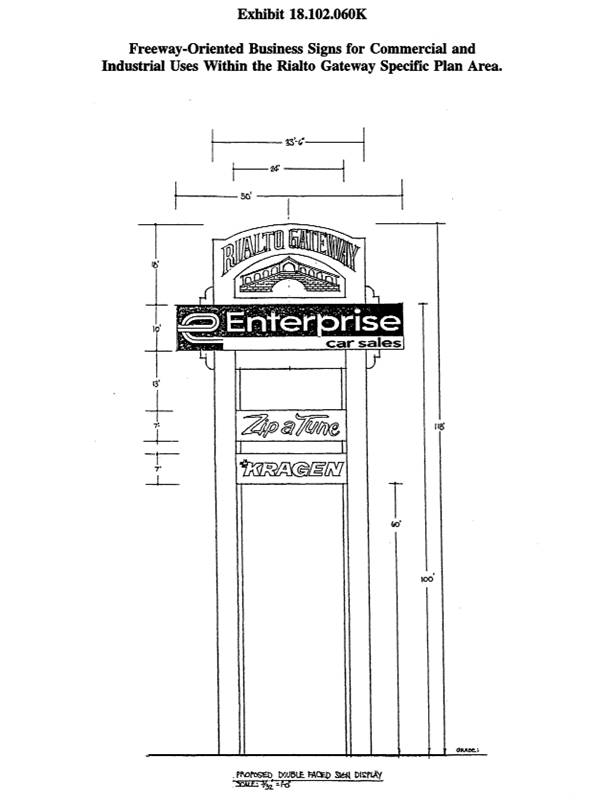
Permitted Signs—Freeway-Oriented Business Signs for Commercial and Industrial Uses Within the Rialto Gateway Specific Plan Area. Notwithstanding the provisions of Section 18.102.060(J), multi-tenant freeway-oriented business signs may be allowed along the north side of the Interstate 10 freeway within the Rialto Gateway Specific Plan area to be visible by the motoring public traveling in both directions along the freeway. The height and mass of the existing freeway trees in this area adversely impact and limit the advertising alternatives for freeway-oriented businesses within the Rialto Gateway. It is the expressed intent of the city council to promote business opportunities by allowing multi-tenant freeway-oriented signs to identify the Rialto Gateway area with signage having sufficient height and size to be visible above the trees, subject to the following conditions:
1.
The sign structure shall be designed to distinctly identify the Rialto Gateway area and provide space for a maximum of five individual business signs. The maximum height of the upper-most business sign shall not exceed one hundred feet above grade, and the overall height of the entire sign structure shall not exceed one hundred twenty feet above grade. The planning commission may reduce the overall height of the sign if it is determined that a reduced height will provide adequate visibility without being obscured by the freeway trees in the area.
2.
The total combined area of all business signs shall not exceed one thousand square feet and the maximum sign area of any single business sign shall not exceed five hundred square feet.
3.
The design and location of the sign structure shall be reviewed and approved by the planning commission prior to the issuance of a building permit for the sign.
(Ord. 1286 § 1, 1999; Ord. 1276 § 4, 1998; Ord. 1260, 1997; Ord. 1234 (part), 1995: Ord. 1203 § 1, 1993; Ord. 1157 § 1 (part), 1991; Ord. 1122 § 2, 1990; Ord. 917 (part), 1984)
(Ord. No. 1635, § 2, 3-10-20)
18.102.070 - Nonconforming signs.
A.
Intent of Provisions. It is the intent of this section to recognize that the eventual elimination of existing signs that are not in conformity with the provisions of this chapter is as important as is the prohibition of new signs that would violate these regulations.
B.
General Requirements. In accordance with the provisions of Chapter 2.5 (commencing with Section 5490) of the State Business and Professions Code, no nonconforming sign shall be compelled to be removed or abated, and its customary maintenance, use or repair shall not be limited without the payment of fair and just compensation to the owner of the sign as prescribed by state law, unless the sign meets any of the following criteria:
1.
The sign was erected without first complying with all ordinances and regulations in effect at the time of its construction and erection and use;
2.
The sign was lawfully erected but whose use has ceased, or the structure on the site has been abandoned by its owner or user, for a period of not less than ninety days. Costs incurred in removing an abandoned sign display may be charged to the legal owner;
3.
The sign has been more than fifty percent destroyed, and the destruction is other than facial copy replacement, and the display cannot be repaired within thirty days from the date of destruction;
4.
The owner of the sign, outside of a change of copy, requests permission to remodel the sign display; or to expand or enlarge the building or land use upon which the sign is located, and the sign display is affected by the construction, enlargement or remodeling; or the cost of construction, enlargement or the remodeling of the sign display, exceeds fifty percent of the cost of reconstruction of the building;
5.
The owner of the sign requests relocation of the sign display;
6.
The sign is a temporary advertising display;
7.
The sign has or may become a danger to the public or which is otherwise unsafe;
8.
The sign display constitutes a traffic hazard not created by relocation of streets and highways or acts by the city;
9.
The sign is an advertising display which has been unlawfully placed or erected within the public right-of-way;
10.
The sign display contains any flashing or rotating features, which may be required to be removed from the sign display without compensation to the owner.
C.
No new sign shall be approved for a site, structure, building or use that contains nonconforming signs unless such nonconforming signs are removed or modified to conform with the provisions of this chapter.
(Ord. 917 (part), 1984)
18.102.080 - Off-site advertising structure pursuant to relocation agreement.
The city recognizes that California Business and Professions Code Section 5412 encourages cities to enter into relocation agreements, and to adopt ordinances or resolutions providing for relocation of billboards. Thus, the intent of this section is to reduce visual clutter; eliminate non-conforming signage; facilitate the relocation and redistribution of existing outdoor advertising displays to more appropriate locations within the city to better serve the advertising needs of the local business community; to allow for incorporation of modern technology into relocated outdoor advertising displays in the form of digital outdoor advertising displays; and to eliminate the need for the city to pay compensation for removal of existing outdoor advertising displays to accommodate a public project.
A.
Content. Each relocation agreement shall contain, at a minimum, the following information:
1.
Identification of the location of the relocated off-site advertising structure(s) and, if removal of further off-site advertising structure sign area is required, off-site advertising structure(s) being permanently removed; and
2.
Conceptual design drawings for the off-site advertising structure(s), including, but not limited to, sign area and dimensions, materials, and colors.
B.
Review Process. All relocation agreements shall be reviewed and approved by the city council after review and consideration by the planning commission. The following findings must be made by the city council in order to approve a relocation agreement:
1.
The proposed agreement is consistent with the goals, objectives, and purposes of the City of Rialto.
2.
The proposed relocation site is compatible with the uses and structures on the site and in the surrounding area.
3.
The proposed relocation agreement contributes to the reduction of visual clutter in the city by one or more of the following methods:
a.
Decreasing the number of existing off-site advertising structures;
b.
Reducing the total advertising square footage within the city;
c.
Promoting activities of city-wide benefit and interest or generates significant revenue for the city; or
d.
In the case of relocations to accommodate a public project, the agreement serves the public interest by eliminating the need for public fund expenditure.
4.
The proposed off-site advertising structure would not create a traffic or safety problem with regard to onsite access circulation or visibility.
5.
The proposed off-site advertising structure would not interfere with onsite parking or landscaping required by city ordinance or permit.
6.
The proposed off-site advertising structure would not otherwise result in a threat to the general health, safety and welfare of city residents.
C.
Status of Existing Off-site Advertising Structure. Only off-site advertising structures that comply with the city's municipal code or that are legal non-conforming outdoor advertising displays as of the date of adoption of this section are eligible to be relocated pursuant to a relocation agreement.
D.
Placement of Relocated Off-site Advertising Structure. Relocated off-site advertising structures may be located in zoning districts as determined on a case by case basis through the permitting process.
E.
Permits Required. Subsequent to the approval of a relocation agreement by the city council, the off-site advertising structure and/or property owner shall file an application for a sign permit to relocate or reconstruct the off-site advertising sign structures as authorized by the relocation agreement, pursuant to the provisions of Section 18.102.040.
F.
Non-Conforming Off-site Advertising Structure. Any non-conforming outdoor advertising display relocated or reconstructed pursuant to an approved relocation agreement shall no longer be considered non-conforming for purposes of this code.
(Ord. No. 1635, § 3, 3-10-20)

