
Richfield City Zoning Code
SECTION 544
GENERAL BUILDING AND PERFORMANCE STANDARDS
(Added, Bill No. 2007-19)
544.01.- Purpose and application.
Subdivision 1.Purpose. These performance standards establish specific requirements and quantifiable limitations, intended to ensure high standards of development, promote compatibility among various uses of land, and to protect the health, safety and welfare of the community.
Subd. 2.Application. The performance standards outlined in this Section 544 shall apply to all new developments, including full redevelopment. These standards shall also apply when a development application involves existing developments with nonconforming site improvements that are required to comply based on Subsection 509.25, or changes that lead to an increased intensity of use. Single- and two-family developments are exempted from Section 544, unless otherwise noted.
544.03. - Landscaping and screening requirements.
Subdivision 1.[Generally.] A landscaping and screening plan shall be submitted as part of any Site Plan application (Section 547.13).
Subd. 2.Purpose. The City of Richfield finds that proper landscaping on newly built or redeveloped sites adds to the health, safety, aesthetic, ecological and economic values of the community. The provisions of this section are intended to:
a)
Add visual interest to open spaces and blank facades;
b)
Soften dominant building mass;
c)
Provide definition for public walkways and open space areas;
d)
Enhance the streetscape by separating the pedestrian from motor vehicles and by reducing the visual impact of large expanses of pavement;
e)
Ensure significant tree canopy shading to reduce glare and heat build-up;
f)
Improve the visual quality and continuity within and between developments;
g)
Provide screening and mitigation of potential conflicts between active areas and more passive areas;
h)
Protect and improve property values;
i)
Improve air quality and provide a buffer from air and noise pollution;
j)
Ensure aesthetic treatment of ponding areas;
k)
Enhance the overall aesthetic conditions within the City;
l)
Limit sight line obstructions;
m)
Reduce the potential for criminal and illegal activities; and
n)
Prevent conflicts with utilities.
Subd. 3.Plan submittal requirements. Landscape plans shall be prepared by a landscape architect or other qualified person (as determined by the Director), drawn to an appropriate scale and show:
a)
Current and accurate certificate of survey;
b)
Locations of existing and proposed buildings, parking lots, roads, walkways and other improvements;
c)
Proposed grading and drainage plan with no greater than two (2)-foot contour intervals;
d)
Location and approximate size of existing trees greater than four (4) inches in diameter and shrubs;
e)
A planting schedule containing symbols, quantities, common and botanical names, size of plant materials, root condition and special planting instructions;
f)
Planting details illustrating proposed locations of all new plant material;
g)
Locations and details of other landscape features, including berms, fences, and retaining walls;
h)
A cross-section drawing at a measurable scale illustrating the effectiveness of proposed screening both at the time of planting and the anticipated screening with five (5) years of growth (if requested by the Director);
i)
Details of restoration of disturbed areas, including areas to be sodded or seeded;
j)
Irrigation systems including system limits; and
k)
A security deposit shall be provided in accordance with Subsection 547.17 of this Code.
Subd. 4.General landscaping requirements. The City intends that each new landscaping and screening plan be designed to a high level of quality because of the needs imposed by the relatively high development densities and land values in Richfield. Designers shall strive to meet the standards outlined in Subdivisions 4 through 7, below. However, the Director shall review and decide the adequacy of each landscaping and screening design based on whether or not it meets the intent of this ordinance. The Director shall advise the Planning Commission as part of Site Plan Review.
a)
Area to be landscaped: All open areas of a lot which are not used or improved for required parking areas, drives or storage shall be landscaped with a combination of overstory trees, understory trees, shrubs, flowers and ground cover materials.
b)
Materials: The plan for landscaping shall include ground cover, shrubs, trees, public art, walls, fences, decorative walks or other features or materials acceptable to the Director.
c)
Tree types and species: For sites requiring ten (10) trees or more as determined by Subd.5 for residential sites and Subd.6 for commercial sites, not more than 25 percent of the required trees shall be composed of one (1) species. No required tree or shrub shall be any of the following:
i.
A species of the genus Ulmus (elm), except those elms bred to be immune to Dutch elm disease;
ii.
Those trees and shrubs listed by the DNR as invasive; or
iii.
Female ginko.
d)
Minimum sizes of ornamental trees and shrubs: Ornamental trees shall generally have a minimum caliper of 1-½ inches. (Caliper and height requirements apply only to trees needed to satisfy the City's quantity requirements. Once these are satisfied, any size can be used.) Shrubs shall be five (5) gallons in size.
e)
Tree sizes: For sites requiring nine (9) trees or fewer, overstory trees shall have a minimum caliper of 2.5 inches, and coniferous trees shall be a minimum of six (6) feet in height. For sites requiring ten (10) trees or more as determined by the following subdivisions, distributions shall be as described below:
Note—
*Single-story building with a front facade greater than 16 feet shall use the two-story
requirements. Parking structures with any portion of a floor at or above finish grade
will be considered a story.
**To determine the minimum heights of coniferous trees multiply the overstory tree
caliper inch requirement by 2.4
Tree quantities may be increased in exchange for smaller sizes with the approval of the Director. Generally, new overstory trees shall be balled and burlapped or moved from the growing site by tree spade. The Director may approve some to be bare root if the species is acceptable and the quantity is increased.
f)
Ground cover: All lot areas not covered by buildings, sidewalks, parking lots, driveways, patios, or similar hard-surface materials shall be covered with sod or an equivalent ground cover approved by the City. (Gravel and/or landscape rock by itself does not constitute groundcover.)
g)
Sight lines: Plantings after five (5) years' growth must not interfere with auto traffic sight lines at intersections nor interfere with pedestrian movement.
h)
Irrigation: All landscaped areas within new developments or developments with additions of 100 percent of gross floor area or more shall be irrigated by an underground mechanical irrigation system. All other sites are highly encouraged to install irrigation systems.
i)
Existing trees and shrubs: In instances where healthy plant materials of species acceptable to the Director exist on a lot prior to its development, the application of the standards in this subdivision may be adjusted by the City to allow credit for such material, provided that such adjustment is consistent with the intent of this Code. A reasonable attempt shall be made to preserve as many existing trees as is practicable and to incorporate them into the site plan. No clearing shall be allowed on a site until tree retention and landscaping plans have been approved. The following practices shall be followed in order to protect existing trees:
i.
Protective fencing consisting of steel posts and conspicuously colored fence at least 48 inches in height shall be placed in a location surrounding the protected trees so that they will not be damaged or jeopardized by construction. The protective fencing shall be placed prior to the issuance of any development permits and shall remain in place and in good condition until any construction work that may jeopardize the health of the protected trees has been completed. The protective fencing shall be installed at the edge of the tree canopy or dripline or at a location defined by the Director;
ii.
Areas within the protective fencing shall be off-limits to workers, visitors, operating equipment, parked equipment, parked vehicles, storage of materials and pedestrian traffic;
iii.
Storage of fuels, chemicals, solutions and washing equipment shall be no closer than 75 feet from fenced areas;
iv.
When any construction traffic must pass nearer to a protected tree than its dripline, a 12-foot wide by 12-inch deep layer of shredded hardwood mulch shall be placed over the impacted area. The 12-foot width by 12-inch depth shall be maintained for the entire period of construction that affects the protected tree. The mulch shall be rem-ved entirely at the end of construction;
v.
Runoff from the construction site must be diverted to prevent entrance or puddling in areas within the protective fencing;
vi.
Trees removed in the construction area shall be felled away from areas of protected trees to avoid disturbance or damage;
vii.
Stumps must be ground to a depth of one (1) foot below ground level. Woodchips must be removed and the hole filled with appropriate topsoil for the area;
viii.
Pruning of protected trees will be allowed only for removal of damaged, disfigured or crossing branches; climbing spikes shall not be used to perform pruning;
ix.
All brush must be removed;
x.
Diseased wood cut from any site shall be disposed of at the tree disposal site serving the City;
xi.
If roots of trees to be protected are disturbed or damaged by construction, they shall be immediately and cleanly cut back to sound healthy tissue and covered with topsoil to a depth of six (6) inches;
xii.
Any roots of protected trees that are uncovered by construction operations shall be immediately covered with topsoil to a depth of six (6) inches;
xiii.
Protected trees, and especially any tree damaged or disturbed by construction operations, shall be watered during the growing season in order to maintain adequate but not excessive soil moisture;
xiv.
All work shall be performed with the proper equipment by qualified personnel;
xv.
Where fill must be placed around protected trees, a section of protective fencing shall be placed around the trunk of the tree, including root flares. Heavy equipment shall not be used to remove soil nearer than ten (10) feet from a protected tree. Removal of soil nearer than ten (10) feet from a protected tree shall be performed by hand;
xvi.
Oaks are very susceptible to root damage by soil compaction. Avoid placing fill around oak trees. This will avoid compaction by the fill itself and by equipment used to remove it from around the tree;
xvii.
For sites with significant existing trees to be protected, or where limited space exists around trees to be protected, the Director may require that a qualified arborist or forester be "on-call" during the project. In this case, the name and telephone number of the qualified arborist or forester shall be placed prominently on the approved construction documents;
xviii.
Because some construction impacts cannot be avoided, and because damage to a tree's root system is not immediately evident, the Director may require submittal of a plan for post-construction care for sites with protected trees; and
xix.
Quality trees, as determined by the City Forester, of 4-8 inch caliper should be transplanted on site or to another site when possible.
j)
Slopes: Final slopes greater than 3:1 are assumed to be unmowable and must have special treatment such as special seed mixtures or reforestation, terracing or retaining walls. Berming used to provide required screening of parking lots and other open areas shall not have slopes in excess of 3:1.
k)
All landscaping must be installed within one (1) growing season of building completion or occupancy, whichever is first. A final certificate of occupancy shall not be issued until all landscaping is complete. If, due to weather conditions, it is not feasible to install required landscape improvements, a temporary certificate of occupancy may be issued.
(Amended, Bill No. 2023-1)
Subd. 5.Residential sites. Residential sites shall be landscaped to improve the livability, beauty and value of housing; to screen and mitigate views of large parking areas; to reduce the effect of traffic noise; to provide shade; and to help protect water quality.
a)
Quantities. These requirements are in addition to any plantings in the public street right-of-way whether installed by the land developer or the City.
b)
Commercial edges. The density and initial size of plantings shall be increased along nonresidential edges and may be combined with berms, walls and fences to achieve the objective of protecting the values, quietude and privacy of the housing. Landscaping on the adjacent nonresidential property may not be substituted for plantings on the residential property.
(Amended, Bill No. 2023-1; Bill No. 2025-12)
Subd. 6.Commercial and mixed-use sites. Commercial, multiple-use and vertically mixed-use developments shall use plant materials, berms, slopes, retaining walls, fences, low masonry walls and public art to enhance the appearance of buildings and parking areas; to provide visual relief from long blank walls; to improve the environment for pedestrians; to improve compatibility with adjacent housing; and to help protect surface water quality.
a)
Locations. Such treatments shall occur on the perimeter of the site, within parking areas and along building edges. In particular, special attention should be paid to providing visual and auditory separation between commercial and residential land uses and in hiding features such as truck docks and rooftop mechanical equipment.
b)
Quantities. Landscaping plans shall include a mixture of overstory, ornamental, ground cover and berming. At a minimum, plantings shall be provided on commercial and mixed use sites at this rate (which includes the plantings for parking lots):
i.
One (1) tree per 2,500 square feet of Developable Landscaping Area; and
ii.
One (1) shrub per 1,000 square feet of Developable Landscaping Area
Developable Landscaping Area is defined as the total area of a development site or phase minus the portion of that area within a natural water body or a protected wetland.
c)
Residential buffer yard. The density and initial size of plantings shall be increased along residential edges and may be combined with berms, walls and fences to achieve the objective of protecting the values, quietude and privacy of the housing.
When not regulated by other regulations of this Code, a buffer yard of not less than 25 feet in width and 50 percent all-season opacity from the ground to a height of six (6) feet shall be provided to separate all aspects of nonresidential uses from abutting residential parcels. The Council may reduce this requirement to not less than 15 feet if significant additional landscaping and/or fencing, with 75 percent all-season opacity, is provided to screen the use.
At the discretion of the Director, an elevation drawing may be required for any residential buffer yard showing the visual effect after five (5) years of growth as viewed from the residential property.
d)
Buffer yard adjacent to nonresidential land use. At a minimum, a mixture of overstory and coniferous trees and shrubs shall be planted along the street edge of all parking lots at the rate of one (1) overstory tree (or one (1) coniferous tree) for every 50 feet of street frontage (on average, may be grouped) plus 20 percent of the ground covered by shrubs and/or perennials.
Subd. 7.Parking lots. Landscaping for parking areas shall screen and mitigate the view of the parked cars and hard surface from adjacent surface streets and from adjacent residential or commercial properties during all seasons of the year; shall enhance the view of the building, whether commercial or residential; shall break very large parking areas into identifiable bays; may be used to visually guide motorists through the lot and to or from the entrances; shall provide some shade for pedestrians and autos; and shall provide an area for pedestrian movement between public streets and the primary building.
a)
Perimeter plantings. At a minimum, a mixture of overstory and coniferous trees and shrubs shall be planted along the street edge of all parking lots at the rate of one (1) overstory tree (or one (1) coniferous tree) for every 40 feet of street frontage (on average, may be grouped); in addition, 25 percent of the ground should be covered by shrubs and/or perennials. The view to the parking lot from grade level should be screened to a height of three (3) to four (4) feet with a combination of shrubs and/or earthen berms.
These plantings should normally be located on private property three (3) feet behind the property line but may be located in the public right-of-way with the approval of the Public Works Director. In some areas, additional elements such as a hedge and/or a fence may also be required at the discretion of the Director.
b)
Interior plantings. Parking lots for more than 25 vehicles must have at least five (5) percent of their area devoted to landscaped islands planted with overstory deciduous trees. The City prefers fewer but larger interior planting areas in parking lots for the sake of lower maintenance, better tree health and greater visual effect. The minimum size of a landscaped island is 180 square feet with a minimum curb-face-to-curb-face dimension of ten (10) feet. Each planting island should have two (2) overstory trees or two (2) ornamental trees if branches do not interfere with sight lines or pedestrian movement. Compacted soil in planting islands should be removed to a depth of 3.5 feet to provide adequate drainage.
Subd. 8.Streetscape plans and alternative plantings. (Amended, Bill No. 2023-1)
a)
Streetscape plans. In areas where a district or street-specific planting plan has been adopted by the City Council for the public street right-of-way, development must provide landscaping as set forth in that streetscape plan. Streetscape plantings located within the property lines of the site may be credited toward the required number of trees and shrubs but plantings in the public right-of-way shall not. Landscaping placed or removed in the public right-of-way must receive City approvals for right-of-way plantings and must conform to City right-of-way planting policies.
b)
Alternative plantings. If the development property does not contain sufficient area or it is otherwise not practical to plant the required trees on the development property as determined by the Community Development Director (or designee), then the trees may be planted on public property (e.g.: parks, boulevards, right-of-way). Plantings must be approved by either the Recreation Services Director (or designee) or the Public Works Director (or designee). Alternatively, an equivalent amount may be paid into the City's Public Tree Planting Fund for planting of trees on public property on behalf of the development. The rate shall be per caliper inch and shall be set by Appendix D of the City Code.
Subd. 9.Landscape and screening maintenance. The property owner shall be responsible for maintenance of all landscaping, screening and fences in a safe and sightly condition and for replacement of any dead trees, shrubs, ground cover and sod required by this section.
544.05. - Screening of refuse collection and utilitarian items.
Refuse collection, recycling and utilitarian elements shall be designed into the interior space of buildings, except for residential structures up to eight (8) units. Buildings of nine (9) to 12 units are also exempt from the internal storage requirement, but exterior storage must be screened by an enclosure. (Amended Bill No. 2025-12)
All delivery and loading operations, HVAC equipment, and other utility and service function shall be grouped and arranged away from the public right-of-way and fully screened from ground level observation at any point on the property, adjacent property, or from adjacent right-of-way. Plans for screening enclosures must be shown on construction plans.
a)
Materials. Required screening may be achieved with fences, walls, earth berms, hedges, two (2) staggered rows of coniferous trees, a dense deciduous hedge, or other landscape materials. Earth berms shall not exceed a slope of 3:1 unless specially treated and approved. All walls and fences shall be architecturally harmonious with the principal building. The use of wood, in whole or in part, as a screening material for roof-top equipment shall not be considered as being architecturally compatible unless the building is constructed with a wood exterior. In cases where roof-top equipment may be visible from above, the Director will determine if the equipment must be painted to match the roof.
b)
Locations. All required screening or buffering shall be located on the lot occupied by the use, building, facility, or structure to be screened. No screening shall be located on any public right-of-way or within eight (8) feet of the traveled portion of any street or highway.
c)
Site improvements or redevelopment consisting of less than a 100 percent increase in gross floor area where the above requirements are impossible to meet based on site constraints as judged by the Director shall conform to the following requirements:
i.
All residential structures with more than eight (8) units and all commercial, industrial, and institutional uses shall provide a screening enclosure for required dumpsters. Such enclosures shall be high enough to completely screen the dumpster from all property lines; (Amended, Bill No. 2014-4 andBill No. 2025-12)
ii.
Dumpster enclosures shall be constructed of durable, weather resistant materials which are properly anchored. Enclosure materials shall be similar to the principal building;
iii.
Dumpster enclosures shall provide sufficient space for required dumpsters and additional space for storage of recyclable materials. In no case shall they exceed 600 square feet in area;
iv.
Dumpster enclosures shall be located behind the front building line of the principal building (as extended to the side lot lines). Enclosures shall be set back not less than five (5) feet from any lot line or any other building on the premises, unless integrated into such building or approved by the Building Official; and
v.
All dumpster enclosures shall have a concrete floor.
(Amended, Bill No. 2014-4)
544.07. - Architectural standards.
Subdivision 1.[Generally.] Architectural plans shall be prepared by an architect or other qualified person and shall show the following:
a)
Elevations of all sides of the building;
b)
Type and color of exterior building materials;
c)
Typical floor plans;
d)
Dimensions of all structures;
e)
The location of trash containers and of exterior electrical, heating, ventilation, and air conditioning equipment;
f)
Utility plans including water, sanitary sewer, and storm sewer; and
g)
Additional plans deemed necessary by the Director.
Subd. 2.Building orientation. Buildings shall be oriented so that at least one (1) principal entrance faces the public street. On corner lots where the intersecting streets have different classifications, the principal entrance shall face the street with the higher classification. Building entrances shall:
a)
Be architecturally emphasized and highly visible from the street; and
b)
Utilize design features that protect pedestrians from the rain and sun, such as awnings, canopies, or porticos;
See also Section 509.07, Subd. 5 (Amended Bill No. 2025-12)
Subd. 3.Exterior Materials. The exterior wall surfaces of all non-residential structures shall be constructed of wood, brick, stone, cementitious planks (e.g., Hardiplank®), glass, architectural concrete textured surfaces or other materials of high quality as approved by the Director.
The exterior wall surface for all residential structures shall be constructed of wood, brick, stone, cementitious planks (e.g., Hardiplank®), glass or other materials of high quality as approved by the Director. Finished metals shall be used only above the ground floor and shall not exceed 40 percent of any exterior wall surface and may not have a metallic finish.
For both residential and non-residential structures, unadorned pre-stressed concrete panels, standard concrete block and unfinished metal, except naturally weathering metals such as copper, shall not be permitted as exterior materials for buildings. This restriction shall apply to all principal structures and to all accessory buildings, including parking ramps, except those accessory buildings not visible from any exterior lot line. (Amended Bill No. 2025-12)
Subd. 4.Architectural Design/Compatibility. The exterior architectural appearance of the proposed structure shall not be so at variance with the exterior architectural appearance of existing structures within the immediate area, or with the intended character of the applicable zoning districts, taking into consideration building materials, size, shape and heights, so as to cause an adverse impact upon property values in the immediate area, or the City as a whole, or adversely affect the public health, safety and general welfare of the portion of the City in which the property is located, or the City as a whole.
Subd. 5.Window Treatment.
a)
For both residential and non-residential structures, windows or false windows shall, at a minimum, be used on the ground level of any wall parallel to or nearly parallel to a street. The use of bars, chains or similar security devices that are visible from a public street or sidewalk shall be prohibited. (Amended Bill No. 2025-12)
b)
Window requirements for residential structures shall include:
i.
Each building wall that faces a public street, public sidewalk or public pathway, must be comprised of no less than 30 percent windows on the first floor and no less than 20 percent windows on each floor above the first floor.
ii.
Each building wall that faces any other direction must be comprised of no less than 15 percent windows on each floor.
iii.
False windows are prohibited.
Residential window requirements are not intended to require custom window sizes or to increase building setbacks to comply with building code. They are intended to apply in cases when the first floor is used for interior parking. (Amended Bill No. 2025-12)
Subd. 6.Equal Façade Treatment. All buildings shall be constructed so that each exterior wall and roof surface is finished with materials of consistent quality as those of the front wall and front roof. This requirement, however, shall not be applicable to walls or roof surfaces which are completely screened from view by other buildings.
Subd. 7.Façade Treatment of Accessory Structures. All structures, including parking ramps shall be designed to be architecturally integrated into the overall site and be made of comparable materials and decorative elements.
Subd. 8.Façade Maintenance. All façade treatments shall be maintained so as to not be unsightly in appearance or in a state of disrepair, nor shall harmful health or safety conditions be present for the life of the project.
Subd. 9.Color. No residential structure may display more than ten (10) percent of any elevation surface in bright, high intensity or pure tone primary or secondary colors. No fluorescent or neon colors shall be used on any exterior elevation surface. City-approved murals are exempt from this limitation. (Added Bill No. 2025-12)
Subd. 10.Blank Walls. Residential building elevations shall consistently incorporate elements that relate to the human scale. No wall shall be uninterrupted for more than 25 feet in length as calculated per floor. Interruptions may include doors and windows, projections, recessions, awnings and canopies, decorative ornamentation or other architectural elements. This requirement may also be addressed through art installation or living walls, subject to approval by the Director. (Added Bill No. 2025-12)
Subd. 11.Building Mass. No residential building wall shall exceed 200 feet in length. Every residential building wall length that exceeds the height of the building shall incorporate full height offsets spaced at intervals equal to or less than the building height. The offset shall be a minimum of one (1) foot in depth and width per story of building height. An offset can be a projection or recess. Building walls under 36 feet in length are exempt from this standard. (Added Bill No. 2025-12)
544.09. - Exterior lighting.
Subdivision 1. Except decorative fixtures per Subd. 4, 8 and 11, all lighting shall be downcast. All lighting shall be designed and arranged to restrict direct illumination and glare onto abutting parcels.
Subd. 2. Mitigative measures shall be employed to limit glare and spill light to protect neighboring parcels and to maintain traffic and pedestrian safety on public streets and sidewalks. Illumination cast from lighting of the subject parcel shall not exceed one (1) footcandle as measured from the centerline of a public street or residential property line. These measures shall include lenses, shields, louvers, prismatic control devices and limitations on the height and type of fixtures. (Amended, Bill 2009-1)
Subd. 3. Flickering or flashing lights shall not be permitted.
Subd. 4. Direct off-site views of the light source shall not be permitted except for globe and/or ornamental light fixtures. Globe and ornamental fixtures shall only be used if the developer can demonstrate that off-site impacts stemming from direct views of the bulb are mitigated by the fixture design and/or location.
Subd. 5. Lights under the canopy of a gasoline dispensing station or similar structure shall not be directly visible from a public street or another property. Such lights shall either be recessed into the underside of the canopy or screened from view with shields.
Subd. 6. Poles within landscaped areas and plazas shall have a maximum height of 20 feet, measured from grade. Poles within these areas may be set on pedestals no more than eight (8) inches in height.
Subd. 7. Poles in non-residential parking lots shall have a maximum height of 24 feet measured from finished grade. Poles in residential parking lots shall have a maximum height of 12 feet measured from finished grade. (Amended Bill No. 2025-12)
Subd. 8. Lighting fixtures mounted directly on structures shall be permitted when utilized to enhance specific architectural elements or to help establish scale or provide visual interest, except as otherwise noted in Subdivisions 9 and 10. (Amended, Bill 2009-1)
Subd. 9. "Wall paks" shall be permitted only in loading and service areas and shall be down-lit. (Amended, Bill 2009-1)
Subd. 10. Shielded illuminators or fixtures shall be permitted to light building mounted signage, building facades, or pedestrian arcades if they are integrated into a building's architectural design.
Subd. 11. Lighting should highlight entrances, art, terraces and special landscape features.
Subd. 12. If installed, exterior lighting shall meet the functional needs of the use, without adversely affecting adjacent properties, neighborhoods or public uses, as determined by the City. Specific requirements are listed below; however, the City reserves the right to adjust these requirements based on concerns regarding safety, security and/or impacts on surrounding properties. Illumination measurements shall be taken by positioning the meter horizontally at ground level. (Amended, Bill 2009-1)
Open-air parking lots (including the roof level of multi-level parking structures):
Minimum: 0.2 fc
Maximum: 4.0 fc
Minimum uniformity ratio: 20:1
Primary building entrances/exits:
Multifamily residential
Minimum: 5.0 fc within five (5) feet of the entrance/exit
Maximum: Eight (8) foot-candles within five (5) feet of the entrance/exit. (Amended Bill No. 2025-12)
Commercial/Industrial:
Minimum: 10.0 fc within five (5) feet of the entrance/exit
Subd. 13. Site lighting should provide consistent levels of illumination, avoiding pockets of very high or low levels of illumination.
Subd. 14. All residential fixtures:
a.
Must be dark sky complaint, except decorative fixtures per Subd. 4, 8 and 11, above; and
b.
Must not exceed 3,000 Kelvin. (Added Bill No. 2025-12)
544.11. - Traffic and parking studies.
Subdivision 1. In review of a project or application, the City may require, at the developer's expense, submission of a traffic and/or parking analysis that is prepared by a traffic engineer. Such analysis shall assess the potential impact of a proposed project on roadways, intersections, and/or on-site parking and circulation.
Subd. 2. If a traffic study indicates that a proposed project or use will have significant impact on the existing service levels of roadways and intersections, the City may require a "traffic management plan" to mitigate traffic impacts. Such plan may include travel demand management strategies, use of transit facilities, or other appropriate measures to reduce traffic congestion. Such plan may also necessitate improvements to road systems. The developer shall be responsible for installation and expense of necessary road system improvements and pedestrian facilities, and any such improvements shall be constructed and installed according to City specifications.
544.13. - Vehicle parking and loading requirements.
Subdivision 1.[Off-street parking and loading areas.] Off-street parking and loading areas shall be permitted only upon approval of a site plan.
Subd 2.Review factors. The Planning Commission and City Council shall consider the following factors when reviewing site plan applications for parking and loading requirements:
a)
The adequacy of available parking relative to anticipated demand;
b)
The adequacy of pedestrian, bicycle and mass transit generation;
c)
The adequacy of traffic control devices and other general safety factors;
d)
The adequacy of loading and unloading areas;
e)
The adequacy of stormwater management, lighting and landscape screening;
f)
The impact on nearby streets and intersections;
g)
The impact on adjacent properties; and
h)
Compliance with the lot and stall design requirements of this Section.
Subd. 3.Parking lot design. Parking lots should be designed and constructed in conformance with the following standards and the accompanying Figure 18. Exceptions to these standards must be approved by the City Engineer.
*An additional 18 inches shall be required when a stall abuts a landscape area.
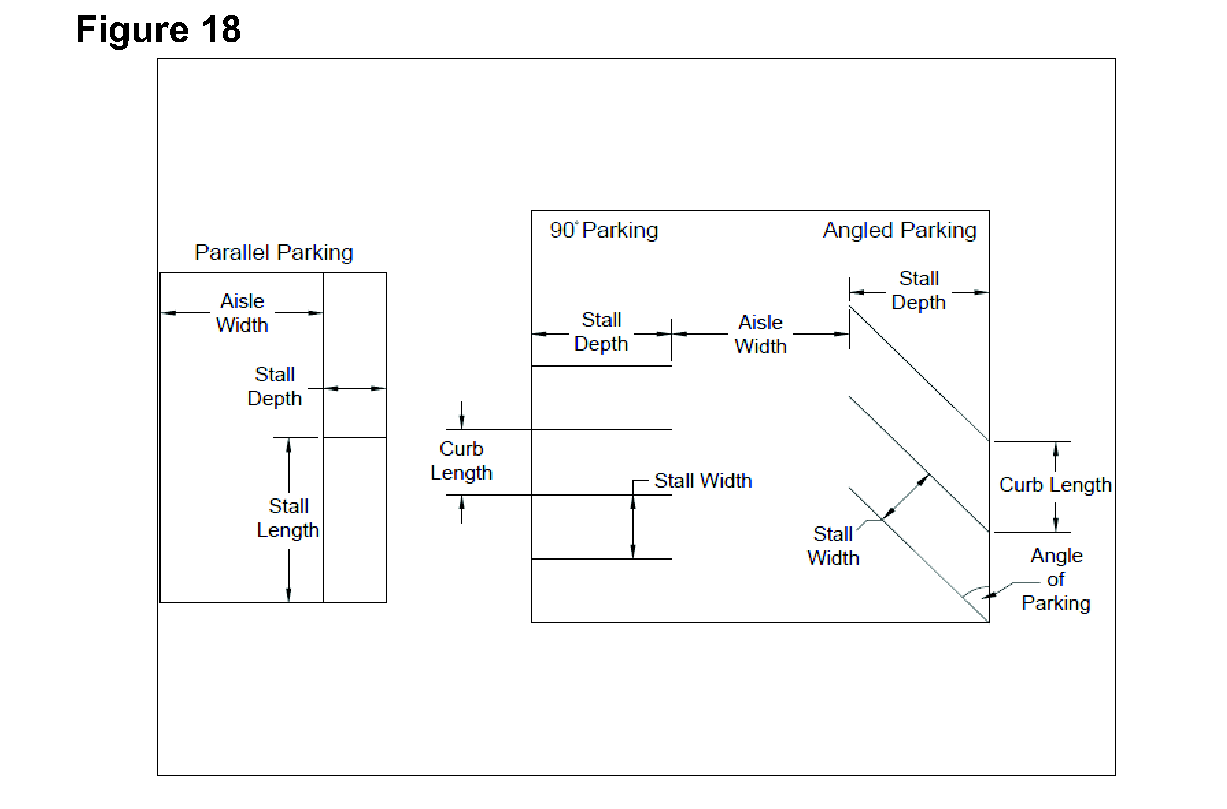
(Bill No. 2013-3)
Subd. 4.
Compact Stalls. Up to 20 percent of the total number of required spaces may be designated for compact cars in conformance with the following standards:
a)
The parking area must have a total size of at least 20 stalls;
b)
Compact stalls must be identified by appropriate signage; and
c)
Compact parking stalls are not permitted for high turnover uses (e.g. fast food).
Subd. 5.Parking Lot Setbacks. Unless otherwise noted elsewhere, parking lots shall be set back in accordance with the following: (Amended, Bill No. 2011-19)
a)
Parking lots must be set back eight (8) feet from the right-of-way.
b)
Parking lots must be set back five (5) feet from adjacent commercial, multifamily residential and mixed use property. (Amended, Bill No. 2011-13; 2011-19; 2025-12)
c)
Parking lots must be set back 15 feet from adjacent single-family and two-family residential property with appropriate screening as required by Subsection 544.03 Subd. 5 for residential sites or Subd. 6 for commercial. (Amended, Bill No. 2011-19)
Subd. 6.Number of Off-Street Spaces Required. Off-street parking spaces shall be provided according to the following minimum standards. Parking for land uses not listed below shall be regulated according to the most similar use and/or authoritative sources as determined by the City Planner.
1. Adjacent on-street parking may be counted toward the parking requirements for triplex and fourplex residential uses if the following conditions are met:
a)
The roadway width, measured from back of curb to back of curb, is at least 36 feet;
b)
The site includes sufficient driveway space to accommodate the full parking requirement on-site during snow events (e.g., tandem parking in driveways); and,
c)
The applicant agrees to notify future residents, through lease or sale agreements, of snow emergency requirements mandating off-street vehicle relocation prior to occupancy. (Amended Bill No. 2025-12).
*If calculation results in a fraction, traditional rounding applies. For Mixed Use zones, see Section 537.09.
(Amended, Bill No. 2011-8; Bill No. 2011-13; Bill No. 2013-22; Bill No. 2015-15; Bill No. 2024-08; Bill No. 2025-12)
Subd. 7.Electric Vehicle Charger Requirements.
a)
Purpose. Ensuring that electric vehicle (EV) charging serves both short and long-term parking needs throughout the city, while limiting adverse impacts of electric vehicle chargers, to reduce emissions and improve environmental health outcomes in our community.
b)
Level descriptions:
i.
Level-1 (or "L1") is considered slow charging and includes a range from zero (0) volts to 120 volts.
ii.
Level-2 (or "L2") is considered medium charging and includes a range from 120 volts to 240 volts.
iii.
Level-3 (or "L3") is considered fast or rapid charging and includes a range of greater than 240 volts.
c)
EV-ready spaces and EV parking space standards:
i.
EV-ready spaces shall require appropriate electrical capacity and conduits to support future EV chargers, but shall not require an installed charger unit. Adequate electrical service is required to allow for future simultaneous charging of all future installed chargers.
ii.
EV charger installation in excess of any minimum requirements may be substituted for up to five (5) percent of minimum off-street parking requirements. One (1) L2 or L3 charger is equivalent to one (1) parking space. This reduction may not be applied in addition to the parking reduction for excess bicycle parking spaces, as described in subsection 544.17 of the Richfield Zoning Code.
iii.
EV charger locations and standards:
1)
EV chargers must be located in a parking island, mounted to an adjacent pedestal or similar structure, or protected by bollards, structures, or curb if located in a parking lot.
2)
EV chargers shall be set back at least three (3) feet from any lot line abutting another parcel. However, upon written request from the property owner, the Director may reduce or rescind this setback requirement for shared access agreements or pursuant to a finding of necessity and public convenience.
3)
EV chargers located along an alley, or located adjacent to a right-of-way which contains a public sidewalk, shall be set back at least three (3) feet from the nearest edge of such alley or sidewalk. When adjacent to the right-of-way, the location must be approved by the Director of Public Works. EV chargers may be located in the right-of-way, with permission from the Director of Public Works. EV chargers mounted on pedestals, light posts, bollards, or other devices for on-street charging stations shall be designed and located as to not impede pedestrian travel or create hazards within the right-of-way.
4)
EV chargers shall be set back at least 24 inches from the face of any adjacent curb.
5)
EV chargers shall be mounted in a manner that allows for any cords to be retractable or hung sufficiently above any pedestrian surface.
6)
EV chargers must be installed per manufacturer specification and must comply with all applicable building codes and relevant Americans with Disabilities Act (ADA) requirements.
7)
When an EV charging station is not operational for 30 consecutive days, it shall be considered to have been removed from service.
8)
EV chargers must be operational during the normal business hours of the use(s) served. EV chargers may be de-energized or otherwise restricted after normal business hours of the use(s) served.
d)
Minimum number of electric vehicle chargers required by land use are as follows:
*If calculation results in a fraction, traditional rounding applies, unless the result is zero (0), then at least one (1) is required.
e)
These numbers may be reduced by the Director if proof can be provided that such spaces will not be used.
(Added, Bill No. 2022-3; Amended, Bill No. 2022-14; Amended Bill No. 2025-12)
Subd. 8.Parking Maximums. The maximum number of parking spaces for any building or use shall not exceed the amount determined as follows: (Amended, Bill No. 2022-3)
a)
Except for Multifamily Residential, parking lots of more than 20 and less than 51 spaces. Parking lots may not have more than 120 percent of the number of spaces identified in the above table, not including accessible spaces.
b)
Except for Multifamily Residential, parking lots of 51 spaces or more. No more than 110 percent of the number of spaces required as identified in the above table, not including accessible spaces, are permitted.
c)
Multifamily Residential parking lots. No more than 1.5 stalls per unit. (Added, Bill No. 2024-08)
d)
Additional parking may be provided if it does not increase impervious surface beyond that which would be provided by meeting the maximum parking required. Examples of additional parking include, but are not limited to, under structure parking, roof top parking, or structured parking above a surface parking lot.
e)
An applicant may request a modification of the maximum allowed number of parking spaces by submitting a study of anticipated parking demand. Parking studies shall be prepared by a professional engineer with expertise in traffic and parking analysis, unless the Director authorizes an equally qualified individual.
Subd. 9.Modification of number of required parking spaces. (Amended, Bill No. 2022-3)
a)
An applicant may request a modification of the minimum required number of parking spaces by submitting a study of anticipated parking demand. Parking studies shall be prepared by a professional engineer with expertise in traffic and parking analysis, unless an equally qualified individual is authorized by the Director.
b)
Bicycle parking in excess of the minimum requirement may be substituted for up to five (5) percent of minimum off-street parking requirements. Four (4) bicycle spaces is equivalent to one (1) parking space. (Added, Bill No. 2021-17)
c)
Parking may be reduced by ten (10) percent for development on any parcel which is located within one-fourth (¼) mile of a frequently operating transit line provided that separate pedestrian ways are provided which connect the parcel to a transit stop. A frequently operating transit line is defined as having: (Amended, Bill No. 2021-17)
i.
Weekday frequency of two (2) runs/hour between 7:00 a.m. and 6:30 p.m.;
ii.
Regularly scheduled service weekdays after 6:30 p.m.; and
iii.
Some Saturday, Sunday, and holiday service.
This reduction is in addition to reductions by PUD, and for shared parking.
d)
Parking for retail and service uses may be reduced if on-street parking is adjacent to the parcel and where all of the following conditions exist: (Amended, Bill No. 2021-17)
i.
The principal building is located within 20 feet of the front property line;
ii.
No parking exists between the front face of the principal building and the street;
iii.
A sidewalk exists along all sides of the lot that abut a public street;
iv.
A primary building entrance must face the street with parking; and
v.
If the Director finds that such parking will not be detrimental to the surrounding neighborhood. (Amended Bill No. 2024-08)
(Amended Bill No. 2024-08)
e)
Sites where at least 20 parking spaces are required, and where at least one (1) street lot line abuts a transit street may substitute transit-supportive plazas for required parking as follows. Existing parking areas may be converted to take advantage of these provisions. Adjustments to the regulations of the paragraph are prohibited: (Amended, Bill No. 2021-17)
i.
Transit-supportive plazas may be substituted for up to ten (10) percent of the required parking spaces on the site;
ii.
The plaza must be adjacent to and visible from the transit street. If there is a bus stop along the site's frontage, the plaza must be adjacent to the bus stop;
iii.
The plaza must be at least 300 square feet in area and be shaped so that a 10'x10' square will fit entirely in the plaza; and
iv.
The plaza must include all of the following elements:
1)
A plaza open to the public. The owner must record a public access easement that allows public access to the plaza;
2)
A bench or other sitting area with at least five (5) linear feet of seating;
3)
A shelter or other weather protection. The shelter must cover at least 20 square feet. If the plaza is adjacent to the bus stop, Metro Transit may need to approve the shelter; and
4)
At least ten (10) percent, but not more than 25 percent of the transit-supportive plaza must be landscaped. This landscaping is in addition to any other landscaping or screening required for parking areas by this Code.
Subd. 10.Reduction of Existing Parking. Parking and loading spaces existing upon the effective date of the ordinance from which this section is derived shall not be reduced in number unless their number exceeds the requirements imposed for a similar new use by this section. (Amended, Bill No. 2022-3)
However, if the existing parking meets more than 90 percent of the requirements of this section, the number of parking spaces may be reduced to 90 percent of the requirement for the purpose of establishing landscaping where such a reduction is necessary to construct a landscaping or buffer yard improvement required by this chapter.
Subd. 11.Calculating space for a compound use. Should a structure contain two (2) or more types of uses, the total off-street and minimum EV parking spaces required for each use shall be calculated separately unless requirements for joint parking arrangements can be applied as regulated by Subd. 12 of this Subsection. (Amended, Bill No. 2022-3)
Subd. 12.Joint parking facilities. Off-street parking facilities may be provided collectively in any district for more than one (1) structure or use, if the following conditions are met: (Amended, Bill No. 2022-3)
a)
The applicant demonstrates to the Director that, because of the hours, size, and mode of operation of the respective uses, there will be an adequate amount of parking available to each use during its primary hours of operation to meet the needs of such use.
b)
The joint use of the parking facilities shall be protected by covenants that run with the lots housing all the joint users and the lots on which the parking facility that satisfies the parking requirement of this section is provided. Those covenants shall contain all of the conditions of the joint agreement and shall grant an easement for parking to the joint principal use lots. The manner of execution and content of such covenants shall be in a form approved by the city attorney and the document containing the covenants shall be recorded with the county recorder or the registrar of titles for the county. Parties to the covenant shall reimburse the city for the costs of legal review. Such covenants shall be provided prior to issuance of building or site permits.
c)
Total required parking spaces for the joint use shall be based on the combined peak requirement and shall not be fewer than the minimum requirements for the use which requires the most parking.
Subd. 13.Control of off-site parking facilities. When required parking facilities are provided on a lot other than the lot on which the principal use is located, the following requirements shall be met: (Amended, Bill No. 2022-3)
a)
When feasible a paved pedestrian way with appropriate pedestrian landscaping and lighting leading from the off-site parking facilities to the use being served has been provided and is properly maintained;
b)
The off-site parking area and the lot on which the principal use is located must be in the same ownership, or the use of the parking facilities shall be protected by covenants that run with the land on both the lot on which the parking facility is provided and the lot on which the principal use is located. The manner of execution and content of such covenants shall be written in a form that is approved by the city attorney and the covenant must be recorded with the county recorder or the registrar of titles for the county. Parties to the covenant shall reimburse the City for the costs of legal review. Such covenants shall be provided prior to issuance of building or site permits;
c)
The closest point of the off-site parking area shall be located no more than 500 feet from an entrance to the principal building of the use being served as measured along an established path of travel between the parking lot and such entrance unless shuttle service is provided. If shuttle service is provided, the location of the parking need not satisfy any distance requirement;
d)
The failure to provide on-site parking will not encourage parking on the public streets, on other private property, or in private driveways or other areas not expressly set aside for off-street parking purposes; and
e)
The off-site parking shall be maintained until on-site parking is provided or an alternate off-site parking facility that meets the requirements of this chapter has been approved by the Director.
Subd. 14.Conversion of garage space. No person shall alter a garage to living space or storage space in such a way that prevents the use of the garage for parking vehicles in any residential district including single- and two-family districts, unless other legal provisions are made to provide the required parking for the lot. (Amended, Bill No. 2022-3)
544.15. - Pedestrian circulation and access.
Subdivision 1.Pedestrian access. Pedestrian access points shall be provided at all pedestrian arrival points to the development including the property edges, adjacent lots, abutting street intersections, crosswalks, and at transit stops. Pedestrian access shall be coordinated with existing development to provide circulation patterns between developments.
Subd. 2.Conflicts. Pedestrian walkways shall form an on-site circulation system that minimizes the conflict between pedestrians and traffic at all points of pedestrian access to on-site parking and building entrances, and between buildings.
Subd. 3.Design Standards. Pedestrian access and walkways shall meet the following minimum design standards:
a)
Access and walkways shall be well-lit and physically separated from driveways and parking spaces by landscaping, berms, barriers, grade separation or other means to protect pedestrians from vehicular traffic;
b)
Access and walkways shall be a minimum of six (6) feet of unobstructed width and meet City standards for surfacing of walkways or sidewalks;
c)
Access shall be usable by mobility-impaired persons and shall be designed and constructed to be easily located by the sight-impaired pedestrian by either grade change, texture or other equivalent means;
d)
A crosswalk shall be required when a walkway crosses a driveway or a paved area accessible to vehicles. Raised crosswalks or speed bumps may be required at all points where a walkway crosses the lane of vehicle travel.
544.17. - Bicycle parking.
Subdivision 1.Purpose. In order to encourage and aid bicycling as a means of transportation for utilitarian and recreational trips for all residents, the Council finds that these requirements are necessary.
Subd. 2.Number of spaces required. This number can be reduced by the Director if proof can be provided that such spaces will not be used.
a)
For residential uses with four (4) or more dwelling units: one (1) space per unit.
b)
Restaurant or food and beverage service uses: the greater of four (4) spaces or one (1) space per 1,500 square feet of gross floor area.
c)
For retail and similar commercial uses: the greater of four (4) spaces or one (1) space per 2,000 square feet of gross floor area.
d)
For office or service uses: the greater of four (4) spaces or spaces equal to ten (10) percent of the total number of employees on site.
e)
For libraries, community centers, religious institutions, and similar uses: the greater of four (4) spaces or ten (10) percent of the occupancy capacity of the main gathering space.
f)
For schools, one (1) space per ten (10) students.
g)
Bicycle parking in excess of the minimum requirement may be substituted for up to five (5) percent of minimum off-street parking requirements. Four (4) bicycle spaces is equivalent to one (1) parking space.
h)
Public bicycle parking spaces may contribute to compliance with required bicycle parking when located adjacent to the property in question with approval of the Director.
Subd. 3.Location. Bicycling facilities shall be located conveniently near the major entrance(s) to the building. If more than ten (10) bicycle parking spaces are required for residential use, 90 percent of spaces must be located in an enclosed and secured space such as a bicycle storage room. With permission of the Director, bicycle parking spaces may be located off-site within 200 feet of the site. With the permission of the City Engineer, required bicycle parking may be located in the public right-of-way.
Subd. 4.Facilities. The bicycle facilities shall be installed per the manufacturer's specifications, and allow enough space around parked bicycles for user access and clearance. Facilities shall be designed to support the bicycle frame and not just one (1) wheel and shall be usable for cable or U-shaped locks. Residential bicycle rooms shall include access to electricity. No more than 75 percent of required bicycle parking spaces may require the user to lift a bicycle into place.
(Amended, Bill No. 2021-17)
544.19. - Underground utilities.
Underground utilities shall be provided for all new structures and those that are renovated if renovation costs exceed 50 percent of the value of the structure.
544.21. - Stormwater management.
All new and modified developments shall comply with the City's comprehensive surface water management plan as administered through the office of the Director of Public Works or receive a variance from the appropriate water management organization as necessary. (Amended, Bill No. 1998-2)
544.23. - Solar access protection.
No building shall be so tall that its shadow is cast across more than 50 percent of land guided for a single-family or two-family building between the hours of 9:00 a.m. and 3:00 p.m. on any day of the year. The Council may make exceptions to this requirement if the applicant can prove to the Council's satisfaction that measures have been taken to mitigate this solar access requirement, which measures may include but are not limited to obtaining the consent of the affected property owner(s). (Amended Bill No. 2025-12)
544.25. - Telecommunication Towers and Antennas.
Subdivision 1. [Purpose.] This section is intended to establish fair and balanced regulations related to the siting, screening, and operation of wireless telecommunication facilities and equipment to accommodate the communication needs of residents and businesses while protecting the public health, safety, and general welfare of the community. This section recognizes that wireless communication systems provide a valuable service to the public but that they are not a public utility. The following regulations are necessary in order to:
a)
Facilitate the provision of wireless telecommunication services to the residents and businesses of the City;
b)
Minimize adverse visual effects of towers through careful design and siting standards;
c)
Avoid potential damage to adjacent properties from tower failure through structural standards and setback requirements; and
d)
Maximize the use of existing and approved towers and buildings to accommodate new wireless telecommunication antennas in order to reduce the number of towers needed to serve the community.
Subd. 2.Permits. It shall be unlawful for any person, firm, or corporation to erect, construct in place, place or re-erect, replace, or repair any tower without first making application to the Department of Community Development and securing the required zoning and building permits.
Subd. 3.Exemptions. Permits are not required for: (Amended, Bill No. 2011-13)
i.
Adjustment of the elements of an antenna array affixed to a tower or antenna, provided that replacement does not reduce the safety factor.
ii.
Antennae and/or towers erected temporarily for test purposes, for emergency communication, or for broadcast remote pick-up operations. Temporary antennae shall be removed within 72 hours following installation.
Subd. 4.Submittal Requirements. The applicant shall provide at the time of application sufficient information to indicate that construction, installation, and maintenance of the antenna and tower will not create a safety hazard or damage to the property of other persons. In addition to the information required elsewhere in this Code, development applications for towers shall include the following supplemental information: (Added, Bill 2009-1)
a)
A report from a qualified and licensed professional engineer which:
i.
Describes the tower height and design including a cross section and elevation;
ii.
Documents the height above grade for all potential mounting positions for co-located antennas and the minimum separation distances between antennas;
iii.
Describes the tower's capacity, including the number and type of antennas that it can accommodate;
iv.
Documents what steps the applicant will take to avoid interference with established public safety telecommunications;
v.
Includes an engineer's stamp and registration number; and,
vi.
Includes other information necessary to evaluate the request.
b)
For all commercial wireless telecommunication service towers, a letter of intent committing the tower owner and his or her successors to allow the shared use of the tower if an additional user agrees in writing to meet reasonable terms and conditions for shared use.
c)
Before the issuance of a building permit, the following supplemental information shall be submitted:
i.
Proof that the proposed tower complies with regulations administered by Federal Aviation Administration; and,
ii.
A report from a qualified and licensed professional engineer which demonstrates the tower's compliance with the aforementioned structural and electrical standards.
d)
All abandoned or unused towers and associated facilities shall be removed within 12 months of the cessation of operations at the site unless the Director approves a time extension. In the event that a tower is not removed within 12 months of the cessation of operations at a site, the tower and associated facilities may be removed by the City and the costs of removal assessed against the property.
Subd. 5.Towers in Residential Zoning Districts. Towers shall be allowed only in the following residentially zoned areas:
a)
Towers supporting amateur radio antennas and conforming to all applicable provisions of this Code shall be allowed only in the rear yard of residentially zoned parcels.
b)
Towers supporting commercial antennas and conforming to all applicable provisions of this Code shall be allowed only in the following residentially zoned locations:
i.
Church sites, when camouflaged as steeples or bell towers;
ii.
Park sites, when compatible with the nature of the park; and,
iii.
Government, school, utility, and institutional sites, not including the public right-of-way.
Subd. 6.Collocation Requirements. All commercial wireless telecommunication towers erected, constructed, or located within the City shall comply with the following requirements:
a)
A proposal for a new commercial wireless telecommunication service tower shall not be approved unless the City Council finds that the telecommunications equipment planned for the proposed tower cannot be accommodated on an existing or approved tower or building within a one (1) mile search radius (one half (½) mile search radius for towers under 120 feet in height, one quarter (¼) mile search radius for towers under 80 feet in height) of the proposed tower due to one (1) or more of the following reasons:
i.
The planned equipment would exceed the structural capacity of the existing or approved tower or building, as documented by a qualified and licensed professional engineer, and the existing or approved tower cannot be reinforced, modified, or replaced to accommodate planned or equivalent equipment at a reasonable cost.
ii.
The planned equipment would cause interference materially impacting the usability of other existing or planned equipment at the tower or building as documented by a qualified and licensed professional engineer and the interference cannot be prevented at a reasonable cost.
iii.
Existing or approved towers and buildings within the search radius cannot accommodate the planned equipment at a height necessary to function reasonably as documented by a qualified and licensed professional engineer.
iv.
Other unforeseen reasons that make it infeasible to locate the planned telecommunications equipment upon an existing or approved tower or building.
b)
Any proposed commercial wireless telecommunication service tower shall be designed, structurally, electrically, and in all respects, to accommodate both the applicant's antennas and comparable antennas for at least two (2) additional users if the tower is over 100 feet in height or for at least one (1) additional user if the tower is over 60 feet in height. Towers must be designed to allow for future rearrangement of antennas upon the tower and to accept antennas mounted at varying heights.
Subd. 7.Tower Design Requirements. Proposed or modified towers and attached antennas shall meet the following design requirements.
a)
Towers and antennas shall be designed to blend into the surrounding environment through the use of color and camouflaging architectural treatment, except in instances where the color is dictated by federal or state authorities such as the Federal Aviation Administration.
b)
Commercial wireless telecommunication service towers shall be of a monopole design unless the City Council determines that an alternative design would better blend into the surrounding environment.
Subd. 8.Tower Setbacks. Towers shall conform to each of the following minimum setback requirements:
a)
Towers shall meet the setbacks of the underlying zoning district with the exception of industrial zoning districts, where towers may encroach into the rear setback area, provided that the rear property line abuts another industrially zoned property and the tower does not encroach upon any easements.
b)
Towers shall maintain a minimum distance from the nearest residential structure equal to twice the height of the tower.
c)
Towers shall not be located between a principal structure and a public street, with the following exceptions:
i.
In industrial zoning districts, towers may be placed within a side yard abutting an internal industrial street.
ii.
On sites abutted by public streets on all sides, towers may be placed within a side yard abutting a local street.
d)
A tower's setback may be reduced or its location in relation to a public street varied, at the sole discretion of the City Council, to allow the integration of a tower into an existing or proposed structure such as a church steeple, light standard, power line support device, or similar structure.
Subd. 9.Tower Height. The height of a telecommunication tower and antenna shall be measured as the distance from ground level to the highest point on the tower, including the antenna.
a)
In all residential property, the maximum height of any tower shall be 30 feet.
b)
In all residential zoning districts other than designated residential property, the maximum height of any tower shall not exceed one (1) foot for each four (4) feet the tower is setback from designated residential property up to a maximum height of 75 feet.
c)
In all nonresidential zoning districts, the maximum height of any tower shall not exceed one (1) foot for each two (2) feet the tower is setback from designated residential property up to a maximum height of 75 feet in nonindustrial zoning districts and 100 feet in industrial zoning districts.
d)
In accordance with the Federal Communications Commission's preemptive ruling PRB1, towers and antennas erected for the primary purpose of supporting amateur radio communications may exceed the height restrictions of (3), above, but shall not exceed 65 feet in height.
e)
In addition to the height limitations noted above, no tower shall be constructed or changed so as to project above any Airspace Surface as shown on MSP Zoning Map Airspace Zones of the MSP Zoning Ordinance.
Subd. 10.Tower Lighting. Towers shall not be illuminated by artificial means and shall not display strobe lights unless such lighting is specifically required by the Federal Aviation Administration or other federal or state authority for a particular tower. When incorporated into the approved design of the tower, light fixtures used to illuminate ball fields, parking lots, or similar areas may be attached to the tower.
Subd. 11.Signs and Advertising. The use of any portion of a tower for signs other than warning or equipment information signs is prohibited.
Subd. 12.Associated Equipment. Ground equipment associated with a tower or wireless telecommunications facility shall be screened by vegetative or other screening compatible with the surrounding environment if deemed necessary by the Director or designee. When associated ground equipment is housed in a building or structure, that building or structure shall be architecturally designed to blend in with the surrounding environment and shall meet the minimum setback requirements of the underlying zoning district. Ground equipment associated with a wireless telecommunications facility may be located on residentially used property only within a utility easement adjacent to the public right-of-way, except in the multifamily zoning districts where ground equipment associated with a wireless telecommunications facility may also be located within a code complying building or structure after receiving the approvals required by this Code.
Subd. 13.Antennas Mounted on Roofs, Walls, and Existing Towers. The placement of wireless telecommunication antennas on roofs, walls, and existing towers may be approved by the Director, provided the antennas meet the requirements of this Code, after submittal of 1) a site and building plan and 2) a report prepared by a qualified and licensed professional engineer indicating the existing structure or tower's suitability to accept the antenna, and the proposed method of affixing the antenna to the structure. Complete details of all fixtures and couplings, and the precise point of attachment shall be indicated. Antennas shall be mounted on the facade of the building or penthouse structure unless the Director or designee determines that another antenna mounting location decreases the visual impact of the antennas. All roof-mounted equipment shall be screened from view.
Subd. 14.Antenna Design and Mounts. Applicants shall use antenna designs and mounts that minimize visual impact.
Subd. 15. Reserved.
Subd. 16.Maintenance and Inspections. Tower and antenna finish and paint shall be maintained in good condition, free from rust, graffiti, peeling paint, or other blemish.
a)
All towers may be inspected at least once each year by an official of the Building and Inspection Division to determine compliance with original construction standards. Deviation from original construction for which a permit is obtained constitutes a violation of this Section.
b)
Notice of violations will be sent by registered mail to the owner and he will have 30 days from the date the notification is issued to make repairs. The owner will notify the Building and Inspection Division that the repairs have been made, and as soon as possible thereafter, another inspection will be made and the owner notified of the results.
Subd. 17.Variances. The following standards apply to variance requests for towers, antennas, or wireless telecommunication facilities.
a)
The City Council shall consider the following issues in addition to the variance findings required in Section 547.11 of this Code.
i.
The viability of Code complying alternative locations for the proposed tower, antenna, or wireless telecommunication facility.
ii.
The impacts of the tower, antenna, or wireless telecommunication facility at the proposed site relative to the impacts of the tower, antenna, or wireless telecommunication facility at a Code complying alternative location.
iii.
The extent to which there is a significant gap in coverage surrounding the proposed tower, antenna, or wireless telecommunication facility or other evidence of inadequate service due to antenna location.
iv.
The extent to which the proposed tower, antenna, or wireless telecommunication facility is the least intrusive, lowest impact design available.
v.
The extent to which the height of the proposed tower, antenna, or wireless telecommunication facility could be reduced and still provides adequate coverage.
vi.
The extent to which the size of the proposed accessory equipment could be reduced.
vii.
The feasibility of placing the proposed accessory equipment underground.
b)
The applicant shall pay the reasonable cost of the City retaining a qualified, independent radio frequency engineer to provide a professional opinion to the City Council if the Director or designee determines that an independent radio frequency engineer is needed to assist in consideration of these regulations.
(Amended, Bill No. 2016-16)
544.27. - Environmental Effects.
No activity or operation shall be established or maintained that by reason of its nature or manner of operation will cause the emission of noise, odor, toxic or noxious fumes, smoke, dust or particulate matter in such concentrations as to be detrimental to or endanger the public health, welfare, comfort or safety, or cause injury to property or business.
Subd. 1.Commercial kitchen odor control. All properties that contain cooking apparatus which necessitates the installation of a Type 1 Ventilation Hood (as required by State Building Code) and which abut (or are located within 150 feet even if not abutting) existing and/or future residential property shall mitigate or otherwise address the impact of odors as follows:
a)
Adjacent to existing residential. New restaurant sites abutting or adjacent to existing residential properties shall install professionally-designed odor control remedies;
b)
Adjacent to future residential. New restaurant sites abutting or adjacent to future residential development (either as a result of the Comprehensive Plan or an approved development plan) shall provide plans for a professionally-designed odor control remedy and a statement by a structural engineer that the building design could accommodate the planned odor control and associated screening in the future. Subsequent complaints of odor impacts may result in the requirement that the planned odor control device be installed.
c)
Pre-existing restaurant sites. Pre-existing restaurant sites abutting or adjacent to either existing or future residential development, which are augmenting cooking equipment and/or intensifying odor emissions, shall follow the requirements of clause b above.
d)
Administrative exemptions. The Community Development Director shall have the authority to exempt uses from meeting the requirements of this Subdivision with a written finding that the proposed commercial kitchen is for an institutional (or similar) use that will have limited hours of operation and/or minimal usage.
(Amended, Bill No. 2015-2)

