
Richfield City Zoning Code
SECTION 509
GENERAL PROVISIONS
(Added, Bill No. 2007-19)
509.01.- Interpretation and application.
Subdivision 1.Requirements declared minimum. In their interpretation and application, the provisions of this Code shall be held to be the minimum requirements for the protection and promotion of public health, safety, comfort, aesthetics, economic viability, and general welfare.
Subd. 2.More restrictive provision to apply. Where the regulations imposed by any provision of this Code are either more restrictive or less restrictive than comparable regulations imposed by this Code, or any other law, ordinance, statute, resolution, or regulation of any kind, the regulations which are more restrictive or impose higher standards shall govern, unless specifically stated otherwise.
Subd. 3.Conformance required. Except as this Code specifically provides, no structure shall be erected, converted, enlarged, reconstructed, or structurally altered, and no structure or land shall be used for any purpose nor in any manner which is not in conformance with this Code.
Subd. 4.Relation to building code. This code shall be interpreted in accordance with the rules set forth in Section 400 of the city code.
Subd. 5.Terms not defined. Terms not defined in this Code shall have the meanings given to them by the city code.
Subd. 6.Measured distances. Where measured distances are referred to in this Code, the following rules shall apply:
a)
Measured distances shall be made in a straight line, without regard to intervening buildings or objects;
b)
Measured distances expressed in feet are to the nearest one-tenth ( 1/10 ) of a foot; and
c)
Where minimum distances are required between uses, measurements shall be taken from nearest lot line to nearest lot line, unless the use requiring the separation is located within a multi-tenant building with more than 10,000 square feet in gross floor area. In such case, measurements shall be taken from the nearest point of the actual business premises (e.g., lease-space) of the use requiring the separation to the nearest lot line of the property from which the use must be separated.
Subd. 7.Setback computations. In computing setback dimensions, measurements shall be taken from the nearest wall of the structure to the related front, side, or rear lot line.
Subd. 8.Private easements or covenants. This code is not intended to abrogate any easement, covenant or any other private agreement, provided that where the regulations of this Code are more restrictive or impose higher standards or requirements than such easements, covenants, or other private agreements, the regulations of this Code shall govern.
509.03. - Separability.
It is hereby declared to be the intention that the several provisions of this Code are separable in accordance with the following:
a)
If any court of competent jurisdiction shall adjudge any provision of this Code to be invalid, such judgment shall not affect any other provisions of this Code not specifically included in said judgment;
b)
If any court of competent jurisdiction shall adjudge invalid the application of any provision of this Code to a particular property, building or other structure, such judgment shall not affect the application of said provision to any other property, building or other structure not specifically included in said judgment.
509.05. - Fees.
Fees charged under this Code are set by Appendix D of the city code.
509.07. - Lot provisions.
Subdivision 1.One building and use. Except in the case of planned unit developments, multi-building developments, and developments in the Mixed-Use Districts, only one (1) principal building and use may be located on a lot. This subdivision is not intended to prohibit similar types of uses from occupying a multi-tenant building if all other requirements of this Code are met. Amended Bill No. 2025-08)
Subd. 2.Frontage requirements. Except in a planned unit development, all lots shall have frontage on a public street.
Subd. 3.Through lots. On a through lot, the lot lines abutting both street frontages shall be considered front lot lines.
Subd. 4.Front yards. A front yard may not contain any building or other structure except fencing, ornamental outdoor furniture, parking areas, signage, and landscaping, as permitted or required under this Code or the city code except as specifically noted for through lots.
Subd. 5.Primary Residential Entrance. Homes are required to have a minimum of one (1) primary, non-garage, entrance facing an adjacent street frontage. Where there is no adjacent street to which a dwelling entrance may be oriented, or it is not practical to orient a dwelling to an adjacent street due to lot layout, topographic, or other characteristics of the site, the dwelling may orient to a walkway, courtyard, open space, common area, lobby, or breezeway (i.e., for multiple family buildings), subject to approval by the Director. (Added, Bill No. 2023-2)
509.09. - Accessory buildings.
Subdivision 1.Construction of accessory buildings. No accessory building shall be constructed prior to the time of construction of the principal building on any residential lot, including commercially zoned lots used for residential purposes.
Subd. 2.Building separation. The required setback between an accessory building and any other building on the lot shall be determined by Section 400 of the city code.
Subd. 3.Eave projection. The roof overhang (eave projection) for accessory buildings shall not be located closer than two (2) feet from any lot line.
Subd. 4.Relationships to principal building. No accessory building on any lot, except through lots, shall be situated forward of the front building line of the principal building. In the case of a through lot, no accessory building shall be located within 30 feet of the lot lines abutting either street unless otherwise noted.
Subd. 5.Lot coverage and height. No accessory building shall be greater in lot coverage or floor area than the principal building, or greater in height than the principal building.
Subd. 6.Opt-out of Minnesota Statutes, Section 462.3593. Pursuant to authority granted by Minnesota Statutes, Section 462.3593, subdivision 9, the City of Richfield opts-out of the requirements of Minn. Stat. § 462.3593, which defines and regulates Temporary Family Health Care Dwellings. (Amended, Bill No. 2015-4; amended, Bill No. 2016-15)
509.11. - Not encroachments.
The following shall not be considered as encroachments on setback requirements in all zoning districts:
a)
Principal building cornices, canopies, eaves, gutters, and other similar features, provided they project not more than 30 inches into a required yard. In no event shall such features be closer than 24 inches from any lot line;
b)
Principal building chimneys, flues, vents, and other similar features, provided they project not more than 24 inches into a required yard and are no more than five (5) feet in width. In no event shall such features be closer than 30 inches from any lot line;
c)
Principal building window wells and bay windows, provided they project not more than 36 inches into a required yard. In no event shall they be closer than 24 inches from any lot line; (Amended, Bill No. 2011-13)
d)
In required front yards, principal building entry vestibules that extend a distance of six (6) feet or less, provided such vestibule is not more than eight (8) feet in width or more than one (1) story in height;
e)
Balconies attached to principal buildings may project up to four (4) feet into required front yards and up to three (3) feet into required side and rear yards, provided such side yards are not adjacent to properties guided for low-density residential use. These projections are permitted only if the balcony is located at least seven (7) feet above grade at the building line; (Amended Bill No. 2025-08)
f)
In front yards and street side yards, fire escapes attached to the principal building that extend a distance of four (4) feet, six (6) inches or less;
g)
In required front and rear yards, landings, steps, uncovered porches, and other similar features attached to the principal building that extend a distance of six (6) feet or less, provided such landing or uncovered porch does not extend in elevation above the height of the ground floor level, and in no case shall they be located more than 30 inches off the ground; a railing enclosure no more than three (3) feet in height may be placed around such landing or uncovered porch, unless prior approval for a greater railing height is granted by the Director. In the MR-2 and MR-3 zoning districts, the feature may be covered; (Amended Bill No. 2025-08)
h)
In required side yards, uncovered porches attached to the principal building that extend a distance of three (3) feet or less, provided they are not more than 30 inches off the ground. In no event shall they be closer than four (4) feet from any side lot line; and
i)
In required side yards, principal building steps, stoops, handicap access ramps, and other similar features that extend a distance of three (3) feet or less. In no event shall they be closer than two (2) feet from a side lot line. (Amended Bill No. 2025-08)
509.13. - Central air conditioning units.
Central air conditioning units shall not be located forward of the front building line, and shall not be located closer to any side lot line than the minimum side setback requirement for the principal building.
509.15. - Fences, walls, and hedges.
Subdivision 1.General rule. A fence, wall, or hedge may occupy a lot as provided in this subsection.
Subd. 2.Definitions.
a)
"Hedge." A row of shrubbery which forms or is intended to form a barrier.
b)
"Wall." This term includes retaining walls, freestanding walls, and decorative or privacy walls.
c)
"Height of fence." Fence height is measured to include the body of the fence, plus allowing a maximum of six (6) inches (on average between posts) above the natural grade (i.e., for drainage purposes). Fence posts are permitted to extend a maximum of six (6) inches above the body of the fence.
(Amended, Bill No. 2014-4)
Subd. 3.General Provisions.
a)
All fences must be located entirely within the lot lines of the subject site. (See also Subd.6.) It is the owner's responsibility to locate the relevant property corner stakes prior to installation.
b)
All fences, walls, and hedges shall be maintained and kept safe and in a state of good repair.
c)
Fences and walls shall be erected with a finished side facing away from the center of the property.
d)
Provisions shall be made for gates or openings to provide access maintenance where necessary, such as through lots.
(Added, Bill No. 2022-12)
Subd. 4.Height.
a)
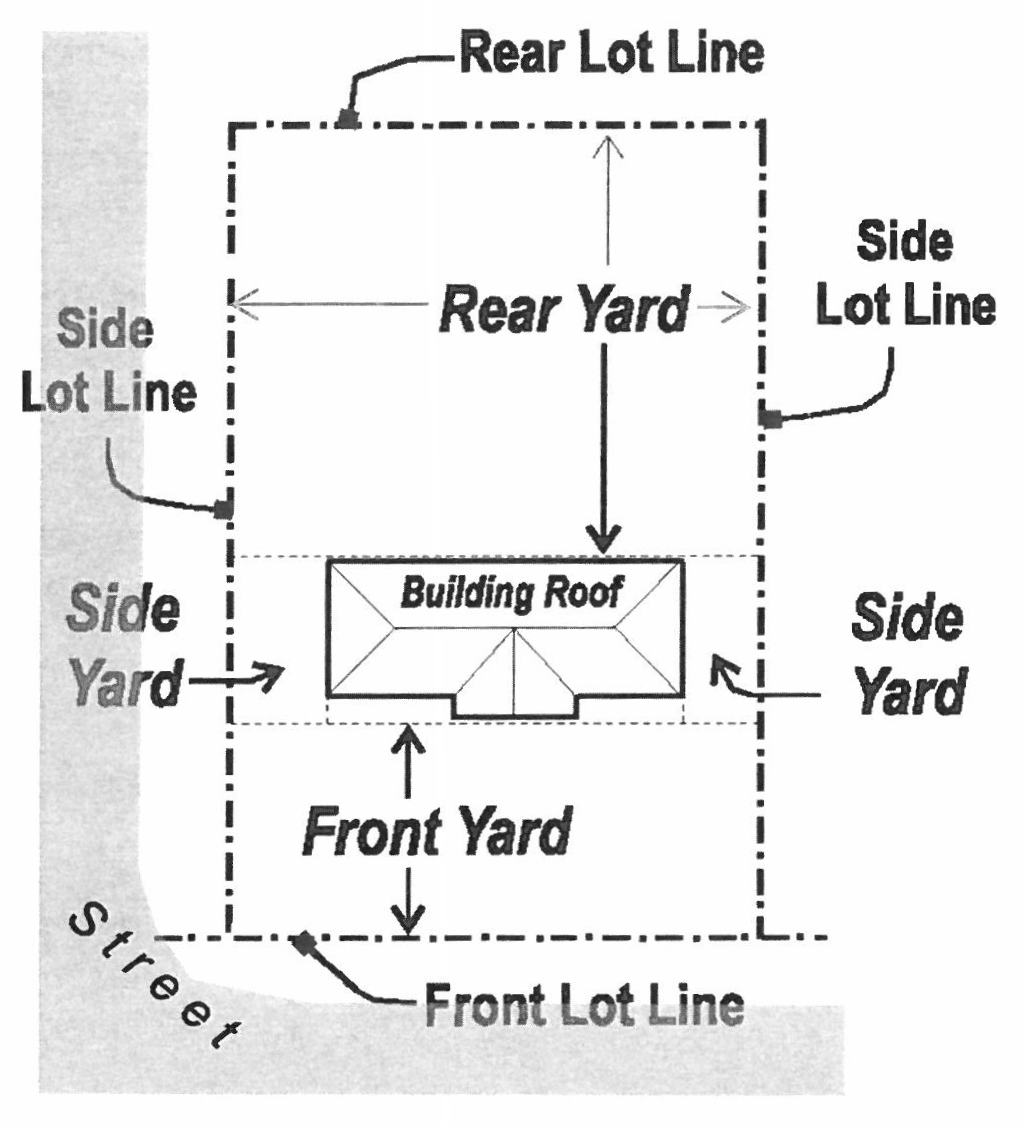
No Fence, wall, or hedge more than four (4) feet in height shall be constructed or permitted to grow in the front yard.
b)
On corner lots, fences or walls located in the side yard abutting a street may not exceed four (4) feet in height.
c)
Fences or walls located in the rear yard along the side lot line abutting a street may be:
i.
Four (4) feet in height when located up to the property line (See also Subd.6.); or
ii.
Six (6) feet in height when located three (3) feet from the property line;
d)
No fence or wall more than six (6) feet in height shall be constructed.
e)
Whenever a fence and wall are used in combination, or placed upon a berm, the combined height shall not exceed the permitted heights outlined in the paragraphs above. For the purposes of this clause, fences placed within three (3) feet of a berm or wall shall be considered to be used "in combination" with said berm or wall.
(Amended, Bill No. 2011-13; Bill No. 2022-12)
Subd. 5.Corner lots. Fences, walls, and hedges located on any corner lot are subject to the traffic visibility requirements described in subsection 925.01 of the City Code. (Amended, Bill No. 2022-12)
Subd. 6.Setback requirement. Fences, walls, and hedges located along a right-of-way which contains a public sidewalk, or located along a street or alley, shall be set back not less than three (3) feet from the nearest edge of such sidewalk, street, or alley. See also subd.3.a of this section. (Amended, Bill No. 2022-12)
Subd. 7.Prohibitions. Barbed wire and electric wire fences are prohibited in all districts. Fences shall not be constructed from chicken wire, welded wire, branches, or materials originally intended for other purposes, unless a showing of a high degree of architectural quality is achieved through the use of such, and prior approval is granted by the Director. (Amended, Bill No. 2022-12)
Subd. 8.Chain link. Chain link fences shall have a top rail and the barbed ends shall be toward the ground. Inserts or slats woven through such fences shall be kept in a good state of repair. (Amended, Bill No. 2022-12)
Subd. 9.Posts. Posts and stringers on any fence located at or near the lot line shall be on the inside of the fenced area unless designed as an integral part of the fence. Posts for wooden fences shall be spaced at intervals not to exceed eight (8) feet. Posts for chain link fences shall be spaced at intervals not to exceed ten (10) feet. (Amended, Bill No. 1999-3; Bill No. 2022-12)
Subd. 10.Construction and maintenance. Fences and walls shall be constructed of durable, weather resistant materials that are properly anchored. All fences and walls shall be maintained in a condition of reasonable repair and shall not be allowed to become and remain in a condition of disrepair, danger, or constitute a nuisance.(Amended, Bill No. 2022-12)
Subd. 11.Required screening. Any fence or wall required as a screening device shall be constructed of decay resistant materials that provide screening to the extent required by this Code. (Amended, Bill No. 2011-13; Bill No. 2022-12)
Subd. 12.Special Fence Exception. The Director may consider a special fence exception to the restrictions of section 509.15 in instances where:
a)
On a through lot, where the proposed fence or wall does not affect the continuity of neighboring front yards.
b)
Whether the size, configuration or other unusual characteristics of the lot requires an exception from the zoning requirements in order to provide a reasonable enclosed area without creating significant harm to adjacent properties or the neighborhood.
c)
The review process for the special fence exception request shall follow the procedure detailed in section 547.19.
(Amended, Bill No. 2022-12)
509.19. - Excavation of natural materials.
Nothing in this Code prohibits the excavation of natural materials for the construction of a building permitted in a district in which the same is located if the building is to be constructed on the lot from which the material is excavated. Excavations shall not be made, however, in violation of any provision of this Code or the city code.
509.21. - Home occupations.
Subdivision 1.Home occupation defined. Home occupations are defined in subsection 507.07 of this Code.
Subd. 2.Purposes. The purposes of this subsection are to allow for home occupations that are appropriate for residential settings; protect those conducting a home occupation from self-induced harm; and protect the property rights of neighbors.
Subd. 3.Compliance required. A home occupation may be established and conducted only in accordance with this subsection.
Subd. 4.Subordinate use. A home occupation shall be permitted as an accessory use to a residential dwelling unit. The home occupation use must be clearly subordinate to the residential use of the property, occupying no more than 25 percent of the gross floor area of the dwelling (excluding garages), and must be conducted by a person or persons who reside full-time in the dwelling.
Subd. 5.Activities. A home occupation must be conducted in such a manner that activities connected with it are not noticeable from adjacent streets or residential lots, and except as permitted in Subd. 6 below, do not draw attention to the home occupation. All activities related to a home occupation must be conducted within a fully enclosed building. The growing of food or ornamental crops, to be sold or donated off-site, shall be exempt from this provision provided that plants and related materials are maintained in a clean and orderly manner and that waste is disposed of appropriately. Food or ornamental crops may only be made available for on-site pick-up, provided that they are grown on-site, if they are distributed through a Community Supported Agriculture (CSA) model. For purposes of this subdivision, the cannabis plant and hemp plant, as defined in Minnesota Statutes, section 342.01 are not a food or ornamental crop.
Subd. 6.Advertising. Signs are allowed in accordance with the provisions of Section 549 of the zoning code.
Subd. 7.Outside storage. No outside storage of products or materials or equipment connected with the home occupation is permitted. This subdivision does not prohibit the outside parking of motor vehicles on the driveway of the premises in accordance with Subd. 8 below.
Subd. 8.Outdoor parking of commercial vehicle. Outdoor parking of no more than one (1) commercial vehicle is permitted, provided that the vehicle is registered to an occupant of the home, and that such vehicle parking is not otherwise prohibited by Section 1320 of the city code or any other applicable district regulations.
Subd. 9.Parking, structural changes, lighting. Parking, structural alteration, lighting or similar facilities which indicate a use of the dwelling for purposes other than a residential structure are prohibited. Home occupations involving the need for more than three (3) outdoor parking spaces for operators and customers shall be prohibited. Parking facilities required to serve the home occupation shall be provided on the premises, but no such parking facilities shall be provided within any required front or side yard, except upon an established driveway.
Subd. 10.Retail sales. Regular retail sales or distribution of products on the premises are prohibited. Occasional sales of products or other articles are permitted where the dwelling serves as an office for a person regularly engaged in retail sales outside the dwelling, or where such occasional sales are incidental to and not the primary purpose of the home occupation.
Subd. 11.Specific activities prohibited. The following activities shall not be allowed as home occupations:
a)
The repair, whether for consideration or not, of motor vehicles which are not registered to a resident of the dwelling on the property where the repair is made, or to a son or daughter, sibling, parent, grandparent, or grandchild of a resident of the property;
b)
Adult business establishments regulated under Section 1196 of the city code;
c)
The practice of medical, dental, chiropractic, psychiatric, or other similar treatment or therapy, including acupuncture, where the person(s) providing such treatment or therapy is not licensed by the State of Minnesota to administer such treatment or therapy; or in the case of massage therapy, where the person(s) providing such treatment is not certified by the "National Certification Board for Therapy Massage and Bodywork" or by the "Massage and Bodywork Licensing Examination;"
d)
Businesses, educational programs, or similar gatherings which meet on a regular basis, having more than six (6) nonresident adults in attendance at one (1) time;
e)
Pet grooming or pet care facilities, except those legally existing on or before June 1, 1995;
f)
Gun or ammunition sales/repair, except those legally existing on or before June 1, 1995;
g)
Music instruction, unless conducted within a single-family (detached) dwelling;
h)
Tattoo businesses;
i)
Sale of honey produced by hives located within the city regulated under section 906 of the City Code; and
j)
Cannabis Businesses.
Subd. 12.Performance standards. A home occupation may not adversely impact the residential character of the dwelling or its neighborhood because of the emission of noise, odor, water, smoke, dust, gases, heat, glare, vibration, electrical interference, or parking or traffic resulting from the conduct of the home occupation.
Subd. 13.Nonresident employee. One (1) person in addition to the person or persons who occupy the dwelling may be employed at the residence.
Subd. 14.Hours of operation. The hours of operation for any home occupation shall be limited to between 7:00 a.m. and 9:00 p.m.
Subd. 15.Use of equipment. No mechanical or electrical equipment requiring in excess of 240 volts single phase shall be permitted in the conduct of a home occupation, and no electric motor shall exceed three (3) horsepower.
(Amended, Bill No. 2021-5; Bill No. 2024-12)
509.23. - Uses not listed.
When the proposed use of any building, structure, or premises is not specifically described in this Code, the requirements for the use most similar to the proposed use applies. If in the judgment of the Director, a proposed use does not come within any existing use classification, the Director shall refer the matter to the Council for a determination as to whether the use shall be classified as permitted, accessory, conditional, or prohibited in the particular zoning district for which the use is proposed.
509.25. - Nonconformities.
Subdivision 1.Purpose. This subsection is intended to provide for the regulation of uses, structures, lots or site improvements which lawfully existed prior to the effective date of this ordinance or subsequent amendments, but which fail to comply with one (1) or more current regulations.
Subd. 2.Definitions. The following terms and accompanying definitions are used in the context of nonconformities: (Added, Bill No. 2010-10)
a)
Expansion. For the purposes of nonconformities, expansion includes, but is not limited to, intensification of the use, expansion of the use to a portion of the property not previously used, or increased structure dimension(s).
b)
Improvement. Where a nonconformity is made more compatible with the use of adjacent properties, efficient, and/or more aesthetically pleasing. For the purposes of nonconformities, an improvement does not include an expansion.
c)
Maintenance. Normal repair, restoration, and improvement including cosmetic changes. For the purposes of nonconformities, maintenance does not include new construction or expansion of a use or structure.
d)
Repair. For the purposes of nonconformities, repair means to restore to good condition by replacing or reassembling broken, worn out or malfunctioning components. Repair does not include expansion.
e)
Replacement. Construction that provides a substitute substantially equivalent to the preexisting conditions that preceded damage or destruction.
f)
Restoration. For the purposes of nonconformities, restoration means to restore or repair to good condition by replacing or reassembling broken, worn out or malfunctioning components. Restoration does not include expansion.
Subd. 3.Continuance of nonconformities. Any nonconformity, including the lawful use or occupation of land or premises existing at the time of the adoption of an additional control, may be continued, including through repair, replacement, restoration, maintenance, or improvement, but not including expansion, unless:
a)
The nonconformity or occupancy is discontinued for a period of more than one (1) year. Time shall be calculated as beginning on the day following the last day in which the use was in normal operation and shall run continuously thereafter; or
b)
Any nonconformity is destroyed by fire or other peril to the extent of greater than 50 percent of its market value, and no building permit has been applied for within 180 days of when the property is damaged. In this case, the city may impose reasonable conditions upon a building permit in order to mitigate any newly created impact on adjacent property;
Any subsequent use or occupancy of the land or premises shall be a conforming use or occupancy. The nonconforming use status of the premises and any rights which arise under the provisions of this subsection shall terminate. (Amended, Bill No. 2010-10)
Subd. 4.
Nonconforming use. Except as otherwise noted in this Code, there shall be no enlargement, expansion, intensification, or relocation of any building or premises devoted to a nonconforming use except to make it a conforming use.
a)
Exception. Expansion which would constitute addition and alteration to buildings containing nonconforming dwelling units complying with the following conditions shall be permitted: (Added, Bill No. 2010-10)
i.
The construction will not result in an increase in the number of dwelling units;
ii.
The building or parcel is not located in an area which the Council has designated as a high priority for redevelopment according to an adopted redevelopment strategy or plan. For the purpose of this section, a redevelopment strategy or plan shall be defined as a document and/or process which specifically outlines the area to be redeveloped and may include timelines and/or action steps to be taken, or which are being taken, to achieve the redevelopment. These action steps may include, but are not limited to, solicitation of developers, the purchase of property, environmental testing or remediation, demolition of structure and other similar activities; and
iii.
The construction would not extend any farther into the required setback than the existing structure.
Subd. 5.
Enlargement of nonconforming structures.
a)
Except as noted below, a nonconforming building or structure occupied by a conforming use may not be expanded or altered in any way so as to increase that nonconformity. Expansions that meet all applicable city code requirements are permitted.
b)
A legally nonconforming single- or two-family dwelling or garage which existed on or before June 1, 1995, which is occupied by a conforming use, and which does not meet current setback requirements can be expanded up to 100 percent of the floor area of the existing structure, as long as the following conditions are met:
i.
The expansion does not extend any farther into the required setback than the existing structure;
ii.
The existing structure does not infringe on the setback more than 50 percent of the required setback distance; and
iii.
The expansion meets all other applicable city code requirements. (Added, Bill No. 1998-13)
Subd. 6.Safety. Nothing in this subsection shall prevent the repairing of a structure to a safe condition when said structure is declared unsafe by the proper authority.
Subd. 7.Nonconforming site improvements. This subsection is primarily aimed at upgrading nonconforming site improvements that affect the appearance and impacts of a site. It is not intended to require extensive changes that would be extremely impractical such as moving or lowering buildings.
a)
Nonconforming Parking. Alteration, addition or expansion which results in an increased need for off-street parking shall provide additional parking according to the following guidelines:
i.
Where modifications result in an increase in the applicable unit of measurement (dwelling unit, floor area, capacity, number or seats, etc.) which is 50 percent or less of the original total, additional parking shall be required only for this new or modified part of the development;
ii.
Where modifications result in an increase in the applicable unit of measurement which is over 50 percent of the original total, sufficient off-street parking shall be provided to bring the entire development into conformance with the requirements of this ordinance.
b)
Nonconforming Landscaping and Screening. Alternative landscaping or screening may be approved by the Director, where, due to existing structure placement, lot dimensions, parking requirements, or other improvements, it is not possible to provide the landscaping or screening required by this ordinance, according to the following rules:
i.
The alternative landscaping or screening will not be detrimental to adjacent properties; and
ii.
The alternative landscaping or screening complies with the purpose and intent of standards dictated by this ordinance.
c)
Additional Nonconforming Site Improvements. In addition to the requirements of a) and b) above, the following nonconforming site improvements must be made conforming if a structure or use associated with the nonconforming site improvement is enlarged or expanded.
i.
Impervious surface coverage as required by applicable zoning district standards;
ii.
Irrigation as required by Subsection 544.03, Subd. 4(h);
iii.
Screening of refuse collection and utilitarian items in accordance with Subsection 544.05;
iv.
Pedestrian circulation as required by Subsection 544.15;
v.
Bicycle parking in accordance with Subsection 544.17; and
vi.
For enlargement or expansion of non-conforming off-street parking or loading areas, the enlarged or expanded area of such off-street parking or loading areas must comply with the minimum requirements for electric vehicle (EV) chargers and EV-ready spaces in accordance with Subsection 544.13, Subd. 7. (Added, Bill No. 2022-3)
vii.
Underground utilities when renovation costs exceed 50 percent of the value of the structure, in accordance with Subsection 544.19. (Amended, Bill No. 2022-3)
d)
The Director may modify or waive any of the provisions above based on a written finding that the proposal:
i.
Would not be detrimental to adjacent properties; and
ii.
The proposal complies with the purpose and intent of standards dictated by this ordinance. (Amended: 9-17-2010)
(Amended, Bill No. 2014-4)

