
Richfield City Zoning Code
SECTION 514
LOW DENSITY RESIDENTIAL DISTRICT R
(Added, Bill No. 2007-19; Amended, Bill No. 2023-2)
514.01.- Purposes.
The purposes of the R District regulations are to protect and preserve the low density residential character of the R District; reserve appropriate locations for low density dwellings; provide opportunities for cluster housing development; minimize traffic congestion and the overloading of utilities; and provide residential locations that are safe, attractive, and quiet. (Amended, Bill No. 2023-2)
514.03. - Permitted uses.
Subdivision 1. The uses listed in this subsection are permitted uses in the R District.
Subd. 2. Single-family (detached) dwellings and two-family dwellings. (Amended, Bill No. 2023-2)
Subd. 3. Subd. 3. State-licensed day care facility serving 14 or fewer children. Care facilities located within the R District shall be subject to the same zoning regulations as single-family dwellings in the R District except that one nonresident employee shall be permitted in accordance with State requirements. (Amended, Bill No. 2016-3)
Subd. 4. State-licensed residential care facility serving six (6) or fewer persons, or a housing with services establishment registered under M.S. 144D serving six (6) or fewer persons. Care facilities located within the R District shall be subject to the same zoning regulations as single-family dwellings in the R District.
Subd. 5. Governmental buildings and public libraries.
514.05. - Accessory building and use regulations.
Subdivision 1. The uses listed in this subsection are allowable accessory uses in the R District.
Subd. 2. In addition to the general accessory building provisions of Subsection 509.09, the following rules apply to accessory buildings in the R District:
a)
No more than one (1) of each of the following shall be located on a residential parcel: detached garage, greenhouse, storage building or gazebo; and
b)
No attached garage shall be greater in lot coverage than the dwelling unit to which it is attached.
Subd. 3. Private garages (includes attached and detached) or carports:
a)
That do not exceed 1,000 square feet in floor area. In the case of detached garages, floor area shall include space devoted to vehicle parking, storage and non-garage uses such as an accessory dwelling unit, office, or similar habitable space. The first 400 square feet of space devoted to an accessory dwelling unit is exempt from this requirement, provided the site complies with part (b). Floor area shall not include crawl spaces or attic storage;
b)
That do not exceed an aggregate of 1,200 square feet (or 13% of lot area in the case of lots of 15,000 square feet or more) in floor area when combined with all other accessory buildings and attached garages on the lot;
c)
That are constructed in accordance with Subdivision 2 of this subsection; and
d)
In no event shall the height of a garage door or carport opening, measured from the floor to the trim covering the door header, exceed nine (9) feet.
e)
Attached garages where one or more garage doors face a street:
i.
the total width of all garage doors on that building elevation shall not exceed 50 percent of the width of that elevation. A garage door is considered to be facing a street where the opening is parallel to, or within 45 degrees of, the street right-of-way line.
ii.
Attached garages shall not extend closer towards the front lot line than the facade of the habitable first story portion of the primary structure.
(Amended, Bill No. 2015-4; amended, Bill No. 2021-4, Bill No. 2023-2)
Subd. 4. Greenhouses, storage buildings, and gazebos that do not exceed 175 square feet (300 square feet in the case of lots of 15,000 square feet or larger) in gross floor area, do not exceed an aggregate of 1,200 square feet (or 13 percent of lot area in the case of lots of 15,000 square feet or more) in gross floor area when combined with all other accessory buildings and attached garages on the lot, and are constructed in accordance with Subdivision 2 of this subsection. (Amended, 2012-2)
Subd. 5. Private swimming pools as defined in Section 420 of the city code, provided that such swimming pools and related equipment be located:
a)
At least ten (10) feet from any rear lot line;
b)
At least ten (10) feet from any interior side lot line; and
c)
At least 15 feet from any street side lot line; and
d)
Not forward of the front building line.
Subd. 6. Private driveways, parking areas, turnaround areas, and sidewalks for residential uses, provided the following conditions are met:
a)
All such driveways, parking areas, turnaround areas, and sidewalks shall be set back no less than one foot from any lot line abutting another parcel, except that upon written request from the landowner, the Director may reduce or rescind this setback requirement for shared access agreements or with a finding of necessity and public convenience;
b)
All such driveways, parking areas, turnaround areas, and sidewalks shall be constructed with concrete, asphalt, concrete pavers, brick set in compacted sand, or other material approved by the Director;
c)
[Reserved]
d)
Within the front yard area, vehicles shall only be parked on the driveway area;
e)
Driveways, where located within the boulevard or the front yard area, are subject to the following requirements:
(i)
Width shall not exceed 35 percent of the front yard area, up to 20 feet maximum, whichever is less (curb cut radii excluded);
(ii)
Driveway width shall not exceed the width of the curb cut within 20 feet of the curbline. Beyond that point, width may increase to the number established by item (i). The expanded portion of the driveway shall be screened with plantings;
(iii)
Curb cut radii (five (5) feet minimum) shall not encroach upon the boulevard of abutting properties;
(iv)
On corner lots, driveways shall be set back at least 30 feet from an intersection, as measured from the point where the extended curblines of the streets intersect;
(v)
Only one (1) curb cut shall be permitted from a public street to a lot. Lots with alley access shall not be permitted to install a curb cut;
(vi)
Upon written request from the landowner, items (i), (ii), (iii), (iv) and (v) above may be varied by the Director with a finding of necessity and public convenience;
f)
Any expansion, installation or replacement of a driveway, parking or turnaround area on a lot shall be subject to a city permit;
g)
Any expansion, installation or replacement of a curb cut from a public street to a lot shall be subject to a city permit and any curb cut abandoned with the installation of a new cut shall be extinguished and replaced with curb and gutter according to specifications determined by the Director of Public Works;
h)
A turnaround area may be located within a front yard subject to the requirements of this paragraph. The turnaround area is limited to the front yard of arterial streets only. The turnaround area cannot exceed 150 square feet. The turnaround area must be contiguous to the driveway. The turnaround area shall be set back no less than three (3) feet from any public sidewalk.
(Amended, Bill No. 2017-13, Bill No. 2023-2)
Subd. 7. The accommodation of one (1) roomer in addition to the family, provided that:
a)
The roomer plus the family shall not exceed a total of five (5) persons (see definition of family); and
b)
Adequate off-street parking is available. (Amended, Bill No. 2015-4)
Subd. 8. Internal, attached, and detached accessory dwelling units shall be allowed, provided that:
a)
The principal residential structure is a permitted or conditional single-family or two-family dwelling;
b)
No more than one accessory dwelling unit shall be allowed on a lot;
c)
The lot must meet current minimum width and depth requirements;
d)
The creation of an accessory dwelling unit shall not create a separate tax parcel;
e)
An owner of the property must occupy at least one dwelling unit on the lot as their primary place of residence. Proof of homesteading shall be required and variances from this provision shall not be considered;
f)
A rental license for the non-owner-occupied unit shall be required in accordance with Section 407 of the City Code;
g)
Accessory dwelling units must have a minimum area of 300 square feet and cannot exceed 800 square feet or the gross floor area of the principal dwelling, whichever is less;
h)
Principal dwelling units must continue to meet minimum floor area requirements or not increase the degree of nonconformity in this matter;
i)
The primary exterior materials of an attached accessory dwelling unit must match those of the principal structure. Exterior materials for new construction related to any type of accessory dwelling unit must match the structure to which it is attached;
j)
The creation of an attached or internal accessory dwelling unit shall not result in the creation of additional entrances facing the public street on the primary structure;
k)
Exterior stairways leading to an upper story accessory dwelling unit shall be allowed so long as the staircase and railing are not constructed with raw or unfinished lumber;
l)
Detached accessory dwelling units are permitted only as a part of an approved accessory garage structure;
m)
Conversion of garage space to an accessory dwelling unit is prohibited unless the garage space is replaced. Space within a garage that exceeds what is necessary for two vehicles may be converted without replacement; and
n)
A minimum of three off-street parking spaces is required in order to add an accessory dwelling unit of any kind.
(Added, Bill No. 2015-4; amended, Bill No. 2015-9, § 1, Bill No. 2023-2)
Subd. 9. Home occupations that are operated in accordance with Section 509 of this Code.
Subd. 10. Roof-mounted television antennas.
Subd. 11. Minor public utilities, including "small wireless facilities" and associated "wireless support structures" in compliance with regulations detailed in Subsection 802.21 of the City Code. (Amended, Bill No. 2017-12; Bill No. 2020-9)
Subd. 12. Sacred communities as an accessory use to an approved religious institution (conditional use permit amendment not required). (Added, Bill No. 2023-18, § 2, 12-12-2023)
514.07. - Conditional uses. (Amended, Bill No. )
Subdivision 1. The uses listed in this subsection are conditional uses in the R District, and are subject to the conditional use permit provisions outlined in Section 547.09 of this Code.
Subd. 2. Cluster home developments, provided the following conditions are met:
a)
The design of the development must be compatible with the surrounding neighborhood in terms of building materials, architectural design, scale and mass of the structure, or other similar urban design characteristics;
b)
Landscaping must be provided in accordance with the Performance Standards Section of this Code;
c)
Two (2) off-street parking spaces, at least one (1) of which must be enclosed in a garage, shall be provided for each dwelling unit;
d)
There must be a minimum of 500 square feet of outdoor open space provided on the lot per dwelling unit;
e)
The number and location of driveways and curbcuts shall minimize conflict with vehicular traffic and should not adversely impact adjacent land uses; and
f)
The density of the development may not exceed the density recommended in the comprehensive plan. (Added, Bill No. 1996-22; Amended, Bill No. 2002-11)
Subd. 3. Bed and breakfast inns, provided the following conditions are met:
a)
No more than two (2) rental rooms shall be provided;
b)
At least two (2) off-street parking spaces (may include garage stalls) shall be provided for the residence, and at least one (1) off-street parking space shall be provided on the lot for each rental room;
c)
The use shall be contained within a single-family detached dwelling;
d)
Outdoor parking areas shall be screened with landscape materials; and
e)
The operator shall secure all applicable licenses and approvals from the city, county, state, or other applicable jurisdictions before the conditional use permit will become effective.
Subd. 4. Public or private elementary and high schools, and other similar learning institutions provided the following conditions are met:
a)
The use site shall abut a collector or arterial street or be located such that significant traffic will not be generated on local residential streets;
b)
Pick-up and drop-off areas shall be designed to enhance vehicular and pedestrian safety;
c)
Outdoor recreational facilities designed for group activities shall be set back at least 40 feet from any lot line;
d)
Buffering shall be provided to mitigate noise and adverse visual impacts on adjacent properties; and
e)
Lighted playing fields shall be permitted only upon demonstration that off-site impacts can be substantially mitigated.
Subd. 5. Cemeteries (may include mausoleums and crematories), provided the following conditions are met:
a)
The lot area shall be not less than five (5) acres;
b)
Direct views from all abutting residential property shall be buffered in accordance with the Performance Standards Section of this Code;
c)
The use shall abut an arterial or collector street and access shall be achieved without conducting significant traffic on local residential streets; and
d)
Any crematory shall be set back not less than 600 feet from any lot line.
Subd. 6. Religious institutions and related convents or parsonages, provided the following conditions are met:
a)
The use site shall abut a collector or arterial street or be located such that significant traffic will not be generated on local residential streets;
b)
Outdoor facilities designed for group activities shall be set back at least 40 feet from any lot line; and
c)
Buffering shall be provided to mitigate noise and adverse visual impacts on adjacent properties.
Subd. 7. Emergency shelters within nonresidential buildings (e.g., schools or churches) provided the following conditions are met:
a)
The shelter shall serve no more than 16 persons at one (1) time; and
b)
Meals for those served by the shelter shall be prepared in a kitchen approved for commercial use.
Subd. 8. State-licensed day care facility serving more than 12 persons, or a group family day care facility licensed under Minnesota Rules, parts 9502.0315 to 9502.0445, serving 15 or more children within nonresidential buildings (e.g., schools or churches) provided the following conditions are met:
a)
Designated pick-up and drop-off areas shall be located on the site; and
b)
Designated outdoor play areas shall be set back at least 15 feet from any lot line which abuts a residential property.
Subd. 9. School-based health centers as accessory uses within currently operating schools provide the following conditions are met:
a)
The health center must primarily serve students;
b)
Hours of operation may not extend beyond the regular operational hours of the school by more than one (1) hour in the morning or 6:00 p.m. in the evening;
c)
Total square footage of the health center may not exceed 3,000 square feet or ten (10) percent of the total building square footage, whichever is less;
d)
Designated parking equal to staff plus one (1) per exam room must be provided and designated for clinic use;
e)
Because of the focus on students and the associated sharing of parking, advertising shall be limited to directional and identification signs. The maximum sign area and height shall not exceed the limits set for residential uses in the MR-2 and MR-3 Zoning Districts per Subsection 549.23. The total square footage of all freestanding signage for the property shall remain limited to 100 square feet in accordance with the established rules for nonresidential uses in the residential districts. (Added, Bill No. 2015-7)
Subd. 10. Telecommunications towers are allowed only in the following residentially zoned areas:
a)
Towers supporting amateur radio antennas and conforming to all applicable provisions of Section 544.25 of this Code shall be allowed only in the rear yard of residentially zoned parcels; and
b)
Towers supporting commercial antennas and conforming to all applicable provisions of Section 544.25 this Code shall be allowed only in the following residentially zoned locations:
(i)
Church sites, when camouflaged as steeples or bell towers;
(ii)
Park sites, when compatible with the nature of the park; and,
(iii)
Government, school, utility, and institutional sites, not including the public right-of-way.
Subd. 11. Major public utilities. (Amended, Bill No. 2017-12; Bill No. 2020-9)
514.09. - Prohibited uses.
Any land use not listed as permitted, accessory or conditional in this Section or subsection 512.05 is prohibited in the R District unless the use is found to be substantially similar to a use listed, as determined by the city in accordance with Section 509.23 of this Code.
514.11. - Lot Area, dimensions and coverage.
Subdivision 1. The standards set out in this subsection apply in the R District.
Subd. 2.Minimum lot area, dimensions and coverage.
(Amended, Bill No. 2023-2)
Subd. 3.Nonconforming Residential Lot Dimensions. A lot that was a lot of record on or before June 1, 1995, located in the R District which does not meet the minimum requirements set forth in this Code as to area and dimensions, may be used for single-family (detached) development provided that the width of such lot is not less than 40 feet and such lot contains at least 5,000 square feet in area. (Amended, Bill No. 2023-2)
514.13. - Building setback and height.
Subdivision 1.Standards. The standards set out in this subsection apply in the R District.
Subd. 2.Building setback and maximum height (measurements in feet).
1
Setbacks for cluster home developments shall apply to the perimeter of the development.
Setbacks between attached and detached units within a townhome or a cluster home development
must comply with applicable building and fire codes. (Added, Bill No. 1996-22)
2
For garages, height is measured on the side of the building with the vehicle door.
3
For nongarage accessory structures, height is measured from the ground level to the
highest point of the roof.
(Amended Bill No. 1996-22; Bill No. 1999-3; Bill No. 2002-11; Bill No. 2011-13; Bill No. 2015-4; Bill No. 2023-2)
Subd. 3.
Setback reductions for principal buildings. The following setback reductions apply in the R District:
a)
On a corner lot, the street side setback requirement shall be the lesser of 12 feet or the established street side setback of the existing principal building on the same lot for single-family, two-family and cluster home development structures. In any case the provisions of paragraphs d) and e) of this subdivision shall be applicable; (Amended, Bill No. 1996-22)
b)
The front setback requirement for a new single-family dwelling, two-family dwelling or cluster home development on a lot may be reduced to not less than the average existing front setback of the dwelling(s) which front on the same street and abut such lot, to a minimum setback of 20 feet; (Amended, Bill No. 1996-22)
c)
With respect to homes existing on or before June 1, 1995, the interior side setback requirement may be reduced to not less than three (3) feet for the purpose of constructing an attached garage or a two-car garage to replace a single-car garage, provided the following conditions are met: (Amended, Bill No. 2023-2)
(i)
A letter of consent signed by the owner of the property that abuts the interior lot line shall be submitted to the city;
(ii)
The garage shall be located a distance of not less than eight (8) feet from any building on an abutting lot;
(iii)
The width of the garage shall not exceed 20 feet, and the length shall not exceed 26 feet;
(iv)
Accessory garages built under this Subdivision are limited to 14 feet in height;
(v)
The garage wall most parallel and adjacent to the interior lot line shall have no more than a one-foot roof overhang (eave projection); and
(vi)
A drainage plan shall be approved by the Engineering Department prior to issuance of building permits.
d)
Windows or window units may project a maximum of 24 inches into a required front yard, street side yard, or rear yard of a dwelling, provided that the floor area is not increased by more than ten (10) square feet, however, in no case shall they be closer than six (6) feet from any lot line;
e)
Those items classified as "not encroachments" in Section 509.11
f)
The setback requirements for cluster home developments may be reduced to 25 feet in the front and 12 feet in the rear if the following criteria are met:
(i)
The project can demonstrate that a superior design is achieved through the reduced setback. Evidence of a superior design may include but is not limited to the preservation of a natural feature, creation of an amenity, creation of public open space, or incorporation of special features to meet the needs of the target population;
(ii)
The reduced setback does not adversely affect the overcrowding, or other similar impacts; and
(iii)
The impact of the reduced setback is minimized through the presence of features such as landscaping or other means of buffering, a limited number of building openings in the portion of the structure that infringes upon the setback, building orientation, minimized garage door dominance, or other similar features.
g)
In required front yards, covered porches attached to the principal building that extend no more than ten (10) feet, provided that the porch is no closer than 20 feet from the front lot line and that the design of the porch is approved by the Community Development Director. The Community Development Director must make the following findings to approve a porch encroachment up to ten (10) feet:
(i)
The exterior materials of the proposed porch are consistent or complementary in color, texture and quality with those visible at the front of the dwelling;
(ii)
The roof of the proposed porch is properly proportioned to and integrated with the roof of the dwelling and has no less than a 3:12 slope;
(iii)
The base of the porch is not open and its appearance is consistent with the base of the dwelling;
(iv)
At least 65 percent of the exposed porch facade is open or occupied by windows, screens, and/or doors of transparent material; the facade constitutes the area from the floor level of the porch to the porch ceiling; and
(v)
Plans are prepared by a registered architect or reviewed by the a design advisor selected by the Community Development Department;
The Director may attach conditions to the approval of the porch encroachment as needed to make the required findings; and
h)
In required residential street/corner side yards, covered porches attached to the front of a principal building that extend no more than ten (10) feet, provided that the porch is no closer than 20 feet from the street side lot line and that the design of the porch is approved by the Community Development Director. The Director must make the findings required by Section 514.13, Subd. 3(g). The Director may attach conditions to the approval of the porch encroachment as needed to make the required findings. (Added Bill No. 1998-12; amended Bill No. 2015-4)
i)
In the case of townhouses, the shared interior side setback may be reduced to zero (0). (Added, Bill No. 2023-2)
Subd. 4.Setback reductions for residential accessory buildings. The following setback reductions apply in the R District:
a)
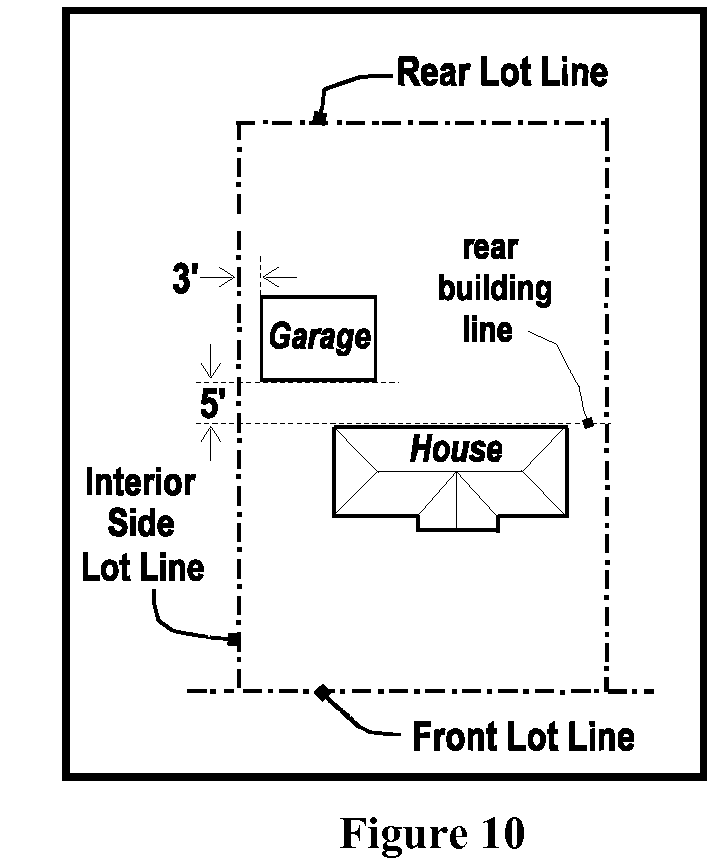
The interior side setback requirement for single-story accessory buildings located entirely five (5) or more feet beyond the rear building line of the principal building may be reduced to three (3) feet (Figure 10); and
b)
On lots which provide alley access to the rear and there is no utility easement, a detached garage may be located no less than two (2) feet from the rear lot line, provided that the setback requirement of Section 514.13, Subd. 6 of this code and all building codes are met. (Amended, Bill No. 2015-4)
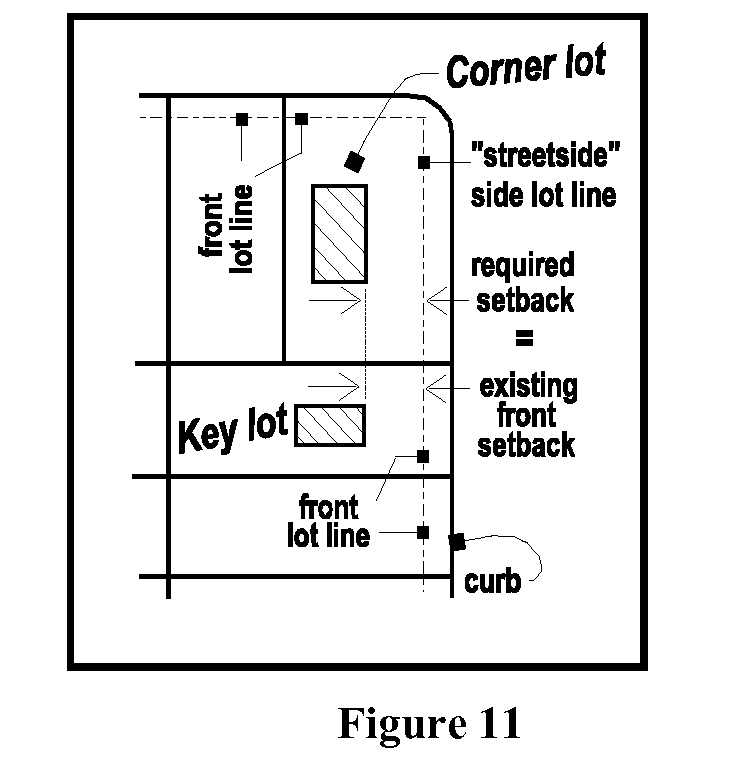
Subd. 5.Additional setback requirement: all structures located on a corner lot that abuts a key lot. On a corner lot which abuts a key lot, the street/corner side setback requirement of such corner lot shall be equal to the front setback of any existing principal building on the key lot or 30 feet, whichever is less, however, in no case shall such street side setback requirement be less than 12 feet. (Figure 11)
Subd. 6.Additional setback requirement: vehicle access door facing a side or rear lot line. Whenever any building (principal or accessory) is located in such a manner that a vehicle access door faces a side or rear lot line, such side or rear setback requirement shall be not less than 20 feet, except under the following conditions:
a)
If a vehicle access door faces a street side lot line which abuts a nonarterial or noncollector street, such street side setback requirement shall be not less than 15 feet; or
b)
If a vehicle access door faces a rear lot line which abuts an alley, such rear setback requirement shall be not less than 15 feet; or
c)
If a vehicle access door faces an interior side lot line on a lot that is less than 45 feet in width, such interior side setback requirement shall be not less than 15 feet.
Subd. 7.Additional height for accessory garages. The maximum height of an accessory garage may be increased when the following conditions are met:
a)
For lots that are less than 75 feet in width, a detached accessory garage may not exceed the height of the principal residential structure, 1 - ½ stories or 18 feet, whichever is less. In no case shall the highest point of the roof of the detached accessory garage exceed the highest point of the roof of the principal residential structure.
b)
For lots that are 75 feet or greater in width, a detached accessory garage may not exceed the height of the principal structure. In no case shall the highest point of the roof of the detached accessory garage exceed the highest point of the roof of the principal residential structure.
c)
Primary exterior materials of the accessory garage/structure must match the primary exterior materials of the principal building and the roof pitch must be substantially similar to the primary roof pitch of the principal building;
d)
Windows, false windows, doors or similar openings are required on all second story walls. (Added, Bill No. 2015-4)
Subd. 8.Additional height for nonresidential buildings. The following height exceptions apply to nonresidential buildings in the R District:
a)
The maximum building height may be increased to no more than 75 feet, provided that the required setbacks shall be increased by one (1) foot for each foot of building height in excess of 42 feet; and
b)
Notwithstanding paragraph a) above, the maximum height for towers, spires, or water tanks may be increased to no more than 150 feet provided that such structure does not exceed 15 percent lot coverage or 1,600 square feet in gross floor area at the base, whichever is less.
Subd. 9.Maximum height increase for cluster housing developments. The maximum height for primary buildings in a cluster housing developments may be increased one (1) foot for every foot the primary building is located from the 25 foot rear set-back, up to a maximum of 35 feet, if the increased height is in harmony with the surrounding neighborhood and if the increased height does not adversely affect the surrounding neighborhood in terms of a decrease in privacy, noise, overcrowding, or other similar impacts. (Added, Bill No. 1996-22; Amended, Bill No. 2002-11)
Subd. 10.Two-family Dwelling Side Entrances. For two-family dwellings on interior lots: A main entrance to either unit from a side yard is not allowed within ten (10) feet of the side property line (Figure 11.1).
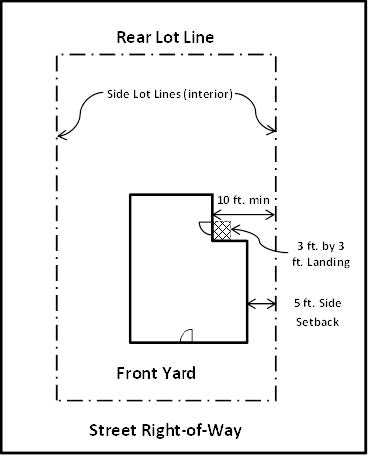
Figure 11.1
(Added, Bill No. 2023-2)
514.15. - Additional regulations.
Subdivision 1.Standards. Developments shall be constructed and maintained in accordance with the standards set out in this subsection.
Subd. 2.Dimensions and floor area. Single-family and two-family dwellings shall be a minimum of 22 feet in length and width for at least 50 percent of each distance as measured from outside wall surfaces. Single Family dwellings shall contain a minimum of 960 square feet of gross floor area. Two-Family dwellings shall contain a minimum of 800 square feet of floor area per dwelling unit. Dwellings in cluster home developments shall be a minimum of 16 feet in width for attached units. (Amended, Bill No. 1996-22, Bill No. 2023-2)
Subd. 3. (Amended, Bill No. 2008-11; Repealed, Bill No. 2023-2)
Subd. 4.Parking requirement. There shall be provided on the site at least two (2) parking spaces per dwelling unit, of which at least one (1) space per dwelling shall be enclosed in a garage. (Added, Bill No. 2014-4; Amended, Bill No. 2023-2)
Subd. 5.Performance standards of Section 544. Developments shall be constructed and maintained in accordance with the applicable performance standards set out in Section 544 of this Code.
Subd. 6.Design and overlay districts. All property located within a design district or corridor overlay district shall be subject to such district's additional requirements and/or modifications.
Subd. 7.Beekeeping. Any property seeking to keep bees must comply with the additional requirements of Section 906 of this Code. (Added, Bill No. 2016-2)

