
Richmond City Zoning Code
ARTICLE IV
- DISTRICT REGULATIONS
Sec. 30-400.- Applicability of article.
Regulations applicable within the several districts established by this chapter shall be as set forth in this article, provided that such regulations shall be subject to exceptions, qualifications and modifications contained in Article VI of this chapter. Off-street parking and loading regulations of all uses shall be set as forth in Article VII of this chapter.
(Code 1993, § 32-400; Code 2004, § 114-400; Code 2015, § 30-400)
Sec. 30-402.1.- Permitted principal uses.
The following uses of buildings and premises shall be permitted in the R-1 district:
(1)
Single-family detached dwellings;
(2)
Libraries, museums, schools, parks and recreational facilities owned or operated by any governmental agency, and other uses required for the performance of governmental functions and primarily intended to serve residents of adjoining neighborhoods;
(3)
Churches and other places of worship, which may include the serving of food as a charitable or fellowship use within the church or place of worship;
(4)
Propagation and cultivation of crops, flowers, trees and shrubs which are not offered for sale on the premises;
(5)
Public and private noncommercial forests, wildlife preserves and conservation areas;
(6)
Private noncommercial parks, recreational facilities, country clubs, swimming pools, athletic fields, community center buildings and uses incidental thereto, operated by associations or organizations not organized for profit, the exclusive use of which is limited to members of such associations or organizations and their guests, provided that the following conditions are met:
a.
Principal points of vehicular access to the premises shall be located on arterial or collector streets as designated in the City's master plan, except that this provision shall not apply to premises exclusively serving the residents of an adjoining neighborhood;
b.
Portions of the premises devoted to outdoor activities shall be effectively screened from view from abutting properties in R and RO districts by evergreen vegetative or structural screens not less than six feet in height;
c.
No building shall be located within 50 feet of an adjoining lot in an R and RO district;
d.
Swimming pools and adjoining deck areas shall be completely enclosed with a fence or wall not less than four feet in height, and no swimming pool or adjoining deck area shall be located within 50 feet of an adjoining lot in an R or RO district;
(7)
Private elementary and secondary schools having curricula substantially the same as that offered in public schools;
(8)
Rights-of-way, easements and appurtenances necessary for the provision and maintenance of public utilities and public transportation, including streets, rail lines, power lines, cables, poles, pipes, meters, transformers and similar devices, but not including railroad yards, freight or passenger depots, loading platforms, generating plants, transformer stations, electric substations, wastewater treatment plants, water treatment plants, utility storage yards and similar uses;
(9)
Antennas and support structures for communications systems operated by or for the City;
(10)
Wireless communications facilities and microwave relay facilities, including support structures, on property owned by the City, subject to the requirements for location, character and extent approval by the City Planning Commission in accordance with the requirements of Section 17.07 of the City Charter.
(Code 1993, § 32-402.1; Code 2004, § 114-402.1; Code 2015, § 30-402.1; Ord. No. 2004-180-167, § 1, 6-28-2004; Ord. No. 2024-314, § 2, 12-9-2024)
Sec. 30-402.2. - Permitted accessory uses and structures.
Accessory uses and structures, including the following, which are customarily incidental and clearly subordinate to permitted principal uses, shall be permitted in the R-1 district (see Article VI, Division 9 of this chapter):
(1)
Private garages, garden, tool and storage buildings, boathouses, piers and docks;
(2)
Home occupations;
(3)
Day nurseries when located within churches, or other places of worship, community centers or school buildings, provided:
a.
A minimum outdoor play area of 100 square feet for each child enrolled shall be furnished on the premises, but not within a required front yard;
b.
The play area shall be enclosed with a continuous opaque structural fence or wall not less than four feet in height, and such fence or wall shall not be located within a required front yard;
c.
No play equipment or structure shall be located within a front yard or a required side yard;
(4)
Parking areas;
(5)
Reserved;
(6)
Swimming pools, tennis courts and similar recreational facilities;
(7)
Temporary structures, trailers and storage of equipment and materials incidental to construction activities taking place on the premises, provided that such shall be removed upon completion or abandonment of construction. In the case of public improvements construction taking place within a public right-of-way, such construction related activities shall be permitted on property abutting the construction site when approved by the Director of Public Works and when operated and maintained in accordance with standards established by said Director;
(8)
Raising or keeping of domestic animals for noncommercial purposes on lots occupied by single-family dwellings, provided that all pens, runs, out-buildings and other facilities for the housing or enclosure of such animals shall be located not less than 200 feet from all property lines. The restrictions set forth in this subsection shall not apply to the keeping of dogs, cats or other household pets or to the keeping of not more than six female chickens in residential districts. In addition, with regard to the keeping of not more than six female chickens:
a.
No fenced area, pen or structure for the keeping of such chickens shall be located closer than 15 feet to any dwelling on an adjacent lot;
b.
No fenced area or pen for the keeping of such chickens shall be located within any required front yard or street side yard; and
c.
No structure for the keeping of such chickens shall be located within any required yard (see Chapter 4);
(9)
Temporary housing of not more than 30 homeless individuals within churches or other places of worship, subject to meeting applicable building code and fire code requirements, for up to a total of seven days and only within the time period beginning on October 1 of any year and ending on April 1 of the following year;
(10)
Adult day care facilities when located within churches, other places of worship or community centers;
(11)
Wireless communications facilities, microwave relay facilities, and radio broadcast antennas, on alternative support structures, in accordance with the additional requirements of Sections 30-692.1 through 30-692.6;
(12)
Short-term rental, subject to the requirements of Article VI, Division 14 of this chapter;
(13)
One accessory dwelling unit located on the same lot as a single-family dwelling provided that:
a.
The accessory dwelling unit cannot exceed one-third of the floor area of the main single-family dwelling or 500 square feet, whichever is greater.
b.
An accessory building with an accessory dwelling unit shall be subject to the requirements of Article VI, Division 9 of this chapter.
c.
Access to an accessory building with an accessory dwelling unit shall be provided in accordance with requirements of the Department of Public Works and Department of Fire and Emergency Services.
(Code 1993, § 32-402.2; Code 2004, § 114-402.2; Code 2015, § 30-402.2; Ord. No. 2004-180-167, § 1, 6-28-2004; Ord. No. 2012-74-84, § 1, 6-11-2012; Ord. No. 2013-47-47, § 1, 4-8-2013; Ord. No. 2019-343, § 1(30-402.2), 6-22-2020; Ord. No. 2020-171, § 1(30-402.2), 9-28-2020; Ord. No. 2023-196, § 1, 9-25-2023; Ord. No. 2024-314, § 2, 12-9-2024)
Sec. 30-402.4. - Lot area and width.
Single-family dwellings in the R-1 Single-Family Residential District shall be located on lots of not less than 20,000 square feet in area with a width of not less than 100 feet (see Article VI, Division 3 of this chapter).
(Code 1993, § 32-402.4; Code 2004, § 114-402.4; Code 2015, § 30-402.4)
Sec. 30-402.5. - Yards.
Yard regulations in the R-1 Single-Family Residential District shall be as follows:
(1)
Front yard. There shall be a front yard with a depth of not less than 35 feet (see Article VI, Division 4 of this chapter).
(2)
Side yards. There shall be side yards of not less than ten feet in width (see Article VI, Division 4 of this chapter).
(3)
Rear yard. There shall be a rear yard with a depth of not less than ten feet (see Article VI, Division 4 of this chapter).
(Code 1993, § 32-402.5; Code 2004, § 114-402.5; Code 2015, § 30-402.5)
Sec. 30-402.6. - Lot coverage.
Maximum lot coverage in the R-1 Single-Family Residential District shall not exceed 20 percent of the area of the lot.
(Code 1993, § 32-402.6; Code 2004, § 114-402.6; Code 2015, § 30-402.6)
Sec. 30-402.7. - Height.
No building or structure in the R-1 Single-Family Residential District shall exceed 35 feet in height (see Article VI, Division 6 of this chapter).
(Code 1993, § 32-402.7; Code 2004, § 114-402.7; Code 2015, § 30-402.7)
Sec. 30-402.8. - Driveways from streets.
No driveway intersecting a street shall be permitted on a lot devoted to a dwelling use when alley access is available to serve such lot. In the case of a corner lot, no such driveway shall be permitted intersecting a street which constitutes the principal street frontage of a lot when other street frontage or alley access is available to serve the lot. Permitted driveways within front yards of single-family and two-family dwellings shall not exceed nine feet in width.
(Ord. No. 2020-171, § 2(30-402.8), 9-28-2020)
Sec. 30-404.1.- Permitted principal uses.
Any principal use permitted in the R-1 district as set forth in Section 30-402.1 shall be permitted in the R-2 Single-Family Residential District.
(Code 1993, § 32-404.1; Code 2004, § 114-404.1; Code 2015, § 30-404.1)
Sec. 30-404.2. - Permitted accessory uses and structures.
Any accessory use or structure permitted in the R-1 district as set forth in Section 30-402.2 shall be permitted in the R-2 Single-Family Residential District.
(Code 1993, § 32-404.2; Code 2004, § 114-404.2; Code 2015, § 30-404.2)
Sec. 30-404.4. - Lot area and width.
Single-family dwellings in the R-2 Single-Family Residential District shall be located on lots of not less than 15,000 square feet in area with a width of not less than 90 feet (see Article VI, Division 3 of this chapter).
(Code 1993, § 32-404.4; Code 2004, § 114-404.4; Code 2015, § 30-404.4)
Sec. 30-404.5. - Yards.
Yard regulations in the R-2 Single-Family Residential District shall be as follows:
(1)
Front yard. There shall be a front yard with a depth of not less than 30 feet (see Article VI, Division 4 of this chapter).
(2)
Side yards. There shall be side yards not less than nine feet in width (see Article VI, Division 4 of this chapter).
(3)
Rear yard. There shall be a rear yard with a depth of not less than nine feet (see Article VI, Division 4 of this chapter).
(Code 1993, § 32-404.5; Code 2004, § 114-404.5; Code 2015, § 30-404.5)
Sec. 30-404.6. - Lot coverage.
Maximum lot coverage in the R-2 Single-Family Residential District shall not exceed 25 percent of the area of the lot.
(Code 1993, § 32-404.6; Code 2004, § 114-404.6; Code 2015, § 30-404.6)
Sec. 30-404.7. - Height.
No building or structure in the R-2 Single-Family Residential District shall exceed 35 feet in height (see Article VI, Division 6 of this chapter).
(Code 1993, § 32-404.7; Code 2004, § 114-404.7; Code 2015, § 30-404.7)
Sec. 30-404.8. - Driveways from streets.
No driveway intersecting a street shall be permitted on a lot devoted to a dwelling use when alley access is available to serve such lot. In the case of a corner lot, no such driveway shall be permitted intersecting a street which constitutes the principal street frontage of a lot when other street frontage or alley access is available to serve the lot. Permitted driveways within front yards of single-family and two-family dwellings shall not exceed nine feet in width.
(Ord. No. 2020-171, § 3(30-404.8), 9-28-2020)
Sec. 30-406.1.- Permitted principal uses.
Any principal use permitted in the R-1 district as set forth in Section 30-402.1 shall be permitted in the R-3 Single-Family Residential District.
(Code 1993, § 32-406.1; Code 2004, § 114-406.1; Code 2015, § 30-406.1)
Sec. 30-406.2. - Permitted accessory uses and structures.
Any accessory use or structure permitted in the R-1 district as set forth in Section 30-402.2 shall be permitted in the R-3 Single-Family Residential District.
(Code 1993, § 32-406.2; Code 2004, § 114-406.2; Code 2015, § 30-406.2)
Sec. 30-406.4. - Lot area and width.
Single-family dwellings in the R-3 Single-Family Residential District shall be located on lots of not less than 10,000 square feet in area with a width of not less than 75 feet (see Article VI, Division 3 of this chapter).
(Code 1993, § 32-406.4; Code 2004, § 114-406.4; Code 2015, § 30-406.4)
Sec. 30-406.5. - Yards.
Yard regulations in the R-3 Single-Family Residential District shall be as follows:
(1)
Front yard. There shall be a front yard with a depth of not less than 25 feet (see Article VI, Division 4 of this chapter).
(2)
Side yards. There shall be side yards of not less than 7½ feet in width (see Article VI, Division 4 of this chapter).
(3)
Rear yard. There shall be a rear yard with a depth of not less than 7½ feet (see Article VI, Division 4 of this chapter).
(Code 1993, § 32-406.5; Code 2004, § 114-406.5; Code 2015, § 30-406.5)
Sec. 30-406.6. - Lot coverage.
Maximum lot coverage in the R-3 Single-Family Residential District shall not exceed 25 percent of the area of the lot.
(Code 1993, § 32-406.6; Code 2004, § 114-406.6; Code 2015, § 30-406.6)
Sec. 30-406.7. - Height.
No building or structure in the R-3 Single-Family Residential District shall exceed 35 feet in height (see Article VI, Division 6 of this chapter).
(Code 1993, § 32-406.7; Code 2004, § 114-406.7; Code 2015, § 30-406.7)
Sec. 30-406.8. - Driveways from streets.
No driveway intersecting a street shall be permitted on a lot devoted to a dwelling use when alley access is available to serve such lot. In the case of a corner lot, no such driveway shall be permitted intersecting a street which constitutes the principal street frontage of a lot when other street frontage or alley access is available to serve the lot. Permitted driveways within front yards of single-family and two-family dwellings shall not exceed nine feet in width.
(Ord. No. 2020-171, § 4(30-406.8), 9-28-2020)
Sec. 30-408.1.- Permitted principal uses.
Any principal use in the R-1 district as set forth in Section 30-402.1 shall be permitted in the R-4 Single-Family Residential District.
(Code 1993, § 32-408.1; Code 2004, § 114-408.1; Code 2015, § 30-408.1)
Sec. 30-408.2. - Permitted accessory uses and structures.
Any accessory use or structure permitted in the R-1 district as set forth in Section 30-402.2 shall be permitted in the R-4 Single-Family Residential District.
(Code 1993, § 32-408.2; Code 2004, § 114-408.2; Code 2015, § 30-408.2)
Sec. 30-408.4. - Lot area and width.
Single-family dwellings in the R-4 Single-Family Residential District shall be located on lots of not less than 7,500 square feet in area with a width of not less than 60 feet (see Article VI, Division 3 of this chapter).
(Code 1993, § 32-408.4; Code 2004, § 114-408.4; Code 2015, § 30-408.4)
Sec. 30-408.5. - Yards.
Yard regulations in the R-4 Single-Family Residential District shall be as follows:
(1)
Front yard. There shall be a front yard with a depth of not less than 25 feet (see Article VI, Division 4 of this chapter).
(2)
Side yards. There shall be side yards of not less than six feet in width (see Article VI, Division 4 of this chapter).
(3)
Rear yard. There shall be a rear yard with a depth of not less than six feet (see Article VI, Division 4 of this chapter).
(Code 1993, § 32-408.5; Code 2004, § 114-408.5; Code 2015, § 30-408.5)
Sec. 30-408.6. - Lot coverage.
Maximum lot coverage in the R-4 Single-Family Residential District shall not exceed 30 percent of the area of the lot.
(Code 1993, § 32-408.6; Code 2004, § 114-408.6; Code 2015, § 30-408.6)
Sec. 30-408.7. - Height.
No building or structure in the R-4 Single-Family Residential District shall exceed 35 feet in height (see Article VI, Division 6 of this chapter).
(Code 1993, § 32-408.7; Code 2004, § 114-408.7; Code 2015, § 30-408.7)
Sec. 30-408.8. - Driveways from streets.
No driveway intersecting a street shall be permitted on a lot devoted to a dwelling use when alley access is available to serve such lot. In the case of a corner lot, no such driveway shall be permitted intersecting a street which constitutes the principal street frontage of a lot when other street frontage or alley access is available to serve the lot. Permitted driveways within front yards of single-family and two-family dwellings shall not exceed nine feet in width.
(Ord. No. 2020-171, § 5(30-408.8), 9-28-2020)
Sec. 30-410.1.- Permitted principal uses.
Any principal use permitted in the R-1 district as set forth in Section 30-402.1 shall be permitted in the R-5 Single-Family Residential District.
(Code 1993, § 32-410.1; Code 2004, § 114-410.1; Code 2015, § 30-410.1)
Sec. 30-410.2. - Permitted accessory uses and structures.
Any accessory use or structure permitted in the R-1 district as set forth in Section 30-402.2 shall be permitted in the R-5 Single-Family Residential District.
(Code 1993, § 32-410.2; Code 2004, § 114-410.2; Code 2015, § 30-410.2)
Sec. 30-410.4. - Lot area and width.
Single-family dwellings in the R-5 Single-Family Residential District shall be located on lots of not less than 6,000 square feet in area with a width of not less than 50 feet (see Article VI, Division 3 of this chapter).
(Code 1993, § 32-410.4; Code 2004, § 114-410.4; Code 2015, § 30-410.4)
Sec. 30-410.5. - Yards.
Yard regulations in the R-5 Single-Family Residential District shall be as follows:
(1)
Front yard. There shall be a front yard with a depth of not less than 25 feet (see Article VI, Division 4 of this chapter).
(2)
Side yards. There shall be side yards of not less than five feet in width (see Article VI, Division 4 of this chapter).
(3)
Rear yard. There shall be a rear yard with a depth of not less than five feet (see Article VI, Division 4 of this chapter).
(Code 1993, § 32-410.5; Code 2004, § 114-410.5; Code 2015, § 30-410.5)
Sec. 30-410.6. - Lot coverage.
Maximum lot coverage in the R-5 Single-Family Residential District shall not exceed 35 percent of the area of the lot.
(Code 1993, § 32-410.6; Code 2004, § 114-410.6; Code 2015, § 30-410.6)
Sec. 30-410.7. - Height.
No building or structure in the R-5 Single-Family Residential District shall exceed 35 feet in height (see Article VI, Division 6 of this chapter).
(Code 1993, § 32-410.7; Code 2004, § 114-410.7; Code 2015, § 30-410.7)
Sec. 30-410.8. - Driveways from streets.
No driveway intersecting a street shall be permitted on a lot devoted to a dwelling use when alley access is available to serve such lot. In the case of a corner lot, no such driveway shall be permitted intersecting a street which constitutes the principal street frontage of a lot when other street frontage or alley access is available to serve the lot. Permitted driveways within front yards of single-family and two-family dwellings shall not exceed nine feet in width.
(Ord. No. 2020-171, § 6(30-410.8), 9-28-2020)
Sec. 30-411.1.- Intent of district.
Pursuant to the general purposes of this chapter, the intent of the R-5A Single- and Two-Family Residential District is to preserve and enhance the established character of older residential neighborhoods located in various parts of the City and characterized by a mixture of detached single- and two-family dwellings situated on modest sized lots. The R-5A district regulations and the supplemental regulations of this chapter are intended to encourage continued improvement and economic use of existing residential buildings and their accessory structures, while enabling development of remaining vacant lots in a manner compatible with existing development.
(Code 1993, § 32-411.1; Code 2004, § 114-411.1; Code 2015, § 30-411.1)
Sec. 30-411.2. - Permitted principal uses.
The following uses of buildings and premises shall be permitted in the R-5A Single- and Two-Family Residential District:
(1)
Any principal use permitted in the R-1 district as set forth in Section 30-402.1.
(2)
Two-family detached dwellings.
(Code 1993, § 32-411.2; Code 2004, § 114-411.2; Code 2015, § 30-411.2)
Sec. 30-411.3. - Permitted accessory uses and structures.
Any accessory use or structure permitted in the R-1 district as set forth in Section 30-402.2 shall be permitted in the R-5A Single- and Two-Family Residential District.
(Code 1993, § 32-411.3; Code 2004, § 114-411.3; Code 2015, § 30-411.3; Ord. No. 2019-343, § 1(30-411.3), 6-22-2020; Ord. No. 2023-101, § 5, 4-24-2023; Ord. No. 2023-196, § 1, 9-25-2023)
Sec. 30-411.5. - Lot area and lot width.
Lot area and lot width regulations in the R-5A Single- and Two-Family Residential District shall be as follows (see Article VI, Division 3 of this chapter):
(1)
Single-family detached dwellings. Single-family detached dwellings shall be located on lots of not less than 5,000 square feet in area with a width of not less than 50 feet.
(2)
Two-family detached dwellings. Two-family detached dwellings shall be located on lots of not less than 6,000 square feet in area with a width of not less than 50 feet.
(Code 1993, § 32-411.5; Code 2004, § 114-411.5; Code 2015, § 30-411.5)
Sec. 30-411.6. - Yards.
Yard regulations in the R-5A Single- and Two-Family Residential District shall be as follows:
(1)
Front yard. There shall be a front yard with a depth of not less than 25 feet (see Article VI, Division 4 of this chapter).
(2)
Side yards. There shall be side yards of not less than five feet in width (see Article VI, Division 4 of this chapter).
(3)
Rear yard. There shall be a rear yard with a depth of not less than five feet (see Article VI, Division 4 of this chapter).
(Code 1993, § 32-411.6; Code 2004, § 114-411.6; Code 2015, § 30-411.6)
Sec. 30-411.7. - Lot coverage.
Lot coverage in the R-5A Single- and Two-Family Residential District shall not exceed 40 percent of the area of the lot.
(Code 1993, § 32-411.7; Code 2004, § 114-411.7; Code 2015, § 30-411.7)
Sec. 30-411.8. - Height.
No building or structure in the R-5A Single- and Two-Family Residential District shall exceed 35 feet in height (see Article VI, Division 6 of this chapter and Section 30-680.1).
(Code 1993, § 32-411.8; Code 2004, § 114-411.8; Code 2015, § 30-411.8)
Sec. 30-412.1.- Permitted principal uses.
The following uses of buildings and premises shall be permitted in the R-6 district:
(1)
Any principal use permitted in the R-1 district as set forth in Section 30-402.1;
(2)
Single-family attached dwellings and uses and structures customarily incidental to attached dwelling developments, provided that:
a.
Appropriate agreements and covenants approved by the City Attorney provide for the perpetuation and maintenance of all areas to be held in common ownership by property owners within such developments;
b.
Architectural variations shall be provided among units within any series of more than four units;
(3)
Two-family detached dwellings;
(4)
Two-family attached dwellings lawfully existing prior to the effective date of the ordinance from which this section is derived.
(Code 1993, § 32-412.1; Code 2004, § 114-412.1; Code 2015, § 30-412.1; Ord. No. 2004-180-167, § 1, 6-28-2004; Ord. No. 2007-338-2008-11, § 1, 1-14-2008; Ord. No. 2024-314, § 2, 12-9-2024)
Sec. 30-412.2. - Permitted accessory uses and structures.
Any accessory use or structure permitted in the R-1 district as set forth in Section 30-402.2 shall be permitted in the R-6 Single-Family and Two-Family Attached Residential District.
(Code 1993, § 32-412.2; Code 2004, § 114-412.2; Code 2015, § 30-412.2; Ord. No. 2019-343, § 1(30-412.2), 6-22-2020; Ord. No. 2023-101, § 5, 4-24-2023; Ord. No. 2023-196, § 1, 9-25-2023)
Sec. 30-412.4. - Lot area and width; density; unit width.
Lot area and width regulations in the R-6 Single-Family Attached Residential District shall be as follows:
(1)
Single-family detached dwellings. Single-family detached dwellings shall be located on lots of not less than 5,000 square feet in area with a width of not less than 50 feet (see Article VI, Division 3 of this chapter).
(2)
Single-family attached dwellings. Density, lot area and unit width for single-family attached dwellings shall be as follows:
a.
Density. The average density within a development site shall not exceed ten dwelling units per acre (see the definition of the term "dwelling, multifamily" in Section 30-1220).
b.
Lot area. Single-family attached dwellings shall be located on lots of not less than 2,200 square feet in area, provided that such area may be reduced when an area equivalent to such reduction is provided in common ownership elsewhere on the development site and is accessible to residents of the lots so reduced in area and is available for their use. Each lot reduced to less than 2,200 square feet in area shall be provided with a private yard adjoining the dwelling unit and containing not less than 500 square feet of usable open space.
c.
Unit width. No individual attached dwelling unit shall be less than 16 feet in width, provided that the average width of all units attached within a series shall be not less than 20 feet.
(3)
Two-family attached and detached dwellings. Two-family attached and detached dwellings shall be located on lots of not less than 6,000 square feet in area with a width of not less than 50 feet (see Article VI, Division 3 of this chapter).
(Code 1993, § 32-412.4; Code 2004, § 114-412.4; Code 2015, § 30-412.4)
Sec. 30-412.5. - Yards.
Yard regulations in the R-6 Single-Family Attached Residential District shall be as follows:
(1)
Uses other than attached dwellings. Yards for uses other than attached dwellings shall be as follows:
a.
Front yard. There shall be a front yard with a depth of not less than 15 feet (see Article VI, Division 4 of this chapter).
b.
Side yards. There shall be side yards of not less than five feet in width (see Article VI, Division 4 of this chapter).
c.
Rear yard. There shall be a rear yard with a depth of not less than five feet (see Article VI, Division 4 of this chapter and Section 30-680.1).
(2)
Single-family and two-family attached dwellings and buildings accessory thereto. Yards for single-family and two-family attached dwellings and buildings accessory thereto shall be as follows:
a.
Front yard. There shall be a front yard with a depth of not less than 15 feet adjacent to public streets, private streets, parking areas and common spaces (see Article VI, Division 4 of this chapter).
b.
Side yard. There shall be side yards of not less than three feet in width except where buildings are attached. There shall be a side yard of not less than ten feet in width at each end of a series of attached units (see Section 30-620.1(d) and Article VI, Division 4 of this chapter).
c.
Rear yard. There shall be a rear yard with a depth of not less than five feet (see Article VI, Division 4 of this chapter and Section 30-680.1).
(Code 1993, § 32-412.5; Code 2004, § 114-412.5; Code 2015, § 30-412.5; Ord. No. 2007-338-2008-11, § 1, 1-14-2008)
Sec. 30-412.6. - Lot coverage.
Lot coverage in the R-6 Single-Family Attached Residential District shall not exceed 55 percent of the area of the lot.
(Code 1993, § 32-412.6; Code 2004, § 114-412.6; Code 2015, § 30-412.6)
Sec. 30-412.7. - Driveways from streets.
No driveway intersecting a street shall be permitted on a lot devoted to dwelling use when alley access is available to serve such lot. In the case of a corner lot, no such driveway shall be permitted intersecting a street which constitutes the principal street frontage of a lot when other street frontage or alley access is available to serve the lot. Permitted driveways within front yards of single-family and two-family dwellings shall not exceed nine feet in width.
(Code 2004, § 114-412.7; Code 2015, § 30-412.7; Ord. No. 2010-18-30, § 1, 2-22-2010)
Sec. 30-412.8. - Height.
No building or structure in the R-6 Single-Family Attached Residential District shall exceed 35 feet in height (see Article VI, Division 6 of this chapter and Section 30-680.1).
(Code 1993, § 32-412.8; Code 2004, § 114-412.8; Code 2015, § 30-412.8)
Sec. 30-413.1.- Intent of district.
Pursuant to the general purposes of this chapter, the intent of the R-7 Single- and Two-Family Urban Residential District is to preserve and enhance the established character of older urban residential neighborhoods in the inner areas of the City. The district regulations are designed to reflect the urban nature of such neighborhoods as characterized by a mixture of detached and attached single- and two-family dwellings situated on small lots with narrow yards and modest setbacks. The district regulations, together with the supplemental regulations of this chapter, are intended to encourage continued improvement and efficient use of existing residential buildings and their accessory structures, while ensuring that infill development will be compatible with the established character.
(Code 1993, § 32-413.1; Code 2004, § 114-413.1; Code 2015, § 30-413.1)
Sec. 30-413.2. - Permitted principal uses.
The following uses of buildings and premises shall be permitted in the R-7 district:
(1)
Any principal use permitted in the R-1 district as set forth in Section 30-402.1;
(2)
Single-family attached dwellings, provided that:
a.
Appropriate agreements and covenants approved by the City Attorney provide for the perpetuation and maintenance of all areas to be held in common ownership by property owners within such developments;
b.
Not more than four dwelling units shall be attached laterally in a series, provided that this provision shall not be applicable in the case of dwelling units existing on the effective date of the ordinance from which this subsection is derived;
(3)
Two-family detached dwellings;
(4)
Two-family attached dwellings lawfully existing prior to the effective date of the ordinance from which this section is derived.
(Code 1993, § 32-413.2; Code 2004, § 114-413.2; Code 2015, § 30-413.2; Ord. No. 2004-180-167, § 1, 6-28-2004; Ord. No. 2007-338-2008-11, § 1, 1-14-2008; Ord. No. 2024-314, § 2, 12-9-2024)
Sec. 30-413.3. - Permitted accessory uses and structures.
Any accessory use or structure permitted in the R-1 district as set forth in Section 30-402.2 shall be permitted in the R-7 Single- and Two-Family Urban Residential District.
(Code 1993, § 32-413.3; Code 2004, § 114-413.3; Code 2015, § 30-413.3; Ord. No. 2019-343, § 1(40-413.3), 6-22-2020; Ord. No. 2023-101, § 5, 4-24-2023; Ord. No. 2023-196, § 1, 9-25-2023)
Sec. 30-413.5. - Lot area and lot width.
Lot area and lot width regulations in the R-7 Single- and Two-Family Urban Residential District shall be as follows (see Article VI, Division 3 of this chapter):
(1)
Single-family detached dwellings. Single-family detached dwellings shall be located on lots of not less than 3,600 square feet in area with a width of not less than 30 feet.
(2)
Single-family attached dwellings. Single-family attached dwellings shall be located on lots of not less than 2,200 square feet in area. Lot width shall be not less than 18 feet, except that the width of any lot at the end of a series of attached units shall be not less than 21 feet.
(3)
Two-family detached dwellings. Two-family detached dwellings shall be located on lots of not less than 4,400 square feet in area with a width of not less than 42 feet.
(4)
Two-family attached dwellings. Two-family attached dwellings shall be located on lots of not less than 4,400 square feet in area with a width of not less than 36 feet.
(Code 1993, § 32-413.5; Code 2004, § 114-413.5; Code 2015, § 30-413.5)
Sec. 30-413.6. - Yards.
Yard regulations in the R-7 Single- and Two-Family Urban Residential District shall be as follows:
(1)
Front yard. There shall be a front yard with a depth of not less than 15 feet (see Article VI, Division 4 of this chapter).
(2)
Side yards. Side yards shall be provided as follows:
a.
Dwelling uses and buildings accessory thereto. There shall be side yards of not less than three feet in width except where buildings are attached (see Article VI, Division 4 of this chapter).
b.
All other uses and buildings. There shall be side yards of not less than five feet in width (see Article VI, Division 4 of this chapter).
(3)
Rear yard. There shall be a rear yard with a depth of not less than five feet (see Article VI, Division 4 of this chapter and Section 30-680.1).
(Code 1993, § 32-413.6; Code 2004, § 114-413.6; Code 2015, § 30-413.6)
Sec. 30-413.7. - Lot coverage.
Lot coverage in an R-7 Single- and Two-Family Urban Residential District shall not exceed 55 percent of the area of the lot.
(Code 1993, § 32-413.7; Code 2004, § 114-413.7; Code 2015, § 30-413.7)
Sec. 30-413.8. - Driveways from streets.
No driveway intersecting a street shall be permitted on a lot devoted to dwelling use when alley access is available to serve such lot. In the case of a corner lot, no such driveway shall be permitted intersecting a street which constitutes the principal street frontage of a lot when other street frontage or alley access is available to serve the lot. Permitted driveways within front yards of single-family and two-family dwellings shall not exceed nine feet in width.
(Code 2004, § 114-413.8; Code 2015, § 30-413.8; Ord. No. 2010-18-30, § 2, 2-22-2010)
Sec. 30-413.9. - Height.
No building or structure in an R-7 Single- and Two-Family Urban Residential District shall exceed 35 feet in height (see Article VI, Division 6 of this chapter and Section 30-680.1).
(Code 1993, § 32-413.9; Code 2004, § 114-413.9; Code 2015, § 30-413.9)
Sec. 30-413.10.- Intent of district.
Pursuant to the general purposes of this chapter, the intent of the R-8 Urban Residential District is to preserve and enhance the established character of older urban residential neighborhoods in the inner areas of the City by ensuring that infill development, as well as redevelopment, will be consistent with the predominant existing development pattern of such neighborhoods. The district regulations incorporate form-based provisions that are designed to preserve the urban nature and sustainability of such neighborhoods as characterized by a mixture of detached and attached dwellings of two and three stories in height with a distinct orientation to the street, and situated on small lots with narrow yards, minimal setbacks from the streets and minimal interruption of the street frontages by open spaces, driveways, parking areas or accessory buildings visible from the streets. The district regulations are also intended to encourage traditional neighborhood development, as well as improvement and efficient use of older commercial-style buildings by enabling, through the conditional use permit process, commercial uses that are limited in location, type and scale and are intended to provide for the convenience of neighborhood residents within walking distance, to respect the primary residential character of the neighborhood and to avoid traffic, parking congestion, noise and other impacts that typically result from uses that draw patrons from outside a neighborhood.
(Code 2004, § 114-413.10; Code 2015, § 30-413.10; Ord. No. 2010-18-30, § 3, 2-22-2010)
Sec. 30-413.11. - Permitted principal uses.
The following uses of buildings and premises shall be permitted in the R-8 district:
(1)
Any principal use permitted in the R-1 district as set forth in Section 30-402.1.
(2)
Single-family attached dwellings, provided that:
a.
Appropriate agreements and covenants approved by the City Attorney provide for the perpetuation and maintenance of all areas to be held in common ownership by property owners within such developments.
b.
Not more than four dwelling units shall be attached laterally in a series, provided that this provision shall not be applicable in the case of dwelling units existing on the effective date of the ordinance creating the R-8 district.
(3)
Two-family detached dwellings.
(4)
Two-family attached dwellings, provided that not more than three two-family dwellings shall be attached laterally in a series.
(Code 2004, § 114-413.11; Code 2015, § 30-413.11; Ord. No. 2010-18-30, § 3, 2-22-2010; Ord. No. 2024-314, § 2, 12-9-2024)
Sec. 30-413.12. - Principal uses permitted by conditional use permit.
The following uses of buildings and premises may be permitted in the R-8 district by conditional use permit as set forth in Article X of this chapter:
(1)
Multifamily dwellings, not to exceed four dwelling units, located on lots of not less than 1,500 square feet in area for each dwelling unit.
(2)
Live/work units, provided that:
a.
Not more than one person who does not reside in the unit shall be employed at any one time in the conduct of the nondwelling activity.
b.
Space devoted to the nondwelling activity within such unit shall not exceed 40 percent of the total floor area of the unit.
c.
The nondwelling activity shall not involve the sale of products directly to customers on the premises, the housing of persons for compensation, or any group instruction or group assembly involving more than two patrons or clients at any one time.
d.
There shall be no process or activity conducted or equipment operated in conjunction with the nondwelling activity that generates any noise, vibration, odor, smoke, fumes, glare or electrical interference discernable to the normal senses outside of the live/work unit. The use or storage or both of hazardous materials of such type or in such quantities not normally permitted in a residential structure shall be prohibited.
(3)
The following nondwelling uses occupying the ground floor of existing buildings, provided that the building devoted to any such use was, prior to May 19, 1943, originally constructed for or converted to commercial use, and provided further that drive-up facilities and facilities for dispensing motor fuels shall not be permitted in conjunction with any such use:
a.
Art galleries, including custom framing in conjunction therewith.
b.
Barber shops and beauty salons, including manicure, spa, tanning and similar services in conjunction therewith.
c.
Grocery stores, convenience stores and specialty food and beverage stores, including bakeries where products are sold principally at retail on the premises.
d.
Laundromats and laundry and dry cleaning pick-up stations.
e.
Offices, including business, professional and administrative offices, and studios of writers, designers and artists engaged in the arts.
f.
Restaurants, tea rooms, cafes, delicatessens, ice cream parlors and similar food and beverage service establishments, including catering businesses in conjunction therewith, but not including establishments providing live entertainment or establishments where food or beverage is intended to be consumed on the premises outside a completely enclosed building.
g.
Video rental stores.
(4)
Dwelling units occupying space above the ground floor of existing buildings devoted to uses specified in subsection (3) of this section, provided that a total of not more than four such dwelling units shall be located in a building and that each dwelling unit shall contain not less than 600 square feet of floor area.
(Code 2004, § 114-413.12; Code 2015, § 30-413.12; Ord. No. 2010-18-30, § 3, 2-22-2010)
Sec. 30-413.13. - Permitted accessory uses and structures.
Any accessory use or structure permitted in the R-1 district as set forth in Section 30-402.2 shall be permitted in the R-8 Urban Residential District.
(Code 2004, § 114-413.13; Code 2015, § 30-413.13; Ord. No. 2010-18-30, § 3, 2-22-2010; Ord. No. 2019-343, § 1(30-413.13), 6-22-2020; Ord. No. 2023-101, § 5, 4-24-2023; Ord. No. 2023-196, § 1, 9-25-2023)
Sec. 30-413.14. - Lot area and lot width.
Lot area and lot width regulations in the R-8 district shall be as follows (see Article VI, Division 3 of this chapter):
(1)
Single-family detached dwellings. Single-family detached dwellings shall be located on lots of not less than 3,000 square feet in area. Lot width shall be not less than 25 feet, provided that in any case where an existing lot of record is to be split or subdivided into two or more lots and where, exclusive of such lot, the average width of the lots on the block is greater than 25 feet, the width of each lot created by the lot split or subdivision shall be not less than such average. This lot width provision shall not be applicable in a case where all of the frontage on a block is proposed to be re-subdivided.
(2)
Single-family attached dwellings. Single-family attached dwellings shall be located on lots of not less than 2,200 square feet in area. Lot width shall be not less than 16 feet, except that the width of any lot at the end of a series of attached units shall be not less than 19 feet.
(3)
Two-family detached and attached dwellings. Two-family detached dwellings and two-family attached dwellings shall be located on lots of not less than 3,400 square feet in area with a width of not less than 28 feet.
(4)
Maximum lot width for single and two-family dwellings. No newly created lot devoted to single-family or two-family use shall exceed a width of 45 feet, whether such lot is created by combination of existing lots or by subdivision of any parcel.
(Code 2004, § 114-413.14; Code 2015, § 30-413.14; Ord. No. 2010-18-30, § 3, 2-22-2010)
Sec. 30-413.15. - Yards.
Yard regulations in the R-8 district shall be as follows (see Article VI, Divisions 4 and 9 of this chapter):
(1)
Front yard. There shall be a front yard with a depth of not less than ten feet and not greater than 18 feet, provided that:
a.
Where existing buildings are located on one or both abutting lots along the same street frontage, the front yard shall not be less than the front yard provided for the existing building closest to the street but in no case greater than 18 feet.
b.
On a corner lot where an existing building is located on an abutting lot or across an alley from an adjacent lot along the same street frontage, the front yard shall be not less than the front yard provided for such existing building but not more than 18 feet.
(2)
Side yards. Side yards shall be provided as follows:
a.
Dwelling uses and buildings accessory thereto. There shall be side yards of not less than three feet in width except where buildings are attached or where the zero-lot-line option is utilized.
b.
All other uses and buildings. There shall be side yards of not less than five feet in width.
(3)
Side yard: zero-lot-line option. One side yard for a single-family detached dwelling may be equal to zero, provided that:
a.
The side yard on the opposite side of the same lot shall be not less than six feet in width, and in no case shall the separation between buildings on abutting lots be less than six feet.
b.
Not less than 50 percent of the overall depth of the dwelling unit shall be provided along the designated zero-lot-line, and doors, windows or similar openings in the building wall facing the designated zero-lot-line shall comply with the requirements of the Uniform Statewide Building Code.
c.
A perpetual easement of not less than five feet in unobstructed width shall be provided on the adjacent lot to permit maintenance of structures abutting a zero-lot-line, which easement shall provide for encroachment of siding, belt courses, eaves, gutters, normal roof overhangs and similar architectural features. Such easement and the buildable area of each lot shall be shown on the subdivision plat, if applicable, and shall be described in the deed for each property.
d.
For purposes of this subsection, a margin of error of not greater than two-tenths of one foot shall be applicable to the location of a structure abutting a designated zero-lot-line, provided that any encroachment onto an abutting lot shall be accommodated by a recorded easement.
(4)
Rear yard. There shall be a rear yard with a depth of not less than five feet.
(5)
Location of accessory buildings. Except as provided in Section 30-680.1, accessory buildings shall be located only in a rear yard as defined in Article XII of this chapter, but not within five feet of the rear lot line.
(Code 2004, § 114-413.15; Code 2015, § 30-413.15; Ord. No. 2010-18-30, § 3, 2-22-2010; Ord. No. 2020-171, § 1(30-413.15), 9-28-2020)
Sec. 30-413.16. - Lot coverage.
Lot coverage in an R-8 district shall not exceed 65 percent of the area of the lot.
(Code 2004, § 114-413.16; Code 2015, § 30-413.16; Ord. No. 2010-18-30, § 3, 2-22-2010)
Sec. 30-413.17. - Building orientation to street, exterior entrances, and first floor elevation.
(a)
Orientation to the street. The architectural front of a building shall be oriented to the street and, in the case of a rectilinear street frontage, shall be parallel or nearly parallel to the street. In the case of a corner lot, such orientation shall be to the principal street frontage.
(b)
Two-family dwelling exterior entrances. In the case of a newly constructed two-family dwelling or conversion of an existing building to a two-family dwelling, there shall be not more than one exterior entrance oriented to a single street frontage, except in a case where an existing building contained more than one exterior entrance oriented to a single street frontage prior to conversion of the building to a two-family dwelling.
(c)
First floor elevation. The finished elevation of the first floor of a building devoted to dwelling use shall be not less than two feet above the mean grade level at the building façade along the street frontage of the lot or, in the case of a corner lot, along the principal street frontage of the lot.
(Code 2004, § 114-413.17; Code 2015, § 30-413.17; Ord. No. 2010-18-30, § 3, 2-22-2010)
Sec. 30-413.18. - Requirements for areas devoted to parking or circulation of vehicles.
(a)
Location of parking and circulation areas. Areas devoted to the parking or circulation of vehicles, other than permitted driveways from a street, shall be located to the rear of buildings so as not to be visible from the street frontage of the lot. On a lot having more than one street frontage, the provisions of this subsection shall apply only along the principal street frontage of the lot.
(b)
Driveways from streets. No driveway intersecting a street shall be permitted on a lot devoted to dwelling use when alley access is available to serve such lot. In the case of a corner lot, no such driveway shall be permitted intersecting a street which constitutes the principal street frontage of a lot when other street frontage or alley access is available to serve the lot. Permitted driveways within front yards of single-family and two-family dwellings shall not exceed nine feet in width.
(c)
Improvement requirements and landscaping standards. In addition to the provisions of this section, parking areas shall be subject to the applicable improvement requirements and landscaping standards set forth in Article VII, Division 2.1 of this chapter.
(Code 2004, § 114-413.18; Code 2015, § 30-413.18; Ord. No. 2010-18-30, § 3, 2-22-2010)
Sec. 30-413.19. - Height.
Height regulations in the R-8 district shall be as follows:
(1)
Maximum height in general. No building shall exceed three stories in height. For purposes of this section, story height as defined in Article XII of this chapter and as applicable to dwelling uses shall be not less than ten feet and not greater than 12 feet (see Section 30-680.4).
(2)
Maximum height in special cases. Where 60 percent or more of the lots on a block are developed with main buildings of less than three stories in height, no building hereinafter constructed on such block shall exceed two stories in height, except that on a lot where a main building on an adjacent lot along the same street frontage exceeds two stories in height, the height limit shall be three stories.
(3)
Minimum height. Every main building hereinafter constructed shall have a minimum height of not less than two stories, except that porches, porticos, attached garages and carports and similar structures attached to a main building may be of lesser height.
(4)
Determination of number of stories. For purposes of this section, the number of stories in a building shall be determined by application of the definition of the term "story" set forth in Article XII of this chapter and shall be measured at the building façade along the street frontage of the lot or, in the case of a corner lot, shall be measured at the building façade along the principal street frontage of the lot.
(Code 2004, § 114-413.19; Code 2015, § 30-413.19; Ord. No. 2010-18-30, § 3, 2-22-2010)
Sec. 30-414.1.- Permitted principal uses.
The following uses of buildings and premises shall be permitted in the R-43 district:
(1)
Any principal use permitted in the R-1 district as set forth in Section 30-402.1;
(2)
Single-family attached dwellings and uses and structures customarily incidental to attached dwelling developments, provided that:
a.
Appropriate agreements and covenants approved by the City Attorney provide for the perpetuation and maintenance of all areas to be held in common ownership by property owners within such developments;
b.
Architectural variations shall be provided among units within any series of more than four units;
(3)
Two-family detached dwellings;
(4)
Multifamily dwellings;
(5)
Day nurseries, provided that:
a.
A minimum outdoor play area of 100 square feet for each child enrolled shall be furnished on the premises, but not within a required front yard;
b.
The play area shall be enclosed with a continuous opaque structural fence or wall not less than four feet in height, and such fence or wall shall not be located within a required front yard;
c.
No play equipment or structure shall be located within a front yard or a required side yard;
(6)
Adult day care facilities.
(Code 1993, § 32-414.1; Code 2004, § 114-414.1; Code 2015, § 30-414.1; Ord. No. 2004-180-167, § 1, 6-28-2004; Ord. No. 2007-338-2008-11, § 1, 1-14-2008; Ord. No. 2024-314, § 2, 12-9-2024)
Sec. 30-414.2. - Permitted accessory uses and structures.
Accessory uses and structures, including the following, which are customarily incidental and clearly subordinate to permitted principal uses shall be permitted in the R-43 Multifamily Residential District (see Article VI, Division 9 of this chapter):
(1)
Any accessory use or structure permitted in the R-1 district as set forth in Section 30-402.2.
(2)
Guest units in multifamily developments available for short-term occupancy by guests of regular tenants of such developments, provided that the total number of such guest units shall not exceed one for each 50 dwelling units within the development.
(Code 1993, § 32-414.2; Code 2004, § 114-414.2; Code 2015, § 30-414.2; Ord. No. 2019-343, § 1(30-414.2), 6-22-2020; Ord. No. 2023-196, § 1, 9-25-2023), § 1, 9-25-2023; Ord. No. 2023-235, § 2, 9-25-2023)
Sec. 30-414.4. - Lot area and width; density; unit width.
(a)
Minimum lot areas and lot widths for single-family detached and two-family dwellings and maximum density, minimum lot area and minimum unit width for single-family attached dwellings in the R-43 Multifamily Residential District shall be as required in the R-6 district and set forth in Section 30-412.4.
(b)
Multifamily dwellings shall be located on lots of not less than 3,000 square feet in area for each dwelling unit.
(Code 1993, § 32-414.4; Code 2004, § 114-414.4; Code 2015, § 30-414.4)
Sec. 30-414.5. - Yards.
Yard regulations in the R-43 Multifamily Residential District shall be as follows:
(1)
Front yard. There shall be a front yard with a depth of not less than 25 feet, except that front yards for single-family attached dwellings fronting on private streets, parking areas and common spaces shall be not less than 15 feet in depth (see Article VI, Division 4 of this chapter).
(2)
Side and rear yards. Side and rear yards shall be as follows:
a.
Side and rear yards for single-family and two-family dwellings and buildings accessory thereto shall be as required in the R-6 district and set forth in Section 30-412.5 (see Article VI, Divisions 3, 4 and 9 of this chapter).
b.
Side and rear yards for uses and buildings other than single-family and two-family dwellings and buildings accessory thereto shall be not less than 15 feet in depth.
(3)
Spaces between buildings on same lot. Spaces between buildings on the same lot shall be as follows:
a.
Where two or more buildings, at least one of which contains a dwelling use, are erected on the same lot, the distance between any two such buildings shall be not less than 20 feet.
b.
Where two or more buildings, neither of which contains a dwelling use, are erected on the same lot, the distance between any two such buildings shall be not less than ten feet.
(Code 1993, § 32-414.5; Code 2004, § 114-414.5; Code 2015, § 30-414.5)
Sec. 30-414.6. - Usable open space.
In the R-43 Multifamily Residential District, usable open space of not less than 60 percent of the area of the lot shall be provided for multifamily dwellings (see definition of term in Section 30-1220).
(Code 1993, § 32-414.6; Code 2004, § 114-414.6; Code 2015, § 30-414.6)
Sec. 30-414.6:1. - Lot coverage.
Maximum lot coverage in the R-43 Multifamily Residential District shall not exceed 40 percent of the area of the lot for uses other than multifamily dwellings.
(Code 1993, § 32-414.6:1; Code 2004, § 114-414.6:1; Code 2015, § 30-414.6:1)
Sec. 30-414.7. - Reserved.
Editor's note— Ord. No. 2004-180-167, § 2, adopted June 28, 2004, repealed Code 2004, § 114-414.7, which pertained to number of attached dwellings in series and derived from Code 1993, § 32-414.7.
Sec. 30-414.8. - Height.
No building or structure in the R-43 Multifamily Residential District shall exceed 35 feet in height (see Article VI, Division 6 of this chapter).
(Code 1993, § 32-414.8; Code 2004, § 114-414.8; Code 2015, § 30-414.8)
Sec. 30-416.1.- Permitted principal uses.
The following uses of buildings and premises shall be permitted in the R-48 district:
(1)
Any principal use permitted in the R-1 district as set forth in Section 30-402.1;
(2)
Single-family attached dwellings and uses and structures customarily incidental to attached dwelling developments, provided that:
a.
Appropriate agreements and covenants approved by the City Attorney provide for the perpetuation and maintenance of all areas to be held in common ownership by property owners within such developments;
b.
Architectural variations shall be provided among units within any series of more than four units;
(3)
Two-family dwellings;
(4)
Multifamily dwellings;
(5)
Day nurseries, provided that:
a.
A minimum outdoor play area of 100 square feet for each child enrolled shall be furnished on the premises, but not within a required front yard;
b.
The play area shall be enclosed with a continuous opaque structural fence or wall not less than four feet in height, and such fence or wall shall not be located within a required front yard;
c.
No play equipment or structure shall be located within a front yard or a required side yard;
(6)
Adult day care facilities.
(Code 1993, § 32-416.1; Code 2004, § 114-416.1; Code 2015, § 30-416.1; Ord. No. 2004-180-167, § 1, 6-28-2004; Ord. No. 2007-338-2008-11, § 1, 1-14-2008; Ord. No. 2024-314, § 2, 12-9-2024)
Sec. 30-416.2. - Permitted accessory uses and structures.
Accessory uses and structures, including the following, which are customarily incidental and clearly subordinate to permitted principal uses shall be permitted in the R-48 Multifamily Residential District (see Article VI, Division 9 of this chapter):
(1)
Any accessory use or structure permitted in the R-1 district as set forth in Section 30-402.2.
(2)
Guest units in multifamily developments available for short-term occupancy by guests of regular tenants of such developments, provided that the total number of such guests shall not exceed one for each 50 dwelling units within the development.
(3)
One dwelling unit located in an accessory building, containing two or more stories, which is existing at the effective date of the ordinance from which this subsection is derived and which is located on the same lot as a two-family or multifamily dwelling, provided that emergency vehicle access to the accessory building shall be provided in accordance with requirements of the Department of Public Works and Department of Fire and Emergency Services.
(4)
Short-term rental located within an accessory building permitted by subsection (3) of this section.
(Code 1993, § 32-416.2; Code 2004, § 114-416.2; Code 2015, § 30-416.2; Ord. No. 2019-343, § 1(30-416.2), 6-22-2020; Ord. No. 2023-101, § 5, 4-24-2023; Ord. No. 2023-196, § 1, 9-25-2023)
Sec. 30-416.4. - Lot area and width.
(a)
Minimum lot areas and lot widths for single-family and two-family dwellings in the R-48 Multifamily Residential District shall be as required in the R-7 district and set forth in Section 30-413.5.
(b)
Multifamily dwellings shall be located on lots of not less than 2,200 square feet in area for each dwelling unit.
(Code 1993, § 32-416.4; Code 2004, § 114-416.4; Code 2015, § 30-416.4)
Sec. 30-416.5. - Yards.
Yard regulations in the R-48 Multifamily Residential District shall be as follows:
(1)
Front yard. There shall be a front yard with a depth of not less than 25 feet, except that front yards for single-family and two-family dwellings shall be not less than 15 feet in depth (see Article VI, Division 4 of this chapter).
(2)
Side and rear yards. Side and rear yards shall be as follows:
a.
Side and rear yards for single-family and two-family dwellings and buildings accessory thereto shall be as required in the R-7 district and set forth in Section 30-413.6 (see Article VI, Divisions 3, 4 and 9 of this chapter).
b.
Side and rear yards for uses and buildings other than single-family and two-family dwellings and buildings accessory thereto shall be not less than 15 feet in depth.
(3)
Spaces between buildings on same lot. Spaces between buildings on the same lot shall be as follows:
a.
Where two or more buildings, at least one of which contains a dwelling use, are erected on the same lot, the distance between any two such buildings shall be not less than 15 feet.
b.
Where two or more buildings, neither of which contains a dwelling use, are erected on the same lot, the distance between any two such buildings shall be not less than ten feet.
(Code 1993, § 32-416.5; Code 2004, § 114-416.5; Code 2015, § 30-416.5)
Sec. 30-416.6. - Usable open space.
In the R-48 Multifamily Residential District, usable open space of not less than 50 percent of the area of the lot shall be provided for multifamily dwellings (see definition of term in Section 30-1220).
(Code 1993, § 32-416.6; Code 2004, § 114-416.6; Code 2015, § 30-416.6)
Sec. 30-416.6:1. - Lot coverage.
Maximum lot coverage in the R-48 Multifamily Residential District shall not exceed 50 percent of the area of the lot for uses other than multifamily dwellings.
(Code 1993, § 32-416.6:1; Code 2004, § 114-416.6:1; Code 2015, § 30-416.6:1)
Sec. 30-416.7. - Reserved.
Editor's note— Ord. No. 2004-180-167, § 2, adopted June 28, 2004, repealed Code 2004, § 114-416.7, which pertained to number of attached dwellings in series and derived from Code 1993, § 32-416.7.
Sec. 30-416.8. - Height.
No building or structure in the R-48 Multifamily Residential District shall exceed 35 feet in height (see Article VI, Division 6 of this chapter).
(Code 1993, § 32-416.8; Code 2004, § 114-416.8; Code 2015, § 30-416.8)
Sec. 30-418.1.- Permitted principal uses.
The following uses of buildings and premises shall be permitted in the R-53 district:
(1)
Any principal use permitted in the R-1 district as set forth in Section 30-402.1;
(2)
Single-family attached dwellings and uses and structures customarily incidental to attached dwelling developments, provided that:
a.
Appropriate agreements and covenants approved by the City Attorney provide for the perpetuation and maintenance of all areas to be held in common ownership by property owners within such developments;
b.
Architectural variations shall be provided among units within any series of more than four units;
(3)
Two-family dwellings;
(4)
Multifamily dwellings;
(5)
Day nurseries, provided that:
a.
A minimum outdoor play area of 100 square feet for each child enrolled shall be furnished on the premises, but not within a required front yard;
b.
The play area shall be enclosed with a continuous opaque structural fence or wall not less than four feet in height, and such fence or wall shall not be located within a required front yard;
c.
No play equipment or structure shall be located within a front yard or a required side yard;
(6)
Tourist homes situated on Federal highways;
(7)
Parking areas serving uses permitted in this district, provided that any card reader or other access control device at an entrance to a parking area shall be provided with not less than one stacking space situated off the public right-of-way;
(8)
Adult day care facilities.
(Code 1993, § 32-418.1; Code 2004, § 114-418.1; Code 2015, § 30-418.1; Ord. No. 2004-180-167, § 1, 6-28-2004; Ord. No. 2007-338-2008-11, § 1, 1-14-2008; Ord. No. 2024-314, § 2, 12-9-2024)
Sec. 30-418.2. - Permitted accessory uses and structures.
Accessory uses and structures, including the following, which are customarily incidental and clearly subordinate to permitted principal uses shall be permitted in the R-53 Multifamily Residential District (see Article VI, Division 9 of this chapter):
(1)
Any accessory use or structure permitted in the R-1 district as set forth in Section 30-402.2.
(2)
Guest units in multifamily developments available for short-term occupancy by guests of regular tenants of such developments, provided that the total number of such guest units shall not exceed one for each 50 dwelling units within the development.
(3)
One dwelling unit located in an accessory building, containing two or more stories, which is existing at the effective date of the ordinance from which this subsection is derived and which is located on the same lot as a two-family or multifamily dwelling, provided that emergency vehicle access to the accessory building shall be provided in accordance with requirements of the Department of Public Works and Department of Fire and Emergency Services.
(4)
Short-term rental located within an accessory building permitted by subsection (3) of this section.
(Code 1993, § 32-418.2; Code 2004, § 114-418.2; Code 2015, § 30-418.2; Ord. No. 2019-343, § 1(30-418.2), 6-22-2020; Ord. No. 2023-101, § 5, 4-24-2023; Ord. No. 2023-196, § 1, 9-25-2023)
Sec. 30-418.4. - Lot area and width.
(a)
Minimum lot areas and lot widths for single-family and two-family dwellings in the R-53 Multifamily Residential District shall be as required in the R-7 district and set forth in Section 30-413.5.
(b)
Multifamily dwellings shall be located on lots of not less than 5,000 square feet in total area and not less than 1,250 square feet in area for each dwelling unit.
(Code 1993, § 32-418.4; Code 2004, § 114-418.4; Code 2015, § 30-418.4)
Sec. 30-418.5. - Yards.
Yard regulations in the R-53 Multifamily Residential District shall be as follows:
(1)
Front yard. There shall be a front yard with a depth of not less than 15 feet (see Article VI, Division 4 of this chapter).
(2)
Side and rear yards. Side and rear yards shall be as follows:
a.
Side and rear yards for single-family and two-family dwellings and buildings accessory thereto shall be as required in the R-7 district and set forth in Section 30-413.6 (see Article VI, Divisions 3, 4 and 9 of this chapter).
b.
Side and rear yards for uses and buildings other than single-family and two-family dwellings and buildings accessory thereto shall be not less than 15 feet in depth.
(3)
Spaces between buildings on same lot. Spaces between buildings on the same lot shall be as follows:
a.
Where two or more buildings, at least one of which contains a dwelling use, are erected on the same lot, the distance between any two such buildings shall be not less than 15 feet.
b.
Where two or more buildings, neither of which contains a dwelling use, are erected on the same lot, the distance between any two such buildings shall be not less than ten feet.
(Code 1993, § 32-418.5; Code 2004, § 114-418.5; Code 2015, § 30-418.5)
Sec. 30-418.6. - Usable open space.
In the R-53 Multifamily Residential District, usable open space of not less than 40 percent of the area of the lot shall be provided for multifamily dwellings (see definition of term in Section 30-1220).
(Code 1993, § 32-418.6; Code 2004, § 114-418.6; Code 2015, § 30-418.6)
Sec. 30-418.6:1. - Lot coverage.
Maximum lot coverage in the R-53 Multifamily Residential District shall not exceed 60 percent of the area of the lot for uses other than multifamily dwellings.
(Code 1993, § 32-418.6:1; Code 2004, § 114-418.6:1; Code 2015, § 30-418.6:1)
Sec. 30-418.7. - Reserved.
Editor's note— Ord. No. 2004-180-167, § 2, adopted June 28, 2004, repealed Code 2004, § 114-418.7, which pertained to number of attached dwellings in series and derived from Code 1993, § 32-418.7.
Sec. 30-418.8. - Height.
No building or structure in the R-53 Multifamily Residential District shall exceed 35 feet in height, except that additional height shall be permitted on lots of two acres or more in area, provided that:
(1)
No portion of any building shall penetrate inclined planes originating at interior side and rear lot lines or at the centerline of a public alley adjoining any such lot line and extending over the lot at an inclination of one foot horizontal for each one foot vertical.
(2)
No portion of any building shall penetrate an inclined plane originating at the centerline of an abutting street and extending over the lot at an inclination of one foot horizontal for each one foot vertical along any street frontage where a front yard is required and one foot horizontal for each 1½ feet vertical along other street frontages.
(3)
No building shall exceed 60 feet in height.
(Code 1993, § 32-418.8; Code 2004, § 114-418.8; Code 2015, § 30-418.8)
Sec. 30-419.1.- Intent of district.
Pursuant to the general purposes of this chapter, the intent of the R-63 district is to encourage development of medium density neighborhoods comprised of a mix of residential uses and to promote a pedestrian oriented urban environment that is primarily residential in character, but that includes limited nonresidential uses that serve many of the day-to-day convenience needs of neighborhood residents and provide opportunities for residents to live and work within the neighborhood. The district is intended to be applied within or in close proximity to areas of the City that reflect an urban scale of development and afford convenient access to major employment centers and community facilities, and to encompass undeveloped or underdeveloped properties comprising areas large enough and with sufficient residential density to enable establishment of a cohesive neighborhood. The district regulations permit corner commercial uses that are limited in location, type and scale and are intended to provide for the convenience of neighborhood residents within walking distance, to respect the primary residential character of the neighborhood and to avoid traffic, parking, noise and other impacts that typically result from uses that draw patrons from outside a neighborhood. The district regulations are also intended to promote a streetscape that is urban in character by requiring minimal building setbacks uninterrupted by parking areas along principal street frontages, and to enhance public safety and encourage an active pedestrian environment appropriate to the residential character of the district by providing for windows in building façades along street frontages. Finally, the district regulations are intended to ensure adequate accessible parking, safe vehicular and pedestrian circulation, and to provide for limited interruption by driveways and vehicular traffic across public sidewalk areas along principal street frontages.
(Code 2004, § 114-419.1; Code 2015, § 30-419.1; Ord. No. 2006-197-217, § 1, 7-24-2006)
Sec. 30-419.2. - Permitted principal uses.
The following uses of buildings and premises shall be permitted in the R-63 district:
(1)
Any principal use permitted in the R-1 district as set forth in Section 30-402.1.
(2)
Single-family attached dwellings and uses and structures customarily incidental to attached dwelling developments, provided that:
a.
Appropriate agreements and covenants approved by the City Attorney provide for the perpetuation and maintenance of all areas to be held in common ownership by property owners within such developments.
b.
Architectural variations shall be provided among units within any series of more than four units.
(3)
Two-family dwellings;
(4)
Multifamily dwellings;
(5)
Dwelling units located in the same building as permitted principal uses on corner lots listed in Section 30-419.3(a), provided that:
a.
A single dwelling unit shall have no minimum lot area requirement.
b.
Less than three dwelling units shall not have a lot area less than 1,000 square feet for each dwelling.
c.
Three or more dwelling units shall be subject to all of the requirements of this district applicable to multifamily dwellings as specified in Section 30-419.5(5).
(6)
Live/work units, provided that:
a.
Not more than one person who does not reside in the unit shall be employed at any one time in the conduct of the nondwelling activity.
b.
Space devoted to the nondwelling activity within such unit shall not exceed 60 percent of the total floor area of the unit.
c.
The nondwelling activity shall not involve the sale of products directly to customers on the premises, the housing of persons for compensation, or any group instruction or group assembly involving more than two patrons or clients at any one time.
d.
There shall be no process or activity conducted or equipment operated in conjunction with the nondwelling activity that generates any noise, vibration, odor, smoke, fumes, glare or electrical interference discernable to the normal senses outside of the live/work unit. The use and/or storage of hazardous materials of such type or in such quantities not normally permitted in a residential structure shall be prohibited.
(7)
Day nurseries, provided that:
a.
A minimum outdoor play area of 100 square feet for each child enrolled shall be furnished on the premises, but not within a required front yard.
b.
The play area shall be enclosed with a continuous opaque structural fence or wall not less than four feet in height, and such fence or wall shall not be located within a required front yard.
c.
No play equipment or structure shall be located within a front yard or a required side yard.
(8)
Tourist homes situated on Federal highways.
(9)
Adult day care facilities.
(Code 2004, § 114-419.2; Code 2015, § 30-419.2; Ord. No. 2006-197-217, § 1, 7-24-2006; Ord. No. 2007-338-2008-11, § 1, 1-14-2008; Ord. No. 2020-171, § 1(30-419.2), 9-28-2020; Ord. No. 2024-314, § 2, 12-9-2024)
Sec. 30-419.3. - Permitted principal uses on corner lots.
(a)
In addition to principal uses permitted by Section 30-419.2, the following principal uses shall be permitted on corner lots in the R-63 district subject to the conditions set forth in subsection (b) of this section, provided that drive-up facilities and facilities for dispensing motor fuels shall not be permitted in conjunction with any such uses:
(1)
Art galleries, including custom framing in conjunction therewith.
(2)
Barber shops and beauty salons, including manicure, spa, tanning and similar services in conjunction therewith.
(3)
Grocery stores, convenience stores and specialty food and beverage stores, including bakeries where products are sold principally at retail on the premises.
(4)
Laundromats and laundry and dry cleaning pick-up stations.
(5)
Restaurants, tea rooms, cafes, delicatessens, ice cream parlors and similar food and beverage service establishments, including catering businesses in conjunction therewith, but not including establishments providing live entertainment. Such establishments may include areas outside completely enclosed buildings and intended for service to or consumption of food and beverages by patrons, provided that the following conditions shall be met:
a.
No such outside area shall be open to patrons between the hours of 11:00 p.m. and 7:00 a.m.
b.
No deck, patio, terrace or other area outside a completely enclosed building and used for the service or accommodation of patrons shall be situated within 100 feet of any property in an R district other than the R-63 district.
c.
Covered trash containers shall be provided in service areas, and fences, walls or vegetative screening shall be provided around service areas, except at entrances and exits, to prevent refuse from blowing onto adjacent properties or streets. Fences or walls to be credited toward this requirement shall comply with fence and wall design guidelines adopted by resolution of the Planning Commission, or their equivalent as determined by the Zoning Administrator. In no case shall chain link, chain link with slats or similar fencing be considered as meeting the requirements of the fence and wall design guidelines.
d.
No music or public address system shall be operated in such a manner that sound produced therefrom is audible beyond the boundaries of the premises.
e.
Such outside areas shall be included in calculation of the total floor area devoted to the use.
(6)
Retail stores.
(7)
Offices, including businesses, professional, and administrative offices, and studios of writers, designers, and artists engaged in the graphic and visual arts.
(b)
The following conditions shall be applicable to permitted principal uses listed in subsection (a) of this section:
(1)
Such uses shall be limited to the ground floor of buildings devoted to other permitted principal uses.
(2)
The total floor area devoted to such uses on any lot shall not exceed 1,500 square feet. Additional floor area, not to exceed a total of 5,000 square feet, may be permitted subject to approval of a conditional use permit as set forth in Article X of this chapter.
(3)
Such uses shall occupy the portion of the building located at the street corner. Along the principal street frontage of the lot, such uses shall extend no greater distance from the street corner than the equivalent of 15 percent of the total length of the block along such frontage.
(Code 2004, § 114-419.3; Code 2015, § 30-419.3; Ord. No. 2006-197-217, § 1, 7-24-2006; Ord. No. 2011-205-2012-1, § 1, 1-9-2012; Ord. No. 2020-171, § 1(30-419.3), 9-28-2020; Ord. No. 2023-101, § 5, 4-24-2023; Ord. No. 2024-314, § 2, 12-9-2024)
Sec. 30-419.4. - Permitted accessory uses and structures.
Accessory uses and structures, including the following, which are customarily incidental and clearly subordinate to permitted principal uses, shall be permitted in the R-63 Multifamily District (see Article VI, Division 9 of this chapter):
(1)
Any accessory use or structure permitted in the R-1 district as set forth in Section 30-402.2.
(2)
Guest units in multifamily developments available for short-term occupancy by guests of regular tenants of such developments, provided that the total number of such guest units shall not exceed one for each 50 dwelling units within the development.
(3)
Parking areas located on lots occupied by permitted principal uses when such parking areas serve dwelling uses located elsewhere in the R-63 district, provided that:
a.
Off-premises parking areas and lots containing five or more spaces shall be improved as specified in Article VII, Division 2.1 of this chapter.
b.
When such parking areas are located on lots occupied by single-family or two-family dwellings, parking spaces shall be accessible directly from an abutting alley without provision of access aisles on the lot.
(4)
Parking decks, provided that:
a.
No portion of such structure located along a principal street frontage shall be used for parking or related circulation of vehicles, but such portion shall be devoted to other permitted principal uses which shall have a depth of not less than 20 feet along the principal street frontage or to means of pedestrian or vehicle access, provided that vehicle access along such street frontage shall be permitted only when no other street or alley is available for adequate access. In the case of a portion of a story located along a principal street frontage and having less than five feet of its height above the grade level at the building façade along the street frontage, the provisions of this subsection prohibiting parking or related circulation of vehicles shall not apply, provided that parking spaces shall be completely screened from view from the street by structural material similar to the material of the building façade.
b.
Except as provided in subsection (5)a of this section, parking spaces contained therein shall be screened from view from abutting streets by structural material of not less than 45 percent opacity.
c.
Not less than one exit lane and one entrance lane shall be provided, and any card reader or other access control device at an entrance to a parking deck shall be provided with not less than one stacking space situated off the public right-of-way.
(5)
Automated teller machines accessible only from the interior of buildings devoted to permitted principal uses listed in Section 30-419.3.
(Code 2004, § 114-419.4; Code 2015, § 30-419.4; Ord. No. 2006-197-217, § 1, 7-24-2006; Ord. No. 2011-205-2012-1, § 1, 1-9-2012; Ord. No. 2019-343, § 1(30-419.4), 6-22-2020; Ord. No. 2020-171, § 1(30-419.4), 9-28-2020; Ord. No. 2023-101, § 5, 4-24-2023; Ord. No. 2023-196, § 1, 9-25-2023; Ord. No. 2024-314, § 2, 12-9-2024)
Sec. 30-419.5. - Lot area and width.
Lot area and lot width regulations in the R-63 district shall be as follows (see Article VI, Division 3 of this chapter):
(1)
Single-family detached dwellings. Single-family detached dwellings shall be located on lots of not less than 3,000 square feet in area with a width of not less than 25 feet.
(2)
Single-family attached dwellings. Single-family attached dwellings shall be located on lots of not less than 2,200 square feet in area. Lot width shall be not less than 16 feet, except that the width of any lot at the end of a series of attached units shall be not less than 19 feet.
(3)
Two-family detached dwellings. Two-family detached dwellings shall be located on lots of not less than 3,200 square feet in area with a width of not less than 27 feet.
(4)
Two-family attached dwellings. Two-family attached dwellings shall be located on lots of not less than 2,600 square feet in area. Lot width shall be not less than 20 feet, except that the width of any lot at the end of a series of attached units shall be not less than 23 feet.
(5)
Multifamily dwellings. Multifamily dwellings shall be located on lots of not less than 4,000 square feet in total area and not less than 1,000 square feet in area for each dwelling unit.
(Code 2004, § 114-419.5; Code 2015, § 30-419.5; Ord. No. 2006-197-217, § 1, 7-24-2006; Ord. No. 2006-330-2007-12, § 1, 1-8-2007; Ord. No. 2010-18-30, § 5, 2-22-2010)
Sec. 30-419.6. - Yards.
Yard regulations in the R-63 district shall be as follows (see Article VI, Divisions 3, 4 and 9 of this chapter):
(1)
Front yard. No front yard shall be required. In no case shall a front yard with a depth of greater than 15 feet be permitted for a main building.
(2)
Side yards.
a.
Single-family and two-family dwellings and buildings accessory thereto. There shall be side yards of not less than three feet in width except where buildings are attached.
b.
All other uses and buildings. There shall be side yards of not less than five feet in width.
(3)
Rear yard.
a.
Single-family and two-family dwellings and buildings accessory thereto. There shall be a rear yard of not less than five feet in depth.
b.
All other uses and buildings. There shall be a rear yard of not less than 15 feet in depth.
(4)
Spaces between buildings on the same lot.
a.
Where two or more buildings, at least one of which contains a dwelling use, are erected on the same lot, the distance between any two such buildings shall be not less than 15 feet.
b.
Where two or more buildings, neither of which contains a dwelling use, are erected on the same lot, the distance between any two such buildings shall be not less than ten feet.
(Code 2004, § 114-419.6; Code 2015, § 30-419.6; Ord. No. 2006-197-217, § 1, 7-24-2006; Ord. No. 2006-330-2007-12, § 1, 1-8-2007)
Sec. 30-419.7. - Usable open space.
In the R-63 district, usable open space of not less than 30 percent of the area of the lot shall be provided for multifamily dwellings (see definition of term in Section 30-1220).
(Code 2004, § 114-419.7; Code 2015, § 30-419.7; Ord. No. 2006-197-217, § 1, 7-24-2006)
Sec. 30-419.8. - Lot coverage.
In the R-63 district, lot coverage for uses other than multifamily dwellings shall not exceed 65 percent of the area of the lot.
(Code 2004, § 114-419.8; Code 2015, § 30-419.8; Ord. No. 2006-197-217, § 1, 7-24-2006)
Sec. 30-419.9. - Requirements for areas devoted to parking or circulation of vehicles.
(a)
Location of parking and circulation areas. Areas devoted to the parking or circulation of vehicles, other than permitted driveways from a street, shall be located to the rear of buildings so as not to be visible from the street frontage of the lot. On a lot having more than one street frontage, the provisions of this subsection shall apply only along the principal street frontage of the lot as defined in Article XII of this chapter.
(b)
Driveways from streets. No driveway intersecting a street which constitutes the principal street frontage of a lot shall be permitted when other street frontage or alley access is available to serve such lot. For purposes of this provision, principal street frontage shall be as defined in Article XII of this chapter.
(c)
Improvement requirements and landscaping standards. In addition to the provisions of this section, parking areas and parking lots shall be subject to the applicable improvement requirements and landscaping standards set forth in Article VII, Division 2.1 of this chapter.
(Code 2004, § 114-419.9; Code 2015, § 30-419.9; Ord. No. 2006-197-217, § 1, 7-24-2006)
Sec. 30-419.10. - Height.
Height regulations in the R-63 district shall be as follows:
(1)
Maximum height in general. No building or structure shall exceed three stories in height, except as set forth in subsections (2) and (3) of this section. For purposes of this Section 30-419.10, story height as defined in Article XII of this chapter shall be not less than ten feet and not greater than 14 feet, except as provided in subsections (2) and (3) of this section.
(2)
Maximum height in special cases. A maximum height of four stories shall be permitted in the case of a building in which not less than 50 percent of the area of the ground floor is devoted to accessory parking deck use in compliance with the provisions of Section 30-419.4(5), provided that in such case no story shall exceed ten feet in height.
(3)
Additional height on corner lots. Additional height not to exceed a total height of four stories shall be permitted on a corner lot, provided that along the principal street frontage of the corner lot, such additional height shall be permitted only within a distance from the corner equivalent to 15 percent of the total length of the block along such frontage, and provided further that, in the case of a four story building, no story shall exceed 12 feet in height.
(4)
Minimum height. Every main building hereinafter constructed shall have a minimum height of not less than two stories, except that porches, porticos and similar structures attached to a main building may be of lesser height.
(5)
Determination of number of stories. For purposes of this section, the number of stories in a building shall be determined by application of the definition of the term "story" set forth in Article XII of this chapter and shall be measured at the building façade along the street frontage of the lot or, in the case of a corner lot, shall be measured at the building façade along the principal street frontage of the lot.
(Code 2004, § 114-419.10; Code 2015, § 30-419.10; Ord. No. 2006-197-217, § 1, 7-24-2006; Ord. No. 2006-330-2007-12, § 1, 1-8-2007; Ord. No. 2011-205-2012-1, § 1, 1-9-2012)
Sec. 30-419.11. - Building façade fenestration.
Fenestration requirements applicable to building façades along street frontages in the R-63 district shall be as set forth in this section. In the case of a corner lot, the requirements shall be applicable along the principal street frontage of the lot.
(1)
Street level story.
a.
Uses permitted only on corner lots. For principal uses that are permitted only on corner lots and listed in Section 30-419.3, a minimum of 60 percent of the building façade between two and eight feet in height along the street frontage shall be comprised of windows or glass doors or both that allow views into and out of the interior building space. Windows used to satisfy this requirement shall have a minimum height of four feet. In the case of a street level story having less than its full height above the mean grade level at the building façade along the street frontage of the lot, a minimum of 30 percent of the building façade above such mean grade level shall be comprised of windows or glass doors or both that allow views into and out of the interior building space, provided that in the case of any portion of a story having less than five feet of its height above the grade level at the building façade along the street frontage of the lot, the requirements of this subsection (1)a shall not apply.
b.
Dwelling uses. For dwelling uses, other than single-family and two-family dwellings, windows or glass doors or both that allow views into and out of the interior building space shall comprise a minimum of 30 percent of the building façade between two and eight feet in height along the street frontage. In the case of a street level story having less than its full height above the mean grade level at the building façade along the street frontage of the lot, windows or glass doors or both that allow views out of the interior building space shall comprise a minimum of 15 percent of the building façade above such mean grade level, provided that in the case of any portion of a story having less than five feet of its height above the grade level at the building façade along the street frontage of the lot, the requirements of this subsection (1)b shall not apply. In all cases, windows shall be double-hung, single-hung, awning or casement type, and fixed windows shall be permitted only as a component of a system including operable windows within a single wall opening.
(2)
Upper stories. For dwelling uses, other than single-family and two-family dwellings, windows or glass doors or both that allow views out of the interior building space shall comprise a minimum of 30 percent of the building façade between two and eight feet in height above the floor level of each story above the street level story. The types of permitted windows shall be as specified in subsection (1)b of this section.
(Code 2004, § 114-419.11; Code 2015, § 30-419.11; Ord. No. 2006-197-217, § 1, 7-24-2006; Ord. No. 2011-205-2012-1, § 1, 1-9-2012)
Sec. 30-420.1.- Permitted principal uses.
The following uses of buildings and premises shall be permitted in the R-73 district:
(1)
Any principal use permitted in the R-1 district as set forth in Section 30-402.1;
(2)
Single-family attached dwellings and uses and structures customarily incidental to attached dwelling developments, provided that:
a.
Appropriate agreements and covenants approved by the City Attorney provide for the perpetuation and maintenance of all areas to be held in common ownership by property owners within such developments;
b.
Architectural variations shall be provided among units within any series of more than four units;
(3)
Two-family dwellings;
(4)
Multifamily dwellings;
(5)
Nursing homes;
(6)
Day nurseries, provided that:
a.
A minimum outdoor play area of 100 square feet for each child enrolled shall be furnished on the premises, but not within a required front yard;
b.
The play area shall be enclosed with a continuous opaque structural fence or wall not less than four feet in height, and such fence or wall shall not be located within a required front yard;
c.
No play equipment or structure shall be located within a front yard or a required side yard;
(7)
Tourist homes situated on Federal highways;
(8)
Parking areas serving uses permitted in this district, provided that any card reader or other access control device at an entrance to a parking area shall be provided with not less than one stacking space situated off the public right-of-way;
(9)
Parking decks serving uses permitted in this district, provided that:
a.
Not less than one exit lane and one entrance lane shall be provided for each 300 parking spaces or major fraction thereof contained within the structure, and any card reader or other access control device at an entrance to a parking deck shall be provided with not less than one stacking space situated off the public right-of-way;
b.
Parking spaces contained therein shall be screened from view from abutting streets by structural material of not less than 45 percent opacity;
(10)
Offices, including business, professional and administrative offices, medical and dental offices and clinics, and studios of writers, designers and artists engaged in the graphic arts; provided that no retailing, wholesaling or servicing of merchandise shall be permitted on the premises nor shall the storage or display of merchandise to be serviced or offered for sale elsewhere be permitted on the premises;
(11)
Hospitals, but not psychiatric hospitals for the care of patients committed by a court, provided that principal points of vehicular access to the premises shall be located on arterial or collector streets as designated in the City's master plan;
(12)
Adult day care facilities;
(13)
Short-term rental, subject to the requirements of Article VI, Division 14 of this chapter;
(14)
Adult care residences;
(15)
Permanent supportive housing, subject to the provisions of Section 30-698;
(16)
Transitional housing, subject to the provisions of Section 30-698.
(Code 1993, § 32-420.1; Code 2004, § 114-420.1; Code 2015, § 30-420.1; Ord. No. 2004-180-167, § 1, 6-28-2004; Ord. No. 2007-338-2008-11, § 1, 1-14-2008; Ord. No. 2019-343, § 1(30-420.1), 6-22-2020; Ord. No. 2020-261, § 1, 3-8-2021; Ord. No. 2024-314, § 2, 12-9-2024)
Sec. 30-420.1:1. - Principal uses permitted by conditional use permit.
Lodginghouse uses of buildings and premises may be permitted in the R-73 Multifamily Residential District by conditional use permit as set forth in Article X of this chapter.
(Code 1993, § 32-420.1:1; Code 2004, § 114-420.1:1; Code 2015, § 30-420.1:1; Ord. No. 2020-261, § 1, 3-8-2021)
Sec. 30-420.2. - Permitted accessory uses and structures.
Accessory uses and structures, including the following, which are customarily incidental and clearly subordinate to permitted principal uses shall be permitted in the R-73 multifamily residential district (see article VI, division 9, of this chapter):
(1)
Any accessory use or structure permitted in the R-1 district as set forth in section 30-402.2.
(2)
Guest units in multifamily developments available for short-term occupancy by guests of regular tenants of such developments, provided that the total number of such guest units shall not exceed one for each 50 dwelling units within the development.
(3)
Incidental uses located within multifamily dwellings, nursing homes and office buildings, designed and scaled for the convenience of the occupants thereof, and including shops for the sale of convenience goods, eating and drinking establishments, automated teller machines and personal service establishments, provided that:
a.
There shall be no advertising signs, displays, show windows or automated teller machines visible from the exterior of the building.
b.
There shall be no direct public entrance to such uses from the exterior of the building.
c.
The aggregate floor area devoted to such uses shall not exceed five percent of the total floor area of the building in which they are located.
(4)
Restaurant facilities, automated teller machines and shops for the sale of gifts, flowers, drugs and similar items for the convenience of patients and visitors may be located within hospital buildings, provided that there shall be no signs, displays, show windows or automated teller machines visible from the exterior of the building nor shall there be any direct public entrance to such uses from the exterior of the building.
(5)
One dwelling unit located in an accessory building, containing two or more stories, which is existing at the effective date of the ordinance from which this subsection is derived and which is located on the same lot as a two-family or multifamily dwelling, provided that emergency vehicle access to the accessory building shall be provided in accordance with requirements of the department of public works and department of fire and emergency services.
(6)
Emergency housing, subject to the provisions of Section 30-698.
(Code 1993, § 32-420.2; Code 2004, § 114-420.2; Code 2015, § 30-420.2; Ord. No. 2006-43-63, § 1, 3-13-2006; Ord. No. 2020-261, § 1, 3-8-2021; Ord. No. 2023-101, § 5, 4-24-2023; Ord. No. 2023-196, § 1, 9-25-2023)
Sec. 30-420.4. - Lot area and width.
In the R-73 Multifamily Residential District, minimum lot areas and lot widths for single-family and two-family dwellings shall be as required in the R-7 district and set forth in Section 30-413.5.
(Code 1993, § 32-420.4; Code 2004, § 114-420.4; Code 2015, § 30-420.4)
Sec. 30-420.5. - Yards.
Yard regulations in the R-73 Multifamily Residential District shall be as follows:
(1)
Front yard. There shall be a front yard with a depth of not less than 15 feet (see Article VI, Division 4 of this chapter).
(2)
Side and rear yards. Side and rear yards shall be as follows:
a.
Side and rear yards for single-family and two-family dwellings and buildings accessory thereto shall be as required in the R-7 district and set forth in Section 30-413.6 (see Article VI, Divisions 3, 4 and 9 of this chapter).
b.
Side and rear yards for newly constructed multifamily dwellings and buildings accessory thereto shall be not less than 15 feet in depth.
c.
Side and rear yards for uses and buildings other than single-family, two-family and multifamily dwellings and buildings accessory thereto shall be not less than ten feet in depth.
(3)
Spaces between buildings on same lot. Spaces between buildings on the same lot shall be as follows:
a.
Where two or more buildings, at least one of which contains a dwelling use, are erected on the same lot, the distance between any two such buildings shall be not less than 15 feet.
b.
Where two or more buildings, neither of which contains a dwelling use, are erected on the same lot, the distance between any two such buildings shall be not less than ten feet.
(Code 1993, § 32-420.5; Code 2004, § 114-420.5; Code 2015, § 30-420.5; Ord. No. 2020-171, § 1(30-420.5), 9-28-2020)
Sec. 30-420.6. - Floor area and usable open space.
The following floor area and usable open space ratios shall be applicable to uses other than single-family and two-family dwellings in the R-73 Multifamily Residential District (see definition of term in Section 30-1220):
(1)
Floor area ratio. The floor area ratio shall not exceed 2.0, provided that the floor area ratio of buildings or portions thereof devoted to nondwelling uses shall not exceed 1.4.
(2)
Usable open space ratio. A usable open space ratio of not less than 0.25 shall be provided for dwelling uses.
(Code 1993, § 32-420.6; Code 2004, § 114-420.6; Code 2015, § 30-420.6)
Sec. 30-420.7. - Reserved.
Editor's note— Ord. No. 2004-180-167, § 2, adopted June 28, 2004, repealed Code 2004, § 114-420.7, which pertained to number of attached dwellings in series and derived from Code 1993, § 32-420.7.
Sec. 30-420.8. - Height.
No building or structure in the R-73 Multifamily Residential District shall exceed 150 feet in height, provided that no portion of a building shall penetrate an inclined plane originating at the centerline of an abutting street and extending over the lot at an inclination of one foot horizontal for each two feet vertical along any street frontage where a front yard is required and one foot horizontal for each three feet vertical along other street frontages.
(Code 1993, § 32-420.8; Code 2004, § 114-420.8; Code 2015, § 30-420.8)
Sec. 30-422.1.- Permitted principal uses.
The following uses of buildings and premises shall be permitted in the R-MH district:
(1)
Any principal use permitted in the R-1 district as set forth in Section 30-402.1, subject to all requirements applicable to such uses in the R-6 district as set forth in Division 7 of this article;
(2)
Manufactured home subdivisions on sites of not less than eight acres in area subject to all requirements applicable to single-family detached dwellings in the R-6 district as set forth in Division 7 of this article;
(3)
Manufactured home parks on sites of not less than eight acres in area.
(Code 1993, § 32-422.1; Code 2004, § 114-422.1; Code 2015, § 30-422.1; Ord. No. 2004-180-167, § 1, 6-28-2004; Ord. No. 2024-314, § 2, 12-9-2024)
Sec. 30-422.2. - Permitted accessory uses and structures.
Accessory uses and structures, including the following, which are customarily incidental and clearly subordinate to permitted principal uses shall be permitted in the R-MH district:
(1)
Any accessory use or structure permitted in the R-1 district as set forth in Section 30-402.2;
(2)
Uses and structures accessory to manufactured home subdivisions, manufactured home parks and individual manufactured home units, including awnings, porches, carports, parking areas, service buildings, rental management offices, maintenance and storage buildings, recreational facilities, community buildings and other uses for the convenience of residents.
(Code 1993, § 32-422.2; Code 2004, § 114-422.2; Code 2015, § 30-422.2; Ord. No. 2004-180-167, § 1, 6-28-2004)
Sec. 30-422.4. - Density and size of unit spaces within manufactured home parks.
The density and size of unit space within manufactured home parks in the R-MH district shall be as follows:
(1)
Density. The maximum density within a manufactured home park shall not exceed eight units per acre.
(2)
Unit space area. Individual spaces for manufactured home units shall be not less than 3,000 square feet in area.
(3)
Unit space width. Individual spaces for mobile home units shall be not less than 40 feet in width.
(Code 1993, § 32-422.4; Code 2004, § 114-422.4; Code 2015, § 30-422.4; Ord. No. 2004-180-167, § 1, 6-28-2004)
Sec. 30-422.5. - Yards within manufactured home parks.
Regulations for yards within manufactured home parks in the R-MH district shall be as follows:
(1)
No manufactured home space or accessory building shall be located within 25 feet of any public street or any exterior boundary of a manufactured home park.
(2)
No manufactured home unit or accessory building shall be located within 15 feet of any private street or access drive.
(3)
No manufactured home unit shall be located within 15 feet of any other manufactured home unit or accessory building.
(Code 1993, § 32-422.5; Code 2004, § 114-422.5; Code 2015, § 30-422.5; Ord. No. 2004-180-167, § 1, 6-28-2004)
Sec. 30-422.6. - Recreation space.
Outdoor recreation space totaling not less than 250 square feet in area for each manufactured home space within a manufactured home park shall be provided within such park.
(Code 1993, § 32-422.6; Code 2004, § 114-422.6; Code 2015, § 30-422.6; Ord. No. 2004-180-167, § 1, 6-28-2004)
Sec. 30-422.7. - Screening.
Manufactured home parks shall be effectively screened from abutting properties in R and RO districts by evergreen vegetative or structural fences or screens not less than 4½ feet in height.
(Code 1993, § 32-422.7; Code 2004, § 114-422.7; Code 2015, § 30-422.7; Ord. No. 2004-180-167, § 1, 6-28-2004)
Sec. 30-422.8. - Height.
No building or structure within a manufactured home park shall exceed 25 feet in height.
(Code 1993, § 32-422.8; Code 2004, § 114-422.8; Code 2015, § 30-422.8; Ord. No. 2004-180-167, § 1, 6-28-2004)
Sec. 30-424.1.- Permitted principal uses.
The uses of buildings and premises listed in this section shall be permitted in the RO-1 district.
(1)
Any principal use permitted in the R-1 district as set forth in Section 30-402.1;
(2)
Single-family attached dwellings and uses and structures customarily incidental to attached dwelling developments, provided that:
a.
Appropriate agreements and covenants approved by the City Attorney provide for the perpetuation and maintenance of all areas to be held in common ownership by property owners within such development;
b.
Architectural variations shall be provided among units within any series of more than four units;
(3)
Two-family detached dwellings;
(4)
Multifamily dwellings;
(5)
Day nurseries, provided that:
a.
A minimum outdoor play area of 100 square feet for each child enrolled shall be furnished on the premises, but not within a required front yard;
b.
The play area shall be enclosed with a continuous opaque structural fence or wall not less than four feet in height, and such fence or wall shall not be located within a required front yard;
c.
No play equipment or structure shall be located within a front yard or a required side yard;
(6)
Offices, including business, professional and administrative offices, medical and dental offices and clinics, and studios of writers, designers and artists engaged in the graphic arts; provided that no retailing, wholesaling or servicing of merchandise shall be permitted on the premises nor shall the storage or display of merchandise to be serviced or offered for sale elsewhere be permitted on the premises;
(7)
Private schools offering instruction in skills practiced in connection with the operation of uses permitted in this district;
(8)
Funeral homes, provided that:
a.
Principal points of vehicular access to the premises shall be located on arterial or collector streets as designated in the City's master plan;
b.
Adequate space shall be provided on the premises for the formation of funeral processions, and no such activity shall take place on public streets;
(9)
Communications centers and telephone repeater stations operated by public service corporations;
(10)
Adult day care facilities.
(11)
Short-term rental, subject to the requirements of Article VI, Division 14 of this chapter.
(Code 1993, § 32-424.1; Code 2004, § 114-424.1; Code 2015, § 30-424.1; Ord. No. 2004-180-167, § 1, 6-28-2004; Ord. No. 2007-338-2008-11, § 1, 1-14-2008; Ord. No. 2023-235, § 2, 9-25-2023; Ord. No. 2024-314, § 2, 12-9-2024)
Sec. 30-424.2. - Permitted accessory uses and structures.
Accessory uses and structures, including the following, which are customarily incidental and clearly subordinate to permitted principal uses, shall be permitted in the RO-1 Residential-Office District (see Article VI, Division 9 of this chapter):
(1)
Any accessory use or structure permitted in the R-1 district as set forth in Section 30-402.2.
(2)
Guest units in multifamily developments available for short-term occupancy by guests of regular tenants of such developments, provided that the total number of such guest units shall not exceed one for each 50 dwelling units within the development.
(Code 1993, § 32-424.2; Code 2004, § 114-424.2; Code 2015, § 30-424.2)
Sec. 30-424.4. - Lot area and width; density; unit width.
(a)
In the RO-1 Residential-Office District, minimum lot areas and lot widths for single-family detached and two-family dwellings and maximum density, minimum lot area and minimum unit width for single-family attached dwellings shall be required in the R-6 district and set forth in Section 30-412.4.
(b)
Multifamily dwellings shall be located on lots of not less than 3,000 square feet in area for each dwelling unit.
(Code 1993, § 32-424.4; Code 2004, § 114-424.4; Code 2015, § 30-424.4)
Sec. 30-424.5. - Yards.
Yard regulations in the RO-1 Residential-Office District shall be as follows:
(1)
Front yard. There shall be a front yard with a depth of not less than 25 feet, except that front yards for single-family attached dwellings fronting on private streets, parking areas and common spaces shall be not less than 15 feet in depth (see Article VI, Division 4 of this chapter).
(2)
Side and rear yards. Side and rear yards shall be as follows:
a.
Side and rear yards for single-family and two-family dwellings and buildings accessory thereto shall be as required in the R-6 district and set forth in Section 30-412.5 (see Article VI, Divisions 3, 4 and 9 of this chapter).
b.
Side and rear yards for newly constructed multifamily dwellings and buildings accessory thereto shall be not less than 15 feet in depth.
c.
Side and rear yards for uses and buildings other than single-family, two-family and multifamily dwellings and buildings accessory thereto shall be not less than ten feet in depth.
(3)
Spaces between buildings on same lot. Spaces between buildings on the same lot shall be as follows:
a.
Where two or more buildings, at least one of which contains a dwelling use, are erected on the same lot, the distance between any two such buildings shall be not less than 20 feet.
b.
Where two or more buildings, neither of which contains a dwelling use, are erected on the same lot, the distance between any two such buildings shall be not less than ten feet.
(Code 1993, § 32-424.5; Code 2004, § 114-424.5; Code 2015, § 30-424.5; Ord. No. 2020-171, § 1(30-424.5), 9-28-2020)
Sec. 30-424.6. - Usable open space.
In the RO-1 Residential-Office District, usable open space of not less than 60 percent of the area of the lot shall be provided for multifamily dwellings (see definition of term in Section 30-1220).
(Code 1993, § 32-424.6; Code 2004, § 114-424.6; Code 2015, § 30-424.6)
Sec. 30-424.6:1. - Lot coverage.
Maximum lot coverage in the RO-1 Residential-Office District shall not exceed 40 percent of the area of the lot for uses other than multifamily dwellings.
(Code 1993, § 32-424.6:1; Code 2004, § 114-424.6:1; Code 2015, § 30-424.6:1)
Sec. 30-424.7. - Reserved.
Editor's note— Ord. No. 2004-180-167, § 2, adopted June 28, 2004, repealed Code 2004, § 114-424.7, which pertained to number of attached dwellings in series and derived from Code 1993, § 32-424.7.
Sec. 30-424.8. - Height.
No building or structure in the RO-1 Residential-Office District shall exceed 25 feet in height (see Article VI, Division 6 of this chapter).
(Code 1993, § 32-424.8; Code 2004, § 114-424.8; Code 2015, § 30-424.8)
Sec. 30-426.1.- Permitted principal uses.
The following uses of buildings and premises shall be permitted in the RO-2 district:
(1)
Any principal use permitted in the R-1 district as set forth in Section 30-402.1;
(2)
Single-family attached dwellings and uses and structures customarily incidental to attached dwelling developments, provided that:
a.
Appropriate agreements and covenants approved by the City Attorney provide for the perpetuation and maintenance of all areas to be held in common ownership by property owners within such developments;
b.
Architectural variations shall be provided among units within any series of more than four units;
(3)
Two-family dwellings;
(4)
Multifamily dwellings;
(5)
Nursing homes;
(6)
Day nurseries, provided that:
a.
A minimum outdoor play area of 100 square feet for each child enrolled shall be furnished on the premises, but not within a required front yard;
b.
The play area shall be enclosed with a continuous opaque structural fence or wall not less than four feet in height, and such fence or wall shall not be located within a required front yard;
c.
No play equipment or structure shall be located within a front yard or a required side yard;
(7)
Tourist homes situated on Federal highways;
(8)
Parking areas serving uses permitted in this district, provided that any card reader or other access control device at an entrance to a parking area shall be provided with not less than one stacking space situated off the public right-of-way;
(9)
Parking decks serving uses permitted in this district, provided that:
a.
Not less than one exit lane and one entrance lane shall be provided for each 300 parking spaces or major fraction thereof contained within the structure, and any card reader or other access control device at an entrance to a parking deck shall be provided with not less than one stacking space situated off the public right-of-way;
b.
Parking spaces contained therein shall be screened from view from abutting streets by structural material of not less than 45 percent opacity;
(10)
Offices, including business, professional and administrative offices, medical and dental offices and clinics, and studios of writers, designers and artists engaged in the graphic arts; provided that no retailing, wholesaling or servicing of merchandise shall be permitted on the premises nor shall the storage or display of merchandise to be serviced or offered for sale elsewhere be permitted on the premises;
(11)
Private schools offering instruction in skills practiced in connection with the operation of uses permitted in this district;
(12)
Banks and savings and loan offices, including accessory automated teller machines accessible from the interior or exterior of buildings devoted to such uses, provided that when any bank or savings and loan office includes drive-up facilities or an automated teller machine accessible from the exterior of the building, the following conditions shall apply:
a.
No such use shall be located on a transitional site;
b.
Principal points of vehicular access to the premises shall be located on arterial or collector streets as designated in the City's master plan;
c.
The floor area of the building devoted to such use shall not exceed 2,500 square feet, and not more than two drive-up teller lanes shall be provided on the premises;
(13)
Funeral homes, provided that:
a.
Principal points of vehicular access to the premises shall be located on arterial or collector streets as designated in the City's master plan;
b.
Adequate space shall be provided on the premises or immediately adjacent thereto for the formation of funeral processions, and no such activity shall take place on public streets;
(14)
Hospitals, but not psychiatric hospitals for the care of patients committed by a court, provided that principal points of vehicular access to the premises shall be located on arterial or collector streets as designated in the City's master plan;
(15)
Radio broadcasting studios and offices, including accessory antennas, provided that the supporting hardware for any such antenna does not exceed ten feet above ground level, or in the case of a building-mounted antenna, ten feet above the surface of the building on which it is mounted;
(16)
Communications centers and telephone repeater stations operated by public service corporations;
(17)
Adult day care facilities;
(18)
Short-term rental, subject to the requirements of Article VI, Division 14 of this chapter;
(19)
Adult care residences;
(20)
Permanent supportive housing, subject to the provisions of Section 30-698;
(21)
Transitional housing, subject to the provisions of Section 30-698.
(Code 1993, § 32-426.1; Code 2004, § 114-426.1; Code 2015, § 30-426.1; Ord. No. 2004-180-167, § 1, 6-28-2004; Ord. No. 2006-43-63, § 1, 3-13-2006; Ord. No. 2007-338-2008-11, § 1, 1-14-2008; Ord. No. 2019-343, § 1(30-426.1), 6-22-2020; Ord. No. 2020-261, § 1, 3-8-2021; Ord. No. 2024-314, § 2, 12-9-2024)
Sec. 30-426.1:1. - Principal uses permitted by conditional use permit.
Lodginghouse uses of buildings and premises may be permitted in the RO-2 Residential-Office District by conditional use permit as set forth in Article X, Division 5.1 of this chapter.
(Code 1993, § 32-426.1:1; Code 2004, § 114-426.1:1; Code 2015, § 30-426.1:1; Ord. No. 2020-261, § 1, 3-8-2021)
Sec. 30-426.2. - Permitted accessory uses and structures.
Accessory uses and structures, including the following, which are customarily incidental and clearly subordinate to permitted principal uses shall be permitted in the RO-2 residential-office district (see article VI, division 9, of this chapter):
(1)
Any accessory use or structure permitted in the R-1 district as set forth in section 30-402.2.
(2)
Guest units in multifamily developments available for short-term occupancy by guests of regular tenants of such developments, provided that the total number of such guest units shall not exceed one for each 50 dwelling units within the development.
(3)
Restaurant facilities, automated teller machines and shops for the sale of gifts, flowers, drugs and similar items for the convenience of patients and visitors may be located within hospital buildings, provided that there shall be no signs, displays, show windows or automated teller machines visible from the exterior of the building, nor shall there be any direct public entrance to such uses from the exterior of the building.
(4)
One dwelling unit located in an accessory building, containing two or more stories, which is existing at the effective date of the ordinance from which this subsection is derived and which is located on the same lot as a two-family or multifamily dwelling, provided that emergency vehicle access to the accessory building shall be provided in accordance with requirements of the department of public works and department of fire and emergency services.
(5)
Emergency housing, subject to the provisions of Section 30-698.
(Code 1993, § 32-426.2; Code 2004, § 114-426.2; Code 2015, § 30-426.2; Ord. No. 2006-43-63, § 1, 3-13-2006; Ord. No. 2020-261, § 1, 3-8-2021; Ord. No. 2023-101, § 5, 4-24-2023; Ord. No. 2023-196, § 1, 9-25-2023)
Sec. 30-426.4. - Lot area and width.
(a)
In the RO-2 Residential-Office District, minimum lot areas and lot widths for single-family and two-family dwellings shall be as required in the R-7 district and set forth in Section 30-413.5.
(b)
Multifamily dwellings shall be located on lots of not less than 5,000 square feet in total area and not less than 1,250 square feet in area for each dwelling unit.
(Code 1993, § 32-426.4; Code 2004, § 114-426.4; Code 2015, § 30-426.4)
Sec. 30-426.5. - Yards.
Yard regulations in the RO-2 Residential-Office District shall be as follows:
(1)
Front yard. There shall be a front yard with a depth of not less than 25 feet, except that front yards for single-family attached dwellings fronting on private streets, parking areas and common spaces shall be not less than 15 feet in depth (see Article VI, Division 4 of this chapter).
(2)
Side and rear yards. Side and rear yards shall be as follows:
a.
Side and rear yards for single-family and two-family dwellings and buildings accessory thereto shall be as required in the R-7 district and set forth in Section 30-413.6 (see Article VI, Divisions 3, 4 and 9 of this chapter).
b.
Side and rear yards for newly constructed multifamily dwellings and buildings accessory thereto shall be not less than 15 feet in depth, provided that no side yard shall be required where buildings on abutting lots are attached by means of a party wall constructed along a mutual side lot line.
c.
Side and rear yards for uses and buildings other than single-family, two-family and multifamily dwellings and buildings accessory thereto shall be not less than ten feet in depth.
(3)
Spaces between buildings on same lot. Spaces between buildings on the same lot shall be as follows:
a.
Where two or more buildings, at least one of which contains a dwelling use, are erected on the same lot, the distance between any two such buildings shall be not less than 15 feet.
b.
Where two or more buildings, neither of which contains a dwelling use, are erected on the same lot, the distance between any two such buildings shall be not less than ten feet.
(Code 1993, § 32-426.5; Code 2004, § 114-426.5; Code 2015, § 30-426.5; Ord. No. 2020-171, § 1(30-426.5), 9-28-2020)
Sec. 30-426.6. - Usable open space.
In the RO-2 Residential-Office District, usable open space of not less than 40 percent of the area of the lot shall be provided for multifamily dwellings, nursing homes, adult care residences, group homes and lodginghouses (see definitions of terms in Section 30-1220).
(Code 1993, § 32-426.6; Code 2004, § 114-426.6; Code 2015, § 30-426.6)
Sec. 30-426.6:1. - Lot coverage.
Maximum lot coverage in the RO-2 Residential-Office District shall not exceed 60 percent of the area of the lot for uses other than multifamily dwellings, nursing homes and lodginghouses.
(Code 1993, § 32-426.6:1; Code 2004, § 114-426.6:1; Code 2015, § 30-426.6:1)
Sec. 30-426.7. - Reserved.
Editor's note— Ord. No. 2004-180-167, § 2, adopted June 28, 2004, repealed Code 2004, § 114-426.7, which pertained to number of attached dwellings in series and derived from Code 1993, § 32-426.7.
Sec. 30-426.8. - Height.
No building or structure in the RO-2 Residential-Office District shall exceed 35 feet in height, except that additional height shall be permitted on lots of two acres or more in area, provided that:
(1)
No portion of any building shall penetrate inclined planes originating at interior side and rear lot lines or at the centerline of a public alley adjoining any such lot line and extending over the lot at an inclination of one foot horizontal for each one foot vertical.
(2)
No portion of any building shall penetrate an inclined plane originating at the centerline of an abutting street and extending over the lot at an inclination of one foot horizontal for each one foot vertical along any street frontage where a front yard is required and one foot horizontal for each 1½ feet vertical along other street frontages.
(3)
No building shall exceed 60 feet in height.
(Code 1993, § 32-426.8; Code 2004, § 114-426.8; Code 2015, § 30-426.8)
Sec. 30-428.- Intent of district.
Pursuant to the general purposes of this chapter, the intent of the RO-3 Residential-Office District is to encourage a high-quality, walkable urban neighborhood with a variety of office and residential uses. Commercial uses located within the district shall be clearly incidental to other primary uses, though welcoming to the general public. The district is intended to promote pedestrian traffic and reduce the effect of vehicular traffic by prohibiting surface parking lots as a permitted principal use, screening accessory parking lots and parking decks, and reducing driveways across sidewalks. Required front and side yard setbacks create spaces between buildings that soften the streetscape and provide space for landscaping and usable open space. The district regulations are also intended to enhance public safety and encourage an active urban environment by providing windows in building façades along street frontages.
(Code 2015, § 30-428; Ord. No. 2019-169, § 2(30-428), 7-22-2019)
Sec. 30-428.1. - Permitted principal uses.
The following uses of buildings and premises shall be permitted in the RO-3 district:
(1)
Any principal use permitted in the R-1 district as set forth in Section 30-402.1;
(2)
Dwelling units;
(3)
Nursing homes;
(4)
Day nurseries licensed by and subject to the requirements of the Virginia Department of Social Services;
(5)
Tourist homes;
(6)
Parking decks and parking garages serving uses permitted in this district, provided that the following conditions shall apply:
a.
No portion of the ground floor of such structure located along a principal or priority street frontage shall be used for parking or related circulation of vehicles, but such portion shall be devoted to other permitted principal uses which shall have a depth of not less than 20 feet along the principal priority street frontage or to means of pedestrian or vehicle access, provided that vehicle access along such street frontage shall be permitted only when no other street or alley is available for adequate access. In the case of a portion of a story located along a principal street frontage having less than five feet of its height above the grade level of the building façade along the street frontage, the provisions of this paragraph prohibiting parking or related circulation of vehicles shall not apply, provided that parking spaces shall be completely screened from view from the street by structural material similar to the material of the building façade. Upper stories of such structure may be used for parking or related circulation of vehicles subject to the fenestration requirements set forth in Section 30-428.11.
b.
Except as provided in paragraph a of this subsection, parking spaces contained therein shall be screened from view from abutting streets by structural material of not less than 45 percent opacity.
(7)
Offices, including business, professional and administrative offices, medical and dental offices and clinics, and studios of writers, designers and artists engaged in the graphic arts; provided that no retailing, wholesaling or servicing of merchandise shall be permitted on the premises nor shall the storage or display of merchandise to be serviced or offered for sale elsewhere be permitted on the premises;
(8)
Lodges and similar meeting places;
(9)
Banks and savings and loan offices, including accessory automated teller machines accessible from the interior or exterior of buildings devoted to such uses;
(10)
Uses owned and operated by a governmental agency, but not including facilities intended for incarceration or alternative sentencing or facilities primarily for the care, treatment, or housing of persons who are currently using or are addicted to a controlled substance as defined in Code of Virginia, § 54.1-3401;
(11)
Wireless communication facilities, microwave relay facilities, and radio broadcast antennas, on alternative support structures, in accordance with the additional requirements of Sections 30-692.1 through 30-692.6;
(12)
Hotels, provided that no such use shall be located on a transitional site.
(13)
Adult day care facilities;
(14)
Art galleries;
(15)
Libraries, museums, schools, parks and noncommercial recreational facilities, when such uses are owned and operated by a governmental agency or a nonprofit organization, and other uses required for the performance of a governmental function;
(16)
Short-term rental, subject to the requirements of Article VI, Division 14 of this chapter.
(Code 1993, § 32-428.1; Code 2004, § 114-428.1; Code 2015, § 30-428.1; Ord. No. 2004-180-167, § 1, 6-28-2004; Ord. No. 2006-43-63, § 1, 3-13-2006; Ord. No. 2007-338-2008-11, § 1, 1-14-2008; Ord. No. 2019-169, § 1(30-428.1), 7-22-2019; Ord. No. 2019-343, § 1(30-428.1), 6-22-2020; Ord. No. 2024-314, § 2, 12-9-2024)
Sec. 30-428.2. - Principal uses permitted by conditional use permit.
The following uses of buildings and premises may be permitted in the RO-3 Residential-Office District by conditional use permit as set forth in Article X of this chapter:
(1)
Adult care residences.
(2)
Group homes.
(3)
Lodginghouses.
(Code 1993, § 32-428.2; Code 2004, § 114-428.2; Code 2015, § 30-428.2)
Sec. 30-428.3. - Permitted accessory uses and structures.
Accessory uses and structures, including the following, which are customarily incidental and clearly subordinate to permitted principal uses shall be permitted in the RO-3 Residential-Office District (see Article VI, Division 9 of this chapter):
(1)
Any accessory use or structure permitted in the R-1 district as set forth in Section 30-402.2.
(2)
Dwelling units within accessory buildings.
(3)
Incidental uses located within multifamily dwellings, hotels, and office buildings designed and scaled for the convenience of the occupants thereof, including shops for the sale of convenience goods, eating and drinking establishments, automated teller machines and personal service establishments, provided that the following conditions shall apply:
a.
Such uses are also intended for use by the general public with direct entrances from the street.
b.
There are direct public entrances to such uses from both the exterior and the interior of the building.
c.
Such uses shall not exceed 1,500 square feet of floor area, but such calculations shall not include outdoor dining areas.
d.
Outdoor dining areas shall not exceed 500 square feet.
(Code 1993, § 32-428.3; Code 2004, § 114-428.3; Code 2015, § 30-428.3; Ord. No. 2006-43-63, § 1, 3-13-2006; Ord. No. 2019-169, § 1(30-428.3), 7-22-2019)
Sec. 30-428.5. - Lot area and width.
Minimum lot areas and lot widths for single-family and two-family dwellings shall be as required in the R-7 district and set forth in Section 30-413.5.
(Code 1993, § 32-428.5; Code 2004, § 114-428.5; Code 2015, § 30-428.5; Ord. No. 2004-180-167, § 1, 6-28-2004)
Sec. 30-428.6. - Yards.
Yard regulations in the RO-3 Residential-Office District shall be as follows:
(1)
Front yard. There shall be a front yard with a depth of not less than 15 feet (see Article VI, Division 4 of this chapter).
(2)
Side and rear yards. Side and rear yards shall be as follows:
a.
Side and rear yards for single-family and two-family dwellings and buildings accessory thereto shall be as required in the R-7 district and set forth in Section 30-413.6.
b.
Side and rear yards for newly constructed multifamily dwellings and buildings accessory thereto shall be not less than 15 feet in depth.
c.
Side and rear yards for uses and buildings other than single-family, two-family and multifamily dwellings and buildings accessory thereto shall be not less than ten feet in depth.
(Code 1993, § 32-428.6; Code 2004, § 114-428.6; Code 2015, § 30-428.6; Ord. No. 2019-169, § 1(30-428.6), 7-22-2019; Ord. No. 2020-171, § 1(30-428.6), 9-28-2020)
Sec. 30-428.7. - Floor area and usable open space.
The following floor area and usable open space ratios shall be applicable to uses other than single-family and two-family dwellings in the RO-3 Residential-Office District (see Section 30-1220):
(1)
Floor area ratio. The floor area ratio shall not exceed 4.6, provided that additional floor area shall be permitted for nondwelling uses as set forth in Section 30-690.
(2)
Usable open space ratio. A usable open space ratio of not less than 0.10 shall be provided for dwelling uses.
(Code 1993, § 32-428.7; Code 2004, § 114-428.7; Code 2015, § 30-428.7)
Sec. 30-428.8. - Land area coverage.
In the RO-3 Residential-Office District, portions of buildings over 35 feet in height shall occupy not more than 35 percent of land area (see the definition of the term "land area" in Section 30-1220).
(Code 1993, § 32-428.8; Code 2004, § 114-428.8; Code 2015, § 30-428.8)
Sec. 30-428.9. - Height.
In the RO-3 Residential-Office District, there shall be no maximum height limit, provided that no portion of a building shall penetrate inclined planes originating at the centerlines of abutting streets and extending over the lot at an inclination of one foot horizontal for each three feet vertical along any street frontage where a front yard is required and one foot horizontal for each four feet vertical along other street frontages and provided, further, that such planes may be penetrated by building walls adjacent to a street for a horizontal distance not exceeding 50 percent of the length of the property line along such street.
(Code 1993, § 32-428.9; Code 2004, § 114-428.9; Code 2015, § 30-428.9)
Sec. 30-428.10. - Requirements for areas devoted to parking or circulation of vehicles.
(a)
Location of parking and circulation areas. Areas devoted to the parking or circulation of vehicles shall not be located between the main building on a lot and the street line nor shall such areas be located closer to the street than the main building on the lot. On a lot having more than one street frontage, this subsection shall apply along both the principal street frontage of the lot and the priority street frontage, if applicable.
(b)
Driveways from streets. No driveway intersecting a street which constitutes the principal street frontage or priority street frontage of a lot shall be permitted when other street frontage or alley access is available to serve such lot.
(c)
Improvement requirements and landscaping standards. In addition to subsections (a) and (b) of this section, parking areas and parking lots shall be subject to the applicable improvement requirements and landscaping standards set forth in Article VII, Division 2.1 of this chapter.
(Code 2015, § 30-428.10; Ord. No. 2019-169, § 2(30-428.10), 7-22-2019)
Sec. 30-428.11. - Building façade fenestration.
Fenestration requirements applicable to building façades along street frontages in the RO-3 Residential-Office District shall be as set forth in this section. On a lot having more than one street frontage, this section shall apply along both the principal street frontage and priority street frontage.
(a)
Street level story.
(1)
Non-dwelling uses. For non-dwelling uses other than those listed in Section 30-428.1(2), 30-428.1(5), 30-428.1(8), 30-428.1(10), 30-428.1(14), and 30-428.1(15), a minimum of 60 percent of the building façade between two and eight feet in height along the street frontage shall be comprised of windows or glass doors or both that allow views into and out of the interior building space. Windows used to satisfy this requirement shall have a minimum height of four feet. In the case of a street level story having less than its full height above the mean grade level at the building façade along the street frontage of the lot, a minimum of 30 percent of the building façade above such mean grade level shall be comprised of windows or glass doors or both that allow views into and out of the interior building space, provided that in the case of any portion of a story having less than five feet of its height above the grade level at the building façade along the street frontage of the lot, the requirements of this subsection (a)(1) shall not apply.
(2)
Dwelling uses. For dwelling uses and tourist homes, windows or glass doors, or both, that allow views out of the interior building space shall comprise a minimum of 30 percent of the building façade between two and eight feet in height along the street frontage. In the case of a street level story having less than its full height above the mean grade level at the building façade along the street frontage of the lot, windows or glass doors or both that allow views out of the interior building space shall comprise a minimum of 15 percent of the building façade above such mean grade level, provided that in the case of any portion of a story having less than five feet of its height above the grade level at the building façade along the street frontage of the lot, the requirements of this subsection (b)(1) shall not apply. In all cases, windows shall be double-hung, single-hung, awning, or casement type and fixed windows shall be permitted only as a component of a system including operable windows within a single wall opening.
(b)
Upper stories.
(1)
Non-dwelling uses. For non-dwelling uses other than those listed in subsection (a)(1) of this section, windows or glass doors or both that allow views out of the interior building space shall comprise a minimum of 30 percent of the building façade between two and eight feet in height above the floor level of each story above the street level story.
(2)
Dwelling uses. For dwelling uses and tourist homes, windows or glass doors, or both, that allow views out of the interior building space shall comprise a minimum of 30 percent of the building façade between two and eight feet in height above the floor level of each story above the street level story. Such windows shall be double-hung, single-hung, awning, or casement type and fixed windows shall be permitted only as a component of a system including operable windows within a single wall opening.
(Code 2015, § 30-428.11; Ord. No. 2019-169, § 2(30-428.11), 7-22-2019)
Sec. 30-430.1.- Permitted principal uses.
The following uses of buildings and premises shall be permitted in the HO district:
(1)
Any principal use permitted in the R-1 district as set forth in Section 30-402.1;
(2)
Single-family attached dwellings and uses and structures customarily incidental to attached dwelling developments, provided that:
a.
Appropriate agreements and covenants approved by the City Attorney provide for the perpetuation and maintenance of all areas to be held in common ownership by property owners within such developments;
b.
Architectural variations shall be provided among units within any series of more than four units;
(3)
Two-family dwellings;
(4)
Multifamily dwellings;
(5)
Day nurseries, provided that:
a.
A minimum outdoor play area of 100 square feet for each child enrolled shall be furnished on the premises, but not within a required front yard;
b.
The play area shall be enclosed with a continuous opaque structural fence or wall not less than four feet in height, and such fence or wall shall not be located within a required front yard;
c.
No play equipment or structure shall be located within a front yard or a required side yard;
(6)
Tourist homes situated on Federal highways;
(7)
Parking areas and parking lots, provided that any card reader or other access control device at an entrance to a parking area or parking lot shall be provided with not less than one stacking space situated off the public right-of-way;
(8)
Parking decks serving uses permitted in this district, provided that:
a.
Not less than one exit lane and one entrance lane shall be provided for each 300 parking spaces or major fraction thereof contained within the structure, and any card reader or other access control device at an entrance to a parking deck shall be provided with not less than one stacking space situated off the public right-of-way;
b.
Parking spaces contained therein shall be screened from view from abutting streets by structural material of not less than 45 percent opacity;
(9)
Offices, including business, professional and administrative offices, medical and dental offices and clinics, and studios of writers, designers and artists engaged in the graphic arts; provided that no retailing, wholesaling or servicing of merchandise shall be permitted on the premises nor shall the storage or display of merchandise to be serviced or offered for sale elsewhere be permitted on the premises;
(10)
Private schools offering instruction in skills practiced in connection with the operation of uses permitted in this district;
(11)
Lodges and similar meeting places;
(12)
Banks and savings and loan offices, including accessory automated teller machines accessible from the interior or exterior of buildings devoted to such uses, provided that when any bank or savings and loan office includes drive-up facilities or an automated teller machine accessible from the exterior of the building, the following conditions shall apply:
a.
No such use shall be located on a transitional site;
b.
The floor area of the building devoted to such use shall not exceed 2,500 square feet, and not more than two drive-up teller lanes shall be provided on the premises;
(13)
Funeral homes, provided that adequate space shall be provided on the premises for the formation of funeral processions, and no such activity shall take place on public streets;
(14)
Hospitals, but not psychiatric hospitals for the care of patients committed by a court;
(15)
Radio broadcasting studios and offices, including accessory antennas, provided that the supporting hardware for any such antenna does not exceed ten feet above ground level, or in the case of a building-mounted antenna, ten feet above the surface of the building on which it is mounted;
(16)
Communications centers and telephone repeater stations operated by public service corporations;
(17)
Hotels and motels, provided that:
a.
No such use shall be located on a transitional site;
b.
The area of the lot devoted to such use shall be not less than 25,000 square feet, and no property line coincidental with a street line shall be less than 100 feet in length;
(18)
Adult day care facilities;
(19)
Short-term rental, subject to the requirements of Article VI, Division 14 of this chapter.
(Code 1993, § 32-430.1; Code 2004, § 114-430.1; Code 2015, § 30-430.1; Ord. No. 2004-180-167, § 1, 6-28-2004; Ord. No. 2006-43-63, § 1, 3-13-2006; Ord. No. 2007-338-2008-11, § 1, 1-14-2008; Ord. No. 2019-343, § 1(30-430.1), 6-22-2020; Ord. No. 2024-314, § 2, 12-9-2024)
Sec. 30-430.2. - Permitted accessory uses and structures.
Accessory uses and structures, including the following, which are customarily incidental and clearly subordinate to permitted principal uses shall be permitted in the HO Hotel-Office District (see Article VI, Division 9 of this chapter):
(1)
Any accessory use or structure permitted in the R-1 district as set forth in Section 30-402.2.
(2)
Retail stores and shops, eating and drinking establishments, entertainment and recreational uses, personal service establishments, automated teller machines accessible only from the interior of buildings, travel agencies and airline ticket offices; when such uses are located within office buildings, multifamily dwellings, apartment hotels, hotels, motels, hospitals or parking garages; provided that the aggregate floor area devoted to such uses shall not exceed ten percent of the total floor area of the building in which they are located.
(Code 1993, § 32-430.2; Code 2004, § 114-430.2; Code 2015, § 30-430.2; Ord. No. 2006-43-63, § 1, 3-13-2006)
Sec. 30-430.4. - Lot area and width.
Minimum lot areas and lot widths for single-family and two-family dwellings shall be as required in the R-7 district and set forth in Section 30-413.5.
(Code 1993, § 32-430.4; Code 2004, § 114-430.4; Code 2015, § 30-430.4; Ord. No. 2004-180-167, § 1, 6-28-2004)
Sec. 30-430.5. - Yards.
Yard regulations in the HO Hotel-Office District shall be as follows:
(1)
Front yard. No front yard shall be required for nondwelling uses. Buildings or portions thereof devoted to dwelling uses shall have front yards of not less than 15 feet (see Article VI, Division 4 of this chapter).
(2)
Side and rear yards. No side or rear yard shall be required for portions of buildings 35 feet or less in height devoted to nondwelling uses. Side and rear yards adjacent to portions of buildings over 35 feet in height or portions of buildings devoted to newly constructed multifamily dwelling uses shall be not less than 15 feet in depth, provided that side and rear yards for single-family and two-family dwellings shall be as required in the R-7 district and set forth in Section 30-413.6.
(3)
Spaces between buildings on same lot. Where two or more buildings, at least one of which contains a dwelling use, are erected on the same lot, the distance between any two such buildings shall be not less than 15 feet.
(Code 1993, § 32-430.5; Code 2004, § 114-430.5; Code 2015, § 30-430.5; Ord. No. 2020-171, § 1(30-430.5), 9-28-2020)
Sec. 30-430.6. - Floor area and usable open space.
In the HO Hotel-Office District, the following floor area and usable open space ratios shall be applicable to uses other than single-family and two-family dwellings (see Section 30-1220):
(1)
Floor area ratio. The floor area ratio shall not exceed 4.6, provided that additional floor area shall be permitted for nondwelling uses as set forth in Section 30-690.
(2)
Usable open space ratio. A usable open space ratio of not less than 0.10 shall be provided for dwelling uses.
(Code 1993, § 32-430.6; Code 2004, § 114-430.6; Code 2015, § 30-430.6)
Sec. 30-430.7. - Land area coverage.
In the HO Hotel-Office District, portions of buildings over 35 feet in height shall occupy not more than 35 percent of land area (see the definition of the term "land area" in Section 30-1220).
(Code 1993, § 32-430.7; Code 2004, § 114-430.7; Code 2015, § 30-430.7)
Sec. 30-430.8. - Height.
In the HO Hotel-Office District, there shall be no maximum height limit, provided that no portion of a building shall penetrate inclined planes originating at the centerlines of abutting streets and extending over the lot at an inclination of one foot horizontal for each three feet vertical along any street frontage where a front yard is required and one foot horizontal for each four feet vertical along other street frontages and provided, further, that such planes may be penetrated by building walls adjacent to a street for a horizontal distance not exceeding 50 percent of the length of the property line along such street.
(Code 1993, § 32-430.8; Code 2004, § 114-430.8; Code 2015, § 30-430.8)
Sec. 30-432.1.- Permitted principal uses.
The uses of buildings and premises listed in this section shall be permitted in the I district, subject to the master plan requirements set forth in this division.
(1)
Single-family detached dwellings, provided that the regulations applicable to such uses in the R-5 district shall be met;
(2)
Day nurseries, provided that:
a.
A minimum outdoor play area of 100 square feet for each child enrolled shall be furnished on the premises, but not within a required front yard;
b.
The play area shall be enclosed with a continuous opaque structural fence or wall not less than four feet in height, and such fence or wall shall not be located within a required front yard;
c.
No play equipment or structure shall be located within a front yard or a required side yard;
(3)
Churches, chapels, convents, monasteries and other places of worship, adjunct residential and administrative facilities and other uses operated by, and in conjunction with, religious institutions, and as an accessory use, emergency housing, subject to the provisions of Section 30-698;
(4)
Public and private nonprofit schools and educational institutions, including dormitory, fraternity and sorority houses, classroom, administrative, recreational and student service facilities owned by or operated under the control of such school or institution, provided that no outdoor stadium or grandstand having a seating capacity in excess of 2,500 persons shall be permitted, and provided further that an indoor arena or auditorium having a seating capacity in excess of 2,500 persons shall be used only for educational, religious, cultural, civic, athletic and entertainment activities sponsored by or under the control of such institution, its student government, alumni association or other university i.e., public and private nonprofit schools and educational institutions) related organization;
(5)
Libraries, museums and similar uses operated by public or nonprofit agencies;
(6)
Hospitals, public health clinics, adult care residences, group homes, adult day care facilities and nursing homes;
(7)
Philanthropic, charitable and eleemosynary institutions, including social service delivery uses operated by such institutions;
(8)
Uses owned or operated by a governmental agency, but not including facilities intended for incarceration or alternative sentencing or facilities primarily for the care, treatment or housing of persons who are currently illegally using or are addicted to a controlled substance as defined in Section 54.1-3401 of the Code of Virginia;
(9)
Parking areas serving uses permitted in this district, provided that any card reader or other access control device at an entrance to a parking area shall be provided with not less than one stacking space situated off the public right-of-way;
(10)
Parking decks serving uses permitted in this district, provided that:
a.
Not less than one exit lane and one entrance lane shall be provided for each 300 parking spaces or major fraction thereof contained within the structure, and any card reader or other access control device at an entrance to a parking deck shall be provided with not less than one stacking space situated off the public right-of-way;
b.
Parking spaces contained therein shall be screened from view from abutting streets by structural material of not less than 45 percent opacity;
(11)
Rights-of-way, easements and appurtenances necessary for the provision and maintenance of public utilities and public transportation, including streets, rail lines, power lines, cables, poles, pipes, meters, transformers and similar devices, but not including railroad yards, freight or passenger depots, loading platforms, generating plants, transformer stations, electric substations, utility storage yards and similar uses;
(12)
Wireless communications facilities and microwave relay facilities, including support structures, on property owned by the city, subject to location, character and extent approval by the city planning commission in accordance with section 17.07 of the City Charter.
(13)
Short-term rental, subject to the requirements of Article VI, Division 14 of this chapter.
(Code 1993, § 32-432.1; Code 2004, § 114-432.1; Code 2015, § 30-432.1; Ord. No. 2004-180-167, § 1, 6-28-2004; Ord. No. 2020-261, § 1, 3-8-2021; Ord. No. 2023-235, § 2, 9-25-2023; Ord. No. 2024-314, § 2, 12-9-2024)
Sec. 30-432.2. - Permitted accessory uses and structures.
Accessory uses and structures, including the following, which are customarily incidental and clearly subordinate to permitted principal uses shall be permitted in the I district (see Article VI, Division 9 of this chapter):
(1)
Any accessory use or structure permitted in the R-1 district as set forth in Section 30-402.2.
(2)
Automated teller machines accessible only from the interior of buildings devoted to permitted principal uses other than individual dwelling units or lodging units, provided there shall be no signs or other evidence of an automated teller machine visible from the exterior of the building.
(Code 1993, § 32-432.2; Code 2004, § 114-432.2; Code 2015, § 30-432.2; Ord. No. 2004-180-167, § 1, 6-28-2004; Ord. No. 2006-43-63, § 1, 3-13-2006)
Sec. 30-432.3. - Master plan requirements.
The Planning Commission shall not recommend to the Council inclusion of any property in the I Institutional District until a master plan for development of the property involved has been approved by the Commission. Such master plan shall be submitted to the Commission by the owner of the property at least 30 days prior to the introduction of the ordinance to include the property in the I district. The plan shall constitute a scaled graphic representation of the following information together with necessary explanatory material:
(1)
The boundaries of the area involved and the ownership of properties contained therein, as well as all existing public streets and alleys within and adjacent to the site.
(2)
The location and use of all existing buildings on the site, as well as the approximate location, height, dimensions and general use of all proposed buildings or major additions to existing buildings. If a site is in excess of ten acres, only the location and use of existing buildings and the general location, extent and use of proposed buildings or major additions to existing buildings need be shown.
(3)
The location of all existing parking facilities and the approximate location of all proposed parking facilities, including the approximate number of parking spaces at each location and all existing and proposed means of vehicular access to parking areas and to public streets and alleys. Any proposed changes in the location, width or character of public streets and alleys within and adjacent to the site shall also be shown on the plan.
(4)
The general use of major existing and proposed open spaces within the site and specific features of the plan, such as screening, buffering or retention of natural areas, which are intended to enhance compatibility with adjacent properties.
(Code 1993, § 32-432.3; Code 2004, § 114-432.3; Code 2015, § 30-432.3)
Sec. 30-432.4. - Action of Planning Commission.
(a)
The Planning Commission shall approve the master plan when it finds, after receiving a report from the Director of Planning and Development Review and after holding a public hearing thereon, that the development shown on the master plan is in compliance with the requirements of the I Institutional District and other applicable sections of this chapter and that such development will adequately safeguard the health, safety and welfare of the occupants of the adjoining and surrounding property; will not unreasonably impair an adequate supply of light and air to adjacent property; will not unreasonably increase congestion in streets; will not increase public danger from fire or otherwise unreasonably affect public safety; and will not diminish or impair the established values of property in surrounding areas; otherwise, the Commission shall disapprove the plan.
(b)
The action of the Commission shall be based upon a finding of fact which shall be reduced to writing and preserved among its records. The Commission shall submit to the Council a copy of its findings and a copy of the master plan, together with its recommendation relative to the ordinance to include the property in the I district.
(Code 1993, § 32-432.4; Code 2004, § 114-432.4; Code 2015, § 30-432.4; Ord. No. 2009-221-2010-9, § 1, 1-25-2010)
Sec. 30-432.5. - Compliance with master plan.
Upon submission of a master plan for institutional development as set forth in this division and inclusion of the property in an I Institutional District, no site plan as set forth in Article X of this chapter shall be approved nor shall any building permit or occupancy permit be issued unless such is deemed to be in compliance with this chapter and substantially in accordance with the submitted master plan or subsequent amendment thereto.
(Code 1993, § 32-432.5; Code 2004, § 114-432.5; Code 2015, § 30-432.5; Ord. No. 2024-314, § 2, 12-9-2024)
Sec. 30-432.7. - Yards.
Yard regulations in the I Institutional District shall be as follows:
(1)
Front yard. There shall be a front yard with a depth of not less than 15 feet, provided that within 50 feet of an adjoining lot in an R or RO district, the minimum front yard requirement of such R or RO district shall be applicable (see Article VI, Division 4 of this chapter).
(2)
Side and rear yards. Side and rear yards for uses other than single-family dwellings and day nurseries shall be not less than 15 feet in depth.
(3)
Spaces between buildings on same lot. Spaces between buildings on the same lot shall be as follows:
a.
Where two or more buildings, at least one of which contains a dwelling use, are erected on the same lot, the distance between any two such buildings shall be not less than 20 feet.
b.
Where two or more buildings, neither of which contains a dwelling use, are erected on the same lot, the distance between any two such buildings shall be not less than 15 feet.
(Code 1993, § 32-432.7; Code 2004, § 114-432.7; Code 2015, § 30-432.7)
Sec. 30-432.8. - Lot coverage.
Maximum lot coverage in the I Institutional District shall not exceed 50 percent of the area of the lot.
(Code 1993, § 32-432.8; Code 2004, § 114-432.8; Code 2015, § 30-432.8)
Sec. 30-432.9. - Height.
There shall be no maximum height limit in the I Institutional District, provided that:
(1)
No portion of any building shall penetrate an inclined plane originating at the centerline of an abutting street and extending over the lot at an inclination of one foot horizontal for each one foot vertical along any street frontage where a front yard is required and one foot horizontal for each 1½ feet vertical along other street frontages.
(2)
No portion of any building shall penetrate inclined planes originating ten feet inside of and 35 feet above interior side and rear lot lines coincidental with or across an alley from any boundary of this district, such planes running the entire length of the lot lines and extending over the district at an inclination of one foot horizontal for each one foot vertical.
(Code 1993, § 32-432.9; Code 2004, § 114-432.9; Code 2015, § 30-432.9)
Sec. 30-433.1.- Intent of district.
Pursuant to the general purposes of this chapter, the intent of the UB Urban Business District is to encourage business areas with a densely developed pedestrian-oriented urban shopping character, compatible with adjacent residential neighborhoods, and with minimal disruption from vehicle-oriented land uses and features that would detract from a safe, convenient and economically viable pedestrian environment. The district is intended to promote continuity of storefront character along principal street frontages, with minimum interruption by driveways and vehicle traffic across public sidewalk areas. The regulations within the district are intended to preserve the predominant scale and character of existing urban shopping areas, promote retention of existing structures and encourage that new development be compatible with such existing areas and structures.
(Code 1993, § 32-433.1; Code 2004, § 114-433.1; Code 2015, § 30-433.1)
Sec. 30-433.2. - Permitted principal and accessory uses.
The uses of buildings and premises listed in this section shall be permitted in the UB district, provided that drive-up facilities and facilities for dispensing motor fuels shall not be permitted in conjunction with any of the uses permitted in the district.
(1)
Adult day care facilities;
(2)
Art galleries;
(3)
Banks, savings and loan offices and similar financial services, including accessory automated teller machines accessible from the interior or exterior of buildings devoted to such uses;
(4)
Catering businesses, provided that not more than five persons are employed on the premises in the conduct of any such business;
(5)
Contractors' shops, service and supply establishments, wholesale and distribution establishments and similar uses, provided that the following conditions shall be met:
a.
Portions of buildings adjacent to street frontages shall be devoted to office, showroom, display or other facilities accessible to the public, except that on a corner lot this provision shall apply only to the principal street frontage;
b.
Not more than 2,000 square feet of floor area shall be used for warehouse purposes;
c.
There shall be no outside storage of equipment, materials or supplies;
d.
No service or delivery vehicle exceeding an empty weight of 6,500 pounds shall be used in connection with such use;
(6)
Day nurseries licensed by and subject to the requirements of the State of Virginia Department of Social Services;
(7)
Dry cleaning and laundering establishments, provided that the total capacity of all dry cleaning machines shall not exceed 50 pounds dry weight and the total capacity of all laundry machines shall not exceed 125 pounds dry weight;
(8)
Dwelling units contained within the same building as other permitted principal uses, provided that such dwelling units shall be located above the ground floor of the building or to the rear of other permitted principal uses so as not to interrupt commercial frontage in the district, and provided further that the ground floor area devoted to other permitted principal uses shall be a minimum of one-third or 1,000 square feet, whichever is greater, of the floor area of the ground floor of the building and shall be not less than 20 feet in depth along the entire length of a principal street frontage, except for ingress and egress (see Section 30-800.1 for provisions for nonconforming dwelling uses);
(9)
Grocery stores, convenience stores and specialty food and beverage stores, including bakeries where products are sold principally at retail on the premises;
(10)
Laundromats and laundry and dry cleaning pick-up stations;
(11)
Libraries, museums, parks and noncommercial recreational facilities, when such uses are owned or operated by a governmental agency or a nonprofit organization; and other uses required for the performance of a governmental function and primarily intended to serve residents of adjoining neighborhoods;
(11.1)
Nightclubs lawfully existing on the effective date of the ordinance from which this provision is derived, provided that no nightclub use shall be enlarged to occupy a greater floor area than was occupied by the use on the effective date of the ordinance from which this provision is derived, and provided further that if such use is discontinued for a period of two years or longer, it shall no longer be considered a permitted use;
(12)
Office supply, business and office service, photocopy and custom printing establishments, provided that not more than five persons are employed on the premises in the conduct of any printing establishment;
(13)
Offices, including business, professional and administrative offices, medical and dental offices and clinics, and studios of writers, designers and artists engaged in the graphic arts;
(14)
Parking areas and parking lots, provided that any card reader or other access control device at an entrance to a parking area or parking lot shall be provided with not less than one stacking space situated off the public right-of-way;
(15)
Parking decks and parking garages, provided that:
a.
Not less than one exit lane and one entrance lane shall be provided for each 300 parking spaces or major fraction thereof contained within the structure, and any card reader or other access control device at an entrance to a parking deck or parking garage shall be provided with not less than one stacking space situated off the public right-of-way;
b.
Parking spaces contained therein shall be screened from view from abutting streets by structural material of not less than 45 percent opacity;
c.
All portions of such structure located along a street that generally functions as the primary orientation of businesses in the district shall not be used for parking of vehicles, but shall be devoted to other permitted principal uses or to means of pedestrian or vehicle access;
(16)
Personal service businesses that provide services directly to persons or services for personal items, including barber shops, beauty salons, health spas, fitness centers, dance studios, photography studios, travel agencies, shoe repair shops, tailor and garment alteration and repair shops, clothing rental stores, watch and jewelry repair shops and similar establishments; provided that not more than five persons are employed on the premises in the conduct of any repair or fabrication activity;
(17)
Pet shops, veterinary clinics and animal hospitals, including boarding kennels operated in conjunction therewith, provided that all facilities shall be located within completely enclosed and air conditioned buildings which are soundproof to the extent that sounds produced by animals kept or treated therein are not audible outside the building;
(18)
Postal and package mailing services, but not including package distribution centers;
(19)
Professional, business and vocational schools when located above the ground floor of buildings, and provided that no heavy machinery, welding equipment or internal combustion engine shall be used in conjunction therewith;
(20)
Recreation and entertainment uses, including theaters, museums and amusement centers; when such uses are located within completely enclosed buildings, and provided that no such use shall be located on a transitional site;
(21)
Restaurants, tearooms, cafes, delicatessens, ice cream parlors and similar food and beverage service establishments, including entertainment in conjunction therewith. Such establishments may include areas outside completely enclosed buildings and intended for service to or consumption of food and beverages by patrons, provided that the following conditions shall be met:
a.
No deck, patio, terrace or other area outside a completely enclosed building and used for the service or accommodation of patrons shall be situated within 100 feet of any property in any R district;
b.
Covered trash containers shall be provided in service areas, and fences, walls or vegetative screening shall be provided around service areas, except at entrances and exits, to prevent refuse from blowing onto adjacent properties or streets. Fences or walls to be credited toward this requirement shall comply with fence and wall design guidelines adopted by resolution of the Planning Commission, or their equivalent as determined by the Zoning Administrator. In no case shall chain link, chain link with slats or similar fencing be considered as meeting the requirements of the fence and wall design guidelines;
c.
No music or public address system shall be operated in such a manner that sound produced therefrom is audible beyond the boundaries of the premises;
(22)
Retail stores and shops;
(23)
Rights-of-way, easements and appurtenances necessary for the provision and maintenance of public utilities and public transportation, including streets, rail lines, power lines, cables, poles, pipes, meters, transformers and similar devices, but not including railroad yards, freight or passenger depots, loading platforms, generating plants, transformer stations, electric substations, wastewater treatment plants, water treatment plants, utility storage yards and similar uses;
(24)
Sales lots for Christmas trees, vegetable stands and other seasonal uses, but not including flea markets, and provided no such use shall be located on a transitional site;
(25)
Service businesses that service, repair or rent audio or video equipment, home appliances, furniture, personal recreational equipment, home yard and garden equipment, tools, bicycles, locks, computers, office machines and similar household or business items; provided that no products shall be serviced, repaired, stored or displayed outside a completely enclosed building, no internal combustion engine shall be repaired or serviced, and not more than five persons shall be employed on the premises in the conduct of any service or repair activity;
(26)
Shopping centers containing uses permitted in this district;
(27)
Tourist homes;
(28)
Wireless communications facilities, microwave relay facilities, and radio broadcast antennas, on alternative support structures, in accordance with the additional requirements of Sections 30-692.1 through 30-692.6;
(28.1)
Short-term rental, subject to the requirements of Article VI, Division 14 of this chapter;
(29)
Accessory uses and structures, including automated teller machines accessible only from the interior of buildings devoted to permitted principal uses other than individual dwelling units or lodging units.
(Code 1993, § 32-433.2; Code 2004, § 114-433.2; Code 2015, § 30-433.2; Ord. No. 2004-180-167, § 1, 6-28-2004; Ord. No. 2006-43-63, § 1, 3-13-2006; Ord. No. 2011-205-2012-1, § 1, 1-9-2012; Ord. No. 2012-234-2013-2, § 1, 1-14-2013; Ord. No. 2013-237-225, § 1, 12-9-2013; Ord. No. 2019-343, § 1(30-433.2), 6-22-2020; Ord. No. 2024-314, § 2, 12-9-2024)
Sec. 30-433.3. - Principal uses permitted by conditional use permit.
The following uses of buildings and premises may be permitted in the UB district by conditional use permit as set forth in Article X of this chapter:
(1)
Retail sales of liquor;
(2)
Retail sales of tobacco and hemp.
(Code 2004, § 114-433.3; Code 2015, § 30-433.3; Ord. No. 2011-29-150, § 1, 9-12-2011; Ord. No. 2025-157, § 1, 7-28-2025)
Sec. 30-433.5. - Yard requirements.
The following yard requirements shall be applicable in the UB Urban Business District (see Article VI, Division 4 of this chapter for supplemental yard regulations):
(1)
Front yard. No front yard shall be required, except that no newly constructed building or addition to an existing building shall extend closer to the street than any building on an abutting lot. In no case shall a front yard greater than 15 feet in depth be required on any lot.
(2)
Side yards. No side yards shall be required, except that where a side lot line abuts property in an R or RO district, there shall be a side yard of not less than ten feet in width.
(3)
Rear yard. No rear yard shall be required, except that where a rear lot line abuts or is situated across an alley from property in an R or RO district, there shall be a rear yard of not less than 20 feet in depth.
(Code 1993, § 32-433.5; Code 2004, § 114-433.5; Code 2015, § 30-433.5)
Sec. 30-433.6. - Screening requirements.
(a)
In the UB Urban Business District, where a side or rear lot line abuts property in an R district, there shall be a continuous evergreen vegetative screen of not less than 3½ feet in height at the time of installation or opaque structural fence or wall of not less than four feet in height erected along such lot line, but not within 15 feet of any street line. Evergreen vegetative material intended to satisfy this subsection shall be planted at such intervals that will result in a continuous visual screen within one year of planting.
(b)
Screening of parking areas and refuse areas shall be provided as set forth in Sections 30-660 and 30-710.12.
(Code 1993, § 32-433.6; Code 2004, § 114-433.6; Code 2015, § 30-433.6)
Sec. 30-433.7. - Requirements for areas devoted to parking or circulation of vehicles.
(a)
Location of parking and circulation areas. Areas devoted to the parking or circulation of vehicles in the UB Urban Business District shall not be located between the main building on a lot and the street line, nor shall such areas be located closer to the street than the main building on the lot. On a lot having more than one street frontage, this subsection shall apply only along the principal street frontage of the lot as defined in Section 30-1220.
(b)
Driveways from streets. No driveway intersecting a street which constitutes the principal street frontage of a lot shall be permitted when other street frontage or alley access is available to serve such lot. For purposes of this subsection, principal street frontage shall be as defined in Section 30-1220.
(c)
Improvement requirements and landscaping standards. In addition to subsections (a) and (b) of this section, parking areas and parking lots shall be subject to the applicable improvement requirements and landscaping standards set forth in Article VII, Division 2.1 of this chapter.
(Code 1993, § 32-433.7; Code 2004, § 114-433.7; Code 2015, § 30-433.7)
Sec. 30-433.8. - Height limit.
In the UB Urban Business District, no building or structure shall exceed 28 feet in height (see Article VI, Division 6 of this chapter for height exceptions).
(Code 1993, § 32-433.8; Code 2004, § 114-433.8; Code 2015, § 30-433.8)
Sec. 30-433.10.- Intent of district.
Pursuant to the general purposes of this chapter, the intent of the UB-2 Urban Business District is to encourage business areas with mixed uses and a densely developed pedestrian-oriented urban shopping character, compatible with adjacent residential neighborhoods, and with minimal disruption from vehicle-oriented land uses and features that would detract from a safe, convenient and economically viable pedestrian environment. The district is intended to be more intensive and more mixed use in character than the UB Urban Business District. It is intended to promote continuity of storefront character along principal street frontages, with minimum interruption by driveways and vehicle traffic across public sidewalk areas, and to promote continuity of building setbacks and heights and to encourage an active pedestrian environment by providing for windows in building façades along principal street frontages. The regulations within the district are intended to preserve the predominant scale and character of existing urban shopping areas, promote retention of existing structures and encourage that new development be compatible with such existing areas and structures.
(Code 2004, § 114-433.10; Code 2015, § 30-433.10; Ord. No. 2008-2-55, § 1, 3-24-2008)
Sec. 30-433.11. - Permitted principal and accessory uses.
The uses of buildings and premises listed in this section shall be permitted in the UB-2 district, provided that drive-up facilities and facilities for dispensing motor fuels shall not be permitted in conjunction with any of the uses permitted in the district.
(1)
Adult day care facilities;
(2)
Art galleries;
(3)
Banks, savings and loan offices and similar financial services, including accessory ATMs accessible from the interior or exterior of buildings devoted to such uses;
(4)
Catering businesses;
(5)
Day nurseries licensed by and subject to the requirements of the State Department of Social Services;
(6)
Dry cleaning and laundering establishments, provided that the total capacity of all dry cleaning machines shall not exceed 100 pounds dry weight and the total capacity of all laundry machines shall not exceed 150 pounds dry weight;
(7)
Dwelling units contained within the same building as other permitted principal uses, provided that such dwelling units shall be located above the ground floor of the building or to the rear of other permitted principal uses so as not to interrupt commercial frontage in the district, and provided further that a minimum of one-third or 1,000 square feet, whichever is greater, of the floor area of the ground floor of the building shall be devoted to other permitted principal uses, and such uses shall have a depth of not less than 20 feet along the entire length of a principal street frontage, except for ingress and egress (see Section 30-800.1 for provisions for nonconforming dwelling uses);
(8)
Grocery stores, convenience stores and specialty food and beverage stores, including bakeries where products are sold principally at retail on the premises;
(9)
Hotels, provided that:
a.
No such use shall be located on a transitional site.
b.
The area of the lot devoted to such use shall be not less than 25,000 square feet, and no property line coincidental with a street line shall be less than 100 feet in length.
c.
The ground floor of portions of buildings adjacent to principal street frontages shall be devoted to those uses specified in subsection (2), (3), (8), (16), (22) or (23) of this section, provided that not more than 30 percent of the frontage of such ground floor may be devoted to entrances or lobbies serving the hotel use.
(10)
Laundromats and dry cleaning pick-up stations;
(11)
Libraries, museums, schools, parks and noncommercial recreational facilities, when such uses are owned or operated by a nonprofit organization;
(11.1)
Nightclubs lawfully existing on the effective date of the ordinance from which this provision is derived, provided that no nightclub use shall be enlarged to occupy a greater floor area than was occupied by the use on the effective date of the ordinance from which this provision is derived, and provided further that if such use is discontinued for a period of two years or longer, it shall no longer be considered a permitted use;
(12)
Office supply, business and office service, photocopy and custom printing establishments;
(13)
Offices, including business, professional and administrative offices, medical and dental offices and clinics, and studios of writers, designers and artists engaged in the arts;
(14)
Parking areas and parking lots, provided that any card reader or other access control device at an entrance to a parking area or parking lot shall be provided with not less than one stacking space situated off the public right-of-way;
(15)
Parking decks and parking garages, provided that:
a.
No portion of such structure located along a principal street frontage shall be used for parking or related circulation of vehicles, but such portion shall be devoted to other permitted principal uses which shall have a depth of not less than 20 feet along the principal street frontage or to means of pedestrian or vehicle access, provided that vehicle access along such street frontage shall be permitted only when no other street or alley is available for adequate access. In the case of a portion of a story located along a principal street frontage and having less than five feet of its height above the grade level at the building façade along the street frontage, the provisions of this subsection prohibiting parking or related circulation of vehicles shall not apply, provided that parking spaces shall be completely screened from view from the street by structural material similar to the material of the building façade;
b.
Except as provided in subsection (15)a of this section, parking spaces contained therein shall be screened from view from abutting streets by structural material of not less than 45 percent opacity;
c.
Not less than one exit lane and one entrance lane shall be provided for each 300 parking spaces or major fraction thereof contained within the structure, and any card reader or other access control device at an entrance to a parking deck or parking garage shall be provided with not less than one stacking space situated off the public right-of-way;
(16)
Personal service businesses that provide services directly to persons or services for personal items, including barber shops, beauty salons, health spas, fitness centers, dance studios, photography studios, travel agencies, shoe repair shops, tailor and garment alteration and repair shops, clothing rental stores, watch and jewelry repair shops and similar establishments;
(17)
Pet shops, veterinary clinics and animal hospitals, including boarding kennels operated in conjunction therewith, provided that all facilities shall be located within completely enclosed and air conditioned buildings which are soundproof to the extent that sounds produced by animals kept or treated therein are not audible outside the building;
(18)
Postal and package mailing services, but not including distribution centers;
(19)
Professional, business and vocational schools, provided that no heavy machinery, welding equipment or internal combustion engine shall be used in conjunction therewith;
(20)
Radio and television broadcasting studios and offices, including accessory antennas, provided that the supporting hardware for any such antenna does not exceed 15 feet above ground level, or in the case of a building-mounted antenna, 15 feet above the surface of the building on which it is mounted;
(21)
Recreation and entertainment uses, including theaters, museums and amusement centers; when such uses are located within completely enclosed buildings, and provided that no such use shall be located on a transitional site;
(22)
Restaurants, tea rooms, cafes, delicatessens, ice cream parlors and similar food and beverage service establishments, including entertainment in conjunction therewith. Such establishments may include areas outside completely enclosed buildings and intended for service to or consumption of food and beverages by patrons, provided that the following conditions shall be met:
a.
No deck, patio, terrace or other area outside a completely enclosed building and used for the service or accommodation of patrons shall be situated within 100 feet of any property in any R district;
b.
Covered trash containers shall be provided in service areas, and fences, walls or vegetative screening shall be provided around service areas, except at entrances and exits, to prevent refuse from blowing onto adjacent properties or streets. Fences or walls to be credited toward this requirement shall comply with fence and wall design guidelines adopted by resolution of the Planning Commission, or their equivalent as determined by the Zoning Administrator. In no case shall chain link, chain link with slats or similar fencing be considered as meeting the requirements of the fence and wall design guidelines;
c.
No music or public address system shall be operated in such a manner that sound produced therefrom is audible beyond the boundaries of the premises;
(23)
Retail stores and shops;
(24)
Rights-of-way, easements and appurtenances necessary for the provision and maintenance of public utilities and public transportation, including streets, rail lines, power lines, cables, poles, pipes, meters, transformers and similar devices, but not including railroad yards, freight or passenger depots, loading platforms, generating plants, transformer stations, electric substations, wastewater treatment plants, water treatment plants, utility storage yards and similar uses, unless owned or operated by a government agency;
(25)
Sales lots for Christmas trees, vegetable stands and other seasonal uses, but not including flea markets, and provided no such use shall be located on a transitional site;
(26)
Service businesses that service, repair or rent audio or video equipment, home appliances, furniture, personal recreational equipment, home yard and garden equipment, tools, bicycles, locks, computers, office machines and similar household or business items; provided that no products shall be serviced, repaired, stored or displayed outside a completely enclosed building and no internal combustion engine shall be repaired or serviced;
(27)
Shopping centers containing uses permitted in this district;
(28)
Showrooms and display areas for goods which are sold at both wholesale and retail on the premises, including the storage and distribution of such goods in conjunction therewith;
(29)
Uses owned or operated by a governmental agency, but not including facilities intended for incarceration or alternative sentencing or facilities primarily for the care, treatment or housing of persons who are currently illegally using or are addicted to a controlled substance as defined in Code of Virginia, § 54.1-3401;
(30)
Wireless communications facilities, microwave relay facilities, and radio broadcast antennas, on alternative support structures, in accordance with the additional requirements of Sections 30-692.1 through 30-692.6;
(30.1)
Short-term rental, subject to the requirements of Article VI, Division 14 of this chapter;
(31)
Accessory uses and structures, including ATM's accessible only from the interior of buildings devoted to permitted principal uses other than individual dwelling units or lodging units.
(Code 2004, § 114-433.11; Code 2015, § 30-433.11; Ord. No. 2008-2-55, § 1, 3-24-2008; Ord. No. 2009-40-57, § 1, 4-27-2009; Ord. No. 2011-205-2012-1, § 1, 1-9-2012; Ord. No. 2012-234-2013-2, § 1, 1-14-2013; Ord. No. 2019-343, § 1(30-433.11), 6-22-2020; Ord. No. 2024-314, § 2, 12-9-2024)
Sec. 30-433.11.1. - Principal uses permitted by conditional use permit.
The following uses of buildings and premises may be permitted in the UB-2 district by conditional use permit as set forth in Article X of this chapter:
(1)
Retail sales of liquor;
(2)
Retail sales of tobacco and hemp.
(Code 2004, § 114-433.11.1; Code 2015, § 30-433.11.1; Ord. No. 2011-29-150, § 2, 9-12-2011; Ord. No. 2025-157, § 1, 7-28-2025)
Sec. 30-433.12. - Nonconforming uses.
Alterations to buildings or structures devoted to nonconforming uses in the UB-2 district shall be subject to the provisions of Section 30-800.1 of this chapter.
(Code 2004, § 114-433.12; Code 2015, § 30-433.12; Ord. No. 2008-2-55, § 1, 3-24-2008)
Sec. 30-433.13. - Yard requirements.
The following yard requirements shall be applicable in the UB-2 Urban Business District (see Article VI, Division 4 of this chapter for supplemental yard regulations):
(1)
Front yard.
a.
Where no existing buildings are located on adjacent lots along the same street frontage, no front yard shall be required. In no case shall a front yard with a depth greater than ten feet be permitted, except as may be authorized pursuant to subsection (1)d of this section.
b.
Where an existing building is located on one adjacent lot along the same street frontage, the front yard shall be the same as the front yard provided for such existing building, but in no case greater than ten feet. Where the front yard of such existing building is greater than ten feet, the front yard requirement shall be ten feet. A front yard with a depth greater than permitted by this paragraph may be authorized pursuant to subsection (1)d of this section.
c.
Where existing buildings are located on both adjacent lots along the same street frontage, the front yard shall be the same as the front yard provided for the existing building closest to the street, but in no case greater than ten feet. Where the front yard of the existing building closest to the street is greater than ten feet, the front yard requirement shall be ten feet. A front yard with a depth greater than permitted by this subsection may be authorized pursuant to subsection (1)d of this section.
d.
A front yard with a depth greater than permitted by application of the provisions of subsections (1)a through d of this section may be provided when such front yard is improved for purposes of a pedestrian plaza or outdoor dining area as permitted by Section 30-433.11 and is approved subject to a site plan as set forth in Article X of this chapter. Except where the property is within an old and historic district, the City Urban Design Committee shall review the application and plans and submit a recommendation to the Director of Planning and Development Review prior to approval of such site plan by the Director.
e.
A building entrance feature that is set back from the street a greater distance than the primary building façade along the street and that is no greater than two times the width of the building entranceway shall be permitted, and shall not be subject to the provisions of this subsection.
(2)
Side yards. No side yards shall be required, except that where a side lot line abuts property in an R or RO district, there shall be a side yard of not less than ten feet in width.
(3)
Rear yard. No rear yard shall be required, except that where a rear lot line abuts or is situated across an alley from property in an R or RO district, there shall be a rear yard of not less than 20 feet in depth.
(Code 2004, § 114-433.13; Code 2015, § 30-433.13; Ord. No. 2008-2-55, § 1, 3-24-2008; Ord. No. 2009-221-2010-9, § 1, 1-25-2010; Ord. No. 2024-314, § 2, 12-9-2024)
Sec. 30-433.14. - Screening requirements.
(a)
In the UB-2 Urban Business District, where a side or rear lot line abuts property in an R district, there shall be a continuous evergreen vegetative screen of not less than 3½ feet in height at the time of installation or opaque structural fence or wall of not less than four feet in height erected along such lot line, but not within 15 feet of any street line. Evergreen vegetative material intended to satisfy this subsection shall be planted at such intervals that will result in a continuous visual screen within one year of planting.
(b)
Screening of parking areas and refuse areas shall be provided as set forth in Sections 30-660 and 30-710.12.
(Code 2004, § 114-433.14; Code 2015, § 30-433.14; Ord. No. 2008-2-55, § 1, 3-24-2008)
Sec. 30-433.15. - Requirements for areas devoted to parking or circulation of vehicles.
(a)
Location of parking and circulation areas. Areas devoted to the parking or circulation of vehicles in the UB-2 Urban Business District shall not be located between the main building on a lot and the street line, nor shall such areas be located closer to the street than the main building on the lot. On a lot having more than one street frontage, this subsection shall apply only along the principal street frontage of the lot as defined in Section 30-1220.
(b)
Driveways from streets. No driveway intersecting a street which constitutes the principal street frontage of a lot shall be permitted when other street frontage or alley access is available to serve such lot. For purposes of this subsection, principal street frontage shall be as defined in Section 30-1220.
(c)
Improvement requirements and landscaping standards. In addition to subsections (a) and (b) of this section, parking areas and parking lots shall be subject to the applicable improvement requirements and landscaping standards set forth in Article VII, Division 2.1 of this chapter.
(Code 2004, § 114-433.15; Code 2015, § 30-433.15; Ord. No. 2008-2-55, § 1, 3-24-2008)
Sec. 30-433.16. - Height limit.
Height regulations in the UB-2 district shall be as follows:
(1)
Maximum height in general. No building shall exceed three stories in height, provided that where an existing building on the same lot or on an adjacent lot along the same street frontage is greater than three stories in height, no building shall exceed four stories in height. For purposes of this Section 30-433.16, story height as defined in Article XII of this chapter shall be not less than ten feet and not greater than 14 feet, except that the ground floor of a building may be of greater height.
(2)
Maximum height in special cases.
a.
Where greater than 50 percent of the lineal block frontage is comprised of lots occupied by existing buildings of greater than three stories in height, the maximum permitted height shall be four stories.
b.
Where there are no buildings existing on an entire block at the time of development, or where there are existing buildings to be retained and vacant land to be developed on an entire block, and where the entire block is to be developed under the same ownership or control pursuant to an overall development plan, the maximum permitted height shall be four stories.
(3)
Maximum roofline limited to roofline nearest to street frontage. In any case where a newly constructed building or addition to an existing building is permitted to exceed three stories in height pursuant to subsection (1) or (2)a of this section, the roofline nearest to the street frontage of the lot shall be the maximum permitted roofline of the building.
(4)
Minimum height. Every main building hereinafter constructed shall have a minimum height of not less than two stories, except that porches, porticos and similar structures attached to a main building may be of lesser height.
(5)
Determination of number of stories. For purposes of this section, the number of stories in a building shall be determined by application of the definition of the term "story" set forth in Article XII of this chapter and shall be measured at the building façade along the street frontage of the lot or, in the case of a corner lot, shall be measured at the building façade along the principal street frontage of the lot.
(Code 2004, § 114-433.16; Code 2015, § 30-433.16; Ord. No. 2008-2-55, § 1, 3-24-2008; Ord. No. 2009-40-57, § 1, 4-27-2009; Ord. No. 2010-19-31, § 3, 2-22-2010; Ord. No. 2010-177-173, § 3, 10-11-2010; Ord. No. 2011-205-2012-1, § 1, 1-9-2012)
Sec. 30-433.17. - Building façade fenestration.
Fenestration requirements applicable to building façades along street frontages in the UB-2 district shall be as set forth in this section. In the case of a corner lot, the requirements shall be applicable along the principal street frontage of the lot.
(1)
Street level story. For nondwelling uses, other than those listed in Section 30-433.11(1), (5), (11) and (29), a minimum of 60 percent of the building façade between two and eight feet in height along the street frontage shall be comprised of windows or glass doors or both that allow views into and out of the interior building space. Windows used to satisfy this requirement shall have a minimum height of four feet. In the case of a street level story having less than its full height above the mean grade level at the building façade along the street frontage of the lot, a minimum of 30 percent of the building façade above such mean grade level shall be comprised of windows or glass doors or both that allow views into and out of the interior building space, provided that in the case of any portion of a story having less than five feet of its height above the grade level at the building façade along the street frontage of the lot, the requirements of this subsection shall not apply.
(2)
Upper stories.
a.
Nondwelling uses. For nondwelling uses, other than those listed in Section 30-433.11(1), (5), (11) and (29), windows or glass doors or both that allow views out of the interior building space shall comprise a minimum of 30 percent of the building façade between two and eight feet in height above the floor level of each story above the street level story.
b.
Dwelling uses. For dwelling uses, windows or glass doors or both that allow views out of the interior building space shall comprise a minimum of 30 percent of the building façade between two and eight feet in height above the floor level of each story above the street level story. Such windows shall be double-hung, single-hung, awning or casement type, and fixed windows shall be permitted only as a component of a system including operable windows within a single wall opening.
(Code 2004, § 114-433.17; Code 2015, § 30-433.17; Ord. No. 2008-2-55, § 1, 3-24-2008; Ord. No. 2009-40-57, § 1, 4-27-2009; Ord. No. 2011-205-2012-1, § 1, 1-9-2012)
Sec. 30-434.1.- Permitted principal and accessory uses.
The following uses of buildings and premises shall be permitted in the B-1 district, provided that: drive-up facilities and facilities for dispensing motor fuels shall not be permitted in conjunction with any of the uses permitted in the district; no newly constructed building shall contain more than 10,000 square feet of floor area; and the distribution of products or the conduct of services off the premises shall not involve the use of more than two delivery vehicles nor any vehicle having an empty weight exceeding 6,500 pounds:
(1)
Adult day care facilities;
(2)
Art galleries;
(3)
Banks, savings and loan offices and similar financial services, including accessory automated teller machines accessible from the interior or exterior of buildings devoted to such uses;
(4)
Churches and other places of worship, which may include the serving of food for charitable or fellowship purposes, and as an accessory use, emergency housing, subject to the provisions of Section 30-698;
(5)
Day nurseries licensed by and subject to the requirements of the State of Virginia Department of Social Services;
(6)
Dry cleaning and laundering establishments, provided that the total capacity of all dry cleaning machines shall not exceed 50 pounds dry weight and the total capacity of all laundry machines shall not exceed 125 pounds dry weight, and provided further that no such use shall be located on a transitional site;
(7)
Dwelling units contained within the same building as other permitted principal uses, provided that such dwelling units shall be located above the ground floor of the building or to the rear of other permitted principal uses so as not to interrupt commercial frontage in the district, and provided further that the ground floor area devoted to other permitted principal uses shall be a minimum of one-third or 1,000 square feet, whichever is greater, of the floor area of the ground floor of the building and shall be not less than 20 feet in depth along the entire length of a principal street frontage, except for ingress and egress (see section 30-800.1 for provisions for nonconforming dwelling uses);
(8)
Grocery stores, convenience stores and specialty food and beverage stores, including bakeries where products are sold principally at retail on the premises;
(9)
Laundromats and laundry and dry cleaning pick-up stations, provided that such uses shall not be operated between the hours of 11:00 p.m. and 7:00 a.m.;
(10)
Libraries, museums, schools, parks and recreational facilities owned or operated by a governmental agency, and other uses required for the performance of a governmental function and primarily intended to serve residents of adjoining neighborhoods;
(11)
Office supply, business and office service, photocopy and custom printing establishments, provided that not more than five persons are employed on the premises in the conduct of any printing establishment;
(12)
Offices, including business, professional and administrative offices, medical and dental offices and clinics, and studios of writers, designers and artists engaged in the graphic arts;
(13)
Parking areas serving uses permitted in this district, provided that any card reader or other access control device at an entrance to a parking area shall be provided with not less than one stacking space situated off the public right-of-way;
(14)
Personal service businesses that provide services directly to persons or services for personal items, including barber shops, beauty salons, health spas, fitness centers, dance studios, photography studios, travel agencies, shoe repair shops, tailor and garment alteration and repair shops, clothing rental stores, watch and jewelry repair shops and similar establishments; provided that not more than five persons are employed on the premises in the conduct of any repair or fabrication activity;
(15)
Radio broadcasting studios and offices, including accessory antennas, provided that the supporting hardware for any such antenna does not exceed ten feet above ground level, or in the case of a building mounted antenna, ten feet above the surface of the building on which it is mounted;
(16)
Restaurants, tearooms, cafes, delicatessens, ice cream parlors and similar food and beverage service establishments, including catering businesses in conjunction therewith, but not including establishments providing live entertainment or establishments where food or beverage is intended to be consumed on the premises outside a completely enclosed building;
(17)
Retail stores and shops, provided that not more than 30 percent of the floor area may be devoted to storage of merchandise to be sold at retail on the premises;
(18)
Rights-of-way, easements and appurtenances necessary for the provision and maintenance of public utilities and public transportation, including streets, rail lines, power lines, cables, poles, pipes, meters, transformers and similar devices, but not including railroad yards, freight or passenger depots, loading platforms, generating plants, transformer stations, electric substations, wastewater treatment plants, water treatment plants, utility storage yards and similar uses;
(19)
Service businesses that service, repair or rent audio or video equipment, home appliances, furniture, personal recreational equipment, home yard and garden equipment, tools, bicycles, locks, computers, office machines and similar household or business items; provided that no products shall be serviced, repaired, stored or displayed outside a completely enclosed building, no internal combustion engine shall be repaired or serviced, and not more than five persons shall be employed on the premises in the conduct of any service or repair activity;
(20)
Shopping centers containing uses permitted in this district;
(21)
Wireless communications facilities, microwave relay facilities, and radio broadcast antennas, on alternative support structures, in accordance with the additional requirements of sections 30-692.1 through 30-692.6;
(21.1)
Short-term rental, subject to the requirements of Article VI, Division 14 of this chapter.
(22)
Accessory uses and structures customarily incidental and clearly subordinate to uses permitted in this district, including automated teller machines accessible only from the interior of buildings devoted to permitted principal uses other than individual dwelling units or lodging units, provided that outdoor accessory uses such as displays, temporary sales areas, play equipment and similar activities shall not be permitted, nor shall any pay phone or vending machine be located outside of a completely enclosed building. Newspaper boxes shall not be subject to the limitations of this paragraph.
(Code 1993, § 32-434.1; Code 2004, § 114-434.1; Code 2015, § 30-434.1; Ord. No. 2004-180-167, § 1, 6-28-2004; Ord. No. 2006-43-63, § 1, 3-13-2006; Ord. No. 2013-237-225, § 1, 12-9-2013; Ord. No. 2019-343, § 1(30-434.1), 6-22-2020; Ord. No. 2020-261, § 1, 3-8-2021; Ord. No. 2024-314, § 2, 12-9-2024)
Sec. 30-434.3. - Yards.
Yard regulations in the B-1 Neighborhood Business District shall be as follows:
(1)
Front yard. No front yard shall be required, except that no newly constructed building or addition to an existing building shall extend closer to the street than any building on an abutting lot. In no case shall a front yard greater than 15 feet in depth be required on any lot (see Article VI, Division 4 of this chapter).
(2)
Side yards. No side yards shall be required, except that where a side lot line abuts a property in an R or RO district there shall be a side yard of not less than ten feet in width.
(3)
Rear yard. No rear yard shall be required, except that where a rear lot line abuts or is situated across an alley from property in an R or RO district there shall be a rear yard of not less than 20 feet in depth.
(Code 1993, § 32-434.3; Code 2004, § 114-434.3; Code 2015, § 30-434.3)
Sec. 30-434.4. - Screening.
Screening regulations in the B-1 Neighborhood Business District shall be as follows:
(1)
Where a side lot line abuts property in an R district, there shall be a continuous evergreen vegetative screen not less than 3½ feet in height at the time of installation or opaque structural fence or wall not less than four feet in height erected along such lot line, but not within 15 feet of any street line. Evergreen vegetative material intended to satisfy this subsection shall be planted at such intervals that will result in a continuous visual screen within one year of planting.
(2)
Where a use prohibited on a transitional site is situated across an alley from the side lot line of property in an R district, there shall be an opaque structural fence or wall not less than four feet in height erected along the alley line, but not within 15 feet of any street line.
(3)
Screening of parking areas and refuse areas shall be provided as set forth in Sections 30-660 and 30-710.12.
(Code 1993, § 32-434.4; Code 2004, § 114-434.4; Code 2015, § 30-434.4)
Sec. 30-434.5. - Height.
No building or structure in the B-1 Neighborhood Business District shall exceed 25 feet in height (see Article VI, Division 6 of this chapter).
(Code 1993, § 32-434.5; Code 2004, § 114-434.5; Code 2015, § 30-434.5)
Sec. 30-436.1.- Permitted principal and accessory uses.
The following uses of buildings and premises shall be permitted in the B-2 district, provided that no use which includes a drive-up facility shall be located on a transitional site.
(1)
Adult day care facilities;
(2)
Art galleries;
(3)
Auto service centers, provided that no such use shall be located on a transitional site, and provided further that the following conditions are met for any such use that includes facilities for dispensing motor fuels:
a.
The area of the lot devoted to such use shall be not less than 10,000 square feet, and no property line coincidental with a street line shall be less than 100 feet in length;
b.
Notwithstanding other provisions of this chapter regarding yards, pump islands for dispensing motor fuels may be located within required yards adjacent to streets, but not within 20 feet of any street or property line. Marquees, cantilevers and similar roofs over pump islands may extend to within ten feet of street lines;
(4)
Banks, savings and loan offices and similar financial services, including accessory automated teller machines accessible from the interior or exterior of buildings devoted to such uses;
(5)
Catering businesses, provided that not more than five persons are employed on the premises in the conduct of any such business;
(6)
Churches and other places of worship, which may include the serving of food for charitable or fellowship purposes, and as an accessory use, emergency housing, subject to the provisions of Section 30-698 of this Chapter;
(7)
Communications centers and telephone repeater stations operated by public service corporations;
(8)
Contractors' shops, offices and display rooms, provided that the following conditions are met:
a.
Not more than 2,000 square feet of floor area shall be used for warehouse purposes;
b.
There shall be no outside storage of equipment, materials or supplies;
c.
No service or delivery vehicle exceeding an empty weight of 6,500 pounds shall be used in connection with such use.
(9)
Custom printing and engraving shops not involving the printing of periodicals, books, catalogs or similar items requiring frequent shipment or delivery of large quantities of materials, provided that not more than five persons shall be employed in the conduct of such business;
(10)
Day nurseries licensed by and subject to the requirements of the State of Virginia Department of Social Services;
(11)
Dry cleaning and laundering establishments, provided that the total capacity of all dry cleaning machines shall not exceed 100 pounds dry weight and the total capacity of all laundry machines shall not exceed 150 pounds dry weight, and provided further that no such use shall be located on a transitional site;
(12)
Dwelling units contained within the same building as other permitted principal uses, provided that such dwelling units shall be located above the ground floor of the building or to the rear of other permitted principal uses so as not to interrupt commercial frontage in the district, and provided further that the ground floor area devoted to other permitted principal uses shall be a minimum of one-third or 1,000 square feet, whichever is greater, of the floor area of the ground floor of the building and shall be not less than 20 feet in depth along the entire length of a principal street frontage, except for ingress and egress (see section 30-800.1 for provisions for nonconforming dwelling uses);
(13)
Funeral homes;
(14)
Furniture repair and upholstery shops, provided that the total floor area of work rooms shall not exceed 2,000 square feet;
(15)
Grocery stores, convenience stores and specialty food and beverage stores, including bakeries where products are sold principally at retail on the premises;
(16)
Hospitals, but not psychiatric hospitals for the care of patients committed by a court;
(17)
Hotels and motels, provided that:
a.
No such use shall be located on a transitional site;
b.
The area of the lot devoted to such use shall be not less than 25,000 square feet, and no property line coincidental with a street line shall be less than 100 feet in length;
(18)
Janitorial and custodial service and supply establishments occupying not more than 2,000 square feet of floor area and not involving the use of delivery or service vehicles having an empty weight exceeding 6,500 pounds;
(19)
Laundromats and laundry and dry cleaning pick-up stations;
(20)
Libraries, museums, schools, parks and noncommercial recreational facilities, when such uses are owned or operated by a governmental agency or a nonprofit organization; and other uses required for the performance of a governmental function and primarily intended to serve residents of adjoining neighborhoods;
(21)
Motor fuels dispensing in conjunction with other uses permitted in this district, provided that:
a.
No such use shall be located on a transitional site;
b.
The area of the lot devoted to such use shall be not less than 10,000 square feet, and no property line coincidental with a street line shall be less than 100 feet in length;
c.
Notwithstanding other provisions of this chapter regarding yards, pump islands for dispensing motor fuels may be located within required yards adjacent to streets, but not within 20 feet of any street or property line. Marquees, cantilevers and similar roofs over pump islands may extend to within ten feet of street lines;
(21.1)
Nightclubs lawfully existing on the effective date of this provision, provided that no nightclub use shall be enlarged to occupy a greater floor area than was occupied by the use on the effective date of this provision, and provided further that if such use is discontinued for a period of two years or longer, it shall no longer be considered a permitted use;
(22)
Office supply, business and office service, photocopy and custom printing establishments, provided that not more than five persons are employed on the premises in the conduct of any printing establishment;
(23)
Offices, including business, professional and administrative offices, medical and dental offices and clinics, and studios of writers, designers and artists engaged in the graphic arts;
(24)
Parking areas and parking lots, provided that any card reader or other access control device at an entrance to a parking area or parking lot shall be provided with not less than one stacking space situated off the public right-of-way;
(25)
Parking decks, provided that:
a.
No portion of such structure located along a principal street frontage shall be used for parking or related circulation of vehicles, but shall be devoted to other permitted principal uses, which shall have a depth of not less than 20 feet along the principal street frontage, or to means of pedestrian or vehicle access, provided that vehicle access along such street frontage shall be permitted only when no other street or alley is available for adequate access. In the case of a portion of a story located along a principal street frontage and having less than five feet of its height above the grade level at the building façade along the street frontage, the provisions of this subdivision prohibiting parking or related circulation of vehicles shall not apply, provided that parking spaces shall be completely screened from view from the street by structural material similar to the material of the building façade;
b.
Not less than one exit lane and one entrance lane shall be provided for each 300 parking spaces or major fraction thereof contained within the structure, and any reader or other access control device at an entrance to a parking deck shall be provided with not less than one stacking space situated off the public right-of-way;
c.
Except as provided in subdivision (a) of this subsection (25), parking spaces contained therein shall be screened from view from abutting streets by structural material of not less than 45 percent opacity;
(26)
Personal service businesses that provide services directly to persons or services for personal items, including barber shops, beauty salons, health spas, fitness centers, dance studios, photography studios, travel agencies, shoe repair shops, tailor and garment alteration and repair shops, clothing rental stores, watch and jewelry repair shops and similar establishments; provided that not more than five persons are employed on the premises in the conduct of any repair or fabrication activity;
(27)
Pet shops, veterinary clinics and animal hospitals, including boarding kennels operated in conjunction therewith, provided that all facilities shall be located within completely enclosed and air conditioned buildings which are soundproof to the extent that sounds produced by animals kept or treated therein are not audible outside the building;
(28)
Postal and package mailing services, but not including package distribution centers;
(29)
Private elementary and secondary schools having curricula substantially the same as that offered in public schools;
(30)
Professional, business and vocational schools when located above the ground floor of buildings, and provided that no heavy machinery, welding equipment or internal combustion engine shall be used in conjunction therewith;
(31)
Radio and television broadcasting studios and offices, including accessory antennas, provided that the supporting hardware for any such antenna does not exceed 15 feet above ground level, or in the case of a building mounted antenna, 15 feet above the surface of the building on which it is mounted;
(32)
Recreation and entertainment uses, including theaters, museums, amusement centers, lodges and clubs, meeting facilities, auditoriums and assembly halls; when such uses are located within completely enclosed buildings, and provided that no such use shall be located on a transitional site;
(33)
Restaurants, tearooms, cafes, delicatessens, ice cream parlors and similar food and beverage service establishments, including entertainment in conjunction therewith. Such establishments may include areas outside completely enclosed buildings and intended for service to or consumption of food and beverages by patrons, provided that the following conditions shall be met:
a.
No deck, patio, terrace or other area outside a completely enclosed building and used for the service or accommodation of patrons shall be situated within 100 feet of any property in any R district;
b.
Covered trash containers shall be provided in service areas, and fences, walls or vegetative screening shall be provided around service areas, except at entrances and exits, to prevent refuse from blowing onto adjacent properties or streets. Fences or walls to be credited toward this requirement shall comply with fence and wall design guidelines adopted by resolution of the planning commission, or their equivalent as determined by the zoning administrator. In no case shall chain link, chain link with slats or similar fencing be considered as meeting the requirements of the fence and wall design guidelines;
c.
No music or public address system shall be operated in such a manner that sound produced therefrom is audible beyond the boundaries of the premises.
(34)
Retail stores and shops, provided that not more than 50 percent of the floor area may be devoted to storage of merchandise to be sold at retail on the premises;
(35)
Rights-of-way, easements and appurtenances necessary for the provision and maintenance of public utilities and public transportation, including streets, rail lines, power lines, cables, poles, pipes, meters, transformers and similar devices, but not including railroad yards, freight or passenger depots, loading platforms, generating plants, transformer stations, electric substations, wastewater treatment plants, water treatment plants, utility storage yards and similar uses;
(36)
Sales lots for Christmas trees, vegetable stands and other seasonal uses, but not including flea markets, and provided no such use shall be located on a transitional site;
(36.1)
Short-term rental, subject to the requirements of Article VI, Division 14 of this chapter;
(37)
Self-service auto washing facilities, either automatic with a single vehicle capacity or hand operated with not more than four washing stalls, provided that:
a.
No such use shall be located on a transitional site;
b.
The area of the lot devoted to such use shall be not less than 10,000 square feet, and no property line coincidental with a street line shall be less than 100 feet in length;
c.
Doors, curtains or screens shall be installed as necessary to prevent water spray from blowing onto adjacent properties;
d.
Such use shall not be operated between the hours of 11:00 p.m. and 7:00 a.m.;
(38)
Service businesses that service, repair or rent audio or video equipment, home appliances, furniture, personal recreational equipment, home yard and garden equipment, tools, bicycles, locks, computers, office machines and similar household or business items; provided that no products shall be serviced, repaired, stored or displayed outside a completely enclosed building, no internal combustion engine shall be repaired or serviced except within a completely enclosed soundproof building, and not more than five persons shall be employed on the premises in the conduct of any service or repair activity;
(39)
Service stations, provided that:
a.
No such use shall be located on a transitional site;
b.
The area of the lot devoted to such use shall be not less than 10,000 square feet, and no property line coincidental with a street line shall be less than 100 feet in length;
c.
Notwithstanding other provisions of this chapter regarding yards, pump islands for dispensing motor fuels may be located within required yards adjacent to streets, but not within 20 feet of any street or property line. Marquees, cantilevers and similar roofs over pump islands may extend to within ten feet of street lines;
(40)
Shopping centers containing uses permitted in this district;
(41)
Tourist homes;
(42)
Wholesale and distribution establishments with not more than 5,000 square feet of floor area devoted to storage of goods, provided that distribution of products shall not involve the use of delivery vehicles having an empty weight exceeding 6,500 pounds;
(43)
Wireless communications facilities, microwave relay facilities, and radio broadcast antennas, on alternative support structures, in accordance with the additional requirements of sections 30-692.1 through 30-692.6;
(44)
Accessory uses and structures customarily incidental and clearly subordinate to uses permitted in this district, including automated teller machines accessible only from the interior of buildings devoted to permitted principal uses other than individual dwelling units or lodging units. Outdoor accessory uses such as temporary sales and display areas, play equipment, pay phones, vending machines and similar uses shall not be located within 15 feet of any street line or within any required side yard adjacent to an R or RO district or within parking spaces, except that temporary sales and display areas not involving any structures may be located within required front yards. Not more than two vending machines shall be located outside of a completely enclosed building. Newspaper boxes shall not be subject to the limitations of this paragraph.
(Code 1993, § 32-436.1; Code 2004, § 114-436.1; Code 2015, § 30-436.1; Ord. No. 2004-180-167, §§ 2, 4, 6-28-2004; Ord. No. 2006-43-63, § 1, 3-13-2006; Ord. No. 2012-234-2013-2, § 1, 1-14-2013; Ord. No. 2013-237-225, § 1, 12-9-2013; Ord. No. 2019-343, § 1(30-436.1), 6-22-2020; Ord. No. 2020-261, § 1, 3-8-2021; Ord. No. 2023-101, § 5, 4-24-2023; Ord. No. 2024-314, § 2, 12-9-2024)
Sec. 30-436.2. - Principal uses permitted by conditional use permit.
The following uses of buildings and premises may be permitted in the B-2 district by conditional use permit as set forth in Article X of this chapter:
(1)
Retail sales of liquor;
(2)
Retail sales of tobacco and hemp.
(Code 2004, § 114-436.2; Code 2015, § 30-436.2; Ord. No. 2011-29-150, § 3, 9-12-2011; Ord. No. 2025-157, § 1, 7-28-2025)
Sec. 30-436.3. - Yards.
Yard regulations in the B-2 Community Business District shall be as follows:
(1)
Front yard. There shall be a front yard with a depth of not less than 25 feet (see Article VI, Division 4 of this chapter).
(2)
Side yards. No side yards shall be required, except that where a side lot line abuts property in an R or RO district there shall be a side yard of not less than ten feet in width.
(3)
Rear yard. No rear yard shall be required, except that where a rear lot line abuts or is situated across an alley from property in an R or RO district there shall be a rear yard of not less than 20 feet in depth.
(Code 1993, § 32-436.3; Code 2004, § 114-436.3; Code 2015, § 30-436.3)
Sec. 30-436.4. - Screening.
Screening regulations in the B-2 Community Business District shall be as follows:
(1)
Where a side lot line abuts property in an R district, there shall be a continuous evergreen vegetative screen not less than 3½ feet in height at the time of installation or opaque structural fence or wall not less than four feet in height erected along such lot line, but not within 15 feet of any street line. Evergreen vegetative material intended to satisfy this subsection shall be planted at such intervals that will result in a continuous visual screen within one year of planting.
(2)
Where a use prohibited on a transitional site is situated across an alley from the side lot line of property in an R district, there shall be an opaque structural fence or wall not less than four feet in height erected along the alley line, but not within 15 feet of any street line.
(3)
Screening of parking areas and refuse areas shall be provided as set forth in Sections 30-660 and 30-710.12.
(Code 1993, § 32-436.4; Code 2004, § 114-436.4; Code 2015, § 30-436.4)
Sec. 30-436.5. - Height.
No building or structure in the B-2 Community Business District shall exceed 35 feet in height.
(Code 1993, § 32-436.5; Code 2004, § 114-436.5; Code 2015, § 30-436.5)
Sec. 30-438.- Intent of district.
Originally intended to provide space for auto-oriented uses, the B-3 General Business District shaped the character of the corridors on the south side and other areas of Richmond by encouraging high-frequency, high-speed, regional traffic-generators that have separated one residential neighborhood from another, detracting from the development of community identity. The B-3 General Business District has been amended with the aim of improving aesthetics and walkability by reducing parking, increasing screening requirements, adding uses to provide services to nearby residents in an effort to encourage more cohesive community fabric, and mitigating the impact of auto-oriented uses on adjacent residential neighborhoods. The amendments were intended to gradually improve the character and livability of those corridors, while still providing space for businesses to provide services.
(Ord. No. 2020-209, § 2, 10-12-2020; Ord. No. 2023-101, § 5, 4-24-2023)
Sec. 30-438.1. - Permitted principal and accessory uses.
The following uses of buildings and premises shall be permitted in the B-3 district, provided that no use which includes a drive-up facility shall be located on a transitional site.
(1)
Adult care residences;
(1.1)
Adult day care facilities;
(2)
Art galleries;
(3)
Auto service centers, provided that no such use shall be located on a transitional site, and provided further that the following conditions are met for any such use that includes facilities for dispensing motor fuels:
a.
The area of the lot devoted to such use shall be not less than 10,000 square feet, and no property line coincidental with a street line shall be less than 100 feet in length;
b.
A landscaped buffer having a depth of not less than five feet and providing an evergreen vegetative screen of not less than three feet in height within one year of planting shall be provided along the street frontage of the property;
c.
Notwithstanding other provisions of this chapter regarding yards, pump islands for dispensing motor fuels may be located within required yards adjacent to streets, but not within 20 feet of any street or property line. Marquees, cantilevers and similar roofs over pump islands may extend to within ten feet of street line;
(4)
Auto, truck, motorcycle, boat, trailer, recreational vehicle, manufactured home and construction equipment sales, rental, service, storage and general repair, and body repair and painting, convertible top and seat cover repair and installation; provided that:
a.
No such use shall be located on a transitional site;
b.
All facilities involving general repair, body repair and painting and convertible top and seat cover repair and installation shall be located within completely enclosed buildings;
c.
No dismantled or junked vehicle unfit for operation on the streets shall be parked or stored outside of an enclosed building;
d.
All outdoor areas devoted to storage or display shall be provided with landscaped buffers along streets in accordance with the standards applicable to parking areas and parking lots set forth in subsections 30-710.13(1) and (2) of this chapter;
(5)
Banks, savings and loan offices and similar financial services, including accessory automated teller machines accessible from the interior or exterior of buildings devoted to such uses;
(6)
Building materials and contractors' sales and storage yards and similar uses involving outside storage of materials or products other than scrapped or junked materials, provided that:
a.
No such use shall be located on a transitional site;
b.
Areas devoted to storage shall be enclosed by opaque fences or walls not less than six feet in height and in no case shall chain link fencing, chain link fencing with slats, or similar fencing be considered as meeting the requirements of the fence and wall design guidelines;
(7)
Breweries producing not more than 100,000 barrels of beer per year and distilleries producing not more than 250,000 cases of liquor per year, subject to the provisions of section 30-446.3 (6);
(8)
Catering businesses;
(9)
Churches and other places of worship, which may include the serving of food for charitable or fellowship purposes, and as an accessory use, emergency housing, subject to the provisions of Section 30-698;
(10)
Communications centers and telephone repeater stations operated by public service corporations;
(11)
Contractors' shops, offices and display rooms;
(12)
Day nurseries licensed by and subject to the requirements of the State of Virginia Department of Social Services;
(13)
Drive-in theaters, provided that:
a.
No such use shall be located on a transitional site;
b.
Principal points of vehicular access to the premises shall be located on arterial or collector streets as designated in the city's master plan;
c.
Theater screens shall be located so as not to face any street or public area;
(14)
Dry cleaning and laundering establishments, provided that the total capacity of all dry cleaning machines shall not exceed 100 pounds dry weight and the total capacity of all laundry machines shall not exceed 150 pounds dry weight, and provided further that no such use shall be located on a transitional site;
(15)
Dwelling units;
(16)
Funeral homes;
(17)
Furniture repair and upholstery shops;
(18)
Greenhouses and plant nurseries;
(19)
Grocery stores, convenience stores and specialty food and beverage stores, including bakeries where products are sold principally at retail on the premises;
(20)
Hospitals, but not psychiatric hospitals for the care of patients committed by a court;
(21)
Hotels, provided that:
a.
No such use shall be located on a transitional site;
b.
The area of the lot devoted to such use shall be not less than 25,000 square feet, and no property line coincidental with a street line shall be less than 100 feet in length;
(22)
Janitorial and custodial service and supply establishments;
(23)
Laboratories and research facilities which are not any more objectionable due to smoke, dust, odor, noise, vibration or danger of explosion than other uses permitted in this district, and which do not involve any manufacturing, processing or fabrication other than that incidental to testing or research activities conducted on the premises;
(24)
Laundromats and laundry and dry cleaning pick-up stations;
(25)
Libraries, museums, schools, parks and noncommercial recreational facilities, when such uses are owned or operated by a government or nonprofit organization;
(26)
Manufacturing uses of under 15,000 square feet of area, as listed in section 30-452.1 a, excepting 30-452.1(2) a. 13;
(27)
Marinas, boathouses, piers and docks;
(28)
Motor fuels dispensing in conjunction with other uses permitted in this district, provided that:
a.
No such use shall be located on a transitional site;
b.
Notwithstanding other provisions of this chapter regarding yards, pump islands for dispensing motor fuels may be located within required yards adjacent to streets, but not within 20 feet of any street or property line. Marquees, cantilevers and similar roofs over pump islands may extend to within ten feet of street lines;
(29)
Nursing homes;
(30)
Office supply, business and office service, photocopy and custom printing establishments;
(31)
Offices, including business, professional and administrative offices, medical and dental offices and clinics, and studios of writers, designers and artists engaged in the graphic arts;
(32)
Parking decks, provided that:
a.
No portion of such structure located along a principal street frontage shall be used for parking or related circulation of vehicles, but shall be devoted to other permitted principal uses, which shall have a depth of not less than 20 feet along the principal street frontage, or to means of pedestrian or vehicle access, provided that vehicle access along such street frontage shall be permitted only when no other street or alley is available for adequate access. In the case of a portion of a story located along a principal street frontage and having less than five feet of its height above the grade level at the building façade along the street frontage, the provisions of this subdivision prohibiting parking or related circulation of vehicles shall not apply, provided that parking spaces shall be completely screened from view from the street by structural material similar to the material of the building façade;
b.
Not less than one exit lane and one entrance lane shall be provided for each 300 parking spaces or major fraction thereof contained within the structure, and any reader or other access control device at an entrance to a parking deck shall be provided with not less than one stacking space situated off the public right-of-way;
c.
Except as provided in subdivision (a) of this subsection (25), parking spaces contained therein shall be screened from view from abutting streets by structural material of not less than 45 percent opacity;
(32.1)
Permanent supportive housing, subject to the provisions of Section 30-698 of this Chapter;
(33)
Personal loan and financial services, provided that such use may not be located within 5,000 feet of another personal loan or financial service;
(34)
Personal service businesses that provide services directly to persons or services for personal items, including barber shops, beauty salons, health spas, fitness centers, dance studios, photography studios, travel agencies, shoe repair shops, tailor and garment alteration and repair shops, clothing rental stores, watch and jewelry repair shops and similar establishments;
(35)
Pet shops, veterinary clinics and animal hospitals, including boarding kennels operated in conjunction therewith, provided that all facilities shall be located within completely enclosed and air conditioned buildings which are soundproof to the extent that sounds produced by animals kept or treated therein are not audible outside the building;
(36)
Postal and package mailing services;
(37)
Printing, publishing and engraving establishments;
(38)
Private elementary and secondary schools having curricula substantially the same as that offered in public schools;
(39)
Professional, business and vocational schools;
(40)
Public utilities installations, equipment buildings and passenger terminals for public transportation, including servicing of motor vehicles used in connection therewith when such servicing is conducted within a completely enclosed building, and provided that no passenger terminal shall be located on a transitional site;
(41)
Radio and television broadcasting studios and offices, including accessory antennas, provided that the supporting hardware for any such antenna does not exceed 15 feet above ground level, or in the case of a building mounted antenna, 15 feet above the surface of the building on which it is mounted;
(42)
Recreation and entertainment uses, including theaters, museums, amusement centers, bowling alleys, lodges and clubs, meeting facilities, auditoriums and assembly halls, when such uses are located within completely enclosed buildings, and provided that no such use shall be located on a transitional site and no music or public address system shall be operated in such a manner that sound produced therefrom is audible beyond the boundaries of the premises;
(43)
Recreation uses, outdoor, including golf courses, par three and miniature golf courses, driving ranges, putting greens, temporary carnivals and similar amusement facilities, but not including shooting ranges; provided that:
a.
No such use shall be permitted on a transitional site;
b.
Such use shall be so located, designed and operated that noise from equipment, machinery or loudspeaker systems is not audible from nearby properties in R or RO districts;
(44)
Repair businesses conducted within completely enclosed buildings, provided that any service doors face away from any property in a R-1, R-2, R-3, R-4, R-5, R-5A, R-6, R-7, R-8 or R-63 district;
(45)
Restaurants, tearooms, cafes, delicatessens, ice cream parlors and similar food and beverage service establishments, including entertainment in conjunction therewith. Such establishments may include areas outside completely enclosed buildings and intended for service to or consumption of food and beverages by patrons, provided that the following conditions shall be met:
a.
No deck, patio, terrace or other area outside a completely enclosed building and used for the service or accommodation of patrons shall be situated within 100 feet of any property in any R-1, R-2, R-3, R-4, R-5, R-5A, R-6, R-7, R-8 or R-63 district;
b.
Covered trash containers shall be provided in service areas, and fences, walls or vegetative screening shall be provided around service areas, except at entrances and exits, to prevent refuse from blowing onto adjacent properties or streets. Fences or walls to be credited toward this requirement shall comply with fence and wall design guidelines adopted by resolution of the planning commission, or their equivalent as determined by the zoning administrator. In no case shall chain link, chain link with slats or similar fencing be considered as meeting the requirements of the fence and wall design guidelines;
c.
No music or public address system shall be operated in such a manner that sound produced therefrom is audible beyond the boundaries of the premises;
d.
Drive-through or drive-up windows shall be located at the rear or side of the building and accessed by an alley or a side street where possible;
(46)
Retail stores and shops, provided that not more than 70 percent of the floor area may be devoted to storage of merchandise to be sold at retail on the premises;
(47)
Rights-of-way, easements and appurtenances necessary for the provision and maintenance of public utilities and public transportation, including streets, rail lines, power lines, cables, poles, pipes, meters, transformers and similar devices;
(48)
Sales lots for Christmas trees, vegetable stands and other seasonal uses, but not including flea markets;
(49)
Self-service auto washing facilities and automatic auto washing facilities operated by attendants, provided that:
a.
No such use shall be located on a transitional site;
b.
Doors, curtains or screens shall be installed as necessary to prevent water spray from blowing onto adjacent properties;
(50)
Service businesses that service, repair or rent audio or video equipment, home appliances, furniture, personal recreational equipment, home yard and garden equipment, tools, bicycles, locks, computers, office machines and similar household or business items; provided that no products shall be serviced, repaired, stored or displayed outside a completely enclosed building;
(51)
Service stations; provided that no such use shall be located on a transitional site;
(52)
Shopping centers containing uses permitted in this district;
(52.1)
Social service delivery uses, in accordance with Section 30-698.3(d);
(53)
Tire recapping and vulcanizing shops, provided that:
a.
No such use shall be located on a transitional site;
b.
Any tire storage must be located behind a continuous evergreen vegetative screen at least eight feet high within three years of planting, or the rear of the building, or otherwise not visible from the street;
(54)
Tourist homes;
(54.1)
Transitional housing, subject to the provisions of Section 30-69;
(55)
Travel trailer parks and campgrounds, provided that no such use shall be located on a transitional site;
(56)
Truck and freight transfer terminals, provided that:
a.
No such use shall be located on a transitional site;
b.
Principal points of vehicular access to the premises shall be located on arterial or collector streets as designated in the city's master plan;
c.
All outdoor areas devoted to truck or trailer storage or parking shall be provided with landscaped buffers along streets in accordance with the standards applicable to parking areas and parking lots set forth in subsections 30-710.13 (1) and (2) of this chapter;
(57)
Uses owned or operated by a governmental agency, but not including facilities intended for incarceration or alternative sentencing or facilities primarily for the care, treatment or housing of persons who are currently illegally using or are addicted to a controlled substance as defined in Section 54.1-3401 of the Code of Virginia;
(58)
Wholesale, warehouse and distribution establishments with not more than 20,000 square feet of floor area devoted to storage of goods;
(59)
Wireless communications facilities, microwave relay facilities, and radio broadcast antennas, on alternative support structures, in accordance with the additional requirements of sections 30-692.1 through 30-692.6;
(59.1)
Short-term rental, subject to the requirements of Article VI, Division 14 of this chapter.
(60)
Accessory uses and structures customarily incidental and clearly subordinate to uses permitted in this district, including automated teller machines accessible only from the interior of buildings devoted to permitted principal uses other than individual dwelling units or lodging units.
(Code 1993, § 32-438.1; Code 2004, § 114-438.1; Code 2015, § 30-438.1; Ord. No. 2004-180-167, §§ 2, 4, 6-28-2004; Ord. No. 2006-43-63, § 1, 3-13-2006; Ord. No. 2013-237-225, § 1, 12-9-2013; Ord. No. 2019-343, § 1(30-438.1), 6-22-2020; Ord. No. 2020-209, § 1, 10-12-2020; Ord. No. 2020-261, § 1, 3-8-2021; Ord. No. 2024-314, § 2, 12-9-2024)
Sec. 30-438.1:1. - Reserved.
Editor's note— Ord. No. 2004-180-167, § 2, adopted June 28, 2004, repealed Code 2004, § 114-438.1:1, which pertained to principal uses permitted by conditional use permit and derived from Code 1993, § 32-438.1:1.
Sec. 30-438.2. - Principal uses permitted by conditional use permit.
The following uses of buildings and premises may be permitted in the B-3 district by conditional use permit as set forth in article X of this chapter:
(1)
Lodginghouses;
(2)
Nightclubs;
(3)
Retail sales of liquor;
(4)
Retail sales of tobacco and hemp.
(Code 2004, § 114-438.2; Code 2015, § 30-438.2; Ord. No. 2004-240-229, § 1, 9-13-2004; Ord. No. 2011-29-150, § 12, 9-12-2011; Ord. No. 2012-234-2013-2, § 1, 1-14-2013; Ord. No. 2020-261, § 1, 3-8-2021; Ord. No. 2025-157, § 1, 7-28-2025)
Sec. 30-438.3. - Yards.
Yard regulations in the B-3 district shall be as follows:
(1)
Front yard. No front yard shall be required (see Article VI, Division 4 of this chapter).
(2)
Side yard. No side yards shall be required, except that where a side lot line abuts a property in an R or RO district there shall be a side yard of not less than ten feet in width.
(3)
Rear yard. No rear yard shall be required, except that where a rear lot line abuts or is situated across an alley from property in an R or RO district there shall be a rear yard of not less than 20 feet in depth.
(4)
Yards adjacent to dwelling uses and shelters. Side and rear yards adjacent to dwelling uses and shelters, other than dwelling units contained within the same building as other permitted principal uses, shall be not less than 15 feet in depth.
(5)
Spaces between buildings on the same lot. Where two or more buildings, at least one of which contains a dwelling use, are erected on the same lot, the distance between any two such buildings shall be not less than 15 feet.
(Code 1993, § 32-438.3; Code 2004, § 114-438.3; Code 2015, § 30-438.3)
Sec. 30-438.3:1. - Floor area and usable open space.
In the B-3 General Business District, a usable open space ratio of not less than 0.25 shall be provided.
(Code 1993, § 32-438.3:1; Code 2004, § 114-438.3:1; Code 2015, § 30-438.3:1; Ord. No. 2020-209, § 1, 10-12-2020)
Sec. 30-438.4. - Screening.
Screening regulations in the B-3 General Business District shall be as follows:
(1)
Where a side lot line abuts property in an R district, there shall be a continuous evergreen vegetative screen not less than 3½ feet in height at the time of installation or opaque structural fence or wall not less than four feet in height erected along such lot line, but not within 15 feet of any street line, provided that no chain link or similar material is used. Evergreen vegetative material intended to satisfy this subsection shall be planted at such intervals that will result in a continuous visual screen within one year of planting.
(2)
Where a use prohibited on a transitional site is situated across an alley from the side lot line of property in an R district, there shall be an opaque structural fence or wall not less than four feet in height erected along the alley line, but not within 15 feet of any street line.
(3)
Screening of parking areas and refuse areas shall be provided as set forth in Sections 30-660 and 30-710.12.
(Code 1993, § 32-438.4; Code 2004, § 114-438.4; Code 2015, § 30-438.4; Ord. No. 2020-209, § 1, 10-12-2020)
Sec. 30-438.5. - Height.
No building or structure shall exceed 35 feet in height in the B-3 General Business District, provided that additional height, not to exceed a total height of 60 feet, shall be permitted when all yards exceed the minimum required by not less than one foot for each one foot of building height in excess of 35 feet and provided, further, that no additional height shall be permitted on a transitional site.
(Code 1993, § 32-438.5; Code 2004, § 114-438.5; Code 2015, § 30-438.5)
Sec. 30-438.6. - Parking and circulation of vehicles.
(a)
Location of parking and circulation areas. Areas devoted to the parking or circulation of vehicles shall not be located between the main building on a lot and the street line and such areas shall not be located closer to the street than the main building on the lot. On a lot having more than one street frontage, this subsection shall apply to the principal street frontage, as the term "principal street frontage" is defined in Section 30-1220.86.
(b)
Driveways from street. No driveway intersection on a street that constitutes the principal street frontage of a lot shall be permitted when other street frontage or alley access is available to serve the lot. For purposes of this subsection, principal street frontage means "principal street frontage" as defined in Section 30-1220.86.
(c)
Improvement requirements and landscaping standards. In addition to subsections (a) and (b) of this section, parking areas and parking lots shall be subject to the applicable improvement requirements and landscaping standards set forth in Article VII, Division 2.1 of this Chapter.
Sec. 30-440.- Intent of district.
Pursuant to the general purposes of this chapter, the intent of the B-4 Central Business District is to define the urban center of the City of Richmond by promoting dense, transit-oriented development with greater building height than elsewhere in the region. The district regulations are intended to promote redevelopment, placemaking, and development of surface parking lots to create high-quality urban spaces. Such regulations are also intended to improve streetscape character and enhance public safety by encouraging an active pedestrian environment consistent with the mixed-use character of the district and by providing uniform setbacks, first floor commercial uses, and windows in building façades along street frontages.
(Code 2015, § 30-440; Ord. No. 2019-170, § 2, 7-22-2019)
Sec. 30-440.1. - Permitted principal and accessory uses.
The following uses of buildings and premises shall be permitted in the B-4 district, provided that drive-up facilities and facilities for dispensing motor fuels shall not be permitted in conjunction with any of the uses permitted in the district unless specifically set forth in this section.
(1)
Adult care residences;
(1.1)
Adult day care facilities;
(2)
Adult entertainment establishments, adult book stores, adult motion picture theaters and massage parlors; provided that the property devoted to any such use shall not be situated within 1,000 feet of property in an R or RO district, nor within 1,000 feet of any property occupied by a church or other place of worship, public or private elementary, intermediate or high school, public library, lodginghouse, emergency housing, transitional housing, permanent supportive housing, tourist home, day care center, nursing home, hotel, motel or other adult entertainment establishment, adult book store, adult motion picture theater or massage parlor;
(3)
Art galleries;
(4)
Auto rental establishments;
(5)
Banks, savings and loan offices and similar financial services, including drive-up facilities in conjunction therewith and accessory automated teller machines accessible from the interior or exterior of buildings devoted to such uses;
(6)
Catering businesses;
(7)
Churches and other places of worship, which may include the serving of food for charitable or fellowship purposes, and as an accessory use, emergency housing, subject to the provisions of Section 30-698;
(8)
Communications centers and telephone repeater stations operated by public service corporations;
(9)
Contractors' shops, offices and display rooms;
(10)
Day nurseries licensed by and subject to the requirements of the State of Virginia Department of Social Services;
(11)
Dry cleaning and laundering establishments, provided that the total capacity of all dry cleaning machines shall not exceed 100 pounds dry weight and the total capacity of all laundry machines shall not exceed 150 pounds dry weight, and provided further that no such use shall be located on a transitional site;
(12)
Dwelling units, provided that when such units are located within buildings fronting on streets designated as street oriented commercial frontage, as shown below, a minimum of one-third or 1,000 square feet, whichever is greater, of the floor area of the ground floor of the building shall be devoted to other principal uses permitted in this district, and such uses shall have a depth of not less than 20 feet along the entire street oriented commercial frontage, except for ingress and egress;
(13)
Funeral homes;
(14)
Furniture repair and upholstery shops;
(15)
Grocery stores, convenience stores and specialty food and beverage stores, including bakeries where products are sold principally at retail on the premises;
(16)
Hospitals, but not psychiatric hospitals for the care of patients committed by a court;
(17)
Hotels, provided that:
a.
No such use shall be located on a transitional site;
b.
The ground floor of portions of buildings adjacent to principal street frontages shall be devoted to those uses specified in subsections (3), (5), (15), (29), (39) or (40) of this section; provided that not more than 50 percent of the frontage of such ground floor may be devoted to entrances or lobbies serving the hotel use, except entrances or lobbies existing at the effective date of this subsection that exceed 50 percent of such frontage shall be permitted, but shall not be expanded to occupy a greater percentage of such frontage;
(18)
Janitorial and custodial service and supply establishments;
(19)
Laboratories and research facilities which are not any more objectional due to smoke, dust, odor, noise, vibration or danger of explosion than other uses permitted in this district, and which do not involve any manufacturing, processing or fabrication other than that incidental to testing or research activities conducted on the premises;
(20)
Laundromats and laundry and dry cleaning pick-up stations;
(21)
Libraries, museums, schools, parks and noncommercial recreational facilities, when such uses are owned or operated by a nonprofit organization;
(22)
Marinas, including facilities for dispensing motor fuels, boathouses, piers and docks;
(22.1)
Permanent supportive housing, subject to the provisions of Section 30-698;
(23)
Nursing homes;
(24)
Office supply, business and office service, photocopy and custom printing establishments;
(25)
Offices, including business, professional and administrative offices, medical and dental offices and clinics, and studios of writers, designers and artists engaged in the graphic arts;
(26)
Parking decks and parking garages, provided that:
a.
No portion of the ground floor of such structure located along a principal street frontage shall be used for parking or related circulation of vehicles, but such portion shall be devoted to other permitted principal uses which shall have a depth of not less than 20 feet along the principal street frontage or to means of pedestrian or vehicle access, provided that vehicle access along such street frontage shall be permitted only when no other street or alley is available for adequate access. In the case of a portion of a story located along a principal street frontage and having less than five feet of its height above the grade level at the building facade along the street frontage, the provisions of this paragraph prohibiting parking or related circulation of vehicles shall not apply, provided that parking spaces shall be completely screened from view from the street by structural material similar to the material of the building facade. Upper stories of such structure may be used for parking or related circulation of vehicles subject to the fenestration requirements set forth in section 30-440.7(2);
b.
Except as provided in paragraph (a) of this subsection (27), parking spaces contained therein shall be screened from view from abutting streets by structural material of not less than 45 percent opacity;
c.
Any card reader or other access control device at an entrance to a parking deck or parking garage shall be provided with not less than one stacking space situated off the public right-of-way;
(27)
Personal loan and financial services;
(28)
Personal service businesses that provide services directly to persons or services for personal items, including barber shops, beauty salons, health spas, fitness centers, dance studios, photography studios, travel agencies, shoe repair shops, tailor and garment alteration and repair shops, clothing rental stores, watch and jewelry repair shops and similar establishments;
(29)
Pet shops, veterinary clinics and animal hospitals, including boarding kennels operated in conjunction therewith, provided that all facilities shall be located within completely enclosed and air conditioned buildings which are soundproof to the extent that sounds produced by animals kept or treated therein are not audible outside the building;
(30)
Postal and package mailing services, but not including package distribution centers;
(31)
Printing, publishing and engraving establishments employing not more than 20 persons on the premises;
(32)
Private elementary and secondary schools having curricula substantially the same as that offered in public schools;
(33)
Professional, business and vocational schools, provided that no heavy machinery, welding equipment or internal combustion engine shall be used in conjunction therewith;
(34)
Public utilities installations, equipment buildings and passenger terminals for public transportation, including servicing of motor vehicles used in connection therewith when such servicing is conducted within a completely enclosed building, provided that no passenger terminal shall be located on a transitional site;
(35)
Radio and television broadcasting studios and offices, including accessory antennas, provided that the supporting hardware for any such antenna does not exceed 15 feet above ground level, or in the case of a building mounted antenna, 15 feet above the surface of the building on which it is mounted;
(36)
Recreation and entertainment uses, including theaters, museums, amusement centers, lodges and clubs, meeting facilities, auditoriums and assembly halls, when such uses are located within completely enclosed buildings, and provided that no such use shall be located on a transitional site;
(37)
Repair businesses conducted within completely enclosed buildings;
(38)
Restaurants, tearooms, cafes, delicatessens, ice cream parlors and similar food and beverage service establishments, including entertainment in conjunction therewith. Such establishments may include areas outside completely enclosed buildings and intended for service to or consumption of food and beverages by patrons, provided that the following conditions shall be met:
a.
No deck, patio, terrace or other area outside a completely enclosed building and used for the service or accommodation of patrons shall be situated within 100 feet of any property in any R district;
b.
Covered trash containers shall be provided in service areas, and fences, walls or vegetative screening shall be provided around service areas, except at entrances and exits, to prevent refuse from blowing onto adjacent properties or streets. Fences or walls to be credited toward this requirement shall comply with fence and wall design guidelines adopted by resolution of the planning commission, or their equivalent as determined by the zoning administrator. In no case shall chain link, chain link with slats or similar fencing be considered as meeting the requirements of the fence and wall design guidelines;
c.
No music or public address system shall be operated in such a manner that sound produced therefrom is audible beyond the boundaries of the premises.
(39)
Retail stores and shops, provided that not more than 70 percent of the floor area may be devoted to storage of merchandise to be sold at retail on the premises;
(40)
Rights-of-way, easements and appurtenances necessary for the provision and maintenance of public utilities and public transportation, including streets, rail lines, power lines, cables, poles, pipes, meters, transformers and similar devices;
(41)
Sales lots for Christmas trees, vegetable stands and other seasonal uses, but not including flea markets, and provided no such use shall be located on a transitional site;
(42)
Service businesses that service, repair or rent audio or video equipment, home appliances, furniture, personal recreational equipment, home yard and garden equipment, tools, bicycles, locks, computers, office machines and similar household or business items; provided that no products shall be serviced, repaired, stored or displayed outside a completely enclosed building;
(43)
Shopping centers containing uses permitted in this district;
(44)
Showrooms and display areas for goods which are sold at both wholesale and retail on the premises, including the storage and distribution of such goods in conjunction therewith;
(45)
Social service delivery uses, in accordance with Section 30-698.3(d);
(46)
Tourist homes;
(46.1)
Transitional housing, subject to the provisions of Section 30-698;
(47)
Uses owned or operated by a governmental agency, but not including facilities intended for incarceration or alternative sentencing or facilities primarily for the care, treatment or housing of persons who are currently illegally using or are addicted to a controlled substance as defined in section 54.1-3401 of the Code of Virginia;
(48)
Wireless communications facilities, microwave relay facilities, and radio broadcast antennas, on alternative support structures, in accordance with the additional requirements of sections 30-692.1 through 30-692.6;
(49)
Short-term rental, subject to the requirements of Article VI, Division 14 of this chapter;
(50)
Accessory uses and structures customarily incidental and clearly subordinate to uses permitted in this district, including automated teller machines accessible only from the interior of buildings devoted to permitted principal uses other than individual dwelling units or lodging units.
The following uses of buildings and premises shall be permitted in the B-4 district, provided that drive-up facilities and facilities for dispensing motor fuels shall not be permitted in conjunction with any of the uses permitted in the district unless specifically set forth in this section.
(1)
Adult care residences;
(1.1)
Adult day care facilities;
(2)
Adult entertainment establishments, adult book stores, adult motion picture theaters and massage parlors; provided that the property devoted to any such use shall not be situated within 1,000 feet of property in an R or RO district, nor within 1,000 feet of any property occupied by a church or other place of worship, public or private elementary, intermediate or high school, public library, lodginghouse, emergency housing, transitional housing, permanent supportive housing, tourist home, day care center, nursing home, hotel, motel or other adult entertainment establishment, adult book store, adult motion picture theater or massage parlor;
(3)
Art galleries;
(4)
Auto rental establishments;
(5)
Banks, savings and loan offices and similar financial services, including drive-up facilities in conjunction therewith and accessory automated teller machines accessible from the interior or exterior of buildings devoted to such uses;
(6)
Catering businesses;
(7)
Churches and other places of worship, which may include the serving of food for charitable or fellowship purposes, and as an accessory use, emergency housing, subject to the provisions of Section 30-698;
(8)
Communications centers and telephone repeater stations operated by public service corporations;
(9)
Contractors' shops, offices and display rooms;
(10)
Day nurseries licensed by and subject to the requirements of the State of Virginia Department of Social Services;
(11)
Dry cleaning and laundering establishments, provided that the total capacity of all dry cleaning machines shall not exceed 100 pounds dry weight and the total capacity of all laundry machines shall not exceed 150 pounds dry weight, and provided further that no such use shall be located on a transitional site;
(12)
Dwelling units, provided that when such units are located within buildings fronting on streets designated as street oriented commercial frontage, as shown below, a minimum of one-third or 1,000 square feet, whichever is greater, of the floor area of the ground floor of the building shall be devoted to other principal uses permitted in this district, and such uses shall have a depth of not less than 20 feet along the entire street oriented commercial frontage, except for ingress and egress;
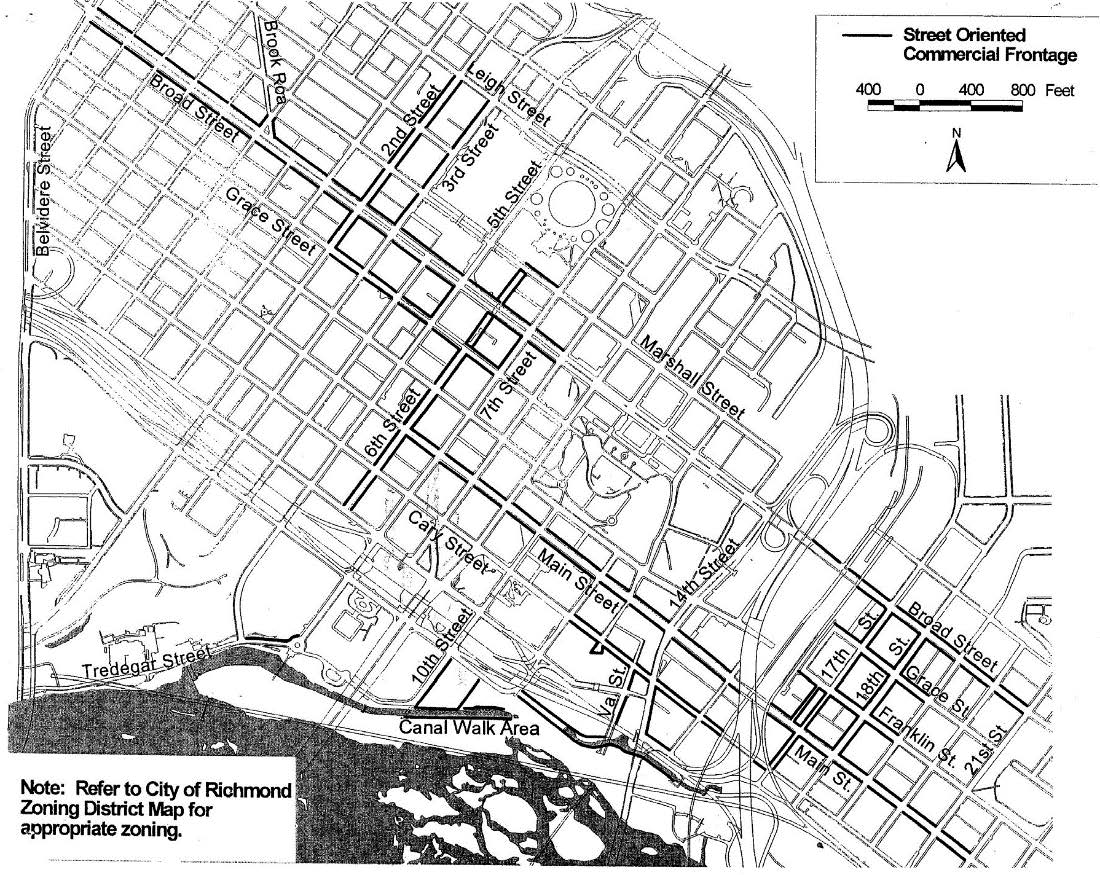
(13)
Funeral homes;
(14)
Furniture repair and upholstery shops;
(15)
Grocery stores, convenience stores and specialty food and beverage stores, including bakeries where products are sold principally at retail on the premises;
(16)
Hospitals, but not psychiatric hospitals for the care of patients committed by a court;
(17)
Hotels, provided that:
a.
No such use shall be located on a transitional site;
b.
The ground floor of portions of buildings adjacent to principal street frontages shall be devoted to those uses specified in subsections (3), (5), (15), (29), (39) or (40) of this section; provided that not more than 50 percent of the frontage of such ground floor may be devoted to entrances or lobbies serving the hotel use, except entrances or lobbies existing at the effective date of this subsection that exceed 50 percent of such frontage shall be permitted, but shall not be expanded to occupy a greater percentage of such frontage;
(18)
Janitorial and custodial service and supply establishments;
(19)
Laboratories and research facilities which are not any more objectional due to smoke, dust, odor, noise, vibration or danger of explosion than other uses permitted in this district, and which do not involve any manufacturing, processing or fabrication other than that incidental to testing or research activities conducted on the premises;
(20)
Laundromats and laundry and dry cleaning pick-up stations;
(21)
Libraries, museums, schools, parks and noncommercial recreational facilities, when such uses are owned or operated by a nonprofit organization;
(22)
Marinas, including facilities for dispensing motor fuels, boathouses, piers and docks;
(22.1)
Permanent supportive housing, subject to the provisions of Section 30-698;
(23)
Nursing homes;
(24)
Office supply, business and office service, photocopy and custom printing establishments;
(25)
Offices, including business, professional and administrative offices, medical and dental offices and clinics, and studios of writers, designers and artists engaged in the graphic arts;
(26)
Parking decks and parking garages, provided that:
a.
No portion of the ground floor of such structure located along a principal street frontage shall be used for parking or related circulation of vehicles, but such portion shall be devoted to other permitted principal uses which shall have a depth of not less than 20 feet along the principal street frontage or to means of pedestrian or vehicle access, provided that vehicle access along such street frontage shall be permitted only when no other street or alley is available for adequate access. In the case of a portion of a story located along a principal street frontage and having less than five feet of its height above the grade level at the building facade along the street frontage, the provisions of this paragraph prohibiting parking or related circulation of vehicles shall not apply, provided that parking spaces shall be completely screened from view from the street by structural material similar to the material of the building facade. Upper stories of such structure may be used for parking or related circulation of vehicles subject to the fenestration requirements set forth in section 30-440.7(2);
b.
Except as provided in paragraph (a) of this subsection (27), parking spaces contained therein shall be screened from view from abutting streets by structural material of not less than 45 percent opacity;
c.
Any card reader or other access control device at an entrance to a parking deck or parking garage shall be provided with not less than one stacking space situated off the public right-of-way;
(27)
Personal loan and financial services;
(28)
Personal service businesses that provide services directly to persons or services for personal items, including barber shops, beauty salons, health spas, fitness centers, dance studios, photography studios, travel agencies, shoe repair shops, tailor and garment alteration and repair shops, clothing rental stores, watch and jewelry repair shops and similar establishments;
(29)
Pet shops, veterinary clinics and animal hospitals, including boarding kennels operated in conjunction therewith, provided that all facilities shall be located within completely enclosed and air conditioned buildings which are soundproof to the extent that sounds produced by animals kept or treated therein are not audible outside the building;
(30)
Postal and package mailing services, but not including package distribution centers;
(31)
Printing, publishing and engraving establishments employing not more than 20 persons on the premises;
(32)
Private elementary and secondary schools having curricula substantially the same as that offered in public schools;
(33)
Professional, business and vocational schools, provided that no heavy machinery, welding equipment or internal combustion engine shall be used in conjunction therewith;
(34)
Public utilities installations, equipment buildings and passenger terminals for public transportation, including servicing of motor vehicles used in connection therewith when such servicing is conducted within a completely enclosed building, provided that no passenger terminal shall be located on a transitional site;
(35)
Radio and television broadcasting studios and offices, including accessory antennas, provided that the supporting hardware for any such antenna does not exceed 15 feet above ground level, or in the case of a building mounted antenna, 15 feet above the surface of the building on which it is mounted;
(36)
Recreation and entertainment uses, including theaters, museums, amusement centers, lodges and clubs, meeting facilities, auditoriums and assembly halls, when such uses are located within completely enclosed buildings, and provided that no such use shall be located on a transitional site;
(37)
Repair businesses conducted within completely enclosed buildings;
(38)
Restaurants, tearooms, cafes, delicatessens, ice cream parlors and similar food and beverage service establishments, including entertainment in conjunction therewith. Such establishments may include areas outside completely enclosed buildings and intended for service to or consumption of food and beverages by patrons, provided that the following conditions shall be met:
a.
No deck, patio, terrace or other area outside a completely enclosed building and used for the service or accommodation of patrons shall be situated within 100 feet of any property in any R district;
b.
Covered trash containers shall be provided in service areas, and fences, walls or vegetative screening shall be provided around service areas, except at entrances and exits, to prevent refuse from blowing onto adjacent properties or streets. Fences or walls to be credited toward this requirement shall comply with fence and wall design guidelines adopted by resolution of the planning commission, or their equivalent as determined by the zoning administrator. In no case shall chain link, chain link with slats or similar fencing be considered as meeting the requirements of the fence and wall design guidelines;
c.
No music or public address system shall be operated in such a manner that sound produced therefrom is audible beyond the boundaries of the premises.
(39)
Retail stores and shops, provided that not more than 70 percent of the floor area may be devoted to storage of merchandise to be sold at retail on the premises;
(40)
Rights-of-way, easements and appurtenances necessary for the provision and maintenance of public utilities and public transportation, including streets, rail lines, power lines, cables, poles, pipes, meters, transformers and similar devices;
(41)
Sales lots for Christmas trees, vegetable stands and other seasonal uses, but not including flea markets, and provided no such use shall be located on a transitional site;
(42)
Service businesses that service, repair or rent audio or video equipment, home appliances, furniture, personal recreational equipment, home yard and garden equipment, tools, bicycles, locks, computers, office machines and similar household or business items; provided that no products shall be serviced, repaired, stored or displayed outside a completely enclosed building;
(43)
Shopping centers containing uses permitted in this district;
(44)
Showrooms and display areas for goods which are sold at both wholesale and retail on the premises, including the storage and distribution of such goods in conjunction therewith;
(45)
Social service delivery uses, in accordance with Section 30-698.3(d);
(46)
Tourist homes;
(46.1)
Transitional housing, subject to the provisions of Section 30-698;
(47)
Uses owned or operated by a governmental agency, but not including facilities intended for incarceration or alternative sentencing or facilities primarily for the care, treatment or housing of persons who are currently illegally using or are addicted to a controlled substance as defined in section 54.1-3401 of the Code of Virginia;
(48)
Wireless communications facilities, microwave relay facilities, and radio broadcast antennas, on alternative support structures, in accordance with the additional requirements of sections 30-692.1 through 30-692.6;
(49)
Short-term rental, subject to the requirements of Article VI, Division 14 of this chapter;
(50)
Accessory uses and structures customarily incidental and clearly subordinate to uses permitted in this district, including automated teller machines accessible only from the interior of buildings devoted to permitted principal uses other than individual dwelling units or lodging units.
(Code 1993, § 32-440.1; Code 2004, § 114-440.1; Code 2015, § 30-440.1; Ord. No. 2004-180-167, §§ 2, 4, 6-28-2004; Ord. No. 2006-43-63, § 1, 3-13-2006; Ord. No. 2009-221-2010-9, § 1, 1-25-2010; Ord. No. 2010-177-173, § 3, 10-11-2010; Ord. No. 2011-205-2012-1, § 1, 1-9-2012; Ord. No. 2017-019, § 1, 2-27-2017; Ord. No. 2019-170, § 1, 7-22-2019; Ord. No. 2019-343, § 1(30-440.1), 6-22-2020; Ord. No. 2020-261, § 1, 3-8-2021; Ord. No. 2024-314, § 2, 12-9-2024)
Sec. 30-440.2. - Principal uses permitted by conditional use permit.
The following uses of buildings and premises may be permitted in the B-4 district by conditional use permit as set forth in article X of this chapter:
(1)
Lodginghouses;
(2)
Nightclubs;
(3)
Retail sales of liquor;
(4)
Retail sales of tobacco and hemp.
(Code 2004, § 114-440.2; Code 2015, § 30-440.2; Ord. No. 2004-180-167, § 4, 6-28-2004; Ord. No. 2011-29-150, § 12, 9-12-2011; Ord. No. 2012-234-2013-2, § 1, 1-14-2013; Ord. No. 2017-019, § 1, 2-27-2017; Ord. No. 2019-170, § 1, 7-22-2019; Ord. No. 2020-261, § 1, 3-8-2021; Ord. No. 2025-157, § 1, 7-28-2025)
Sec. 30-440.3. - Yards.
Yard regulations in the B-4 district shall be as follows (see Article VI, Division 4 of this chapter):
(1)
Front yard.
a.
Where no existing buildings are located on adjacent lots along the same street frontage, no front yard shall be required. In no case shall a front yard with a depth greater than ten feet be permitted, except as may be authorized pursuant to subsection (1)d of this section.
b.
Where an existing building is located on one adjacent lot along the same street frontage, the front yard shall be the same as the front yard provided for such existing building, but in no case greater than ten feet. Where the front yard of such existing building is greater than ten feet, the front yard requirement shall be ten feet. A front yard with a depth greater than permitted by this subsection may be authorized pursuant to subsection (1)d of this section.
c.
Where existing buildings are located on both adjacent lots along the same street frontage, the front yard shall be the same as the front yard provided for the existing building closest to the street, but in no case greater than ten feet. Where the front yard of the existing building closest to the street is greater than ten feet, the front yard requirement shall be ten feet. A front yard with a depth greater than permitted by this subsection may be authorized pursuant to subsection (1)d of this section.
d.
A front yard with a depth greater than permitted by subsections (1)a through c of this section may be provided when such front yard is improved for purposes of a pedestrian plaza, outdoor dining area as permitted by Section 30-440.1 or vehicular drop-off or pick-up area permitted by Section 30-440.4:1, and is approved subject to a site plan as set forth in Article X of this chapter. Except where the property is within an old and historic district, the City Urban Design Committee shall review the application and plans and submit a recommendation to the Director of Planning and Development Review prior to approval of such site plan by the Director.
e.
A building entrance feature that is set back from the street a greater distance than the primary building façade along the street and that is no greater than two times the width of the building entranceway shall be permitted and shall not be subject to this subsection.
(2)
Side yards. No side yards shall be required except as provided in subsection (4) of this section, and except that where a side lot line abuts property in an R or RO district there shall be a side yard of not less than ten feet in width.
(3)
Rear yard. No rear yard shall be required except as provided in subsection (4) of this section, and except that where a rear lot line abuts or is situated across an alley from property in an R or RO district, there shall be a rear yard of not less than 20 feet in depth.
(4)
Side and rear yards adjacent to shelters. Side and rear yards adjacent to newly constructed buildings or portions thereof devoted to shelters shall be not less than 15 feet in depth.
(5)
Spaces between buildings on same lot. Where two or more buildings, at least one of which contains a dwelling use, are erected on the same lot, the distance between any two such buildings shall be not less than 15 feet.
(Code 1993, § 32-440.3; Code 2004, § 114-440.3; Code 2015, § 30-440.3; Ord. No. 2010-177-173, § 3, 10-11-2010; Ord. No. 2011-205-2012-1, § 1, 1-9-2012; Ord. No. 2024-314, § 2, 12-9-2024)
Sec. 30-440.4. - Screening.
Screening regulations in the B-4 Central Business District shall be as follows:
(1)
Where a side lot line abuts property in an R district, there shall be a continuous evergreen vegetative screen not less than 3½ feet in height at the time of installation or opaque structural fence or wall not less than four feet in height erected along such lot line, but not within 15 feet of any street line. Evergreen vegetative material intended to satisfy this subsection shall be planted at such intervals that will result in a continuous visual screen within one year of planting.
(2)
Where a use prohibited on a transitional site is situated across an alley from the side lot line of property in an R district, there shall be an opaque structural fence or wall not less than four feet in height erected along the alley line, but not within 15 feet of any street line.
(3)
Screening of parking areas and refuse areas shall be provided as set forth in Sections 30-660 and 30-710.12.
(Code 1993, § 32-440.4; Code 2004, § 114-440.4; Code 2015, § 30-440.4)
Sec. 30-440.4:1. - Requirements for areas devoted to parking or circulation of vehicles.
(a)
Location of parking and circulation areas. Areas devoted to the parking or circulation of vehicles shall not be located between the main building on a lot and the street line nor shall such areas be located closer to the street than the main building on the lot. On a lot having more than one street frontage, this subsection shall apply along both the principal street frontage and the priority street frontage. This subsection shall not be construed to prohibit vehicular drop-off or pick-up areas serving hotels or hospitals when approved in accordance with Section 30-440.3(1).
(b)
Driveways from streets. No driveway intersecting a street which constitutes the principal street frontage or priority street frontage of a lot shall be permitted when other street frontage or alley access is available to serve such lot. This subsection shall not be construed to prohibit vehicular drop-off or pick-up areas serving hotels or hospitals when approved in accordance with Section 30-440.3(1).
(c)
Improvement requirements and landscaping standards. In addition to subsections (a) and (b) of this section, parking areas and parking lots shall be subject to the applicable improvement requirements and landscaping standards set forth in Article VII, Division 2.1 of this chapter.
(Code 2004, § 114-440.4:1; Code 2015, § 30-440.4:1; Ord. No. 2010-177-173, § 1, 10-11-2010; Ord. No. 2019-170, § 1, 7-22-2019)
Sec. 30-440.5. - Floor area and usable open space.
In the B-4 Central Business District, the following floor area and usable open space ratios shall be applicable (see Section 30-1220):
(1)
Floor area ratio. The floor area ratio shall not exceed 6.0, provided that additional floor area for nondwelling uses shall be permitted as set forth in Section 30-690.
(2)
Usable open space ratio. A usable open space ratio of not less than 0.08 shall be provided for newly constructed buildings or portions thereof devoted to dwelling uses or shelters.
(Code 1993, § 32-440.5; Code 2004, § 114-440.5; Code 2015, § 30-440.5)
Sec. 30-440.6. - Height.
For purposes of this section, story height shall not be less than ten feet nor greater than 15 feet, except that the ground floor of a building may be of greater height. Height regulations in the B-4 district shall be as follows:
(1)
Maximum height. There shall be no maximum height limit in the B-4 Central Business District, provided that no portion of a building shall penetrate an inclined plane originating at the centerline of each abutting street and extending over the lot at an inclination of one foot horizontal for each four feet vertical.
(2)
Minimum height. Every main building hereinafter constructed shall have a minimum height of three stories, except that porches, porticos, and similar structures attached to a main building may be of lesser height.
(3)
Determination of number of stories. For purposes of this section, the number of stories in a building shall be determined by application of the definition of the term "story" set forth in Article XII of this chapter and shall be measured at the building façade along the principal street frontage of the lot.
(Code 1993, § 32-440.6; Code 2004, § 114-440.6; Code 2015, § 30-440.6; Ord. No. 2011-205-2012-1, § 1, 1-9-2012; Ord. No. 2019-170, § 1, 7-22-2019)
Sec. 30-440.7. - Building façade fenestration.
Fenestration requirements applicable to building façades along street frontages in the B-4 district shall be as set forth in this section. In the case of a corner, the requirements shall be applicable along both the principal street frontage of the lot or both the principal street frontage and the priority street frontage where applicable.
(1)
Street level story.
a.
Non-dwelling uses. For non-dwelling uses, other than those listed in Section 30-440.1(1), (7), (8), (9), (13), (15), (17), (29), (31), (43), and (44), a minimum of 60 percent of the building façade between two and eight feet in height along the street frontage shall be comprised of windows or glass doors or both that allow views into and out of the interior building space. Windows used to satisfy this requirement shall have a minimum height of four feet. In the case of a street level story having less than its full height above the mean grade level at the building façade along the street frontage of the lot, a minimum of 30 percent of the building façade above such mean grade level shall be comprised of windows or glass doors or both that allow views into and out of the interior building space, provided that in the case of any portion of a story having less than five feet of its height above the grade level at the building façade along the street frontage of the lot, the requirements of this subsection shall not apply.
b.
Dwelling uses. For dwelling uses, tourist homes, and shelters, windows or glass doors or both that allow views out of the interior building space shall comprise a minimum of 30 percent of the building façade between two and eight feet in height along the street frontage. In the case of a street level story having less than its full height above the mean grade level at the building façade along the street frontage of the lot, windows or glass doors or both that allow views out of the interior building space shall comprise a minimum of 15 percent of the building façade above such mean grade level, provided that in the case of any portion of a story having less than five feet of its height above the grade level at the building façade along the street frontage of the lot, the requirements of this subsection shall not apply. In all cases, windows shall be double-hung, single-hung, awning, or casement type and fixed windows shall be permitted only as a component of a system including operable windows within a single wall opening.
(2)
Upper stories.
a.
Non-dwelling uses. For non-dwelling uses, other than those listed in subsection (1)a of this section, windows or glass doors or both that allow views out of the interior building space shall comprise a minimum of 30 percent of the building façade between two and eight feet in height above the floor level of each story above the street level story.
b.
Dwelling uses. For dwelling uses, tourist homes, and shelters, windows or glass doors or both that allow views out of the interior building space shall comprise a minimum of 30 percent of the building façade between two and eight feet in height above the floor level of each story above the street level story. Such windows shall be double-hung, single-hung, awning, or casement type and fixed windows shall be permitted only as a component of a system including operable windows within a single wall opening.
(Code 2004, § 114-440.7; Code 2015, § 30-440.7; Ord. No. 2010-177-173, § 1, 10-11-2010; Ord. No. 2011-205-2012-1, § 1, 1-9-2012; Ord. No. 2019-170, § 1, 7-22-2019)
Sec. 30-442.1.- Permitted principal and accessory uses.
The following uses of buildings and premises shall be permitted in the B-5 district, provided that drive-up facilities and facilities for dispensing motor fuels shall not be permitted in conjunction with any of the uses permitted in the district.
(1)
Adult care facilities;
(2)
Art galleries;
(3)
Banks, savings and loan offices and similar financial services, including accessory automated teller machines accessible only from the interior of buildings devoted to such uses;
(4)
Day nurseries licensed by and subject to the requirements of the Virginia Department of Social Services;
(5)
Dry cleaning and laundering establishments, provided that the total capacity of all dry cleaning machines shall not exceed 100 pounds dry weight and the total capacity of all laundry machines shall not exceed 150 pounds dry weight, and provided further that no such use shall be located on a transitional site;
(6)
Dwelling units, provided that when such units are located within buildings fronting on streets designated as street oriented commercial frontage, as shown on the official zoning map, a minimum of one-third or 1,000 square feet, whichever is greater, of the floor area of the ground floor of the building shall be devoted to other principal uses permitted in this district, and such uses shall have a depth of not less than 20 feet along the entire street oriented commercial frontage, except for ingress and egress;
(7)
Grocery stores, convenience stores and specialty food and beverage stores, including bakeries where products are sold principally at retail on the premises;
(8)
Hotels, provided that:
a.
No such use shall be located on a transitional site;
b.
The ground floor of portions of buildings adjacent to principal street frontages or any priority street frontage shall be devoted to those uses specified in subsection (2), (3), (7), (14), (20), or (21) of this section, provided that not more than 30 percent of the frontage of such ground floor may be devoted to entrances or lobbies serving the hotel use;
(9)
Laundromats and laundry and dry cleaning pick-up stations;
(10)
Libraries, museums, schools, parks and noncommercial recreational facilities, when such uses are owned or operated by a governmental agency or a nonprofit organization; and other uses required for the performance of a governmental function and primarily intended to serve residents of adjoining neighborhoods;
(11)
Office supply, business and office service, photocopy and custom printing establishments;
(12)
Offices, including business, professional and administrative offices, medical and dental offices and clinics, and studios of writers, designers and artists engaged in the graphic arts;
(13)
Parking decks and parking garages, provided that:
a.
No portion of such structure located along a principal street frontage or priority street frontage shall be used for parking or related circulation of vehicles, but such portion shall be devoted to other permitted principal uses which shall have a depth of not less than 20 feet along the principal street frontage or priority street frontage or to means of pedestrian or vehicle access, provided that vehicle access along such street frontage shall be permitted only when no other street or alley is available for adequate access. In the case of a portion of a story located along a principal street frontage or a priority street frontage and having less than five feet of its height above the grade level at the building façade along the street frontage, the provisions of this paragraph prohibiting parking or related circulation of vehicles shall not apply, provided that parking spaces shall be completely screened from view from the street by structural material similar to the material of the building façade;
b.
Except as provided in paragraph a of this subsection (13), parking spaces contained therein shall be screened from view from abutting streets by structural material of not less than 45 percent opacity;
c.
Any card reader or other access control device at an entrance to a parking deck or parking garage shall be provided with not less than one stacking space situated off the public right-of-way;
(14)
Personal service businesses that provide services directly to persons or services for personal items, including barber shops, beauty salons, health spas, fitness centers, dance studios, photography studios, travel agencies, shoe repair shops, tailor and garment alteration and repair shops, clothing rental stores, watch and jewelry repair shops and similar establishments;
(15)
Pet shops, veterinary clinics, and animal hospitals, including boarding kennels operated in conjunction therewith, provided that all facilities shall be located within completely enclosed and air conditioned buildings which are soundproof to the extent that sounds produced by animals kept or treated therein are not audible outside the building;
(16)
Postal and package mailing services, but not including package distribution centers;
(17)
Printing, publishing and engraving establishments employing not more than 20 persons on the premises;
(18)
Professional, business and vocational schools, provided that no heavy machinery, welding equipment or internal combustion engine shall be used in conjunction therewith;
(19)
Recreation and entertainment uses, including theaters and museums, when such uses are located within completely enclosed buildings, and provided that no such use shall be located on a transitional site;
(20)
Restaurants, tearooms, cafes, delicatessens, ice cream parlors and similar food and beverage service establishments, including catering businesses and entertainment in conjunction therewith. Such establishments may include areas outside completely enclosed buildings and intended for service to or consumption of food and beverages by patrons, provided that the following conditions shall be met:
a.
No deck, patio, terrace or other area outside a completely enclosed building and used for the service or accommodation of patrons shall be situated within 100 feet of any property in any R district;
b.
Covered trash containers shall be provided in service areas, and fences, walls or vegetative screening shall be provided around service areas, except at entrances and exits, to prevent refuse from blowing onto adjacent properties or streets. Fences or walls to be credited toward this requirement shall comply with fence and wall design guidelines adopted by resolution of the planning commission, or their equivalent as determined by the zoning administrator. In no case shall chain link, chain link with slats or similar fencing be considered as meeting the requirements of the fence and wall design guidelines;
c.
No music or public address system shall be operated in such a manner that sound produced therefrom is audible beyond the boundaries of the premises;
(21)
Retail stores and shops;
(22)
Rights-of-way, easements and appurtenances necessary for the provision and maintenance of public utilities and public transportation, including streets, rail lines, power lines, cables, poles, pipes, meters, transformers and similar devices, but not including railroad yards, freight or passenger depots, loading platforms, generating plants, transformer stations, electric substations, wastewater treatment plants, water treatment plants, utility storage yards and similar uses;
(23)
Sales lots for Christmas trees, vegetable stands, and other seasonal uses, but not including flea markets, and provided no such use shall be located on a transitional site;
(24)
Service businesses that service, repair or rent audio or video equipment, home appliances, furniture, personal recreational equipment, home yard and garden equipment, tools, bicycles, locks, computers, office machines and similar household or business items; provided that no products shall be serviced, repaired, stored or displayed outside a completely enclosed building;
(25)
Showrooms and display areas for goods which are sold at both wholesale and retail on the premises, including the storage and distribution of such goods in conjunction therewith;
(26)
Uses owned or operated by a governmental agency, but not including facilities intended for incarceration or alternative sentencing or facilities primarily for the care, treatment, or housing of persons who are currently illegally using or are addicted to a controlled substance as that term is defined in Code of Virginia, § 54.1-3401;
(27)
Wireless communications facilities, microwave relay facilities, and radio broadcast antennas, on alternative support structures, in accordance with the additional requirements of Sections 30-692.1 through 30-692.6;
(27.1)
Short-term rental, subject to the requirements of Article VI, Division 14 of this chapter;
(28)
Accessory uses and structures customarily incidental and clearly subordinate to uses permitted in this district, including automated teller machines accessible only from the interior of buildings devoted to permitted principal uses other than individual dwelling units or lodging units.
(Code 1993, § 32-442.1; Code 2004, § 114-442.1; Code 2015, § 30-442.1; Ord. No. 2004-180-167, §§ 2, 4, 6-28-2004; Ord. No. 2006-43-63, § 1, 3-13-2006; Ord. No. 2010-177-173, § 3, 10-11-2010; Ord. No. 2011-205-2012-1, § 1, 1-9-2012; Ord. No. 2017-019, § 1, 2-27-2017; Ord. No. 2018-049, § 1, 3-26-2018; Ord. No. 2019-343, § 1(30-442.1), 6-22-2020; Ord. No. 2020-171, § 1(30-442.1), 9-28-2020; Ord. No. 2024-314, § 2, 12-9-2024)
Sec. 30-442.1:1. - Principal uses permitted by conditional use permit.
The following uses of buildings and premises may be permitted in the B-5 district by conditional use permit as set forth in article X of this chapter:
(1)
Nightclubs;
(2)
Parking areas and parking lots;
(3)
Retail sales of liquor;
(4)
Retail sales of tobacco and hemp.
(Code 2004, § 114-442.1.1; Code 2015, § 30-442.1:1; Ord. No. 2011-29-150, § 4, 9-12-2011; Ord. No. 2012-234-2013-2, § 1, 1-14-2013; Ord. No. 2017-019, § 1, 2-27-2017; Ord. No. 2025-157, § 1, 7-28-2025)
Sec. 30-442.2. - Nonconforming uses.
Alterations to buildings or structures devoted to nonconforming uses in the B-5 Central Business District shall be subject to Section 30-800.1.
(Code 1993, § 32-442.2; Code 2004, § 114-442.2; Code 2015, § 30-442.2)
Sec. 30-442.4. - Yards.
Yard regulations in the B-5 district shall be as follows (see Article VI, Division 4 of this chapter):
(1)
Front yard.
a.
No front yard shall be required. In no case shall a front yard with a depth greater than ten feet be permitted, provided further that not more than ten percent of the building wall of the street level story along the street shall be set back more than ten feet, except as may be authorized pursuant to subsections (1)b and (1)c of this section.
b.
A front yard with a depth greater than permitted by subsection (1)a of this section may be provided when such front yard is improved for purposes of a pedestrian plaza or outdoor dining area as permitted by Section 30-440.1 and is approved subject to a site plan as set forth in Article X of this chapter. Except where the property is within an old and historic district, the City Urban Design Committee shall review the application and plans and submit a recommendation to the Director of Planning and Development Review prior to approval of such site plan by the Director.
c.
A building entrance feature that is set back from the street a greater distance than the primary building façade along the street and that is no greater than two times the width of the building entranceway shall be permitted, and shall not be subject to this subsection.
(2)
Side yards. No side yards shall be required, except that where a side lot line abuts or is situated across an alley from property in an R or RO district there shall be a side yard of not less than ten feet in width.
(3)
Rear yard. No rear yard shall be required, except that where a rear lot line abuts or is situated across an alley from property in an R or RO district there shall be a rear yard of not less than 20 feet in depth.
(Code 1993, § 32-442.4; Code 2004, § 114-442.4; Code 2015, § 30-442.4; Ord. No. 2010-177-173, § 3, 10-11-2010; Ord. No. 2020-171, § 1(30-442.4), 9-28-2020; Ord. No. 2024-314, § 2, 12-9-2024)
Sec. 30-442.5. - Screening.
Screening regulations in the B-5 Central Business District shall be as follows:
(1)
Where a side lot line abuts property in an R district, there shall be a continuous evergreen vegetative screen not less than 3½ feet in height at the time of installation or opaque structural fence or wall not less than four feet in height erected along such lot line, but not within 15 feet of any street line. Evergreen vegetative material intended to satisfy this subsection shall be planted at such intervals that will result in a continuous visual screen within one year of planting.
(2)
Screening of parking areas and refuse areas shall be provided as set forth in Sections 30-660 and 30-710.12.
(Code 1993, § 32-442.5; Code 2004, § 114-442.5; Code 2015, § 30-442.5)
Sec. 30-442.5:1. - Requirements for areas devoted to parking or circulation of vehicles.
(a)
Location of parking and circulation areas. Areas devoted to the parking or circulation of vehicles shall not be located between the main building on a lot and the street line, nor shall such areas be located closer to the street than the main building on the lot. On a lot having more than one street frontage, this subsection shall apply to the principal street frontage of the lot as defined in Section 30-1220 as well as to any priority street frontage.
(b)
Driveways from streets. No driveway intersecting a street that constitutes the principal street frontage or priority street frontage of a lot shall be permitted when other street frontage or alley access is available to serve such lot. For purposes of this subsection, principal street frontage shall be as defined in Section 30-1220.
(c)
Improvement requirements and landscaping standards. In addition to subsections (a) and (b) of this section, parking areas and parking lots shall be subject to the applicable improvement requirements and landscaping standards set forth in Article VII, Division 2.1 of this chapter.
(Code 2004, § 114-442.5:1; Code 2015, § 30-442.5:1; Ord. No. 2010-177-173, § 2, 10-11-2010; Ord. No. 2018-049, § 1, 3-26-2018)
Sec. 30-442.6. - Height.
Height regulations in the B-5 district shall be as follows:
(1)
Maximum height. No building shall exceed five stories in height. For purposes of this Section 30-442.6, story height as defined in Article XII of this chapter shall be not less than ten feet and not greater than 15 feet, except that the ground floor of a building may be of greater height.
(2)
Minimum height. Every main building hereinafter constructed shall have a minimum height of not less than two stories, except that porches, porticos and similar structures attached to a main building may be of lesser height.
(3)
Determination of number of stories. For purposes of this Section 30-442.6, the number of stories in a building shall be determined by application of the definition of the term "story" set forth in Article XII of this chapter and shall be measured at the building façade along the street frontage of the lot or, in the case of a corner lot, shall be measured at the building façade along the principal street frontage of the lot.
(Code 1993, § 32-442.6; Code 2004, § 114-442.6; Code 2015, § 30-442.6; Ord. No. 2010-177-173, § 3, 10-11-2010; Ord. No. 2011-205-2012-1, § 1, 1-9-2012)
Sec. 30-442.7. - Building façade fenestration.
Fenestration requirements applicable to building façades along street frontages in the B-5 district shall be as set forth in this section. In the case of a corner lot, the requirements shall be applicable along the principal street frontage of the lot as well as along any priority street frontage of the lot.
(1)
Street level story.
a.
Nondwelling uses. For nondwelling uses, a minimum of 60 percent of the building façade between two and eight feet in height along the street frontage shall be comprised of windows or glass doors or both that allow views into and out of the interior building space. Windows used to satisfy this requirement shall have a minimum height of four feet. In the case of a street level story having less than its full height above the mean grade level at the building façade along the street frontage of the lot, a minimum of 30 percent of the building façade above such mean grade level shall be comprised of windows or glass doors or both that allow views into and out of the interior building space, provided that in the case of any portion of a story having less than five feet of its height above the grade level at the building façade along the street frontage of the lot, the requirements of this subsection shall not apply.
b.
Dwelling uses. For dwelling uses, windows or glass doors or both that allow views out of the interior building space shall comprise a minimum of 30 percent of the building façade between two and eight feet in height along the street frontage. In the case of a street level story having less than its full height above the mean grade level at the building façade along the street frontage of the lot, windows or glass doors or both that allow views out of the interior building space shall comprise a minimum of 15 percent of the building façade above such mean grade level, provided that in the case of any portion of a story having less than five feet of its height above the grade level at the building façade along the street frontage of the lot, the requirements of this subsection shall not apply. In all cases, windows shall be double-hung, single-hung, awning or casement type, and fixed windows shall be permitted only as a component of a system including operable windows within a single wall opening.
(2)
Upper stories.
a.
Nondwelling uses. For nondwelling uses, windows or glass doors or both that allow views out of the interior building space shall comprise a minimum of 30 percent of the building façade between two and eight feet in height above the floor level of each story above the street level story.
b.
Dwelling uses. For dwelling uses, windows or glass doors or both that allow views out of the interior building space shall comprise a minimum of 30 percent of the building façade between two and eight feet in height above the floor level of each story above the street level story. Such windows shall be double-hung, single-hung, awning or casement type, and fixed windows shall be permitted only as a component of a system including operable windows within a single wall opening.
(Code 2004, § 114-442.7; Code 2015, § 30-442.7; Ord. No. 2010-177-173, § 2, 10-11-2010; Ord. No. 2011-205-2012-1, § 1, 1-9-2012; Ord. No. 2018-049, § 1, 3-26-2018)
Sec. 30-444.1.- Intent of district.
Pursuant to the general purposes of this chapter, the intent of the B-6 district is to encourage development of mixed land uses consistent with the objectives of the master plan and the downtown plan, and to promote enhancement of the character of development along principal corridors and in other areas. The district regulations are intended to encourage appropriate infill development on undeveloped land, promote adaptive reuse of underutilized buildings or enable redevelopment of properties where continuation of current uses or adaptive reuse is not feasible, depending on the character and needs of particular areas. The district regulations are also intended to safeguard the character of adjoining properties, to maintain existing streetscape character by providing continuity of building setbacks and heights, to enhance public safety and encourage an active pedestrian environment appropriate to the mixed use character of the district by providing for windows in building façades along street frontages, and to promote an environment that is conducive to preservation of important historic, architectural and cultural features that may exist within the district. Finally, the district regulations are intended to ensure adequate accessible parking and safe vehicular and pedestrian circulation, to facilitate a streetscape with minimum setbacks along principal street frontages and to provide for limited interruption by driveways and vehicular traffic across public sidewalk areas along principal street frontages.
(Code 2004, § 114-444.1; Code 2015, § 30-444.1; Ord. No. 2006-168-189, § 1, 7-10-2006)
Sec. 30-444.2. - Permitted principal and accessory uses.
The following uses of buildings and premises shall be permitted in the B-6 district, provided that drive-up facilities and facilities for dispensing motor fuels shall not be permitted in conjunction with any of the uses permitted in the district.
(1)
Adult day care facilities.
(2)
Art galleries.
(3)
Banks, savings and loan offices and similar financial services, including accessory ATM's accessible from the interior or exterior of buildings devoted to such uses.
(4)
Catering businesses.
(5)
Day nurseries licensed by and subject to the requirements of the State Department of Social Services.
(6)
Dry cleaning and laundering establishments, provided that the total capacity of all dry cleaning machines shall not exceed 100 pounds dry weight and the total capacity of all laundry machines shall not exceed 150 pounds dry weight.
(7)
Dwelling units, provided that when such units are located within buildings fronting on streets designated as street oriented commercial frontage, as shown on the official zoning map, a minimum of one-third or 1,000 square feet, whichever is greater, of the floor area of the ground floor of the building shall be devoted to other principal uses permitted in this district, and such uses shall have a depth of not less than 20 feet along the entire street oriented commercial frontage, except for ingress and egress.
(8)
Entertainment, cultural and recreational uses, including theaters, art galleries, museums, bowling alleys, amusement centers, and other commercial recreation facilities located within completely enclosed buildings.
(9)
Grocery stores, convenience stores and specialty food and beverage stores, including bakeries where products are sold principally at retail on the premises.
(10)
Hotels, provided that:
a.
No such use shall be located on a transitional site.
b.
The area of the lot devoted to such use shall be not less than 25,000 square feet, and no property line coincidental with a street line shall be less than 100 feet in length.
c.
The ground floor of portions of buildings adjacent to principal street frontages shall be devoted to those uses specified in subsection (2), (3), (9), (17), (22), or (24) of this section, provided that not more than 30 percent of the frontage of such ground floor may be devoted to entrances or lobbies serving the hotel use.
(11)
Laundromats and dry cleaning pick-up stations.
(12)
Libraries, museums, schools, parks and noncommercial recreational facilities, when such uses are owned or operated by a nonprofit organization.
(13)
Office supply, business and office service, photocopy and custom printing establishments.
(14)
Offices, including business, professional and administrative offices, medical and dental offices and clinics, and studios of writers, designers and artists engaged in the arts.
(15)
Parking areas and parking lots, provided that any card reader or other access control device at an entrance to a parking area or parking lot shall be provided with not less than one stacking space situated off the public right-of-way.
(16)
Parking decks and parking garages, provided that:
a.
No portion of such structure located along a principal street frontage shall be used for parking or related circulation of vehicles, but such portion shall be devoted to other permitted principal uses which shall have a depth of not less than 20 feet along the principal street frontage or to means of pedestrian or vehicle access, provided that vehicle access along such street frontage shall be permitted only when no other street or alley is available for adequate access. In the case of a portion of a story located along a principal street frontage and having less than five feet of its height above the grade level at the building façade along the street frontage, the provisions of this paragraph prohibiting parking or related circulation of vehicles shall not apply, provided that parking spaces shall be completely screened from view from the street by structural material similar to the material of the building façade.
b.
Except as provided in subsection (16)a of this section, parking spaces contained therein shall be screened from view from abutting streets by structural material of not less than 45 percent opacity.
c.
Not less than one exit lane and one entrance lane shall be provided for each 300 parking spaces or major fraction thereof contained within the structure, and any card reader or other access control device at an entrance to a parking deck or parking garage shall be provided with not less than one stacking space situated off the public right-of-way.
(17)
Personal service businesses that provide services directly to persons or services for personal items, including barber shops, beauty salons, health spas, fitness centers, dance studios, photography studios, travel agencies, shoe repair shops, tailor and garment alteration and repair shops, clothing rental stores, watch and jewelry repair shops and similar establishments.
(18)
Pet shops, veterinary clinics and animal hospitals, including boarding kennels operated in conjunction therewith, provided that all facilities shall be located within completely enclosed and air conditioned buildings which are soundproof to the extent that sounds produced by animals kept or treated therein are not audible outside the building.
(19)
Postal and package mailing services, but not including distribution centers.
(20)
Professional, business and vocational schools when located above the ground floor of buildings, provided that no heavy machinery, welding equipment or internal combustion engine shall be used in conjunction therewith.
(21)
Radio and television broadcasting studios and offices, including accessory antennas, provided that the supporting hardware for any such antenna does not exceed 15 feet above ground level, or in the case of a building-mounted antenna, 15 feet above the surface of the building on which it is mounted.
(22)
Restaurants, tea rooms, cafes, delicatessens, ice cream parlors and similar food and beverage service establishments, including entertainment in conjunction therewith. Such establishments may include areas outside completely enclosed buildings and intended for service to or consumption of food and beverages by patrons, provided that the following conditions shall be met:
a.
No deck, patio, terrace or other area outside a completely enclosed building and used for the service or accommodation of patrons shall be situated within 100 feet of any property in any R district.
b.
Covered trash containers shall be provided in service areas, and fences, walls or vegetative screening shall be provided around service areas, except at entrances and exits, to prevent refuse from blowing onto adjacent properties or streets. Fences or walls to be credited toward this requirement shall comply with fence and wall design guidelines adopted by resolution of the Planning Commission, or their equivalent as determined by the Zoning Administrator. In no case shall chain link, chain link with slats or similar fencing be considered as meeting the requirements of the fence and wall design guidelines.
c.
No music or public address system shall be operated in such a manner that sound produced therefrom is audible beyond the boundaries of the premises.
(23)
Retail sales and food or beverage sales conducted in an open area or structure by one or more individual vendors operating from stalls, stands, carts or other spaces which are rented or otherwise made available to such vendors.
(24)
Retail stores and shops.
(25)
Rights-of-way, easements and appurtenances necessary for the provision and maintenance of public utilities and public transportation, including streets, rail lines, power lines, cables, poles, pipes, meters, transformers and similar devices, but not including railroad yards, freight or passenger depots, loading platforms, generating plants, transformer stations, electric substations, wastewater treatment plants, water treatment plants, utility storage yards and similar uses, unless owned or operated by a government agency.
(26)
Service businesses that service, repair or rent audio or video equipment, home appliances, furniture, personal recreational equipment, home yard and garden equipment, tools, bicycles, locks, computers, office machines and similar household or business items; provided that no products shall be serviced, repaired, stored or displayed outside a completely enclosed building and no internal combustion engine shall be repaired or serviced.
(27)
Showrooms and display areas for goods which are sold at both wholesale and retail on the premises, including the storage and distribution of such goods in conjunction therewith.
(28)
Uses owned or operated by a governmental agency, but not including facilities intended for incarceration or alternative sentencing or facilities primarily for the care, treatment or housing of persons who are currently illegally using or are addicted to a controlled substance as defined in Code of Virginia, § 54.1-3401.
(29)
Wireless communications facilities, microwave relay facilities, and radio broadcast antennas, on alternative support structures, in accordance with the additional requirements of Sections 30-692.1 through 30-692.6.
(29.1)
Short-term rental, subject to the requirements of Article VI, Division 14 of this chapter.
(30)
Accessory uses and structures, including ATMs accessible only from the interior of buildings devoted to permitted principal uses other than individual dwelling units or lodging units.
(Code 2004, § 114-444.2; Code 2015, § 30-444.2; Ord. No. 2006-168-189, § 1, 7-10-2006; Ord. No. 2009-36-56, § 1, 4-27-2009; Ord. No. 2011-205-2012-1, § 1, 1-9-2012; Ord. No. 2019-343, § 1(30-444.2), 6-22-2020; Ord. No. 2020-171, § 1(30-444.2), 9-28-2020; Ord. No. 2024-314, § 2, 12-9-2024)
Sec. 30-444.2:1. - Principal uses permitted by conditional use permit.
The following uses of buildings and premises may be permitted in the B-6 district by conditional use permit as set forth in Article X of this chapter:
(1)
Nightclubs;
(2)
Retail sales of liquor;
(3)
Retail sales of tobacco and hemp.
(Code 2004, § 114-444.2.1; Code 2015, § 30-444.2:1; Ord. No. 2011-29-150, § 5, 9-12-2011; Ord. No. 2012-234-2013-2, § 1, 1-14-2013; Ord. No. 2025-157, § 1, 7-28-2025)
Sec. 30-444.3. - Nonconforming uses.
Alterations to buildings or structures devoted to nonconforming uses in the B-6 district shall be subject to the provisions of Section 30-800.1.
(Code 2004, § 114-444.3; Code 2015, § 30-444.3; Ord. No. 2006-168-189, § 1, 7-10-2006)
Sec. 30-444.4. - Yards.
Yard regulations in the B-6 district shall be as follows (see Article VI, Division 4 of this chapter):
(1)
Front yard.
a.
No front yard shall be required. In no case shall a front yard with a depth greater than ten feet be permitted, provided further that not more than ten percent of the building wall of the street level story along the street shall be set back more than ten feet, except as may be authorized pursuant to subsections (1)b and (1)c of this section.
b.
A front yard with a depth greater than permitted by application of the provisions of subsection (1)a of this section may be provided when such front yard is improved for purposes of a pedestrian plaza or outdoor dining area as permitted by Section 30-444.2 and is approved subject to a site plan as set forth in Article X of this chapter. Except where the property is within an old and historic district, the City Urban Design Committee shall review the application and plans and submit a recommendation to the Director of Planning and Development Review prior to approval of such site plan by the Director.
c.
A building entrance feature that is set back from the street a greater distance than the primary building façade along the street and that is no greater than two times the width of the building entranceway shall be permitted, and shall not be subject to the provisions of this subsection.
(2)
Side yard. No side yards shall be required, except that where a side lot line abuts or is situated across an alley from property in an R or RO district there shall be a side yard of not less than ten feet in width.
(3)
Rear yard. No rear yard shall be required, except that where a rear lot line abuts or is situated across an alley from property in an R or RO district there shall be a rear yard of not less than 20 feet in depth.
(Code 2004, § 114-444.4; Code 2015, § 30-444.4; Ord. No. 2006-168-189, § 1, 7-10-2006; Ord. No. 2008-2-55, § 2, 3-24-2008; Ord. No. 2009-221-2010-9, § 1, 1-25-2010; Ord. No. 2020-171, § 1(30-444.4), 9-28-2020; Ord. No. 2024-314, § 2, 12-9-2024)
Sec. 30-444.5. - Screening.
Screening regulations in the B-6 district shall be as follows:
(1)
Where a side or rear lot line abuts property in an R district, there shall be a continuous evergreen vegetative screen not less than 3½ feet in height at the time of installation or opaque structural fence or wall not less than four feet in height erected along such lot line, but not within 15 feet of any street line. Evergreen vegetative material intended to satisfy this provision shall be planted at such intervals that will result in a continuous visual screen within one year of planting.
(2)
Screening of parking areas and refuse areas shall be provided as set forth in Sections 30-660 and 30-710.12.
(Code 2004, § 114-444.5; Code 2015, § 30-444.5; Ord. No. 2006-168-189, § 1, 7-10-2006)
Sec. 30-444.6. - Requirements for areas devoted to parking or circulation of vehicles.
(a)
Location of parking and circulation areas. Areas devoted to the parking or circulation of vehicles shall not be located between the main building on a lot and the street line, nor shall such areas be located closer to the street than the main building on the lot. On a lot having more than one street frontage, the provisions of this subsection shall apply only along the principal street frontage of the lot as defined in Article XII of this chapter.
(b)
Driveways from streets. No driveway intersecting a street, which constitutes the principal street frontage of a lot shall be permitted when other street frontage or alley access is available to serve such lot. For purposes of this provision, principal street frontage shall be as defined in Article XII of this chapter.
(c)
Improvement requirements and landscaping standards. In addition to the provisions of this section, parking areas and parking lots shall be subject to the applicable improvement requirements and landscaping standards set forth in Article VII, Division 2.1 of this chapter.
(Code 2004, § 114-444.6; Code 2015, § 30-444.6; Ord. No. 2006-168-189, § 1, 7-10-2006)
Sec. 30-444.7. - Height.
Height regulations in the B-6 district shall be as follows:
(1)
Maximum height in general. No building shall exceed four stories in height, provided that where an existing building on the same lot or on an adjacent lot along the same street frontage is greater than four stories in height, no building shall exceed the number of stories contained in such existing building. For purposes of this Section 30-444.7, story height as defined in Article XII of this chapter shall be not less than ten feet and not greater than 14 feet, except that the ground floor of a building may be of greater height.
(2)
Maximum height in special cases.
a.
Where greater than 50 percent of the lineal block frontage is comprised of lots occupied by existing buildings of greater than four stories in height, the average number of stories (rounded to the nearest whole number) contained in such existing buildings shall be the maximum permitted number of stories.
b.
Where there are no buildings existing on an entire block at the time of development, or where there are existing buildings to be retained and vacant land to be developed on an entire block, and where the entire block is to be developed under the same ownership or control pursuant to an overall development plan, the maximum permitted height shall be five stories.
(3)
Maximum roofline limited to roofline nearest to street frontage. In any case where a newly constructed building or addition to an existing building is permitted to exceed four stories in height pursuant to subsection (1) or (2)a of this section, the roofline nearest to the street frontage of the lot shall be the maximum permitted roofline of the building.
(4)
Minimum height. Every main building hereinafter constructed shall have a minimum height of not less than two stories, except that porches, porticos and similar structures attached to a main building may be of lesser height.
(5)
Determination of number of stories. For purposes of this section, the number of stories in a building shall be determined by application of the definition of the term "story" set forth in Article XII of this chapter and shall be measured at the building façade along the street frontage of the lot or, in the case of a corner lot, shall be measured at the building façade along the principal street frontage of the lot.
(Code 2004, § 114-444.7; Code 2015, § 30-444.7; Ord. No. 2006-168-189, § 1, 7-10-2006; Ord. No. 2009-36-56, § 1, 4-27-2009; Ord. No. 2010-19-31, § 3, 2-22-2010; Ord. No. 2011-205-2012-1, § 1, 1-9-2012)
Sec. 30-444.8. - Building façade fenestration.
Fenestration requirements applicable to building façades along street frontages in the B-6 district shall be as set forth in this section. In the case of a corner lot, the requirements shall be applicable along the principal street frontage of the lot.
(1)
Street level story.
a.
Nondwelling uses. For nondwelling uses, other than those listed in Section 30-444.2(1), (5), (12) and (28), a minimum of 60 percent of the building façade between two and eight feet in height along the street frontage shall be comprised of windows or glass doors or both that allow views into and out of the interior building space. Windows used to satisfy this requirement shall have a minimum height of four feet. In the case of a street level story having less than its full height above the mean grade level at the building façade along the street frontage of the lot, a minimum of 30 percent of the building façade above such mean grade level shall be comprised of windows or glass doors or both that allow views into and out of the interior building space, provided that in the case of any portion of a story having less than five feet of its height above the grade level at the building façade along the street frontage of the lot, the requirements of this subsection (1)a shall not apply.
b.
Dwelling uses. For dwelling uses, other than single-family and two-family dwellings, windows or glass doors or both that allow views out of the interior building space shall comprise a minimum of 30 percent of the building façade between two and eight feet in height along the street frontage. In the case of a street level story having less than its full height above the mean grade level at the building façade along the street frontage of the lot, windows or glass doors or both that allow views out of the interior building space shall comprise a minimum of 15 percent of the building façade above such mean grade level, provided that in the case of any portion of a story having less than five feet of its height above the grade level at the building façade along the street frontage of the lot, the requirements of this subsection (1)b shall not apply. In all cases, windows shall be double-hung, single-hung, awning or casement type, and fixed windows shall be permitted only as a component of a system including operable windows within a single wall opening.
(2)
Upper stories.
a.
Nondwelling uses. For nondwelling uses, other than those listed in Section 30-444.2(1), (5), (12) and (28), windows or glass doors or both that allow views out of the interior building space shall comprise a minimum of 30 percent of the building façade between two and eight feet in height above the floor level of each story above the street level story.
b.
Dwelling uses. For dwelling uses, other than single-family and two-family dwellings, windows or glass doors or both that allow views out of the interior building space shall comprise a minimum of 30 percent of the building façade between two and eight feet in height above the floor level of each story above the street level story. The types of permitted windows shall be as specified in subsection (1)b of this section.
(Code 2004, § 114-444.8; Code 2015, § 30-444.8; Ord. No. 2006-168-189, § 1, 7-10-2006; Ord. No. 2009-36-56, § 1, 4-27-2009; Ord. No. 2011-205-2012-1, § 1, 1-9-2012)
Sec. 30-446.1.- Intent of district.
Pursuant to the general purposes of this chapter, the intent of the B-7 district is to encourage a broad range of mixed land uses, including residential, commercial and compatible industrial and service uses. The district is intended to promote enhancement of the character of mixed-use areas that are undergoing revitalization and adaptive reuse by providing for alternative economic use of existing structures, while enabling continuation of existing industrial and service uses. The district regulations are intended to encourage appropriate infill development on undeveloped land, promote adaptive reuse of vacant or underutilized buildings and enable redevelopment of properties where continuation of current uses or adaptive reuse is not feasible. The district regulations are also intended to safeguard the character of adjoining properties, to maintain the predominant existing streetscape character by providing continuity of building scale and setbacks, to enhance public safety and encourage an active pedestrian environment appropriate to the mixed-use character of the district by providing for windows in building façades along street frontages. Finally, the district regulations are intended to assure adequate accessible parking and safe vehicular and pedestrian circulation, to facilitate a streetscape with minimum setbacks along principal street frontages and to provide for limited interruption by driveways and vehicular traffic across public sidewalk areas along principal street frontages.
(Code 2004, § 114-446.1; Code 2015, § 30-446.1; Ord. No. 2010-19-31, § 1, 2-22-2010)
Sec. 30-446.2. - Permitted principal and accessory uses.
The following uses of buildings and premises shall be permitted in the B-7 district, provided that drive-up facilities and facilities for dispensing motor fuels shall not be permitted in conjunction with any of the uses permitted in the district, except as specifically authorized by conditional use permit pursuant to Section 30-446.3.
(1)
Adult day care facilities.
(2)
Art galleries.
(3)
Auto service centers, subject to the provisions of Section 30-446.3(6), and provided that no such use shall be located on a transitional site.
(4)
Banks, savings and loan offices and similar financial services, including accessory ATM's accessible from the interior or exterior of buildings devoted to such uses.
(5)
Breweries producing not more than 100,000 barrels of beer per year and distilleries producing not more than 250,000 cases of liquor per year, subject to the provisions of Section 30-446.3(6).
(6)
Building materials and contractors' sales and storage yards and similar uses involving outside storage of materials or products other than scrapped or junked materials, subject to the provisions of Section 30-446.3(6), and provided that:
a.
No such use shall be located on a transitional site.
b.
Areas devoted to storage shall be enclosed by opaque fences or walls not less than six feet in height.
(7)
Catering businesses.
(8)
Communications centers and telephone repeater stations operated by public service corporations.
(9)
Contractors' shops, offices and display rooms.
(10)
Day nurseries licensed by and subject to the requirements of the State Department of Social Services.
(11)
Dry cleaning and laundering establishments, provided that the total capacity of all dry cleaning machines shall not exceed 100 pounds dry weight and the total capacity of all laundry machines shall not exceed 150 pounds dry weight.
(12)
Dwelling units, other than a single-family detached, a single-family attached or a two-family dwelling, provided that when dwelling units are located within buildings located on lots having street frontage on Hull Street or Commerce Road, or street-oriented commercial frontage, a minimum of one-third or 1,000 square feet, whichever is greater, of the floor area of the ground floor of the building shall be devoted to other principal uses permitted in this district, and such uses shall have a depth of not less than 20 feet along the entire Hull Street and Commerce Road street frontages or along street-oriented commercial frontage, except for ingress and egress, provided that dwelling units shall not be located in any building devoted to a use that is prohibited on a transitional site.
(13)
Entertainment, cultural and recreational uses, including theaters, museums, bowling alleys, amusement centers, and other commercial recreation facilities located within completely enclosed buildings.
(14)
Funeral homes.
(15)
Furniture repair and upholstery shops.
(16)
Greenhouses and plant nurseries, subject to the provisions of Section 30-446.3(6).
(17)
Grocery stores, convenience stores and specialty food and beverage stores, including bakeries where products are sold principally at retail on the premises.
(18)
Hospitals, but not psychiatric hospitals for the care of patients committed by a court.
(19)
Hotels, provided that:
a.
The area of the lot devoted to such use shall be not less than 25,000 square feet, and no property line coincidental with a street line shall be less than 100 feet in length.
b.
The ground floor of portions of buildings adjacent to principal street frontages or priority street frontages shall be devoted to those uses specified in subsection (2), (4), (17), (30), (37) or (39) of this section, provided that not more than 30 percent of the frontage of such ground floor may be devoted to entrances or lobbies serving the hotel use.
(20)
Janitorial and custodial service and supply establishments.
(21)
Laboratories and research facilities which are not any more objectionable due to smoke, dust, odor, noise, vibration or danger of explosion than other uses permitted in this district, and which do not involve any manufacturing, processing or fabrication other than that incidental to testing or research activities conducted on the premises, subject to the provisions of Section 30-446.3(6).
(22)
Laundromats and dry cleaning pick-up stations.
(23)
Libraries, museums, schools, parks and noncommercial recreational facilities, when such uses are owned or operated by a nonprofit organization.
(24)
Manufacturing uses of under 15,000 square feet of area, as listed in Section 30-452.1(2)(a), but not allowing paragraph (13), Section 30-452.1(2)(c), Section 30-452. 1(2)(d), or Section 30-452.1(2)(e), (34).
(24.1)
Marinas, boathouses, piers and docks.
(25)
Nursing homes.
(26)
Office supply, business and office service, photocopy and custom printing establishments.
(27)
Offices, including business, professional and administrative offices, medical and dental offices and clinics, and studios of writers, designers and artists engaged in the arts.
(28)
Parking areas and parking lots, subject to the provisions of Section 30-446.3(6), and provided that any card reader or other access control device at an entrance to a parking area or parking lot shall be provided with not less than one stacking space situated off the public right-of-way.
(29)
Parking decks and parking garages, provided that:
a.
No portion of such structure located along a principal street frontage or priority street frontage shall be used for parking or related circulation of vehicles, but such portion shall be devoted to other permitted principal uses which shall have a depth of not less than 20 feet along the principal street frontage or priority street frontage or to means of pedestrian or vehicle access, provided that vehicle access along such street frontage shall be permitted only when no other street or alley is available for adequate access. In the case of a portion of a story located along a principal street frontage or priority street frontage and having less than five feet of its height above the grade level at the building façade along the street frontage, the provisions of this section prohibiting parking or related circulation of vehicles shall not apply, provided that parking spaces shall be completely screened from view from the street by structural material similar to the material of the building façade.
b.
Except as provided in subsection (29)a of this section, parking spaces contained therein shall be screened from view from abutting streets by structural material of not less than 45 percent opacity.
c.
Any card reader or other access control device at an entrance to a parking deck or parking garage shall be provided with not less than one stacking space situated off the public right-of-way.
(30)
Personal service businesses that provide services directly to persons or services for personal items, including barber shops, beauty salons, health spas, fitness centers, dance studios, photography studios, travel agencies, shoe repair shops, tailor and garment alteration and repair shops, clothing rental stores, watch and jewelry repair shops and similar establishments.
(31)
Pet shops, veterinary clinics and animal hospitals, including boarding kennels operated in conjunction therewith, provided that all facilities shall be located within completely enclosed and air conditioned buildings which are soundproof to the extent that sounds produced by animals kept or treated therein are not audible outside the building.
(32)
Postal and package mailing services, but not including distribution centers.
(33)
Printing, publishing and engraving establishments.
(34)
Professional, business and vocational schools, provided that no heavy machinery, welding equipment or internal combustion engine shall be used in conjunction therewith.
(35)
Radio and television broadcasting studios and offices, including accessory antennas, provided that the supporting hardware for any such antenna does not exceed 15 feet above ground level, or in the case of a building-mounted antenna, 15 feet above the surface of the building on which it is mounted.
(36)
Repair businesses conducted within completely enclosed buildings.
(37)
Restaurants, tea rooms, cafes, delicatessens, ice cream parlors and similar food and beverage service establishments, including entertainment in conjunction therewith. Such establishments may include areas outside completely enclosed buildings and intended for service to or consumption of food and beverages by patrons, provided that the following conditions shall be met:
a.
No deck, patio, terrace or other area outside a completely enclosed building and used for the service or accommodation of patrons shall be situated within 100 feet of any property in any R district.
b.
Covered trash containers shall be provided in service areas, and fences, walls or vegetative screening shall be provided around service areas, except at entrances and exits, to prevent refuse from blowing onto adjacent properties or streets. Fences or walls to be credited toward this requirement shall comply with "Fence and Wall Design Guidelines" adopted by resolution of the City Planning Commission, as amended, or their equivalent as determined by the Zoning Administrator. In no case shall chain link, chain link with slats or similar fencing be considered as meeting the requirements of the fence and wall design guidelines.
(38)
Retail sales and food or beverage sales conducted in an open area or structure by one or more individual vendors operating from stalls, stands, carts or other spaces which are rented or otherwise made available to such vendors.
(39)
Retail stores and shops.
(40)
Rights-of-way, easements and appurtenances necessary for the provision and maintenance of public utilities and public transportation, including streets, rail lines, power lines, cables, poles, pipes, meters, transformers and similar devices, but not including railroad yards, freight or passenger depots, loading platforms, generating plants, transformer stations, electric substations, wastewater treatment plants, water treatment plants, utility storage yards and similar uses, unless owned or operated by a government agency.
(41)
Sales lots for Christmas trees, vegetable stands and other seasonal uses, but not including flea markets, and provided no such use shall be located on a transitional site.
(42)
Service businesses that service, repair or rent audio or video equipment, home appliances, furniture, personal recreational equipment, home yard and garden equipment, tools, bicycles, locks, computers, office machines and similar household or business items; provided that no products shall be serviced, repaired, stored or displayed outside a completely enclosed building.
(43)
Showrooms and display areas for goods which are sold at both wholesale and retail on the premises, including the storage and distribution of such goods in conjunction therewith.
(44)
Tourist homes.
(45)
Uses owned or operated by a governmental agency, but not including facilities intended for incarceration or alternative sentencing or facilities primarily for the care, treatment or housing of persons who are currently illegally using or are addicted to a controlled substance as defined in Code of Virginia, § 54.1-3401.
(46)
Uses permitted in the M-1 and M-2 districts and not otherwise listed as permitted uses in this division, when such uses are lawfully existing on the effective date of the ordinance creating the B-7 district to include the property in the B-7 district, and:
a.
Such uses shall not be considered nonconforming uses, shall not be subject to the limitations on nonconforming uses set forth in Article VIII of this chapter and, subject to the provisions of Section 30-446.3(6), may be extended, expanded or enlarged to occupy any portion of the property devoted to the use at the time of its inclusion in the B-7 district.
b.
Any such use may be changed to another use that is permitted by right or by conditional use permit in the B-7 district, or to a use that is first permitted in the same district as or a more restricted district than the district in which such use is first permitted, subject to the provisions of Section 30-454.1(2).
c.
In the case of a building or portion thereof that is vacant on the effective date of the ordinance to include the property in the B-7 district, the last lawful use, subject to the provisions of Sections 30-800.4 and 30-800.5, to occupy such building or portion thereof shall determine the applicability of this subsection.
(47)
Wholesale, warehouse and distribution establishments with not more than 30,000 square feet of floor area devoted to storage of goods, subject to the provisions of Section 30-446.3(6).
(48)
Wireless communications facilities, microwave relay facilities, and radio broadcast antennas, on alternative support structures, subject to the provisions of Section 30-446.3(6), and in accordance with the additional requirements of Sections 30-692.1 through 30-692.6.
(48.1)
Short-term rental, subject to the requirements of Article VI, Division 14 of this chapter.
(49)
Accessory uses and structures, including automated teller machines accessible only from the interior of buildings devoted to permitted principal uses other than individual dwelling units or lodging units.
(Code 2004, § 114-446.2; Code 2015, § 30-446.2; Ord. No. 2010-19-31, § 1, 2-22-2010; Ord. No. 2011-205-2012-1, § 1, 1-9-2012; Ord. No. 2017-150, § 1, 9-25-2017; Ord. No. 2019-343, § 1(30-446.2), 6-22-2020; Ord. No. 2024-314, § 2, 12-9-2024)
Sec. 30-446.3. - Principal uses permitted by conditional use permit.
The following uses of buildings and premises may be permitted in the B-7 district by conditional use permit as set forth in Article X of this chapter:
(1)
Drive-up facilities in conjunction with principal uses permitted by Section 30-446.2, provided that:
a.
No such use shall be located on a transitional site, a priority street frontage, or a street-oriented commercial frontage.
b.
The area of the lot devoted to such use shall be not less than 10,000 square feet, and no property line coincidental with a street line shall be less than 100 feet in length.
(2)
Motor fuels dispensing in conjunction with principal uses permitted by Section 30-446.2, provided that:
a.
No such use shall be located on a transitional site, a priority street frontage, or a street-oriented commercial frontage.
b.
The area of the lot devoted to such use shall be not less than 10,000 square feet, and no property line coincidental with a street line shall be less than 100 feet in length.
c.
Notwithstanding other provisions of this chapter regarding yards, pump islands for dispensing motor shall not be located within 20 feet of any street or property line. Marquees, cantilevers and similar roofs over pump islands shall not extend within ten feet of any street line.
(3)
Nightclubs.
(4)
Self-service auto washing facilities and automatic auto washing facilities operated by attendants, provided that:
a.
No such use shall be located on a transitional site.
b.
The area of the lot devoted to such use shall be not less than 10,000 square feet, and no property line coincidental with a street line shall be less than 100 feet in length.
c.
Doors, curtains or screens shall be installed as necessary to prevent water spray from blowing onto adjacent properties.
(5)
Social service delivery uses.
(6)
Uses listed in Section 30-446.2(3), (5), (6), (16), (21), (28), (47) and (48) and the extension, expansion or enlargement of a use listed in Section 30-446.2(46), when any such use is located on a lot having street frontage on Hull Street or Commerce Road.
(Code 2004, § 114-446.3; Code 2015, § 30-446.3; Ord. No. 2010-19-31, § 1, 2-22-2010; Ord. No. 2011-29-150, § 12, 9-12-2011; Ord. No. 2012-234-2013-2, § 1, 1-14-2013; Ord. No. 2017-150, § 1, 9-25-2017; Ord. No. 2023-101, § 5, 4-24-2023)
Sec. 30-446.4. - Yards.
Yard regulations in the B-7 district shall be as follows (see Article VI, Division 4 of this chapter):
(1)
Front yard.
a.
No front yard shall be required. In no case shall a front yard with a depth greater than ten feet be permitted, provided further that not more than ten percent of the building wall of the street level story along the street shall be set back more than ten feet, except as may be authorized pursuant to subsections (1)b and (1)c of this section.
b.
A front yard with a depth greater than permitted by application of the provisions of subsection (1)a of this section may be provided when such front yard is improved for purposes of a pedestrian plaza or outdoor dining area as permitted by Section 30-446.2 and is approved subject to a site plan as set forth in Article X of this chapter. Except where the property is within an old and historic district, the City Urban Design Committee shall review the application and plans and submit a recommendation to the Director of Planning and Development Review prior to approval of such site plan by the Director.
c.
A building entrance feature that is set back from the street a greater distance than the primary building façade along the street and that is no greater than two times the width of the building entranceway shall be permitted, and shall not be subject to the provisions of this subsection.
(2)
Side yard. No side yards shall be required, except that where a side lot line abuts or is situated across an alley from property in an R or RO district there shall be a side yard of not less than ten feet in width.
(3)
Rear yard. No rear yard shall be required, except that where a rear lot line abuts or is situated across an alley from property in an R or RO district there shall be a rear yard of not less than 20 feet in depth.
(Code 2004, § 114-446.4; Code 2015, § 30-446.4; Ord. No. 2010-19-31, § 1, 2-22-2010; Ord. No. 2020-171, § 1(30-446.4), 9-28-2020; Ord. No. 2024-314, § 2, 12-9-2024)
Sec. 30-446.5. - Screening.
Screening regulations in the B-7 district shall be as follows:
(1)
Where a side or rear lot line abuts property in an R district, there shall be a continuous evergreen vegetative screen not less than 3½ feet in height at the time of installation or opaque structural fence or wall not less than four feet in height erected along such lot line, but not within 15 feet of any street line. Evergreen vegetative material intended to satisfy this provision shall be planted at such intervals that will result in a continuous visual screen within one year of planting.
(2)
Screening of parking areas and refuse areas shall be provided as set forth in Sections 30-660 and 30-710.12.
(Code 2004, § 114-446.5; Code 2015, § 30-446.5; Ord. No. 2010-19-31, § 1, 2-22-2010)
Sec. 30-446.6. - Requirements for areas devoted to parking or circulation of vehicles.
(a)
Location of parking and circulation areas. Areas devoted to the parking or circulation of vehicles shall not be located between the main building on a lot and the street line, nor shall such areas be located closer to the street than the main building on the lot. On a lot having more than one street frontage, the provisions of this subsection shall apply to the principal street frontage of the lot as defined in Article XII of this chapter as well as any priority street frontage.
(b)
Driveways from streets. No driveway intersecting a street which constitutes the principal street frontage or priority street frontage of a lot shall be permitted when alley access is available to serve such lot. No driveway intersecting a street which constitutes the principal street frontage of a lot shall be permitted when other street frontage is available to serve such lot. For purposes of this provision, principal street frontage shall be as defined in Article XII of this chapter.
(c)
Improvement requirements and landscaping standards. In addition to the provisions of this section, parking areas and parking lots shall be subject to the applicable improvement requirements and landscaping standards set forth in Article VII, Division 2.1 of this chapter.
(Code 2004, § 114-446.6; Code 2015, § 30-446.6; Ord. No. 2010-19-31, § 1, 2-22-2010; Ord. No. 2017-150, § 1, 9-25-2017)
Sec. 30-446.7. - Height.
Height regulations in the B-7 district shall be as follows:
(1)
Maximum height in general. No building shall exceed five stories in height. For purposes of this section, story height as defined in Article XII of this chapter shall be not less than ten feet and not greater than 15 feet, except that the ground floor of a building may be of greater height.
(2)
Maximum height in special cases. Where there are no buildings existing on an entire block at the time of development, or where there are existing buildings to be retained and vacant land to be developed on an entire block, and where the entire block is to be developed under the same ownership or control pursuant to an overall development plan, the maximum permitted height shall be six stories.
(3)
Determination of number of stories. For purposes of this section, the number of stories in a building shall be determined by application of the definition of the term "story" set forth in Article XII of this chapter and shall be measured at the building façade along the street frontage of the lot or, in the case of a corner lot, shall be measured at the building façade along the principal street frontage of the lot.
(Code 2004, § 114-446.7; Code 2015, § 30-446.7; Ord. No. 2010-19-31, § 1, 2-22-2010; Ord. No. 2011-205-2012-1, § 1, 1-9-2012)
Sec. 30-446.8. - Building façade fenestration.
Fenestration requirements applicable to building façades along street frontages in the B-7 district shall be as set forth in this section. In the case of a corner lot, the requirements shall be applicable along the principal street frontage of the lot as well as along any priority street frontage.
(1)
Street level story.
a.
Nondwelling uses. For nondwelling uses, other than those listed in Section 30-446.2(1), (3), (5), (6), (8), (10), (14), (16), (18), (21), (23), (24), (25), (29), (44), (45), (46) and (47), a minimum of 60 percent of the building façade between two and eight feet in height along the street frontage shall be comprised of windows or glass doors or both that allow views into and out of the interior building space. Windows used to satisfy this requirement shall have a minimum height of four feet. In the case of a street level story having less than its full height above the mean grade level at the building façade along the street frontage of the lot, a minimum of 30 percent of the building façade above such mean grade level shall be comprised of windows or glass doors or both that allow views into and out of the interior building space, provided that in the case of any portion of a story having less than five feet of its height above the grade level at the building façade along the street frontage of the lot, the requirements of this subsection (1)a shall not apply.
b.
Dwelling uses. For dwelling uses, other than single-family and two-family dwellings, windows or glass doors or both that allow views out of the interior building space shall comprise a minimum of 30 percent of the building façade between two and eight feet in height along the street frontage. In the case of a street level story having less than its full height above the mean grade level at the building façade along the street frontage of the lot, windows or glass doors or both that allow views out of the interior building space shall comprise a minimum of 15 percent of the building façade above such mean grade level, provided that in the case of any portion of a story having less than five feet of its height above the grade level at the building façade along the street frontage of the lot, the requirements of this subsection (1)b shall not apply. In all cases, windows shall be double-hung, single-hung, awning or casement type, and fixed windows shall be permitted only as a component of a system including operable windows within a single wall opening.
(2)
Upper stories.
a.
Nondwelling uses. For nondwelling uses, other than those listed in subsection (1)a of this section, windows or glass doors or both that allow views out of the interior building space shall comprise a minimum of 30 percent of the building façade between two and eight feet in height above the floor level of each story above the street level story.
b.
Dwelling uses. For dwelling uses, other than single-family and two-family dwellings, windows or glass doors or both that allow views out of the interior building space shall comprise a minimum of 30 percent of the building façade between two and eight feet in height above the floor level of each story above the street level story. The types of permitted windows shall be as specified in subsection (1)b of this section.
(Code 2004, § 114-446.8; Code 2015, § 30-446.8; Ord. No. 2010-19-31, § 1, 2-22-2010; Ord. No. 2011-205-2012-1, § 1, 1-9-2012; Ord. No. 2017-150, § 1, 9-25-2017)
Sec. 30-447.1.- Intent of district.
Pursuant to the general purposes of this chapter, the intent of the RF-1 Riverfront District is to provide for modest scale planned mixed-use development on relatively large sites adjacent to the riverfront in a manner that will protect prominent views of the James River from public spaces and will encourage public and private use of and access to the riverfront. The district is intended to facilitate the economic development benefits which will accrue through enhanced commercial and residential development and increased tourism generated by riverfront redevelopment. Finally, the district regulations are intended to promote a concentration of uses that result in a high degree of pedestrian attraction and activity along the riverfront, while protecting the area at the shore of the river from building development.
(Code 1993, § 32-447.1; Code 2004, § 114-447.1; Code 2015, § 30-447.1)
Sec. 30-447.2. - Permitted principal and accessory uses.
The uses of buildings and premises listed in this section shall be permitted in the RF-1 district, provided that drive-up facilities and facilities for dispensing motor fuels shall not be permitted in conjunction with any of the uses permitted in the district unless specifically set forth in this section.
(1)
Retail stores and shops;
(1.1)
Specialty food and beverage stores, including bakeries where products are sold principally at retail on the premises; provided that the floor area devoted to any such use shall not exceed 5,000 square feet;
(2)
Restaurants, tearooms, cafes, delicatessens, ice cream parlors and similar food and beverage service establishments, including entertainment in conjunction therewith. Such establishments may include areas outside completely enclosed buildings and intended for service to or consumption of food and beverages by patrons;
(3)
Catering businesses employing not more than five persons on the premises;
(4)
Entertainment, cultural and recreational uses, including theaters, art galleries, museums, bowling alleys, amusement centers, and other commercial recreation facilities or activities, whether indoors or outdoors;
(5)
Personal service businesses that provide services directly to persons or services for personal items, including barber shops, beauty salons, health spas, fitness centers, dance studios, photography studios, travel agencies, shoe repair shops, tailor and garment alteration and repair shops, clothing rental stores, watch and jewelry repair shops and similar establishments;
(6)
Marinas, including facilities for dispensing motor fuels, boathouses, piers and docks;
(7)
Day nurseries licensed by and subject to the requirements of the Virginia Department of Social Services;
(8)
Adult day care facilities;
(9)
Dry cleaning and laundering establishments employing not more than five persons on the premises;
(10)
Offices, including business, professional and administrative offices, medical and dental offices and clinics and studios of writers, designers, artists and others engaged in the arts;
(11)
Radio and television broadcasting studios and offices, including accessory antennas, provided that the supporting hardware for any such antenna does not exceed 15 feet above ground level, or in the case of a building-mounted antenna, 15 feet above the surface of the building on which it is mounted;
(12)
Banks, savings and loan offices and similar financial services, including accessory automated teller machines accessible only from the interior of buildings devoted to such uses;
(13)
Shops for the repair of household items, locks, bicycles and similar items, provided that not more than five persons are employed on the premises, and provided further than no gasoline engines shall be repaired or serviced;
(14)
Showrooms and display areas for goods which are sold at both wholesale and retail on the premises, including the storage and distribution of such goods in conjunction therewith;
(15)
Office supply, business and office service, photocopy and custom printing establishments, provided that not more than ten persons are employed on the premises in the conduct of any printing establishment;
(16)
Hotels, provided that:
a.
The area of the lot devoted to such use shall be not less than 25,000 square feet, and no property line coincidental with a street line shall be less than 100 feet in length;
b.
The ground floor of portions of buildings adjacent to principal street frontages shall be devoted to those uses specified in subsection (1), (1.1), (2), (4), (5) or (12) of this section, provided that not more than 30 percent of the frontage of such ground floor may be devoted to entrances or lobbies serving the hotel use;
(17)
Dwelling units, provided that when such units are located within buildings fronting on streets designated as street oriented commercial frontage as shown on the official zoning map, a minimum of one-third or 1,000 square feet, whichever is greater, of the floor area of the ground floor of the building shall be devoted to other principal uses permitted in this district, and such uses shall have a depth of not less than 20 feet along the entire street oriented commercial frontage, except for ingress and egress;
(18)
Uses owned or operated by a governmental agency, but not including facilities intended for incarceration or alternative sentencing or facilities primarily for the care, treatment or housing of persons who are currently illegally using or are addicted to a controlled substance as defined in Code of Virginia, § 54.1-3401;
(19)
Parking areas and parking lots, provided that any card reader or other access control device at an entrance to a parking area or parking lot shall be provided with not less than one stacking space situated off the public right-of-way;
(20)
Parking decks and parking garages, provided that:
a.
No portion of such structure located along a principal street frontage shall be used for parking or related circulation of vehicles, but such portion shall be devoted to other permitted principal uses which shall have a depth of not less than 20 feet along the principal street frontage or to means of pedestrian or vehicle access, provided that vehicle access along such street frontage shall be permitted only when no other street or alley is available for adequate access. In the case of a portion of a story located along a principal street frontage and having less than five feet of its height above the grade level at the building façade along the street frontage, the provisions of this paragraph prohibiting parking or related circulation of vehicles shall not apply, provided that parking spaces shall be completely screened from view from the street by structural material similar to the material of the building façade;
b.
Except as provided in subsection (20)a of this section, parking spaces contained therein shall be screened from view from abutting streets by structural material of not less than 45 percent opacity;
c.
Not less than one exit lane and one entrance lane shall be provided for each 300 parking spaces or major fraction thereof contained within the structure, and any card reader or other access control device at an entrance to a parking deck or parking garage shall be provided with not less than one stacking space situated off the public right-of-way;
(21)
Rights-of-way, easements and appurtenances necessary for the provision and maintenance of public utilities and public transportation, including streets, rail lines, power lines, cables, poles, pipes, meters, transformers and similar devices; but not including railroad yards, freight or passenger depots, loading platforms, generating plants, transformer stations, electric substations, wastewater treatment plants, water treatment plants, utility storage yards and similar uses, unless owned or operated by a governmental agency;
(22)
Wireless communications facilities, microwave relay facilities, and radio broadcast antennas, on alternative support structures, in accordance with the additional requirements of Sections 30-692.1 through 30-692.6;
(23)
Shopping centers containing uses permitted in this district;
(24)
Retail sales and food or beverage sales conducted in an open area or structure by one or more individual vendors operating from stalls, stands, carts or other spaces which are rented or otherwise made available to such vendors;
(24.1)
Short-term rental, subject to the requirements of Article VI, Division 14 of this chapter;
(25)
Accessory buildings and uses customarily incidental and clearly subordinate to uses permitted in this district, including automated teller machines accessible only from the interior of buildings devoted to permitted principal uses other than individual dwelling units or lodging units.
(Code 1993, § 32-447.2; Code 2004, § 114-447.2; Code 2015, § 30-447.2; Ord. No. 2004-180-167, § 1, 6-28-2004; Ord. No. 2006-43-63, § 1, 3-13-2006; Ord. No. 2008-36-57, § 3, 3-24-2008; Ord. No. 2010-20-49, § 1, 3-8-2010; Ord. No. 2011-205-2012-1, § 1, 1-9-2012; Ord. No. 2019-343, § 1(30-447.2), 6-22-2020; Ord. No. 2020-171, § 1(30-447.2), 9-28-2020; Ord. No. 2024-314, § 2, 12-9-2024)
Sec. 30-447.2:1. - Principal uses permitted by conditional use permit.
The following uses of buildings and premises may be permitted in the RF-1 district by conditional use permit as set forth in Article X of this chapter:
(1)
Nightclubs;
(2)
Retail sales of liquor;
(3)
Retail sales of tobacco and hemp.
(Code 2004, § 114-447.2.1; Code 2015, § 30-447.2:1; Ord. No. 2011-29-150, § 6, 9-12-2011; Ord. No. 2012-234-2013-2, § 1, 1-14-2013; Ord. No. 2025-157, § 1, 7-28-2025)
Sec. 30-447.3. - Yards and setbacks.
Yard regulations in the RF-1 Riverfront District shall be as follows:
(1)
Front yard. No front yard shall be required. In no case shall a front yard with a depth greater than ten feet be permitted, except that:
a.
A front yard with a depth greater than ten feet shall be permitted when such front yard is improved for purposes of an outdoor dining area as permitted by Section 30-447.2(2), and is approved subject to a site plan as set forth in Article X of this chapter. Except where the property is within an old and historic district, the City Urban Design Committee shall review the application and plans and submit a recommendation to the Director of Planning and Development Review prior to approval of such site plan by the Director.
b.
A building entrance feature that is set back from the street a greater distance than the primary building façade along the street and that is no greater than two times the width of the building entranceway and no greater than 50 feet in width shall be permitted, and shall not be subject to the provisions of this subsection.
c.
The prohibition of a front yard with a depth greater than ten feet shall not be applicable within a designated floodplain.
(2)
Side and rear yards. No side or rear yard shall be required, except where a side or rear lot line abuts a property, other than the James River or other public open space, that is not included within the development site, a side or rear yard of not less than 25 feet shall be provided (see Section 30-630.9 for permitted projections and encroachments in required yards).
(3)
Riverfront setback. No building or structure shall be located within 50 feet of the mean low-water level along the shore of the James River, provided that the following shall be exempt from this requirement when permitted by the regulations of the Chesapeake Bay Preservation Areas contained in Chapter 14, Article IV:
a.
Water-dependent facilities as defined in Section 14-181.
b.
Walkways, promenades, decks, gazebos, permitted signs, and similar structures intended to accommodate or provide amenities for pedestrians.
(Code 1993, § 32-447.3; Code 2004, § 114-447.3; Code 2015, § 30-447.3; Ord. No. 2008-36-57, § 3, 3-24-2008; Ord. No. 2009-221-2010-9, § 1, 1-25-2010; Ord. No. 2024-314, § 2, 12-9-2024)
Sec. 30-447.4. - Land area coverage.
In the RF-1 Riverfront District, portions of buildings over three stories in height shall occupy not more than 25 percent of land area and shall be situated on the lot in such manner as to maximize to the extent practical, as determined through the site plan review process, views of the James River from public parks as identified in the master plan. For purposes of this Section 30-447.4, the number of stories in a building shall be determined by application of the definition of the term "story" set forth in Article XII of this chapter and shall be measured at the building façade along the street frontage of the lot or, in the case of a corner lot, shall be measured at the building façade along the principal street frontage of the lot.
(Code 1993, § 32-447.4; Code 2004, § 114-447.4; Code 2015, § 30-447.4; Ord. No. 2010-20-49, § 1, 3-8-2010; Ord. No. 2024-314, § 2, 12-9-2024)
Sec. 30-447.5. - Building dimensions and space between buildings.
In the RF-1 Riverfront District, no building or combination of multiple buildings, whether such buildings are on the same lot or on multiple lots within the same development site, shall exceed a total dimension of 300 feet along a lot line, street, public space or riverfront without an intervening uncovered open space at ground level of not less than 50 feet in width along such lot line, street, public space or riverfront, or without an intervening street of not less than 50 feet in width and having no building space above the surface of the street, provided that uncovered open space may contain gazebos and similar structures intended to accommodate or provide amenities for pedestrians. The purpose of this section is to provide for river view corridors between buildings.
(Code 1993, § 32-447.5; Code 2004, § 114-447.5; Ord. No. 2010-20-49, § 1, 3-8-2010)
Sec. 30-447.6. - Usable open space ratio.
In the RF-1 Riverfront District, a usable open space ratio of not less than 0.15 shall be provided for newly constructed buildings or portions thereof devoted to dwelling uses.
(Code 1993, § 32-447.6; Code 2004, § 114-447.6; Code 2015, § 30-447.6)
Sec. 30-447.7. - Screening.
Screening regulations in the RF-1 Riverfront District shall be as follows:
(1)
Where a side lot line abuts property in any R district, there shall be a continuous evergreen vegetative screen not less than 3½ feet in height at the time of installation or opaque structural fence or wall not less than four feet in height erected along such lot line, but not within 15 feet of any street line. Evergreen vegetative material intended to satisfy this subsection shall be planted at such intervals that will result in a continuous visual screen within one year of planting.
(2)
Screening of parking areas and refuse areas shall be provided as set forth in Sections 30-660 and 30-710.12.
(Code 1993, § 32-447.7; Code 2004, § 114-447.7; Code 2015, § 30-447.7)
Sec. 30-447.7:1. - Requirements for areas devoted to parking or circulation of vehicles.
(a)
Location of parking and circulation areas. Areas devoted to the parking or circulation of vehicles in the RF-1 Riverfront District shall not be located between the main building on a lot and the street line, nor shall such areas be located closer to the street than the main building on the lot. On a lot having more than one street frontage, this subsection shall apply only along the principal street frontage of the lot as defined in Section 30-1220.
(b)
Driveways from streets. No driveway intersecting a street which constitutes the principal street frontage of a lot shall be permitted when other street frontage or alley access is available to serve such lot. For purposes of this subsection, principal street frontage shall be as defined in Section 30-1220.
(c)
Improvement requirements and landscaping standards. In addition to subsections (a) and (b) of this section, parking areas and parking lots shall be subject to the applicable improvement requirements and landscaping standards set forth in Article VII, Division 2.1 of this chapter.
(Code 2004, § 114-447.7:1; Code 2015, § 30-447.7:1; Ord. No. 2008-36-57, § 1, 3-24-2008)
Sec. 30-447.8. - Height.
Height regulations in the RF-1 Riverfront District shall be as follows:
(1)
Maximum height. No building shall exceed six stories in height. For purposes of this Section 30-447.8, story height as defined in Article XII of this chapter shall be not less than ten feet and not greater than 15 feet, except that the ground floor of a building may be of greater height.
(2)
Minimum height. Every main building hereinafter constructed shall have a minimum height of not less than two stories, except that porches, porticos and similar structures attached to a main building may be of lesser height.
(3)
Determination of number of stories. For purposes of this Section 30-447.8, the number of stories in a building shall be determined by application of the definition of the term "story" set forth in Article XII of this chapter and shall be measured at the building façade along the street frontage of the lot or, in the case of a corner lot, shall be measured at the building façade along the principal street frontage of the lot.
(Code 1993, § 32-447.8; Code 2004, § 114-447.8; Code 2015, § 30-447.8; Ord. No. 2010-20-49, § 1, 3-8-2010; Ord. No. 2011-205-2012-1, § 1, 1-9-2012)
Sec. 30-447.9. - Building façade fenestration.
Fenestration requirements applicable to building façades along street frontages in the RF-1 Riverfront District shall be as set forth in this section. In the case of a corner lot, the requirements shall be applicable along the principal street frontage of the lot.
(1)
Street level story.
a.
Nondwelling uses. For nondwelling uses, other than those listed in Section 30-447.2(7), (8) and (18), a minimum of 60 percent of the building façade between two and eight feet in height along the street frontage shall be comprised of windows or glass doors or both that allow views into and out of the interior building space. Windows used to satisfy these requirements shall have a minimum height of four feet. In the case of a street level story having less than its full height above the mean grade level at the building façade along the street frontage of the lot, a minimum of 30 percent of the building façade above such mean grade level shall be comprised of windows or glass doors or both that allow views into and out of the interior building space, provided that in the case of any portion of a story having less than five feet of its height above the grade level at the building façade along the street frontage of the lot, the requirements of this subsection (1)a shall not apply.
b.
Dwelling uses. For dwelling uses, windows or glass doors or both that allow views out of the interior building space shall comprise a minimum of 30 percent of the building façade between two and eight feet in height along the street frontage. In the case of a street level story having less than its full height above the mean grade level at the building façade along the street frontage of the lot, windows or glass doors or both that allow views out of the interior building space shall comprise a minimum of 15 percent of the building façade above such mean grade level, provided that in the case of any portion of a story having less than five feet of its height above the grade level at the building façade along the street frontage of the lot, the requirements of this subsection (1)b shall not apply. In all cases, windows shall be double-hung, single-hung, awning or casement type, and fixed windows shall be permitted only as a component of a system including operable windows within a single wall opening.
(2)
Upper stories.
a.
Nondwelling uses. For nondwelling uses, other than those listed in Section 30-447.2(7), (8) and (18), windows or glass doors or both that allow views out of the interior building space shall comprise a minimum of 30 percent of the building façade between two and eight feet in height above the floor level of each story above the street level story.
b.
Dwelling uses. For dwelling uses, windows or glass doors or both that allow views out of the interior building space shall comprise a minimum of 30 percent of the building façade between two and eight feet in height above the floor level of each story above the street level story. Such windows shall be double-hung, single-hung, awning or casement type, and fixed windows shall be permitted only as a component of a system including operable windows within a single wall opening.
(Code 2004, § 114-447.9; Code 2015, § 30-447.9; Ord. No. 2008-36-57, § 1, 3-24-2008; Ord. No. 2010-20-49, § 1, 3-8-2010; Ord. No. 2011-205-2012-1, § 1, 1-9-2012)
Sec. 30-447.10.- Intent of district.
Pursuant to the general purposes of this chapter, the intent of the RF-2 Riverfront District is to provide for medium scale planned mixed-use development on relatively large sites in close proximity to the riverfront in a manner that will protect prominent views of the James River from public spaces and will encourage public and private use of and access to the riverfront. The district is intended to facilitate the economic development benefits that will accrue through enhanced commercial and residential development and increased tourism generated by riverfront redevelopment. Finally, the district regulations are intended to promote a concentration of uses that result in a high degree of pedestrian attraction and activity along the riverfront, while protecting the area at the shore of the river from building development.
(Code 1993, § 32-447.10; Code 2004, § 114-447.10; Code 2015, § 30-447.10)
Sec. 30-447.11. - Permitted principal and accessory uses.
The uses of buildings and premises listed in this section shall be permitted in the RF-2 district, provided that drive-up facilities and facilities for dispensing motor fuels shall not be permitted in conjunction with any of the uses permitted in the district unless specifically set forth in this section.
(1)
Retail stores and shops;
(1.1)
Specialty food and beverage stores, including bakeries where products are sold principally at retail on the premises; provided that the floor area devoted to any such use shall not exceed 5,000 square feet;
(2)
Restaurants, tearooms, cafes, delicatessens, ice cream parlors and similar food and beverage service establishments, including entertainment in conjunction therewith. Such establishments may include areas outside completely enclosed buildings and intended for service to or consumption of food and beverages by patrons;
(3)
Catering businesses employing not more than five persons on the premises;
(4)
Entertainment, cultural and recreational uses, including theaters, art galleries, museums, bowling alleys, amusement centers, and other commercial recreation facilities or activities, whether indoors or outdoors;
(5)
Personal service businesses that provide services directly to persons or services for personal items, including barber shops, beauty salons, health spas, fitness centers, dance studios, photography studios, travel agencies, shoe repair shops, tailor and garment alteration and repair shops, clothing rental stores, watch and jewelry repair shops and similar establishments;
(6)
Marinas, including facilities for dispensing motor fuels, boathouses, piers and docks;
(7)
Day nurseries licensed by and subject to the requirements of the Virginia Department of Social Services;
(8)
Adult day care facilities;
(9)
Dry cleaning and laundering establishments employing not more than five persons on the premises;
(10)
Offices, including business, professional and administrative offices, medical and dental offices and clinics and studios of writers, designers, artists and others engaged in the arts;
(11)
Radio and television broadcasting studios and offices, including accessory antennas, provided that the supporting hardware for any such antenna does not exceed 15 feet above ground level, or in the case of a building-mounted antenna, 15 feet above the surface of the building on which it is mounted;
(12)
Banks, savings and loan offices and similar financial services, including drive-up facilities in conjunction therewith and accessory automated teller machines accessible from the interior or exterior of buildings devoted to such uses;
(13)
Shops for the repair of household items, locks, bicycles and similar items, provided that not more than five persons are employed on the premises, and provided further than no gasoline engines shall be repaired or serviced;
(14)
Showrooms and display areas for goods which are sold at both wholesale and retail on the premises, including the storage and distribution of such goods in conjunction therewith;
(15)
Office supply, business and office service, photocopy and custom printing establishments, provided that not more than ten persons are employed on the premises in the conduct of any printing establishment;
(16)
Hotels, provided that:
a.
The area of the lot devoted to such use shall be not less than 25,000 square feet, and no property line coincidental with a street line shall be less than 100 feet in length;
b.
The ground floor of portions of buildings adjacent to principal street frontages shall be devoted to those uses specified in subsection (1), (1.1), (2), (4), (5) or (12) of this section, provided that not more than 30 percent of the frontage of such ground floor may be devoted to entrances or lobbies serving the hotel use;
(17)
Dwelling units, provided that when such units are located within buildings fronting on streets designated as street oriented commercial frontage as shown below, a minimum of one-third or 1,000 square feet, whichever is greater, of the floor area of the ground floor of the building shall be devoted to other principal uses permitted in this district, and such uses shall have a depth of not less than 20 feet long the entire street oriented commercial frontage, except for ingress and egress;
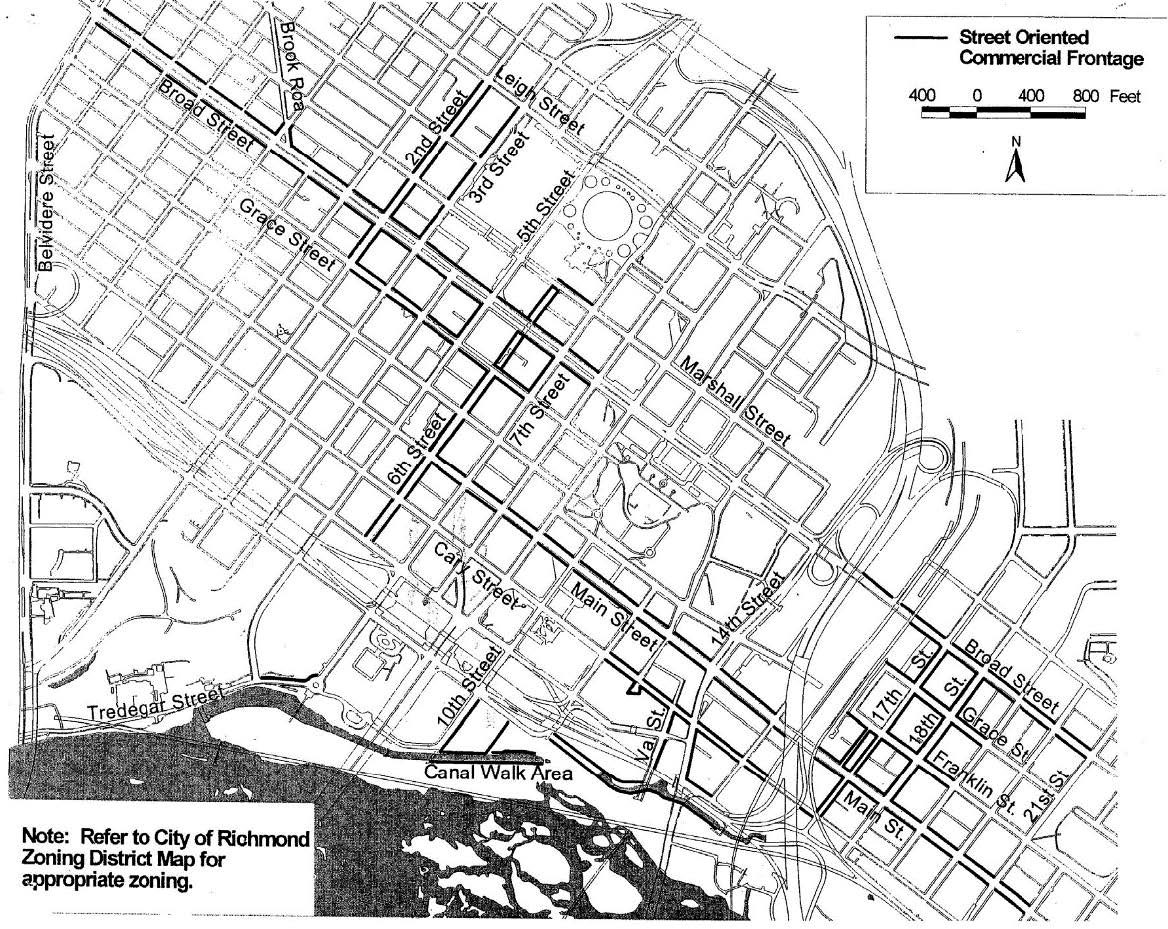
(18)
Uses owned or operated by a governmental agency, but not including facilities intended for incarceration or alternative sentencing or facilities primarily for the care, treatment or housing of persons who are currently illegally using or are addicted to a controlled substance as defined in Code of Virginia, § 54.1-3401;
(19)
Parking areas and parking lots, provided that any card reader or other access control device at an entrance to a parking area or parking lot shall be provided with not less than one stacking space situated off the public right-of-way;
(20)
Parking decks and parking garages, provided that:
a.
No portion of such structure located along a principal street frontage shall be used for parking or related circulation of vehicles, but such portion shall be devoted to other permitted principal uses which shall have a depth of not less than 20 feet along the principal street frontage or to means of pedestrian or vehicle access, provided that vehicle access along such street frontage shall be permitted only when no other street or alley is available for adequate access. In the case of a portion of a story located along a principal street frontage and having less than five feet of its height above the grade level at the building façade along the street frontage, the provisions of this subsection prohibiting parking or related circulation of vehicles shall not apply, provided that parking spaces shall be completely screened from view from the street by structural material similar to the material of the building façade;
b.
Except as provided in subsection (20)a of this section, parking spaces contained therein shall be screened from view from abutting streets by structural material of not less than 45 percent opacity;
c.
Not less than one exit lane and one entrance lane shall be provided for each 300 parking spaces or major fraction thereof contained within the structure, and any card reader or other access control device at an entrance to a parking deck or parking garage shall be provided with not less than one stacking space situated off the public right-of-way;
(21)
Rights-of-way, easements and appurtenances necessary for the provision and maintenance of public utilities and public transportation, including streets, rail lines, power lines, cables, poles, pipes, meters, transformers and similar devices; but not including railroad yards, freight or passenger depots, loading platforms, generating plants, transformer stations, electric substations, wastewater treatment plants, water treatment plants, utility storage yards and similar uses, unless owned or operated by a governmental agency;
(22)
Wireless communications facilities, microwave relay facilities, and radio broadcast antennas, on alternative support structures, in accordance with the additional requirements of Sections 30-692.1 through 30-692.6;
(23)
Shopping centers containing uses permitted in this district;
(24)
Retail sales and food or beverage sales conducted in an open area or structure by one or more individual vendors operating from stalls, stands, carts or other spaces which are rented or otherwise made available to such vendors;
(25)
Business and professional schools;
(25.1)
Short-term rental, subject to the requirements of Article VI, Division 14 of this chapter;
(26)
Accessory buildings and uses customarily incidental and clearly subordinate to uses permitted in this district, including automated teller machines accessible only from the interior or exterior of buildings devoted to permitted principal uses other than individual dwelling units or lodging units.
(Code 1993, § 32-447.11; Code 2004, § 114-447.11; Code 2015, § 30-447.11; Ord. No. 2004-180-167, § 1, 6-28-2004; Ord. No. 2006-43-63, § 1, 3-13-2006; Ord. No. 2008-36-57, § 3, 3-24-2008; Ord. No. 2010-20-49, § 1, 3-8-2010; Ord. No. 2011-205-2012-1, § 1, 1-9-2012; Ord. No. 2019-343, § 1(30-447.11), 6-22-2020; Ord. No. 2024-314, § 2, 12-9-2024)
Sec. 30-447.11:1. - Principal uses permitted by conditional use permit.
The following uses of buildings and premises may be permitted in the RF-2 district by conditional use permit as set forth in Article X of this chapter:
(1)
Nightclubs;
(2)
Retail sales of liquor;
(3)
Retail sales of tobacco and hemp.
(Code 2004, § 114-447.11.1; Code 2015, § 30-447.11:1; Ord. No. 2011-29-150, § 7, 9-12-2011; Ord. No. 2012-234-2013-2, § 1, 1-14-2013; Ord. No. 2025-157, § 1, 7-28-2025)
Sec. 30-447.12. - Yards and setbacks.
Yard regulations in the RF-2 Riverfront District shall be as follows:
(1)
Front yard. No front yard shall be required. In no case shall a front yard with a depth greater than ten feet be permitted, except that:
a.
A front yard with a depth greater than ten feet shall be permitted when such front yard is improved for purposes of an outdoor dining area as permitted by Section 30-447.11(2), and is approved subject to a site plan as set forth in Article X of this chapter. Except where the property is within an old and historic district, the City Urban Design Committee shall review the application and plans and submit a recommendation to the Director of Planning and Development Review prior to approval of such site plan by the Director.
b.
A building entrance feature that is set back from the street a greater distance than the primary building façade along the street and that is no greater than two times the width of the building entranceway and no greater than 50 feet in width shall be permitted, and shall not be subject to the provisions of this subsection.
c.
The prohibition of a front yard with a depth greater than ten feet shall not be applicable within a designated floodplain.
(2)
Side and rear yards. No side or rear yard shall be required, except where a side or rear lot line abuts a property, other than the James River or other public open space that is not included within the development site:
a.
A side or rear yard of not less than 25 feet shall be provided (see Section 30-630.9 for permitted projections and encroachments in required yards).
b.
No building shall penetrate an inclined plane originating at such lot line and extending over the lot at an inclination of one foot horizontal for each three feet vertical.
(3)
Riverfront setback. No building or structure shall be located within 50 feet of the mean low-water level along the shore of the James River, provided that the following shall be exempt from this requirement when permitted by the regulations of the Chesapeake Bay Preservation Areas contained in Chapter 14, Article IV:
a.
Water-dependent facilities as defined in Section 14-181.
b.
Walkways, promenades, decks, gazebos, permitted signs, and similar structures intended to accommodate or provide amenities for pedestrians.
(Code 1993, § 32-447.12; Code 2004, § 114-447.12; Code 2015, § 30-447.12; Ord. No. 2008-36-57, § 3, 3-24-2008; Ord. No. 2009-221-2010-9, § 1, 1-25-2010; Ord. No. 2024-314, § 2, 12-9-2024)
Sec. 30-447.13. - Land area coverage.
In the RF-2 Riverfront District, portions of buildings over four stories in height shall occupy not more than 35 percent of land area and shall be situated on the lot in such manner as to maximize to the extent practical, as determined through the site plan review process, views of the James River from public parks as identified in the master plan. For purposes of this Section 30-447.13, the number of stories in a building shall be determined by application of the definition of the term "story" set forth in Article XII of this chapter and shall be measured at the building façade along the street frontage of the lot or, in the case of a corner lot, shall be measured at the building façade along the principal street frontage of the lot.
(Code 1993, § 32-447.13; Code 2004, § 114-447.13; Code 2015, § 30-447.13; Ord. No. 2010-20-49, § 1, 3-8-2010; Ord. No. 2024-314, § 2, 12-9-2024)
Sec. 30-447.14. - Building dimensions and space between buildings.
(a)
Ground level. In the RF-2 Riverfront District, no building or combination of multiple buildings, whether such buildings are on the same lot or on multiple lots within the same development site, shall exceed a total dimension of 300 feet along a lot line, street, public space or riverfront without an intervening uncovered open space at ground level of not less than 50 feet in width along such lot line, street, public space or riverfront, or without an intervening street of not less than 50 feet in width and having no building space above the surface of the street, provided that uncovered open space may contain gazebos and similar structures intended to accommodate or provide amenities for pedestrians. The purpose of this subsection is to provide for river view corridors between buildings.
(b)
Over four stories in height. Portions of a building over four stories in height or combinations of portions of multiple buildings over four stories in height, whether such buildings are on the same lot or on multiple lots within the same development site, shall not exceed a total dimension of 300 feet along a lot line, street, public space or riverfront without an intervening uncovered open space of not less than 100 feet in width along such lot line, street, public space or riverfront. For purposes of this subsection, the number of stories in a building shall be determined by application of the definition of the term "story" set forth in Article XII of this chapter and shall be measured at the building façade along the street frontage of the lot or, in the case of a corner lot, shall be measured at the building façade along the principal street frontage of the lot. The purpose of this subsection is to provide for river view corridors between portions of buildings over four stories in height.
(Code 1993, § 32-447.14; Code 2004, § 114-447.14; Code 2015, § 30-447.14; Ord. No. 2010-20-49, § 1, 3-8-2010)
Sec. 30-447.15. - Usable open space ratio.
In the RF-2 Riverfront District, a usable open space ratio of not less than 0.10 shall be provided for newly constructed buildings or portions thereof devoted to dwelling uses.
(Code 1993, § 32-447.15; Code 2004, § 114-447.15; Code 2015, § 30-447.15)
Sec. 30-447.16. - Screening.
Screening regulations in the RF-2 Riverfront District shall be as follows:
(1)
Where a side lot line abuts property in any R district, there shall be a continuous evergreen vegetative screen not less than 3½ feet in height at the time of installation or opaque structural fence or wall not less than four feet in height erected along such lot line, but not within 15 feet of any street line. Evergreen vegetative material intended to satisfy this subsection shall be planted at such intervals that will result in a continuous visual screen within one year of planting.
(2)
Screening of parking areas and refuse areas shall be provided as set forth in Sections 30-660 and 30-710.12.
(Code 1993, § 32-447.16; Code 2004, § 114-447.16; Code 2015, § 30-447.16)
Sec. 30-447.17. - Requirements for areas devoted to parking or circulation of vehicles.
(a)
Location of parking and circulation areas. Areas devoted to the parking or circulation of vehicles in the RF-2 Riverfront District shall not be located between the main building on a lot and the street line, nor shall such areas be located closer to the street than the main building on the lot. On a lot having more than one street frontage, this subsection shall apply only along the principal street frontage of the lot as defined in Section 30-1220.
(b)
Driveways from streets. No driveway intersecting a street which constitutes the principal street frontage of a lot shall be permitted when other street frontage or alley access is available to serve such lot. For purposes of this subsection, principal street frontage shall be as defined in Section 30-1220.
(c)
Improvement requirements and landscaping standards. In addition to subsections (a) and (b) of this section, parking areas and parking lots shall be subject to the applicable improvement requirements and landscaping standards set forth in Article VII, Division 2.1 of this chapter.
(Code 2004, § 114-447.17; Code 2015, § 30-447.17; Ord. No. 2011-205-2012-1, §§ 2, 3, 1-9-2012)
Editor's note— Ord. No. 2011-205-2012-1, § 2, adopted January 9, 2012, repealed Code 2004, § 114-447.17, which pertained to height and derived from the 1993 Code; and Ord. No. 2010-20-49, adopted March 8, 2010. Section 3 of said ordinance enacted new provisions to read as herein set out.
Sec. 30-447.18. - Height.
Height regulations in the RF-2 Riverfront District shall be as follows:
(1)
Maximum height. No building shall exceed 13 stories in height. For purposes of this Section 30-447.18, story height as defined in Article XII of this chapter shall be not less than ten feet and not greater than 15 feet, except that the ground floor of a building may be of greater height.
(2)
Minimum height. Every main building hereinafter constructed shall have a minimum height of not less than two stories, except that porches, porticos and similar structures attached to a main building may be of lesser height.
(3)
Determination of number of stories. For purposes of this Section 30-447.18, the number of stories in a building shall be determined by application of the definition of the term "story" set forth in Article XII of this chapter and shall be measured at the building façade along the street frontage of the lot or, in the case of a corner lot, shall be measured at the building façade along the principal street frontage of the lot.
(Code 2004, § 114-447.18; Code 2015, § 30-447.18; Ord. No. 2011-205-2012-1, §§ 2, 3, 1-9-2012)
Editor's note— Ord. No. 2011-205-2012-1, § 2, adopted January 9, 2012, repealed Code 2004, § 114-447.18 which pertained to requirements for areas devoted to parking or circulation of vehicles and derived from Ord. No. 2008-36-57, adopted March 24, 2008. Section 3 of said ordinance enacted new provisions to read as herein set out.
Sec. 30-447.19. - Building façade fenestration.
Fenestration requirements applicable to building façades along street frontages in the RF-2 Riverfront District shall be as set forth in this section. In the case of a corner lot, the requirements shall be applicable along the principal street frontage of the lot.
(1)
Street level story.
a.
Nondwelling uses. For nondwelling uses, other than those listed in Section 30-447.11(7), (8) and (18), a minimum of 60 percent of the building façade between two and eight feet in height along the street frontage shall be comprised of windows or glass doors or both that allow views into and out of the interior building space. Windows used to satisfy this requirement shall have a minimum height of four feet. In the case of a street level story having less than its full height above the mean grade level at the building façade along the street frontage of the lot, a minimum of 30 percent of the building façade above such mean grade level shall be comprised of windows or glass doors or both that allow views into and out of the interior building space, provided that in the case of any portion of a story having less than five feet of its height above the grade level at the building façade along the street frontage of the lot, the requirements of this subsection (1)a shall not apply.
b.
Dwelling uses. For dwelling uses, windows or glass doors or both that allow views out of the interior building space shall comprise a minimum of 30 percent of the building façade between two and eight feet in height along the street frontage. In the case of a street level story having less than its full height above the mean grade level at the building façade along the street frontage of the lot, windows or glass doors or both that allow views out of the interior building space shall comprise a minimum of 15 percent of the building façade above such mean grade level, provided that in the case of any portion of a story having less than five feet of its height above the grade level at the building façade along the street frontage of the lot, the requirements of this subsection (1)b shall not apply. In all cases, windows shall be double-hung, single-hung, awning or casement type, and fixed windows shall be permitted only as a component of a system including operable windows within a single wall opening.
(2)
Upper stories.
a.
Nondwelling uses. For nondwelling uses, other than those listed in Section 30-447.11(7), (8) and (18), windows or glass doors or both that allow views out of the interior building space shall comprise a minimum of 30 percent of the building façade between two and eight feet in height above the floor level of each story above the street level story.
b.
Dwelling uses. For dwelling uses, windows or glass doors or both that allow views out of the interior building space shall comprise a minimum of 30 percent of the building façade between two and eight feet in height above the floor level of each story above the street level story. Such windows shall be double-hung, single-hung, awning or casement type, and fixed windows shall be permitted only as a component of a system including operable windows within a single wall opening.
(Code 2004, § 114-447.19; Code 2015, § 30-447.19; Ord. No. 2008-36-57, § 2, 3-24-2008; Ord. No. 2010-20-49, § 1, 3-8-2010; Ord. No. 2011-205-2012-1, § 1, 1-9-2012)
Sec. 30-448.1.- Permitted principal and accessory uses.
The following uses of building and premises shall be permitted in the CM district, provided that drive-up facilities and facilities for dispensing motor fuels shall not be permitted in conjunction with any of the uses permitted in the district:
(1)
Retail stores and shops;
(1.1)
Specialty food and beverage stores, including bakeries where products are sold principally at retail on the premises; provided that the floor area devoted to any such use shall not exceed 5,000 square feet;
(2)
Restaurants, tearooms, cafes, delicatessens, ice cream parlors and similar food and beverage service establishments, including catering businesses and entertainment in conjunction therewith, and including areas outside completely enclosed buildings and intended for service to or consumption of food and beverages by patrons;
(3)
Entertainment, cultural and recreational uses, including theatres, art galleries, museums, bowling alleys, amusement centers and other commercial recreation facilities located within completely enclosed buildings;
(4)
Personal service businesses that provide services directly to persons or services for personal items, including barber shops, beauty salons, health spas, fitness centers, dance studios, photography studios, travel agencies, shoe repair shops, tailor and garment alteration and repair shops, clothing rental stores, watch and jewelry repair shops and similar establishments; provided that not more than five persons are employed on the premises in the conduct of any repair or fabrication activity;
(4.1)
Dry cleaning and laundering establishments employing not more than five persons on the premises;
(5)
Shops for the repair of household items, locks, bicycles and similar items, provided that not more than five persons are employed on the premises, and provided further than no gasoline engines shall be repaired or serviced;
(6)
Banks, savings and loan offices and similar financial services, including accessory automated teller machines accessible only from the interior of buildings devoted to such uses;
(7)
Hotels and motels;
(8)
Parking areas and parking lots, provided that any card reader or other access control device at an entrance to a parking area or parking lot shall be provided with not less than one stacking space situated off the public right-of-way;
(9)
Parking decks and parking garages, provided that:
a.
Not less than one exit lane and one entrance lane shall be provided for each 300 parking spaces or major fraction thereof contained within the structure, and any card reader or other access control device at an entrance to a parking deck or parking garage shall be provided with not less than one stacking space situated off the public right-of-way;
b.
Parking spaces contained therein shall be screened from view from abutting streets by structural material of not less than 45 percent opacity;
(10)
Offices, including business, professional and administrative offices, medical and dental offices and clinics, and studios of writers, designers, artists and others engaged in the arts;
(11)
Public assembly buildings, auditoriums, convention facilities, meeting rooms and exhibition spaces;
(12)
Public schools and private business, professional and vocational schools not involving the use of heavy machinery, welding equipment or internal combustion engines;
(13)
Rights-of-way, easements and appurtenances necessary for the provision and maintenance of public utilities and public transportation, including streets, rail lines, power lines, cables, poles, pipes, meters, transformers and similar devices, but not including railroad yards, freight or passenger depots, loading platforms, generating plants, transformer stations, electric substations, wastewater treatment plants, water treatment plants, utility storage yards and similar uses;
(14)
Wireless communications facilities, microwave relay facilities, and radio broadcast antennas, on alternative support structures, in accordance with the additional requirements of Sections 30-692.1 through 30-692.6;
(14.1)
Short-term rental, subject to the requirements of Article VI, Division 14 of this chapter;
(15)
Accessory uses and structures customarily incidental and clearly subordinate to uses permitted in this district, including automated teller machines accessible from the interior of buildings devoted to permitted principal uses.
(Code 1993, § 32-448.1; Code 2004, § 114-448.1; Code 2015, § 30-448.1; Ord. No. 2004-180-167, § 1, 6-28-2004; Ord. No. 2006-43-63, § 1, 3-13-2006; Ord. No. 2019-343, § 1(30-448.1), 6-22-2020; Ord. No. 2024-314, § 2, 12-9-2024)
Sec. 30-448.2. - Use limitations.
To ensure continuity of retail, personal service and entertainment uses appropriate to a pedestrian mall and to encourage the concentration of active establishments with a high degree of pedestrian attraction necessary to the economic vitality of such areas, only those uses specified in Sections 30-448.1(1) through (6) and (11) and 30-448.3(1) and (2) shall be located within the ground floor of a building having frontage along a public mall within the CM Coliseum Mall District, provided that not more than 30 percent of any building frontage along such mall may be devoted to entrances or lobbies related to other uses generally permitted in this district and located above or below the ground floor or to the rear of the building.
(Code 1993, § 32-448.2; Code 2004, § 114-448.2; Code 2015, § 30-448.2; Ord. No. 2012-234-2013-2, § 1, 1-14-2013)
Sec. 30-448.3. - Principal uses permitted by conditional use permit.
The following uses of buildings and premises may be permitted in the CM district by conditional use permit as set forth in Article X of this chapter:
(1)
Nightclubs;
(2)
Retail sales of liquor;
(3)
Retail sales of tobacco and hemp.
(Code 2004, § 114-448.3; Code 2015, § 30-448.3; Ord. No. 2011-29-150, § 8, 9-12-2011; Ord. No. 2012-234-2013-2, § 1, 1-14-2013; Ord. No. 2025-157, § 1, 7-28-2025)
Sec. 30-448.4. - Height.
No building or structure in the CM Coliseum Mall District shall exceed 80 feet in height.
(Code 1993, § 32-448.4; Code 2004, § 114-448.4; Code 2015, § 30-448.4)
Sec. 30-449.1.- Intent of district.
The DCC Downtown Civic and Cultural District is intended to be applied to sites containing or adjacent to a major public space or building intended for public assembly. The district is intended to permit the public assembly use itself, while also fostering the occupancy of adjacent sites by entertainment, cultural, and/or tourism-oriented uses that have a mutually supportive relationship with the public assembly use. The range of permitted uses is intended to generally result in a concentration of establishments with a high degree of pedestrian attraction, and the development standards are intended to result in a relatively uninterrupted collection of such uses along or around a major public space within the district.
(Code 1993, § 32-449.1; Code 2004, § 114-449.1; Code 2015, § 30-449.1)
Sec. 30-449.2. - Permitted principal and accessory uses.
The following uses of buildings and premises shall be permitted in the DCC district, provided that drive-up facilities and facilities for dispensing motor fuels shall not be permitted in conjunction with any of the uses permitted in the district unless specifically set forth in this section:
(1)
Retail stores and shops;
(1.1)
Specialty food and beverage stores, including bakeries where products are sold principally at retail on the premises; provided that the floor area devoted to any such use shall not exceed 5,000 square feet;
(2)
Restaurants, tearooms, cafes, delicatessens, ice cream parlors and similar food and beverage service establishments, including catering businesses and entertainment in conjunction therewith, and including areas outside completely enclosed buildings and intended for service to or consumption of food and beverages by patrons;
(3)
Entertainment, cultural and recreational uses, including theaters, art galleries, museums, bowling alleys, amusement centers, and other commercial recreation facilities, whether indoors or outdoors;
(4)
Personal service businesses that provide services directly to persons or services for personal items, including barber shops, beauty salons, health spas, fitness centers, dance studios, photography studios, travel agencies, shoe repair shops, tailor and garment alteration and repair shops, clothing rental stores, watch and jewelry repair shops and similar establishments; provided that not more than five persons are employed on the premises in the conduct of any repair or fabrication activity;
(4.1)
Dry cleaning and laundering establishments employing not more than five persons on the premises;
(5)
Shops for the repair of household items, locks, bicycles and similar items, provided that not more than five persons are employed on the premises, and provided further than no gasoline engines shall be repaired or serviced;
(6)
Banks, savings and loan offices and similar financial services, including accessory automated teller machines accessible only from the interior of buildings devoted to such uses;
(7)
Hotel and motels;
(8)
Parking areas, provided that any card reader or other access control device at an entrance to a parking area shall be provided with not less than one stacking space situated off the public right-of-way;
(9)
Parking decks and parking garages, provided that:
a.
Not less than one exit lane and one entrance lane shall be provided for each 300 parking spaces or major fraction thereof contained within the structure, and any card reader or other access control device at an entrance to a parking deck or parking garage shall be provided with not less than one stacking space situated off the public right-of-way;
b.
Parking spaces contained therein shall be screened from view from abutting streets by structural material of not less than 45 percent opacity;
(10)
Offices, including business, professional and administrative offices, medical and dental offices and clinics, and studios of writers, designers, artists and others engaged in the arts;
(11)
Public assembly buildings, auditoriums, convention facilities, meeting rooms, exhibition spaces, stadiums and arenas;
(12)
Rights-of-way, easements and appurtenances necessary for the provision and maintenance of public utilities and public transportation, including streets, rail lines, power lines, cables, poles, pipes, meters, transformers and similar devices; but not including railroad yards, freight or passenger depots, loading platforms, generating plants, transformer stations, electric substations, wastewater treatment plants, water treatment plants, utility storage yards and similar uses, unless owned or operated by a governmental agency;
(13)
Uses owned or operated by a governmental agency, but not including facilities intended for incarceration or alternative sentencing or facilities primarily for the care, treatment or housing of persons who are currently illegally using or are addicted to a controlled substance as defined in Code of Virginia, § 54.1-3401;
(13.1)
Short-term rental, subject to the requirements of Article VI, Division 14 of this chapter.
(14)
Accessory uses and structures customarily incidental and clearly subordinate to uses permitted in this district, including automated teller machines accessible only from the interior of buildings devoted to permitted principal uses.
(Code 1993, § 32-449.2; Code 2004, § 114-449.2; Code 2015, § 30-449.2; Ord. No. 2004-180-167, § 1, 6-28-2004; Ord. No. 2006-43-63, § 1, 3-13-2006; Ord. No. 2023-235, § 2, 9-25-2023; Ord. No. 2024-314, § 2, 12-9-2024)
Sec. 30-449.3. - Use limitations.
To ensure continuity of retail, personal service and entertainment uses appropriate to the area along a public mall or plaza and to encourage the concentration of active establishments with a high degree of pedestrian attraction necessary to the economic vitality of such areas, only those uses specified in Sections 30-449.2(1) through (6) and (11) and 30-449.4(1) and (2) shall be located within the ground floor of a building having frontage along a public mall or plaza within the DCC Downtown Civic and Cultural District, provided that not more than 30 percent of any building frontage along such mall or plaza may be devoted to entrances or lobbies related to other uses generally permitted in this district and located above or below the ground floor or to the rear of the building.
(Code 1993, § 32-449.3; Code 2004, § 114-449.3; Code 2015, § 30-449.3; Ord. No. 2012-234-2013-2, § 1, 1-14-2013)
Sec. 30-449.4. - Principal uses permitted by conditional use permit.
The following uses of buildings and premises may be permitted in the DCC district by conditional use permit as set forth in Article X of this chapter:
(1)
Nightclubs;
(2)
Retail sales of liquor;
(3)
Retail sales of tobacco and hemp.
(Code 2004, § 114-449.4; Code 2015, § 30-449.4; Ord. No. 2011-29-150, § 9, 9-12-2011; Ord. No. 2012-234-2013-2, § 1, 1-14-2013; Ord. No. 2025-157, § 1, 7-28-2025)
Sec. 30-449.5. - Height.
No building or structure in the DCC Downtown Civic and Cultural District shall exceed 95 feet in height.
(Code 1993, § 32-449.5; Code 2004, § 114-449.5; Code 2015, § 30-449.5)
Sec. 30-450.1.- Permitted principal and accessory uses.
The following uses of buildings and premises shall be permitted in the OS district, provided that drive-up facilities and facilities for dispensing motor fuels shall not be permitted in conjunction with any of the uses permitted in the district:
(1)
Offices, including business, professional and administrative offices, medical and dental offices and clinics, and studios of writers, designers, artists and others engaged in the arts;
(2)
Professional, business and vocational schools, provided that no heavy machinery, welding equipment or internal combustion engine shall be used in conjunction therewith;
(3)
Catering businesses employing not more than 20 persons on the premises;
(4)
Churches and other places of worship, which may include the serving of food for charitable or fellowship purposes, and as an accessory use, emergency housing, subject to the provisions of Section 30-698;
(5)
Communications centers and telephone repeater stations operated by public service corporations;
(6)
Contractors' shops, offices and display rooms;
(7)
Furniture repair and upholstery shops;
(8)
Janitorial and custodial service and supply establishments;
(9)
Libraries, museums, schools, parks and recreational facilities owned or operated by any governmental agency, and similar uses required for the performance of a governmental function and intended to serve residents of adjoining neighborhoods;
(10)
Lodges and similar meeting places;
(11)
Parking areas serving uses permitted in this district, provided that any card reader or other access control device at an entrance to a parking area shall be provided with not less than one stacking space situated off the public right-of-way;
(12)
Parking decks serving uses permitted in this district, provided that:
a.
Not less than one exit lane and one entrance lane shall be provided for each 300 parking spaces or major fraction thereof contained within the structure, and any card reader or other access control device at an entrance to a parking deck shall be provided with not less than one stacking space situated off the public right-of-way;
b.
Parking spaces contained therein shall be screened from view from abutting streets by structural material of not less than 45 percent opacity;
(13)
Printing, publishing and engraving establishments employing not more than 20 persons on the premises;
(14)
Radio and television broadcasting studios and offices, including accessory antennas, provided that the supporting hardware for any such antenna does not exceed 18 feet above ground level, or in the case of a building mounted antenna, 18 feet above the surface of the building on which it is mounted;
(15)
Rights-of-way, easements and appurtenances necessary for the provision and maintenance of public utilities and public transportation, including streets, rail lines, power lines, cables, poles, pipes, meters, transformers and similar devices, but not including railroad yards, freight or passenger depots, loading platforms, generating plants, transformer stations, electric substations, wastewater treatment plants, water treatment plants, utility storage yards and similar uses;
(16)
Wholesale, warehouse and distribution establishments in conjunction with office, showroom, display and other facilities generally accessible to the public, provided that:
a.
Not more than 20,000 square feet of floor area shall be devoted to warehouse and storage use;
b.
Portions of buildings adjacent to public street frontages along which front yards are required shall be devoted to office, showroom, display and other facilities generally accessible to the public;
(17)
Incidental retail sales, repair, fabrication and processing activities shall be permitted within the same building as, and in conjunction with office, studio, wholesale, warehouse, distribution, supply and contractors' establishments permitted in this district when such retail sales, repair, fabrication and processing activities are clearly accessory and subordinate to the principal activity conducted on the premises;
(17.1)
Short-term rental, subject to the requirements of Article VI, Division 14 of this chapter.
(18)
Accessory uses and structures customarily incidental and clearly subordinate to uses permitted in this district, including automated teller machines accessible only from the interior of buildings devoted to permitted principal uses.
(Code 1993, § 32-450.1; Code 2004, § 114-450.1; Code 2015, § 30-450.1; Ord. No. 2004-180-167, § 1, 6-28-2004; Ord. No. 2006-43-63, § 1, 3-13-2006; Ord. No. 2019-343, § 1(30-450.1), 6-22-2020; Ord. No. 2020-261, § 1, 3-8-2021; Ord. No. 2024-314, § 2, 12-9-2024)
Sec. 30-450.1:1. - Nonconforming dwelling uses.
Alterations to buildings or structures devoted to nonconforming dwelling uses in the OS Office-Service District shall be subject to Section 30-800.1.
(Code 1993, § 32-450.1:1; Code 2004, § 114-450.1:1; Code 2015, § 30-450.1:1)
Sec. 30-450.2. - Outside storage.
There shall be no outside storage of equipment, materials or supplies either as a principal use of property or as an accessory use in connection with a principal use permitted in the OS Office-Service District.
(Code 1993, § 32-450.2; Code 2004, § 114-450.2; Code 2015, § 30-450.2)
Sec. 30-450.4. - Yards.
Yard regulations in the OS Office-Service District shall be as follows:
(1)
Front yard. There shall be a front yard with a depth of not less than 15 feet, which yard shall be improved and maintained with appropriate vegetative ground cover (see Article VI, Division 4 of this chapter).
(2)
Side yards. There shall be side yards of not less than ten feet in width, provided that no side yard shall be required where buildings on abutting lots are attached by means of a party wall constructed along a mutual side lot line.
(3)
Rear yard. No rear yard shall be required, except that where a rear lot line abuts or is situated across an alley from property in an R or RO district there shall be a rear yard of not less than 25 feet in depth.
(Code 1993, § 32-450.4; Code 2004, § 114-450.4; Code 2015, § 30-450.4)
Sec. 30-450.5. - Screening, location and improvement of parking and loading areas.
In addition to requirements pertaining to the location and improvement of parking and loading areas set forth in Article VII of this chapter, the following requirements shall be applicable in the OS Office-Service District.
(1)
Where a side lot line abuts property in an R district, there shall be a continuous evergreen vegetative screen not less than 3½ feet in height at the time of installation or opaque structural fence or wall not less than four feet in height erected along such lot line, but not within 15 feet of any street. Evergreen vegetative material intended to satisfy this subsection shall be planted at such intervals that will result in a continuous visual screen within one year of planting.
(2)
Whenever a parking area for five or more vehicles or a loading area abuts or is situated within 50 feet of property devoted to dwelling, office, medical or dental clinic use existing at the time such parking or loading area is constructed, the parking or loading area shall be effectively screened from view from such premises by an evergreen vegetative screen not less than 3½ feet in height at the time of installation or opaque structural fence or wall not less than four feet in height, provided that such parking or loading area need not be screened from an adjacent loading area or parking area containing five or more spaces. Evergreen vegetative material intended to satisfy this subsection shall be planted at such intervals that will result in a continuous visual screen within one year of planting.
(3)
Loading areas shall not be situated within that portion of a lot between the main building and a public street along which a front yard is required and shall be located or screened so as not to be directly visible from such public street.
(Code 1993, § 32-450.5; Code 2004, § 114-450.5; Code 2015, § 30-450.5)
Sec. 30-450.6. - Height.
No building or structure in the OS Office-Service District shall exceed 35 feet in height.
(Code 1993, § 32-450.6; Code 2004, § 114-450.6; Code 2015, § 30-450.6)
Sec. 30-451.1.- Intent of district.
Pursuant to the general purposes of this chapter, the intent of the RP Research Park District is to encourage development of an innovation district with mixed-uses including residential, ground floor activation, and unlimited height and density as envisioned in the City Center Innovation District Small Area Plan, approved by the Council by Ordinance No. 2022-010, adopted January 24, 2022. The area will become an engine for expanding life sciences industries within the Richmond-Petersburg Metropolitan Statistical Area. The district regulations are intended to create a place to live, learn, collaborate, innovate, and develop new life science businesses in a high density, walkable, urban, full-service environment that includes multi-modal transportation options to city and regional neighborhoods and job centers. The RP Research Park District is intended to promote an environment that is conducive to the expansion of research, development, and laboratory facilities related to the medical, biotechnology, and life sciences industries, and other uses that support innovation such as a mixed-use residential, hotel, walkable mixed-use built environment.
(Code 1993, § 32-451.1; Code 2004, § 114-451.1; Code 2015, § 30-451.1; Ord. No. 2022-245, § 1, 9-26-2022)
Sec. 30-451.2. - Permitted principal and accessory uses.
The uses of buildings and premises listed in this section shall be permitted in the RP district, provided that drive-up facilities and facilities for dispensing motor fuels shall not be permitted in conjunction with any of the uses permitted in the district.
(1)
Research, development and laboratory facilities related to the medical, biotechnology and other life sciences industries;
(2)
Offices, including business, professional and administrative offices, and medical and dental offices and clinics;
(3)
Day nurseries licensed by and subject to the requirements of the State of Virginia Department of Social Services;
(4)
Public open spaces and uses owned or operated by a governmental agency, but not including facilities intended for incarceration or alternative sentencing or facilities primarily for the care, treatment or housing of persons who are currently illegally using or are addicted to a controlled substance as defined in Code of Virginia, § 54.1-3401;
(5)
Parking decks and parking garages, provided that:
a.
No portion of the ground floor of such structure located along a principal street frontage or priority street frontage shall be used for parking or related circulation of vehicles, but such portion shall be devoted to other permitted principal uses which shall have a depth of not less than 20 feet along the principal street frontage or priority street frontage or to means of pedestrian or vehicle access, provided that vehicle access along such street frontage shall be permitted only when no other street or alley is available for adequate access. In the case of a portion of a story located along a principal street frontage or priority street frontage and having less than five feet of its height above the grade level at the building façade along the street frontage, the provisions of this paragraph prohibiting parking or related circulation of vehicles shall not apply, provided that parking spaces shall be completely screened from view from the street by structural material similar to the material of the building façade. Upper stories of such structure may be used for parking or related circulation of vehicles subject to subsection c of this section;
b.
Not less than one exit lane and one entrance lane shall be provided for each 300 parking spaces or major fraction thereof contained within the structure, and any card reader or other access control device at an entrance to a parking deck or parking garage shall be provided with not less than one stacking space situated off the public right-of-way;
c.
Parking spaces contained therein shall be screened from view from abutting streets by structural material of not less than 45 percent opacity;
(6)
Adult care residences;
(7)
Adult day care facilities;
(8)
Art galleries;
(9)
Banks, savings and loan offices and similar financial services, any accessory automated teller machines accessible from the interior or exterior of buildings devoted to such uses;
(10)
Catering businesses;
(11)
Churches and other places of worship, which may include the serving of food for charitable or fellowship purposes and, as an accessory use, emergency housing, subject to the provisions of Article VI, Division 15 of this chapter;
(12)
Communications centers and telephone repeater stations operated by public service corporations;
(13)
Dry cleaning and laundering establishments, provided that the total capacity of all dry cleaning machines shall not exceed 100 pounds dry weight and the total capacity of all laundry machines shall not exceed 150 pounds dry weight, and provided further that no such use shall be located on a transitional site;
(14)
Dwelling units, provided that when such units are located within buildings fronting on streets designated as street oriented commercial frontage, as shown on the official zoning map, the ground floor of the building shall be devoted to other principal uses permitted in this district, and such uses shall have a depth of not less than 20 feet along the entire street oriented commercial frontage, except for ingress and egress;
(15)
Grocery stores, convenience stores, and specialty food and beverage stores, including bakeries where products are sold principally at retail on the premises;
(16)
Hospitals, but not psychiatric hospitals for the care of patients committed by a court;
(17)
Hotels, provided that the ground floor of portions of buildings adjacent to principal street frontages shall be devoted to those uses specified in subsections (8), (9), (15), (24), (34), (35), or (36) of this section; provided that not more than 50 percent of the frontage of such ground floor may be devoted to entrances or lobbies serving the hotel use, except entrances or lobbies existing at the effective date of this subsection that exceed 50 percent of such frontage shall be permitted, but shall not be expanded to occupy a greater percentage of such frontage;
(18)
Laundromats, and laundry and dry cleaning pick-up stations;
(19)
Libraries, museums, schools, parks, and noncommercial recreational facilities, when such uses are owned or operated by a nonprofit organization;
(20)
Nursing homes;
(21)
Office supply, business and office service, photocopy, and custom printing establishments;
(22)
Permanent supportive housing, subject to the provisions of Article VI, Division 15 of this chapter;
(23)
Personal loan and financial services;
(24)
Personal service businesses that provide services directly to persons or services for personal items, including barber shops, beauty salons, health spas, fitness centers, dance studios, photography studios, travel agencies, shoe repair shops, tailor and garment alteration and repair shops, clothing rental stores, watch and jewelry repair shops and similar establishments;
(25)
Pet shops, veterinary clinics, and animal hospitals, provided that all facilities shall be located within completely enclosed and air conditioned buildings which are soundproof to the extent that sounds produced by animals kept or treated therein are not audible outside the building;
(26)
Postal and package mailing services, but not including package distribution centers;
(27)
Printing, publishing and engraving establishments employing not more than 20 persons on the premises;
(28)
Public elementary or secondary schools, or private elementary and secondary schools having curricula substantially the same as that offered in public schools;
(29)
Professional, business and vocational schools;
(30)
Public utilities installations, equipment buildings, and passenger terminals for public transportation, including servicing of motor vehicles used in connection therewith when such servicing is conducted within a completely enclosed building, provided that no passenger terminal shall be located on a transitional site;
(31)
Radio and television broadcasting studios and offices, including accessory antennas, provided that the supporting hardware for any such antenna does not exceed 15 feet above ground level or, in the case of a building mounted antenna, 15 feet above the surface of the building on which it is mounted;
(32)
Recreation and entertainment uses, including theaters, museums, amusement centers, lodges and clubs, meeting facilities, auditoriums, and assembly halls;
(33)
Repair businesses conducted within completely enclosed buildings;
(34)
Restaurants, tearooms, cafes, delicatessens, ice cream parlors, and similar food and beverage service establishments, including entertainment in conjunction therewith. Such establishments may include areas outside completely enclosed buildings and intended for service to or consumption of food and beverages by patrons, provided that the following conditions shall be met:
a.
Covered trash containers shall be provided in service areas, and fences, walls or vegetative screening shall be provided around service areas, except at entrances and exits, to prevent refuse from blowing onto adjacent properties or streets. Fences or walls to be credited toward this requirement shall comply with fence and wall design guidelines adopted by resolution of the City Planning Commission, or their equivalent as determined by the Zoning Administrator. In no case shall chain link, chain link with slats or similar fencing be considered as meeting the requirements of the fence and wall design guidelines;
b.
No music or public address system shall be operated in such a manner that sound produced therefrom is audible beyond the boundaries of the premises;
(35)
Retail stores and shops, provided that not more than 70 percent of the floor area may be devoted to storage of merchandise to be sold at retail on the premises;
(36)
Rights-of-way, easements, and appurtenances necessary for the provision and maintenance of public utilities and public transportation, including streets, rail lines, power lines;
(37)
Sales lots for Christmas trees, vegetable stands, and other seasonal uses, but not including flea markets, and provided no such use shall be located on a transitional site;
(38)
Service businesses that service, repair, or rent audio or video equipment, home appliances, furniture, personal recreational equipment, home yard and garden equipment, tools, bicycles, locks, computers, office machines, and similar household or business items; provided that no products shall be serviced, repaired, stored, or displayed outside a completely enclosed building;
(39)
Shopping centers containing uses permitted in this district;
(40)
Short-term rental, subject to the requirements of Article VI, Division 14 of this chapter;
(41)
Showrooms and display areas for goods which are sold at both wholesale and retail on the premises, including the storage and distribution of such goods in conjunction therewith;
(42)
Social service delivery uses, in accordance with 30-698.3(d);
(43)
Tourist homes;
(44)
Transitional housing, subject to the provisions of Article VI, Division 15 of this chapter;
(45)
Wireless communications facilities, microwave relay facilities, and radio broadcast antennas, on alternative support structures, in accordance with the additional requirements of Sections 30-692.1 through 30-692.6; and
(46)
Accessory uses and structures customarily incidental and clearly subordinate to uses permitted in this district, including automated teller machines accessible only from the interior of buildings devoted to permitted principal uses other than individual dwelling units or lodging units, and including assembly, processing, prototype production activities and indoor storage of materials, when such are located within the same building.
(Code 1993, § 32-451.2; Code 2004, § 114-451.2; Code 2015, § 30-451.2; Ord. No. 2004-180-167, § 1, 6-28-2004; Ord. No. 2006-43-63, § 1, 3-13-2006; Ord. No. 2022-245, § 1, 9-26-2022; Ord. No. 2024-314, § 2, 12-9-2024)
Sec. 30-451.2:1. - Principal uses permitted by conditional use permit.
(a)
Lodginghouses;
(b)
Nightclubs;
(c)
Retail sales of liquor;
(d)
Retail sales of tobacco and hemp.
(Ord. No. 2022-245, § 2, 9-26-2022; Ord. No. 2025-157, § 1, 7-28-2025)
Secs. 30-451.3, 30-451.4. - Reserved.
Editor's note— Ord. No. 2004-180-167, § 2, adopted June 28, 2004, repealed Code 2004, § 114-451.3, which pertained to plan of development requirements and derived from Code 1993, § 32-451.3.
Sec. 30-451.5. - Yard requirements.
(a)
Front yard.
(1)
No front yard shall be required. In no case shall a front yard with a depth of greater than ten feet be permitted, except as may be authorized pursuant to subdivision (a)(2) of this section.
(2)
A front yard with a depth greater than permitted by subdivision (a)(1) of this section may be provided when such front yard is improved for purposes of outdoor dining area as permitted by section 30-451.2 or vehicular drop-off or pick-up area permitted by section 30-451.7(a), and is approved subject to a site plan as set forth in Article X of this chapter.
(b)
Side yards. No side yards shall be required except that where a side lot line abuts or is situated across an alley from property in an RO district, there shall be a side yard of not less than ten feet in width.
(c)
Rear yard. No rear yard shall be required except that where a rear lot line abuts or is situated across an alley from property in an RO district, there shall be a rear yard of not less than ten feet in depth.
(Code 1993, § 32-451.5; Code 2004, § 114-451.5; Code 2015, § 30-451.5; Ord. No. 2022-245, § 1, 9-26-2022; Ord. No. 2024-314, § 2, 12-9-2024)
Sec. 30-451.6. - Screening requirements.
In the RP Research Park District, the screening of refuse areas and parking areas shall be provided as set forth in sections 30-660 and 30-710.2, respectively.
(Code 1993, § 32-451.6; Code 2004, § 114-451.6; Code 2015, § 30-451.6; Ord. No. 2022-245, § 1, 9-26-2022)
Sec. 30-451.7. - Requirements for areas devoted to parking or circulation of vehicles.
(a)
Location of parking and circulation areas. Areas devoted to the parking or circulation of vehicles shall not be located between the main building on a lot and the street line, nor shall such areas be located closer to the street than the main building on the lot. On a lot having more than one street frontage, this subsection shall apply along both the principal street frontage and the priority street frontage. This subsection shall not be construed to prohibit vehicular drop-off or pick-up areas serving hotels or hospitals when approved in accordance with section 30-451.5(1).
(b)
Driveways from streets. No driveway intersecting a priority or principal street shall be permitted when alley access or another street frontage is available to serve such a lot.
(c)
Improvement requirements and landscaping standards. Parking areas and parking lots in the RP Research Park District shall be subject to the applicable improvement requirements and landscaping standards set forth in Article VII, Division 2.1 of this chapter, except that the requirements of Section 30-710.12(1) shall not apply.
(d)
Paving of loading areas. All loading areas, including entrances thereto and exits therefrom, shall be designed and improved using accepted engineering practices for usability and longevity with asphalt, concrete, unit pavers or similar materials approved by the administrator of the erosion and sediment control ordinance found in Chapter 14, Article III.
(Code 1993, § 32-451.7; Code 2004, § 114-451.7; Code 2015, § 30-451.7; Ord. No. 2022-245, § 1, 9-26-2022)
Sec. 30-451.7:1. - Usable open space.
In the RP district, a usable open space ratio of not less than 0.10 shall be provided for newly constructed buildings or portions thereof devoted to dwelling uses.
(Ord. No. 2022-245, § 2, 9-26-2022)
Sec. 30-451.8. - Height limit.
In the RP Research Park District, there shall be no maximum height limit, provided that any building above seven stories in height shall have a minimum building stepback of ten feet from the building façade line along each street frontage, which stepback shall occur above the ground story and no higher than the fifth story. For purposes of this section, the term "stepback" means the setting back of the upper stories of a building that fronts on a public right-of-way from the face of the lower story or stories of such building. Every main building hereinafter constructed shall have a minimum height of three stories, except that porches, porticos, and similar structures attached to a main building may be of lesser height (see Article VI, Division 6 of this chapter for height exceptions).
(Code 1993, § 32-451.8; Code 2004, § 114-451.8; Code 2015, § 30-451.8; Ord. No. 2012-66-43, § 1, 4-23-2012; Ord. No. 2022-245, § 1, 9-26-2022)
Sec. 30-451.9. - Building façade fenestration.
Fenestration requirements applicable to building façades along street frontages in the RP district shall be as set forth in this section.
(1)
Street level story.
a.
Non-dwelling uses. For non-dwelling uses, other than those listed in section 30-451.2(1), (4), (5), (11), (12), (16), (19), (30), and (45), a minimum of 60 percent of the building façade between three and ten feet in height along the street frontage shall be comprised of windows or glass doors or both that allow views into and out of the interior building space. The horizontal linear dimension of contiguous building wall that does not contain fenestration or doors shall not exceed twenty feet. Windows used to satisfy this requirement shall have a minimum height of four feet. In the case of a street level story having less than its full height above the mean grade level at the building façade along the street frontage of the lot, a minimum of 30 percent of the building façade above such mean grade level shall be comprised of windows or glass doors or both that allow views into and out of the interior building space, provided that in the case of any portion of a story having less than five feet of its height above the grade level at the building façade along the street frontage of the lot, the requirements of this subsection shall not apply.
b.
Dwelling uses. For dwelling uses, tourist homes, and shelters, windows or glass doors or both that allow views out of the interior building space shall comprise a minimum of 30 percent of the building façade between three and ten feet in height along the street frontage. The horizontal linear dimension of contiguous building wall that does not contain fenestration or doors shall not exceed twenty feet. In the case of a street level story having less than its full height above the mean grade level at the building façade along the street frontage of the lot, windows or glass doors or both that allow views out of the interior building space shall comprise a minimum of 15 percent of the building façade above such mean grade level, provided that in the case of any portion of a story having less than five feet of its height above the grade level at the building façade along the street frontage of the lot, the requirements of this subsection shall not apply. In all cases, windows shall be double-hung, single-hung, awning, or casement type and fixed windows shall be permitted only as a component of a system including operable windows within a single wall opening.
(2)
Upper stories.
a.
Non-dwelling uses. For non-dwelling uses, other than those listed in subdivision (1)(a) of this section, windows or glass doors or both that allow views out of the interior building space shall comprise a minimum of 30 percent of the building façade between two and eight feet in height above the floor level of each story above the street level story.
b.
Dwelling uses. For dwelling uses, tourist homes, and shelters, windows or glass doors or both that allow views out of the interior building space shall comprise a minimum of 30 percent of the building façade between two and eight feet in height above the floor level of each story above the street level story. Such windows shall be double-hung, single-hung, awning, or casement type and fixed windows shall be permitted only as a component of a system including operable windows within a single wall opening.
(Ord. No. 2022-245, § 2, 9-26-2022)
Sec. 30-452.1.- Permitted principal and accessory uses.
The following uses of buildings and premises shall be permitted in the M-1 district:
(1)
Any use permitted in the district as set forth in section 30-438.1, provided that:
a.
The prohibition of uses outside of enclosed buildings shall not be applicable in this district;
b.
Except for emergency housing uses, subject to the provisions of Section 30-698, no building shall be erected for dwelling use or converted to such use unless permitted by the board of zoning appeals pursuant to the provisions of section 17.20 of the Charter, in which event such use shall be discontinued within ten years from the date such use is permitted, provided that a building may be used for dwelling purposes by a guard, caretaker or watchman employed in connection with the use of a building or premises permitted in this district;
(2)
The following uses and any similar uses which are not likely to create any more offensive noise, vibration, dust, heat, smoke, odor, glare or other objectionable influence than the minimum amount normally resulting from other uses permitted; such permitted uses being generally light industries that manufacture, process, store and distribute goods and materials and are in general dependent upon raw materials refined elsewhere, and manufacturing, compounding, processing, packaging or treatment as specified of the following or similar products:
a.
Food and beverages:
1.
Baked goods.
2.
Beverages: blending and bottling plants.
3.
Chocolate, cocoa and cocoa products: processing and packaging.
4.
Coffee, tea and spices: processing and packaging.
5.
Condensed milk: processing and canning.
6.
Dairy products: creameries and plants.
7.
Fruit and vegetable processing, including canning, preserving, drying and freezing.
8.
Gelatin products.
9.
Glucose and dextrine.
10.
Macaroni and noodle manufacturing.
11.
Meat products: packing and processing, but not including slaughtering.
12.
Oleomargarine: compounding and packaging.
13.
Poultry packaging and slaughtering.
b.
Metal and metal products:
1.
Agricultural or farm implements.
2.
Aircraft and aircraft parts.
3.
Aluminum extrusion, rolling, fabrication and forming.
4.
Automobile, truck, trailer, motorcycle and bicycle assembly.
5.
Bolts, nuts, screws, washers and rivets.
6.
Containers (metal).
7.
Culverts.
8.
Firearms.
9.
Foundries and foundry products manufacturing.
10.
Heating, ventilating, refrigeration and appliance supplies and equipment.
11.
Iron or structural steel fabrication.
12.
Nails, brads, tacks, spikes and staples.
13.
Needles and pins.
14.
Plating (electrolytic process).
15.
Plumbing supplies.
16.
Safes and vaults.
17.
Sheet metal products.
18.
Silverware and plated ware.
19.
Tool, die, gauge and machine shops.
20.
Tools and hardware products.
21.
Vitreous enameled products.
c.
Textiles, bedding and fibers:
1.
Garment making, repair and tailoring.
2.
Hats.
3.
Hosiery mill.
4.
Knitting, weaving, printing, dyeing and finishing of textiles and fibers into fabric goods.
5.
Rubber and synthetic treated fabrics, but not including rubber and synthetic processing.
6.
Yarn, threads and cordage.
d.
Wood and paper products:
1.
Baskets and hampers.
2.
Boxes and crates.
3.
Forests and wildlife preserves: public and private.
4.
Furniture.
5.
Pencils.
6.
Pulp goods and paper processing, but not including pulp milling.
7.
Shipping containers.
8.
Trailers and wagons.
e.
Unclassified uses:
1.
Animal, poultry and bird raising.
2.
Animal pound for detention only.
3.
Boat manufacturing (vessels less than five tons).
4.
Building materials storage and sales.
5.
Bus and other transportation terminals, garages and repair shops.
6.
Button manufacturing.
7.
Carbon paper and inked ribbon manufacturing.
8.
Chewing gum manufacturing.
9.
Clay, stone and glass products.
10.
Cigar, cigarette, chewing and smoking tobacco manufacturing.
11.
Circus and fairgrounds.
12.
Coal and coke storage and sales.
13.
Concrete products.
14.
Contractors' shops and storage yards.
15.
Drive-in or outdoor theatres.
16.
Dry cleaning and laundering.
17.
Exhibition space: enclosed or unenclosed.
18.
Electric transformer stations, substations and generating plants.
19.
Entertainment and recreational uses.
20.
Feed and grain storage.
21.
Flour and feed packaging and blending.
22.
Fur finishing.
23.
Grain blending and packing, but not including milling.
24.
Greenhouses.
25.
Ice manufacturing.
26.
Industrial and vocational training schools.
27.
Insecticides, fungicides, disinfectants and related industrial and household chemical compounds (blending only).
28.
Kennels.
29.
Laboratories and research facilities.
30.
Leather goods manufacturing, but not including tanning operations.
31.
Livery stables and riding academies.
32.
Malt products manufacturing, but not including breweries producing more than 100,000 barrels of beer or distilleries producing more than 250,000 cases of liquor per year.
33.
Motion picture production.
34.
Pottery and porcelain products.
35.
Propagation and cultivation of crops, flowers, trees and shrubs.
36.
Public utility storage yard.
37.
Railroad passenger and freight depots.
38.
Repair and servicing of diesel engines.
39.
Repair, servicing, sale and storage of heavy construction equipment.
40.
Sanitary landfills operated by governmental agencies.
41.
Storage of petroleum products for distribution within the metropolitan area.
42.
Support structures used in connection with wireless communications facilities, radio and television broadcast antennas and microwave relay facilities, in accordance with the additional requirements of sections 30-692.1 through 30-692.6.
43.
Wholesale, warehouse and distribution establishments.
(3)
Adult entertainment establishments, adult book stores, adult motion picture theaters, and massage parlors, provided that the property devoted to any such use shall not be situated within 1,000 feet of property in an R or RO district, nor within 1,000 feet of any property occupied by a church or other place of worship, public or private elementary, intermediate or high school, public library, lodginghouse, tourist home, day care center, nursing home, hotel, motel or other adult entertainment establishment, adult book store, adult motion picture theater or massage parlor;
(4)
Parking areas and parking lots.
(5)
Accessory uses and structures customarily incidental and clearly subordinate to uses permitted in this district.
(Code 1993, § 32-452.1; Code 2004, § 114-452.1; Code 2015, § 30-452.1; Ord. No. 2004-180-167, § 1, 6-28-2004; Ord. No. 2013-33-37, § 1, 3-25-2013; Ord. No. 2020-209, § 1, 10-12-2020; Ord. No. 2020-261, § 1, 3-8-2021; Ord. No. 2024-314, § 2, 12-9-2024)
Sec. 30-452.1:1. - Principal uses permitted by conditional use permit.
The following uses of buildings and premises may be permitted in the M-1 district by conditional use permit as set forth in Article X of this chapter:
(1)
Nightclubs;
(2)
Retail sales of liquor;
(3)
Retail sales of tobacco and hemp.
(Code 2004, § 114-452.1.1; Code 2015, § 30-452.1:1; Ord. No. 2011-29-150, § 10, 9-12-2011; Ord. No. 2012-234-2013-2, § 1, 1-14-2013; Ord. No. 2025-157, § 1, 7-28-2025)
Sec. 30-452.2. - Yards.
Yard regulations in the M-1 Light Industrial District shall be as follows:
(1)
Front yard. No front yard shall be required (see Article VI, Division 4 of this chapter).
(2)
Side yards. No side yards shall be required, except that where a side lot line abuts or is situated across an alley from property in an R or RO district there shall be a side yard of not less than 25 feet in width.
(3)
Rear yard. No rear yard shall be required, except that where a rear lot line abuts or is situated across an alley from property in an R or RO district there shall be a rear yard of not less than 25 feet in depth.
(Code 1993, § 32-452.2; Code 2004, § 114-452.2; Code 2015, § 30-452.2)
Sec. 30-452.3. - Screening.
Screening regulations in the M-1 Light Industrial District shall be as follows:
(1)
Where a side lot line abuts a property in an R district, there shall be a continuous evergreen vegetative screen or opaque structural fence or wall not less than six feet in height erected along such lot line, but not within 15 feet of any street line. Evergreen vegetative material intended to satisfy this subsection shall be of the specified height at the time of installation and shall be planted at such intervals that will result in a continuous visual screen within one year of planting.
(2)
Screening of parking areas and refuse areas shall be provided as set forth in Sections 30-660 and 30-710.12.
(Code 1993, § 32-452.3; Code 2004, § 114-452.3; Code 2015, § 30-452.3)
Sec. 30-452.4. - Height.
In the M-1 Light Industrial District, no building or structure shall exceed 45 feet in height, provided that additional height shall be permitted, except for sign structures, when all portions of a building or structure over 45 feet in height are set back from side and rear lot lines a minimum of one foot for each two feet in height in excess of 45 feet and provided, further, that no portion of a building or structure shall penetrate an inclined plane originating at the centerline of an abutting street and extending over the lot at an inclination of one foot horizontal for each three feet vertical.
(Code 1993, § 32-452.4; Code 2004, § 114-452.4; Code 2015, § 30-452.4)
Sec. 30-454.1.- Permitted principal and accessory uses.
The following uses of buildings and structures shall be permitted in the M-2 district:
(1)
Any use permitted in the M-1 district as set forth in Section 30-452.1.
(2)
Any use or structure not permitted in any other district, including accessory buildings; provided that no building or premises shall be used for any of the following purposes unless specifically authorized or permitted by the City Council; provided that for purposes of this subsection (2), a use listed in any other district as permitted by conditional use permit or permitted only when lawfully existing on the effective date of a particular provision shall not be construed to be a permitted use:
a.
Curing, smoking, packing or storing of fish.
b.
Incinerating, reducing, dumping or storing, including transfer facilities, of offal, dead animals, garbage or refuse for compensation and not as a governmental function.
c.
Manufacturing or refining of ammonia, bleaching powder, chlorine, celluloid, pyroxylin and explosive or flammable products made therefrom; dyestuffs, explosives and pyrotechnics, gypsum, lime, cement, plaster of Paris, matches, turpentine, paint, varnish and fertilizer from organic materials or bone distillation
d.
Manufacturing or storage of sulphurous, sulphuric, nitric, picric, hydrochloric or other corrosive acid, exclusive of the use or storage thereof in connection with other permitted uses of buildings or premises.
e.
Medical waste management facilities as regulated by and for which a permit is required by the State of Virginia Department of Environmental Quality, excluding however, any facility subject to an on-site permit by rule.
f.
Flea markets.
g.
Nightclubs.
h.
Outdoor shooting ranges.
i.
Private penal institutions.
j.
Public and private alternative incarceration domiciliary facilities and institutions.
k.
Refining of tallow, grease or lard.
l.
Refining of petroleum products.
m.
Rendering of fat.
n.
Retail sales of liquor.
o.
Sales, storage or disposal of used tires in bulk.
p.
Storage of dyestuffs, explosives and pyrotechnics.
q.
Storage of petroleum products in bulk for distribution in areas beyond the metropolitan area.
r.
Retail sales of tobacco and hemp.
(Code 1993, § 32-454.1; Code 2004, § 114-454.1; Code 2015, § 30-454.1; Ord. No. 2004-180-167, § 1, 6-28-2004; Ord. No. 2011-29-150, § 12, 9-12-2011; Ord. No. 2012-234-2013-2, § 1, 1-14-2013; Ord. No. 2025-157, § 1, 7-28-2025)
Sec. 30-454.2. - Report from Chief Administrative Officer.
In the M-2 Heavy Industrial District, the City Council shall not authorize or permit any building or premises to be used for any purpose specified in Section 30-454.1(2) until after the Chief Administrative Officer has reported in writing to the Council the effect that such use will have upon the safety, health, comfort, convenience and welfare of the inhabitants of the City and of persons in the locality in which such building is or premises are to be situated.
(Code 1993, § 32-454.2; Code 2004, § 114-454.2; Code 2015, § 30-454.2; Ord. No. 2004-360-330, § 1, 12-13-2004)
Sec. 30-454.3. - Uses constituting nuisances.
No building or premises shall be used for any purpose permitted in the M-2 Heavy Industrial District in such a manner as to constitute a nuisance by the creation of unreasonably loud and disturbing sound or noise; unreasonable vibrations; unreasonable danger from explosion or fire; or the unreasonable emission of smoke, odor, dust, heat or glare.
(Code 1993, § 32-454.3; Code 2004, § 114-454.3; Code 2015, § 30-454.3)
Sec. 30-454.4. - Yards.
Yard regulations in the M-2 Heavy Industrial District shall be as follows:
(1)
Front yard. No front yard shall be required (see Article VI, Division 4 of this chapter).
(2)
Side yards. No side yards shall be required, except that where a side yard line abuts or is situated across an alley from property in an R or RO district there shall be a side yard of not less than 50 feet in width.
(3)
Rear yard. No rear yard shall be required, except that where a rear lot line abuts or is situated across an alley from property in an R or RO district, there shall be a rear yard of not less than 50 feet in depth.
(Code 1993, § 32-454.4; Code 2004, § 114-454.4; Code 2015, § 30-454.4)
Sec. 30-454.5. - Screening.
Screening regulations in the M-2 Heavy Industrial District shall be as follows:
(1)
Where a side lot line abuts property in an R district, there shall be a continuous evergreen vegetative screen or opaque structural fence or wall not less than six feet in height erected along such lot line, but not within 15 feet of any street line. Evergreen vegetative material intended to satisfy this subsection shall be of the specified height at the time of installation and shall be planted at such intervals that will result in a continuous visual screen within one year of planting.
(2)
Screening of parking areas and refuse areas shall be provided as set forth in Sections 30-660 and 30-710.12.
(3)
Automobile junkyards and similar uses involving outside storage of scrapped or junked materials shall be screened from view from public streets, public spaces and adjacent properties in an R or RO district by opaque structural fences or walls not less than six feet in height.
(Code 1993, § 32-454.5; Code 2004, § 114-454.5; Code 2015, § 30-454.5)
Sec. 30-454.6. - Height.
In the M-2 Heavy Industrial District, no building or structure shall exceed 45 feet in height, provided that additional height shall be permitted, except for sign structures, when all portions of a building or structure over 45 feet in height are set back from side and rear lot lines a minimum of one foot for each two feet of height in excess of 45 feet and provided, further, that no portion of a building or structure shall penetrate an inclined plane originating at the centerline of an abutting street and extending over the lot at an inclination of one foot horizontal for each three feet vertical.
(Code 1993, § 32-454.6; Code 2004, § 114-454.6; Code 2015, § 30-454.6)
Sec. 30-456.1.- Applicability of division.
The regulations contained in this division shall be applicable to community unit plans and are established pursuant to and in accordance with Section 17.10(g) of the Charter.
(Code 1993, § 32-456.1; Code 2004, § 114-456.1; Code 2015, § 30-456.1)
Sec. 30-456.2. - Land eligible.
The owner of any tract of land situated in any district and which comprises not less than ten contiguous acres in area, except for intervening public streets and alleys, may submit to the Planning Commission a plan for the use and development of such land in a manner that does not conform in all respects with the regulations and restrictions prescribed for the district in which such tract is situated.
(Code 1993, § 32-456.2; Code 2004, § 114-456.2; Code 2015, § 30-456.2)
Sec. 30-456.3. - Content of preliminary plan.
A preliminary community unit plan containing the following information shall be submitted to the Planning Commission:
(1)
Maximum number of dwelling units and maximum amount of commercial and residential floor area proposed.
(2)
General character and location of all buildings, structures and open spaces.
(3)
General location of all means of ingress and egress and areas for the parking and circulation of vehicles.
(4)
Specific features of the plan which are intended to ensure compatibility with adjacent development.
(5)
Statement as to the manner in which such plan meets the criteria set forth in Section 30-456.4.
(Code 1993, § 32-456.3; Code 2004, § 114-456.3; Code 2015, § 30-456.3)
Sec. 30-456.4. - Approval or disapproval of preliminary plan; criteria.
The Planning Commission shall approve the preliminary community unit plan when it finds, after receiving a report from the Director of Planning and Development Review and after holding a public hearing thereon, that the use of the land and the design, construction, maintenance and operation of the structures, facilities and appurtenances proposed thereon will adequately safeguard the health, safety and welfare of the occupants of the adjoining and surrounding property; will not unreasonably impair an adequate supply of light and air to adjacent property; will not unreasonably increase congestion in streets; will not unreasonably increase public danger from fire or otherwise unreasonably affect public safety; and will not diminish or impair the established values of property in surrounding areas; otherwise, the Commission shall disapprove the plan.
(Code 1993, § 32-456.4; Code 2004, § 114-456.4; Code 2015, § 30-456.4; Ord. No. 2009-221-2010-9, § 1, 1-25-2010)
Sec. 30-456.5. - Action of Planning Commission.
The Planning Commission shall hold a public hearing on the preliminary community unit plan. Notice of the time and place of such public hearing shall be given in accordance with general law. The names and addresses of all property owners within the City to whom notices are to be sent shall be furnished by the City Assessor and shall be as shown on the then-current tax records of the City. The action of the Planning Commission shall be based upon a finding of fact which shall be reduced to writing and preserved among its records. The Commission shall act by formal resolution, which shall set forth the reasons for its decision. When the Planning Commission approves a preliminary community unit plan, it shall transmit a copy of its resolution, together with its finding of fact, to the City Council.
(Code 1993, § 32-456.5; Code 2004, § 114-456.5; Code 2015, § 30-456.5)
Sec. 30-456.6. - Action of City Council.
The City Council shall hold a public hearing on the preliminary community unit plan. Notice of the time and place of such public hearing shall be given in accordance with general law. The names and addresses of all property owners within the City to whom notices are to be sent shall be furnished by the City Assessor and shall be as shown on the then-current tax records of the City. The City Council may, by ordinance, approve the plan if it concurs in the finding of fact of the Commission.
(Code 1993, § 32-456.6; Code 2004, § 114-456.6; Code 2015, § 30-456.6; Ord. No. 2019-085, § 2, 4-22-2019)
Sec. 30-456.7. - Approval or disapproval of final plan; criteria.
After approval of a preliminary community unit plan by the City Council and within a period of time specified in the ordinance adopting such plan, a final plan indicating in detail the proposed layout of the site and character of improvements thereon shall be submitted to the Planning Commission. After receiving a report from the Director of Planning and Development Review, the Commission shall, by formal resolution, approve the final plan if it finds that the requirements of Section 30-456.4 are met and that such plan is consistent with objectives of the preliminary plan as adopted by the Council and not in conflict with any conditions specified by the Council. The Commission shall not approve the final plan if revisions thereto subsequent to Council approval have resulted in an increase in the number of dwelling units or amount of residential or commercial floor area or in any greater deviation from the zoning district regulations than proposed in the preliminary plan.
(Code 1993, § 32-456.7; Code 2004, § 114-456.7; Code 2015, § 30-456.7; Ord. No. 2009-221-2010-9, § 1, 1-25-2010)
Sec. 30-456.8. - Permits for construction and occupancy.
A copy of the resolution approving a final community unit plan shall be transmitted to the Zoning Administrator, who shall thereby be authorized to review for sufficiency the necessary permits for construction and occupancy. Application for building permits shall be made within a period of time specified in the resolution; otherwise, the action of the Planning Commission shall be considered null and void.
(Code 1993, § 32-456.8; Code 2004, § 114-456.8; Code 2015, § 30-456.8)
Sec. 30-456.9. - Preliminary plan may be considered final plan.
When a preliminary community unit plan indicates in detail the proposed layout of the site and character of improvements thereon and meets all other requirements of this division and when no modifications are made to such plan subsequent to its approval by the City Council, the plan shall be deemed to be the final plan. In such case, the City Council may authorize the issuance of necessary construction and occupancy permits within a specified period of time, and further approval by the Planning Commission shall not be required.
(Code 1993, § 32-456.9; Code 2004, § 114-456.9; Code 2015, § 30-456.9)
Sec. 30-456.10. - Submission fees.
(a)
A fee of $3,000.00 plus $100.00 per acre over ten acres shall accompany the preliminary community unit plan application, which amount shall be paid into the City treasury.
(b)
A fee of $1,500.00 plus $100.00 per acre over ten acres shall accompany each final community unit plan application, which amount shall be paid into the City treasury.
(c)
A fee of $1,500.00 shall accompany each application for an extension to a community unit plan, which amount shall be paid into the City treasury.
(d)
A fee of $1,500.00 plus $100.00 per acre amended over ten acres shall accompany each application for an amendment to a community unit plan, which amount shall be paid into the City treasury.
(e)
A letter of acceptance for a preliminary community unit plan, final community plan, extension of a community unit plan or amendment of a community plan shall not be accepted until satisfactory evidence has been presented to the Secretary of the Planning Commission that any delinquent real estate taxes applicable to the subject property have been paid. If an application for an amendment to a community unit plan is made, this subsection shall apply only to the properties which are included in the amendment application.
(Code 1993, § 32-456.10; Code 2004, § 114-456.10; Code 2015, § 30-456.10; Ord. No. 2007-54-121, § 1, 5-29-2007; Ord. No. 2010-237-2011-16, § 1, 1-24-2011)
Sec. 30-456.11. - Posting of notice on property.
In the case of each application for a community unit plan or amendment to a community unit plan, it shall be the responsibility of the Department of Planning and Development Review to post on the property that is the subject of the community unit plan, a sign or signs notifying interested parties of the application and pending public hearings thereon. Such sign(s) (i) shall be posted at least 15 days prior to the scheduled Planning Commission public hearing on the application, (ii) shall remain on the property until final disposition of the application by the City Council, and (iii) shall comply with any applicable standards established by the Department of Planning and Development Review and approved by resolution of the Planning Commission.
(Code 2004, § 114-456.11; Code 2015, § 30-456.11; Ord. No. 2006-259-262, § 1, 10-23-2006; Ord. No. 2015-148-158, § 1, 7-27-2015)
Sec. 30-457.1.- Intent of district.
(a)
Pursuant to the general purposes of this chapter, the intent of the TOD-1 district is to encourage dense, walkable transit-oriented development consistent with the objectives of the master plan and to promote enhancement of the character of this development along principal corridors, at key gateways, and at nodes of high activity located near transit service, bicycle infrastructure, and pedestrian-friendly streetscapes. The district regulations are also intended to safeguard the character of adjoining properties by only being applied in areas that meet the criteria above, with buffering by setbacks and screening or transitional districts to lower intensity residential areas.
(b)
The district regulations are intended to encourage redevelopment and place-making, including adaptive reuse of underutilized buildings, to create a high-quality urban realm. They are intended to improve streetscape character by providing continuity of building setbacks, to enhance public safety by encouraging an active pedestrian environment consistent with the mixed-use character of the district by providing for windows in building façades along street frontages, and to promote an environment that is safe for walking and biking.
(Code 2015, § 30-457.1; Ord. No. 2017-150, § 2, 9-25-2017)
Sec. 30-457.2. - Permitted principal and accessory uses.
The following uses of buildings and premises shall be permitted in the TOD-1 district, provided that drive-up facilities and facilities for dispensing motor fuels shall not be permitted in conjunction with any of the uses permitted in the district.
(1)
Adult day care facilities licensed by and subject to the requirements of the State Department of Social Services.
(2)
Art galleries.
(3)
Banks, savings and loan offices and similar financial services.
(4)
Breweries producing not more than 10,000 barrels of beer per year and distilleries producing not more than 25,000 cases of liquor per year, subject to the provisions of Section 30-446.3(6).
(5)
Catering businesses.
(6)
Day nurseries licensed by and subject to the requirements of the State Department of Social Services.
(7)
Dwelling units, subject to the following:
a.
When such units are located within buildings fronting on streets designated as street-oriented commercial frontage, the portion of the ground floor of the building along the street oriented commercial frontage, except for ingress and egress, to a depth of at least 20 feet, shall be devoted to other principal uses permitted in this district or to uses accessory to dwelling units, except for the following:
1.
Areas for housing major mechanical equipment which serves the building as a whole or a major portion thereof.
2.
Refuse areas.
3.
Storage rooms, including areas for bicycles.
4.
Corridors.
b.
Each dwelling unit shall have a minimum of two exterior windows or exterior doors, or a combination thereof, that can open to the outside.
(8)
Grocery stores, convenience stores and specialty food and beverage stores, including bakeries where products are sold principally at retail on the premises.
(9)
Hospitals, but not psychiatric hospitals for the care of patients committed by a court.
(10)
Hotels.
(11)
Laundromats and laundry and dry cleaning pick-up stations.
(12)
Libraries, museums, and schools.
(13)
Laboratories and research facilities which are not any more objectionable due to smoke, dust, odor, noise, vibration or danger of explosion than other uses permitted in this district, and which do not involve any manufacturing, processing or fabrication other than that incidental to testing or research activities conducted on the premises, subject to the provisions of Section 30-446.3(6).
(14)
Manufacturing, warehouse, and distribution uses of food and beverages as listed in Section 30-452.1(2)(a) of under 8,000 square feet of area, but not allowing paragraph (13), and requiring consumption on premises with a minimum of 1,000 square feet of another principal use.
(15)
Nursing homes.
(16)
Office supply, business and office service, photocopy and custom printing establishments.
(17)
Offices, including business, professional and administrative offices, medical and dental offices and clinics, and studios of writers, designers and artists engaged in the graphic arts.
(18)
Parking decks and parking garages, provided that:
a.
No portion of the ground floor of such structure located along a principal street frontage or a priority street frontage shall be used for parking or related circulation of vehicles, but such portion shall be devoted to other permitted principal uses which shall have a depth of not less than 20 feet along the principal street frontage or priority street frontage or to means of pedestrian or vehicle access, provided that vehicle access along any principal street frontage or priority street frontage shall be permitted only when no alley or other street frontage is available for adequate access. In the case of a portion of a story located along a street frontage and having less than five feet of its height above the grade level at the building façade along the street frontage, the provisions of this paragraph prohibiting parking or related circulation of vehicles shall not apply, provided that parking spaces shall be completely screened from view from the street by structural material similar to the material of the building façade.
b.
Except as provided in subdivision a of this subsection, parking spaces contained therein shall be screened from view from abutting streets by structural material of not less than 45 percent opacity.
c.
Any card reader or other access control device at an entrance to a parking deck or parking garage shall be provided with not less than one stacking space situated off the public right-of-way.
(18.1)
Parks.
(19)
Personal service businesses that provide services directly to persons or services for personal items, including barber shops, beauty salons, health spas, fitness centers, dance studios, photography studios, travel agencies, shoe repair shops, tailor and garment alteration and repair shops, clothing rental stores, watch and jewelry repair shops and similar establishments.
(20)
Pet shops, veterinary clinics and animal hospitals, including boarding kennels operated in conjunction therewith, provided that all facilities shall be located within completely enclosed and air conditioned buildings which are soundproof to the extent that sounds produced by animals kept or treated therein are not audible outside the building.
(21)
Postal and package mailing services, but not including package distribution centers.
(22)
Printing, publishing and engraving establishments employing not more than 20 persons on the premises.
(23)
Professional, business and vocational schools, provided that no heavy machinery, welding equipment or internal combustion engine shall be used in conjunction therewith.
(24)
Recreation and entertainment uses, including theaters, except that if such use is situated within 100 feet of any property in any R district, such use shall be located within a completely enclosed building.
(25)
Restaurants, tearooms, cafes, delicatessens, ice cream parlors and similar food and beverage service establishments, including catering businesses and entertainment in conjunction therewith. Such establishments may include areas outside completely enclosed buildings and intended for service to or consumption of food and beverages by patrons, provided that the following conditions shall be met:
a.
No deck, patio, terrace or other area outside a completely enclosed building and used for the service or accommodation of patrons shall be situated within 100 feet of any property in any R district.
b.
Covered trash containers shall be provided in service areas, and fences, walls or vegetative screening shall be provided around service areas, except at entrances and exits, to prevent refuse from blowing onto adjacent properties or streets. Fences or walls to be credited toward this requirement shall comply with fence and wall design guidelines adopted by resolution of the planning commission, or their equivalent as determined by the zoning administrator. In no case shall chain link, chain link with slats or similar fencing be considered as meeting the requirements of the fence and wall design guidelines.
(26)
Retail sales and food or beverage sales conducted in an open area or structure by one or more individual vendors operating from stalls, stands, carts or other spaces.
(27)
Retail stores and shops.
(28)
Rights-of-way, easements and appurtenances necessary for the provision and maintenance of public utilities and public transportation, including streets, rail lines, power lines, cables, poles, pipes, meters, transformers and similar devices, but not including railroad yards, freight depots, generating plants, transformer stations, electric substations, wastewater treatment plants, water treatment plants, utility storage yards and similar uses.
(29)
Service businesses that service, repair or rent audio or video equipment, home appliances, furniture, personal recreational equipment, home yard and garden equipment, tools, bicycles, locks, computers, office machines and similar household or business items; provided that no products shall be serviced, repaired, stored or displayed outside a completely enclosed building.
(29.1)
Stadiums and arenas, provided that no such use shall be situated within 500 feet of any property in any R district.
(30)
Uses owned or operated by a governmental agency, and uses required for the performance of a governmental function, but not including facilities intended for incarceration or alternative sentencing or facilities primarily for the care, treatment or housing of persons who are currently illegally using or are addicted to a controlled substance as defined in Code of Virginia, § 54.1-3401.
(31)
Wireless communications facilities, microwave relay facilities, and radio broadcast antennas, on alternative support structures, in accordance with the additional requirements of Sections 30-692.1 through 30-692.6.
(31.1)
Short-term rental, subject to the requirements of Article VI, Division 14 of this chapter.
(32)
Accessory uses and structures customarily incidental and clearly subordinate to uses permitted in this district, including but not limited to the following:
a.
Automated teller machines, but only when accessible from the interior of buildings or located on an exterior façade of buildings devoted to permitted principal uses other than individual dwelling units or lodging units.
b.
Flea markets accessory to principal uses specified in section 30-457.2(18.1), (29.1), or (30).
(Code 2015, § 30-457.2; Ord. No. 2017-150, § 2, 9-25-2017; Ord. No. 2019-343, § 1(30-457.2), 6-22-2020; Ord. No. 2023-369, § 1, 1-8-2024; Ord. No. 2024-314, § 2, 12-9-2024)
Sec. 30-457.3. - Principal uses permitted by conditional use permit.
The following uses of buildings and premises may be permitted in the TOD-1 district by conditional use permit as set forth in Article X of this chapter:
(1)
Nightclubs;
(2)
Social service delivery uses, provided that:
a.
A site plan shall be required as set forth in Article X of this chapter.
b.
No property devoted to such use shall be situated within 500 feet of property occupied by another social service delivery use or an adult care residence, group home, lodginghouse or shelter.
c.
A management program, addressing not less than the following elements shall be submitted as part of the site plan application. The Director of Planning and Development Review may include as conditions, elements of the management program as part of the approval of a site plan. If a particular element listed below is not applicable to a specific type of use because of the characteristics of that use, the management program shall include a statement of why the element is not applicable:
1.
Detailed description of the managing entity, including the organizational structure, names of the board of directors, mission statement, and any bylaws.
2.
Detailed description of programs offered on the premises, including operating procedures and characteristics, the intent of the programs and a description of how the programs support a long-term strategy for meeting the clients' needs.
3.
Detailed description of off-site programs offered or description of linkages to programs operated by others, or both.
4.
Detailed description of the number and type of clients to be served, including an outline of program objectives, eligibility criteria, and requirements for referrals to other programs.
5.
Operational details for on-site programs including: hours of operation, number and type of staff, staff qualifications, and typical hours worked by staff; method of client supervision; operating procedures including procedures for orienting a new client to the facility's programs; expectations for clients; prerequisites for continued client enrollment such as a requirement that the client participate in programs; rules of behavior for clients; the location and nature of any security features and arrangements; and names and telephone numbers of persons to contact in emergencies and any emergency procedures.
6.
Annual operating budget, including sources of funding.
(Code 2015, § 30-457.3; Ord. No. 2017-150, § 2, 9-25-2017; Ord. No. 2024-314, § 2, 12-9-2024)
Sec. 30-457.4. - Nonconforming uses.
Alterations to buildings or structures devoted to nonconforming uses in the TOD-1 transit-oriented nodal district shall be subject to Section 30-800.1.
(Code 2015, § 30-457.4; Ord. No. 2017-150, § 2, 9-25-2017)
Sec. 30-457.5. - Yards.
Yard regulations in the TOD-1 district shall be as follows (see Article VI, Division 4 of this chapter):
(1)
Front yard.
a.
No front yard shall be required. In no case shall a front yard with a depth greater than 20 feet be permitted, except for a lot with principal uses specified in section 30-457.2(10), (18.1), (24), (29.1) or (30).
b.
Where dwelling units are located on the ground floor along any street frontage with a front yard depth of zero to five feet, the finished elevation of the ground floor of the building shall be at least two feet above the mean grade level of the building façade.
c.
Where dwelling units are located on the ground floor along any street frontage with a front yard greater than five feet, the front yard shall include one or more of the following improvements: fenced yard, stoop, porch, elevated terrace or sunken lightwell.
d.
Where dwelling units are not located on the ground floor along any street frontage, a front yard with a depth of greater than zero feet may be provided when such front yard is improved (i) for purposes of a forecourt, entry plaza, arcade, open walkway, recreational or play area, pedestrian plaza, or outdoor dining area, or (ii) for principal uses specified in section 30-457.2(18.1), (24), (29.1), or (30).
(2)
Side yards. No side yards shall be required, except that where a side lot line abuts or is situated across an alley from property in an R district there shall be a side yard of not less than 20 feet in width.
(3)
Rear yard. No rear yard shall be required, except that where a rear lot line abuts or is situated across an alley from property in an R district there shall be a rear yard of not less than 20 feet in depth.
(Code 2015, § 30-457.5; Ord. No. 2017-150, § 2, 9-25-2017; Ord. No. 2023-369, § 1, 1-8-2024)
Sec. 30-457.6. - Usable open space.
In the TOD-1 Transit-Oriented Nodal District, a usable open space ratio of not less than 0.10 shall be provided for the portions of newly constructed buildings devoted to dwelling uses.
(Code 2015, § 30-457.6; Ord. No. 2017-150, § 2, 9-25-2017; Ord. No. 2023-369, § 1, 1-8-2024)
Sec. 30-457.7. - Screening.
In the TOD-1 Transit-Oriented Nodal District, the screening of parking areas and refuse areas shall be provided as set forth in Sections 30-660 and 30-710.12.
(Code 2015, § 30-457.7; Ord. No. 2017-150, § 2, 9-25-2017)
Sec. 30-457.8. - Requirements for areas devoted to parking or circulation of vehicles.
(a)
Location of parking and circulation areas. Areas devoted to the parking or circulation of vehicles shall not be located between the main building on a lot and the street line, nor shall such areas be located closer to the street than the main building on the lot. The rules in the preceding sentence regarding circulation of vehicles shall not apply to a lot with a principal use specified in sections 30-457.2(9), (10), or (29.1). On a lot having more than one street frontage, this subsection shall apply along the principal street frontage of the lot as defined in Section 30-1220 as well as any designated priority street frontage.
(b)
Driveways from streets. No driveway intersecting a priority or principal street shall be permitted when alley access or another street frontage is available to serve such a lot. For purposes of this subsection, principal street frontage shall be as defined in Section 30-1220.
(c)
Improvement requirements and landscaping standards. In addition to subsections (a) and (b) of this section, parking areas and parking lots shall be subject to the applicable improvement requirements and landscaping standards set forth in Article VII, Division 2.1 of this chapter.
(Code 2015, § 30-457.98; Ord. No. 2017-150, § 2, 9-25-2017; Ord. No. 2023-369, § 1, 1-8-2024)
Sec. 30-457.9. - Height.
For purposes of this Section 30-457.9, story height as defined in Section 30-1220 shall be not less than ten feet and not greater than 15 feet, except that the ground floor of a building may be of greater height. Height regulations in the TOD-1 district shall be as follows:
(1)
Maximum height.
a.
No building shall exceed 12 stories in height.
b.
When a rear lot line abuts or is situated across an alley from property in an R district, no portion of a building should penetrate an inclined plane originating from a horizontal line 20 feet above and parallel to the rear lot line, and extending perpendicularly over the lot to the front lot line at an inclination of one foot horizontal for each one foot vertical.
c.
When a side lot line abuts or is situated across an alley from property in an R district, no portion of a building should penetrate an inclined plane originating from a horizontal line 20 feet above parallel to the side lot line, and extending perpendicularly over the lot to the opposite lot line at an inclination of one foot horizontal for each one foot vertical.
(2)
Minimum height. Every main building hereinafter constructed shall have a minimum height of not less than two stories, except that the main building on a lot with, or abutting a lot with, a principal use specified in section 30-457.2(18.1), (24), (29.1), or (30) may be of lesser height.
(3)
Determination of number of stories. For purposes of this section, the number of stories in a building shall be determined by application of the definition of the term "story" set forth in Article XII of this chapter and shall be measured at the building façade along the street frontage of the lot or, in the case of a corner lot, shall be measured at the building façade along the principal street frontage of the lot.
(Code 2015, § 30-457.9; Ord. No. 2017-150, § 2, 9-25-2017; Ord. No. 2023-369, § 1, 1-8-2024)
Sec. 30-457.10. - Building façade fenestration.
Fenestration requirements applicable to building façades along street frontages in the TOD-1 Transit-Oriented Nodal District shall be as set forth in this section.
(1)
Street level story.
a.
Nondwelling uses. For nondwelling uses, other than those listed in Section 30-457.2(18), (18.1), (24), (28), (29.1), (30), or (31), a minimum of 60 percent of the building façade between two and eight feet in height along the street frontage shall be comprised of windows or glass doors or both that allow views into and out of the interior building space. The horizontal linear dimension of contiguous building wall that does not contain fenestration or doors shall not exceed 20 feet. Windows used to satisfy this requirement shall have a minimum height of four feet. In the case of a street-level story having less than its full height above the mean grade level at the building façade along the street frontage of the lot, a minimum of 30 percent of the building façade above such mean grade level shall be comprised of windows or glass doors or both that allow views into and out of the interior building space, provided that in the case of a street level story having less than five feet of its height above the grade level at the building façade along the street frontage of the lot, the requirements of this subdivision a shall not apply.
b.
Dwelling uses. For dwelling uses, windows or glass doors or both that allow views out of the interior building space shall comprise a minimum of 30 percent of the building façade between two and eight feet in height along the street frontage. The horizontal linear dimension of contiguous building wall that does not contain fenestration or doors shall not exceed 20 feet. In the case of a street level story having less than its full height above the mean grade level at the building façade along the street frontage of the lot, windows or glass doors or both that allow views out of the interior building space shall comprise a minimum of 15 percent of the building façade above such mean grade level, provided that in the case of any portion of a story having less than five feet of its height above the grade level at the building façade along the street frontage of the lot, the requirements of this subdivision b shall not apply.
(2)
Upper stories.
a.
Nondwelling uses. For nondwelling uses, other than those listed in Section 30-457.2(18), (18.1), (24), (28), (29.1), (30), or (31), windows or glass doors or both that allow views out of the interior building space shall comprise a minimum of 30 percent of the building façade between two and eight feet in height above the floor level of each story above the street level story.
b.
Dwelling uses. For dwelling uses, windows or glass doors or both that allow views out of the interior building space shall comprise a minimum of 30 percent of the building façade between two and eight feet in height above the floor level of each story above the street level story.
(Code 2015, § 30-457.10; Ord. No. 2017-150, § 2, 9-25-2017; Ord. No. 2023-369, § 1, 1-8-2024)
Sec. 30-457.11. - Orientation to street, exterior entrances, and façades.
For newly constructed buildings, the following shall apply:
(1)
Orientation to the street. The architectural front of a building shall be oriented to the street, except for a principal use specified in section 30-457.2(29.1). In the case of a corner or through lot, such orientation shall be to the principal street frontage.
(2)
Exterior entrances. In the case of a multifamily building with dwelling units on the ground floor along any street frontage, there shall be an exterior entrance to each dwelling unit accessible from the street frontage.
(3)
Building width. Building façades along street oriented commercial or principal frontages, other than buildings that exclusively contain one or more uses listed in section 30-457.2(18.1), (24), (28), (29.1), (30) or (31), shall have the front façade of the building extend across at least 80 percent of the lot frontage.
(Ord. No. 2023-369, § 2, 1-8-2024)

