
Richmond City Zoning Code
ARTICLE VII
OFF-STREET PARKING AND LOADING REQUIREMENTS
Sec. 30-700. - Applicability of article.
Off-street parking, bicycle parking and loading spaces for uses permitted by this chapter shall be provided in such numbers, at such locations and with such improvements as required by this article.
(Code 1993, § 32-700; Code 2004, § 114-700; Code 2015, § 30-700; Ord. No. 2015-151-164, § 1, 9-14-2015)
Secs. 30-710.1—30-710.3. - Reserved.
Editor's note— Ord. No. 2023-101, § 1, adopted April 24, 2023, repealed §§ 30-710.1, 30-710.2—30-710.2:5 and 30-710.3, which pertained to number of spaces required for particular uses; off-street parking not required in certain districts; off-street parking requirements in RP district; off-street parking not required on certain lots; special off-street parking requirements in the UB, UB-2, B-1, B-2, B-3, B-6, B-7, RF-1 and RF-2 districts; special off-street parking requirements in the R-63 district; special off-street parking requirements in the R-8 district and method of determining number of parking spaces, respectively and derived from the Code of 1993, § 32-710.1—32-710.3; the Code of 2004, § 114-710.1—114-710.3; the Code of 2015, § 30-710.1—30-710.3; Ord. No. 2004-48-49, adopted March 22, 2004; Ord. No. 2004-180-167, adopted June 28, 2004; Ord. No. 2006-168-189, adopted July 10, 2006; Ord. No. 2006-197-217, adopted July 24, 2006; Ord. No. 2006-329-2007-11, adopted January 8, 2007; Ord. No. 2008-2-55, adopted March 24, 2008; Ord. No. 2008-36-57, adopted March 24, 2008; Ord. No. 2010-19-31, adopted February 22, 2010; Ord. No. 2012-234-2013-2, adopted January 14, 2013; Ord. No. 2015-151-164, adopted September 14, 2015; Ord. No. 2017-019, adopted February 27, 2017; Ord. No. 2017-150, adopted September 25, 2017 and Ord. No. 2022-245, adopted 26, 2022.
_____
Sec. 30-710.3:1. - Dimensions of parking spaces.
(a)
The minimum size of parking spaces and access aisles, in feet, shall be as follows:
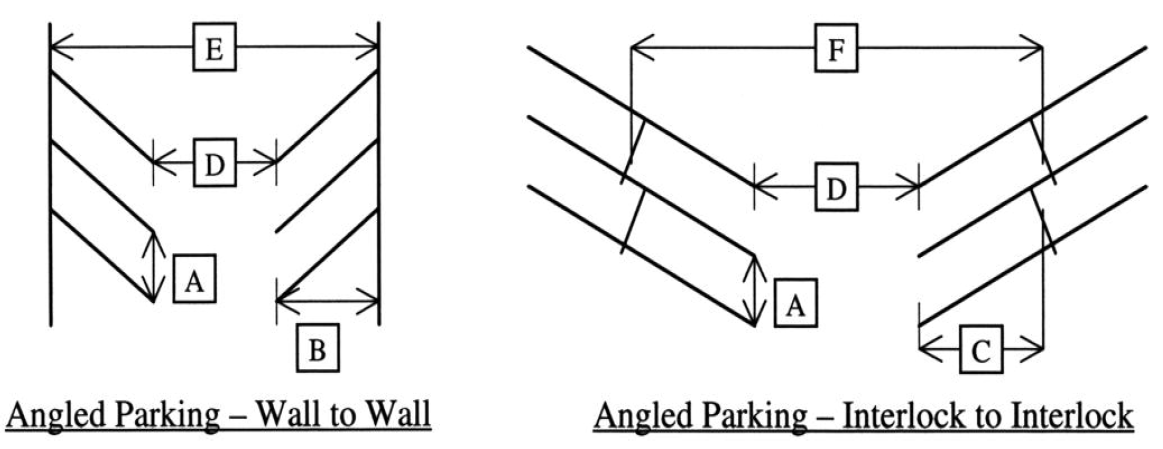
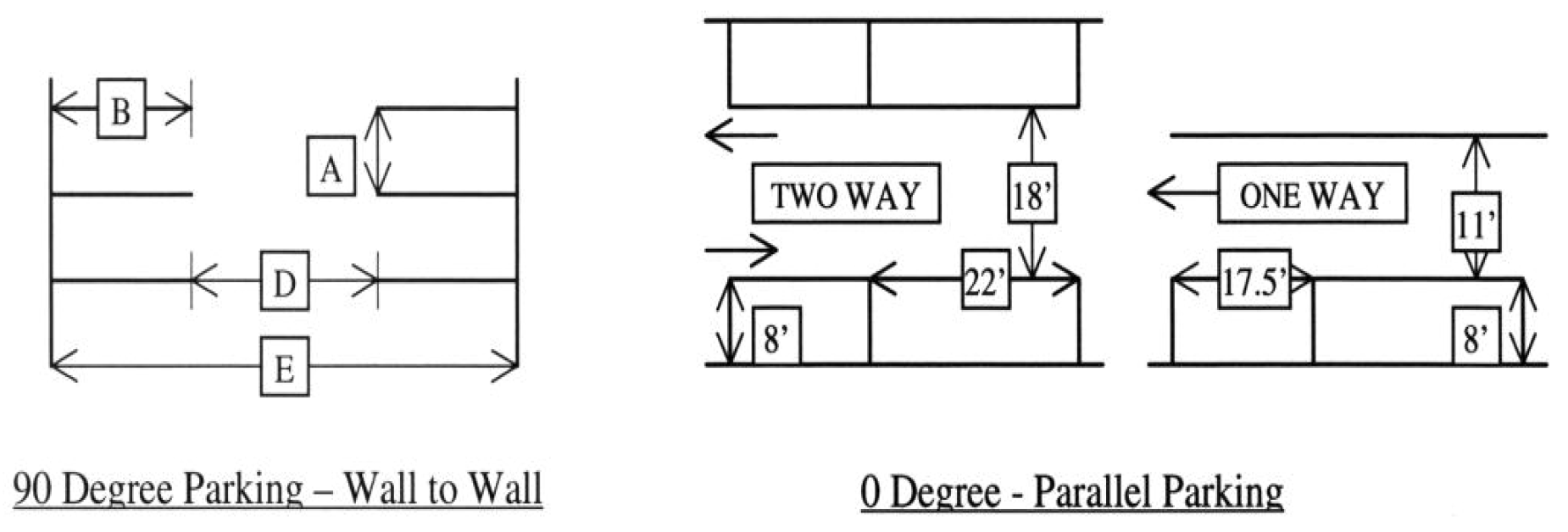
The minimum aisle width for two-way traffic shall be 18 feet. Captive stalls for parallel parking shall be 22 feet in length. End stalls for parallel parking shall be 17½ feet in length. The Zoning Administrator may interpolate dimensions for angles not listed above.
_____
(b)
Parking areas with five or more spaces may provide a maximum of 20 percent of spaces at compact dimensions, provided that such spaces shall be clearly marked as compact spaces.
(c)
A further reduction of two feet in aisle width for full-size stalls shall be permitted in RO-3, HO, B-4, B-5, B-6, B-7, TOD-1, CM, DCC, and RP districts.
(d)
Up to 2½ feet of the required parking stall depth specified in subsection (a) of this section may be provided as vehicle overhang area and need not be paved, provided that curbs or wheel stops shall be installed in such manner that the vehicle overhang area is clear of any obstruction to vehicles utilizing the parking space and that the vehicle overhang area shall not encroach into any other parking space, access aisle, public right-of-way, abutting property, pedestrian walkway or any required yard, perimeter buffer or internal landscaped area.
(e)
All dead-end aisles providing access to parking spaces shall be provided with backup space of not less than five feet in depth at the end of such aisles.
(Code 1993, § 32-710.3:1; Code 2004, § 114-710.3:1; Code 2015, § 30-710.3:1; Ord. No. 2006-168-189, § 2, 7-10-2006; Ord. No. 2010-19-31, § 3, 2-22-2010; Ord. No. 2017-150, § 5, 9-25-2017)
Sec. 30-710.3:2. - Dimensions of stacking spaces.
The minimum size of stacking spaces required by the provisions of this chapter shall be eight feet in width and 18 feet in length.
(Code 2004, § 114-710.3:2; Code 2015, § 30-710.3:2; Ord. No. 2004-180-167, § 4, 6-28-2004)
Sec. 30-710.4. - Reserved.
Editor's note— Ord. No. 2023-101, § 1, adopted April 24, 2023, repealed § 30-710.4, which pertained to required spaces located off the premises and derived from the Code of 1993, § 32-710.4; the Code of 2004, § 114-710.4; the Code of 2015, § 30-710.4; Ord. No. 2006-168-189, adopted July 10, 2006; Ord. No. 2010-19-31, adopted February 22, 2010; Ord. No. 2015-151-164, adopted September 14, 2015 and Ord. No. 2017-150, adopted September 25, 2017.
Sec. 30-710.5. - Parking spaces located in required yards.
This section shall apply in addition to the applicable improvement requirements and landscaping standards for parking areas and parking lots contained in Division 2.1 of this article. Spaces for the parking of vehicles and access aisles thereto, except spaces accessory to single-family dwellings, shall not be located within a required front yard or required street side yard on any lot in R, RO, B-1, and OS districts nor within that portion of a required front yard on a lot in any other district and situated within 50 feet of a lot in an R or RO district.
(Code 1993, § 32-710.5; Code 2004, § 114-710.5; Code 2015, § 30-710.5)
Sec. 30-710.7. - Parking areas located in R districts adjacent to business, commercial or industrial districts.
When authorized by the Board of Zoning Appeals pursuant to Section 17.20(d)(3) of the City Charter, land located in an R district contiguous to an RO, HO, B, UB, UB-2, CM, OS or M district or separated therefrom by an alley may be used for the parking of vehicles of customers of business, commercial or industrial establishments permitted in such districts, provided that such parking shall not extend a distance of more than 170 feet from the boundary of the RO, HO, B, UB, UB-2, CM, OS or M district.
(Code 1993, § 32-710.7; Code 2004, § 114-710.7; Code 2015, § 30-710.7; Ord. No. 2006-168-189, § 2, 7-10-2006)
Sec. 30-710.10. - Intent.
The intent of this division is to facilitate the creation of a convenient, attractive and harmonious community; to conserve and protect natural resources, including air and water quality; to protect and enhance property values; and to promote public safety by providing internal landscaping, perimeter buffer, tree coverage and other improvement standards for the development and maintenance of parking areas and parking lots in the City.
(Code 1993, § 32-710.10; Code 2004, § 114-710.10; Code 2015, § 30-710.10)
Sec. 30-710.11. - Applicability of division.
(a)
Newly constructed parking areas and parking lots. The requirements and standards set forth in this division shall be applicable to all principal and accessory parking areas and parking lots newly constructed or established after the effective date of the ordinance from which this division is derived. For purposes of this section, the paving of a previously unpaved parking area or parking lot or the removal and subsequent reconstruction of improvements in an existing parking area or parking lot shall be construed as a newly constructed parking area or parking lot.
(b)
Existing parking areas and parking lots. The requirements and standards set forth in this division shall be applicable to principal and accessory parking areas and parking lots existing at the effective date of the ordinance from which this division is derived in accordance with the requirements of Article VIII of this chapter pertaining to nonconforming uses and features.
(Code 1993, § 32-710.11; Code 2004, § 114-710.11; Code 2015, § 30-710.11)
Sec. 30-710.12. - Improvement of parking areas and parking lots.
Parking areas and parking lots containing five or more parking spaces shall be improved and maintained in accordance with the following:
(1)
Screening along interior lot lines in certain cases. Whenever a parking area or parking lot abuts or is situated within 50 feet of property in an R, RO, HO or I district, unless separated therefrom by an alley providing access to such parking area or parking lot, the parking area or parking lot shall be effectively screened from view from such property by evergreen vegetative material not less than 3½ feet in height at the time of installation or by an opaque structural fence or wall not less than four feet in height, provided that such parking area or parking lot need not be screened from an adjacent parking area or parking lot containing five or more parking spaces or from an adjacent loading area. Evergreen vegetative material intended to satisfy this subsection shall be planted at such intervals that will result in a continuous visual screen within one year of planting.
(2)
Paving. Parking areas and parking lots and all entrances thereto and exits therefrom shall be designed and improved using accepted engineering practices for usability and longevity with asphalt, concrete, unit pavers or similar material approved by the administrator of the erosion and sediment control ordinance in Chapter 14, Article III, and shall be designed so as not to create or increase adverse effects on adjoining properties as a result of surface drainage.
(3)
Pavement markings. Except where the parking of vehicles is by attendant only, every parking space provided on the premises shall be delineated.
(4)
Maneuvering space. No parking area or parking lot shall be designed, operated or maintained so as to cause any street or sidewalk to be obstructed by vehicles entering, leaving or maneuvering within such parking area or parking lot. Whenever necessary to prevent such obstruction, space for the maneuvering of vehicles shall be provided within the parking area or parking lot.
(5)
Lighting. Parking areas and parking lots shall be provided with lighting during the non-daylight hours when such are in use. Lighting shall be designed and installed so as to concentrate illumination within the parking area or parking lot and to prevent glare on adjoining properties and streets. The height of lighting structures shall not exceed the height limit of the district in which they are located, and in no case shall such height exceed 35 feet. When lighting is required by this subsection, the intensity of illumination within the area devoted to parking shall be not less than 0.5 horizontal footcandle at any location, provided that in no case shall the intensity of illumination exceed 0.5 horizontal footcandle at any property line abutting a lot in an R or RO district. The lighting maximum-to-minimum ratio within the parking area or parking lot shall not exceed 15:1. Parking area and parking lot lighting fixtures shall be constructed or shielded in such a manner that all light emitted by the fixture, either directly from the lamp or indirectly from the fixture, is projected below the horizontal plane of the fixture.
(Code 1993, § 32-710.12; Code 2004, § 114-710.12; Code 2015, § 30-710.12; Ord. No. 2011-33-53, § 1, 3-28-2011; Ord. No. 2023-101, § 5, 4-24-2023)
Sec. 30-710.13. - Perimeter buffers; landscaping requirements.
Except as provided in subsection (3) of this section, parking areas and parking lots containing five or more parking spaces shall be improved and maintained with landscaping in accordance with the requirements of this section as follows:
(1)
Treatment of required landscaped buffers. Treatment of required landscaped buffers shall be in accordance with the following:
a.
Required landscaped buffers shall be provided with vegetative ground cover, trees, shrubs, other plant material, or any combination thereof, except where more specific requirements are set forth in subsection (2) of this section. Mulch ground cover may be provided as a border or supplement to other vegetation in a required landscaped buffer. Pedestrian walkways incidental to landscaped buffers may be incorporated within such buffers when the other requirements of this subsection (1)a are met.
b.
All required landscaped buffers shall be protected from encroachment by motor vehicles by installation of curbs, wheel stops or other features which separate the landscaped buffer from areas improved for vehicle parking or circulation.
(2)
Landscaped buffers along streets. Landscaped buffers as set forth in subsections (2)a through (2)d of this section shall be installed and maintained between all areas devoted to parking and all adjacent street lines, provided that approved driveways enabling access to abutting streets may extend through such buffers.
a.
Zoning districts and permitted buffer alternatives. The following table specifies the buffer and buffer alternatives that satisfy the landscaped buffer requirement in each zoning district. Where more than one buffer alternative is listed for a zoning district, any of the listed alternatives may be provided to satisfy the buffer requirement in that district:
b.
Description of buffer alternatives. The depth of and improvements required within each buffer alternative are as follows. In all cases, buffer alternatives are minimum requirements, and greater buffer depth, additional landscaping or additional fence or wall improvements may be provided:
1.
Buffer "A," as shown below, shall have a depth of not less than the minimum yard requirement applicable along each street frontage of the property, but in no case less than five feet, and shall include an evergreen vegetative screen not less than 3½ feet in height at the time of installation placed along the setback line of the parking area. Evergreen vegetative material intended to satisfy this requirement shall be planted at such intervals that will result in a continuous visual screen within one year of planting.
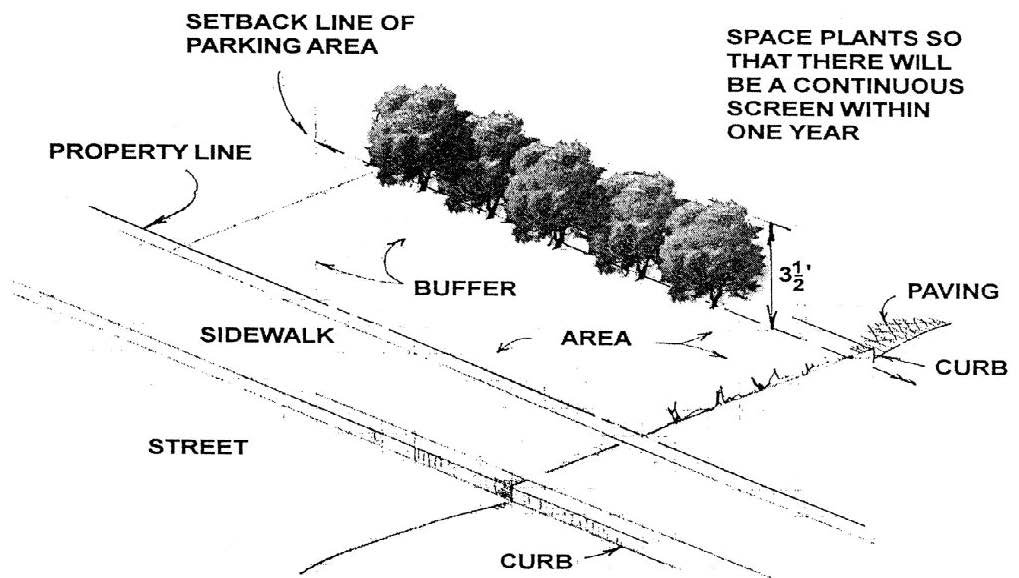
Buffer area depth dependent on yard requirement in district, but in no case less than five feet.
2.
Buffer "B," as shown below, shall have a depth of not less than the minimum yard requirement applicable along each street frontage of the property, but in no case less than five feet, and shall include an opaque structural fence or wall not less than four feet in height placed along the setback line of the parking area and shall include shrubs located adjacent to such fence at a rate of not less than ten for each 50 linear feet or major fraction thereof of buffer along each street frontage.
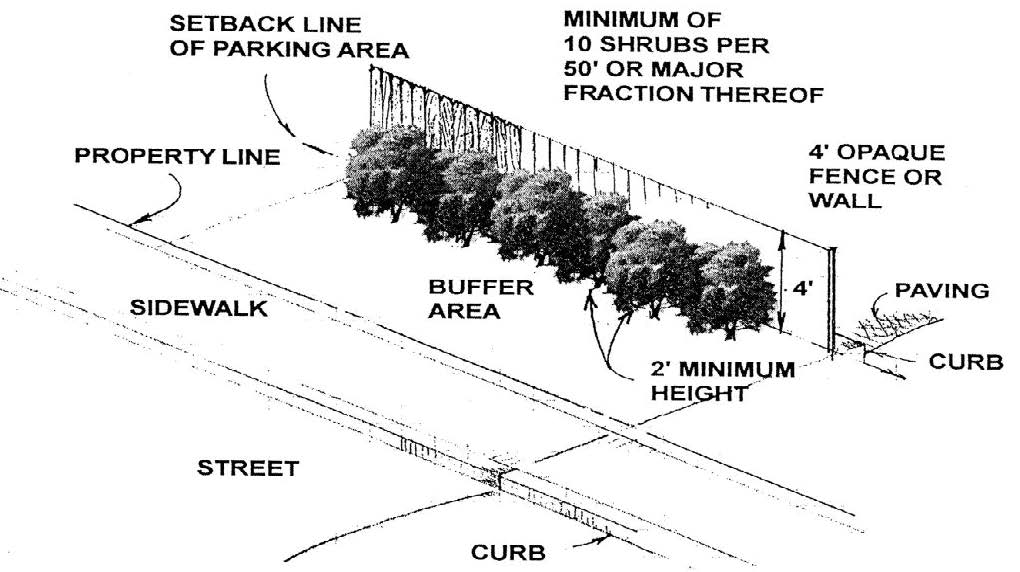
Buffer area depth dependent on yard requirement in district, but in no case less than five feet.
3.
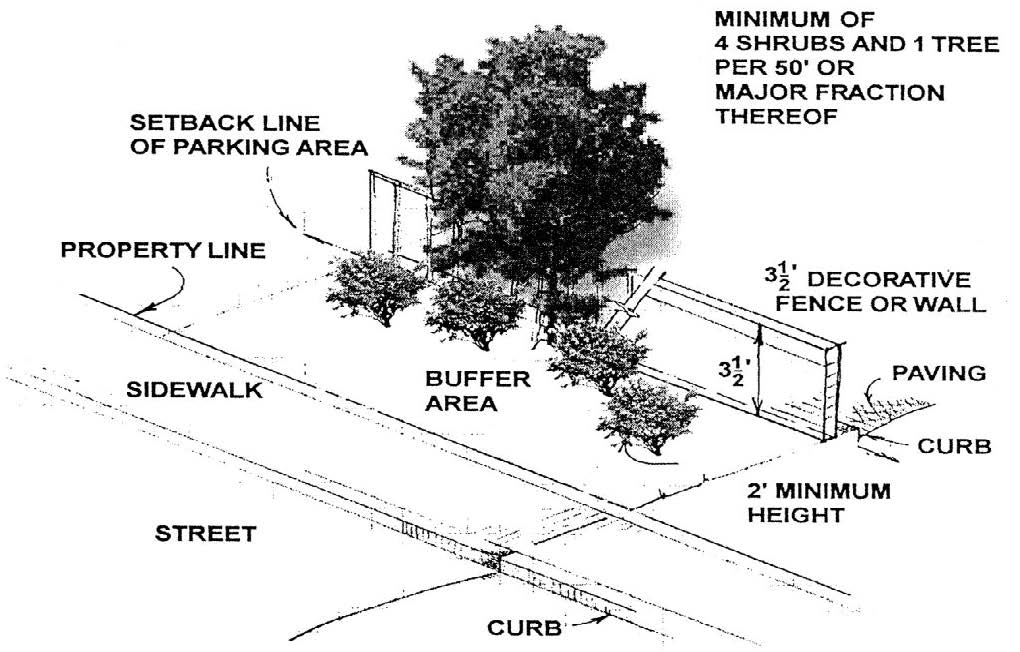
Buffer "C," as shown below, shall have a depth of not less than the minimum yard requirement applicable along each street frontage of the property, but in no case less than five feet, and shall include a decorative fence or wall not less than 3½ feet in height placed along the setback line of the parking area and shall include trees and shrubs located adjacent to such fence at a rate of not less than one tree and four shrubs for each 50 linear feet or major fraction thereof of buffer along each street frontage.
Buffer area depth dependent on yard requirement in district, but in no case less than five feet.
4.
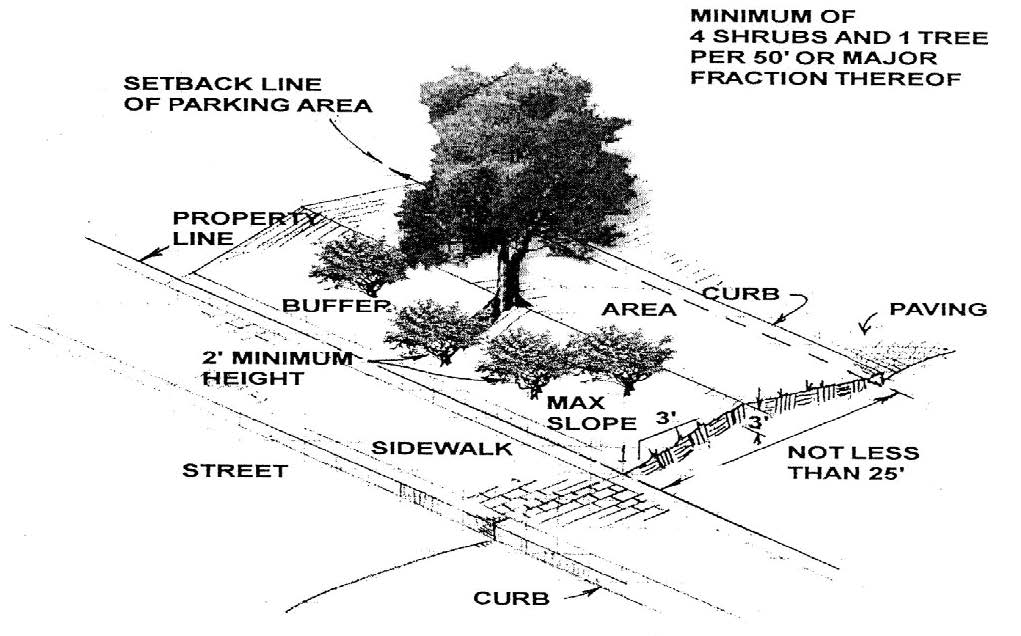
Buffer "D," as shown below, shall have a depth of not less than 25 feet and shall consist of an earthen berm not less than three feet in height with slopes not greater than three feet horizontal for each one foot vertical and shall include trees and shrubs located on the top or street side of such berm at a rate of not less than one tree and four shrubs for each 50 linear feet or major fraction thereof of buffer along each street frontage.
5.
Buffer "E," as shown below, shall have a depth of not less than the minimum yard requirement applicable along each street frontage of the property and shall include trees and shrubs at a rate of not less than one tree and four shrubs for each 40 linear feet or major fraction thereof of buffer along each street frontage. In any case where the applicable yard requirement along a street is five feet or less, the trees and shrubs required for buffer "E" may be substituted with the improvements specified for buffer "H" provided that the applicable yard requirement is met.
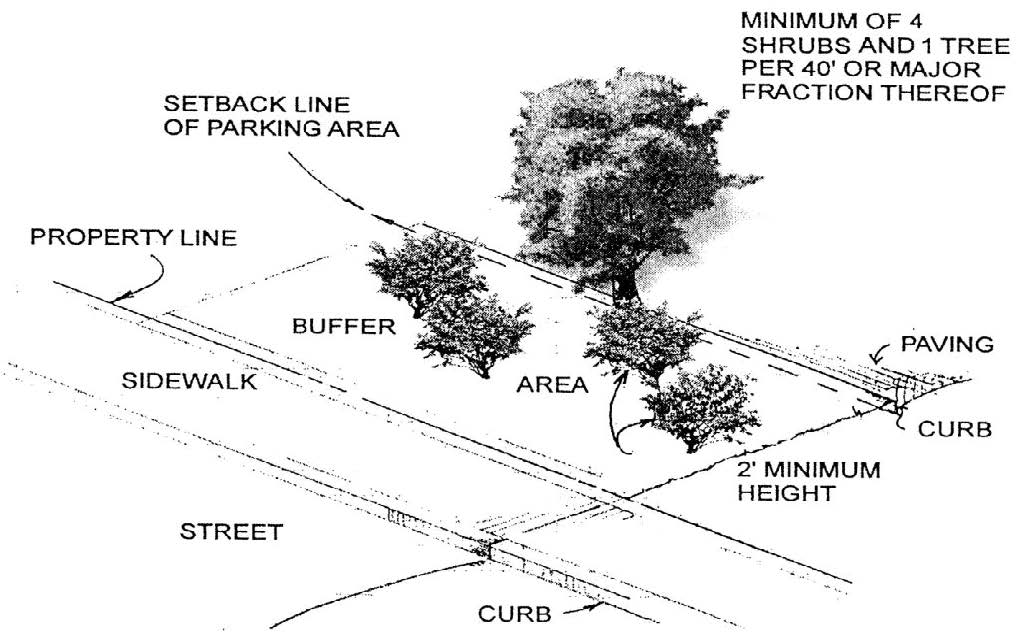
Buffer area depth dependent on yard requirement in district, but in no case less than five feet. Where yard requirement is five feet or less, trees and shrubs may be substituted as specified for buffer "H."
6.
Buffer "F," as shown below, shall have a depth of not less than 15 feet and shall include trees and shrubs at a rate of not less than one tree and four shrubs for each 50 linear feet or major fraction thereof of buffer along each street frontage.
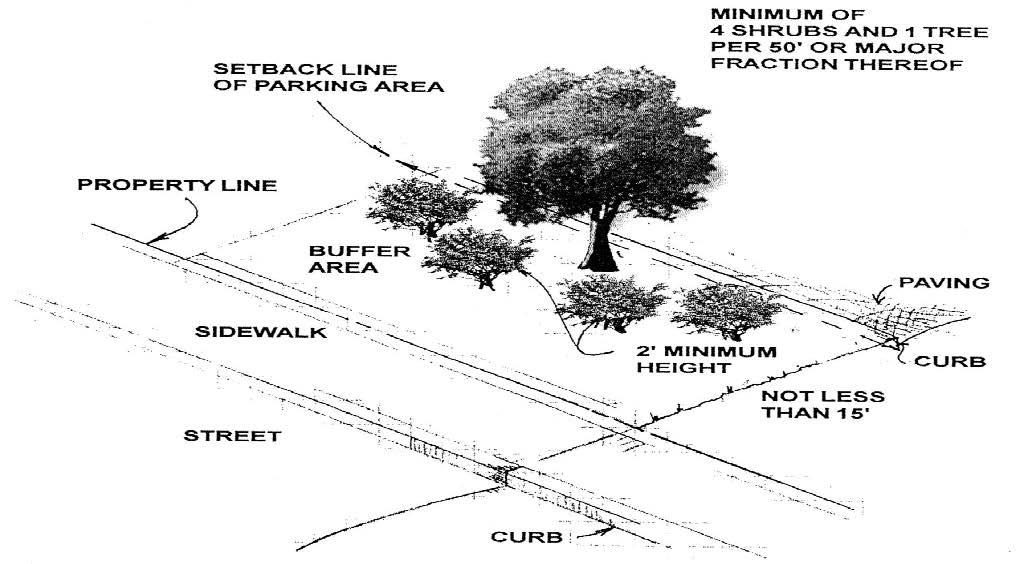
7.
Buffer "G," as shown below, shall have a depth of not less than ten feet and shall include trees and shrubs at a rate of not less than one tree and four shrubs for each 40 linear feet or major fraction thereof of buffer along each street frontage.
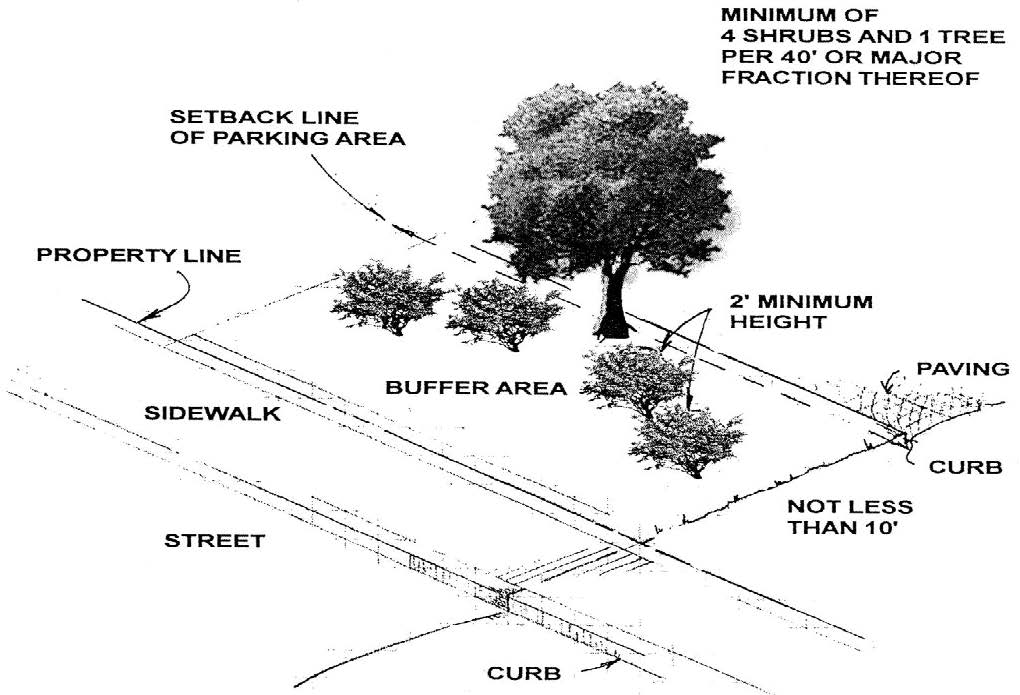
8.
Buffer "H," as shown below, shall have a depth of not less than five feet and shall include a decorative fence or wall not less than 3½ feet in height and shrubs at a rate of not less than four shrubs for each 50 linear feet or major fraction thereof of buffer along each street frontage.
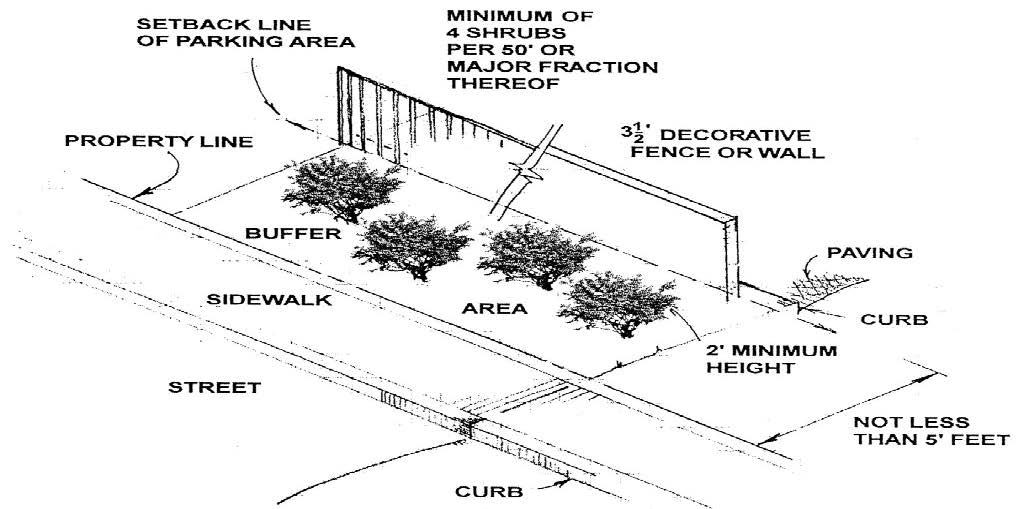
9.
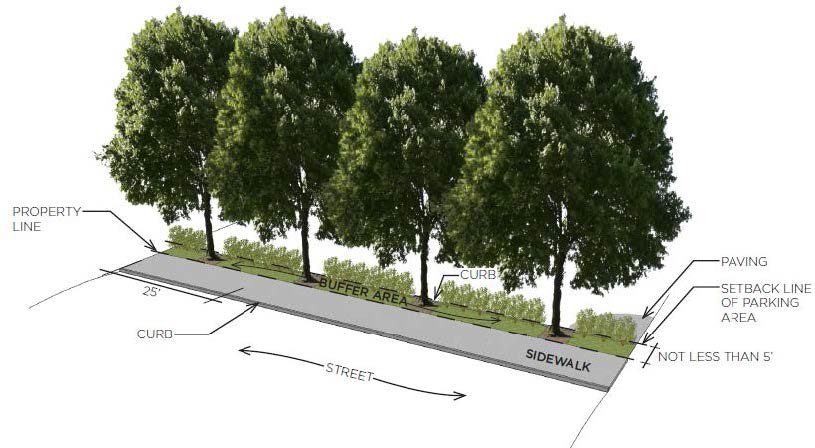
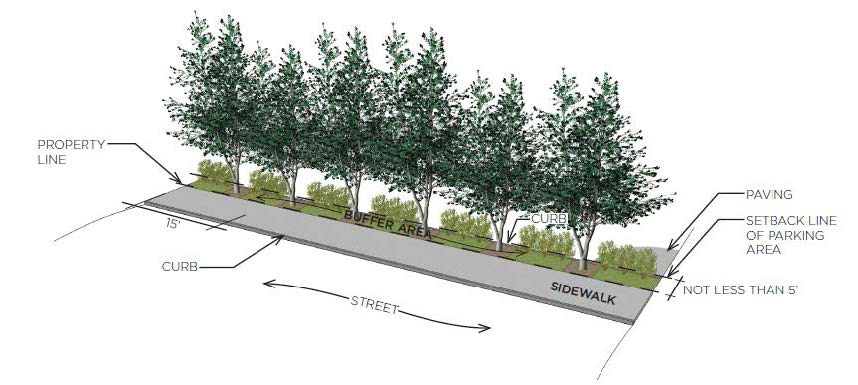
Buffer "I," as shown below, shall have a depth of not less than five feet and shall include either trees classified as medium or large in the Tree Canopy Chart dated November, 2002, adopted by the Planning Commission at a rate of one tree for every 30 linear feet or trees classified as compact or small trees in Tree Canopy Chart dated November, 2002, adopted by the Planning Commission at a rate of one tree for every 20 linear feet; as well as groundcover or shrubs covering at least 50 percent of the area of the buffer along each street frontage.
Buffer I, Medium Or Large
Trees Illustration
Buffer I, Small Or Compact
Trees Illustration
c.
Tree and shrub standards. Standards for trees and shrubs shall be as follows:
1.
Trees to be credited toward buffer requirements shall be deciduous trees having a caliper of not less than 2½ inches at the time of installation measured six inches above the ground or evergreen trees having a height of not less than six feet at the time of installation. Healthy existing trees to be retained within a buffer area may be credited toward buffer requirements when such trees are shown on approved plans and are adequately protected during construction.
2.
Trees to be credited toward buffer requirements shall be distributed as equally as practical throughout the length of the buffer, with consideration for the species of trees, topography, location of driveways and utilities and other physical conditions.
3.
Shrubs to be credited toward buffer requirements shall be evergreen shrubs not less than two feet in height at the time of installation. Shrubs may be grouped in a manner appropriate to the species and need not be distributed equally throughout the length of the buffer.
d.
Fences or walls. Fences or walls to be credited toward buffer requirements shall comply with fence and wall design guidelines adopted by resolution of the Planning Commission or their equivalent as determined by the Zoning Administrator. In no case shall chain link, chain link with slats or similar fencing be considered to meet the requirements of the fence and wall design guidelines.
1.
A fence or wall disapproved by the Director of Planning and Development Review shall, at the request of the applicant, be submitted to the Planning Commission for its review. The request for such review shall be made in writing to the Secretary of the Commission, who shall place the request on the Planning Commission's agenda for consideration at its first regularly scheduled meeting following the receipt of such request, provided that the request is received not less than ten days prior to such meeting.
2.
After reviewing the decision of the Director of Planning and Development Review, the Planning Commission may affirm the decision or, upon finding that the proposed fence or wall satisfies the fence and wall design guidelines, may instruct the Director of Planning and Development Review to approve the fence or wall. The Planning Commission may attach such conditions as it deems necessary to ensure conformance with the intent and purpose of the fence and wall design guidelines.
e.
Buffer I. Trees classified as medium or large in the Tree Canopy Chart dated November, 2002, adopted by the Planning Commission shall have a caliper of not less than 2½ inches at the time of installation measured six inches above the ground or evergreen trees having a height of not less than six feet at the time of installation. Trees classified as small or compact in the Tree Canopy Chart dated November, 2002, adopted by the Planning Commission shall have a caliper of not less than 1½ inches at the time of installation measured six inches above the ground or evergreen trees having a height of note less than five feet at the time of installation. Shrubs and groundcover credited towards the 50 percent coverage requirement may be evergreen or deciduous. All shrubs, groundcover, and trees may be grouped in a manner appropriate to the species with consideration for the topography, location of driveways and utilities, and other physical conditions and need not be distributed equally throughout the length of the buffer.
(3)
Landscaped buffers along interior lot lines. In addition to the screening requirements set forth in Section 30-710.12, parking areas and parking lots containing 30 or more parking spaces and parking areas containing five or more parking spaces serving uses with drive-up facilities or facilities for dispensing motor fuels shall be provided with landscaped buffers of not less than five feet in depth installed and maintained between all areas devoted to parking and all lot lines other than street lines, provided that approved driveways connecting properties or enabling access to abutting alleys may extend through such buffers.
(Code 1993, § 32-710.13; Code 2004, § 114-710.13; Code 2015, § 30-710.13; Ord. No. 2004-180-167, § 1, 6-28-2004; Ord. No. 2006-168-189, § 2, 7-10-2006; Ord. No. 2008-2-55, § 2, 3-24-2008; Ord. No. 2009-221-2010-9, § 1, 1-25-2010; Ord. No. 2010-19-31, § 3, 2-22-2010; Ord. No. 2015-151-164, § 1, 9-14-2015; Ord. No. 2017-150, § 6, 9-25-2017)
Sec. 30-710.14. - Internal landscaping requirements.
Landscaped islands meeting the requirements of this section shall be provided within all parking areas and parking lots containing 30 or more parking spaces and within parking areas containing five or more parking spaces serving uses with drive-up facilities or facilities for dispensing motor fuels.
(1)
Required number of landscaped islands. Landscaped islands shall be installed at a rate of not less than the following, unless a greater number of landscaped islands are required to satisfy the provisions of subsection (2) of this section:
a.
Within parking areas containing 30 or more parking spaces serving uses other than uses with drive-up facilities or facilities for dispensing motor fuels and within parking lots containing 30 or more parking spaces: one landscaped island for every 15 parking spaces, or major fraction thereof, for the first 100 parking spaces, plus one landscaped island for every additional 20 parking spaces, or major fraction thereof;
b.
Within parking areas containing five or more parking spaces serving uses with drive-up facilities or facilities for dispensing motor fuels: one landscaped island for every ten parking spaces, or major fraction thereof, for the first 30 parking spaces; plus one landscaped island for every additional 15 parking spaces, or major fraction thereof, for up to and including 100 parking spaces; plus one landscaped island for every additional 20 parking spaces, or major fraction thereof, in excess of 100 parking spaces.
(2)
Location of required landscaped islands. Within parking areas and parking lots containing 100 or fewer parking spaces, landscaped islands shall be located so that no more than 15 parking spaces are situated in a continuous row, and within parking areas and parking lots containing more than 100 parking spaces, landscaped islands shall be located so that not more than 20 parking spaces are situated in a continuous row. Each end of each row of parking spaces shall be separated from adjacent access aisles and driveways by a landscaped island.
(3)
Size of required landscaped islands. Required landscaped islands shall be not less than eight feet in width measured between the outside faces of curbs or other features that define the landscaped island if curbs are not provided, and shall be not less than the length of abutting parking spaces. In the case of landscaped islands having irregular width, the width shall be measured at each point where a tree is to be located within the island.
(4)
Improvement of required landscaped islands.
a.
Each required landscaped island shall contain not less than one deciduous tree having a caliper of not less than 2½ inches at the time of installation measured six inches above the ground.
b.
In addition to required trees, landscaped islands shall be provided with vegetative ground cover, shrubs, other plant material, or any combination thereof. All portions of required landscaped islands not provided with vegetative ground cover or other plant material shall be mulched.
c.
Pedestrian walkways incidental to landscaped islands may be incorporated within such islands when the other requirements of this subsection are met.
d.
All required landscaped islands shall be protected from encroachment by motor vehicles by installation of curbs, wheel stops or other features which separate the landscaped island from areas improved for vehicle parking or circulation. Required landscaped islands shall not include any portion of a required perimeter buffer or any portion of a parking space.
(5)
Areas qualifying as landscaped islands. As shown below, landscaped islands shall include areas that are improved in accordance with the requirements of this section and are situated:
a.
Within an otherwise continuous row of parking spaces so as to provide separation between parking spaces;
b.
At the end of a row of parking spaces so as to provide separation between parking spaces and an access aisle, driveway, street, alley or other paved area;
c.
At the end of a row of parking spaces so as to provide a corner between rows of parking spaces that are arranged at an angle to one another; or
d.
Between opposing rows of parking spaces or between a row of parking spaces and an access aisle, driveway, street, alley or other paved area.
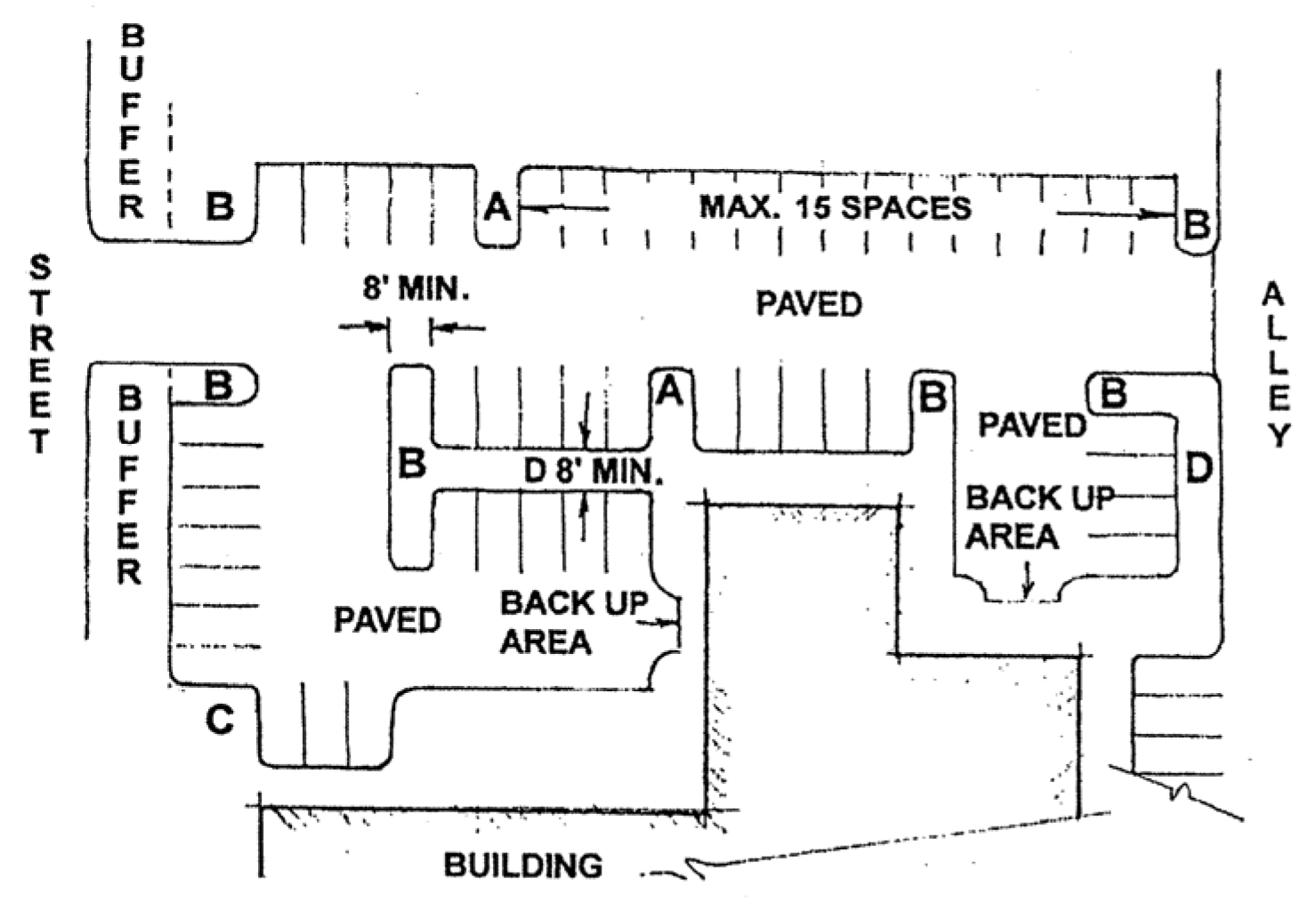
Landscape Islands
(Code 1993, § 32-710.14; Code 2004, § 114-710.14; Code 2015, § 30-710.14; Ord. No. 2004-180-167, § 1, 6-28-2004)
Sec. 30-710.15. - Tree coverage requirements.
Parking areas and parking lots containing 30 or more parking spaces and parking areas containing five or more parking spaces serving uses with drive-up facilities or facilities for dispensing motor fuels shall be improved and maintained with trees in accordance with the requirements of this section.
(1)
Determining projected tree coverage. Projected tree coverage shall be determined in accordance with the City of Richmond Tree Canopy Chart which shall be adopted by resolution of the Planning Commission. Other tree species and larger trees not shown on the tree canopy chart may be given credit toward the tree coverage requirement when supporting data adequate to determine coverage is submitted to and accepted by the Zoning Administrator.
(2)
Minimum projected tree coverage. Trees shall be planted or existing trees shall be retained so as to provide a projected tree coverage at ten years from the date of plan approval as determined by the following formulas:
a.
A parking area serving a use other than a use with drive-up facilities or facilities for dispensing motor fuels, or a parking lot, shall have a projected tree coverage area equivalent to not less than 30 square feet for each parking space contained in the parking area or parking lot.
b.
A parking area serving a use with drive-up facilities or facilities for dispensing motor fuels shall have a projected tree coverage area equivalent to not less than 40 square feet for each parking space contained in the parking area.
(3)
Minimum tree sizes. Trees to be credited toward the tree coverage requirement shall meet the following standards at the time of installation:
a.
Deciduous trees shall have a caliper of not less than 2½ inches measured six inches above the ground.
b.
Evergreen trees shall be not less than six feet in height.
(4)
Location of trees to be credited. As shown below, trees to be credited toward the tree coverage requirement may be located:
a.
Within landscaped islands meeting the requirements of Section 32-710.14;
b.
Between the area devoted to parking and a building on the same site, or between the area devoted to parking and a side or rear property line, provided such trees are located within ten feet of the area devoted to parking; or
c.
Within that portion of a perimeter buffer lying within ten feet of the area devoted to parking, provided that trees required to meet perimeter buffer requirements shall not be credited toward the tree coverage requirement.
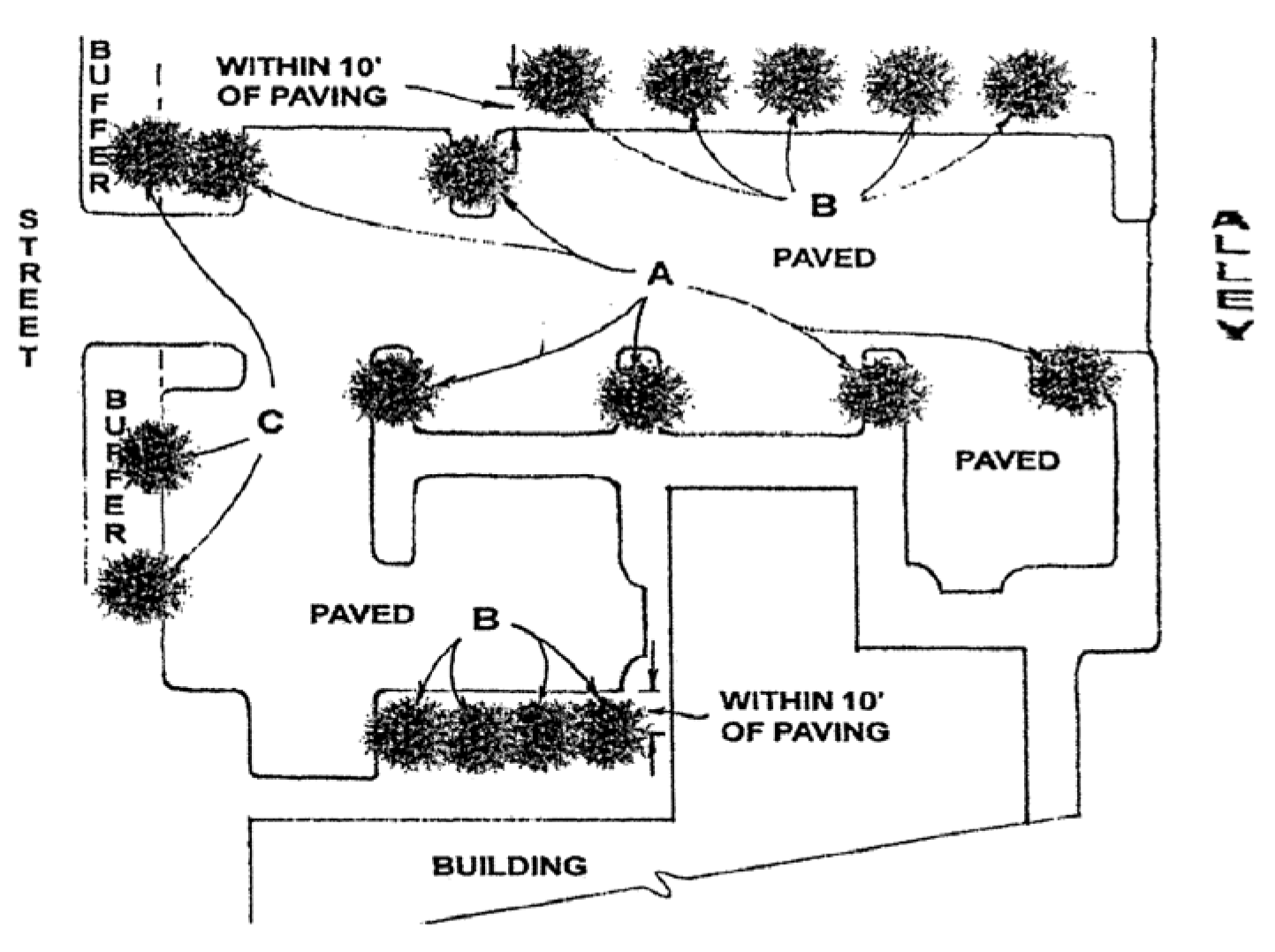
Location of Trees
(5)
Retention of existing trees. Healthy existing trees to be retained may be credited toward the tree coverage requirement when such trees are located as specified in subsection (4) of this section, are shown on approved plans, and are adequately protected during construction.
(Code 1993, § 32-710.15; Code 2004, § 114-710.15; Code 2015, § 30-710.15; Ord. No. 2004-180-167, § 1, 6-28-2004)
Sec. 30-710.16. - Maintenance.
The owner of the property shall be responsible for maintenance, repair and replacement of landscaping materials and other improvements required by this division in such manner that the requirements of this division continue to be met.
(Code 1993, § 32-710.16; Code 2004, § 114-710.16; Code 2015, § 30-710.16)
Secs. 30-720.1, 30-720.2. - Reserved.
Editor's note— Ord. No. 2023-101, § 1, adopted April 24, 2023, repealed §§ 30-720.1 and 30-720.2, which pertained to number and length of spaces required and method of determining number, respectively, and derived from the Code of 1993, §§ 32-720.1, 30-720.2; the Code of 2004, §§ 114-720.1, 114-720.2; the Code of 2015, §§ 30-720.1, 30-720.2; Ord. No. 2006-168-189, adopted July 10 2006; Ord. No. 2008-2-55, adopted March 24, 2008; Ord. No. 2010-19-31, adopted February 22, 2010; Ord. No. 2017-150, adopted February 25, 2017.
Sec. 30-720.3. - Location and improvement of loading spaces.
(a)
No loading space or maneuvering space related thereto shall be located within a required yard adjacent to a public street or within a required yard abutting property in an R or RO district.
(b)
Whenever a loading space or maneuvering area related thereto abuts or is situated within 50 feet of property in an R, RO, HO or I district, the loading space or maneuvering area shall be effectively screened from view from such property by an evergreen vegetative or opaque structural fence or screen not less than six feet in height, provided that such loading space or maneuvering area need not be screened from a loading space, maneuvering area or parking area containing five or more spaces located on adjacent property.
(c)
Each loading space shall be identified as such and shall be reserved for loading purposes.
(d)
All loading spaces and maneuvering spaces related thereto shall be graded, improved and maintained so as to be available for use under normal weather conditions and so as not to create adverse effects on adjoining property as a result of dust or surface drainage.
(Code 1993, § 32-720.3; Code 2004, § 114-720.3; Code 2015, § 30-720.3; Ord. No. 2023-101, § 5, 4-24-2023)
Sec. 30-720.4. - Dimensions of loading spaces.
Off-street loading spaces shall be not less than ten feet in width and shall have an unobstructed vertical clearance of not less than 14 feet. The minimum length of required off-street loading spaces shall be 35 feet.
(Code 1993, § 32-720.4; Code 2004, § 114-720.4; Code 2015, § 30-720.4; Ord. No. 2023-101, § 5, 4-24-2023)
Sec. 30-720.5. - Reserved.
Editor's note— Ord. No. 2023-101, § 1, adopted April 24, 2023, repealed § 30-720.5, which pertained to required loading spaces in UB-2, B-5, B-6, B-7, TOD-1, and DCC districts and derived from the Code of 1993, § 32-720.5; the Code of 2004, § 114-720.5; the Code of 2015, § 30-720.5; Ord. No. 2006-168-189, adopted July 10, 2006; Ord. No. 2008-2-55, adopted March 24, 2008; Ord. No. 2010-19-31, adopted February 22, 2010 and Ord. No. 2017-150, adopted September 25, 2017.
Sec. 30-730.1. - Intent.
The intent of this division is to facilitate the creation of a convenient, attractive and harmonious community; to promote the conservation and protection of natural resources and air quality; to protect and enhance property values; and to promote public safety by providing secure bicycle parking within the City.
(Code 2015, § 30-730.1; Ord. No. 2015-151-164, § 2, 9-14-2015)
Sec. 30-730.2. - Bicycle parking requirement.
The minimum number of bicycle parking spaces required for uses located in any district shall be as follows:
(1)
For multifamily dwellings:
(2)
For parking decks and parking garages containing parking spaces serving nonresidential uses:
(Code 2015, § 30-730.2; Ord. No. 2015-151-164, § 2, 9-14-2015)
Sec. 30-730.3. - Location of required bicycle parking spaces.
(a)
All required bicycle parking spaces located within a parking deck or parking garage shall be located on a level no lower than the first complete parking level below the ground floor.
(b)
Long-term bicycle parking spaces shall be located on the same premises as the use which they are intended to serve.
(c)
Short-term bicycle parking spaces shall be located within 120 feet of the principal entrance to the building occupied by the use they serve. In cases where short-term bicycle parking spaces are not visible from the principal street frontage, signage to direct the public to the short-term bicycle parking spaces shall be installed and maintained.
(Code 2015, § 30-730.3; Ord. No. 2015-151-164, § 2, 9-14-2015)

