
Ridgeway City Zoning Code
14.28
Definitions.
For the purpose of this ordinance, the following definitions shall be used. Words used in the present tense include the future; the singular number includes the plural number; and the plural number includes the singular number. The word "shall" is mandatory, the word "should" is advisory and the word "may" is permissive. Any words not defined in this section shall be presumed to have the customary dictionary definitions.
Accessory Use or Structure. A use or detached structure subordinate to the principal use of a structure, land, or water and located on the same lot or parcel serving a purpose customarily incidental to the principal use or the principal structure.
Alley. A special public right-of-way affording only secondary access to abutting properties.
Animal Unit. One animal unit shall be defined as being the equivalent of 1 cow, 1 -1,000 lb. steer or bull, 4 hogs, 10 sheep, 10 goats, 100 poultry, 1 horse or pony.
Arterial Street. A public street or highway used or intended to be used primarily for fast or heavy through traffic. Arterial streets and highways shall include freeways and expressways as well as arterial streets, highways and parkways.
Basement. That portion of any structure located partly below the average adjoining lot grade.
Building. Any structure having a roof supported by columns or walls used or intended to be used for the shelter or enclosure of persons, animals, equipment, machinery, or materials.
Building Height. The vertical distance measured from the mean elevation of the finished lot grade along the street yard face of the structure to the highest point of flat roofs, to the mean height level between the eaves and ridges of gable, gambrel, hip, and pitch roofs; or to the deck line of mansard roofs.
Classes of Notice. References in this ordinance to Class 1 and Class 2 notices refer to Chapter 985 of the Wisconsin Statutes.
Clothing Repair Shops. Shops where clothing is repaired such as shoe repair shops, seamstress, tailor shops, shoe shine shops, clothes pressing shops, but none employing over five persons.
Clothing Stores. Retail stores where clothing is sold, such as department stores, dry goods and shoe stores, dress, hosiery, and millinery shops.
Commercial Livestock Operation. An animal confinement facility used or designed for the feeding or holding of more than 400 animal units for 30 days or more.
Commercial Poultry Operation. A confinement facility used or designed for the raising of more than 150 animal units for egg or meat production.
Conditional Uses. Uses of a special nature as to make impractical their predetermination as a principal use in a district.
Dwelling. A detached building designed or used exclusively as a residence or sleeping place, but does not include boarding or lodging houses, motels, hotels, tents, cabins, or mobile homes.
Dwelling, Multiple Family. A residential building designed for or occupied by two or more families, with the number of families in residence not to exceed the number of dwelling units provided.
Efficiency. A dwelling unit consisting of one principal room with no separate sleeping room.
Essential Services. Services provided by public and private utilities, necessary for the exercise of the principal use or service of the principal structure. These services include underground, surface, or overhead gas, electrical, steam, water, sanitary sewerage, storm water drainage, and communication systems and accessories thereto, such as poles, towers, wires, mains, drains, vaults, culverts, laterals, sewers, pipes, catch basins, water storage tanks, conduits, cables, fire alarm boxes, police call boxes, traffic signals, pumps, lift stations, and hydrants.
Family. Any number of persons related by blood, adoption, or marriage, or not to exceed four persons not so related, living together in one dwelling as a single housekeeping entity.
Floor Area. The total living area bounded by the exterior walls of a building at the floor levels, but not including basement, utility rooms, garages, porches, breezeways, and unfinished attics.
Frontage. The smallest dimension of a lot abutting a public street measured along the street line.
Garage. Structure whose primary purpose is the storing of personal vehicles.
Government Uses. Includes all public uses and facilities including parks.
Household Occupation. Any occupation for gain or support conducted entirely within buildings by resident occupants which is customarily incidental to the principal use of the premises and does not exceed 25% of the area any floor. A household occupation includes uses such as millinery, dressmaking, canning, laundering, crafts, etc. Household occupations shall not cause any objectionable odors, noise, traffic, or unsightly storage. No activity from any household occupation shall be visible from the street or adjacent properties.
Joint Extraterritorial Zoning Committee. Any zoning committee established in accordance with Section 62. 23 (7a) of the Wisconsin Statutes.
Loading Area. A completely off-street space or berth on the same lot for the loading or unloading of freight carriers, having adequate ingress and egress to a public street or alley.
Lot. A parcel of land having frontage on a public street, occupied or intended to be occupied by a principal structure or use and sufficient in size to meet the lot width, lot frontage, lot area, yard, parking area, and other open space provisions of this ordinance.
Lot Lines and Area. The peripheral boundaries of a parcel of land and the total area lying within such boundaries.
Lot Types.
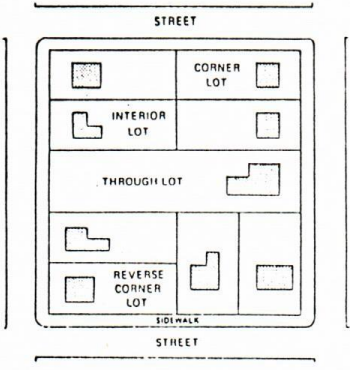
Lot Width. The width of a parcel of land measured at the rear of the specified street yard.
Machine Shops. Shops where lathes, presses, grinders, shapers, and other wood and metal working are used, such as blacksmith, tinsmith, welding, and sheet metal shops, plumbing, heating, and electrical repair and overhaul shops.
Minor Structures. Any small, movable accessory erection or construction such as birdhouses, tool houses, pet houses, play equipment, arbors, and walls and fences under four feet in height.
Mobile Home Park. Any lot on which two or more mobile homes are parked for the purpose of temporary or permanent habitation.
Mobile Homes. A vehicle designed to be towed as a single unit or in sections upon a highway by a motor vehicle and equipped and used, or intended to be used, primarily for human habitation, with walls of rigid non-collapsible construction. Any mobile home fitting the definition of a mobile home as set out above shall be designated a mobile home regardless of whether the plans for the mobile home include a concrete foundation, a basement, utility hookup, attachments, additions, annexes, foundations, and appurtenances.
Motel. A series of attached, semi-attached, or detached sleeping units for the accommodation of transient guests.
Nonconforming Uses or Structures. Any structure, land, or water lawfully used, occupied, or erected at the time of the effective date of this ordinance or amendment thereto which does not conform to the regulations of this ordinance or amendments thereto. Any such structure conforming in respect to use but not in respect to frontage, width, height, area, yard, parking, loading, or distance requirements shall be considered a nonconforming structure and not a nonconforming use.
Parking Lot. A structure or premises containing ten or more parking spaces open to the public for rent or a fee.
Parking Space. A graded and surfaced area of not less than 180 square feet in area either enclosed or open for the parking of a motor vehicle, having adequate ingress and egress to a public street or alley.
Parties in Interest. Includes all abutting property owners, all property owners within 100 feet, and all property owners of opposite frontage.
Professional Home Offices. Residences of doctors of medicine, practitioners, dentists, clergymen, architects, landscape architects, professional engineers, registered land surveyors, lawyers, artists, teachers, authors, musicians, or other recognized professions used to conduct their professions where the office does not exceed one-half of the area of only one floor of the residence and only one non-resident person is employed.
Rear Yard. A yard extending across the full width of the lot, and depth of which shall be the minimum horizontal distance between the rear lot line and a line parallel thereto through the nearest point of the principal structure. This yard shall be opposite the street yard or one of the street yards on a corner lot.
Renovation. A general upgrading of the building's interior and exterior appearance. Exterior improvements can include cleaning and painting, and will often involve a substantial change to shop front and design. Interior rehabilitation can include the upgrading of electrical, mechanical, or structural elements and new interior design.
Restoration. The reinstatement of original architectural integrity of structural form to quality buildings of the past, but does not necessarily extend to a reinstatement of the past use of the building.
Side Yard. A yard extending from the street yard to the rear yard of the lot, the width of which shall be the minimum horizontal distance between the side lot line and a line parallel thereto through the nearest point of the principal structure.
Signs. Any words, letters, figures, numerals, phrases, sentences, emblems, devices, designs, trade names, or trademarks by which anything is made known and which are used to advertise or promote an individual, firm, association, corporation, profession, business, commodity, or product and which is visible from any public street or highway.
Small Livestock and Poultry. For purposes of this ordinance, small livestock shall be limited to animals weighing less than 20 pounds.
Street. A public right-of-way not less than 50 feet wide providing primary access to abutting properties.
Street Yard. A yard extending across the full width of the lot, the depth of which shall be the minimum horizontal distance between the existing or proposed street or highway line and a line parallel thereto through the nearest point of the principal structure. Corner lots shall have two such yards.
Structural Alterations. Any change in the supporting members of a structure, such as foundations, bearing walls, columns, beams, or girders.
Structure. Any erection or construction, such as buildings, towers, masts, poles, booms, signs, decorations, carports, machinery, and equipment.
Utilities. Public and private facilities such as water wells, water and sewage pumping stations, water storage tanks, power and communication transmission lines, electrical power substations, static transformer stations, telephone and telephone exchanges, microwave radio relays, and gas regulation stations, but not including sewage disposal plants, municipal incinerators, warehouses, shops, and storage yards.
Yard. An open space on the same lot with a structure, unoccupied and unobstructed from the ground upward except for vegetation. The street and rear yards extend the full width of the lot.

