
Ridgway City Zoning Code
SECTION 4
Zoning Regulations
Subsections:
(Section Renumbered and Restated by Ordinance 03-2023)
Prior history: Ord. 01-2020; Ord. 03-2020; Ord. 06-2021; Ord. 07-2021; Ord. 02-2022.
7-4-1 - GENERAL PROVISIONS.
(A)
This Section, as amended from time to time, together with the Official Zoning Map as adopted and amended from time to time, may be cited as the Town's Zoning Regulations.
(B)
The purpose of these Zoning Regulations is to promote public health, safety, and welfare.
(C)
Whenever there is any conflict between these Zoning Regulations and any other ordinance, code provision, regulation, or law, the more restrictive or higher standard shall apply.
(D)
These Zoning Regulations and the Official Zoning Map shall constitute a part of the Town's Comprehensive Master Plan. These Zoning Regulations are enforceable in accordance with Subsection 7-1-8, Enforcement and Administration. However, the Master Plan is advisory in nature.
(E)
This Section lays out the application types, requirements, and review procedures for requests associated with zoning changes and land use approvals within the Town of Ridgway. These common review procedures provide the foundation for specific review and approval procedures. See those specific sections to determine which of these common review procedures apply to individual applications for development review.
(F)
Multiple Applications.
(1)
Concurrent Review Permitted. Where multiple applications concern the same property, the Town Manager or designee, may permit concurrent review of applications for efficiency and practicality.
(G)
Continued Work on Application. Applicants shall continuously and diligently pursue their application(s). An applicant who fails to respond to staff comments or requests for a period of four (4) months shall be administratively withdrawn by the Town Manager or designee. An applicant may request, in writing, an extension to the Town Manager or designee. The Town Manager or designee may allow such extension if it is determined that good cause exists to extend the application time frame.
(Ord. 03-2023)
7-4-2 - ZONING MAP.
(A)
The 1993 Revised Zoning Map of the Town, as such may be amended from time to time, may be known or cited as the "Official Zoning Map" of the Town.
(B)
The regulations for the various districts provided for in this Section shall apply within the boundaries of each such district as indicated on the Official Zoning Map. The district boundaries, as shown on the Official Zoning Map, shall be construed to follow the center lines of streets, to follow platted lot lines or the lines of undivided parcels of property, or to follow the Town limits, whenever a boundary is shown as approximately in the vicinity of such lines. Distances may be determined by the scale of the map.
(C)
No single lot shall be divided by a district (i.e., zoning, sanitation, fire, etc.), municipal or county boundary line.
(Ord. 03-2023)
7-4-3 - ZONING APPLICATIONS AND REVIEW PROCEDURES.
(A)
General Provisions. This Section outlines the review procedures that are common to all applications regulated within this Section 7-4-3, Zoning Applications and Review Procedures, unless otherwise stated in this Chapter. Table T-4.1 identifies the various application types and associated review procedures regulated by the Zoning Regulations. The submittal requirements, review procedures, and approval criteria for each application type are laid out in subsequent sections of this Chapter as identified in Table T-4.1. All documents and materials identified in this Section, and the particular application type section shall be required. Table T-4.1 - Zoning Application Types and Processes.
Table T-4.1 - Zoning Application Types and Processes
(B)
General Application Review Procedures. The following procedures shall apply to all classifications of development applications which are required under this Chapter.
(1)
Pre-Application Meeting. If the applicant or Town Manager or designee, requests a pre-application meeting, the following process shall be followed:
(a)
Prior to the formal submission of the application, the applicant shall contact the Town Manager or designee to schedule and request a pre-application meeting. Following receipt of a request, the pre-application meeting should be set for a date within ten (10) days of the date of the applicant's request. The Town Manager or designee shall advise the applicant of the date and time of the pre-application meeting.
(b)
The applicant shall be prepared to discuss the proposed application with the Town Manager or designee. The applicant is encouraged to present such plats, plans, diagrams, or other preliminary information sufficient to allow a conceptual review of the proposed application.
(c)
The purpose of the pre-application meeting is to assist the applicant in understanding the town's application review processes and to allow the Town Manager or designee to determine the applicable process(es) and regulations for the proposed application.
(2)
Application Submittal Requirements. All of the following information and materials shall be submitted to the Town of Ridgway in a form acceptable to the Town Manager or designee. Additional information and materials required to be submitted for each specific application type identified in Table T-4.1 are set forth in subsequent sections of this Chapter and shall also be submitted in order to receive a determination of completeness.
(a)
Basic Application Materials. The following materials are required for all applications regulated by Chapter 7, Section 4 Zoning Regulations, unless waived by the Town Manager or designee.
(i)
Application Form. An application form for the request shall be obtained from the Town. Completed application forms and accompanying materials shall be submitted to the Town by the owner or applicant.
a.
Authorized Agent. If the applicant is not the owner of the land based on Ouray County Assessor records, the applicant shall submit a letter signed by the owner consenting to the submission of the application(s).
b.
Applicant is Not the Sole Owner. If the applicant is not the sole owner of the land, the applicant shall submit a letter signed by all owners or an association representing all the owners, by which all owners consent to or join in the application.
(ii)
Fees. All application fees shall be in compliance with Section 7-1-7, Fees and Costs.
(iii)
Proof of Ownership. Proof of Ownership in the form of a copy of the property deed or a title commitment which has been issued within sixty (60) days of the application submittal along with copies of all documents listed in the exceptions.
(iv)
Legal Description. Legal description of the property subject to the development application.
(v)
Mineral Interest Owners. List of all mineral interest owners with interests severed from the subject property.
(vi)
Vicinity Map. A map locating the project limits, parcel(s), and property within Ridgway. The vicinity map shall clearly show the boundaries of the subject property and all property within a three-mile radius of the subject property.
(vii)
General Written Narrative. A general written narrative identifying the development team, existing conditions of the property, proposed uses, density, lot layout, end users, financing, public dedications (including rights-of-way, parks, open space, infrastructure), and describing the purpose of the project, how the request meets the applicable approval criteria, furthers the goals and objectives specified in the Master Plan, and identifying any potential impacts on adjacent properties and public infrastructure and how those impacts are proposed to be mitigated.
(3)
Completeness Review. When a completeness determination is required pursuant to Table T-4.1, the following shall apply:
(a)
Within ten (10) days following receipt of an application, the Town Manager or designee shall administratively review the application and determine whether it includes all the application content requirements of the Ridgway Municipal Code for the requested application type.
(b)
All plans, reports, maps, and other information required for the application type must be complete and legible. A failure of the application to meet the requirements of the Zoning Regulations and this Ridgway Municipal Code may delay the processing of the application until the application is sufficient and deemed complete.
(c)
When the Town Manager or designee determines that the application is complete as submitted, the Town Manager or designee shall process the application for review in accordance with the provisions set forth in this Chapter 7, Planning and Zoning.
(d)
In the event the Town Manager or their designee determines that the application is incomplete, the Town Manager or designee shall inform the applicant in writing of the deficiencies in the application. No further processing of the incomplete application shall be undertaken until the Town Manager or designee, determines that the applicant has remedied the application's deficiencies.
(4)
Referral Agencies. In accordance with Table T-4.1, applications shall be referred to any of the below referral agencies the Town Manager or designee determines is necessary to the complete and comprehensive review of the request. Referral of applications to other agencies shall be for a minimum time frame of fourteen (14) days. However, the time frame for review and comment may be extended if the application presents technical issues which require additional review, additional information is provided by the applicant, or the application is modified. Referral agencies include, but are not limited to, the following:
(a)
Bureau of Land Management (BLM)
(b)
Colorado Department of Transportation (CDOT)
(c)
Colorado Division of Reclamation, Mining & Safety
(d)
Colorado Division of Water Resources
(e)
Colorado Parks and Wildlife
(f)
Colorado State Forest Service
(g)
Ditch companies
(h)
Fire Protection District(s) or department(s)
(i)
Ouray County Departments (Assessor, Clerk & Recorder, Attorney, Health Department, Building Department, Road & Bridge, Sheriff Office, etc.), as appropriate
(j)
Town of Ridgway Departments (Town Clerk, Town Attorney, Engineering Department, Building Department, Public Works Department, Police Department, etc.), as appropriate
(k)
Water Conservation District(s)
(l)
San Miguel Power Authority
(m)
School district(s)
(n)
Soil Conservation District
(o)
Utility service providers and districts
(p)
US Army Corp of Engineers
(q)
US Environmental Protection Agency (EPA)
(r)
US Forest Service
(s)
Any other entity or agency deemed necessary by the Town Manager or designee
(5)
Staff Report. The Town Manager or their designee shall review the application to determine if the proposal satisfies the applicable standards. Once all review comments have been adequately addressed by the applicant, the Town Manager or designee shall prepare a staff report discussing whether the applicable standards of the Ridgway Municipal Code have been satisfied. The staff report should identify issues raised through staff and referral agency review, potential mitigation requirements, any recommended conditions for approval, and any additional information pertinent to the review of the application.
(6)
Notice Requirements. All public notices of hearings required by these Zoning Regulations shall include the date, time, place, and purpose of the hearing, a general description of the property affected, and any other information deemed appropriate to apprise the public of the general nature of the action proposed. Errors or inaccuracies in the notice shall not be deemed sufficient cause to postpone or invalidate a hearing except where such errors are substantive in material and are found to have reasonably misled or misinformed the public.
(a)
Notice by Posting. When notice by posting is required for a public hearing by Table T-4.1, the Town shall be responsible for notice of the hearing which shall be posted at Town Hall ten (10) days before the hearing and posted on the subject property in a location that is visible from each street frontage abutting the property, for at least ten (10) days prior to the hearing in addition to any other notice required by Town regulations.
(b)
Notice by Publication. When notice by publication is required for a public hearing by Table T-4.1, the Town shall be responsible for notice of the hearing which shall be published in the designated newspaper of the Town of Ridgway at least ten (10) days before the date of the hearing.
(c)
Mineral Estates Notice. Per 24-65.5-103, C.R.S. if the surface estate and mineral estate are severed, the owners of severed mineral estates shall be entitled to notification of not less than thirty (30) days before the date scheduled for the public hearing for the application. A copy of the notice shall be given to the Town along with the applicant's certification of compliance with said notification requirements. Provided this notice is not required if notice was previously sent and such certification previously provided with respect to the same surface development, or the application is only platting an additional single lot, unless a mineral estate owner has requested notice pursuant to 24-6-402(7), C.R.S.
(7)
Public Hearings. When an application requires a public hearing before the Planning Commission, the Town Council, or the Board of Adjustment in accordance with Table T-4.1, the following shall apply:
(a)
The Town shall set the date and time of a public hearing. Notice of the public hearing shall be issued in accordance with Table T-4.1 and Section 7-4-3(B)(6), Notice Requirements.
(b)
At the public hearing, the reviewing body shall review the application for conformance with the applicable review standards and approval criteria for the request.
(c)
Any public hearing or other action of the body may be continued or postponed at any time to a specified date and time in order to permit preparation of additional information for further review by the reviewing body.
(d)
When required, the Planning Commission recommendation shall be forwarded to the Town Council. Following a public hearing, the Town Council shall approve, approve with conditions, or deny the application or continue the matter to a date certain.
(e)
The applicant shall bear the burden of presenting sufficient competent evidence at the public hearing to support the standards for approval set forth by this Ridgway Municipal Code. Any decision by the reviewing body to recommend, or to act to, approve, conditionally approve, or deny an application shall be based upon a consideration of all evidence presented during the public hearing. Where evidence presented is contradictory, the reviewing body shall weigh such evidence and judge the credibility and sufficiency of the evidence prior to rendering a decision.
(8)
Post Approval.
(a)
Review. Prior to recording of the approved documents, the applicant shall submit all final documents reflecting any conditions of approval to the Town Manager or designee for final review and acknowledgement.
(b)
Recording. Ordinances, resolutions, plats, and other documents as stated throughout this section, shall be required to be recorded with the Ouray County Clerk and Recorder shall be fully executed by the applicant and filed for execution by the Town and recorded. Recording of all documents shall be completed within ninety (90) days from the date of approval by the approving body.
(c)
Effective Upon Recording. The approval does not become effective until all approved documents have been properly recorded with the Ouray County Clerk and Recorder.
(C)
Zoning Map Amendment.
(1)
General Provisions.
(a)
Amendments to the Official Zoning Map may be made by an ordinance enacting a revised map or by an ordinance amending portions of the Official Zoning Map by specifying the legal description of the property to be rezoned. A copy of the Official Zoning Map, as amended from time to time, shall be maintained in the Town Clerk's office available for public inspection. Periodically, copies of the Official Zoning Map, as amended, may be reproduced and made available to the public.
(b)
Rezoning may be requested or initiated by the Town, the Planning Commission, or the owner of any legal or equitable interest in the property or his representative. The area considered for rezoning may be enlarged by the Planning Commission on its own motion over the area requested in the application as part of its recommendation.
(c)
Legislative Zoning. Comprehensive review and reenactment of all or a significant portion of the Official Zoning Map shall be a legislative action and shall not be required to meet any criteria set out in this Subsection.
(2)
Review Procedures.
(a)
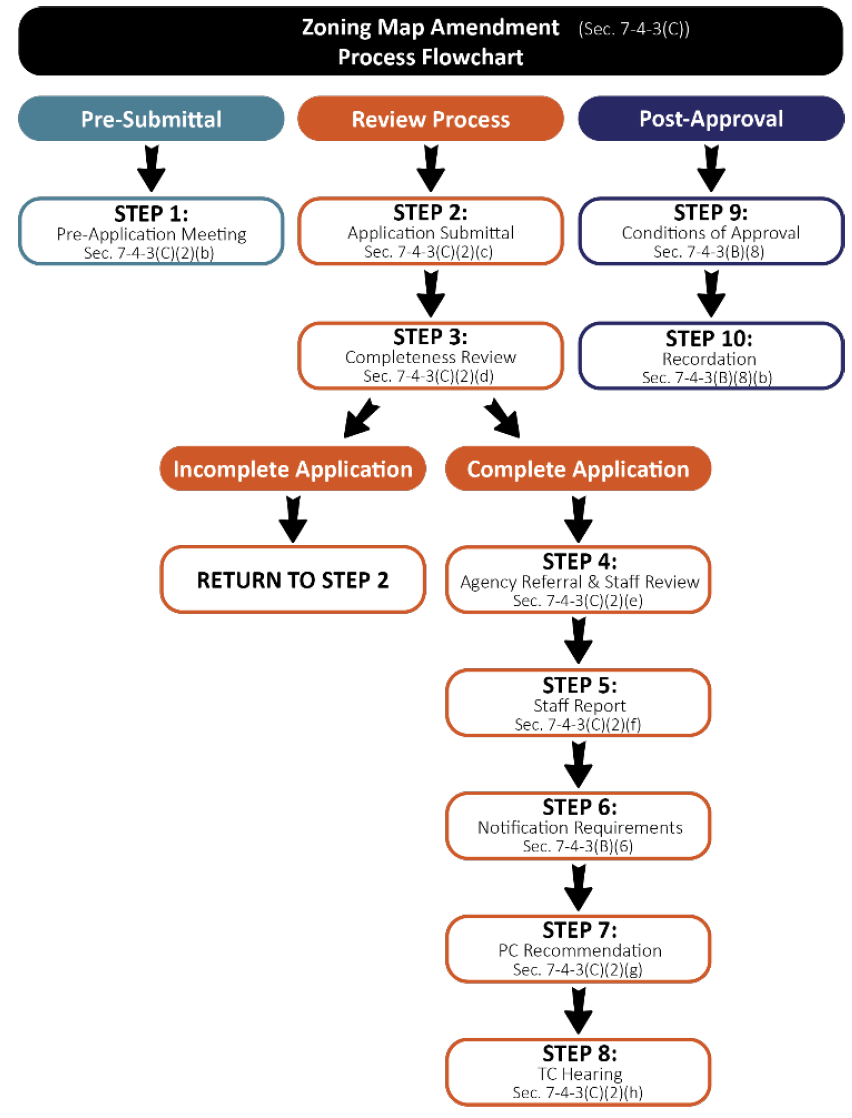
Review Flowchart. The flowchart F-4.1 depicts the zoning map amendment application review process described in greater detail in this section.
Figure F-4.1 Zoning Map Amendment Flowchart
(b)
Pre-Application Meeting. A pre-application meeting may be held in accordance with the provisions set forth in Section 7-4-3(B)(1), Pre-Application Meeting.
(c)
Application Submittal Requirements. The following are the application materials required to be submitted for a zoning map amendment request. The Town Manager or designee may waive or alter any of the submittal requirements if they are determined to be inappropriate or unnecessary to determining if the application satisfies applicable standards.
(i)
Basic Application Materials. All materials set forth in Section 7-4-3(B)(2), Application Submittal Requirements.
(ii)
Written Narrative. A written narrative shall be submitted addressing all of the following items and any other pertinent or necessary information.
a.
A general written narrative describing the purpose of the project;
b.
The source and quantity of water required for the proposed use(s) within the project;
c.
The method of wastewater treatment and anticipated quantity of wastewater generated;
d.
When water or wastewater service would be provided by a municipality or a water or sanitation district or other public entity, written confirmation that such entity is willing and able to provide such service;
e.
A description of any natural or man-made hazard within or in the vicinity of the land within the application and a statement describing how the anticipated impact of such hazards would be mitigated if the proposed request requires such mitigation;
f.
A vicinity map showing to scale the proposed project area in relationship to the surrounding municipal and unincorporated area;
g.
A description of any unique features, such as historical sites, unique landforms or scenic vistas, contained within the project area.
(iii)
Site Improvement Plan.
a.
The size of the map shall be of a size that is legible for reasonable review and interpretation, as determined by the Town Manager or designee;
b.
A scale that is one (1) inch equals two hundred (200) feet or another suitable scale if approved by Town Manager or designee;
c.
Legal description of the parcel;
d.
North arrow, scale, and legend;
e.
A vicinity map at a suitable scale;
f.
Outline of the parcel boundary or the portion of the parcel that the application applies to;
g.
The location and name of any streams, ponds, waterways, and irrigation ditches within the property boundaries;
h.
The location and names of all roads and highways abutting the site;
i.
All existing and proposed structures and their dimensions;
j.
The location, dimensions and design of any existing signs on the site;
k.
All utility easements or rights-of-way for telephone, gas, electric, water and sewer lines;
l.
The location of vehicular drives, entrances, exits, acceleration and deceleration lanes; location and dimensions of pedestrian entrances, exits, walks and walkways;
m.
General location, arrangement and dimensions of parking spaces, aisles, bays and other similar information; and
n.
A notation on the site improvement plan of all existing or potential natural or manmade hazards on or adjacent to the site and a narrative description of an acceptable plan for the mitigation of the impact of such identified hazards.
(iv)
Supplemental Materials. The following items are also required to be submitted to the Town:
a.
Proof of minimum guaranteed water supply.
(v)
Additional Requirements.
a.
Any other information deemed necessary by the Town Manager or designee to assist in the review of the application.
(d)
Completeness Review. The Town Manager or designee shall review the application for completeness in accordance with the provisions of Section 7-4-3(B)(3), Completeness Review.
(e)
Evaluation by Staff and Referral Agencies. Upon determination of completeness, the Town Manager or designee shall refer the application to additional reviewing agencies as set forth in Section 7-4-3(B)(4), Referral Agencies, and review the application for conformance with the requirements and standards of this Chapter.
(f)
Staff Report. A staff report shall be prepared and provided to the reviewing body in accordance with Section 7-4-3(B)(5), Staff Report.
(g)
Review and Recommendation by the Planning Commission.
(i)
The Planning Commission shall review the zoning map amendment application in a manner consistent with Table T-4.1 to evaluate compliance with applicable standards. Following its review of the application, the Planning Commission may provide either a recommendation to approve, approve with conditions, or deny the application to the Town Council based on the criteria set forth in Section 7-4-3(C)(3), Approval Criteria.
(ii)
The Planning Commission may, in its sole discretion, continue or postpone the public hearing to a specified date and time in order to permit preparation of additional information for further review by the Planning Commission prior to providing a recommendation to the Town Council.
(h)
Review and Action by the Town Council.
(i)
The final decision to approve, approve with conditions, or deny a zoning map amendment shall be made by the Town Council in a manner consistent with Table T-4.1 and be based upon the criteria set forth in Section 7-4-3(C)(3), Approval Criteria.
(ii)
The Town Council may, in its sole discretion, continue or postpone the public hearing to a specified date and time in order to permit preparation of additional information for further review by the Town Council prior to making a final decision.
(3)
Approval Criteria. Amendments to the Official Zoning Map involving any change in the boundaries of an existing zoning district, or changing the designation of a district, shall be allowed only upon a determination following public hearing that the following criteria are met:
(a)
The amendment is not adverse to the public health, safety and welfare, and
(b)
Either:
(i)
The amendment is in general conformity with the Master Plan; or
(ii)
The existing zoning is erroneous; or
(iii)
Conditions in the area affected or adjacent areas have changed materially since the area was last zoned.
(D)
Text Amendment.
(1)
General Provisions. Text amendments are changes to these Land Use Regulations. Such amendments may be submitted, reviewed, and approved pursuant to this section to respond to changed conditions, changes to public policy, or to advance the general welfare of the town. The review process for text amendments shall be reviewed as set forth in Section 7-4-3(D)(2), Review Procedures. A text amendment may only be initiated by the Planning Commission, Town Council, or the Town Manager or designee.
(2)
Review Procedures.
(a)
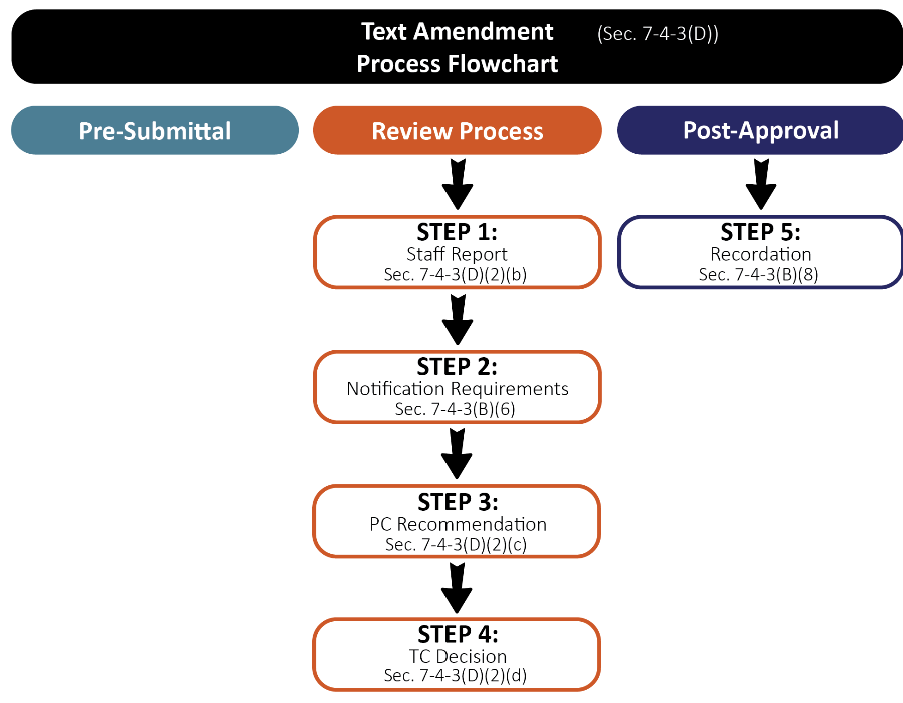
Review Flowchart. The flowchart F-4.2 depicts the text amendment application review process described in greater detail in this section.
Figure F-4.2 Text Amendment Flowchart
(b)
Staff Report. A staff report shall be prepared and provided to the reviewing body in accordance with Section 7-4-3(B)(5), Staff Report.
(c)
Review and Recommendation by the Planning Commission.
(i)
The Planning Commission shall review the text amendment application in a manner consistent with Table T-4.1 to evaluate compliance with applicable standards. Following its review of the application, the Planning Commission may provide either a recommendation to approve, approve with conditions, or deny the application to the Town Council based on the criteria set forth in Section 7-4-3(D)(3), Approval Criteria.
(ii)
The Planning Commission may, in its sole discretion, continue or postpone the public hearing to a specified date and time in order to permit preparation of additional information for further review by the Planning Commission prior to providing a recommendation to the Town Council.
(d)
Review and Action by the Town Council.
(i)
The final decision to approve, approve with conditions, or deny a text amendment shall be made by the Town Council in a manner consistent with Table T-4.1 and be based upon the criteria set forth in Section 7-4-3(D)(3), Approval Criteria.
(ii)
The Town Council may, in its sole discretion, continue or postpone the public hearing to a specified date and time in order to permit preparation of additional information for further review by the Town Council prior to making a final decision.
(3)
Approval Criteria. The following criteria shall be found to be met by the application and supplemental materials in order for the Planning Commission and/or Town Council to recommend approval or approve a text amendment.
(a)
The text amendment is consistent with the intent of applicable portions of the Master Plan in the reasonable judgement of the approving body; and
(b)
The proposed text amendment is necessary to correct an omission or error in the code; or
(c)
The proposed text amendment is necessary to adapt to a change in conditions within the town; or
(d)
Changes in public policy are needed to advance the general welfare of the town.
(E)
Conditional Uses.
(1)
General Provisions. Conditional uses are land uses that have potential for causing adverse impacts on other uses due to such factors as location, method of operation, scale or intensity of activity, or traffic generated. Because of their unusual or special characteristics, conditional uses require review and evaluation so that they may be located properly with respect to their effects on surrounding properties and the Town of Ridgway at large. Conditional uses may be permitted subject to such conditions and limitations as the town may prescribe. The intent is to ensure that the location and operation of the conditional use is in accordance with the development objectives of the town and the Master Plan and will not be detrimental to other uses or properties. All conditional uses shall meet all applicable standards as detailed in this Chapter. The review process for conditional uses is set forth in Section 7-4-3(E)(3), Review Procedures.
(a)
Applicability. Conditional use approval is required for those uses listed as conditional uses in the Land Use Table in Section 7-4-4(O).
(b)
An application for conditional use approval is required and shall be submitted at the same time as site plan review if one is necessary.
(c)
Conditional use permits run with the land and approval may be revoked upon failure to comply with conditions associated with the original approval of the conditional use.
(d)
Conditional use permits issued prior to the effective date of these Land Development Regulations shall be allowed to continue as long as the use is consistent with the conditions of the permit and the provisions of Section 7-4-13, Nonconforming Uses, and is renewed as required by the conditional use permit. If the conditions of approval are not maintained, it shall be considered a violation of these Land Development Regulations, punishable in a manner set forth in Section 7-1-8, Enforcement and Administration. In addition, the Town may revoke the permit.
(2)
Review and Revocation of a Conditional Use Permit.
(a)
At such intervals as the Planning Commission may have specified in its original decision, or when there is an alleged violation of the provisions of a conditional use permit, the Town Manager or designee shall review the terms, conditions, and other provisions of conditional use permit(s) issued by Planning Commission.
(b)
Upon review of the permit terms, conditions, and provisions, the Town Manager or designee shall make recommendations to the Planning Commission at its next available meeting to remedy any violations, the reasons for such recommendations, and specific time period(s) in which violations of the provisions of the permit shall be corrected.
(c)
The Planning Commission may apply any and all remedies and penalties set forth in the Municipal Code to correct violations of a conditional use permit.
(d)
If the Town Council finds that terms, conditions, and/or provisions of a conditional use permit have been violated, the conditional permit shall be revoked, and such use shall be considered in violation of the Ridgway Municipal Code.
(3)
Review Procedures.
(a)
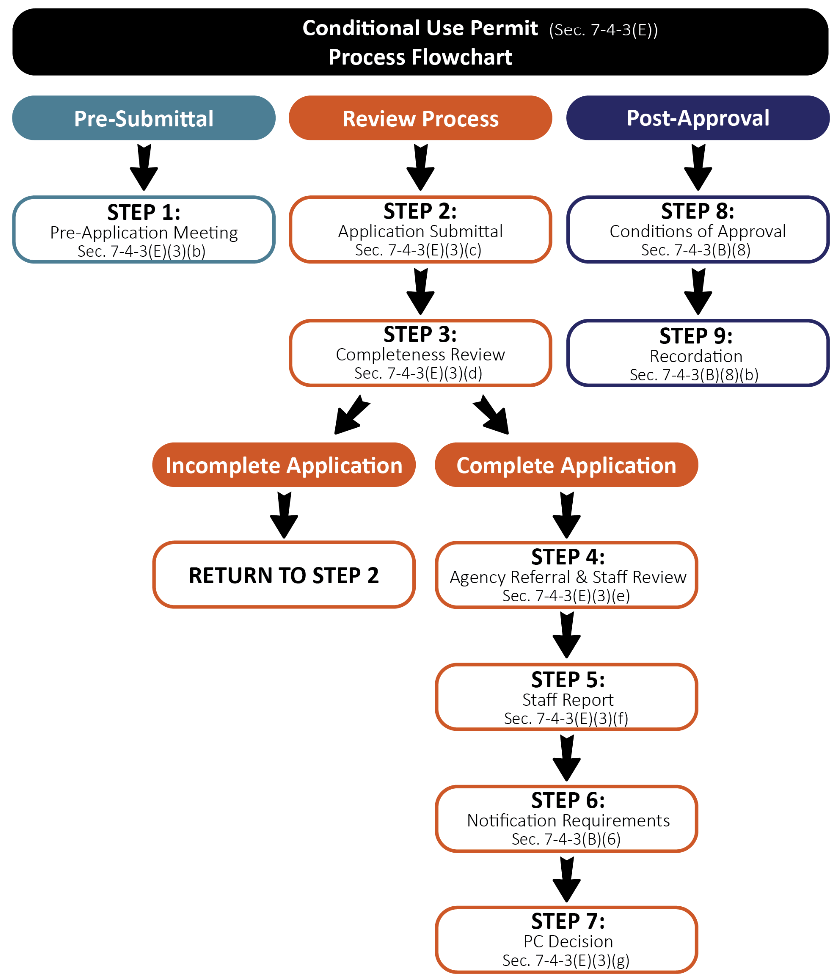
Review Flowchart. Figure F-4.3, Conditional Use Permit Flowchart, depicts the conditional use permit application review process described in greater detail in this section.
Figure F-4.3 Conditional Use Permit Flowchart
(b)
Pre-Application Meeting. A pre-application meeting may be held in accordance with the provisions set forth in Section 7-4-3(B)(1), Pre-Application Meeting.
(c)
Application Submittal Requirements. The following are the application materials required to be submitted for conditional use requests. The Town Manager or designee may waive or alter any of the submittal requirements if they are determined to be inappropriate or unnecessary to determining if the application satisfies applicable standards.
(i)
Basic Application Materials. All items set forth in Section 7-4-3(B)(2), Application Submittal Requirements.
(ii)
Written Narrative. A written narrative shall be submitted addressing all of the following items and any other information:
a.
A general written narrative describing the purpose of the project;
b.
Description of the current land use(s) on the property, the characteristics of the land within the property boundaries, and the current land use on all adjoining property;
c.
A time schedule for construction and/or operation;
d.
Description of how the use will be operated;
e.
How ongoing maintenance of the use and site will be provided;
f.
How the use's impacts on surrounding properties will be minimized and mitigated;
g.
A statement describing how the proposed use would be in compliance with the provisions of the Master Plan;
h.
The proposed sources of water and sanitary sewer; and
i.
A listing of additional local, state and/or federal permits required prior to commencing the proposed land use and notation of which permits have been applied for and which, if any, have been granted.
(iii)
Site Improvement Plan.
a.
The size of the map shall be of a size that is legible for reasonable review and interpretation, as determined by the Town Manager or designee;
b.
A scale that is one (1) inch equals two hundred (200) feet or another suitable scale if approved by Town Manager or designee;
c.
Legal description of the parcel;
d.
North arrow, scale, and legend;
e.
A vicinity map at a suitable scale;
f.
Outline of the parcel boundary or the portion of the parcel that the conditional use applies to;
g.
The location and name of any streams, ponds, waterways and irrigation ditches within the property boundaries;
h.
Current and proposed grading and drainage patterns including:
i.
Drainage arrows depicting surface flow;
ii.
Drainage facilities and improvements; and
iii.
A grading plan depicting existing and proposed site contours at two-foot intervals;
i.
The location and names of all roads and highways abutting the site;
j.
All existing and proposed structures and their dimensions;
k.
The location, and dimensions of any existing and proposed signs on the site;
l.
All utility easements or rights-of-way transmission and/or service lines;
m.
The location and dimensions of vehicular drives, entrances, exits, acceleration and deceleration lanes; location and dimensions of pedestrian entrances, exits, walks and walkways;
n.
General location, arrangement and dimensions of parking spaces, width of aisles, width of bays, angle of parking and other similar information;
o.
A notation on the site improvement plan of all existing or potential natural or manmade hazards on or adjacent to the site and a narrative description of an acceptable plan for the mitigation of the impact of such identified hazards; and
p.
Any other information deemed necessary by the Town Manager or designee to assist in the review of the application.
(iv)
Supplemental Materials. The following items are required to be submitted to the Town of Ridgway:
a.
Drainage plan or study calculating historic and proposed surface and stormwater flows and how such flows will be managed.
b.
Traffic statement or study identifying current and proposed traffic counts and proposed trip generation along with any needed or anticipated improvements to mitigate the projects use on the public transportation network and infrastructure.
c.
Proof of minimum guaranteed water supply appropriate for the requested use.
(v)
Additional Requirements.
a.
Where deemed required by the Town Manager or designee, applicants shall submit an Industrial Use Mitigation Report that details how the proposed use will conform to the criteria outlined in Section 7-4-5, General Performance Standards.
b.
Any additional information that may be reasonably requested by the Town Manager or designee and determined to be necessary to enable an adequate and comprehensive evaluation of the application.
(d)
Completeness Review. The Town Manager or designee shall review the application for completeness in accordance with the provisions of Section 7-4-3(B)(3), Completeness Review.
(e)
Evaluation by Staff and Referral Agencies. Upon determination of completeness, the Town Manager or designee shall refer the application to additional reviewing agencies as set forth in Section 7-4-3(B)(4), Referral Agencies, and review the application for conformance with the requirements and standards of this Municipal Code.
(f)
Staff Report. A staff report shall be prepared and provided to the reviewing body in accordance with Section 7-4-3(B)(5), Staff Report.
(g)
Review and Action by the Planning Commission.
(i)
The Planning Commission shall review the conditional use application in a manner consistent with Table T-4.1 to evaluate compliance with applicable standards. The final decision to approve, approve with conditions, or deny a conditional use permit shall be made by the Planning Commission in a manner consistent with Table T-4.1 and be based upon the criteria set forth in Section 7-4-3(E)(4), Approval Criteria.
(ii)
The Planning Commission may, in its sole discretion, continue or postpone the public hearing to a specified date and time in order to permit preparation of additional information for further review by the Planning Commission prior to making a final decision.
(4)
Approval Criteria. Uses listed as conditional uses for the various zoning districts provided in this Chapter shall be allowed only if the Planning Commission determines, following review pursuant to Subsection 7-4-3(E)(3), that the following criteria are substantially met with respect to the type of use and its dimensions:
(a)
The use will not be contrary to public health, safety, or welfare.
(b)
The use is not materially adverse to the Town's Master Plan.
(c)
Streets, pedestrian facilities, and bikeways in the area are adequate to handle traffic generated by the use with safety and convenience.
(d)
The use is compatible with existing uses in the area and other allowed uses in the District.
(e)
The use will not have an adverse effect upon other property values.
(f)
The location of curb cuts and access to the premises will not create traffic hazards.
(g)
The use will not generate light, noise, odor, vibration, or other effects which would unreasonably interfere with the reasonable enjoyment of other property in the area.
(h)
Visual impact due to a building's size shall be mitigated by means of design, landscaping, berming, and other methods of site treatment, and must be compatible with the mass and scale of existing buildings on adjacent properties, or if there are no such buildings, compatible with the mass and scale of buildings in the Town generally.
(F)
Minor Amendment to a Conditional Use Permit.
(1)
General Provisions.
(a)
Minor amendments to conditional use permits are those that do not alter the basic intent and character of the approved conditional use and are deemed necessary in light of technical or engineering considerations not first discovered during actual construction; or could not have been reasonably anticipated during the initial review process. Minor amendments shall not include changes in use.
(b)
Any change not qualifying as a minor amendment shall be processed as a new conditional use request.
(c)
No conditional use permit may receive more than one (1) minor amendment. For purposes of this Subsection, a minor amendment may include multiple amendments consolidated and submitted as one minor amendment to a conditional use permit application. Any additional amendments, minor or otherwise, shall be processed as a new conditional use application pursuant to Section 7-4-3(E), Conditional Uses.
(d)
The review process for a minor amendment to conditional use permit is set forth in Section 7-4-3(F)(2), Review Procedures. These minor amendments may include, but are not limited to:
(i)
Variations to the location of an approved building footprint of not more than five (5) feet;
(ii)
Minor deviations in the location of infrastructure (roads and utilities);
(iii)
Pedestrian or vehicular circulation throughout or adjacent to the project;
(iv)
Changes to the gross floor area of not more than ten (10) percent of the approved square footage;
(v)
Modifications to include necessary operations to enhance the area or clear the site;
(vi)
Modification to the day by which the conditional use permit is in operation;
(vii)
Other minor changes to a conditional use permit as determined by the Town Manager or designee.
(2)
Review Procedures.
(a)
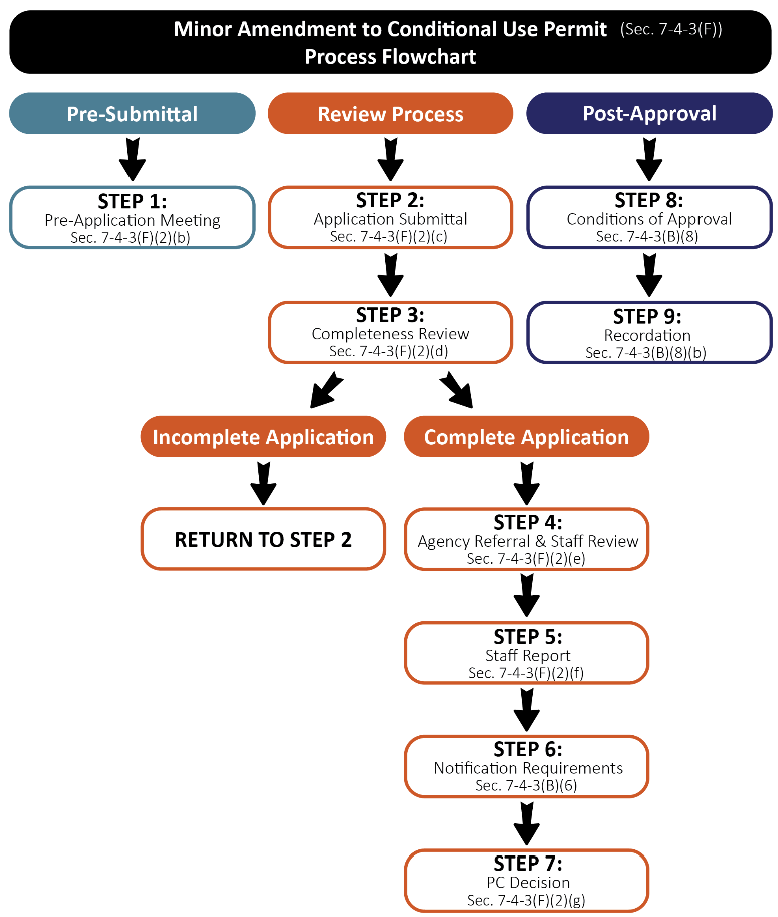
Review Flowchart. Figure F-4.4, Minor Amendment to a Conditional Use Permit Flowchart, depicts the minor amendment to a Conditional Use Permit application review process described in greater detail in this section.
Figure F-4.4 Minor Amendment to a Conditional Use Permit Flowchart
(b)
Pre-Application Meeting. A pre-application meeting may be held in accordance with the provisions set forth in Section 7-4-3(B)(1), Pre-Application Meeting.
(c)
Application Submittal Requirements. The following are the application materials required to be submitted for minor amendment to conditional use permit requests. The Town Manager or designee may waive or alter any of the submittal requirements if they are determined to be inappropriate or unnecessary to determining if the application satisfies applicable standards.
(i)
Basic Application Materials. All items set forth in Section 7-4-3(B)(2), Application Submittal Requirements.
(ii)
Written Narrative. A written narrative shall be submitted addressing all of the following items and any other information.
a.
A general narrative of the conditional use permit issued by the town and any conditions or provisions included in such permit;
b.
A description of the minor amendment being requested and justification and rationale for such request; and
c.
Any impacts the amendment may have on the use, adjacent properties, and/or public infrastructure.
(iii)
Site Improvement Plan. The site improvement plan shall include all items required for a conditional use set forth in Section 7-4-3(E)(3)(c)(iii), Site Improvement Plan.
(iv)
Supplemental Materials. The supplemental materials shall include all items required for a conditional use set forth in Section 7-4-3(E)(3)(c)(iv), Supplemental Materials.
(v)
Additional Requirements. Any additional information deemed necessary by the Town Manager or designee to assist in the review of the application.
(d)
Completeness Review. The Town Manager or designee shall review the application for completeness in accordance with the provisions of Section 7-4-3(B)(3), Completeness Review.
(e)
Evaluation by Staff and Referral Agencies. Upon determination of completeness, the Town Manager or designee shall refer the application to additional reviewing agencies as set forth in Section 7-4-3(B)(4), Referral Agencies, and review the application for conformance with the requirements and standards of these Land Use Regulations.
(f)
Staff Report. A staff report shall be prepared and provided to the reviewing body in accordance with Section 7-4-3(B)(5), Staff Report.
(g)
Review and Action by the Planning Commission.
(i)
The Planning Commission shall review the minor amendment to a conditional use application in a manner consistent with Table T-4.1 to evaluate compliance with applicable standards. The final decision to approve, approve with conditions, or deny a minor amendment to a conditional use permit shall be made by the Planning Commission in a manner consistent with Table T-4.1 and be based upon the criteria set forth in Section 7-4-3(E)(4), Approval Criteria.
(ii)
The Planning Commission may, in its sole discretion, continue or postpone the meeting to a specified date and time in order to permit preparation of additional information for further review by the Planning Commission prior to making a final decision.
(3)
Approval Criteria. A minor amendment to a conditional use permit may be approved by the Planning Commission if the application is found to meet the approval criteria of a conditional use permit set forth in Section 7-4-3(E)(4), Approval Criteria.
(G)
Temporary Use Permits.
(1)
General Provisions. Temporary uses or structures are uses and/or structures that will be used for a specified period of time, are not permanent, or are for a special event or purpose. The review process for a temporary use permit is set forth in Section 7-4-3(G)(2), Review Procedures.
(a)
The Planning Commission may issue a permit authorizing certain temporary uses of premises in a district for a use which is otherwise not allowed in such a district for the periods specified here below:
(b)
A permit for a period of up to one year may be issued under the following circumstances by the Planning Commission for temporary location or use of a manufactured home or travel home:
(i)
For fire protection or security purposes in the General Commercial District.
(ii)
At a construction site during the construction period.
(2)
Review Procedures.
(a)
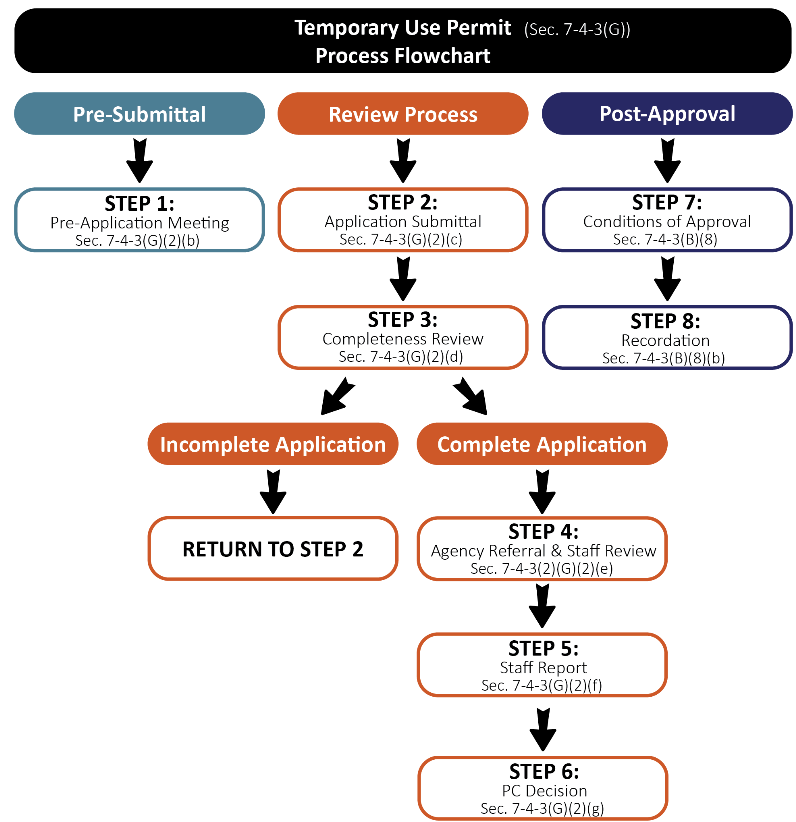
Review Flowchart. Figure F-4.5, Temporary Use Permit Flowchart, depicts the temporary use permit application review process described in greater detail in this section.
Figure F-4.5 Temporary Use Permit Flowchart
(b)
Pre-Application Meeting. A pre-application meeting may be held in accordance with the provisions set forth in Section 7-4-3(B)(1), Pre-Application Meeting.
(c)
Application Submittal Requirements. The following are the application materials required to be submitted for temporary use requests. The Town Manager or designee may waive or alter any of the submittal requirements if they are determined to be inappropriate or unnecessary to determining if the application satisfies applicable standards.
(i)
Basic Application Materials. All items set forth in Section 7-4-3(B)(2), Application Submittal Requirements.
(ii)
Written Narrative. A written narrative shall be submitted addressing all of the following items and any other information:
a.
A general written narrative describing the purpose of the project;
b.
Description of the current land use(s) on the property, the characteristics of the land within the property boundaries, and the current land use on all adjoining property;
c.
A time schedule for construction and/or operation;
d.
Description of how the use will be operated;
e.
How ongoing maintenance of the use and site will be provided;
f.
How the use's impacts on surrounding properties will be minimized and mitigated;
g.
A statement describing how the proposed use would be in compliance with the provisions of the Master Plan;
h.
The proposed sources of water and sanitary sewer; and
i.
A listing of additional local, state and/or federal permits required prior to commencing the proposed land use and notation of which permits have been applied for and which, if any, have been granted.
(iii)
Site Improvement Plan
a.
The size of the map shall be of a size that is legible for reasonable review and interpretation, as determined by the Town Manager or designee;
b.
A scale that is one (1) inch equals two hundred (200) feet or another suitable scale if approved by Town Manager or designee;
c.
Legal description of the parcel;
d.
North arrow, scale, and legend;
e.
A vicinity map at a suitable scale;
f.
Outline of the parcel boundary or the portion of the parcel that the conditional use applies to;
g.
The location and name of any streams, ponds, waterways and irrigation ditches within the property boundaries;
h.
Current and proposed grading and drainage patterns including:
i.
Drainage arrows depicting surface flow;
ii.
Drainage facilities and improvements; and
iii.
A grading plan depicting existing and proposed site contours at two-foot intervals;
i.
The location and names of all roads and highways abutting the site;
j.
All existing and proposed structures and their dimensions;
k.
The location, and dimensions of any existing and proposed signs on the site;
l.
All utility easements or rights-of-way transmission and/or service lines;
m.
The location and dimensions of vehicular drives, entrances, exits, acceleration and deceleration lanes; location and dimensions of pedestrian entrances, exits, walks and walkways;
n.
General location, arrangement and dimensions of parking spaces, width of aisles, width of bays, angle of parking and other similar information;
o.
A notation on the site improvement plan of all existing or potential natural or manmade hazards on or adjacent to the site and a narrative description of an acceptable plan for the mitigation of the impact of such identified hazards; and
p.
Any other information deemed necessary by the Town Manager or designee to assist in the review of the application.
(iv)
Additional Requirements. Any additional information that may be reasonably requested by the Town Manager or designee and determined to be necessary to enable an adequate and comprehensive evaluation of the application.
(d)
Completeness Review. The Town Manager or designee shall review the application for completeness in accordance with the provisions of Section 7-4-3(B)(3), Completeness Review.
(e)
Evaluation by Staff and Referral Agencies. Upon determination of completeness, the Town Manager or designee shall refer the application to additional reviewing agencies as set forth in Section 7-4-3(B)(4), Referral Agencies, and review the application for conformance with the requirements and standards of these Land Use Regulations.
(f)
Staff Report. A staff report shall be prepared and provided to the reviewing body in accordance with Section 7-4-3(B)(5), Staff Report.
(g)
Review and Decision by Planning Commission.
(i)
The Planning Commission shall review the temporary use application to evaluate compliance with applicable standards. Following the review, the Planning Commission may approve, approve with conditions, or deny an application for a temporary use permit based on the criteria set forth in Section 7-4-3(G)(3), Approval Criteria.
(ii)
The Planning Commission may, in its sole discretion, continue or postpone the meeting to a specified date and time in order to permit preparation of additional information for further review by the Planning Commission prior to making a final decision.
(3)
Approval Criteria. The following criteria shall be met by the application and supplemental materials in order for the Planning Commission or designee to issue a temporary use permit.
(a)
The owner of the property on which the temporary use, structure or event is proposed consents in writing to the issuance of the permit;
(b)
Local governmental agencies have the resources to dedicate to the use, structure or event;
(c)
The use, structure or event is not too intrusive or destructive to the community;
(d)
The proposed use, structure or event is compatible with surrounding land users and uses;
(e)
The use, structure or event complies with all requirements imposed by this code; and
(f)
The use, structure or event complies with all applicable laws and regulations.
(H)
Site Plan.
(1)
General Provisions.
(a)
The purpose of a site plan is to ensure compliance with the town's development and design standards and the provisions of this code. It is designed to encourage quality development reflective of the goals, policies, and objectives of the town of Ridgway. The character and environment of the town for future years will be greatly affected by the design of development. Planning, layout, and design of sites are of the utmost concern. Safe mobility for pedestrians and motor vehicles is important. Lots should provide desirable settings for the buildings that are to be constructed, make use of natural contours, protect significant views, and afford privacy for residents. Natural features should be preserved when practicable.
(b)
The site plan shall ensure that all nonresidential and multifamily uses comply with access, parking, setbacks, signage, and other site design standards as required by the Ridgway Municipal Code. When site plan review is required, structures shall not be constructed or installed and uses may not begin until a site plan showing the proposed development has been approved in accordance with the procedures and provisions of this section. The review process for site plans is set forth in Section 7-4-3(H)(2), Review Procedures.
(c)
The following projects require site plan approval:
(i)
All new uses and structures which are not exempted in Section 7-4-3(H)(1)(d);
(ii)
Any modification of an existing use, structure, or site where, in the opinion of the Town Manager or designee, significant changes to the use, structure, or site are proposed; or
(iii)
Any modification of an existing structure where the exemption limits set forth in Section 7-4-3(H)(1)(d)(ii) are exceeded.
(d)
The following projects are exempt from site plan approval:
(i)
Single-family dwelling; or
(ii)
Duplex dwelling; or
(iii)
Any proposed modification of an existing structure where less than twenty (20) percent of gross floor footage of the existing structure is being modified, provided that the modification does not exceed one thousand (1,000) gross square feet.
(2)
Review Procedures.
(a)
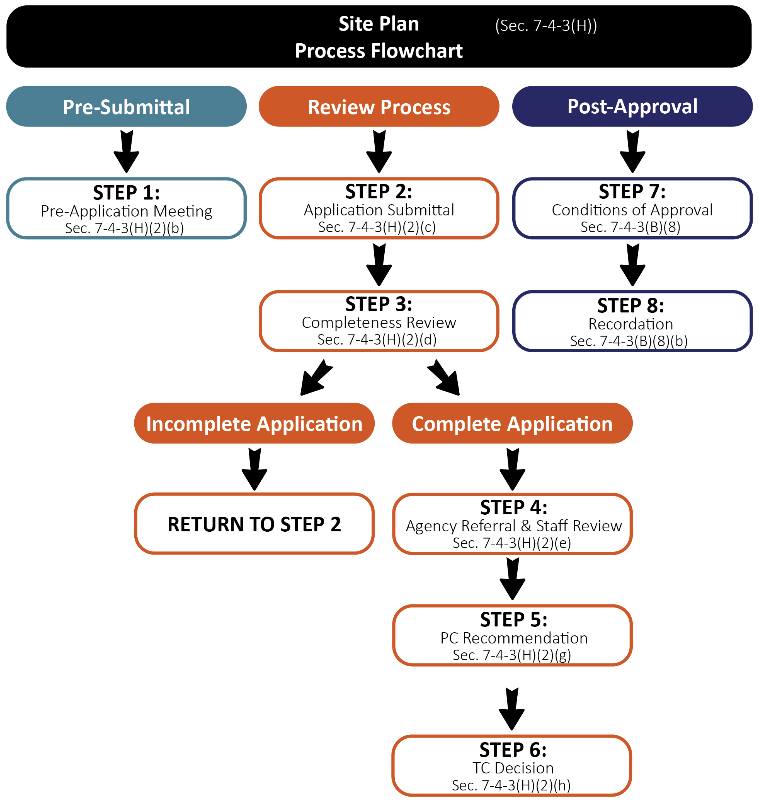
Review Flowchart. Figure F-4.6, Site Plan Flowchart, depicts the site plan application review process described in greater detail in this section.
Figure F-4.6 Site Plan Flowchart
(b)
Pre-Application Meeting. A pre-application meeting may be held in accordance with the provisions set forth in Section 7-4-3(B)(1), Pre-Application Meeting.
(c)
Application Submittal Requirements. The following are the application materials required to be submitted for site plan requests. The Town Manager or designee may waive or alter any of the submittal requirements if they are determined to be inappropriate or unnecessary to determining if the application satisfies applicable standards.
(i)
Basic Application Materials. All items set forth in Section 7-4-3(B)(2), Application Submittal Requirements.
(ii)
Written Narrative. A written narrative shall be submitted addressing all of the following items and any other information:
a.
A general written narrative describing the purpose of the project;
b.
The proposed vehicular access including ingress, egress, internal circulation, and parking;
c.
The source and quantity of water required for the proposed use(s) within the area to be developed;
d.
The method of wastewater treatment and anticipated quantity of wastewater generated;
e.
When water or wastewater service would be provided by a municipality or a water or sanitation district or other public entity, written confirmation that the public entity in question is willing and able to provide the service in question;
f.
A description of any natural or man-made hazard within or in the vicinity of the subject parcel and a statement describing how the anticipated impact of such hazards would be mitigated if the proposed development requires such mitigation;
g.
A description of any unique features, such as historical sites, unique landforms or scenic vistas, contained within the subject parcel.
(iii)
Site Improvement Plan.
a.
The size of the map shall be of a size that is legible for reasonable review and interpretation, as determined by the Town Manager or designee;
b.
A scale that is one (1) inch equals two hundred (200) feet or another suitable scale if approved by Town Manager or designee;
c.
Legal description of the parcel;
d.
North arrow, scale, and legend;
e.
A vicinity map at a suitable scale;
f.
Outline of the parcel boundary or the portion of the parcel that the conditional use applies to;
g.
The location and name of any streams, ponds, waterways and irrigation ditches within the property boundaries;
h.
Current and proposed grading and drainage patterns including:
i.
Drainage arrows depicting surface flow;
ii.
Drainage facilities and improvements; and
iii.
A grading plan depicting existing and proposed site contours at two-foot intervals.
i.
The location and names of all roads and highways abutting the site;
j.
All existing and proposed structures and their dimensions;
k.
The location, and dimensions of any existing and proposed signs on the site;
l.
All utility easements or rights-of-way transmission and/or service lines;
m.
The location and dimensions of vehicular drives, entrances, exits, acceleration and deceleration lanes; location and dimensions of pedestrian entrances, exits, walks and walkways;
n.
General location, arrangement and dimensions of parking spaces, width of aisles, width of bays, angle of parking and other similar information;
o.
A notation on the site improvement plan of all existing or potential natural or manmade hazards on or adjacent to the site and a narrative description of an acceptable plan for the mitigation of the impact of such identified hazards; and
p.
Any other information deemed necessary by the Town Manager or designee to assist in the review of the application.
(iv)
Supplemental Materials. The following items are required to be submitted to the Town of Ridgway:
a.
Drainage plan or study calculating historic and proposed surface and stormwater flows and how such flows will be managed.
b.
Traffic statement or study identifying current and proposed traffic counts and proposed trip generation along with any needed or anticipated improvements to mitigate the projects use on the public transportation network and infrastructure.
c.
Proof of minimum guaranteed water supply appropriate for the requested use.
d.
Development Improvements Agreement Form (executed).
(v)
Additional Requirements
a.
Where deemed required by the Town Manager or designee, applicants shall submit an Industrial Use Mitigation Report that details how the proposed use will conform to the criteria outlined in Section 7-4-5, General Performance Standards.
b.
Any additional information that may be reasonably requested by the Town Manager or designee and determined to be necessary to enable an adequate and comprehensive evaluation of the application.
(d)
Completeness Review. The Town Manager or designee shall review the application for completeness in accordance with the provisions of Section 7-4-3(B)(3), Completeness Review.
(e)
Evaluation by Staff and Referral Agencies.
(i)
Upon determination of completeness, the Town Manager or designee shall refer the application to additional reviewing agencies as set forth in Section 7-4-3(B)(4), Referral Agencies, and review the application for conformance with the requirements and standards of these Land Use Regulations.
(f)
Staff Report. A staff report shall be prepared and provided to the reviewing body in accordance with Section 7-4-3(B)(5), Staff Report.
(g)
Review and Recommendation by the Planning Commission.
(i)
The Planning Commission shall review the site plan application in a manner consistent with Table T-4.1 to evaluate compliance with applicable standards. Following its review of the application, the Planning Commission may provide either a recommendation to approve, approve with conditions, or deny the application to the Town Council based on the criteria set forth in Section 7-4-3(H)(3), Approval Criteria.
(ii)
The Planning Commission may, in its sole discretion, continue or postpone the public hearing to a specified date and time in order to permit preparation of additional information for further review by the Planning Commission prior to providing a recommendation to the Town Council.
(h)
Review and Action by the Town Council.
(i)
The final decision to approve, approve with conditions, or deny a site plan application shall be made by the Town Council in a manner consistent with Table T-4.1 and be based upon the criteria set forth in Section 7-4-3(H)(3), Approval Criteria.
(ii)
The Town Council may, in its sole discretion, continue or postpone the public hearing to a specified date and time in order to permit preparation of additional information for further review by the Town Council prior to making a final decision.
(3)
Approval Criteria. Prior to making a decision on a site plan application, the Town Council shall consider the following review criteria and find that each criterion has been met or determined to be inapplicable:
(a)
The application complies with all requirements imposed by these Land Development Regulations;
(b)
The application complies with all applicable laws and regulations;
(c)
The proposed use does not result in undue traffic congestion or traffic hazards.
(4)
Minor Changes Allowed. Minor changes from an approved site plan may be authorized through written authorization from the Town Manager or designee provided that they determine that the proposed changes:
(a)
Could be approved under the allowable administrative adjustments pursuant to Section 7-4-3(I), had they been requested with the original application; and
(b)
Comply with the standards of this Section; and
(c)
Are necessary to meet conditions of approval; and/or
(d)
Would not significantly alter the function, form, intensity, character, demand on public facilities, or impact on adjacent properties as approved with the original site.
(I)
Administrative Adjustment.
(1)
General Provisions. An administrative adjustment may be requested by an applicant to adjust any dimensional standard set forth in Chapter 4, Zoning Regulations, by no more than ten (10) percent of the required dimensional standard. An administrative adjustment shall be submitted and reviewed in compliance with this Section 7-4-3(I), Administrative Adjustment.
(a)
The request for an administrative adjustment must be made in writing to Town Manager.
(b)
If an applicant desires over ten (10) percent relief from a dimensional standard set forth in Section 4, Zoning Regulations, the applicant must pursue a variance in accordance with Section 7-4-3(J), Variance.
(2)
Review Procedures.
(a)
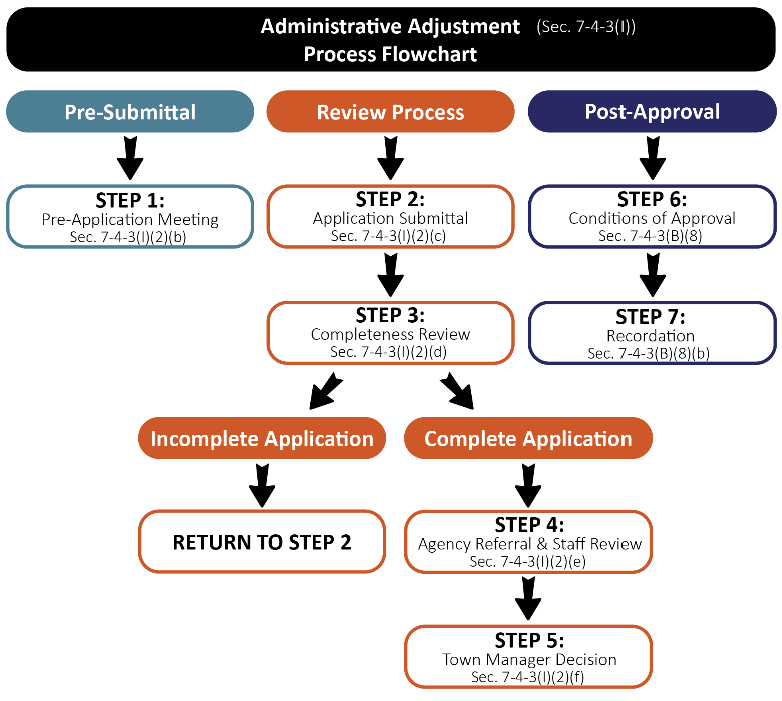
Review Flowchart. Figure F-4.7, Administrative Adjustment Flowchart, depicts the administrative adjustment application review process described in greater detail in this section.
Figure F-4.7 Administrative Adjustment Flowchart
(b)
Pre-Application Meeting. A pre-application meeting may be held in accordance with the provisions set forth in Section 7-4-3(B)(1), Pre-Application Meeting.
(c)
Application Submittal Requirements. The following are the application materials required to be submitted for administrative adjustment requests. The Town Manager or designee may waive or alter any of the submittal requirements if they are determined to be inappropriate or unnecessary to determining if the application satisfies applicable standards.
(i)
Basic Application Materials. All items set forth in Section 7-4-3(B)(2), Application Submittal Requirements.
(ii)
Written Narrative. A written narrative shall be submitted addressing all of the following items and any other information:
a.
A general written narrative describing the purpose of the project;
b.
Explanation of the request(s) and justification for why the standard for which an adjustment is being requested is unable to be met;
c.
Any efforts the applicant or property owner has made to meet the minimum standards;
d.
Justification for the request and how the request is the minimum required standard(s); and
e.
Description of how the request meets each of the criterion set forth in Section 7-4-3(I)(3), Approval Criteria.
(iii)
Site Improvement Plan.
a.
All existing, required, and proposed dimensional standards clearly depicting the location and increase of the administrative adjustment request.
b.
A table identifying the required standard(s) and the numerical value being requested by the administrative adjustment.
(iv)
Additional Requirements
a.
Any additional information that may be reasonably requested by the Town Manager or designee and determined to be necessary to enable an adequate and comprehensive evaluation of the application.
(d)
Completeness Review. The Town Manager or designee shall review the application for completeness in accordance with the provisions of Section 7-4-3(B)(3), Completeness Review.
(e)
Evaluation by Staff and Referral Agencies. Upon determination of completeness, the Town Manager or designee shall refer the application to additional reviewing agencies as set forth in Section 7-4-3(B)(4), Referral Agencies, and review the application for conformance with the requirements and standards of this Municipal Code.
(f)
Review and Decision by Town Manager or designee.
(i)
The Town Manager or designee shall review the administrative adjustment application to evaluate compliance with applicable standards. Following the review, the Town Manager or designee may approve, approve with conditions, or deny an administrative adjustment based on the criteria set forth in Section 7-4-3(I)(3), Approval Criteria.
(ii)
The decision of the Town Manager or designee may be appealed to the Board of Adjustment in accordance with Section 7-4-3(K), Appeal.
(3)
Approval Criteria. The Town Manager or designee may approve an administrative adjustment upon a finding that:
(a)
The request is consistent with the intent, purpose, and goals of this Municipal Code;
(b)
The administrative adjustment is of a technical nature (i.e., relief from a dimensional or design standard), and is either:
(i)
Required to compensate for some unusual aspect of the site or the proposed development that is not shared by landowners in general;
(ii)
Support by an objective or goal from the purpose and intent of the zoning district within which the project is located; or
(iii)
Proposed to protect sensitive natural resources or better integrate development with the surrounding environment.
(J)
Variance.
(1)
General Provisions. Variances are deviations from the zoning dimensional standards set forth in Chapter 7, Planning and Zoning, that would not be contrary to the public interest when, owing to special circumstances or conditions such as exceptional topographic conditions, narrowness, shallowness or the shape of a specific piece of property, the literal enforcement of the provisions of this Ridgway Municipal Code would result in peculiar and exceptional practical difficulties to or exceptional and undue hardship upon the owner of the property. No variance from the provisions governing "Uses By Right", and "Conditional Uses" within any zoning district may be granted.
(2)
Review Procedures.
(a)
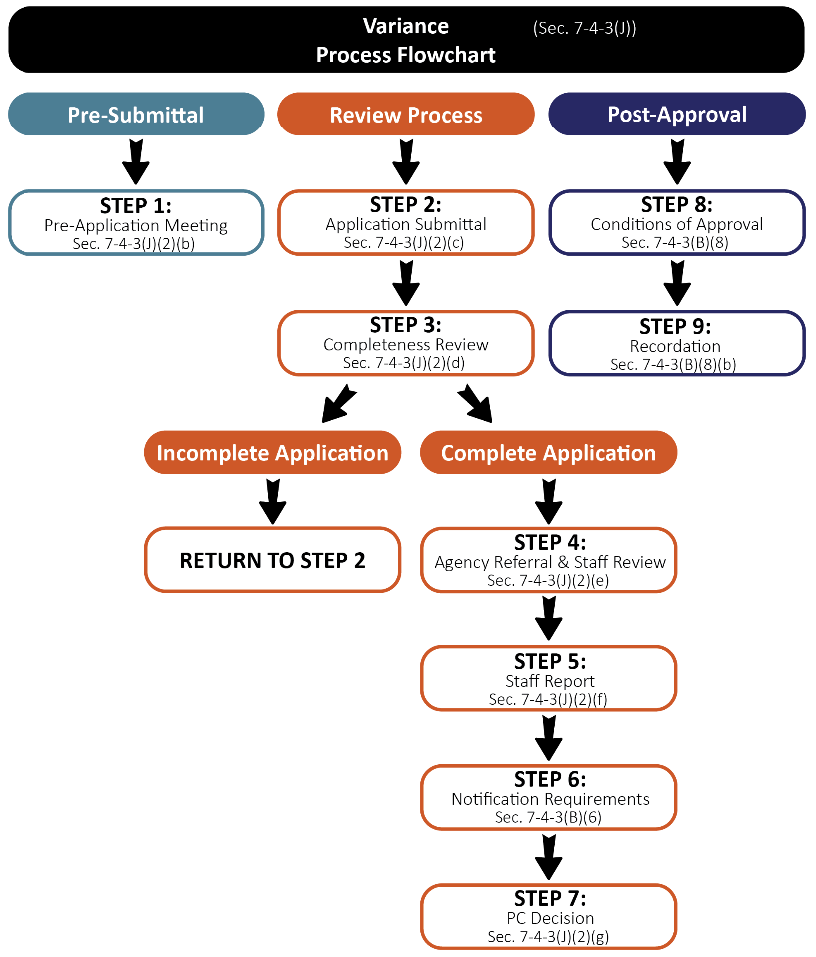
Review Flowchart. Figure F-4.8, Variance Flowchart, depicts the variance application review process described in greater detail in this section.
Figure F-4.8 Variance Flowchart
(b)
Pre-Application Meeting. A pre-application meeting may be held in accordance with the provisions set forth in Section 7-4-3(B)(1), Pre-Application Meeting.
(c)
Application Submittal Requirements. The following are the application materials required to be submitted for variance requests. The Town Manager or designee may waive or alter any of the submittal requirements if they are determined to be inappropriate or unnecessary to determining if the application satisfies applicable standards.
(i)
Basic Application Materials. All items set forth in Section 7-4-3(B)(2), Application Submittal Requirements.
(ii)
Written Narrative. A written narrative shall be submitted addressing all of the following items and any other information:
a.
Explanation of the request(s) and justification for why the standard for which the variance is being requested is unable to be met;
b.
Any efforts the applicant or property owner has made to meet the minimum standards;
c.
Justification for the request and how the request is the minimum required standard(s);
d.
Description of how the request meets each of the criterion set forth in Section 7-4-3(J)(3), Approval Criteria;
(iii)
Site Improvement Plan.
a.
All existing, required, and proposed dimensional standards clearly depicting the location and increase of the variance request.
b.
A table identifying the required standard(s) and the numerical value being requested by the variance.
(iv)
Additional Requirements. Any additional information that may be reasonably requested by the Town Manager or designee and determined to be necessary to enable an adequate and comprehensive evaluation of the application.
(d)
Completeness Review. The Town Manager or designee shall review the application for completeness in accordance with the provisions of Section 7-4-3(B)(3), Completeness Review.
(e)
Evaluation by Staff and Referral Agencies.
(f)
Upon determination of completeness, the Town Manager or designee shall refer the application to additional reviewing agencies as set forth in Section 7-4-3(B)(4), Referral Agencies, and review the application for conformance with the requirements and standards of this Municipal Code.
(g)
Staff Report. A staff report shall be prepared and provided to the reviewing body in accordance with Section 7-4-3(B)(5), Staff Report.
(h)
Review and Decision by Planning Commission. The Planning Commission shall review the variance application in a manner consistent with Table T-4.1 to evaluate compliance with applicable standards. Following its review of the application, the Planning Commission shall approve, approve with conditions, or deny the application based on the criteria set forth in Section 7-4-3(J)(3), Approval Criteria.
(i)
No variance shall be granted with fewer than four (4) concurring votes of the Planning Commission regardless of number of Commissioners present.
(ii)
If there are only four (4) Commissioners present, the applicant may elect to, in their sole discretion, continue the hearing to a future meeting when more than four (4) Commissioners will be present.
(3)
Approval Criteria.
(a)
The Planning Commission may grant a variance for allowed deviations only upon the finding that the following criteria are met:
(i)
There are practical difficulties or unnecessary hardships in the way of carrying out the strict letter of the zoning ordinance, and
(ii)
The spirit of the ordinance will be observed, the public health, safety and welfare secured, and substantial justice done by granting the variance.
(b)
The Planning Commission may grant a variance from the Off-Street Parking Requirements within the Historic Business Zoning District only upon the finding that the following criteria are met:
(i)
The variance is requested for an addition to an existing building or the construction of a purely accessory structure and these modifications will have a de minimis effect on traffic and parking; or,
(ii)
The placement of on-site parking is not congruent with the goals and objectives of the downtown and as such will create an undesirable effect on the downtown streetscape, potentially interrupting, impeding, or otherwise adversely affecting existing or future infrastructure such as pedestrian walkways and landscape areas; or,
(iii)
There are practical difficulties or unnecessary hardships in the way of carrying out the strict letter of the Off-Street Parking Requirements.
(K)
Appeal.
(1)
General Provisions. Administrative interpretations and final decisions of the Town Manager or designee may be appealed to the Board of Adjustment. Recommendations to a decision-making authority are not subject to appeal pursuant to this Section 7-4-3(K), Appeal.
(a)
Any person applying to the courts for a review of any decision made under the terms of this section shall apply for review within thirty (30) days after the date of decision and shall be required to pay the cost of preparing a transcript of proceedings and the application for review shall be in the nature of certiorari under Rule 106 (a) (4) of the Colorado Rules of Civil Procedure. The town shall be entitled to appeal any decision of the District Court under said Rule 106 proceedings.
(b)
No appeal shall be granted with fewer than four (4) concurring votes of the Board of Adjustment members regardless of number of members present.
(c)
If there are only four (4) members present, the applicant may elect to, in their sole discretion, continue the hearing to a future meeting when more than four (4) members will be present.
(2)
Review Procedures.
(a)
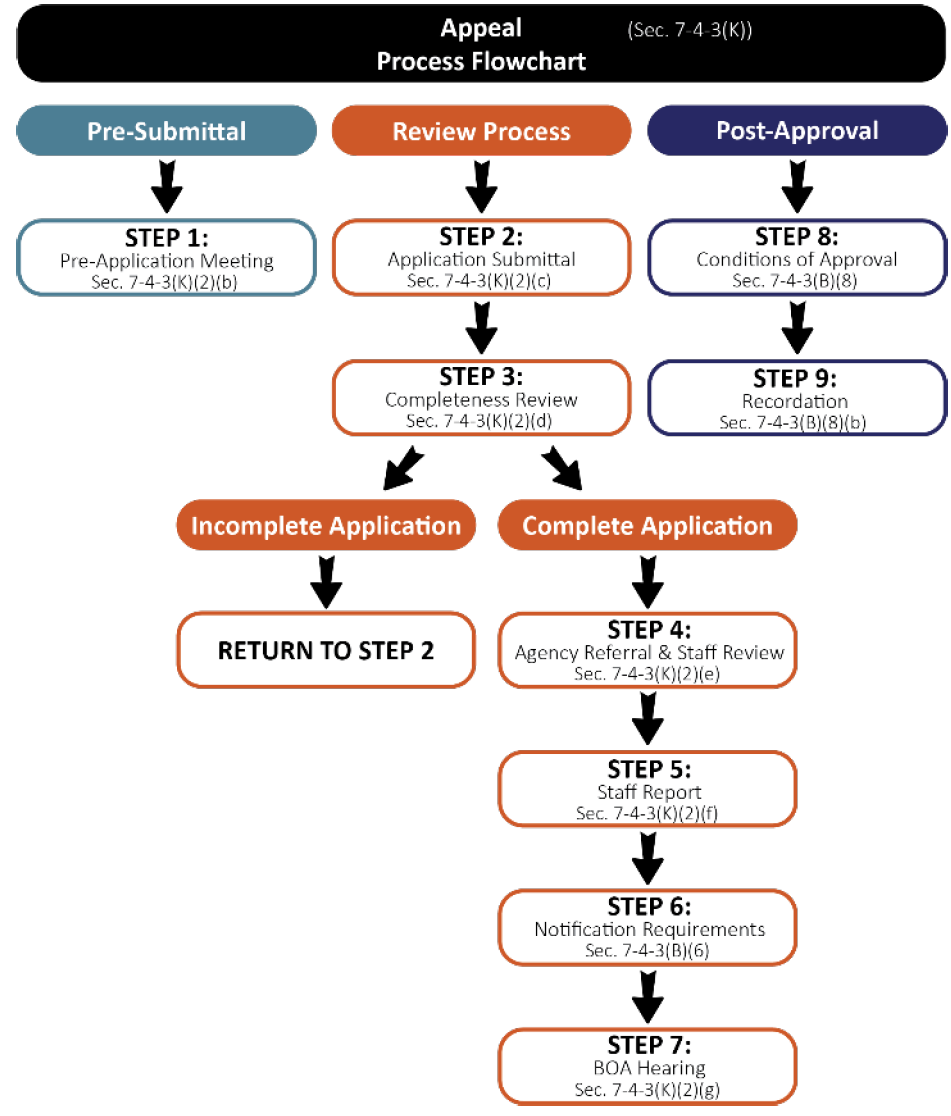
Review Flowchart. Figure F-4.9, Appeal Flowchart, depicts the appeal application review process described in greater detail in this section.
Figure F-4.9 Appeal Flowchart
(b)
Pre-Application Meeting. A pre-application meeting may be held in accordance with the provisions set forth in Section 7-4-3(B)(1), Pre-Application Meeting.
(c)
Application Submittal Requirements. The following are the application materials required to be submitted for appeal requests. The Town Manager or designee may waive or alter any of the submittal requirements if they are determined to be inappropriate or unnecessary to determining if the application satisfies applicable standards.
(i)
Basic Application Materials. All items set forth in Section 7-4-3(B)(2), Application Submittal Requirements.
(ii)
Written Narrative. A written narrative shall be submitted addressing all of the following items and any other information:
a.
Explanation of the request(s) and justification for why the standard for which the variance is being requested is unable to be met;
b.
Any efforts the applicant or property owner has made to meet the minimum standards;
c.
Justification for the request and how the request is the minimum required standard(s);
d.
Description of how the request meets each of the criterion set forth in Section 7-4-3(K)(3), Approval Criteria;
(d)
Completeness Review. The Town Manager or designee shall review the application for completeness in accordance with the provisions of Section 7-4-3(B)(3), Completeness Review.
(e)
Evaluation by Staff and Referral Agencies. Upon determination of completeness, the Town Manager or designee shall refer the application to additional reviewing agencies as set forth in Section 7-4-3(B)(4), Referral Agencies, and review the application for conformance with the requirements and standards of this Municipal Code.
(f)
Staff Report. A staff report shall be prepared and provided to the reviewing body in accordance with Section 7-4-3(B)(5), Staff Report.
(g)
Review and Decision by Board of Adjustment. The Board of Adjustment shall review the appeals application in a manner consistent with Table T-4.1 to evaluate compliance with applicable standards. Following its review of the application, the Board of Adjustment shall approve, approve with conditions, or deny the application based on the criteria set forth in Section 7-4-3(K)(3), Approval Criteria.
(3)
Approval Criteria.
(a)
The Board of Adjustment may only approve an appeal upon a finding that the following criteria have been met:
(i)
Literal enforcement of the standard or requirement would place an unnecessary and unreasonable hardship upon the applicant;
(ii)
The granting of the appeal will not be materially detrimental to the public welfare or injurious to other property in the neighborhood and surrounding area;
(iii)
The appeal will not have adverse effect on the intent, goals, and policies of the Town of Ridgway;
(iv)
The appeal will not be averse to the intent of the applicable portions of the Master Plan in the reasonable judgement of the Board of Adjustment;
(v)
Evidence of the manner in which the provision has been interpreted in the past, if applicable; and
(vi)
The positive or negative impact of the requested appeal on the achievement of the purposes of the Municipal Code.
(Ord. 03-2023)
7-4-4 - ZONING DISTRICTS.
(A)
Establishment of Districts. The following districts are established to encourage the most appropriate use of land within the Town of Ridgway.
(B)
Residential Districts. The residential districts described in this Section are established to support a diversity of housing options; to promote stability in residential neighborhoods; to protect such property from incompatible land uses; to protect property values; and to encourage the appropriate use of such land. Certain other uses are permitted which are compatible with residences.
(C)
Commercial Districts. The commercial districts described in this section are established to support a diverse and sustainable local economy with a mix of retail and service uses meeting the needs of the Ridgway community.
(D)
Industrial Districts. The industrial districts described in this section are established to support a diverse mix of employment opportunities including manufacturing, warehousing, distribution, or office uses to meet the needs of the regional workforce.
Table T-4.2, Zone District Abbreviations
(E)
"R" Low Density Residential District.
(1)
Intent. This District is intended to accommodate low to moderate density development for single-family detached dwellings, as well as a mix of other housing types and other compatible land uses where supported by the Master Plan. Environmental protection is provided by allowing cluster development to preserve environmentally sensitive lands, maintain common open space, and to provide recreational opportunities for residents.
(2)
District Standards.
(a)
Permitted uses are identified in Table T-4.3.
(b)
Lot size and required setbacks are identified in Table T-4.4.
(F)
"HR" Historic Residential District.
(1)
Intent. This District is intended to coincide with the historic residential core of Ridgway and accommodate a variety of housing types at medium density as well as other activities which are compatible with such uses.
(2)
District Standards.
(a)
Permitted uses are identified in Table T-4.3.
(b)
Lot size and required setbacks are identified in Table T-4.4.
(G)
"MR" Mixed Residential.
(1)
Intent. This District provides opportunities for a diverse mix of housing options at higher densities, as well as supporting services and other compatible uses that help meet the needs of area residents. Uses should be organized in compact, pedestrian and bicycle friendly manner and be responsive to the scale and intensity of development in adjacent zoning districts.
(2)
District Standards.
(a)
Permitted uses are identified in Table T-4.3.
(b)
Lot size and required setbacks are identified in Table T-4.4
(c)
A mix and variety of housing types and unit sizes must be incorporated to the maximum extent feasible based on the size of the development, adjacent development context, and other site considerations.
(d)
Parks, open spaces or common areas must be incorporated into the development.
(e)
Buildings with a gross floor area greater than 10,000 square feet shall be a conditional use.
(f)
Buildings containing more than 25,000 square feet of gross floor area are not permitted.
(H)
"FD" Future Development District.
(1)
Intent. This District is intended to include lands held in reserve to meet future growth needs of the community. Uses include very low-density single-family detached dwellings and agriculture.
(2)
District Standards.
(a)
Permitted uses are identified in Table T-4.3.
(b)
Lot size and required setbacks are identified in Table T-4.4.
(I)
"HB" Historic Business District.
(1)
Intent. This District encompasses the historic commercial core of Town. Intended uses include a mix of retail, restaurants, office, lodging, residential, service, institutional and other uses that are compatible with the historic character of the Town Core and contribute to vibrant, pedestrian-friendly atmosphere. All residential development must comply with residential design standards in Section 7-4-9. Where short-term rentals are permitted, they must comply with Subsection 7-4-6(N).
(2)
District Standards.
(a)
Permitted uses are identified in Table T-4.3.
(b)
Lot size and required setbacks are identified in Table T-4.4.
(c)
Buildings with a gross floor area greater than 7,500 square feet shall be a conditional use.
(d)
Buildings containing more than 15,000 square feet of gross floor area shall not be allowed.
(e)
No equipment, inventory, or supplies may be stored outside, except as authorized pursuant to Subsection 7-4-6(L).
(J)
"DS" Downtown Service District.
(1)
Intent. The Downtown Service District is not intended to compete with the Historic Business District or the General Commercial District, but rather intended to provide some flexibility in use for existing residences located on or within 100 feet of Highway 62, west of Laura Street as depicted upon the Town Comprehensive Plan Land Use Map. The flexibility in use is intended to mitigate the impact of increasing traffic upon the highway upon residences, by allowing for limited business use of the properties. The Downtown Service District is further intended to provide an effective transition between the General Commercial and Historic Business Districts and nearby residential neighborhoods along and near the Highway without creating an undue, adverse impact on these areas. Establishments and structures within the Downtown Service District are intended to appear "residential" as opposed to simply providing a visual extension of the commercial and business districts. Toward this objective, some service-oriented businesses are allowed within the Downtown Service District, as conditional uses, and with performance criteria that speak to appearance, signage, and parking. These businesses may have limited and ancillary retail use. Home occupation of these business uses is permissible in accordance with Subsection 7-4-6(H). Auto intensive uses such as gas stations, drive through businesses, convenience stores and similar uses that generate high traffic of items or require large parking areas are not permitted. All residential development in these districts must comply with residential design standards in Section 7-4-9.
(2)
District Standards.
(a)
Permitted uses are identified in Table T-4.3.
(b)
Lot size and required setbacks are identified in Table T-4.4.
(c)
All professional offices and service businesses allowed as a conditional use shall have no more than five employees.
(d)
Business hours shall be between 7:30 a.m. and 5:30 p.m.
(e)
No semi-truck traffic shall be allowed upon residential streets or alley ways.
(K)
"GC" General Commercial District.
(1)
Intent. This District encompasses lands along the river and Highways 550 and 62. Its purpose is to create areas for a mix of retail and commercial services, office, and other supportive uses to meet the needs of residents and tourists. A mix of higher-density housing types are also supported to provide for live/work opportunities and to promote activity and vibrancy within these areas. While more auto oriented than development within the Town Core, uses in the "GC" District should be designed with the safety and convenience of pedestrians and bicyclists in mind. Where short-term rentals are permitted, they must comply with Subsection 7-4-6(N).
(2)
District Standards.
(a)
Permitted uses are identified in Table T-4.3.
(b)
Lot size and required setbacks are identified in Table T-4.4.
(c)
Buildings 27 feet to 35 feet in height or containing more than 10,000 square feet of gross floor area shall be a conditional use.
(d)
Buildings containing more than 10,000 square feet of gross floor area will be required to mitigate the visual impacts of their size by means of design, landscaping, berming and other methods of site treatment, and must be compatible with the mass and scale of existing buildings on adjacent properties, or if there are no such buildings compatible with the mass and scale of buildings in the Town generally.
(e)
Buildings containing more than 25,000 square feet of gross floor area shall not be allowed.
(f)
Residential development shall not be located along arterial street frontages to preserve these locations for commercial services and other businesses that rely upon visibility from Highways 550 and 62.
(g)
Gas Stations shall comply with the following criteria:
(i)
All fuel storage shall be located underground.
(ii)
All gasoline pumps, lubrication and service facilities shall be located at least 20 feet from any street right-of-way line.
(iii)
No curb cut may be any closer than 30 feet from any street intersection.
(iv)
A minimum lot frontage of 125 feet is required.
(v)
The main building on the site shall be set back at least 40 feet from any property line.
(L)
"LI" Light Industrial District.
(1)
Intent. This district is to provide areas for light industrial uses that include offices and light manufacturing and fabrication. Additionally, this district is to provide opportunities for employment and serve as a transition from adjoining residential neighborhoods. Uses by right in this district, will be those that do not create an adverse impact on adjoining uses from lighting, noise, vibration, glare, smoke/fumes/odor, outside storage or other similar impacts. Landscaping is to be used to improve the appearance of the properties, breakup parking areas into smaller sections and generally buffer the industrial area from surrounding non-industrial uses. Work conducted on-site is to occur primarily inside buildings. Some on-site impacts may be associated with this district in the form of noise, truck traffic, and vibrations. However, these impacts must be mitigated at the property line.
(2)
District Standards.
(a)
Permitted uses are identified in Table T-4.3.
(b)
Lot size and required setbacks are identified in Table T-4.4.
Maximum building size without special review is 5,000 square feet of gross floor area. Buildings containing more than 5,000 square feet of gross floor area will be required to mitigate the visual impacts of their size by means of design, landscaping, berming and other methods of site treatment. Buildings must be compatible with the mass and scale of existing buildings on adjacent properties, or if there are no such buildings, compatible with the mass and the scale of buildings in the Town generally. In no case, shall buildings exceed 5,000 square feet of building footprint.
(M)
"GI" General Industrial District.
(1)
Intent. This district is similar to the LI Light Industrial District but will allow more intensive uses. Uses by right in this district, will be those that do not create an adverse impact on adjoining uses from lighting, noise, vibration, glare, smoke/fumes/odor, outside storage or other similar impacts. Landscaping is to be used to improve the appearance of the properties, break up parking areas into smaller screened sections and generally buffer the industrial area from surrounding non-industrial uses. Work conducted on-site may occur outside of buildings. Some on-site impacts may be associated with this district in the form of noise, truck traffic, and vibrations. However, these impacts must be mitigated at the property line.
(2)
District Standards.
(a)
Permitted uses are identified in Table T-4.3.
(b)
Lot size and required setbacks are identified in Table T-4.4.
(c)
Buildings containing more than 5,000 square feet of gross floor area will be required to mitigate the visual impacts of their size by means of design, landscaping, berming and other methods of site and architectural design treatments. Buildings must be compatible with the mass and scale of existing buildings on adjacent properties, or if there are no such buildings, compatible with the mass and the scale of buildings in the Town generally. In no case, shall buildings exceed 12,500 square feet of building footprint.
(N)
Uncompahgre River Overlay District.
(1)
Purpose and Intent: The purpose of the Uncompahgre River Overlay District (UROD) is to promote the public health, safety and welfare of the citizens of the Town of Ridgway. The Town shall use the UROD to implement goals, policies and action items in the Town of Ridgway's Land Use Plan; preserve, improve and protect the river corridor as a Town amenity; regulate buildings and structures to maximize access to the Uncompahgre River and view corridors along the Uncompahgre River; utilize design and development techniques that avoid, minimize and mitigate impacts to the natural environment; and ensure aesthetic and ecological qualities of the river corridor continue to be a community asset.
(2)
Applicability: The provisions and regulations of this Subsection 7-4-4(N) shall apply to all land within the Town of Ridgway Official Zoning Map included as part of the UROD; and as defined within these regulations. The provisions of this Subsection 7-4-4(N) shall apply in addition to the applicable requirements of the underlying zoning district, the Flood Plain Management Regulations in Ridgway Municipal Code Chapter 6, Section 2, and other regulations of the Town. When the standards of this UROD conflict with any other provision of the Ridgway Municipal Code, the more stringent limitation or requirement shall apply. Within the UROD, all land use activity, development, redevelopment, renovation, and/or change in use requiring a building, development, or other land use permit (for the purposes of this Section of the Ridgway Municipal Code shall be defined as "Development") are subject to the provisions of this Subsection 7-4-4(N).
(3)
Uses by Right: Uses permitted by the underlying zoning district are allowed unless specifically prohibited, provided that the use complies with this Subsection 7-4-4(N), and provided any development complies with this Subsection 7-4-4(N).
(4)
Conditional Uses: All conditional uses allowed within the underlying zoning district may be permitted upon approval in accordance with Subsection 7-4-3(E), and provided any development complies with this Subsection 7-4-4(N).
(5)
Development between 25 and 75 feet:
(a)
Development between 25 and 75 feet from the High-Water-Mark shall be reviewed in accordance with Subsection 7-4-4(N), as a conditional use. In addition to the review criteria under Subsection 7-4-3(E), the following shall also apply:
(i)
All of this Subsection 7-4-4(N).
(ii)
The applicant shall provide an Ecological Characterization Study in accordance with Subsection 7-4-4(N)(7) which concludes that any adverse impacts to the river environment with the proposed Development can be mitigated, and the applicant shall incorporate the mitigation into the development plan and construct the mitigation with the Development.
(iii)
Special consideration for development shall be given so as to not deprive reasonable use of any land within the UROD.
(6)
Performance Standards:
(a)
Setback: All development must be setback a minimum of 75 feet from the High-Water-Mark, unless approved as a Conditional Use as further set forth under Subsection 7-4-4(N)(4), (5).
(b)
Public Access:
(i)
If any proposed or existing trail, path or public access area as described in the Town's Land Use Plan or Parks and Trails Map, as amended from time to time and including the Uncompahgre RiverWay Trail, traverses a parcel proposed for development, the Town may require as a condition of development approval, dedication of a bicycle/pedestrian trail easement and/or public access easement benefiting the Town of Ridgway. The preferred dedication is for a ten-foot-wide bicycle/pedestrian public access trail easement. However, in reviewing the proposed site plan, the Town shall evaluate the nature and extent of the proposal and the proportionality between the proposal and the dedication and may determine that the ten-foot dedication is appropriate or may reduce the dedication based on the proportionality assessment. The Town may also take into consideration whether and to what extent there are existing easements over the subject property, which provide the same functions of the required public access trail easements. Any trail easements shall be located at, or above, the High-Water-Mark or abutting a public right-of-way. In lieu of a trail dedication, other trail locations that provide for connectivity to existing or future trails and are made accessible to the public through a dedicated public access easement, may be approved by the Town.
(ii)
As a condition of development approval, if any proposed or existing trail, path or public access area as described in the Town's Land Use Plan or Parks and Trails Map, as amended from time to time and including the Uncompahgre RiverWay Trail, does not traverse a parcel proposed for development, the Town shall not seek a dedication of bicycle/pedestrian trail easement and/or public access easement benefiting the Town of Ridgway. However, parcels within the UROD are encouraged to provide public access to the Uncompahgre River including clearly defined access points to public trail segments. "Access" refers to the provision of access from a public right-of-way to a publicly accessible trail or path and/or to the water's edge of the Uncompahgre River.
(c)
Design Guidelines and Standards:
(i)
These Design Guidelines and Standards under this Subsection 7-4-4(N)(6)(c) shall apply to all development within the UROD, with the exception of single-family and duplex residential buildings.
(ii)
Site Planning:
a.
Existing or historic drainage ways shall be accommodated with the development plan.
b.
Discharge of stormwater directly into the river is prohibited. Use of landscaped/grassed catchment areas and similar design features shall be used for managing, controlling and filtering parking lot and site drainage.
c.
Outdoor common areas, seating and/or dining is recommended on the river side of the building.
d.
A visible and accessible public entrance from the side of the property facing the Uncompahgre River is encouraged for commercial properties that are open to the public.
(iii)
Parking and Loading:
a.
Parking and loading shall be sited to provide the least visual impact from public rights-of-way, including the Uncompahgre River corridor.
b.
Trees shall be incorporated to provide parking lot shading. Bollard and/or street lighting shall be used to provide lighting at critical access points.
c.
Site parking shall include bike racks and areas for parking strollers and other non-motorized vehicles near the main entrance to the primary building(s) and should have a logical connection to on-site non-motorized access routes.
(iv)
Mass, Scale, Architectural Design and Materials:
a.
Total building façade length shall be less than 50 feet in length parallel to the river.
b.
Buildings shall avoid monolithic shapes and surfaces by incorporating solids and voids, changes in color, pattern, texture, and materials at minimum along the primary façade and the façade along the linear frontage of the river.
c.
Use of naturally derived materials, such as stone, wood, and innovative materials such as metal, or high-quality environmentally friendly wood-alternative decking and siding, shall be required.
(v)
Screening and Buffers: All parking areas, outside trash receptacles, large utility boxes, mechanical systems and other unattractive views shall be screened with landscaping from public rights-of-way, including the Uncompahgre River corridor. Screening is not required where access is necessary but shall be screened with a gate where feasible. The purpose of screening and buffers is to promote the public health safety and welfare to conserve views along the Uncompahgre River corridor, and to improve the visual appearance along the river.
(vi)
Exceptions to these Design Guidelines and Standards may be pursued through the variance process pursuant to Subsection 7-4-3(J).
(7)
Submittal Requirements: These submittal requirements are in addition to the underlying zoning district submittal requirements for the type of land use activity or development proposed. The following information must be completed and included in all applications for development or land use activity:
(a)
A development plan showing compliance with the Performance Standards listed in Subsection 7-4-4(N)(6).
(b)
Survey map including property boundaries, the location of the High-Water-Mark and 75 foot setback. In the event the identification or location of the High-Water-Mark is disputed by the Town, the Town may hire a professional experienced in the identification of a High-Water Mark, to survey the High-Water Mark, and charge the cost of each survey to the Property owner.
(c)
In addition to the above, development applicants seeking a Conditional Use in accordance with Subsection 7-4-3(E) are required to submit an Ecological Characterization Study completed by a professional qualified in the areas of ecology, wildlife biology or other relevant discipline. The Ecological Characterization Study shall describe, without limitation, the following:
(i)
The boundary of wetlands and riparian areas and a description of the ecological functions and characteristics provided by those wetlands and riparian areas;
(ii)
The pattern, species and location of any significant native trees and other native site vegetation;
(iii)
The pattern, species and location of any significant non-native trees and non-native site vegetation that contribute to the site's ecological, shade, canopy, aesthetic and cooling value;
(iv)
The top of bank, the 25-foot setback and High-Water-Mark of any perennial stream or body of water on the site;
(v)
The wildlife use of the area showing the species of wildlife using the area, the times or seasons that the area is used by those species and the "value" (meaning feeding, watering, cover, nesting, roosting, perching) that the area provides for such wildlife species;
(vi)
Special habitat features;
(vii)
Wildlife movement corridors;
(viii)
The general ecological functions provided by the site and its features;
(ix)
Any issues regarding the timing of development related activities stemming from the ecological character of the area; and
(x)
Any measures needed to mitigate the projected adverse impacts of the development project on natural habitats and features along the Uncompahgre River corridor.
(8)
Exempt Uses and Activities: The following uses and activities are exempt from these regulations, including the Performance Standards of Subsection 7-4-4(N)(6) and the submittal requirements of Subsection 7-4-4(N)(7), provided plans and specifications are approved by the Town, and all local, state and federal permitting is approved.
(a)
Public improvements essential for public health and safety, installed by, and/or approved by the Town, including, but not limited to, public utility buildings, facilities, systems and accessory structures;
(b)
Public improvements such as pedestrian and automobile bridges, trails and recreational amenities installed by, and/or approved by the Town;
(c)
Irrigation, drainage, flood control or water diversion structures installed by, and/or approved by the Town; and
(d)
Bank stabilization, river restoration and planting of native vegetation installed by, and/or approved by the Town.
(e)
Notwithstanding Subsection 7-4-13 of the Code, any development (as defined in Subsection 7-4-4(N)(2), related to any structure within the UROD that was legally conforming prior to the date of adoption of this Section, so long as such development does not expand the building footprint of the structure and is in compliance with all other Town regulations.
(O)
Land Use Table. Table T-4.3, Table of Land Uses, identifies allowed land uses within each of the established zone districts. The Town Manager or designee shall determine whether any use that is not specifically listed is allowed in a corresponding zone district and the level of review required, based upon the listed use which is most similar to the use not specifically listed.
(1)
Table of Land Uses Interpretation and Process.
(a)
Site Plan Approval. Nonresidential and multi-family uses identified in Table T-4.3 shall receive approval of a site plan in accordance with Section 7-4-3(H), Site Plan, prior to commencing any development activity regardless of whether such use is allowed by right or requires an administrative approval or conditional use permit.
(b)
Conditional Uses. Any use identified as requiring a Conditional Use in Table T-4.3 shall receive a Conditional Use Permit in accordance with Section 7-4-3(E), Conditional Use Permit.
(c)
Uses not Allowed. If a particular use does not have a letter corresponding to a zone district, that use is prohibited in the respective zone district.
(2)
Table T-4.3 Key. The following should be used to interpret and understand Table T-4.3 below.
(a)
"R" - Use allowed by right in the identified zone district.
(b)
"C" - Use requiring Conditional Use Permit in the identified zone district.
(c)
Blank - Use is prohibited in the identified zone district.
(d)
Use not listed - unlisted uses are generally prohibited unless they can be interpreted to meet an allowed Use Category and/or Land Use.
Table T-4.3 - Land Use Table
(P)
Zone District Dimensional Standards.
(1)
Dimensional Standard Requirements. Dimensional standards for lot size, setbacks, and maximum height are summarized for each zone district in Table T-4.4, Dimensional Standard Requirements, below.
Table T-4.4-Dimensional Standard Requirements:
(2)
Additional Dimensional Standards and Exceptions.
(a)
Duplex Resubdivision Exception. A duplex dwelling on a lot that meets the requirements set forth in Section 7-4-4(P) above may be resubdivided, provided that the resulting two lots and the building meet the following minimum requirements:
(i)
The minimum lot size requirement shall be divided in half for a duplex lot that is resubdivided.
(ii)
The party wall in all such duplex dwellings shall run along and upon the lot line common to the resulting two lots.
(iii)
A zero foot (0') setback exists at the party wall lot line.
(b)
Townhouse and Condominium Exception.
(i)
There is no lot coverage requirement for individual townhouse or condominium lots, only for the project site.
(ii)
The minimum side yard setbacks are measured from the property line of the townhome and condominium project site and not from individual townhome or condominium lots.
(c)
When the rear or side lot line abuts an alley, the setback shall be a minimum of two feet.
(d)
HB Setbacks shall be determined as follows:
(i)
The setback shall be eight feet, unless snow and drainage from the roof is effectively directed away from the abutting property, in which case the setback can be as little as four feet.
(ii)
In those instances where snow and drainage are effectively directed away from the abutting property, and the foundation and wall of the structure are constructed so that a wall and foundation of a building on an abutting lot can be built up to, or abutting the property line, the setback can be eliminated.
(iii)
In buildings with three stories above ground, the third story shall be subject to a 15-foot front setback, and an eight-foot side setback for those sides facing a public street, in addition to other applicable setbacks as provided above. The third story setbacks may be reduced or eliminated where design of the third story provides architectural features that are aesthetically attractive to provide visual relief and contrast as an alternative to monolithic three-story facade surfaces. For purposes of this provision, such features include, but are not limited to, integration of third stories into roof lines, multiple roof lines and angles, windows, doors and balconies, and fenestration and facade designs that make a distinction between upper and lower floors, such as horizontal banding and varied building materials.
(e)
Any reduction of the setbacks as specifically provided in these paragraphs (c) and (d) shall be determined by the Town Planning Commission, pursuant to consideration of the criteria as set forth herein and in accordance with the review procedures as set forth in Subsection 7-4-3.
(f)
Structure Height shall be determined as follows for application of the limitations as set forth herein:
(i)
The height of any structure shall be determined by measuring the vertical distance between the elevation of the lowest point of the natural grade abutting any exterior wall or supporting structure and the highest point of the coping of a flat roof or to the deck line of a mansard roof or to the average height of the highest gable or a pitched or hipped roof. Structures that do not have roofs shall be measured to the height of the structure.
(ii)
The height of each separate terrace or step for terraced or stepped buildings shall be considered for purpose of application of these limits.
(iii)
Allowable building height may be increased by six inches if the roof design includes raised heel trusses.
(iv)
Within the General Industrial District, commercial telecommunication antennae or towers that are located on Town owned property, and that are in compliance with Subsection 7-4-6(O), may have a structure height of up to 40 feet.
(g)
Lot width shall be measured at the frontage of that abutting public street which provides actual access to the lot.
(Ord. 03-2023)
7-4-5 - GENERAL PERFORMANCE STANDARDS.
(A)
Purpose, Applicability, and Related Provisions.
(1)
Purpose. These performance standards are designed to limit, restrict, and prohibit, the effects of certain uses outside their premises or district.
(2)
Applicability. No structure, land, or water shall be used except in compliance with the district regulations and with the environmental performance standards of this Section.
(3)
Responsibility. It shall be the responsibility of the owner, operator, or proprietor of any use or property to provide evidence and technical data to demonstrate that the use or development of the property will be in compliance with the requirements and standards of this Section. Failure of the Town Manager, or designee, to require such information shall not be construed as relieving the owner, operator, or proprietor from compliance with the requirements and environmental performance standards of this Code.
(4)
State and Federal Regulations. All uses shall comply with applicable state and federal regulations related to environmental protection, including those pertaining to air or water pollution.
(5)
Measurements. Accurate and representative measurements, as necessary, shall be made according to accepted engineering practice. Observations shall be made as described in the applicable Subsection above. In the event that the point of measurement is not defined or if there is more than one use on the property, measurements shall be taken at the property line of the lot on which the use is located if it is the only use on the lot.
(6)
Additional Studies. The applicant shall complete or provide funding for completion of studies by qualified personnel that the Town deems necessary to quantify and to develop recommendations for abating impacts directly associated with the proposed use.
(7)
It shall be unlawful to maintain, own or operate any offensive or unwholesome business or establishment within the Town, including, but not limited to, rendering plants, tanneries, pig sties, feed lots, dairy farms, manufacture and storage of explosives, sugar beet pulp storage facilities, foundries, or petroleum product refineries, unless such business was lawfully in existence at the effective date of this Section, or at the effective date of annexation subsequent to the effective date of this Section. In either event, such business or establishment shall be subject to the Nonconforming Use Regulations of Subsection 7-4-13 of these regulations, and all other applicable regulations of the Town.
(B)
Air Pollution, Dust and Fly Ash.
(1)
No solid or liquid particles shall be emitted in such a quantity as to be readily detectable at any point along lot lines or as to produce a public nuisance or hazard beyond lot lines.
(C)
Electrical Disturbance or Interference.
(1)
No use shall:
(a)
Create any electrical disturbance that adversely affects any operations or equipment other than those of the creator of such disturbance, or
(b)
Otherwise cause, create, or contribute to the interference with electrical signals (including television and radio broadcasting transmissions) to the extent that the operation of any equipment not owned by the creator of such disturbance is adversely affected.
(D)
Fire and Explosion.
(1)
No fire or explosive hazard shall exist such as to produce dangerous exposure to adjacent property.
(E)
Glare.
(1)
No direct or reflected glare shall be detectable at any property boundary.
(F)
Hazardous Waste.
(1)
Hazardous waste shall be those substances as defined by Federal, State or local regulations. The disposal, treatment, bulking or handling (hereinafter collectively called treatment) of hazardous waste within the municipal limits of the Town shall be permitted only when such waste is generated within the Town. Any such treatment shall be prohibited except in conformance with all applicable Federal, State or local regulations governing hazardous waste. The temporary storage of hazardous waste other than for treatment is permitted only when it is used, manufactured or generated as a waste as part of an industrial, manufacturing or laboratory process that takes place within the Town. In this circumstance, hazardous waste shall be inventoried and stored inside a building with an impermeable floor and otherwise handled in strict conformance with all applicable Federal, State and local regulations. The records pertaining to such inventory and storage shall be open to authorized personnel of the Town of Ridgway and/or the Ridgway Fire Department upon reasonable request.
(G)
Heat.
(1)
No direct or reflected heat that is dangerous or discomforting shall be detectable at any property boundary.
(H)
Noise.
(1)
In addition to RMC 10-3-24, Unreasonable Noise, the following shall be followed within the Town of Ridgway. No persistent noise shall be detectable beyond the property line in excess of the values identified in the following table:
Table T-4.5 Noise
(a)
Impact noises are sounds that occur intermittently rather than continuously. Impact noises generated by sources that do not operate more than one minute in any hour are permissible up to a level of ten dB(A) in excess of the figures listed in the table above, except that this higher level of permissible noise shall not apply from 7:00 p.m. to 7:00 a.m. when the adjacent lot is zoned residential. The impact noise shall be measured using the fast response of the sound level meter.
(b)
Noise resulting from temporary construction activity that occurs between 7:00 a.m. and 7:00 p.m. shall be exempt from the requirements of this Section.
(c)
Noise shall be measured on a decibel or sound level meter. Noise level shall be measured at a point located within a street or public right-of-way in the town and a distance of at least 25 feet from the noise source; and/or at the common property line of the property on which the noise source is located and the adjacent property.
(d)
No use in the industrial zone districts may generate noise that tends to have an annoying or disruptive effect upon uses outside the immediate space occupied by the use if that use is one of several located on the lot or uses located on adjacent lots.
(e)
The table above establishes the maximum permissible noise levels for the LI and the GI Zone Districts. Measurements shall be taken at the boundary line of the lot where a particular use is located, and as indicated, the maximum permissible noise levels vary according to the zoning of the lot adjacent to the lot on which subject use is located.
(I)
Odor.
(1)
For purposes of this Section, the "odor threshold" is defined as the minimum concentration in a year of a gas, paper or particulate matter that can be detected by the olfactory systems of a healthy observer.
(2)
No use in the Town of Ridgway may generate any odor that reaches the odor threshold measured at the outside boundary of the immediate space occupied by the enterprise generating the odor (if there is more than one enterprise in the structure) or the lot line (if the enterprise generating the odor is the only enterprise located on a lot).
(J)
Radioactivity.
(1)
No operation shall be permitted which causes radioactivity in violation [of] any applicable Federal, State or local regulation.
(K)
Smoke.
(1)
For purposes of determining the density of equivalent opacity of smoke, the Ringlemann Chart, as adopted and published by the United States Department of Interior, Bureau of Mines Information Circular 8333 May 1967, shall be used. The Ringlemann number referred to in this Section refers to the number of the area of the Ringlemann Chart that coincides most nearly with the visual density of equivalent opacity of the omission of smoke observed. For example, a reading of Ringlemann No. 1 indicates a 20-percent density of the smoke observed. No smoke shall be permitted in such quantity as to become a nuisance, nor shall it be detectable at any property boundaries. All measurements shall be taken at the point of emission of the smoke. In the GI District, no use may emit from a tent, stack, chimney or combustion process any smoke that exceeds a density or equivalent capacity of Ringlemann No. 2, except that any emission that does not exceed a density or equivalent capacity of Ringlemann No. 2 is permissible for a duration of not more than four minutes during any eight-hour period if the source of such emission is not located within 500 feet of a residential district.
(L)
Vibration.
(1)
No inherent and recurrently generated vibration shall be perceptible, without instruments, at any point along in the boundary line of the property on which the use is located. Where more than one use is located on a property, then this standard shall also be measured along any wall of any other building on the property.
(M)
Waste Disposal.
(1)
Liquid and solid waste disposal and water service shall comply with all pertinent Federal, State and local regulations.
(2)
Storage is not allowed in the front or side setbacks along any street.
(Ord. 03-2023)
7-4-6 - SUPPLEMENTAL REGULATIONS.
(A)
Accessory Dwelling Units.
(1)
General Provisions.
(a)
The creation of Accessory Dwelling Units (ADU) is generally encouraged as an effective means to improve housing affordability, provided that each ADU complies with the standards of these regulations.
(b)
The goal of improving housing affordability requires flexibility with landscaping requirements, building typologies, and construction methods. Sustainable construction methods including, but not limited to, utilizing local resources and energy efficient designs are encouraged to increase long-term affordability.
(c)
The burden shall be upon the owner of any ADU to provide adequate proof to the Town that the criteria of this Section are met. In the event that the Town determines that the criteria have not been shown to be satisfied, the unit may not be occupied as an ADU.
(d)
A dwelling unit constructed before a principal building, which meets these criteria, may be converted to an ADU following construction of a new principal dwelling unit.
(e)
Plan review fees as calculated by the Building Official may be waived by the Town Manager for ADU(s) as set forth below.
(i)
Plan review fees may be reduced by up to one-hundred (100) percent for attached ADU(s).
(ii)
Plan review fees may be reduced by seventy-five (75) percent for detached ADU(s).
(iii)
Permit fees may not be reduced for any ADU(s).
(2)
Dimensional and Design Standards.
(a)
ADUs are only allowed as an accessory use to the following dwellings:
(i)
Single-Family Dwelling;
(ii)
Duplex Dwelling; or
(iii)
Triplex Dwelling.
(b)
The quantity of ADUs on a single lot is permitted in accordance with the following:
(i)
One (1) ADU may be allowed on a lot that is at least 3,000 square feet in area.
(ii)
Two (2) ADUs may be allowed on a lot that is at least 7,500 square feet in area.
(c)
ADUs may be located within a detached structure, attached to the principal structure, or converted room or rooms within the principal structure.
(d)
The ADU(s) must be constructed in accordance with applicable requirements of Town Building Codes.
(e)
All lots where an ADU is proposed shall comply with all dimensional standards applicable to the underlying zone district.
(i)
Required setbacks may be reduced by up to fifty (50) percent, or two (2) feet, whichever is greater, when adjacent to open space. Such a reduction shall be approved in writing by the Town Manager or their designee.
(f)
The ADU shall not be located within the sight triangle as determined by Section 7-4-8(F)(8), Sight Triangles.
(g)
The architectural design of an ADU shall be compliant with the regulations set in RMC 7-4-9, Residential Design Standards.
(h)
An ADU shall comply with the parking requirements as set out in subsection 7-4-6(M).
(i)
The maximum size of an ADU shall not exceed 1,000 square feet of gross floor area unless otherwise allowed by this section.
(i)
For purposes of this Section, the calculation for the "gross floor area" shall be the total square footage of the ADU measured to the interior walls of the area comprising the dwelling unit excluding internal parking areas and stairways.
(j)
The proposed property on which the ADU is located shall be compliant with an approved Landscape Plan, consistent with Section 7-4-8, Landscape Regulations, if one exists.
(i)
If the property does not have an approved Landscape Plan, the Town Manager or their designee may determine if Section 7-4-8, Landscape Regulations, applies to the proposed improvements.
(3)
Incentives.
(a)
ADU Affordable Housing Provisions. All single-family, duplex, or triplex dwellings may be allowed to construct one (1) additional ADU above the allowed quantity in subsection 7-4-6(A)(2)(b) when the ADU is income-restricted pursuant to this subsection.
(i)
Affordable Housing Covenants and Restrictions. The property owner shall record a restrictive covenant with the Ouray County Clerk and Recorders' office that includes the following provisions:
a.
Area median income (AMI). The income range shall be equal to or less than 150 percent AMI for Ouray County as determined by the US Department of Housing and Development or US Census.
b.
Income-restricted units. Describe the quantity of income-restricted units, their square footage, and bedroom count.
c.
Compliance report and leasing period. The duration of the tenant's lease. Upon reasonable request by the Town of Ridgway or Ouray County, the property owner shall submit a compliance report outlining how the restricted units comply with covenant requirements.
d.
Income verification and rent limitations. Provide the method for determining tenant income and calculating the rent limitations for each income-restricted unit.
(ii)
All dimensional standards of the underlying zone district shall still be met.
(iii)
In no case shall there be more than two (2) ADU's on any one parcel.
(b)
Landscaping. When a property owner requesting an ADU meets one of the applicable water conservation standards below, the proposed ADU may increase its maximum gross floor area by up to ten (10) percent without an administrative adjustment.
(i)
The proposed live ground cover does not include more than 750 square feet of turf or;
(ii)
The proposed landscape area has a minimum of eighty (80) percent non-live ground cover.
(c)
Sustainable construction methods. When an applicant meets the applicable sustainable construction standards as set forth below, the proposed ADU may exceed the maximum gross floor area by two hundred (200) square feet.
(i)
The proposed construction is certified by a professional sustainable construction organization;
(ii)
The applicant provides proof of energy efficient design that exceeds industry standards from a certified construction professional; and
(iii)
The applicant sources fifty (50) percent of the construction materials from the State of Colorado.
(4)
Ownership and Occupancy. The following shall be met for any proposed or existing ADU within the Town of Ridgway:
(a)
The ADU, principal residential unit(s), and the lot or parcel upon which they are located, shall remain in undivided ownership.
(b)
An ADU may be used as a Short-Term Rental provided it complies with all provisions of RMC Section 7-4-6(N), Short Term Rental Regulations, and Section 8-5, Short-term Rentals.
(c)
A minimum of a ninety (90) day rental period shall be required by written lease for an ADU, unless the ADU is owner-occupied.
(5)
Utilities.
(a)
The ADU(s) should be served off of the water and sewer tap for the principal residence, in which case it shall not be subject to additional tap fees.
(Ord. 03-2024)
(B)
Accessory Uses and Structures. The purpose of this section is to authorize the establishment and continuation of land uses and structures that are incidental and customarily subordinate to principal uses. This section is intended to allow a broad range of accessory uses and structures, so long as they are listed in the table of allowed uses and comply with the standards set forth in this section to reduce potentially negative impacts on adjacent properties.
(1)
Accessory uses and structures are allowed pursuant to the following provisions:
(a)
Table T-4.3 Table of Land Uses identifies allowed accessory uses and structures within each zone district.
(b)
All principal uses allowed in a zoning district shall be deemed to include those accessory uses, structures, and activities typically associated with the principal use, unless specifically prohibited in this section.
(c)
All accessory uses are subject to the provisions of this Section 7-4-6(B), Accessory Uses and Structures.
(2)
Relationship to principal use or structure.
(a)
Except as otherwise expressly allowed in the Ridgway Municipal Code, an accessory use or structure shall not be established or constructed before the establishment of the principal use or structure.
(b)
If the principal use or structure is destroyed or removed, the accessory use or structure shall no longer be allowed.
(c)
Accessory uses shall not be permitted as the exclusive use of any property.
(3)
Location of accessory uses and structures.
(a)
No accessory use or structure shall be located within any platted or recorded easement or over any known utility, or in any areas designated as a fire lane or emergency access route.
(b)
No accessory structure shall impede the access to, or function of an area required for the circulation or parking of vehicles.
(c)
Accessory uses and structures shall comply with the minimum applicable zone district setbacks.
(C)
Bed and Breakfast Operations.
(1)
Residents of a dwelling unit in the "R" and "HR" Districts may rent rooms on a short-term basis (and may provide meals to such boarders) if a Conditional Use Permit is approved by the Planning Commission pursuant to Section 7-4-3(E), and the operation will comply with the criteria of this Subsection.
(2)
The application shall not be granted unless the Planning Commission determines that the following criteria are met:
(a)
There is at least one additional off-street parking space for each room to be rented in addition to the off-street parking required for the residential dwelling unit;
(b)
No more than three rooms shall be rented in any dwelling unit. Such rooms shall be an integral part of the dwelling unit;
(c)
The meals to be served shall be served from the kitchen which is part of the dwelling unit itself;
(d)
The operation will not create a public or private nuisance;
(e)
Only the permanent residents of the dwelling unit shall be employed in the operation; and
(f)
The Permittee will obtain a sales tax license and remit sales tax and lodging occupation tax.
(3)
The Town Council may revoke any permit if it determines following a hearing with reasonable notice to the holder of the permit that the above criteria or limits of any permit are not being met.
(D)
Drive-Up Window Establishments.
(1)
The purpose of this section is to regulate fast food, drive-in and drive-up window commercial uses in order to limit the potential for impairment of traffic flow on roads providing access to the use; to ensure adequate off-street queuing and ingress/egress; and to limit the noise and other negative impacts on adjacent land uses.
(2)
Drive-up window establishments are permitted as an accessory use where the principal use is permitted by right, or by conditional use, in the zone district as described in Table T-4.1.
(3)
Drive-Through Lanes: Drive-through lanes shall be separated from circulation lanes required to enter or exit the property. Drive-through lanes shall be marked by special striping, pavement markings or barriers. Drive-through lanes shall not cross or intersect the principal pedestrian access route to such establishment. Drive-through lanes shall be designed and located in such a manner as to minimize impacts on adjoining properties and shall be screened and buffered in such a manner as to minimize noise impacts. An opaque screening treatment shall be provided on all sides of the site that are located adjacent to residentially zoned property.
(4)
Parking: 5 stacking spaces per drive-up window shall be required in addition to required parking spaces for principal use.
(E)
Employee Housing.
(1)
The creation of employee housing is generally encouraged as an effective means to improve housing affordability and to support the viability and retention of employment generating uses, provided that each complies with the following standards.
(2)
Employee housing units are only allowed as accessory to a nonresidential use.
(3)
One employee housing unit is allowed for the first 2,500 square feet of gross floor area in the structure. Structures that exceed 2,500 square feet of gross floor area are allowed one additional unit per 2,500 square feet, up to a maximum of three units per nonresidential use.
(4)
The employee housing unit must be constructed in accordance with all applicable building and safety codes.
(5)
The employee housing unit must be owned together with the structure occupied by the nonresidential use, and the lot or parcel upon which they are located, in undivided ownership.
(6)
The employee housing unit must be served off of the water or sewer tap for the principal structure, in which case it shall not be subject to additional tap fees.
(7)
If the employee housing unit has been offered to current and prospective employees of the nonresidential use for 45 days after the prior tenant vacates and the unit remains vacant, the unit can then be offered to other households where at least one of the occupants is employed at an establishment located within Ouray County.
(8)
Short-term rental of employee housing is not permitted.
(9)
The burden shall be upon the owner of any employee housing unit to provide adequate proof to the Town that the criteria of this Section are met. In the event that the Town determines that the criteria have not been shown to be satisfied the unit may not be occupied as a residence.
(F)
Fence, Hedge, and Wall Regulations.
(1)
No fence, rail or freestanding wall shall exceed six feet in height within the Town.
(2)
In the Residential and Historic Residential Zoning Districts, fences, rails or freestanding walls located within the area between the property line and the front set back line may not exceed four feet in height, except for fences designed and intended to exclude deer may be up to six feet high if they are substantially transparent at sight angles up to 45 degrees from perpendicular to the faces of the fence, and are constructed out of a:
(a)
Mesh;
(b)
Woven wire;
(c)
Rails and pickets or similar components which have a width no greater than their depth.
(3)
No fence, freestanding wall or hedge or other plantings shall be constructed or maintained on corner lots in a place or at a height which unreasonably creates a traffic hazard by obstructing vision from vehicles on abutting streets.
(4)
Electrically charged fences are not allowed within the Town unless their location is made inaccessible to persons who would not know that the fence is electrified by virtue of another fence or structure.
(5)
Barbed wire fences may be allowed only LI and GI Districts, and only if the barbed wire is a minimum of six feet above the ground. No barbed wire fence may be maintained in other districts unless necessary to confine livestock lawfully kept within the Town.
(6)
All fences shall be maintained in good and safe condition.
(7)
Exceptions within the Light Industrial, General Industrial, and General Commercial Districts
(a)
Fencing is not allowed in the front or side setbacks along any street.
(b)
No fence, rail or freestanding wall shall exceed eight feet in height.
(8)
Measuring Fence Height.
(a)
Fences and walls shall be measured from the existing natural grade at the base to the highest point of the fence or wall within any yard. No fence or wall may be artificially elevated by means of a berm or other method for purposes of height calculation with the exception of fences constructed on top of retaining walls as stated in Section 7-4-6(F)(8)(b).
(b)
When a fence is constructed on top of the face of an above-ground retaining wall, and located in a required yard, the height of the fence shall be measured from the top of the fence to the midpoint height of the retaining wall.
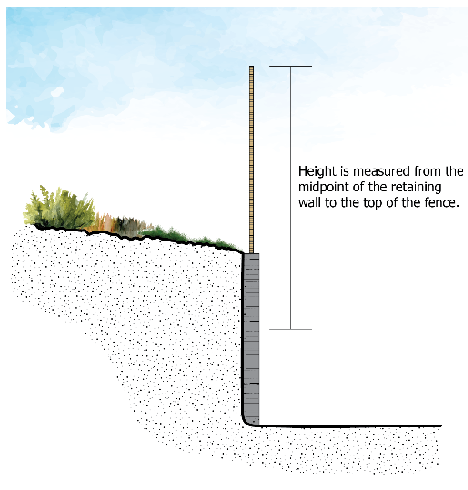
(G)
Garage and Yard Sales.
(1)
Notwithstanding restrictions of Town Zoning Regulations, or junk, litter or nuisance ordinances, garage and yard sales may be conducted within the Town consistent with the conditions set out herein.
(2)
No premises shall be used for a garage or yard sale for more than 48 hours at one time or for more than two such sales in any calendar year.
(3)
The sale shall be conducted so that no traffic hazards or nuisances are created.
(H)
Home Occupations. Home Occupations may be conducted within a residential premises or accessory structure related thereto in any district as an accessory use only if the following criteria are met:
(1)
Town and State Sales Tax Licenses must be obtained if sales taxable by the Town or State sales taxes are to be made.
(2)
Only the residents of the dwelling unit may be engaged in the home occupation.
(3)
No unreasonable noise, glare, smoke, dust, vibration, or odor shall be observable off the premises.
(4)
The home occupation activity shall not utilize or occupy more than 750 square feet in total, nor more than 400 square feet in a garage or other structures outside of the residence. Provided, however, family day care facilities shall be limited to eight or fewer children in lieu of these area limitations.
(5)
No business activity or storage of property involved in the business may take place outside of enclosed structures, except for horticultural activities.
(6)
The short-term rental of rooms, such as bed and breakfast operations, does not qualify as an accessory use pursuant to this Subsection.
(I)
Manufactured Homes.
(1)
Manufactured homes, as defined in Subsection 7-9, that have more than 500 square feet of living area, are only permitted on the following described property:
(a)
All of Blocks 4, 9 and 29;
(b)
Block 28, Lots 11 through 20;
(c)
Block 32, Lots 1 through 18;
(d)
Block 33, Lots 6 through 10; and
(e)
Lot 1 of Mitchell Subdivision No. 2.
(2)
The limitations of this Subsection shall not apply to any manufactured home that was placed on a property not referenced in Subsection (I)(1) above prior to June 9, 1993, in Ordinance 02-1993 that met all applicable building at safety codes at time of installation.
(3)
Manufactured Homes are subject to the provisions of Section 6-3, Regulations for Manufactured Homes, Travel Homes, and Other Factory-Built Housing.
(4)
Manufactured Home Parks are subject to the provisions of Section 8-1, Manufactured Home Park and Travel Home Park Regulations.
(J)
Marijuana.
(1)
The cultivation, manufacture, distribution, storage, or sale of marijuana shall not be a lawful use by right, accessory use (including as a home occupation), conditional use, or lawful nonconforming use in any zoning district of the Town of Ridgway, except as provided in this Subsection (2).
(2)
A Medical Marijuana Center, Medical Marijuana Optional Premises Cultivation Operation, and Medical Marijuana-Infused Products Manufacturing Facility, licensed under Article 43.3 of Title 12 CRS, a Primary Care Giver registered under C.R.S. 25-1.5-106, and a Marijuana Cultivation Facility, a Marijuana Testing Facility, a Marijuana Product Manufacturing Facility or a Retail Marijuana Store licensed by the State of Colorado pursuant to Article XVIII, Section 16 of the Colorado Constitution and Article 43.4 of the Title 12, CRS, may be located within the LI and GI Zoning Districts and the General Commercial Zoning District east of Liddell Drive extended, as a use by right if they meet the following provisions:
(a)
They must be operated lawfully under applicable provisions of State Law.
(b)
They must comply with the performance standards of the LI and GI Zoning Districts, or General Commercial Zoning Districts, as applicable.
(c)
They must have valid State and Town sales tax licenses and collect and remit sales tax on sales of Marijuana in accordance with State Law and Town ordinances.
(d)
A Certificate of Occupancy for each building must be obtained prior to establishment of the use therein.
(e)
The cultivation, manufacturing, storage, distribution, and sale of Marijuana must be confined to an enclosed building.
(f)
They must be located in structures with commercial and industrial uses only and are not allowed in buildings with residential uses.
(g)
No storage facilities are permitted off the licensed premises.
(h)
The building in which the licensed activities take place may not be located within 1,000 feet of a school, an alcohol or drug treatment facility, the principal campus of a college, university or seminary, or a residential childcare facility. The distance referred to shall be measured from the nearest property line of the land use for the above-listed uses to the nearest portion of the building in which licensed activity takes place, using a route of direct pedestrian access. This restriction shall not affect the renewal or reissuance of a license once granted or apply to a license in effect actively doing business before any of the above uses was constructed.
(3)
Cultivation.
(a)
A patient, validly registered under State Law, may cultivate Medical Marijuana at the patient's residence for the Patient's own use only, if in compliance with the limitations of State Law and if the plants cannot be seen or smelled off the premises.
(b)
An individual may cultivate Marijuana at the individual's residence, only if in compliance with the limitations of Subsection (16)(3)(b) of Article XVIII of the Colorado Constitution and other applicable state law, including the requirement that the growing take place in an enclosed locked place, is not conducted publicly or openly and is not made available for sale.
(c)
The use of compressed flammable gas as a solvent in the extraction of THC or other cannabinoids in a residential setting is prohibited.
(d)
Co-op or collective grow operations are not allowed without a state license.
(4)
Delivery of Marijuana, or Medical Marijuana by a licensed Medical Marijuana business, licensed Marijuana establishment, Primary Care Giver, or any other person, from a location outside of Town, to a location within Town, is allowed, only if lawful under, and in full compliance with State Law, and the delivering person has a Town sales tax license if taxable sales may occur, and collects and remits Town sales taxes on the sale of the delivered Marijuana and Medical Marijuana.
(5)
The below listed terms shall be defined as indicated for purposes of this Subsection (J):
(a)
"Medical Marijuana", "Medical Marijuana Center", "Optional Premises Cultivation Operation", and "Medical Marijuana-Infused Products, Manufacturing", shall have meanings as defined in CRS, Title 12, Article 43.3.
(b)
"Primary Care Giver" shall have the meaning as defined in C.R.S. 25-1.5-106.
(c)
"Patient" shall have the meaning as defined in Section 14(1) of Article XVIII of the Colorado Constitution.
(d)
"State Law" shall include, but not be limited to, Section 16 and Section 14(1) of Article XVIII of the Colorado Constitution, C.R.S. 25-1.5-106, Article 43.3 and 43.4, Title 12, CRS; and any rules or regulations promulgated pursuant thereto.
(e)
"Marijuana", "Marijuana Cultivation Facility", "Marijuana Testing Facility", "Marijuana Product Manufacturing Facility" or a "Retail Marijuana Store" shall have the meaning defined in Article XVIII, Section 16 of the Colorado Constitution, and Article 43.4, Title 12, CRS.
(6)
Storage of Marijuana off of the licensed premises is not permitted in the Town.
(7)
Marijuana clubs, businesses, or other places of assembly where customers, members, or the like, are regularly invited for the purpose of using or consuming marijuana or marijuana products on site, are prohibited in the Town.
(K)
Outdoor Lighting Regulations.
(1)
General Provisions.
(a)
All non-exempt outdoor light fixtures and illuminating devices permanently or temporarily installed outdoors, including, but not limited to, devices to illuminate signs, shall meet the following requirements:
(i)
They shall be shielded so no light rays are emitted at angles which will allow the light to pass directly off of the premises appurtenant to the fixture.
(ii)
They shall be shielded so that no light rays are emitted by the installed fixture at angles below the horizontal plane.
(iii)
All fixtures designed to illuminate signs or structures shall be mounted above the area of the sign or structure to be illuminated.
(iv)
Blinking, flashing, rotating, or moving lights are prohibited.
(v)
Correlated color temperature (CCT) is limited to 3,000 kelvin per fixture.
(vi)
The following lumen limits are established to prevent over lighting and are not intended to be achieved. Each site should use the lowest number of lumens needed for the site to provide safety and functionality.
a.
Single-Family Residential Sites shall be limited to 5,100 lumens. Single Family Residential Sites that include an accessory dwelling unit shall be limited to 6,500 lumens. Each lighting fixture shall be limited to 850 lumens.
b.
Multifamily Residential Sites, Mixed Use Sites and Nonresidential Sites shall be limited to 25,000 lumens per net acre plus 2,000 lumens per unit beyond the first. Each lighting fixture shall be limited to 1,500 lumens.
(vii)
Lighting for all nonresidential uses shall be extinguished one hour after close of business unless there is a public safety hazard that is best mitigated by the use of lighting. Lighting intended for security purposes shall use Adaptive Controls.
(viii)
If any of the above are in conflict with the Town building codes adopted pursuant to Municipal Code Section 6-1, the regulations of the adopted building code shall apply.
(b)
The following are exempt from the provisions of Subsection (1).
(i)
Lights used to illuminate athletic fields of other community special event areas. Such lights shall be turned off one hour after the conclusion of the event and should be designed or placed to minimize light falling beyond the area in use.
(ii)
Signs which are illuminated by interior light sources, such as neon signs, provided such signs are lit only during the property owner's business hours.
(iii)
Official traffic control devices and lights owned and operated by or pursuant to proper authority of the United States of America, the state of Colorado or any of their agencies, and such other lights as are specifically required by federal or state law.
(iv)
Official traffic control lights owned and operated by the Town of Ridgway.
(v)
Repealed by Ordinance 16-2006.
(vi)
Lawful vehicle lights.
(vii)
Repealed by Ordinance 10-2007.
(viii)
Holiday lights. Holiday lights should only be in use from November 15 to January 31.
(ix)
Artwork that is outdoors and on public property. Such artwork shall receive a permit by the Town of Ridgway prior to installation. Such artwork shall be public and accessible to all people and may be illuminated, pursuant to the following:
a.
Artwork shall not contain lighting that exceeds 500 lumens within the entire structure, nor more than 2,500 degrees kelvin.
b.
All public art that is illuminated shall include a dimmer and timer to aid the compliance with the Dark Skies Association's Outdoor Lighting Requirements and shall have the ability to be automatically turned off. In any event such lighting shall be automatically turned off by 10:00 p.m. nightly.
c.
No structure may contain lighting that is cast upward or outward but may be diffused in a way such that the lighting emits a soft glow.
d.
All structures shall be lit internally.
e.
All illuminated public art is subject to review and approval by Town staff for compliance with these regulations.
(c)
Public Outdoor Lighting.
(i)
New public lighting owned and operated by the Town of Ridgway, including street lights, walkway lights, external building lights, holiday lights and other lights to ensure safety, shall be allowed as recommended by the Town Manager or designee in situations where a public health hazard exists which can only be mitigated by artificial light at night and shall be in compliance with Subsection (A).
(ii)
Adaptive controls or curfews shall be employed in all new public outdoor lighting installations.
(iii)
All Town owned lighting shall comply with the requirements of Section 7-4-6(K) within five years from the effective date of this Section.
(2)
Noncompliant Lights.
(a)
Lights which were lawfully existing and in use at the time they became nonconforming with the requirements of this Section 7-4-6(K) by virtue of the initial adoption of this Section, subsequent amendment to this Section or by annexation into the Town, may continue to be used and operated subject to the limitations of this Section.
(b)
The right to operate a lawful nonconforming light shall terminate upon any of the following:
(i)
Replacement of the light fixture.
(ii)
Non-use of the light fixture for a period of six months.
(iii)
Damage to the light fixture so that the cost of repair is 50 percent or more of the cost to replace it with a conforming fixture.
(c)
The right to exceed the lumen limits established in Subsection 7-4-6(K) as a lawful nonconforming site shall terminate upon any of the following:
(i)
Replacement of 50 percent or more of the light fixtures on the site.
(ii)
Damage to the light fixtures so that the cost of repair is 50 percent or more of the cost to replace them with conforming fixtures.
(d)
No alteration may be made to lighting on a site which would increase the amount or degree of the nonconformity.
(L)
Outdoor Storage.
(1)
Materials and Wastes Contained on Property. No materials or wastes shall be deposited on any property in a form or manner that may be transferred off the property by any reasonably foreseeable natural cause or force.
(2)
Outdoor Storage Enclosed or Concealed.
(a)
Outdoor storage areas shall be enclosed or have adequate provisions to conceal these facilities from adjacent properties.
(b)
No storage of any item(s) shall be allowed in a front yard in any residential zone district.
(c)
Storage of any item located in a side street setback shall be screened from view of public rights-of-way with a minimum of a six (6) foot opaque, solid wood or masonry fence in any residential zone district, or any residential use in any zone district.
(M)
Parking Standards.
(1)
Off-Street Parking Requirements. The following off-street parking requirements shall apply unless otherwise indicated in all districts.
(2)
For purposes of this Subsection, "gross floor area" is the heated square footage of a building measured along the outside enclosing walls, excluding interior parking areas and outdoor common areas.
(3)
Shared Parking Plan. The purpose of the shared parking plan and the subsequent regulations is to efficiently utilize parking resources amongst multiple properties and users while adequately meeting parking demand at peak hours or during special events. Applicants wishing to use shared parking as a means to satisfy off-street parking requirements shall submit a shared parking plan in accordance with this section.
(a)
Shared parking standards.
(i)
Shared parking plan required. A shared parking plan shall be required for the following:
a.
All proposed developments, except for single-family or duplex dwelling units, that intend to utilize off-site parking spaces. Such plan may request to eliminate all or a percentage of the required off-street parking spaces being provided on the subject property.
b.
Major special events, as determined by the Town Manager or designee, that will have a significant impact on traffic circulation within Town limits.
c.
The applicant is requesting to utilize existing on-street parking to meet off-street parking requirements which isn't otherwise authorized by this section.
(ii)
Shared parking plan provisions. The proposed shared parking plan shall address each of the following provisions.
a.
Off-site shared parking. Provide the location of the off-site parking spaces, quantity of parking spaces, and the current physical condition of the area to be used for off-site parking.
i.
If the off-site parking spaces are fulfilling the required off-street parking needs of another use or property, the plan shall also provide a schedule of peak demand for each use utilizing the parking spaces.
ii.
Submit a written narrative describing adjacent land uses to the off-site parking location, potential negative impacts of increased parking on the off-site location, and proposed strategies to mitigate negative effects.
b.
Shared Parking Agreement. In the case of off-site shared parking for proposed uses where the targeted off-site lot is owned by others, a written agreement between the town, the owner of the property where the off-site parking is being proposed, and the owner of the property seeking the use of off-site parking shall be entered into.
i.
The agreement shall be recorded with Ouray County Clerk and Recorder, unless the agreement is for temporary uses, such as a special event.
ii.
The agreement shall provide details of continued maintenance and the owner's responsibility for off-site parking spaces.
c.
Pedestrian movement. Describe the intended pedestrian movement from off-site parking locations to the property or establishment served by those spaces.
i.
Shared parking that is located across Highway 62 or Highway 550 shall be located within two (2) blocks of an existing crosswalk or a grade separated pedestrian connection to cross the highway.
d.
Neighborhood partnership. Proposed developments that intend to utilize shared parking are encouraged to form partnerships within the community.
i.
The shared parking plan shall identify all businesses and organizations that utilize the parking resources.
ii.
For special events, the shared parking plan shall detail methods of reliance on public transportation.
iii.
For permanent uses, off-site parking spaces located adjacent to residential uses shall provide a minimum of five (5) foot buffer with an opaque six (6) foot tall fence or landscaping along all shared boundaries.
e.
Peak hours. The shared parking plan shall provide operating hours for each specified use. If public transit is to be utilized for temporary uses, then a description of route schedule and stop locations are required.
i.
The shared parking plan shall describe usage of off-site parking for specified for the following time periods:
1.
Monday to Friday 8 AM to 5 PM.
2.
Monday to Friday 5 PM to 12:00 AM.
3.
Monday to Friday 12 AM to 8 AM.
4.
Saturday to Sunday 8 AM to 5 PM.
5.
Saturday to Sunday 5 PM to 12 AM.
6.
Saturday to Sunday 12 AM to 8 AM.
(4)
On-street parking.
(a)
Except as otherwise allowed in this Chapter, on-street parking spaces are not allowed to be used to satisfy off-street parking requirements.
(b)
The Town Manager or their designee may approve on-street parking spaces within one-hundred (100) feet of the subject property to count towards required off-street parking.
(5)
Vehicle Stacking. Nonresidential uses that provide drive-through facilities are required to provide spaces for vehicles waiting in line.
(a)
Stacking spaces shall be a separate aisle from parking lot circulation.
(b)
Stacking spaces shall be located in a manner that prevents any stacked vehicle from extending onto the public right-of-way, interfering with pedestrian and vehicle circulation, or preventing ingress to or egress from the property.
(c)
Required stacking spaces shall be a minimum nine (9) feet wide and twenty (20) feet in length.
(d)
Drive-through aisles shall be distinctively marked or delineated.
(e)
Stacking spaces shall not count towards the minimum required parking spaces.
(6)
Parking plan requirements. In instances where a Site Plan is required, the submittal shall include details of all proposed parking facilities. The Site Plan must contain the following information:
(a)
Parking spaces shall be sized and designed in accordance with standard Town specifications and shall be a minimum of eight (8) feet by twenty (20) feet in size. The parking space size may be modified to provide parking for alternative modes of transportation with approval from the Town Manager or their designee.
(b)
Site Plan shall provide sufficient off-street space to allow an automobile to enter, maneuver, and exit without backing onto any public street. Backing onto alleyways is permissible except where otherwise prohibited by plat note.
(c)
The quantity and location of parking spaces, including drop off zones, electric vehicle charging spaces, stacking spaces, and drive-through circulation, as applicable.
(d)
Type of surface materials and treatment for parking aisles and parking spaces.
(e)
Traffic directional arrows, signage, and markings.
(7)
Bicycle parking.
(a)
Bicycle parking as set forth in subsection 7-4-6(M)(7) shall be required for all nonresidential uses, fourplex dwellings, and multiple family dwellings.
(i)
A minimum of two (2) bicycle spaces or the quantity of bicycle spaces equivalent to ten (10) percent of required parking spaces shall be provided when either of the following circumstances are met:
a.
The property is located within 2,000 feet of the Uncompahgre RiverWay Trail or other designated trails.
b.
The property is located within 2,000 feet of a transit station or designated transit bus.
(ii)
For all other locations, bicycle parking is optional and may be used to reduce the required number of parking spaces.
(b)
Design Standards.
(i)
The required bicycle rack type shall be able to support two (2) bicycle parking spaces.
(ii)
Parking for bicycles shall be provided on-site, and bicycle parking areas shall be located as near to the building or facility entrance as possible but not more than one hundred (100) feet away and shall not interfere with pedestrian or vehicular traffic.
(iii)
When applicable, bicycle parking areas should utilize already existing weather protected areas such as building overhangs.
(iv)
If bicycle and automobile parking areas or accessways abut each other, a physical barrier between the bicycle parking area and the automobile parking or drive areas shall be provided to prevent the possibility of bicycle-motor vehicle collisions.
(8)
Electric Vehicle Parking. Electric vehicle parking shall be provided for all new developments.
(a)
Electric vehicle parking may count towards the required off-street parking space at a rate of one-to-one.
(b)
Electric vehicle supply equipment (EVSE) The installation of EVSE shall meet the National Electrical Code. Equipment mounted on pedestals, lighting posts, bollards, or other devices for on-street charging stations shall be designed and located as to not impede pedestrian or vehicle travel or create hazards within the right-of-way.
(c)
Any new development with fifteen (15) or more required parking spaces shall provide EV Ready spaces pursuant to table T-4.6, EV Parking Required, below. EV Ready spaces have the electrical capacity necessary to accommodate the future hardwire installation of Level-2 electric vehicle charging stations.
Table T-4.6 - EV Parking Required.
(d)
Electric vehicle spaces not provided at time of site plan approval shall pay a fee-in-lieu for each required electric vehicle parking space. The fee for each required electric vehicle space is established, pursuant to the Town's adopted fee schedule.
(9)
Parking reductions. The purpose of the parking reductions is to provide further flexibility to developments, redistribute the required parking, and support transportation alternatives amongst the Town.
(a)
Parking reductions overall. The Town Manager or their designee may grant a parking reduction up to fifty (50) percent of the required parking spaces.
(i)
Parking reductions may only be granted if the proposed reduction will not result in spillover parking into public roads and will not adversely affect traffic circulation.
(ii)
Only the following parking reductions may be allowed unless otherwise permitted by this code.
a.
One (1) vehicular space for every two (2) bicycle parking spaces in addition to required bicycle parking.
b.
The Town Manager or their designee may reduce the number of required off-street parking spaces on property located within 500 feet of a transit bus stop with a headway of one-hour or less.
c.
One (1) vehicular parking space for every two (2) motorcycle spaces.
d.
The Town Manager or their designee may reduce the number of required off-street parking spaces for existing buildings that are designated historic locations or have existed greater than or equal 75 years by up to fifty (50) percent.
i.
The building(s) may not be drastically renovated so that its building character is no longer like the original structure to qualify for the parking reduction.
(b)
Parking standards for zoning districts. The following sections set forth standards that are applicable to specific zoning districts and apply in addition to all standards and provisions of this Section.
(i)
Parking standards specific to the DS District. Businesses shall be credited with half parking space for every designated on-street parking space adjacent to the business and in accordance with Town specifications. No parking shall be allowed on alleys or on Highway 62 (Sherman Street).
(ii)
Parking standards specific to the HR District. Single-family and duplex dwelling uses may utilize on-street parking to meet all parking requirements without a shared parking plan.
(iii)
Parking standards specific to the MR District.
a.
Parking shall be sited to provide the least visual impact from public rights-of-way and shall not dominate the front yard of any lot or parcel.
b.
An area used for bike racks and parking of other nonmotorized vehicles, shall be located no more than fifty (50) feet from the main entrance to the primary building(s) and shall provide a logical connection to onsite non-motorized access routes.
(iv)
Parking standards specific to the HB District.
a.
Nonresidential uses have no minimum parking requirement.
b.
All proposed parking spaces shall only be accessed from an alley.
c.
A minimum of two (2) off-street parking spaces shall be provided for residential uses.
d.
For residential uses requiring more than two (2) spaces, a fee-in-lieu of providing these spaces may be paid at a rate of $6,000.00 per space not provided on-site.
i.
The monetary payment(s) shall be used to fund the acquisition or construction of public parking facilities to serve the Historic Business Zoning District. The use of these funds shall be at the sole discretion of the Town.
(v)
Parking standards specific to the Limited Industrial (LI) and General Industrial (GI) Districts. Parking and storage is not allowed in the front or side setbacks along any street.
(10)
Accessible Parking Spaces.
(a)
For all uses other than single-family or duplex dwellings, accessible parking spaces shall be provided at the minimum rate consistent with Table T-4.6, Accessible Parking Requirements.
(b)
The accessible parking shall be provided on-site.
(c)
At least one (1) van accessible space shall be provided for every six (6) accessible spaces required.
(d)
Accessible parking spaces shall otherwise comply with the American with Disabilities Act.
Table T-4.6 Accessible Parking Required.
(Ord. 04-2024)
(N)
Short-Term Rental Regulations.
(1)
Intent and Purpose: Establish standards and procedures by which residential short-term rentals can be provided in a manner that protects both the quality of experience and the character of the Town. It is the Town's intent to establish short-term rental regulations to promote a mix of lodging options, support the local economy, while also upholding the integrity of the Town.
(2)
Short-term rentals shall comply with the provisions of this Subsection (N) and shall be licensed per Chapter 8, Section 5 of the Municipal Code.
(3)
Permitted Use of Short-Term Rentals:
(a)
For short-term rentals outside of the "HB" Historic Business, "DS" Downtown Service, or "GC" General Commercial Districts, the structure involved:
(i)
Shall be a single-family dwelling structure; or
(ii)
Shall be a single residential unit in structures with mixed uses; or
(iii)
Shall be a property with multiple dwelling units owned by the same owner, in which one of the dwelling units may be used as a short-term rental as long as at least one of the other dwelling unit(s) is/are owner occupied; and
(iv)
Shall not be a multiple family dwelling or structure as short-term rentals are prohibited in multiple family structures in districts other than HB, DS, and GC.
(b)
In the HB, DS, and GC Districts, a maximum of five short-term rentals are allowed per building or structure.
(4)
Performance Standards for Short-Term Rentals:
(a)
The unit shall have a minimum of two off-street parking spaces available and any additional spaces necessary to accommodate the tenant's vehicles off-street.
(b)
Adequate animal resistant trash and recycling containers shall be provided, and information on placement for collection shall be provided in the short-term rental as stated in Ridgway Municipal Code Section 9-2.
(c)
The unit shall be maintained in compliance with applicable Town ordinances and regulations. The rental of residential units as provided herein shall not unreasonably annoy or interfere with the use or enjoyment of public or private property or constitute a health or safety hazard.
(d)
The owner must have current State and Town sales tax licenses, a Town business license, if at such time the Town has business licensing, and collect and remit sales taxes and lodging taxes.
(Ord. 01-2025)
(O)
Telecommunication Antenna and Tower Regulations.
(1)
Telecommunication towers and antennae shall be located, and comply with the following provisions:
(a)
Noncommercial television and telecommunications receivers and amateur radio antennae, which qualify as an accessory use to the main use on the premises, may be located on such premises.
(b)
Antennae for "personal wireless services" as defined in 97 USC 332(c)(2) shall be limited to the GC Zoning District, or upon Town owned property in other zoning districts pursuant to leases or permits with the Town, with terms and conditions adequate to ensure safety and reasonable compatibility with the neighborhood in which they are located, including requirements for camouflaging where appropriate.
(c)
Commercial radio, television and other telecommunications transmitters and receivers shall be restricted to the GC Zoning District.
(d)
Additional receivers or transmitters may be installed on existing telecommunication towers regardless of the zoning district.
(2)
All telecommunication antennas and towers shall be limited to the maximum structure heights set out in Table T-4.4, Dimensional Standard Requirements, unless a variance is obtained pursuant to Section 7-4-3(J), or allowed in accordance with the following exceptions:
(a)
Telecommunication antennas, receivers and transmitters may be located on lawfully existing towers and structures, as long as they are not above the tower structure.
(b)
A variance to the height limitations otherwise applicable may be obtained for an amateur radio antenna for noncommercial use pursuant to the review procedure of Section 7-4-3 if the Planning Commission determines that the following criteria are met:
(i)
A higher tower is necessary to be reasonably adequate for the domestic communications purposes;
(ii)
No reasonable alternative exists; and
(iii)
No adverse impacts will be created with respect to other property in the area.
(c)
A variance to the height limitations otherwise applicable may be obtained for personal wireless service antennae if the Planning Commission determines pursuant to the review procedure of Subsection 7-4-3 that the following criteria are met:
(i)
Space is not available at a commercially reasonable price on an existing tower or structure located in a technically feasible location, and no other location is available which will provide reasonably adequate service in compliance with the height limitations set out above;
(ii)
No adverse effect on property values in the area will be caused, and no safety hazard will be created; and
(iii)
The design and color of the tower and appurtenances shall be reasonably compatible with the site and surrounding area.
(d)
Commercial telecommunication antennae or towers up to 40 feet in height may be installed upon Town owned property within the "GI" General Industrial Zoning District.
(3)
A final decision to deny a variance shall be in writing and supported by a substantial written record.
(4)
All towers and structures shall be subject to the building setback requirements of Table T-4.4, Dimensional Standard Requirements and applicable provisions of Town building codes and other ordinances and regulations.
(P)
Use and location of travel homes.
(1)
Travel homes may be occupied only in the following circumstances:
(a)
Within a licensed travel home park for a maximum period of six months in any one 365-day period.
(b)
Upon private property for temporary occupancy by out-of-town guests for a period not to exceed 30 days in any year for any tract of property.
(c)
Upon property for which a permit has been issued by the Town, pursuant to Subsection 7-4-3(G), Temporary Use Permits.
(2)
Travel homes may be parked, if unoccupied, upon private property if in compliance with zoning setbacks, or temporarily upon public streets, if registered under State law and lawfully parked. Provided, however, they may not be parked in a manner which creates a traffic hazard.
(Ord. 03-2023)
7-4-7 - SIGN REGULATIONS.
(A)
Compliance Required. It shall be unlawful to erect or maintain any sign except in conformity with the requirements of this Subsection. Signs not in conformity with the provisions of this Subsection are hereby declared to be a nuisance which may be abated by the Town in any lawful manner.
(B)
Signs Allowed Without a Permit. The following may be erected, maintained, and used without a sign permit as long as they are properly maintained in accordance with the requirements of this paragraph (B) and paragraph (F) and with other applicable requirements of this Subsection, State law and Town ordinances and regulations, and are not prohibited by paragraphs (C) or (D)
(1)
Official traffic control devices, signs, and notices erected, owned, and maintained by the United States, the state of Colorado, the Town of Ridgway or any of their political subdivisions for official governmental purposes.
(2)
Any pennant, motto, or insignia of any nation, state, political subdivisions, religious, civic, or fraternal organization, or school except devices which are used to promote business activity.
(3)
Works of art unless they are used to promote business activity.
(4)
Temporary decorations, displays and banners which are customarily displayed and associated with holidays or celebrations and banners associated with Town endorsed civic events.
(5)
Scoreboards, unless used to advertise business activity.
(6)
Public utility warning signs, construction warning signs, and signs warning of other hazards, with no sign face larger than ten square feet in area.
(7)
Identification signs incidental to the use of vehicles attached to the vehicle.
(8)
Traffic control devices with no sign face larger than three square feet.
(9)
One or more temporary signs with an aggregate sign face area of no more than four square feet in the Residential and Historic Residential Zoning Districts and 16 square feet in all other zoning districts, for the premises upon which they are located. Signs identifying a project and contractors involved therein shall only be allowed during the construction period. All "for sale" signs shall be taken down when the sale of the premises is closed.
(10)
One bulletin board per street frontage not over 20 square feet in area for the purpose of announcing events of civic interest, which is owned and maintained by a charitable or religious institution.
(11)
Memorial signs and tablets, or cornerstone signs identifying the building and its date of construction. Such signs shall be cut into masonry surface, inlaid so as to be part of the building or constructed of incombustible materials.
(12)
Signs upon vending machines, gasoline pumps, or packages of goods which relate to the contents thereof.
(13)
Temporary signs advertising Town approved civic events during the period of the event. All such signs may be erected only with the approval of the Town Council except for those displayed in Town Parks which may be approved by Town Administrative Staff.
(14)
Signs within buildings which are located no closer than six inches to any window or which are not legible from distances of five feet or more.
(15)
Temporary signs on the Ridgway School Ball Field fence, provided they do not face Highway 62, that they are only up during baseball season, and that all such signs be controlled and administered by the Ridgway School Administration.
(16)
Signs devoted to noncommercial speech which do not exceed ten square feet in area.
(C)
Prohibited Signs and Devices. The following are hereby prohibited within the Town:
(1)
Animated or flashing signs visible outside any building.
(2)
Balloons, pennants, or other wind-powered devices designed to attract attention, except they may be used for civic events up to a maximum of seven days.
(3)
The operation of search lights to promote business activities.
(D)
Off-Premises Signs Restricted. A sign may identify or advertise only that activity or use conducted upon or related to the premises upon which the sign is located except in the following circumstances:
(1)
Directional signs owned by the Town. The expense of construction and maintenance shall be charged to the businesses or organizations advertised.
(2)
Signs authorized pursuant to Subsection 7-4-7(G).
(3)
Signs allowed by paragraphs (B)(1), (4), (10), and (13).
(4)
Signs with a message devoted solely to non-commercial speech.
(5)
Tourist oriented directional signs owned and erected by the Colorado Department of Transportation pursuant to C.R.S. 43-1-420(3), which meet conditions set out in Town resolutions as in effect from time to time.
(E)
Permits.
(1)
Except for the signs specified in paragraph (B), no sign may be erected and maintained until a Sign Permit has been issued by the building official. Applications for a standard sign permit issued pursuant to this Subsection 7-4-7(E) shall be submitted to the Town on forms supplied by the Town accompanied by an application fee in compliance with Section 7-1-7, Fees and Costs. Applications for permits issued pursuant to Subsection 7-4-7(G), for signs erected over Town-owned streets and alley rights-of-way pursuant to a revocable right-of-way permit, shall be submitted to the Town on forms supplied by the Town accompanied by an application fee in compliance with Section 7-1-7, Fees and Costs.
(2)
The Building Inspector shall grant a permit only for signs which will be in compliance with the requirements of this Subsection.
(3)
The total sign face area of signs required to have a permit per property, other than those restricted by Subsection (6), shall not exceed the lesser of one square foot per foot of lineal street frontage of the property abutting Town streets or 150 square feet. When more than one building/and or business is on the property, the property street frontage shall be allocated among the buildings and/or businesses accordingly, unless otherwise approved through a Master Sign Plan. Total sign face area in excess of 150 square feet shall not be allowed for any property unless approved through a Master Sign Plan applicable to that property.
(4)
A Building Permit is also required for any sign with a cost or value over $1,000.00.
(5)
No permit for a sign shall be allowed in the Residential Districts.
(6)
The total sign face area of signs required to have a permit for businesses within the Downtown Services Zoning District shall not exceed 12 square feet per business. All signs within said District shall be non-illuminated and attached to the building structures, no higher than the roof line.
(F)
Performance Criteria. All signs shall meet the requirements of this paragraph (F) whether a permit is required or not.
(1)
All signs shall be maintained in good, legible, and safe condition.
(2)
No sign shall be erected or maintained which creates a traffic or other safety hazard.
(3)
All signs shall be constructed and maintained in accordance with any applicable provisions of the Town's building codes.
(4)
All signs shall be erected and maintained in accordance with applicable requirements of State law.
(5)
No part of any sign shall be above the roof or parapet of the highest building on the property and no higher than 35 feet. No part of any freestanding sign shall be higher than 20 feet above finished grade.
(6)
No sign may be erected or maintained which creates a public or private nuisance, or which unreasonably interferes with the reasonable enjoyment of the adjacent property by reason of unreasonable light, shade, or other effects.
(7)
No sign shall be larger than 32 square feet in area, except a freestanding sign with more than one business advertised may have a sign face up to 56 square feet, unless approved through a Master Sign Plan applicable to the building. No sign shall have more than two sign faces.
(8)
Signs may be erected only on property which the sign owner has a legal right to erect such sign.
(9)
All temporary signs must comply with the size restrictions set forth in Subsection 7-4-7(B)(9). Portable or wheeled signs displayed outside of buildings must be located so as to not impede with vehicular or pedestrian traffic or create a traffic hazard or safety hazard or other nuisance and must be removed at times when the advertised use or activity is not open for business.
(10)
No more than 50 percent of any sign face may be internally illuminated.
(11)
Materials. Signs lit with a dark-skies compliant external source are recommended over internally lit signs. "Halo" type signs, which use solid letters with a light source behind them, illuminating the wall around the letters, are acceptable. If internally illuminated signs must be used, illumination of letters and graphics is allowed; however, illumination of the background is prohibited.
(12)
Within the DS District, signage shall be non-illuminated and attached to the building.
(G)
Signs in Public Rights-of-Way. Signs, other than signs belonging to the Town or sponsored by the Town, conforming to size limits of this Subsection 7-4-7, may be erected over Town-owned streets and alley rights-of-way pursuant to a revocable right-of-way permit issued pursuant to either paragraph (1) or (2) of this Subsection only on the following conditions, in addition to other applicable requirements of this Subsection:
(1)
Projecting signs:
(a)
The sign must be supported and attached to a building.
(b)
The sign may extend no more than five feet from the building. If the sign is printed on a retractable awning, the awning may extend no more than ten feet from the building. A sign may extend no more than five feet across Town owned right-of-way. If the sign is printed on a retractable awning, the awning may extend no more than ten feet across Town owned right-of-way.
(c)
No part of the sign may be less than ten feet above the ground over Town right-of-way, except for a sign printed on an awning, the awning shall be at least seven feet above the ground.
(d)
That portion of any sign face located over the Town right-of-way shall be no larger than 20 square feet in area.
(e)
No more than one sign per business may extend over the Town right-of-way.
(f)
No sign with its face parallel to the wall of the building to which it is attached, except for those printed on an awning, may extend more than 12 inches from the building, nor more than 12 inches over public property.
(g)
Plans for signs over Town rights-of-way must be submitted with applicable fee, reviewed and approved by the Town Administrative Staff.
(h)
The revocable permit may be revoked by the Town at any time for any reasonable reason.
(i)
Proof of insurance shall be provided to the Town.
(j)
The sign may identify or advertise only that activity or use conducted upon or related to the abutting premises.
(2)
Portable signs:
(a)
The sign may identify or advertise only that activity or use conducted upon or related to the abutting premises.
(b)
No more than one sign per business may be placed on Town right-of-way.
(c)
The proposal for a portable sign on Town right-of-way must be submitted with applicable fee, reviewed, and approved by the Town Administrative Staff.
(d)
The revocable permit shall specify the authorized location and may be revoked by the Town at any time for any reasonable reason.
(e)
Proof of insurance shall be provided to the Town.
(f)
The sign must be located so that it does not interfere with Town use, impede vehicular or pedestrian traffic, or create a traffic or safety hazard or other nuisance.
(g)
The sign must be removed at times when the advertised use or activity is not open for business.
(H)
General Provisions.
(1)
The area of a sign face shall include the surface area of a sign, including non-structural trim and decoration, but excluding supports or uprights. The face area of a sign painted or hung on a wall of a building, or on an awning, shall include all the area within a perimeter surrounding all words, symbols, designs, and coloring, distinctive from the wall upon which it is painted. Only one side of double-faced signs that convey the same message on both faces shall be included for purposes of this calculation.
(2)
As used in this Subsection, "sign" means and includes any object, device, or message which is used to advertise, identify, display, direct, attract attention, or convey any message concerning any object, person, institution, organization, business, products, service, event, or location by any means, including words, letters, figures, designs, symbols, fixtures, colors, motion, illumination, or projection, and anything else commonly known as a "sign".
(I)
Nonconforming Signs.
(1)
All signs shall at all times be maintained in strict conformity with the performance criteria of paragraphs (F)(1), (2), (3), (4), (6) or (8). All Master Sign Plans previously approved by the Town prior to April 15, 2019, shall be maintained in strict conformity with such Town approval. Any signs not in compliance with these specific performance criteria and/or Master Sign Plans approved prior to April 15, 2019, shall be removed.
(2)
All signs shall at all times be maintained in strict conformity with the performance criteria of paragraph (F). Any sign not in compliance with paragraph (F) shall be removed.
(3)
The right to maintain a nonconforming sign shall be terminated and the sign removed or brought into full compliance with this Subsection under the following conditions:
(a)
Abandonment of the sign, abandonment or termination of the related business, an interruption in continuance of the business for six months.
(b)
A violation of any of the performance criteria of paragraph (F)(1), (2), (3), (4), (6) or (8).
(c)
The destruction of the sign, removal of the sign or damage of the sign, such that the cost of replacement or repair is greater than 50 percent of the replacement cost of the original sign.
(d)
The creation of any additional violation of or nonconformity with these regulations.
(4)
A list of nonconforming signs shall be developed and maintained by the building inspector with owners notified and given a copy of paragraph (I).
(J)
Master Sign Plans.
(1)
Purpose: To provide flexibility for the amount of signage and size of signs for multi-tenant buildings and developments to ensure signage is available for business and facility wayfinding and identification. To protect the health, safety and welfare of the community while preserving Town aesthetics.
(2)
Applicability:
(a)
A Master Sign Plan shall be encouraged for all properties with multi-tenant buildings and/or multiple buildings in which three or more nonresidential tenants or businesses are present.
(b)
Any property with multiple-tenant buildings or multiple buildings in which three or more nonresidential tenants existing at the time of adoption of this Section that does not have a Master Sign Plan is encouraged to apply for a Master Sign Plan at the time of application for a new sign at the site.
(c)
Any property owner with multi-tenant and/or multiple buildings in which two or more nonresidential tenants or businesses are present, may apply for a Master Sign Plan.
(3)
General Regulations:
(a)
All signs subject to a Master Sign Plan shall apply for and receive a sign permit before any sign may be installed.
(b)
All signs on the site shall conform at all times to the approved Master Sign Plan and other applicable sign regulations.
(c)
Master Sign Plan shall run with the property for which it was issued and not with individual tenants or businesses.
(d)
Applications for a Master Sign Plan shall be submitted to the Town on forms supplied by the Town accompanied by the fee per Subsection 7-4-3. At a minimum the applicant shall submit the following information to the Town:
(i)
Identification of the property for which the Master Sign Plan application shall apply;
(ii)
Proof of property ownership, or partial ownership, and signatures from all property owners included in the proposed Master Sign Plan;
(iii)
Total sign area allowed per Subsection 7-4-7 and the total sign area requested with the Master Sign Plan;
(iv)
Site plan showing location of all existing and proposed signs on property, with distance from property lines;
(v)
Building elevations/pictures showing location of all existing and proposed signs on property, with height of all signs from the ground;
(vi)
Dimensions and type of all existing and proposed signs, including the unit number/address for each;
(vii)
Any proposed lighting for the signs, including location, type, kelvin, and lumens for each fixture; and
(viii)
Proof that the criteria for approval have been met.
(e)
Through these Master Sign Plan Regulations, the following deviations from the specified dimensional requirements may be considered.
(i)
A free-standing sign may be up to 30 percent larger than the 56 square feet limitation of Subsection 7-4-7(F)(7).
(ii)
Up to 30 percent more than the allocated square footage per Subsection 7-4-7(E)(3) of sign area may be allowed.
(iii)
Deviations shall not be considered for any other sign regulations in the Ridgway Municipal Code.
(4)
Criteria for Approval of the proposed Master Sign Plan:
(a)
Will not be contrary to the public health, safety or welfare;
(b)
Will not create traffic hazards;
(c)
Provides for adequate assurances of safety from natural conditions such as wind, snow and ice as it relates to the proposed signs;
(d)
Will not unreasonably interfere with neighboring commercial businesses or properties;
(e)
Provides for signs that are reasonably necessary to operate the business or businesses on the property; and
(f)
The burden shall be on the applicant to show that these criteria have been met.
(5)
Review Procedure:
(a)
Within 14 days of receipt of a completed application accompanied by the applicable fee for a Master Sign Plan, or a minor change to an existing Master Sign Plan, the Town will administratively approve or deny the application according to the Criteria for Approval. It shall not be necessary for the Town to provide written findings or conclusions, except upon the request of the applicant.
(i)
To the extent an application for a Master Sign Plan or minor change is denied in whole or in part, the requesting party may appeal to the Planning Commission as set forth in paragraph (5)(b) of this Subsection. Such appeal shall be in writing and submitted within seven days of the Towns decision and review shall be de novo.
(b)
Within 14 days of receipt of a completed application accompanied by the applicable fee for a major change to a Master Sign Plan, or an appeal of a denial of a Master Sign Plan, or minor change to a Master Sign Plan, the Planning Commission will set a hearing:
(i)
The hearing shall be heard at the next regularly scheduled Planning Commission meeting for which proper notice of the hearing can be made, and no later than 40 days after receipt of a completed application accompanied by the applicable fee for a major change to a Master Sign Plan, or an appeal of a denial of a Master Sign Plan, or minor change of a Master Sign Plan. A hearing that must be continued due to time constraints or other delays, may be continued for an additional seven days beyond the 40-day deadline, assuming the hearing was commenced within the 40-day deadline. By mutual agreement, the applicant and the Planning Commission may also extend the 40-day and seven-day deadlines set forth in this Subsection.
(ii)
At the scheduled hearing, the applicant and other interested parties may appear and present such evidence and testimony as they may desire. Anyone presenting evidence or testimony shall be subject to cross-examination by other interested parties, although the Planning Commission may limit testimony, evidence and cross-examination which is merely cumulative and is not required to follow any set procedure during the hearing, nor strictly follow the Rules of Evidence as applied by the Court. The hearing should be tape recorded or otherwise electronically recorded. The applicant, or other interested party may, if so desires, have the hearing recorded by a court reporter, at the applicant's sole expense. The burden is upon the applicant in all cases to establish that the applicable criteria for any action are met.
(iii)
Notice of the hearing shall be posted at Town Hall at least ten days before the hearing and posted visibly for each street frontage abutting the property for at least ten days prior to the hearing, in addition to any other notice required by Town regulations.
(iv)
The Planning Commission shall announce its decision according to the Criteria for Approval within 14 days of completion of the hearing. It shall not be necessary for the Planning Commission to provide written findings or conclusions, except upon request of the applicant, or other party appearing or participating in the hearing. The decision of the Planning Commission with respect to an application for major change of to a Master Sign Plan, or an appeal of a denial of a Master Sign Plan or minor change to a Master Sign Plan shall be final, subject only to review under Rule 106 of the Colorado Rules of Civil Procedure. Upon the filing of an appeal under Rule 106, the Town shall cause a transcript of any tape recording of the hearing to be made and certified to the court, and the party filings such appeal or such review, shall pay the Town the reasonable cost incurred in producing such transcript, unless such party has a transcript produced by a court reporter at the applicant's expense.
(v)
The Planning Commission may approve the requested action only upon finding that all applicable criteria and requirements of these Master Sign Plan regulations or other Town ordinances have been met. If it determines such criteria have not been met, the application shall be denied. The application may be granted upon conditions or limitations which the Planning Commission determines are necessary in order to ensure that the applicable criteria are met. Such conditions or limitations shall be provided to the applicant and interested parties in writing as part of the decision, subject only to review under Rule 106 of the Colorado Rules of Civil Procedure.
(6)
Amendments to Approve Master Sign Plans:
(a)
Minor Changes: Minor changes are those changes that do not alter the overall characteristics of the existing Master Sign Plan and that create no adverse impacts on adjacent uses, infrastructure, or public safety. Examples of what may be considered a minor change include, but are not limited to:
(i)
Changes in the location of a sign;
(ii)
Replacement of existing signs that are the same size or smaller than the existing sign; and
(iii)
Changes in the number of signs, as long as the aggregate square footage remains the same.
(b)
Major Changes: Major changes are those that can alter the overall character of the Master Sign Plan, and which could create adverse impacts on adjacent uses or public infrastructure. Examples of what may be considered a major change include, but are not limited to:
(i)
Changes in the total square footage of the Master Sign Plan; and
(ii)
Requests for deviations per Subsection 7-4-7.
(Ord. 03-2023)
7-4-8 - LANDSCAPE REGULATIONS.
(A)
Intent.
(1)
The purpose of this Section is to provide clear landscaping requirements that will contribute to high quality development and sustainable, water-saving practices. Landscaping is an important element of the character of the Town of Ridgway that is both functional and aesthetic. Ridgway's objective is to prioritize design that incorporates low water use and regionally appropriate materials while increasing fire resilience in the community. In addition to these regulations, applicants should consider the Colorado Wildfire Resiliency Code in landscape design. These landscaping regulations will endeavor to achieve the following:
(a)
Preserve and enhance the quality and character of the community through landscaping;
(b)
Conserve water resources;
(c)
Provide visual buffers and screening;
(d)
Provide separation between pedestrian and vehicular uses;
(e)
Mitigate adverse effects of stormwater and weeds; and
(f)
Allow for creativity and flexibility in landscape design.
(2)
Drought-tolerant, native, and water-wise plants are to be used whenever possible and appropriate. Water-wise is a term used throughout this chapter to describe the method of planting which works to promote water conservation by minimizing the amount of native vegetation removed, limiting new vegetation to native and drought tolerant species, limiting the amount and type of irrigation, and other related measures to conserve water and create a native landscape.
(3)
Landscaping that is sustainable, visually appealing, and regionally appropriate is required for all new development. Landscaping should be used to promote the visual aesthetic of a development from pedestrian spaces and travel corridors. Buffers and medians are encouraged as a means to facilitate drainage during storm events and provide areas for snow storage during the winter.
(B)
Applicability.
(1)
This chapter establishes minimum landscaping standards which apply to all properties within the Town of Ridgway.
(2)
The following projects shall comply with the landscaping standards set forth in this chapter:
(a)
Projects which require a site plan review;
(b)
New commercial, residential, or mixed use construction;
(c)
Projects that result in a disturbance of more than fifty percent (50%) of the aggregate landscape area;
(d)
Change of use; or
(e)
Public rights-of-way improvements.
(3)
A building permit for new construction shall not be issued until a conforming Landscape Plan is approved by the Town. A permanent Certificate of Occupancy will not be issued until the Town determines that the landscaping included in the approved plan has been properly installed.
(4)
All standards and policies adopted within the Town of Ridgway Water Conservation and Management Plan, Master Plan, and Land Use Regulations should be implemented with the landscape regulations.
(5)
Where conflict exists between these regulations and an adopted Wildfire Resiliency Code, the Wildfire Resiliency Code shall govern.
(C)
Site and Landscape Plan Development.
(1)
Landscape Plan Requirements.
(a)
The landscape plan shall be drawn to scale of one inch equals 40 feet, or larger, and may be included on the Site Plan. The landscape plan shall include the following information:
(i)
Property lines and dimensions;
(ii)
Building footprint, driveways, and vehicle circulation;
(iii)
A grading plan with contour lines depicting existing elevations and proposed finished grade;
(iv)
North arrow and scale;
(v)
Name of applicant and landscape consultant or architect (if applicable);
(vi)
Legend indicating all proposed plant materials with botanical names, indication of drought tolerant plants, size (maturity) maximum spacing, caliper size, and quantities;
(vii)
The existing or proposed method of establishing and maintaining plant materials;
(viii)
Surface drainage characteristics and structures, including, but not limited to, inlets, retention/detention ponds, swales, permeable surfaces, down spouts;
(ix)
Location of all plant material.
(x)
Other natural features, including, but not limited to, wetlands, water bodies, rock outcroppings, detention areas, retaining walls, and buildings and paved areas (existing and proposed);
(xi)
Plantings should be shown as they would be at full maturity;
(xii)
Clearly labeled locations and calculations for amounts of required landscaping, including the square footage and percentage of required landscape area, live materials, and non-live materials.
(xiii)
Identify any existing trees, shrubs, or live groundcover that will remain on the property and how they will be protected from damage during construction;
(xv)
Construction debris storage and staging areas; and
(xvi)
Additional information as may be required by the Town.
(D)
Water Conservation.
(1)
Water Conservation Planting: Landscaping should be designed to incorporate water conservation materials and techniques through the application of water-wise landscape principles. In general, water-wise landscaping with drip irrigation is required, while large, irrigated areas requiring spray heads are strongly discouraged.
(2)
Regionally Appropriate: All landscaping should be regionally appropriate, and materials shall be suitable for local soil conditions and climate.
(a)
Preferred Species: Lists of recommended species for use in Colorado is available from the Ouray Country Weed Manager and the Colorado State University Extension Service. The lists are not all inclusive but do recommend a variety of plants known to do well in our region of Colorado. In general, plants that are not recognized as hardy or suited to the local climate should be kept to a minimum. Water-wise, drought-tolerant plants are to be used whenever possible. Regionally appropriate or native species are preferred.
(b)
Prohibited Species.
(i)
Invasive Plant Species are prohibited. Siberian elm and Chinese elm (Ulmus); Cottonwoods that bear cotton (Populus); Purple Loosestrife (Lythrum slaicaria); Russian Olive (Elaeagnus angustifolia); and Kentucky Blue Grass (Poa pratensis) are included in the prohibited species.
(ii)
Trees with aggressive root structures that are incompatible with pavement should be avoided in areas that are paved or may become paved. Narrowleaf Cottonwood (Populus angustifolia) and Lanceleaf Cottonwood (Populus x acuminata) shall not be installed in areas in close proximity to sidewalks, streets, paved pathways, etc.
(ii)
The Town Manager or designee is authorized to prohibit additional species with nuisance properties.
(E)
Landscaping Required.
(1)
Purpose: The purpose of this section is to establish minimum landscaping requirements. This section is not intended as a build/install-to.
(a)
All areas on a lot must be landscaped. At least 25 percent of the minimum required landscape area shall be provided in the front yard of the property.
(b)
Landscaped area may include a combination of trees, shrubs, groundcovers (live and non-live), planters/planting beds, decorative landscape stone or rock, or other landscaping material that does not conflict with other provisions of this Chapter.
(i)
Live ground cover is considered to be material such as native grasses, wildflowers, functional turf, and planting beds.
(ii)
Non-live ground cover is considered to be material such as mulch, flagstone, rock, gravel, permeable pavers, etc. If mulch or other flammable materials are proposed, the applicant should consider fire risks. Fire resistant material is encouraged.
(iii)
The landscaping requirements table below demonstrates the required landscape area for all parcels in all zoning districts.
1 See Subsection 7-4-8(I)(2) for exemptions for uses that are nonresidential in the FD zoning district.
2 For all residential uses that are single-family and duplex dwellings, a maximum of one acre of area shall be used to calculate the minimum required landscape area.
3 The minimum number of trees is a sum of all required trees. Any additional tree requirements (such as street trees) shall be counted as part of this minimum number of required trees.
4 Four shrubs can be counted for one required tree. A minimum of one tree is always required per lot.
(2)
Historic Business (HB) District Exceptions. This district is intended to provide for zero lot lines and full lot coverage. Therefore, there is no minimum required landscaped area as defined in this chapter. However, the following shall apply:
(a)
Right-of-way landscaping shall be required pursuant to Subsection 7-4-8(H).
(b)
If a parking lot is provided on-site, parking lot landscaping shall be required pursuant to Subsection 7-4-8(G).
(c)
Required landscaped area for properties zoned HB is required for any area not used for a building or parking lot.
(F)
General Landscape Standards.
(1)
Trees: Trees shall have a minimum caliper of one and one-half inches for deciduous trees and a five-foot minimum height for evergreens. In the case of fractional requirements for the number of trees, the number required shall be rounded up to the next whole number. Existing trees that are in good health, as determined by the Town Manager or designee, shall be counted as one and one-half trees for the minimum tree requirement.
(a)
Species Diversity: To prevent uniformity and insect or disease susceptibility, species diversity is required, and extensive monocultures of trees are prohibited. Species diversity does not apply to existing trees. The following requirements shall be met:
(2)
Shrubs: Shrubs shall be a minimum three-gallon size. Decorative grasses in a minimum size of three gallons are to be counted as shrubs. In the case of fractional requirements for the number of shrubs, the number required shall be rounded up to the next whole number.
(3)
Groundcover: Area can be made up of vegetative materials, organic or inorganic mulch, flowerbeds, or other acceptable landscape material. Fire resistant material is encouraged. If mulch or other flammable materials are proposed, the applicant should consider fire risks. Groundcover must be adequate to ensure that dust cannot blow from the property and that the soil is stabilized to ensure that erosion is kept to a minimum, it must also remain free of noxious weeds as defined as Ouray County Weed Manager.
(4)
Turf: No more than 1,500 square feet or ten percent of area requiring landscaping, whichever is less, can be high water turf. High water turf should only be used in areas of high use, also known as "functional turf". The limitation shall not apply to any public recreation area or sports field owned or operated by the town/city or any public or quasi-public entity.
(a)
Artificial turf is prohibited except for use on any public recreation area or sports field owned or operated by the town/city or any public or quasi-public entity.
(5)
Irrigation: To ensure best practices for water conservation, all new landscaping shall comply with the following irrigation standards:
(a)
Irrigation should be limited to between the hours of 6:00 P.M. and 9:00 A.M.
(b)
All irrigation systems shall be automatic and have moisture sensors installed.
(c)
Where possible, non-potable irrigation systems should be used to irrigate landscape.
(6)
Screening and Buffering:
(a)
Screening and landscape buffers soften the less desirable impacts of development and can provide a certain element of safety in commercial areas where significant pedestrian interactions are more likely to occur. Buffers should be constructed to mitigate the view, light pollution (including light trespass and glare), noise, heat, and odor impacts of vehicles, pavement, and higher intensity uses, and other potential negative effects of development.
(b)
Buffering shall be provided when a nonresidential use is adjacent to a residential use. It shall be the responsibility of non-residential use to provide the adequate buffer from the residential use in a manner consistent with these regulations. The buffer should include a mix of trees, fencing, landscape berms, and other materials appropriate to mitigate visual, audible, and other impact the nonresidential use may have on the residences.
(c)
Mechanical Equipment: Ground-mounted or rooftop equipment shall be screened from public rights-of-way on all sides to its full height. Ground level mechanical equipment shall be screened with landscaping, berms, fences, or architectural walls. Rooftop units shall be screened with materials and colors to match the building.
(d)
Storage Areas: All open storage areas shall be screened from public rights-of-way and adjacent property by use of landscaping, berms, fencing, or a combination of landscaping and other structural elements to a height of six feet. Fencing must meet the requirements of Section 7-4-6(F).
(e)
Additional landscape screening above the minimum requirements of this Section may be required when it is determined by the Town Manager, Town Manager's designee, Planning Commission, or Town Council to be in the best interest of the affected properties.
(7)
Sight Triangles: All plant material, walls, fences, berms and/or structures shall not exceed 24 inches in height when located on any corner within a triangular area formed by the curb lines and a line connecting them at points 15 feet from the intersection of the curb lines.
(8)
Existing Plantings: Existing trees, shrubs, and live groundcovers that are in good health should be retained and not destroyed during the construction process. The health of the trees shall be determined by the Town Manager or designee. These plants will be counted towards the required landscaping.
(9)
Revegetation: Development activities should only disturb, clear, or grade the area necessary for construction. All areas disturbed by grading or construction, not being formally landscaped, shall be revegetated with native seeding and/or other approved plant materials in a method acceptable to the Town.
(10)
Slopes: Removal of existing vegetation, including ground cover and trees, is strongly discouraged on slopes greater than 30 percent. Development on slopes greater than 15 percent shall maintain the maximum vegetative cover possible to protect soils, prevent land slippage, and retain wildlife habitat and open space resources. A minimum of 50 percent of vegetation on slopes greater than 15 percent shall not be disturbed during development.
(G)
Parking Lot Landscape Standards.
(1)
Islands or Rain Gardens: A landscape island and/or rain garden shall be provided in parking lots along the ends of the parking rows. Islands shall be a minimum of six feet wide and as long as the adjacent parking space. Trees shall be incorporated with parking lot design to provide parking lot shading.
(a)
Islands for parking lots in residential and mixed-use areas shall be used to separate rows of six or more parking spaces and shall include a minimum of one tree.
(b)
For non-residential uses, islands shall be used to separate rows of 12 or more parking spaces and shall include a minimum of two trees.
(2)
Catchment areas: Landscaped catchments areas and similar designs should be used for managing, controlling, and filtering parking lot and site drainage and should be included as part of an overall site drainage plan.
(H)
Right-of-Way Landscape Standards.
(1)
Street trees: A landscape area shall be established along the public right-of-way for all non-residential uses and shall be a minimum of five feet wide. Such trees shall be placed in the center of the landscape area, not within the site triangle, and 20 feet away from any streetlight. A minimum of one tree per 50 linear feet of right-of-way is required. Street trees shall have a minimum caliper of two and one-half inches for deciduous trees and a six-foot minimum height for evergreens.
(I)
Exceptions or Deviations.
(1)
Affordable Housing: Landscaping requirements for affordable housing projects may be reduced, based on the determination of the Town Manager or designee. Whenever possible, deviations from these standards for the purpose of preserving affordable housing or deed restricted housing should be identified and provided for in the appropriate document establishing the affordability and/or deed restricted provisions for the projects.
(2)
Non-residential Uses on Properties Zoned FD: If the proposed use in the FD zone district is intended to be permanent, these landscape regulations shall apply. If, however, an existing use is intended to be redeveloped, the Town Manager or designee may waive these requirements until such time the property redevelops. Such a decision is the sole discretion of the Town Manager or designee.
(3)
High-Water Turf: High-water turf may be allowed in areas of high-water contact such as drainages, swales, or downspout locations.
(4)
Administrative approval for deviations from a required standard: Deviations from the landscape requirements may be granted by the Town Manager or designee for up to ten percent (10%) from the applicable requirement. To request a deviation, a letter explaining the unique situation or hardship preventing the project from meeting the minimum landscape requirements shall be submitted with the application material and will be subject to the sole discretion of the Town Manager or designee.
(J)
Installation Standards.
(1)
Living materials shall be adequately watered and maintained to become established. Once established, watering should be minimized as appropriate.
(2)
Trees should be installed in such a way that they will not infringe on solar access, views from the adjoining properties, or block a sight distance triangle.
(3)
Easements shall remain clear of all obstacles which may prevent such easement from operating within its intended purpose.
(a)
Retaining walls are prohibited from being located in any established easement.
(b)
Trees may only be permitted in utility easements upon written approval of the easement holder.
(K)
Maintenance Requirements.
(1)
Following completion of the landscaping, the owner or occupant of the property shall maintain it in good condition thereafter. Failure to maintain the landscaping is unlawful and is hereby declared to create a nuisance.
(2)
Where approved trees, shrubs, or other landscaping materials die or are removed, it shall be the responsibility of the property owner to replace them with materials of a comparable nature and size to those originally approved. This obligation shall continue until the property is redeveloped, at which time the redeveloper shall comply with the requirements of this code as they apply to the proposed development at that time.
(Ord. 03-2023; Ord. 03-2025)
7-4-9 - RESIDENTIAL DESIGN STANDARDS.
(A)
Legislative Declaration. Ridgway is defined in part by architecture and neighborhoods that vary in age and character. A goal of the Town's Master Plan is to create a well-integrated community that meets the needs of residents of various income levels, ages, and stages of family life cycles. One way of achieving this is to encourage a mix of housing types and densities, rather than segregating them into separate districts. In accomplishing this, it is acknowledged that the visual appearance of a property affects more than just the property involved. New and altered structures impact the surrounding neighborhood both in character and property value. These standards have been adopted to encourage a mix of housing types, while helping to ensure that this will not be detrimental to the character of the neighborhoods or to property values in general.
(B)
Applicability.
(1)
Unless otherwise excepted, the regulations set out in this Section shall apply to:
(a)
Construction of any residential building, including without limitation construction of Single-Family, Duplex, Townhouse, Triplex, Fourplex, Cluster Housing, Co-Housing, Multiple-Family structures, and Accessory Dwelling Units;
(b)
New residential subdivisions;
(c)
Major additions or renovations to an existing residential structure;
(d)
Structures that contain only residential uses that are included as part of a mixed-use development.
(2)
Once subjected to these requirements, all residential development and appurtenant sites shall thereafter be maintained in conformity with these requirements.
(C)
Exceptions. These regulations shall not be applicable to manufactured homes, as defined in Section 7-4-12 and subject to supplemental standards in Subsection 7-4-6.
(D)
Development Standards.
(1)
Foundations:
(a)
The foundation must enclose the space beneath the perimeter of the structure. Foundations may be constructed of masonry or concrete.
(b)
Perimeter foundations and all supports under the structure must meet the frost depth as required in Section 6-1.
(c)
All foundations and interior supports shall be poured on undisturbed or compacted soil.
(d)
All portions of foundations that are above the adjacent finished grade by more than six inches shall be finished using the same siding materials as the dwelling or complementary materials such as stucco, stone, or brick. Cosmetically equivalent split faced block or other block with design finish or other materials may be allowed with prior approval of the Town.
(e)
Unfinished masonry blocks, plywood, other materials, or earth backfill that exceeds a grade of two-foot horizontal for each one foot of raise are not permitted.
(f)
Exceptions to the above standards may be allowed where foundations must be stepped to address a slope in the natural grade of the site. However, such deviations to these standards shall be kept to the minimum required to address the specific site condition.
(2)
Exterior Siding:
(a)
Exterior siding shall be made of non-reflective metal or vinyl lap, wood, simulated wood grain products, painted or colored stucco, brick, stone, or any combination of these materials, or other cosmetically equivalent materials with prior approval of the Town.
(b)
Materials intended to be painted or finished in any manner, such as wood products or stucco, shall not be accepted until painted or finished.
(3)
Roof Structure:
(a)
Provide varied roof forms or roof forms that are compatible with those used on adjacent homes.
(b)
Sloped roofs must have an overhang at the eaves and gable ends of not less than 12 inches excluding rain gutters measured from the vertical side of the dwelling. This required overhang shall not apply to areas over porches, alcoves, and other appendages, which together do not exceed 25 percent of the length of the façade on which they are located. Flatter roofs are permitted only if any equipment on the roof is screened from view from each street on which the lot fronts, and from abutting lots, provided, however, that screening that would interfere with the efficient operation of rooftop solar equipment shall not be required.
(c)
A-frame designs are not permitted.
(d)
Mansard roofs are only permitted if the base of the roof is above the second story of the structure.
(4)
Sidewalks: Sidewalks shall be installed in accordance with Town specifications along the adjoining street frontages prior to issuance of a Certificate of Occupancy unless the Town allows execution of a recordable covenant to participate in an assessment district, in cases where immediate construction is not practical.
(5)
Mechanical Equipment:
(a)
Propane storage tanks shall not be placed in the front or street side yard unless placed underground. Propane tank placement must also meet applicable code requirements, which in most cases require that the tank be no less than ten feet from any property line and ten feet from any building.
(b)
Swamp coolers, AC units, heat pumps and other mechanical equipment shall not be placed in the front yard. When placed in the street side yard, mechanical equipment should be screened from view from the street using landscaping, walls or fences which are complimentary to the building design.
(6)
Street Address Number: Each residence shall display the street address number in a location that is easily visible from the street with each character not less than four inches nor more than eight inches in height.
(7)
A landscaping plan pursuant to RMC 7-4-8(C) shall be submitted for all new residential plans as required by Subsection 7-4-8(B).
(8)
Additions to Existing or New Homes: Any additions or exterior remodeling shall respect the architectural character, detailing, lines, and proportions of the existing structure. Additions shall be so integrated into the existing structure that they are difficult to identify as being added and shall appear to have been a part of the original design of the structure. A "face lift" on the existing building may be used to accomplish this result. Attached or detached garages, carports, patio covers or walls should be designed in the same architectural style as the main structure and be built of similar or compatible materials.
(E)
Architectural Standards.
(1)
Buildings shall avoid monolithic shapes and surfaces by incorporating solids and voids, changes in color, pattern, texture, and materials at minimum along the primary façade.
(2)
The design of all new residential development and major additions shall meet each of the following architectural design objectives. Corner lots shall meet these objectives on both the front and side street elevations.
(a)
Provide relief and contrast to the building's front and side street elevations incorporating solids and voids to break up plain wall surfaces.
(b)
Provide variation of building mass and height, responding to the existing development context and adjacent zoning districts.
(i)
Uninterrupted wall areas exceeding twenty-five feet in length shall incorporate a minimum of two (2) architectural features or propose other similar techniques. Such techniques shall include:
a.
Changes in color, pattern, texture or material;
b.
Projections, recesses and reveals;
c.
Horizontal/vertical breaks;
d.
Pilasters, columns, quoined edges;
e.
Windows or faux windows; or
f.
Other method approved by the Town Manager, or designee.
(c)
Building materials. Building materials should be consistent with the materials currently or historically used in Town. A list of encouraged exterior materials are: brick, wood, stone, stucco, decorative block, aluminum, steel, and fiber cement siding. Additionally:
(i)
Synthetic exterior materials, which have an appearance or similarity to standard dimensional building materials, may be acceptable;
(ii)
Buildings shall not incorporate exterior metal siding for more than fifty percent (50%) of the total building façade area; and
(iii)
Glass may be used for display and allow visual access to interior spaces. Buildings may not incorporate glass for more than seventy percent (70%) of the total building façade area.
(d)
Garage doors shall not be more than fifty percent (50%) of the front elevation.
(e)
No two detached Single-family dwellings, Duplex dwelling structures, Townhome, Triplex dwelling structures, or Fourplex dwelling structures of substantially similar elevations shall be located adjacent to each other.
(3)
The Town Manager or designee shall promulgate design guidelines to provide assistance in meeting these requirements.
(F)
Deviations.
(1)
The Planning Commission may approve deviations from one or more of the requirements of this Section 7-4-9 on the basis of finding that:
(a)
The proposed structure will be compatible and harmonious with structures in the immediate vicinity; and either
(b)
The proposed architecture or construction standards provide compensating features that meet the intent and objectives of these standards; or
(c)
The proposed structure(s) support(s) the expansion of workforce housing options within the Town of Ridgway.
(2)
Requests for deviations shall be reviewed pursuant to the procedures of Subsection 7-4-3(J), subject to the fees set in Section 7-1-7, Fees and Costs.
(3)
Approval criteria.
(a)
The Planning Commission may grant a deviation to the Residential Design Standards only upon the finding that the following criteria are met:
(i)
The proposed structure will be compatible and harmonious with structures in the immediate vicinity; and either
(ii)
The proposed architecture or construction standards provide compensating features that meet the intent and objectives of these standards; or
(iii)
The proposed structure(s) support(s) the expansion of workforce housing options within the Town of Ridgway.
(Ord. 03-2023)
7-4-10 - COMMERCIAL DESIGN STANDARDS.
(A)
Purpose.
(1)
These Commercial Design Standards are intended to document a community's design objectives so that developers and consultants can visualize how their projects work towards the goals stated in the Town Plan. They are intended to assist property owners, developers and town review boards with the preliminary planning, design, and evaluation of proposals and approval of projects. By incorporating the Guidelines in the early phases of design, time-consuming and costly changes can be avoided. Additionally, they are intended to reduce or eliminate the more common architectural characteristics of sprawl development, keeping with the Town of Ridgway's vision for the future.
(2)
The goal of these Guidelines is to ensure that, over time, the Guidelines will nurture the character and natural beauty of the community, making it an even more appealing and prosperous place.
(B)
Applicability.
(1)
Unless otherwise excepted, the regulations set out in this Section 7-4-10, shall apply to new construction and exterior alterations of properties within the Town of Ridgway's two primary commercial districts, the Historic Business District (HBD) and the General Commercial District (GCD) district as located on the most updated District Boundaries Map provided at Town Hall. Specifically, the following shall require compliance with these regulations:
(a)
Structures containing commercial use(s).
(b)
Structures designated as mixed-use, containing a combination of both commercial and residential uses.
(c)
Developments with more than 20 parking spaces within the GC District shall incorporate the mitigation and site planning improvements.
(C)
General Commercial District Development Standards. The General Commercial District is equally important to Ridgway's economic sustainability but provides a different facet of retail and business opportunities than the Historic Business District. Commercial development within this District is encouraged to be pedestrian-oriented within the development; however, it is geared more towards the drive-up customer as the main point of arrival. Furthermore, with no historic buildings on-site to influence the architectural style or ambiance of new commercial developments within the General Commercial District, close attention must be paid to site planning and design elements to promote an experience that is still complementary to Ridgway as a whole.
In general, unique, and variable architectural design is encouraged, while large, uniform and generic-looking buildings should be avoided. Buildings shall avoid monolithic shapes and surfaces by incorporating solids and voids, changes in color, pattern, texture, and materials at minimum along the primary façade. As described in the Land Use Plan, the community desires to carry the character and distinct charm of Ridgway forward in all new commercial developments.
With such a small developable land area, nearly all of which is within view of travelers driving on Highways 550 and 62, every development makes a difference in the overall impression and experience of Ridgway. Thus, the Commercial Design Guidelines play an ever-important role in promoting the historic, rural landscape that the community desires to maintain in the future.
(1)
Site Planning and Parking.
(a)
Site plans for new commercial development within the General Commercial District are encouraged to place buildings towards the front of the lot, with parking in the rear or the sides of the building where practical. Windows and entrances may be located on both the front and the rear, emphasizing access for patrons who may be arriving via automobile, or those who may be walking or biking via sidewalks and bike lanes from other areas of town. Some buildings may front more than one street, in which case there will be multiple building "fronts" instead of front and rear building aspects.
(b)
Parking should be provided to the greatest extent possible at the rear or sides of buildings (except when prevented by building orientation) and parking should be sited to provide the least visual impact from public rights-of-way.
(i)
Parking and driveway areas and primary access to parking facilities should be surfaced with asphalt or concrete, or alternative materials and systems approved by the Town. Hard-surface alternatives to concrete and asphalt are encouraged. Improvements shall not impede drainage on streets or public rights-of-way.
(ii)
Parking lots should not dominate the frontage of pedestrian-oriented streets, interfere with designated pedestrian routes, or negatively impact surrounding areas.
(iii)
Where feasible, parking lots are encouraged to share access drives with adjacent property with similar land uses. Shared access should include cross-access easements and/or similar shared use and maintenance agreements.
(iv)
Off-street parking areas should be designed so that vehicles may exit without backing onto a public street unless no other practical alternative is available. Off-street parking areas should be designed so that parked vehicles do not encroach upon or extend onto public rights-of-way, sidewalks, or strike against or damage any wall, vegetation, utility or other structure.
(v)
Circulation areas should be designed to facilitate the safe movement of vehicles without posing a danger to pedestrians or impeding the function of the parking area.
(vi)
Parking area lighting shall comply with Town Outdoor Lighting Regulations.
(vii)
Where possible, shared off-street parking for compatible uses should be considered and should include a shared parking agreement including substantiation that parking will be available during the times it is needed.
(viii)
Bollard and/or street lighting should, where appropriate, be used to provide lighting at critical points in the parking lot without over lighting, glare, or lighting trespass.
(ix)
Use of landscape/grassed catchment areas shall follow the requirements of Ridgway Municipal Code Section 7-4-10(C).
(x)
Site parking should include bike racks and areas for parking strollers and other non-motorized vehicles near the main entrance to the primary building(s) and should have a logical connection to on-site non-motorized access routes.
(2)
Mass and Scale:
(a)
While the mass and scale of buildings within the General Commercial District might be larger as compared to other areas of the community, development should take steps to minimize the impact of this type of commercial development on the distinct character of Ridgway. Large, featureless "big box" retail structures are out of context in Ridgway.
(3)
Architectural Design and Materials:
(a)
Architectural design within the General Commercial District has the opportunity to be modern and streamlined, yet still must uphold the character and distinct qualities of Ridgway as a whole. Developments should incorporate architectural features and techniques to avoid monolithic shapes and surfaces. Changes in color, pattern, texture, and material are encouraged on the primary facade as well as all other visible building elevations.
(i)
Uninterrupted wall areas exceeding fifty feet in length shall incorporate a minimum of two (2) architectural features or propose other similar techniques. Such techniques shall include:
a.
Changes in color, pattern, texture or material;
b.
Projections, recesses and reveals;
c.
Horizontal/vertical breaks;
d.
Pilasters, columns, quoined edges;
e.
Windows or faux windows; or
f.
Other method approved by the Town Manager, or designee.
(b)
Building materials. Building materials should be consistent with the materials currently or historically used in Town. A list of encouraged exterior materials are: brick, wood, stone, stucco, decorative block, aluminum, steel, and fiber cement siding. Additionally:
(i)
Synthetic exterior materials, which have an appearance or similarity to standard dimensional building materials, may be acceptable;
(ii)
Buildings shall not incorporate exterior metal siding for more than fifty percent (50%) of the total building façade area; and
(iii)
Glass may be used for display and to allow visual access to interior spaces. Buildings may not incorporate glass for more than seventy percent (70%) of the total building façade area.
(4)
Screening and Buffers:
(a)
Screening and landscape buffers shall follow the screening and buffering requirements as described in Section 7-4-8.
(b)
Parking areas, outside trash receptacles, large utility boxes, open storage areas, conflicting land uses, mechanical systems and other unattractive views should be screened from the street and public right of way.
(c)
Screening of utility boxes, trash enclosures, and similar uses should be around all sides except for those required for access, which will be screened with a gate on the access side.
(D)
Historic Business District Design Guidelines. Ridgway's Historic Town Core is the heart of the community. It is home to the original Ridgway Townsite and is comprised of a walkable grid pattern, historic structures, local businesses, and the historic Hartwell Park. It is a place where the community gathers and residents and visitors alike shop, dine, relax, and enjoy town. As recognized in the Land Use Plan, maintaining its charming, rustic character is important to the quality of life and sustainability of the greater Ridgway community. To this end, the Town is participating in two statewide economic development efforts, the Creative District Program, and the Main Street Program, whereby the existing assets of the Ridgway community and its built environment in this historic downtown location are the focal point of current and future development.
Many of Ridgway's historic buildings were destroyed by fire in the early years, and a number of new buildings were constructed in the 1980s and 1990s. Despite the forces of nature and development influences, the Town retains a characteristic historic feel in its downtown area, with a number of historic buildings remaining from the late 1800s and early 1900s and including historically platted secondary roads and alleyways.
There are approximately 10 significant, historic, commercial structures in the downtown Historic Business District/Main Street area. This represents roughly 20% of the commercial building stock downtown where the location and key uses of these historic buildings are significant for the Ridgway community, including the Old Stone Town Hall and Jail ("the Firehouse"), the Ridgway Train Depot, the Bank Building, and the Sherbino Theater. Most of these buildings have taken on modern businesses or uses and provide the design foundation upon which the Historic Business District is built.
In general, new commercial construction and renovation in the Historic Business District should complement rather than overpower the historic buildings.
(1)
Site Planning.
(a)
The way in which a building is placed on its lot and relates to the neighboring buildings contributes to the visual unity and character of the Historic Business District. New construction should complement the size, height, and arrangement of surrounding buildings.
(b)
Buildings within the Historic Business District were traditionally placed at the front of the lot, facing the public right of way, to provide ready pedestrian access. Many were fronted by sidewalks or boardwalks and had shed-roofed porches. Horse and wagon hitches were found on railings in front of the buildings. Today, that same model promotes a pedestrian-friendly and aesthetically-pleasing environment.
(c)
New development should place any new building to the front of the lot with the entrance at the front of the building in order to define the street edge and promote a pedestrian scale experience.
(d)
For new buildings or renovations on corner lots, both street-facing walls should be treated as primary facades.
(e)
Place less-public areas such as storage, manufacturing spaces, and loading docks toward the rear of the building, shielded from the street view.
(2)
Architectural Design.
(a)
A new commercial building in the Historic Business District should blend in with its historic counterparts in terms of architectural design. Features that need to be considered include roof, storefront, windows, and decorative elements.
(b)
25' x 142' is a typical width and length for historic lots in this region, which creates the visual pattern for which towns such as Ridgway are known. Multi-story structures often have a visual distinction between the ground floor and the upper floor(s). Porches and sidewalks are also characteristic of the historic era in which many of Ridgway's buildings were constructed. They allowed people to walk along the street edge without being marred by mud or dust. Similarly, porches provided shelter and shade. Today, porches and sidewalks would add an element of historic character while also enhancing the pedestrian movement throughout the Historic Business District.
(c)
Exterior building elevations and roof lines should maintain the scale and integrity of nearby architectural character and detailing.
(d)
Uninterrupted wall areas exceeding twenty-five feet in length shall incorporate a minimum of two (2) architectural features or propose other similar techniques. Such techniques shall include:
(i)
Changes in color, pattern, texture or material;
(ii)
Projections, recesses and reveals;
(iii)
Horizontal/vertical breaks;
(iv)
Pilasters, columns, quoined edges;
(v)
Windows or faux windows; or
(vi)
Other method approved by the Town Manager, or designee.
(e)
The architectural treatment of the front facade should be continued, in its major features, around all visibly exposed sides of a building, except in the Historic Business District where side setbacks have been legally addressed in accordance with Ridgway Municipal Code Section 7-4-10(A) and a future building may directly abut the structure.
(f)
Entrances should be clearly defined to orient customers and give dimensional character to the building. Each principal entrance should have clearly defined features such as canopies, overhangs, arches, or peaked roof forms. Covered, functional front porches or boardwalks are strongly encouraged.
(g)
Roof forms should complement the historic character of the District. This may include a variety of textures and forms, but should be in keeping with the scale of the structure itself, adjacent buildings, and avoid overly large or bold designs.
(h)
Flat roof structures should be capped by an articulated parapet design which acts as a structural expression of the building façade and its materials.
(i)
Historic architectural features, such as brick cornices with dentil molding or corbelling on masonry buildings, should be incorporated where appropriate.
(j)
Recessed entries, kick plates and transoms are encouraged to be incorporated into the architectural design.
(k)
Provide a shed-roofed porch on new buildings, when appropriate to the architectural design of the building.
(l)
Large areas of blank wall should be avoided, unless required by the Town-adopted Fire Code. If blank walls cannot be avoided, design accents such as pilasters or other façade articulations should be utilized to reduce the overall wall mass.
(3)
Materials.
(a)
Traditional materials used in the Historic Business District included brick, log, milled wood, stone and metal. It is desirable to continue these historic uses in an innovative and sustainable manner.
(b)
Materials similar in texture and finish to those used traditionally and that complement nearby buildings should be selected and used.
(c)
New buildings must use materials that are compatible with historic materials and, when possible, are sustainably and/or locally-sourced. Examples of these materials include brick, stone, rusted metal, stucco, milled wood, log and composite siding.
(4)
Screening and Buffers.
(a)
Screening and landscape buffers shall follow the screening and buffering requirements as described in Ridgway Municipal Code Section 7-4-8.
(b)
Parking areas, outside trash receptacles, large utility boxes, open storage areas, conflicting land uses, mechanical systems and other unattractive views should be screened from the street and public right-of-way.
(c)
Screening of utility boxes, trash enclosures, and similar uses should be around all sides except for those required for access, which will be screened with a gate on the access side.
(E)
Deviations.
(1)
The Planning Commission may approve deviations from one or more of the requirements of this Section 7-4-10 on the basis of finding that an exception is justified on the basis of finding that:
(a)
The proposed structure will be compatible and harmonious with structures in the immediate vicinity; and
(b)
The proposed architecture or construction standards provide compensating features that meet the intent and objectives of these standards.
(2)
Requests for deviations shall be reviewed pursuant to the procedures of Subsection 7-4-3(J), subject to the fees set in Section 7-1-7, Fees and Costs.
(3)
Approval Criteria.
(a)
The Planning Commission may grant a deviation to the Commercial Design Standards only upon the finding that the following criteria are met:
(i)
The proposed structure will be compatible and harmonious with structures in the immediate vicinity; and
(ii)
The proposed architecture or construction standards provide compensating features that meet the intent and objectives of these standards.
(Ord. 03-2023)
7-4-11 - INDUSTRIAL DESIGN STANDARDS.
(A)
Legislative Declaration. These standards have been adopted to require industrial buildings to implement design solutions which are sensitive to those nearby buildings and developments.
(B)
Applicability.
(1)
Unless otherwise excepted, the regulations set out in this Section shall apply to new construction and exterior alterations of properties within the Town of Ridgway's two primary commercial districts, the Light Industrial (LI) District and the General Industrial (GI) District as located on the most updated District Boundaries Map provided at Town Hall. Specifically, the following shall require compliance with these regulations:
(a)
Structures containing industrial use(s).
(C)
Development Standards.
(1)
Site Planning and Parking:
(a)
If adjacent to a residential use, an additional building setback of ten feet (10') shall be provided adjacent to the residential use to reduce the visual impact of large-scale industrial buildings. The additional ten feet shall be landscaped with trees to provide buffering and shall not include parking or storage areas for equipment or mechanical systems. Vehicle and pedestrian access is permitted within the ten feet buffer.
(b)
All manufacturing, fabrication and repairs shall be conducted within a building unless the activity is not visible from adjoining property outside of the light industrial district within 100 yards of the district boundary.
(c)
Buildings must be compatible with the mass and scale of existing buildings on adjacent properties, or if there are no such buildings, compatible with the mass and the scale of buildings in the Town generally.
(d)
Parking should be sited to provide the least visual impact from public rights-of-way.
(i)
Parking and driveway areas and primary access to parking facilities should be surfaced with asphalt or concrete, or alternative materials and systems approved by the Town. Hard-surface alternatives to concrete and asphalt are encouraged. Improvements shall not impede drainage on streets or public rights-of-way.
(ii)
Parking lots should not dominate the frontage of pedestrian-oriented streets, interfere with designated pedestrian routes, or negatively impact surrounding areas.
(iii)
Where feasible, parking lots are encouraged to share access drives with adjacent property with similar land uses. Shared access should include cross-access easements and/or similar shared use and maintenance agreements.
(iv)
Off-street parking areas should be designed so that vehicles may exit without backing onto a public street unless no other practical alternative is available. Off-street parking areas should be designed so that parked vehicles do not encroach upon or extend onto public rights-of-way, sidewalks, or strike against or damage any wall, vegetation, utility or other structure.
(v)
Circulation areas should be designed to facilitate the safe movement of vehicles without posing a danger to pedestrians or impeding the function of the parking area.
(vi)
Site parking should include bike racks near the main entrance to the primary building(s) and should have a logical connection to on-site non-motorized access routes.
(2)
Mass and Scale:
(a)
While the mass and scale of buildings within the Industrial Districts might be larger as compared to other areas of the community, development should take steps to minimize the impact of this type of industrial development on the distinct character of Ridgway. Large, featureless industrial structures are out of context in Ridgway.
(b)
Uninterrupted wall areas exceeding fifty feet in length shall incorporate a minimum of two (2) architectural features or propose other similar techniques. Such techniques shall include:
(i)
Changes in color, pattern, texture or material;
(ii)
Projections, recesses and reveals;
(iii)
Horizontal/vertical breaks;
(iv)
Pilasters, columns, quoined edges;
(v)
Windows or faux windows; or
(vi)
Other method approved by the Town Manager or designee.
(3)
Architectural Design and Materials:
(a)
Architectural design within the Industrial Districts has the opportunity to be functional and streamlined, yet still must uphold the character and distinct qualities of Ridgway as a whole.
(b)
Naturally-derived materials are always desirable, such as stone or wood; and innovative materials such as metal, or high quality and environmentally friendly wood-alternative decking and siding are also encouraged. Whenever possible, local, and regionally produced materials are preferred.
(c)
Developments should incorporate architectural features and techniques to avoid monolithic shapes and surfaces. Changes in color, pattern, texture, and material are encouraged on the primary facade as well as all other visible building elevations.
(d)
Materials within the Industrial Districts should emphasize quality, durability, innovation, and variation. A broad array of materials is acceptable, but those that leave an impression of a poor quality, low durability and generic character are not permitted. Building materials should be consistent with the materials currently or historically used in Town. A list of encouraged exterior materials are brick, wood, stone, stucco, decorative block, aluminum, steel, and fiber cement siding. Additionally:
(i)
Synthetic exterior materials, which have an appearance or similarity to standard dimensional building materials, may be acceptable;
(ii)
Buildings shall not incorporate exterior metal siding for more than fifty percent (50%) of the total building façade area; and
(iii)
Glass may be used for display and to allow visual access to interior spaces. Buildings may not incorporate glass for more than seventy percent (70%) of the total building façade area.
(4)
Screening and Buffers:
(a)
Screening and landscape buffers shall follow the screening and buffering requirements as described in Section 7-4-8.
(b)
Parking areas, outside trash receptacles, large utility boxes, open storage areas, conflicting land uses, mechanical systems and other unattractive views should be screened from the street and public right-of-way.
(c)
Screening of utility boxes, trash enclosures, and similar uses should be around all sides except for those required for access, which will be screened with a gate on the access side.
(D)
Deviations.
(1)
The Planning Commission may approve deviations from one or more of the requirements of this Section on the basis of finding that:
(a)
The proposed structure will be compatible and harmonious with structures in the immediate vicinity; and
(b)
The proposed architecture or construction standards provide compensating features that meet the intent and objectives of these standards.
(2)
Requests for deviations shall be reviewed pursuant to the procedures of Subsection 7-4-3(J), subject to the fees set in Section 7-1-7, Fees and Costs.
(3)
Approval Criteria.
(a)
The Planning Commission may grant a deviation to the Industrial Design Standards only upon the finding that the following criteria are met:
(i)
The proposed structure will be compatible and harmonious with structures in the immediate vicinity; and
(ii)
The proposed architecture or construction standards provide compensating features that meet the intent and objectives of these standards.
(Ord. 03-2023)
7-4-12 - REGULATIONS FOR MANUFACTURED HOMES, TRAVEL HOMES, AND OTHER FACTORY-BUILT HOUSING.
(A)
Manufactured Home Park Design Requirements.
(1)
Manufactured home parks may be located only where allowed by Town Zoning Regulations, and shall be a minimum of two acres.
(2)
All manufactured home parks shall, as a minimum, comply with the regulations for manufactured home parks issued by the State of Colorado and the requirements of this Section 7-4-12. In the event of any conflict between the State regulations and the requirements of this Section or other ordinances and regulations of the Town, those regulations which are more stringent shall apply.
(3)
Each manufactured home space may have only one manufactured home located on it and shall comply with the dimensional requirements of this Subsection. All spaces shall be adequately identified by a number or letter.
(a)
Minimum Lot area: 2,500 square feet.
(b)
Minimum Setbacks:
(i)
Front: Ten feet.
(ii)
Rear: Eight feet.
(iii)
Side on Corner Space: Seven and one-half feet.
(iv)
Side: Five feet.
(c)
Accessory structures which are not attached to the manufactured home are not subject to the rear and side yard setbacks but shall be set back a minimum of two feet.
(4)
The manufactured home park developer shall provide the following improvements:
(a)
A Town water system to serve each lot, including fire hydrants and fire mains;
(b)
A sanitary sewer system;
(c)
Fifty-foot-wide streets with a minimum paved width of 30 feet;
(d)
A storm drainage system;
(e)
Street signs, streetlights;
(f)
Concrete valley pans four feet in width, or curbs, gutters and four-foot-wide sidewalks shall be installed on each side of each street; and
(g)
A park or playground occupying at least five percent of the area of the manufactured home park to be maintained by the manufactured home park owner.
(5)
Arrangements to provide public utilities, including, if available, gas, electricity, telephone, and cable television, shall be made with the utility companies for service to each space.
(B)
Travel Home Park Design Requirements.
(1)
Size and Location: Travel home parks may be located only where allowed by Town Zoning Regulations and shall be a minimum of two acres in area.
(2)
All travel home parks shall, as a minimum, comply with applicable State of Colorado Regulations for campgrounds and recreation areas and the requirements of this Subsection. In the event of any conflict between State Regulations and the requirements of this Section or other Town ordinances or regulations, those regulations which are more stringent shall apply.
(3)
Dimensional Requirements:
(a)
All travel homes and any accessory structures shall be at least ten feet from any other travel home and accessory structure.
(b)
The number of travel homes in the park shall not exceed 25 travel homes per acre.
(4)
Eight percent of the gross area of the travel home park, or 2,500 square feet, whichever is greater, shall be developed and maintained as a park or playground by the park owner.
(5)
The travel home park developer shall provide the following improvements:
(a)
A water system, including fire hydrants and fire mains.
(b)
A sanitary sewer system.
(c)
Paved streets with a minimum paved width as follows:
(i)
One-way/no parking: 11 feet;
(ii)
One-way/parking on one side: 18 feet;
(iii)
Two-way/no parking: 24 feet;
(iv)
Two-way/parking on one side: 27 feet;
(v)
Two-way/parking on both sides: 34 feet.
(d)
A storm drainage system.
(e)
Street signs and security lights.
(f)
A service building meeting the requirements of applicable State and Town regulations.
(6)
Plans for all improvements shall be submitted with the site plan and shall be approved by the Town prior to the approval of any licenses by the Town Council. All required improvements shall comply with Town design and construction standards and specifications.
(7)
Easements: The Town may require reasonable utility easements to be dedicated to the public for the purpose of public and Town utilities.
(C)
Maintenance of Manufactured Homes and Travel Home Parks.
(1)
All manufactured home parks and travel home parks shall be maintained in accordance with the requirements of this Section, applicable State of Colorado Department of Public Health and Environment Regulations, and other applicable regulations of the Town or State.
(2)
The Town Manager or designee shall have the right to enter upon any manufactured home park or travel home park at any reasonable time for the purpose of inspecting the premises to determine compliance with this Section or other applicable ordinances and Town and State regulations.
(Ord. 03-2023)
7-4-13 - NONCONFORMING USES.
(A)
General Provisions.
(1)
Any use, building or structure which at the effective date of this Section or at the time of annexation, if annexed subsequent to the effective date of this Section, was lawfully existing and maintained in accordance with the previously applicable County or Town Regulations and Ordinances but which does not conform or comply with all of the regulations provided for in these Zoning Regulations, may continue to be maintained and used as a lawful nonconforming use only in compliance with the provisions and limitations imposed by this Subsection. Uses, structures or buildings which were unlawful or illegal and not in compliance with previously applicable Regulations shall remain unlawful, illegal, and subject to abatement or other enforcement action.
(2)
If a use, building or structure is lawfully nonconforming in that it is not a "Use By Right", or a "Conditional Use" which has been approved pursuant to the review provisions of Subsection 7-4-3(E), the following shall apply:
(a)
If the building, manufactured home or structure involved in the use is removed or if it is destroyed or damaged so that repair, replacement or reconstruction will cost more than 50 percent of the fair market value of the building, manufactured home or structure after repair, it shall no longer be lawful to use the building, manufactured home or premises except in compliance with the Use Regulations for the District within which it is located.
(b)
If the nonconforming use is abandoned or discontinued for a period of six months, then the premises may only be used in compliance with the Use Regulations for the District within which it is located.
(c)
The use may be continued only substantially as it existed at the effective date of this Section or of annexation, and no material change in the type of use shall be allowed, unless the Planning Commission determines, following the hearing procedure provided in Subsection 7-4-3, that the criteria set out in Subsection 7-4-3(E) will be met, and that the new use is a more restrictive use than the existing nonconforming use. Any change in use allowed pursuant to this provision shall not affect the future status of the use as a nonconforming use for all purposes of this Subsection.
(d)
The extent or area of the premises utilized for or by the nonconforming use, building or structure, may not be materially extended or enlarged, or substantially structurally altered, unless the Planning Commission determines, following the review procedure of Subsection 7-4-3, that the criteria set out in Subsection 7-4-3(E) will be met.
(3)
If the use, building, or structure is nonconforming with respect to dimensional requirements, design and performance standards, or other provisions not related to "use", the following provision shall apply:
(a)
If the nonconformity of the building, use, or structure is abandoned, removed, or corrected, such nonconformity may not be reestablished.
(b)
If the building, manufactured home, or structure is damaged so that the cost of replacing or restoring it is greater than 50 percent of its fair market value after replacement, the building, manufactured home or structure may be repaired or replaced only in compliance with these Zoning Regulations.
(c)
If the building or structure is damaged in such a way as to remove the nonconformity, the nonconforming feature may not be reestablished by any repair or reconstruction, unless it is unfeasible to repair the building without reestablishing the nonconforming feature.
(d)
No alteration may be made to the use, building, or structure which would increase the amount or degree of the nonconforming feature. Changes in the use, building, or structure may be made which will decrease the degree or amount of deviation from the requirements of this Section.
(4)
This Subsection shall not apply to signs. Nonconforming signs shall be governed by the provisions of Subsection 7-4-7.
(B)
Nonconforming Manufactured Home Parks and Travel Home Parks.
(1)
Any manufactured home park or travel home park which at the effective date of this Section, or at the time of annexation, if annexed subsequent to the effective date of this Section, which was lawfully existing and maintained in accordance with previously applicable County or Town regulations and ordinances, but which does not conform or comply with all of the regulations provided for in this Section, may be continued to be maintained and used only in compliance with the provisions and limitations imposed by this Subsection in addition to the limitations of Sections 7-4-3 and 7-4-3(E). Manufactured home parks, or travel home parks which were unlawful or illegal and not in compliance with previously applicable regulations shall remain unlawful and illegal and subject to abatement or other enforcement action. All manufactured home parks and travel home parks shall comply with applicable State regulations immediately.
(2)
If the manufactured home park or travel home park is nonconforming with respect to dimensional requirements or other general requirements of the design standards of this Section, the following provisions shall apply:
(a)
If the nonconformity is abandoned, removed, or corrected for any length of time, such nonconformity may not be reestablished.
(b)
No alteration may be made which would increase the amount or degree of the non-conforming feature. Changes may be made which would decrease the degree or amount of deviation from the requirements of this Section.
(c)
If any existing manufactured home is removed from a site or space within or without a manufactured home park, no manufactured home may be moved onto such site or space which would have the effect of increasing the degree or amount of the nonconformity with this Section.
(Ord. 03-2023)

