
Ridgway City Zoning Code
SECTION 9
Definitions
Subsection:
(Section Enacted by Ordinance 03-2023)
7-9-1 - DEFINITIONS OF GENERAL USE CATEGORIES.
(A)
Agricultural Uses. Agricultural, farming, and ranching activities, including nurseries and facilities for processing and selling agricultural products. Agricultural uses involve farming, dairying, pasturage, apiculture, horticulture, floriculture, and viticulture.
(B)
Animal Services. Animal-related uses include the boarding and care of animals on a commercial basis. Accessory uses may include confinement facilities for animals, parking, and storage areas.
(C)
Child Care Facilities. Establishments that provide care for children on a regular basis away from their primary residence. Accessory uses include offices, recreation areas, and parking. This category does not include public or private schools or facilities operated in connection with an employment use, shopping center, or other principal use, where children are cared for while parents or guardians are occupied on the premises.
(D)
Community and Cultural Facilities. Uses including buildings, structures, or facilities owned, operated, or occupied by a governmental entity or nonprofit organization to provide a service to the public.
(E)
Educational Facilities. Public, private, and parochial institutions at the primary, elementary, middle, high school, or postsecondary level, or trade or business schools, that provide educational instruction to students. Accessory uses include play areas, parking, cafeterias, recreational and sport facilities, auditoriums, and before- or after-school day care.
(F)
Food and Beverage. Establishments involved in serving prepared food or beverages for consumption on or off the premises. Accessory uses may include food preparation and storage areas, offices, and parking.
(G)
Group Living. Uses characterized by residential occupancy of a structure by a group of people who do not meet the definition of "household living." Tenancy is arranged on a monthly or longer basis, and the size of the group may be larger than a family. Generally, group living structures have a common eating area for residents. The residents may receive care, training, or treatment, and caregivers may or may not also reside at the site. Accessory uses commonly include recreational facilities and vehicle parking for occupants and staff.
(H)
Healthcare Facilities. Any facility or use providing direct health care to the public such as hospitals, mental health institutions, sanitariums, special care centers, and clinics.
(I)
Household Living. Uses characterized by residential occupancy of a dwelling unit as a household. Tenancy is arranged on a month-to-month or longer basis (lodging where tenancy may be arranged for a period of less than 30 days is classified under the "lodging facilities" category). Common accessory uses include farm structures, recreational activities, raising of pets, gardens, personal storage buildings, hobbies, and parking of the occupants' vehicles.
(J)
Lodging Facilities. For-profit facilities where lodging, parking, meals, and the like are provided to transient visitors and guests for a defined period.
(K)
Manufacturing and Production. Uses including all transformative processes, regardless of whether or not the new product is finished or semi-finished. Production is typically for commercial wholesaling rather than for direct sales. This use category may also include industrial service and research uses including the repair or servicing of agricultural, industrial, business, or consumer machinery, equipment, products, or by-products. Such uses generally have fewer on-site customers. Accessory activities may include retail or wholesale sales, offices, parking, and storage.
(L)
Parks and Open Space. Uses with a focus on natural areas, large areas consisting mostly of vegetative landscaping or outdoor recreation, community gardens, or public squares. Lands tend to have few structures. Accessory uses may include clubhouses, playgrounds, maintenance facilities, concessions, caretaker's quarters, and parking.
(M)
Personal Services and Offices. Establishments that provide individual services and office space related to personal needs directly to customers at the site of the business, or that receive goods from or return goods to the customer, which have been treated or processed at that location or another location. Examples include but are not limited to beauty and barbershops, laundromats, shoe repair shops, and tailor shops. Offices may be for executive, management, administrative, or professional services and do not involve the sale of merchandise except as incidental to a permitted use. Accessory uses may include cafeterias, health facilities, parking, or other amenities primarily for the use of employees in the building or patrons to the permitted uses.
(N)
Public Utilities and Facilities. All lines, buildings, easements, passageways, or structures used or intended to be used by any public or private utility related to the provision, distribution, collection, transmission, or disposal of power, oil, gas, water, sanitary sewage, communication signals, or other similar services at a local level.
(O)
Recreation. Uses that provide recreation or entertainment activities. Accessory uses may include concessions, snack bars, parking, and maintenance facilities.
(P)
Retail. Uses involving the sale of a product directly to the final consumer for any purpose. Examples include, but are not limited to, bookstores, coffee shops, restaurants, antique stores, bakeries, grocery stores, household product stores, and similar uses.
(Q)
Vehicles and Equipment. Uses include a broad range of uses for the maintenance, sale, or rental of motor vehicles and related equipment. Accessory uses may include incidental repair and storage and offices.
(R)
Warehouse and Freight. Uses that are engaged in the storage or movement of goods for the owner or other firms or persons. Goods are generally delivered to other firms or the final consumer, except for some will-call pickups. There is little on-site sales activity with the customer present. Accessory uses may include offices, truck fleet parking, and maintenance areas.
(Ord. 03-2023)
7-9-2 - GENERAL DEFINITIONS.
The following words and terms shall be defined as follows for the purposes of these Land Use Regulations:
ACCESS: The way by which pedestrians and vehicles enter and leave property.
ACCESSORY STRUCTURE: A subordinate building or structure on the same property and not attached to the primary unit. Examples of accessory buildings include storage sheds, gazebos, detached carports, and detached residential garages.
ACCESSORY USE: A use, which is subordinate to, clearly incidental to, customarily in connection with, and ordinarily located on the same premises as the permitted use. Home occupations which meet the criteria set out in Subsection 7-4-5(H), including daycare facilities with eight or fewer children, shall be considered an accessory use to a residence in all districts.
ADAPTIVE CONTROLS: Devices such as timers, motion-sensors and light-sensitive switches used to actively regulate the emission of light from light fixtures.
AFFORDABLE HOUSING: A dwelling unit that is restricted in perpetuity to occupancy by individuals meeting the income limitations and occupancy standards as established from time to time by the Town. Occupancy standards include requirements for primary residency and local employment.
AGRICULTURAL LAND: Any land used primarily for the production of crops or livestock, including irrigated meadows, irrigated and dry pasture, and irrigation ditches; stock drive routes; lands used for barns, corrals and storage of crops or agricultural products. "Agricultural Land" does not include lands used primarily for the production of commercial timber.
ANIMAL, VETERINARY CLINIC: A place where animals or pets are given medical or surgical treatment and are cared for during the time of such treatment. Use as a kennel shall be limited to short-term boarding and shall be only incidental to the hospital or clinic use.
ANIMAL KENNEL OR BOARDING FACILITY: Any establishment where dogs and/or cats are bred or raised for sale, or boarded, trained, cared for and/or groomed commercially.
APPLICANT: The owner of land or the owner's authorized representative of the land, as well as mineral owners and lessees, when the same are applicants for land development approval.
ART AND CRAFT STUDIO: The workshop of an artist, sculptor, photographer, craftsperson, furniture maker, glass blower, potter or cabinet maker primarily used for on-site production of unique custom goods by hand manufacturing involving the use of hand tools and small-scale equipment, which may include an accessory gallery. The primary use of art and craft studios is the retail sale of custom goods as produced on-site, as evidenced through allocation of customer floor area or gross sales receipts of the business.
ART AND ENTERTAINMENT CENTER, INDOOR: A structure or facility for the presentation of exclusively indoor performing arts, including indoor motion picture theaters, theaters for indoor live performances, and studios for performing arts education, such as dance or theater.
AUTOMOBILE, BOAT, AND RECREATIONAL VEHICLE SALES OR LEASING: The use of any building or land for a business involving the sale or leasing of new or used motor vehicles, boats, and recreational vehicles. Such establishments may include office space, parking lots for the display and storage of vehicles available for sale, parking areas for customers and employees, vehicle repair facilities, facilities for body work, painting, or restoration and sale of parts.
AUTOMOBILE FUEL SALES: An establishment operated at a fixed location at which gasoline, or any other motor vehicle engine fuel is offered for sale to the public.
AUTOMOBILE SERVICE OR WASH: The use of the site for the repair, washing, polishing, or detailing of motor vehicles and recreational vehicles. This includes the sale and on-site installation of parts, wheel and brake shops, body and fender shops and similar repair and service but excludes salvage and servicing semi-tractor trailers.
BAR OR TAVERN: An establishment providing or dispensing fermented malt beverages, and/or malt, vinous or spirituous liquors and in which the sale of food products such as sandwiches or light snacks is secondary.
BED AND BREAKFAST: A place of lodging that provides eight or fewer rooms for rent for more than 10 nights in a 12-month period, is the owner's personal residence, is occupied by the owner at the time of rental, and in which the only meal served to guests is breakfast.
BOARDING OR ROOMING HOUSE: A building or portion thereof which is used to accommodate, for compensation, one or more boarders or roomers, not including members of the occupant's immediate family who might be occupying such building. "Compensation" includes compensation in money, services, or other things of value.
BREWERY: An industrial use that brews ales, beers, meads, and/or similar beverages on site. Breweries are classified as a use that manufactures more than it stores and/or small breweries operated in conjunction with a bar or restaurant defined herein as an accessory use.
BREWPUB: An eating place that includes the brewing of beer as an accessory use. The brewing operation processes water, malt, hops, and yeast into beer or ale by mashing, cooking, and fermenting. The area used for brewing, including bottling and kegging, shall not exceed twenty-five (25) percent of the total floor area of the commercial space and the facility shall have a capacity no more than that of a microbrewery.
BUILDING LINE: A line parallel to a property line beyond which no exposed portion of a building extends. The first three feet of unroofed terraces or patios, sills, cornices, and chimneys; temporary awnings; free standing walls, rails, or fences; the first one foot of a roof eave; and the first four feet of an open fire escape; need not be considered in determining the building line.
BUILDING SUPPLIES AND MATERIAL SALES: A commercial enterprise devoted to the sale of goods and services related to the building industry, including construction supplies, building materials and plumbing, roofing, and interior remodeling supplies. Building materials businesses may include wholesale operations.
CAMPGROUND: An outdoor area providing space for vacationers to temporarily occupy in tents or recreational vehicles. A campground may also include an area with rental cabins, rental tents, and site amenities, but its primary function is to accommodate visitors providing their own shelter.
CEMETERY: Land used or intended for the burial of the dead and dedicated for cemetery purposes, including mausoleums and mortuaries when operated in conjunction with and within the boundaries of such cemetery.
CHANGE IN LAND USE: Any development, grading, construction, activity, or operation that changes the basic character, configuration or use of land or structures after the enactment of this Code.
CHILD CARE CENTER: A facility that is maintained for the whole or part of a day for the care of five (5) or more children who are eighteen years of age or younger and who are not related to the owner, operator, or manager thereof, whether the facility is operated with or without compensation for such care and with or without stated educational purposes. The term includes, but is not limited to, facilities commonly known as day care centers, school-age childcare centers, before- and after-school programs, nursery schools, kindergartens, preschools, day camps, summer camps, and centers for developmentally disabled children and are regulated and licensed by the state of Colorado.
CHURCH: See Religious Assembly Facility.
CLUBS AND LODGES: Organizations of persons for special purposes or for the promulgation of sports, arts, literature, politics or other common goals, interests, or activities, characterized by membership qualifications, dues, or regular meetings, excluding clubs operated for profit and/or religious assembly facilities.
CODE: The Ridgway Municipal Code.
COMMUNITY CENTER: A place, structure, area, or other facility used for and providing religious, fraternal, social, or recreational programs generally open to the public and designed to accommodate and serve significant segments of the community. May also be referred to as a convention center or civic center.
CONDITIONAL USE: Land uses that have potential for causing adverse impacts on other uses because of such factors as location, method of operation, scale or intensity of activity, or traffic generated.
CONDOMINIUM: A building or buildings consisting of separately owned air space units of a multi-unit property. Generally, the units or portions of the units are stacked one above another. In addition to the interest acquired in a particular unit, each unit owner has an undivided interest in the land or buildings as parts thereof used in common by all the unit owners (common elements). This does not prohibit the ownership of common areas by a homeowners association holding title to such areas for and on behalf of the owner of a condominium unit.
CONDOMINIUMIZATION: The development or use of the land and existing structures as a condominium project, regardless of the present or prior use of such lands and structures and regardless of whether substantial improvements have been made to structures.
CONTRACTOR STORAGE YARD: Facilities for building, heating, plumbing, or electrical contractors, and related storage facilities. The site may include an unenclosed portion upon which a contractor maintains an area used to store equipment and other materials customarily used in the trade carried on by the contractor. This definition excludes temporary contractor storage associated with the site of an ongoing construction project.
DENSITY: A unit of measurement, specific to development, to be interpreted as the number of dwelling units per acre of land.
DEVELOPMENT: Any construction or activity which changes the basic character or the use of the land on which the construction or activity occurs.
DEVELOPMENT AGREEMENT: The agreement between the owner and the county which specifies the terms and conditions of the land use permit approval. This agreement may also implement the site-specific development plan which establishes vested rights under Article 68 of Title 24, C.R.S.
DISTILLERY: A facility for the on-site distillation of spirits in quantities not to exceed 75,000 gallons per year. The distillery operation processes the ingredients to make spirits by mashing, cooking, and fermenting. The distillery operation does not include the production of any other alcoholic beverage. A distillery may include a tasting room open to the public.
DORMITORY: A building used as group living quarters for students or religious adherents as an accessory use for a bona fide college, university, boarding school, seminary, convent, monastery, or other similar institutional use.
DWELLING, CLUSTER DEVELOPMENT: A development type that concentrates single-family, duplex, or townhouse dwellings (in groups of two) on smaller lots than would otherwise be allowed in the zone district in return for the preservation of sensitive natural areas, agricultural or ranch land, trail or recreational easements, and/or common open space within the same site, on a separate lot, or in an easement.
DWELLING, CO-HOUSING DEVELOPMENT: A residential development that does not meet the definition of a Group Home, that includes a group of individual dwelling units of varying sizes, the largest containing less than 1,500 square feet of floor area, that are not constructed on a frame or capable of being transported on their own wheels, and in which individual units may or may not have partial or complete kitchens. The development must include one or more community building(s) with a community kitchen and dining room intended for communal use on a regular basis, and in which most or all residents generally agree to share in the provision of regular communal services such as cooking meals or providing childcare.
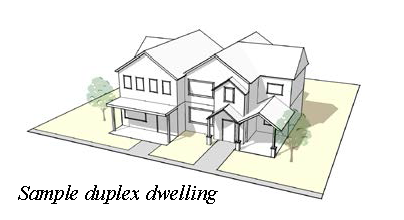
DWELLING, DUPLEX: A single building containing two dwelling units, each of which shares a common unpierced wall that extends from ground to roof and that totally separates the enclosed living areas within the dwelling units or the enclosed area within attached accessory garages.
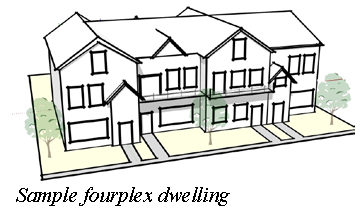
DWELLING, FOURPLEX: A single structure, located on a single lot, containing four dwelling units, none of which meets the definition of a townhouse dwelling unit or an accessory dwelling unit.
DWELLING, LIVE/WORK: A structure containing an integrated living and working space that is intended to function predominantly as business workspace with residential use area occupied by the business owner or operator. The unit typically has a store front, with the workspace, public display area, or show room on the ground floor of the unit and the majority of the residence area is located either on the upper floor if there are two floors, or the back of the unit if there is only one floor.
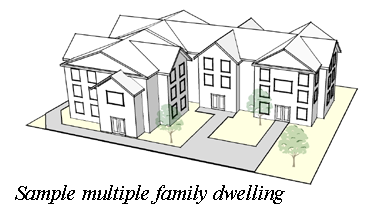
DWELLING, MULTIPLE FAMILY: Five or more dwelling units, within a single building and located on a single lot, including apartments and condominiums.
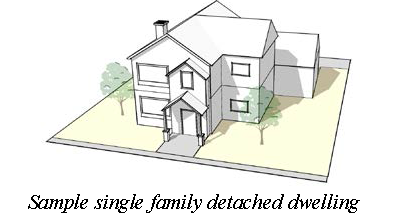
DWELLING, SINGLE-FAMILY: A dwelling unit, located on a separate lot or tract that has no physical attachment to any other building containing a dwelling unit located on any other lot or tract, and that does not meet the definition of a manufactured home.
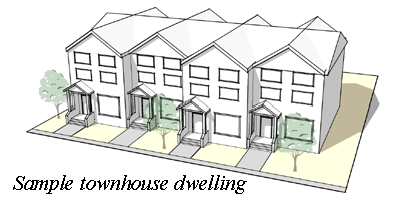
DWELLING, TOWNHOUSE: An individually owned residential unit that has an undivided interest in common with other unit owners in the common elements of a project including land and infrastructure. Townhouse ownership includes the structure, from foundation to roof in an unbroken vertical plane, and the land on which the foundation of the Townhouse is constructed. In order for footings to be considered a foundation in any location, that area must have an unbroken vertical plane to the roof and must be physically attached to the building. Townhouse units or portions thereof cannot be stacked one above another. Nothing shall be construed to prohibit the ownership of common areas by a homeowners association holding title to such areas for and on behalf of the individual owners of a townhouse unit.
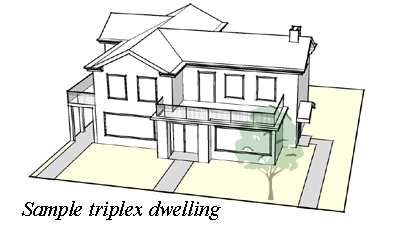
DWELLING, TRIPLEX: A single structure, located on a single lot, containing three dwelling units, none of which meets the definition of a townhouse dwelling unit or an accessory dwelling unit.
DWELLING UNIT: An area in a building containing cooking, living and sanitary facilities designed for use and used by a single family for residential purposes, including related accessory structures. The term dwelling shall not include hotels, motels, homeless shelters, boarding and rooming houses, dormitories, seasonal overflow shelters, tents, or other structures designed or used primarily for temporary occupancy.
DWELLING UNIT, ACCESSORY: A dwelling unit located within, attached to, or detached from the principal structure. The unit includes its own independent living facilities with provisions for sleeping, cooking, and sanitation, and is designed for residential occupancy independent of the primary use. The use is associated with and subordinate to the principal structure and is located upon the same lot as the principal structure.
EDUCATIONAL FACILITY: Buildings and uses for instruction or research activities associated with an academic institution which has curriculum for technical or vocational training, including, but not limited to, kindergarten, elementary, secondary, or higher education.
EMPLOYEE HOUSING: A dwelling unit that contains no more than 450 square feet of gross floor area, located within the same structure as a nonresidential use and above, adjacent to, or behind the nonresidential use, in which the use of the dwelling units is secondary and subordinate to the nonresidential use and restricted for occupancy only by the employees of the nonresidential use.
FACTORY-BUILT HOUSING: Any structure, or component of a structure, designed primarily for residential occupancy, either permanent or temporary, that is wholly or in substantial part made, fabricated, formed, or assembled in manufacturing facilities for installation, or assembly and installation, on the building site, and that does not meet the definition of a manufactured home. Factory-built housing shall either comply with the Town's adopted building codes or the Colorado Division of Housing adopted Building Codes for Modular Homes, as set forth in CDOH Rule 2, Codes and Standards, at 8 CCR 1302-14.
FAMILY: One or more individuals occupying a single dwelling unit and living as a single housekeeping unit with a maximum of eight adults. This includes groups of eight or fewer persons whose right to live together is protected by the federal Fair Housing Amendments Act.
FAMILY DAY CARE: The use of a residence for the care of eight (8) or fewer children other than the occupant's own children for periods of less than twenty-four (24) hours per day, as designated by rules of the Colorado Department of Human Services.
FARM USE: The use of land for the purpose of obtaining a profit from the production and sale of agricultural products, animals, or animal products, including accessory uses. See also agricultural uses.
FEED STORAGE AND SALES: A retail store selling primarily agricultural products, including the bulk storage of fertilizers and related agrichemicals.
FENCE: A structure, which serves as a barrier intended to prevent escape or intrusion, to mark a boundary, to shield or screen view, or to serve any similar purpose constructed of materials other than vegetation.
GENERAL FARMING AND RANCHING: The growing of crops, plants, and trees or the maintaining of animals.
GOVERNMENT BUILDINGS AND FACILITIES: Any building or facility owned and operated by the United States of America, the state of Colorado, the Town of Ridgway, or any agency or political subdivision thereof.
GRAVEL EXTRACTION: A lot or land or part thereof used for the purpose of extracting stone, sand, gravel, or topsoil for sale and exclusive of the process of grading a lot preparatory to the construction of a building for which application for a building permit has been made.
GROSS FLOOR AREA: The heated area of a building measured along the outside enclosing walls, excluding interior parking areas and outdoor common areas.
GROUP HOME: One or more dwelling units in which more than eight unrelated individuals or related and unrelated individuals live, where physical assistance and/or supervision, care or treatment is provided by resident and/or nonresident professional support personnel as a continual benefit. This definition does not include a hotel, motel, boarding or rooming house, facility housing juvenile or adult offenders, or a facility for persons with drug or alcohol addictions that are not in a treatment program, but includes any group of eight or more persons whose right to live together is protected by the federal Fair Housing Amendments Act. Group homes shall include state licensed personal care and alternative care personnel.
HEALTH, RECREATION, AND EXERCISE ESTABLISHMENT: An establishment or facility designed and equipped for the conduct of sports, exercise activities and other customary and usual recreational activities, including, but not limited to, tennis, racquetball, handball and squash courts, weight and aerobic exercise rooms, running facilities, swimming pools, yoga, bowling, martial arts, dance, and whirlpool and sauna facilities. Permitted accessory uses may include childcare, sun tanning booths, health and nutrition counseling services, retail sales of sporting goods and restaurant services.
HIGH-WATER MARK: The boundary dividing a river bed from a river bank and defined as the line on the bank up to which the presence and action of water are so usual and long conditioned as to impress on the bed a character distinct from that of the bank with respect to the nature of the ground surface, soil and vegetation.
HOME OCCUPATION: A lawful commercial activity carried on within a dwelling unit or an associated accessory structure by a member or members of the household who occupy the dwelling unit, and up to one additional full-time employee, where the occupation is clearly secondary to the use of the dwelling unit for living purposes and the residential character of the dwelling is maintained. Such occupation shall not generate traffic or parking requirements which significantly or adversely affect the residential character of the neighborhood.
HOMEOWNERS ASSOCIATION: Any entity, whether corporation, partnership, nonprofit, unincorporated association, or other entity existing for the purpose of maintaining commonly owned facilities and/or enforcing private protective covenants whose members or shareholders are the property owners involved.
HOTELS AND MOTELS: Any building or portion thereof containing six or more guest rooms used, designed to be used, let, or hired out for occupancy by persons on more or less a temporary basis.
IMPROVEMENT AGREEMENT: An agreement including a list of all agreed-upon improvements, an estimate of the cost of such improvements, the form of guarantee for the improvements, and any other provisions or conditions deemed necessary by the Town Council to ensure that all improvements will be completed in a timely, quality and cost-effective manner. Improvement agreements shall run with and be a burden upon the land.
LAND USE CHANGE: Any land use or development activity that changes the basic character, configuration or use of land or buildings and structures after the enactment of this Land Use Code.
LAUNDROMAT, COMMERCIAL/INDUSTRIAL: An establishment that cleans fabrics and textiles (apparel, uniforms, towels, bedding, table linens, draperies, rugs, upholstery, etc.) for other businesses, with no more than 30% of the gross floor area occupied by an accessory self-service laundromat use. The establishment may include drop-off facilities and collection/delivery services.
LAUNDROMAT, SELF-SERVICE: On-site laundry facilities that are an accessory use to a principal commercial, industrial, or institutional use, and are a part of normal business operations in industries such as healthcare, veterinary services, emergency services, sports and athletics, hospitality, spas and salons, farming and agriculture, manufacturing, etc.
LIBRARY: A public, nonprofit facility in which literary, musical, artistic, or reference materials such as but not limited to books, manuscripts, computers, recordings, or films are kept for use by or loaning to patrons of the facility but are not normally offered for sale.
LOADING AREA: A parking space other than a public street or alley for parking commercial vehicles for the purpose of loading or unloading materials or merchandise.
LOT: A portion or parcel of land, including a portion of a platted subdivision, occupied or intended to be occupied by a building or use and its accessories, together with such yards as required under the provisions of this title, that is an integral unit of land held under unified ownership in fee or co-tenancy, or under legal control tantamount to such ownership.
LOT AREA: The total horizontal area within the boundary lines of a lot, exclusive of any road rights-of-way.
LOT CONSOLIDATION: A division of land process to combine two (2) or more lots, tracts, properties, or parcels within the same unit of a platted subdivision which actually deletes the common boundary lines, and results in fewer lots remaining than were started with.
LOT WIDTH: Measured at the frontage of that abutting public street which provides actual access to the lot.
KENNEL: Any use, other than a veterinary clinic in which household pets are kept commercially for board, propagation, grooming, or sale. Animals used as a part of an agricultural activity are not included in this definition.
KENNEL, BOARDING: Any kennel use which is primarily used to house, board, keep, or care for household pets for a temporary period of time.
KENNEL, BREEDING: Any kennel use which is primarily used for the propagation, breeding or raising of household pets for commercial sale.
MAJOR ADDITION: An addition to or renovation of a structure in which the total gross floor area of the proposed addition or renovation area is 50 percent or more of the total gross floor area of the existing structure before addition or renovation.
MANUFACTURE OF MATERIALS: The mechanical or chemical transformation of materials or substances into new products, including the assembling of component parts, the manufacturing of products, and the blending of materials, such as lubricating oils, plastics, or resins.
MANUFACTURING, LIGHT: The manufacture, predominantly from previous prepared materials, of finished products or parts, including processing, fabrication, assembly, treatment, and packaging of such products, and incidental storage, sales, and distribution of such products, but excluding basic industrial processing and custom manufacturing. All light manufacturing activities are contained entirely within the building and noise, odor, smoke, heat, glare, and vibration resulting from the manufacturing activity are confined entirely within the building.
MANUFACTURING, MEDIUM: The processing and manufacturing of materials or products predominately from extracted or raw materials. These activities do not necessitate the storage of large volumes of highly flammable, toxic matter or explosive materials needed for the manufacturing process. This use shall include any packaging of the product being manufactured on site. This term includes, but is not limited to, machine and welding shops.
MANUFACTURING, HEAVY: The manufacture or compounding process of raw materials. These activities or processes would necessitate the storage of large volumes of highly flammable, toxic matter, or explosive materials needed for the manufacturing process. This term includes, but is not limited to:
(a)
Fabrication of metal products;
(b)
Chemical manufacturing;
(c)
Stone-work or concrete product manufacturing;
(d)
Manufacturing of agricultural, construction, or mining machinery;
(e)
Motor vehicle manufacturing;
(f)
Lumber milling;
(g)
Permanent concrete/batch plant.
MANUFACTURED HOME, LARGE: A single-family dwelling which:
(1)
Is partially or entirely manufactured in a factory;
(2)
Is not less than twenty-four (24) feet in width and thirty-six (36) feet in length;
(3)
Is installed on an engineered, permanent foundation;
(4)
Is certified pursuant to the National Manufactured Housing Construction and Safety Standards Act of 1974, 42 U.S.C. Section 5401, et seq., as amended; and
(5)
Is built for the Colorado climate and snow load according to the Department of Housing and Urban Development Standards established under the provisions of 42 U.S.C. Section 5401, et seq.
MANUFACTURED HOME, SMALL: A single-family dwelling which:
(1)
Is partially or entirely manufactured in a factory;
(2)
is less than twenty-four (24) feet in width and thirty-six (36) feet in length;
(3)
Is installed on an engineered, permanent foundation;
(4)
Is certified pursuant to the National Manufactured Housing Construction and Safety Standards Act of 1974, 42 U.S.C. Section 5401, et seq., as amended; and
(5)
Is built for the Colorado climate and snow load according to the Department of Housing and Urban Development Standards established under the provisions of 42 U.S.C. Section 5401, et seq.
MANUFACTURED HOME PARK: A single site, parcel, or lot operated and used for the location of two or more manufactured homes intended for use as residences.
MARIJUANA: Shall have meanings as defined in C.R.S., Title 12, Article 43.3.
MARIJUANA CULTIVATION FACILITY: Shall have meanings as defined in C.R.S., Title 12, Article 43.3.
MARIJUANA PRODUCT MANUFACTURING FACILITY: Shall have meanings as defined in C.R.S., Title 12, Article 43.3.
MARIJUANA TESTING FACILITY: Shall have meanings as defined in C.R.S., Title 12, Article 43.3.
MEDICAL, MARIJUANA: Shall have meanings as defined in C.R.S., Title 12, Article 43.3.
MEDICAL MARIJUANA CENTER: Shall have meanings as defined in C.R.S., Title 12, Article 43.3.
MEDICAL MARIJUANA-INFUSED PRODUCTS, MANUFACTURING: Shall have meanings as defined in C.R.S., Title 12, Article 43.3.
MICROBREWERY: A facility for the production and packaging of malt beverages of low alcoholic content for distribution, retail, or wholesale, on or off-premises, with a capacity of not more than 15,000 barrels per year. The development may include other uses such as a standard restaurant, bar or live entertainment as otherwise permitted in the zoning district.
MINI-STORAGE WAREHOUSE: A building, group of buildings, or other facility having compartments, rooms, spaces, or other types of units that are individually rented or leased or otherwise contracted by customers for the storage of personal or business goods or property. For the purposes of this Title, "mini-warehouse" shall be considered synonymous with mini-storage or self-storage facility.
MIXED-USE SITE: An undivided or combination of undivided lots under one or more ownership or lease agreement used for a mixture of commercial, industrial, institutional, and residential uses.
MOBILE HOME: A structure which: (1) is transportable in one or more sections; (2) is built on a permanent chassis; (3) is designed to be used as a place of living for a single-family, with or without a permanent foundation, when connected to the required utilities; and (4) includes the plumbing, heating, air conditioning and electrical systems contained therein. "Manufactured home", large or small, is not included within the definition of "mobile home."
MOTOR VEHICLE PARKING LOT: An open, all-weather surfaced area, other than street or public way, to be used for the storage, for limited periods of time, of operable passenger automobiles and commercial vehicles, and available to the public, whether for compensation, free, or as an accommodation to clients or customers.
MULTIFAMILY RESIDENTIAL SITE: An undivided or combination of undivided lots under one or more ownership or lease arrangements occupied by multiple dwelling units.
MUSEUM: An establishment for preserving and exhibiting artistic, historical, scientific, natural, or man-made objects of interest. Such activity may include the sale of the objects collected and memorabilia, the sale of crafts work and artwork, boutiques, and the holding of meetings and social events.
NATIVE VEGETATION: Vegetative species that occur naturally in a particular region, ecosystem, and habitat.
NONCONFORMING USE: A use which does not comply with the use regulations, dimensional requirements, or other regulations of these Land Use Regulations.
NONRESIDENTIAL SITE: An undivided or combination of undivided lots under one or more ownership or lease agreement used for commercial, industrial, or institutional uses.
NURSERY: An enterprise that conducts the retail and/or wholesale of plants grown on the premises, as well as accessory items (but not power equipment, such as gas or electric lawn mowers and farm implements) directly related to their care and maintenance.
NURSING HOME: A home licensed by the state for the aged or chronically or incurably ill persons in which five or more such persons not of the immediate family are provided with food and shelter or care for compensation, but not including hospitals, clinics, or similar institutions devoted primarily to the diagnosis and treatment of the sick or injured.
OFFICE: A building or portions of a building in which commercial activities take place but where goods are not produced, sold, or repaired. These include but are not limited to general and professional services, governmental offices, insurance offices, real estate offices, travel agency, utility offices, radio broadcasting and similar uses.
OFFICE, MEDICAL: A building or portion of buildings that contains establishments dispensing health services, and/or that provides support to the medical profession and patients. Examples include but are not limited to medical and dental laboratories, blood banks, oxygen providers, integrative medicine and holistic or homeopathic therapies, and other miscellaneous types of medical services.
OPEN SPACE: Any land or water area which serves the specific use of providing park and recreation opportunities, conserving natural areas and environmental resources, or protecting areas of agricultural, archeological, or historical significance. Open space shall not be considered synonymous with vacant or unused land or yards as part of a platted lot.
OPTIONAL PREMISES CULTIVATION OPERATION: Shall have meanings as defined in C.R.S., Title 12, Article 43.3.
OUTDOOR AMUSEMENT AND ENTERTAINMENT FACILITIES: The provision of entertainment or games of skill to the general public for a fee where any portion of the activity takes place outside of a building, including, but not limited to, a golf driving range, archery range, miniature golf course or a scenic railroad.
OUTDOOR GUIDING: A use where professional outdoor guides lead groups on outdoor activities such as hunting, fishing, skiing, camping, photography, or other outdoor recreational activities. This may include accessory retail or rental of equipment for the patrons participating in the outings. Outdoor guiding does not include outdoor recreational equipment rentals.
OUTDOOR RECREATION EQUIPMENT RENTAL: Any use where motorized recreation equipment such as snowmobiles, off-highway vehicles, or utility vehicles are stored or displayed outdoors for rental purposes. This use may include office space and repair and maintenance of rental equipment.
OUTDOOR STORAGE, NONRESIDENTIAL: An outdoor area in which items that are used for commercial or construction activities (e.g., portable or mechanized equipment, building materials, manufacturing inputs, or merchandise) are stored for, in an unroofed area, in the same place for more that twenty-four hours.
OUTDOOR STORAGE, RESIDENTIAL: The keeping of any equipment, materials, or other items outdoors on property with a principal use of residential. The material or items are incidental to normal residential use of property and are owned by the owner or tenant residing on the property, including, but not limited to, lawn and garden equipment, snowmobiles, motor bikes, bicycles, snow blowers and other household items, excepting all items as defined in rubbish.
OUTFITTING: See Outdoor Guiding.
OWNER-OCCUPIED: At least one owner of a property lives on that property as their primary residence for at least nine months out of any 12-month period.
PARK: Areas open to the general public and reserved for recreational, educational or scenic purposes.
PARKING FACILITY: Any parking lot or parking structure which is used primarily or habitually for the parking of vehicles (excluding street or alley rights-of-way).
PERSON: Any individual, firm, partnership, corporation, association, LLC, or other entity, including to the extent allowed by law, the United States and the State of Colorado, and any agency or political subdivision thereof.
PERSONAL SERVICES: Establishments primarily engaged in providing services involving the care of a person or his/her personal goods, including, but not limited to, dry cleaning pickup, cosmetics, beauty and barbershops, spas, nail salons, shoe repair shops, tailor shops, funeral services, and domestic services.
PLAN, PRELIMINARY: The plat and/or maps of a proposed subdivision or planned unit development and specified supporting materials, drawn and submitted in accordance with the requirements of adopted regulations, including detailed engineering and design.
PLAN, SKETCH: A map of a proposed subdivision or planned unit development, drawn and submitted in accordance with the requirements of this Code, to evaluate feasibility and design characteristics at an early stage in the planning.
PLANNED UNIT DEVELOPMENT (PUD): A tract, lot, parcel, or property developed under single ownership or unified control, which includes one or more principal buildings and/or uses and is processed under the planned unit development provisions of this Code.
PLANNING COMMISSION: The Planning and Zoning Commission of the Town.
PRINCIPAL USE: The primary purpose or function for which the land, building or structure is used.
PUBLIC ASSEMBLY FACILITY: A permanent or temporary structure or facility, place, or activity where concentrations of people gather in reasonably close quarters for purposes such as deliberation, education, worship, shopping, employment, entertainment, recreation, sporting events, or similar activities. Public assembly facilities include, but are not limited to, schools, churches, conference or convention facilities, employment and shopping centers, arenas, athletic fields, stadiums, clubhouses, museums, and similar facilities and places, but do not include parks, golf courses or similar facilities unless used in a manner where people are concentrated in reasonably close quarters.
PUBLIC BUILDING: Any building held, used, or controlled exclusively for public purposes by any department or branch of government, public agency, or special district without reference to the ownership of the building or of the realty upon which it is situated. A building belonging to or used by the public for the transaction of public or quasi-public business.
PUBLIC UTILITY SERVICE FACILITIES: Transmission and distribution facilities for natural gas, electricity, water, sewer, drainage, telephone, and cable television necessary to provide service to customers located in the various districts of the Town, such as pipes, lines, mains, wires, transformers, valves, and other related appurtenances, but not including buildings, offices, and production or generation facilities.
RECYCLING FACILITY: A facility that accepts recyclable materials and may perform some processing activities. The principal function is to separate and store materials that are ready for shipment to end-use markets, such as paper mills, aluminum smelters, or plastic remanufacturing plants.
REGISTERED PROFESSIONAL ENGINEER: A professional engineer means a person who is qualified to perform engineering work and who is registered in conformance with Title 12, Article 25 of the C.R.S.
RELIGIOUS ASSEMBLY FACILITY: A facility or site used by a bona fide religious group primarily or exclusively for religious worship and related religious services, including a place of worship, retreat site, or religious camp.
RESEARCH AND DEVELOPMENT: An establishment or other facility for carrying on investigation in the natural, physical, or social sciences, which may include engineering and product development.
RESTAURANT/EATING AND DRINKING ESTABLISHMENT: A structure in which the principal use is the preparation and sale of food and beverages.
RESTAURANT WITH DRIVE UP WINDOW: A restaurant accommodating the patron's automobile from which the occupants may receive a service or in which products purchased from the establishment may be consumed.
RESUBDIVISION: A change in a map of an approved or recorded subdivision plat if such change isn't otherwise classified as a type of subdivision or if it significantly changes any map or plan legally recorded prior to the adoption of any regulations controlling subdivision.
RETAIL: A facility or area for the retail sale of general merchandise or food to the general public for direct use. This use includes but is not limited to the sale of general merchandise, clothing and other apparel, flowers and household plants, dry goods, convenience and specialty foods, hardware, liquor, and similar consumer goods.
RETAIL, CONTRACTOR CONSTRUCTION YARD: An unenclosed portion of the lot or parcel upon which a construction contractor maintains its principal office or a permanent business office. Designation of the lot or parcel as a contractor's storage yard would allow this area to be used to store and maintain construction equipment and other materials customarily used in the trade carried on by the construction contractor.
RETAIL, CONVENIENCE STORE: Any retail establishment selling consumer products including primarily prepackaged or prepared food items and household items, having a gross floor area of less than five thousand (5,000) square feet. A convenience store may also have associated retail sale of gasoline and other petroleum products.
SETBACK: The perpendicular distance between a property line and the building line.
SHORT-TERM RENTAL: Rental of all or a portion of a residential dwelling unit for periods of less than 31 days. This definition of short-term rentals excludes hotels, motels, lodges, and bed and breakfasts.
SINGLE-FAMILY RESIDENTIAL SITE: An undivided or combination of undivided lots under one ownership occupied by a single-family residential structure and related accessory structures.
SOLID WASTE DISPOSAL: A lot of land or part thereof used primarily for the disposal, by abandonment, dumping, burial, burning, or any other means and for what purpose, of garbage, sewage, trash, refuse, junk, discarded machinery, vehicles, or parts thereof, or waste material of any kind.
STRUCTURE HEIGHT: Shall be determined as follows for application of the limitations as set forth herein:
(1)
The height of any structure shall be determined by measuring the vertical distance between the elevation of the lowest point of the natural grade abutting any exterior wall or supporting structure and the highest point of the coping of a flat roof or to the deck line of a mansard roof or to the average height of the highest gable or a pitched or hipped roof. Structures that do not have roofs shall be measured to the height of the structure.
(2)
The height of each separate terrace or step for terraced or stepped buildings shall be considered for the purpose of application of these limits.
(3)
Allowable building height may be increased by six inches if the roof design includes raised heel trusses.
SUBDIVIDE: Any act which is intended to or does result in the creation of a subdivision pursuant to Section 5 of these Planning and Zoning Regulations.
SUBDIVIDER means any person performing such act or processing a subdivision pursuant to Section 5 of these Planning and Zoning Regulations.
SUBDIVISION means a parcel of land which is divided into two or more parcels, lots, tracts, or other interests including condominiums; townhouses, other common interest ownership properties; and apartment complexes or other development involving more than one primary building; and any act creating such results. Provided, however, the following shall not be considered to be a subdivision for the purpose or application of these regulations:
(1)
A division of land which creates cemetery lots;
(2)
The creation of separate but undivided interests in a tract of land such as joint tenancy, tenancy in common, tenancy in entirety, trust, lien, mortgage, deed of trust or other security interest, unless such separate interests apply to less than all of the tract;
(3)
An interest severing the oil, gas, minerals or water from the surface estate;
(4)
Creation of a utility easement or an easement unrelated to the use of the surface;
(5)
Any division of property created by acts of a Town;
(6)
Boundary adjustments which resolve a disputed boundary or boundary survey problem such as overlaps or gaps, so long as the boundary adjustment or transaction does not result in the transfer from one parcel to another of an area in excess of 10,000 square feet.
SUBDIVISION, BUILDING FOOTPRINT: A previously approved commercial or mixed-use building footprint that is intended for individual ownership and which includes in such ownership an undivided interest in the common elements of a project, including land and infrastructure. Ownership includes the building, from foundation to roof in an unbroken vertical plane, and the land on which the foundation is constructed. A building footprint subdivision may be defined by the building foundation line delineated on an approved site plan/preliminary plat and may be subdivided per a site plan/preliminary plat prior to the actual pouring of the foundation at the risk of the subdivider. The building footprint subdivision must be defined by resubdivision once the foundation has been poured. This does not prohibit the ownership of common areas by an owner's association holding title to such areas for and on behalf of the individual owners of a commercial pad.
SUBDIVISION, CONDOMINIUM: The development or use of the land and existing structures as a condominium project, regardless of the present or prior use of such lands and structures and regardless of whether substantial improvements have been made to structures.
SUBDIVISION, MAJOR: A major subdivision is any division of land that is not defined as a "boundary or lot line adjustment," a "building footprint subdivision," a "condominium subdivision," a "lot consolidation," a "minor subdivision," a "resubdivision," a "townhouse subdivision," or a "right-of-way vacation."
SUBDIVISION, MINOR: A minor subdivision is a division of land creating four (4) or fewer lots, and a subdivision creating a second single-family dwelling unit on one parcel.
SUBDIVISION, TOWNHOUSE: The development or use of the land and existing structures as a townhome project, regardless of the present or prior use of such lands and structures and regardless of whether substantial improvements have been made to structures.
TELECOMMUNICATION FACILITY: A facility that transmits and/or receives electromagnetic wireless communications signals. It includes antennas, microwave dishes, and other types of equipment for the transmission or receipt of such signals, telecommunication towers or similar structures supporting said equipment, equipment buildings, parking area, and other accessory development.
TOWN: The Town of Ridgway, Colorado, and any authorized officer, employee, or agent thereof.
TRAVEL HOME: Any movable or relocatable dwelling unit with a living area of less than 500 square feet or which is required to have a license plate.
TRAVEL HOME PARK: A park or campground for the temporary use of travel homes, including, but not limited to, campers, motorhomes, pick-up truck campers, trailers, and trailer coaches.
TRUCK REPAIR SHOP: The use of the site for the repair, washing, polishing, or detailing semi-tractor trailers.
USE: The activity or purpose for which property, a building or other structure is designed, arranged, intended, occupied, or maintained.
USE BY RIGHT: A use which is permitted or allowed in the district involved, without review, and complies with the provisions of these Land Use Regulations and other applicable Town ordinances and regulations.
VETERINARY HOSPITAL: An establishment that provides medical treatment and care to animals, and which may include temporary or overnight boarding of animals that are recuperating from treatment. A veterinarian clinic or office may include a kennel.
WAREHOUSE FACILITY: An establishment whose primary activity is the storage of residential, commercial, industrial, or other goods, including inventory and/or finished products, and where no such goods are sold either at wholesale or at retail. This use does not include the storage of goods incidental to a different primary use on the same lot, which is considered an accessory use.
WHOLESALE ESTABLISHMENT: An establishment or place of business primarily engaged in selling and/or distributing merchandise to retailers; to industrial, commercial, institutional, or professional business users, or to other wholesalers; or acting as agents or brokers and buying merchandise for, or selling merchandise to, such individuals or companies. This is not considered a general commercial use. This term includes, but is not limited to:
(a)
Building supplies material and sales;
(b)
Electronic and mechanical supplies;
(c)
Industrial equipment sales or leasing;
(d)
Office supplies, printing;
(e)
Nursery sales and storage of nursery equipment, materials, and supplies.
Wholesale establishments may include associated outdoor storage of goods connected directly to the operations of the establishment.
WORKFORCE HOUSING: Housing that is available for purchase or rent on terms that are affordable to households earning between 80 percent and 120 percent of area median income (AMI) as determined by the U.S. Department of Housing and Urban Development (HUD) and published annually for the County. The cost of for sale workforce housing (including principal, interest, taxes, insurance, utilities, and homeowners association fees) or for rent workforce housing (including rent and utilities) does not exceed 30 percent of those households' gross annual incomes.
YARD: The required open area between a building and a lot line, unoccupied and unobstructed from the ground up, except for such encroachments as are expressly permitted within this Chapter 7.
YARD, FRONT: A yard extending between the side lot lines across the full width of the lot and lying between the front lot line and any portion of any structure on the lot. In those instances where a lot abuts two (2) streets, such as a corner lot or a double frontage lot, the town manager shall designate which yard constitutes the front yard based on the existing development patterns within the neighborhood.
YARD, REAR: A yard extending between the side lot lines across the full width of the lot and lying between the rear lot line and any portion of any structure on the lot.
YARD, SIDE: A yard extending between the front and rear lot lines along the full length of the lot and lying between the side lot line that abuts a public way or private street and any portion of any structure on the lot.
(Ord. 03-2023; Ord. 03-2024)

