
Riverdale City Zoning Code
ARTICLE 5
- ARCHITECTURAL DESIGN STANDARDS
Sec. 5.1.- Mixed-use architectural design standards.
(Ord. No. 7-2020, § 1(Exh. A), 10-26-20)
Sec. 5.1.1. - Purpose and intent.
The mixed-use architectural design standards (design standards) seek to create developments that provide a safe, convenient, dynamic and attractive environment through the integration of uses and building design, where people can live, work, and play in Riverdale. The purpose of these design standards is to eliminate the ambiguity for the development community and ensure complementary environments. The building and site design standards set forth in this article integrate land use, urban design, transportation, and architecture that comprise the built environment and address the following components:
(Ord. No. 7-2020, § 1(Exh. A), 10-26-20)
Sec. 5.1.2. - Applicability.
A.
General. These standards apply to all new construction and modifications within the designated town center mixed-use district mixed-use (MU) districts. These standards shall also be applied to properties that are rezoned to any mix-use. Single-family dwellings are exempt from these provisions. For commercial design standards, see section 5.2, Commercial architectural design standards.
B.
Relationship to underlying zoning district standards. These architectural design standards are supplementary to the TCMU district and MU District development standards established in article 3, other applicable regulations in the zoning ordinance, and other application city ordinances. In any case where these design standards conflict with standards of the zoning district to which they apply or with other provisions of this zoning ordinance, the architectural design standards shall govern.
C.
Modifications to existing structures.
1.
Any building that is nonconforming with respect to the development and design standards of this ordinance or any future amendments shall not be enlarged, expanded, or altered in any manner which may increase its nonconformity, with the exception that the structure may be repaired to the extent necessary to maintain it in a safe and sanitary condition in accordance with article 10, Nonconforming Uses, Buildings, and Lots.
2.
Any existing building that is enlarged, expanded, or altered in any manner would increase its non-conformity must be brought into compliance with the design standards set forth in section 5.1, Mixed-use architectural design standards.
3.
Rebuilding of a damaged, nonconforming building must conform with article 10, Nonconforming Uses, Buildings, and Lots.
D.
Alternate standards. The standards herein are intended to be followed as outlined below. However, at its discretion, the city council may approve minor deviations from the design standards if, in the opinion of the council, the intent of the goals and purpose of this article can be achieved with the proposed minor deviations. Applicants must clearly indicate how proposed deviations further the purpose and intent defined in the guiding principles in article 3, section 3.6.2. The purpose statements in each section in this article. These design standards do not exempt applicants from obtaining all required permits and complying with all applicable city codes and regulations in force.
(Ord. No. 7-2020, § 1(Exh. A), 10-26-20)
Sec. 5.1.3. - Building form and location.
A.
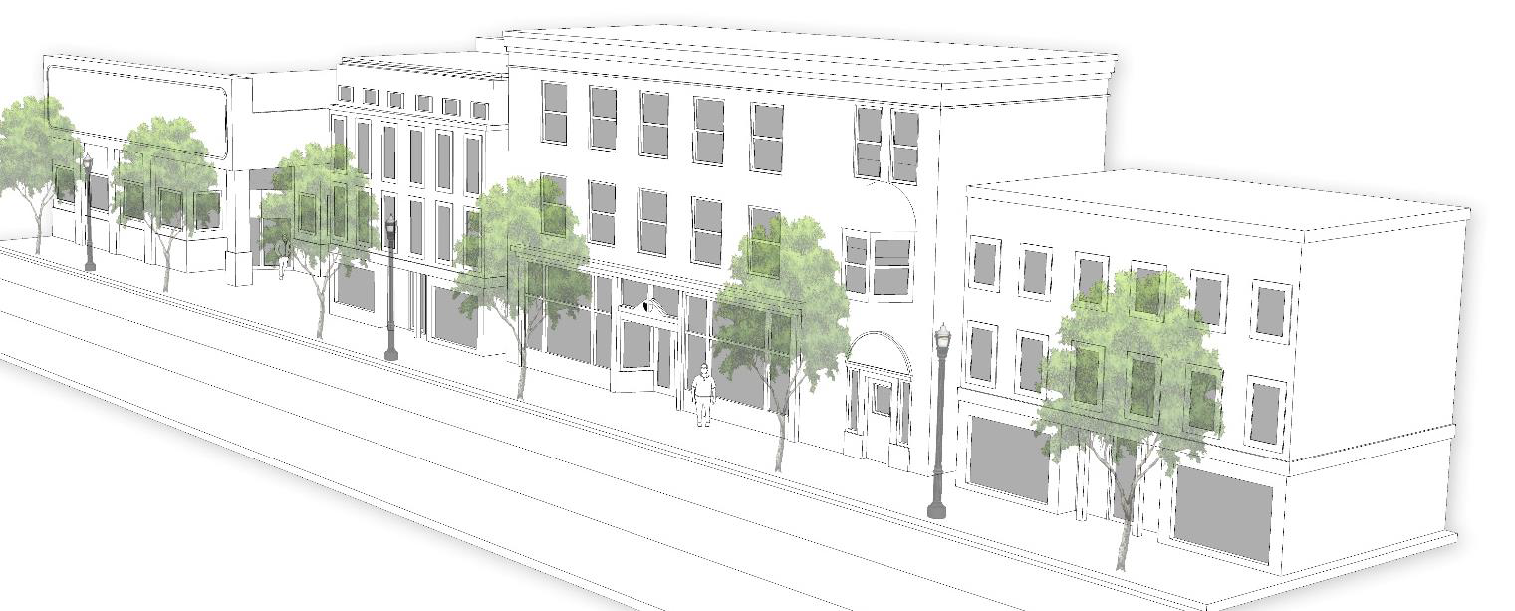
Building form and mass are crucial in defining the specific "town center" or "main street" character that many mixed-use developments seek to achieve. Human-scaled, pedestrian-oriented architectural features on buildings help reduce mass so that building form does not overwhelm the public space. A variety of architectural elements can be applied to the building design to create desired massing, which may include windows, doors, columns, masonry detailing, façade articulation, variations in roof lines, building wall recesses, and variations in colors and exterior materials.
B.
Other techniques to reduce mass include integrating view corridors between pedestrian destinations, such as building entrances and public parks. Additionally, the location of buildings on a site and their orientation to the street helps to define the public realm and promote pedestrian activity that supports development.
(Ord. No. 7-2020, § 1(Exh. A), 10-26-20)
Sec. 5.1.3.1. - Setbacks.
A.
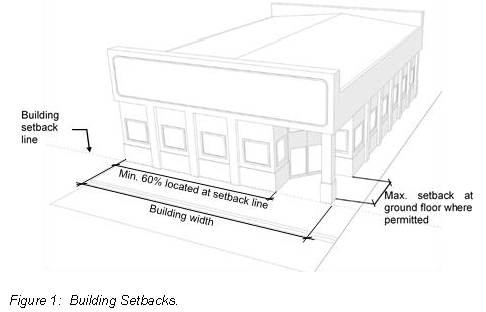
Building setbacks shall be in accordance with the applicable zoning district standards set forth in article 3. In order to achieve a continuous building façade, side yards between adjoining buildings shall be minimized to the greatest extent possible.
B.
A minimum of 60 percent of front façades at ground level shall be located at the minimum setback line to reinforce the building line. When the space between the façade and setback line is specifically designed for pedestrian uses, such as outdoor dining, the maximum setback shall be permitted. The setback of minor portions of the ground level, front façade may vary to articulate building entries, provide variety and maintain a defined, pedestrian-oriented environment.
C.
All multi-family and residential structures shall be built to the same front and side setbacks as commercial buildings.
(Ord. No. 7-2020, § 1(Exh. A), 10-26-20)
Sec. 5.1.3.2. - Orientation and location.
A.
A principal building shall be oriented to face or be nearly parallel to a primary street (nearly parallel means within a maximum of 15 degrees of being parallel).
B.
Residential façades, elevations, and entrances shall be oriented towards the street to maximize visual appearance and pedestrian access.
(Ord. No. 7-2020, § 1(Exh. A), 10-26-20)
Sec. 5.1.3.3. - Height.
A.
Building height shall be in accordance with the standards of the applicable zoning district (TCMU or MU) in which the development is located, as set forth in article 3.
B.
Architectural features such as a tower, cupola, etc., located above the roof line, are permitted provided the feature is in character with the architecture of the building, and the total height of the building and feature does not exceed requirements in section 5.1.3.3(a).
(Ord. No. 7-2020, § 1(Exh. A), 10-26-20)
Sec. 5.1.4. - Building design standards.
A.
The purpose of these standards is to promote high-quality development that incorporates variety in architectural and design elements using attractive, durable building materials to enhance overall visual appearance of the community. Careful consideration of mass and scale, window size and placement, exterior finish materials and decorative elements help define local character and create a sense of place.
B.
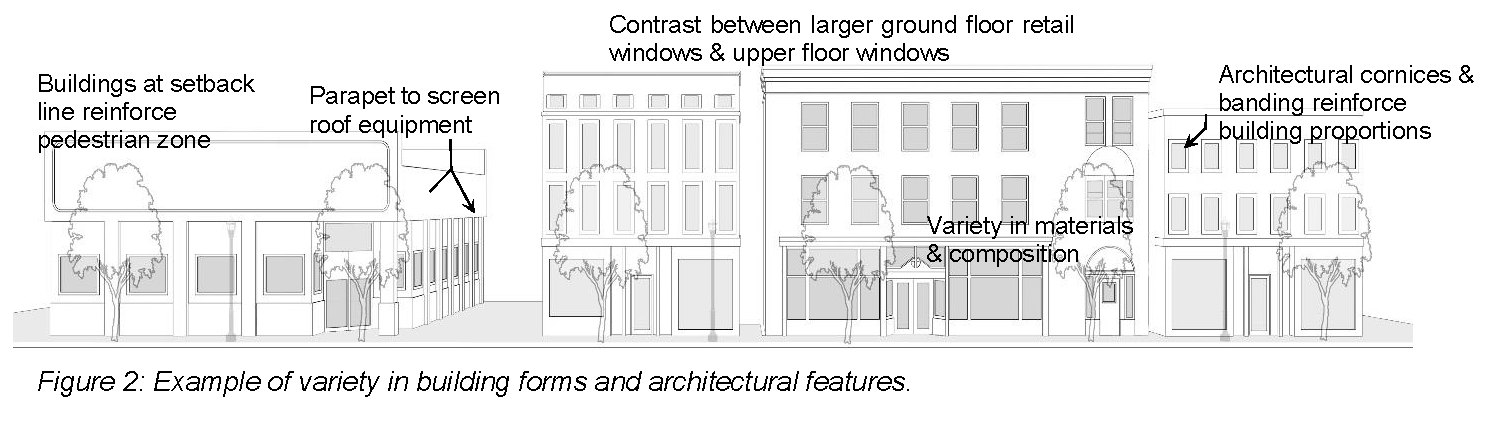
Horizontal elements (e.g., belt courses, projecting cornices, canopies, and step-backs) should be combined with vertical elements (e.g., recesses, projecting bays, parapets and vertically aligned windows) in order to reinforce the human-scale. Change in materials or textures is encouraged to accentuate the building proportions and create desired aesthetic for the City of Riverdale.
(Ord. No. 7-2020, § 1(Exh. A), 10-26-20)
Sec. 5.1.4.1. - Facades.
A.
Façade elements, including exterior siding materials, shall continue around to all sides of buildings visible from public streets and/or parking areas. Elements may be simplified at the rear of buildings that are not facing a public street or parking area to clarify a front/rear hierarchy.
B.
Building facades greater than 100 feet in length shall feature a change in plane articulated by projecting or recessed bays, balconies, step-backs, banding, cornices, or similar features. Large, monolithic, box-like structures are prohibited to reduce the incompatible visual impact of such structures in a pedestrian-oriented environment.
C.
Rooftop mechanical equipment shall not be visible from the street and shall be screened from view behind parapets or otherwise integrated into the building design.
D.
Franchise architecture, distinctive building design that is trademarked or identified with a particular chain or corporation and is generic in nature, shall not be allowed in the TCMU District: Buildings shall not be branded using an architectural style of a company; franchises or national chains must adapt architectural styles to follow these design standards to create a building that is compatible with the TCMU district and maintains the unique character of the district.
(Ord. No. 7-2020, § 1(Exh. A), 10-26-20)
Sec. 5.1.4.2. - Entries.
A.
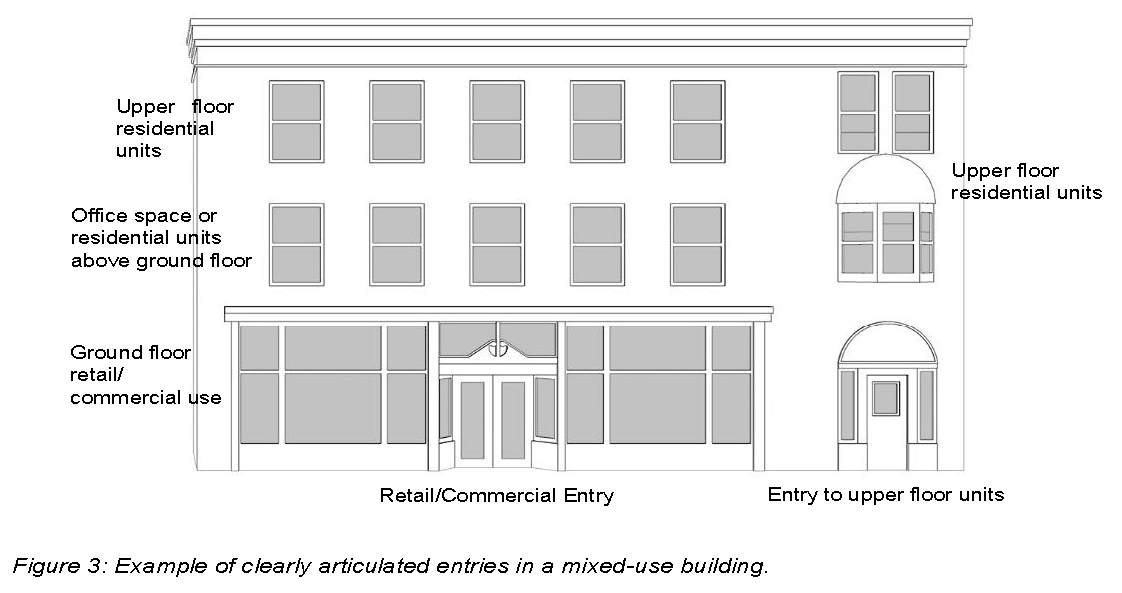
Entries shall be clearly articulated to activate the street front and pedestrian spaces. Residential and commercial entries shall be separated.
B.
Retail and commercial entries shall face a public street or sidewalk and are to be primarily transparent to reinforce the public nature of the ground floor uses.
C.
Lighting and signs shall be integrated into the entry design to reinforce the public nature of the entry.
(Ord. No. 7-2020, § 1(Exh. A), 10-26-20)
Sec. 5.1.4.3. - Fenestration.
A.
Fenestration shall reinforce the dominant horizontal character for commercial uses and a dominant vertical character for residential uses. Windows shall be spaced and grouped logically, vertical upper story windows shall contrast with horizontal lower story windows, and larger windows shall exist on the lower level to the street.
B.
The façade of ground floor commercial and retail uses shall be a minimum of 60 percent glass. The view into the sales floor or seating area of ground floor commercial or retail spaces shall be maintained and shall not be completely blocked by merchandise displays. Transom windows above view windows and doors are encouraged. This standard applies to multi-story mixed-use buildings that include ground floor commercial and retail uses with residential or office space located on the upper floors.
C.
A minimum of 25 percent of the second and third floor building frontages (as measured from floor to ceiling) shall be window glass. Where applicable upper floor residential and commercial uses shall have relatively less glass area to emphasize the public nature of the street-front uses. This standard applies to multi-story mixed-use buildings.
D.
Glass shall be clear, or reflective only to the extent that such reflectivity reduces interior heat.
E.
Mirrored glass, window appliqués or similar window screening shall be prohibited within the TCMU district.
F.
Windows shall not be blocked, boarded up, or reduced in size, unless otherwise required by code for securing a vacant structure.
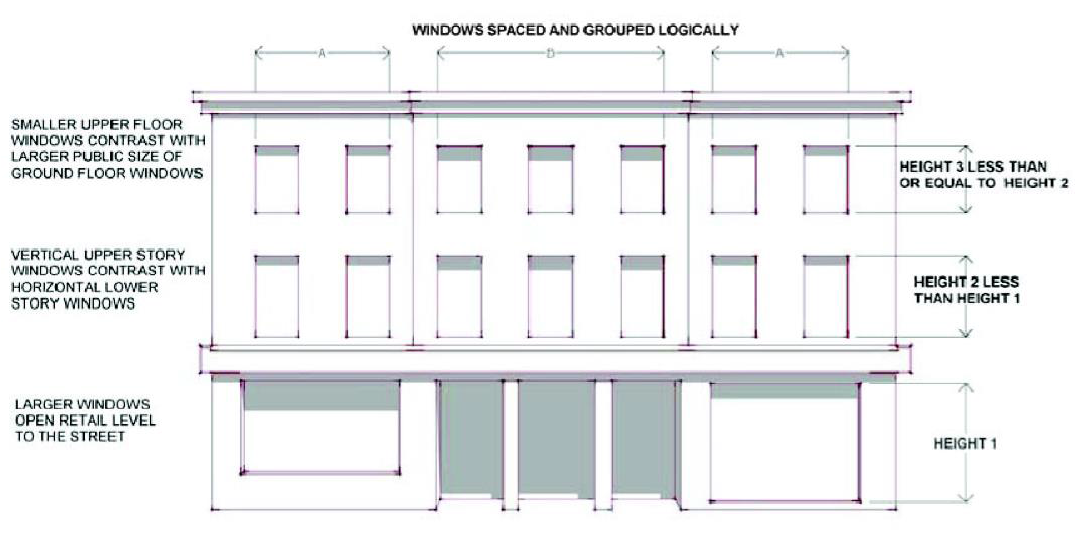
Figure 4: Fenestration.
(Ord. No. 7-2020, § 1(Exh. A), 10-26-20)
Sec. 5.1.4.4. - Exterior materials.
A.
Allowed exterior siding materials include, but are not limited to full-depth brick, stone, cast stone or other finished masonry, fiber cement panels, high-quality vinyl siding, EIFS, glass, wood or other natural materials, or similar material as approved by the community development director.
B.
Materials shall continue around to all sides of buildings in accordance with section 5.1.4.1.A.
C.
Restrictions on exterior siding materials:
1.
Vinyl siding is prohibited on a building façade that faces a public street. However, this material is permitted on facades not visible from a public street providing the vinyl siding is installed in accordance with the vinyl manufacturer's specifications.
2.
Exterior insulation finish system (EIFS) siding must be installed in accordance with the EIFS manufacturer's specifications.
3.
The application of these materials must be consistent with the architectural character of the surrounding development.
(Ord. No. 7-2020, § 1(Exh. A), 10-26-20)
Sec. 5.1.5. - Site design standards.
Site design includes street and pedestrian networks, parking areas, landscaping and buffers, screening, lighting, fences and walls, signs, and other components. Pedestrian circulation should be an integral part of the initial site layout. Landscaping should be used to enhance appearance of buildings, sidewalks, and streets, and is also encouraged as screening in parking areas. Special consideration should be given when designing buffers between incompatible uses to minimize potential nuisances.
Supplemental design guidelines for streetscapes are found in the city's streetscape and improvement design standards which can be accessed through the community development department. Guidelines presented in the streetscape and improvement design standards document are encouraged but are not enforceable as standards.
(Ord. No. 7-2020, § 1(Exh. A), 10-26-20)
Sec. 5.1.5.1. - Streets.
A.
Streets shall be arranged in a grid pattern or similar layout that maximizes connectivity and circulation and enhances safety for pedestrians and vehicles.
B.
Public streets in mixed-use/commercial areas shall contain one travel lane in each direction with on-street parking on both sides of the street. This configuration is recommended for mixed-use developments with street-front retail and commercial uses on both sides of the street.
C.
Public streets in residential areas shall have one travel lane in each direction with on-street parking on at least one side of the street.
D.
Cul-de-sacs are prohibited.
E.
For new development or redevelopment in the TCMU district:
(Ord. No. 7-2020, § 1(Exh. A), 10-26-20; Amd. of 7-24-2023(4); Amd. of 7-24-2023(5))
Sec. 5.1.5.2. - Blocks.
A.
The maximum block size shall be a length no greater than 450 feet and a width no greater than 450 feet, with a block perimeter no greater than 1,800 feet.
B.
Any block side greater than 500 feet shall be broken up by a public right-of-way allowing through pedestrian connections.
C.
Development that abuts existing developments which are not a part of the town center or mixed-use district shall be compatible with the surrounding development.
(Ord. No. 7-2020, § 1(Exh. A), 10-26-20)
Sec. 5.1.5.3. - Sidewalks.
A.
Sidewalks shall be constructed in the right-of-way on both sides of the streets of all new development or redevelopment. In mixed-use and commercial areas, the minimum width of sidewalks shall be 12 feet. However, in areas that contain solely residential (e.g., townhomes), and no commercial or mixed-use component, the minimum width may be reduced to eight feet. This standard applies to multi-story mixed-use buildings that include ground floor commercial and retail uses with residential or office space located on the upper floors.
B.
Pedestrian crosswalks are required at the intersection of any two local streets within the development.
C.
Usable open spaces adjoining sidewalks that create an active pedestrian zone for outdoor dining, open air markets, or similar uses, are encouraged. Such spaces in the vicinity of public uses shall be integrated into the site design when feasible.
D.
Amenities that increase the comfort and safety of pedestrians along sidewalks such as lighting, projecting canopies, and street trees shall be included, when feasible.
E.
The community development director (CDD), may require the developer to provide benches, trash receptacles, bollards, bicycle racks, or similar features to serve abutting within the development. This street furniture shall meet the uniform design standard for the district as approved by the CDD.
F.
Continuous pedestrian networks shall connect building entrances and public sidewalks.
G.
All driveways between parking areas and building entrances shall have designated pedestrian walkways. Walkways that cross travel lanes in parking lots shall be clearly designated through pavement marking or similar means to emphasize the need for driver caution.
H.
Pedestrian walkways through parking lots shall be separated from vehicle lanes with curbing, landscape strips, decorative walls, or similar means.
I.
Sidewalks shall be continued across driveways in order to emphasize the need for driver caution.
J.
Improvements to adjacent crosswalks, curbing, and sidewalks to accommodate increased pedestrian activity associated with new developments are encouraged.
K.
Internal roadways that provide access to parking are allowed, but should be used sparingly, and must include sidewalks with a minimum width of six feet, and amenity zone of at least three feet.
(Ord. No. 7-2020, § 1(Exh. A), 10-26-20; Amd. of 7-24-2023(4))
Sec. 5.1.5.4.1. - Driveways and parking areas.
A.
All parking areas and driveways must comply with ADA standards for accessible design and be designed to maximize pedestrian and motorist safety.
B.
Parking lots shall be located to the rear or side of a building and shall not be located between the front of a building and the right-of-way.
The required number of off-street parking spaces for nonresidential uses set forth in article 7, Parking and Loading, of this zoning ordinance shall be reduced in the following manner:
1.
All uses, regardless of size, are permitted a 25 percent reduction of the required parking.
C.
On-street parking adjacent to the property being development shall be counted towards minimum parking requirements to reduce the need for off-street parking and to minimize impervious surfaces.
D.
Standards for parking space dimensions:
1.
Each parking space shall not exceed nine feet in width and 18 feet in length.
2.
Parallel parking spaces shall not exceed eight feet in width and 22 feet in length.
3.
Accessible parking areas must comply with ADA standards for accessible design.
4.
Alternative dimensions may be proposed, in accordance with section 5.1.2(d), to accommodate certain aspects of the site design (e.g. traffic calming features), but must comply with applicable state regulations, accessible standards, or similar.
E.
The maximum pavement width of any driveway shall be 24 feet for two-way traffic and 15 feet for one-way traffic with angled parking spaces.
F.
Driveways shall not interrupt the continuity of sidewalks and pedestrian spaces. Curb cuts shall be located away from the primary commercial streets whenever possible, preferably on side streets and alleys.
(Ord. No. 7-2020, § 1(Exh. A), 10-26-20)
Sec. 5.1.5.4.2. - Shared parking and interparcel access.
A.
Shared parking plans and interparcel access shall be implemented between developments when feasible.
B.
Parking lots shall be aggregated across property lines wherever possible to maximize the efficiency of the paved space and minimize the number of curb cuts and driveways. Shared parking areas shall follow the access easement requirements of article 7, Parking and Loading.
(Ord. No. 7-2020, § 1(Exh. A), 10-26-20)
Sec. 5.1.5.4.3. - Parking decks.
A.
Parking structures shall be set back a minimum of 30 feet from the property lines of all adjacent streets to reserve room for "linear/wrap-around" buildings between parking structures and the lot frontage.
B.
On-site deck parking structures are encouraged where the topography is advantageous.
C.
Below grade parking is encouraged, especially where existing changes in grade make on-grade access possible while allowing economical structuring of buildings above. Ramping must be incorporated within the building envelope or below grade.
D.
All exposed parking deck façades shall be compatible with design of adjacent buildings.
(Ord. No. 7-2020, § 1(Exh. A), 10-26-20)
Sec. 5.1.5.5. - Bicycle parking.
A.
For parking areas of six spaces or more, bicycle parking shall be provided at five percent of the amount of required automobile parking spaces. Bicycle parking may be used to reduce the amount of vehicular parking spaces otherwise required.
B.
Bicycle parking shall be in plain view of the main entry of the principal building on the site. If site constraints require that bicycle parking is placed elsewhere, signs shall direct bicyclists to the parking area.
C.
Bicycle parking shall be placed such that it does not interfere with on-site pedestrian and vehicular traffic.
D.
Bicycle parking shall be placed in a location that is convenient, accessible, sheltered and well lit. Safe access to and from bikeways (or, where none exists, the public right-of-way) is required.
(Ord. No. 7-2020, § 1(Exh. A), 10-26-20)
Sec. 5.1.5.6. - Landscaping.
A.
Landscaping shall be used to enhance entrance drives, parking areas, and pedestrian-oriented spaces, such as plazas and pocket parks.
B.
Landscaping shall be used to provide variation along building façades at the street level.
C.
Landscaping at retail frontages should be minimal and shall not interfere with the connection between the sidewalk and interior uses. Landscaping to define commercial entries or outdoor dining areas shall not interfere with the continuity of the sidewalks. Landscaping to define residential entries shall not compete with or overwhelm the continuity of the retail frontages.
D.
Landscaping shall be used to accentuate primary building entrances. Hanging plants, potted plants, and wall planters that do not impede pedestrian movement may be used in the event a landscaped strip is not feasible.
E.
Landscaping that creates usable public open space, or continues existing public open space, is encouraged, provided such landscaping does not interrupt the continuity of retail frontages in commercial areas.
F.
Street trees shall be provided along commercial and mixed-use streets. One appropriately sized canopy tree shall be planted every 30 feet. Design for street trees should follow the City of Riverdale LCI Study and supplemental document, streetscape and improvement design standards, and must comply with applicable city landscaping requirements in article 8, Buffer and Landscaping Standards.
G.
Attractive, low maintenance landscaping geared to the scale of development shall be incorporated into the designated open space and parking areas of the lot to the greatest extent feasible. Acceptable plantings shall include trees planted in locations with sufficient growing space to reach full maturity, including hedges, flower beds, planters, fountains, etc. An irrigation system shall be provided to ensure long-term survival of all plant materials.
H.
Parking lots having more than ten parking spaces shall comply with the landscaping requirements in article 8, Buffer and Landscaping Standards.
I.
Bio-swales and other natural drainage areas shall be integrated into the design of surface parking lots to the greatest extent feasible.
J.
Landscaping to buffer parking lots from adjacent residential areas shall meet applicable requirements in article 8, Buffer and Landscaping Standards, of this zoning ordinance.
K.
Entry or "gateway" areas into the town center should be distinguished by enhanced landscaping, architectural treatments, or identification signs in accordance with section 5.1.5.12(D).
L.
Landscaping shall be used in conjunction with fences and walls to screen undesirable public views, such as loading docks, maintenance areas, or storage yards in accordance with article 8, Buffer and Landscaping Standards, of this zoning code and other applicable city regulations.
M.
Plant materials shall be native species that require minimal irrigation and fertilizing, when feasible. Invasive species shall be avoided to the greatest extent possible. Selections for parking lot and street trees should be in accordance with the Riverdale Tree Species List and other applicable regulations in article 8, Buffer and Landscaping Standards.
N.
Trees may be installed in tree pits with irrigation and sub-drainage for parcels on major and minor roadways in lieu of continuous perimeter planting strips.
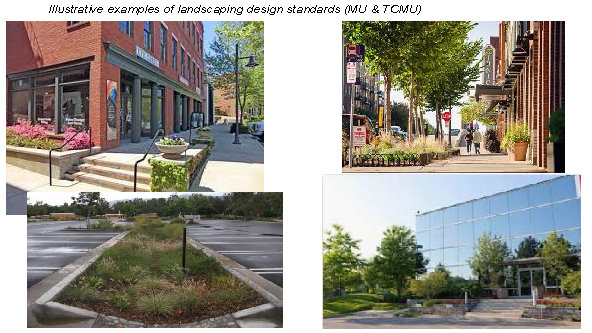
(Ord. No. 7-2020, § 1(Exh. A), 10-26-20; Amd. of 7-24-2023(4))
Sec. 5.1.5.7. - Lighting.
A.
Façade lighting and architectural lighting shall articulate building entries and other features and reinforce the public nature of the sidewalk and building frontage.
B.
Streetlights. If pedestrian lighting is incorporated into the development along sidewalks, the streetlights shall be mounted at a height of 12 to 14 feet above the sidewalk. Pedestrian lighting shall be installed at the sole expense of the developer or property owner. The number, type and location of such lighting standards shall be determined by the community development director.
C.
Lighting along street fronts shall reinforce, rather than compete with, the continuity of the city's street lighting. If the sidewalk includes street trees, streetlights shall be located between the trees so that the tree canopy does not interfere with illumination coverage.
D.
Lighting in parking areas and at the side and rear of buildings abutting adjoining properties shall be designed to cut off light at the property line to prevent spillover onto adjacent properties or the right-of-way.
E.
Lighting should contribute to public safety by lighting entries, exits, and adjacent open spaces and pedestrian access to parking areas.
F.
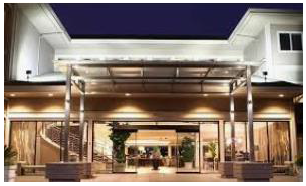
All lighting shall be oriented downward and otherwise conform to "dark skies" standards. Uplighting is permitted to light a primary entrance when the light fixture is mounted under an architectural element (e.g. roof, cornice, walkway, entryway or overhanging non-translucent eaves) so that the uplight is captured.
G.
Prohibited lighting includes neon or other edge-glowing sources, mercury vapor, low-pressure sodium, high-pressure sodium, searchlights, and flashing or changing light sources.
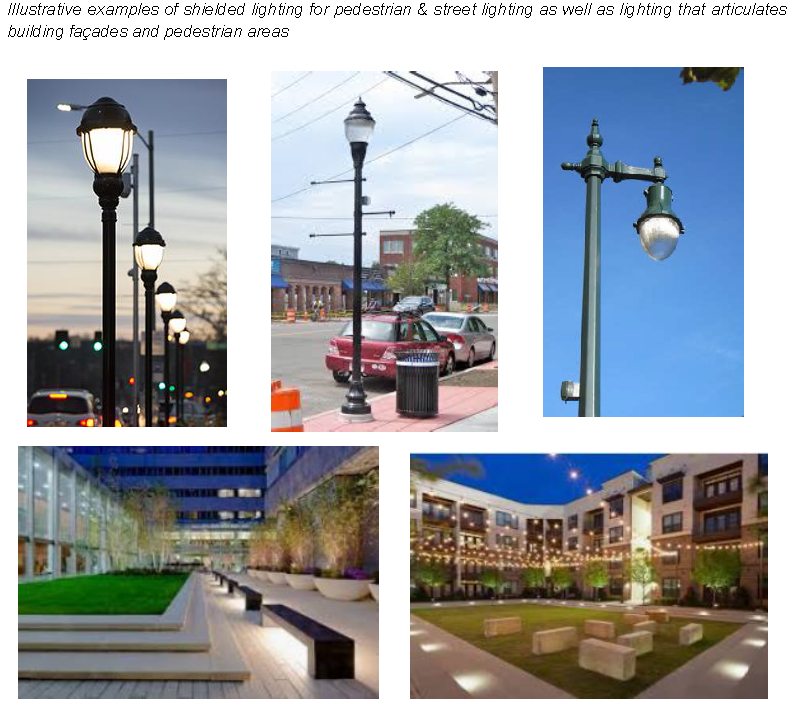
(Ord. No. 7-2020, § 1(Exh. A), 10-26-20; Amd. of 7-24-2023(4))
Sec. 5.1.5.8. - Awnings.
A.
Awnings shall be made of fire resistant, water repellent marine fabric (e.g. canvas) or may be constructed of metal or glass.
B.
The following awning types shall be prohibited:
1.
Continuous, uninterrupted awning spans: Fixed awnings shall not span numerous bays, windows, or store fronts. Awnings shall delineate storefronts on a multi-tenant building.
2.
Internally illuminated awnings: Except that down lighting that is intended to illuminate the sidewalk may be provided under the awning. All lighting under a canopy shall be cutoff or recessed, with no lens dropping below the horizontal plane of the canopy. The light source shall not illuminate or cause the awning to "glow".
3.
Backlit awnings.
(Ord. No. 7-2020, § 1(Exh. A), 10-26-20)
Sec. 5.1.5.9. - Screening enclosures.
A.
Loading docks, dumpsters, mechanical equipment, utility meters and similar equipment shall be located at the rear or side of buildings where they are not visible from primary commercial streets and do not interrupt the continuity of the sidewalk or building façades.
B.
Loading docks, dumpsters, mechanical equipment, and similar equipment shall be screened on all sides by opaque materials that are consistent with the architecture of the building and section 5.1.4.4. Screening shall meet applicable requirements in article 8, Buffer and Landscaping Standards, of the zoning ordinance.
C.
Dumpster enclosures shall be higher than the dumpster, not to exceed ten feet in height.
D.
Where feasible, shared loading areas, dumpsters, and mechanical equipment shall be incorporated into the design.
(Ord. No. 7-2020, § 1(Exh. A), 10-26-20)
Sec. 5.1.5.10. - Utilities.
A.
Above ground electrical lines or utility cables shall be minimized to the greatest extent possible.
(Ord. No. 7-2020, § 1(Exh. A), 10-26-20)
Sec. 5.1.5.11. - Drainage and storm water management.
The following standards shall be applicable to development within the TCMU District. If proposed development within the TCMU District is unable to meet these standards, the applicant may apply for a variance in accordance with article 14, section 14.4, Variances.
A.
Storm water management systems shall incorporate "best management practices" (BMP) as prescribed by the U.S. Department of Environmental Protection Agency, in addition to employing low impact development (LID) strategies. BMP/LID means and methods should be carefully integrated within the site design approach with a goal of decentralizing storm water management systems to the greatest extent practical and minimizing environmental impact of new development. The specific goals of the BMP/LID measures should be mitigation of post-development downstream impacts and achieving the highest level of water quality for all storm water runoff.
B.
A storm water operations and maintenance plan shall be submitted at the time of application for all development projects to ensure compliance with the City of Riverdale Zoning Ordinance. The plan shall include a map of the proposed system specifying the parties responsible for the system, required easements, and a maintenance schedule tasks. The storm water operations and maintenance plan must be approved by the storm water division of the Clayton County Water Authority.
C.
All water from roofs and paved areas shall be retained on site and recharged into the ground, or incorporated into a recovery system for use as on-site irrigation, gray water flushing, etc.
D.
Sites shall be graded with a positive slope greater than 0.5 percent as necessary to prevent ponding of water.
E.
Developments located on sites that are more than two acres shall require retention areas for storm water management. Detention ponds are prohibited on such sites.
(Ord. No. 7-2020, § 1(Exh. A), 10-26-20)
Sec. 5.1.5.12.1. - Exterior signs.
A.
Sign materials shall be compatible with the building appearance.
B.
A residential-only development or the residential component of a mixed-use development project shall be permitted one sign at each principal entrance to the site which shall not exceed 16 square feet.
C.
Each mixed-use development may include a primary storefront sign, a storefront cantilevered sign, a display window sign, an awning sign, or some combination thereof.
D.
Signs on buildings shall not obstruct elements such as cornices, arches, lintels, pediments, windows, pilasters, etc.
E.
Signs shall be designed primarily to be visible to pedestrians and slow-moving vehicular traffic.
F.
No sign maker labels or other identification (including UL labels), are permitted on the exposed surfaces of signs, except as may be required by the building code. If required, such labels or other identification shall be in an inconspicuous location.
G.
Awnings used to accommodate signs should be standardized by height above grade, type, size, materials, colors, illumination, and installation method, across the building façade and within the block to the largest extent practical.
(Ord. No. 7-2020, § 1(Exh. A), 10-26-20)
Sec. 5.1.5.12.2. - Primary storefront signs.
A.
A primary storefront sign shall be located within a sign band beginning approximately eight to 15 feet above the finish floor level. When a tenant has elevations fronting on different sides of a building, the tenant may have a primary storefront sign on each façade. Wall signs in multi-tenanted buildings shall be placed within the same sign band. The placement of wall signs on individual buildings shall be consistent with the sign band on adjacent buildings.
B.
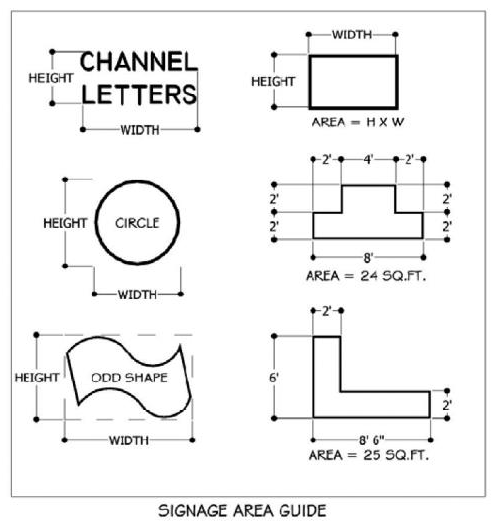
The total sign area for the primary storefront sign shall not contain more than two square feet of sign area for each linear foot of storefront. Sign area shall be calculated by creating a box around the main body of the primary sign. The width of individual tenant spaces multiplied by two equals the maximum sign area which shall not exceed 75 square feet.
C.
Tenant signs are limited to one wall sign per elevation.
D.
Signage shall not be located above the first floor elevation.
(Ord. No. 7-2020, § 1(Exh. A), 10-26-20)
Sec. 5.1.5.12.3. - Storefront cantilevered signs.
A.
Each tenant shall be allowed one cantilevered ("blade sign"), installed perpendicular to the building façade, not exceeding eight square feet as measured on one face of the sign. Any such storefront cantilevered sign shall not count toward the total allowable sign area on a single façade.
B.
One storefront cantilevered sign shall be allowed per tenant on each elevation of a building with a customer entrance. The sign shall be attached to the tenant storefront at a minimum eight feet six inches above finish floor level.
C.
Each storefront cantilevered sign may be externally illuminated with two integrated lights (one light on each sign face or panel). Formed plastic, injection molded plastic, and internally illuminated panels are prohibited.
D.
Signs on the inside or outside surface of display windows may be permitted provided, however, that such signs shall not cover more than 20 percent of the display window area and shall be lighted only by building illumination (white, non-flashing).
(Ord. No. 7-2020, § 1(Exh. A), 10-26-20)
Sec. 5.1.5.12.4. - Gateways and markers.
A.
Gateway elements (landscaped sign, monument, or other marker) shall be placed at key entry points to the town center mixed-use district.
B.
Gateway markers should be distinct, easily recognizable, and harmonious with the town center character.
(Ord. No. 7-2020, § 1(Exh. A), 10-26-20)
Sec. 5.1.5.12.5. - Prohibited signs.
A.
The following signs are prohibited in the TCMU district:
1.
Signs employing luminous plastic letters;
2.
Signs or lights that move, change, flash, make noise, or emit smoke. Such prohibition shall include commercial balloon devices, high-powered searchlights and signs expressed or portrayed by emitted light, digital display or liquid crystal display;
3.
Box style cabinet signs or "can" signs, whether internally illuminated or not;
4.
Signs utilizing paper, cardboard, styrofoam, stickers, or decals hung around, on or behind storefronts, or applied to or located behind the storefront glazing;
5.
Any imitation of official traffic signs or signals;
6.
Roof, pole, billboard, or pylon signs;
7.
Inflatable figures and/or signs; and
8.
Signs with flashing lights or bare bulbs, rotating signs, automatic changeable copy signs, and bench signs.
(Ord. No. 7-2020, § 1(Exh. A), 10-26-20)
Sec. 5.2.1. - Purpose and intent.
The commercial architectural design standards (design standards) seek to promote a safe and aesthetically pleasing environment by promoting high-quality streetscape and site design along major commercial corridors and in commercial developments.
(Ord. No. 7-2020, § 1(Exh. A), 10-26-20)
Sec. 5.2.2. - Applicability.
A.
General.
1.
These standards shall apply to all new and modified commercial development within the general commercial (GC) district. All existing commercial development within the GC district shall be brought into compliance with the site design standards set forth in section 5.2.4 of this article within 12 months of the effective date of this zoning ordinance.
2.
Single-family dwellings are exempt from these provisions. However, any single-family residential structure that is altered for commercial use shall comply with the architectural design standards and other applicable codes set-forth in this ordinance.
B.
Relationship to underlying zoning district standards. These architectural design standards are supplementary to the TCMU district and MU district development standards established in article 3, other applicable regulations in the zoning ordinance, and other applicable city ordinances. In any case where these design standards conflict with standards of the zoning district to which they apply or with other provisions of this zoning ordinance, the architectural design standards shall govern.
C.
Modifications to existing structures.
1.
Any building that is nonconforming with respect to the development and design standards of this ordinance or any future amendments shall not be enlarged, expanded, or altered in any manner which may increase its nonconformity, with the exception that the structure may be repaired to the extent necessary to maintain it in a safe and sanitary condition, in accordance with article 10, Nonconforming Uses, Buildings, and Lots.
2.
Any existing building that is enlarged, expanded, or altered in any manner would increase its non-conformity shall be brought into compliance with the design standards set forth in section 5.2, Commercial architectural design standards.
3.
Rebuilding of a damaged, nonconforming building must conform with article 10, Nonconforming Uses, Buildings, and Lots.
D.
Alternate standards. The standards herein are intended to be followed as outlined below. However, at its discretion, the city council may approve minor deviations from the design standards if, in the opinion of the council, the intent of the goals and purpose of this article can be achieved with the proposed minor deviations. Applicants must clearly indicate how proposed deviations further the purpose and intent defined in the guiding principles in article 3, section 3.6.2 and the purpose statements in each section in this article. These design standards do not exempt applicants from obtaining all required permits and complying with all applicable city codes and regulations in force.
E.
Signage.
All signage must be in compliance with City of Riverdale Municipal Code chapter 58.
(Ord. No. 7-2020, § 1(Exh. A), 10-26-20)
Sec. 5.2.3.1. - Facades.
A.
Façade elements, including exterior siding materials, shall continue around to all sides of buildings visible from public streets and/or parking areas. Elements may be simplified at the rear of buildings that are not facing a public street or parking area to clarify a front/rear hierarchy.
B.
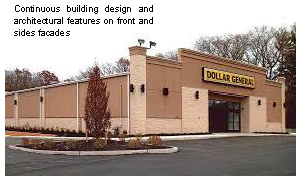
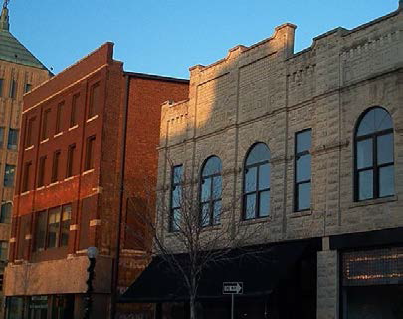
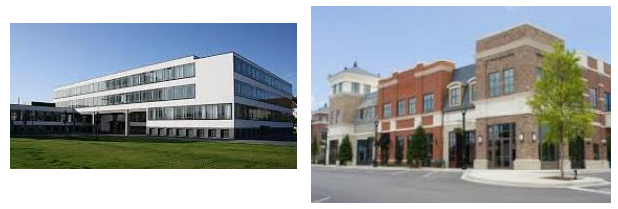
Large, monolithic, box-like structures should be avoided to the greatest extent possible. Building facades should feature a change in plane articulated by projecting or recessed bays, balconies, step-backs, banding, cornices, or similar features to minimize the visual impact of such structures.
C.
Rooftop mechanical equipment shall not be visible from the street and shall be screened from view behind parapets or otherwise integrated into the building design.
Illustrative examples of commercial building façade design standards
(Ord. No. 7-2020, § 1(Exh. A), 10-26-20)
Sec. 5.2.3.2. - Fenestration.
A.
Mirrored glass, window appliqués or similar window screening shall be prohibited.
B.
Windows shall not be blocked, boarded up, or reduced in size, unless otherwise required by code for securing a vacant structure.
(Ord. No. 7-2020, § 1(Exh. A), 10-26-20)
Sec. 5.2.3.3. - Exterior materials.
A.
Allowed exterior siding materials include, but are not limited to full-depth brick, stone, cast stone or other finished masonry, fiber cement panels, high-quality vinyl siding, EIFS, glass, wood or other natural materials, or similar material as approved by the community development director.
B.
Materials shall continue around to all sides of buildings in accordance with section 5.1.4.1(A).
(Ord. No. 7-2020, § 1(Exh. A), 10-26-20)
Sec. 5.2.4. - Site design standards.
Site design standards for commercial development focus on improving parking areas, landscaping and screening, lighting, fences and other components. Pedestrian circulation should be an integral part of the initial site layout. Landscaping should be used as screening in parking areas and can be can also be used to enhance appearance of buildings, streets, and sidewalks.
(Ord. No. 7-2020, § 1(Exh. A), 10-26-20)
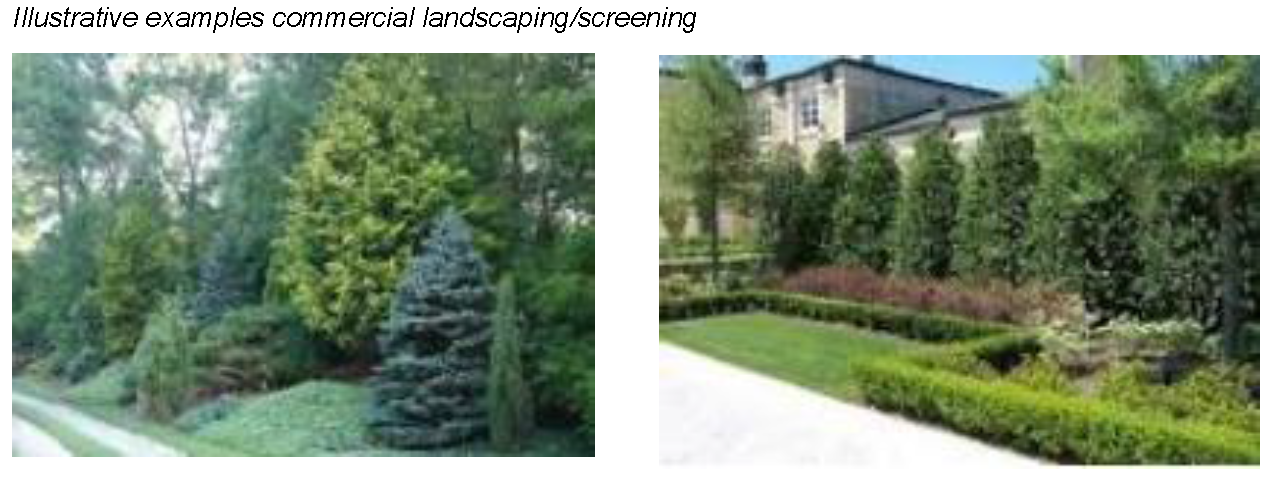
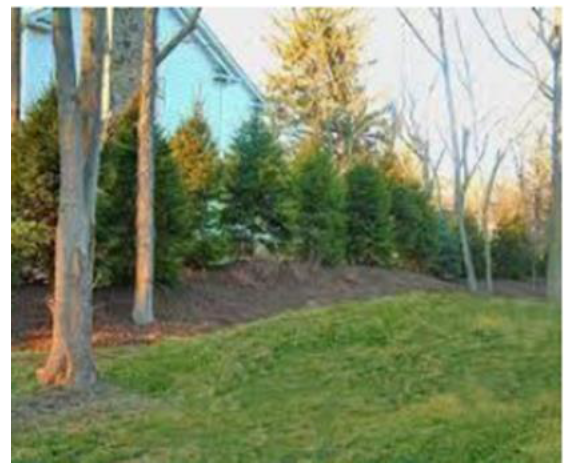
Sec. 5.2.4.1. - Landscaping and screening.
A.
Landscaping shall be used to enhance entrance drives, parking areas, and building entrances, when applicable.
B.
Landscaping shall be used in conjunction with fences and walls to screen loading docks, maintenance areas, and dumpsters areas from the public right-of-way in accordance with section 5.2.4.3, Screening enclosures.
C.
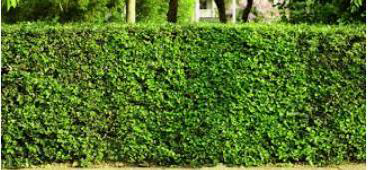
Dual frontage lots. For lots that have frontage on two or more public streets, screening is required where the rear of the building faces the road; inclusive of loading areas. Trash dumpster areas must be screened the full length of the road frontage with decorative fencing or landscaping a minimum of six feet in height.
D.
If a parking lot or parking structure is next to a sidewalk or is clearly visible from the public right-of-way, a five-foot wide landscaped buffer or a fence and a two foot wide buffer combination is recommended.
E.
The design of visual screens and landscaping along the parking lot edge should be dense enough to screen adjacent residences and public rights-of-way from headlight glare and movement of traffic generated by vehicles using the parking area.
F.
Fences, planter boxes and low walls can help screen the views of cars as well as soften the appearance of the street.
G.
Planter boxes and walls must be made of brick, masonry, textured or aggregate concrete.
H.
Chain link or wire mesh may be used only in combination with plant material of sufficient density to create a screen. The fence should be either black or green to blend with the plant materials.
I.
Solid fences, hedges, or walls along lot lines abutting the public right-of-way may not exceed three feet in height to allow visibility into the lot for security.
J.
Landscaped areas must have a properly designed irrigation system providing full coverage on all plant material areas. Impulse sprinklers, pop-up and surface spray sprinklers or other means appropriate for the areas to be irrigated may be installed as determined by the community development director.
K.
Methods for harvesting runoff water for use on site are encouraged to reduce the need for potable water for irrigation and to reduce burdens upon storm drainage systems.
L.
The property owners, their successors, heirs, and assigns are responsible for the proper maintenance of the landscaped area and parking lot subject to a landscape plan approved by the community development department.
(Ord. No. 7-2020, § 1(Exh. A), 10-26-20)
Sec. 5.2.4.2. - Lighting.
A.
Parking areas must have properly designed lighting. A qualified lighting designer or the property owner must certify that the proposed lighting will produce the minimum foot candle levels required.
B.
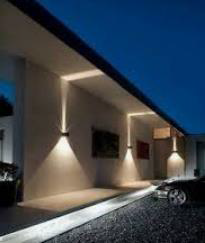
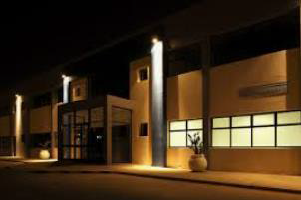
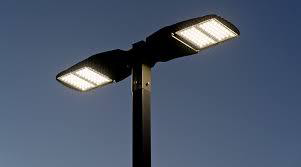
Light fixtures should be of the cut-off (down cast) type, equipped with house side guards and mounted in heights and locations to minimize off-site glare. Fixtures must be approved by the community development department.
C.
The owner is responsible to maintain light fixtures and light levels to illuminate the parking areas from dusk until midnight or one hour after the end of business hours, whichever is the later of the two.
Illustrative examples of commercial lighting standards for downcast lighting
(Ord. No. 7-2020, § 1(Exh. A), 10-26-20)
Sec. 5.2.4.3. - Screening enclosures.
A.
Loading docks, dumpsters, mechanical equipment, utility meters and similar equipment shall be located at the rear or side of buildings where they are not visible from primary commercial streets and do not interrupt the continuity of the sidewalk or building façades.
B.
Loading docks, dumpsters, mechanical equipment, and similar equipment shall be screened on all sides by opaque materials that are consistent with the architecture of the building. Screening shall meet applicable requirements of section 5.2.4.1(D).
C.
Dumpster enclosures shall be higher than the dumpster, not to exceed ten feet in height.
(Ord. No. 7-2020, § 1(Exh. A), 10-26-20)

