
Riverside City Zoning Code
CHAPTER 1107
ZONING DISTRICTS
1107.01 - General provisions.
A.
Regulation of the Use and Development of Land and Structures. These regulations are established and adopted governing the use and physical development of land and/or structures.
B.
Rules of Application. These regulations shall be interpreted and enforced according to the following rules:
1.
Identification of Uses. Listed uses are to be defined by their customary name or identification, except where they are specially defined or limited in this Ordinance.
2.
Permitted Uses. Only a use designated as a permitted use shall be allowed as a matter of right in a zoning district and any use not so designated shall be prohibited except, when in character with the zoning district, such other additional uses may be added to the permitted uses of the zoning district by an amendment to this UDO (Section 1105.07).
3.
Conditional Uses. A use designated as a conditional use shall be allowed in a zoning district when such conditional use, its location, extent and method of development will not substantially alter the character of the vicinity or unduly interfere with the use of adjacent lots in the manner prescribed for the zoning district. To this end, the BZA shall, in addition to the development standards for the zoning district, set forth such additional requirements that, in its judgment, render the conditional use compatible with the existing and future use of adjacent lots and the vicinity. Additional standards for conditional uses are listed in Section 1105.09 of the UDO.
4.
Accessory Uses. A use designated as an accessory use shall be permitted in a zoning district when such use is subordinate in area, extent, and purpose to the principal use and is located on the same lot and in the same zoning district as the principal or conditional use.
5.
Primary Use. Every parcel shall have one use designated as its primary use, which may be permitted by right or as conditionally approved by the Planning Commission. Any other primary use of such parcel shall be prohibited.
6.
Development Standards. The development standards shall be the minimum required for development in a zoning district unless otherwise stated. If the development standards are in conflict with the requirements of any other lawfully adopted rules, regulations or laws, the more restrictive or higher standard shall govern.
C.
Districts. The City of Riverside is divided into zoning districts, which shall be governed by all the use and area requirements of this Ordinance. See Official Zoning Map.
D.
Zoning of Annexed Land. When land is annexed to the City of Riverside after the effective date of this UDO, the City of Riverside shall diligently proceed following the effective date of the annexation to amend this UDO to assign a zoning district to the newly annexed land. The Riverside City Council may initiate a rezoning of land annexed to the City of Riverside or encourage the property owner to apply to rezone the land.
(Ord. 17-O-618, Passed 3-16-17)
1107.03 - Official zoning map.
A.
Official Zoning Map Adopted. All land in the municipality is placed into zoning districts as shown on the Official Zoning Map that is hereby adopted and declared to be part of the UDO.
1.
Final Authority. The Official Zoning Map, as amended from time to time, shall complement appropriate legislation so as to be the final authority for the current zoning district status of land under the jurisdiction of the UDO.
2.
Land Not Otherwise Designated. All land under the UDO and not designated or otherwise included within another zoning district map shall be included in the R-1 Single-Family Residential District.
B.
Identification of the Official Zoning District Map. The Official Zoning Map, with any amendments made thereon, shall be identified by the signatures of the Mayor and Clerk of Council under the following words:
Official Zoning District Map, Riverside, Ohio:
This is to certify that this is the Official Zoning Map referenced
by Section 1107.03 of the Unified Development Ordinance.
Adopted by the City Council, Riverside, Ohio.
C.
Establishment of Zoning Districts. The names and symbols for zoning districts displayed on the Official Zoning Map are as those stated in Section 1107.01.C. of this UDO.
D.
Legend and Use of Color or Patterns. There shall be provided on the Official Zoning Map a legend which shall list the name and symbol for each zoning district. In lieu of a symbol, a color or black and white pattern may be used on the Official Zoning Map to identify each zoning district as indicated in the map legend.
E.
Interpretation of Zoning District Boundaries. The boundaries of the zoning districts are shown upon the Official Zoning Map. The Official Zoning Map and all notations, references, and other information are a part of the UDO. A certified copy of the Official Zoning Map shall be kept on file with the City Clerk of Council.
F.
Rules for Determination. When uncertainty exists with respect to the boundaries of zoning districts as shown on the Official Zoning Map, the following rules shall apply:
1.
Along a Public Dedicated Right-of-Way. Where zoning district boundary lines are indicated as approximately following the right-of-way line of a public street, highway or alley, such right-of-way line shall be the zoning district boundary.
2.
Along any other Right-of-Way or Easement. Where zoning district boundary lines are indicated as approximately following a center line of a private street or alley, railroad easement, or other right-of-way, or a river, creek, or other watercourse, such centerline shall be the zoning district boundary.
3.
Along a Property Line. Where zoning district boundary lines are indicated as approximately following a lot line, such lot line shall be the zoning district boundary.
4.
Parallel to Right-of-Way or Property Line. Where zoning district boundary lines are indicated as approximately being parallel to a centerline or a property line, such zoning district boundary lines shall be parallel to a centerline or a property line and, in the absence of a specified dimension on the map, at such scale and distance as indicated on the Official Zoning Map.
5.
Actual Conflict with Map. When the actual street or lot layout existing on the ground is in conflict with that shown on the Official Zoning Map, the party alleging that such conflict exists shall furnish an actual survey for interpretation by the Director of the Planning and Economic Development Department (DPED).
6.
Right-of-Way Vacation. Whenever any street, alley or other public way is vacated by official action of Council, the zoning district adjoining each side of such street, alley or public way shall be automatically extended to the center of such vacation, and all area included in the vacation shall then and henceforth be subject to all appropriate regulations of the extended district or districts.
(Ord. 13-O-535, Passed 9-19-13)
1107.05 - Residential districts.
A.
Purpose. The following generally describes the purpose and general characteristics of each residential district.
B.
R-1, Low-Density Single-Family Residential District. The purpose of the R-1 District is to promote single-family dwellings in low-density residential neighborhoods.
1.
Single-Family Residential District Minimum Requirements:
2.
Permitted Principal Uses. The permitted principal uses shall be as follows:
a.
Single-family dwellings.
b.
Publicly owned and operated buildings and facilities.
c.
Public parks, playfields and community centers.
d.
Agricultural activity when located on ten or more acres.
3.
Permitted Accessory Uses. The following accessory uses shall be allowed, provided all accessory buildings and structures shall meet the standards of Section 1115.01.
a.
Accessory uses, buildings, or other structures customarily incidental to any aforesaid permitted principal use, including those specified below, provided that no accessory use shall involve the conduct of any business, trade or industry, except a home occupation as regulated in this UDO, or any private way or walk giving access to such activity.
b.
Residential Recreational Equipment as regulated in Section 1115.01.
c.
Garage sales as regulated in Section 1115.01.
d.
Residence family homes as defined in Chapter 1117.
e.
Home occupations as regulated in Section 1115.05.
f.
Parking of motor-vehicles as regulated in Section 1115.01.
g.
Private garages or carports as regulated in Section 1115.01.
h.
Radio, television, wind-powered generator or other similar dish, antennae or structure as regulated in Section 1115.03.
i.
Outdoor storage as regulated in Section 1115.01.
j.
Signs as regulated in Section 1115.09.
k.
Single-stall stable, provided it is at least 200 feet from any existing dwelling, or at least 50 feet from any lot line if no dwelling exists, on the adjacent property.
l.
Statuary, arbors, trellises, barbecue equipment, flag poles, fences, play equipment, nonmechanical laundry drying equipment, walls and hedges as regulated by this UDO.
m.
Storage structures incidental to a permitted principal use as regulated by this UDO.
n.
Swimming pool, bathhouse, tennis court, and other recreational facilities as regulated in Section 1115.01.
o.
Portable Storage Units for uses incidental to construction work, as regulated in Section 1115.01.
4.
Conditional Uses. The following conditional uses shall be allowed subject to approval in accordance with Section 1105.09.
a.
Private outdoor recreational clubs and facilities including commercial golf courses (not including driving ranges, miniature golf courses, and pitch and putt courses), swimming pools, tennis courts and playfields, and accessory uses, as regulated in Section 1115.01 of this UDO.
b.
Residence group home as defined in Chapter 1117.
c.
Places of worship.
d.
Educational institutions as defined in Chapter 1117, provided that they are located on a major thoroughfare.
e.
Nursing or Convalescent home as defined in Chapter 1117.
f.
Day Care Centers as defined in Chapter 1117.
g.
Agricultural Uses on lots larger than one and one-half acres under the following conditions:
(1)
Any structure assembled to function as an accessory to the Agricultural use shall be a minimum of 200 feet from any dwelling.
(2)
Any structure assembled to function as an accessory to the Agricultural use shall have a minimum setback of 25 feet from any lot line.
(3)
All applicable Federal, State, or Industry regulations governing the functions and activities of agricultural uses shall be valid and enforceable under the provisions of this UDO.
C.
R-2, Medium Density Single Family Residential District. The purpose of the R-2 Districts is to promote single family dwellings in medium density residential neighborhoods.
1.
Single Family Residential District Minimum Requirements.
2.
Permitted Principal Uses. The permitted principal uses shall be as follows:
a.
Single family dwellings.
b.
Publicly owned and operated buildings and facilities.
c.
Public parks, playfields and community centers.
3.
Permitted Accessory Uses. The following accessory uses shall be allowed, provided all accessory buildings and structures shall meet the standards of Section 1115.01:
a.
Accessory uses, buildings or other structures customarily incidental to any aforesaid permitted principal use, including those specified below, provided that no accessory use shall involve the conduct of any business, trade or industry, except a home occupation as regulated in this UDO, or any private way or walk giving access to such activity.
b.
Residential Recreational Equipment as regulated in Section 1115.01.
c.
Garage sales as regulated in Section 1115.01.
d.
Residence family homes as defined in Chapter 1117.
e.
Home occupations as regulated in Section 1115.05.
f.
Parking of motor vehicles as regulated in Section 1115.01.
g.
Private garages or carports as regulated in Section 1115.01.
h.
Radio, television, wind powered generator, or other similar dish, antennae or structure as regulated by Section 1115.03.
i.
Outdoor storage as regulated in Section 1115.01.
j.
Signs as regulated in Section 1115.09.
k.
Statuary, arbors, trellises, barbecue equipment, flag poles, fences, play equipment, nonmechanical laundry drying equipment, walls and hedges as regulated by this UDO.
l.
One accessory building used for incidental storage to a permitted principal use as regulated in Section 1115.01.
m.
Swimming pool, bathhouse, tennis court, and other recreational facilities as regulated in Section 1115.01.
n.
Portable Storage Units for uses incidental to construction work, as regulated in Section 1115.01.
4.
Conditional Uses. The following conditional uses shall be allowed subject to approval in accordance with Section 1105.09:
a.
Private commercial golf courses (not including driving ranges, miniature golf courses, and pitch and putt courses), swimming pools, tennis courts, and playfields, and accessory uses, as regulated in Section 1115.01 of this UDO.
b.
Residence group home as defined in Chapter 1117.
c.
Places of worship.
d.
Educational institutions as defined in Chapter 1117, provided that they are located on a major thoroughfare.
e.
Nursing or Convalescent home as defined in Chapter 1117.
f.
Day Care Centers as defined in Chapter 1117.
D.
R-3, Medium-Density Residential District. The purpose of the R-3 District is to promote single family and Multi-Family dwellings in medium density residential neighborhoods.
1.
Residential District Minimum Requirements.
2.
Permitted Principal Uses. The permitted principal uses shall be as follows:
a.
Single family dwellings.
b.
Two family dwellings.
c.
Publicly owned and operated buildings and facilities.
d.
Public parks, playfields and community centers.
3.
Permitted Accessory Uses. The following accessory uses shall be allowed, provided all accessory buildings and structures shall meet the standards of Section 1115.01.
a.
Accessory uses, buildings, or other structures customarily incidental to any aforesaid permitted principal use, including those specified below, provided that no accessory use shall involve the conduct of any business, trade, or industry, except a home occupation as regulated in this UDO, or any private way or walk giving access to such activity.
b.
Garage sales as regulated in Section 1115.01.
c.
Residence family homes as defined in Chapter 1117.
d.
Home occupations as regulated in Section 1115.05
e.
Motor Vehicle parking as regulated in Section 1115.01.
f.
Private garages or carports as regulated in Section 1115.01.
g.
Radio, television, wind powered generator, or other similar dish, antennae, or structure as regulated in Section 1115.03.
h.
Outside Storage as regulated in Section 1115.01.
i.
Signs as regulated in Section 1115.09.
j.
Statuary, arbors, trellises, barbecue equipment, flag poles, fences, play equipment, nonmechanical laundry drying equipment, walls and hedges as regulated by this UDO.
k.
Storage structures incidental to a permitted principal use as regulated by this UDO.
l.
Swimming pool, bathhouse, tennis court and other recreational facilities as regulated in Section 1115.01.
m.
Portable Storage Units for uses incidental to construction work, as regulated in Section 1115.01.
4.
Conditional Uses. The following conditional uses shall be allowed subject to approval in accordance with Section 1105.09.
a.
Private commercial golf courses (not including driving ranges, miniature golf courses, and pitch and putt courses), swimming pools, tennis courts and playfields, and accessory uses, as regulated in Section 1115.01 of this UDO.
b.
Residence group home as defined in Chapter 1117.
c.
Places of worship.
d.
Educational institutions as defined in Chapter 1117, provided that they are located on a major thoroughfare.
e.
Nursing or Convalescent home as defined in Chapter 1117.
f.
Day Care Centers as defined in Chapter 1117.
E.
R-4, Multi-Family Residential District: The purpose of the R-4 District is to provide for multi family dwelling units.
1.
Multi Family Residential District Minimum Requirements.
* Landscape Bufferyard required as regulated in Section 1113.07.
2.
Permitted Principal Uses. The permitted principal uses shall be as follows:
a.
Multi family dwellings.
3.
Permitted Accessory Uses. The permitted accessory uses shall be as follows:
a.
Coin operated laundry, laundry and dry cleaning pick up stations for use of tenants only.
b.
Retail uses 6,000 square feet or less.
c.
Off street parking as regulated in Section 1113.11.
d.
Signs as regulated in Section 1115.09.
e.
Other accessory uses, buildings or structures customarily incidental to the aforesaid use.
4.
Conditional Uses. The following conditional uses shall be allowed subject to approval in accordance with Section 1105.09.
a.
Mobile Home Parks.
(1)
Mobile homes (house trailers).
(2)
Manufactured Housing and Urban Development (HUD) units.
5.
Development Standards. In addition to other applicable provisions of this UDO, the following standards for arrangement and development of land and building are required in the R-4 Multi Family Residential District.
a.
All mobile home parks shall conform to Ohio R.C. 3733.02.
6.
Modifications to Existing Mobile Home Parks. No enlargements or extensions to any mobile home park shall be permitted unless the enlargement or extension is made to conform to all the requirements of this UDO.
F.
O-R, Office/Residential District. The purpose of this district is to provide for the location of professional, medical and institutional facilities to act as a buffer between residential and business districts or between major thoroughfares and residential districts as an effort to reduce the external negative impacts created by intensive uses on low intensity uses.
1.
Office/Residential District Minimum Requirements.
* Landscape Buffer yard required as regulated in Section 1113.07.
2.
Permitted Principal Uses. The permitted principal uses shall be as follows:
a.
Single-family dwellings.
b.
Day care center.
c.
Medical clinic.
d.
Office.
3.
Permitted Accessory Uses. The permitted accessory uses shall be as follows:
a.
Accessory buildings shall conform to all lot and setback regulations for principal buildings
b.
Off-street parking as regulated in Section 1113.11.
c.
Signs as regulated in Section 1115.09.
d.
Other accessory uses buildings or structures customarily incidental to the aforesaid use.
4.
Conditional Uses. The following conditional uses shall be allowed subject to approval in accordance with Section 1105.09.
a.
Places of Worship.
5.
Required Conditions. No CZC shall be issued for a use within the "O-R" Office Residential District until the applicant shall have certified to the PEDD that:
a.
Such buildings shall front onto a collector or arterial street with a right-of-way of 60 feet or more as established on the Official Thoroughfare Plan for Riverside.
b.
An office use shall be conducted principally in daylight hours and shall not create a nuisance from noise, smoke or odor.
(Ord. 13-O-535, Passed 9-19-13; Ord. 17-O-618, Passed 3-16-17)
1107.07 - Campus/institutional district.
A.
Purpose. The C-I, Campus/Institutional District provides for the location of facilities for institutional, governmental, and academic services in suitable locations in which they can support community needs and serve traditional areas between residential and business districts or between major thoroughfares and residential districts.
1.
Campus/Institutional District Minimum Requirements.
* Landscape Bufferyard required as regulated in Section 1113.07.
2.
Permitted Principal Uses. The permitted principal uses shall be as follows:
a.
Schools.
b.
Day Care Center.
c.
Public parks, playfields and community centers.
d.
Medical Clinic.
e.
Veterinary Office.
f.
Government Facilities.
g.
Hospitals.
3.
Permitted Accessory Uses. The permitted accessory uses shall be as follows:
a.
Accessory buildings shall conform to all lot and setback regulations for principal buildings.
b.
Off-street parking as regulated in Section 1113.11.
c.
Signs as regulated in Section 1115.09.
d.
Other accessory uses, buildings or structures customarily incidental to the aforesaid use.
(Ord. 18-O-667, Passed 9-20-18)
1107.09 - Business districts.
A.
Purpose. The following generally describes the purpose and general characteristics of each commercial district:
B.
B-1, Neighborhood Business District. This district provides for the location of small scale retail sales establishments, offices, and facilities for financial, institutional, governmental, and personal services, and recreational establishments in suitable locations where they can quietly and unobtrusively meet the everyday needs of the nearby residential neighborhoods.
1.
B-1, Neighborhood Business District Minimum Requirements.
* Landscape Buffer yard required as regulated in Section 1113.07.
2.
Permitted Principal Uses. The permitted principal uses shall be as follows:
a.
Bakery.
b.
Bank.
c.
Barber Shop.
d.
Book Store.
e.
Bowling Alley.
f.
Coffee Shop.
g.
Convenience Store.
h.
Corporate Data Center.
i.
Department Store.
j.
Dry Cleaning.
k.
Florist.
l.
General Merchandise Store.
m.
Grocery Store.
n.
Hardware Store.
o.
Hobby Store.
p.
Laundromat.
q.
Library.
r.
Medical Clinic (for example: physicians, dentists and urgent care offices).
s.
Office.
t.
Office Business Services.
u.
Pharmacy.
v.
Printing Service.
w.
Research and Development Office.
x.
Restaurants.
y.
Retail sales and services generally not otherwise enumerated.
z.
Shopping Center.
3.
Permitted Accessory Uses. The permitted accessory uses shall be as follows:
a.
Accessory uses, buildings or other structures customarily incidental to any of the foregoing permitted uses.
b.
Off street loading as regulated in Section 1113.11.
c.
Off street parking and waiting spaces as regulated in Section 1113.11.
d.
Signs as regulated in Section 1115.09.
e.
Portable Storage Units for uses incidental to construction work, as regulated in Section 1115.01.
4.
Conditional Uses. The following conditional uses shall be allowed subject to approval in accordance with Section 1105.09.
a.
Gasoline Station.
b.
Places of Worship.
c.
Live/work space as defined and outlined in Section 1115.17.
5.
Required Conditions. No CZC shall be issued for a use within the "B-1" Business District until the applicant shall have certified to the PPMD that:
a.
The business activity will be conducted wholly within a completely enclosed building, except for automobile self-service gas station/mini markets.
b.
The business establishment shall not offer goods, service, food, beverages or make sales directly to customers in automobiles, except for drive thru windows for pick up or delivery and which will be provided with adequate driveway space on the premises for waiting vehicles.
c.
All business shall be of retail or service character.
d.
No manufacturing, processing, packaging, repair or treatment of goods shall be carried on, except when incidental or accessory to the performance of services or the sale of goods to the public on the premises.
e.
Exterior lighting shall be shaded wherever necessary to avoid casting direct light upon any property located in a residential zoning district or upon any public street as regulated in Section 1113.09.
f.
All premises shall be furnished with all-weather hard surface walks of a material such as bituminous or Portland cement concrete, wood, tile, terrazzo or similar material, and, except for parking areas, the grounds shall be planted and landscaped.
g.
No noise from any operation conducted on the premises, either continuous or intermittent, as regulated in Section 1115.11.
h.
No emission of toxic or noxious matter, which is injurious to human health, comfort or enjoyment of life and property or to animal or plant life shall be permitted. Where such emissions could be produced as a result of accident or equipment malfunction, adequate safeguards considered suitable for safe operation in the business involved shall be taken as regulated in Section 1115.11.
i.
The emission of smoke or other air pollutants shall not violate the standards and regulations of this UDO or of the Montgomery County Combined General Health District. Dust and other types of air pollution borne by the wind shall be kept to a minimum by appropriate landscaping, paving, or other acceptable means.
j.
No person, firm or corporation (including food services) shall emit odors or odor causing substances which can be detected without the use of instruments at or beyond the lot lines, as regulated in Section 1115.11.
k.
No person, firm or corporation shall cause vibrations which can be detected without the use of instruments at or beyond the lot lines, as regulated in Section 1115.11.
l.
Failure to comply with any of the required conditions set forth in this subsection by property owners or users shall be considered a zoning violation appropriate for prosecution under the terms of this UDO.
C.
B-2, General Business District. The intent of the General Business District is to provide an appropriate location for retail, office, service and administrative establishments required to satisfy the needs of the overall community. This district is also intended to provide accommodations, supplies, sales and services to the motoring public.
1.
B-2, General Business District Minimum Requirements.
* Landscape Buffer yard required as regulated in Section 1113.07.
2.
Permitted Principal Uses. The permitted principal uses shall be as follows:
a.
Any commercial activity, such as those enumerated below as examples, which fulfills all the requirements of this section and is not listed initially as a permitted use in any industrial zoning district.
(1)
Any use permitted in Section 1107.09.B.2. subject to the conditions of Section 1107.09.B.2.
(2)
Agricultural implement sales.
(3)
Banquet hall.
(4)
Car wash facility.
(5)
Commercial entertainment and recreation.
(6)
Gasoline station.
(7)
Hay, grain and feed stores.
(8)
Plant nursery.
(9)
Restaurant.
(10)
Theater.
(11)
Veterinarian office.
(12)
Wholesale sales.
(13)
Tire and lube service.
3.
Permitted Accessory Uses. The permitted accessory uses shall be as follows:
a.
Accessory uses, buildings or other structures customarily incidental to any of the aforesaid permitted principal uses.
b.
Off street loading as regulated in Section 1113.11.
c.
Off street parking and waiting spaces as regulated in Section 1113.11.
d.
Signs as regulated in Section 1115.09.
e.
Portable Storage Units for uses incidental to construction work which shall be removed upon the completion or abandonment of the construction work.
4.
Conditional Uses. The following conditional uses shall be allowed subject to approval in accordance with Section 1105.09.
a.
Animal hospitals, kennels or pounds, provided the kennel structure and runs are located a minimum of 50 feet from any residential zoning district.
b.
Automobile and motorcycle sales, rental, and service.
c.
Recreational vehicle sales, rental, and service.
d.
Sales of an industrial nature.
e.
Agricultural implement service.
f.
Heliports or helistops, provided any landing area is at least 1,000 feet from any lot within a residential district.
g.
Mobile home sales, rental and service.
h.
Outdoor recreational activities.
i.
Places of worship.
j.
Recycling trailer stations.
k.
Seasonal sales of farm produce.
l.
Live/work space as defined and outlined in Section 1115.17.
5.
Required Conditions. No CZC shall be issued for a use within the "B-2" Business District until the applicant shall have certified to PPMD that:
a.
Drive thru windows for pick up or delivery shall be located on and accessible only from the premises and shall be provided with adequate driveway space for waiting vehicles.
b.
All business shall be of retail, service or recreational character.
c.
No manufacturing, processing, packaging, repair or treatment of goods shall be carried on, except when incidental or accessory to the performance of services or the sale of goods to the public on the premises.
d.
Exterior lighting shall be shaded wherever necessary to avoid casting direct light upon any property located in a residential district or upon any public street as regulated in Section 1113.09.
e.
All areas used for outdoor display of motor vehicles, farming equipment, recreational equipment, mobile homes and similar merchandise shall be furnished with an all-weather hard surface of a material such as bituminous or Portland cement concrete.
f.
All premises shall be furnished with all-weather hard surface walks of a material such as bituminous or Portland cement concrete, wood, tile, terrazzo or similar material, and, except for parking areas, the grounds shall be planted and landscaped.
g.
No noise from any operation conducted on the premises, either continuous or intermittent, shall violate the provisions of this UDO as regulated in Section 1115.11.
h.
No emission of toxic or noxious matter, which is injurious to human health, comfort or enjoyment of life and property or to animal or plant life shall be permitted. Where such emissions could be produced as a result of accident or equipment malfunction, adequate safeguards considered suitable for safe operation in the business involved shall be taken as regulated in Section 1115.11.
i.
The emission of smoke or other air pollutants shall not violate the standards and regulations of the Montgomery County Combined General Health District. Dust and other types of air pollution borne by the wind shall be kept to a minimum by appropriate landscaping, paving, or other acceptable means.
j.
No person, firm or corporation shall emit odors or odor causing substances which can be detected without the use of instruments at or beyond the lot lines as regulated in Section 1115.11.
k.
No person, firm or corporation shall cause vibrations which can be detected without the use of instruments at or beyond the lot lines as regulated in Section 1115.11.
l.
Failure to comply with any of the required conditions set forth in this section by property owners or users shall be considered a zoning violation appropriate for prosecution under the terms of this UDO.
(Ord. 18-O-667, Passed 9-20-18; Ord. No. 18-O-678, § 2(Exh. B), 5-16-19)
1107.11 - Light industrial district.
A.
Purpose. The I-1, Light Industrial District has been established to provide for industrial uses having a minimum impact upon the surrounding environment in areas that are suitable for industrial development by reason of location and the availability of adequate utility and transportation systems. Industrial uses are permitted that can be operated in a clean and quiet manner subject to those regulations and performance standards necessary to prohibit congestion and for the protection of adjacent residential and business property. It is intended that the development permitted in this district will create a high quality industrial environment.
B.
I-1, Light Industrial District.
1.
Industrial District Minimum Requirements.
* Landscape Bufferyard required as regulated in Section 1113.07
2.
Permitted Principal Uses. The permitted principal uses shall be as follows:
a.
The manufacturing, compounding, assembling or treatment (or any combination of such processes) of articles or products from the following substances: bone, canvas, cellophane, clay, cloth, cork, elastomers, feathers, felt, fiber, fur, glass, hair, horn, leather, paper, plastics, rubber, precious or semiprecious stone or metal, sheet metal, shell, textiles, tobacco, wax, wire, and wood, but not including as a principal operation, the manufacturing of such substances.
b.
Any industrial activity, such as those enumerated below as examples:
(1)
Automobile and motorcycle sales, rental, and repair.
(2)
Semi-truck sales, rental, and repair.
(3)
Recreational vehicles sales, rental, and repair.
(4)
Car wash.
(5)
Light manufacturing.
(6)
Machine shop.
(7)
Research and development lab.
(8)
Retail of industrial character.
(9)
Science research facility.
(10)
Storage.
(11)
Truck terminal.
(12)
Utility distribution facility.
(13)
Warehouse.
(14)
Wholesale plant nursery.
(15)
Agricultural implement sales and service.
3.
Permitted Accessory Uses. The permitted accessory uses shall be as follows:
a.
Accessory uses, buildings or other structures customarily incidental to any aforesaid permitted principal use.
b.
Off street loading as regulated in Section 1113.11.
c.
Off street parking and waiting spaces as regulated in Section 1113.11.
d.
Signs as regulated in Section 1115.09.
e.
Portable Storage Units for uses incidental to construction work which buildings shall be removed upon the completion or abandonment of the construction work.
4.
Conditional Uses. The following conditional uses shall be allowed subject to approval in accordance with Section 1105.09.
a.
Bulk storage of corrosive acids and acid derivatives and bulk storage stations for liquid fuels, petroleum products, petroleum and volatile oils, in accordance with subsection B.5. hereof.
b.
Earth disturbing activity.
c.
Heliports and helistops, provided any landing area is at least 1,000 feet from any lot within a residential district.
d.
Adult entertainment facilities in accordance with Section 1115.07.
e.
Live/work space as defined and outlined in Section 1115.17.
5.
Required Conditions. No zoning permit shall be issued for a use within the "I-1" Light Industrial District until the applicant shall have certified to the PPMD that:
a.
No noise from any operation conducted on the premises, either continuous or intermittent, shall violate the provisions of this UDO as regulated in Section 1115.11.
b.
No emission of toxic or noxious matter, which is injurious to human health, comfort or enjoyment of life and property or to animals or plant life shall be permitted. Where such emissions could be produced as a result of accident or equipment malfunction, adequate safeguards considered suitable for safe operation in the industry involved shall be taken as regulated in Section 1115.11.
c.
The emission of smoke or other air pollutants shall not violate the standards and regulations of this UDO or of the Montgomery County Combined General Health District. Dust and other types of air pollution borne by the wind shall be kept to a minimum by appropriate landscaping, paving, oiling, or other acceptable means.
d.
The emission of odors or odor causing substances shall not violate the standards and regulations of this UDO or the Montgomery County Combined General Health District.
e.
There will be no vibrations which can be detected without the use of instruments at or beyond the lot lines as regulated in Section 1115.11.
f.
Any operation that produces intense glare or heat shall be performed within a completely enclosed building or structure and exposed sources of light shall be screened so as not to be detectable at the lot line as regulated in Section 1115.11.
g.
Exterior lighting shall be shaded wherever necessary to avoid casting direct light upon property located in any residential zoning district or upon any public street as regulated in Section 1113.09.
h.
No building or structure shall be used for residential purposes except that a watchman or custodian may reside on the premises.
i.
All premises shall be furnished with all-weather hard surface walks of a material such as bituminous or Portland cement concrete, wood, tile, terrazzo, or similar material and, except for parking areas, the grounds shall be planted and landscaped.
j.
The storage, utilization and manufacture of solid, liquid and gaseous chemicals and other materials shall be permitted subject to the following conditions:
(1)
The storage, utilization or manufacture of solid materials or products ranging from free or active burning to intense burning is permitted, but only if said material or products are stored, utilized or manufactured within completely enclosed buildings having incombustible exterior walls and protected throughout by an automatic fire extinguishing system.
(2)
All activities involving the use and/or storage disposal of flammable liquids or materials which produce flammable or explosive vapors or gases shall be provided with adequate safety and protective devices against hazards of fire and explosion, as well as with adequate firefighting and suppression equipment and devices standard to the industry involved. All above ground storage shall be in enclosed fireproof vaults.
(3)
The storage, utilization or manufacture of pyrophoric and explosive powders and dusts, and of materials and products which decompose by detonation is prohibited.
(4)
The manufacture of flammable liquids or materials which produce flammable or explosive vapors or gases is prohibited.
(5)
The storage and utilization of flammable liquids, or of materials that produce flammable or explosive vapors or gases shall be permitted on any lot in strict conformance with the applicable regulations set forth in the "Ohio Rules and Regulations of the Division of the State Fire Marshal for the manufacture, storage, handling, sale and transportation of flammable and combustible liquids."
k.
The handling of radioactive materials, the discharge of such materials into air and water and the disposal of radioactive wastes shall be in strict conformance with:
(1)
The applicable regulations of the Energy Research and Development Administration.
(2)
The applicable regulations of any instrumentality of the State of Ohio.
l.
Material or merchandise stored or stockpiled in unsheltered storage bins or outside storage piles or pits shall not exceed a height limit of 20 feet above normal ground level at that point and said storage area shall not be located closer than 50 feet from any property zoned for residential purposes.
m.
All areas used for outdoor display shall be furnished with an all-weather hard surface of a material such as bituminous or Portland cement concrete.
n.
Failure to comply with any of the required conditions set forth in this section by property owners or users will be considered a zoning violation appropriate for prosecution under the terms of this UDO.
(Ord. 17-O-618, Passed 3-16-17; Ord. No. 18-O-678, § 2(Exh. B), 5-16-19)
1107.13 - Overlay districts (mandatory).
A.
Floodplain District. It is the purpose of this Ordinance section to promote the public health, safety and general welfare and to minimize public and private losses due to flood conditions in specific areas by provisions designed to:
1.
Protect human life and health.
2.
Minimize expenditure of public money for costly flood control projects.
3.
Minimize the need for rescue and relief efforts associated with flooding.
4.
Minimize prolonged business interruptions.
5.
Minimize damage to public facilities and utilities such as water and gas mains, electric, telephone and sewer lines, streets and bridges located in areas of special flood hazard.
6.
Help maintain a stable tax base by providing for the proper use and development of areas of special flood hazard so as to minimize future flood blight areas.
7.
Ensure that those who occupy the areas of special flood hazard assume responsibility for their actions.
8.
The Floodplain Overlay District is subject to the provisions of Section 1111.09.
B.
Well Field Protection (WP) Overlay District.
1.
The Well Field Protection Overlay District is subject to the provisions of Section 1109.05.
(Ord. 13-O-535, Passed 9-19-13; Ord. No. 18-O-678, § 2(Exh. B), 5-16-19)
1107.15 - Business overlay districts (optional).
A.
Purpose. This chapter applies to all development in the Heavy Commerce District. The purpose of the districts is to:
1.
Allow a mixture of complementary land uses that includes retail, offices, commercial services, and industrial, to create economic and social vitality and to encourage the linking of trips;
2.
Develop commercial and mixed-use areas that are safe, comfortable and attractive to pedestrians;
3.
Provide flexibility in the placement and design of new developments and redevelopment to anticipate changes in the marketplace;
4.
Reinforce streets as public places that encourage pedestrian and bicycle travel;
5.
Provide roadway and pedestrian connections to residential areas;
6.
Provide transitions between high traffic streets and neighborhoods;
7.
Encourage efficient land use by facilitating compact development and minimizing the amount of land that is needed for surface parking;
8.
Facilitate development (land use mix, density and design) that supports public transit, where applicable;
9.
Provide appropriate locations and design standards for automobile- and truck-dependent uses; and
10.
Maintain mobility along traffic corridors and state highways.
B.
Applicability and Location.
1.
Overlay zoning districts are established through rezoning and only in conjunction with base zoning districts. Letters, numbers, or a combination thereof, shall be combined with other applicable district designations to the property(ies) on which an overlay district is established.
2.
Except as modified by the overlay zoning district, the provisions of the applicable base-zoning district shall apply to all development within the boundary of the designated area. If regulations conflict, the applicable overly zoning district regulations shall prevail.
3.
Whenever an overlay district is established, any subsequent application to change the base-zoning district shall not be construed to be an application to eliminate the overlay district for the property covered by the application. Intent to eliminate the overlay district on a given property shall be expressly stated to be part of the application.
4.
The following section describes where and under what circumstances Heavy Commerce District apply. It also provides location criteria for Zoning District Map changes.
C.
HC, Heavy Commerce. This district is established to provide for large business or light industrial parks and institutional campuses which, because of the scale of the buildings or the nature of the use, cannot be fully integrated into the fabric of the community. The predominant use is that of the workplace. The heavy commerce district is buffered from neighboring properties. Buildings in the Heavy Commerce District that front a street shall relate to the street as prescribed by building type. Heavy Commerce Districts shall be located on arterial streets. Principal access shall be provided by arterial streets.
1.
Permitted Use Ratio. The following uses shall not exceed following percentage of total area use
a.
Uses allowed in Section 1107.09.C.2. of this UDO shall make up at least 60 percent of uses in this overlay district.
b.
Uses allowed in Section 1107.11.B.2. of this UDO shall make up no more than 40 percent of uses in this overlay district.
(Ord. 13-O-535, Passed 9-19-13)
1107.17 - Residential overlay districts (optional).
A.
Purpose. This chapter applies to all development in the Neighborhood Transitional District. The purpose of the districts is to:
1.
Allow a mixture of complementary land uses that includes housing, retail, offices, commercial services, and civic uses, to create economic and social vitality and to encourage the linking of trips.
B.
Applicability and Location.
1.
Overlay zoning districts are established through rezoning and only in conjunction with base zoning districts. Letters, numbers, or a combination thereof, shall be combined with other applicable district designations to the property(ies) on which an overlay district is established.
2.
Except as modified by the overlay zoning district, the provisions of the applicable base-zoning district shall apply to all development within the boundary of the designated area. If regulations conflict, the applicable overly zoning district regulations shall prevail.
C.
NT, Neighborhood Transitional. This district is provided for the development of new neighborhoods and the revitalization or extension of existing neighborhoods, which are structured upon a fine network of interconnecting pedestrian oriented streets and other public spaces. They offer a mixture of housing types and prices, prominently sited civic or community building(s), and stores/ offices/ workplaces to provide a balanced mix of activities. Civic uses are encouraged. It has a recognizable center and clearly defined edges; optimum size is a quarter mile from center to edge. It is urban in form, is an extension of the existing developed area of the town, and complies with density measures of the underlying residential district. Minimum parcel size: Ten acres.
1.
Permitted Use Ratio. The following uses shall not exceed following percentage of total area use
a.
Uses allowed in Section 1107.05.D. of this UDO shall make up at least 60 percent of uses in this overlay district.
b.
Uses allowed in Section 1107.09.B.1. of this UDO shall make up no more than 40 percent of uses in this overlay district.
(Ord. 13-O-535, Passed 9-19-13)
1107.19 - Urban core zoning district.
A.
Preamble.
1.
The Urban Core District has been established to provide for high-density, mixed-use developments, which will serve as centers for the City of Riverside.
2.
The purpose of the Urban Core District is to assist the development and redevelopment of land uses in order to achieve high efficiency, function, and compatibility with the character of the District; to protect private property and investment; to provide for flexibility in land use controls; and to provide for a high quality built environment in the City of Riverside.
3.
All renderings and drawings depicted in this chapter are for illustrative purposes only and shall not constitute any requirements of this chapter.
B.
Definitions.
1.
For the purpose of this section the following definitions shall apply:
a.
Big Box Retail. Commercial use conducted entirely within a single story building containing a gross floor area of 10,000 square feet or more.
b.
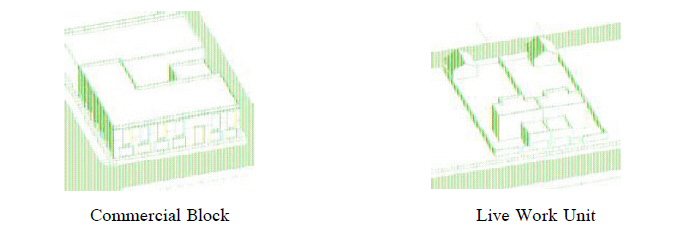
Commercial Block. A building designed for occupancy by retail, service, and/or office use on the ground floor, with upper floors also configured for those uses or for residences.
c.
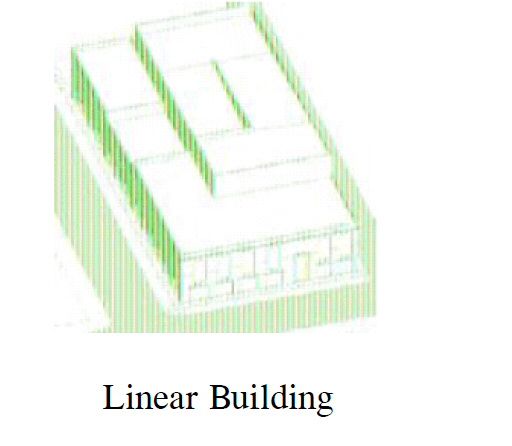
Linear Building. A building that conceals a larger building, such as a public garage, that is designed for occupancy by retail, service, and/or office uses on the ground floor, with upper floor also configured for those uses or for residences.
d.
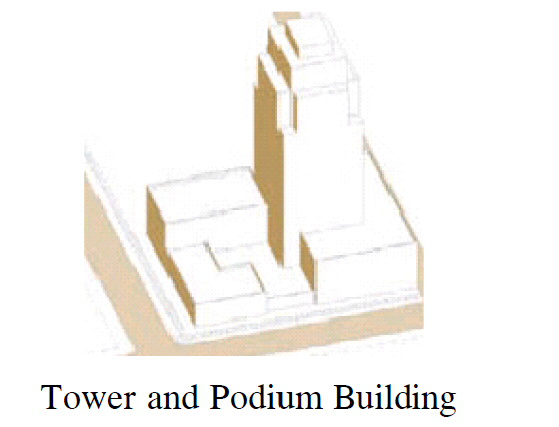
Podium Building. A building defined by the condition that its principle residential, office, or service level is raised one level above ground. The ground level is typically occupied by parking or commercial uses.
e.
Tower Building. A multi-level building organized around a central core with the first two floors expressed as a podium building.
f.
Live/Work Building. An integrated residence and working space, occupied and utilized by a single household in a single family or multifamily structure that has been designed or structurally modified to accommodate joint residential occupancy and work activity. The working space shall be limited to the ground level of the structure.
g.
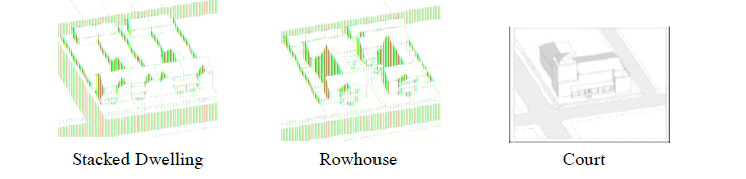
Row House. An individual structure occupied by one primary residence or a structure of multiple townhouse unit types arrayed side by side.
h.
Court. Courts are an architectural type consisting of residences that can be arranged in three possible configurations: townhouses, townhouses over apartments, and apartments over apartments. These are arrayed next to each other, on one or more lots to form a shared type that is partly or wholly open to the street.
i.
Stacked Dwelling. A multi-story building in which dwellings are stacked vertically as well as attached horizontally.
j.
Commercial Uses. The transaction of general business including professional, service, governmental occupation, and sale of merchandise and food services directly to the consumer. Commercial Uses shall not include adult entertainment uses as defined in this UDO. Adult entertainment uses are expressly prohibited in this district.
k.
Residential Uses. Those uses permitted in Section 1107.05.
l.
Blade Sign. A non-fabric sign which hangs perpendicular to the building.
m.
Blade Banner. A sign made of fabric or similar non-rigid material which hangs perpendicular to the building.
n.
Plaque. A sign installed on the base of building.
o.
Cornice Sign. A sign installed on the roof or cornice line of a building.
p.
Sign Board. A sign whose letters are installed on a board which is attached to the façade of a building.
q.
Sign Band. A sign whose individual letters are installed on a band which is attached to the façade of a building.
r.
Awning Sign. A sign whose individual letters are attached to the fabric of an awning.
s.
Transom Sign. A sign whose individual letters are attached to the transom over the entrance to a building.
t.
Window Sign. A sign whose individual letters are attached to the window or hangs in a window which is visible to the public right-of-way.
C.
Permitted Principal Uses.
1.
The following are permitted as principal uses within the Urban Core District:
a.
Commercial uses conducted entirely within the following building forms:
(1)
First floor of live/work units;
(2)
Commercial blocks;
(3)
Podium buildings; and
(4)
Linear buildings.
b.
Residential uses in the following building forms:
(1)
Row houses;
(2)
Courts;
(3)
Stacked Dwellings;
(4)
Located in floors above the first floor in commercial blocks;
(5)
Located in floors above the first floor in podium buildings; and
(6)
Located in floors above the first floor in linear buildings.
D.
Permitted Accessory Uses.
1.
The following are permitted as accessory uses within the Urban Core District:
a.
Accessory uses, buildings, or other structures, customarily incidental to any of the aforesaid permitted uses;
b.
Off-street loading as regulated in Section 1113.11;
c.
Off-street parking and waiting spaces as regulated in Section 1113.11;
d.
On-street valet, taxi drop-off, and pedestrian pickup stands;
e.
Outdoor dining areas;
f.
Signs as regulated in Section 1115.09;
g.
Outdoor sales of vegetables, floral, and other produce; all other outdoor rental, sale, and storage of goods and materials shall be prohibited;
h.
The parking of vehicles used in the operation of the principal permitted uses. Such Parking shall conform to the requirements of subsection H. of this section; and
i.
Portable Storage Units for uses incidental to construction work, as regulated in Section 1115.01.
E.
Conditional Uses.
1.
The following are permitted as conditional uses within the Urban Core District:
a.
Commercial uses conducted entirely within tower buildings;
b.
Commercial uses with drive through facilities;
c.
Commercial uses conducted entirely within a big box retail building;
d.
Theaters;
e.
Parking garages; and
f.
Residential uses within tower buildings.
F.
Standards for Conditional Uses.
1.
Big Box Retail shall conform to one of the following:
a.
Big Box Retail shall be screened by a linear building constructed along 80 percent of the front facade;
b.
Big Box Retail shall be setback a minimum of 100 feet and shall be screened by a Commercial Block, Linear Building, Court, or Row House constructed along 80 percent of the property line abutting a public right-of-way; or
c.
Big Box Retail shall be designed as follows:
(1)
A minimum of two distinguishable stories in height;
(2)
A minimum of 75 percent of the street-facing, ground level façade shall be windows or fixed glass. The glass area shall be designed to make the uses inside easily discernible to passers-by. Reflective or highly tinted glass and faux windows are prohibited;
(3)
The street-facing façade on the upper stories shall be articulated with windows, projections, recesses, changes of floor levels, moldings, cornices, or other architectural features;
(4)
At least one pedestrian entrance shall front on the public right-of-way.
2.
Tower Buildings shall conform to the following:
a.
Buildings shall be composed of bases of podium buildings and towers;
b.
Podium buildings bases shall be two to five stories in height;
c.
Entrance to the building shall be through a street level lobby; and
d.
Tower buildings should be articulated with a discernable base, shaft, and capital. The capital should be distinguished by a non-flat roof such, as a dome or peaked roof, to add visual interest to the building.
3.
Theaters shall conform to one of the following:
a.
Theaters shall be screened by a linear building constructed along 80 percent of the façade abutting a public right-of-way; or
b.
Theaters shall be setback a minimum of 100 feet and shall be screened by a Commercial Block, Linear Building, Court, or Row House constructed along 80 percent of the property line abutting a public right-of-way.
c.
Theaters shall be designed according to the architectural requirements of Section 1165.11 in addition to the following:
(1)
Marquee towers, canopies, or ornaments shall extend over the roofline by no more than one-half the height of the structure.
(2)
No more than 50 percent of the building may be unarticulated blank wall.
(3)
The use of decorative materials such as stucco, tile, and ornamentation to break up the massing of the building is encouraged.
(4)
At least one pedestrian entrance shall front on the public right-of-way.
4.
Parking garages shall conform to one of the following:
a.
Parking Garages shall be screened by a linear building constructed along 80 percent of the façade abutting a public right-of-way;
b.
Parking Garages shall have 80 percent of the ground floor dedicated to commercial uses; or
c.
Garages shall conform to the architectural standards provided in subsection K. of this section.
5.
Commercial uses with drive through facilities:
a.
All driveway entrances, including stacking lane entrances, must be at least 50 feet from an intersection. The distance is measured along the property line from the junction of the two street lot lines to the nearest edge of the entrance.
b.
A minimum of 120 feet for a single stacking lane or 60 feet per lane when there is more than one stacking lane is required for all drive-through facilities. A stacking lane is measured from the curb cut to the service area. Stacking lanes do not have to be linear.
c.
Stacking lanes shall be designed so that they do not interfere with parking or vehicular circulation.
d.
Stacking lanes must be clearly identified, through the means such as striping, landscaping, and signs. Pedestrian walkways should not intersect with drive aisles if possible. If such intersections are necessary, they shall have clear visibility and be emphasized by differentiated paving or striping.
e.
Drive through facilities shall be located towards the rear or side of the building.
f.
Menu boards shall be a maximum of 32 square feet, with a maximum height of eight feet above ground level.
g.
Awnings and drive through canopies shall be architecturally integrated with the overall design of the principal structure.
G.
Building Development Standards.
1.
All buildings are encouraged to be placed at or very close to the street right-of-way line with their facades running parallel with the street.
2.
In addition to other applicable provisions of this Zoning Ordinance, the following standards for arrangement and development of land and buildings shall conform to the requirements set forth in Table 1107.19.
H.
Parking Standards.
1.
Parking shall comply with the requirements of Section 1113.11, except as modified below, but in no case shall the parking exceed 130 percent of the minimum parking standard.
2.
The minimum number of parking spaces shall be the following:
a.
Two and one-half spaces per 1,000 square feet of commercial uses; and
b.
Two spaces per residential dwelling unit.
3.
On-street parking available along the frontage lines that correspond to each lot used for commercial or mixed-use purposes shall be counted toward the parking requirement of the lot.
4.
Developments or mixed-use buildings that operate at different times may jointly use or share the same parking spaces with a maximum of one-half of the parking spaces credited to both uses if the uses' peak hours of operation are different. The PEDD shall make such a recommendation, subject to Planning Commission review.
5.
Parking is encouraged to be placed to the rear of the lot. Parking shall be no closer than 25 feet to any street frontage and shall be screened from adjacent uses of a dissimilar type.
6.
Whenever possible, adjacent properties shall provide cross-access to allow for circulation between them. A system of joint-use driveways and cross-access easements should be established whenever feasible. Property owners shall record an easement and agreement with the deed allowing cross-access to and from other properties served by the joint-use driveway and cross-access.
7.
Parking shall not occur within the front yard setback.
8.
Access Management.
a.
No access points shall be located within 50 feet of a major intersection or within 20 feet of one another.
b.
Only one set of access points shall be permitted per street frontage per lot.
c.
Joint access and shared driveways shall be encouraged.
9.
Drives and aisles within the parking lots shall be clearly delineated using such methods as curbs and landscaped islands.
10.
Separate pedestrian access areas shall be provided within the corridor providing internal pedestrian circulation and external pedestrian circulation. These pedestrian ways shall be curbed and made of a paved surface.
11.
All business parking lots located within the Urban Core District shall be screened from the street according to subsection J. of this section.
12.
Parked vehicles may hang over the interior landscaped area no more than two feet. Concrete or other wheel stops shall be provided to ensure no greater overhang or penetration into the landscaped area.
I.
Signs.
1.
Signs shall comply with Section 1115.09 unless otherwise specified below.
2.
Sign Boards and Sign Bands shall comply with the following standards:
a.
Shall have a maximum height of three feet, and in no case shall they extend over the roofline of the building.
b.
Shall be placed above store/shopping center/building entryways.
c.
Shall be a maximum size of one and one-half square feet of sign area per linear foot of building frontage, and in no case shall the size of the sign exceed 150 square feet for single-tenant structures. Multi-tenant structures shall be allowed one Sign Board or Sign Band per tenant, with a maximum size of 25 square feet per sign.
d.
Shall not be placed to obstruct any portion of a window, doorway or other architectural detail.
e.
No part of the Sign Boards or Sign Bands shall be located more than 15 feet above grade level.
f.
No sign part, including cut-out letters, may project from the surface upon which it is attached more than required for construction purposes and in no case more than 12 inches.
3.
Blade Sign and Blade Banner Signs. Blade Sign and Blade Banner Signs shall comply with the following standards:
a.
Shall have a ten foot clearance from ground level.
b.
Shall not be taller than the wall from which the sign projects if attached to a single story building, or the height of the bottom of any third story window if attached to a multi-story building.
c.
Shall not extend more than four feet from the building wall.
d.
The sign face shall be a maximum size of one and one-half square feet of sign area per lineal foot of building frontage, but in no case shall the sign face be greater than 32 square feet.
e.
Sign supports and brackets shall be compatible with the design and scale of the sign.
f.
The number of projecting signs is limited to one per business.
4.
Window Signs. Window Signs shall comply with the following standards:
a.
Maximum area. When a sign is displayed in a window and is visible beyond the boundaries of the lot upon which the sign is displayed, the total area of such sign shall not exceed:
(1)
Twenty-five percent of the window or door area at the ground floor level; and
(2)
Twenty-five percent of the total allowable sign area for the premises.
b.
All illuminated window signs shall be included in the total allowable sign area for the premises.
5.
Portable Signs. Portable signs shall be prohibited within the Urban Core District.
6.
Directional Signs. Directional signs shall be limited to two signs per driveway, and shall be included as part of the overall signage package.
7.
Transom Signs. Transom signs shall contain letters or characters not to exceed two and one-half inches in height. No more than one line of letters shall be used.
8.
Plaques. Plaques shall be placed flat on a building wall and shall have the maximum area of three square feet. Plaques shall be placed no higher than five feet above ground level.
9.
Cornice Signs. Cornice Signs shall be installed no lower than eight feet below the cornice or roofline of a building. Cornice signs shall conform to the dimensional requirements of Section 1107.19.I.2.a.,c.
10.
Awning Signs. Awning signs shall contain letters or characters not to exceed two and one-half inches in height. No more than one line of letters shall be used and shall be on the valance of the awning.
J.
Site Development Standards.
1.
Lighting shall conform to the following standards:
a.
Lighting should be used to illuminate important on-site elements such as entrances, pedestrian pathways, and pedestrian spaces.
b.
The luminosity, orientation, and location of exterior light fixtures should foster user safety and minimize vehicle/pedestrian conflicts.
c.
All outdoor lighting shall be designed, located, and mounted at heights no greater than 16 feet above grade for non-cutoff lights and 32 feet above grade for cutoff lights.
d.
All outdoor lighting shall be located, screened, and shielded so that adjacent uses are not directly illuminated, especially in cases where commercial uses abut or are in close proximity to residential uses.
e.
No outdoor lighting shall be of such an intensity or color distortion as to cause glare or to impair the vision of pedestrians or drivers.
2.
All landscaping improvements shall comply with the following standards:
a.
To provide protective screening and buffers for residential areas adjacent to nonresidential areas. A view obscuring a wall, fence, or greenbelt shall be provided by the nonresidential property owner in accordance with the following:
(1)
Where vegetative and/or topographic conditions that provide a natural screening and buffer exist prior to development of properties in question, every effort shall be made to retain such conditions. In such cases, additional screening may not be required, provided the provision is made for maintenance of such areas.
(2)
The requirement for a wall, fence, or greenbelt may be waived if equivalent screening is provided by existing or planned parks, parkways, recreation areas, or by topography or their natural conditions.
(3)
The space between such fence, wall, or planting screen and the lot line of the adjoining premises in any residential district shall be landscaped with grass, hardy shrubs, or evergreen ground cover and maintained in good condition; however no set-back from the lot-line shall be required.
b.
Required landscaping may be placed wholly or partially in the right-of-way, utility, or other easements, providing all landscaping requirements can be fulfilled and written approval is granted by the holder of the easements and/or right-of-way.
c.
Street trees shall be located no greater than ten feet behind the right-of-way. Street trees may be placed within the tree lawn upon approval of the Director of Public Service. Shrubs shall not be permitted in tree lawns. Trees placed under overhead utility wires shall be chosen to ensure that such trees do not interfere with said wires.
d.
In no case, however, shall landscaping and buffer yards be established so as to block the sight distance at street or drive intersections. Sight distance concerns shall be reviewed and approved by the Director of Public Service. Ground cover and trees with at least eight feet of limbless trunk may be permitted within the sight distance triangle. In the case of a city street intersection, the sight triangle shall consist of the area between points 50 feet along both intersecting streets from their respective edge of pavements.
e.
Landscaping within parking areas, whether ground cover or upright plant material, is necessary not only to reduce the generation of heat and water runoff, but to visually break up the expanse of paved areas. The use of parking islands or peninsulas strategically placed throughout the parking lot is required to landscape parking lot interiors. The use of shade trees in these landscaped areas is encouraged. All off-street parking areas, access drives, or other vehicle use areas shall be landscaped with plantings of grass, shrubs, or trees according to the following minimum requirements:
(1)
Landscaping for any outdoor parking area, containing six or more spaces, shall be provided around its perimeter.
(2)
Vehicular use areas, containing more than 6,000 square feet of area or 20 or more vehicular parking spaces, whichever is less, shall provide interior landscaping of the peninsular or island types of uncompacted, well-drained soil as well as perimeter landscaping. An area equal to five percent of the total area devoted to parking space and parking lanes shall be landscaped and permeable.
f.
Interior Lot Landscape Requirements.
(1)
The minimum landscape area permitted shall be 112 square feet, with a minimum inside dimension width of seven feet.
(2)
Maximum contiguous area. In order to encourage the required landscape areas to be properly dispersed, no individual landscape area shall be larger than 350 square feet in size in vehicular use areas less than 30,000 square feet, and no individual area shall be larger than 1,500 square feet in size in vehicular areas over 30,000 square feet. Individual landscape areas larger than that indicated above shall be permitted as long as the additional area is in excess of the required minimum total for the vehicular use area.
(3)
Two trees shall be installed for every 5,000 square feet of total ground covered by structures and pavement.
(4)
To retain visibility, deciduous trees shall have a clear trunk of at least five feet above the ground. The remaining area shall be landscaped with hardwood mulch, shrubs, and/or ground cover not to exceed two feet in height.
(5)
Trees shall be planted at least four feet from the edge of pavement where vehicles overhang.
g.
Grass or ground cover shall be planted on all portions of the property not occupied by structures, vehicular use areas or other plant material. Any form of mulch shall only define a landscaped area and shall not be permitted to be installed in lieu of grass or ground cover.
3.
Dumpsters shall be located at the rear or side of buildings away from pedestrian pathways, shall be screened from public view, and shall be easily accessible for service. Dumpster enclosures shall be constructed in direct coordination with the principal structure with regards to materials and color.
4.
Service structures shall include but not be limited to: loading docks, propane tanks, dumpsters, outdoor storage areas, electrical transformers, utility vaults, and other equipment or elements providing service to a building or a site. Structures may be grouped together, however, and screening height shall be based upon the tallest of the structures.
a.
Location of Screening. A continuous planting of evergreen, fence, wall, or earthen mound must enclose any service structure on all sides, unless such structure must be frequently moved or accessed, in which case screening material shall be established on three sides and shall be at least one foot taller than the height of the enclosed structure, but shall not be required to exceed ten feet in height in any case. If the fourth side is visible from the public right-of-way, it shall be gated and screened. Plant material used to screen a service structure shall be an evergreen species that retains its needles throughout the year. Deciduous plant material cannot be used to fulfill this screening requirement. The height of the evergreen plant material at installation must be equal to or greater than two-thirds of the height of the service structure(s) and meet the height and 100 percent capacity requirement within four years.
b.
Whenever a service structure is located next to a building, wall, or vehicular use area, the building, wall, or vehicular use screening material may fulfill the screening requirement for that side of the service structure if the building, wall, or screening material is of sufficient height to meet the height requirements set out in this section.
c.
Whenever service structures are screened by plant material, such material may count toward the fulfillment of required interior or perimeter landscaping. No interior landscaping shall be required within an area screened for service structures.
d.
Protection of Screening. Whenever screening material is placed around any trash disposal unit or waste collection unit that is emptied or removed mechanically on a regular basis, a barrier shall be provided to prevent damage to the screening when the container is moved or emptied.
K.
Architectural Standards.
1.
The Urban Core Zoning District encourages all new and renovated buildings to be outstanding examples of architecture and planning. The Urban Core Zoning District is a planning instrument. It does not dictate any architectural style or design. Design regulations are intended to allow imaginative design that is respectful of its neighbors. The regulations are meant to help achieve good design and to establish consistent framework for assessing proposed development. The Urban Core Zoning District is intended to be predictable. It is also intended that it be flexible. The predictability and flexibility embodied in The Urban Core Zoning District is intended to permit creativity and diversity in architectural design, because the construction, renovation, and maintenance of outstanding buildings and public spaces continue to contribute to the health, welfare, character, and history of the City of Riverside and its citizens. Due to the mixed use nature of the development, architectural compatibility is necessary in order to visually integrate development and to allow for proximity of varied uses. The design of all buildings in the Urban Core District shall conform to the following requirements:
a.
Buildings shall front on a street, courtyard, or pedestrian way.
b.
Building facades that front the street shall extend parallel to the street.
c.
Hedges, garden walls, or fences may be built on property lines or as the continuation of building walls. A garden wall, fence, or hedge that is a minimum of three feet in height shall be installed along any street frontage adjacent to the parking areas.
d.
Main pedestrian access to the building shall be from the street with secondary access from the parking areas.
e.
Large scale single use buildings, defined as those buildings which have a first floor footprint greater than 10,000 square feet, shall conform to the requirements of subsection F.1. of this section.
f.
A building located at the street intersection shall not have parking, loading, or service areas at the corner.
g.
Buildings at corners or an axial terminus should be designed with additional height and architectural embellishments, such as corner towers, to emphasize their location.
h.
Architectural elements such as openings, sills, bulkheads, columns, and other architectural features shall be used to establish human scale at the street level.
i.
Long, monotonous, and uninterrupted walls or roof planes shall be avoided on the visible facades of buildings. Building wall offsets, projections, recesses, and changes in floor level shall be used in order to add architectural interest and variety; relieve the visual effect of a single, long wall; and subdivide the wall into human scale proportions.
j.
Materials shall be selected for suitability to the type of building for which they are used.
k.
For the facades of commercial buildings, the architectural features, materials, and the articulation of buildings shall be continued on all sides visible from a public street.
l.
Service areas shall be oriented away from the public streets and rights-of-way.
m.
Lighting shall be compatible with architecture and site design of the building and shall be consistent with the lighting standards established for the City of Riverside.
n.
Openings above the first story shall not exceed 50 percent of the building wall area, with each façade calculated independently.
o.
Flat roofs shall be enclosed with a parapet, or a wall-like barrier at the edge of the roof, a minimum of 24 inches high. Mechanical equipment shall be properly screened and not visible from a street level line of sight.
L.
Application for Rezoning.
1.
Area requirements. The minimum area of an Urban Core District shall be five acres, unless the proposal is located within an area zoned for business or industrial uses, the proposal is located immediately adjacent to an area zoned Urban Core, or the proposal is located within an area designated as a special planning area in the comprehensive plan. Such special planning areas may be designated to encourage redevelopment to lessen negative impacts of blighted areas.
2.
Applicants for rezoning shall engage in informal consultations with the staff of the Planning and Economic Development Department prior to filing an application for rezoning to the Urban Core District. However, no statement or representation by members of the staff shall be binding upon either the Planning Commission or Council.
3.
Application for rezoning of property within the City of Riverside to the Urban Core District shall comply with the requirements of Section 1105.07.
4.
In addition to the requirements for a zoning map amendment listed in Section 1105.07, applicants, other than the Planning Commission or Riverside City Council, for the rezoning of property to the Urban Core District shall submit a Development Plan at a scale acceptable to the Planning and Economic Development Department and one eight and one-half inch by 11 inch photostat of the Development Plan shall be submitted, and shall include in text and map form:
a.
A survey of the tract that is to be developed showing existing features of the property including streets, alleys, easements, utility lines, existing land use, general topography and physical features.
b.
A site plan showing the approximate areas and arrangement of the proposed uses, the distance between structures and the boundary of the site, proposed maximum heights of structures; the relationship of abutting land uses and zoning districts; proposed lots and blocks, if any; proposed public or common open space, if any, including parks, playgrounds, school sites and recreational facilities, proposed landscaping and buffering, if any; proposed access points; and proposed parking and drives.
c.
Evidence that the applicant has sufficient control over the tract to effect the proposed plan, including a statement of all the ownership and beneficial interests in the tract of land and the proposed planned development.
d.
In the case of a residential development, the proposed density to which the development shall be limited, a statement of the total number of dwelling units or other housing units proposed for the site, and the total number of such units by type.
e.
A pattern book identifying the architectural and structural elements which will be utilized within the area zoned for Urban Core. Such pattern book shall comply with the architectural standards of subsection K. of this section.
M.
Administration of the Urban Core Zoning District.
1.
Upon adoption of the Urban Core Zoning district to a particular tract or tracts of land, no building or other structure shall be erected, moved, added, to, or structurally altered, or land be established or changed in use without a permit issued pursuant to Section 1105.09 of this UDO.
2.
Upon application for a zoning permit, the Planning and Economic Development Department shall issue a permit only if the application complies with the regulations of this chapter, and with the site plan and pattern book submitted under subsection L of this section. The Planning and Economic Development Department shall not approve a zoning permit for applications containing a substantial change from the approved site plan and pattern book.
3.
A substantial change shall be one which results in an increase of five percent or more in building coverage; a five percent or greater increase in dwelling unit density; an increase of greater than ten feet in height of a building or structure; or a major redesign of a building which significantly alters the central architectural design or theme of the building or fails to comply with the approved pattern book or design palette. Such substantial change shall result in the application submitting a variance application pursuant to Section 1105.09 to the Board of Zoning Appeals.
4.
For the purposes of this section a "Pattern Book" or "Design Palette" is defined generally as a concept of thematic or motif-based design elements that will be consistently and harmoniously utilized throughout the Project. The "Pattern Book" or "Design Palette" will include, but is not limited to, such items as materials, color schemes, architectural motifs, and infrastructural details and amenities such as landscaping, lighting, seating, signage, and the like. The concept of a "Pattern Book" or "Design Palette" should be construed flexibly so as not to require all structures to be identical, but to define standards that will produce an appearance of continuity and harmony throughout the District.
Table 1107.19
^ Tower buildings shall be built on Podium Buildings. Setback refers to the number of feet which the shaft of the Tower must be setback from the roof line of the Podium Building.
* Height shall not exceed the maximum allowed under Wright-Patterson Air Force Base Zoning
**A setback of 20 feet is permitted when the setback is to be used for outdoor dining.
+ When adjacent to a residential zoning district, such yard shall not be less than one-fourth of the height of the structure, but in no case shall be less than 20 feet.
(Ord. 13-O-535, Passed 9-19-13)

